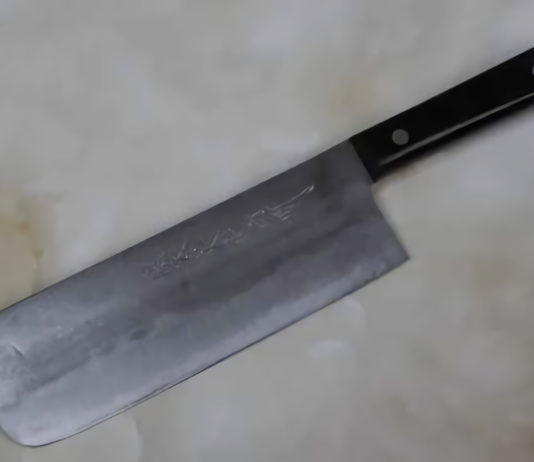
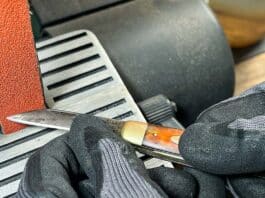
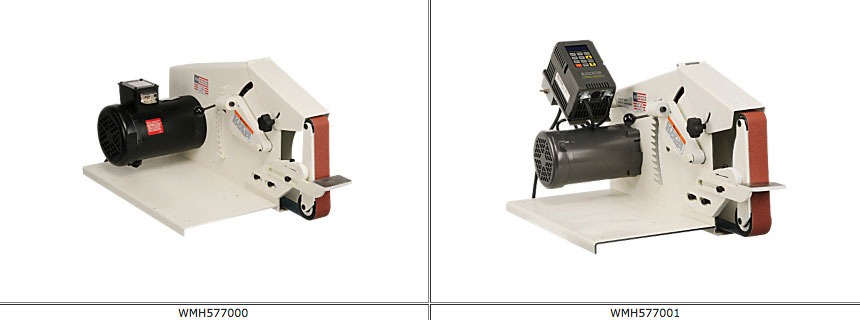
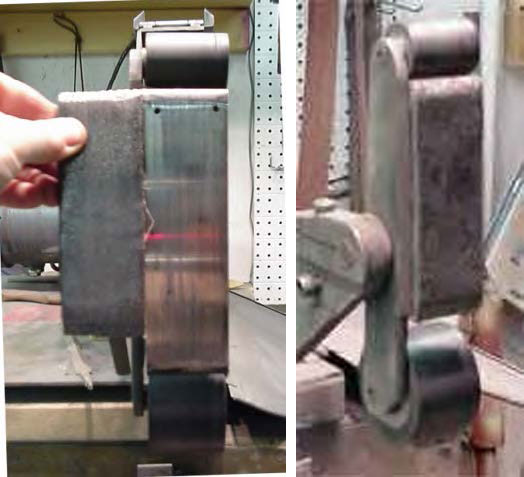
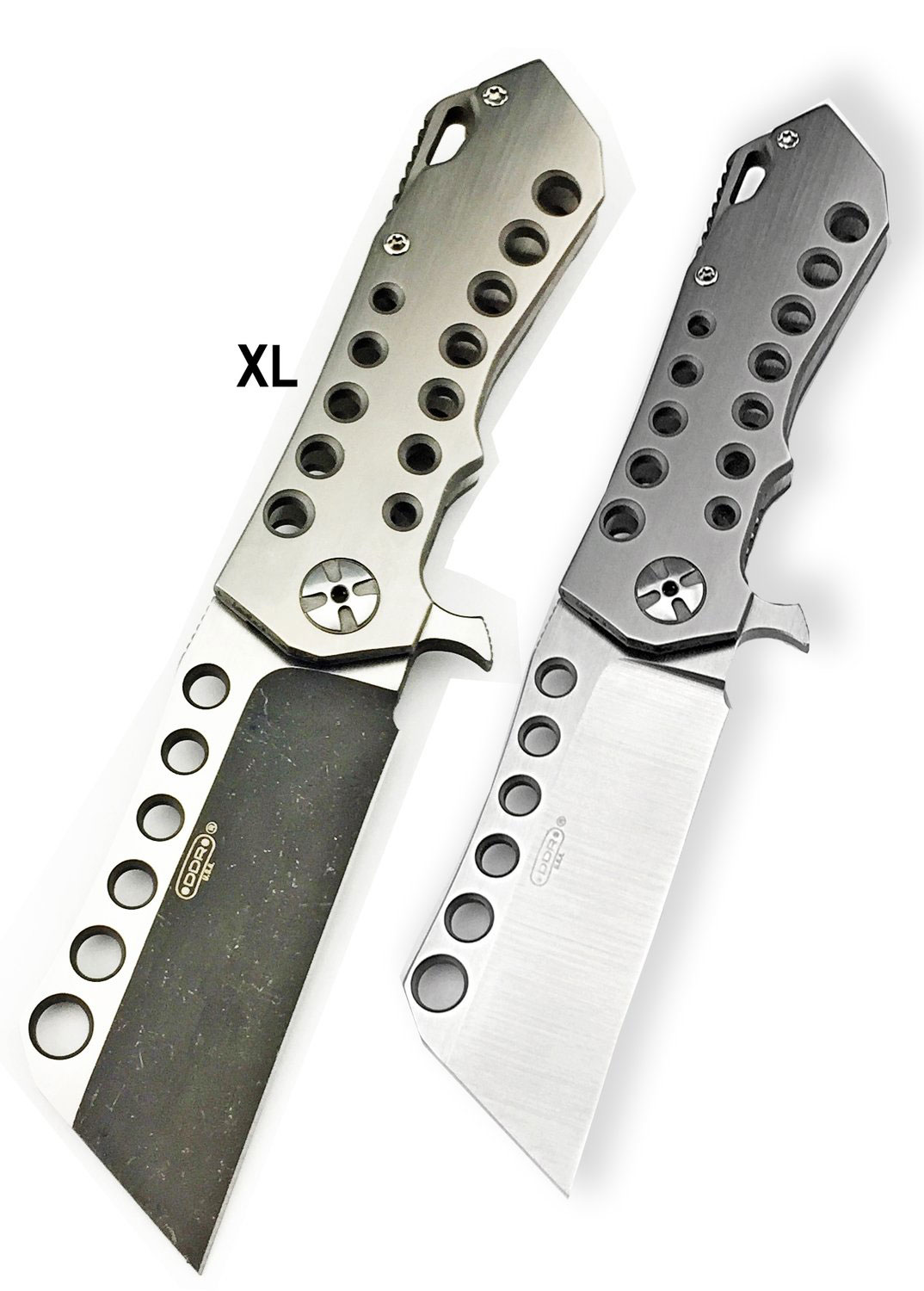
Two variations of the Wilton Square Wheel Grinder. (Images courtesy of Southern-Tool.com)
The variety and types of belt grinders available today is tremendous. Without a doubt each individual has his/her favorite machine. Although all are very good, we always wish that we could make them do more, or modify them to better fit how we each do things in our shop(s).
I have used every grinder out there at one time or another, and have chosen the Wilton Square Wheel as my favorite. The most attractive feature for me is the ease and speed of changing attachments.
As it comes from the factory or dealer, there are a few draw backs that can be irritating to a knifemaker. Below are a few modifications I have made to increase versatility and production in my shop.
Specs
The machine is set up to run either 110VAC or 220VAC. As delivered it is set up to run at 110VAC, I highly recommend setting it up to run on 220VAC. There is a world of difference in the power and smoothness of the machine from 110 to 220. (My machine had change over instructions located inside the switch housing.)
Slow Down
(All images by the author unless otherwise noted.)
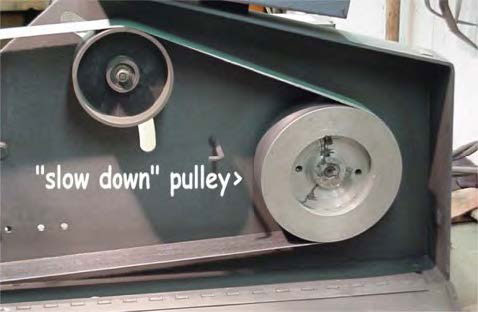
If you did not purchase a variable speed machine, get a “slow down” drive pulley. As it comes from the factory, the Wilton Square Wheel has a 10″ drive pulley that runs the machine at 4600 SFPM (surface feet per minute) Before they were offered commercially, I had one made at a local machine shop. Mine is 7″ dia, and slowed the belt speed down to 2950 SFPM.
By slowing the machine down, it may seem at first that your progress is very slow, but your grinds will come out much nicer, and you’ll get a lot more mileage out of your belts.
Flat Platen Attachment
Next we turn to modification of the flat platen attachment. As it come from the factory, and with the way the platen attachment is cast, there is simply not enough room or tracking adjustment to allow one to create plunge cuts on the left side of the platen (as you are facing the machine).
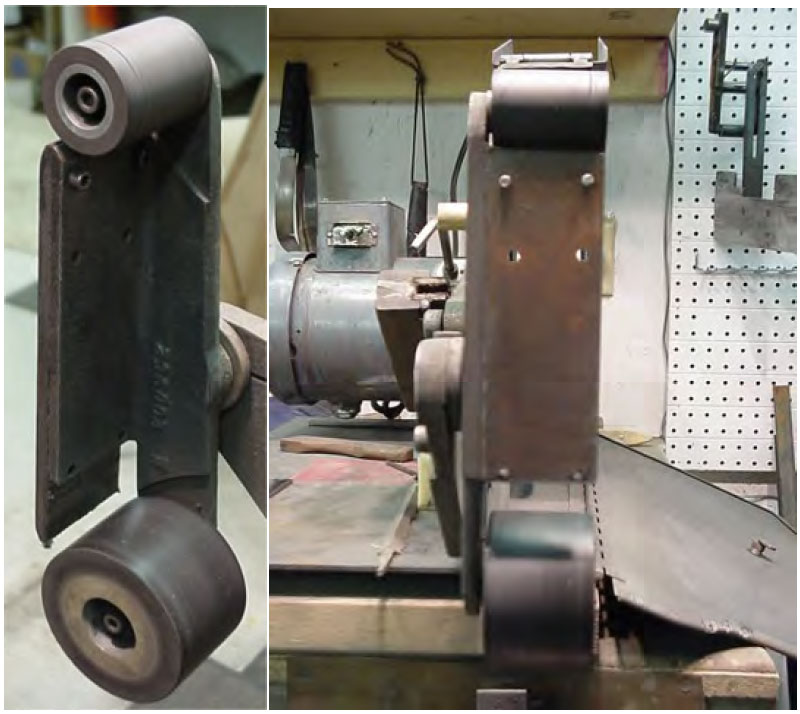
It took me a while to work this one out, but the solution is a simple fix. I created a platen that bolts onto the existing platen. These “add on” platens are nothing more than a piece of 1/4″x 2″x whatever length you want (up to the original 8″) that the belt “rides” over. This will give you plenty of room for plunge cuts. In the photos below you can see how I drilled two holes in the casting, and use two socket head bolts (10-24 thread) to secure the “add on” platen.
The easy way to do this is to remove the contact wheels and use a set of vise grips to drill the holes for threading, and then enlarge the holes in the casting to accept the socket head bolts.
Modify Platen Lengths
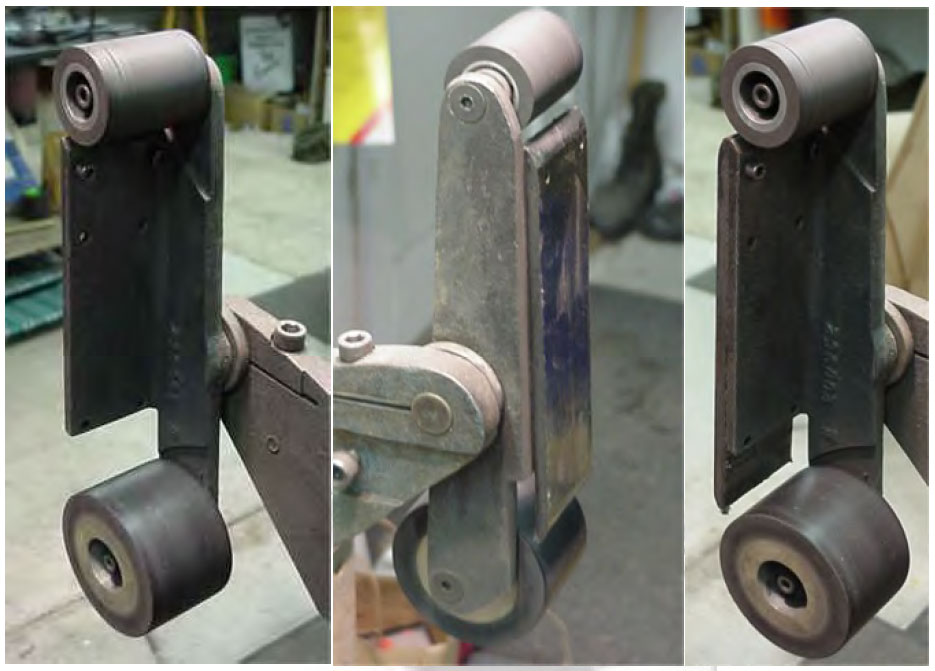
For those who were paying close attention to the photos above, the platen may have seemed shorter than it should be. This brings us to one of the best improvements. Remove 2″ at the bottom of the factory platen casting. This gives an area that is ideal for convex grinding.
Platens can be made in different lengths, for various applications. The above photo on the left shows two different platen sizes, the large for flat grinding, and in the right photo, the shorter platen is in place for convex grinding. Below is a close up view of the setup I use for convex grinding. It’s easy to get carried away and use too much pressure, so nice and easy is the key. You can control the amount of convex with a combination of belt tension, and the amount of pressure you apply to your work piece.
Using the Short Platen
I seldom use the 8″ wheel, with the exception of profiling blades. The long flat platen, I use for flattening, and tapering, the shorter platen is used for convex grinding.
If you have made modifications, and are willing to share your ideas, let me know in the comments.
NOTE: Since first writing this article, I have trashed the idea of using Graphite canvas for a platen backing. This material wears too quickly, causing uneven grinds and just general mayhem. I now use “pyro-ceram” or tempered glass on all my platens. The platen MUST be flat, and the glue used to attach the glass able to withstand heat (I use AccraGlass) but it will improve you grinding 10 fold.
Keep Learning About Knife Grinding with This Download
Does the flow of new knives ever cease? Lord, I hope not.
Midspring is as good a time as any for knife companies to drop new models, variations and what have you. And with this round, we have five new blades from three manufacturers worth a gander.
These knives range across the board, from a very collectible outdoor option to a bevy of affordable pocket pals. Even if they don’t exactly tickle your fancy, these blades are worthwhile window-shopping fodder.
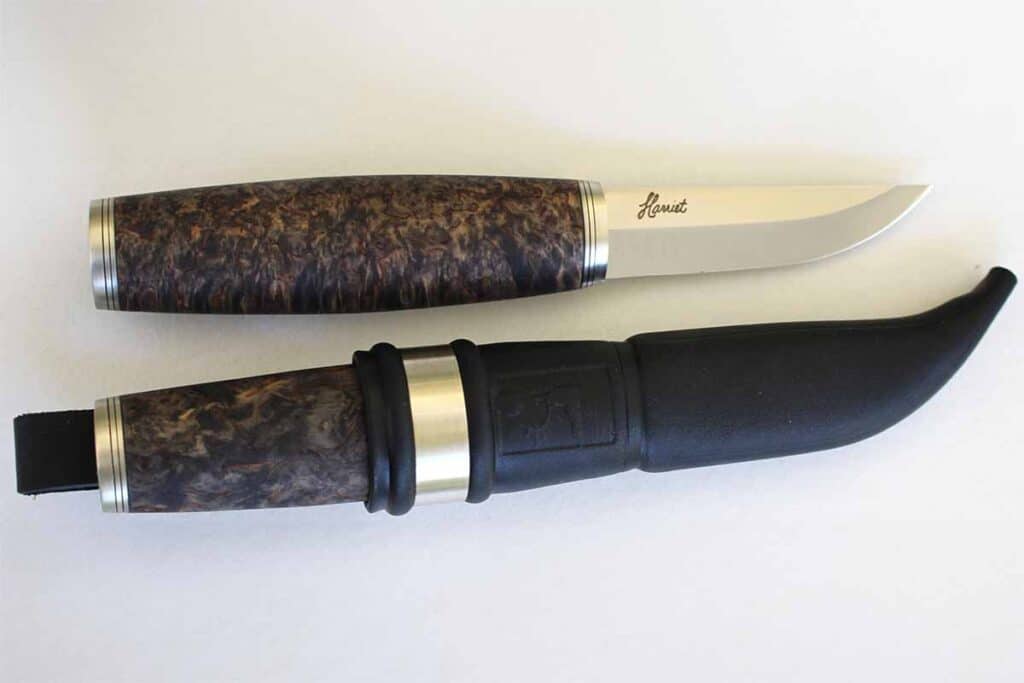
Kellam Knives Harriet70
Puukos are bread and butter at Kellam but its most recent introduction of this style of belt knife might prove better on the mantlepiece than on the hip.
Dubbed the Harriet70, the classic design is a tribute to Harriet Kellokoski, the wife of Kellam’s headman Jouni Kellokoski, for her 70th birthday.
There are a lot of nice points on this limited-edition knife, but what jumped out for me immediately was the handle—more exactly its wood. In this case, it’s arctic curly birch, darkly dyed and lightly oiled for the finish.
The curl pops and plays a beautiful counter to the nickel silver bolster and polished stainless-steel blade.
With 3-inches of wicked-sharp steel to play around with it’d make a solid hunting or fishing option, one dripping with class.
CRKT BOT Deadbolt
I can never complain about a design that puts fast deployment at the forefront of its engineering. Hence the BOT Deadbolt hits a sweet spot for me.
Assisted open with IKBS bearings, the action of this flipper doesn’t disappoint with the drop-point blade winking out in the blink of an eye.
Designed by Flavio Ikoma, the knife also features the Brazilian’s innovative lock—the Deadbolt—which relies on two lugs for extremely strong lockup.
This a much larger knife than what the Deadbolt is usually found on, intentionally so, since Ikoma was aiming for an overall robust system from tip to pocket clip.
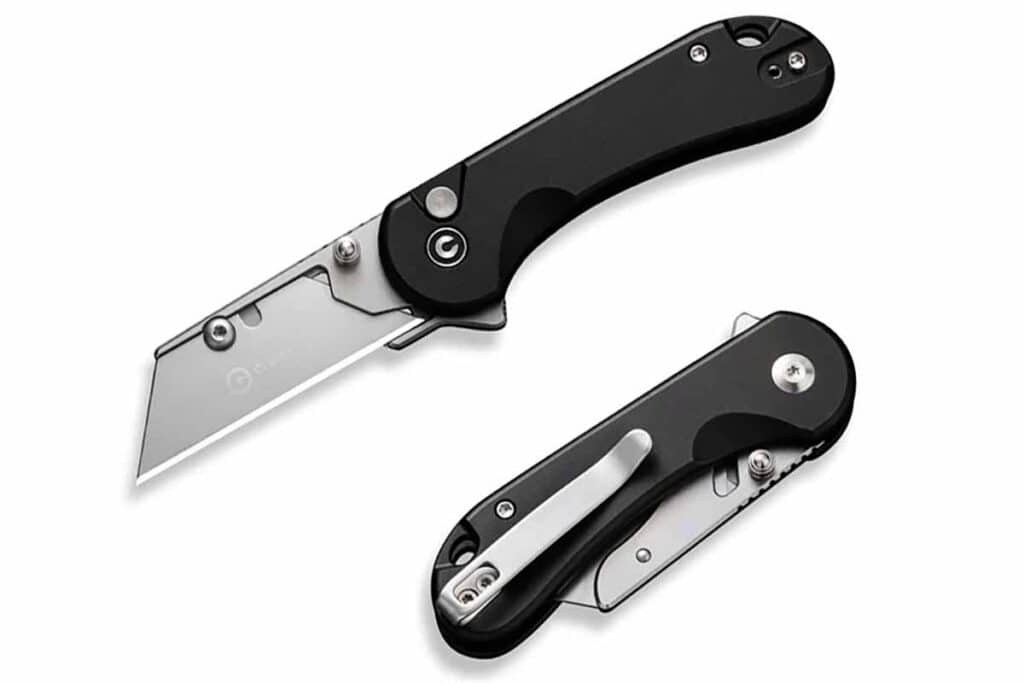
CIVIVI Elementum Utility
Quietly, there’s a utility knife war brew in the knife world. I, for one, say it’s about dang time.
An oft-overlooked corner of the blade world is getting some much-needed attention with the latest enhancement coming from juggernaut CIVVI.
Essentially a flipper/folder utility knife, the Elementum Utility offers perhaps the most important aspect of this class of knives—single-hand deployment. And it delivers it not in one, but three ways via kicker, thumb stud and button lock—if you like flicking out your blade.
CIVVI also delivers a bit of panache with the line, offering the replaceable-blade knife in a slew of colorways on its aluminum handle.
CIVIVI Primitrox
Even without looking at the branding, I think most knife aficionados would have sussed out this is a CIVIVI… or WE or Sencut. It just has the look, design points and action of the tirade’s knives and is close to several other options that already exist in the company’s catalog.
The one that comes to my mind is the WE Saakshi.
However, the Primitrox comes in a bit bigger thanks to a larger 3.89-inch drop-point blade.
The extra steel works to the knife’s advantage giving it not only a more robust design but more mass that flings the blade forward when opening.
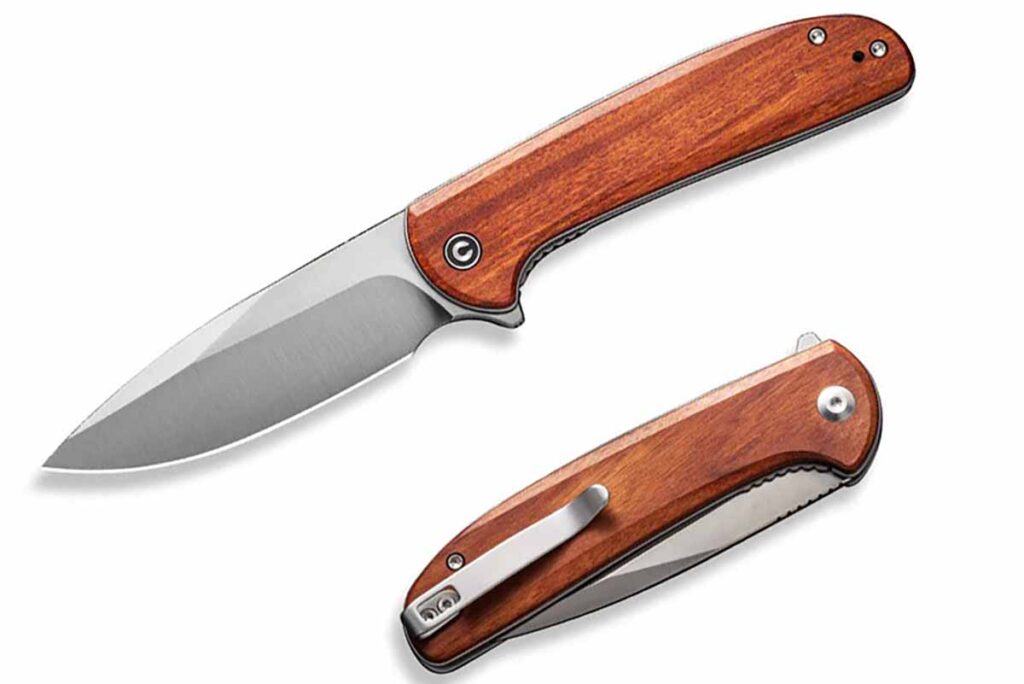
I have to say, the handle options on the knife are nice as well, particularly the Guibourtia wood scale option, which gives the Primitrox a dignified look.
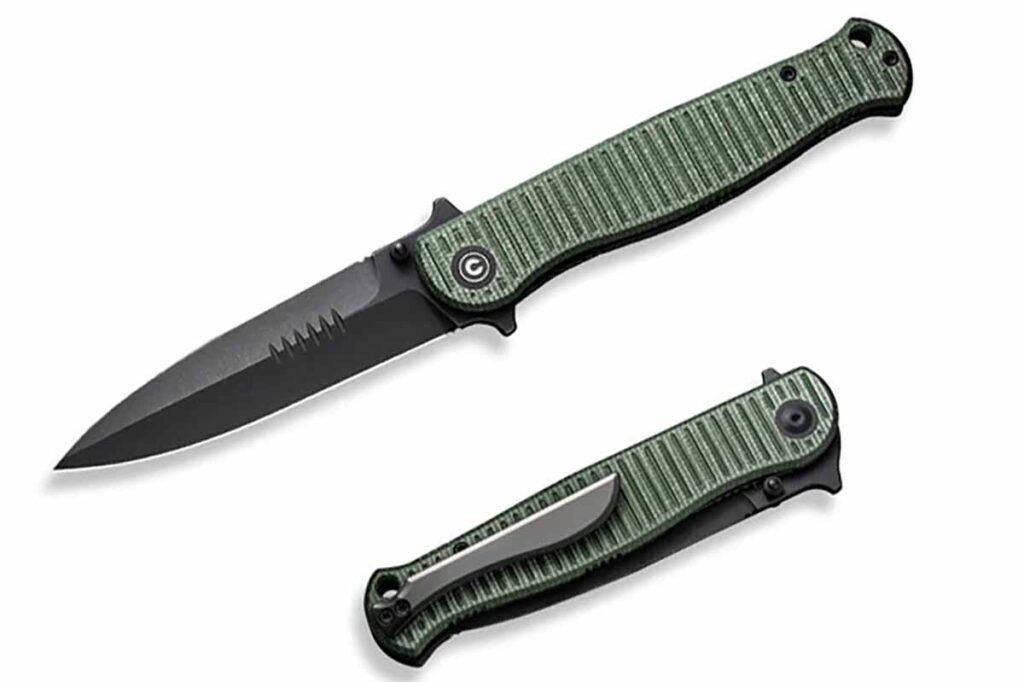
CIVIVI RS71
I have to confess this knife intrigues me. Of course, you’d have to have a heart of stone not to get geeked up over a dagger—or dagger-style—blade.
A Rob Saniscalchi design, the RS71 takes the deadly-looking blade style and tames it down for EDC with plenty of style. But plan on having plenty of pocket space to tote it around, because the CIVIVI borders on behemoth with a full 4-inch blade and 9.31-inch deployment length.
The knife fills the hand, yet the contoured handle makes it very manageable.
I also like the grooving on the scale, which gives it more purchase in the palm and a downright distinctive look.
An iconic knifemaker, Benchmade had earned the respect of discerning knife aficionados. Here are some of the best of what it has to offer.
The Benchmade company as we know it today began in 1980 as Bali-Song, Inc., later Pacific Cutlery Corp. Before its knives got popular on the national scene, the company went through a couple of initial changes in how they produced knives and where, ultimately settling on the ‘Benchmade’ name in 1987.
The hallmark of Benchmade knives has always been extreme quality. When the company began, they were making knives one at a time. While that is not always the case today, the same spirit of persistence and dedication to the end-user remains. Benchmade has made a name for itself across the board with hunters, military, and law enforcement.
Why Benchmade Gets Props
There is an obvious and easy way to explain why Benchmade dominates the production knife market. Their stuff just works. If you buy a Benchmade, it will not necessarily be the cheapest knife on the shelf, but for damn sure, it will do exactly what it was designed to do. Unfortunately, this isn’t the case with a wide swath of the knife industry, where quantity over quality reigns supreme.
The overall quality of Benchmade knives is something that the consumer should be aware of when purchasing blades. In the author’s experience, Benchmade knives have typically outperformed, or at least equally matched any competing model, regardless of price. That is not something that can be said for most other knife companies.
What Benchmade knives offer is something akin to an investment, a lifetime of use should you take care of it.
Great Benchmade Knives
There is no disparity in quality in the Benchmade lineup. But, for this article, the author selected 10 models that best represent what is good about Benchmade, ranging from specialized hunting knives to out-the-front pocketknives. Not all of Benchmade’s lineup is being produced today, and some of the most well-respected versions have been retired, though their descendants are equally as good if not better.
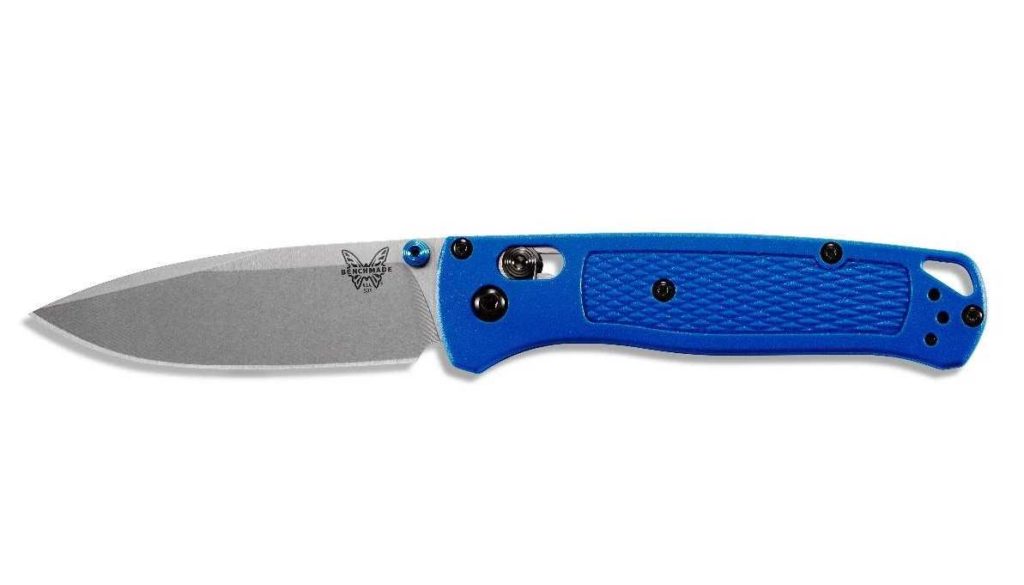
535 Bugout
If there had to be a standard issue pocketknife for across-the-board use today, you would be hard-pressed to argue against the Bugout. It is not the most expensive knife in the lineup, but it is well over the cost of today’s average pocketknife. The Bugout is a well-respected, reliable design, that is both lightweight and has a very reliable, folding and locking mechanism. Designed to stand out, it is available in bright colors, in this case blue. The knife features a blade designed for optimal use in regular situations. It is not exactly an outdoor knife, although it would be at home for small games and fishing.
MSRP: $180
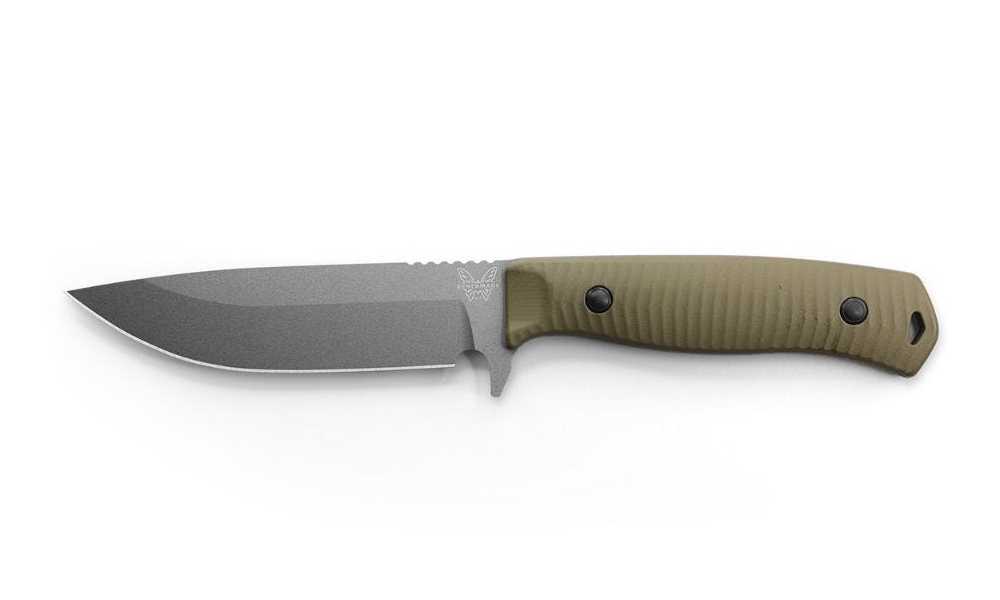
539GY Anonimus
An interesting knife with an interesting name. This one is a hybrid field knife and every day carry fixed blade. The author received an early example of this knife from Benchmade and it has held up extremely well throughout use. The knife is low profile and has a relatively thin spine, making it unsuitable for some of the heavier camp chores and tasks. What it is great for is skinning deer size animals and smaller. To top it off, it has a wide degree of self-defense function. The knife has a notable choil to protect the finger—it makes for ample protection while thrusting hard or holding the knife tip down. Overall, this is a knife that meets a lot of needs and checks a lot of boxes while not being particularly flamboyant.
MSRP: $310
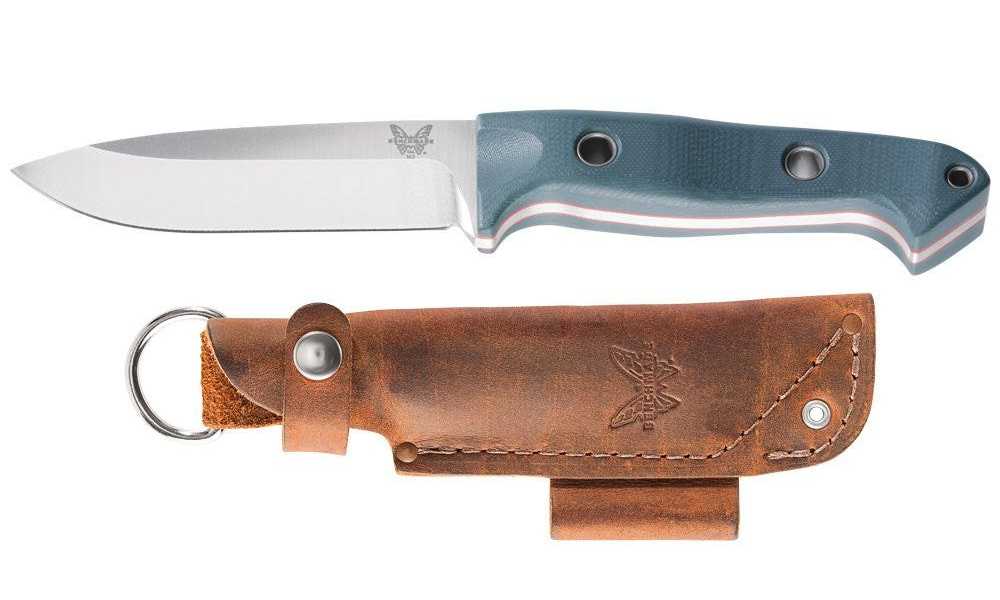
162 Bushcrafter
Out of all the knives on this list, the Bushcrafter is the model that the author has the most extensive experience. The author received this knife for an article in the print edition of Blade Magazine, where he put it through quite a bit of use. The knife has been a constant companion for outdoor chores and is an incredible product. A great deal of the author’s experience comes from fire making and working with bushcrafting materials, and while this knife certainly meets that task with flying colors, some criticisms can be had given the amount of time the author has spent with it.
The first of these is that this is a relatively small chore knife. The blade is not long enough for heavy work and wood splitting. It is a knife that is usable at the end stage after most of the splitting has been done, meaning you will need to carry additional tools. If you were trying to get a fire started with this knife it is great for striking a rod, which is sadly not included in the price. Many competing designs that have performed equally well if not better have come with striker rods in the same MSRP range. Why Benchmade included the loop but no striker is a mystery.
The handle ergonomics are a little bit more angular than is needed, competing knives that have smoother and more contoured handles are better for extended periods of work and generate fewer hot spots. For the casual camper, this is an exceptional knife. The author tends to fall into the category of outdoorsman that believes you need a 6-inch or 7-inch blade to get stuff done. Smaller blades are the favorite of many people, the author finds them to be fatiguing to use and many times difficult to dislodge from pieces of wood or harder to use when skinning large game on the ground. That said, this is a fantastic knife, the author wishes that Benchmade will come out with a slightly larger version with a thicker spine.
MSRP: $300
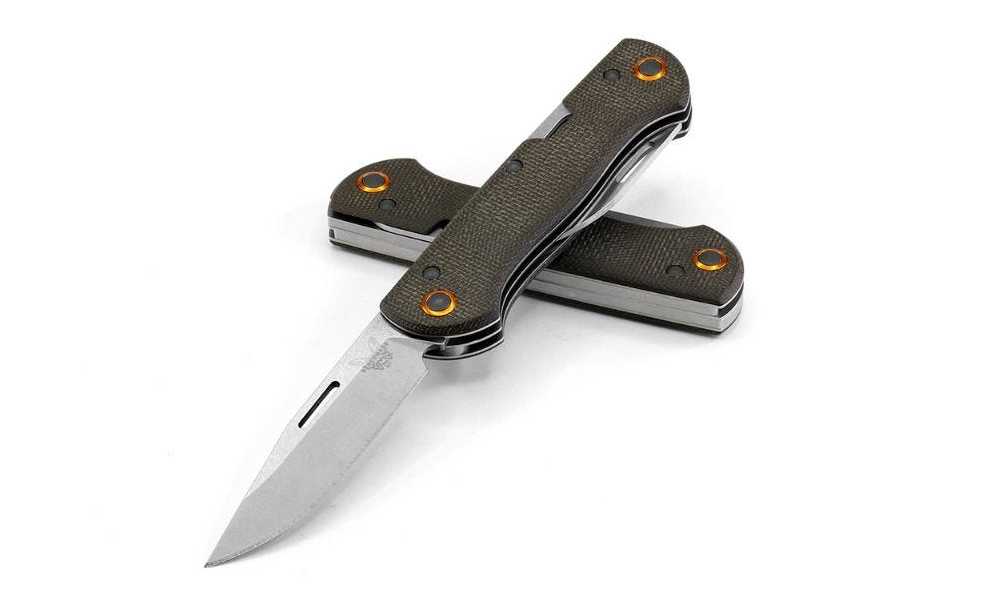
317-1 Weekender
If you are casually out and about with your friends on your party barge, this knife is an exceptional comrade. It is something of a modern pen knife in that it features two blades as well as a bottle opener. It is an excellent knife for daily use and covers just about all regular cutting chores you may encounter in your day-to-day existence, barring of course any heavy-duty uses. The knife is beautifully finished and has excellent accent work, it is surely something you will want to show to your friends.
MSRP: $275
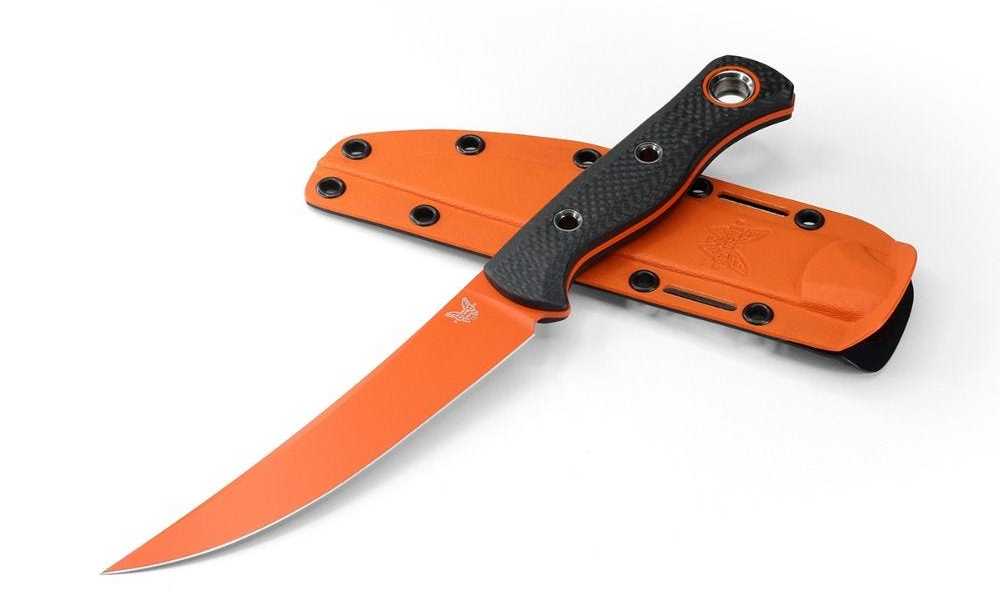
15000OR-2 Meatcrafter
This is another knife that the author reviewed for the print edition of Blade Magazine. The author received one of the first initial prototypes for testing. The Meatcrafter knife is an excellent tool, something of a hybrid between a fillet knife, a kitchen knife, and a hunting knife. It is relatively thin in the spine and cannot be used for tasks such as splitting wood, or really anything above cutting soft material.
Benchmade has a series of these knives now, available in a variety of colors and blade finishes. The knife is very well adapted to its specific role. The author butchered a deer with the prototype, and it proved to be an exceptionally sharp cutting tool, so much so that it simply glided through the meat with almost no effort. Because of its thin blade and very fine tip, it can be used for boning out meat at just about any angle. The blade is flexible enough that it can be used to get into some nooks and crannies that thicker and stiffer blades would have a hard time with. The knife does have limitations, though, and one should take care to not drop it on its tip or put it through use that results in extreme bending or pressure on the tip, an example of this would be cutting into the ball joint on the pelvis of a large game animal. There is arguably no finer game knife on the market today than this one. It is quite expensive, but it is something that will last you a lifetime with care.
MSRP: $450
Station Knife
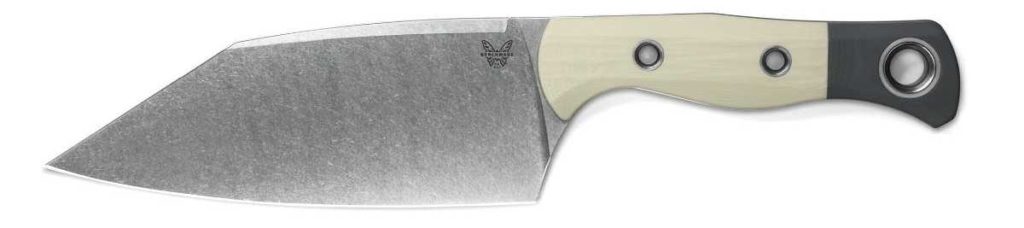
The Station Kinfe is available as a custom order option from Benchmade. The website has a configuration selector where you can pick out every detail of this knife. It is an all-purpose kitchen tool, able to do just about anything that you could imagine a knife could do, from slicing to dicing to breaking down meat and vegetables, as well as carving and serving. If you are a professional in the food service industry, this knife is something of the Holy Grail. Because of its unique shape, it can be used for a variety of cooking styles, not just traditional American cooking, but also different Asian, South American, and European styles. The use of the knife in these culinary arts tends to vary, and you’ll be prepared for all of them with the station knife.
MSRP: Starting at $280
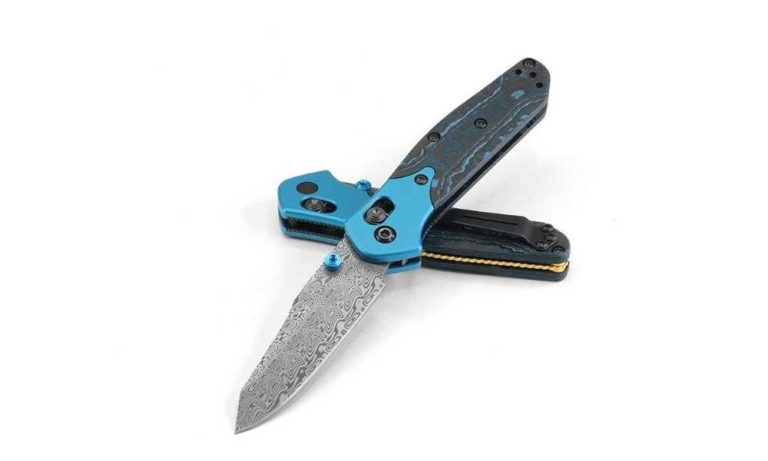
945-221 Mini Osbourne
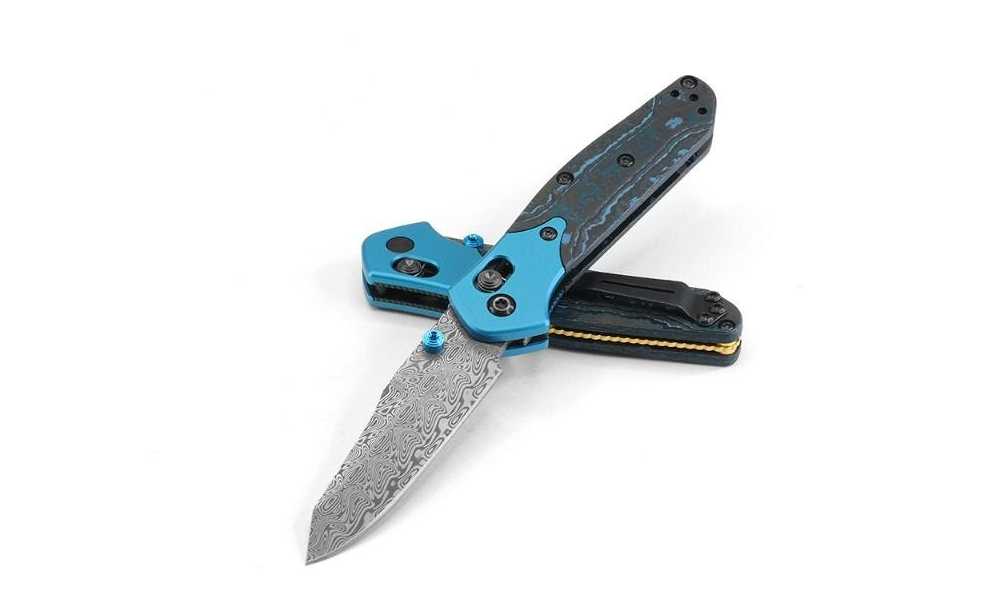
If you are looking for a pocketknife that truly sets you apart as a gentleman, the mini Osborne is one that you will certainly want to take a look at. The author has carried a version of this knife for a couple of years, it is not a heavy-duty, knife whatsoever, the blade is relatively thin, and the frame is lightly constructed. However, it is excellent at his job, which is a dedicated pocket knife. There are several variations of this knife available from Benchmade, it is a very popular design thanks to its lightweight and ease of use. The version shown here is at the top end of their design range, made of incredible materials, which will surely catch the eye.
MSRP: $700
34000BK-1 Autocrat
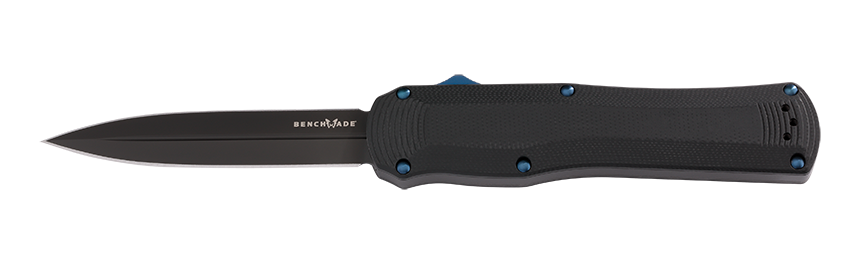
This is arguably the king of out-the-front knives. Bench made has truly made a name for itself in this category of knives, while it is quite expensive, it has probably the most reliable mechanism of any OTF knife currently on the market and is constructed with durability in mind. The handle is, not gimmicky, rather, it is simple in overall appearance. Critics of the knife would like to see more embellishment, but the author is just the opposite, OTF knives are not an inherently strong or reliable design. In general, simplicity is king, and reliability stands above that.
MSRP: $500
15060-2 Grizzly Creek
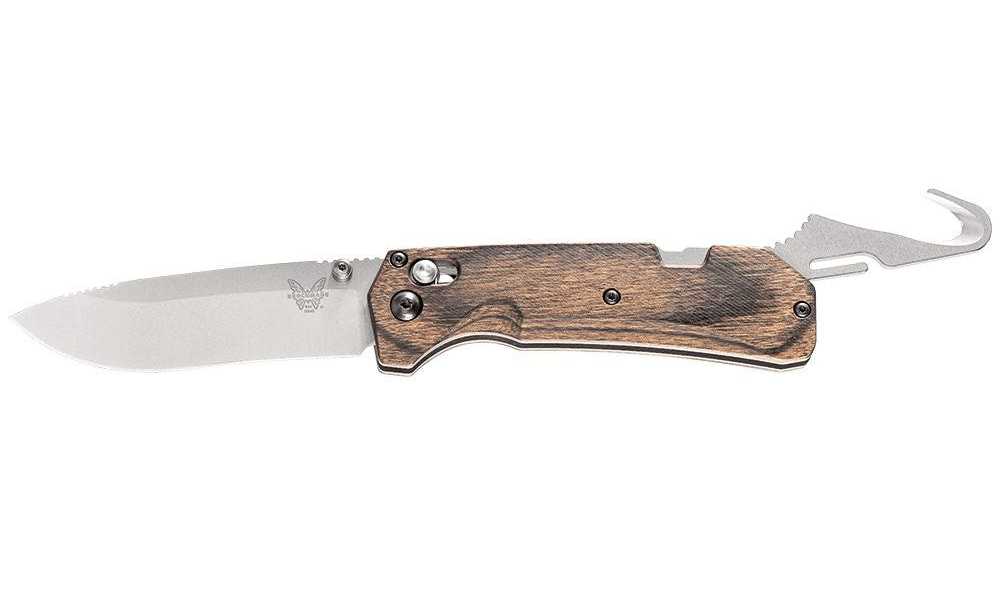
The Grizzly Creek is an excellent, professional-level field knife that can fit just about anywhere. It is not a camp knife in the sense that it can be used for a large amount of splitting or heavy chores, however, it is excellent for breaking down game, regardless of size. Because it is a folder, the blade is not especially long, making it not as good for big game. For all general hunting, it will work, though, you may have some struggles with large deer and above. The knife features a folding gut hook that can also be used to cut fishing line and a variety of other outdoor tasks. The price is right for a working knife; it is not the most embellished or interesting-looking product from Benchmade, but it will certainly do well given its features and intended use.
MSRP: $250
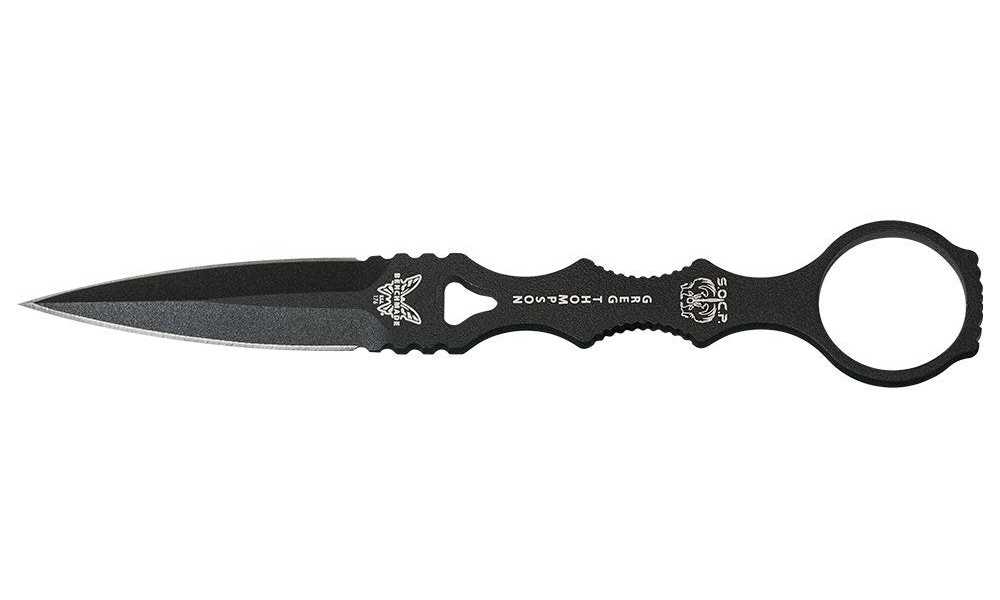
176BK SOCP
The last knife on our list is the discrete SOCP. This is a little dagger with a ring pommel designed to be used as a last-ditch item integrated into your gear. The knife can be used on just about any finger depending on what you’re trying to manipulate. At $130. It may seem a little bit overpriced for a small dagger, but it is a well-made tool that can get you out of some very sticky situations. It is worth noting, that not every municipality allows the carrying of a fixed-blade dagger, you’ll have to check your local laws if you plan to carry this knife.
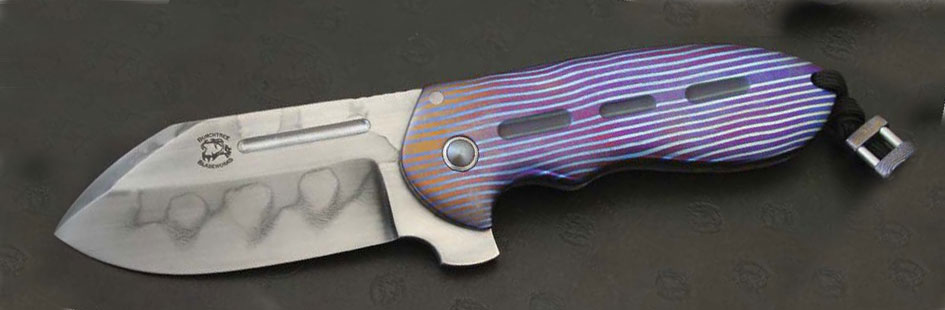
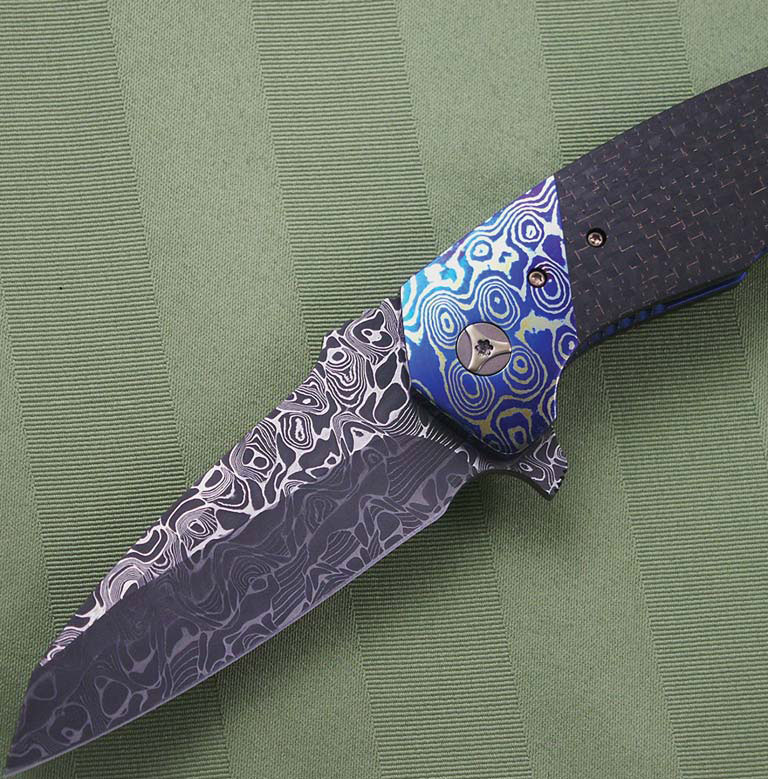
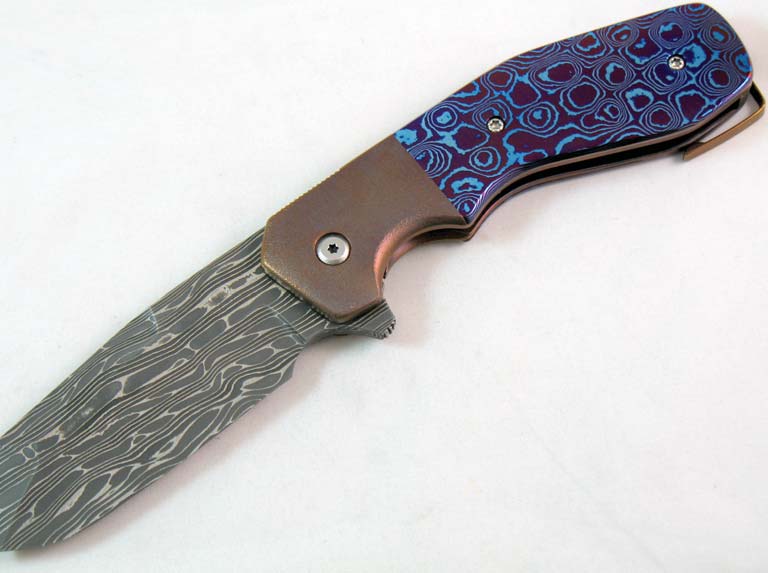
Michael Burch employed Chad Nichols’ “Stripes” MokuTi for his integral folder. The blade is 1095 carbon steel with hamon and a nail nick. Burch said the Stripes MokuTi works well on larger knives. (photos courtesy of Michael Burch)
In the northern Mississippi town of Blue Springs, in a rural area between Tupelo and the Tennessee border, a company called Chad Nichols Damascus is forging steel that is taking knives to a new level. The company’s owner and namesake, Chad is an easygoing Southerner who created a damascus product called MokuTi that boasts a stunning combination of shapes and colors.
The name explains it perfectly. It is mokume that includes titanium laminates. MokuTi adds an exceptional visual boost to a knife, with swirled or mosaic tones of blue, gold, orange, silver and pink, depending on the composition of the materials used.
In his affable manner, Chad assured that Chad Nichols Damascus did not invent the colorful titanium laminate; the company just came up with a new way to achieve it—which, he noted, was not an easy task.
“We haven’t invented the wheel or anything,” Nichols said of MokuTi. “I don’t have to be the first one doing anything. I just want to be the last one doing it. We run this like a business, not an ego trip.”
Years in the Making
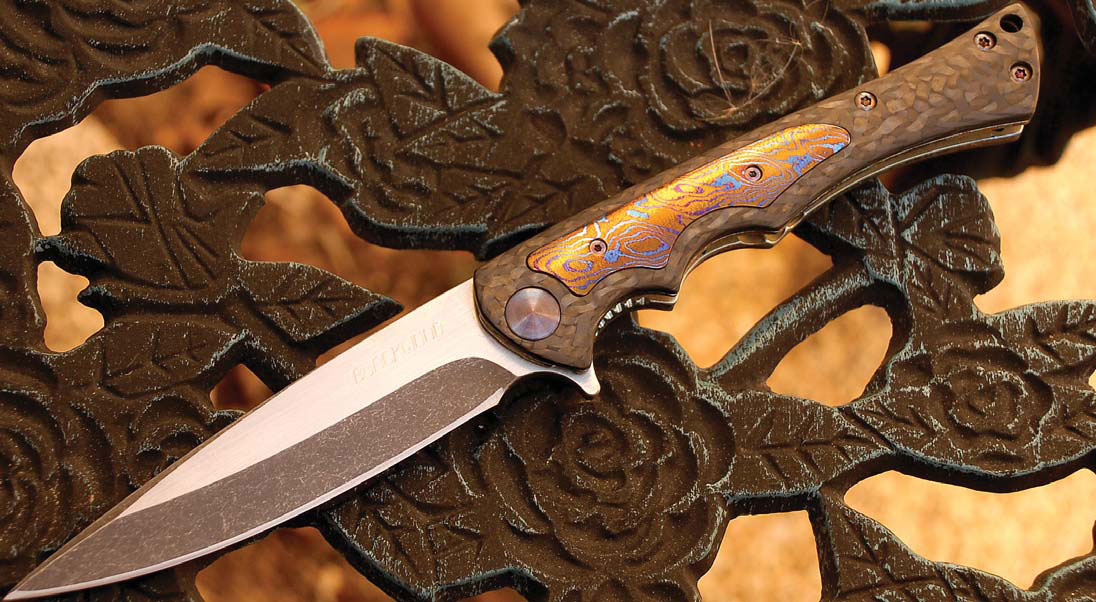
MokuTi is a great way to accent a knife with color. Neil Blackwood does it here for the handle inlay and clip of his Henchman flipper folder. The 4-inch blade is CPM S30V with a two-tone finish. His list price for a similar knife: $1,200. (photo courtesy of Neil Blackwood)
It would figure that something that looks as good as MokuTi would be difficult to produce. Nichols said it took several years to figure out.
“That’s not blowing it out of proportion,” he laughed. “I messed with it for a while, then I just put it away because I kept failing.”
He remembered getting tunnel vision trying to figure out why it was not working.
“You keep doing it and it’s insane,” he said, “because if it didn’t work the first three times and you didn’t do anything different, it’s not going to work the fourth time.”
Through trial and error he was finally able to figure out how to bond titanium with the other metals, but he is understandably tight-lipped about his proprietary secrets.
“I’m not going to tell you how we do it,” he admitted, “but there’s things we do that might seem minute to some people. However, we found those things to be critical.”
He explained a myriad of variables when bonding the layers in presses and rolling mills, including oxygen, heat and surface texture.
“Without getting into too much detail as far as bonding the layers, I’ll just say it’s tricky and it doesn’t always work,” Nichols allowed. “If I don’t make MokuTi for a month or two, I kind of count on the first two tries being crap.”
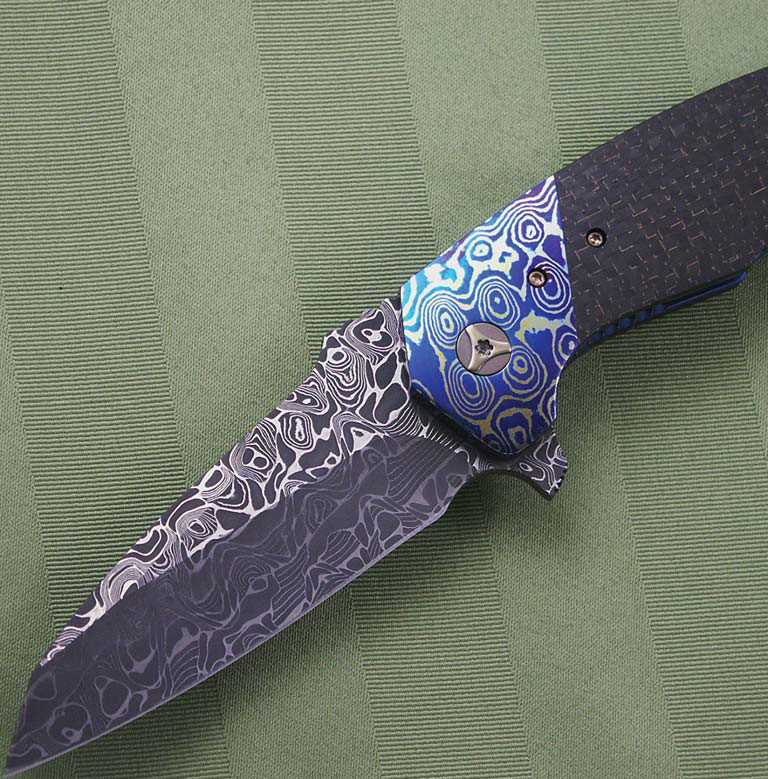
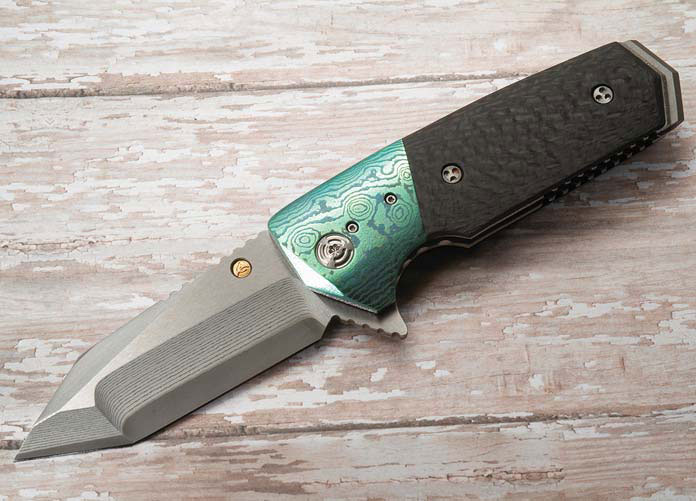
Peter Carey outfitted his Tension flipper folder with “Crosswalk” MokuTi bolsters and a blade and clip of Nichols’ “Whiplash” stainless damascus. The handle is lightning-strike carbon fiber. Carey’s list price for a similar model: $1,200. (photo courtesy of Peter Carey)
The experimental journey to fruition brought Nichols’ shop down some rocky roads.
“We recently made some MokuTi and threw zirconium in there,” he noted. “We love bonding titanium to other metals, but you just can’t do anything with [titanium and zirconium]. They just won’t bond because I guess the ductility is too different and the metals move at different rates during forging. It was a disaster, so we quit trying.”
It is all part of the ride, he said, and you cannot be scared to “just throw something in there” and see what happens.
Meteorology Matters
Another variable that affects producing MokuTi successfully is the atmosphere. While forging carbon damascus is fairly predictable, Nichols said forging MokuTi is much more complex.
“When you get into stainless and even Mokume, with the copper and brass with the nickel silver in it, and especially with the MokuTi, it gets complicated,” he continued. “What people don’t understand about forging, especially down where I live, is that with humidity of 100 percent is going to get hotter than if it’s 50 percent the next day.”
A Sixth Sense for MokuTi Damascus
Nichols searched for the words to explain his approach. Maybe it is a feeling, maybe it is a sixth sense, and maybe it is just exposure and experience.
“I hate saying this but you just get in tune with what’s going on. It’s like using the word ‘organic.’ I hate it when I have to use that word, but sometimes there’s no other word to describe it,” he lamented. “We made a new pattern a couple weeks ago called ‘Boomerang’ and some guy goes, ‘What’s it like?’ and, between groans, I said, ‘It’s very organic looking.’”
Put a Tie on that Knife
The MokuTi handle of Jon Graham’s GL Razel SS3 Bolsterlock is joined by a blade of Chad Nichols’ Iguana stainless damascus and Graham’s “Tailclip” pocket clip. Closed length: 5 inches. Graham’s list price for a similar piece: $1,400. (photo courtesy of Jon Graham)
“I’ve used MokuTi on a variety of styles,” said Michael Burch, Missouri knifemaker and owner of Burchtree Blades. “It’s like putting a tie on a knife—it just adds some class.”
Adding MokuTi as an accent is a common way to integrate the material into a knife without breaking the bank. Still, it is not cheap. The more of it the maker adds to the knife, the more it adds to the sale price.
“I charge twice as much for MokuTi bolsters as I would titanium bolsters due to the extra finishing time with polishing and heat coloring,” explained knifemaker Peter Carey. “I use MokuTi on all my folders because it’s strong and has an exotic look.”
Carey said he also uses it as an accent material on his knives, such as for bolsters, pocket clips, back spacers, thumb studs and pivot rings. He said accenting with MokuTi injects some color and flash without overwhelming the knife. A good example of employing MokuTi is as a pivot collar on a stonewashed framelock, Burch added.
The Mini Tank flipper by Allen Elishewitz has MokuTi bolsters and carbon fiber scales. The blade is Takefu Special Steel’s laminated stainless with a VG-10 core. (photo courtesy of Allen Elishewitz)
“It makes for great contrast and can really dress up a user folder,” he observed. “It’s costly but if customers saw what went into making it, it would seem cheap.”
“It appears that everyone likes the material and it usually ends up on my higher-end knives,” Carey said. “Some of my customers ask for it as full scales or for a framelock, so I use it that way also.”
As Carey noted, MokuTi comes from Nichols Damascus as a billet that must be worked to shape and then colored.
“[Chad] usually colors it so you can see the pattern, but that gets ground off when you work it,” Carey said, explaining that it is a surface color that does not go all the way though the material. “When you get it to final shape and finish, you have to heat color or anodize it to the colors you want.”
“The other cool thing about MokuTi is dealing with Chad,” he maintained. “He’s a great guy, a friend, hard working and you can’t beat his customer service.”
Correct sharpener selection is imperative for keen household cutlery. With that, here are four kitchen knife sharpeners that make the cut.
Dull kitchen knives not only make meal preparation more difficult, they also can slip and cut you when you least expect it. As a result, it’s imperative to keep them sharp. If you sharpen them yourself, correct sharpener selection is key.
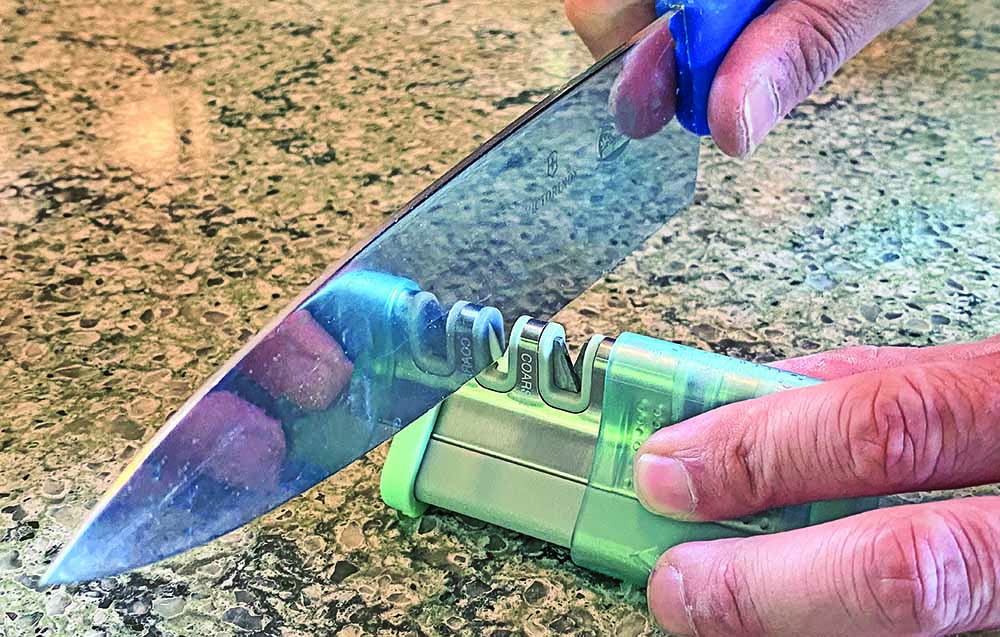
A kitchen knife sharpeners can be as simple or complicated as you want. No matter your skill level, there is a sharpener for you. For those with little-to-no sharpening experience are the cost-effective pull-through sharpeners. These are as simple as simple can get. Often they are plastic-bodied devices with one or two slots. Inside the slots are the sharpening media. The media are permanently affixed at pre-set angles The most common media for the two-slotters are carbide and a fine-grit ceramic. The carbide quickly restores damaged and worn edges, while the fine-grit ceramic polishes and hones the edge to razor sharpness. Anyone can achieve a sharp edge with a pull-through.
Smith’s Products Slide Sharp Edge Grip
Smith’s Slide Sharp has two pairs of pull-through slots to address both standard and Asian-style kitchen knives.
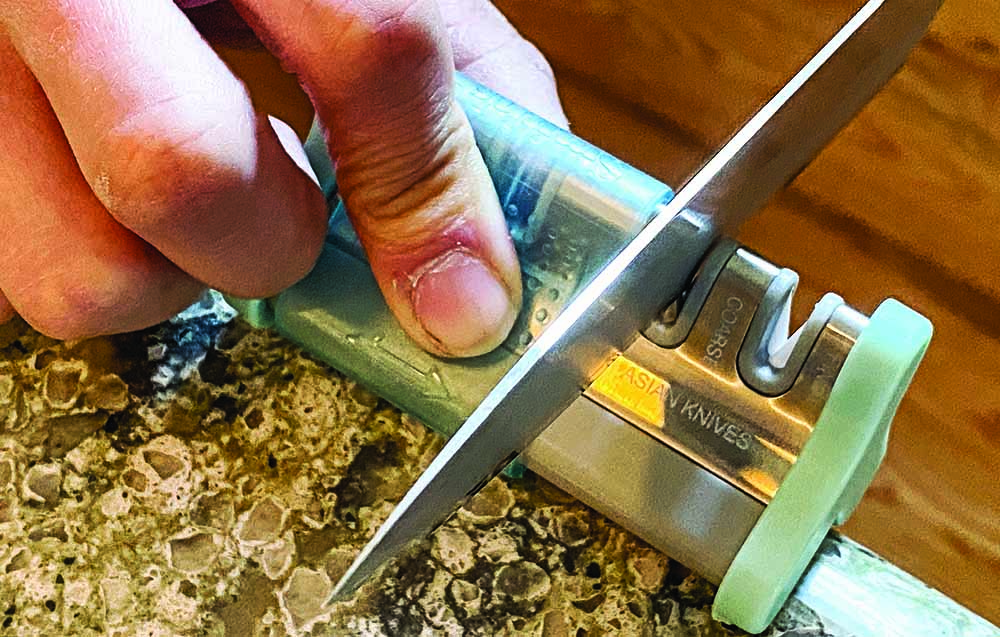
One such kitchen knife sharpener is the Smith’s Products Slide Sharp Edge Grip. It has two sets of slots. One pair addresses standard kitchen knives at a pre-set 20-degree angle, and the other addresses Asian-style knives at a 15-degree angle. The standard slots have carbide for a coarse grit abrasive and ceramic for fine grit. The Asian-style slots have diamond rods for coarse grit and ceramic for fine.
The Slide Sharp’s indexed sliding grip is textured for a non-slip purchase to allow for secure sharpening. Depending on which slot set you use, the other set is covered by a sliding cover, which is how the sharpener is stabilized—by placing your hand over the sliding cover.
The cross-section of the sharpener resembles an upside-down “Y,” with the arched base held in place on the edge of a table or counter. This gives you another option for stable sharpener operation. Consequently, you have two ways to secure the sharpener during use. Few pull throughs provide such an option.
The Slide Sharp is effective and works as advertised. To use it on a countertop or tabletop, take one hand and stabilize it on the flat work surface. To use it on the edge of a kitchen counter, sit it on the counter edge via the “Y” legs and, while holding it with one hand, pull the blade through and down with the other. You have a better line of sight
to the sharpener this way and it’s very safe, too.
Designed with an upside down “Y” frame, the Smith’s Slide Sharp sits securely while held to the edge of a countertop. This puts the sharpening slots at an angle for better viewing while in use.
If you must use a pull-through, I highly recommend the Slide Sharp. I also recommend using the lightest pressure as possible to sharpen, as pull-throughs can remove too much metal, more so than ceramic, diamond or powered abrasive belt sharpeners. Removing too much metal can prematurely deform the cutting edge.
The Slide Sharp is a little over 1.5 inches tall and a bit under 3.5 inches long. Its compact nature enables convenient drawer storage. The manufacturer’s suggested retail price (MSRP) of $11.99 makes it incredibly affordable and provides no excuse for anyone to have dull kitchen knives. MSRP: $11.99
Camillus Extreme Edge V2 Knife & Shear Sharpener
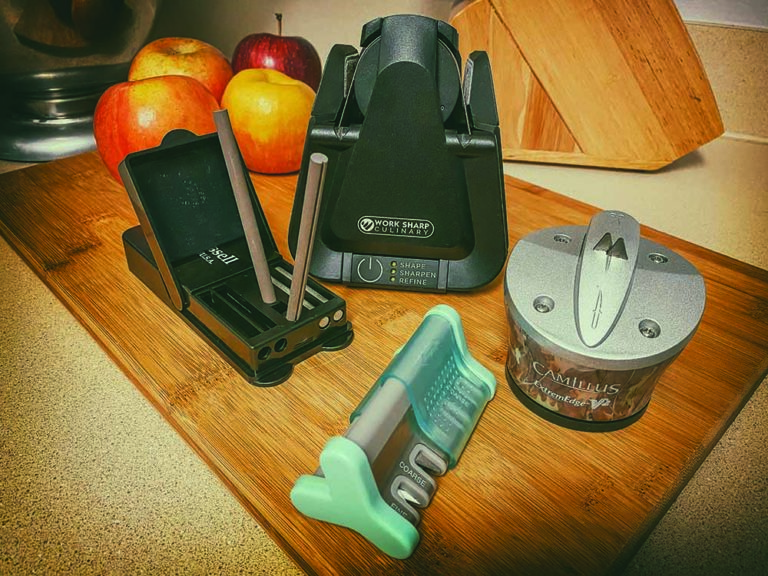
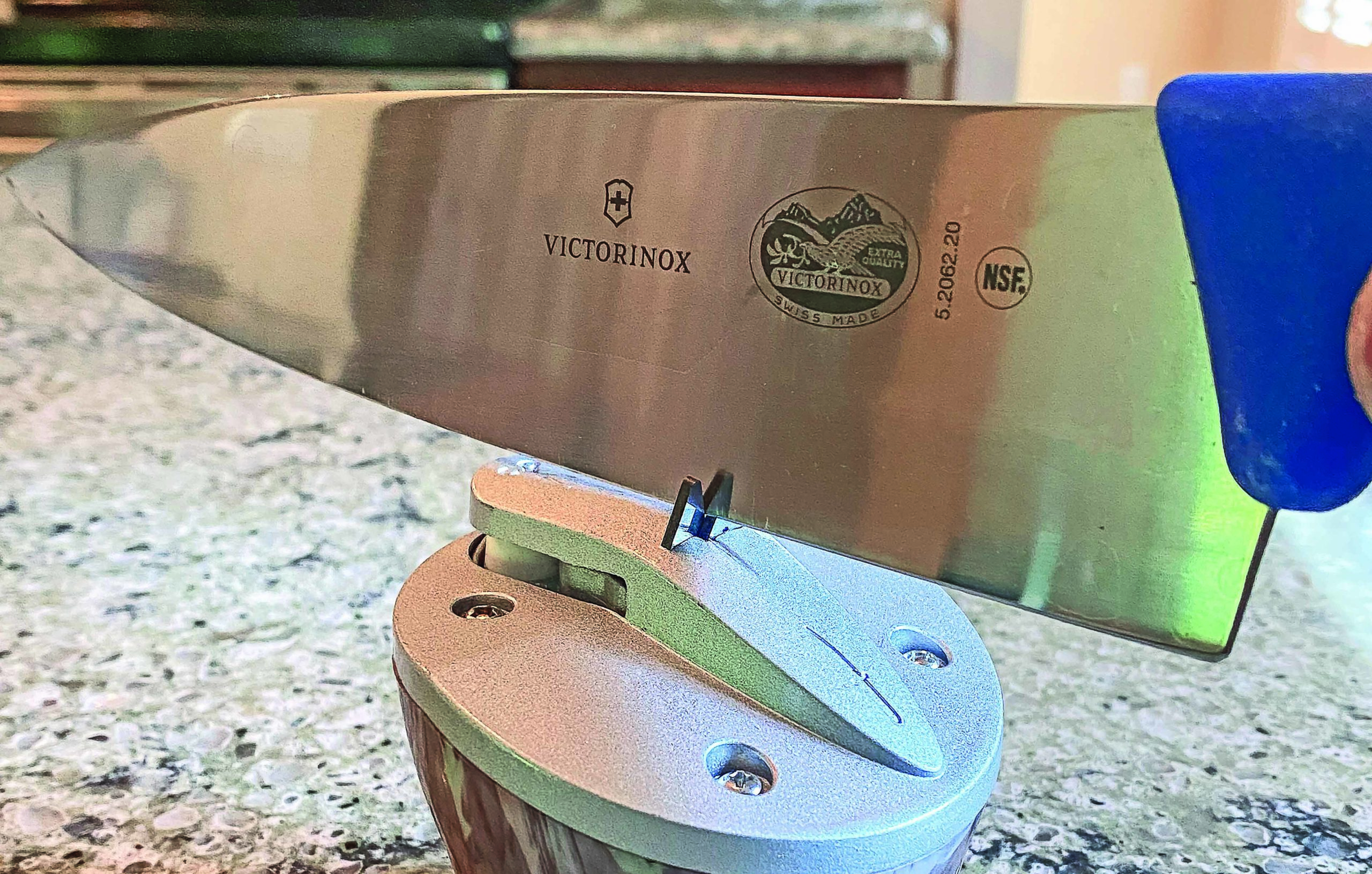
The Camillus Extreme Edge V2 Knife & Shear Sharpener features a pull-through design with carbide media for kitchen knives and fine ceramic for shears to establish edges in quick fashion.
The Extreme Edge V2 Knife & Tool pull-through from Camillus is a two-for-one deal. A set of carbide abrasives addresses plain edge and kitchen knives. It also features a built-in shears sharpener.
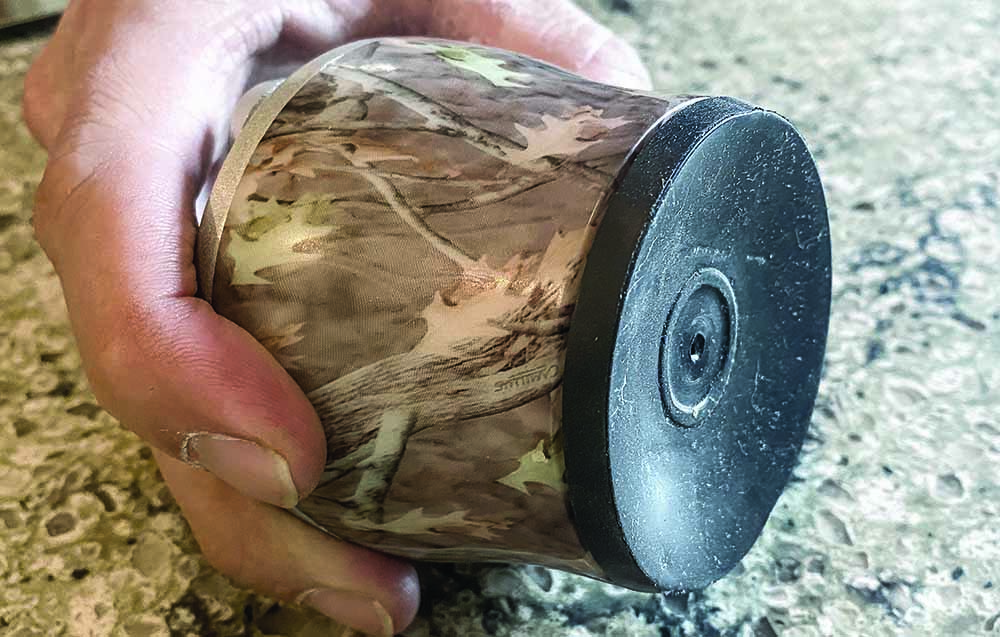
The cylindrical body is around 3 inches in diameter. The top is cast metal and houses the carbides, while the fine-grit-ceramic shears sharpener is in the unit’s rear. The plastic body has an outdoorsy camo theme appearance. For safe operation, a suction cup at the base activates by pressing down and rotating the unit to firmly grip the tabletop surface. For scenarios where the suction cup feature isn’t feasible, it acts as a standard non-skid base.
The sharpener works OK, though I didn’t feel the carbides to be as aggressive as with other pull-throughs I’ve used. The edge it produced was sharp though not surgical sharp. At least the V2 provides a functional sharp edge, which is better than having no sharpener and a dull edge.
The suction cup base of the Camillus Extreme Edge V2 is designed to stick to a slick surface for stable sharpening.
The suction cup base was a disappointment. I could not get it to cling to the slick worktop of my toolbox most of the time. You must really press down on the sharpener and twist it to get it to stick, but it kept loosening repeatedly. However, you can still use the sharpener safely and effectively by employing the suction cup as a non-skid rubber base. Oh, and one of the carbide teeth loosened up after the first few uses, which is unacceptable. MSRP: $19.98.
A.G. Russell Knives Field Sharpener
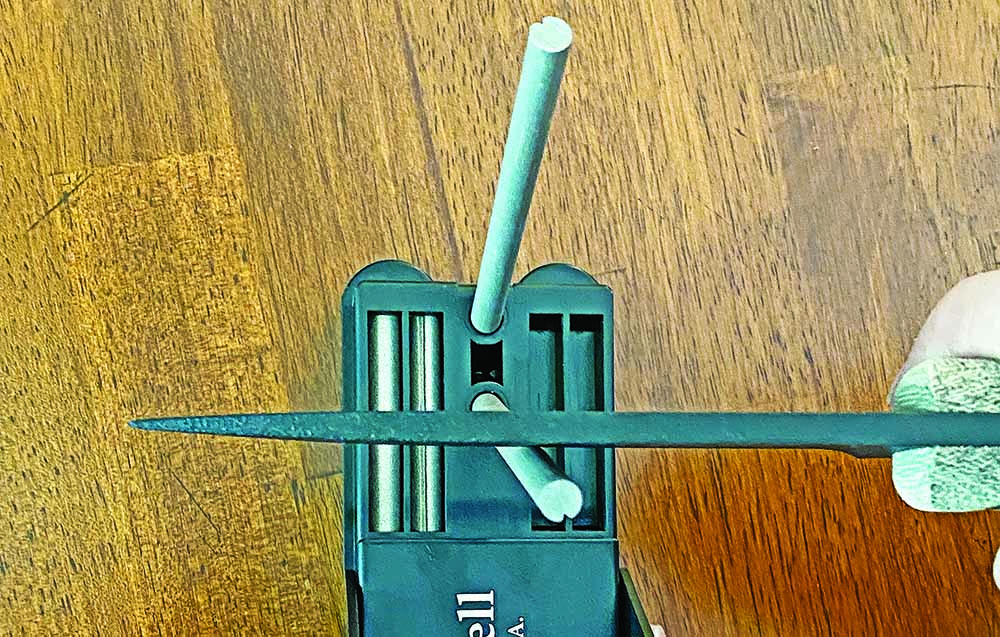
You can see the diamond-grit hones stored in slots in the base of the A.G. Russell Field Sharpener. This is a completely functional, self-contained guided sharpening system that goes anywhere you do.
The A.G. Russell Knives Field Sharpener is probably the most versatile of the test bunch of kitchen knife sharpeners. Not only does it sharpen kitchen knives but also pocket knives, hunting knives and tactical knives. Such value and versatility is a hard combo to top no matter how you slice it.
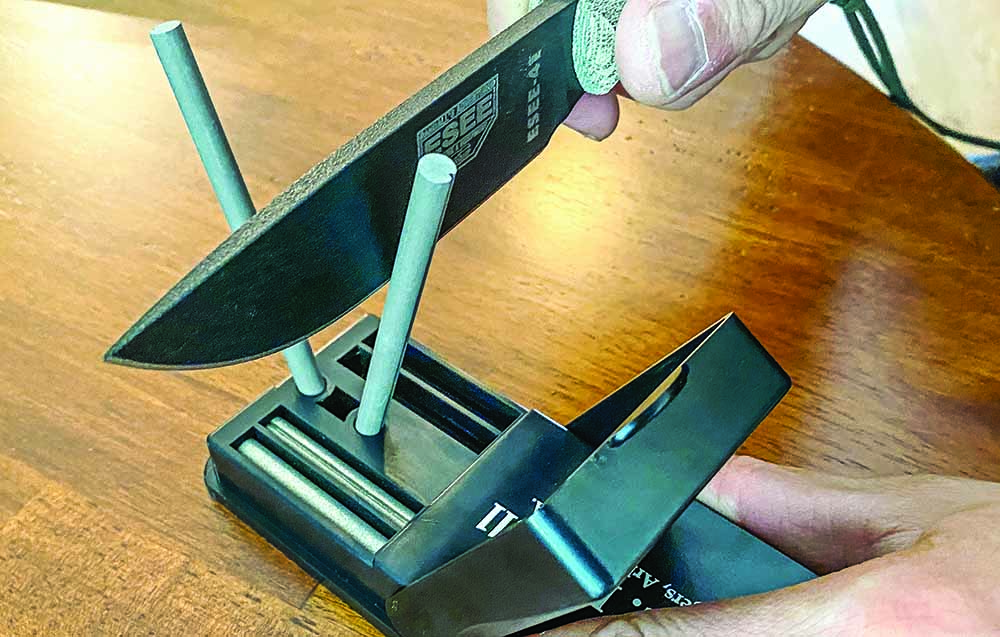
The Field Sharpener has a molded plastic base and hinged cover. You insert a pair of included 4-inch sharpening rods into two holes at a preset angle of 15 degrees. There’s a set of coarse diamond-grit rods to quickly repair a worn edge or rehab a damaged one. A set of medium-grit ceramic rods further sharpens and dials in edges to razor sharpness. The unit measures 5-by-2 inches and is compact enough for stowing in a toolbox, tacklebox, backpack or even a jacket pocket.
Place the sharpener on a flat work surface. Select the set of rods you wish to use and insert into the holes in the base. The flip-up cover secures the rods when they are tucked inside the base; when open, the cover forms a convenient guard to prevent the blade from coming down on your hand. Place one hand on the base to secure the sharpener. With your other hand, take the knife and move the blade down the rods, while pulling it across from tang to tip—two motions at once. Don’t use a lot of pressure; allow the weight of the blade to rest on the rods and move it down. Keep the blade positioned perpendicular to the tabletop surface; holding it straight up and down allows you to sharpen at the proper angle of 30 degrees inclusive.
The Field Sharpener’s flip-up cover secures the rods when they are tucked inside the base. When open, the cover forms a guard to prevent the blade from coming down on your hand.
The Field Sharpener is very effective. If you’ve used Crock Sticks or a Spyderco Tri-Angle Sharpmaker, you will take to this one easily. It requires the same motions. Unlike the Sharpmaker or Crock Sticks, it’s portable enough to take on outdoor adventures. It’s great for camping, especially if you use a variety of knives.
Given the longer length of many kitchen knives and the 4-inch rods, you must pull the blade across the rods with a bit of expediency to be able to capture the entire blade length in one downward pass. Just be mindful that this technique is more pronounced with longer blades. With shorter blades you won’t notice it as much. The round profile means the contact area of the rod to the blade is smaller and more effective at removing steel. It’s easy to use and highly effective. MSRP: $39.95.
Work Sharp E5 Kitchen Knife Sharpener
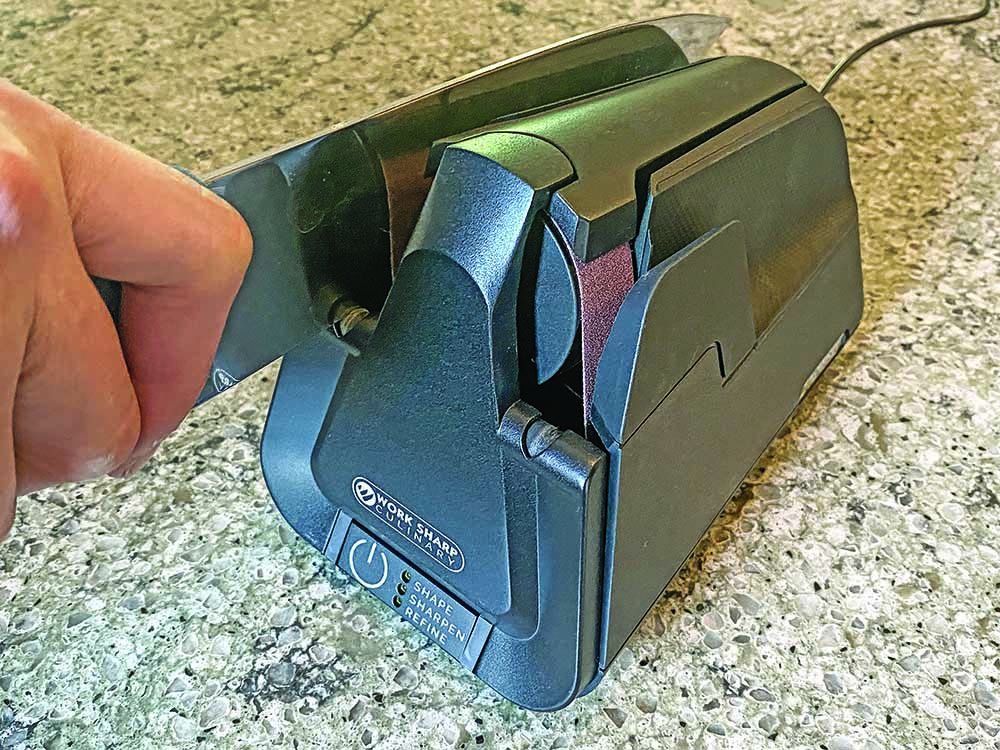
The Work Sharp Culinary E5 uses the same flexible abrasive belt technology as used on the company’s Ken Onion Edition sharpener. Three pre-programmed sharpening modes eliminate the guesswork of obtaining a professional edge.
The Work Sharp E5 Kitchen Knife Sharpener is a top-of-the-line powered kitchen knife sharpener, offering multiple modes, speeds, and the latest technology in providing consistent high-quality sharpening knife after knife. The E5 was designed from the ground up as a powered sharpener that can sit on a counter full time, blending in with other appliances with a minimal footprint. Like Work Sharp’s other powered knife sharpeners, the E5 uses flexible, long-wearing abrasive belts to create an ultra-durable convex edge.
Place the blade inside each slot and the abrasives do the work. Select from one of three sharpening modes via the one-touch programming feature. The Shape mode—three rapid clicks on the power button—starts at a high speed for fast cutting and repair of worn edges, then drops down to the Refine mode—one click—at low speed for the final touch up. The Sharpen mode—two rapid clicks—runs the belt at medium speed for routine edge maintenance, followed by the Refine mode for fast touch-ups.
Select the desired mode then alternate placing the blade in each of the slots. Watch the lights on the power panel. Whichever mode you select, a light shines next to it. Ten seconds before the machine changes modes, the light will begin flashing to warn of the upcoming transition to the next mode, or, depending on the mode, stop completely. Simply draw the blade through. The machine does all the work.
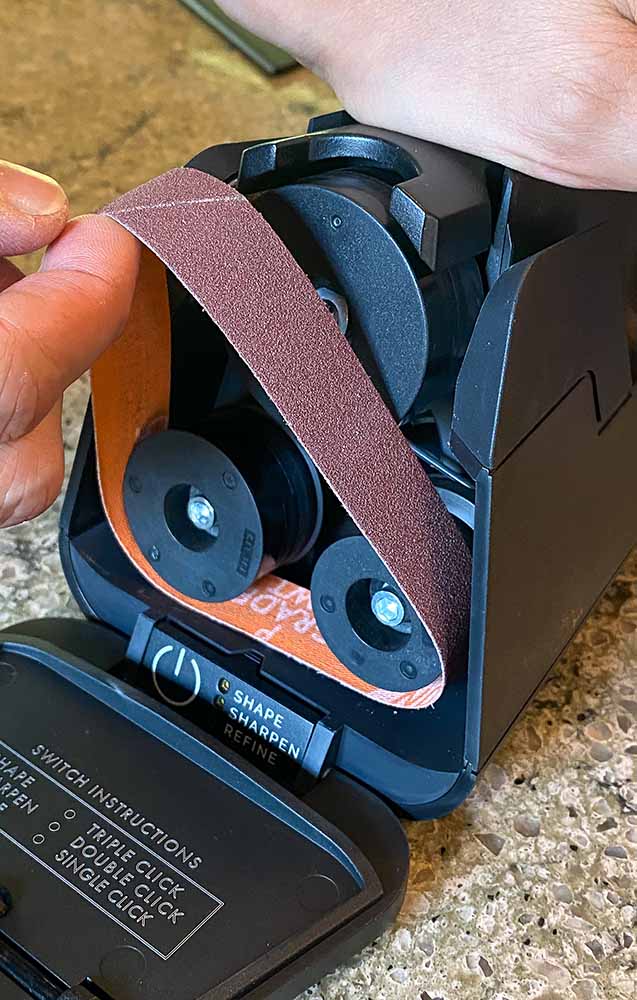
Changing belts on the Work Sharp Culinary E5 is easy. Flip down the faceplate. Press down on top of the machine with one hand to release belt tension, and, with the other hand, remove the belt. The new belt goes on in reverse order.
The first time you use the E5, you will be reprofiling your blades to the set 17-degree angle, which can take some time. At extra cost is an upgrade kit that includes more coarse belts, and 15- and 20-degree angle guides for enhanced versatility and quicker sharpening. MSRP: $59.95.
The E5 works well and produces the convex edge, which is very sharp and durable. The sharpener is quiet and easy to operate, something novices appreciate. If you are serious about cooking, it is essential to have not only high-quality knives but also a high-quality sharpener. The E5 is it. MSRP: $149.95.
Other Kitchen Sharpener Options
Shenzen Knives Electric Diamond Knife Sharpener
Shenzen Knives Electric Diamond Knife Sharpener
Diamonds aren’t just a girl’s best friend. This sharpener from Shenzen Knives features an electric diamond grinding wheel with two settings designed to sharpen both steel and ceramic knives.
Its powerful motor can remove chips as large as 1mm off of ceramic knives, and it easily comes apart for cleaning. An added plus is the universal knife guide slot, which is designed to keep your knives at the perfect angle for the best possible edge on both the fine and coarse settings. Specifically for kitchen knives, this machine is not meant to sharpen scissors, hunting knives, or any other types of blades.
MSRP: $49.99
Sharp Pebble Premium 1000/6000 Whetstone
Sharp Pebble Premium Whetstone Knife Sharpening Stone 2 Side Grit 1000/6000 Waterstone- Whetstone Knife Sharpener
The whetstone, and other sharpening stones, are a much more finite and meditative way to sharpen your knives. Coming in a variety of grit sizes, whetstones work by being submerged in a liquid, usually water, which enhances the stone’s ability to sharpen a blade while also allowing the chips and scrapes to wash away. Sharp Pebble offers a variety of whetstones in different grits and at different price points. (The 1000/6000 stone is a perfect stone for home sharpeners, and is the method I’ve used to sharpen my kitchen knives for the last several years. I enjoy the process of using the stone and feel it provides a quality edge whether it’s my chef knife or my paring knife.)
The majority of the stones come with an angle guide to help you get the best sharpening angle for your knife. These stones can also be used to sharpen other implements from razors to scissors to chisels.
MSRP: $40.99
Messermeister Fine Grit Honing Steel
Messermeister Fine Grit Honing Steel
Sometimes your knife needs honing rather than sharpening. That’s where honing steel, or a honing rod, comes to the rescue. Over time and normal use, the edge of your knives will bend and warp at a microscopic level. Honing steel works to massage the edge back into the proper position without removing as much material as sharpening would. (I hone my knives daily while sharpening them 2-4 times a year. By honing I’m able to maintain a sharp edge longer and maintain better control over my knives while I cook.)
Messermeister offers a variety of honing rods ranging from steel and ceramic to diamond. Their fine-grit rod is made of high-carbon tool steel and can be used to hone knives made from any material. It’s designed to never wear over its lifespan and should be able to hone your knives’ edges for decades.
For a fair price, you can’t go wrong with this rod, and your knives will thank you for it.
MSRP: $24.95 (10-inch), $29.95 (12-inch)
Worksharp Electric Kitchen Knife Sharpener
Worksharp Electric Kitchen Knife Sharpener
For a quality all-rounder, look no further than Worksharp’s newest electric sharpener. Roughly the size of a softball, the sharpener effortlessly sharpens anything you can throw at it in the kitchen including scissors and serrated knives.
Its sharpening slots feature built-in 20-degree angle guides so each edge comes out at a perfect angle. Beyond just sharpening, the device features a ceramic honing wheel as well that allows you to maintain your edge every day.
MSRP: $59.95
Editor’s Note:Mike Abelson contributed to this story
Gerber Has Reinvented The Multi-Tool With The Dual-Force. Incredibly Strong And Versatile, The Dual-Force Is As Rugged As It Gets
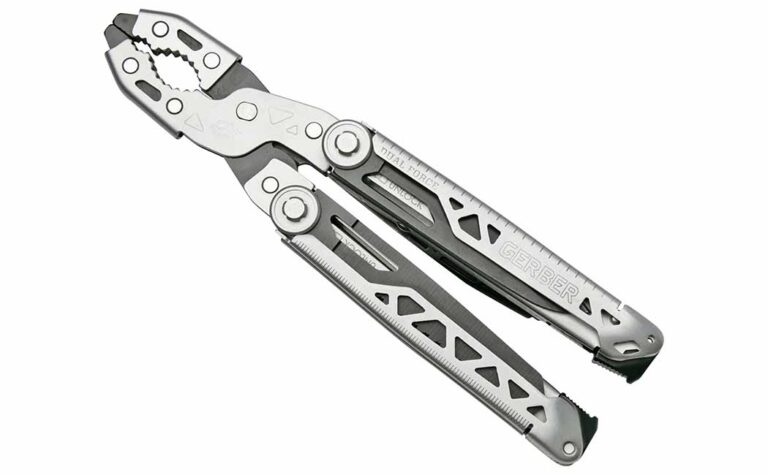
The multi-tool is beloved by many for its flexibility and ability to be useful in many situations. Gerber Gear has ripped up the book on the multi-tool and reinvented the genre with the 12-tool Dual-Force.
It is a monster. The Dual-Force is similar to other multi-tools in terms of the implements within it, but the strength level has been ratcheted up. The screwdriver and saw are beefier than in a Swiss Army knife. The driver is 3.25 inches and features Center-Drive tech so it feels and operates like a standard driver.
The Dual-Force has a dozen different tools.
The tool also includes a 3.25-inch plain-edge blade, which rivals that of many standard pocketknives.
But the star of the show is the pliers. There are so needle-nose pliers here. The Dual-Force features a robust set of jaws with a twin-position dual-lock design and large teeth for more control. The jaws dwarf the pliers offered on most other multi-tools.
The Dual-Force brings the quality you expect from Gerber Gear and an innovative design that makes it stand apart from all the other choices on the market today. MSRP: $110.
Editor’s Note: This post was written by Mike Ableson.
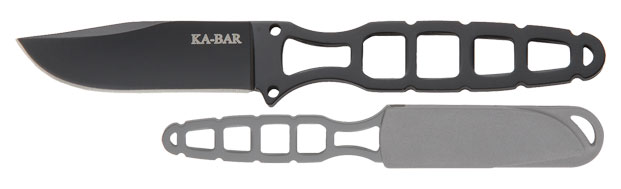
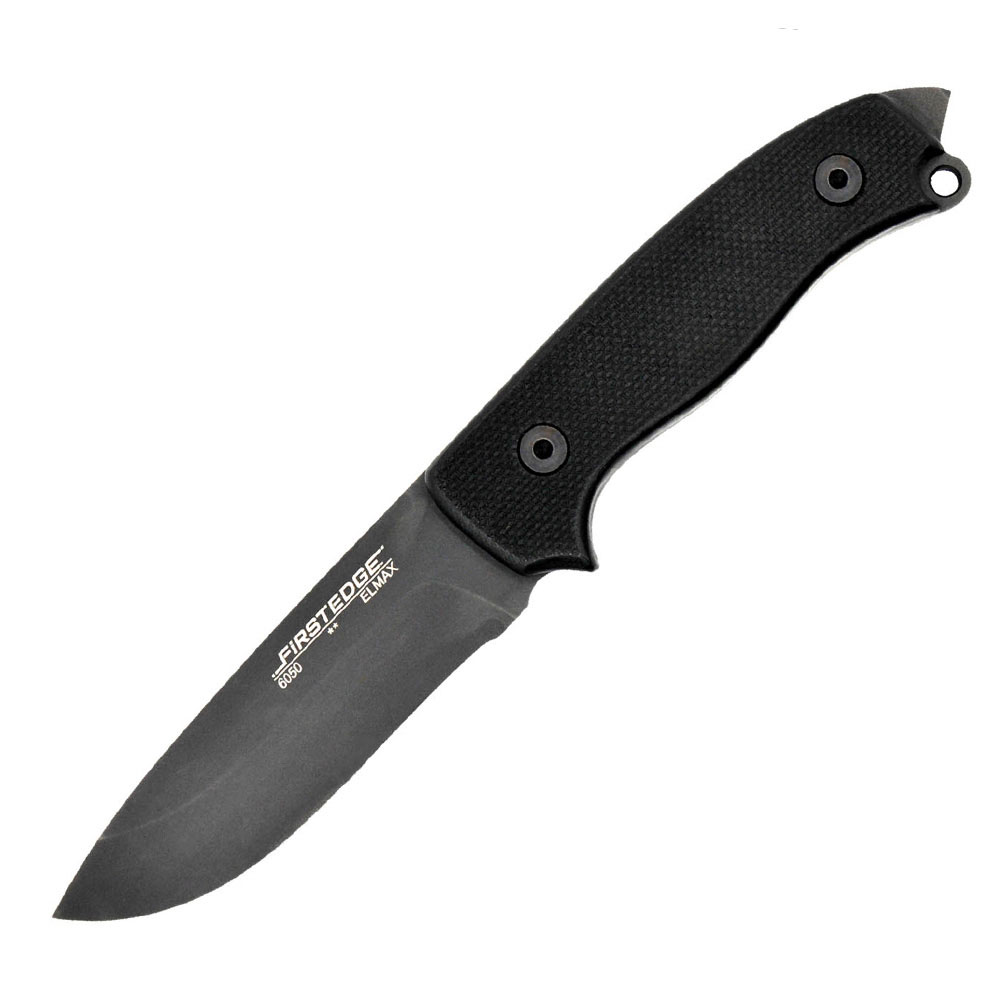
SHEATH: Tri-Composite System Kydex w/3” nylon webbing, Box X stitching, stainless hex fasteners and liners; locks blade in; MOLLE system sheath also available