2026 BLADE Show Preview: New Wrapper, Same Steel

BLADE Show’s home sharpens up for the event’s 45th Anniversary.

Longtime BLADE Show patrons, get ready for a brand-new venue. Calm your heart palpitations. The world’s largest knife show isn’t picking up stakes from Atlanta when it unsheathes its 45th iteration June 5-7. Simply put, the longtime home of our favorite edgy shindig is undergoing a massive $190 million facelift.

The Cobb Galleria Centre—now officially the Cobb Convention Center—is in the midst of a multi-year renovation to upgrade its facilities and amenities. While the project stretches into early 2027, it will be at its midway point when the BLADE Show doors open this June.

Diehard knifeaholics needn’t worry, the upgrade project won’t derail the aspects of the show you love. Factory knife debuts, the educational instruction of BLADE University (see sidebar) and action-packed demos still await show patrons. The BLADE Magazine 2025 Knife-Of-The-Year® Awards and the custom knife judging competition remain center stage. Furthermore, the American Bladesmith Society (ABS) will still name its latest master and journeyman smiths, and some of the best knives from the ABS, The Knifemakers’ Guild and unaffiliated makers will be on display in all their sharpest glory.
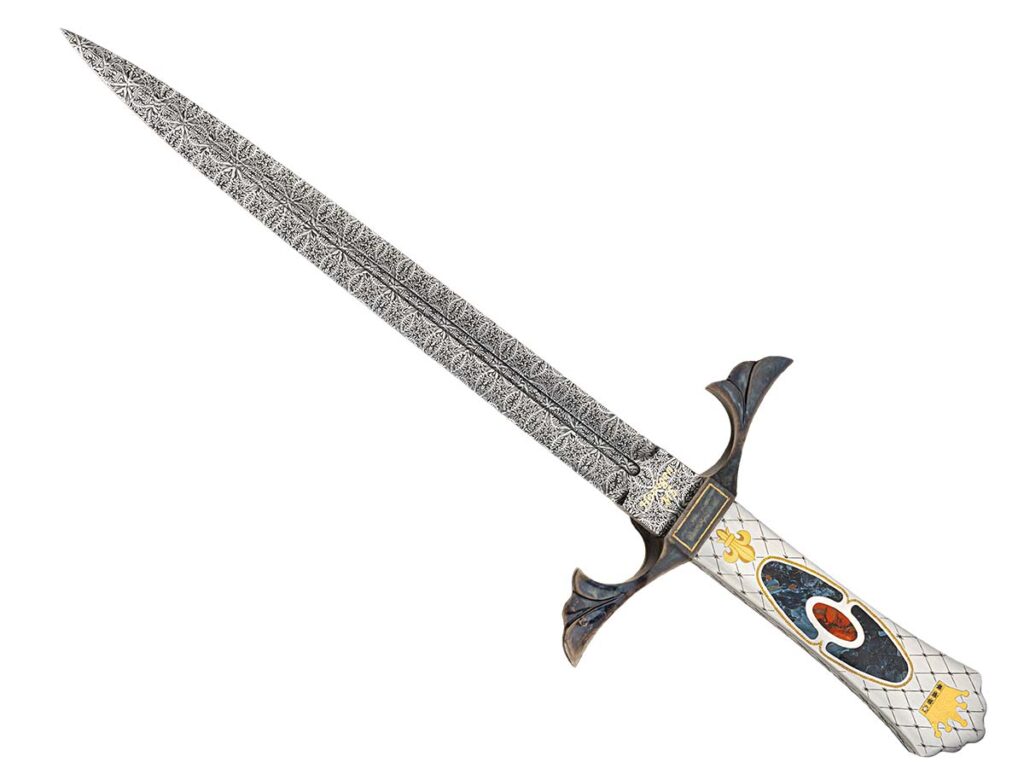
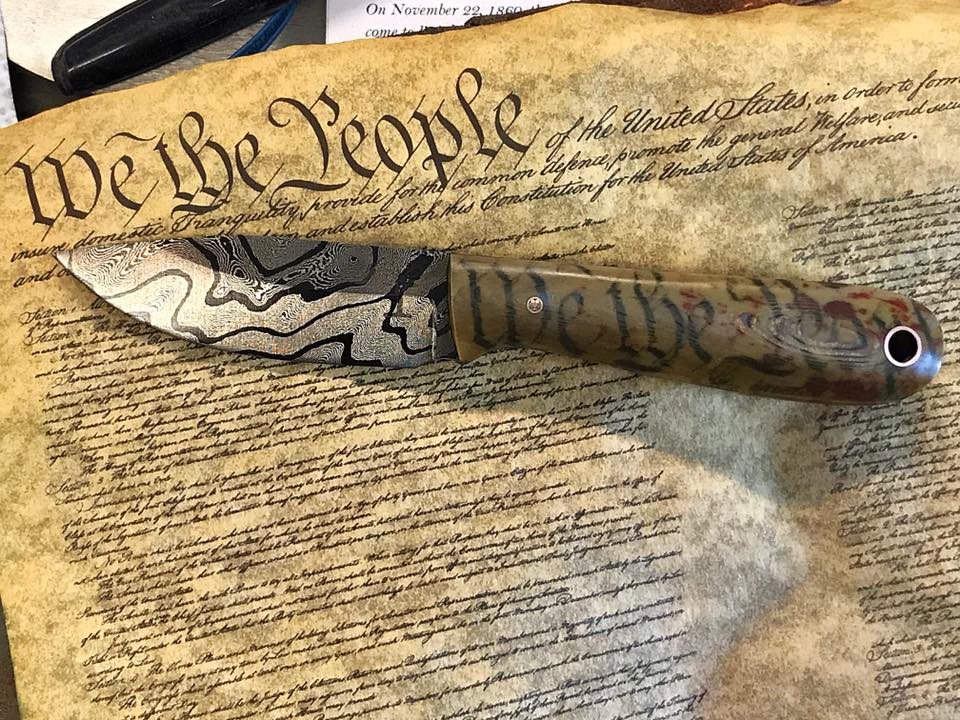
John Horrigan’s majestic fixed blade turned more than a few heads during the 2025 show. (Jocelyn Frasier image)

Additionally, the show floor welcomes more than 900 exhibitors from 35 countries, offering a global masterclass in modern cutlery. From the latest production folders and custom fixed blades to rare handle materials and high-tech shop equipment, the sheer volume of gear is staggering. All of this comes in the brand-new wrapper of the convention center, honing the BLADE Show to a razor’s edge.

The main exhibit hall and the ballroom—better known to the faithful as the Baller Room—are already complete. These renovations will immediately improve the show with new LED lighting, fixed concession outlets, renovated restrooms and an improved PA system. The Baller Room and lobby area also sport new wall coverings, chandeliers and carpet, while the rotunda has an entirely new look.
While the show floor is unaffected, attendees will feel some impact. The renovation of the specialty shops and meeting rooms below and across from the main hall will run congruent to the show. This means BLADE University has a new campus. Look for classes in the newly constructed ballrooms just off the Renaissance Atlanta Waverly.

And for those who love the food, libation (lots of that), knife boasting and lie swapping of “The Pit”, that is slated to proceed unchecked. The sunken bar of the Waverly is untouched by hammers, saws or fresh sheetrock. Get your sleep so you can haunt it until cock’s crow.
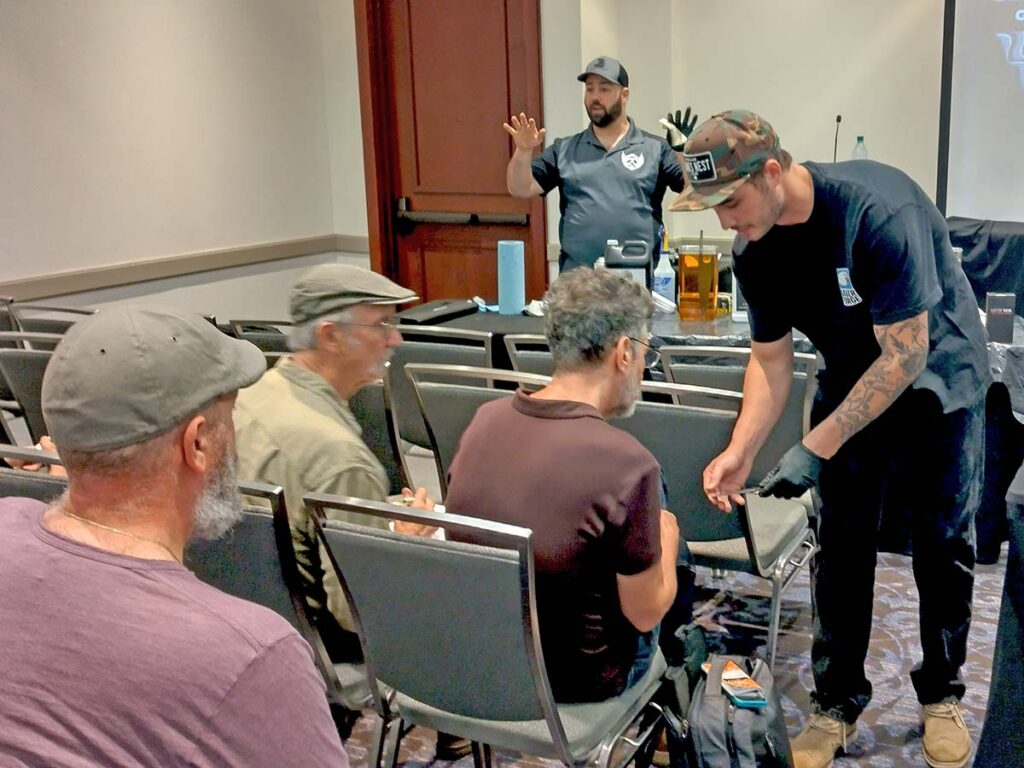
Jordan Berthelot discusses next-level damascus etching while Greyson Weltyk shows a student a result of the process during one of many BLADE University classes.

When the dust finally settles, the Cobb Convention Center will be a major boon. By 2027, showgoers can look forward to more than 50,000 square feet of new meeting rooms, event courtyards and indoor space. As the BLADE Show grows in global reach, its longtime home has the room to grow along with its marquee event.

Edge Of The World

Perhaps the most intriguing aspect of the BLADE Show in recent years is the global reach of the brothers and sisters of sharps. No one knife-specific event gathers more makers and companies from around the world—including the good ol’ U.S. of A—into one venue.

The outstanding international makers include: the CAS Brothers, Mauricio Daletzky and Javier Vogt (Argentina); Bertie Rietveld, Theuns Prinsloo, Henning Wilkinson and Neels van den Berg (South Africa); Franco de Souza, Rodrigo Sfreddo, Fabio Barros and Gus Cecchini (Brazil); Bruce Barnett (Australia); Kizer Cutlery, Reate and Ketuo (China); Koji Hara (Japan); Lionsteel, Alfredo Faccipieri, Fox Cutlery, Maniago Knife Makers (MKM) and Maserin (Italy); Damasteel (Sweden); Jens Anso (Denmark); Helle Knives (Norway); Jean-Louis Regel and Veronique Laurent (Belgium); Carlos Queiros (Portugal); Sergey Shirogorov (Russia); and Grace Horne (United Kingdom).
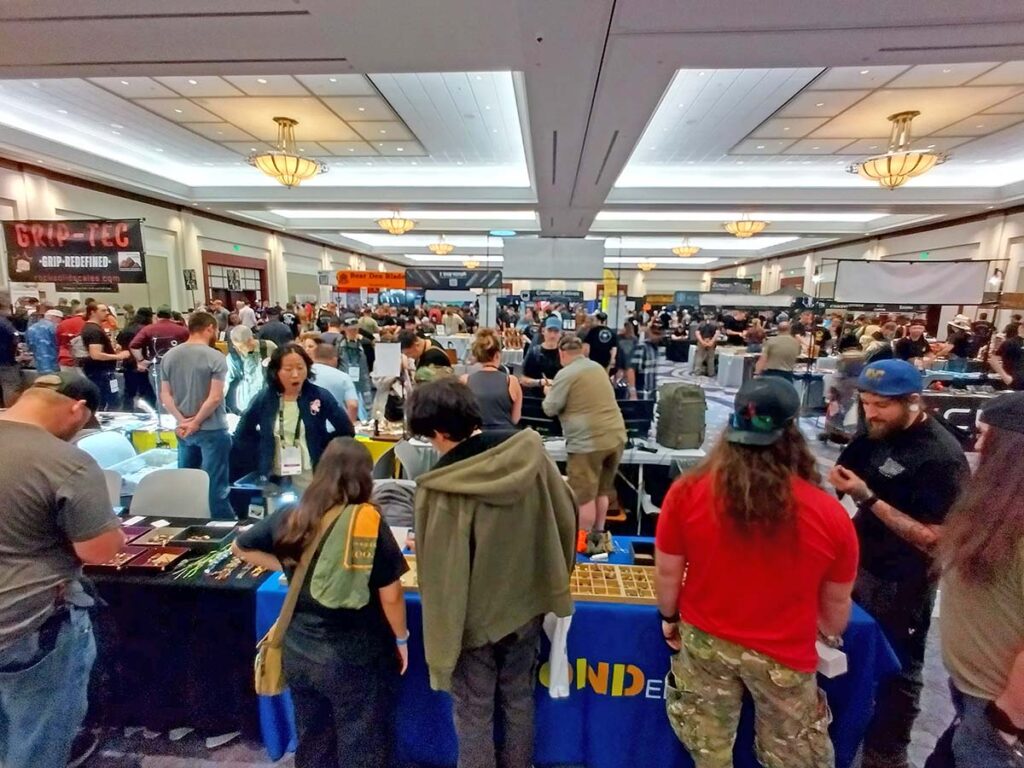
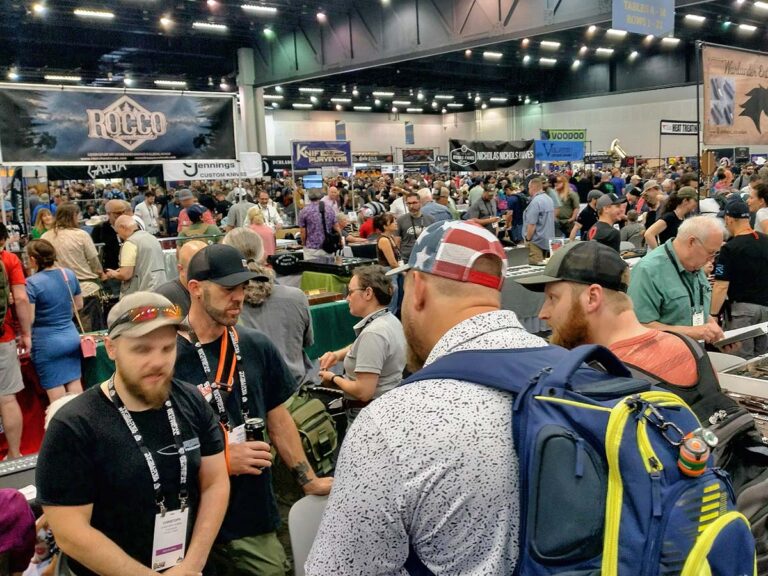
The Baller Room buzzed all three days of the show. The room comes with some notable improvements this year, including new carpet and wall coverings.

Some of the leading American exhibiting makers will be BLADE Magazine Cutlery Hall-Of-Fame® members Bill Ruple, Steve Schwarzer and Harvey Dean; ABS master smiths Mike Quesenberry, Shane Taylor, David Lisch, Jordan LaMothe, Josh and Karis Fisher, and Andrew Meers; slipjoint makers Stanley Buzek, Tom Ploppert, Luke Swenson and Tim Robertson; Allen Elishewitz; Les George; Walter Brend; Strider Knives; Hawk Knives; Vince Evans; factory companies Spyderco, Case, TOPS Knives, Chris Reeve Knives, Spartan Blades, Pro-Tech, Microtech, Kershaw, Squid Industries, KA-BAR and Heretic Knives; and many more.

Knives Of The Year

BLADE Magazine Knife-Of-The-Year® Awards is the factory knife industry’s highest honors, pitting the companies’ sharpest designs again each other. In an effort to keep the awards’ distinguished position and recognize the changing landscape of the industry, BLADE Show added a new category for this year.

New for the 2026 competition is the Best Slip Joint category, breaking off the traditional design from the Best Imported Folder and Best American Made Folder categories. This is the third new category added in as many years, with Best Of The Rest created in 2025 and the Automatic Knife Of The Year sponsored by PVK.com that debuted in 2024.
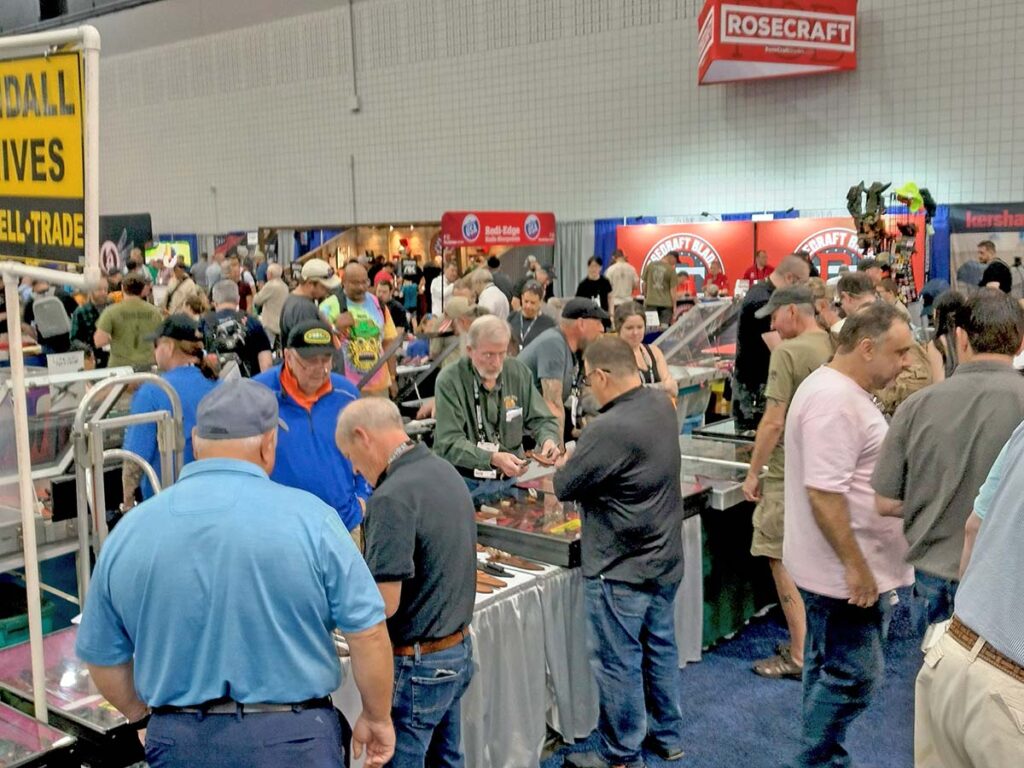
 New knives aren’t the only draw in Atlanta. Antique Randall knives and their collectors were in abundance at the show.
New knives aren’t the only draw in Atlanta. Antique Randall knives and their collectors were in abundance at the show.

As in the past, the entries are limited to BLADE Show factory booth exhibitors, all of whom received the rules well before the show outlining the new changes. Like last year, the winners will be announced and presented during the BLADE Magazine Awards Reception on Saturday at 8 p.m. in the room on the floor above The Pit. The winners will be listed on BLADE’s blademag.com website after the awards reception, and a list will be posted outside the show entrance Sunday morning.

BLADE University

Get current on the latest knifemaking techniques and other trending sharp subjects during the 13th Annual BLADE University on Thursday, Friday and Saturday. See the sidebar for a complete rundown of classes, days, times and instructors.

Sponsored by Work Sharp, BLADE University has the most extensive schedule of knife, knifemaking and other instruction held at any knife show. For enrollment and other information, visit https://bladeshow.com/show-info/classes.

Custom Knife Awards

Among the most testing custom knife competitions in the nation, the BLADE Show Custom Knife Awards is one of the most coveted honors in knifemaking. In a continuing effort to keep it the premier award in the handmade knives, the competition’s categories have been expanded. Best Slip Joint has been split into Best Single-Blade Slip Joint and Best Multi-Blade Slip Joint categories, allowing more subtlety in judging the nuanced class of knives.
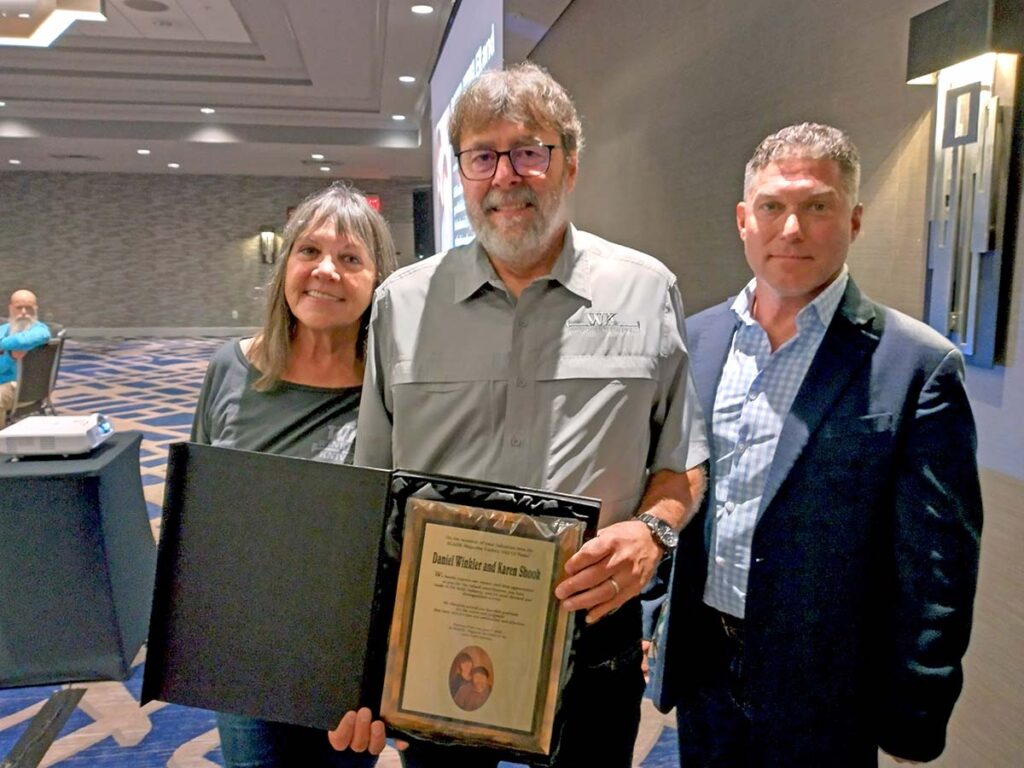
From left, Karen Shook and Daniel Winkler accept their Hall of Fame plaque after Kevin Holland (right) delivered their induction speech.

Leading industry authorities will pick the best custom knives by BLADE Show exhibitors in the annual knife judging competition, with the winners announced during the BLADE Magazine Awards Reception Saturday at 8 p.m.

The categories are: Best of Show; Best Art Knife; Best Bowie; Best Collaboration; Best Collaboration; Best Damascus; Best Fighter; Best Fixed Blade; Best Folder; Best Handle Design; Most Innovative Design; Best Kitchen Knife; Best M.A.C.K.; Best Miniature; Best New Maker; Best Single-Blade Slip Joint; Best Multi-Blade Slip Joint; Best Sword; Best Tactical Folder; Best Utility Hunter; Best of the Rest.

The competition is open to the show’s custom knife exhibitors only. The winners will be announced on BLADE’s blademag.com website after the awards ceremony, and a list will be posted outside the show entrance Sunday morning.

World Championship

The BLADE Show World Championship Cutting Competition will be conducted by BladeSports International (BSI) and held in The Courtyard, the parking lot of the host hotel, the Renaissance Atlanta Waverly, Saturday at 4:30 p.m. Attendance is free to BLADE Show ticketholders.
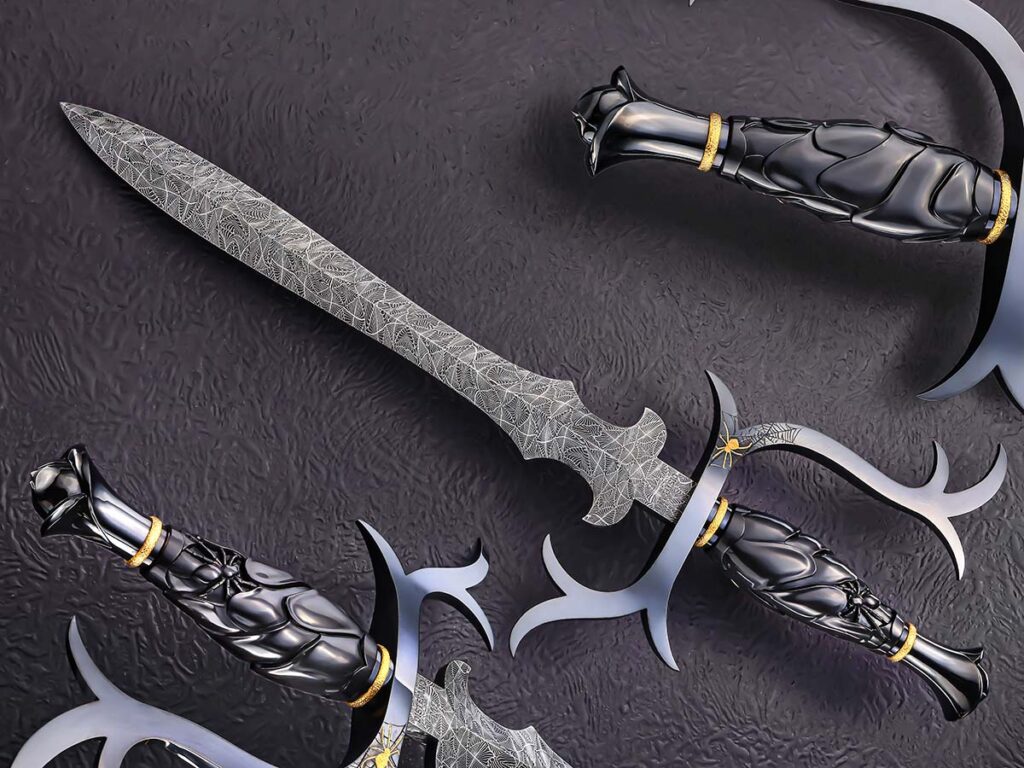
Paul DiStefano always produces stunning work, which certainly goes for his 14-inch spiderweb mosaic damascus-bladed dagger, which he brought to the BLADE Show. That’s a carved buffalo horn handle, by the way. (SharpByCoop image)

For a second year in a row the men’s and women’s divisions were won by a husband and wife: Mr. and Mrs. Ben and Sue Ann Propst. The championship results were as follows: Men’s Division: Ben Propst (Niagara Specialty Metals), world champion; 2nd: Donavon Phillips (Spyderco); 3rd: David Moore (Pops Knife Supplies); and 4th: James Clifton (Spyderco). Women’s Division: Sue Ann Propst (Niagara Specialty Metals), world champion; 2nd: Lauren Kalns; 3rd: Sara Maly (Pops Knife Supplies); and 4th: Jo Carothers (Carothers Performance Knives).

Bali Grand Master

Top balisong flippers will vie for the title of “Grand Master” in the 10th Annual Battle for Bali Champion sponsored and conducted by Blade HQ.

BLADE Show ticketholders are invited to watch the competition on the second floor above The Pit of the Renaissance Atlanta Waverly Hotel on show Saturday from 12:45 p.m. to 2 p.m. Competitors will start flipping knives at 1 p.m.
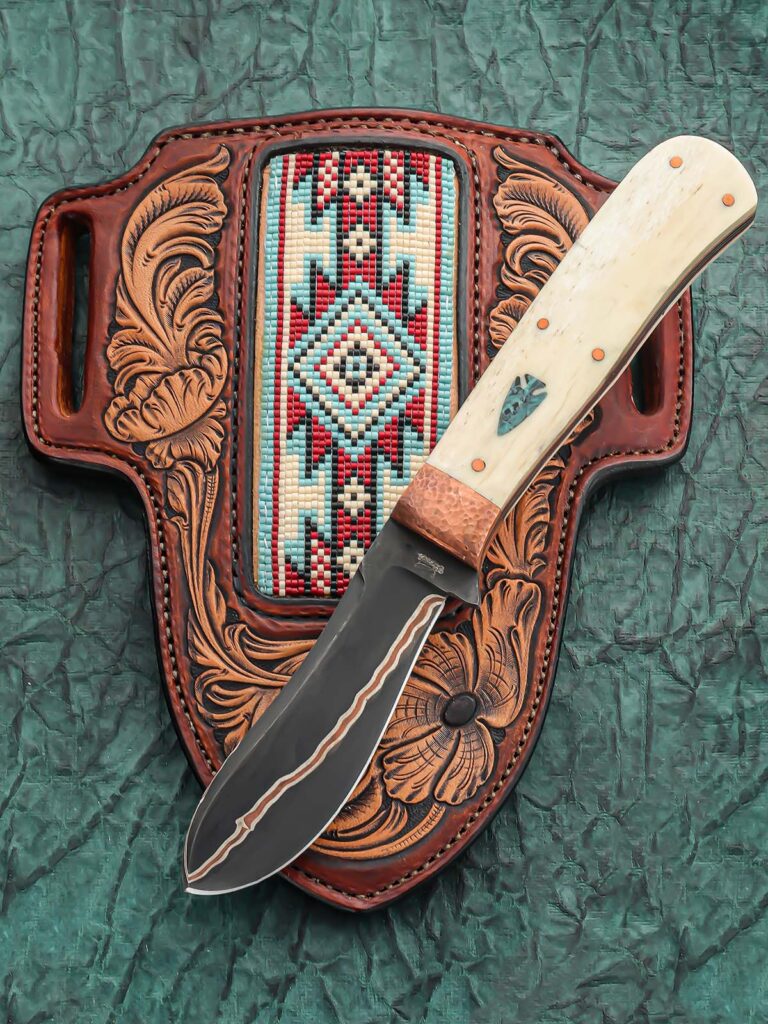
When it comes to slip joints, Bubba Crouch is a must-stop at BLADE Show. His skinner, with a 3 1/2-inch copper san mai blade, came complete with a sheath by Will Anderson, with beadwork done by Kelly Faulcorer. (SharpByCoop image)

The top three finishers will receive prizes and all participants will get swag bags. Brycen Nelson flipped his way to the top of the podium in the competition, Steve Ash placed second and Landon Morrison third.

Cutlery Hall Of Fame

The BLADE Magazine Cutlery Hall Of Fame® will formally induct its new members at 8 a.m. show Saturday in the Kennesaw Room of the Renaissance Atlanta Waverly Hotel. (At press time, the new members had not been determined. For updates, visit blademag.com.) Tickets are required ahead of time for the ceremony, which includes breakfast. Seating is limited. For ticket information, email [email protected].

What’s Next

The final BLADE Show-sponsored event for 2026 will be BLADE Show West, Oct. 9-10 at the Salt Palace Convention Center in Salt Lake City, Utah. For details, visit bladeshowwest.com. BLADE Show Texas 2027 will be March 12-13 at the Fort Worth Convention Center. Visit bladeshowtexas.com for more on it. And, of course, it’s never too late to start thinking about BLADE Show 2027 June 4-6 at the Cobb Convention Center in Atlanta. For details, visit bladeshow.com.
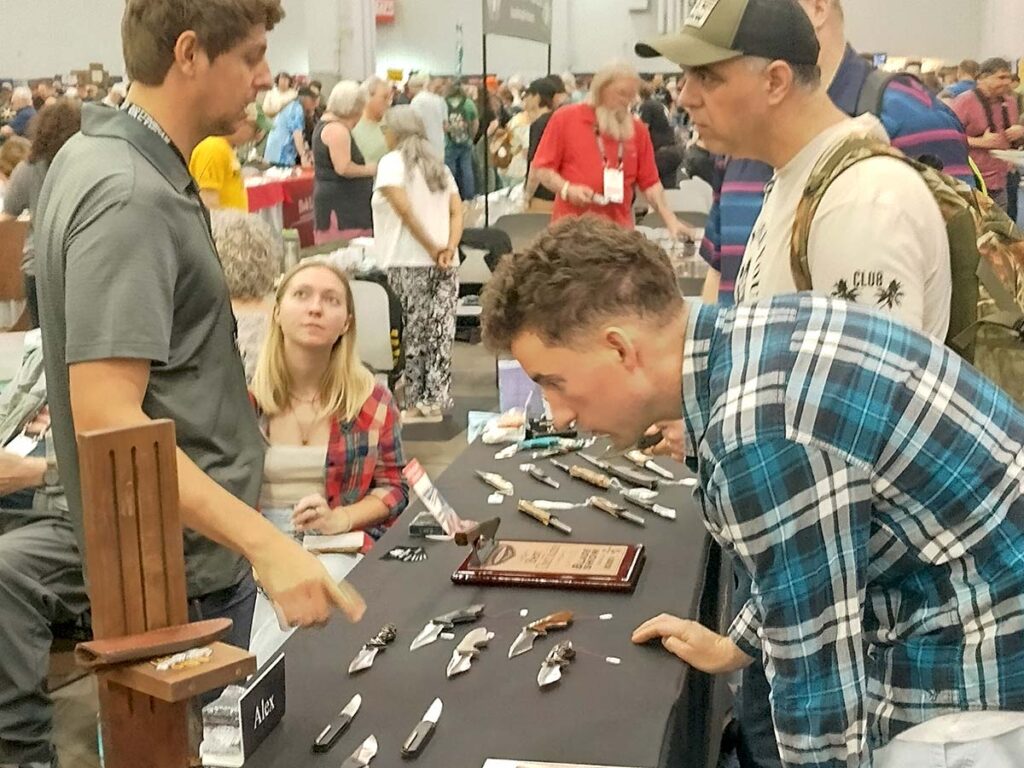
It’s easy to get mesmerized by knives at the BLADE Show, here at the table of Alex Hossom (left).

Editor’s note: Kizer Cutlery is The Pit sponsor. Work Sharp sponsors BLADE University. Nottingham Tactical is the lanyard sponsor. Hogue Knives is the housing sponsor. EKnives is the concessions sponsor. Vosteed is the Wi-Fi sponsor. The other sponsors are Heretic Knives, Reate Knives, Poikilo Blade, McNees Knives, Ketuo/Rike Knife, Artisan Cutlery/CJRB, Reate Knives and HORL Corporation.

More On BLADE Show:

What’s the Best Kind of Knife Grind?

Is There a Perfect Blade Grind?

Who knows when the first argument over the best blade grind started? Most likely it was a conversation between two flintknappers sitting around a cave—and the battle of which grind is the best rages on to this day. The modern tactical and bushcraft movements have brought heated debates on which grind is the best. The grind of a blade is where a key battle is won, and blade geometry varies widely. But is there a so-called best blade grind and, if so, which one is it?

Curved or Flat?

walter brend custom knives
Before becoming a renowned custom knifemaker, Walter Brend was a meat cutter, the skills of which gave him keen insight into the art of the slice. The man some call the best grinder ever shows his stuff here. (Rodney Hiers image)

According to Wikipedia, blade geometry refers to the “physical properties of a sword blade: cross-section (or grind) and taper.”

You can forget the “sword” qualifier—blade geometry applies to any blade. The three most common blade grinds in use today are hollow, flat and convex, with other grinds of note are the chisel, asymmetrical, Scandi and compound. There are others.

Before becoming a renowned custom knifemaker, Walter Brend was a meat cutter, the skills of which gave him keen insight into the art of the slice.

“What works for me is the hollow grind,” Brend says. “The hollow-ground blade is not a flat surface, it is concaved, so as you cut an object it immediately starts a separation. The bottom edge should flow from the point to the back of the blade with a recurved blade edge.”

Knifemaker Bob Dozier, well known for making hard-use knives, prefers the hollow grind as well.

“Since I make mostly hunting knives, I prefer the drop-point blade style. Since Bob Loveless popularized the drop point, it’s been the most popular shape for hunting knives for many decades now. Also, for a hunting knife, the hollow grind is the best as it stays thin at the edge much longer.”

hollow grind blade
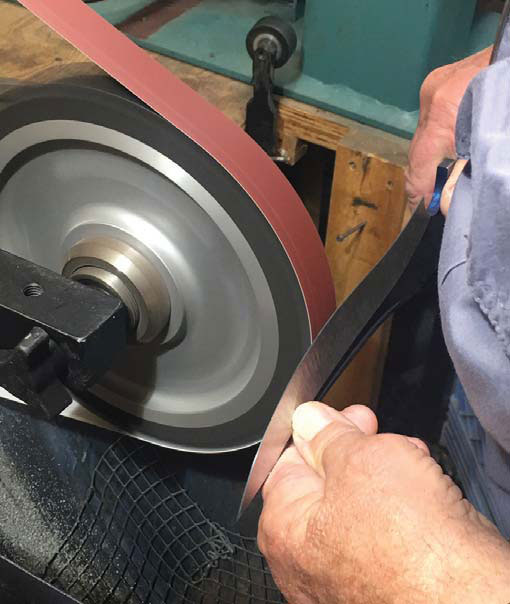
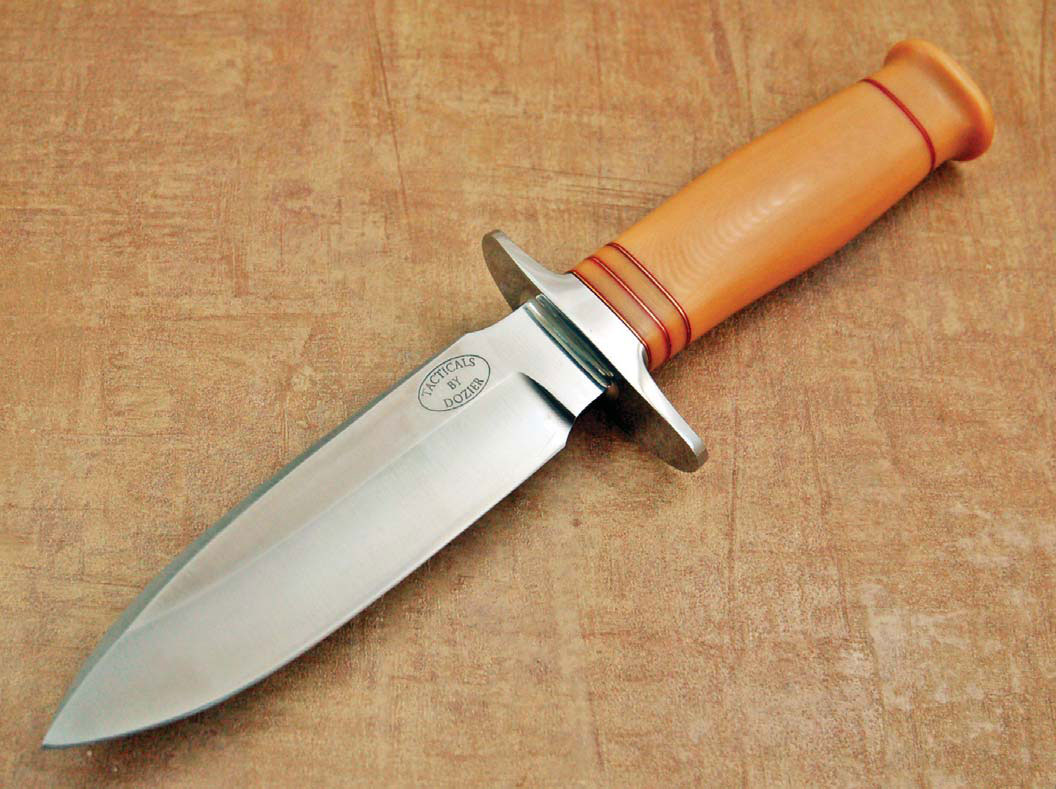
Like Walter Brend, Bob Dozier prefers the hollow grind. “For a hunting knife, the hollow grind is the best as it stays thin at the edge much longer,” Dozier opines. Bob’s fixed blade features a nice, clean hollow grind. (Kerry Peal images)

However, that’s not to say Dozier is adverse to other grinds.

“The flat grind is the best for the kitchen as it does not wander when making thin slices,” he opines. “A convex grind is great for splitting firewood.”

Award-winning American Bladesmith Society master smith Jim Crowell won the 1st Annual BLADE Show World Championship Cutting Competition in 2003 and was inducted into the ABS Hall of Fame in 2016.

“My opinion for the best blade geometry is a full flat grind with a convex edge,” Crowell begins. “This grind will give the smoothest transition from the full thickness of the spine to the cutting edge—anything else is something less.”

Crowell is also very familiar with the Bill Moran appleseed or convex grind, which is based on the Japanese hamaguri or “clamshell” grind.

“Bill Moran did like full convex blade geometry,” Crowell notes. “He ground on a round wheel and meticulously shaped the whole blade to have a convex cross section. I have cut with several of Bill’s knives and they were very sharp and had great geometry.

“The full convex grind performs in an exemplary manner, but I cannot discern any advantage in performance over a full flat grind with a convex edge. You do not just slap a convex edge on a blade. There are a myriad of variables: how thick was the edge when you started the roll? How high or low did you roll it? A short and abrupt roll may shave but will not cut well at all.”

Bob Dozier custom knifemaker
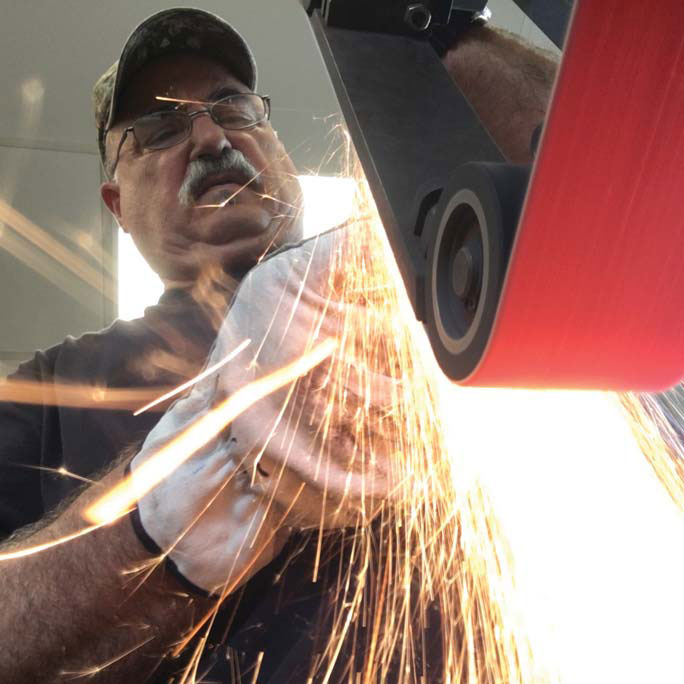
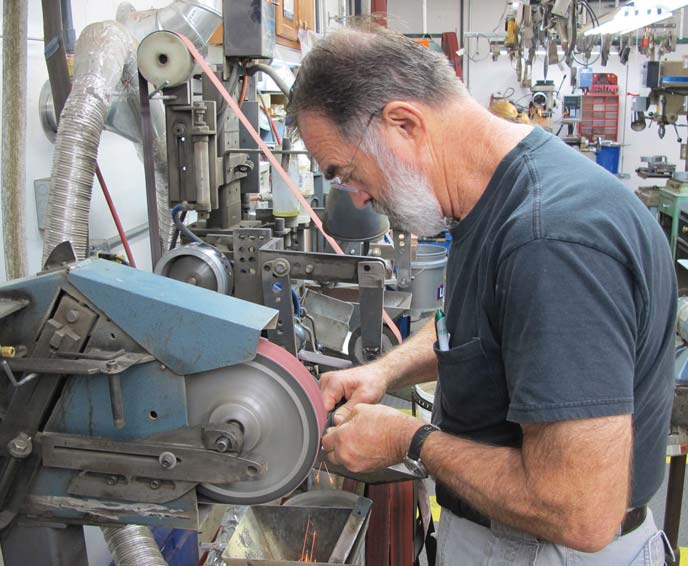
“The flat grind is the best for the kitchen as it does not wander when making thin slices,” opines Bob Dozier, here busy at his shop grinder. (Pat Covert image)

Degrees of Difficulty

Curious as to the degree of difficulty of applying the various grinds, BLADE® asked Brend, Dozier and Crowell which they thought are the most difficult to execute. They provided varied opinions.

“I think whichever one you do the most is easiest, and the one you do the least is hardest,” Crowell notes. “Once upon a time I used to hollow grind a lot, but then I started to cut a lot and it became apparent to me a flat grind would cut better overall for my use. I gradually phased out hollow grinding and now find it difficult as compared to flat grinding.”

Dozier adds pointedly, “I don’t find any of them hard. I think it depends on how you learn to grind at first. A lot of the makers today learned from someone else and stick with the grind they learned.”

Brend ranked the grinds in order of difficulty.

“Hollow-ground knives, in my opinion, are the hardest to grind,” he begins. “You have to control the blade on a wheel to form a perfect symmetrical line. In my opinion you should keep the point thick, and, at the same time, make your edges sharp and thin.

“Flat ground is next after hollow. In my opinion a true flat-ground blade should be finished by hand because the grinding belt will not allow a true flat surface. Convex is the easiest because you have no set lines or pattern when grinding.”

Order of Importance

best blade grinds
At the grinder here, Bob Dozier says blade geometry is more crucial
in terms of a blade’s cutting performance than the type of steel or
how it is heat treated. “The most important is blade geometry,” he
notes. “The type of steel and how it is heat treated has nothing to do
with how it cuts, only how long it cuts.” (Pat Covert image)

Is blade geometry the most important aspect of a blade’s cutting effectiveness, or is the type of steel or proper heat treating most crucial?

“The most important is blade geometry,” Dozier says. “The type of steel and how it is heat treated has nothing to do with how it cuts, only how long it cuts.”

Crowell differs.

“Heat treat, geometry and steel, in that order,” he opines. “If the heat treat is wrong, the rest will be of little consequence. Proper geometry is next in importance. The steel, although important, is not the determining factor. Of course, you need to have a ‘good’ steel, but it is not the steel that makes the difference. Just because you may have the latest, greatest steel does not mean you will have a superior knife. You have to do it all correctly and in the right order.”

Brend ranks the three differently.

“I think the type of steel is the most important. With proper heat treating you can vary from two-to-four points [on the Rockwell hardness scale] and still cut with the knife because of the type of steel,” he says. “Heat treating is second. With most steels you can be within two points and still cut with the blade. All heat treaters are not the same because of the equipment or their method. Geometry would be the last because if you use the proper steel, you should be able to make any blade work well.”

Flunking Geometry

custom knife mistakes
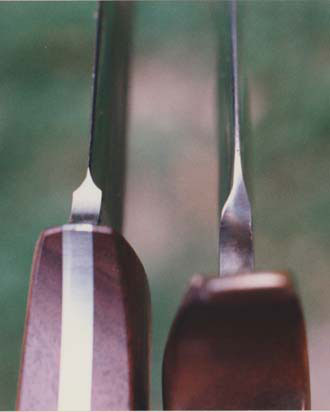
Uneven grind/plunge lines (right) as seen from the bottom of the blade are one of the more obvious and common things to look for in a bad grind. By contrast, the plunge lines at left are nice and even.

Finally, what makes a bad blade grind?

“What I look for are the grind lines,” Brend explains. “Are the sharp edges of lines rolled? Also, at the back of the blade—where the [grind] line starts—is the steel uneven? I see some hollow grinds where the edges are too thin. If you hit a hard object the blade will chip.”

Opines Dozier: “A poor grind is shown with uneven grind lines, crooked cutting edges or a non-uniform cutting edge.”

“Poor grinding is evidenced by several telltale signs,” Crowell interjects. “Uneven grind/plunge lines as one would look from the bottom of the blade. This is one of the more obvious and common things to look for. Also, the finish on the bottom of the ricasso and choil area is often neglected. You can hold a blade horizontal and look down the flat of the bevel and it should be smooth as glass with no ripples or distortions.”

Jim also notes that on symmetrical patterns such as daggers, look for mirrored-image grinds on both sides of the blade.

One interesting takeaway: The perfect grind may just be determined by how you plan to use your knife—or perhaps you may need two or more knives to cover all the bases.


Keep Learning About Knifemaking

how to make knives

Huber Foxworth Bowie: The Men Behind The Blade

The men behind the Huber Foxworth Bowie are as captivating as the knife itself.

This is the story of a knife named in honor of an incredibly special man. In this highly populated world not many people get their name attached to anything. I do, however, know for a fact that Craig Fox Huber was very proud of the idea that people would be wanting the knife that bore his name for decades to come. He told me so in person. He lived a life that so many would aspire to but very few would have the moxie to follow through on. He was the real deal.

So, how did Craig impact a knifemaker to the point of naming a knife the Huber Foxworth Bowie? Here’s what my father, BLADE Magazine Cutlery Hall-Of-Fame® member Dan Dennehy, wrote about Craig in his 1970 Dan-D Knives Brochure:

Many self-styled “experts” have stopped by my shop from time to time to suggest to me how I should design the “perfect” knife … Not long ago a trim bearded crewcut type found his way to my shop, and we started talking knives. [Circa the late 1960s] I took an immediate liking to this handsome, rather cocky gent and was pleasantly surprised to learn that he spoke about knives with a rather rare understanding of design and more than just a rudimentary knowledge of metallurgy that I found uncommon even among some men whose names would be familiar to you as supposed “experts.” He not only talked good theory and design, but he spoke with considerable authority on how a fighting knife should be used.

Craig Huber
That’s Craig Fox Huber inset circa 1970 at the Fox Den’s second location in Mountain Home, Arkansas.

During our conversation I learned that he had earned three Purple Hearts while serving with a Marine Recon Unit in Viet Nam, and enough other “breast hardware” that when he spoke, I listened with both ears, and rather attentively.

Those who knew Dan might realize that these comments mean he really respected the “cocky gent.” And Craig respected Dan. Their long friendship stayed the course until the end. I also had a lot of respect for Craig and his vast knowledge of knives and other things.
I met him in the early ’70s at The Fox’s Den, his gun shop located in the small ranch community of Kirkland, Arizona. Dan took me there to meet Craig when I was about 13. I shook hands with a man wearing a drop-loop gun belt with rounds in every loop and a .45 Long Colt pistol in the holster. I was in awe. I also got to see some of the knives he carried and to learn why he carried them.

About a year later my family bought a small ranch in the area. I visited the gun shop at every chance. Dan would take me to Craig’s home occasionally. I was equally impressed at his collections. The next summer I worked for Craig, helping with his horses and other stuff around his place. They were good times and I must say that it was from his influence that I went to see the United States Marine Corps recruiter a few years later.

Craig Huber: Christian Patriot

Craig’s son Hunter can tell you better than anyone about his father. Of Craig he wrote:

Dad was a lot of things. He was a soldier, a gunfighter, inventor, storyteller, adventurer, hunter, fisherman, survivalist, outfitter, collector, gunsmith, writer, and the list goes on. He was a patriot and a Christian. He lived his life to the absolute fullest and would fight for everything he believed in and loved.

Two sides of bowie knife
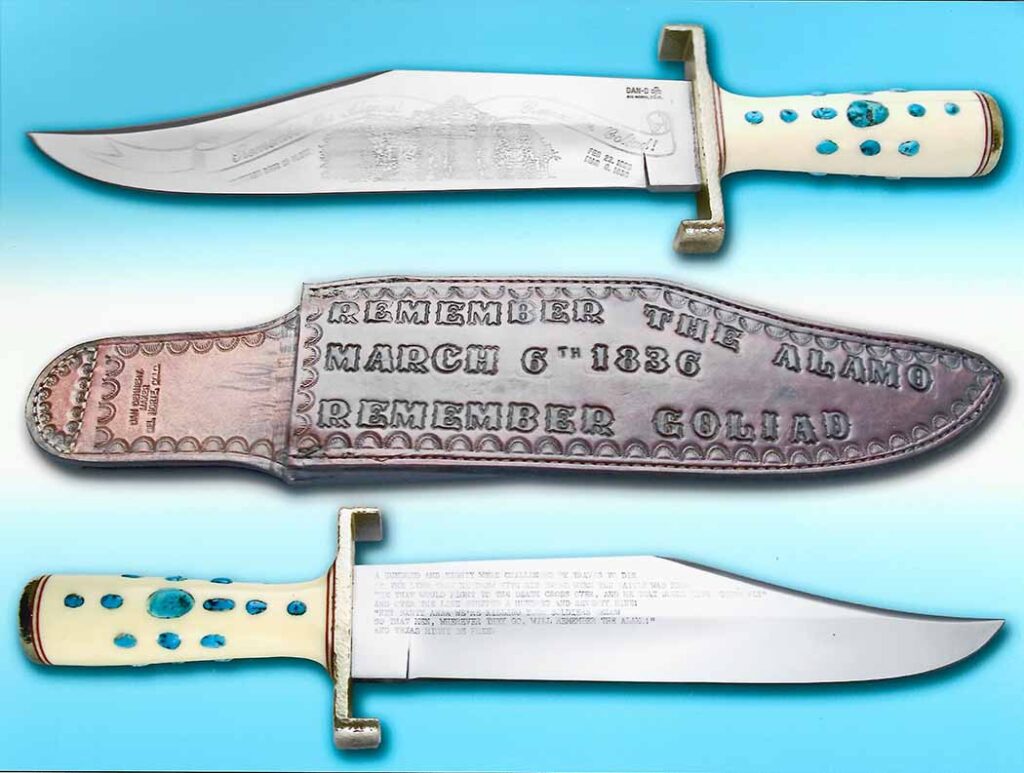
In his vast collection of Dan Dennehy knives, Craig’s favorites were the Dan-D Alamo Bowie and the Huber Foxworth Bowie. The Alamo Bowie has a 12-inch hollow-ground blade a quarter-inch thick and 2 inches wide. The blade’s non-mark side is etched with an eight-line poem that commemorates Col. Travis’s call for “defenders to step forward.” The handle is walrus ivory inlaid with 18 turquoise cabs. Overall length: 16.5 inches. The custom sheath is cowhide. (Bob Glassman image)

Despite having the option to go work for his father’s rapidly growing company in York, Pennsylvania, that was obviously of no interest to Dad so he went into the military. Even though he had trouble with authority and rules, he thrived in the Marines.

After the military his life got really interesting. His resume speaks for itself but here is a summary: police officer; sheriff; private investigator; horse wrangler; hunting guide, Ozark Mountains; fishing guide, French River, Canada; gun shop owner, Fox’s Den (Kirkland, Arizona, and Mountain Home, Arkansas); salesman, Camillus Knives and Levis; personal protection, bodyguard for Saudi Royal Family; professional hunter, South Africa; writer, Whitetail Times magazine and several personal protection books; gunsmith; gun dealer; private security, consulting and training; fugitive recovery; and much more. This is a very general overview and it took him to some very interesting places and dangerous spots, and he met some really interesting people along the way.

So here is what Dad loved. He loved his country and God. He loved our mom. He loved me and my sister. He loved adventure. And he loved guns and knives. Dad was an encyclopedia of firearms, handloading and ballistics. He had a real passion for Rugers, Ruger M77s in any and every caliber they make, but especially 7×57 and Ruger single action pistols. He was also a 1911 fanatic. I don’t remember a single occasion in my life where I ever saw Dad without a 1911 on his side or in a shoulder holster.

And he loved knives. Man did he love knives. I don’t know exactly where in his life this interest started, but he was as passionate about knives as guns, and maybe more. And this is coming from a guy whose gun collection is over 500. He loved all knives and always carried at least two at a time. He had a real appreciation for a good blade and considered knives the most valuable tool an outdoorsman or soldier could have.

Fox's Den Gun Shop
Here’s the second iteration of The Fox’s Den Gun Shop as it appeared in Mountain Home, Arkansas. Note the sidewalk parking meter.

As you would expect, just like factory rifles with factory ammo were not suitable for Dad’s standards, neither were factory knives. As a result he started reaching out to custom knifemakers and collaborating. He formed relationships with Bo Randall, Jimmy Lile, Art Wiman, Clyde Fischer, Blackie Collins, Harold Corby and George Herron, and most notably Dan D. Dad spoke of Dan D. with a manner of respect and admiration that he did not offer up lightly to many. A shared respect and appreciation for the art and skill behind making the ultimate tool, something that was practical and efficient, beautiful and deadly. Dad’s collection of Dan D. knives is vast but his two most prized are the Alamo Bowie and the Huber Foxworth Bowie.

Dad was the toughest man I’ve ever known. A real fighter, rock solid, set in his ways and unshakeable. No matter, if you had a problem, my Dad would be your first call and the man you wanted in your corner. Dad had a lot of fans and a lot of enemies. He had many acquaintances and peers and only a small handful of good friends. He always said if you get through life and only have a few good friends, real true friends, then consider yourself lucky. Dan D. was a true friend of Dad’s.

Machete and knife
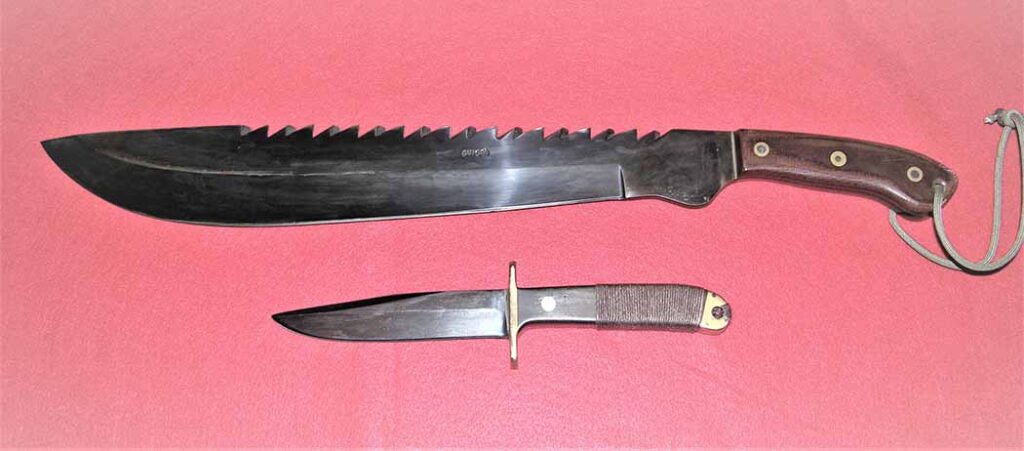
Two of Craig’s favorite Dan-D users included a survival machete and a Woodsman model. Craig designed both, with Dan-D making the former and helping Craig make the latter in the Dan-D shop. Craig carried the Woodsman more than any other knife for over 40 years.

Craig was one of those rare characters you meet along the road of life and always remember. Later he told me stories of discussions with Cutlery Hall-Of-Famer Bo Randall and knife designs for different purposes. Another story was how he talked to Cutlery Hall-Of-Famer Bob Loveless about the simplicity of balancing a knife using his personal theory of the tapered tang. He visited with his friend Cutlery Hall-Of-Famer Jimmy Lile long before the Rambo knife was created. John Horrigan told me about their hunting trip in Africa. Since Craig was a licensed guide the trip was arranged in exchange for a knife identical to the one John presented to President George W. Bush.

Huber Foxworth Bowie

But back to the Huber Foxworth Bowie. The brochure description continues:

This knife is a pure and simple Bowie style but with the handle dropped slightly which seems to give it a much better “pointing” ability and maneuverability not found in most common Bowie styles. [Craig] had a prototype of this knife made for him by a Philippine Negrito instructor while he was attending the armed forces Jungle Survival School in the Philippines. Pound for pound these little Negritos are about as slick and fierce a knife fighter as will be found anywhere.

Knives
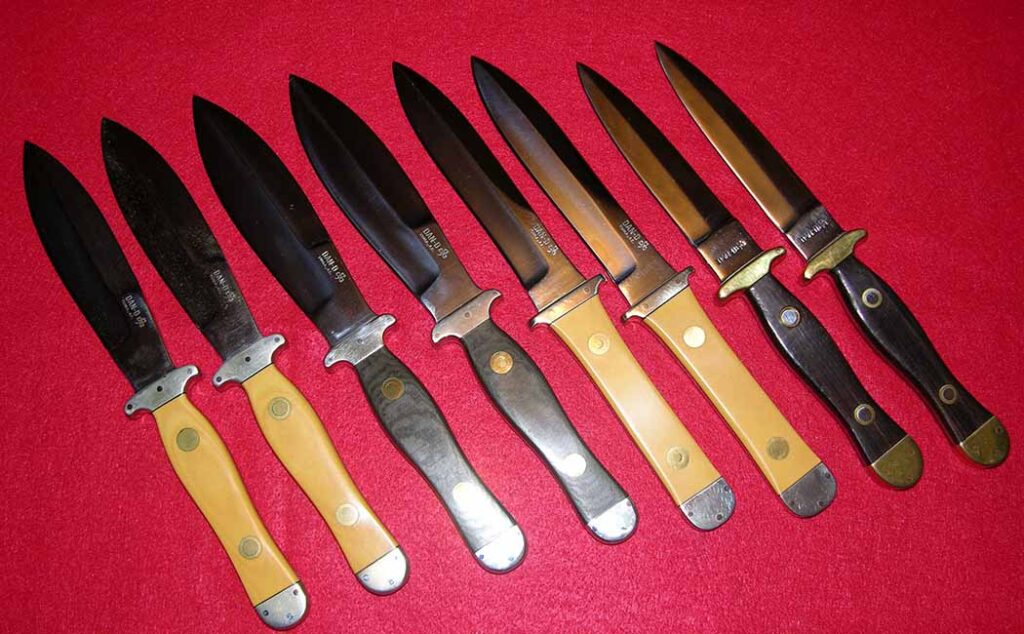
In a 2011 email to the author Craig wrote, “This [image] shows all four pair of boot knives your Dad did for me, including two pairs of my Model III. All have been carried extensively over the past 40 years, and two of the knives have saved my life.”
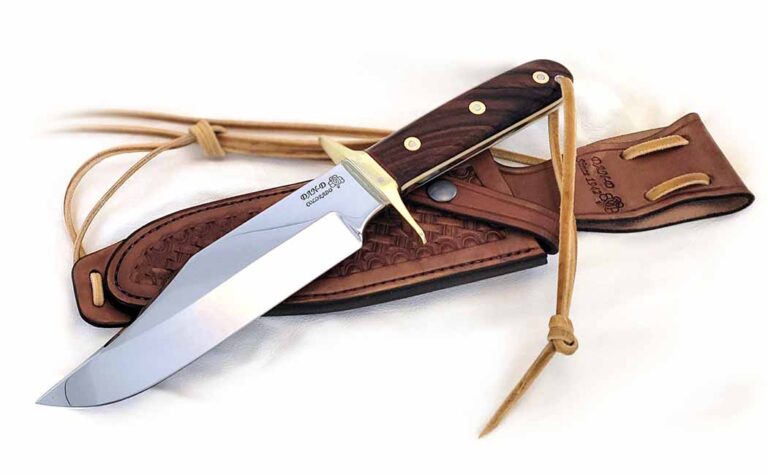
The blade is 8 inches long, 1.75 inches wide and in quarter-inch stock of 154 CPM stainless steel heat treated by Cutlery Hall-Of-Famer Paul Bos. It has a double guard and a 4.75-inch handle. According to the brochure, “This is a knife you could bet your life on.”

A couple of years ago, Hunter contacted me and told me of his father’s passing. Craig lived 76 years his way and made his mark in the world. His passion for God, his country and living life to the fullest extent had been accomplished. Hunter went on to explain that out of all the knives they cannot find the one that meant more to Craig than the Huber Foxworth Bowie.

Check Out More Cool Custom Knives:

YouTube Censorship: Losing The Battle For 1A & 2A

0

Editor’s Note: While this article pertains to the deletion of gun channels on YouTube — including our sister publication Recoil’s channel — we believe it is an interest and pertinent to the knife community. While it hasn’t happened yet, it is perceivable knife content may one day end up under social media’s microscope. Thus, we wish to keep our readership fully informed on the present-day digital landscape.

YouTube Bans Channels Days Before SHOT Show 2023

YouTube has everything from cat videos to documentaries about war to child predators, all six clicks away.

While even mainstream “family-friendly” content creators have complaints about YouTube, there is one form of YouTuber the platform loves to hate – GunTubers.

Recently, YouTube made another push to de-platform and demonize GunTubers. 

Starting just days before SHOT 2023 with the deletion of Ammoland.com’s YouTube page, the site either suspended or issued strikes against channels like Rodger Barrera, 1911 Syndicate, and Lucky Gunner.

Spurring the writing of this article was the deletion of Kit Badger’s channel. Little did we know only a few days later, RECOILTv’s YouTube channel would also be summarily nuked.

Why is this happening, and what can we do about it? The answer isn’t very encouraging, but cold truths rarely are.

Why Does YouTube Hate Your Second Amendment?

Based on what we know – I don’t think YouTube actually hates the Second Amendment as a construct. 

From multiple conversations with multiple content creators on YouTube, they’ve spoken with many people that worked at YouTube who were pro-gun. The problem is, that’s not enough.

YouTube is here to make money. It isn’t here to make the world a better place or to uphold morals and values. The company is in it for the almighty dollar. 

Those dollars come from advertisers. While there are some firearm-friendly brands advertising with YouTube, the super majority of the site’s money comes from mega-corporations like Disney and Amazon, household goods manufacturers like Procter & Gamble, and electronics brands like Samsung. The names of those who advertise on YouTube are nearly endless, but you get the idea. 

YouTube made over $28 billion in 2021. 

Of that, GunTubers are a very small drop in the bucket. The exact totals are unknown, but it’s easy to conjecture firearms content is nowhere in the top ten on YouTube.

2017: YouTube’s Worst Nightmare

Since most major brands prefer to avoid controversy or even the appearance of being on the wrong side of issues, it’s easy to understand why most only want to advertise products on channels and videos no one objects to. 

But in 2017, YouTube screwed up. Truthfully, YouTube had been doing this for a long time – but people noticed in 2017. Due to a series of news articles showing YouTube ads playing alongside extremist videos — the kind with people’s heads being cut off — advertisers made it clear to YouTube that the money could stop.

Huge brands like Walmart and Verizon pulled ad dollars completely. In the month of April 2017, YouTube lost 5% of its top advertisers.

This happened again in 2019 when reports came out of YouTube’s grossly ineffective methods of dealing with child exploitation videos. Again, huge brands like Disney, Nestle, and others pulled ad money until YouTube fixed the problem or the public turned its attention to something else.

Firearm Hysteria

This is a supposition, I believe it’s reasonable to conclude YouTube hates gun channels because it is scared of firearms being the next big thing to lose money over.

dk mags gun store rifle wall

With the mass media’s fetish for murder porn on the nightly news, guns are (as always) an easy target for (real or imagined) ire.

Even as large as the American firearm industry is, all of its marketing money combined isn’t enough for YouTube to sacrifice its Apple/Disney/Hulu cash.

The Omnipotent Algorithm

While firearms are clearly not on its list of favorite things as a corporation, even vanilla channels have a rough time of actually communicating with anyone at YouTube who can make a difference. 

Because of the staggering amount of content posted on the platform, the vast majority of moderation is automated. 

Every minute, over 500 hours of content are uploaded to YouTube. More than 30,000 hours of video are added per hour. While YouTube employs thousands of moderators, this is far, far short of the tens of thousands of human moderators required to view all the content.

Instead, YouTube uses powerful AI and machine learning algorithms to comb through videos automatically. Everything from the words spoken to the images shown is scanned and processed by the algorithm.

This algorithm — more accurately many sets of different algorithms — work together to control everything from what you see in your recommended feed to what videos are allowed to make money.

As much as everyone hates this system, there isn’t a practical alternative. Not without YouTube spending an astronomical amount of money to fund human moderation teams. Not exactly something the company is likely to do if it wants to keep profit margins high. 

YouTube Guidelines

One of the major problems all YouTubers have is the site’s guidelines don’t matter. While YouTube maintains two sets of rules, one set that covers everything on the platform and another set specifically for videos that are monetized, the rules often are simply ignored. 

When a channel gets a warning or a strike, the channel has the option to appeal it. This is, in theory, sent to a human moderator who looks at the issue and rules on it. The problem is these human moderators are unreliable in their judgment. 

Videos that clearly do not violate the rules are still removed or demonetized. Channels can try to delete the video, reupload it, wait for the automated demonetization, and appeal to a different moderator for a different ruling — but this also runs the risk of multiple strikes for one video.

Some rules are so broadly written they become nonsensical. For example, 1911 Syndicate received a warning for swapping a charging handle on camera and a strike for unthreading a suppressor from a rifle.

Other channels, like Kit Badger, don’t even know exactly why its channel was deleted.

Instead, all that is offered is the name of the video supposedly violating the rules and a copy of the entire YouTube Firearms Policy. Too many of these strikes and the channel as a whole is simply deleted.

Even when YouTube deletes an entire channel, it barely tells you why except there were “too many violations.”

Goal Posts Moving Faster Than Light Speed

Another huge obstacle YouTubers face is old videos.

As YouTube has updated and changed its policy over the years, these new rules apply to old videos as well.

Videos that have been up for 5, 7, or 10 years are subject to YouTube rulings overnight. One recent change was creators could not show 30-round magazines. This resulted in multiple channels I spoke with having to spend hours, even days, going through old videos to self-censor them before YouTube found them.

Instead of warnings or a grace period, these old videos can cause a channel’s deletion overnight.

As of this writing, this is what we believe happened to the RECOILTV YouTube channel. Videos that were years old featuring suppressors triggered strikes against the channel, followed by the entire channel being deleted.

Mo Money, Mo Problems

Something a few channels have found is YouTube cares much more about channels that are monetized than channels that are not. But this isn’t the good kind of caring like a mother’s hug. This is more like attracting the Eye of Sauron.

InRangeTV has been proactively demonetized for years, and Karl — the channel’s main host and creator — feels this helped keep the wolves at bay. Without ad revenue or sponsorships, InRange instead relies on the viewers to join and donate through other platforms like Patreon or Utreon.

However, even this has not kept the channel from receiving a warning in the past. 

InRange’s great crime? A video about the Ghost Gunner machine that even didn’t show the machine. Instead, Karl overlaid videos of cats playing with yarn to self-censor the version of the video uploaded to YouTube.

Other channels, like 1911 Syndicate, are demonetized but do not rely on the YouTube for revenue to stay afloat. For the concern, its channel is a marketing tool for its real estate business

We monetized our channel around 40,000 subscribers, and were demonetized about 2 months later.  Since then our channel has been demonetized, which probably helped us not get strikes

1911 Syndicate

This has (probably) helped keep it off YouTube’s naughty list, but as its recent warning and strike shows, being demonetized does not make it immune.

Best YouTube Alternatives

The main problem with other video platforms — YouTube’s competitors — is the lack of viewers. None of the channels I’ve spoken with actually like YouTube, but it’s the place where you can find the most viewers.

If you want to be the change you want to see in the world, the first step is to stop watching YouTube. 

These are some of the best platforms to make this move. 

Recoil.TV

Call it a shameless plug if you want, but Recoil.TV offers a video platform free of YouTube crapola. An aggressively pro-2A and 1A video platform, Recoil.TV is a great way to find and watch your favorite creators. It also acts as a backup in case YouTube persecutes your favorite channel. For example, you can still find Kit Badger on Recoil.TV.

You can also find original content from RECOIL Magazine and our sister publications like OffGrid, Gun Digest, Blade, and Carnivore. 

Utreon

The preferred site, according to several channels I know, Utreon is a mix of Patreon and YouTube. A video platform for people to watch their favorite channels, but also the ability to donate money directly to the channel.

Run by a founder and owner who believes in 2A and giving the people what they want, Utreon offers a lot of options and a lot of flexibility to channels while also using a fee structure that results in more of your donations going to the channel instead of the platform.

InRangeTV is a fan stating it’s their preferred alternative to YouTube:

From my content creator perspective, the best alternative to YouTube at this point is Utreon. They are a good mix of Patreon and YouTube combined, providing a lot of the benefits of both – it’s not a paywall, but does allow for direct viewer support and a lot of Patreon perks integrated into the platform. The owner has proven to be reliable, respectful and capable. I believe their heart is in the right place, but it is ultimately still a centralized solution.

Karl Kasarda, InRangeTV

BitChute

In the media, BitChute has a bad reputation, some of that is well earned. With a strong belief in freedom of expression, there comes the unavoidable reality of some real nut cases abusing the system to spread hate speech, crazy off-their-meds conspiracy theories, and lots of lies.

That said, BitChute offers a decentralized method of sharing and watching videos. Using a webtorrent for distribution means BitChute is extremely difficult to take down, reduces overhead costs, and gives a platform to those who would otherwise be left off major platforms like YouTube.

Viewers be warned: BitChute is definitely not a site I would let my children have free access. Scrolling through the most popular videos makes me want to take a shower and watch something wholesome, like cat videos… on YouTube.

Rumble

Another platform that is home to anyone with a video camera, Rumble hosts everything from wholesome content like America’s Funniest Home Videos to the likes of Alex Jones and Andrew Tate. 

Rumble also provides a clear and simple method for channels to monetize content, very similar to how YouTube AdSense works. 

While again falling victim to the reality that not everything on the internet is good content, Rumble does draw a line at pornography, harassment, racism, antisemitism, copyright infringement, and illegal content. 

I would still caution viewers to exercise their best judgment when browsing Rumble.

Loose Rounds

The writing is on the wall and has been for years. Sooner or later, YouTube will probably ban firearms from its platform. If it doesn’t, it will at least make it so hard and unprofitable for gun channels to stay on the platform that, by choice or force, all of them leave.

While there is probably very little that can be done to prevent this, there are at least some alternatives, as I mentioned. 

Until then, if you can and when you can, consider supporting your favorite channels directly via Patreon, Utreon, and other platforms.

A Labor of Love: Lorenzi Foundation And Museum

The Lorenzi Foundation and Museum showcases one of the finest collections of rare and historical knives in the world.

One of the most extensive collections of ultra-rare modern custom and historical knives, cutting implements and many other items connected with the cutler’s art is displayed magnificently in a new museum in Milan, Italy.

A labor of love by Aldo and Edda Lorenzi, the museum is under the auspices of the aptly named Aldo and Edda Lorenzi Foundation (established July, 2020). The museum showcases the Lorenzi Collection consisting of about 2,000 pieces in all, catalogued and accompanied by specific information: era, origin, artisan (if known), function, material, construction and more.

Aldo & Edda Lorenzi
Aldo & Edda Lorenzi

It gathers cutting utensils and related items dating from the Etruscan period (approximately 900-27 B.C.) to today. It is complemented by a series of specialized publications, testimony to the incessant research that was necessary to bring the operation  of the Lorenzis’ internationally recognized G. Lorenzi retail knife store in Milan to exceptional levels, and to which Mr. and Mrs. Lorenzi devoted their efforts and creativity for many years. It is all housed in a state-of-the-art edifice containing many of the displays and other historical examples of the cutler’s art from the original G. Lorenzi shop and elsewhere.

The Foundation’s premises include a library where visitors and specialists may view the bibliographic materials. A special fit-out of the space enables visitors to relive the shop’s atmosphere. Thanks to an attentive recovery, a number of the original furnishings have been reinstalled on site. This includes an exterior window from G. Lorenzi, one of six “eyes” that communicated with window shoppers in one of Milan’s most exclusive retail store districts, and the display counters on which, over the years, over 18,000 types of sales items were placed. The space also features oak display cases in which the items were shown, as well as the copper-paneled room that featured the small entrance door opening onto the larger shop.

Historic Excellence

The collected items demonstrate, by starting from an artisanal craft as ancient and humble as that of the knife grinder, how it is possible to evolve and then achieve historic excellence. As further informational support, there are over 700 books, about 1,000 magazines and 150 prints, which for the most part depict traveling knife grinders. In fact, Aldo’s father, Giovanni Lorenzi, started his career as a professional knife grinder. Giovanni

Edda Lorenzi examines and arranges some of the many cutlery items from the Lorenzi Collection. (Lorenzi image)

founded  Coltelleria G. Lorenzi—a small shop at the time—at the address of via Montenapoleone 9, Milan, a shop later operated by his sons Aldo, the sole administrator, and Franco. (Regrettably, Franco passed away a few years ago.)

In the course of over 60 years, the Lorenzis collected and kept the pieces which best represented their profession until the closure of G. Lorenzi in 2014. Their selection of the most recent items from their collection was made possible thanks to the close, precious relationship with the artisans—many Europeans, a number of Americans and Japanese—whom Aldo and Edda visited periodically at their shops. It was in such shops that the artisans created their unique pieces, full-fledged artworks that stand the test of time and which enabled G. Lorenzi to become renowned and appreciated at the international level.

Custom Gems

Included in the collection are 150 custom knives by American makers, knives that are particularly near and dear to Mr. and Mrs. Lorenzi. Having collected such knives since the mid-1970s, the Lorenzis traveled the USA, not only visiting the makers in their shops but also attending most every major knife show, meeting just about every maker worth his or her steel along the way.

Among the Lorenzis’ honors are The Knifemakers’ Guild’s Nate Posner Award (1995); the BLADE Magazine Industry Achievement Award (2014); the American Bladesmith Society Special Achievement Award (2014); and the Gold Star Award of Recognition from the William Moran Jr. Museum and Foundation (2014). Three of the Lorenzis’ favorites among their favorite custom knives in their collection are:

  • The number one of an art piece by W.W. “Bud” Cronk, the maker some consider the father of the modern art knife. Aldo ordered a copy of the knife for one of the Lorenzis’ best customers, but Cronk passed away before he could finish it. It would’ve been a coup for the Lorenzis if they could have gotten the copy too, as Cronk never made duplicates of his work. The copy was used later as the model for the logo of the W.W. Cronk Award, a private honor Don Henderson sponsored for 25 years for the Guild Show’s best art knife
  • A Bob Loveless/Barry Wood folder Loveless gave to Aldo when the Lorenzis visited the Loveless shop in 1977. Unaware at the time that U.S. knifemakers’ shops were not retail knife stores, the Lorenzis knocked on the Loveless shop door unannounced. Loveless answered the door and, unsure at first what to make of the couple from Italy, soon hit it

    Loveless/Wood Folder
    Loveless/Wood Folder

    off with Aldo—so much so that he gave the Lorenzis the Loveless/Wood folder. Before the Lorenzis left, they asked Loveless why he had trusted them so much at first sight that he gave them a knife (at the time, Aldo and Edda had no idea what Loveless knives were worth). “He replied that we ‘had our history written on our foreheads,’ a phrase that we have never forgotten!” Edda wrote. “These are the kinds of bonds that have made us love American knives and knifemakers even more!” 

  • A Multilock folder by Ray Appleton. Edda recounted a memorable trip the Lorenzis shared with Appleton from Georgia to Chicago, including visits to an Atlanta racing museum and Kentucky’s Mammoth Cave in the process, the latter where the 6-foot-8-inch Appleton bumped his noggin on a cave overhead. Recounted Edda: “Since Aldo wanted to stop at every cutler shop he knew along the way, Ray generously offered to make the phone calls for him to warn the shops of our arrival. ‘I’m Aldo Lorenzi’s secretary, Hot Pants,’ he announced himself on the telephone, making us laugh a lot!”

These are but three of the many American custom knives and their stories among the scads of other custom and assorted knives and cutting implements in the museum. Meanwhile, a 300-to-400 page catalog of museum items is due for completion by early 2022 at the latest.

If you ever get Milan way, a visit to the Aldo and Edda Lorenzi Foundation and Museum is a bucket-list must. 


Read more about the Lorenzis

Knife Blade Repair: Bringing Old Blades Back To Life

0

Practice the proper steps with the proper equipment and, most important, be safe and knife blade repair is a snap.

I have been fortunate enough to make not just one but two side hustles out of my knife hobby. First is the obvious—writing for BLADE® Magazine. Second is running a knife-and-tool sharpening service out of my garage, serving folks in my community and metro area with full-service sharpening on most cutting tools found in the home, workshop and garage. I have always had a strong interest in sharpening in general and have been practicing the skill for about as long as I have been into knives in general.

While I sharpen many knives and scissors, I also repair damaged knife blades. Those repairs include—but are not limited to—straightening bent blade tips, fixing severely damaged cutting edges, and regrinding new blade tips from broken ones. While sharpening is something I still enjoy very much and to a degree it remains fun work for me, it’s these minor repairs at customer request that I love doing. You can too provided you have the proper equipment and the desire to learn.

Knife with sharpening stone
In knife blade repair, carbon steel blades make the steps easy as they sharpen up quicker than stainless blades.

Before we get into the thick of blade repair, let’s discuss equipment. I run four Work Sharp Ken Onion Elite sharpening machines—I keep one as a backup or deploy it as backup should I need to augment what I’m already running—plus a 1×30 single-speed belt sander, a “Harbor Freight special.” I do all my sharpening on this equipment.

I have used the Ken Onion Elite since the start of my sharpening service almost 10 years ago. I started out with just one Work Sharp. I added a second one awhile after that. The 1×30 came about from trying to revive a few totally dull butcher knives. In the process, I realized I needed another machine that would be in charge of hogging off material to get a quick starter edge that the Work Sharp machines could sculpt into a razor-sharp edge.

Profiling the blade
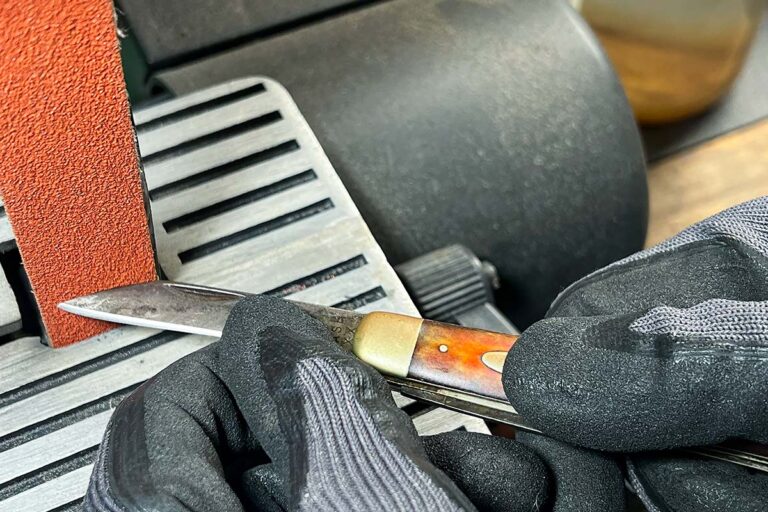
After profiling the basic shape of the new tip, the author uses the X65 belt of the Work Sharp Ken Onion Elite sharpener to further massage and fine tune it, as well as blend in the appearance of the blade spine at the tip to match the rest of the spine. 

Keep in mind that the Ken Onion Elite is not just a sharpener but also a variable-speed miniature belt sander as well, especially when you turn the unit around 180 degrees and work off the platen side. You can easily work on plastic, PVC, metal and wood. This is also how I regrind new blade tips, as well as fixing blade damage caused by hitting something solid and chipping the edge out. We will dive more into specifics in a bit. It’s important to note here that to do blade repairs of any sort successfully, you must have some sort of variable-speed, motorized, belt-sander-type machine.  

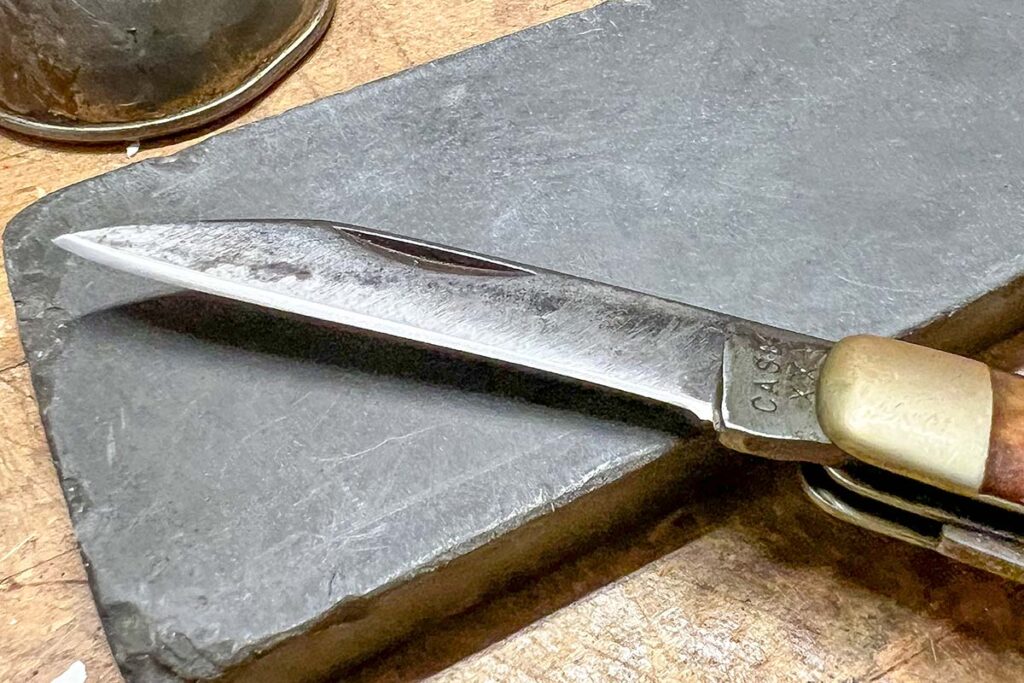
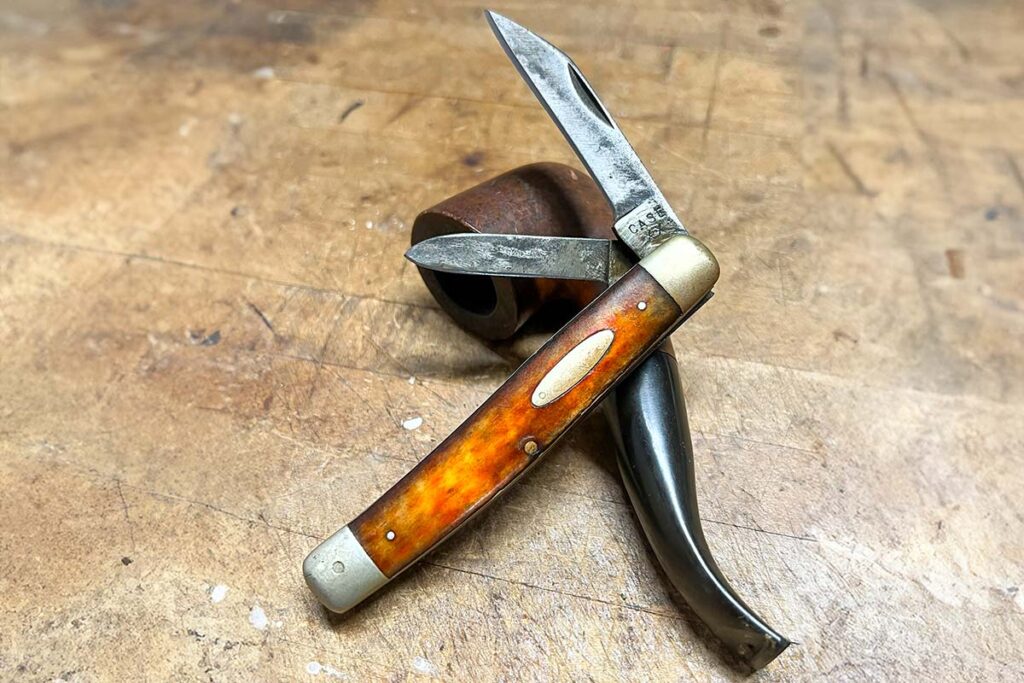
DEMO KNIFEThe demo knife is one a coworker on my day job gave me to refurbish. It is a vintage, carbon steel Case jackknife that saw a lot of use in a previous life. The blades were extremely worn down. Both tips were broken off. The main blade was resharpened so much that the cutting edge was a bit on the curved side. Both blades also had some dings in the edge as well. The owner wanted me to rehab the blades by regrinding new tips and sharpening them. I will take you through step by step on what I did and how it was done. WARNING! Please exercise caution when working with power tools such as belt sanders. Should you attempt such a task as outlined in this story, neither I nor BLADE is liable for any injuries that might occur as a result. 

Heat Management

Whenever executing such repairs on a knife blade, remember to not let the blade heat up or you can ruin the steel’s heat treat. Always keep a jar filled with water within arm’s reach of your machine and dunk the blade into the water every few seconds to keep it cool. Doing so will ensure that you will not overheat the steel. If working on a larger blade such as a machete, I recommend using a spray bottle filled with water. The blade is simply too long to dunk into a jar, so spraying it down every so often will help.  Something else that will help is to have a pair of cut-resistant gloves on hand and always wear them when handling the blade. The gloves usually have a textured coating on the gripping surfaces for the fingers and palms. This will help you hold the blade securely as well as keep your hands and fingers safe from accidental cuts. The gloves usually are inexpensive, less than $10, so there’s no excuse to not have a pair.

Where To Start Repairing A Blade

WARNING! Whenever faced with a blade-tip-rehab task, remember to sharpen the blade last. Why? Because you will be holding the blade as you regrind the new tip. This applies even if you’re wearing cut-proof work gloves.

Blade Tip

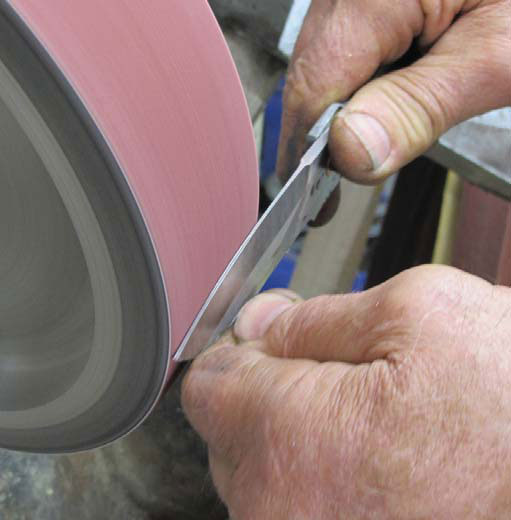
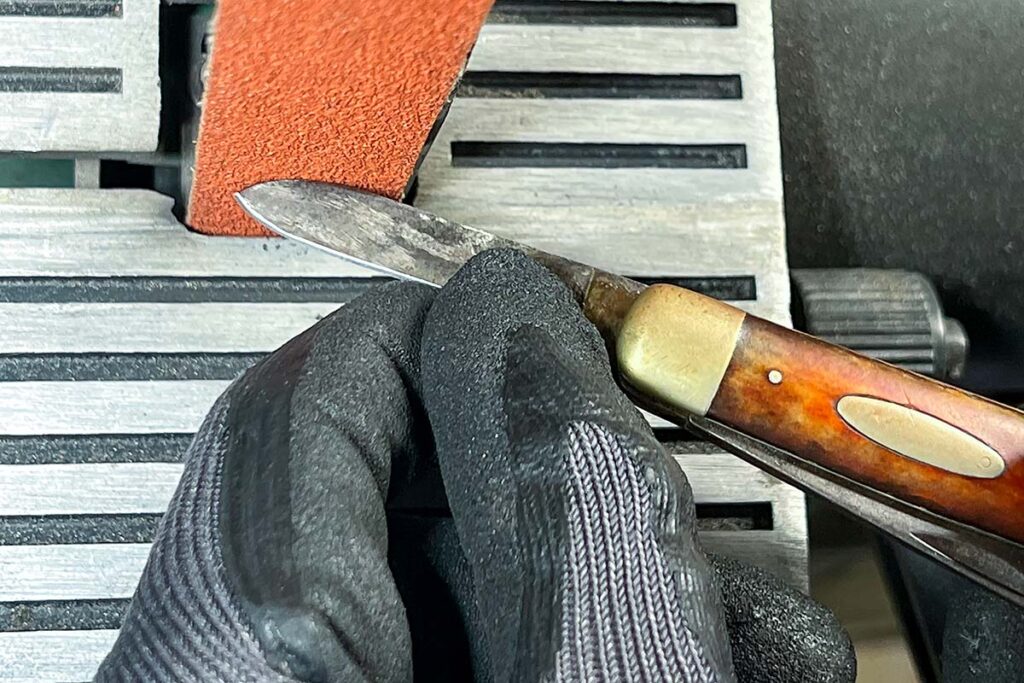
When regrinding tips, I always start with my 1×30 sander with an 80-grit Norton Blaze SG belt. It is the orange belt specifically engineered for knifemaking and removing steel. The 1×30 hogs off material and rough shapes the new blade tip.

Knife blade repair shaping the blade
The author reshapes the new tip on the pen blade using the 1×30 belt sander with an 80-grit Norton Blaze SG belt. 

I start by visualizing where the new tip is going to lie. I start at the uppermost point of the broken-off tip, usually on the blade spine side. I start grinding at that point and remove material to where eventually a new tip is created. As I grind it down, I also pay attention to the visual “flow” of the new tip and how it transitions to the rest of the blade spine. I may have to round off the harsh angle to blend it back into the spine. A lot of this is done by eye, making everything blend right in. The goal is to make the new blade tip look as though nothing happened.

Blade Shaping

After roughing out the new tip with the 1×30 belt sander, I begin to dial in the final shape of the new tip with the Ken Onion Elite. I have much more control at this juncture due to the less aggressive belt grit and the slower belt speed. I can finesse the new tip on, keeping a close eye on the evenness of the ground-down portion, making it parallel with the rest of the untouched blade spine.

chamfering the edges
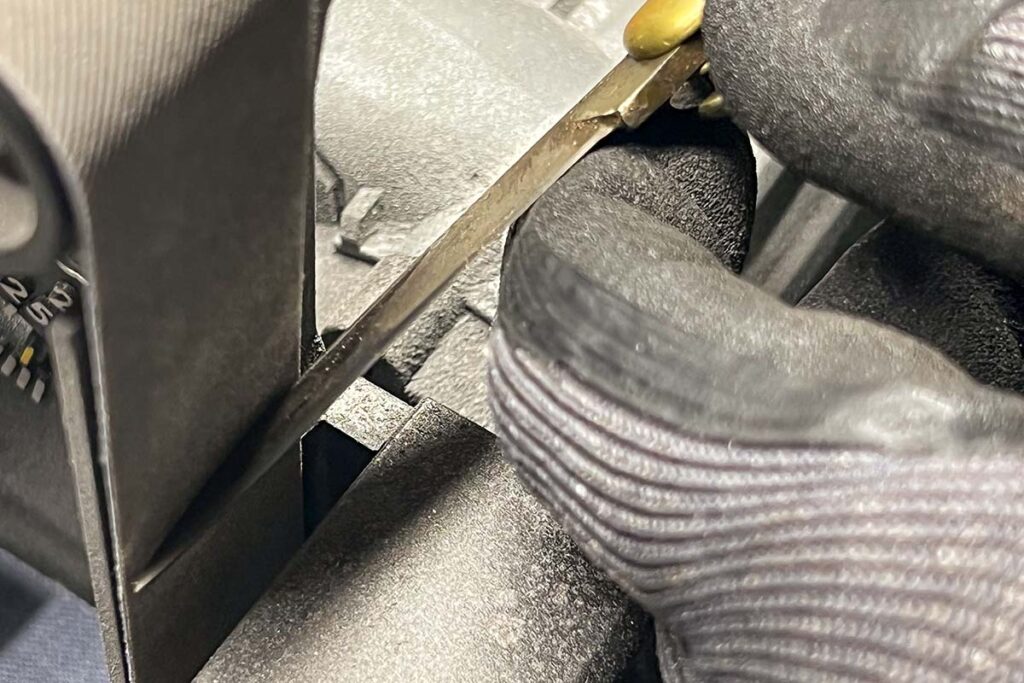
The author carefully knocks off the sharp edge at the corner created by rough grinding the new tip.

Finish

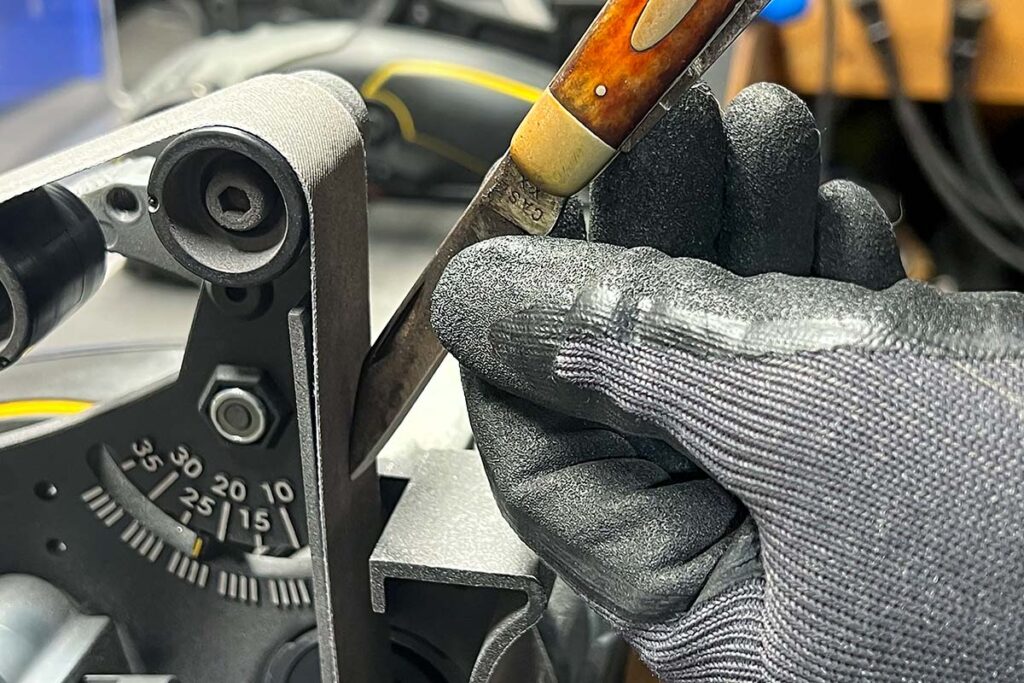
After tweaking the new tip to final shape, I concentrate on the finished appearance of the ground portion by holding the knife almost vertical and sanding only on the ground portion, blending it in visually and removing the coarse-grit scratches with the 80-grit belt on the 1×30.

Chamfering And

When everything is blended in visually, the last step is to chamfer the ground portion and remove the crisp corners made by all the sanding. You’ve seen how blade spines have a small, rounded corner on both sides? You are essentially doing that here. Hold the blade at an angle and lightly touch the blade spine to the belt to cut the crisp corner down. Remember: you can always cut more later if needed. The key is to use a light touch and stop only when the corners are smooth to the touch and you don’t detect crisp edges. The result is a new blade tip that is highly functional but doesn’t look “factory,” though it will be awfully close.

Fixing An Uneven Blade

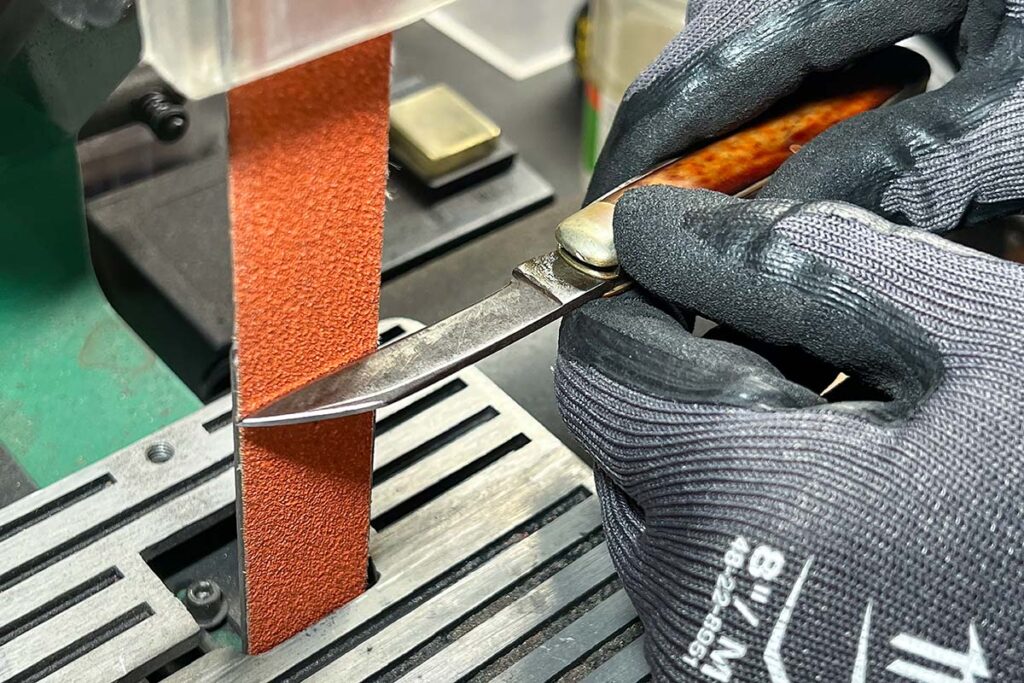
The main blade of the demo knife was worn away unevenly due to years of manual sharpening, so I straightened that out as well. Like the shaping of the new tip, I did the bulk of the straightening of the cutting edge on my 1×30 belt sander. I used a light touch on the belt—I cannot stress enough that it’s easier to grind cautiously—eyeing the straightness of the new cutting edge. Grind a bit then dunk the blade in water to keep it on the cool side.

Straightening the edge
After grinding the new tip on the main blade, the author uses the 1×30 belt sander to straighten the uneven cutting edge by evening it out back to straight. The 80-grit belt eats off material in a hurry. At this juncture the author eyeballs what is to be straight.  

Once I attained an even edge, it was time to grind the new edge. Straightening out the edge will cause a wide flat spot on it, so you have to grind the spot away evenly on both sides. Work diligently and carefully, and don’t forget to dunk the blade in water. With the smaller of the two blades, I repeated the same steps to even out the edge as there were some imperfections I wanted to remove also. As a result, I wound up starting a new edge on the small blade as well.

Once I ground the starter edges, I progressed to the Work Sharp machines to carefully sculpt the new final edges. This is the step where you bring the blades to life. The carbon steel blades make the steps easy as they sharpen up quicker than stainless blades. After the final sharpening of both blades, the result is a vintage pocketknife with a new lease on life sporting new tips and fresh cutting edges. 

Final Cut

Sharpening—transforming a cutting tool from dull to razor sharp in a few minutes—is very therapeutic. Toss in creating new blade tips on top of that and the combination is undeniably very satisfying. If you carefully follow these steps, you too can renew any knife blade with a broken tip. And it doesn’t have to be a pocketknife. I’ve ground new tips on tactical folders and karambits, too. Just follow the same steps outlined here. In fact, larger knives are probably easier because there is more to hold onto while working on them. If you have the equipment and the desire to renew and rehab knife blades, give it a try.

Final repaired knife
The end result is a demo knife with two sharp points and two sharp edges.

It is also possible to use a regular belt sander like mine to do all the shaping steps. Be sure to have an assortment of belts of various grits at your disposal. You will want to change to the finer grits to finesse your work. I recommend using only a 1×30 given the size and width of belt. Again, you can find an inexpensive 1×30 at Harbor Freight Tools for around $50. Who knows, you might even find some other uses for it outside of blade repair.

Knife blade repair can be very satisfying. And because you are working with knives as well as power tools, please exercise the utmost caution and pay attention to what you are doing to prevent serious injury.

Have fun and good luck!

Hone Your Knife Sharpening Knowledge:

Everything You Wanted To Know About Arkansas Sharpening Stones

Novaculite still rocks knife sharpening!

Timeless and iconic, it remains practical and complementary to other options today.

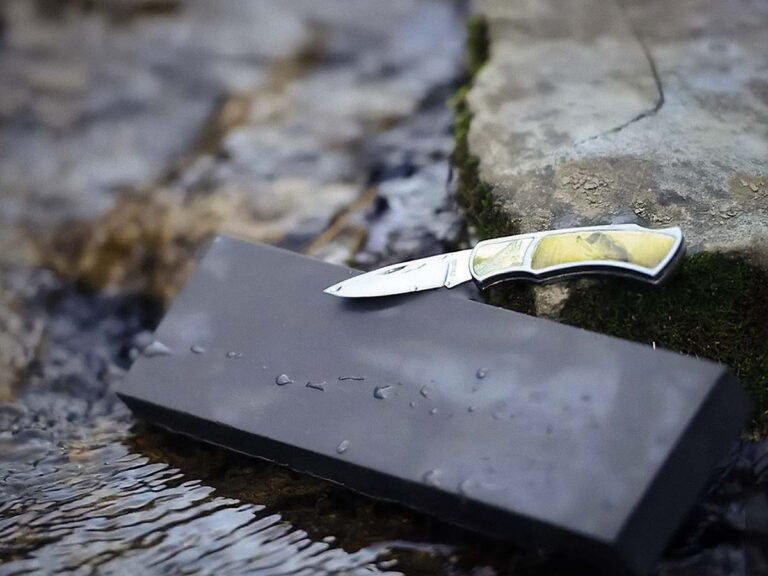
The novaculite sharpening stone is a wonder of nature. Almost pure microcrystalline quartz in content, this dense, fine-grained rock was formed from 318 to 416 million years ago during the Devonian and Mississippian periods in ancient seabeds and later pushed toward the surface with the peaks of the Ouachita Mountains of western and central Arkansas. Massive sedimentary layers ranging from 250 to 900 feet thick produced the stone, which takes its name from the Latin novacula, meaning “sharp knife” or “razor.”

From there, the stone was destined for a rendezvous with the knife blade, rendering a sharp edge that gets the job done and holding a place in working knife history dating back centuries.

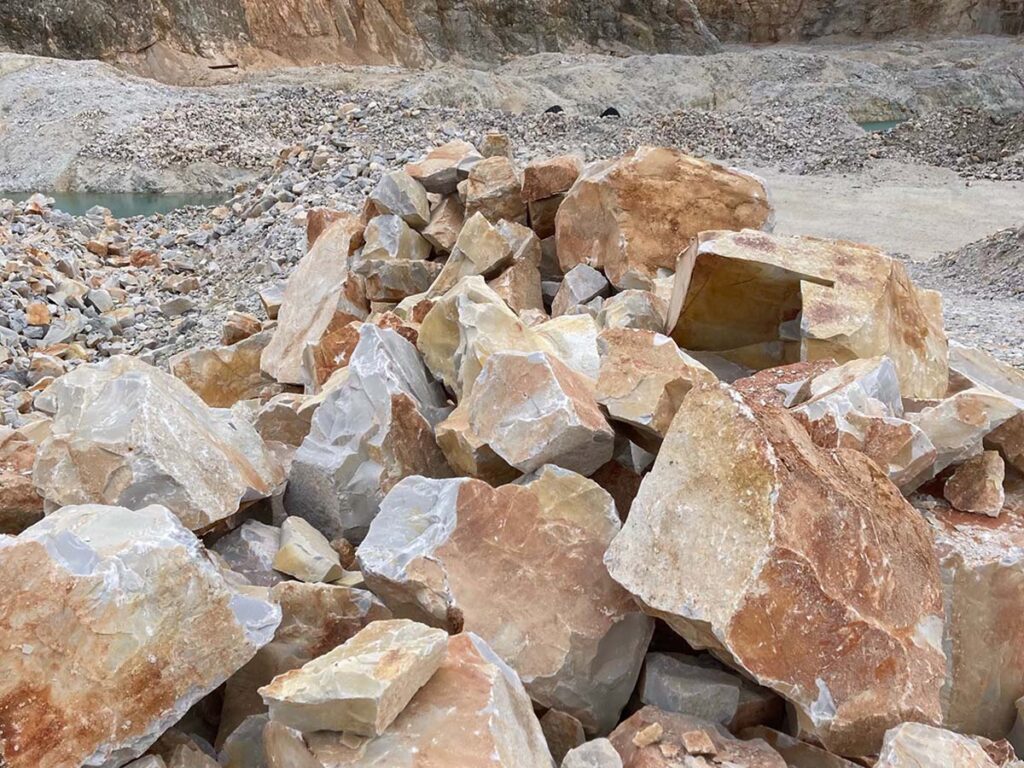
The novaculite deposits in Arkansas were formed 318 to 416 million years ago and it takes plenty of mechanical muscle to push around the material. The deposits run from 200- to 900-feet thick, in turn the operations are substantial. And while the weathered novaculite is somewhat bland to the eye, once broken up the beauty of the natural material shines through. (Images courtesy of Chis Stillian)

Today, however, there is a bit of … well … friction as some may claim modern synthetic stones are eclipsing or at least competing with novaculite for some nebulous title of “best.” Synthetic stones often offer faster sharpening and convenience, while novaculite is valued for its refined finish and traditional appeal. Truth is that each has its place, and novaculite was and is a key participant in the knife-sharpening exercise.

“It gives a razor-sharp, polished edge with smooth feedback that many prefer over synthetics,” explained Chris Stillian, owner of Natural Whetstone, LLC. The company was founded by close friend David Davenport two decades ago, and when David passed away during the COVID-19 pandemic, Chris and his father, Shawn, kept the central Arkansas company going.

“The stones wear very slowly,” Chris continued. “Some last decades because they’re 99 percent plus pure quartz with no fillers. They’re natural, made in the USA and work great for chefs, woodworkers and knife users.”

Danny Kirschman founded Dan’s Whetstone Company, Inc., in Pearcy, Arkansas, in 1976, and his son Steve is currently CEO of the family venture. His roots in novaculite are long and deep. “The erosion-resistant quartz formations of the Ouachitas produced the finest and rarest natural abrasive in the world,” he offered. “Danny Kirschman’s opinion and what we share with others is that the one thing that sets novaculite products apart from other sharpeners is their unique crystalline structure. The novaculite stones wear less aggressively than most manmade abrasives due to the natural bonding of the crystals.”

Best Steel For Novaculite

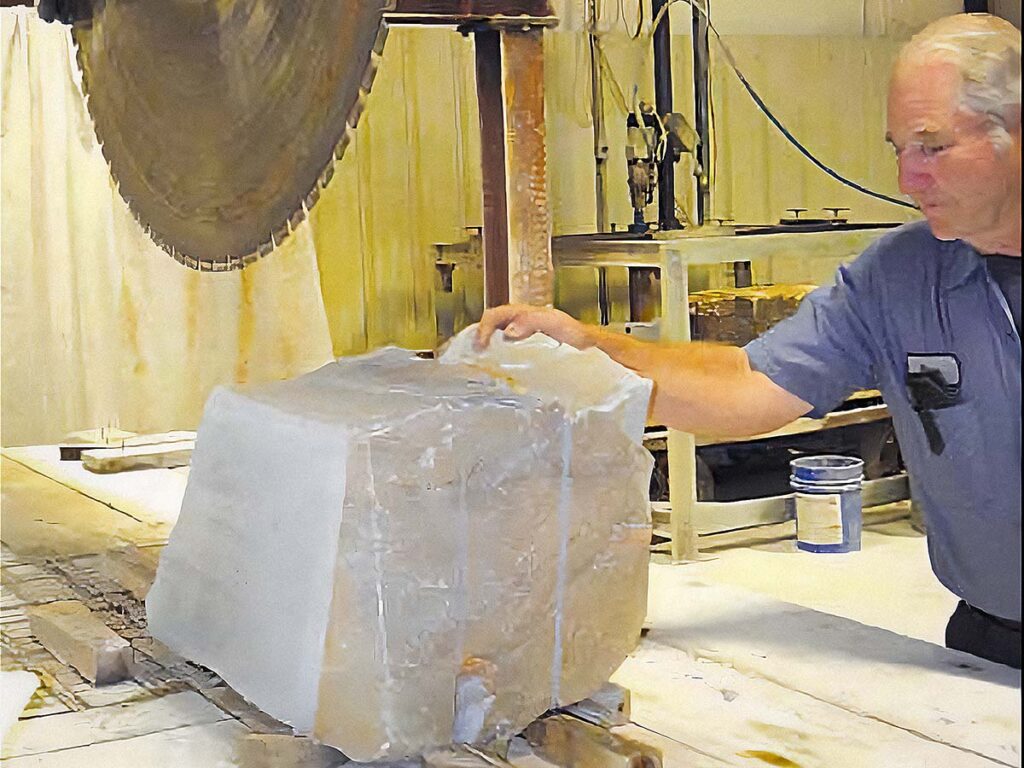
Dan Kirschman, by the company’s largest saw, spent his formative years as a mining engineer, until his hobby of cutting and polishing novaculite developed into a full-time business. Dan’s Whetstones now has a 500-acre quarry and manufactures more than 300 different products from the stone. (Images courtesy of Dan’s Whetstone)

Both Stillian and Kirschman agree that the disadvantages of novaculite usage lie in cutting speed and other aspects. Chris commented, “It cuts slower than diamond or water stones, so it’s better for refining edges than heavy profiling. It needs oil instead of water, can glaze if not cleaned and doesn’t bite hard on modern super steels. Top grades cost more because the dense material is rare.”

Steve added, “The most common complaint is their low abrasion rate. Because the stones are exceptionally hard and dense, they remove material much more slowly than synthetic stones. They are best suited for maintaining an already sharp edge rather than ‘hogging off’ metal to repair chips or reprofile a blade. There is no truly coarse Arkansas stone. Even the soft Arkansas is relatively fine compared to a coarse synthetic stone. Novaculite is composed of quartz, which has a Mohs hardness of around 7. While this is harder than standard carbon steel, it is softer than the vanadium and chromium carbides found in modern, high-alloy super steels.”

Further, since Arkansas stone is a natural product, every stone is unique and may exhibit internal flaws, cracks or variable grit. Oil is required to keep metal particles, or swarf, from clogging the pores, which leads to a bit more cleanup. Lubrication keeps the stone from “loading” with metal, which can reduce its effectiveness.

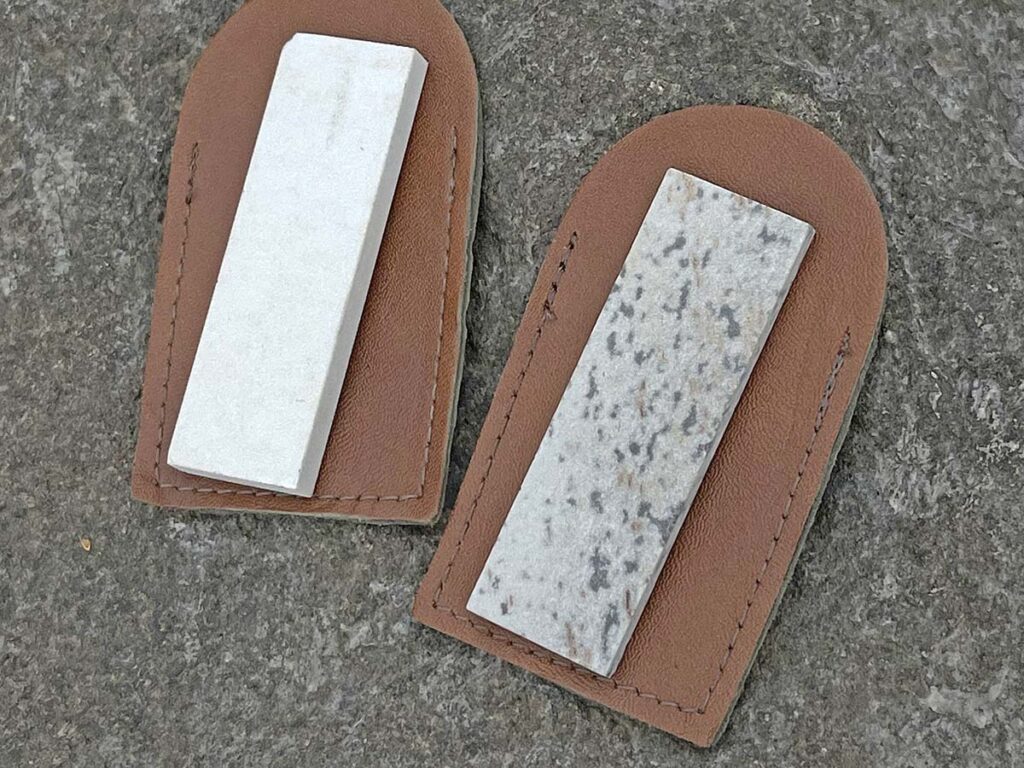
Similar to many sharpening systems, Arkansas stones of different grit sizes are used in conjunction. On the right is a soft stone with a courser grit, good for raising a burr and initial honing. On the left is hard stone, used for final edge polishing and day-to-day maintenance. (Image courtesy of Chris Stillian)

Novaculite works best with simple carbon and low-alloy stainless steels like 1095, O-1, 440C and A2. Since such steels are commonly found on hunting, working, kitchen, bushcraft/survival and everyday slipjoint and fixed-blade knives, a broad area of application exists. High vanadium super steels such as S35VN, M390, CPM-3V and others—often seen in premium chefs’ knives and high-end custom knives—are best served with diamond stones, for example, because their carbides are harder than the quartz in novaculite.

Reviving Arkansas Rock

Even the casual observer can, therefore, discern the proper employment of the novaculite sharpening stone with the blade steel that will produce the best results. One giant of the knife industry recognized the value of the Arkansas stone years ago and built a catalog empire on its sturdy reputation.

The late BLADE Magazine Cutlery Hall of Fame® member A.G. Russell began selling Arkansas sharpening stones in the mid-1960s after moving his family back home to northwest Arkansas from Marin County, California. During the move, he discovered that his whetstones had gotten lost in transit.

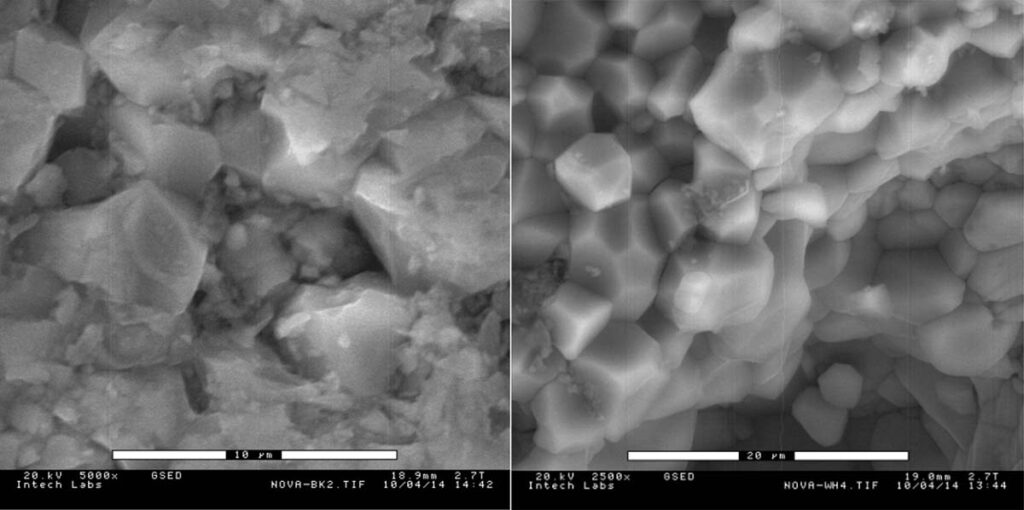
Novaculite is microcrystalline quartz in structure and while it can seem extremely smooth to the naked eye, at the microscopic level the formation’s cutting properties become evident. On the left is ultra-fine black stone at 5000x magnification and the right hard Arkansas stone at 2500x magnification. (Image courtesy of Dan’s Whetstones)

“He tried to buy replacements in local hardware stores, but none stocked them,” remembered A.G.’s wife and fellow hall-of-famer Goldie Russell, who runs the company today. “Having lived in Hot Springs, Arkansas, for a while when he was a teenager, A.G. knew that the only deposit of novaculite was in that area. A.G. went to Hot Springs and found someone who was cutting stones. He purchased stones and began selling them to local hardware stores.”

From there, A.G. bought ads in magazines, particularly Guns & Ammo and The American Rifleman. Soon enough, he became a supplier to Brownells, a major gun retailer, capitalizing on the mutual affinity of gun enthusiasts for knives. Together with the magazine effort and his own sales acumen, Russell re-energized the popularity of the Arkansas stone.

“The frequency of A.G.’s ad in magazines and then the offering of these stones in the A.G. Russell Catalog of Knives was very important in making these stones readily available nationwide through the late 1960s and the 1970s,” observed Goldie. “There is still a large quantity of the small stones that he had cut during those years in our inventory. That is how he started what became A.G. Russell Knives.”

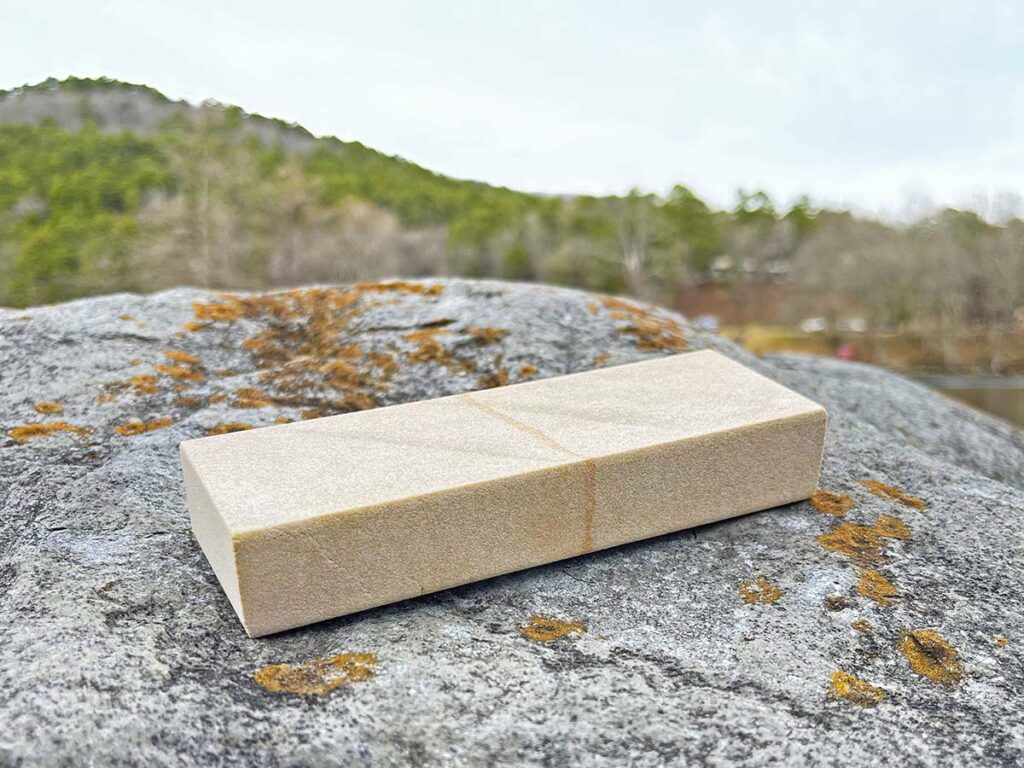
It’s a misnomer Arkansas stone’s hardness corresponds to its color. Similar colors can be noted in different grades, as the coloration is purely a matter of trace mineralization in the stones. (Image courtesy of Chris Stillian)

Novaculite stones, therefore, maintain their place in the practical and the historical aspects of the knife industry, and their relevance is not likely to fade. Those who are familiar with their capabilities remain loyal. They appreciate the investment of time and effort required to bring out that razor-sharp edge, and there is something timeless and reaffirming in the process.

Novaculite Grades

The stones themselves are available in four major grades. “Users should be aware that color is not the determining factor in grading novaculite,” explained Kirschman. “Some users have been defining whetstone grades by color, but the same colors may be seen in more than one grade. Color is caused by trace minerals that are dispersed through the rock during sedimentary formation more than 350 million years ago and subsequent geological activity.”

The major grades of novaculite include the following:

  • Soft Arkansas: The most popular all-purpose stone often used by wood carvers, sportsmen, butchers, commercial knife sharpeners and even housewives who desire keen, polished edge in a minimum of time.
  • Hard Arkansas: A fine grit stone good for everyday maintenance and popular among woodcrafters and the dental industry.
  • Translucent and True Hard Arkansas: An extra fine stone with a glassy feel and used in industrial applications requiring an extremely fine polish. It appears in a variety of colors.
  • Black Arkansas: Sometimes referred to as “surgical black” stone, the finest grade abrasive available today, delivering a mirror polish.     
Among the most critical factors of using natural stones to sharpen knives is using honing oil. Oil keeps metal particles, or swarf, from clogging the stone’s natural pores, thus reducing its effectiveness. (Image courtesy of Chris Stillian)

The proper method of sharpening with a novaculite stone involves preparation and practice. “It’s an oil stone, so put a few drops of honing oil on it,” advised Stillian. “Hold a consistent angle, 15 to 20 degrees for most knives, use light to moderate pressure, and take smooth strokes. Start on soft or hard if the edge is dull, and finish on black or translucent. Raise a burr, then lighten pressure. Clean with soap or solvent to avoid glazing. Strop afterward for extra keenness, if you like.”

Those About To Rock

According to Chris, consistent purchasers and users include enthusiasts, woodworkers and chefs who “keep buying them for the feel, longevity and heritage. Synthetics rule high-volume work, but real Arkansas novaculite—especially the rare translucent and black grades—still sell at a premium to people who want the genuine article.”

Steve sees emerging interest as well. “The rising D.I.Y. (do it yourself) sharpening culture is a major driver,” he commented, “with the hobbyist segment now accounting for nearly 35 percent of total whetstone sales worldwide. Online tutorials and a deeper appreciation for craftsmanship have fueled this demand. Sustainability is a driver, as well. Modern consumers increasingly view natural stones as a “green” alternative to synthetics.

“Niche premium positioning, even while high-end market saturation is slowing growth in North America to about 4 percent, means natural stones remain a staple for professional chefs who prefer them for maintaining blade integrity,” Steve concluded. “And technological integration means that manufacturers are now developing beginner-friendly kits and instructional digital content to tap into 62 percent of home users who are interested in traditional sharpening but lack confidence in the technique.”

The future presents an atmosphere of coexistence among the Novaculite and synthetic options. The global whetstone market topped $457 million in value in 2024 and is expected to reach $677 million within eight years. Natural stone demand should stay steady, supported by its faithful and traditional users while welcoming explorers to these Ouachita wonders.

More On Sharpening:

Advertisement

Must Read Articles

Read this before you make a knife

Knifemaking 101 – Read This Before You Make a Knife

  by Wayne Goddard My experience has taught me that there's nothing like digging in and getting started. I've often said the hardest part of the...
how to forge damascus steel

How to Forge Damascus

Advertisement
Advertisement