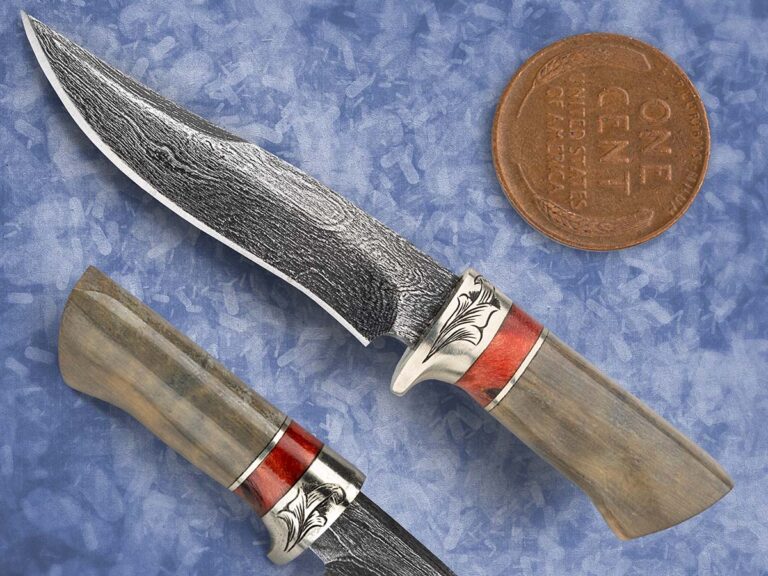
Robert Logan had a scrap to pull off his Tiny Fighter.
ABS apprentice smith and member of the Texas Knifemakers Guild, Robert Logan, has developed a varied catalog over his nearly nine-year career. His work in kitchen cutlery has raised eyebrows in some corners of the knife world. Yet, his smaller projects are certainly worth consideration.
Such is the case with Robert’s Tiny Fighter, a minuscule fighter whose detailed execution is hard to miss—even if it’s no larger than a penny. The knife measures a scant 2.875 inches in overall length, with a 1.6875-inch damascus blade (192 layer 1084-15n20). Setting it all off is a mammoth-ivory handle and a beautiful guard featuring engraving by Alice Carter.
Robert Logan
Robert has tinkered with miniatures previously, making a couple of dozen scaled-down versions of his Mini Cleaver Belt Knife. But the Tiny Fighter, he said, was his first crack at venturing deeper than a simple slab handle in a miniature piece. Without special equipment for the job, it was especially tricky.
“Honestly, the most challenging thing about making tiny knives for me is just holding on to them,” Robert confessed. “I don’t use grinding jigs, so just holding on to the thing to grind, it was hilarious.”
Travis Payne’s knife has all the right curves in all the right places.
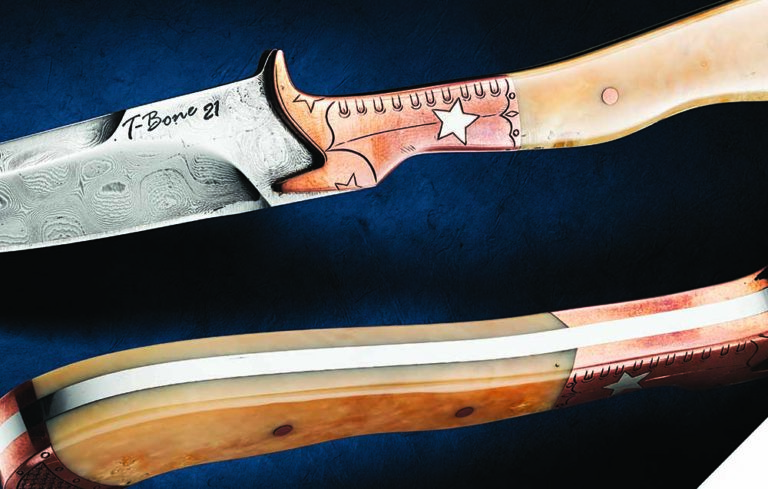
It’s hard to find anything more beautiful than a shapely woman’s leg, and Travis Payne revisits the concept in knife terms with his Gal Leg fixed blade.
Study the leg handle and you can see how it would be eminently ergonomic. “That was the whole point of the knife—to get a handle shape that both looked like a leg and was pleasing to grip,” the maker from Telephone, Texas, noted.
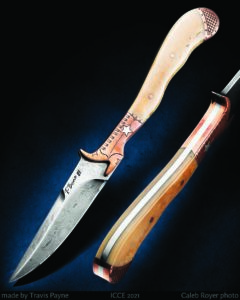
Travis Payne (inset) said his Gal Leg fixed blade finished second in its category in the knife judging competition at the 2021 ICCE in Fort Worth, Texas. The swedged blade bears Payne’s mark of “T-Bone 21.” Note how the boot toe curls up to form a top single guard/thumb placement area for an enhanced grip.
Leg handles long were favored among manufacturers of antique pocketknives back in the day, but there’s something about Payne’s version with the boot for a bolster, swaybacked handle with the indentation about where the back of the knee would be and the—ahem—handle butt that all comes together.
You might say the knife has a leg up on the competition.
Gal Leg Specs Maker: Travis Payne Knife type: Fixed blade Blade length: 3” Blade material: Pattern-welded steel forged by Alabama Damascus Handle material: Mammoth ivory Bolsters: Copper engraved by Matt Litz Overall length: 7” Maker’s approximate list price for a similar knife: $1,200
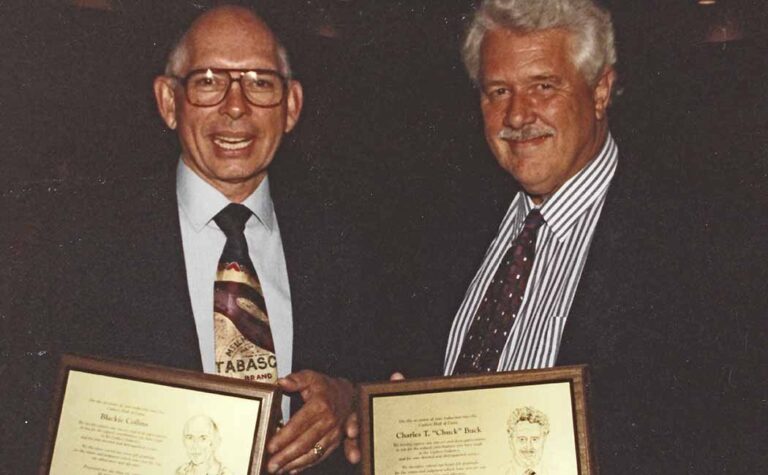
Blackie Collins brought The American Blade to an audience thirsting for knife news.
Editor’s note: This year marks BLADE®’s 50th anniversary. In recognition of that milestone, we are presenting a series of stories celebrating our half-century birthday. This time, how Blackie Collins founded the magazine then known as The American Blade.
Whether designing a new knife, making a knife of his own creation, flying along on a motorcycle—or starting a magazine—BLADE Magazine Cutlery Hall-Of-Fame® member Walter Wells “Blackie” Collins was a risk taker.
Fifty years ago, Blackie spearheaded the first issue of The American Blade, the original name of today’s BLADE® Magazine. It’s unlikely he ever thought his creation would endure as it has, or that it would grow to become the World’s No. 1 Knife Publication. But back then, the time was right to give it a try.
“I was in business with a friend of mine buying and selling knives, and Blackie would supply us with cutlery. He was an excellent custom knifemaker,” remembered Roger Aiple of New Orleans. “He was a close friend and you might say he was thinking about producing a magazine. He asked me what I thought about it, and, knowing Blackie and his dedication to knives, I said it was a great idea but that producing a magazine was not the easiest thing in the world.”
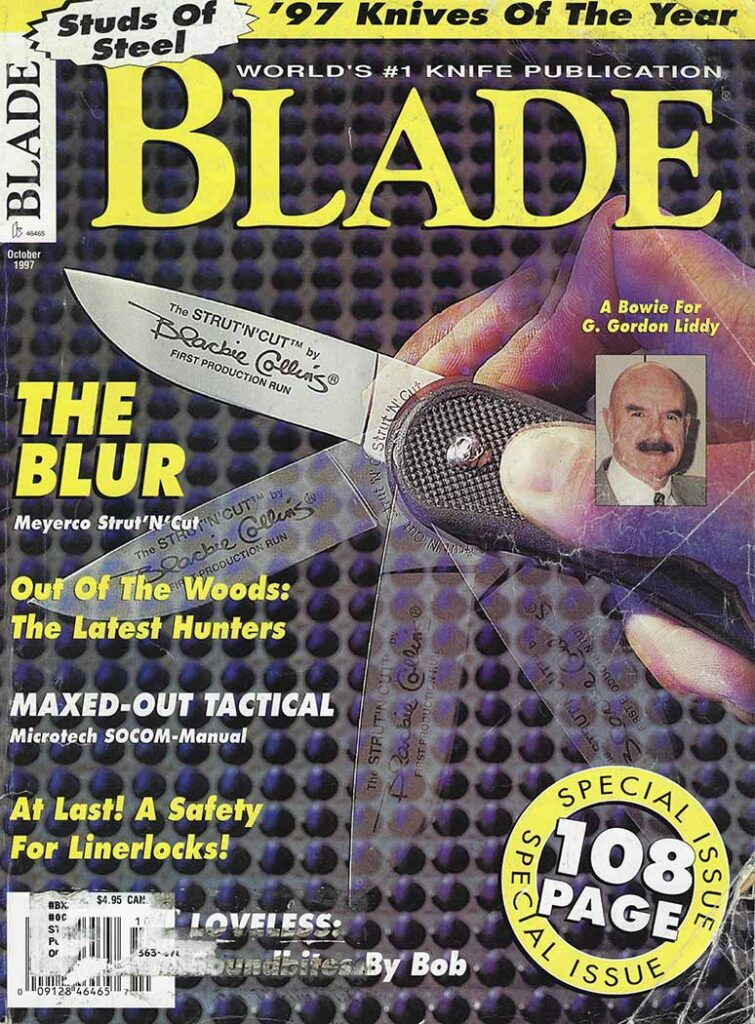
Blackie Collins loved motorcycles, including those by Ducati. In fact, he based the opening mechanism of his revolutionary Strut’N’Cut assisted-opening knife (inset gracing the cover of the October 1997 BLADE®) on the Ducati’s single-strut suspension system. He was killed in a motorcycle accident on July 20, 2011, at the age of 71.
Aiple introduced Blackie to Mal Mele and Sonny Molenaar, the owner of Molenaar Printing Company, in nearby Metairie, Louisiana, and the three men worked out a deal. Apparently, Mele and Molenaar were willing to share some of their insights on how magazine production worked, including printing, distribution, and other nuts and bolts items. Then, of course, there was editorial content to produce, copy to be written, and photos to be taken and reproduced for the new publication.
Blackie devoted energy and ideas to The American Blade, and there were two very good reasons for his drive to see the magazine concept become a reality. “Can you think of a better way, if you’ve got knives or knife designs, to get with other knife companies and everybody in the business?” reasoned Susan Collins, Blackie’s sister-in-law and wife of his brother, Michael. “The American Blade opened the door for him to walk into a shop or factory and say, ‘Let me do an article on you or on this or that subject.’ Blackie knew everybody, and it helped to make him very successful and Michael, too.”
While Blackie was putting The American Blade together, Michael was working away in the brothers’ shop. He knew Blackie was up to something but wasn’t sure exactly what was going on.
“I was working on knives and grinding blades, and he wouldn’t tell me what he was doing,” Michael smiled. “It was a surprise to me, but he got it done and it turned out well. Sometimes Blackie would do things and people would wonder why. He did a really good job of putting the magazine together and getting it published, and I sat back and watched it happen.”
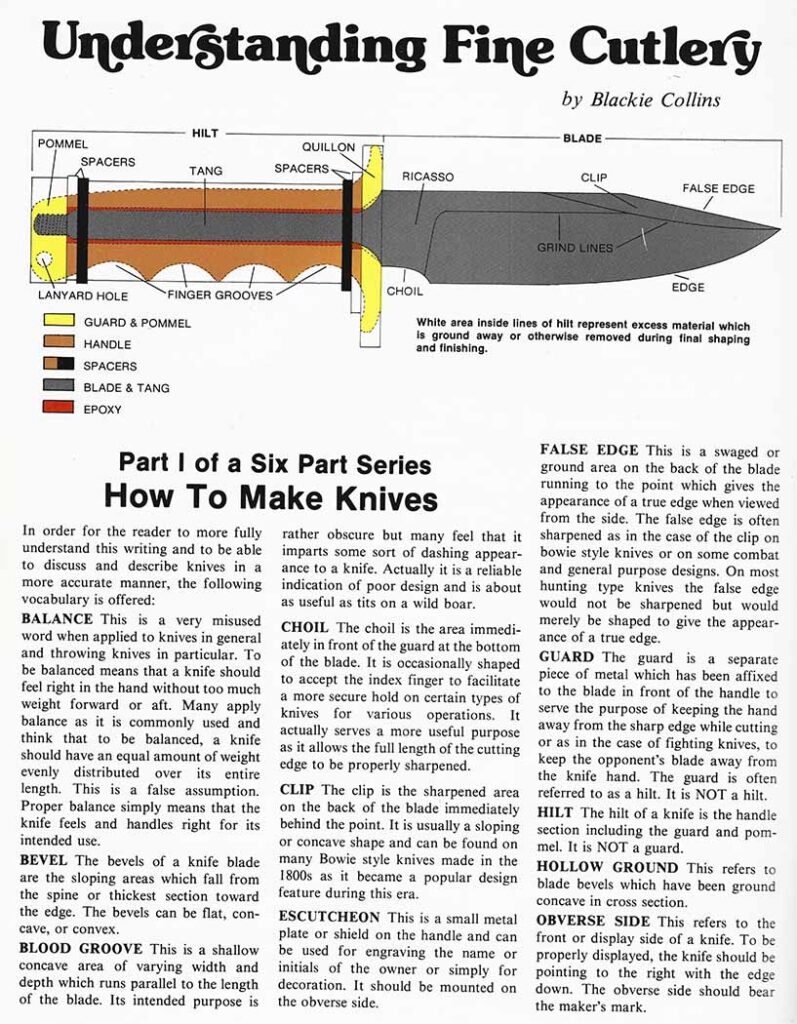
Blackie Collins wrote a series for the magazine titled, “Understanding Fine Cutlery,” and did his best to spread the good word of how to make knives, providing tips and pointers to up-and-coming makers.
Michael related that the two knives that graced the first cover of The American Blade were both his creations. After all, something had to go on that first cover, right? “He would set his mind to something, and that is what he was going to do,” Michael said of his industrious brother. “Sometimes, he would go a while before he would tell you what he was doing.”
Voice Of American Knifemaking
Cutlery Hall-Of-Famer Bill Adams, owner of long-time knife retailer Atlanta Cutlery for many years, was responsible in large part for the excitement that surrounded the knives of Sheffield, England, in the magazine in the early to mid-1970s. Sheffield was a center of knife production in Europe, and the quality of its cutlery was unsurpassed in the factory setting from the late 18th century until the early 20th century. After Bill put in long hours and travelled to Sheffield to search through the old local knife factories and make some key purchases, he had become an authority on Sheffield knives and co-wrote/wrote two articles on the topic in the first two issues of The American Blade. He later advertised Atlanta Cutlery in the magazine, too.
“There was something happening back at that time, and I thought The American Blade was an important development in the knife field,” Adams explained. “Up to that time, there was practically no news or information about custom knives, factory knives, sales outfits, or anything else if you were interested in collecting. Seems like I did write some articles for the magazine, and we probably swapped payment for advertising.”
Adams was right. There was something happening in the knife world in the 1970s, and The American Blade made information available to an ever-widening readership. Longtime knife-and-gun writer and one of the founders of the American Bladesmith Society, Cutlery Hall-Of-Famer B. R. Hughes, once said, “In the latter part of the 1960s, A.G. Russell supplied me with a list of all the custom knifemakers he knew at that time. There were 21 names on the list. The American Blade appeared in 1973, and there are literally thousands of known makers in America today. This is due primarily to BLADE’s features on knifemaking, prominent knifemakers, techniques, materials and the like, as well as information on knifemaking schools and expositions. This dramatic explosion of custom makers would never have occurred without BLADE.”
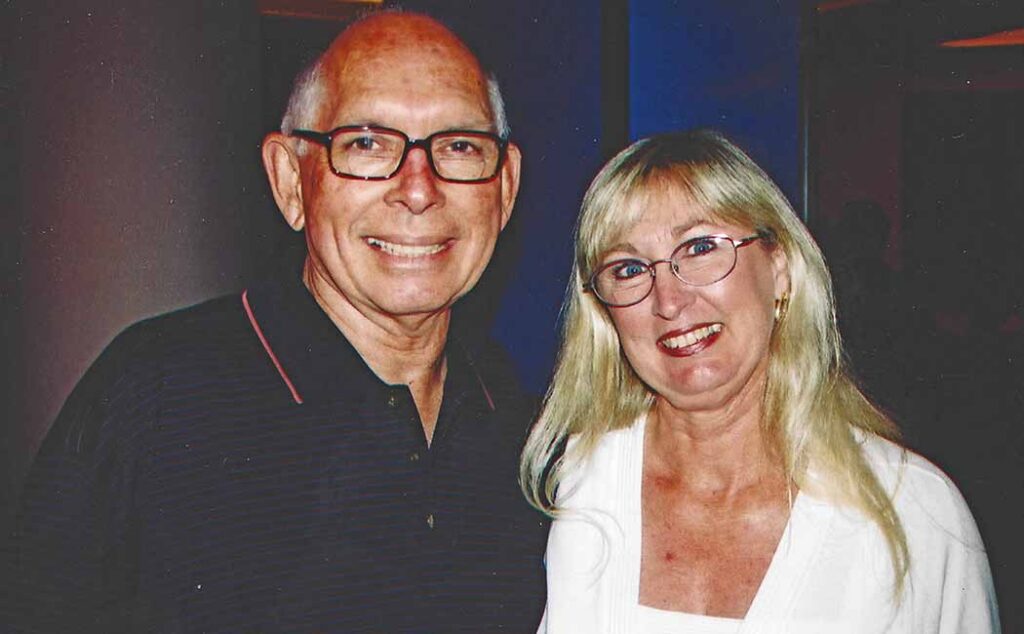
Jane Collins (right) said Blackie read and wrote constantly, and it was not unusual for him to stop his motorcycle on the side of the road or to get up in the middle of the night to write down an idea for a knife design or knife project.
And the big idea for The American Blade belonged to Blackie Collins. The magazine debuted with the May-June 1973 issue, and soon enough there was a buzz building up among knife people. Some of the most recognized custom makers in the industry were appearing with regularity in the pages of the magazine. D. E. Henry and Cutlery Hall-Of-Famer Bill Moran were members of its “Board of Editors,” while Bob Dozier made a knife that was given away in one issue to a lucky winner, a Mr. T. L. Cox of League City, Texas. Dozier, Moran, Lloyd Hale, Ted Dowell, Pat Crawford, Chubby Hueske, Herman Schneider, Cutlery Hall-Of-Famers Bob Loveless, Ron Lake, Buster Warenski, Wayne Goddard and Billy Mace Imel, and a host of other great custom makers were featured in one way or another in the succeeding issues. Dowell, Michael Collins, John Nelson Cooper, Jim Small, and Hueske also contributed giveaway knives that generated quite a swirl of excitement among early readers.
Bringing Knifemaking To The Masses
Blackie wrote a series for the magazine titled, “Understanding Fine Cutlery,” and did his best to spread the word on how to make knives, providing tips and pointers to up-and-coming makers. “There were a lot of people who wanted to learn how to make knives,” recalled Jane Collins, Blackie’s wife. “He had written a book about how knives are made, and he wanted to put the magazine out there to help new makers, too. It was so everybody could learn from it. He had learned from other people, and other people had learned from him.”
Jane remembers Blackie’s drive and commitment to various projects throughout his life, and The American Blade was an all-consuming endeavor for a while. “It caught on well. He was a writer, and he wrote and read constantly. He had the most interesting way of thinking about stuff,” she recalled. “He might be riding a motorcycle and have something come to mind and stop and write it down with a pencil and paper he carried. Sometimes, he woke up in the middle of the night and would run out to the workshop to make notes.”
Blackie always seemed to have a formula to make something go. His dedication to The American Blade in those early days was as intense as his new knife designs that always seemed to be in high demand.
“The magazine was such a good idea then because of our love of cutlery,” Roger Aiple observed. “We knew all of those first custom knifemakers, and the magazine was intended to promote knives. Blackie didn’t have any idea how to publish a magazine back then, but when I introduced him to Mal and to Sonny, they worked it out and helped him get it printed to start things.”
Soon after The American Blade got off the ground, Blackie must have felt that old familiar tug to move along to some new project. He had been listed on the magazine masthead as managing editor, editor and publisher, and of course, he had written articles as well. Some of the details from those days gone by have literally been lost to history, but it is safe to say that Blackie’s energy got things going, gave the publication the push that it needed, and set the stage for something that would have a far-reaching impact on the knife world.
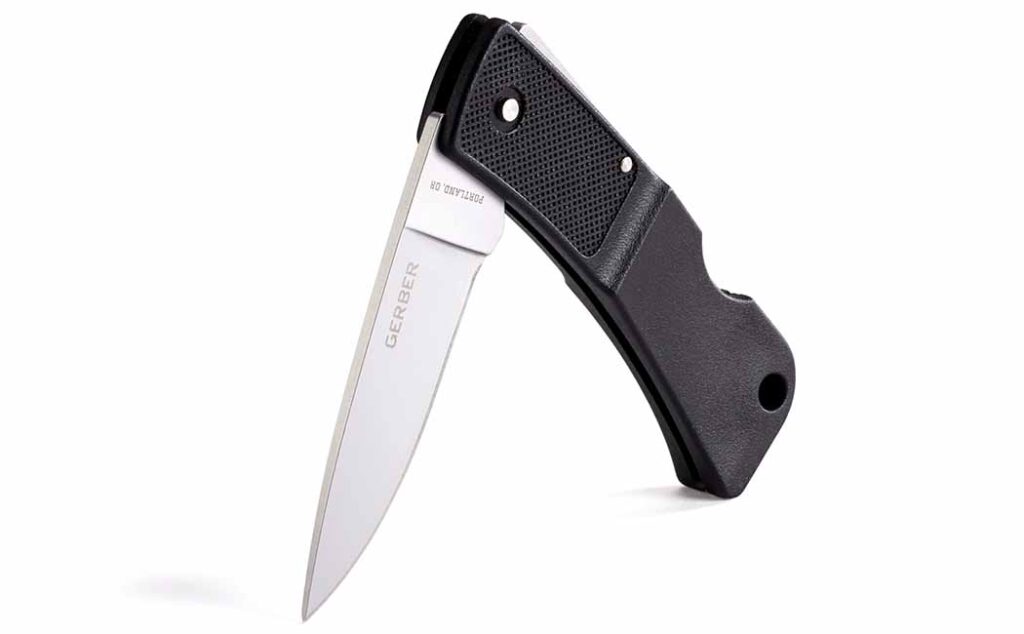
Blackie Collins designed the Gerber L.S.T. (1983), the first knife ever to have a handle of glass-filled nylon.
“Blackie was the kind of guy that would put things together, make some money and move on,” Aiple observed. “He was a great custom knifemaker, but his heart was in designing knives and having someone else make them. He did sell the magazine. I think he had gotten tired. It was taking up too much of his time, and it does take a lot of time to put a magazine together, writing articles, getting advertising, having photos prepared.”
Blackie resigned from The American Blade within months of the magazine’s launch, and an announcement ran in the November-December 1974 issue. The new editor, William L. Cassidy, noted that his predecessor was moving on and commented on Blackie’s important role in establishing a solid foundation and tapping into the knife community so well. “Blackie is, after all, the fellow who began this magazine—who lived with it through triumph and failure alike—and for this we all certainly owe him a debt of gratitude,” Cassidy wrote.
Blackie worked on the first seven issues of The American Blade in 1973-74. He saw his creation grow and prosper, becoming the icon in the knife publishing world that it is today. After half a century, BLADE’s staying power is proven. It still delivers on the desire of its founder to spread the good word about knives, and its message is as enduring as one of Blackie’s great knife designs that so many people have carried and used with pride through the years.
Largest class as HOF honors living and deceased legends.
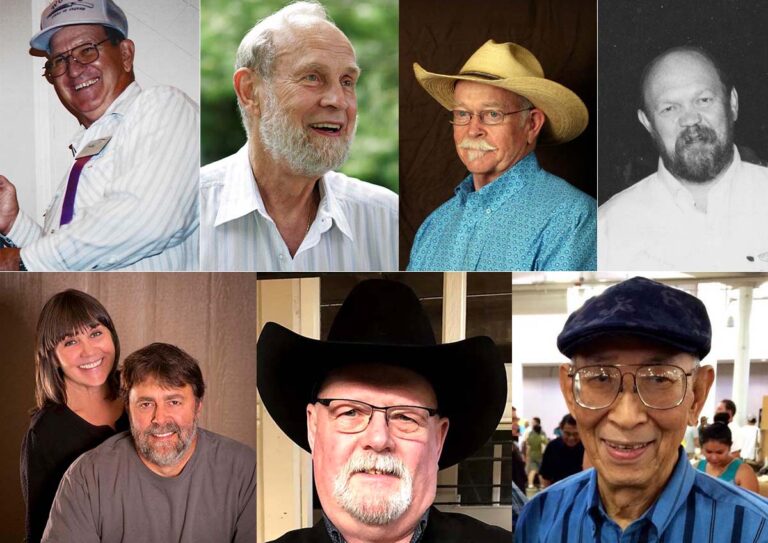
The BLADE Magazine Cutlery Hall of Fame® is proud to announce its new inductees for 2025: Harvey Dean, Stanley Fujisaka, Rick Dunkerley, Dr. James Lucie, Alfred Pendray, James Schmidt, and Daniel Winkler and Karen Shook.
In a procedural change new for this year, the Hall of Fame has expanded the number of annual inductees from three to seven, the latter including four living and four deceased individuals. (The team of Winkler and Shook is count as one inductee.) They, along with Dean and Dunkerley, are this year’s living inductees, with the balance being the deceased ones.
The new Hall of Famers will be formally inducted, including the posthumous inductions of the deceased members, during BLADE Show 2025 June 6-8 at the Cobb Galleria Centre in Atlanta. The induction ceremony will commence the Saturday morning of the show, June 7, at 8 a.m., and will include a breakfast in the Kennesaw Room of the show’s host hotel, the Renaissance Atlanta Waverly. Tickets are required in advance and are limited. For ticket information email [email protected].
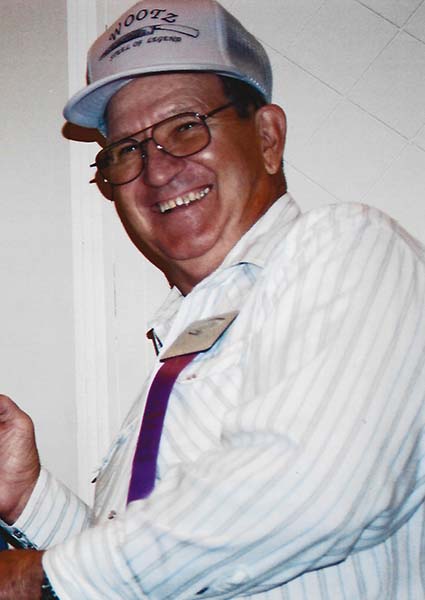
Harvey Dean
Harvey Dean
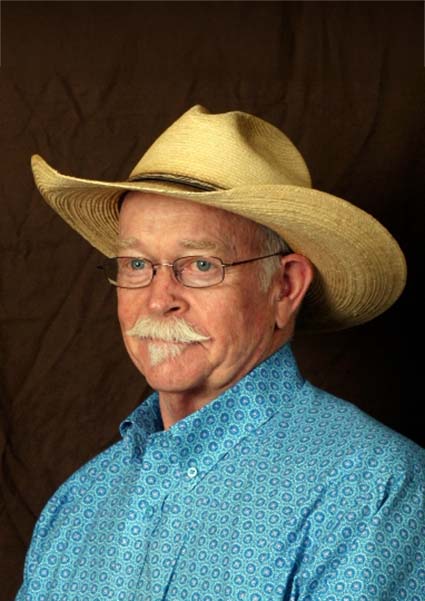
According to a nominator, “Harvey Dean earned his American Bladesmith Society master smith rating in 1992 and since then has taught an impressive number of students the art of bladesmithing. He became a member of the ABS Board of Directors in 2004 and served four years with distinction as ABS president from 2015-19. He continues to serve on the ABS board today. He was inducted into the ABS Hall of Fame in 2016. He has won an impressive number of judging awards for his knives, including at BLADE Show Texas, multiple times at the BLADE Show, from the Antique Bowie Knife Association and others. His knives have earned him membership in the prestigious Art Knife Invitational, limited to 25 of the world’s top knifemakers by a vote of the member makers.
He is a marvelous bladesmithing teacher, a master leader, a master administrator, and a master ambassador for the forged blade.” Along with award-winning knifemaker Johnny Stout, Harvey coordinated two annual knifemaking seminars in New Braunfels, Texas, for a number of years. He has also passed the knifemaking torch to his son Dillon, who creates utility fixed blades of his own. Concluded the nominator, “Harvey is among those named in the book Greatest Living Knifemakers written by Cutlery Hall-Of-Famer Steve Shackleford. I know of no one man deserving of being named to the Cutlery Hall Of Fame more than Harvey.”
Rick Dunkerley
Rick Dunkerley
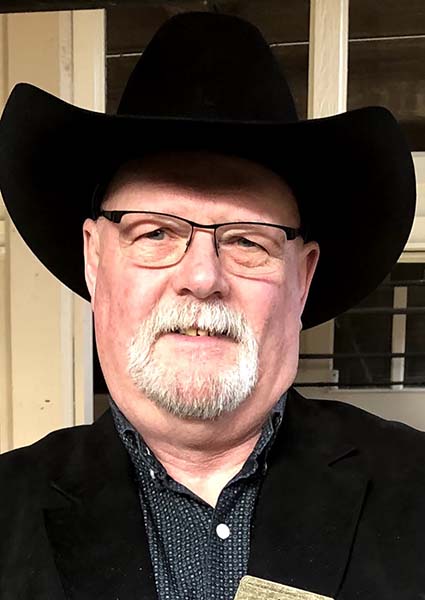
Rick Dunkerley began making knives in 1983 and started forging them in 1992. He specializes in mosaic damascus folders, winning judging awards for a number of them, as well as an occasional fixed blade. Among others, he’s won judging awards for his knives at the Oregon Knife Collectors Association Show, Montana Knifemakers Association Show, BLADE Show and BLADE Show Texas. His knives have earned him membership in the prestigious Art Knife Invitational, limited to 25 of the world’s top knifemakers by a vote of the member makers. He held many hammer-ins during the ’90s and brought in the best instructors of the time.
Rick has always been generous with information and is an excellent teacher. He’s taught at such venues as the Texarkana College/Bill Moran School of Bladesmithing, the Batson Bladesmithing Symposium, the Massachusetts College of Art, Saskatchewan Western Development Museum, Northern Minnesota Blacksmith’s Association, Northern Rockies Blacksmith’s Association and Western Canada Knifemakers’ Symposium. One of his students, Josh Smith, was the youngest ever to achieve both ABS journeyman and master smith status, and today runs the Montana Knife Co., a factory knife production operation with 80 employees. According to a nominator, “Rick has been on the board of the ABS and does the top shows worldwide. He has paid his dues, is a hell of a guy, always willing to share his knowledge, and makes world-class knives.”
Stanley Fujisaka
Stanley Fujisaka
Stanley “Stan” Fujisaka went full-time making knives in 1984 and was a prolific builder of award-winning folders and fixed blades. He was a beloved mentor in his Kaneohe, Hawaii, knife shop to a number of Hawaiian and other makers, including Scott Matsuoka, Les George, Cutlery Hall-Of-Famer Ken Onion and many more. Stan played a key role in encouraging Onion to patent his famous SpeedSafe assisted-opening mechanism. As a result and as Cutlery Hall-Of-Famer Dan Delavan wrote, “Ken went on to become the savior of Kershaw Knives.”
Stan also generously assisted knifemakers who fell victim to floods, shop fires, medical issues and more. He was a regular exhibitor at knife shows, donating many knives for door prizes. He collected custom knives and promoted them and the custom industry in general by supporting the Bay Area Knife Collectors Association Show, The Knifemakers’ Guild Show and other knife events. Together with his good friend, Cutlery Hall-Of-Famer Jim Sornberger, Stan co-hosted dinners for knife collectors, area celebrities and others, all of which helped promote custom knives. Finally, when it came to being a goodwill ambassador to the custom knife industry, few if any could rival Stan for his many gifts—including flowers, Hawaiian coffee and boxes of chocolate-macadamia nuts—that he doled out to friends, customers and other patrons at the shows where he exhibited.
Dr. James R. Lucie
Dr. James R. Lucie
According to a nominator, “Dr. James R. ‘Jim’ Lucie was Cutlery Hall-Of-Famer William Scagel’s physician and signed Scagel’s death certificate in 1963. This was the beginning of Dr. Lucie’s Scagel knife-collecting avocation. Scagel is considered by many the father of the modern custom knife. Dr. Lucie discovered his passion for knifemaking in 1990 when he took a class on bladesmithing from Cutlery Hall-of-Famer Bill Moran. Jim was a very talented maker and received several awards for his contributions to the knifemaking community. He assisted other makers often. In 2001, the ABS created the Dr. Jim Lucie Award, which it bestowed on Jim as its inaugural recipient. The award was ‘presented for the unselfish contribution to the preservation of the forged blade. The person receiving this award has gone far beyond the call … and exemplifies the type of person needed to keep … bladesmithing alive.’
Jim also received an ABS Special Service Award in 2002 ‘in recognition of his meritorious and unselfish services on behalf of … the forged blade.’ He also received the ABS Chairman’s Award for Outstanding Service more than once. He was a talented bladesmith, hand-forging mostly Scagel recreations of the highest quality. He improved on Scagel’s designs when it would enhance the knife. Jim dedicated three decades to researching Scagel’s life and collecting his works. Jim’s efforts culminated in Scagel Handmade, a massive hardbound book detailing Scagel’s life, with photos of over 200 knives and other Scagel items. Dr. Lucie hosted a hammer-in in 2001, with over 500 people in attendance. He shared his knowledge of Scagel’s techniques by giving speeches at many bladesmithing events. Late in life, Jim donated his blacksmithing, grinding and finishing equipment valued at $62,700 to the ABS. His actions consistently exhibited honesty, compassion for others and a dedication to the bladesmithing community.”
Alfred Pendray
Alfred Pendray
Alfred “Al” Pendray was a rock to the many bladesmiths he taught and influenced over the decades. “I learned so much from him,” noted ABS master smith Charley Ochs, “not only about knives and metallurgy but also about life and social interaction as a person.” Softspoken but never at a loss for words on the subjects that mattered to him, Alfred possessed an intricate knowledge of many things, including wootz steel, bladesmithing/knifemaking and knife history in general. He had a solid work ethic and led as much or more by example than the spoken word. He knew when to express his views and when not to, a trait sadly lacking in much of today’s discourse. Alfred is co-author—along with Dr. John Verhoeven, a former metallurgical engineering professor at Iowa State University—of articles appearing in eight scientific journals, four bladesmith publications and BLADE on the nature of “genuine damascus,” or wootz steel.
Pendray was granted patent number 5,185,044 on a “method of making damascus blades.” He was a speaker at the Symposium on Damascus Steel at New York University in 1984. He also spoke at the International Conference on Damascus Steel in Germany in 1985 and the same conference in 1992. He lectured at the Imperial College in London, England, in 1992. He joined The Knifemakers’ Guild in 1982 and was awarded his master smith rating by the ABS in 1983. He received the ABS award for the Bill Moran Knife of The Year in 1991 and was elected to the Guild board of directors in 1992. He received the ABS W.W. Scagel Award in 1998 and is a past recipient of the Guild’s Red Watson Award. He served as Guild president from 1998-2004. In September 2001, he was featured on the nationally syndicated Paul Harvey radio show. In 2003, he was inducted into the ABS Hall of Fame.
James Schmidt
James Schmidt
According to a nominator, James “Jim” Schmidt was instrumental in raising the level of knifemaking to compete with the finest crafts ever made. Most importantly, he elevated the pursuit to an art but never forgot the meticulous details of the craft. His knives are immediately recognizable and he influenced so many who came after him in meaningful ways. A spectacular book by BLADE® field editor Mike Haskew memorialized the man and his knives: JAMES A. SCHMIDT, The Great Master. A few passages from the book: “As a custom knifemaker he knew few peers. As a mentor and teacher, he was without equal”; “A man of few words, he allowed the results of his skill, precision, and limitless creativity to speak for him. In silent, stunning beauty, they thundered”; and “He welcomed those who were earnestly interested in improving their bladesmithing and knifemaking skills into his shop … and shared with them the light of precious knowledge that he realized should be readily and freely given rather than hidden.”
In the 1970s, along with Jimmy Fikes and Don Fogg, Jim formed the New England Bladesmith Society to promulgate the skills and techniques of knifemaking. Before long the groundbreaking Ashokan Bladesmithing Seminar was born. Jim was a principal organizer, lecturer and demonstrator. He was one of the earliest members of the ABS and one of the earliest ABS master smiths, and a member of the ABS Hall of Fame. He was a constant member of the Art Knife Invitational, a winner of the Red Watson Award from the Knifemakers’ Guild, the Beretta Award for Outstanding Achievement, and many other honors from a number of custom knife shows. In time Jim decided to let someone else win an occasional award and became a judge at many shows. His approach was to be meticulously but fairly critical and always encouraging. He was indeed the ultimate teacher, his profession for most of his life.
Daniel Winkler And Karen Shook
Daniel Winkler And Karen Shook
ABS master smith Daniel Winkler and Karen Shook first made their mark in the world of knives with custom reproductions of historical knives and tomahawks. Daniel made the knives and hawks and Karen made the accompanying authentic period sheaths, and the two became internationally known for their work. Daniel and Karen taught for the ABS for many years and Daniel was in the vanguard of the Society’s early cutting competitions. The two were at the forefront of early American historical arms and their period pieces were among those featured in the 1992 feature film, Last of the Mohicans. In 1994 a Navy SEAL Special Warfare operator asked Daniel to make a tomahawk because there was nothing on the market that worked for the SEALs at the time. According to a nominator, “Karen designed a sheath the SEALs liked and over the years she and Daniel did more special projects for the SEALs, ultimately inspiring the two to form Winkler Knives II.” Added another nominator, Daniel and Karen’s operation “soon became the cutlery armorer of many top Special Ops teams, from the SEALs to Delta Force, and to those of other nations as well.
For many years Daniel and Karen quietly made the knives, axes and sheaths without seeking glory or publicity for their work. In fact, they insisted that their generosity and unselfishness remain a secret among those who discovered it. It was only upon mention of their work in the book No Easy Day, in which the SEAL Team member on the Bin Laden take-down mentioned he was carrying a Winkler knife, that Daniel and Karen’s work became known to the general public. With such demand, they have expanded into a mid-tech operation and from there into that of a cutlery producer.” Today, Winkler Knives has a 35,000-square-foot facility employing one part-time and 28 full-time workers. “Few have transitioned into the changing markets as well as Daniel and Karen,” the nominator noted, “and none have done so with such humility and class.”
Forty-five shows in, the edge-travaganz’s remains the beating heart of the knife world.
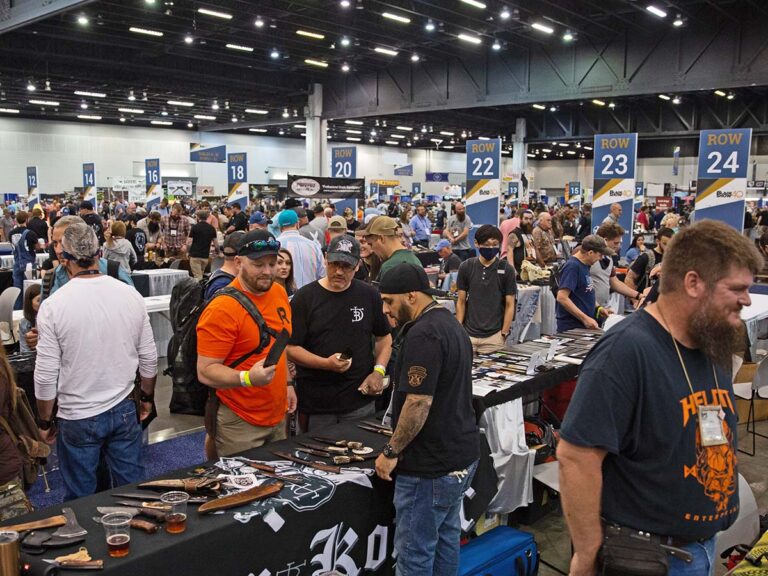
Each year, the BLADE Show draws thousands as the knife industry’s perennially premier event. Now celebrating its 45th anniversary, BLADE Show has grown from humble beginnings at the Drawbridge Motor Inn in Fort Mitchell, Kentucky, in 1982 to a hub that stirs enthusiasm, sparks lively discourse, facilitates buying and selling and energizes the world of cutlery like no other.
Knife enthusiasts and aficionados of all types, makers, purveyors, factory representatives and collectors have crowded the floor of the show regularly, from the greater Cincinnati, Ohio, area to the World Trade Center in Knoxville, Tennessee, to its present home in Atlanta. Memories have been made, deals struck and a rising tide has lifted all.
“We originally said we were going to do one show a year,” remembered Bruce Voyles, BLADE Magazine Cutlery Hall of Fame® member and longtime publisher of BLADE® Magazine. “The goal was to make it more than a show. We loved the original venue in the Cincinnati area, but we outgrew it in two years, moving to 70,000 square feet in Knoxville by 1985 or so, with 700 tables, and then to Atlanta, where there is an airline hub and more international people were able to attend.
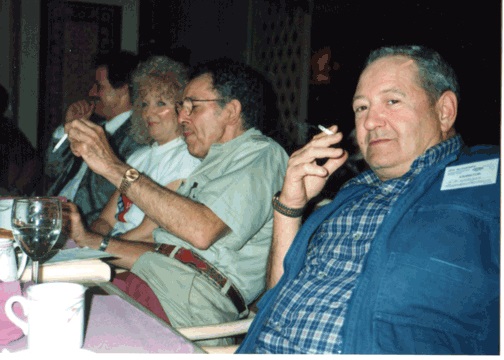
From the right, Bob Loveless, J.W. Denton and Myra and Durvyn Howard enjoy a dinner after a day on the BLADE Show floor. The show is as much a social gathering as it is an industry event. (John Denton image)
“Nobody had gotten such an incredible group of people together in one room before, and from it some amazing things happened,” Voyles reflected. “Sal Glesser of Spyderco came up with the idea for collaborations, and that really began at the BLADE Show as manufacturing people wandered into the handmade area–and it happened! We built the show on borrowing ideas from others and adapted it for all we could, trying to minimize mistakes we had seen in other shows.”
Through the years, the BLADE Show has been characterized by its exchange of ideas, vigorous commerce, displays of remarkable collections, professional demonstrations, honors for the industry greats and much more. Voyles smiled, “It just went gangbusters!”
And so, while the BLADE Show is in its 45th year, many have made the annual pilgrimage time and again. They acknowledge the impact the event has had on the knife industry and reflect on their memories and its true significance. The show has evolved, experienced growing pains and reached new heights of influence–but its dynamic energy has never waned, even in these days of the internet and instant access to information.
Knife Family Reunion
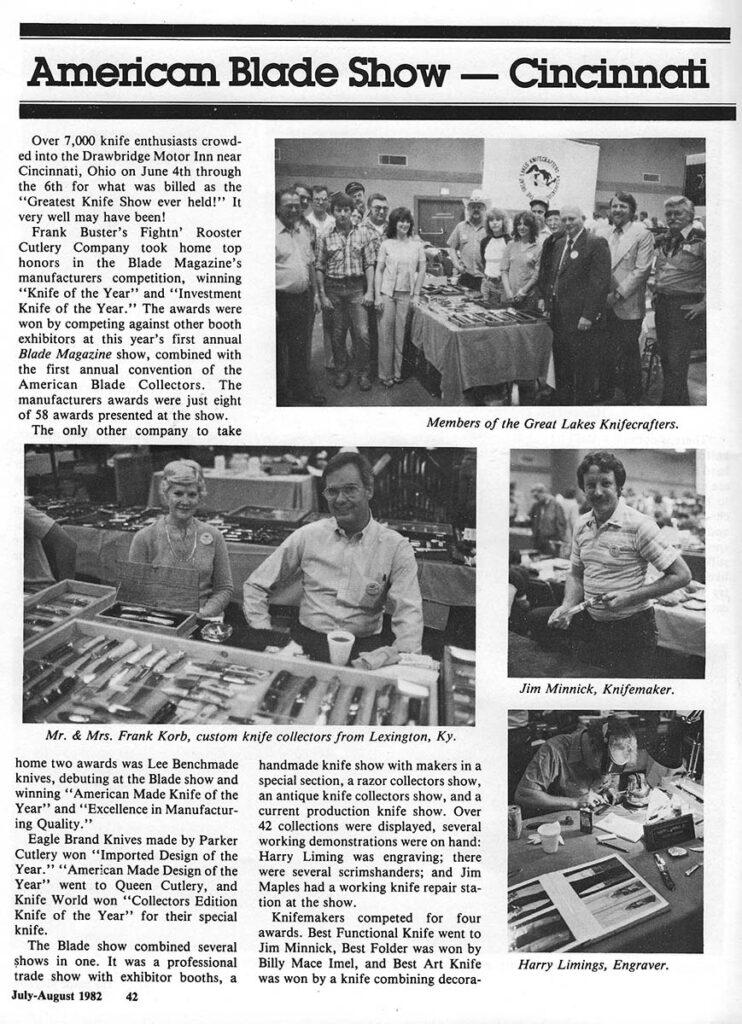
From the start, BLADE Show was red hot. Documenting the first show at the Drawdridge Motor Inn near Cincinnati, Ohio, the article from the July/August 1982 American BLADE estimates more than 7,000 knife enthusiasts showed up.
“The early BLADE Shows were run by Bruce,” commented ABS master smith and custom purveyor Dave Ellis. “Over the years, ownership has changed and the crowds have grown. Now there are two rooms to hold all of the table holders. The lines to attend start days in advance and eager folks flood in to be first to their tables of choice. The seminars have grown, and celebrities, musicians and folks from all walks of life attend with the expectation of purchasing that special piece they have saved all year for.”
During his active days as a bladesmith, Ellis attended shows with greats like Hall of Fame legend Bill Moran and master smith Jerry Fisk. He remembers sitting in “the Pit” at Atlanta’s Waverly Hotel, where friendships were forged and discussion flourished.
Hall of Famers Daniel Winkler and Karen Shook were attendees in the 1980s, and their first impressions were lasting. “It was overwhelming to know there were that many people making knives and to see the diversity,” Karen recalled. “The most striking memory is the sense of community and camaraderie. We did not know who the legends were at the time, but when we got to know them, we learned of a group of great talents with great passion for knives and the knife community.”
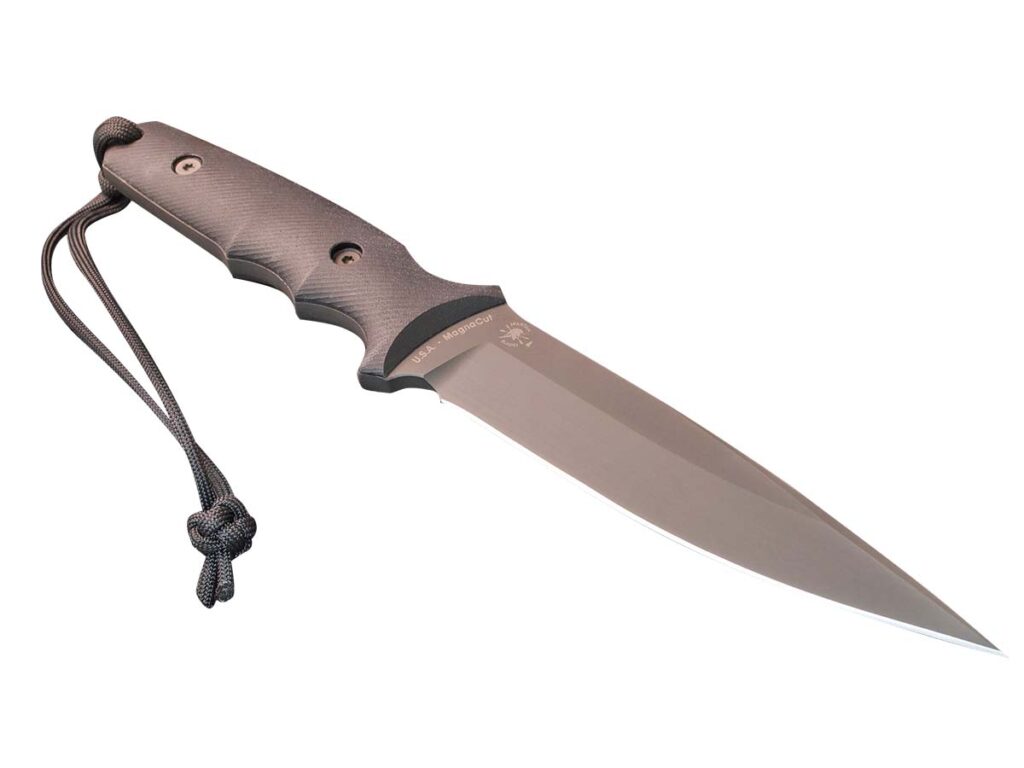
Among the aspects that set BLADE Show apart from other knife shows is the inclusion of factory knives. This has become an important part of the industry, as companies vie for the coveted Knife Of The Year award. Spartan Blade nabbed the honor in 2024 with its wicked Clandestina.
Karen fondly remembers sitting in the Pit. “It was like a family reunion. Almost every face became familiar. The show and the promotion of the same have attracted interested parties and given makers the opportunity to meet people and educate attendees as to why custom knives cost more than your typical hardware store hunting knife.”
Magic Of Knives In Person
When UK-based custom scissor maker Grace Horn attended her first BLADE Show in 2003, she was expecting her second child. “That child was conceived with the knowledge that I had to attend and not be too pregnant to do the transatlantic flight,” she laughed. “I have been attending every year since, and the changes have been fascinating. The fluxes of the industry are so much easier to see in a microcosm at a show … a snapshot of the industry at a point in time. Even in this world of increased social media engagement, nothing replaces the actual interaction between people. I love the sense of community that comes with the BLADE Show.”
Collector Chris Schluter agrees. “These days, so much of knife collecting takes place via social media,” he said. “It’s been great for sure–online sales, frequent interaction with makers and collectors. There’s still not a substitute, though, for meeting people in person and handling knives in person. For collectors, this is seeing your favorite makers in person and also walking by that table with a maker you’ve never heard of and stopping because something caught your eye. It’s not just meeting people during the show. It’s also after hours in “The Pit” and nearby restaurants and bars where people have time to chat. The BLADE Show is always something I look forward to, and I think many makers and collectors see the show as a sort of annual ritual that they really try to go to each year.”
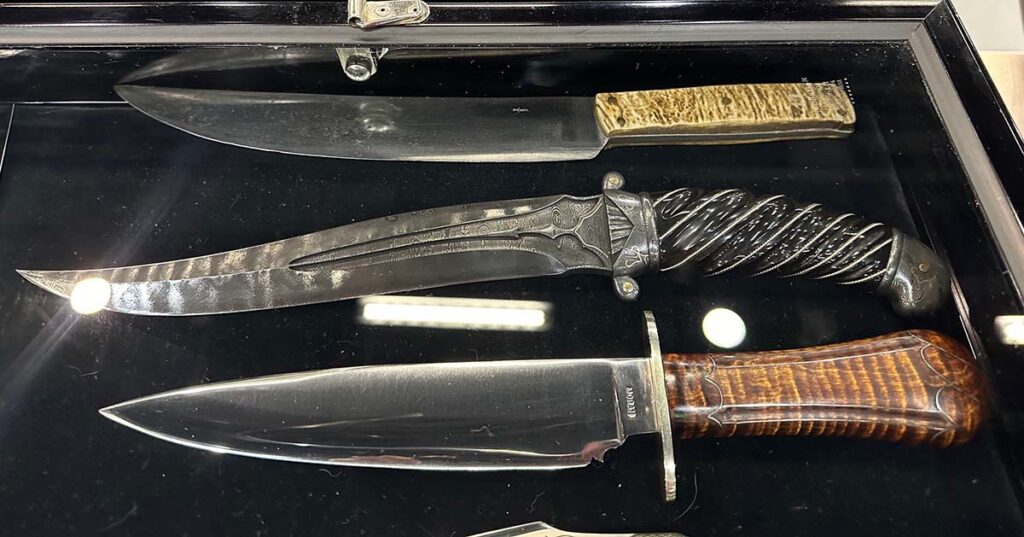
From top, knives from Hall of Famer Bill Scagel, CAS and Hall memeber Bill Moran. Imagine seeing so many great creations in one case. Through the years, it’s become commonplace at BLADE Show. (Dave Ellis image)
That pervasive energy, the smiles and the renewal of each acquaintance team up with the latest across the knife world to make the BLADE Show even more relevant in today’s environment. “The BLADE Show has made the careers of custom makers,” declared renowned knife innovator Ernest Emerson. “Before the internet, how could you find out about custom makers and their knives? BLADE Magazine was it, and the readers of BLADE Magazine would go to that show. Still, there is no motivation like seeing what the other guys are making.”
Emerson’s following is proof positive that the BLADE Show complements a career. The throng that gathers at each show to purchase his knives and those of other makers gave rise to the lotteries that are commonplace these days.
“The BLADE Show has pushed the knife world to outer space,” assessed Loveless knives expert and purveyor John Denton. “People keep coming back because it has something to do with the love of custom knives—one on one with makers, dealers, collectors—we all love the same thing. So, it is so much fun to see everyone. It feels like family. We all come back because we have all we need at the BLADE Show. The future is here, and now, so I just hope the magic stays.”
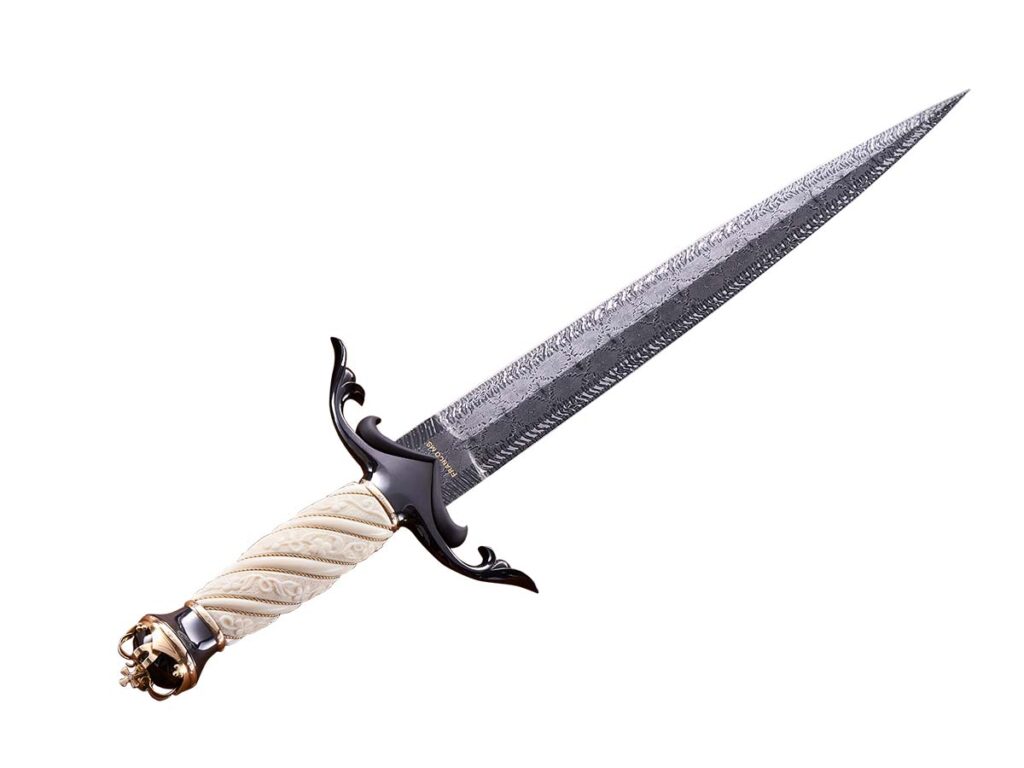
BLADE Show launched during the golden years of custom knives in the 1980s. But don’t think the best years are behind. Contemporary makers, such as Brazilian Dionatam Franco, continue to wow with creations like his 2023 Best of Show dagger.
That magic was indeed, at times, like catching lightning in a bottle. “It was things like [Hall of Famer] Bob Loveless staying with Wayne Clay, and once the show ended for the day, we all went out to eat,” Denton commented. “Then, at the hotel, you just looked around the room, and the knifemakers of the world were all pretty much in the same place. You could listen to Loveless and [Hall of Famer] A.G. Russell discussing things. Over on the couch was [Hall member] George Herron. Then you saw Bill Moran relaxed next to him. It was all bigger than life.”
From Show To Spectacle
Les George was a young knifemaker when he attended his first BLADE Show at age 25. “I don’t know if I can say it’s better now because it’s been amazing from the very first time,” he remarked. “On top of being a trade show for knives, it’s the number one social event for this business. I see some friends only at the BLADE Show, even though I’m in touch with them all the time. The BLADE Show is a huge fixture in my life, and the whole year pivots around the June trip to Atlanta.”
Of course, many others would say the same thing. Like the proverbial sun, the BLADE Show is the center of the knife community’s solar system. Its atmosphere sheds radiant light on the industry. Its gravitational pull is virtually irresistible. Its intensity is nothing short of “white hot”.
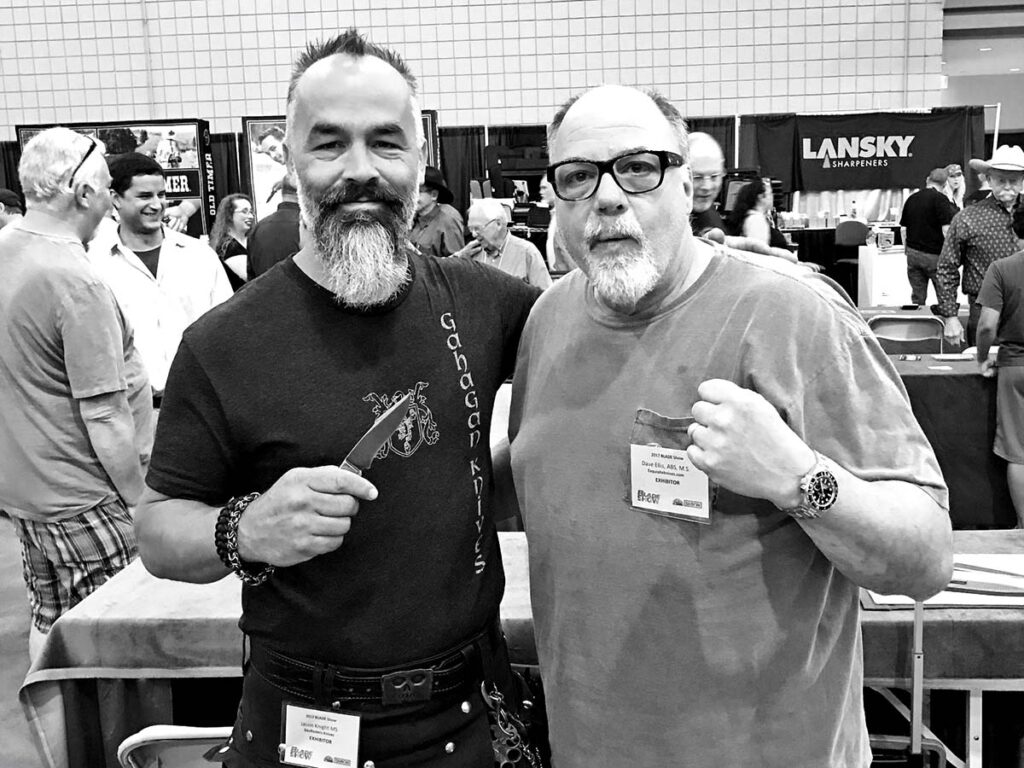
A couple of master smiths—Jason Knight (left) and Dave Ellis (right)—rub elbows at the BLADE Show. (Dave Ellis image)
Through change and reinvention, the BLADE Show remains a driving force in its 45th year. And even though the computer screen and cell phone add to the communication milieu, those who know what the BLADE Show is will accept no substitute. Here’s to 45 more years.
On This Independence Day We Here At Blade Want To Celebrate All-American Knives
America is celebrating its 246th birthday today. In all those years the knife has been an integral tool to the growth of the United States, and, as such, we here at Blade want to celebrate it on this beautiful Independence Day.
These are 10 beautiful All-American knives to get you in the holiday spirit.
MTech USA 440 Steel USA Design Pocket Knife
MTech USA 440 Steel USA Design Pocket Knife
The name may be a mouthful, but the knife is a beaut. MTech has made a spring-assisted folder out of 440 stainless with an aluminum handle. The handle is decorated with an American flag design and the opening text of the Constitution. This drop point has an MSRP of $15.95.
Berg American Flag Themed Bowie Knife
Berg American Flag Themed Bowie Knife
Custom-made to order by knifemaker Dan Berg, this Bowie is 11 inches long and can be made out of 1095 carbon steel or AEBL stainless. The metal is etched with a patriotic star pattern and the handle has a flag pattern made out of Micarta or cast resin. This beautiful knife has an MSRP of $300.
Mega Knife American USA Flag Spring-Assisted Folding Open Pocket Knife
Mega Knife American USA Flag Spring-Assisted Folding Open Pocket Knife
A bright, bold American flag on the handle shines bright on this piece from Mega Knife. The stainless steel blade features a blackwash finish, and the pocket clip lets you bring this knife everywhere. This folder has an MSRP of $19.95
CobraTec Knives Small CTK-1 Cerakote American Flag
CobraTec Knives Small CTK-1 Cerakote American Flag
This CobraTec double-action OTF knife featured a striking American flag handle made of aluminum alloy married to a 2.75-inch D2 steel blade. You can pick between four different blade styles (drop point, tanto, dagger, Wharncliffe), and all but the Wharncliffe have serrated options as well. It features a nylon sheath, pocket clip, and a glass breaker at the end of the handle. This comes with an MSRP of $149.99.
Modern Artisans 3-Inch Pocket Knife With American Flag Stonework
Modern Artisans 3-Inch Pocket Knife With American Flag Stonework
This 3-inch folder from Modern Artisans has a stunning damascus blade made of a core of VG-10 wrapped in 32 layers of stainless. The brilliant American flag handle is made from lapis lazuli, red coral, and mother of pearl. This knife has an MSRP of $132.99.
Victorinox Super Tinker
Victorinox Super Tinker
From the makers of the famous Swiss Army Knife, Victorinox has made an All-American medium pocket knife that has the option of an American flag design and not just the classic red. It features 14 tools including two blades, three screwdrivers, and scissors. It has an MSRP of just $43.99.
The twist damascus pattern steals the show for this model from Orklo Knife. The three-inch, HRC 55-58 blade is connected to a four-inch red, white, and blue handle made of dollar sheet and inlaid with a star mosaic pin. This piece has an MSRP of $69.99
Cabela’s Flag Tanto Blade Folding Knife Two-Pack
Cabela’s Flag Tanto Blade Folding Knife Two-Pack
Two knives are always better than one, and Cabela’s has an affordable patriotic combo pack. Both knives have blades made of 8Cr13MoV steel. The larger blade is three inches long and partially serrated. The shorter of the two is 2.75-inches long and features a flat edge. The combo has an MSRP of $19.97.
KCCEdge 8-Inch Two-Piece Large American Flag Throwing Knife Set
KCCEdge 8-Inch Two-Piece Large American Flag Throwing Knife Set
For something fun, you can go wrong with these throwing knives. These KCCEdge knives feature a top-to-bottom flag design that was embossed printed on the blades. What could be more fun than watching Old Glory fly through the air? These could be yours for the MSRP of $14.
Red Dot Laser Engineering “The Patriot” Folding Knife
Red Dot Laser Engineering “The Patriot” Folding Knife
Red Dot Laser Engraving, a veteran-owned business, has made a stainless steel folding knife with an American flag engraved on both sides of the blade and an aluminum body. The design won’t wear off so you’ll be able to proudly show it off for decades. The MSRP is $17.76.
ASR Outdoor Patriotic Locking Pocket Knife
ASR Outdoor Patriotic Locking Pocket Knife
Adorned with the head of a bald eagle on the handle and atop the the American flag on the handle, this knife from ASR Outdoor screams American pride. The steel alloy clip point opens with a nail nick, and the whole piece is eight inches in length. It also comes with a collectible display box. The MSRP is $14.99
Four knife industry pros share the secrets of how they keep their edge when sharpening.
A knife is made to perform its function as a tool, and job number one is to cut.
It follows that the development and maintenance of the edge is the most important aspect of knife ownership and use. When users are in the shop, around the house, at the office or in the field, keeping the edge in top form and working order makes the task at hand easier and often saves time and effort.
Custom Knifemaker: Chris Berry
Chris Berry sharpens freehand, holding the DMT bench stone in one hand and his modified cleaver in the other. (Chris Berry image)
A custom knifemaker for 15 years, Chris Berry has made a name for himself in heavy-use choppers with blades of high-wear-resistant steel.
“When I finish a knife and get ready to sharpen it, I break the edges on the grinder to start the process and then work freehand after that,” he explained. “I’ll start with an extra-coarse DMT diamond stone and then go from extra coarse black to red medium and then green extra fine.”
In the field Berry carries a Spyderco cubic boron nitride (CBN) sharpening stone along with a Spyderco Double Stuff pocket stone.
“It has medium and fine ceramic for the edge,” Berry continued, “and then I’ll have some piece of leather to strop the blade and remove the burr.”
Chris knows it’s time to touch up an edge when it starts to drag through the cut.
“A blade is dull when it won’t cut printer paper,” he said, “so I’ll sharpen it before it reaches that point. I’m not obsessively sharpening a knife blade, but I’m just hitting the medium edge of the Double Stuff and going to the strop to bring back that popping edge. I usually only go back to the grinder if the edge is damaged, but, if the blade is really dull, starting with the extra coarse diamond and going through the grits will make it like a new knife.”
As Berry noted, the burr is the little, fine piece of steel that rolls up to the edge of the blade and is rough on one side and smooth on the other.
“If the burr isn’t gone after sharpening [the edge is] not sharp,” he advised. “In my opinion, it is the key to whether a knife is sharp or not. I tell people on social media that sharpening a blade is broken down to apexing the edge to raise the burr, refining the edge with progressively finer grits, and then removing the burr by stropping. If you progress through the grits and have the burr removed, you should be able to cut newsprint, phone book paper and even paper towels. That is as sharp as you are going to get.”
Knob Creek Forge: James Gibson
James Gibson of Knob Creek Forge designs knives for ESEE and teaches classes on bushcraft and survival.
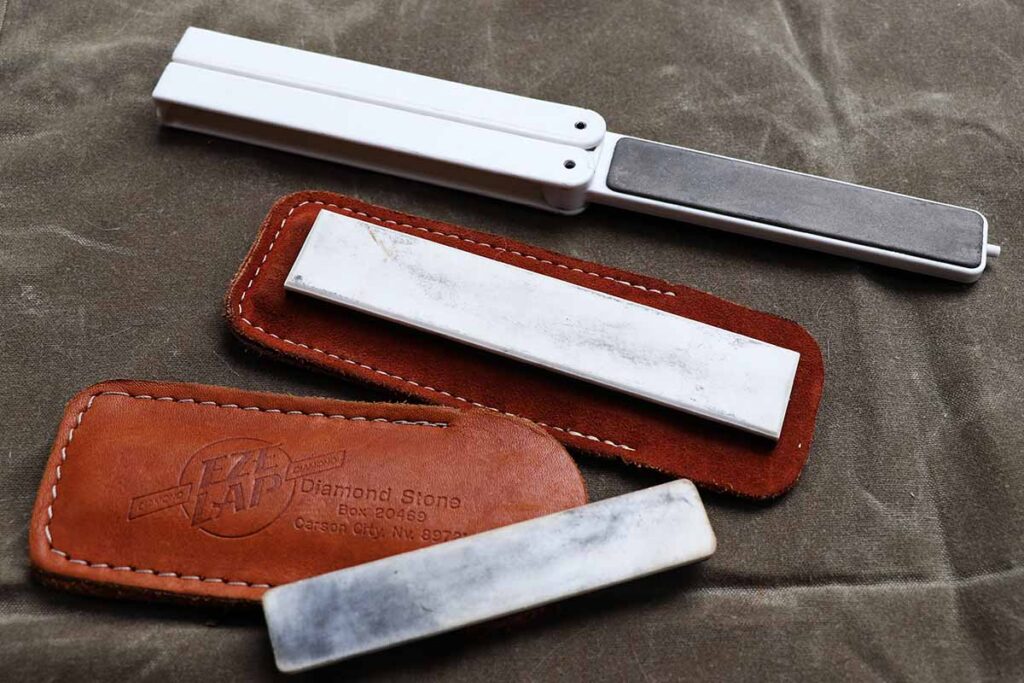
Some of the favorite field sharpeners of Joe Flowers include the EZE-Lap 530 Super Fine Diamond/Ceramic Folding Sharpener (top) with a folding handle. “The Spyderco Double Stuff [middle] is a fantastic field sharpener,” Joe wrote. “It and the EZE-Lap Double Sided Sharpening Stone [bottom] both have a leather sleeve which can work as a strop.” (Joe Flowers image)
“I like a full flat grind with a convex edge,” he remarked. “They say the convex edge is the best, and when I have an extremely dull blade I use these little diamond files and then a ceramic rod or stone that will stand the edge up.”
An ABS journeyman smith, Gibson cautioned, “A dull knife will hurt you quicker than a sharp knife because you tend to lose control when you apply more pressure to get a job done. Most of the time I will sharpen a knife at the end of the day, but if it is not performing I will touch it up right then and there. If you ever watch a carver, they will carve for 15 minutes or so and then strop the blade to bring the edge back right quick. After a few days of stropping, they will have to do a bit of sharpening.”
Gibson sometimes uses a marker to spot the blade about a quarter inch up from the edge and then “floats” the edge up and down the diamond sharpener. He then moves to the leather strop and notes that if a compound has been used to keep the leather in shape the process will turn the leather black.
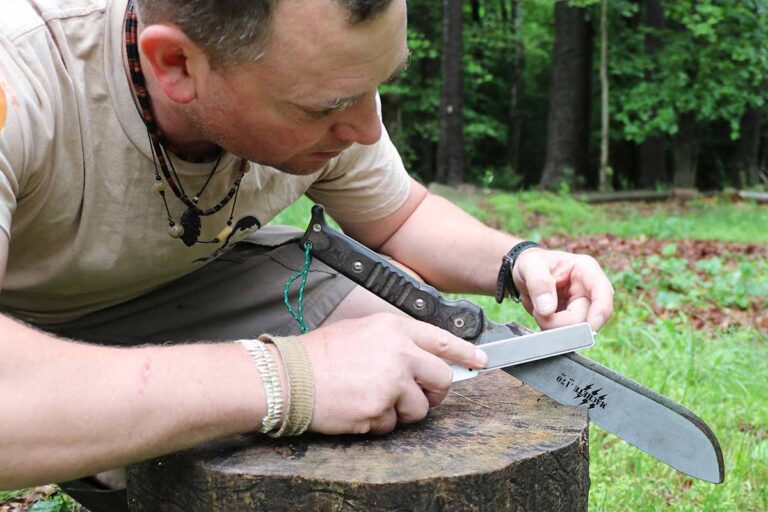
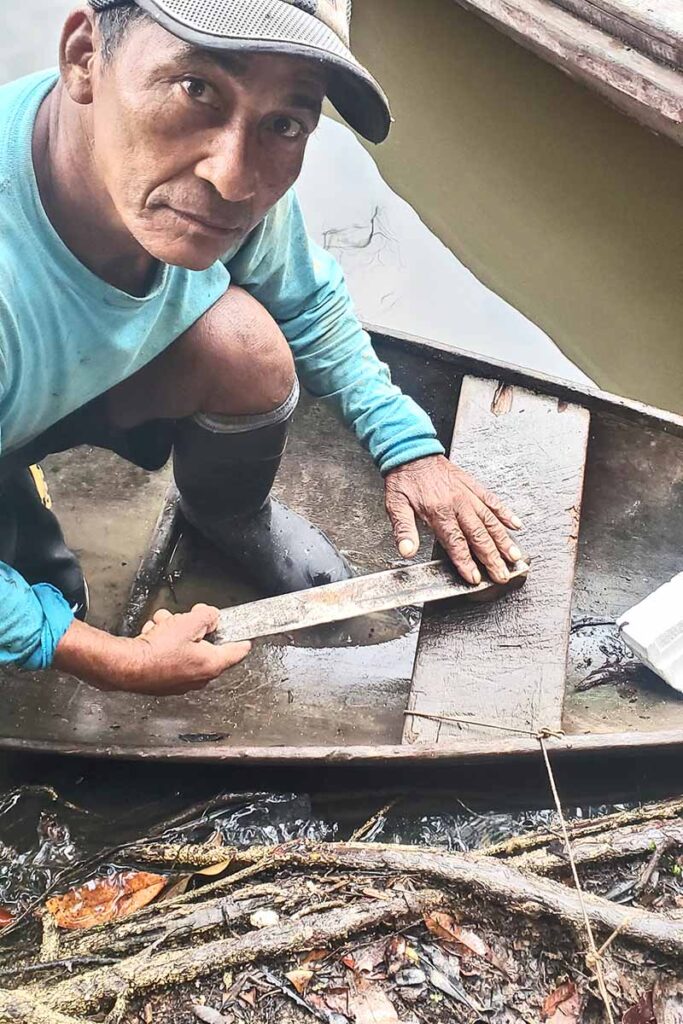
A Brazilian bushman files his machete on a stone, taking out the burrs and nicks in the edge. (Joe Flowers image)
“That means you are pulling steel off the edge,” he commented, “and where the two polished edges meet that will give you the sharpest blade you can get.”
Safety is a constant concern for Gibson and he stresses this aspect of knife use in his classes.
“We train people on the knife, and one of the first things we tell them is never to cut toward yourself. Keep everything out in front of you, or use a bench, log or stump so that everything is out of the way.”
CRKT: Russ Kommer
As a knife designer for Columbia River Knife & Tool (CRKT) and a hunting guide, Russ Kommer keeps blades sharp on a regular basis.
“When I finish up a custom knife, I run the blade on a brand new 400 grit slack belt with a real slight radius,” he remarked. “Then I will take it over a used 400 grit belt so that when the edge is curled and there is a little white line, I can use a leather strop or a 10-inch wheel and break off the burrs.”
Kommer carries a diamond sharpener in the field to touch up an edge.
“That will stand that line back up and remove some steel to get the edge back to infinity,” he said. “The only way to get a blade sharp is to remove enough steel. In the field you can use a leather strop or even the leather heel of your boot or something to help. When guiding, I have done two moose and a caribou in one day, and working on big animals is a big job. Sometimes I will carry two knives and touch both up to be ready for the next week, and I carry a pocketknife for cutting rope or other camp chores. It’s not good to use your hunting knife to cut burlap and dull it up on something like that.”
Testing for sharpness is a varied exercise, and Russ likes the simple standard.
“Guys like to shave their arms and that is all cool and dandy,” he smiled. “I just rake it across the back of my head, and when I feel it grab that hair I know the blade is sharp. There is also the fingernail task—if you feel the blade grab right there on the fingernail, then it is sharp. If you have practiced sharpening a blade enough, then you know quickly just how sharp a knife blade is.”
Condor Tool & Knife: Joe Flowers
As a knife designer for Condor Tool & Knife, Joe Flowers has sharpened thousands of blades through the years. The sharpening process is dependent largely on the work at hand.
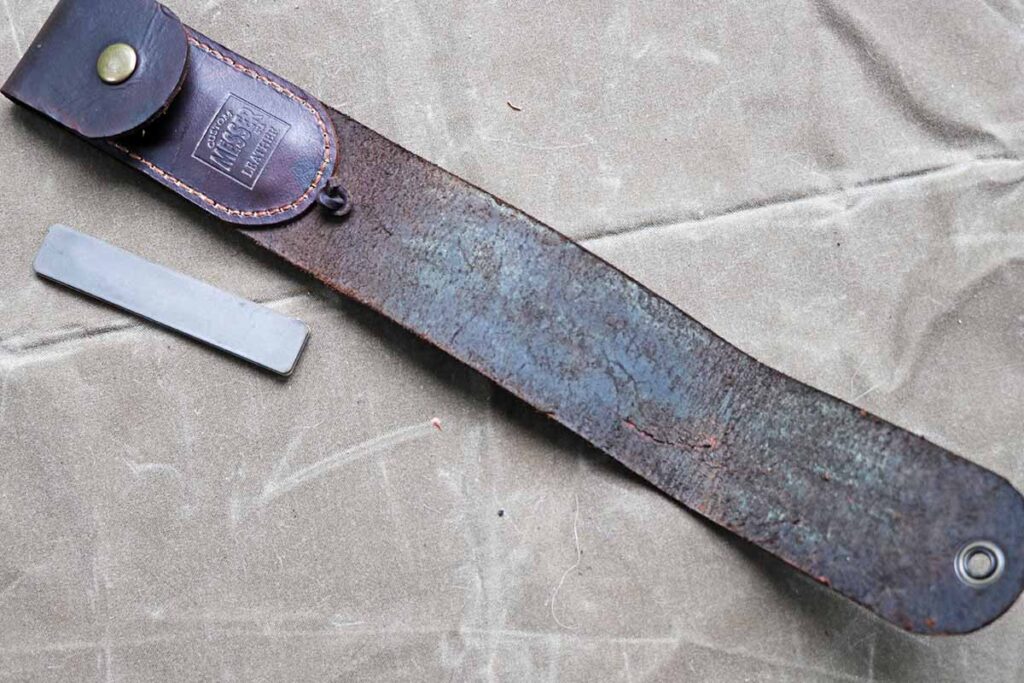
This combination of an EZE-Lap ceramic and diamond stone tucks into the JC Messer strop, providing Joe Flowers with a large range of media in a small package. The large strop helps balance out the smaller stone. (Joe Flowers image)
“It can vary between jobs,” he explained. “I just have a 2×42 grinder that I do edge modification on—with every belt imaginable—but by far I use the leather belt the most because I am always using the blades and getting a fast strop. Most of the time, I try and use my field sharpeners and also complement them with the finer stones like my King stones or Spyderco ceramics.”
When Flowers ventures into the field, he is prepared for the occasional sharpening task.
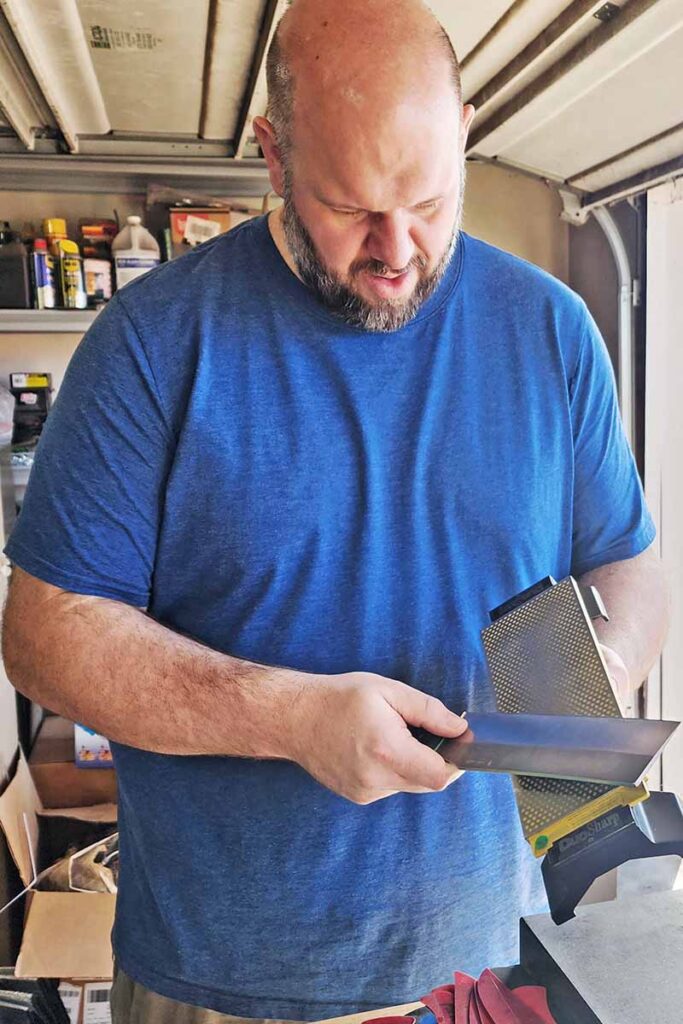
“I really like EZE-Lap’s double sharpener,” he advised. “The files really bite down on carbon steel, and the ceramic on the other side keeps a finer edge. I’ve even used the sheath as a strop. That and the Spyderco Double Stuff are my two favorite compact sharpeners, although Work Sharp’s setup is great, too.”
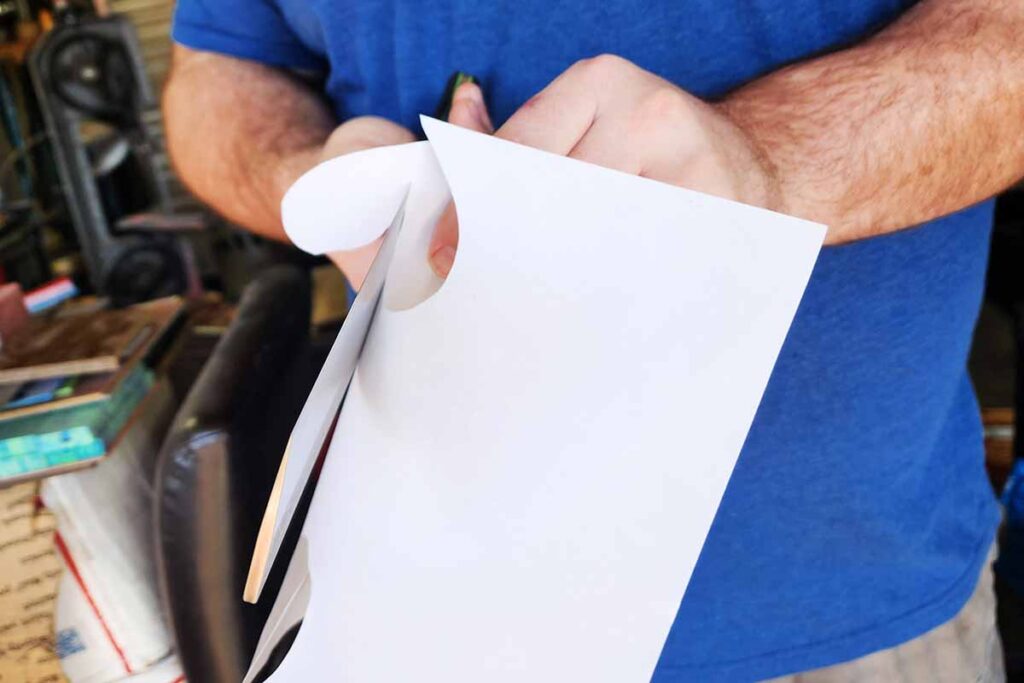
Chris Berry cuts a figure 6 in a sheet of paper. “A blade is dull when it won’t cut printer paper,” he said, “so I’ll sharpen it before it reaches that point.” (Chris Berry images)
When in the field, Flowers likes to settle down before taking on the sharpening of his knives.
“Normally, in camp situations, unless I’m working hours on a game animal or on a bushcraft project, I leave my sharpening to nighttime around the campfire. I also have my field sharpeners around my desk at work to use to understand how they work on different steels more. I like using EZE-Lap and diamond stones with harder-use bushcraft [carbon] steels like 1095. It can get an edge fast and you can go about your day.
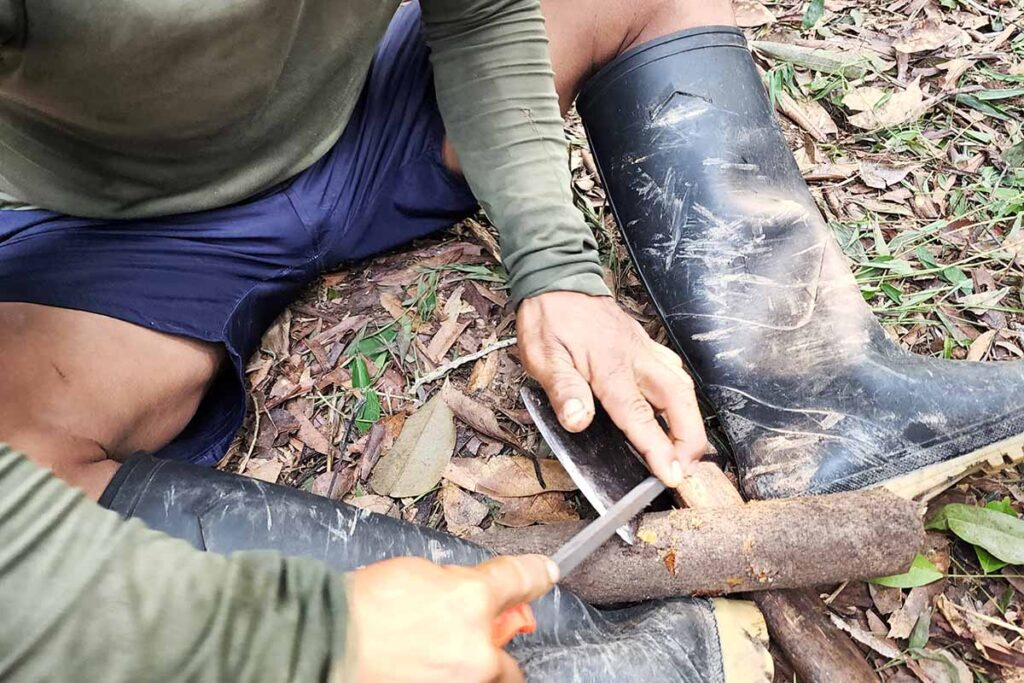
“For machetes,” Joe continued, “I stick with what the locals use, and that’s a file. Generally, I’m working with softer steels for machetes so a triangular single cut bastard or double cut bastard file about 6 inches long is a nice addition to my sheath. I’m finding better results in super steels on diamond stones until I move into these new crazy preloaded diamond powder strops. Those look incredible to try.”
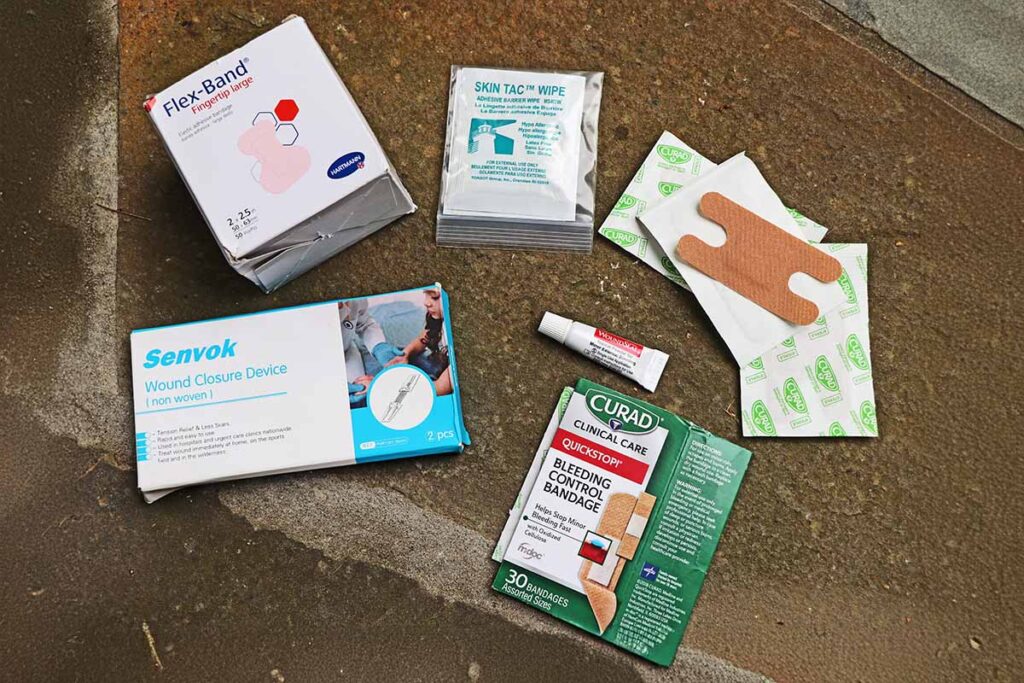
These items are extremely handy if you do anything with knives. The fingertip bandages are good anywhere on the bop, aka a survival experience, and bleed control Band-Aids® can also be handy. They have a coagulant. Besides a tourniquet, noninvasive wound closure devices coupled with a tape adherent like Skin Tac™ can save a trip to the emergency room for those annoying cuts. (Joe Flowers image)
When sharpening a dull blade, Flowers is known to use 60- to 80-grit belts to re-form edges when large chunks have been taken out of a machete, for example. He maintains that it can take the steel off the blade fast but there must be a bucket of water or a spray bottle handy to keep the grinding surface cool.
Bringing a knife back from dead dull involves a proven process.
“At home I would reprofile gently on a 1×30 Harbor Freight special I’ve had from the old days,” Joe commented. “Depending on the steel and use and the comfort of the hardness, I’ve reprofiled knives from dead dull with homemade sandpaper and mouse pad backing and keep heavier grits there as well. You can definitely over sharpen a knife by stropping so much you roll the edge. In the technique, you need to be able to tell when you have just the right amount of pressure.”
Hari, a Huitoto tribesman from Colombia, uses a common triangular file on the axes and machetes on Bushcraft Global (bushcraftglobal.com) trips. For the final edge, the file is drawn from the edge to the poll. (Joe Flowers image)
Sometimes the type of sharpening medium used depends on the blade steel, the style of blade and the common utility of the knife.
“On many higher-end-steel kitchen knives, I stick with King stones because they are tried and true,” Joe related. “However, I like many different media for various steels, going for the extra-fine edges or a strop loaded with compounds for the final edge. For things like serrations, I use thinner round diamond rods for getting the radius, but I don’t deal with them much. I really like the flattest surface possible when I sharpen Scandi as it helps keep the angle straight.”
Retaining a sharp edge makes life easier wherever and whenever a knife is needed. A few minutes to shape up a blade is always time well spent.