See what the highlights, low lights and everything in between were for the knife world in the past year.
Like most years, 2024 had more than its share of ups, downs and continuations of the same. From the promising developments in American-made factory knives to the harmful effects of Hurricanes Milton and Helene on knifemakers and at least one knife show, there were the goods, the bads, gains, losses, victories, debuts, swan songs and more. Among them:
Original portions of the hull, deck and other parts of The Battleship Texas are distributed to artisans around the country, including bladesmiths and knifemakers such as Harvey Dean, Jason Fry, J. Neilsen, Jack Stottlemire, Greg Coker and many others, to make items they specialize in and donate them to raise money to restore the pre-World War I dreadnought (https://battleshiptxartisans.com/catalog/);
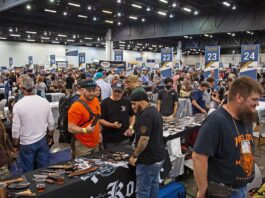
A boom in the number of international countries (35) with exhibitors at the BLADE Show, led by France (21 exhibitors), South Africa (18), Italy (14) and Brazil (13), reflect the continuing recovery from the devastating effect of the worldwide pandemic;
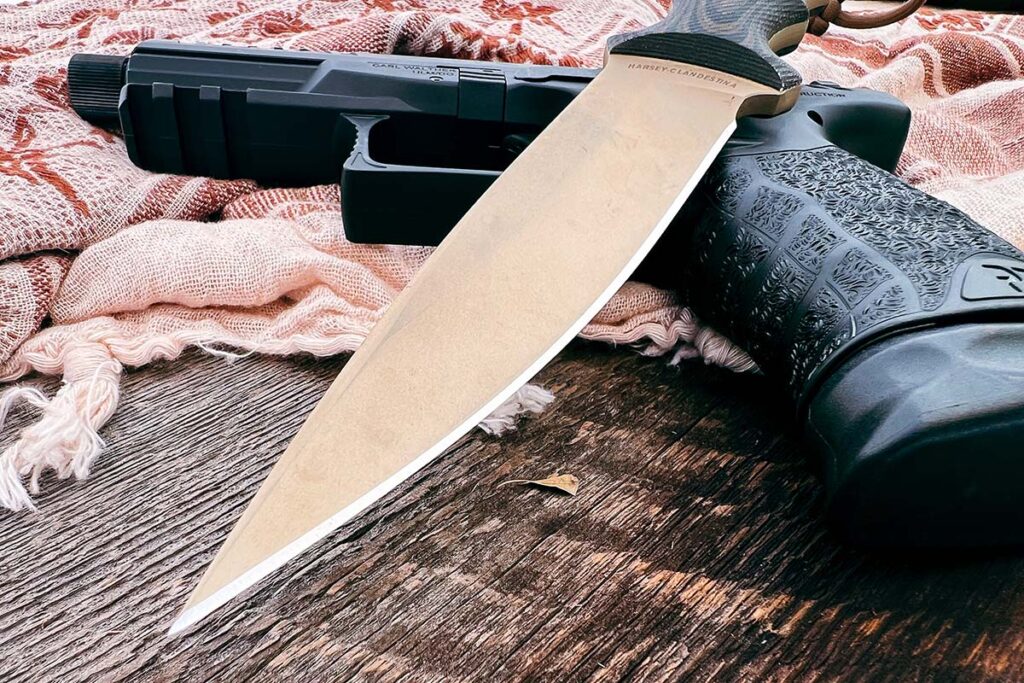
Spartan Blades headlines the BLADE Magazine Knife-of-the-Year® awards at the BLADE Show with the company’s first Overall Knife of the Year, the Bill Harsey designed Clandestina. It was company’s first ever win in the prestigious category;
Speaking of Harsey, he, along with Ted Dowell and Don Fogg, become the 72nd, 73rd and 74th members of the BLADE Magazine Cutlery Hall of Fame®;
In what promises to be the first of several, Cutlery Hall-of-Famer Bill Ruple and Case debut their inaugural collaboration, the Bill Ruple X Case Axe Handle;
CPM MagnaCut stainless continues its run as the No. 1 blade steel among factory knives;
After almost 30 years with Spyderco, including stints in customer service and as marketing manager and coordinator of all things public relations, past BLADE Magazine Publisher’s Award winner Joyce Laituri calls it a career;
ABS master smith Kevin Cashen is named new chairman of the American Bladesmith Society, succeeding ABS master smith Steve Dunn, who passed away unexpectedly May 21;
After its original lawsuit was dismissed in June on “absurd standing grounds,” Knife Rights files a new federal lawsuit in September challenging the constitutionality of portions of the Federal Switchblade Act;
Hurricanes play havoc not only with the Southeast USA but knife industry members in the affected areas, with Milton postponing the Louisiana Knife Show and Helene flooding and/or temporarily shutting down at least two North Carolina knifemaking operations, including Winkler Knives and Dogwood Custom Knives, and no doubt others elsewhere;
Companies/knives celebrating anniversaries include: Boker (155th); Tru-Bal Knives, aka Tru-Balance Knife Co., (75th); Kershaw (50th); Fallkniven (40th); and the Emerson Knives, Inc. CQC-7 (25th);
Finally, a number of friends of the knife community pass away, including: scrimshander Gary “Garbo” Williams; bladesmith/mokume gane guru Phillip “Phil” Baldwin; knifemaker/past National Knife Collectors Association president Bob Cargill; ABS master smiths Steve Dunn and Hanford Miller; long-time custom knife collector Walter Hoffman; veteran knifemaker Dave Ricke; Mrs. Lori Buck (wife of Cutlery Hall-of-Famer Chuck Buck); Mrs. Sallie Bos (wife of Cutlery Hall-of-Famer Paul Bos ); Mrs. Betty Dowell (wife of Cutlery Hall-of-Famer Ted Dowell); Cutlery Hall-of-Famer B. R. Hughes; and past BLADE art director Jim Sasse. God rest their souls—and please forgive me if I’ve omitted anyone.
Classic and competent, no wonder why the clip-point knife remains among the most popular designs.
Clip-point blades are one of the most common profiles you will see throughout custom and production knives. You likely know the style, the familiar drop-off of the blade spine to a curved or linear transition that terminates at the blade tip.
The earliest noted clip-point blade style dates back to the Macedonian era. Flint-knapped stone blades in a clip-point shape were discovered from this time period. Today, clip points are found across a lot of knife genres from tactical to EDC to pocket knives to fixed blades.
Pros Of Clip Points
Due to its highly streamlined and optimized blade tip, the clip point has excellent puncturing capabilities. There is more of a true point that helps to penetrate thicker materials with ease. It is more aerodynamic than a drop point and even a spear point. Think of an arrowhead and how it penetrates, and you will get the idea. Clip points are also favored among the tactical crowd because of this characteristic.
The defined point also makes great scoring cuts because placing pressure on the blade tip results in the tip cutting through aggressively on the first cut. So, this blade shape is also one that is favored among those who use their knives for the trades, where having a good knife is imperative to the work at hand.
Cons Of The Clip Point
Conversely, the blade tip being tapered also results in a blade design that has a weaker tip. You cannot have everything, I guess! With a smaller clip-point blade like those found on pocket knives, refrain from any sort of prying with the tip because it will bend or break off entirely.
Clip-Point Styles
It’s interesting to note that there are different variants of the clip point blade. Two of the most recognizable are the California clip point and Turkish clip point.
California: Exhibits a long taper, which originates almost to the blade tang and gradually and progressively tapers down to the blade tip.
Turkish: It has a long taper as well (but not as dramatic as the California style) but also incorporates a little bit of a blade belly as well. The Turkish clip looks very stylish and eye-catching when done right.
You’ll see other variants like a saber ground clip point with a pronounced swedge, and even some fixed fighters with sharpened clip sections for added bite and powerful penetration.
Jack-Of-All-Trades
For general-purpose use, nothing beats a clip point for its versatility. You cannot go wrong by selecting a knife with this blade shape. Chances are high that if you are reading this, you already own a few knives that have a clip-point shape. If you don’t have any yet, here’s a rundown of 10 clip point blades knives that you should be on the lookout for and add one (or more) to your collection.
Among The Best Clip-Point Fixed Blade Knives Available Now
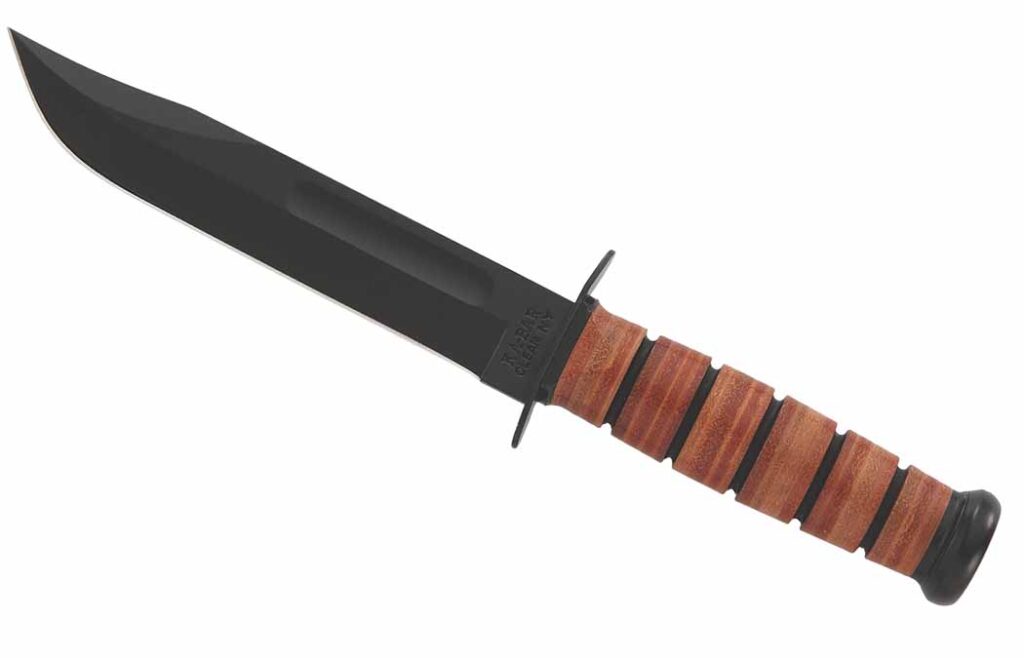
Kabar USMC Fighting Knife
This iconic fixed blade has seen action on battlefields the world over. This knife first saw action during WWII and it still is going to this day.
The 7-inch long blade is made from 1095 carbon steel, making it easy to maintain in the field. It’s fuller adds style and strength to the blade. The iconic stacked leather washer handle is both handsome as well as very practical with its deep grooves that enhance grip and the flat metal pommel which is useful for light hammering and crushing tasks. The double guard prevents your hand from sliding up on the blade. As a bonus, each USMC Fighting Knife comes with a leather sheath.
MSRP: $135 Origin: USA
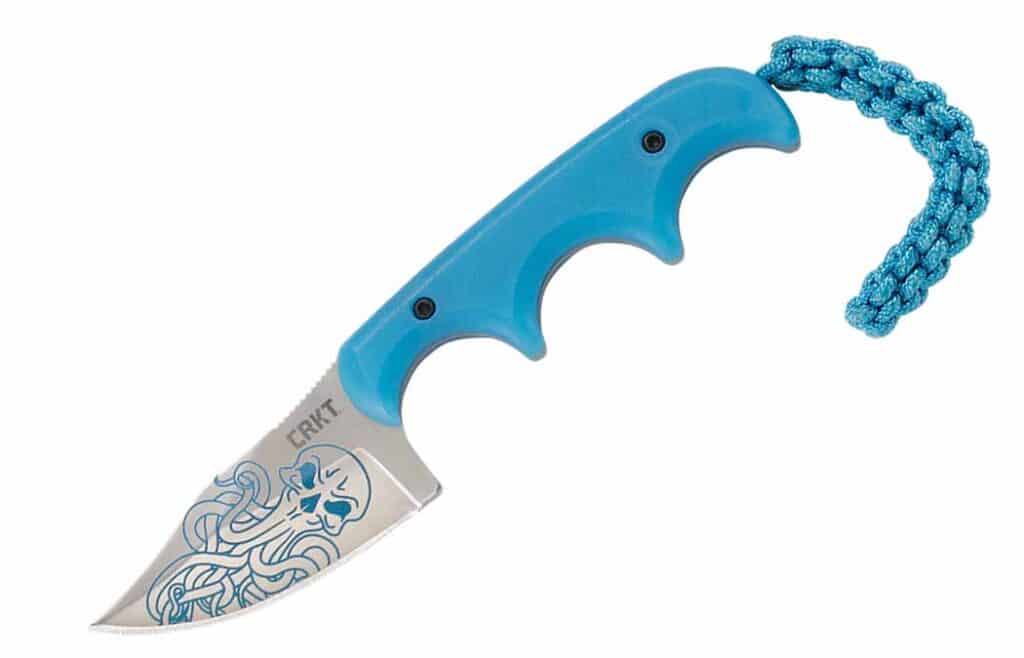
CRKT Minimalist Bowie
Designed by custom knifemaker Alan Folts, the Minimalist Bowie is one of Folts’ best-selling custom knives. It is available to the masses in the form of the CRKT version which sports a 2.1-inch long Bowie-style clip-point blade, made from 5Cr15MoV stainless steel.
Its prominent swedge adds style with function, permitting the blade easily penetrate most materials. The deep finger grooved handle has resin-infused fiber scales for light weight and strength. The entire knife is super comfortable to hold and it feels like the knife melts in your hand and remains very secure. It’s a small fixed blade without the bulk.
MSRP: $45 Origin: China
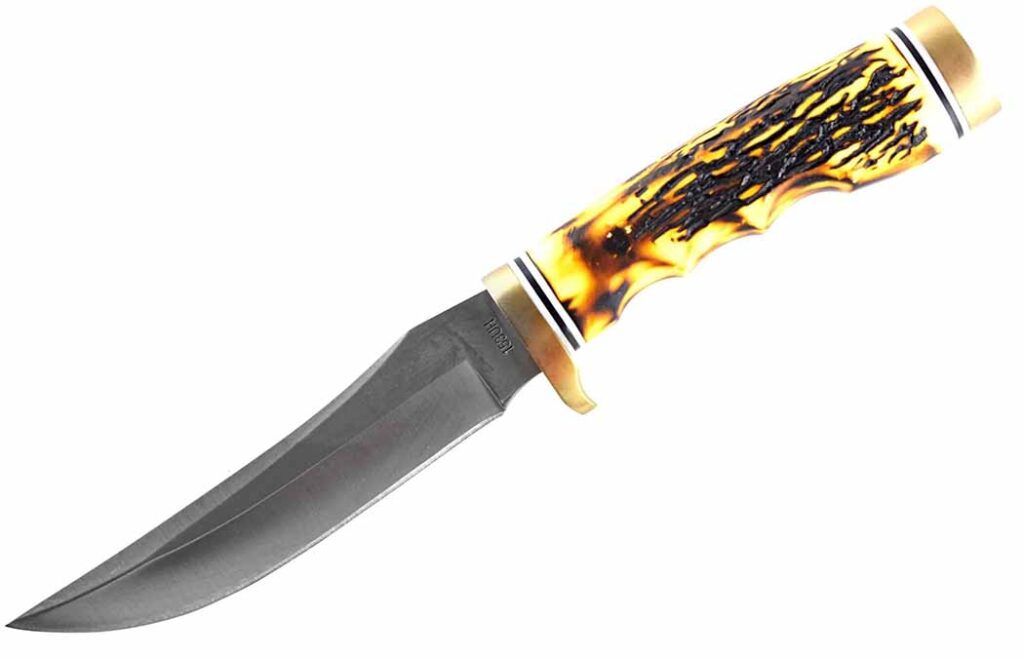
Schrade Uncle Henry Golden Spike
This one is an older design still manufactured today.
Its 5-inch 7Cr17MoV stainless steel clip point blade is a good example of what we call a California clip point, with its long taper to the blade tip. The handle is faux stag in Delrin, with finger grooves for security and control.
It is capped off at both ends with a brass guard and pommel to offset the overall appearance. This knife will fit the fill of an outdoor knife perfectly and not blow the budget. Each Golden Spike comes shipped with a leather sheath for easy portability.
MSRP: $46 Origin: China.
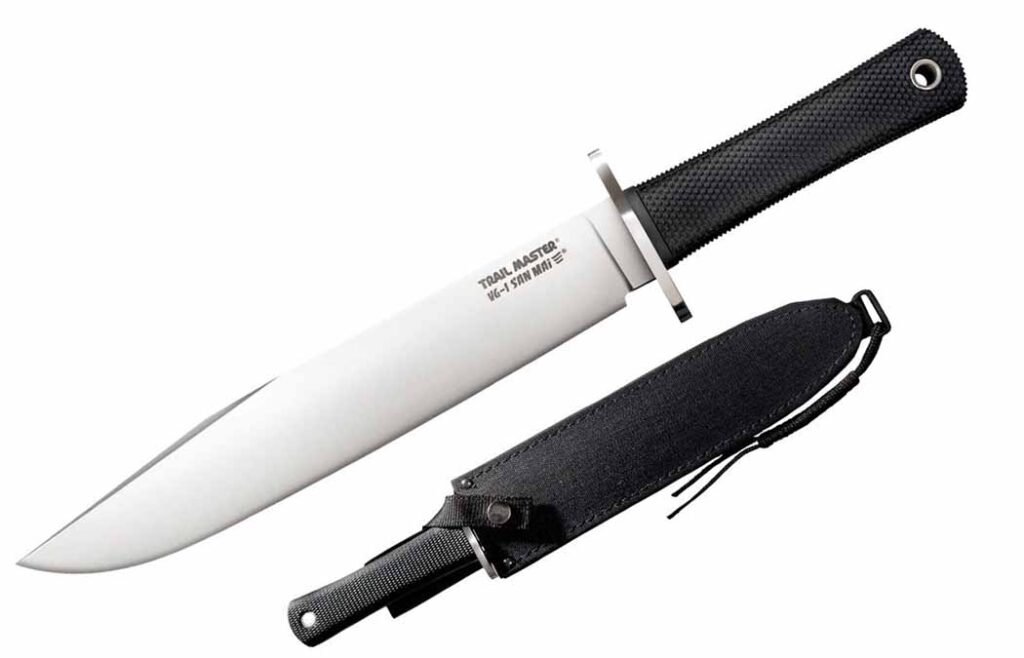
Cold Steel Trailmaster Bowie
This knife commands attention with its sheer size and heavy-duty build.
The Trailmaster Bowie is one of Cold Steel’s most recognizable fixed blades. The impressive 9 ½ inch long clip point blade is made of CPM 3V tool steel for toughness and edge holding. The unsharpened swedge gives the knife its attitude, and a full flat grind allows the Trailmaster to be an effective slicer and chopper as well.
The textured Kray-Ex rubber handle helps the Trailmaster remain in your grip and a double guard up front keeps your hand in place during use. The Trailmaster is adept at chopping and other hard-use outdoor tasks for the campsite.
It is the knife to have with you and instills user confidence when tackling tough cutting and chopping chores.
MSRP: $540 Origin: Taiwan
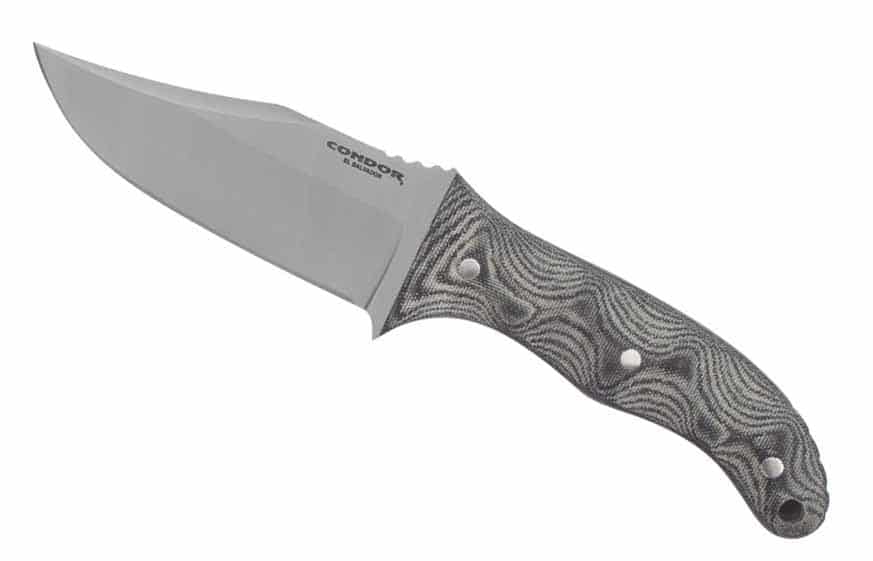
Condor Tool & Knife Little Bowie
Little knife…big attitude! That’s exactly what you get with the Condor Tool & Knife Little Bowie.
The 4.6-inch long blade makes it compact enough to carry comfortably on the belt. Overall length is just over 9.5 inches, making this knife about as long as some of the higher-end tactical folders when open. 1075 carbon steel was selected for the blade, making this knife both tough and easy to maintain. The bead-blasted finish adds a subdued finish for low reflectivity.
The ergonomic-shaped handle has black Micarta scales for a comfortable, all-weather grip. If you like Bowie fixed blades but don’t want to carry a full-size Bowie on the belt, the Condor Little Bowie fits the bill nicely. Each knife is shipped with a sewn leather belt sheath to keep the knife close at hand.
MSRP: $123 Origin: El Salvador.
Among The Best Clip-Point Folders Available Now
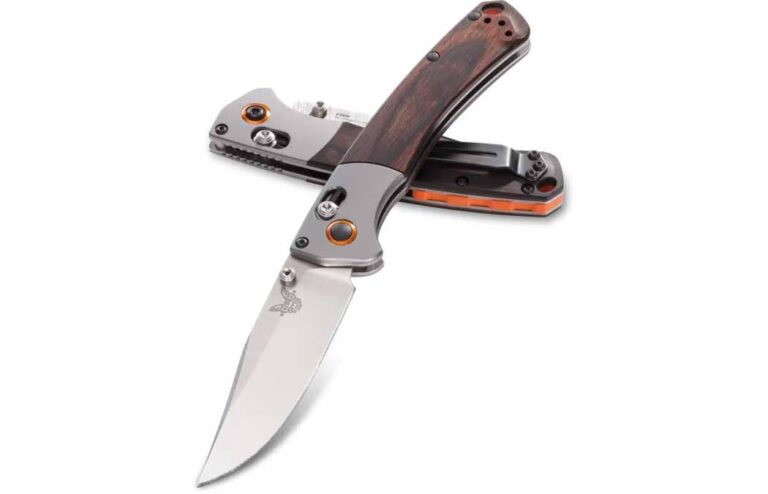
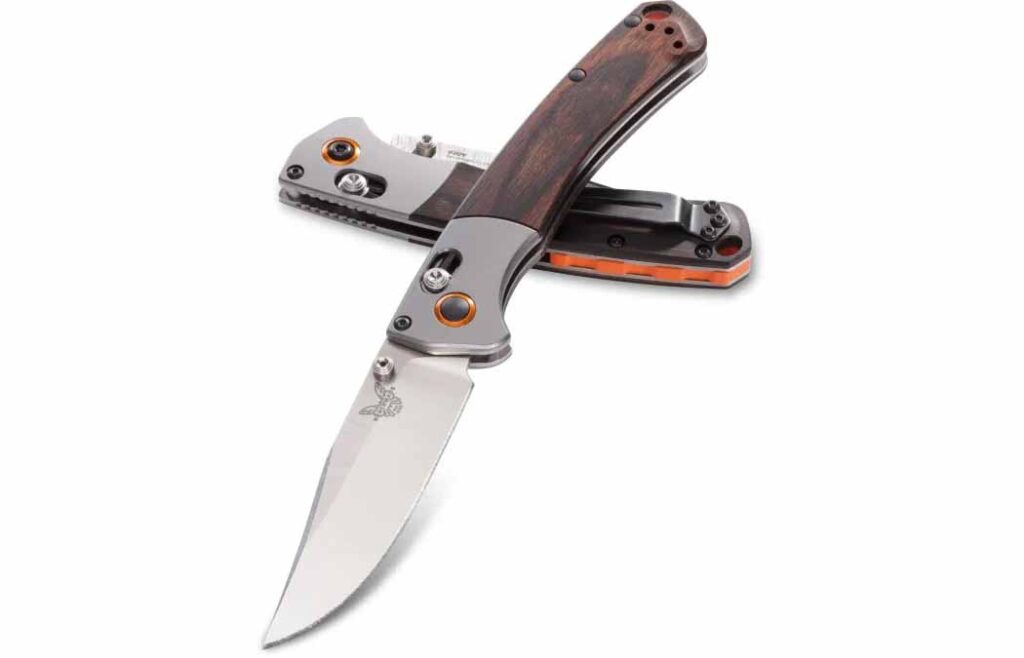
Benchmade Crooked River
The flagship of their outdoor folding knife line, the Benchmade Crooked River is built tough for the outdoors, with a 4-inch clip point S30V stainless steel blade, anodized aluminum bolsters, and Dymondwood handle scales. The handle has a slight contour to it, making it lay in your grip that much easier.
The knife also features Benchmade’s own Axis Lock crossbar lock system for a safe and secure lockup. The Axis Lock is a Benchmade innovation that allows the blade to rotate smoothly and locks up tight, with very little blade play.
At over 9 inches overall, the Crooked River is a formidable folder that is ready to help tackle your field dressing or camp utility tasks. A steel pocket clip allows for easy carry. A Mini Crooked River is also available, scaling down the Crooked River model to a 3.4-inch blade length, and making it more EDC-friendly.
MSRP: $380 Origin: USA
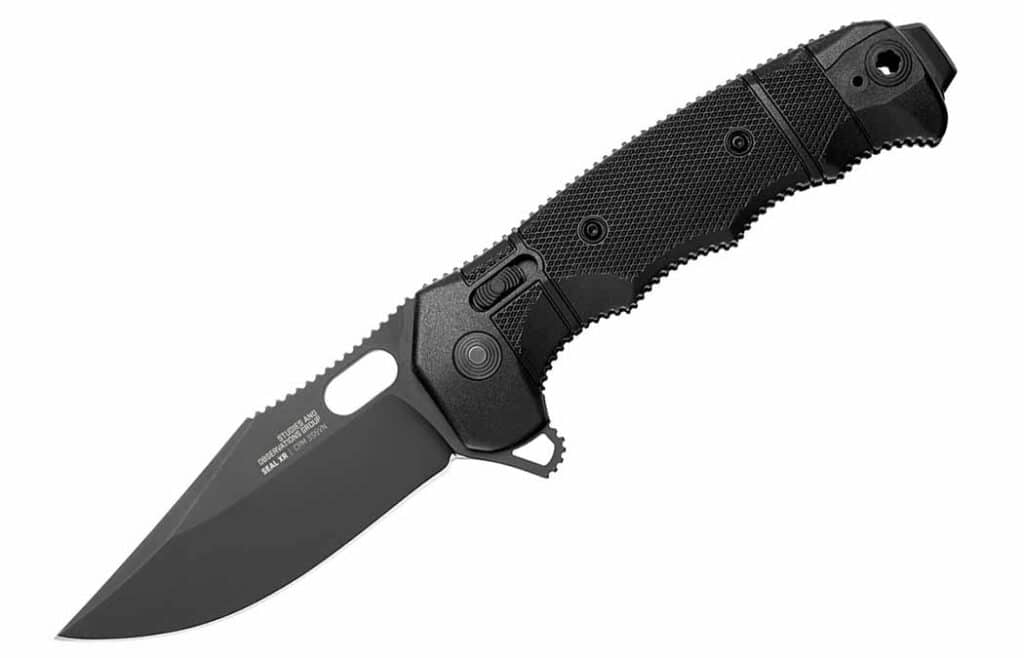
SOG SEAL XR
You want big and brawny? You got it with the SOG SEAL XR! Its 3.9-inch long Bowie style clip point blade is flat ground from premium CPM S45VN high-performance stainless steel. A blade hole and a flipper tab are present to offer two distinct methods of one-handed opening. The handle design is very similar to that of the SOG SEAL fixed blade. The build of the handle is definitely robust and heavy-duty, there’s weight to this knife that you notice when you pick it up.
Weighing in at a healthy 8.2 ounces, the handle has two steel liners, a steel handle spacer with an integrated extension that can be used as a blunt strike tool, and grooved, textured, and traction notches all around. The handle design is made to keep your hand in place. There is an integrated lower hand guard that prevents your hand from sliding forward. The blade lock is SOG’s own XR crossbar lock that offers true ambidextrous operation.
A beefy, wide steel pocket clip rounds out the SOG SEAL XR package. The clip won’t be sprung for sure, even with rough carry. This is by far an EDC folder due to the size and weight but if you need a knife for rough use and outdoor use, the SOG SEAL XR is it.
MSRP: $224.95 Origin: USA
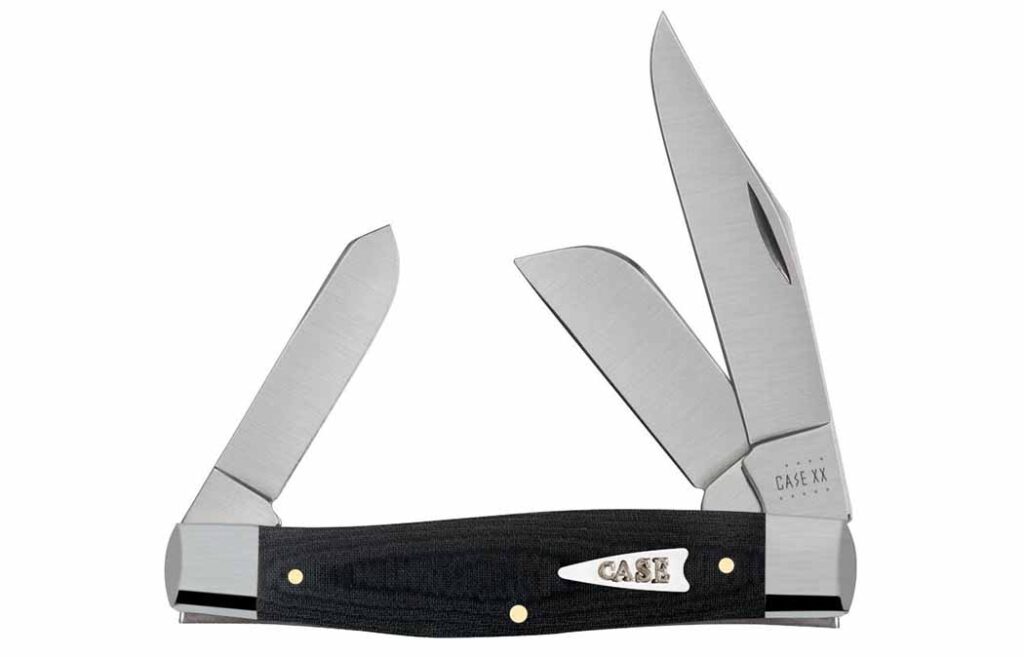
Case Large Stockman 10375
Clip points are found on many different patterns of multi-blade slipjoint knives, such as this Case Large Stockman pattern, model 10375. The main blade is a 3.3-inch long clip point, and two smaller blades – a 2.3-inch long sheepsfoot blade as well as a 2.2-inch spey blade. The blades are ground from Case’s proprietary Tru-Sharp surgical steel, and the handles are of black and green canvas micarta phenolic synthetic for long-lasting durability.
The beauty of knives like these is they are handy to have with you at all times as they sit in the pocket perfectly and they are low profile enough that using them in public won’t raise any eyebrows. These knives are used by everyone from farmers, ranchers, plumbers, electricians, carpenters, warehouse workers, and countless individuals who just want a good solid pocketknife. The main blade does well with opening packages, mail, cutting tape, stripping wire, cutting up cardboard, and any sort of utility or mundane cutting task that tend to pop up in daily life.
The clip point blade is ground fairly thin so it has really good performance characteristics and easily cuts whatever you need to. The Tru Sharp stainless sharpens up quickly and holds an edge fairly well. The stockman pattern is very handy due to the three distinct blade shapes, it’s the perfect pattern to have if you use a pocketknife frequently.
MSRP: $96 (Micarta Handle) Origin: USA
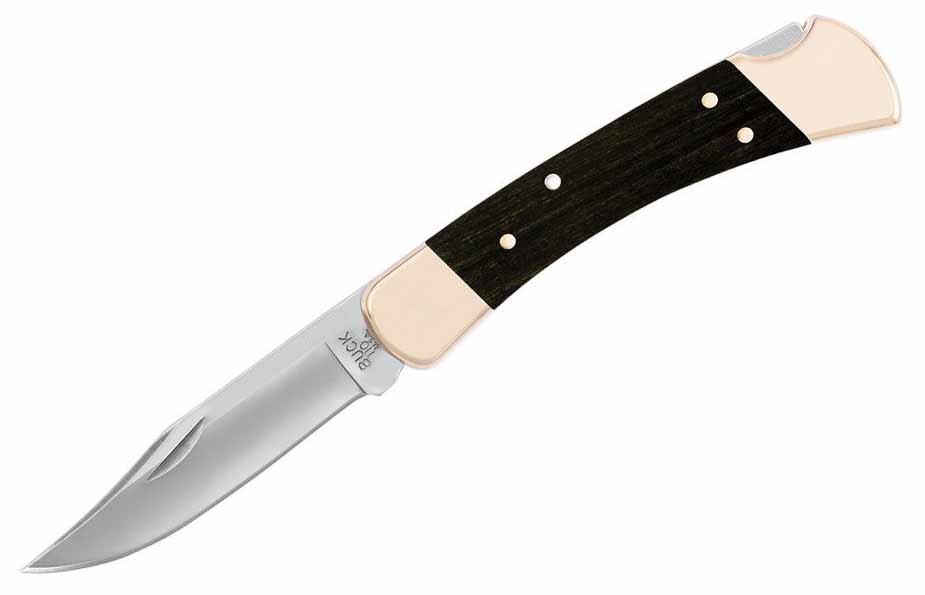
Buck 110 Folding Hunter
This knife perhaps is the signature clip-point bladed folder. Its design was innovative back in 1963 when it was released, and its quality and build have withstood the test of time.
Even today, the 110 Folding Hunter is still made and enjoyed by many. The 3.75-inch long blade is of a Bowie shape and is hollow ground from 420HC stainless steel. The handle is of a robust build, with double brass bolsters and a Crelicam ebony, stabilized hardwood handle. The handle definitely has weight to it, and it’s this exact heavy-duty build that has allowed the 110 Folding Hunter to withstand hard use over time, and still hold up beautifully. The lockback design secures the blade in the open position with a satisfying audible click.
The clip-point blade is ideal for field dressing as well as general cutting tasks. The 110 Folding Hunter originally was designed for hunters as an alternative to a fixed-blade hunting knife. But the knife also found favor with those who are in agriculture, the military, law enforcement, and countless knife enthusiasts as well. For all intents and purposes, it was the predecessor to what we know now as the modern tactical folder.
Still produced to this day in the Buck Knives product line, the 110 Folding Hunter has a few variants including a lightweight budget version, a pro-grade modern version with high-end blade steel and handle material, an automatic opening version, as well as countless collector variants available through the years from Buck as well as select Buck Knives retailers as exclusives.
MSRP: $88 (original 110) Origin: USA
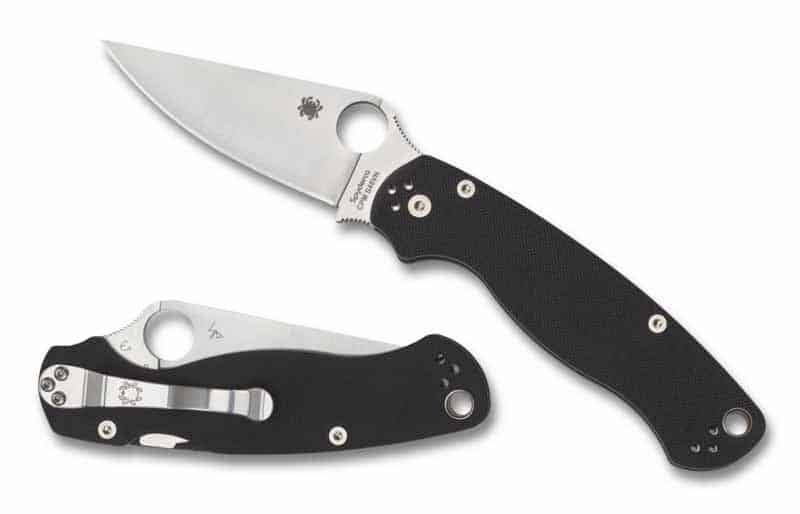
Spyderco C81GP2 Paramilitary 2
Spyderco’s Paramilitary 2 folder – better known simply as the Para2 – is a downsized version of the company’s popular C36 Military folder.
The Para2 offers the same cutting prowess of the full-size Military model with its full flat grind clip-point blade but in a more compact, pocket-friendlier form factor. The Para2’s blade measures 3.4 inches long and is ground out of premium CPM S45VN blade steel that is known for its enhanced edge-holding capabilities. The handle is textured black G-10 and mimics the ergonomics found on the C36 folder that make this one of the most comfortable and handy midsize folding knives on the market.
With an overall length of 8.2 inches, the Para2 is still large enough to tackle sizable cutting tasks. The blade is secured open by Spyderco’s own Compression Lock system, which permits easy one-hand opening and closing. It also allows the blade to have such smooth, silky-like action. The Para2 is a slender knife and carries well in the pocket.
The large blade hole allows for easy one-hand opening with either hand, even while wearing work gloves.
Performance-wise, this is one of the best in high-end folders as the flat grind clip-point blade sails through thick and tough materials easily. Spyderco engineers its blades to be some of the most efficient cutting tools on that market by paying attention to blade shape and blade grinds and optimizing both to create a cutting tool that is unmatched in both performance and value.
The popular pattern offers a complex combination of material and motif.
The variations on damascus steel themes are endless. The possibilities are tempered only by the maker’s time at the forge and his or her desire to create.
Among these many variations, one pattern has recently captured the spotlight. These days, feather damascus is trending and custom makers are producing knives that turn heads, captivating buyers with the intricate layering that produces hard steel intertwined with the look of the light and wispy. Feather damascus offers a medium of both performance and artistic expression that influences every aspect of the maker’s creativity.
Ethan Kolar of Plummer, Idaho, describes his interest in feather damascus as “chaotic flow.” He explains, “The pattern’s center seam, where the jagged W’s converge, creates a flow in the blade which really adds to the overall confluence of the knife as well as creating a controlled chaos as the pattern explodes from the center filling out the blade.”
Kolar enjoys the hint of “jaggedness” and the center line that ties the blade together, and in the making of his feather damascus, his focus lies in test etching every restack from the forge. He sees the pattern in many different forms with the observation that “a pattern is not right or wrong but more of what the maker envisions and creates and what is right to him for his knife.”
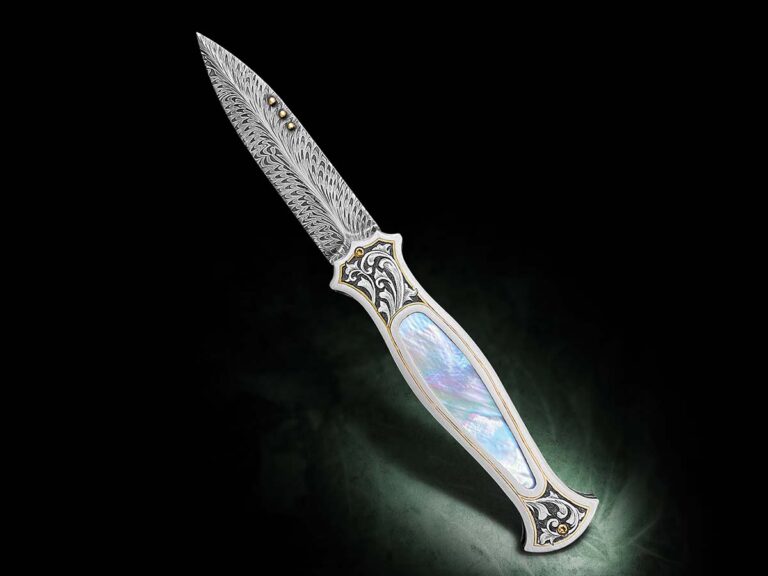
The folding dagger Ethan composed includes a 3-inch feather damascus blade of 1084 and 15N20 steels with an engraved gold inlay and scroll worked 416 stainless steel window frame fitted with exhibition-grade white-lip mother of pearl. Liners are 15N20 file-worked and nitre blued, while the backbar of 416 stainless is engraved and sports delicate file work. Its overall length is 7 inches.
“Most of the inspiration I have while making damascus comes from envisioning my final product,” Ethan remarked, “what engraving will go with it, the handle embellishment, and a lot to do with the overall color of the knife, deciding whether the pattern will be brighter or darker.”
Steel On Fire
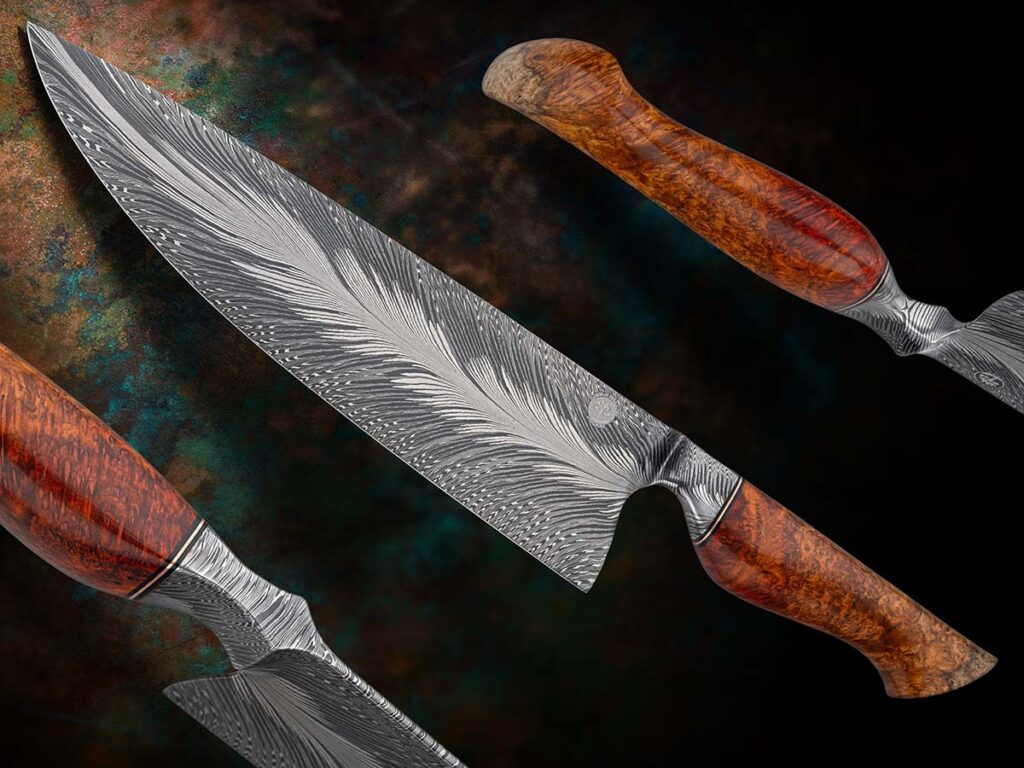
Winning Best Damascus at the 2025 BLADE Show West, Trevor Morgan’s “Torrent of Fire” chef’s knife includes a 9.25-inch blade of 1084 and 15N20 in a mix of W’s and straight layers with a fat core of 15N20. The knife’s overall length is 14.2 inches, and the handle is dark red tiger’s blood amboyna burl with a splash of sapwood for contrast. (Jocelyn Frasier image)
Another contemporary artisan exploring the feather damascus pattern is ABS journeyman smith Trevor Morgan. Having attended the Bill Moran School of Bladesmithing in Texarkana, Texas, in 2020, his goal with each feather damascus blade is to make the pattern “pop.” To achieve that look, his hand follows an artistic eye.
“Contrast, for sure, really makes any pattern cool,” said Trevor, “especially feather or mosaic damascus, larger pieces of dark and bright steel, gradients and that kind of thing. Also, out-of-the-ordinary stuff like feather [damascus] can be really cool to look at. Symmetry is always great with a feather pattern because it’s pretty easy to notice when something is out of whack with a feather due to the defined center. Complexity is also great. If it’s hard to figure out, all the better.”
According to Morgan, a resident of Apple Valley, California, the feather pattern can be challenging due to the hot-cut process, which puts enormous stress on the billet in somewhat weird ways and causes every forge weld to want to split open. The problem, however, can be mitigated by mig welding all the way around the seams. But this is his least favorite method of achieving the integrity of the billet because it requires grinding away the welds, wasting material and consuming time.
Trevor’s inspiration for feather damascus pieces comes from the world around him. “It’s places and people,” he commented, “from nature and the endeavor to make something organic and as lifelike as possible in steel. I regularly get swept up in the general zeitgeist surrounding the making of complex patterns. I see something on social media or somewhere, and I think, ‘Man, that’s really awesome! I’d love to try to make something like that.’ Then comes the real creative part, where I just get an idea of something that might look really cool and put it together.”
Morgan’s method is readily revealed in his featured piece, named “Torrent of Fire.” The knife includes a 9.25-inch blade of 1084 and 15N20 in a mix of W’s and straight layers with a fat core of 15N20. The knife’s overall length is 14.2 inches, and the handle is dark red tiger’s blood amboyna burl with a splash of sapwood for contrast.
Organic Appeal
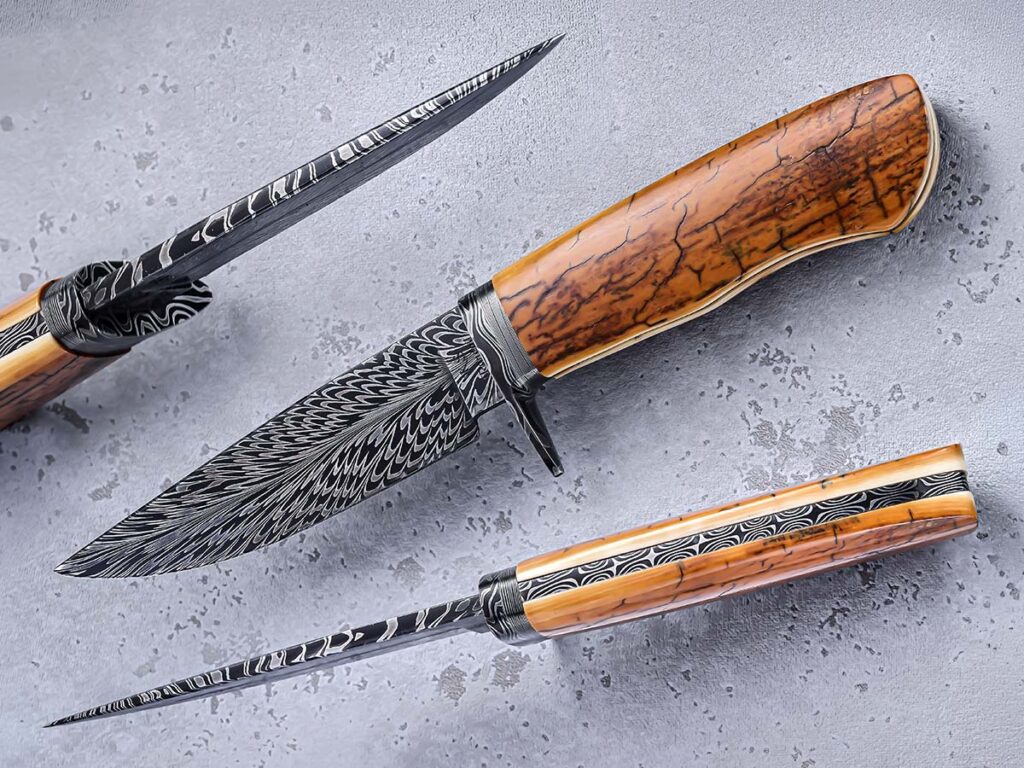
Splitting the billet down the center to maintain symmetry is among the trickiest aspects of feather damascus to Steve Randall. He nails it on his frame-handle hunter, with the axis of the pattern fountaining from the mastodon scales in a balanced and spectacular fashion. (SharpByCoop image)
Feather damascus has been a staple steel for ABS master smith Steve Randall for some time. He seeks a continual flow of the steel from the handle to the tip, and oriented so that the handle appears to actually hold a feather. “I was attracted to the feather pattern because of it’s a very cool, organic look,” he advised. “Like a snowflake, there are no two exactly the same. I’ve been forging feather damascus for at least seven years, and I’ve made several bowies and hunters.”
Randall, of Estancia, New Mexico, presents his feather damascus piece with frame-handle construction, showcasing mastodon scales with an overall length of 9½ inches and a blade of 4¾ inches. “Feather damascus is a more challenging pattern,” he said. “My tricks are patience and concentration. There are many welds involved in the pattern, which can contribute to cold shuts, which can destroy hours of hard work. The trickiest part is splitting the billet right down the middle and maintaining symmetry.”
While he describes the feather damascus forging process as complicated and labor-intensive, Steve sees the payoff in the harmony of the pattern and its related materials in the finished knife. “I always try to complement it with the best handle materials I have available,” he reasoned. “I prefer stag or ivory. If using wood, I avoid busy patterns and colors. I draw inspiration from many other makers. There are so many accomplished makers who produce a variety of feather patterns. It is one of my favorite patterns to forge because it can really accent the flow of the blade and give it a great overall look.”
Movement And Flow
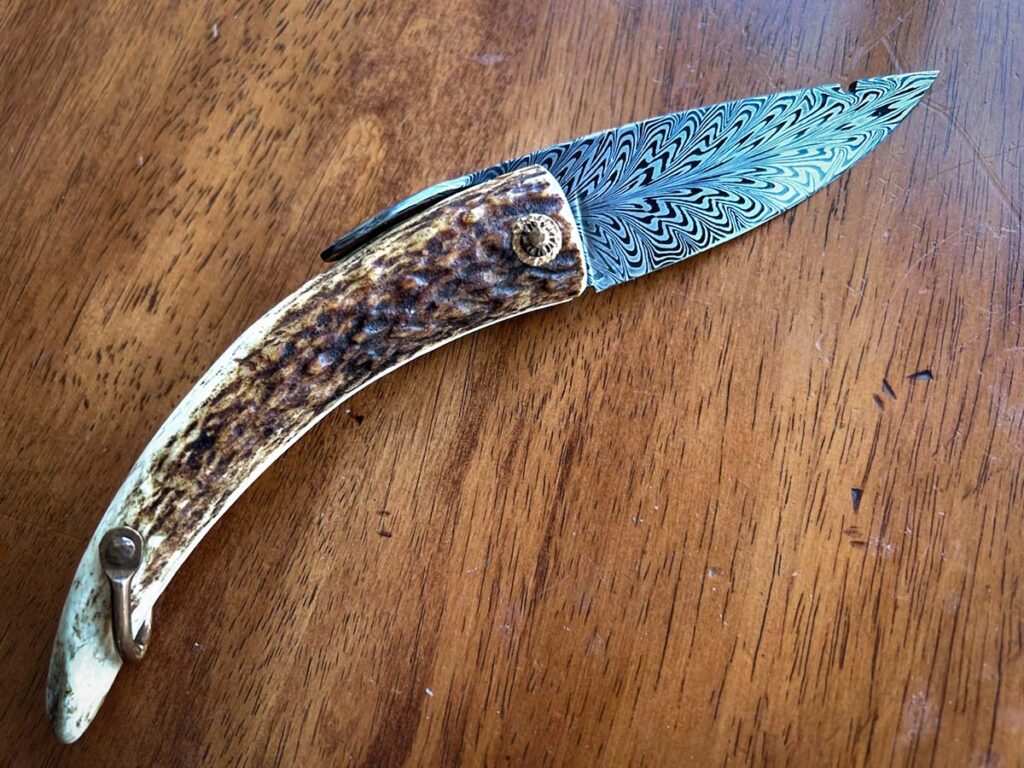
While David Lisch doesn’t feel he’s hit the limits of his Mountain Man folder, the style of knife is striking with its feather damascus blade set in stag-tip handle. Copper hardware and pivot give the knife its antediluvian look, while the flowing pattern of the blade anchors it in modern forge techniques. (David Lisch image)
It took a single demonstration by the great master smith Harvey Dean to convince David Lisch, who earned his ABS journeyman stamp in 2009 and his master stamp six years later, to try the feather pattern. “I was always attracted to feather damascus,” he remembered, “but around 2008 I had the chance to see Harvey Dean demonstrate it at an event at Josh Smith’s, and I went right home and made the tools needed and gave it a go. I’ve been making feather damascus since his demo, and my hat is off to Harvey.”
For David, the making of feather damascus is challenging, but he says book matching the blocks really helps with the constant flow of the pattern. Sometimes, he says, makers will intentionally disrupt the flow by spinning one block one way and one the other to enhance the look. If it is done intentionally, he advises, there is no wrong way to stack the blocks. Forging all begins with the initial stack, and David starts with a 12- to 15-pound billet, acknowledging that the pattern can be wasteful in material. He tries not to go too far or stop too short in the forging process and offers that sometimes less is actually more.
“I love feather damascus because it looks different from maker to maker,” added Lisch. “I like a feather with movement and flow, not too bold and not way too fine, something that is easy to look at. For me, the more the pattern follows the forging, the more I like it. The center should lift up into the bolster or ricasso, showing that the blade was forged rather than running off the blade under the ricasso, showing it was just ground into a shape that disrupts the flow.”
Lisch gained a measure of popularity with his Mountain Man 2 folder, and the pictured knife is an example of what he describes as a “deep dive” into the style while using stag tips. “I set out trying to create my own version of one of the oldest knife designs in America,” he remarked, “and I believe I did just OK. But I’m not finished. So far, I’ve made several versions of the folder and have taken it even further with help from my friend and mentor [master smith] Mike Vagnino.”
Lisch had brought together his feather damascus touch and innovative design composition by introducing a clocking adjustable pivot that he has incorporated into a slipjoint, linerlock, lockback and flipper, all in the Mountain Man style with bronze, copper, stag and, of course, feather damascus. He has yet to reach the outer limits of his Mountain Man creativity and says that more will come in due time.
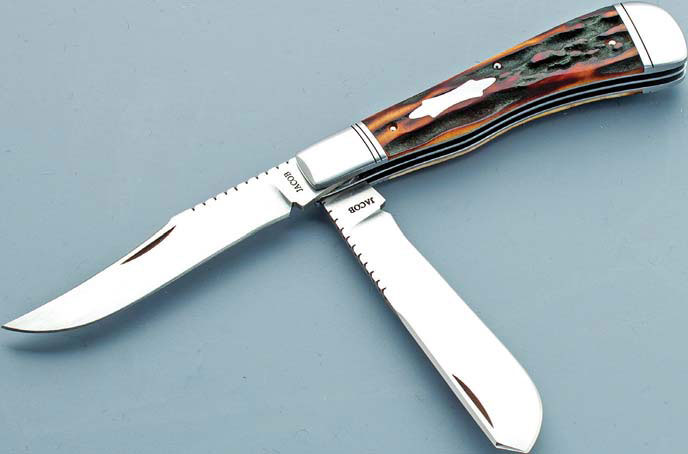
Phil Jacob took home the Best New Maker award from BLADE Show 2017, which is as good as it gets for someone getting started in knifemaking. The achievement is also good news for knife collectors looking for a guiding light for their collections. “Best New Maker” translates to “best new opportunity” for ROIs on investment.
Jacob, who calls Kansas home, specializes in slip joint folders. The addition of exotic handle materials and attention to detail offset any cliches about this traditional style. Just take a look at the double-bladed trapper that made waves at BLADE Show.
Specs:
Blade lengths: 3.125”
Blade steel: CPM 154 stainless
Handle: Stag dyed amber
Folding mechanism: Slip joint
Weight: 5.1 oz
Closed length: 4.5”
Maker’s list price for a similar knife: $875 to $1,100
Jacob maintains a healthy social media presence, which is another benefit to collectors interested in a commission or a resale. His Facebook page is full of status updates and photos.
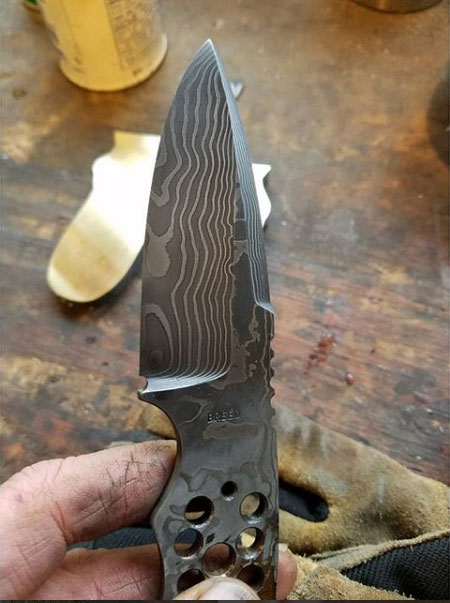
Msg. Kim Breed (retired), a long-time field editor for BLADE best known for his knife reviews, will partner with DoubleStar Corp. to produce knives for that company’s Edged Weapon line.
There’s no doubt that Breed’s 18 years of experience in the United States 5th Special Forces Group will inform the designs that come out of the collaboration, as well as his time as the owner of Breed Custom Knives. Although DoubleStar has not announced specific models, a release from the company suggests that Breed’s custom work will be adapted for affordable price points.
“Kim is a legend within the custom knife community and we are very excited to have the opportunity to collaborate with him, turning his custom design into something that is accessible to a wider audience. Adding Kim to our already impressive roster of collaborators only strengthens our commitment to the edged weapon market, and we look forward to unveiling his designs soon,” stated Rob Cabrera, director of Edged Weapon, in a DoubleStar release.
The following are examples of Breed’s custom knives:
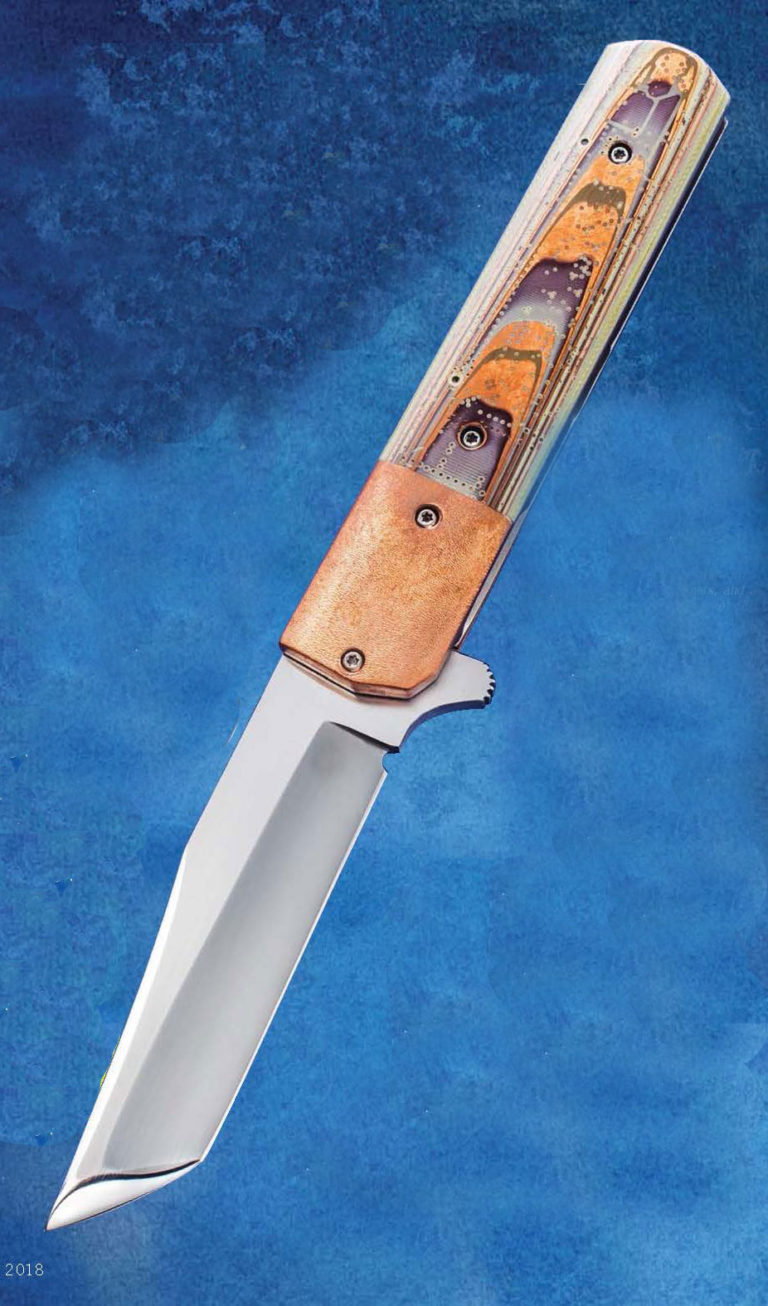
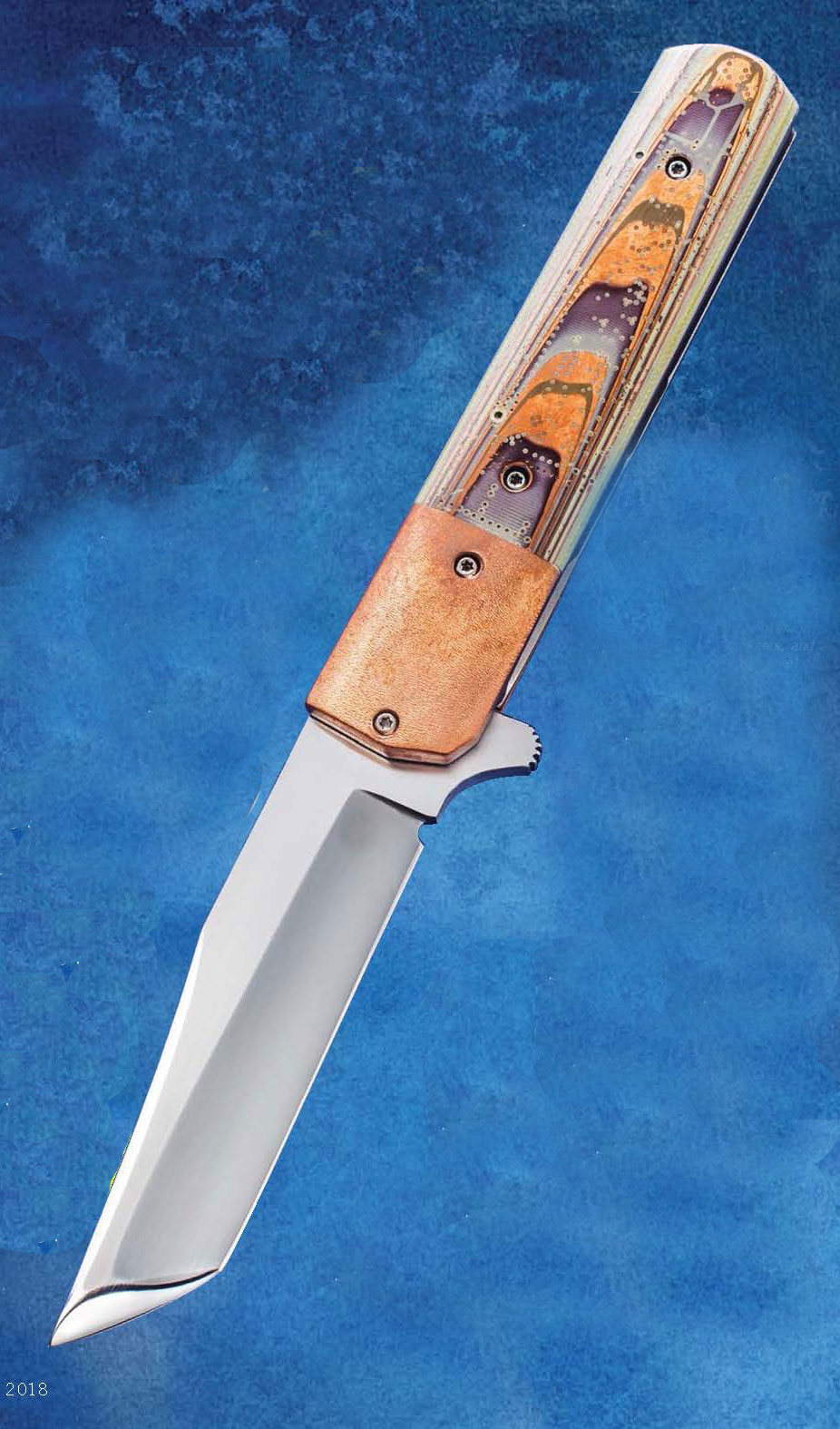
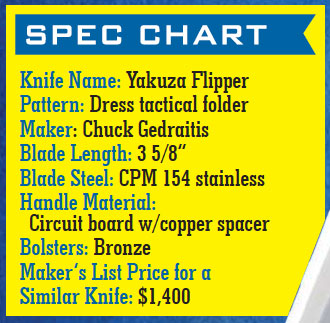
The Yakuza Flipper by Chuck Gedraitis includes a hand-rubbed blade finish, titanium frame and liners, and a Timascus™ pocket clip. Yakuza is a nickname for “transnational organized crime syndicates”—i.e., the mafia—in Japan. Click for larger view. (SharpByCoop knife image)
Chuck Gedraitis Flipper Meshes Modern Materials with Traditional Style
The Yakuza Flipper by Charles “Chuck” Gedraitis meshes classic styling with an unusual modern handle material in a folder that reflects both the traditional and the modern. The traditional is the Japanese-style instead of an American-style tanto blade.
“The American style would have more of a straight cutting tip,” Gedraitis noted. “This one has a little curve to it.”
The modern is the circuit board scales. Gedraitis highlights the copper of the circuit board with the bronze bolsters and a copper spacer, the latter two both in an orange-peel finish. He exposed the pattern of the circuit board by grinding into it, thus revealing the copper in the different layers of the scale material.
For more information contact Chuck Gedraitis, Dept. BL4, 444 Shrewsbury St., Holden, MA 01520 508-963-1861 [email protected], gedraitisknives.com, Facebook/Instagram: @gedraitisknives gedraitisknives.
Meet the Maker at BLADE Show
Balisongs are a Chuck Gedraitis specialty and he will show you how he designs and makes them in his special class “How To Make a Balisong” at 2 p.m. June 2 at BLADE University in the Cobb Galleria Centre in Atlanta.
Held in conjunction with the 37th Annual BLADE Show June 1-3, also at the Cobb Galleria, BLADE U. is the most comprehensive array of classes on knives and knifemaking of any knife show. Click here for more information.
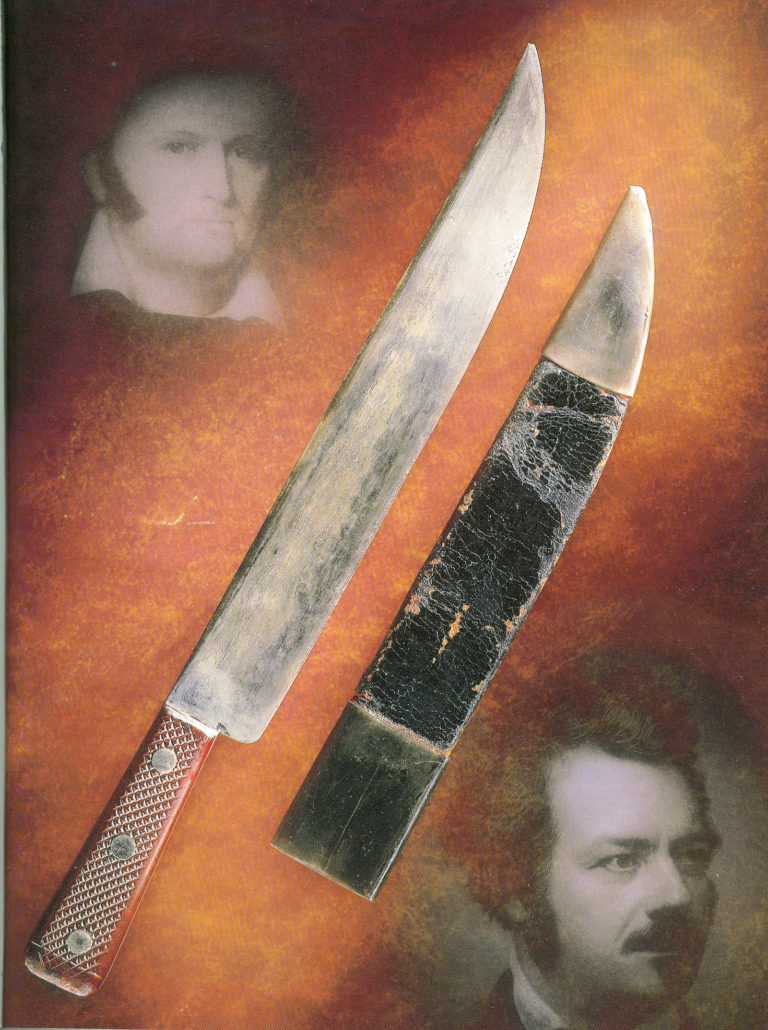
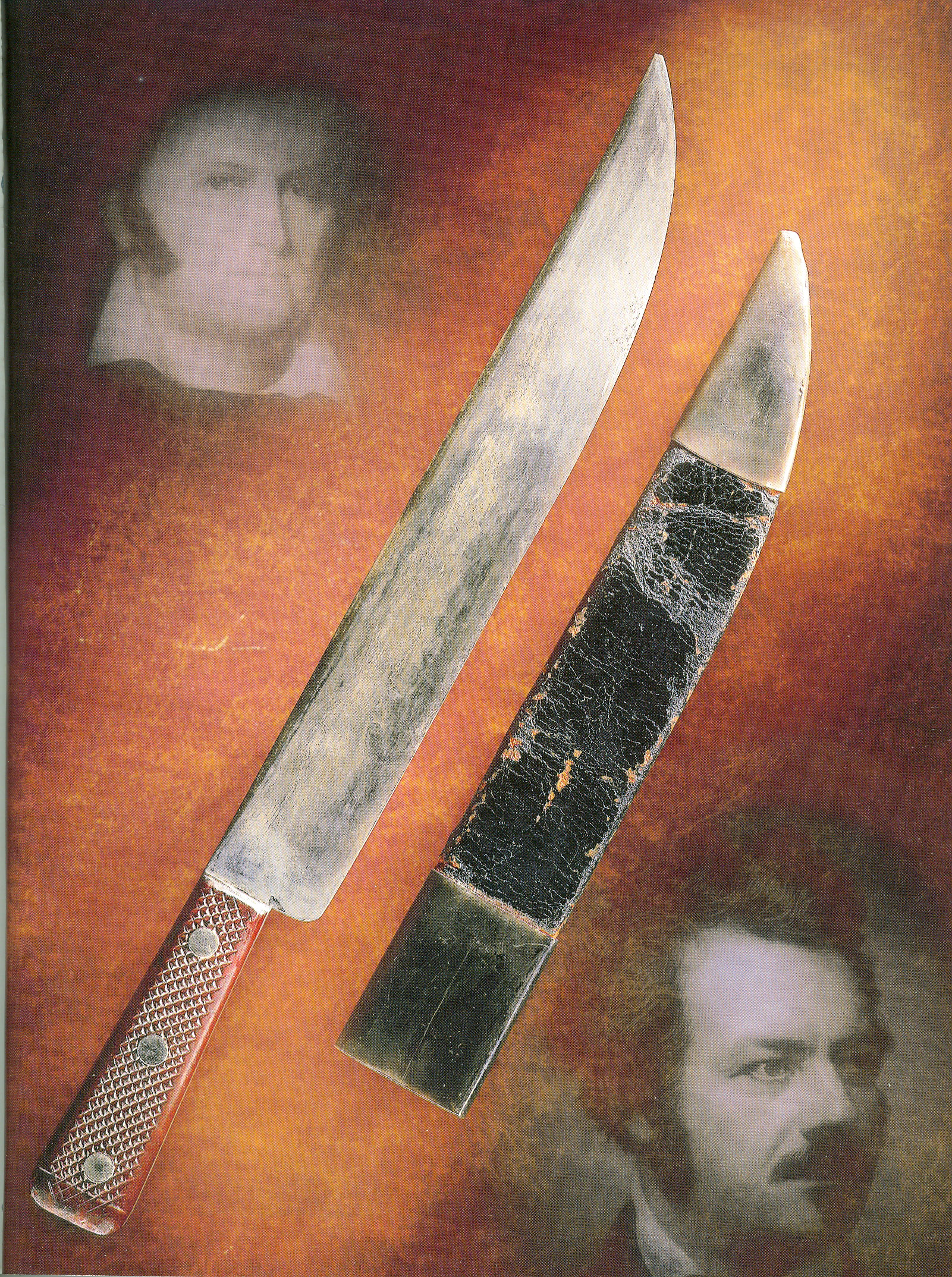
Some say that Jim Bowie (upper left) personally gifted a bowie knife (above) to Edwin Forrest (lower right). Jim Batson, one of the world’s leading bowie knife authorities, shares his findings on the subject.
Jim Batson
BLADE recently sat down for an extensive interview with Jim Batson, one of the leading bowie knife researchers in the world. The interview was recorded on video, which can be seen below, and consists of two parts.
Most significantly, Batson reveals what he discovered about the controversial Edwin Forrest bowie knife, claimed to be gifted to the 19th Century actor by James Bowie himself. That can be seen at 25:06 in the video.
Look below the video for further timestamps and summaries.
Batson Looks Back on 30
ABS master smith Jim Batson has been conducting his Batson Bladesmithing Symposium for three decades and just completed the 30th one April 8 at the Tannehill Ironworks near Bessemer, Alabama.
Join us for an exclusive interview with Batson as he talks about those 30 symposiums, the major industry changes he’s seen in his bladesmithing career, his induction into the BLADE Magazine Cutlery Hall of Fame in 2017 and what the future holds for this icon of the forge.
Use these timestamps to help you navigate the video.
ABS master smith Jim Batson has scoured the Bowie Trail from the Southeast USA to Texas for decades, researching anything and everything about James Bowie and bowie knives.
Watch the video above to see Jim recount the highlights of his research, including his book about the Sandbar Fight where the bowie knife legend was born, whether James Black really made bowie knives—including those in the Carrigan style—whether the Edwin Forrest bowie actually belonged to James Bowie and more in this exclusive BLADE® interview.
12:27 Contributions to bowie knife history research
15:01 Surprising finds
15:53 New facts about the 1827 Sandbar Fight
17:57 James Black controversy
23:14 The Carrigan knives 25:06 The Edwin Forrest “Gift” bowie knife 27:22 Where did the Forrest knife come from?
30:47 End