

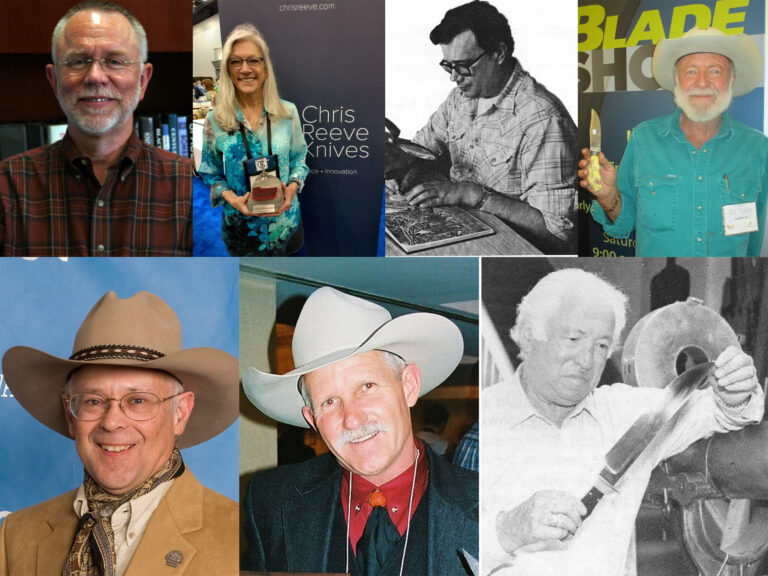
7 Join BLADE Magazine Cutlery Hall of Fame®

New inductees span the world of custom and factory knives.

A notable assortment of those who for many years enhanced or continue to enhance the overall improvement of the knife industry highlights the 2026 class of inductees into the BLADE Magazine Cutlery Hall of Fame®.

The new honorees include three living and four deceased members. Among the former are CRKT co-founder Rod Bremer and Anne Reeve, owner/president of Chris Reeve Knives, on the factory side, and American Bladesmith Society master smith Larry Fuegen from the custom realm.

The posthumous inductees are bladesmith/writer Ed Fowler, custom knife purveyor Nate Posner, knifemaker/knifemaking supplier Bob Engnath and ABS master smith Tim Hancock.

All will be formally inducted in a special ceremony during the BLADE Magazine Cutlery Hall-of-Fame Breakfast the Saturday morning of the BLADE Show, June 6, in the Renaissance Waverly, the host hotel adjoining the Cobb Convention Center in Atlanta. For ticket information email [email protected].

Rod Bremer

Rod Bremer

Along with partner Paul Gillespie, Rod Bremer started Columbia River Knife & Tool (CRKT) in 1994. The concept was to bring world-class-quality knives to the U.S. market in the designs of custom knifemakers—as of today, CRKT has used the designs of over 50 such makers—and innovation at a price that virtually all consumers can afford.

According to a nominator, Rod’s integrity qualifies him for the Hall of Fame, a good example being that “CRKT pays the makers/designers royalties for as long as the knife sells. To this day, Rod is still paying royalties to the estates of Ed Halligan, Jon Graham, Cutlery Hall-of-Famer Kit Carson and several others.” Added the nominator, “CRKT started the Forged by War program to help veterans and their charities. So far the program has donated over $500,000 to the charities of the veteran’s choice.”

Under Rod’s leadership, CRKT has won a number of BLADE Magazine Knife-of-The-Year® Awards. In the process, he helped enhance Southeast Asia knife manufacturing by teaching and demanding that the Taiwanese factories produce the highest-quality knives possible.
He has bolstered pro-knife initiatives through his work as an American Knife & Tool (AKTI) Board of Regents member, working on issues that benefit the knife industry. His resume includes: 1) Election to the AKTI Board of Regents (2009); 2) Playing an active role in the monumental defeat of U.S. Customs’ attempt to classify all one-hand knives as switchblades (2009); 3) Recipient of Knife Rights’ inaugural Freedom’s Guardian Award for his role in upholding knife rights industry wide (2011); 4) Elected AKTI vice president (2011); 5) Organized and hosted AKTI anti-counterfeiting round table and presented related seminars for BLADE University at BLADE Show 2013; and 6) Elected (2014) AKTI president, a position he held through 2016.

Anne Reeve
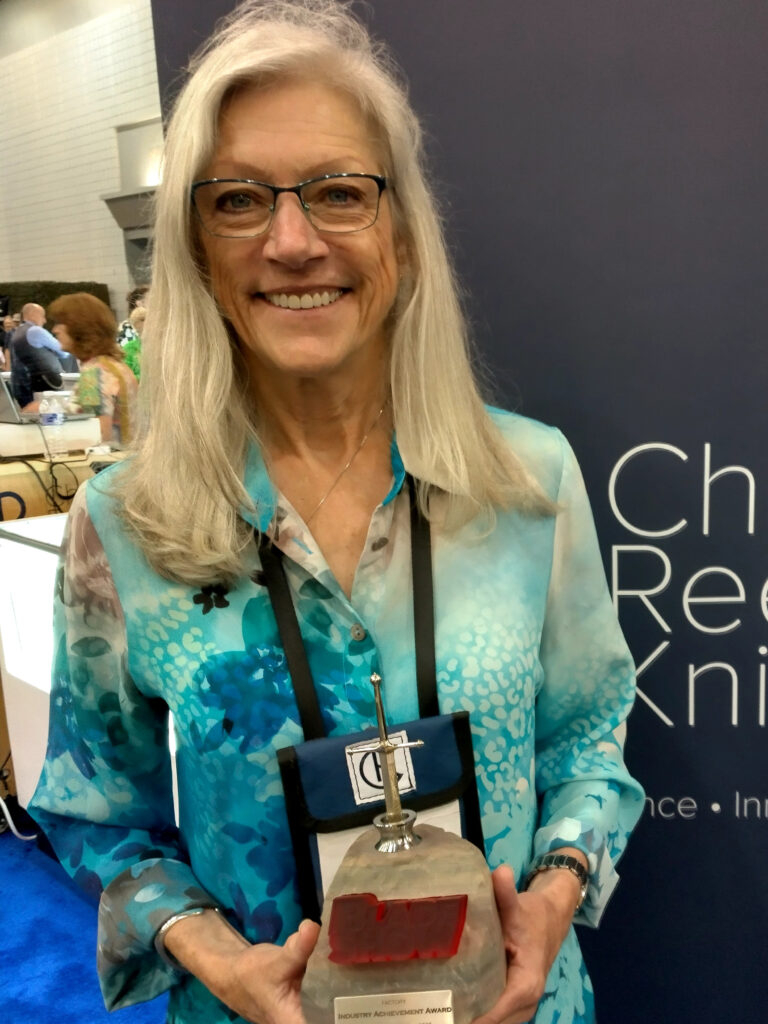
Anne Reeve

According to a nominator, in 1986 Anne Reeve joined the then-fledgling Chris Reeve Knives and quickly became an integral part of the company. Her partner, both in life and business, Cutlery Hall-Of-Famer Chris Reeve, was the craftsman, and a great one at that. While Chris’s forte was knife design, Anne’s strengths were administration and bookkeeping. Anne spent many of the following years lending a hand where she could, helping to build a company known for quality and excellence.

For most of the early years, Chris Reeve Knives was just Anne and Chris plus a handful of employees, which meant Anne wore many hats. As the company grew, Anne stepped more into working behind the scenes in administration and customer service. Her years of answering the phone and meeting customers, partnered with her determination to ‘do the right thing,’ laid the groundwork for the knife manufacturer’s international reputation for excellence. Today, the company has around 150 dealers worldwide.

On the knife legislation front, Anne showed support for both the American Knife & Tool Institute and Knife Rights with encouragement, donations of knives and cash, and attending and sponsoring related functions. She has been treasurer of the Idaho Knife Association since 2018 and is an active member of the organizing committee for the IKA’s annual show.

After a nearly 30-year partnership, Chris retired, and Anne took a massive leap of faith and bought Chris’s share of the company. With the help of their son, Tim, and a team of young, talented and enthusiastic leaders, Anne has trailblazed Chris Reeve Knives into new territory. As the nominator concluded, “Investment in equipment and employees has resulted in revenue more than doubling under her leadership, the quantity of knives produced each month continues to increase, the quality of those knives is better than ever, and demand continues to significantly outpace production. Her determination to keep the integrity of Chris Reeve Knives, coupled with the highest quality products and customer service, has set a standard in the knife industry.” Helping cap it off, Anne won the BLADE Magazine 2025 Industry Achievement Award for her many contributions to the craft and cutlery community.

Bob Engnath
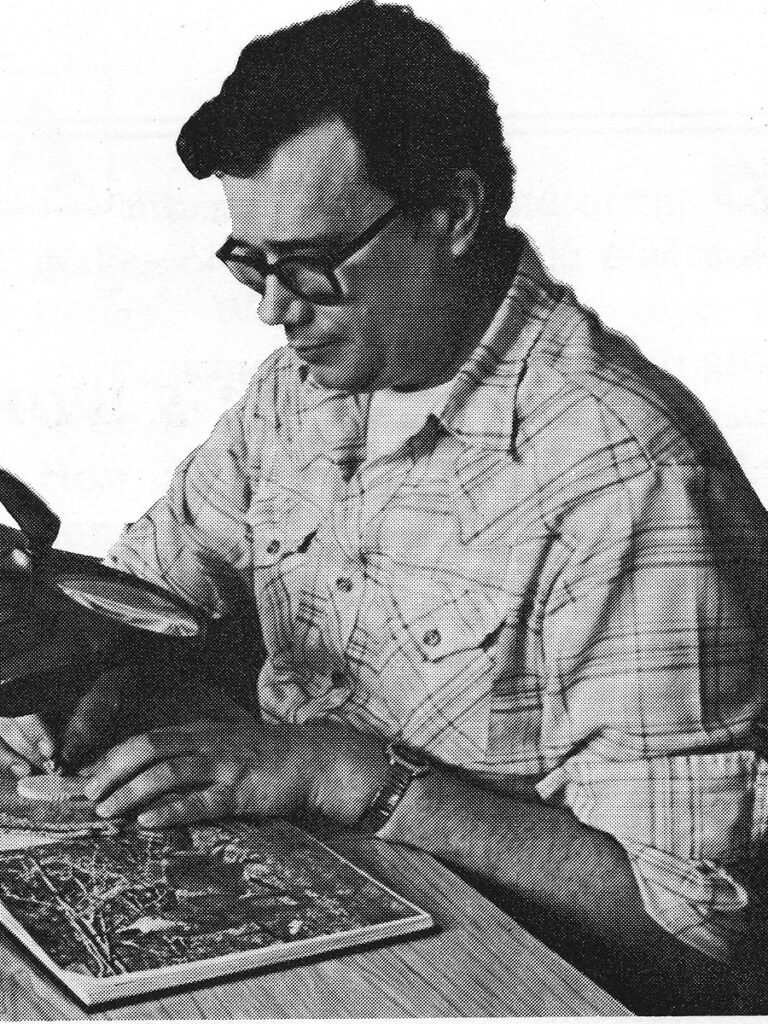
Bob Engnath

Bob Engnath built his first knife in 1972 and went full-time in ’79, making kit blades, tantos, swords and assorted knives in carbon steel. His base of operations was Blades ‘N’ Stuff, a retail shop he ran in Glendale, California, that offered tools, supplies and materials for knifemakers, bladesmiths and swordsmiths.

He produced several editions of a comprehensive publication he also called Blades ‘n’ Stuff, a 70-or-so-page 8-by-11-inch “Catalog and Instruction Manual featuring Handcrafted Blades by Bob Engnath and Knifemakers’ Supplies.” Sold for $5, it contained copious amounts of knowledge and instruction for anyone who wanted to make a knife or sword, including line art of his many patterns, knifemaking how-to’s with diagrams, tips and do’s and don’ts, and tons of sage advice on various steels, heat treating, knifemaking machines and materials, finishing, how to forge damascus, shop safety and other invaluable information. In addition to his catalogs, Bob also wrote the books The Scrimshaw Connection and The Second Scrimshaw Connection.

Engnath was a dedicated blade grinder and considered by many the best grinder of the time, providing blanks his customers could finish on their own. He gave many makers their start and dispensed an untold amount of knifemaking knowledge to anyone interested enough to listen, usually free of charge. According to one source, “Bob was a mentor to countless new makers through his knife kits, leaving a lasting legacy in the knife community.”

Summed up another source, Bob “was an excellent role model for any man in the knife business. He never said a bad word about anyone, took the knife business where it had not been before, his ethics were outstanding, his word was ironclad. I’d rather have had a handshake with Bob Engnath than a lawyered-up contract with any other knife name you care to mention. He was a hero and an example to a lot of people.”

Ed Fowler
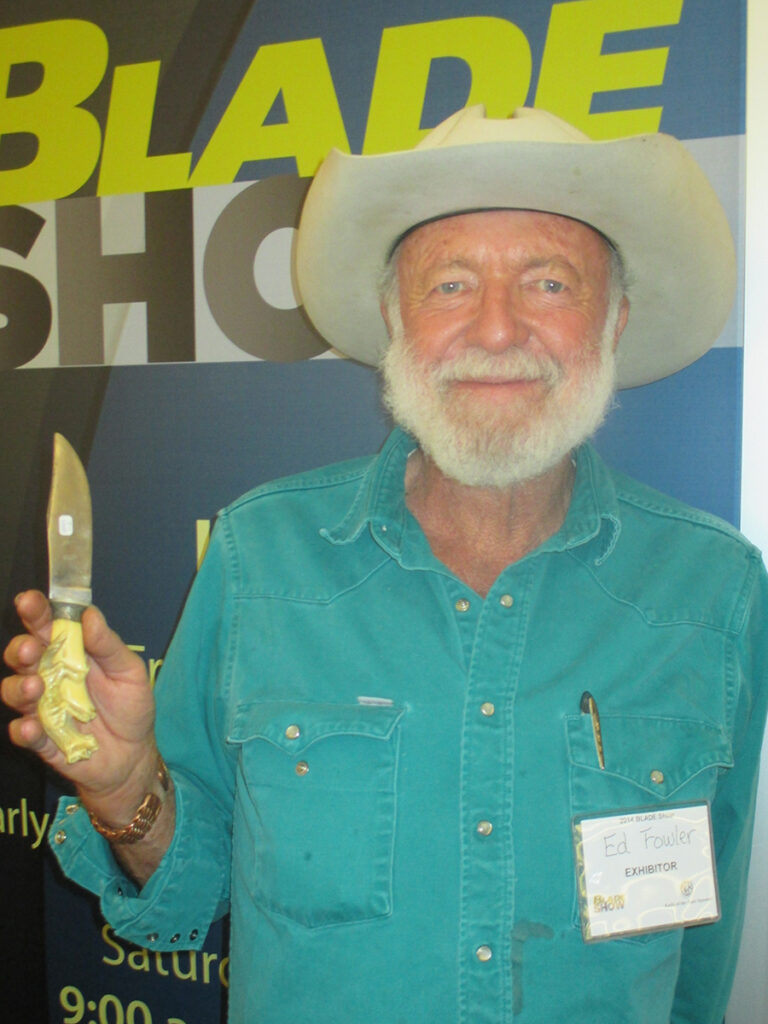
Ed Fowler

Selling his first knife in 1962, Ed Fowler epitomized “the philosophy of the cutlery fabricator,” noted one nominator. Though not the first to use 52100 carbon steel for knife blades, Ed helped popularize it as it became a go-to material among today’s bladesmiths. He long performed and encouraged the multiple quenching of blades during heat treatment.

He wrote the monthly column “Knife Talk” for BLADE® for well over a quarter century. In BLADE’s reader surveys, along with Cutlery Hall-of-Famer Wayne Goddard, Ed completed the top one-two team of most popular BLADE writers year-in and year-out. Ed compiled his “Knife Talk” columns into two books: Knife Talk I: The Art & Science of Knife Making and Knife Talk II: The High Performance Blade. He conducted demos for many years on a variety of subjects at the BLADE Show, plus a class at BLADE University.

Formerly an ABS master smith, he went on to create the High Endurance Performance Knife Association, an organization dedicated to a greater understanding of the knives its members make, the steels they use, the process necessary for the knives to reach their maximum performance potential, and to share this understanding with any and all who seek it. He taught knifemaking to many, including more than a few who have gone on to become ABS journeyman and master smiths, including Audra Draper, Wade Colter, Shane Taylor, Bill Burke and Cutlery Hall-of-Famer Rick Dunkerley among the latter.

Wrote one nominator, Ed was “very passionate about what a knife should do. He indulged anyone who wanted to share time or debate ‘the concept of cut,’ as he called it.” Ed would pit his high-performance 52100 knives against all comers in what he called “real world tests,” cutting and doing things with the knives many consider abusive, until the knives failed. Ed continued using this testing regimen, observing that though you may never have to use a knife in such a manner, “What if you had to and the only tool you had at your disposal was your knife? Wouldn’t you take comfort in knowing that if ever push came to shove, you had a knife you could stake your life on?”

Larry Fuegen

Larry Fuegen

Larry Fuegen started forging knives in 1975. According to a sitting Hall of Famer, from that time on all of Larry’s knives were sole authorship. He became a full-time knifemaker in 1987 and earned his American Bladesmith Society master smith rating in 1989.

“Since I’ve known Larry he has been a unique person who made unique knives,” the Hall of Famer wrote. “He started making friction folders after meeting Cutlery Hall-of-Famer Jim Schmidt at an ABS hammer-in. Years later Larry took those folders to a whole new level. For years he did gargoyle-type carvings on them and later started doing other renditions, like his folder featuring the Spanish explorer Hernan Cortes wearing a gold helmet and Larry’s carved face of his idea of what Cortes looked like. Besides these great folders he made many ornate bowies, daggers and hunters that had carving, texturing and engraving done in a way to set his work apart from anyone else.

“For me what stood out most were his push daggers. I believe if you Googled push daggers a picture of Larry Fuegen would come up. He not only crafted knives, he also did his own leatherwork, which was top quality. He also made some of the best bits and spurs anywhere. In addition to his quality work he designed and built the tools he needed to produce his knives, leatherwork, and bits and spurs.”

He was voted into the Art Knife Invitational in 1999 and every year thereafter until 2022. Circa 2008 another of his ornately done friction folders, entitled Alaric, King of the Visigoths, went on permanent display at the Smithsonian American Art Museum’s Luce Foundation. He has been featured in many magazine articles and books, among the latter including Greatest Living Knifemakers by Cutlery Hall-of-Famer Steve Shackleford.

Larry passed his knowledge on, teaching at numerous hammer-ins and seminars around the country. He is very knowledgeable and is willing to share with anyone. He is the personification of the traits required for induction into the Cutlery Hall of Fame.

Tim Hancock

Tim Hancock

Teaching others how to make “the total knife” played a huge role in defining Tim Hancock. “He taught and demonstrated at many hammer-ins in the areas of embellishment, design, blade forging, grinding, heat treating and sheath making,” ABS master smith Larry Fuegen observed. “He wanted to share his methods and thoughts with others. He also gave private lessons in his shop to many aspiring makers. The influence of his recognizable style can be seen in the work of many makers. Just as [Cutlery Hall-of-Famers] Bill Moran and Bob Loveless influenced many with their designs, so did Tim with his work.”

Added knifemaker Michael Vagnino, “I suppose the most important thing I learned from Tim was integrity. The knife you make is in fact a part of you. How it turns out is more about how honest you were when making it. When Tim told me that, it really made me pause. From that moment on, I viewed making knives in a new light.”

Tim earned his ABS master smith rating in 1993 and won an impressive number of honors for his knives, including the 2010 W.F. Moran Award. He was known for his award-winning period bowies, including though not limited to dog-bone bowies. Dr. David Darom dedicated an entire hardback book, Tim Hancock: The Western Bladesmith, to highlighting Tim’s knives and knifemaking career, even his penchant for forging silver-mounted bits and spurs and other Western gear. From 2001-2015 Tim was a member of the Art Knife Invitational, an organization of the world’s 25 greatest knifemakers spearheaded by Cutlery Hall-of-Famer Phil Lobred.

Nate Posner
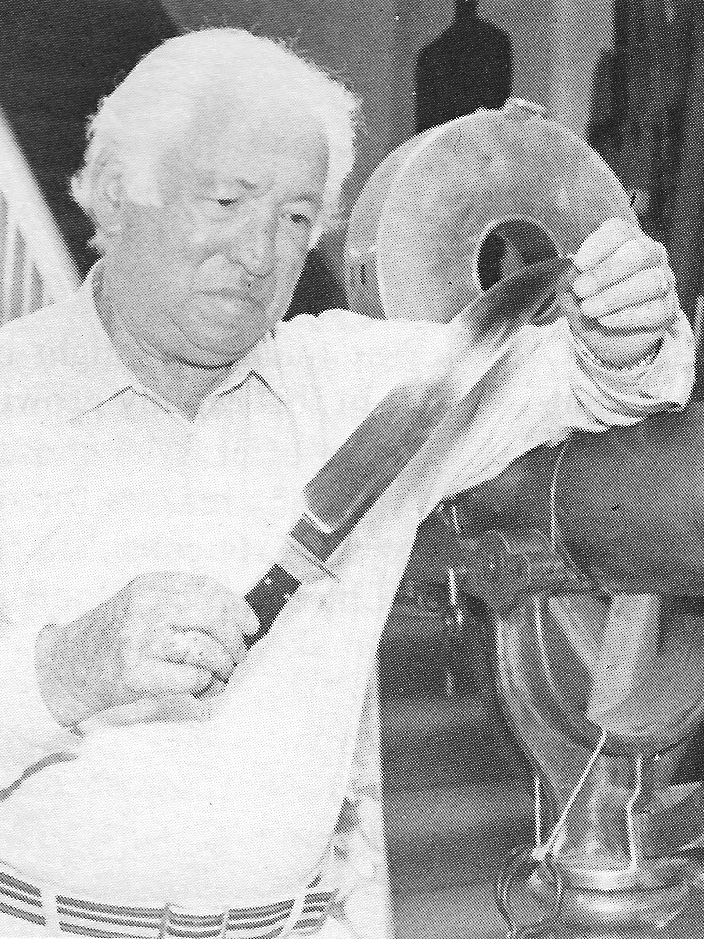
Nate Posner

Nate Posner started the San Francisco Gun Exchange in 1948 and built it into what he called the “Firearms Center of the West.” It had most everything firearm related but it was his displays of custom and factory knives that pertain here.

Along with Cutlery Hall-of-Famers A.G. Russell and Dan Delavan and also Bob Gaddis and Dave Harvey of Nordic Knives, Posner was among the first custom knife purveyors. He was known for telling his customers that to get the best price, instead of buying custom knives from middlemen such as him they should buy directly from the maker. Of course, if the customers wanted the handmade knife in question immediately, they often had to buy it from one of the few purveyors such as Nate to avoid spending what might be years on a waiting list. However, it was being up front that put Nate in good stead not only with his knife customers but the Guild, too—for both buying/selling the makers’ knives and treating what often were the makers’ customers/prospective customers in a professional manner.

At one time he had over 350 custom knives on display, with at least that many others in stock. Circa 1975 he ordered knives from dozens of makers, most active or past Guild members. Eventually he culled his list to about 25 or 30, including one of his favorites, D. E. Henry. Others included Tommy Lee, Jess Horn, Herman Schneider, Corbet Sigman, the-then-team of Scott Sawby and Steve Mullin, and future Cutlery Hall-of-Famers Frank Centofante, Jimmy Lile, Bob Loveless, George Herron, Bo Randall and more.

Thanks to the high store profile he gave custom knives and their makers to knife and gun buyers alike, Nate was one of the most important custom knife promoters of his or any era. As a result, the honor the Guild gives annually to an individual who provides “Outstanding Service in the Promotion of Handcrafted Cutlery” is called the Nate Posner Award.

See More Award Winners:

4 Paring Knives for Mom

Editor’s note: All images courtesy of the participating companies.

Go-To Knives

Look up paring—as in paring knife—in the Merriam-Webster dictionary and ol’ Mr. Webster says it’s “the act of cutting away an edge or surface.”

This raises a question.

If the paring knife was originally designed as a peeling knife, does it still matter? Or is it relegated to the back of the flatware drawer, consigned to a future of rust and dust?

Chef Timothy Hollingsworth, who wears the double hat of chef and owner at the California restaurants with the respective names of Otium and Barrel and Ashes, said the scrappy paring knife—with a blade less than 4 inches designed for food prep—still holds its own against $5 peelers and glinting chef’s knives. Not only is a paring knife designed to peel, it can be called on to prepare pearl onions, scrape mushrooms and cut intricate designs to give food extra pizzazz.

“For the home cook,” Hollingsworth said, “paring knives are great because you’re able to hold the vegetables or fruit in your hand while cutting, whether that’s cutting potatoes into smaller chunks, or peeling an apple and cutting it into bite-sized pieces.”

Mother’s Day is around the corner, a time that seeks to honor the women whose varied accomplishment include making many a home-cooked meal, often with paring knife in hand. From contemporary to traditional, here are four designs that represent the latest in one of Mom’s go-to tools.

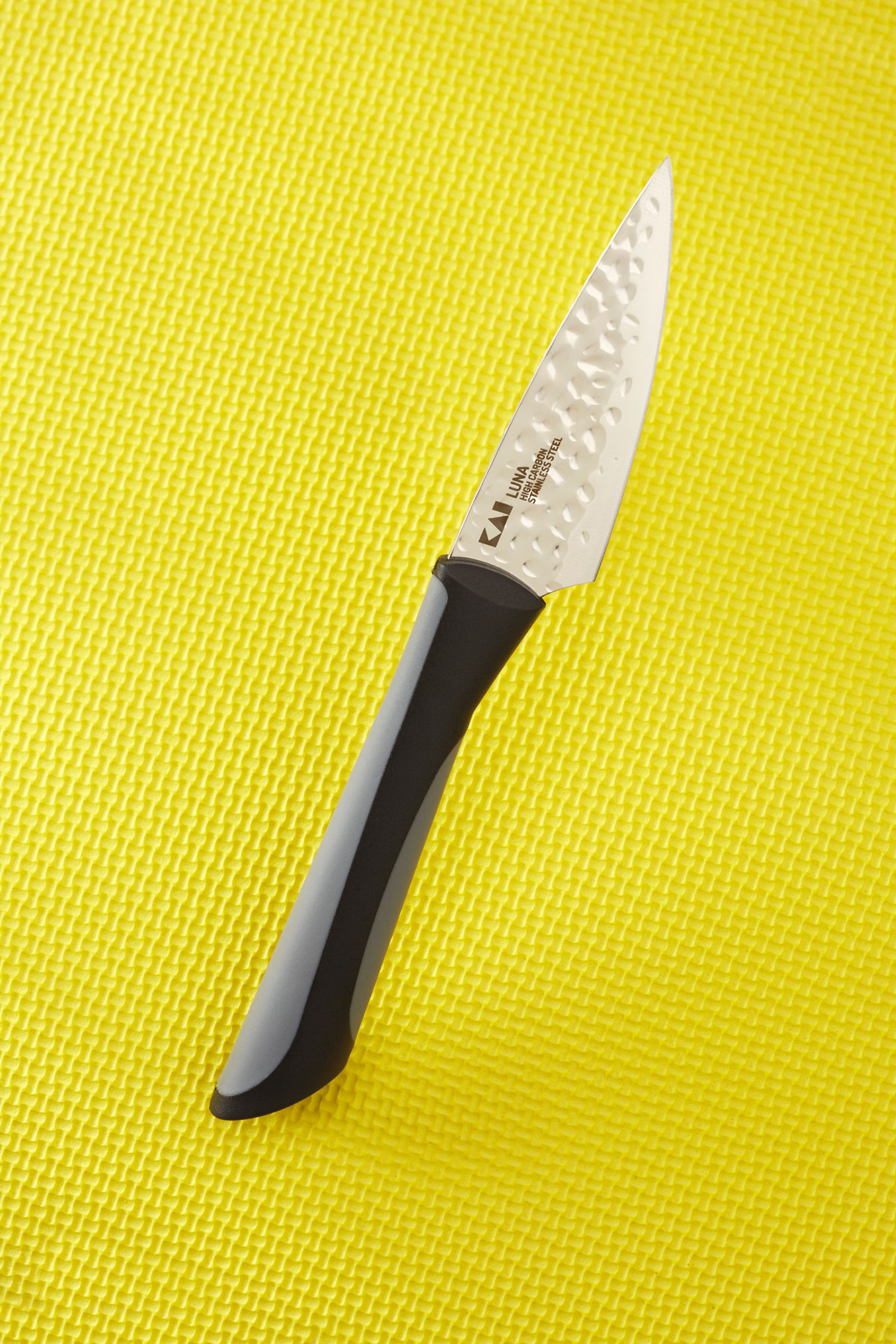
Kai Luna Paring Knife

Kai Luna paring knife

Kai Luna paring knife

It was about 10 years ago that Scott Zahm, director of sales for the housewares division of Kai USA Ltd., and other of his compatriots at Kai noticed people used paring knives as small utility blades, chopping a handful of parsley on a cutting board, for example.

“Many home cooks prefer a smaller knife that’s less intimidating and easier to control,” he said. Kai took to the drawing board with its Pure Komachi 2 and the resulting blade shape was wider than a traditional paring knife, with a deeper belly. The shape helped users navigate a cutting board with more agility.

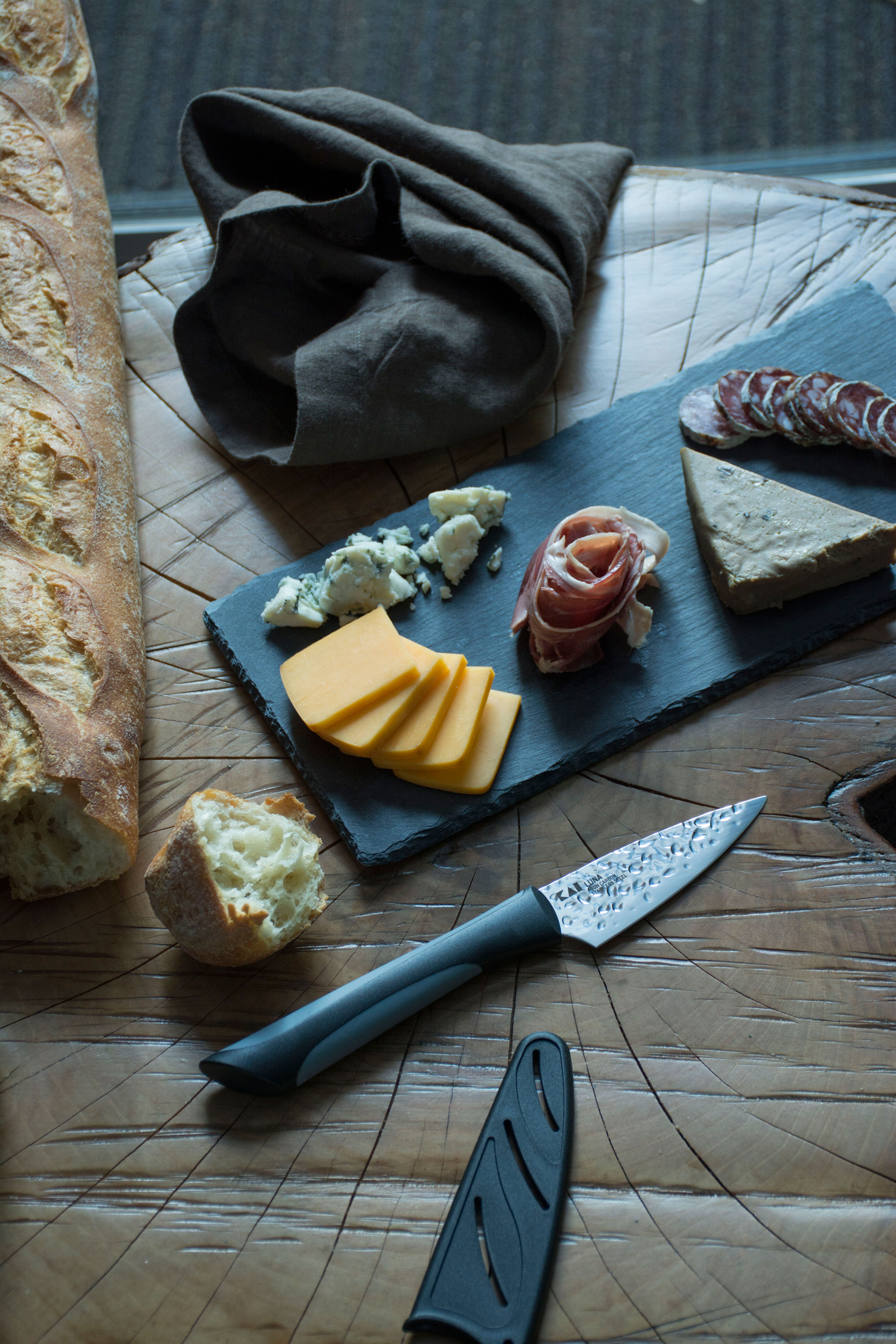
This issue’s cover knife (page 7), the newer Luna Paring Knife, features the same profile. “We made the Kai Luna series for the adventurous cook on a budget,” Zahm said. The knife features a tsuchime, or hammered finish, and the edge is honed to a 16-degree angle on each side.

“All of the knives in the Luna series offer the performance good cooks demand at a price that even aspiring cooks can afford,” Zahm said. “With Luna’s tsuchime finish and contemporary styling, it’s an exciting and eye-catching addition to any kitchen.”

With a modified blade shape, does the paring knife usurp a chef’s knife in utility? Not really, Zahm said. Chef’s and paring knives work with each other, handling different-sized cutting jobs. Both are essential in the cook’s workspace.

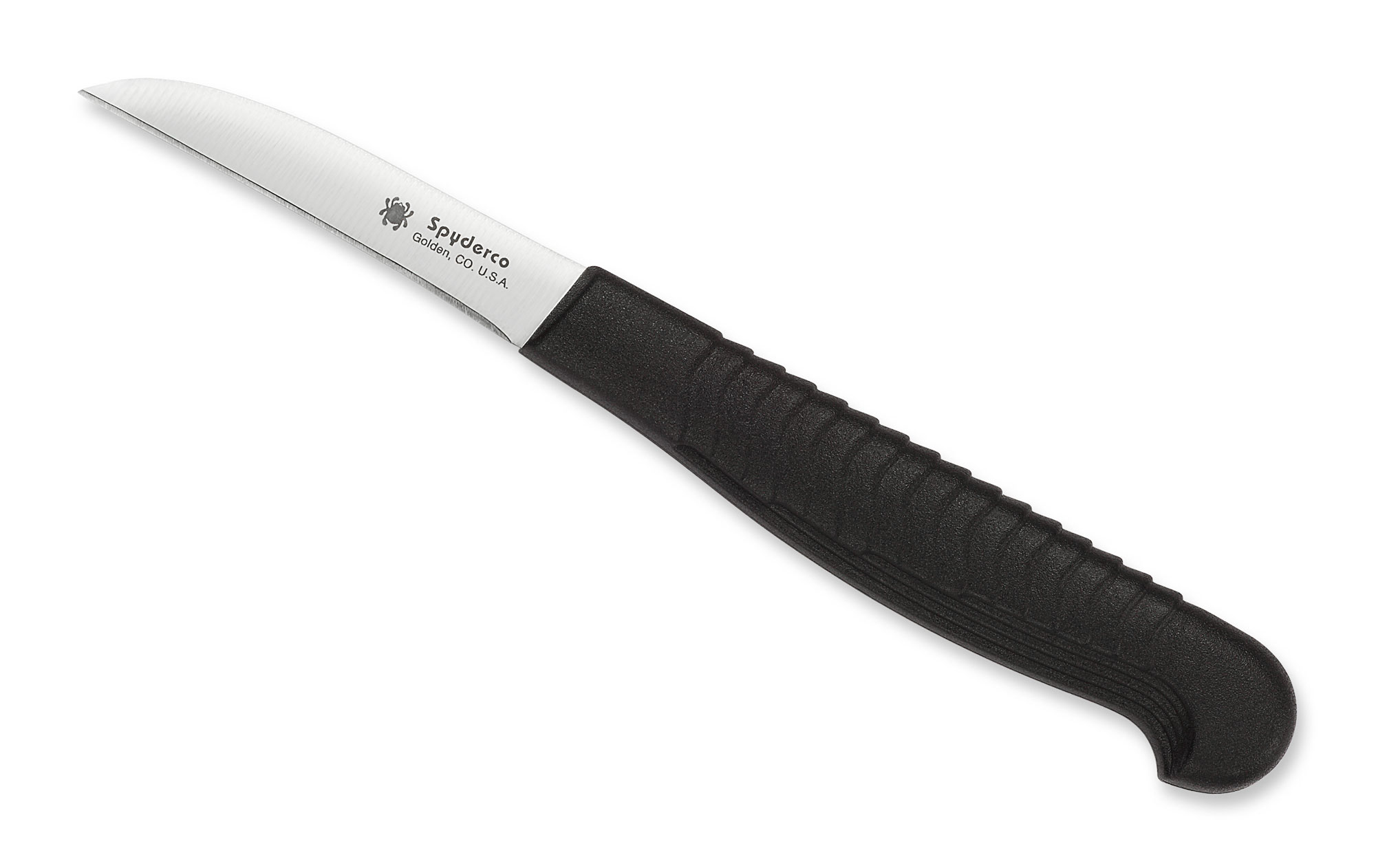
Spyderco K09 Mini Paring Knife

Spyderco paring knife

Spyderco “thought small” when it redesigned the K09 Mini Paring Knife. The company still offers utility knives 4 and 6 inches long. However, Spyderco’s Joyce Laituri compared the K09 to a scalpel, giving users options from peeling fruit to removing small bones from meat.

“I use mine every year at Halloween to start the pumpkin carving process,” Laituri said. “We draw the face on a pumpkin and the K09 goes through gourd like a laser. It is easily controlled letting you create intricate and even lacy designs.”

Three years ago, Spyderco reintroduced the K09 with a new handle material. The Japanese-made knife features a polypropylene grip with ridges to enhance purchase with wet hands.

The K09’s 2.25-inch blade of MBS-26 stainless steel is thinly ground. The result is a blade that keeps its edge and has a slight spring to it, Laituri observed. When it comes to how often people should reach for a paring knife, Laituri said it depends on the cook. She often uses Spyderco’s 6-inch serrated utility knife. Her husband, on the other hand, barbecues and rarely uses a paring knife.

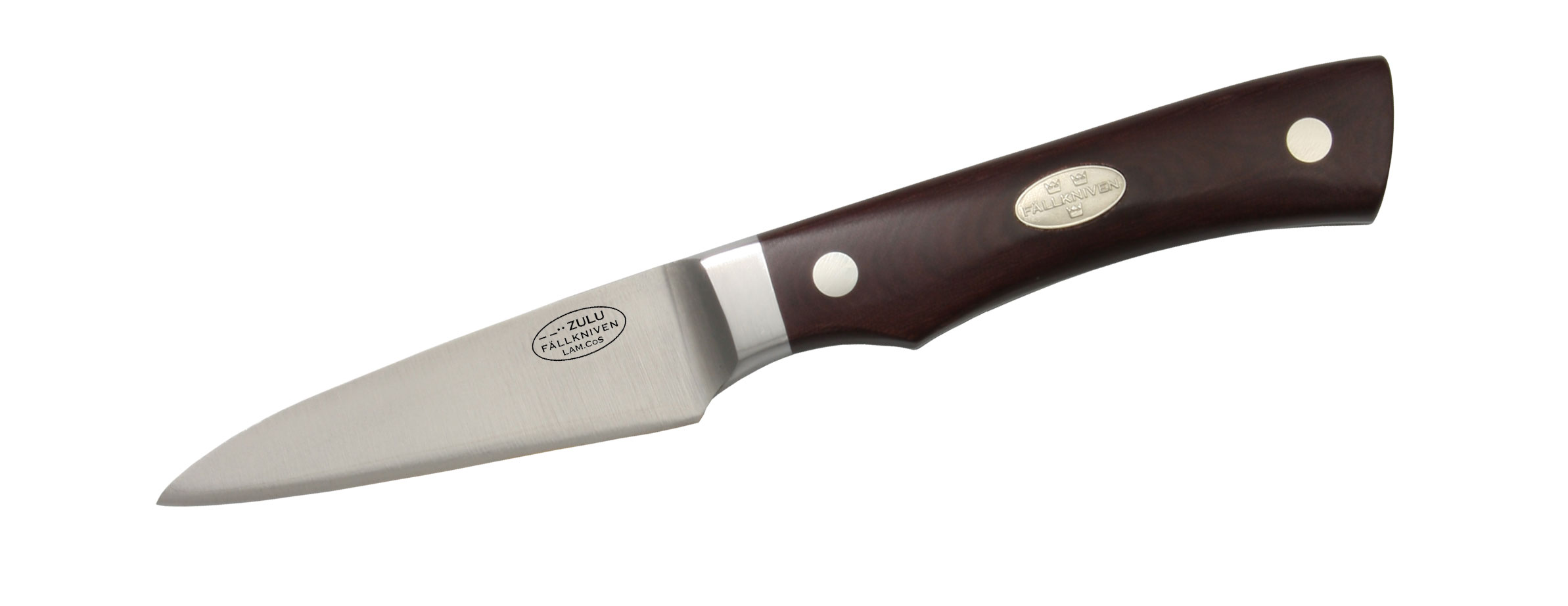
Fällkniven CMT Zulu

Fällkniven paring knife

“I believe the paring knife is one of the most used knives in the kitchen and also the knife with the lowest reputation,” said Peter Hjortberger, founder of Fällkniven AB. “Usually a paring knife is made for being cheap, a knife you don’t need to care much about, just a [semi] sharp edge for daily tasks.”

Fällkniven went in the opposite direction, making the 3-inch blade of the CMT Zulu of laminated COS steel, the core consisting of a stainless steel that contains a high percentage of cobalt. Hjortberger called it “technically, a very advanced steel.”

“So, instead of searching for the cheapest steel, we go for the best steel, understanding that this knife will last a hundred years or more,” Hjortberger said. “To me, this is climate smart to make high-quality knives which will last during several generations instead of uttering out crap.”

The knife is full tang and handled with Micarta. The CMT Zulu features an old-world design ground with a convex edge common on knives before the Industrial Revolution. It is made in Japan with Swedish materials and quality control.

Often, the paring knife is the most-reached-for kitchen tool, not just for cooking but also for common household chores. Paring knives are non-frightening, Hjortberger said, and women might like the more manageable design.

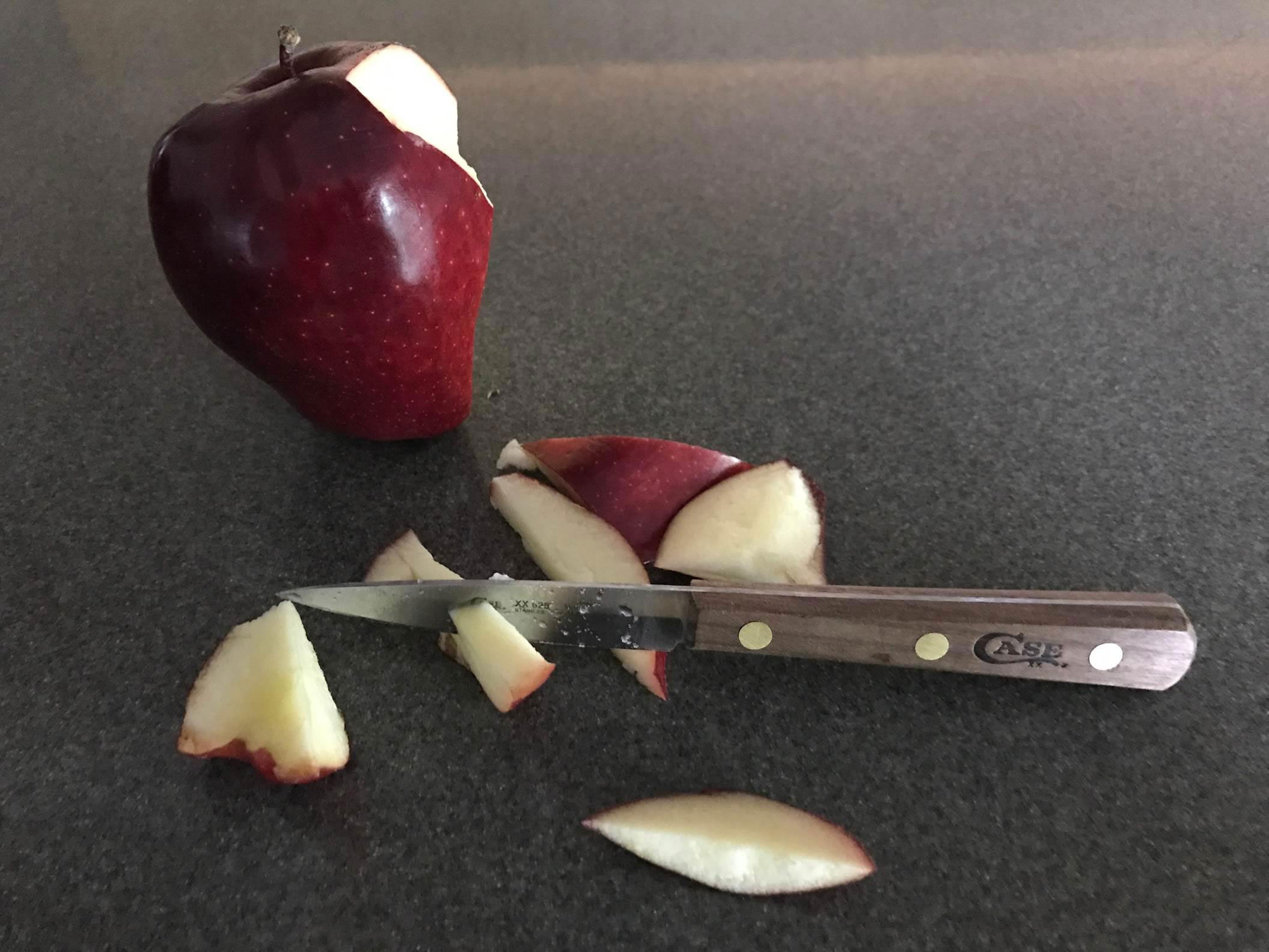
Case Paring Knife

Case paring knife

According to Case’s Fred Feightner, paring knives have homes in restaurants offering nearly every type of cuisine. In 2012, Case resurrected its paring knife offering, giving home cooks the option of a handle of black synthetic or walnut. With the walnut handles, brass rivets gleam from the wood. Case offers four paring knives in its Household Cutlery collection.

“We knew people would want their household set to be complemented by a paring knife or two,” Feightner opined. “Case paring knives have been a part of the American kitchen’s tool set for many years.”

Case manufactures paring knives with either a clip-point blade, where the clip drops to the gently curving edge, and the spear-point, where the spine and edge meet in an acute tip. Both are made from Case Tru-Sharp™ surgical steel, the company’s equivalent of 420HC stainless.

Paring Knife Maintenance Tips

After use, a few moments of care can extend the life of a paring knife. While convenient for pots and pans, etc., the dishwasher is notorious for destroying knives.

“Dishwashers are never kind to household knives,” Feightner said, “because the blade edges can be dulled by the movement of the knives during cleaning, and the detergents made for automatic dishwashers will tend to stain and pit the blades. Our wooden-handled knives have natural oils and pigments within them that can be compromised by the high temperatures employed by the dishwasher. As a result, fading and splitting of the wooden handles can occur.

“We recommend hand washing, using a mild-strength detergent, followed by a prompt water rinsing and hand drying with a clean towel. Cleaning products that include chlorine and/or bleach in them can cause the stainless-steel blades to discolor and pit.”

Knives stored loosely in a drawer can rattle against each other, chipping edges and posing cutting hazards to anyone rummaging for a blade. Once their knives are clean, professional chefs store them in a knife bag, roll or case. At home, a knife block, a magnetic strip or in a drawer as long as they are in sheaths, work equally as well to preserve the life of kitchen knives. After all, from feats of culinary artistry to cutting string, the paring knife will rest in kitchens for decades to come.

Mom, or Anyone, Will Like This, too

The official knife of BLADE Show 2018 is this special edition CRKT Caligo.

  • Only 150 made
  • Serialized number
  • BLADE Show logo on blade
  • Designer TJ Schwarz’s signature on the blade

Get this instant collectible now for only $49.99 at ShopBlade.com.

Cool Custom: Payne’s Gal Leg Is Sharp And Sexy

0

Travis Payne’s knife has all the right curves in all the right places.

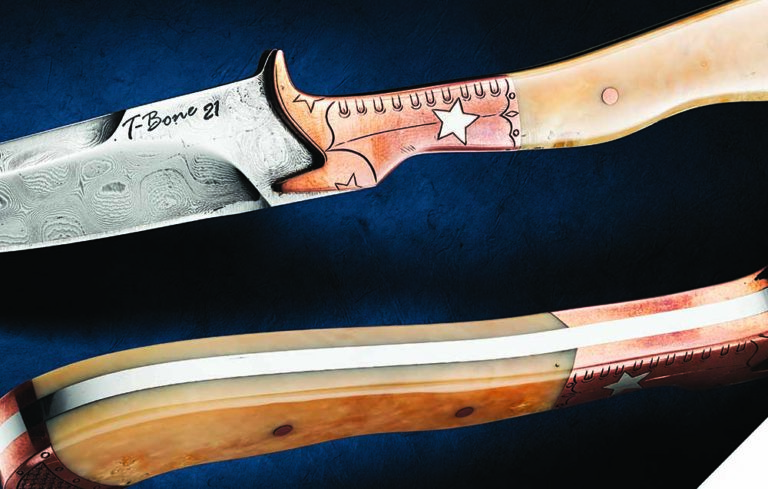
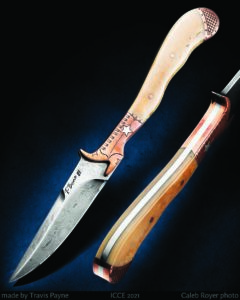
It’s hard to find anything more beautiful than a shapely woman’s leg, and Travis Payne revisits the concept in knife terms with his Gal Leg fixed blade.

Study the leg handle and you can see how it would be eminently ergonomic. “That was the whole point of the knife—to get a handle shape that both looked like a leg and was pleasing to grip,” the maker from Telephone, Texas, noted.

Travis Payne (inset) said his Gal Leg fixed blade finished second in its category in the knife judging competition at the 2021 ICCE in Fort Worth, Texas. The swedged blade bears Payne’s mark of “T-Bone 21.” Note how the boot toe curls up to form a top single guard/thumb placement area for an enhanced grip.

Leg handles long were favored among manufacturers of antique pocketknives back in the day, but there’s something about Payne’s version with the boot for a bolster, swaybacked handle with the indentation about where the back of the knee would be and the—ahem—handle butt that all comes together.

You might say the knife has a leg up on the competition.

Gal Leg Specs
Maker: Travis Payne
Knife type: Fixed blade
Blade length: 3”
Blade material: Pattern-welded steel forged by Alabama Damascus
Handle material: Mammoth ivory
Bolsters: Copper engraved by Matt Litz
Overall length: 7”
Maker’s approximate list price for a similar knife: $1,200

How To Determine The Best Angle To Sharpen

1

What determines the best sharpening angle? The answer is one that plagues knife neophytes and old hands alike.

“The best angle of sharpening is one of those very intriguing topics that many have explored but most have come up with different answers,” states Jake Broce, online marketing coordinator for A.G. Russell Knives. Agrees Kyle Crawford, brand manager for Work Sharp, “The answer is often different for everyone.”

He says the two keys are knife type/use and edge retention/maintenance. In fact, all of our story sources cited the intended use of the knife as a deciding factor. For tough chores such as chopping or batoning, a wider angle is best. “Generally, the wider the angle of edge, the more steel is behind it, which increases the edge’s toughness,” Broce observes. “For kitchen knives that see light-duty cutting food on cutting boards, or a task-specific hunting knife like a camping knife, a low angle is ideal,” counters Crawford. By “low” he means an edge angle between 15 and 20 degrees.

Edge angle also affects edge retention. “If you sharpen your heavy-use EDC knife to a low angle such as 15 degrees, it will be incredibly sharp,” Crawford says, “but the trade-off you are making is edge retention and durability.” Conversely, he adds, if you sharpen at a wider angle, such as 25 degrees, the edge will still be very sharp but you gain improved edge retention and, thus, eliminate the need for more frequent maintenance.

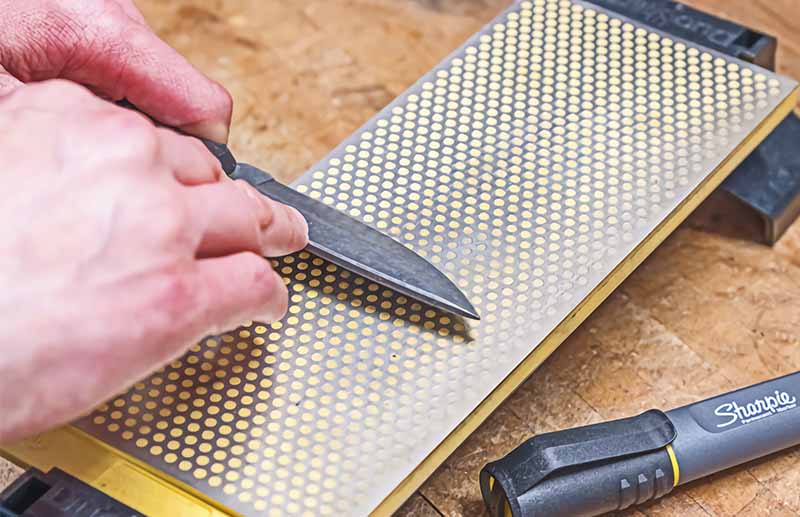
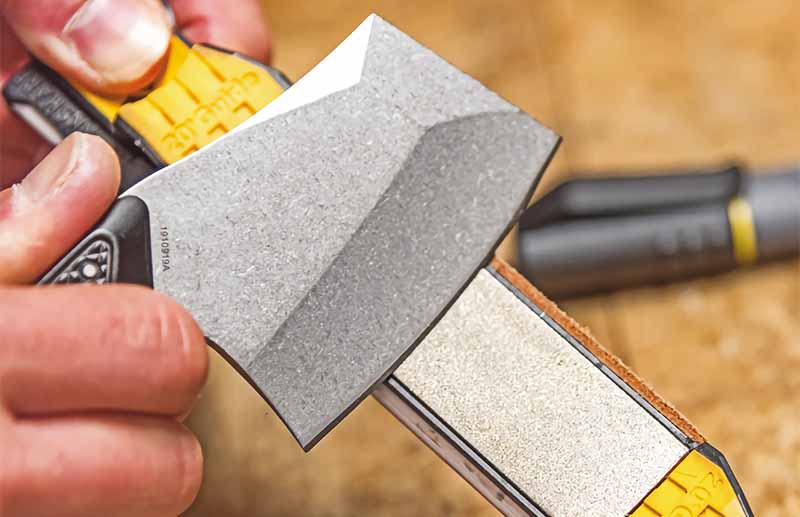
“The edge angle is seldom impacted by the blade grind,” says Work Sharp’s Kyle Crawford. “Be mindful that the sharpener you are using may not be able to replicate the blade grind. But for most of us, sharpness is the goal, not maintaining the exact factory grind type.” The DMT Duo-Sharp sharpener does the honors here.

However, Kendra Tobler, marketing communications manager for Benchmade Knife Co., indicates grades of blade steel also factor in as well. “A harder steel with higher yield strength can be ground to a small included angle with less worry about rolling or deforming the edge,” she says. “Conventionally cast steels with large carbides are better suited to larger included angles.” This is done so for edge durability.

A prime example of Tobler’s point is Benchmade’s 15017-1 Hidden Canyon Hunter, a compact drop-point fixed blade in premium CPM S90V stainless steel well known for its extreme edge-holding ability. Benchmade uses its SelectEdge 14-degree included edge on the knife. It is ground thinner because S90V is a high-yield-strength steel that can retain its strength with a thinner edge without deforming or chipping. Blade thickness is a factor as well. “Thin blades are much easier to sharpen to low edge angles than thick knives,” Crawford states. “The thicker the blade, the more material you will have to remove to create a low edge angle.” And it usually takes time to thin down a thick blade. As he warns, “If you choose to sharpen a low edge angle onto a thick blade, be prepared to be patient.”

Sharpening To Steel Grade

“Modern super steels have really changed the game for low angles and edge retention,” Crawford says. By this he means
blades of lower quality steel are prone to low edge retention as well as edge deformation and damage incurred from use. Higher quality steels have the high yield strength that enables them to be sharpened with lower edge angles, resist deformation and damage, and have higher edge retention overall. Crawford specifically cites CPM S45VN and CPM 154 as types of high-yield stainless steels. For lesser grades of steel, opt for a wider angle to save you from having to deal with damaged edges and/or frequent edge maintenance. Any steel designated as CPM (manufactured by Crucible Industries) or any other high end/high-performance steel can be taken down to lower edge angles for enhanced performance. Such steels include M4, 20CV, S30V, S35VN, S45VN, S60V, S90V, S110V, CRU-WEAR® and the CPM version of D2.

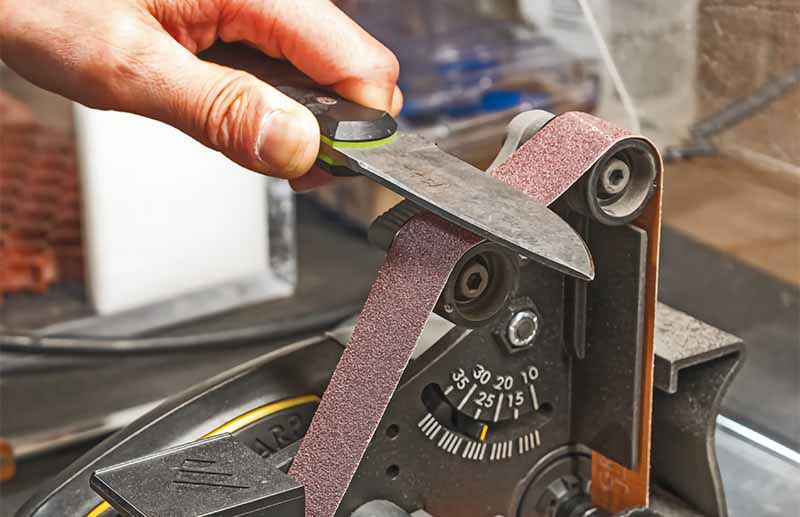
Knives come with a standard edge from the factory, around 22 degrees inclusive. The edge is sharp and durable, and a good middle-of-the-road angle that is a good balance between durability and cutting ease. The Work Sharp Ken Onion Elite sharpener is set here to sharpen at 22 degrees.

Lesser grades of steel that should not be taken down to acute angles mostly are found on entry-level to mid-grade factory knives, and some higher-end non-CPM steels found in high-end factory knives. Such stainless steels would include 440A, AUS-8, 8Cr13MoV, 1.4116 and VG-10. The high-end non-CPM stainless steels would be 154CM, ATS-34 and 440C. Also, any grade of carbon (non-stainless) steel should be treated like this as well. Examples would be 1095, 5160, D2, O1, A2 and so forth. If the steel’s specs do not state that it is a CPM steel, avoid applying acute edge angles and stick with wider ones to be safe.

Consequently, it is very important to educate yourself on the different grades of steel and their performance characteristics and edge retention qualities. Such information will further help you understand how the steel type will perform and how maintenance should be handled.

Sharpening To Blade Grind

The many different types of blade grinds are largely influenced by the knife’s intended use. As Tobler notes, “The bevel grind and the sharpening angle should complement each other.” For instance, hollow-ground blades have thinner edges. “This complements a small included angle,” she states. “A convex edge provides plenty of material behind the edge for strength and support and works well with a larger included angle.” Adds Broce, “The blade grind determines how much steel is behind the edge. More steel behind the edge improves edge stability, whereas less material behind the edge can improve the pass-through” of the material being cut.

Blade thickness is a factor as well. “Thin blades are much easier to sharpen to low edge angles than thick knives,” Crawford states. “The thicker the blade, the more material you will have to remove to create a low edge angle.”

Crawford takes a different tack. “The edge angle is seldom impacted by the blade grind,” he says. “Be mindful the sharpener you are using may not be able to replicate the blade grind. [Author’s note: Hollow grinds are converted to flat grinds when using a stone, or too convex grinds when sharpening on a flexible abrasive belt.] But for most of us, sharpness is the goal, not maintaining the exact factory grind type.”

Know The Use

“The required cutting task affects the angle,” Broce says. “Chopping requires good edge stability, so an increased edge angle is necessary.” He also explains that finer chores such as slicing and dicing work better with more acute angles due to the precision cutting. “Whittling introduces more variables than normal knife use,” he states. In other words, whittling exerts a lateral force on the blade and, therefore, the cutting edge. “Generally, you want a thicker blade stock with a thin edge [on a whittling knife],” he sums up. Agrees Tobler, “Smaller angles, like our SelectEdge, work best for finer, delicate slicing cuts.” The primary goal for Benchmade’s 14-degree SelectEdge is for field dressing, and the acute-angle edge slices through thicker hide and meat almost effortlessly.

Knives come with a standard edge from the factory, around 22 degrees inclusive. The edge is sharp and durable, and a good middle-of-the-road angle that is a good balance between durability and cutting ease. Some users are harder on a knife and require the larger edge angle. Nonetheless, with task-specific knives of high-yield-strength steels for hunting/field dressing, you may opt for a more acute edge angle, anywhere between 15 and 20 degrees.

Establishing The Sharpening Angle

How should you go about establishing the edge angle when you sharpen? A safe bet is to invest in a sharpener that sets and maintains the edge angle for you—all you have to do is set the sharpener to the desired angle.

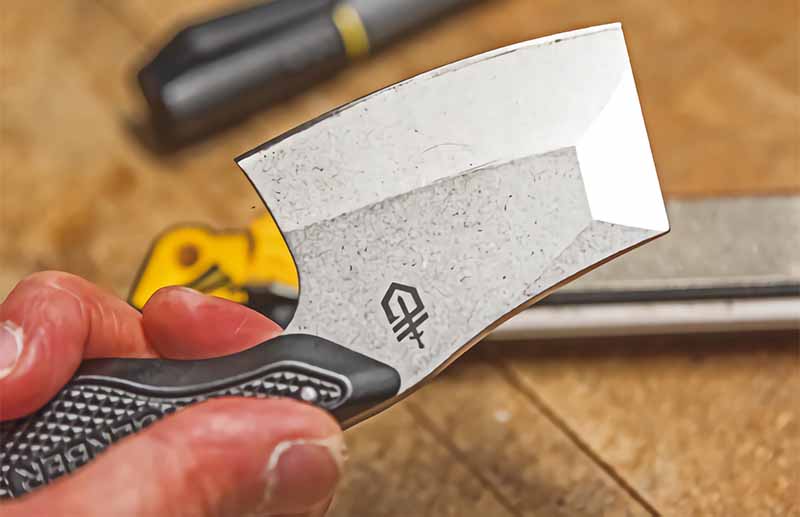
Lesser grades of steel such as the 7Cr17MoV stainless of the Gerber Tri-Tip should not be taken down to an acute angle.

“Angle guides are tried and true and solve one of the biggest sharpening challenges—establish the angle and be consistent,” Crawford says. Cautions Broce, “The first time you use [a guide kit] on your knife will usually take the longest, as your edge angle adjusts to the way you use the sharpener.” The angle guide kits subtract the science of maintaining a consistent angle, so all you need do is concentrate on getting the edge sharp. The kits have been a game-changer for consumers who struggle with freehand sharpening on a bench stone.

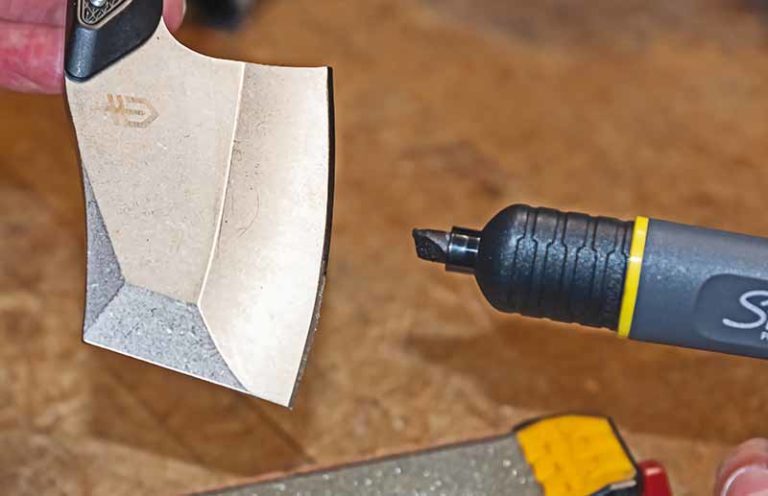
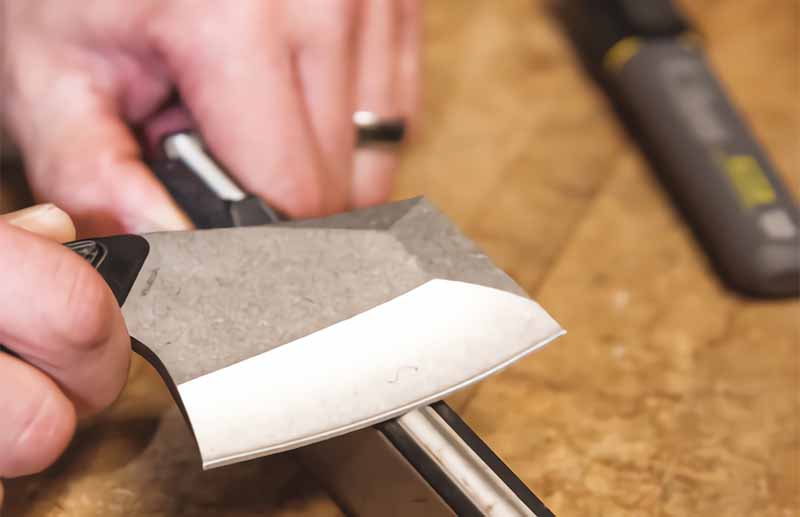
Another good tip, regardless of which sharpener you use, is the tried-and-true black marker trick. Using a permanent black marker with a wider chisel tip, color the edge bevel on both sides of the blade. The goal is to sharpen the blade,
removing the black marker ink from both sides. When you accomplish this, your edge angle is correct and you should have a sharp blade.

“The goal is to remove all of the ink in one swipe,” Crawford says. “If you are removing the marker at the cutting edge, your edge angle is too high and you are micro-beveling.” From there adjust your edge angle to a lower degree and take a few more passes to see how the ink is being removed. “It is a process of trial and error,” Crawford notes.

According to Jason Broce of A.G. Russell Knives, “The blade grind determines how much steel is behind the edge. More steel behind the edge improves edge stability, whereas less material behind the edge can improve the pass-through.”

Tobler is another proponent of the marker method. “It helps for matching the edge angle already on the blade when resharpening,” she observes. You can use the method in conjunction with one of the guide kits even if the kit holds the angle constant for you. The method enables you to see how much more you must sharpen off in order for the edge bevel to be reestablished. In this regard, you’re using it to determine how much more you have to go as opposed to if you’re holding the angle correctly.

Another tip is to sharpen in a well-lighted area. Good visibility is very important and key to doing a thorough, well-executed sharpening job. And if you use the marker method a lot, abundant lighting helps you see clearer without eye strain.
Finally is sharpener selection. You can use any quality sharpener as long as it fits the steel type. The key here is to select a sharpener you feel very comfortable in using.

Also Read:

3 Awesome Axes for Chopping Wood Like a True Lumberjack

THREE FACTORY AXES TAKE THE CHOP, LIMB, TRIM, SHAVE AND STRIP TEST

BY JAMES MORGAN AYRES

We got snowed in one New Year’s in a rented cabin in the mountains. When I expressed concern about relying on electric heat in a remote cabin, the rental agent assured me that the electricity never went out. In any event, she said, “There was plenty of firewood for the fireplace and an axe. You’re an experienced outdoorsman. I’m sure you can cope.”

Of course, the electricity went out. I found about a cord of unsplit logs, each log 6-to-8 inches in diameter and 3 feet long. No split wood. No kindling. No axe. I batonned my ever-present Randall Model 1 around the edges of the logs to make kindling, and split enough wood to keep the fire going until the electricity came back on. Three days. I coped but every time I went to the wood pile, I wished I had an axe. Any of the axes in this field review would have been welcome.

Almost anything will chop softwood such as pine. For a proper challenge, we spent a day clearing madrone and oak at a friend’s property. Oak is a hardwood. Madrone is more fibrous and even tougher. We also split seasoned oak logs for our friend’s fireplace.

HIKING HACKER: The Fox Trekking Axe

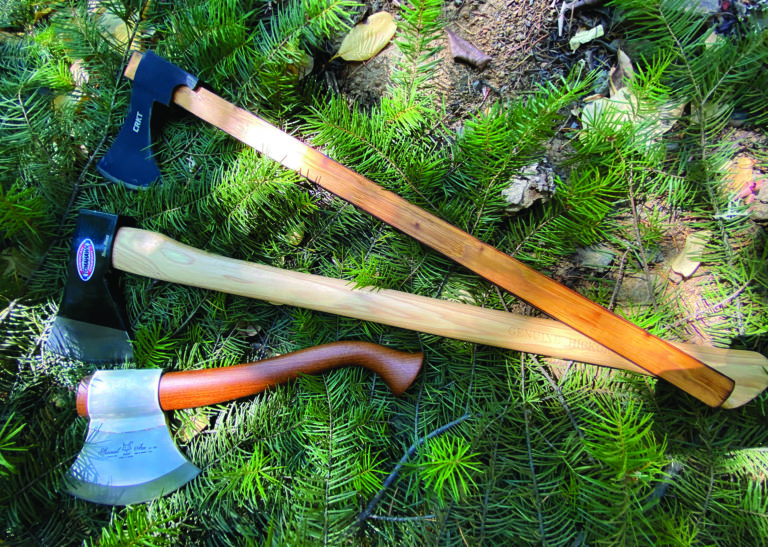
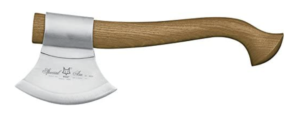
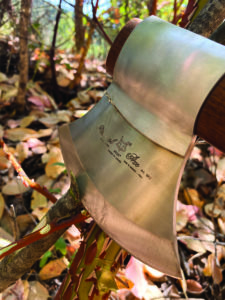
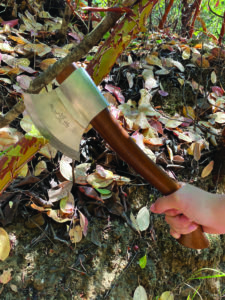
The Fox Trekking Axe is a terrific chopper for the backpacker, hunter or woods wanderer. Reminiscent of a medieval design, it’s light enough to keep in a rucksack and very well made.

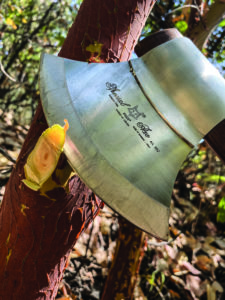
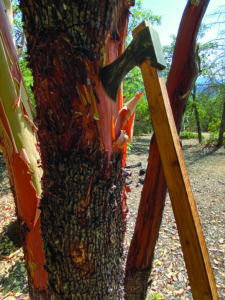
The thin blade came sharp enough to cut paper and kept its edge during a day’s work. Its good edge geometry and balance, comfortable and ergonomic handle—well, really, its overall efficient configuration, which I suspect was inspired by an old, well-proven design—enabled painless hours of chopping, limbing and trimming. The long edge worked well for stripping and shaving bark to make bare poles. I have no doubt that the Trekking Axe would serve to quickly erect a shelter against an incoming mountain snowstorm, or dress out and break down an elk carcass. With its long, almost knife-like edge, it could also skin out the elk.

The thin blade, so efficient at taking down saplings and other work, tended to bind when chopped into the center of the seasoned oak logs. That’s a matter of geometry—the blade is not wedge shaped and won’t serve as a splitting maul, which is outside of its design envelope. A change in method overcame that limitation. By working around the edges and splitting off sections an inch or 3 thick, we were able to reduce logs to kindling.

Overall it’s a well-designed, well-made tool that I wouldn’t hesitate to take to the deep woods.

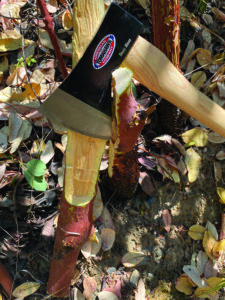
Good edge geometry and balance and a comfortable, ergonomic handle enabled painless hours of chopping, limbing and trimming with the Fox Trekking Axe. Here it chops the Ma- drone sapling with aplomb.

SPECS: FOX TREKKING AXE
CUTTING EDGE:
5.625”
BLADE STEEL: 12C27 Swedish stainless
HEAD WIDTH: 4.7”
HEAD THICKNESS: .22”
HEAD FINISH: Satin
HANDLE MATERIAL: Sassafras (wood)
WEIGHT: 13.8 ozs.
OVERALL LENGTH: 13.8”
COUNTRY OF ORIGIN: Italy
MSRP: $104.95

THAT’S AN AXE: Cold Steel Trail Boss

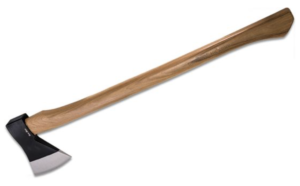
Photo from KnifeCenter.com

I hefted the Cold Steel Trail Boss, chopped through a 3-inch madrone sapling with one swing and paraphrased Crocodile Dundee’s line: “That’s an axe.”

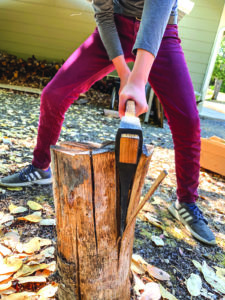
About the size of a traditional cruiser axe, the Trail Boss has a smooth, comfortable haft/handle in-between axe and tomahawk length. The long edge came sharp and stayed sharp. The head has good wedge-shaped geometry that made splitting the seasoned oak logs a breeze. Unlike a splitting axe, it was not too thick for general work. One whack to the center of the log and there were two split sections on the ground. It’s not a splitting maul or splitting axe but almost as efficient. While it has enough heft to split oak, it’s also light enough and balanced so that downing saplings could be done with full control and no danger of cutting through and swinging too far.

When limbing, it was easy to control for precise cuts, even when limbing with one hand. The haft is not as long as that of a full-sized axe, nor is the head as heavy. However, the head’s well-designed geometry, the smooth, comfortable handle and overall good balance enabled it to perform almost as well as one.

This is a good, all-around chopping tool—actually, an excellent all-around chopping tool.

SPECS: COLD STEEL TRAIL BOSS
CUTTING EDGE:
4.5”
BLADE MATERIAL: 1055 spring steel
HEAD WIDTH: 6.5”
FINISH: Black
HANDLE MATERIAL: Hickory
WEIGHT: 2 lbs., 9.5 ozs.
OVERALL LENGTH: 27”
SHEATH: Not Included
COUNTRY OF ORIGIN: Taiwan
MSRP: $49.99

FRANKISHLY SPEAKING: CRKT Cimbri

Photo from CRKTknives.com

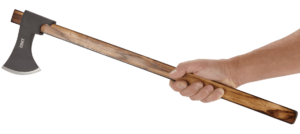
The CRKT Cimbri is an interesting design that, in my opinion, needs a bit of work to fulfill its potential. Modeled on a classic Frankish axe, with a nicely shaped head and a long handle, it is well balanced.

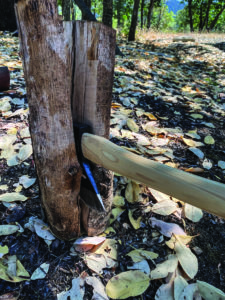
With a nicely shaped head and a long handle, the CRKT Cimbri is well balanced for such tasks as splitting oak logs.

Unfortunately, the edge wasn’t sharp out of the box and we test all knives, axes, tomahawks, swords, etc., as they come, so there’s a level playing field for all. The lack of a truly sharp edge required more force to chop through the saplings and impeded its penetration when splitting. Also, the thick coating on the carbon steel head caused it to drag in a cut. Even more unfortunate, and for some reason I do not understand, the haft is squared rather than oval or round. The acute edges of the haft/ handle not only were uncomfortable, they dug into our hands, producing blisters—in one instance breaking the skin of one of our testers’ palms.

The author stated he would round off the edges of the CRKT Cimbri’s squared-off haft.

Tuning up the edge would be a simple job, a matter of 20 or 30 minutes with a good stone. Reprofiling the haft wouldn’t be difficult, but I cannot understand why anyone would put a squared handle on an axe. Historical authenticity, perhaps?

SPECS: CRKT CIMBRI
BLADE LENGTH:
4.09”
BLADE MATERIAL: 1055 spring steel
HEAD THICKNESS: 1.26”
FINISH: Manganese phosphate coating
HANDLE MATERIAL: Tennessee hickory
WEIGHT: 2 lbs., .8 oz.
OVERALL LENGTH: 25.75”
DESIGNER: Elmer Roush
COUNTRY OF ORIGIN: Taiwan
MSRP: $69.99

AUTHOR’S CHOICES

Which of the three would I choose if I were again snowed in and had only a stack of logs to burn? If I hiked in, the Trekking Axe would be my choice, no question. I’m too old to hump anything heavier in a rucksack filled with camping gear, food and ammunition. If I arrived by car or truck, the Trail Boss would be it. If I had only the Cimbri, I would use my belt knife as a draw knife to take off the corners of the handle and smooth it. That done, 20 minutes with a sharpening stone and I’d head for the wood pile.


Pros’ Secrets To Sharpening Knives

0

Four knife industry pros share the secrets of how they keep their edge when sharpening.

A knife is made to perform its function as a tool, and job number one is to cut.

It follows that the development and maintenance of the edge is the most important aspect of knife ownership and use. When users are in the shop, around the house, at the office or in the field, keeping the edge in top form and working order makes the task at hand easier and often saves time and effort.

Custom Knifemaker: Chris Berry

Chris Berry sharpens freehand
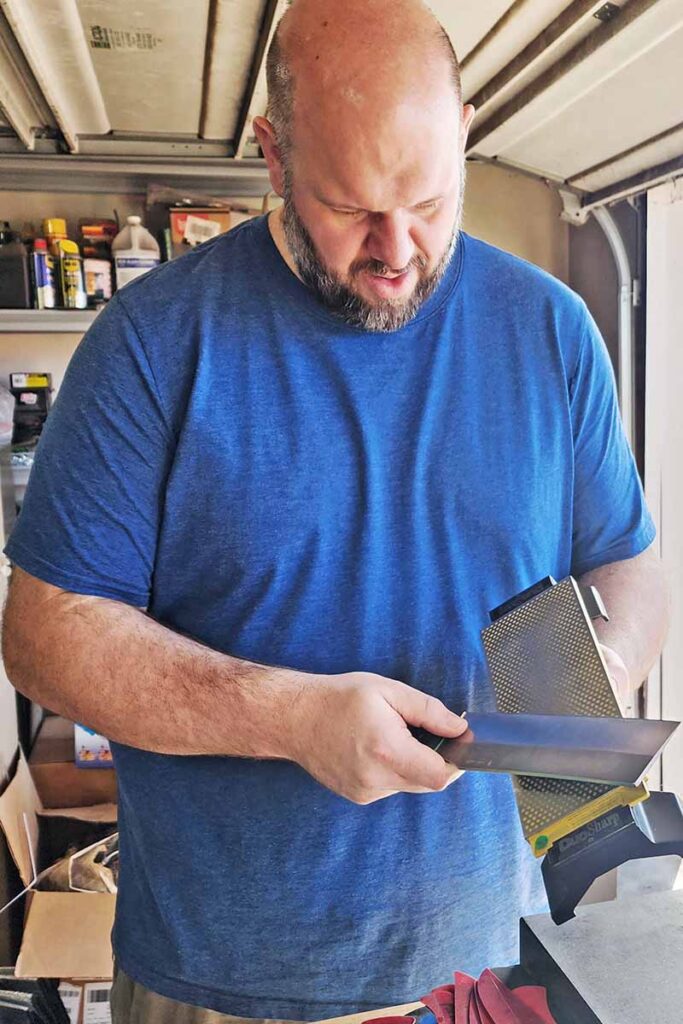
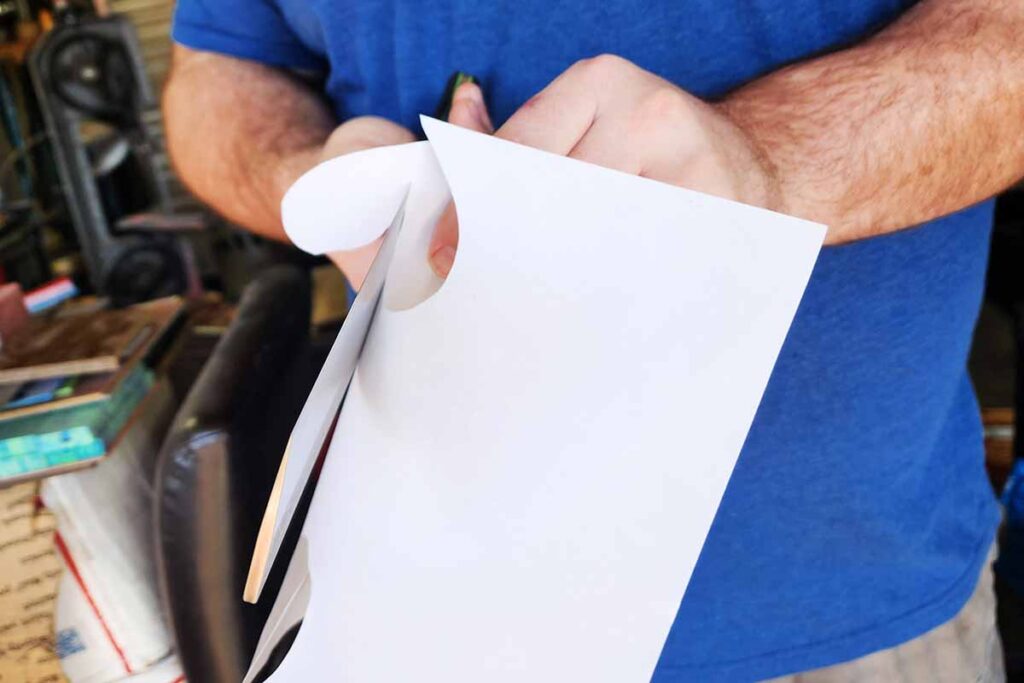
Chris Berry sharpens freehand, holding the DMT bench stone in one hand and his modified cleaver in the other. (Chris Berry image)

A custom knifemaker for 15 years, Chris Berry has made a name for himself in heavy-use choppers with blades of high-wear-resistant steel.

“When I finish a knife and get ready to sharpen it, I break the edges on the grinder to start the process and then work freehand after that,” he explained. “I’ll start with an extra-coarse DMT diamond stone and then go from extra coarse black to red medium and then green extra fine.”

In the field Berry carries a Spyderco cubic boron nitride (CBN) sharpening stone along with a Spyderco Double Stuff pocket stone.

“It has medium and fine ceramic for the edge,” Berry continued, “and then I’ll have some piece of leather to strop the blade and remove the burr.”

Chris knows it’s time to touch up an edge when it starts to drag through the cut.

“A blade is dull when it won’t cut printer paper,” he said, “so I’ll sharpen it before it reaches that point. I’m not obsessively sharpening a knife blade, but I’m just hitting the medium edge of the Double Stuff and going to the strop to bring back that popping edge. I usually only go back to the grinder if the edge is damaged, but, if the blade is really dull, starting with the extra coarse diamond and going through the grits will make it like a new knife.”

As Berry noted, the burr is the little, fine piece of steel that rolls up to the edge of the blade and is rough on one side and smooth on the other.

“If the burr isn’t gone after sharpening [the edge is] not sharp,” he advised. “In my opinion, it is the key to whether a knife is sharp or not. I tell people on social media that sharpening a blade is broken down to apexing the edge to raise the burr, refining the edge with progressively finer grits, and then removing the burr by stropping. If you progress through the grits and have the burr removed, you should be able to cut newsprint, phone book paper and even paper towels. That is as sharp as you are going to get.”

Knob Creek Forge: James Gibson

James Gibson of Knob Creek Forge designs knives for ESEE and teaches classes on bushcraft and survival.

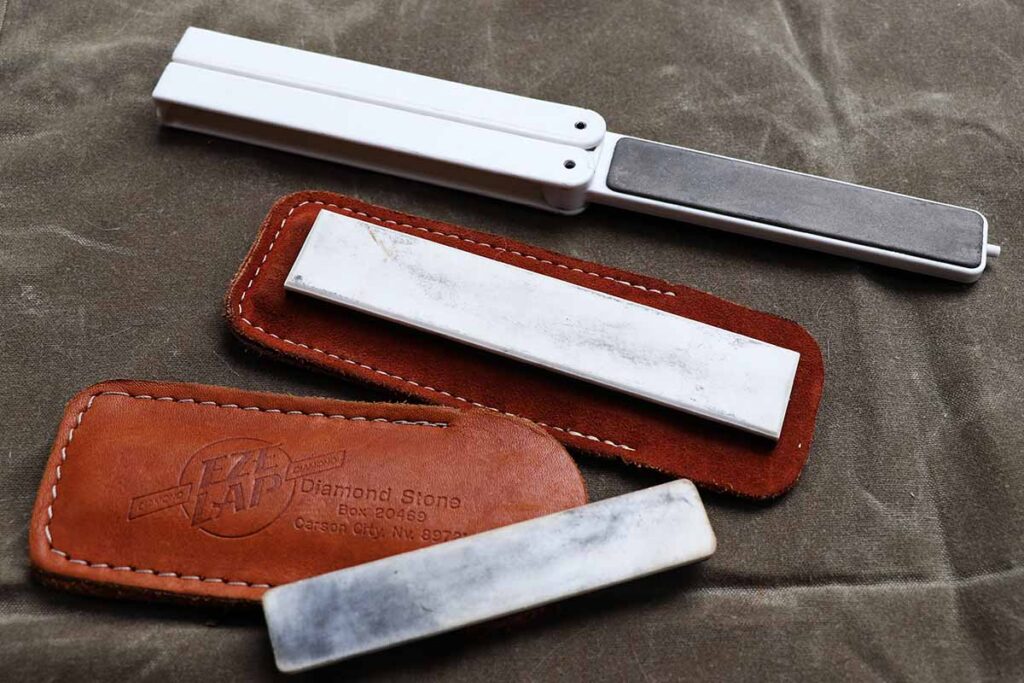
Some of the favorite field sharpeners of Joe Flowers include the EZE-Lap 530 Super Fine Diamond/Ceramic Folding Sharpener
Some of the favorite field sharpeners of Joe Flowers include the EZE-Lap 530 Super Fine Diamond/Ceramic Folding Sharpener (top) with a folding handle. “The Spyderco Double Stuff [middle] is a fantastic field sharpener,” Joe wrote. “It and the EZE-Lap Double Sided Sharpening Stone [bottom] both have a leather sleeve which can work as a strop.” (Joe Flowers image)

“I like a full flat grind with a convex edge,” he remarked. “They say the convex edge is the best, and when I have an extremely dull blade I use these little diamond files and then a ceramic rod or stone that will stand the edge up.”

An ABS journeyman smith, Gibson cautioned, “A dull knife will hurt you quicker than a sharp knife because you tend to lose control when you apply more pressure to get a job done. Most of the time I will sharpen a knife at the end of the day, but if it is not performing I will touch it up right then and there. If you ever watch a carver, they will carve for 15 minutes or so and then strop the blade to bring the edge back right quick. After a few days of stropping, they will have to do a bit of sharpening.”

Gibson sometimes uses a marker to spot the blade about a quarter inch up from the edge and then “floats” the edge up and down the diamond sharpener. He then moves to the leather strop and notes that if a compound has been used to keep the leather in shape the process will turn the leather black.

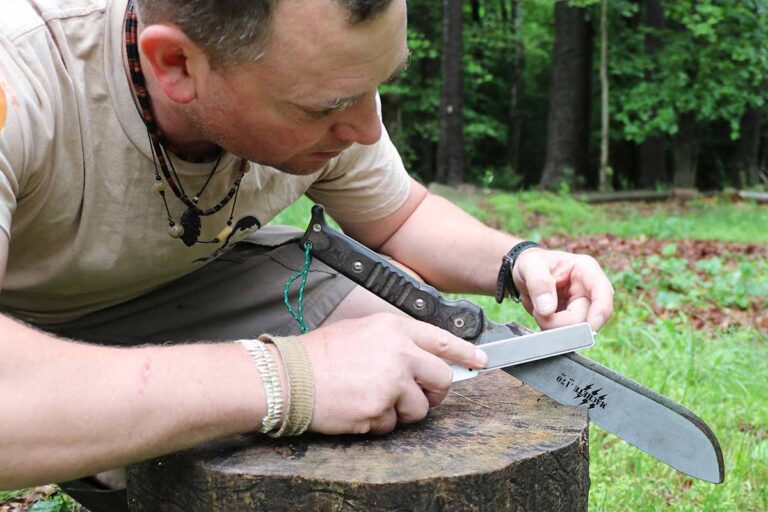
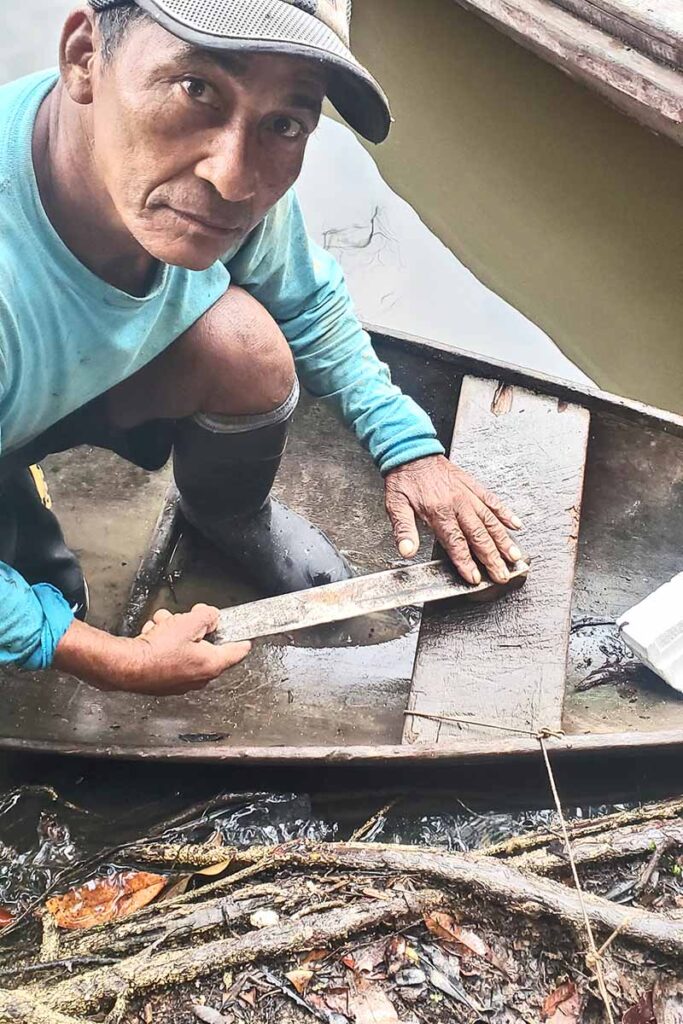
A Brazilian bushman files his machete on a stone
A Brazilian bushman files his machete on a stone, taking out the burrs and nicks in the edge. (Joe Flowers image)

“That means you are pulling steel off the edge,” he commented, “and where the two polished edges meet that will give you the sharpest blade you can get.”

Safety is a constant concern for Gibson and he stresses this aspect of knife use in his classes.

“We train people on the knife, and one of the first things we tell them is never to cut toward yourself. Keep everything out in front of you, or use a bench, log or stump so that everything is out of the way.”

CRKT: Russ Kommer

As a knife designer for Columbia River Knife & Tool (CRKT) and a hunting guide, Russ Kommer keeps blades sharp on a regular basis.

“When I finish up a custom knife, I run the blade on a brand new 400 grit slack belt with a real slight radius,” he remarked. “Then I will take it over a used 400 grit belt so that when the edge is curled and there is a little white line, I can use a leather strop or a 10-inch wheel and break off the burrs.”

Kommer carries a diamond sharpener in the field to touch up an edge.

“That will stand that line back up and remove some steel to get the edge back to infinity,” he said. “The only way to get a blade sharp is to remove enough steel. In the field you can use a leather strop or even the leather heel of your boot or something to help. When guiding, I have done two moose and a caribou in one day, and working on big animals is a big job. Sometimes I will carry two knives and touch both up to be ready for the next week, and I carry a pocketknife for cutting rope or other camp chores. It’s not good to use your hunting knife to cut burlap and dull it up on something like that.”

Testing for sharpness is a varied exercise, and Russ likes the simple standard.
“Guys like to shave their arms and that is all cool and dandy,” he smiled. “I just rake it across the back of my head, and when I feel it grab that hair I know the blade is sharp. There is also the fingernail task—if you feel the blade grab right there on the fingernail, then it is sharp. If you have practiced sharpening a blade enough, then you know quickly just how sharp a knife blade is.”
Condor Tool & Knife: Joe Flowers

As a knife designer for Condor Tool & Knife, Joe Flowers has sharpened thousands of blades through the years. The sharpening process is dependent largely on the work at hand.

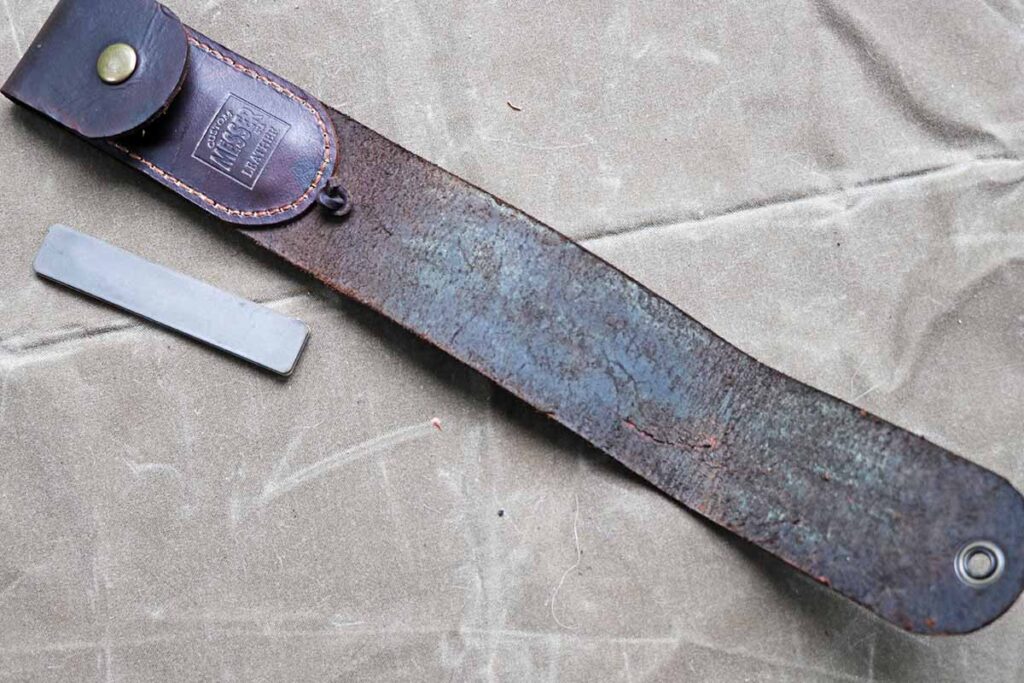
This combination of an EZE-Lap ceramic and diamond stone tucks into the JC Messer strop
This combination of an EZE-Lap ceramic and diamond stone tucks into the JC Messer strop, providing Joe Flowers with a large range of media in a small package. The large strop helps balance out the smaller stone. (Joe Flowers image)

“It can vary between jobs,” he explained. “I just have a 2×42 grinder that I do edge modification on—with every belt imaginable—but by far I use the leather belt the most because I am always using the blades and getting a fast strop. Most of the time, I try and use my field sharpeners and also complement them with the finer stones like my King stones or Spyderco ceramics.”

When Flowers ventures into the field, he is prepared for the occasional sharpening task.

“I really like EZE-Lap’s double sharpener,” he advised. “The files really bite down on carbon steel, and the ceramic on the other side keeps a finer edge. I’ve even used the sheath as a strop. That and the Spyderco Double Stuff are my two favorite compact sharpeners, although Work Sharp’s setup is great, too.”

Chris Berry cuts a figure 6 in a sheet of paper
Chris Berry cuts a figure 6 in a sheet of paper. “A blade is dull when it won’t cut printer paper,” he said, “so I’ll sharpen it before it reaches that point.” (Chris Berry images)

When in the field, Flowers likes to settle down before taking on the sharpening of his knives.

“Normally, in camp situations, unless I’m working hours on a game animal or on a bushcraft project, I leave my sharpening to nighttime around the campfire. I also have my field sharpeners around my desk at work to use to understand how they work on different steels more. I like using EZE-Lap and diamond stones with harder-use bushcraft [carbon] steels like 1095. It can get an edge fast and you can go about your day.

“For machetes,” Joe continued, “I stick with what the locals use, and that’s a file. Generally, I’m working with softer steels for machetes so a triangular single cut bastard or double cut bastard file about 6 inches long is a nice addition to my sheath. I’m finding better results in super steels on diamond stones until I move into these new crazy preloaded diamond powder strops. Those look incredible to try.”

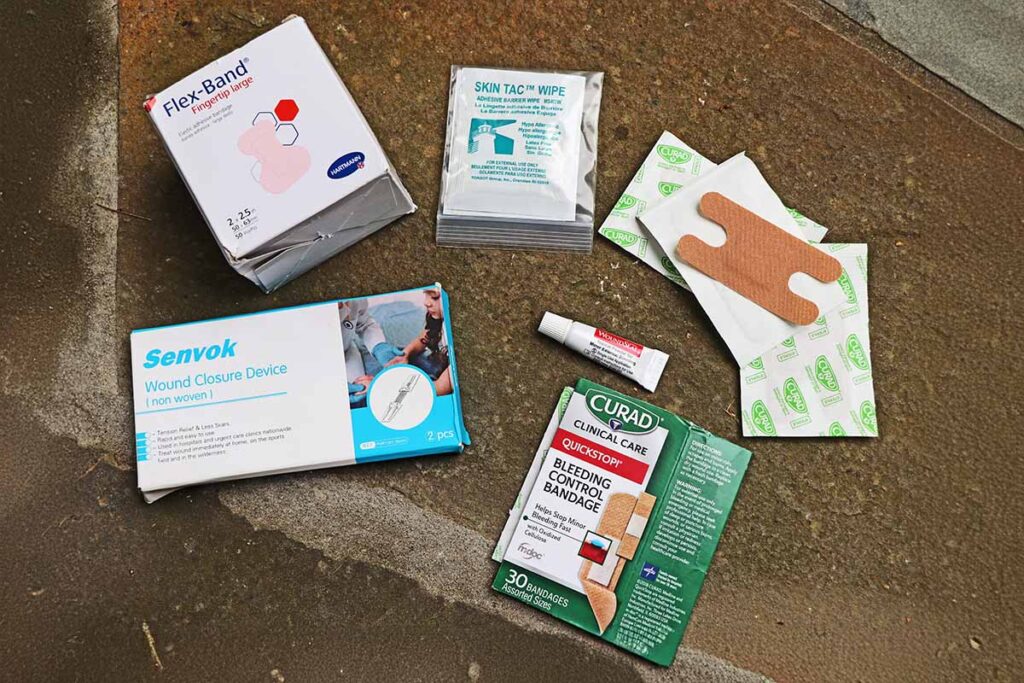
These items are extremely handy if you do anything with knives. The fingertip bandages are good anywhere on the bop
These items are extremely handy if you do anything with knives. The fingertip bandages are good anywhere on the bop, aka a survival experience, and bleed control Band-Aids® can also be handy. They have a coagulant. Besides a tourniquet, noninvasive wound closure devices coupled with a tape adherent like Skin Tac™ can save a trip to the emergency room for those annoying cuts. (Joe Flowers image)

When sharpening a dull blade, Flowers is known to use 60- to 80-grit belts to re-form edges when large chunks have been taken out of a machete, for example. He maintains that it can take the steel off the blade fast but there must be a bucket of water or a spray bottle handy to keep the grinding surface cool.

Bringing a knife back from dead dull involves a proven process.

“At home I would reprofile gently on a 1×30 Harbor Freight special I’ve had from the old days,” Joe commented. “Depending on the steel and use and the comfort of the hardness, I’ve reprofiled knives from dead dull with homemade sandpaper and mouse pad backing and keep heavier grits there as well. You can definitely over sharpen a knife by stropping so much you roll the edge. In the technique, you need to be able to tell when you have just the right amount of pressure.”

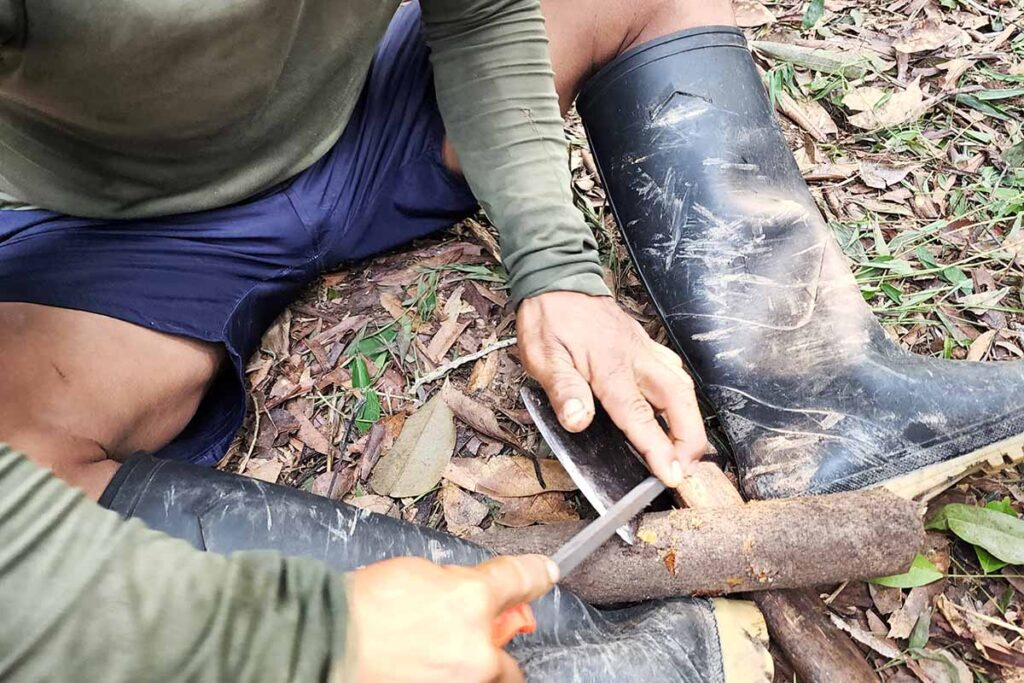
tribesman from Colombia, uses a common triangular file on the axes and machetes
Hari, a Huitoto tribesman from Colombia, uses a common triangular file on the axes and machetes on Bushcraft Global (bushcraftglobal.com) trips. For the final edge, the file is drawn from the edge to the poll. (Joe Flowers image)

Sometimes the type of sharpening medium used depends on the blade steel, the style of blade and the common utility of the knife.

“On many higher-end-steel kitchen knives, I stick with King stones because they are tried and true,” Joe related. “However, I like many different media for various steels, going for the extra-fine edges or a strop loaded with compounds for the final edge. For things like serrations, I use thinner round diamond rods for getting the radius, but I don’t deal with them much. I really like the flattest surface possible when I sharpen Scandi as it helps keep the angle straight.”

Retaining a sharp edge makes life easier wherever and whenever a knife is needed. A few minutes to shape up a blade is always time well spent.

More Sharpening Articles:

2026 BLADE Show Texas Factory Knife Award Winners

See which factory knives took home the coveted hardware from the BLADE Show Texas Factory Knife Awards.

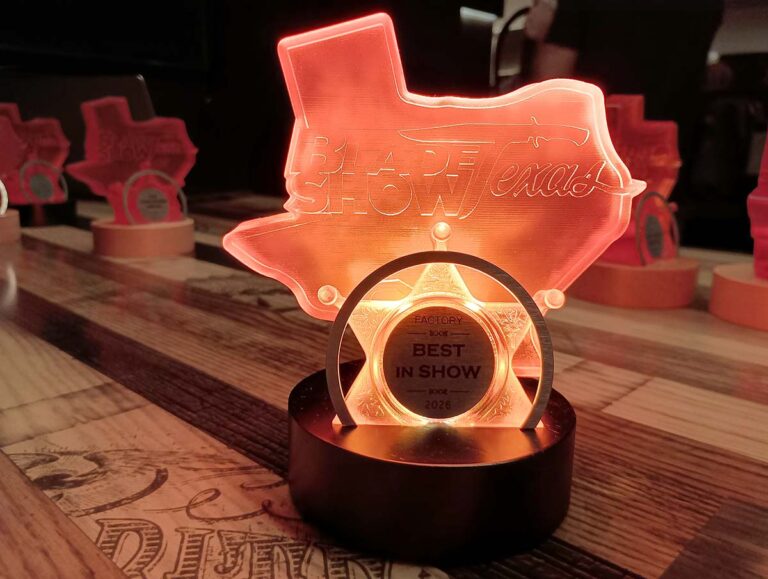
The BLADE Show Texas, held March 20-21 at the Fort Worth Convention Center, saw an intense factory knife competition. With an excellent turnout of competitors and a high-level of execution on the knives, it was most definitely a showcase of the top-tier production knives at the show.

With such an impressive lineup, the three-judge panel faced a tough challenge in determining which blade best represented each of the seven categories. In short, competition was hot. With the dust settled, here are the winners who claimed top honors, including Best in Show.


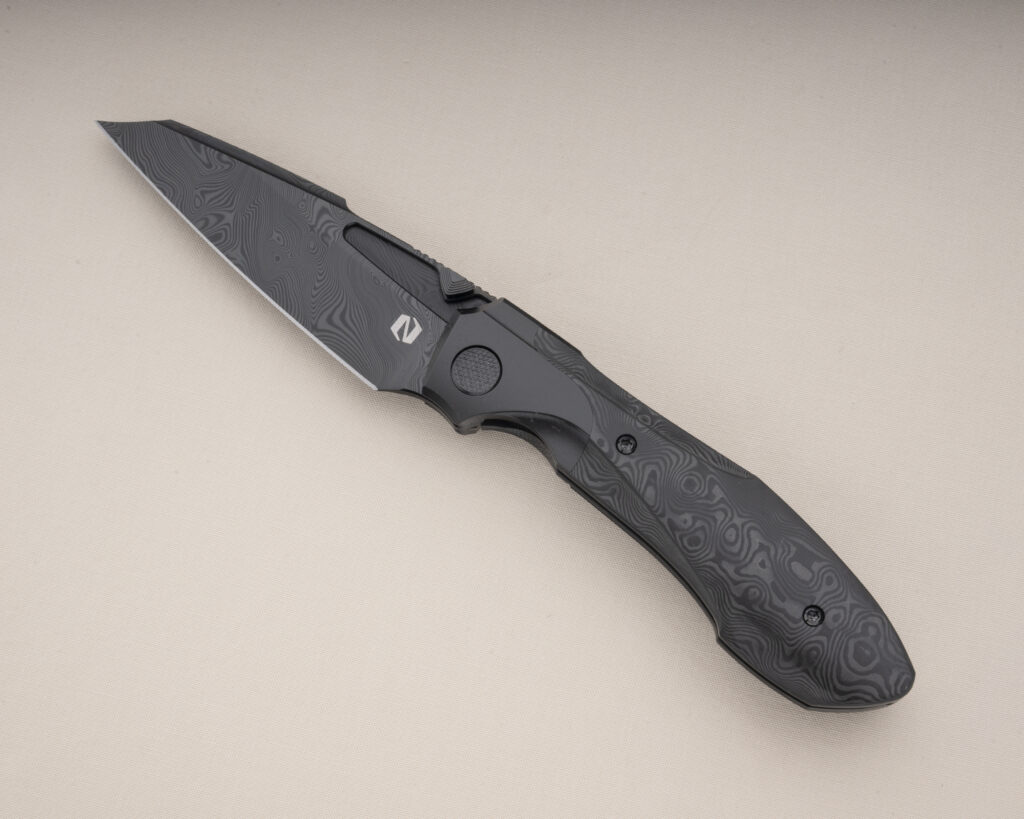
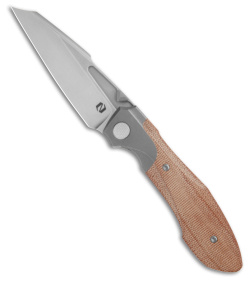
Best Folder And Best Of Show: Null Knives Voodoo

Null Knives VooDoo
Jocelyn Frasier image
Null Knives Voodoo Lock Knife Natural Micarta

Null Knives Voodoo Lock Knife Natural Micarta

$350.00
Prices accurate at time of publishing. Affiliate disclosure.

Best EDC: Arcane Design Automation

Arcane Design Automation
Jocelyn Frasier image

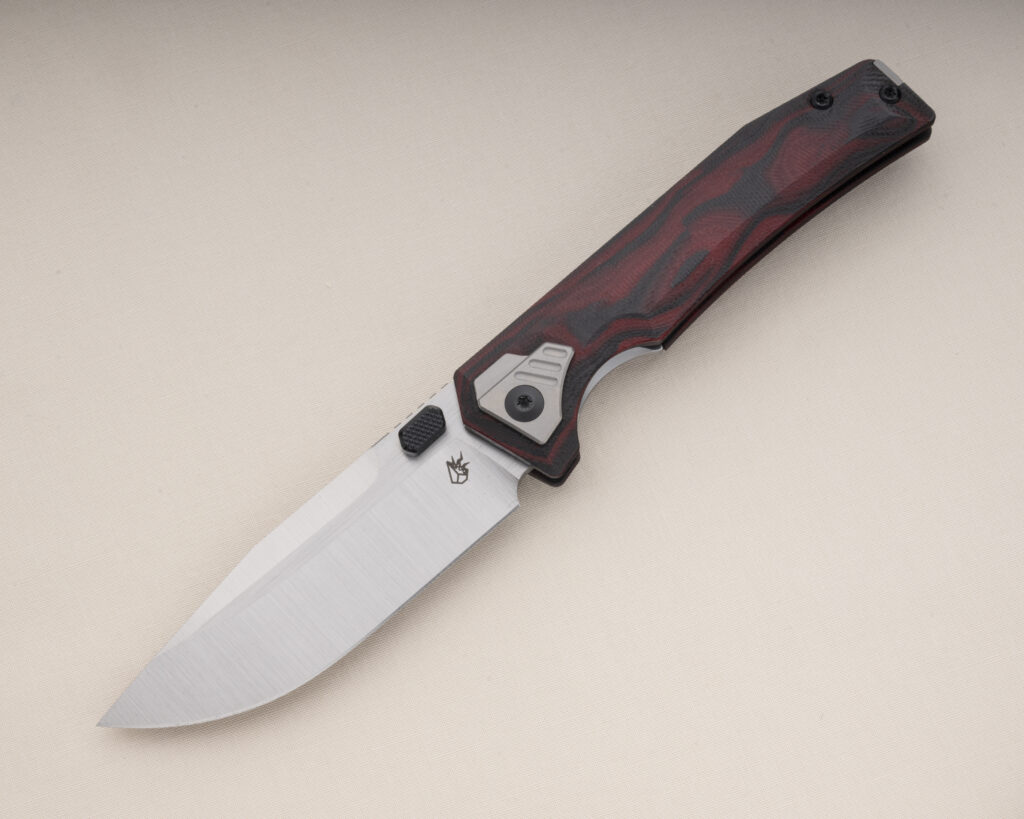
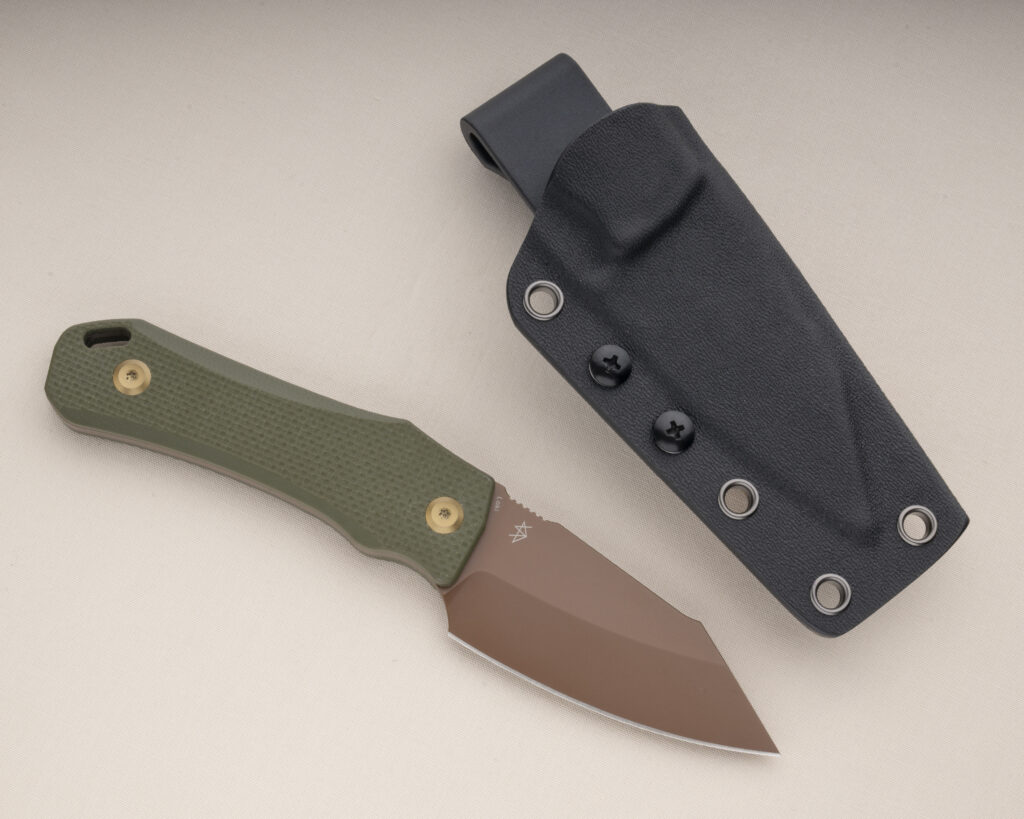
Best Fixed Blade: Tenable Knives Loki

Best Fixed Blade: Tenable Knives Loki
Jocelyn Frasier image
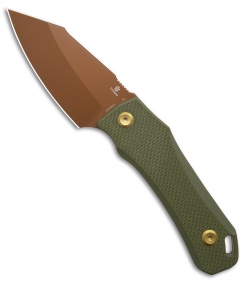
Tenable Knives Tenable Loki Fixed Blade Knife Olive G-10

Tenable Knives Tenable Loki Fixed Blade Knife Olive G-10

$49.89
Prices accurate at time of publishing. Affiliate disclosure.

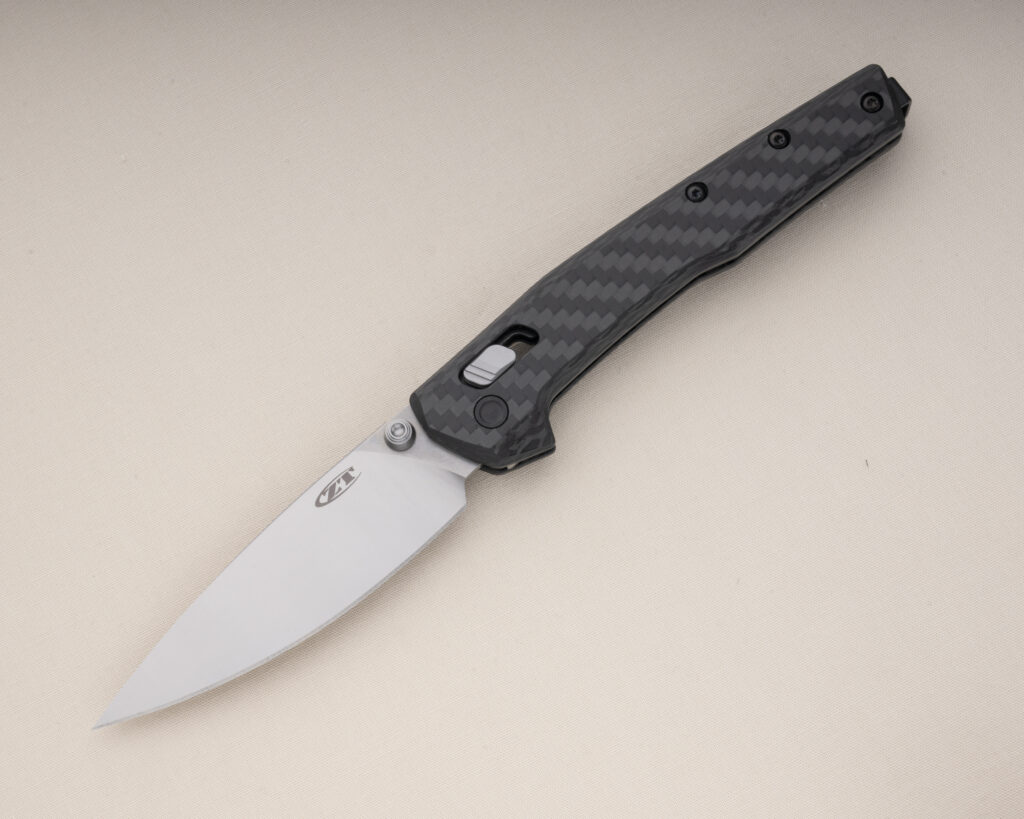
Best American-Made Knife: Zero Tolerance 0117

Best American-Made Knife: Zero Tolerance 0117
Jocelyn Frasier image
Zero Tolerance 0117 Pocket Knife Drop Point CPM MagnaCut Satin Blade Carbon

Zero Tolerance 0117 Pocket Knife Drop Point CPM MagnaCut Satin Blade Carbon

$240.00
Prices accurate at time of publishing. Affiliate disclosure.

Best Imported Knife: Null Knives Vandal

Best Imported Knife: Null Knives Vandal
Jocelyn Frasier image

Best of the Rest: Tactile Turn Anso

Best of the Rest: Tactile Turn Anso
Jocelyn Frasier image

See More Award Winners:

Advertisement

Must Read Articles

Read this before you make a knife

Knifemaking 101 – Read This Before You Make a Knife

  by Wayne Goddard My experience has taught me that there's nothing like digging in and getting started. I've often said the hardest part of the...
how to forge damascus steel

How to Forge Damascus

Advertisement
Advertisement