3 New Knives, 1 New Tomahawk and 1 Highfalutin Marshmallow Roasting Stick

Benchmade Reveals Two New Folders

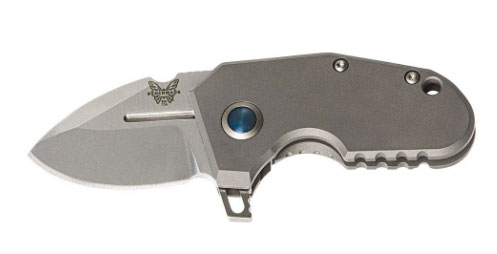
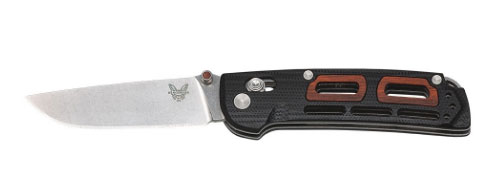
Last week on social media, Benchmade announced two new folders: the 756 mPR (micro pocket rocket) and the 486 Saibu.

That was followed by a live video featuring the newbies:

The knives will be available for your inspection at the Benchmade booth (#8) at BLADE Show 2018. If you can’t make the show, here are the specs.

Benchmade 756 mPR

Micro pocket rocket

  • Overall Length: 4.83″
  • Blade Length: 1.87″
  • Blade Thickness :0.12″
  • Blade Material: CPM-20CV
  • Weight: 3.52 oz.
  • Hardness: 59-61 RC
  • Blade Style: Drop Point
  • Blade Grind: Flat
  • Finish: Satin
  • Edge Type: Plain
  • Handle Length: 2.84″
  • Handle Thickness: 0.45″
  • Handle Material: Titanium
  • Opener: Flipper
  • Lock Type: Frame Lock
  • Designer: Shane Sibert
  • MSRP: $400

More Info

Benchmade 486 Saibu

Benchmade 486

  • Overall Length: 6.79″
  • Blade Length: 2.98″
  • Blade Thickness: 0.11″
  • Blade Material: CPM-20CV
  • Weight: 2.70 oz.
  • Blade Style: Drop Point
  • Blade Grind: Flat
  • Finish: Satin
  • Edge Type: Plain
  • Handle Length: 3.81″
  • Handle Thickness: 0.48″
  • Handle Material: G-10, Wood
  • Pocket Clip: Tip-Up
  • Opener: Thumb Stud
  • Lock Type: AXIS®
  • Designer: Seiichi Nakamura
  • MSRP: $250

More info


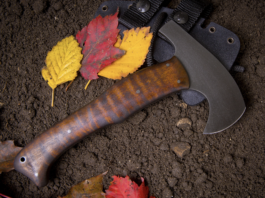
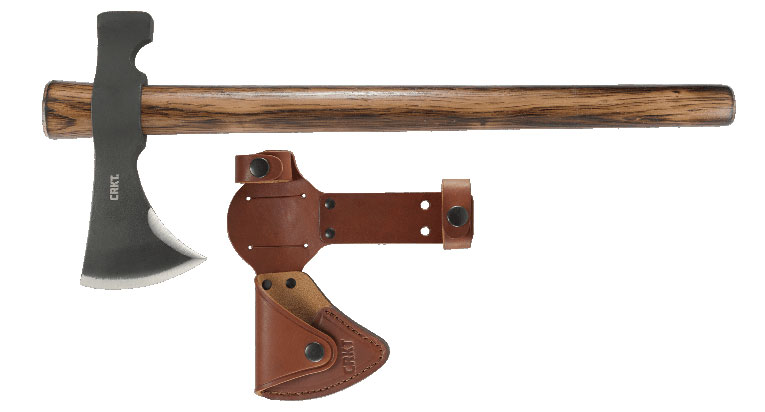
CRKT.com-Exclusive Woods Chogan T-Hawk

Exclusive CRKT tomahawk

Designer Ryan Johnson’s latest tomahawk, a new spin on the Woods Chogan T-Hawk released in 2014, will only be available through CRKT.com. This new version sports a “black magnesium phosphate coating on the head for corrosion resistance and an aesthetically cool firewood-burned handle,” per CRKT.

  • Blade Length: 3.500″ (88.9 mm)
  • Blade Steel 1055 Carbon Steel
  • Hardness: 50-55 HRC
  • Finish: Magnesium Phosphate Coating
  • Blade Thickness: 0.52″ (13.21 mm)
  • Weight: 1 lbs. 15.9 oz.
  • Handle: Tennessee Hickory
  • Overall Length: 19.13″ (485.9 mm)
  • MSRP: $69.99

More Info


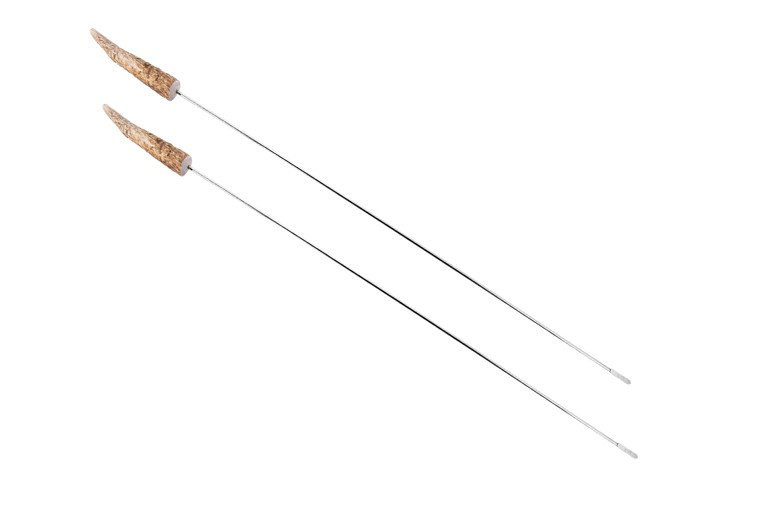
Buck Marshmallow Roasting Sticks with Elk Antler Handles

Why not?

  • OAL: 36″
  • Handle: Elk Antler
  • Steel: 304SS Food Grade Steel Rod
  • MSRP: $25 for pair

More Info


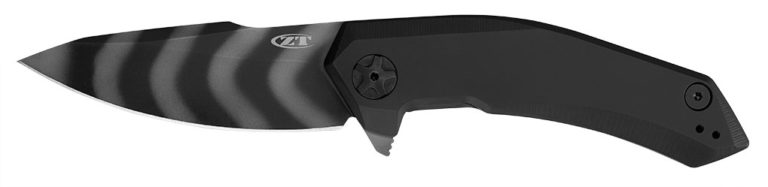
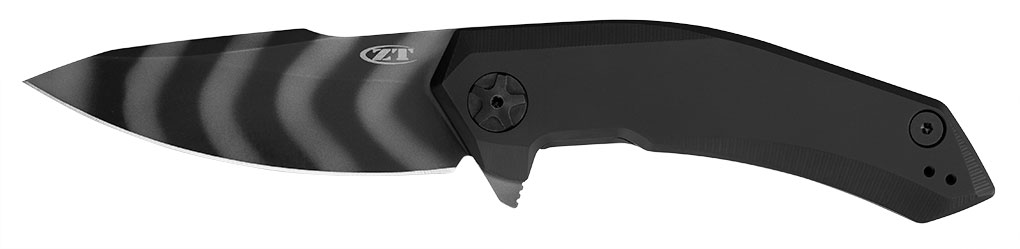
Zero Tolerance 0095TS Earns Its Stripes

Zero Tolerance 0095 with tiger stripes

Zero Tolerance’s new 0095TS offers a step up from its 0095 with premium steel and tactical aesthetics. The “TS” in the model name comes from the tiger stripes design on the blade.

  • Blade Length: 3.6 in. (9.8 cm)
  • Blade Thickness: 0.121 in. (0.307 cm)
  • Closed Length: 4.9 in. (12.4 cm)
  • Overall Length: 8.4 in. (21.3 cm)
  • Blade Steel: S90V, Tungsten DLC coating, tiger stripe
  • Opener: Flipper, KVT ball-bearing opening system
  • Lock: Titanium frame lock, hardened steel lockbar insert
  • Clip: Reversible
  • Handle: Titanium, DLC coating
  • Weight: 5.3 oz. (150.3 g)
  • MSRP: $300

More Info 

Choosing The Best Throwing Knife Buyer’s Guide

Want to know what steel to fling and what at? We break down how to choose the best throwing knife and targets for high-flying fun.

Simply put, a throwing knife is an object that is either a true knife (capable of cutting and other work) or a pointed/tipped/edged object that is solely designed to be thrown with no other intended capability.

Any knife in theory can be thrown, however, most all knives are not intended to be thrown. There are several reasons for this, among them the fact that knives are edged tools and are reliant on their edge profile, blade shape, and handle style to be functional in their intended role. For instance, a chef’s knife isn’t designed to be batoned through wood. A knife it is, but it is not *that* type of knife.

Likewise with throwers—a throwing knife is purpose-made for the role and is usually stripped down to a point where it is not functional in most other roles.

Selecting A Throwing Knife

In selecting a throwing knife, you need to first look at what you want to throw it at and what type of throwing interests you.

Steel

The first criterion here is important because you want to choose steel of a high enough grade that throwing it doesn’t damage it. Knives break all the time and even the strongest edge can chip or even snap if it hits a hard surface with sufficient speed and force.

If you are a recreational thrower who likes to have some fun at your weekend cookout, you really can’t go wrong across the board. Lower-cost knives in sets mean you can get more of your friends involved and the good times can be made that much better. These knives are usually made of lower-quality steel, and it is not uncommon to see broken tips. These knives are usually inexpensive and are only made to maintain a tip, not an edge.

The medium-skill thrower is probably going to graduate to some better steels and more common profiles. It is in this category you start seeing true blade steels like 1055 and 1095 come up as opposed to just generic ‘stainless steel’. The knives at this stage are still affordable but are typically sold as individual pieces, meaning building a set gets pricey. At this level, you start to see real effort put into blade profiles and balance points, as well as an emphasis on the ability to throw repeatably.

Advanced throwing knives start to get expensive, sometimes into the hundreds of dollars—some even custom-made. These are the knives you see the most serious competition throwers using. The average recreational thrower would benefit from them, but unless you’re throwing every day the expense is not going to aid you. That said, an expert’s knives are going to be balanced perfectly as well as featured tailored grip style, tip and body to provide the most consistent performance. These are also nearly identical in weight and in the distribution of that weight along the blade and handle.

Designs

Some knives are tip-heavy, others handle-heavy. Others are slotted or have holes drilled to allow the addition of weight where necessary. The weight distribution of a knife largely depends on how you grip it—a topic too large to cover here. The abridged version is balance points vary depending on your throwing method, and as you learn you may gravitate to one or another depending on what works best. Typically, it is advisable to start with a perfectly balanced knife and then, once you have that skill, learn what style your body and throwing performs best.

Throwing Styles

Throwing styles vary depending on what you are trying to do and what style of knife you’re throwing. There are many methods to do this, not just the classic ‘hold by the tip and hope for the best’. There are two main types of throwing, rotational and non-rotational, and certain types of knives are balanced better for each.

Rotational throwing is where you throw the knife, and it rotates in the air before contacting the target. You’ll need to know or be able to estimate the number of rotations needed to arrive at the target with the tip. This is harder, but the more common type you see practiced in backyards everywhere.

The next is non-rotational, where the knife is launched straight on without spinning. This is usually for shorter ranges inside 15 feet.

Throwing Knife Targets

Throwing knife targets are wide-ranging. There are dedicated throwing targets that exist, but you should know examples made of foam or modern composite usually do not hold up for the long run.

Archery targets are commonly misused as knife targets, which is fine if you like wasting your money. Archery targets made of rubber foam are meant to stop target point arrows, in a sense, it catches them by means of friction. A knife can cut through these layers and ruin them and increase the danger of a rebound back at the thrower.
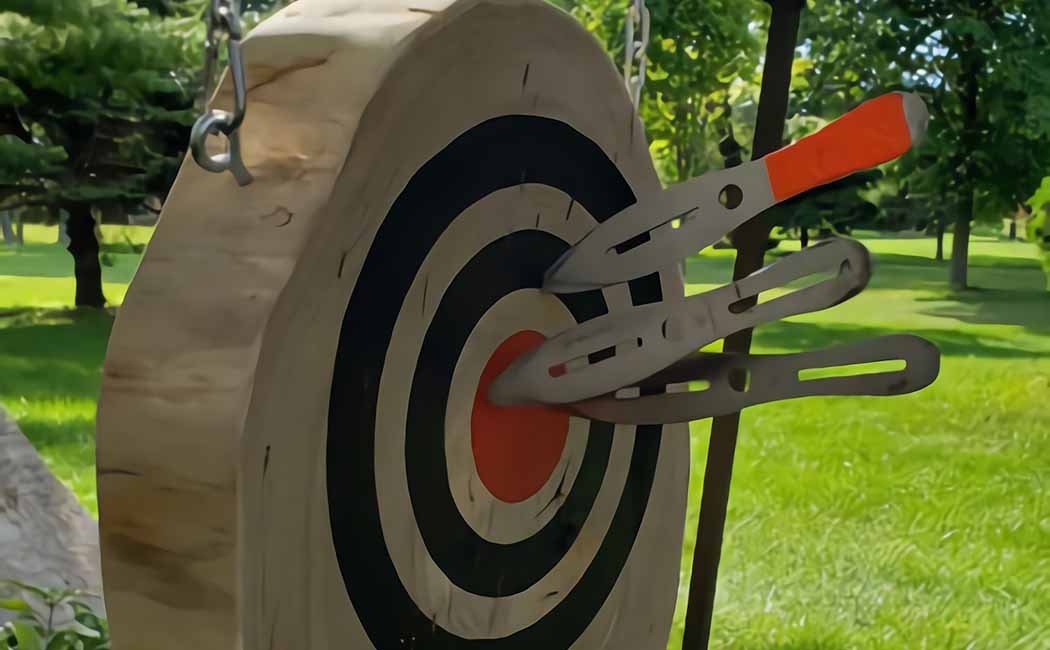
The best material for throwing knives is wood, especially slices of a tree trunk. It is not good to throw at living trees, as while the knives themselves won’t kill the tree, they can allow insects in which will destroy it.

Log slices have been used as throwing targets for time immemorial and there is hardly a substitute. They last for years, can be painted over again and again, and are cheap to replace. Most people make a stand to mount them on that can be folded up and moved.

If you are handy and like woodworking, you can make a wood block target using 4×4 posts cut into sections and glued together with the grain facing the thrower. This simulates a log slice but is more uniform in shape. The author has made this type of target and found it cosmetically nice, but not more functional than a log slice.

why Throw Knives?

To ask this question you need to understand that there is a very serious and well-researched answer… because it’s a hell of a good time!

Knife throwing has very little to do with self-defense these days, and while not out of the realm of possibility, it is just not a highly relevant skill. Today it is now common to find establishments called ‘axe bars’, where throwing blades and tossing back a few cold ones are the name of the game.

There are pro-level competitions out there, just like there are in any game or sport. There is some money in it if you’re good enough, but most people just like to do this because it is a good way to spend time together and win bragging rights.

Some Of The Best Throwing Knife Options

Cold Steel Perfect Balance Thrower
Cold Steel Perfect Balance Thrower

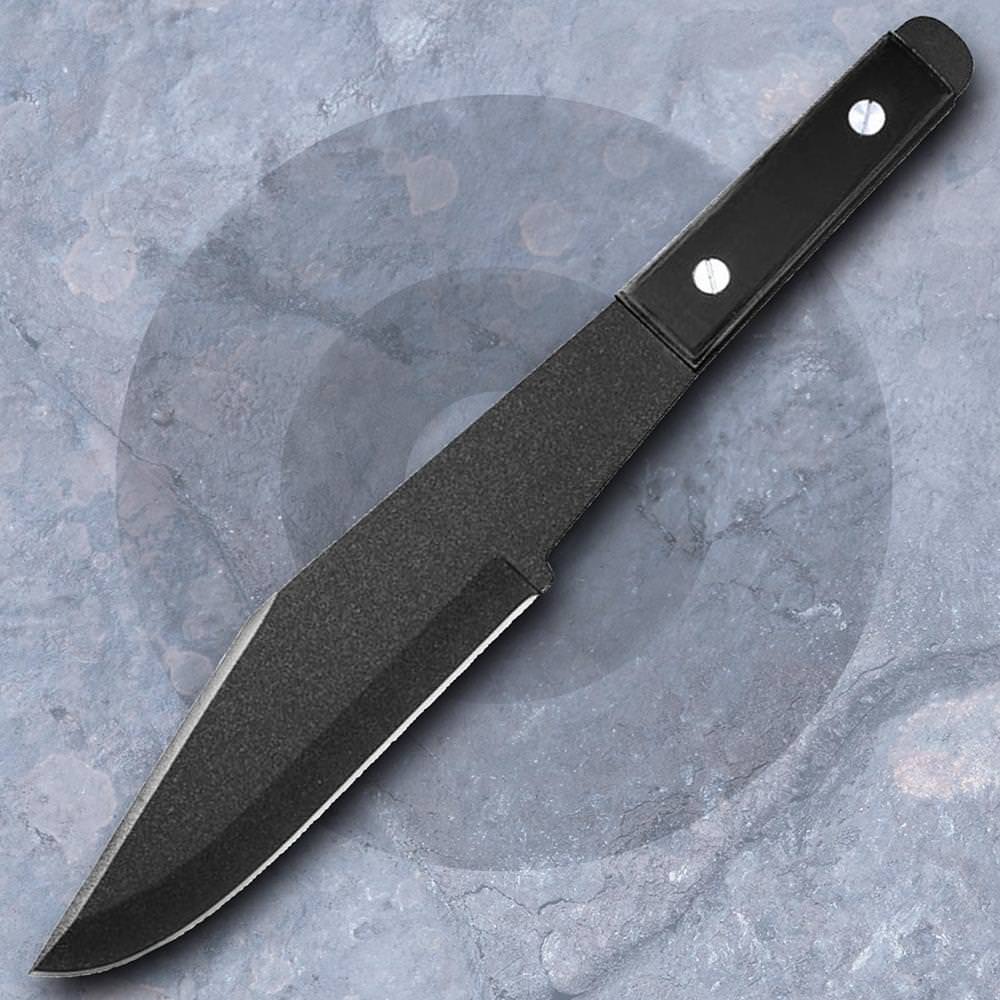
Resembling the company’s tough, powerful bowie knives, the Cold Steel Perfect Balance Thrower is every bit as rugged as its fellow products. But it is designed for the purpose of throwing, not necessarily day-to-day tasks. Though it is one of the few on this list with handle scales, it isn’t held up by this feature at all. This knife was designed to offer repeatable accuracy thanks to its well-managed profile, tip shape, and handle layout. A large thrower at 13.5-inches long and almost 1 pound in weight, it has no problem carrying enough energy to punch in and stick. The knife is not sold as a set, the price is for one without any carrying system.

MSRP: $38

Cold Steel Torpedo
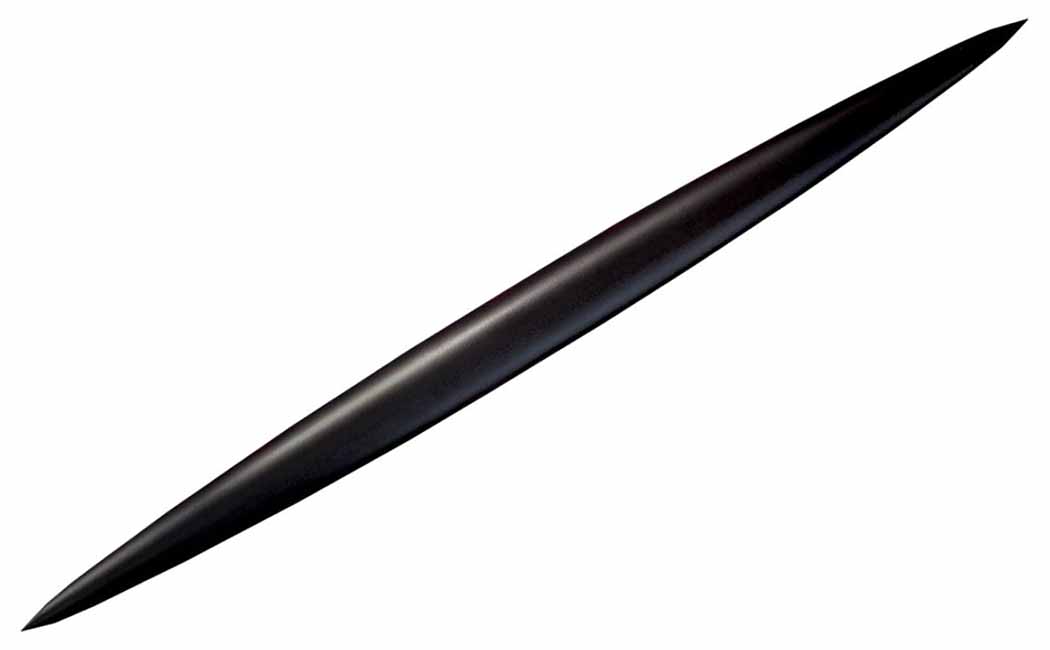
Cold Steel Torpedo

Probably the most unique thrower on this list, Cold Steel’s Torpedo is deceptively simple, yet extremely effective. The Torpedo isn’t necessarily a knife. However, most throwing knives aren’t knives in the true sense either. They are in the same shape as a knife but aren’t meant for cutting or really anything else other than throwing.

The Torpedo is a 15-inch long, 1-inch thick, 32-ounce piece of steel sharpened into conical points at each end. It carries a tremendous amount of mass and is large enough it can be used for self-defense and even some types of hunting at close distances on small game. This thrower is a design that exceeds its simplicity and crosses into the practical for ownership.

Survival schools teach throwing for hunting, and many native and indigenous cultures have used similar methods for millennia. The fact that a direct hit from this massive steel cylinder results in a huge, deep wound is enough to convince even the most dedicated primitive survivalist of its utility.

MSRP: $38 each

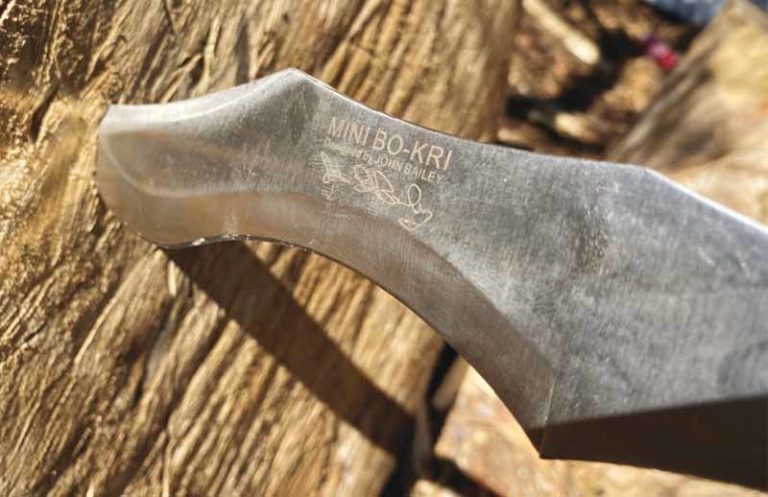
Boker Magnum Mini Bo-Kri
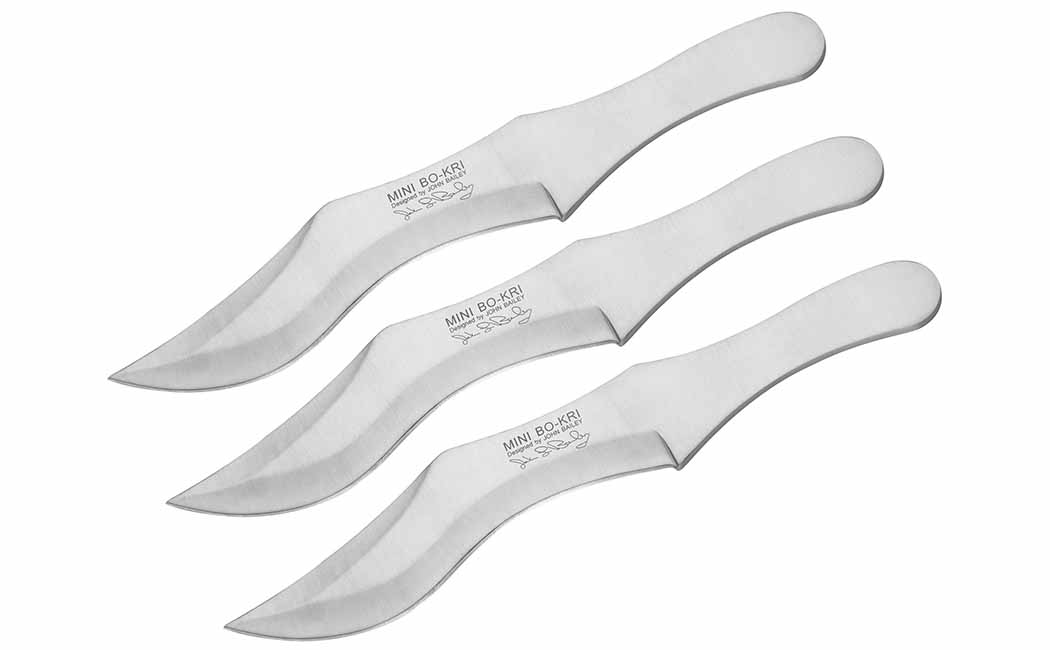
Boker Magnum Mini Bo-Kri

Boker makes excellent knives and is known the world over for their quality. The Mini Bo-Kri is an example of this, as not only a well-balanced thrower, but unique in appearance and functionality. The knife comes with a dedicated leather sheath, which is an interesting addition considering most knives of this type aren’t carried in anything, but nylon covers. The shape is a hybrid profile featuring a Bowie tip profile and a Kukri blade curvature. This shape brings the tip to the centerline and allows for very accurate throwing using a few different styles.

MSRP: $43 each

Ka-Bar Thunderhorse Thrower
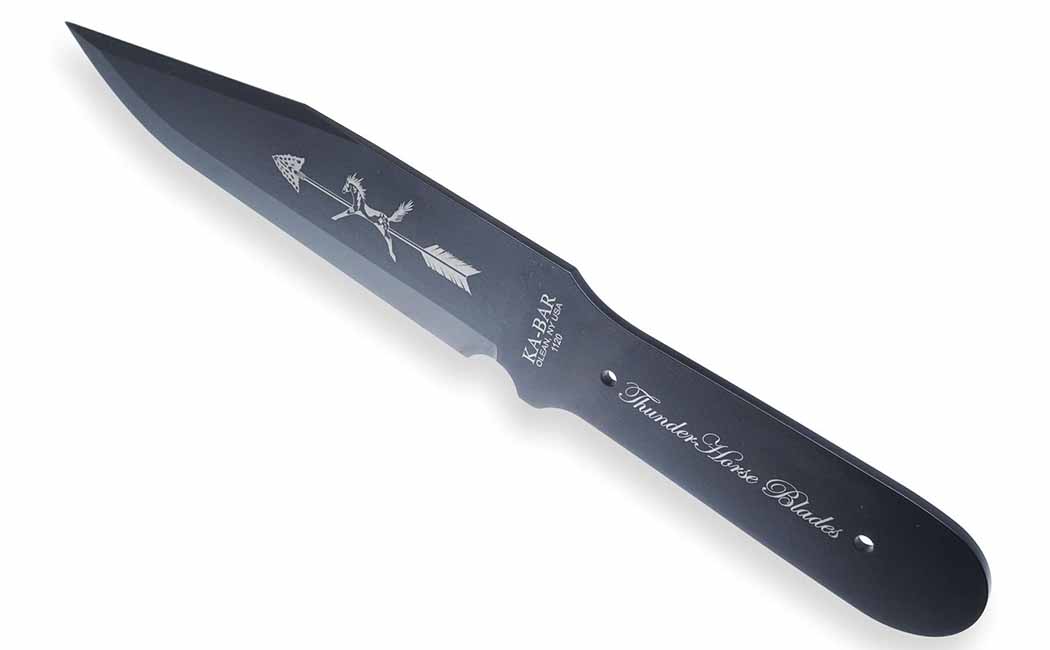
Ka-Bar Thunderhorse Thrower

The only dedicated throwing knife to carry the Ka-Bar name, the ThunderHorse is a big knife at 15.6 inches in overall length and is made in the USA out of 1095 stainless steel. There are some important things to take note of when looking to purchase this knife.

The first is that it is relatively expensive for what it is, however, it is one of the better-rated throwers out there. It is very well-balanced and has a rugged surface finish. It is made of heavy-duty steel that can sharpened to hold an edge. Of note is that the handle has pinholes, so if you need to change the point of balance you can add weights or scales.

The ThunderHorse does not come with either a sheath or as part of a set, the price is per each. If you want the best in American quality from a well-known name, you should seriously consider looking at buying a few of these to complete a competition set for your next backyard BBQ or serious game at a local match.

MSRP: $70

Thrower Supply Traditional Mountain Man Knife
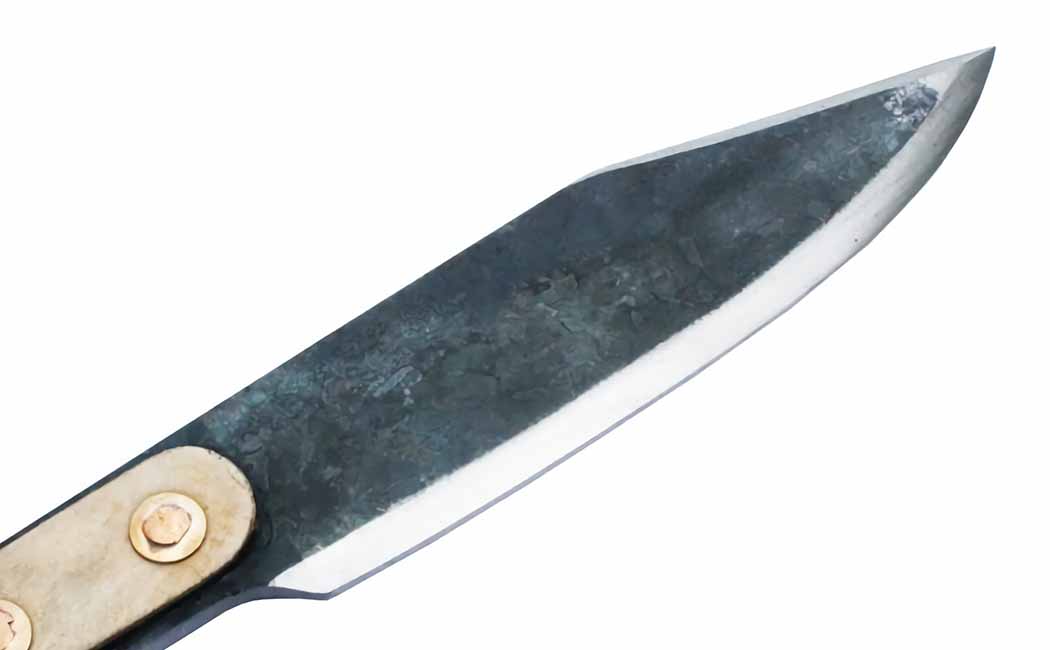
Thrower Supply Traditional Mountain Man Knife

Any time you gather a bunch of guys together in the middle of nowhere with guns, knives, axes, and a plentiful supply of liquor you inevitably end up with a competition. Marksmanship has been the hallmark of these frontier gatherings, often called Rendezvous, for the past couple of centuries. This is not where knife throwing started, but it could be argued that it became a true sport.

The Traditional Mountain Man thrower considers not just how the original throwing knives looked, but also design features that are very close to what was used in history. The first camp throwers were just that, hunting and skinning knives that were thrown for accuracy. Over time, people inevitably realized that handles were easy to break, so stripped-down elements were added, and blades became heavier and stouter.

In historical fashion, the Mountain Man thrower has leather handle scales held in place with copper rivets. This is easily replaced in camp with basic tools if need be. The knife we see here comes with a matching, historical-themed sheath. It is sold per each, which is a bonus if you want to show off wearing your set at your buddy’s house. Nothing says you like throwing knives like three of these bad boys on your belt in matching scabbards.

MSRP: $47 each

SOG Fling Set
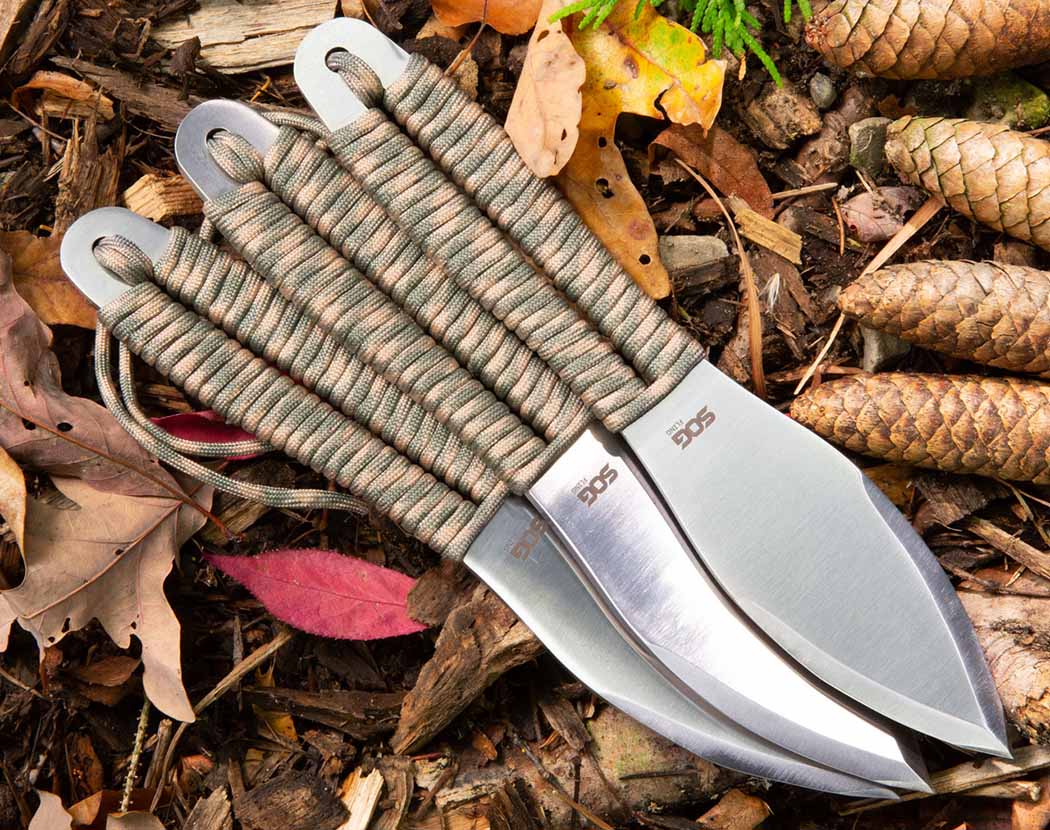
SOG Fling Set

SOG is well-known for making affordable and rugged tools to cover all uses. The Fling knives are meant for the recreation end of the spectrum, and they sure are fun!

The knives come as a set of three, which is what you need for low-cost backyard fun. The blades are spade-shaped, making them strong and stout, ideal for common backyard targets that are less than professional in construction.

It should be noted that these knives are not what you’d call a ‘professional’ set. They come wrapped in 21 feet of paracord each—not something that cuts air easily and facilitates superior balance. However, these are fun knives and enjoy a far greater range of ownership than higher-end throwers.

For a person interested in getting into throwing or if you just want a fun day in the yard, these are an excellent choice at a very modest price.

MSRP: $47 set of three

Condor Dismissal Set
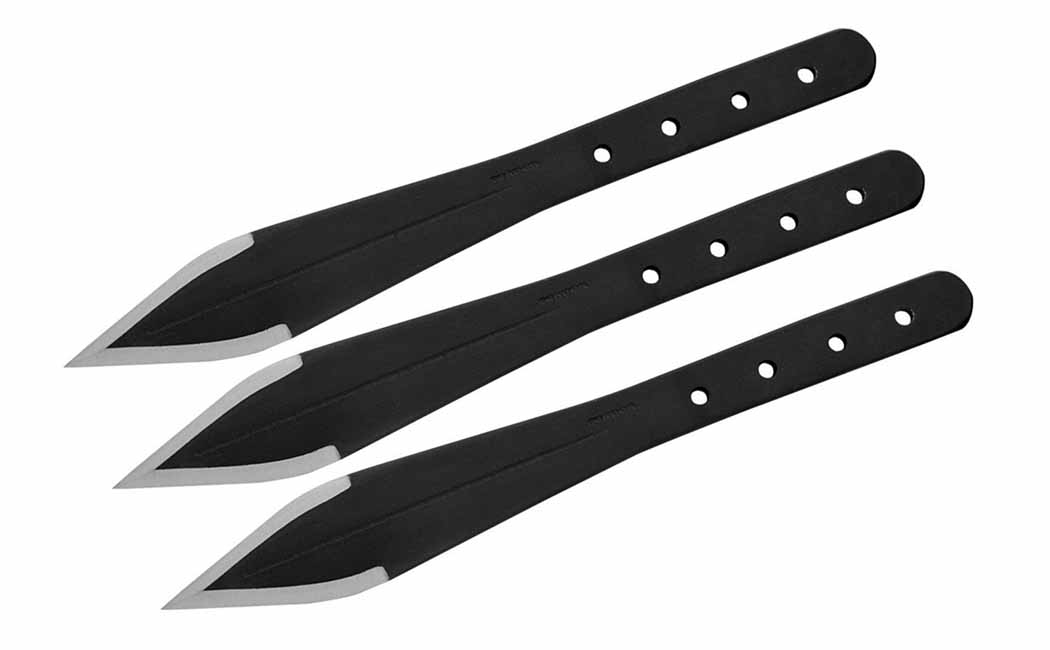
Condor Dismissal Set

Condor makes a huge range of affordable weapons and tools for just about any use. Despite being an El Salvadorian company, it makes functional versions of just about any historical sword, including Japanese style, huge German Messers, right on down to survival knives and recreational items like the Dismissal set.

These knives are highly refined for the price and have a set of features that make them suitable for backyard use as well as for serious competition. The knives have four holes in the handle area, allowing the user to add weights or scales should they wish to adjust balance. The tip profile of this knife is aggressively pointed and can punch into most regular materials but is also obtuse enough to not to get damaged in the process.

If you are just entering the knife-throwing sports, this set is inexpensive enough to get you started but also feature-rich enough to let you hone your skills and truly improve.

MSRP: $102

United Cutlery Expendables Kunai Set
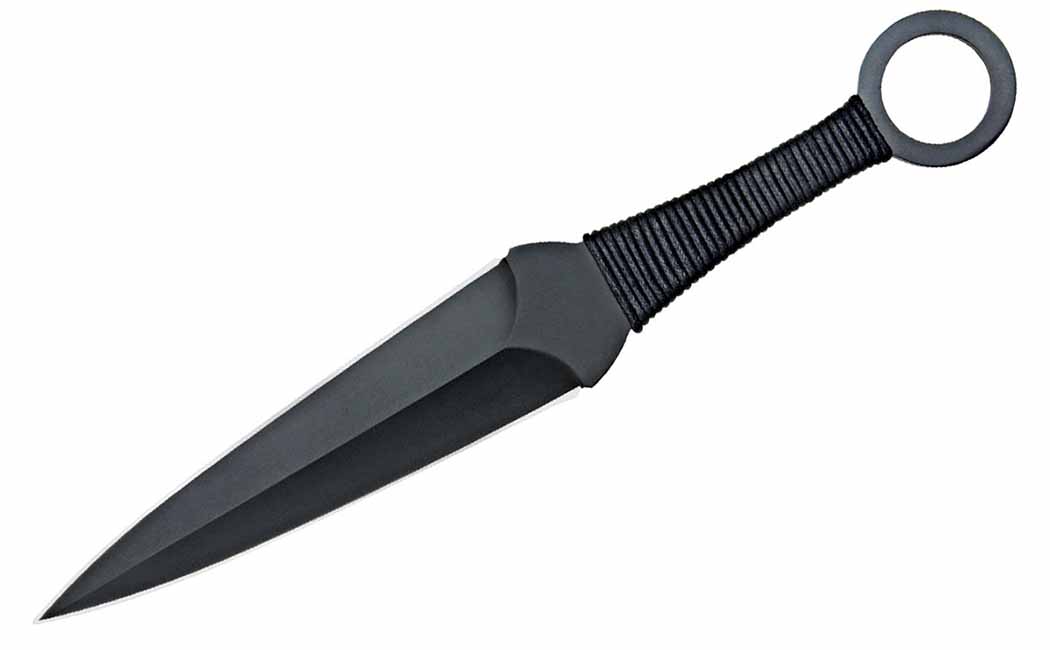
United Cutlery Expendables Kunai Set

The Expendables movie series has been out for a while now, and it is always fun to watch. Many of the actors have a history with the knife industry, arguably none more iconic than Sylvester Stallone, who also happens to be the chief character in the series. While better known for Rambo and that character’s famous knives, Stallone’s crew in the films uses a wide range of knives and this set of throwers are replicas of the screen.

Anytime you get movie prop replicas you are reminded that most prop designers have no idea how they work, but this is not the case. These throwers are functional and feature unique ring pommels that can function in the same way as a karambit in the hand. This adds security for stabbing or slashing and also making it harder to get out of the hand in a fight. A word of caution, as much fun as these would be to spin on your finger, be aware that they are sharp enough to do some damage! The knives come as a set of three in a sheath.

MSPR: $55 set of three

Check out More of Our Buyer’s Guides

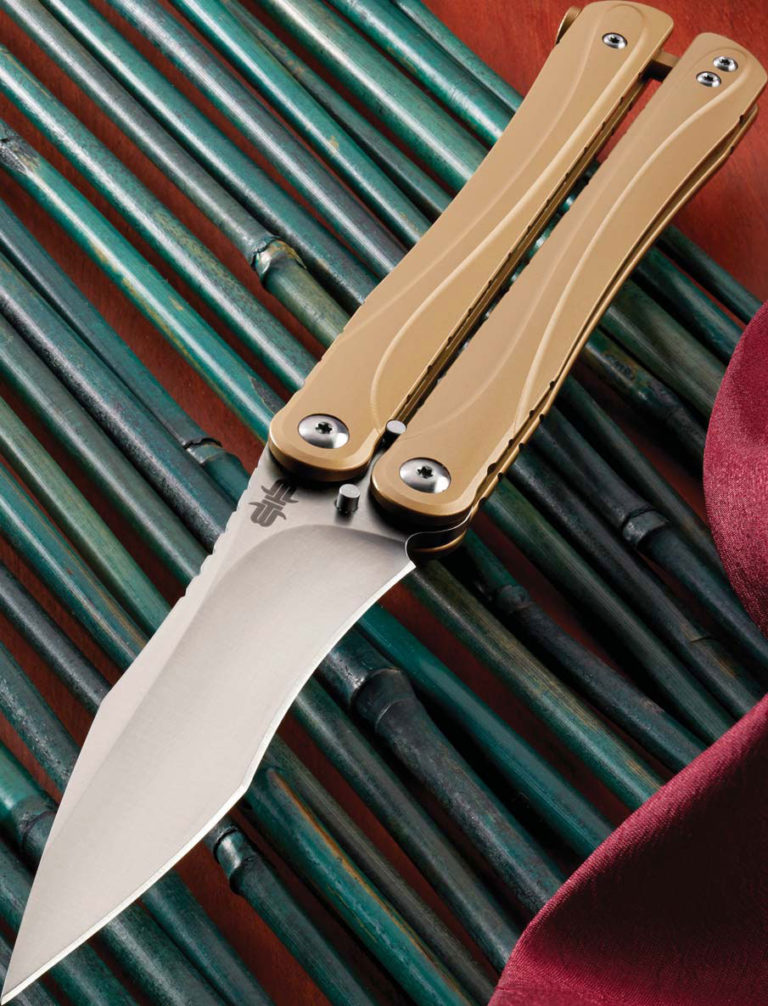
Photos: 4 Butterfly Knives that Sting Like a Bee

Butterfly knives (aka “balisongs”) have evolved into meticulously crafted pieces of cutlery. Many of the best capitalize on state-of-the-art blade and handle materials coupled with progressive and modern designs that advance the genre toward the close of the century’s second decade.

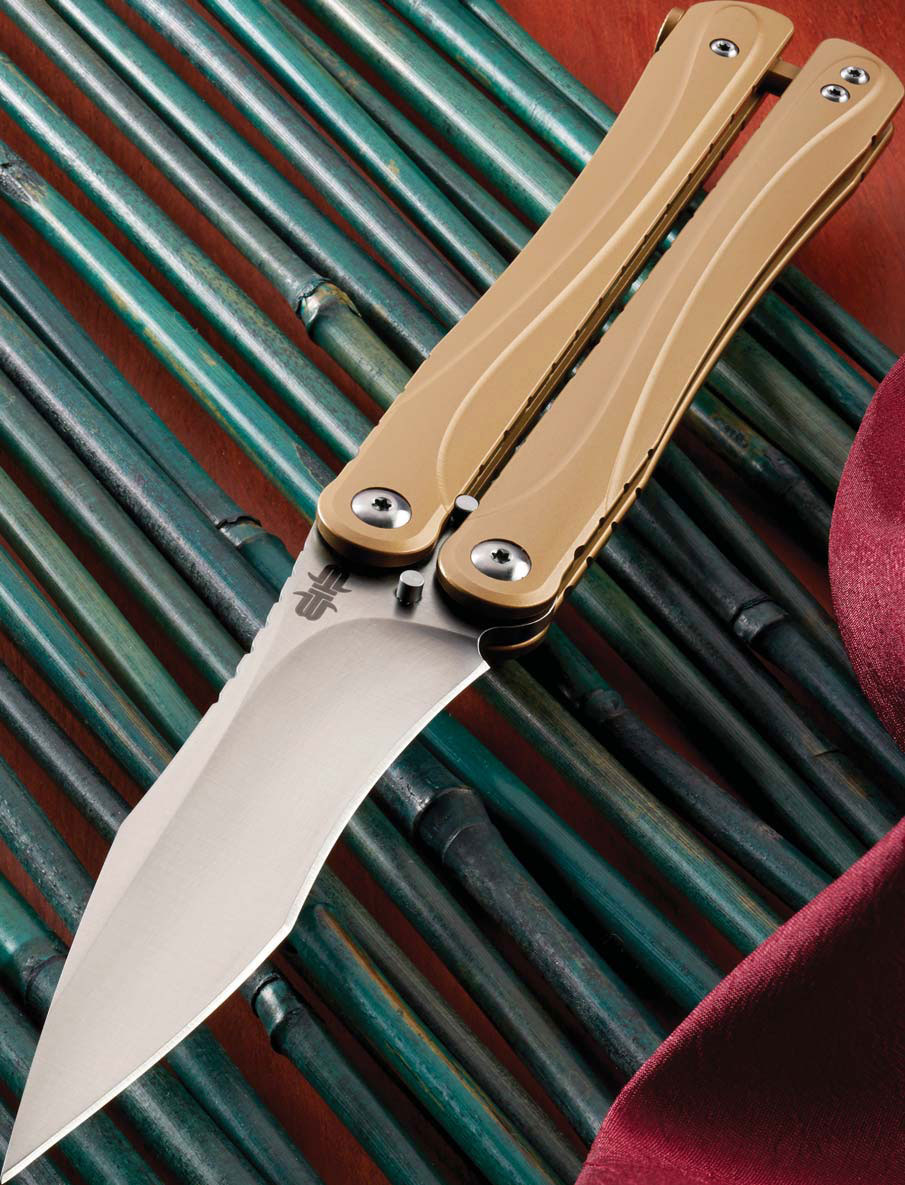
Brous Blades B3
new butterfly knives
(All images by David Stanfield unless otherwise noted)
Brous Blades balisong

The B3 from Brous Blades is a modern butterfly knife with its stainless steel handles and D2 recurve tanto blade style. The handle interiors have cavities milled out to reduce weight. The knife has great action as a result, without the need to use bearings in the pivots. MSRP will vary depending on the finish, though this one is $320.


Bear Ops Bear Song VI

Bear Ops butterfly knife

Bear Song VI balisong

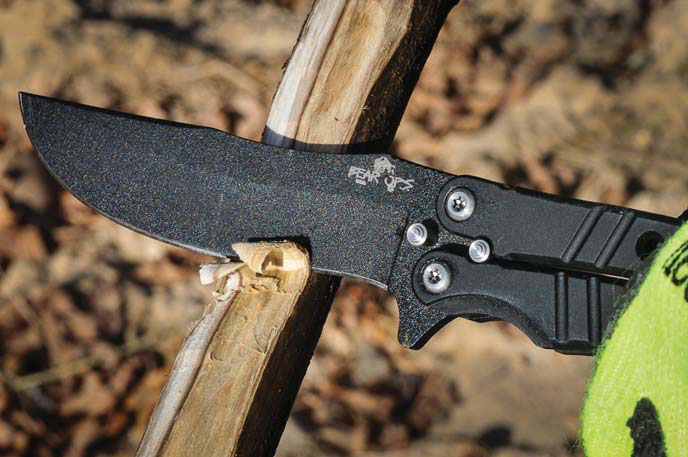
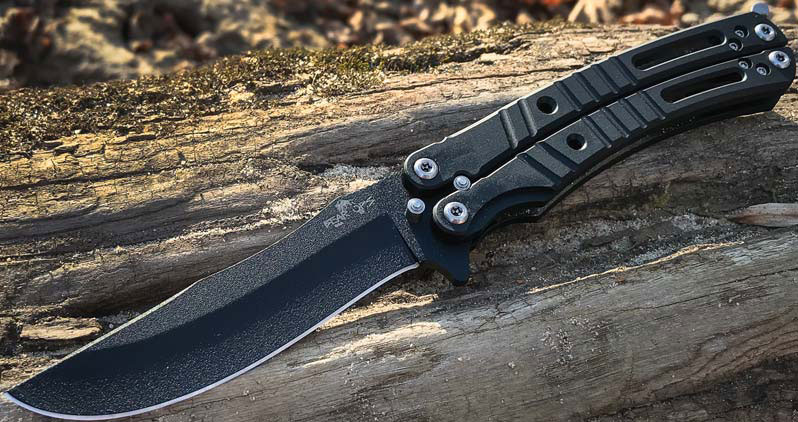
The hollow-ground 1095 carbon steel blade of the Bear Ops Bear Song VI has great edge geometry for all your cutting chores. A textured black epoxy coating guards against corrosion. MSRP: $174.99.


Mantis Knives Vuja De

Mantis Knives butterfly knife

Mantis butterfly knife

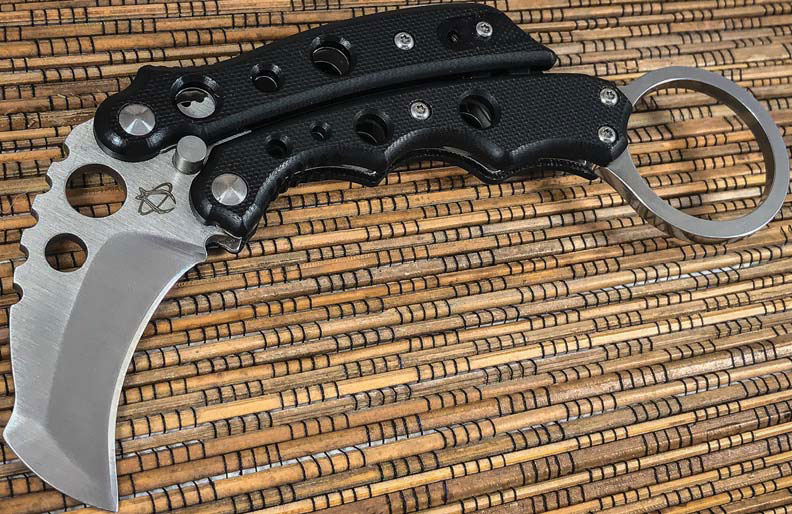
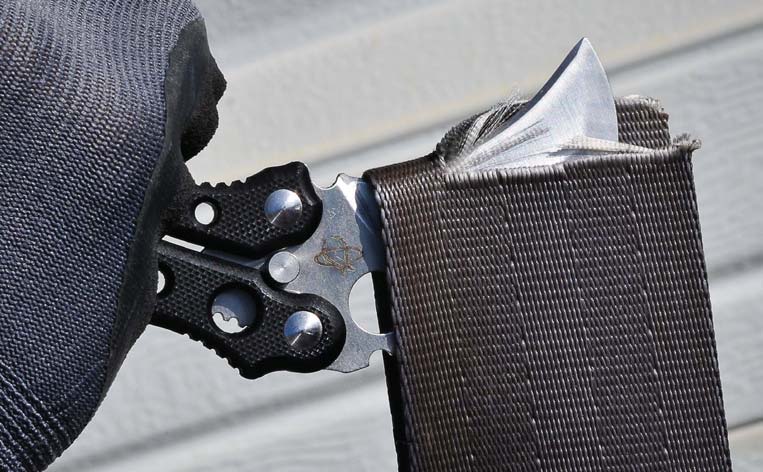
The Vuja De from Mantis Knives marries the karambit’s large finger ring and hook-shaped blade with the free-swinging individual handles of a butterfly knife. The scales are textured black G-10 for both durability and grip quality. The blade is Mantis’ proprietary MV-1 stainless steel.


Emerson Knives Bali Commander & CQC7

Emerson Knives balisongs

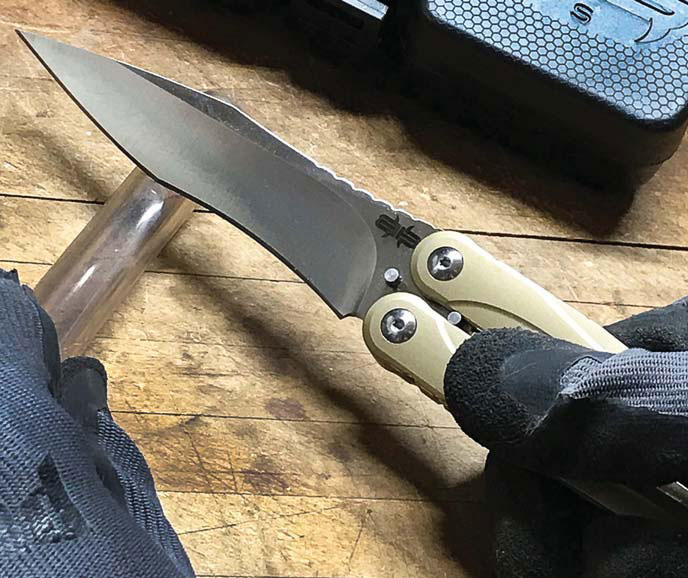
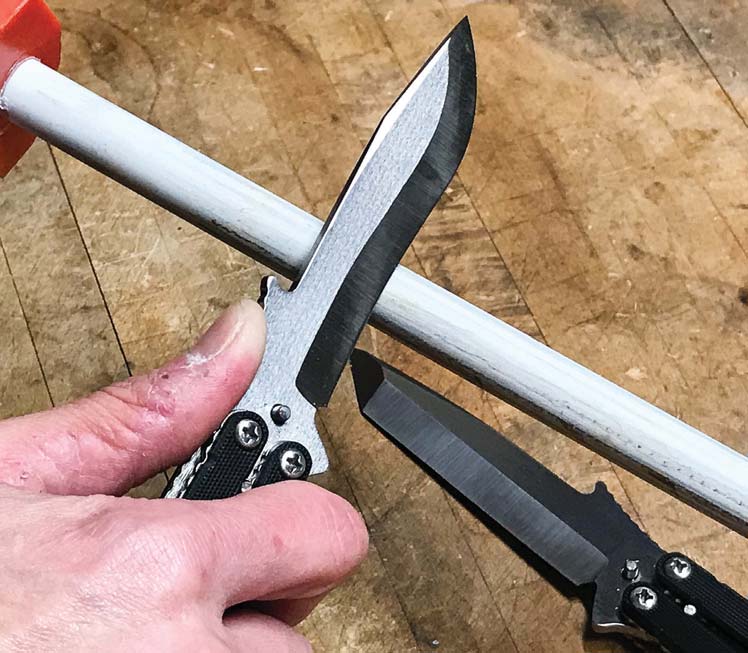
The recurve clip-point blade of the Bali Commander (left) from Emerson Knives, Inc., is easily sharpened using a round profile sharpener to effectively capture the blade’s gentle sweeping curve.

The Emerson Bali CQC7 (right) in the background sports the chisel-ground blade like that of the iconic Emerson CQC7 tactical folder.


Attend a Flipping Competition at BLADE Show

balisong knife contest
Butterfly knives were a-fluttering during the balisong competition conducted by Blade HQ at last year’s BLADE Show.

Among the many exciting events at BLADE Show 2018 this June in Atlanta, you’ll flip to know that there’s a balisong competition at this year’s show. It’s included with your admission. Buy tickets here.

Coffee With An Edge: Well-Known Knifemakers Forging Coffee Brands

Knife companies offer their own brands of hot Joe and perk up consumers in the process.

For Ernest Emerson, it’s as strong as… well, a cup of dark roast. He’s a firm believer in the expansion of his marquis knife manufacturing company into other lines of business. The idea behind that expansion is the diversity of different sources of revenue while complementing the Emerson core business.

“We’ve owned our own coffee company since 2019,” Ernest related. “I’m friends with Evan Hafer, the founder of Black Rifle Coffee, and our conversations probably go back to 2016 when we were first to co-brand with Black Rifle. Evan carried our CQC-7 on his military deployments, and he knew who we were. We worked it out with him to package coffee and do labeling. That worked for a while, and then my wife [Mary] and I talked it over and decided we wanted to have our own brand of coffee.”

For Emerson, taking the coffee plunge complemented the other activities that go hand in hand with offering top quality knives. Barriers to entry were few.

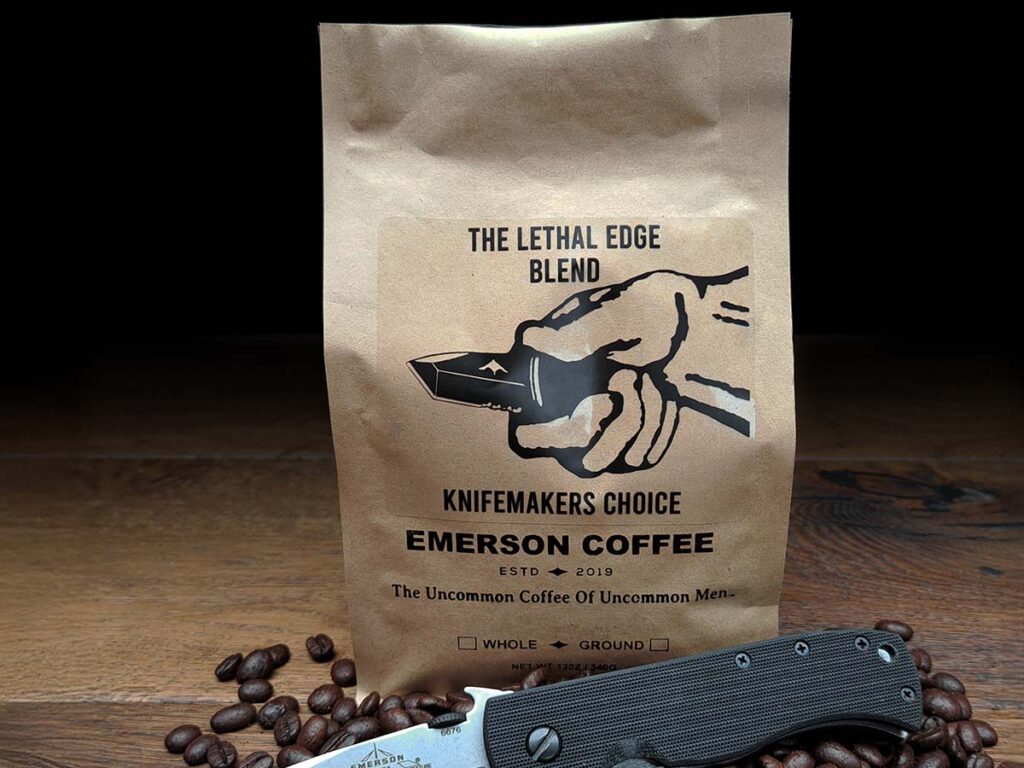
“I talked to Evan, and he said there was plenty of room,” Ernest explained. “We started Emerson Coffee Roasters Company, and I know we were first and started that trend, just like the trend in knife company whiskeys that is going on now.

“We get coffee from a source in South America and have it roasted and package everything under our own ownership,” he added. “Some other companies do collaborations and have their coffee packaged up, but we do everything from start to finish. The way I look at it, everything is a backup for a backup for a backup. What if somebody in Washington can make knives illegal with the stroke of a pen? All our other companies are there as a family-run group of businesses from coffee to apparel, whiskey, fighting systems and others. We’ve built those companies so the family will have support, and then we are at the helm and decide what roasts we want and everything.”

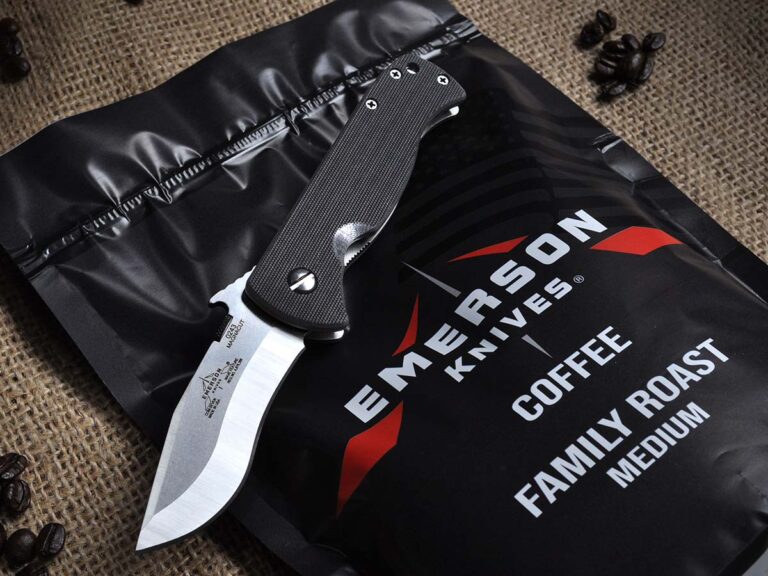
Emerson Coffee has three blends: Renegade Roast, which is the Emerson family’s favorite. Family Roast is the medium blend and Lethal Edge is the dark offering. The knife is the Emerson CQC-7BL-SF.

The future for Emerson and coffee may include some bundles of brew and whiskey or special flavorings for the coffee itself. Ernest sees flexibility and responsiveness always in the mix—a bourbon-flavored coffee when the time is right or a Christmas blend for the holiday season. Right now, the idea is simplicity with three blends: Renegade Roast is the Emerson family’s choice, Farmer’s Roast is the medium and Lethal Edge is the dark offering.

“It’s been a great thing to expand into coffee,” Ernest observed. “Our coffee is delicious, and people say they can’t drink any other coffee after trying it. Besides, we are a lifestyle brand and other than water more coffee is consumed around the world than any other beverage. I would bet that everybody who has ever bought a knife from us drinks coffee. So, if you buy or use knives, chances are you would drink our coffee and whiskey and wear our clothing.”

So, Ernest Emerson, the savvy businessman, finds another niche with coffee, one that complements the tried-and-true knife business and broadens the appeal of his entire spectrum of products. Seeing the big picture is expected to pay big dividends. Ernest points to recent history to back up his market perspective.

“No other knife entity on earth had a show in Las Vegas that revolved 100 percent around its brand like Emerson Knives,” Ernest concluded. “And the Usual Suspects Network was started for Emerson Knives. People tattoo our name on their body, and we say, ‘Show us your ink!’

Forbes Magazine said that there is only one other brand that loyal people tattoo on their bodies, and that is Harley-Davidson. The Forbes people actually told me that. We don’t know all the reasons for it, but again it is partly because people identify with who we are—American made by American workers with American grit and self-reliance. If people buy a $300 or $400 knife from us, then they buy other stuff that the company represents. Emerson truly is a lifestyle brand.”

And what says lifestyle better than a fine cup of brew?

Spartan Blades Tactical Beans

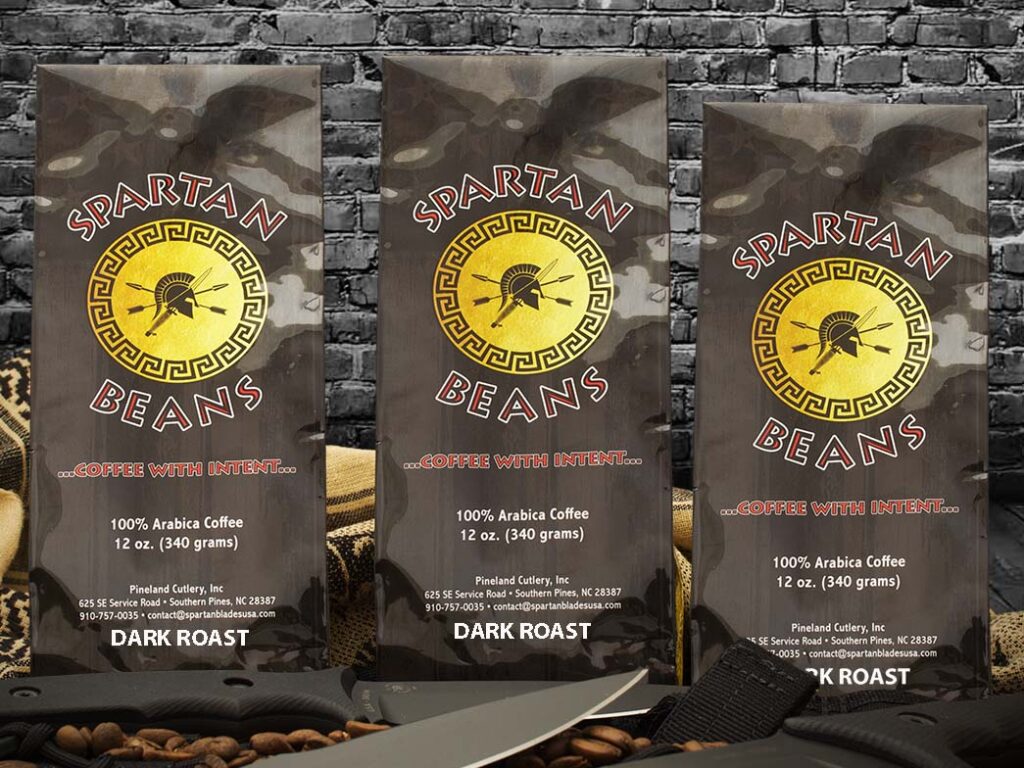
Spartan Beans is sold in 100 percent Arabica regular roast and dark roast, single or three pack. There is also a sturdy mug available to top off the experience.

At Spartan Blades, company co-founder Curtis Iovito says offering a special coffee collaboration with Black Rifle is just fun. Fresh-roasted Spartan Beans fuels the consumption of a couple of gallons of brew per day around the office. The concept started when Curtis was chatting with a good friend who owns a roaster and has evolved into offerings consisting of 100 percent Arabica beans.

“Spartan Beans has been around for about three years now,” Curtis remarked, “and it has gone surprisingly well. Sometimes we will throw in some of our coffee when we ship a knife order to a dealer. The roaster is right up the street, so the coffee is about as fresh as you can get. We may look at doing an auto-ship program as demand increases, too!”

Spartan Beans is offered in 100 percent Arabica regular roast and dark roast, single or three pack, and there is also a sturdy mug available to top off the entire experience.

Spartan Blades co-founders Mark Carey (left) and Curtis Iovito (right) have traveled the globe for years, teaching counterterrorism and assisting with operations related to the use of knives in the field. When time permits, they search for the finest coffee from exotic locations for their Spartan Beans blends.

Through the years Curtis and fellow company co-founder Mark Carey have spent years traveling around the globe, teaching counter-terrorism and assisting with operations related to the use of knives in the field. And when time has permitted, they have searched for the finest cup of java available, whether in Malaysia or some other exotic location. The Spartan Beans blend includes the best from Colombia, Costa Rica, Africa and Sumatra.

“It’s like the United Nations of coffee, just more fun,” laughed Curtis.

Montana Knife Co. Backcountry Brew

Noted Josh Smith of Montana Knife Co., “Hot, steaming coffee while freezing on a hunt tastes so good!” Montana offers its MKC X Black Rifle Coffee Signature Dark Roast in whole bean and ground 12-ounce bags.

A more recent entry into the coffee arena, Montana Knife Co. (MKC) entered into a partnership with Black Rifle in the fall of 2024. The packaging tells customers, “Fresh from the forge, this dark roast offers notes of dark chocolate with an aroma of spice topped off with a smoky finish. American brewed and crafted to perfection.”

Josh Smith, founder, president and ABS master smith at MKC, has found the kinship between knives and coffee to be compelling.

“Over the years, I became friendly with the owners of Black Rifle Coffee Co.,” he said. “We share many of the same beliefs around love of our country and support of our active-duty soldiers and veterans. For the past few years, we have worked with them on some marketing-related promotions, but this was our first launch of coffee with Black Rifle.

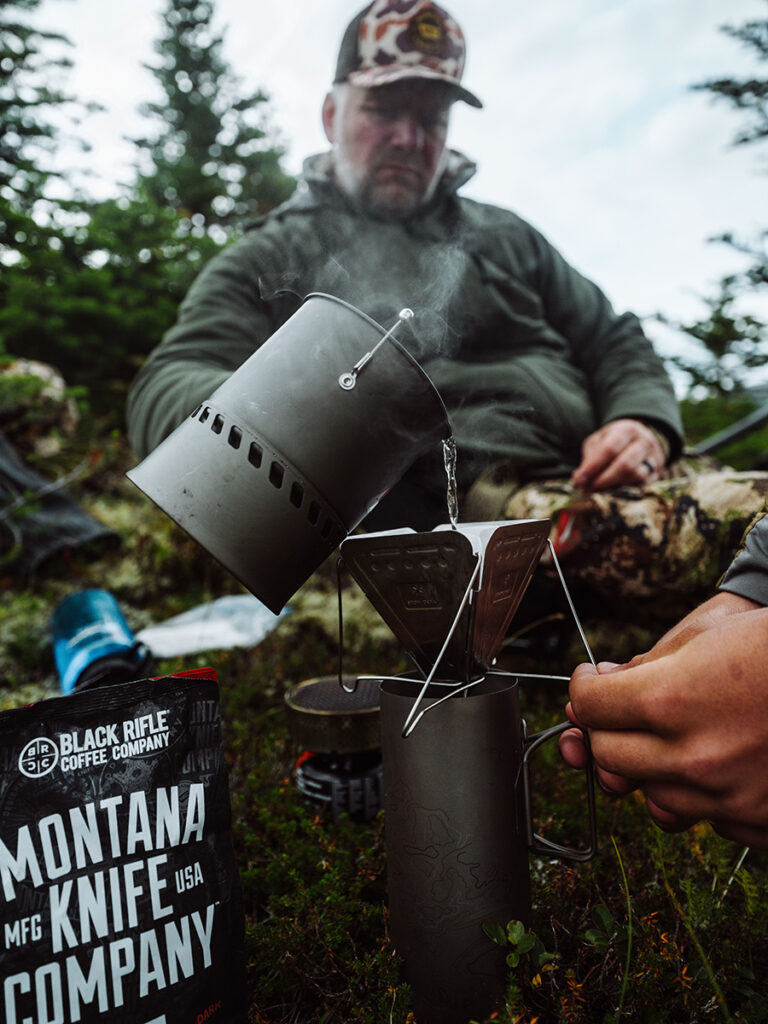
“Personally, I love coffee,” Josh emphasized. “For me, coffee and knives seem to be loved by so many blue-collar workers. Clearly, white-collar people drink coffee too. But I think back to my grandpa or my dad, and they always started the day with a cup of coffee before going off to work the ranch or in a backhoe. That same guy always had a knife in his pocket. The best place I’ve had Montana Knife Co. coffee is in northern British Columbia on a horseback moose hunt with my son [Hank]. For 10 days, it was rainy and cold. But each time we sat down to rest we made coffee with our jet boil. Hot, steaming coffee while freezing on a hunt tastes so good!”

Josh Smith (left) said the best place he’s had MKC coffee is in northern British Columbia on a horseback moose hunt with his son Hank (right). “For 10 days, it was rainy and cold,” he recalled. “But each time we sat down to rest we made coffee with our jet boil.”

Montana Knife Company offers its MKC X Black Rifle Coffee Signature Dark Roast in whole bean and ground 12-ounce bags.

For many consumers, the blend of the knife and the good cup of coffee just comes natural. Now, it’s easier than ever. Exploring the best in cutlery and coffee simply enriches the experience with both.

More On Knife Business:

10 Knifemaking Questions with Naked & Afraid’s Laura Zerra

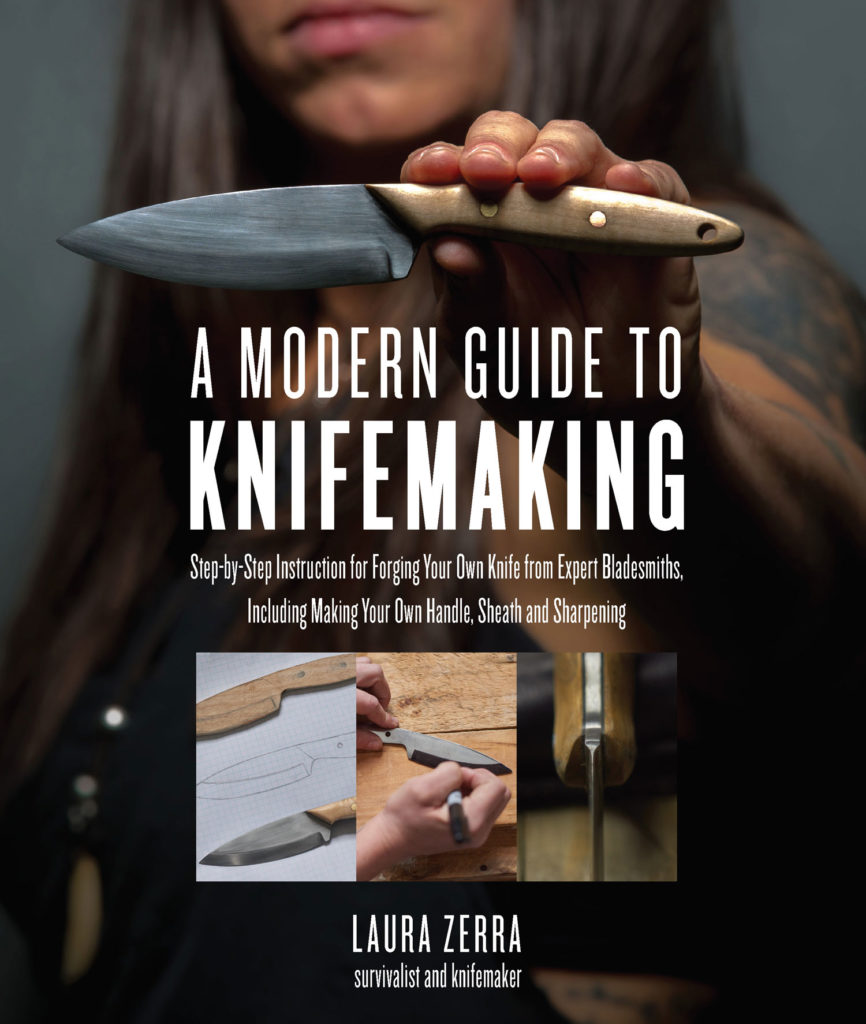
You may know Laura Zerra from her appearances on the Discovery Channel program, Naked & Afraid, or at BLADE Show. What you might not know is that she’s also an accomplished knifemaker with a book coming out July 3, 2018, titled, A Modern Guide to KnifemakingNo less than BLADE Magazine Cutlery-Hall-of-Fame® member Ken Onion, Kaila Cumings, and Mike Jones contributed to the tome.

Fresh from an extended stay in the wilderness, Zerra talked with BLADE about knifemaking, survival knives and the biggest mistake people new to knifemaking make.


BLADE: Most people know of you through Naked & Afraid. Did you get into knifemaking after appearing on that show or was this something you were always practicing?

LZ: I used to be a farrier, so I got my first introduction to knifemaking through blacksmithing. I used to mess around with steel in the forge, and that led to trying my hand at making knives. As a survivalist and outdoors person, I’ve always had a love for knives, and starting to make my own was a natural progression.

What spurred you to write your new book, A Modern Guide to Knifemaking?

I was working on outlining a survival book, and my editor saw that I’d just been at BLADE Show. We talked about the possibility of me writing a book on knifemaking. I’ve always loved knives, and have been in numerous situations where my life literally depended on my blade. I’ve also been humbled by all the legendary knifemakers I know, and I don’t have the expansive years of experience and talent that a lot of them do.

The thought of writing a book on knifemaking was really intimidating at first, but I realized that my perspective would allow to me to write a book that could really break it down for a beginner, and that my relationship with knives as a survivalist could offer some unique insight. Knifemaking is one of those skills that everyone does a little bit differently, so I wanted to interview some experts in the field and have them offer their two cents, as well.

How to make survival knives

Can someone with little knifemaking experience pick this up and go at it?

I wrote the book that I wish I’d had when I first started knifemaking. I wanted someone with absolutely no experience to be able to pick up my book and be able to make their first knife, from start to finish. While I do talk about what has worked for me in my experience, I think knifemaking is personal. I really wanted to encourage the reader to experiment with different processes as well as designs to develop their own style and find what works for them.

What’s your philosophy when it comes to knifemaking?

As a survivalist, first and foremost, my knives have to be functional and durable. A knife has to be able to complete the tasks I need it to, and I don’t want to have to worry about it breaking or losing an edge quickly when I’m depending on it for my survival. That being said, I don’t think that means it has to be unattractive; I think a functional knife can still be beautiful, and a skilled knifemaker can complete both these objectives.

Laura Zerra knives
Zerra says she prefers working with 1095.

What are your favorite steels to work with?

I like working with 1095 steel. I find it easy to move with a hammer, and it holds a great edge with a good heat treat. But I have to admit, I’m a sucker for damascus carbon steel. Well-made damascus really does well with that balance of function and beauty. I just love the moment of pulling it out of the etch and seeing how the pattern has played out on the steel.

What’s the biggest mistake people make when first starting out making knives?

I think the biggest mistake people make is not getting started at all. I’ve talked to so many people who have told me, “I’ve always wanted to make a knife!” but have never actually done it. Getting started can be intimidating for people, and that can be enough to prevent them from ever getting out there and doing it.

If I could tell people one thing, it would be to commit to doing it; not in a year, not when you have time, but right now. And don’t be scared of making mistakes. Mistakes are a natural part of getting into any new skill, and are an important part of the learning process; but you have to actually get out in the shop to start making them!

Laura Zerra knifemaker
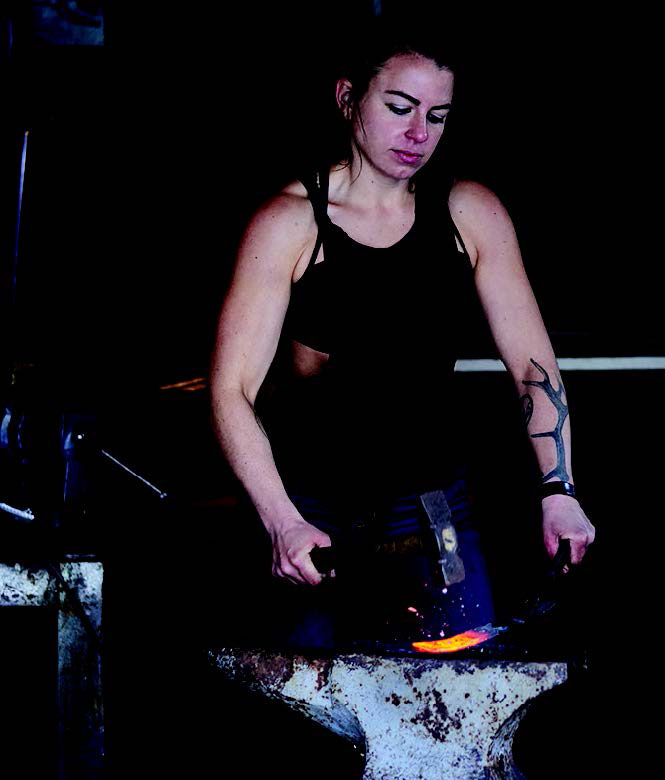
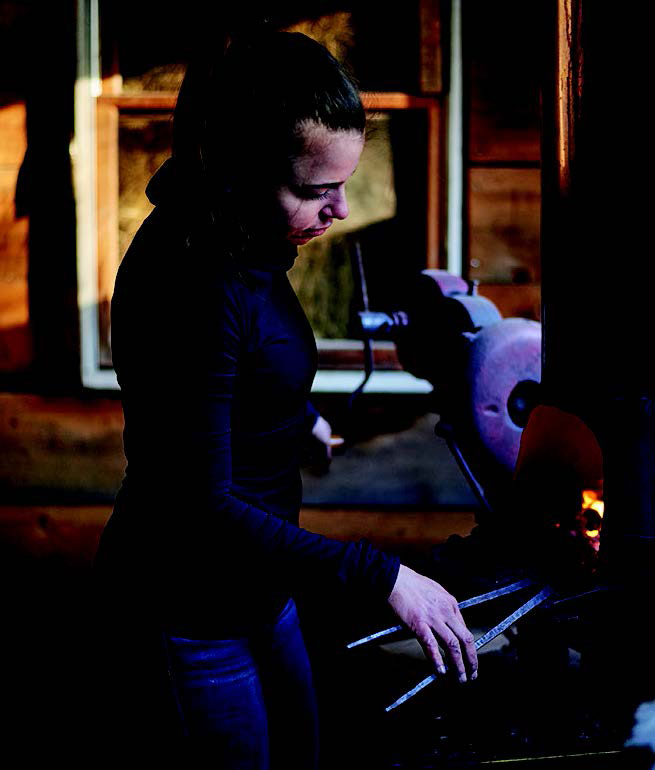
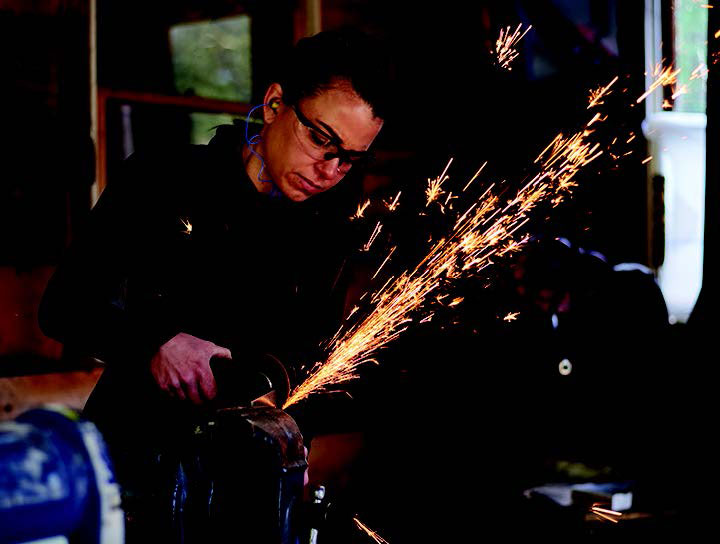
Laura Zerra, star of TV’s “Naked & Afraid,” at work in her shop. (all shop images provided by Laura Zerra)

Is there such a thing as a “survival knife” or are there only knives used for survival purposes?

I think the term “survival” is too broad to describe a specific type of knife. Where am I surviving? What’s the environment like? What tasks will I need my knife to perform?

Different circumstances will be best met with different qualities in a knife, from overall size and shape to steel choice to blade geometry. To try to make a “One Size Fits All” blade that will be the best tool for every survival situation seems like an impossible task.

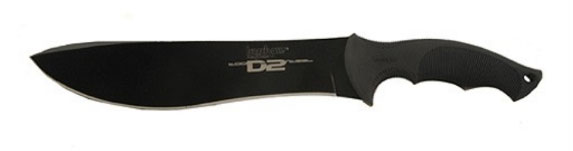
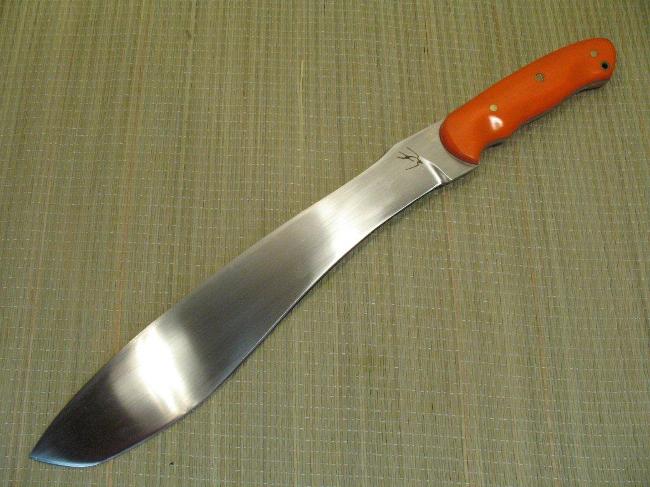
In seasons 1 and 2 of Naked & Afraid, you brought with you a Kershaw Outcast and a Diving Sparrow Mako Shark, respectively. Both of those sport big blades (10 inches and 11.25 inches). Is it safe to say that machetes are better than knives with smaller blades for survival purposes?


Kershaw Outcast
Kershaw Outcast

Mako Shark knife
Mako Shark

I brought those knives based on my location in the tropics. Both of those knives made easy work of cutting through a massive amount of palm leaves and opening coconuts. It’s a bit more difficult to carve trap parts or butcher meat, but it can still be done.

A machete can be used to complete more delicate tasks by changing the way you use the cutting edge; for example, when gutting small game, I hold the machete between my feet and move the animal across the blade instead of trying to move the big knife across the much smaller animal.

For jungle survival, I absolutely recommend a big blade because the of amount of material you’ll be chopping though. Put me in a desert or a deciduous forest, however, and I’m likely to bring a smaller blade; it just depends.

What’s your take on survival knives versus survival multi-tools (those 31-in-1 sorts of things)? Are those multi-tools any better than a knife that’s just a knife?

I prefer a simple knife. A multi-tool has its place in urban survival and everyday use, but I find all those extra tools and edges can limit the use of your blade and get in the way. As a primitive survivalist, I’m used to improvising with what I have so maybe that’s part of it. I know people who love multi-tools, so I guess it’s personal preference.

Laura Zerra knifemaker
Careful around the grinder, warns Zerra.

In the name of safety, we run a series on blademag.com about knifemakers’ worst accidents in the shop (so that no one else repeats the same mistakes). Have you ever had an accident in the shop? What did you do differently the next time around?

Yup! When I first started using the grinder, I ground a big notch out of one of my fingers. It took a minute to start bleeding, but then it gushed for quite awhile. I had to quit for the day, because my hands were so slippery from my own blood that I couldn’t hold the blade anymore.

It definitely gave me respect for the grinder, and I was more aware of the fact that the belt removes flesh much faster than steel. I also had a shirt catch on fire from hot steel dust gathering in a fold. I’d love to tell you that I wear a leather apron now but I’d be lying.

Keep up with Laura Zerra on Twitter, Instagram, Facebook and her website.


You Never Know Who You’ll Meet at BLADE Show

Laura Zerra is just one of the celebrities who have attended BLADE Show. The 2018 version takes place June 1 to 3 in Atlanta. Buy tickets and find information here.

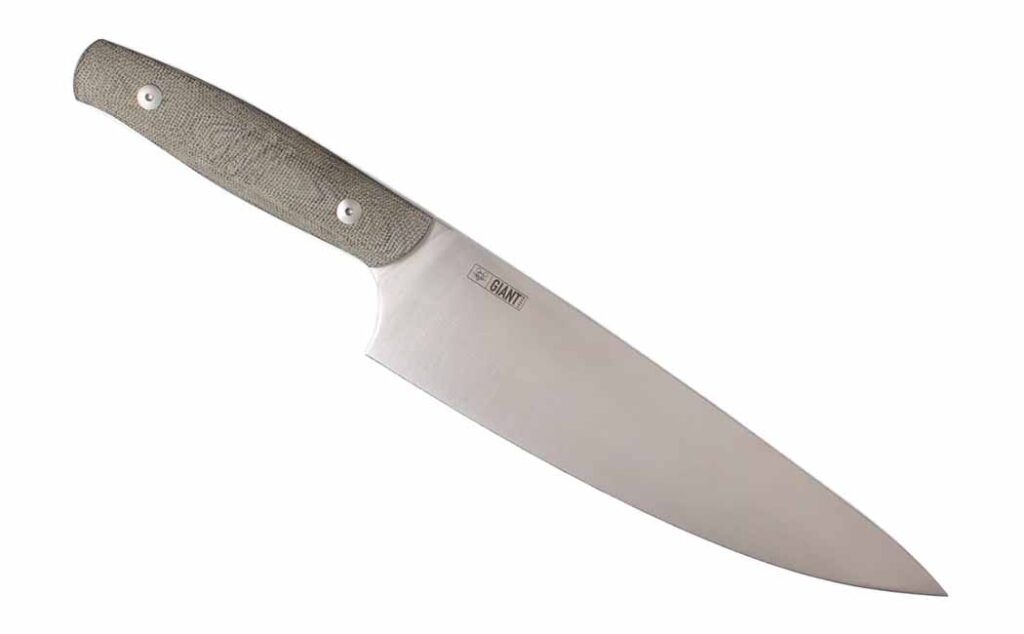
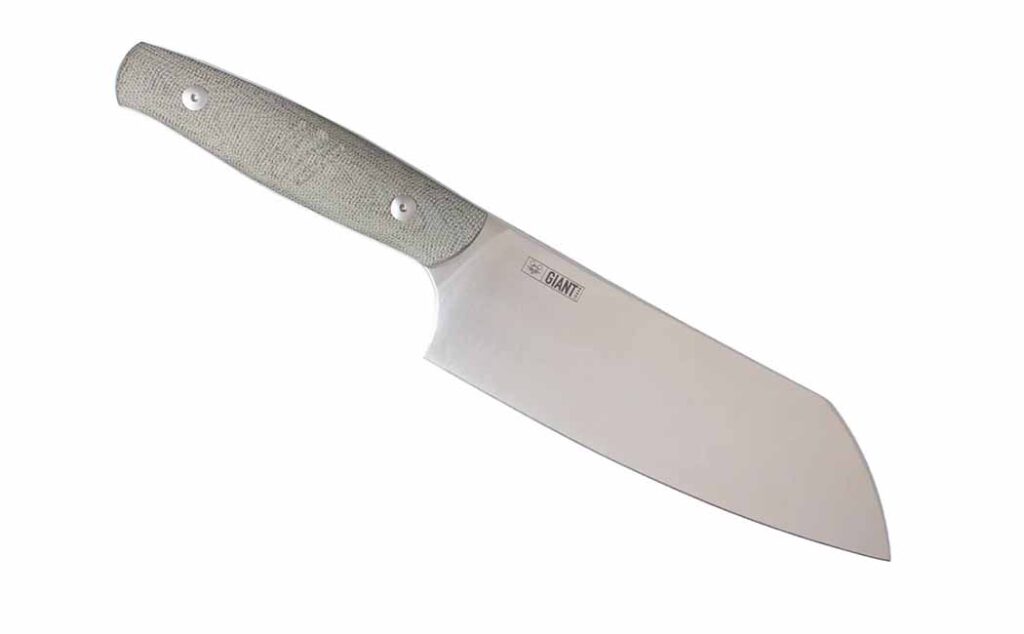
GiantMouse Kitchen Knives: Cooking Up Something New

GiantMouse takes a stab at the culinary world with a kitchen knife line.

EDC knives of a variety of stripes have been GiantMouse’s bread and butter, helping the Danish-design concern kick a solid toehold into the knife industry. This success somewhat culminated earlier this month in Atlanta, with the company’s GMX earning Knife-Of-The-Year® accolades at the 2023 BLADE Show. This trophy in hand is a pretty good indicator you’re doing things right. But, GiantMouse is far from living off past achievements.

In fact, it has a new vista in sight—kitchen knives.

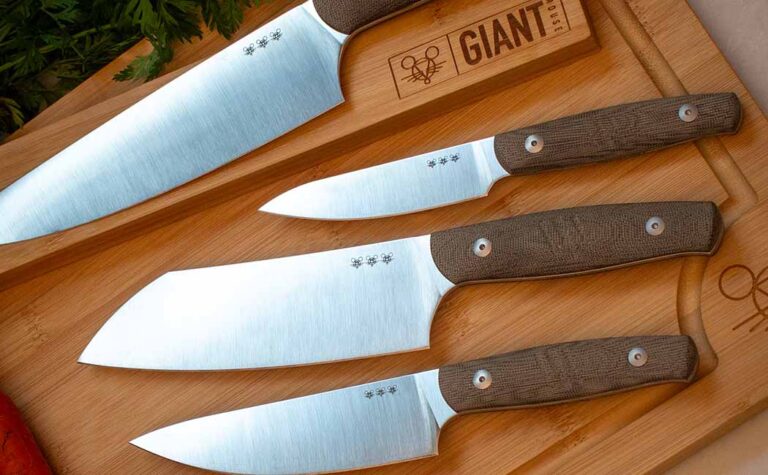
Following a well-trod recent trend in knife manufacturing, GiantMouse is dipping its toe into the culinary end of the pool with the introduction of four kitchen knives. While this drop might prove unexpected to some, the expansion is something the company said has been in the works for nearly two years now. At least, that’s been the personal testing period of designers Jens Ansø and Jesper Voxnaes (Vox), refining the minutia of the knives. So, how did it shake out?

At first blush—and without a knife-in-hand, tomato-dicing torture test—not too shabby. The four-knife line appears attractively utilitarian, nice enough to show off along with your next dinner party. But the knives aren’t so pretty as to scare you off from actually using them in your day-to-day culinary adventures. At arm’s length, it’s difficult to discuss ergonomics, balance and performance. However, GiantMouse doesn’t appear to have to broken any of the major kitchen-knife rules, attempting to displace function for novel form. Though, the slightly hooking heel on the larger knives might prove a sore point—pun intended—for some.

The line, at present, includes:

  • Santoku
  • Chef
  • Carving
  • Paring
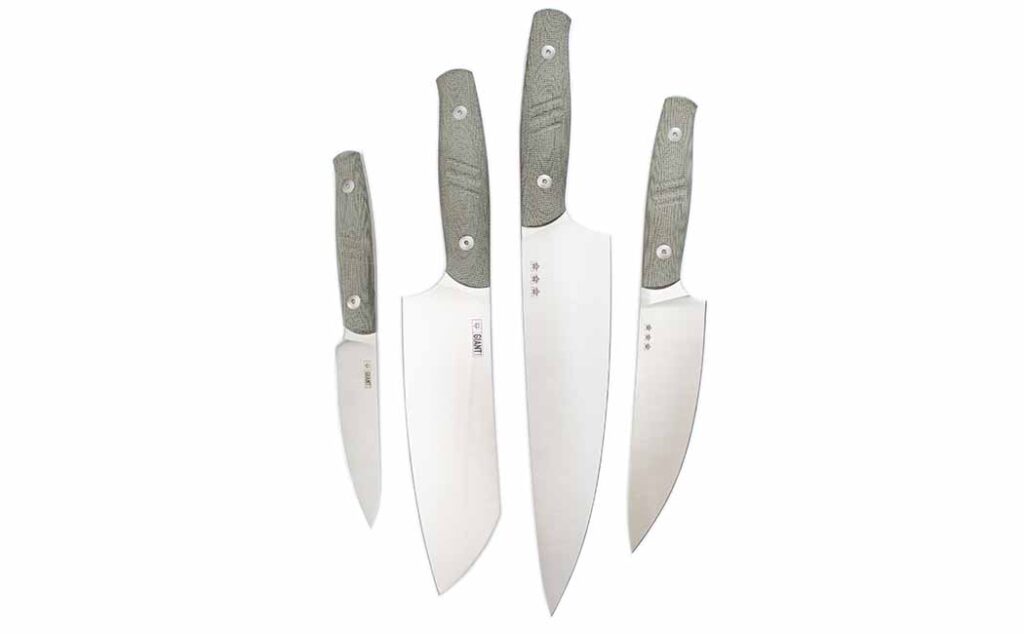
GiantMouse Kitchen Knives in a line

Essentially, GiantMouse has homed in on the basic food prep tools every kitchen requires. The knives are sold individually and as a set; there’s a branded bamboo magnetic knife bar available, as well. And, in the company’s announcement, it certainly sounds as if it has designs to continue expanding into more corners of the culinary arts. No hint on what that might include.

As to the Italian-made knives themselves, GiantMouse has opted for Nitro-B for the blade steel and given them an unstated satin finish. Having grown in popularity in recent years, high-nitrogen steel (.21% in the case of Nitro-B) has spurred its share of debates as well. Sufficed to say, it should thrive in a kitchen environment if for no other reason than its corrosion resistance. To top it off, the blades are stamped with a tirade of the company’s murine logo—jaunty, to say the least.

To this, the company has outfitted the knives with green micarta handles, which should prove popular. Generally providing an excellent gripping surface, even when wet, GiantMouse has further enhanced it with a run of three serrations at the midpoint to provide a bit more purchase.

As for price, expect to drop $95 to get into GiantMouse’s paring knife at the low end and $175 for the chef or santoku at the high end.

GiantMouse Kitchen Knives Specs:

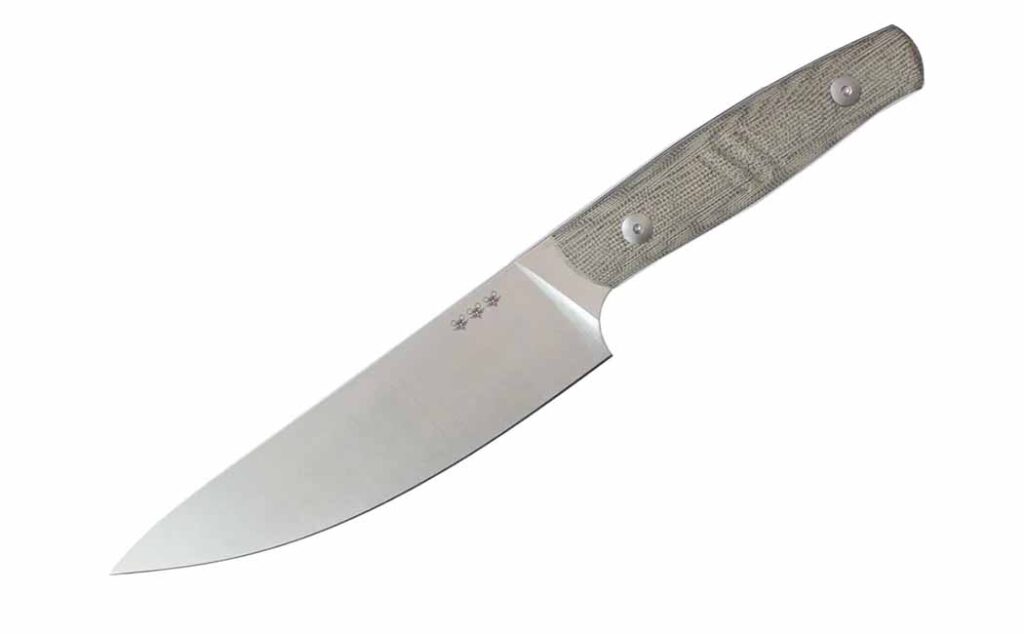
GiantMouse Chef Knife


Chef Knife
Blade Length: 8.375″ (212.725mm)
Weight: 6.9oz (195.612g)
Overall Length: 13.125″ (333.4mm)
Steel: Nitro B
Blade Thickness: .1125″ (2.875mm)
Finish: Satin
Handle: Green Micarta
MSRP: $175

GiantMouse Santoku

Santoku
Blade Length: 6.75″ (171.45mm)
Weight: 6.8oz (192.777g)
Overall Length: 11.4″ (289.56mm)
Steel: Nitro B
Blade Thickness: .1125″ (2.875mm)
Finish: Satin
Handle: Green Micarta
MSRP: $175

GiantMouse Carving Knife

Carving Knife
Blade Length: 5.58″ (141.732mm)
Weight: 4.6oz (130.408g)
Overall Length: 9.75″ (247.65mm)
Steel: Nitro B
Blade Thickness: .116″ (2.87mm)
Finish: Satin
Handle: Green Micarta
MSRP: $125

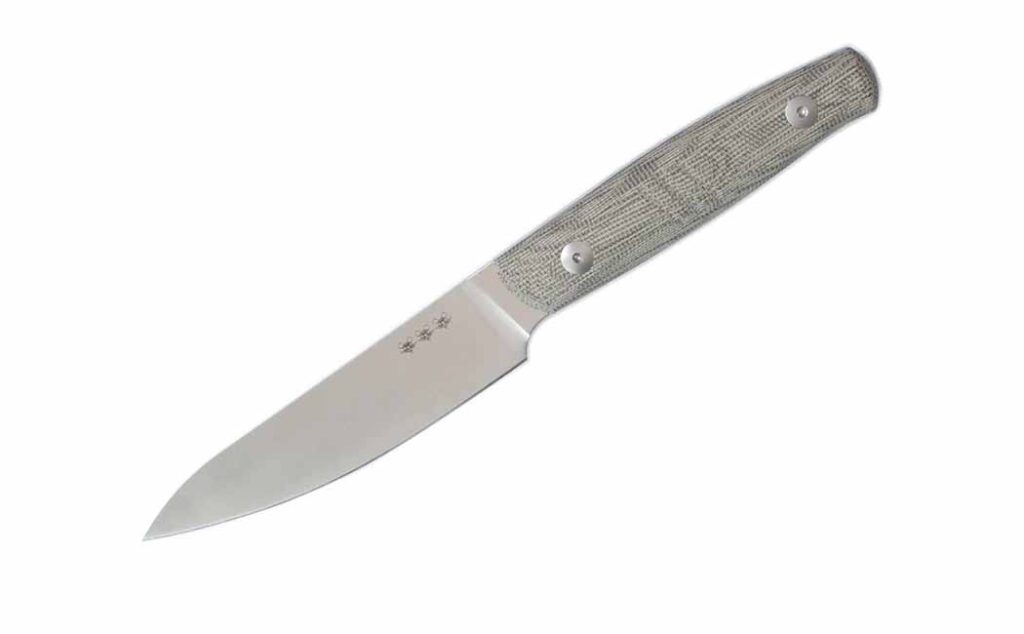
GiantMouse Paring Knife

Paring Knife
Blade Length: 4.2″ (106.68mm)
Weight: 2.6oz (73.708g)
Overall Length: 8.250″ (209.55mm)
Steel: Nitro B
Blade Thickness: 0.0675″ (1.71mm)
Finish: Satin
Handle: Green Micarta
MSRP: $95

Read More

How to Make a Flipper Folding Knife

make a folder knife
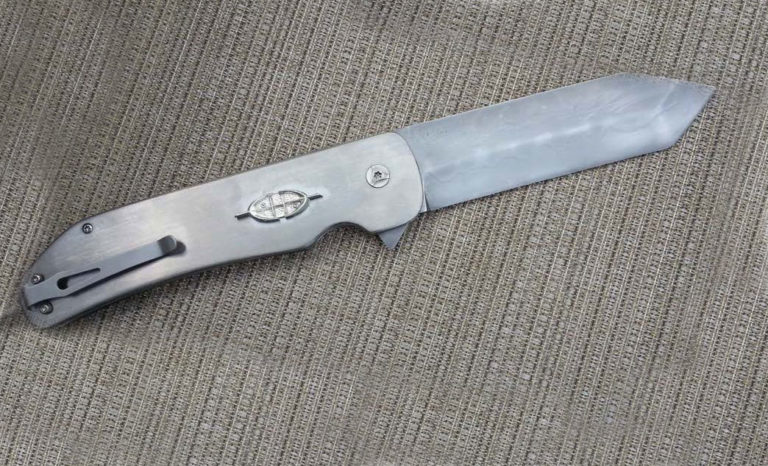
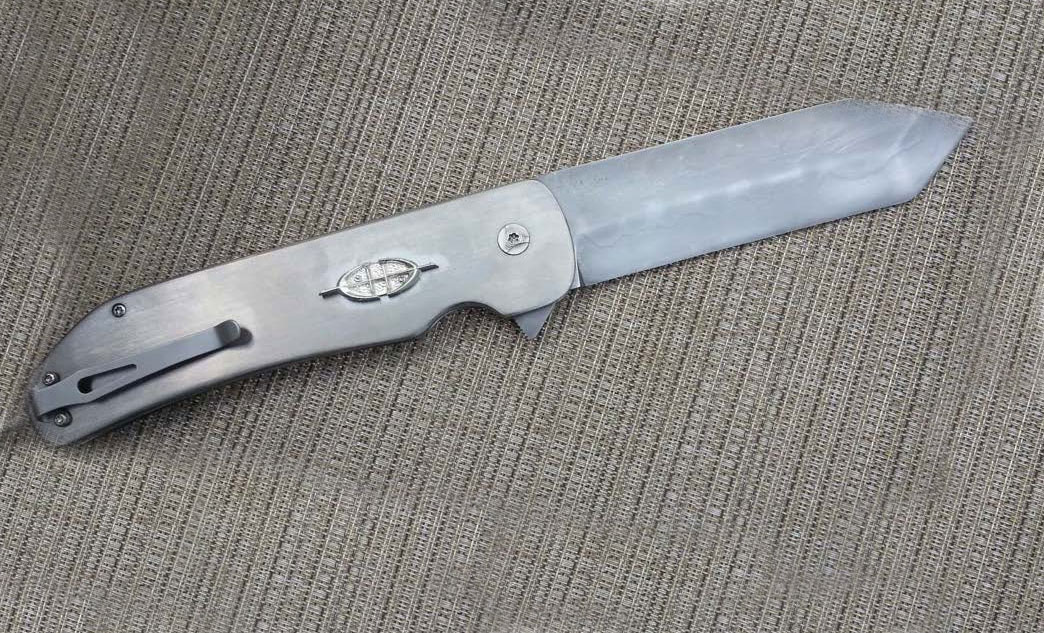
The author’s finished flipper folder—sanded, polished and ready to go!

Folder making has advanced so much in the past few years. Now, flipper folders are the hot new ticket.

Following is an overview of the steps in making a modern flipper by hand.

Draw It Up

how to design a knife
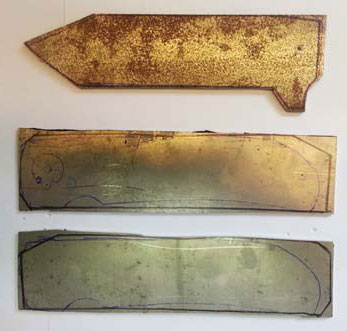
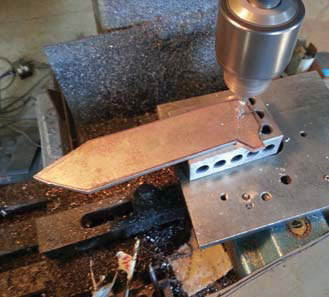
The parts are all cut out. The holes in one handle side (center) are center punched and ready to drill.

knifemaking tips
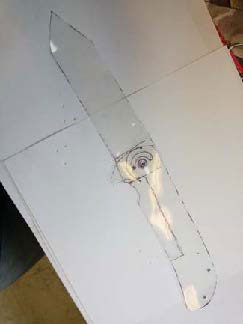
Design the knife parts on clear plastic so you can see where to locate everything.

To begin, draw designs on paper and transfer them to clear plastic. Cut out the designs of the blade and handle from the clear plastic. Overlap the tang of the blade on the handle and insert a needle through both pieces where the pivot pin will be.

From there, fold the blade onto the handle and adjust the design as needed.

Next, trace around the plastic handle on a titanium sheet. I use titanium in a 1/8-inch size for the top part of the handle and .070 inch for the two bottom pieces. Trace the blade and cut it out.

Know the Drill

drill knife blade
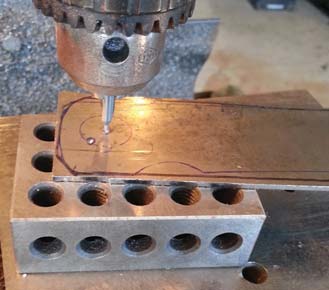
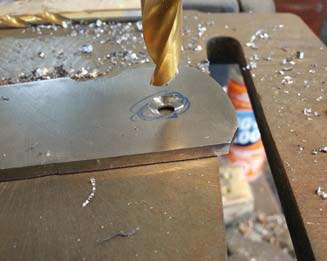
Counter sink all the holes a small amount before drilling them with the 1/16-inch drill bit.

Making folders is mostly about drilling holes. Drill out one plate of titanium with 1/16-inch holes. Place another plate of titanium underneath the drilled-out plate and clamp the two together. Turn it over and drill through the second plate.

Starting with the pivot hole, place a ½x1/16-inch hardened dowel pin in it so the two plates won’t move. Next, drill the end of the handle and put a pin in it.

Continue drilling, clamping and adding pins where your stand-offs go. Each time you drill a hole, take the plates apart and de-burr. A hand drill with a four-flute counter-sink is handy for de-burring.

drill knives
Start drilling all the holes with a 1/16-inch drill bit.

This flipper will have an internal stop pin, so don’t drill all the way through the top plate. However, do drill through the bottom plate—the .070-inch one. From here, affix the plates with 1/16-inch dowel pins. Clamp, remove the pivot pin, and drill and ream to 3/16 inch for the pivot pin. De-burr and reassemble. Drill and ream a 1/8-inch stop pin.

CAUTION: Do not go all the way through the top 1/8-inch plate! Countersink the outside plates for the 2-56 screw heads. I use a #20 drill bit for this.

Pivot, Washers & Pins

make a flipper knife
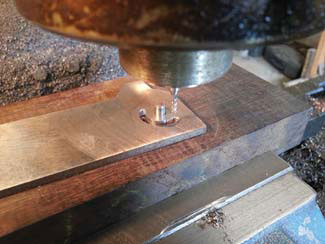
Mill the slot for the stop pin.

Now it’s time to countersink the two pivot screws. Different types of spacers and stand-offs can be used on a folder. For this flipper I used ones with shoulders from Knifekits.com. Normally I use custom-made stand-offs from Sheffield Knifemakers Supply. The shouldered step-down stand-offs prevent any unwanted movement in the blade.

I open up the holes for the stand-offs to fit in with a 1/8-inch reamer. Actually, I use a reamer .001 inch larger, so it is .126 inch.

The cool new thing with folders is pivot washers with ball bearings. There are many different types from which to choose. Michael Burch recommended washers from Jantz Supply to me at BLADE Show.

bladesmithing tips
Countersink the pivot screws.

You have to sink the washers down into the scales a bit. I use a 3/8-inch, four-fluted end mill to do this step. First, I index a 3/16-inch end mill into a hole on a plate of steel held in a mill vise. I lock down my table and take out the 3/16-inch end mill and put in the 3/8-inch one using a dial indicator to show how far down I am drilling.

Most tactical folders are going pretty thick with washers .020-to-.040-inch on each side of the blade. I sink the washers down so they and the blade are the same thickness as the stand-offs. You want the space between the blade and washer to be equal to the space between the stand-off s or spacer material. Drill and ream a 3/16-inch pivot hole in the blade. Mill a half-moon slot for the 1/8-inch stop pin.

Many makers put the pin in the handle at about the 7 o’clock position when open. Grind the pivot and stop pins down to the proper length. (Author’s note: Grind the pivot pin so it is not exposed past the top of the countersunk hole of the pivot screw. Grind the stop pin so it floats between the two scales.) Grind the 2-56 screws down so they don’t touch each other when they’re screwed into the stand-offs.

Profile the blade and grind the tang at a 7-degree angle. I use a 7-degree block of Micarta® held up against my disc grinder for a guide.

Lock & Detent

knife grinding tips
Grind the tang to fit the lock.

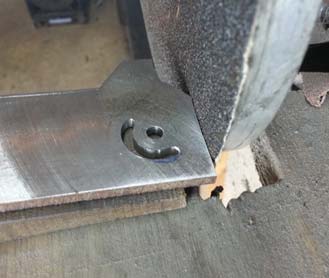
Now it’s time to cut the lock. Place the blade on the bottom liner with the pivot and stop pins in place. Open the blade and scribe a line with an X-acto™ Knife behind the tang onto the liner. Draw a line 3 inches long with a marker down the scale. Clamp in the mill, and, using a slitting saw, cut the 3-inch length. Use a band saw to cut the short face, which will be the lock. Using a cut-off -wheel attachment in a Dremel® Tool, clean up the end of the lock.

On a locking-liner or flipper folder, the lock is made by bending a tab of the titanium liner over so it engages with the end of the tang of the blade. The end of this tab must be coated with carbide. The machine that does this is a little hand-held micro welder and is called a carburizer. Simply run the rod onto the end of the titanium lock and it welds a coating of carbide onto the titanium. This produces a smoother action on the folder.

You can also flame harden the lock by heating it until it turns orange. In order to let the lockbar bend, grind in a .020-inch dent with a ¾-inch wheel at the other end of the lock.

It’s time to drill holes in the lock and blade for the 1/16-inch detent ball. Center punch a hole in the middle of the lock. Drill through with a #54 drill bit.

Close the folder and clamp it closed. Drill through the same hole as the liner into the blade about .060-inch deep. The #54 drill bit is .053 inch. You can also use a .054- or .055-inch drill bit depending on how you want to tune your folder. Grind, heat treat and polish the blade. Press the 1/16-inch ball bearing into the lock. The height left remaining of the ball bearing should equal the thickness of the washer.

Bend the lock over to about the middle of the folder. Now grind the tang at 7 degrees on a disc grinder until the lock starts to grab. You can assemble the folder, hold it up to the light and push the lock away from the knife to see how much more you have to grind the tang. Go slow and grind just a little before checking the lock. Drill and tap the scale for the pocket clip.

Sand & Polish

Finally, sand and polish everything. I also polish the ends of the screws. After assembling the folder, tighten the bottom pivot screw and adjust the tightness of the folder action with the top screw. Use Loctite© glue on all the screws.

Now Make Another Knife with These Books

tips for making knives

Advertisement

Must Read Articles

Read this before you make a knife

Knifemaking 101 – Read This Before You Make a Knife

  by Wayne Goddard My experience has taught me that there's nothing like digging in and getting started. I've often said the hardest part of the...
how to forge damascus steel

How to Forge Damascus

Advertisement
Advertisement