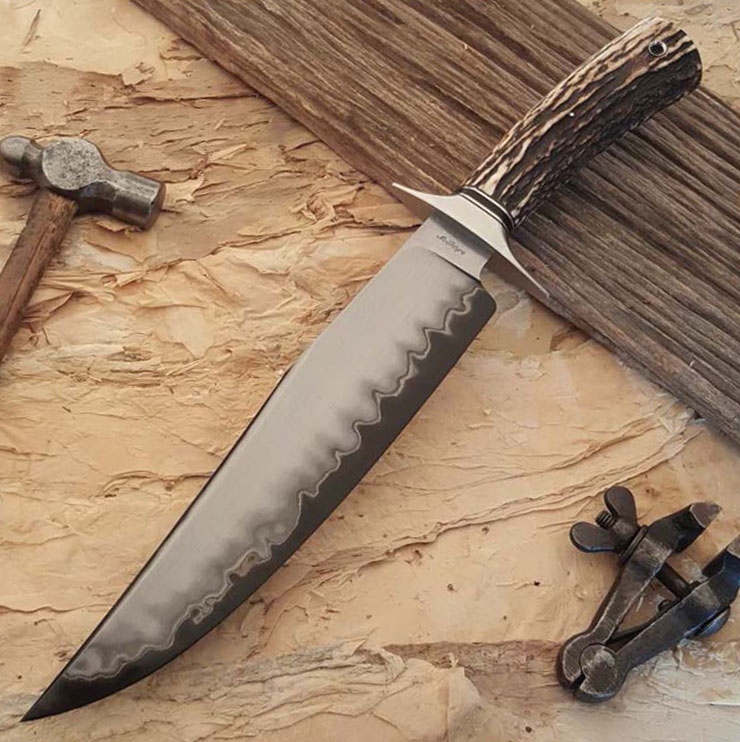
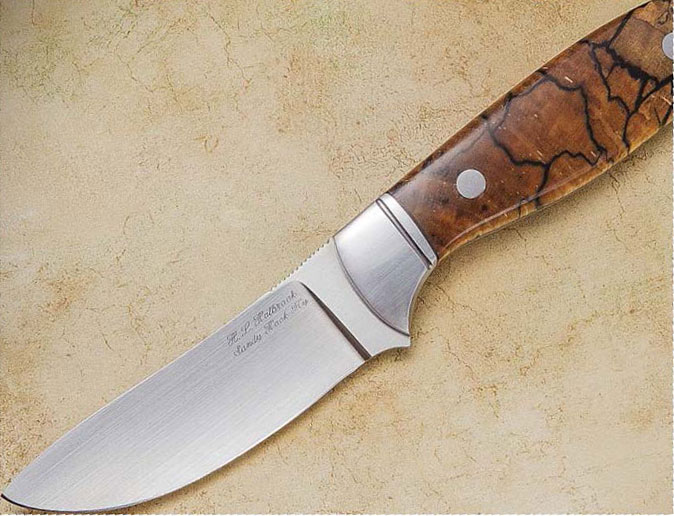
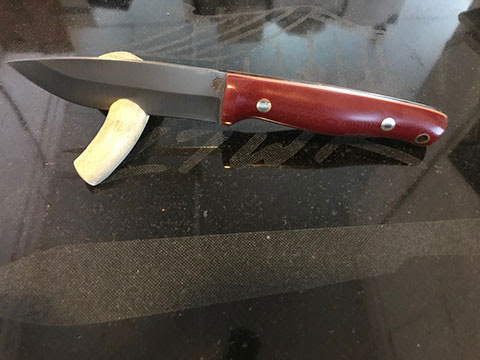
The gentle rise of the tip area of the blade is the classic sign of a skinner—or in this instance, the Semi Skinner #2 by H.L. Holbrook. The 3.5-inch blade is CPM 154 stainless and the handle is stabilized maple. Overall length: 8 inches. Contact H.L. Holbrook, Dept. BL3, POB 483, Sandy Hook, KY 41171 606-794-1497. (Chuck Ward image)
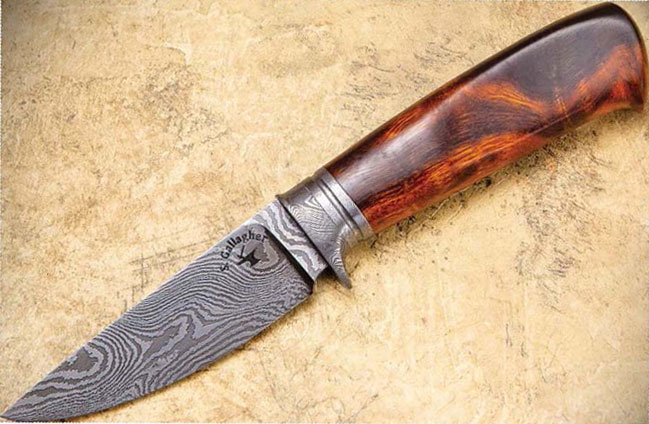
Scott Gallagher employs a 3-inch damascus blade, a damascus single guard and a handle of Arizona ironwood for his hunter. Overall length: 6.5 inches. Contact Scott Gallagher, Dept. BL3, 335 Winsten Manor Rd., Santa Rosa Beach, FL 32459 850-865-8264. (Chuck Ward image)
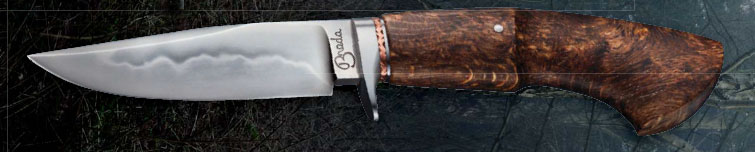
A 4-inch clip-point blade of W2 tool steel with hamon and a spalted sycamore handle and fileworked copper spacer distinguish Ben Breda’s hunter. Overall length: 9 inches. Contact Ben Breda, Dept. BL3, 56 Blueberry Hill Rd., Hope, ME 04847 [email protected]. (Caleb Royer image)
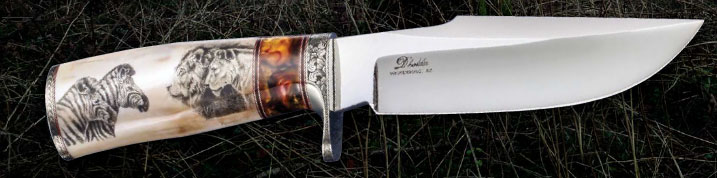
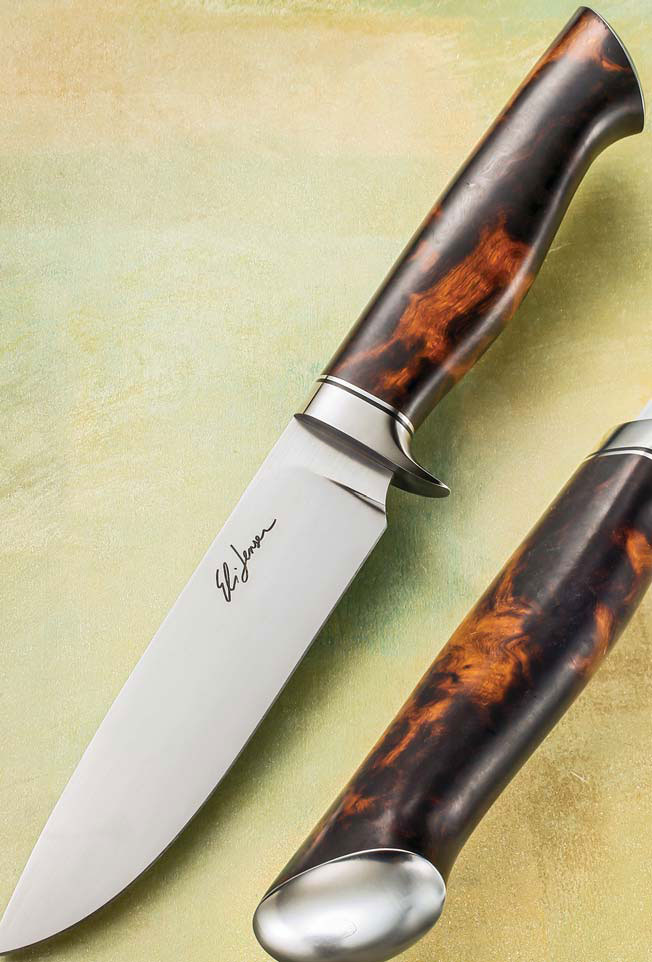
A gorgeous Arizona ironwood handle with a domed/curved 416 stainless steel butt plate and G-10 spacer, and a 5.75-inch blade of 1084 carbon steel help complete Eli Jensen’s Forester MKII hunting knife. Overall length: 10.75 inches. Contact Eli Jensen, Dept. BL3, 2840 W. Dreamscape Way, Chino Valley, AZ 86323 928-606-0373 [email protected], Facebook/Instagram: Eli Jensen. (Sharp-ByCoop image)
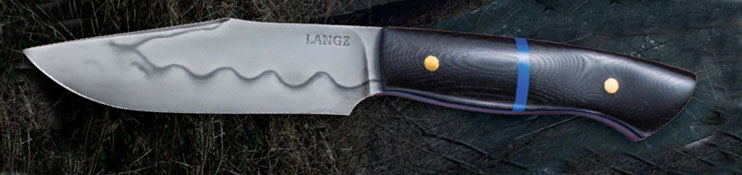
Kenneth Lange received an order for this hunter by a family friend whose husband is celebrating 10 years on the police force—thus the thin blue line on the black G-10 handle. The 4.5-inch blade is 1095 carbon steel. Overall length: 9 inches. Contact Kenneth Lange, Dept. BL3, 1200 County Road 5711, LaCoste, TX 78039 210-218-9415 [email protected], Facebook/Instagram: kjl_handmadegoods KJLhandmadegoods. (SharpByCoop image)
Phil Jacob took home the Best New Maker award from BLADE Show 2017, which is as good as it gets for someone getting started in knifemaking. The achievement is also good news for knife collectors looking for a guiding light for their collections. “Best New Maker” translates to “best new opportunity” for ROIs on investment.
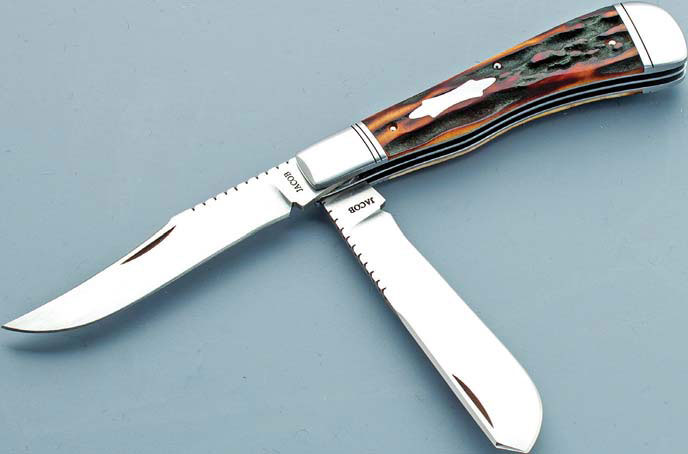
Jacob, who calls Kansas home, specializes in slip joint folders. The addition of exotic handle materials and attention to detail offset any cliches about this traditional style. Just take a look at the double-bladed trapper that made waves at BLADE Show.
Specs:
Blade lengths: 3.125”
Blade steel: CPM 154 stainless
Handle: Stag dyed amber
Folding mechanism: Slip joint
Weight: 5.1 oz
Closed length: 4.5”
Maker’s list price for a similar knife: $875 to $1,100
Jacob maintains a healthy social media presence, which is another benefit to collectors interested in a commission or a resale. His Facebook page is full of status updates and photos.
People Who Like to be Prepared Will Love the latest EDC Tools
Knife guys love gadgets, fix-it people love gadgets and DIY-ers love gadgets, so it’s easy to see why multi-tools do so well in the knife market. Though not knives per se, they off er more versatility than just cutting ability by offering on-board tools. With broader appeal than knives, multi-tools have a further reach and encompass more markets, too. They appeal to folks who like to be prepared.In addition to DIY-ers, campers, hunters, fishermen, hikers, mountain bikers and anyone who enjoys outdoor activities benefits from owning and using a multi-tool. It performs in-fi eld repairs on equipment when you do not have access to regular tools. It can mean the difference between bowing out of a camping trip because of equipment failure, or performing an expedient in-field repair or adjustment and carrying on with your adventure. As with knives, advances in multi-tools have made them stronger and more user friendly and versatile.
FLASH in the HAND: Coast’s LED150 multi-tool
When you think of multi-tools, what immediately comes to mind is a pliers-based tool with little fold-out implements nestled inside the handle. Truth is, multi-tools can take on any form as long as they incorporate the implements necessary for field-expedient repairs and adjustments.
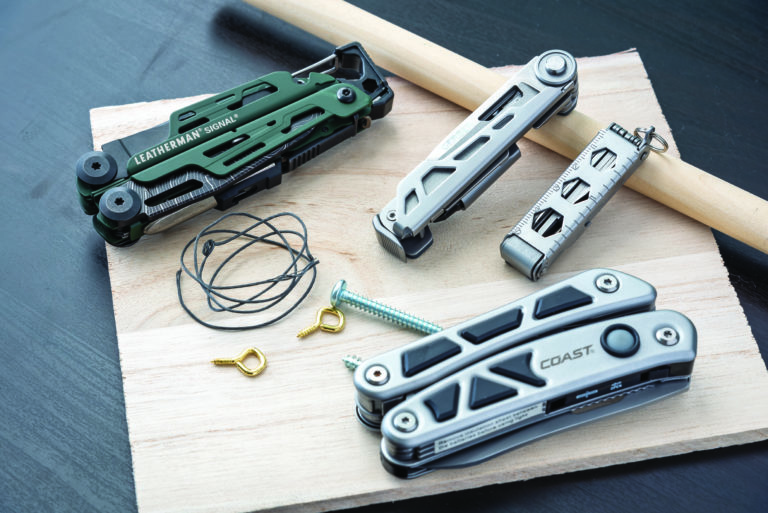
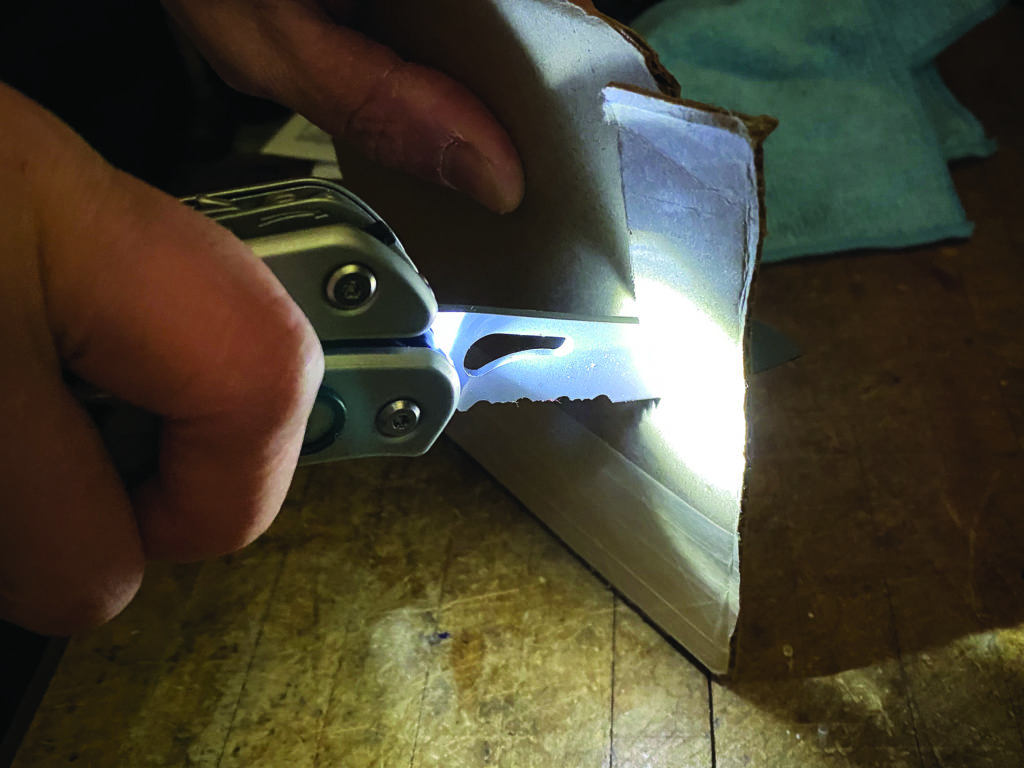
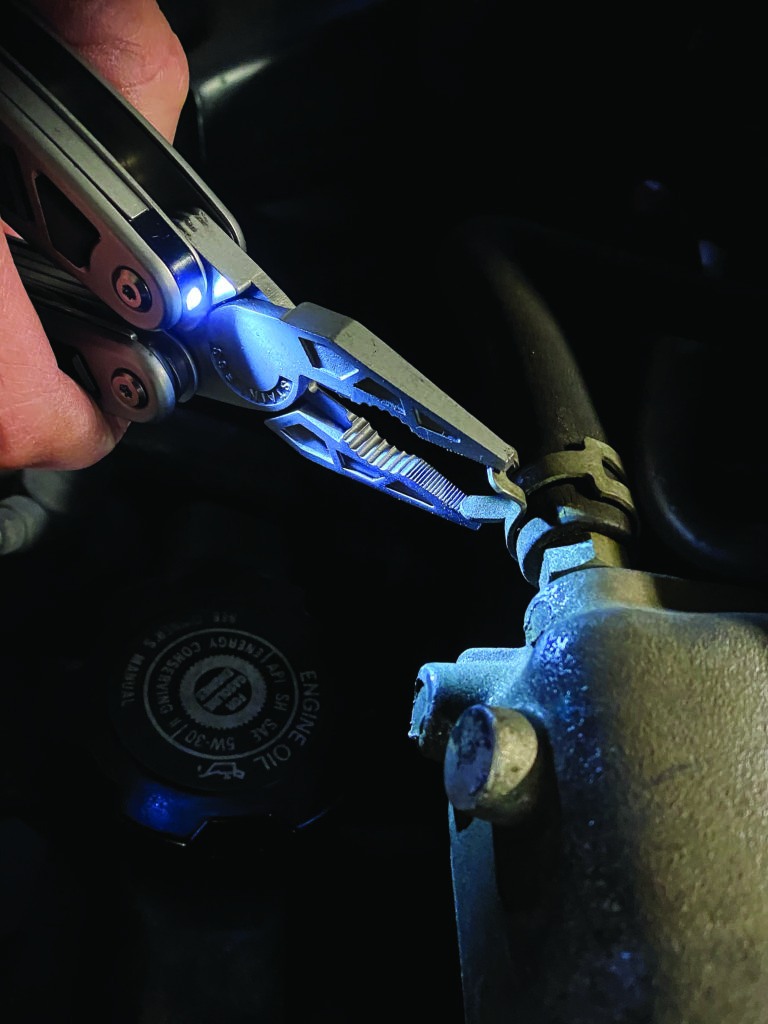
At first glance, Coast’s LED150 multi-tool might appear like any other pliers-based multi-tool, except for one thing: it incorporates not one but two LED lights. One LED is on the pliers jaw end and the other is on the partially serrated end of the knife blade. This way, you can confidently work in tight and dark spaces with confidence thanks to the illumination. The lights are activated by a recessed push button located on one side of the handle. Press once to activate the light by the main blade. Press again and the light turns off and, at the same time, the light on the pliers jaws end turns on. Press again and the jaws light turns off. With the multi-tool closed, you can use either light as a stand-alone flashlight, further expanding the multi-tool’s versatility. The lights are powered by two CR1616 lithium button batteries. The batteries replace easily.
The light on the end of the Coast LED150’s handle illuminates what you’re cutting.
The pliers jaws have different gripping surfaces for smaller objects and larger nuts/round objects. The jaws themselves are spring loaded, which helps to open them by spring tension, reducing hand fatigue. When closed, all the fold-out tools are easily accessible: a partially serrated main blade that works on a linerlock, spring-loaded scissors, large and small flat-head screwdrivers, can opener, Phillips head screwdriver and the pliers jaws—most all the common implements necessary for field repairs and adjustments.
The handles are aluminum and feature raised hard rubber for a non-slip grip. The LED150 has a good heft and the heavy-duty build will withstand normal use. The sturdy ballistic nylon belt pouch has a fabric-fastener flap closure. Manufacturer’s suggested retail price (MSRP): $49.
One of the LED lights on Coast’s LED150 multi-tool shines on the pliers jaws end so you can effectively work in dark areas easily without the need for a separate flashlight.
AFFORDABLE SOLUTION: Gerber’s Armbar
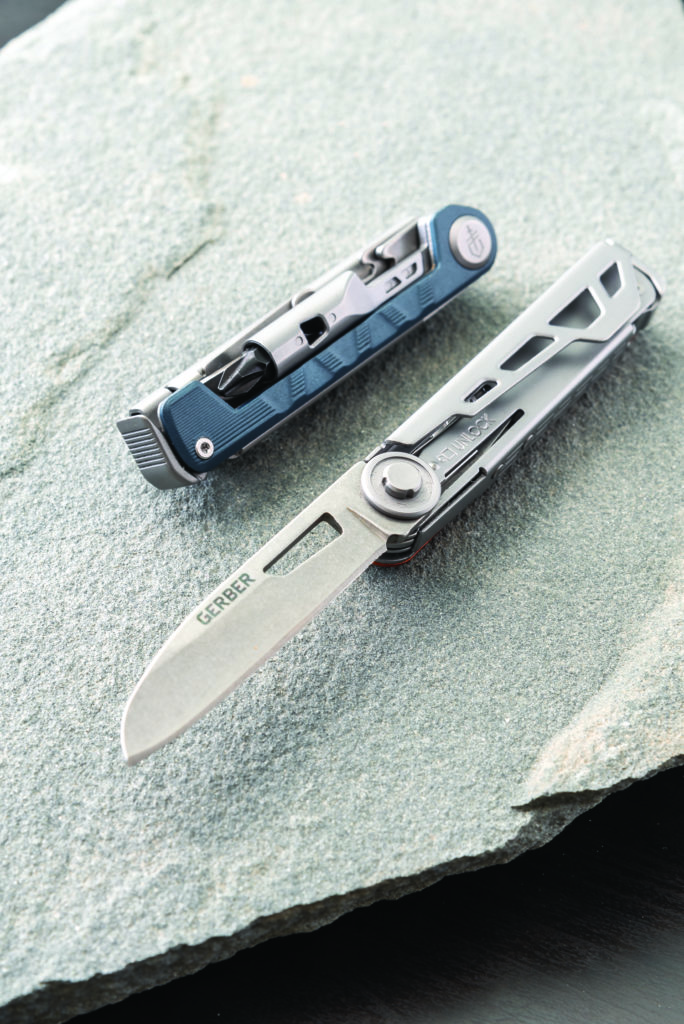
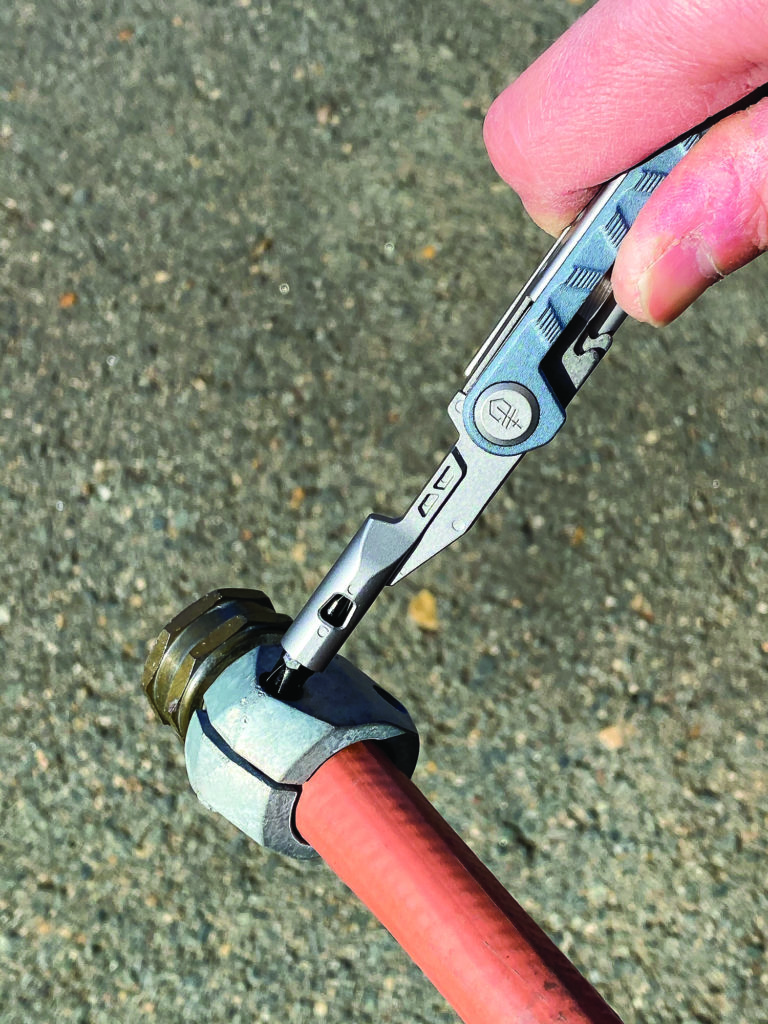
Gerber’s Armbar series incorporates the fold-out implements of pliers-based multi-tools like the Coast LED150—minus the pliers. Sometimes, you just need the versatility of screwdrivers, a knife blade and scissors. About the same size as a large multi-blade pocketknife, the Armbar Drive features seven on-board fold-out tools: 2.5-inch plain edge sheepsfoot blade with opening hole and framelock, 2.5-inch extension driver with a double-sided bit of Phillips and flat-head screwdrivers, a prybar, bottle opener, hammer, scissors and awl.
The Gerber Armbar Drive features a sturdy main blade. The entire package has about the same dimensions as a medium-sized traditional pocketknife.
The extension driver has a magnet that holds the double-sided bit and allows for fast flip-over when transitioning to different screws. The driver socket can accept aftermarket quarter-inch drive bits, too. Hence, you can customize your Armbar Drive just about any way to fit your tasks. The spring-loaded scissors provide enough blade length for cutting coupons, stray threads and duct tape. The plain edge sheepsfoot blade thumbs open easily like any lock blade. The blade is mostly exposed even when closed, but the metal channel protects it from damage and you from accidental cuts.
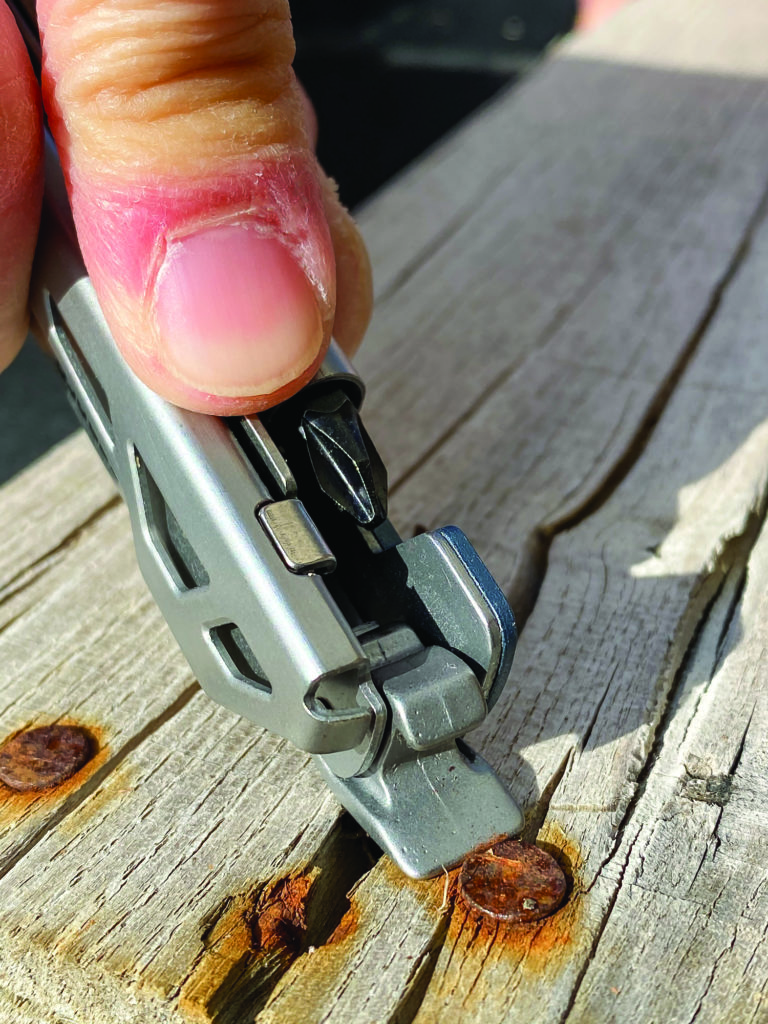
Perhaps the neatest implement is the combination hammer/prybar/bottle open-
er, which in the closed position is in the hammer mode by default. The squared-off back end takes care of light hammering. The prybar function is rather limited as you’re not going to get a ton of leverage. However, if you need staples removed or to pry open a casing and such, it does the job.
A fold-out prybar/bottle opener on the Gerber Armbar Drive performs light-duty prying when needed, saving the blade tips on your standard knives.
One thing I wish Gerber would have included is the ability to lock the screwdriver in the fully open as well as the 90-degree position. When you torque down with the driver, your hand may move and this will cause the screwdriver to fold a bit. Also, when you use the tool in the 90-degree position, you apply more torque. Having it lock in the 90-degree position would make it easier to use—if not lock in both positions, then a strong detent and a half stop, like a slip joint, would be better than nothing. The form factor permits easy carry in your pocket, toolbox, glove box or a backpack.
At 3.1 ounces the smallest multi-tool in the Armbar line, it comes in an aluminum handle anodized in a choice of urban blue, orange or onyx. With an MSRP of $39, it presents an affordable solution to a typical pliers-based multi-tool by reducing bulk and weight—that is, if you don’t need pliers.
The screwdriver tool on the Gerber Armbar Drive is easy to manipulate. The magnetic socket allows you to flip the double-end bit over, as well as use most any aftermarket quarter-inch driver bit.
TINY TOOLBOX: Utica Minimaster
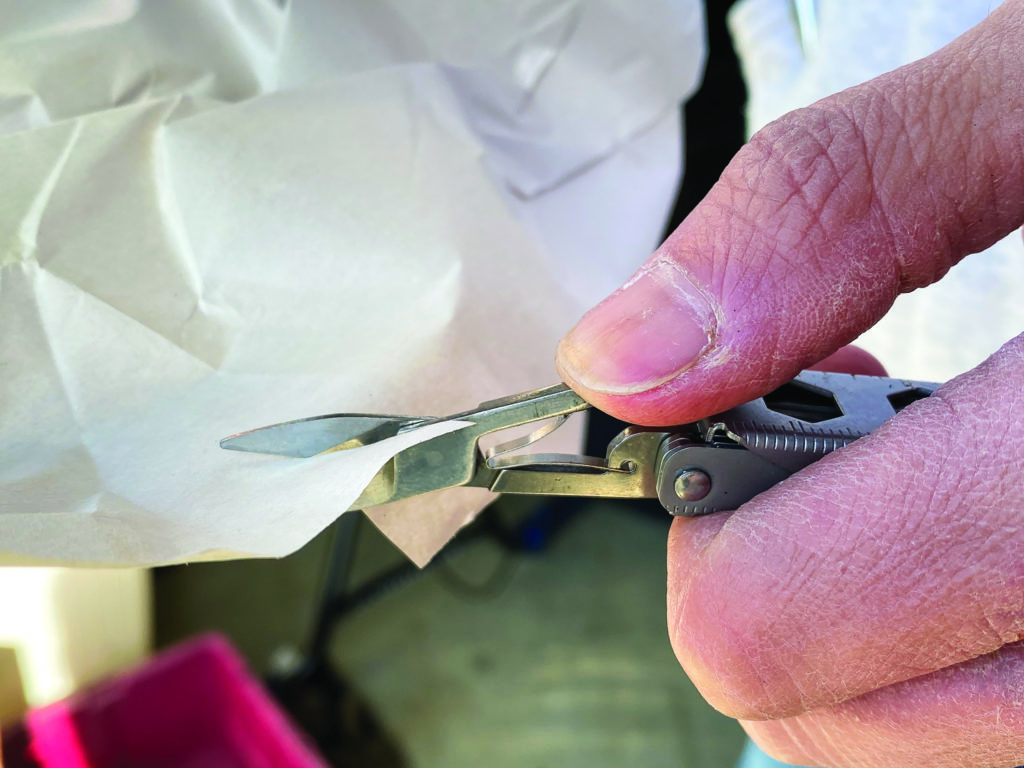
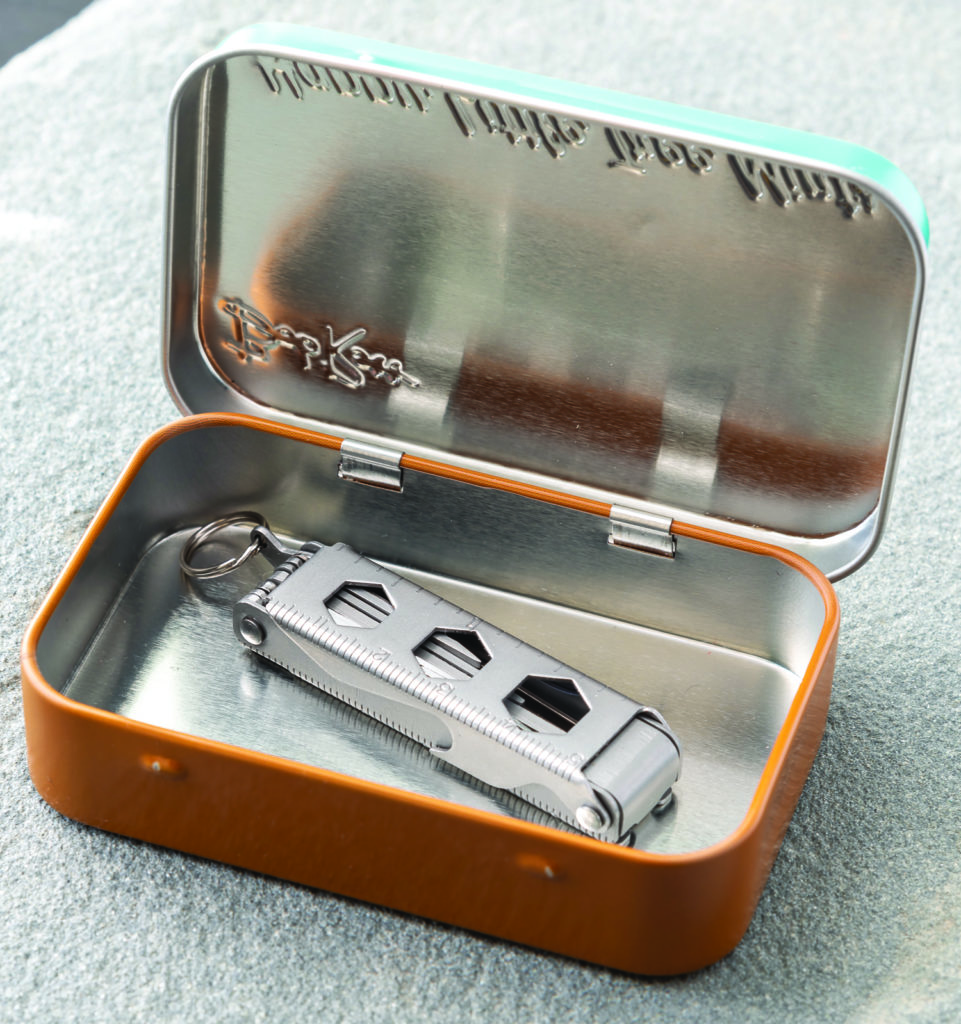
Utica primarily manufactures knives for hunting and tactical but also makes multi-tools. The Minimaster is the smallest multi-tool of the test bunch. It’s loaded with many small fold-out implements: a pair of tweezers, large and small flat-head screwdrivers, a Phillips screwdriver, scissors, fingernail file/cleaner, knife blade, bottle opener, and ⅜-, 11/32- and ⅝-inch wrenches integrated into the folding cover. Made in the USA, it’s roughly the size of a Victorinox Classic, so it fits well on a keyring, its preferred method of carry.
The scissors may be tiny on the Utica Minimaster but it is effective.
None of the tools lock in the open position. You pull one out and then close the cover; the cover held closed by your grip acts as the lock so the tools won’t fold on you. The tweezers are pretty neat—this is the only compact multi-tool I know of that integrates one. The tips are not textured or ground precise like regular tweezers, so grasping some things with it can be a bit difficult, though having one is better than not. As for the rest of the tools, they are handy to have and definitely will work in a pinch when you need them.
The ultra-compact size of the Utica Minimaster makes it a great candidate for improvised tin-based survival kits.
The only down side to the Minimaster is the hinged cover. It needs to detent tighter in the closed position, as the sample sent to us for review had a tendency to open partway easily. This could present a safety issue, especially if the tools open inadvertently. MSRP: $60. There’s also an imported version that retails for $9.95. Same construction and implement selection, except the multi-tool is made overseas.
MAPPED MULTI-TOOL: Leatherman Signal
When it comes to an article about multi-tools, I would be remiss to not include Leatherman Tool Group, the brand that pioneered the concept. It is the originator of the pliers-based format, and still among the best of them after all these years.
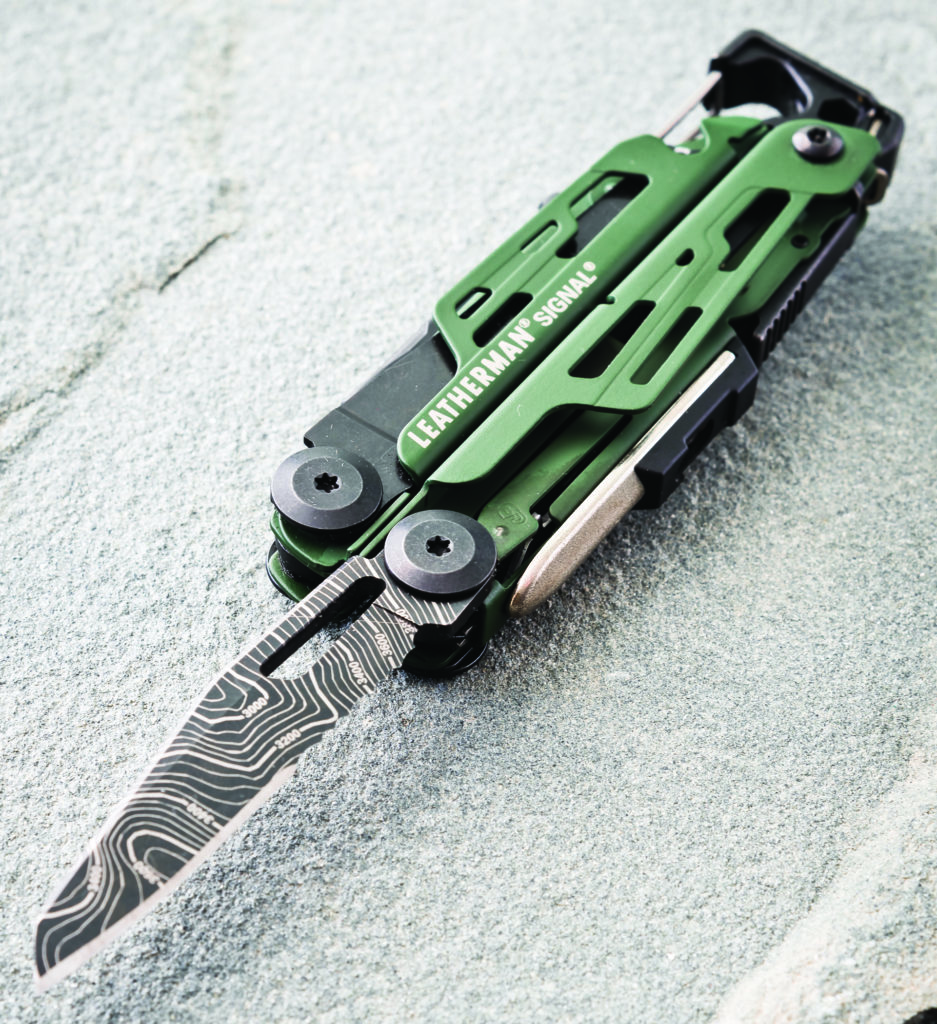
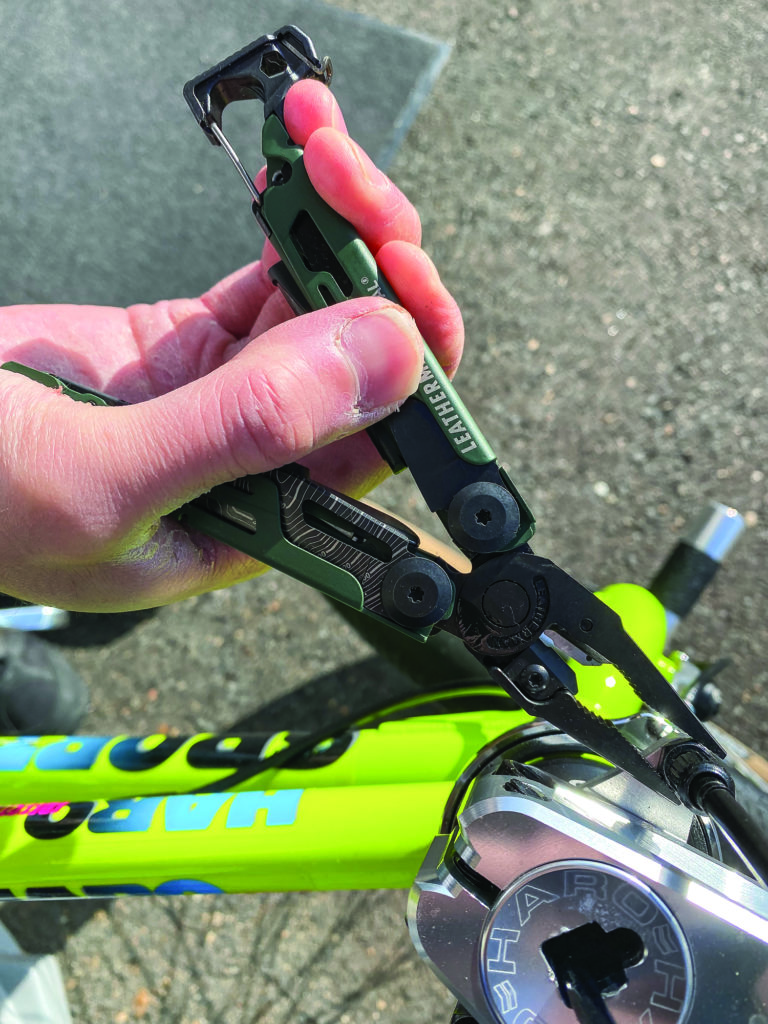
The main blade of the Leatherman Topo Signal features a map-topography laser etching, hence the multi-tool’s name.
The limited-edition Topo Signal is a variant of Leatherman’s Signal multi-tool. The Signal was developed specifically for the outdoor enthusiast, integrating features like a ferrocerium fire starter rod, saw, survival whistle, diamond sharpener and hammer, along with standard Leatherman features such as pliers jaws with replaceable cutting inserts, fold-out driver with reversible bit, awl and can opener. There’s also an integrated quarter-inch-bit socket built into the hammer portion of the handle, which will accept any standard quarter-inch bit driver.
The main blade is a partially serrated 420HC stainless sheepsfoot pattern that locks open via a linerlock. The blade features an oblong opening hole, while the partial serrations eat through tough and fibrous materials with ease. The blade has a map-topography-style laser etch, hence the name. The distinctive appearance is pretty neat and fits in perfectly with the outdoor theme. Speaking of outdoor theme, the Topo Signal comes in a nice dark green Cerakote coating for the aluminum handles and pliers jaws, fold-out implements, and all-black hardware.
Making on-the-spot repairs and adjustments are a multi-tool specialty. The needle-nose pliers of the Leatherman Topo Signal works great at accessing small nuts in cramped places.
Each one comes with a nice ballistic nylon belt sheath withbutton snap closure. It has a steel pocket clip. There’s also an integrated carabiner in the hammer portion so the tool can be clipped on a D-ring, etc.
Comparatively speaking, a Leatherman multi-tool is engineered better than most on the market. MSRP: $119.95. Country of origin: USA. It is the most expensive of the test group, but the quality of the manufacture and fit and finish justifies the price.
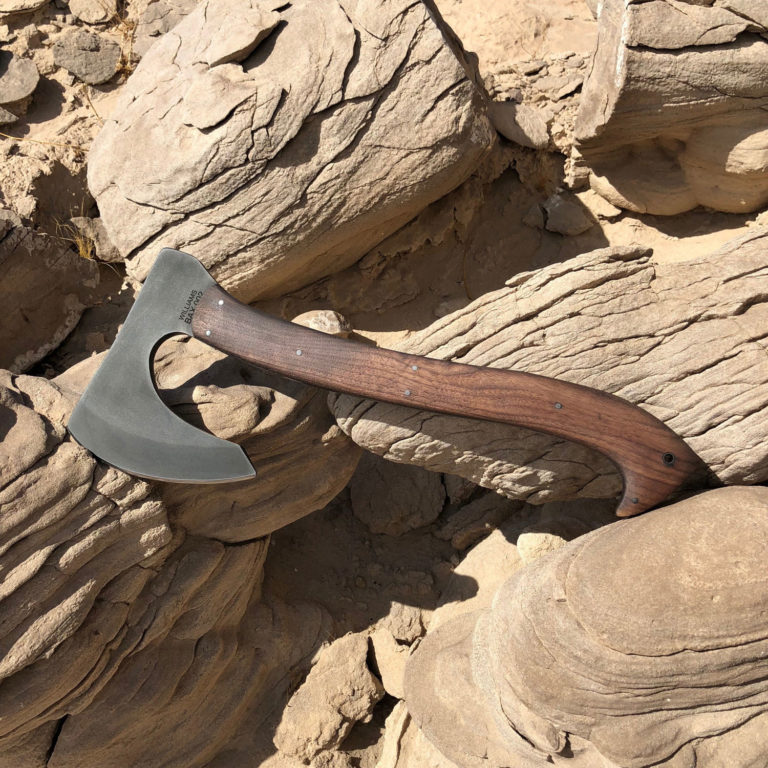
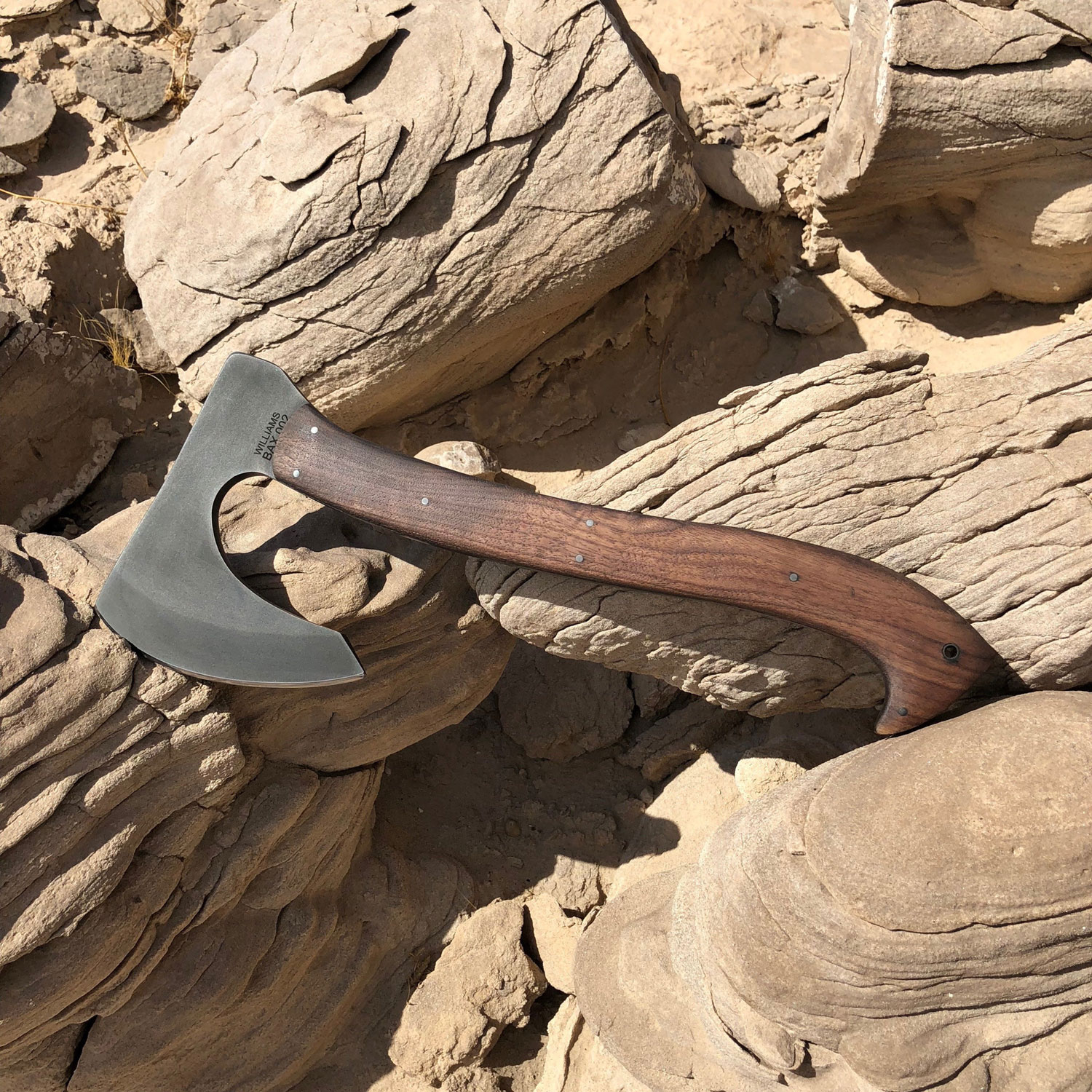
Beards and blades never went out of style, so it’s only appropriate that an axe continue the tradition with a “beard” of its own. The BAX 002 Bearded Axe, offered via Williams Blade Design, draws from Viking lore with a formidable design hatched by ABS master smith Daniel Winkler, someone with plenty of beardly street cred himself.
While the follicles on the BAX 002 are noticeably absent, it should be noted that the “beard” refers to the shape of the axe head. The extra gap this allows between the head and the handle allows the user to “choke up behind the edge for detailed work,” according to a media release. The result offers enough heft to satisfy raiding parties of yesteryear or today.
From Williams Blade Design:
Inspired by the axes of the Vikings, this bearded axe is equally at home in the wild or on the battlefield. The full tang 80CrV2 steel construction makes for an impressively tough tool that excels in the roughest environments. The walnut handle scales provide excellent feel for delicate tasks, and solid grip when the need arises.
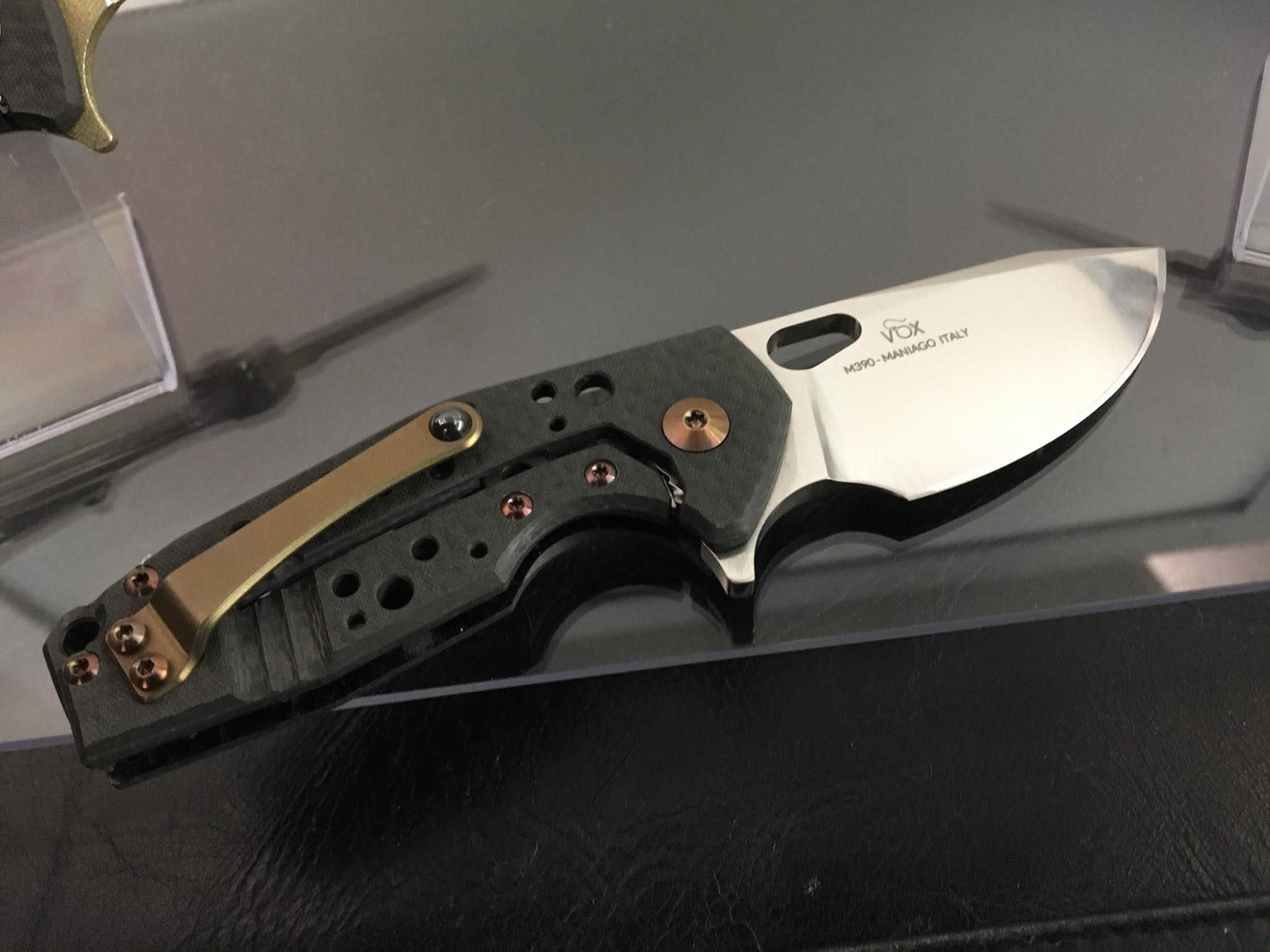
As rugged as the mechanics who use it, this overbuilt pocket knife features a modified drop point blade that’s built from stainless steel. It’s tough enough to cut hose but still precise enough to strip wiring. Meanwhile a black corrosion resistant coating keeps the blade intact no matter what you put it through in the shop.
Blade Steel: 1.4116
Blade hardness: 55-57 HRC
Blade Thickness: 0.120” (3.0 mm)
Blade Finish: EDP
Blade Length: 2.75” (69.85 mm)
Closed: 4.125” (104.76 mm)
Open: 6.875” (174.63 mm)
Weight: 6.2 oz. (175 g)
Handle: Glass-Reinforced Polypropylene with TPR Insert
For a minimalist with an appetite for big adventure. Jesper Voxnaes’ Scandinavian backyard is filled with fjords, punctuated by mountains, and sliced by surging rivers. So when he sets out to design an outdoor knife, it’s crafted to perform. Everywhere.
Editor’s note: In addition to a good blade, one of the best survival tools you can carry is a .22 pistol. Check out our sister site GunDigest.com for the Top list of best .22 pistol options.
Keep Up on New Knives with a BLADE Magazine Subscription
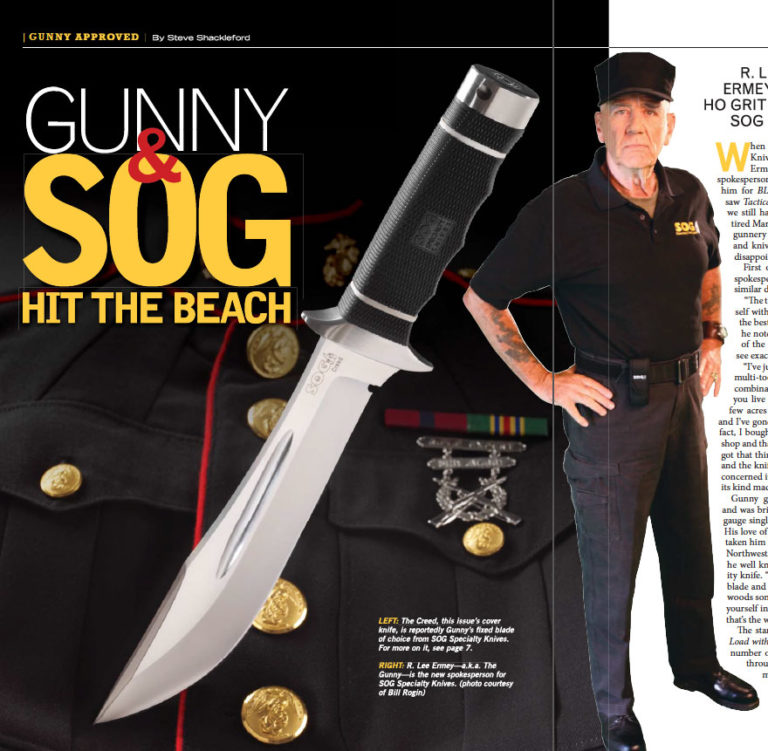
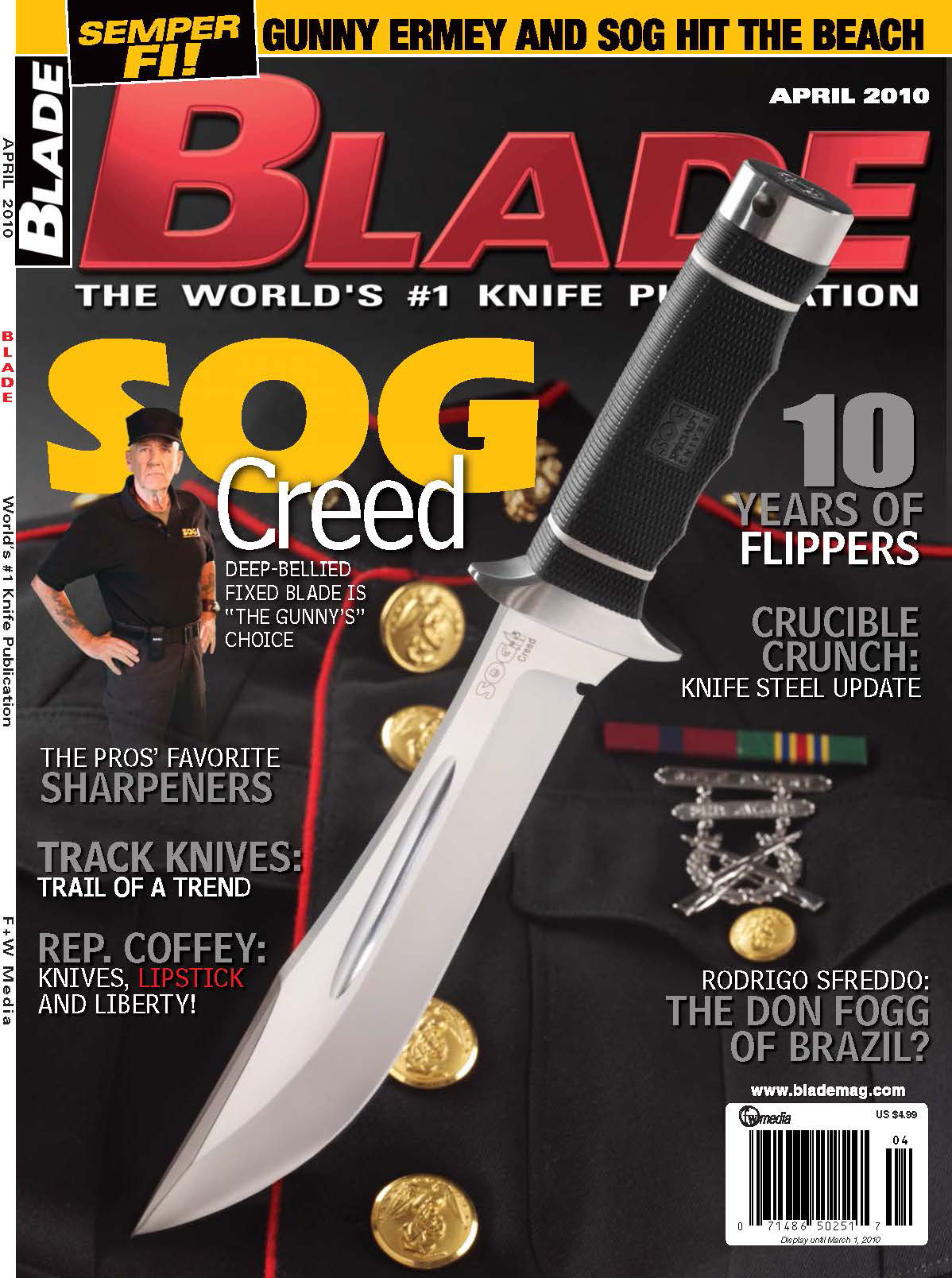
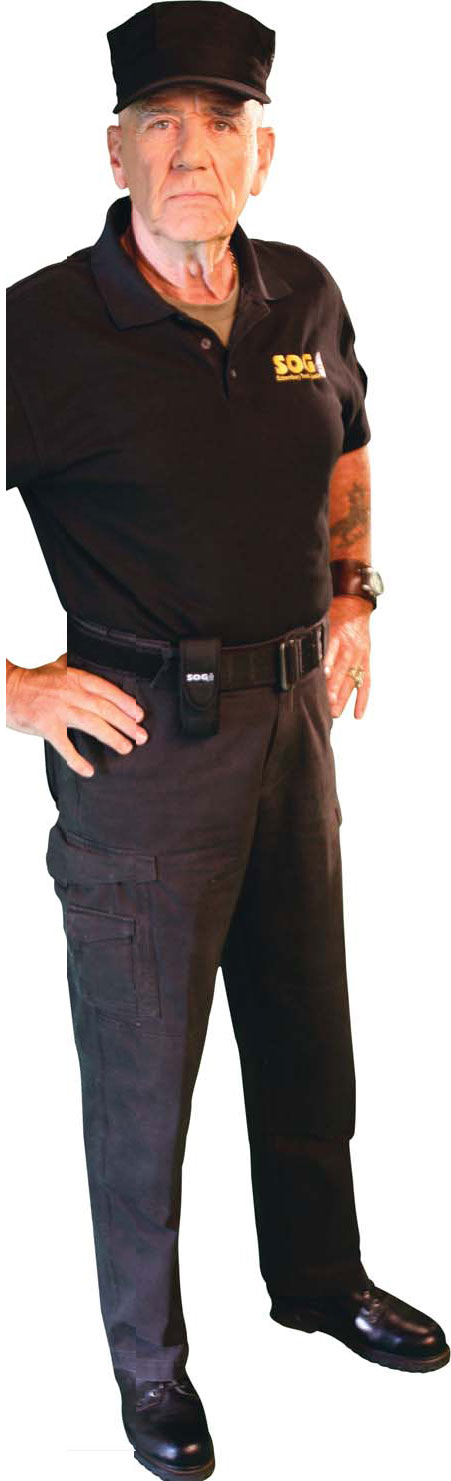
R. Lee “The Gunny” Ermey appeared on the cover of the April 2010 issue of BLADE.
Editor’s note: The following article is from the April 2010 issue of BLADE. At the time, R. Lee “The Gunny” Ermey had signed on as a spokesperson for SOG Specialty Knives & Tools. Here he talks with Steve Shackleford about knives and his career in films.
Ermey, best known for his portrayal as Gunnery Sgt. Hartman in Full Metal Jacket, died April 15, 2018, at age 74.
The Gunny, the Knife Enthusiast
R. Lee “The Gunny” Ermey made frequent appearances at BLADE Show on behalf of knife companies.
Gunny comes by his love of knives honestly. He has over 100 custom and factory pieces in his collection, including his great grandfather’s pocketknife. First and foremost, though, he uses his knives.
“I’m a firm believer that the only thing a dull knife is good for is cutting yourself, because that’s exactly what you do with a dull knife,” he said. “I believe a man ought to be able to shave with that knife and after he shaves with it, he ought to be able to fold it up and then go chop a tree down.”
He also keeps up with the news and is outraged at the way knives are portrayed by the media.
“What really upsets me, I’ve seen this young Eagle Scout [Matthew Whalen],” Gunny began. “Because he had a knife, a little pocketknife in a survival kit in the trunk, they put him out of school. What the hell kind of a survival kit have you got without a knife? You’d be a dead man.
“When I grew up, I was probably 6 years old, I started carrying a pocketknife and I’ve carried one ever since. It’s a tool, you know. I grew up on a farm and I went to school and I can’t ever recall any kid pulling his pocketknife out at school and wanting to do harm to another kid. Times have changed. We need to start taking responsibility for our actions, we need to teach our children a bit of discipline.”
Gunny was just getting warmed up.
“My Swiss Army knife, what, they’re 2 inches long these little guys. I travel constantly, and I’ve had about 20 of those little knives taken away from me at the airport. I finally took one and just broke the knife blade off it and there’s still a big debate if I can go on board because there’s a scissors on it.
There’s a toothpick and a tweezers and I use those tools constantly. After a meal I have to use that toothpick. Society’s gone to the dogs as far as I’m concerned. They need to pull their heads out of their butts and realize that a Boy Scout carrying a pocketknife that’s got a spoon and a fork on it is just a tool, it’s not a weapon.”
A Standup Guy
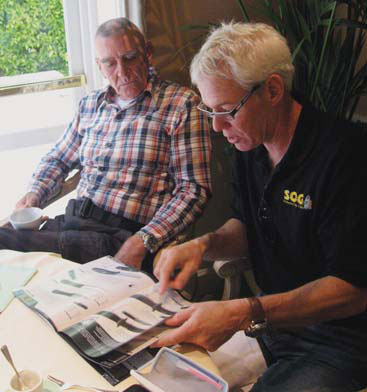
Spencer Frazer (right), SOG founder and president, and Gunny go over the company catalog. (photo courtesy of Bill Rogin)
Gunny enlisted in the Marines in 1961 and was medically retired as a staff sergeant in 1971 for injuries incurred during his tours, which included 14 months active duty in the Vietnam War, and, as you might guess, as a drill instructor (at the Marine Corps Recruit Depot in San Diego and Parris Island, South Carolina). In ’Nam he carried his issued Ka-Bar USMC fighting/utility knife, using it for everything from cutting threads off his uniform to opening “C” rations. He also carried a pocketknife and, of course, his trusty machete.
He said many of his fellow Marines bought their own fixed blades and folders in addition to the issue Ka-Bar.
Did he ever use a knife as a weapon over there?
“No. And I hope I never have to. I would just leave the area,” he laughed. “I would go get my gun. I don’t care for the up-close-and-personal stuff.”
Like most fresh out of the military, Gunny was unsure of what to do after his discharge, so it came as no surprise when he fell back on his Marine background.
“I didn’t have any formal training that would improve my lifestyle and I looked around and thought, what can I do, and I found out,” he recalled. “I was basically pretty much a standup comic when I was in the Marine Corps. I was an instructor, and in order to be a good instructor you have to be able to keep the troops awake. It’s almost like being a standup comic.
Gunny made a number of visits to the troops in Iraq and Afghanistan for the U.S. Navy Department of Morale and Welfare. Here he is with a group of Marines in front of Saddam Hussein’s palace in December 2008. (Rob Scott photo)
“So, when I retired, I wrote a couple of scripts and I went off to Hollywood. I did some of the comedy clubs and was pretty successful at it, and then I found out they were going to start shooting a Vietnam war movie in the Philippine Islands.”
Gunny boarded a military transport, flew to the Philippines where The Boys in Company “C” was being filmed in 1978, landed the part of a Marine drill instructor and his acting career had begun.
However, it was 1987’s Full Metal Jacket that, as Gunny put it, “kicked all the doors open.”
In it he established his onscreen persona as the gung-ho drill instructor, Gunnery Sgt. Hartman.
Not only did the role earn Gunny a nomination for a Golden Globe Award as Best Supporting Actor, it played a key part in his receiving an honorary promotion to gunnery sergeant from the Commandant of the Marine Corps. According to Wikipedia, it made Gunny the first retired military member in the history of the Corps to be promoted. Wikipedia, it seems, needs to check its sources.
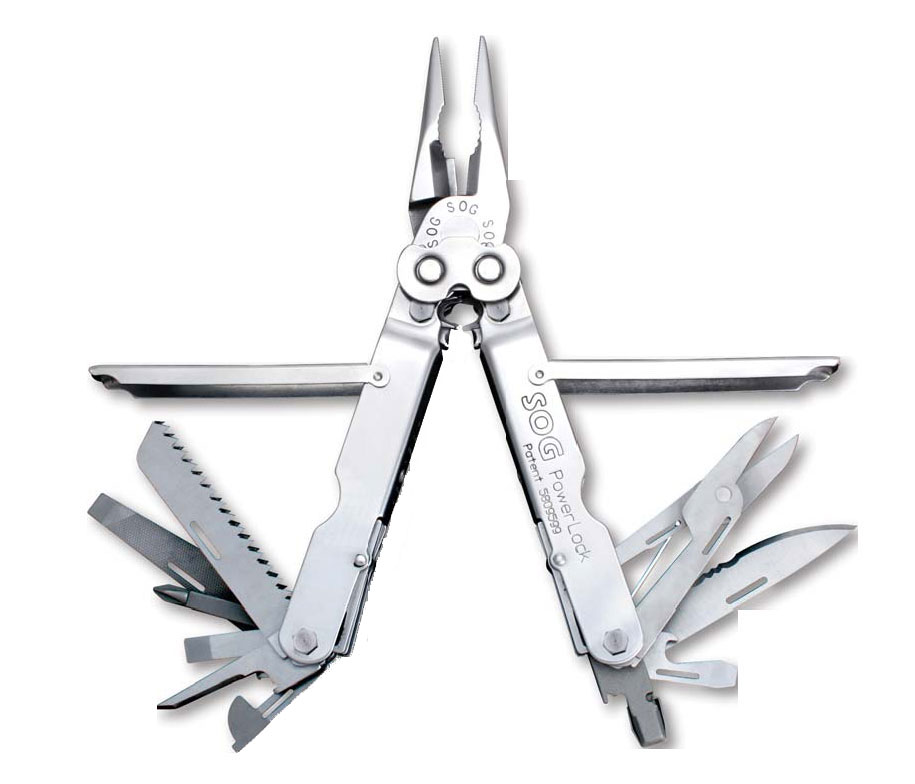
Gunny carries a SOG PowerLock multitool. It includes a pliers/gripper, hard wire cutter, crimper, double-toothed wood saw, a partially serrated blade, three-sided file and more.
“I’m not just the first but the only,” retired member in Corps history to be promoted, Gunny noted with pride.
He continues to be active in supporting young Marines, making morale-building visits to Iraq and Afghanistan when he can, as well as Guantanamo Bay and Okinawa, Japan. In between comes his acting and promotional work.
“I spend 90 percent of my time working with the military,” he said. “The other 10 percent I have to do shows and movies and whatever it takes because I have to support the 90 percent.”
The new SOG spokesman would seem to have his priorities in order. And, luckily for his new employer, SOG is one of them.