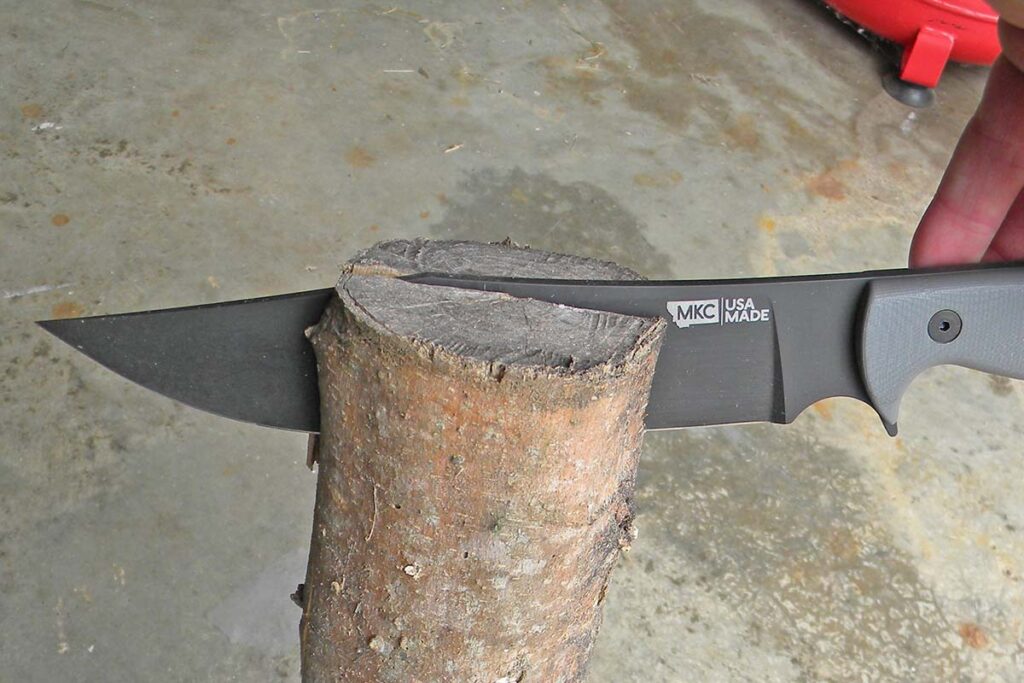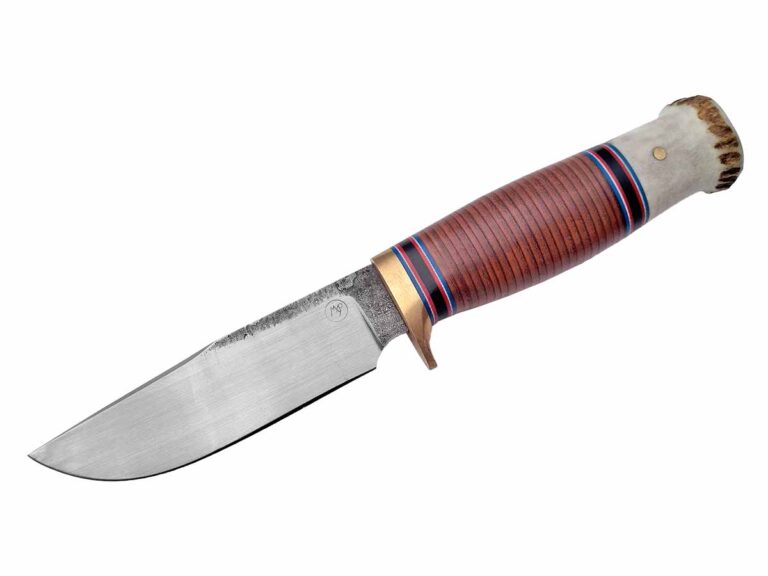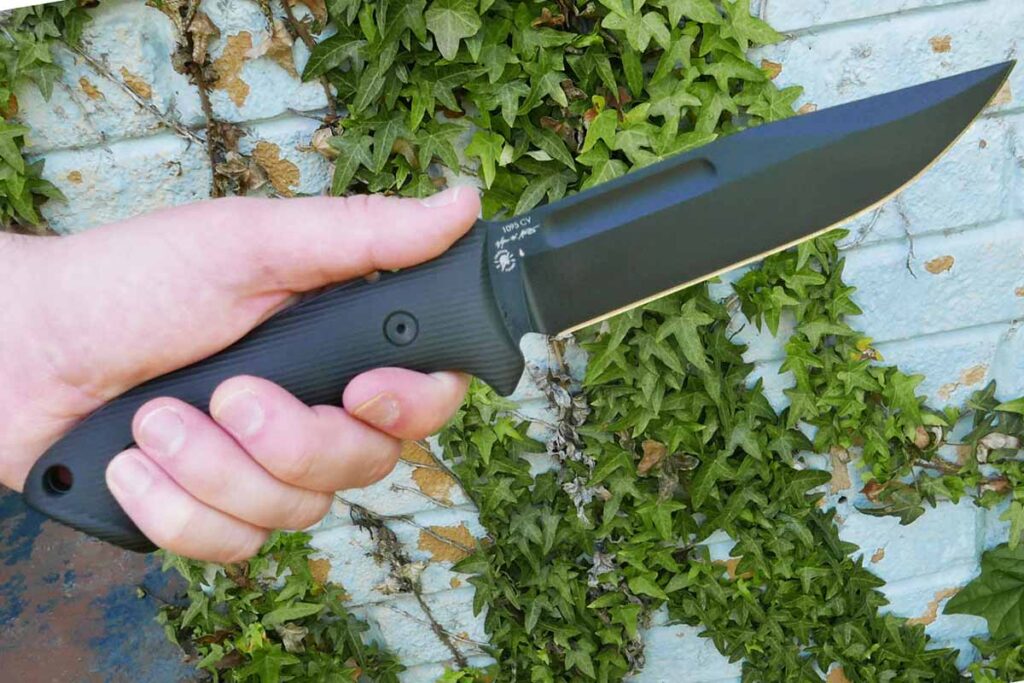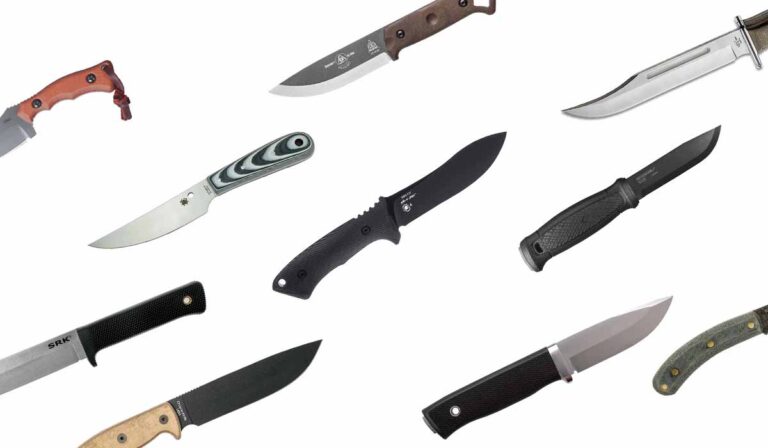

From kitchen to camp and beyond, these puppies will perform.
Christmas may have passed and all your presents have been unwrapped, but that doesn’t mean you can’t start building out your wish list for the coming year. We’re here to help with a slew of new knives—and non-knives—that are certain to tantalize and tempt. From production options full of pomp and customs cutting one-of-a-kind profiles, there’s something for knife lover.
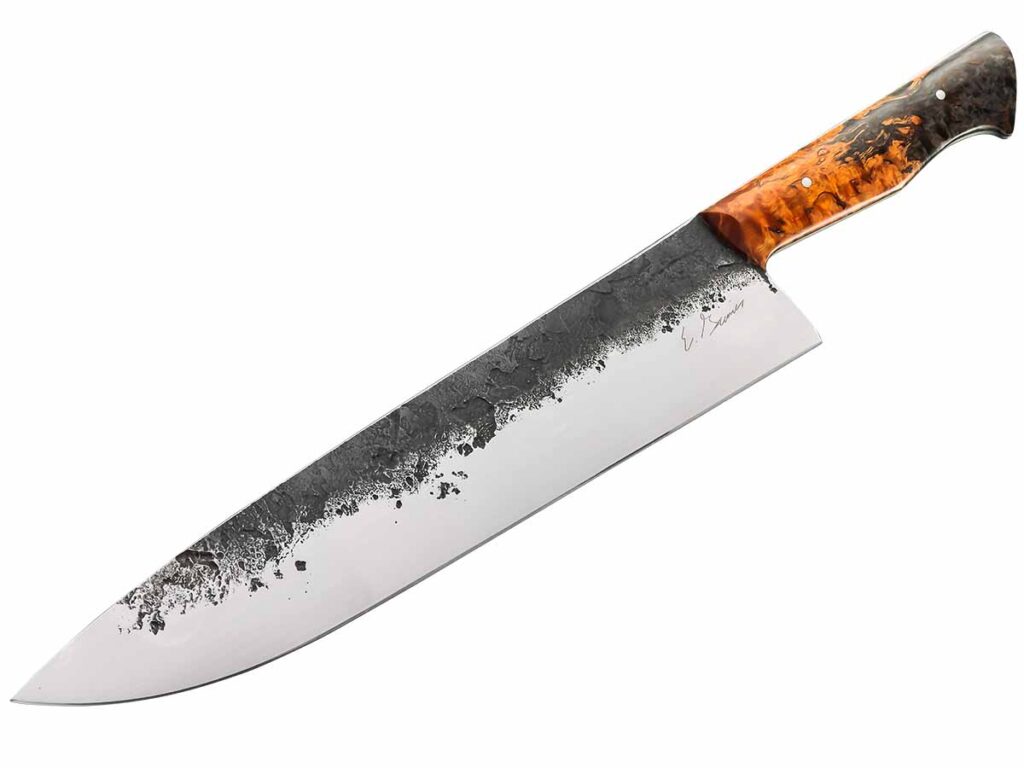
Greiner Chef’s Knife
Blade length: 10” Blade material: 80CrV2 carbon steel w/forged finish Blade grind: Flat Handle material: Double-stabilized karelian birch Overall length: 14.5” Maker’s price for a similar knife: $600 Maker: Erik Greiner, greinerblades.com (SharpByCoop image)
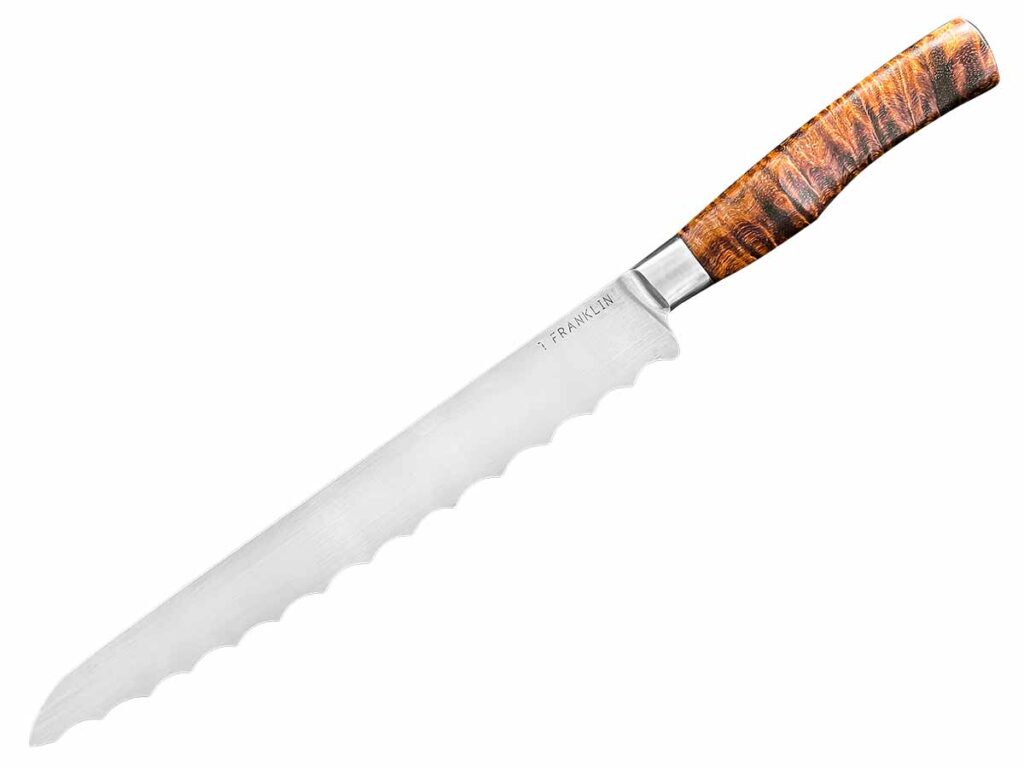
Franklin Bread Knife
Blade length: 9.25” Blade material: 52100 carbon steel Handle material: Hawaiian koa Overall length: 14” Maker’s price for a similar knife: $575 Knife to know: Also comes in a set of three that includes chef’s and paring knives w/a price of $1,750 for the entire set; Thomas Franklin is an ABS apprentice smith Maker: Thomas Franklin (Jfrasierphotography.com)
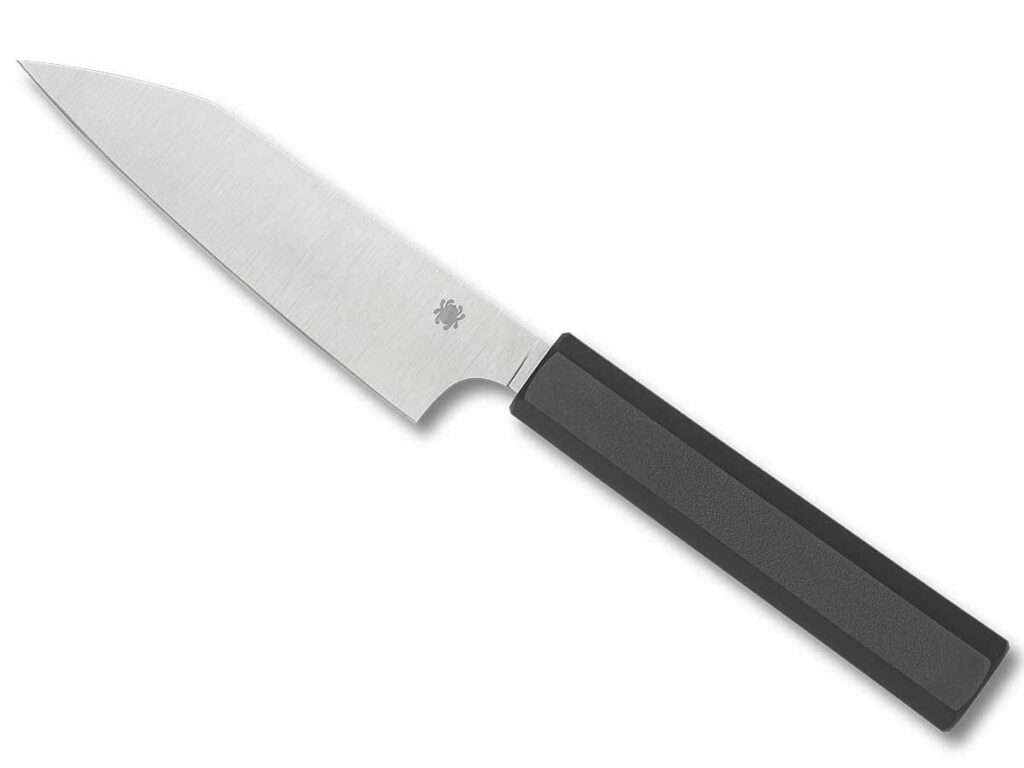
Spyderco Petty
Designer: ABS master smith Murray Carter Blade length: 4.64” Blade steel: CTS BD1N stainless Blade grind: Full-flat Blade @ thickest: .068” Handle design: Wa style (octagonal) Handle material: Black polypropylene Weight: 1.8 ozs. Overall length: 8.87” Knife to know: The Petty is part of Spyderco’s Minarai Series; meaning “to look and learn,” minarai is the Japanese way of describing the role of an apprentice Country of origin: Japan Company: Spyderco, spyderco.com
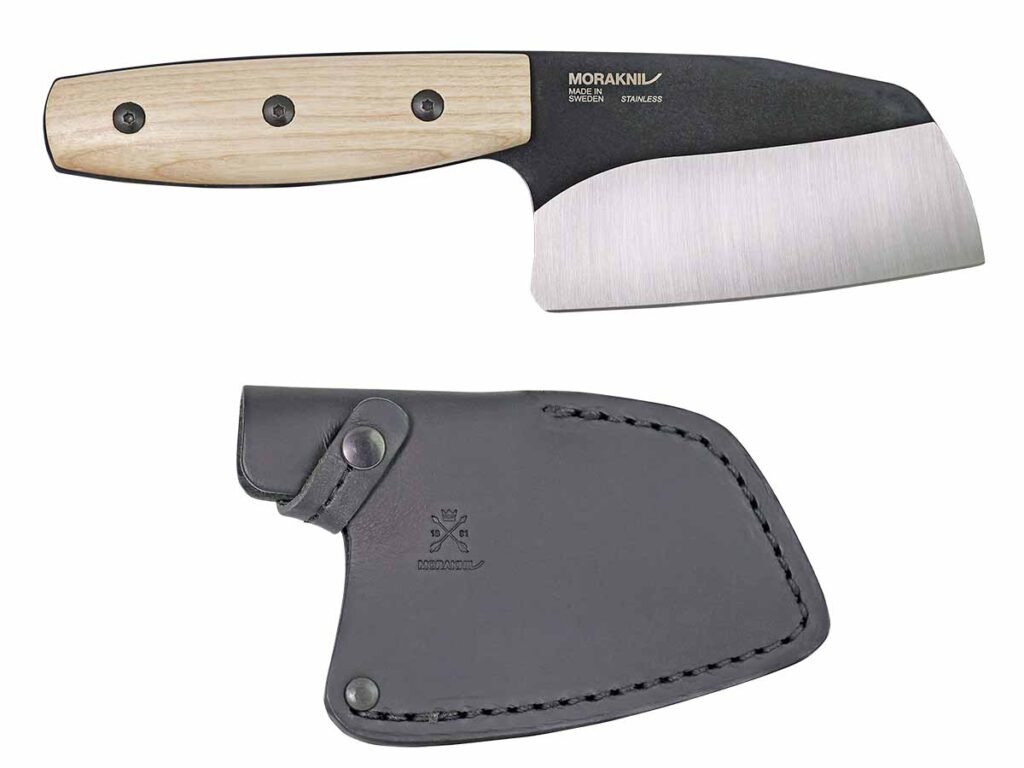
Morakniv Rombo
Model: Camp chef’s knife Blade length: 3.86” Blade steel: Swedish stainless Blade grind: Flat Blade @ thickest: .09” Blade finish: Two-tone Handle material: Wood Weight: 5.5 ozs. Overall length: 8” Country of origin: Sweden Knife to know: Designed for right-hand use MSRP: $230 (at press time rate of exchange) Company: Morakniv, industrialrev.com
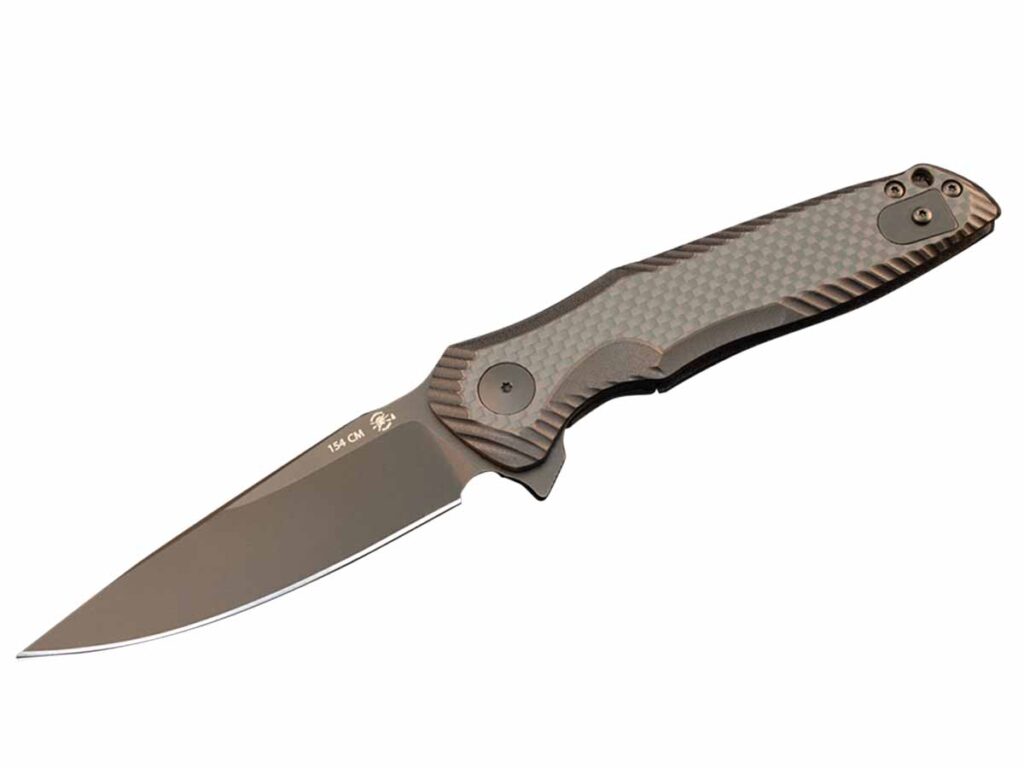
Spartan Blades Poros
Designer: Curtis Iovito Knife type: Flipper folder Blade length: 3.75” Blade steel: 154CM stainless Rockwell hardness: 58-60 HRC Blade grind: Flat Blade @ thickest: .125” Blade finish: Black titanium nitride coating Blade pattern: Drop point Pivot action: Ikoma Korth Bearing System (IKBS) Handle material: Carbon fiber/G-10 composite Lock: Linerlock Pocket clip: Deep carry Hardware & liner: Stainless steel w/black electro-deposit powder coating Weight: 5.3 ozs. Closed length: 4.25” Country of origin: USA MSRP: $190 Company: Spartan Blades, spartanbladesusa.com
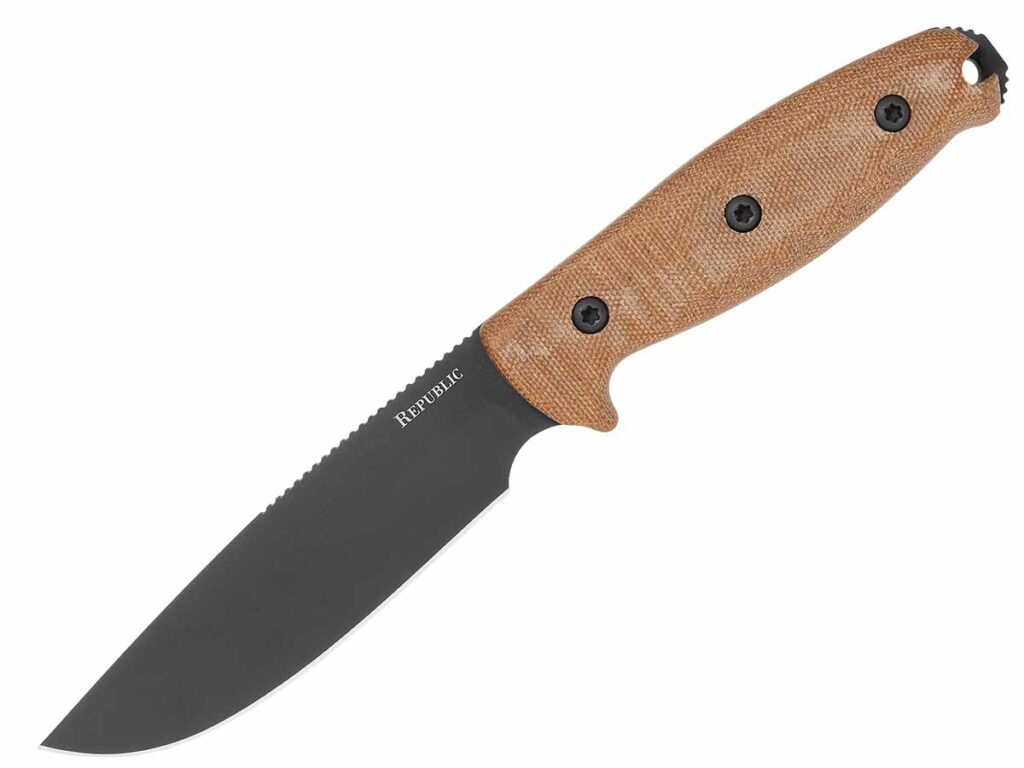
Cold Steel The Republic
Knife type: Bushcraft fixed blade Blade length: 5” Blade steel: CPM S35VN stainless Rockwell hardness: 58-60 HRC Blade @ thickest: .1535” Blade finish: Corrosion resistant/no-glare Ionbond Blade pattern: Drop point Handle material: Micarta® w/single integral guard and lanyard hole Knife to know: Handle is removable for customization based on situation/undertaking; spine gimping for extra control Weight: 8.4 ozs. Overall length: 10” Sheath: Leather pouch MSRP: $269.99 Country of origin: USA Company: Cold Steel, coldsteel.com
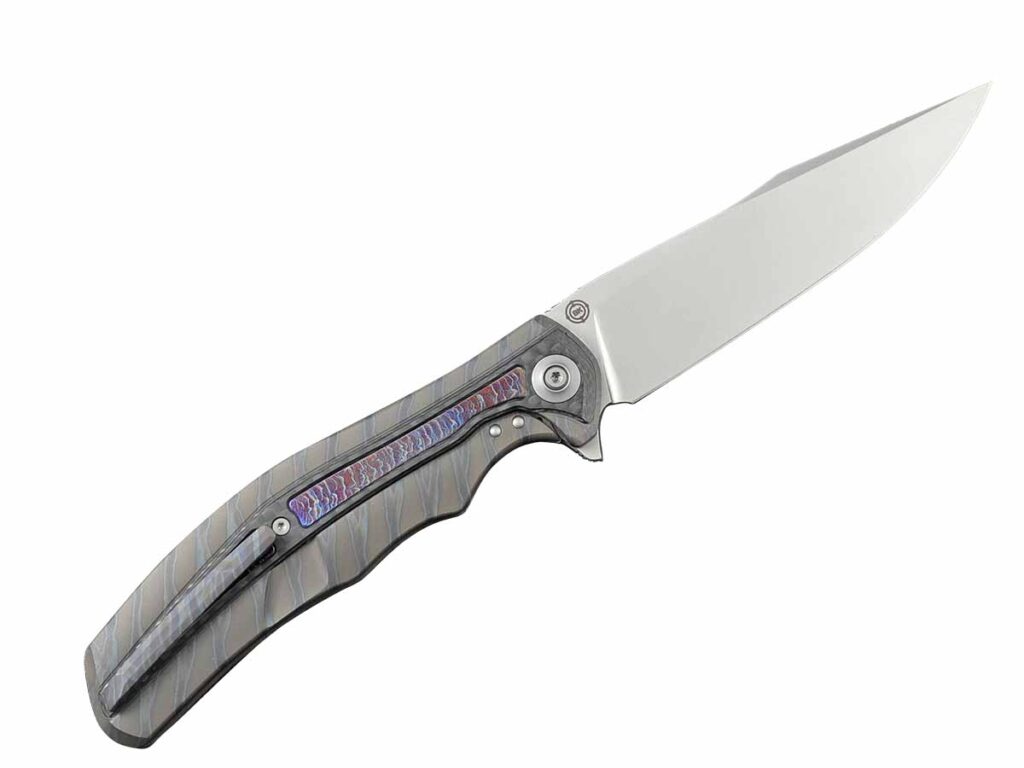
WE Knife Zonda
Pattern: Flipper folder Blade length: 4.04” Blade steel: CPM 20CV stainless Blade finish: Stonewashed Blade @ thickest: .13” Handle material: Black titanium w/flamed titanium inlay Pocket clip: Right-hand, blade-tip-up carry Lock: Framelock Closed length: 4.85” Country of origin: China MSRP: $480 Company: WE Knife, weknife.com
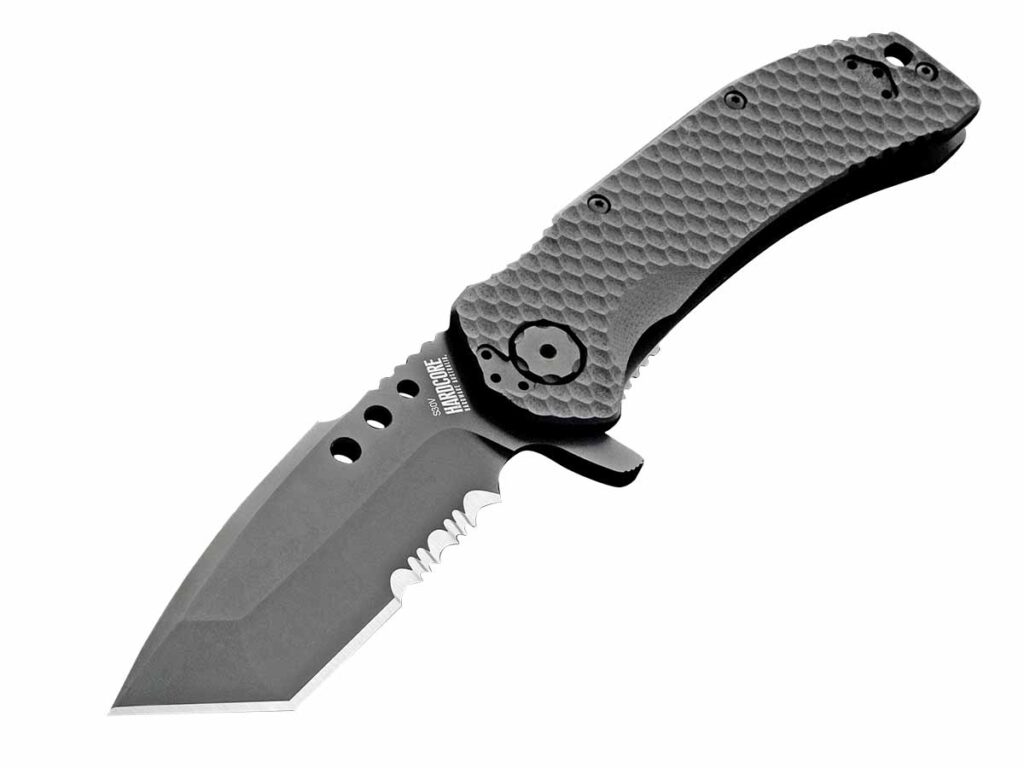
Halfbreed Blades MILF-03PS
Blade length: 3.54” Blade steel: CPM S30V stainless Rockwell hardness: 59-60 HRC Blade grind: Hollow Blade @ thickest: .19” Blade finish: PVD coat Blade pattern: Tanto Handle material: G-10 Washers: Phosphor bronze Weight: 7.34 ozs. Closed length: 5.51” Handle @ thickest: .59” Country of origin: Australian and Taiwanese make MSRP: $280 Company: Halfbreed Blades, halfbreedblades.com.au
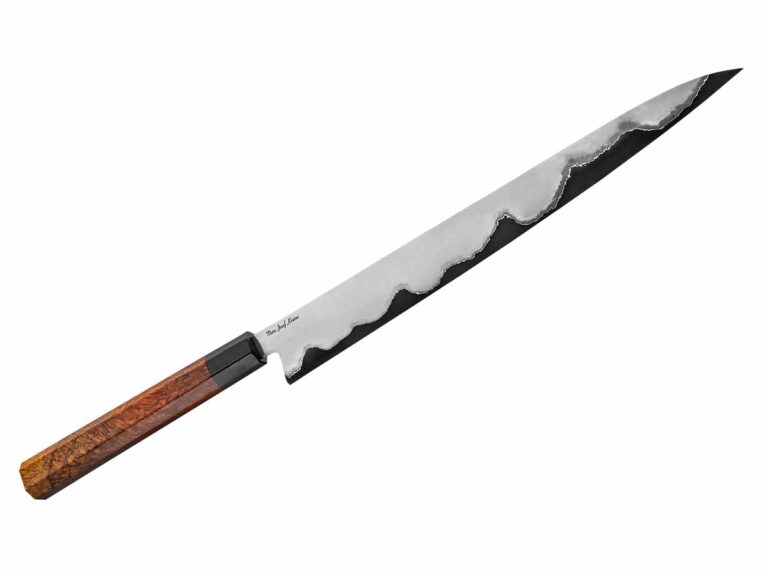
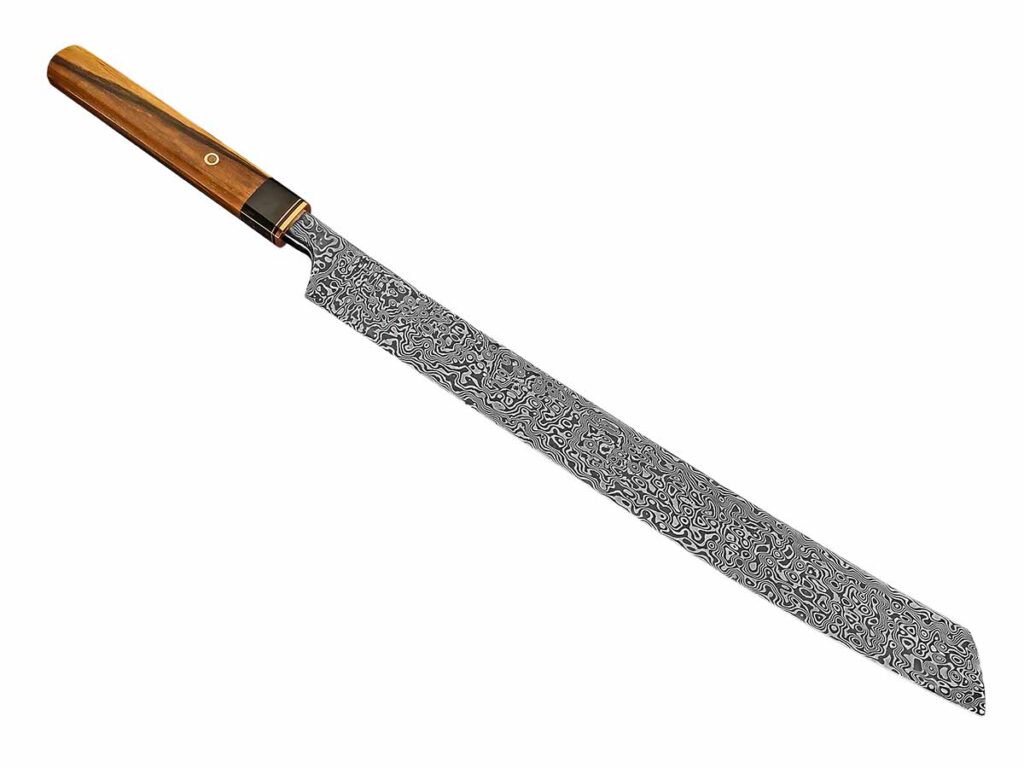
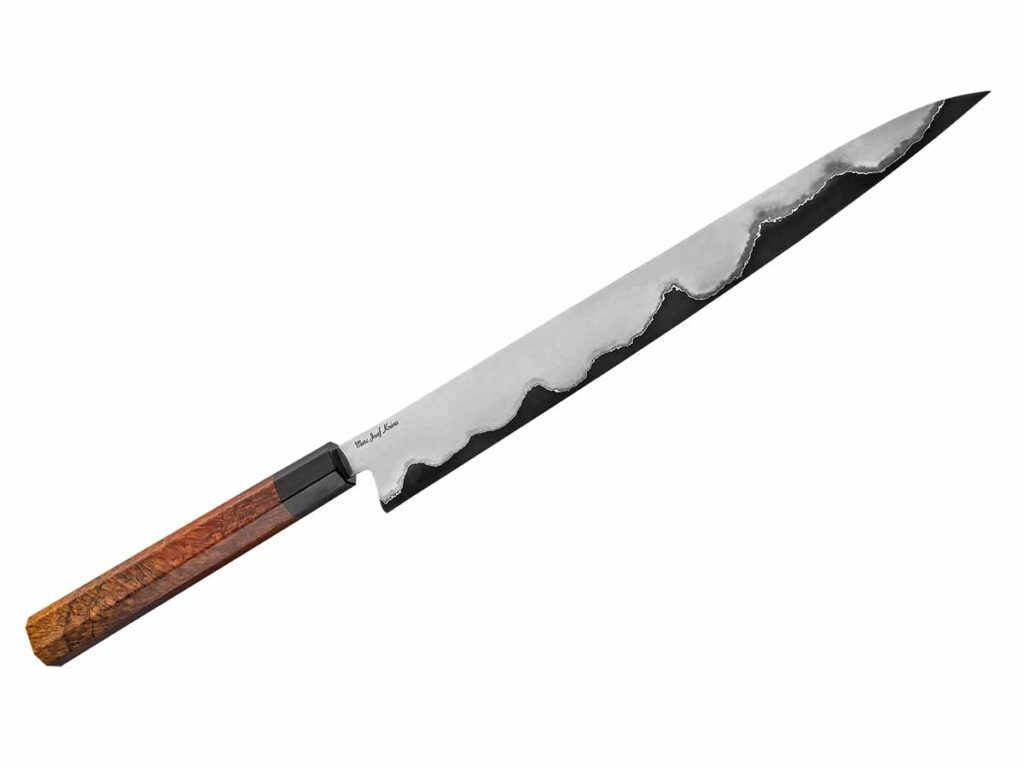
Pattern: Slicer Blade length: 11.8” Blade material: San-mai construction of 410 stainless steel, nickel and 52100 carbon steel forged by Brook Turner Rockwell hardness: 62 HRC Blade grind: Flat/convex Blade thickness @ ricasso: .118” Blade @ widest: 1.496” Handle material: Coolabah burl Bolster/guard: African blackwood Overall length: 18.5” Maker: Marc Stewart, Mark Josef Knives, marcjosefknives.com.au (Rod Hoare image)
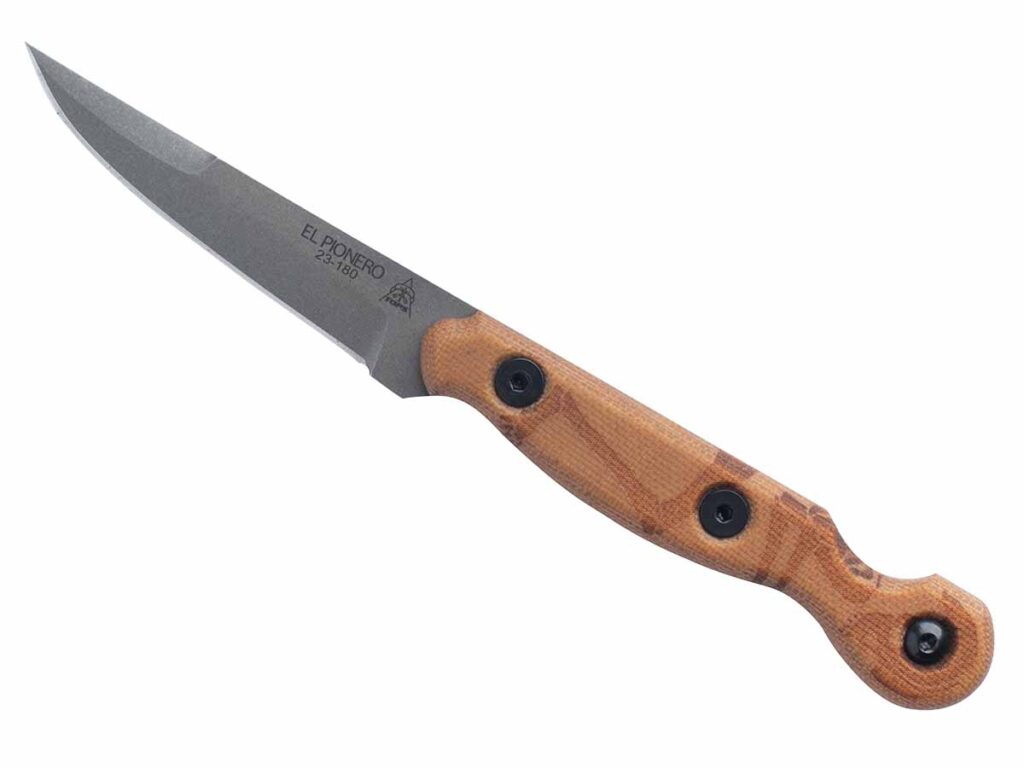
TOPS Knives El Pionero
Designer: Ed Calderon Blade length: 3.38” Blade material: 1095 carbon steel Blade @ thickest: .09” Blade finish: Tumble Handle material: Tan canvas Micarta® w/finger divot that aids in blade orientation, etc. Weight: 2.9 ozs. Overall length: 7.63” Sheath: Black Kydex Weight w/sheath: 4.1 ozs. Knife to know: The El Pionero is a “paring knife-esque design”; Ed Calderon (edsmanifesto.com) worked as a counter-narcotics officer in Mexico and more recently as a trainer and “guru in the tactical space” Country of origin: USA MSRP: $220 Company: TOPS Knives, topsknives.com
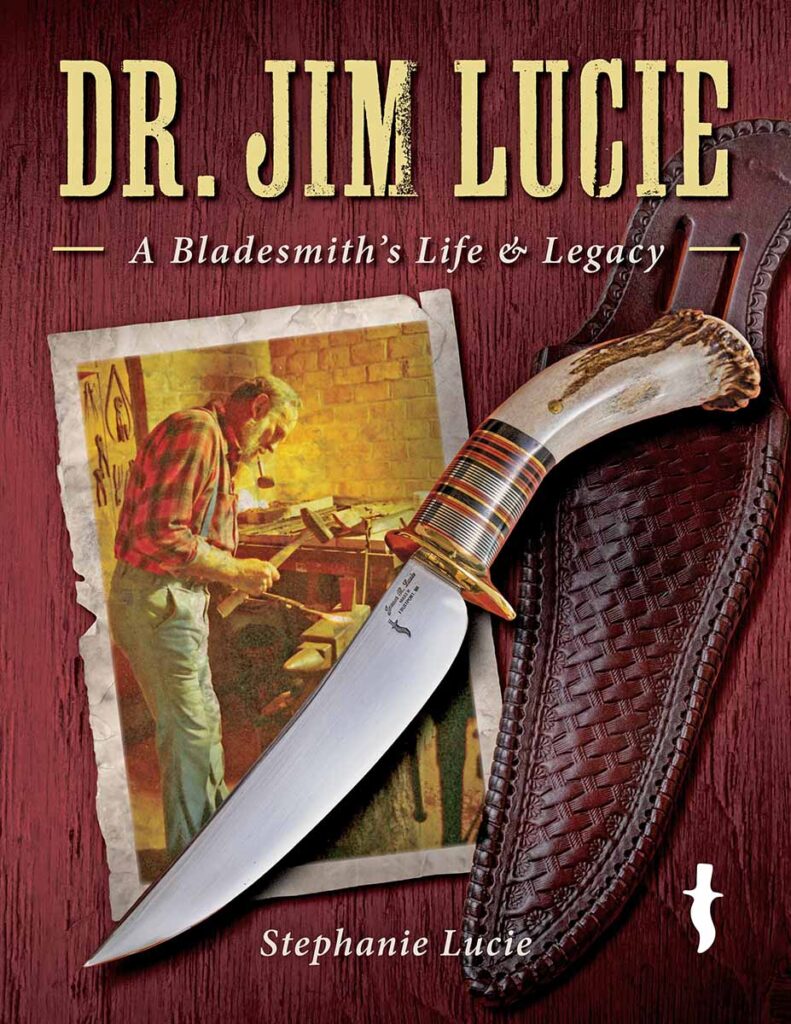
Dr. Jim Lucie: A Bladesmith’s Life & Legacy
What it’s about: ABS journeyman smith Dr. Jim Lucie had a unique background: he served as the personal physician for, and learned about knifemaking from, the man recognized as the grandfather of custom knives—BLADE Magazine Cutlery Hall-Of-Fame® member William Scagel. The author, Stephanie Lucie, is Lucie’s youngest of four daughters. She paints a picture of her father like no other, from childhood to adulthood, his bladesmithing mentors and friends, the many stories written about him and much more. Format: 9.25 x 12.5-inch hardback, limited to 1,500 copies in the first edition, over 300 color photos, including more than 200 knives Lucie made, and over 100 pictures of his life and accomplishments. MSRP: $120 Contact:jimluciebook.com


A bonnie blade to be sure, Kemper makes a statement with his Scottish dirk.
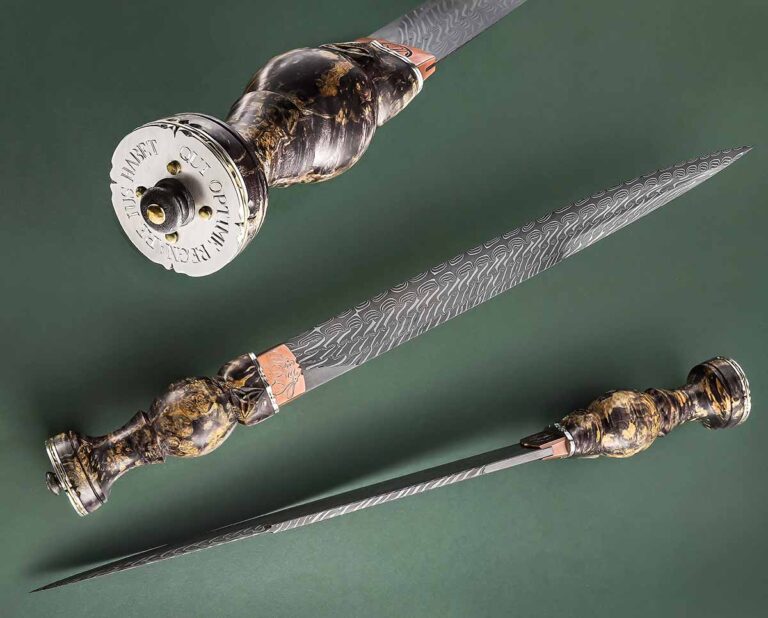
Derick Kemper celebrates his Scottish heritage with his sprawling reproduction of a Scottish dirk. It’s overstated to salute the legend and lore of his Scottish Highlander ancestors who fought so valiantly for their independence from Great Britain, beginning with the Jacobite rising of 1745.
The edge of the stunning damascus blade is a simple twist pattern of W2 carbon and 15N20 nickel alloy steels. The three bars above it are Derick’s version of Robert Eggerling’s paisley pattern—a modified twist of 203E carbon steel for the bright section and W2 and 15N20 as well.
The habaki has Derick’s Damselfly Forge stamp of two damselflies and his initials in the middle engraved on one side, and the white rose of Scotland’s “Bonnie Prince Charlie” (1720-1788) on the other.
Derick Kemper
The chess-piece-like handle is oversized as well, with the pommel engraved in Latin, Qui Optime Regnare Ius Habet. The English translation is “Who hath best right to reign,” a slogan that appeared on the flags and accouterments of many of the Highlanders in the 18th century.
These tactical fixed blade knives are set to conquer the most extreme tasks.
When the Gulf War took off in Iraq in the early 1990s, the knife industry took off, too, and a steady stream of tactical fixed blades has surfed the wave ever since.
Needless to say, there are military fixed blades aplenty in the cutlery industry with no single design or manufacturer having a chokehold on today’s market. This has given knife users an abundance of choices, from pure fighters to utility users and everything in between.
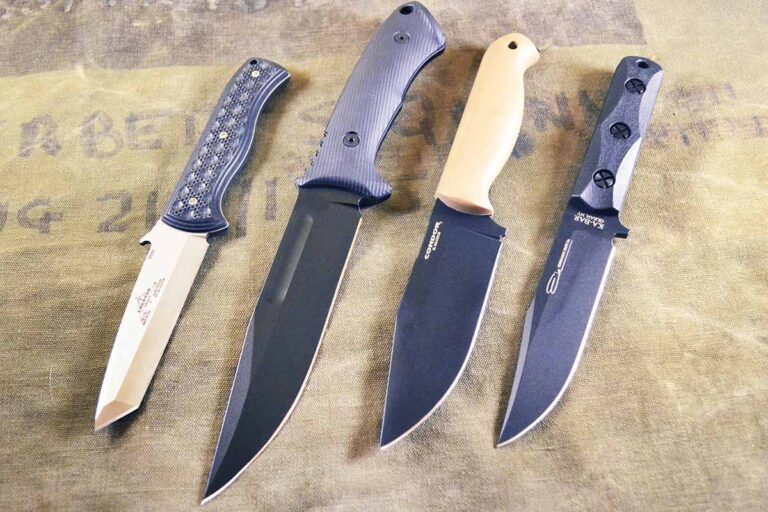
A diverse quartet of the genre includes the Condor Fighter Knife, Emerson CQC-7 Fixed Blade, KA-BAR/John Ek Commando Short Clip and Spartan Blades Harsey Fighter. To determine their strengths and weaknesses, the first order of business was a common test for penetration.
Testing
I set up a heavy-duty corrugated-board box with a 1-inch Styrofoam™ liner made for shipping frozen foods. I tested each knife by thrusting the blade into the side of the box forcefully, and then pushing it through from a standstill with the tip resting on the box. All the knives penetrated the thick, layered material with ease—not surprising considering they have either clip-point or tanto blade patterns, both adept at stabbing. There was very little differential from one model to the next. What follows is a look at each knife and how it performed other chores.
Condor Tool & Knife Fighter Knife
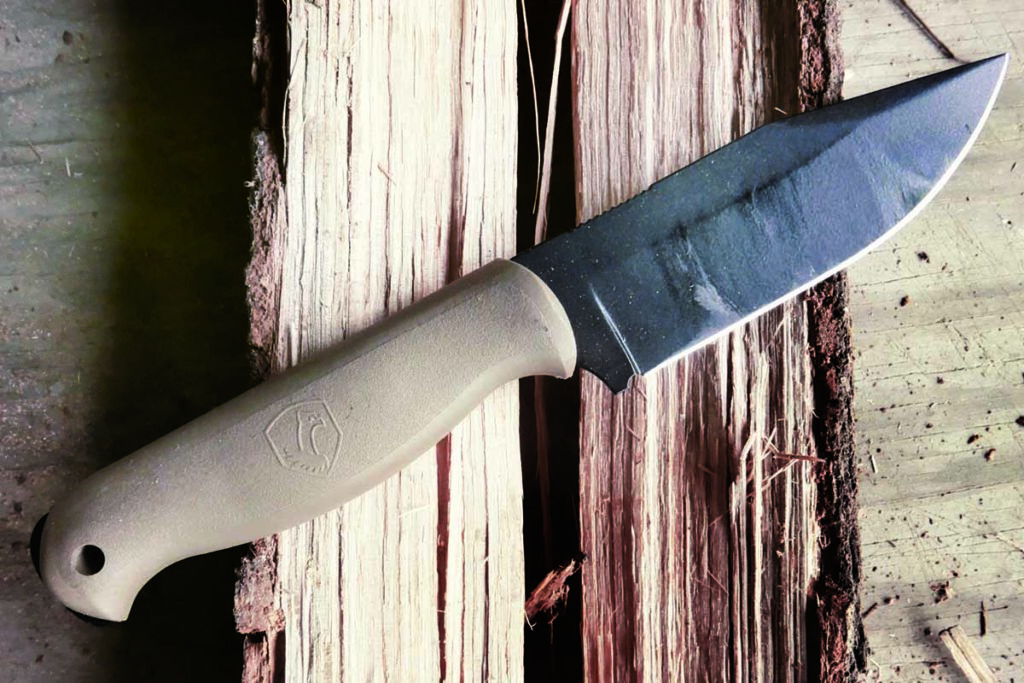
The author took the Condor to task batonning a length of seasoned hardwood with good effect. According to him, “This is one versatile knife that even a bushcrafter would love.”
Condor Tool & Knife specializes in bang-for-the-buck blades and the Fighter Knife is no exception. Indeed, it is the most affordable of the test group. From the side the knife appears to be pudgy but it is actually quite nimble. The clip-point blade has jimping on the rear of the spine for enhanced purchase on detail cuts.
The tan handle is hidden tang in construction with a fine stippled surface texture, an ample palm swell in the middle and a lanyard loop. The exposed steel at the butt can be used for hammering. The sheath is MOLLE compatible, injection molded and features a black leather drop loop.
The knife easily switches from combat to field chores—not surprising as the company specializes in both. The wider blade is similar to that of many field knives, as is its deep grind. Slicing 3/8-inch rappelling rope and taking curls for firestarter were a breeze. I set the blade across the end of a 15-inch piece of tough seasoned hardwood, 25/8 inches across, and drove it clean through. This is a rugged knife. The sheath is relatively unobtrusive and rides about 2 inches above the beltline.
Condor Fighter Knife Specs Blade length: 4.91” Blade material: 1075 carbon steel Blade grind: Flat w/secondary bevel Blade finish: Black Cerakote® Handle length: 4.83” Handle material: Tan polypropylene Weight: 8.82 ozs. Overall length: 9.74” Sheath: Tan polypropylene/leather belt strap Country of origin: El Salvador MSRP: $100
KA-BAR John Ek Commando Short Clip
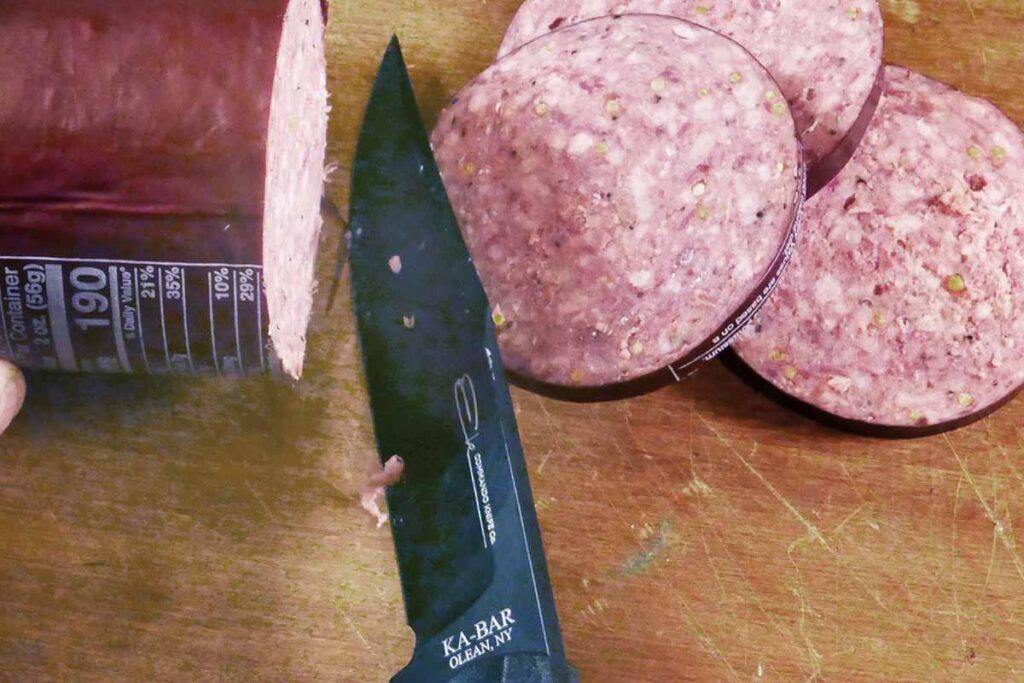
The Commando Short Clip tackled a 2.75-inch-diameter chub of summer sausage admirably. The blade is 5.125 inches of 1095 Cro-Van carbon steel, a time-proven KA-BAR favorite.
The John Ek Commando Short Clip is one in a series of military-type models KA-BAR Knives offers by the cutlery legend. This one is all black and a timeless, no-nonsense John Ek design. The blade is complemented by a 4.125-inch “stick” handle with scales affixed by big, fat screws, an Ek hallmark. The blade clip breaks with a slight harpoon kick, which I’m not sure Ek ever used, though it works wickedly, and there’s a short guard below the blade. The symmetrical handle has a lanyard hole at the butt. All of this is delivered with a modern, MOLLE-compatible sheath.
KA-BAR has done an admirable job picking up the John Ek banner and blending the old with the new. The Commando Short Clip’s narrow blade—1.31 inches wide—proved proficient at slicing. I tested it on paracord, 3/8-inch rappelling rope and a large round of 2.75-inch summer sausage, and it did a masterful job of tackling them all. It is a combat knife at heart and its light weight is not as skillful at tough field chores like hacking wood, but that’s not its department.
The handle is fine for small and medium hands but could be a challenge for those with large ones. The modern sheath is very well done and rides with the butt of the handle just above the waistband. Overall, this modern take on a classic leans toward a combat knife with enough utility to get you by.
KA-BAR/Ek Commando Short Clip Specs Blade length: 5.125” Blade material: 1095 Cro-Van carbon steel Blade grind: Flat Blade finish: Black powder coat Handle length: 4.125” Handle material: Polymer Weight: 10.4 ozs. Overall length: 9.25” Sheath: Black polymer Celcon/MOLLE compatible Country of origin: USA MSRP: $155
Emerson Knives CQC-7
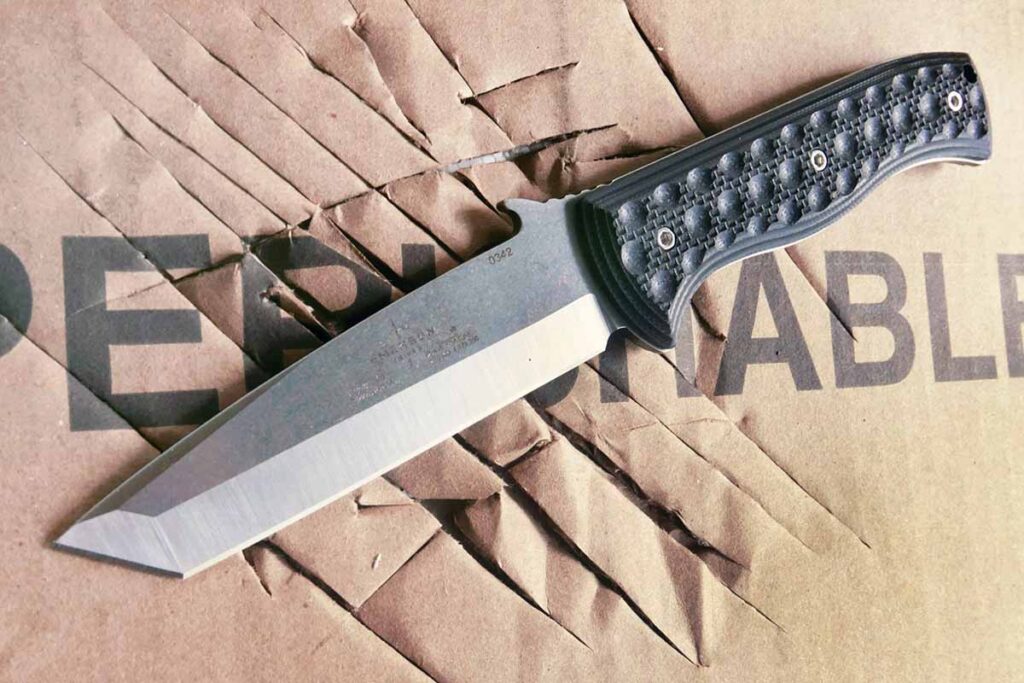
The CQC-7 Fixed Blade has an appetite for slicing and slashing. The 154CM stainless steel tanto blade was extremely sharp and penetrated both layers of the shipping box with controlled slices.
The Emerson Knives CQC-7 Fixed Blade hasn’t gotten a lot of face time because the overwhelming amount of tactical knife coverage of the company is devoted to folders. It’s the way of the world. The Emerson is the shortest of the review subjects and is also the one that tilts more toward being a pure combat knife—something its designer, martial arts specialist/custom knifemaker/cutlery entrepreneur Ernest Emerson, knows a thing or two about. The tanto blade sports a flat V-grind and a stonewashed finish. The blade has three straight grinds: the main edge, tip grind and a clipped saber grind. An Emerson Wave shape on the rear of the blade spine serves as a thumb ramp. The handle has a nice palm swell, a symmetrical dimpled texture for enhanced purchase and a lanyard hole in the butt.
The blade’s 7/16-inch edge grind was delivered wicked sharp and I took it to task slicing one of my favorites, 3/8-inch rappelling rope. The rope is extremely strong because lives depend on it. In one test I pulled the edge through three consecutive cross sections of rope. The drag on the blade was much less than I normally encounter—a pleasant surprise. It slashed the corrugated board outer layer into the Styrofoam effortlessly, and when I slowed the process down with a little more pressure, it dug through the foam as well. The sheath is a study in minimalism, but that’s what you want when concealment is at a premium.
Emerson CQC-7 Fixed Blade Specs Blade length: 4.125” Blade steel: 154CM stainless Blade grind: V-grind Blade finish: Stonewashed Handle length: 4.625” Handle material: Black G-10 composite Weight: 5.86 ozs. Overall length: 8.75” Sheath: Black Kydex® Country of origin: USA MSRP: $237.95
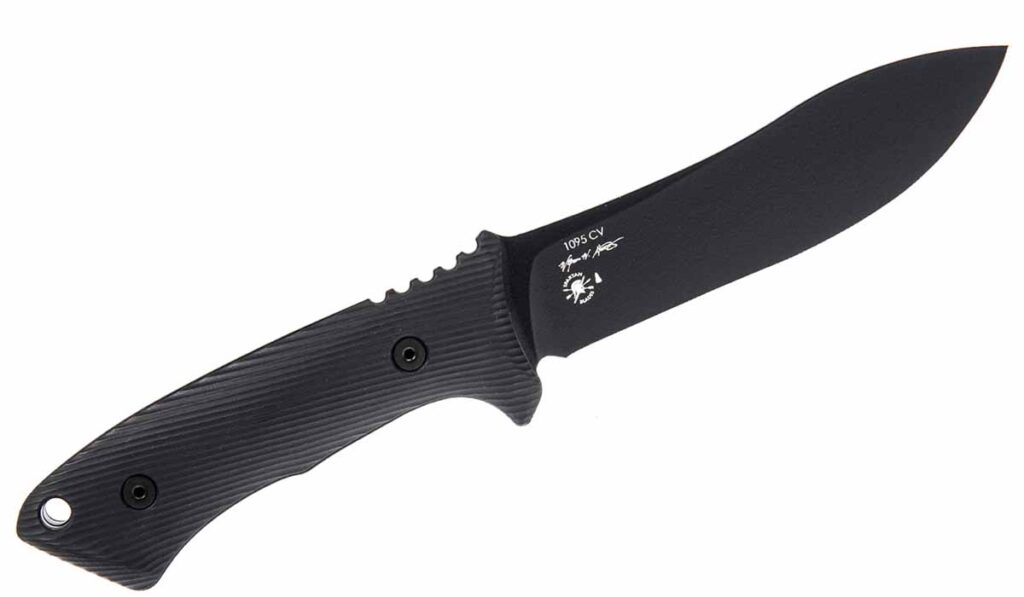
Spartan Blades Harsey Fighter
The Harsey Fighter’s ample 5.35-inch handle has black G-10 scales with a ribbed pattern machined into the surface. The flare atop the handle offers excellent finger protection and the grip accommodates the biggest of mitts.
A goodly portion of observers seem to believe the Spartan Blades Harsey Fighter is noted knifemaker Bill Harsey’s consummate work and, though he has a load of nice designs in his stable, I wouldn’t argue. It is the largest of the test knives and a blend of modern styling with traditional cues. It is the Pineland Cutlery version manufactured by KA-BAR under the Spartan label. The clip-point blade has a fuller that butts up against the ricasso. The handle surface boasts a diagonal rib pattern for enhanced grip and an ample lanyard hole at the butt. The sheath has a fabric-fastener drop loop and retention strap. There’s also a swing-out lock at the rear guard that secures the knife in the main body of the sheath.
It’s amazing what a couple of inches in length, a couple of ounces in weight, plus an extra inch in the handle add to the versatility of a knife. That’s on average what the Harsey Fighter has over the other knives tested. This is not a knock on the others, just the advantage of having more knife.
For chopping ability I tested the blade on a thick-skinned cantaloupe. I had to chop the melon off center to clear the handle but the blade made its point in one fell swoop. The extra weight allowed me to tackle tougher chores and the added blade length made for excellent slicing and hacking. You can clear a camp with the Harsey Fighter. The comfortably sculpted handle can accommodate the largest of hands and the upper flare offers good finger protection. The sheath is very well made but the guard lock takes some getting used to and is one added step for a quick draw. All in all, the Harsey Fighter earned its mettle in spades.
Spartan Blades Harsey Fighter Specs Blade length: 6.125” Blade material: 1095 Cro-Van carbon steel Blade grind: Flat Blade finish: Black powder coat Handle length: 5.35” Handle material: Black G-10 composite Weight: 11.5 ozs. Overall length: 11.5” Sheath: Black polymer/nylon belt loop/MOLLE compatible Country of origin: USA MSRP: $195
If you spend time camping, you know the importance of proper tool selection for your excursions. The right kit makes a difference in how you enjoy your weekend woods getaway.
From batoning firewood to prepping dinner, these are the blades that will help you conquer the wild.
An important part of your gear should always include a camp knife of some sort. This multipurpose cutting tool takes on multiple roles in your camping trip and can handle the bulk of hard use when it comes to campsite tasks, campfire prep, processing food, and any other cutting task that comes up inside and outside of camp.
What Is A Camp Knife?
When you hear the word “camp knife”, what immediately comes to mind? Well, a rather larger fixed blade that has some heft to it. Which is partially true. Keep in mind not all camp knives are big, brawny choppers. And not all choppers can be camp knives either.
Blade: Camp knives have a proven blade shape. Nothing wild, but rather a design that can handle multiple tasks. Blade shapes like clip point, drop point, or even spear point.
Size: The knife also has to be of some length, around 7-8 inches is good. Such a blade length will facilitate tasks involving whittling, batoning firewood, chopping wood, or expediently slicing up food for cooking.
Handle: On the handle side, it’s important to have a handle shape that is very comfortable in your grip and incorporates design elements such as (but not limited to) finger grooves, palm swells, radiused edges, machined-in textures, and choils.
These features seat your hand better on the handle, making for a more comfortable user experience. Face it, if a handle isn’t comfortable you’re are not going to use the knife, regardless of how expensive it is or if it uses the best blade steel. Plus, as you are working, you want the handle to feel secure in your hand and not feel like it’s going to fly out. Therefore, such materials as G-10, micarta, and some molded thermoplastics are great choices for handle materials on camp knives.
Steel: What about blade steels? What about them? You have to remember the camp knife is a workhorse and you will probably have to sharpen the knife in camp. Carbon steel is still the steel of choice for this very reason of being easy to resharpen in the field.
1095 seems to be a factory favorite, found on outdoor knives, some fixed blade tactical, and EDC fixed blades. 1095 sharpens very easily but it’s not stainless so you will have to exercise extra care to make sure it’s dry as possible to prevent rust and stains.
Higher-end super stainless steels like S35VN are great and have the muscle to go the distance without frequent sharpening. Yet when it comes time to resharpen, you could end up investing a good deal of time.
To negate this, you can switch to a maintenance mode from resharpening mode, meaning, frequent honing will preserve the cutting edge. Something must be said for going old school, with carbon steel. There is a trade-off with frequent short-duration sharpening of blade steel that is softer and easier to manage, as opposed to spending a lot of time in the field sharpening a high-performance super stainless steel.
Now we have the basics out of the way, let’s dive further into some good examples of camp knives that might interest you.
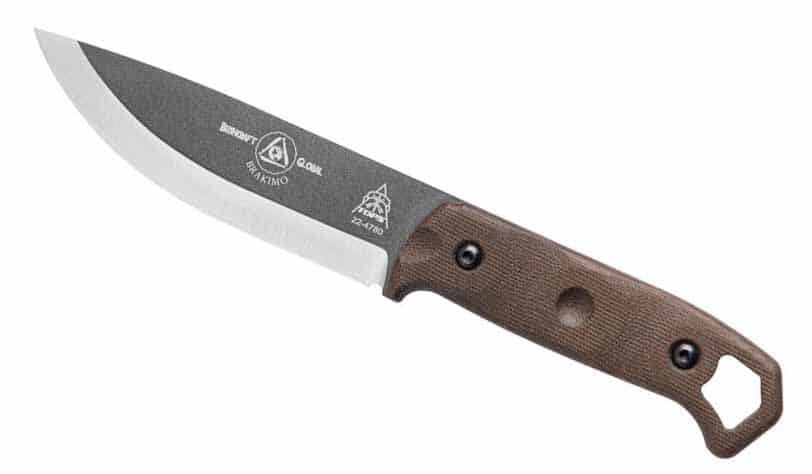
TOPS Brakimo
Designed by noted survival/outdoor expert Joe Flowers of Bushcraft Global, the TOPS BRAKIMO is as close to a do-it-all knife that can handle all tasks from whittling to cutting to chopping and baton work.
Its blade is 5 2/4-inches long and 0.190 inches thick and is made from 1095 carbon steel. The drop point shape gives plenty of belly to facilitate a broad range of tasks including but not limited to food prep. The modified Scandi grind is there for cutting performance as well as a thicker cross-section of the blade to promote strength in the blade. The handle is of OD green canvas micarta and has been finished to leave a “grip you back” quality to it. The edges have been chamfered for ultimate comfort, and there’s a divot for use with a bow drill. An extra-large lanyard hole allows you to use any cord diameter for a lanyard and possibly even attach it to a carabiner. Finishing out the Brakimo is a nice Kydex sheath that carries the knife at your side securely. A spring metal clip is the means to attach the sheath to your belt.
The Kydex sheath is nice although basic. But really in the end as long as it works, that’s all that matters.
MSRP: $169 Origin: USA
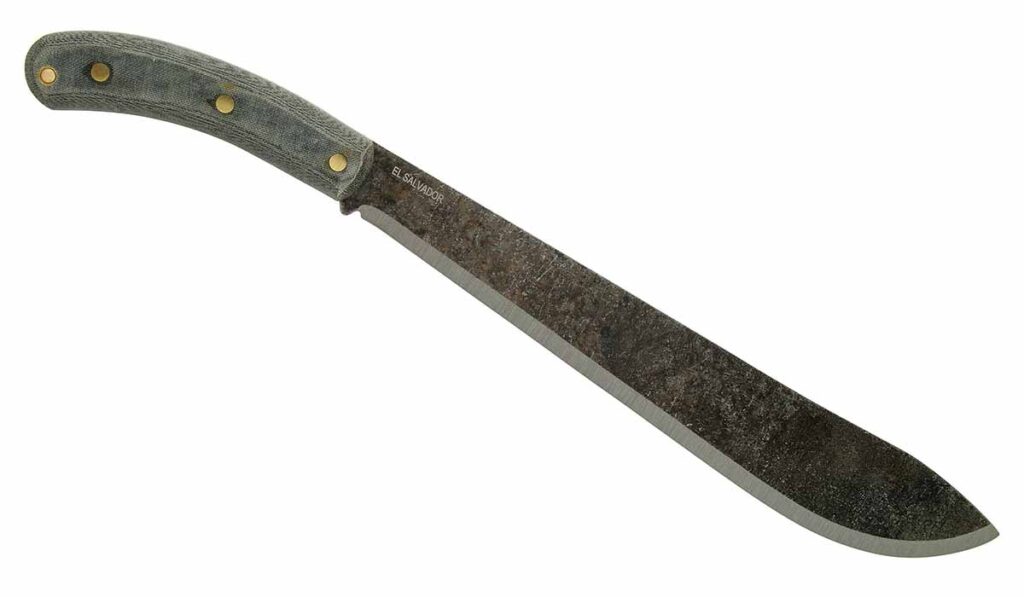
ESEE Expat Darien Machete
I know. This is a machete, but this is an article on camp knives. Truth is that machetes can be used in conjunction with camp knives. More so with the ESEE Expat Darien machete, this is also part machete and part knife as well.
Measuring a little over 18 inches, the Darien has a reach like any other machete, but it also has excellent balance and feels so agile in the hand that you can use it as a knife for whittling, chopping, batoning, and maybe some heavier cutting of camp food prep tasks. The blade is made from 1075 carbon steel and is very easy to resharpen in the field. At 0.094-inches thick, the blade stock is thin enough to be nimble and is thinner than most camp knives, which are at least ⅛-inch thick (0.125 inches).
The blade itself is a little over 12 inches, which is enough length to get work done. The handle is made from black micarta, which is a great choice because it’s a synthetic material that is dimensionally stable and has an excellent grip you back quality. The sheath is sewn canvas and is well made. An integrated belt look allows the Darien to be at your side whenever it is needed. Pair the Darien with a favorite full-blown camp knife and you have the ultimate combo!
MSRP: $121 Origin: El Salvador.
Spartan Blades Hersey Nessmuk
Spartan Blades made a name for itself as a top producer of high-end tactical and outdoor knives. It recently came out with a USA-made mid-grade line of professional use knives that are OEM’d by Kabar Knives in the Kabar factory in upstate NY. This series is known as the Silver line and offers enhanced features and value pricing. These are a step up from the company’s Bronze line of entry-level knives and a step down from its Gold line of elite, high-end knives. The Harsey Nessmuk was designed by knifemaker Bill Harsey to be a heavy-duty field companion on the hunt or at the campsite.
The Nessmuk skinner-inspired blade shape flares at the tip and is great for, well… skinning and slicing tasks. The 5-inch blade is big enough to get work done but short enough to not get in the way. 1095 carbon steel is used for the blade, and the high flat grind tapers allows it to slice cleanly and effectively. A black powder coating reduces glare and adds a layer of protection against corrosion.
One look at the handle design and you can tell it’s pure Harsey. Multiple features are integrated such as the lower hand guard, the palm swell in the middle, the traction notches at the thumb rest on the blade spine. There’s 3D machined texture for grip retention, all built into the black injection molded handles. Wrap your hand around the handle and you feel how secure and comfortable it is to grip, lending a feeling you can use the Spartan Harsey Nessmuk for extended periods.
It is a very well-thought-out design overall and meant for hard use in the great outdoors. The Harsey Nessmuk comes with an injection molded sheath with a thick webbing belt loop. An innovative retention feature locks the knife into the sheath, preventing it from coming out unless you want it to. There is a thumb button on the sheath you push up on as you grip the handle naturally to release the blade from the sheath. Not too many fixed blades have a feature like this and just rely on locking the sheath up around some part of the handle. When you insert the knife into the sheath, you will hear an audible click, indicating that the blade is locked. Very cool!
MSRP: $190 Origin: USA
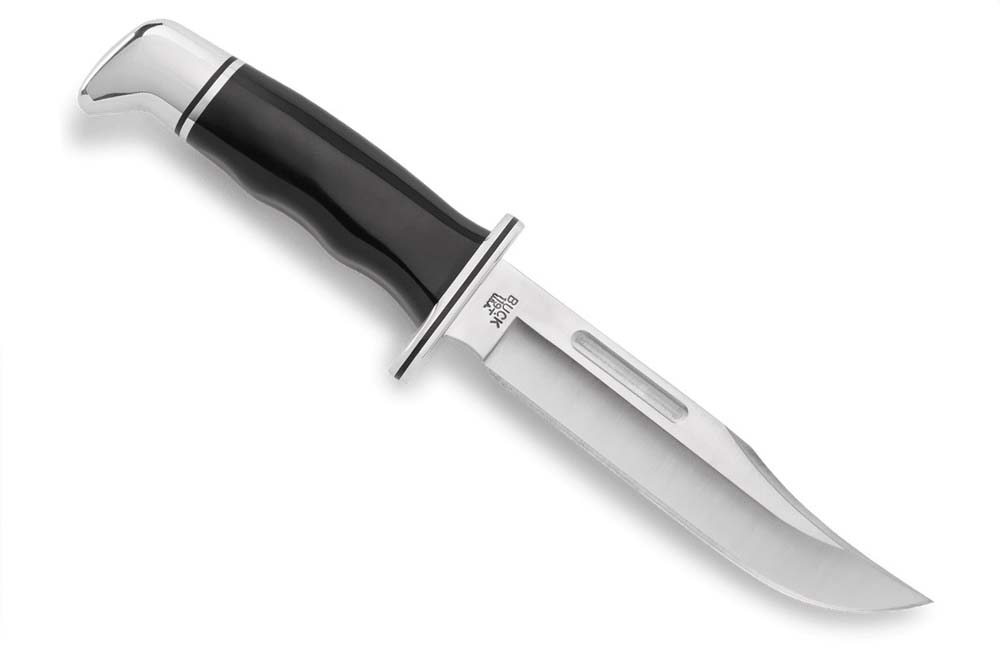
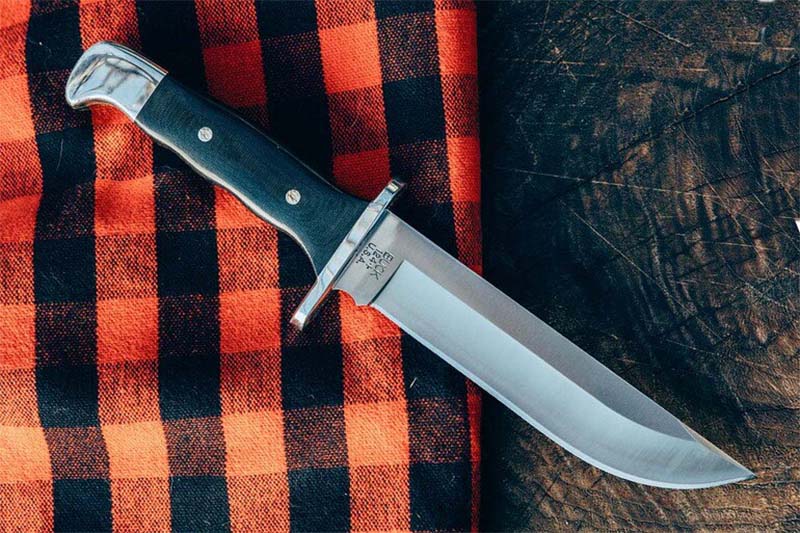
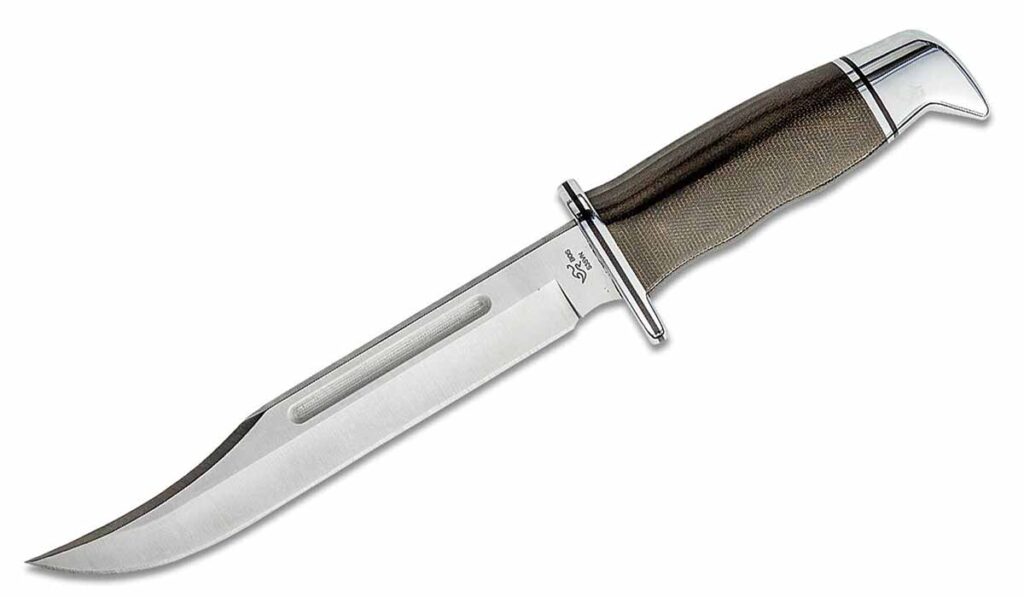
Buck Knives General Pro
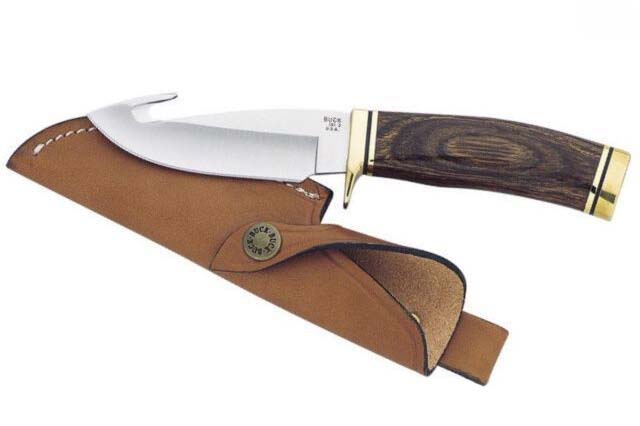
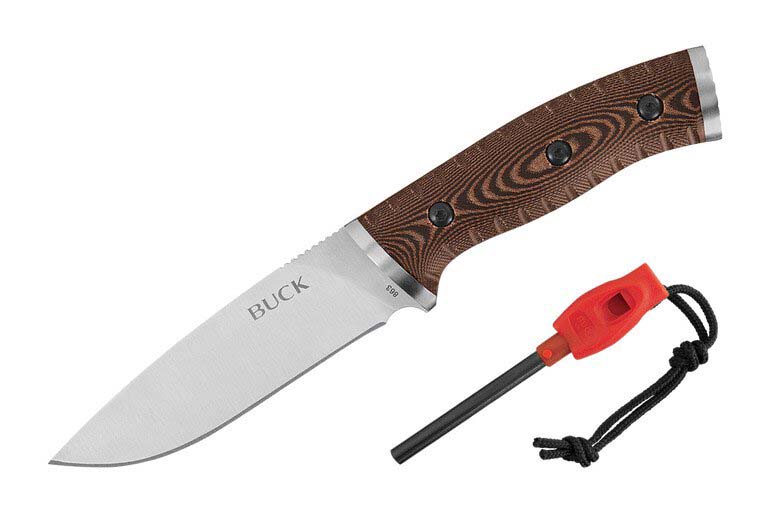
Any article talking about outdoor knives isn’t complete without a mention of a Buck knife. The company has been synonymous with the great outdoors since its inception. Its model 120 General Pro is one such knife, built to take whatever the great outdoors can dish up.
Crafted with a blade made from premium CPM S35VN stainless steel, the General Pro is built for hard use in all environments. Measuring a little over 7 inches in length, the clip point blade has a hollow grind, pronounced swedge, and a milled-in fuller, giving the knife its aggressive look. The handle is made from OD green canvas micarta for the ultimate all-weather grip.
The signature aluminum guard and pommel, present on all Buck fixed blades, cap off the handle’s construction and appearance. The General Pro excels at camp food prep, whittling, some chopping, and baton work for wood splitting. At 12 inches overall, it’s the perfect large fixed blade to have when you hit the great outdoors. It is accompanied with a sewn leather sheath, as is common with all Bucks.
The General Pro is the tonier model, but if it’s out of your price range, the General model offers the same design only with 420HC stainless steel blade, black phenolic handle and lower price.
MSRP: $128
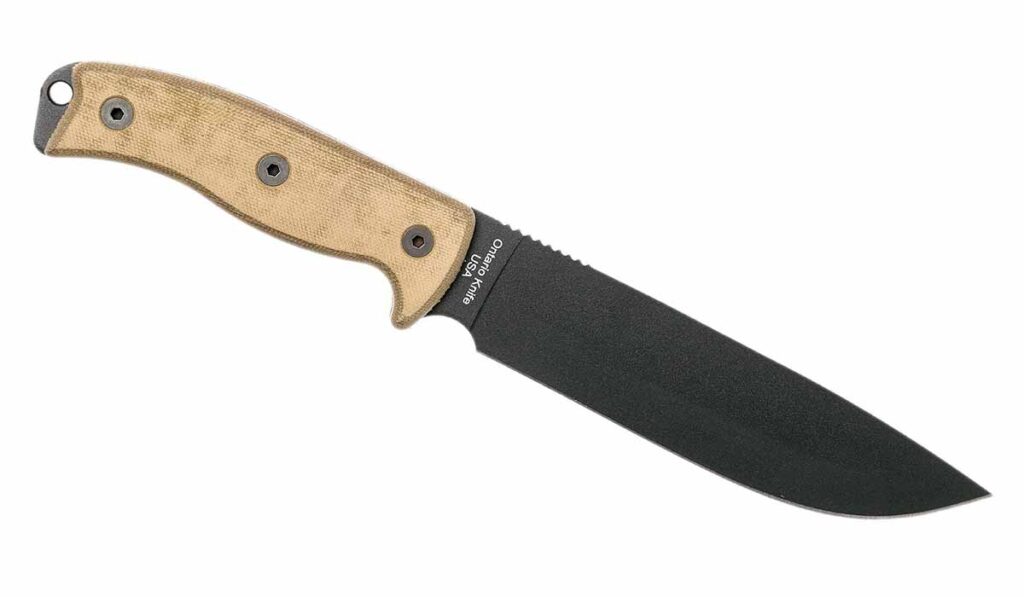
Ontario RAT 7
Ontario’s collaboration with Randall’s Adventure & Training has yielded a very highly successful series of folding and fixed-blade knives that are aimed solely at outdoor adventures. One such example is the RAT 7. The fixed blade is a larger knife that can handle all of your camp chores and some food prep. But tough work like chopping and batoning wood is what the RAT 7 is built for.
The 7-inch long, flat ground, drop point blade is ground from 1095 carbon steel and given an epoxy powder coating to keep rust and corrosion at bay. The handle is a tan canvas micarta, an excellent choice for outdoor knives because it is fully synthetic and is impervious to moisture, cracking, and gouging. The handle design itself incorporates an integral lower finger guard, an ergonomic curved gripping area, and an exposed pommel with a lanyard hole. There is also a forward choil at the tang so you can employ a choke grip for more control over the blade.
Each RAT 7 comes with a nylon belt sheath that features an exterior accessory pocket for storage of a sharpener, folding knife, or additional survival supplies.
MSRP: $135
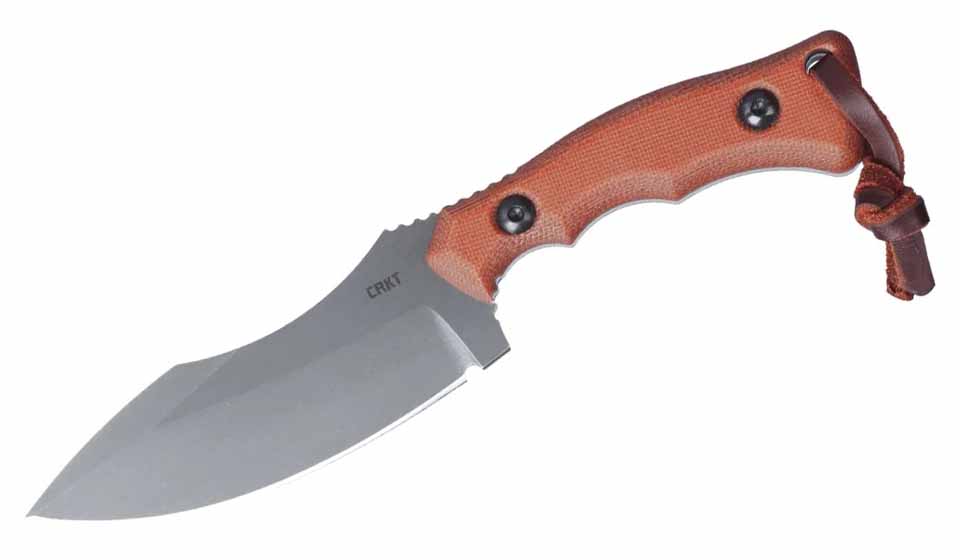
CRKT Bugsy
Designed by custom knifemaker and Discovery Channel’s Naked and Afraid star Kaila Cummings, the Bugsy is CRKT’s first USA-made fixed blade in the lineup. The knife receives its moniker from Cummings’s first appearance on the TV show when she received numerous big bites in the jungle in Colombia.
Featuring a 1095 carbon steel harpoon-style blade and a micarta handle, the Bugsy is as at home in the outdoors as it is an EDC fixed blade. With a blade length of a hair under 4 inches, the Bugsy is sized appropriately to take on most tasks inside camp or at home. Again, like some of the fixed blades discussed here, 1095 is used due to its low cost-to-performance ratio. It’s easy to resharpen in the field and offers reasonably good edge holding, which makes it a favorite amongst outdoor users.
The highly ergonomic handle showcases multiple finger grooves and an expanded butt end capture your hand to provide a secure, non-slip grip. Micarta is used due to its dimensional stability and excellent all-weather qualities—necessary for an outdoor use knife.
A leather fob is tied to the handle and acts as a handle extension for those with larger hands.
Accompanying each Bugsy is a high-quality leather sheath that holds the knife securely and at your side. There’s also a tactical version of Bugsy that features a black-coated, part-serrated blade and black G-10 handle. It comes with a black Kydex rig for belt carry.
MSRP: $200 Origin: USA
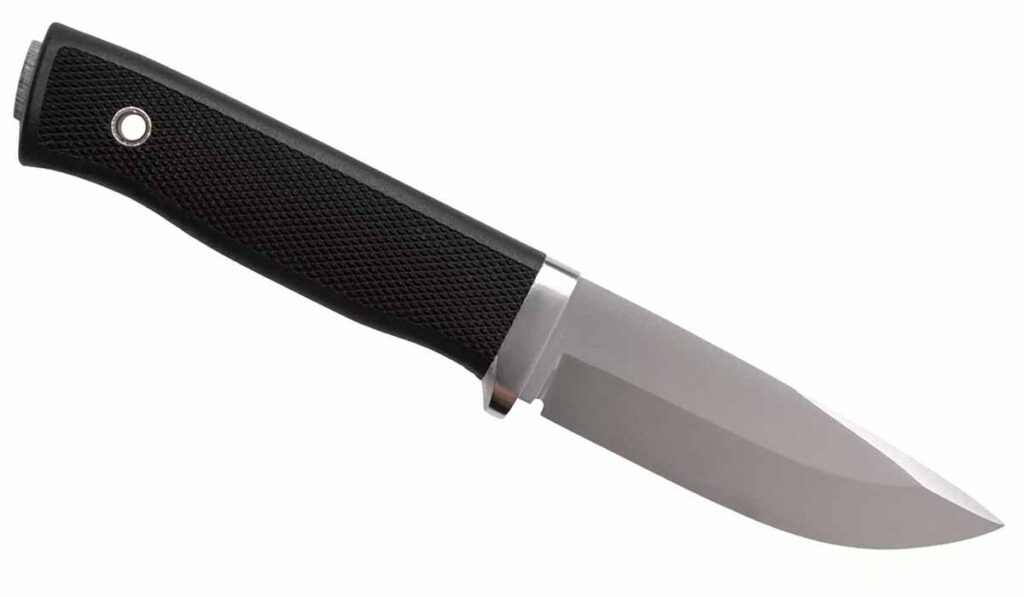
Fallkniven F1 Pro
For those not familiar with Fallkniven, it is a Swedish knife manufacturer with among the best-kept secrets in the production knife industry—its fixed blades. These tools are elegantly refined and yet sport blade and handle designs geared towards the practical. Like anything European, Fallknivens are a bit costly but are very worth it. You get what you pay for and then some.
Fallkniven’s F1 Pro fixed blade is a straightforward utility done up to the next level. The drop point blade is 4 inches in length and is ground from premium high-end ELMAX stainless steel, ensuring edge longevity and durability.
The handle is made from a polymer called Thermorun, a molded material soft to the touch. It sports checkered texturing that grips your hand back regardless of weather conditions. Hot, cold, wet, or dry…the Thermorun handle ensures a sturdy, comfortable purchase.
With an overall length of 8 and ½ inches, the F1 Pro carries very well in its hybrid molded Zytel sheath with nylon webbing belt loop. A secondary button snap strap secures the handle in place.
MSRP: $408
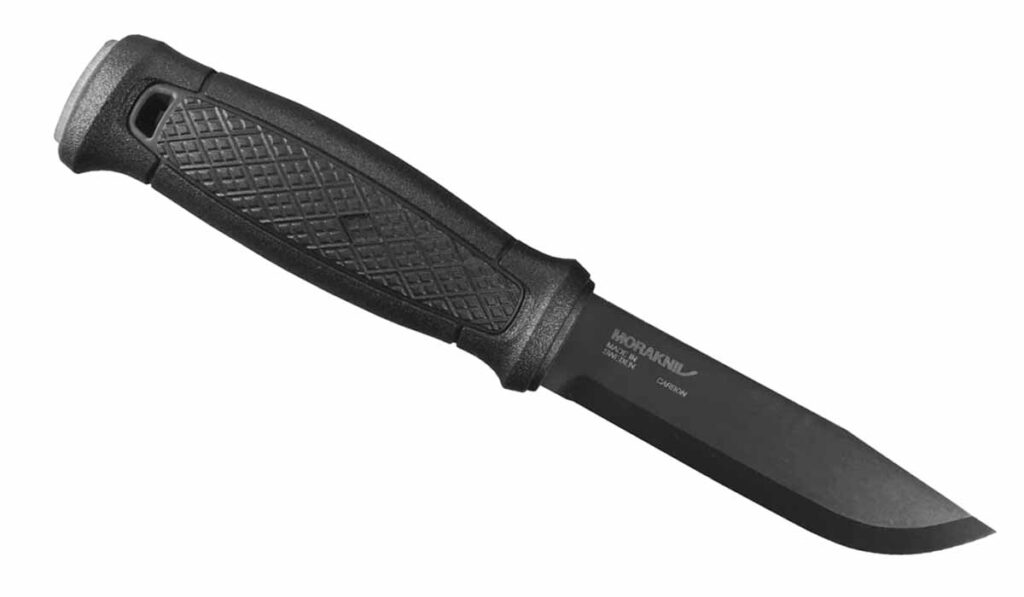
Mora Garberg Carbon
One of the best values in high-quality fixed blades undoubtedly is Mora, another Swedish knife manufacturer. Mora’s knives are highly functional and well-designed, yet they sell at prices anyone can afford. They are what I recommend to folks who want a good quality knife without breaking the budget. Mora’s Garberg is one of the company’s larger knives and is designed and built for survival and camping.
Starting with the blade, the modified clip point is made from carbon steel for ease of sharpening and is given a Scandi grind for optimum cutting performance and blade strength. The blade measures a hair over 4-inches long, which is enough to take care of most cutting tasks while being easy to carry. The blade is given a black coating to help protect it from corrosion since it isn’t stainless steel. The handle sports a full tang construction, the Garberg is the first Mora model to feature a full tang. This means the knife can withstand harder use than the other Mora knives.
The handle has a dual molded construction with molded Polyamide and hard rubber, for a durable and weather-resistant grip. The handle has rounded contours, which makes it easy on your hand for extended use. This handle design and construction is typical across the Mora knife line and is proven to be durable and comfortable in the long run. The sheath that accompanies the carbon steel Garberg is a nice leather sheath that protects the knife and allows the user to carry it conveniently.
MSRP: $130
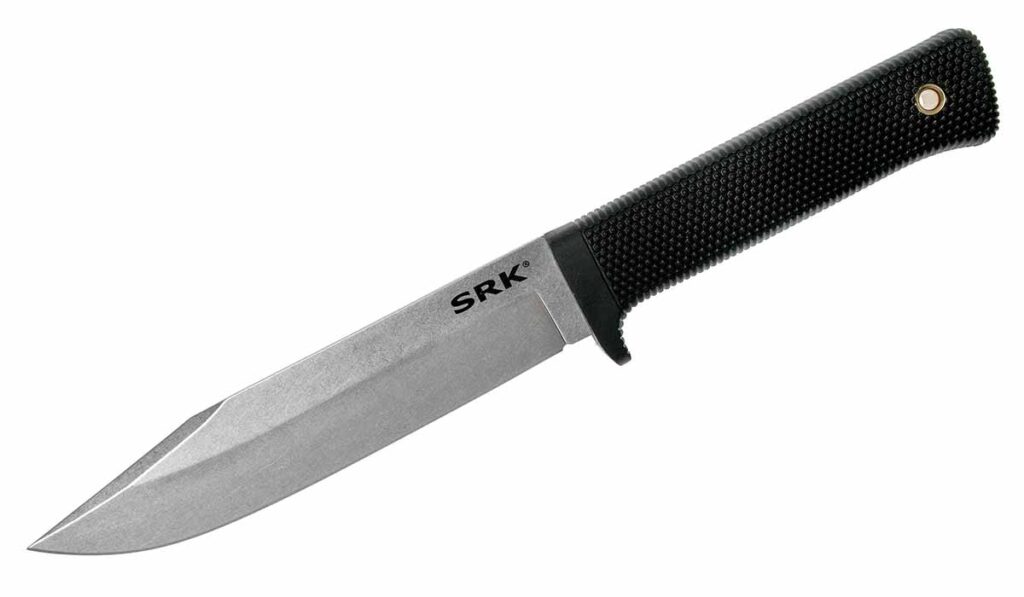
Cold Steel SRK
Those of you into knives for a while have heard of Cold Steel. It has been around for a long time and so have some of the company’s classic designs such as the SRK (Survival Rescue Knife). Don’t let the name fool you though, this knife also excels at camp chores as well as any cutting task indoors or out.
The 6-inch blade is ground from SK-5 carbon steel and given an epoxy coating to protect it from the elements. SK-5 is a Japanese steel that is roughly equal to 1080 carbon. The clip-point blade is straightforward, but pure utility all around. It can pierce, score, and slice its way through all your camp-cutting tasks.
The handle is a molded rubber-like material that Cold Steel calls Kray-Ex. It sports checkered texturing for the ultimate grip regardless of weather conditions. An integrated, lower hand guard prevents your hand from sliding forward. The handle color is available in black, tan, and OD green to suit your personal preferences and primary use environment. The overall length is a little over 10 inches, making this a larger fixed blade, and it’s ideal for hard-use applications. Each SRK comes with a molded Secure-Ex sheath which is very similar to Kydex, allowing the sheath to be form-fitting and securely carry the SRK without rattle.
MSRP: $62
Spyderco Bow River
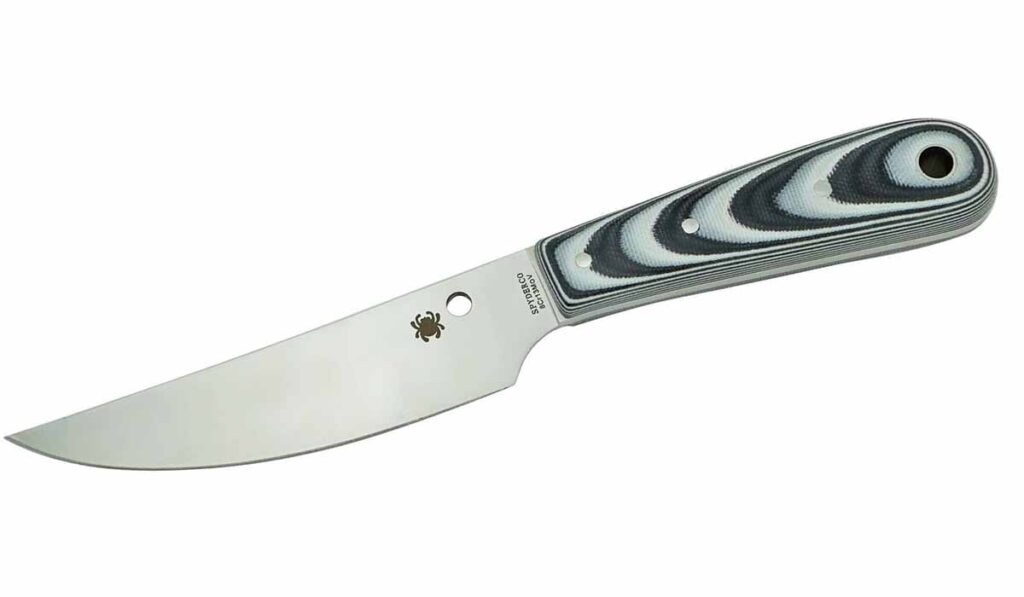
The Bow River from Spyderco is an affordable fixed blade in the SPYDERCO lineup that has great potential. Its trailing point blade style is highly adaptive to hunting, bird and trout, as well as general food prep in camp.
The blade is 4.4-inches long and is ground from 8Cr13MoV stainless steel, which is the Chinese equivalent of Japanese AUS-8 stainless. 8Cr13MoV is easy to sharpen out in the field and offers reasonable stain resistance. It’s a good middle-of-the-road production stainless steel, favored by quite a few production brands. The full flat grind ensures optimum cutting performance through a variety of foods and meats. The trailing point blade design offers a continuous blade belly that works excellently with food prep, facilitating ease of slicing motions. At an overall length of 8.1 inches, the Bow River is an excellent choice for a fixed blade that carries easily and won’t break the bank.
The handle is black and gray G-10, with alternating color layers that produce an interesting wood grain visual effect when the handle is contoured. The handle is rounded and contoured to lay in your hand easily and very comfortably. You can get a good grip on this shape, even though it lacks any texturing. Each Bow River comes with a sewn leather belt sheath that carries the knife, ready at hand for any task.
Large Work Knife takes the author’s favorite media to task.
With camping season in full swing, it’s always a good idea to have a sharp knife at your side to build a lean-to or traps and make firesticks, to name a few. The Large Work Knife by KG Handcrafted Bladeware can fill the bill. Ground from 5/32-inch A2, a tool steel known for providing a keen edge, it begged for a good testing.
Large Work Knife Edge Test
I like to start off by slicing 20-pound bond copy paper because it gives a good idea of edge profile and keenness of the edge. The knife sliced the paper smoothly with no resistance. It’s nasty sharp for sure. Though I’m not a big fan of the chisel grind and Scandi profile edge, each has its place.
The Large Work Knife excelled cutting the 8-ounce leather, providing very fine slices at the same thickness and angle.
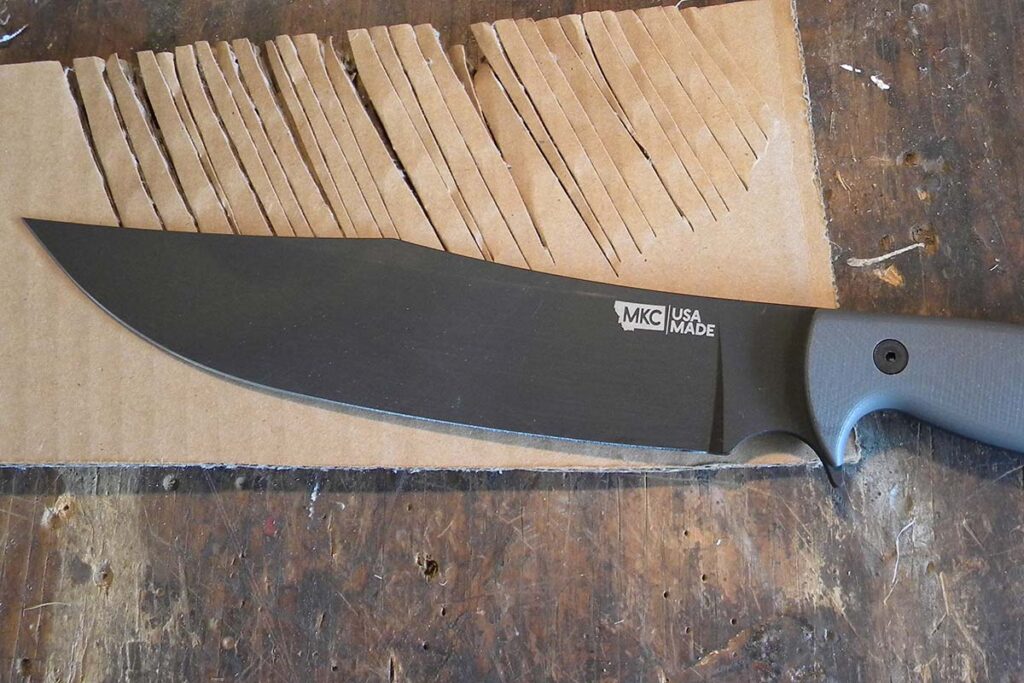
I grabbed a piece of double-walled cardboard and commenced cutting. The edge was very aggressive and only a slight rolling of the cut pieces occurred from the Scandi profile edge. The handle made for great control. I really like it. It worked best by using a push cut.
Medium-Duty Cutting
Leather was next. The A2 blade zipped through it very fast. The edge created a nice crunching sound as it went and was very aggressive. The wrapped handle was great at controlling the width of each cut. It was fun to do but be sure to keep your fingers out of the way. Next, I skived 8-ounce leather. The blade made short work of it, providing very fine slices at the same thickness and angle.
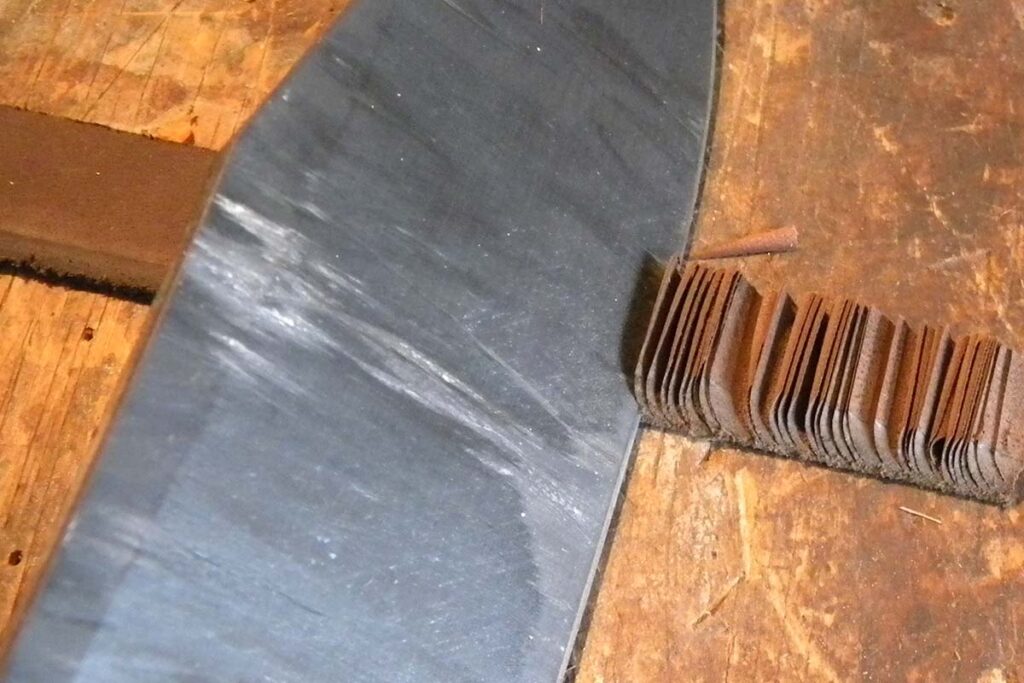
The knife powered through 200 clean, crunching cuts of sisal rope very quickly. The handle was comfortable and provided a non-slip grip with no hot spots.
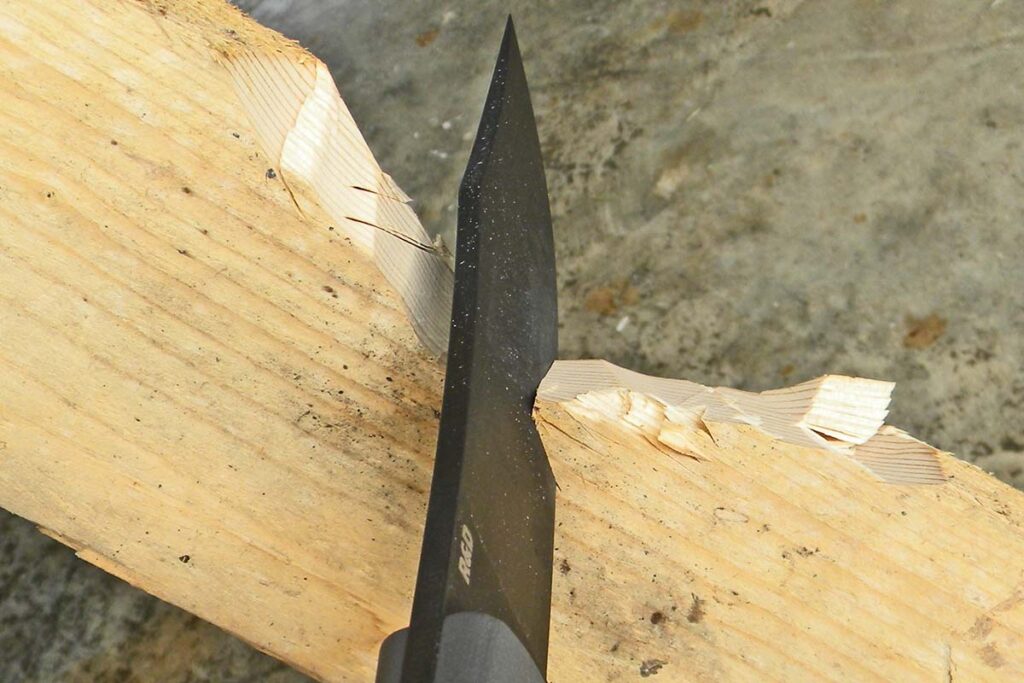
It was time to make firesticks. The knife made great curlicues. Cut depth was very manageable. It was a perfect use for the chisel grind on the correct side for a right hander. Nicely done, KG Handcrafted Bladeware! Woods seems to be the perfect medium for this blade style.
Now for my favorite, cutting sisal rope. The knife powered through 200 clean, crunching cuts very quickly. With no stopping in sight, I ended the cuts before I used up all my rope, another great medium for the chisel grind. The handle is comfortable and provided a non-slip grip with no hot spots.
Heavy-Duty Cutting
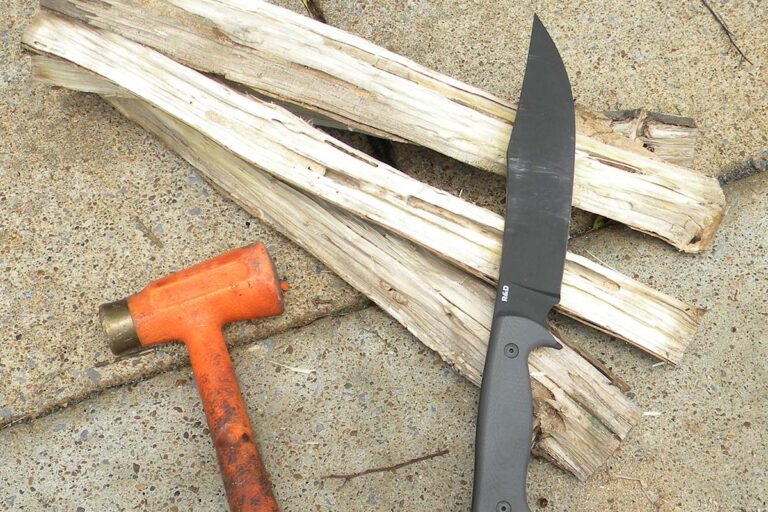
I batonned the Large Work Knife through a 1.5-inch-diameter branch. It split the first 2 inches quickly then started to drift to one side the farther down I got. The drifting could have been due to the fact it was old wood or a chisel grind. Either way, it worked with no damage to the knife whatsoever.
Thirty hard whacks into the antler put some very small chips in the fine edge an inch or so before the tip, as the author expected. When he returned to the copy paper, slicing was smooth with minimal tearing by the chip area. The knife was still nasty sharp.
Chopping deer antler to test how well a blade has been heat treated is not recommended and might void the warranty. I did it anyway. Thirty hard whacks into the antler managed to put some very small chips in the edge, as I expected it would. The fine edge will do exactly that.
Finally, I returned to the copy paper. Slicing was smooth with minimal tearing by the chip area. The knife was still nasty sharp. Job well done!
Overall Take On The Large Work Knife
This knife is well-made for EDC chores. I love the A2 steel. The handle is very comfortable.
Changes
The knife performs well for its designed purpose. I would just run the grind higher.
Large Work Knife Specs Maker: KG Handcrafted Bladeware Blade Length: 4” Blade Material: A2 tool steel Blade Grind: Chisel Blade at Thickest: 5/32” Blade Pattern: Semi drop point Handle Material: Waxed cotton string and resin cord wrap Weight: 6 ozs. Overall Length: 8.5” Sheath: Oil-tanned cowhide over aluminum and Kevlar® Weight w/Sheath: 9 ozs. Maker’s Price: $320
The Karambit Is A Historic Utility and Combat Knife From Asia That Has Grown In Popularity Around The World In Recent Decades.
The karambit looks unlike any other knife. The short, swooping curve of the blade dates back nearly a millennium in Indonesia and throughout Southeast Asia. First used mainly as a tool for farming and planting rice, the karambit evolved over time into a combat knife. The curve became more pronounced and became a main weapon in pencak silat, an indigenous Indonesian martial art, and Filipino martial arts.
Legend goes that as the knife became more combat-oriented, its shape was inspired by a tiger’s claw. The knife’s tight curve and finger ring allow it to stay securely in the hand in close-quarters combat.
Why Should I Use A Karambit?
The karambit today is very much a self-defense tool. Yes, it can still be used for outdoor tasks, but there are more practical blades available for such purposes. The karambit is a strong, durable combat knife used by law enforcement and militaries around the world.
If you’re looking for a high-quality knife to keep on your person as protection, you can’t get much better than the karambit. The finger ring provides a natural, secure traditional grip or reverse grip to generate more power with each swing.
The folks at Emerson Knives, Inc., have made a great video showing how to use a karambit.
Do I Need A Karambit?
Simply put: no. A karambit is a refined self-defense tool. If you live a life where life-and-death close-quarters combat is an extremely minute possibility then you can probably pass on a karambit.
Additionally, the sharp curve of the blade means it can be difficult to handle without experience or training, even with the finger ring. If it’s uncomfortable to use then don’t use it.
Best Karambits
Emerson Combat Karambit
The Combat Karambit folder by Emerson Knives, Inc., was very well received when introduced years ago. It subsequently spawned a larger version called the Super Karambit. It shares the same award-winning features of its forerunner but in a larger, more impressive format. The 3-inch blade is 154CM stainless steel and opens by either the patented Emerson Wave or an oval blade hole. Handle material is G-10 reinforced by dual titanium liners for rigidity. The handle flows seamlessly into the finger ring in the butt. There are a lot of graceful curves on this knife. It’s a feast to behold.
The handle fits my hand extremely well, instilling a high sense of security and user confidence. The Super Karambit carries nicely in a pocket though its presence is a constant reminder of just how big it is. A reverse grip feels exactly as secure as a forward one. Your hand isn’t moving once it’s wrapped around this handle!
To deploy the blade using the Wave remote pocket opener, hook your finger through the finger ring, pull the handle from your pocket and let the Wave hook engage the seam of your pants pocket. Keep pulling and as the handle comes free from the pocket, the hook grabs the seam and deploys the blade open and locked. To my knowledge, this results in faster blade deployment than any other karambit.
One thing I don’t care for is the overly aggressive texturing of the G-10. I like grippy texture but this one is downright abrasive on pants fabric. It might be a good idea to take a small piece of cardboard and rub it over the handle texture to smooth it out somewhat. The knife is offered exclusively in a stonewashed blade finish and a black G-10 handle. Country of origin: USA. Closed length: 5 inches.
MSRP: $325
TOPS Devil’s Claw 2
The Devil’s Claw 2 by TOPS Knives is a mid-sized fixed blade designed for personal protection. It’s built on the same platform as the company’s original Devil’s Claw but with an extended handle to accommodate a full grip as well as the traditional ring at the end. The 3-inch hawkbill blade is 1095 carbon steel in the company’s Black Traction Coating to help protect against corrosion, as well as provide a low profile. Overall length: 5.75 inches. Five large traction notches machined into the rest portion of the blade spine provide a non-slip grip for the thumb. The handle is blue and black G-10 with red fiber spacers at the tang—very eye catching! The sheath is molded Kydex with loops to carry horizontally on a belt.
The DC2 is also a well-disguised utility knife. It feels agile and capable in hand. If you have jobs that require long, straight cuts, the DC2 is the answer. The angle of the blade makes it easy to use the tip to cut and score, while hiding the knife in a forward grip. The finger ring helps seat your hand during such tasks. The traction notches on the thumb rest aid with precise tasks such as wire stripping, whittling or any task that requires downward pressure on the blade.
MSRP: $165
CRKT Du Hoc
Sometimes bigger really is better, and that might be the case with the CRKT Du Hoc. This fixed blade designed by Austin McGlaun is a whopping 9.63 inches in length and 9.3 ounces in weight. McGlaun designed the knife to honor his late uncle who earned a Silver Star at Point Du Hoc.
The 5.1-inch blade is made from powder-coated SK-5 carbon steel. The G-10 handle provides an excellent grip, and the included thermoplastic sheath comes with mounting options and makes for easy transport.
MSRP: $113
Fox Knives 479
We return to folders with this piece from Fox Knives. The 479 is a large flipper that can handle whatever you throw at it. The 2.95-inch blade is made from N690Co stainless with a black Idroglider coating and a G-10 handle. The blade has been treated to 58-60 HRC, making it the hardest blade on our list.
When opened, the knife is 7.48 inches long, and it weighs 4.58 ounces. The finger ring is made from aircraft aluminum to keep weight down without sacrificing toughness. The reversible pocket clip makes for easy carry no matter where you go.
MSRP: $156
Boker Magnum Spike
At 8.25 inches overall, the Boker Magnum Spike Karambit is a full-size fixed blade. Visually, this one is quite striking! The 4-inch talon-shaped blade is 440A stainless steel coated black for corrosion protection and a low profile. A full-length swedge adds attitude.
The handle is very well executed. Multiple finger grooves aid in seating your hand comfortably. There’s a groove on the handle spine with traction notches to securely seat your thumb and help index your grip. The tan G-10 handle features a 3D texturing pattern for an excellent non-slip grip. The edges of the G-10 are chamfered properly, further enhancing grip comfort. The finger ring has an integral spike at the end for a blunt strike option if needed. When held in the reverse grip, the spike helps form a comfortable thumb rest. A molded Kydex sheath with belt adapter promotes easy carry . Due to its large size, the Spike isn’t as agile in-hand as the smaller test karambits. If you tend to manipulate a karambit, this one isn’t for you. Due to the swedge, the blade is somewhat thin and while sharp and able to penetrate like crazy, it might be prone to bending or breaking if used for rough cutting. A smaller version with a 3-inch blade that is more hawkbill than talon, flat ground and without the spike on the ring could be more agile and more EDC friendly. Still, at an
MSRP: $73
Spartan Blades Ronin Shoto
Spartan Blades teamed up with Tu Lam of Ronin Tactics to design the Ronin Shoto, a folding karambit that is part of the company’s Field Grade line of tactical knives. The Ronin Shoto design leverages the knowledge of Lam along with Spartan Blades co-owners Curtis Iovito and Mark Carey—all three saw action together in the Special Forces—and their experiences serving the USA overseas in Asia. The trio developed a fascination with the karambit during that time and it wasn’t until years later that their fascination manifested itself with the Ronin Shoto.
The knife adopts 2.5 inches of a tanto blade, rarely seen in karambits. For blade steel, CTS XHP premium stainless provides edge longevity and durability. There’s also the Emerson Wave, the only opening method the Ronin Shoto has. The blade rides on Spartan’s OIBBS (oil-infused bronze bushing system). The bronze washers are permanently impregnated with lubricant to ensure glassy smooth blade operation at all times. Textured G-10 slabs conceal dual stainless liners. A linerlock secures the blade in the open position. A deep carry pocket clip carries the knife comfortably. A contrasting red G-10 handle spacer adds a tasteful pop of color.
The Ronin Shoto sports a very impressive, heavy-duty build. Like the Emerson Super Karambit, the pocket presence is something you will notice, though it’s not uncomfortable. Opening the blade is very similar to the Super Karambit—index finger through the finger hole, pull and the blade opens as the knife exits the pocket, all in one continuous motion. If you prefer the reverse grip, re-orient the clip to the left side of the handle and you can still make use of the Wave.
Whereas the curved blades of standard karambits are limited in use, the short tanto of the Ronin Shoto is more utility friendly. It tackles general cutting tasks and the CTS XHP stainless steel ensures edge quality will go the distance. I wish the folder had an alternate way of deploying the blade other than just the Wave, though it is possible to place your thumb on the Wave and push on it to open the blade as you would any one-hand knife. Closed length: 5.2 inches.
MSRP: $155
Lionsteel/Emerson LE One
The Lionsteel/Emerson LE One is a collaboration between Ernest Emerson and Lionsteel. It quite possibly is the most advanced folding karambit on today’s market due to several notable features. The 3.23-inch blade is CPM MagnaCut stainless, the latest in high-performance “super steel.” It’s the most advanced steel in terms of edge holding, stain resistance and toughness. The blade opens via one of three methods—blade hole, Emerson Wave and a flipper. If you want to remove the flipper, you can do so using a T6 Torx® wrench. The removable flipper is the REF (removable flipper) system, exclusive to Lionsteel.
The framelock handle showcases another feature seldom seen on factory knives: no assembly screws because it’s machined from one billet of aluminum. The lockbar, semi-open backspacer and finger ring are all one piece of aluminum. The handle boasts a machined crosshatch pattern with milled striations. A stainless steel wear pad screwed to the end of the lockbar results in steel-on-steel lock integrity. A deep-carry pocket clip is reversible for ambidextrous use. Handle color options are black, green, red and brown. Blade finish options are stonewashed and black coated.
A fraction over 5 inches closed, the LE One is one of the larger folding karambits. However, it’s so lightweight and carries so well that its sheer size doesn’t even factor in. I like how your hand is seated comfortably when in the forward grip—it definitely feels secure. All edges and corners are rounded and chamfered properly, making the handle melt in your hand. Even the finger ring is rounded both inside and out. The thumb ramp and blade spine are crowned—I totally dig this. These areas have a rounded appearance, not flat like most other blade spines. Crowning demonstrates that a company is willing to go the extra mile to pay attention to such a minor detail. Lionsteel has detail locked down for sure!
Sharp out of the box, the blade cuts very efficiently and the flat grind pull cuts easily. The framelock engages tight, with zero blade movement in any direction. The blade tip looks different from other karambits. It appears to be dull but is not. Emerson’s design eliminates the very pointy tip, which is prone to break during heavy use, by squaring it off slightly. This creates a strong tip. The Emerson Super Karambit has the same feature as well.
MSRP: $268
Kershaw Knives Outlier
Anchoring the value end of the spectrum is the Kershaw Knives Outlier. In a somewhat angular handle design, the Outlier’s finger ring is integral with the handle spacer. The only karambit from Kershaw, it features a 2.6-inch blade of 8Cr13MoV stainless steel. The blade opens via Kershaw’s SpeedSafe assisted-opening mechanism designed by BLADE Magazine Cutlery Hall-Of-Fame® member Ken Onion. The opening starts via a choice of an oversized thumb stud and a flipper. The handle is a glass-filled nylon polymer outfitted with a deep-carry pocket clip and a linerlock.
The Outlier feels very secure and comfortable in hand. Your grip is locked in via the large forward finger recess and finger recess at the butt just outside the finger ring. Fit and finish is top notch and an all-black tactical finish presents a subdued appearance. The 8Cr13MoV is a good middle-of-the-road steel, very comparable to AUS-8, which is popular in entry-level-to-mid-range knives. The curved blade is easy to sharpen with a rod-type sharpener and holds a decent edge.
MSRP: $72
Editor’s Note: Dexter Ewing and Mike Ableson contributed to this article.
Feel the burn of the hottest makers’ hottest Custom EDC Knives—both folded and fixed.
Tommy Gann: Coke Bottle Slip Joint
As Daniel O’Malley of BladeGallery.com noted, “ABS master smith Tommy Gann makes an exceptional knife. The 52100 carbon steel wharncliffe blade of his Coke Bottle Slip Joint has a handrubbed satin finish, smooth, consistent action, a firm half stop and easily opens with a light pull.” Blade and closed lengths: 2.9 and 3.9”. Bolsters: 416 stainless steel. BladeGallery.com’s price: $550. (BladeGallery.com image)
Willem Steenkamp: Raider Flipper Folder
The 3.5-inch blade of hollow-ground CTS XHP stainless steel on Willem Steenkamp’s Raider flipper folder pivots on an Ikoma Korth Bearing System. Handle: Silver-strike carbon fiber. Pivot collar: stainless damascus. Pocket clip: 3D-machined titanium anodized blue, configured for right-side, blade-tip-up carry. Lock: linerlock. Weight: 3.2 ozs. Closed length: 3.83”. BladeGallery.com’s price: $680. (BladeGallery.com image)
David Breniere: Mini Inglorious Slip Joint
“The Mini Inglorious slip joint by David Breniere offers a handrubbed Elmax stainless steel blade with David’s W’s pattern damascus bolster and Sambar stag scales,” stated Dave Stark of Steel Addiction Custom Knives. “The knife just melts into the hand. Truly topper fit and finish.” Blade and closed lengths: 2 7/8 and 3.25”. Weight: 3.2 ozs. Retail price: $2,000. (Steel Addiction Custom Knives image)
Brian Efros: Elder Tactical Folder
The Elder tactical folder by Brian Efros has a drop-point recurve blade with dual bead-blasted thumb studs. Blade length and steel: 3” and CTS XHP stainless. Handle: carbon fiber with Chad Nichols Dark-Ti damascus bolsters and backspacer, and zirconium pivot collars. The Dark-Ti pocket clip provides blade-tip-up carry. Lock: linerlock. According to Arizona Custom Knives (AZCK), the Elder has “very nice action, detent and blade seating.” Weight: 5.2 ozs. Closed length: 4.25”. AZCK’s price: $3,295. (AZCK image)
Jacek Hnatow: Bushcraft 1
The Bushcraft 1 by Jacek Hnatow boasts full-tang construction and excellent balance and handle ergonomics. “Though designed for bushcraft, the knife makes an outstanding all-around utility tool,” observed Les Robertson of Robertson’s Custom Cutlery. Blade length, style and steel: 5.5”, drop point and Bohler N690 stainless. Handle width and material: 3.75” and textured black G-10. Overall length: 14.5”. Sheath: custom made of leather by the maker. Maker’s price for a similar knife and sheath: $325. (ImpressByDesign image)
Bill Koenig: Arius Flipper Folder
Bill Koenig’s Custom Arius flipper folder has a 3.5-inch blade of CPM 20CV stainless steel with a handrubbed satin finish and mirror-washed accents. The handle on the custom EDC knife is copper-dust carbon fiber on the front side and titanium with C-pattern milling on the framelock side. Hardware and screws: zirconium. Pocket clip: handrubbed titanium configured to carry the knife blade tip up. Closed length: 5”. Maker’s price for a similar knife: $3,510. Recon 1 sold price: $6,500. (Recon 1 image)
Piotr Gosciniak: Breaker Tanto
Of Piotr Gosciniak’s Breaker Les Robertson writes, “The compound grind provides the penetration of a tanto-style blade and slicing ability of a recurve blade. The texture of the black Micarta® handle gives additional grip, particularly in a wet environment.” Blade length, steel and finish: 4.7”, Elmax stainless and satin. Overall length: 10”. Sheath: custom made of Kydex® by the maker. Maker’s price for a similar knife and sheath: $415. (ImpressByDesign image)
Sean Kendrick: Ruiner Tactical Folder
Sean Kendrick’s Ruiner is a framelock tactical folder with a 3.125-inch black blade of an “unknown material,” zirconium thumb studs and a notched thumb rest. Handle: dark Timascus™ front scale, backspacer and blade-tip-up pocket clip, and an orange-peel-finished and anodized titanium lockside. Pivot: zirconium. Weight: 6.1 ozs. Closed length: 4.5”. Sean names Mike Franklin of Hawg Knives as one of his top mentors. AZCK’s price: $5,995. (AZCK image)
Tashi Bharucha: Onion LegacyFliper Folder
“The Legacy project is Tashi Bharucha’s way of paying homage to the icons of the knife world that have influenced him,” Dave Stark observed. “The Onion Legacy, his tribute to Ken Onion, was limited to nine pieces featuring a handrubbed RWL-34 stainless steel blade running on caged bearings. The frames are stonewashed and bead-blasted titanium with laser etching, accented by a custom-heat-colored Mokuti clip and pivot rings.” Weight and blade and closed lengths: 6.2 ozs., 4 and 4.75”. Retail price: $1,875. (Steel Addiction Custom Knives image)
Matthew Christensen: Full Dress Dreadeye
The Full Dress Dreadeye by Matthew Christensen sports a 3.375-inch high-satin-finished blade of Mike Norris Fire Clone damascus and dual zirconium thumb studs. Handle: Zirblast-finished Ant Farm Mokuti scales, and zirconium pivot collars, backspacer and blade-tip-up pocket clip. Weight: 4.9 ozs. Closed length: 4.625”. One of Matthew’s leading mentors is Dave Curtiss of Curtiss Knives. AZCK’s price: $3,595. (AZCK image)
Riann Manser: H4 Flipper Folder
South African Riann Manser’s H4 custom EDC knife has a 3.7-inch blade of satin-finished M390 stainless steel that runs on caged bearings. “It is perfectly centered, has silky-smooth action” and opens easily via a flipper tab, Daniel O’Malley noted. Handle: black G-10 with gold snakeskin FatCarbon inlaid into each side. Backspacer: black G-10. Liners: bead-blasted Gr6 titanium. Lock: linerlock. Pocket clip: bead-blasted titanium, configured for right-side, blade-tip-up carry. Closed length: 4.8”. BladeGallery.com’s price: $695. (BladeGallery.com image)
Sergey Shirogorov: Mini Quantum Flipper Folder
The Mini Quantum flipper folder by Sergey Shirogorov is highlighted by a rotating titanium pocket clip that carries the knife blade tip up. Blade length and steel: 3.5” and Mike Norris damascus. Handle: titanium. Closed length: 4.5”. Maker’s price: varies depending on what the knife brings at the various auctions where it is sold. Recon 1’s price: $10,000. (Recon 1 image)
RJ Martin: Q36 Flipper Folder
Custom knife purveyor Les Robertson has been buying Q36s since RJ Martin started making them. According to Les, “RJ never ceases to amaze me how he incrementally improves this knife: serrated thumb ramp, extremely lightweight, hypersonic flipper opener and bank-vault lockup.” Blade length and steel: 4” and MagnaCut stainless. Frame: grooved titanium. Closed length: 4 7/8”. RJ’s price for a similar knife: $3,200. (ImpressByDesign image)
Thomas Gony: Speartac Front Flipper
Frenchman Thomas Gony’s Speartac front flipper has a 3 3/8-inch blade of handrubbed RWL-34 stainless steel. The titanium handle features Zircuti inlays, pivot rings and pocket clip (blade tip up). Weight: 4.8 ozs. Closed length: 4.5”. Retail: $2,600. According to Dave Stark, there is such a huge demand for Gony’s work that Thomas can no longer take custom orders. (Steel Addiction Custom Knives image)
Dmitry Sinkevich: Skiving Tanto
A 3.125-inch tanto blade of K110-core san-mai and a titanium handle help complete the Skiving Tanto prototype by Dmitry Sinkevich. The pivot and blade-tip-up pocket clip are zirconium on this custom EDC knife, and the body screws are titanium. Closed length: 4”. Maker’s price: varies depending on what the knife brings at the various auctions where it is sold. Recon 1’s price: $10,000. (Recon 1 image)