


First Look: Boker Gnome

The Boker Gnome Is A Fun Little Fixed Blade That’s An Excellent Neck Knife And Can Serve You Well As An EDC.

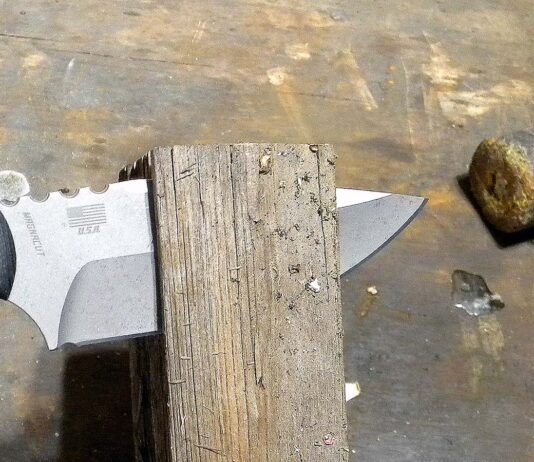
Sometimes bigger isn’t necessarily better. The new Boker Gnome fixed blade is a little gem that can be your trusty sidekick in the home and elsewhere.

It starts with a 2.2-inch wharncliffe blade of D2 tool steel. The knife comes in two different handle types. The one featured above is made from olivewood, and there is a slightly more expensive green Micarta® version. The big lanyard hole at the butt of the handle comes in handy if you want to lash the Gnome to your pack or hang it around your neck. Everything is kept safe thanks to the included leather belt sheath. 

Even though it’s small, the handle is rounded in such a way that the knife is easy to grip. It weighs just 1.6 ounces so is light and simple to use. So many neck knives trade quality for convenience. The Boker Gnome is high quality as it is convenient.

MSRP: $49.95 (olive wood); $64.95 (green micarta)

Read More

Veronique Laurent Is Winning In A Man’s World

Veronique Laurent Has Become One Of The Most Accomplished Smiths In The World Even After Fighting Against Prejudice In Her Native Belgium.

I come from Texas where a knifemaker is more likely to wear boots and a cowboy hat than a suit and tie. In many parts of the world, it’s commonly assumed that a knifemaker is a man. 

This past March I caught up with American Bladesmith Society Master Smith Veronique Laurent at BLADE Show Texas in Fort Worth, Cowtown, USA. She had no boots or cowboy hat and her accent isn’t “Southern,” but she’s sure enough a bona fide knifemaker.  

Veronique comes from Brussels, Belgium, where French is the spoken language. Now, I don’t speak French, so out of respect I asked her how a non-French-speaking person should pronounce her name. 

Over here she’ll answer to the Americanized Veronica Lawrent, but the correct answer is more like Vehr-o-NIK-eh Law-ron, with the rolled R’s in the middle of each. In Belgium the people use the last name first, so she’s often just called “Laurent.”  Now that you can read her name in your head in a beautiful French accent, let’s move on to the interesting part of the story.

Veronique found her first career as a clerk at a Belgian TV station. She did cold metalworking as a hobby. While on holiday in France in 2004, she attended a knifemaking and blacksmithing event similar to a U.S. hammer-in. She later took a one-day knifemaking class with the Belgian Knife Society and never looked back. 

She became involved with the Society and learned more about knifemaking from the members of that community. The group eventually broke up but not before Veronique was well on her way.

In 2010, again in France, she attended a hammer-in that included ABS Master Smiths/BLADE Magazine Cutlery Hall-Of-Fame® members Joe Keeslar and Jay Hendrickson. In Belgium and France, a woman is not commonly accepted as a knifemaker. So it was that Veronique was pleased and surprised by the hospitality that Joe and Jay showed her, particularly with the respect they gave her as a craftsperson. 

For while a female knifemaker is a bit of an American rarity, being female isn’t an automatic gale-force headwind in the American knifemaking journey. In Europe, however, things are quite different. Veronique struggled to sell knives in Europe even as her skills advanced.  

“When a man came to my table and picked up a knife, he would ask me who the maker was,” she recalled. “When I said that I made the knife, he would then ask the person next to me who made the knife. Once he knew I was the knifemaker, he’d put the knife down and walk away. In Europe they don’t want to buy a knife from a woman.” She made it her goal to be a full-time maker, and her American contacts became even more important.

Becoming An ABS Master Smith

Laurent Blade Show
Veronique (left) makes a point as her fellow panel members—from right, ABS Journeyman Smith Lora Schwarzer and knifemakers Grace Horne and Abie Lyons—listen during the Women’s Bladesmith/Knifemaker Panel class of BLADE University at BLADE Show ’22.

After her contact with Keeslar, she journeyed to the 2013 BLADE Show and gained her ABS journeyman smith certification. She then began corresponding with ABS Master Smith John White, who encouraged her to learn to build takedown knives. 

“In 2015 I built my first takedown knife, and that same week I received the ABS email notification that John White had passed away,” she recalled. “I built all of my master smith test knives as takedowns in his memory.” 

Veronique pretty well blew away the crowd at the 2015 BLADE Show and gained her MS stamp. After the show, she and ABS Master Smith Jean-Louis Regel of France spent three weeks in Brazil learning advanced damascus techniques from ABS Master Smith Rodrigo Sfreddo.

“After I was a master smith, I began to ‘exist’ in Europe,” she noted. “I became a full-time knifemaker shortly after that.” Even with American renown and credibility, the headwinds of bias still were a challenge in her home country.  “People were rude, and it made me think ‘I will show you!’ Their bad attitude became my motivation,” she said. 

She began to work with Jean-Louis more and more (Jean-Louis also earned his MS in 2015). Because of bias, it was often assumed that he did her work for her, that he made her damascus or that she worked only in his shop. This was not the case. 

Though to Americans it makes sense that the two French-speaking master smiths must be connected, the real story is that Veronique and Jean-Louis each have their own shops in their hometowns. Their shops are roughly 375 miles apart, with Veronique in Belgium and Jean-Louis in France. The journey between them takes about eight hours. 

Even in Texas, where we measure trips in hours, not miles, an eight-hour trip is a “long haul” or a “far piece.” While the distance was significant, they covered it about once a month depending on workflow. Veronique says that she has better grinding and finishing tools in her shop, while Jean-Louis has a bigger shop with better damascus-making equipment.  

Veronique and Jean-Louis attended the International Custom Cutlery Exposition (now BLADE Show Texas) in Fort Worth in 2018, and each won multiple awards. 

“In all my trips to America, only one time has anyone set my knife down rudely like in Europe,” she noted. They joined The Knifemakers’ Guild on that trip also and spent a week learning bladesmithing from ABS Master Smith Rick Dunkerley.

Covid got in the way of travel plans and so Veronique and Jean-Louis were unable to return to America until this year’s BLADE Show Texas. As an American, it wouldn’t cross my mind to visit France regularly to try to sell knives, so I was curious why Veronique keeps coming back.  She explained that “Europe doesn’t like to ship big knives. It is very complicated and expensive. Sometimes you can ship a small letter opener or something, but it is very difficult.” 

Rather than fight the restrictions, it’s easier to travel over here and sell her work where it is in high demand. Another thing she does is make a “junior baby” model of each major piece. If she makes a dagger, she makes another small one. If she makes a big bowie, she makes a similar hunter. These smaller pieces tend to sell better in Europe than the big works.

Veronique Laurent’s Knives

Laurent bowie
Based on the Musso Bowie, Veronique’s Big Boy Bowie won Best Fighter at BLADE Show Texas. It has a 13-inch feather damascus blade of O2 and 45NCD16 tool steels with a riveted brass back. Parts of the guard are mirror polished, parts are stippled, and parts are engraved with raised flowers. The handle is ancient walrus ivory. Overall length: 18.5 inches. (SharpByCoop image)

Veronique had a good variety of knives at BLADE Show Texas that showcased her skills and versatility:  a large brass-backed bowie, a few elegant hunters and a folding dagger. 

“It was an honor to be asked to make a big bowie,” she observed. “It’s a man’s knife and it took many years for a man to trust that I could build a large bowie.”  

While she doesn’t build knives “to order,” she does keep a list of customers who are looking for a particular type of knife. “I don’t take orders. I want to be free!” she explained. She’d been asked to build a big bowie and did her research and came across the Musso Bowie. She built the Big Boy Bowie and it promptly won Best Fighter in Fort Worth.

Big Boy is highlighted by a feather damascus blade of O2 and 45NCD16 tool steels with a riveted brass back. The guard is O2 also. Parts of the guard are mirror polished, parts are stippled, and parts are engraved with raised flowers. 

“O2 steel is good because you can finish it many ways and it works well for the engraving,” Veronique explained.

The handle is ancient walrus ivory.  Also on her table was a fine damascus folding dagger that won the show’s custom judging award for Best Folding Knife. All the fittings, engraving, jewel settings, and display box are by Veronique.

So where does one go next when you’re already known worldwide?  

“I want to focus on engraving and filework,” she said. “I am also learning to make automatic folding knives from Rick Dunkerley.”  

Veronique is a strong woman and plays well at what is often a man’s game. She doesn’t take orders but builds a few major pieces in several categories each year. She prefers email communication from Americans because it is difficult to hear and translate over the phone. She’ll be at the major shows, but you’d better get there early as her work is in high demand.

For more information about Veronique Laurent and her knives e-mail her at [email protected].

Read More

Budget To Bang Combos: A Trio Of Great Hunting Knife Sets

When Hunting, One Knife Is Good But More Knives Are Better. These Knife Sets Can Help Make The Hunt Easier No Matter The Size Of The Game.

Each year hunting season rolls around there are experienced hunters and first-time hunters anxious to make their way into the field. Whether a bow hunter or a firearms hunter, one thing remains consistent between the two: They both need something to clean game and prepare it to be able to get it out of the field and home.

No one would argue that you don’t need a knife, but sure enough each hunter would back his choice of blade in a discussion led by the question “What do you use?”

This year, as usual, I found some likely candidates to add to the discussion of whose knife is better, though this time, instead of a single knife to tackle the project, let’s consider knife sets. They can’t get your game for you but we can put them through their paces to see if they can help make the most out of what you do get.

Gerber Moment

Gerber Moment
Here you get a good look at the size difference between the large Utility knife and small Finesse knife in the Gerber Moment. Sometimes a good picture is worth a thousand measurements. Blade and overall lengths: 3.625/3 and 8.625/7 inches. Blade and handle materials: 5Cr15MoV stainless and rubber overmold, glass-filled nylon

The Gerber Moment is a two-knife set. Of the test entries, this one is for the budget-minded hunters looking to spend the short dollar. It is made in China and the fit and finish is darn respectable considering each knife runs about $17.

The two knives were not hair-popping sharp out of the package, though it didn’t take long to up their edge games. Both the large utility knife and the small finesse model come with contoured rubber grips. 

The scales do not totally cover the full-tang handle design. A small perimeter of the tang is left exposed around the scales. At the rear of each tang are small oblong-shaped notches to serve as lanyard holes. They’re small holes at that, as you won’t get much more than paracord through them. As mentioned, the edges of the tang are proud of the scale but not so much as to cause any hot spots.

Both knives are drop-point designs, with the large knife being hollow ground and sporting a gut hook. The small Finesse is a full-flat-ground drop point. Texturing on the rubber grips helps provide a good, solid purchase. Of the two, as you would expect, the small detailing knife is pretty agile, though it isn’t like the large one is clumsy. To tote them both Gerber provides a dual-carry nylon belt sheath with plastic liner inserts.

Overall, the knives are quite well made. The design cleans up easy. After you do some work to bump up edge performance, you’ve got some users.

I have never been much for gut hooks. I remember when the Wyoming Knife was new and loads of hunters were sold for life on gut-hook knives. Even though I don’t use them, I can see how some hunters could like them. The gut hook on the Moment is pretty large.

I would have to give the set a thumbs up. It would be good for a hunter on a budget or one looking to try out different styles until finding one that suits him best.

MSRP: $34

Outdoor Edge Razor Guide Pak

razor guide pak
Some of the extra blades you get in the Outdoor Edge Guide Pak Razorbone include a selection of drop point, gut hook and boning/fillet patterns. All are neatly store in the waxed canvas roll. Blade steel: 420J2 stainless.

The Outdoor Edge Razor Guide Pak comes with two knives—the RazorBone and the RazorCape—along with a small bone saw. The knives take replaceable razor-blade-style inserts. Both are folders and come with multiple replacement blades. 

Outdoor Edge provides a boning/fillet-style blade along with a drop point and gutting blade for the RazorBone. For the RazorCape knife, you get two cape-blade inserts. Both have glass nylon and TPR rubber inlay handles.

A lockback system secures the blades in the open position. The handles don’t have a lot of cross-sectional contouring and the texturing on the rubber inserts provides some traction to your grip. There’s a thumb groove with jimping on the spine of the blade holder.

What worked well for me was the difference in thicknesses between the blade holder and the blade gave me a great lip to secure my handhold while executing a pinch grip. As I used the RazorBone in a butcher grip, the thin tip of the insert snaked through joints and kept me close to the bone so that I didn’t leave any of the good stuff behind. 

The RazorCape knife works well but has a large choil. I find such choils a waste of potential edge length. As if that isn’t bad enough on a hunting knife, they basically become a fur catcher. Both folders come with a pocket clip, though for me they are not pocket-carry-style knives. All the inserts come scalpel-sharp, so show them respect while handling them.

Lastly, the Flip n’ Zip saw works well but the anodized aluminum handle doesn’t do a lot for me. It makes a nice, thin package. A lockback system securely holds the blade in place. It’s just that the aluminum handle, even with CNC grooves, is thin and pretty slippery in my hands once things get wet. 

Also, the handle is so thin it makes it a bit difficult for my fat mitts to hold onto it. I would hate to try it with gloves on while the handle is covered in blood. The extra blades, all 420J2 stainless steel, are stored in a wax canvas roll. 

MSRP: $99

Knives Of Alaska Bobcat Combo

Alaska knives
Knives of Alaska includes a top-notch leather sheath with the Bobcat Combo. The sheath has the hallmarks of solid craftsmanship. (The author indicated he put the nick there.)

The set from Knives of Alaska (KOA) comes with the Alpha Wolf knife and the Bobcat Hatchet—hence, the Bobcat Combo. I’ve used the Alpha Wolf before. It’s a full-tang design made of D2 tool steel and a layered polymer handle. The handle contouring includes four finger grooves, with the index groove on the ricasso. It is a straightforward, fully flat-ground drop-point design.

The Alpha Wolf comes shaving sharp out of the box and has a general curve to the cutting edge. I have to say as a game knife it handles well and you can exert a great deal of control over the cutting edge with little effort. 

The design fits well in my meaty hand and the cuts get made where I need them without struggling. At the rear of the edge is a micro choil and, as usual, when the material being cut gets hung up there, it frustrates my workflow. I would say the only thing I would prefer is a bit of texturing to up the grip game.

As you can imagine, the Bobcat hatchet does things like splitting the sternum, cutting the pelvic bone and, if you want, it will bust out some of the tougher joints. It doesn’t have the heft of a full-size hatchet but as my buddy is fond of saying: if you put enough force behind anything you can make it fly. To me, it would be certainly neater than a chainsaw (don’t ask, it’s a drunken Canadian hunter thing). A gut hook is on the back.

A top-notch-made leather sheath carries the combo. I never reviewed a knife from KOA on which the leather wasn’t well executed. It’s a good combo and the Bobcat hatchet is such a neat tool I couldn’t resist using it in the kitchen as a small hand chopper. I know, somewhat sacrilegious, but it’s my kitchen. It’s a great set and as much of a trophy as the game you kill. 

MSRP: $209.99

There’s a wide range of knives here from budget to bang and represents only a small sampling of the tools available to hunters these days. If you’re going for the big game, don’t ruin the moment by struggling with a poorly crafted tool. Take the time to round out your kit with a good field-dressing knife set.

Read More

Seven Excellent Drop Point Knives

The Drop Point Blade Is One Of The Most Utilitarian Blade Styles. From Outdoor Knives To EDC Folders, The Drop Point Is The Way To Go.

The drop-point blade is perhaps the most useful shape for outdoor knives. It’s an excellent cutting tool and the point makes it good at puncturing too. Whether it’s cleaning a kill or just opening up a gift box, the drop point is an excellent all-rounder that any knife lover should have.

Ka-Bar/Becker Knife & Tool BK16 Short Becker

Ka-Bar/Becker Knife & Tool BK16 Short Becker
The wide drop-point blade of the KA-BAR/Becker BK16 has the ideal edge geometry to handle precise tasks like whittling.

It is a midsize knife that is easy to carry, handle and use. The 4-inch blade of flat-ground 1095 Cro-Van steel can hold a respectable edge and sharpens quickly in the field. The black textured epoxy coating is non-glare and corrosion-resistant.

The Zytel handle is a typical Becker design—highly ergonomic with a palm swell that fills the hand nicely.  The handle edges are rounded to eliminate hot spots. Part of the tang is exposed for the lanyard hole. There’s also traction notches on the spine to choke up for added control. When you hold the BK16, notice how solid it feels. Even though one of the smaller knives in the line, it still feels capable of handling most cutting or camp tasks.

The sheath is a ballistic nylon with a rigid plastic liner. An accessory pouch holds a small lockblade folder or sharpener. The knife secures in the sheath via two button-snap nylon straps. The BK16 holds snugly inside the sheath with no rattling. Made in China, the sheath is of very good quality.

The BK16 is a workhorse. The drop-point shape is utility friendly and covers a broad range of general camp chores, from food prep to field dressing. The flat grind ensures optimum slicing.

The handle shape is classic Becker. A forward finger recess forms the lower guard and a palm swell mid-handle seats the hand comfortably. All edges are rounded for maximum comfort during prolonged use. The BK16 comes with two sets of scales: black Zytel and coyote tan. I opted for the tan. I love the contrast with the black blade.

I successfully batonned the knife through wood. The knife shrugged the task off and repeatedly came back for more. Whittling was easy. The ergonomic grip is comfortable and you’re able to use the exact pressure needed. The BK16 handles food prep with confidence.

If you need a compact fixed blade capable of tackling large tasks, the BK16 is it. Made in the USA, it has an MSRP of $132. 

Fallkniven F1 Pro

Fallkniven F1 Pro
The Fallkniven F1 Pro’s blade geometry makes baton work almost effortless.  

The Fallkniven F1 Pro features an extra-heavy-duty build and ELMAX high-performance stainless blade steel, which offers enhanced edge holding and toughness. With a 4-inch, convex-ground blade and 8.5-inch overall length, it is a formidable knife, weighing in at 6.1 ounces. 

The blade stock thickness is .19 inches, fairly thick for a knife this size. The full tang extends through the Thermorun rubber handle and is exposed on the butt for excellent torsional rigidity.

The handle sides feature a heavy checkering pattern for an excellent grip with wet or dry hands. The Thermorun material has a sort of a grip-you-back quality, similar to Kraton. The oblong handle shape rests in your grip comfortably so that you feel in control of the knife.

The sheath is well made of heavy-duty Zytel with a nylon webbing belt loop and button-snap retention strap. At first, the nylon webbing may seem a bit cheap but in reality it’s very smart. 

Why? The webbing allows the sheath to move freely at your side in case it gets snagged by branches, or to self-adjust when you are seated in a chair or a vehicle. Most rigid sheaths do not allow for this. Not to mention, the nylon webbing material is weather and moisture-resistant. 

The knife locks into the sheath via the guard as it engages a spring-loaded tab in the sheath’s side. This alone is enough to hold the knife inside, but securing the handle with the snap strap guarantees the knife stays put until you release it. The sheath’s bottom is open to allow moisture to escape and resist blade corrosion.

The F1 Pro and the BK16 are the heaviest-duty ones of the test bunch. The F1 Pro easily completed baton work. The thick blade stock and flat grind split wood like a wedge. For whittling, the convex edge has a ton of bite. It shaved off thick chunks of wood as I carved multiple stakes to a point. It made fast work of the task but, at the same time, was controllable and made precise cuts when needed. 

In some respects it worked as hard as a larger knife. In the kitchen, don’t dismiss the F1 Pro due to the thick blade. It slices vegetables with precision, proof this beast of a knife can handle delicate tasks as well.

There were no problems with the Thermorun handle. My hands got a bit sweaty during outdoor use and the handle never felt like it was going to slip in my hand. The checkered texturing is the right amount and not overly aggressive to your skin.

With an MSRP of $407.95, the F1 Pro ELMAX is one of the most expensive knives you will find in this class, but the chosen materials and highest quality of build offset the cost. You get what you pay for and this is a high-quality tool.

White River Knife & Tool Hunter

White River Knife & Tool Hunter
The blade of the White River Hunter is flat ground for optimal cutting performance, and the steel offers toughness and high edge-retention qualities. 

The White River Knife & Tool Hunter is a simple design, with a 3.5-inch drop-point blade paired with an ergonomic handle.  Blade steel is CPM S35VN high-performance stainless, and the handle comes in several material options. The 8.25-inch overall length is well-suited for field dressing and possible bushcraft use, too. 

The blade is flat ground for optimal cutting performance and the steel offers toughness and high edge-retention qualities. A polished finish makes the blade a snap to clean and also seals micropores, thus helping prevent rust. It’s kind of unusual to see a mirror polish on such a blade due to it being a labor-intensive finish; most such blades have either machine satin, stonewash, or even bead-blasted finishes.

A large finger recess helps index your grip, and a significant palm swell rests the knife in your hand comfortably. The butt has a bird’s beak pommel to prevent your hand from sliding backward.

As for handle material choices, they include three Micarta® flavors: natural burlap, black burlap, and black/OD green. Micarta is an excellent choice for an outdoor knife, as it is dimensionally stable and impervious to the elements and absorption of fluids. It also has a tactile feel that aids in grip retention in all conditions. 

We selected the natural burlap for the test, as it has a very organic appearance, almost a wood tone. The feel is akin to that of canvas Micarta. The sheath is formfitting Kydex, with a molded Kydex belt loop that accommodates belts up to 2 inches wide.

The cutting performance is superb. The knife is efficient and simple to maneuver. The flat-ground blade sails through meat and vegetables. Being a smaller fixed blade means it can be used for more delicate or intricate cutting.

I like the burlap Micarta. It’s very durable, looks great, and has a great in-hand feel. Burlap micarta isn’t common in production knives, so this is a bit rare—for now.

The shorter-length blade handles kitchen utility tasks well. Who knows—this knife might wind up in your kitchen pulling permanent duty when it’s not out with you in the woods. The White River Hunter retails for $180 for any of the handle material options. This is a really good price for a USA-made fixed blade with premium blade and handle materials. If you like refined fixed-blade hunters, the White River Hunter is for you.

Chris Reeve Knives Backpacker

Chris Reeve Backpacker
The Chris Reeve Backpacker handles like a dream. The knife is balanced perfectly and feels like an extension of your hand. It’s very predictable in use and is a slicer by nature. (Dexter Ewing image)

The newest fixed blade from Chris Reeve Knives, the Backpacker is for outdoorsmen and backpack hunters who want a fairly lightweight sheath knife that is quite usable with a smart design and high-end materials. 

It features a 4-inch drop-point blade hollow ground from CPM Magnacut, the latest of the high-performance stainless super steels. Magnacut reportedly has the best edge retention of any high-end blade steel. The Backpacker will go the distance with edge holding. A stonewash finish gives the blade a slight industrial look. Stonewash finishes do a good job of hiding scratches that occur during use.

The handle has a hollowed-out full tang, which helps keep weight to a minimum (3.8 ounces) and improves balance. The scales are canvas Micarta in black or natural. The Micarta is sculpted to provide placement of the hand and fingers, enhancing user comfort and blade control. 

Canvas Micarta has a grippy nature and seems to get better when your hands are wet, unlike other materials that may feel less tactile when wet. Two pairs of hex-head bolts secure the scales which are removable, resulting in a skeletonized fixed blade to further reduce weight and bulk. 

The integral guard formed by the blade’s height is a smart design I really like. It allows you to choke up on the handle for precise control, as well as keeping your hand in place.

The Backpacker comes with a Kydex sheath which locks around the lower portion of the exposed tang that forms the guard. It does not encompass the handle scales as most fixed-blade Kydex sheaths do. This is done on purpose so if you do decide to remove the scales and use the Backpacker skeletonized, the sheath will still work and lock on the knife for safe carry. 

A flat-head screw at the end allows you to fine-tune how tight the sheath locks onto the blade. Not many sheaths have this feature. The rivet spacing allows use of a large Tek-Lok belt fastener (the knife does not come with a provision for belt attachment, so it’s up to the buyer to supply such).

The Backpacker handles like a dream! The hollow grind slices easily. I used the knife to cut meats and vegetables. The cutting performance is predictable, efficient, and precise. It’s like driving a nice European sports car. 

Handle comfort is first class; I love the way the Micarta feels in-hand. It’s light as a feather for a fixed blade of its size, and no doubt the minimal weight does a lot to improve handling. When you choke-up on the handle with your thumb placed on the blade spine, you can feel how the ergonomics work to lock your grip on.

The Backpacker is a high-end, USA-made hunting/camping fixed blade. MSRP: $300. A CRK knife for $300 is a great price, actually, and you get a lot in return, including high-end materials and the company’s design and manufacturing/engineering expertise.

Buck 112 Ranger

Buck 112 Ranger
Buck 112 Ranger

Buck makes great knives, and this folder certainly is one of their best. The Ranger is a variation on the famous 110 Folding Hunter with a drop point instead of the original’s clip point.

The knife is beautiful with an ebony handle and ethically-sourced Crelicam ivory. While the handle is stunning, the star of the show is still the blade. Made from 420 HC stainless with a satin finish, the 3-inch blade is everything you would want in an EDC. With a thick belly and thick tip, the blade slices and punctures confidently.

The heat treat imbues the blade with excellent corrosion resistance and durability. It’s hardened to an HRC 58 so the knife can handle the wear and tear of everyday use with ease. This is a classy knife at a great price.

MSRP: $63.99

Benchmade Bugout

Benchmade BK-2
Benchmade BK-2

When it comes to drop point EDC knives the Benchmade Bugout is one of the most iconic. It was designed for outdoor use which makes it overpowered as an EDC for so many reasons.

There are many versions of the Bugout, and all are excellent, but for this piece we chose the BK-2 for its affordability in relation to other knives in the line.

The BK-2 is a fully blacked out version of the Bugout with a CF-Elite handled married to the CPM-S30V blade. The steel comes in a black Cerakote finish and is treated to a 58-60 HRC. The knife shines in large part thanks to its weight. At just 1.8 ounces, the BK-2 is so light and nimble in the air that it can feel like cutting with air.

It’s the Bugout. It’s great. It’s one of the highest-quality drop point knives on the market.

MSRP: $190

Kizer Drop Bear

Kizer Drop Bear

This knife was released over the summer and it is excellent. We have already written an in-depth review of the Drop Bear, and it’s worthy of a second mention.

The 154CM steel blade is meted to an aluminum handle. At 3.8 ounces it’s a substantial little knife that can handle the day-to-day tasks asked of it and can even be used as a kitchen knife in a pinch. 

The knife’s clutch lock, Kizer’s newly-adopted Axis-style lock, is fun to use and keeps the blade secure at all times. This is an excellent new addition to the world of drop point pocketknives.

MSRP: $158

Editor’s Note: Mike Abelson provided content for this piece.

Read More

First Look: White River Rescuehawk

The New Rescuehawk From White River Knife & Tool Is An Excellent Fixed-Blade Multi-Tool That Will Make Any Outdoorsman Happy.

Not every multi-tool folds up and fits in your pocket, and that’s a good thing. For someone looking for a more robust multi-tool, the new tactical Rescuehawk from White River Knife & Tool is exactly what you’re looking for.

Made from quarter-inch thick 80CRV2 steel, and designed by Kurt Delia, the Rescuehawk does a little of everything. The head features a 2.6-inch splitting edge with a strong piercing point horn on the opposite end.

The handle is incredibly versatile with a half-inch gas line channel wrench and split chisel pry point and textured G10 handle scales to provide excellent grip. The included bottom-eject Kydex sheath keeps the blade safe and secure in transit.

Overall, this tool is excellent for any outdoor lover and is great to have in case of an emergency or survival situation.

MSRP: $450

Read More

Tactical And Switchblade Combs That Keep You Looking Cool

A Switchblade Comb Is A Fun Take On The Knife Design. Unlike The Knife, The Switchblade Comb Can Be Taken On A Plane.

The switchblade looks cool. The blade firing out at speed and satisfyingly clicking into place is one of the great joys of the knife world. However, many legal codes of countries around the world don’t look fondly on the fast-moving blade. But that cool factor has endured and can be seen in switchblade combs. And they have the added benefit of being far, far cheaper than even the lowest-quality stiletto.

Switchblade combs?

Yes. It’s a comb that deploys like a switchblade. Maybe you’re looking for a comb with a burst of excitement, or a comb that isn’t made of cheap, flimsy plastic. Or maybe you’re a Jet or a Shark that needs to look good for their next rumble.

No matter what the reason, the switchblade comb is a fun little tool to have. This knife… I mean comb shows what the switchblade comb is all about.

Etrading Italian-Style Automatic Comb

Etrading Italian-Style Automatic Comb

This comb is a perfect example of what a switchblade comb can be. The handle is made from pearl-toned polymer, and the blade is made from 440 stainless steel that’s built to last. At nine inches in length, with a five-inch handle, the comb sits well in the hand and feels good to use.

The stainless bolsters help take the look to the next level, and it all comes together thanks to the push-button deployment that sends the comb out in a blink. Additionally, there is a trigger lock-out that prevents the comb from opening in your pocket or bag.

This is a fun piece that you can show off to friends and keep your hair well-coiffed too.

MSRP: $10.50

Tops Knives Tac-Rake

Tops Knives Tac-Rake

For something a bit more robust there is the Tac-Rake from TOPS Knives. This beard comb is of the fixed-blade variety (yes, not a switchblade but it’s so good) that’s made from black traction-coated steel meted to a tan canvas micarta handle.

It’s only 5.88 inches in total length so it’s probably not the best comb for a full head of hair, but it is specially made for a beard and will keep your facial hair looking clean and sharp. The fact that you’ll feel like a champ while using it is just an added bonus.

The included leather sheath makes traveling with the comb easy and stress-free.

MSRP: $105

Microtech UTX-85

Microtech UTX-85

This OTF comb is the Cadillac of combs. The blade is stainless, and the handle is anodized aluminum. It’s luxurious to use, and the dual-action mechanism deploys and retracts the knife in the blink of an eye.

The teeth are nice and fine so it’ll brush your hair and your beard with ease. Adding to the tactical nature of the comb, the glass breaker at the butt of the piece is a handy tool to have on your person. And, since this isn’t a proper sharpened knife, you can take this with you wherever you go from a baseball game to a restaurant and even on a plane.

MSRP: $340

BeardAir Tactical Beard Comb

BeardAir Tactical Beard Comb

For a tactical combing experience, there is this sleek comb from BeardAir. With a blade made from 17-4PH steel, and a handle made from aviation aluminum. It’s light and strong, and the automatic open/close function deploys the comb with speed and style.

Unlike the other combs on this list, the Tactical Beard Comb comes in all sorts of different colors so you can find the one that fits your aesthetic the best whether it’s a more traditional black knife with red accents or something more wild like the olive green and pink one above. 

MSRP: $59.99

Read More

The Many Moods Of Mosaic Damascus

Mosaic Damascus Can Be Made Numerous Ways, And These Master Smiths Are All Putting Their Own Spin On The Craft.

The many moods of mosaic damascus provide the bladesmith and custom knifemaker with an ever-changing form of artistic expression. The possibilities of a new pattern, a different look, and yet another lasting impression are endless.

For several makers, mosaic has become a signature steel in their presentations, and these imaginative artists are pushing the envelope in an already dazzling array of motifs for blades and knife fittings.

Kelly Vermeer-Vella

Kelly Vermeer-Vella said she initially called the mosaic damascus of her fighter Riptide because it looks like “calm waters, but also because the forging process is pretty brutal. So, now I call that process ‘ripping it!’” Blade and overall lengths: 7.5 and 12.5 inches. At press time the knife was available through Arizona Custom Knives for $3,800. (SharpByCoop knife image)

In her Riptide pattern, American Bladesmith Society Journeyman Smith and past Forged in Fire champion Kelly Vermeer-Vella provides a great example of the new frontiers being explored with mosaic damascus. 

“It’s initially called that because it looks like calm waters,” she commented, “but also because the forging process is pretty brutal. So, now I call that process ‘ripping it!’ Sometimes I win and sometimes I make hunters!”

Kelly showcases the Riptide pattern on her 12.5-inch fighter with a 7.5-inch blade and mammoth ivory handle sporting a long, modified “S” guard. 

“I really enjoy swooping forged guards that complement the curves of the blade and handle. And I love mammoth ivory, so I make a lot of frame handles,” she added. “I think the best-looking frame is in a low-layer twist, 25 layers or so.”

The Vermeer-Vella mosaic involves a commitment to hard work to produce the desired results. 

“The pattern is not san-mai,” she revealed, “rather, different layer counts of stacked W’s with heavy 1075 steel on the edge. The wing effect comes from forging. I push and pull the pattern with a hand hammer and forge to shape so that the pattern flows with the edge.” 

The blade material is the 1075 carbon steel, which appears as the dark areas, and 15N20 nickel alloy, which shows as the grey, shiny areas. “I etch in 3-to-1 ferric chloride and also do a coffee etch,” she added. Her power hammer is an Anyang 88 and she uses a Riverside 24-ton press.

Jack Rellstab

Jack Rellstab said he wanted the blade of his Western Chef’s Knife to “look alive.” As he noted,
“My idea was with the taper in layers to give it an organic look that appears as if the elements are actually growing.” Thus, the pattern’s name of Frogs and Flowers seems most apropos. His price for a similar knife: $2,600. (SharpByCoop image)

Like Vermeer-Vella, Jack Rellstab is an ABS journeyman smith who enjoys the creative process of forging mosaic damascus. His Western Chef’s Knife brings a robust profile to life in a mosaic pattern called Flowers and Frogs.

“The pattern is one of my styles of W’s explosion,” he noted. “I started the original billet with the layers of both 1080 and 15N20 getting progressively thinner from one side of the billet to the other. After using square dies to resquare the billet for W’s, I drew it out with a taper so the W’s would get tighter towards the end. Then I did a restack and a four-way to finish it. So, the steel is 1080 for the dark portion and 15N20 for the bright.”

The handle is amboyna burl, bronze and G-10. He says the grip is designed around most Western-style kitchen knives on today’s market, though the belly/underside might be a bit shallower.

“With this mosaic pattern, I wanted the knife to look alive,” he offered. “My idea was with the taper in layers to give it an organic look that appears as if the elements are actually growing. I used a 165-pound hammer belonging to New West Knifeworks, and I also used their Anyang hydraulic press for resquaring.”

Jack began his bladesmithing journey with mosaic damascus by watching a YouTube video, and then let his imagination kick in to develop the exciting pattern that is sure to generate conversation in any kitchen.

Will Stelter

The Serpentine Multi-bar Santoku by Will Stelter sports a mosaic damascus pattern of the same name. He used 1080 and 15N20 steels for the pattern-welded twisted bars and Cruforge V for the edge. The Cruforge V etches darkly, and its wear resistance and high working hardness make it ideal for culinary knives. Blade and overall lengths:
5 7/8 and 10.75 inches. His price for a similar knife: $3,500. (SharpByCoop knife image)

The Serpentine Multi-bar Santoku by ABS Journeyman Smith Will Stelter sports a mosaic damascus pattern of the same name. The handle is ivory paper Micarta®. He used 1080 carbon and 15N20 nickel-alloy steels for the pattern-welded twisted bars and Cruforge V for the edge. The Cruforge V etches darkly, and its wear resistance and high working hardness make it ideal for culinary knives.

“I started by forging up 28 layers of W’s,” he recalled, “and then worked that billet down to a half-square twisting stock. I twisted three bars right hand and two bars left hand, lining up my twists as best I could before forge-welding them together. After they were stuck, I forge welded on a solid Cruforge V edge bar that was around 40 percent as wide as the multi-bar billet, but the same thickness. With my final stock stuck together, I then laid out and cut away several three-quarter-inch-deep grooves or divots from the profile of the rectangular 2-inch wide bar, which still left Cruforge V on the edge, and two full twisted bars at the thinnest parts of the patterned area on the spine.

“I then flattened down the billet, which took the previously straight layers and gave them the bold ‘serpentining’ that came out in the blade. I then forged my blade to shape and forge welded on some of the base W’s stock that I twisted from as bolster material. This is a very similar technique to how the classic ‘River of Fire’ pattern is done, but with a different base pattern other than the usual feather pattern.”

Will used his 1924 400-pound ram Beaudry hammer to do the majority of the forge welding and a twisting machine to twist the five bars. He learned his pattern-welding technique and the ability to visualize the way the steel moves from bladesmith Salem Straub, crediting Straub with teaching him how to design patterns “with intentionality behind them.” The pattern itself is sole authored by Stelter, who has done some serpentine multi-bar patterns prior to the subject piece. However, this was his first attempt with a monosteel-edged bar.

“The serpentining is purely aesthetic,” Will said. “It’s meant to give a bold line for the eye to dance down rather than the straight, more classic intersection of the edge bar that is normal for a composite construction. This also means that from far away you see an interesting pattern, and then when inspected up close the explosions of the twisted W’s really pop out, which gives the overall piece an interesting level of depth.”    

Will considers this particular mosaic “an intermediate-level pattern, easy to try, though somewhat difficult as well. The most challenging part is building a high-quality multi-bar pattern with adequate layer density and well-matched twists. The rest of the pattern is fairly simple.”

Brent Stubblefield

Brent Stubblefield’s integral chef’s knife has an 8-inch blade of his shimmering Crossroads mosaic damascus, and a stabilized Hawaiian koa wood handle with mammoth tooth spacer. Overall length: 13 inches. His price for a similar knife: $1,500. (SharpByCoop image)

At the Join or Die Knives Forge in Richmond, Virginia, Brent Stubblefield hammered a beautiful blade in his Crossroads mosaic pattern—and did so with multiple techniques. 

According to Brent, “There is the initial damascus forging, crushed W’s, twisting, four-bar-squaring welds, ferry flip tilting, edge bars, and a ‘fish mouth’ tip to make the edge bars meet. There are multiple elements that are forged on the edge or corners to manipulate the pattern, and finally the knife shape and integral bolster are forged to shape.”

The mosaic is comprised of 1084 and 15N20 steels, with the 15N20 appearing as a silver white on the blade while the 1084 blackens with a ferric chloride etch. 

“The shapes in this pattern reflect a desire to incorporate all the different techniques of mosaic damascus making I have learned over the years,” he explained. “I’m always trying to find a way to create never-before-seen patterns in order to add something totally new to the American bladesmithing tradition.”

Stubblefield used an Anyang 88 power hammer and homemade 30-ton press to create the Crossroads mosaic. A Bridgeport mill was helpful in the squaring-up process and flattening pieces for rewelding. A Miller welder assisted in tacking materials up before they went into the forge, while an Evenheat kiln and Broadbeck Ironworks grinder were key tools in the process as well.

“Although I did not have any single mentor,” Brent mused, “many knifemakers have gone out of their way to share tips and tricks with me. While they didn’t teach me directly, [bladesmiths] Mareko Maumasi and Salem Straub have been very generous with sharing their processes through social media. I certainly have referenced them among others.”

Stubblefield continues to challenge himself as his career advances, and he sees no slowdown in the creative process. “This knife is very difficult to do simply because the higher number of forge welds create more opportunities for failure,” he reasoned. “Any complex damascus blade is actually just many simple techniques combined together. The hardest part for me is understanding how manipulating the pattern early in the process will affect the outcome, and visualizing the end pattern.”

Read More

Advertisement

Must Read Articles

Read this before you make a knife

Knifemaking 101 – Read This Before You Make a Knife

  by Wayne Goddard My experience has taught me that there's nothing like digging in and getting started. I've often said the hardest part of the...
how to forge damascus steel

How to Forge Damascus

Advertisement
Advertisement





