Knife collecting is an extremely rewarding experience for knife enthusiasts. There truly is a knife for everyone. Many increase or hold their value throughout the years, making collecting knives something to pass on to the next generation of knife collectors.
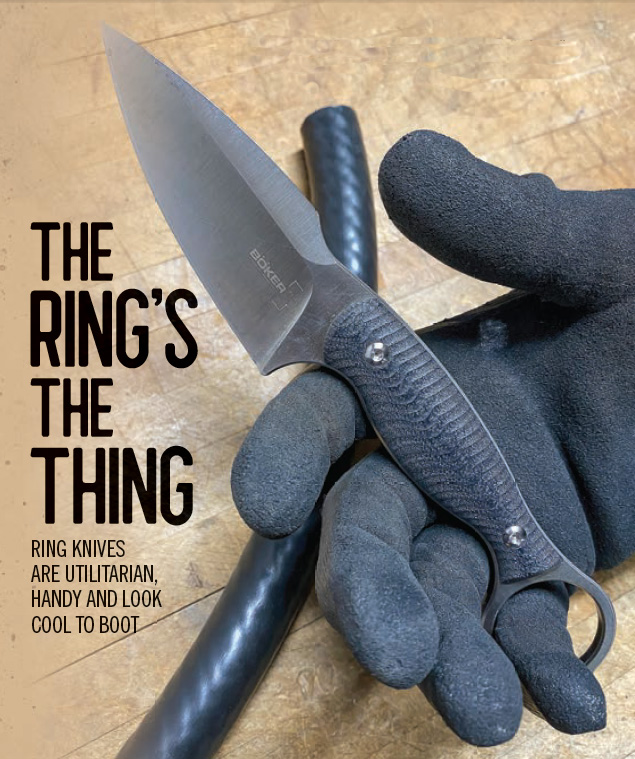
When you think of a knife with a ring in the handle butt, a karambit probably comes to mind. Fact is, there are other knives with such a feature. In fact, some have rings at the middle and also even at the front of the handle.
Unlike karambits, in which the ring is used for quickly spinning the knife in between different grips as well as affecting the grips themselves, non-karambit versions of such knives employ the ring in utilitarian ways that are less flashy.
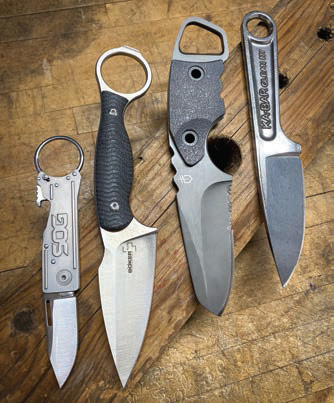
The latest ring knives from left, with manufacturer’s suggested retail prices in parentheses: SOG Keytron ($23.95), Boker Plus Accomplice ($119.95), Gerber Epic ($42) and KA-BAR Wrench Knife ($54.74). (Marty Stanfield Photography)
Examples include assisting in providing a more secure purchase on the handle, dangling the knife from a pinky to allow for full use of the hand while keeping the knife handy, attaching the knife to a keyring, or simply hanging the knife on a tool rack or elsewhere.
If your approach involves frequent intermittent knife use, interspersing it with employing your hand to grip, hold or pull the material you’re cutting or some other method all your own, then adding a ring knife to your collection might be beneficial.
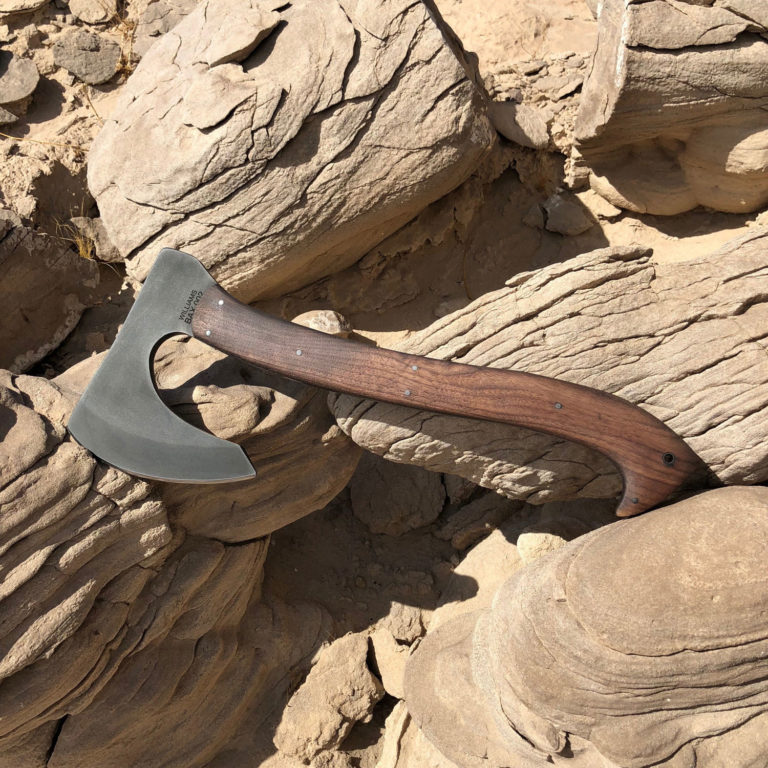
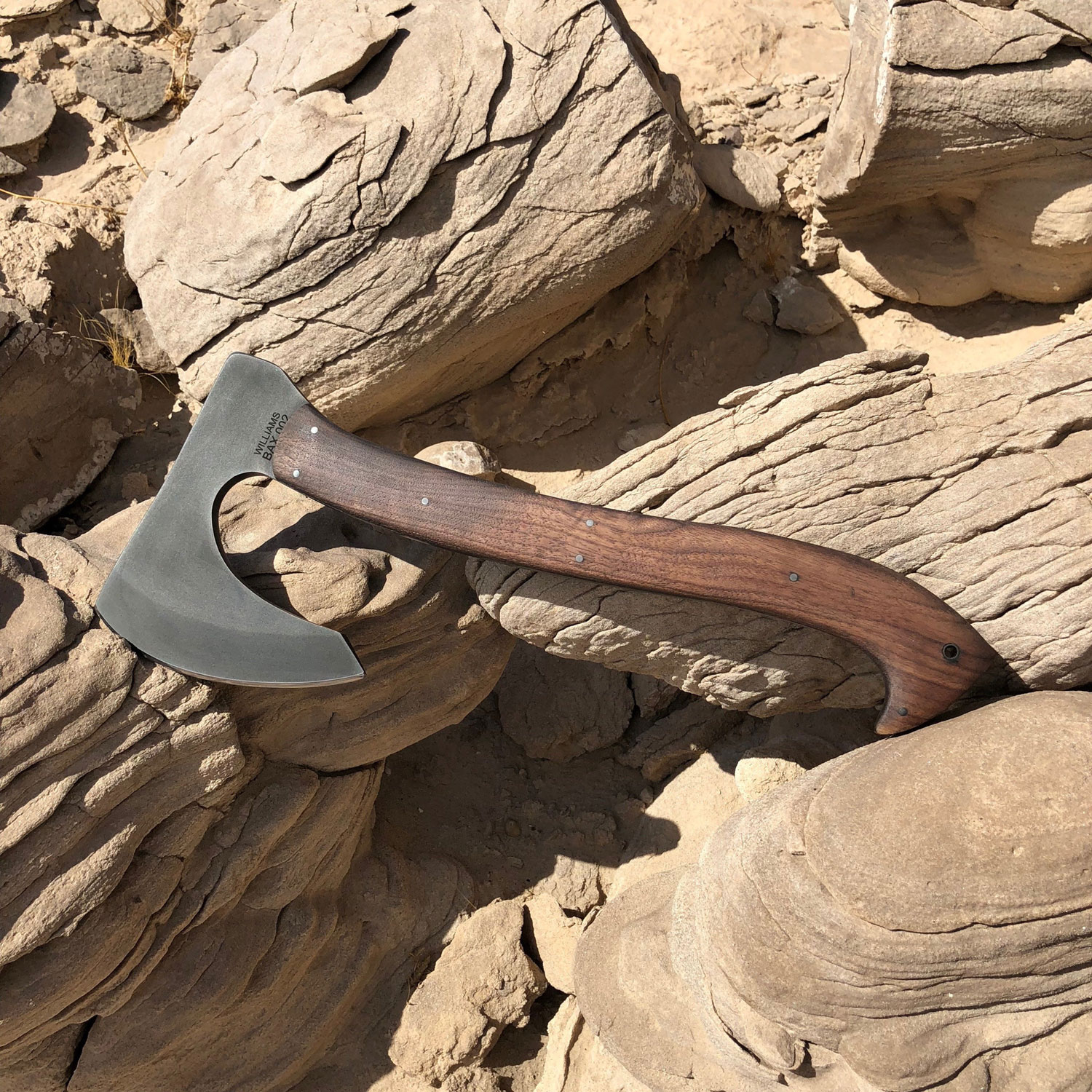
Beards and blades never went out of style, so it’s only appropriate that an axe continue the tradition with a “beard” of its own. The BAX 002 Bearded Axe, offered via Williams Blade Design, draws from Viking lore with a formidable design hatched by ABS master smith Daniel Winkler, someone with plenty of beardly street cred himself.
While the follicles on the BAX 002 are noticeably absent, it should be noted that the “beard” refers to the shape of the axe head. The extra gap this allows between the head and the handle allows the user to “choke up behind the edge for detailed work,” according to a media release. The result offers enough heft to satisfy raiding parties of yesteryear or today.
From Williams Blade Design:
Inspired by the axes of the Vikings, this bearded axe is equally at home in the wild or on the battlefield. The full tang 80CrV2 steel construction makes for an impressively tough tool that excels in the roughest environments. The walnut handle scales provide excellent feel for delicate tasks, and solid grip when the need arises.
Puukko Knives Are A Traditional Knife Of The Nordic Countries. It Is Used For Everything From Hunting To Chopping Vegetables
Puukko is Finnish for “knife.” It is deeply rooted in Scandinavian countries where the knife is both tool and art form. In fact, the puukko plays an important part in Nordic culture. Often included as part of the traditional cultural dress, the puukko is a historical symbol, especially in Finland and Northern Scandinavia.
The Finns treat the knife with deep respect. Many men in the country take great pride in how they carve their knife’s handle. It’s so ingrained in the culture that the Finnish Defense Forces don’t issue a standard knife to its soldiers. Instead, most men simply bring their own puukko with them into service.
What Is A Puukko Knife?
Rich history aside, puukkos are first and foremost solid work knives. They are of basic construction, consisting of a high carbon steel blade mated with a handle that is usually of a natural material, though some modern versions are synthetic.
The steel is traditionally crucible steel made from limonite iron, which was almost exclusively the type of steel made in Finland before more modern manufacturing methods were invented in the 19th century.
Primary uses are woodcarving and food prep as well as most anything requiring a cutting tool. Outside the Nordic culture, puukkos have earned a solid reputation as stout knives built for serious labor. It’s easy to see why these knives are favored among outdoor folks.
If you spend time camping or hiking or are simply in need of a good, solid fixed blade that withstands hard use and requires low maintenance, consider the sleek, slender puukko.
What Is A Puukko Handle Made Of?
One of the more common puukko handle materials is Masur (curly birch, though you’ll also find antler, bone, leather, and other hardwoods. Modern factory-made knives can come with a plastic handle instead of using traditional materials. The handle has no guard, and the blade boasts a gentle upsweep to the edge to facilitate easy cutting.
Puukko Sheaths
Puukko sheaths are usually leather and may or may not have fancy tooling. A belt loop is separate and affixed via a metal ring. Also known as a dangler, the sheath is free to move separately from the belt loop and you. This comes in handy if you’re seated, as the knife can move freely and adjust itself into position yet remain easy to withdraw.
Best Puukko Knives
Today, puukkos have become a popular knife beyond just Scandinavia. In places ranging from El Salvador to Russia and the USA, puukkos are prized for their durability and ruggedness. Below are five of the best puukkos that are available today.
TOPS Tanimboca Puukko
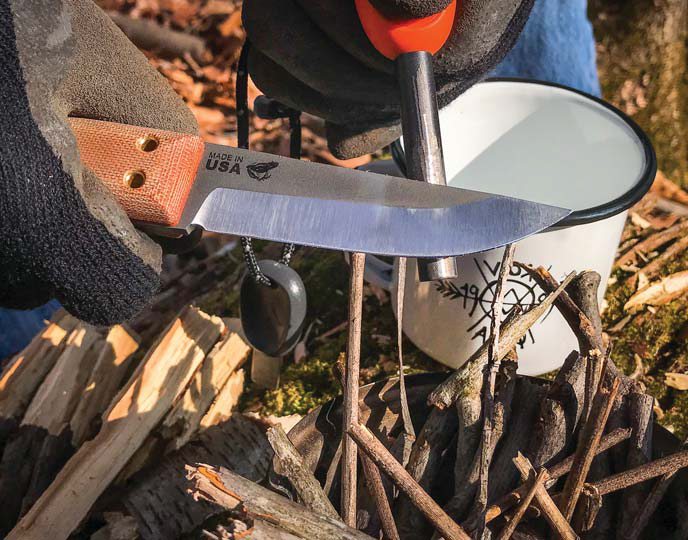
The 90-degree blade spine on the TOPS Tanimboca Puukko is for use with a fire restarter. Scrape the corner of the blade spine down the ferro rod to create a shower of sparks. (Marty Stanfield Photography)
From TOPS Knives, there is the Tanimboca Puukko. Designed in conjunction with Serbian knifemaker Goran Mihajlovic, who has spent the last two decades living in Colombia, the Tanimboca combines the best of a puukko knife with the toughness of the Amazon.
The blade has a slight clip point at the end and a flat spine is great for fire starting and scraping tasks. The knife is made from 1095 steel with a 56-58 Rockwell hardness and a length of 3.63 inches and a tumbled finish. The Tan Canvas Micarta handle honors the traditional puukko and looks great.
The knife comes with a brown leather sheath and has a belt loop so it’s easy to take with you. A cool, contemporary take on a historic knife makes the Tanimboca work the $170 MSRP.
Benchmade 200 Puukko
Benchmade 200 Puukko
You know Benchmade is going to put out a good product, and their 200 Puukko is no exception. The drop point is made of CPM-3V steel, the 200 is super hard and super durable even by puukko standards. The rubberized Santoprene handle provides excellent grip, and the lanyard hold in the handle makes the 200 easy to bring with you outdoors or on the job site.
Add in a leather sheath and you have a top-tier knife that can handle any situation you throw at it. With an MSRP of $160 it’s fairly priced and worth every penny.
Ahti Vaara Finnish Puukko Knife
Ahti Vaara Finnish Puukko Knife
Direct from Finland comes a budget puukko from Ahti. The Vaara is made from carbon-vanadium alloy steel with a traditional Masur birch handle and brass fittings. The is sharpened with a Scandi grind and is 3.74 inches in length. Overall, the knife is 8.31 inches long and well-weighted.
A neat design element is a black spine made of carbon steel. The flat edge, like with other puuukkos on this list, is great for starting fires and scraping away at material.
With a reasonable MSRP of just $51.45, the Vaara is a well-priced knife, and even with the shipping cost from Europe, it should still be under $100.
Marttini Tundra Kelo
Marttini Tundra Kelo
Another puukko made in Finland, the Marttini Tundra Kelo is not just a beautiful knife but also a quality one. Unlike most puukkos, which have a narrow tang within a solid wood handle, the Tundra Kelo is a full-tang blade surrounded on either side by a wax-coated gnarl birch handle.
The 4.33-inch blade is longer than most other choices on this list and is made from stainless chromium steel with an HRC 58 in terms of hardness. The black leather sheather contrasts nicely with the look of the knife itself.
The MSRP is € 139, which converts to $146.87 before shipping. One of the pricier knives on our list but worth it if you’re looking for a high-quality authentic Finnish puukko.
Condor Indigenous Puukko Knife
Condor Indigenous Puukko Knife
The last knife on our list is from Condor and is one of the most visually striking. The Indigenous Puukko Knife has a 3.9-inch blade made of 1095 high carbon steel with a Scandi grind.
The walnut handle features an inlaid golden wire wrap to help with grip, and it looks great. the handle is meant to combine elements from Polynesian and Sami cultures to celebrate indigenous cultures from around the world. The Sami are an indigenous group that lives in northern Norway, Sweden, Finland, and a small portion of Northwest Russia.
The knife comes with a welted leather sheath and is incredibly light at just 4.6 ounces. At an MSRP of just $95.45 this is a well-priced, nimble, and beautiful knife.
GiantMouse Ace Nimbus V2
This folder is inspired by the puukko and other Nordic knives and is built to be a mix of EDC and tool for the jobsite. The 3-inch blade is made from satin-finished Elmax steel meted to a green micarta handle for a secure grip. The blade has a full flat grind and thin edge. This allows for longer, more precise slicing strokes, and since the blade comes to an extremely fine tip the knife is also great for puncturing as well.
The nuts and bolts of this knife are great. The liners are made from AISI 420 hardened steel, and the liner lock keeps everything rigid. At 3.8 ounces it’s both light yet heavy enough to feel good in the hand.
The blade is .138 inches thick. That’s more than fine for many standard tasks around a jobsite but you might not want to start using it as a pry bar if you don’t have to.
MSRP: $185
Kellam Knives Ranger Puukko
This knife is a puukko to its core. It’s designed and built to stand up to not only combat but also the ferocious winters of Northern Europe. The 6-inch blade is made from forged 80CrV2 carbon steel with a teflon coating for added wear resistance and a Scandi grind.
At two-tenths of an inch thick, the blade is a beast and can stand up to almost anything life can throw at it. Use is aided by a 5-inch tempered rubber handle that won’t crack or deform even in hostile conditions.
Th Ranger Puukko is standard issue for troops from both the Finnish and Estonian militaries, and it’s easy to see why.
MSRP: $186.45
Helle Temagami CA
Designed by Les Stroud, the Temagami is a full-tang puukko that was precisely built to be among the best of its type on the market. It starts with a half-full tang design. That means the blade can be seen along the spine of the handle except near the fingers; this is done to better weight the knife and to better withstand harsh conditions.
The curly birch handle looks great and is ergonomically designed for hard, intense work. At 4.34 inches long, the triple laminated carbon steel blade is long enough to be used for slicing, puncturing, and even chopping for food-related tasks. The leather sheath allows for easy transport and storage.
MSRP: $209
Editor’s Note: Mike Abelson contributed to this piece
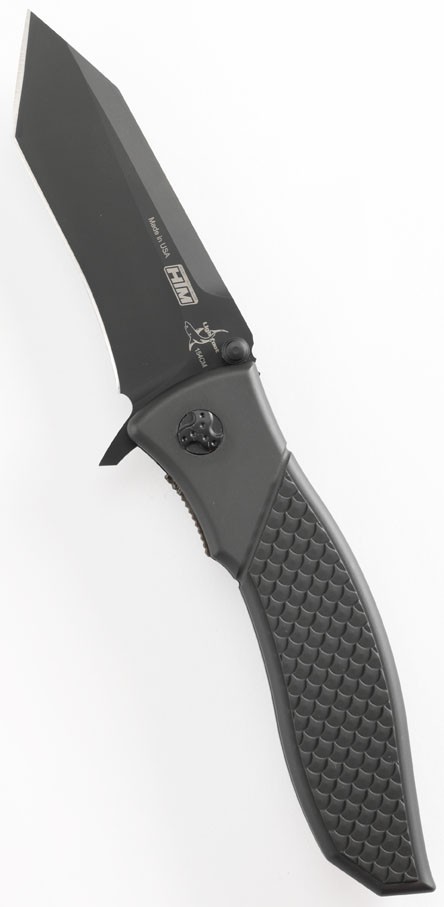
The HTM Lightfoot Bullwhip in the tanto blade is a ShopBlade exclusive and gets the once over in our “Cutting Critique.”
The HTM Lightfoot Bullwhip Tanto is one of those deceptive heavy-duty tactical folders that feels big to the touch but, at 6.5 ounces, is surprisingly lightweight—and is our latest entry in our “Cutting Critique” series.
Designed by award-winning knifemaker, motorcycle racing enthusiast, kayak builder and all-around man of many talents, Greg Lightfoot of Alberta, Canada, the HTM tanto version of the knife is exclusive to ShopBlade (www.shopblade.com). The 3.5-inch hollow-ground blade with a hint of a recurve is coated black and the factory edge is razor sharp for any number of cutting jobs straight out of the box. The tip is also razor sharp and thickened on the spine end, ideal for penetration, a hallmark of any classic tanto blade design.
The robust, hump-backed handle is 5/8-inch thick and features Lightfoot’s “shark-skin” texture on the non-clip side for enhanced purchase. A slight finger groove in the bolster, reverse bird’s-beak butt and flipper guard keep your hand squarely in control of the knife.
The Maxx Glide Pivot Bearing System, designed by Darrel Ralph, operates effortlessly by way of the flipper opener. The tension on the locking liner spring is nice and tight—though not too tight—to keep the blade securely open during use.
The only thing I do not like is the sharp end of the flipper. While it provides excellent traction for opening the knife, the sharp end can jab you at inopportune times—not enough to seriously injure you but enough to be uncomfortable. However, it’s nothing that can’t be remedied with a few swipes of your favorite abrasive.
A cool black zippered pouch with the HTM (Hand-Tech-Made) logo completes the package. ShopBlade’s price: $299.99.
Mantis Knives will host an event at its headquarters in Anaheim, California.
The event is called “The So-Cal Slice.” A BladeSports school and competition will take place, Bram Frank and Ms. Sonia will teach a two-day seminar on Close Quarters Combat, and Mantis Knives will offer a warehouse sale and tours of its grand facility.
The BladeSports cutting competition will be covered by local press and television.
This event will take place on December 11th and 12th, 2010.
Get twice the cutting versatility in skinning and dressing game for the upcoming fall hunting season with the Gerber Metolius.
The folder has drop-point and skinning blades, the latter with a safety ball for the tip to prevent accidental puncturing of the organs of the animal while cutting inside it. The drop point works on a lockback mechanism, the skinning blade via a push button. Each blade is 3.2 inches long.
The knife sports a Gerber Softgrip overmold handle for enhanced purchase. Overall weight: 4.8 ounces. Length open: 7.9 inches.