Knife collecting is an extremely rewarding experience for knife enthusiasts. There truly is a knife for everyone. Many increase or hold their value throughout the years, making collecting knives something to pass on to the next generation of knife collectors.
It was 11 years ago today—a sunny Tuesday morning, just as it is this morning in New York City—that scores of innocent Americans paid the ultimate price when the Twin Towers were attacked.
At some point today, take time to pause and reflect on those innocent lives lost and the lives today that continue to be affected and will be for decades to come. We salute the victims and their survivors, for they are the ones who shouldered the brunt of the burden, with the survivors continuing to do so today.
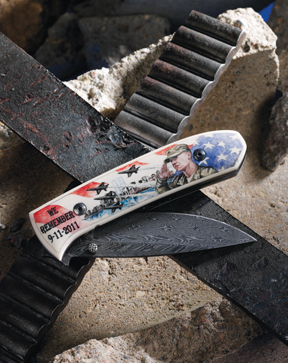
The knife above was made by Bob Dozier and scrimshawed by Sandra Brady. It rests atop a raw piece of cut steel from the South Tower and, below it, a piece of South Tower and 1095 carbon steel forged into ladder-pattern damascus by Daryl Meier. A portion of the latter material was used for the blade steel.
On one side is “We Remember 9-11-2011” commemorating the 10th anniversary, and the New York city skyline, including a shadow outline of the Twin Towers in place of the missing jet in a flyby jet formation, and a soldier saluting. On the flip side is a scene of firemen fighting the fires of the Twin Towers before they fell, an American flag, and the words, “Lest We Forget 9-11-2001.”
The knife was auctioned last year to benefit the 9/11 first responders’ families.
“There will never be enough to repay our debt for what [the first responders] paid,” Dozier said in a BLADE article last year.
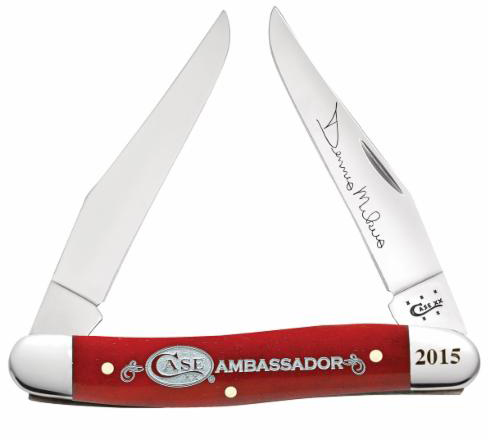
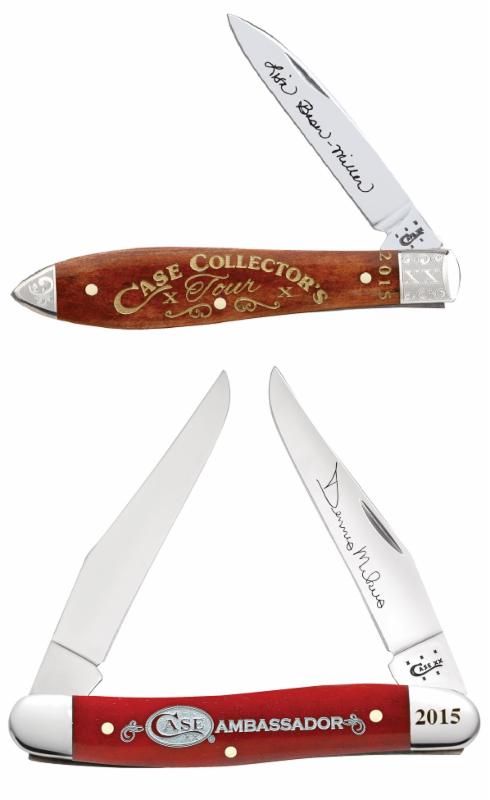
New from Case is the Collector’s Tour Tear Drop and Ambassador Tour’s muskrat.Think pink with Bear & Son’s new Model 114PK butterfly knife.
What’s hot and new in factory knives for the fall? Among them are 6 hotties ready to cut. Let’s start with Case. Its 2015 Collector’s Tour Knife is a traditional tear-drop pattern with an embellished smooth chestnut bone handle and the company’s famous “XX” scrolled bolsters. Case Collectors Club Manager Lisa Boser-Miller’s signature appears on the Tru-Sharp stainless spear blade.
The 2015 Ambassador Tour Knife is a muskrat in a smooth dark red bone handle and bolster engraving. One of the clip blades bears the signature of the owner of Coffman Hardware who doubles as a Case ambassador, Dennis Mikus.
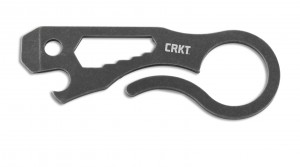
The CRKT Viva is a pry tool, hex wrench, bottle opener and screwdriver all in one keychain multi tool.
Bear & Son offers up a cool butterfly in hot pink handles—the Model
114PK in a 3 5/8-inch stainless blade. The handles are epoxy-coated aluminum. Weight: 5 ounces. Closed length: 5 inches.
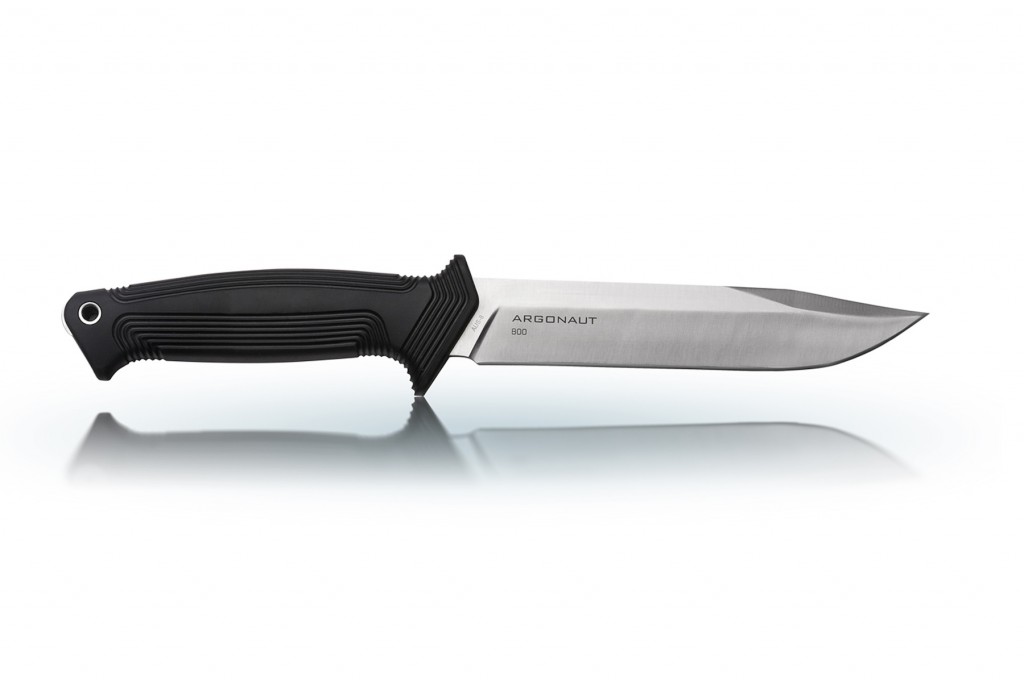
If you’re looking for a stout fixed blade, look no further than the Argonaut 800 from Steel Will Knives. The 6.3-inch blade is AUS-8 stainless in a satin finish and a Rockwell hardness of 56-58 HRC. Weight: 9.59 ounces. The $99.99 MSRP includes a Nylon sheath.
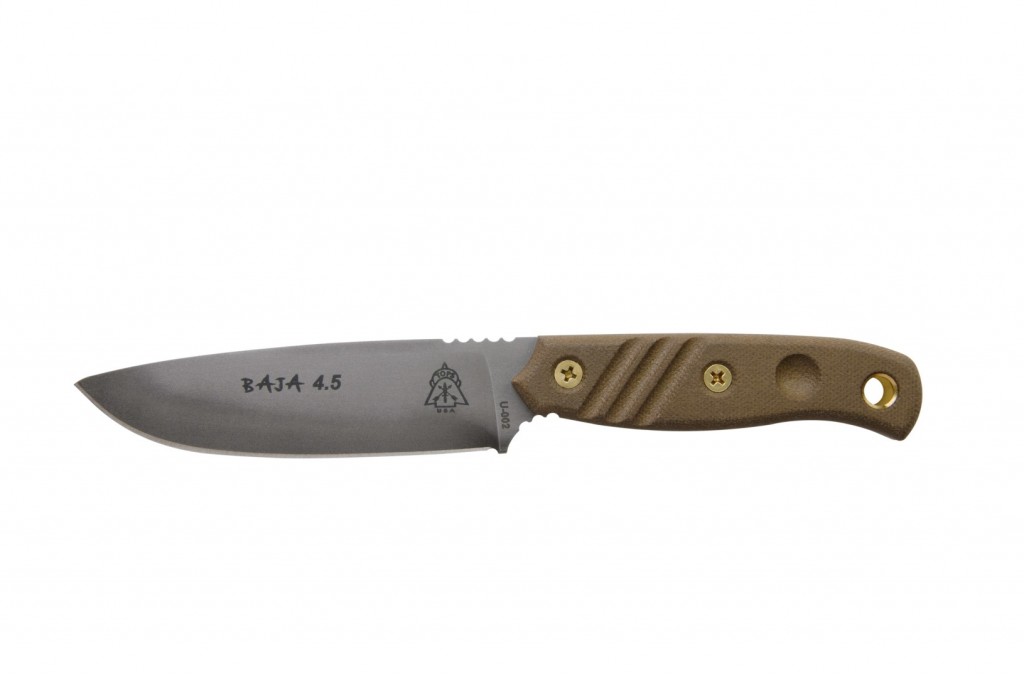
The Baja 4.5 is TOPS Knives’ “stretched sibling” of the Baja 3.0.
OK, so it’s not really a knife. So? Designed by Liong Mah, CRKT’s Viva is one of a growing number of key-ring multi-tools that includes a pry tool, screwdriver, bottle opener, hex wrench and more—all for a measly $9.99 MSRP.
The TOPS Knives Baja 4.5 is the “stretched sibling” of the TOPS Baja 3.0, sporting a 4.5-inch blade of 1095 high-carbon steel in a Black River Wash and a green canvas Micarta® handle. MSRP: $200 (includes a leather dangler sheath).
The Argonaut from Steel Will Knives is one stout fixed blade.
Also Check Out:
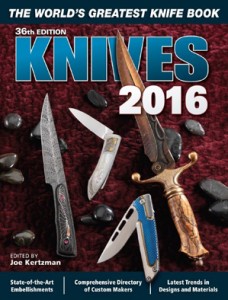
Knives 2016, 36th Edition
The trusted guide for knife collectors, enthusiasts, knifemakers, and dealers around the world, this knife book covers the latest and greatest from front to back. A collection of feature articles explores the latest developments, history, and transformation of knives, swords, and edges of various kinds. Get your copy
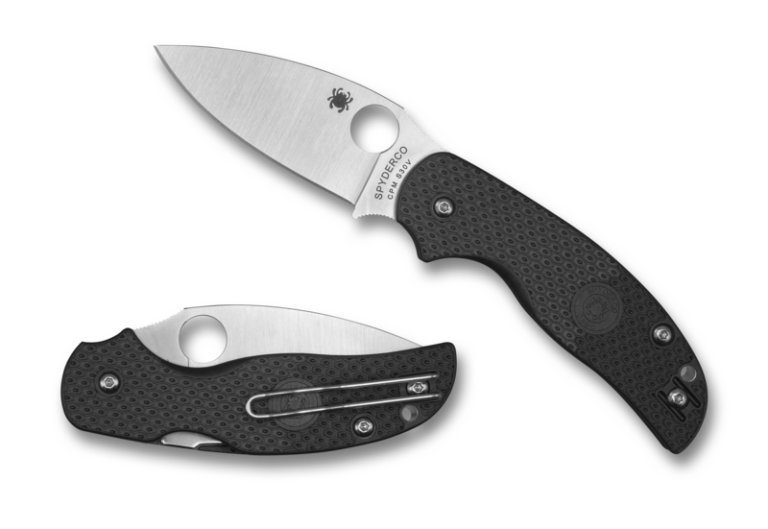
Spyderco’s Sage 5 Lightweight is a detour from their original Sage project in the best kind of way. Originally created as a platform to showcase unique locking mechanisms and their creators, the Sage series has helped to deliver incredible innovation into the mainstream.
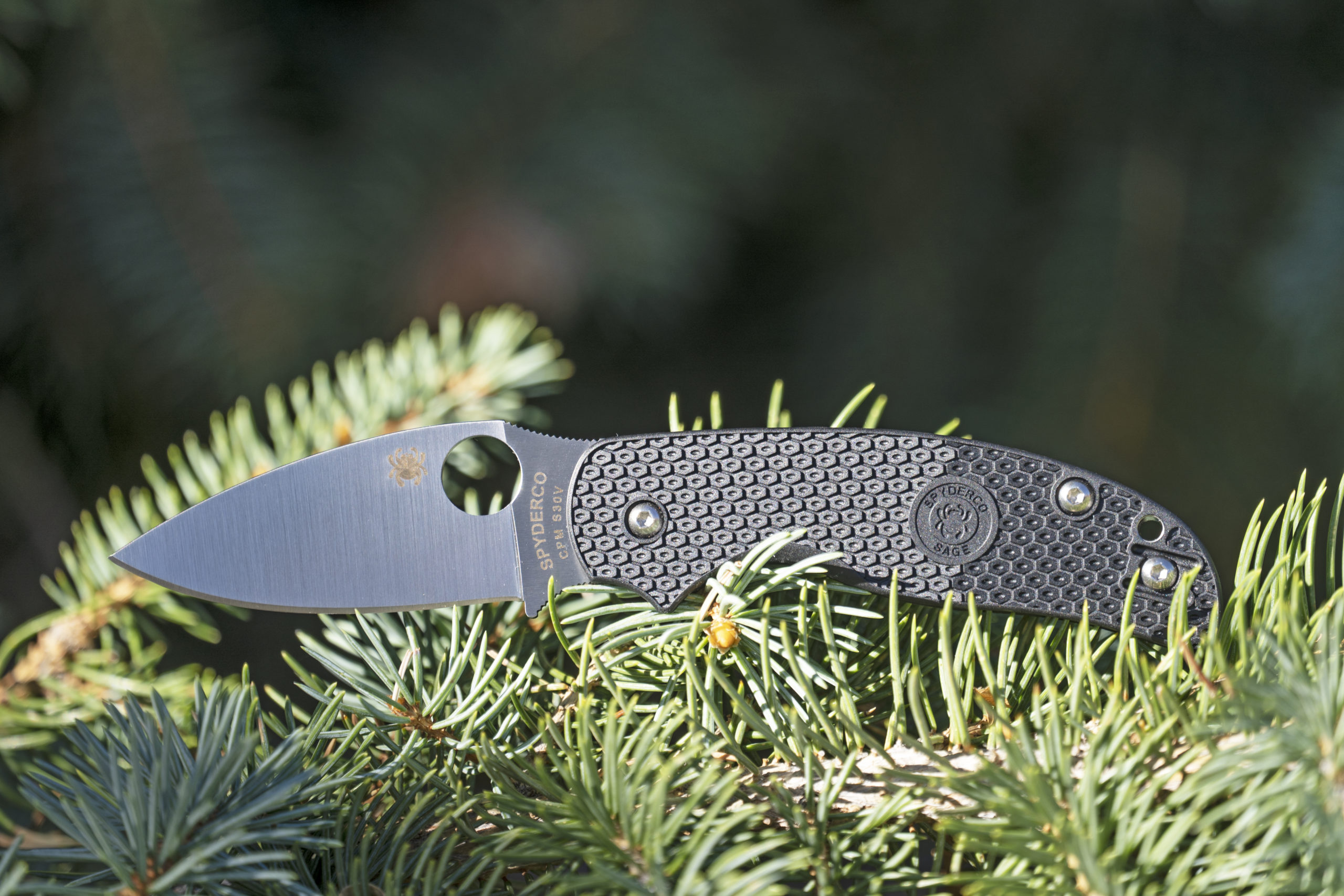
In this spirit, the Sage 5 Lightweight maintains the Compression Lock™ mechanism highlighted in the original Sage 5, but pairs it with injection-molded, fiberglass-reinforced-nylon (FRN) handle scales to reduce its weight by 13 percent.
The handle’s Bi-Directional Texture™ pattern provides a secure grip. Nested, skeletonized stainless steel liners provide structural strength and a foundation for the knife’s lock mechanism.
For serious end users, the result is a lightweight, high-performance knife that offers an ultra-secure grip at a more affordable price than the original version of this design.
To ensure an ultra-smooth action, the Sage 5 Lightweight’s full-flat-ground CPM® S30V® stainless steel blade rides on a special low-friction bushing that allows for precise pivot tensioning. A reversible deep-pocket wire clip provides discreet, ambidextrous, tip-up carry, while keeping the knife readily accessible.
As is tradition with all of Spyderco’s Sage models, a portion of the sales of these knives will be donated to the National Alzheimer’s Association.
Award-winning knifemaker Brian Fellhoelter drew on his experience as a whitewater guide to design the Timberline ECS. Frustrated by emergency knives that fell out of their sheaths during rafting and kayaking trips, Brian developed a reliable mechanism to hold the knife securely in the sheath until deployment is required. The result is the ECS.
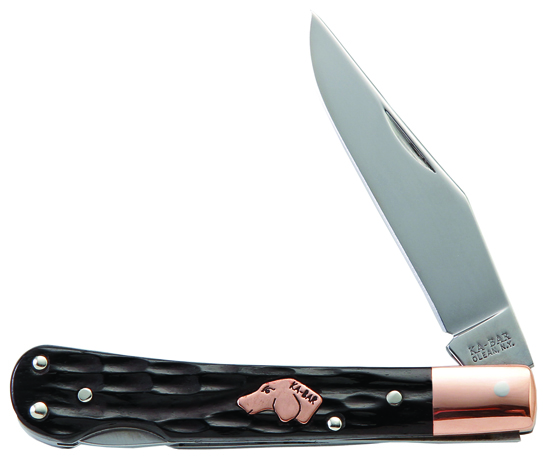
Ka-Bar Knives is set to star in the premier episode of the new History Channel series What People Earn. What better theme than “Beer, Knives & Football” for the initial episode of the show, and at 115 years old and going strong, is there a better fit than Ka-Bar for the show, starring alongside Samuel Adams, the famous brewer? It’s time to kick back, relax, grab a brew, and watch What People Earn while mindlessly, though carefully, opening and closing your Ka-Bar pocketknife.
What People Earn will air at 10 p.m. EST on Sunday, March 10 on History Channel 2. History Channel 2 can be found on DirecTV channel 271. Dish Network subscribers can find the premier of What People Earn on channel 121. For cable subscribers, please check your local listings. For additional information, please visit History.com. To learn more about KA-BAR Knives, please visit KA-BAR.com or call 800-282-0130.
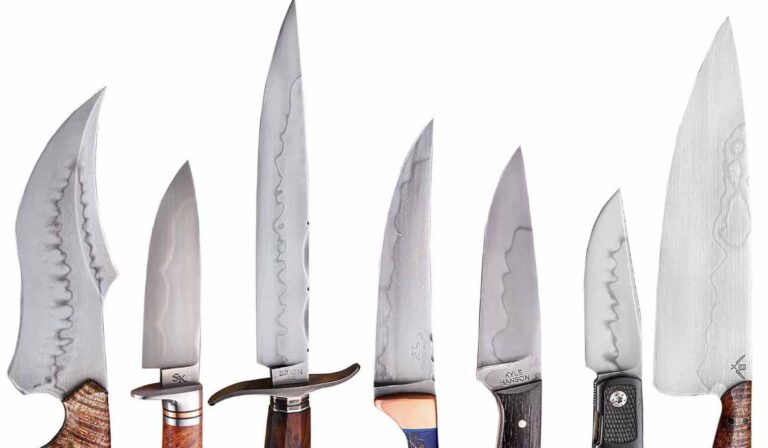
The often wavy hardening line running laterally and roughly midway from one end of the blade to the other on some knives is the hamon (pronounced ha-MOAN). Most if not all blades with genuine hamons are forged and differentially hardened. The wavy line serves as a demarcation point between the softer spine for toughness above and what extends down to a hardened edge for enhanced cutting below.
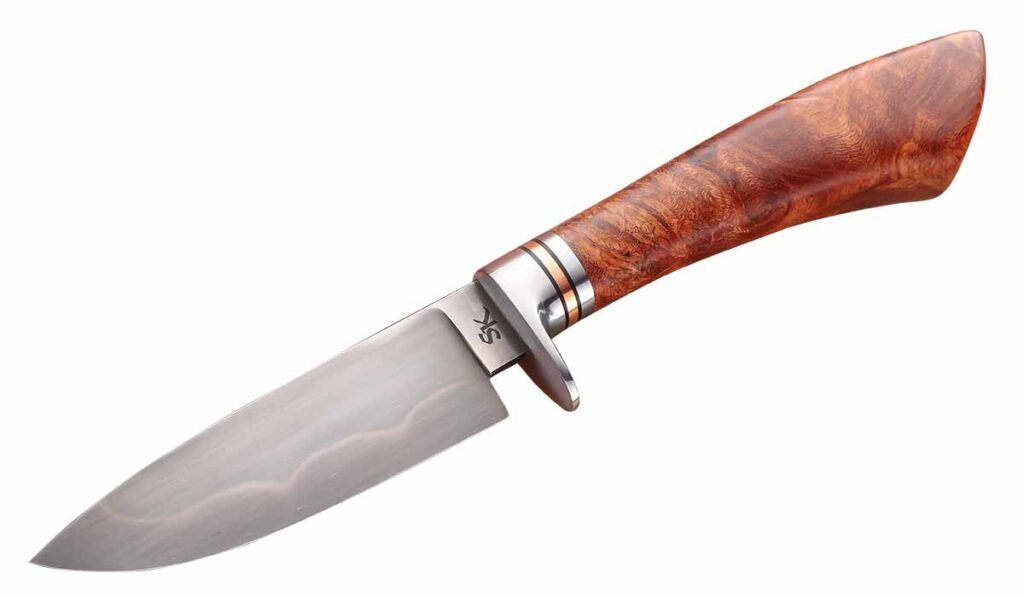
Steve Sando: Classic Hunter
Steve Sando used a coffee patina to color the hamon of the 4 3/8-inch blade of 26C3 carbon steel on his classic hunter. Steve’s differential hardening of the blade resulted in a Rockwell hardness of 62 HRC on the edge and 40 HRC on the spine. Blade grind: flat. Handle material: Afzelia wood. Overall length: 9 1/8 inches. (SharpByCoop image)
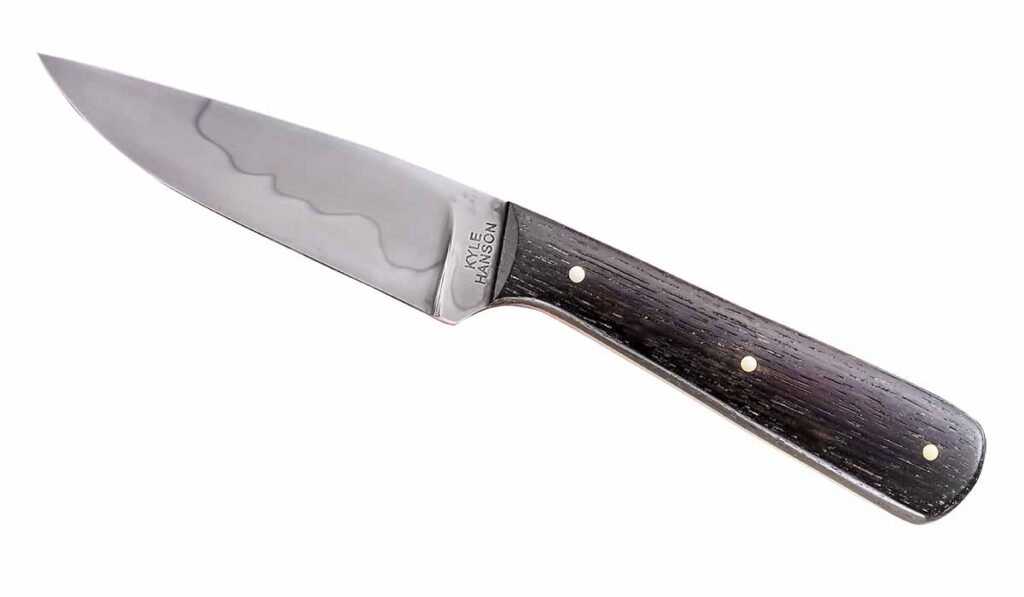
Kyle Hanson: Tapered Full Tang Hunter
Not merely W2 but “Oldass W2” tool steel is the canvas for the hamon on the blade of Kyle Hanson’s tapered-full-tang hunter. Handle material: 5,600-year-old bog oak. Overall length: 8.25 inches. A leather pouch sheath (not shown) by Kenny Rowe accompanies the knife. (SharpByCoop image)
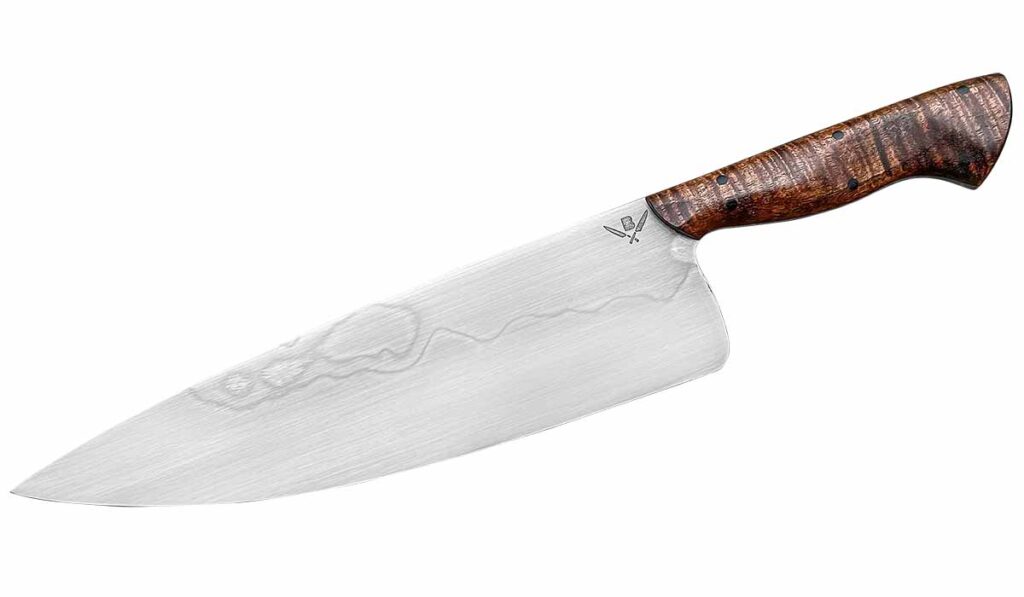
Geoffrey Baze: Chef’s Knife
ABS apprentice smith Geoffrey Baze opts for W2 tool steel to showcase the hamon on the 9.5-inch blade of his chef’s knife. The contoured bird’s beak handle is Tasmanian blackwood. (Jocelyn Frasier image edit)
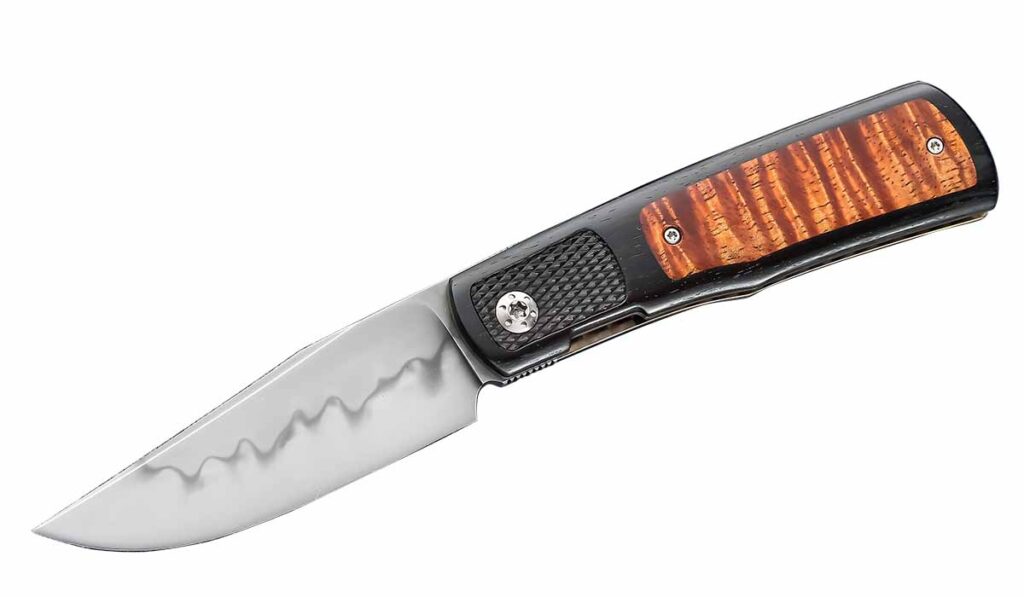
John Doyle: Dress Classic Gunstock Model
While not unheard of, folders with blades sporting hamons are not all that common. John Doyle does the deed on his Dress Classic Gunstock Model with pocket clip. The 3.25-inch blade is W2 tool steel and the handle frame is African blackwood with koa inserts. Lock: linerlock. Liners: jeweled, anodized titanium. Closed length: 4.125 inches. (SharpByCoop image))
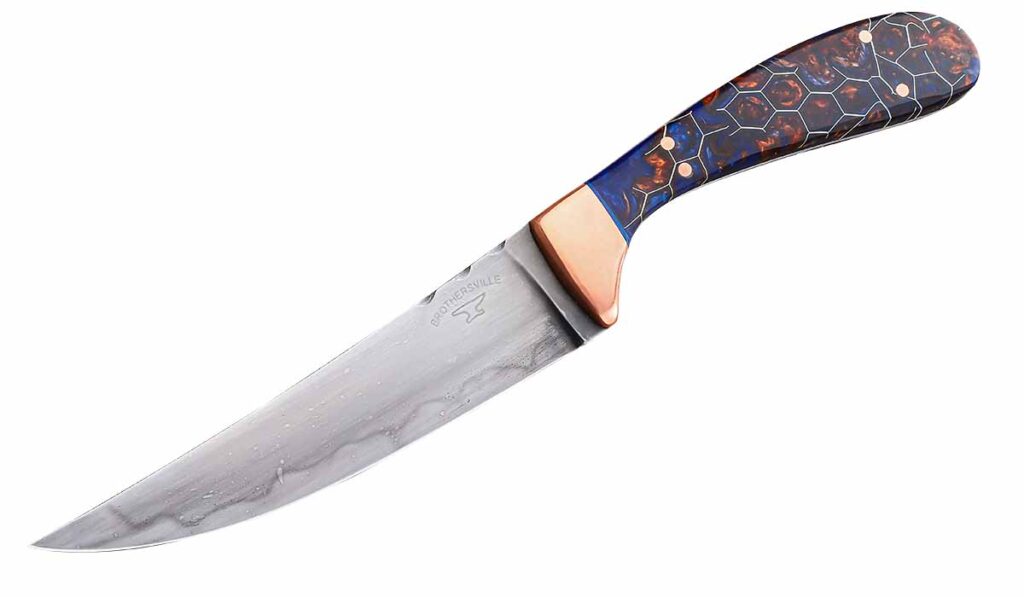
Peter Pruyn: Boning Knife
Like many makers who differentially harden their blades, Peter Pruyn used the clay-coating method for his small boning knife. The 5-inch blade is flat ground from 1095 carbon steel. The blueberry crumble resin-based scales are from Voodoo Resins and the bolster is copper. Overall length: 10.5 inches. Peter’s price for a similar knife: $450. (SharpByCoop image)
Eliott Robinson: Fighter
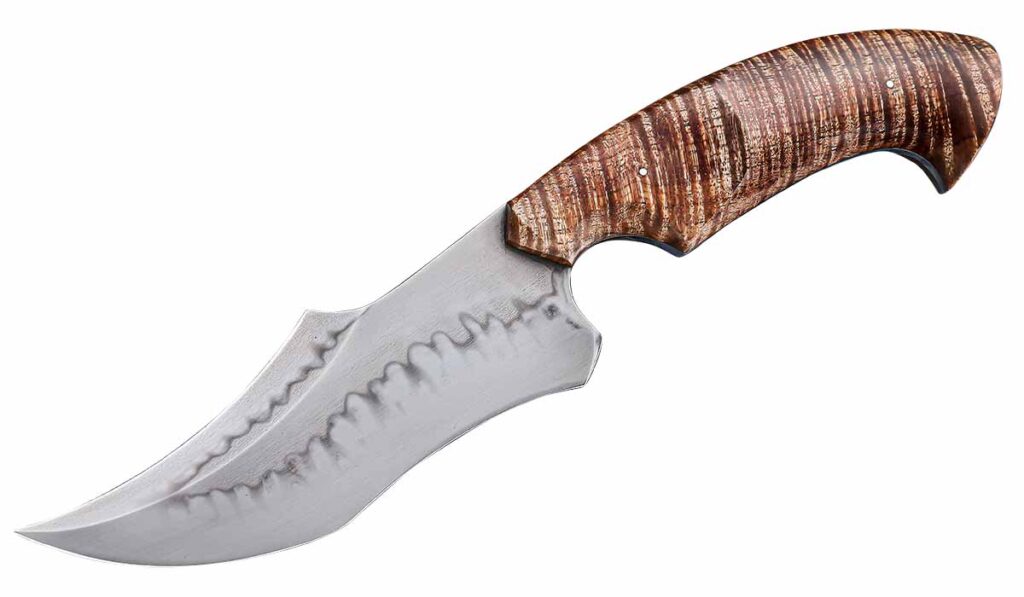
An apprentice to ABS master smith Sam Lurquin, Eliott Robinson nails it with the hamon on his fighter’s upswept recurve blade of U10A carbon steel. The bird’s-beak handle is Tasmanian blackwood. Respective blade and overall lengths: 5 and 9.5 inches. A quality inlaid sheath (not shown) by Jeremy Guillaume completes the outfit. (SharpByCoop image)
Brion Tomberlin: Coffin-Handle Bowie
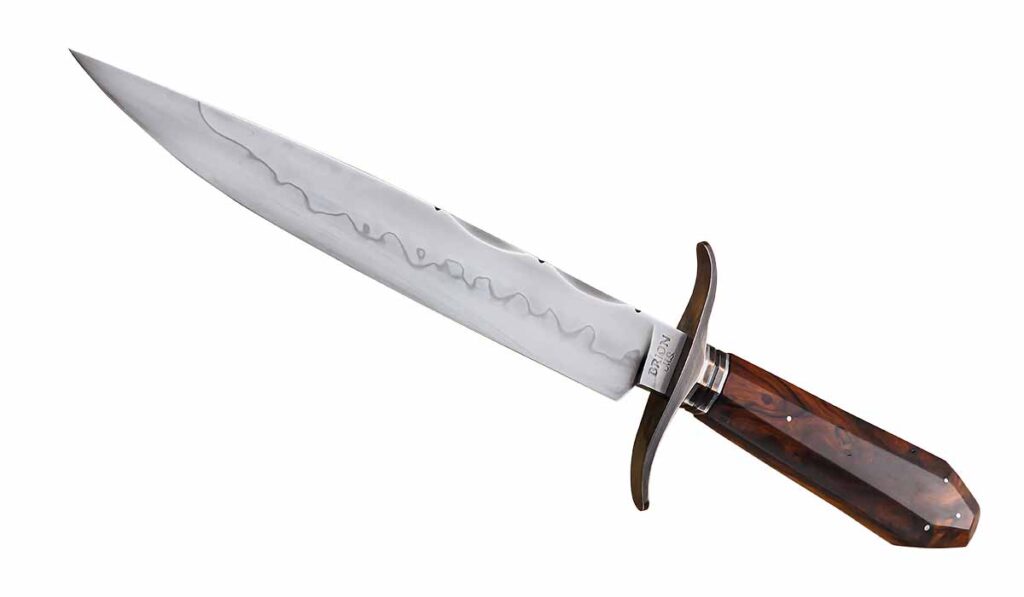
The hamon of ABS master smith Brion Tomberlin’s coffin-handle bowie dissects the 8.5-inch W2 tool steel blade almost perfectly. Blade grind: flat. Handle material: ironwood. Overall length: 13.25 inches. Brion’s price for a similar knife: $2,200. (SharpByCoop image)
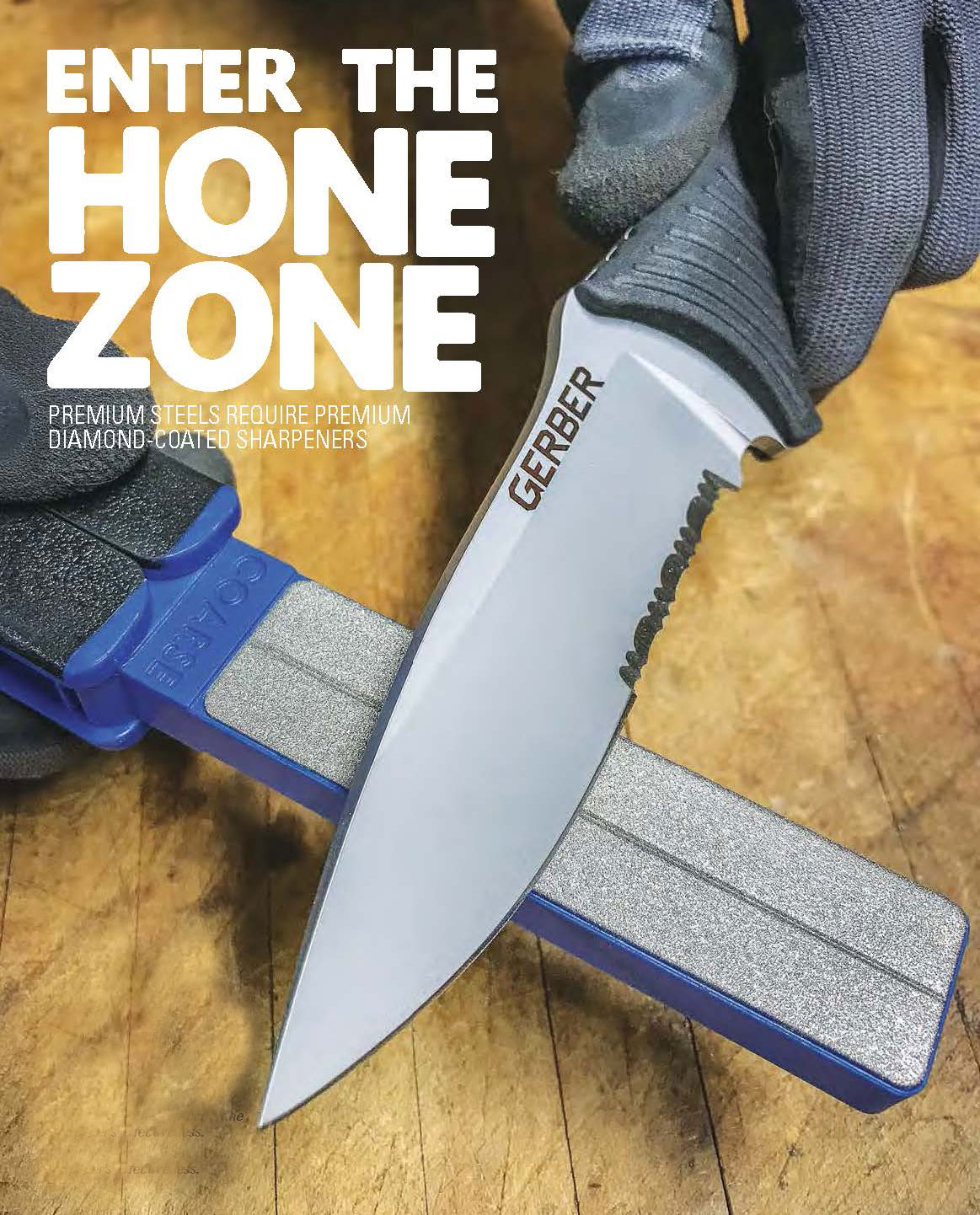
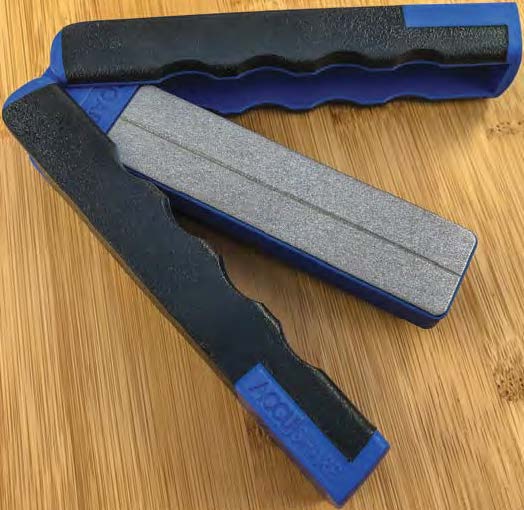
With the AccuSharp Diamond Paddle model, use light pressure and let the abrasives do the work. Too much pressure and you can dislodge the diamond particles, reducing the sharpener’s effectiveness. (All images by David M. Stanfield, DMS Captures)
Many knife users/collectors opt for high-performance blade steels such as CPM S30V, CPM 154, 154CM, CPM S35VN, BG-42, CTS 204P, CTS XHP and others. These high grades of stainless offer maximum edge holding, though at a price—and that price comes due when you resharpen the blades. Since these steels excel at wear resistance and can hold an edge for a long time, it also makes them difficult to resharpen. It’s a tradeoff you must consider when buying knives with premium blade steels.
Ergo, especially if you’re going to sharpen the knives yourself, it’s imperative you buy a sharpener that can address such steels effectively. If you’re new to the super steels, not only is selection of the proper sharpener critical but the necessary investment of time is also required.
With the proper sharpener, that time can be kept to a minimum.
Enter Diamond-Coated Sharpeners
Historically, diamond-coated sharpeners are at the upper echelon for sharpening knives. They are the most durable and longest lasting. The tradeoff is price. They are generally more expensive but you must bear in mind that unlike other sharpeners that can break or eventually wear out, there is almost nothing to break or wear out with a diamond sharpener.
Once you buy it, if you can keep from losing it, it should last your lifetime.
AccuSharp Diamond Paddle Sharpener
The handles of the AccuSharp Diamond Paddle Sharpener fold up to encase the sharpening surfaces and protect them during storage and transport. The rubber overmold gripping areas are a nice touch and make the sharpener easy to hold securely.
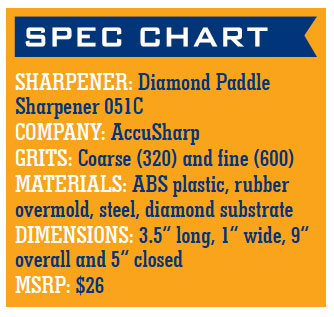
AccuSharp’s Diamond Paddle Sharpener model 051C is a double-sided model featuring both coarse (320) and fine (600) grits. At a healthy .75 by 3.75 inches, it has a large diamond-coated sharpening surface.
The big surface enables the 051C to address all types of knives, from multi-blade slip joints to large fixed-blade hunters. It includes a sharpening groove for use with all kinds of hooks, darts and other pointed items. It features handles similar to a butterfly knife’s that fold up around the sharpening surface, protecting it from damage during transport or storage. The handles feature a secure gripping surface as well.
The 051C works very well. With a diamond sharpener, use light pressure and let the abrasives do the work.
Too much pressure and you can dislodge the diamond particles, reducing the sharpener’s effectiveness. I like the sharpener’s two sides, which eliminate the need to carry a separate finer-grit sharpener to fine tune the edge. When done re-profiling the edge with the coarse side, just flip the 051C over and continue your work to refine the edge.
Another thing I like about the 051C is the rubber overmold gripping area. With or without gloves or wet hands, the sharpener is comfortable to hold. It never felt unsecure in my grip. Along with the rubber overmold, the thickness of the handles adds to comfort by filling my grip easier.
However, I can see where the girth can also be a downside, making the 051C difficult to stow in tight quarters like a zippered pouch or glove box.
Diamond Machining Technology Diafold
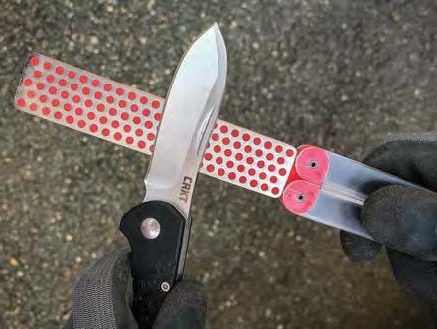
The DMT Diafold easily sharpens high-performance stainless steels with ease. The fine grit carefully constructs the final edge keenly, and is for use only after re-profiling the edge employing a coarse-grit sharpener.
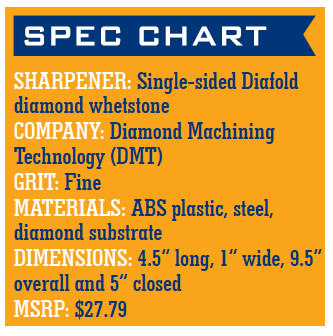
In my opinion the most iconic product made by Diamond Machining Technology (DMT) is the single-sided Diafold diamond whetstone sharpener. DMT’s sharpeners are easily recognizable by their trademark round polka-dot sharpening surface. They offer near-perfect grit-size consistency across the sharpening surface.
The Diafold is a compact sharpener with a flat form factor, allowing it to be carried in a large pocket, toolbox, glovebox, tackle box or carry bag. The handles double as a carrying case, folding up to conceal the sharpening surface and protect it from damage during transport.
Each DMT sharpener is color-coded according to grit, so, once you learn the codes, it’s easy to identify each grit by its color. The clear handles make identification easy and are a nice touch, so there’s no mistake which grit you have.
The Diafold works exceptionally well. It has been on the market many years and in my opinion is pretty much the gold standard when it comes to compact handheld sharpeners. It easily addresses all types of high performance stainless steels with ease. The fine grit carefully constructs the final edge keenly, and is for use only after re-profiling the edge employing a coarse-grit sharpener.
An improvement I recommend would be to make the sharpener a bit thicker to give the handles some width, which in turn would make it easier to hold—especially for an extended period of time sharpening several knives in one sitting.
Still, as is it functions well and, when the handles are folded, the thin profile makes it easy to pack.
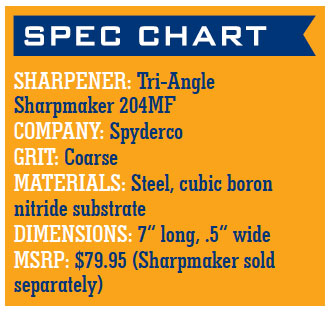
Spyderco Tri-Angle Sharpmaker 204MF
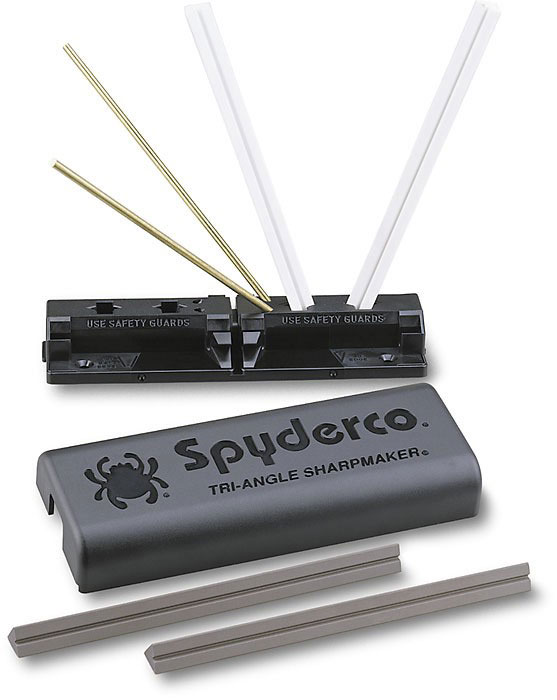
The Spyderco Tri-Angle Sharpmaker’s triangular-shaped rods enable you to address both plain edges on the rods’ flats and serrations using the “points” of the triangle.
“In the 1970s when [Mrs. Gail Glesser] and I started selling knife sharpeners at local fairs, we were buying and selling other people’s sharpeners,” begins BLADE Magazine Cutlery Hall-Of-Fame® member Sal Glesser, CEO and founder of Spyderco. One of the sharpeners the Glessers sold was a V-stick type that they liked, though they identified some of its shortcomings. “We invented the Tri-Angle Sharpmaker because, while similar to the [V-stick] sharpener, it solved many sharpening challenges/problems the [V-stick] couldn’t perform,” he says.
One of those problems is the V-stick model could not sharpen serrated blades. Enter the Sharpmaker’s triangular-shaped rods, which allow it to address both plain edges on the rods’ flats and serrations using the “points” of the triangle.
With the advent of higher-performance steels, the Sharpmaker’s ceramic rods were underpowered, so the company devised the 204CBN (Cubic Boron Nitride) Tri-Angle hones. The CBN hones work exceptionally well addressing dull or damaged blades. They can reprofile edges efficiently, handling not only the super stainless steels but all steel types. Like the ceramic Tri-Angle hones, the CBN easily addresses both plain and serrated edges.
As with the ceramic rods, a groove running the length of the CBN rod’s length allows for sharpening pointed objects and tools. The CBN material is what Spyderco calls a “super abrasive” second in hardness to diamond.
The CBN hones cost extra. The 204CBN complements the included medium- and fine-grit ceramic hones well. Once you re-establish the new cutting edge, switch to the medium and fine ceramic hones to further fine-tune it to razor sharpness. The CBN hones work on any blade length, fixed or folding.
Once you set the sharpener up, start your blade from where the edge starts closest to the tang and run it down the hone, at the same time pulling the blade back toward you, ensuring the hone contacts the entire length of the cutting edge all the way to the tip. Hence, you’re doing two simultaneous motions—moving down the hone and pulling the blade back toward you. Do it all with light pressure.
An improvement I would recommend would be to include a set of CBN hones as standard with the Sharpmaker. The CBN hones speed up the process of edge recreation. Granted, the addition would increase the Sharpmaker’s cost but the increase would be justified.
DMD Double-Sided Bench Stone
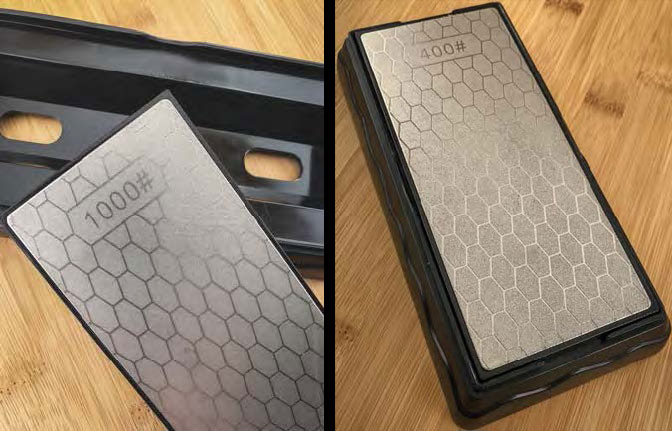
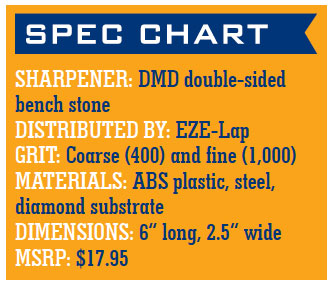
The DMD Double Sided Bench Stone features two grits on one stone. Coarse (400) and fine (1,000) grits address high-performance steel blades. The metal plate is double sided and lies on the base just so to provide sharpening convenience.
The DMD double-sided bench stone sports two different grits: a coarse 400 and fine 1,000. The base is molded ABS plastic and features wide, anti-skid rubber feet to keep the sharpener in place while working on a flat table, counter or bench. The sharpening surface sits in a cavity of the base. To change grits, flip the hone over and return it to the base.
A hex-like pattern on both sharpening surfaces removes the tiny metal particles so they won’t collect and clog the surfaces as you sharpen the blade.
Work with the DMD and discover the convenience of a double-sided diamond bench stone, a rarity among such stones. The coarse side easily and quickly re-establishes worn edges to sharp. After you establish the primary edge, flip the sharpening surface over to the fine side and fine-tune the blade.
The DMD did a great job on CPM S30V and CPM 154. Keep in mind that since this isn’t an angle guide-type sharpener where the angle is held consistent for you, extra care/consideration is required to get a nice edge.
Try using a permanent marker to color in the entire cutting edge on both sides of the blade. As you sharpen, note where the ink is removed and where it remains on the cutting edge. By doing so you can adjust your angle accordingly to capture the entire cutting edge and, therefore, keep the angle consistent for a sharp blade.






 It was 11 years ago today—a sunny Tuesday morning, just as it is this morning in New York City—that scores of innocent Americans paid the ultimate price when the Twin Towers were attacked.