Knife Collecting

Knife collecting is an extremely rewarding experience for knife enthusiasts. There truly is a knife for everyone. Many increase or hold their value throughout the years, making collecting knives something to pass on to the next generation of knife collectors.

WE Knife Elementum: An Exercise in Minimalism

0

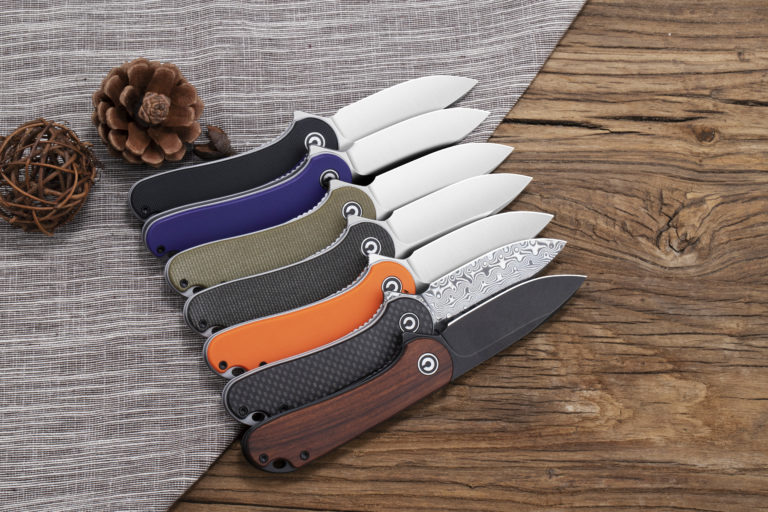
The Elementum is the best-selling knife ever for Civivi, a special line from WE Knife. Simple, elegant, functional and utilitarian, the Elementum from Civivi is an exercise in minimalism, delivering everything that is essential to an everyday carry folder with nothing frivolous or impractical.

Boasting a drop point hollow ground blade in razor-sharp D2 or s35VN steel, caged ball bearing pivot, and a deep carry pocket clip the Elementum is a spec-heavy workhorse. With over 20 different styles available (including dealer exclusive models) there is an Elementum for everyone.

CLICK HERE TO VISIT WE KNIFE

Customer Reviews

We are not the only ones who think the Elementum is in a class of its own. Check out these real reviews from real customers.

“The perfect edc knife…The price-performance ratio is unsurpassed.”

“It’s the sharpest knife out of a box I’ve ever had… this is probably the best budget knife out there”

“The ball bearing pivot makes the action buttery smooth.”

“I would think that this knife would cost three times what I paid.”

“Overall, this knife defies its price point”

“A high end knife without the high end price”

“Buy this knife. You will be happy.”

Knives Unite the World

0

specializesThe following is an excerpt from the KNIVES 2016 book. Click here to order your copy, read many entries like it and view some of the most gorgeous knives on the planet.

Edges of the World

You know it’s American when you see it. That’s the easy part. Isn’t it amazing how something “foreign” is also instantly recognizable? And it doesn’t matter which country you live in, a Chevy is as American as a Ford, and a Maserati as Italian as a Ferrari. One doesn’t look at a Dodge pickup truck, and say, “Wow, those Japanese imports are sure stylish.” The Dodge is easily identified as an American truck. And likewise, even the most novice of car enthusiasts can tell that a Hyundai isn’t a product of Detroit, Mich.

So should knives and swords be any different? When you shrink your product down from a vehicle that a person rides inside to a knife he or she carries, one might think that identifying it by country of origin would be more difficult. But that’s not the case. Many knife enthusiasts recognize Persian upswept blades when they see them, Scottish basket-hilt swords, Japanese tantos or wakizashis, French poniards, Napalese kukris and American bowie knives. Those are the easy ones. But can you identify a Hungarian foko or a Spanish belduque? It doesn’t take much practice.

FBTKIPerhaps we’re more worldly than we give ourselves credit for. Sure, the average American can’t likely name the countries of South Africa, but we know Chinese food when we taste it, a Cuban cigar when we smoke it and a Mexican fiesta when we attend one. Regional recognition isn’t limited to geography, but also includes cultures, people, clothing, food, arms and armor. That means knives, and these exotic beauties will take you to the edges of the world and back. Or is the world round?

For answers to many of the questions a knife enthusiast might have, pick up your copy of KNIVES 2016 today.

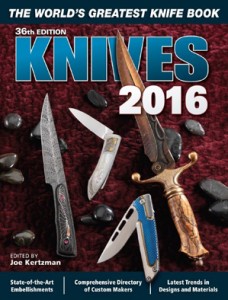
T7174Knives 2016, 36th Edition
The trusted guide for knife collectors, enthusiasts, knifemakers, and dealers around the world, this knife book covers the latest and greatest from front to back. A collection of feature articles explores the latest developments, history, and transformation of knives, swords, and edges of various kinds. Get your copy

Cool Customs: Blount’s War Club Dusts Off Mohican Memories

Josh Blount reproduces Chingachgook’s gunstock war club.

ABS apprentice smith Josh Blount recently rewatched the 1992 version of The Last of the Mohicans, and the gunstock war club of the character of Chingachgook in the film inspired him to make his own stunning version.

Josh patterned his reproduction after the movie piece* but with his own spin, including a low-layer-twist damascus blade and curly maple stock decorated with silver wire inlay in assorted mountain images: a daytime scene with hawks circling the sun, a nighthawk nighttime scene amid moon and stars, etc. “My background is wildlife biology, so I live birds and chasing wildlife,” he noted. “So, I put a little bit of that in there.”

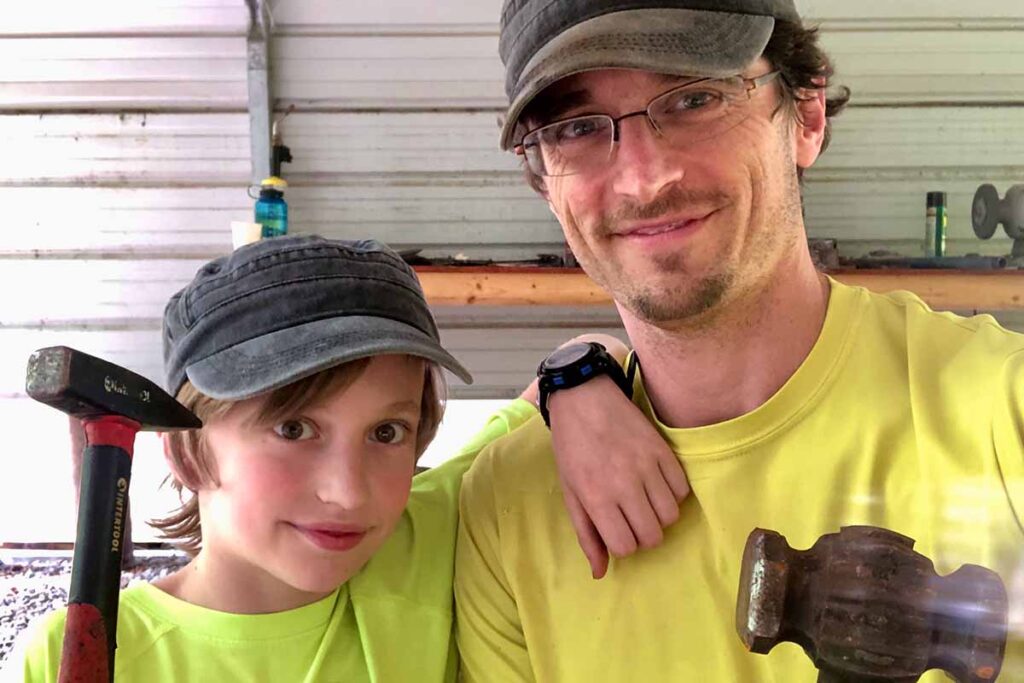
Josh and son Elliott
Josh and son Elliott appear here (inset) after beginning to forge a Scottish dirk for Elliott’s 10th birthday.

Josh’s mentors include the late Ron Claiborne and Larry Harley, and, of course, ABS master smith Daniel Winkler, who made some of the knives and tomahawks for Mohicans (February 1993 BLADE®). In fact, Josh visited the Winkler shop just over 20 years ago. Josh was bladesmithing then too, but life happened and he went to college. Now he’s back to hammering hot steel in Franklin, West Virginia, and hopes to test for ABS journeyman smith in the near future.

Gunstock War Club Specs
Maker: Josh Blount
Blade length: 6.5”
Blade material: 80CrV2 carbon and 15N20 nickel-alloy steels
Handle/stock: Curly maple from Dunlap Woodcraft, w/pewter pins and deerskin wrap from Crazy Crow Trading Post
Overall length: 40”
Maker’s price for a similar piece: $800

*The gunstock war club in The Last of the Mohicans was made by the movie’s prop department.

Check Out More Cool Custom Knives:

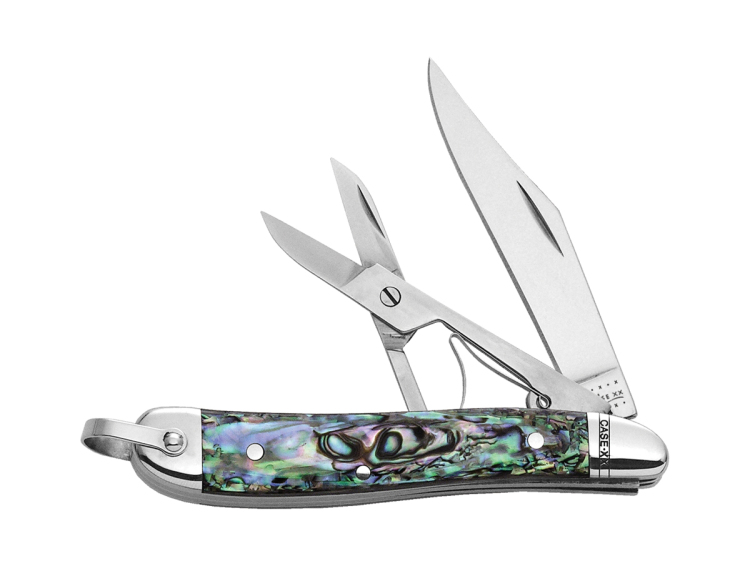
Knife Of The Day XXIII: Abalone Case Peanut for Mother’s Day

NOBODY APPRECIATES A SHARP UTILITY TOOL LIKE MOM—and all the better if it’s pretty. The Case abalone peanut is just the ticket for Mom on Mother’s Day.

The swirling abalone scales are very attractive and the clip blade and scissors—all in a 2 7/8 inches-closed package that weighs in at a scant 1.2 ounces—will give Mom all the cutting and snipping power she needs on her special day.

For more information click on www.wrcase.com.

For more on the latest knives, knife legislation, knifemaking instruction, knife trends, knifemakers, what knives to buy and where and much more, subscribe to BLADE Magazine, the World’s No. 1 Knife Publication. Click here for a subscribe to BLADE Magazine.

What’s Hot In Knife Mechanisms

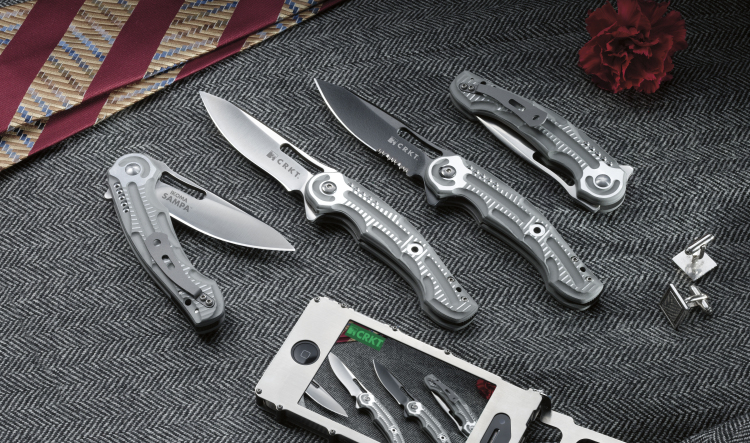
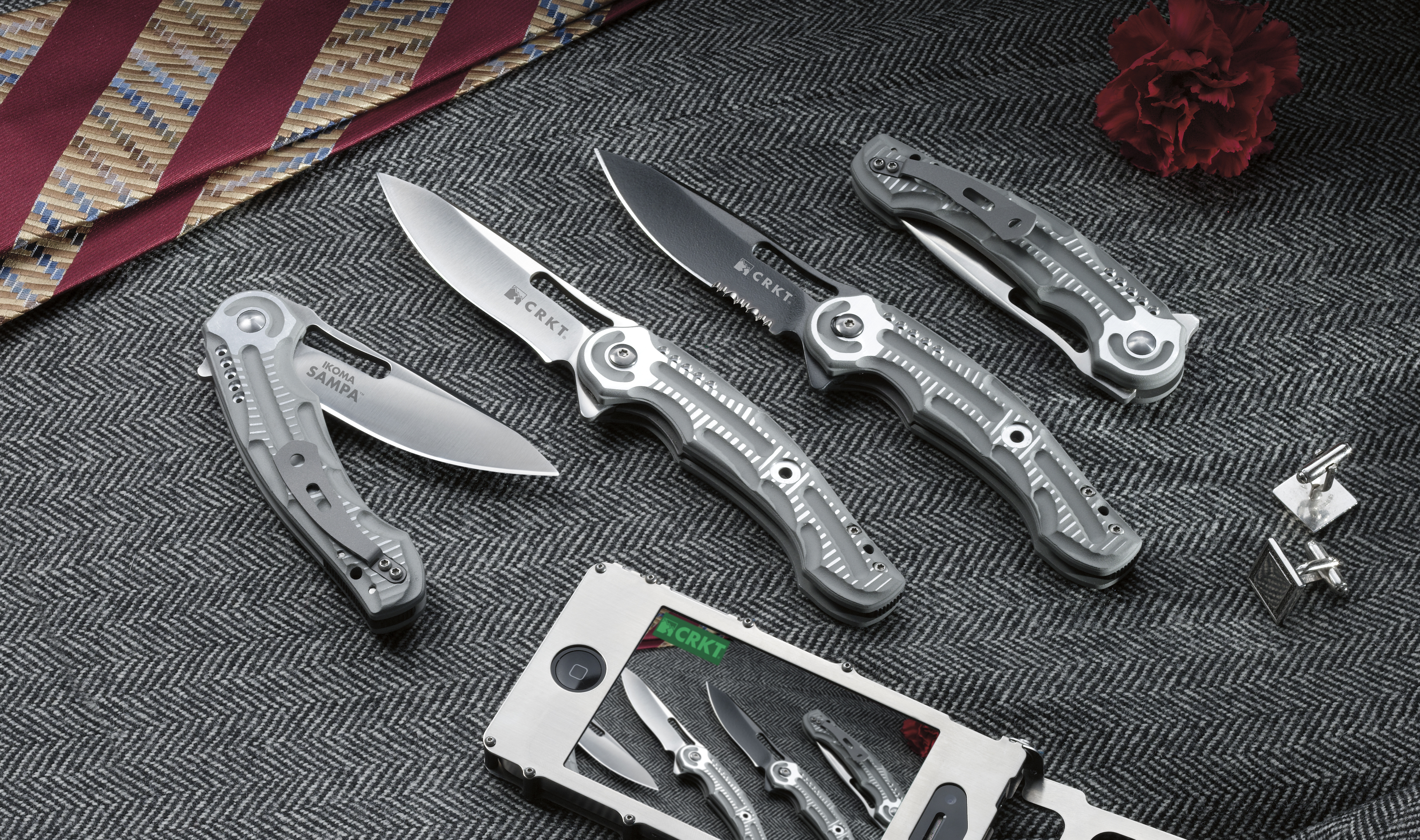
Designed by Flavio Ikoma and using the IKBS (Ikoma Korth Bearing System) Flavio helped create, Columbia River Knife & Tool’s Sampa line is an example of the non-assisted-opening flipper folder purveyor Duane Weikum said seems very popular at the moment. (CRKT photo)

User needs and refined design/construction rule the hottest knife mechanisms

By Dave Rhea


Mechanisms are everywhere on the knife market. There are so many different ways to open, shut and lock a knife it seems there could never be anything new under the sun. Invariably, though, advanced, creative minds push the boundaries of what is out there. Sure enough, along comes something that revolutionizes the cutlery culture.

     So what is going on in the sphere of knife mechanisms? Owner of New Graham Knives retail knife store, Michael Dye said it is difficult to have a really fresh, new idea, and pointed to a visit he had with Blade Magazine Cutlery Hall-Of-Fame© member Ken Warner a few years ago.

     “He showed me drawings in a bound notebook that were dated back to the ’70s,” Dye recalled. “Ken said, ‘Recognize these?’ and they looked the same as the handles that are on [a line of leading field knives now].” Dye was not alluding to any sort of theft or malicious intent, but to the fact so many people have so many ideas, and over the years the ideas start to overlap.

     Which is a roundabout way of saying what is hot today in knife mechanisms is not necessarily new but a combination of consumer preference and a refinement of existing mechanisms.


Get Your Tweak On

“I think you’re seeing a lot of refining, where the changes are in movement improvements and [modifying] existing mechanisms,” he said. “The devil is often in the details. Also, like putting mechanisms such as the IKBS [Ikoma Korth Bearing System] in affordable production knives.”

     He used the Taylor Cutlery/Smith & Wesson knives as an example of the benefits of tweaking a design. “Their third-generation flippers really hit the mark,” Dye explained. “When people put that little knife in their hand, they really are impressed with how the assisted opening works. Refining and tweaking of the geometry to make flippers open more easily—that’s what I have been seeing more than anything in the last year.”

     Owner of EDC Knives, purveyor Duane Weikum cited the venerable non-assisted-opening flipper folder popularized by Kit Carson as probably the most-sought-after mechanism this year. “A flipper tab on the knife, along with a strong detent and a smooth pivot, makes for an impressive-opening knife,” he said. “I prefer a straight flipper to an assisted knife myself—fewer chances of it opening in my pocket.”

     Weikum is also a big fan of Flavio Ikoma and the IKBS bearing pivot system (page 50, June BLADE®). “There are other bearing systems coming online, people tweaking things so they can call it something other than IKBS,” he opined, “but Ikoma and Korth were putting it into practice long before these other systems came along. Some guys were even using IKBS before they knocked it off—sad but true.”

     He added that Columbia River Knife & Tool (CRKT) has licensed the IKBS for Ikoma’s and Cutlery Hall-Of-Famer Ken Onion’s CRKT designs (the Sampa and Ripple, respectively), which he said speaks well for the mechanism’s performance.

     Another hot existing mechanism Dye singled out is the one on the Blade Magazine 2010 Overall Knife Of The Year®, the Chris Reeve Knives Ti-Lock. “You definitely have some people who are pushing the envelope, like Gavin and Grant Hawk with the Ti-Lock,” Dye pointed out. “That is, without a doubt, a very unusual locking mechanism.”

     The Ti-Lock lock bar is mounted along the back of the blade toward the pivot. When the blade is opened, the handle edge of the lock bar, which has a cross bar with thumb-stud-like grips, is forced down into a slot through spring pressure, locking the knife securely open.

     The Ti-Lock folder by Chris Reeve Knives is a collaboration between the father-and-son Hawk team and Chris Reeve. According to Dye, it is a design that, initially, was almost complete but shy of actual fruition. “I think Gavin and Grant got it about 90 percent figured out,” Dye noted. From there, he said Reeve took the lock and made it economically feasible to build on the larger manufacturing scale of Chris Reeve Knives. “It works very well and it adds a different look to the knife, to say the least, with the [lock’s] anodized titanium bars,” Dye observed.

     Another hot mechanism is Benchmade’s Paul Axial system, according to Trevor Darby, owner of BladeOps LLC. “I think the [Benchmade version of the] Paul Axial system that has just been hitting the market is very interesting,” he said. “It’s a smooth-opening one-handed mechanism that seems to be generating quite a bit of buzz, as well as demand.”

     Developed by Paul Poehlmann in the 1970s (page 50, November BLADE), the Paul Lock has a spring-loaded interlock key that can be depressed and rotated. It is simple and strong. “Along the same lines,” Darby added, “even though it is a mechanism that has been around for a while, the Tri-Ad lock that Cold Steel makes is always in huge demand.” Darby also points to the Spyderco Ball Bearing Lock (page 24, February BLADE) as something that has been gaining interest with his customers.


Hard To Put Down

Sometimes it is the mechanism itself that pushes a buyer into purchasing a knife. The “gadget factor” has a strong allure, and, when someone puts a knife in his hand and starts toying with it and it is hard to put it down, that is an almost certain sale. For many of BladeOps’ clientele, Darby said there is often a specific mechanism that drives them to buy.

     “We have a lot of customers who have seen something somewhere and want that particular mechanism,” he related. “I would say there’s about a 50/50 split between buyers looking for a specific mechanism and those looking more along a size, brand and price range.”

     A great example of a company that excels in the marketing of interesting mechanisms is CRKT. It has led the way by offering an incredible array of opening and locking mechanisms to the point that, each year, this writer cannot wait to see what is in its new catalog.

     “Things like what Ed Van Hoy did with the Snap Fire with the anodized wheels and stuff,” Dye pointed out. “We have a lot of people who come in and really get mesmerized by the glitzy opening systems that you see in some designs.” (Editor’s note: Though CRKT offers at least one other Van Hoy design, the Snap Fire has been discontinued.)

     Dye mused that sometimes the mechanism itself outweighs the knife’s actual usefulness. “In such cases, the knife is not utilitarian by any means,” he said. “But what sells the knife to every customer that puts it in his hand is the way it opens and closes. It becomes a gizmo at that point—it just happens to have a sharp blade on it.”

For more on the latest knives, knife legislation, knifemaking instruction, knife trends, knifemakers, what knives to buy and where and much more, subscribe to BLADE® Magazine, the World’s No. 1 Knife Publication. For subscription information click on http://www.shopblade.com/product/blade-magazine-one-year-subscripti…?r+ssfb020512#BL1SU


New Knife Category From ZT/Hinderer?

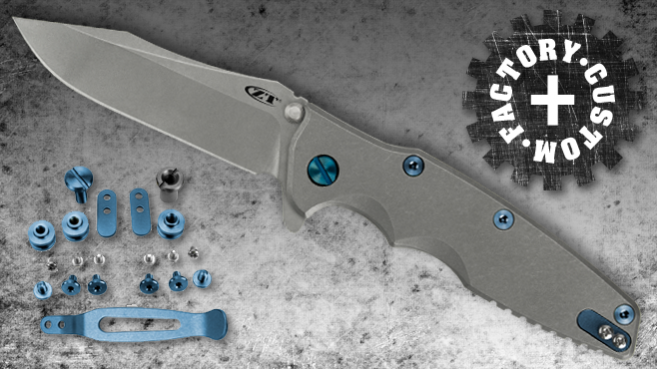
Factory custom is new knife category from Kershaw. (Kershaw knife image)
Zero Tolerance announces a new knife category called ‘factory custom’ done in concert with Rick Hinderer. (Kershaw knife image)

Zero Tolerance’s Model 0392 “factory custom” collaboration with Rick Hinderer is not only a new knife idea, it might be an entirely new knife category.

Here’s how it works: Hinderer makes and supplies the knife parts such as the pocket clips, screws, spacers, filler tabs, standoffs and other furniture and Zero Tolerance employs them in the manufacture and assembly of the resulting knife—thus the name, ‘factory custom.’ The initial parts will be titanium anodized cool blue.

According to a ZT news release, “While we’ve often worked with custom knifemakers … we’ve never had this kind of partnership before. Now, working together, we can create knives with true custom details, while producing quantities that would be impossible for a custom knifemaker.”

The resulting factory custom knives will also offer “after-market customization.” Customers will be able to buy the furniture from Hinderer with different finishes, anodized in different colors, etc. The furniture may even come in different materials, including copper, to go with the standard titanium. The different finishes, anodizations, etc., apparently will come later.

An award-winning custom knifemaker out of Shreve, Ohio, Hinderer is best known for his XM-18 folder, and his knife lotteries are always among the best attended. He also has been expanding his knife operation to offer semi-production-type knives. He had a booth at the recent BLADE Show, where he celebrated exhibiting at his 25th consecutive rendition of the event.

A flipper folder, the 0392 will feature M390 blade steel, a titanium handle and the KVT ball-bearing opening system.

For the time being, the factory custom project is in the formative stages. Exactly how many of the knives will be made or when they will be available remains unknown. Stay tuned to Zero Tolerance and blademag.com for more details.

Custom Forged Hunting Knives: Full Spectrum Of Options

Discover the craftsmanship behind unique designs, from carbon steel to mosaic damascus, and learn what makes a perfect hunting knife.

The primary trend that has emerged in custom forged blades over the past 18 months is the growing popularity of the hunting and utility knife. The options seem limitless, from forged carbon steel and Micarta® to mosaic damascus and ivory.

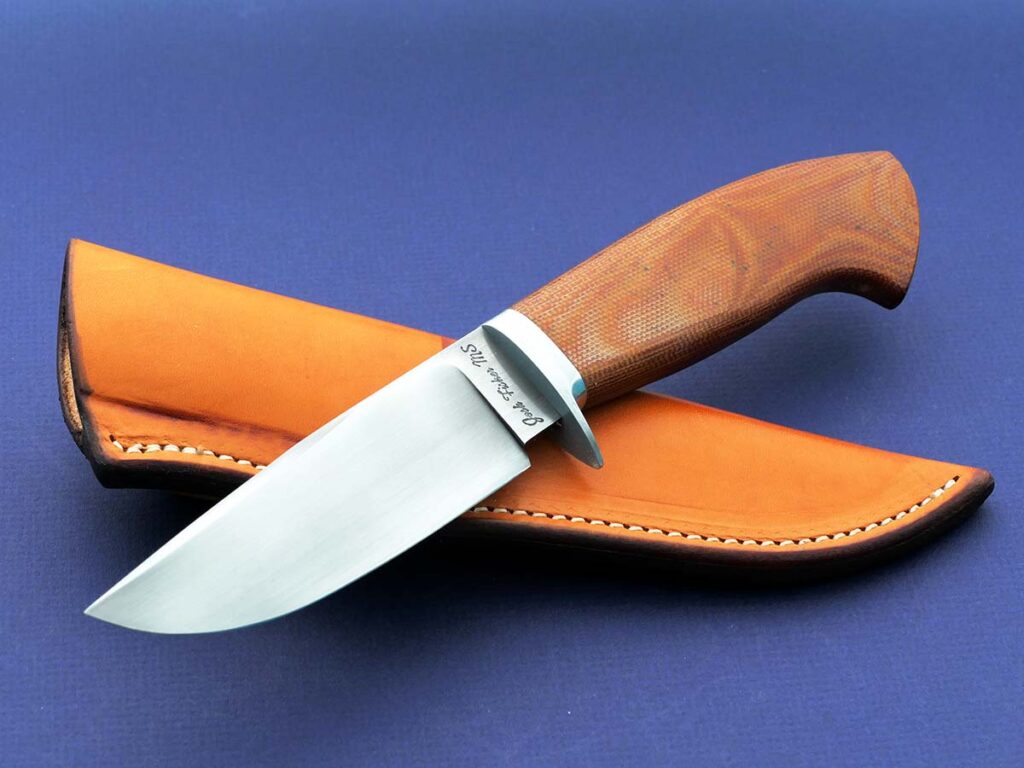
The best seller among the group is the carbon steel hunter featuring a Micarta handle. An excellent example is from award-winning ABS master smith Josh Fisher—world-class craftsmanship at an affordable price. Designed for serious work, this knife will last, if properly maintained, for the owner’s lifetime and beyond.

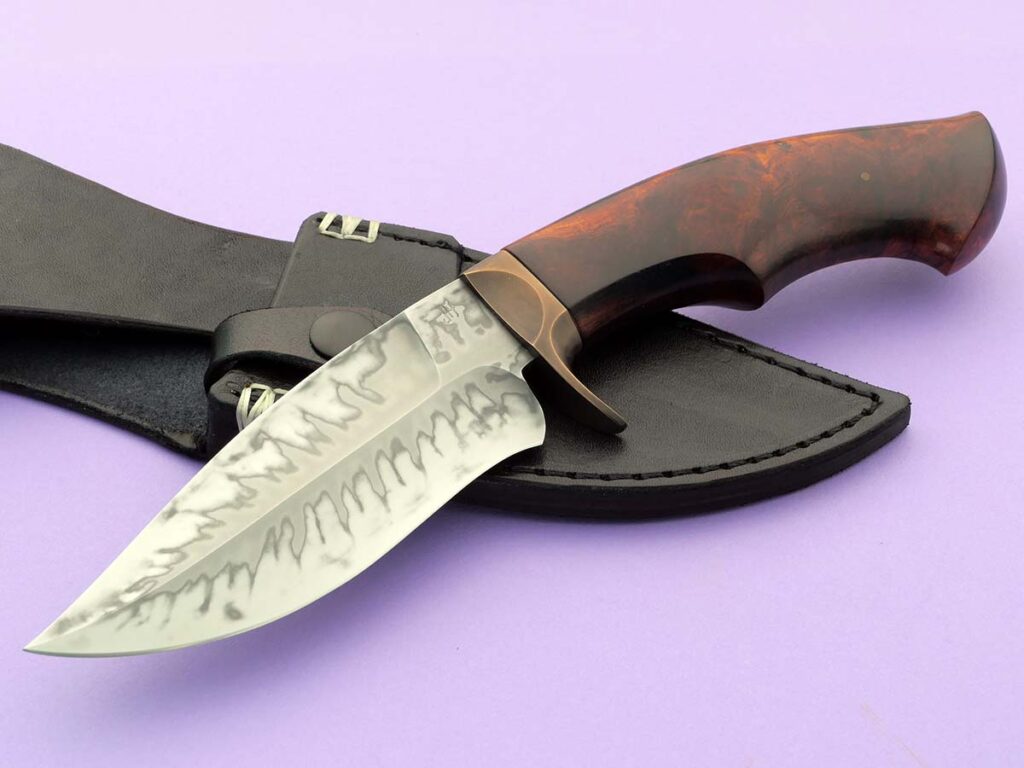
One of my favorites is a hunter from Slovenian knifemaker Jan Hafinec featuring the unique hamon of his Bonfire Hunter. Jan’s hamon looks like flames streaking across the blade. He achieves the distinctive look by cleaning the grind and normalizing the blade. He then applies Satanite* clay to the blade in the desired shape for the hamon. After drying the clay, he puts the blade in his electric kiln. Upon removing it from the kiln, he plunges the blade into fast-quenching oil to give the hamon its fiery look.

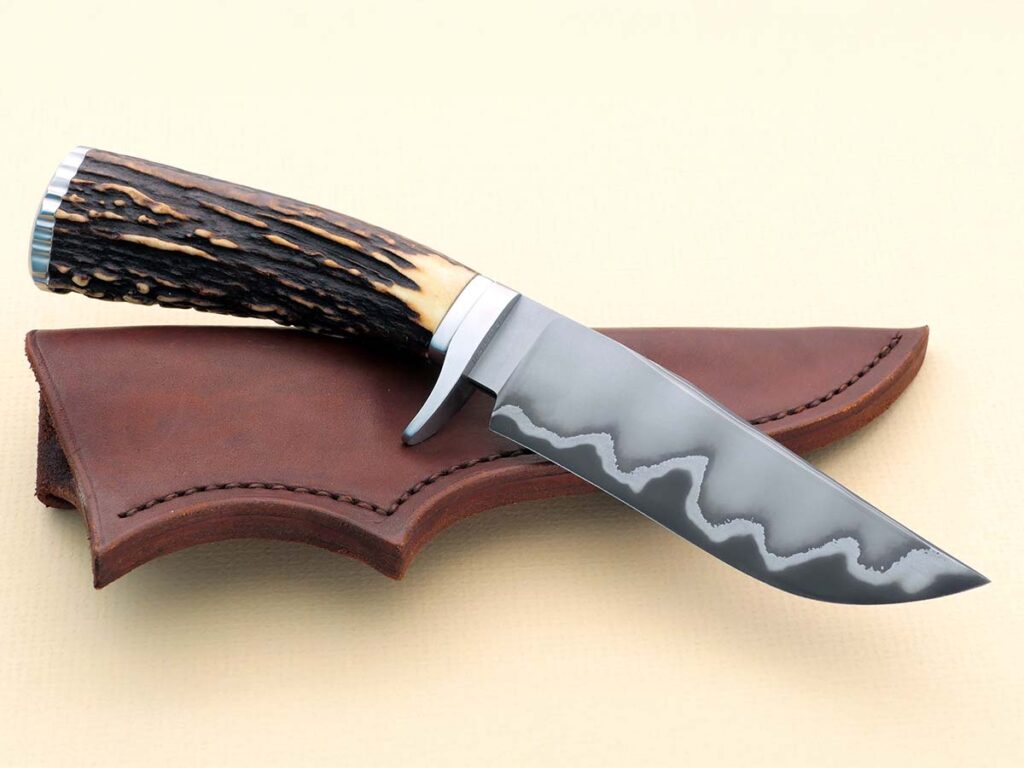
Maker: Wess Barnhill
Model: Drop-point hunter
Blade Length: 5”
Blade Material: San-mai of 1075 carbon and 410 stainless steels
Guard and Buttcap: Stainless steel 
Handle Material: Sambar stag 
Overall Length: 9.75”
Sheath: Leather model custom made by Wess Barnhill
Knife to know: Wess is an ABS journeyman smith 
His price for a similar knife: $825
(Robertson’s Custom Cutlery image)

A steel construction that has been a favorite of collectors for several years now is san-mai. A hunter by ABS journeyman smith Wess Barnhill has a great example of a san-mai blade, featuring a carbon steel core sandwiched between outer layers of stainless steel. One of my favorite aspects of this type of laminated blade is that each one is unique, encouraging collectors to have more than one in their collection, if they so choose, as no two are the same. Barnhill’s blade material of choice is a 1075 carbon steel core sandwiched between two pieces of 410 stainless steel. He likes to zip-weld all the edges together, as this keeps out the oxygen while forge welding. He sets the temperature to 2,350 F° for 10 minutes to produce his san-mai blades.

Copper San-Mai

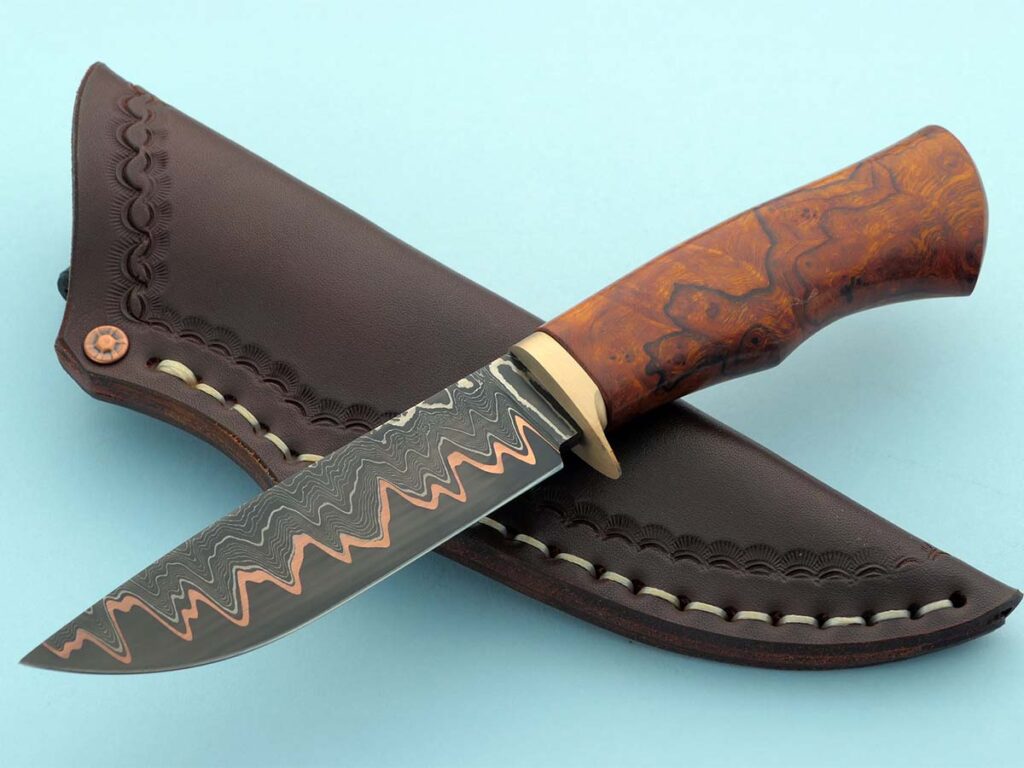
Maker: Dan Lewis
Model: Drop-point hunter
Blade Length: 4.5”
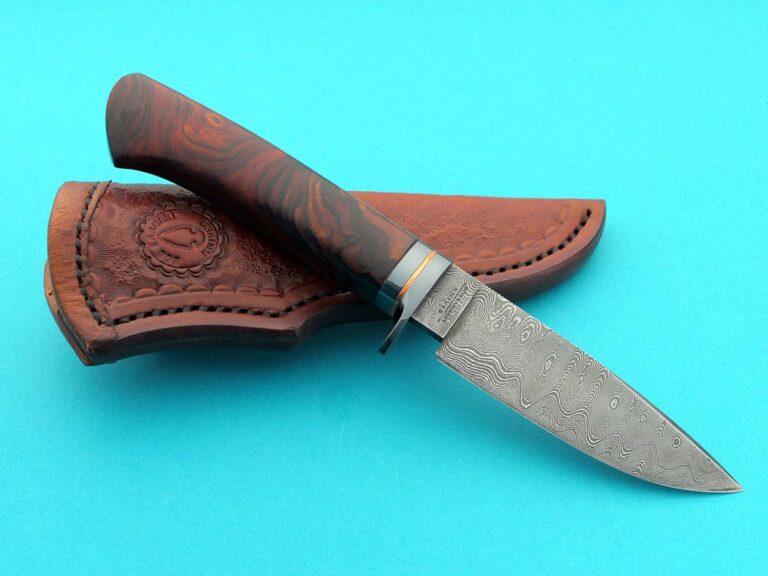
Blade Material: Forged san-mai w/a core of W-2 tool steel, an outer layer of damascus and a middle layer of copper
Guard Material: Bronze
Handle Material: Desert ironwood
Overall Length: 9”
Sheath: Leather model custom made by Dan Lewis
Knife to know: Dan is an ABS journeyman smith
His price for a similar knife: $550
(Robertson’s Custom Cutlery knife image)

Seeing the work of ABS journeyman smith Dan Lewis at the 2024 BLADE Show, I was immediately drawn to it. His unique copper damascus san-mai features carbon steel, damascus and copper. He also offers the same style of blade with nickel if you prefer. He explained that monosteel and damascus blades are forged to shape and taken through a precise heat treatment. Copper san-mai blades are a different story.

“Once I create the billet—layering high-carbon steel with pure nickel damascus and copper—I do very little forging beyond drawing out the tang. The rest is done through careful grinding,” he explained. “Precision is everything. The billet must be measured exactly to keep a consistent core of high-carbon steel, with even layers of damascus and copper on each side. Copper looks great but it doesn’t belong on the cutting edge. I always use a high-carbon core for strength and sharpness. When it comes to etching, combining pure nickel and copper allows me to use a stronger, proprietary acid. The result is a deep, dark etch in just seconds, creating a bold finish that highlights every layer.”

Dan combines the copper damascus san-mai with blued fittings and desert ironwood to create an eye-catching work of art at an affordable price.

Maker: Josh Fisher
Model: Drop-point hunter
Blade Length: 4.5”
Blade Material: 1084 carbon steel
Blade Finish: Satin 
Guard Material: Stainless steel 
Handle Material: Vintage Westinghouse Micarta®
Overall Length: 8.75”
Knife to know: Josh Fisher is an ABS master smith
Sheath: Leather model custom made by Josh
His price for a similar knife: $550
(Robertson’s Custom Cutlery image)

I saw ABS journeyman smith Bob Earhart’s knives on the internet while working on my checklist for the BLADE Show. I contacted him several months before the show to discuss his knives. In addition to his excellent knifemaking skills, the use of a blued guard and bronze spacer in conjunction with presentation-grade desert ironwood gives his hunter a stunning look. Instead of using a forge press die, Bob grinds a ladder pattern into his steel billet. Grinding toward the edge, he cuts deeper and then hammers out the grooves, creating a complete ladder pattern throughout the blade.

Additionally, Bob has the one skill that many knifemakers lack: effective communication. He encouraged me to provide my input and kept me informed about the knife build every step of the way. When I buy my first knife from a knifemaker, I really appreciate that.

Frame-Handle Jewel

Maker: Steve Randall 
Model: Frame-Handle Hunter
Blade Length: 4.75”
Blade Material: Feather-pattern damascus 
Guard and Frame: Feather-pattern damascus  
Handle Material: Mastodon ivory
Overall Length: 9.5”
Sheath: Leather model custom made by Steve Randall
Knife to know: Steve is an ABS master smith
His price for a similar knife: $1,400
(SharpByCoop image)

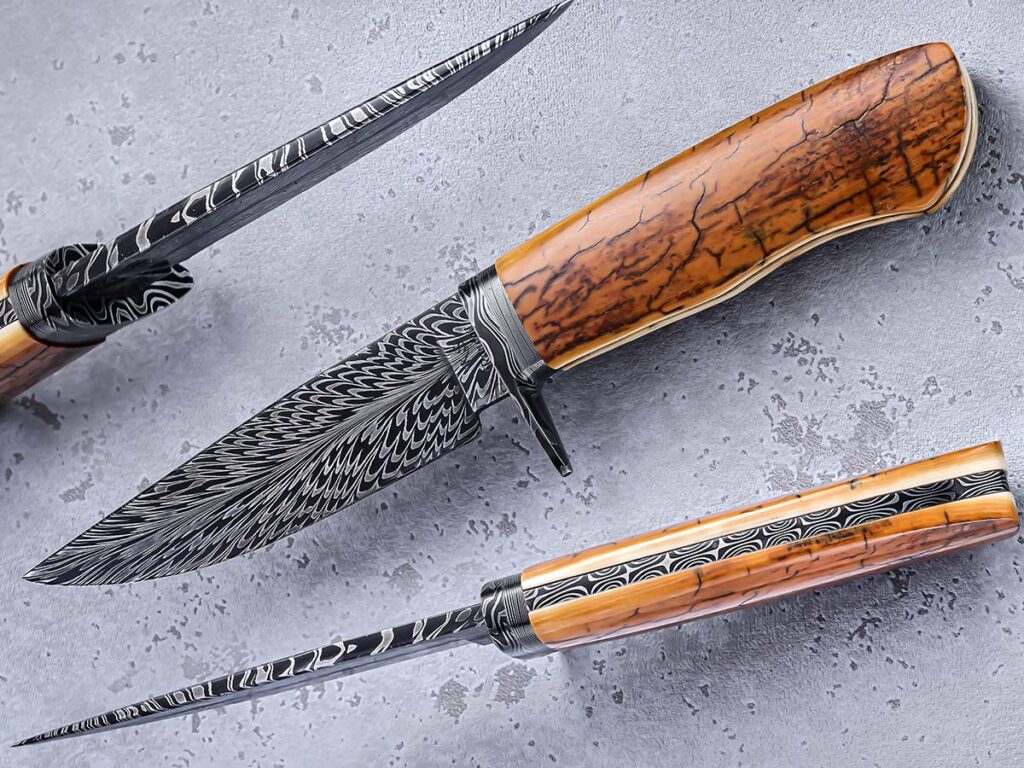
The frame-handle hunter is arguably one of the more difficult knives to build. Add mosaic damascus and ivory to the equation and it becomes even more challenging. Given the complex nature of ABS master smith Steve Randall’s frame-handle hunter, I asked him to explain his process for building the knife.

He starts by making a billet of a W’s-pattern damascus. The layer count and stack are personal preferences. The lower the count, the wider the pattern. Once the billet is formed to the preferred layer count, Steve cuts it into pieces, restacks the pieces, and forge welds them back together. He splits the resulting stack in half using a dull wedge and welds the two halves back together to create a feather damascus billet. The splitting process with the dull wedge is what drags the hot steel to make the feather design.

Steve pointed out that increasing the layers also increases the potential for flaws. Often, the flaws don’t reveal themselves until the blade is being ground. If flaws are discovered, the blade must be thrown away and all those work hours are lost. (Author’s note: Please understand that due to the increased degree of difficulty and risk of blade failure, any mosaic-type of damascus used in the knife’s construction will increase the price. All damascus is not equal!)

Steve said the most challenging part of a frame-handle knife is connecting the frame to the guard or ferrule so there are no gaps and the fit appears seamless. Also, how the handle is attached to the blade is key. There are various ways to attach that can add to the complicated nature of a frame, for example, hidden pins, hidden finial, external finial, etc.

Changing Conditions

Maker: Jan Hafinec 
Model: Bonfire Hunter
Blade Length: 5”
Blade Material: Forged C105 carbon steel w/double hamon
Guard Material: Bronze
Handle Material: Desert ironwood
Overall Length: 10 1/8”
Sheath: Leather model custom made by Jan Hafinec
His price for a similar knife: $600
(Robertson’s Custom Cutlery image)

In the March BLADE®, I wrote about the matrix I use to determine which knives to buy. Before that story was published, BLADE Editor Steve Shackleford asked me what conditions would cause me to adjust my matrix. One condition would be a change in the popularity of a market sector, such as custom fighters, gut hooks, stilettos, etc. With a current slowdown in damascus bowie sales, primarily due to the bowies’ price point, an alternative emerged, offering many of the same options at a more affordable price: the forged hunting knife.

One of the best aspects of attending a knife show is the ability to compare knives, apples to apples if you will. This year’s BLADE Show resulted in me updating my matrix with regard to custom hunting knives.

Before the show I provided a set of parameters to 10 ABS journeyman and master smiths, both domestic and international, to build a damascus hunting knife to my specifications Those parameters were: a 4.75-inch ladder-pattern damascus blade, damascus guard (no pattern specified), and a wood handle (no wood specified). The smiths’ quotes ranged in prices from $600 to $1,250 per knife.

Still think you don’t need your own matrix?

*CAUTION: When using Satanite hamon clay, “wear protective gloves, outfit, and face and eye protection. If on skin, wash with soap and eater. If on eyes, rinse with water for several minutes. If eye irritation persists, get medical attention.”

More Custom Knives:

Advertisement

Must Read Articles

Read this before you make a knife

Knifemaking 101 – Read This Before You Make a Knife

  by Wayne Goddard My experience has taught me that there's nothing like digging in and getting started. I've often said the hardest part of the...
how to forge damascus steel

How to Forge Damascus

Advertisement
Advertisement