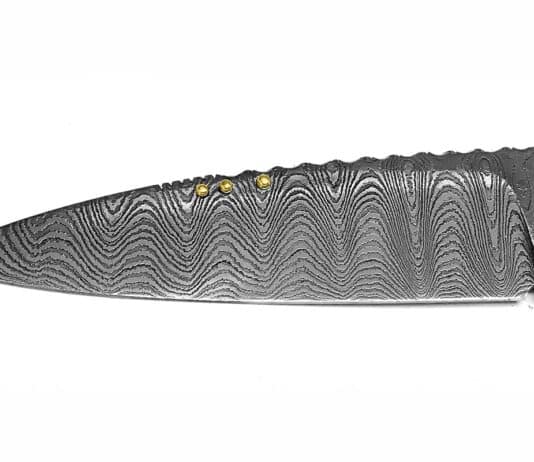
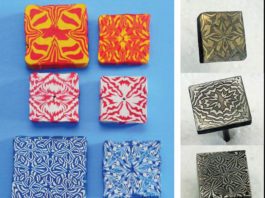
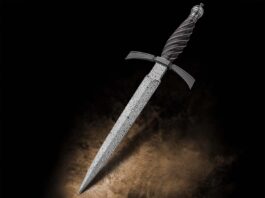
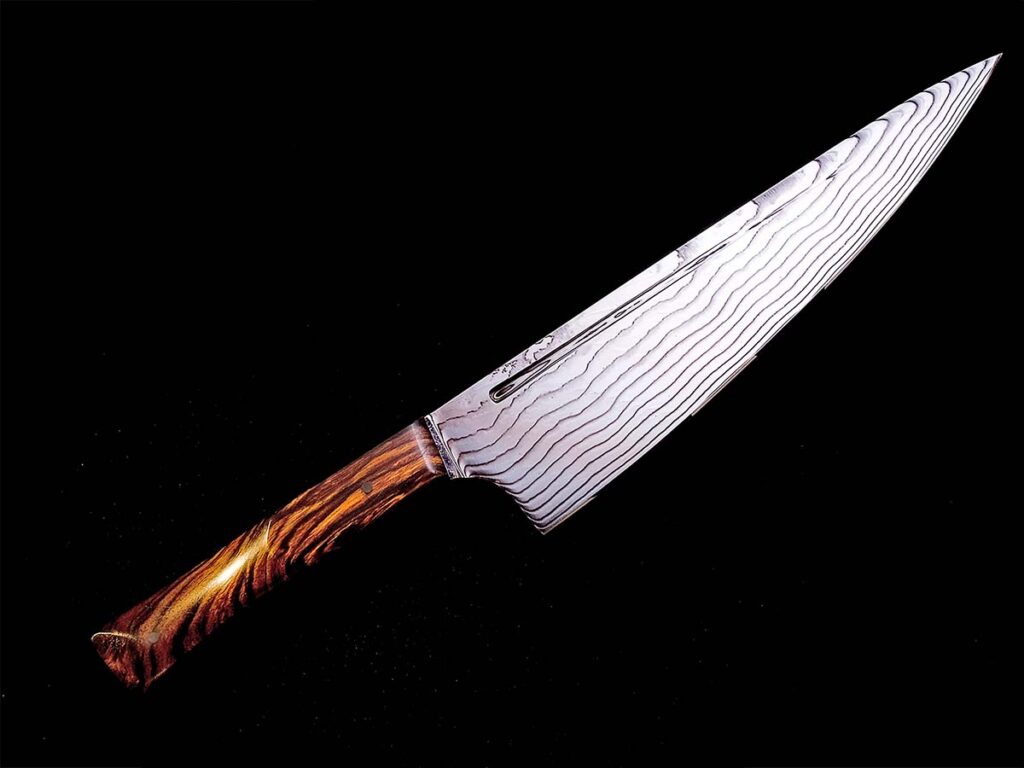
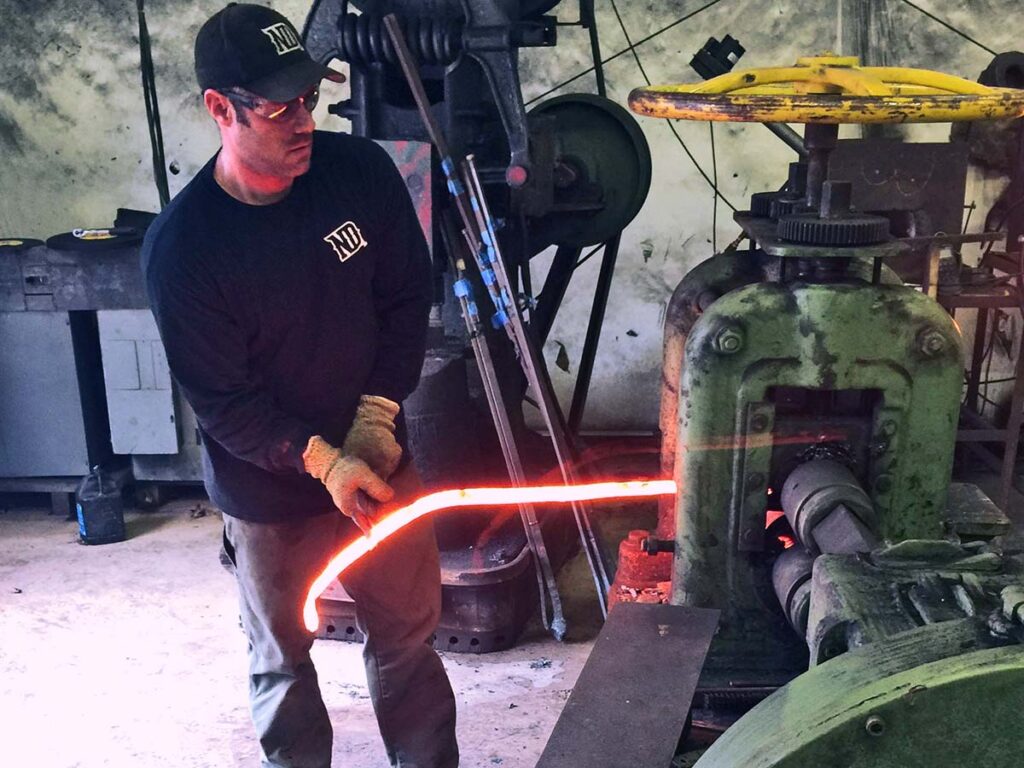
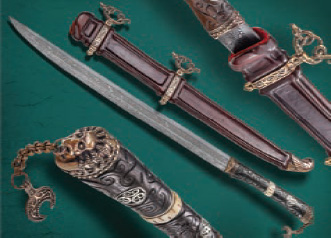
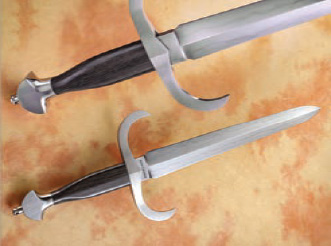
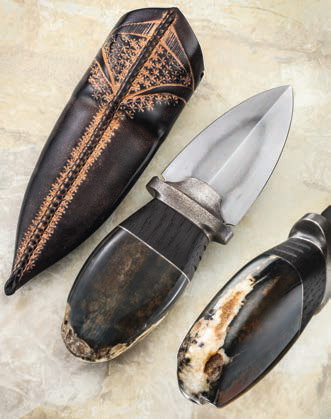
Knifemaking is the building of a knife, which includes the blade, handle and other accouterments. Blades are made by either removing metal from a steel blank via a grinder – known as stock removal – and the forging to shape of hot steel into a blade in the process known as bladesmithing. Other parts, including bolsters, guards, pommels, etc., are needed to complete the finished knife.
In BLADE®’s continuing series entitled Midweek Maker, we are in our third installment of Midweek Maker Military Style: Tracy LaRock of LaRock Knives.
Tracy LaRock grew up on a dairy farm and spent every spare moment hunting, trapping and fishing. He served as a mortarman in U.S. Marine Corps from 1990 to 1995, but he didn’t stay out for long. In 1997 he signed on with the Texas Army National Guard, in artillery and recruiting, and still serves today. “So knives have been a part of my daily life since the beginning,” he commented.
“In 2008 Atmar Lester was showing a knife he made to some folks at church. I asked him some questions and he pointed me in the direction I needed to go,” Tracy related. “To start off it was basic tools and head-scratching, then I discovered the forums and tutorials.” Thomas Rucker and Percy Richardson let Tracy visit their shops. In 2014 he started making slip joints. After completing a few he reached out for help and received helpful insights from knifemakers Luke Swenson, Jared Oser and Enrique Pena among others.
“I hope to become a full-time maker in a couple years when I hang this uniform up for the last time,” he noted. Tracy lives in Lufkin, Texas with his wife, Mia, and their three sons.
Best-selling knife patterns: TimberJack and TimberJack Jr., traditional slip joints
Favorite blade steels: W2, 1095, O1. “Most are W2 because I have long since fallen down the hamon hole,” Tracy quipped.
Blade grinds: flat
How he tests his knives: rope, cardboard
Favorite handle materials: green canvas Micarta and ironwood
Price range: $350-$850
Forums he participates in: Facebook Group like Making Slipjoints and Lockbacks
As Tracy LaRock retires from the military, he will be able to focus more time on making his TimberJack slip joints. His wife Mia LaRock does a terrific job running the Facebook Group at LaRock Knifes.
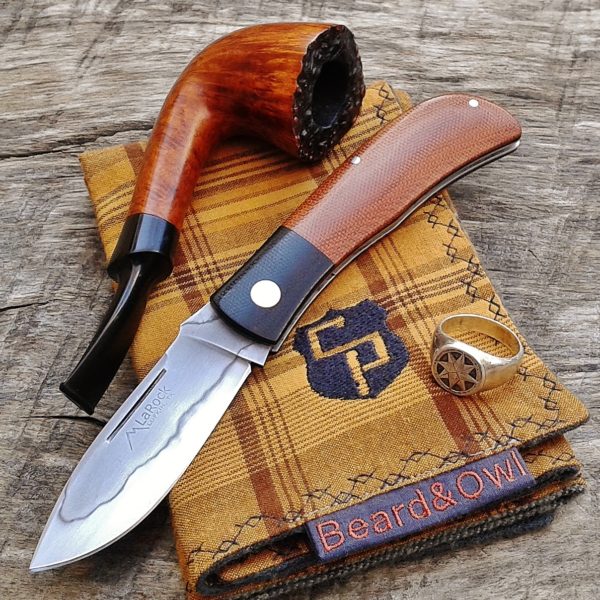
The above TimberJack has a 3-inch blade of W2 with hamon. The handle is fashioned from canvas Micarta scales. Overall length is 7.25 inches. Maker’s list price: $425.
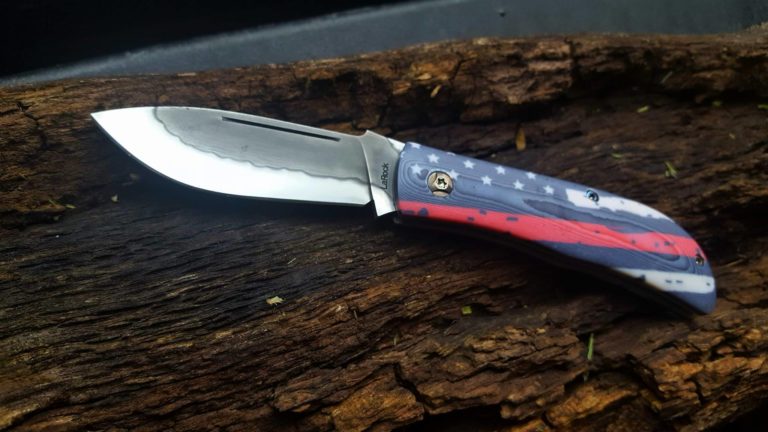
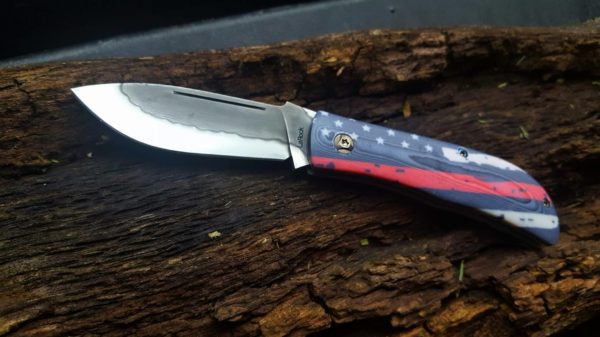
This Tracy LaRock creation is also a TimberJack with a 3-inch blade of W2 steel with hamon. The handle is American flag Carv-X. Overall length is 7 3/4 inches. The screw construction is done with titanium screws from TiConnector. Maker’s list price: $750.
Contact Tracy or Mia LaRock at 936-238-9077, [email protected], on Facebook at LaRock Knives or on Instagram @tracylarock.
Subscribe To BLADE For More Stories Like This
An annual U.S. subscription to BLADE is $21.98. You can get your 13 issues sent to Canada for $39.98 and internationally for $49.98. Or go green and get your issues sent digitally for $17.98.
A one year’s subscription to BLADE® will ensure you’re the first to read all six Knifemaker Showcase stories. You’ll also get the latest knife news, knifemaking how-tos, knife reviews, plus knife history and articles that tap into the knowledge of both the legends and the up-and-comers. Don’t miss out. Subscribe.
From copper-infused patterns to stainless steel sheets, discover the innovations driving the red-hot market for production damascus.
Are we seeing a bit of “global warming” in the knife industry, where red-hot damascus steel is getting even hotter? BLADE® spoke with some industry leaders, and 2025 and beyond looks good to them when it comes to production damascus in both carbon and stainless steels.
There are many individual makers who make high-quality damascus in simple and complex patterns in their home shops, backyards or shared maker spaces. This article focuses instead on production damascus forged by specialized outfits such as Baker Forge & Tool, Damasteel, Chad Nichols Damascus and Vegas Forge. At a level beyond “regular” damascus makers, these companies make steel for the masses, for production companies, and specialize in innovative new materials that are sure to delight the industry.
BLADE readers will be familiar with Baker Forge & Tool, a prolific producer of innovative damascus patterns that include copper, such as CopperMai, TigerMai, GoMai and others.
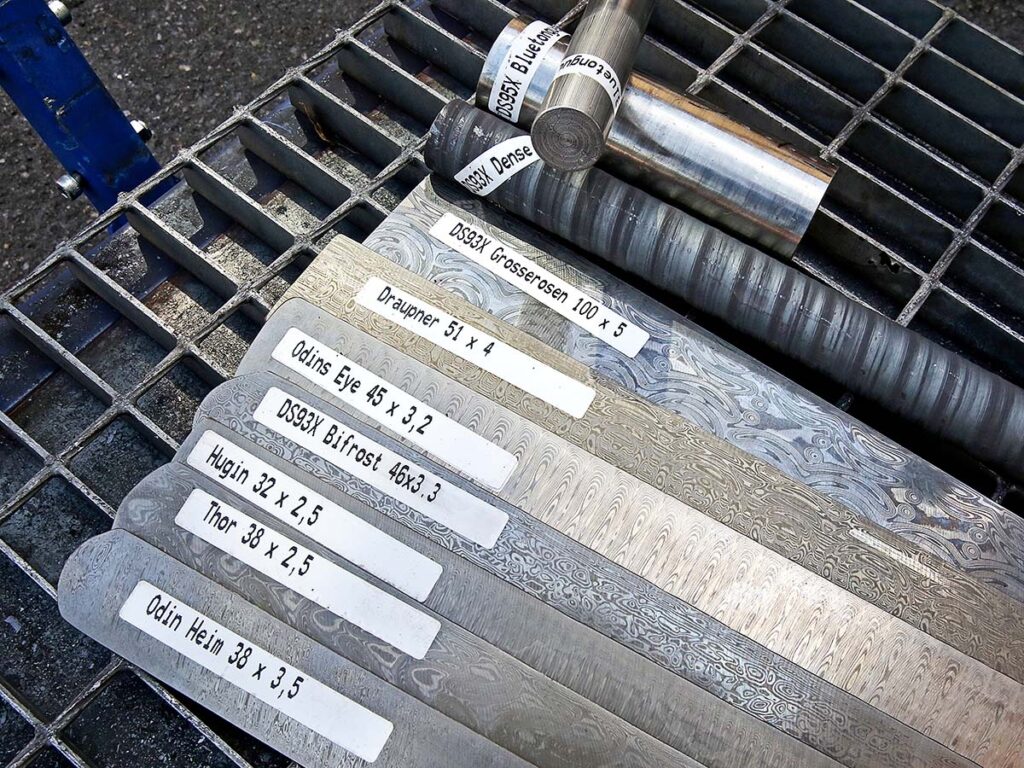
DS93X steel—fourth from bottom in bar form—is Damasteel’s standard mix, “combining good performance with good looks.” “For us it’s more about expanding the patterns than about trying new steel combos,” noted Per Jarbelius. The other patterns in bar form are representative examples of what you can expect from the Swedish steel maker.
“We make carbon steel damascus patterns with copper, and they’ve been hot. We expect them to stay hot through 2025,” Coy Baker said. When it comes to steel selection, the company most often sticks with the gold standard combination of 1084 carbon and 15N20 nickel-alloy steels.
Baker also has been experimenting with Apex Ultra as a core steel for its copper san-mai. For those unfamiliar, Apex Ultra is a tungsten steel alloy, kind of a super-52100 carbon steel. It’s made in small batches and is hard to get in the USA, but Baker has found that the material makes a great damascus core.
“Demand for our Apex core billets far outpaces supply,” Coy noted.
Baker has also been experimenting with stainless and copper damascus and san-mai, using 154CM and AEB-L stainless steels. This writer also makes knives and that combo sounds quite challenging to forge. Baker confirmed that it was very challenging and wouldn’t reveal any secrets, other than the 154CM etches light and the AEB-L etches darker.
Growth In The ‘Sip
Down in beautiful Bush Springs, Mississippi, Chad Nichols makes traditional carbon steel damascus at a production level.
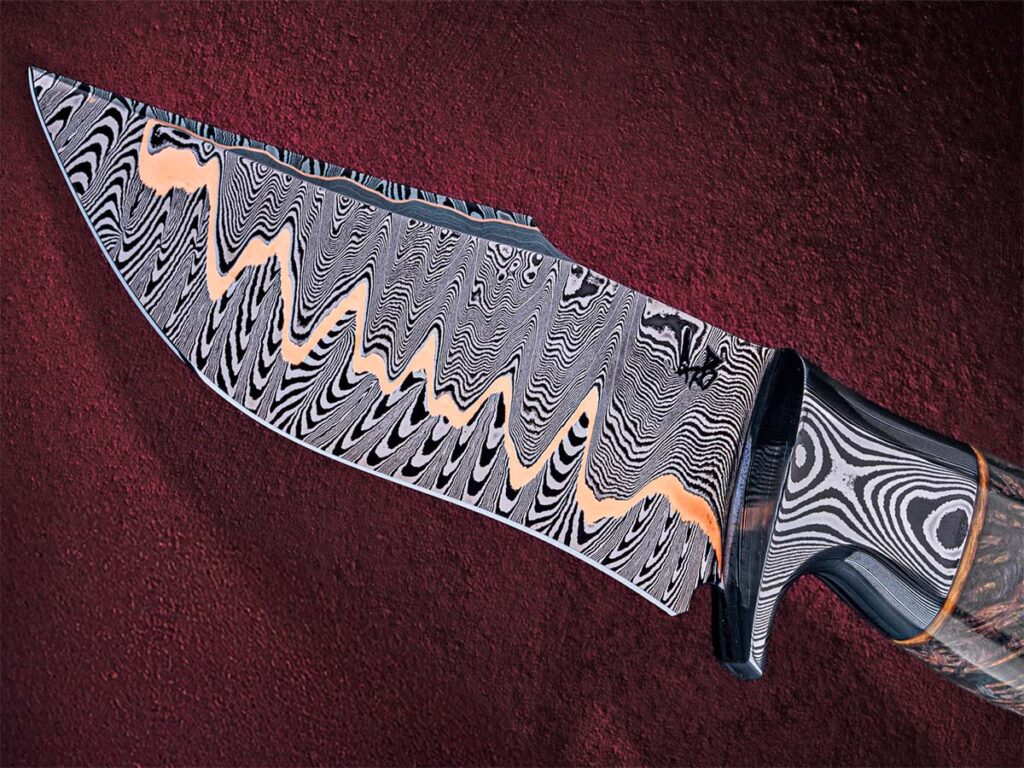
Vegas Forge has always been innovative and 2025 will be no exception. “We’ve figured out how to do copper in with the damascus pattern manipulation, not just as a line between san-mai,” Jesse Harber noted. (Vegasforge.com image)
“I stick mostly to carbon steel 1075 or 1095 plus 15N20 with occasionally a little bit of 3V,” Nichols explained. “I’ve got my process down and these steels go together well.” He makes a variety of mosaic patterns, most of which go to a single manufacturer. “The carbon steels are so much more organic,” Nichols said. “You can do so much more with them in a cost-effective way.”
Nichols’ goal for 2025 is to increase his production of mosaic patterns.
“There just aren’t many people doing production mosaics,” he said. “It’s a great opportunity for growth.”
Another area he’d like to see grow in 2025 is the use of exotic and historical materials. He’s made a run of steel for Boker with steel from a German Tiger tank, and has a run coming for William Henry with some leaf springs sourced by WH.
Collab Designs
Damascus isn’t just a U.S. product. Damasteel produces high-quality stainless steel damascus in Sweden.
Chad Nichols (above) stated the goal at Chad Nichols Damascus for 2025 is to increase the production of mosaic patterns.
“Our DS93X steel is our standard mix, combining good performance with good looks,” Damasteel’s Per Jarbelius remarked. “For us it’s more about expanding the patterns than about trying new steel combos.”
DS93X is described as a “patented powder metallurgy product” that includes “two different hardenable steel grades.” “We use only stainless steel,” Jarbelius explained, ‘because it doesn’t rust and has the same or better performance.”
Damasteel historically produces a new pattern each year. For 2025 it also has begun a special project to collaboratively design patterns. Benchmade collaborated with Damasteel to make a steel pattern called “Monarch” exclusively for the Benchmade Gold Class Necron balisong. Jarbelius is excited for the potential to expand the collaborative effort with other companies who want proprietary patterns.
In another innovation, Damasteel has developed the capability to produce stainless damascus in sheets, not just bars. This will come in handy for small-batch and mid-tech production. The sheet steel pattern is called “Drakkar,” which is the old Norse word for the dragon-shaped Viking longboats.
Copper In The Pattern
What happens in Vegas may stay in Vegas, but that’s not the slogan for Vegas Forge, whose damascus is well known worldwide. It is a consistent producer of high-quality carbon and stainless damascus in complex patterns.
Baker Forge & Tool has been experimenting with Apex Ultra as a core steel for copper san-mai. This integral fighter by Greyson Weltyk features Baker copper damascus for its recurve harpoon blade. (Bakerforge.com image)
“One of our most popular patterns is ‘Reptilian,’ which has three alloys included: O1, 1075 and nickel,” observed the company’s Jesse Harber.
Vegas Forge has always been innovative and 2025 will be no exception.
“We’ve figured out how to do copper in with the damascus pattern manipulation, not just as a line between san-mai,” Jesse noted. “We can take our Reptilian pattern with copper in it, and then clad that billet over an O1 or 1095 core.”
As far as stainless goes, Vegas Forge continues to push the complexity of its patterns. Its most popular pattern, “Virus,” begins with a single stack of 1200 pieces! The company uses 154CM cores for most of its stainless san-mai, along with CTS XHP when available.
Ultimate Hotness
What kind of knives do the manufacturers predict for ultimate hotness in 2025?
Damasteel has developed the capability to produce stainless damascus in sheets, not just bars. The sheet steel pattern is called “Drakkar,” the old Norse word for the dragon-shaped Viking longboats, and is used here on a chef’s knife by a local Swedish cutler.
Both Baker and Jarbelius indicated culinary knives will stay hot, especially in stainless. Baker pointed out that stainless steel handles kitchen abuse better, and this writer agrees. Per said Damasteel’s Damacore and DC18N nitrogen steels are top of the line, and the company has a culinary knife coming in partnership with BLADE Magazine Cutlery Hall-of-Fame® member Ken Onion and CRKT. Both Damasteel officials and Chad Nichols agree that complex patterns are expected to do well for the pocketknife and one-off makers.
Jarbelius “expects growth in the complex pattern market” even as Damasteel’s basic traditional rose, ladder and twist damascus patterns remain best sellers. Nichols states that the mosaic niche he addresses will continue to grow.
All four steel makers expect growth in the production side of the market. Even in a slower economy, the big knife manufacturing companies are still producing limited runs of high-quality damascus knives. Baker looks for growth in his damascus-core san-mai steels.
“They’re easier to get a consistent etch on than the mono-steel cores,” he explained.
Chad Nichols stated that he expects growth in the use of mosaic damascus steels by factory knife companies in 2025.
Manufacturing is all about consistency and efficient processes. Damasteel achieves consistency by using the same steel combo for all its patterns. Nichols gets there by batch building for specific manufacturers so that each run is internally consistent. Harber mentioned that he was approached at BLADE Show West* by multiple production companies looking to order steel for 100-to-200-piece runs. He indicated he expects the mid-range sub-$800 production folders to stay hot.
Gonna Be Intersting
The new year is going to be an interesting one for the economy and politics, both of which are inextricably entwined. Fortunately, thanks to the work of those in the damascus industry, it’ll also be an interesting year in the world of knives. If nothing else, knife enthusiasts will have plenty of beautiful damascus production knives coming off the assembly lines to keep them entertained.
Awards Were Given Out In Nine Different Custom Knife Categories Including Best In Show At BLADE Show West In Salt Lake City.
Dozens of makers entered knives in competition across eight different custom knife categories. The skill on display was tremendous, and numerous knives wowed the judges. However, these were the blades that stood out from the crowd and took home the awards. All images are SharpByCoop Images.
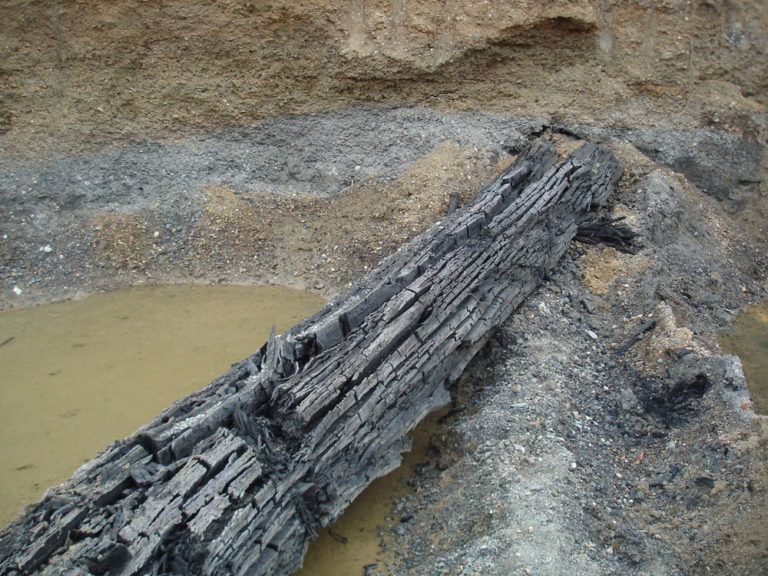
As noted in Monty Python and the Holy Grail, “strange women lying in ponds distributing swords is no basis for a system of government.” On the other hand, oaken logs lounging in bogs for a couple of millennia transform into something of a “holy grail” for knifemakers.
The oxygen-poor, acid-rich bog environment changes humble woods such as oak into something dark and infused with history. And it’s in no small part because of this that makers have turned to the material for knife handles.
Knives seem to have a long relationship with bog oak, a prized and precious wood pulled from bogs after thousands of years.
For instance, take the Scottish sgian dubh, the small utility fixed blade sheathed in the sock of a Highlander in traditional Scottish garb. Translated from Gaelic, sgian dubh means black knife, which some think is a reference to the dark bog oak from which the handles of a number of sgian dubhs were carved.
Just as oxygen-poor and acid-rich bogs transform wood, some makers have gone beyond traditional sgian dubhs and use the handle material to hearken back to more mysterious and historic times.
Black Betty
Because it takes ages to form, bog oak is a finite resource. ABS journeyman smith Mike Deibert, who makes knives on the weekends and evenings when he’s not working as an elementary school teacher, waited five years after he bought a piece of bog oak for the right knife to come along.
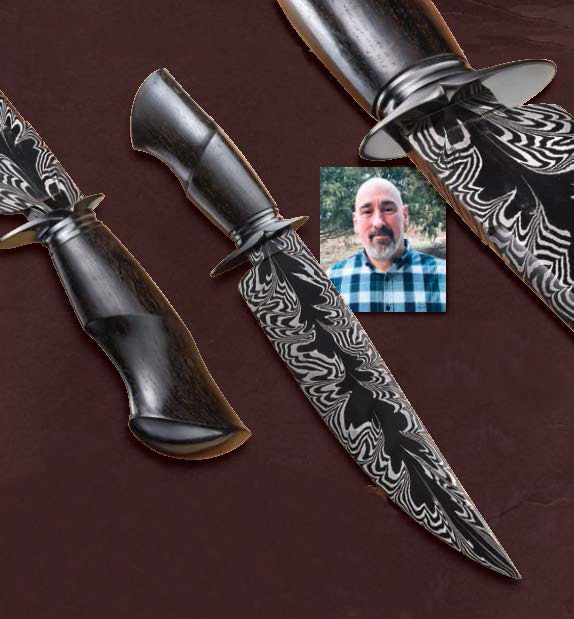
Mike Deibert (inset) uses 5,400-year-old bog oak for the handle of his Black Betty Bowie. Blade length and steel: 10 inches and bold-feather-pattern damascus. (SharpByCoop knife image)
The large, handle-sized piece of the material came already stabilized. Deibert has most of his natural handle materials stabilized so they’re not subject to fluctuation in humidity and are more predictable to work. Even before he decided to use the bog oak, the project was going to be a special one.
“The Black Betty Bowie was created in September of 2019,” Deibert explained. “I designed it for a client who wanted to present it as a gift to an individual who was responsible for raising hundreds of thousands of dollars for cancer research. I wanted to come up with a special work of art that even a non-knife enthusiast couldn’t help but appreciate.”
Deibert started with a bold-featherpattern-damascus design by working out the pattern on paper. When he saw the finished billet, the contrast thrilled him. Besides its tight grain and chocolate color, the wood, billed as a 5,400-year-old relic pulled from a bog in Ukraine, gave the blade historical gravitas.
“When I saw how incredible the dark plume billowed down the center of the blade, I knew I had to put together a guard and handle that complemented this intense feature,” he began. “Originally, I had drawn the knife with a piece of ironwood burl in mind for the handle and a satin-finished steel guard. But, with a very dark portion over most of the blade, I decided to go with all-dark furnishing as a complement.
“This wood, once growing and living thousands of years ago, is now preserved and on display as a handle on the world’s oldest tool. There’s a story in it, and it makes me proud to be able to keep that story going.”
Baba Yaga
What kind of knife would Baba Yaga, a mysterious and terrifying old woman in Slavic folklore, wield as a war blade? That’s the question Connecticut knifemaker Matt Berry pondered as he read through Katabasis, a novel in which the wicked witch swoops in for an appearance.
“Babayaga’s Warknife” began with a blade Berry had put aside after beginning it in 2016.
One of the highlights of the Babayaga Warknife by Matt Berry (inset) is the pommel. Berry carved the bog oak to fit into the bronze pommel and ferrule, which he created by casting them via the lost-wax method. The oak for Berry’s handle entered a bog about 5,300 years ago and helped set the knife’s tone. (SharpByCoop photo)
“I started with the pommel carving, which was meant to be Baba Yaga’s face. The rest of the handle just kind of fell into place as I worked forward from the pommel,” he recalled. “I worked on it as time and inspiration allowed and finished it in the spring of 2019.”
One of the highlights of the knife is the pommel. Berry carved the bog oak to fit into the bronze pommel and ferrule, which he created by casting them via the lost-wax method. The oak for Berry’s handle entered a bog about 5,300 years ago and helped set the knife’s tone.
“I wanted something European even if bog oak was never used in the 1200s,” Berry said. “Bog oak is quite expensive. It’s right up there with burl in price and will sometimes cost more. There’s not a lot of it around and the supply is finite. I get most of mine from an English furniture company that digs up and dries its own logs and then makes high-end furniture. I’m buying the company’s scraps.”
Like anything that has sat around for a few millennia, bog wood has its quirks. According to Berry, it can be as temperamental as Baba Yaga herself.
“The grain isn’t tight, and it’s kind of mushy and chippy at the same time,” he warned. “Th at makes it very frustrating to carve. It drills and sands fairly normally but it can be prone to splitting.”
Dagger of Firsts
Brant Cochran of Gray Flame Forge works in the insurance industry but, when he can, he’s in his shop. When he created his 10.5-inch dagger with a blade of W2 tool steel and a bog oak handle, it was a project of firsts.
He took three months to slowly build the dagger, in part because it was his first time making a dagger of that length. While he wanted to make a large knife, the quintessential bowie didn’t appeal to a man whose interests in edged tools were whetted when, as a youngster, he saw an arming sword at his grandparents’ house.
The bog oak for the handle of the dagger by Brant Cochran (shown inset in the process of assembling the takedown piece) is 3,300 years old. The 10.5-inch blade is W2 tool steel with a double hamon. Overall length: 17.5 inches. His list price to make a similar knife: $800. (SharpByCoop knife image)
The dagger was the first time he had made a knife with a cross guard, a pommel, takedown construction and a bog oak handle. He initially had planned on making the handle from ironwood. Then, after some African blackwood got “screwed up,” Cochran turned to a piece of bog oak.
“I’d never used it before,” he stated. “I was already doing all these new things—why not try a new material as well? That was part of it. But I was interested in bog wood because it has a historical element to it. It had spent 3,300-plus years sitting in a bog.”
His impressions? The bog oak worked a heck of a lot better than ironwood.
Furthermore, it was almost the perfect carving wood. He created a subtle ridge running down the length of the handle. The wood wasn’t soft enough for the subtle feature to get “completely washed out,” nor was it hard enough that it required extra effort to eliminate the sharp edges. The dagger of “firsts” became a springboard to future projects.
“I would work really hard on one piece as I was trying to build up my skills,” Cochran said. “Then I would bring it to master smiths I knew and respected to get it critiqued. A picture is not going to show you every little detail you need to figure out how to make a quality knife.
“Your edge might have good retention but if your handle’s too thick or just very uncomfortable, you might not pick that up. And, by speaking to the master smiths and having them show you what those details are, you can then train your own eye to do it as you move forward.”
Perfect Complement
For Anders Högström, bog oak is a relic from an ancient time and a perfect complement for his Valdez ceremonial dagger.
A full-time knifemaker who lives in southern Sweden, Högström is also a hobby chef when he’s not crafting knives. One vein of his work is to build knives of cultures that are combined or are long-ancient ones that persisted for years.
One-thousand-year-old bog oak and ancient walrus ivory comprise the handle of the Valdez ceremonial dagger by Anders Högström (inset). The 3-inch blade is 1050 carbon steel with hamon. The custom leather sheath is by Balatoni. Högström’s price for a similar knife and sheath: $2,500. (SharpByCoop knife image)
According to Högström, “My main direction of design is that of a marriage between the Nordic and Japanese.”
He uses a lot of one-off casting and hamons. For his short-bladed ceremonial knife, he went with a model he imagined could have been used by an ancient American Indian culture, such as the Inca or Maya.
“The ceremonials I make are a sort of homage to what would have been used by a high priest, shaman or someone of similar standing at a ceremony of importance,” he explained.
Högström indicated bog oak pairs well with other materials. For the Valdez, he “married” the 1,200-year-old material with ancient walrus ivory left raw in the handle butt to provide texture. The bog oak, he said, carried a “meaningful weight”—almost as if the material were an artifact of an older time.
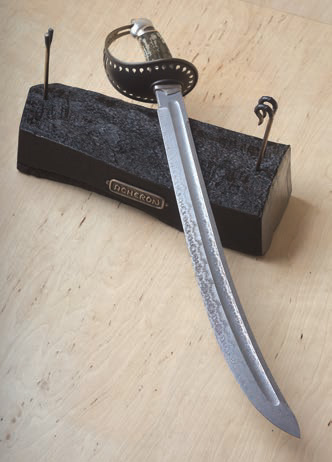
Anders Högström used bog oak for the stand for his cutlass. As he noted, “The stand is made from an old piece of bog oak that was likely a beam from a ship—the ax marks are intact and are all on the top surface—and it comes from the area where I live, named Blekinge here in the south of Sweden, that has been in the ship building business for centuries.” (image courtesy of Anders Högström)
“Something ancient that has been left to decay—but, as nature would have it, something happened in the process, and the original material got to evolve into something else—much like the fossil walrus ivory in the handle that was colored by minerals in the ground and because of the thousands of years it stayed there,” he mused.
Högström pointed out that some pieces of bog oak must be stabilized because they might be soft and the pores of the wood must be filled.
It depends on the project. However, for his ceremonial dagger, he said the unstabilized wood was “easy to work and medium soft.” He chose a fine-steel-wool finish to get into the wood’s grain, thus bringing out the most character. This was followed by a couple of coats of wax to protect the surface.
When customers learn of the bog oak’s history and the stories it evokes, Högström said they often react with “both amazement and amusement, as well as a certain reverence.”
Top makers explain how they collaborate with knife companies.
The old cliché of the win-win holds a real grain of truth. Any successful partnership must be mutually beneficial, and in the knife industry the phenomenon of the collaboration has come to exemplify the upside of working together.
Years ago, a veteran custom knifemaker described his relationship with a major manufacturer as serving as the company’s research and development department. Such a description is accurate in that the manufacturer often relies on the custom maker for new design inspiration, from good looks to materials and mechanics. The collaboration has emerged in the last 35 years or so as an outstanding means of bringing innovation to the public and putting first-rate knives in the hands of the mass market.
The ins and outs, nuts and bolts, and give and take of the collaboration process raise questions for makers interested in striking deals of their own. A few comments from makers who have achieved great success on the collaboration frontier offer helpful insights.
“It goes both ways,” observed BLADE Magazine Cutlery Hall-of-Fame® member Bob Terzuola, who indicated he completed his firstfactory collaboration with fellow Cutlery Hall-of-Famer Sal Glesser and the design team at Spyderco in 1989. “You can go to the company or the company can come to you depending on your notoriety. If you are just starting out, you probably have to go to the company.”
On the business side of the ledger, Suzi Terzuola takes the lead and has demonstrated proficiency in making the deal work for everyone involved. Her flair for negotiation and finding the right blend of maker-manufacturer cooperation has been demonstrated through the years as Bob has worked not only with Spyderco but also the old Camillus, Boker, Fox, Pro-Tech, Tactile Knife Co. and others.
BLADE Magazine Cutlery Hall-of-Fame® member Bob Terzuola has done collaborations with many companies, including the Bob Terzuola ATCF Auto Ultimate from Pro-Tech, the BLADE Magazine 2022 Investor/Collector Knife Of The Year®. (Eric Eggly/PointSeven knife image)
“I was raised by parents with their own successful businesses,” Suzi observed, “and I saw Bob receiving passive income from Spyderco and Camillus, and of course passive income is how you survive after having only so many years to make knives. I began looking at the knife designs Bob had and tried to match the design to the company. Bob has patents lining the walls, and when he lends his name to a knife he should receive a signing bonus and a bonus against the royalties.”
In return for his design skill and the use of his name in promotions, Bob has certainly established himself as a leader among successful custom collaborators. His contribution to a company’s success has enhanced his reputation of excellence across the industry, while Suzi has forged a business posture that results in security for the future.
Knife Collaboration Contracts
The contract is the key component of a collaborative deal, and depending on the circumstances everything is negotiable. Although early agreements made among friends were sometimes done on a handshake, it has become a “best practice” to hammer out the terms of the collaboration on paper, invest in an attorney’s review, and formally memorialize the discussions. Standard royalties run roughly 5 percent of the price at which the company sells the knife.
The Terzuolas include a period of time in which the company is allowed to produce the knife; the period may be extended at maturity with the agreement of both parties. Further, there may be a requirement that the company produces a certain number of knives in a given time period, also renewable. Restrictions on wholesale pricing or discounts that affect royalties may also be negotiated.
For those considering a foray into collaborations, Bob and Suzi offer some advice: “If you’re a new maker, you shouldn’t just walk up to [the company’s] booth at a show. Make an appointment to see them because they are at the show to deal with customers. Approach a company with one or more finished designs. They want a package presented to them, a prototype or existing model, something they can hold in their hands, and in the case of a prototype it’s good to have as many innovations and design creations as you can—anything that will set the knife apart from other potential deals out there.”
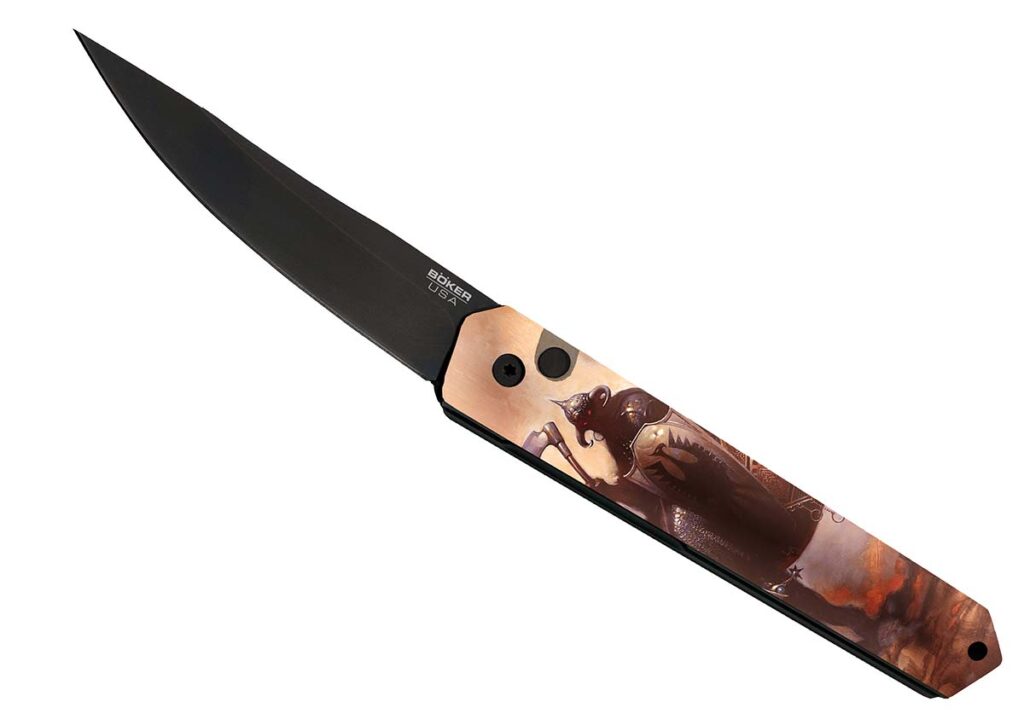
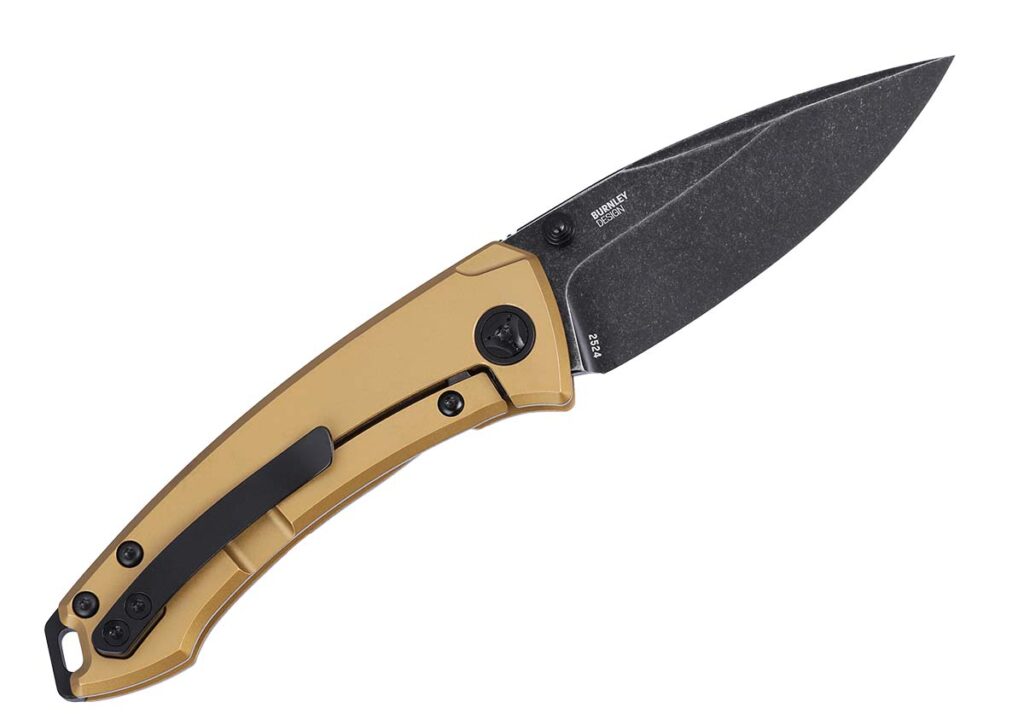
Lucas Burnley has designed several iterations of his Kwaiken for Boker, including the Kwaiken Auto Frazetta.
Suzi added that a higher profile in the industry can drive success.
“We are the R&D for a knife company,” she noted, “and when you approach them for a collaboration your social media resumé is very important.”
Making custom knives since 1994, Darriel Caston has concluded collaborations with numerous companies, including CRKT, Spyderco, Boker, V Nives, Kansept Knives and more.
“I’m prolific when it comes to designs,” he affirmed. “There are probably about 300 that I will never get to making. I’m an engineer by trade and my 3D drawings are almost ready for production, and that helps with the deals. They ask for STEP files [standardized 3D model data files for CAD and 3D printing] that can go right into machining. Sometimes we work with a prototype, and sometimes we work with a knife that I have been doing for quite a while.”
According to Darriel, one significant element of the collaboration is the retention of the rights to the design.
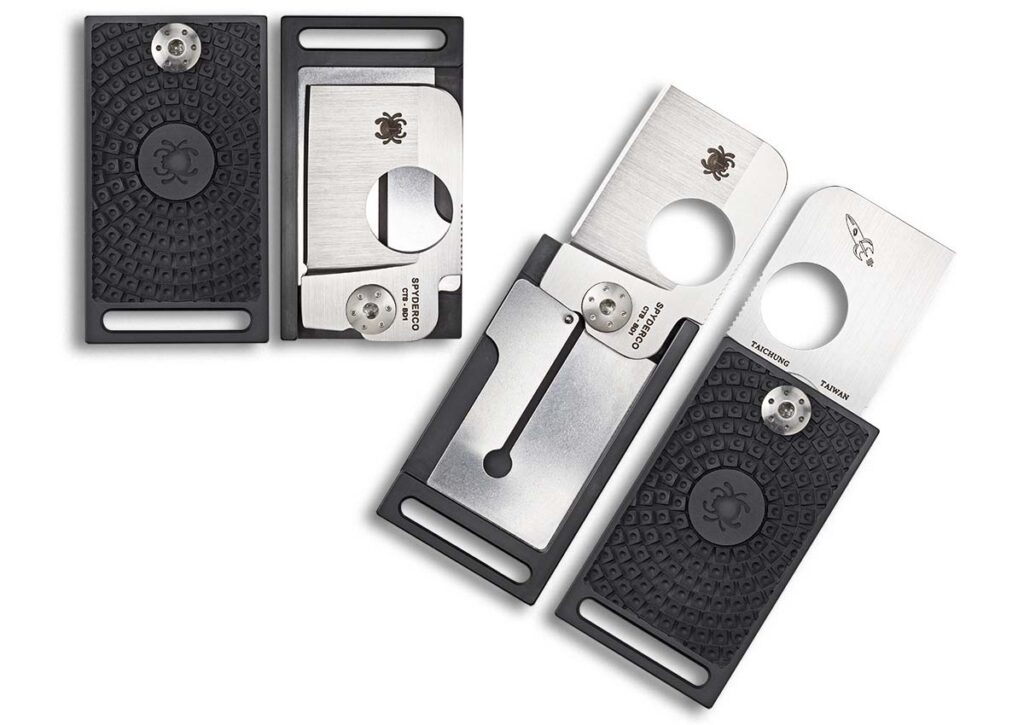
“Anybody who wants to do a collaboration must put footprints in the sand, get their work out there and show a story,” custom knifemaker Darriel Caston observed. One of his latest designs for CRKT is the blacked-out MinimalX framelock folder, an evolution of a knife originally made for SpaceX to commemorate a rocket launch.
“You never want to give up your design,” he warned. “I would license the design to the company usually up to four or five years, and the average is three years. After that, you can discuss if you want to continue if the relationship has been good for both parties. License the design and never sell it. If a company buys the design, then they own it forever. If it became their best seller, I could never make the knife again, and I would have to stay away from anything that looks like it.”
For Caston, every deal starts with a friendly conversation. As progress is made, attorneys draw up the contract. He sees the process as straightforward, whether dealing with an American manufacturer or a company headquartered in a foreign country.
“I find the knife community for the most part to be very honorable,” he commented. “I haven’t run into any bad juju. When you want to do a collaboration, I tell people they need to have a name and a track record of good designs with people following them on social media and stuff.”
Since his first collaboration—with Spyderco in 2015—Darriel can speak with confidence regarding the potential for success.
“It would be rare for someone to take a design to a company without a history or a footprint there. They look for your story,” he noted. “Anybody who wants to do a collaboration must put footprints in the sand, get their work out there and show a story. Then it becomes easier.”
Getting A Collab Off The Ground
Darriel Caston has concluded collaborations with several companies. “I’m prolific when it comes to designs,” he affirmed. “There are probably about 300 that I will never get to making.” Now discontinued, the Squarehead was one of his early collaborations with Spyderco.
Custom maker/U.S. Marine Corps veteran Les George found early collaboration success at the SHOT Show some years back. He approached Pro-Tech a decade ago, and the association has continued since then.
“I had just finished my first batch of VECP [Value Engineering Change Proposal] mid-tech knives,” he remembered, “and I thought it would be cool to see Pro-Tech make the knife in an automatic. So, I did the CAD work to change the knife to an automatic and walked up to their booth at the SHOT Show. I asked to speak to the owner, and Dave Wattenberg came over and shook my hand. I drew a big breath and told him, ‘My name is Les George and I am a knifemaker and I have a design I think would be a great knife for you to make as an auto and I already have the CAD done would you like to see it?’ I said that all as one sentence in one breath!”
Still, a pragmatic view of the collaboration landscape demands preparation and planning. A so-called “cold call” may not meet with success.
“It depends on the company whether a direct approach will work or not,” George conceded. “Don’t walk up to a company at the BLADE Show and tell them you’re a hot maker and they should pay you to make one of your designs. Instead, walk up, introduce yourself, and show them with CAD pictures, a 3D printed model, or a real knife, and tell them why you think it would be awesome to work with them on a production project.”
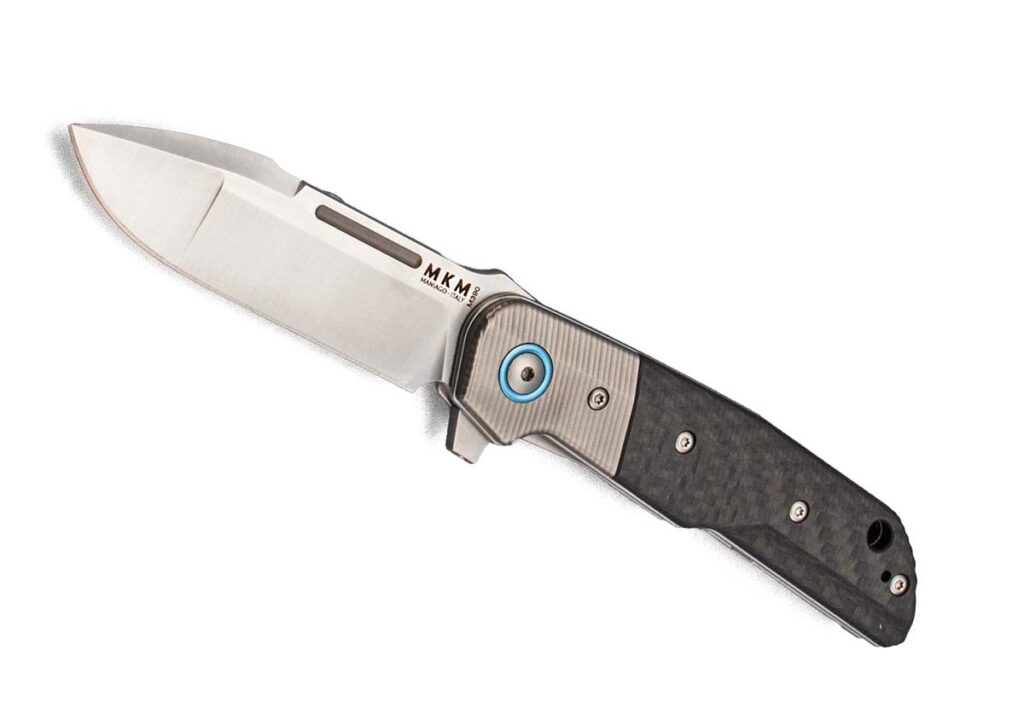
When it comes to her husband Bob’s collaborations, Suzi Terzuola takes the lead and has demonstrated proficiency in making the deal work for everyone involved. An example of several overseas Terzuola collaborations is the Clap from Italy’s Maniago Knife Makers.
Les sees the components of a particular collaboration deal varying. Of course, some of the structure depends on the negotiating skills of the parties. Commonly, the compensation may revolve around a percentage of dealer or distributor pricing on each unit, and particular deals may extend as long as each party is pleased with the progress.
“Collaborations should run as long as they are profitable,” Les remarked. “Companies don’t generally kill a successful project unless there is a capacity constraint issue or something else outside hindering it. Both parties can end the deal at any time with some allowances for production to finish with the things they have in progress already. Every contract I have ever seen gives one company the rights to exclusively make a particular model. My contracts have a provision that I can make as many customs of my models as I want. In the end, it would be counterproductive to license the same model to multiple companies. The maker would be competing with himself at that point, and it’s not helping the companies.”
Priming The Pump
Award-winning maker Lucas Burnley appreciates the help of friends in establishing a firm footing for collaboration.
“In general, I’m a big fan of pulling on my network,” he said. “If you have someone you can reach out to for an introduction, that’s always a strong move. If you don’t have someone to make an introduction, you might be able to ask around and at least figure out who you need to talk to. Regardless of how you get your foot in the door, I highly recommend going to a knife show and trying to set up a meeting in person.
“A design is only one part of a collaboration,” he continued, “so bring your ‘A’ game and think about what other value you can provide for the company. I was introduced to Boker by Jens Anso and Jesper Voxnaes, and Ken Onion put in a good word for me with Columbia River Knife & Tool. I’ll be forever grateful for those introductions and the relationships behind them. I’ve been able to pay it forward a few times, and hopefully I’ll be able to do it many more times in the years to come.”
Les George’s V14 dagger design for Spartan Blades was the BLADE Magazine 2014 Investor/Collector Knife Of The Year®.
In Burnley’s experience, contracts provide compensation most often in the form of monthly or quarterly royalties based on a percentage of sales. One-time lump sum payments are also seen; however, the income generated depends on the goals of the two parties involved.
“I want my designs to run until my grandkids are old enough to thank me for my good decisions,” he laughed. “If a model is selling, I want it to keep selling. On the flip side, I will routinely ask what models we can kill if they aren’t pulling their weight.
“One caveat here is that if a design is still in production, I want to get paid for it,” he concluded. “Some companies will offer a contract for a set period of time but have the option of continuing to produce the model. I view this as somewhat akin to a one-time payout. If it works for you great; just make sure you are paying attention.”
George specifically limits the number of companies he works with in order to give the relationships the priority he believes they deserve. Consistency, he says, is huge. Real, solid collaborations are not “get-rich-quick schemes.” He remembers getting his first collaboration check in 2014 totaling a whopping $6.
“A design is only one part of a collaboration,” Lucas Burnley observed, “so bring your ‘A’ game and think about what other value you can provide for the company.” His Tuna Compact framelock design for CRKT is one of his latest collaborations. “A design is only one part of a collaboration,” Lucas Burnley observed, “so bring your ‘A’ game and think about what other value you can provide for the company.” His Tuna Compact framelock design for CRKT is one of his latest collaborations.
Times change—and checks change with good business practices, commitment, follow through, and most of all a process from contract to design and product that proves profitable for everyone.
This demonstration on the selection and use of milling vises is by Dale Schafer, Machine/Tool Technology Instructor at the Washburn Institute of Technology. This was one of the demonstrations at the 3rd Heartland Hammer-In in Topeka, Kansas sponsored by the American Bladesmith Society and hosted by the Kansas Custom Knife Makers Association.
For more about knifemaking, be sure to pick up a copy of BLADE’s Guide to Making Knives. This second edition shows step-by-step the tools and techniques for making a knife.