Knifemaking

Knifemaking is the building of a knife, which includes the blade, handle and other accouterments. Blades are made by either removing metal from a steel blank via a grinder – known as stock removal – and the forging to shape of hot steel into a blade in the process known as bladesmithing. Other parts, including bolsters, guards, pommels, etc., are needed to complete the finished knife.

Featured Knives – – Knife Collecting – – Tactical Knives – – Survival Knives

Suprlativ Knives: How Three Makers Blend Artistry and Innovation

A knifemaking trio with little to no ego keeps Suprlativ super.

If you’re going to carry a knife every day, then it should be functional and stylish, a joy to use and look at. Otherwise, what’s the point? That’s Enrique Peña’s design philosophy. In addition to owning Peña Knives, along with Jared Oeser and Javi Garcia he is one of three founding members of Suprlativ Knives. Suprlativ (pronounced like superlative) offers limited-edition folders in eye-catching designs, constructed with modern materials, artistic colorways and a machinist’s attention to mechanics—all at an affordable price.

How do three creatives run a knife company without conflict? Easy—no one’s ego is so tied to an idea that he can’t incorporate suggestions from the others. All three maintain their own companies, their homes for signature work, so when they come together to design for Suprlativ they can push boundaries. The diversification means there’s no stress when they work on collaborative projects.
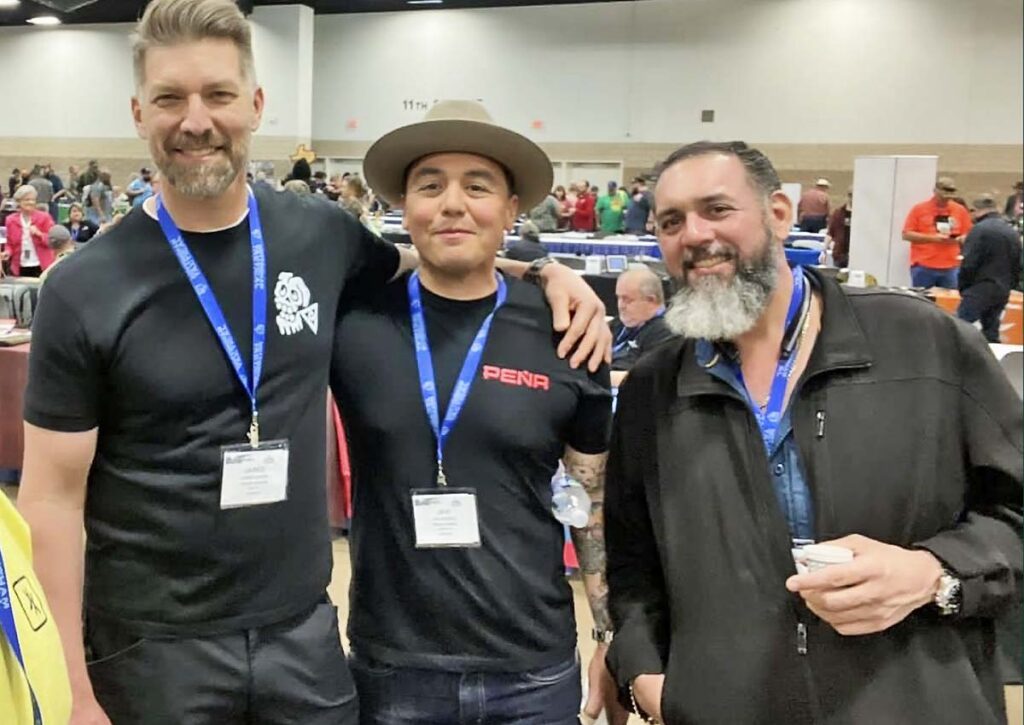
Suprlativ’s 3 Musketeers, from left: Jared Oeser, Javi Garcia and Enrique Peña.

As Garcia explained it, the mindset shifts to, “What can we make that would nurture the community?”

Enrique Peña

Peña is an associate of the South Texas Slipjoint Cartel. For the uninitiated, the cartel is a group of knifemakers that got together to honor BLADE Magazine Cutlery Hall-of-Fame® member Bill Ruple, each making a knife in the Ruple style. Bill, in turn, began sharing his knowledge with them, inviting them to his shop and answering questions by phone and email. He has been making knives since 1988 and is a master at multiblade slipjoints.

He sat on the board of the Texas Knifemakers and Collectors Association, the predecessor of the Texas Knifemakers Guild. Other Cartel members—all serious about preserving traditional knifemaking—include Bruce Barnett; Tanner Couch; Tommy “Bubba” Crouch; Burt Flanagan; Jeff Hawkins; Tobin “Toby” Hill; Bobby House; Matt Humphries; Phil Jacob; Tom Ploppert; Tim Robertson; Kendall Schorsch; Tyler Turner; Trae Gaenzel; Roan West; Rusty Preston; and Luke Swenson.
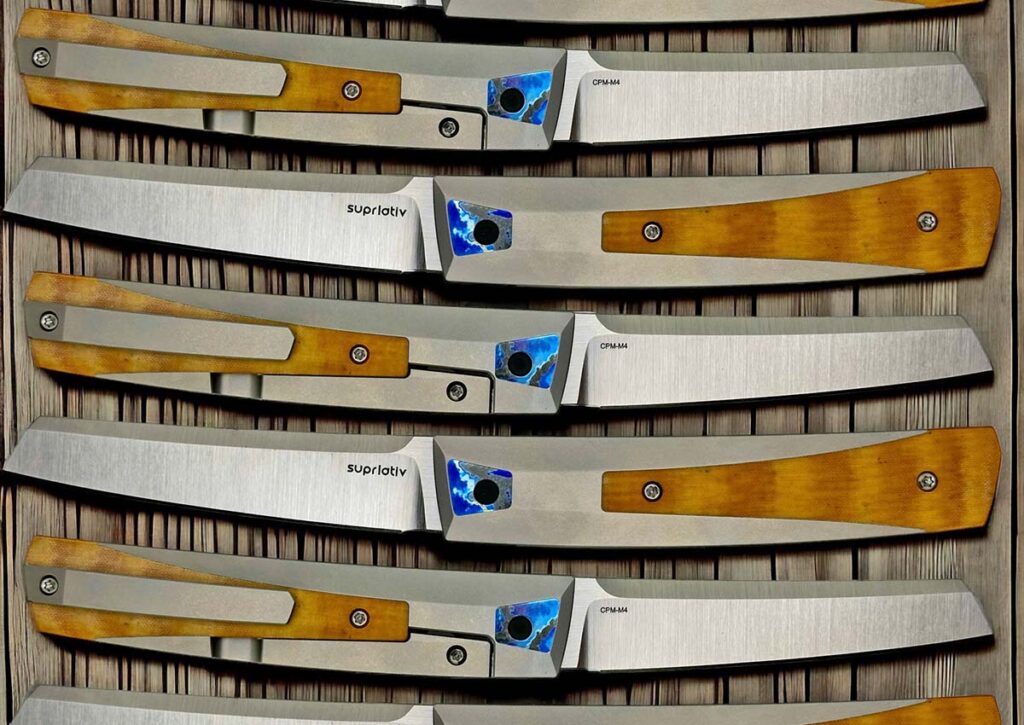
A swayback look complemented by a modified sheepsfoot blade highlights the Tirant. Blade length and material: 3 inches and CPM M4 carbon steel. Blade opener: Front flipper. Blade grind: Flat. Pivot: Ceramic caged bearings and detent. Frame: 6Al-4V Grade 5 titanium. Handle: Linen Micarta®. Weight: 3.4 ounces. Closed length: 4 3/8 inches. Country of origin: China. MSRP: $298.

In 2008, Peña was laid off from his job as a diesel mechanic and turned his knifemaking hobby into a full-time endeavor. He simply drove to Ruple’s house, knocked on the door and asked to learn knifemaking. Bill began mentoring Peña and credits him with being a quick learner. Ruple shared more than his craft; he guided Peña with business wisdom as well, which ensured the success of Peña Knives.

Peña’s X-Series offers the design and mechanical excellence of his custom knives in a more affordable production knife. Whether traditional or tactical, Peña’s fit and finish displays a respected exactitude. He maintains that clean, crisp, simple designs are harder to master because you can’t hide mistakes with bells and whistles. For example, to the experienced eye, grinder marks, or the lack of them, reveals something about the maker. Hand rubs take time. Peña, if you couldn’t tell, is a traditionalist.

Jared Oeser

Around three years after Peña took to knifemaking full time, Jared Oeser, owner of Oeser Knives, did the same. A building developer by trade and with little to do during the 2008 recession, he looked to his knifemaking hobby as a potential moneymaker. He said his wife can attest to the fact that his stress level plummeted during this time. Making knives provided an outlet for a creativity he had possessed since boyhood but couldn’t concentrate on as a profession except through designing houses.

Suprlativ’s 3 Musketeers, from left: Jared Oeser, Javi Garcia and Enrique Peña.

He asked his friend, fellow Salt Lake City resident and longtime knifemaker Dave Lang, to help him make knives. Lang swapped knifemaking ideas with the likes of Bob Loveless, Buster and Julie Warenski (now Warenski-Erickson) and Earl Black (Loveless and Buster are Cutlery Hall of Famers). Oeser’s father always carried a knife and brought his son up hunting, fishing and camping, traditions that Oeser passes on to his children.

Oeser’s first knives were bushcrafters. He couldn’t find exactly what he wanted—a bushcrafting knife that was both functional and good looking—so he made one. He and Peña communicated now and again, exchanging ideas and figuring out problems together. Now, though Oeser’s custom knives normally sell for around $1,000, some can go for over $10,000. In other words, he found his creative outlet and realized that the knife-art market still exists.

Prior to Suprlativ, he held a three-year contract with Benchmade, designing its Tengu and Tengu tool, so his design abilities have received praise from both collectors and industry giants.
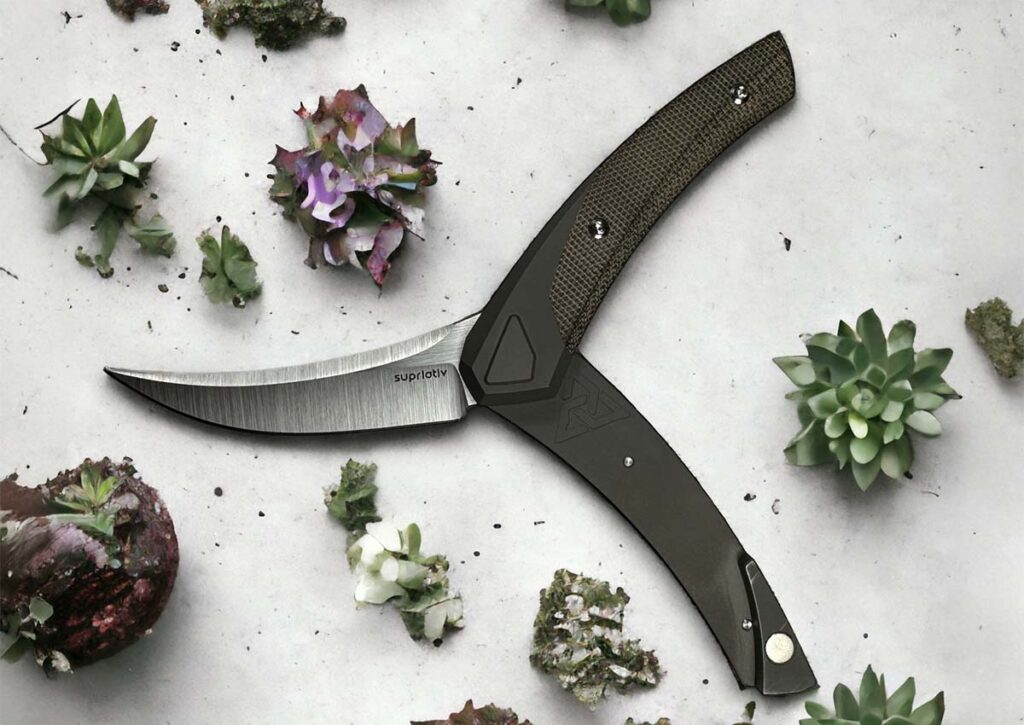
The fully serrated blade of the Piranha deploys via a Rare Earth Magnet Lock. Blade material: CPM M4 carbon steel. Pivot: Bronze washers. Frame: 6Al-4V Grade 5 titanium. Handle: Brown canvas Micarta®. Weight: 2.1 ounces. Closed length: 3.76 inches. MSRP: $284.

Though Peña lives in Laredo, Texas, and Oeser in Lehi just outside Salt Lake City, and Peña is a staunch traditionalist and Oeser blurs the lines between traditional mechanisms and modern frames and furniture, the two had a working relationship that grew into a friendship.

Javi Garcia

Enter Javi Garcia. Formerly of South Texas and now living in central Texas, Javi first was a Peña customer, then a potential hire, then a friend and mentee. The two socialized together with their families, compatible in their shared Mexican heritage. Even though Garcia’s design approach is decidedly modern, Peña could appreciate his style.

Javi knew that Enrique was a master of knife mechanics, taking Garcia’s ideas and showing how they could be brought to fruition. Garcia began to share ideas with Oeser, too. He found himself going between the two veteran makers and telling each how the other approached a design idea or challenge. During these exchanges, the idea developed that the three of them start a separate company. Peña credits Garcia with bringing the three together to form Suprlativ.

How Suprlative Operates

Javi Garcia’s last-minute decision to enter the Canibl Phantom Lock resulted in Suprlative taking home Best Custom Knife Collaboration at BLADE Show 2024. The 3 1/8-inch blade is hollow-ground CPM MagnaCut stainless steel. Closed length: 4 inches. (Jocelyn Frasier image)

The men knew they could bring knives to the market that got the job done expertly and looked really good doing it, knives of high quality, high tech and high precision. Garcia and Oeser are extremely creative, and Peña’s hands-on skillset is, well, superlative. Garcia says Peña is more creative than he thinks he is. And that’s the way it is with these three.

They are endlessly encouraging and positive with each other. In a situation where three chiefs and no Indians could seem problematic, Garcia explained that the collaboration works because they relate to each other with positivity, respect and warmth. They reserve their individual knifemaking styles for their independent work and let loose with ideas for Suprlativ.

Part of the contentedness and success is that Suprlativ designs come from all three knifemakers, including Peña. It’s an equal contribution of creativity. “The designs never start in the same place,” Garcia said. It’s fluid. Once the design is finalized, Peña initiates contact with what’s considered the fourth member of the group: Reate.
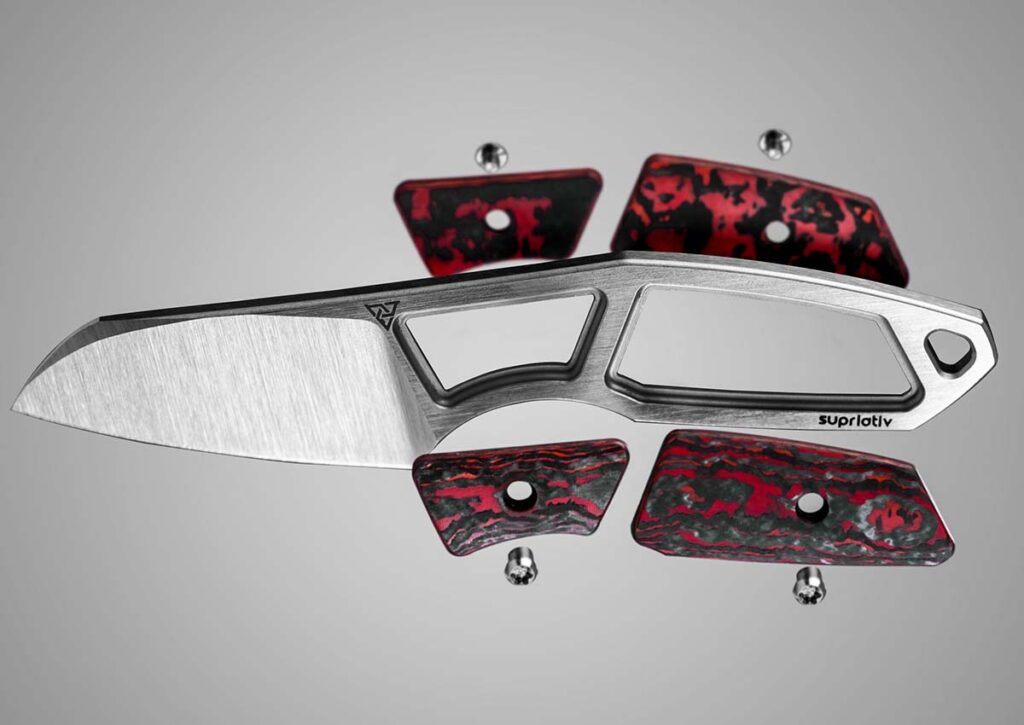
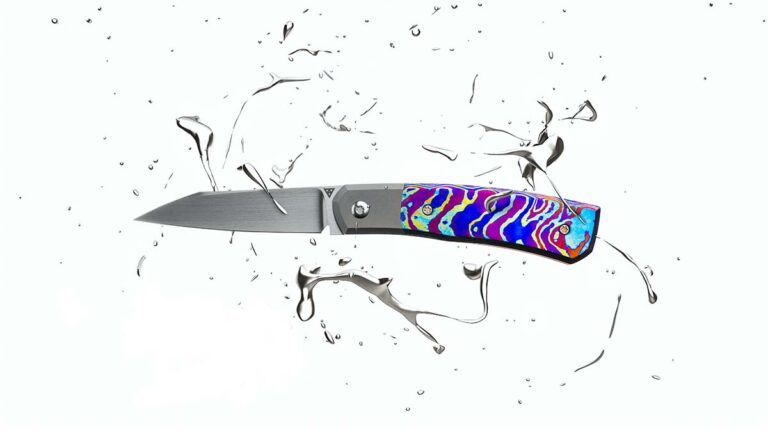
The home-page image for Suprlativ’s website, an exploded view of the Hella showcases one of its various inlay options—carbon fiber—and a 2.07-inch blade of flat-ground Böhler M390 Microclean stainless steel. Weight: 1.2 ounces. Frame: 6Al-4V Grade 5 titanium. Closed length: 2.88 inches. Sheath: Premium vegetable leather. Country of origin: China. MSRP: $194.

Peña already had a relationship with Reate Knives, the high-end Chinese original equipment manufacturing (OEM) operation that makes knives for other companies. Peña said that Reate offers the highest quality production and is also more costly, but not exorbitantly so. Plus, Reate officials never seem to say no, he noted. For its part, Reate considers any deviation from the norm as a way to learn how to incorporate new production procedures. The company reportedly considers Suprlativ’s vision to be unique.

Steel choices depend on what Reate can get in stock, but M390 and CPM 154 stainless and CPM M4 carbon steels all have been used in prior releases. The most recent order will be in CPM MagnaCut. Handle materials include a mixture of titanium, carbon fibers and Micarta® with shield inlays—a nod to tradition—and come in an artistic array of color patterns. Each run is different, never just a colorway change. Peña, Oeser and Garcia determined early not to chase steel or frame material fads since it can take upward of a year to receive an order.

At the last minute during BLADE Show 2024, Garcia decided to enter the Suprlativ Canibl Phantom Lock in the custom knife competition. Once the three determined the design, Oeser cut the parts, did the precision grinding, fit the locks—every type of lock is on the table at Suprlativ—did the surface grinding and ensured the knife was functional.
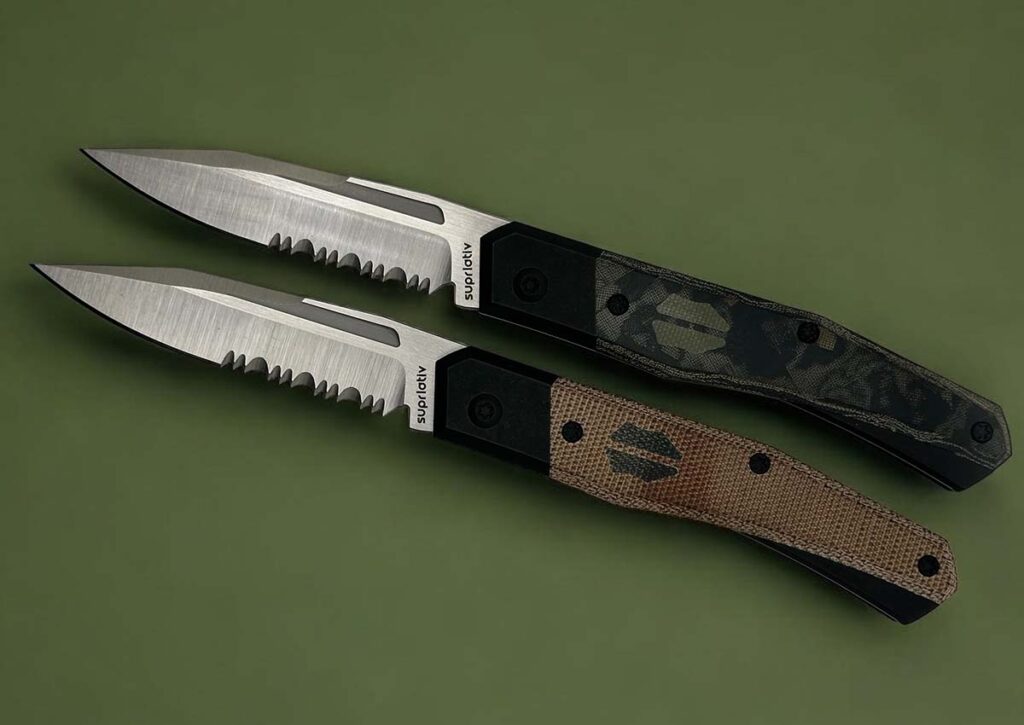
The Cruzador slipjoint has a 3.224-inch semi-serrated/nail-nick-fullered blade of flat-ground CPM M4 carbon steel and a 6Al-4V Grade 5 titanium frame. It also comes in a plain edge. Blade pattern: Clip point. Handle material: Jungle Wear Fatcarbon® ($274 (top) and brown canvas Micarta® (bottom). Weight: 3.3 ounces. Closed length: 4.25 inches. Country of origin: China. MSRPs: $274 each.

Garcia did the blade grinding; he’s the youngest and is humble enough to take on the difficult and time-consuming part of the job, which is just one more example of the goodwill dynamic between the three. Then the knife went to Peña for hand-rub finishing, shield inlay and blade edging. It was an equally shared labor of love.

The effort paid off. The Canibl Phantom Lock won Best Knife Collaboration. The men each expressed surprise, excitement and a sense of validation that what they set out to accomplish resonated within the community. Their collaboration, peaceable interactions and professionalism obviously generated increased creativity for them, loyalty from customers and now well-deserved notice and approval from knifemaking standard-bearers.

Read About Custom Knives:

Japanese Swords: Can Tradition Outperform Modern Tech?

There is plenty of lore surrounding traditional Japanese Swords, but do the master makers’ time-tested methods equal modern steel advancements?

Editor’s note: Long-time BLADE® subscriber and knife collector Rick Royster wrote us, wondering how the swords of the ancient Japanese samurai warriors would compare to today’s modern swords. Did all the steps the ancient Asian swordsmiths used really make a difference? “Employing special quenchants, some clay, some of this and that—is it science or mystical?” Rick asked. While we couldn’t test an ancient sword vs. one of today’s, we did go to the sources themselves for answers—some of today’s top swordsmiths.

The traditional Japanese sword blade is revered for its performance, perhaps even more than its beauty and ties to an uber-rich heritage in the world of cutlery. Combined, these elements make the classic Japanese sword something unforgettable, a work of art and poetry in motion—yet capable of delivering the decisive blow in combat.

Modern custom sword blades may not possess the allure of the centuries. They may not have a hamon—though many do—or the other attributes that make their vintage counterparts so revered. Nonetheless, they can claim respect and admiration when it comes to strength. If the comparison of relative strength is relevant and worthwhile, which is stronger—the ancient Japanese or the modern custom sword blade?

World-renowned Japanese swordsmith Yoshindo Yoshihara does yakire, the fast quenching of a sword, during one of his swordmaking demonstrations. (Aram Compeau image)

BLADE Magazine Cutlery Hall-of-Fame® member/ABS master smith Steve Schwarzer answers the question this way: “Modern steels are highly superior in almost every way except for visual structure. Traditional Japanese bladesmiths were all about taking inferior material, which was the best stuff on the planet at the time, and making it better. Modern steel is superior because it is a lot cleaner with alloys for specific jobs. Setting the structure up is what today’s American Bladesmith Society is all about: making steel better. It’s hard to compare the two, but modern steels are superior in edge holding and sharpness. Modern steel won’t bend like the old stuff because it is not designed to bend.

“Once you get the aesthetics out, the fancy hamons and stuff like that, ancient bladesmiths had a way to control the process in the old days from one portion of the blade to another. If you take a Japanese blade and quench and polish it, you have a big spring supporting the cutting edge, and that is why it would excel in battle.”

ABS master smith Zack Jonas sees the purpose as the primary differentiator in either case.

According to Steve Schwarzer, traditional Japanese bladesmiths took inferior material—the best stuff available at the time—and made it better. “Modern steel is superior because it is a lot cleaner with alloys for specific jobs,” he stated. He used modern steel and all the trimmings on his Japanese sword. (Eric Eggly/PointSeven sword image; image of Schwarzer by Chris Wellhausen)

“The strength of the traditional Japanese sword would have been measured in its ability to withstand the test of battle without breaking,” he began. “By this measure, they were marvels of engineering. Today’s technology is capable of producing swords with performance characteristics that vastly exceed the finest traditional blades. We have steel mills producing bespoke blade alloys from ultra-precise ratios of refined base elements.

“We have modern heat-treating methods capable of holding plus-or-minus a fraction of a degree indefinitely within a perfectly controlled atmosphere. We have modern quenching oils and molten salt pots and ovens for tempering, and we have analytical tools that allow us to refine how we approach our materials. Traditional swords were purpose-built for war, and they lived up to those demands for a thousand years and more. But modern science gives us greater capabilities on a purely quantitative level.”

The cutting of the tatami mat—done here by James Williams during one of his Japanese sword demos at a past BLADE Show—is said to be a good analogue for testing cuts against a human target.

Schwarzer agrees that modern steel is produced in quantity, while the traditional Japanese sword blade was produced singularly.

“It truly takes a master to get the most out of any steel,” he remarked, “but modern steels are more forgiving because they are designed around production, not one-offs.”

Traditional Sword Construction

Dave Goldberg has made traditional Japanese swords since the 1990s and learned from masters in their construction, as well as in the forging of damascus. He sees the functionality of the traditional Japanese blade and says, “The edge of the sword blade is about 60-70 on the Rockwell scale and you want that to be about one-third of the blade area. The middle is somewhat hard, and the back is not hard but flexible.”

According to Zack Jonas, modern smiths have access to modern materials and technology, but in many or even most cases, modern swords are not made with careful consideration for the practicalities of combat. Zack’s wakizashi features a 22-inch damascus blade with a shinogi zukuri grind. Overall length: 28 inches. (SharpByCoop sword image; image of Zack by B. R. Hughes)

According to Jonas, the hardening process was essential during ancient times. The warrior absolutely depended on it. Traditional swordsmithing techniques have been refined over the course of centuries through the familiar process of trial and error.

“Since ‘error’ would have been a matter of life and death,” Zack observed, “we can say with a degree of confidence that traditional methods worked extremely well. For example, it was essential to employ differential hardening—which traditional smiths did by applying an insulative clay to the spine—because given the properties of the steel they were working with, a fully hardened blade would have created a number of problems both for the smith and for the warrior. It can be tricky to retrospectively disentangle the mystical from the scientific. Mystical practices that offered no benefit would have been winnowed out in favor of those that did, and those that did offer benefit can be scientifically explained today.”

Years ago, Goldberg traveled to Japan to study traditional sword blades under the legendary Yoshindo Yoshihara, whose family has practiced the art for no fewer than 10 generations.

Zack Jonas said modern steels can get harder, tougher and sharper than traditional Japanese tamagahane steel, but it remains important to remember that tamagahane was strong enough for a thousand years of battles. This traditional tamahagane was made in a smelter, or tatara. (Yoshihara Yoshikazu image)

“He taught me a lot of things about sword making,” Dave remembered, “and in his smithy, he had on the wall behind where he forges a Japanese shrine with lightning bolts hanging and incense burners, and there was a little teapot in the smithy, too. He said it was just decoration, but with the Japanese guys even if you are friends, there are still secrets. So, I put paper lightning bolts in my shop too—to protect my spirit and so the blades will come out well and get through the quench.”

Bound up in tradition, the mysticism makes the Japanese way an art form that can never be completely separated from its origins. Even in a straight-up test of strength, whether one steel prevailed over the other, there would be no loser. Each would continue to hold its relative place in time and space and fact and imagination.

“In absolute quantitative terms, traditional materials mostly do not offer performance advantages over their modern counterparts,” Jonas said, echoing Schwarzer’s observation. “For example, modern steels can get harder, tougher and sharper than traditional Japanese tamagahane steel, but it is still important to remember that tamagahane was strong enough for a thousand years of battles. Likewise, performance isn’t everything. One of the signature features of tamahagane is its appearance. It has aesthetic characteristics that modern steels lack entirely.”

Japanese Sword Features

Eighty-two-year-old Yoshindo Yoshihara, author of this classic Japanese sword and saya (scabbard), is generally recognized as the greatest maker of Japanese-style swords of his generation. (Francesco Pachi images)

Among the most noteworthy features found in traditional Japanese sword blades is the hamon, which Zack describes as the literal demarcation point between the hardened edge of the blade and its softer spine. The hamon, he says, is a visible representation of the technique that must be used due to the material constraints and demands of tamahagane steel.

It is visible due to light diffusing off the mixture of hard and non-hardened crystalline structures, where the hardened edge transitions to the softer spine. He adds that over time, the production of the hamon stretched beyond the practical necessities of the steel and into the realm of aesthetics. Whether the shape of the hamon has any bearing on the blade’s performance is an open question.

“Any steel hardened and tempered to its best molecular composition is good steel,” Goldberg commented. “Modern 80CrV2 steel is harder than any Japanese steel. Japanese steel can take it in battle, and from sword to sword, it can be amazingly hard. It becomes its own shield when the warrior holds it above his head and can then come around and cut the other guy. Japanese steel is really hard, but modern technology is something else. I have never seen anything harder than the CrV stuff. Everything is purpose-driven.”

Matt Venier made what he calls Mattyhagane to recreate tamahagane for the blade of his katana. The tsuka (handle) consists of a wood core with full rayskin and braided wrap. The tsuba (guard) and habaki (collar) are copper. (SharpByCoop images)

Other attributes of the traditional Japanese sword, including the handle ornaments known as menuki, may contribute to performance as well. While some observers may see menuki as a sort of grip enhancement in functioning as a palm swell, allowing the user to index the sword better, others stress that they are primarily evidence of the maker’s desire to express his or her own identity and creativity. Menuki quite possibly can function on both levels.

Japanese Sword Folklore

Through the centuries, there have been claims that Japanese steel can perform certain tasks that modern sword steel cannot. Jonas says that many such contentions are simply folklore or myth and have been easily debunked.

“One popular example is the cutting of the tatami mat,” he related. “These straw mats, soaked in water and then rolled tightly together, are said to be a good analogue for testing cuts against a human target. It has been said that only the katana can do this well, but these days, videos can be found online showing a skilled swordsman cutting through a tatami with a blunted medieval-style longsword.

“The Japanese sword has been mythologized along with the warriors who made it famous. The samurai were incredible fighters who earned their reputation for fierce courage through feats in battle and cultural refinement. Their signature sword is a highly developed object with exceptional performance abilities, but traditional examples will not outperform their modern counterparts.”

Old & New Symbiosis

In the final analysis, the old and new steels co-exist, achieving a symbiosis, a sort of mutual respect. As Zack so aptly pointed out, the context of their comparison weighs in on the discourse.

“It is important to consider how this matter is discussed,” he noted. “Most of these topics bear on the question of superiority—what makes this sword better than that sword or vice versa—and while it is possible to give some answers in the absolute sense, there is a risk that these answers ignore important contextual factors.

“The traditional Japanese sword was designed for a particular form of combat and was designed with the constraints of the tools and materials available at the time,” he concluded. “Modern smiths have access to modern materials and technology, but in many or even most cases, modern swords are not made with careful consideration for the practicalities of combat. Modern smiths are unlikely to even be familiar with how a sword would need to behave in a fight.”

Times change, materials change, techniques and methods change. But through the ages, traditional icons endure, while new and emerging genres come to life and begin to build legacies of their own.

More On Swords:

Forged In Fame

0

Inspiration And Guidance From Jerry Fisk Has Helped Forged In Fire Champion Ricardo Vilar Continue His Rise To Steel Stardom.

It’s hard enough to make it to top bladesmith status in the USA but even harder if you are from another country. Brazilian bladesmith Ricardo Vilar is one of those who worked hard, persisted like hell, and has been rewarded with both high accolades and fame for his efforts.

Starting with humble beginnings and a love for knives at an early age, Ricardo resides in the USA now and is living the dream.

“Growing up in the countryside of Brazil, for some reason I always loved knives,” he recalls. “At that age as Boy Scouts, we were allowed to use knives—and more, the knife was part of the uniform—so I was able to carry one on my belt. But my family wasn’t wealthy enough for me to be able to buy the knives I wanted, so making my own was a natural progression.

Ricardo’s love for carrying belt knives as a Boy Scout in his youth carries over into his stag hunter in damascus. (Image courtesy of @digitalbladesmith)

“I started with stock removal because 30 years ago in Brazil it was very difficult to find a blacksmith, and impossible to find a bladesmith. They were people considered rare and with ‘magical’ knowledge. I started following other makers who were ahead of my knowledge. But something really interesting I would like to say, at that age at least in Brazil, the sharing of information wasn’t very popular. Also, remember, we had no Internet, so my progress was really slow.”

Inspiration From A Legend

Ricardo knew if he was going to progress at a more rapid pace, he had to go outside Brazil to get help. He did so by reaching out to one of America’s most famous and lauded bladesmiths: Jerry Fisk. He invited Jerry to Brazil, offering to pay his expenses.

“I asked Jerry if he would stay at my home because we had no money to pay for a nice hotel room,” Ricardo states. “He accepted my offer and with his help we were able to set up a better workshop, which was the turning point for my knifemaking in Brazil. We have become great friends ever since.”

Jerry remembers his first visit to Ricardo’s home country and the South American bladesmith’s sacrifice to get him there.

“I met Ricardo in the fall of 2001,” he said. “He and some other makers wanted to get someone to come to Brazil to help them start looking around at what the world was doing in the knife business. Ricardo sold his car to get the funds together to have me flown there.”

This flowing bowie by Ricardo Vilar shows the design influence of his mentor, Jerry Fisk and also Ricardo’s own creative approach to knife construction.

The American and Brazilian immediately bonded.

“I realized right off how good he was as a businessperson,” Jerry said. “And the fact that he had a really good sense of humor started things off with a bang. Though neither of us spoke the other’s language well, we both managed to come up with enough jokes and pranks that it made learning and sharing cultures fun together.

“On the first trip—others followed—we would stay up till 1 to 3 in the morning talking about how the world worked regarding knives. On the first trip I helped Ricardo and other Brazilian bladesmiths form a knifemakers’ group, with the rules being a blend of both The Knifemakers’ Guild and the American Bladesmith Society bylaws mixed in with what would work for them. We worked on forging carbon steel but, more important at the time, we went down to the junkyard, gathered up all kinds of materials, made gas forges and made damascus. We were using vacuum cleaners, hair dryers, anything that would work.”

Jerry’s impact on Ricardo has been immeasurable. “If you pay attention to my designs, it is clear to see Jerry’s influence,” he said. “I like the style and the functionality of his knives and this is what I like to pay attention to when I design a knife.”

Forging In The USA

The next few years Ricardo’s hard work began to pay off. In 2005, he became the first-ever ABS journeyman smith from South America. The same year he began working with the Brazilian Army Jungle War Instruction Center designing and producing knives for the military. “I still have my little company in Brazil which makes knives for law enforcement, firefighters, first responders and the like,” he notes.

In 2017 he was faced with the biggest decision of his life. “I had been visiting Arkansas since 2003, more specifically the Nashville area—yes, there is a Nashville, Arkansas,” he smiled. Such a move would allow him to be closer to Fisk’s home as well as the cutlery action in the United States. The Vilars also were keenly attracted to the Razorback State’s splendid beauty. “When my family and I decided to immigrate to the U.S., we felt like the Arkansas area would be awesome for us to be connected with nature,” Ricardo explains, “so Nashville, Arkansas, was our top option.”

“His success in knives is quite simple, really,” Jerry Fisk says of Ricardo. “Work your butt off doing the best you can do until you get done what the client deserves. Repeat next week, but better.”

Once situated stateside, Ricardo and his knifemaking blossomed, propelling him to new heights. Not only did he start winning awards for his work the world over, he had an opportunity to collaborate with Jerry. The two friends were recruited to produce limited edition knives for the Arkansas Game and Fish Foundation. As the foundation’s press release states, “The Arkansas Game and Fish Foundation was proud to work with Ricardo Vilar in establishing the first-of-its-kind limited edition knife collection. The Foundation chose Mr. Vilar for his outstanding craftsmanship and love of the outdoors. We tasked him with making and testing a blade that not only would meet the demands of use in the field, but could also be displayed in the board/trophy room. With several of the board members owning a custom Vilar knife already, they knew he would make something they would all be proud to own.”

Ricardo also enjoyed the publicity of appearing on, and winning, an episode of the popular Forged in Fire television series in March of last year. “It was an awesome experience and I need to tell you, it is not as easy as you might think,” he relates. “I made a very interesting African weapon called an ikakalaka. I made two instead of one and I had the difficult job of deciding which one I was going to compete with.” Ricardo won the competition with ease and most likely would have done so with either sword.

Fisk shares Ricardo’s secret to making it in the knife world.

“His success in knives is quite simple, really. Work your butt off doing the best you can do until you get done what the client deserves. Repeat next week, but better. Be honest enough that the client knows he can play poker over the telephone with you and get a fair hand. Then after all that, have the sale come in at 10 percent below market price,” Jerry advises. “I have had Ricardo help me set up for the cutting competitions that I work with simply because his knives cut very well. Yes, Renata, his wife, often engraves and does gold inlay, but the knives will also cut well.”

Ricardo’s story is one of hard work, dogged determination, taking chances—and winning.

Read More

Tim Britton’s Badger: Old Keen Kutter Pattern Reborn

A sensational slip joint, Tim Britton’s Badger revives the Keen Kutter pattern with a ton of flare.

When ABS master smith Bruce Bump showed an old Keen Kutter penknife pattern to veteran knifemaker Tim Britton, Tim fell in love with it and immediately set to making his own iteration.

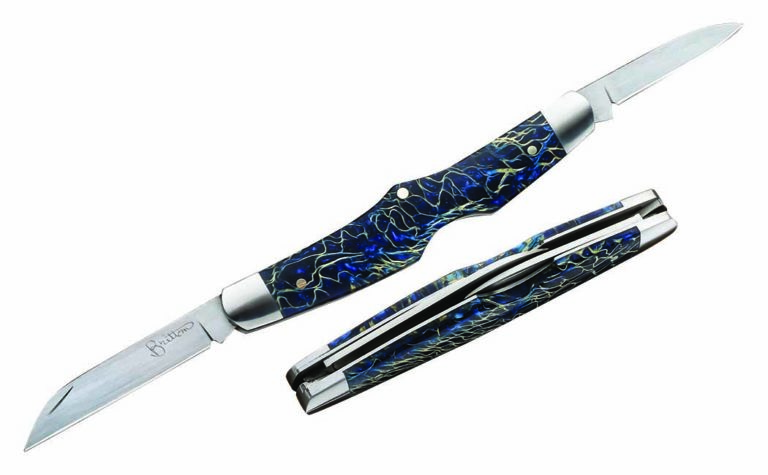
The blades are BG-42 stainless steel that, as Tim noted, has high ductility and holds an edge forever. He flat ground them on his “ancient” 18-inch, 200-pound Porter Cable disc sander. However, it’s the handle that really stands out. Consisting of stabilized diseased ash burl from Whistle in the Woods, the material looks synthetic but isn’t.

Tim Britton , 80, has been making knives since 1971 and has focused a lot in recent years on slip joints, with the Badger being the latest. He’s got about six antique pocketknife designs on his to-do list for this year, including a peanut and a copperhead. (knife image courtesy of Tim Britton)

“The light stuff in it looks like explosions,” Tim said. “I’ve never seen anything like it.” The projection on the spine fits right in between the user’s index and middle fingers and the groove on the underside cradles the latter for a comfortable, secure grip.

Calling it the Badger, Tim said he made 10 of them and had four or five at BLADE Show 2022.

Badger Spec Check
Knife Name: Badger
Maker: Tim Britton
Blade Steel: BG-42 stainless
Blade Grinds: Flat
Handle Material: Stabilized diseased ash burl from Whistle in the Woods
Closed Length: 3.5 inches
Maker’s Price For A Similar Knife: $375

More Knife Collecting And Custom Knives

Blue Bloods: Custom Knives With A Twist Of Azul

No doubt, these custom blades have icy good looks.

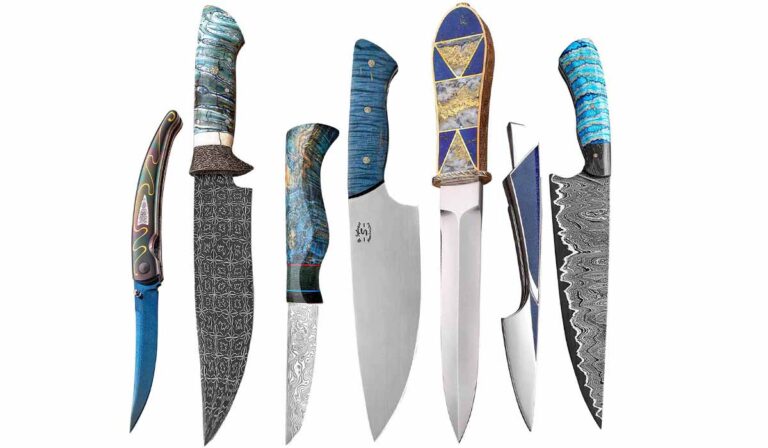
Many things are associated with the color blue. Depending on your preference or point of view, some of those things may be good, others bad. In the case of knives, blue comes in many hues and materials, and can serve different purposes. Here’s hoping these blue knives don’t give you the blues.


Michael West: Starry Night

Michael West Starry Night

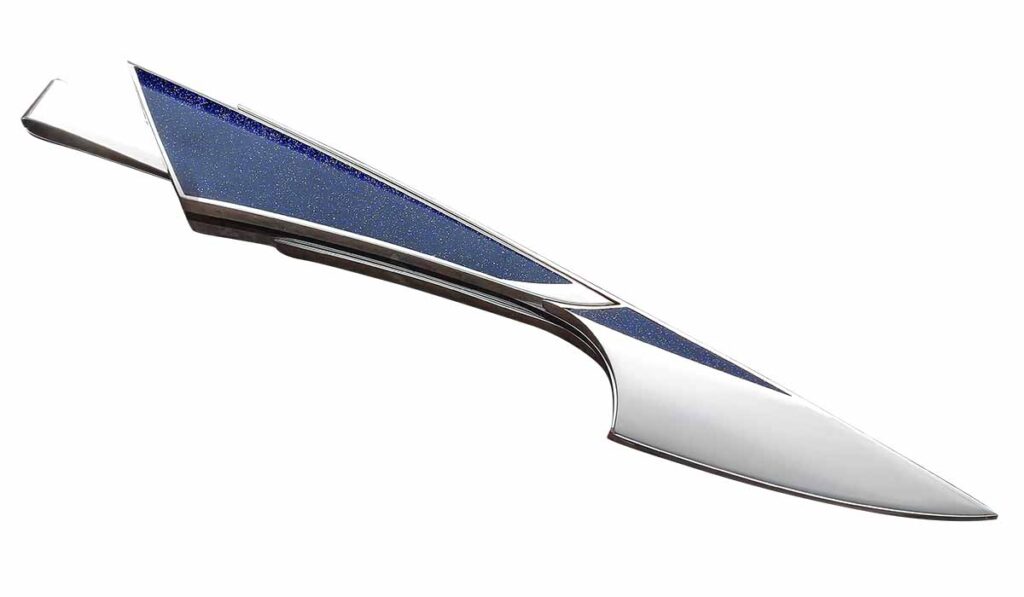
A handle of blue sunstone set in a frame of argentium silver and at 2.83-inch blade of RWL-34 stainless steel headline Starry Night by Michael West. Blade grind: concave. Bolster: Argentium silver. Overall length: 7 inches. Sheath: all silver with blue sunstone inlay. Maker’s price for a similar knife: $3,500. (SharpByCoop image)

Shane Gagne: Chef’s Knife

Blue Shane Gagne Chefs Knife

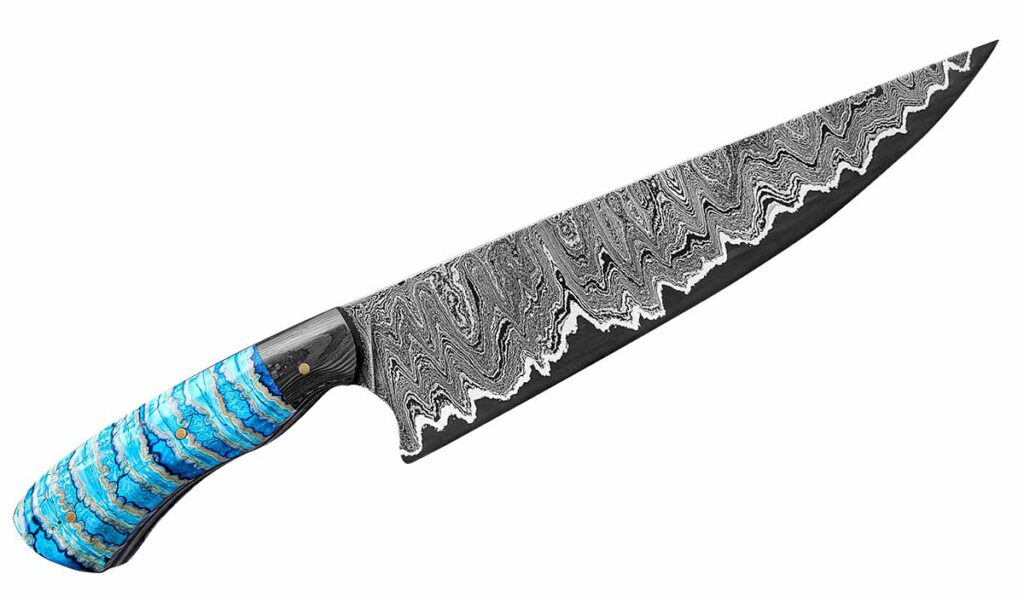
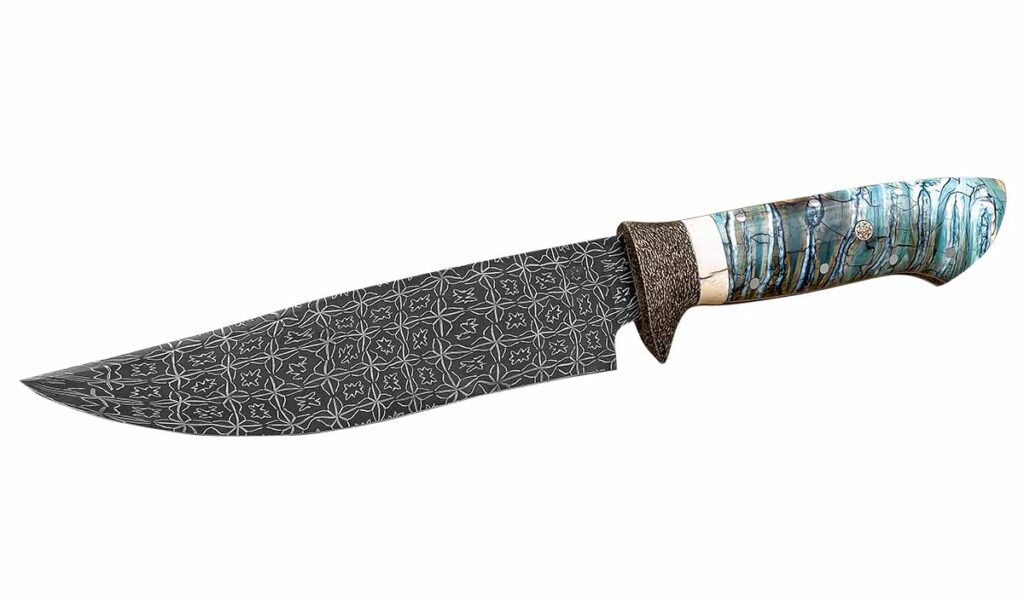
The mammoth molar of the handle of Shane Gagne’s chef’s knife is dyed blue. The 8.75-inch blade is 180 layers of random damascus cladding go-mai with nickel shim and a core of 52100 ball bearing carbon steel. Total layers: 360. Bolster: carbon fiber. Overall length: 13.25 inches. (Jocelyn Frasier image edit)


Don Sylvest: Chef’s Knife

Blude Don Sylvest Chefs Knife

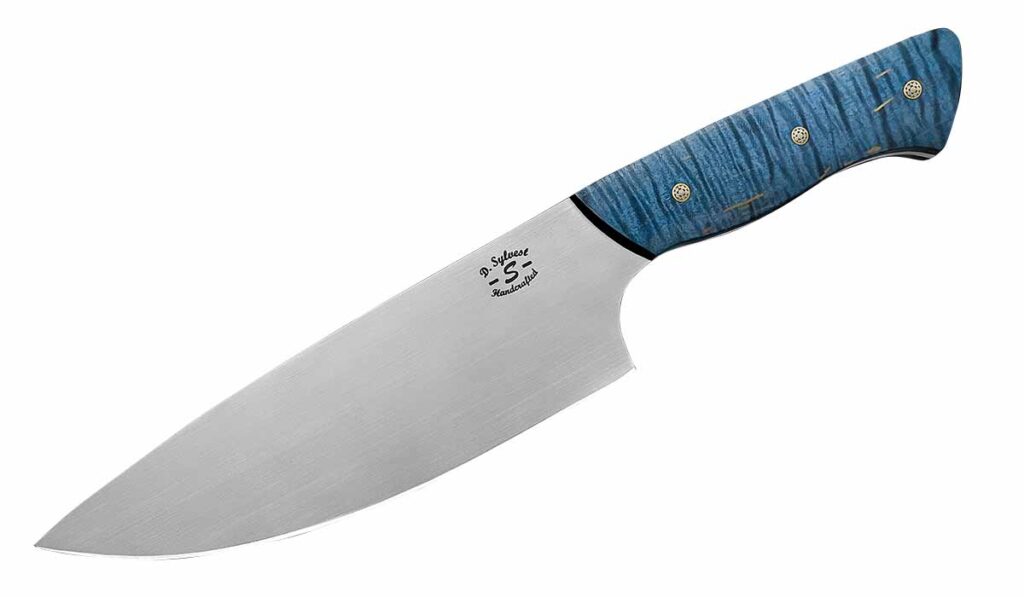
Curly maple dyed blue outfits the handle of Don Sylvest’s chef’s knife. The 6-inch blade is CTS-XHP stainless steel. Don offers the knife in tandem with a paring model in the same materials, only smaller with a 3.5-inch blade. (Jocelyn Frasier image edit)


Tyler Turner: Toothpick

Blue Tyler Turner Toothpick

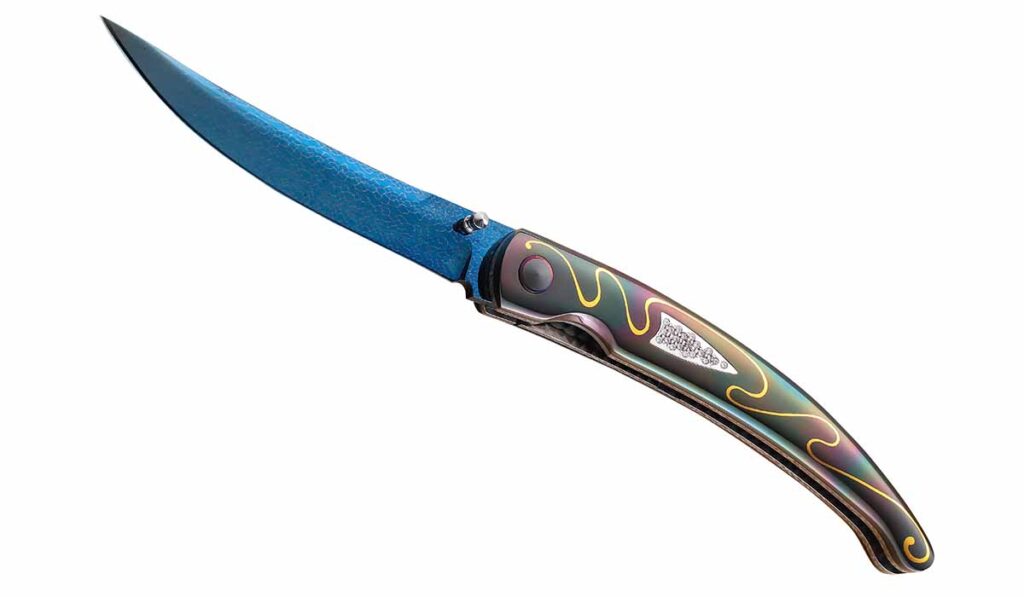
The 4.25-inch blade of Tyler Turner’s toothpick is blued Turkish Lace damascus forged by Doug Ponzio. The frame is zirconium and the liners are titanium. Embellishments include 24k-gold inlay by Jody Muller, an argentium silver shield and diamonds pavé set by Tyler. The pivot adjusts with a custom takedown tool. (SharpByCoop image)


Jim Sornberger: Dress Bowie

Blue Jim Sornberger Dress Bowie

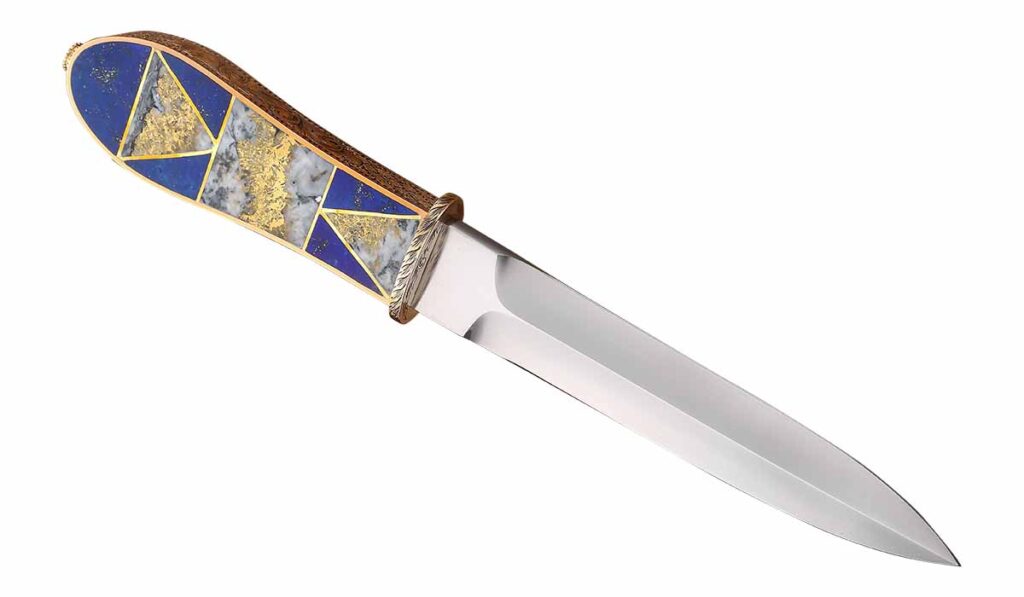
Blue adds contrast to the gold quartz handle of BLADE Magazine Cutlery Hall-Of-Fame® member Jim Sornberger’s mid-19th-century-style dress bowie. Bolster: 14k gold. The 2.25-inch blade is ATS-34 stainless steel. All engraving is by the maker. (SharpByCoop image)


Jose Santiago-Cummings: EDC Fixed Blade

Blue Jose Santiago-Cummings EDC Fixed Blade

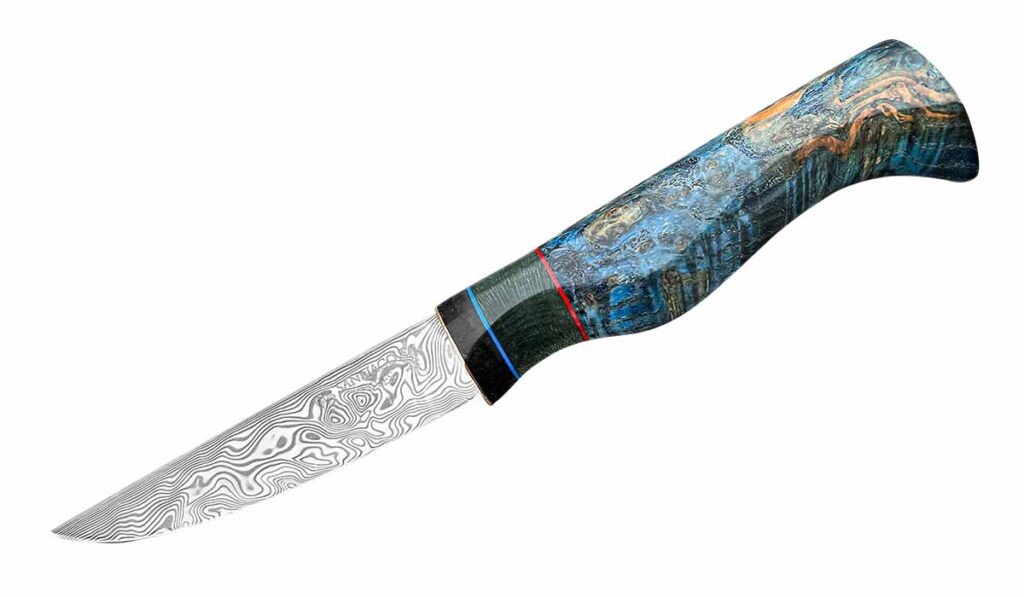
The EDC fixed blade by Jose Santiago-Cummings has a bird’s-beak handle of black ebony, chestnut dyed green and contoured birch wood dyed blue. The 3.75-inch blade is Damasteel damascus in a Vinland pattern. The bolster is mokume. Overall length: 8 inches. (Jocelyn Frasier image edit)


Rob Logan: Fighter

Blue Rob Logan Fighter

Rob Logan’s fighter sports a blue mammoth molar handle with a mammoth ivory spacer, white vulcanized handle liners and brass liners. The 4.25-inch blade is mosaic damascus forged by Bill Poor, and the brass frame and guard are textured and patinaed. Overall length: 13 inches. (Jocelyn Frasier image edit)


Check Out More Cool Custom Knives:

Cool Customs: Barret Chrisman Takes The Ol’ Bullet Hi-Tech

Barret Chrisman puts a modern spin on a vintage Remington design.

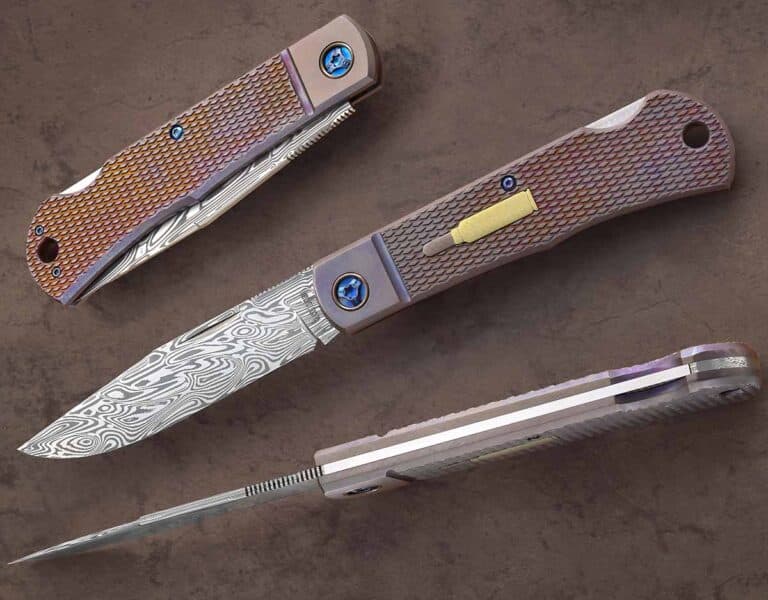
Barret Chrisman’s contemporary take on the classic Remington 1306 Bullet lockback combines tradition and hi-tech in one handsome custom pocketknife.

Barret outfitted his repro with all cutting-edge materials, including a blade of Loki pattern damascus by Damasteel, a handle of checkered titanium that resembles jigging and a titanium bullet shield. “I’ve seen people jig titanium before but I wanted to try checkering, so I made up a custom pantograph template and tried it out,” he said. He anodized the handle a purplish bronze.

Barret Chrisman
Barret Chrisman

“It’s a modern take on an old school knife everybody likes,” Barret noted, “and I’ll probably be doing the same kind of thing in the future.”

Remington 1306 Bullet Modern Reproduction Specs
Maker: Barret Chrisman
Blade length: 4”
Blade material: Loki pattern damascus by Damasteel
Blade grind: Full flat
Handle frame: Titanium
Handle scales: Checkered titanium w/inlaid titanium bullet shield
Lock: Lockback
Closed length: 47/8”
Maker’s price for a similar knife: $1,500

Check Out More Cool Custom Knives:

Hottest Damascus Patterns, According to Top Bladesmiths

0

Top bladesmiths discuss the three hottest damascus patterns.

As damascus patterns emerge through the years, their popularity waxes and wanes. The steel itself, layers of intrigue and interest, experimentation and innovation captivate the steel forger, the custom maker and the knife-buying public like nothing else. The patterns abound and in recent reviews of photos, commentary from those in the business and observation it appears that the feather and mosaic, with twist not far behind, have been and continue to be hot.

“I agree that feather and mosaic patterns are predominantly what is made, or certainly what is getting photographed [a lot],” related ABS master smith Steve Randall. “Both patterns are popular because they have lots of character and can be pretty dramatic. Feather patterns are very cool because they can be unique yet still hold true to the feather pattern. The mosaics can move off into so many different styles. They allow the maker to be really creative.”

Feather Damascus Pattern

ABS master smith Bill Burke praises the versatility of the feather pattern and its breadth of presentation.

“I think that you see a lot of feather pattern because it is so striking and looks good on almost any knife style,” he commented. “It is also quite a challenge to produce. A well-done feather will have a flow from end to end with nicely curved veins, while a feather that has interruptions in the pattern or has the center area drawn out into a long ‘V’ shape then curves out rather sharply to the edge is not done so well. I don’t feel a feather pattern is difficult to do after one has mastered pattern welding. It becomes difficult when an inexperienced smith rushes into trying to make a feather before mastering basic pattern-welding techniques.”

“Feather patterns are very cool because they can be unique yet still hold true to the feather pattern,” Steve Randall observed. He matches up the feather pattern with a mastodon ivory handle on his frame-handle hunter. Overall length: 9 inches. (SharpByCoop image)

BLADE Magazine Cutlery Hall-of-Fame® member and ABS master smith Steve Schwarzer sees the artistry in the feather pattern as well, and when he considers the magnitude of its relative surge concludes, “Absolutely. What you don’t see much of is images and the forge skill required to put that in damascus. Both the feather and mosaic damascus are fairly easy to do, and with the internet there are thousands of recipes out there with visual step-by-step instructions. I did the first feather pattern ever done in a folding knife, and [Cutlery Hall-of-Famer] Don Fogg in his Life and Death Dagger was the only one who did a feather pattern before me. I did the first that was recognizable in the folding knife.”

Degree of difficulty is and will forever be a matter of individual perspective and opinion. Randall stresses the experience level of the maker in fashioning the feather pattern.

“I would say that feather damascus can be a difficult pattern,” he offered. “There are a lot of pieces that have to forge weld together, which opens the opportunity for cold shuts or poor welds. Once that happens, you’ve pretty much got a paper weight.”

Mosaic Damascus Pattern

The perspective on mosaic damascus is similar to that of the feather pattern. Its uptick in popularity is driven by the skill of the maker and the diversity of the presentation. Mosaic makes its statement in both subtle and bold blade aesthetics.

“While a simple twist pattern is rather mundane,” Bill Burke noted, “when four or more bars are twisted in opposite directions and stacked one on top of the other to create a Turkish twist, the result can be striking.” A lavish five-bar Turkish-twist damascus comprises the blade, including the Spanish notch at the base of the edge, on Mike Quesenberry’s Mediterranean bowie. (SharpByCoop image)

“Mosaic patterns do lend themselves to individual creativity,” Burke remarked. “They can vary from not too hard to extremely difficult to do. Mosaics are limited only by the smith’s skill and imagination. Mosaics that are done well will have the patterns lined up with no unintended interruptions in the elements and all the individual tiles matched up well.”

Tiles, incidentally, are the small, angled pieces of steel that are carefully assembled and then forge-welded together to create the distinctive, repeating mosaic pattern. The tiles are cut from the billet or block of welded steel that forms the basis for the creation of any damascus pattern. The tile cuts are made with a scarf joint that facilitates the joining of the surfaces to be mated during the forge welding process.

ABS master smith Mike Quesenberry is a big fan of the mosaic pattern, particularly its possibilities for expression.

Mike Quesenberry stated the black and silver contrast of mosaic patterns can do “all kinds of crazy, wild things. It is huge with so many possibilities, and it turns out to be a really good pattern that some like in a fine look and others prefer in a bold statement.” The Sobral Brothers go bold with the pattern on their keyhole subhilt fighter. Overall length: 13 inches. (SharpByCoop image)

“I love mosaic and its creativity,” he declared, “along with the fact that smiths can take mosaic and make it bold or fine and there are all sorts or variations that make it fantastic, from W’s to many others. You can add different layers to fine and thick material, 1080 or 15N20 or whatever alloy. That black and silver contrast can do all kinds of crazy, wild things.

It is huge with so many possibilities, and it turns out to be a really good pattern that some like in a fine look and others prefer in a bold statement.”

Things To Look For

Assessing the quality of the individual feather and mosaic product is an exercise in discernment and preference along with the display of basic skill that is evident. Randall takes a subjective point of view.

“One of the most important signs of a feather pattern that is well done is its flow through the blade,” he observed. “The feather should flow from the center of the ricasso through the blade and out the tip. Both feather and mosaics being well done are in the eye of the beholder. Layer count has a big impact. The higher the count does not always make the pattern better.”

Bill Burke indicated a well-done feather pattern will have a flow from end to end with nicely curved veins. ABS master smith Scott Gallagher nails the concept in the feather-pattern blade of his Dolan Dagger Folder. Closed length: 5.25 inches. (Jocelyn Frasier image)

Schwarzer agrees that the individual’s taste has a tremendous weight in the interpretation of well-done damascus.

“It’s all subjective,” he related. “It involves how pleasing to the eye the fine or bold patterns are. The whole thing can’t be just a hodgepodge of stuff stuck together. It has to tell a story, and if it tells a story, then it is art—and to a lot of people it is great art. There is stuff out there that is incredibly complicated to do that looks simple on the face of it, but it isn’t. We are in the infancy of pattern welding, and a lot of it has come from Daryl Meier.

“There have been patterns out there with faces and images in them since the 1700s,” Steve continued, “and now we are painting with steel. When Bill Moran showed up with random-pattern blades in the early ’70s, he was continuing something that had never stopped. Pattern welding has probably been going on for 4,000 years, and you have to forge, fold and weld the iron to clean it. Then, when you get the alloy in there, it shows the pattern. Pattern welding, including feather and mosaic damascus, is a technique and a skill set that is developed. Once you develop that skill, the trick is to get it back together without flaws, turning something mundane into something striking. Mosaic requires more planning and skill than feather.”

One of the pioneers in—and a most outstanding forger of—Turkish twist damascus is Jerry Rados (inset), who forged the steel for the Wall Street Knife by Joe Kious. Jerry’s Turkish twist has what Steve Schwarzer calls a kaleidoscopic appearance.  (KnifePurveyor.com knife image)
One of the pioneers in—and a most outstanding forger of—Turkish twist damascus is Jerry Rados (inset), who forged the steel for the Wall Street Knife by Joe Kious. Jerry’s Turkish twist has what Steve Schwarzer calls a kaleidoscopic appearance. (KnifePurveyor.com knife image)

Twist Damascus Pattern

Although some patterns may stand out from others for a while, there are always those that maintain their place among the most popular. Twist patterns and specifically Turkish twist are regularly in the conversation when collectors are seeking their prize blade.

“Twist and Turkish twist are the same and totally different at the same time,” smiled Burke. “While a simple twist pattern is rather mundane, when four or more bars are twisted in opposite directions and stacked one on top of the other to create a Turkish twist, the result can be striking. However, like almost all other patterns these two can also be drawn out or stretched too far, which detracts from the looks of the pattern. While a simple twist is relatively easy, the Turkish twist billet is wrought with potential for failure and is very labor intensive.”

A key element in producing twist patterns is control, and Schwarzer respects the precision required.

“Very precise control is necessary in the twisting so you get that twisting the same in fine or coarse layers,” he said. “Jerry Rados was the American guy who did the most of that, and we both learned from Daryl Meier in Carbondale [Illinois]. The early blades made by Daryl in the 1980s are beautiful, but you’ve got to be almost [obsessive compulsive] to produce that stuff. It involves a lot of planning and the turns have to be precise. You can twist mosaic and make it look like a kaleidoscope.”

Chris Roosendaal’s feather pattern in 1084 carbon- and 15N20 nickel-alloy steels borders on the mesmerizing. The scales are black G-10 and Micarta®. Overall length: 11.22 inches. (Rod Hoare image)

Randall says that a Turkish twist done right is “very classy.” Its degree of difficulty is a cut above basic twist, but in his experience, it isn’t quite as demanding as feather pattern work due to the requirement of fewer pieces to “cut, flip and weld together.”

When Quesenberry talks Turkish twist, he affirms his love of the look but decries the amount of waste he sees in its production.

“I’m a huge fan,” he commented, “and I love the fact that it’s an appealing pattern. But I don’t like the huge amount of waste. To me, the cool pattern is in the middle third of the bar. There aren’t really a lot of American and European guys into Turkish twist, but some of the South Americans are really pros who are turning out some bold patterns.”

Shifting Damascus Pattern Preferences

Of course, the shifting preferences and envelope of creativity that is constantly pushed keep the damascus conversation going. And it is likely to remain lively long into the future.

“Trying to say one pattern or another is more popular is always subjective,” Randall concluded. “There are some great classic patterns that are very appealing. For example, the ladder, twist, crushed W’s and others. Sometimes the mosaics get visually busy, so some people don’t enjoy them as much, but who doesn’t love a feather or explosion pattern? They are too cool. Some of it does depend on the overall knife design. The blade design and size with guard and handle can enhance—or take away—from a pattern.”

Considering damascus pattern popularity past, present and future, one element is certain. The driving force of creativity and the artistry of the forge will keep this ancient steel relevant for generations to come.

More On Damascus:

Advertisement

Must Read Articles

Read this before you make a knife

Knifemaking 101 – Read This Before You Make a Knife

  by Wayne Goddard My experience has taught me that there's nothing like digging in and getting started. I've often said the hardest part of the...
how to forge damascus steel

How to Forge Damascus

Advertisement
Advertisement