Knifemaking

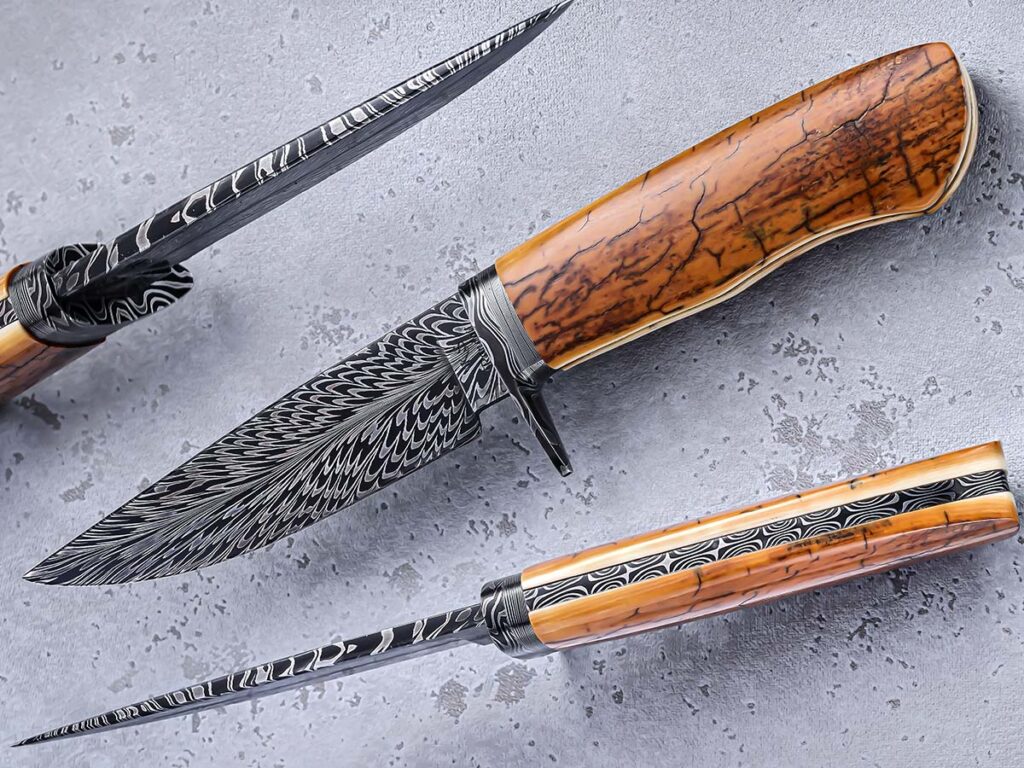
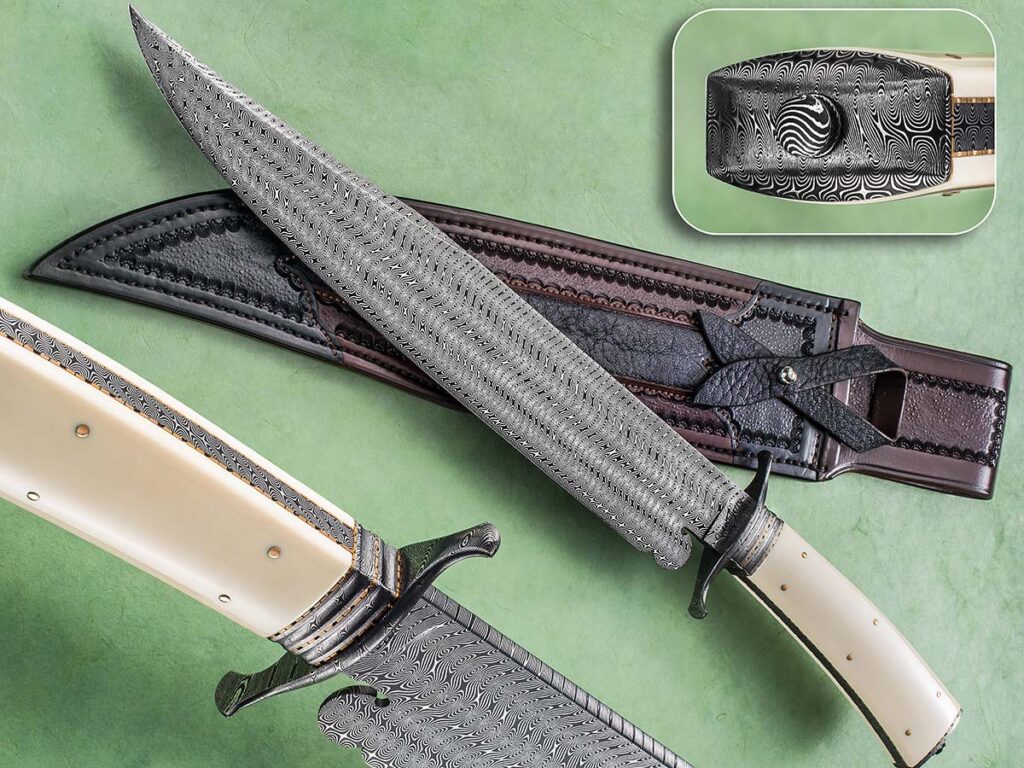
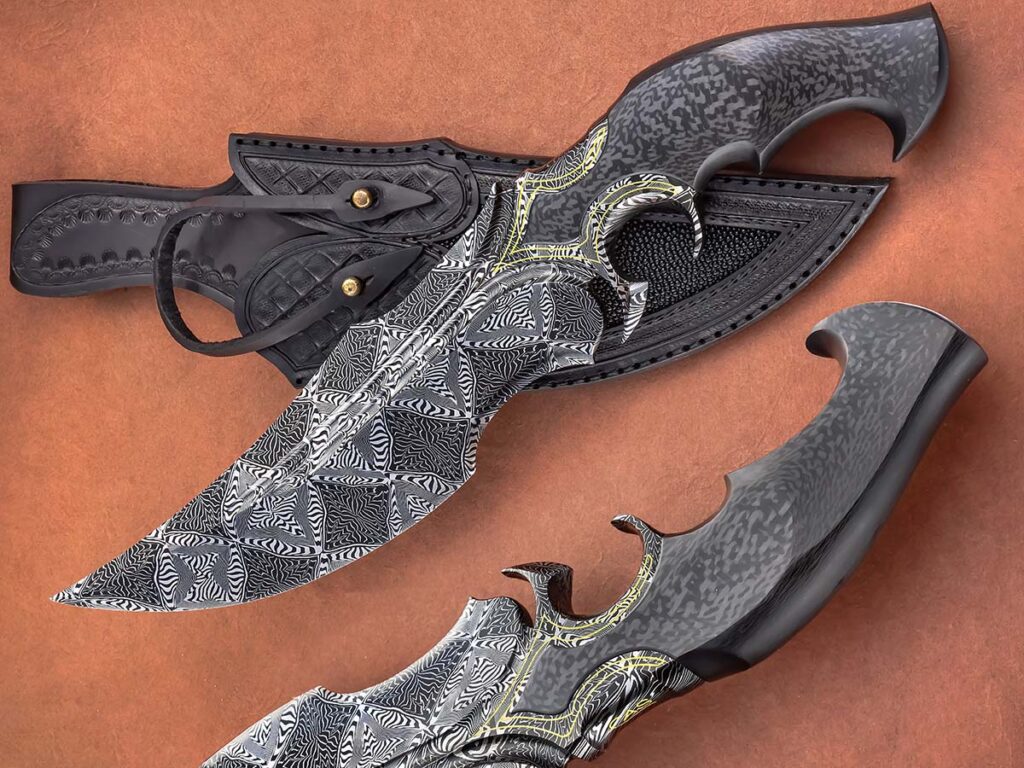
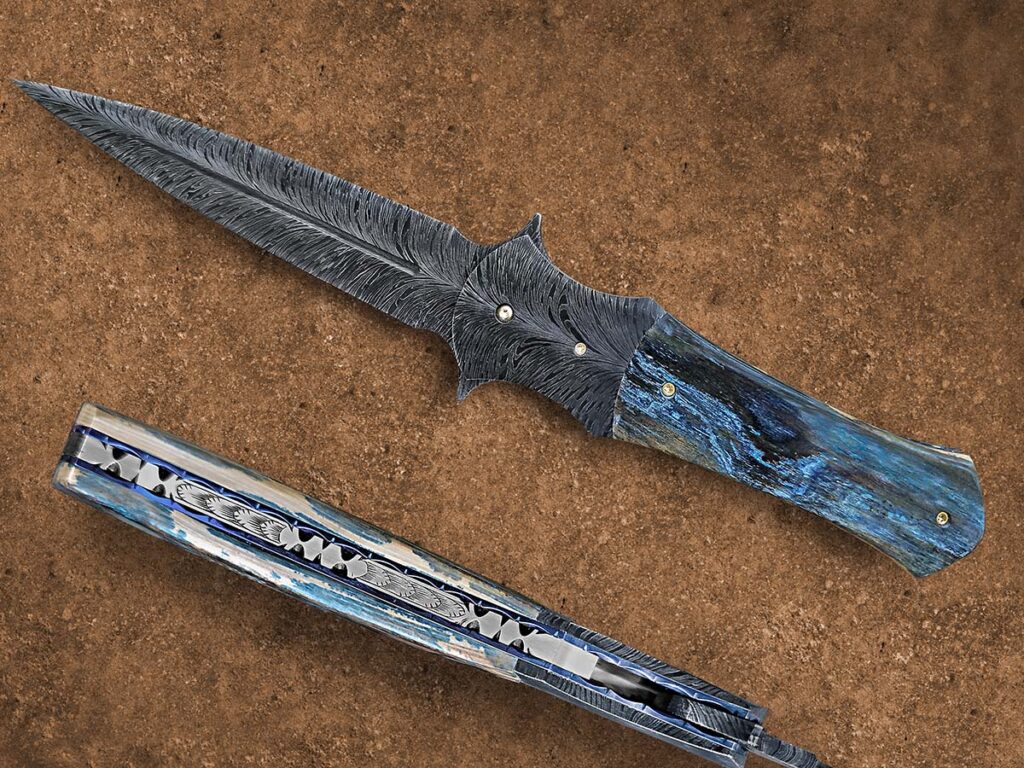
Knifemaking is the building of a knife, which includes the blade, handle and other accouterments. Blades are made by either removing metal from a steel blank via a grinder – known as stock removal – and the forging to shape of hot steel into a blade in the process known as bladesmithing. Other parts, including bolsters, guards, pommels, etc., are needed to complete the finished knife.

Featured Knives – – Knife Collecting – – Tactical Knives – – Survival Knives

MagnaMax and Pop’s ProCut: The Next Super Steels?

Specially engineered for knife blades, the two alloys are at the cutting edge of metallurgy.

Editor’s note: The genius behind MagnaCut—arguably today’s most popular blade steel for both custom and factory knives—the author has helped create two new blade materials that he fully expects to meet with wide-ranging acceptance as well. Following is his story on his latest voyage into his favorite subject.

I pitched the idea of MagnaCut steel to Crucible Steel and Niagara Specialty Metals in 2019. I said I had an idea for a steel that would match the best of the non-stainless powder-metallurgy steels in terms of wear resistance and toughness. This would be a big deal because there has been a longstanding gulf between the performance of carbon steels and stainless steels. My team and I successfully turned the idea into MagnaCut, released in 2021, which had a microstructure like a non-stainless steel while being stainless—offering the best properties of both.

I intentionally sought balanced properties with MagnaCut so it was both tough and wear-resistant, similar to non-stainless grades such as CPM 4V, CPM CruWear and Vanadis 4 Extra. Knife enthusiasts, especially those into folders, often seek higher-wear-resistance steels for maximum edge retention. Instead, I tried to push for a more balanced set of properties so knife buyers could see the benefits of having high toughness in addition to good wear resistance. This can allow knives to be made with thinner edges for better cutting ability, because toughness helps thinner edges resist chipping. In my edge retention tests with the CATRA (Cutlery Allied Trades Research Association) edge testing machine, thinner edges with smaller angles lead to larger differences in edge retention than the steel choice, or even the heat treatment! It seems many knife buyers have seen the light as MagnaCut has gained quite a bit of popularity since its release.

MagnaMax Steel

Nonetheless, I also knew knife enthusiasts would ask for something more wear-resistant. The folder crowd is not as worried about toughness and are seemingly always asking for greater wear resistance and edge retention. However, when the wear resistance gets too high, the steel becomes “unbalanced,” and the toughness becomes a significant issue. I see images of broken folders semi-regularly from the most extreme wear-resistance grades.

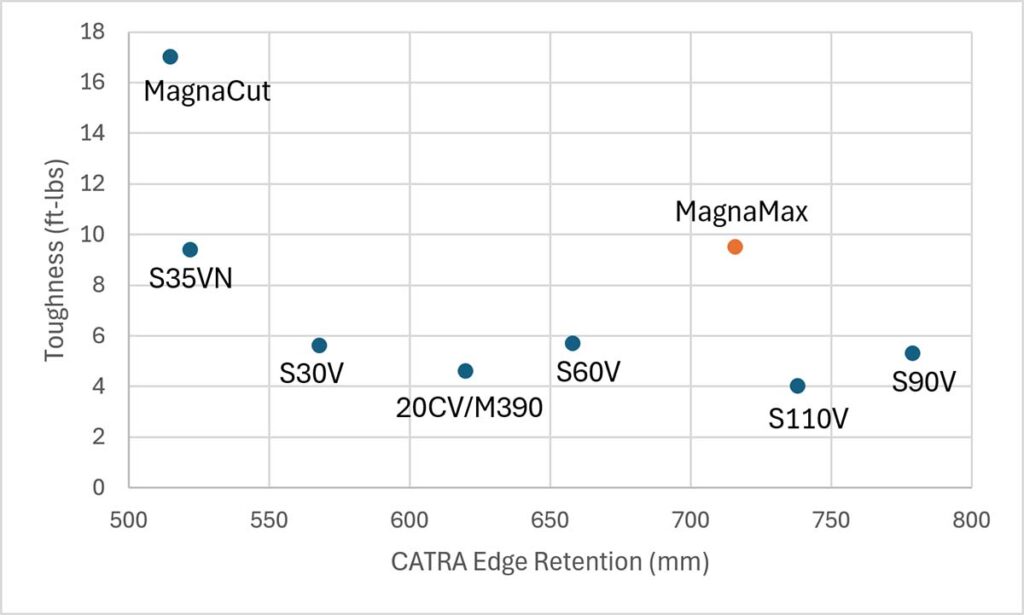
MagnaMax shares the same high corrosion resistance and good hardness potential as MagnaCut, but has higher wear resistance at the cost of some toughness. Because MagnaMax shares a similar microstructure to non-stainless steels, its toughness level for that high wear resistance is excellent.

The “sweet spot” for higher-wear-resistance products seems to be in the family of non-stainless alloys such as CPM 10V, Vanadis 8 and K390. In particular, K390 has been building in popularity through Spyderco knives in recent years for its excellent combination of properties. I had actually proposed to Crucible and Niagara way back in 2019 that, after we were successful with MagnaCut, I had another idea I was calling stainless 10V at the time.

This led to a new product called MagnaMax, a higher-wear-resistance steel in the same family as MagnaCut. It shares the same high corrosion resistance and good hardness potential as MagnaCut, but has higher wear resistance at the cost of some toughness. Because it shares a similar microstructure to non-stainless steels, its toughness level for that high wear resistance is excellent.

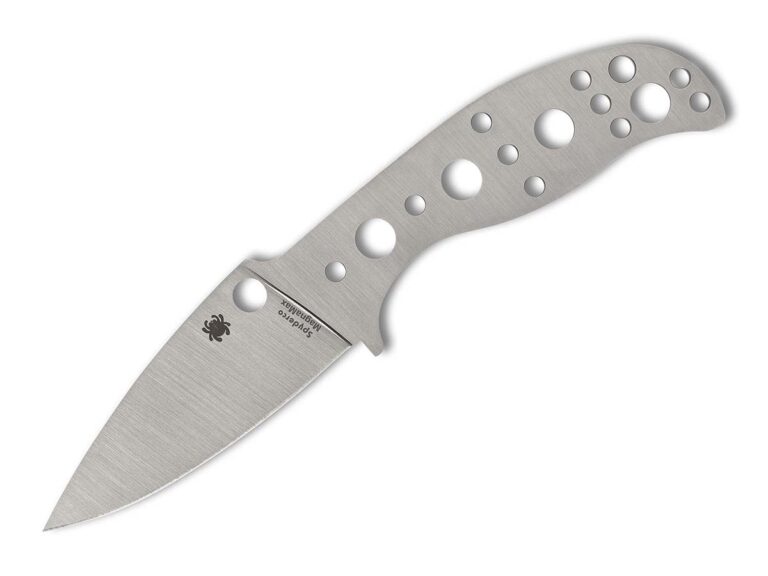
Two of the highest-toughness stainless powder-metallurgy steels before MagnaCut were CPM S35VN and CPM 154. MagnaMax matches the toughness of those grades while being much more wear-resistant. In recent years, one of the more popular folding knife steels has been M390, and MagnaMax has over twice the toughness and substantially higher slicing edge retention. Spyderco used the second prototype heat of MagnaMax in a series of its Mule series knives intended for enthusiasts to try out different steels. A Spyderco Forum member known as vivi said he cut 325 gallons worth of cardboard strips with one of these knives. He reported, “Even without adding the numbers up, I can say this steel has the best edge retention of any steel I’ve tried.”

The author (left) and his father, BLADE Magazine Cutlery Hall-of-Fame® member Devin “Hoss” Thomas.

The development of MagnaMax was not without its issues, however. The first two test heats of the steel were made by Crucible, a longstanding U.S.-based steel company that unfortunately went out of business in 2025. Crucible is the company behind many of the industry’s leading knife steels like 154CM, S30V, S35VN and 3V. Crucible is the company that invented powder metallurgy itself, a significant innovation providing the excellent properties of all the “CPM” (Crucible Particle Metallurgy) grades. Crucible went under basically right while it was making the second test heat of MagnaMax. A couple of slabs were even recovered from a pile of scrap after the company was dismantled so my team could test it. We made the first test heat of MagnaMax back in March 2023, and we are just now approaching the product’s wide release.

Niagara Specialty Metals (NSM), the company that hot rolls, anneals and distributes the majority of the leading steel grades, has played a key role in keeping these steels alive. Crucible relied on NSM for hot rolling the high-end, complex grades, as it is the only facility in the United States capable of processing them.

Niagara had already assumed an active role in the knife industry many years before, taking over the distribution of blade steels over a decade ago after Crucible’s first bankruptcy in 2009. It pushed for new grades like CPM S45VN, and without NSM, I’m not sure MagnaCut would ever have been made. Niagara is working with other suppliers of powder-metallurgy steel, including Carpenter and Erasteel, to ensure these grades remain available. My team has been working closely with these partners on the development of MagnaMax, but that also means we almost had to start over after Crucible’s unfortunate demise. The good news is I have been testing MagnaMax made by Erasteel, and the properties look excellent, at least as good as the Crucible-made material. And it’s actually looking a little better.

Pop’s ProCut Steel

Perhaps sometimes I get carried away working on new knife steels that push the boundaries for wear resistance. Some knifemakers are looking for simpler grades that are easy to forge, grind and finish.

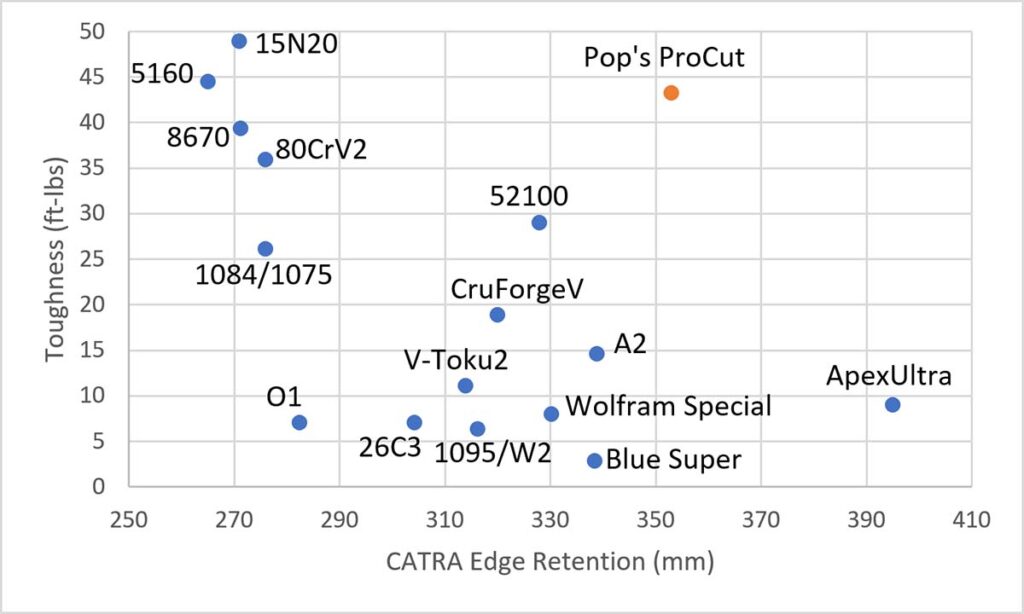
Pop’s ProCut’s toughness matched that of steels like 8670 and 5160, known for their excellent toughness. The edge retention was better than the majority of forgeable grades outside of ApexUltra, a high-performance forging grade.

Joey Berry of Pop’s Knife Supply contacted me in March 2024 asking for an improved version of Pop’s most popular grade, 80CrV2, which is known for being very easy to work, high in toughness and low in cost. I told Joey I would need to think about it because I had no idea off the top of my head what version of 80CrV2 would fill the niche of bladesmiths who want something inexpensive and easy to work. However, I have always enjoyed working with Pop’s Knife Supply, so I gave some serious thought to what kind of steel would be ideal for Joey’s request.

Pop’s is growing rapidly and has been a big supporter of mine, selling copies of my books—Knife Engineering and The Story of Knife Steel. It has been expanding its steel offerings and its steel education base to better serve customers, and I knew a steel along these lines would be a good fit for it. One of the trade-offs with knife steel design is when you add some elements like vanadium in significant amounts, things like forgeability and finishability go down. How could I make something new and exciting without pushing so much it becomes difficult for knifemakers to work with?

I thought about how high-nickel steels like 15N20, L6 and 8670 are known for their excellent toughness—at the top of my charts—but also have very limited wear resistance. I also knew some relatively rare steels like Blue #1, V-Toku2 and Wolfram Special have small additions of tungsten and vanadium for wear resistance. In grades with higher amounts of those elements, I start to see complaints from makers about the difficulty of working with them, though they seem to be at a place where they hit the right balance before forging and hand sanding become issues. These tungsten-vanadium steels are relatively challenging to find, often expensive when you do, and their toughness is much lower than the high nickel grades. As a result, the idea was to combine the high nickel approach for toughness with the controlled additions of tungsten and vanadium for wear resistance.

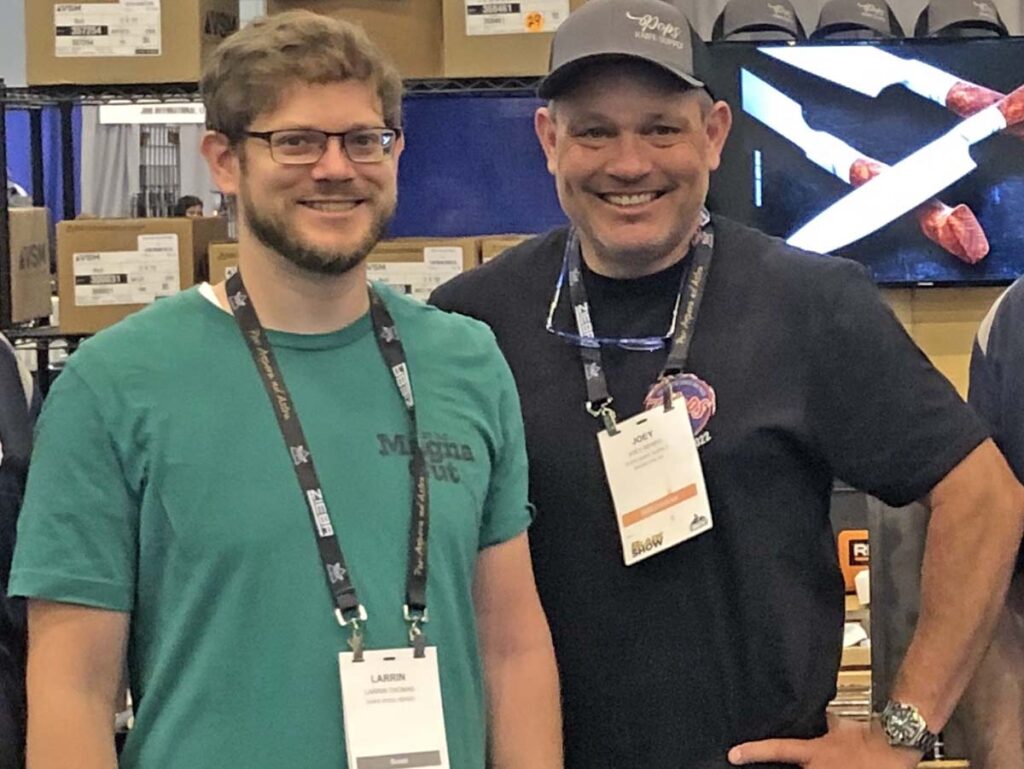
The author (left) and Joey Berry of Pop’s Knife Supply.

Another major factor for this development was the ease of heat treating. Often, steels like 1084 are recommended to novice makers for heat treating in a forge because it is dead simple to harden—just heat it to nonmagnetic and dunk it in oil. However, these grades are also very easy to overheat; they come out hard, but the toughness is greatly reduced. Only a few seconds in a forge past nonmagnetic can lead to a reduction in toughness.

On the flip side are grades like 80CrV2 that have chromium and vanadium additions to limit grain growth, so overheating isn’t as much of an issue. But the chromium also means you must heat past nonmagnetic and hold it there to ensure the carbides dissolve. The chromium slows everything down. However, I thought if we kept the chromium content very low the new steel could still be quenched from nonmagnetic and achieve full hardness, while the tungsten and vanadium additions would create tiny carbides that “pin” the grain boundaries so overheating and grain growth are not issues. This would make the easiest-to-heat-treat knife steel ever. Just heat it past nonmagnetic and quench it, and you will get high hardness and toughness every time.

My team and I got a steel company to agree to try the composition I proposed and waited (im)patiently for the steel to arrive. This was a major investment for Pop’s Knife Supply, and there was no guarantee the new steel would work just because it sounded good on paper. Fortunately, however, when we tested the steel, its toughness matched steels like 8670 and 5160, known for their excellent toughness. The edge retention was better than the majority of forgeable grades outside of ApexUltra, a high-performance forging grade I developed with makers Marco Guldimann and Tobias Hangler. And in testing the heat-treating range, we found it could be quenched anywhere from 1400°F up to 1750°F—over 300°F! This met our target of making a steel that is easy to heat treat.

Reports from makers have been very positive for Pop’s ProCut. They have praised the ease of working as well as the tested performance. Dawson Knives related: “We found it to be an excellent steel that 1) Offers a razor-sharp edge on par or better than other modern steels; 2) Holds that edge cut after cut; 3) Displays excellent lateral strength (it flexed close to 20 degrees in either direction and returned to true); and 4) Extreme impact resistance (edge resisted chipping, cracking or rolling when driven into a piece of steel Unistrut with a sledge hammer). We are able to get our edge hardness to Rockwell C of 62-63 and still retain superb flexibility.”

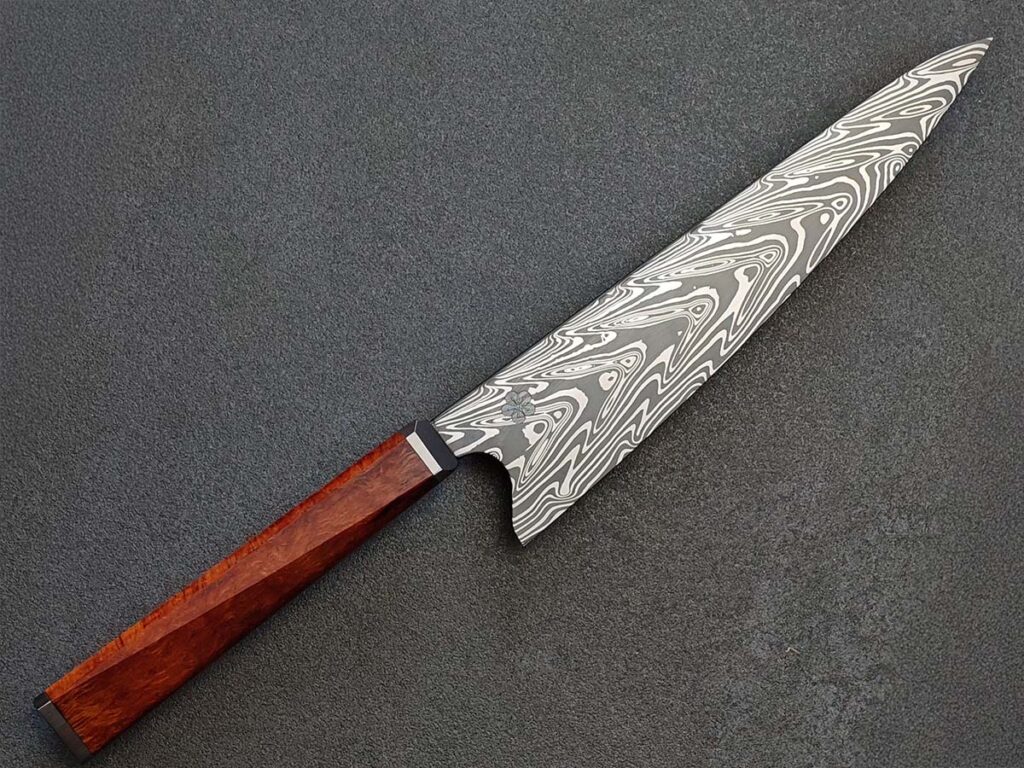
Kurt Glatt forged Pop’s ProCut and ApexUltra steels for the damascus blade of his chef’s knife.

Another exciting aspect of ProCut is the high nickel content (2 percent like 15N20) allows it to be used in pattern-welded damascus as a “bright” layer. This gives a new, higher-edge retention steel for use in damascus. As noted, previous high nickel grades have very low wear resistance. It can even be used in combination with other high-wear-resistance grades to make superior edge-retention damascus. I have seen a couple of knives using both ProCut and ApexUltra for some excellent-looking and performing damascus.

More To Come?

I’m constantly working on new ideas, though it’s hard to predict which projects will pan out or when they’ll be released. It’s been incredibly rewarding to see the steels I’ve developed used by top knifemakers and major knife companies, and to hear from end users who genuinely love them. When my dad, BLADE Magazine Cutlery Hall-of-Fame® member Devin “Hoss” Thomas, took me to my first knife show as a teenager, I never would have thought I would be working on such cool stuff.

More On Knife Steel:

Knifemakers And Their Tools

0

Knifemakers From Around The World Share What Equipment They Can’t Live Without And How It Helps In Creating Their Knives.

There are high-quality knifemakers on every continent. We chatted with some of the world’s best makers about what equipment and tools are must-haves for them in their shop. 

Bertie Rietveld

Bertie’s Legacy Roman pugio in Dragonskin damascus with a Stanhope lens just below the guard and lapis lazuli cylinders with titanium spacers in-between is spectacular even by his high standards. Overall length: 16 inches. (SharpByCoop image)

One of the world’s leading makers of art knives, South Africa’s Bertie Rietveld is known for magnificent custom daggers and fixed blades, many in his Dragonskin damascus and with a Stanhope lens at the ricasso, a peek into which reveals whatever image Bertie likes to put there—usually the Stanhope logo.

Among his knifemaking equipment that proves invaluable to building his award-winning knives are his Rosa Italian precision drill presses. 

“I have three of them,” he wrote, “each one set up with a different-diameter drill bit so I don’t have to change bits. The speeds are set to match the ideal speed of each drill bit in the chuck of each machine. They are super accurate and an absolute pleasure to use when drilling small holes. Each one has a light that automatically comes on when you start the drill. They’re probably 30 years old but I have rebuilt them to their former glory.”

Next on Bertie’s list of top knifemaking machines is his Schaublin 102 plain lathe. 

“It was manufactured in 1961, which makes it a year older than me!” he grinned. “I have a full set of collets and chucks for it and use it a lot to turn small pins and pivots for my folders. It’s one of those machines built in the golden area of mechanical excellence: the 1960s. I love working on it because it’s very accurate and just a solid, well-built machine.”

Third among his most valuable knifemaking machines is his Cutlermatic belt grinder, which he built about 20 years ago when he ran Batavia Engineering. 

“We built some 300 of these grinders for knifemakers at the time,” he recalled. “This machine has a whole myriad of contact wheels, from 2 inch to 20 inch, and is fitted with an inverter speed control. I use it to grind all my knives and also for hundreds of other grinding jobs. It’s probably the most used machine in my shop. It has a foot pedal to change belts and also some really bright LED lights on stalks so I can see where I’m grinding.”

The fourth machine is “Shaya,” Bertie’s “famous” 500-pound Massey power hammer. It was built in 1941 and he completely rebuilt it in 2000, a process that took eight years. 

“I make all my damascus on this hammer, Dragonskin, Nebula, and Fracture, as well as other laminar damascus. It is a gentle giant but packs a mean punch when at full speed. Hardly a week goes by when I don’t have two or three forging sessions.”

Murray Sterling 

Murray makes nothing but folders, including slip joints, linerlocks, and lockbacks. Among the latter is this fileworked and engraved straight-edge model in mother-of-pearl.

Murray Sterling turned 93 the first day of Spring and still makes knives like he’s 39. What are the most important pieces of knifemaking equipment for the self-described “old-school machinist” on the low side of 100 who’s been making knives for over three decades?

First are his four 2×72 belt grinders. He made three of them, including one he built 25 years ago that he uses 90 percent of the time. 

“I hollow grind and profile all my folders and finish all my folders with it,” he wrote. “The only other grinder I bought new was a square wheel in 1989. I only use it for 45-degree scales.”

Next on Murray’s list is his Taft Pierce surface grinder. “This is probably the most important machine in the shop for making folders, and that’s all I make now,” he wrote. 

The machine is over 50 years old and Murray bought it 20 years ago when it came available from a company his son worked for that was in the process of upgrading its machinery.

“In making folding knives, everything has to be flat,” Murray observed. “This machine is one of the best ways to achieve that. It has upgraded the quality of my folders by 100 percent. It also has a 2×72 belt attachment and, with a 60-grit belt, you can remove a lot of material fairly fast.”

Murray has four disc grinders, including two side-by-side models with 9-inch and 12-inch discs, the former with a 100-grit abrasive and the latter with a 320-grit one. Murray made the tables for the grinders 20 years ago. The motor for the 12-inch grinder is the original one from his square wheel grinder, the latter which he reoutfitted with a DC motor a couple of years after he bought it. The grinder on the fixed 45-degree table he uses for knife parts that need to be made square, such as backsprings for slip joints and lockbars.

The handiest machine in Murray’s shop is his Burgmaster drill press. He bought it in 1967 and uses it to drill 90 percent of the holes in his knives. It has six spindles, each of which runs at a different RPM. 

“I can set it up with a tap drill, clearance drill, and counter bore for .080-inch screws,” he wrote. “It makes things quick and easy. I would hate to do without any of these machines. I also have a lathe and make my own bushings and pivot pins.”

Brian Tomberlin

An example of Brion’s knives is his Nagabowie—a Japanese-style blade with hamon complemented by a bowie handle.

ABS master smith Brion Tomberlin makes a lot of hidden-tang knives in his shop in Norman, Oklahoma, and a set of handle broaches he got from fellow ABS master smith John Perry are a must-have for that style of knife construction.

“They do a great job of opening up the slot for the tang in handle blocks,” Brion observed. “I bought the first two from John way back when there was a Spirit of Steel knife show in Mesquite, Texas, probably his first or second batch of them. I still use them all the time. They’re very finely crafted tools.

“Another must-have tool for me and most makers is a set of calipers. In order to get things fitted correctly, such as guards and getting the measurements on things like the depth of clips even on both sides, you need to have accurate measurements. A good knifemaker thinks in thousandths and you need to be able to accurately measure them. So, I have calipers everywhere. I’ve got to have them.”

Brion uses a Foredom tool on every knife that leaves his shop. 

“It’s a super versatile tool,” he noted. “I’m sure everyone has used Dremel tools, especially the variable-speed models. But the Dremel tools wear out and I hear all the time that people keep buying them every two or so years because the tools stop working. So, save money and get the standard rotary-flex-shaft tool used in the jewelry trades. Just get a Foredom tool and you will not regret it.

“Mine is variable speed and reversible and that is what I suggest. I bought it from an old name in knifemaking supplies, Mick Koval [of Koval Supply], over twenty years ago. It’s still going strong. There is so much you can do with them and they have so many attachments. Rio Grande and Gesswein jewelry supply are knifemakers’ friends. I use this tool for guards, contouring buttcaps to match stag, polishing things, carving, etc. It has so many uses.”

Another tool Brion uses on every knife he makes is his trusty file guide. 

“The shoulder filing guide or just plain file guide should be standard in every maker’s shop,” he advised. “My main one is a carbide-faced model from Riverside Machine in DeQueen, Arkansas.

“You need to get the shoulders on a blade flat in order to get the guard to fit up correctly,” Brion wrote. A file guide will do that. “Also, with the carbide faces you can use the guide with grinding belts to get the plunges even. I bought this years ago when Uncle Al [Alton Lawrence of Riverside Machine] first started making them. It has served me well. You don’t have to have the carbide faces as there are hardened steel file guides too, but pay the extra money and get the carbide—you will not regret it.”

Rounding out Brion’s top knifemaking tools are his machinist squares.

“You have to be able to lay out lines and have them be true, everything from laying out guard slots to making sure things are 90 degrees, such as platens on grinders,” he advised. That’s where the machinist squares come into play. “You have to have them and they aren’t expensive. Making sure your layout lines are correct will help you make better knives,” Brion concluded. “Every knife shop should have them.”

Read More

Cool Customs: Les George’s M3 Folder

0

Les George Leans On His Decade Of Service In The Marines To Guide His Knifemaking Philosophy

A veteran of the United States Marine Corps and the Iraq War, knifemaker Les George loves vintage military fixed blades and collects, designs, and reproduces them on a regular basis. 

About four years ago, Kershaw asked him to design a folding version of one of his military favorites.

“It’s hard to translate from fixed blades to folders,” he noted but he went ahead and designed one based on the M3 trench knife. Kershaw made a prototype from the design—sold today as the XCOM—and sent the knife to Les. Today, the XCOM sells for $53.99 and is well reviewed on the Kershaw site.

He carried it for a while and was cutting with the folder one day when he laid it down and began admiring it. “I saw the prototype lying there and it was way cooler and much more utilitarian than I thought it would be because of the military vibe,” he said. 

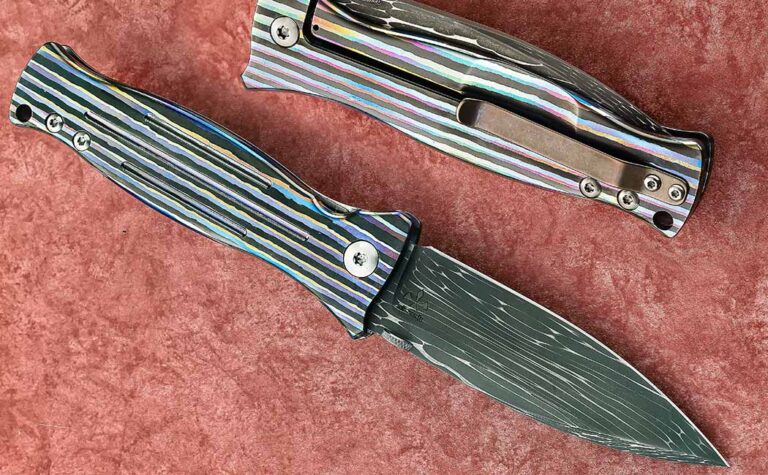
He dropped everything he was doing and made the custom M3 Folder with a blade of a  stainless damascus forged especially for the knife by Chad Nichols, and a handle of Zircuti, a laminate of titanium and zirconium. The result is one stunning folding dagger.

Who Is Les George

Les George

Les George first started making knives in 1992. Many of his pieces are inspired by his 10 years of service in the Marines where he, among other jobs, worked as an explosive ordnance disposal technician. Overseeing hundreds of EOD missions has given up a unique view of how tools should be made that carries over into his knifemaking. George makes both fixed blades and folders.

M3 Folder Knife Specs

Maker: Les George
Blade Length: 3.9 inches
Blade Material: Chad Nichols stainless damascus
Handle: Zircuti
Pocket Clip: Titanium
Lock: Framelock
Closed Length: 4-⅝ inches 
Maker’s Price For A Similar Knife: $2,400

Read More

Shop Dump: Tony Cetani Of Hourglass Knives

0

Tony Cetani has left his mark in the kitchen knife niche grinding it out at Hourglass Knives.

When asked why he makes knives, Anthony “Tony” Cetani of Hourglass Knives grinned and states, “It’s cheaper to make them than buy them.” It was while recovering from knee surgery that he got the idea to make one. “After weeks of reading forums and watching YouTube videos I bought a single-burner forge, a 4×36-inch belt sander, a set of files, a hacksaw and a bar of 1084, and in March 2017 made my first knife,” he recalls.

Tony Cetani
Tony Cetani specializes in such kitchen knives as his Honesuki. It features a 9-inch blade of Riptide cu-mai copper damascus from Baker Forge & Tool and an amboyna burl handle with cu-mai pins and liners. (Baker Forge & Tool knife image)

“It took me a few years to figure out what my niche in the knife world was going to be,” Cetani continues. “With so many amazing makers and designs I wanted to try and set myself apart. In late 2020 I made my first kitchen knife and fell in love. I started with some traditional Japanese styles and put my own spin on them. I love a knife where everything flows together and there are no straight lines in the profile. Though I love making all types of knives, kitchen knives have become a huge part of what sets Hourglass Knives apart.”

In seven short years, Tony has made his mark in the custom knife realm.

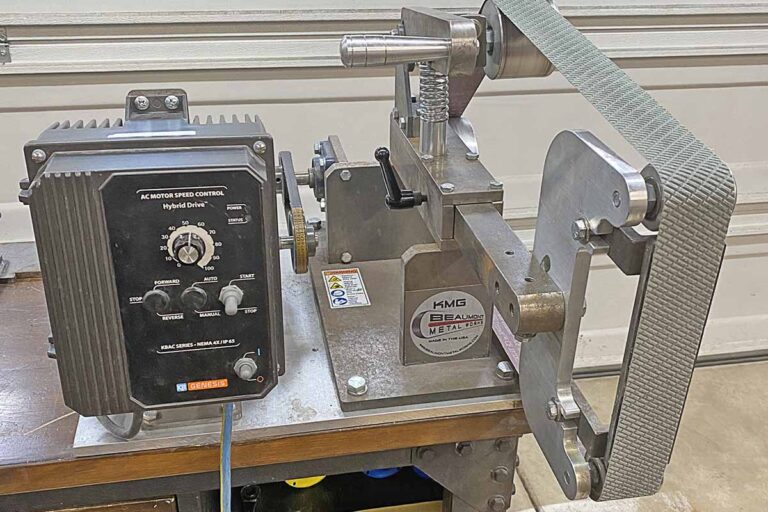
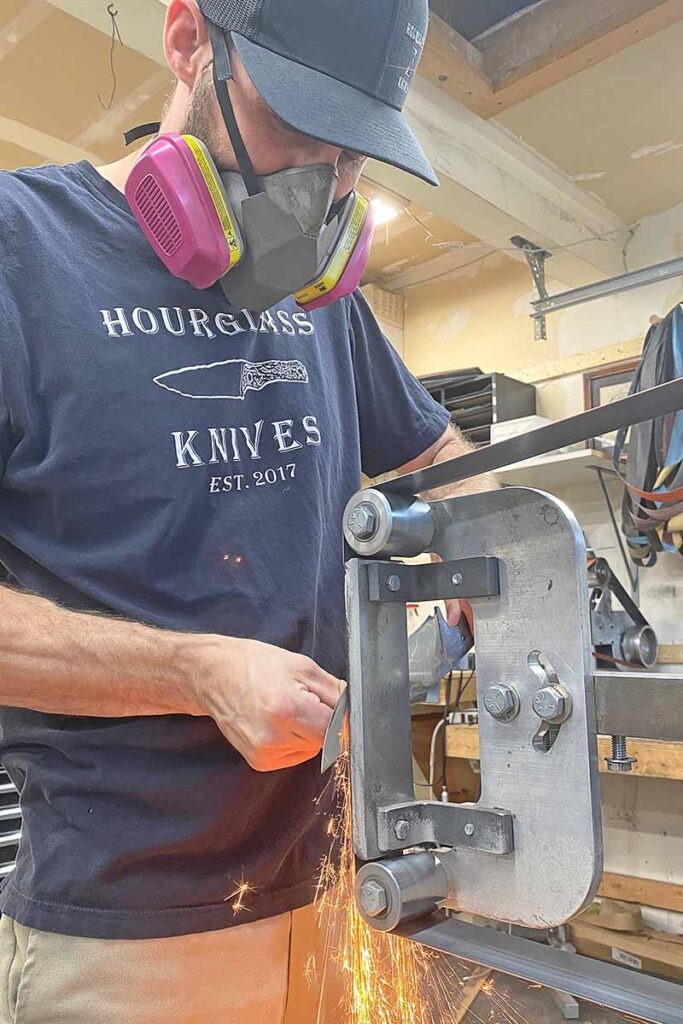
“My grinders are my most-used machines in the shop,” he offers. “Whether I’m grinding bevels, contouring handles, getting in tight corners with my small wheels, sharpening a pencil, or chasing scratches on a finished blade that I end up ruining, I use my KMG grinders for everything. Both of these machines have been invaluable to me. Having 1.5-inch tooling-arm slots gives me a ton of different options for attachments and fixtures. Switching belts is quick and easy with no tracking issues. Beaumont makes a tough and very reliable machine.”

Tony Cetani grinding
From grinding bevels to chasing scratches on a finished blade or what have you, Tony uses his KMG grinders for most everything. This is his classic variable speed model. (In his rush to have the picture taken of him grinding for the story, Tony forgot to don his safety glasses.)

Cetani lauds his Foredom SR flexible shaft rotary tool. “There’s a few rotary tools out there I’ve tried but the Foredom has been my favorite. It has tons of different attachments, bits, accessories and the hand pieces can fit most rotary tool bits,” he explains. “The Foredom has given me the ability to do fine detail work on plunge lines, spines, tangs and the like that no other tool can. This rotary tool has helped my finish work immensely.”

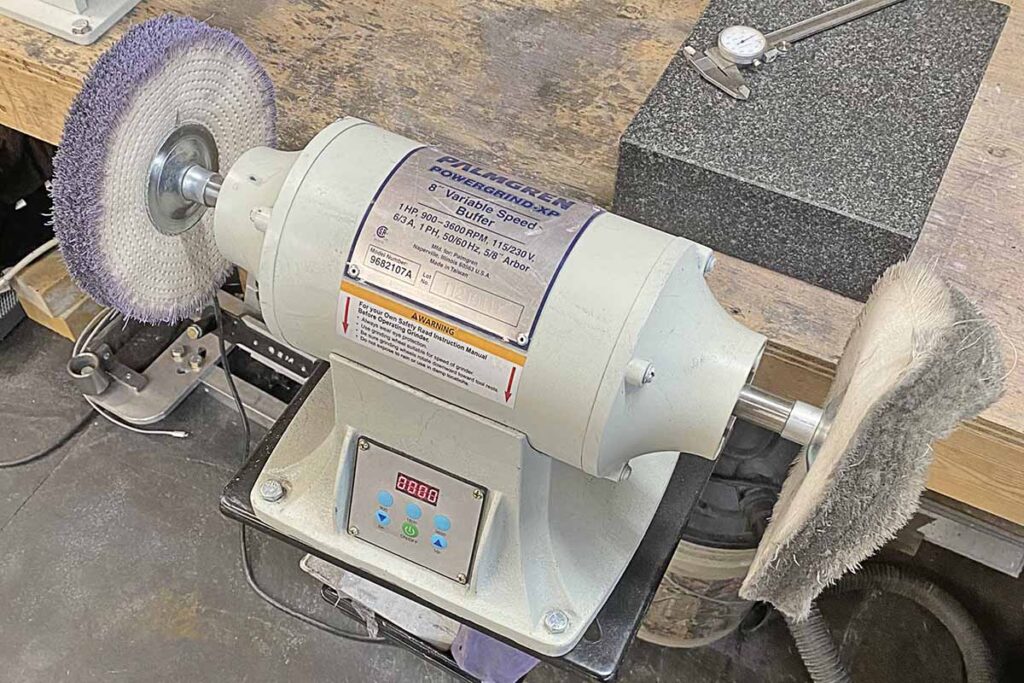
For his exquisite knife grips, Tony shares his key to success. “The Palmgren Powergrind-XP 8-inch, 1-horsepower, variable-speed buffer has changed my handle game. For years I ran a 3600-rpm buffer and was really happy with my results,” he reports. “I only use buffing compound when finishing my handles, and the change I saw after using the Palmgren variable speed buffer was phenomenal. Starting at 3600 and being able to drop it down slowly to 900 rpm really helps bring the most out of the wood. Being able to adjust speeds when buffing oxides off or polishing steels has been huge as well. The variable speed buffer is the one tool I wish I would have bought early on in knifemaking.”

Palmgren Powergrind-XP 8-inch, 1-horsepower, variable-speed buffer
The Palmgren Powergrind-XP 8-inch, 1-horsepower, variable-speed buffer has changed Cetani’s handle game. “I only use buffing compound when finishing my handles,” he notes, “and the change I saw after using the Palmgren variable speed buffer was phenomenal.”

For sanding Cetani uses a Edward Braun hand-sanding fixture. “I always disliked hand sanding because of the amount of times I stabbed and/or cut myself. When I first saw Edward Braun had a few hand-sanding fixtures for sale,” he recalls, “I knew I needed one. The fixture makes it fast and easy to secure your knife and start hand sanding. Adjusting the clamp is quick and allows for multiple holds for the specific knife you are working on. Since buying one I still don’t like hand sanding but I haven’t hurt myself!”

Check Out More Shop Dumps:

Dietmar Pohl Celebrates 30 Years In The Knife Industry

0

From passion to icon: celebrating 30 years of Dietmar Pohl’s knife mastery.

Dietmar Pohl is a name well-known in knife circles. More so than his groundbreaking designs, the founder of Pohl Force knives might also be known for his professionalism. On Nov. 18, the designer celebrated 30 years in the industry. 

With over 100 knife designs, three books translated into multiple languages, and a reputation for innovation, Pohl has established himself as a leading figure in the world of blades.  

While Pohl might be best known for his knives, such as the Magnum Colection Knife and the Böker Speedlock switchblade, he has held many roles in the industry.  

Dietmar Pohl talking with military man

Pohl started his career as marketing director, design and production manager in Solingen, Germany.  Combining contemporary design with cutting-edge materials, he quickly made his mark by creating knives that balanced performance and aesthetics.  

However, his interest in edged tools started well before then. His imagination was captured at 11 years old when his older brother—10 years his senior—returned from the Bundeswehr paratroopers and showed him his paratrooper knife. 

While Pohl has no military or law enforcement background, he’s built his expertise through hands-on training and close collaboration with professionals in elite units like Germany’s GSG9, SEK, and U.S. Marine Force Recon.  

Practical experiences, such as SWAT training in Virginia and knife combat sessions with Marine Force Recon at Camp Pendleton, have deepened his understanding of tactical requirements.  

Dietmar Pohl with sylvester stallone

Pohl’s influence extends beyond design. His books are respected resources for enthusiasts, and his work is frequently featured in trade publications. Among his standout achievements is the MK9 Heartstopper, created for Sylvester Stallone’s final Rambo movie, Last Blood. Dubbed The Knife Guy by the film crew, this project solidified his global reputation.  

Read Knife Reviews:

Dagger Design: Point For Perfecting Blade Performance

0

In this look at dagger design, we move beyond history and symbolism to the structural realities of geometry and construction. From the curve of the edge to the presence—or deliberate absence—of a fuller, each feature serves the dagger’s singular purpose: to deliver a clean, decisive thrust and to endure long enough to do so again.

Dagger Profile & Point Geometry

A single, shallow fuller lightens the blade without compromising stiffness—proof that subtle geometry changes transform handling. Kelly Vermeer-Vella and Bruce Bump do the honors here.

A dagger’s profile is its outline when viewed from the flat side; its point geometry is the shape of its cross-section near the tip. Mastery in dagger design comes when the two elements merge into a seamless conduit for force, guiding energy from the wielder’s hand into the target.

One guiding principle is to avoid parallel edges along the portion of the blade intended for penetration. On utility knives, parallel edges are excellent for long, slicing cuts, but in a dagger they can create excessive suction and drag during withdrawal. They also represent a missed opportunity to enlarge the wound. A blade with gently convex curves tends to create a wound tract that widens as it penetrates, then releases more easily on the way out. The effect is twofold: the strike inflicts substantial damage on entry, and the blade slips back out with minimal resistance. In a fight where fractions of a second matter, ease of withdrawal could determine whether the wielder stays alive.

The balance point rests just forward of the guard, lending a stab-ready steadiness that rewards control. The author made this balanced dagger.

Cross-sectional design reinforces how a dagger behaves in the hand. The Roman pugio often carried a pronounced central ridge that gave it a triangular cross-section, lending the blade excellent stiffness. Later European daggers frequently adopted a diamond-shaped section that struck a balance between rigidity and lighter mass. In practice, triangular sections feel solid and grounded, with the ridge channeling force straight to the point. Diamond sections distribute the force across four bevels, trimming weight just enough to make the blade a touch quicker, though sometimes at the cost of absolute stiffness.

Experimental archaeology adds nuance to this comparison. Triangular sections resist torsional stress more effectively, while diamond sections tend to slip more cleanly into soft targets. Renaissance arms rooms often contained both forms, chosen with intent: defense versus assassination, battlefield versus court intrigue.

Dagger Ergonomics & Balance

Careful placement of a ricasso notch ensures consistent hand alignment, turning technique into muscle memory. Note the refined handle and ricasso detail on Cutlery Hall-of-Famer Billy Mace Imel’s piece.

Even the finest blade geometry falters without a grip that enables control. Here, ergonomics and balance determine the dagger’s effectiveness.

Early medieval daggers often featured grips as short as 3-to-4 inches. This compact length forced the hand into a firm grasp close to the guard, a practical safety measure when blood, rain or sweat made surfaces treacherous. Fourteenth-century Germanic examples show how a modest flared guard and compact handle could prevent slippage while preserving agility.

Balance points were just as carefully managed. In many 16th-century Italian stilettos, the center of gravity sits just ahead of the guard, giving the weapon a stab-ready steadiness. The narrow, edgeless blade minimizes rotational drag. Highland dirks, by contrast, often used teardrop pommels to counterweight the blade, shifting balance closer to the hand and allowing forceful thrusts whether on horseback or on foot.

A weighted pommel counters blade weight, shifting balance back toward the hand and straightening the thrust on a Renaissance-influenced dagger by the author.

Makers sometimes introduced subtle refinements. A ricasso notch carved two or three centimeters from the guard ensured that the user’s thumb returned to the same anchor point every time. A shallow fuller reduced forward weight, so that an 8-inch stiletto might balance almost identically to a heavier 10-inch combat dagger. These small calibrations transformed the blade from a piece of steel into an extension of muscle and bone.

Dagger Strength Features

There are no gimmicks on Joe Syverson’s minimalist dagger with clean taper—just clear profile, rigid spine and reliable balance. The design reflects simplicity that serves performance.

The dagger’s tip, however slender, must withstand resistance from mail, bone or even poorly placed strikes. European smiths between the 14th and 17th centuries developed several overlapping solutions that remain relevant today. Fuller placement was one of the most important: a carefully cut longitudinal groove reduced weight while preserving stiffness, as seen in 16th-century Venetian stilettos where the fuller often ran from just below the guard almost to the point.

Ricasso thickness was another safeguard. A blade too thin at the base was liable to flex and buckle under pressure, and even worse, a weak ricasso translated into a fragile point once the final bevels were ground. By keeping this area stout, smiths not only gave the blade strength but also provided a tactile zone of unsharpened steel where the thumb or index finger could anchor securely.

Even with an ornate sculpted handle and dramatic damascus, the blade remains an unbroken taper from guard to tip on Henning Wilkinson’s art dagger. Note the lavish surface detail.

Hardening practices added a third layer of reliability. Most European daggers were quenched and tempered uniformly to a Rockwell hardness in the neighborhood of 48-to-52 HRC. A few Italian masters appear to have experimented with clay tempering to leave the ricasso slightly softer, but this might also have been accidental. In any case, the visible temper lines familiar in Japanese blades were rare. What mattered was consistency: a uniform temper that balanced edge retention with toughness made it so the dagger could survive repeated thrusts against armor and bone alike.

Avoid Feature Creep

Next-generation work in this forward-looking piece by Jean-Pierre Potvin proves the old lessons endure: blade geometry is still central even if the rest of the dagger is fantastical.

Through all the refinement, one lesson emerged repeatedly: every extra feature risked undermining the dagger’s true purpose. Serrations, pry tips and decorative piercings might look clever but each introduced problems. Serrations can snag on clothing and tear rather than pierce. Pry tips disrupt the straight thrusting line. Even ornate cut-outs, while attractive, create weak points that could split under stress.

Historical makers knew better. Even the most extravagant Renaissance daggers—with gilded hilts, inlaid gems or etched scrollwork—maintained an unbroken distal taper from guard to tip. Embellishment was typically reserved for the surfaces, not the structure. However adorned, the dagger kept faith with its defining role: the straight, unyielding line of the thrust.

Conclusion

Inventive cross-sections and flawless transitions demonstrate that modern makers can push design without breaking the rules. Elizabeth Loerchner captures the concept in the strong geometry of her experimental modern dagger.

From the Roman pugio to the Renaissance stiletto, the dagger’s identity rests not in ornament but in discipline: geometry over gimmicks, strength over flourish, function over feature creep. Clear profiles, rigid spines and balanced grips remain the hallmarks of a true dagger. These principles are as relevant to the modern craftsman as they were to the smiths of Venice, Florence or Solingen. A dagger’s promise, after all, is measured not by extravagance but by the sharp integrity of its point.

More On Daggers:

Custom Cleavers That Have Culinary Chops

Four custom makers push the boundaries of the tried-and-true cleaver.

An inclination toward the kitchen and a desire to design and deliver cutlery used on a regular basis has spurred a number of custom knifemakers to try their skill with the cleaver. It’s a staple in most kitchens and its uses are as varied as the food prepared there.

Robert Wayman of Middleburgh, New York, sees his cleavers as complementing years of food preparation. “I’ve done a lot of my own food processing, and I spent several years in commercial kitchens when I was younger,” he commented. “So, I’ve always had an affinity for culinary knives and especially cleavers. The cleaver is such an iconic blade. I love to make everything from heavy-duty butcher cleavers to medium-duty kitchen cleavers, Chinese cleavers and lighter-duty veggie cleavers for the kitchen.”

Robert’s featured cleaver is 14 inches in overall length with an 8-inch blade of pattern damascus go-mai five-layer steel. The core is a 100-layer random pattern damascus made of 1084 and 15N20 high-carbon steel and a layer of nickel and matching damascus cladding. The handle includes a damascus collar, stainless steel and G-10 spacers, crosscut carbon fiber, green malachite and blue coral accents, stabilized amboyna burl and a damascus butt cap with stainless mounting pins inset with blue coral framed with green malachite.

“I packed a lot into that one,” Wayman smiled. “As a maker, I’m all about sole authorship. I make all of my own high-carbon damascus steel in-house, and a cleaver provides a great opportunity to showcase that steel. One of my favorite things to forge is a large cleaver with an integral bolster.”

Wayman sees large blades, such as those associated with cleavers, as inherently challenging, while making a task-specific blade, such as a cleaver, adds another layer of complexity. Although they are labor-intensive and involve a lot of time in the shop, performance remains the key.

 “Overall weight needs to be taken into consideration, as well as how that weight is distributed for the style cleaver you are making,” Robert advised. “Ergonomics is an important consideration for any knife or tool, but especially for kitchen cutlery. Whether it’s in a professional or home kitchen, you’re making a handle that a chef or cook could use for hours of food prep on any given day. So, it must be comfortable.”

Edgy Ebony

Having served time in professional food service, practical utility is never far from David Jacobson’s mind. However, he isn’t afraid of adding some flourish to his creations, such as the gold-inlay signature near the spine of his mosaic damascus bladed and ebony scaled cleaver. (SharpByCoop image)

David Jacobson’s integral 13-inch cleaver with ebony handle scales sports an 8¼-inch mosaic damascus blade of 1085 and 15N20 steels and a gold inlay signature—his first such accent. He used brass bolt pins to finish the ebony scale attachment.

“I love cooking and making cool chef’s knives and kitchen tools,” Jacobson related from his Felton, California, shop. “Edge geometry for chopping and balance are challenges, and fullers are nice when slicing vegetables for food release. Cleavers are not only for the kitchen. They are great for large fish processing at the dock, chopping through bone and restaurant back-alley butchering. The wide blade shows off the many designs in the damascus steel, and I chose a traditional profile for this particular cleaver. I’ve always liked a black handle with big brass pins—old school.”

Cutting Mustard

Given the amount of steel and the need to pay attention to minutia is what Bill Tyc figures steers most makers away from cleavers. Tyc achieves an intricate pattern on his cleaver-chef’s knife set through a simple mustard patina, but applied with a straight edge for a pattern he calls “Lines of Insanity.” (SharpByCoop image)

The pairing in Bill Tyc’s featured ensemble is stunning in its presentation. “The cleaver as well as the chef’s knife are made of 52100 high carbon steel from the NJ Steel Baron,” he remarked. “The handles are stabilized spalted tamarind from Wood Dynamics fastened with brass Corby bolts. The pattern on the steel is a mustard patina done with a ruler edge, hence the name “Lines of Insanity” pattern. The cleaver is 11½ inches overall with a 6¼-inch blade. It’s 3 inches tall and ¾ inches at the heel. I felt the spalted lines of the tamarind wood would look perfect with the mustard patina.”

Tyc, who resides in Waterbury, Connecticut, remembers making kitchen knives that did something no other creations had generated. He got immediate feedback from users.

“In fact, the first ‘kitchen’ knife I sold was a cleaver at the Mystic Knife Show in Connecticut,” Bill remembered. “A gentleman circled the floor three times, every time touching a cleaver I had on the table. Last pass, he picks it up and just says, ‘I’ll take it.’ My wife and I look at each other with a thumbs up, and off he goes. Well, the following year, the gentleman comes into the show, right up to my table, and says, ‘Last year I bought a cleaver from you.’ The wife and I again look at each other because we most certainly remembered. He says, ‘I have so much fun using that cleaver every day!’ I reached across the table, shook his hand and said, ‘I’ve been waiting 20 years to hear that! I could pack up and go home, I feel so good.’”

According to Tyc, many custom knifemakers shy away from cleavers because they require a lot of work. At just about any knife show, only a relative few are seen for sale. But he adds cleavers’ utility far exceeds their supposed kitchen niche, pointing out they are handy for camping, survival exercise, yard work and bushcraft as well.

“The most important things are balance and weight,” Bill observed. “A knife used as often as a kitchen knife or cleaver has to feel good in the hand, not just initially, but long term. You may find yourself using your kitchen knives for many hours through the week. You want it to be comfortable, not a labor.”

Veggies Beware

One of the unique advantages of the cleaver, Dan Tomplins points out, is the large canvas it allows for the steel. In the case of his nakiri—vegetable cleaver—its 81/2-inch copper mai blade can’t help but catch the eye, particularly with the steel’s blacked-out finish enhancing the patina'd copper. Note too, the hybrid octagonal/western-style handle made from amboyna burl. (SharpByCoop image)
One of the unique advantages of the cleaver, Dan Tomplins points out, is the large canvas it allows for the steel. In the case of his nakiri—vegetable cleaver—its 81/2-inch copper mai blade can’t help but catch the eye, particularly with the steel’s blacked-out finish enhancing the patina’d copper. Note too, the hybrid octagonal/western-style handle made from amboyna burl. (SharpByCoop image)

In 2016, Dan Tompkins began making knives, and three years later, he started Evolution Cutlery in Highland, New York. His kitchen knife work began simply because he wanted to make cutlery used on a daily basis, and his cleaver immediately attracts attention.

“The big square profile is a great canvas to show forging skills, especially if using mosaic damascus. It allows a lot of room to see the details in the patterning,” said Dan. The subject steel is Baker Forge copper mai with a blacked-out finish and layers of patina’d copper in the nakiri, or veggie cleaver, design. The handle is Tompkins’ hybrid octagonal/western style made from amboyna burl, heirloom fit to a copper and G-10 bolster. The cleaver blade measures 8½ inches, and the overall length is 13 inches.

“One challenge in making cleavers is getting the edge geometry perfect for the intended purpose,” explained Dan. “There are many different types of cleavers, so the proper geometry is an important consideration. Heavy-duty blades require a heavy convex edge, while veggie cleavers are best with a laser-thin edge. When it comes to kitchen knife ergonomics, not only do you have to have a good feel in the handle’s shape and contour, but you also have to have proper balance to make the knife comfortable to use all day. While cleavers will almost always be slightly blade heavy in balance, they should still be balanced not far in front of the handle … Balance can make a light knife feel heavy or a heavy knife feel light. In my opinion, even a heavy knife with proper balance is far more comfortable to use than a light knife with improper balance.”

 Tompkins sees the cleaver in action in varied settings, not just the kitchen. Camp chores like chopping wood or preparing food outdoors can be handled easily with a cleaver made for such adventures, and he makes the cleaver to fit the anticipated tasks.

Versatility is readily apparent in these custom cleavers, and their functionality is in lockstep with good looks driven by their makers’ creativity.

Check Out More Cool Customs:

Advertisement

Must Read Articles

Read this before you make a knife

Knifemaking 101 – Read This Before You Make a Knife

  by Wayne Goddard My experience has taught me that there's nothing like digging in and getting started. I've often said the hardest part of the...
how to forge damascus steel

How to Forge Damascus

Advertisement
Advertisement