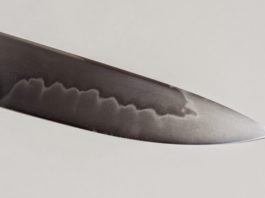
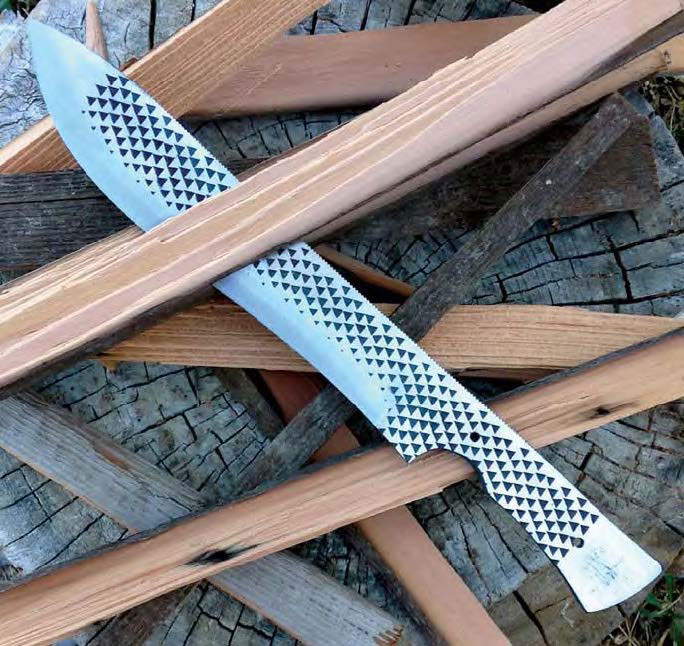
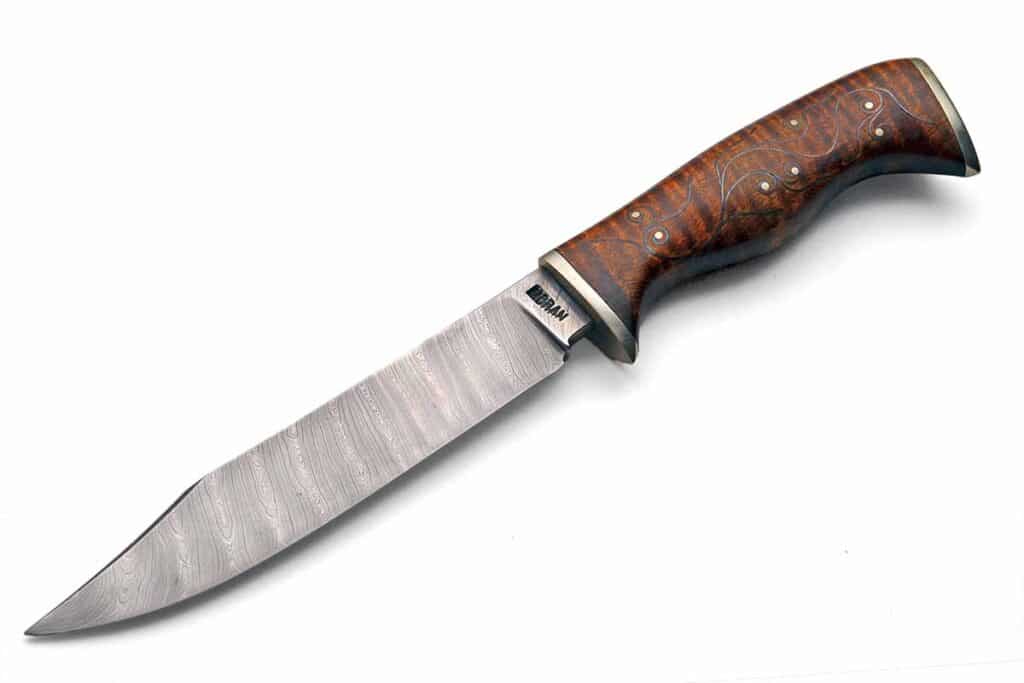
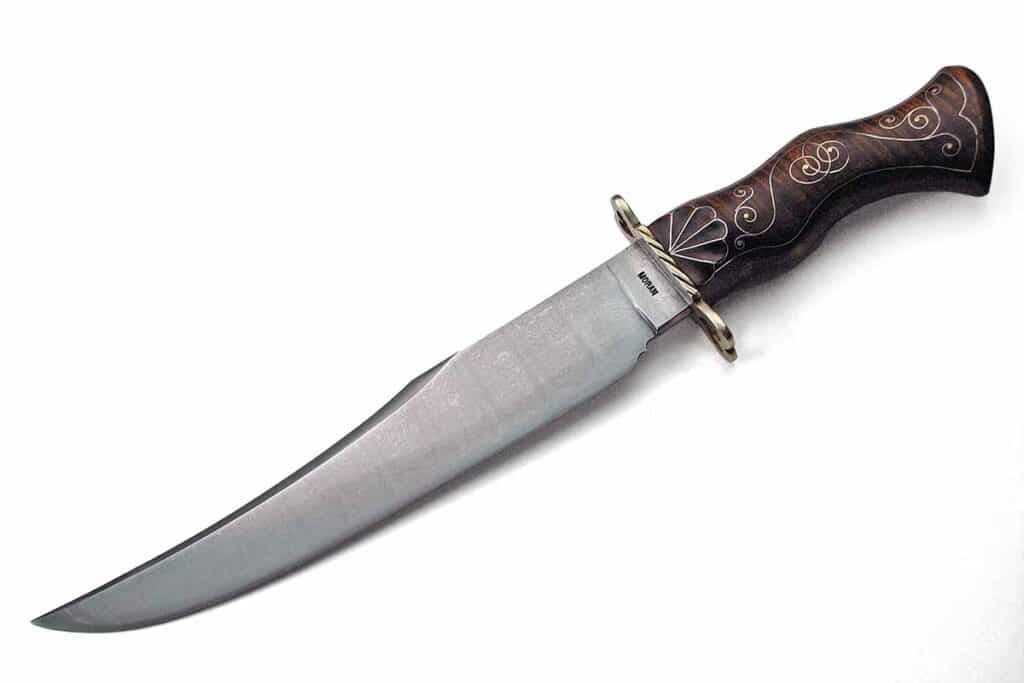
Knifemaking is the building of a knife, which includes the blade, handle and other accouterments. Blades are made by either removing metal from a steel blank via a grinder – known as stock removal – and the forging to shape of hot steel into a blade in the process known as bladesmithing. Other parts, including bolsters, guards, pommels, etc., are needed to complete the finished knife.
The father of modern sporting knives was busy making them a half century ago.
Editor’s Note: BLADE Magazine is celebrating more than 50 years of bringing the knife community sharp coverage of the knife world at large. Given a more comprehensive picture of where the industry comes from—thus, where it’s going—we’re running a series of vignettes on important articles marking milestones in the knife design, knife making and knifemakers from 50 years ago.
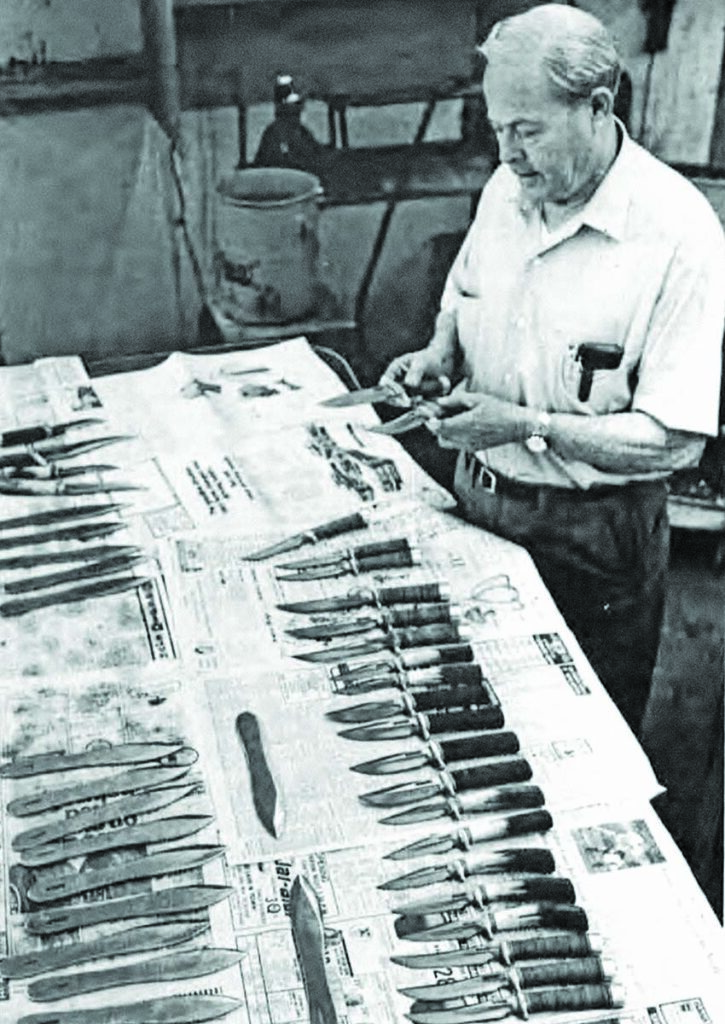
A pioneering writer and photographer, Sid Latham chronicled his visit to the Orlando, Florida, shop of Randall Made Knives in the May-June 1975 issue of The American Blade to detail how Bo Randall and his staff made knives.
As Latham noted, Bo believed in the Cutlery Hall-of-Famer William Scagel theory that every blade shape should have a purpose and be practical—and the Randall utility, hunting, combat and survival patterns reflected the Scagel approach. The most popular Randall knife in ’75 was the Model 3 hunter. It was a Model 3 that pilot Francis Gary Powers was carrying when his U-2 spy plane was famously shot down over Russia in 1960.
Bill Platts was closing out his career as Randall shop foreman.
Latham wrote of what Bo considered his proudest achievement of specially designing knives for the astronauts of the Project Mercury NASA space mission. The final design was worked out by Major Gordon Cooper, who took one along on his 22-orbit flight. The knife was subsequently offered as the Model 17.
Latham also covered most of the Randall staff, including shop foreman Bill Platts, who was in the process of retiring and being replaced by Pete Hamilton, to Bo’s son Gary and more. Bo Randall had already been making knives for 37 years at the time—and Randall Made Knives (randallknives.com) continues turning them out to this day.
Editor’s note: Beginning with this issue, “50 Years Ago in BLADE®” journeys back in time to recall what was happening in the early days of BLADE—formerly The American Blade—and the world of knives. This time: BLADE Magazine Cutlery Hall-of-Fame® member Bo Randall and Randall Made Knives.
Robin Askew moves on, but her father remains there for her.
The constant, the heart and soul of BLADE Magazine Cutlery Hall-of-Fame® member Bob Loveless, was wrapped up in custom knives. There was little time for anything else and there were only rare occasions that he travelled. Bob and his wife, Yoshi, made a few trips to Japan or to Hawaii, on a rare occasion to Europe, but most often with some business purpose involved as well.
And over time, Robin Askew came to appreciate and understand the singular purpose, laser-like focus and personal intensity that drove her father. He was capable of kindness but often brutally frank. He was willing to entertain young knifemakers, share information and then criticize or dismiss flaws with stark, unvarnished perspective. With patience that was sometimes fleeting, he did not suffer fools gladly.
But then, his personality was a tapestry, like all of us, an amalgam of inherited traits and life experience. His mother and father had sent him to live on a farm with grandparents at a young age. According to Robin, he lived and worked with the hired hands, not as a grandchild. At just 15 years old, he joined the Merchant Marine when his mother told the white lie that he was of age.
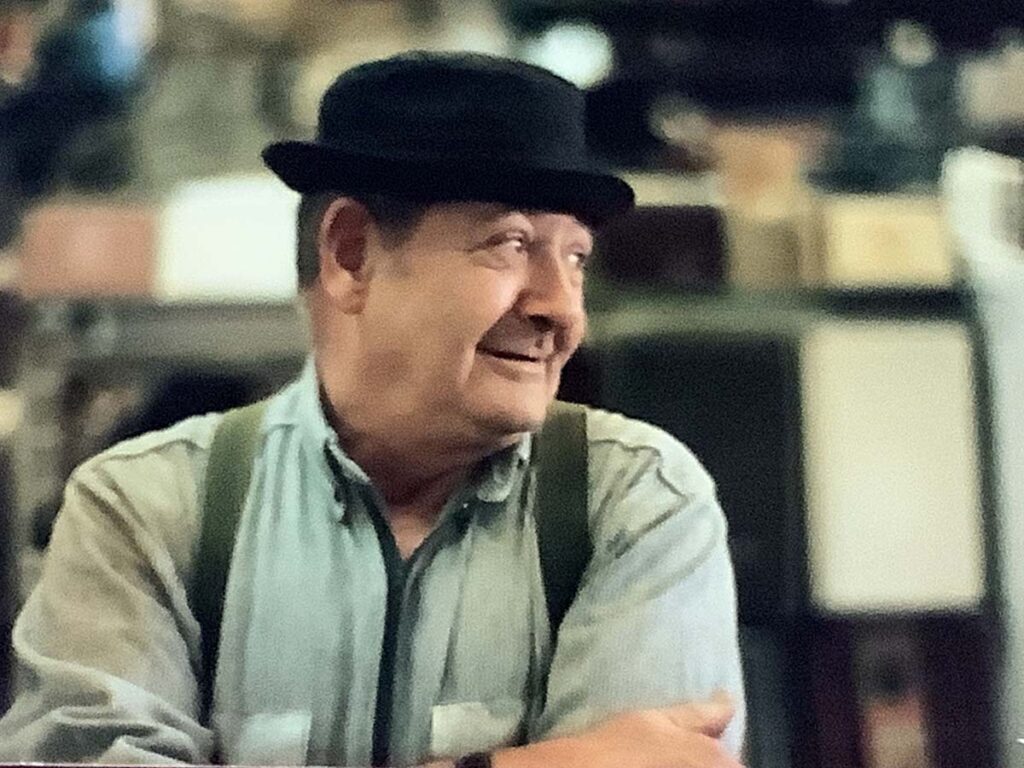
In addition to the knife her dad made for her, Robin’s other favorite keepsake is a photo of him, a joyous grin radiating from his face, as a cluster of pigeons lands on his shoulders and arms during a visit to Rome many years ago. “It’s a beautiful picture,” Robin stated, “and I look at it every day.”
It wasn’t easy for Bob Loveless, right from the start. But he made something of his opportunities and his native talents, shared them in the way he knew how, paying the price along the way and leaving a body of work of insight into what is beauty and flow in a handmade knife, like no one else has. For the record, he never billed himself as the world’s best knifemaker. He wasn’t, and he freely acknowledged that others were much more deserving of applause for their skills. It was his eye, perspective and sense of beauty and design that thoroughly set him apart.
Four Careers
When Robin grew up, moved out and moved on, she carried the best and the most worrisome of life experiences with her. She made her own way and has come to understand and appreciate the journey.
“I’ve really had four careers,” she reflected. “I worked 11 years in the banking industry and 20 years as a correctional peace officer at Pelican Bay State Prison in Crescent City, California, with 12 years as a peace officer. Put that together with the work in Dad’s office and then when my husband, Jimmie Askew, and I had a restaurant in Crescent City, California.” When she worked in banking, Robin went to Crescent City on business for her employer. While there she met the most eligible bachelor in town. “It was a 400-mile, eight-hour drive to Crescent City, and I was supposed to be there for a month,” she said. “It became one of those wonderful love stories. Jimmie and I were meant to be together.”
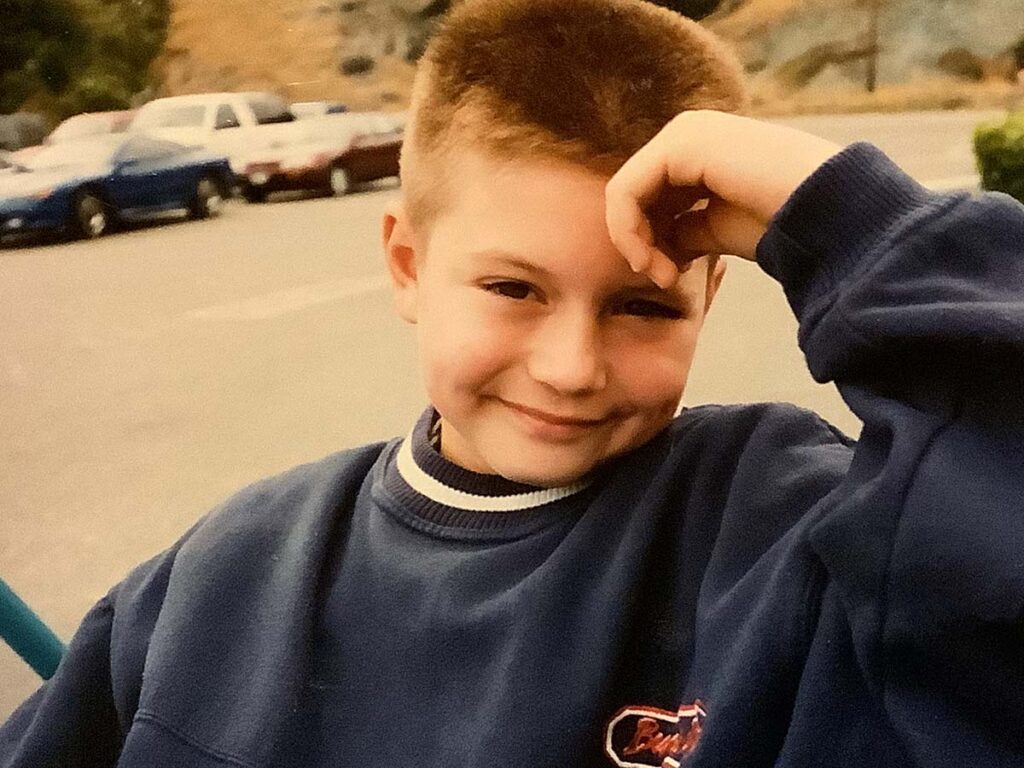
Bob Loveless photographed Robin’s son Nico during a regular visit while they were “out and about.” Nico was 9. The resemblance to his grandfather is striking. (Bob Loveless image)
Jimmie was an award-winning chef, and with Robin’s business background the couple put together a fine restaurant that served a variety of entrees.
“I met Jimmie in 1984,” she recalled wistfully. “We got married the next year, and he passed away 12 years later. He made prime rib, barbecue pork spareribs and fresh seafood. He would go out in the morning on his boat and catch 300 to 400 pounds of rock cod. He would clean the fish and then serve it that night. It was the best seafood in all of Crescent City—wonderful. We also had meat from our mesquite grill, chicken parmesan, grilled Italian sausage, vegetarian dishes and the deep-fried seafood platter.”
Nico
The couple had one son, Nico, who is now 36. When Robin speaks of those days, a tinge of heartache touches her words. But also during that time, she rediscovered the love and care that her father had always had for the family.
Nico and Robin
“Dad came up from Riverside to visit us a month before Jimmie died,” Robin recalled. He had been in touch by telephone continually and made himself the father figure that a 7-year-old boy needed during a tragic time.
“After Jimmie died, Dad would come up regularly,” Robin related. “He took Nico fishing four or five times a year. Grandpa was there for Nico. He taught him how to shoot a gun and would charter a boat on the Chetco River in Oregon and they would fish together. He came up to see Nico play soccer, baseball and football, and he stepped in to take care of my son.”
When Bob wasn’t physically present, he was always in touch with Robin and Nico. He worried that Robin worked in the toughest place at Pelican Bay State Prison. It was called the “shoe,” and he once told Robin how he worried for her safety. Her response was from deep inside, a manifestation of something she learned when her father made the introduction to that Japanese gentleman years earlier: “I told my dad, ‘I show them [the inmates] respect, and they show me respect. It’s really the safest place in the prison to work.’ I told him there were two officers for every inmate and that I really had no qualms about it.”
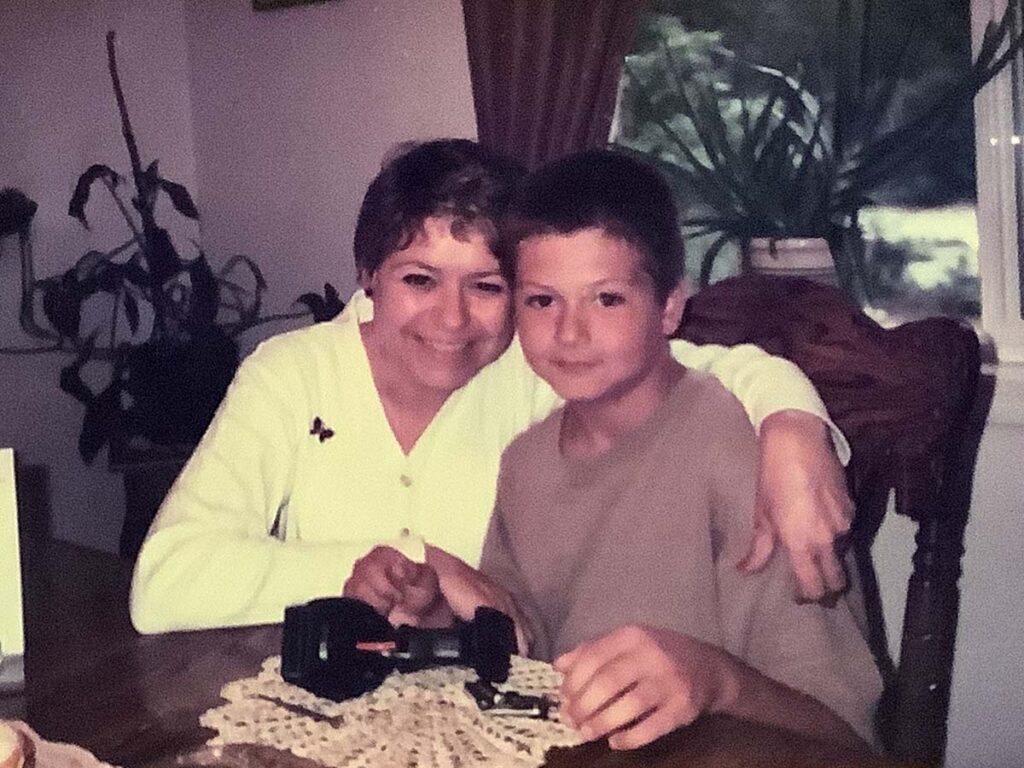
Bob took this picture when he visited Robin and Nico not long after Jimmie Askew passed away. Nico was 10.
That soft spot in Bob’s heart came through time and again as he cared for his daughter and grandson. “He would call us and say, ‘What’s Nico doing?’ He wrote a check to pay for Nico’s braces. He was there for both of us. Being a widow raising a young boy, I could call him anytime and we would talk. I also started to do that with my mother because I wanted to reach out and make sure that my contact with my family was really strong. Dad was so far away, but I talked to him at least once a week. He became the type of dad that my son needed.”
Traits & Quirks
All the while, the legend of Bob Loveless continued to grow. Tales were told. Knives were made and sold. Stories were swapped, and the maker slowly but surely grasped his own impact on the world of knives. At the same time, his various interests, personality traits and, yes, his quirks made him more than just a knifemaking phenomenon. They made him a marvel, a celebrity and an icon.
Bob always carried a gun. “Even when I was a little girl,” Robin laughed, “I remember that he would hang his gun on the towel rack in the bathroom.” For some time, he enjoyed rabbit hunting in the desert with friends. But then another fork in the road pointed a different direction when it came to outdoor activities.
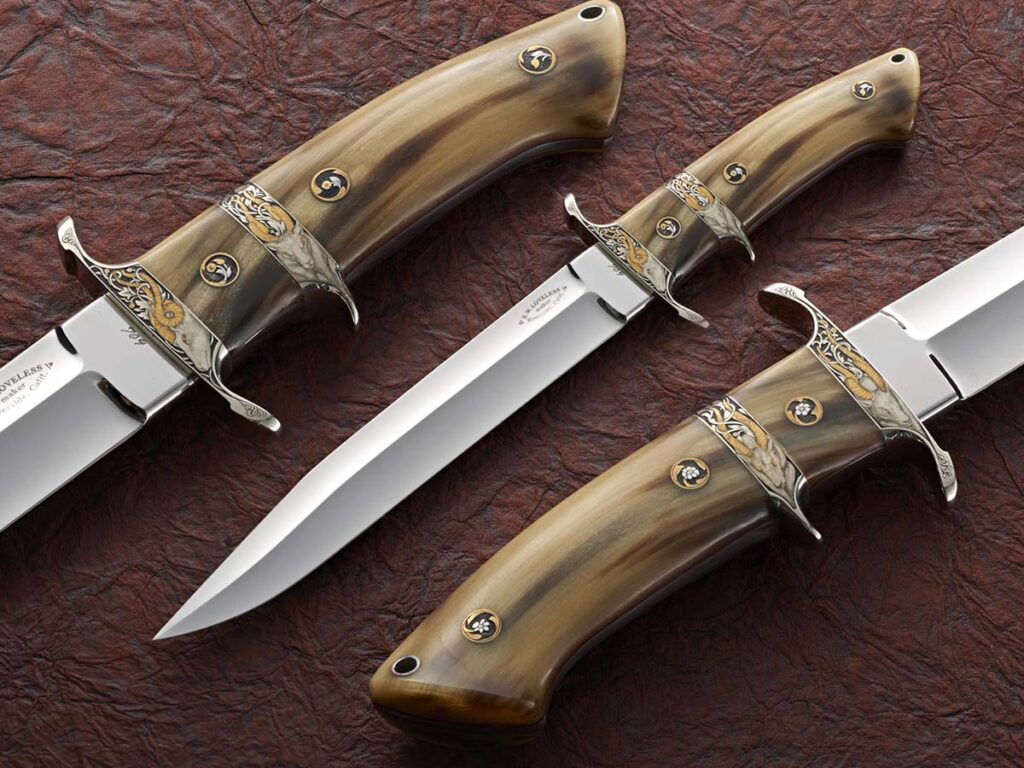
It was his eye, perspective and sense of beauty and design that set Bob Loveless apart. Few if any of his knives capture these traits better than his Big Bear fighter in sheep horn and gold engraving by Dan Wilkerson. (from the John Denton collection; Eric Eggly/PointSeven image)
Robin commented, “They took a lot of hunting trips, and one day Dad decided to stop shooting animals with a gun. He started shooting pictures with a camera. He loved photography, and I have no idea how all that started—but, gosh, I remember when I was a young kid he would take me and Allison on the weekends to camera stores. He would go in and talk for a couple of hours, and we were bored out of our minds. He would take pictures like you wouldn’t believe.”
Adding to Bob’s repertoire of activities, he was also an accomplished gunsmith. If these endeavors sound like a lot to pack into a lifetime, then there is no hesitation in labeling Loveless a true “Renaissance Man.”
Nonetheless, he had pursued his passions, probably without seeking the fame that came along with them. “I do know he never liked living in fancy houses,” Robin remarked. “But he had sports cars, and his favorite car depended on his age bracket. He would drive the back roads to the Chinese restaurant in Riverside and hit 100 miles per hour. At one time, he had three cars and two airplanes. He was a pilot with a lot of camera equipment. He probably got his pilot’s license before he moved to Riverside. I forget what year he got rid of his planes. He had crashed and it was no fault of his own. It happened when a bigger plane was landing and he got banged up. He had a limp after that.”
Keepsakes
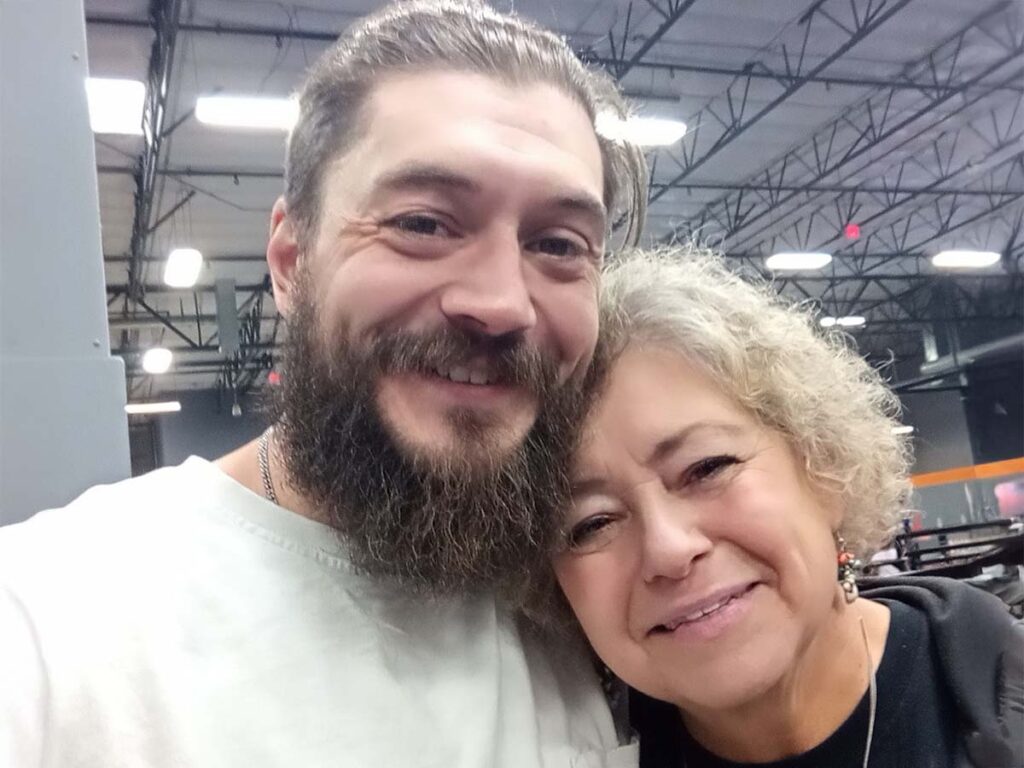
Writes Robin: “My handsome son Nico as he is today, shaggy beard and all. As a mother, I think his eyes and smile show what a kind and good man he is. I know his grandpa would agree with me and like this picture very much.”
Today, Robin’s heart is warmed by her memories, her strong Christian faith, and the knowledge that her dad truly became a father. His life was a mosaic of love and loss, turmoil and moments of calm, fiery and icy emotion, but always with a heart for the good and for his family. She clings to at least a couple of special items that symbolize the tie that binds.
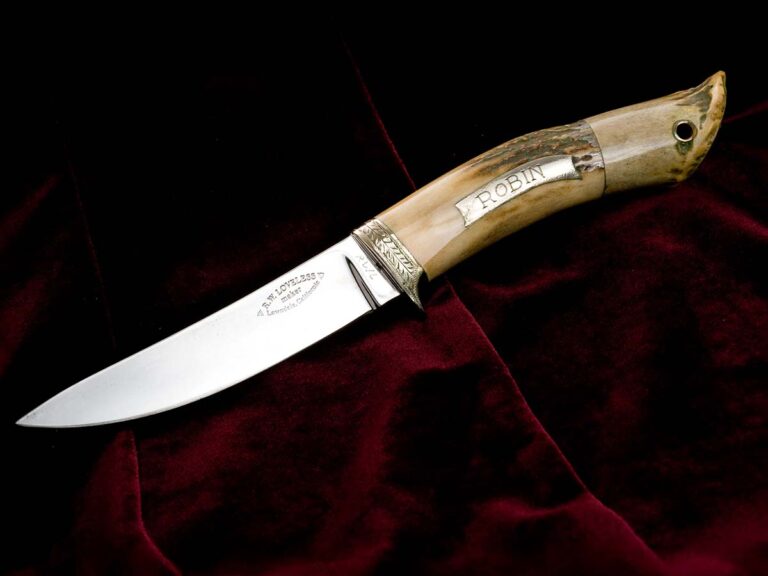
He made a banana skinner for her when she graduated from high school. “It has a stag handle with intricate engraving that he had done by a silversmith,” Robin said, “and I think the handle is at least 6 inches long with the blade about 7 inches. It is absolutely beautiful.”
A few years ago, Steve Johnson cleaned the knife up and put an edge on it. Dave Ellis took photographs of the one-of-a-kind piece, and John Denton, likely the foremost authority on Loveless knives in the world today, offered powerful words and urged her to treasure it always.
His various interests, personality traits and quirks made Bob Loveless more than just a knifemaking phenomenon—they made him a marvel, a celebrity and an icon.
The other keepsake is a photo of Bob, a joyous grin radiating from his face, as a cluster of pigeons lands on his shoulders and arms during a visit to Rome many years ago. It captures a sliver of his enjoyment of life, a glimpse into the heart and soul of just who he was. He was the gruff guy that gave generously to the local animal shelter, the edgy and matter-of-fact curmudgeon who handed substantial financial support to the UPS driver who had served faithfully in the area for years when Bob found out the guy had fallen on hard times. He was simply their quiet benefactor.
“It’s a beautiful picture and I look at it every day,” Robin offered. She ponders exactly where his genius came from and concludes that he inherited it from his mother. She admits that the spark of “genius” has not emerged from any other family member and concludes, “It was meant to be. That kind of genius is created before birth. My father was extremely gifted, and I always knew that.”
True enough, he was gifted, and in some ways that only a relative few others were even aware of.
Growing up Loveless and living within the sphere of influence her famous father created has been an adventure for Robin Askew, a thrill ride that began so many years ago, one that continues well after her dad’s departure from this Earth.
Read More On Bob Loveless:
Bob Loveless: The Icon’s Indelible Mark On The Knife Industry
Four Young, Talented Bladesmiths Battled The Clock Under The Sweltering Maine Sun To Craft A Knife In Two Hours.
It was brutally hot under the Southern Maine Sun on the campus of the New England School of Metalwork, It was made even hotter when a pair of forges were fired until they were an electric glowing orange. It was all part of the build-up to the Battle Of The Bladesmiths as part of the New England Bladesmithing Symposium.
The rules were simple: given a one-foot bar of 1084 steel, four bladesmiths had two hours to make a knife at least 7-inches long. This meant forging the blade, sculpting the guard, making the handle, and assembling it all within the allotted time.
The theme for the contest was young guns as the youngest competitor was 19 and the oldest was just 24.
“We pick people that are at an equal level of skill,” NESM director Dereck Glaser said. “We had 25 applicants, and we picked these guys based on a moderate level of skill, they’ve all been making knives around the same length of time. And I wanted to get an [similar] age range. I didn’t want big old-school guys coming in against people nobody knew.”
Who Hammered In The Battle
Leo Potter shows off his sword before the battle. Blade: 1084. Guard & Pommel: 1045. He dried local birch for the hilt core.
The foursome was from all over.
There was Leo Potter, already an accomplished smith from New Hampshire who came with pieces to proudly show off and display. Up from Martha’s Vineyard with his parents was 20-year-old Luke Nivala, and down from Quebec was Jeremy Yelle. Kemper Feuerzeig rounded out the field, and he had flown in all the way from California.
Glaser said he was excited to have the field he had and was thrilled to see the battle return for the first time since 2019 due to the COVID pandemic.
“We started doing the battle in 2010 or 2011, and shortly after, Forged in Fire caught on,” Glaser. “That’s where the show came from, this whole battle concept. The ABS was doing this at their events long before the show existed.”
In The Thick Of It
The contest started fast as everyone got their steel into the heat within the first minute. Like dancers, the smiths bounced back and forth from their stations to check on their steel. Every second was used to the fullest.
The smiths used different techniques to make their blades. Feuerzeig forged and ground his blade with authority and was ahead of everyone when he quenched just 30 minutes in. By contrast, after forging the blade to shape, Yelle put his blade in the vice to normalize so he didn’t quench until 70 minutes into the competition.
Nivala kept a steady pace throughout and didn’t let the pressure get to him, or at least kept a cool, confident face. His mother was beaming the whole time with pride in her son.
Lisa Nivala captures video of her son Luke as he competes in the battle.
The contest was to be judged by a trio of renowned smiths, Emiliano Carrillo, Matthew Parkinson, and Lin Rhea. Other legends of the field like Mace Vitale watched on intently and tried to help guide the younger smiths when given the opportunity to do so.
It was great to see the camaraderie as day turned to night not only between the competitors but among the judges, staff, and other symposium attendees. No one wanted anyone to lose. Everyone was cheering for four successful knives.
Potter putting all his weight into making the handle work.
However, bad luck hit both Potter and Yelle. The former’s first attempt at a handle didn’t work, putting him way behind on time. He tried mightily to get the handle married to the blade but it wasn’t to be.
“I made the hole way too big so when you stuck it on the knife there was a big gap,” Potter said after the contest. “You could see the gap around the guard.”
Yelle’s attempt to normalize the blade put him behind on time and he wasn’t able to get the most out of grinding.
The two youngest competitors, Nivala and Feuerzeig, were a sight to behold. Kemper’s forging and grinding was magic and Nivala’s ability to maximize every second at the grinder was great to see. Both of them made beautiful knives.
Testing The Knives’ Mettle
After the contest concluded, the knives were all put through a series of three tests. They had to poke and pop a water balloon hanging from a piece of twine, push cut through a piece of rope, and slice through a rolling paper.
Feuerzeig (left) and Nivala (right) grinding away at their blades.
Nivala and Feuerzeig’s knives performed the best although none of the knives were able to fully cut through the rolling paper. Carrillo chipped in to help cut so the competitor’s adrenaline-filled hands, didn’t play a role in the slice.
All the knives were judged on a scale of 25 points and Feuerzeig beat Nivala for the win, and the $5,000 prize by a single point. He said his strategy was to keep things straightforward so he could put all his energy into the process and not have to re-design on the fly.
Kemper Feuerzeig’s winning knife.
“This is the first Bowie I’ve done in forever so I just wanted to do something very simple,” Feuerzeig said. “The one mistake I made on the knife was the ricasso got a bit longer than I would like. I think it’s not super elegant; in the future, I’d try to do that better. I wanted something where I wouldn’t have to think about the lines too much.”
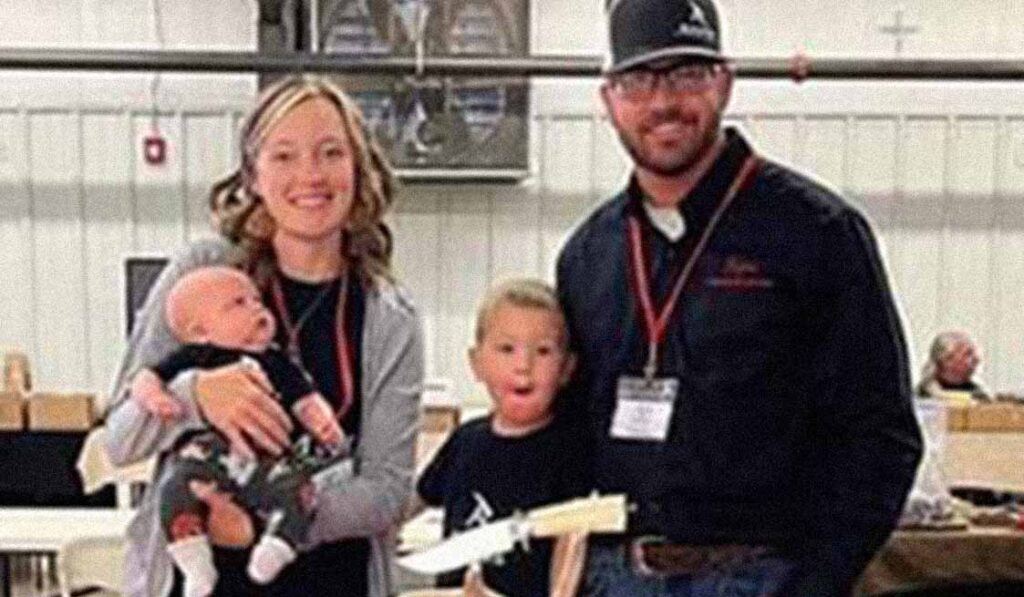
Feuerzeig with his winnings, the judges, and the staff from the NESM
Even though he didn’t win, Potter said that the battle taught him a lot about himself as a smith and showed him new ways he can go about making blades.
“I think it sped up a lot of my other work,” Potter said. “I figured out yeah, I can cut this. I don’t need to be so careful if I’m making the back of my guard exactly flat because I can take it to belt grinder, and I can make it as flat as I need. It’s little things where you try it and you realize it’s doing the same amount of work as when you spend 20-30 hours getting it just right. It’s really taking that time to blow through it. I like to do things big and it teaches you about the little bits. When you go and slow down you know can take some time and here you can act with reckless abandon and blow through it.”
Final Cut
You can watch Forged In Fire, but nothing prepares you to see the process up close. It’s remarkable watching four people take the same rod of steel in the same amount of time and all come to vastly different ends. The crowd loved it, the judges loved the knives, and everyone had a great time as day turned to night in the Pine Tree State.
The New England School of Metalwork in Auburn, Maine offers courses in blacksmithing, bladesmithing, and welding. You can learn more here.
Editor’s Note: This article was written by Mike Ableson.
Forget the traditional 10-inch blade, the new sweet spot for a custom bowie knife is now a 9- to 9.5-inch blade!
In July 1990 I was in the Army, home on leave from South Korea and attending The Knifemakers’ Guild Show in Orlando, Florida. While there, I was introduced to the forged blade.
I stopped by the table of ABS Master Smith Jim Crowell. He explained to me what it took to gain the prestigious rating of ABS master smith. It wasn’t just the quality of the knife that impressed me. I was amazed at how a 15-inch knife with a 10-inch blade could be so lightweight. While I was not new to fixed blades, my experience to that point had been with stock-removal knives.
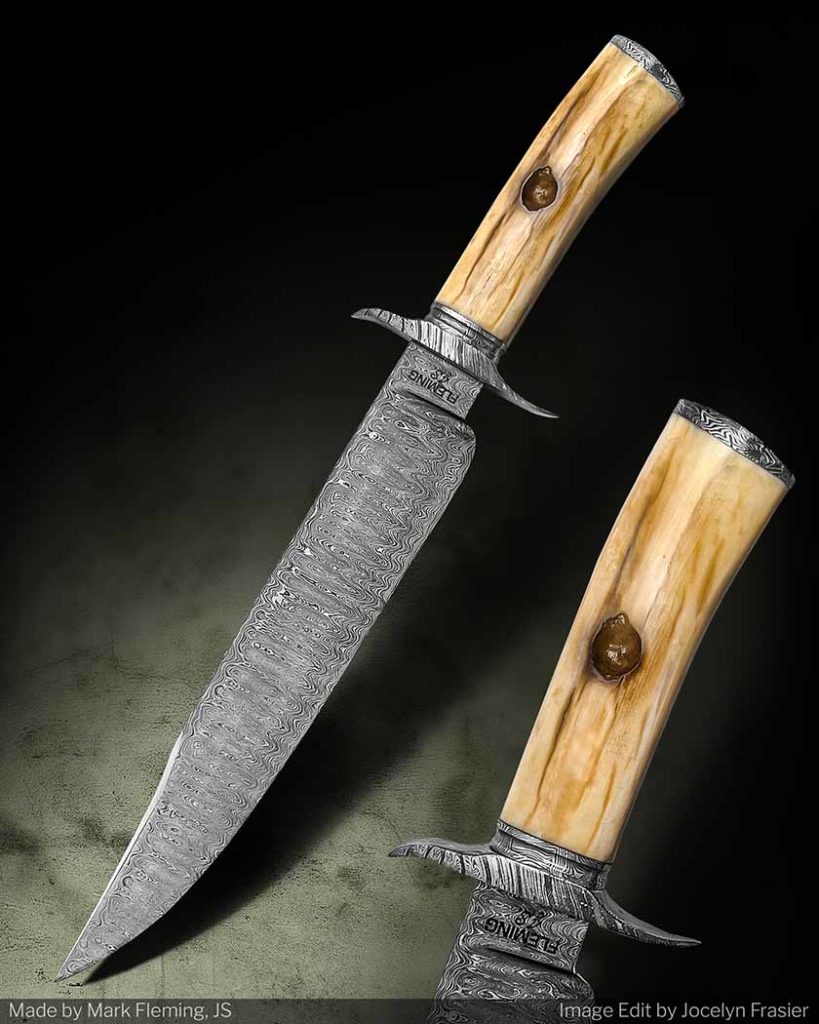
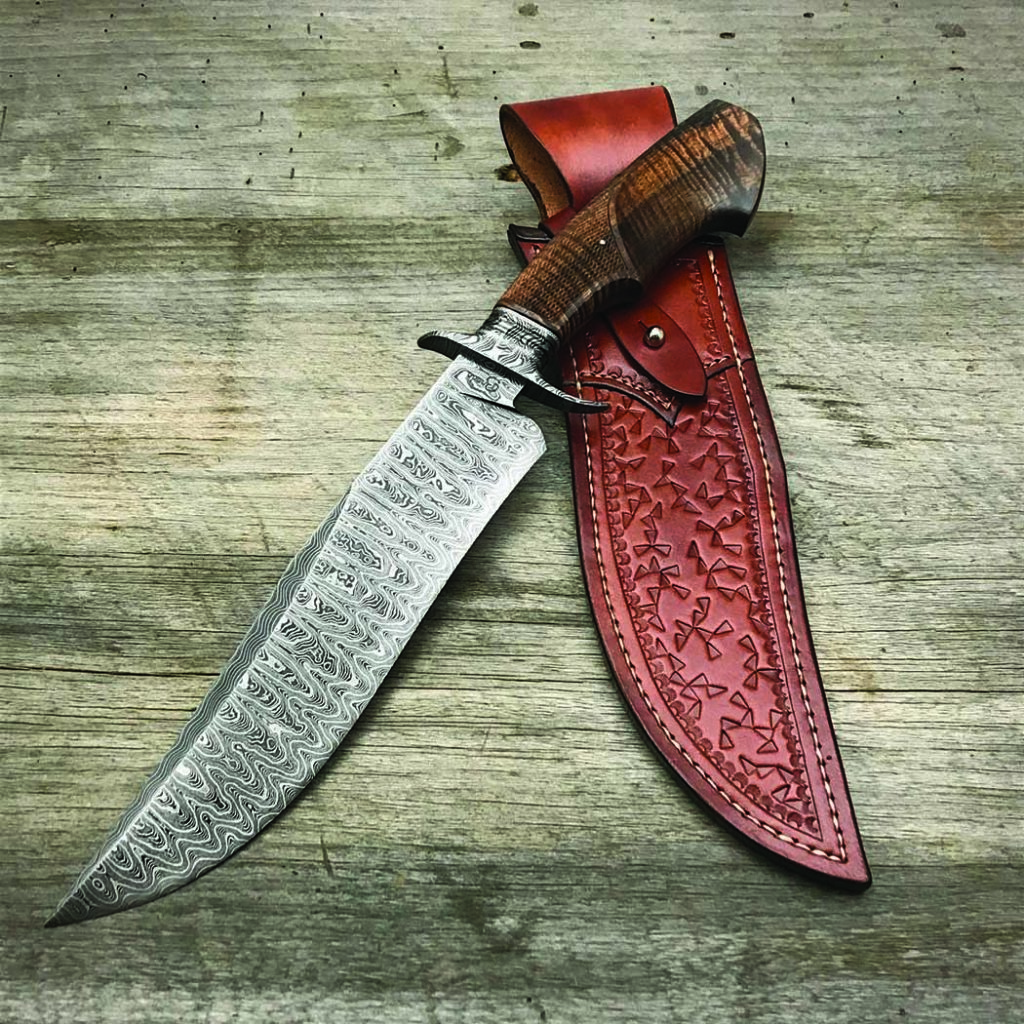
Bad to the bone, Mark Fleming’s forged Southwest Trail Bowie has a 9.5-inch blade made of 1084 carbon and 15N20 nickel-alloy steels in a ladder pattern. The handle is ancient walrus tusk, capped with a damascus pommel, ferrule and guard. Almost a steal, with Fleming marking the price at $1,900 for a similar knife.
Jim explained that distal tapering is a procedure to thin the blade from guard to tip and spine to edge. The amount of tapering depends on the purpose of the knife. As I moved through the show, I started paying more attention to the forged blades on the exhibitors’ tables. What I discovered was what was called the ABS Bowie. The dimensions of the knife were a blade of 10 inches in length, 1.5 inches wide and a quarter inch thick, generally with a 5-inch handle.
Development Of The Shorter Custom Bowie Knife
Those who have been involved with custom knives for some years know that the knives tend to move in cycles. Innovation leads to demand from collectors. There’s a lot of “following the leader” in the custom knife business. This could have helped explain why so many knives were dimensionally identical at the ’90 Guild Show. While some had damascus blades and hardware, most were carbon steel.
In 1992 the custom knife market cycled to a new entry into the custom knife world: the tactical folder. Toward the end of the decade, tactical folders started to wane, and forged blades once again established their prominence in the custom knife world. This time around the cycle began with hunters—basically, those with forged carbon steel blades, stainless guards, and wood or stag handles. The price point was predominantly in the $150-to-$210 range. By 2002, collectors buying hunters were ready to move to the hunter’s “big brother.” Meanwhile, the decade was populated with damascus patterns such as ladder, raindrop and twist, all of which began to show up more regularly.
Another nine-and-a-halfer, Ben Brea’s Forged Stag Bowie has a ladder-pattern damascus blade and a checkered koa handle. The superlatively executed custom bowie knife comes with a custom leather sheath. Breda set the price of a similar knife at $2,000.
While damascus was in demand by the higher-end collectors, it was W2 tool steel blades with hamons that took center stage for about five years. No two hamons were exactly alike. They looked cool and, for most collectors, were affordable. While antique designs from the mid-1800s were showing up more regularly, the one thing that hadn’t changed was the ABS Bowie, the majority of which continued to have 10-inch blades or longer.
BLADE Magazine Cutlery Hall-Of-Fame® member Jim Bowie was at least 6 feet tall. Depending on your source, the knife he carried had a blade with a length anywhere from 9.25 inches (on the one his brother Rezin stated was made for Jim), to 121/8 inches (the knife known as the Edwin Forrest Bowie), and a handle length of up to 6 inches. For size comparison, the Japanese ko-wakizashi, a short sword that was carried by samurai, started with a 12-inch blade. The ko-wakizashi was worn outside the clothes in a belt at the waist. Current knife laws aside, a knife that long would be difficult to carry and use openly. After all, have you ever tried carrying around a knife with a 12-inch blade? My only experience was a two-week field exercise while I was in the Army. The knife I took with me had only a 10-inch blade. Granted, I am at least 1 inch shorter than Jim Bowie was. But the 10-inch blade was cumbersome to carry and, quite frankly, just too long for what a soldier needed. Also, it would be challenging to deploy the knife without having it in a cross-draw setup similar to what the samurai employed.
Dimensional Changes To Cutom Bowie Knives
While it isn’t much different from the ABS Bowie, the current hot custom bowie features a 9-to-9.5-inch blade. The other difference on many of the blades is that the width has expanded from 1.5 to 1.75 inches. The additional blade width allows makers who so desire to use some curves along the primary edge.
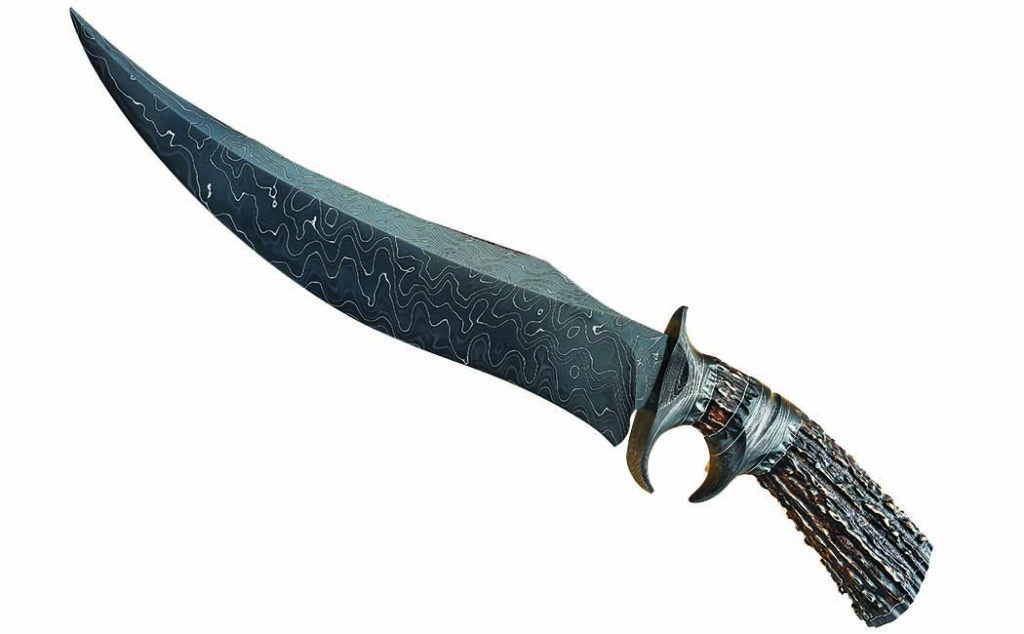
A big boy of the bunch, Brian Sellers’ 9.5-inch custom bowie knife boast a twist-pattern damascus blade (double-edged) with stainless steel liners. The handle is ironwood and features a sub-hilt design, which Sellers would ask $2,400 for a similar creation.
I think that the shorter, wider blade is more aesthetically appealing. It no longer looks long and thin like its lengthier, narrower cousin. Moreover, the additional width results in a more substantial blade. Finally, extending the blade width allows bladesmiths to tweak the accompanying damascus patterns. Mosaic damascus patterns have gained favor among makers and collectors over the past two years. The extended blade width may give rise to new mosaic patterns. At the same time, the extra width may add a fresh take on standard damascus patterns such as ladder and twist.
The Constant Change Of The Bowie Knife
Today, most of us don’t use large bowies to defend our honor or protect our loved ones. Whether antiques or current models, many bowies have been relegated to collections. Given the amount of 10-inch custom bowies made over the past 30+ years, hundreds of them are for sale in the primary market and thousands are available in the aftermarket. Should you want a 10-inch bowie, your choices of materials and combinations are almost limitless. Given the number of 10-inch bowies available in both the primary market and aftermarket, it should be no wonder collectors are looking for something different.
As many of you may know, as a purveyor I keep pretty close tabs on several custom knife market sectors. Damascus bowies is one such sector. Over the past 18 months, I’ve seen both collectors and makers move away from the standard 10-inch bowie. This is not to say such bowies are not being made but that the demand has slowed. Makers are creating new types and patterns of damascus. Is it any wonder then that what were considered standard dimensions over the past 30 years are being revisited? The new sweet spot of the 9-to-9.5-inch blade is appearing more on today’s custom bowies. Eventually, bowie collectors will once again look for something new and different for their collections. As the Greek philosopher Heraclitus said, “The only constant in life is change.” The same is true in custom knives.
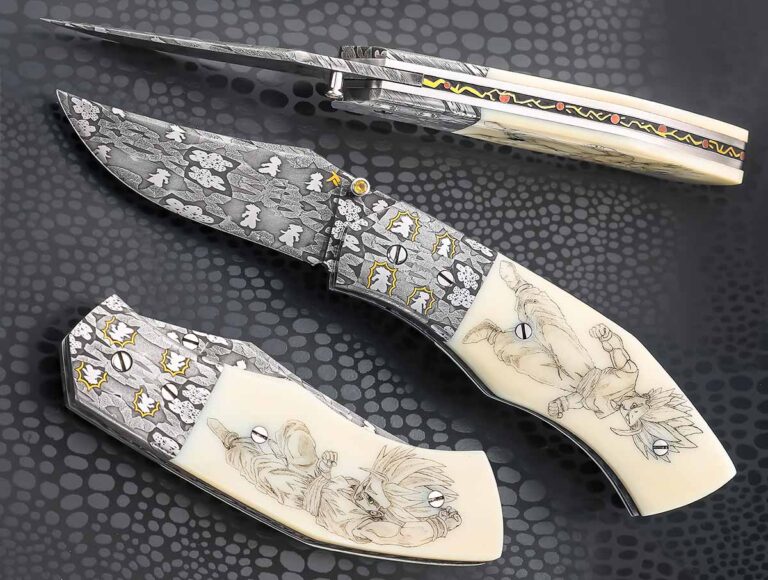
Peyton Ramm uses the 3D printing process for canister patterns to make his dream knife.
It was ABS journeyman smith Peyton Ramm’s dream to make a knife themed after his favorite childhood TV show, Dragon Ball, and the new 3D printing process for canister patterns provided him with the perfect vehicle to do so.
“Before I heard about 3D printing, I dreaded the idea of paying someone to wire EDM every single dragon ball out, but my good friend Ron Hardman introduced the idea,” Peyton wrote. “I sent him pictures of Gohan [a prominent character in the Dragon Ball series] and the dragon balls, and asked him to recreate the image in the best way possible to forge down. His students at Kilroy’s Workshop got a rough draft for me and once I approved it, they printed and sent it.”
Peyton stated he had to build a new forge just to do the canisters, as he only had a vertical forge and it’s important to forge weld lightly on the two end caps first before welding the sides.
“My first billet fell apart because of this, a mistake I didn’t [repeat],” he wrote. He combined the two images with a flower mosaic he made with a damascus of 1095 carbon and 15N20 nickel-alloy steels to break the pattern up, and finally had his damascus. From there he matched the blade and bolsters as best he could so it would look like an uninterrupted transition.
We talk with those who know Bill Moran best to determine how many damascus blades the godfather of the craft forged.
BLADE Magazine Cutlery Hall-of-Fame® member Bill Moran is and will forever be remembered as the father of modern damascus steel. He and a few early devotees popularized damascus during an era when the art of bladesmithing was an endangered species in the realm of the artisan.
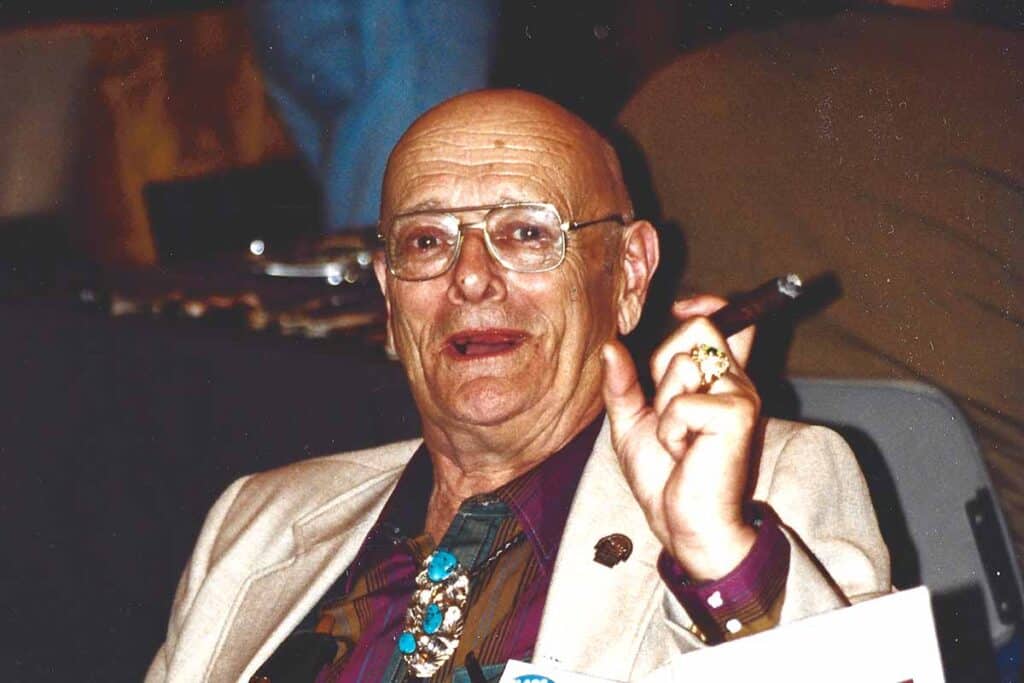
Though Moran was partial to smoking a pipe, he liked an occasional stogie as well. (Pete Cohan knife image)
It was Moran who shocked the custom knife world in 1973 when he brought eight knives to The Knifemakers’ Guild Show in Kansas City, Missouri. Those historic eight sported blades of Moran’s damascus steel and they created a sensation. Cutlery Hall-of-Famer, longtime journalist and friend of Moran’s, and a respected member of the knife community, B. R. Hughes remembered how the event electrified those who attended.
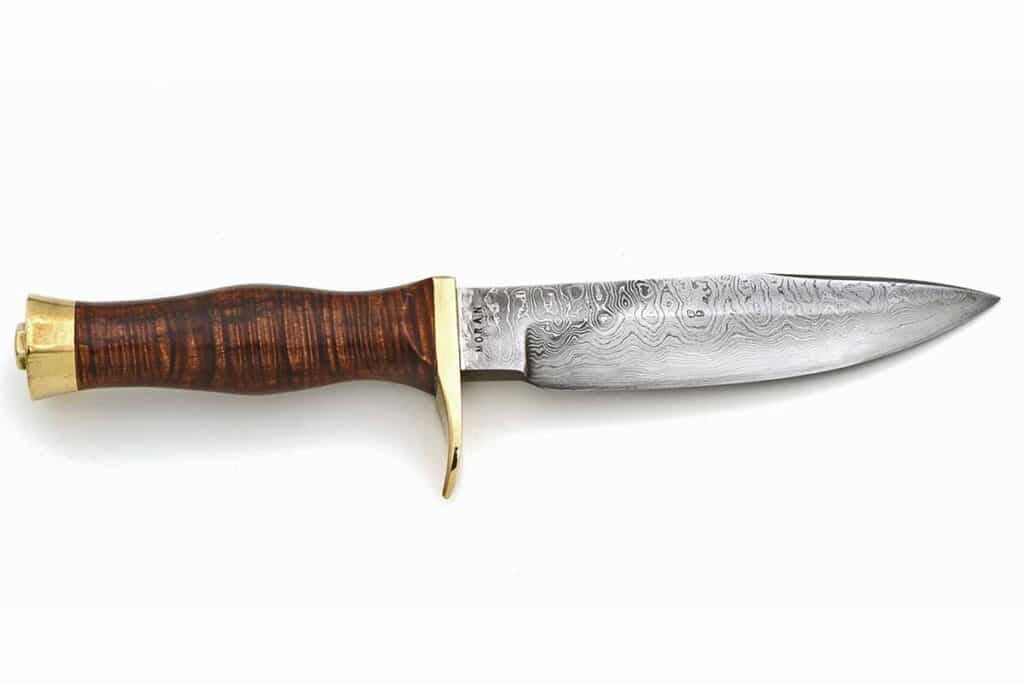
This is the first damascus knife Moran ever made. He forged “No. 1” circa 1972. It was misplaced for 30 years until Nancy Hendrickson found it in Moran’s house. (Pete Cohan knife image)
“When my wife [Carolyn] and I drove up to the Muehlebach Hotel in Kansas City, a friend of mine came out and said, ‘You gotta get in there and see the damascus knives Moran has on his table.’ Those knives were the talk of the show. Bill also had mimeographed sheets that explained what damascus steel was and how it was made. He gave those sheets away to anyone who desired one.”
Moran made basic damascus knives. “They weren’t elaborate and this, that and the other thing, but most of them were for use,” B. R. Hughes noted. (Exquisiteknives.com image)
Three years later, Hughes joined Moran and bladesmiths Bill Bagwell and Don Hastings as the quartet that founded the American Bladesmith Society (ABS). When the ABS was founded in 1976, bladesmithing was on life support, and probably fewer than a dozen smiths were forging knives. Today, the Society includes more than 2,000 members and the future of the craft has been secured. Meanwhile, Moran deserves the credit as the catalyst for modern bladesmithing.
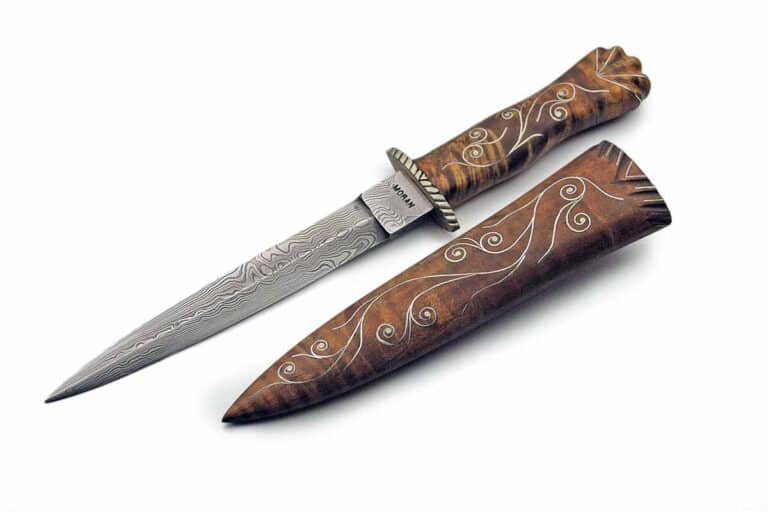
B. R. Hughes said Moran made some art daggers that “were a bit elaborate for the day.” An example is this large quillon dagger. (Exquisiteknives.com image)
How Many Damascus Knives Did Moran Make?
While there is no question that Moran and other dedicated disciples of the forged blade brought damascus and the ring of the hammer back to life in the early-to-mid-1970s, there is some conjecture as to just how many such knives the great Moran forged and completed himself. The thought of how many Moran damascus knives were made and exist today is tantalizing, and, of course, what’s a great legend without a bit of mystery and conjecture? Exploring Moran’s body of work and the damascus element within provides some insight into the man, the legend who padded about on the creaky floor of his Maryland shop, sometimes chewing tobacco, but rarely alone when his doors were open as crowds came to see the wizard work.
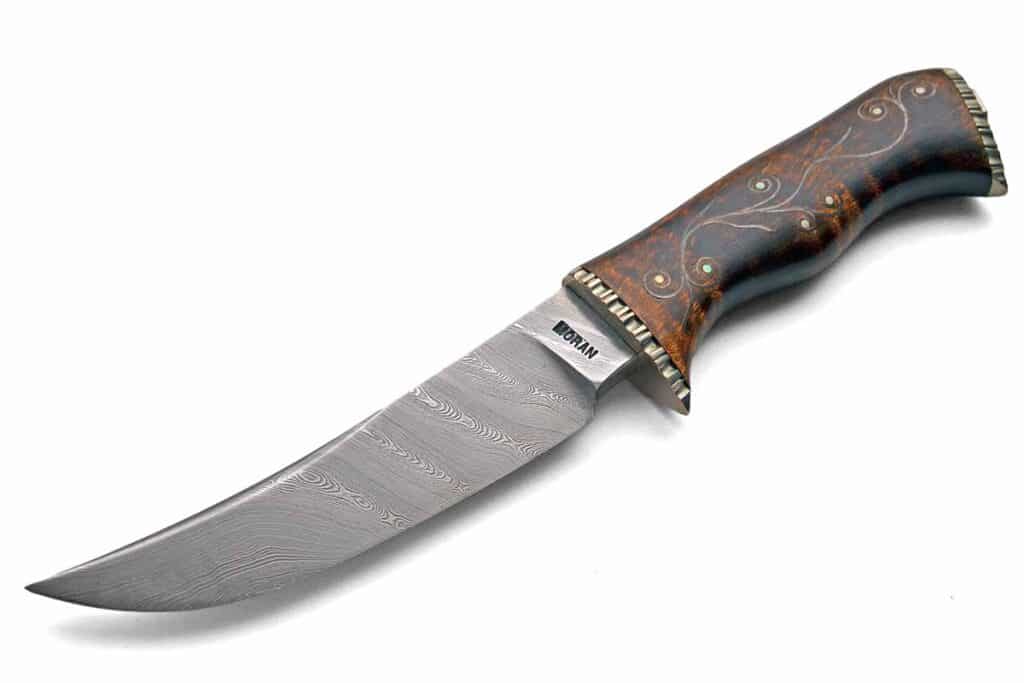
Back in the day, a Moran damascus knife was a challenge to own, considering the time Moran spent in his shop with the material actually able to work without the distraction of visitors, the many hours of labor required to produce a damascus billet, and the higher price for such a piece that naturally followed. (Exquisiteknives.com image)
Collectors such as Cutlery Hall-of-Famer Butch and Rita Winter bought the first of Moran’s damascus knives during that historic Guild Show more than a half-century ago, and, as Hughes relates, “Moran made basic damascus knives. Most of his were what folks would call ‘using’ knives. They weren’t elaborate and this, that, and the other thing, but most of them were for use. He did make some art daggers that I thought were a bit elaborate for the day.”
Dave Harvey, Nordic Knives
Hughes remembers that Moran himself was rather vague on the number of damascus knives he actually made. However, probably the best estimate is that fewer than 100 Moran damascus knives were made during a career that spanned more than 50 years.
“He liked the random pattern and the ladder pattern,” B. R. remembered, “and he could do some pretty good patterns, but it took a lot of time. He was very happy just making ladder pattern and stuff like that, and he continued making non-damascus knives and about 40 folders. When he was in his shop, there were always five or six locals in there talking to him and watching him work.” Agreed Cutlery Hall-of-Famer and ABS master smith Jay Hendrickson, a close friend of Moran for 30 years, “Bill had so many visitors to his shop on a daily basis that it is a wonder he ever got anything accomplished.”
According to Jay Hendrickson, Moran made all of his damascus in a coal fire. “All of Bill’s experiments were with coal, as gas forges were not popular at the time,” Jay explained. “In today’s world, gas forges are almost always used for damascus making because of adjustable temperature and the cleanliness of propane gas.” (vintage photo of Moran in his shop circa the 1960s)
Hendrickson served as the executor of Moran’s estate and founded the Moran Foundation to preserve the great bladesmith’s legacy, serving as its president for 10 years. Jay observed that Moran made a workingman’s knife with quality that was spot-on, though there may have been an occasional flaw in the solder on his early pieces. Nonetheless, Jay says, Bill’s knives always cut.
As for Moran’s damascus knife productivity, Hendrickson offered, “This is strictly a judgment call on my part, but I would say Bill made less than 100 damascus knives. I counted 36 in our Forever A Legend book. I only know a few people that own Bill’s damascus knives, but I think they are sold and traded often between collectors. You also see Bill’s damascus knives occasionally sold at auctions.”
Butch and Rita Winter bought this damascus quillon dagger from Bill Moran at the 1973 Knifemakers’ Guild Show where Moran introduced modern damascus knives. It was one of eight damascus knives Moran brought to the show. The tang is marked DAMASCUS in all uppercase letters. (image courtesy of Rita Winter)
Jay verifies the original sale of a Moran damascus quillon dagger and sheath to Butch and Rita Winter and adds a bit more information. “Rita Winter recently sold Bill’s first damascus dagger to Mr. Doug Hook, a Tennessee collector,” he commented. “Two years ago, I repaired one of the twisted wires on the handle for Mr. Hook. Because of that contact I was able to confirm the original purchase as Doug has written verification of the original sales transaction and the invoice.”
So where are the majority of Moran’s damascus treasures today? Longtime purveyor Dave Harvey of nordicknives.com is straightforward—“in collections around the world. Values vary and depend largely on the particular knife. But they are generally worth at least double that of [one of Moran’s straight carbon steel blades], sometimes even more.”
Dave Ellis said the first of the Moran damascus knives are quite valuable and guessed they would start at least at $10,000 and go up from there. Dave holds an early 1970s Moran damascus hunter at BLADE Show 2023.
Back in the day, a Moran damascus knife was a challenge to own, considering the time Moran spent in his shop with the material actually able to work without the distraction of visitors, the many hours of labor required to produce a damascus billet, and the higher price for such a piece that naturally followed. Dave Ellis of Exquisiteknives.com reasoned, “I could not say how many damascus knives Moran made in his lifetime, but certainly not a large number. Many of Moran’s damascus pieces reside in private collections, as well as the Moran Museum. I personally have owned and still own some and have sold a number of the finer pieces to overseas clients.
“I believe he made four or five patterns. Damascus steel was and still is a laborious process. Bill’s prices for his damascus knives were quite high for the time, so he made and sold mostly carbon steel pieces. Damascus was reserved for higher-end clientele and foreign dignitaries. A good number of the damascus knives were fighters and bowies. Damascus hunters were also made, many with Bill’s twist pattern steel, maidenhair. I do not know of any mosaic steel knives that Moran made. The first of the Moran damascus knives are quite valuable, and I would guess that they would start at least at $10,000 and go up from there.”
Along with Bill Bagwell and Don Hastings, Bill Moran (left) and B. R. Hughes (right) founded the American Bladesmith Society in 1976. Hughes is the only surviving founding member. (Buddy Thomason image)
HOW HE MADE THEM Hendrickson is familiar with Moran’s most common damascus patterns, the maidenhair twist, ladder pattern and others. “He knew how to fuse metal, as he learned that technique working on equipment on the family farm,” Jay remarked. “On the farm he made knives from whatever he could get his hands on, old springs, files, and rasps, for example. He could also buy steel from a local hardware store in town. Bill also knew the difference between plain iron and high carbon steel. His first damascus experience began by using one piece of steel and one piece of iron. He welded the two together, drew it out and folded it many times.”
The process yielded insight for Moran, and he learned from experience. At times during the process of hammering and folding, he realized that the steel was absorbing heat quicker than the iron because it was on the outside of the billet. Therefore, he moved to one piece of iron with steel in the center, and then a second piece of iron, using O1 tool steel and a carbon mix of 33 percent. According to Jay, this combination gave the billet the right hardness without the need for tempering. Moran’s test of the finished knife was to carve wood for two hours with no loss to the cutting edge, and he was satisfied with the results using this mixture.
Moran’s test of the finished damascus knife was to carve wood for two hours with no loss to the cutting edge. An example is this clip-point model, again in a ladder pattern. (Exquisiteknives.com image)
“Bill made all of his damascus in a coal fire,” Hendrickson recalled. “A hot coal fire can melt steel as temperatures can reach over 2,700 degrees Fahrenheit, which is the melting point of steel. That is why Bill added iron to the outside of the billet, as iron is less apt to burn as quickly as steel. All of Bill’s experiments were with coal, as gas forges were not popular at the time. In today’s world, gas forges are almost always used for damascus making because of adjustable temperature and the cleanliness of propane gas. Therefore, the burning of steel to a great deal has been eliminated with the use of gas forges.”
Hendrickson attributes the relative scarcity of Moran damascus knives to the maker’s affinity for producing using knives, constraints on time and other factors. “Bill was truly a supporter of the art knife,” he noted, “and along with others they created that industry. Collectors were willing to pay big time for exceptionally well-made knives, and Bill, like other top-notch makers, profited as this industry took hold. However, Bill’s true passion was in using knives, such as camp knives, hunters and small utility knives, of which he made many. The vast majority of his knives came from customers wanting working knives.
A good number of Moran’s damascus knives were fighters and bowies, according to Dave Ellis. This classic ST-24 in ladder-pattern damascus and curly maple handle with fancy wire inlay is a favorite of Moran collectors. (Exquisiteknives.com image)
“Bill liked to experiment with damascus. For example, he would slip in an added piece of iron after many folds to gain toughness in the end product. Another example was where he completed a damascus billet to the desired number of welds. He then cut it in two and added a piece of high carbon steel to form the middle and welded the two damascus pieces on both sides of the high carbon steel. Once that was completed, Bill forged the billet into a knife. One might call the finished product a damascus san-mai. Bill liked the various patterns that were being developed beyond the more basic patterns that he originally developed. To Bill, mosaic knives were art knives, not to be used but just admired. He didn’t like the process of welding pieces together to make a knife. Remember, he was more into using knives where the grain within the steel followed the entire edge of the blade.”
Through the years, Moran became a legend, leaving a legacy of learning, teaching, giving information freely, and welcoming many to his shop. He paid tribute in steel to the wonder of damascus, the art knife and the using knife. Today’s body of bladesmiths still looks to him as the guiding light that led them to the glow of the forge and the spark of the hammer on hot steel. Those who own or admire the few damascus knives that Moran completed continue to do so for their beauty, their imagination, their rarity, and simply because they bear the touch of the master’s hand.
Learn how to spot flaws in Damascus steel blades, like delamination and inclusions, with expert tips from master bladesmiths.
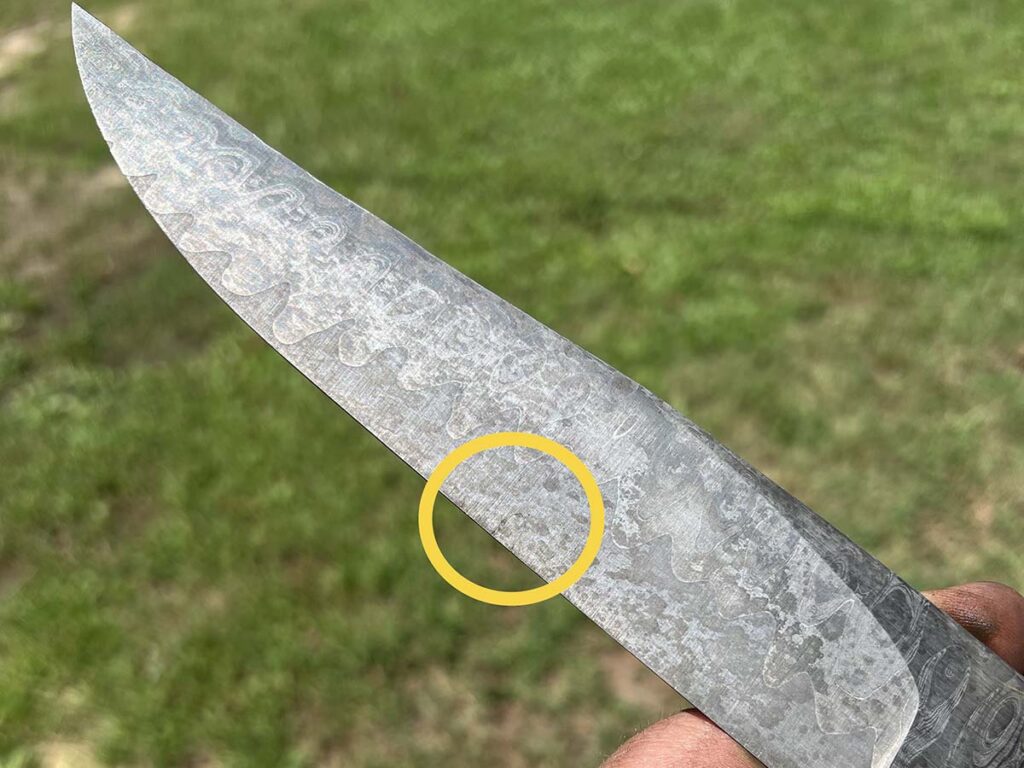
They may be small and insignificant or obvious and glaring, but the skill that is involved in forging damascus steel and then fashioning blades and furniture that adorn custom knives like no other component naturally produces the potential for flaws in the steel itself.
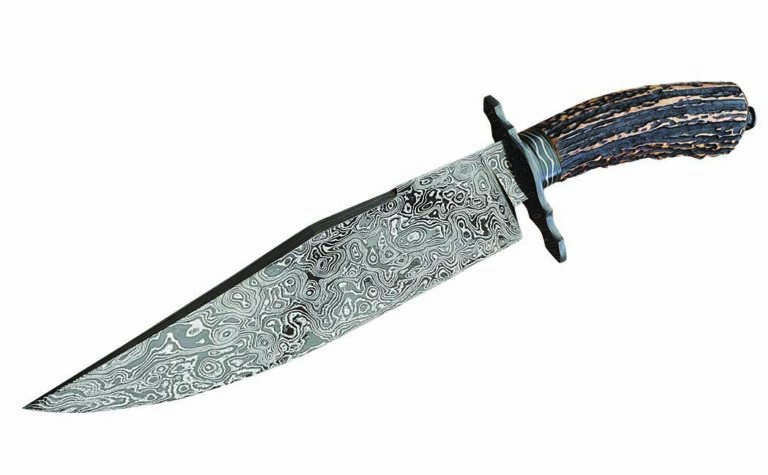
Ironically, the structure of damascus steel, the allure of its beauty and texture, images and etched artistry, is brought together with the potential for a flaw. The production of billets that contain welded elements of 1080 carbon- and 15N20 nickel-alloy steels or other variations involves the marriage of metals. And like any union there is the possibility of a fault. The flaws may be serious or inconsequential. For the buyer, the ability to spot an imperfection and make a value judgment is highly beneficial in the ownership experience.
“I would say the most common flaw in a damascus blade is delamination,” ABS master smith Lin Rhea opined. “This shouldn’t be in a knife that is offered for sale. It’s usually evident as a hairline void in the layering and could occur anywhere on a blade. But I see them mostly in the deepest part of the blade as they are revealed in the bevel grinds. I believe this could be prevented by being sure the billet is up to proper welding heat before extracting it from the forge for the first weld in the particular stage of pattern development.”
In a similar perspective, ABS master smith Bill Burke sees imperfections as “a closed shut or incomplete weld that can be found anywhere on the blade. It can be seen as a dark or silvery line in lightly etched damascus or becomes a deep crevasse on heavily etched damascus—and it is caused by the smith not letting a billet soak at heat long enough before welding, or by manipulating a weld that has not been fully set and then working this tear back into the pattern.”
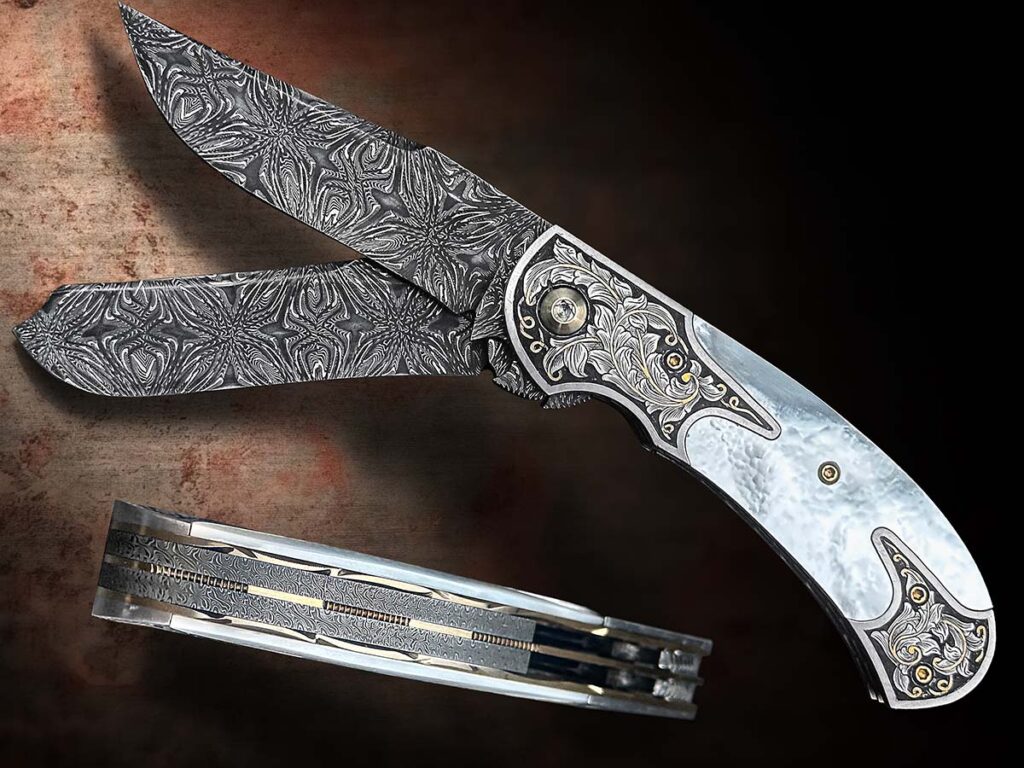
Fortunately for knife enthusiasts, most quality damascus knives are free of flaws, such as Eliot Maldonado’s saddlehorn trapper in Blackbird damascus by Chris Zimmerman. (Jocelyn Frasier image)
ABS master smith Steve Randall agrees and sees these types of imperfections and other potential flaws as well.
“The most common flaw on a damascus blade is the cold shut or an area where the pieces did not weld,” he observed. “It is not so much where it occurs on the blade such as the tip, edge or spine, but where the two different steels meet in the pattern. It’s the two steels that didn’t weld together that creates the flaw, and sometimes they aren’t noticed until [the maker starts] grinding into the blade.
“I would say another common flaw for damascus, mosaic specifically, would be shadow lines from the tiling process,” Steve continued. “Structurally they don’t change the steel, but they can detract from the mosaic visually.”
Both Rhea and Burke have encountered other flaws related to the fusion of the two steels in damascus.
“Less common is an inclusion of some kind,” Burke explained. “Twenty years ago flux inclusions were fairly common. Now one sees inclusions of weld filler material, though, overall, inclusions are less common now than 20 years ago. Inclusions are always found in between the elements that make up the pattern in a bar of damascus.”
Lin added, “I’ve also seen where the maker has left a bit of welding rod material within the damascus blade. This appears as a cloudy gray area and is pretty distinct in appearance from the hardened damascus. In the event wrought iron or mild steel is mixed with high carbon and the layering is of a relatively low number count, this could be part of the intended pattern, so it might be acceptable.”
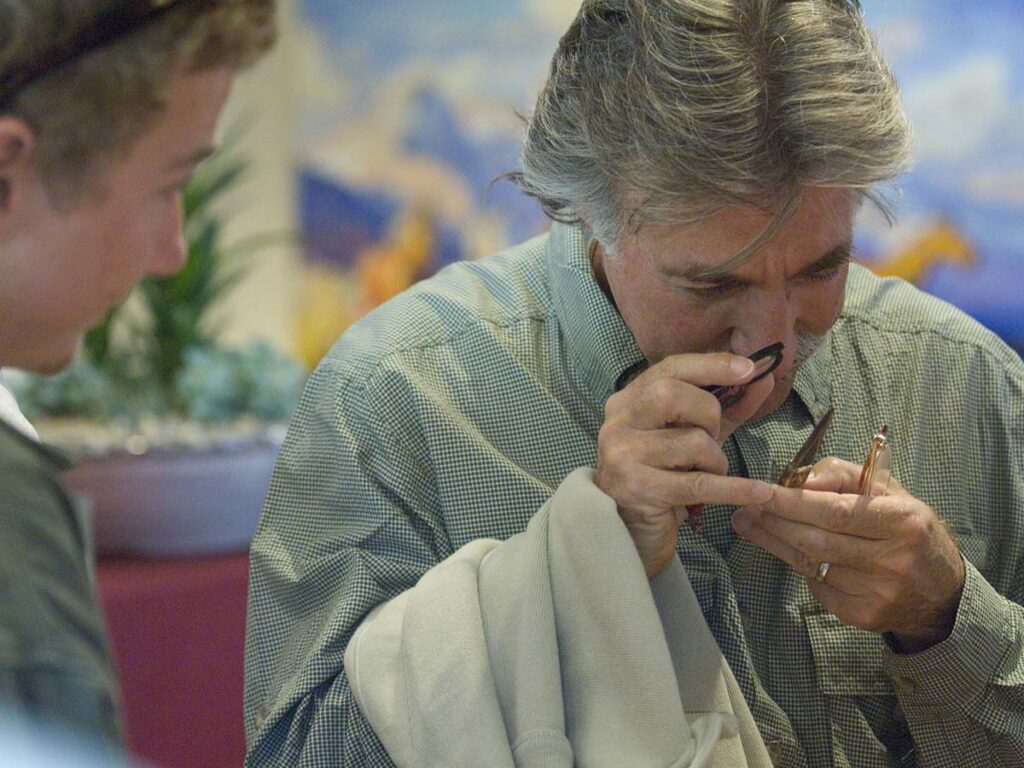
“If you’re at a show and feel you want to look at the blade under a magnifier, then you should ask the maker if he minds,” Bill Burke noted. “If he says ‘no’ or gets upset, then thank him and walk away.” (Eric Eggly/PointSeven image)
According to ABS master smith/BLADE Magazine Cutlery Hall-of-Fame® member Steve Schwarzer, the particular combination of steels might raise the prospects for a flaw to develop, especially when the skills of the maker are evolving. He commented.
“The worst flaws are the delaminations and inclusions,” he said. “These might come from poor welding practices and the choice of alloys involved. Some welds are much easier to make than others and a higher level of skill may be required. Most of it is visual—bad welds are bad welds and don’t have the necessary molecular bond.”
For a potential buyer the ability to spot a flaw is an attribute that pays off when dollars are exchanged for the finished product. Although a flaw may have no impact on the structural integrity of the damascus steel itself, the degree of impairment—if any—ultimately lies with the potential buyer who assesses the level of discrepancy. Approaching a maker’s table, discussing the damascus, and taking a closer look at the blade will sometimes generate relevant conversation and exchange of information. Flaws can show up anywhere in damascus construction, so visual inspection comes with the territory.
Schwarzer advises buyers to check the knife thoroughly.
“Using magnification helps. If the blade doesn’t look right, it probably isn’t. A flaw may show up as a bright spot in a dark area, and some skilled people can reweld their billets. I do that regularly and especially when I do guards and stuff, taking a light hammer and welding heat to fix it, but not everything can be repaired. Sometimes there is no way to repair it, and that is one reason why I hardly ever sell damascus steel—[and if I do] only to skilled professionals.”
Visual Signs
When a buyer’s interest is piqued, the next steps involve courtesy and cordial exchange with the knifemaker.
“Flaws in damascus can range from very hard to see to blaring and obvious,” Burke remarked. “An experienced eye in good light and magnification are the best ways I know to detect them. Some can be felt, but feeling the blade and running your fingers up and down and across it are not reliable and can cause rust and tarnish. If you’re at a show and feel you want to look at the blade under a magnifier, then you should ask the maker if he minds. If he says ‘no’ or gets upset, then thank him and walk away.”
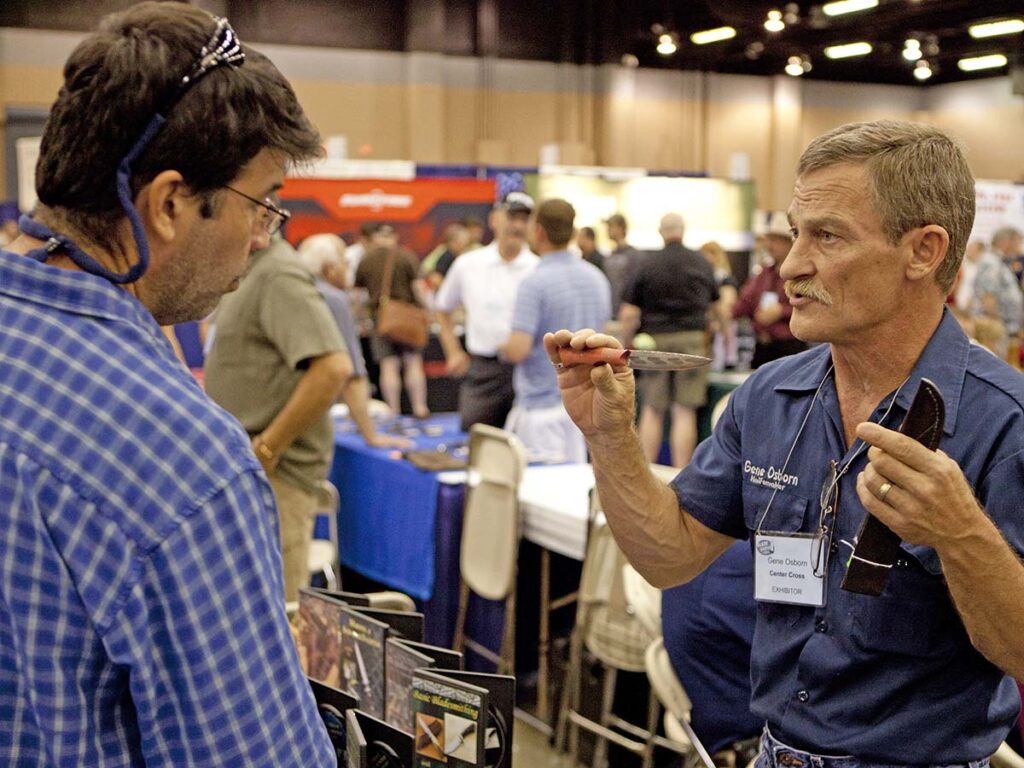
Steve Randall said most makers would not intentionally sell a knife knowing it had a flaw or without first pointing it out to the buyer. Gene Osborn (right) discusses a damascus knife with a customer at a past BLADE Show. (Eric Eggly/PointSeven image)
Randall concurs with that point of view.
“Bright light sure helps,” he observed. “It is difficult to find small flaws once a damascus blade has been etched. Running your fingers over the blade won’t tell you anything, and if you’re at a show I advise not doing it. Using a magnifying glass at the maker’s table could be awkward, and I would suggest respectfully asking before doing it.”
Historically, skilled makers and smiths have assessed their own work and identified flaws, correcting them or chalking up a flawed blade to the hazards of the craft. When ABS master smith Mike Quesenberry considers the flaw in context, he is frank in his response.
“The smith sees the weld lines with flaws before the steel is etched. To me that is something the smith has to deal with. I don’t have any problem scrapping a blade if [a flaw] shows up in the process. The hand sanding and grinding are where the time is really invested, and makers should be honest with their work. If you see a flaw, scrap it,” he stressed. “The best way to fix a flaw is to throw that blade away and start over again.”
Schwarzer smiles when he relates the style of an ancient practice.
“Japanese smiths worked out a way to hide a flaw if it didn’t mechanically affect the viability of the blade. They would do a nice little gold inlay. That was done in Persia, too, and a lot of other places. They would put artwork over something that was unseemly. If you have $300 in a blade and there is no mechanical problem, then that is a way to make it go away. It’s been said that the difference between a journeyman and a master smith is the size of the screw-up you can fix.”
Rhea acknowledges the human side of the situation. There may be a temptation to continue working on a knife with a flaw in the damascus, but then comes the realization on the part of the maker that causes him to refrain from that option. “When a buyer sees any odd discoloration in the form of surface treatment, color or texture, ask questions and give the maker the opportunity to explain or rethink his position,” he noted.
Resolving Situations
Bladesmiths and custom makers are genuinely committed to excellence. However, at times there may be a situation involving a flaw. When a purchaser detects something that may or may not be an imperfection, talking with the maker can resolve the situation to mutual satisfaction.
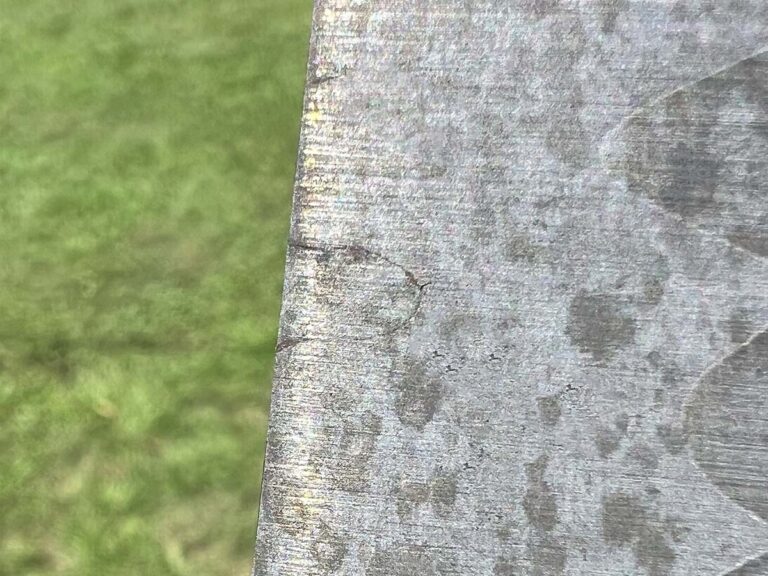
A welding flaw might pass a cursory glance, which is why you should always inspect any damascus blade you plan to buy closely.
“If you buy a blade and then find a flaw, you should contact the maker and ask them about it,” Burke advised. “If it is something you cannot live with, ask for a refund or allow the maker to replace the flawed knife. In most cases, the maker is going to be unaware of the flaw. If the maker is aware of the flaw or refuses to do anything for you, then you either have to keep it and say, ‘Oh well’ or sell it to someone else with full disclosure of the flaw.”
“When I have a buyer who experiences issues of any kind, I would prefer that they contact me and give me the opportunity to evaluate, discuss and make it right,” Randall noted. “I’m sure most makers would not intentionally sell a knife knowing it had a flaw or without first pointing it out to the buyer.”
Rhea sees the interested parties taking the high road in almost every case. “Most makers will honestly make a sale with good intent and in good faith,” he reasoned. “If there’s a problem just contact the maker and let him or her explain or make it right. Ultimately his reputation is on the line and he deserves the chance to make it an overall pleasant experience.
“When it comes to flaws and issues,” Lin concluded, “we all have them and we handle them in our own ways. To the degree we act to prevent problems for the buyer we also prevent problems for ourselves as makers, as well as enhance our reputation. Leaving flaws in damascus will reflect on our honesty and our attitude toward the buyer. This is something to think about very seriously. So, will there be problems? Yes, but we should go to great effort to prevent them rather than having to correct things that might be perceived as an oversight. In the end, we are human and will want to use common courtesy and humility in our dealings.”