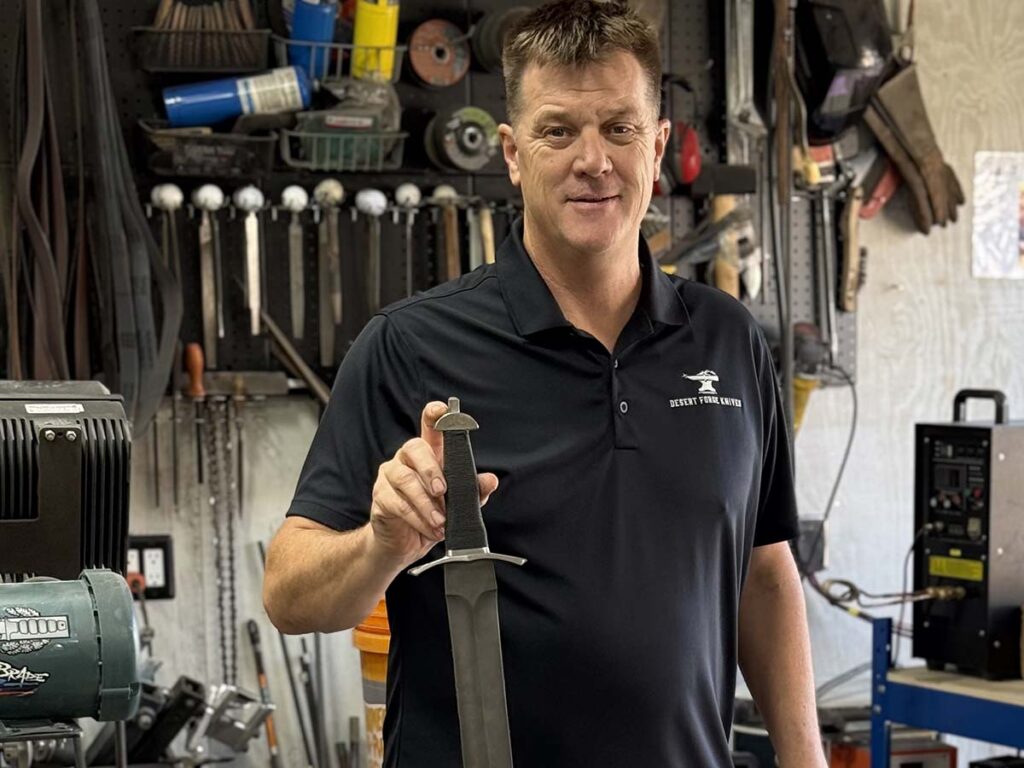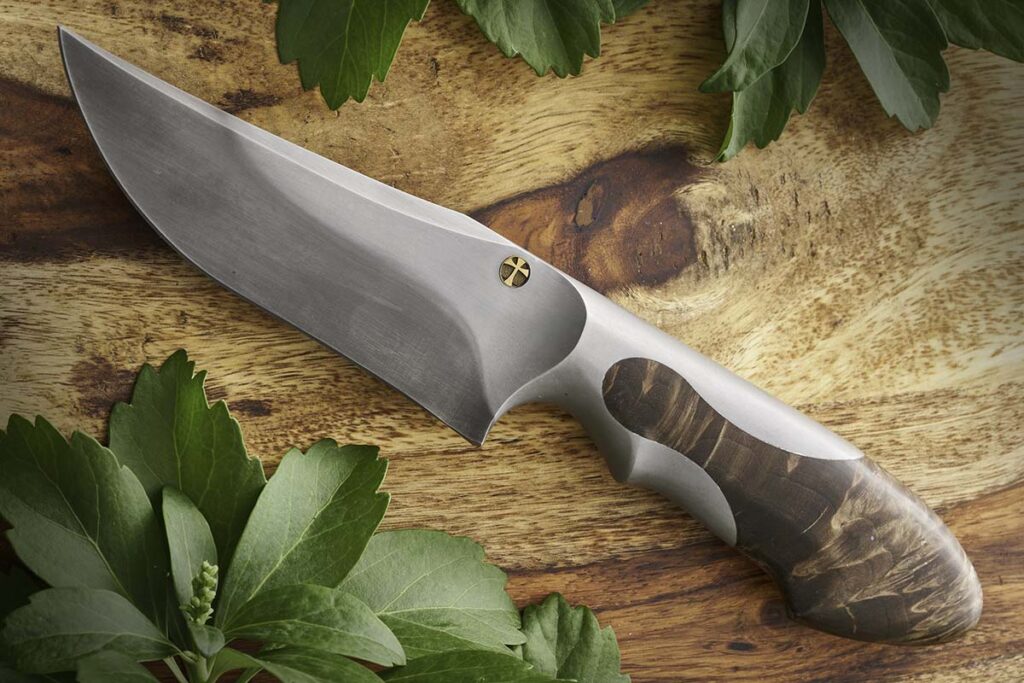
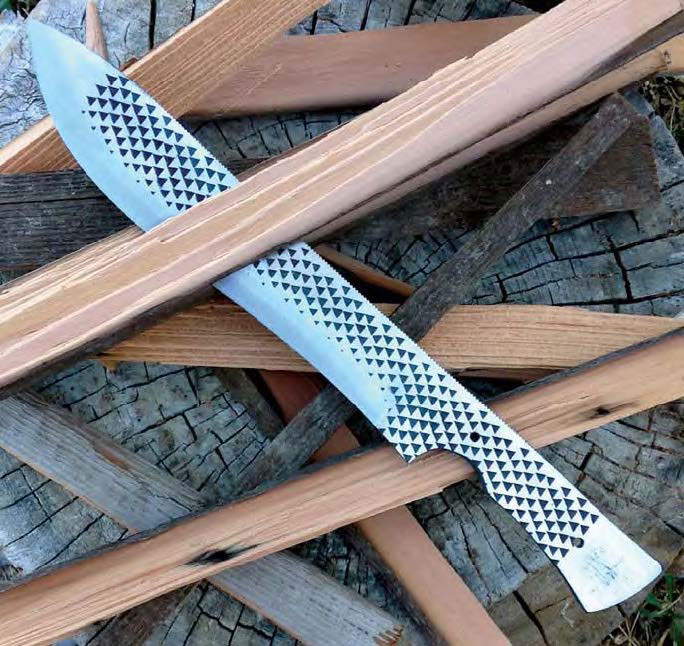
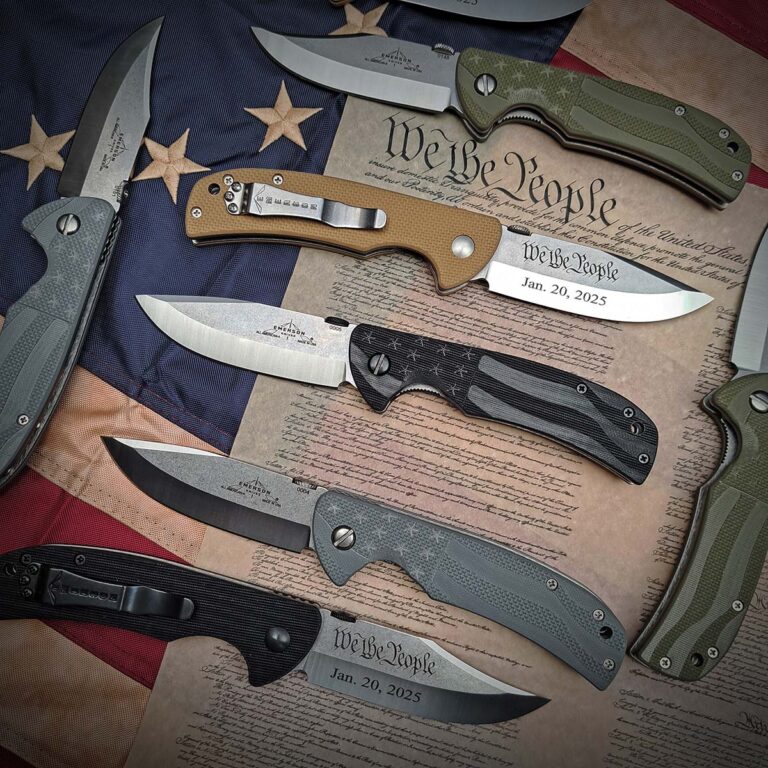
Knifemaking is the building of a knife, which includes the blade, handle and other accouterments. Blades are made by either removing metal from a steel blank via a grinder – known as stock removal – and the forging to shape of hot steel into a blade in the process known as bladesmithing. Other parts, including bolsters, guards, pommels, etc., are needed to complete the finished knife.
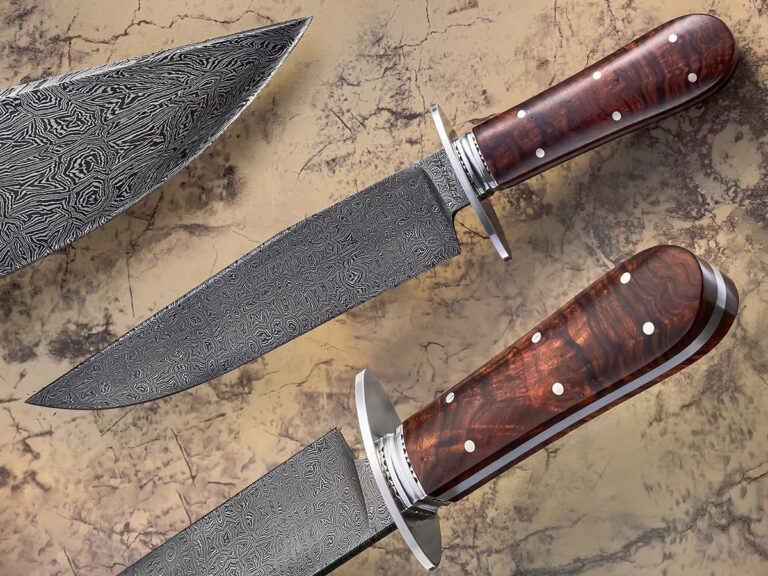
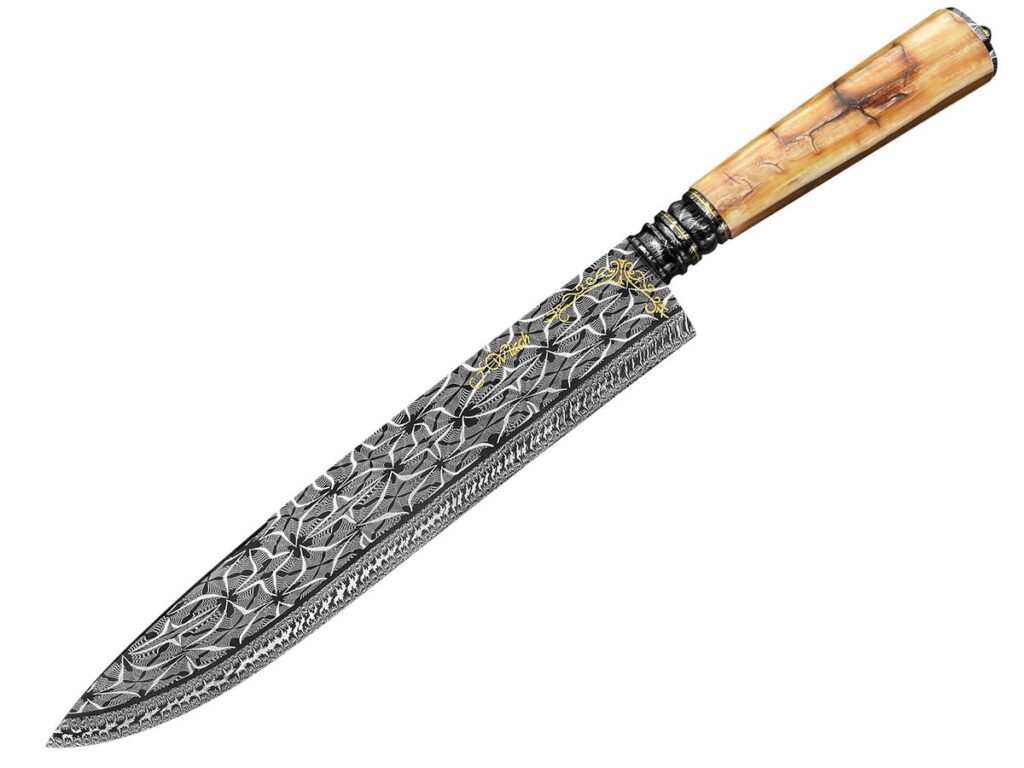
Tony Lewis knife honors the late ABS master smith and chairman.
American Bladesmith Society Master Smith/past ABS chairman Steve Dunn was admired by many in the knife community and died way too soon at 68 in 2024. ABS Journeyman Smith Tony Lewis never met Steve but is a fan of his work, including Steve’s damascus pattern known as Thorns and Thistles.
Tony was fortunate enough to buy Steve’s Riverside hydraulic press, a purchase that included several of Dunn’s die sets. Among the dies was a saddle die—maybe the very one Steve originally used to make the Thorns and Thistles pattern.
Tony Lewis
“Recreating the Thorns and Thistles pattern was both a challenge and a joy,” Tony wrote. “Forging triangles and combining them into a cohesive mosaic was a new technique for me, but after some trial and error I managed to pull it off. When I finally etched the billet and saw the intricate pattern revealed, I felt a deep sense of satisfaction—and connection.”
After studying Steve’s signature style, Tony chose a bowie that he believes “embodies the spirit of Steve’s work.” The result is a terrific tribute to a most talented man.
There must be something in the Amazonian water. In the global phenomenon of custom knives, there are few geographic locales that sizzle hotter than Brazil. The country has sharp makers and attracts talent, creating some of the world’s most desirable knives. Here is a look at some of the steel expertise emanating from the equatorial nation and its cutlery shows.
Romário Ribeiro Fighter
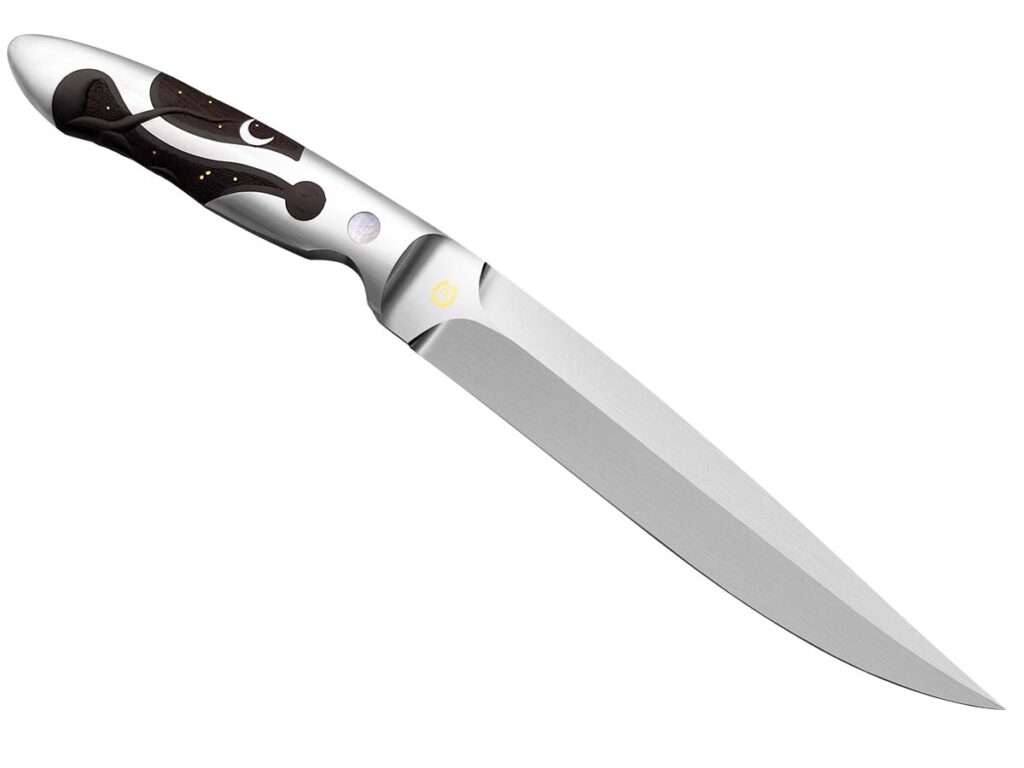
Sleek and dark, Romário Ribeiro’s 12-inch fully integral fighter of 52100 carbon steel won the Best Handle Award at Salão Paulista de Cutelaria 2025. It’s no wonder, with a seamless and intricate keyhole-style construction, and jacaranda wood and 24k gold inlays creating a boundless night sky motif, complete with a rising crescent moon.
Gustavo Schuenck Fighter
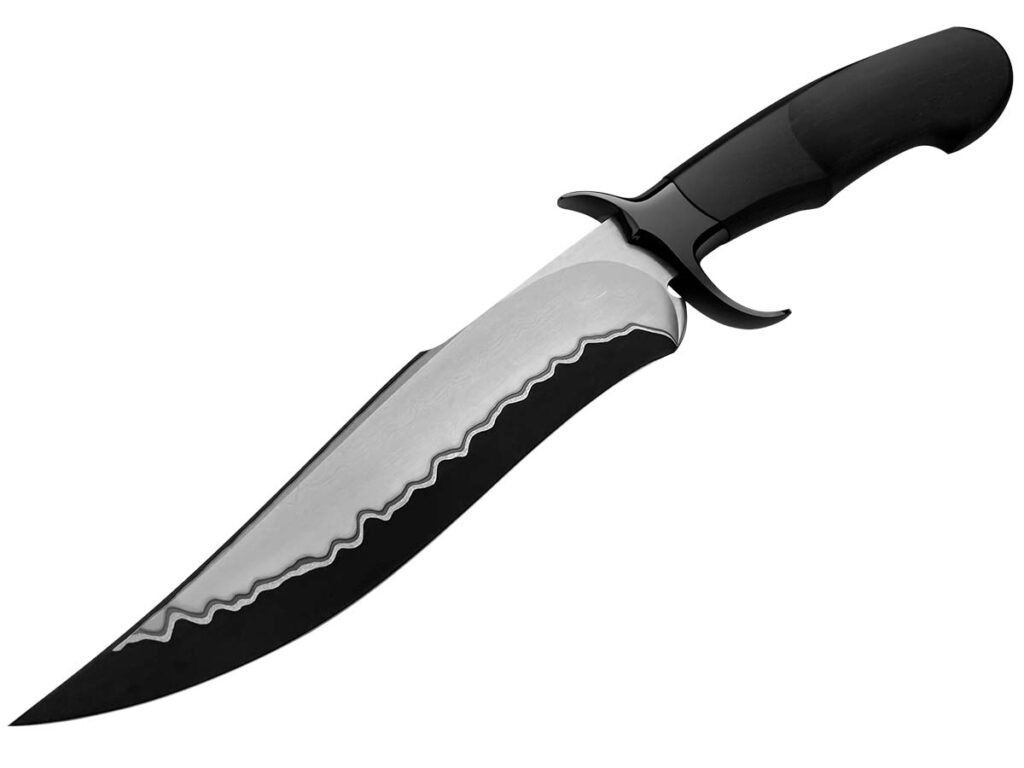
Winner of the Best Fighter Knife Award at Salão Paulista de Cutelaria 2025, Gustavo Schuenck’s blade is aggressively beautiful. San mai steel of 9½ inches with a black phosphate finish ties together with the knife’s pitch-colored jacaranda handle. The nuanced recurve toward the heel offers flow in the build, paired with an understated yet sweeping guard.
Alexandre Biguna Bowie
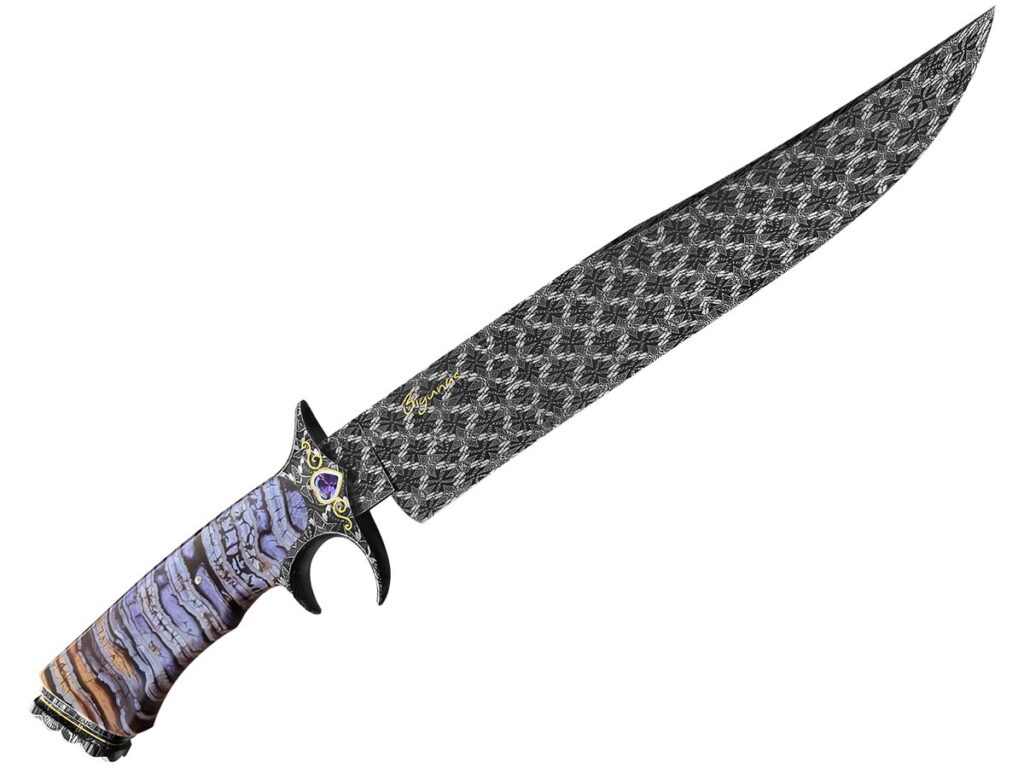
Near-perfect symmetry of Alexandre Bigunas’ basketweave mosaic damascus bowie can’t help but fascinate. The meticulous work on the 10-inch blade is contrasted by the striking color of the sub-hilt’s mammoth-molar handle and pair of amethyst stones on either side of the guard. Topping off Bigunas’ work, 24k inlay, including his signature on the blade.
Júlio Cézar Ribeiro Gentleman’s Slip Joint
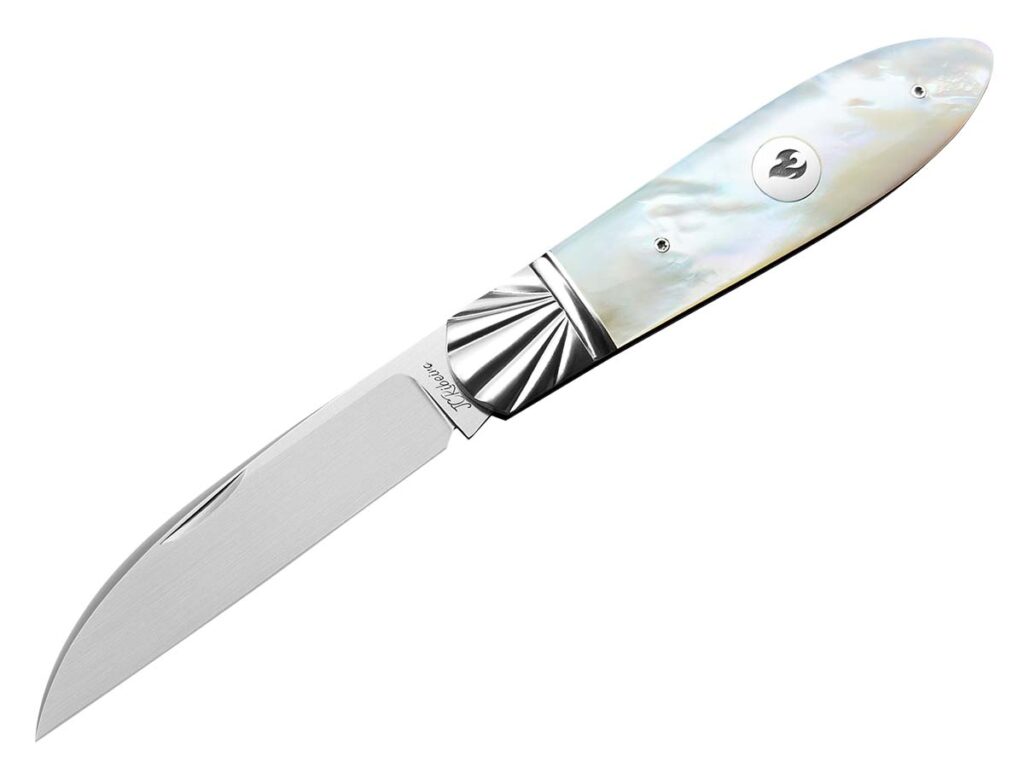
Simple, clean and classy are the driving ideas behind Júlio Cézar Ribeiro’s gentleman’s slip joint. The Brazilian’s spotless execution also caught the judges’ eyes at Salão Paulista de Cutelaria 2025, with the knife winning Best Traditional Folder. Notable aspects of the knife includes the swooping spine of the RWL 34 steel Wharncliff blade, maintaining the knife’s overall geometry with its teardrop mother-of-pearl handle.
Lizandro Bertoni Bowie
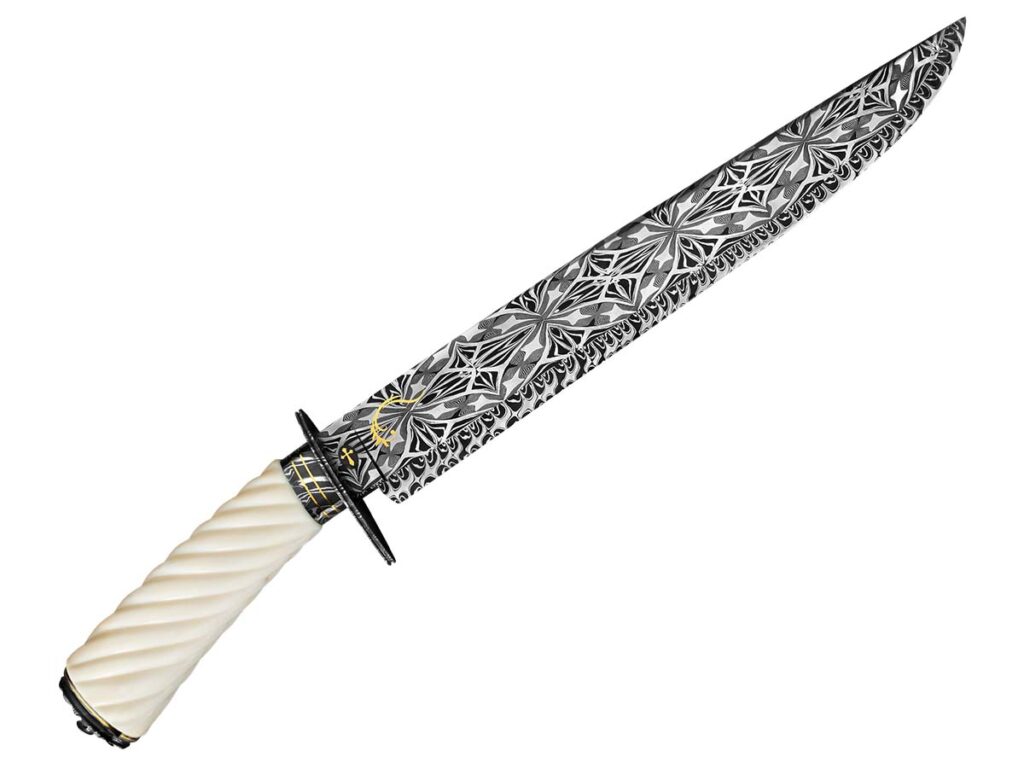
Lizandro Bertoni’s bowie is a study in contrasts. The flats of the 16-inch, 1085 and 15N20 damascus blade dominate with a starburst-like mosaic pattern, but give way to a cross pattern at the edge. Further, the busy ornamentation of the blade is contrasted with the calmer design of its walrus-ivory handle and the smooth lines of its texturing.
Vanuti Fiori Dagger
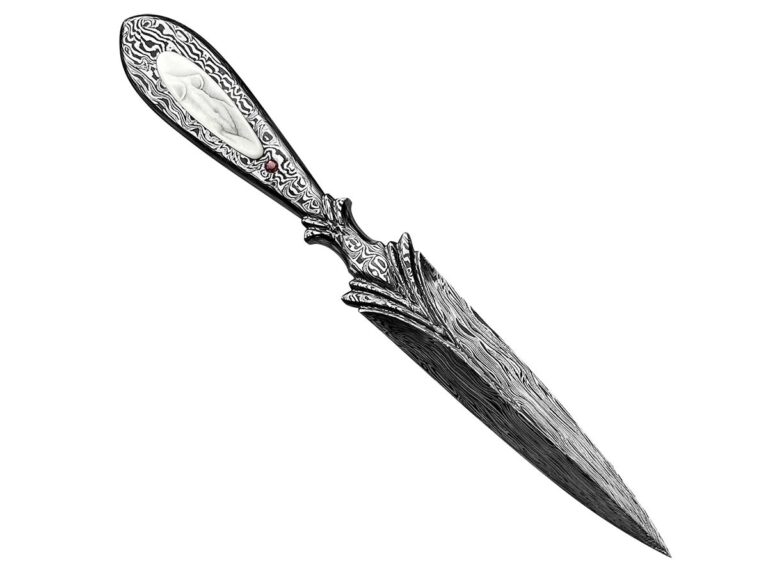
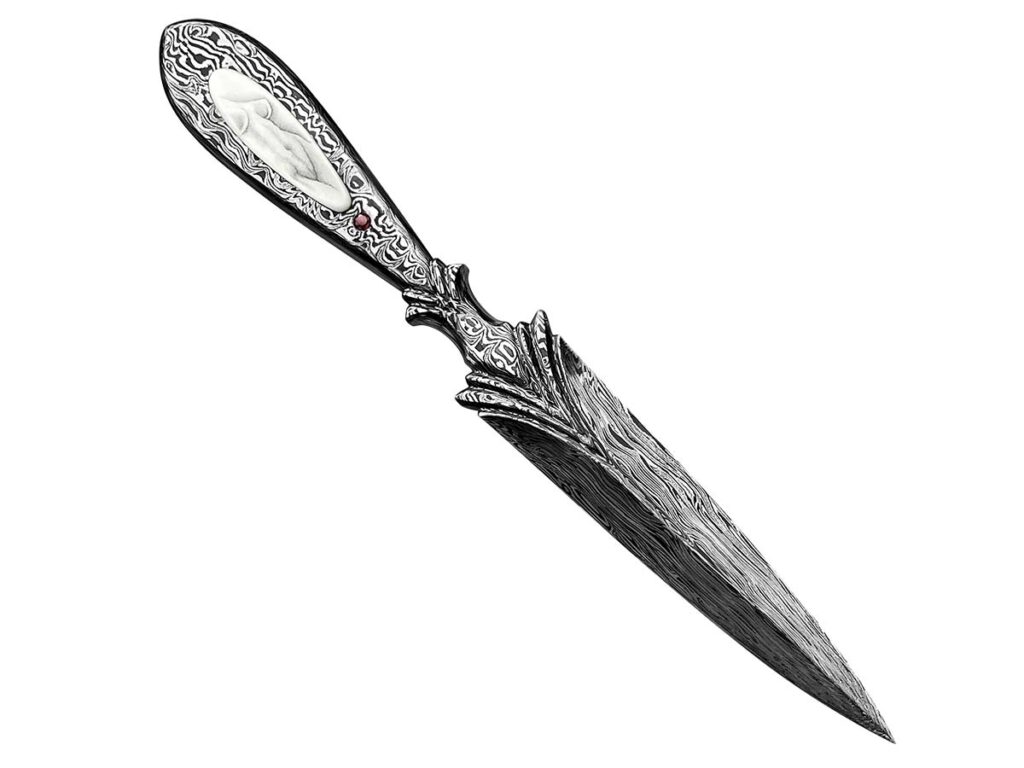
Dang sexy is all that can be said of “Lady of the Night,” a collaboration between knifemaker Vanuti Fiori and engraver Gabriel Krebs. It’s not only the lines of Fiori’s integral dagger that drip sex appeal, but also Krebs’ alluring feminine -form scrimshaw on its mother-of-pearl inserts.
Francisco Wlach Gaucho
Francisco Wlach takes the workingman’s gaucho knife to a different level with the execution of his knife’s 10-inch laced mosaic blade. Wlach creates movement on the blade with a very uniform pattern over the majority of the steel, contrasted by a more subtle pattern along the edge. Gold inlay, integral bolster and mammoth-tooth handle would make this blade any gaucho’s pride.
Bob & John Horrigan Made Knives Together. After The Former Died Defending The Country, John Kept Their Knifemaking Legacy Alive
It was a night mission, and it was dangerous—just like every mission, every moment in the deserts and villages of western Iraq or the mountains of Tora Bora in Afghanistan.
“You don’t have to come,” the others said matter-of-factly to Master Sergeant (MSG) Bob Horrigan. “You’ve only got two weeks left in the country.” The veteran Delta Force NCO, with 19½ years in the U.S. Army, three tours in Afghanistan, and a fifth in Iraq coming to an end, simply replied, “If you’re going, I’m going.”
True enough, Horrigan was just days away from returning to the USA, and he planned to retire from the Army in six months, then, in peace, to make custom knives in his shop and share that time with his twin brother, ABS master smith John Horrigan.
This night, however, there was dangerous work to be done. A raid was planned on a safehouse known to be frequented by terrorists, particularly Iraqi al Qaeda leader Abu Musab al-Zarqawi, a ruthless murderer pledged to support Osama bin Laden. Horrigan
A veteran Delta Force NCO, Bob Horrigan served 19½ years in the Army, including three tours in Afghanistan and five in Iraq. He was killed during a raid on a safehouse frequented by terrorists, including Iraqi al Qaeda leader Abu Musab al-Zarqawi. Bob was laid to rest with full military honors at Arlington National Cemetery.
When the call went out for someone to serve as a master breacher during the mission, blasting doors and first inside a building where hostiles might be hiding, Bob Horrigan said without hesitation, “I’ll breach.” In the town of al Qaim in western Iraq, the Delta Force team, accompanied by additional Special Forces personnel, moved toward the suspected Zarqawi safehouse. With MSG Michael McNulty at Bob’s side and the rest of the team close by, the two were first to enter the enemy compound.
Bob made it into a nearby room, and a machine gun opened up. McNulty was hit in the doorway. Bob was fatally wounded seconds later. Both died within a few hours.
“It was about 7 in the morning. I was at home, and Bob’s brother-in-law, Mark England, came to the house,” John Horrigan recalled. “Our sons were best friends, and I thought he was coming to tell me that my son had gotten into trouble. He said, ‘No, John. It’s Bob.’”
The news was devastating, and Bob Horrigan was laid to rest with full military honors at Arlington National Cemetery, following a funeral service in Austin, Texas. He left behind his wife, Denise; young daughter, Courtney; older sister, Lisa; younger brother, David; many friends and relatives; and, of course, twin brother John.
To say Bob and John shared a special bond, even as identical twins, would be an understatement. Their mannerisms and speech patterns were so alike, and they experienced the joy of growing up inseparable. They also shared their love of service to their country, and later came a great interest in custom knives.
First Drop Zone
The brothers were born in Limestone, Maine, on Jan. 13, 1965. “I came into the world seven minutes before Bob, so I cleared the drop zone. We always said he was a hung jumper,” John smiled. “We’re identical twins, so I got into fistfights for him, and he got into fistfights for me. It was like the Doublemint®-Spearmint commercial, and it was that way in school and in the Army. He continues to be half of me. He is still here, and I can feel his presence out in the shop now and then.”
John made his first knife in high school. Instead of making a planter as his shop project, he found a piece of O1 tool steel and went to work on the knife. His son carries the same fixed blade today, first with a cherry handle and later with one of maple. For 24 years now, John has worked as a firefighter with the Austin Fire Department, the family’s hometown after moving from Maine to Florida and then to Texas years ago.
John enlisted in the Army in 1984, six months ahead of Bob. The two became Rangers, elite soldiers engaging in demanding training programs and taking on the most hazardous combat operations. They served in the 3rd Ranger Battalion, 75th Ranger Regiment, and Captain Stanley McChrystal, who later reached the rank of general and commanded American forces in Afghanistan, led Company A.
John spent three years on active duty as an Army Ranger. Bob stayed in and spent about eight years with the 7th Special Forces Group and 9.5 years with Delta Force. Even among the elite of the 7th Special Forces and the clandestine Delta Force, Bob stood out. He attended just about every training school imaginable, including the Basic Airborne Course, Jungle Warfare Training Course, Special Forces Qualification Course, Military Freefall Jumpmaster Course, and several others. In 1987, he competed in the Best Ranger competition at Fort Benning, Georgia, and placed second.
He was a leader of hardened, highly trained military professionals, and among his numerous decorations were the Bronze Star, Purple Heart, Legion of Merit, Combat Infantryman Badge, and Expert Infantryman Badge. The full list of his accomplishments during a distinguished two-decade career is literally too long to include in this story.
Several well-known authors have written about his exploits, including Brad Thor, Pete Blaber, Sean Naylor, and George Hand IV. In writing of the funeral of a central character in one of his novels, Thor is actually describing Bob’s funeral, an all-too-real and somber event.
In his book The Mission, The Men, and Me, former Delta Squadron Commander Blaber remembered Bob and wrote, “After unshouldering his ruck, Bob H. scotched forward on his belly. He stopped behind a small pile of rubble. Canting his head slowly, he spied the valley below. His eyes and ears strained to detect any unnatural noise or movement; Bob was focused like a man whose finely tuned autonomic nervous system is programmed to maintain perfect equilibrium between the thrill of the hunt and the thrill of the chase. Bob understood his status as both the hunter and the hunted. He liked it that way … Courage has been called a contradiction in terms, meaning a strong desire to live manifesting as a readiness to die. It described Bob and his mates to a tee.”
During those long deployments to combat zones, Bob stayed in touch with John, mostly via email. “He would send one to me, and I would respond,” John said. “The next morning there was another one waiting for me. Robert downplayed a lot of what was going on. He’d say, ‘Not much happening here … I’m bored.’ But he was lying. They were in firefights every day; he just didn’t want people to worry about him.”
In his book The Mission, The Men, and Me, former Delta Squadron Commander Pete Blaber wrote of Bob Horrigan (above): “Bob understood his status as both the hunter and the hunted. He liked it that way … Courage has been called a contradiction in terms, meaning a strong desire to live manifest as a readiness to die. It described Bob and his mates to a tee.”
Meanwhile, there were those precious times that Bob came home, mostly during the Christmas season, and the twin brothers picked up where they had left off during a prior visit. One of their primary topics was—of course—knives.
$50 Sander
John was 21 when he left the military, and he visited a knife and gun show in Austin with a pair of his own custom knives and a couple of makeshift cardboard wheels under his arm that he used as sharpeners. He met Houston-based custom knifemaker Ed Thuesen, who also owned Texas Knifemakers Supply.
“Ed saw those under my arm and said, ‘Don’t use that crap!’” John recalled. “I told him I couldn’t afford a new sander, and he said that he had a used one in Houston that he would sell for $50, but I would have to drive there to pick it up, and he wanted cash. I said, ‘Deal!’” Later, John bought a brand-new Bader sander and sold the used one to Bob—
for $50.
“I got into knifemaking, and then I got Bob into it,” John smiled. “He mainly made military fighters for guys in his unit, for Navy SEALs or whoever. He had more business than I did.”
At Fort Bragg, North Carolina, home of the Army’s Airborne and Special Operations Forces, Bob set up a knife shop in a lawnmower shed. Power was supplied with an extension cord, running through a sliding glass door to the shop’s tools. He enjoyed working with 440C and 154CM stainless steels, but he couldn’t forge on the Army post. Hence, when he needed a piece of damascus, John gladly supplied it.
“He wrote me a letter once telling me how much he loved coming home, coming to the shop and learning new things,” John remarked. “He would tell me that copying someone else was the highest form of flattery, and if you look at Robert’s knives they were similar to the knives I made. But he’s my brother, and I don’t care. Later, he got into his own designs, and now my best-selling knife is one of Robert’s designs.”
That legacy design is the Robert “Bob” Horrigan Military Fighter, available from John today in the notable style that has become popular in the military as well as the general public. The fighter is 11.25 inches overall with a 6.375-inch blade of 440C stainless steel and a handle of black linen Micarta®. The knife weighs 8.7 ounces and is accompanied by a Kydex sheath.
“I actually didn’t make the Bob Horrigan,” John related. “I made my Model 1 and others, but there were some guys from the 160th Night Stalkers who were on the mission that night and asked if I would make the Bob Horrigan knife. Now I make the Bob Horrigan, and I make them the way he did.”
Through the years, John has established himself among the best bladesmiths and custom knifemakers around. His daggers, tomahawks, and fighters are acknowledged as fine work, and his dazzling inlay with precious metals is something to behold. “I tell everybody that is my Picasso work,” he laughed.
Tremendous Spirit
Living quietly in Burnett, Texas, about an hour outside Austin with Donna, his high school sweetheart and wife of 33 years, John works in a 30×40-foot shop on his farm, dotted with chickens, goats, and bees. Donna says the shop is as big as the couple’s first house. They have two grown children, Matthew and Krystal, and two grandchildren, whom they adore.
Reflecting quietly, John observes, “The greatest thing that has happened since Bob’s death is that he brought me back to God, and that is the best thing he could ever leave me. Being twins, it was pretty rough, and it felt like half of me was gone. Bob came to me at the BLADE Show* two years before he was killed and said, ‘I’m coming back to God. At the time I just said, ‘Great!’ but when he was killed, God was what got me through it.
Designed by Bob Horrigan, the Robert “Bob” Horrigan Military Fighter is ABS master smith John Horrigan’s best-selling model. “I make them the way he did,” John said, including a 6.375-inch blade of 440C stainless steel, a black linen Micarta® handle and a Kydex sheath.
“I started living for Robert, for my family and doing what God wanted me to do,” John continued. “I know where Robert is now, and I know where I’m going. Bob killed a lot of people and that worried him. So he went to the chaplain, who told him that the Bible said not to murder. It didn’t say not to kill in defense of your country. So, he was good with that. I don’t think my brother ever had PTSD because he had God.”
John received his ABS master smith rating shortly before Bob was killed, and as he continues to live his dedicated life, he takes comfort in the fact that his brother, who also wanted the ABS designation, knew that John had achieved it.
In recent years, John has made presentation knives depicting the American flag for Delta Force and for former President George W. Bush, whom he met at Fort Bragg during a visit after Bob’s death. He presented the knife to “W” sometime later in Dallas.
John is generous with Honor Flight Austin, donating knives that raised $19,000 at auction, paying for 19 veterans of World War II to visit their memorial in Washington, D.C. At one auction event, he presented a Bob Horrigan fighter to Admiral William H. McRaven, commander of U.S. Special Operations Command. At an auction the following year, he presented a Bob Horrigan fighter to Medal of Honor recipient Sergeant Salvatore Guinta of the 503rd Infantry Regiment, 173rd Airborne Brigade Combat Team.
During each of these events, John has felt his twin brother right there with him. In service to his country, Bob made men. In the shop, he made knives with lasting, honorable attributes like those who carry them today. Noted John, “The sacrifice of these young men and women is incredible.”
For the elder Horrigan, every day is a tribute to his brother. Their love of the custom knife is an unbreakable link, and to be sure, every knife that John will ever complete carries something of Bob’s tremendous spirit with it.
A Pair Of Gifted Knifemakers Show Off The Tools They Use To Turn Raw Steel Into Razor-Sharp Works Of Art.
Simply put, Salem Straub makes art and culinary knives of the highest order. He began forging in 2003 when a previous project introduced him to blacksmithing and, like so many knifemakers, once the bug bit there was no turning back.
Twenty years later Salem is at the top of his game and all his work is sole authorship. What’s more, he delighted many knife lovers by competing and winning in the second season of the History Channel’s popular reality show, Forged in Fire.
Award-winning bladesmith Salem Straub makes fine art folders, fixed blades and swords, and added culinary knives out of his passion for cooking.
Salem operates his custom cutlery business under the name Promethean Knives after a passage from noted British writer Zia Haider Rahman: “Is that not the Promethean fable, that the fire stolen from the gods will light men their way even while it burns their hands?”
Salem built his reputation for making fine art folders and fixed blades, including swords, but he added culinary knives out of his passion for cooking, which in turn led to his winning the Best Integral Award at the 2019 Damasteel Chef Invitational. His forging specialty is extremely fine patterned damascus.
Inside Salem Straub’s Shop
Salem leads off his list of top tools with his bandsaw.
“The Marvel Model 81 Hydraulic Vertical Bandsaw is the ideal saw for a dedicated pattern welder,” he begins. “It will easily handle all the normal operations that either a horizontal or vertical bandsaw can, but also affords the additional capability of ripping lengthwise with power feed, miter cuts, compound miter cuts and rips. Everything from the table vise to the saw feed and drive wheel is hydraulically powered, and a flood coolant system is integral to the design.”
Straub’s Marvel Model 81 Hydraulic Vertical Bandsaw easily handles anything a horizontal or vertical bandsaw can, and affords the additional capability of ripping lengthwise with power feed, miter cuts, compound miter cuts and rips.
His lathe of choice is his Pratt & Whitney Model C Toolroom model.
“It’s a bit larger than might be strictly necessary for knifemaking,” Salem notes, “but affords the ability to create parts for repair of, or modification to, other machines. It’s also very smooth, accurate and convenient for making and threading small knife parts to close tolerances. The P&W ‘C’ lathes are among the truly legendary lathes from the heyday of American machine tool manufacturing.”
His Abrasive Machine Tool Model 3B Surface Grinder features an 8×24-inch capacity automatic table with a magnetic chuck, a 2×72-inch-belt modification by Salem, and a 3-horsepower motor.
“The table feeds are mechanically powered and relatively quiet and very reliable in operation,” he explains. “This machine is MVP in the shop, especially on many damascus production days. The belt modification allows for much faster removal of stock, making billet and tiling work much faster and more precise.
“Another piece of equipment I can’t do without is my Beaudry Champion #9 300-pound power hammer. I bought it from the late Larry Langdon, who gave me quite a deal as it needed lots of work to restore, and some difficult parts had to be made. After I took seven months to overhaul and install it, this hammer has become the cornerstone of my operations in making composite damascus billets and blades. The large flat die surfaces and excellent control make it ideal for forge welding, and it has plenty of power to forge large cross sections efficiently.”
Straub’s chef’s knife sports a 9-inch blade of a stunning herringbone/mosaic composite damascus and a Japanese-style wa handle. (knife image by Abe Shaw of Eating Tools, Inc.)
Next up Straub extols the virtues of his rolling mill.
“My 10-horsepower rolling mill with 6×6-inch rollers is probably a tertiary forging machine for most hot shops to have—after a hammer and press—but it’s very handy indeed for cleanly drawing billets to bar stock, welding san-mai, and sizing pattern elements before tiling or four-way welds and the like. It was built to spec by a fab shop for my friend Mike Blue, whom I bought it from. I consider it a very good working design, and for production damascus it’s a huge help.”
Last but not least, Salem mentions his 1960s-era Deckel GK21 Pantograph.
“This is a machine quite unlike the others. Its use is quiet, contemplative, technical, and its mode of use is more artistic than one of brute force. The GK21 is a machine that pretty much defines its class—very smooth to operate and fascinating in its potential. I’ve been learning to use it for a few years and so far I’ve been mostly doing inlays for handle work, but I’m branching out into engraving designs onto handles with it, too. I look forward to decades of finding out new cool ways to use it.”
Andreas Kalani
Andreas Kalani specializes in mainstream and culinary fixed blades and also folders.
Andreas Kalani spent 30 years in the corporate world, but once he discovered knifemaking he knew he’d found his calling. Now, nearly 10 years after leaving his former occupation, the Iranian-American is a full-fledged U.S. citizen grinding steel and making the knives of his dreams.
Kalani is an American Bladesmith Society apprentice smith currently working on his journeyman smith designation on the way to his ultimate goal of master smith. The versatile maker builds fixed blades—both mainstream and culinary—and folders.
Among those pieces are some top-shelf art knives. Meanwhile, he also makes a point of offering affordable fare for his customers. He markets his cutlery under the AK Custom Knives label and also instructs budding makers with a separate division called AK University. Needless to say, Andreas keeps himself busy with a full plate of cutlery interests.
Inside Andreas Kalani’s Shop
He leads off his knifemaking go-to equipment with a lightweight wonder.
“One of the most valuable tools in my shop is my Dremel 4000 Rotary Tool,” he reveals. “I use Dremel for engraving, polishing, sanding, cutting and much more. Dremel was my shop’s first official tool before I became a knifemaker. I used to make small and miniature swords and knives for my wire sculpture, and I could grind and shape the blades and handles with my Dremel tool. You can use various tips and bits for multiple uses such as carbide tips for steel and alloys or diamond tips for clay, woods and other materials. The possibilities are endless and you can be super creative with this tool; you can either mount it on the table, make a stand for it, or get an extra pen cable to do much more.”
Next on his list is his Evenheat Kiln.
Andreas not only uses his Evenheat Kiln for heat treating his blades but also for lost-wax processing.
“It is generally used for the blade heat treatment to have better steel structure and accurate Rockwell hardness,” he states. “However, sometimes I use it for lost-wax processing as well. Before I got the kiln I had to send out all of my blades for professional heat treatment and it was time-consuming and costly, especially when I wanted to work on one custom project. Therefore, I had to get my own. With this kiln in the shop I can now heat treat various steels from high carbon to stainless, and know I have a good grain structure and a suitable heat treatment. An Evenheat kiln is one of the must-have tools for any knifemaker in the shop.”
According to Andreas, finishing tools play multiple roles in his operation.
“They are the most used on every project in my shop,” he observes. “From the finishing stones to G-10 sanding blocks, I use them for various sanding and polishing. Gesswein® EDM Blue Stones are made from premium aluminum oxide. EDM Blue is a more complex formulation of EDM stones specially designed to handle the high-speed back-and-forth motion of a profiler or ultrasonic machines, and are superior for polishing the most challenging scales. The stones are designed for use on hard surfaces at high speed and hold their shape very well.”
For the sanding blocks, Andreas created different G-10 paddles for such various uses as flat, concave or convex sanding.
“I add additional leather or plastic backing to each paddle to have more give on a harder surface when sanding,” he notes. “By combining these tools, I can achieve a beautiful finish on all of my blades.”
The Milwaukee Portable Bandsaw 6232-20 is another must-have machine in his shop.
“It’s precise when you want precision cuts or to create an intricate geometry—for example, when you want to make a guard for a knife, you can outline your guard on whatever [steel/alloy] you use and then quickly cut it to the shape. Afterward, you can go straight to the grinder to shape the final form,” he states. “You can purchase different types and styles of the blade for this machine to have a better cut and precision for other materials. It’s portable and I purchased a stand for it separately, which is made specifically for this machine by SWAG Off Road.”
Another invaluable tool in Kalani’s shop is the 25-gallon Sandblaster cabinet, which helps remove material, clean, and applies the final finish to blades.
Kalani’s14.5-inch Lagertha Middle-East chef’s knife features a blade of 1095 carbon steel with an electro-pattern mirror polish. The Natural Galaxy handle is a combo of Middle Eastern turquoise and flowers. (SharpByCoop knife image)
“You can achieve different results on other materials using various media types from the walnut shell, glass bead, aluminum oxide, steel bead and so on,” Andreas explains. “There’s a learning curve and trial and error at the beginning. For example, if you want to sandblast titanium and be able to anodize it, you cannot blast it with aluminum oxide or steel media. The pressure will infuse the titanium and prevent it from anodizing. Based on my trial and error I found out that glass beads not only give a good matte surface to titanium but also keep it clean—and I am able to anodize it.”
He calls the 2×72 TW90 Grinder “the mother of all the machines in the shop.” It has a multi-position setup and various speeds, giving him limitless capability for different styles and types of grinding.
“I own at least five other attachments for this machine, including an 8-inch wheel, a 4-inch wheel, a modular switchable small wheel, a surface grinding attachment, plus flat and slack-belt platen,” Andreas observes. “One best modification I applied to it was adding an earth magnet on my work rest to use for different sizes and styles of work. It’s helpful for a different kind of grinding. For example, if you want to grind a sword, you need a more extensive work rest to run your blade over it, and this is super helpful.”
The men behind the Huber Foxworth Bowie are as captivating as the knife itself.
This is the story of a knife named in honor of an incredibly special man. In this highly populated world not many people get their name attached to anything. I do, however, know for a fact that Craig Fox Huber was very proud of the idea that people would be wanting the knife that bore his name for decades to come. He told me so in person. He lived a life that so many would aspire to but very few would have the moxie to follow through on. He was the real deal.
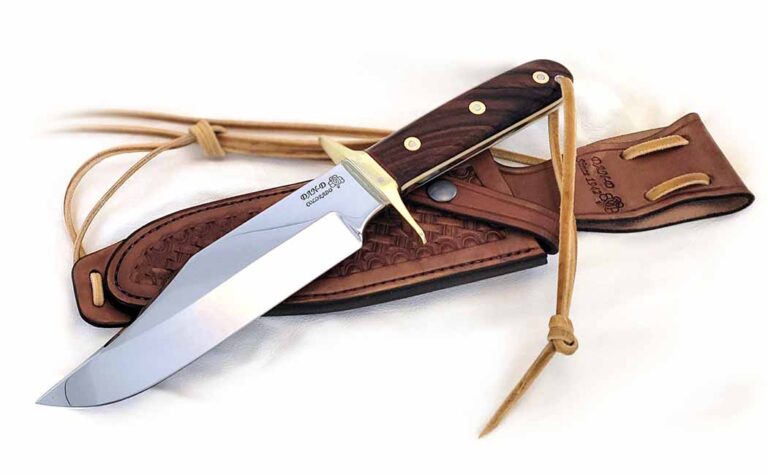
So, how did Craig impact a knifemaker to the point of naming a knife the Huber Foxworth Bowie? Here’s what my father, BLADE Magazine Cutlery Hall-Of-Fame® member Dan Dennehy, wrote about Craig in his 1970 Dan-D Knives Brochure:
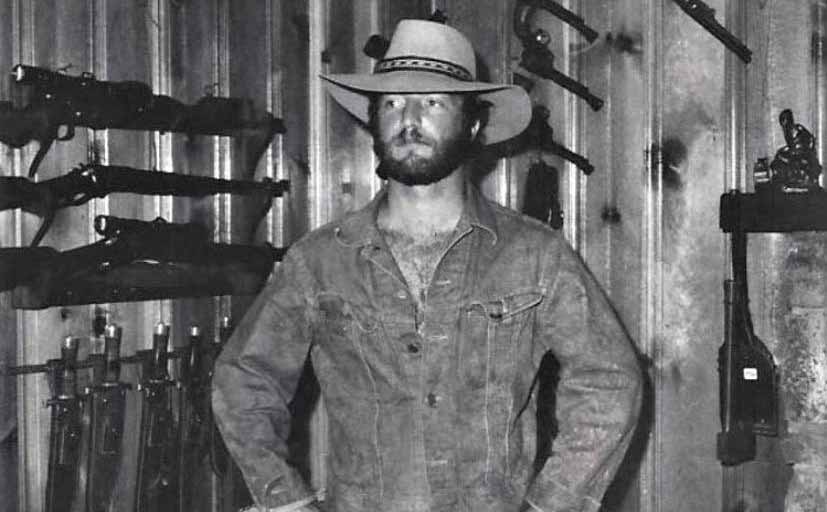
Many self-styled “experts” have stopped by my shop from time to time to suggest to me how I should design the “perfect” knife … Not long ago a trim bearded crewcut type found his way to my shop, and we started talking knives. [Circa the late 1960s] I took an immediate liking to this handsome, rather cocky gent and was pleasantly surprised to learn that he spoke about knives with a rather rare understanding of design and more than just a rudimentary knowledge of metallurgy that I found uncommon even among some men whose names would be familiar to you as supposed “experts.” He not only talked good theory and design, but he spoke with considerable authority on how a fighting knife should be used.
That’s Craig Fox Huber inset circa 1970 at the Fox Den’s second location in Mountain Home, Arkansas.
During our conversation I learned that he had earned three Purple Hearts while serving with a Marine Recon Unit in Viet Nam, and enough other “breast hardware” that when he spoke, I listened with both ears, and rather attentively.
Those who knew Dan might realize that these comments mean he really respected the “cocky gent.” And Craig respected Dan. Their long friendship stayed the course until the end. I also had a lot of respect for Craig and his vast knowledge of knives and other things.
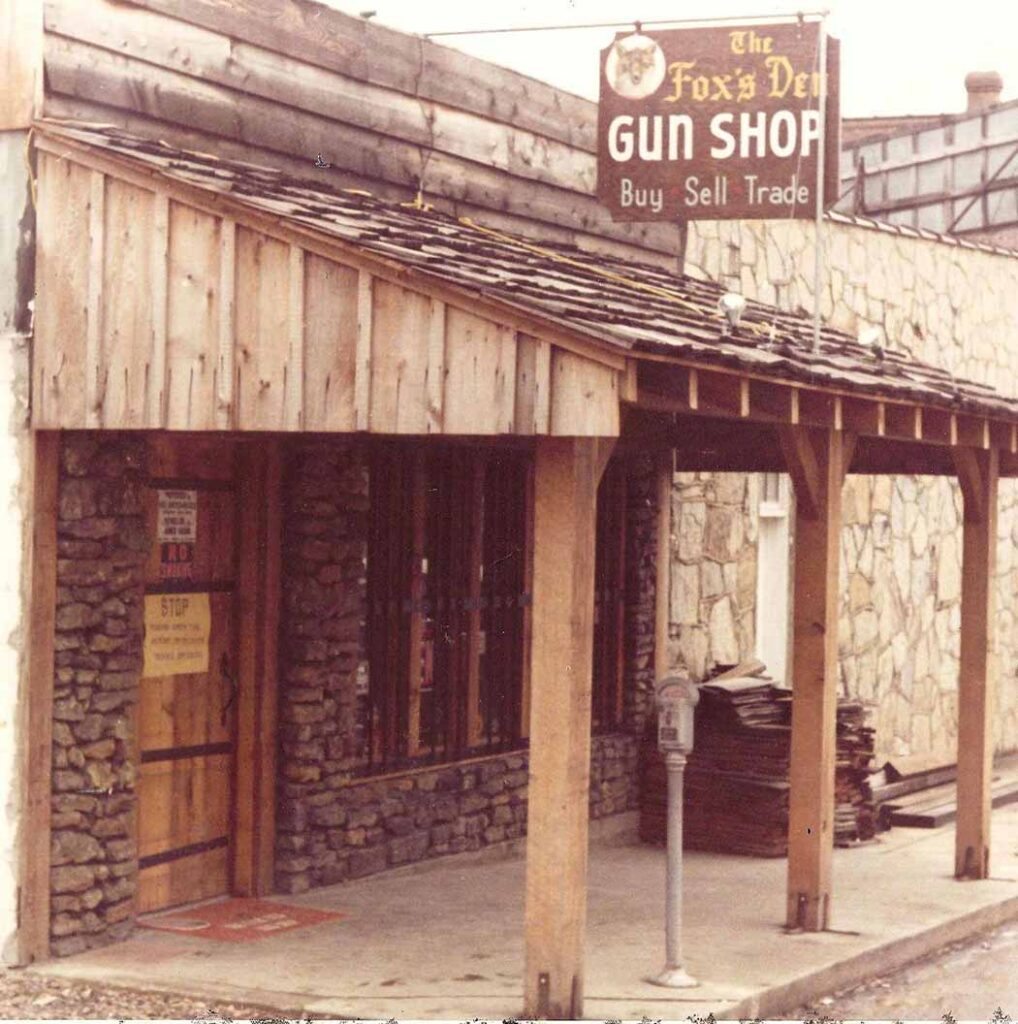
I met him in the early ’70s at The Fox’s Den, his gun shop located in the small ranch community of Kirkland, Arizona. Dan took me there to meet Craig when I was about 13. I shook hands with a man wearing a drop-loop gun belt with rounds in every loop and a .45 Long Colt pistol in the holster. I was in awe. I also got to see some of the knives he carried and to learn why he carried them.
About a year later my family bought a small ranch in the area. I visited the gun shop at every chance. Dan would take me to Craig’s home occasionally. I was equally impressed at his collections. The next summer I worked for Craig, helping with his horses and other stuff around his place. They were good times and I must say that it was from his influence that I went to see the United States Marine Corps recruiter a few years later.
Craig Huber: Christian Patriot
Craig’s son Hunter can tell you better than anyone about his father. Of Craig he wrote:
Dad was a lot of things. He was a soldier, a gunfighter, inventor, storyteller, adventurer, hunter, fisherman, survivalist, outfitter, collector, gunsmith, writer, and the list goes on. He was a patriot and a Christian. He lived his life to the absolute fullest and would fight for everything he believed in and loved.
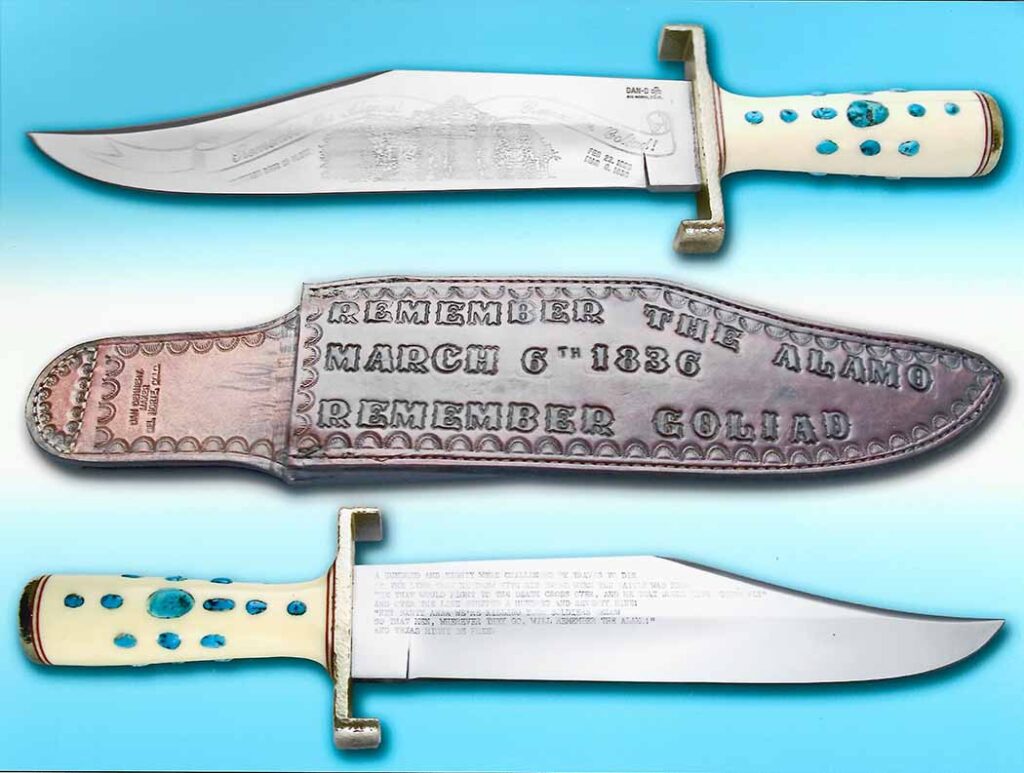
In his vast collection of Dan Dennehy knives, Craig’s favorites were the Dan-D Alamo Bowie and the Huber Foxworth Bowie. The Alamo Bowie has a 12-inch hollow-ground blade a quarter-inch thick and 2 inches wide. The blade’s non-mark side is etched with an eight-line poem that commemorates Col. Travis’s call for “defenders to step forward.” The handle is walrus ivory inlaid with 18 turquoise cabs. Overall length: 16.5 inches. The custom sheath is cowhide. (Bob Glassman image)
Despite having the option to go work for his father’s rapidly growing company in York, Pennsylvania, that was obviously of no interest to Dad so he went into the military. Even though he had trouble with authority and rules, he thrived in the Marines.
After the military his life got really interesting. His resume speaks for itself but here is a summary: police officer; sheriff; private investigator; horse wrangler; hunting guide, Ozark Mountains; fishing guide, French River, Canada; gun shop owner, Fox’s Den (Kirkland, Arizona, and Mountain Home, Arkansas); salesman, Camillus Knives and Levis; personal protection, bodyguard for Saudi Royal Family; professional hunter, South Africa; writer, Whitetail Times magazine and several personal protection books; gunsmith; gun dealer; private security, consulting and training; fugitive recovery; and much more. This is a very general overview and it took him to some very interesting places and dangerous spots, and he met some really interesting people along the way.
So here is what Dad loved. He loved his country and God. He loved our mom. He loved me and my sister. He loved adventure. And he loved guns and knives. Dad was an encyclopedia of firearms, handloading and ballistics. He had a real passion for Rugers, Ruger M77s in any and every caliber they make, but especially 7×57 and Ruger single action pistols. He was also a 1911 fanatic. I don’t remember a single occasion in my life where I ever saw Dad without a 1911 on his side or in a shoulder holster.
And he loved knives. Man did he love knives. I don’t know exactly where in his life this interest started, but he was as passionate about knives as guns, and maybe more. And this is coming from a guy whose gun collection is over 500. He loved all knives and always carried at least two at a time. He had a real appreciation for a good blade and considered knives the most valuable tool an outdoorsman or soldier could have.
Here’s the second iteration of The Fox’s Den Gun Shop as it appeared in Mountain Home, Arkansas. Note the sidewalk parking meter.
As you would expect, just like factory rifles with factory ammo were not suitable for Dad’s standards, neither were factory knives. As a result he started reaching out to custom knifemakers and collaborating. He formed relationships with Bo Randall, Jimmy Lile, Art Wiman, Clyde Fischer, Blackie Collins, Harold Corby and George Herron, and most notably Dan D. Dad spoke of Dan D. with a manner of respect and admiration that he did not offer up lightly to many. A shared respect and appreciation for the art and skill behind making the ultimate tool, something that was practical and efficient, beautiful and deadly. Dad’s collection of Dan D. knives is vast but his two most prized are the Alamo Bowie and the Huber Foxworth Bowie.
Dad was the toughest man I’ve ever known. A real fighter, rock solid, set in his ways and unshakeable. No matter, if you had a problem, my Dad would be your first call and the man you wanted in your corner. Dad had a lot of fans and a lot of enemies. He had many acquaintances and peers and only a small handful of good friends. He always said if you get through life and only have a few good friends, real true friends, then consider yourself lucky. Dan D. was a true friend of Dad’s.
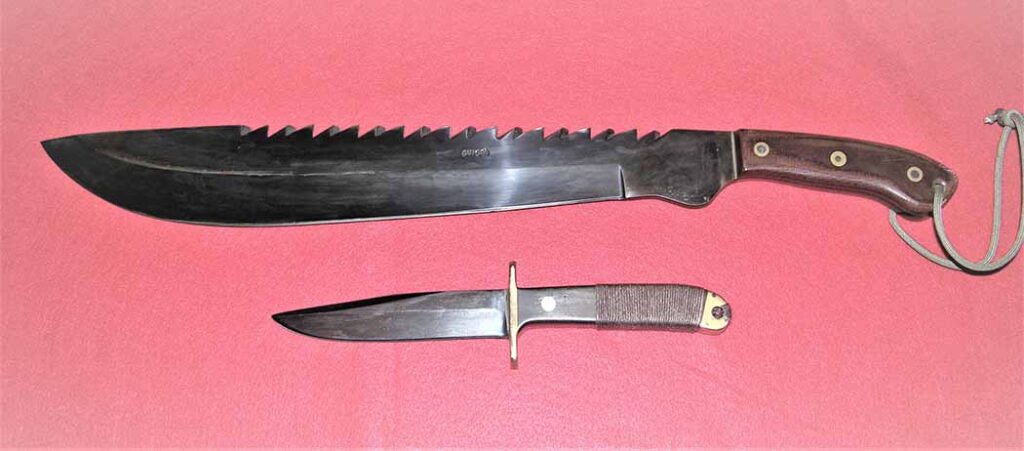
Two of Craig’s favorite Dan-D users included a survival machete and a Woodsman model. Craig designed both, with Dan-D making the former and helping Craig make the latter in the Dan-D shop. Craig carried the Woodsman more than any other knife for over 40 years.
Craig was one of those rare characters you meet along the road of life and always remember. Later he told me stories of discussions with Cutlery Hall-Of-Famer Bo Randall and knife designs for different purposes. Another story was how he talked to Cutlery Hall-Of-Famer Bob Loveless about the simplicity of balancing a knife using his personal theory of the tapered tang. He visited with his friend Cutlery Hall-Of-Famer Jimmy Lile long before the Rambo knife was created. John Horrigan told me about their hunting trip in Africa. Since Craig was a licensed guide the trip was arranged in exchange for a knife identical to the one John presented to President George W. Bush.
Huber Foxworth Bowie
But back to the Huber Foxworth Bowie. The brochure description continues:
This knife is a pure and simple Bowie style but with the handle dropped slightly which seems to give it a much better “pointing” ability and maneuverability not found in most common Bowie styles. [Craig] had a prototype of this knife made for him by a Philippine Negrito instructor while he was attending the armed forces Jungle Survival School in the Philippines. Pound for pound these little Negritos are about as slick and fierce a knife fighter as will be found anywhere.
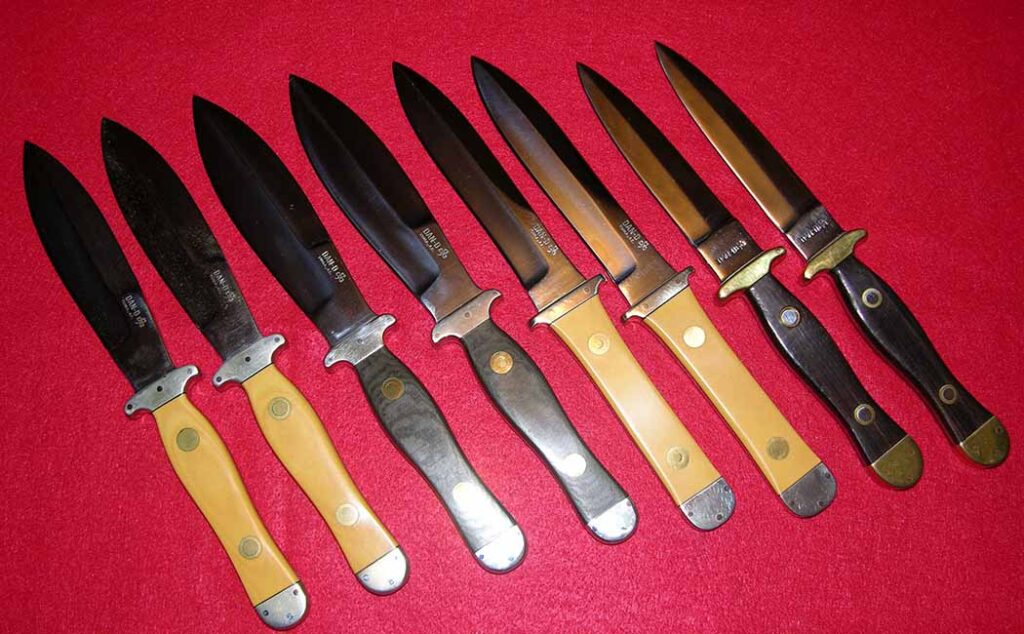
In a 2011 email to the author Craig wrote, “This [image] shows all four pair of boot knives your Dad did for me, including two pairs of my Model III. All have been carried extensively over the past 40 years, and two of the knives have saved my life.”The blade is 8 inches long, 1.75 inches wide and in quarter-inch stock of 154 CPM stainless steel heat treated by Cutlery Hall-Of-Famer Paul Bos. It has a double guard and a 4.75-inch handle. According to the brochure, “This is a knife you could bet your life on.”
A couple of years ago, Hunter contacted me and told me of his father’s passing. Craig lived 76 years his way and made his mark in the world. His passion for God, his country and living life to the fullest extent had been accomplished. Hunter went on to explain that out of all the knives they cannot find the one that meant more to Craig than the Huber Foxworth Bowie.
Get your bachelor’s of state-of-the-art degree at the 11th Annual BLADE University.
The state-of-the-art in all things knife, including the latest in mosaic damascus steel, knife and handle design, and how to sharpen, make a lockback whittler, run a knife business and more will be the focus of the 11th Annual BLADE University.
Held in conjunction with the 43rd Annual BLADE Show June 7-9 at the Cobb Galleria Centre in Atlanta, BLADE University will be sponsored by Work Sharp. Classes begin Thursday, June 6, and will run through Friday, June 7, and Saturday, June 8.
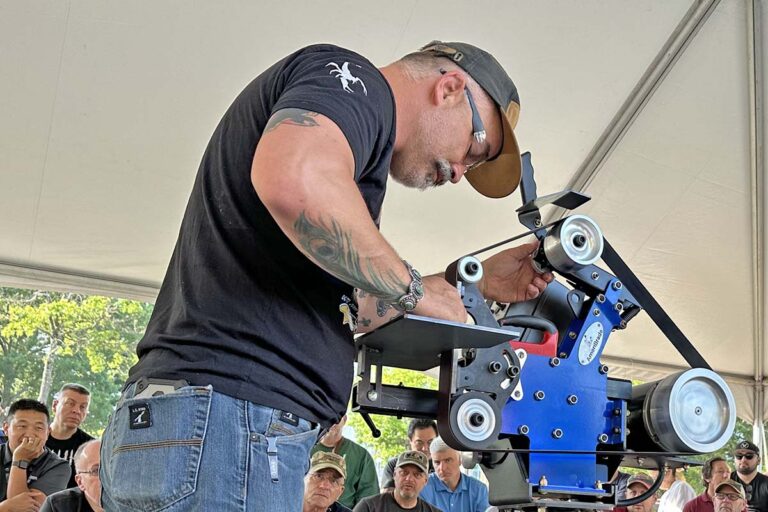
While most courses will be taught in the Cobb Galleria, some also will convene under the tent in The Courtyard, aka the parking lot of the show’s host hotel, the Renaissance Atlanta Waverly.
BLADE University gathers some of the world’s best knifemakers, bladesmiths and other cutlery and steel professionals to teach a wide range of subjects for the knife user, knifemaker, knife hobbyist, knife entrepreneur, knife designer, and knife aficionado and novice alike. If you love knives or are just beginning to, BLADE University has a topic for you. The complete course schedule, with subjects, teachers, times and venues:
The Art of Selling at a BLADE Show, Tom Krein, 4 to 5 p.m., Room 104—A long-time maker of custom utilitarian fixed blades and folders, Tom Krein will outline exactly what a knifemaker who is serious about selling knives should do and how he/she should behave behind a knife show exhibitor table. Proper table etiquette and sales and customer relations strategies are just some of the subjects Tom will cover. The class will be held the day before the BLADE Show begins so attendees can put some of Tom’s recommendations into practice during the main event Friday through Sunday.
FRIDAY, JUNE 7
ABS journeyman smith Henning Wilkinson makes impeccable keyhole knife handles like this one. Join him for his class Metal and Wood Fitting Techniques for Keyhole Handles Friday at 2 p.m. (Eric Eggly/PointSeven knife image)
Fundamentals of Grinding, AmeriBrade and guest grinders, 8 to 9:30 a.m., The Courtyard—AmeriBrade and guest makers will provide a general overview on grinds, techniques and different equipment. The class will be interactive and the team will answer questions and demonstrate suggestions for common issues.
How to Run a Small Successful Knifemaking Business, Bob Kramer, 10 to 11:30 a.m., Room 103—Learn the do’s and don’ts of making the most out of your knifemaking business. ABS master smith Bob Kramer has 30 years of experience and says he’s still learning!
Thermal Cycle Steel for High Performance, Larrin Thomas, 10:30 to 11:30 a.m., Room 104—There are many different recommendations for how to heat treat steel after forging, but what is best? Can normalizing and grain-refining cycles really improve properties when compared with steel from the factory? Should stock-removal makers bother with thermal cycling? How do you thermal cycle stainless steels after forging them? Is it thermocycling or thermal cycling? Join Larrin Thomas, designer of CPM MagnaCut stainless steel, creator of the website Knife Steel Nerds, and author of Knife Engineering: Steel, Heat Treating, and Geometry, as he answers these questions and more.
Symmetrical Quillon Dagger 101, Neels Van Den Berg, 1 to 2 p.m., Room 107—Join ABS master smith Neels Van Den Berg from Black Dragon Forge for a discussion and walkthrough of making a symmetrical quillon dagger. He will cover design, proportions, aesthetics, materials, fluting and finally the entire manufacturing process, sharing useful tips and tricks to save you time, money and frustration.
Intro to Power Forging, panel of forging authorities, 1:30 to 2:30 p.m., Room 103—Bring your forging questions to our group of expert panelists including Logan Gillihan, Will Stelter, Salem Straub, Charlie Ellis and Brian House.
Metal and Wood Fitting Techniques for Keyhole Handles, Henning Wilkinson, 2 to 3 p.m., Room 113—An ABS journeyman smith and member of the Knifemakers’ Guild of South Africa, Henning Wilkinson will outline the correct techniques for fitting metal and wood in the construction of the keyhole integral knife handle. Henning will show you how to eliminate the gaps between materials that results in the proper fit and finish collectors and those who judge knife competitions look for in an award-winning keyhole-handle knife.
Hands on Sharpening, the team at Work Sharp, 3:30 to 4:30 p.m., Room 113—What happens when a knife gets dull? How do you know when to sharpen it? Bring your own knife or borrow a demo model and learn the progression of shaping a bevel, sharpening and edge maintenance from the team at Work Sharp. You will get hands-on practice and experience sharpening your blade using a variety of sharpeners and abrasives, from whetstones to belts.
Originality: Experimentation, Innovation and Ingenuity, Lucas Cao, 4:30 to 5:30 p.m., Room 107—Why are some people more creative than others? Can creativity be learned? Lucas Cao, founder of Squid Industries, explores tools and techniques that anyone can apply to become more original.
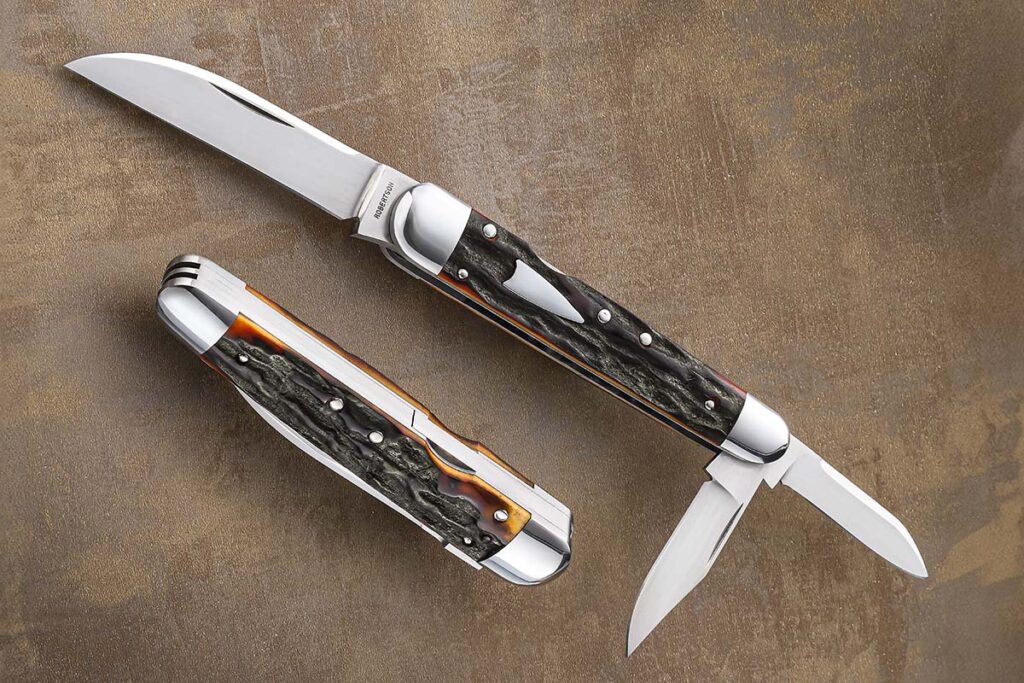
Tim Robertson won Best Locking Folder at BLADE Show West ’22 for his lockback whittler and will cover how to make this most difficult pocketknife of all to build in his class Saturday at 9:45 a.m. (SharpByCoop image)
Elevating Your Handle Appearance: Spine Filework, Handle Shapes and Pin Placement, Kyle Daily, 8:30 to 9:30 a.m., Room 113—Enhance the appearance of your knife with distinctive features that go far beyond standard production models. Knifemaker Kyle Daily from KHDaily Knives guides you through the intricate art of filework on the spine, while also sharing insights into handle design and the pin placement on your handle. Discover Kyle’s preferred files and specialized equipment for crafting his five most popular filework patterns, ensuring your knife not only looks exceptional but also feels comfortable and functional. From laying out your pattern to a step-by-step tutorial, this class provides the essential knowledge to achieve a professional and eye-catching finish. A Q&A session at the end will ensure you leave with the skills and knowledge to take your knifemaking to the next level.
Insert Welding with Bob Kramer, 9:30 to 11 a.m., Room 104—Understand how to forge weld inserts with high precision and control to create realistic depictions of animals and patterns in this BLADE University offering. This will be an exclusive opportunity to experience the technique that Bob Kramer created with fellow ABS master smith Tom Ferry and shared with the masses.
How to Make the Most Difficult Pocketknife, Tim Robertson, 9:45 to 10:45 a.m., Room 107—An award-winning maker of slipjoints and a charter member of the South Texas Slipjoint Cartel, Tim Robertson will address perhaps the most difficult pocketknife to build: the lockback whittler. He will outline what makes the classic slipjoint/lockback folder so demanding to make, with a major focus on backspring design and function, the two areas of the knife that work against each other. He also will cover the correct sequence of parts preparation and the proper order of construction steps that reduces mistakes and helps ensure a successfully completed knife.
The Process Is the Product, TJ Schwarz, 11 a.m. to 12 p.m., Room 113—TJ Schwarz is the founder of Schwarz Knives, an Idaho-based manufacturer of premium outdoor fixed blades. He has over a decade of freelance knife design experience with many models in circulation, a patent, and two BLADE Show awards to show for it. Schwarz will share his insights on how to create a successful knife business, including the key point of understanding actually what it is that you’re selling.
Let the Pros Critique Your Knife, 2:15 to 3:15 p.m., Room 114—Award-winning knifemakers David Carver, Enrique Pena and Luke Swenson and ABS master smiths Bob Kramer and Jim Rodebaugh will share decades of knowledge and experience to critique the knife you made. They will go over every square inch of it and tell you what’s good, what’s not and how to make it better. Bring one knife only. Questions from attendees will be entertained throughout.
Hands on Sharpening, the team at Work Sharp, 2:15 to 3:15 p.m., Room 113—What happens when a knife gets dull? How do you know when to sharpen it? Bring your own knife or borrow a demo model and learn the progression of shaping a bevel, sharpening and edge maintenance from the team at Work Sharp at this BLADE University class. You will get hands-on practice and experience sharpening your blade using a variety of sharpeners and abrasives, from whetstones to belts.
Making Scissors in a Knife Workshop, Grace Horne, 2:30 to 3:30 p.m., Room 107—Have you ever thought about making scissors but don’t know where to start? If you’re curious about scissors or just want to expand your knowledge, this session is for you. Whether you want to have a go at restoring old scissors or forging your own from scratch, the basic information is the same—and it’s notoriously poorly documented. Dr. Grace Horne will give a whirlwind tour through the early history of scissors, describe methods of producing the blanks, give inside information on the twist and the curve, and highlight critical areas to consider. Most importantly, she will describe her method of scissors making that requires no specialized tools or equipment.
Pattern Welding Panel, 4 to 5 p.m., Room 104—Salem Straub, Mareko Maumasi, Charlie Ellis, Josh Prince and Will Stelter will explain how they created their collaborative Consortium billet, including each of the steps that went into creating this wild mosaic billet, and then open up to general questions about damascus forging and pattern development.
The father of modern sporting knives was busy making them a half century ago.
Editor’s Note: BLADE Magazine is celebrating more than 50 years of bringing the knife community sharp coverage of the knife world at large. Given a more comprehensive picture of where the industry comes from—thus, where it’s going—we’re running a series of vignettes on important articles marking milestones in the knife design, knife making and knifemakers from 50 years ago.
A pioneering writer and photographer, Sid Latham chronicled his visit to the Orlando, Florida, shop of Randall Made Knives in the May-June 1975 issue of The American Blade to detail how Bo Randall and his staff made knives.
As Latham noted, Bo believed in the Cutlery Hall-of-Famer William Scagel theory that every blade shape should have a purpose and be practical—and the Randall utility, hunting, combat and survival patterns reflected the Scagel approach. The most popular Randall knife in ’75 was the Model 3 hunter. It was a Model 3 that pilot Francis Gary Powers was carrying when his U-2 spy plane was famously shot down over Russia in 1960.
Bill Platts was closing out his career as Randall shop foreman.
Latham wrote of what Bo considered his proudest achievement of specially designing knives for the astronauts of the Project Mercury NASA space mission. The final design was worked out by Major Gordon Cooper, who took one along on his 22-orbit flight. The knife was subsequently offered as the Model 17.
Latham also covered most of the Randall staff, including shop foreman Bill Platts, who was in the process of retiring and being replaced by Pete Hamilton, to Bo’s son Gary and more. Bo Randall had already been making knives for 37 years at the time—and Randall Made Knives (randallknives.com) continues turning them out to this day.
Editor’s note: Beginning with this issue, “50 Years Ago in BLADE®” journeys back in time to recall what was happening in the early days of BLADE—formerly The American Blade—and the world of knives. This time: BLADE Magazine Cutlery Hall-of-Fame® member Bo Randall and Randall Made Knives.