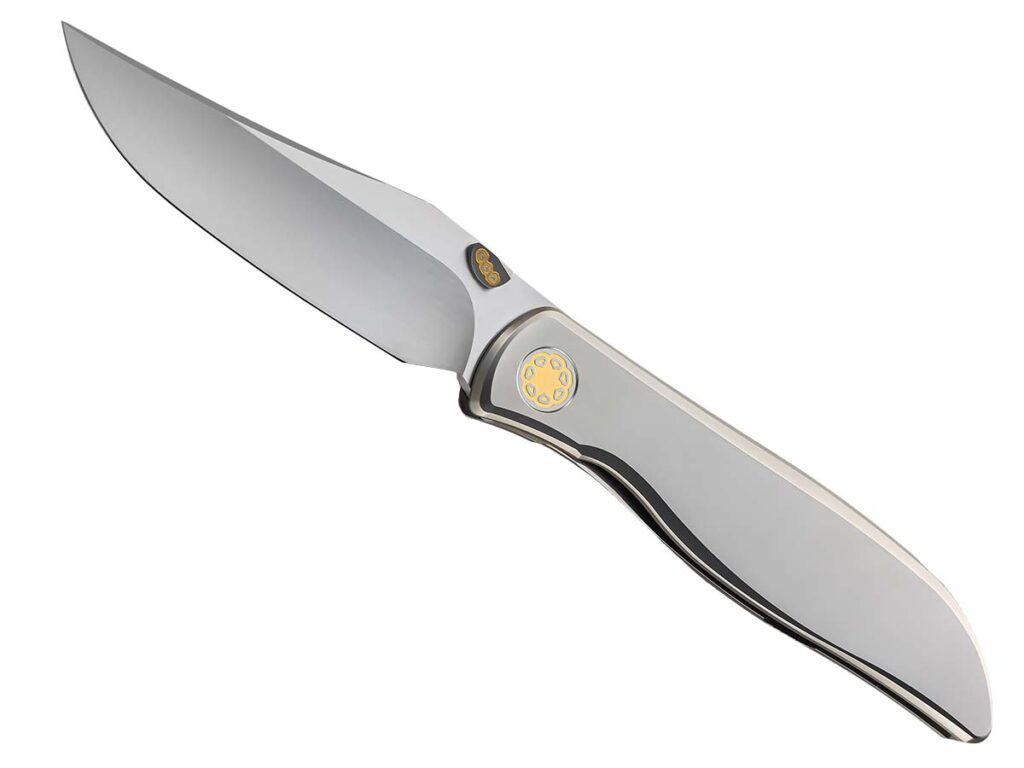
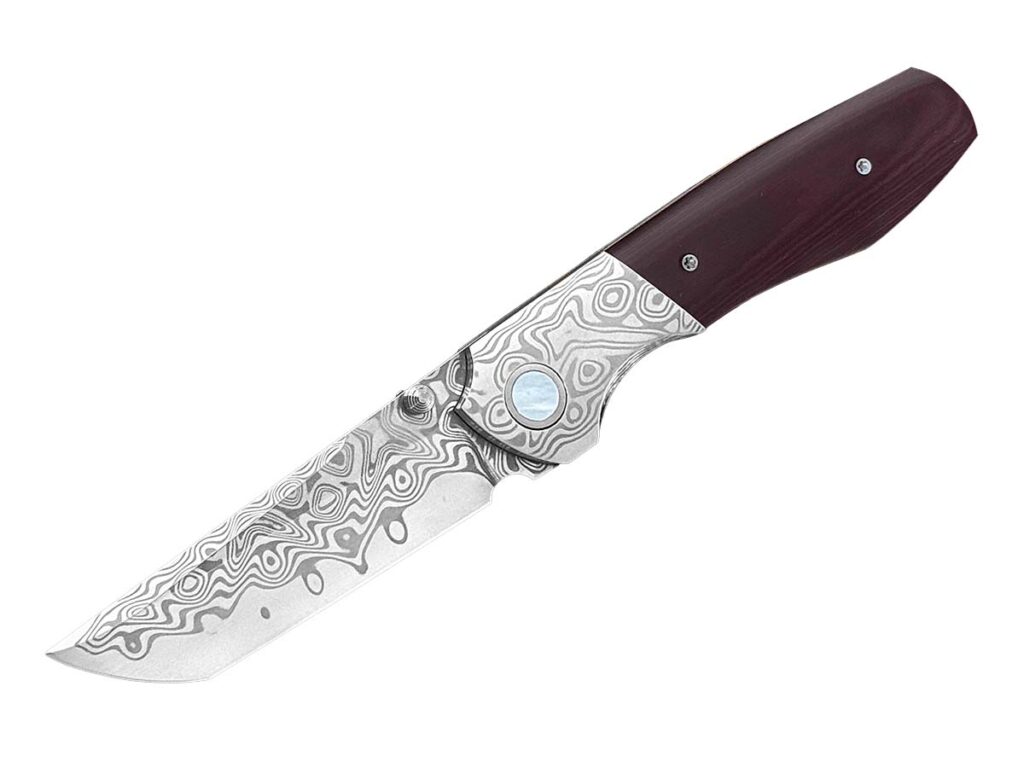
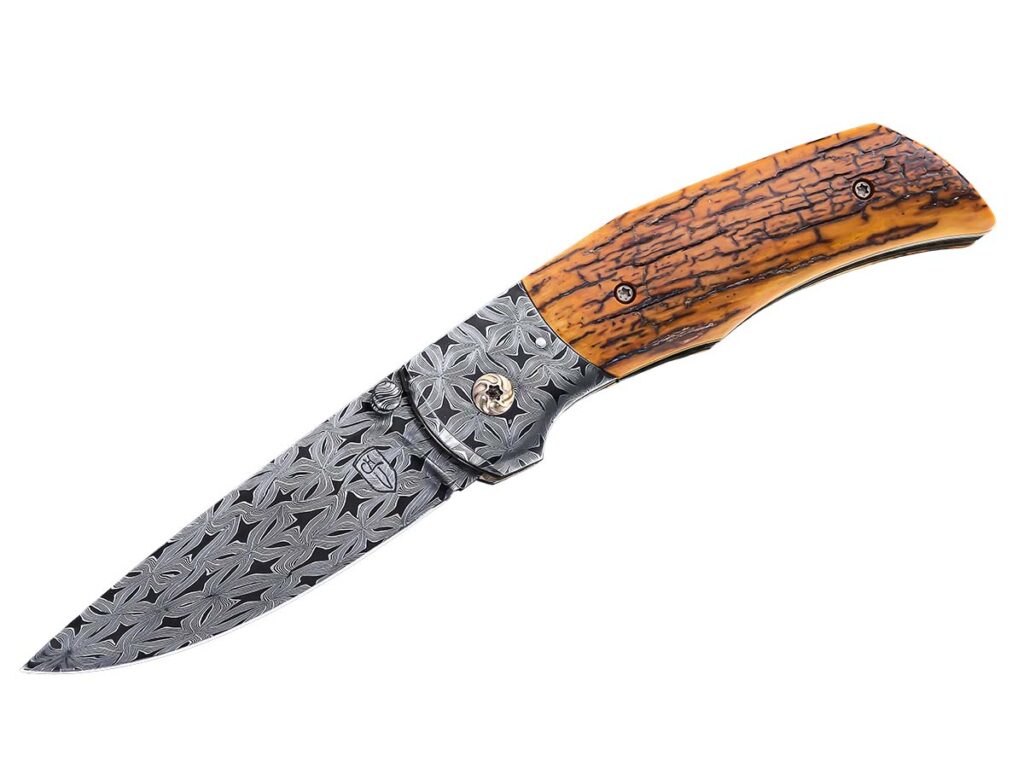
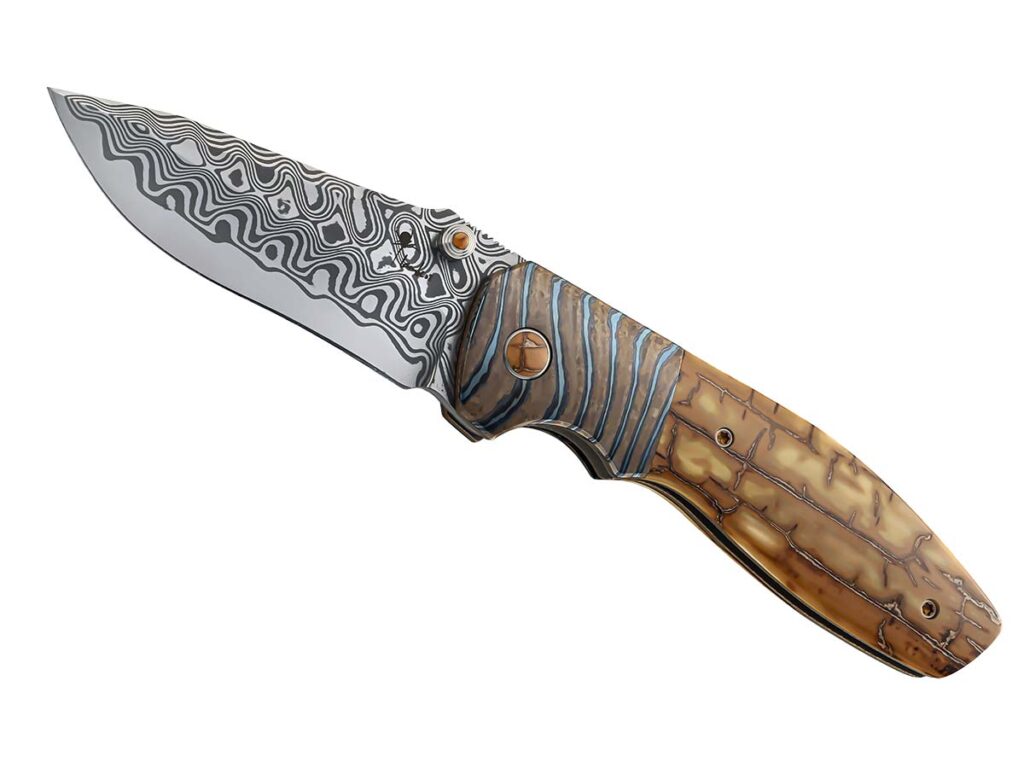
Knifemaking is the building of a knife, which includes the blade, handle and other accouterments. Blades are made by either removing metal from a steel blank via a grinder – known as stock removal – and the forging to shape of hot steel into a blade in the process known as bladesmithing. Other parts, including bolsters, guards, pommels, etc., are needed to complete the finished knife.
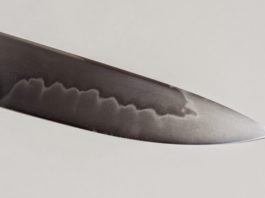
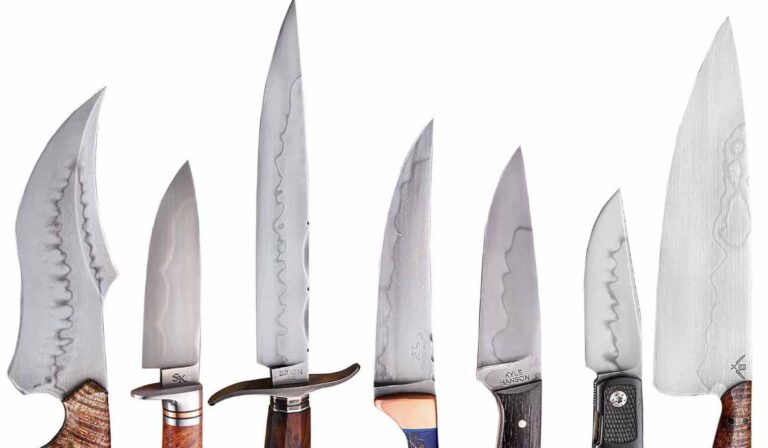
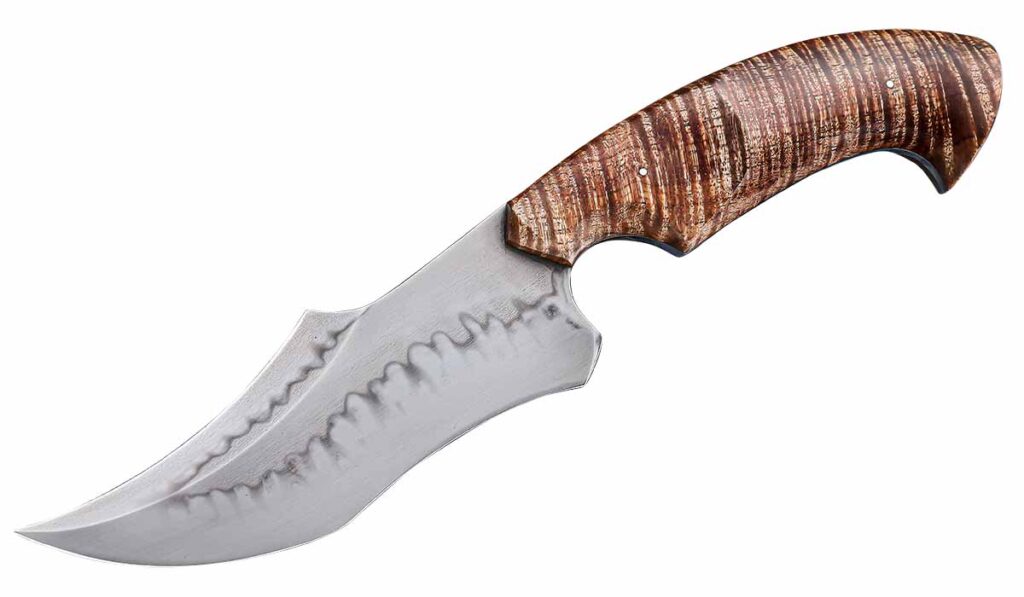
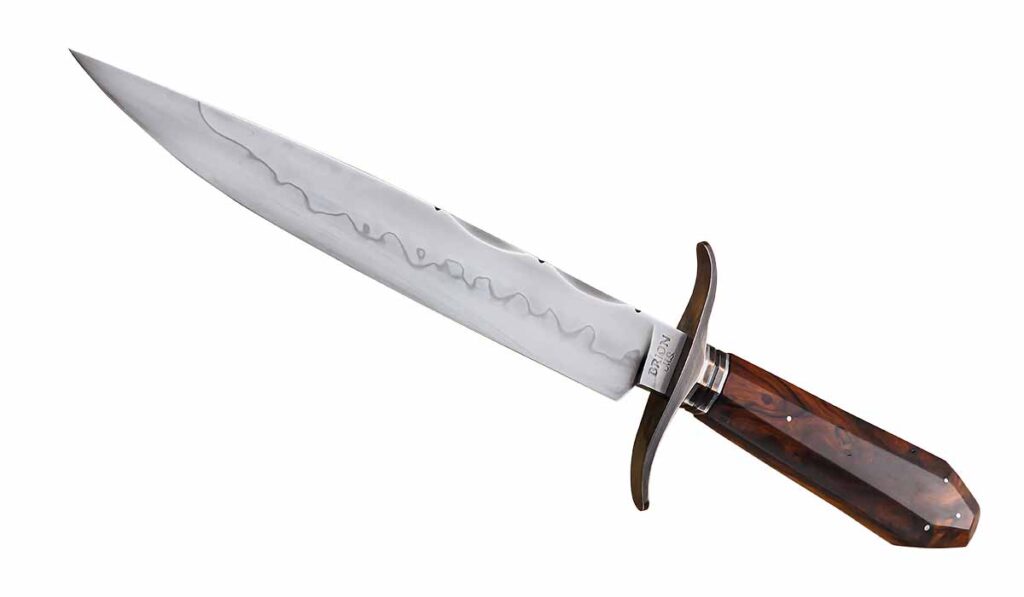
The often wavy hardening line running laterally and roughly midway from one end of the blade to the other on some knives is the hamon (pronounced ha-MOAN). Most if not all blades with genuine hamons are forged and differentially hardened. The wavy line serves as a demarcation point between the softer spine for toughness above and what extends down to a hardened edge for enhanced cutting below.
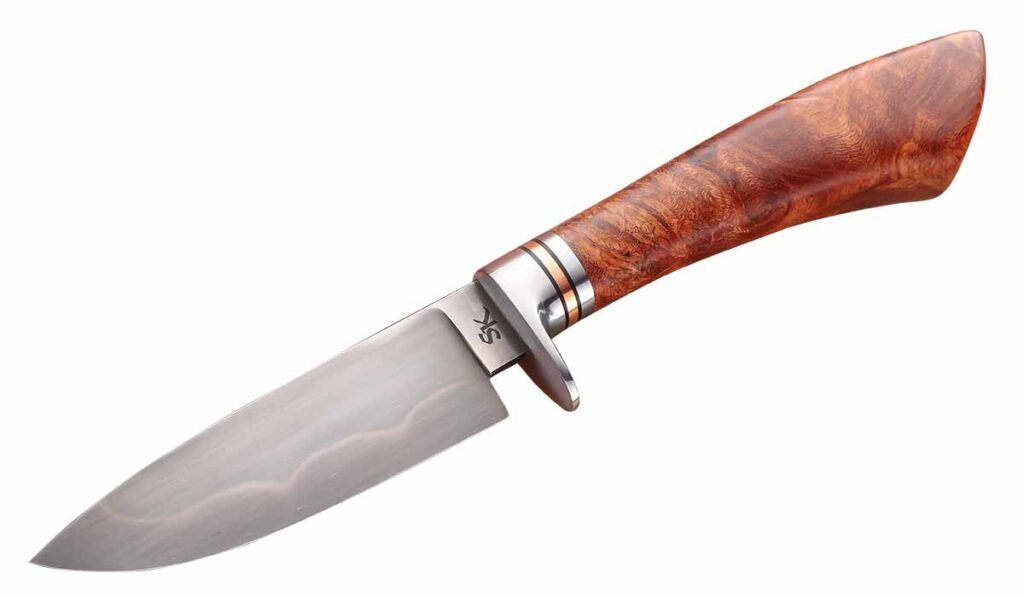
Steve Sando: Classic Hunter
Steve Sando used a coffee patina to color the hamon of the 4 3/8-inch blade of 26C3 carbon steel on his classic hunter. Steve’s differential hardening of the blade resulted in a Rockwell hardness of 62 HRC on the edge and 40 HRC on the spine. Blade grind: flat. Handle material: Afzelia wood. Overall length: 9 1/8 inches. (SharpByCoop image)
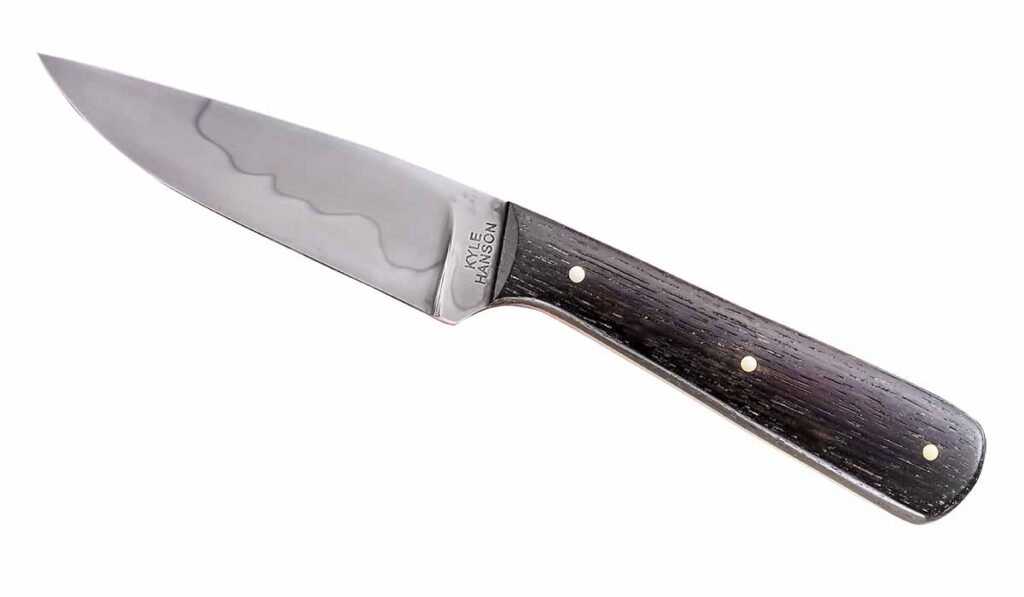
Kyle Hanson: Tapered Full Tang Hunter
Not merely W2 but “Oldass W2” tool steel is the canvas for the hamon on the blade of Kyle Hanson’s tapered-full-tang hunter. Handle material: 5,600-year-old bog oak. Overall length: 8.25 inches. A leather pouch sheath (not shown) by Kenny Rowe accompanies the knife. (SharpByCoop image)
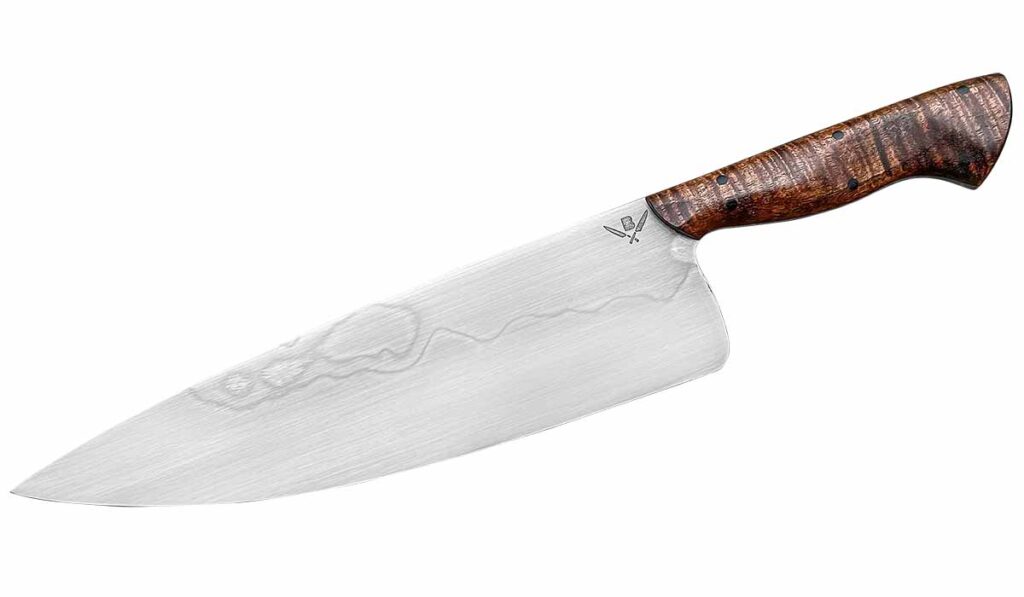
Geoffrey Baze: Chef’s Knife
ABS apprentice smith Geoffrey Baze opts for W2 tool steel to showcase the hamon on the 9.5-inch blade of his chef’s knife. The contoured bird’s beak handle is Tasmanian blackwood. (Jocelyn Frasier image edit)
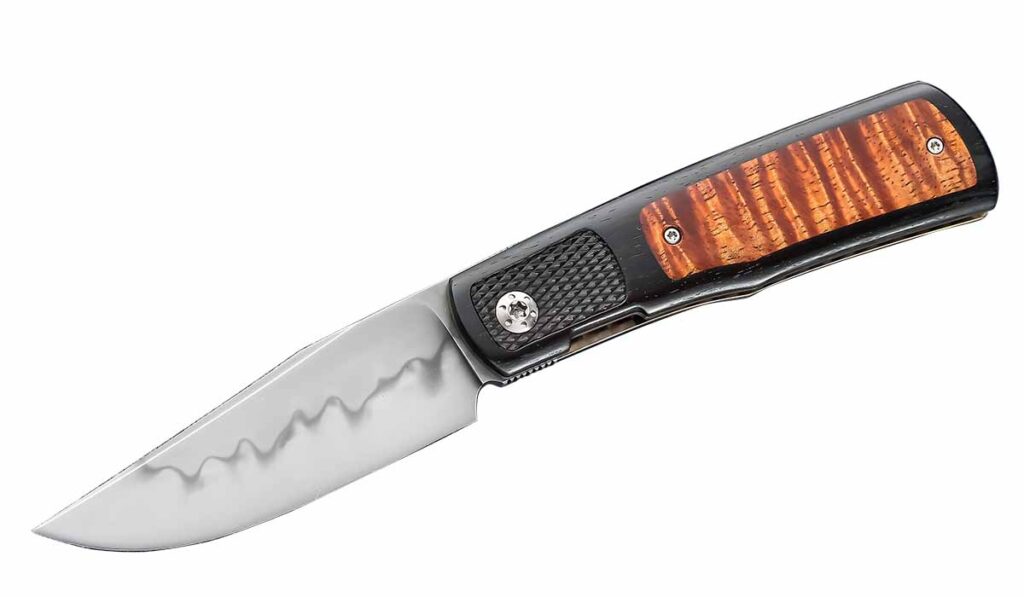
John Doyle: Dress Classic Gunstock Model
While not unheard of, folders with blades sporting hamons are not all that common. John Doyle does the deed on his Dress Classic Gunstock Model with pocket clip. The 3.25-inch blade is W2 tool steel and the handle frame is African blackwood with koa inserts. Lock: linerlock. Liners: jeweled, anodized titanium. Closed length: 4.125 inches. (SharpByCoop image))
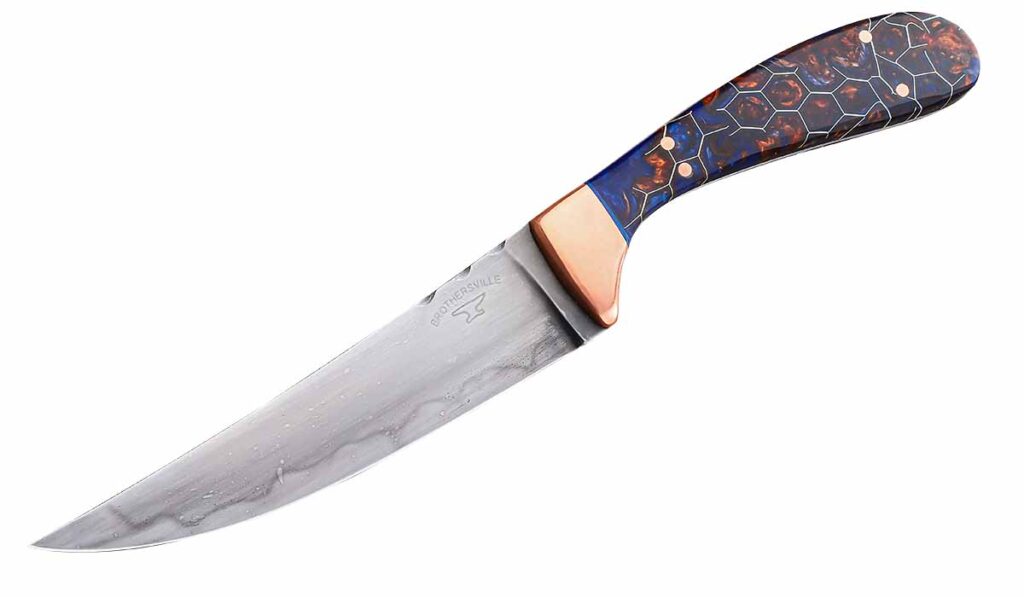
Peter Pruyn: Boning Knife
Like many makers who differentially harden their blades, Peter Pruyn used the clay-coating method for his small boning knife. The 5-inch blade is flat ground from 1095 carbon steel. The blueberry crumble resin-based scales are from Voodoo Resins and the bolster is copper. Overall length: 10.5 inches. Peter’s price for a similar knife: $450. (SharpByCoop image)
Eliott Robinson: Fighter
An apprentice to ABS master smith Sam Lurquin, Eliott Robinson nails it with the hamon on his fighter’s upswept recurve blade of U10A carbon steel. The bird’s-beak handle is Tasmanian blackwood. Respective blade and overall lengths: 5 and 9.5 inches. A quality inlaid sheath (not shown) by Jeremy Guillaume completes the outfit. (SharpByCoop image)
Brion Tomberlin: Coffin-Handle Bowie
The hamon of ABS master smith Brion Tomberlin’s coffin-handle bowie dissects the 8.5-inch W2 tool steel blade almost perfectly. Blade grind: flat. Handle material: ironwood. Overall length: 13.25 inches. Brion’s price for a similar knife: $2,200. (SharpByCoop image)
The best knives and stories are born from some essential reality that grows in the making and telling. For a knife, it is the nature of that reality that determines whether the ornamentations available to the knifemaker either reveal or conceal it. Simply put, some knives benefit from the generous application of various bells and whistles. Others are diminished by any additions beyond their essential form. Most fall somewhere in-between these extremes. But how do you tell the difference?
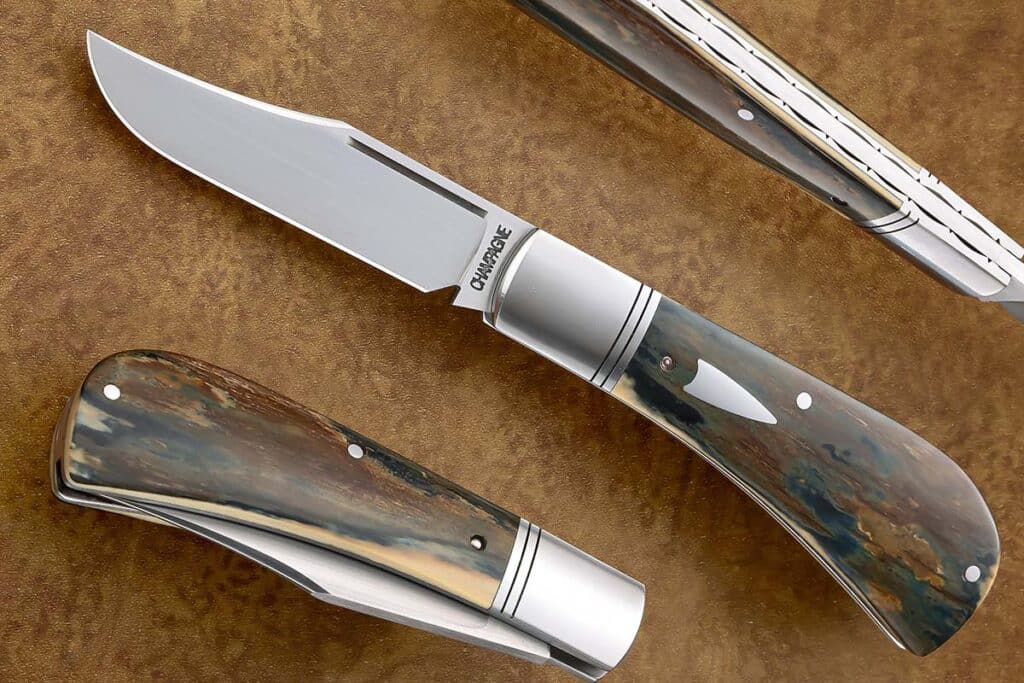
A Lanny’s Clip slipjoint by Ben Champagne is an example of how even a minimally embellished knife sends a clear message about the character of the maker.
First, consider that much like the vehicle you drive, the knife you carry or make says something about you. It can shine light on your character, priorities, economic or social status, or simply your tastes. Each knife can reflect something important about the maker, or it can evoke a response from the person that encounters it. As the maker, what story are you trying to tell and to whom are you trying to tell it? Any embellishment should be designed to ensure that that something is exactly the thing you want to say. A Lanny’s Clip slipjoint (IMAGE 1) by Ben Champagne is an example of how even a minimally embellished knife sends a clear message about the maker’s character. Every detail matters, even the ones that are invisible. Immaculate execution is a statement of its own.
In addition, each type of knife serves an essential purpose. Often the purpose is reflected in the name of the knife’s category—everyday carry (EDC), hunter, fighter, chopper, chef’s, even art knife—or by its shape, history and tradition, as in the case of daggers, machetes and bowies. In each case the design is constrained by the intended use, though with varying degrees of success.
Once you have a clear idea what your knife is for and the impact you want it to have, it is useful to write those down. The process of articulating your purpose in words has a way of clarifying things, and helps you keep a firm grasp on your idea as you move forward with your design. You have a much greater chance of creating an excellent knife if you allow your intent to guide your design decisions.
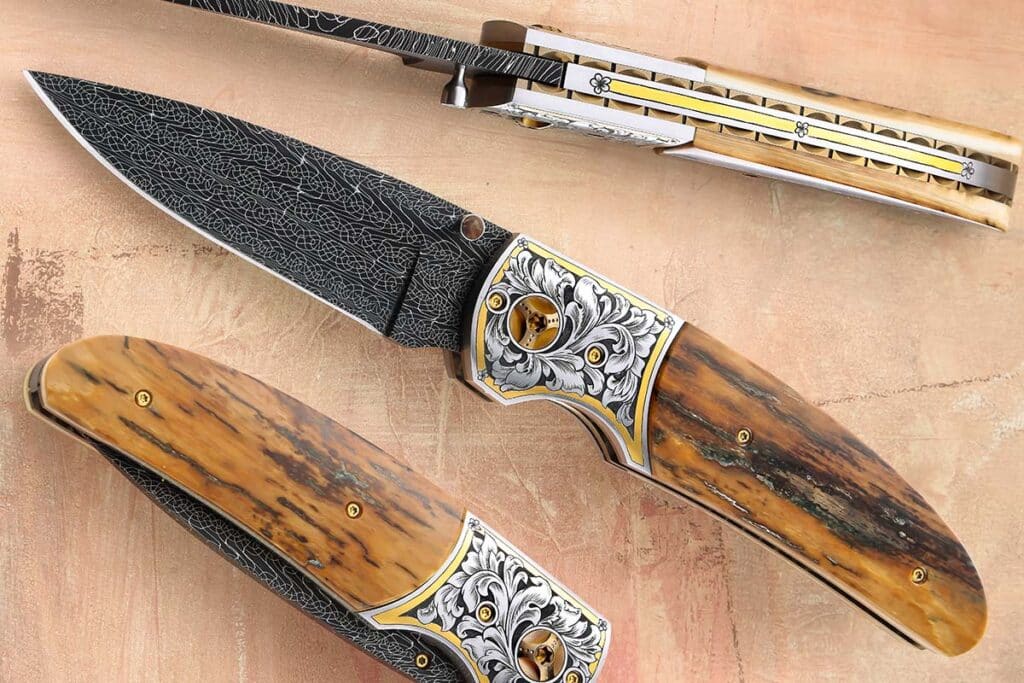
Image 3: The mammoth ivory scales, subtle filework and damascus blade of Andy Isaacks’ elegant linerlock highlight the detailed engraving by Alice Carter. Closed length: 4.5 inches.
A good next step is a detailed drawing, which will help you think through the details in a coherent manner; it is much easier to work through various design elements, material choices and additional embellishment ideas with a pencil than with steel. Here is your chance to test different ideas, keeping in mind that there will most certainly be deviations from your drawing that occur during the actual making process. Some ideas look good on paper but don’t translate as imagined into a three-dimensional object. The opposite is also true, and embracing the back-and-forth process yields the best results. Producing a cohesive design aligned with both your intended statement and the knife’s function is a process that often continues until the knife is complete.
Making A Knife Embellishment Plan
I don’t always embellish a knife, but when I do, I do it on purpose.
As you have gathered by now, the most valuable embellishment available to the knifemaker is outstanding, intentional design. Consequently, the best knives are those in which embellishments are specific, intentional design choices. Intentionality is essential; if you want to be good at something, you should do it on purpose. If a particular choice of ornament does not contribute to the function, visual impact or the statement you wish to make in a noticeable way, omit it. At the very least, choices of ornamentation should never inhibit the essential purpose of the knife.
Alice Carter’s gold engraving is the center of attention on a linerlock folder by G. Kent Carter. Closed length: 4 inches.
Selecting Type Of Knife Embellishment
When it comes to specific embellishments for a specific knife there are myriad choices at your disposal, but if you spend too much time thinking about it nothing will get done. Here are some ideas that can help you decide.
The first consideration is to determine what it is you’re trying to draw attention to. Certain shapes or lines like the S-curve, diagonal line and flow, and pointy or sharp triangular elements tend to naturally draw the eye. A dominant visual weight, strong contrasts of color or texture, or intentional disruptions in visual flow can also grab attention if used accordingly.
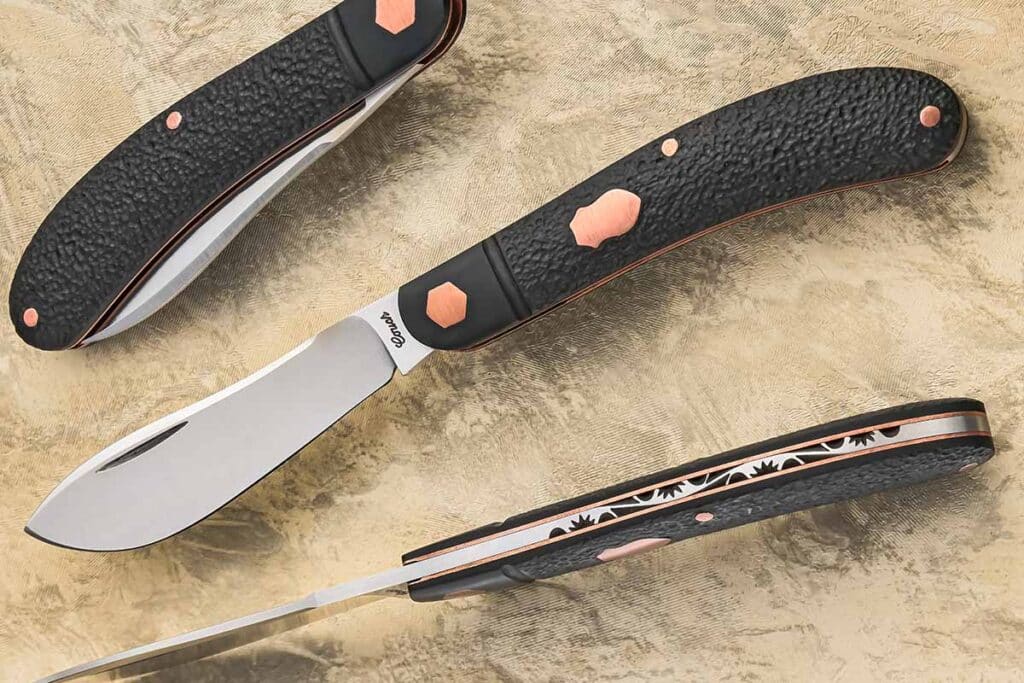
Tanner Couch uses copper to highlight the hardware of the textured black paper Micarta® handle and creative filework that covers only about half the backspring of his shadow pattern rabbit skinner. Closed length: 3.75 inches.
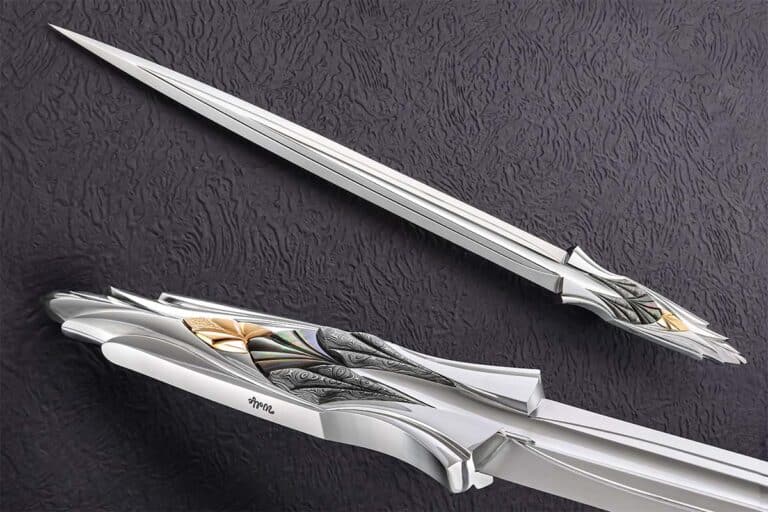
Usually, it is the clever combination of more than one of these elements that makes an arresting visual, and once the attention is firmly grasped the details can reveal themselves. An integral dagger by Wolfgang Loerchner (IMAGE 2) demonstrates how the masterful combination of curves, diagonals and triangles can command notice. Sharp contrasts in texture and color also arrest the eye. Once the attention is captured, it becomes clear that every element of the shape, materials and finish works together to create the essential whole.
The eye is also drawn to areas with more detail. A good rule of thumb is that for it to stand out, the area of sharpest detail should make up about a third of the overall visual composition. By applying this principle, an engraving can be the center of attention, can complement the overall knife design or can distract from it. When engraving is to be the center of attention, other design elements should be allowed to fade into the background. This does not mean that these other details are less important, but a handle with subdued colors and even texture, a satin polished blade, and understated filework will allow the engraving to be the focus.
A boldly patterned damascus blade paired with detailed engraving can overwhelm the eye and keep either element from being visually arresting. Counterintuitively, a finely detailed mosaic damascus blade can present a more neutral visual impact; the details become apparent only when you look closely. A wildly patterned or brightly colored handle material will similarly draw the attention, so use it if the handle material is what you want to visually emphasize.
For example, the mammoth ivory scales, subtle filework and damascus blade of Andy Isaacks’ elegant linerlock folder (IMAGE 3) highlight the detailed engraving by Alice Carter. Every element serves to ensure that the area with most detail draws the eye.
How Not To Embellish A Knife
The understated detail of the Star Crossed Lovers mosaic damascus blade provides a subtle contrast to the artifact walrus ivory handle with inlaid Oregon sunstone set in gold and pure iron guard covered in melted gold on the Behring Sea Artifact Dagger by ABS master smith David Lisch. Overall length: 10 inches.
No discussion about knife embellishment is complete without some reflection on what not to do.
Perhaps most importantly, if you can’t think of a good reason to add a particular type of embellishment, there’s a good chance that you shouldn’t do it. Sometimes it works out but often you waste time and possibly your money by adding elements that lack a clear intent. Similarly, if a knife is intended for hard use, consider what cumulative effects that use will have on your bling, and invest your enhancement efforts accordingly. Where does the value lie?
Despite everything else discussed, it’s worth saying that not every knife needs to be something other than a cutting tool. Indeed, some of the best knives make their statement with simplicity and function. There’s no minimum or maximum amount of embellishment you can add to a knife, but embellishments that aren’t done exceptionally well are worse than none. If you must err, err on the side of simplicity or subtlety. Extravagance can be beautiful but elegance is always understated. Both have a place in the alternatives of intentional design choice.
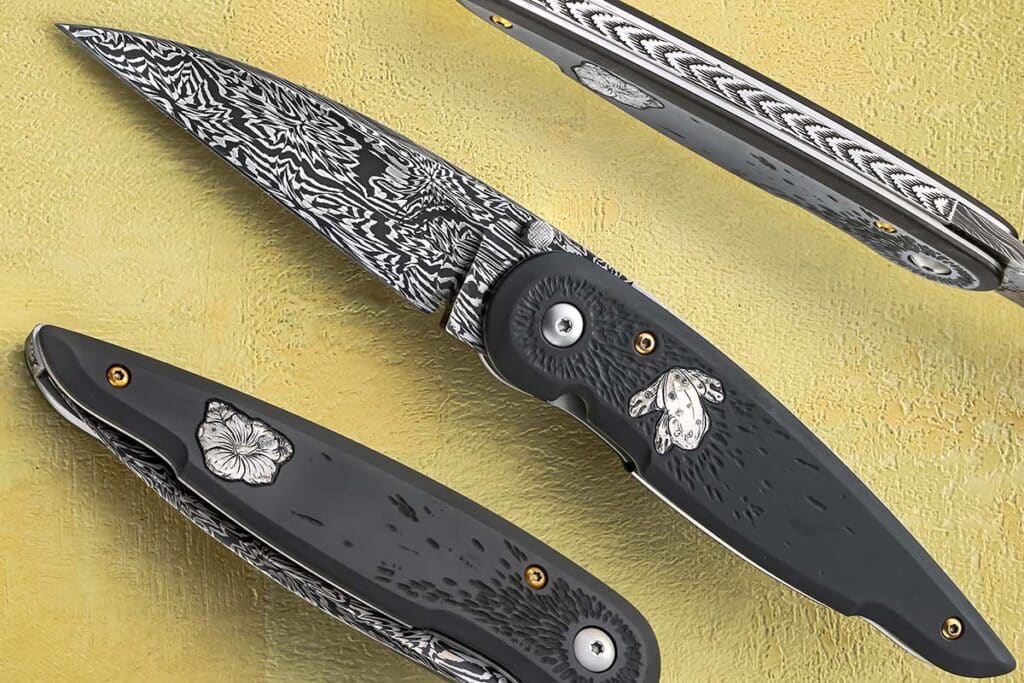
Is it a shield, modified unwrapped menuki or something else? Whatever the designation, the embellished reptile stands out from the all-black textured handle of an ABS master smith Andrew Meers peg-opening linerlock with a mosaic damascus wharncliffe blade.
Finally, your knives will benefit from embellishments done purposefully to increase impact, but can suffer from ornamentation added with the sole intent of increasing the sale price. Keep an eye on what’s best for the knife rather than simply tossing in expensive ornamentation for the sake of perceived collector or monetary value.
Celebrate the new class of master and journeyman smiths! See who received the top honors from the American Bladesmith Society at the recent BLADE Show.
The American Bladesmith Society awarded its coveted ratings of master smith and journeyman smith at the recent BLADE Show in Atlanta.
Three applicants achieved the rating pinnacle of master smith:
Andrew Blomfield (Australia)
Luiz Gustavo Gonçalves (Brazil)
Erik McCright (Weatherford, Texas)
Gonçalves also won the awards for Best Kitchen Knife and Best Fighter during the BLADE Show custom knife judging competition.
Argentina’s Matias Funes was awarded his ABS journeyman smith stamp during the 44th Annual BLADE Show after his five test knives met with the approval of the ABS JS judging panel. (SharpByCoop image)
Journeyman smith stamps were awarded to:
Felipe Cavallin (Brazil)
Jason W. Coy (Squires, Missouri)
Viktor De Bonte (Woodinville, Washington)
Adam Fromholtz (Australia)
Matias Funes (Argentina)
PJ Gouws (South Africa)
Nate “Tuna” Grant (Seguin, Texas)
Matthew Hartwig (Bozeman, Montana)
Nishan Mood (Fullerton, California)
Christopher Moss (Asheboro, North Carolina)
William Porto (Brazil)
Willie Van Der Merwe (South Africa)
Jan C. Vatelau, (Boise, Idaho)
Michael Hobbs (Shelbyville, Tennessee)
In addition, Gonçalves won the award for the best knife presented by a master smith applicant for judging, and Funes won the award for the best knife presented by a journeyman smith applicant for judging.
Journeyman smiths are the second highest level of ABS member bladesmiths, surpassed only by master smiths. Each must pass rigorous tests before achieving their respective rates, with the journeyman smiths having to wait a specified time once making JS before they can apply for the top rating of MS. For a complete rundown of the tests, requirements and other bona fides of both ratings, visit americanbladesmith.org and click on “Member Resources.”
The thumb stud is reliable, time-tested and add dynamic dash to these customer folders.
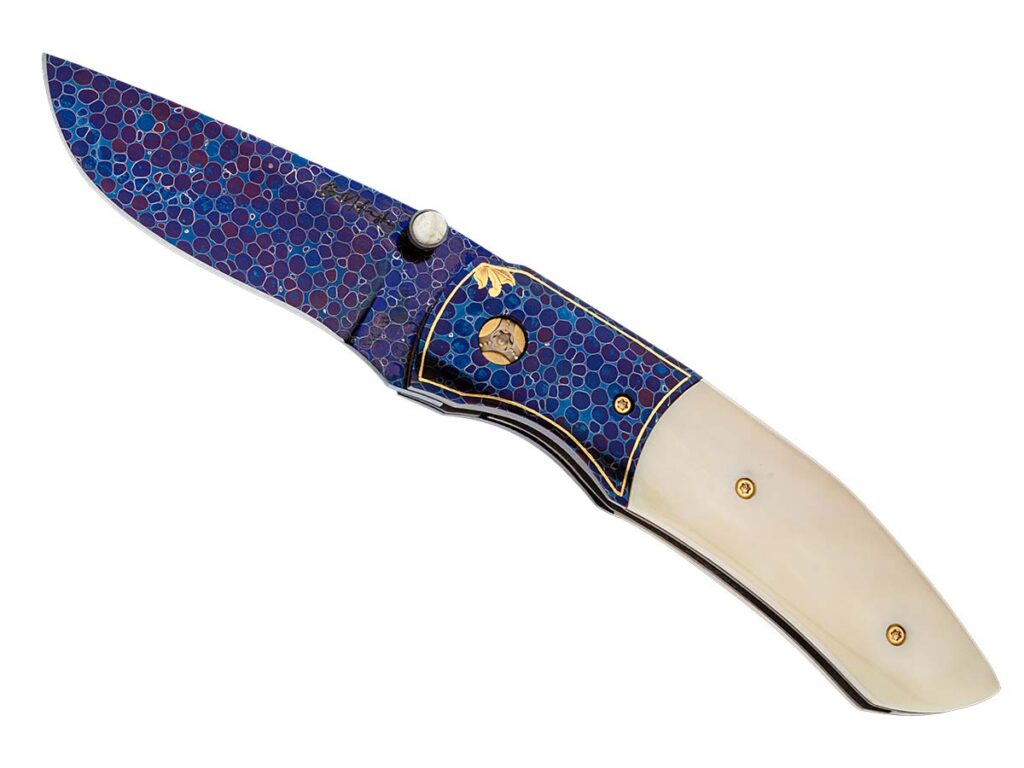
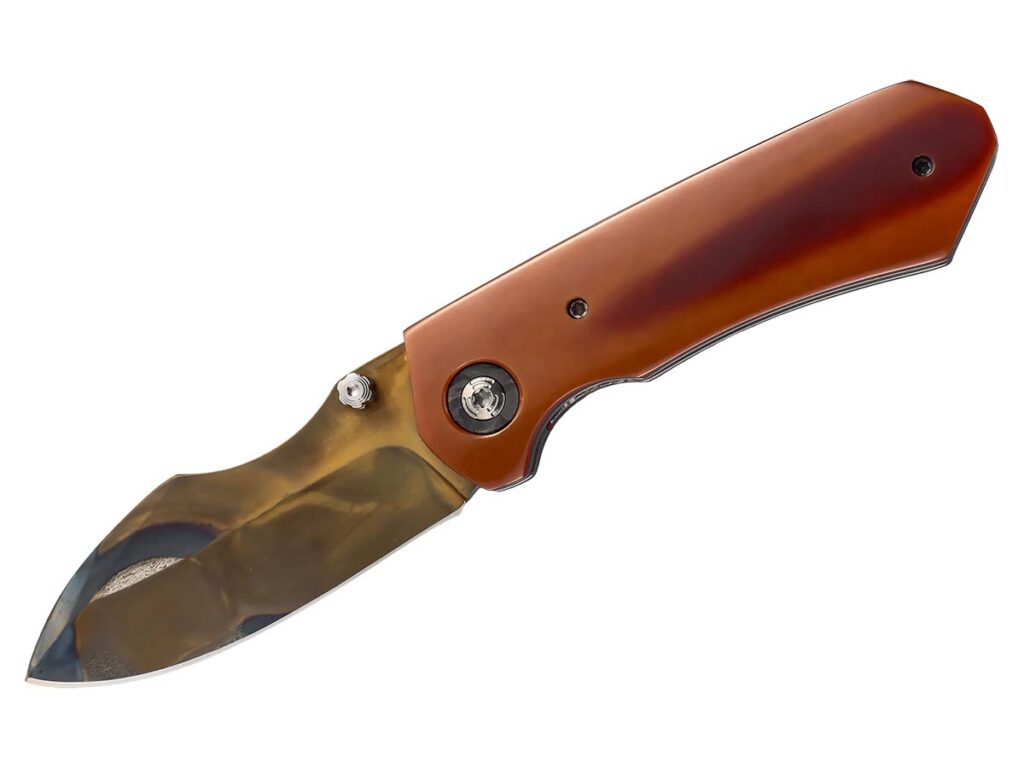
Aside from the good ol’ nail nick, thumb studs are among the most enduring opening systems for folding knives. Why not? Typically ambidextrous, easy to manipulate and lightning fast, the reliable deployment feature has a lot going for it. Not to mention, on these custom knives, they add equal parts dash and traditional appeal.
Michael Raymond: Ziura folder
Forty-nine 24k gold inlays set into a 6-4 titanium frame elevate Michael Raymond’s Ziura folder. The swedge-ground Bohler M390 blade measures 3.53 inches with an 8.08-inch overall length. (SharpByCoop image)
David Beaver: Shogun Horizon Folder
Vintage red linen Micarta scales and a hollow-ground Damasteel Baldur on Damacore blade highlight David Beaver’s Shogun Horizon folder. Blade and overall lengths: 3.75 and 8.5 inches. The maker’s price for similar knife is $1,800. (Jocelyn Frasier image)
Cody Hofsommer: Mammoth Ivory Folder
Mammoth ivory scales and mosaic damascus bolsters define a sole-authorship flat-ground folder by Cody Hofsommer. The 1080/15n20 mosaic Damascus blade measures 3.375 inches with an 8-inch overall length. (SharpByCoop image)
Kirby Lambert: Augustus Mini Folder
A hollow-ground Damacore blade and mammoth ivory scales distinguish the Augustus Mini folder by Kirby Lambert. Bolsters are titanium and 2IRC damascus. Blade and overall lengths: 3.25 and 8 inches. (SharpByCoop image)
Brian Milinski: Paratrooper Elegante Linerlock
Nitre blued Rietveld damascus and fossilized walrus tusk scales characterize Brian Milinski’s Paratrooper Elegante linerlock. Joe Mason engraved and inlaid the matching bolsters. Blade and overall lengths: 3.25 and 7.75 inches. The maker’s price for a similar knife is $3,400. (Jocelyn Frasier image)
KC Gray: Titanium Folder
A 3.5-inch SM100 blade paired with vintage Micarta scales defines this 8-inch dress locking folder by Tucson maker KC Gray. The titanium frame includes marble carbon-fiber pivot collars and a black anodized clip. (SharpByCoop image)
Sean Alonzo: Ani
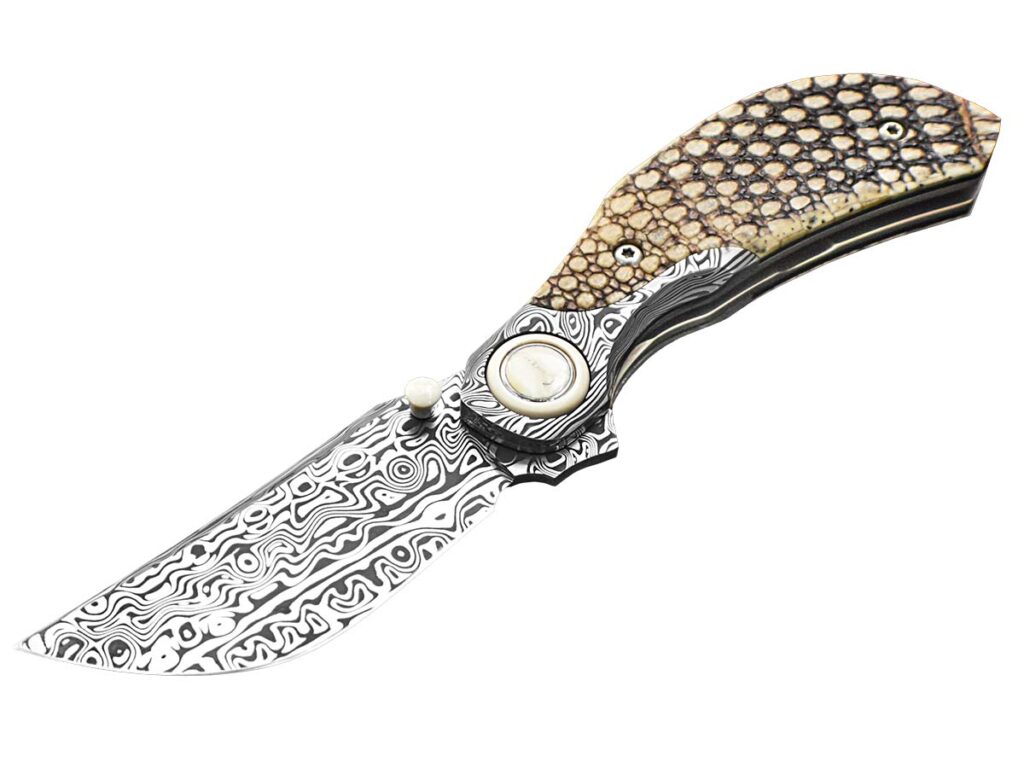
Sean Alonzo’s Ani 3.2 linerlock features armadillo carapace, warthog ivory, and a hollow-ground Yggdrasil Damasteel blade. Blade and overall lengths: 3.2 and 7.8 inches. Maker’s price for a similar knife $5,500. (Jocelyn Frasier image)
The Author Got To Spend A Weekend Making A Custom Knife With Legendary Maker Bob Terzuola
Over 30 years ago when I was just getting into the knife collecting hobby, I was at a gun shop on Long Island. I noticed the knife in the salesperson’s pocket and asked if I could see it. It was a custom Bob Terzuola.
I had my own Spyderco Terzuola factory/custom reproduction that recently had been introduced and I was amazed to see and handle a custom Terzuola for the first time. I thought to myself that someday I would own a custom Terzuola. Little did I know that one day I’d have a chance to make my own custom knife with Bob as well.
In the course of my “collecting career” I managed to get one Terzuola—to say the least. Now I have around 75 Terzuola knives! During this journey, I’ve met Bob many times and we’ve become friends. He’s a truly remarkable person who’s been making knives for over 40 years. More than just a knifemaker, he is an artisan, inventor, and craftsman, too. In addition, he has plenty of interesting stories to tell.
This past fall, Bob and his wife, Susan, were in Chicago and we met for dinner. It was around my 50th birthday (which, coincidentally, I share with Susan). As a gift, Bob invited me to come to his shop near San Diego to make my own knife.
So in March I flew to San Diego to spend a few days with Bob at his storied “Knife Camp.” I was a bit nervous. I don’t really have any knifemaking or even machinery type experience. My family came along with me—my daughter loves Bob’s dogs, while my wife enjoyed the local botanical gardens with Susan, who is an artist and a master gardener.
Who Is Bob Terzuola?
Bob’s knifemaking journey began in Central America. In the late 1960s, he served in the Peace Corps in Panama. After completing his service, Bob settled in Guatemala, where he managed a jade company. It was there, in the late 1970s, when Bob began to first make knives, mostly for military operatives in Central America. In 1984 he returned to the USA and set up shop in Santa Fe, where things really took off.
Bob is often referred to as the “father of the tactical folder” and is best known for his ATCF (Advanced Technology Combat Folder) model, which was released in 1985. Wanting to create a discrete yet robust, functional, and easily deployable knife, Bob was one of the first custom knifemakers to use titanium, pocket clips, and G-10.
He was among the first makers to use a thumb disc and have parts laser cut. Bob is also credited with being the first custom maker to do a knife collaboration with Spyderco. Made in 1989, the knife was the Spyderco C15, which held patents for being the first U.S.-made factory knife using premium steel and G-10, along with a linerlock.
Bob Terzuola’s Shop
Bob shows the author how to grind.
When you first walk into Bob’s shop, you’re immediately struck by how neat and organized it is. As far as equipment, he has all that’s required with over a dozen machines including a band saw, milling machine, grinders, drill presses, and blasting cabinets.
More than the equipment, though, Bob’s shop is like a history of his knifemaking. The shop is dotted with mementos of his career, gifts from customers, letters of praise, awards, and trinkets from over the years. There’s also a collection of police patches from all over the world, along with hats and photos. On one bench he even has an artillery shell. Of course, the C15 Spyderco knife patent is on display as well.
Knifemaking With Bob
Using the lathe, Bob helps the author trim the pivot barrel to the proper length.
Time to make a knife! We decided to go with a 3-inch tanto folder, which is one of my favorite overall configurations. Bob suggested basing it on his Mini Athena model. He already had two handle liners cut out that we could use. I had to do the rest.
He explained the basics of operating the machines and got me to work right away. Within 45 minutes of pulling into his driveway, I was using a bandsaw to cut a blade profile drawn on a sheet of MagnaCut steel. Then I was drilling the pivot and screw holes in liners, countersinking holes, and smoothing out edges.
Things got quite serious when Bob had me “practice” taking the blades out of the heat treat oven. It’s pretty crucial to not drop the blades, which are heated to 1900° each when removed from the oven. Oh, and you read right, I did say “blades” as Bob had me cut two in case I screwed one up at some point. Fortunately I didn’t drop the blades after the heat treat, so that was a relief.
Next, I picked out my scale material. I like Micarta® so green canvas Micarta was an easy choice for me. Bob gave me a sheet of the material and off to the bandsaw I went. Same for the backspacer, for which I used some yellow/white Micarta for a bit of contrast.
The next day a lot of time was spent cutting the lockbar—Bob set up the milling machine for me—smoothing out the scales, adjusting stop pin placement, and putting the handles together many times to make sure everything fit just right.
Of course, all the work was made a bit easier and more efficient by using the tools that Bob has made, often even invented, over the years. His shop is filled with a plethora of tools, devices, holders, clamps, and more, many of which he’s designed and made himself to make his knifemaking process more reliable and efficient.
Next came the grinding, probably what many think of as the hardest and scariest part of making a knife. One of the first things Bob said to me when I arrived at Knife Camp was, “We can always take more away but we can’t put things back.” I think that nowhere is this truer in the knifemaking process than in grinding a blade. If you make a big mistake here, there’s no fixing it. Obviously, there is a practiced art to this. I seemed to do OK on the grinding part—until I wasn’t.
Overall, I ground the blade well but got sloppy on one of my final passes. I started a bit too soon and ground some of the area near the detent hole. When we put the knife together, it was pretty clear that the mistake had implications. Basically, there was no detent. It was pretty disappointing, but then we remembered the second blade I cut in the beginning. Clearly, Bob had been thinking ahead.
Finishing My Blade
The finished knife is based on one of Bob’s Mini Athena models sporting a 3-inch tanto blade of MagnaCut stainless steel and a green canvas Micarta® handle with pocket clip.
On day three I got to work grinding the second blade and managed to not repeat my mistake of the day previous. Then I sandblasted the blade. After that, I began the process of putting the knife together, taking it apart, tweaking it a bit, putting it back together, all over and over again until it worked just right. Finally, the action, lockup, and centering were good. Bob sharpened the knife for me and it was done.
I don’t know that I’ll ever be a knifemaker but I made a knife, and I love it!
Over the years, I’ve gained a lot of knowledge about knives but to actually make one was something else entirely. The amount of planning and work, especially detail work, that goes into a handmade knife is truly remarkable. Being guided by and watching a master like Bob made my experience even more remarkable. He knows what works well functionally and artistically. He thinks several steps ahead and takes the time with each detail. That’s why his knives are highly desirable.
Thank you again Bob—and Susan—for your hospitality and for making this opportunity happen.
Inspired By His Time Fly Fishing In The Pacific Northwest, Joe Mangiafico’s Trout Knives Are Durable, Eye-Catching Tools.
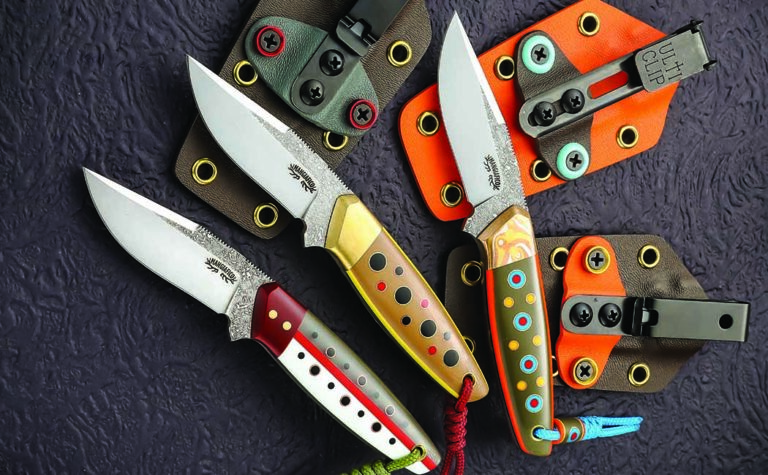
Joe Mangiafico’s trout knives not only are built to use but are cool and colorful to boot.
The 28-year-old Massachusetts maker acid etched the flat areas of the blades for a damascus look, yet it’s the handles and sheaths that really stand out.
The grips are structural mosaics of G-10, brass, and copper. For instance, the blue haloed red center pins of the model with the green handle are inlaid plugs, and the brass pins are press fit and epoxied all the way through. He designed the Kydex sheaths with centered pocket clips to attach to your pocket or waders while fishing. The red-banded model is inspired by the redband trout Joe fly fishes for in the Deschutes River Valley of central Oregon.
Who Is Joe Mangiafico
Mangiafico began making knives while still a college student several years ago. Joe makes his knives in his shop in Cotuit, on the southern coast of Cape Cod. While the majority of his work is custom knives, he does have a factory collaboration with the German company Boker Knives. His Brook fixed blade is made from VG-10 steel and, like his trout knives, showcases his deft ability to craft an eye-popping handle. It retails for $156.95 and can be found on Boker’s website.
Trout Knife Specs Model names: Brook Trout, Brown Trout and Rainbow Trout Knife type: Trout knife Blade lengths: 3 inches Blade steel: Nitro V stainless Blade grinds: Flat Handle materials: G-10, copper and brass Bolster materials: Brass, Micarta® and mokume gané Overall lengths: 6.5 inches Sheaths: Kydex Maker’s price for similar knives: $375 each
So, you’re going to build a power hammer… now’s the time to consider where to get your parts.
The first thing you’ll have to decide is which style of power hammer you will build. There are as many designs as there are folks who build hammers, but they fall into two basic categories: helve hammers and linkage hammers.
Power Hammer Styles
Linkage Hammer
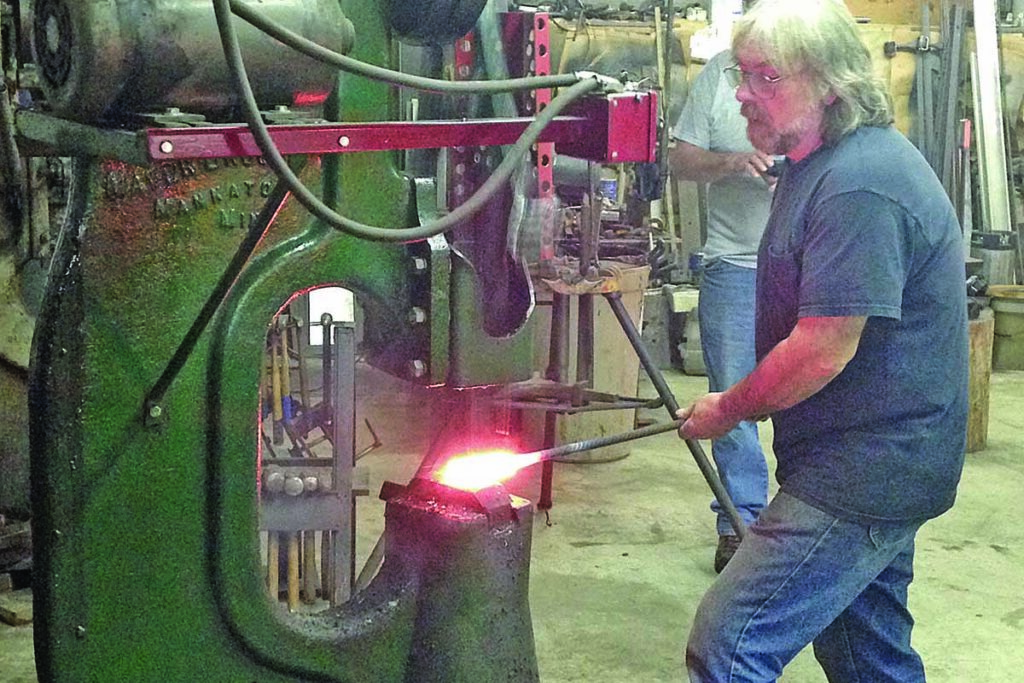
At the basic level, a helve hammer has an arm that moves up and down on a fulcrum to move the hammer head up and down. A linkage hammer uses a wheel, tire or disk that rotates and uses the rotation to move the hammer head up and down. The Little Giant power hammer design uses a linkage, as does the commonly home-built tire hammer.
The Little Giant power hammer design uses a linkage, as does the commonly home-built tire hammer. ABS master smith/BLADE® field editor Joe Szilaski pounds away with his 50-pound Little Giant. (Lori Szilaski image)
Helve Hammer
I chose to build an Appalachian-style spring helve hammer because I had access to a variety of leaf springs, and because the design is more intuitive and less mechanically precise. I figured correctly that I could build a helve hammer design from scratch, but that a tire hammer had some engineering points that would be difficult for me to figure out. If you have access to uniform steel sizes or must buy your steel, I suggest a tire hammer. I had good scrap steel and didn’t want to buy much.
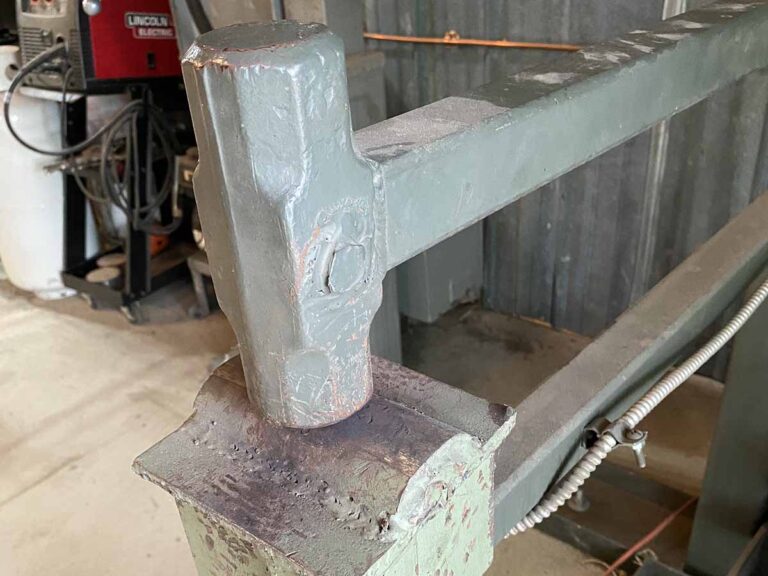
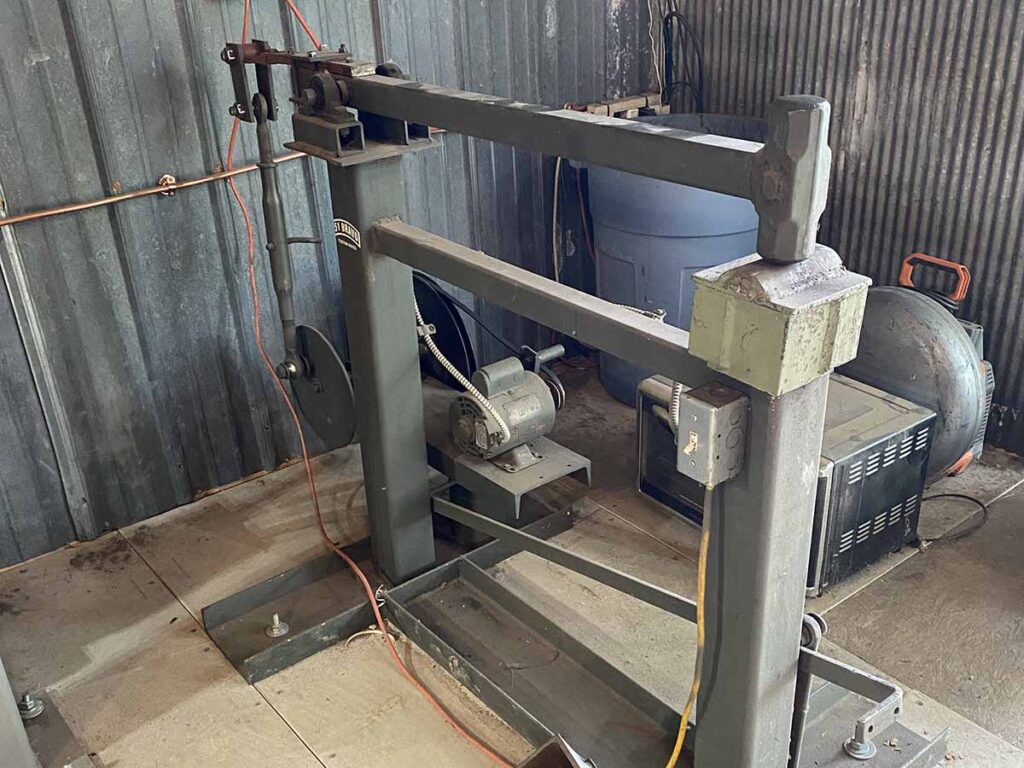
I’m focusing on the upright, heavier, more efficient metal-moving machines. Even so, it’s worth mentioning the smaller, simpler but less efficient helve hammers. I came across a good example in the shop of Shawn Moulenbelt, a Michigan bladesmith who was on season seven of Forged in Fire. His hammer used various sizes of hollow square tubing, a sledgehammer head and a half-horsepower motor. He used a slack belt clutch and interchangeable die plates. His hammer was built by Rusty Glovebox on YouTube and is a solid DIY (do-it-yourself) design.
Bladesmith Shawn Moulenbelt’s helve hammer uses various sizes of hollow square tubing, a sledgehammer head and a half-horsepower motor. On the upside, these hammers are quick and fairly straightforward to build. On the downside, they’re not all that great at their one job: moving metal. Even so, a similar light use-DIY power hammer is much more efficient than your arm, and much less likely to get tired.
On the upside, helve hammers are quick and fairly straightforward to build. On the downside, they’re not all that great at their one job: moving metal. Even so, a similar light use-DIY power hammer is much more efficient than your arm, and much less likely to get tired. In my mind, if you have the time and skill to build a small hammer, you can just as easily build a bigger one. Even so, the small helve hammers may be just the ticket for your shop.
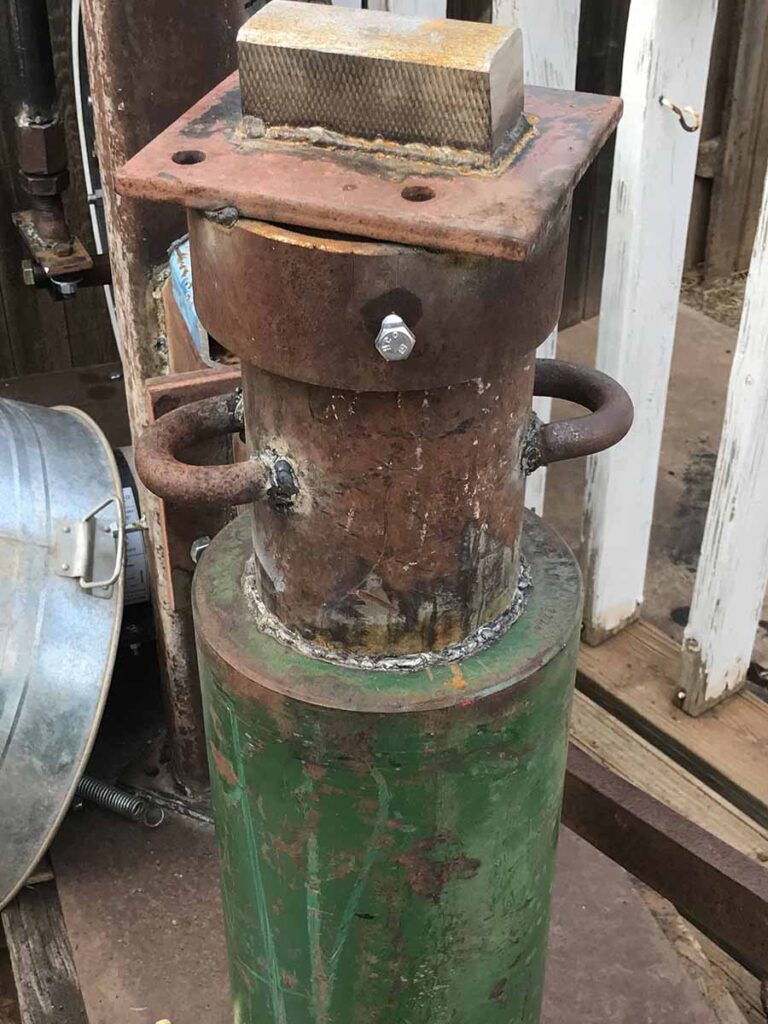
The author’s home-built hammer combines a 5-inch piece of round stock with a heavy sleeve from a “mud pump” to make an anvil that weighs around 400 pounds.
Resourcing An Anvil
There are many different things that can make a suitable anvil for a power hammer and many more things that cannot. What you are looking for in an anvil is a solid piece of steel that weighs anywhere from 150 to 600-800 pounds, which can be difficult to acquire.
Sometimes you can find solid square or round bar steel. Some folks recommend railroad axles. Others suggest forklift tines welded together. I’ve seen sections of a 2-inch square bar welded together into a solid 6×6. I’ve seen pieces of 1-inch plate welded where the hammer strikes the ends. Whatever you can find needs to be solid or able to be welded into a solid, single, massive piece, and your welder has to have the power to stick it all together. My hammer is built on a 32-inch piece of 5-inch round bar welded inside a mud pump sleeve that has a 5-inch bore. The total weight of my anvil is around 400 pounds.
What Not To Use
Don’t be tempted to think you can get a piece of something hollow like pipe or square tubing and fill it up and make a suitable anvil. Each stroke of your hammer pounds the steel in-between the hammer head and your anvil, pushing your anvil toward the ground. If you have any movement, vibration or give in your anvil, the force is absorbed by the movement and not efficiently transferred to your workpiece.
Anvil To Hammer Head Ratio
When you finally locate this difficult-to-find thing, it won’t likely be the size or shape you want. My anvil was round, which doesn’t easily weld to square tubing, for example. I had to deal with it. As noted, my anvil was around 400 pounds total weight. Yours may be more or less. You should design your hammer with a minimum 1:10 head-to-anvil ratio. Since I had a 400-pound anvil, I built a 40-pound head. If all you can find is a 200-pound hunk of steel for your anvil, you should stick to a 20-pound head or so. Design your hammer around your anvil, as the anvil is the hardest part to find. Alternatively, find the weight you need for the anvil and use the tire hammer plans.
Another consideration is the base for your hammer. I’d recommend the thickest steel plate you can find, mounted on the firmest foundation you can muster. If I could have built on 1-inch plate and bolted it to a 24-inch-deep concrete pad set into a concrete shop floor, I’d have done it. I had to make do with what I could find in my “free” scrapyard, and deal with the limitations of my shop setting.
Power Hammer Center Post
For any hammer you need a center post. The post should be heavy enough to withstand the extreme forces involved in rocking a spring arm or linkage with a heavy hammer on one end. I used a piece of 4-inch tubing with half-inch walls. Others have used thinner-walled but larger cross-section square or rectangular tubing, heavy walled pipe or sections of I beam. The tire hammer plans call for a 6-foot-long piece of quarter-inch wall and 5-inch square tubing.
Final Cut
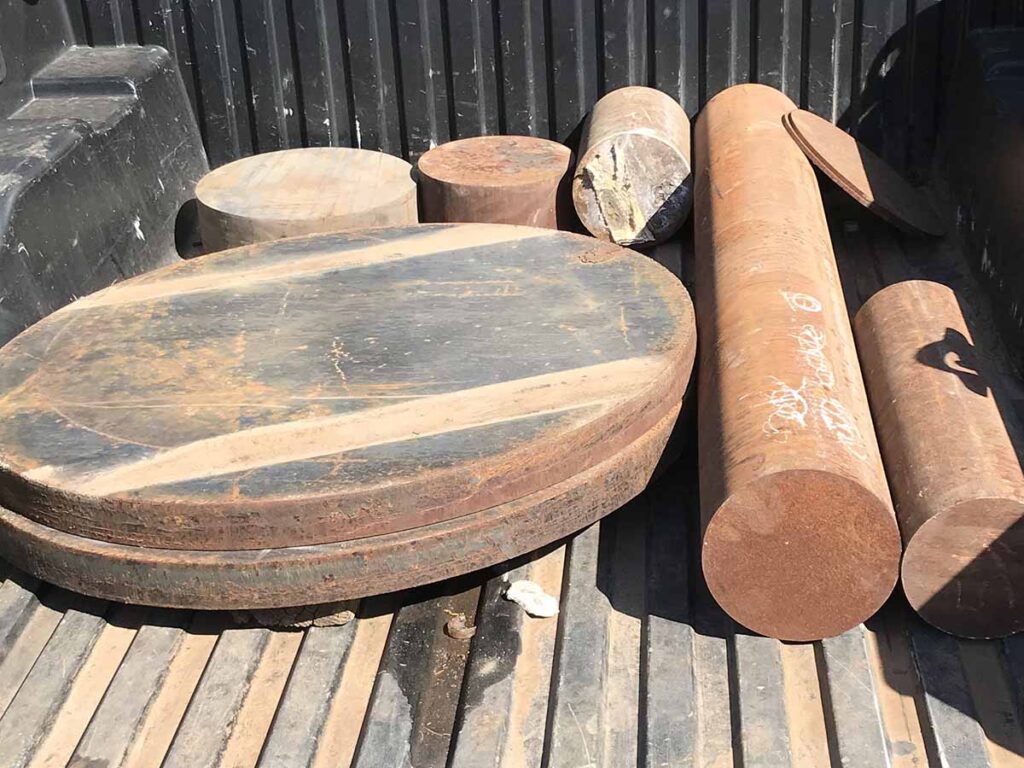
Another consideration is the base for your hammer. The author scored some 2-inch-thick, 30-inch-round, 300-pound base plates out of the “drop” pile at a local steel distributor, along with several other potential anvils.
My power hammer has become an essential tool in my shop, to the point that I sometimes wonder how I ever lived without it. I have only begun to explore its full potential. I built it for my appearance on Forged in Fire, where I was fortunate to make the final. I was able to come home and use my hammer to build my final edged piece for FIF. I lost the contest but ultimately still have a power hammer, and I can still take pride in the fact I built it myself from little more than a pile of junk.
It may take you a few months to gather all the primary parts, or you may get lucky and find them all in one place. Next month’s article will focus on building considerations for a spring helve hammer, and later we’ll discuss the Clay Spencer DIY tire hammer.