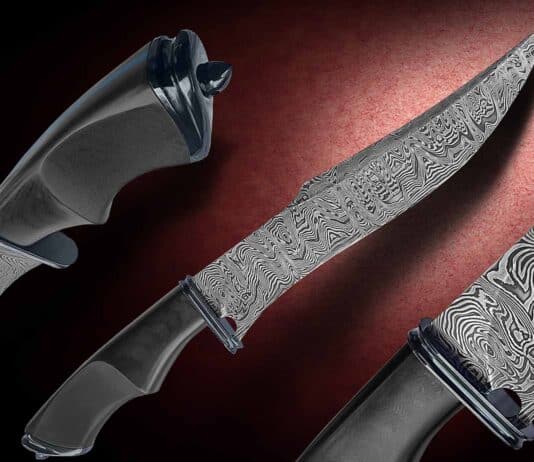
Knifemaking is the building of a knife, which includes the blade, handle and other accouterments. Blades are made by either removing metal from a steel blank via a grinder – known as stock removal – and the forging to shape of hot steel into a blade in the process known as bladesmithing. Other parts, including bolsters, guards, pommels, etc., are needed to complete the finished knife.
Tony Cetani has left his mark in the kitchen knife niche grinding it out at Hourglass Knives.
When asked why he makes knives, Anthony “Tony” Cetani of Hourglass Knives grinned and states, “It’s cheaper to make them than buy them.” It was while recovering from knee surgery that he got the idea to make one. “After weeks of reading forums and watching YouTube videos I bought a single-burner forge, a 4×36-inch belt sander, a set of files, a hacksaw and a bar of 1084, and in March 2017 made my first knife,” he recalls.
Tony Cetani specializes in such kitchen knives as his Honesuki. It features a 9-inch blade of Riptide cu-mai copper damascus from Baker Forge & Tool and an amboyna burl handle with cu-mai pins and liners. (Baker Forge & Tool knife image)
“It took me a few years to figure out what my niche in the knife world was going to be,” Cetani continues. “With so many amazing makers and designs I wanted to try and set myself apart. In late 2020 I made my first kitchen knife and fell in love. I started with some traditional Japanese styles and put my own spin on them. I love a knife where everything flows together and there are no straight lines in the profile. Though I love making all types of knives, kitchen knives have become a huge part of what sets Hourglass Knives apart.”
In seven short years, Tony has made his mark in the custom knife realm.
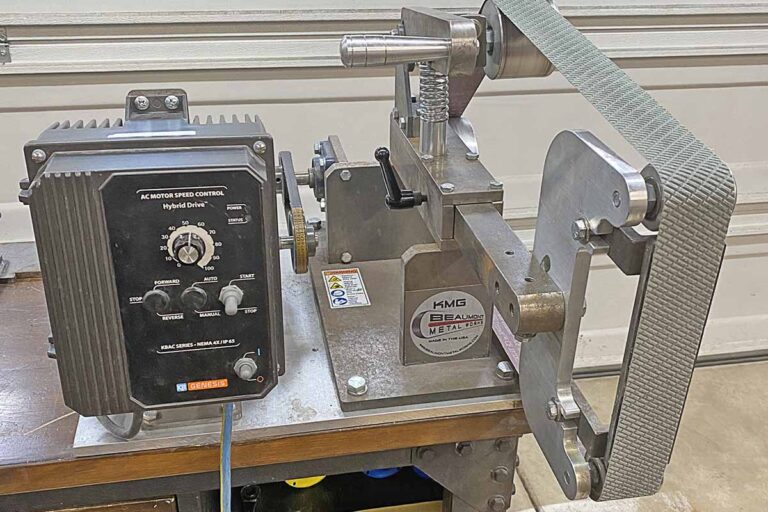
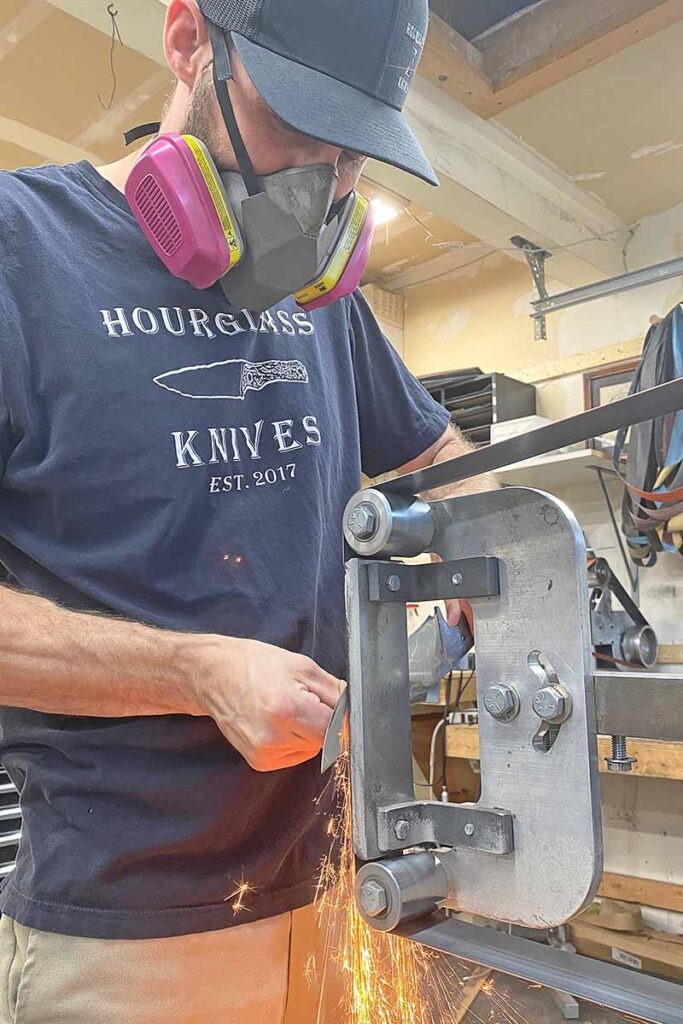
“My grinders are my most-used machines in the shop,” he offers. “Whether I’m grinding bevels, contouring handles, getting in tight corners with my small wheels, sharpening a pencil, or chasing scratches on a finished blade that I end up ruining, I use my KMG grinders for everything. Both of these machines have been invaluable to me. Having 1.5-inch tooling-arm slots gives me a ton of different options for attachments and fixtures. Switching belts is quick and easy with no tracking issues. Beaumont makes a tough and very reliable machine.”
From grinding bevels to chasing scratches on a finished blade or what have you, Tony uses his KMG grinders for most everything. This is his classic variable speed model. (In his rush to have the picture taken of him grinding for the story, Tony forgot to don his safety glasses.)
Cetani lauds his Foredom SR flexible shaft rotary tool. “There’s a few rotary tools out there I’ve tried but the Foredom has been my favorite. It has tons of different attachments, bits, accessories and the hand pieces can fit most rotary tool bits,” he explains. “The Foredom has given me the ability to do fine detail work on plunge lines, spines, tangs and the like that no other tool can. This rotary tool has helped my finish work immensely.”
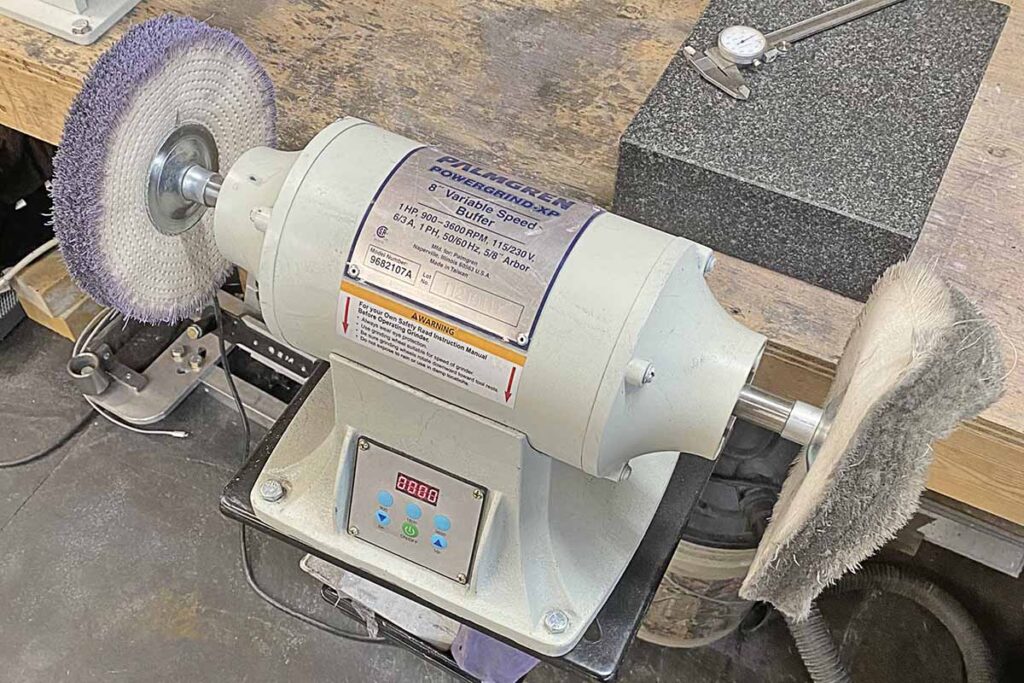
For his exquisite knife grips, Tony shares his key to success. “The Palmgren Powergrind-XP 8-inch, 1-horsepower, variable-speed buffer has changed my handle game. For years I ran a 3600-rpm buffer and was really happy with my results,” he reports. “I only use buffing compound when finishing my handles, and the change I saw after using the Palmgren variable speed buffer was phenomenal. Starting at 3600 and being able to drop it down slowly to 900 rpm really helps bring the most out of the wood. Being able to adjust speeds when buffing oxides off or polishing steels has been huge as well. The variable speed buffer is the one tool I wish I would have bought early on in knifemaking.”
The Palmgren Powergrind-XP 8-inch, 1-horsepower, variable-speed buffer has changed Cetani’s handle game. “I only use buffing compound when finishing my handles,” he notes, “and the change I saw after using the Palmgren variable speed buffer was phenomenal.”
For sanding Cetani uses a Edward Braun hand-sanding fixture. “I always disliked hand sanding because of the amount of times I stabbed and/or cut myself. When I first saw Edward Braun had a few hand-sanding fixtures for sale,” he recalls, “I knew I needed one. The fixture makes it fast and easy to secure your knife and start hand sanding. Adjusting the clamp is quick and allows for multiple holds for the specific knife you are working on. Since buying one I still don’t like hand sanding but I haven’t hurt myself!”
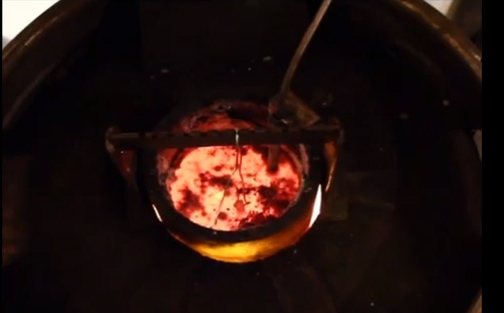
This video from the American Bladesmith Society (ABS) explains how to perform salt bath heat treating. It’s part of the Phoenix knife project ABS members created. You can see video about the incredible ABS Phoenix knife here.
Here’s a bit of background from the ABS about the Phoenix knife:
The Phoenix Knife was originally created by several members of the ABS Board, then disaster struck and it was damaged in a house fire. On its second life, several ABS Board Members contributed in the efforts to bring it back to life including Master Smith Kevin Cashen shown in this video heat treating the blade and bringing the knife back to life. Stay tuned for the third video about “Rockwell Testing” the blade.
To follow the Phoenix knife through its stages, be sure to subscribe to the ABS YouTube channel. There are plenty of knife videos online, but the expert insights from ABS are a cut above.
It’s easy to toss around the word epic and difficult to describe Jon Christensen’s recent work any other way. Of course, the subject material for his two-handed sword made it challenging for the results of the project to be anything other than mythical.
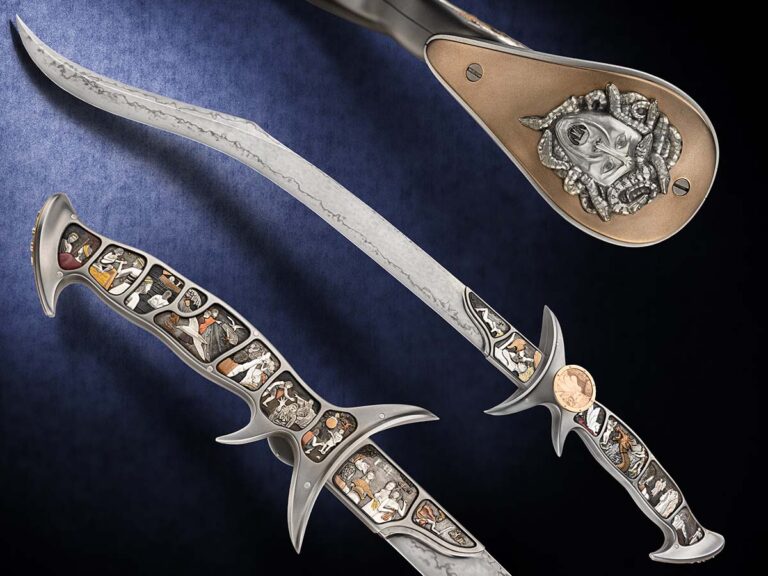
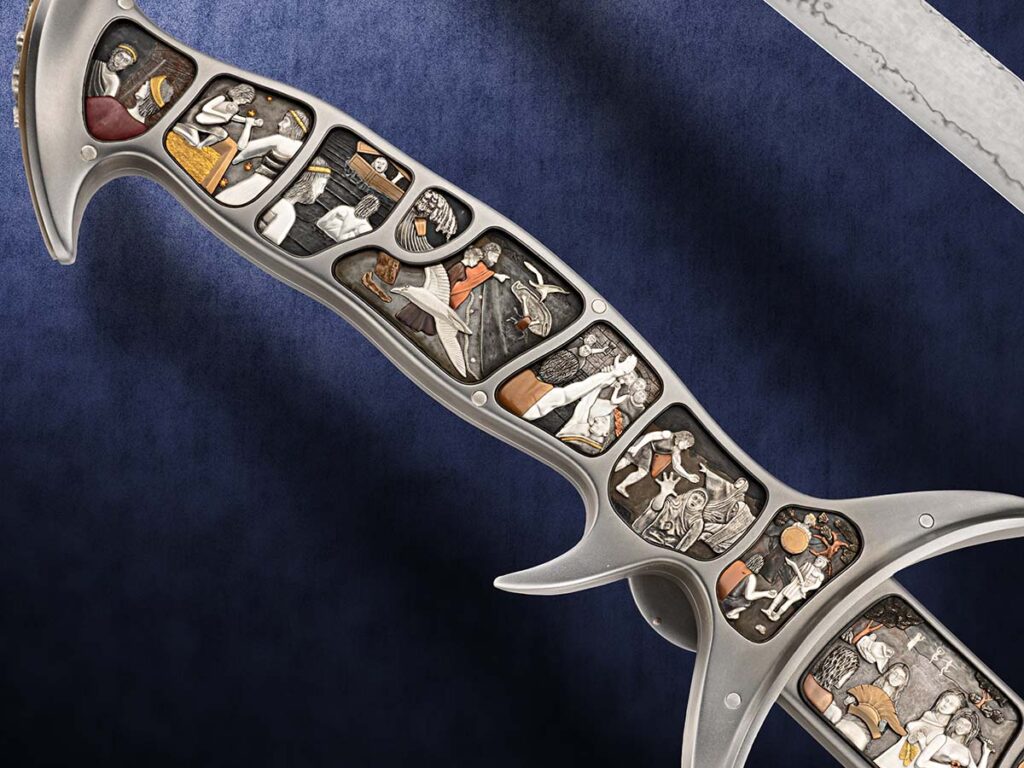
The Montana-based ABS master smith captures the ancient Greek myth of Perseus and Medusa in 16 hand-engraved iron panels inset into the 410SS handle and a bulino-engraved bronze shield on the guard of his Guardian Sword. Among other things, the handle features gold, bronze, copper, silver, custom alloy and mother-of-pearl inlay and is punctuated with Medusa’s head on the butt.
Jon Christensen
“The bulino engraving was very challenging as it was my first,” Christensen confessed. “There was a ‘paying my dues’ stage of time spent, which I just had to accept.”
It might be said that the entire project was an exercise in dues-paying. In addition to challenging himself with a new engraving technique, he was also delving into an unfamiliar subject. Christensen gave himself a crash course in the story of Medusa before conceptualizing the panels. But the client who commissioned the sword raised the bar on his retelling of the myth.
“Before starting on the project, the collector requested my interpretation of the story be approved by Tufts University, which is known for a strong program in classical mythology,” he said. “I compiled and submitted a document of the concept showing drawings and descriptions for each scene, as well as the overall sword. They replied saying, ‘It was a masterful interpretation.’”
The Guardian Sword handle, with the panels depicting the Greek myth of Perseus and Medusa.
The sword is reminiscent of the one featured in Benvenuto Cellini’s sculpture of Perseus, showcasing the same unique shape in its 37.5-inch W2 blade, with a hamon. While this aspect of the sword presented challenges, Christensen admits it was the easy part of the Guardian. Much of the 4,000 or so hours he dedicated to the work were focused on the handle, engravings and accurately retelling the ancient myth.
“The time on completing the blade would be measured in weeks, the handle scenes in years working under a microscope,” he said. Epic, indeed.
“Yes, the scope of the project was very intimidating at times. I had to constantly manage my thoughts to the task at hand,” Christensen said. “As the saying goes, ‘How do you eat an elephant? One bite at a time.’”
The thumb stud is reliable, time-tested and add dynamic dash to these customer folders.
Aside from the good ol’ nail nick, thumb studs are among the most enduring opening systems for folding knives. Why not? Typically ambidextrous, easy to manipulate and lightning fast, the reliable deployment feature has a lot going for it. Not to mention, on these custom knives, they add equal parts dash and traditional appeal.
Michael Raymond: Ziura folder
Forty-nine 24k gold inlays set into a 6-4 titanium frame elevate Michael Raymond’s Ziura folder. The swedge-ground Bohler M390 blade measures 3.53 inches with an 8.08-inch overall length. (SharpByCoop image)
David Beaver: Shogun Horizon Folder
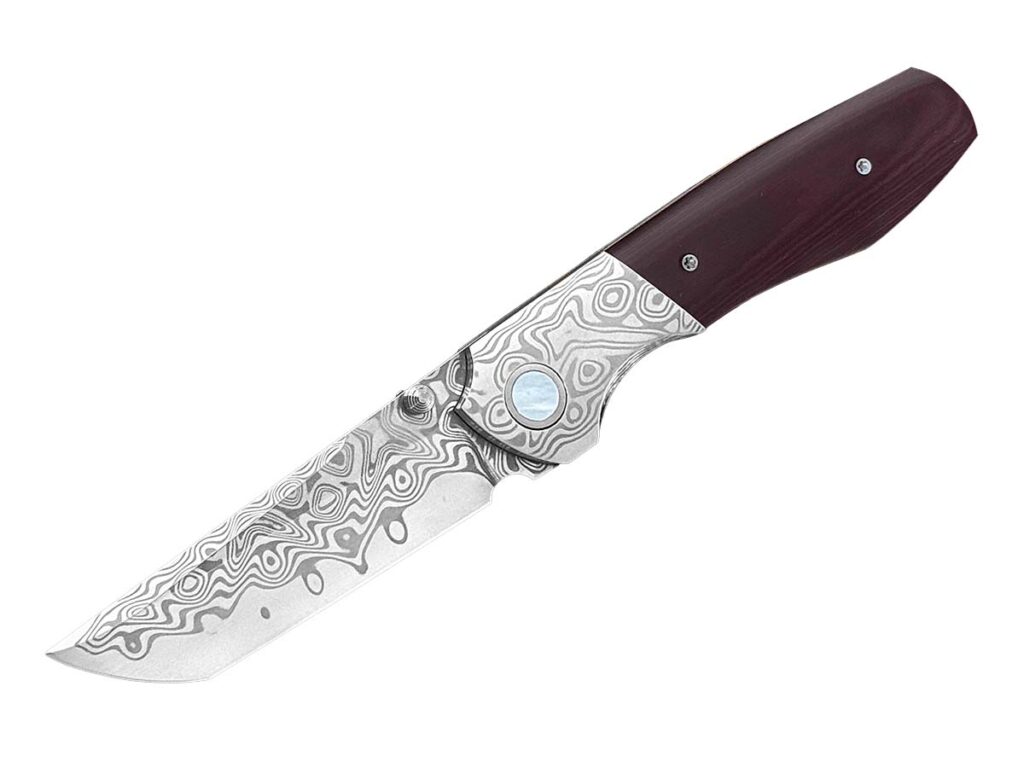
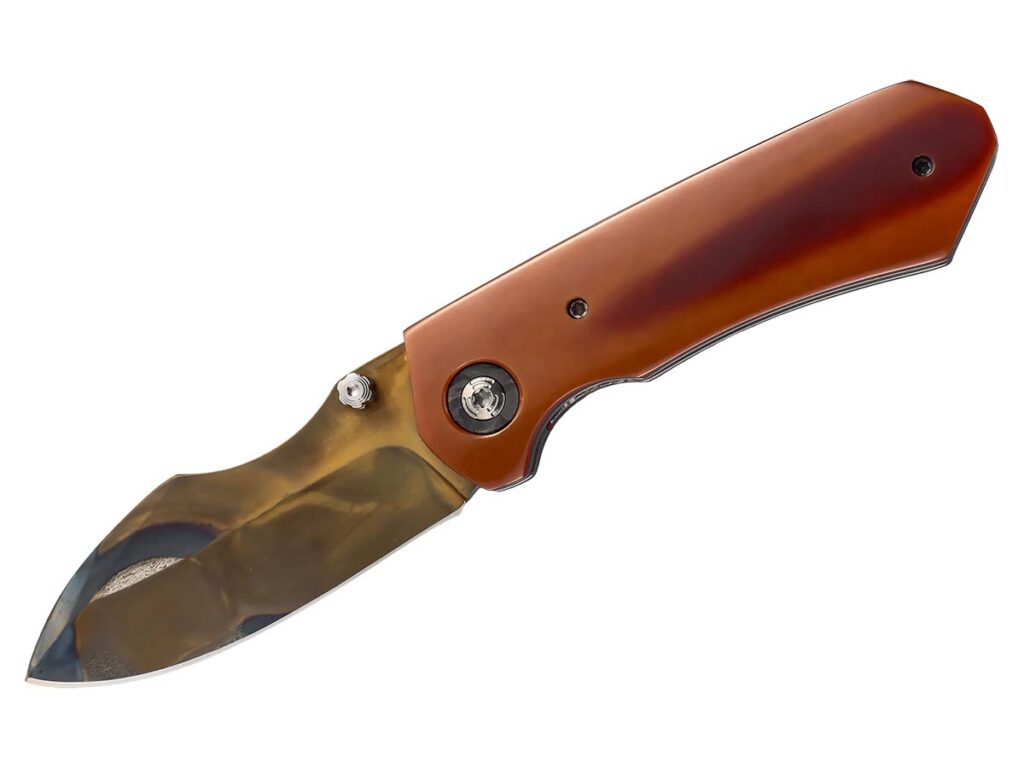
Vintage red linen Micarta scales and a hollow-ground Damasteel Baldur on Damacore blade highlight David Beaver’s Shogun Horizon folder. Blade and overall lengths: 3.75 and 8.5 inches. The maker’s price for similar knife is $1,800. (Jocelyn Frasier image)
Cody Hofsommer: Mammoth Ivory Folder
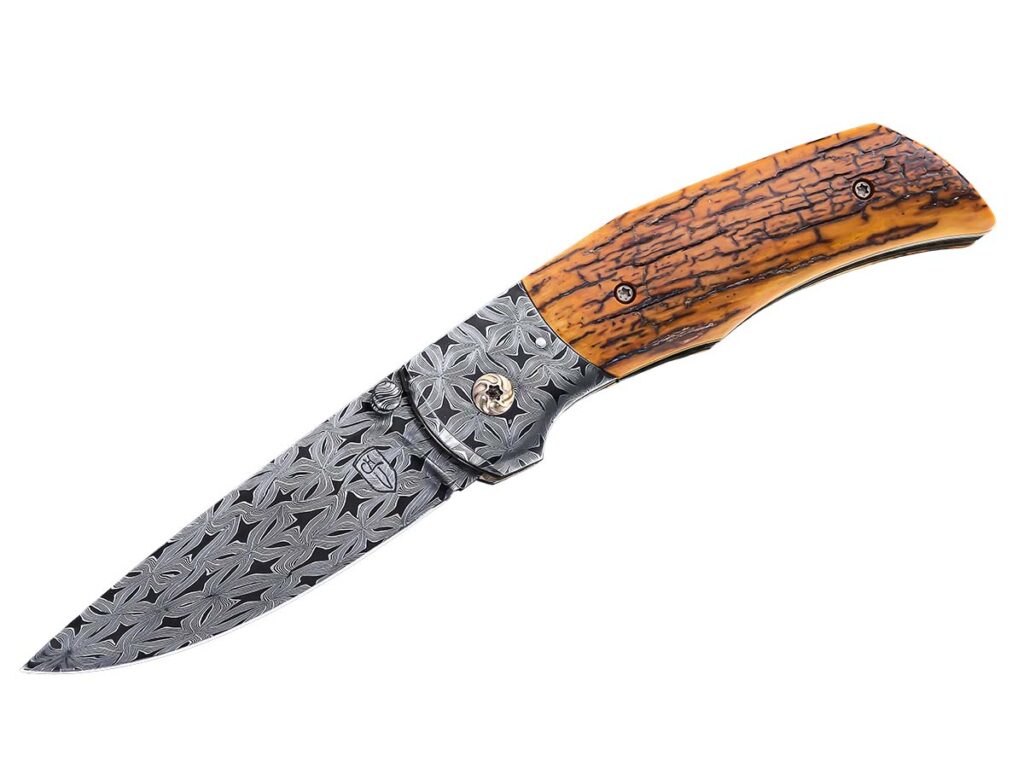
Mammoth ivory scales and mosaic damascus bolsters define a sole-authorship flat-ground folder by Cody Hofsommer. The 1080/15n20 mosaic Damascus blade measures 3.375 inches with an 8-inch overall length. (SharpByCoop image)
Kirby Lambert: Augustus Mini Folder
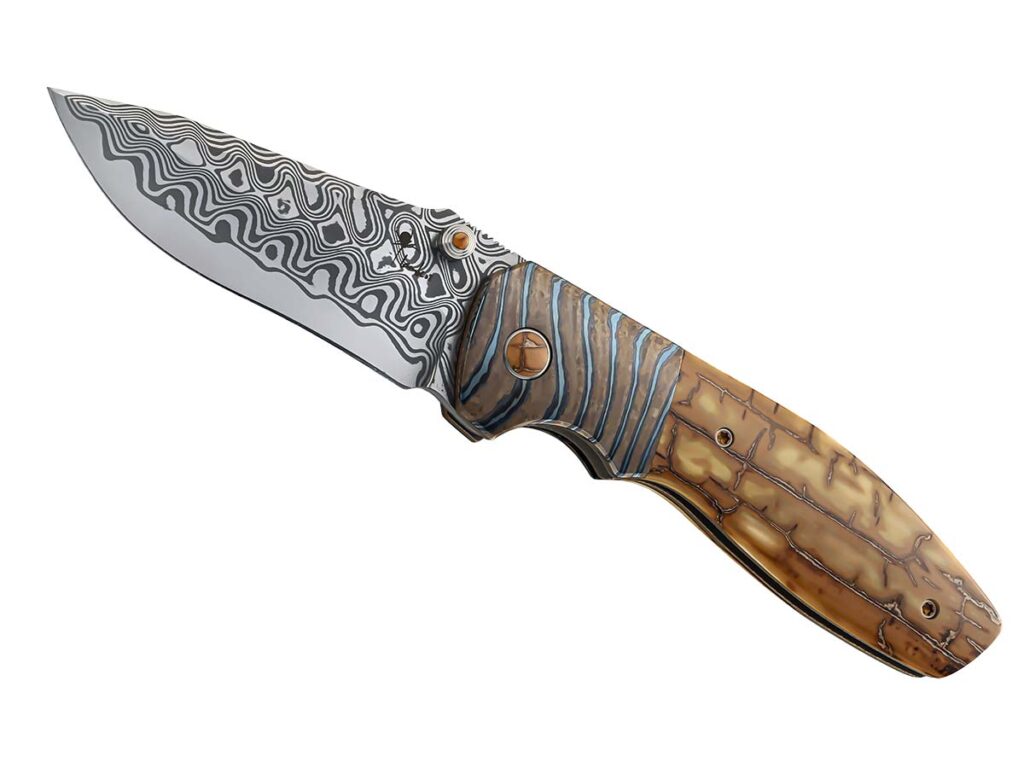
A hollow-ground Damacore blade and mammoth ivory scales distinguish the Augustus Mini folder by Kirby Lambert. Bolsters are titanium and 2IRC damascus. Blade and overall lengths: 3.25 and 8 inches. (SharpByCoop image)
Brian Milinski: Paratrooper Elegante Linerlock
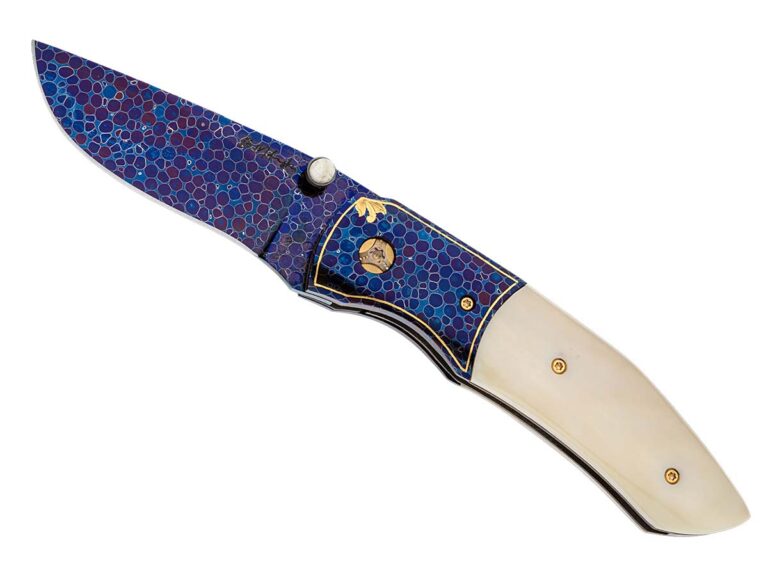
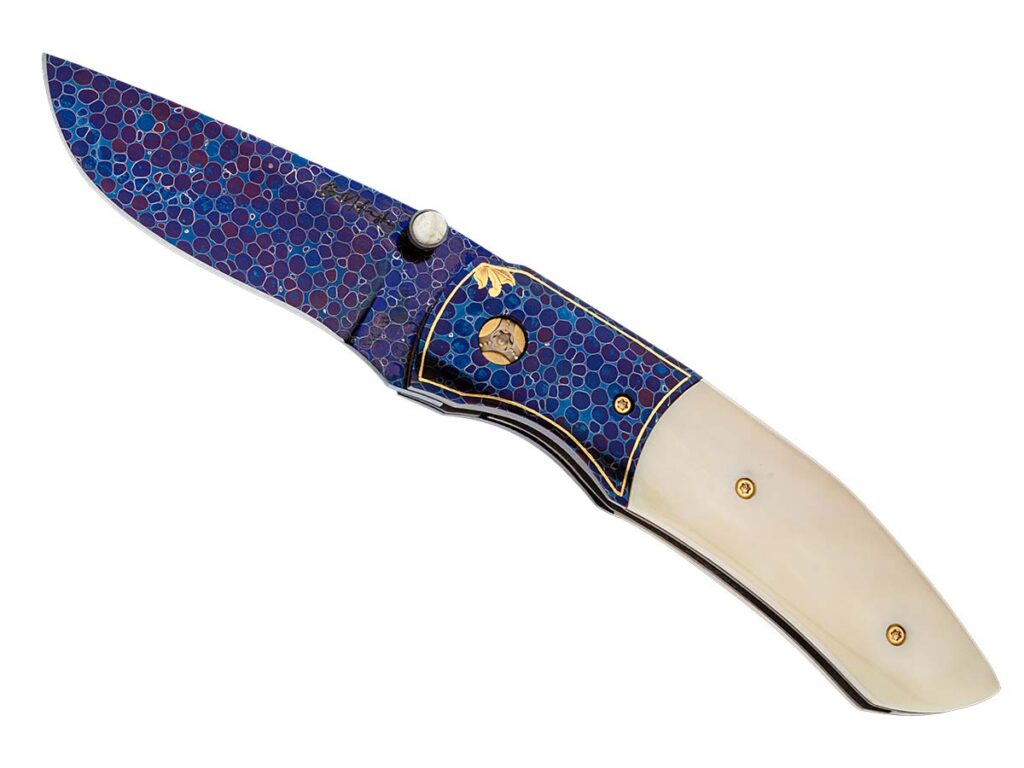
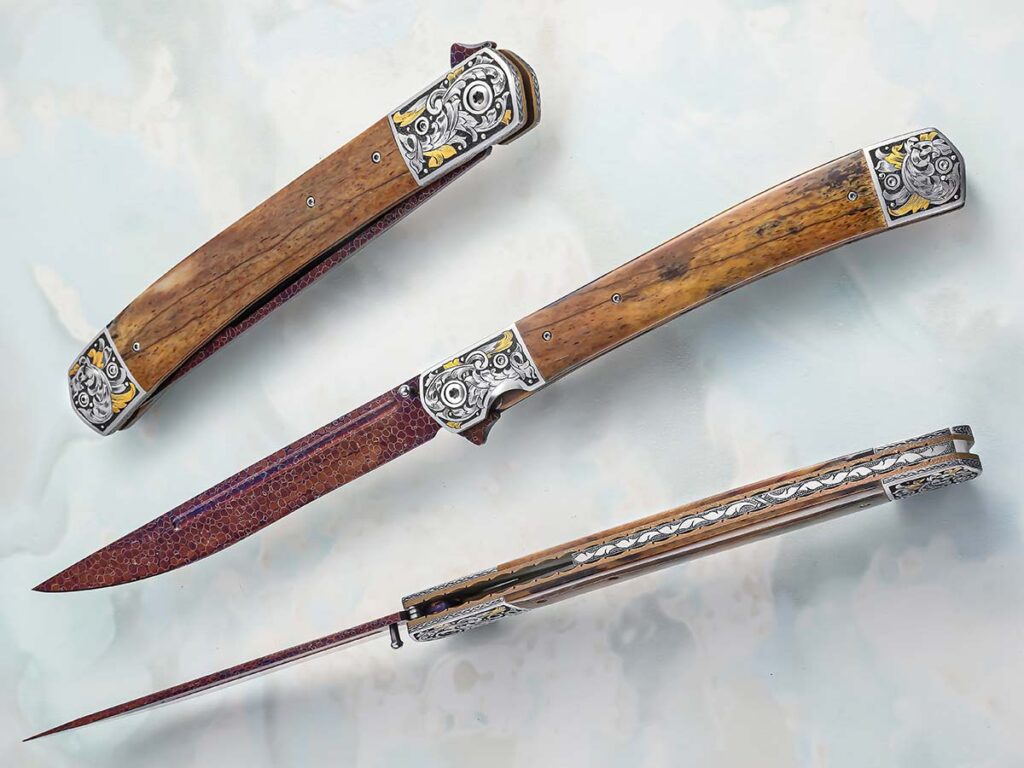
Nitre blued Rietveld damascus and fossilized walrus tusk scales characterize Brian Milinski’s Paratrooper Elegante linerlock. Joe Mason engraved and inlaid the matching bolsters. Blade and overall lengths: 3.25 and 7.75 inches. The maker’s price for a similar knife is $3,400. (Jocelyn Frasier image)
KC Gray: Titanium Folder
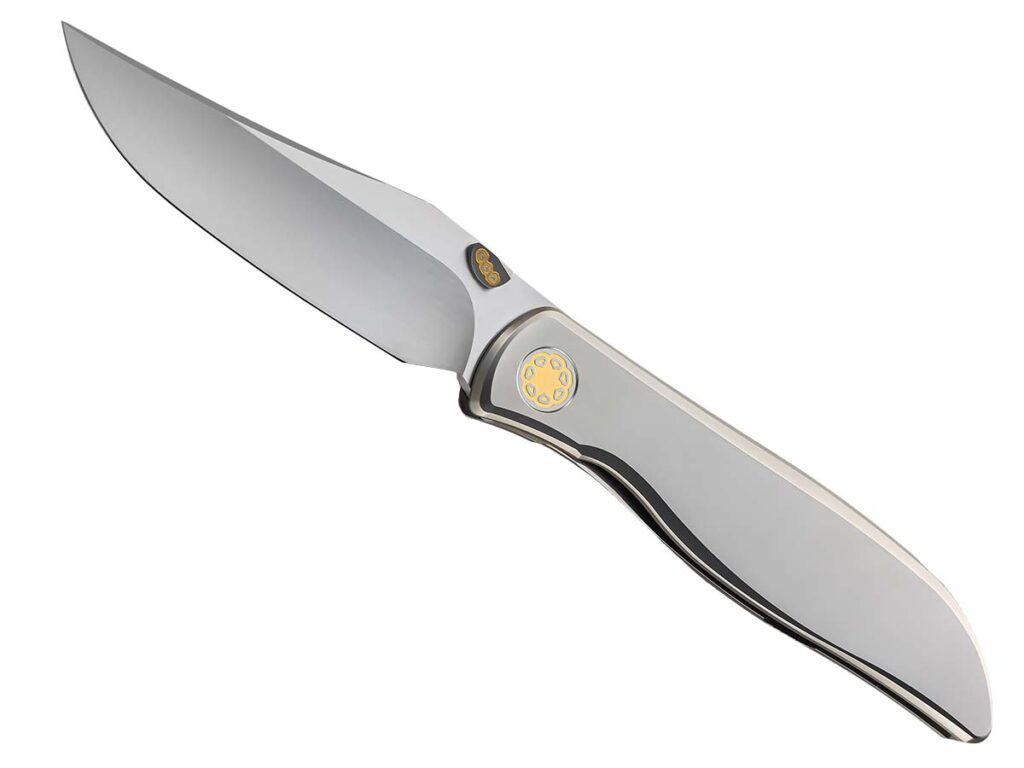
A 3.5-inch SM100 blade paired with vintage Micarta scales defines this 8-inch dress locking folder by Tucson maker KC Gray. The titanium frame includes marble carbon-fiber pivot collars and a black anodized clip. (SharpByCoop image)
Sean Alonzo: Ani
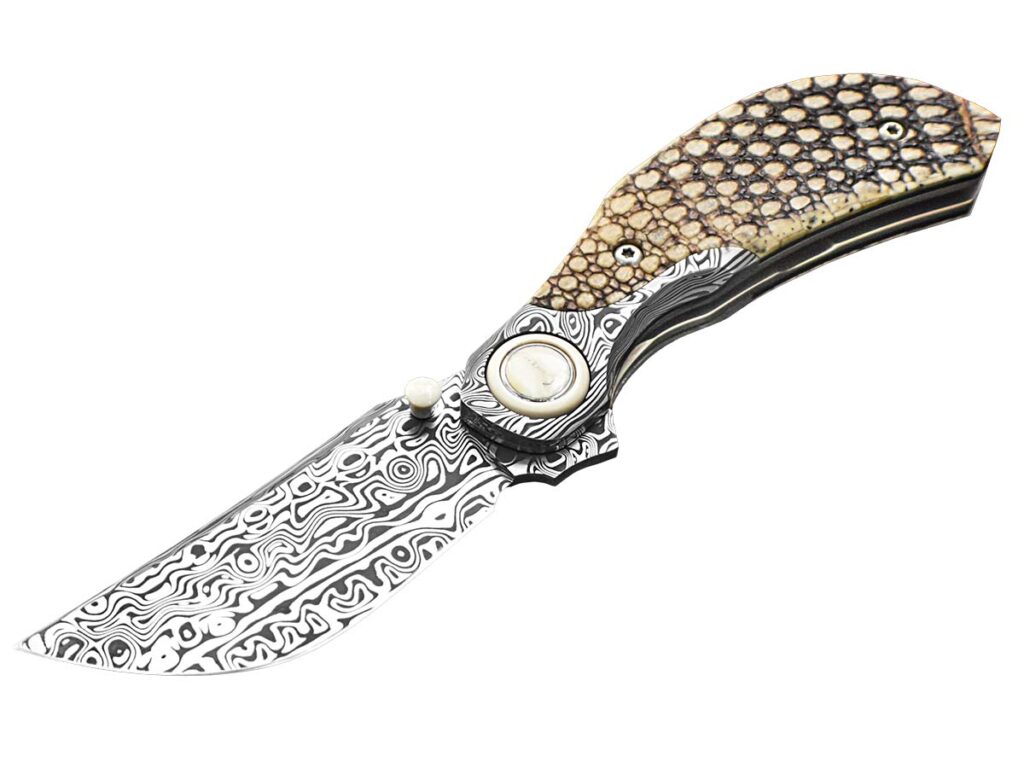
Sean Alonzo’s Ani 3.2 linerlock features armadillo carapace, warthog ivory, and a hollow-ground Yggdrasil Damasteel blade. Blade and overall lengths: 3.2 and 7.8 inches. Maker’s price for a similar knife $5,500. (Jocelyn Frasier image)
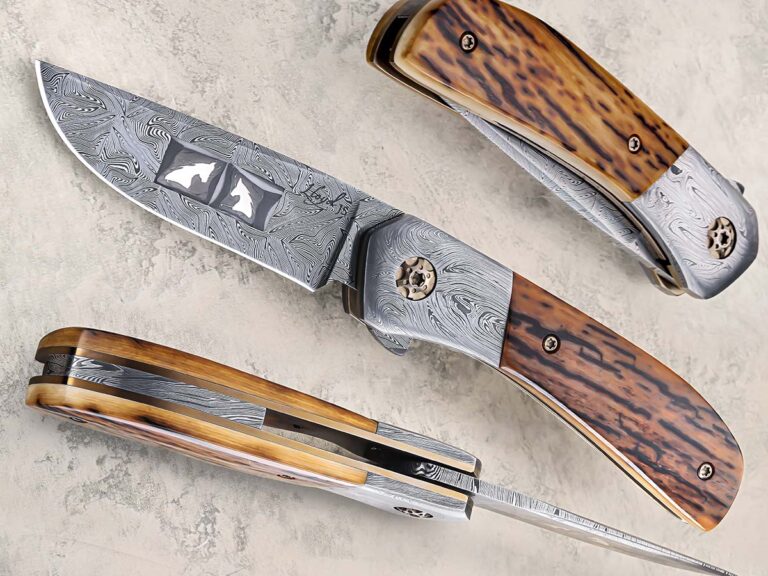
When BLADE Magazine Cutlery Hall-Of-Fame® member Bill Moran reintroduced knives with damascus blades at the 1973 Knifemakers’ Guild Show, little did he know how much damascus would evolve, redefine itself, expand into new media, and no telling what other recreations and rebirthings it has experienced in the half-century since that fateful weekend in the Muehlebach Hotel in downtown Kansas City.
On this page are some of today’s reincarnations of the material in its various forms, methods, materials and more. What’s staggering to consider is there are so many more variations—not only now but also to come. It is a phenomenon that is truly unique to the custom knife industry and should be celebrated and promoted whenever possible.
David Lisch Templars Mosaic
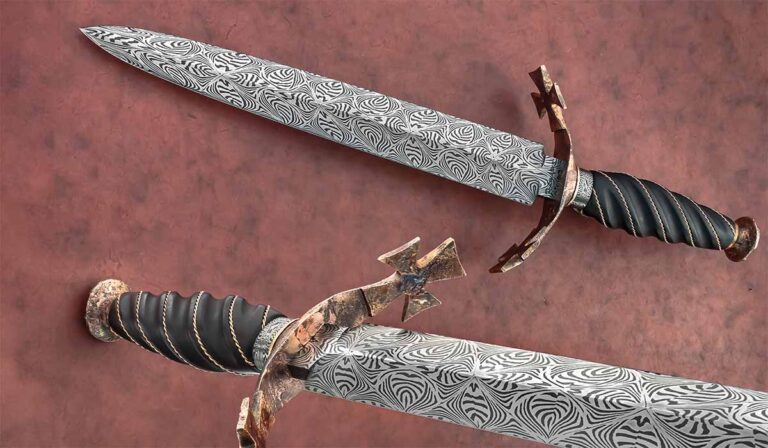
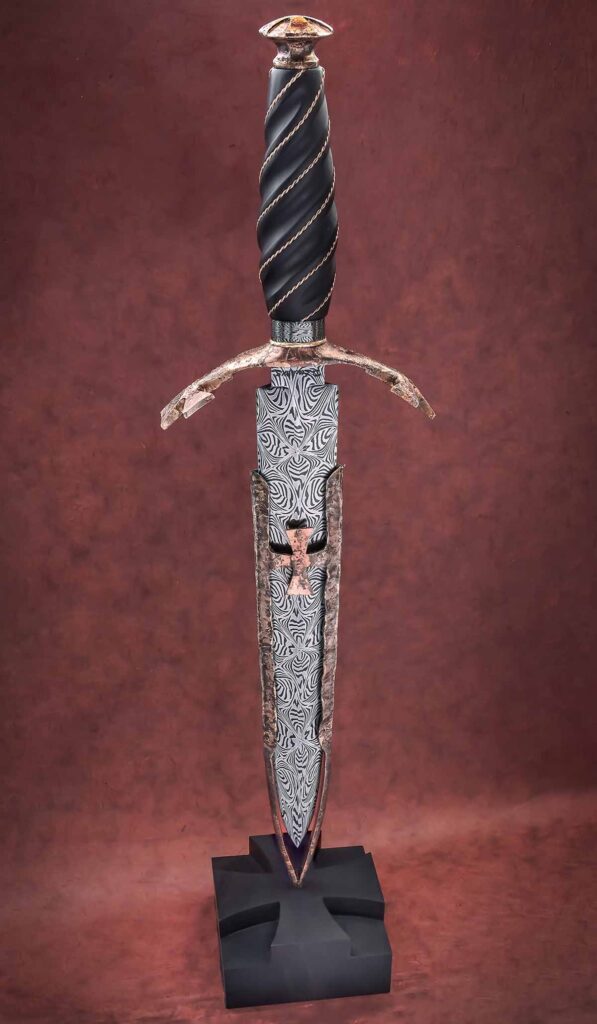
David Lisch’s spectacular art dagger features a 12-inch blade of his Templars Mosaic Damascus, a blackwood handle with gold wire wrap and a guard of pure iron covered in melted gold. Overall length: 17.75 inches. The knife comes with a stand that includes an embellished templars’ cross and one carved in the base as well. (SharpByCoop knife images)
Sporting a pattern ABS master smith David Lisch christened Templars Mosaic, the blade for his dagger is one he forged from 15N20 nickel-alloy and 1080 carbon steels and etched in ferric chloride.
“I was aiming for a bold, bright pattern that had a cross-like shape but wanted it to be a bit organic,” he wrote. The Templars’ cross also is represented on the guard and the finial, and there is one on the stand that holds the knife as well. “All these parts are pure iron covered in melted gold,” he noted. The dagger also has a domed gold spacer between the guard and Dragon Thunder damascus spacer that the fluted-blackwood-with-gold-wire-inlay handle butts up against.
“I made this dagger out of the love I have for creating art with no concern about how long it took or how much money I would make from it,” David stressed. “I did the handle twice and I did the big finial twice. I sold the piece for $10,000 and will not be making another one like this. You can be sure that the love I have for creating will take me to a new dagger, sword or bowie knife that tries to fill the void in me that can only be filled by creating art.”
Jeremy Yelle Jellyroll Mosaic Turkish Twist
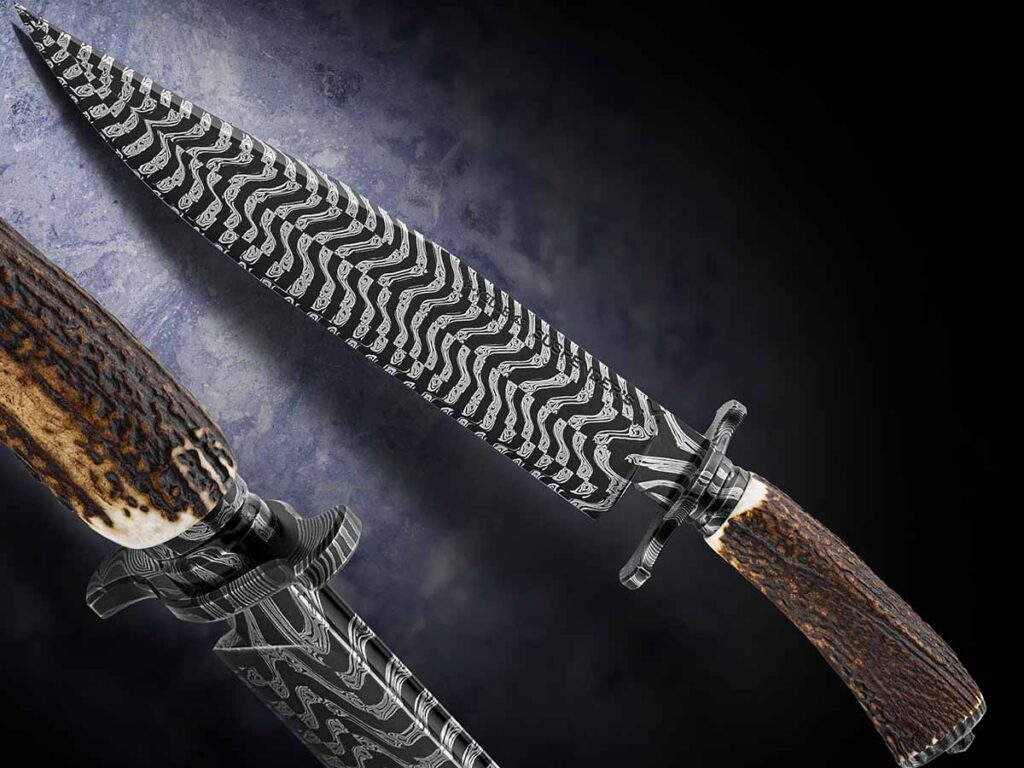
The steels for the jellyroll mosaic Turkish twist pattern damascus of the collaborative bowie by Jeremy Yelle (right) and Alex Houle (left) is forged from 1080 carbon and 15N20 nickel-alloy steels. Blade and overall lengths: 10.25 and 15.5 inches. Their list price for a similar knife: $2,600. (Jocelyn Frasier knife image edit)
The blade damascus of ABS journeyman smith Jeremy Yelle’s and SBK Cutlery’s stag bowie is a positively electric jellyroll mosaic Turkish twist pattern Jeremy forged in a collaboration with his friend Alex Houle of SBK. Alex forged the collaborative damascus into a blade and Jeremy made the handle.
“We began by welding a billet of alternate layers,” Jeremy wrote of the forging process. The pair drew the billet into a bar and jelly rolled it. “Then we squared it up and welded a four-way incorporating some 1-inch-square 1080,” he continued. They welded the billet, drew it out to ¾-inch square, cut and twisted it, and made a Turkish-twist stack that Alex forged into a blade. “You can also see the ‘fish mouth*’ weld Alex did so the edge bar and the spine meet properly,” Jeremy wrote. “He did a wonderful job making the blade.” Jeremy showed Alex how to work with stag and they finished the parts. Alex revealed the beautiful pattern via a two-step etching process using a solution of ferric chloride and finishing the etch with a coffee-darkening soak and hot wax finish.
Zane Dvorak Multi-Bar
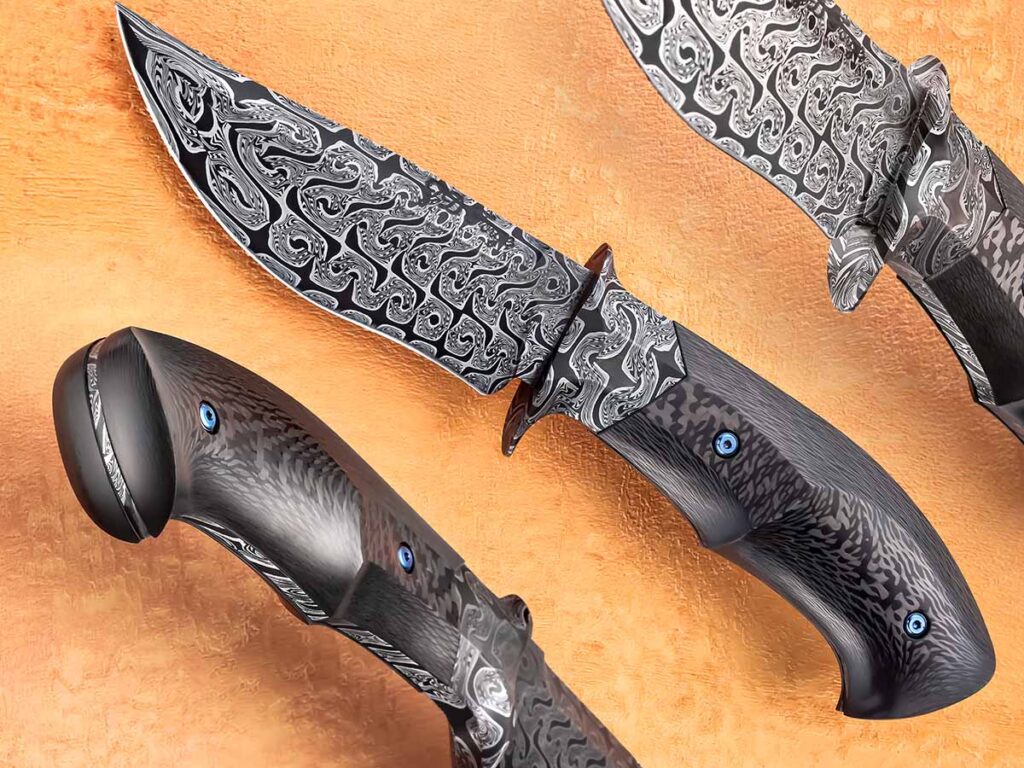
The 4.25-inch blade of Zane Dvorak’s hunter is a multi-bar damascus of 1084 carbon and 15N20 nickel-alloy steels. Overall length: 9.25 inches. His price for a similar knife: $2,400. (SharpByCoop image)
The blade of Zane Dvorak’s hunter is a multi-bar damascus of 1084 carbon and 15N20 nickel-alloy steels. Zane forged the blade/tang of four twisted bars of a twisted-bar pattern, and forged welded the guards and bolsters on with the same pattern. He bird’s mouthed the blade tip and rewelded it back together to create flowing outer bars. For etchant he used Gator Piss Acid from Baker Forge & Tool.
Bird’s mouthing is a process done on multi-bar, mosaic or other types of damascus patterns. According to Zane, it involves cutting a triangle out of the end of the rectangular parent bar—the shape of which somewhat resembles a bird’s mouth—then bringing the steel of the edge and spine back together to form the point of the blade. By doing so the blade exhibits a better consistency and overall flow of the pattern.
Andrew Blomfield Alternate Pattern
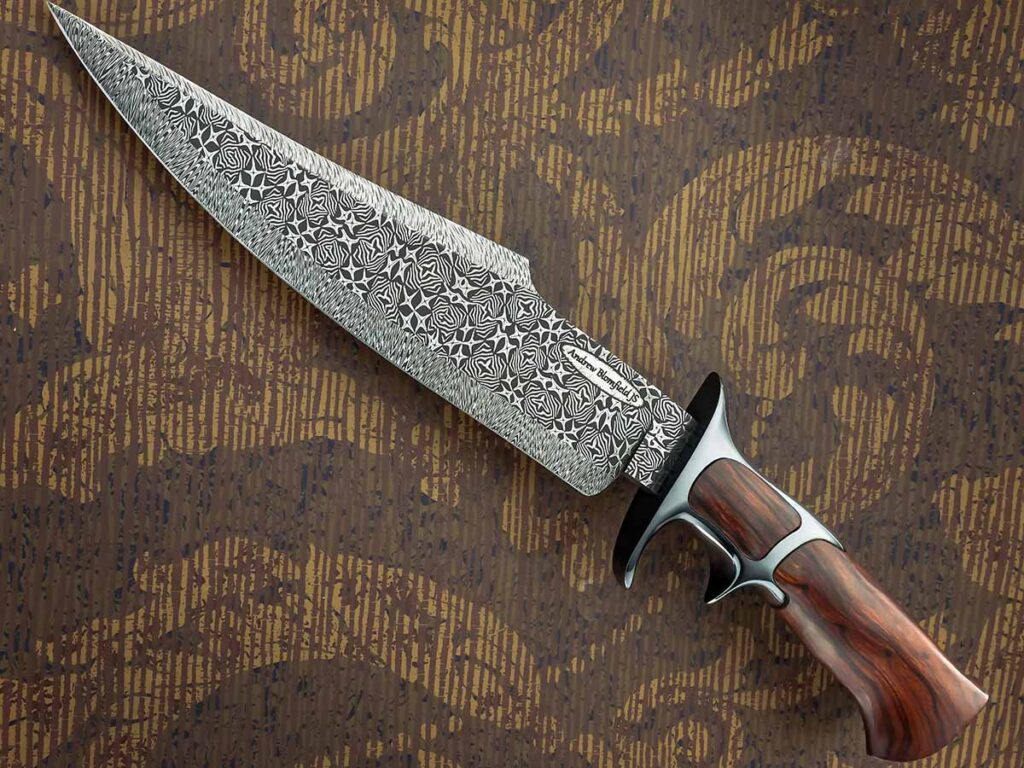
The mosaic damascus for Andrew Blomfield’s sub-hilt fighter is a combo of two separate billets welded in an alternate pattern. Blade and overall lengths: 9.5 and 14.5 inches. Blade grind: flat. Andrew’s price for a similar knife: $3,000. (SharpByCoop image)
The material mid-blade of Andrew Blomfield’s sub-hilt fighter is a combination of two separate billets of mosaic damascus welded in an alternate pattern. The edge is a straight feather pattern forge welded around the edge. The blade is a combination of pieces from three separate billets. The steels are 1084 carbon and 15N20 nickel alloy etched with ferric chloride.
The integral sub-hilt is 1020 low-carbon steel hot salt blued to a deep black finish. The handle is desert ironwood. The knife is of a full takedown construction.
Frank Edwards Palm Leaf Mosaic Pattern
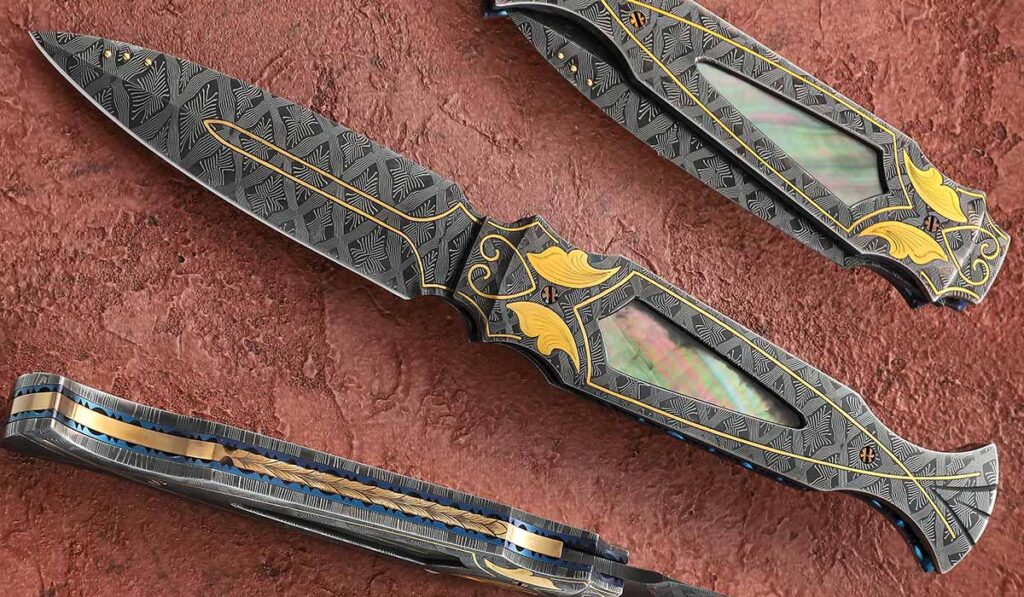
The Palm Leaf mosaic damascus by Frank Edwards is an interweaving river system of straight lines. The handle inlay is black-lip mother-of-pearl. Blade and closed lengths: 3 and 4.25 inches. His price for a similar knife: $1,900. (SharpByCoop knife image)
The multi-bar damascus of Frank Edwards’s folding dagger blade is in a Palm Leaf mosaic pattern. Starting with a billet of straight lines, he reduced it all into a square and then biased the squares, four-waying the billet into a 1.5-inch square.
As Frank explained his recipe, “Forge weld another billet of straight lines, keeping them straight as possible to .5 inch by 1.5 inches. Add that to the previous billet and forge weld and reduce to a 1×1-inch square. Then four-way it again. This will give you the frame around the palm leaves. Keep repeating that until you achieve the size of pattern for the knife you’re building.
“The key to getting good mosaics is a slower reduction [of the steel]. We have presses and power hammers that help but they can move too much metal too fast, which will destroy a mosaic in a hurry. The slower reduction allows the billet to stay uniform throughout the length of the bar.” To expose the pattern he etched the blade with a four-to-one mixture of water/ferric chloride in 10-minute cycles, using 2,000-grit sandpaper between cycles.
Jackson Rumble Stunning Pattern
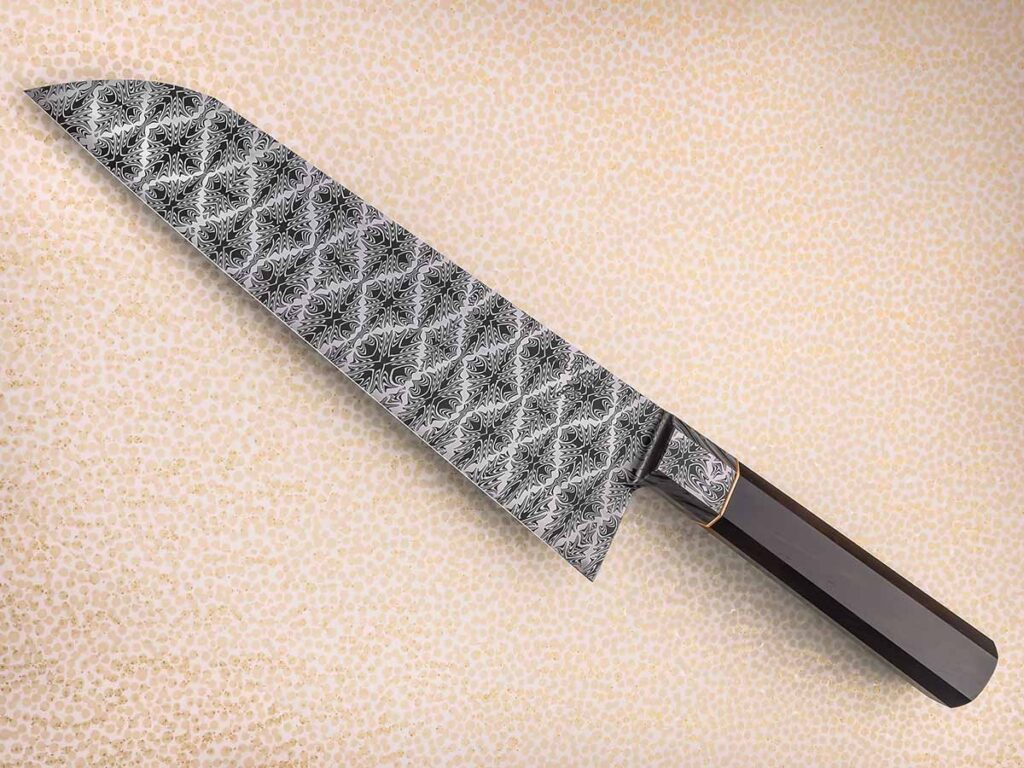
The 8-inch blade of an integral chef’s knife by Jackson Rumble boasts a mesmerizing and at press time unnamed damascus pattern forged from 1084 carbon and 15N20 nickel-alloy steels. The handle is African blackwood. Overall length: 13 inches. The maker’s price for a similar knife would start at $2,500. (SharpByCoop knife image)
The technique for the stunning pattern on newly named ABS master smith Jackson Rumble’s chef’s knife is what he calls a “pretty standard process” of four-way welding and re-square cycles. Not bad for “pretty standard,” eh (page 28, top left)? The initial stack has large sections of both light and dark steels interspersed through the alternating layers, and Jackson added extra-light steel to the billet in the later stages of the forging process.
“Finally, I used the Filicietti Flip method to transfer the pattern to the face of the billet,” he wrote. “For the etching process I used ferric chloride followed by coffee.” OK, Jackson, so what’s the “Filicietti Flip method”?
“I’ve heard the Filicietti Flip called other names like the Ferry Flip, or just tile welding,” he explained. “Basically, after you’ve finished building the pattern in the end grain of the billet, you take it to a bandsaw and cut slices off the end at a 35-degree angle. This makes a bunch of pieces in the shape of parallelograms or tiles. The tiles can then be rotated and forge welded back together to form a new billet. Instead of having the pattern showing on the end of the billet, the pattern will repeat itself along the face of the billet.”
We’re glad we asked.
*Also called fish lips, fish mouth is when the tip of the billet begins to curl up on either side during rough forging to resemble a fish’s mouth or lips, thus the name. It is an easy fix for knowledgeable bladesmiths such as Alex Houle.
Aesthetically and mechanically challenging flipper designs that shine.
The flipper folder is one of those knife designs that continues to delight its makers and its owners with incredible vitality. Not only do the most recent flipper folders fill the traditional bill with great materials, mechanics and mesmerizing beauty, but they further garner high praise with an inherent level of energy.
Combining the attributes of excellence that set standards for custom knives with the sheer pleasure of smooth operation, the latest flipper folders hit the mark in quality and bring attention to their makers amid an ever-growing level of interest in the marketplace.
Scott Gallagher: Feather Damascus
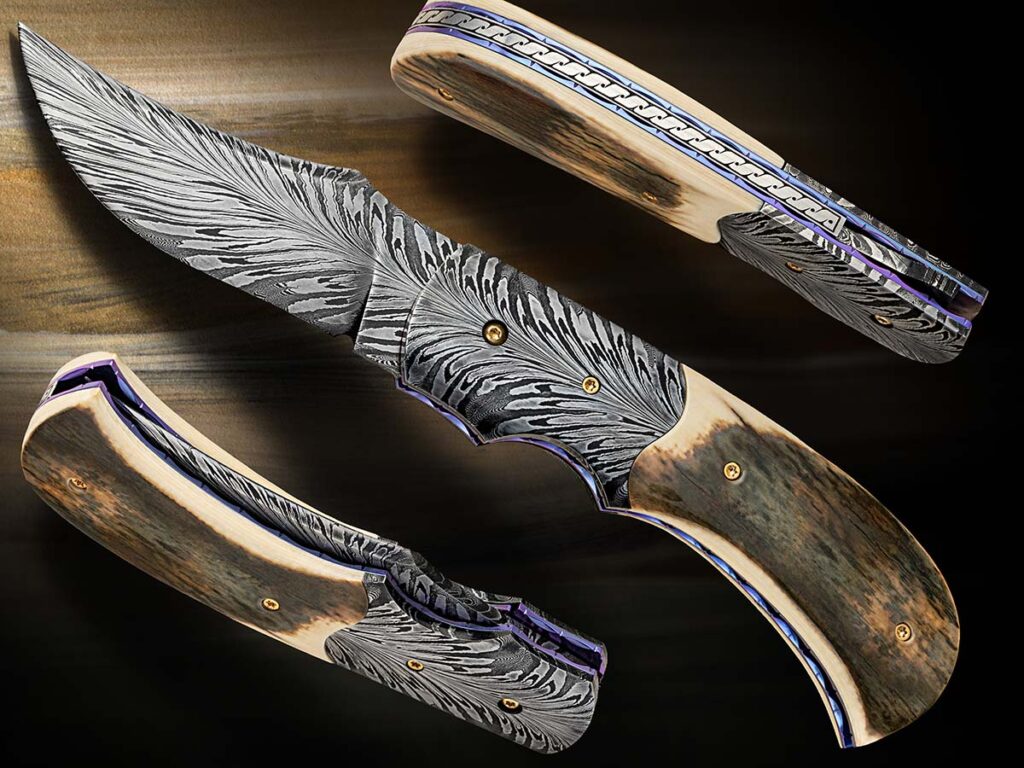
Scott Gallagher says he’s seen an upswing in the interest in flippers in recent years. It makes sense with works like his feather damascus flipper. The feather pattern defines both blade and bolster, and is complemented by a fossilized mammoth ivory handle. (Jocelyn Frasier image)
Scott Gallagher recently completed a beauty with a 3-inch feather damascus flat-ground blade complemented by a damascus bolster and fossil mammoth ivory handle. With an overall length of 7¼ inches, Scott’s flipper folder features an upswept curve for fantastic visuals and intricate filework along the spine.
“I am receiving more requests for flippers right now,” commented Scott. “They have become very popular. I think the reason why is because they’re fun to use, kind of like a widget—they’re functional, they can be embellished and they are easy to carry.”
The single attribute of fun helps set the flipper folder apart from other designs. Anything incorporating fun into the knife equation is sure to gain increased attention. Still, Scott makes his flipper folders with exacting specifications and attention to detail. “A quality flipper should have a blade steel that performs well—good fit, finish and symmetry,” he explained. “The blade should close in the center of the frame. It should be fast opening and close easily without a sticky lock.”
For Scott, achieving the proper mechanics involves a combination of precise construction with materials that work in concert with each other. “Making the flipper tab is a matter of incorporating it into the design of the knife in the design phase,” he related. “In the closed position, the tab has to sit higher than the frame so your index finger can access it. I use bearings on my flippers. They are ceramic and very fast. To avoid pinching the user’s hand, I use a small tab. It’s only exposed enough to open the blade. My flipper tab is hidden in the frame in the open position. I have finger grooves designed into the frame to avoid fingers slipping forward.”
Alan Hollerbach: Spectre
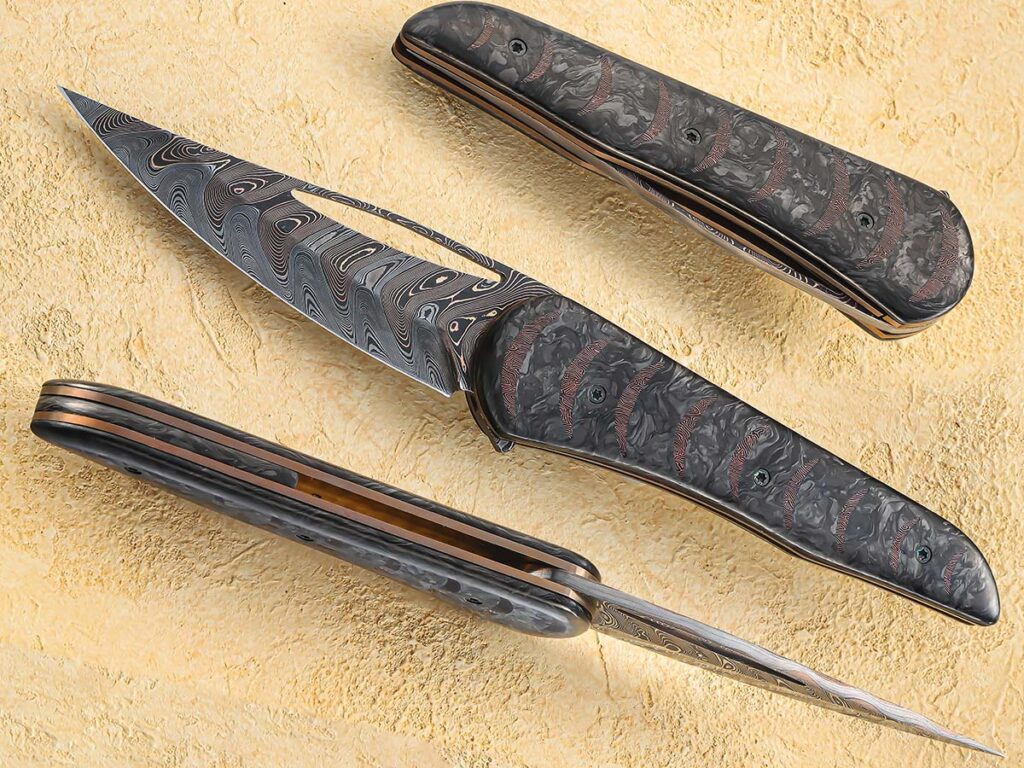
There’s something ominously attractive about what Alan Hollerbach achieves with this knife. Christened the Spectre—an homage to the nemesis organization of James Bond—the wasp-wasted flipper gets right to the point. Baker Forge TigerMai steel for the blade and Fatcarbon Dark Matter scales add to the knife’s dark good looks. (SharpByCoop image)
When customers consult with Alan Hollerbach on the attributes of a quality flipper folder, his response is straightforward. “Look for high-quality materials—hardened washers and bearings, a smooth action and a solid detent,” he offered. “I don’t take orders. I make knives I like and hope others do as well.”
The degree of knifemaker proficiency is tested somewhat further with the flipper folder in comparison to other designs. Alan welcomes the opportunity to put his skillset to the test. “It takes some more designing up front to get the layout and how it looks and the action correct,” he related. “The tab needs to be in a comfortable position for one-handed opening, tall enough to engage easily, but not too tall it looks out of place. It needs to have a strong detent to allow proper pressure to fire the blade and a smooth action with the bearings to allow the blade to open with minimum friction.”
Alan achieves his technical and aesthetic objectives in a handsome flipper folder model he has christened the Spectre, in reference to the James Bond feature film series. This example includes a 4-inch hollow ground blade of Baker Forge TigerMai Chevron damascus steel with jeweled and anodized titanium liners and Skiff bearings with hardened washers. Handle scales are Fatcarbon Dark Matter with 18 inlays in nine different sizes of Space Coral. The backspacer is also Fatcarbon Dark Matter, and the screws are black anodized titanium.
Rising interest in flipper folders is a matter of likes and style, as Alan sees the buying landscape these days. “I think it is a personal preference,” he commented. “I like the flippers for easy one-handed opening, but you can do the same with most other ways. It takes some more designing up front to get the layout and how it looks with the correct action. I like the lines as clean as I can make them, so tabs are just to open the knife, as I try to hide as much as I can when the knife is open, just for aesthetics.”
The addition of a hole in the Spectre blade gets attention as well. “You can open the knife with the hole, but it was designed for aesthetics mainly,” Alan noted. “I wanted to smooth the lines of the knife in the closed position and show with the curves of the cutout it was done on a pantograph by hand.”
Robert Champion: Dark Wind
Robert Champion spends plenty of time perfecting the placement of the deployment tab. On his Dark Wind, he employs a low-profile tab to avoid pinching when the blade is deployed. Also noteworthy on this knife, the knock-out engraving by Dale Bass that takes the work to another level. (SharpByCoop image)
Examining the locking mechanism is a must for those contemplating an investment in a quality flipper folder, a tip Robert Champion emphasizes. “A 3-point constraint is better than a 2-point constraint,” he said. “A 3-point will lock the knife more securely in the open position as well as in the closed position. The blade should lock solid, not be loose and never have a sticky lock.”
Robert’s Dark Wind model exemplifies his perspective on the flipper folder. Its 6-inch blade features hollow ground Dragonskin Damascus steel from Shaya Forge, while the furniture is in 416 stainless steel and the handle scales are fashioned from giraffe bone. Dale Bass’ engraving complements the piece in its entirety.
“I’m receiving more and more requests for flippers,” Robert remarked, “especially the more dressed and upscale models. Their popularity seems to be trending up. They’re easier to deploy and in regions where automatics are not permitted, the flipper is a great option. The flipper tab is an integral part of the tang design that is easily roughed in while profiling the blade. Thumb pegs and discs are separately fabricated components that require drilling, tapping and a turning process on a lathe. Then, they are attached to the blade. Tab location is important when designing a flipper. Placing it too far forward or too far back on the tang will cause inefficient deployment.”
Bringing all these components together in proper tolerance with respect to the look and feel of the finished product provides a worthy test for the makers of flipper folders. Like any folder, smooth deployment and ease of carry rise to the top. However, the flipper aspect brings another dimension to the requirements for optimal performance.
“Depending on the size of the knife, I use good-quality stainless or ceramic ball bearings,” Robert advised. “I tend to use stainless bearings on my smaller models, but that is just a personal preference. I also use dry slide oil lubricant. I design a low-profile tab to prevent pinching and currently make single-tab models. In the future, I plan to make flipper daggers that will have more of a guard-type tab.”
John Curran: Alpha 3
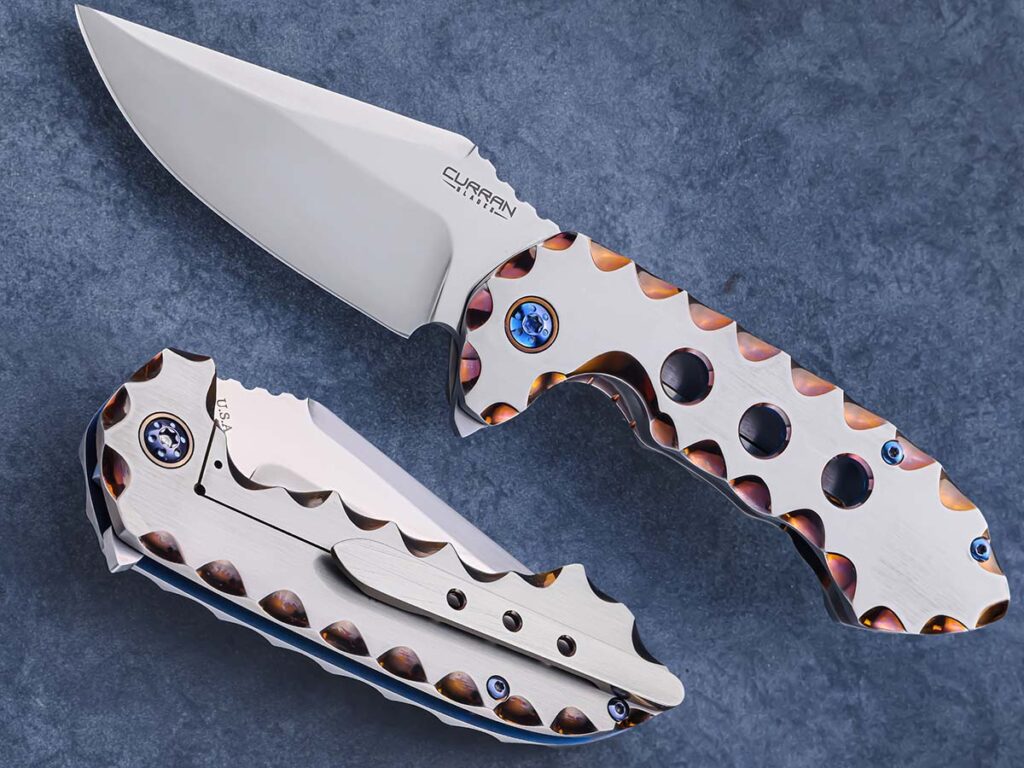
John Curran has focused much of his work on flipper folders and his experience in this design shows in his Alpha 3. Clean and complex, the knife pairs a titanium handle with an Elmax steel blade, featuring caged bearings for absolute, buttery-smooth deployment. (SharpByCoop image)
John Curran created a flipper folder in a model he calls Alpha 3 with a flat ground 3-inch blade of Elmax steel and an overall length of 7½ inches with a titanium handle and frame. The flipper design has been a mainstay of his work for some time.
“I’ve predominantly built flipper-style folders over the years, though I’ve done my share of thumb-stud and thumb-hole deployments as well,” he related. “In terms of trends, I haven’t noticed interest in one style rising or falling dramatically. What I have noticed is that customers are spending more carefully. People know what they want and they are choosing their purchases very intentionally.”
As John tries to fulfill his customers’ expectations, he watches the intricacies of the flipper folders he constructs carefully. “From my perspective, flippers don’t necessarily hold an advantage over other deployment methods,” he commented. “It really comes down to personal preference. Some customers want a classic flipper, others ask for a flipper paired with a thumb stud and some want a hole cut into the blade as an alternative opening method. There is no single best option, just what feels right in the user’s hand.
“The complexity of the build depends on the design more than the deployment style,” John continued. “I spend a lot of time sketching concepts only to discover during mock-ups certain ideas don’t translate well in hand. I typically prototype in G-10 or even wood to check ergonomics, mechanics and overall fit. That stage tells me a lot about whether the knife is going to meet my standards.”
John’s basic components include caged bearings and hardened stainless washers for smooth action. “If a customer wants to keep the cost down, I can build the knife without bearings and use phosphor bronze washers instead,” he advised. “Ceramic bearings undeniably offer the smoothest action, but bronze washers still perform well. It ultimately depends on what the customer values most. Milling pockets for the bearings adds time and labor and is reflected in the final price.”
Design concentrations on clean, reliable opening mechanisms and functional finger guards when the blade is deployed are hallmarks of John’s finished product. The challenge is always in the “tweaking” to solidify the geometry, but the result is worth the investment of time and effort.
The flipper folders emerging in the custom knife market today offer diverse profiles, materials and interpretations along with a wide range of price points. Each of these factors influences the consumer and makes the genre vibrant.
Calling all bladesmiths and knifemakers: the Guilford Art Center in Guildford, Connecticut, announces “Contemporary Knife Smithing: A Juried and Invitational Exhibition,” and is calling for submissions.
Bladesmithing is a thousands-year-old craft practiced in diverse cultures across the world. It has survived as an art form despite modern industrialization, with artisans dedicated to preserving and expanding traditional techniques. This exhibit will explore and highlight the artistry of the contemporary hand-crafted knife, as an object with both functional and aesthetic value.
Exhibit Dates: July 10-August 18, 2013
Juror: An ABS journeyman smith, Mace Vitale practices blacksmithing and is a copper smith. He has a background in architectural pre-cast concrete, is owner of Laurel Rock Forge in Guilford, and is an instructor at the Guilford Art Center.
Eligibility: This exhibition is open to knives made by U.S. residents.
Entries: Each artist may submit up to three (3) works. Each work may be represented by two separate images: one full view and one detail view. Work must be submitted in high-resolution digital format. For each entry please note dimensions of knife, and a maker’s list price (retail price), or not-for-sale/insurance value. Email entries to: [email protected].
Entry Fee for Applicants: $20. Includes up to three (3) submissions. Make check payable to Guilford Art Center and mail to 411 Church St., Guilford, CT 06437. Or call the Center with credit card number 203-453-5947. Payment must be received for entries to be eligible.
Entry Deadline: June 10, 2013. Digital images and entry fee must be received by this date.
Conditions:All accepted works must arrive with a display case that closes for safety purposes during exhibition.All entries must be original and must be completed within the last 3 years. The Center reserves the right to reject entries that do not meet these requirements or is deemed unstable. Shipped work that differs from submitted images will not be accepted. Work damaged in shipping will regretfully not be presented. All accepted work must have proper identification. No accepted work may be picked up before the closing of the exhibition. Work may be available for sale or must be identified as NFS. The retail price or insurance value provided on the entry form will be used; no changes may be made after the work is shipped.
Shipping: Shipping costs are the responsibility of the artist. A check for return shipping, including the cost of insurance, must accompany delivered work, payable to Guilford Art Center. Work damaged in shipping will not be presented. Detailed packing/handling instructions must accompany all works.
Hand Delivery: Please call the Center to make an appointment for hand delivery/pickup at 203-453-5947, Ext. 12, or email [email protected].
Receiving Deadline: All work must be received no later than these dates.
Sales/Insurance: A 40% commission on all sales will be retained by the Center. Artists must indicate sale price and insurance value or, if NFS, just insurance value. Submission of work to this exhibit is done so at the artist’s risk and implies an agreement on the part of the artist to all the conditions of this Call for Submission. GAC will not be responsible for loss or damage to work in transit, however, work will be insured while in the Guilford Art Center facility.
Publicity:Guilford Art Center reserves the right to photograph entries for the purposes of documentation, education and publicity. Accepted artists are encouraged to send to the Center a resume, artist statement, brochures, and additional photographic materials of the accepted work for publicity purposes.
Show Schedule:
Application due: June 10, 2013
Artist Notification: June 14, 2013
Receiving: June 24-28, 2013 (10am-4pm) (Shipped/by appointment)
Opening reception: July 10, 2013 (5-7pm)
Closing: August 18, 2013
Deinstallation: August 19-23, 2013 (10am-4pm) (Shipped/by appointment)
For more information please contact Guilford Art Center at 203-453-5947, or visit www.guilfordartcenter.org.