Home Blog Page 20

Wa Handle: Japanese Ergonomics Are Revolutionizing Custom Kitchen Knives

User-friendly custom takes on the classic Japanese knife handle abound.

The Japanese influence in kitchen knives is more or less a given. Those who work in food preparation, an art form unto itself, appreciate the style and utilitarian feel that the Japanese culture exerts on their vocation.

The kitchen knife has seen a wave of custom makers taking that context a step further. The knife is an extension of the hand and that extension starts with the handle. So, here again the ergonomics of Japanese influence emerge. The wa handle brings comfort and confidence to the kitchen user while also providing a sense of form, function and artistic expression for the custom maker.
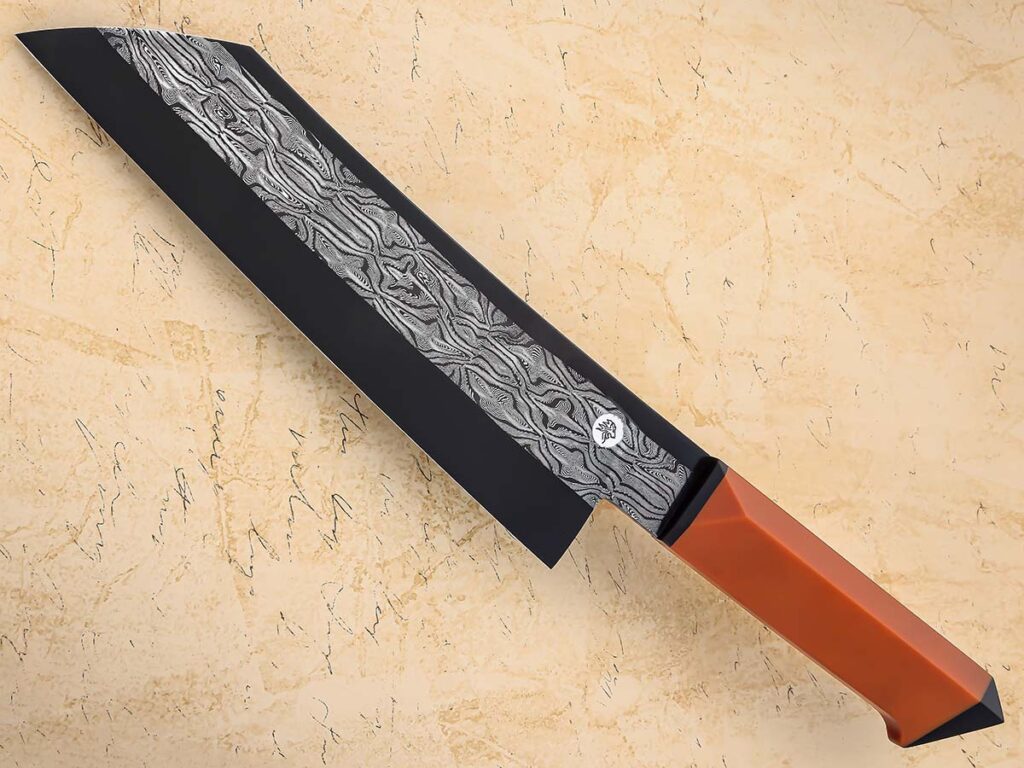
The wa handle of Aidan Garrity’s santoku has largely parallel sides to the width of the ricasso with a small ‘beak’ at the bottom for hand retention and aesthetics. Blade steel: mosaic damascus. Vintage butterscotch Micarta® scales boast flat-shield cross-sections and G-10 spacers. Overall length: 14 inches. His list price for a similar knife: $2,300. Its sister piece is a Garrity nakiri that was featured on the March 2024 BLADE® cover. (SharpByCoop image)

According to maker Jacob Anstaett, the name itself is rooted in the Japanese language.

“Wa comes from the Japanese language and broadly translates as ‘harmony’ or ‘balance,’” he explained. “In knifemaking, it refers to the traditional Japanese handle style, which emphasizes simplicity, lightness and an ergonomic connection between the handle and the blade.”

Anstaett further defines the wa handle as “lightweight with forward-balanced design. Typically, it is either octagonal, oval or D-shaped in cross-section. The handle is crafted as a separate piece that fits onto a hidden tang rather than a full tang. The construction is what gives the blade its distinct balance, where the cutting edge feels alive in your hand instead of weighed down.”

A resident of Plano, Texas and a custom knifemaker for eight years, Jacob says his wa handle is an interpretation of the Japanese style.
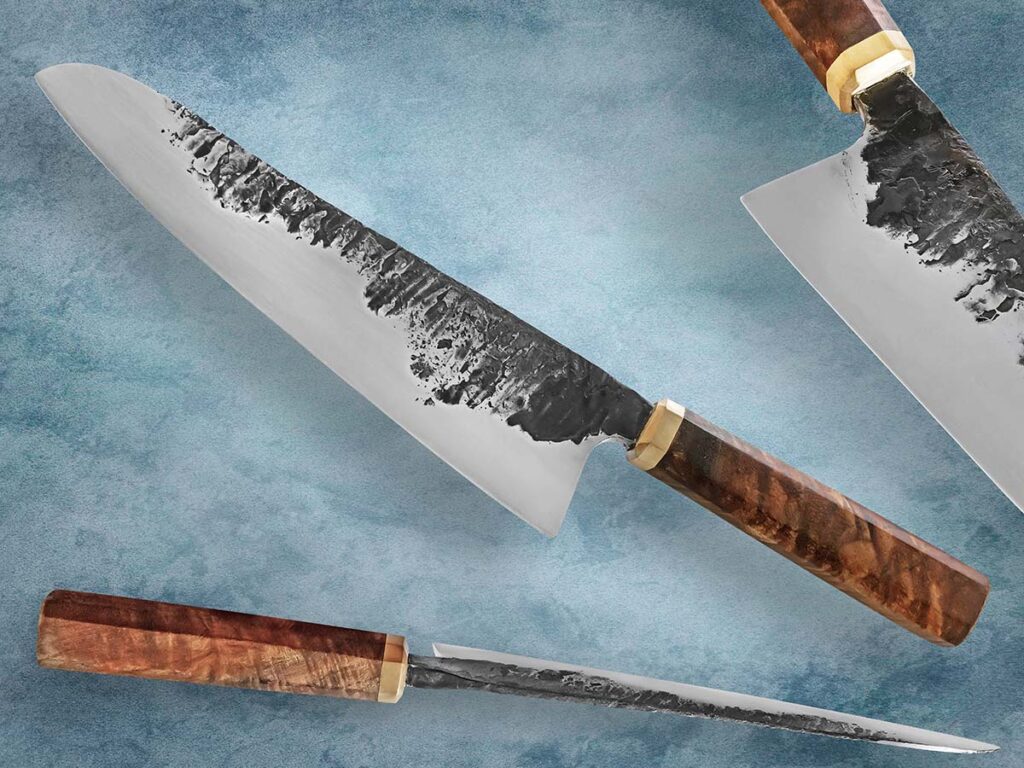
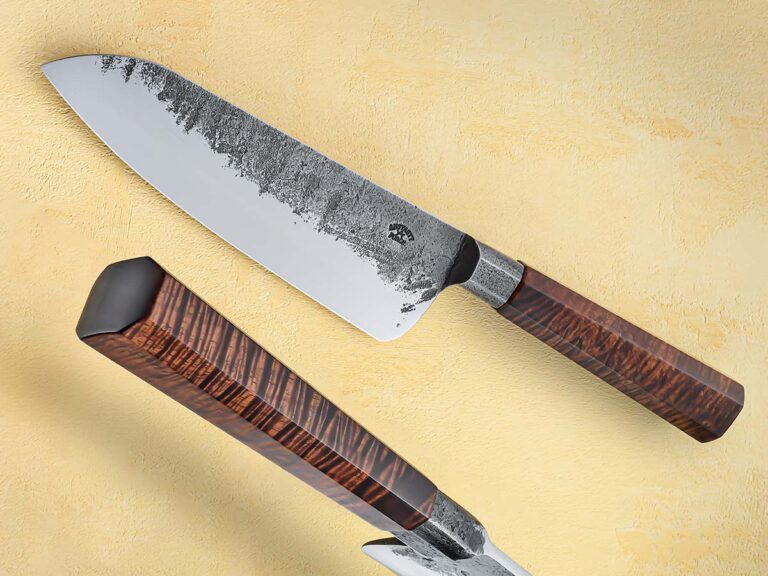
Alex Töpfer described his wa-handled piece as “a general-purpose kitchen knife based on various santoku. The blade is 80CrV2 as it’s a good general steel I can forge and heat treat. The handle is Tasmanian blackwood to add some fanciness, and the same is true for the bronze bolster. It’s functional art you can appreciate as you use it to cook.” His price for a similar knife: $325. (Rod Hoare image)

“It’s best described as a variation of the traditional wa,” he explained. “I keep the core geometry usually as an octagon cross-section, but I adapt the dimensions slightly for comfort. Western chefs often prefer a little more thickness and resilience, so I adjust proportions while preserving the forward balance that makes wa handles so effective.”

Jacob devoted extensive time to the study of traditional Japanese wa handles and then embarked on his road to interpretation.

“Over time I developed my own hybrid approach,” he commented. “My reasoning was simple: I wanted to honor tradition while building something that stands up to modern kitchens. For instance, I blend traditional shapes with stabilized woods or composites, ensuring they can handle daily use in a busy Western kitchen without losing the essence of the Japanese design.”

What Makes A Wa Handle?

Elaborating on the spirit and style of the wa, Aidan Garrity of Iron Lion Blades in Madison, Connecticut remarked, “There are two schools of thought for what exactly categorizes as a wa handle. One is that the handle’s construction involves a hole the width of the knife’s tang being drilled into the handle, and the tang being enclosed in a slotted dowel to tightly fit into that round cavity. The other is that it is simply the style of the handle, usually slimline and often having angular geometries. For questions like these, I always answer with the understanding that it is just the style of the handle, but I personally consider the true wa handle to be one utilizing the dowel bedding construction.”
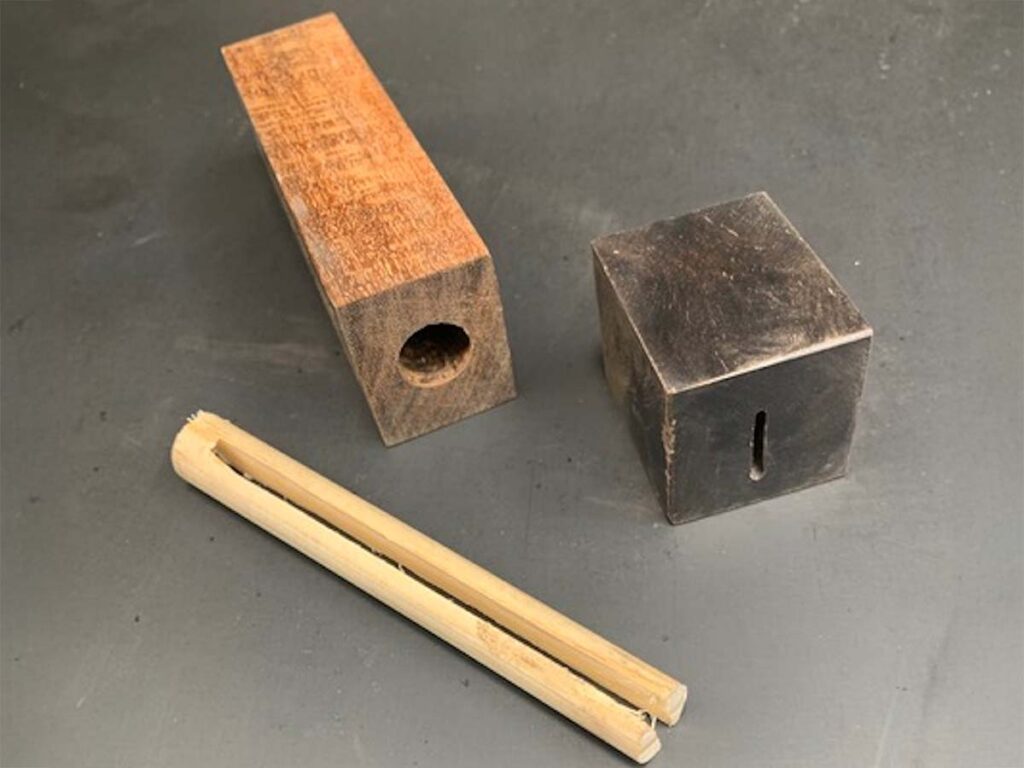
The wa handle of Mert Tansu’s gyuto has a half-inch-wide, 4-inch dowel (above) with a tang slot cut into it. “It is a traditional-shaped wa except for the internal structure,” Mert wrote. “While most Japanese blades are mounted to the handle with burning the tangs in, this is not possible with a hard timber-like ringed gidgee, and I glued mine in.”

Australian custom knifemaker Mert Tansu follows the wa tradition with his own interpretation. His perspective includes a geometric aspect that broadens the possibilities with the style.

“Wa handles come in a few different geometries,” he related, “from round to oval, to semi-octagonal to full octagonal and D-shape. Compared to their Western counterparts they are not sculpted and flat. Most of the traditional wa handles will have a horn ferrule and magnolia wood body.”
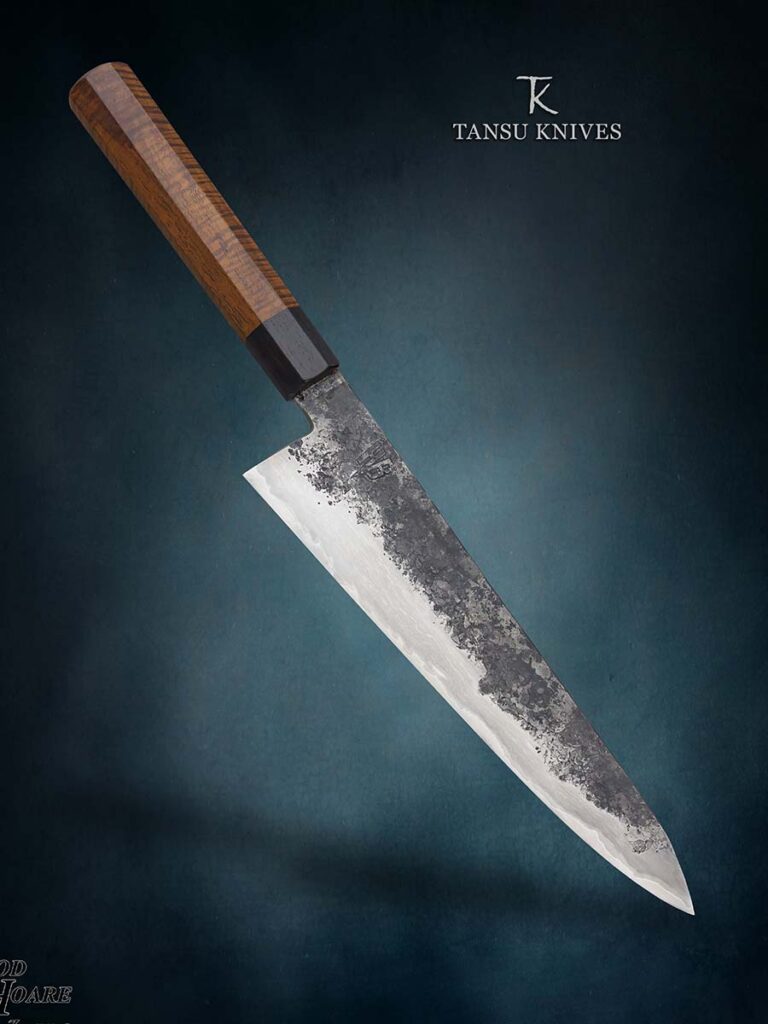
The wa handle of Mert Tansu’s gyuto has a half-inch-wide, 4-inch dowel (above) with a tang slot cut into it. “It is a traditional-shaped wa except for the internal structure,” Mert wrote. “While most Japanese blades are mounted to the handle with burning the tangs in, this is not possible with a hard timber-like ringed gidgee, and I glued mine in.”

Mert’s featured knife is a gyuto from his Hunter Valley Blades series of traditional Japanese chef’s knives with forged finishes and usually san-mai construction. He employed a dowel-bedding construction for the wa handle (page 16). He characterizes his chef’s knives as affordable and less time consuming to make than other custom types.

Specific features of the wa handle style translate into precision and control in the kitchen. He says that the flats allow the user to index the knife with ease. Despite the “stop sign” shape, the octagonal handle is quite comfortable and fashioned with precision on his disc grinder. Optimal length is a subjective question, but Mert likes paring knives with wa handles no longer than 4.7 inches, while handles of 5.3 to 5.5 inches work best in larger chef’s knives with overall lengths of 9.5 inches. For long slicing knives of overall lengths of 10.5 inches, he indicated he prefers a handle between 5.7 and 5.9 inches.

Wa Handle Interpretations

A custom knifemaker for seven years at his home near Melbourne, Australia, Alex Töpfer appreciates the employment of the hidden tang in his knife construction, and he says the wa-inspired handle works in both the active and aesthetic aspects of kitchen use.

“Obviously, I’m inspired by various styles of wa handles, specifically octagonal ones,” he commented, “and also the use of brass bolsters and guards in the Western context. The flats here are more to provide context with the organic, curved aspects of the wood grain and forged texture.

“I do think it’s important to have a flat [handle] surface that aligns with the blade, but the upper parts are more for looks. There is also the question of what an individual user likes. Personally, I prefer to use oval hidden-tang handles, but I do the occasional faceted one for practice and a change. I’ve only had problems when the tang is not long enough. So, I tend to go 2.75 to 3.15 inches of tang. That will support the handle during use. I have had issues with burl where the grain didn’t provide any strength, but a longer tang on that knife would have avoided the problem. Also, fancier materials might be easier to sell even if they’re not ideal. I like recycled ironbark but it doesn’t have that bling factor.”
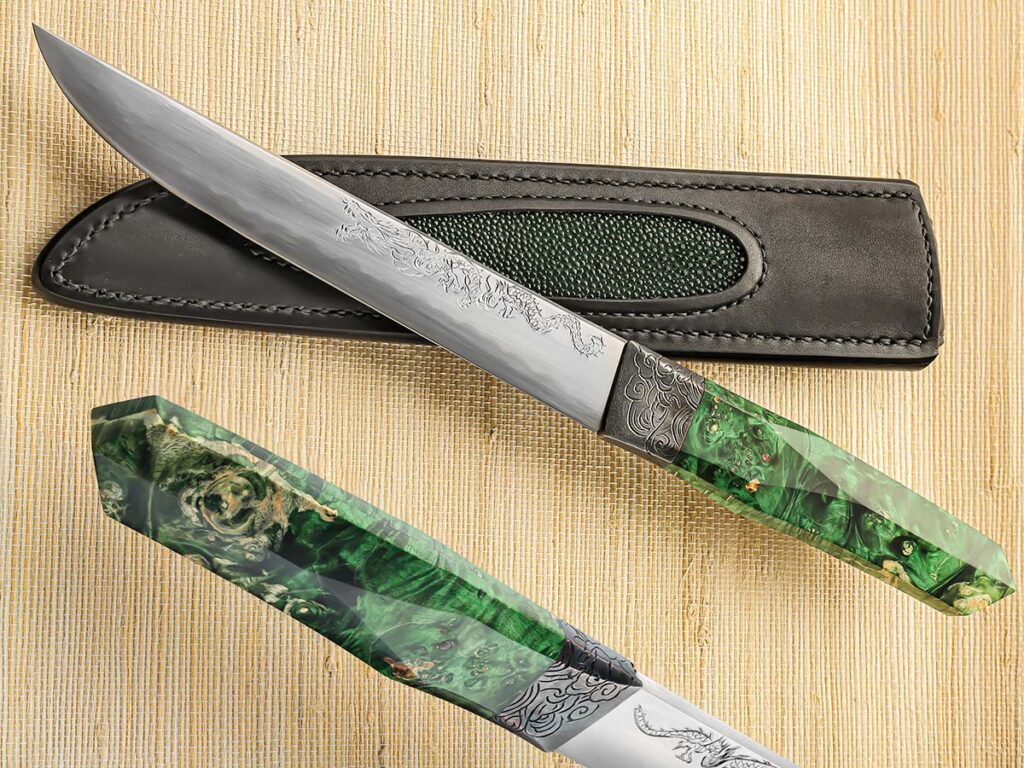
The traditional handle of Dew Hara’s suigetsu has stabilized burl scales and a copper bolster. The 7-inch blade is tamahagane steel with a hamaguri grind. Overall length: 12.4 inches. (SharpByCoop image)

Garrity demonstrates his skill with the wa in his mosaic damascus santoku blade that combines 1095 and 52100 carbon and 15N20 nickel-alloy steels. He used the Ferry Flip method* and then placed the multi-bar construction to be framed by a monosteel edge and spine bars. Aidan’s santoku has a sister blade, a nakiri featured on the cover of the March 2024 BLADE® (page 13). He made the nakiri with the same bar of mosaic damascus as his santoku.

“This handle is of my own design. It has largely parallel sides to the width of the ricasso with a small ‘beak’ at the bottom for hand retention, as well as aesthetics. It wasn’t based on any particular style,” he noted, “but it does categorize as a shield-shaped wa handle. The flats lend themselves to helping the user maintain proper edge alignment while cutting, as an overly round grip doesn’t offer much [user feedback]. In addition, the flats are somewhat easier to bring to a high finish.”

In constructing a wa handle, Aidan leans heavily on the length of the blade.

“Typically, 4½ to 5½ inches is seen as a natural range to balance average length and weighted blades,” he remarked. “Thicker and wider blades like nakiri and bunka will often be more forward weighted compared to the more generalist shapes like santoku. The handle is often too slim with poor retention for any large chopping blades or fighters. It’s best to stick to kitchen knives for this type of handle design.”
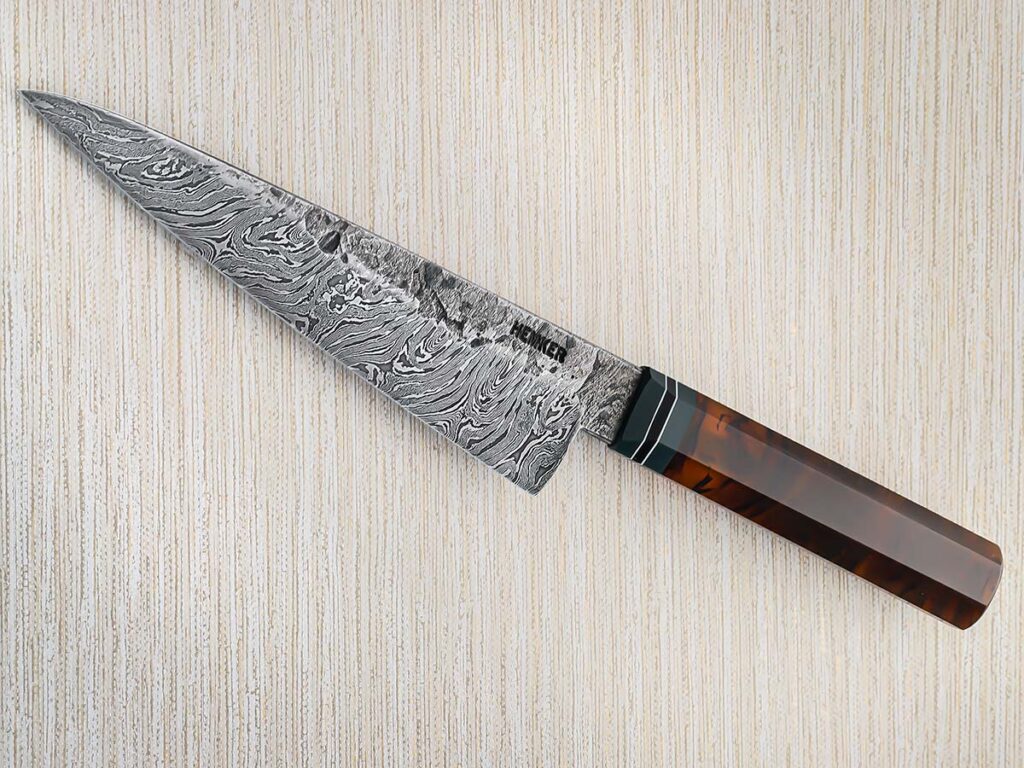
Eric Hemker uses synthetic tortoise shell for the wa handle of his chef’s knife. The flat-ground 7.785-inch blade is a damascus of 1084 carbon and 15N20 nickel-alloy steels. The spacers are green, black and white G-10. Overall length: 14 inches. (SharpByCoop image)


The where, why and how of the wa are revealed in various interpretations, put to work with enthusiasm in the kitchen, and exhibit style and beauty whether in the midst of meal preparation or displayed for all to see. Their aesthetic is timeless, but so is their capacity to make the work of the chef an adventure in creativity.

*Editor’s Note: Named in honor of its creator, award-winning bladesmith Tom Ferry, the Ferry Flip is a variation on the canned steel technique. It basically consists of cutting slices at a 35-degree angle off the end of a damascus billet. The resulting tiles are rotated and forge welded together to form a new billet. As a result, instead of the pattern showing on the end of the new billet, the pattern repeats itself along the new billet’s face.

More Kitchen Knives:

Semper Fi Blades: Celebrating the US Marines’ 250th Anniversary

Honor 250 years of Marine Corps history! Discover the legendary KA-BAR/MK2 fighting knife and new anniversary blades from makers like Medford and Defiant 7.

The day before Veterans Day, November 10 is the 250th anniversary of some of the most storied combat fighters in world history—the United States Marines.

The Marines have a special aura that almost transcends their many exploits. And when it comes to American military exploits, the Battle of Iwo Jima is in the top two or three all time. The raising of the flag on Mount Suribachi is America personified, and the United States Marine Corps War Memorial across the Potomac River from Washington, D.C., celebrating the event is about the most awesome monument anywhere.

As for those in the knifemaking community, Marine veterans are well-represented and include two BLADE Magazine Cutlery Hall-of-Fame® members, Don Fogg and Joe Keeslar. Other Marine vets who make knives are Tim Britton; Matt Chase; Allen Elishewitz; Doug Esposito; Les George; Brad Jennings; Tim Kell; Jonathan McNees; Greg Medford; Jeff Moore; ABS Master Smith James Rodebaugh; Kevin Stack; and Connor Toor. There are no doubt many more, both present and past.

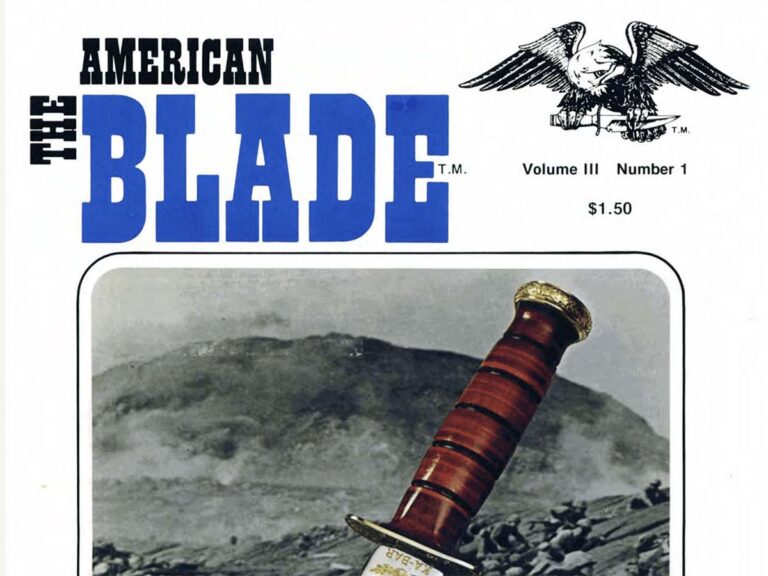
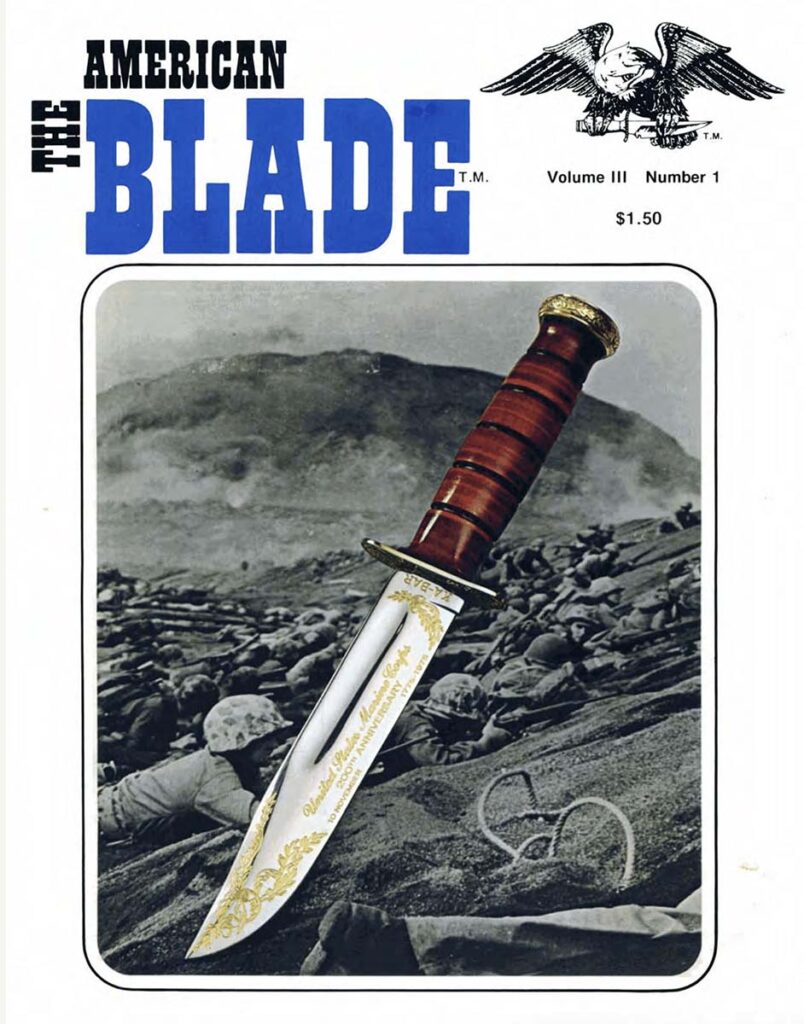
Then there’s the iconic Marine knife, variously known as the Mark 2/MK2, USMC fighting/utility, the Model 1219 or simply the generic kabar. Associated by many with having been made by KA-BAR Knives, the knife also was made by a number of other companies during World War II, including Camillus, Case, Colonial, Ontario, Pal, Queen, Robeson, etc., and is made by several of the foregoing that remain active today, as well as others. The 200th KA-BAR commemorative of the knife graced the cover of the November-December 1975 issue of The American Blade 50 years go in what may be the best BLADE® cover ever.

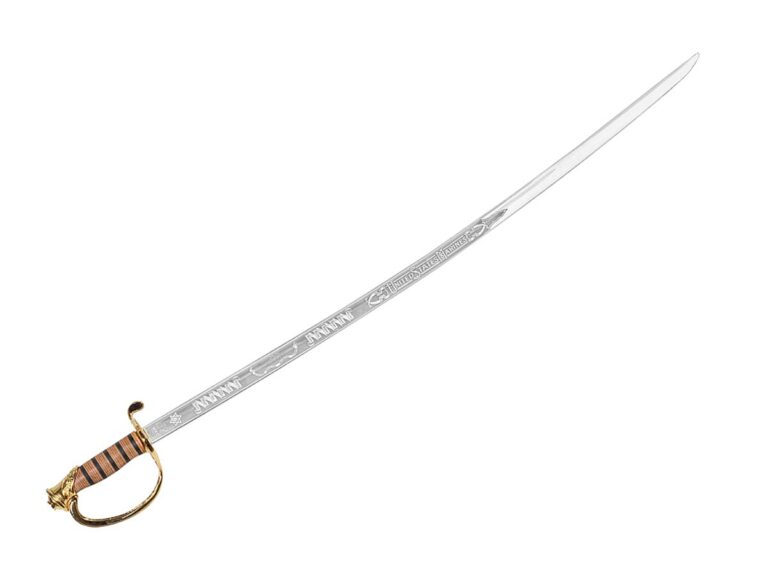
As for blades observing the 2025 anniversary, the 250th USMC Trench Knife by Medford Knife & Tool is available now. KA-BAR is making a dress sword in a limited edition of 250 pieces that at press time was slated to be out in early October. At Defiant 7, Allen Elishewitz and Les George are “reworking” the USMC MK2 in what will be called the M320. Among other features, it will include a 3V carbon steel blade and a stacked handle construction not unlike the original MK2 grip but in a polymer material and a more ergonomic shape. Ontario was reportedly working on a new kabar-inspired piece at press time, too.

Look for these and other anniversary-focused knives in future issues of BLADE. Choose one or more of them if you want a blade inspired by our incomparable Marines.

To America-loving Marines everywhere, Semper Fi! And to all U.S. military vets, Happy Veterans Day!

More On Military Knives:

Standouts From The New York Custom Knife Show

The Empire State’s finest.

The best in blade and handle materials decorated some of the most creative folder designs anywhere at the recent New York Custom Knife Show. Enjoy seven of them in all their glory on this and the facing page.


Alan Hollerbach Flipper Folder

Alan Hollerbach Flipper Folder

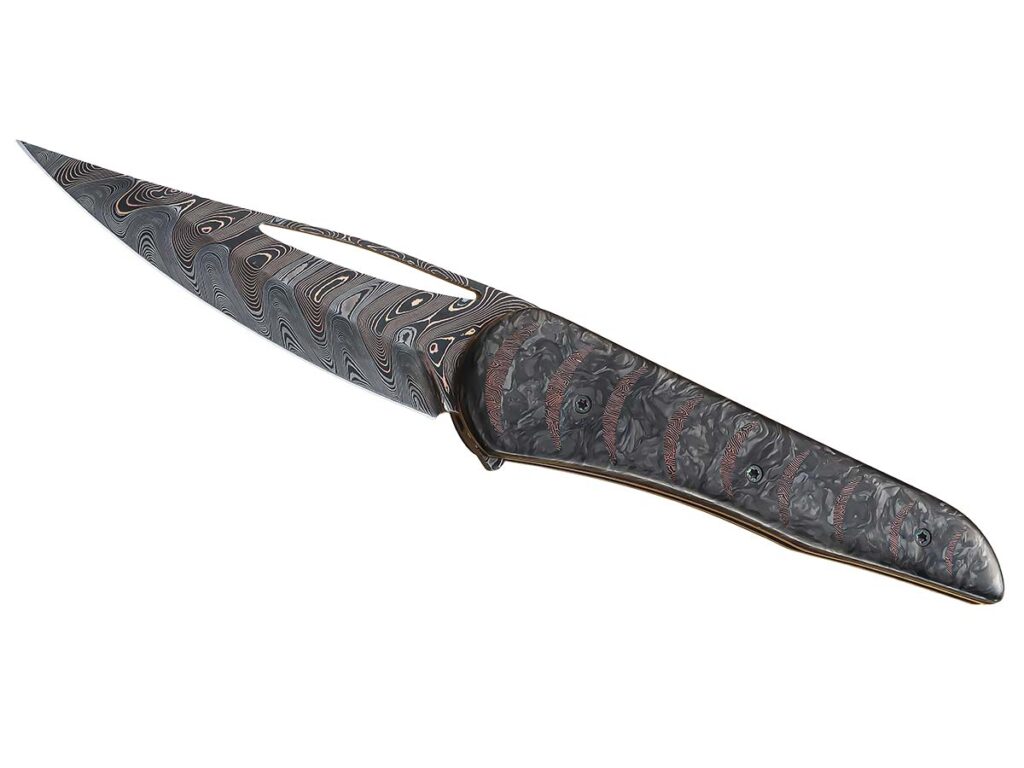
Alan Hollerbach’s flipper folder has a 4-inch hollow-ground blade of damascus forged by Baker Forge & Tool, and scales of Fatcarbon carbon fiber and carbon fiber inlays. All hardware is titanium. Closed length: 4.5 inches.


Eyal Landesman Mini Tritan Flipper

Eyal Landesman Mini Tritan Flipper

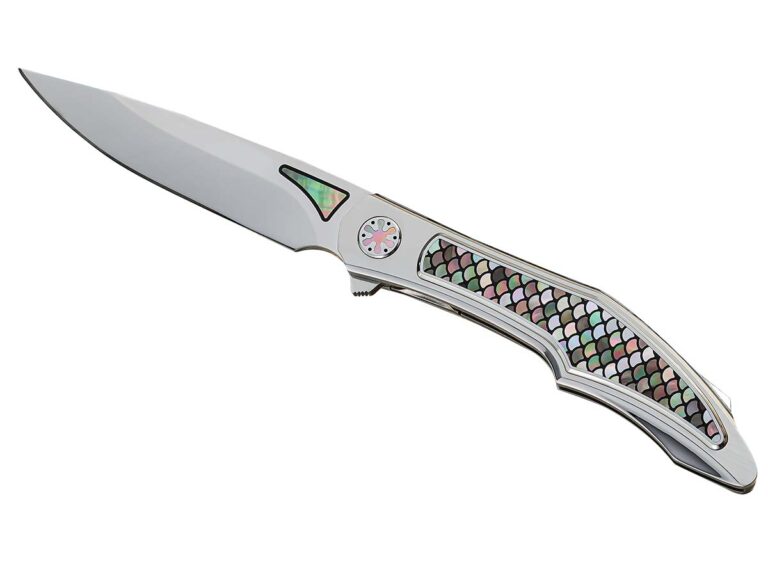
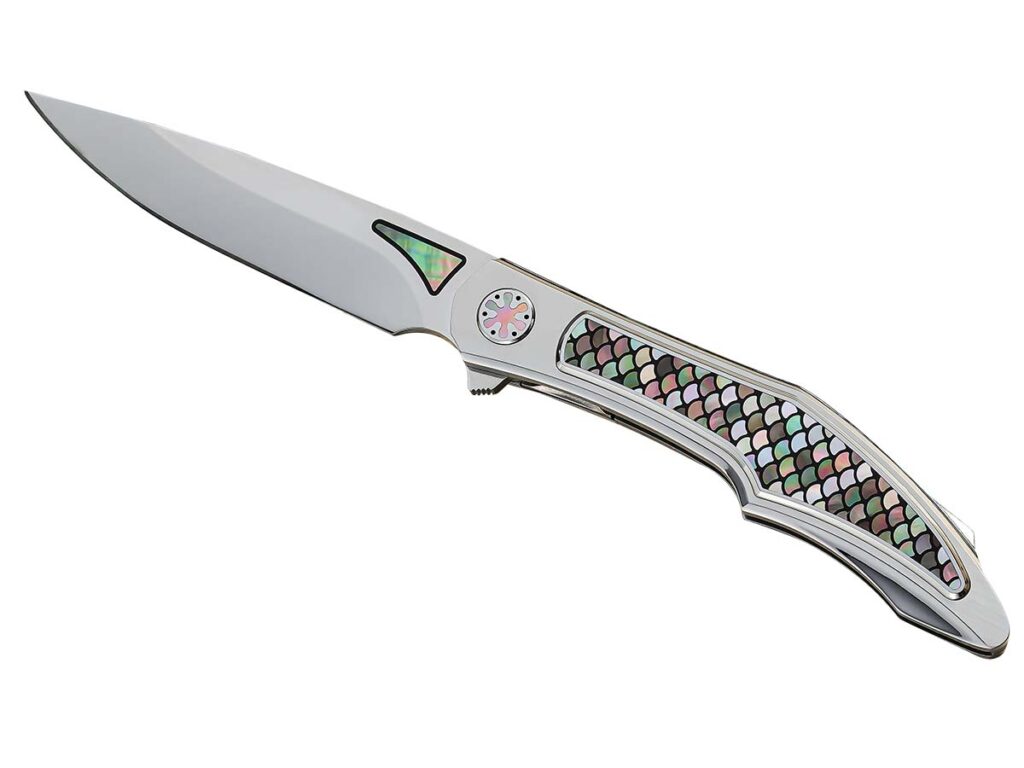
The Mini Tritan flipper folder by Eyal Landesman sports a 3.5-inch blade of mirror-polished RWL34 stainless steel. The mosaic “fish scale” inlay includes assorted “scales” of black-lip and white mother-of-pearl. Closed length: 4 inches.


Corrado Moro Vantage Framelock Flipper Folder

Corrado Moro Vantage Framelock Flipper Folder

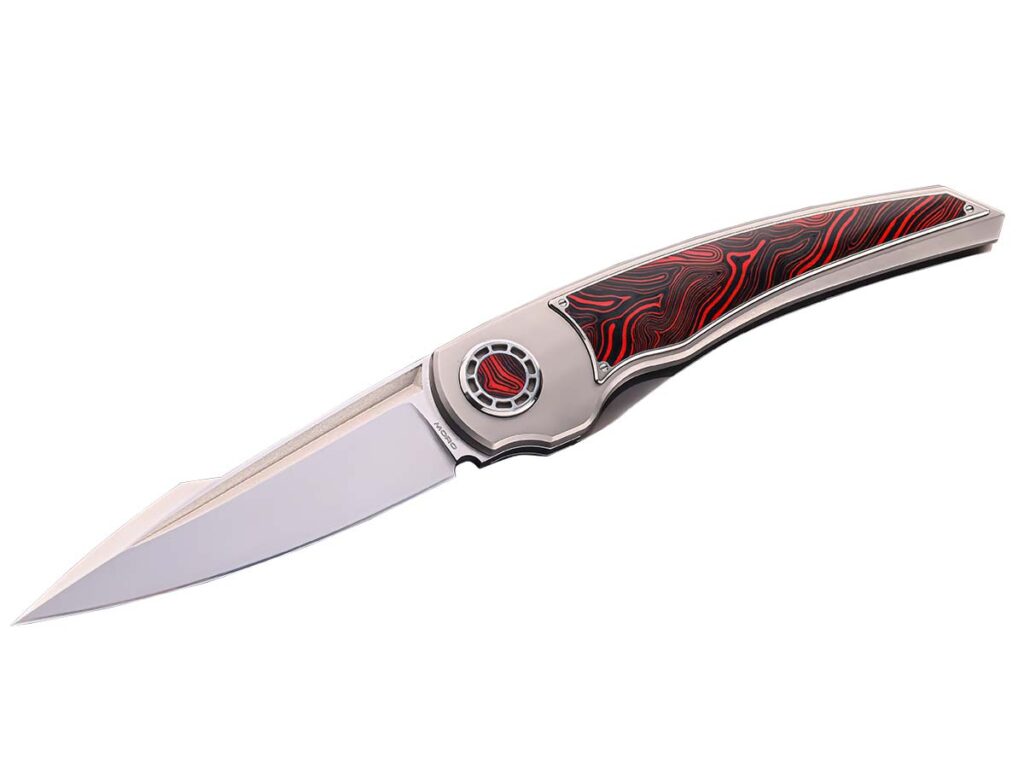
The Vantage framelock flipper folder by Corrado Moro features a 3.38-inch harpoon-pattern blade of RWL34 stainless steel with a tapered fuller in the flat. The frame and pocket clip are Grade 5 titanium and the handle and pivot inlays are a G-10 composite. Closed length: 4.62 inches.


Chris Richardson Lockback Folder

Chris Richardson Lockback Folder

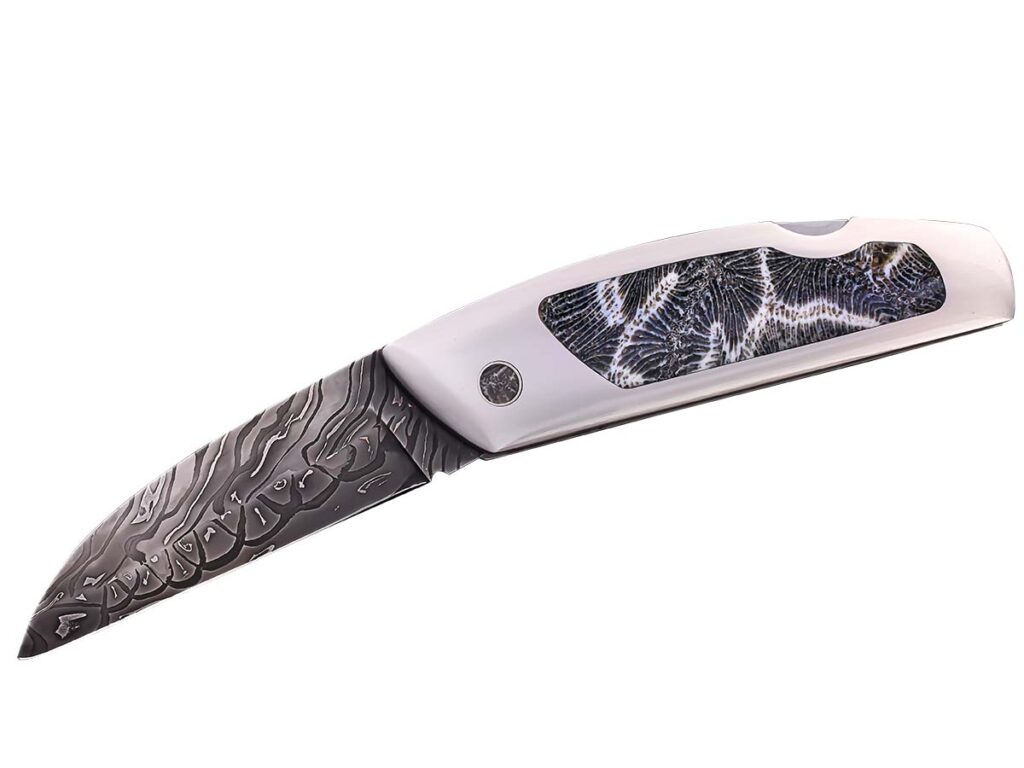
Panel and pivot inlays of fossilized coral and a 3.5-inch flat-ground blade of mosaic twist damascus top off Chris Richardson’s lockback folder. Frame: 416 stainless steel. Closed length: 4.5 inches.


Jeremy Krammes Helix Flipper Folder

Jeremy Krammes Helix Flipper Folder

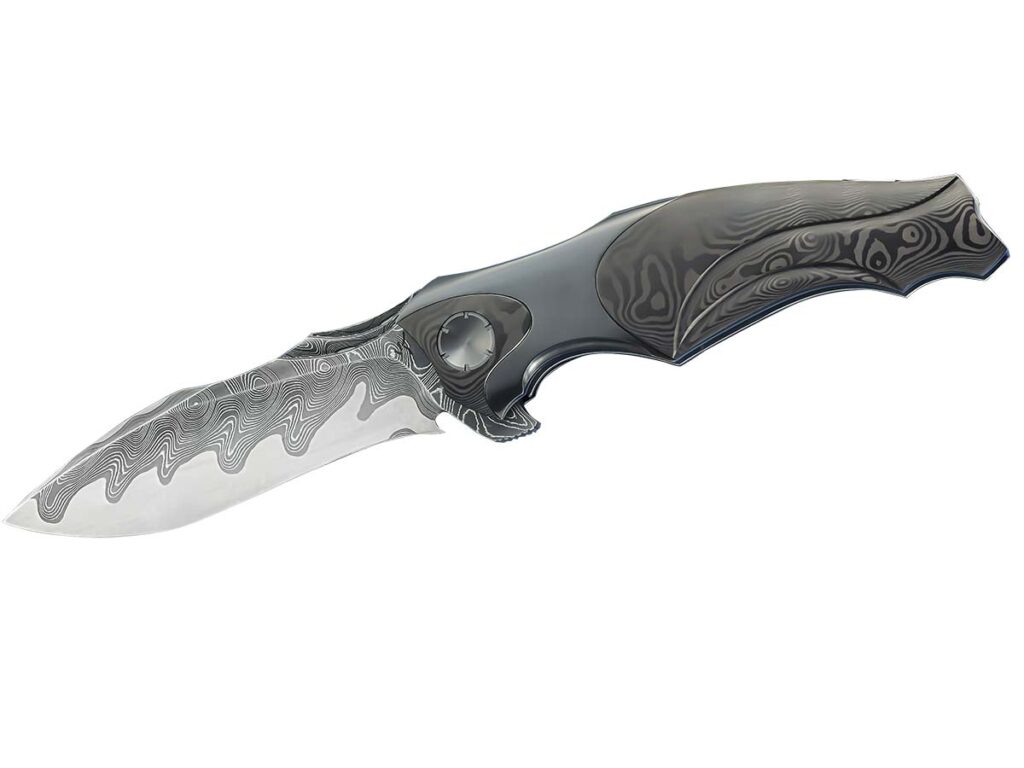
Jeremy Krammes helps celebrates his 20th year of knifemaking with his Helix flipper folder in Chad Nichols damascus blade steel, a titanium frame, carbon fiber scales and a zirconium bolster and pocket clip. The 3.5-inch recurve blade is hollow ground.


Edison Barajas Waka Folder

Edison Barajas Waka Folder

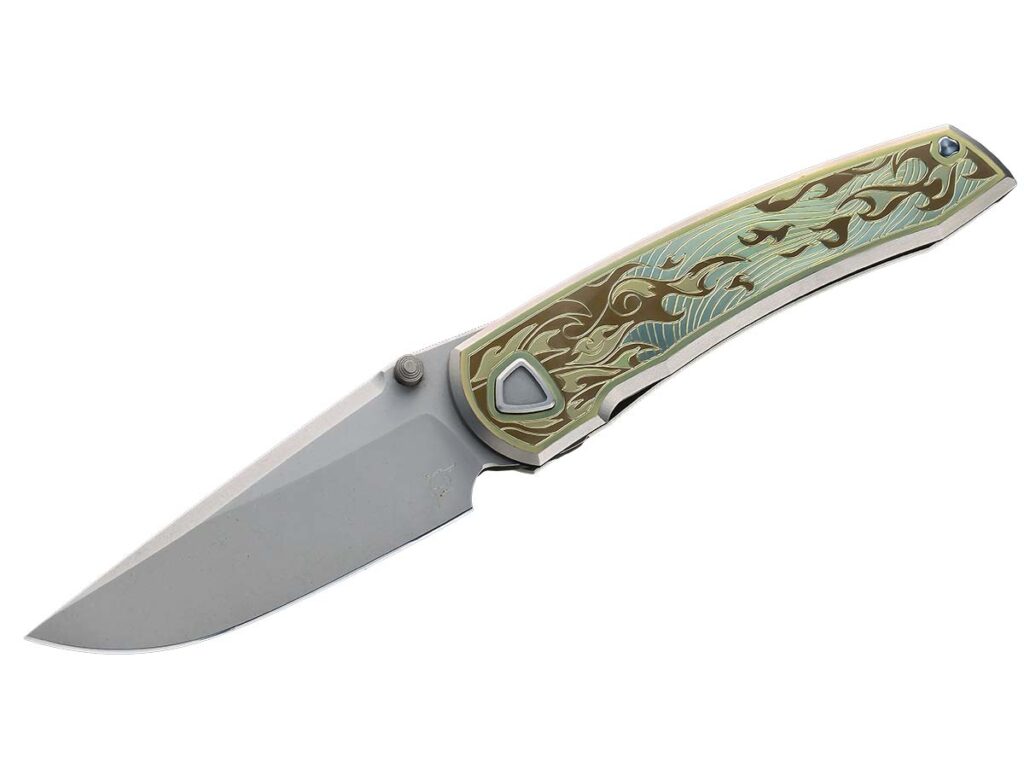
Edison Barajas combines new school with old on his Waka folder, using titanium for the scales engraved by Wilfred Valtakis II and a thumb stud to open the 3.25-inch blade of premium stainless steel. Closed length: 4.5 inches.


Stefano Compostella Stria XL

Stria XL by Italy’s Stefano Compostella sports a 5-inch wharncliffe blade of premium stainless steel. The linerlock flipper folder features Damasteel handle overlay and titanium liners.

Collaboration Knives: Knives Offering The Best Of Both Worlds

Cool collaborations offer the best of both blade worlds.

Custom/factory collaboration knives have long been popular sellers. A custom knifemaker designs the knife and the company either makes or has it made, providing cutlery consumers with a knife at a lower price point and readier availability than almost always is the case when ordering a custom version directly from a custom maker.

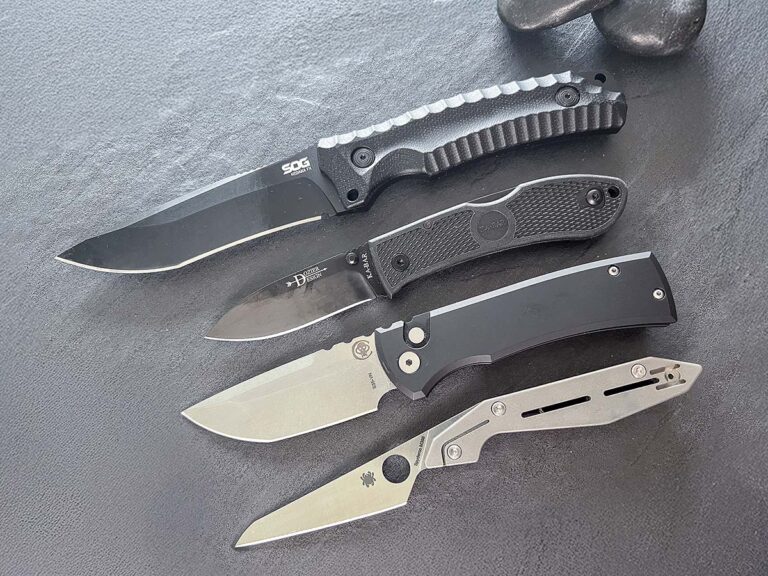
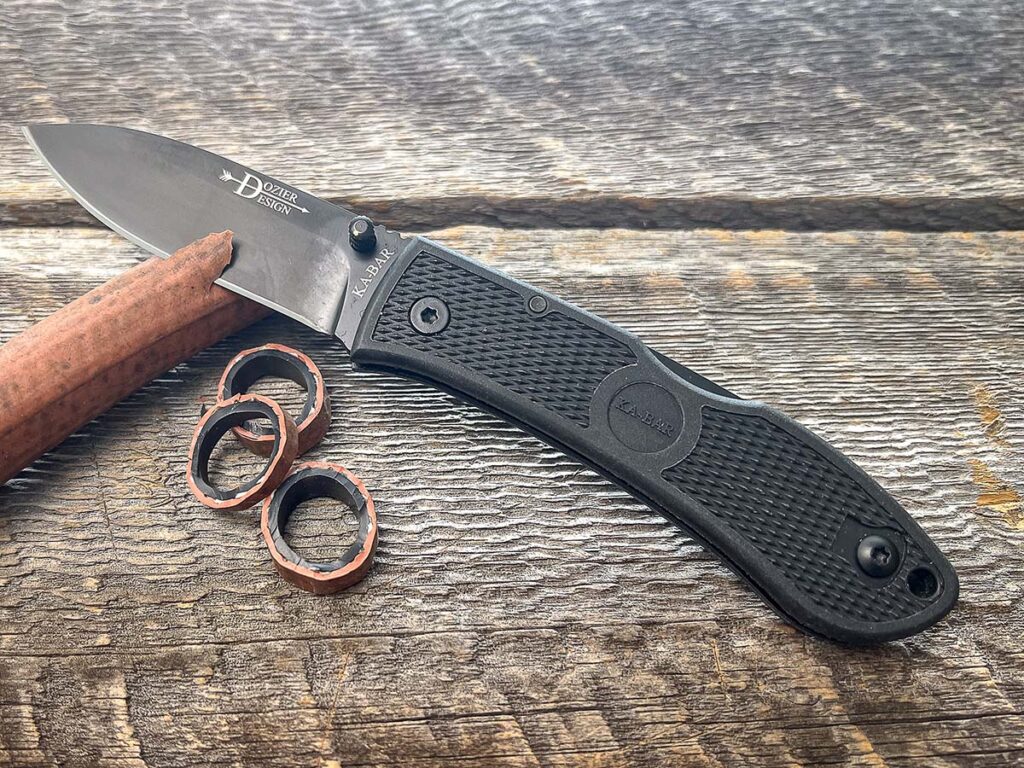
KA-BAR Dozier Folding Hunter

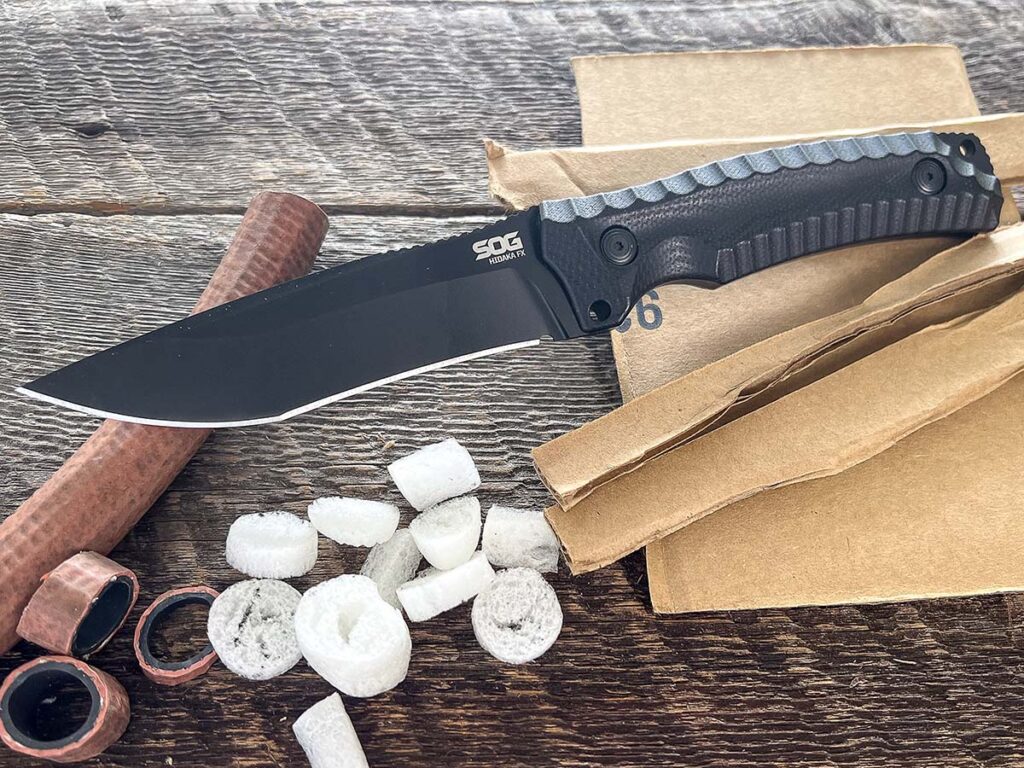
Thicker materials like cardboard and hose are no match for the blade of the SOG Hidaka FX 3V, a Kiku Matsuda design. A slight hint of a recurve to the main cutting edge no doubt helps cutting power. Overall length: 10 inches.

A long-time example of the genre is the collaborations between KA-BAR Knives and veteran knifemaker Bob Dozier. The original Dozier Folding Hunter series consists of mid-sized lockbacks with manufacturers’ suggested retail prices south of $50, offering plenty of bang for the buck. The knives provide ease of portability combined with the high utility of a drop-point blade.

The series proved such an excellent seller for KA-BAR that the company decided to also market it in a higher-grade steel to enhance performance and edge holding: CPM S35VN stainless. The standard KA-BAR Dozier Folding Hunter has D2, a very respectable, hard-wearing blade steel that’s tried and true in the industry. MSRP: $47.58. The S35VN iteration has an MSRP of $97.01 and like the D2 version is made in Taiwan.

While somewhat of a significant price increase, remember, you’re getting a high-end blade steel in return. S35VN behaves a lot like its predecessor, S30V, with a bit more edge-holding power. It’s also easier to resharpen than S30V. S35VN will go the distance, drastically increasing your intervals of sharpening over standard D2. This is especially important if you field dress game on a regular basis. Even though S35VN is stainless, the knife comes with a DLC-coated blade for low glare as well as added corrosion resistance.

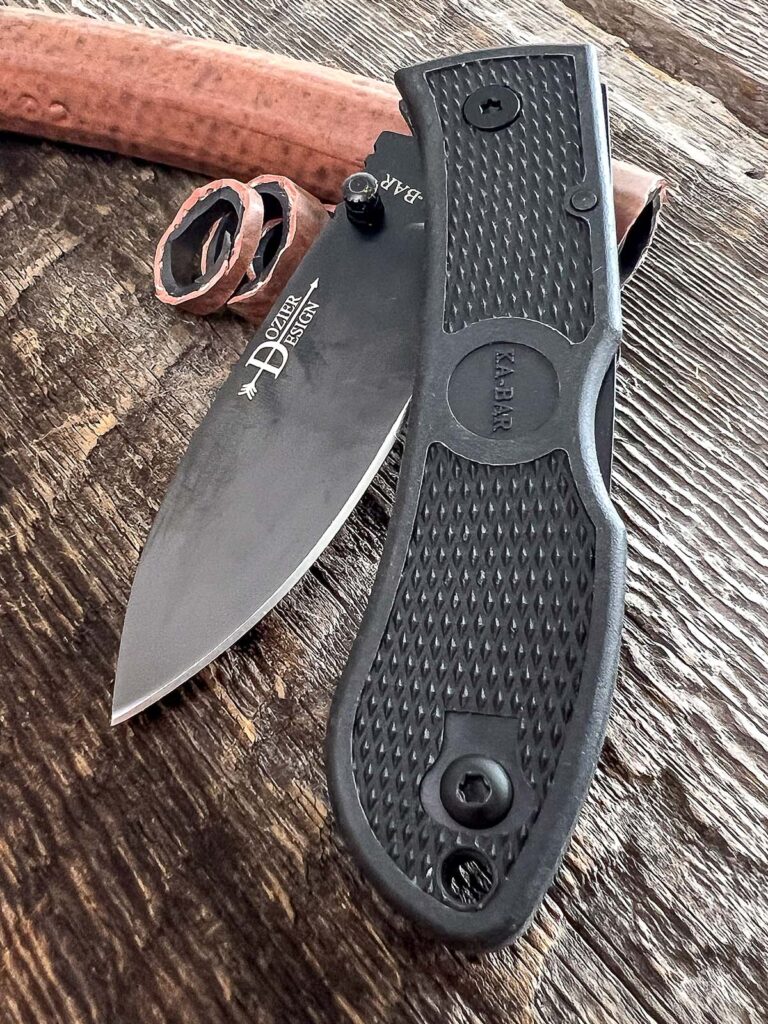
 Even though S35VN is stainless, the Dozier comes with a DLC-coated blade for low glare as well as added corrosion resistance. Raised diamond texturing molded into the handle does a great job at keeping your hand in place even when wet. Country of origin: Taiwan. Closed length: 4.25 inches.
Even though S35VN is stainless, the Dozier comes with a DLC-coated blade for low glare as well as added corrosion resistance. Raised diamond texturing molded into the handle does a great job at keeping your hand in place even when wet. Country of origin: Taiwan. Closed length: 4.25 inches.

Out of the box the edge on the sample was good, but not quite there for my tastes. So, with a bit of work I got the blade hair-popping sharp. The 3-inch blade is a sweet spot length for EDC—big enough to tackle most cutting chores and small enough to carry comfortably without added bulk or length.

The handle’s slender nature also enhances EDC ability. It’s flat and doesn’t “print” in the pocket. Raised diamond texturing molded into the black, lightweight Zytel scales does a great job keeping your hand in place even when wet. It might not be the best-looking grip but it’s definitely geared for function, and that’s very important in a working folder. The pocket clip carries the knife blade tip up and is reversible to accommodate lefties.

The single thumb stud deploys the blade easily and the action is smooth. The knife is very controllable at all times, a testament to both its overall size and handle design/ergonomics. The lockback mechanism is swift and secure. I had no problems with it at all. For a nice, sturdy, compact lockback folder, the Dozier in S35VN is hard to beat.

Spyderco/Paul Alexander SLIPIT

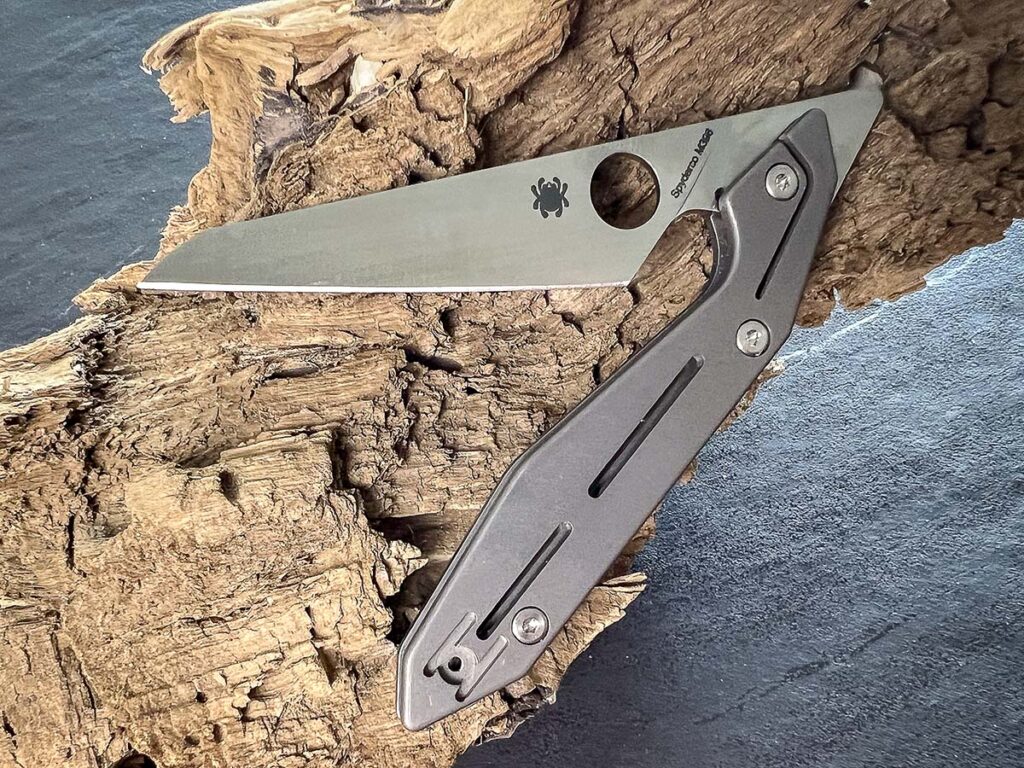
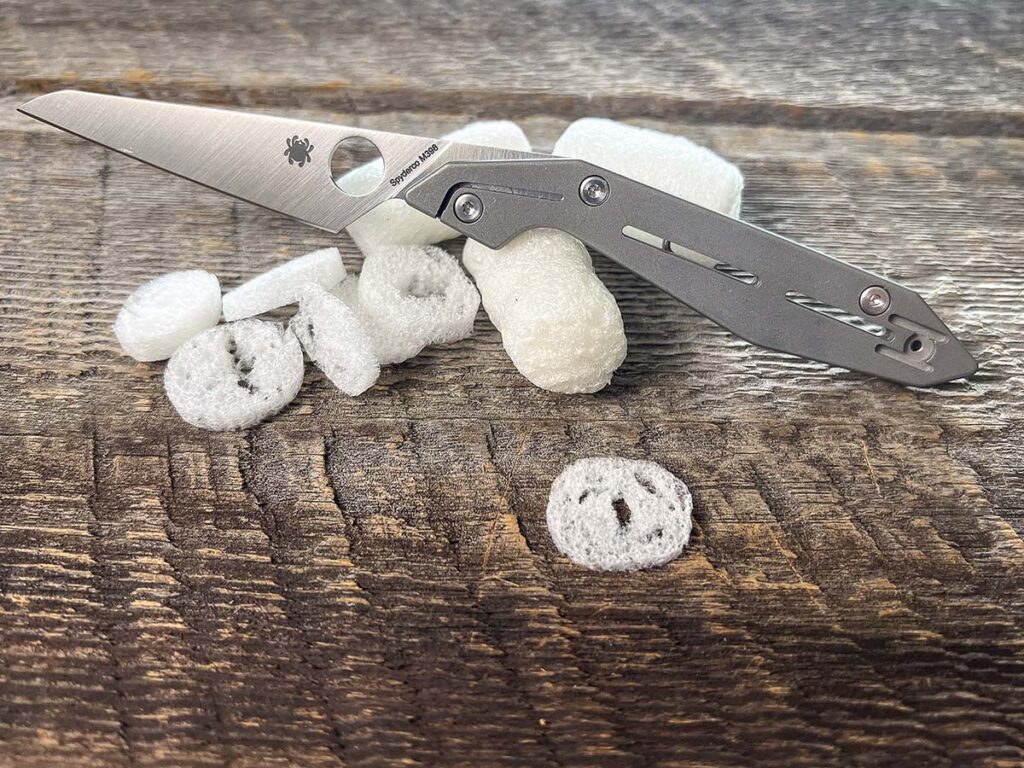
Designed by Paul Alexander, the Spyderco Nand and its angular handle theme carries over into the ergonomics, with finger recesses and a choil as well. Despite its angular appearance, the handle is quite comfortable. Closed length: 4.66 inches.

When it comes to collaborations, Spyderco has always been in the forefront of the genre. It also has some interesting folders in its SLIPIT family of non-locking folders. The Nand is an unusual, exciting example of both. Designed by Paul Alexander, an accomplished automotive mechanical engineer and a seasoned knife enthusiast, the Nand combines an angular approach to folding knife design with high-tech materials, all with the precise execution that Italian manufacturing offers. The result is sort of the Cybertruck of folders.

The 3.19-inch reverse tanto blade is fully flat ground from a new super stainless steel from Bohler called M398. Basically, Bohler took its M390 and increased the carbon and vanadium content for even more edge holding.

There are two methods of deploying the blade. The trademark Spyderco round hole is present as well as the extended blade spine that allows the Nand to be thumbed open similarly to a straight razor. The correct terminology for it is a front flipper.

Machined of titanium, the handle translates into an extremely lightweight knife and is where things get a bit interesting. The integral double-ball-bearing detent system not only holds the blade closed but also provides a positive detent when the blade is open. The “spring arms” for the detents are cut out of each handle half and, to create pressure, are bent in a similar manner to a framelock. Ceramic balls implanted on the ends of the spring arms create the open and close detents.

The wharncliffe blade has a full flat grind, which makes the Nand an excellent slicer. Out of the box, the knife cut plastic foam peanuts easily.

The handle’s angular features might make the knife look a bit awkward but don’t dismiss it until you put the Nand in your hand (see what I did there?). With the knife open, a kind of choil forms so you can choke up on the blade for an extra measure of control. Barring that, you can hold the knife a bit further back with your index finger resting inside the handle’s finger recess. Either grip brings your hand over the blade spine of the opened knife and helps secures the blade open as an added measure to prevent accidental closure. The minimalist wire clip is reversible to accommodate ambidextrous carry.

While the Nand may look a bit different, it’s easy to use and holds its own as an EDC folder. The reverse tanto blade has a highly effective tip that pierces easily. The straight-line cutting edge is simple to resharpen, has a lot of bite and slices through tough materials effortlessly. The knife feels very secure despite its slender nature. Choking up around the choil feels good and secure in-hand, rendering the Nand easily controllable.

SOG KNIVES Kiku Matsuda Hidaka FX 3V

Thicker materials like cardboard and hose are no match for the blade of the SOG Hidaka FX 3V, a Kiku Matsuda design. A slight hint of a recurve to the main cutting edge no doubt helps cutting power. Overall length: 10 inches.

The Hidaka FX 3V is a continuation of the exciting collaboration between SOG Knives and legendary Japanese knifemaker Kiku Matsuda. Known for their distinctive, flowing design style, intricately sculpted handles and hollow-to-flat compound-ground blades, Matsuda’s designs stand out.

His new SOG entry is an exciting tactical/outdoor fixed blade with a 4.8-inch tanto blade ground from ultra-tough CPM 3V carbon steel paired with a multi-faceted sculpted handle of black Micarta®. The blade’s angled tanto tip has a flat grind and the primary cutting edge is hollow ground. When you look at the blade in the light, you can see the grinds transition. Very cool—not too many factory knives have this feature and no doubt it’s much trickier to pull off than a standard tanto blade.

The flat-ground tip has a thicker cross section for greater penetration strength and general tip durability during hard use. The hollow-ground main bevel allows the blade to slice easily. Notches on the thumb-rest portion enhance control and a non-slip grip when bearing down on the blade. A black PVD coating helps with corrosion resistance and low-profile visibility.

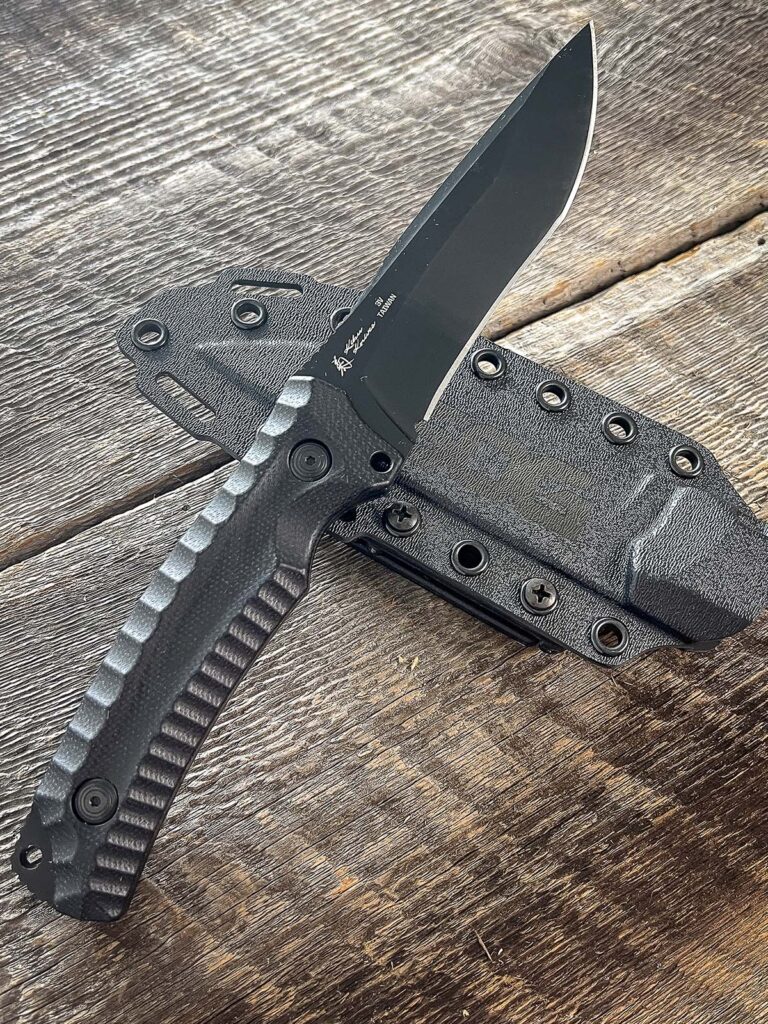
The handle is as interesting as the blade. The distinct, intricately sculpted grip features are a Matsuda trademark. The sculpting is not purely for looks but where form follows function. The middle of the handle is hollowed out on each side like one long groove. The handle edges sport a heavy chamfer and a series of scallops all the way around, the latter to enhance grip. A prominent groove helps seat the index finger and provide an anchor point. The total blacked-out look—handle screws included—gives a somewhat sinister tactical appearance. The exposed pommel also sports traction notches for a better thumb purchase.

The SOG’S handle edges sport a heavy chamfer and a series of scallops all the way around, the latter to enhance grip. A sturdy molded Kydex sheath holds the blade securely and an audible snap lets you know when the knife is fully seated.

Overall, the Hidaka FX 3V is just an interesting fixed blade. Not only does the compound-ground blade look cool but it is also very practical. Thicker materials like cardboard and hose are no match for it. A slight hint of a recurve to the main cutting edge no doubt helps cutting power.

The knife comes with a sturdy molded Kydex sheath. It holds the blade securely and an audible snap lets you know when the knife is seated. A hinged fastener affixes the sheath to your belt. The device is similar to the Blade-Tech Tek-Lok and operates similarly. The knife rides comfortably on a belt and the handle is easily accessible. Country of origin: Taiwan. MSRP: $309.95.

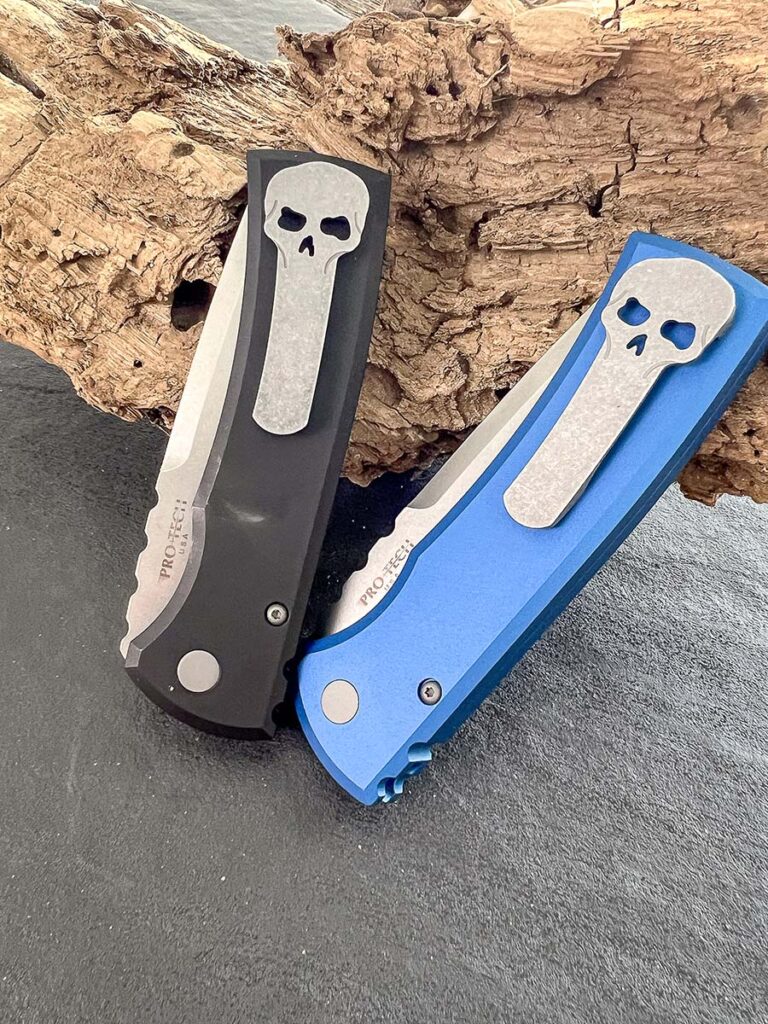
Pro-Tech Knives Ramon Chavez Redencion 229

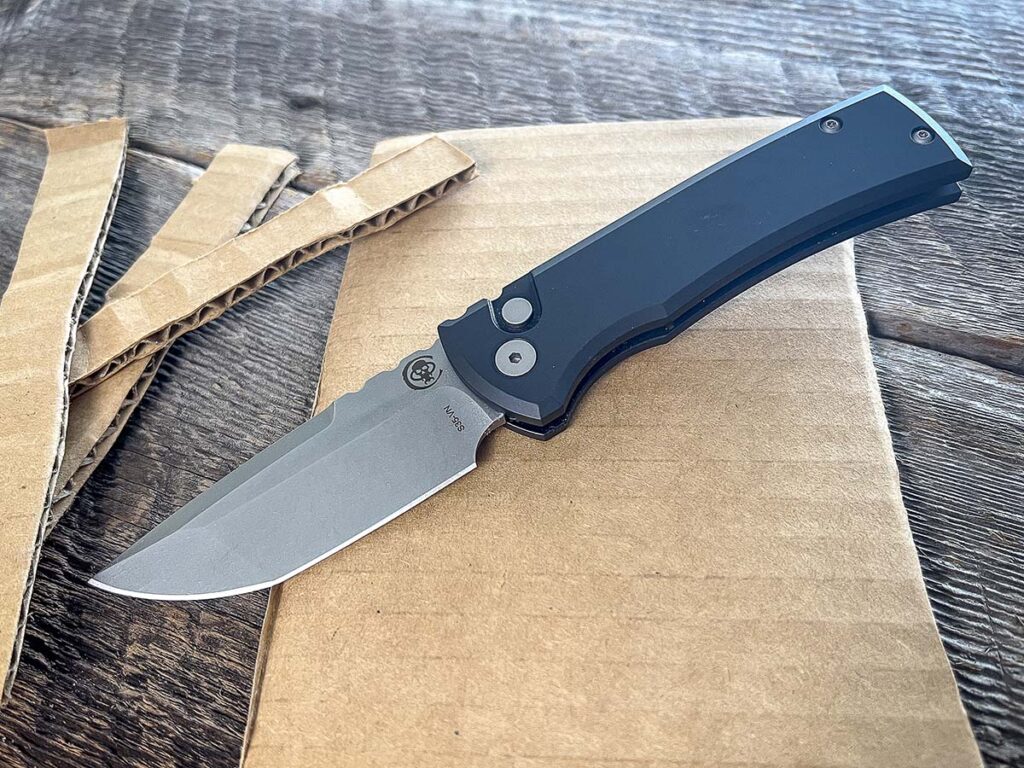
The Redencion 229 is a workhorse folder. The aluminum handle and S35VN steel blade denote that it’s in it for the long haul. Cardboard is no match.

One of the most exciting factory automatics going is the Chaves Redencion 229 by Pro-Tech Knives. Designed by knifemaker Ramon Chavez, the auto combines his bold design style with Pro-Tech’s excellent manufacturing capabilities and automatic action. The 3.3-inch tanto blade is high-performance CPM S35VN. The handle is T6-6061 hard-anodized aluminum for light weight and strength. The Chavez signature skull pocket clip adds attitude to the hard-firing automatic. At 4.5 inches closed, the folder carries well and works hard.

With the press of a button, the blade flies with authority and hits hard when it locks. If you’ve played with Pro-Techs you know what I’m talking about. The blade is flat ground and comes with a very sharp cutting edge out of the box. It will easily handle most tough cutting chores. It goes through cardboard and hose easily.

Designed by Ramon Chavez, the Pro-Tech Redencion 229 and its skull pocket clip stand out. Given the clip’s width, it’s also highly functional and durable. You are not going to spring this clip from your pocket accidentally. Note that the clip screws are inserted from inside the handle for a cleaner look.

The blocky handle allows for a secure grip. I noticed no hotspots or any hand discomfort. The aluminum scales are solid and generally hold up to hard use. Some might be apprehensive about the pocket clip as I was at first. Its size and width makes it hard to feel in-hand. Another good thing is the width means it won’t accidentally disengage if caught on anything. It’s stout! It provides the right amount of tension when the knife is clipped to the pocket. Another neat thing is you see no clip mounting screws because the clip is screwed to the handle from the inside—a very cool extra touch.

The Redencion 229 is a great EDC automatic that has attitude and high utility all in one interesting folder. Made in the USA, the model with a stonewashed blade and black anodized handle has an MSRP of $300. Black blade iterations are also available, as well as a recently released drop-point version.

Read More:

Puukko Knives: Top Blades Of The Finn Folk

0

Today’s puukkos are knives you can trust in the great outdoors.

It’s a crisp, early winter morning. You wake and need to start a fire to get breakfast underway. As you exit your hut, your warm breath clouds the air. While you gather wood, you gaze out over your reindeer herd.

At least this story would be yours if you were a Sami, a traditional reindeer herder of Finland’s Lapland region. And a traditional Sami tool is the Finnish puukko-style knife, three versions of which are our test subjects this time.

Puukko Specs Comparison

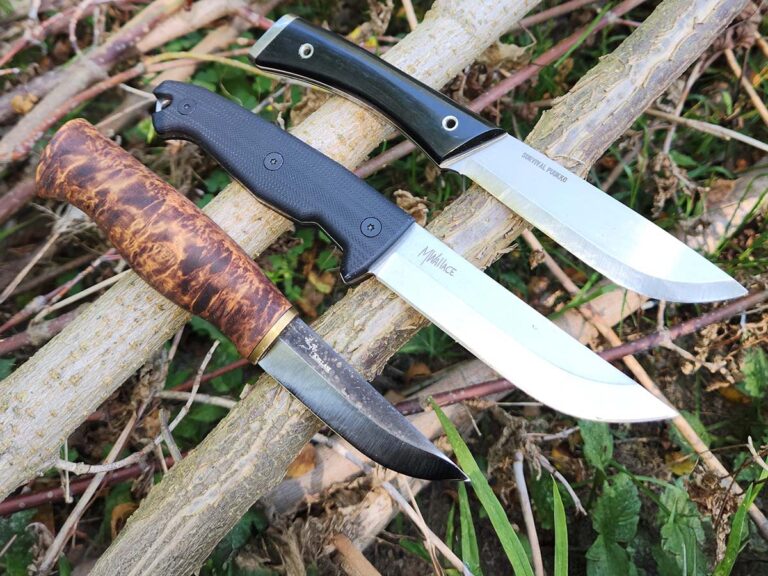
Kellam HawkAPOC Wallace Large PuukkoCondor Tool & Knife Survival Puukko
Overall length (inches)7.5″9.25″8.5″
Blade length (inches)3″4.25″3.9″
Blade materialCarbon steel7Cr15MoV stainless1095 carbon
Handle materialQuilted birch burlG-10Black paper Micarta®
SheathLeatherLeatherKydex
MSRP$106.88$123.53$79
FinlandChinaEl Salvador

Condor Tool & Knife Survival Puukko

The Condor is a capable cutter but the stout grind tends to make creating thin slivers difficult.

Though called a puukko, the blade profile of the Condor Tool & Knife Survival Puukko follows more the pattern of a leuku, a bigger Scandinavian chopper. The grind is a stout Scandi and it arrived work ready right out of the box. While it cut very well, I would have liked to see it come with a bit more of a traditional higher grind.

An interesting feature is that the steel pommel is attached to the tang. I would say that would come from a Mors Kochanski* influence as he promoted such a design aspect as a striker plate. The blade is 1095 carbon steel, which will hold an edge well when heat treated properly. The scales are polished black paper Micarta® accented with white liners.

The Condor’s pommel is connected to the tang, which allows you to use the pommel as a striking plate. The white liners set off the black paper Micarta® scales. “Some say they don’t care if a knife is pretty just as long as it works,” the author observed. “Well, if it works it doesn't hurt if it’s pretty, too.”
The Condor’s pommel is connected to the tang, which allows you to use the pommel as a striking plate. The white liners set off the black paper Micarta® scales. “Some say they don’t care if a knife is pretty just as long as it works,” the author observed. “Well, if it works it doesn’t hurt if it’s pretty, too.”

I found the handle a bit small for my bear paw hands. The grip’s inward curved profile tends to bunch my fingers together. Add a smallish handle and it started crowding my grip, causing discomfort. (Keep in mind, my hand is over 4.5 inches wide.) Two stainless steel pins affix the scales to the tang, with the lanyard hole a bit too small for a paracord. The full leather pouch sheath is well made.

Designed by Joe Flowers, the Survival Puukko is a good, serviceable cutting tool. It is a clean knife design with tight fit and finish. One thing: before you buy it, be sure it fits your hand.

APOC Wallace Large Puukko

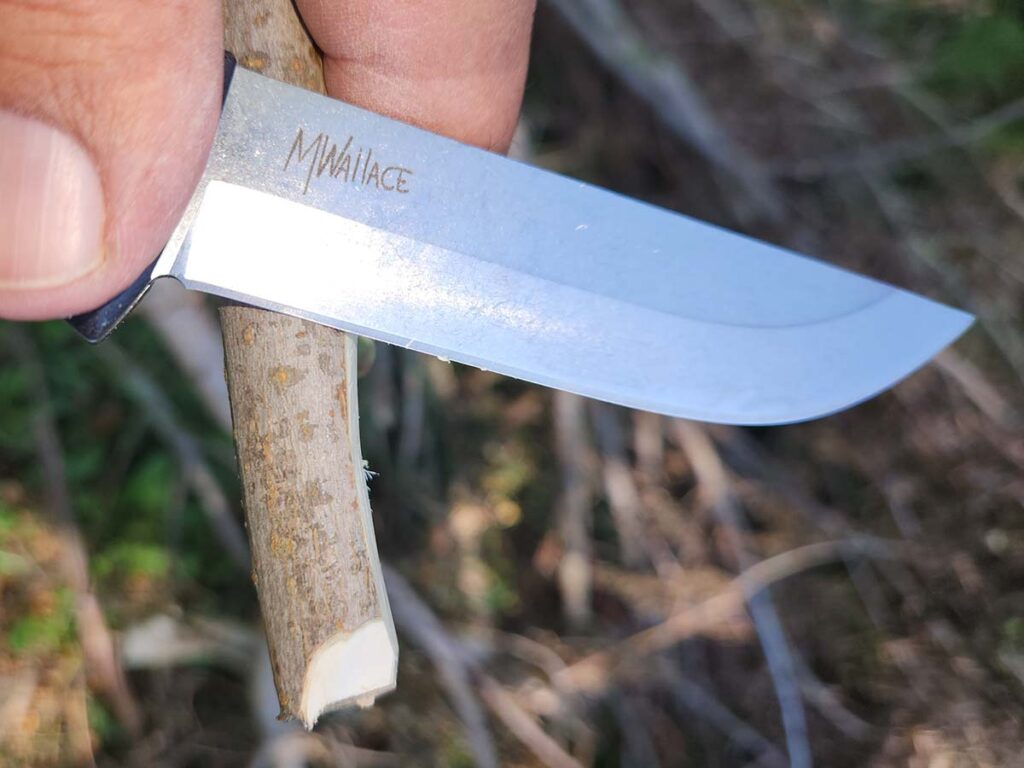
From this point, you can see the secondary bevel on the APOC. It’s not a Scandi grind but is still a good cutter.

Right out of the gate, I must say you get a lot for the price with the APOC Wallace Large Puukko. I would have expected a higher MSRP on this package. Having said that, let me roll out the high points.

Designed by Mike Wallace, the knife is a good size for bushcraft. Handle ergonomics aren’t amazing but are pretty darn good. The textured black scales are trim so it’s a nice, nimble cutter. As profiles go, it is a dead-on use of the puukko. On the grind end of things, it is not a Scandi. The blade actually has a secondary bevel. However, since it has a high grind it remains an effective cutter.

The tang of the APOC is exposed at the lanyard hole, which allows the lanyard to nest into the handle material and stay out from underneath your grip.

The sheath is molded Kydex and then some, including a fire steel and a striking plate on the side. In testing the striking plate I found the belt clip gets in the way, and I could get sparks just fine using the blade spine. You have the choice of horizontal or vertical carry with the G-style belt clip.

If I had to pick a downside, I would go with the belt clip. For a bushcraft knife, you want more mobility and accommodation from your sheath if you’re wearing a backpack, getting in and out of a canoe or kayak, even something as simple as bending over. In the vertical position, I find the knife rides too high. To make carrying it easier I would add a belt loop or even a dangler, allowing the knife to ride lower.

As a cutting tool, it works and works well. I would have no problem putting the Wallace Large Puukko on my side for a walk into the woods.

Kellam Hawk Puukko

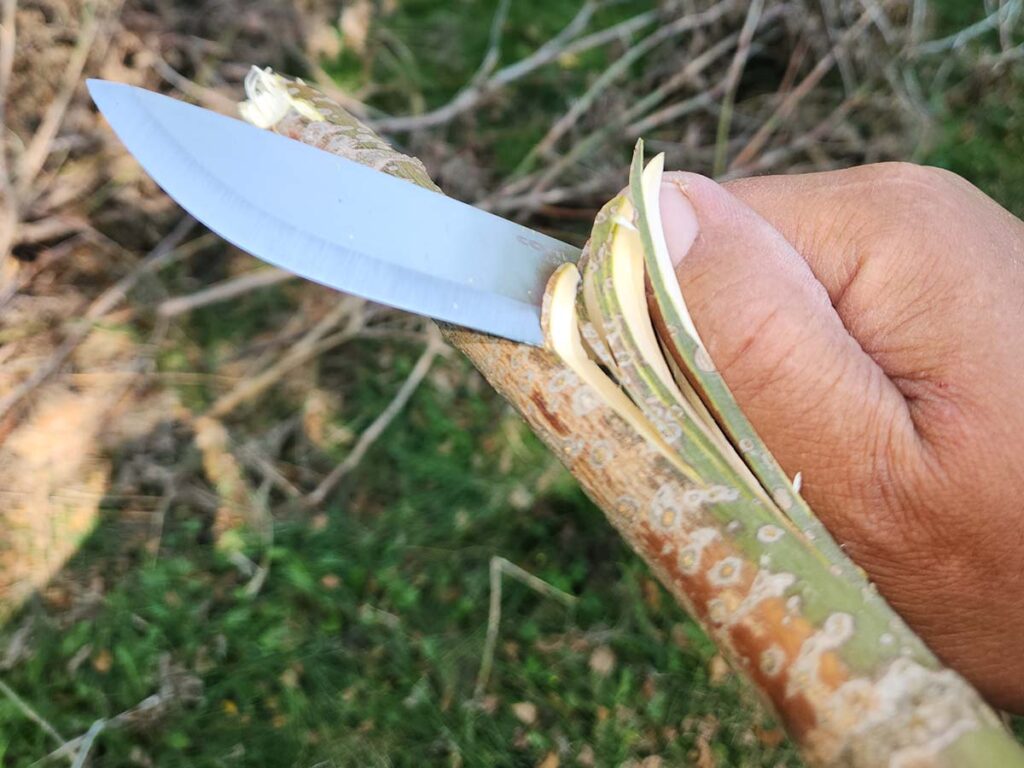
The high grind on the Kellam allows for great control, letting you hog off lots of material or make fine slivers.

The Kellam Hawk is a perfect example of the traditional puukko design. A full leather pouch sheath with dangler loop makes it easy to carry. Scales are a quilted birch burl that has a dark stain to it. The handle is not polished, which leaves a nice textured matte finish that adds to the knife’s value. Because the Hawk is a stick-tang design, Kellam could shape the handle to perfection, and it did. As I write these words, I can’t resist just holding the knife for the feel of the handle. Then again, stick and hidden tangs are advantageous in that they are constructions that make it easier to fully sculpt a handle.

The blade is a carbon steel with a forged finish on the flats and a Scandi grind. Performance wise it is a capable cutter. Scandi edges excel at cutting wood but can have issues with other tasks. Cleaning an animal is one. If you bump a piece of bone with a Scandi edge, chances are the edge will chip.

A look along the contour of the Kellam’s grip shows how smoothly a handle’s lines can flow when using a hidden tang.

Light and quick, the Hawk will help you craft many things around the camp, making your time in the woods easier. Over my 23 years of writing reviews for knife magazines, I have never met a Kellam I didn’t like.

*An international bushcraft legend, Mors Kochanski (1940-2019) was an outdoor educator and survival instructor for almost half a century and is recognized by many as the godfather of modern bushcraft.

Check Out More Outdoor Knives:

Was This The Best BLADE Cover?

1

The American Blade Cover saluted the Marines’ bicentennial in grand fashion.

A half-century ago, the November-December issue of The American Blade recognized the 200th birthday of the United States Marine Corps with a special commemorative KA-BAR U.S.M.C. fighting/utility knife on the cover.

The cover of the November-December 1975 issue of The American Blade featured the 200th anniversary “Commemorative U.S.M.C. Fighting Knife” by KA-BAR Knives. The Corps celebrates its 250th anniversary this year.

Paired with the iconic image of U.S. Marines inching their way up the beaches of Iwo Jima during the titanic struggle to take the island from the Japanese during World War II, the cover knife featured a blade with “gold accents” that included the Corps’ founding date of 10 November and 1775-1975, oak leaf patterns and 200th Anniversary under United States Marine Corps in script.

The commemorative’s “top quality leather handle” was an exact duplicate of the handle on the original 1941-45 issue knife. The commemoratives were made in a limited edition of 2,500 with individual MSRPs of $300 for knives serial numbered two through 49, $200 for serial numbers 50 to 99, $150 for serial numbers 100-199, and $100 for serial numbers 200 and up.

More Knife History:

Dagger Design: Point For Perfecting Blade Performance

0

In this look at dagger design, we move beyond history and symbolism to the structural realities of geometry and construction. From the curve of the edge to the presence—or deliberate absence—of a fuller, each feature serves the dagger’s singular purpose: to deliver a clean, decisive thrust and to endure long enough to do so again.

Dagger Profile & Point Geometry

A single, shallow fuller lightens the blade without compromising stiffness—proof that subtle geometry changes transform handling. Kelly Vermeer-Vella and Bruce Bump do the honors here.

A dagger’s profile is its outline when viewed from the flat side; its point geometry is the shape of its cross-section near the tip. Mastery in dagger design comes when the two elements merge into a seamless conduit for force, guiding energy from the wielder’s hand into the target.

One guiding principle is to avoid parallel edges along the portion of the blade intended for penetration. On utility knives, parallel edges are excellent for long, slicing cuts, but in a dagger they can create excessive suction and drag during withdrawal. They also represent a missed opportunity to enlarge the wound. A blade with gently convex curves tends to create a wound tract that widens as it penetrates, then releases more easily on the way out. The effect is twofold: the strike inflicts substantial damage on entry, and the blade slips back out with minimal resistance. In a fight where fractions of a second matter, ease of withdrawal could determine whether the wielder stays alive.

The balance point rests just forward of the guard, lending a stab-ready steadiness that rewards control. The author made this balanced dagger.

Cross-sectional design reinforces how a dagger behaves in the hand. The Roman pugio often carried a pronounced central ridge that gave it a triangular cross-section, lending the blade excellent stiffness. Later European daggers frequently adopted a diamond-shaped section that struck a balance between rigidity and lighter mass. In practice, triangular sections feel solid and grounded, with the ridge channeling force straight to the point. Diamond sections distribute the force across four bevels, trimming weight just enough to make the blade a touch quicker, though sometimes at the cost of absolute stiffness.

Experimental archaeology adds nuance to this comparison. Triangular sections resist torsional stress more effectively, while diamond sections tend to slip more cleanly into soft targets. Renaissance arms rooms often contained both forms, chosen with intent: defense versus assassination, battlefield versus court intrigue.

Dagger Ergonomics & Balance

Careful placement of a ricasso notch ensures consistent hand alignment, turning technique into muscle memory. Note the refined handle and ricasso detail on Cutlery Hall-of-Famer Billy Mace Imel’s piece.

Even the finest blade geometry falters without a grip that enables control. Here, ergonomics and balance determine the dagger’s effectiveness.

Early medieval daggers often featured grips as short as 3-to-4 inches. This compact length forced the hand into a firm grasp close to the guard, a practical safety measure when blood, rain or sweat made surfaces treacherous. Fourteenth-century Germanic examples show how a modest flared guard and compact handle could prevent slippage while preserving agility.

Balance points were just as carefully managed. In many 16th-century Italian stilettos, the center of gravity sits just ahead of the guard, giving the weapon a stab-ready steadiness. The narrow, edgeless blade minimizes rotational drag. Highland dirks, by contrast, often used teardrop pommels to counterweight the blade, shifting balance closer to the hand and allowing forceful thrusts whether on horseback or on foot.

A weighted pommel counters blade weight, shifting balance back toward the hand and straightening the thrust on a Renaissance-influenced dagger by the author.

Makers sometimes introduced subtle refinements. A ricasso notch carved two or three centimeters from the guard ensured that the user’s thumb returned to the same anchor point every time. A shallow fuller reduced forward weight, so that an 8-inch stiletto might balance almost identically to a heavier 10-inch combat dagger. These small calibrations transformed the blade from a piece of steel into an extension of muscle and bone.

Dagger Strength Features

There are no gimmicks on Joe Syverson’s minimalist dagger with clean taper—just clear profile, rigid spine and reliable balance. The design reflects simplicity that serves performance.

The dagger’s tip, however slender, must withstand resistance from mail, bone or even poorly placed strikes. European smiths between the 14th and 17th centuries developed several overlapping solutions that remain relevant today. Fuller placement was one of the most important: a carefully cut longitudinal groove reduced weight while preserving stiffness, as seen in 16th-century Venetian stilettos where the fuller often ran from just below the guard almost to the point.

Ricasso thickness was another safeguard. A blade too thin at the base was liable to flex and buckle under pressure, and even worse, a weak ricasso translated into a fragile point once the final bevels were ground. By keeping this area stout, smiths not only gave the blade strength but also provided a tactile zone of unsharpened steel where the thumb or index finger could anchor securely.

Even with an ornate sculpted handle and dramatic damascus, the blade remains an unbroken taper from guard to tip on Henning Wilkinson’s art dagger. Note the lavish surface detail.

Hardening practices added a third layer of reliability. Most European daggers were quenched and tempered uniformly to a Rockwell hardness in the neighborhood of 48-to-52 HRC. A few Italian masters appear to have experimented with clay tempering to leave the ricasso slightly softer, but this might also have been accidental. In any case, the visible temper lines familiar in Japanese blades were rare. What mattered was consistency: a uniform temper that balanced edge retention with toughness made it so the dagger could survive repeated thrusts against armor and bone alike.

Avoid Feature Creep

Next-generation work in this forward-looking piece by Jean-Pierre Potvin proves the old lessons endure: blade geometry is still central even if the rest of the dagger is fantastical.

Through all the refinement, one lesson emerged repeatedly: every extra feature risked undermining the dagger’s true purpose. Serrations, pry tips and decorative piercings might look clever but each introduced problems. Serrations can snag on clothing and tear rather than pierce. Pry tips disrupt the straight thrusting line. Even ornate cut-outs, while attractive, create weak points that could split under stress.

Historical makers knew better. Even the most extravagant Renaissance daggers—with gilded hilts, inlaid gems or etched scrollwork—maintained an unbroken distal taper from guard to tip. Embellishment was typically reserved for the surfaces, not the structure. However adorned, the dagger kept faith with its defining role: the straight, unyielding line of the thrust.

Conclusion

Inventive cross-sections and flawless transitions demonstrate that modern makers can push design without breaking the rules. Elizabeth Loerchner captures the concept in the strong geometry of her experimental modern dagger.

From the Roman pugio to the Renaissance stiletto, the dagger’s identity rests not in ornament but in discipline: geometry over gimmicks, strength over flourish, function over feature creep. Clear profiles, rigid spines and balanced grips remain the hallmarks of a true dagger. These principles are as relevant to the modern craftsman as they were to the smiths of Venice, Florence or Solingen. A dagger’s promise, after all, is measured not by extravagance but by the sharp integrity of its point.

More On Daggers:

Advertisement

Must Read Articles

Read this before you make a knife

Knifemaking 101 – Read This Before You Make a Knife

  by Wayne Goddard My experience has taught me that there's nothing like digging in and getting started. I've often said the hardest part of the...
how to forge damascus steel

How to Forge Damascus

Advertisement
Advertisement