Learn how the new law, SB 108, updates knife regulations and what this means for knife owners.
Delaware became the 22nd state to repeal switchblade/automatic knife bans or restrictions with the signing July 30 of bipartisan SB 108 by Governor Matt Meyer.
According to the Knife Rights website, the bill not only removes restrictions on the sale or possession of automatics in Delaware, it also amends the “Deadly Weapons” exemption for “ordinary pocketknife” by deleting “folding” in order to cover all knife types. It also increases the legal blade length from 3 to 3.75 inches.
“SB 108 is a common-sense update, modernizing Delaware’s knife laws, so citizens gain the freedom to carry and use these tools responsibly without fear of legal penalty,” Meyer said.
In addition to Delaware, states repealing switchblade bans or restrictions include Alaska; Colorado; Hawaii; Illinois; Indiana; Kansas; Louisiana; Maine; Michigan; Missouri; Montana; Nevada; New Hampshire; Ohio; Oklahoma; Pennsylvania; Tennessee; Texas; Vermont; Virginia; and Wisconsin.
This leaves only three states where civilian possession of automatic knives remains banned: New Mexico, Minnesota and Washington. Knife Rights is challenging Minnesota’s ban in federal court. Washington is in the Ninth Circuit where KR’s federal lawsuit against California’s partial ban is proceeding on appeal. A win there would apply to Washington’s ban.
Hunting knives should be workhorses and these options are ready to shoulder the load as you take to the field.
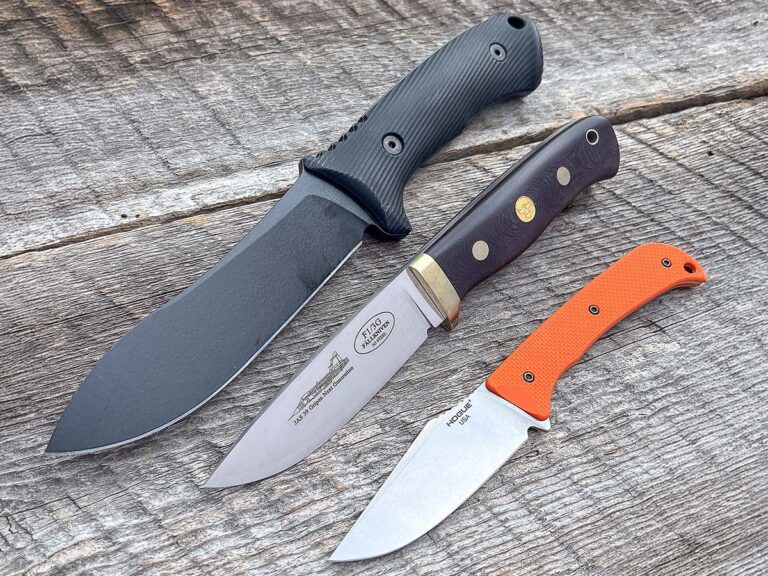
Fixed-blade hunting knives are the workhorses of your hunting gear. They handle a lot of the grunt work associated with cutting, including field dressing game after the take-down to various cutting tasks while hunting or in camp. As a result, it is important to choose a hunter that not only has the features and the materials you want but one that fits your budget as well.
Hogue Knives Extrak
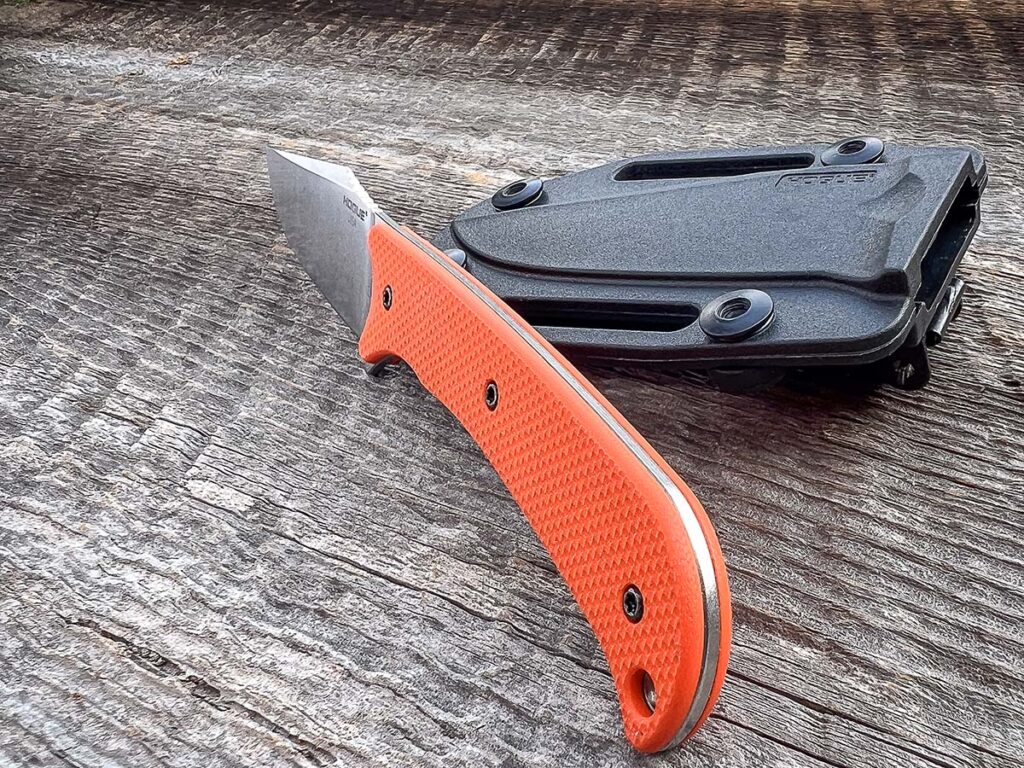
Despite the thin nature of the Extrak’s handle, slightly expanded front and rear sections help form a guard of sorts to avoid gripping difficulties.
With its slender form, the Hogue Knives Extrak takes a minimalist approach to fixed hunters. Hogue President Jim Bruhns designed it to be lightweight and agile. Available in two sizes, the Extrak and its bigger brother, the Extrak XL, both tackle heavy field-dress work while offering comfortable carry minus the bulk of many fixed hunters.
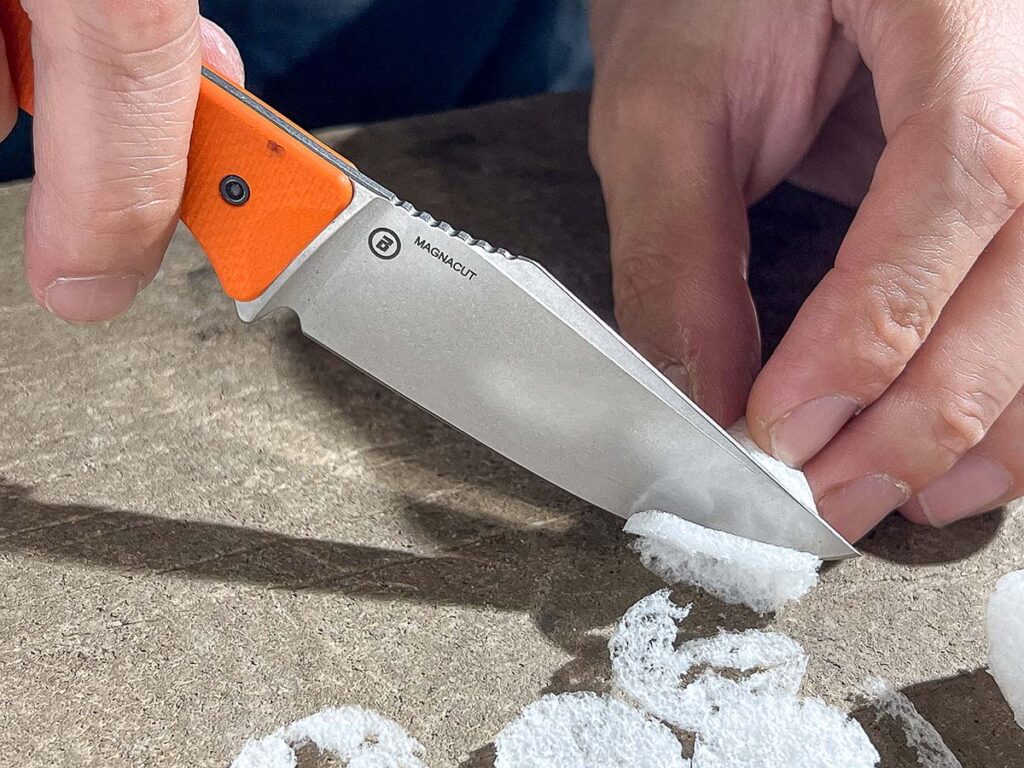
The modified clip-point blade is 3.3 inches of high-performance CPM MagnaCut stainless steel in a stonewashed finish. The peel-ply orange G-10 scales are textured enough so the material is a bit grabby. The orange fits right in with the hunter theme. Despite the handle’s thin nature, slightly expanded front and rear sections help form a guard of sorts to avoid gripping difficulties. Overall length: 7.375 inches.
Thanks to the thin blade stock and full, flat primary grind, think of this knife as a scalpel. Scalpels have lean handles but the blades are thin enough to cut easily with very little applied force. Same thing with the Extrak. The blade bites into meat so easily that the slender handle doesn’t matter.
At first I was a bit apprehensive that the thin grip would affect the knife’s use. The more I cut with the Extrak, the more I saw that the thin blade is where the work takes place. It slices so cleanly and efficiently that you need not apply pressure on the handle to make the cut. After a while, the lean grip doesn’t matter because you are too busy admiring the knife for its extreme cutting power and efficiency. From sausages, steaks and veggies to cardboard and opening mail, the Extrak dispatches all with aplomb. It’s a great candidate for your next restaurant outing. It is a very low-profile design that won’t attract unwanted attention in public, even with its bright orange handle.
The Hogue Extrak might be a lightweight and thin fixed blade but don’t let that fool you. Cutting performance wise, this knife punches above its class. The thin blade cuts like a scalpel.
The Extrak also makes a great utility knife. However, shy away from rough use and any sort of cutting where you simultaneously twist the blade. MagnaCut is a tough steel but as thin as the knife is, you can damage the edge or break the tip if you use it too hard. It is a precise cutting tool. I rate the knife high on the list for an EDC fixed blade as well.
Due to the knife’s minimalist design, it might be possible to custom fabricate a Kydex neck sheath for it to wear under a shirt for more discreet carry. Don’t try it with the supplied slip cover as there isn’t enough tension to hold the blade securely for such neck carry. The molded ABS plastic sheath features an UltiClip fastener. The setup enables you to carry the knife clipped to the top of a pants pocket, much as you would a tactical folder. The knife rides securely in this manner, with the entire handle sticking out for easy deployment. The sheath is simple but works and is of pretty good quality. Country of origin: USA. MSRP: $199.95.
Spartan Blades Harsey Nessmuk
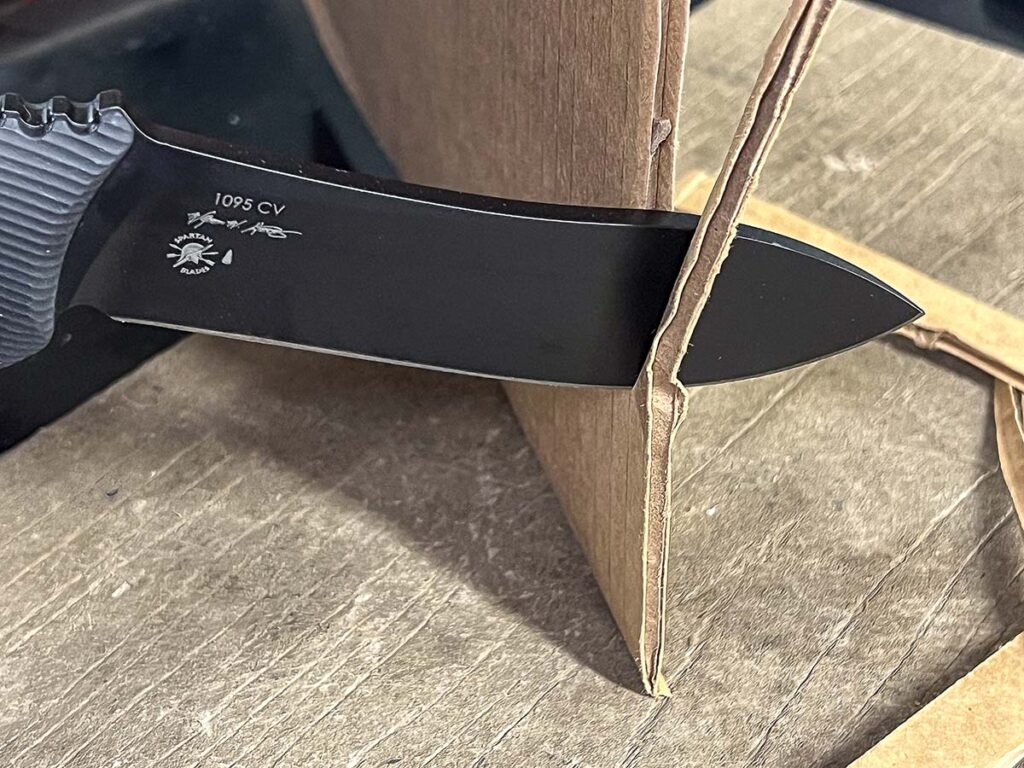
The skinner-like blade of the Spartan Harsey Nessmuk excels at slicing tasks.
The Spartan Blades Harsey Nessmuk is the largest knife of the test group. The classic Nessmuk design with its distinctive bulbous tip has proven to be a very effective outdoor knife that excels at many tasks, from field dressing to camp utility chores. The skinner-esque blade is a highly effective slicer. Do an internet search for George Washington Sears and the Nessmuk blade style. The history of how the design came about is a rather interesting read and gives some insight as to why the blade is shaped as it is.
In the Spartan entry, the Nessmuk blade is paired with the handle design of BLADE Magazine Cutlery Hall-of-Fame® member Bill Harsey. The Creswell, Oregon, knifemaker is widely known for his tough fixed-blade designs for the Special Forces and his work with Cutlery Hall of Famers Col. Rex Applegate and Al Mar. The Nessmuk is yet another Harsey design for Spartan that includes the pair’s tactical and other outdoor collaborations. It is part of Spartan’s Silver Line, aka Professional Line, a mid-priced/made-in-the-USA (KA-BAR factory in upstate New York) series that is less expensive than the company’s flagship Gold Line.
The Nessmuk blade is 5⅛ inches of flat-ground 1095 CRO-VAN carbon steel with a Rockwell hardness of 56-58 HRC. The 1095 offers a great balance of edge retention and ease of sharpening without the need of a complicated sharpener. At .1875-inch at the thickest and with a corrosion-resistant/low-glare black powder coat, the blade is well-equipped for high-performance outdoor work.
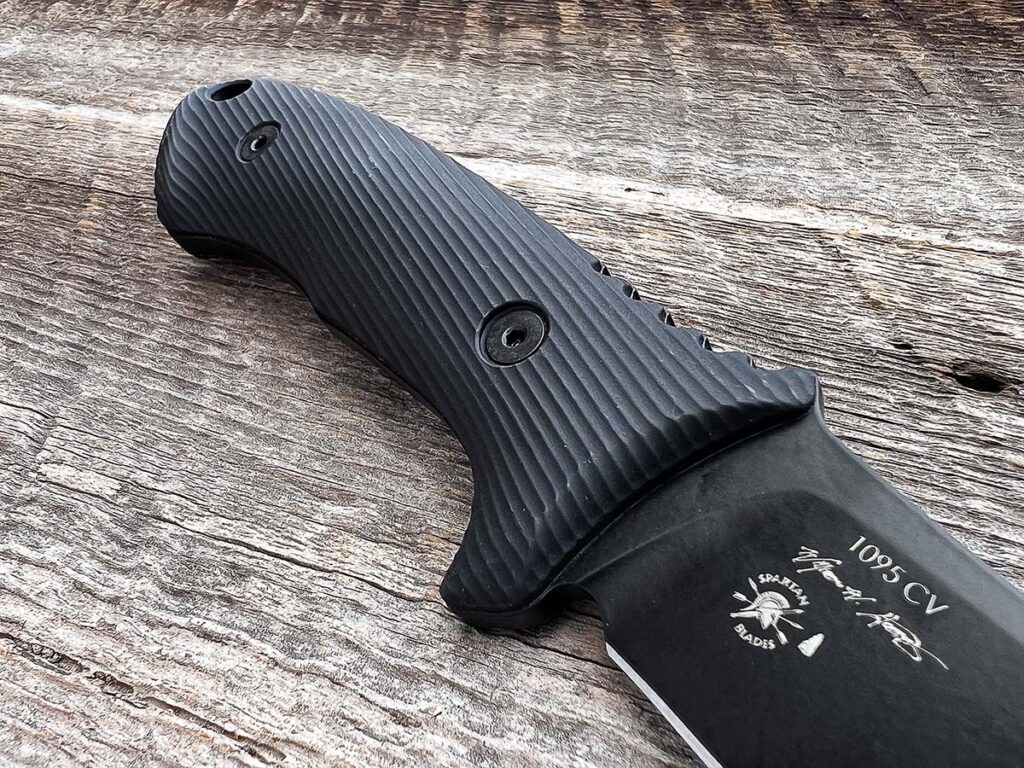
As the author noted, one of the hallmarks of a true Bill Harsey design is the handle. “His handle designs are among the best in the industry,” the author observed. “They are contoured to fit your hand like a glove, without any hot spots.” Handle features also prevent forward or backward sliding of the hand, while the 3D texturing adds enough grip to be secure but not aggressive.
The rugged, molded thermoplastic sheath has a fabric-fastener loop to attach to a wide range of belt sizes. A thumb-retention lock holds the knife in place and three slits vent water, making it ideal for wet environments.
The handle is Grivory, an impact and fluid-resistant material that can be molded with various contours and chamfers that aid in attaining a comfortable, secure grip. The durable/usable handle feels as if it were molded to your hand and has no hot spots. At 10.8 ounces and 10 inches overall, the Spartan Harsey Nessmuk is big yet lightweight enough to tackle most any hunting knife chore you throw its way. MSRP: $225.
Fallkniven F1L3GMM Next Generation
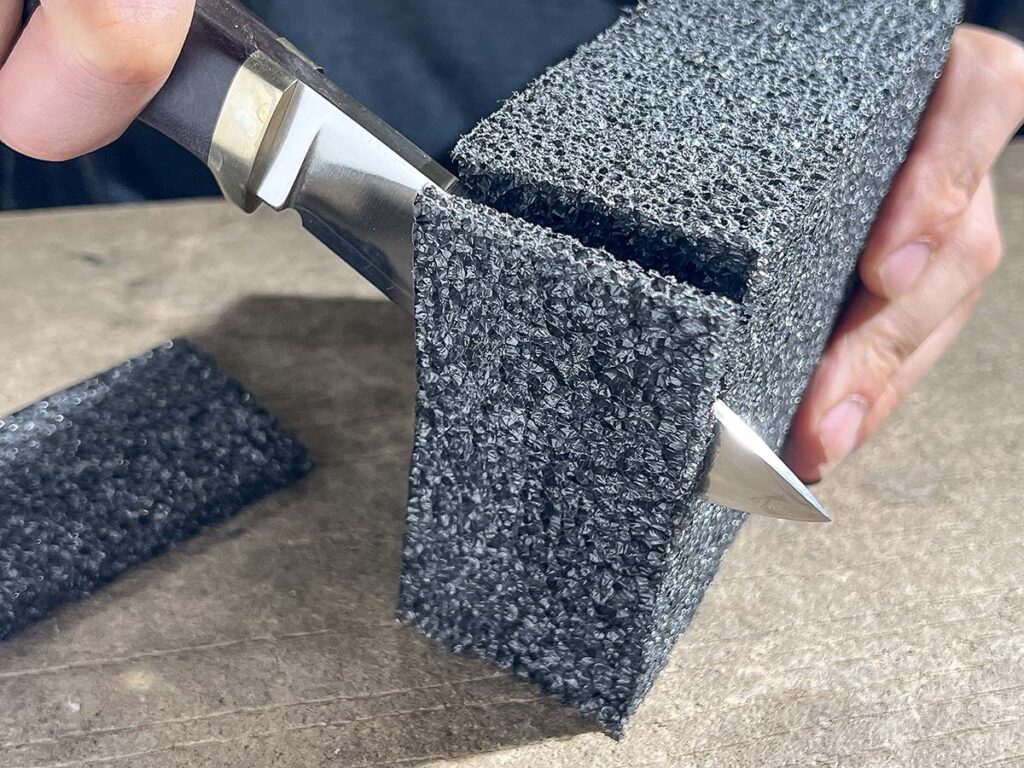
The convex-ground blade of the Fallkniven powers easily through most any medium. According to the author, “it is one of the sharpest cutting edges out there.”
The Fallkniven F1L3GMM Next Generation fixed blade was designed as a pilot survival knife but is also a knockout crossover fixed hunter. The blade boasts a laser etching of the JAS 39 Gripen Next Generation Swedish fighter jet, but don’t let that fool you. The Fallkniven entry actually has a hunting knife pedigree.
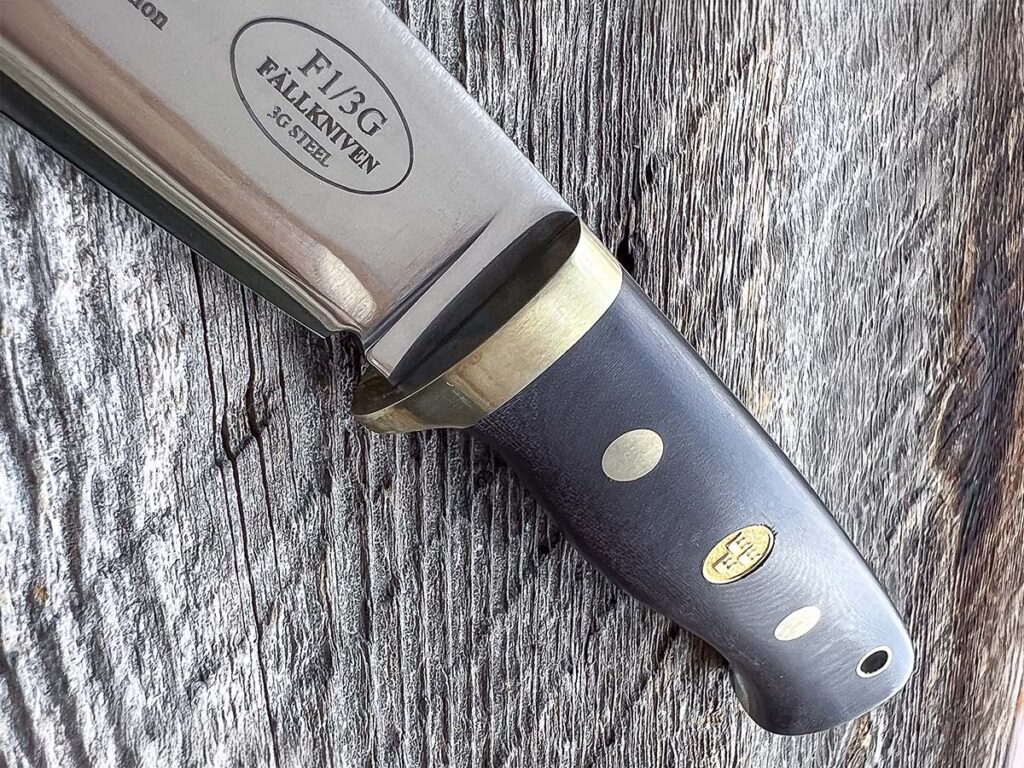
As the company website notes, the work of BLADE Magazine Cutlery Hall-of-Fame® member Bob Loveless was the inspiration for the F1L3GMM. You can almost see it in the knife’s lines. The 3.9-inch drop-point blade has plenty of belly to facilitate slicing chores. The maroon Micarta® handle is very elegant and sports the right contours to accommodate your hand, and is very comfortable to hold with no worry of hot spots. The nickel-silver guard fits the tang seamlessly and is a great anchor point to prevent your hand from sliding forward. The handle fastens to the tang with a pair of Corby bolts, and a gold medallion with three crowns decorates the grip’s center. At 8.2 inches overall, the F1L3GMM is sized just right for a hunter. The sewn black leather belt sheath sports quality construction, and the “F1”-stamped flap closure with button snap conceals the entire knife.
The Fallkniven entry is a hard-use beast. The blade slices very cleanly and expediently. If you’ve never used a knife with a full convex edge, you are definitely in for a treat. Fallkniven is known for convex edges that are both sharp and quite durable, not to mention easier to maintain due to the geometry. The convex edge bites in deep and hard, and you can use it a tad rough as well without fear of the edge chipping out. It is also very well suited for general use around camp or the kitchen. The blade is fairly thick but, due to the convex edge, dives into whatever is being cut and propels the rest of the blade through. Just because it’s thick doesn’t mean it cannot slice effectively. This is a knife of heirloom quality that also has plenty of horsepower for getting real work done.
Maroon Micarta® is the handle material of choice for the Fallkniven F1L3GMM fixed hunter. It is pinned to the tang using Corby rivets.
The handle is comfortable, rounded and contoured in the right places and devoid of hot spots during extended use. I have always been a big fan of Micarta® for both folder and fixed-blade handles. It’s pretty much the ultimate user material given its light weight, dimensional stability and imperviousness to most known liquids. Plus, it comes in a wide array of colors, and the maroon adds a nice splash of color without being overly flashy. You don’t see too many maroon-handled knives, so this one is a breath of fresh air.
Yes, it is on the pricey side for a production hunter but in return you get a very well-built cutter executed with the best materials. I don’t think you can find a better knife for the money. If you love European engineering and manufacturing, this is the hunter for you. Country of origin: Sweden. MSRP: $499.99.
Discover the craftsmanship behind unique designs, from carbon steel to mosaic damascus, and learn what makes a perfect hunting knife.
The primary trend that has emerged in custom forged blades over the past 18 months is the growing popularity of the hunting and utility knife. The options seem limitless, from forged carbon steel and Micarta® to mosaic damascus and ivory.
The best seller among the group is the carbon steel hunter featuring a Micarta handle. An excellent example is from award-winning ABS master smith Josh Fisher—world-class craftsmanship at an affordable price. Designed for serious work, this knife will last, if properly maintained, for the owner’s lifetime and beyond.
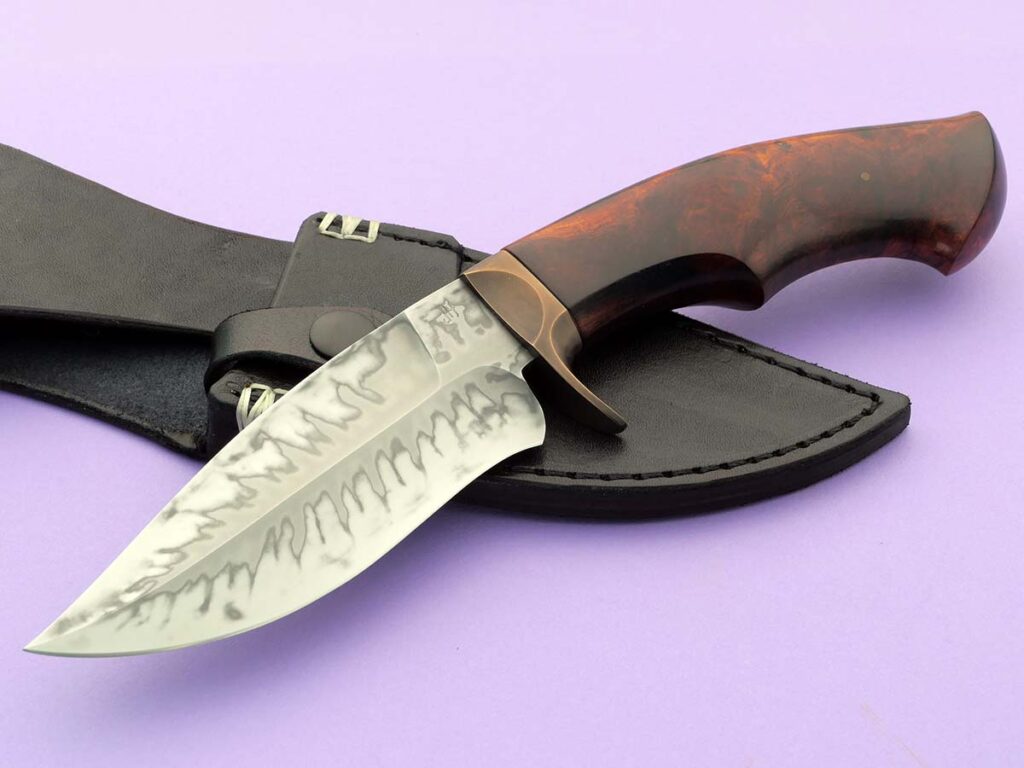
One of my favorites is a hunter from Slovenian knifemaker Jan Hafinec featuring the unique hamon of his Bonfire Hunter. Jan’s hamon looks like flames streaking across the blade. He achieves the distinctive look by cleaning the grind and normalizing the blade. He then applies Satanite* clay to the blade in the desired shape for the hamon. After drying the clay, he puts the blade in his electric kiln. Upon removing it from the kiln, he plunges the blade into fast-quenching oil to give the hamon its fiery look.
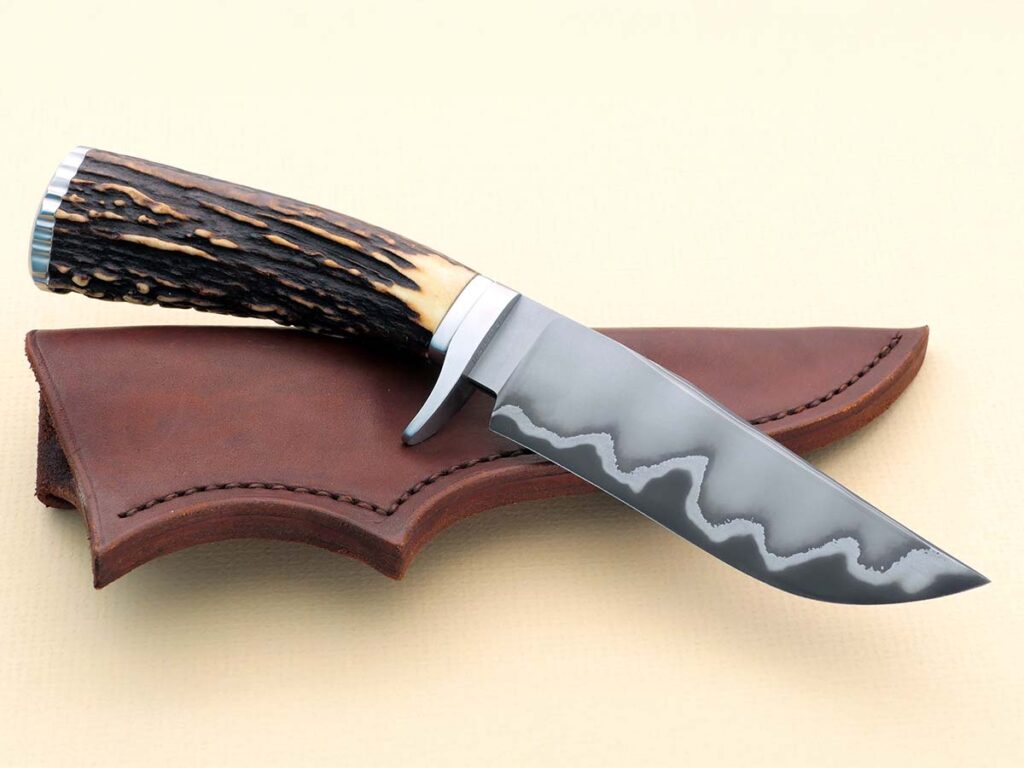
Maker: Wess Barnhill Model: Drop-point hunter Blade Length: 5” Blade Material: San-mai of 1075 carbon and 410 stainless steels Guard and Buttcap: Stainless steel Handle Material: Sambar stag Overall Length: 9.75” Sheath: Leather model custom made by Wess Barnhill Knife to know: Wess is an ABS journeyman smith His price for a similar knife: $825 (Robertson’s Custom Cutlery image)
A steel construction that has been a favorite of collectors for several years now is san-mai. A hunter by ABS journeyman smith Wess Barnhill has a great example of a san-mai blade, featuring a carbon steel core sandwiched between outer layers of stainless steel. One of my favorite aspects of this type of laminated blade is that each one is unique, encouraging collectors to have more than one in their collection, if they so choose, as no two are the same. Barnhill’s blade material of choice is a 1075 carbon steel core sandwiched between two pieces of 410 stainless steel. He likes to zip-weld all the edges together, as this keeps out the oxygen while forge welding. He sets the temperature to 2,350 F° for 10 minutes to produce his san-mai blades.
Copper San-Mai
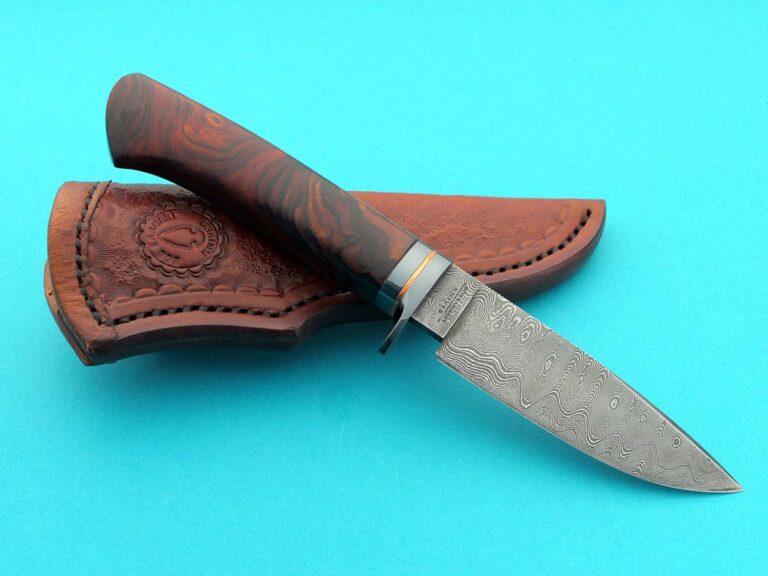
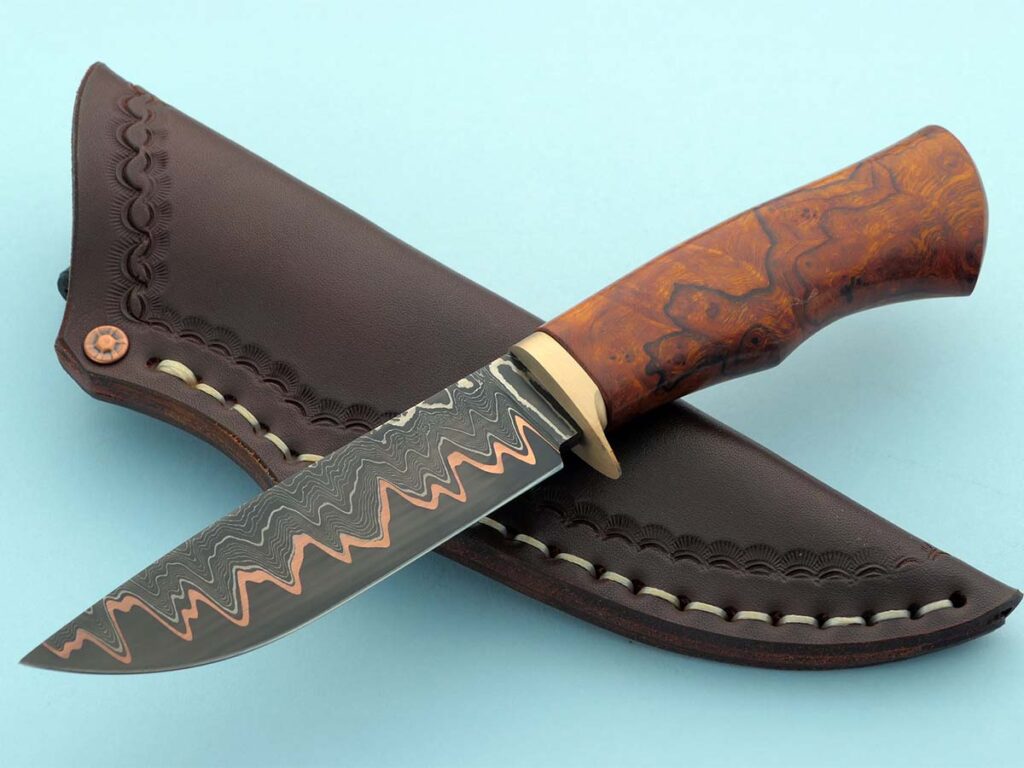
Maker: Dan Lewis Model: Drop-point hunter Blade Length: 4.5” Blade Material: Forged san-mai w/a core of W-2 tool steel, an outer layer of damascus and a middle layer of copper Guard Material: Bronze Handle Material: Desert ironwood Overall Length: 9” Sheath: Leather model custom made by Dan Lewis Knife to know: Dan is an ABS journeyman smith His price for a similar knife: $550 (Robertson’s Custom Cutlery knife image)
Seeing the work of ABS journeyman smith Dan Lewis at the 2024 BLADE Show, I was immediately drawn to it. His unique copper damascus san-mai features carbon steel, damascus and copper. He also offers the same style of blade with nickel if you prefer. He explained that monosteel and damascus blades are forged to shape and taken through a precise heat treatment. Copper san-mai blades are a different story.
“Once I create the billet—layering high-carbon steel with pure nickel damascus and copper—I do very little forging beyond drawing out the tang. The rest is done through careful grinding,” he explained. “Precision is everything. The billet must be measured exactly to keep a consistent core of high-carbon steel, with even layers of damascus and copper on each side. Copper looks great but it doesn’t belong on the cutting edge. I always use a high-carbon core for strength and sharpness. When it comes to etching, combining pure nickel and copper allows me to use a stronger, proprietary acid. The result is a deep, dark etch in just seconds, creating a bold finish that highlights every layer.”
Dan combines the copper damascus san-mai with blued fittings and desert ironwood to create an eye-catching work of art at an affordable price.
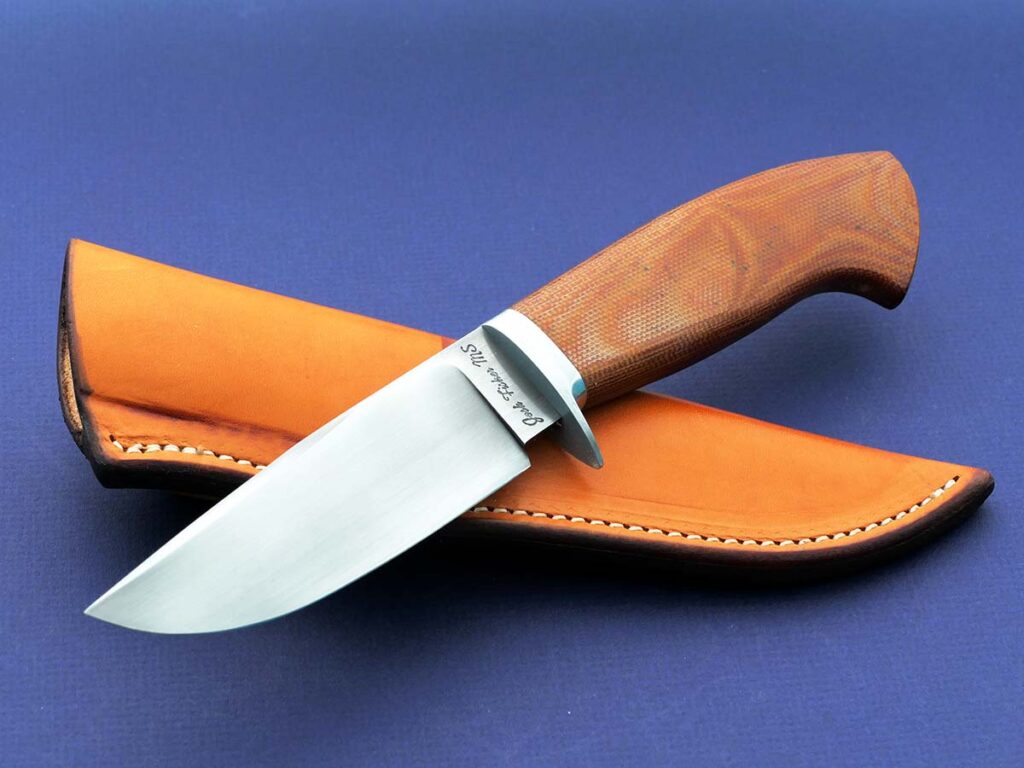
Maker: Josh Fisher Model: Drop-point hunter Blade Length: 4.5” Blade Material: 1084 carbon steel Blade Finish: Satin Guard Material: Stainless steel Handle Material: Vintage Westinghouse Micarta® Overall Length: 8.75” Knife to know: Josh Fisher is an ABS master smith Sheath: Leather model custom made by Josh His price for a similar knife: $550 (Robertson’s Custom Cutlery image)
I saw ABS journeyman smith Bob Earhart’s knives on the internet while working on my checklist for the BLADE Show. I contacted him several months before the show to discuss his knives. In addition to his excellent knifemaking skills, the use of a blued guard and bronze spacer in conjunction with presentation-grade desert ironwood gives his hunter a stunning look. Instead of using a forge press die, Bob grinds a ladder pattern into his steel billet. Grinding toward the edge, he cuts deeper and then hammers out the grooves, creating a complete ladder pattern throughout the blade.
Additionally, Bob has the one skill that many knifemakers lack: effective communication. He encouraged me to provide my input and kept me informed about the knife build every step of the way. When I buy my first knife from a knifemaker, I really appreciate that.
Frame-Handle Jewel
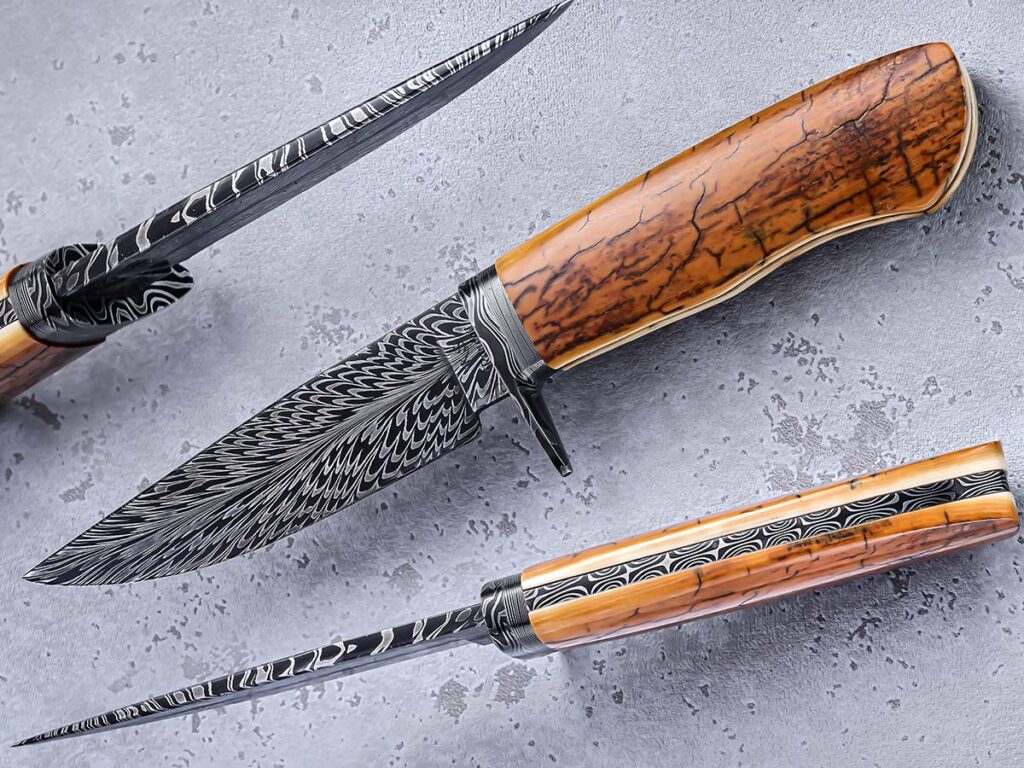
Maker: Steve Randall Model: Frame-Handle Hunter Blade Length: 4.75” Blade Material: Feather-pattern damascus Guard and Frame: Feather-pattern damascus Handle Material: Mastodon ivory Overall Length: 9.5” Sheath: Leather model custom made by Steve Randall Knife to know: Steve is an ABS master smith His price for a similar knife: $1,400 (SharpByCoop image)
The frame-handle hunter is arguably one of the more difficult knives to build. Add mosaic damascus and ivory to the equation and it becomes even more challenging. Given the complex nature of ABS master smith Steve Randall’s frame-handle hunter, I asked him to explain his process for building the knife.
He starts by making a billet of a W’s-pattern damascus. The layer count and stack are personal preferences. The lower the count, the wider the pattern. Once the billet is formed to the preferred layer count, Steve cuts it into pieces, restacks the pieces, and forge welds them back together. He splits the resulting stack in half using a dull wedge and welds the two halves back together to create a feather damascus billet. The splitting process with the dull wedge is what drags the hot steel to make the feather design.
Steve pointed out that increasing the layers also increases the potential for flaws. Often, the flaws don’t reveal themselves until the blade is being ground. If flaws are discovered, the blade must be thrown away and all those work hours are lost. (Author’s note: Please understand that due to the increased degree of difficulty and risk of blade failure, any mosaic-type of damascus used in the knife’s construction will increase the price. All damascus is not equal!)
Steve said the most challenging part of a frame-handle knife is connecting the frame to the guard or ferrule so there are no gaps and the fit appears seamless. Also, how the handle is attached to the blade is key. There are various ways to attach that can add to the complicated nature of a frame, for example, hidden pins, hidden finial, external finial, etc.
Changing Conditions
Maker: Jan Hafinec Model: Bonfire Hunter Blade Length: 5” Blade Material: Forged C105 carbon steel w/double hamon Guard Material: Bronze Handle Material: Desert ironwood Overall Length: 10 1/8” Sheath: Leather model custom made by Jan Hafinec His price for a similar knife: $600 (Robertson’s Custom Cutlery image)
In the March BLADE®, I wrote about the matrix I use to determine which knives to buy. Before that story was published, BLADE Editor Steve Shackleford asked me what conditions would cause me to adjust my matrix. One condition would be a change in the popularity of a market sector, such as custom fighters, gut hooks, stilettos, etc. With a current slowdown in damascus bowie sales, primarily due to the bowies’ price point, an alternative emerged, offering many of the same options at a more affordable price: the forged hunting knife.
One of the best aspects of attending a knife show is the ability to compare knives, apples to apples if you will. This year’s BLADE Show resulted in me updating my matrix with regard to custom hunting knives.
Before the show I provided a set of parameters to 10 ABS journeyman and master smiths, both domestic and international, to build a damascus hunting knife to my specifications Those parameters were: a 4.75-inch ladder-pattern damascus blade, damascus guard (no pattern specified), and a wood handle (no wood specified). The smiths’ quotes ranged in prices from $600 to $1,250 per knife.
Still think you don’t need your own matrix?
*CAUTION: When using Satanite hamon clay, “wear protective gloves, outfit, and face and eye protection. If on skin, wash with soap and eater. If on eyes, rinse with water for several minutes. If eye irritation persists, get medical attention.”
With solid steel, bold styling, and a pocket-friendly profile, the Merino MM proves that great things really do come in small blades.
A lesson quickly learned in hunting, dressing game doesn’t require a big knife. Funny thing is, the same holds for most EDC chores for your EDC knife.
Certainly, a Crocodile-Dundee sized bowie raises eyebrows and wows crowds. What it doesn’t do is a better job of breaking down boxes and managing everyday emergencies than just the right amount of steel.
Size does matter and with a well-thought-out design and good looks to boot, Pepperwool’s Merino MM proves that more blade isn’t necessarily more better.
Merino MM Specs
Overall Length: 5.25″ Blade Length: 2.25″ Cutting Edge: 2.125″ Blade Width: 0.96″ Blade Thickness: 0.11″ Blade Material: CPM S35VN Blade Style: Clip point Finish: Blue Edge Type: Plain Handle Length: 3.00″ Handle Thickness: 0.35″ Handle Material: G-10 Color: White Weight: 1.60 oz. Pocket Clip: Tip-Up Lock Type: Axis Country of Origin: China MSRP: $130
Pros
Ultra-Lightweight
Smart Blade Geometry
Ambidextrous
Cons
Handle May Be Too Small for Larger Hands
Merino MM Concept
The Merino’s blade is terse, but punch well above its weight in most tasks.
The brainchild of Pepperwool founder Beren McKay, the Merino MM takes a hack at a high-functioning micro-EDC knife.
McKay’s thought process is petite beats beastly when it offers many of the same assets and is something you never second-guess throwing in your pocket. You won’t do that because the axis-lock flipper is about as convenient as your local 7-11.
By the tape, the initial offer from the relatively new company measures in at 3-inches closed, 5.25-inches open and .35-inches thick. At 1.6 ounces, it’s about like throwing a Zippo lighter in your pocket—and as easy to forget on your person.
Merino MM Blade Steel
As is obvious as the dawn, a knife is only as good as its blade and a blade is only as good as its steel. Pepperwool has succeeded here with the cryo-treated S35VN. The steel itself is well-rounded, with good hardness and edge retention when heat-treated properly.
The former is likely the more important factor here, given the wispy thickness of the blade. Despite being as thin as a shadow, the blade is stiff enough to punch above its weight on demanding cutting and prying jobs.
Merino MM Blade Profile
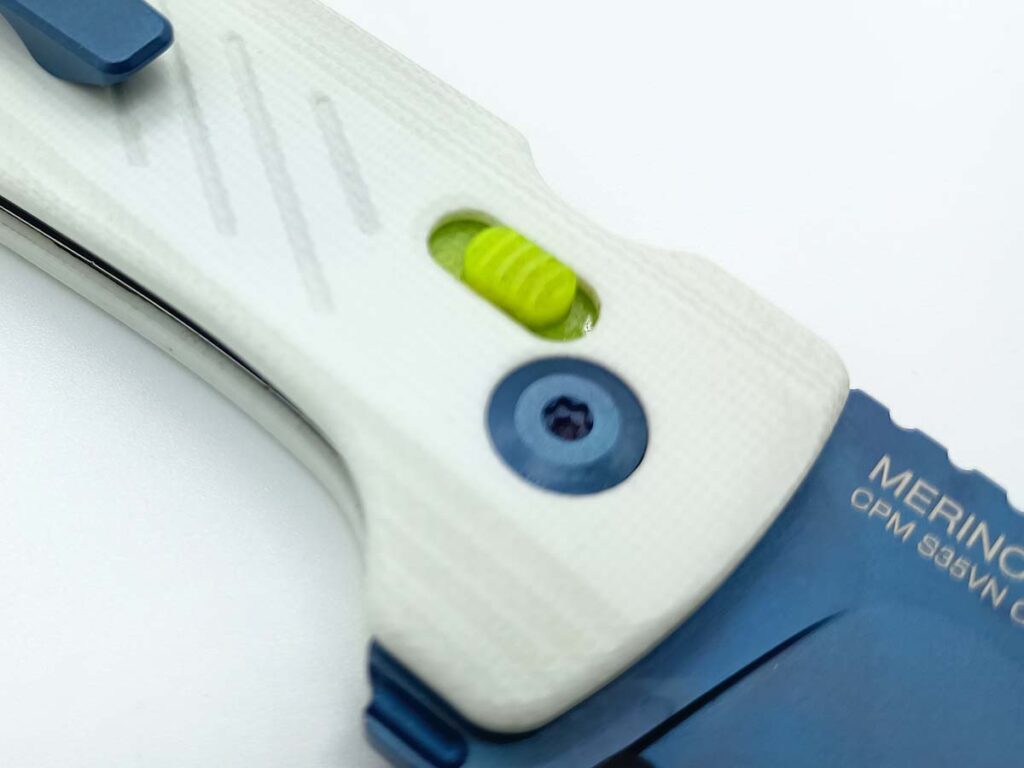
An axis lock, the Merino is ambidextrous and quick to deploy.
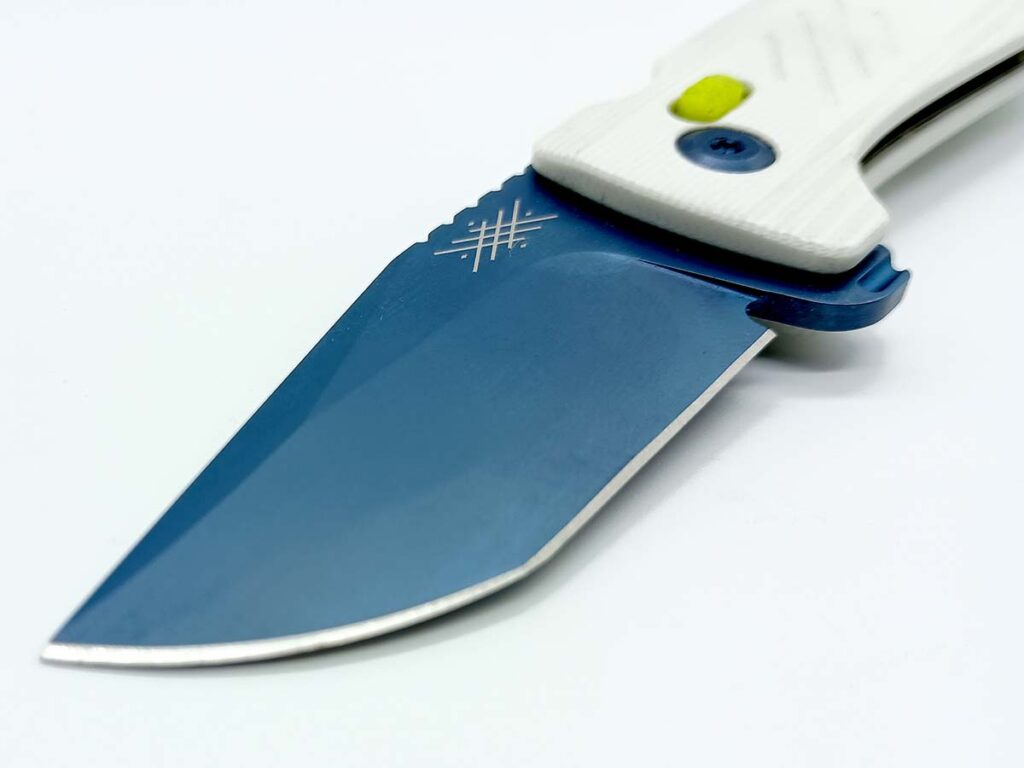
Here’s where I really like the Merino, and not simply because I’m a sucker for a clip point blade. And Pepperwool has included a dandy version on the knife with a generous upper blade a belly.
Given that the knife is natural to choke up onto the blade, it arms users with a very controllable slicing edge for very fine tasks. Still, if you need a straight edge for push or pull cuts, the Merino’s lower edge has a surprising amount of real estate.
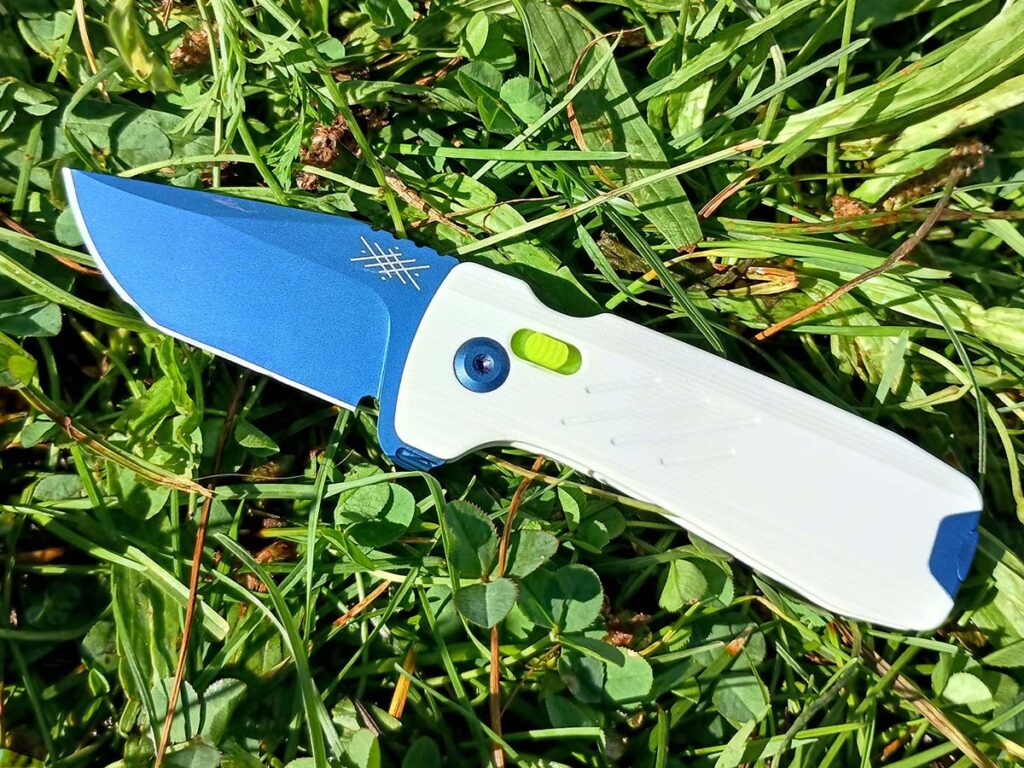
Worth noting, Pepperwool finishes the blade with titanium nitride for an extra level of corrosion and wear resistance. As a bonus, the ceramic is a very attractive cobalt blue for added panache.
Merino MM Handle
It’s tough to go wrong with G10 for a knife handle—the stuff just seems made for the job. And it’s welcome on the Merino.
Since there isn’t a lot of knife to grip onto, the well-textured material gives the user a strong purchase on the tool. Furthermore, it’s slightly off-white, which matches up well with the blue blade—simply in the looks department.
Chamfered, the G10 also ensures there are no hotspots when the knife is in hand. This surprised me a bit, given the grip is boxy in geometry, which usually spells at least one edge that bites into your hand.
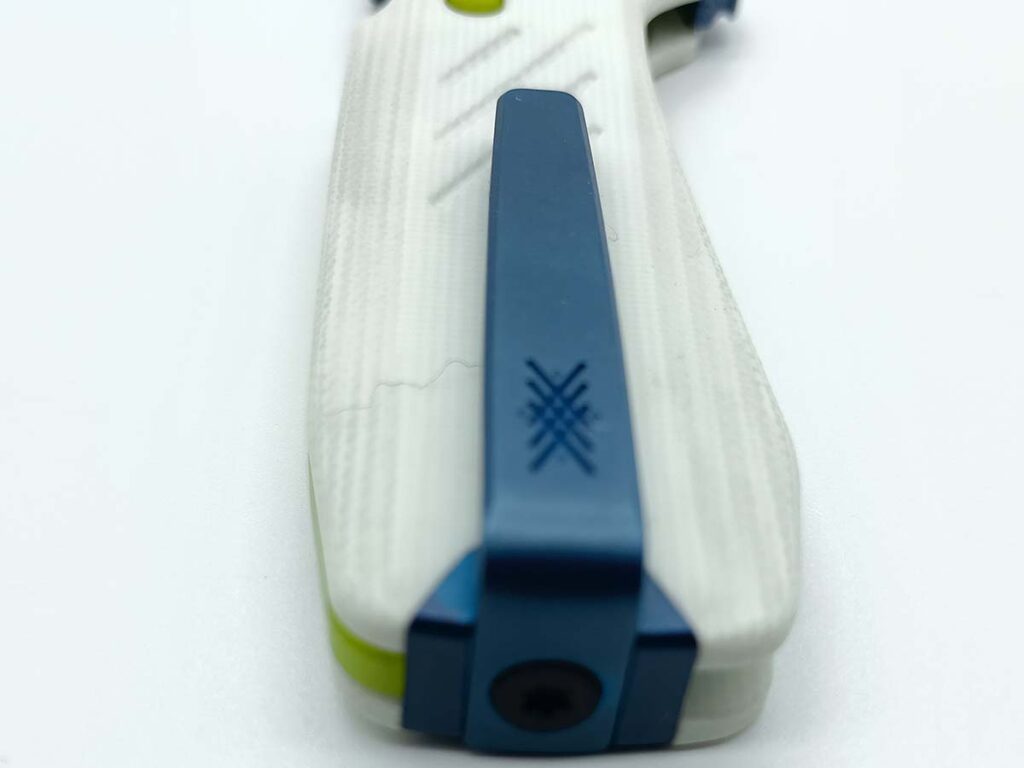
Topping everything off is a very sturdy pocket clip, also finished in dark blue. It sits level with the butt of the Marino, but is designed to sink the entire knife into your pocket, sight unseen. By the way, it is reversible from a single set screw, but the knife is strictly a tip-up carry affair.
Merino MM Lock
The pocket clip is very attractive. Good thing, because in the pocket it the only thing you’ll see on the knife.
This might be the belle of the ball on the knife, at least from a practicality standpoint. The axis lock isn’t anything new, but the convenience of the lock is ideal for an EDC knife. First off, it offers a quick opening and closing system to get the blade in or out of play. But more importantly, the lock makes the knife truly ambidextrous—a boon for lefties.
Testing The Merino MM
I didn’t set a challenge course of tasks for the Merino to accomplish in putting it through the wringer. Instead, for roughly two months of this summer, it was my go-to hiking and fishing knife—roles I’m certain Pepperwool figured it’d fill.
In this time, I used the knife for everything from cutting nylon cord and fishing line to prying open a paint can and, on one occasion, shaving feather sticks. On all counts, the knife proved its mettle.
The knife came sharp and until the latter part of the second month, only required the lightest touch-up to hone its edge. The blade was especially adept at finer tasks—such as trimming tags on hair rigs.
Admittedly, the handle is terse—my pinky hangs off—but with a nice tapper toward the guard, I always felt I had full control of the blade. And the action on deployment is effortless, but limited. For me, it’s always an index-finger affair; the one time I attempted with my thumb, it poked into my ring finger, due to the knife’s small size.
The knife is a solid choice for most outdoor adventures, particularly where weight might be an issue.
The best aspect of the knife, from my time with it, is that it’s absolutely a second thought to carry. Tucked away in the hip pocket, the Merino is easy to forget about given its size, and I did on more than one occasion.
The Merino MM certainly isn’t a first choice for more heavy-duty endeavors—it isn’t a bushcrafter by any stretch of the imagination. But as a piece of lightweight kit, exactly what I used it for—hiking, fishing, camping—it definitely has an edge.
Is there anything I dislike about the knife? Yes, I don’t care for the fluorescent green on the lock and liner, but that’s an eye-of-the-beholder deal. And it’s not a make-or-break feature of the knife.
Final Cut
Pepperwool’s aim was a knife you have no second thoughts about carrying. With style, function and convenience, the Merino MM scores on all points. And, I’d say it’s scored big enough that it’d make many question if it’s time to go small on their EDC.
Check Out More Outdoor Knives:
BEST TOMAHAWKS: OUR TOP HAWKS FOR BACKWOODS TO BATTLEFIELDS
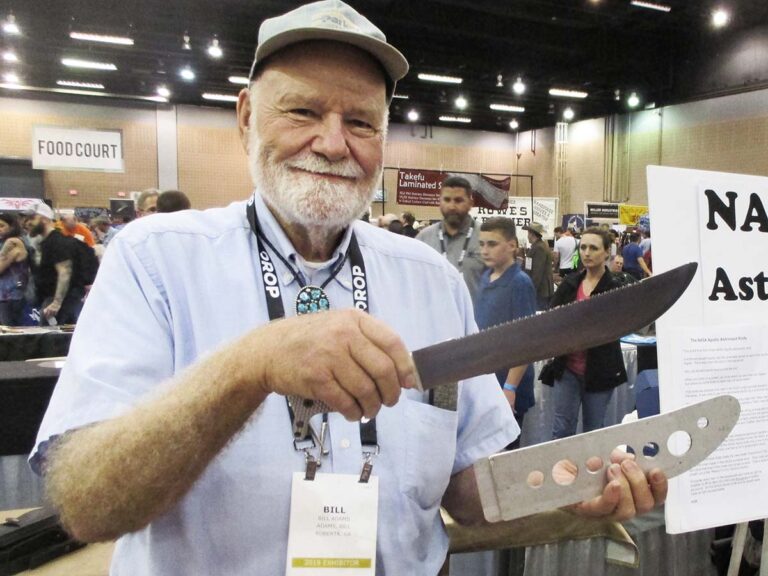
William “Bill” Adams was a revered knife entrepreneur, author and Cutlery Hall-of-Fame member. Learn about his immense impact on the knife community.
William Calhoun “Bill” Adams, knife entrepreneur, defender of all things knife, BLADE Magazine Cutlery Hall-of-Fame® member and invaluable friend of the knife community, passed away August 10. He was 87.
Known for his easy smile, snow white beard and amiable North Georgia drawl, Bill was liked and admired by many in the industry. He founded Atlanta Cutlery and, with Hank Reinhardt, co-founded Museum Replicas, both in Conyers, Georgia. Bill’s retail operations required him to travel the globe in search of the finest knives, swords and accouterments, including England, Ireland, Africa, India, parts of Central and South America, and all over the USA.
He served as president of the Antique Bowie Knife Association and helped found the Military Equipment and Weapons Collectors Association. He also helped found the Cutlery Collectors Legislative Committee, aka the CCLC, forerunner to today’s two leading pro-knife-legislation groups, Knife Rights and the American Knife & Tool Institute. In 1995, Bill was inducted into the Cutlery Hall of Fame.
He was a knowledgeable, gifted author, editing Sheffield Exhibition Knives and co-writing The Antique Bowie Knife Book, both of which are go-to guides for fans and aficionados of vintage Sheffield-made and antique bowies, respectively. He also was a dedicated knife collector, winning several awards for his wide-ranging collections at the BLADE Show. He retired to Roberta, Georgia, to live along the Flint River, where he enjoyed a quiet, peaceful and happy life.
He is survived by his sister-in-law Dee Anne Adams, his nephew David A. Adams and wife Cheryl, and dear friend and travel partner Elaine Barnes. The family wishes to express its thanks to Bill’s Roberta, Georgia, friends, especially Charles and Kate Rice, who cared for and treated him like family.
Remembering Others The Knife Industry Has Lost:
Betty Dowell, Driving Force Behind Knifemaker Ted Dowell, Passes
B. R. Hughes, Pioneering Writer And Bladesmithing Teacher, Passes Away
From razor-thin slicers to heavy-duty choppers, here’s how edge geometry and grind thickness impact real hunting performance—and what makes the perfect hunting knife.
Whether it’s a secret lure, special scent, backwoods honey hole, a custom-tuned call, or even camo boxers or lucky socks, all hunters have some kind of secret weapon, superstition or technique that they believe will give them an edge over their quarry. But when it comes to the actual edge—the blade of your knife—are you that particular? Are you that picky, that much caught up in hype or that much committed to tradition? Let’s explore the “hunter’s edge” as we consider what kind of grind and edge geometry makes a so-called perfect hunting knife.
Hunting is a game of tradeoffs. If you hunt the field, you can’t hunt the hill. You may be stuck at work on the nice weather days and sitting in the trees in the rain on Saturday. You may sit one time and kill a record buck, or you may sit all season and not see a single “shooter.” There’s seldom a way you can have it all at the same time.
Sojourn by Alex Harrison of Night Watch Knives features a blade of CPM 154 stainless in a blackened War Wash finish. The handle is textured, blasted G-10 with black liners and hollow pins. Guard: nickel. Construction: tapered tang. Overall length: 8 inches. Blade grind: hollow. Edge thickness: .010 inch. Alex said the ligature notch is meant to be a safe way to conduct an aggressive gross motor skills reverse cut and sever a ligature under tension. His price for a similar knife: $500.
The hunter’s knife is no different. In general, “small game, small knife, large game, large knife” holds true, but what characteristics make it so? A big knife can be an advantage or a small knife can be sufficient, depending on whether you’re hunting whitetails in Saskatchewan or Texas. Do you want to use the same knife for wild pigs and moose?
Hunters want a knife that will stay with them through thick and thin. But should the knife’s edge be thick or thin? I have hunted and harvested game since I was a boy, but it was not until I was nearly 40 that I put a caliper to a knife edge. A knife just was, an omnipresent tool taken for granted. Some worked better than others, though I had never thought about why it was that way. Let’s talk a little about edge thickness and numbers.
Optimal Hunting Knife Edge
An experienced hunter may want a knife to chop trails and trim brush, do camp chores or fire-building tasks, or split a deer’s pelvis or sternum. Those tasks lend themselves to a larger, heavier knife with a thicker edge. The heavy-use knife may be 10 or 11 inches overall of 3/16-inch-thick steel and maybe forty thousandths (.040) of an inch or more behind the edge.
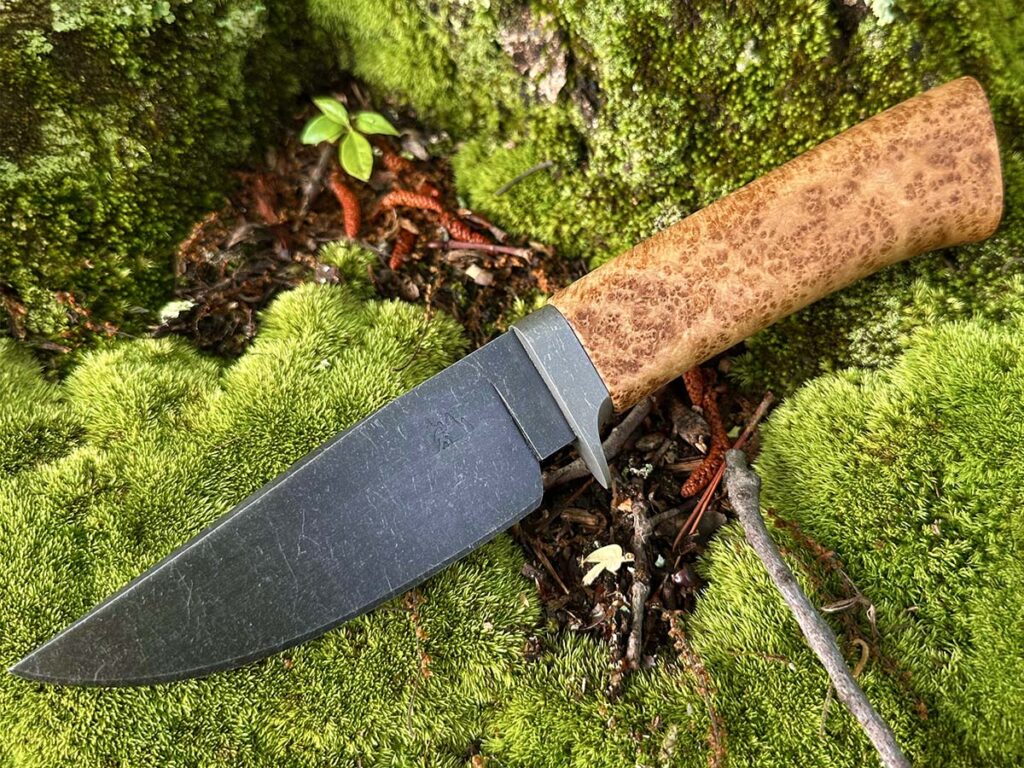
A 4-inch blade of 8670 carbon steel in a stonewashed finish and a maple burl handle help complete the Wagu Cattleman by Guild probationary member Chip Carlisle of Skjeggmenn Knives. Handle: maple burl. Overall length: 9.5 inches. Blade grind: full-height flat. Edge thickness: .020 inch. His price for a similar knife: $400.
The grind is more likely to be full flat with a convex edge, or even full convex. The tradeoff is no matter how sharp such a knife gets, it won’t excel at fine work like making the initial cuts through fur or opening the abdomen. It’s not impossible to field dress a deer with a thick-edged knife, it’s just a bit more difficult.
Another hunter of equal skill may carry his knife on his belt or in her pack, only taking it out for the finer tasks of skinning, quartering and deboning. Such a knife could be as little as 3/32 inch thick and as short as 7.5 inches overall. The grind could be full flat or hollow, and somewhere in the 15-to-20 thousandths (.015-to-.020)-of-an-inch-thick-range, or even thinner.
If you use a caliper, you’ll need one that measures down to the thousandths-of-an-inch level.
On a small knife, you may not have the handle or blade length to give you the leverage you want to easily split the sternum on an elk. No matter how sharp the small knife is, it won’t excel at chopping or tasks that require leverage. It’s presumably not impossible to field dress a grizzly bear with a small, thin knife, it’s just a bit more difficult at some points in the process.
My “eyecrometer” doesn’t measure very precisely. As a simple frame of reference, 10 pages of BLADE® are roughly .020-inch thick. If you use a caliper, you’ll need one that measures down to the .001 (thousandths)-of-an-inch level.
Well, that was a nice theoretical discussion. Now let’s look at some concrete examples.
Different Hunting Knives
I asked a group of knifemakers to send me examples of knives that fit the hunting knife description. I was part of the judging panel for the Knifemakers’ Guild awards at the BLADE Show and got the chance to handle a wonderful knife from Guild voting member Alex Harrison of Night Watch Knives. Of all the knives in the judging, this one really spoke to me as an excellent hunting knife.
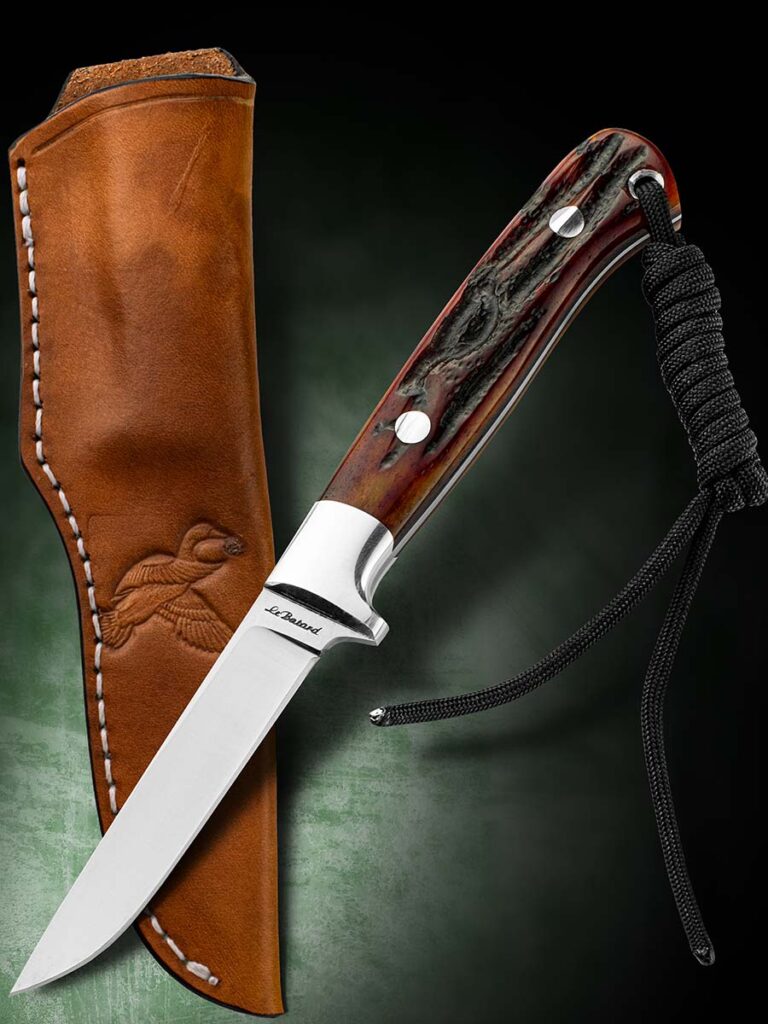
Field and Stream by newly elected Knifemakers’ Guild board member Paul LeBatard boasts a 3.5-inch blade of CPM 154 stainless and jigged bone scales. Overall length: 7.75 inches. Blade grind: hollow. Edge thickness: .020 inch. His price for a similar knife: $400. (Jocelyn Frasier image)
First, there are the intentionally muted textures and tones. It’s all dark, rough and tough, and even the bright orange G-10 has subtlety from the combination of the ground-in divots and blasted grain of the material. Next, the shape was pleasant in the hand and the blade was all business. At first glance it’s a fairly standard drop point but it has all the small details: the short-serrated section near the ricasso, the swedged point, the ground edge at the top of the point. Underneath it all, the hollow grinds are simultaneously effective and pleasing to the eye.
“This knife is hollow ground, probably ‘ten thou’ behind the edge. That’s the sweet spot for me,” Alex explained. “Everyone loves a razor blade but people do stupid [stuff] with their knives, and even skilled users aren’t always gentle. I often have requests for serrations for game processing, so I taught myself how to grind them in such a way that they still slice paper.” I dare you to try to slice paper with the serrations on the standard big-box store hunter! Added Alex, “The ligature notch is meant to be a safe way to conduct an aggressive gross motor skills reverse cut and sever a ligature under tension.”
Guild probationary member Chip Carlisle’s take on a hunter is a bit bigger, a bit beefier and a bit more traditional. The Wagu Cattleman from Chip’s Skjeggmenn Knives is 9.5 inches overall with a 4-inch blade of 3/16-inch-thick stonewashed 8670 carbon steel. A precise, full-height flat grind comes to a thin .020-inch edge. The clip point is swedged, giving the blade a sleeker look than its height would automatically provide. Carlisle said the knife “delivers uncompromising performance where it matters most—at the edge of work and wilderness.”
All hunters have some kind of secret weapon, superstition or technique they believe will give them an edge over their quarry.
Newly elected Guild board member Paul LeBatard executes the traditional hunter with modern materials and an eye for precision. The 3.5-inch blade of his Field and Stream model is 3/32-inch stock hollow ground on a 12-inch wheel to an edge thickness of .020 inch. Overall length: 7.75 inches. The same design comes in two larger sizes called the Personal and Personal Plus. The profile reminds me of the old Case and Western hunters from years past.
Critiquing Work
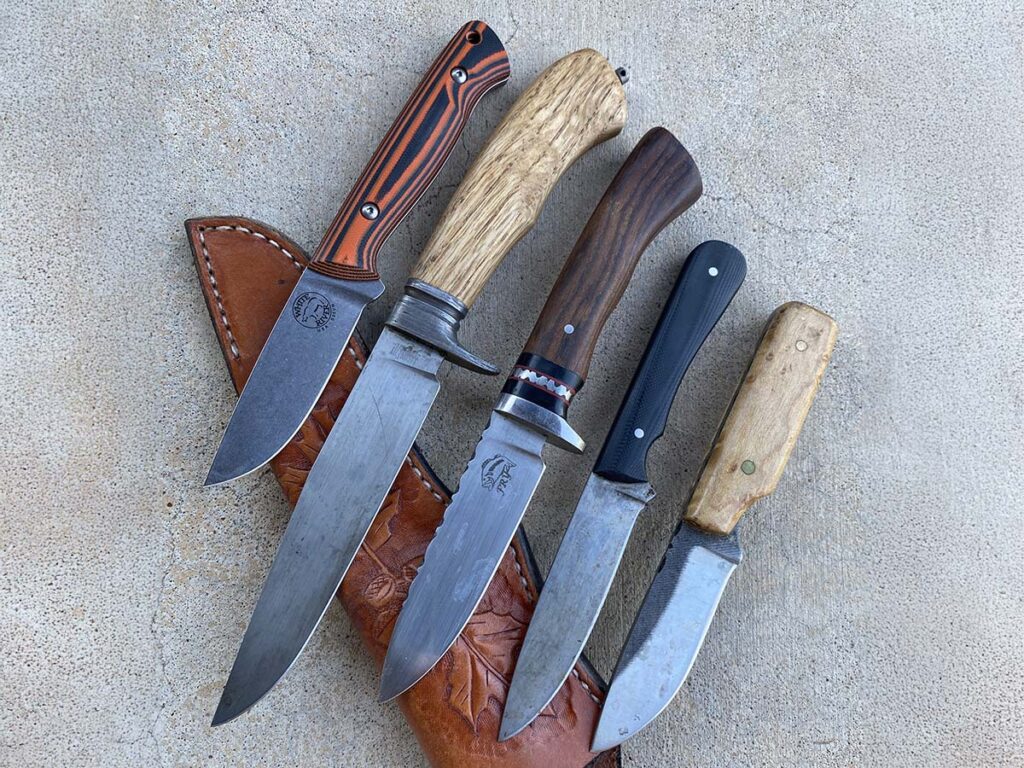
Knives the author has designed and/or made over the years, from left: his Jason Fry Hunter for White River Knife & Tool; his first real forged knife; the 100th knife he ever made, circa 2010; the 50th knife he ever made; and his first-ever knife, the Deer Disassembly Device, aka Triple D. For the knives’ grinds, edge thicknesses and other specs, see the story.
One of the unspoken rules of the knifemaking world is to not offer unsolicited criticism of another maker’s work. Now that I’ve put that rule in writing, I’ll be consistent and point out some flaws in some of my own early work to illustrate some points of error to look for.
At far right in the accompanying image (above) of my five knives is the first knife I ever made, stock removal from a file, that I enthusiastically called the Triple D for Deer Disassembly Device. I was a bit delusional. Although I’ve processed many deer with this knife, the handle is too short for the blade, which causes problems with leverage while splitting the sternum. Also, the knife was made with files and sandpaper, not a grinder.
The original edge thickness was somewhere beyond .060 inch. Eventually, as my skills improved, I re-ground the knife a bit, pushing the edge back to a slightly more respectable .035 inch. The knife doesn’t slice well at all, mostly as a function of the thick geometry, but also of the shorter bevel grinds on thicker stock.
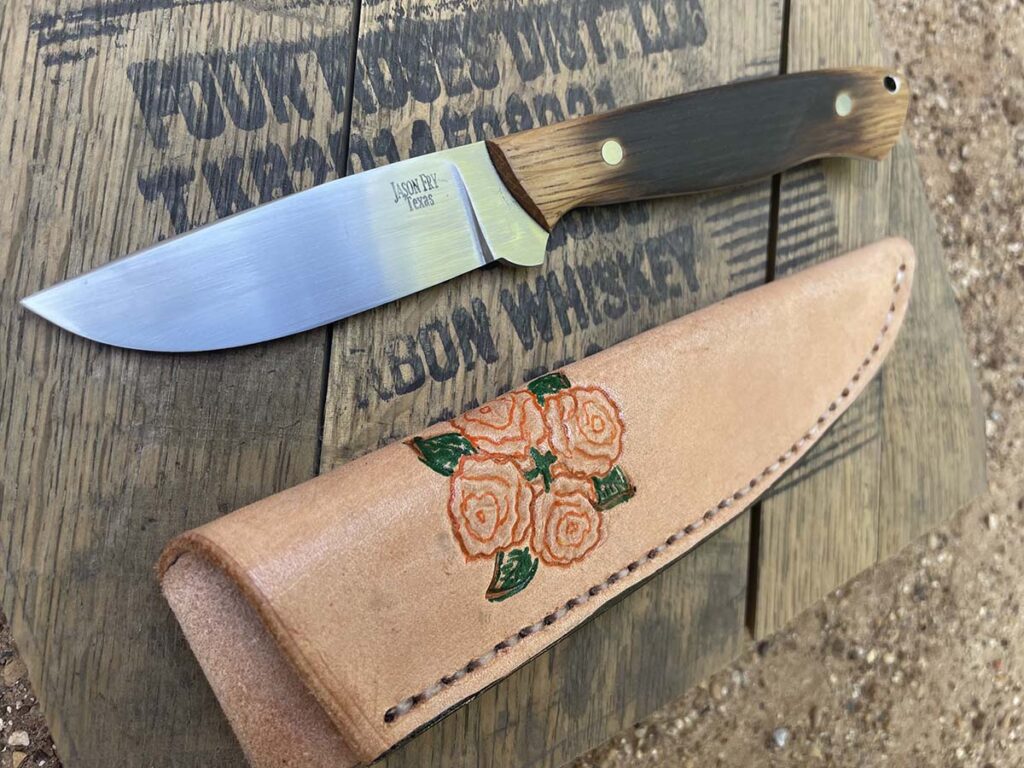
The author’s Four Roses sports a 3-inch blade of Nitro V stainless and scales from a Four Roses whiskey barrel. Construction: tapered tang. Overall length: 7.75 inches. Blade grind: flat. Edge thickness: .020. His price for a similar knife: $350.
Next from right in the image is my 50th knife, stock removal, ⅛-inch-thick 1084 carbon steel. This one also has handled its share of game. The edge thickness is .025 inch and works great but the handle is too thin. With ⅛-inch-thick steel and ⅛-inch-thick G-10 scales, there’s just not enough handle for my aging hands. The center knife is my 100th circa 2010.
I was into D2 and filework at the time, neither of which are particularly suited for a hunter, and the handle is fat and boxy. Next is my first real forged knife, from a drag harrow tooth from my grandfather’s ranch. The handle is 1955 white oak floorboards from my house at the time.
The knife is the best of those pictured in many ways, with a thin edge at .010 inch, a large enough handle, easily sharpenable steel, and a great story of how the original customer gave the knife back to me before he passed away. The full flat grind and distal taper make it a pleasure to use.
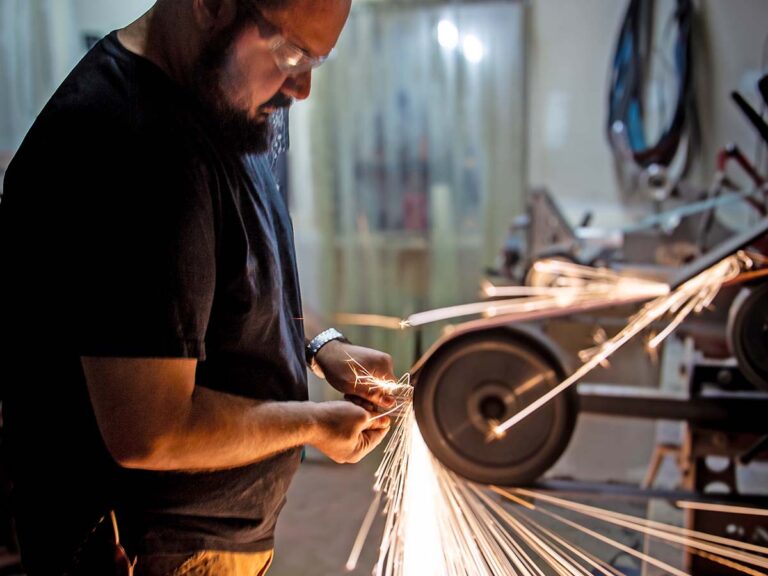
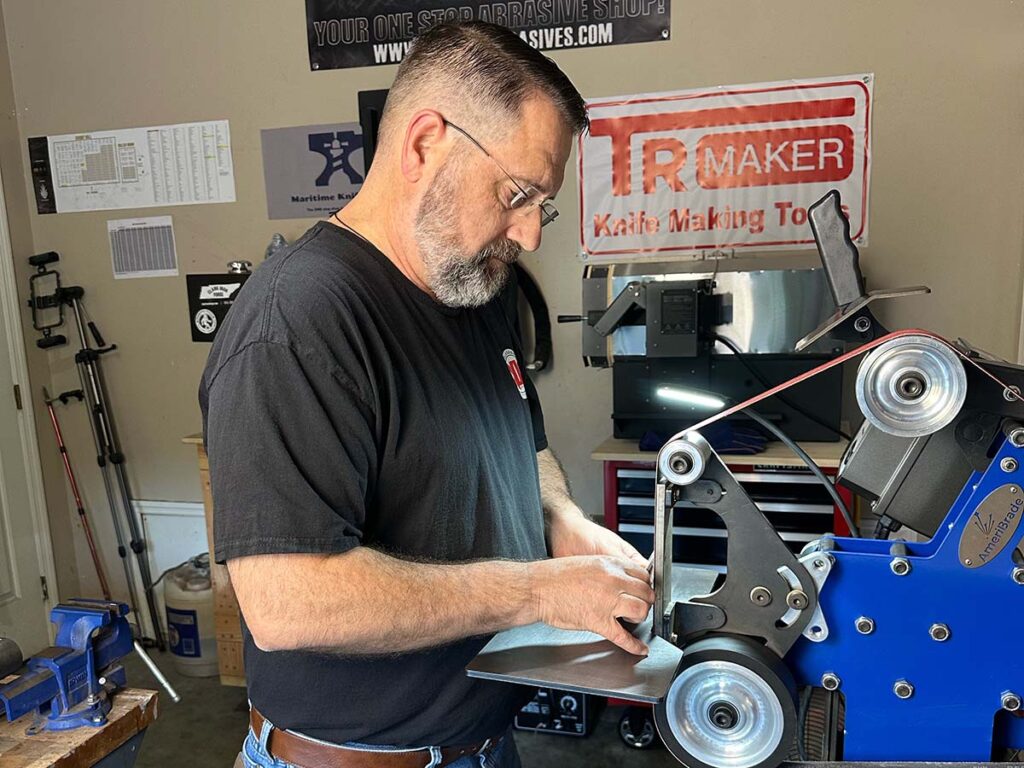
Chip Carlisle applies a flat blade grind using his belt grinder.
At far left in the picture is what I’ve settled on as my hunting knife of choice, the Jason Fry Hunter I designed for White River Knife & Tool in a full-flat-bevel-ground blade of S35VN stainless and black/orange G-10 scales. It’s just shy of 8 inches overall with a 3.5-inch blade. The handle length is enough to provide the necessary leverage, and the blade length is enough to do the cutting.
I’ve made this design for a decade by hand, both one-offs and small batches. For a general-use hunting knife for mass production, I wanted to split the difference between thin razor and beefy chopper. I specified the thickness at .020 inch and the White River guys nailed it.
The Perfect Hunting Knife
What makes the perfect hunting knife edge? It must be sharp. It has to be thin enough to slice fur yet burly enough to split a pelvis or sternum. It must have a handle big enough to provide leverage. It has to hold an edge through its primary tasks. Most of all, it must be with you when you hunt, an integral part of the package of secret weapons that set the hunter above the prey.
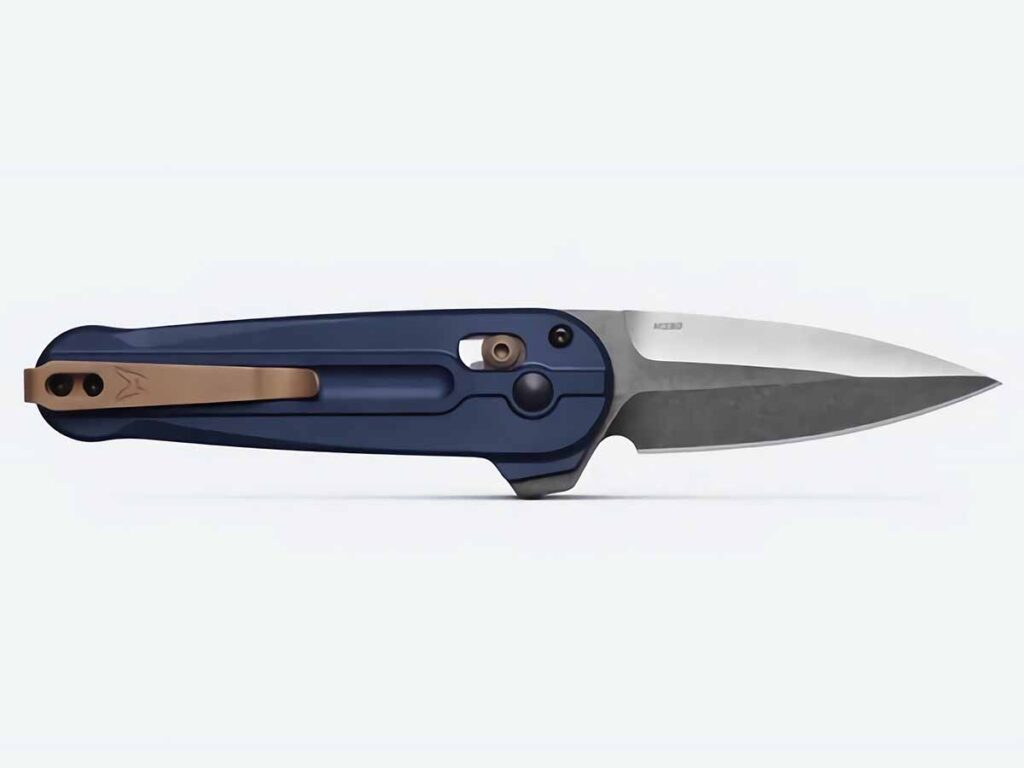
A bold new release from Benchmade, the Lowden blends premium materials, M390 steel, and fidget-worthy deployment in a sleek, spear-point EDC design.
Benchmade just shook things up with the release of the Lowden—and if you’re into flippers, this one’s going to catch your eye.
Known for their rock-solid AXIS lock and high-quality builds, Benchmade isn’t typically the first brand you think of when it comes to rear flippers. But the Lowden changes that.
This sleek little blade flips open like a dream. You’ve got the option of using the flipper tab or sticking with the tried-and-true AXIS lock for one-handed deployment, and both are smooth and snappy. It’s a fun, fidget-friendly knife that doesn’t compromise on function.
The Lowden sports a 2.79-inch spear-point blade made from M390 super steel—translation: this thing holds an edge like a champ, resists corrosion, and is tough enough for serious work.
The handles are lightweight anodized aluminum with a stainless-steel inset frame, giving it that slim, dagger-inspired profile without skimping on strength. Plus, Benchmade matched the color on the AXIS button and deep-carry pocket clip for a clean, cohesive look.
Sure, a spear-point blade might seem like an odd choice for EDC or outdoor use, but in practice, it works. It’s surprisingly versatile, with great piercing power and slicing ability. The ergonomics are solid too—with an ample handle fitting comfortably in a wide range of hand sizes and offers a confident grip.
Are there a couple of nitpicks? Sure.
There’s no lanyard hole, which could be a downside for folks who like a little extra security, and the flipper tab could use some jimping. But overall, the Lowden is a refined, premium knife that’s just plain enjoyable to carry and use—classic Benchmade quality with a fresh twist.



![Pepperwool Merino MM Review [Field Tested]](https://blademag.com/wp-content/uploads/Merino-2-768x579.jpg "Pepperwool Merino MM Review [Field Tested]")