Home Blog Page 4

Sharps Makers: New Knife Sharpeners & Maintenance Gear

0

Tools and accessories to keep your edge.

As with so many tools, knives require other tools to keep them up to snuff. A vicious cycle, to be sure, but one in the modern day has been simplified with innovation. Modern knife maintenance equipment is leaps and bounds beyond what it was a few short years ago. In turn, there is little excuse to pocket a dull blade or carry around a knife whose action is choked with lint and fouling. While the concept remains the same—a sharp and functional knife—we’ve gathered up some of the latest maintenance equipment designed to keep your blades edgy and acute.


Horl Rolling Sharpener
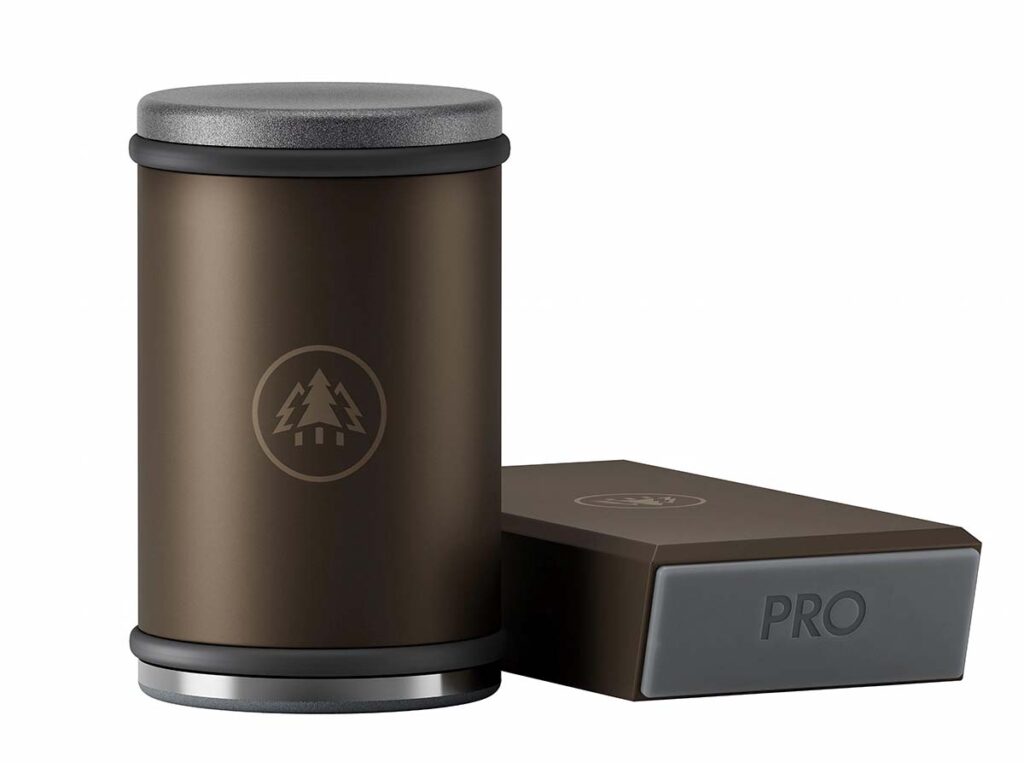
Horl Sharpener

ROLLING DEEP—Horl is shifting its popular rolling sharpener system up a gear with its most recent iteration. Underneath the hood, the Horl3 Pro features a planetary gear system, increasing the sharpening head’s rotation. Geared 1:3, the sharpener hones at a much faster rate than the company’s previous versions, cutting work time down. Further, the Pro is also more versatile, offering six sharpening angles—10, 13, 15, 20, 22 and 25 degrees—so you precisely match its acuteness to the knife you’re sharpening. The new Horl still has all the features that made the system all the rage in the first place, including quick-change heads, diamond sharpening disk, ceramic honing disk and magnetic angled holding pad. MSRP: $399


Hapstone Bench Stone
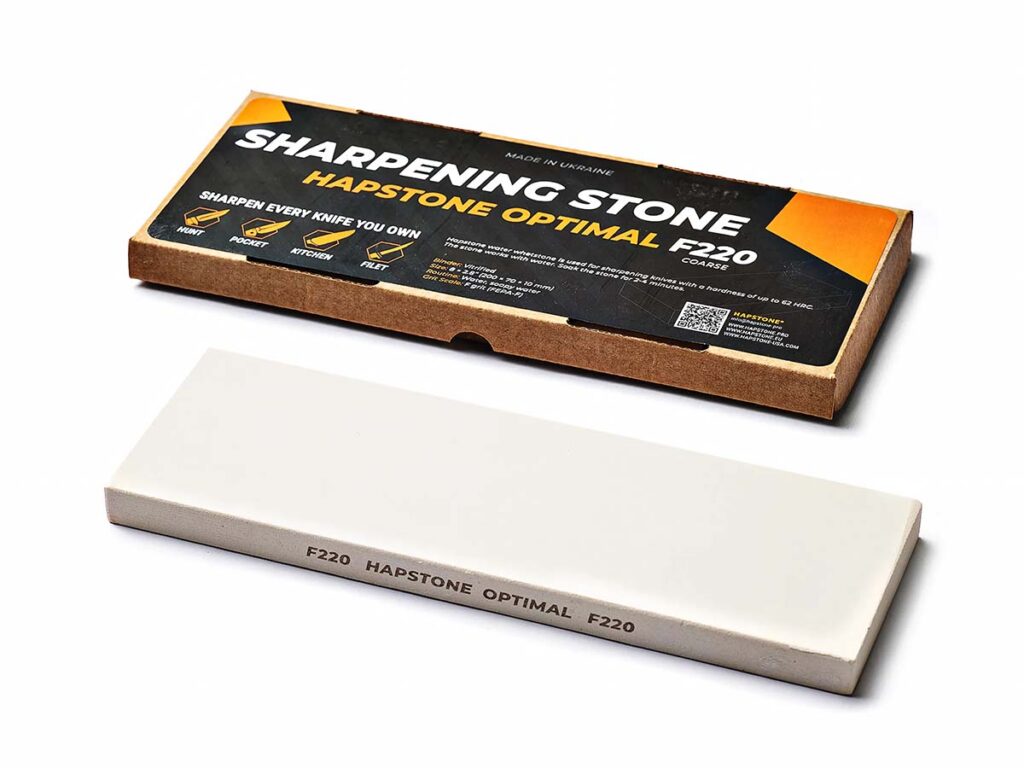
Hapstone Benchstone

STONE COLD—Freehand sharpening is an art, one that requires the right tools. Hapstone delivers with affordable and effective bench stones in its Optimal line. Made in the Ukraine, the stones are designed to hone steel with hardnesses up to 62 HRC, which covers most of the modern super steels. The 8×2.8-inch stones use aluminum oxide as the cutting medium and a vitrified binder, and the company pre-laps the stones to ensure a smooth working surface. Hapstone offers five grit sizes—220, 400, 500, 1000 and 1200—giving sharpeners the full course to re-form, sharpen and hone their edges. MSRP: $36-$44, depending on grit size


SharpeningSupplies.com Logbook
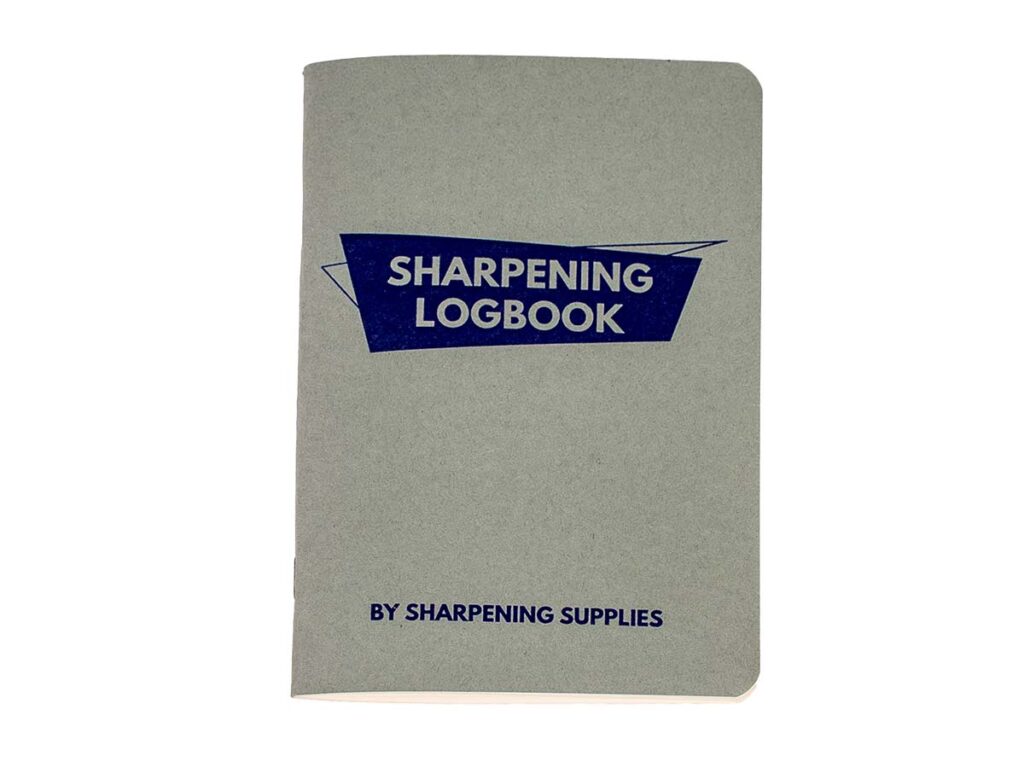
SharpeningSupplies.com Logbook

KEEPING TABS—If you’re serious about your knives and their upkeep, SharpeningSupplies.com cooked up an absolute must-have maintenance tool. Low-tech as it comes, the online retailer’s Sharpening Logbook helps you keep track of a ton of useful data on your sharpening sessions. Designed to document each knife’s session, there’s room to record knife and date specs, grits used, sharpening angle, edge condition, faults, sharpness before and after, personal notes and more. Additionally, the back of the book has some very useful guidance on sharpening in general. For those who are resolute about achieving and maintaining a pristine edge, this is the type of sharpening D.O.P.E. that proves vital. MSRP: $10


Edge Pro BevelTech
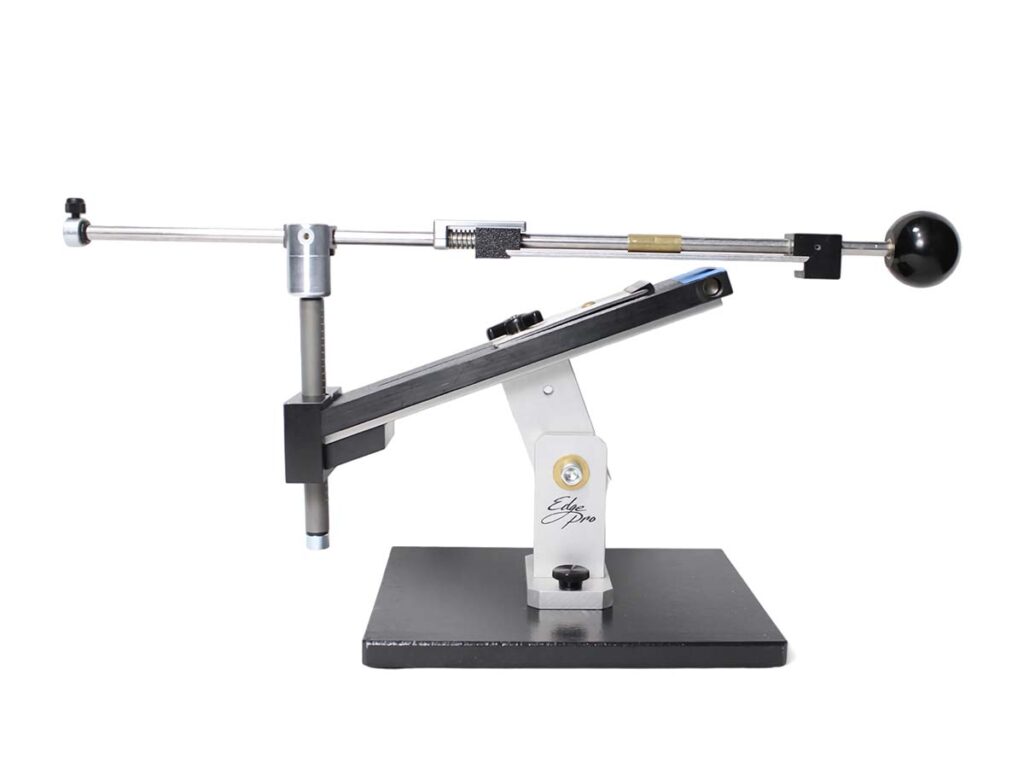
Edge Pro BevelTech

PROFESSIONAL DEGREE—Perhaps you run a sharpening business or maybe you simply take a professional approach to your sharpening projects. Either way, Edge Pro’s BevelTech system is tailored to the most exacting hone hounds in the knife world. Designed for installation in a workspace (though there are less-permanent mounting options), the all-metal angle-adjustable sharpener is designed for precision projects or high-volume honing. Features that should intrigue those undertaking either are an adjustable tilting retention surface, oversized ball grip on the sharpening arm, angle-gauge attachment point on the arm, laser-engraved angle-adjustment graduation and quick-attachment stone holders. Edge Pro offers four different tiers of its system, with more sharpening stones as you go up. But each is built around the base precision sharpener. MSRP: Starting at $435


Knafs Launchpad
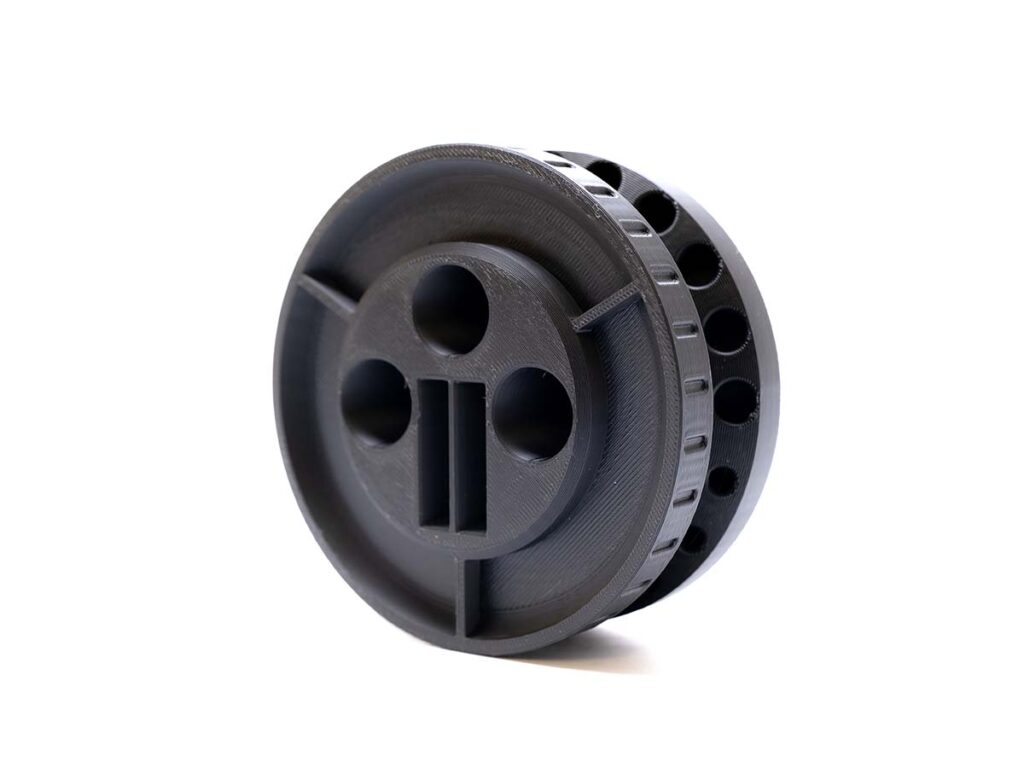
Knafs Launchpad

TO THE MOON—Since we talked about Knafs’ Bit Driver Grande in a bit, we’ll pitch an accessory for it that is well worth add to the cart with it—the Launchpad. Simply put, it’s a holding system for the driver, giving you an easy and organized place to hold the tool and a whole array of bits. Here’s the great thing about the 3D-printed accessory: you can spend a little coin and buy one from Knafs or—if you have a 3D printer—the company offers the files for free to print one at home. MSRP: $9


Work Sharp Guided Field Sharpener
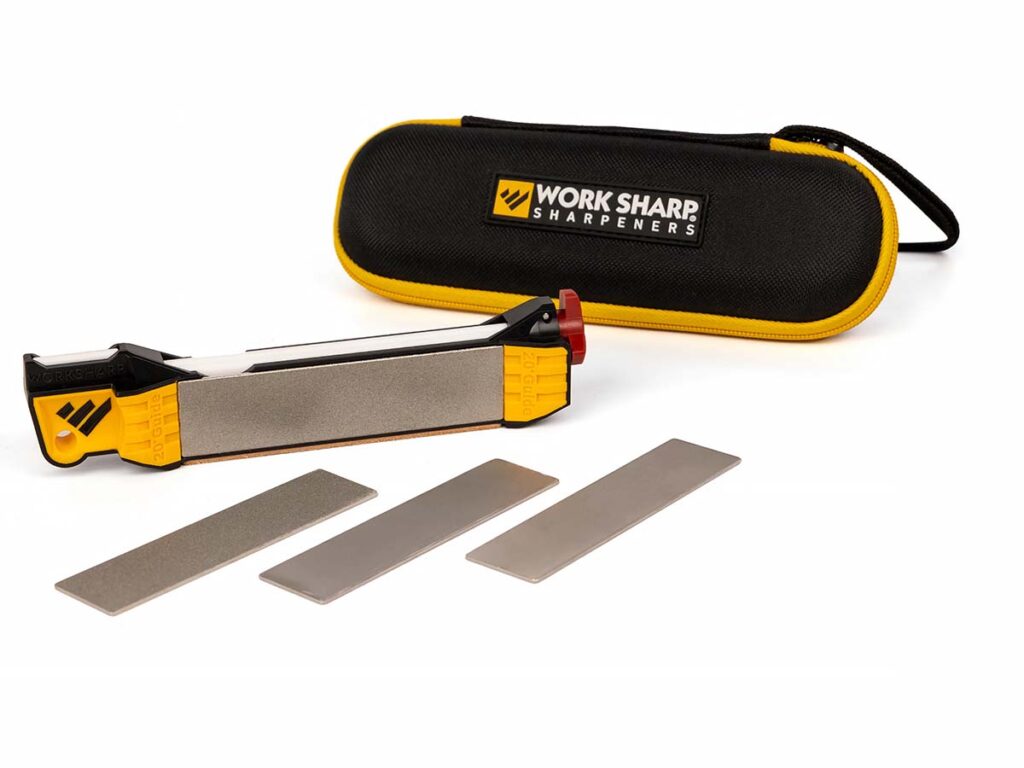
Work Sharp Guided Field Sharpener

EDGY ANYWHERE—Anyone who aims at recapturing a knife’s edge is likely familiar with Work Sharp’s standby Guided Field Sharpener. It’s been around for a hot minute, but never in what’s being offered now. The Guided Field Sharpener Elite offers complete angle-guided edge maintenance in a system that delivers it anywhere. Where Work Sharp has kicked it up a notch is the sharpening surfaces it includes in the kit, with the Elite coming with 220-, 400-, 600- and 800-grit diamond plates. That takes users from course to extra-fine and covers nearly every sharpening necessity you’re likely to encounter. Plus, Work Sharp throws in a handy zippered carrying case to keep everything organized. MSRP: $75


JRW + KPL Knife Maintenance Tray
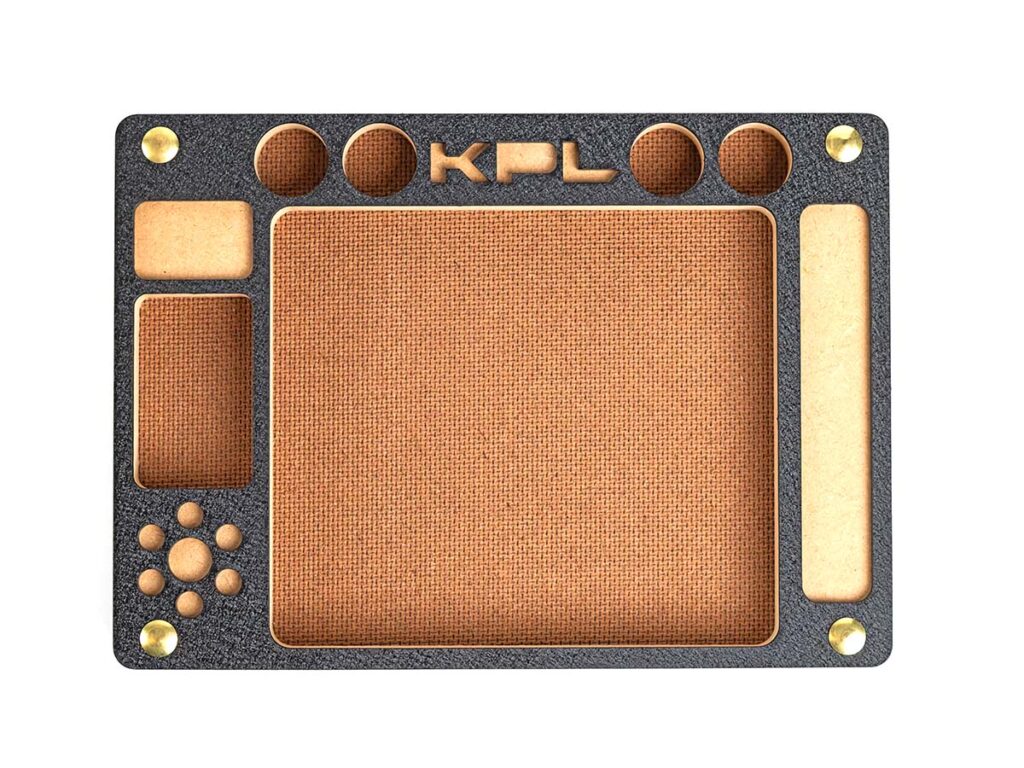
JRW + KPL Knife Maintenance Tray

TRAY CHIC—Keeping your workbench organized during a teardown is half the battle, and KPL has teamed up with the pocket-art wizards at JRW Gear to deliver a dedicated workspace solution. The JRW + KPL Knife Maintenance Tray is a premium, multi-layered, riveted storage platform precision-machined to house your entire maintenance arsenal. Designed with custom-bored pockets, it features dedicated slots for your lubes, detailing swabs, hardware and loose knife parts. It even includes a custom cutout perfectly sized for an oil-resistant JRW dump tray to catch small screws before they roll away. Finished with silicone rubber non-slip feet to keep the station securely anchored while you work, you have a steady place to get jobs done. MSRP: $135


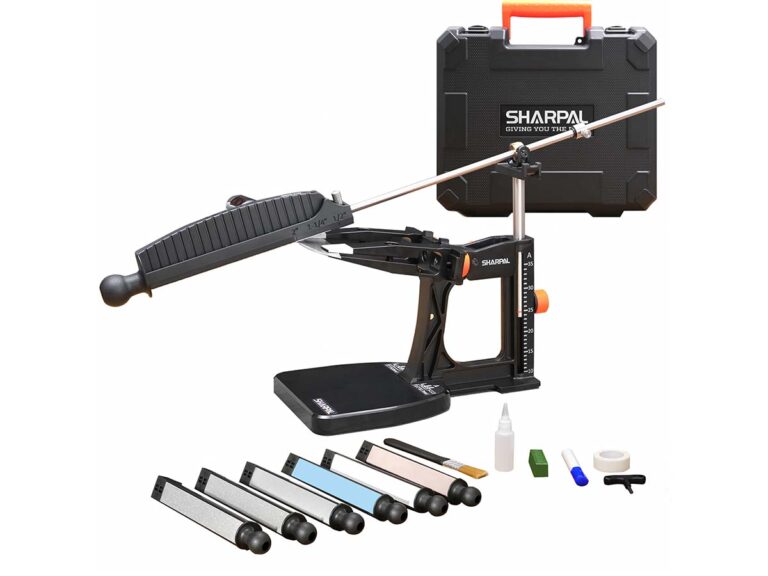
Sharpal 202H Adjustable Angle Sharpening System
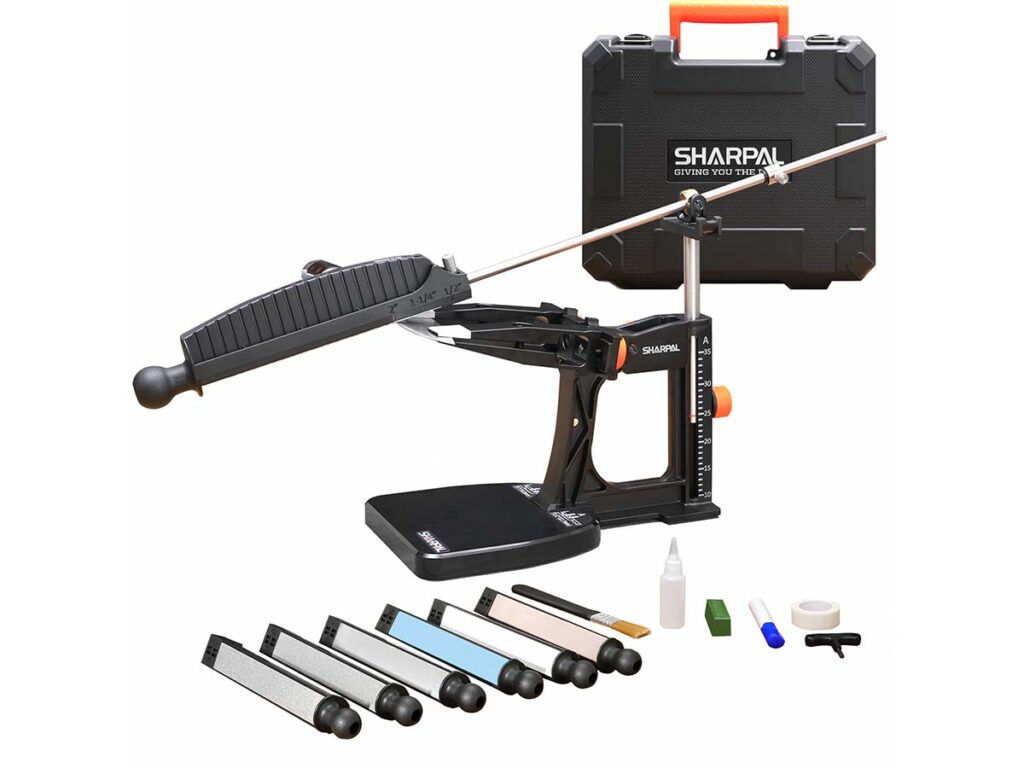
Sharpal 202H Adjustable Angle Sharpening System

ALL IN ONE—If you want a single setup that handles everything from total edge repair to a mirror polish, Sharpal has a comprehensive solution. The 202H Adjustable Angle Sharpening System is a seven-in-one kit built around a heavy-duty metal chassis and an anti-slip base. The heart of the system is its smooth angle adjustment, delivering a wide 10-to-35-degree range with precise 0.2-degree granularity. To guide your progress, the kit includes seven different 1×6-inch abrasive plates, starting with 220-, 325-, 600- and 1000-grit diamond surfaces. From there, 3000- and 6000-grit whetstones smooth out burrs before you finish on a leather strop with green compound. A reliable flip mechanism lets you work both sides evenly without losing your exact angle. MSRP: $180


Knafs Bit Driver Grande
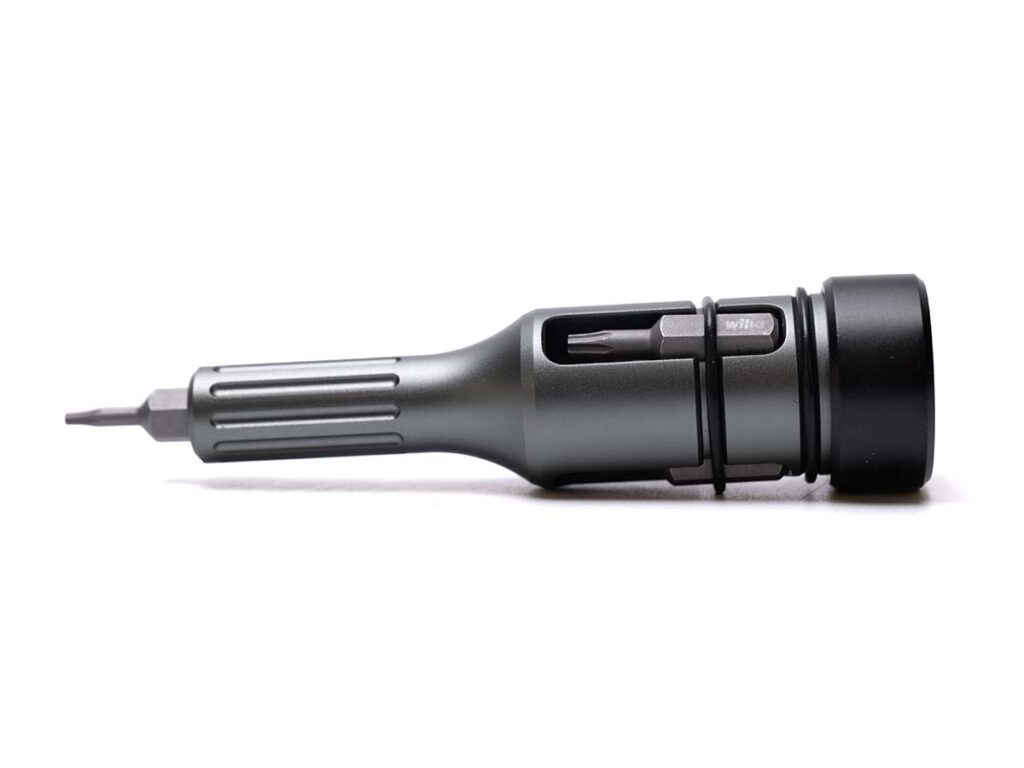
Knafs’ Bit Driver Grande

DRIVER’S SEAT—Man does not live by sharp edges alone. Sometimes there are screws to tighten and liners to swab clean. In these situations, a bit driver is the hero of the story and Knafs has a solid—not to mention manageable—option in its Grande. What’s to like about this self-contained system is that it’s the larger brother to its original driver, which, in turn, fits into the palm better to deliver more torque. At the same tick, it has an elongated neck, perfect for more control in precise operations. The tool comes with three Wiha Torx bits (T6, T8 and T10), has a spinning cap run on ceramic bearings and a body of durable, yet light, aluminum. MSRP: $38


Lansky 4-Rod Diamond/Ceramic TurnBox Crock Stick
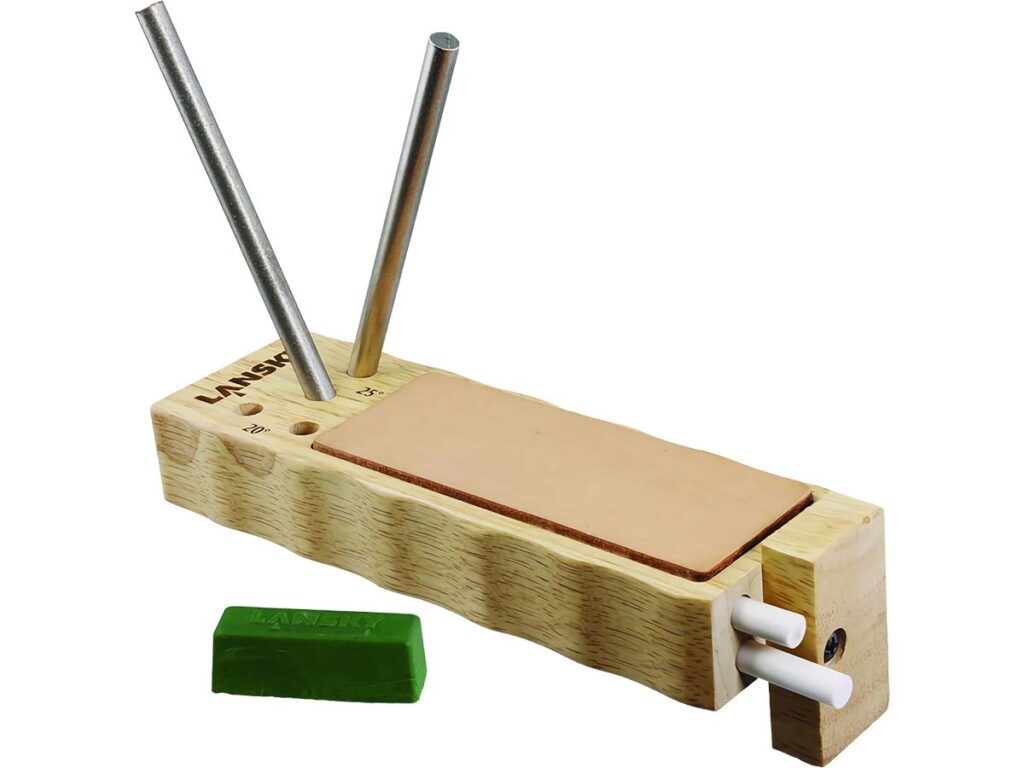
Lansky 4-Rod Diamond/Ceramic TurnBox Crock Stick

TURNING HEADS—Lansky is updating its classic V-rod format by packing an extra refinement stage into a highly portable layout. The latest 4-Rod Diamond/Ceramic TurnBox Crock Stick system features a compact hardwood block with integrated internal storage for the rods inside the base. Perfect for a kitchen drawer or a hunting pack, the system utilizes preset 20- and 25-degree angles to keep your bevel geometry completely consistent. The two-stage sharpening process leverages two 5-inch medium 400-grit diamond rods for rapid steel removal, followed by two 5-inch fine 1000-grit ceramic rods for daily touch-ups. Lansky then takes the system a step further by including a dedicated leather strop and polishing compound to deliver a true factory-level mirror edge. MSRP: $65


More On Sharpening:

First Look: Drop-Forged KA-BAR Elishewitz Pocket Tool

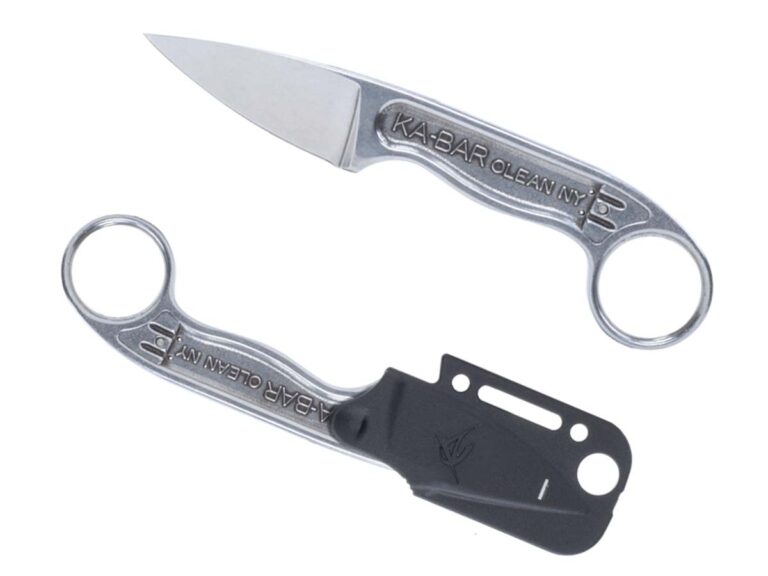
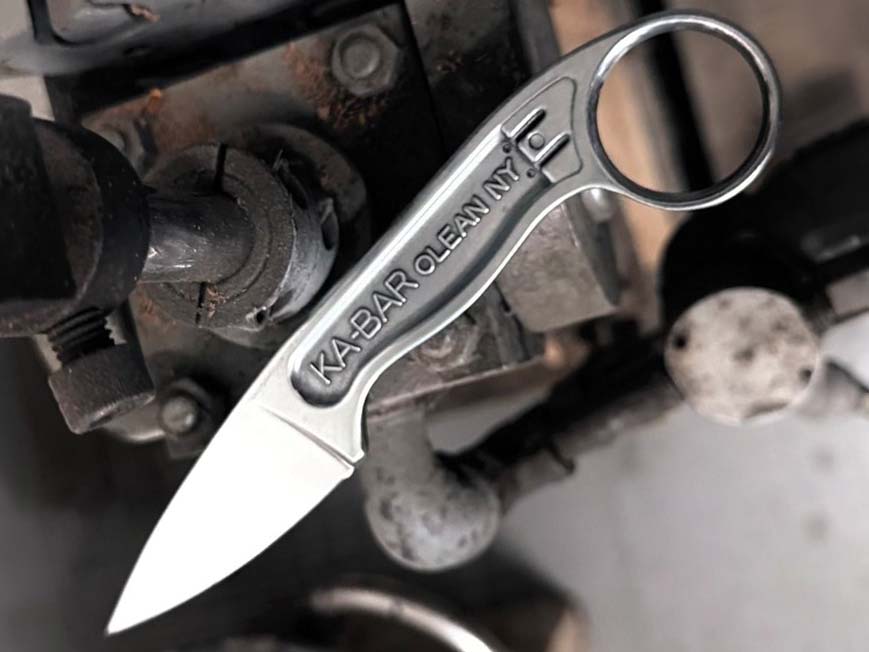
Designed by Allen Elishewitz, KA-BAR’s USA-made drop-forged EPT pairs a 2.5-inch blade with a clip-equipped sheath for easy pocket carry.

KA-BAR has expanded its line of drop-forged steel tools with the Elishewitz Pocket Tool, or EPT. Designed by veteran maker and former Force Recon Marine Allen Elishewitz, the compact fixed blade targets the growing daily carry market with a format tailored specifically for pocket carry rather than belt wear.

Built for Daily Duty

The EPT centers around a short, broad 2.5-inch drop-point blade ground flat to a 20-degree edge per side. KA-BAR crafts the knife from 0.1875-inch thick 425 high-carbon stainless steel, hardened to 56–58 HRC. The stout blade geometry offers plenty of strength for routine cutting tasks while keeping the overall footprint manageable.

Because the knife utilizes a one-piece drop-forged construction, the skeletonized handle is integral to the blade. A finger ring integrated into the butt end assists with control during use while serving as a quick-draw indexing point when pulling the knife from a pocket.

Pocket-Friendly Carry

Elishewitz Pocket Tool at work in profile.

Rather than relying on a traditional belt sheath, the EPT comes equipped with a custom USA-made sheath featuring a reversible, loop-over wire pocket clip. This setup allows the fixed blade to ride deep inside a pocket in much the same manner as a standard folding knife.

At 6.75 inches in overall length and weighing 3.2 ounces (0.2 lbs for the knife alone), the U.S.-manufactured piece delivers the structural integrity of a fixed blade without adding unnecessary bulk to a daily kit.

Elishewitz Pocket Tool (EPT) Specs
Designer: Allen Elishewitz
Overall Length: 6.75 in.
Blade Length: 2.50 in.
Blade Width: 1.70 in.
Blade Thickness: 0.1875 in.
Blade Steel: 425 High Carbon Stainless (56–58 HRC)
Blade Type/Grind: Drop Point, Flat Grind
Edge Angle: 20 degrees per side
Construction: Integral drop-forged 425 stainless steel
Weight: 3.2 oz. total (2.24 oz. knife weight)
Sheath: USA-made sheath with reversible wire pocket clip
MSRP: $78

Read More:

Portable Knife Sharpeners: Sharps On The Go

Three options to stay keen when you’re out and about.

Active lifestyles often need specialized tools. Out hiking, camping or hunting, a workbench instrument is out of place. This is especially true for one of the most vital pieces of knife kit—sharpeners.

In recent years, the market has trended toward larger bench-mounted sharpeners that, while dynamite at extracting a precise edge, are all but impractical in the field. Out and about, a solid portable sharpener is more than worth its weight in gold. Even better, for those who take a more minimalist approach to edge-maintenance equipment, most mobile sharpeners are more than capable of serving as primary tools for bringing a knife back to life.

Given this isn’t the time of Charlemagne, this class of sharpeners should have an angle guide integral to their design, eliminating guesswork. And since they’re less elaborate, portable sharpeners should be cost-effective, as well. You do not want to spend a ton on something that might be lost. Most of all, these options should prove easy to tote around, be it in a pocket, tool pouch, vehicle glove compartment, backpack or anywhere else you want to cram one.

There are plenty of portable sharpeners available today, but in our trials, we found the following a cut above the rest.

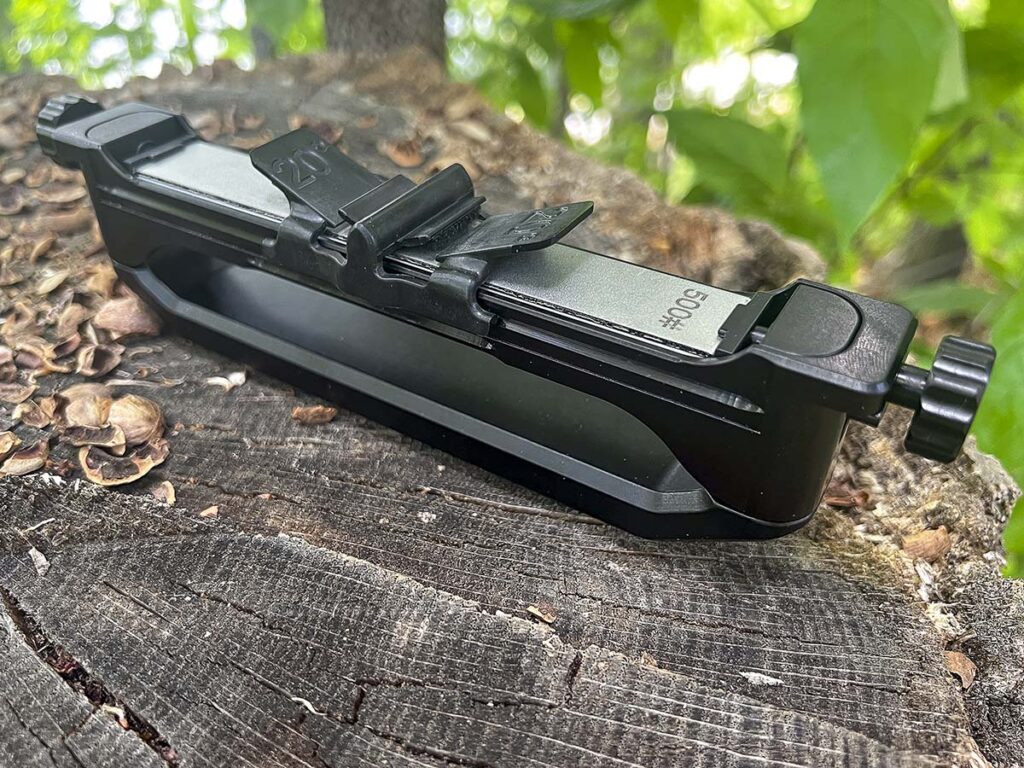
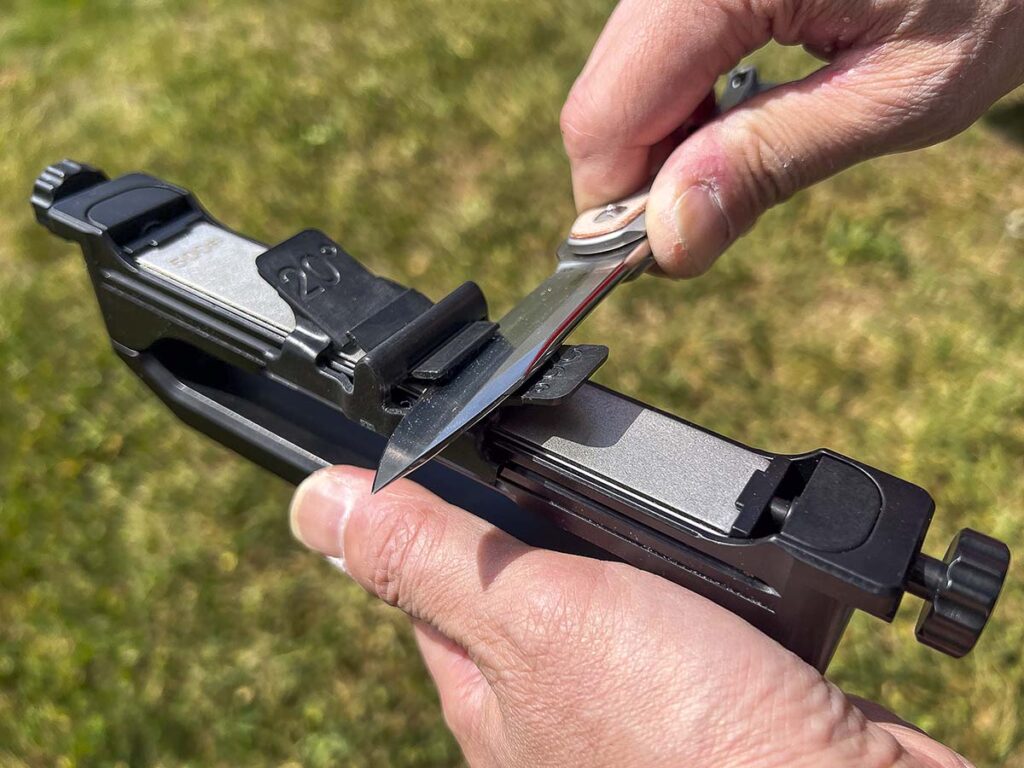
Wicked Edge Venture Pro WE26

The Wicked Edge Venture Pro features a movable 20-degree angle guide that helps to keep your angle consistent, so that even beginners can achieve desirable results. And while not quite pocket sized, the until is perfectly proportioned for sharpening on the go.

Wicked Edge, primarily known for its high-end guide-honing systems, has recently turned its discerning eye to mobile sharpening. The result is the Venture Pro WE26. While more compact than most everything else the company offers, it is no less effective.

Starting with the build quality, Wicked Edge has constructed a system built to last. The Venture Pro’s frame is sturdy T6-6061 aluminum alloy, keeping the unit relatively light, yet extremely durable. The company holds the system together with stainless steel screws and a tension spring. And the honing surface is a double-sided diamond-coated steel plate—if you drop one, you don’t have to sweat it shattering. A cam system holds it in place and allows a painless switch between sides and grit size—500-grit diamond and a fine-grit ceramic. A plus. Yet this is only part of the sharpener’s selling points.

What really grabs attention is that the Venture Pro is a railed angle guide. The system is slick, essentially allowing you to pull your knife through, while the guide maintains a consistent 20-degree angle over the entirety of the sharpening surface. This element of the system deserves mention in and of itself. It is molded from a thermoplastic blend of POM (Delrin) and PTFE (Teflon), the result is a slick surface that all but guarantees a smooth stroke on each pass. The guide is removable and has a storage position on the rear of the sharpener for easy storage in a more compact configuration. The final perk, the unit includes a leather strop and a built-in guide on the rear side, so you can hone a blade to a mirror finish.

The Venture Pro features both 500-grit diamond stone and ceramic honing surface, as well as a leather strop. Wicked Edge sells other grits and different angled guides, to tailor the system to your knives.

The Venture Pro definitely isn’t pocket-sized, but it is small enough to be considered portable. Its size is a plus in this respect; it’s large enough to tackle a wide range of knife types and sizes. I found the system easy to master over the course of several sharpening sessions with pocketknives, tactical folders, kitchen knives and even scissors. The routine is simple: place the blade into the guide as far up to the tang as possible, draw the knife through while moving forward and repeat on the other side. The angle guide slides so easily across the frame of the sharpener that it almost feels like it’s not even there.
 
Given that the 500-grit side is diamond, I did not have to apply a ton of pressure to achieve the desired results. And, if you’re sure of your freehand skills, the guide can be removed to speed up the process.

At home, at camp or anywhere, the Venture Pro works every time to provide you with a guaranteed sharp edge. As a bonus, several other plates with different grit sizes are available as well as different angle guides (15, 17 and 25 degrees), in case you have a particular system you want to adhere to. No matter what, this made-in-the-U.S.A. sharpener has an edge.

Venture Pro Specs
Frame Material: T6-6061 Aluminum Alloy
Sharpening Material: 500-grit diamond stone, ceramic hone and leather strop
Weight: 10 oz.
Sharpening Surface: 8.25”
Features: Continuous 20-degree angle guide, integral handle
Country Of Origin: U.S.A.
MSRP: $189

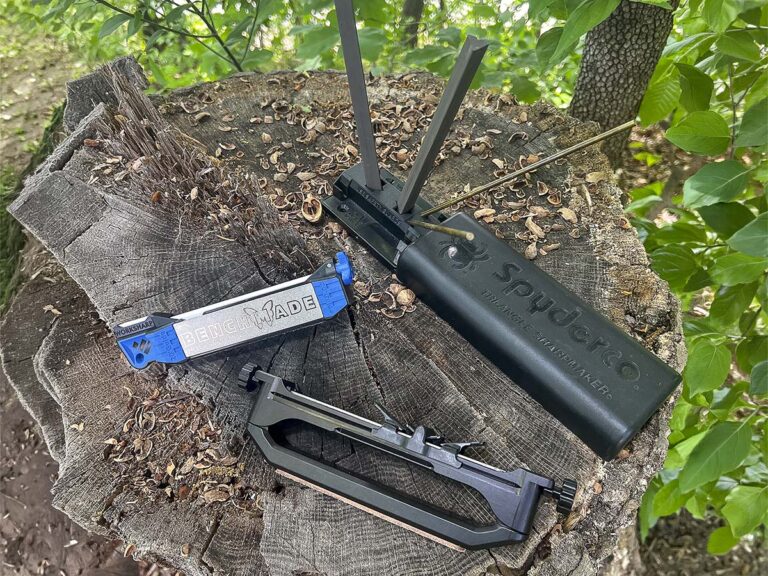
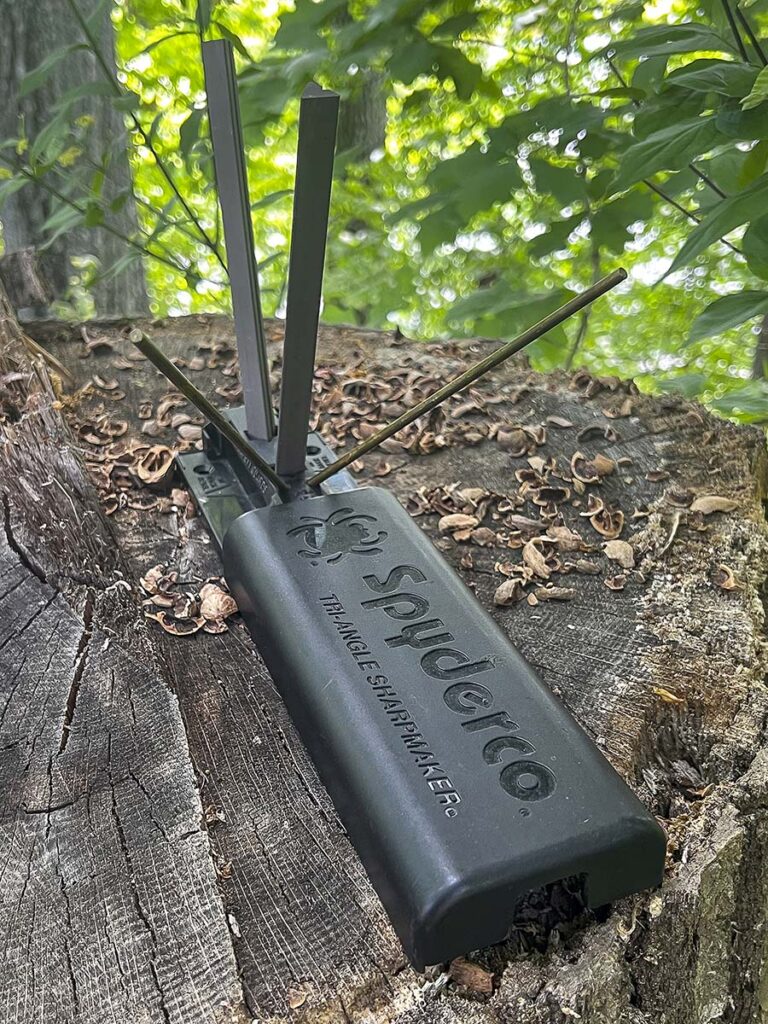
Spyderco Sharpmaker

Absolutely time tested, the Sharpmaker has been a honing mainstay for a spell—namely because it works so well. Very simple in design, the portable sharpener features course and fine grain sharpening rods that can be set for a 20-degree edge and simply requires a downward stroke to do their business.

Spyderco’s model 204 Sharpmaker is a versatile, made in the U.S.A. sharpener and could be a primary sharpener on its own. But it’s how it breaks down, with all its hones nestled in the base, and the cover snaps over all of it, fully encasing the stowed sharpener that makes it a top choice for a portable sharpener.  

The Sharpmaker utilizes two pairs of alumina ceramic rods—medium grit (brown) and fine grit (white)—held in the plastic base at a 20-degree angle, forming a “V” shape. The proper way to use this is to hold your knife to where the blade is perpendicular to the tabletop and then, starting at the blade tang end, place the blade onto the home and, in one motion, travel down the hone and at the same time pull the blade toward you. Gentle pressure is generally all that is required to achieve a sharp edge. As an added safety precaution, Spyderco includes two brass protection rods that prevent cutting your hand while holding the base.

The Sharpmaker’s design allows you to sharpen on any flat surface—tabletop, workbench, desk or even the tailgate of a pickup truck. Making the tool extremely convenient, the alumina ceramic rods do not require lubrication with oil or water. Though they do require occasional cleaning. The rods darken over time due to swarf collecting on the surface. Scotch-Brite pads and powder sink cleaner make quick work of this fouling and restore the sharpening surface. Another cool feature of the Sharpmaker is the two grooves on the bottom of the base. This allows you to set any two matching hones into the base, with their flat sides up for a makeshift bench stone.  

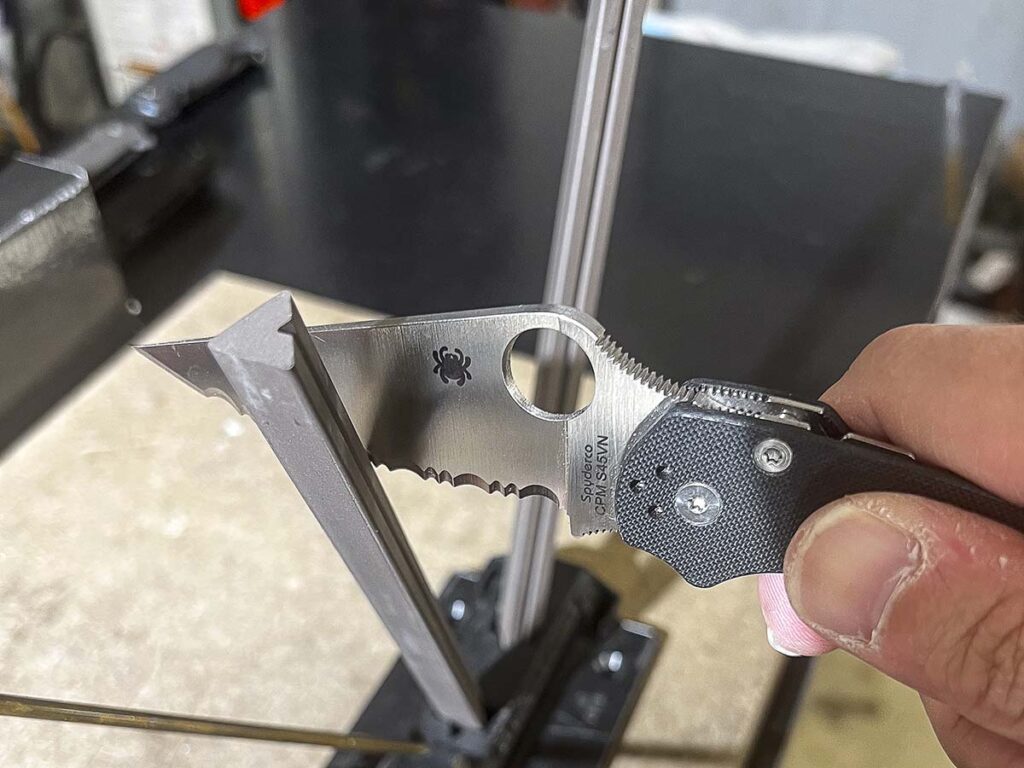
The Spyderco Sharpmaker 204 is the best sharpener to use with serrated knives, as it is easy to set up, easy to use and doesn't use oil or water for lubrication. The points of the triangular-shaped hones capture each tooth in the serration pattern effectively.
The Spyderco Sharpmaker 204 is the best sharpener to use with serrated knives, as it is easy to set up, easy to use and doesn’t use oil or water for lubrication. The points of the triangular-shaped hones capture each tooth in the serration pattern effectively.

The triangular shape of the hones was done on purpose and is a brilliant design. When you set up the honing where the flat sides face each other, the Sharpmaker effectively sharpens plain-edge blades. Rotate the hones so that the points face each other, and the Sharpmaker easily addresses serrated knives.

How well does the Sharpmaker work? Simply put—very well. It’s a must-have if you own any serrated knives, but as I said earlier, it will work just as well on plain-edge blades.  The sharpener is easy to set up and easy to use. There’s no mess since you don’t use fluid for lubrication, and it breaks down into an ultra-compact form factor that stows easily.  

Sharpmaker Specs
Frame Material: ABS plastic base
Sharpening Material: Alumina ceramic stones
Weight: 1.4 lbs.
Sharpening Surface: 7”
Features: Plain edge and serrated sharpening surfaces
Country Of Origin: U.S.A.
MSRP: $127

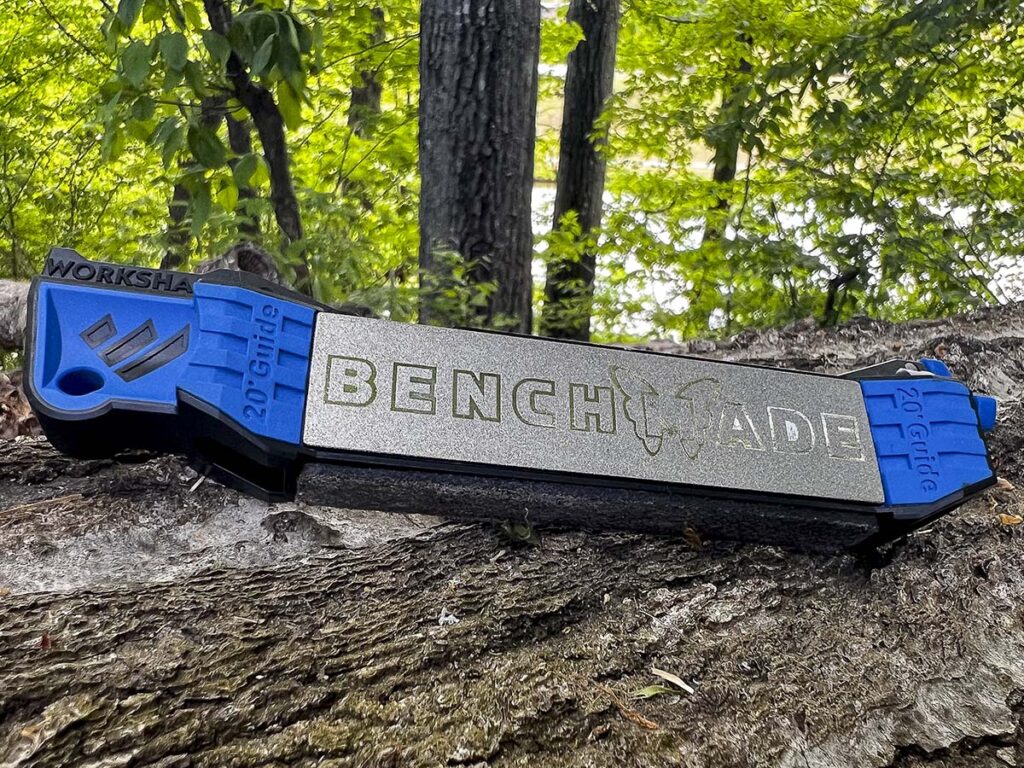
Benchmade Guided Field Sharpener

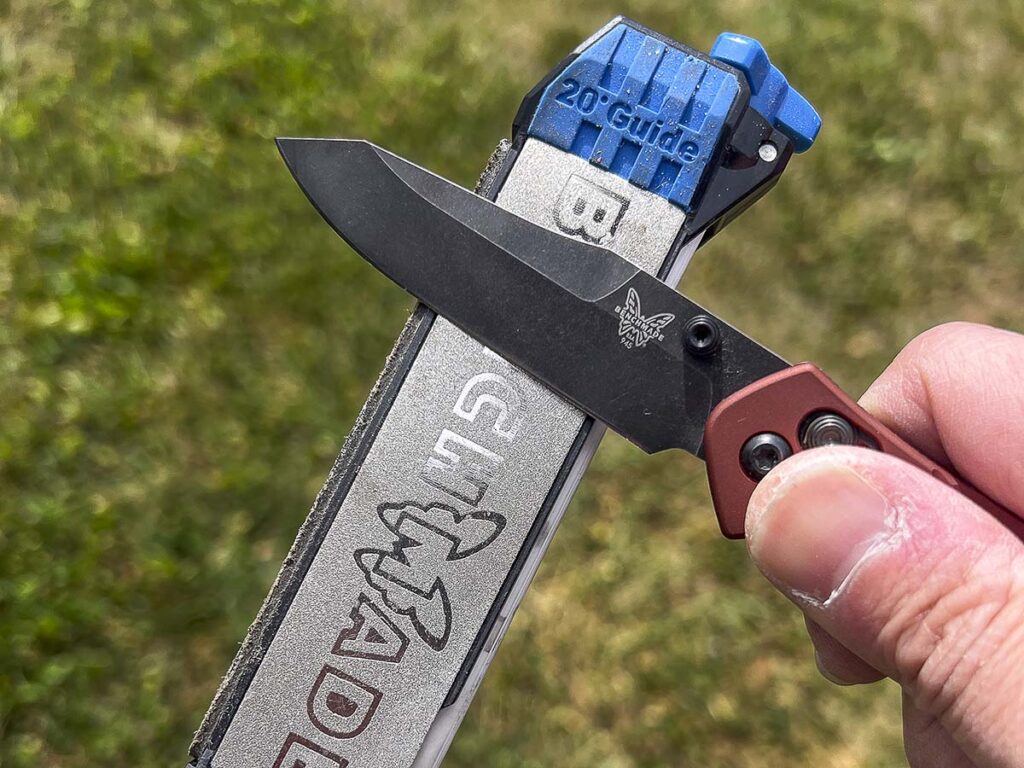
The Benchmade Guided Field Sharpener packs a lot into a small and affordable system. In addition to an integral angle guide, the system includes a diamond-infused sharpening plate, ceramic honing rods and a leather strop.

The Benchmade Guided Field Sharpener is the ultimate compact sharpener that is packed with so many features that you must use it to believe it. The unit is manufactured for Benchmade by Work Sharp, so it comes with a pedigree of a company that knows a thing or two about sharp cutting edges.

What you get with the Guided Field Sharpener (GFS) are coarse and fine diamond-coated sharpening plates held onto the body using rare-earth magnets. You also get a fine-grit ceramic rod for quick touch-ups. This rod has two sharpening surfaces—regular and ribbed, which are for more aggressive honing. You also get a smaller diameter ceramic rod, which addresses serrations. On top of all this, the unit has two sets of integral angle guides set permanently at 20 degrees. Finally, at one end of the sharpener frame is a leather strip for the final polishing of your edge. Folks, what you have right here is a comprehensive sharpening system in a pocket-sized form factor.  

While the Guided Field Sharpener works very well on folding hunters, tactical folders, multi-bladed pocketknives and some smaller fixed blades, it also handles larger blades, such as kitchen knives, as well. You must be mindful when working with a larger blade on a smaller sharpener and move the blade more efficiently to cover the entire cutting edge in one stroke.

The Benchmade Guided Field Sharpener is made by Work Sharp and was designed as a comprehensive compact sharpener to take with everywhere. Aside from its accoutrements, one of the more desirable features of the tool is its lightweight, coming in at less than 5 ounces.

Using GFS is simple, you lay your blade onto the angle guide, then hold the handle steady and move the blade across the surface of the plate. You do need to remain conscious of your angle, as the guide only starts you at the right incline. Generally, you’ll start with the diamond hone to establish the edge, followed by the fine grit to define it. Finally, a few swipes on the ceramic rod, along with a finish on the leather strip, result in a hair-popping sharp edge.

Overall, the Benchmade sharpener is sized perfectly for everything from a rucksack to a coat pocket. It’s a powerful tool in a compact package, and a value. To this, it’s worth noting that the GFS is assembled in the U.S.A. from foreign and domestic components.

Guided Field Sharpener Specs
Frame Material: Polymer
Sharpening Material: Diamond plates, ceramic rods and leather strop
Weight: 4.7 oz.
Sharpening Surface: 6.87”
Features: Integral 20-degree angle guide
Country Of Origin: Assembled in U.S.A. from domestic and foreign components
MSRP: $50

More On Sharpening:

Legendary knives that gave the U.S. military its edge

These knives formed the tip of the U.S. Military’s spear.

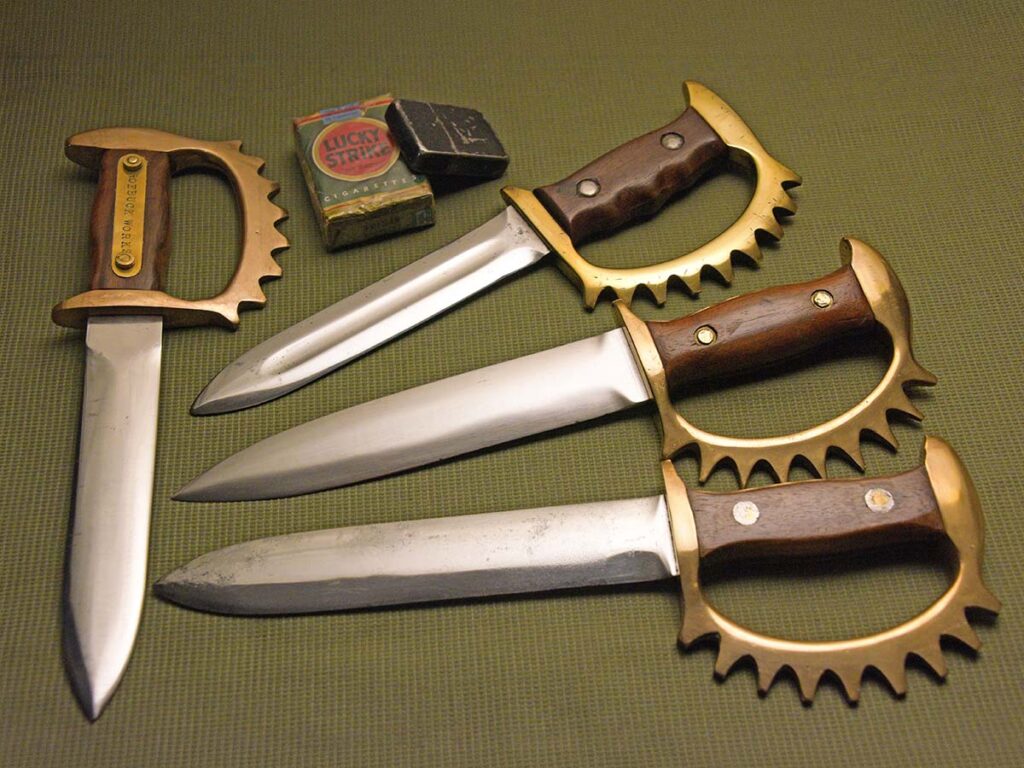
The 20th and 21st centuries saw some of the most iconic of military knives. From the World War I trench knives with the imposing knuckle-duster D-guards to today’s modern folders and fixed blades, a few, in no particular order, stand out above the rest:

  • USN Mark II/USMC fighting-utility knife*: According to Army Special Forces veteran and Spartan Blades co-owner Curtis Iovito, “The KA-BAR fighting/utility knife is arguably the most recognizable American military knife ever produced. Introduced in 1942 for the U.S. Marine Corps during World War II, it solved a critical problem: troops needed a knife that could serve both as a weapon and a field utility tool.
    “Marines used it for everything from opening ammunition crates and cutting brush to close-quarters combat. Its design struck a near-perfect balance between fighting knife and utility blade, and it has influenced military knife design ever since.”
    “As an issue knife, the classic USN Mark II filled the same role as the Randall Model 1, but in a much more ‘democratized’ sense. Very few soldiers could get a Randall,” explained Army veteran and Spyderco Special Projects Coordinator Michael Janich, “but the Mark II/Ka-Bar was ubiquitous. Although it ultimately became best known as the Ka-Bar and most closely associated with the Marine Corps, it was manufactured by many other companies and widely issued. As a mass-produced item, it was—and still is—a very capable knife and continued to serve with distinction in many other wars after World War II.”
    “The USMC fighting knife has not always been made by KA-BAR, and KA-BAR didn’t even make them first, but they made it their own,” noted Marine Corps veteran/knifemaker Les George. “It’s the stereotypical military knife in the western hemisphere.” Added Army 5th Special Forces veteran/BLADE field editor/knifemaker Kim Breed, “It is a multi-use combat knife used in one form or fashion in all branches of the service.”
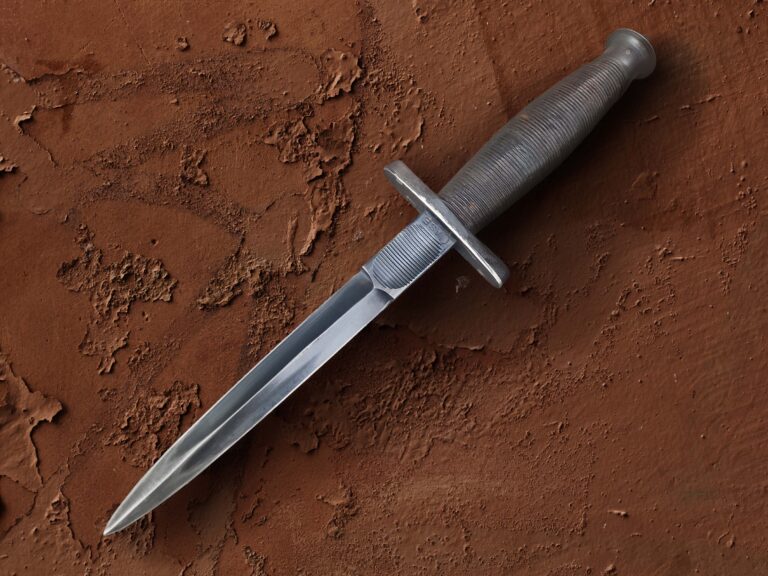
  • V-42: As Janich noted, “The V-42 is not only one of the sexiest fighting knife designs ever created, it also has perhaps the strongest pedigree since it was designed for and by the First Special Service Force, aka The Devil’s Brigade, of World War II fame. Its unique design and signature sheath reflect the original mission of that unit, which is regarded as the predecessor of current U.S. Army Special Forces units and Canada’s Joint Task Force 2. This iconic design is also immortalized in many U.S. military unit insignia, though it is often mistaken for the Fairbairn-Sykes dagger.”
  • Randall Model 1: “Randall has done more to influence modern knife design language than most,” George wrote. “The Model 1 is what I think of as peak Randall. Its influence ranges from World War II to the unit-made SOG knives in Vietnam to the modern SOG knife company.”
    “This iconic design epitomizes everything a military-style fighting knife should be,” Janich opined. “Its blade captures the spirit of the classic bowie knife, but in a leaner, more maneuverable form. The sharpened false edge allows it to back cut and penetrate with extreme authority, and its handle design allows for a grip that is both deft and secure. The fact that it continues to serve downrange in the same basic form to this day is a testament to the fact that it started out damned near perfect.”
  • Gerber Mark II: “The shortcomings of the original Fairbairn-Sykes and the many variations it inspired became very well-known both during and after World War II,” Janich wrote. “The Gerber Mark II addressed and corrected all of these to offer a superior fighting dagger design. Although it was a private-purchase item, like Randalls, it was much more accessible to servicemen and more widely carried. Its unique variations and its evolution over time also created its own rich history.” Janich added the fact it was the favored combat knife of Michael D. Echanis, decorated Vietnam veteran, accomplished martial artist and hand-to-hand combat knife writer and editor, enhanced its mystique and widespread appeal as well.

More Standouts

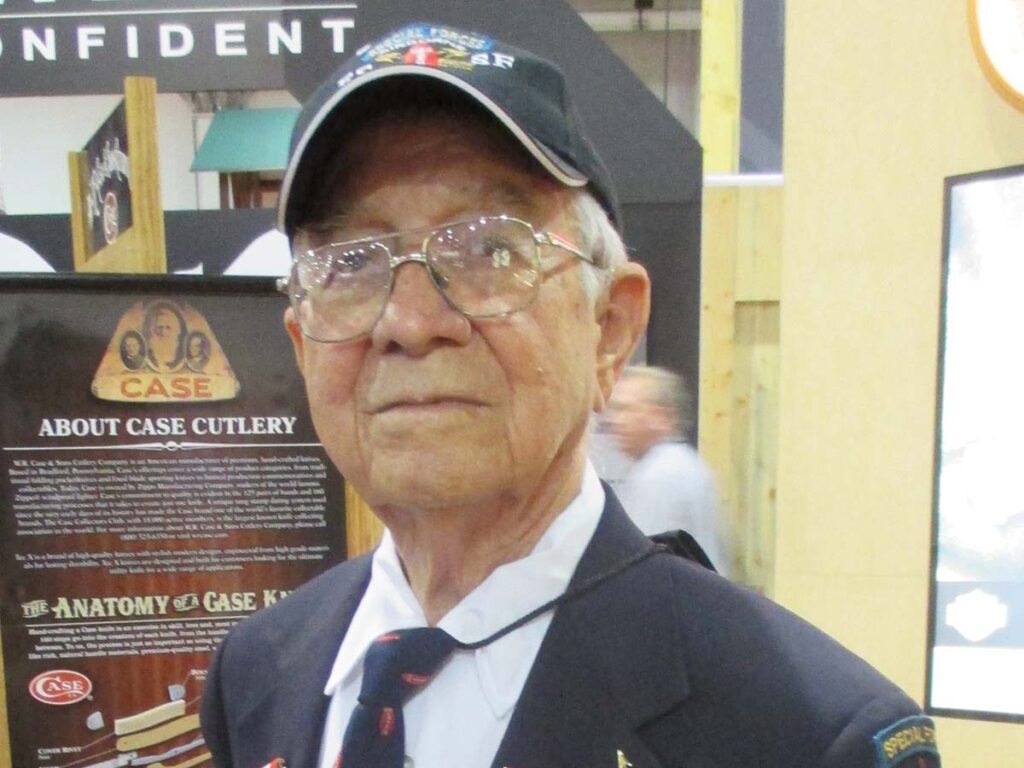
Gene Gutierrez
Gene Gutierrez

Any number of other U.S. military knives have stood out since the turn of the 20th century. Among them are the M3 trench knife, M1 bayonet, the Applegate-Fairbairn dagger and the Applegate-Fairbairn folder.

“The M3 was what the Army chose to issue in World War II,” George noted. “In purest terms, it also had a fairly short service life, but in real terms it is what became the M4 bayonet on down the line to the M7 bayonet that I used to run the assault course in boot camp in the ’90s. Its influence has been widespread.”

“The World War II-era M1 bayonet, designed for use with the M1 Garand rifle, played an important role in American infantry combat during World War II and beyond. I remember so many old World War II vets telling me stories about the bayonet,” Iovito recalled. “Shorter and more practical than earlier bayonets, the M1 reflected the changing nature of warfare where mobility and close-quarters fighting often occurred in tight environments. Many soldiers also carried the bayonet as a fighting and utility knife when not mounted on their rifles. Its durable construction and effective blade profile made it a reliable tool throughout several conflicts.”

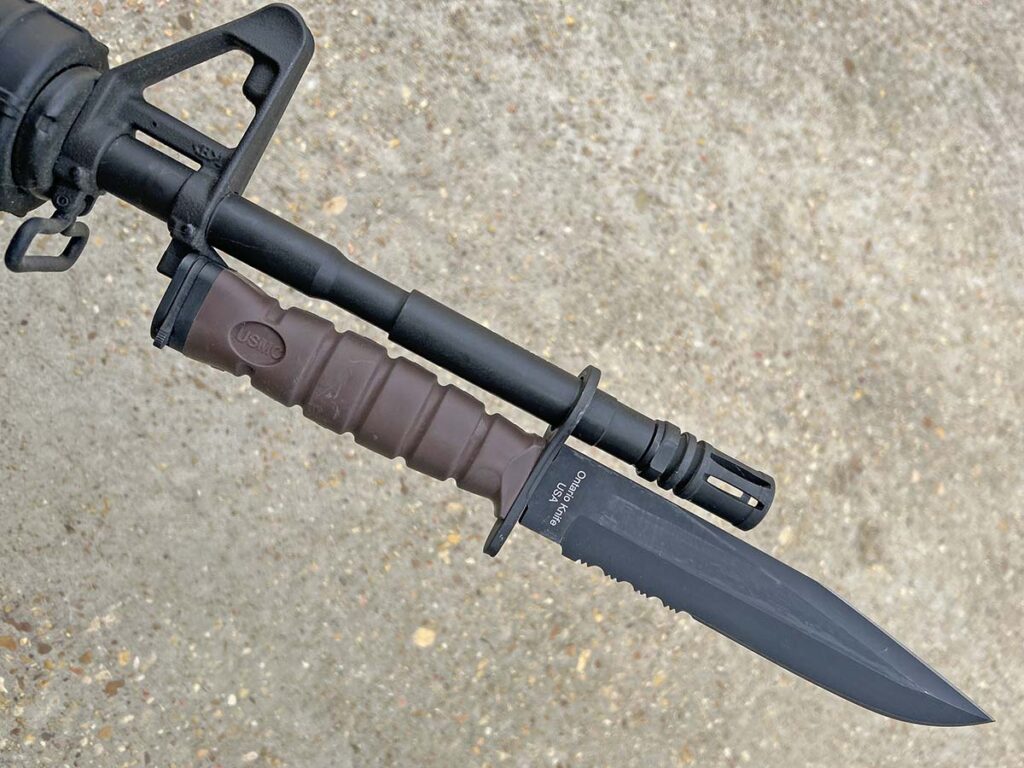
One of U.S. Marine Les George’s teammates mounted an Ontario OKC-3S similar to this one on an M4 to help quell a tense situation on the streets of Fallujah. (Les George image)

The Applegate-Fairbairn dagger and Gerber A-F folder were named after Cutlery Hall-of-Famer Col. Rex Applegate and W.E. Fairbairn
of Fairbairn-Sykes Commando Knife fame.

“Another design that corrected the flaws of the Fairbairn-Sykes dagger was the Applegate-Fairbairn dagger,” Janich observed. “Designed during World War II by Col. Applegate and W.E. Fairbairn, it never got beyond the prototype stage before the war ended. Decades later, it finally saw production by several major knife companies. Although very noteworthy on its own, it also inspired a scaled-down folding version that set a new and different standard in folding and fighting knife design. The original A-F Folder design was a collaboration between Col. Applegate and consummate custom knifemakers Bill Harsey and Butch Vallotton.” Added Harsey, a Cutlery Hall-of-Famer in his own right, “The Gerber version of the folding knife was a long-running project, and I was told by Gerber that the Army ordered 50,000 pieces at one time for the troops, which were delivered.”

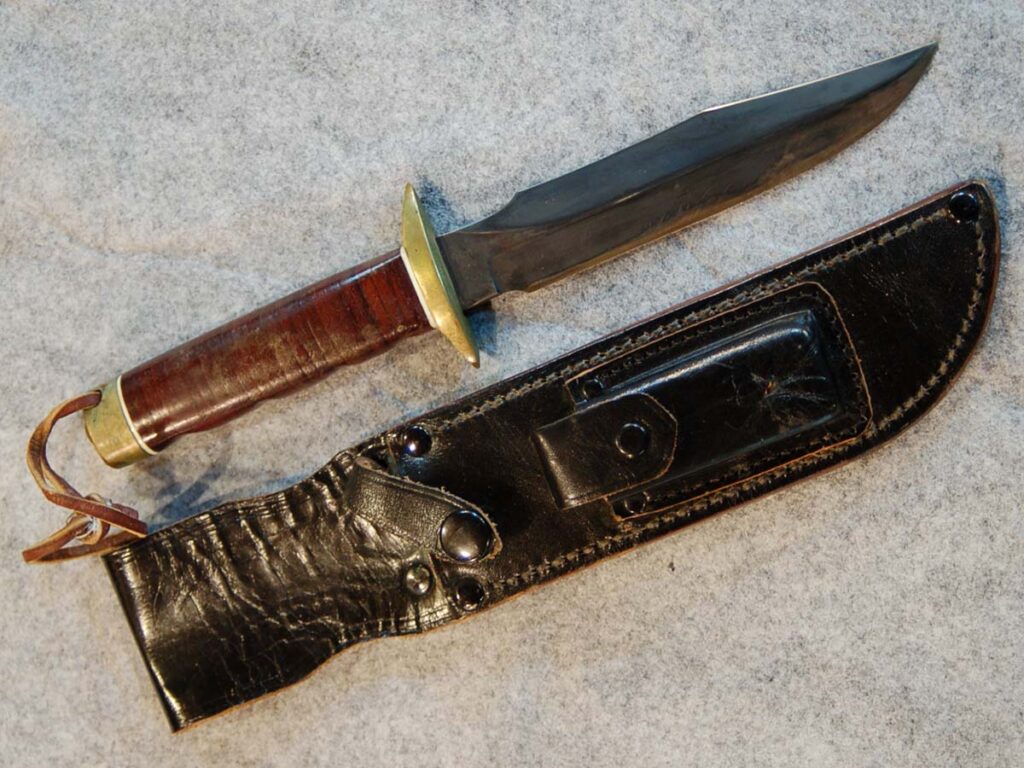
Few knives enjoy legendary U.S. military status as much as the SOG Bowie, which served as the inspiration for the name of today’s SOG knife company. “The Special Forces SOG Bowie is one of the most iconic knives associated with American special operations forces,” Iovito wrote. “Inspired by the knife carried by members of the Military Assistance Command, Vietnam Studies and Observations Group during the Vietnam War, the SOG Bowie reflects a fusion of classic bowie knife design with modern military needs. Its lineage connects directly to clandestine operations carried out in Southeast Asia, where unconventional warfare units often relied on rugged equipment that could handle jungle conditions and extreme use.”

Howard Cole was famous for making knuckle knives such as these three rare nine-pointers and one eight-pointer. A paratrooper named Clyde McClelland carried the center nine-pointer during World War II. (Image courtesy of Louis Chow)

Folding knives have never been so popular in the U.S. military as they have in the past 40 years, and at or near the top of that list are the Al Mar SERE, CRKT M-16 and Spyderco Endura.

“While many earlier military knives were fixed blades, modern soldiers frequently rely on folding knives for everyday field use. One of the most influential examples is the Spyderco Endura,” Janich began. “For me, the knife carries a very personal meaning. During Operation Just Cause in Panama, I found myself tangled in my parachute harness after landing while under fire. I used my Spyderco Endura to cut myself free from the harness so I could move and get back into the fight. That moment left an indelible mark on me and reinforced the reality that sometimes the most important piece of equipment you carry is the knife in your pocket. The Endura is lightweight, corrosion resistant and extremely functional, and its opening hole allows rapid one-handed deployment, even with gloves. Its reliability and practicality have made it a favorite among soldiers who need a dependable cutting tool for daily field tasks.”

In the fall of 1984, Harsey helped Al Mar do a run of just over 50 large folders for Col. Nick Rowe, who had been tasked by the Army to run the SERE (Survival, Evasion, Resistance and Escape) School near Fort Bragg, North Carolina. “All modern Special Forces soldiers, aka Green Berets, and other high-risk military members including pilots undergo this training,” Harsey stated. “I finished my part of unmarked knives in time for Al Mar to get them on an airplane bound for Fort Bragg and into Col. Rowe’s hands for an important mission date. I never heard another thing about this project. Later this knife would become known as the AL Mar SERE folding knife.”

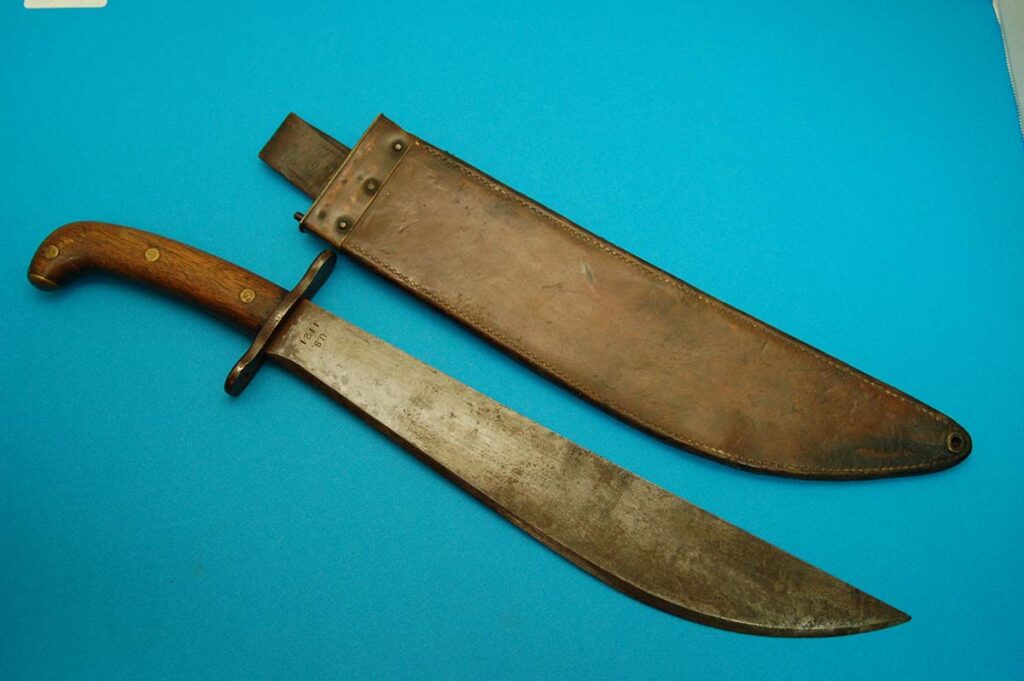
The Field Artillery Corps designed the Model of 1909 bolo for use by crew-served weapons during World War I. It was for clearing fields of fire to enable the limbers and horses to navigate the towed artillery into place. (Images courtesy of Frank Trzaska)

As for the CRKT M-16, its universality during the Iraq War guarantees its spot on the list. “I am not aware of this knife ever being issued but there was a time when you saw them everywhere,” George wrote. “Guys would buy them at the PX and clip them on the outside of their vests. They were everywhere, and they did everything!”

Standard Setters

The foregoing includes but a few of the knives that have served the USA and served it well over 250 years of saving the world from tyranny and oppression and setting the standard billions aspire to today. Other notable knives, in no particular order, include:

The M9, M11 and OKC-3S bayonets; Camillus Jet Pilot Survival Knife; Chris Reeve Yarborough; OSS Smatchet; Collins M1942 Machete; Swiss Army knife; Spartan Blades Ares, Difensa and Harsey Dagger; Randall Models 2 and 18; Gerber Silver Trident Knife and Mark I; G.I. four-bladed pocketknife; Schrade Mark II Paratrooper switchblade; G.I. Machete; Leatherman and Gerber multi-tools; and Western 49 Bowie.

According to Army Special Forces veteran Curtis Iovito, the Special Forces SOG Bowie reflects a fusion of classic bowie design with modern military needs. “Its lineage connects directly to clandestine operations carried out in Southeast Asia,” he wrote, “where unconventional warfare units often relied on rugged equipment that could handle jungle conditions and extreme use.” (Frank Trzaska’s knife and image)

Which ones are we omitting? Let us know. And while you celebrate the semiquincentennial of your favorite nation throughout the year, never forget: knives have played a monumental role in the success of the U.S. military and the building of the USA up to now and for the foreseeable future.

It doesn’t get much sharper than that.

*Though they are two different knives, the USN Mark II and USMC fighting/utility knife are grouped together for the purposes of this story because of their similarity in design and their across-the-board use by U.S. service personnel, especially during World War II. Also, the spelling of KA-BAR refers to the knife manufacturer that continues in operation, while Ka-Bar refers to the generic name service personnel gave the knife, a name that persists to this day.

Military Knives:

FIRST LOOK: SOG Knives 40th Anniversary Fat Guard Bowie

SOG marks four decades with a limited, 500-piece run honoring its original MACV-SOG combat bowie root.

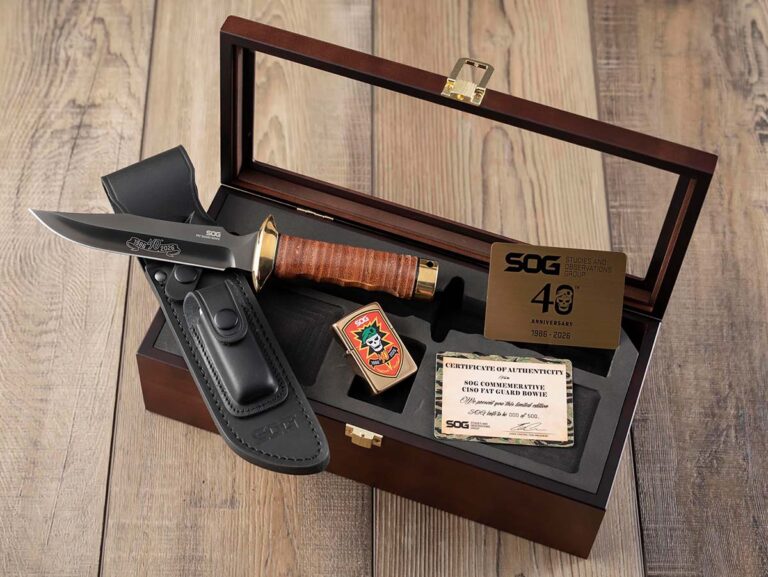
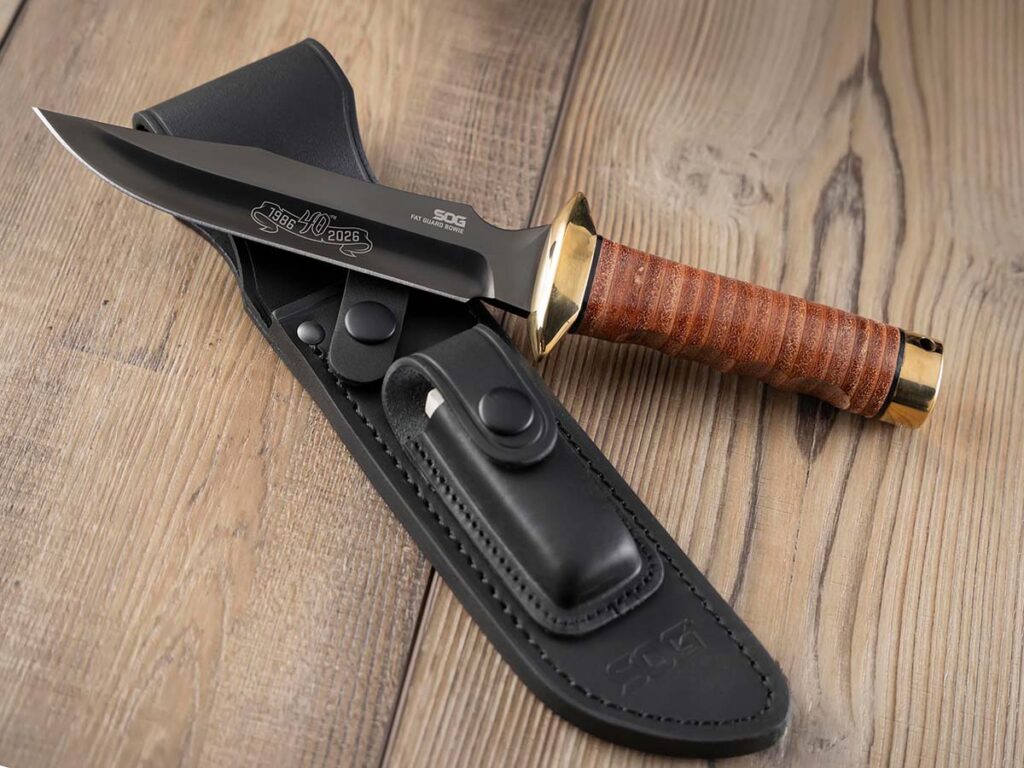
To mark four decades in business, SOG Knives has released a limited-edition homage to the blade that started it all: the 40th Anniversary Fat Guard Bowie. Drawing direct design cues from the original S1 Bowie introduced in 1986, the new release pays tribute to the covert fighting knives carried by MACV-SOG personnel during the Vietnam War.

Historical Roots, Modern Production

The 40th Anniversary model centers around a 6.1-inch clip-point blade forged from AUS-8 stainless steel. SOG finished the steel with a black PVD coating for added corrosion resistance and reduced reflection.

SOG 40th Bowie 1

True to the traditional combat bowie silhouette, the handle is built from stacked leather, offering a classic aesthetic alongside a contoured grip. A substantial brass guard and matching butt cap frame the handle assembly. Production is strictly capped at 500 individually serialized units, with each knife’s specific number etched directly into the pommel.

Commemorative Display Package

Rather than shipping as a standalone tool, SOG packaged the anniversary Bowie as a complete collector’s set. The knife sits inside a handcrafted pine display case outfitted with a clear glass viewing lid and an engraved anniversary plaque.

Accompanying the fixed blade inside the presentation box is a custom SOG 40th anniversary Zippo lighter and a signed certificate of authenticity. For field carry or storage, the set includes a heavy-duty black leather belt sheath, complete with a front-mounted snap pocket containing a touch-up sharpening stone.

The 40th Anniversary Fat Guard Bowie package is available directly through SOG’s website while supplies last.

Knife Reviews:

Everything You Wanted To Know About Arkansas Sharpening Stones

Novaculite still rocks knife sharpening!

Timeless and iconic, it remains practical and complementary to other options today.

The novaculite sharpening stone is a wonder of nature. Almost pure microcrystalline quartz in content, this dense, fine-grained rock was formed from 318 to 416 million years ago during the Devonian and Mississippian periods in ancient seabeds and later pushed toward the surface with the peaks of the Ouachita Mountains of western and central Arkansas. Massive sedimentary layers ranging from 250 to 900 feet thick produced the stone, which takes its name from the Latin novacula, meaning “sharp knife” or “razor.”

From there, the stone was destined for a rendezvous with the knife blade, rendering a sharp edge that gets the job done and holding a place in working knife history dating back centuries.

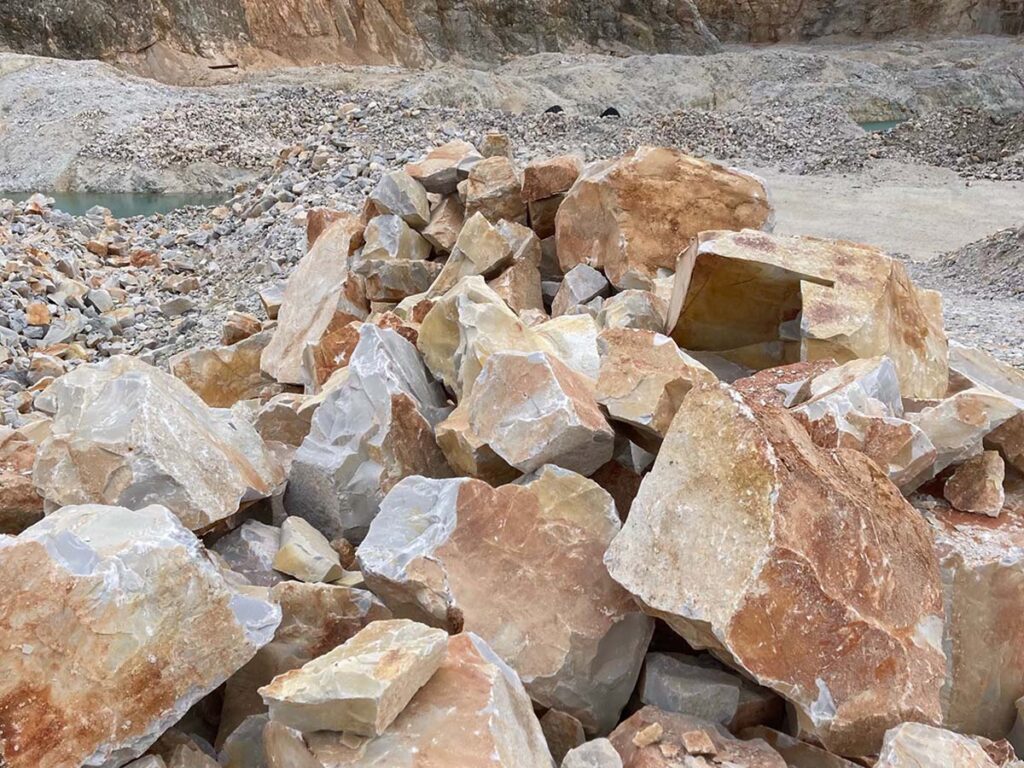
The novaculite deposits in Arkansas were formed 318 to 416 million years ago and it takes plenty of mechanical muscle to push around the material. The deposits run from 200- to 900-feet thick, in turn the operations are substantial. And while the weathered novaculite is somewhat bland to the eye, once broken up the beauty of the natural material shines through. (Images courtesy of Chis Stillian)

Today, however, there is a bit of … well … friction as some may claim modern synthetic stones are eclipsing or at least competing with novaculite for some nebulous title of “best.” Synthetic stones often offer faster sharpening and convenience, while novaculite is valued for its refined finish and traditional appeal. Truth is that each has its place, and novaculite was and is a key participant in the knife-sharpening exercise.

“It gives a razor-sharp, polished edge with smooth feedback that many prefer over synthetics,” explained Chris Stillian, owner of Natural Whetstone, LLC. The company was founded by close friend David Davenport two decades ago, and when David passed away during the COVID-19 pandemic, Chris and his father, Shawn, kept the central Arkansas company going.

“The stones wear very slowly,” Chris continued. “Some last decades because they’re 99 percent plus pure quartz with no fillers. They’re natural, made in the USA and work great for chefs, woodworkers and knife users.”

Danny Kirschman founded Dan’s Whetstone Company, Inc., in Pearcy, Arkansas, in 1976, and his son Steve is currently CEO of the family venture. His roots in novaculite are long and deep. “The erosion-resistant quartz formations of the Ouachitas produced the finest and rarest natural abrasive in the world,” he offered. “Danny Kirschman’s opinion and what we share with others is that the one thing that sets novaculite products apart from other sharpeners is their unique crystalline structure. The novaculite stones wear less aggressively than most manmade abrasives due to the natural bonding of the crystals.”

Best Steel For Novaculite

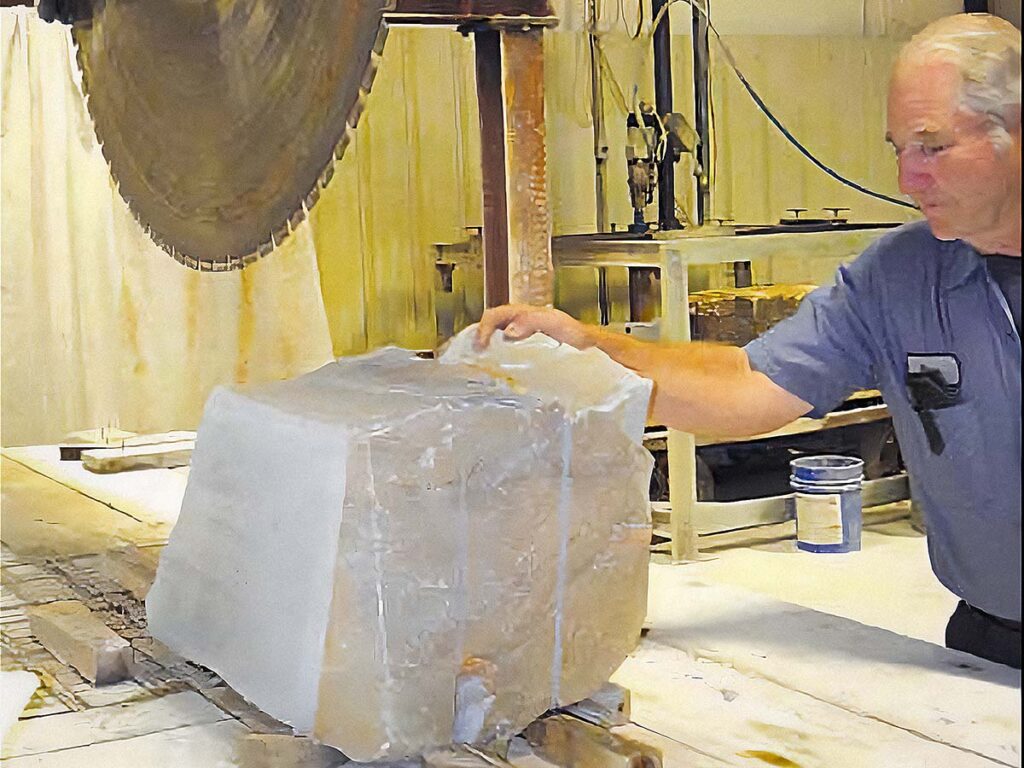
Dan Kirschman, by the company’s largest saw, spent his formative years as a mining engineer, until his hobby of cutting and polishing novaculite developed into a full-time business. Dan’s Whetstones now has a 500-acre quarry and manufactures more than 300 different products from the stone. (Images courtesy of Dan’s Whetstone)

Both Stillian and Kirschman agree that the disadvantages of novaculite usage lie in cutting speed and other aspects. Chris commented, “It cuts slower than diamond or water stones, so it’s better for refining edges than heavy profiling. It needs oil instead of water, can glaze if not cleaned and doesn’t bite hard on modern super steels. Top grades cost more because the dense material is rare.”

Steve added, “The most common complaint is their low abrasion rate. Because the stones are exceptionally hard and dense, they remove material much more slowly than synthetic stones. They are best suited for maintaining an already sharp edge rather than ‘hogging off’ metal to repair chips or reprofile a blade. There is no truly coarse Arkansas stone. Even the soft Arkansas is relatively fine compared to a coarse synthetic stone. Novaculite is composed of quartz, which has a Mohs hardness of around 7. While this is harder than standard carbon steel, it is softer than the vanadium and chromium carbides found in modern, high-alloy super steels.”

Further, since Arkansas stone is a natural product, every stone is unique and may exhibit internal flaws, cracks or variable grit. Oil is required to keep metal particles, or swarf, from clogging the pores, which leads to a bit more cleanup. Lubrication keeps the stone from “loading” with metal, which can reduce its effectiveness.

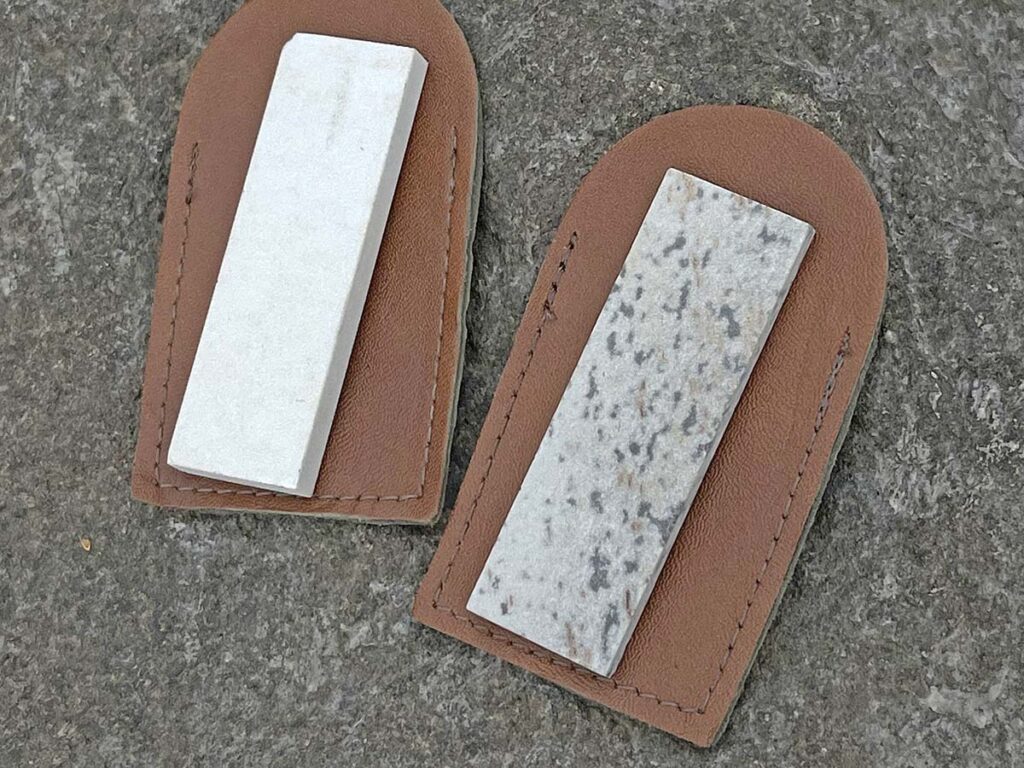
Similar to many sharpening systems, Arkansas stones of different grit sizes are used in conjunction. On the right is a soft stone with a courser grit, good for raising a burr and initial honing. On the left is hard stone, used for final edge polishing and day-to-day maintenance. (Image courtesy of Chris Stillian)

Novaculite works best with simple carbon and low-alloy stainless steels like 1095, O-1, 440C and A2. Since such steels are commonly found on hunting, working, kitchen, bushcraft/survival and everyday slipjoint and fixed-blade knives, a broad area of application exists. High vanadium super steels such as S35VN, M390, CPM-3V and others—often seen in premium chefs’ knives and high-end custom knives—are best served with diamond stones, for example, because their carbides are harder than the quartz in novaculite.

Reviving Arkansas Rock

Even the casual observer can, therefore, discern the proper employment of the novaculite sharpening stone with the blade steel that will produce the best results. One giant of the knife industry recognized the value of the Arkansas stone years ago and built a catalog empire on its sturdy reputation.

The late BLADE Magazine Cutlery Hall of Fame® member A.G. Russell began selling Arkansas sharpening stones in the mid-1960s after moving his family back home to northwest Arkansas from Marin County, California. During the move, he discovered that his whetstones had gotten lost in transit.

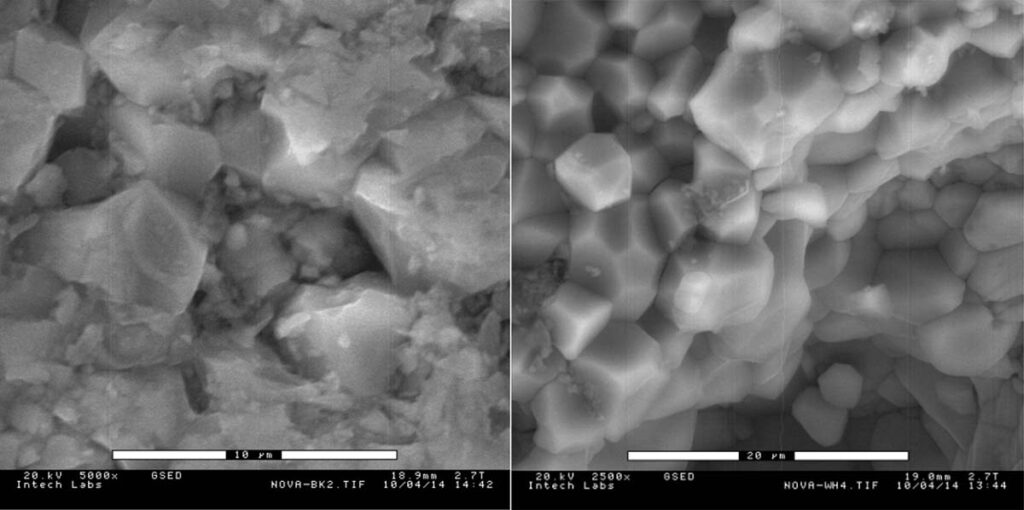
Novaculite is microcrystalline quartz in structure and while it can seem extremely smooth to the naked eye, at the microscopic level the formation’s cutting properties become evident. On the left is ultra-fine black stone at 5000x magnification and the right hard Arkansas stone at 2500x magnification. (Image courtesy of Dan’s Whetstones)

“He tried to buy replacements in local hardware stores, but none stocked them,” remembered A.G.’s wife and fellow hall-of-famer Goldie Russell, who runs the company today. “Having lived in Hot Springs, Arkansas, for a while when he was a teenager, A.G. knew that the only deposit of novaculite was in that area. A.G. went to Hot Springs and found someone who was cutting stones. He purchased stones and began selling them to local hardware stores.”

From there, A.G. bought ads in magazines, particularly Guns & Ammo and The American Rifleman. Soon enough, he became a supplier to Brownells, a major gun retailer, capitalizing on the mutual affinity of gun enthusiasts for knives. Together with the magazine effort and his own sales acumen, Russell re-energized the popularity of the Arkansas stone.

“The frequency of A.G.’s ad in magazines and then the offering of these stones in the A.G. Russell Catalog of Knives was very important in making these stones readily available nationwide through the late 1960s and the 1970s,” observed Goldie. “There is still a large quantity of the small stones that he had cut during those years in our inventory. That is how he started what became A.G. Russell Knives.”

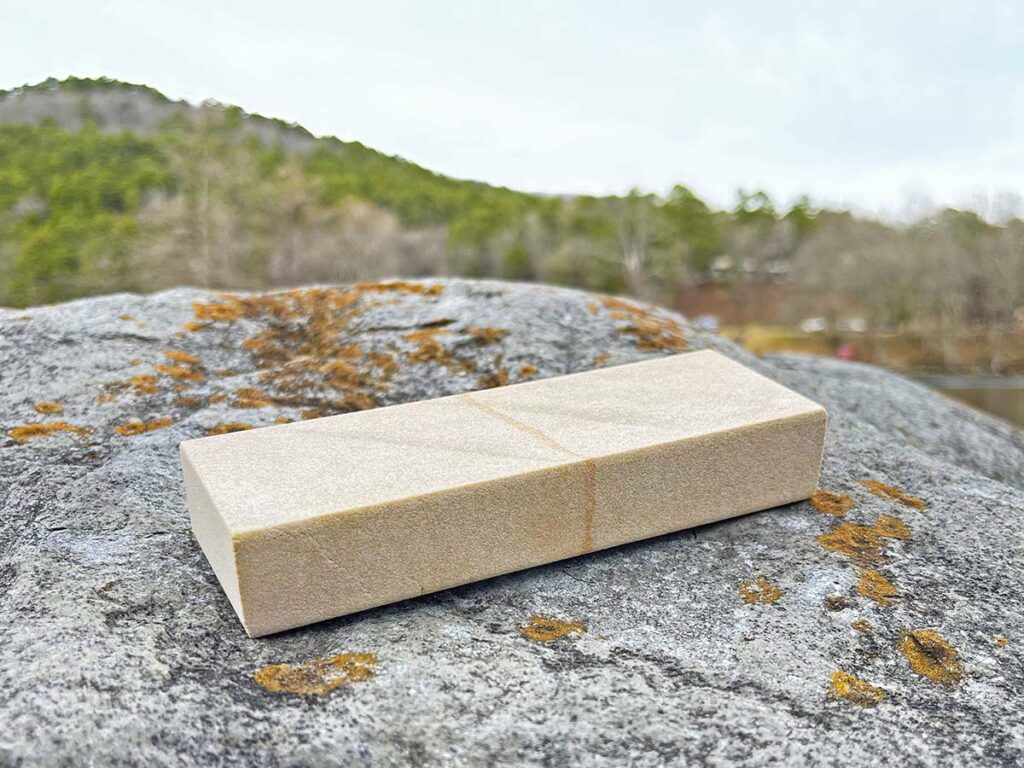
It’s a misnomer Arkansas stone’s hardness corresponds to its color. Similar colors can be noted in different grades, as the coloration is purely a matter of trace mineralization in the stones. (Image courtesy of Chris Stillian)

Novaculite stones, therefore, maintain their place in the practical and the historical aspects of the knife industry, and their relevance is not likely to fade. Those who are familiar with their capabilities remain loyal. They appreciate the investment of time and effort required to bring out that razor-sharp edge, and there is something timeless and reaffirming in the process.

Novaculite Grades

The stones themselves are available in four major grades. “Users should be aware that color is not the determining factor in grading novaculite,” explained Kirschman. “Some users have been defining whetstone grades by color, but the same colors may be seen in more than one grade. Color is caused by trace minerals that are dispersed through the rock during sedimentary formation more than 350 million years ago and subsequent geological activity.”

The major grades of novaculite include the following:

  • Soft Arkansas: The most popular all-purpose stone often used by wood carvers, sportsmen, butchers, commercial knife sharpeners and even housewives who desire keen, polished edge in a minimum of time.
  • Hard Arkansas: A fine grit stone good for everyday maintenance and popular among woodcrafters and the dental industry.
  • Translucent and True Hard Arkansas: An extra fine stone with a glassy feel and used in industrial applications requiring an extremely fine polish. It appears in a variety of colors.
  • Black Arkansas: Sometimes referred to as “surgical black” stone, the finest grade abrasive available today, delivering a mirror polish.     
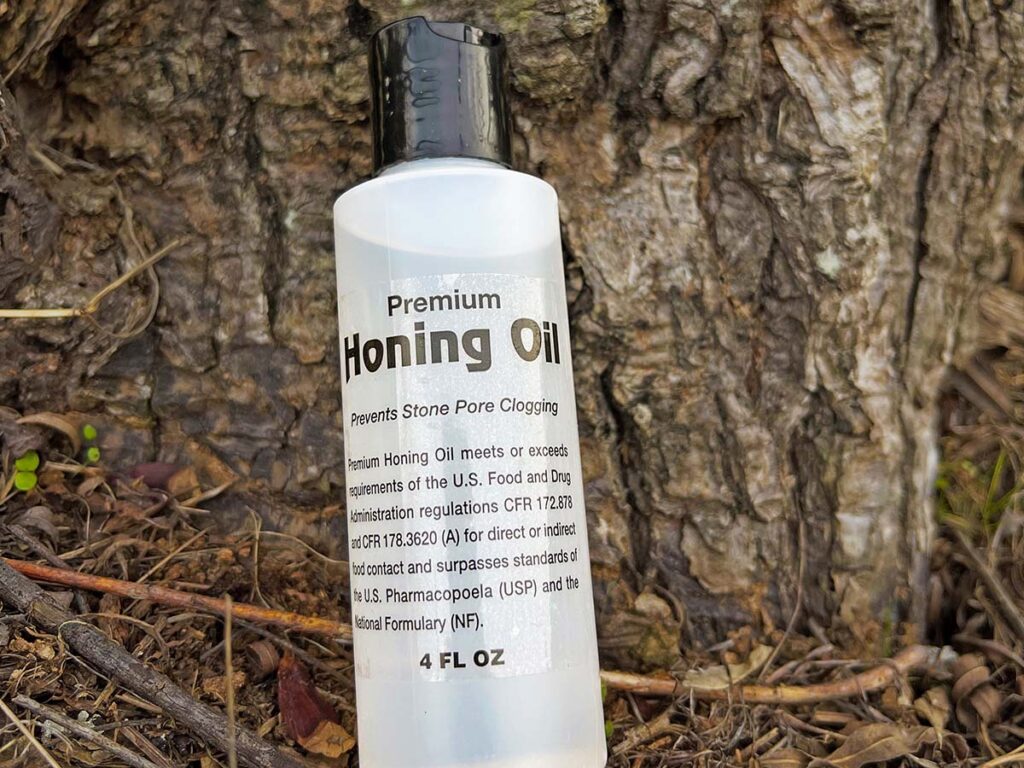
Among the most critical factors of using natural stones to sharpen knives is using honing oil. Oil keeps metal particles, or swarf, from clogging the stone’s natural pores, thus reducing its effectiveness. (Image courtesy of Chris Stillian)

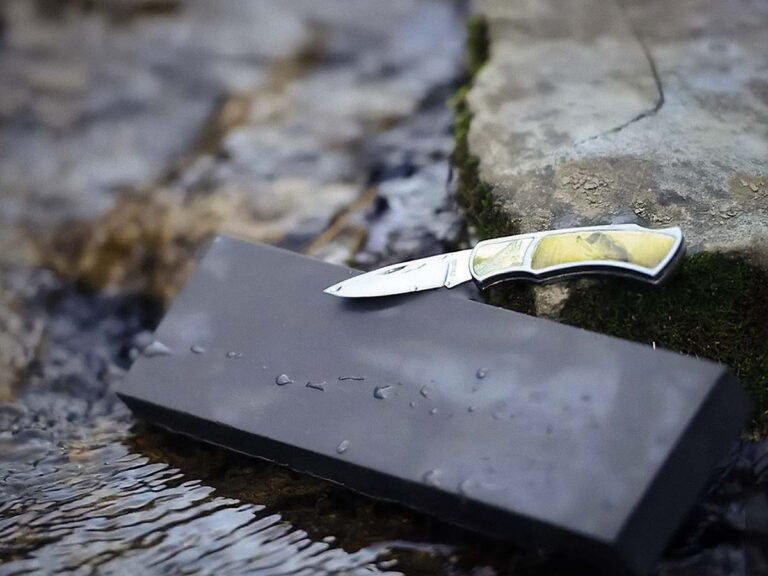
The proper method of sharpening with a novaculite stone involves preparation and practice. “It’s an oil stone, so put a few drops of honing oil on it,” advised Stillian. “Hold a consistent angle, 15 to 20 degrees for most knives, use light to moderate pressure, and take smooth strokes. Start on soft or hard if the edge is dull, and finish on black or translucent. Raise a burr, then lighten pressure. Clean with soap or solvent to avoid glazing. Strop afterward for extra keenness, if you like.”

Those About To Rock

According to Chris, consistent purchasers and users include enthusiasts, woodworkers and chefs who “keep buying them for the feel, longevity and heritage. Synthetics rule high-volume work, but real Arkansas novaculite—especially the rare translucent and black grades—still sell at a premium to people who want the genuine article.”

Steve sees emerging interest as well. “The rising D.I.Y. (do it yourself) sharpening culture is a major driver,” he commented, “with the hobbyist segment now accounting for nearly 35 percent of total whetstone sales worldwide. Online tutorials and a deeper appreciation for craftsmanship have fueled this demand. Sustainability is a driver, as well. Modern consumers increasingly view natural stones as a “green” alternative to synthetics.

“Niche premium positioning, even while high-end market saturation is slowing growth in North America to about 4 percent, means natural stones remain a staple for professional chefs who prefer them for maintaining blade integrity,” Steve concluded. “And technological integration means that manufacturers are now developing beginner-friendly kits and instructional digital content to tap into 62 percent of home users who are interested in traditional sharpening but lack confidence in the technique.”

The future presents an atmosphere of coexistence among the Novaculite and synthetic options. The global whetstone market topped $457 million in value in 2024 and is expected to reach $677 million within eight years. Natural stone demand should stay steady, supported by its faithful and traditional users while welcoming explorers to these Ouachita wonders.

More On Sharpening:

Feather Damascus: Blades Forged Light And Airy

The variations on damascus steel themes are endless. The possibilities are tempered only by the maker’s time at the forge and his or her desire to create.

Among these many variations, one pattern has recently captured the spotlight. These days, feather damascus is trending and custom makers are producing knives that turn heads, captivating buyers with the intricate layering that produces hard steel intertwined with the look of the light and wispy. Feather damascus offers a medium of both performance and artistic expression that influences every aspect of the maker’s creativity.

Ethan Kolar of Plummer, Idaho, describes his interest in feather damascus as “chaotic flow.” He explains, “The pattern’s center seam, where the jagged W’s converge, creates a flow in the blade which really adds to the overall confluence of the knife as well as creating a controlled chaos as the pattern explodes from the center filling out the blade.”

Kolar enjoys the hint of “jaggedness” and the center line that ties the blade together, and in the making of his feather damascus, his focus lies in test etching every restack from the forge. He sees the pattern in many different forms with the observation that “a pattern is not right or wrong but more of what the maker envisions and creates and what is right to him for his knife.”

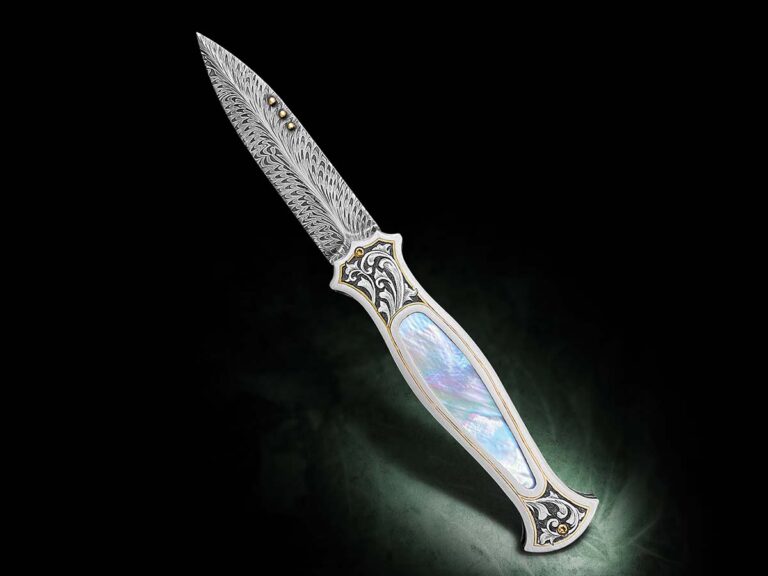
The folding dagger Ethan composed includes a 3-inch feather damascus blade of 1084 and 15N20 steels with an engraved gold inlay and scroll worked 416 stainless steel window frame fitted with exhibition-grade white-lip mother of pearl. Liners are 15N20 file-worked and nitre blued, while the backbar of 416 stainless is engraved and sports delicate file work. Its overall length is 7 inches.

“Most of the inspiration I have while making damascus comes from envisioning my final product,” Ethan remarked, “what engraving will go with it, the handle embellishment, and a lot to do with the overall color of the knife, deciding whether the pattern will be brighter or darker.”

Steel On Fire

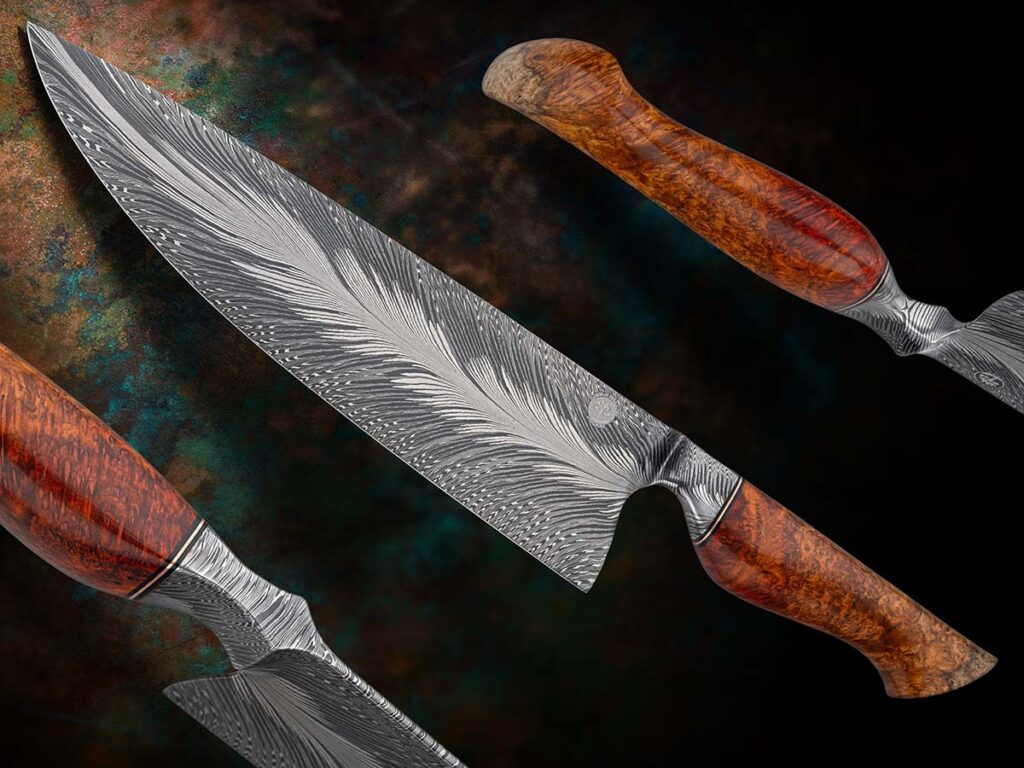
Winning Best Damascus at the 2025 BLADE Show West, Trevor Morgan’s “Torrent of Fire” chef’s knife includes a 9.25-inch blade of 1084 and 15N20 in a mix of W’s and straight layers with a fat core of 15N20. The knife’s overall length is 14.2 inches, and the handle is dark red tiger’s blood amboyna burl with a splash of sapwood for contrast. (Jocelyn Frasier image)

Another contemporary artisan exploring the feather damascus pattern is ABS journeyman smith Trevor Morgan. Having attended the Bill Moran School of Bladesmithing in Texarkana, Texas, in 2020, his goal with each feather damascus blade is to make the pattern “pop.” To achieve that look, his hand follows an artistic eye.

“Contrast, for sure, really makes any pattern cool,” said Trevor, “especially feather or mosaic damascus, larger pieces of dark and bright steel, gradients and that kind of thing. Also, out-of-the-ordinary stuff like feather [damascus] can be really cool to look at. Symmetry is always great with a feather pattern because it’s pretty easy to notice when something is out of whack with a feather due to the defined center. Complexity is also great. If it’s hard to figure out, all the better.”

According to Morgan, a resident of Apple Valley, California, the feather pattern can be challenging due to the hot-cut process, which puts enormous stress on the billet in somewhat weird ways and causes every forge weld to want to split open. The problem, however, can be mitigated by mig welding all the way around the seams. But this is his least favorite method of achieving the integrity of the billet because it requires grinding away the welds, wasting material and consuming time.

Trevor’s inspiration for feather damascus pieces comes from the world around him. “It’s places and people,” he commented, “from nature and the endeavor to make something organic and as lifelike as possible in steel. I regularly get swept up in the general zeitgeist surrounding the making of complex patterns. I see something on social media or somewhere, and I think, ‘Man, that’s really awesome! I’d love to try to make something like that.’ Then comes the real creative part, where I just get an idea of something that might look really cool and put it together.”

Morgan’s method is readily revealed in his featured piece, named “Torrent of Fire.” The knife includes a 9.25-inch blade of 1084 and 15N20 in a mix of W’s and straight layers with a fat core of 15N20. The knife’s overall length is 14.2 inches, and the handle is dark red tiger’s blood amboyna burl with a splash of sapwood for contrast.

Organic Appeal

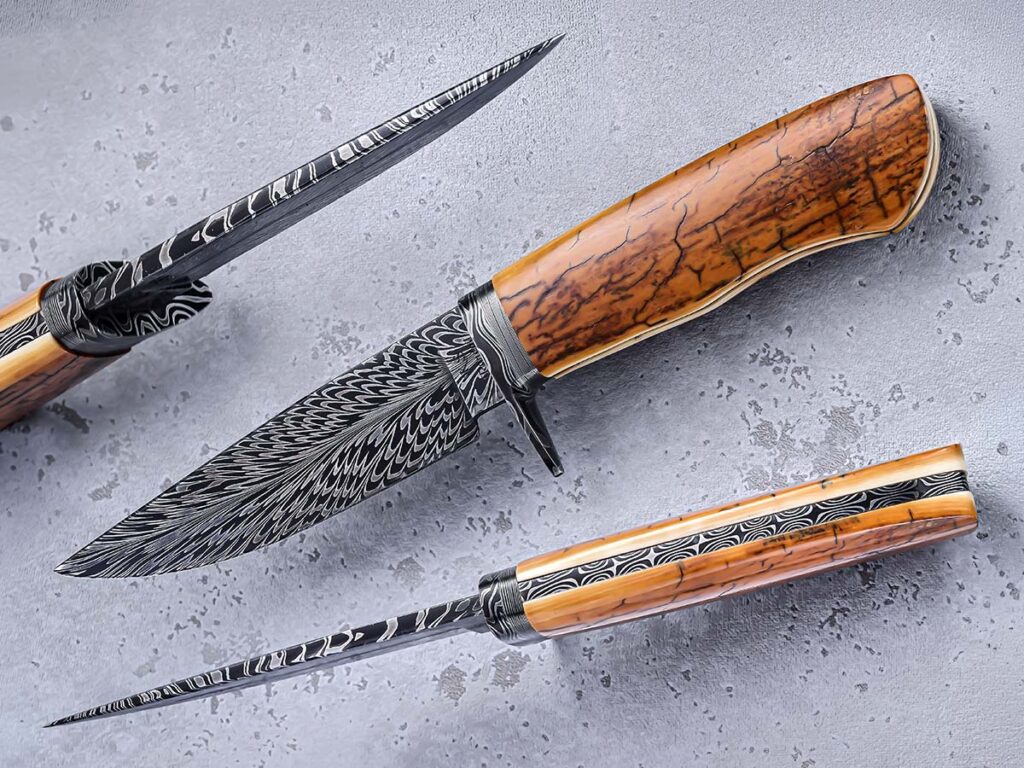
Splitting the billet down the center to maintain symmetry is among the trickiest aspects of feather damascus to Steve Randall. He nails it on his frame-handle hunter, with the axis of the pattern fountaining from the mastodon scales in a balanced and spectacular fashion. (SharpByCoop image)

Feather damascus has been a staple steel for ABS master smith Steve Randall for some time. He seeks a continual flow of the steel from the handle to the tip, and oriented so that the handle appears to actually hold a feather. “I was attracted to the feather pattern because of it’s a very cool, organic look,” he advised. “Like a snowflake, there are no two exactly the same. I’ve been forging feather damascus for at least seven years, and I’ve made several bowies and hunters.”

Randall, of Estancia, New Mexico, presents his feather damascus piece with frame-handle construction, showcasing mastodon scales with an overall length of 9½ inches and a blade of 4¾ inches. “Feather damascus is a more challenging pattern,” he said. “My tricks are patience and concentration. There are many welds involved in the pattern, which can contribute to cold shuts, which can destroy hours of hard work. The trickiest part is splitting the billet right down the middle and maintaining symmetry.”

While he describes the feather damascus forging process as complicated and labor-intensive, Steve sees the payoff in the harmony of the pattern and its related materials in the finished knife. “I always try to complement it with the best handle materials I have available,” he reasoned. “I prefer stag or ivory. If using wood, I avoid busy patterns and colors. I draw inspiration from many other makers. There are so many accomplished makers who produce a variety of feather patterns. It is one of my favorite patterns to forge because it can really accent the flow of the blade and give it a great overall look.”

Movement And Flow

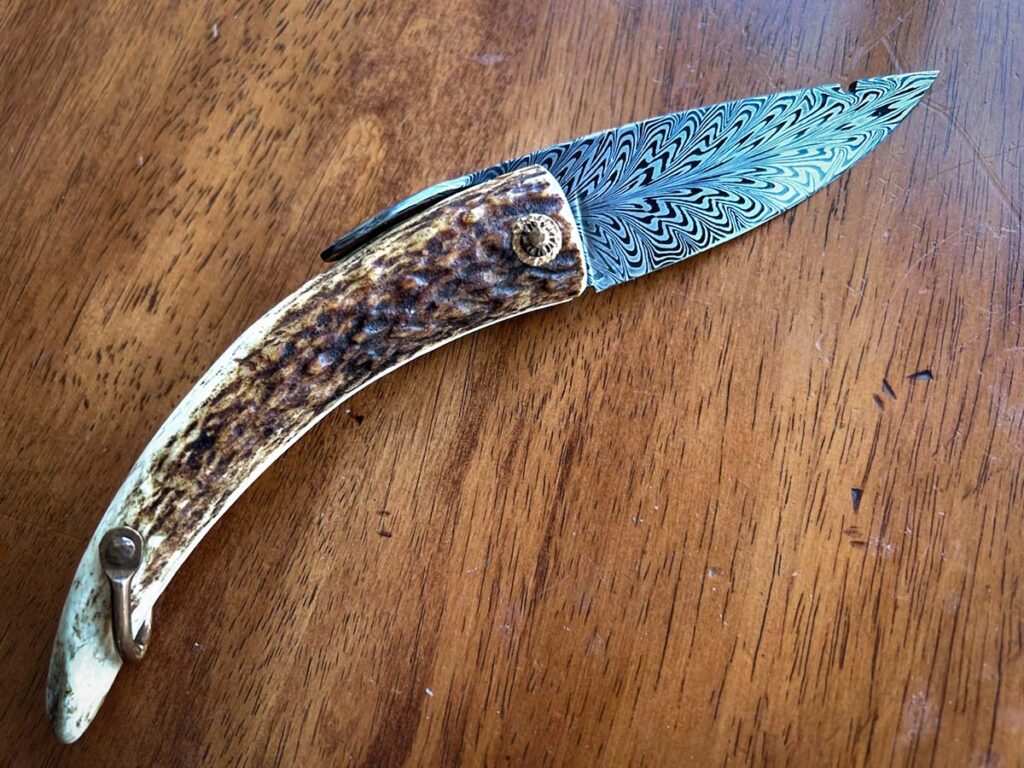
While David Lisch doesn't feel he's hit the limits of his Mountain Man folder, the style of knife is striking with its feather damascus blade set in stag-tip handle. Copper hardware and pivot give the knife its antediluvian look, while the flowing pattern of the blade anchors it in modern forge techniques. (David Lisch image)
While David Lisch doesn’t feel he’s hit the limits of his Mountain Man folder, the style of knife is striking with its feather damascus blade set in stag-tip handle. Copper hardware and pivot give the knife its antediluvian look, while the flowing pattern of the blade anchors it in modern forge techniques. (David Lisch image)

It took a single demonstration by the great master smith Harvey Dean to convince David Lisch, who earned his ABS journeyman stamp in 2009 and his master stamp six years later, to try the feather pattern. “I was always attracted to feather damascus,” he remembered, “but around 2008 I had the chance to see Harvey Dean demonstrate it at an event at Josh Smith’s, and I went right home and made the tools needed and gave it a go. I’ve been making feather damascus since his demo, and my hat is off to Harvey.”

For David, the making of feather damascus is challenging, but he says book matching the blocks really helps with the constant flow of the pattern. Sometimes, he says, makers will intentionally disrupt the flow by spinning one block one way and one the other to enhance the look. If it is done intentionally, he advises, there is no wrong way to stack the blocks. Forging all begins with the initial stack, and David starts with a 12- to 15-pound billet, acknowledging that the pattern can be wasteful in material. He tries not to go too far or stop too short in the forging process and offers that sometimes less is actually more.

“I love feather damascus because it looks different from maker to maker,” added Lisch. “I like a feather with movement and flow, not too bold and not way too fine, something that is easy to look at. For me, the more the pattern follows the forging, the more I like it. The center should lift up into the bolster or ricasso, showing that the blade was forged rather than running off the blade under the ricasso, showing it was just ground into a shape that disrupts the flow.”

Lisch gained a measure of popularity with his Mountain Man 2 folder, and the pictured knife is an example of what he describes as a “deep dive” into the style while using stag tips. “I set out trying to create my own version of one of the oldest knife designs in America,” he remarked, “and I believe I did just OK. But I’m not finished. So far, I’ve made several versions of the folder and have taken it even further with help from my friend and mentor [master smith] Mike Vagnino.”

Lisch had brought together his feather damascus touch and innovative design composition by introducing a clocking adjustable pivot that he has incorporated into a slipjoint, linerlock, lockback and flipper, all in the Mountain Man style with bronze, copper, stag and, of course, feather damascus. He has yet to reach the outer limits of his Mountain Man creativity and says that more will come in due time.

Check Out More Cool Customs:

Advertisement

Must Read Articles

Read this before you make a knife

Knifemaking 101 – Read This Before You Make a Knife

  by Wayne Goddard My experience has taught me that there's nothing like digging in and getting started. I've often said the hardest part of the...
how to forge damascus steel

How to Forge Damascus

Advertisement
Advertisement