
Buyer's Guides

You’re looking for a new knife in a certain style – we’ve got recommendations on the best blades for every price point.

Best Bushcraft Knife: When Steel Meets The Woods (2023)

Be it chopping wood or prepping a meal, a solid bushcraft knife is an essential piece of backwoods kit.

Bushcraft is a specialized skill set that ensures survival in the wilderness using foraging, hunting, fishing, shelter construction, and firecraft, all accomplished with minimal tools. The primary bushcraft implement is a fixed blade employed not only for food prep but the other mentioned skills, too. 

As a result, such a fixed blade must be a tough tool capable of more than just standard cutting tasks, including whittling, carving, splitting wood or, in conjunction with a ferrocerium rod, starting a campfire.

What Defines A Bushcraft Knife?

Five basic chores of outdoor survival can be performed with a bushcraft knife. The tasks are elemental and a must-learn if you want to use a bushcraft knife to maximum effect.

  • Chopping
  • Batoning
  • Carving
  • Fire Starting
  • Food Prep

Chopping

Whereas a small hatchet, ax, or even a machete are better suited for the task, a bushcraft knife can turn the trick. Grip the handle as far back and as securely as you can, and chop as you would with a larger knife, ax, hatchet or machete.

Batoning

Basically, to baton a piece of kindling is to split it. Take a rather large/thick piece of wood to act as a baton/hammer in one hand, lay the blade edge on the end of the secured piece of kindling with the other, and, using firm, deliberate blows, pound the blade lengthwise through the kindling, effectively splitting it.

Again, an ax, hatchet or even a folding saw would be better, but if you lack any of these, your bushcraft knife is capable of handling such a task.

Carving

One of the most important bushcraft skills is to carve bowls, spoons, or even whittling sticks to roast hot dogs. Chopping and batoning are tasks using brute force; carving is more finesse and control.

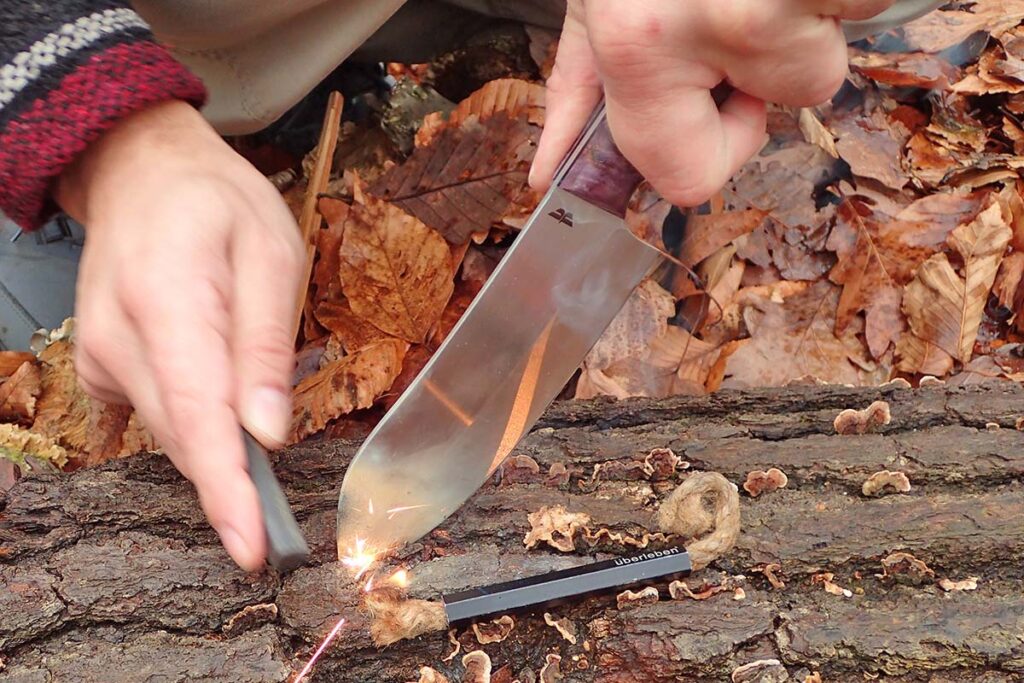
This can be accomplished by using the knife and a ferrocerium (aka ferro) rod. The job is best done by using a knife that has a blade with a 90-degree spine as opposed to a chamfered or radiused one.

Grasp the knife firmly, cutting edge up. Lay the corner of the blade spine on the ferro rod and with one swift, downward motion, as if you are whittling o a piece of the rod, move the blade down it. Doing so will result in a white hot shower of sparks. The sparks can ignite tinder to start a fire.

The key to fire starting is always select a bushcraft knife with a 90-degree spine. If it lacks such a spine, you can always use the edge but this will dull the one spot on the edge faster than standard cutting will.

Food Prep

And, obviously, a bushcraft blade can also adeptly handle any cutting task related to food or campsite prep. Bushcraft knives prove a knife need not have sheer size and weight to be effective. It’s all in smart design of the blade and handle.

Our Picks For Best Bushcraft Knife

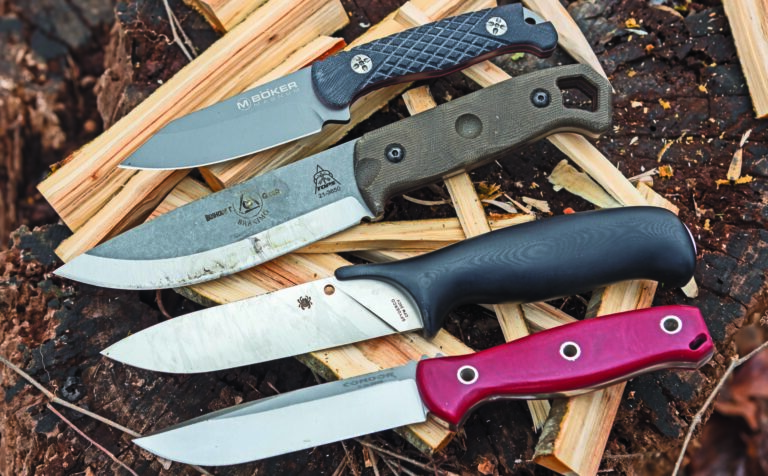
Boker Magnum Life Knife
Boker-A1-knive
Boker Magnum Life Knife

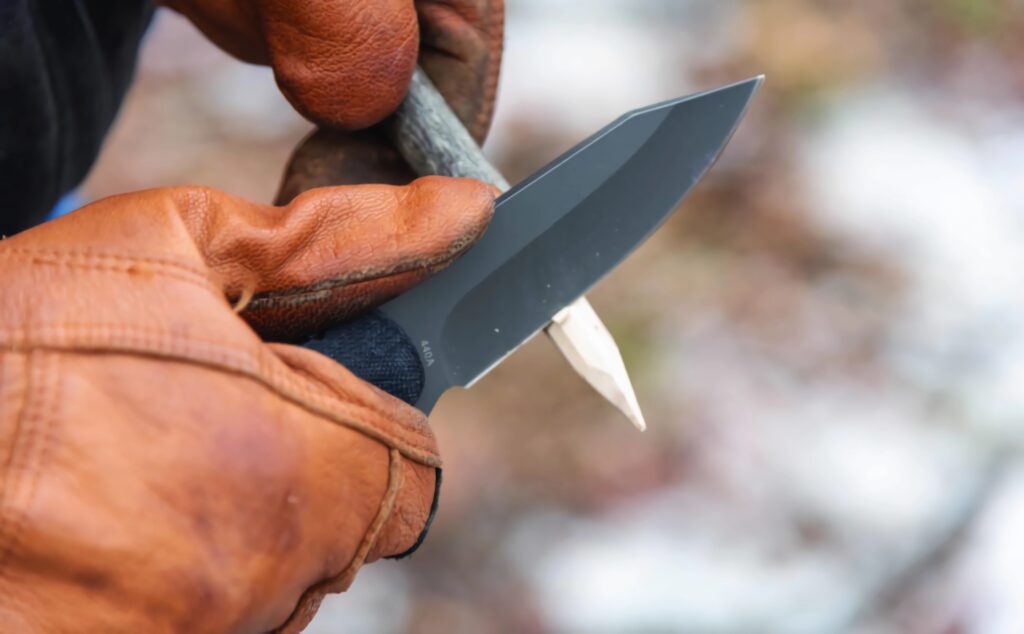
The most affordable bushcraft model of the test bunch, the Boker Magnum Life Knife has a 3.9-inch blade of 440A stainless steel in a modified clip-point pattern. Built rugged for the outdoors, the knife comes with a sturdy Kydex sheath for safe carry.

At 7.87 inches overall, the Life Knife sports a handle of machined black G-10 in a coarse crosshatched checkering pattern for enhanced hand traction regardless of conditions. The grooves in the crosshatching work are similar to those of a radial car tire by displacing moisture. Red fiber liners under the G-10 add a nice pop of color to an otherwise dark knife. 

The handle includes integral forward and rear guards to prevent your hand from sliding in either direction. The three large traction notches in the thumb rest area of the blade spine also help improve grip. The handle felt a bit skinny in my hand, so I would prefer a slightly wider one. 

Conversely, the Life Knife might be a great choice for those with smaller paws. The 3.9-inch blade is a great size for belt carry. The rather compact nature allows it to carry comfortably, with the length neither too long nor too short. The short blade tip accomplishes precise cutting chores easily.

The sheath is a simple fold-over design of Kydex with a Boker Plus clip for belt carry. The sheath features quality construction, retains the knife well, and is simple yet effective. 

MSRP: $59.95

Condor Tool & Knife Bushcraft Bliss

Condor Tool & Knife Bushcraft Bliss

Composed of high-quality materials, the Bushcraft Bliss from Condor Tool & Knife boasts a 5-inch blade with a flat grind. The 1075 carbon steel can be rather easy to sharpen in the field and still retains an edge well. The modified clip point shape offers a generous belly for slicing and a defined point. A swedge gives the blade a bit of attitude, and bead-blasted flats and satin-finished bevels provide a two-tone finish that’s very eye-catching.

The ergonomic handle of red linen Micarta® is an excellent choice thanks to its being largely impervious to temperature and humidity changes. Three thong tubes fasten the scales to the full tang. Three large notches at the spine permit non-slip thumb placement so you can bear down on the blade. With its rounded edges, choil, and scale contouring, the handle felt as if it were molded to my hand.

The sheath is Condor’s hybrid molded Kydex and leather rig, an unusual material combo. The belt loop and securement strap are leather. The leather belt loop allows the sheath to move somewhat, unlike the more rigid molded clamshell fastener—which doesn’t—and makes it easier to sit down while wearing it. A thumb break molded into the top of the sheath assists in extracting the blade, which is a nice extra touch.

I found the handle to be very comfortable. A distinctive trait is the prominently elevated traction notches. They almost look like part of a gear. The feature ensures your thumb isn’t going anywhere. 

The 5-inch blade makes baton work easy, as well as food prep tasks. Out of the box, the 1075 carbon steel was plenty sharp and ready for use. The Bushcraft Bliss is a consistent performer. 

MSRP: $118

TOPS Knives Brakimo
TOPS Knives Brakimo Bushcraft Knife
TOPS Knives Brakimo

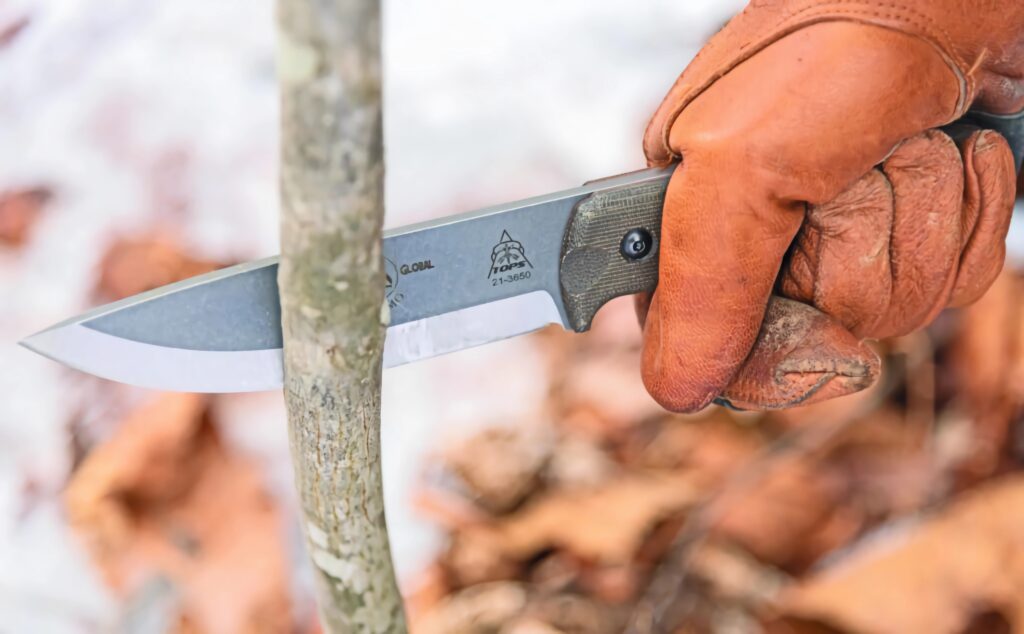
Joe Flowers runs Bushcraft Global, where he instructs students on basic and advanced survival skills while in the Amazon jungle. A notable authority in the field, he also designs knives, including the Brakimo from TOPS Knives, a tool that can carve, cut, split, and perform just about any task involving outdoor survival.  

The 5.25-inch blade of 1095 carbon steel is a drop-point pattern with a Scandi grind. It has a generous belly for easy slicing and a defined point for delicate work.

The green Micarta handle is ideal for bushcraft given its stability and minimal weight. It is matte-finished for a nice grip quality without being overly aggressive. The integral front and rear guards provide a measure of safety that locks the knife in the hand. The divot in the handle is for use with a bow drill for making fire. 

If there is a solid all-around performer of the test bunch, it’s the Brakimo. I like how it easily handles heavy work like chopping and baton work, as well as such lighter work as whittling and food prep. You can choke up on the handle for tasks requiring more control where a slicing or rocking motion is used. Grip the handle more toward the rear and feel how the balance point shifts to a blade-heavy profile for easy, effective chopping. 

The Scandi grind acts as a wedge and splits the wood in a snap, almost as if no effort were invested—very impressive performance! For one knife that does it all, the Brakimo is it. In-hand it feels substantial and capable of taking on serious work. 

MSRP: $225

Spyderco FB42G Zoomer

Spyderco FB42G Zoomer

Designed by Tony Zoomer, an outdoor enthusiast and survival skills instructor from the Netherlands comes the Spyderco FB42G Zoomer. Made of high-end materials, the knife is expertly configured and has a list of features that quite possibly makes it the most comfortable bushcraft knife you’ll use.

The 5-inch blade in a drop-point pattern is premium CPM 20CV stainless steel for enhanced edge retention. The blade has an ample belly for slicing and whittling/carving tasks and a defined point for close-up detail work. The full flat grind transitions to a convex edge, which is durable and extremely sharp.

The black G-10 scales are machined where they join the tang, so the handle is completely rounded in profile. This translates into a super comfortable grip that eliminates hot spots. An integrated rest at the blade spine permits placement of your thumb for additional pressure on cuts and for added control. The full tang extends a little beyond the end of the handle for use as a light-duty hammer.

The sheath is a custom-designed, well made leather drop-leg-style rig with a free-floating belt loop. It has an exterior storage pouch with a snap closure. The pouch can carry your choice of survival supplies, a large folding knife, a multi-tool, etc. 

The free-floating belt loop allows the knife to swing freely as you move or pivot out of the way when you are seated. It also can temporarily break away in the event the sheath gets snagged by brush in the woods. 

The Zoomer is a solid performer. The heavily contoured G-10 handle feels mighty good in the hand. The full flat grind allows the blade to sail through whatever you cut.

While the handle is comfortable, it felt big in my hand. Those with smaller hands might not take to it easily. While using high-performance CPM 20CV stainless steel is not typically a bushcraft thing, with some regular stropping and honing, you can prolong the edge and skip sharpening during your trip.

MSRP: $600

Fallkniven S1 Pro Forest Knife
Fallkniven survival knife review
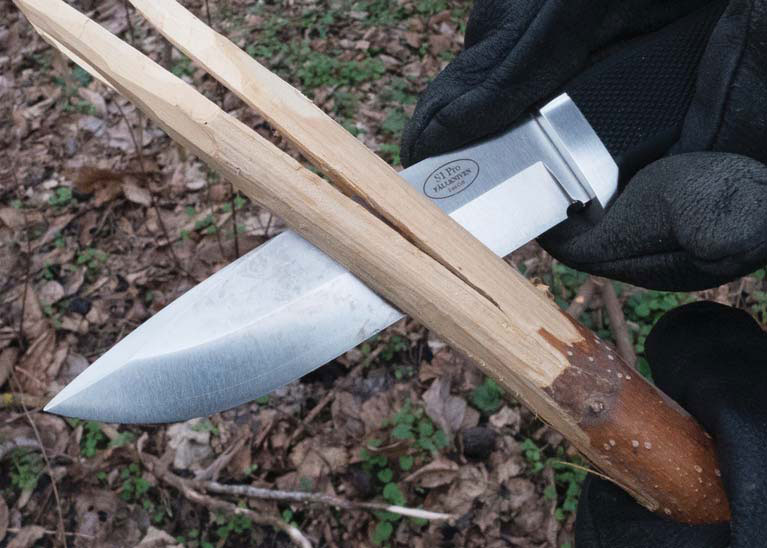
The Fallkniven S1 Pro Forest did fine work—as on this fish spear—with full control. (All images by Ash Ayres and Mary Lou Ayres)

Fallkniven’s S1 Pro Forest Knife is the evolutionary descendant of the company’s S1, which has been in production for over 20 years. The Pro version is made with better steel than the original S1, is more sophisticated and a better performer.

The S1 Pro simply does everything well and with no fuss. Its convex grind does not bind in deep cuts, goes through tough, knotty wood with little effort, peels bark, makes feather sticks, does fine work as on fish spear points with full control, and slices duck through skin, meat and bone like Luke Skywalker’s lightsaber. It cut through 2-inch-thick saplings in about a minute with little effort. The non-slip grip is comfortable and does not, in fact, slip.

Compact enough to always have on—or with a custom sheath, inside—your belt, the S1 Pro is as close as I’ve seen to the mythical “one knife to do it all.”

MSRP: $466

Ontario Bushcraft Woodsman
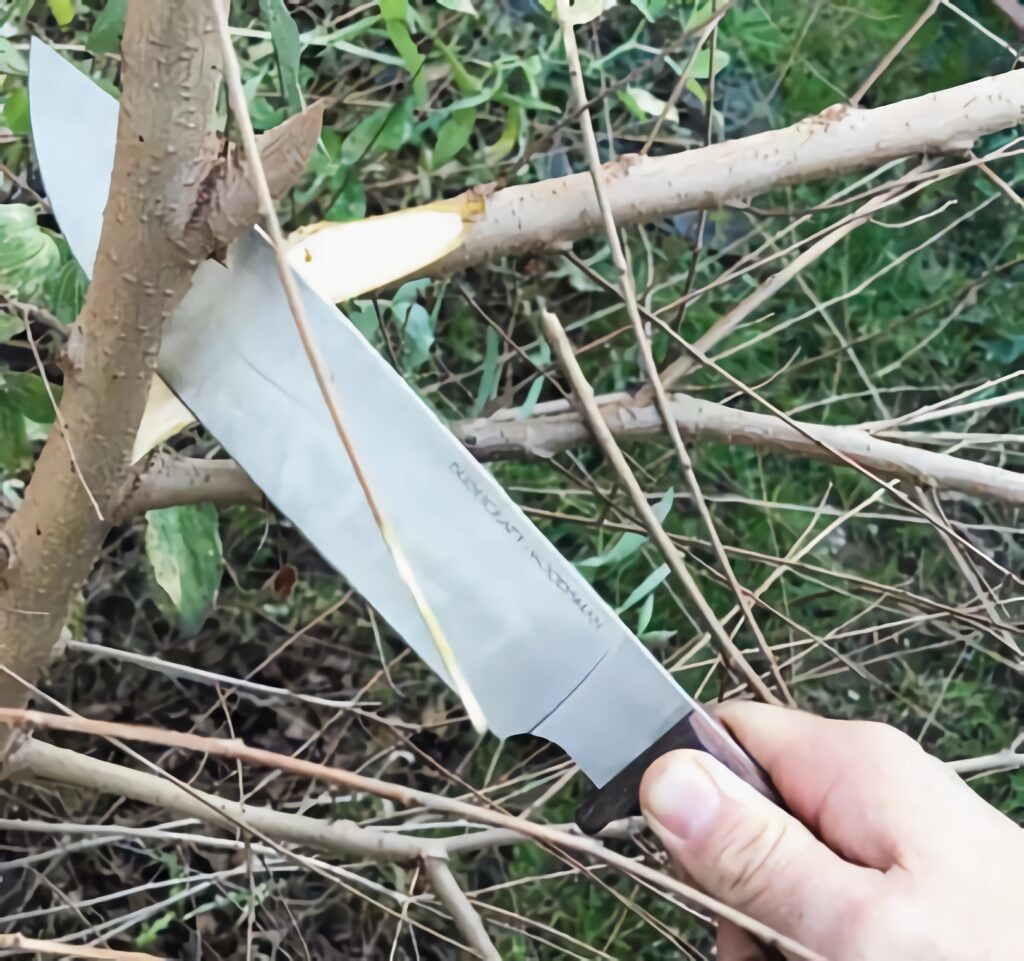
Woodsman Bushcraft Knife
Bushcrafting chopping The geometry of the Bushcraft Woodsman’s blade, combined with the overall design, good steel and heat treat, make for an exceptional big knife.

Veteran bladesmith Dan Maragni designed this issue’s cover knife, the Ontario Bushcraft Woodsman. The big blade shows his expertise and lineage as an accomplished smith, and is far more sophisticated than a first glance might suggest.

The distal taper gives it excellent balance, and, combined with the taper from spine to edge, great chopping ability.

We slashed through 2-inch-thick saplings with a single swipe, an important point in the calories-expended-vs.-results-achieved equation, and when night is falling and you need to get a fire going.

The blade’s geometry, combined with the overall design, good steel and heat treat, make for an exceptional big knife. Again referencing Tolkien, Ash called it the “Goblin Cleaver.”

Not as handy for fine work as the smaller knives, Dan’s design is a reassuring blade to have by your side in deep woods when the jackals are howling—or the Orcs.

MSRP: $137

Larry Roberts Signature Edition Gen6 Scandi (L.T. Wright Handcrafted Knife Co.)
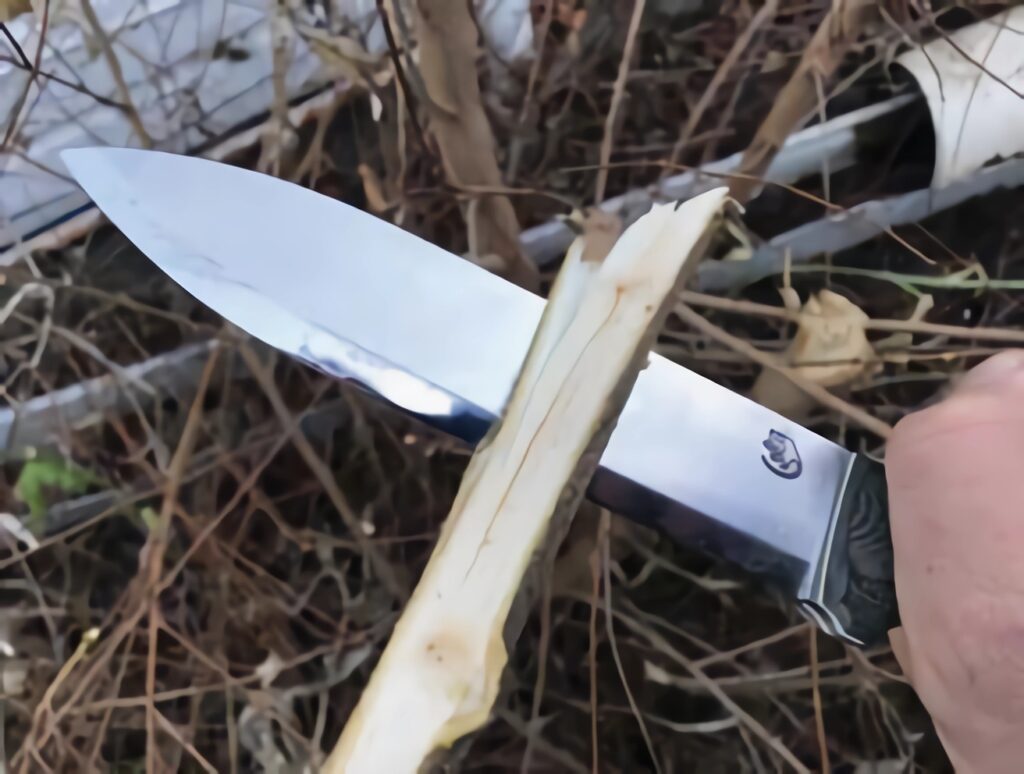
Scandi grind bushcraft knife
Due to its scandi grind, which tends to hang up in deep cuts, an average of three minutes was required to get through 2-inch-thick saplings with the Gen6 Scandi.

The Larry Roberts Signature Edition Gen6 Scandi from L.T. Wright Handcrafted Knife Co. performs like a “Mora on steroids,” according to Ash. I agree.

If you’re familiar with the scandi grind, the only surprise with the LRSEG6S is that it takes scandi-ground blades to a higher level of performance. It excels at controlled shallow cuts, holds an edge well, and is strong enough that when batonning you can twist the blade with no worries and quickly pop the batonned material apart.

I like the longer 6-inch blade much better than the popular 4-inch pattern because you can get more stuff done faster and at no penalty to doing fine work. Due to the scandi grind, which tends to hang up in deep cuts, an average of three minutes was required to get through 2-inch-thick saplings.

Comfortable in the hand, it is also beautifully made and finished. A good all-around performer, it is a classic belt knife for the woods.

MSRP: $253

Editor’s Note: Dexter Ewing and James Ayres contributed to this post.

Read More

Best Carabiner Knife: Options That Hang Tough

The Carabiners Knife Offers A Cool, Handy Way To Carry Your Everyday Knife.

The carabiner is most often associated with mountain climbing and rooted on the German word karabiner-haken, which roughly translates in English as “spring hook.” Spyderco brought the concept of adding a carabiner to a knife to prominence with its first Snap-It folder, the BLADE Magazine 1993 Overall Knife of the Year®.

In the years since, the carabiner knife concept has popped its head out of the foxhole from time-to-time, with Spyderco adding models to its line and other manufacturers following suit.

Simply stated, adding a carabiner to a knife offers an alternative way of carry. It’s a great way for a climber, camper or hiker to keep a knife handy, but what about the average everyday user? Is there a place for a carabiner cutter in your endeavors?

CRKT Compano Sheepsfoot

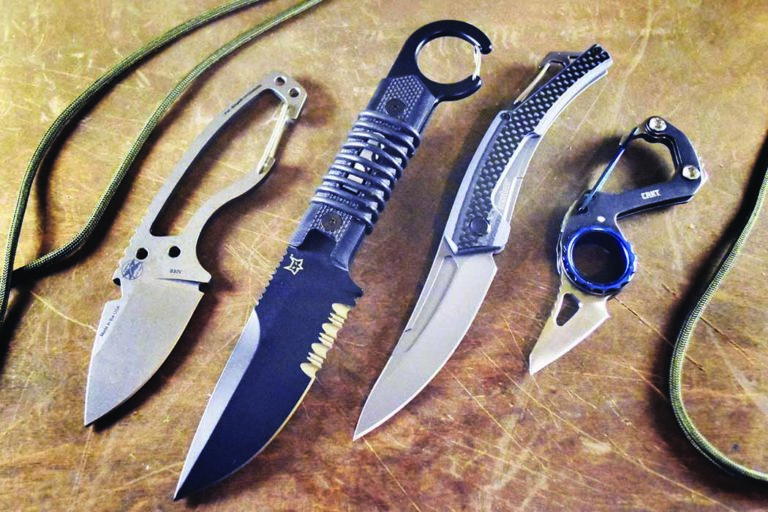
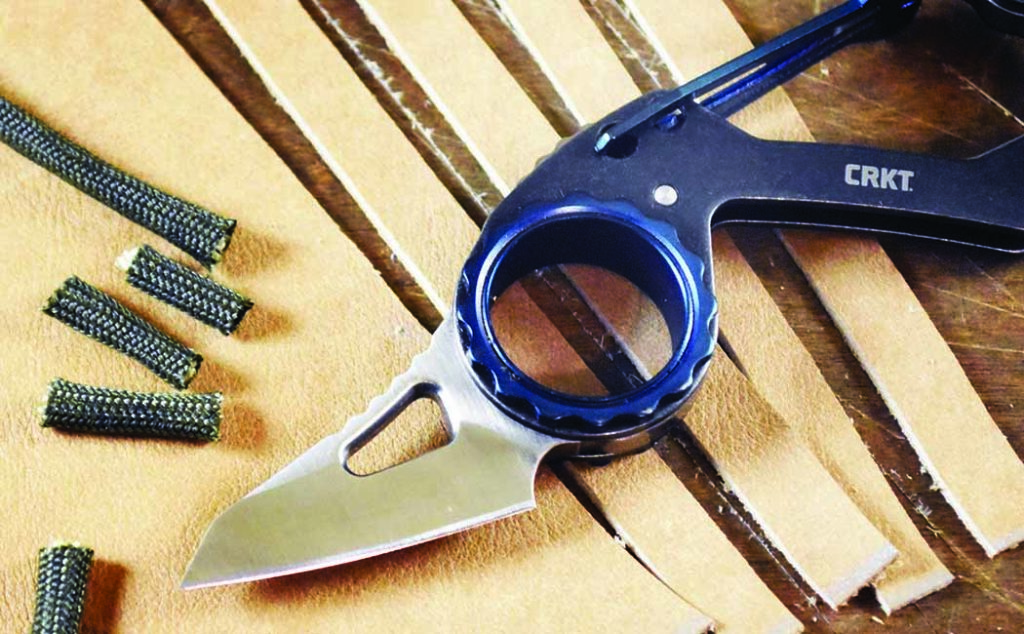
The Compano Sheepsfoot has a wicked-sharp blade that whipped through suede and paracord like butter. CRKT also offers the Compano in a drop-point version should you prefer a deeper-bellied blade.

The CRKT Compano Sheepsfoot is a sibling to the standard Compano drop-point model. Designed by Mike Bond of Honolulu, Hawaii, the Compano companions are designed as keychain knives with an edge. The folder’s cylindrical pivot is 1 inch in diameter—3/4 inch inside—with synthetic blue gear-like caps mounted to a stonewashed stainless-steel frame. The folder’s wicked little 1.44-inch blade opens by way of an oblong cutout and, interestingly, has a half-stop along the way. The handle has a generous-sized carabiner with a spring-loaded gate for capturing your key ring.

The svelte Compano Sheepsfoot can be clipped to a belt loop with no problem. The whole assemblage—Compano and keys, all on a keyring—can be carried loose in the pocket, too. I like the Compano not as a keychain knife but as a back-up, hideaway piece that can be clipped not just to a belt loop or toted loose in the pocket, but corded and worn as a neck knife as well.

Tests with the sheepsfoot blade were conclusive—the little rascal can cut! I laid out a flat of 4-inch suede and the blade sliced through it effortlessly. It liked paracord as well. In a self-defense situation with your index finger in the knife’s large pivot hole, the knife would be very difficult for a foe to dislodge. Regardless of how you plan to use this little mighty mite, I believe it would be money well spent.

CRKT COMPANO SHEEPSFOOT
Blade length: 1.44 inches
Blade steel: CPM S30V stainless
Blade pattern: Sheepsfoot
Handle material: Stonewashed stainless steel
Lock: Non-locking slip joint
Carry: Carabiner or in pocket
Special features: Large finger-hole pivot
Weight: 2.2 ounces
Closed length: 3.25 inches
Country of origin: China
MSRP: $44

Kershaw Reverb XL

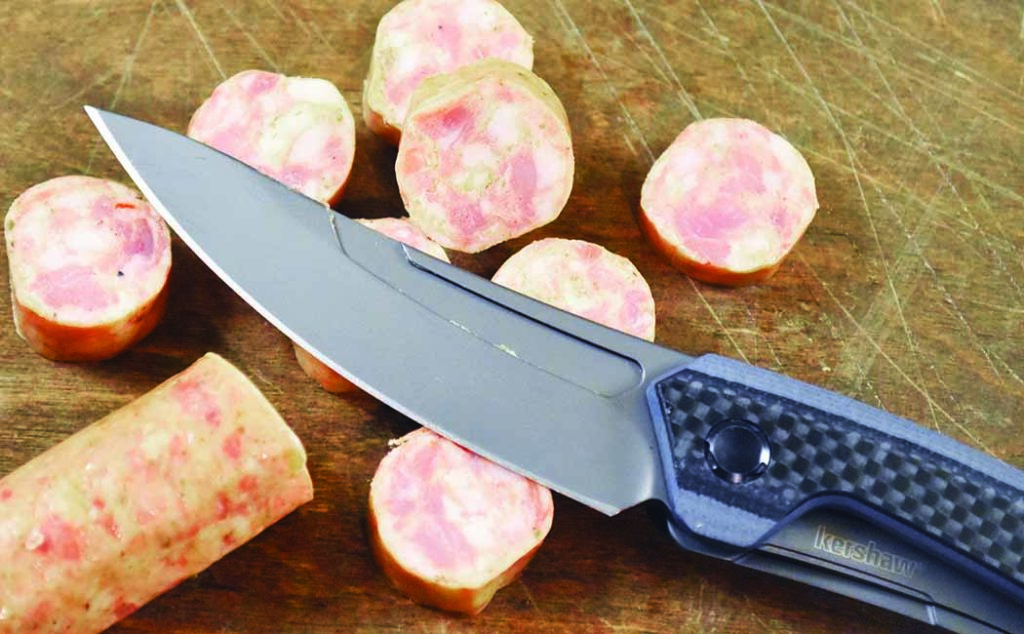
The Kershaw Reverb XL has a trailing-point blade the author found ideally geared for slicing. Notice there is no thumb stub or flipper tab for opening, with Kershaw opting instead for a finger groove to keep the Reverb snag-proof.

Kershaw makes no bones about the Reverb XL—it is made for the great outdoors. The slim 1-inch carabiner on the spine of the handle butt attaches to gear or a belt loop. A 1.5-inch pocket clip on the back handle slab can be used alternately. The Reverb XL has a sweeping trailing point or Persian-style blade with a gray finish. The blade thumbs open via a groove that follows the spine on both sides—no thumb studs or a flipper tab make it snag proof. The front slab is an attractive composite of black carbon fiber and blue G-10; the back slab is gray stainless with an interesting framelock cut completely inside the slab itself. The lock is accessed from the front slab via a cutout that exposes the lock spring.

The XL’s lock spring takes a little getting used to, but, once you get it, you get it. The knife’s extremely lightweight and won’t be a burden on any hiker, camper or climber. This is not a workhorse knife per se, rather an assistant for things like light meal prep and cutting rope or paracord. I tested it cutting sausage, paracord and 3/8-inch rappelling rope, all on a flat wood surface. The thin blade slices very well. Tough projects will leave you wanting more blade, but that’s not this knife’s design purpose. Keep it in its lane and it will serve you well.

KERSHAW REVERB XL
Blade steel: 8Cr13MoV stainless
Blade length: 3 inches
Blade pattern: Trailing point
Handle material: Carbon fiber, G-10, stainless steel
Lock: Framelock
Carry: Carabiner or blade-tip-up pocket clip
Special features: Framelock, groove blade opener
Weight: 2.31 ounces
Closed length: 4.25 inches
Country of origin: China
MSRP: $53.95

DPx HEAT Hiker Stonewashed

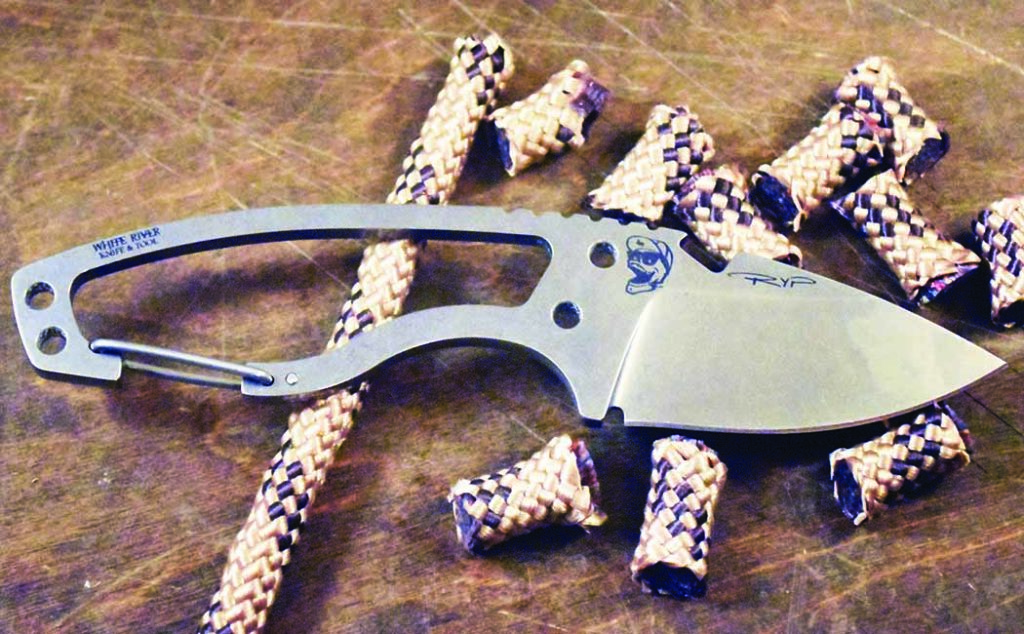
The author found the DPx Gear HEAT Hiker brutish in both looks and action, whipping through this 3/8-inch rappelling rope with nice, clean cuts from the CPM S30V stainless steel blade. The HEAT Hiker has by far the largest, most accommodating carabiner of the review knives.

The DPx HEAT Hiker Stonewashed is an upscale version of the original DPx versions released in 2014. With White River Knife & Tool handling the manufacturing chores, DPx Gear ordered these up with premium CPM S30V stainless steel blades in a stonewashed finish. Other than that, all the knife’s popular trademark features—skeletonized carabiner handle, cap lifter on the lower blade spine and nifty Kydex breakaway neck sheath—are preserved for HEAT Hiker fans to enjoy. The Hiker blade is built on 0.16-inch-thick steel so you can bet it’s plenty stout, while still lightweight enough to make it a breeze to carry.

The curves on the integral handle fit the hand well, and cutting through 3/8-inch rappelling rope was as easy as eating puffed wheat for breakfast. The knife’s short blade will shave wood for fire starter and is limited only by its length. An area the Hiker truly excels in is its carry options. The gaping carabiner allows it to easily hook onto belt loops or gear, and its thin cross-section allows it to lay flat against the chest when worn as a neck knife. Can you say EDC? Designed by adventurist/journalist Robert Young Pelton, aka RYP, you can tell the HEAT Hiker had a lot of thought and experience behind its development.

DPx HEAT HIKER
Blade steel: CPM S30V stainless
Blade length: 2.5 inches
Blade type: Drop point
Handle material: Skeletonized steel
Carry: Carabiner or Kydex neck sheath
Special features: Bottle opener/breakaway sheath
Weight: 2.15 ounces
Overall length: 6.25 inches
Country of origin: USA
MSRP: $125

Fox Knives Ferox

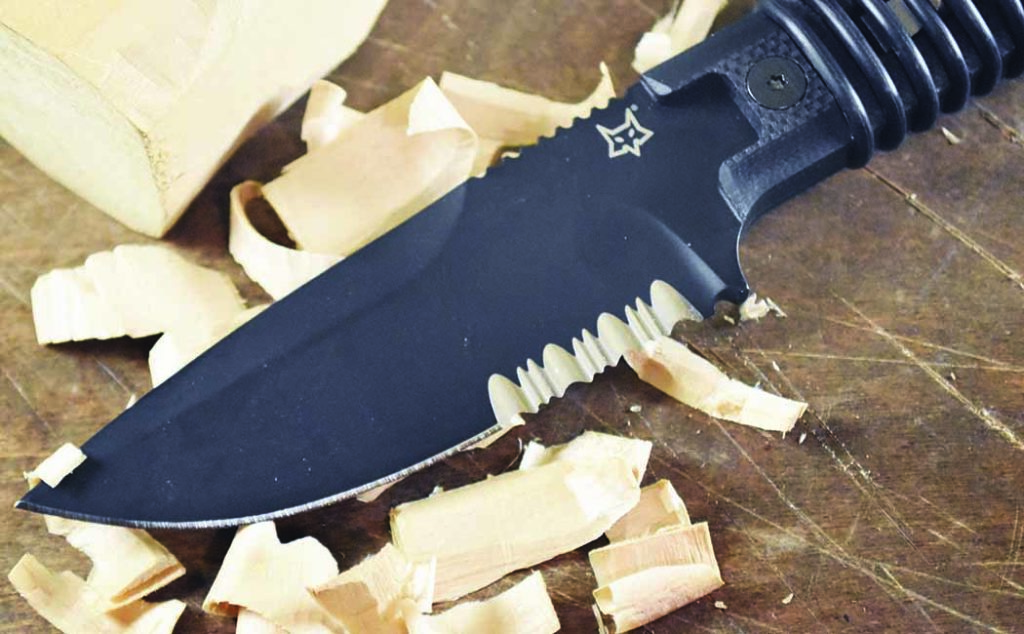
Using the plain-edge portion, the 3.54-inch Bohler N690 stainless steel blade of the Fox Knives Ferox serves up some nice shavings from a block of wood.

The Fox Knives Ferox carabiner knife brings a couple of extra tools to the table, namely a set of Phillips and flat-head bit drivers along with a 2-inch extension. Designer Tommaso Rumici saw a need to add the two components because knife users often get caught flat-footed by not having screwdrivers on hand and end up using the tips of their knife blades—which is not only hazardous to the knife but can cause harm to the user as well.

The Ferox is a black-coated, mid-sized integral straight knife with a blade available in either a plain or partially serrated edge. The handle butt houses a round finger-sized carabiner 1 inch in inside diameter with a .5-inch spring gate. The scales are black G-10, grooved in the middle to house the Phillips and flat-head bits on either side. There are eight O-rings on the handle that serve to trap the bits until ready to use, and also to add purchase. The Ferox includes a black Kydex sheath with a Tek-Lok belt attachment.

There’s a lot to unpack here. The Ferox and its sheath weigh 9 ounces, which, in my opinion, is a little too much for hanging off a belt loop, though ideal for gear with a decent size strap or metal ring. The knife is very well made, and the blade sliced through 3/8-inch rappelling rope and took off firewood shavings from a wood block effortlessly. This is a heavy-duty knife for its size and the blade steel is praiseworthy.

The bit driver is an interesting addition. The drive extension must be kept track of separately as there is no place for it to attach to the sheath. While I think the bit driver is a handy addition—and it does work—I like the knife more for its other characteristics: it’s built like a tank, has excellent steel and cuts like a house afire. I’d opt for the plain-edge version to get even more slice out of the superb blade.

FOX KNIVES FEROX
Designer: Tommaso Rumici
Blade steel: Bohler N690 stainless
Blade pattern: Drop point
Blade length: 3.54 inches
Handle material: Black G-10
Carry: Carabiner or sheath
Special features: Integral design, flat-head and Phillips driver bits
Weight: 5.29 ounces
Overall length: 7.27 inches
Country of origin: Italy
MSRP: $299

Check out More of Our Buyer’s Guides

Rothman Knives Gentleman’s Trapper Review

Don’t let its throwback good looks fool you, Rothman’s Gentleman’s Trapper has serious EDC chops.

The original EDC knife is a pocketknife. It used to be a right of passage when you were allowed to have a hand-me-down knife in your front pocket. I received mine at the ripe old age of 5. I used it to sharpen pencils and crayons and for whittling.

After a few years and a few cuts on my fingers, I progressed to skinning and cleaning fish. The knife never left my front pocket. I carried it to school for daily uses. It also made quite a few trips in the washing machine and dryer. My mom would have a fit every time she heard it thumping in the dryer. Of course, the laws have changed now and the younger generation has found other things to entertain themselves. For me, my old pocketknife is retired.

Mike Rothman’s Gentleman’s Trapper would make a great pocket filler. It walks and talks perfectly. But how well does it cut? Let’s see.

Gentleman’s Trapper Sharpness Test

Twenty-pound bond copy paper provided the first test. The slip joint sliced it cleanly and effortlessly. The edge is very fine, so control was easy. It’s a nasty-sharp knife for sure—I could hear the blade slicing aggressively.

Light Duty Cutting With The Gentleman’s Trapper

Cutting cardboard
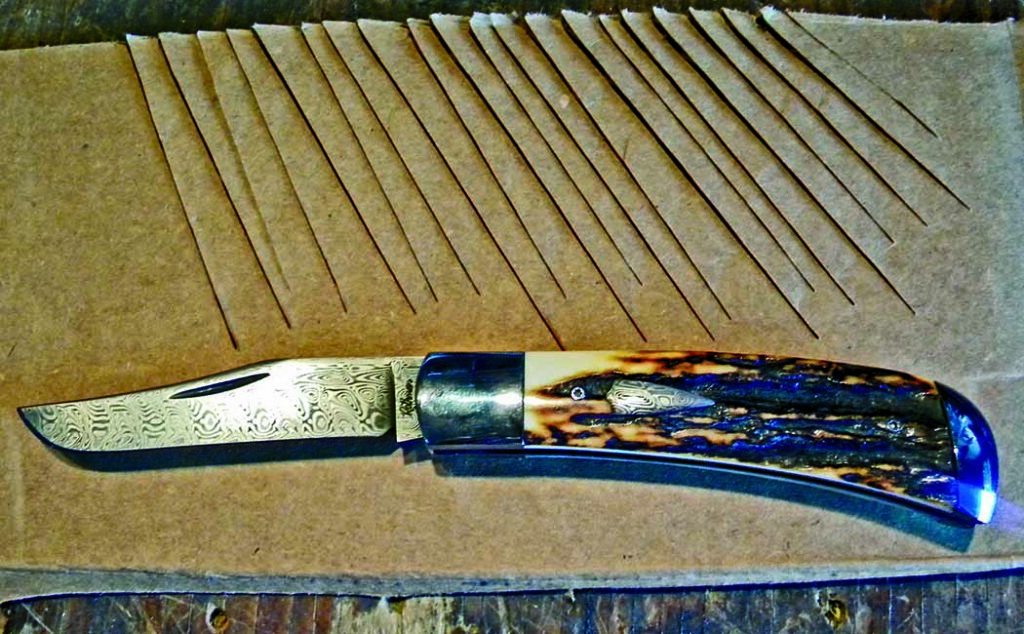
After dispatching single-walled cardboard with the Rothman knife, the author only had to use a tad more pressure on the push cut to zip through double-walled cardboard.

On to single-walled cardboard. The Gentleman’s Trapper made short work of it. In fact, it was very addictive slicing the cardboard. The blade made smooth, straight cuts with no deflection of the material. Very sharp indeed!

Next I found a piece of double-walled cardboard to try. I only had to use a tad more pressure on the push cut to zip through it. I could hear every cut again. The knife is a very forceful cardboard cutter.

Gentleman’s Trapper skins leather
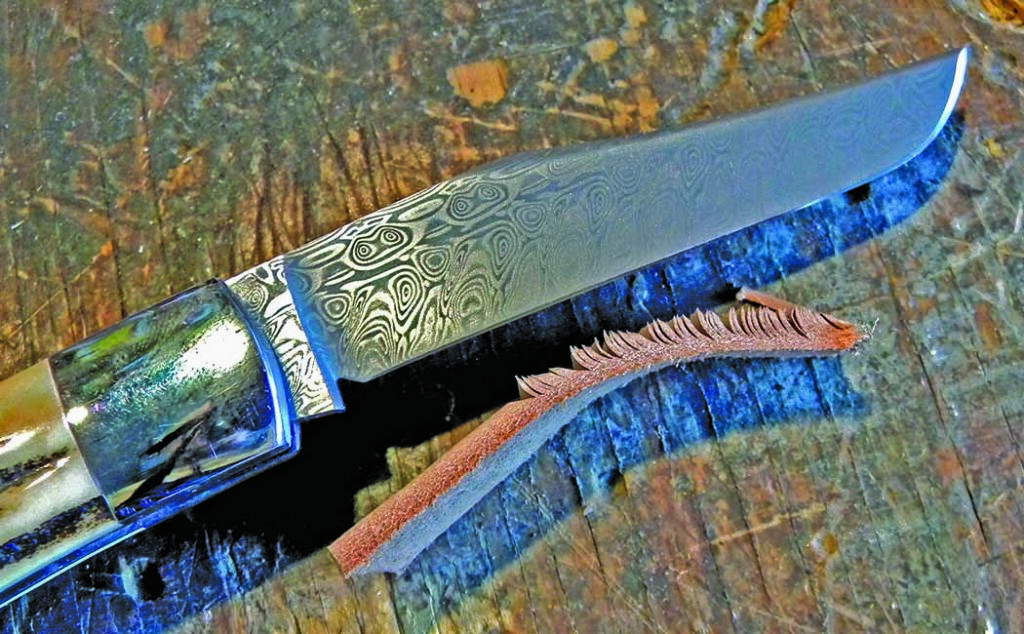
The thin blade made skiving leather simple, producing super thin slices repeatedly.

It was time for the leather slice and skiving. The trapper zipped through the leather quickly, so I had to use my knuckles as a stop to keep the piece together so it wouldn’t turn into a pile of pieces. The thin blade made skiving simple, producing super thin slices repeatedly. The stag handle worked perfectly providing a positive grip cutting the leather.

Heavy-Duty Cutting Duty

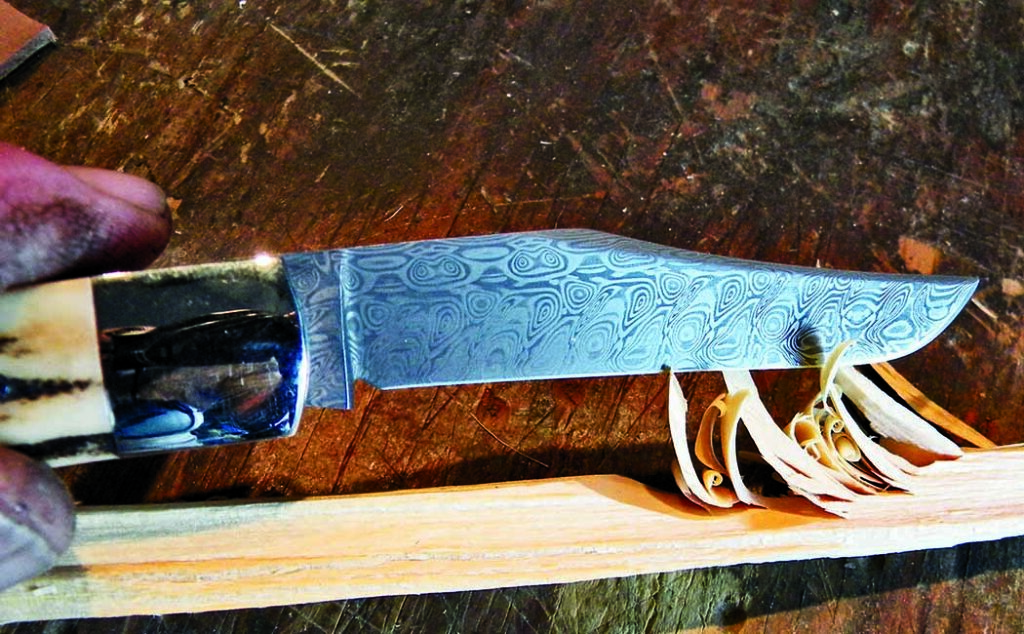
Whittling was up next. The thin blade produced some of the finest curly-cues I’ve seen. I changed the angle of cut for a deeper bite. I could see and feel the blade flex as deeper bites ensued. It was a very weird sensation, to say the least. I just moved the contact surface closer to the bolsters.

Gentleman’s Trapper whittling
In the whittling test, the author changed the angle of cut for a deeper bite. He could see and feel the edge flex as deeper bites ensued.

Half-inch sisal rope beckoned. I was looking forward to this one. Dang, this trapper performs—273 crunching cuts and the edge was barely sliding! It was easy to cut with and the handle was comfortable with a tight grip. The insides of the liners are a bit sharp but there were no hot spots. Wow!

I returned to the 20-pound bond paper to see if the edge was affected by all the testing. Nope—same clean slices in the material, a sign of great heat treatment.

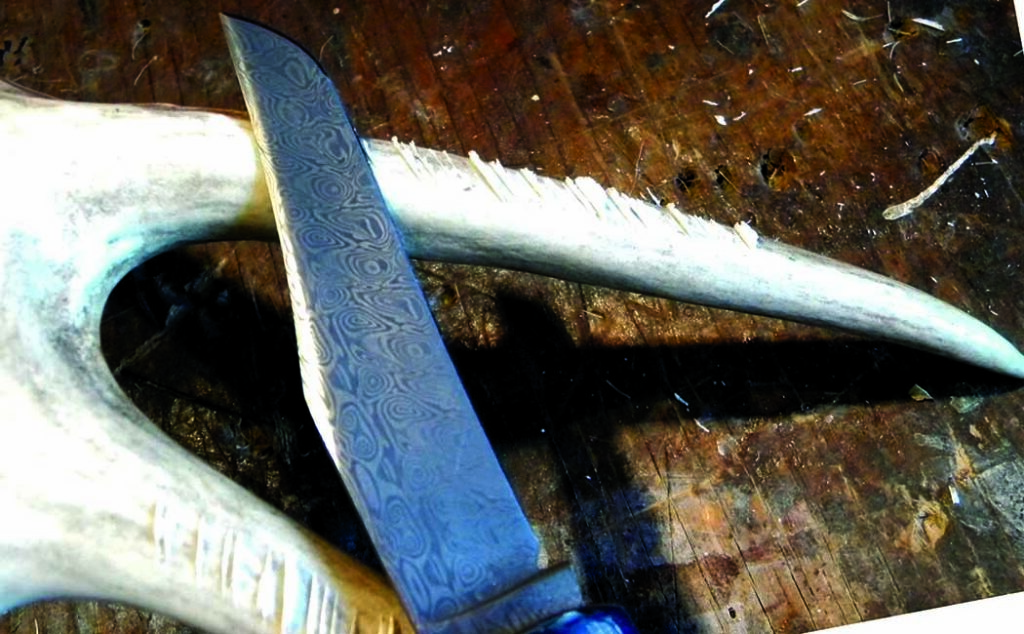
Knife tested vs antlers
The author whacked the blade 30 times into the antler with no edge damage at all. The edge would still pull hair and the knife was as tight as when the author started, still walking and talking.

I was compelled to do a warranty-breaking test just to see how tough the Gentleman’s Trapper is. Where was the deer antler? I whacked the blade 30 times into the antler expecting to see some minor edge damage. There was no damage at all! The edge would still pull hair and the knife was as tight as when I started, still walking and talking.

Overall Impression Of Rothman’s Work

I was impressed with the performance of the blade considering how thin it is. Excellent workmanship!

Does Anything Need To Change?

Soften the exposed inside edges of the liners. That’s all, folks!

Gentleman’s Trapper Specs:
Knife Type: Slip joint/pocketknife
Maker: Mike Rothman
Blade Length: 3”
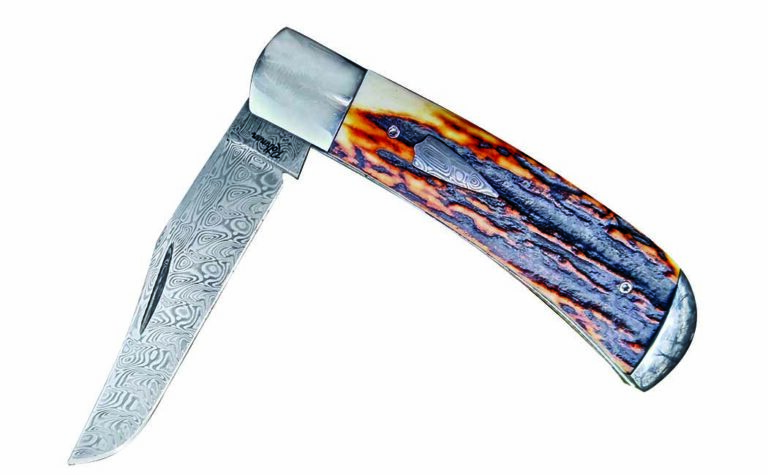
Blade Steel: Damasteel damascus in an Ægir pattern
Blade Grind: Hollow
Blade Pattern: Clip point
Blade Thickness: Tapers on the spine from 1/8” above the ricasso to .039” at the tip; the edge is even thinner than the latter
Handle: Sambar stag w/shield of same material as the blade
Handle at the Thickest: .5”
Liners: Fileworked of 410 stainless steel
Bolsters: 416 stainless steel
Backspring: CPM 154 stainless steel
Weight: 3.5 ozs.
Closed Length: 4”
Knife to know: There is a seamless fit of blade to backspring in the open position
Extras: Comes in black zippered pouch w/Rothman’s company name over shape of the state of New York
Maker’s price: $750

Read More Knife Reviews:

CRKT Clever Girl And Stylus Drop In November

1

Just in time for Christmas, CRKT adds a pair of sleek and stylish options.

Little surprise, CRKT’s insatiable march of designs continued in November with a couple of wickedly lithe designs.

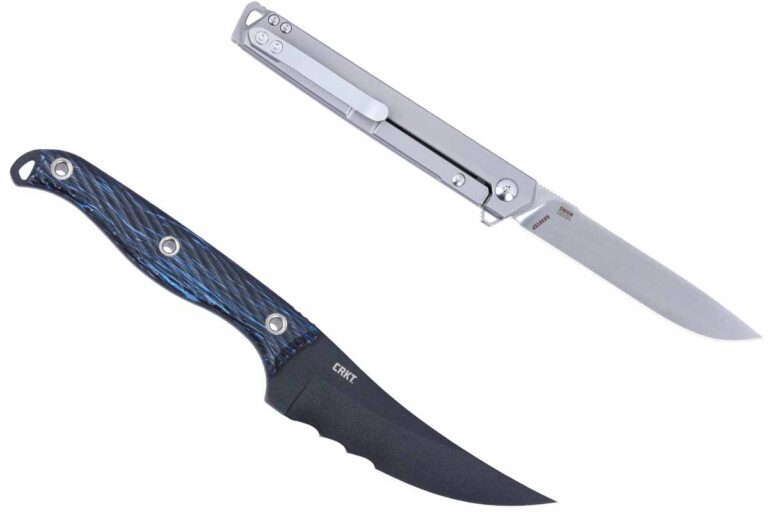
The Clever Girl Fixed and Stylus most certainly cut different profiles from each other and seem different as night and day. However, the new release certainly mimics each other in their sleek and slender designs, with their nimbleness apparent even out of hand. Additionally, both are in time for the impending Yuletide season, making them both perfect additions under the tree.

Let’s take a look at what each of these new CRKT drops brings to the table.

Clever Girl Fixed

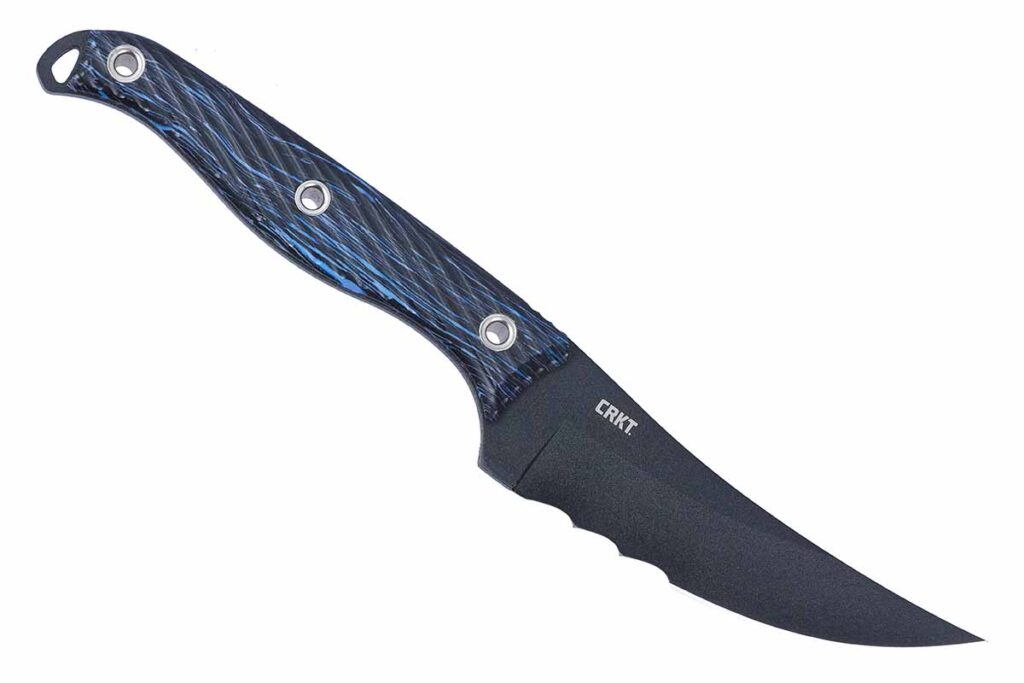
CRKT Clever Girl profile

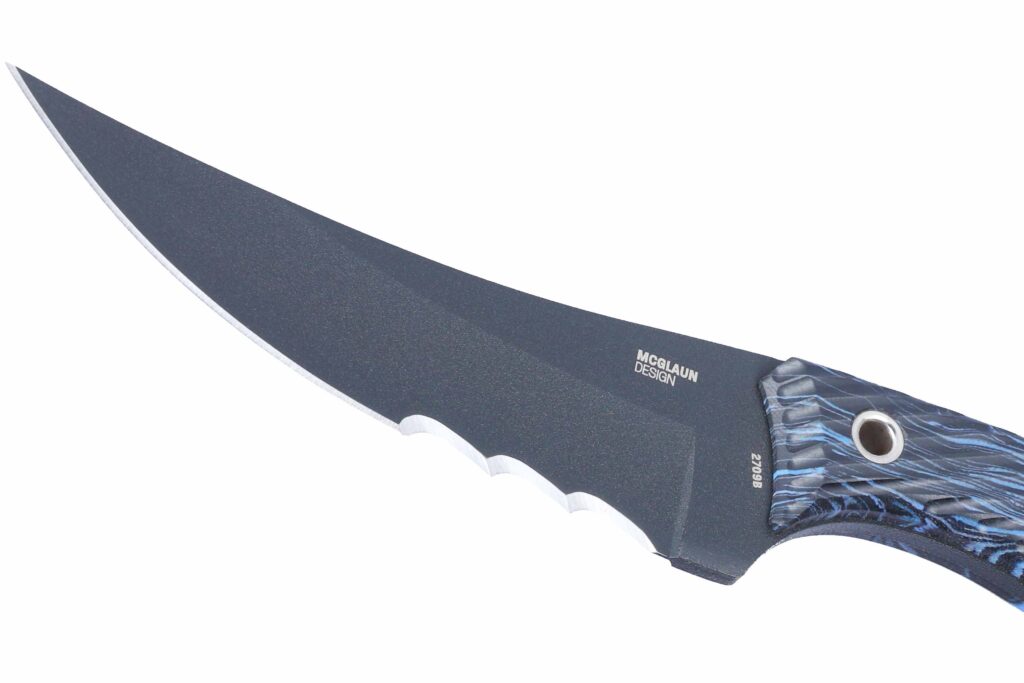
This knife somewhat returns to its roots, taking the Clever Girl back to the fixed-blade configuration. However, the Austin McGlaun design has some new twists that keep the Persian-style trailing point fresh. In particular, partial serration of the blade.

These are a series of three large, scalloped Veff serrations (CRKT proprietary and created by professional sharpener Tom Veff) running near the midpoint of the 4.6-inch blade. This enhances the knife’s sawing power, particularly against materials such as rope or fabric—think seatbelts. But let’s face it, it also takes a pretty menacing original design and makes it look a dash more ominous.

The other change on the Clever Girl Fixed is the handle, with CRKT bidding adieu to black G-10 scales and replacing them with marbled blew G-10. Not a huge switch-up, but one adding a touch of flair to the knife, particularly when offset by the black powder-coat finish on the blade.

CRKT Clever Girl Blade

As to the finer points of the knife, the blade is made from SK-5 steel, providing a good balance between toughness and ruggedness. It comes with a molded Kydex sheath for ease of carry. And it the Clever Girl Fixed watches her weight, tipping the scales at a very nimble 6.3 ounces. CRKT lists the knife at $114 on the company’s website and a portion of every sale—as with every knife in Columbia River’s Forged By War collection—is donated to the Green Bret Foundation.

CRKT Stylus

CRKT Stylus Profile

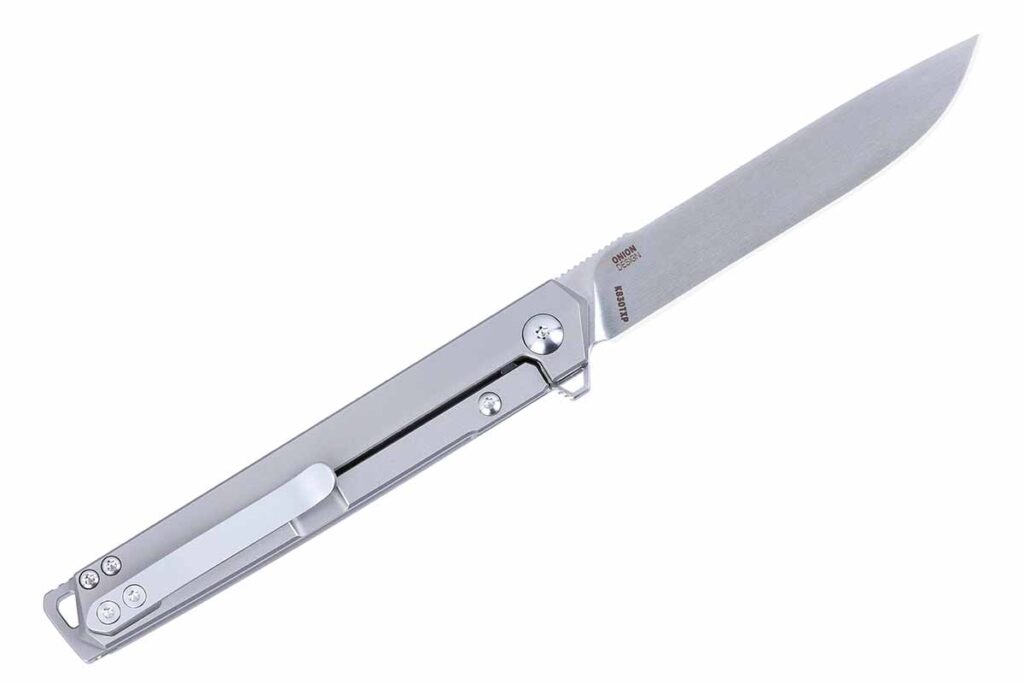
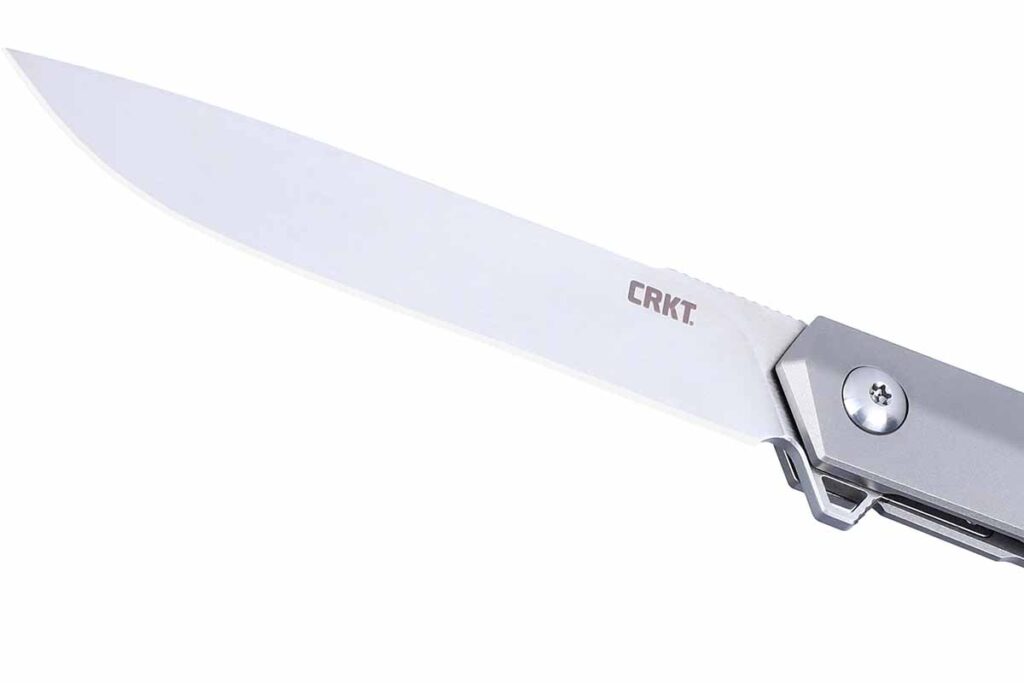
A Ken Onion classic CRKT brought to the masses a few years back, the Stylus has proven a popular addition to the company’s catalog. Unable to leave well enough alone—lucky for knife nuts—CRKT has released an updated version of the classy and svelte, assisted-open. In particular, the new version of the Stylus offers several upgraded materials, including a titanium handle and powerful CPM S35VN blade steel. The handle is especially nice, accentuating the crisp lines of the knife, making the already clean and sleek design seem even more so

CRKT Stylus Blade

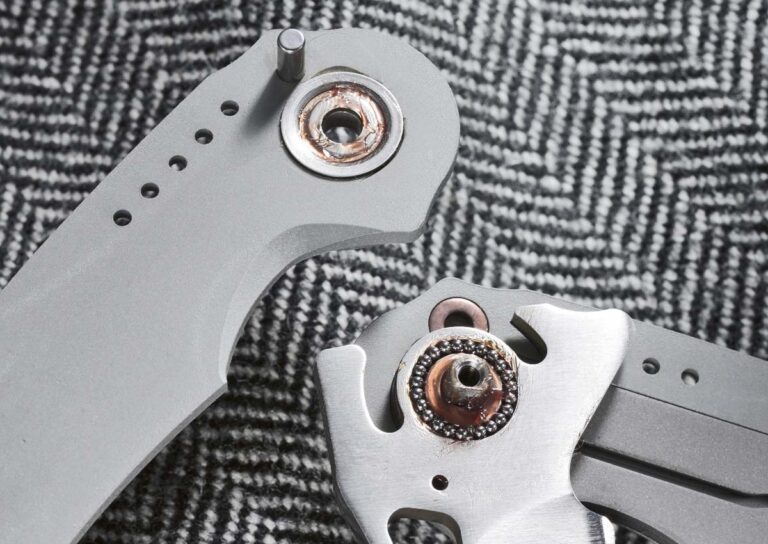
The updated Stylus offers the points that have made the flipper a favorite of many, such as an IKBS ball bearing pivot for a silky blade deployment, a thick locking bar to secure the frame-lock’s blade and an extremely low profile. At present, CRKT lists the new Stylus listed at $195 on the company’s website.

More On Fixed Blades:

Nessmuk Knife: Options In The All-American Outdoor Knife

History repeats itself in modern renditions of an all-American classic.

Some patterns stand the test of time and become legendary for a reason, be it a story, movie or book. The Nessmuk-style knife stands out because of its shape.

Nessmuk was the pen name of George Washington Sears, a 19th-century American writer, conservationist and outdoorsman. He wrote about his wilderness adventures, particularly his solo canoe trips in the Adirondacks, a picturesque mountain range in northeastern New York state. He promoted a simple and lightweight approach to camping and woodcraft.

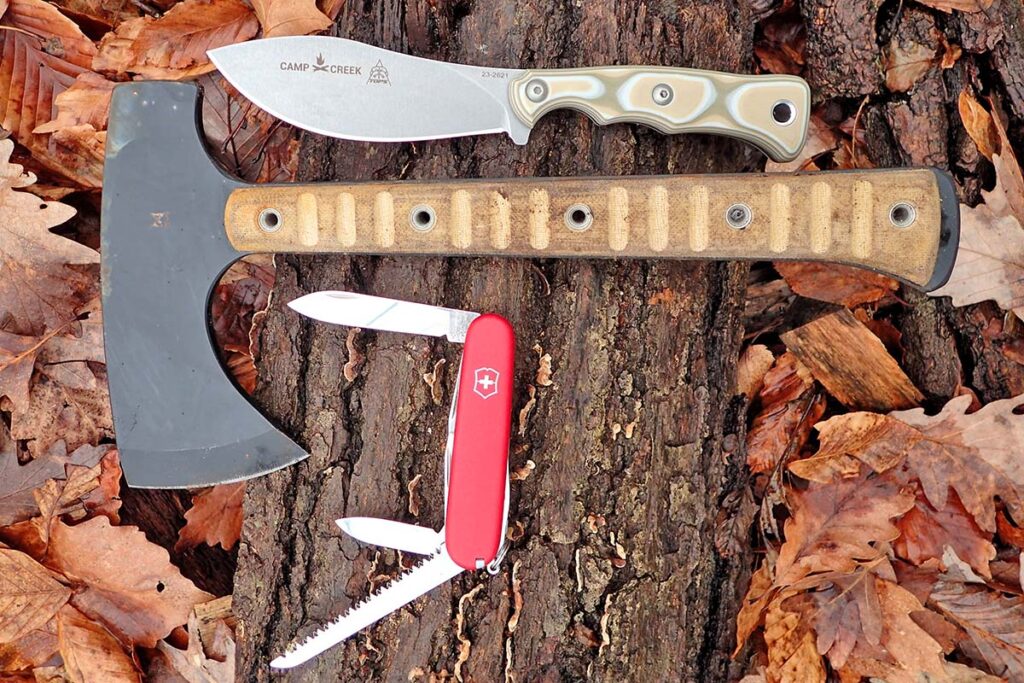
A modern “Nessmuk Trinity” with a Helm Forge hatchet, Victorinox camper, and TOPS Knives Camp Creek.
A modern “Nessmuk Trinity” with a Helm Forge hatchet, Victorinox camper, and TOPS Knives Camp Creek. Nessmuk would be proud of this edged-tool setup.

According to the story, the Nessmuk knife was named after a childhood friend of Sears’s from the American Indian community. The knife was not well documented and very little is known about it except for a diagram in Sears’s book Woodcraft and Camping. The book describes the knife as “thin in the blade, and handy for skinning, cutting meat, or eating with.”

What Is A Nessmuk

The Nessmuk-style knife has a unique shape that sets it apart from other models. The 4-to-5-inch blade has a hump on the spine that is closer to the point. The blade also has a deep belly and an upswept point, which makes it ideal for slicing, skinning and similar tasks. The distinct blade shape is the defining feature of a Nessmuk-style knife.

George Washington Sears, aka Nessmuk, preferred thin knives with keen edges. He paired his knife with a double-bit hatchet and a folding knife, forming his “trinity” of cutting tools.

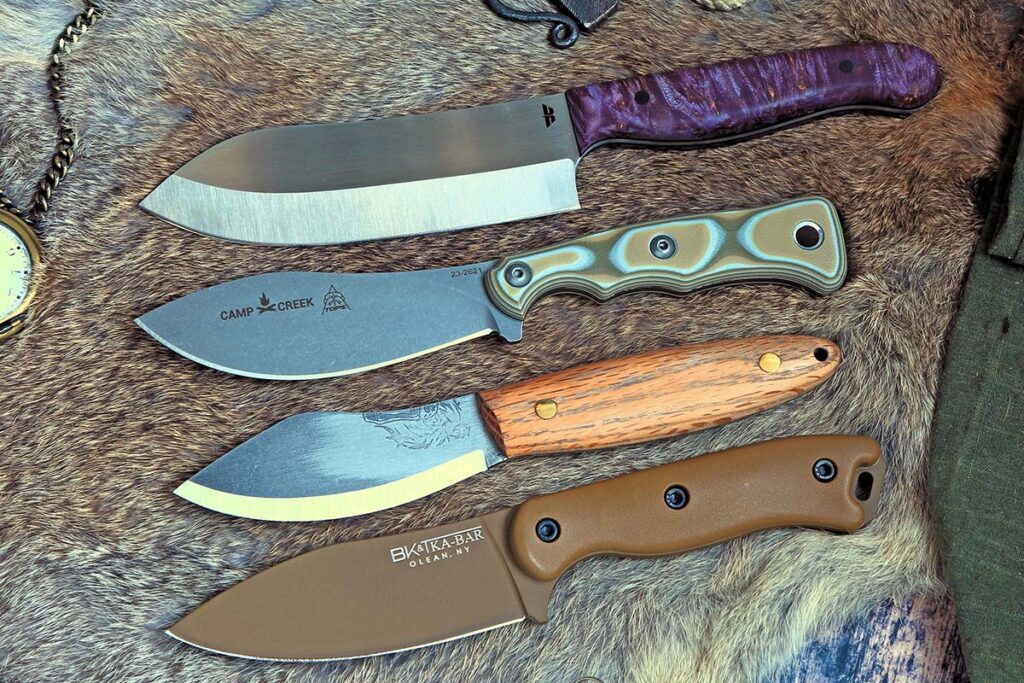
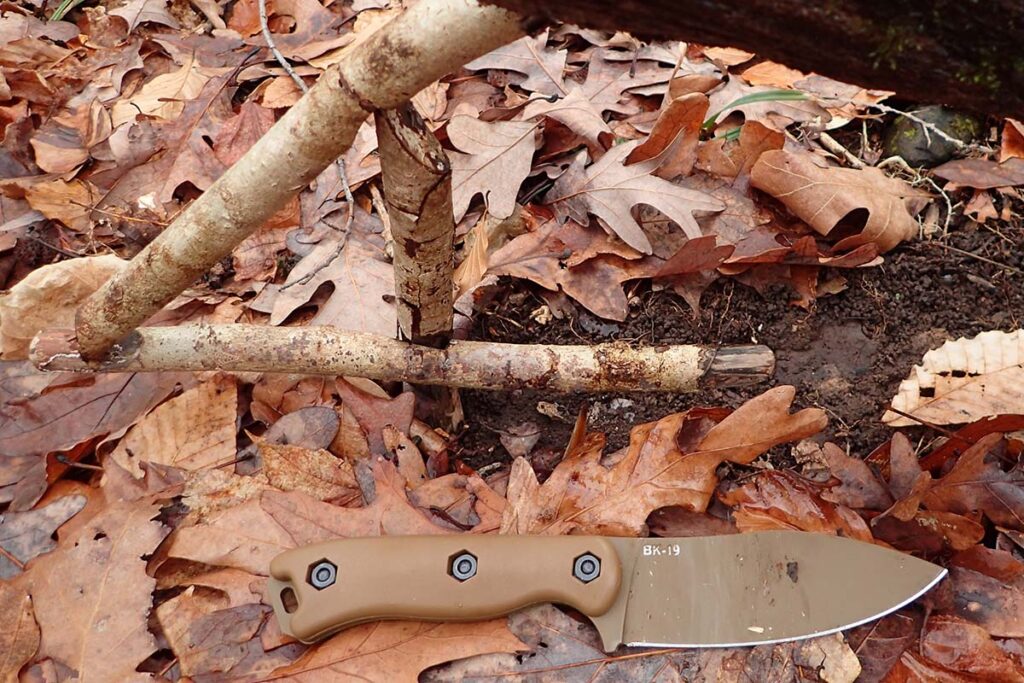
Nuge Camptoku, TOPS Knives Camp Creek, Bear Forest Knives PuuMuk and KA-BAR/Becker BK-19 Nessmuk knives.
The Nessmuk-type knife is a highly regarded design. The test versions are, from top: Knives By Nuge Camptoku, TOPS Knives Camp Creek, Bear Forest Knives PuuMuk and KA-BAR/Becker BK-19.

Usually, a Nessmuk blade is carbon steel ranging from 3/32 to 1/8 inch at the thickest. The handle comes in a variety of materials, including wood, bone or antler depending on availability and user preference. It is important for the handle to be comfortable and ergonomic, fitting the hand well.

What Makes A Good Nessmuk

A Nessmuk knife is a fixed blade Sears designed and used for his expeditions. It has a distinctive curved blade that resembles a skinner or a butcher knife and a handle that fits comfortably in the hand.

A quality Nessmuk knife should be able to perform various tasks in the woods, such as skinning game, slicing meat, carving wood, making feather sticks, cutting cord—even shaving. It should be sharp, sturdy, well balanced and easy to maintain. A Nessmuk knife should also be lightweight and compact so as not to add much bulk or weight.

TOPS Knives Camp Creek

Camp Creek combines all the features of a superior hunting knife with impeccable fit and finish
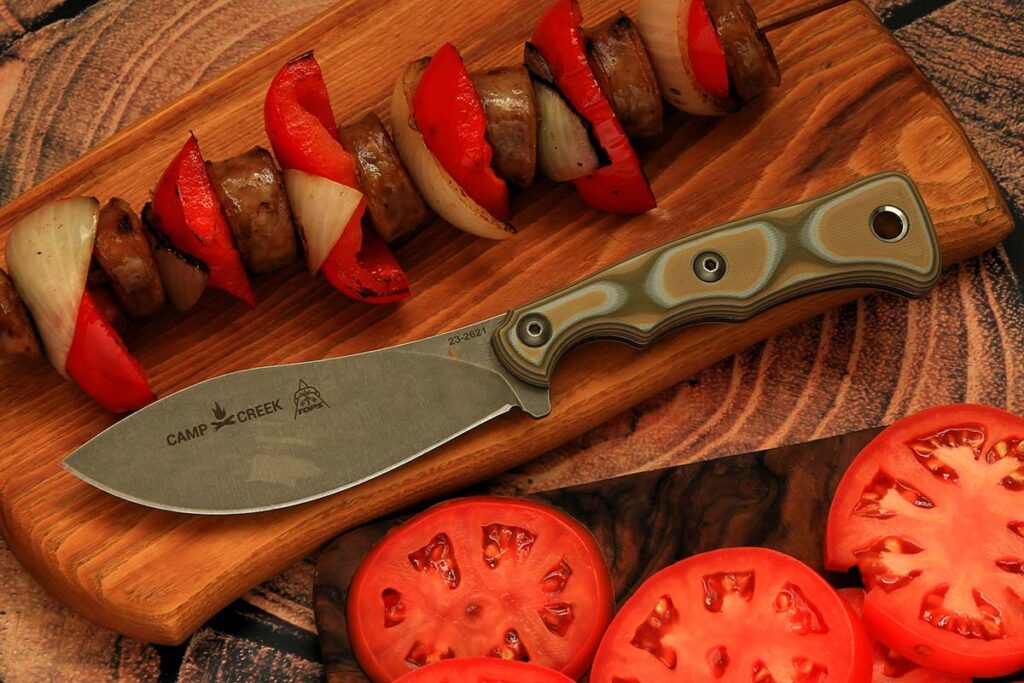
The Camp Creek combines all the features of a superior hunting knife with impeccable fit and finish. It sliced camp food and passed the tomato test with flying colors.

The TOPS Knives Camp Creek is a hunting/camping knife designed by Leo Espinoza, company president. The blade is CPM S35VN steel, which boasts superior edge retention and stainless properties. The handle is a three-color camo-style G-10.

The Nessmuk-like design is perfect for hunting, skinning, processing wood and food prep around the campsite. The knife has a contemporary tan Kydex sheath and a brown leather dangler on a swivel.

Camp-style kabobs were my focus with the Camp Creek due to its classic butcher knife shape. I knew it would excel slicing meat and veggies and it didn’t disappoint. It aced the tomato-slicing test and will see more dirt time in the future.

Definitely the most Nessmuk shaped of the review knives, the super-sharp, flat-ground blade has all the right curves and excels at food prep and woodcraft.

Camp Creek Specs
Designer: Leo Espinoza
Blade Length: 4.38”
Blade Steel: CPM S35VN stainless
Blade Grind: Flat
Blade @ Thickest: .13”
Blade Finish: Tumble
Handle Material: Camo G-10
Overall Length: 9”
Sheath: Coyote tan Kydex and leather
Country of origin: USA
MSRP: $305

Bear Forest Knives PuuMuk

Eating off the Nessmuk hump
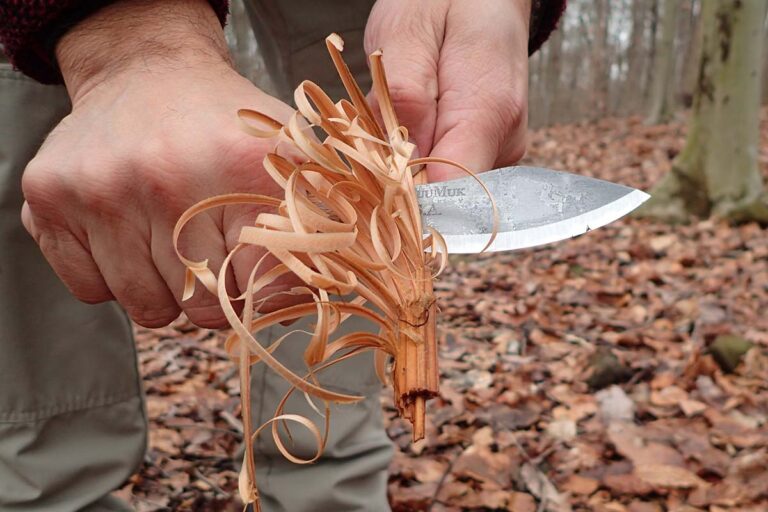
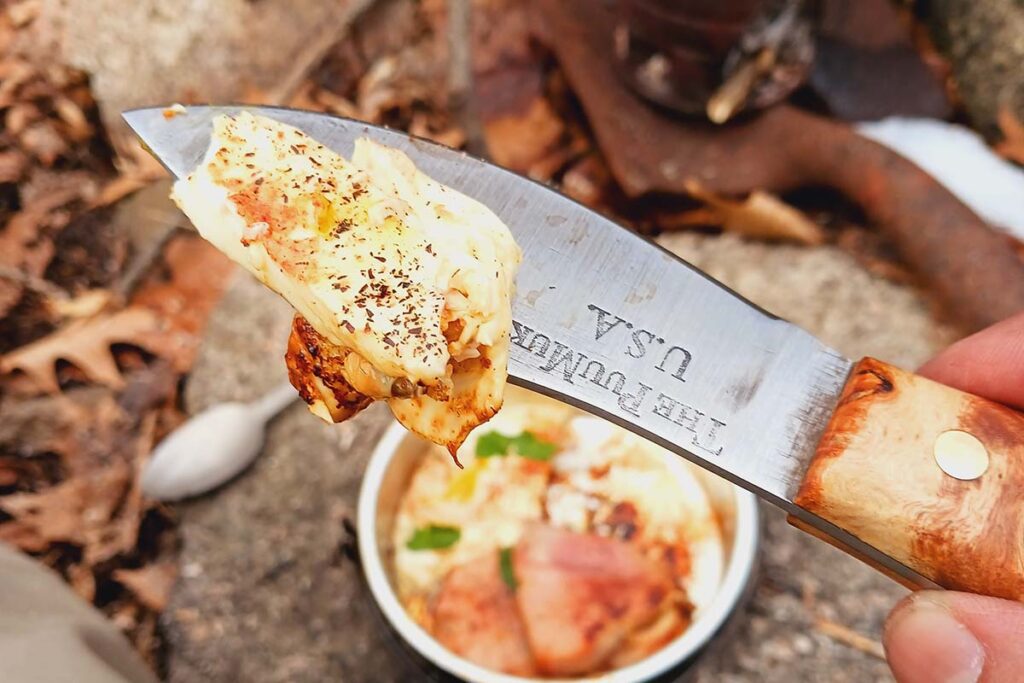
The author ate off the Nessmuk hump of the PuuMuk, perhaps the way Nessmuk himself did a century-and-a-half ago.

Made by Bear Forest Knives (BFK), the PuuMuk combines the design elements of a puukko and a Nessmuk-style knife. It has a straight handle without a guard and a choice of blade grinds: high saber or Scandi. The knife features full-tang construction. The blade was sharp as can be, especially the Scandi version.

The handle is like all the knives I have used from BFK—comfort is not compromised in any way. The red oak scales are secure and comfortable in any grip.

I used the PuuMuk as I would a general camp knife. I improvised carving a fork out of wood and general woodcraft like making feather sticks for a fire. The PuuMuk prepared food outdoors, slicing bacon, tomatoes, avocados and peppers. I used it as an impromptu spoon to eat off the back of the Nessmuk blade hump; perhaps Sears did the same. I used the PuuMuk for one month straight in the kitchen, doing all a kitchen knife would typically do. It didn’t take much time before the steel took on a respectable patina, adding to the look of the old-timey pattern.

The knife’s standout feature is the thin Scandi-ground blade and sharp 90-degree spine, adding a modern improvement to the classic pattern.

PuuMuk Specs
Blade Length: 3.75”
Blade Material: 80CrV2 carbon steel
Blade Grinds: Scandi and high saber options
Blade @ Thickest: 3/32”
Blade Finish: Acid wash
Knife to know: The blade’s 90-degree spine accommodates ferro rod striking and tinder scraping
Handle Material: Red oak
Overall Length: 8.375”
Sheath: JRE Industries brown leather
Country of origin: USA
MSRP: $179.99

KA-BAR Becker BK-19

BD-19 Trap
In survival Nessmuk mode, the author made a figure-four trap with the BK-19 in a jiffy.

The KA-BAR Becker BK-19 is a solid tool battened down with stainless steel Torx hardware and comes with a MOLLE-compatible, bulletproof Celcon sheath. Designed by Ethan Becker of Becker Knife & Tool, the 9.6-ounce edged tool stands out with the beloved Nessmuk blade shape so highly regarded in the bushcraft community.

The blade has more of a drop-point look than the other three test models. It is a survival Nessmuk if ever there was one. I put the knife into the deep end, splitting wood via a stout baton and crafting a figure-four deadfall trap. The robust blade easily split timber and processed wood for a late winter fire.

The handle was comfortable in several grips, and the exposed tang pommel added another degree of usefulness among the bunch, standing out as the hard-use survival Nessmuk the likes of which Mr. Sears would be proud.

The standout feature of this compact powerhouse is the sheath, which can be worn on a belt or in a scout carry orientation. The belt loop webbing is removable, and the retention is so good that the snap closure at the top is unnecessary. However, the closure can come in handy when in transit. KA-BAR has figured it out for you with two drain holes to help keep the sheathed blade dry in wet conditions.

BK-19 Specs
Designer: Ethan Becker
Blade Length: 4.3125”
Blade Material: 1095 Cro-Van carbon steel
Blade Grind: Flat
Blade @ Thickest: .165”
Blade Finish: Burnt bronze
Handle Material: Ultramid synthetic
Overall Length: 9.125”
Sheath: Celcon
Country of origin: USA
MSRP: $165.38

Camptoku Knives By Nuge

Camptoku Nessmuk
The Camptoku has a sharpened 90-degree section at the front of the spine, allowing the author to ignite some tinder with a ferro rod quickly.

The Camptoku from Knives By Nuge is a versatile general-purpose camp knife blending the esteemed Nessmuk blade with a santoku pattern, resulting in a rugged tool for outdoor and meal tasks. The Nitro-V stainless steel blade offers excellent durability and easy maintenance. The Camptoku comes with G-10 or wood scales and a custom-made slip sheath (no belt loop).

It is the longest of the bunch and a bit of a divergence from the traditional Nessy. However, it pays homage to the revered design and moves it into a new era. The thin blade screams kitchen use and allows for a comfortable chef’s pinch grip with a rounded spine for comfort. Meanwhile, the front 1.5-inch section from the Nessmuk hump to the tip has a sharp 90-degree spine for striking a ferro rod or scraping tinder.

The handle is a generous 4.75 inches, making it suitable for kitchen and woodcraft grips. Incredibly comfortable in a fist handhold, the knife is a chameleon when put into service in a chest-lever or pinch grip. The G-10 liners and pins offer that dash of undeniable modern class.

In the field the Camptoku served as the ordained kitchen knife, slicing tomatoes, meat and vegetables for stew while also starting fires to cook what it had been used to prepare.

Camptoku Specs
Blade Length: 5.5”
Blade Steel: Nitro-V stainless
Blade Grind: Saber
Blade @ Thickest: 3/32”
Blade Finish: Satin
Knife to know: The blade has a 90-degree spine in a 1.5” section from the hump to the tip for ferro rod striking and tinder scraping
Handle Material: Choice of G-10 or maple burl
Overall Length: 10.5”
Sheath: Kydex
Country of origin: USA
MSRP: $425

Dime Novel Knives?

George Washington “Nessmuk” Sears spoke ill of the bowie- and hunting-style knives of his era (mid-to-late 19th century), writing of them, “The ‘bowies’ and ‘hunting knives’ usually kept on sale are thick, clumsy affairs, with a sort of ridge along the middle of the blade, murderous-looking, but of little use; rather fitted to adorn a dime novel or the belt of ‘Billy the Kid’ than the outfit of the hunter.”

Here To Stay

The Nessmuk knife is a versatile and practical tool that can easily handle various outdoor tasks. The pattern has become crucial to American cutlery history and shows no signs of going away. Here’s hoping it never does.

Check Out More Outdoor Knives:

Hunting Knife Sets: Hands-On And Tested

The latest hunting knife combos will exalt your outdoor experience.

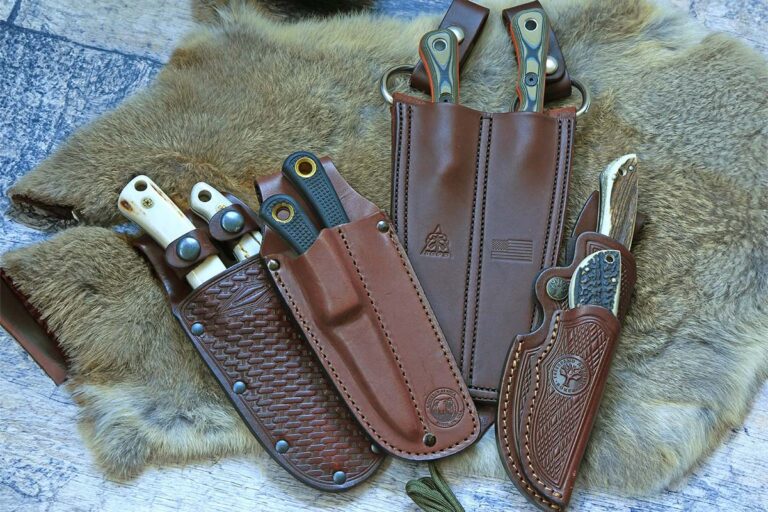
When choosing a hunting set of cutting tools, consider the quality of the tools and how they complement each other. Before you do that, though, be sure the set is properly outfitted.

A good set should include a gut hook, knife, saw and small hatchet for field dressing and processing game. Each tool serves a specific purpose:

  • Gut hook: makes opening the animal’s abdomen easier,
  • Sharp knife: essential for skinning and butchering
  • Saw: helps cut through bone or branches
  • Small hatchet: helps split bone or cut wood.

Consider durability and ease of use, as well as how the tools can be packed for transport.

Gut Hook Knives

A gut hook hunting knife serves multiple purposes in the field. Its primary function is to assist in the field dressing process by opening the animal’s abdomen with minimal damage to the internal organs. The hook feature helps prevent puncturing the organs while skinning and reduces the risk of cutting into the stomach or intestines. A gut hook can be used for cutting through tough connective tissues, tendons and cartilage, too. Its precision and specialized design make it an essential tool for hunters, allowing for efficient and safe processing of game in the field. It also works great for hooking under a bail and lifting hot pots and other items off a camp stove, etc.

Caping Knives

A caping knife in a hunting set serves various purposes, making it an essential tool for hunters. Its precision and maneuverability render it ideal for delicate tasks such as skinning around trophy areas, making intricate cuts, and separating hide from the meat. Also known as a caper, it is great for creating shoulder mounts or European mounts of game animals, preserving the hide for taxidermy purposes. The fine point and sharp blade allow for detailed, careful work without damaging the hide or underlying tissue. A caper is a versatile tool that adds value to any hunting tool set, especially for hunters looking to preserve trophies.

Boker Arbolito Guides Combo

Boker 2.25-inch drop point and Diamond Blade Knives Pinnacle
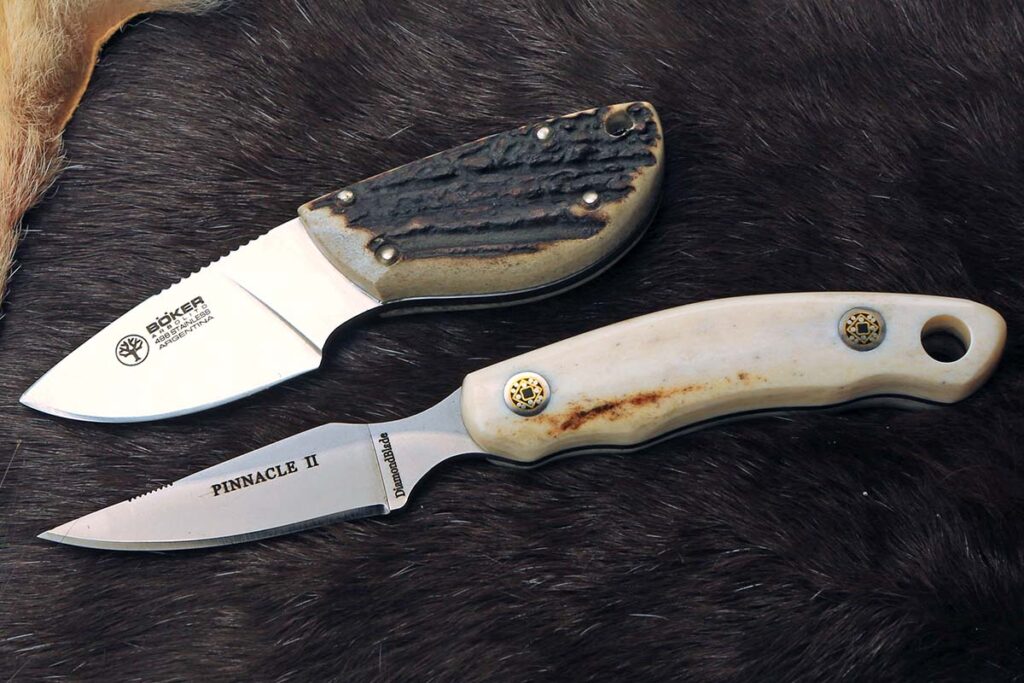
The Boker 2.25-inch drop point and Diamond Blade Knives Pinnacle II are both classic caper/utility tools featuring handsome stag scales.

The Boker Arbolito Manufactory in Buenos Aires, Argentina, is known for crafting high-quality knives using premium materials, with an emphasis on hunting and outdoor models featuring handles of wood and stag. These traditional knives are designed to cater to a variety of needs and tasks, whether for professional use, sports, everyday carry or collectors with a keen interest.

A notable offering is the Arbolito Guides Combo set in satin blades and stag handles. It includes a 4.25-inch gut hook skinning blade and a 2.25-inch drop point hunter. The gut hook prevents accidental punctures during skinning and is designed with a large forward finger choil for enhanced control. The little drop point is suitable for small, detailed cutting tasks, providing precision cuts. It is an excellent utility blade for cutting cord, fishing line and packaging, and it can act as a small skinner. Both knives sport stag handles for a secure grip and a rustic appearance.

The set includes a brown leather piggyback belt sheath for easy carry. The gut hook pouch boasts a solid snap to ensure retention. The small drop point comes with a simple drop-in friction-fit pouch, which is easy to access and is held on the main sheath via a rivet. This set presents function and style for processing your next trophy animal or other outdoor tasks.

Arbolito Guides Combo Set Specs
Blade Lengths: Gut hook skinner 4.25”, drop point 2.25”
Blade Steel: Bohler N695 stainless
Blade Grinds: Skinner hollow, drop point flat
Blades @ Thickest: .125”
Blade Finish: Satin
Handle Material: White/brown stag
Overall Lengths: Skinner 8.6”, drop point 4.8”
Sheath: Leather piggyback
Country of Origin: Argentina
MSRP: $291 at press-time exchange rate

Knives of Alaska Caribou Combo

KOA Caribou Combo work well together
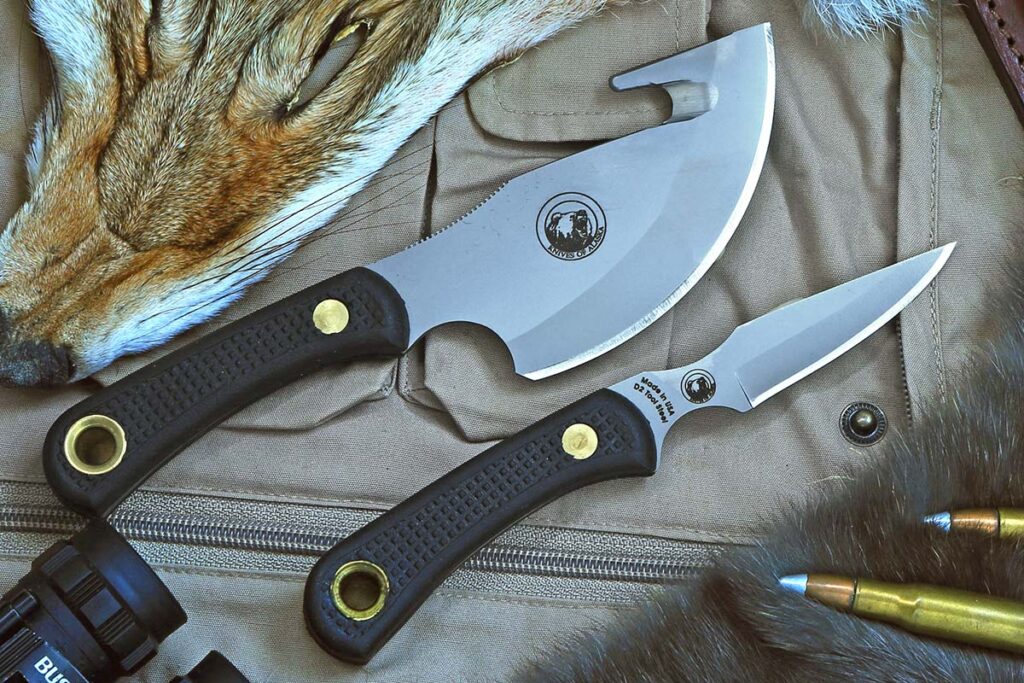
The two knives of the KOA Caribou Combo work well together. The skinner has a deep belly for slicing and enough weight to be a light cleaver. The Cub Bear is a tremendous caper that pulls triple duty as a fine carver and paring knife.

The Knives of Alaska Caribou Combo offers a slimmer alternative to the company’s Light Hunter Combo. The Caribou Combo features the same gut hook skinner design as the Light Hunter Combo but with a thinner blade for a sharper, longer-lasting cutting edge. The Caribou is ideal for those seeking a complete field dressing kit for whitetail deer and other medium-sized game.

The Caribou Combo includes two knives—a gut hook skinner and Cub Bear—in a side-by-side sheath. The skinner is a full-tang knife 7.5 inches overall. It has a .1-inch-thick D2 tool steel blade and a 4.25-inch cutting edge. It features thumb notches and a large-capacity gut hook.

The Cub Bear is a fine-detail-work knife of D2 with a blade 3/32 inch thick at the thickest. Both models feature black SureGrip handles with large, lined lanyard holes. For hunting deer, sheep and mountain goats, the Caribou Combo is an excellent choice.

The two knives work perfectly together. The skinner has a deep belly for slicing and enough weight to be a light cleaver. Besides the obvious skinning qualities and gut hook that opens the abdomen safely, it’s an excellent butcher knife. Using it to slice and chop up meat chunks for a rustic, slow-cooked meal was a breeze. The Cub Bear, meanwhile, is a tremendous caper that pulls triple duty as a fine carver and paring knife.

In my humble opinion, of the test group this set was by far the best buy for the money.

Caribou Combo Specs
Blade Lengths: Gut hook skinner 3.5”, Cub Bear 2.75”
Blade Material: D2 tool steel
Blade Grind: Saber
Blades @ Thickest: Skinner .1”, Cub Bear .09”
Blade Finish: Bead blast
Handle Material: Black SureGrip
Overall Lengths: Skinner 7.5”, Cub Bear 6.75”
Sheath: Brown leather double pouch
Country of Origin: USA
MSRP: $189.99

Diamond Blade Knives Summit Combo

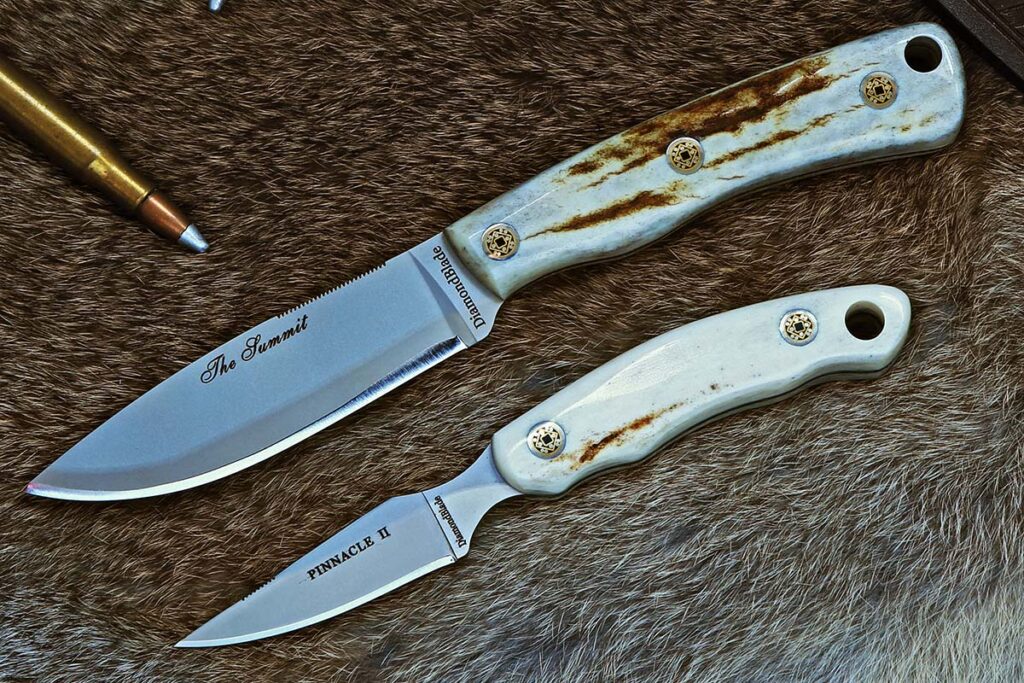
Summit has a long skinning radius, making it proficient at swiftly and effectively breaking down game. A scalpel-like knife, the Pinnacle II is ideal for caping and initial incisions
The Summit has a long skinning radius, making it proficient at swiftly and effectively breaking down game. A scalpel-like knife, the Pinnacle II is ideal for caping and initial incisions, boasting finger gimping and cutouts for optimal leverage.

The Summit Combo from Diamond Blade Knives is a pro hunter’s set meticulously crafted with the benefit of decades of hunting and field dressing expertise. It includes the Summit drop point and the Pinnacle II, both highly efficient field tools.

The Summit has a long skinning radius, making it the perfect tool for swiftly and effectively breaking down game. A scalpel-like knife, the Pinnacle II is ideal for caping and initial incisions, sporting finger gimping and cutouts for optimal leverage.

Designed for professional hunters, this versatile kit provides reliable and efficient tools for most aspects of field dressing. The set includes an American-made dual leather sheath with a Kydex insert for secure retention and easy access while preventing damage to the knives.

The substantial Summit proved ideal for effortlessly carving meat for a hearty stew or canning. The large handle gave ample space for various grips or when wearing gloves. The Pinnacle II did an excellent job on small detailed work, especially slicing herbs and peeling garlic.

The double sheath was my favorite of the test bunch because it held the knives perfectly in place, even with the snaps open, due to the Kydex insert. The attractive outer leather provides the best of both worlds.

Knives Summit Combo Specs
Blade Lengths: Pinnacle II Scalpel 2.55”, Summit Drop Point 3.75”
Blade Material: Friction Forged® D2 tool steel
Blade Grind: Flat
Blades @ Thickest: Pinnacle II Scalpel .09”, Summit Drop Point .125”
Blade Finish: Satin
Handle Material: Stag
Overall Lengths: Pinnacle II Scalpel 7”, Summit Drop Point 8.75”
Sheath: Leather double model w/Kydex insert
Country of Origin: USA
MSRP: $799

TOPS Knives Muley Skinner/Saw Combo

TOPS Knives Muley Skinner
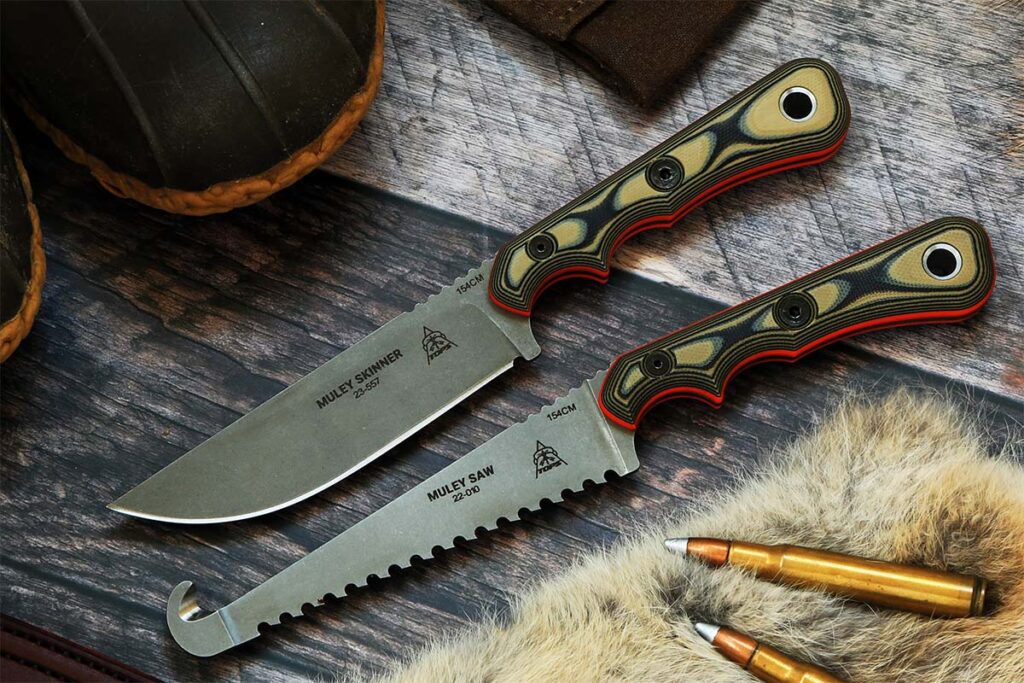
The long, deep-bellied blade of the TOPS Knives Muley Skinner is well-suited for skinning game and performing campsite tasks such as prepping, kindling and food processing. The Muley Saw is a bone saw tailored for efficient game processing and can saw wood in emergencies.

Winner of Best Hunting Knife at BLADE Show West 2023, the TOPS Knives Muley Skinner/Saw Combo is a game changer. The Muley Skinner is a solid fixed blade for outdoor jobs. The long, deep-bellied blade is well-suited for skinning game and performing campsite tasks such as prepping, kindling and food processing. The Muley Saw is a bone saw tailored for efficient game processing and can serve as a wood saw in emergencies. The saw blade sports a razor-sharp gut hook for added function.

Due to in no small part to its flat grind, the skinner excelled at slicing meat. It also deboned chicken thighs, as the belly fit nicely between the joints while roll cutting. The robust build instills confidence for using the knife for baton cuts. The saw was aggressive and did equally well on bone as on branches. It was the most diverse tool of all those in the test sets.

Muley Combo Specs
Designer: Leo Espinoza
Blade Lengths: Skinner 4.5”, Saw 4.25”
Blade Steel: 154CM stainless
Rockwell Hardness: 58-60 HRC, cryo-treated
Blade Grind: Flat
Blades @ Thickest: .13”
Blade Finish: Tumble
Handle Material: Tan/Black G-10 w/orange G-10 liners
Overall Lengths: Skinner 8.75”, Saw 9”
Sheath: Brown leather double model
Knife to know: Winner of Best Hunting Knife at BLADE Show West 2023
Country of Origin: USA
MSRP: $550

Final Cut

The reviewed sets ensure you have everything you need for field dressing and processing game efficiently. A good hunting knife set can make the process quicker and more manageable, especially when dealing with larger game. Lastly, having a set of dedicated hunting tools helps preserve the sharpness and integrity of your everyday carry knife, as it won’t be subjected to the same level of wear and tear that field dressing often involves.

Check Out More Outdoor Knives And Tools:

5 Pocketknife Breakthroughs That Changed The Class Of Knife

The technological advancements that have redefined the pocketknife as we know it.

When I stumbled onto the knife scene in 1985, the only pocketknives I had carried up to that point were slipjoints and lockbacks. Of course, slipjoints weren’t called slipjoints back then but simply pocketknives. Today, as far as BLADE® is concerned—not that it’s any major newsflash or anything—any knife you can carry in your pocket is a pocketknife.

All of which brings me to the subject at hand: my picks of the five most important pocketknife developments of the modern sporting knife era. In rough chronological order they are:

The pocket clip: BLADE Magazine Cutlery Hall-of-Fame® member Sal Glesser’s introduction in 1981 of the Spyderco pocketknives with the hole in the blade and the pocket clip would turn the genre on its head. While the hole in the blade was a masterstroke in and of itself, it was the pocket clip that forever changed the way people would carry their pocketknives. Rather than rattling around in the bottom of a pocket with change, car keys and what have you, the closed knife was held on the pocket lip by the clip, free from pocket-bottom scratches and poised at the ready to be deployed to cut whatever needed cutting.

The linerlock: Cutlery Hall-of-Famer Michael Walker invented the linerlock in 1981, but it would take a few more years before custom knifemakers—and shortly thereafter, factory makers—began readily adopting the lock that made one-hand manual opening and closing of the pocketknife an easy reality rather than an exercise in hand contortions. Today, the argument can be made that the linerlock is used on more sporting folders than any other lock.

The flipper: While exactly who made the first folder with the flipper tab that manually deploys a folding blade with the tap of a finger may be up for debate, there is no debating that the person who popularized it was Cutlery Hall-of-Fame knifemaker Kit Carson. A simple addition to the pocketknife on its face, the flipper tab opens a blade as fast and easy as any other manual method—probably faster.

The Ikoma Korth Bearing System (IKBS): Pivot systems that helped open folding blades quickly and smoothly had been around before, but it was the IKBS conceived in 2002 that took blade opening to a new level of quick and smooth. In conjunction with the flipper especially, the IKBS transformed one-hand pocketknife opening from fast to just this side of automatic. Developed by Brazilian custom knifemakers Flavio Ikoma and Ricardo “Rick” and Paulo Lala (the latter two collectively known as Korth), the IKBS is another masterstroke of design and invention.

Material upgrades: These cover a number of materials and years, from Walker’s switch to titanium for his linerlock spring in 1983, to a wide array of other hi-tech substances in subsequent years for pocketknife handles, including titanium, thermoplastics, Micarta®, G-10, carbon fiber and other state-of-the-art materials that not only were super strong and tough but also were lightweight, reducing the weight of pocketknives to the point that they were basically unnoticeable in a pocket. Meanwhile, the advances in blade steels over that same stretch are too many to mention.

How about you? What are the most important pocketknife developments? Tell us in the comments.

More On Pocketknives:

Advertisement

Must Read Articles

Read this before you make a knife

Knifemaking 101 – Read This Before You Make a Knife

  by Wayne Goddard My experience has taught me that there's nothing like digging in and getting started. I've often said the hardest part of the...
how to forge damascus steel

How to Forge Damascus

Advertisement
Advertisement