GiantMouse’s compact classic fixed-blade GMF1-MG updated with some top-notch materials.
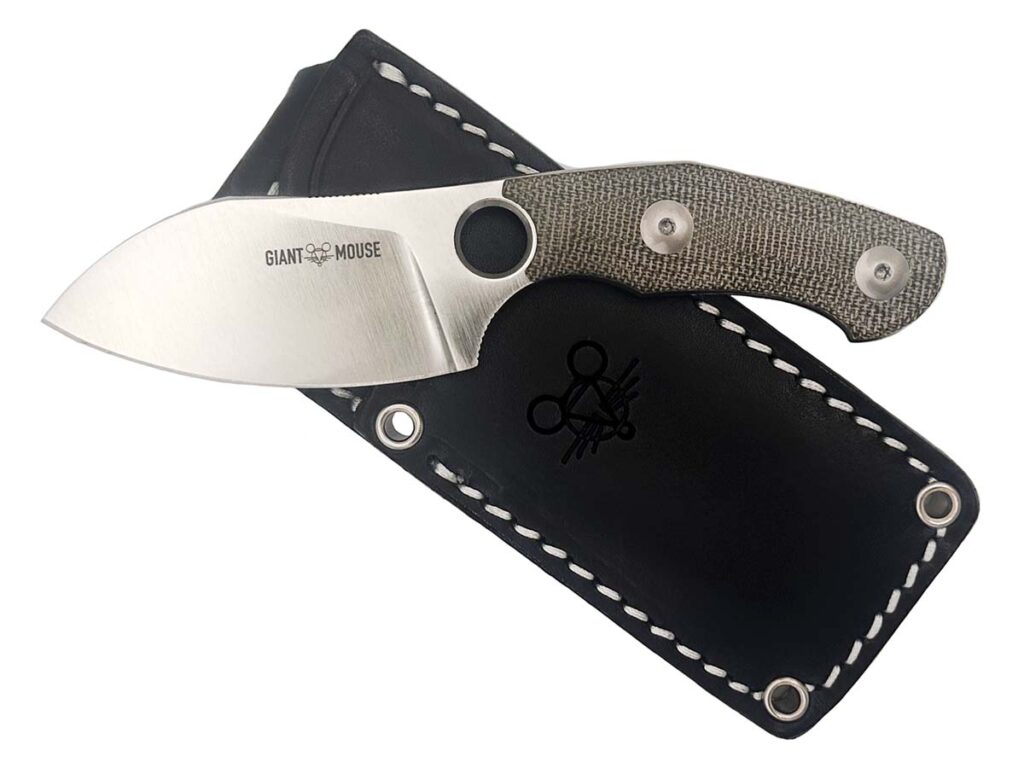
GiantMouse has a knack for creating “giant” utility in small packages, and the company’s latest announcement proves they aren’t finished perfecting among its most recognizable designs. On January 22nd,the company will officially release the GMF1-MG, an evolution of the compact fixed blade that originally put the brand on the map for many EDC enthusiasts.
While the original GMF1 (the 2024 BLADE Magazine Imported Fixed Blade Of The Year®) was a skeletonized tool designed for minimalism, the MG (Micarta/Green) version enhances the user experience without sacrificing the design’s signature compact footprint.
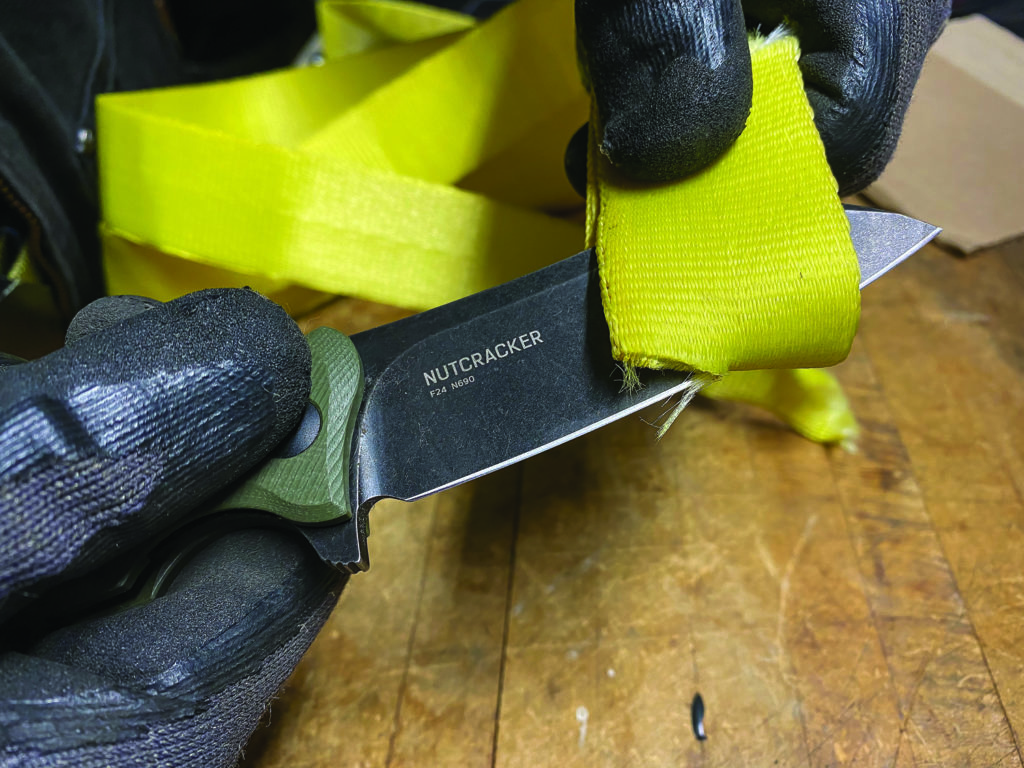
GMF1-MG CPM MagnaCut
The most significant technical leap here is the move to a CPM MagnaCut blade. Finished in a clean satin, the super steel has become the industry benchmark for its ability to offer high-end toughness and edge retention while remaining nearly immune to corrosion. For a knife designed to live in a pocket or on a belt through all seasons, MagnaCut is the perfect choice to elevate the GMF1’s punch above its weight reputation.
Ergonomics And Personalization
While the original GMF1 was often used with an aftermarket paracord wrap or custom scales, GiantMouse is now providing that grip straight from the factory. The GMF1-MG comes standard with Green Canvas Micarta scales, offering a warm, secure feel excelling in both dry and wet conditions.
In a move that will surely please the modding community, GiantMouse is also launching a line of interchangeable scales. Users can now personalize their GMF1 with options in burlap Micarta or even milled titanium, allowing the knife to shift from a rugged outdoor tool to a premium gentleman’s fixed blade in minutes.
Italian Made
Despite the upgrades, the GMF1-MG remains a masterclass in discreet carry. It stays lightweight and nimble, shipping with a handmade black leather sheath crafted in Italy. It’s a setup designed to challenge the traditional pocket folder for a spot in your daily rotation.
If your knife is a damascus folder, all eyes are on it when you pull it from your pocket and deploy the blade. Is that damascus? Is it sharp? Who forged it? What’s the pattern? The questions flood in and the conversation starts. Enjoy the discussion!
Bob Hook: Dress Locking Folder
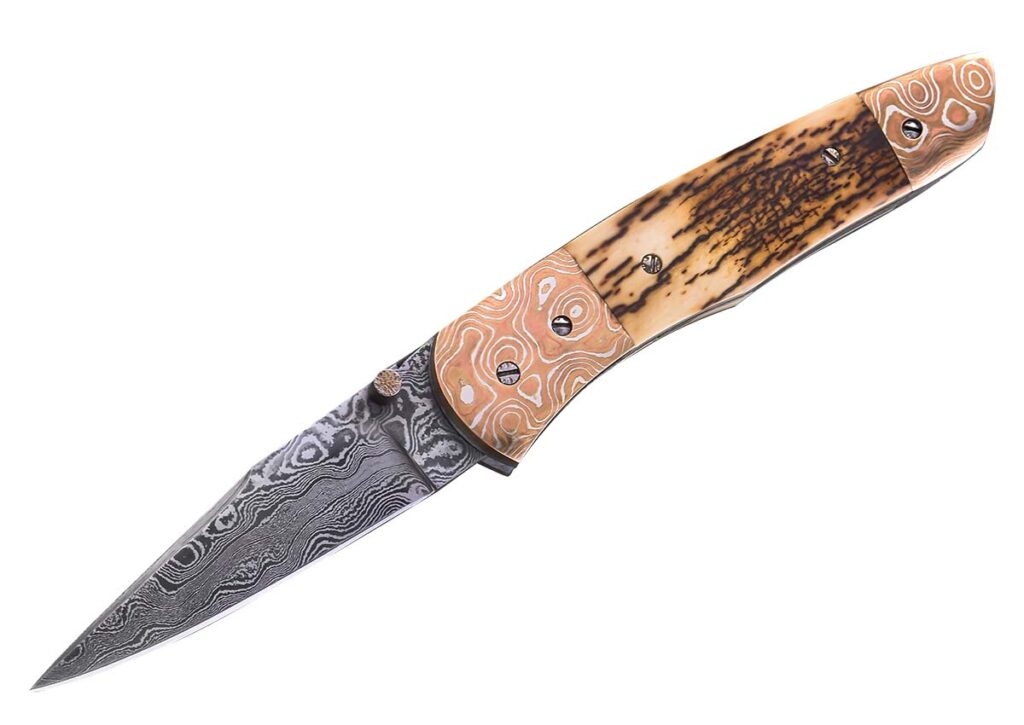
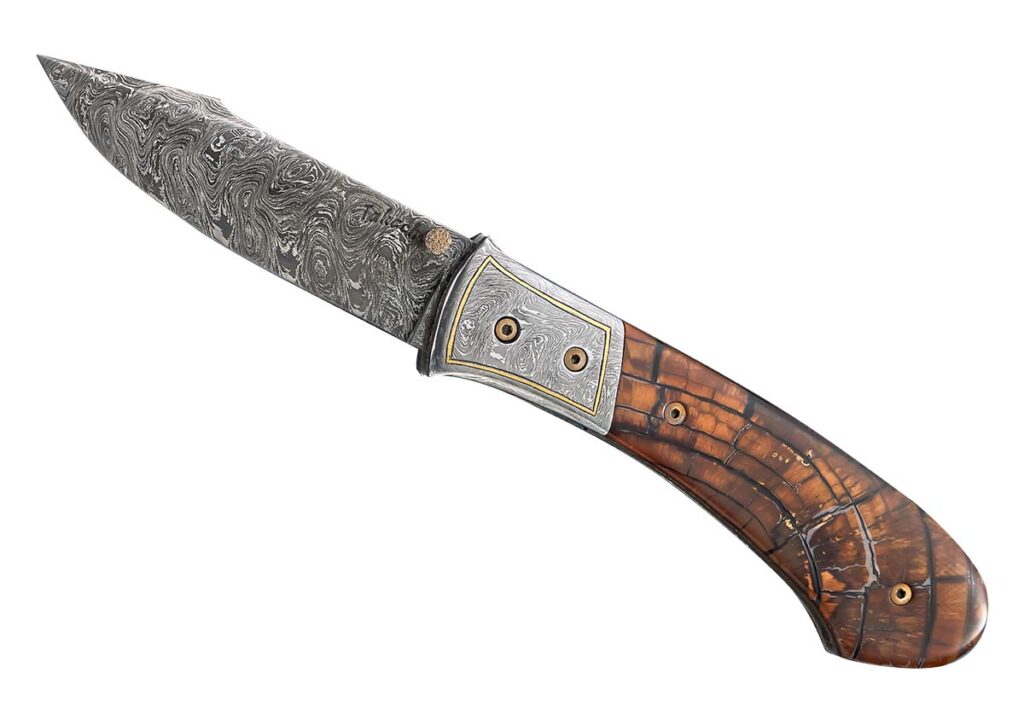
ABS journeyman smith Bob Hook employs a damascus of 1080 carbon and 15N20 nickel-alloy steels forged by Salem Straub for the clip-point blade of his dress locking folder. The scales are Alaskan mammoth ivory and the bolsters are mokume gane. Blade and closed lengths: 2.75 and 3.25 inches.
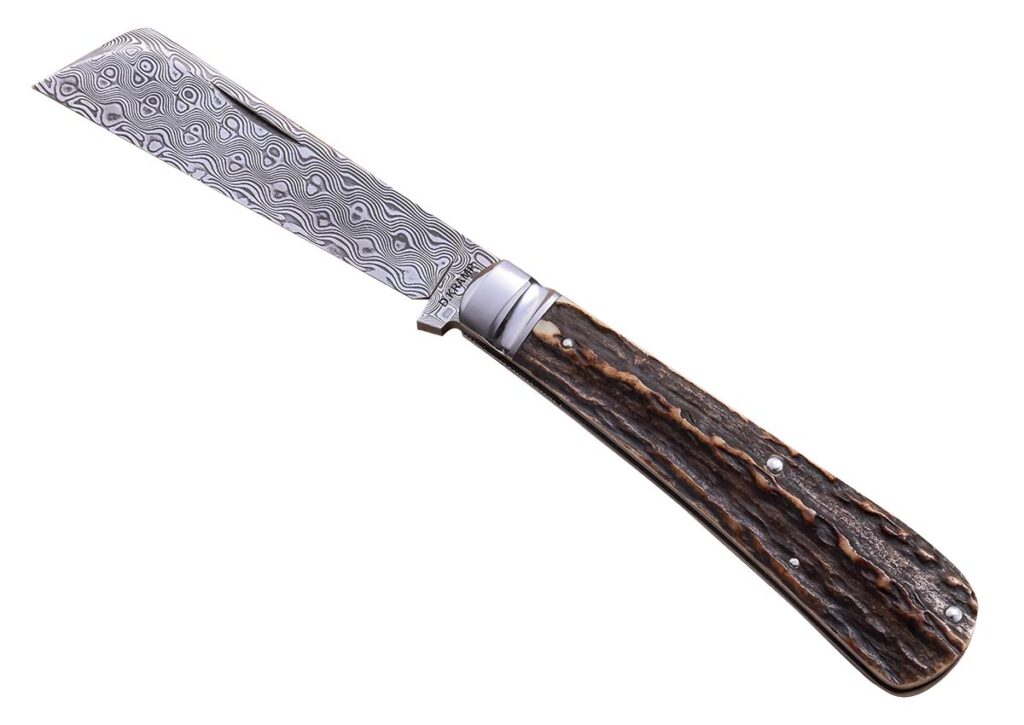
David Kramp: Navy Rope Knife
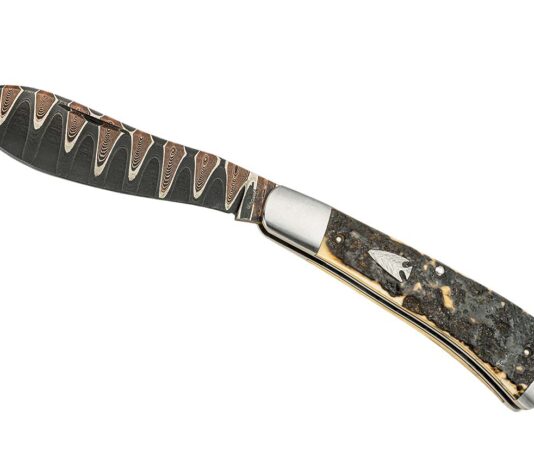
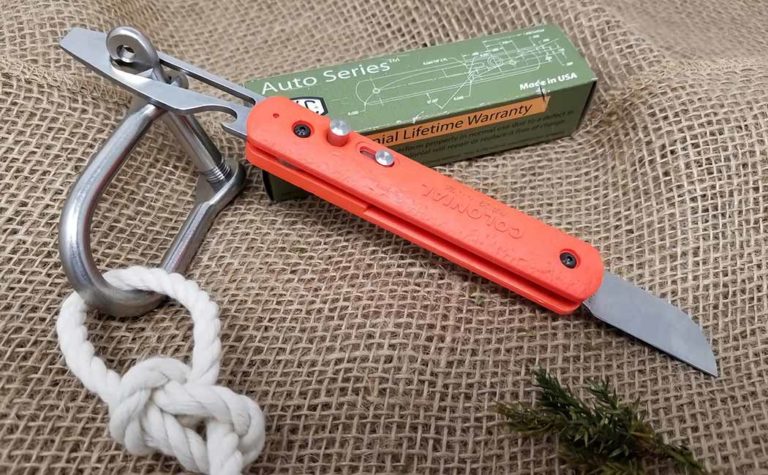
Rose pattern damascus from Damasteel comprises the sheepsfoot blade of David Kramp’s Navy Rope Knife. The slipjoint is modeled after a Sheffield, England-built U.S. Navy rope knife likely issued around the time of the Spanish American War of 1898. A frame of 410 stainless steel supports the stag scales. Bolster: 416 stainless. Closed length: 4.5 inches.
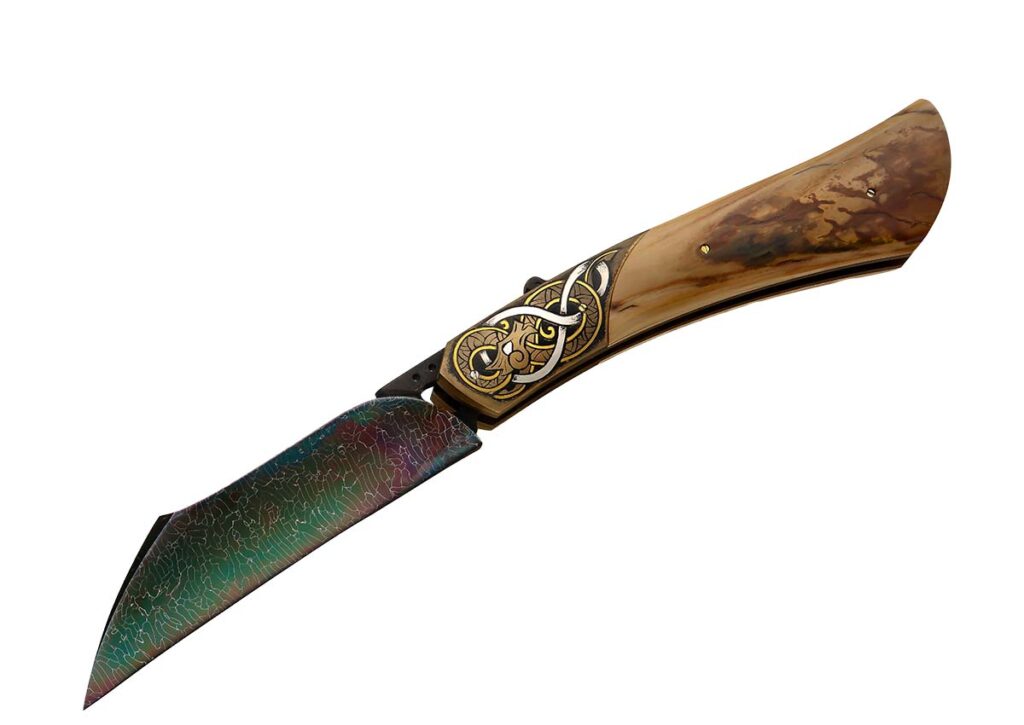
Dirk Loots: Engraved
Dirk Loots opts for Fracture pattern damascus by Bertie Rietveld for the 3.5-inch hollow-ground blade of his exotic folder. Scales and liners/bolster: Mammoth ivory and bronze. Inlays: 24k gold and fine silver. Closed length: 5.5 inches. Dirk also did the engraving.
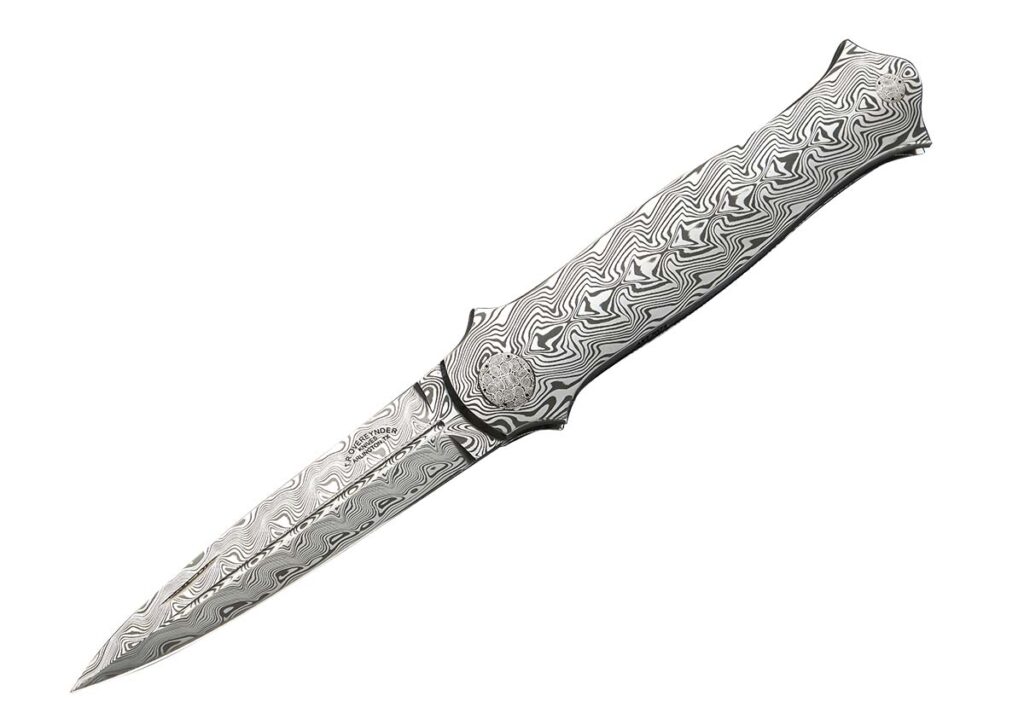
Tom Overeynder: Dagger
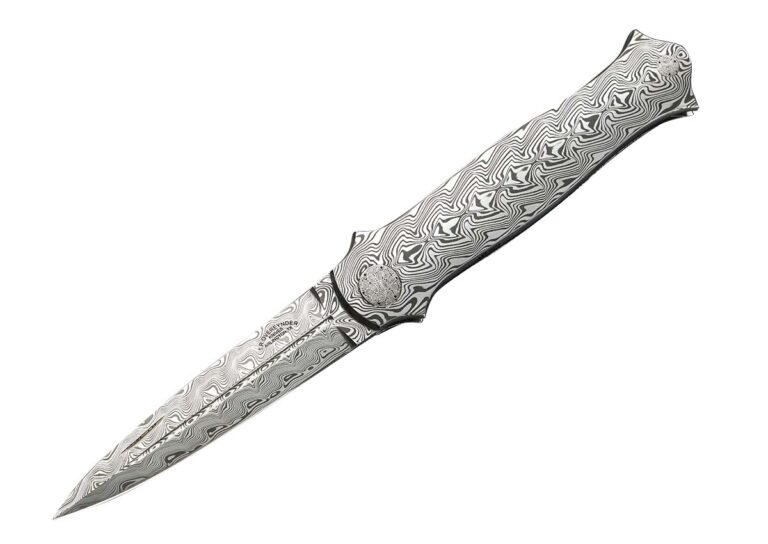
A 3.62-inch blade and 4.66-inch frame of Gysinge pattern damascus forged by Damasteel highlight Tom Overeynder’s folding dagger. The spanner bolts used in the construction of the knife are Blue Tongue pattern damascus, also by Damasteel.
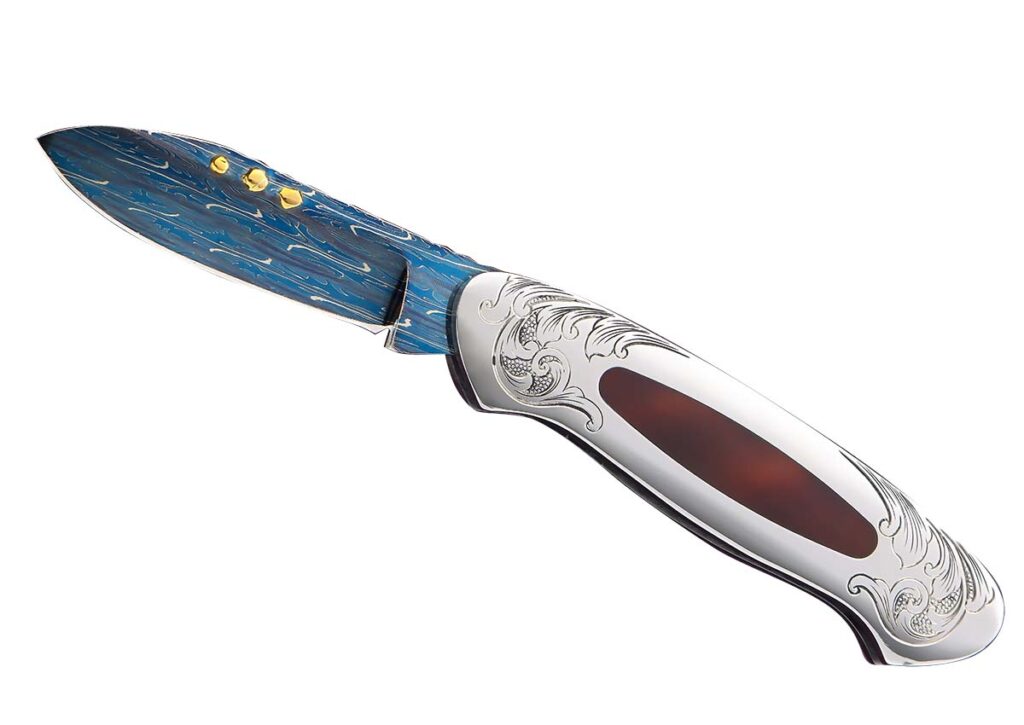
Ted Moore: Hollow Grind
Larry Donnely forged the damascus for the blued, hollow-ground blade of Ted Moore’s folder engraved by Madeline Crumling. The frame and liners are 416 stainless steel and the inlay is black pen shell. Blade and closed lengths: 2.5 and 3.5 inches.
Manuele Messori: Halo
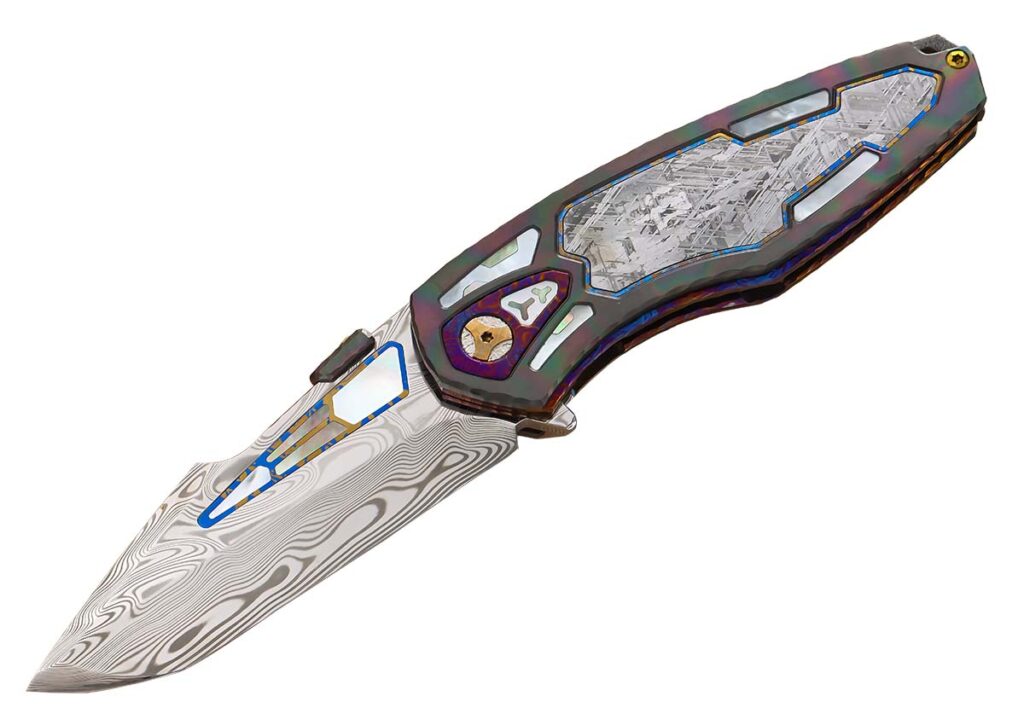
Damasteel forged the Thor pattern damascus for the 4.13-inch blade of Manuele Messori’s Halo. The blade inlay is white and black-lip mother-of-pearl, and the handle is zirconium, Timascus®, mother-of-pearl and Gibeon meteorite. Liners: Timascus. Closed length: 4.9 inches.
Andrew Takach: Harpoon
A damascus blade in a harpoon pattern, crosscut mammoth ivory handle in a bird’s-beak-butt pattern, and a flared damascus bolster with 24k-gold inlay complete a dress locking folder by Andrew Takach.
We dive into the new additions to the CRKT 2026 catalog.
Columbia River Knife & Tool (CRKT) has officially pulled the curtain back on its 2026 lineup, and it’s a diverse spread that leans heavily into premium materials and clever engineering. By collaborating with some of the biggest names in the custom knife world, CRKT is continuing its push to bring high-end design language to the production market.
According to Kyle Stuart, CRKT’s VP of Marketing, the goal this year was to pair “smart innovation with practical, purpose-driven design.” Here is a breakdown of the standouts from the new collection.
Sero
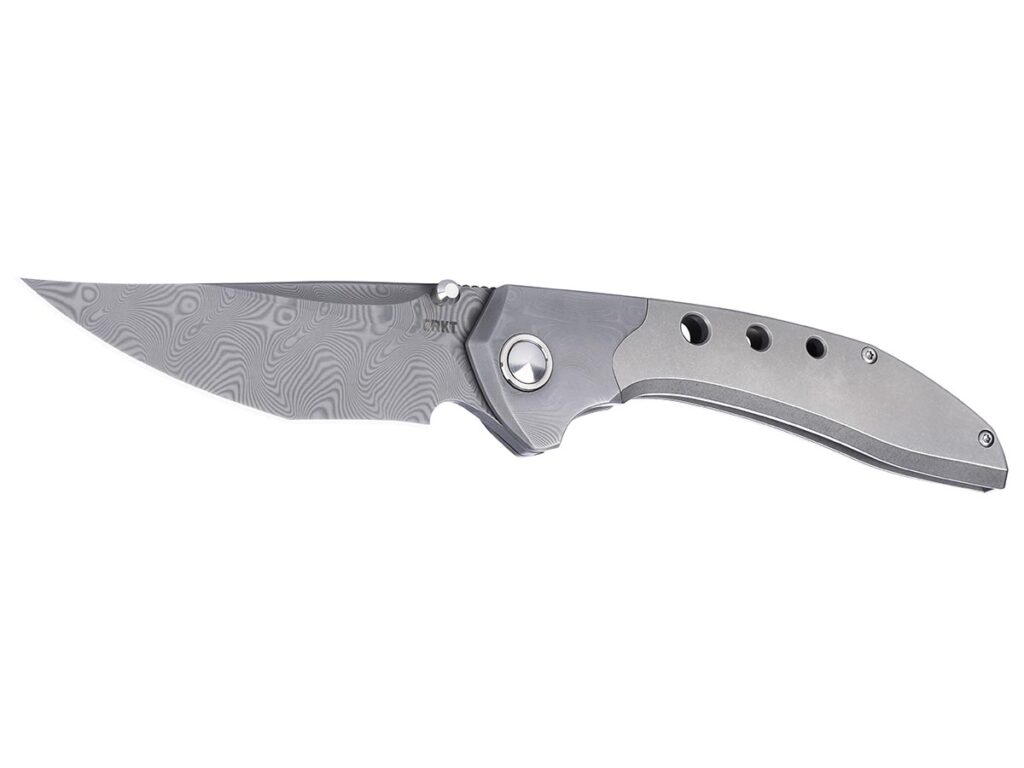
Designed by Richard Rogers, the Sero is where high fashion meets the everyday carry world. It’s a low-profile flipper that takes inspiration from Art Deco styling but doesn’t skimp on performance. The blade is S35VN—a favorite for edge retention—and it rides on an IKBS™ ball bearing pivot for snappy deployment. The lines are incredibly clean, with a flipper tab that disappears into the bolster when open. It also features a Crossbar Lock, making it fully ambidextrous. MSRP: $140 ($250 damascus/titanium version)
Princeton Wong brings his award-winning custom vision to the production line with the Orochi. Named after the mythical eight-headed Japanese serpent, this knife features a distinct clip point recurve blade made from 14C28N steel. You can deploy it via a discreet “hidden” flipper tab or dual thumbstuds. The G10 handle and stainless-steel bolsters give it a solid, ergonomic feel that punches way above its weight class in terms of refinement. MSRP: $140 ($200 damascus/titanium model)
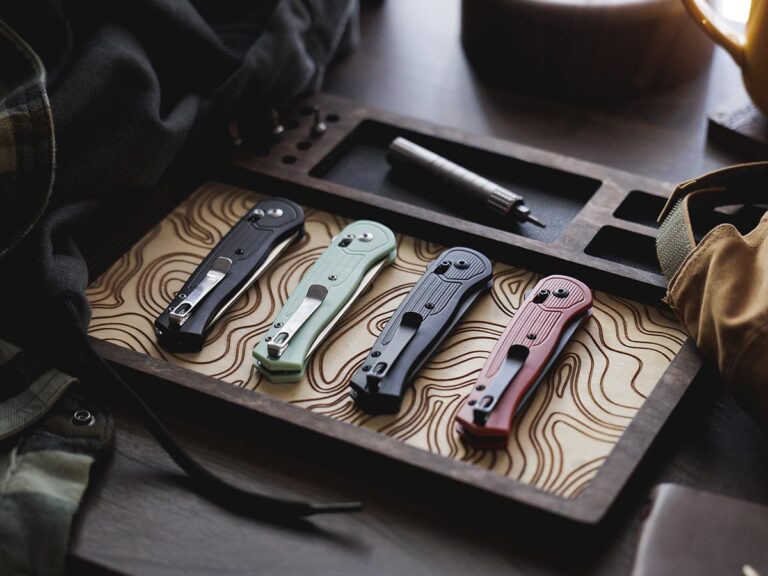
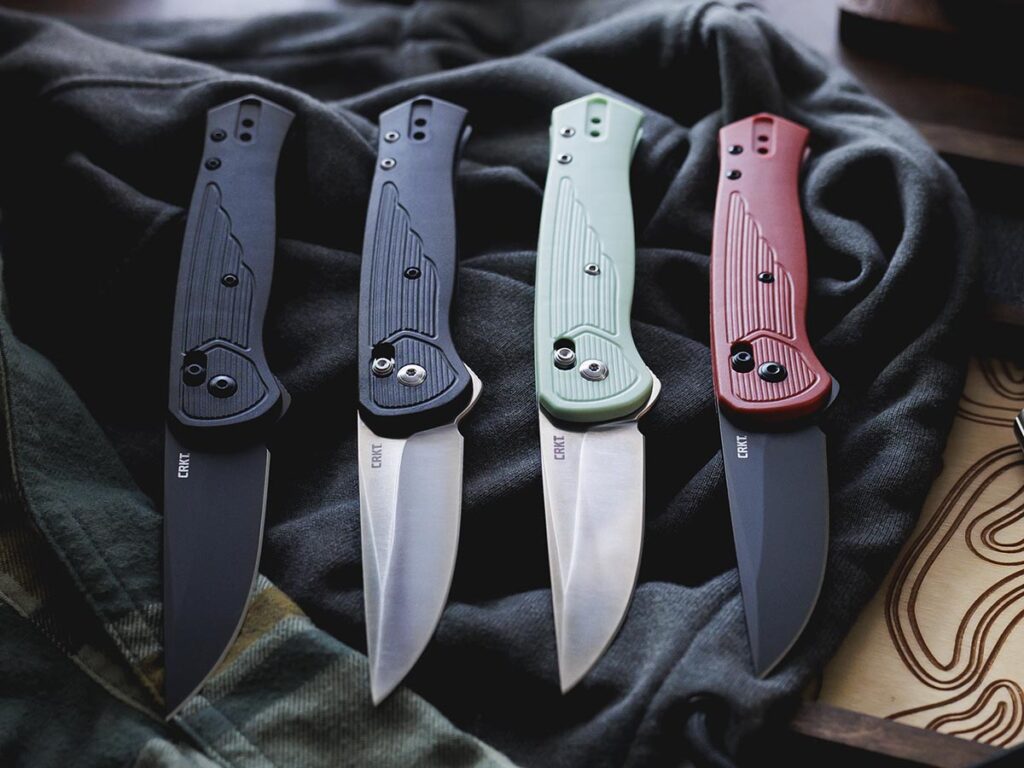
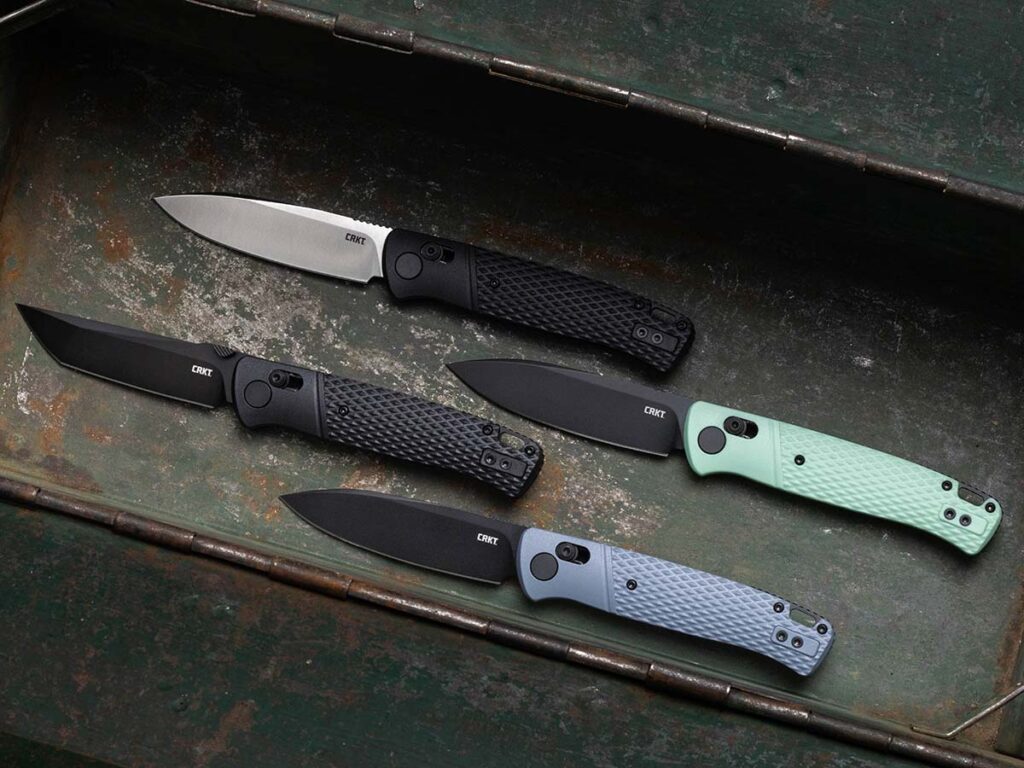
When you see Ken Onion’s name on a knife, you expect smooth curves and real-world utility, and the Counterpart series delivers. This is a collection of purpose-built folders available in four different models. Most feature 12C27 drop point blades, though there is a D2 tanto version for those who prefer a more tactical edge. All of them utilize an ambidextrous Crossbar Lock and a reversible deep-carry pocket clip. MSRP: $89 – $99
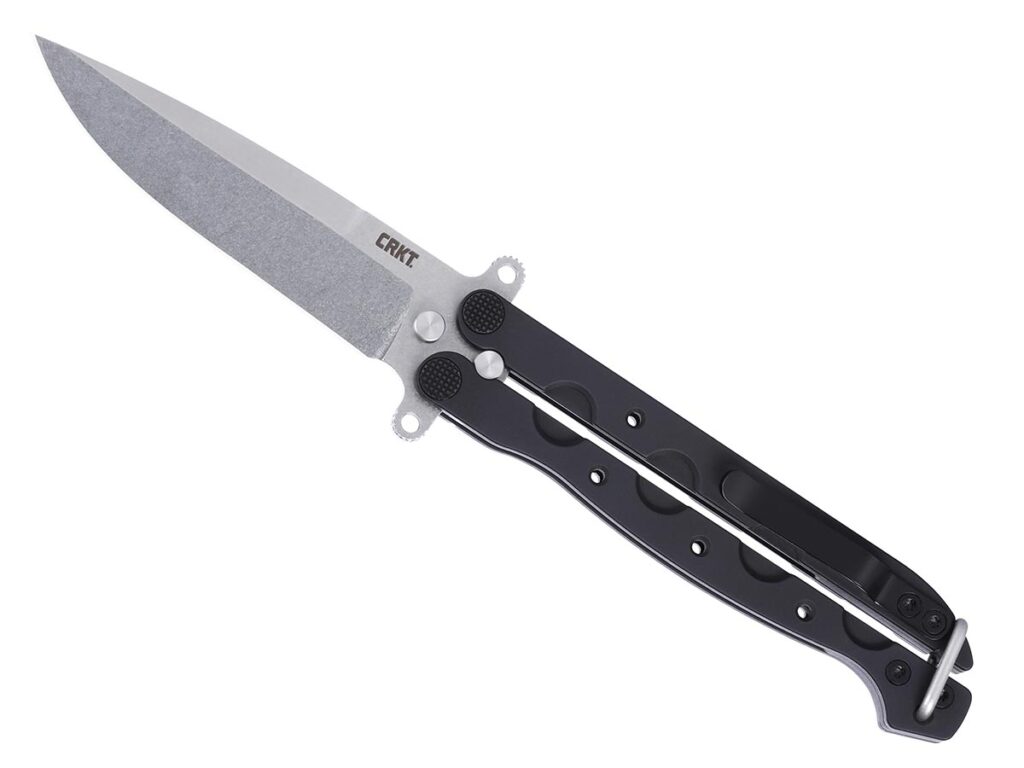
The late Kit Carson’s M16 is perhaps one of the most recognizable silhouettes in the knife industry. For 2026, CRKT has taken that DNA and moved it into the world of butterfly knives. These aren’t just “fidget flippers”; they are serious, American-made tools crafted in Colorado. Featuring MagnaCut steel—the current “super steel” king of corrosion resistance—and titanium handles, these are available in both tanto (M16-02) and drop point (M16-03) configurations. MSRP: $300
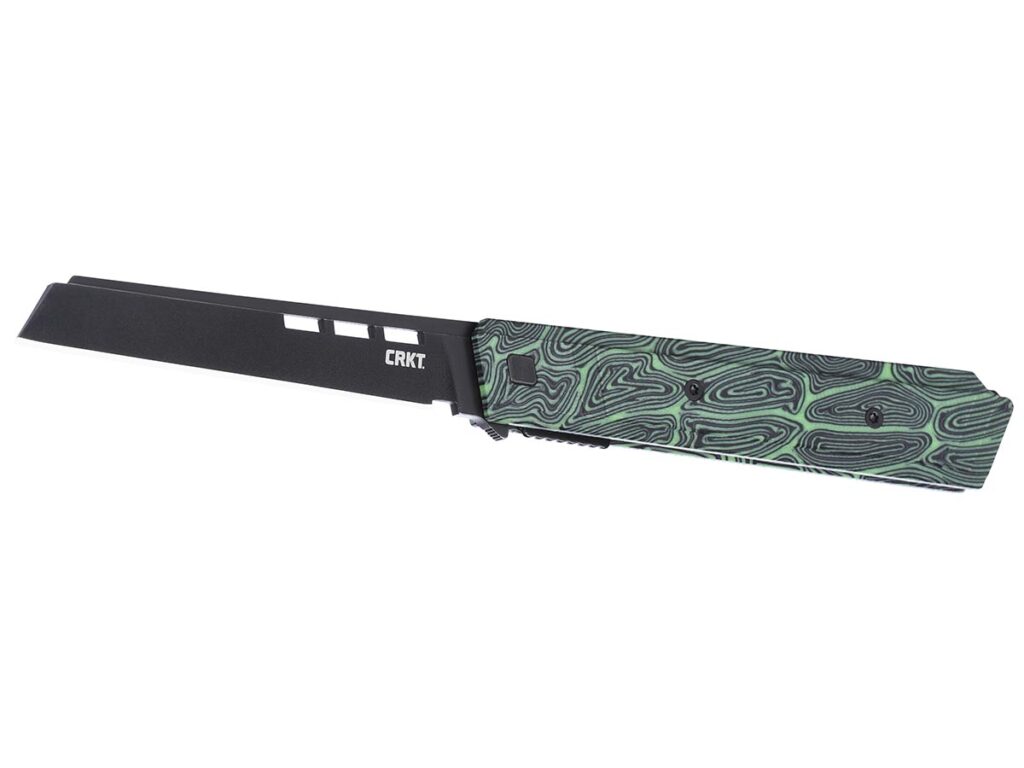
Matthew Lerch is known for clean lines, and the Zephyr is a perfect example of his philosophy. It uses a sheepsfoot blade profile which is ideal for the sort of controlled, precise cutting most people actually do on a daily basis. The G10 handle keeps it light, while the IKBS pivot ensures it’s fast. For those who want something a bit flashier, a premium version offers an acid-etched Damascus blade and titanium scales. MSRP: $100 – $130 ($160 damascus/titanium version)
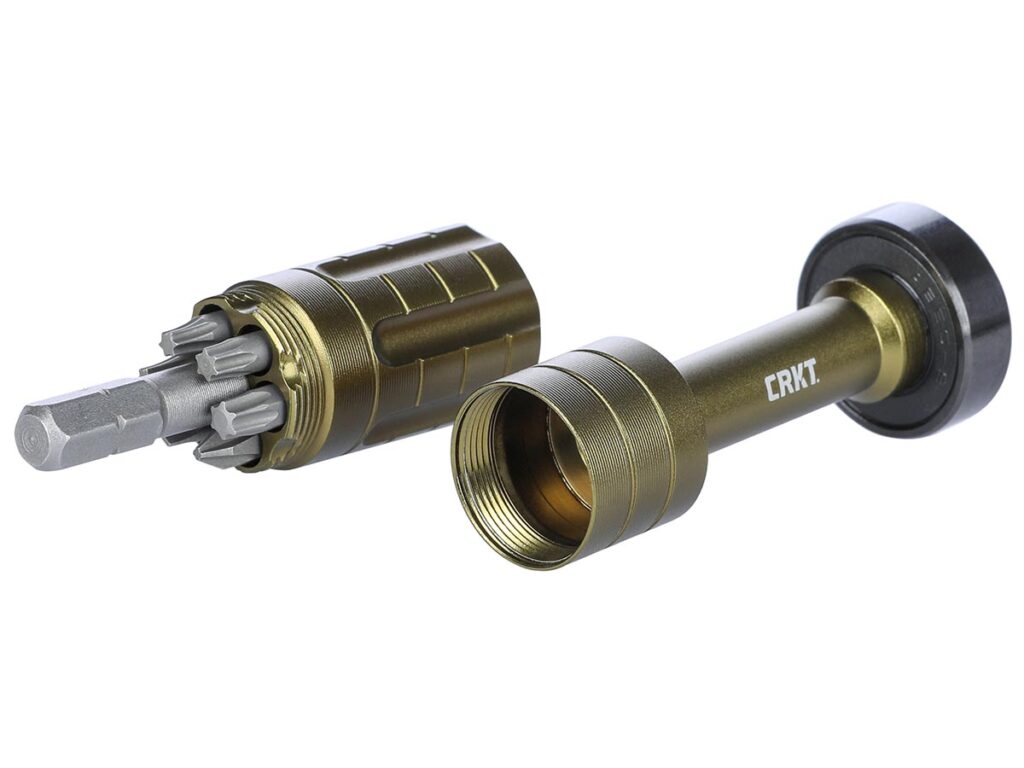
CRKT isn’t just about the blades this year. Designed with Joe Wu, the ToGo Driver is a compact maintenance tool for the person who likes to keep their gear in top shape. The anodized aluminum handle hides an internal compartment for seven precision micro bits. It even features a ball-bearing spinner on the end, making those tedious takedowns and reassemblies significantly smoother. MSRP: $50
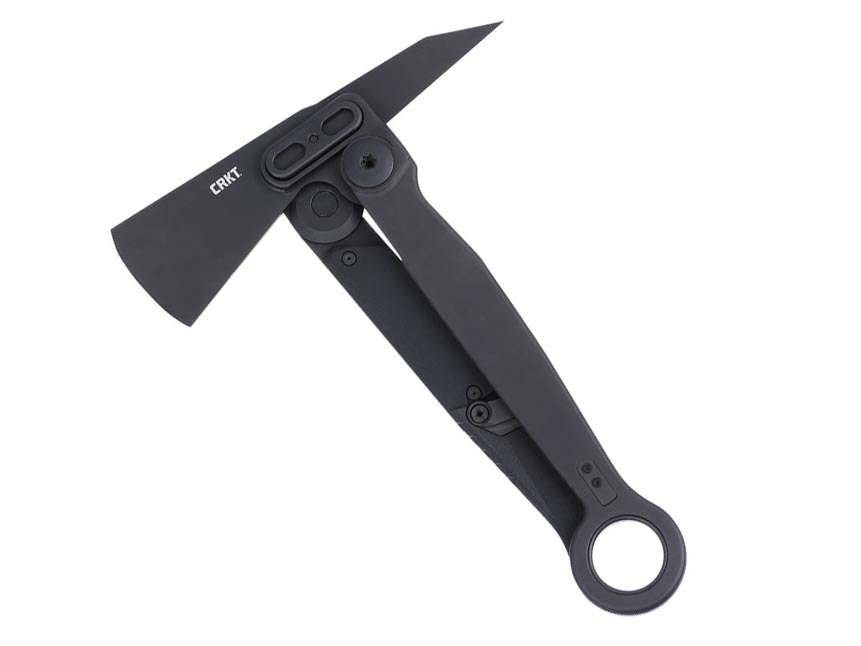
Technically a late-2025 arrival, the Provoke X is still a major head-turner for 2026. Using the Kinematic® technology that made the Provoke karambit famous, this is a “morphing axe” that fits in a pocket and snaps open with a flick of the wrist. It’s secured by the Deadbolt® lock and features a titanium nitride-coated SUJ2 steel blade. It’s easily one of the most unique tools we’ve seen in recent years. MSRP: $350
Battened down the hatches, we’re going full-speed ahead talking about the sailor’s rigging knife!
Rigging knives are a particular type of cutting tool developed in conjunction with sailing ships. There is not a particularly well-documented history on the use of these knives, but by the Age of Exploration, the tool was quite common aboard virtually every vessel.
Bear bones, the rigging knife was designed to cut line. Together with the equally common marlinspike, it could be used to manage lines by cutting, splicing, and freeing knots. The simplicity of these tools has given them long life, and as a result, the knives are available in modern versions suited to our uses today.
The knife has not changed much in hundreds of years, a testament to how it was perfected before it became miniaturized and able to fit in a pocket.
Use And Evolution Of The Rigging Knife
The rigging knife is a similar case. You are almost always better served by a heavy fixed-blade knife than by a small, delicate folder. But, as time has gone on, the need for chopping through lines thicker than your arm has declined for most nautical enthusiasts. In turn, as line material changed from Manila and natural materials to nylon, large-blade rigging knives went the way of the tri mast. In its place, a smaller folding version became the norm.
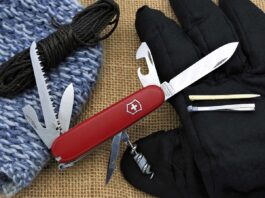
The rigging knife has, like the penknife, been a multitool of sorts for generations. The earliest examples were of course dedicated to their task. As times changed, it was combined with similar tools that were also at one point their own thing. Let’s take a look at some of the tools likely found on a modern rigging knife.
Sheepsfoot Blade
A sturdy sheepsfoot blade tackles cutting and chopping tasks with easy, while protecting the user from perforating him or herself.
Long before this profile was in fashion for EDC knives, the sheepsfoot profile was used for cutting rigging. The blade shape was perfected over time and was considered the best way to cut heavy lines. The cleaver-like abilities of this profile, when combined with a thick spine, allows it to chop through thick line as well as be pounded through with a mallet if need be. The lack of a defined tip reduced the chances of injury as it couldn’t really be used to stab or otherwise harm by thrusting.
Marlinspike
Need to loosen a mooring line? The marlinspike is your tool.
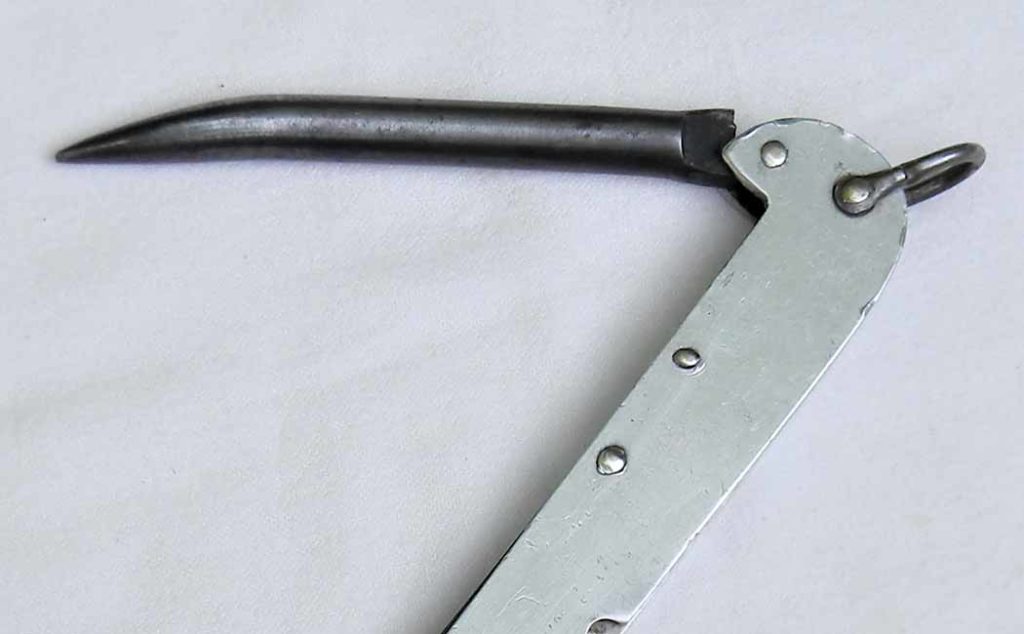
The marlinspike is a linework tool and it is quite simple in terms of how it’s used. It is like a large needle of sorts, meant to work in between tightly tied ropes in order to loosen knots. That is just about all it does. This less-than-glamorous job is of the highest importance on any vessel from canoes to warships and the lack of it can cause serious issues.
Historically these tools were not small, some even exceeding 20-plus inches. Heavy rope, 5 inches or thicker, was common for mooring lines and these massive marlinspikes could move even the largest lines. Today most people use much thinner lines, usually 1-inch or so, on recreational vessels. Half-inch is common for duck boats and other flat-bottom craft. Kayaks and canoes usually work with a 1/4-inch line. Most of the work a modern marlinspike encounters is going to be on a relatively thin nylon line, making huge spikes unnecessary.
Shackle Key
The shackely key is a must to break open a problematic shackel on deck.
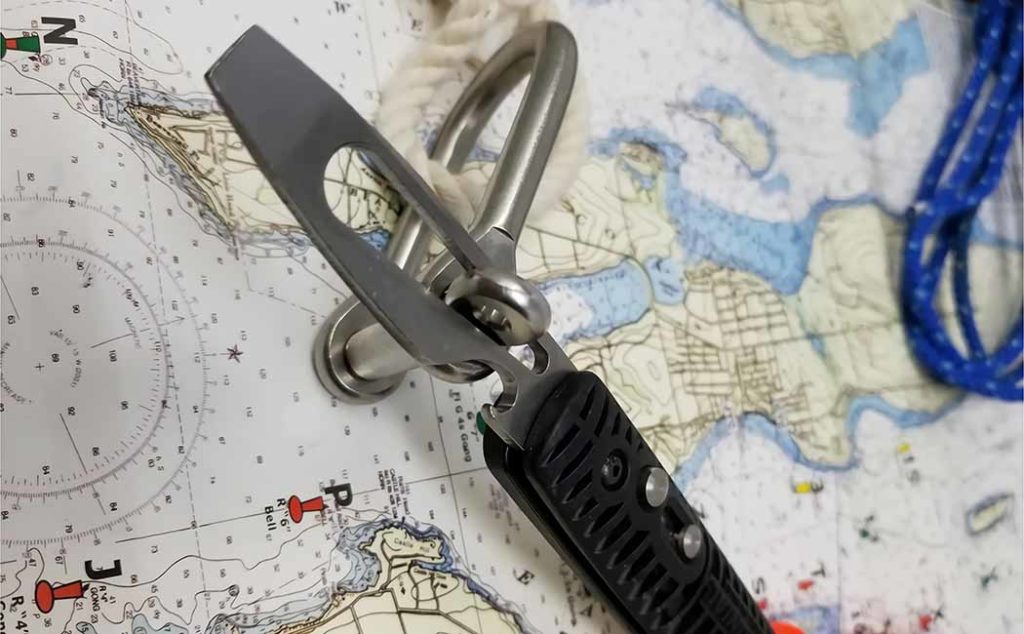
The shackle key is just that, a key for unlocking shackles. Shackles are a D-shaped clip used to attach various parts of the rigging together. These devices are usually tightened down beyond what can be accomplished with bare hands, so the key is applied and used to open it. There isn’t a high degree of utility for this accessory on most small, single-person watercraft. Many people, however, still find the tool useful for other duties. If not, it’s prized for its connection to sailing’s golden age.
Top Rigging Knives Available Today
Davis Instruments Deluxe Rigging Knife
Inexpensive, rugged and handy, Davis’ rigging knife has all based covered.
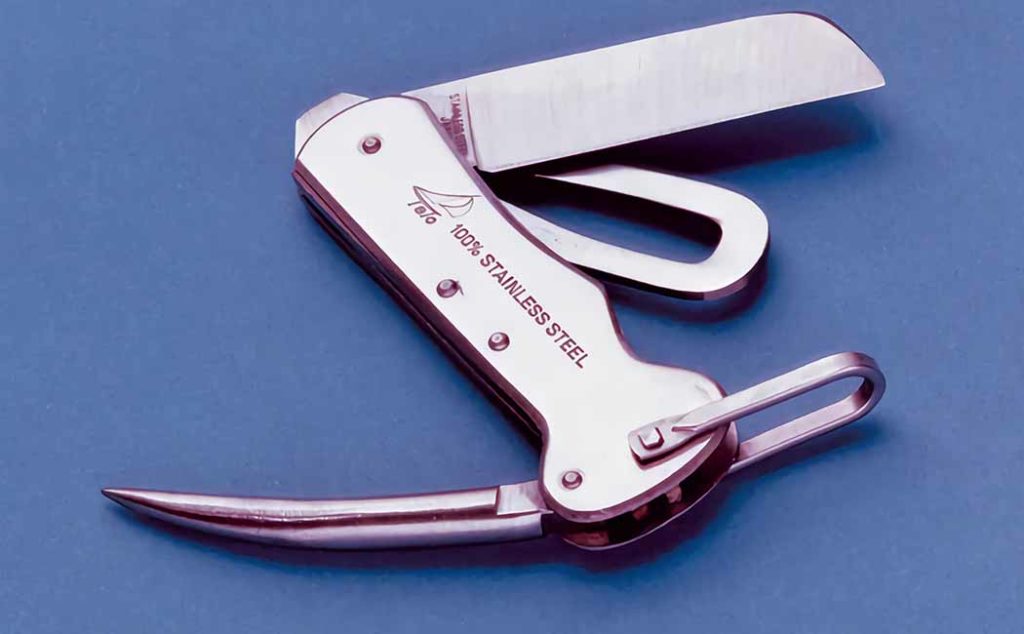
This is among the most baseline functional rigging knives on the market today. Davis‘s knife is inexpensive, under $30 retail, and has every single tool you want in a rigger. Because of salt water’s corrosiveness, the knife is constructed completely out of stainless steel and is easily kept clean and in service. If it ever gets to the point rusting out it won’t break the bank to replace. Functional knives like this lack glamor, but for what it is used for you will have a hard time finding something that truly exceeds it in utility. The folding knife features a marlinspike, shackle key, screwdriver, and blade.
MSRP: $27
Gill Marine Multitool
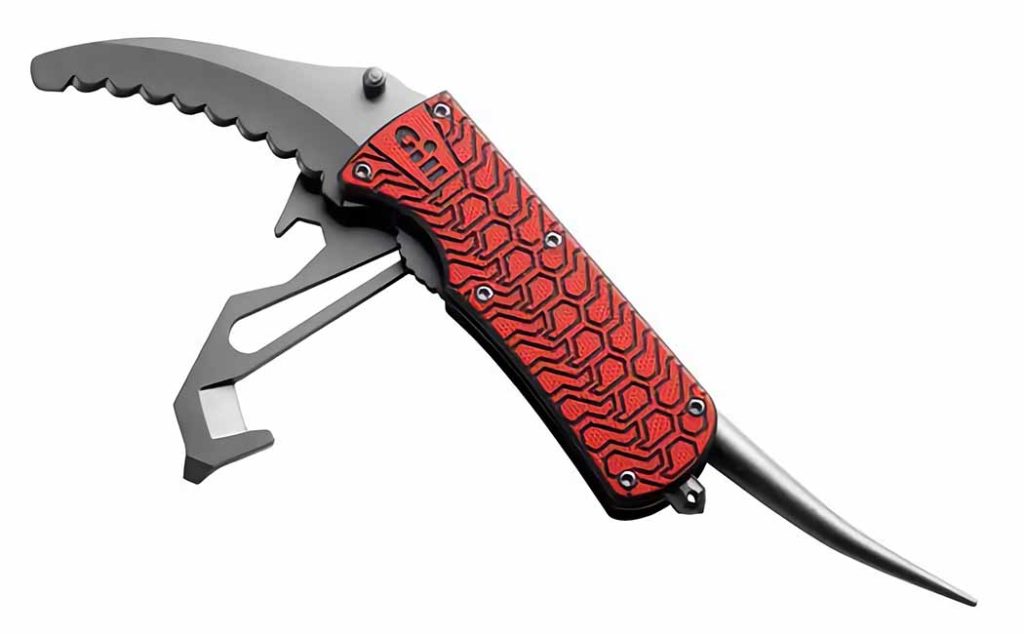
Gills’ option offer a nice update to the design—particularly the G10 handles.” width=”696″ height=”431″> A modern iteration of the classic rigging knife, Gills’ option offer a nice update to the design—particularly the G10 handles.
This tool retains many of the necessary, time-honored features common to rigging knives but adds some much-need advancements. Taking a hint from automotive rescue tools, the Gill tool a glass breaker and strap cutter to deal with tie-downs and hard-surface obstacles. The blade locks open, which is more than can be said of most rigging knives. The edge of the blade has deep, scalloped serrations that won’t hang up in nylon rope. To increase grip in wet conditions the knife has a machined G10 handle in bright orange. Lastly, the knife has an integrated screwdriver and shackle key. It does not come with a lanyard but has a pouch that can be worn. Interestingly, the knife has a titanium coating, something not usually found on tools at this price point.
MSRP: $45
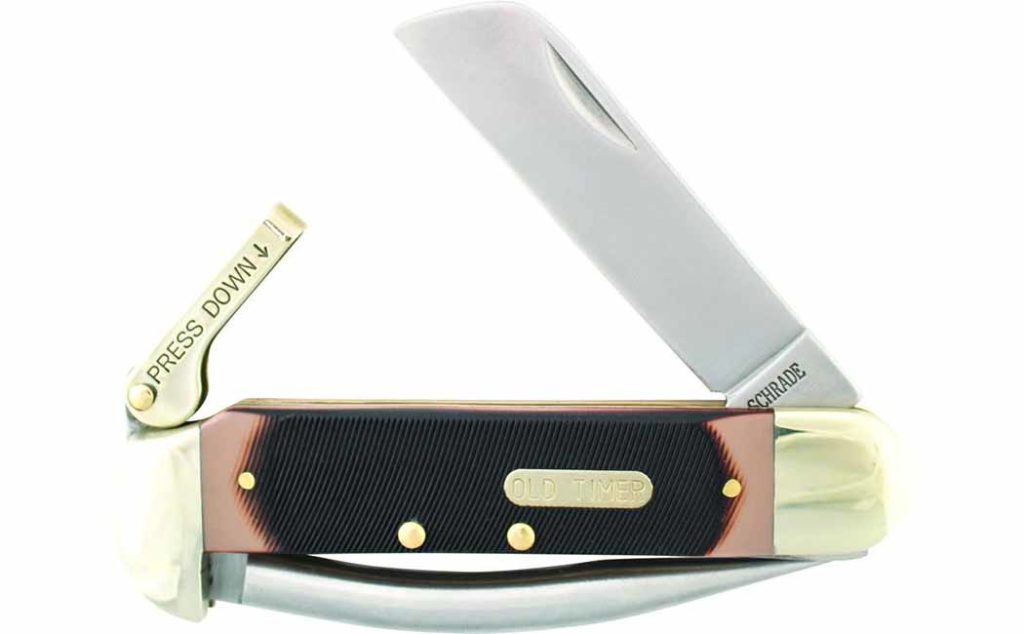
Old Timer Mariner
The materials that make up the Old Timer Mariner might not endure hard salt-water usuage. However, the knife more than looks the part and is capable of lighter duty.
In terms of classic appearance at a very low price, the Old Timer Mariner is just the ticket. The knife is relatively simple, it has a classic sheepsfoot blade and a functionally tapered marlinspike. The knife is of traditional construction and isn’t made of materials that are particularly resistant to salt water. That said, this style has been in use for decades and is just about what you think of when you imagine what your granddad or great-granddad may have used in the early part of the 20th century. As is common in traditional designs, the blade is nonlocking. Taking into account that many modern versions of this knife incorporate this safety feature, it is up to you to decide if you want the added liability in wet conditions.
MSRP: $27
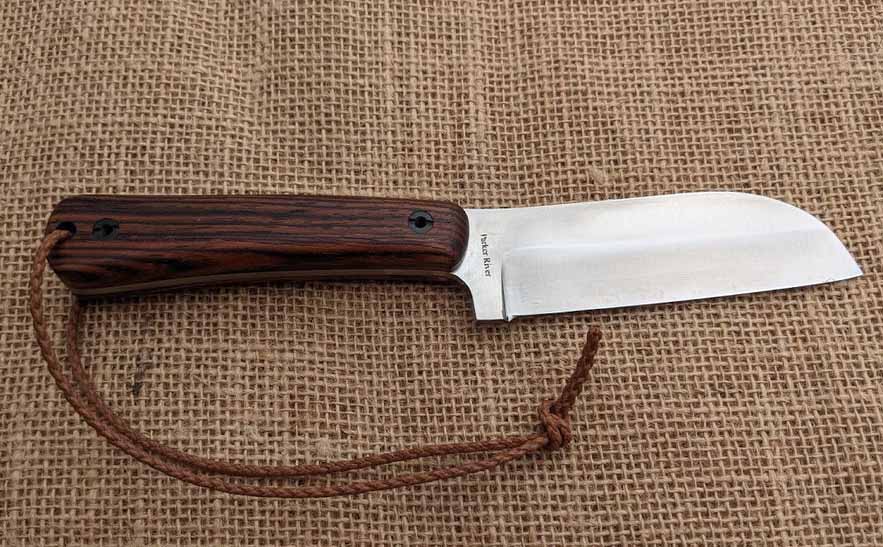
Parker River Bosun Knife
Parker’s River Bosun Knife harkens back to the earliest versions of the rigging knife. Expensive, it more than speaks to your maritime cred.
If you find that you are in the market for the luxe version of a rigging knife, look no further than the Parker River Bosun Knife. This one isn’t at all on the cheap side, you could easily buy every other knife on this list and still have money left over. But, for the discerning mariner, a tool like this is not just a status symbol but a nod to a long-past way of doing things.
This knife is made in the original bosun knife style, fixed blade and all. It lacks any other adornments, including a marlinspike. However, just like in the old days, you can of course buy a separate marlinspike and tie it on with a lanyard. The interesting part of this knife is it really has not lost function over a multi-tool in that the blade aspect. Having a separate knife and marlinspike allows larger models of, thus makes them easier to use and not hinder you with a folding mechanisms. The knife comes with a leather sheath and is available with custom engraving.
MSRP: $315
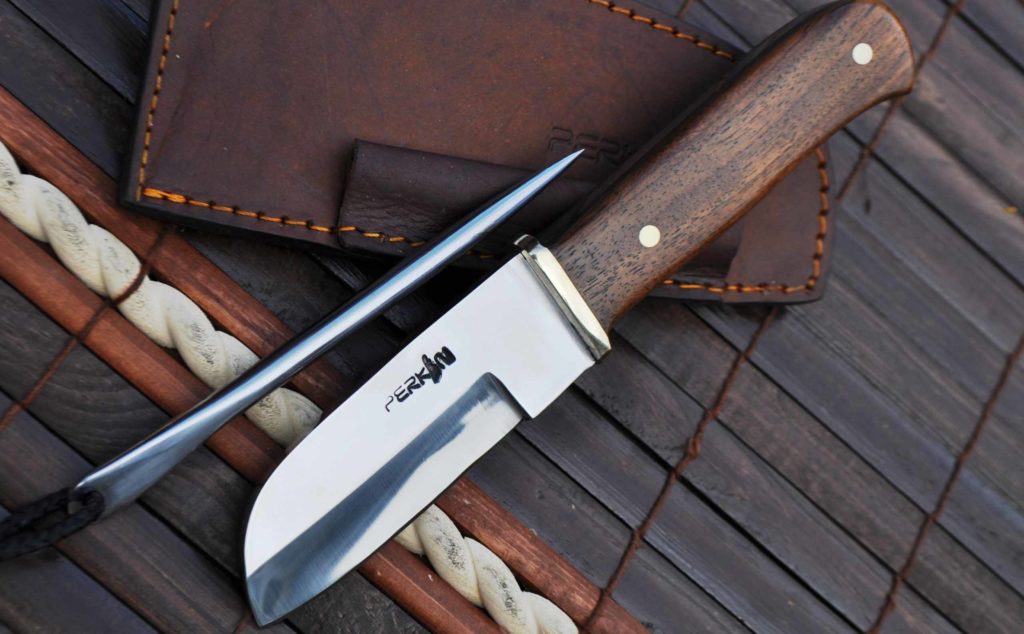
Perkin Handcrafted Rigging Knife
Traditional in design, Perkin’s rigging knife is built for heavy usage, but offers throwback appeal.
Another traditional fixed-blade design is the Perkin Handcrafted Rigging Knife. It has many of the same features as the Parker River example and even comes with a leather sheath with an integrated marlinspike loop.
The knife is heavily constructed and bears a thick, heavy spine. It is substantial enough it can be pounded through rope much in the way these knives were originally used. The physical construction is simple, a pinned scales and a bolster. Overall this is a good entry-level kit if you want a classic setup for your boating adventures.
Keep your knife cutting ready with today’s top sharpeners.
It’s not much of a knife if it’s dull. Getting a blade sharp and keeping it that way is what the top sharpeners are all about. Pull throughs, V sharpeners, adjustable angle models and more, contemporary sharpeners not only will keep your knives keen, some are multi-tools with Torx tools and bits, screwdrivers, fire starters and window breakers. From those for use in the kitchen, camp or workshop to portable use and more, make way for today’s sharp makers.
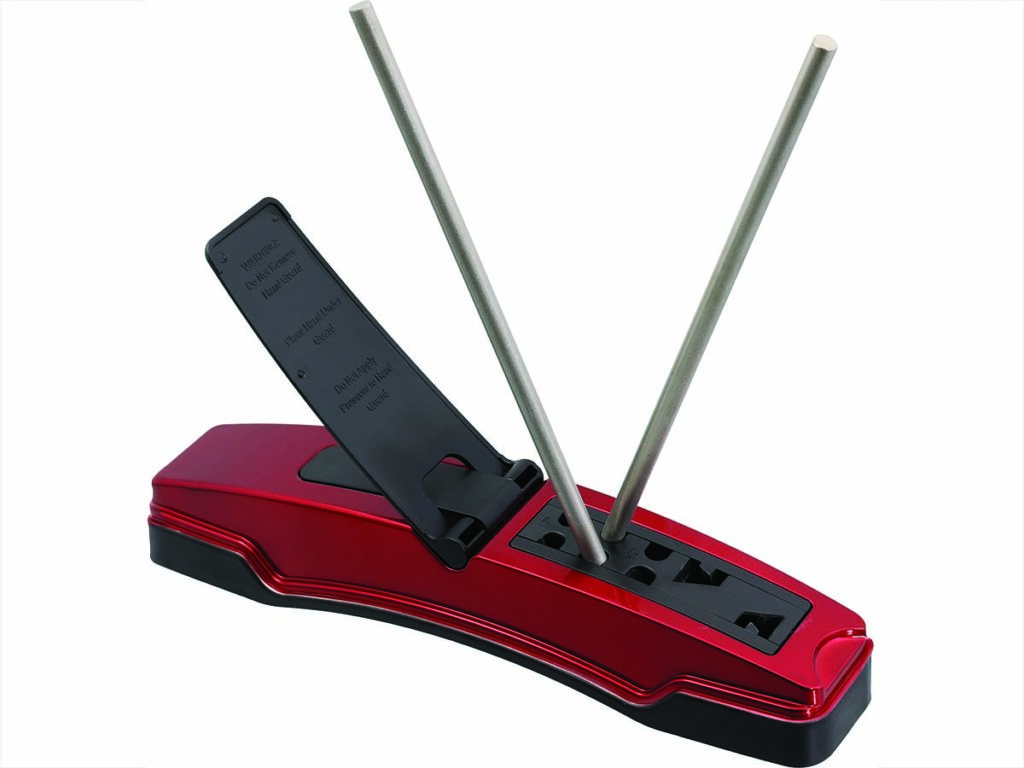
Lansky Master’s Edge Sharpener
The Lansky Master’s Edge All Diamond Sharpener has a rubberized non-slip base with integrated hand guard for safe use.
Master’s Edge All Diamond Sharpener Model type: V sharpener Type of abrasive: Diamond coated Grit: 400 & 600 grit round rods; triangular rod for serrations Types of knives sharpened: Fillet/slicing, butcher, paring, skinning/kitchen/hunting, camping, utility and chef’s Types of edges sharpened: Plain and serrated Weight: 1.4 lbs. Country of origin: China MSRP: $139.95
Inspired by the design of Lansky’s top-selling Master’s Edge Sharpener, the Master’s Edge All Diamond Sharpener and its diamond-coated abrasives put a factory edge on hunting, utility, kitchen and other knives with just a few strokes. The unit includes a pair of medium (400 grit) and fine (600 grit) diamond-coated-abrasive rods for sharpening and polishing at your choice of preset angles: 17, 20 and 25 degrees. The 17-degree setting is for fillet and fine slicing knives, while the 20-degree angle is for slicing, butcher, paring and skinning knives. The 25-degree setting sharpens hunting, camping, utility and chef’s knives. A diamond-coated triangular rod sharpens serrated blades and also awls and fishhooks. A rubberized non-slip base with integrated hand guard ensures safe use and features easy snap-in storage in its underside. The unit can be kept on a counter or stores easily in a drawer.
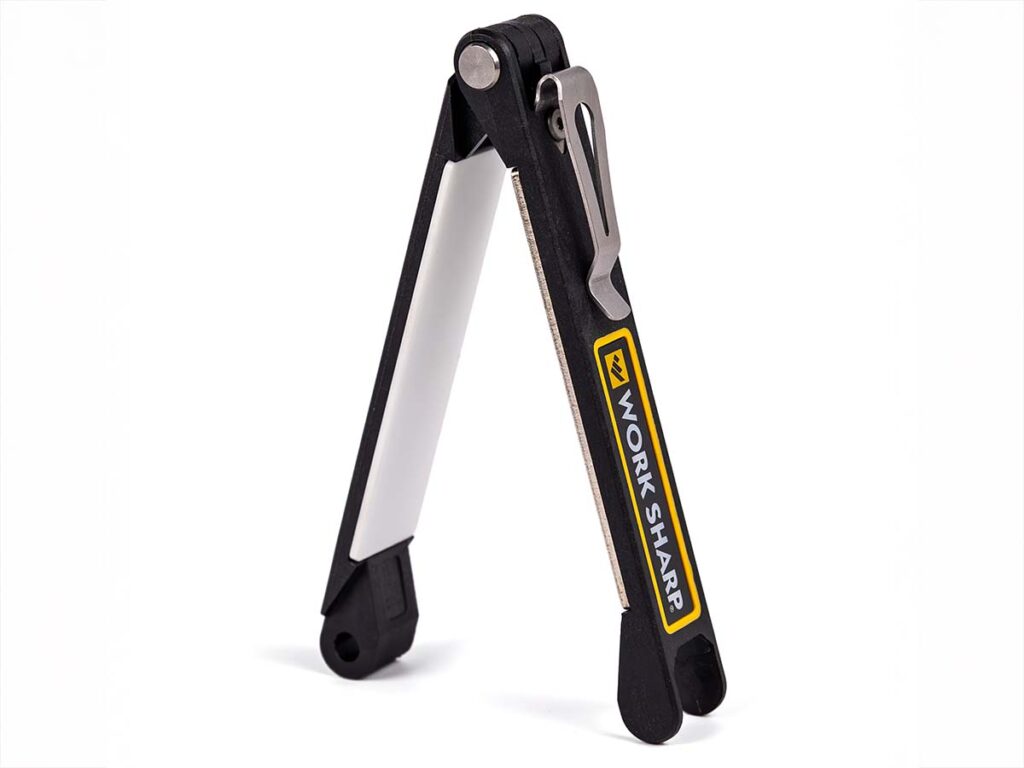
Work Sharp Folding Field Sharpener
Especially effective on EDC knives, the new Work Sharp Folding Field Sharpener is one whiz-bang of a portable unit.
Folding Field Sharpener Model type: Compact field sharpener Type of abrasive: Diamond grit plate and fine grit ceramic plate Grit: Coarse 400-grit for each plate Unit dimensions: 4.75 x .75 x .5” Unit materials: Sharpening plates, plastic, aluminum Types of knives sharpened: Pocketknives, hunting knives, EDC Types of edges sharpened: Plain Special features: Folding design; edge angle guides (20 & 25 degrees) help maintain a consistent angle when sharpening and honing; pocket clip Weight: 4.6 ozs. Country of origin: Designed, calibrated and quality checked in Ashland, Oregon, using foreign components MSRP: $29.95
The Work Sharp Folding Field Sharpener is a compact, lightweight model designed for on-the-go sharpening. It features a 400-grit diamond plate with 20-degree sharpening guides and a fine-grit ceramic plate with 25-degree honing guides, ensuring consistent, reliable edges wherever you are. The folding design and integrated pocket clip make it easy to carry almost everywhere. A big package in a small platform, it’s designed to bring back an edge after a hard day’s use or simply for touchups. Especially effective on EDC knives, it is one whiz bang of a portable-type sharpener.
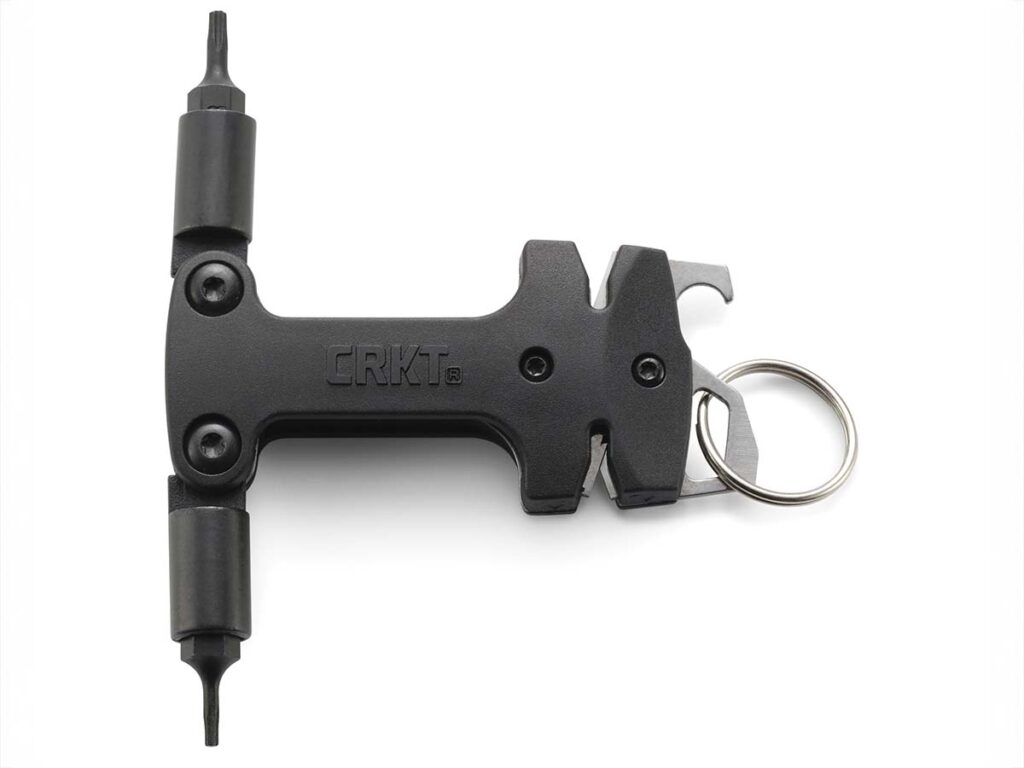
CRKT Knife Maintenance Tool
Designed by Tom Stokes, the CRKT Knife Maintenance Tool is two sharpeners and a multi-tool all rolled into one.
Knife Maintenance Tool Model type: Keychain/pocket field sharpener and multi-tool Type of abrasive: Tungsten carbide sharpener with ceramic honing edge Unit dimensions: 2.7 x 1.18 x .47” Handle: Glass-reinforced nylon Types of knives sharpened: Pocketknives, EDC Types of edges sharpened: Plain Special features: T6 and T8 Torx tools/bits, flathead screwdriver, bottle opener, keychain compatible Weight: 2.2 ozs. Country of origin: China MSRP: $30
Designed by mechanical engineer Tom Stokes, the CRKT Knife Maintenance Tool is a multi-tool sharpener that reflects Tom’s more than 25 years of experience in the aerospace industry, including his work with CAD software and rapid prototyping technology. He designed the Knife Maintenance Tool to prepare you for life’s various exigencies, everything from emergency repairs, popping a top on your favorite beverage—and, yes, sharpening your knives.
The Tool includes two pull-through sharpeners—one a tungsten carbide abrasive to establish a sharp edge, the other a ceramic abrasive to fine tune it—and two sizes of Torx tools/bits: T6 and T8. The sharpeners are on either side of the front of the handle, which is topped off with a bottle opener and flat-head screwdriver/lanyard hole for a keychain loop. The Torx tools are also on either side of the handle and fold out independently of one another for torquing screws pistol-grip style.
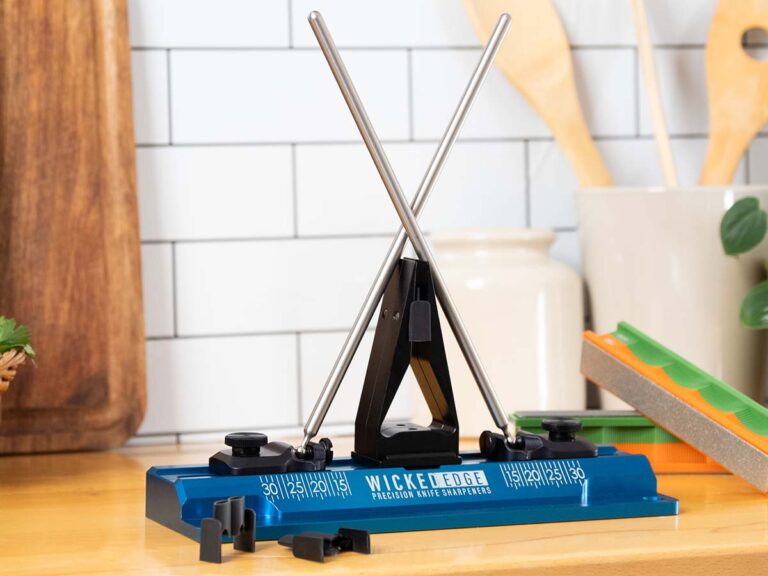
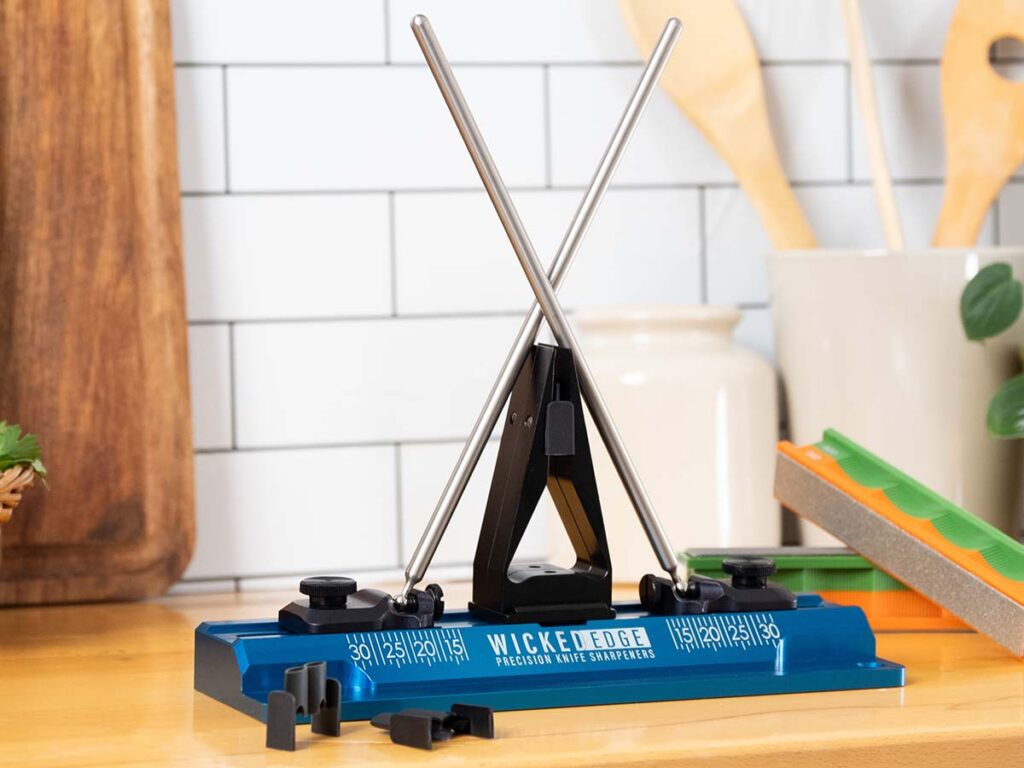
Wicked Edge GO-WE60 Precision Knife Sharpener
Premium abrasives on the Wicked Edge GO-WE60 are 200/600 grit monocrystalline diamond-coated stones.
GO-WE60 Precision Knife Sharpener Blade Length Capacity: Up to 15” Blade Thickness Capacity: Up to .25” (longer screws available for thicker blades) Angle Markings: Calibrated for the blade’s edge to sit at 5/8” above the top of the vise Guide Rod Length: 8.75” Unit Weight: 3.6 lbs. Country of origin: USA MSRP: $299
The Wicked Edge GO-WE60 Precision Knife Sharpener is designed for novices and seasoned old pros alike, whether at home, in the field or on the road. A redesigned standard vise clamps fully flat-ground and distally tapered blades such as on pocketknives and household cutlery. Sharpening angles are adjustable from 13 to 31 degrees per side (26-62 degrees inclusive) in 1-degree increments for precise edge maintenance. Premium abrasives are 200/600 grit monocrystalline diamond-coated stones. Mounting options include securing to any flat surface with the included C-clamp or attaching directly using predrilled holes.
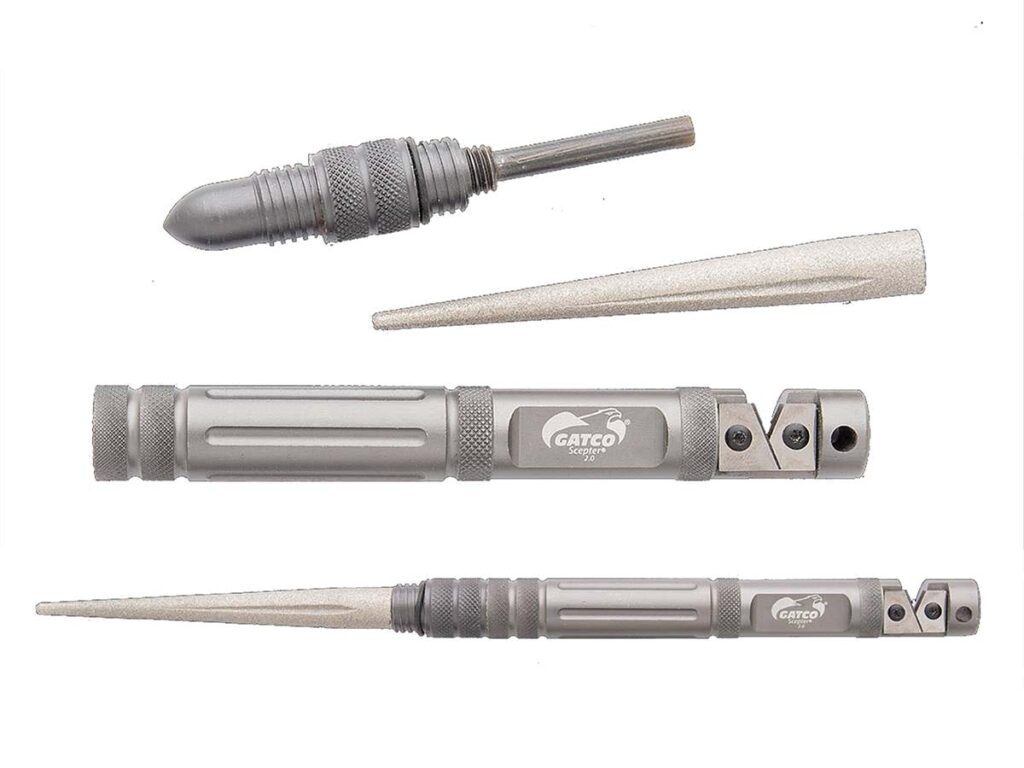
Bear & Son GATCO Scepter 2.0 Diamond
The multi-purpose GATCO Scepter 2.0 sharpens plain and serrated edges and has a magnesium rod for starting fires.
GATCO Scepter 2.0 Model type: Pull through and tapered diamond rod Type of abrasive: Diamond coated and tungsten carbide Unit dimensions: 6.125″ Unit material: 6061-T6 aluminum housing Types of knives sharpened: Hunting, EDC, kitchen Types of edges sharpened: Plain and serrated Special features: Tapered diamond rod, magnesium fire starter rod, window breaker Weight: 3.2 ozs. Country of origin: China MSRP: $49.99
The compact GATCO Scepter 2.0 Diamond Take Down Sharpener & Fire Survival Tool from Bear & Son is a multi-purpose implement for everyday pocket carry, the toolbox, to take camping and/or makes an ideal necessity for your bug-out bag. A magnesium rod for fire starting stows inside the tapered diamond sharpener, the latter which includes a groove for sharpening fishhooks. The rod and tapered sharpener are contained inside the CNC-machined, 6061-T6 aluminum carbide body, which has a pull-through tungsten carbide sharpener on the end. Each component features precision-machined threads and an outer “O” ring.
Assisted open knives that get the job done … quickly.
Although their popularity has leveled off in recent years, manufacturers still embrace the assisted-open genre and continue to produce new models. For those new to the hobby, who may not be familiar with this style of knife, allow us to explain how they work.
Assisted openers are usually EDC and tactical folding knives equipped with some sort of torsion spring affixed to the tang of the blade that aids in propelling it to full open. What results is a crisp and quick action akin to a fully automatic knife. But, and here’s the good part, it remains legal in most jurisdictions.
There is a downside to the assisted opener; the spring creates a weak link. If it fails, the snappy action is absent. The knife remains usable, but, impetus gone, it’s practically a manual opener. Hence, some enthusiasts shun the assisted opener like the plague. Yet, the design still has its enthusiasts, who can’t get enough of its brisk and fast actions.
No matter where you stand on that spectrum, there are assisted-open knives worthy of consideration. We’ll cover four of the latest and greatest that deliver the thwack users love.
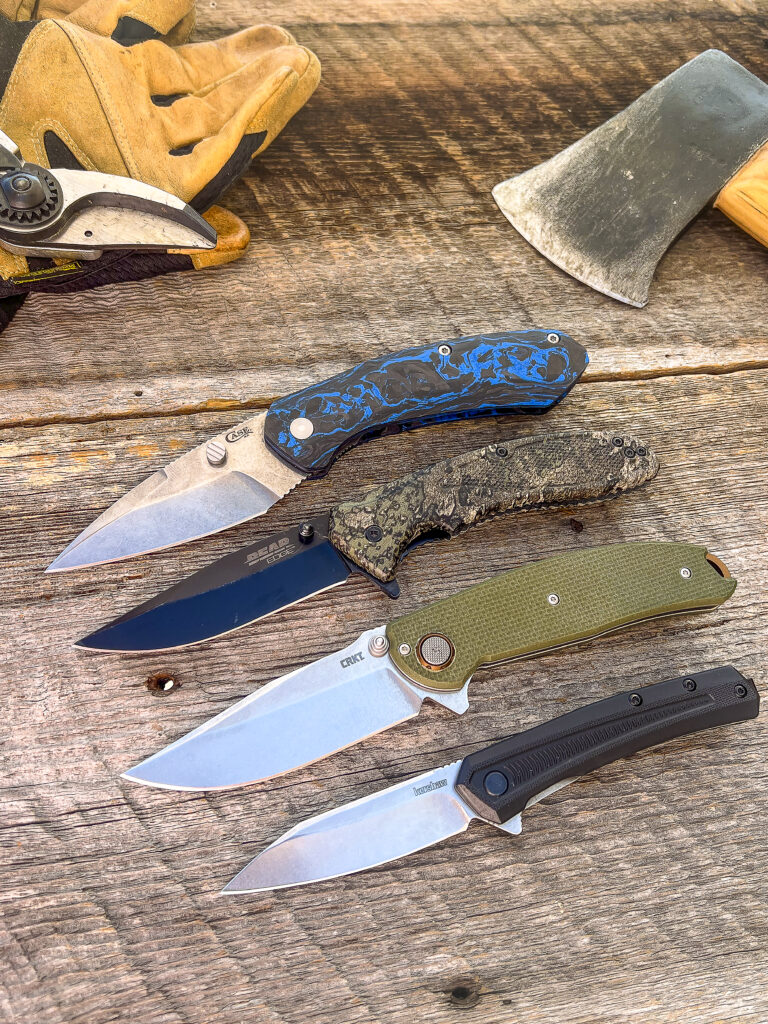
CRKT Butte
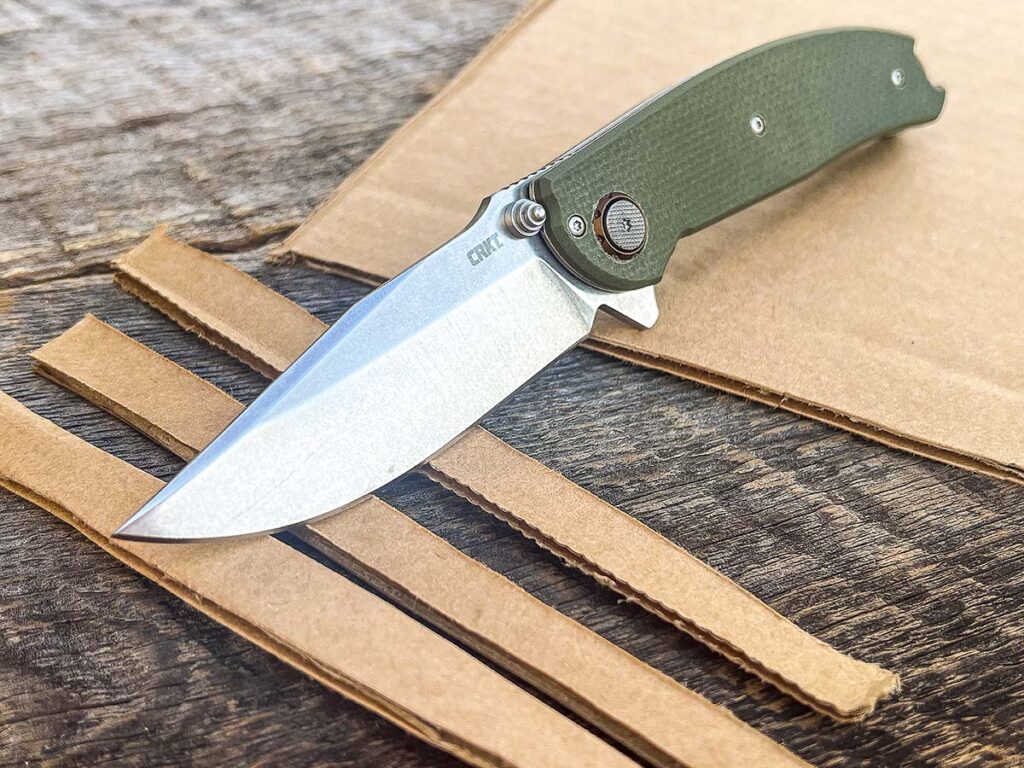
The Butte was designed by knifemaker Lucas Burnley and features CRKT Deadbolt lock. The author found the clip-point blade exceptional and the knife overall sized right.
The Butte is named after its designer’s—Lucas Burnley’s—hilly hometown of Bend, Oregon. Like this rugged terrain, the CRKT knife is heavy-duty and blends style and function into one package, geared for the outdoors.
The Butte boasts a 3.3-inch blade with a clip point and is constructed from D2 tool steel. The material choice gives the knife enhanced edge holding capabilities and is relatively easy to sharpen. Additionally, the steel has good impact resistance, though it’s not stainless, so plan to exercise more care in its upkeep.
Moving down, the handle is OD green peel ply G-10, with dual steel liners providing the backbone. A bronze anodized aluminum back spacer rounds out the handle features.
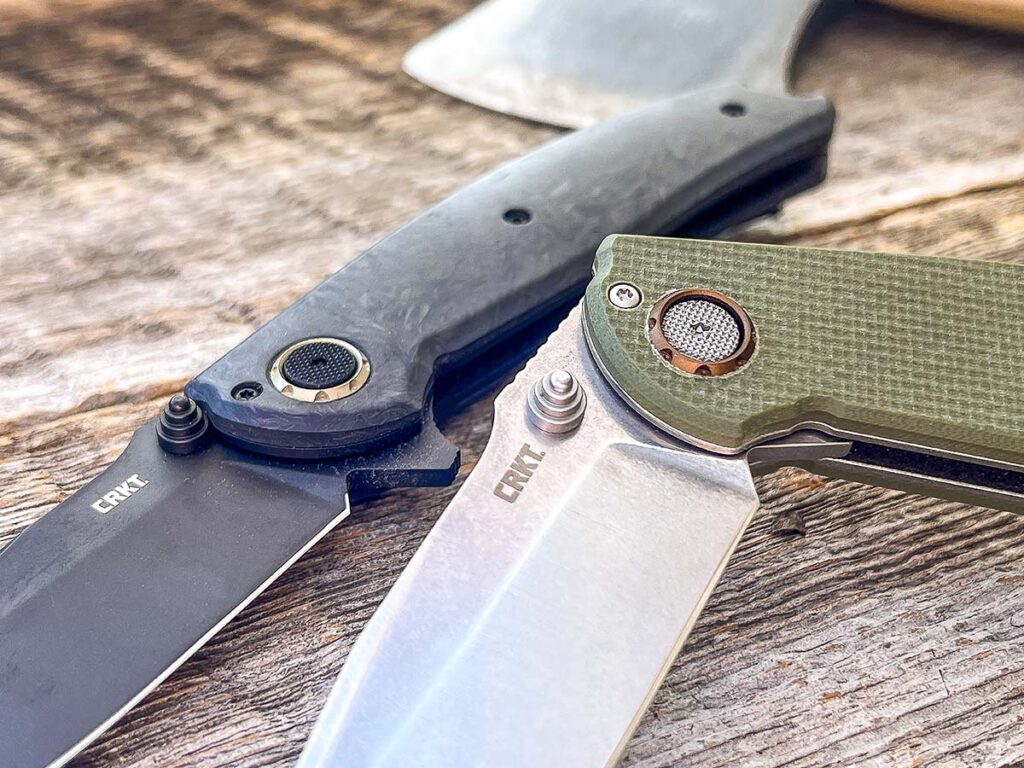
CRKT utilizes its Deadbolt lock mechanism on the Butte, a solid choice for a knife meant for rough outdoor work. The system, developed by Brazilian custom knifemaker Flavio Ikoma, is essentially a button lock, but with two actuating steel posts. In the case of the Butte, the button design plays well into the overall streamlined look of the knife. It resides on the blade pivot and melts away into the knife’s lines.
The Butte’s lock release is disguised as a pivot bolt, which makes unlocking the blade intuitive, even while wearing work gloves. It also keeps the knife’s sleek look.
To keep the knife handy, CRKT outfits the assisted opener with a pocket clip oriented in the right-handed, tip-up-carry position. Unfortunately for lefties, the clip cannot be reconfigured.
The Butte’s size makes it very capable of tackling a wide variety of chores inside the home or in the great outdoors. Folding hunter or general work knife are both well within its wheelhouse. Could be an outdoor knife, could possibly be a folding hunter, or could be a general working knife.
Of its assets, I like the peel ply G-10, which is more grippy than regular G-10. The handle is also very comfortable, and the lock release is oriented smartly—it’s out of the way of the hand.
Flat out, I think the Butte is a winner when it comes to a working assisted-open. With an MSRP of $120, it’s also a great value.
Kershaw Raygun
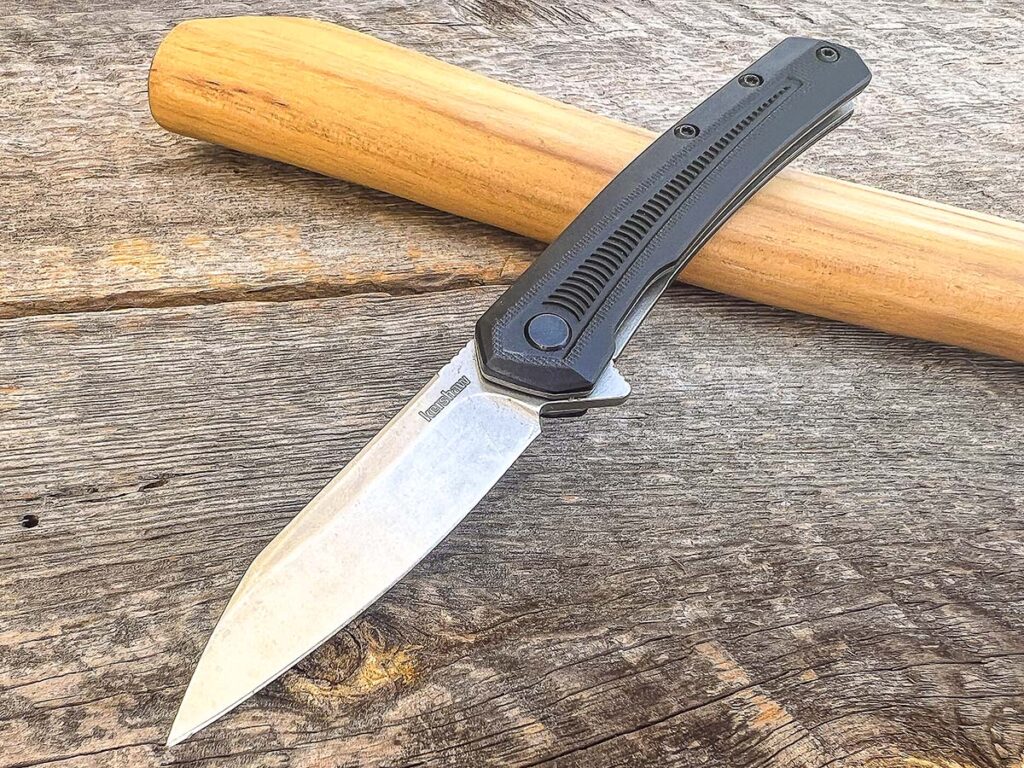
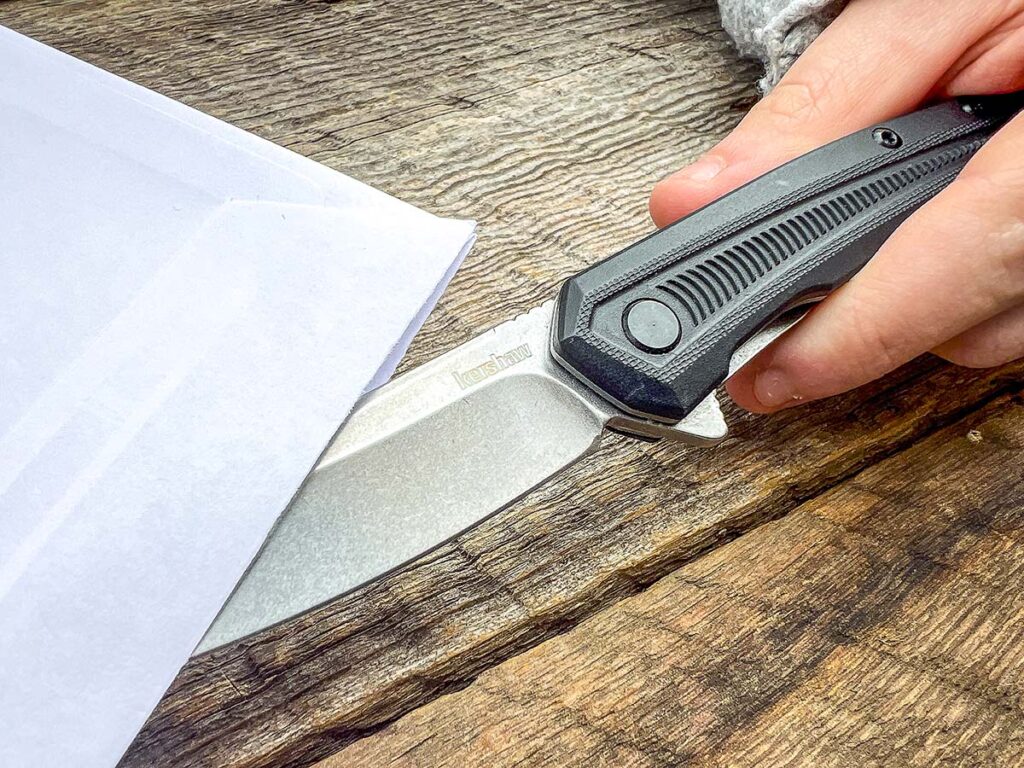
The reverse tanto blade shape of the Kershaw knife makes it user friendly, with what the author describes as a gently sweeping edge that maximizes cutting efficiency.
Kershaw’s Raygun offers high utility, a slim form factor and assisted opening in one affordable package. Though it comes in smaller than the rest, with just 2.8 inches of blade to work with; however, a hollow-ground edge gives the compact option aggressive cutting abilities.
As does Raygun’s reverse tanto blade. The profile supplies a gently sweeping cutting edge for maximum efficiency, along with a defined tip for scoring. As to the knife’s steel, it’s 4Cr14 stainless. This is a compromise, balancing solid edge retention and price. Kershaw gives the blade an added layer of protection, stonewashing it to hide any scratches obtained along the way.
Deployment is strictly a flipper affair, which is nice given that it maintains the knife’s sleek look. And Kershaw—like many of its models—makes certain the deep-carry clip is ambidextrous, though strictly a tip-up affair.
Steel composes the liner lock’s liner and Kershaw outfits the handle with glass-filled nylon scale. It’s chamfered, cutting down on hot spots and well textured. The center features a wave pattern of increasing size toward the pivot. This provides the most traction on the handle.
The Raygun features a slender construction and compact size, paired with a highly utilitarian reverse tanto blade. Despite its size, the knife can tackle a variety of tasks, large and small.
The assisted opening mechanism is a classic, Kershaw’s own Speed Safe. For those who don’t know, this is a design of Blade Magazine Cutlery Hall of Fame® member Ken Onion, and is credited with kick-starting the assisted opening trend. It’s fast, durable and a mainstay in Kershaws.
The Raygun cuts efficiently, quickly and its compact size carries easily in slacks, jeans or even clipped to the waist of jogging shorts or sweatpants. I did find the knife’s size a plus and a minus. The downside, bigger hands might find it too difficult to manipulate and use. The upside, its opening is precise and predictable. Given the short, narrow blade, there isn’t a lot of blade mass to move.
With an MSRP of $38, you get a lot of knife in a small package with the Raygun.
Case Westline
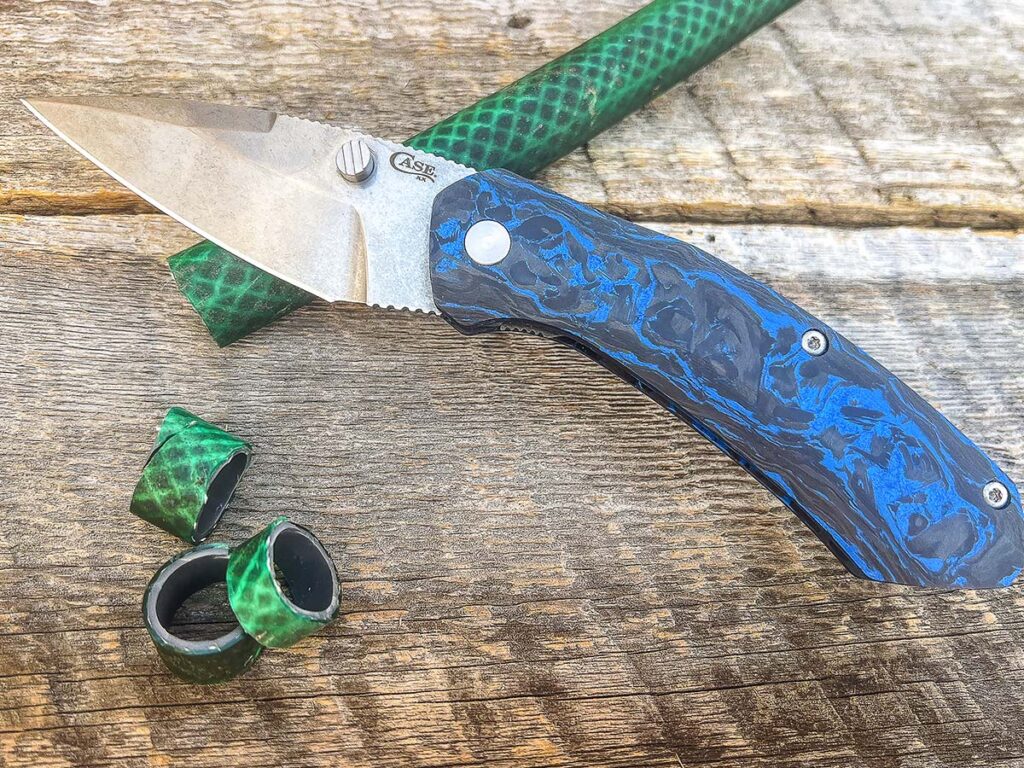
The Westline series of folders have drop point blades and a contoured handle. This particular specimen has eye-catching and lightweight blue and black carbon-fiber handles, paired with a stonewashed S35VN blade. The bigger blade helps to handle larger cutting chores like cutting thick hose.
An interesting twist to the Case Knives plot, a few years ago, it designed and manufactured a line of modern folding knives. Finally, granddad’s pocketknife company embraced the EDC theme with blade locks, one-hand opening and high-tech materials. At the vanguard, the Westline series. The line also introduced assisted opening to Case.
The Westline I looked at was outfitted with 3.23-inch modified drop point blade, made from premium CPM S35VN stainless steel with a stonewash finish. This is a Crucible Industries material, one of the super steels, renowned for its exceptional toughness and edge retention.
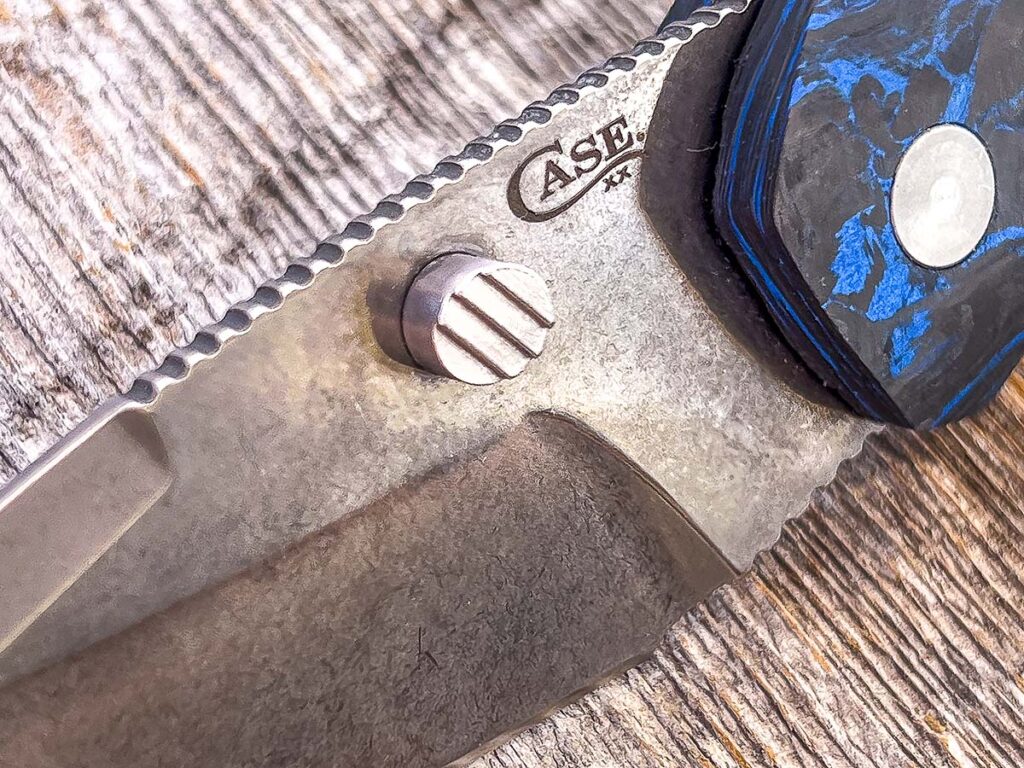
The blade spine features a run of traction notches, allowing added pressure to a cut with your thumb or index finger. Furthermore, there are notches on the tang behind the cutting edge. Used in conjunction with the blade spine, you can choke up on the blade for more precise control.
As far as the handle goes, it is made from striking blue and black marbled carbon fiber that catches the eye. Underneath are two nested steel liners providing the backbone for the Westline’s handle. It is a liner lock, which engages smoothly and holds the blade secure in the open position. Finishing it off, a steel pocket clip is mounted to the handle to carry the knife in the tip-up configuration.
Large, angled and stepped thumbstuds make the blade of the Case Westline easy to open.
The blade deploys in either hand thanks to two large ambidextrous beveled thumbstuds. Speaking of opening, the Westline’s action is predictable, controllable and smooth. Case makes this a certainty, outfitting the knife with pivot bearings.
The Westline would make a great working folder where general-purpose cutting chores reign. It carries well, deploys fast and has a blade steel well known for its performance. It cut through a variety of materials with ease for me. My only complaint is the thumb stud placement. Case could have moved the studs back toward the tang more, thus shortening the arc of travel. The MSRP of the Case Westline with blue and black carbon fiber is $197, and it is made in the USA.
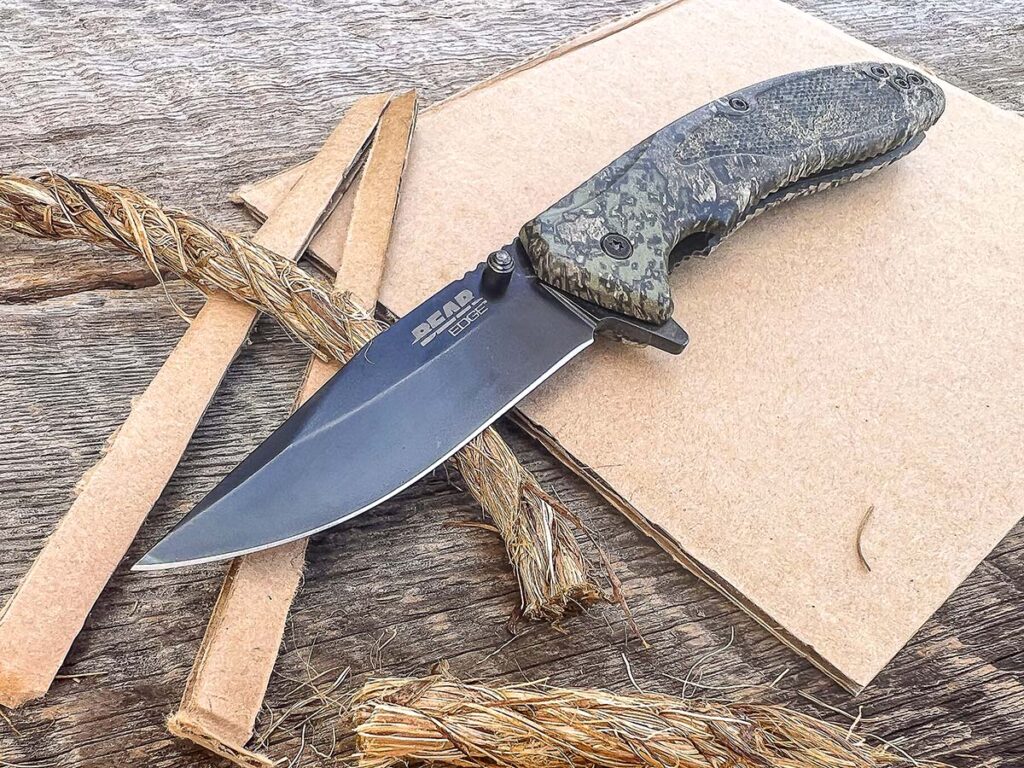
Bear & Son Bear Edge True-Timber Sideliner
The Sideliner is a cutting champ, thanks to its hollow-ground blade. The assisted-opener made mincemeat of cardboard, rope and a variety of other materials.
The Bear & Son Bear Edge True-Timber Sideliner folder offers a lot of desired features in an affordable package. The clip-point blade is 3.5 inches in length and is made from 440A stainless steel, a lower-end blade steel that is inexpensive but easy to sharpen.
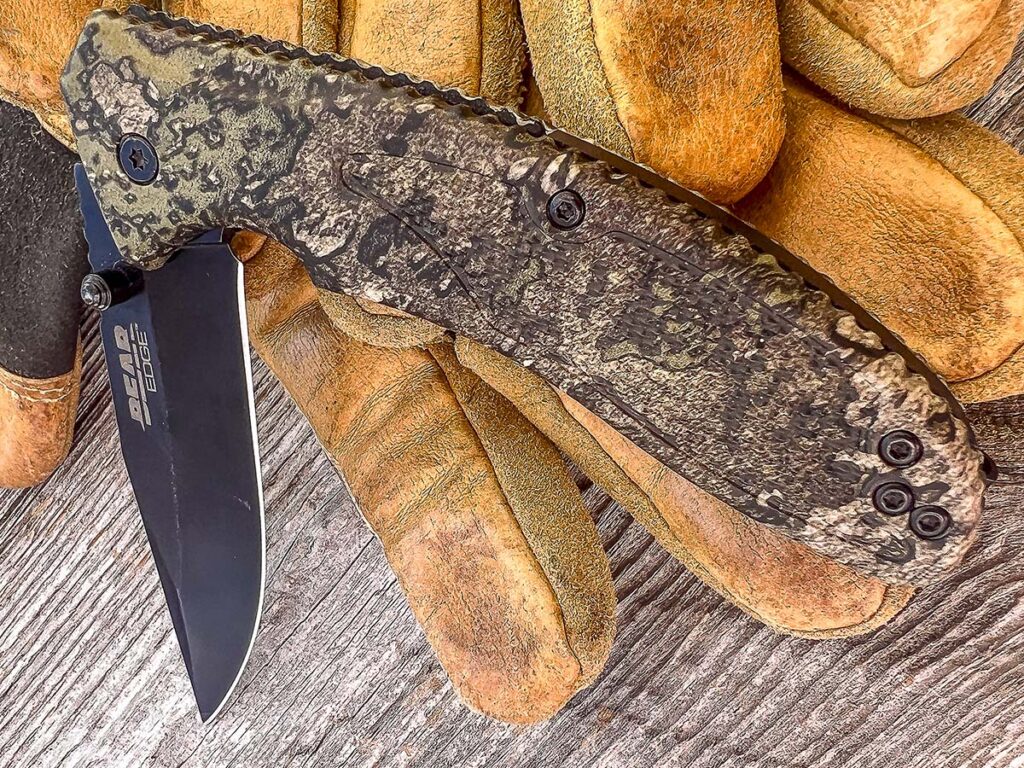
The TrueTimber camo Zytel handle is lightweight, impact-resistant, and impervious to the weather as well as fluid absorption. It incorporates several ergonomic features, such as a primary finger recess with lower hand guard, screw-together construction, checker texturing that helps to improve grip, and there are traction notches all around the perimeter of the handle to aid in nonslip grip as well.
A deep carry pocket clip is attached to the handle to carry the knife in the tip-up position, and it can be switched to the opposite side for lefties.
I would say this Sideliner folder is a very viable option for those who want a good, solid, reliable folding knife at a very reasonable price. The hollow grind makes it easy to slice through any material with ease, but the factory edge out of the box was just OK in my observation. It would cut, but I did notice an improvement in performance once I was able to put my own edge on it.
The Bear & Son knife’s handle has textured grip panels for hand traction, as well as traction notches around the perimeter for an excellent all-weather grip.
The Sideliner’s assisted opening action is quick and sure. A firm push out of one of the thumbstuds causes the blade to spring into action. However, whenever there is a flipper option, I prefer using that instead, as it’s easier and faster to get to. A simple press on the flipper will activate the assist, and the blade is opened, locked and ready for action.
The 440A stainless steel isn’t going to hold an edge like the mid-grade or high-grade stainless steel, but it is easy to resharpen, so there’s that. There’s a trade-off for an MSRP of $60. Still, it really is not a bad price for this piece. Knowing you will generally pay a bit less than this makes it a great buy.
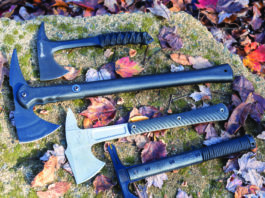
The CRKT Skeggox Is A Fun Little Hatchet That Swings A Big Game And Can Handle The Daily Tasks Around Your Property
A good hatchet is worth its weight in gold, and in the case of the CRKT Skeggox it weighs just 1.63 pounds.
This fun, tactical hatchet is one of the newest offerings from CRKT. I had the chance to try it out on my property as winter descended. I had never used a hatchet before. I don’t think I’ll be needing to get another one for quite a long time.
What Is The Skeggox Made Of?
Let’s start with the particulars. The Skeggox is 12.94 inches long with a 4.83-inch blade made from SK-5 carbon steel for good edge retention. The glass-reinforced nylon handle is lightweight, cool, and feels excellent in the hand when swung. The blade is powder coated for extra corrosion resistance and gives the Skeggox an all-black look.
The hatchet includes a thermoplastic sheath that I loved. It has a clip to fasten it securely shut, but it fit so snug that you could easily travel with it and not clasp the clip (although you absolutely should).
Testing the Skeggox
The vines I first went at with the Skeggox
When I went to test the Skeggox I had the perfect patient: this nightmare of vines and saplings in my backyard. Before the arborist came to remove it all I took the hatchet out there to see what it could do.
With the vines it was a thumbs down. The thin, almost grassy material was not easy to chop through. The fact that the blade would slide off of the vines instead of slicing through made me uncomfortable because I didn’t know where the blade was going to go. I quickly moved onto the saplings, which were entwined with the vines in their upper reaches.
But as you can see, these saplings were the perfect size to really see what the Skeggox could do. And boy howdy, could it do a lot!
The saplings before meeting the Skeggox.
I went to work swinging the hatchet with a smile on my face. The Skeggox is weighted so well that each swing made me want to swing it again. I was wearing my outdoor gloves and the handle never once slipped as I chopped at the tree.
It took a touch over two minutes, and it wasn’t the cleanest cut, but in the end, the sapling stood no chance.
The sapling after meeting the Skeggox.
I’m also getting my fence replaced in a few weeks so I took the Skeggox and began laying blows into the tops of the fence posts. I went as hard as I could to beat up the hatchet as much as possible.
Final Cut
And finally, I returned to my kitchen, put a fresh Campari tomato on a plate, and drew the Skeggox down toward it. It went through like a hot knife through butter. Then, for good measure, I even quartered the tomato just as easily.
This is an excellent piece of kit. I can’t recommend it more highly. If you own a home and are looking for an affordable hatchet to use in the yard, this is the piece to get.