We take a gander at some of the knives that showed up at the first BLADE Tactical at CANCON Carolina.
Sun, guns and a whole bunch of knives—BLADE Tactical was a whole new twist on BLADE Show. And a heck of a marriage between it and one of our sister events, CANCON Carolina.
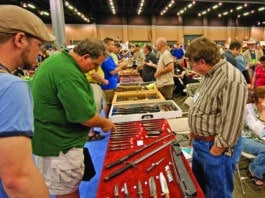
Held Nov. 7-8 at South Carolina’s Clinton House Plantation range, the inaugural BLADE Tactical brought together some 25 knifemakers to show and sell their wares, all of the blades with a definite tactical bent. The knife show ran the first day, on the periphery of the shooting events. It had a different feel than any of our legacy shows, given it was outdoors and had the constant report of suppressed gunfire as background noise. But it wasn’t too far off our big three with some knife enthusiasts spending the night in the parking lot so they could be the first to the BLADE Tactical pavilion.
With that sort of enthusiasm, we’ll chalk the event down as a success.
For those who were unable to make the BLADE Tactical show or have their interest piqued, we’ve put together a recap of some of the knives that made their way to central South Carolina. Take a gander at what was up for sale and start planning now for next year’s B-Tact extravaganza. For anyone looking to pick up a hot new knife and burn some powder at the range—consider the gathering your Valhalla!
Krein Knives
Tactical doesn’t preclude good looks, which is certainly the case with this Krein Knives Alpha. The blue thumb studs add a nice flare to this top-end framelock.
Carver Knives
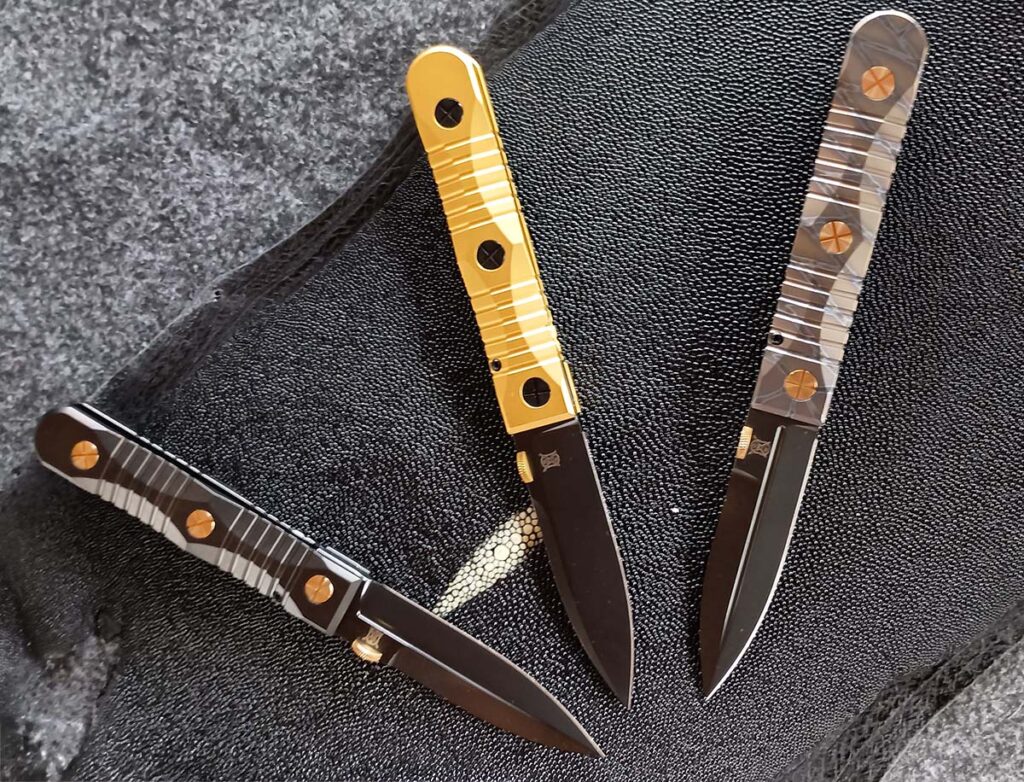
Carver Knives‘ Waif has it going on. Up front is a titanium handled-model, in the back a dark Ti handle. Both are thin as a minute, particularly when measured up the knucks in the middle.
Pro Tech Knives
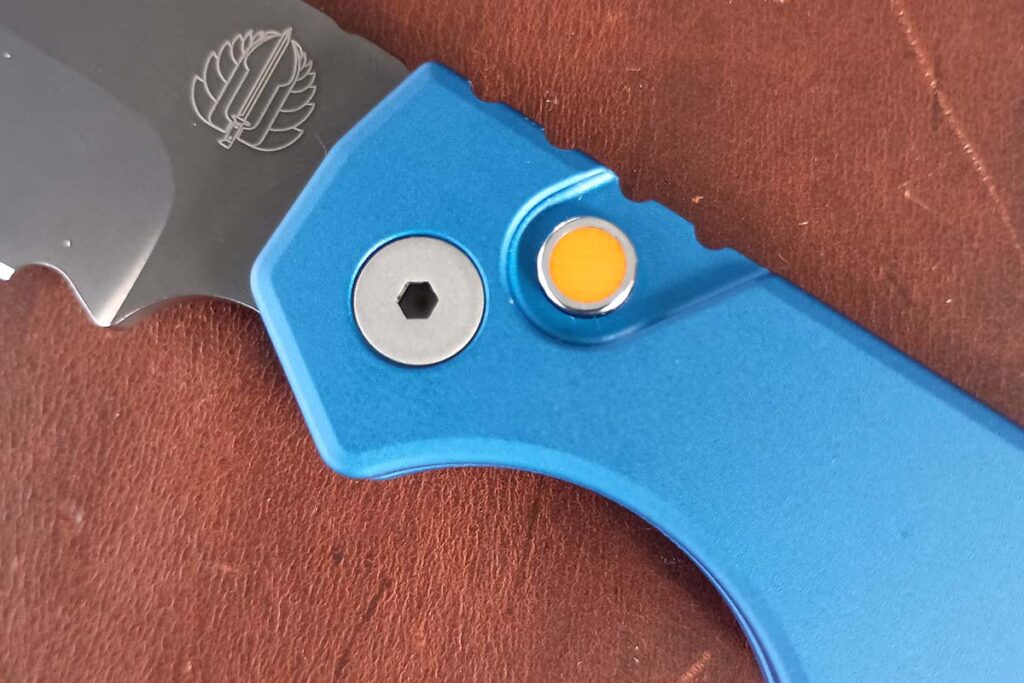
Pro-Tech came to BLADE Tactical with an offer you couldn’t refuse, like a number of these thin and wicked Godfather autos.
The company also offered a nice bit of custom bling for the show, a CANCON blaze orange G-10 insert on several of it’s knives buttons.
Elishewitz Custom Creations
With the Ek Integral, Elishewitz Custom Creations combined class and performance in a light and functional package. A nice dagger-style blade deploys in the wink of an eye via a thumb stud.
McNees Knives
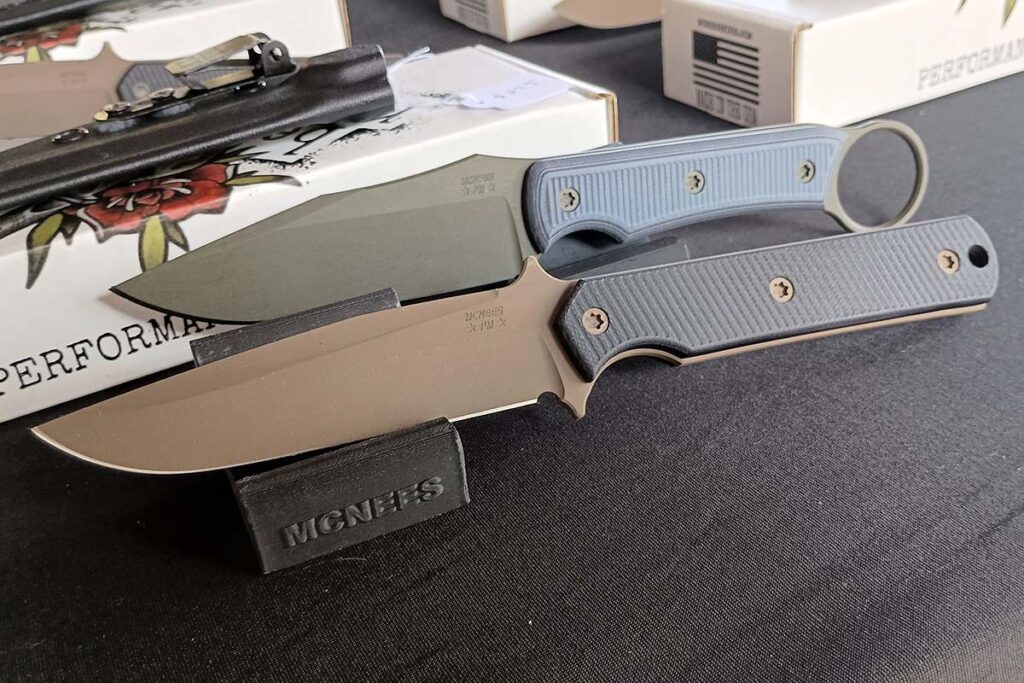
Some hefty debuts from McNees Knives at BLADE Tactical. In the rear, is the Ringed Agent and up front the Stalker. Par usual for McNees, both feel like their built to beat the world.
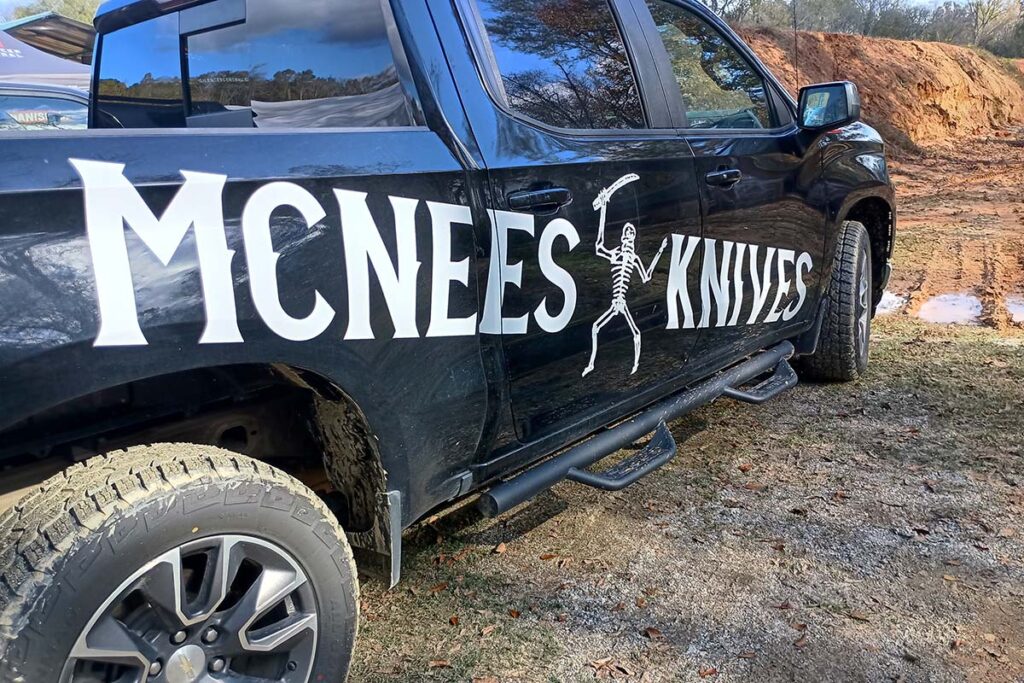
Somewhat from the neighborhood (Alabama), the McNees crew drove to BLADE Tactical. Needless to say, they did so in style… nice wheels.
Nicholas Nichols Knives
Certainly, the Guppy is no small fry. Nichols Knives drop point has plenty of size to get nearly any job done, but stays light in the pocket thanks to a titanium handle.
Spartan Blades
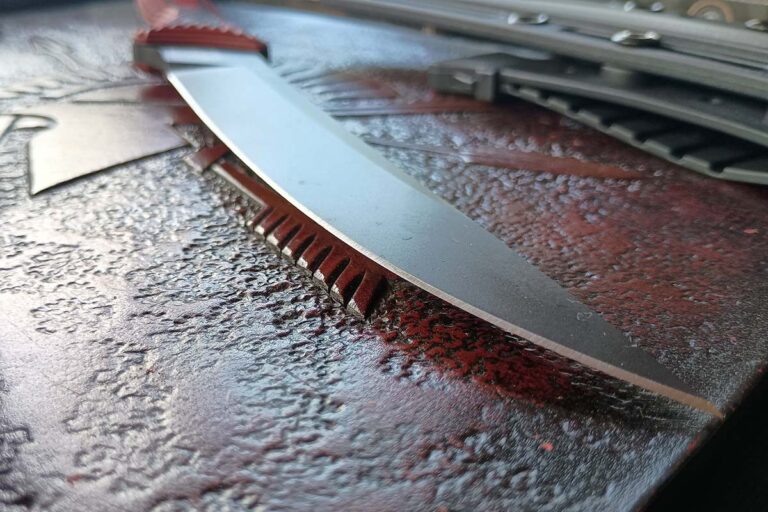
Spartan Blades was right at home at BLADE Tactical—no surprise there. But the belle of the ball was the company’s Ronin-Torii, a traditional tanto, which few would want to find themselves on the wrong end of.
Nottingham Tactical
Believe it or not, you’re looking at six-years of development. Nottingham Tactical was game for a carbon-fiber model, but it took a ton of work to get it to come together, from finding the carbon-fiber up to the abuse to getting the right adhesives to get the metal parts to stay.
Vero Engineering
It wasn’t all fixed blades and folders for the knife side of the show. After BLADE Tactical closed, the knifemakers hit the range at CANCON for some therapeutic trigger time. Here’s Joseph Vero of Vero Engineering getting on one of Maxim Defense’s shorties.
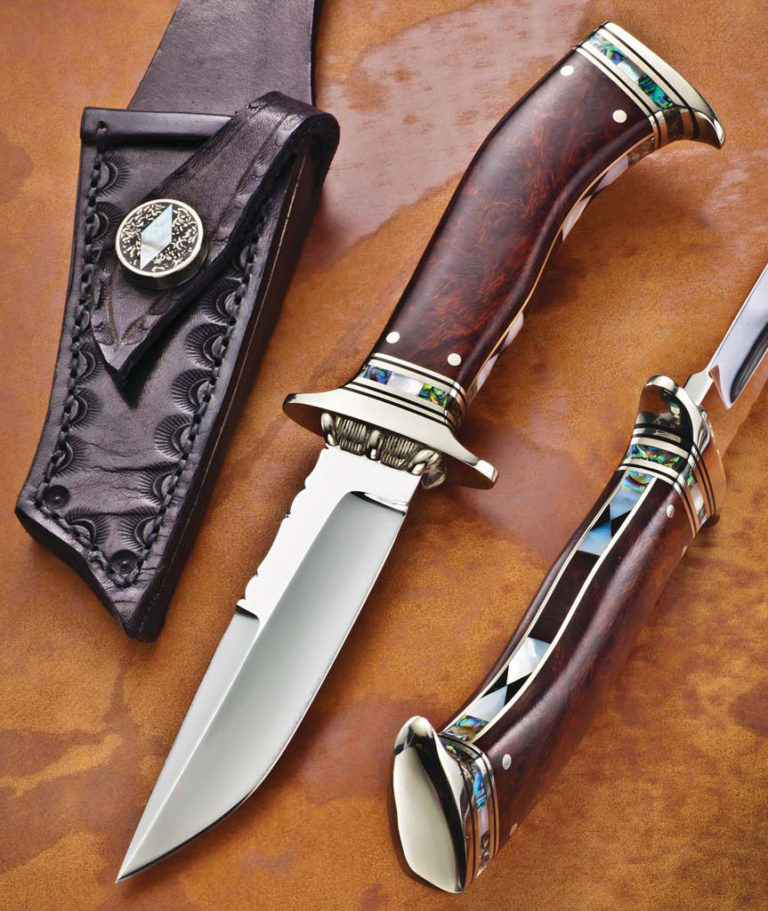
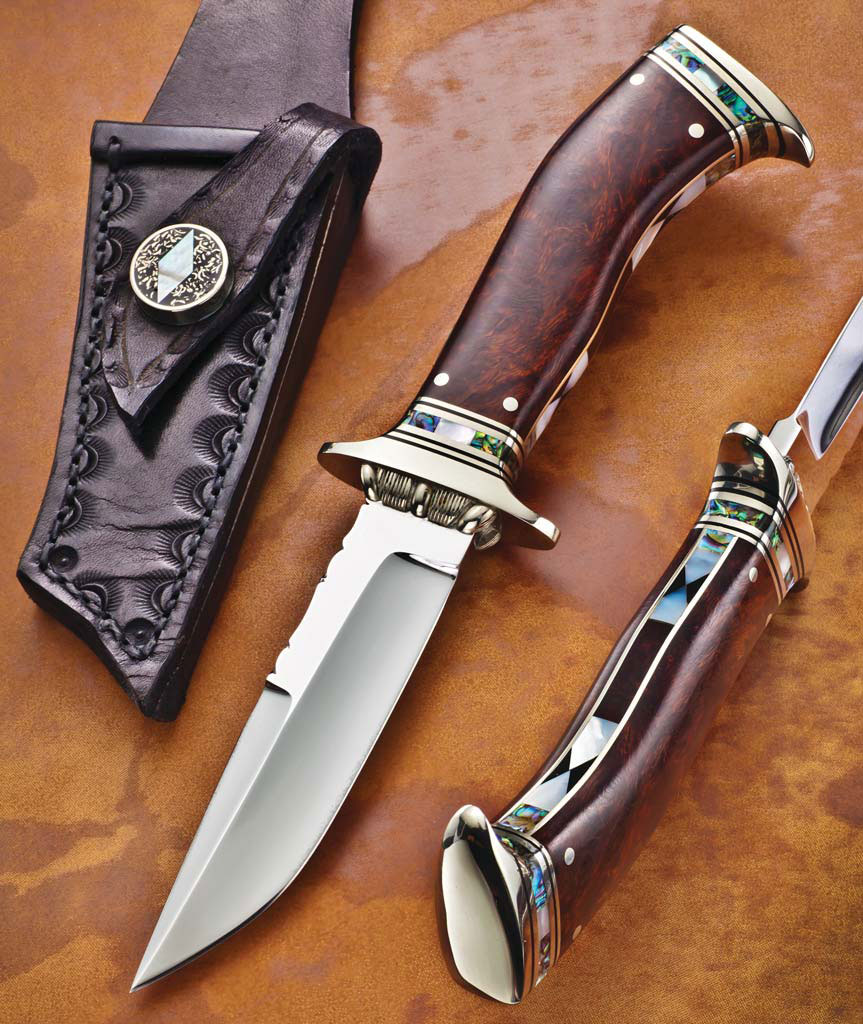
Well-made vintage knives by legendary makers can be very attractive to collect. Lloyd Hale does the honors here in a chute knife sporting an ironwood handle with pearl and abalone inlay. (SharpByCoop.com photo)
Eventually, All Knife Collectors Hit Crossroads
You may face a crossroads, a time of decision involving the realization that interests, tastes and possibly buying power change. In such situations, you may decide to begin collecting a different genre of knives, departing from what you have collected. If and when that time comes, evaluating your situation and making informed decisions is crucial.
Some basic questions loom large, from deciding what to collect to getting the best education on what is available, selling or retaining an existing collection, and, if the choice is to sell, then maximizing the revenue generated.
Should You Reboot? Ask Yourself These Questions
Do you have a very good reason for starting over?
Do you sell or keep your existing collection?
If you sell it, how do you get the most out of it?
Are you trying to recover your initial investment or trying to make as much money as possible to assemble your new collection?
Are you comfortable with the effort and costs it will take to build a new collection?
Do you want to make money or collect, carry or use the knives?
What knives should you collect, and how do you best research them?
How available are they and are they of recent vintage?
Are they still in production or limited in distribution, both of which influence collectibility?
If antiques, where can they be found and can they be found without undue cost?
What are the prices typically asked for the knives in collectible condition?
Are you going to collect only mint or near-mint examples, and can you afford to pay premium prices for them?
Guidelines for Going Forward with a New Collection
If, after answering those questions, you decide to liquidate and start over, keep these guidelines in mind.
Collect what you like or even use.
Chasing trends is a fool’s errand. Collecting knives that are hot now means paying top dollar now as well.
Know which knives are collectible in specific geographic locations of the country.
Inexpensive, low-end knives will never appreciate to any degree.
Well-made, fine-condition knives should not lose you any money.
Don’t buy damaged/poor condition knives unless they are very old and collectible, such as antique bowies and rare military knives.
The company’s shop was extensively damaged in the natural disaster.
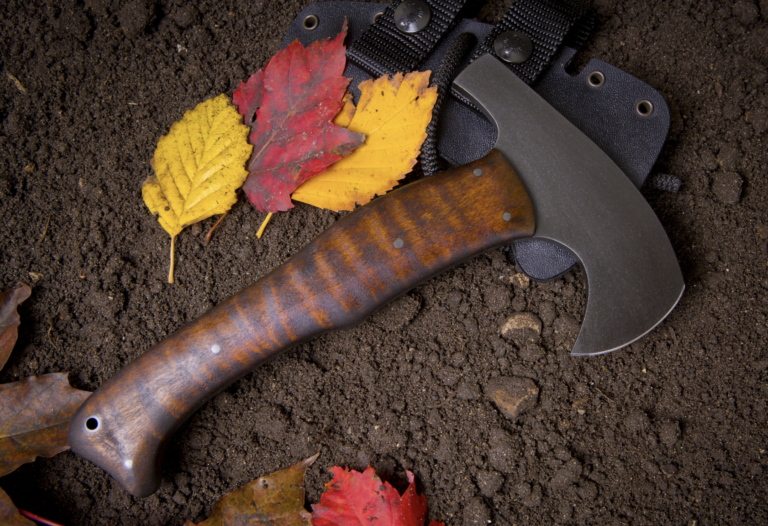
Hurricane Helene affected a vast swath of the country and the knife community was not immune. Several knifemakers call North Carolina home, the state that took the brunt of the devastating hurricane that tore across Appalachia in September. One of the harder hit was Winkler Knives, based out of Boone.
The tactical- and outdoor-focused maker thankfully did not lose any of its employees in what turned out to be among the worst natural disasters in recent history. The company’s shop, however, incurred substantial damage from the torrential downpours flooding much of North Carolina’s countryside. In a brief estimate on a YouTube video, Winkler’s founder and owner Daniel Winkler when he returned to his shop there was 15 inches of standing water throughout. Even more troublesome, the workspace was swamped with hundreds, if not thousands of pounds of mud.
Needless to say, this halted the company’s production and put many orders on hold, with much of its machinery reportedly damaged or destroyed. In finished products, Winkler estimates it lost two weeks of work.
Living up to the rugged persona of its knives and axes, Winkler is attempting to make the best out of a rough situation. The company is staging a special sales day on Nov. 30, to raise funds to—as the company puts it—build back. The company will stage a meet-and-greet before the actual sale, then offer those who register, early-bird entry before its store opens proper to the public. And Winkler has quite a selection of special knives up for sale at the event.
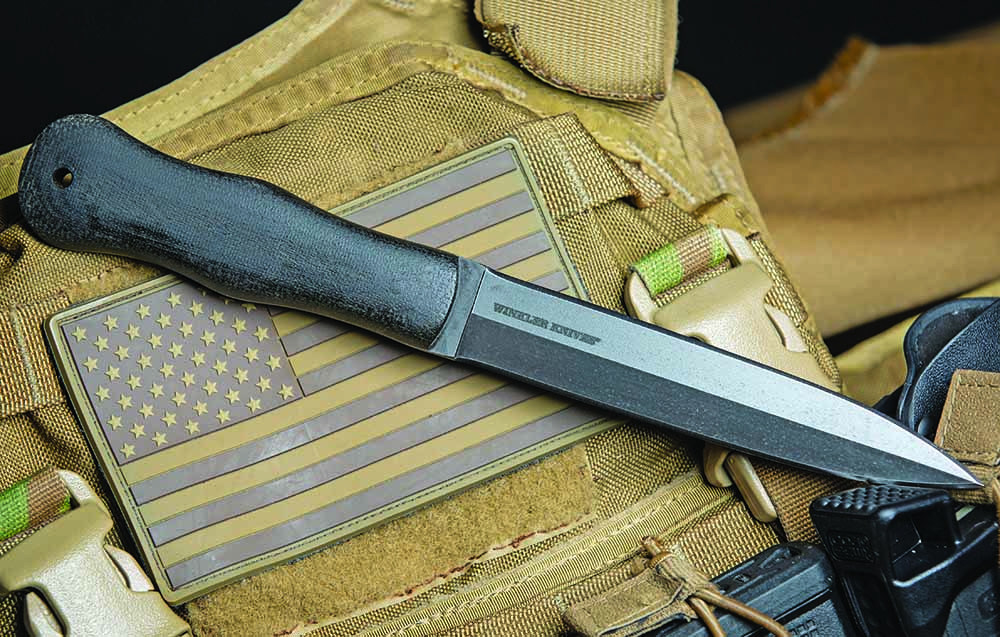
Made in Boone, North Carolina, the Winkler Knives Tactical Dagger in a black Micarta® handle has the same specs as the WASP-pattern model.
Among the many special offerings will be Winkler Knives standard models made by Daniel Winkler (DW Made), Winkler Knives Traditions by Daniel Winkler and Karen Shook, and even a couple of one-of-a-kind hand Forged knives by Master Bladesmith Daniel Winkler, accompanied by the leather craft of Karen Shook. There will also be special editions produced by Winkler Knives Artisans.
This is a special affair and only registered customers will be allowed in during the early-bird portion of the event. The company will not conduct phone sales for the event, only in-person sales. However, Winkler will set aside special editions from the sales event for those unable to travel to Boone. Those products will become available on Winkler Knives’ website on December 2, under the “Currently Available” tab.
If you are interested in attending the Winkler sales event, time is of the essence. The deadline to register is Nov. 18. To register, email [email protected] with the subject Register. The company will email an invitation or a notification the event is full in response.
Winkler Knives Sales Event
Nov. 30, 2024 520 Church Road Boone, NC 28607
Sales Event Schedule
8 am Meet-And-Greet The Winkler Team 9 am Product Preview 9:30 Early-Bird Sales
Each Tuesday in April, KA-BAR will release a video documenting a piece of its storied 120-year history. What, you thought it started with the USMC knife in the ’40s? You’d be wrong.
The KA-BAR website will host the videos, but you can also catch the installments on YouTube. Here is the first episode.
Beyond the marketing value of such a series, these episodes should serve as a history lesson for knife collectors. Often, the provenance of a knife, or a line of knives, is tied to its value or collectibility. And there are few companies with the kind of history that KA-BAR brings to the table.
Whether for bushcraft, carving, or just straight woodworking, drawknives are handy tools that range quite a bit in size, function, and style. There are large drawknives to peel bark or hew small logs, as well as models for specialty purposes such as coopering or making chair seats. There even used to be specialty drawknives for shaping round handles small in diameter for brooms, rakes, and other implements.
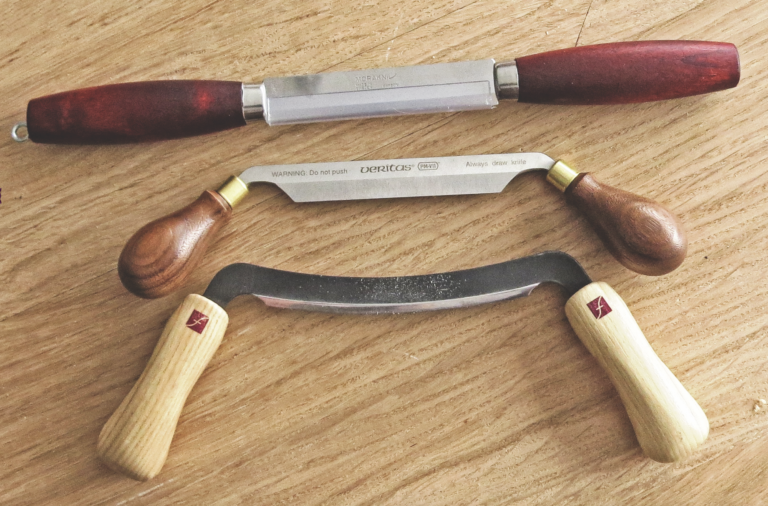
Three small drawknives for carving and crafting are the focus this time: the MoraKniv Classic wood splitting knife, Flexcut Drawknife, and Veritas Drawknife. They are great because they are relatively compact and portable, and help comprise part of what you could call a portable rustic tool kit.
DUAL BEVEL
I know, right off the bat the MoraKniv Classic is called a wood splitting knife and not a drawknife. I thought this model would be interesting to test because it departs from the regular one-bevel blade geometry. The handle positioning is straight, giving the tool a compact configuration for transporting. It also comes with a sheath.
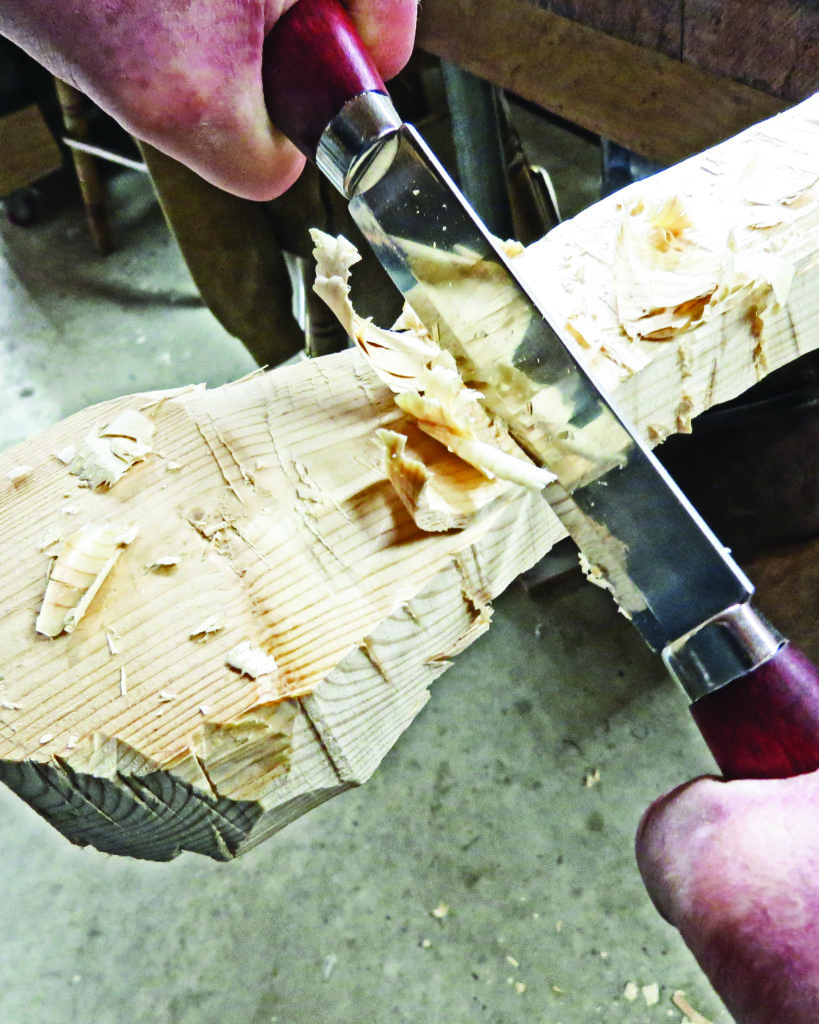
The author uses the MoraKniv Classic wood splitting knife in a push-cut motion to perform a stop cut while contouring the grip on a paddle.
Over the years, I’ve seen many a bushcrafter try and find a way for a standard knife to act as a drawknife. You can do many bushcraft chores with the MoraKniv Classic, from spoon work to shaping a tenon on a stool leg. You can do some of the same things with a regular knife, but with a drawknife it can be easier.
The 4.5-inch carbon steel blade has a dual bevel. An advantage of such a bevel is it makes the knife more versatile. A disadvantage is you don’t have depth control on a cut like you do with a single bevel. Single-bevel blades provide control similar to using a woodworking plane or a chisel. You shear through the levels you need to and, once you establish your depth of cut, you can remove material without bogging down by using a bit of depth control. Given that the dual bevel is a Scandi grind, it makes control easier than, say, a grind with a micro and major bevels on both sides. Control is most certainly easier than, for instance, with a convex grind. In the end, it is no big deal. Having to control a blade only becomes a problem when its design is not conducive to the job at hand.
Having in-line handles and a dual bevel, the Mora allows use like a sheath knife. It adds to the tool’s versatility and saves time, as you don’t have to put one knife down and pick up the other.
For the most part, control affects how much energy you put into making the blade do exactly what you want. In the case of a convex-ground blade, if you want to make a long, straight cut at the same depth, you will expend more energy than you should trying to keep the blade from “porpoising” (that is, front to rear bouncing of the blade). The alternative is simply getting used to making shorter controlled cuts more frequently.
The Classic cuts extremely well. Due to the straight handles and dual-bevel blade, you can switch and use it like a sheath knife in a split second.
WESTERN TRADITIONAL
Flexcut has a variety of tools covering chip, relief, and decoy carving, just to name three. The company also has a couple of drawknife styles. The Flexcut Drawknife is more of a traditional Western version. The 5-inch blade is 1095 carbon steel with the bevel brought to a mirror shine.
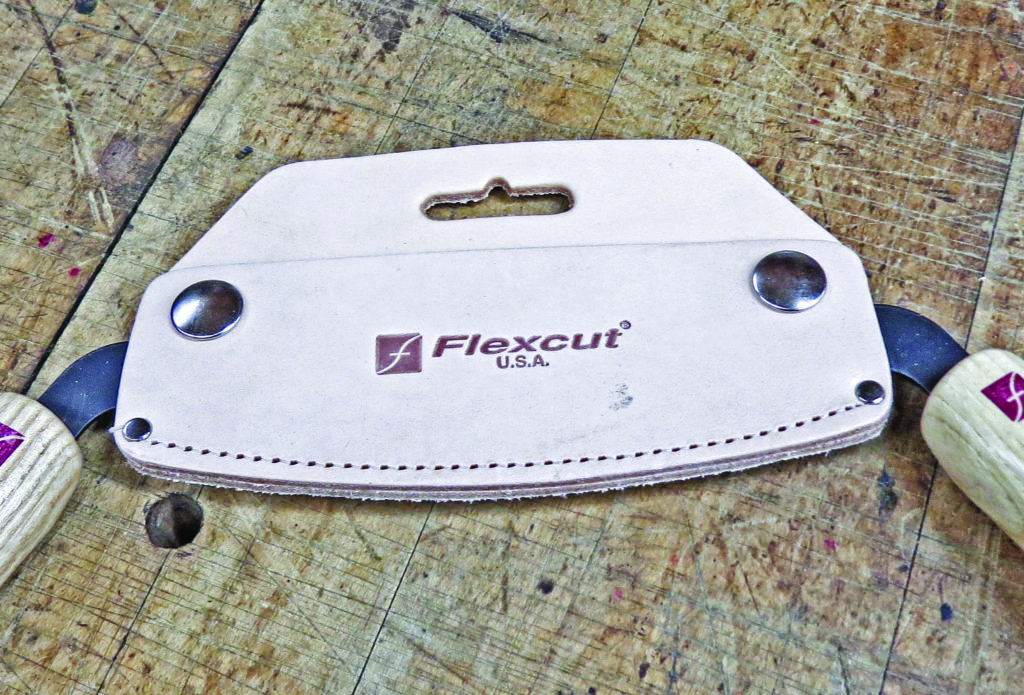
The Flexcut comes with a well-made sheath. It is always nice to have something protecting the edge—if not for safety’s sake, for that of preserving the edge from accidental harm.
Right out of the box, this thing is wicked sharp. It comes in a leather case with a peg-hole loop. It has a curved blade, which gives it a natural tendency to skew in a leading edge cut. If you haul the spine up a bit on your cuts, it will make more of a scraping action for a hollowing effect. It is a thin blade and not suited for hogging off large amounts of wood at one time. It is great for detailed jobs like the subtle contours you might find in a canoe yoke.
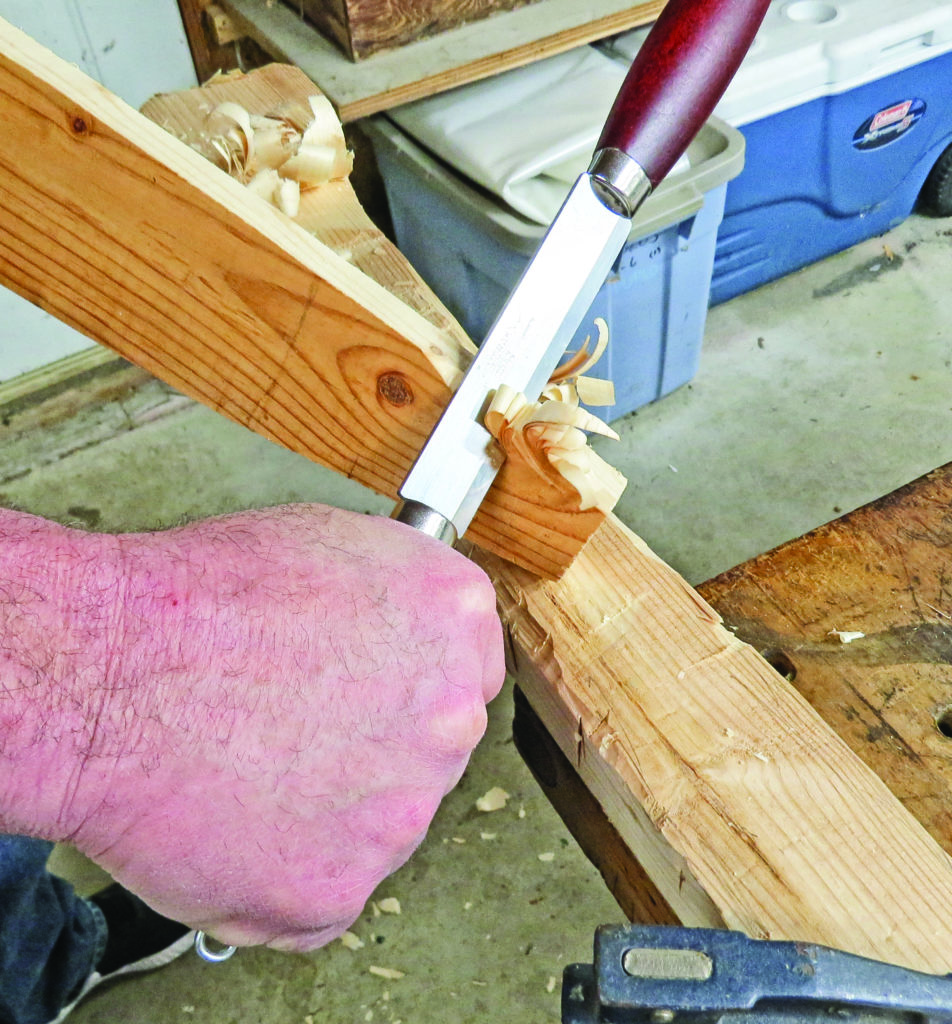
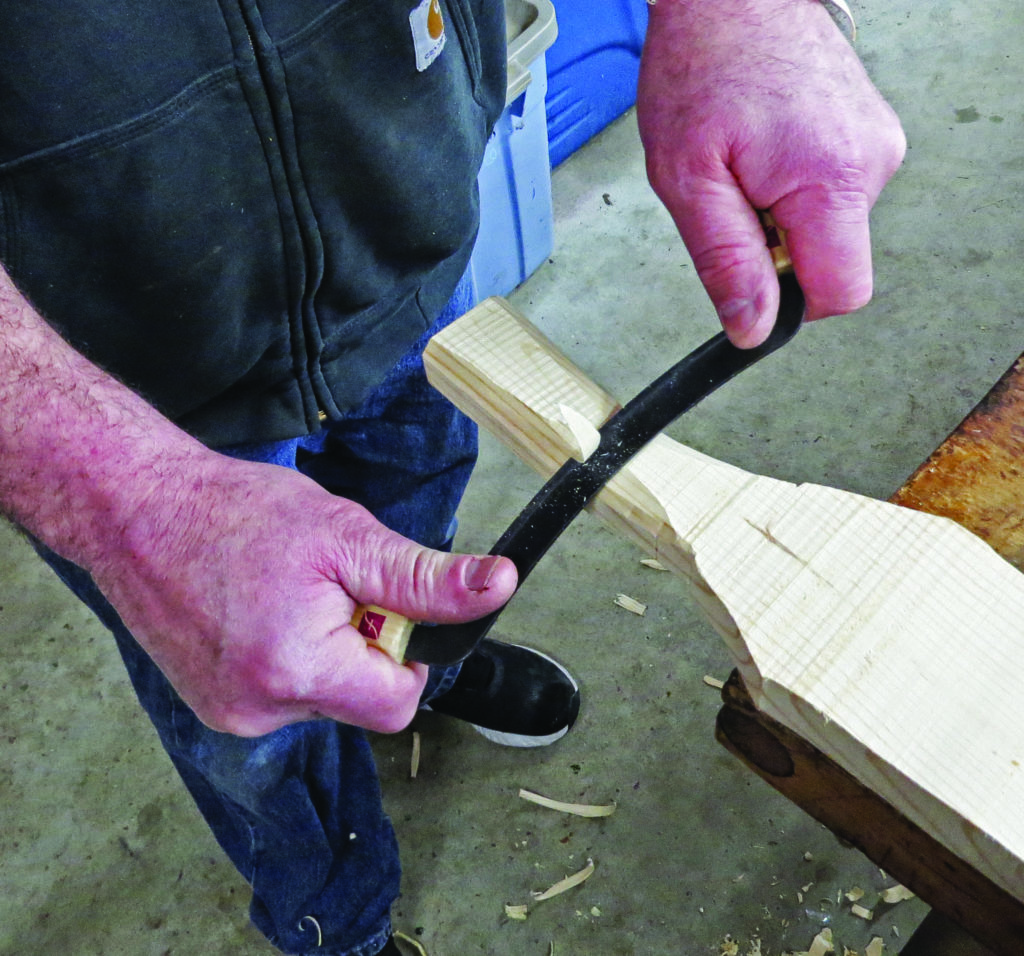
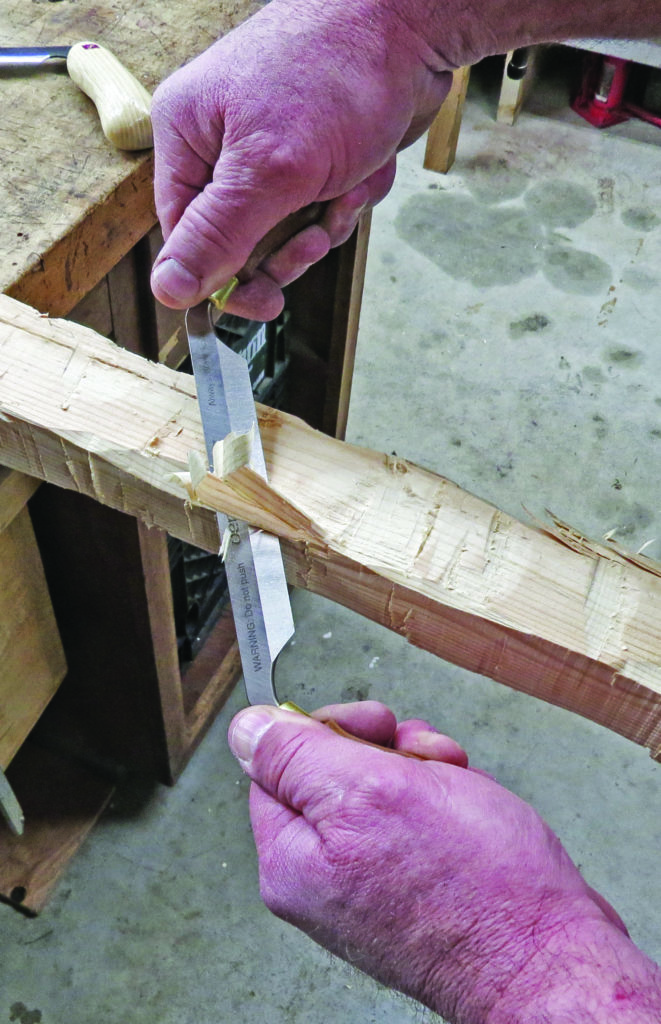
Using the Flexcut Drawknife, the author shapes the handle for a flat-board atlatl. The efficiency you gain using a drawknife is hard to beat for control and energy.
Such a small drawknife is a good tool not only to create art but to make utilitarian items. Given its Western-style handles, it doesn’t make a streamlined package for carrying in a pack like the Mora does, but it still has very little bulk and weight. The arched blade can be sharpened with a flat stone, though I find sharpening it with a small handheld stone and using a dynamic sharpening method easier. The Flexcut Drawknife is the kind of tool that suits the creative mind.
HOB-KNOBBER
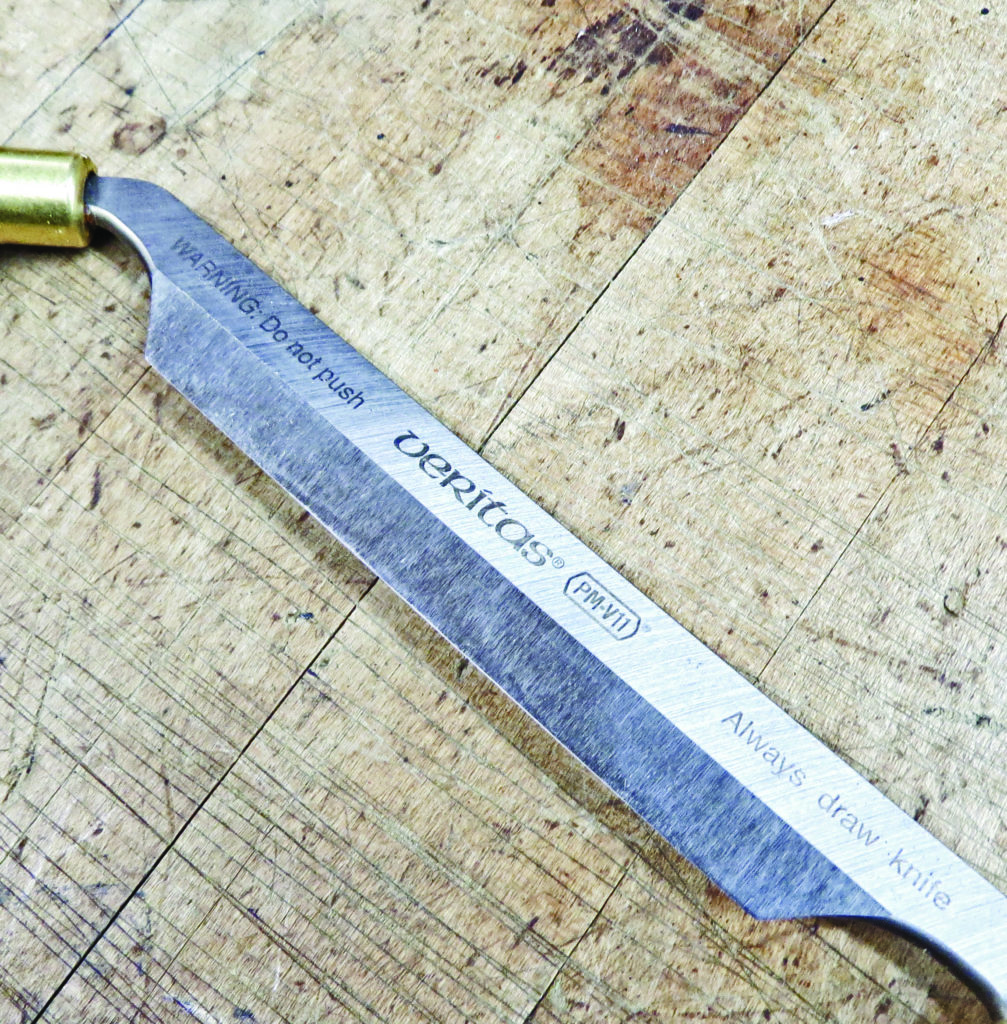
The Veritas tool company manufactures the last of the test drawknives in Ottawa, Canada. Sporting a 4-inch blade, it is a small carving-style model. Steel is PMV-11, a stainless with a Rockwell hardness of 61-63 HRC. Veritas made the switch from traditional tool steels like O1 and A2 to up cutting performance and edge retention. A case for the knife sells separately.
The Veritas Drawknife’s 20-degree angle cuts aggressively and you have complete control with the well-shaped handles. Here the knife is skewed compared to its cutting path. Skewing the knife provides a leading edge to the cut, reducing resistance
The company’s technical information says the bevel is ground at 20 degrees. To sharpen the Veritas, be sure the sharpener is of a flat design. Given the knife’s size, you can sharpen it in either a dynamic or a static style*. To cover/sharpen the entire bevel, you will need a flat surface. There is no micro bevel on the Veritas, though that’s not to say you can’t apply one. However, if you want to keep it original, you will need to cover the bevel.
The angling of the handles is a traditional Western style, though they have more of an elongated knob shape to them. The shape helps reduce fatigue. Because of the handle angling the Veritas does not offer as compact of a carry as the Mora, but the .125-inch-thick blade makes it a bit sturdier user than the
Flexcut. Handle material is torrefied maple. Due to the kilning process, the material has a greater stability to it without the use of chemicals. At the top of each handle is a brass ferrule.
The author stated he has been known to push a drawknife to make a quick cut. The Veritas Drawknife clearly warns not to do that. At a 20-degree bevel, you take a chance of damaging the edge if you were to catch and roll it.
It is a good-looking product and out of the box is ready to work. It is the most expensive of the review knives, yet is not so much more that you wind up scratching your head. A drawknife like this can be put to work doing a number of things limited only by your imagination. Veritas promotes it more as a carving tool and actually shows it making a decoy in the company’s marketing media.
Staying within the bounds of this tool, I can’t think why you couldn’t get chores done or entertain yourself by making pieces of art with it. Keeping you busy in the woods and not necessarily only during a survival situation promotes better mental health. It is a great little package and a good tool—I just think the company could include the sheath. When you hold the knife you see where the extra cost is as the precision work shows in the fit and finish.
EXPLORING OPTIONS
Once you leave the big city behind, in order to thrive you must know how to make what you need. Many of the tools you carry will depend on what you plan on doing. If you’re building up a getaway spot, you might need to build items for the camp. When planning to build a more substantial base, you will need more tools. Again, it all depends on what you plan on doing. A good drawknife can greatly increase your cutting and carving options—not to mention that being able to use two hands greatly reduces fatigue. If you haven’t tried a drawknife yet, I highly recommend doing so.
*Static sharpening is when the stone is stationary, and dynamic is when the stone is moving.
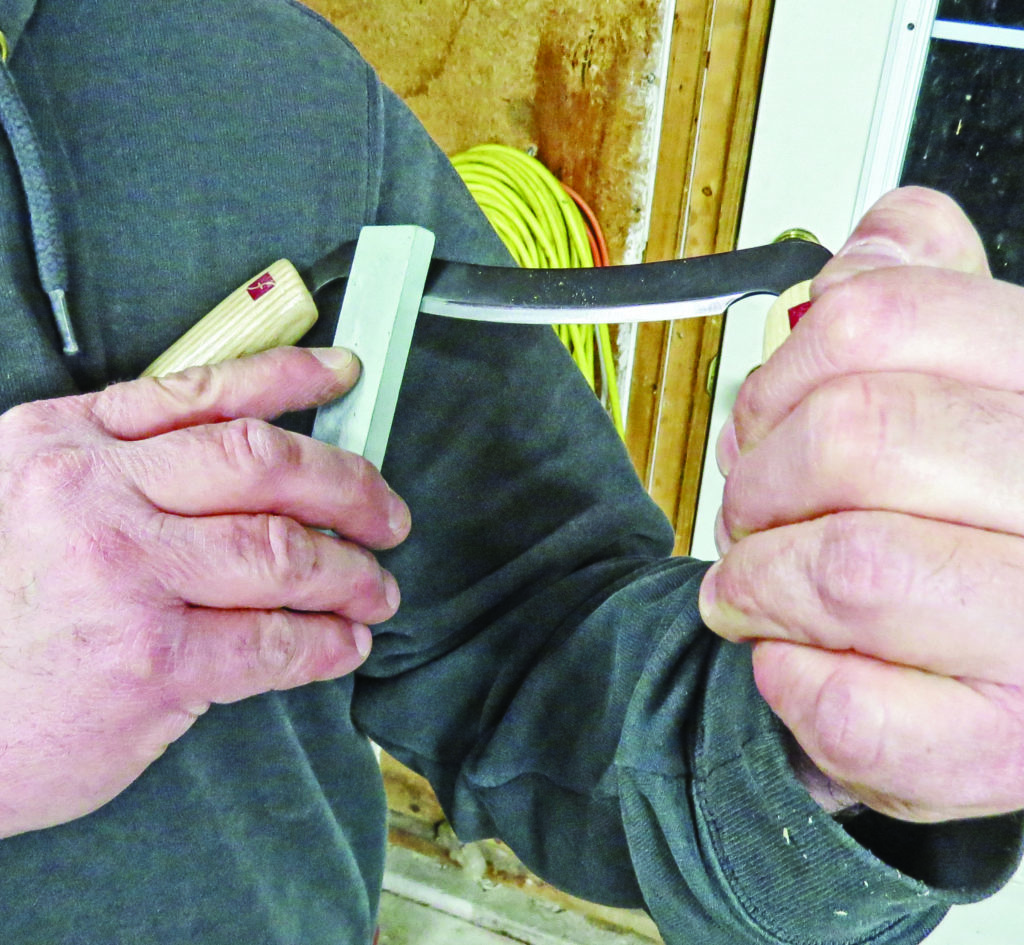
A trick to sharpening drawknives both in the shop and field is to brace one handle against your armpit or chest. After bracing the knife, simply use a dynamic sharpening method with a small stone running parallel to the edge.
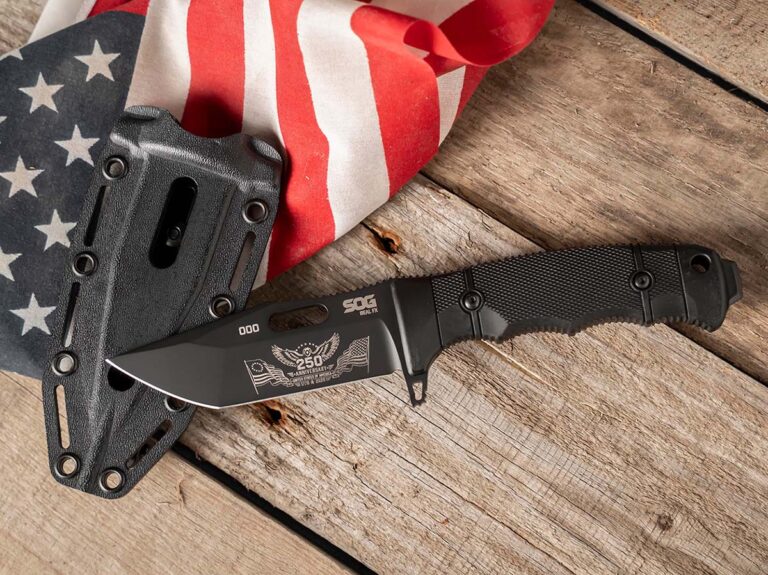
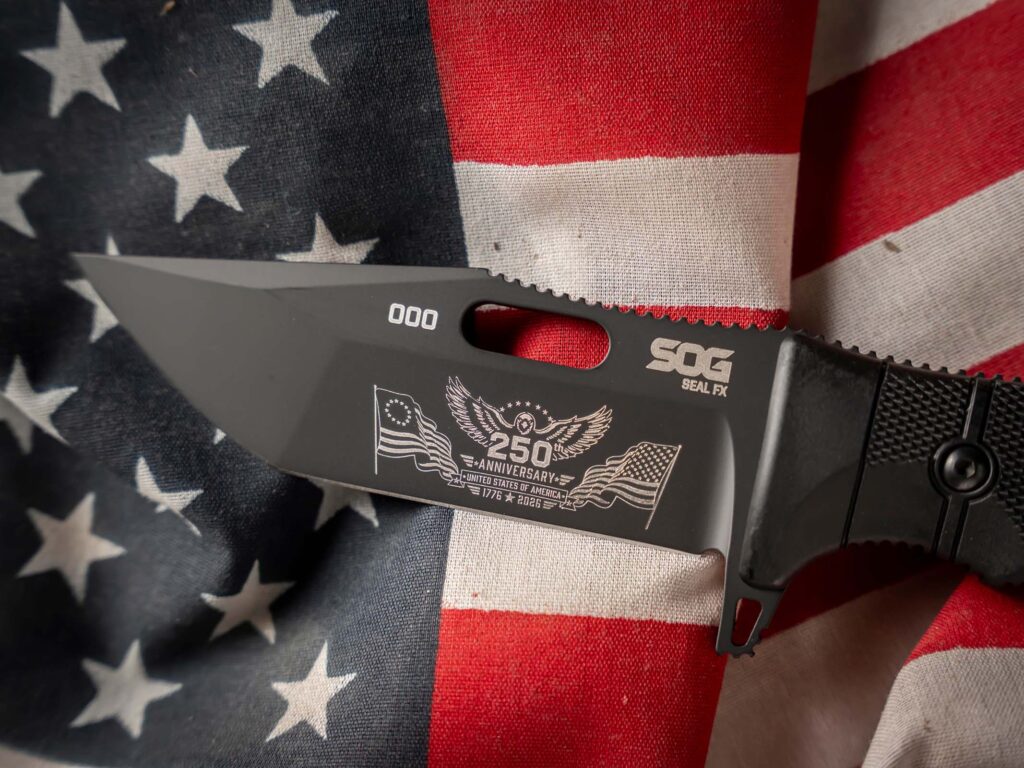
A USA-made tribute to a quarter millennium of American freedom, limited to just 250 numbered pieces.
As the United States approaches its semiquincentennial, SOG Knives is marking the milestone with a highly exclusive tribute to American grit. The company has unveiled its 250th Anniversary Limited Edition SEAL FX Fixed Blade, a commemorative tool that honors a quarter-millennium of history, sacrifice, and resolve.
True to its heritage, this special edition is forged and assembled entirely in the USA. True to its name, production is strictly capped at just 250 individually numbered pieces, making it a true collector’s item.
Beneath the commemorative engraving lies a serious tool designed for professional use. The knife features a capable 4.3-inch blade forged from premium S35VN steel, known for its excellent edge retention and toughness. The handle is crafted from a durable glass-reinforced nylon, paired with an ambidextrous Kydex sheath that offers versatile mounting options for any loadout.
Whether it is destined for a display case or a survival kit, the 250th Anniversary SEAL FX is built to stand the test of time. It serves as a functional symbol of the values that have shaped the nation for 250 years. The limited-edition blade retails for $250. Given the low production run, interested collectors should act quickly.
SEAL FX SPECS Overall Length: 9.20″ Blade Length: 4.30″ Weight: 7.20 oz Blade Thickness: .19″ Product Family: SEAL Product Type: Fixed Blade Country of Origin: U.S.A. Finish: Black Cerakote Edge Type: Straight Blade Steel Type: CPM S35VN Blade Shape: Tanto Handle Material: Glass Reinforced Nylon Handle Color: Black Hardness: Rc. 58-60 Sheath Material: Kydex Sheath Color: Black MSRP: $250
The author is the owner of a store that sells knives, often to first responders. Restrictions on the importation of the folding knives those customers often use hurts not only her business, but also the ability of first responders to do their important work. (Image via LethbridgeTacticalSupply.com)
Editor’s note: Sarah Jorgensen is the owner of Lethbridge Tactical Supply, a knife retailer in Lethbridge, Alberta, Canada. Read BLADE‘s previous articles about prohibitions on the import of folding knives into Canada here.
More Questions Than Answers
Sarah Jorgensen
A recent decision by the International Trade Tribunal (ITT) has only added more questions than answers when it comes to the tools Canadians can and cannot use for self-defense, emergencies and everyday tasks. After a seizure by the Canadian Border Services Agency (CBSA), the ITT announced in January 2018 that it is restricting the import of knives that “have a blade that opens by centrifugal force,” and that “includes knives that require some preliminary or simultaneous minimal manipulation of either a flipper or other non-edged parts of the blade.”
So what are our rights? What are we allowed to use to protect ourselves? Will we get in trouble if we hurt someone with a particular kind of knife while acting in self-defense? And most importantly, are we risking our safety by asking these questions in an emergency instead of acting?
Section 84(1) of the Criminal Code of Canada states that a prohibited knife “has a blade that opens automatically by gravity or centrifugal force or by hand pressure applied to a button, spring or other device in or attached to the handle of the knife.”
Wait a minute. How did we go from a device on the handle, to a device on the blade? The Criminal Code has not changed, but the CBSA’s interpretation has. This means that Federal, Provincial and local law enforcement agencies do not consider flippers on the blade of a knife as prohibited, but the CBSA does.
It Doesn’t Add Up
As a retailer, I can still purchase and sell these knives with no restrictions. However, if I can’t import them, how can I sell them? There are very, very few knives made in Canada, certainly not enough to keep up with the demand of our customers. Some knife manufacturers are now refusing to ship any folding knives at all into Canada because they are not sure which knives the CBSA is going to consider prohibited and seize.
So, why would the CBSA and International Trade Tribunal come to this decision? Are they keeping Canadians safer? Has there been an increase in attacks with knives that have assisted openings? The answer to both of those questions is no. I can still import fixed-blade knives, machetes, axes and batons. Are those items any more or less dangerous than an assisted-opening knife?
And who uses these assisted-opening knives that are so dangerous that the CBSA must override the Criminal Code to protect Canadians? Well, the majority of my customers are first responders (including CBSA agents) and they use these knives. They use them to gain access to vehicles and cut seat belts from people involved in car accidents. They use them as a last line of defense. They use them while on camping trips with their families. Most commonly, they use them to open packages and boxes. I sell these knives to knife enthusiasts and collectors, avid outdoorspeople and, yes, I sell them to people looking for a way to protect themselves in an emergency.
So, the question I have for the CBSA is this: How are you going to explain why your agents are seizing the same knives they use at work?