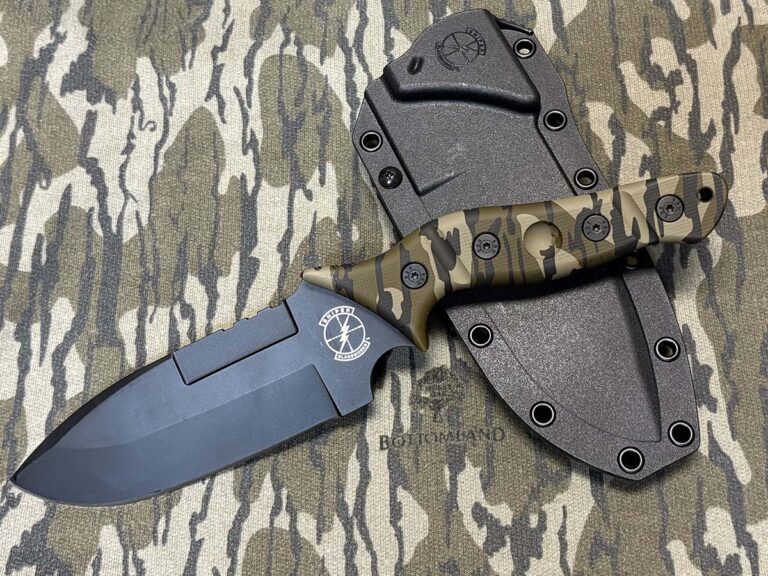
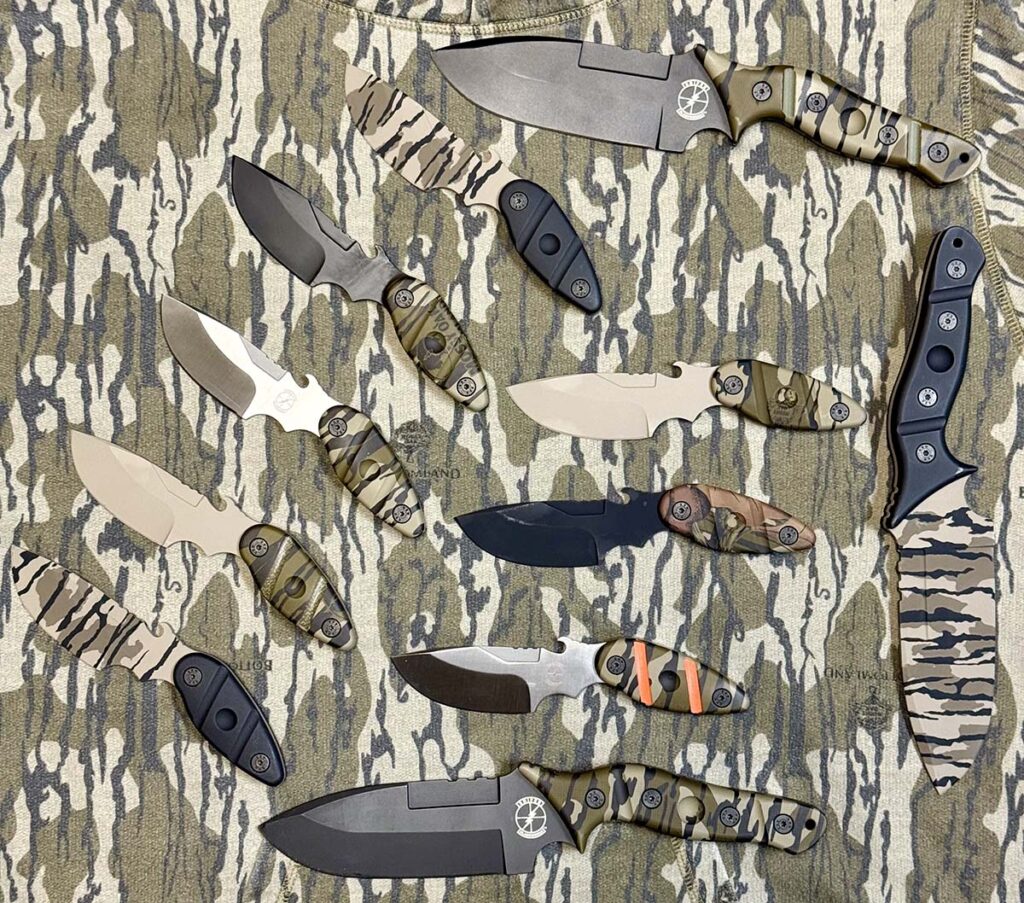
Sniper Bladeworks announces a new collaboration, a collection featuring Mossy Oak camouflage patterns on its hard-use knives.
A new partnership between Mossy Oak and Sniper Bladeworks is set to bring a classic camouflage aesthetic to a line of purpose-built cutlery. The collaboration will see select Sniper Bladeworks models finished in Mossy Oak patterns, merging the well-known camouflage brand with Lance Abernathy’s reputation for hard-use knife design.
Based in West Point, Mississippi, Mossy Oak has long been a staple in the hunting and outdoor world. Its original Bottomlands camouflage pattern is ubiquitous and, to many, is synonymous with hunting season. This move represents a continued effort to integrate the company’s patterns into the EDC and custom knife markets. Sniper Bladeworks, founded by Abernathy in 2009, is recognized for its focus on ergonomics and field performance—traits often attributed to Abernathy’s background in law enforcement and security. Aside from their rugged engineering, the company’s knives are perhaps best known for their pistol-grip style handles, a signature design feature.
Abernathy, who remains the chief designer of Sniper Bladeworks’ knives, noted that incorporating Mossy Oak patterns into his designs has been a long-term goal. He views the collaboration as a way to bring a sense of outdoor heritage to his functional, often overbuilt tools. Adam Pener, CEO of Sniper Bladeworks, echoed this sentiment, suggesting the partnership is a natural fit given both companies’ focus on the hunting and outdoor communities.
While specific model names and exact release dates have yet to be finalized, the collection is expected to cater to hunters, outdoorsmen, and those who prefer a more tactical, camouflaged look for their daily carry. The upcoming releases will likely feature the signature pistol-grip ergonomics that helped establish Sniper Bladeworks in the custom market, now adapted for a wider audience through this brand alignment.
Robert Logan had a scrap to pull off his Tiny Fighter.
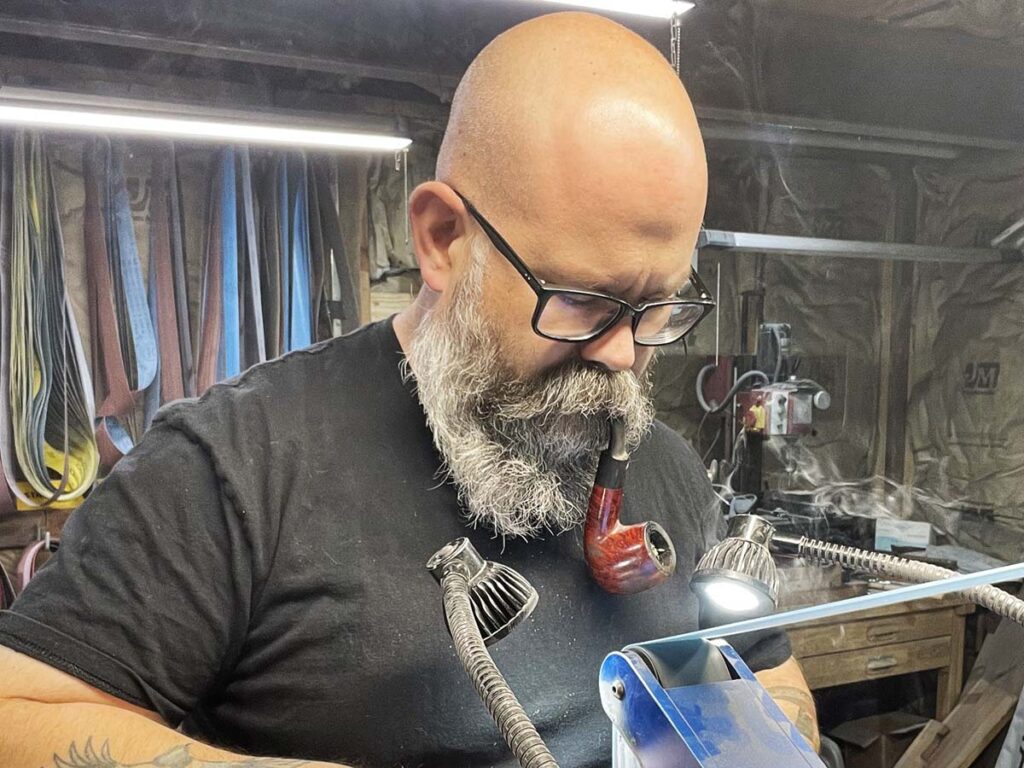
ABS apprentice smith and member of the Texas Knifemakers Guild, Robert Logan, has developed a varied catalog over his nearly nine-year career. His work in kitchen cutlery has raised eyebrows in some corners of the knife world. Yet, his smaller projects are certainly worth consideration.
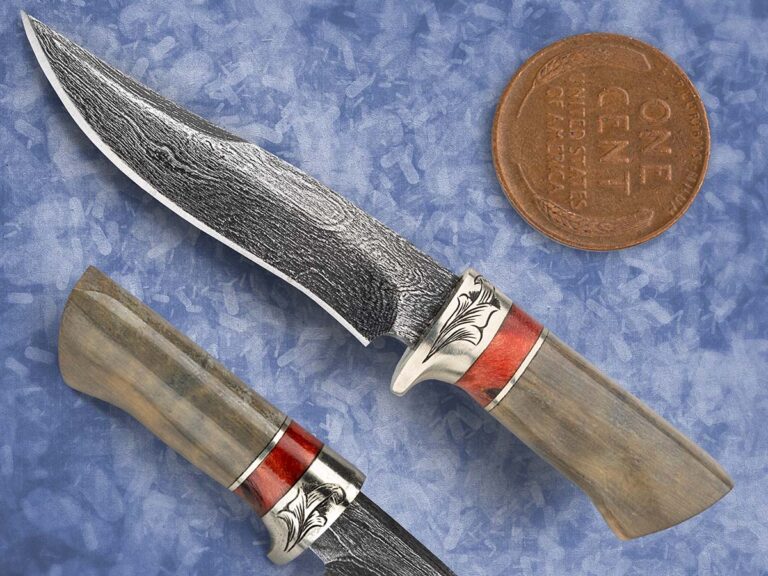
Such is the case with Robert’s Tiny Fighter, a minuscule fighter whose detailed execution is hard to miss—even if it’s no larger than a penny. The knife measures a scant 2.875 inches in overall length, with a 1.6875-inch damascus blade (192 layer 1084-15n20). Setting it all off is a mammoth-ivory handle and a beautiful guard featuring engraving by Alice Carter.
Robert Logan
Robert has tinkered with miniatures previously, making a couple of dozen scaled-down versions of his Mini Cleaver Belt Knife. But the Tiny Fighter, he said, was his first crack at venturing deeper than a simple slab handle in a miniature piece. Without special equipment for the job, it was especially tricky.
“Honestly, the most challenging thing about making tiny knives for me is just holding on to them,” Robert confessed. “I don’t use grinding jigs, so just holding on to the thing to grind, it was hilarious.”
After more than 40 years at the helm, “Mr. Blade” hangs it up.
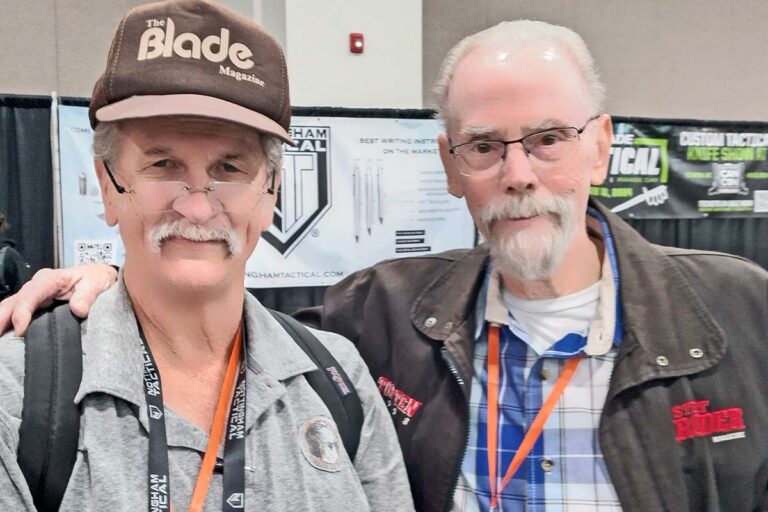
It had to happen sometime and that time is now. After over 40 years of writing for and editing BLADE® Magazine, it’s time for me to hang it up as BLADE editor.
If you had told me when BLADE Magazine Cutlery Hall-of-Fame® member Bruce Voyles hired me in 1985 that BLADE would be the focus of my work life for the following four decades, I might’ve said, “Yeah, and Donald Trump will be president one day, too.” However, working for BLADE has been a blessing to my family and me, and I am most thankful for the privilege of having done so.
Why retire now? Last July, it hit me; at 72 I need to spend more time with my beautiful wife Susan and others who I love before I start leaking oil. So, my boss, Caribou Group Media Publisher Jim Schlender, and the rest of the BLADE brain trust started planning for the future of the World’s No. 1 Knife Publication. The result: Elwood “Woody” Shelton, who has been doing a standout job as our online editor, will be my replacement as BLADE editor—and we think he will be a most accomplished one.
For the past several years Woody also has coordinated the BLADE Magazine Knife-of-the-Year® judging at the BLADE Show, as well as the factory knife judging at BLADE Show Texas and BLADE Show West. In the process and along with his online duties, he has become well-acquainted with the knife industry and those who drive it. Besides, he is captivated by knives like the rest of us.
As for me, I will continue as a consultant for BLADE and chairman of the Cutlery Hall of Fame, coordinating the nomination and selection process of new inductees and serving as emcee at the annual Hall of Fame induction ceremony during the BLADE Show, this year June 5-7 at the newly named Cobb Convention Center-Atlanta (formerly the Cobb Galleria Centre). As a result, I hope to see some of y’all there. I also hope to write on occasion for BLADE, as well as participate in other related projects.
What will I miss? Much more than I can cover here but the simple pleasure of opening each issue of BLADE I edited after it hits my mailbox will be one. Others will be all the great knives I have handled and written about and the thousands of fascinating folks I have met over the decades. Included among the latter are those knifemakers and their knives that I’ve helped shed light on by publicizing them in BLADE.
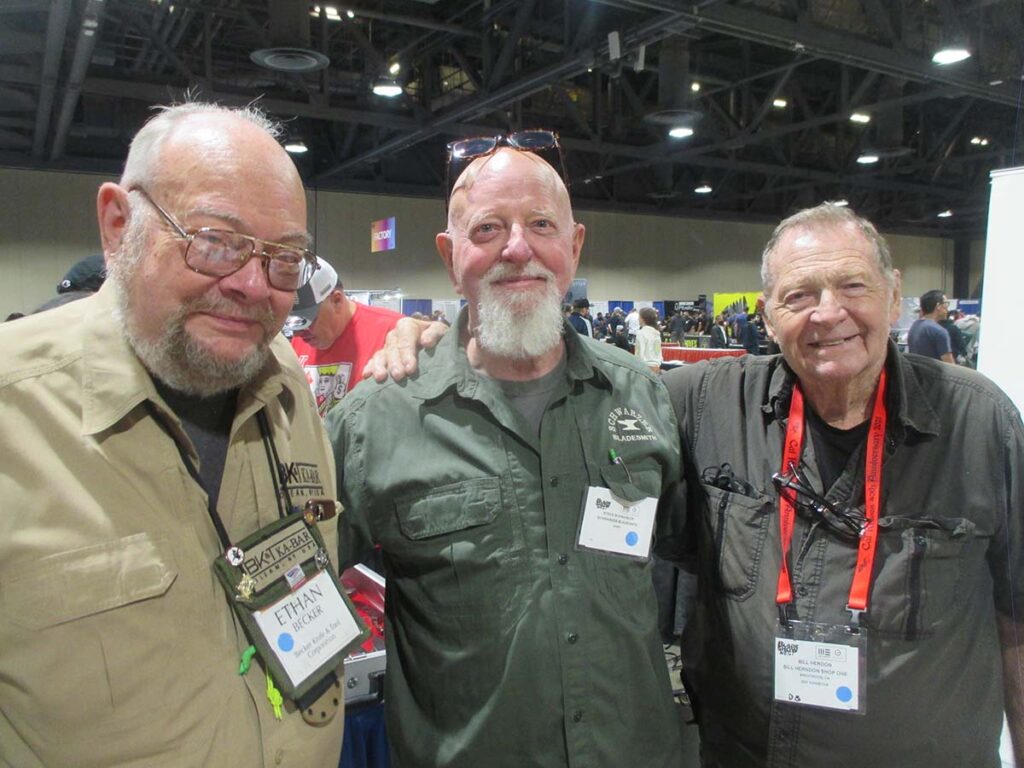
Among many knife VIPs the author has been privileged to know over the years include, from left, Ethan Becker of Becker Knife & Tool, BLADE Magazine Cutlery Hall-of-Fame® member Steve Schwarzer and custom knifemaker Bill Herndon.
The highlights for me have been many. A few include visiting the Boker manufactory in Solingen, Germany, and seeing the wonders of nearby Cologne with Ziggy Felix, wife of Boker’s Ernst Felix, as my tour guide; exploring the Alamo with Cutlery Hall of Famers B. R. Hughes and Jim Batson; spending hours interviewing Cutlery Hall of Famer Bob Loveless in his Riverside shop; and my inductions into both the ABS and BLADE Magazine Cutlery Halls of Fame.
In addition to Batson, Hughes and Loveless, four other unforgettable Hall of Famers who molded the industry by the sheer power of their work ethic and personalities and who were my privilege to know include: A.G. Russell, who influenced the collecting community and custom and factory knife industries like no other; Bill Moran, the father of modern damascus and the ABS—some resumé, eh?; Wayne Goddard and his ability to explain details about knives, how to make them, steels and more so that even I could understand them; Frank Centofante guiding the Guild so successfully while simultaneously providing a constant stream of one-liners; the list goes on. Oh, and Ed Fowler, his sheep-horn handles, lifelong search for Excalibur, his dogs and pet rattlesnakes, etc. Need I say more?
I will miss them and many more, including having the lasting honor and satisfaction of helping in providing you with the world’s best knife magazine for so many years. See you down the road and, in the immortal words of the Reverend Captain Samuel Clayton (Ward Bond) in The Searchers, “Watch that knife!”
Robin Askew moves on, but her father remains there for her.
The constant, the heart and soul of BLADE Magazine Cutlery Hall-of-Fame® member Bob Loveless, was wrapped up in custom knives. There was little time for anything else and there were only rare occasions that he travelled. Bob and his wife, Yoshi, made a few trips to Japan or to Hawaii, on a rare occasion to Europe, but most often with some business purpose involved as well.
And over time, Robin Askew came to appreciate and understand the singular purpose, laser-like focus and personal intensity that drove her father. He was capable of kindness but often brutally frank. He was willing to entertain young knifemakers, share information and then criticize or dismiss flaws with stark, unvarnished perspective. With patience that was sometimes fleeting, he did not suffer fools gladly.
But then, his personality was a tapestry, like all of us, an amalgam of inherited traits and life experience. His mother and father had sent him to live on a farm with grandparents at a young age. According to Robin, he lived and worked with the hired hands, not as a grandchild. At just 15 years old, he joined the Merchant Marine when his mother told the white lie that he was of age.
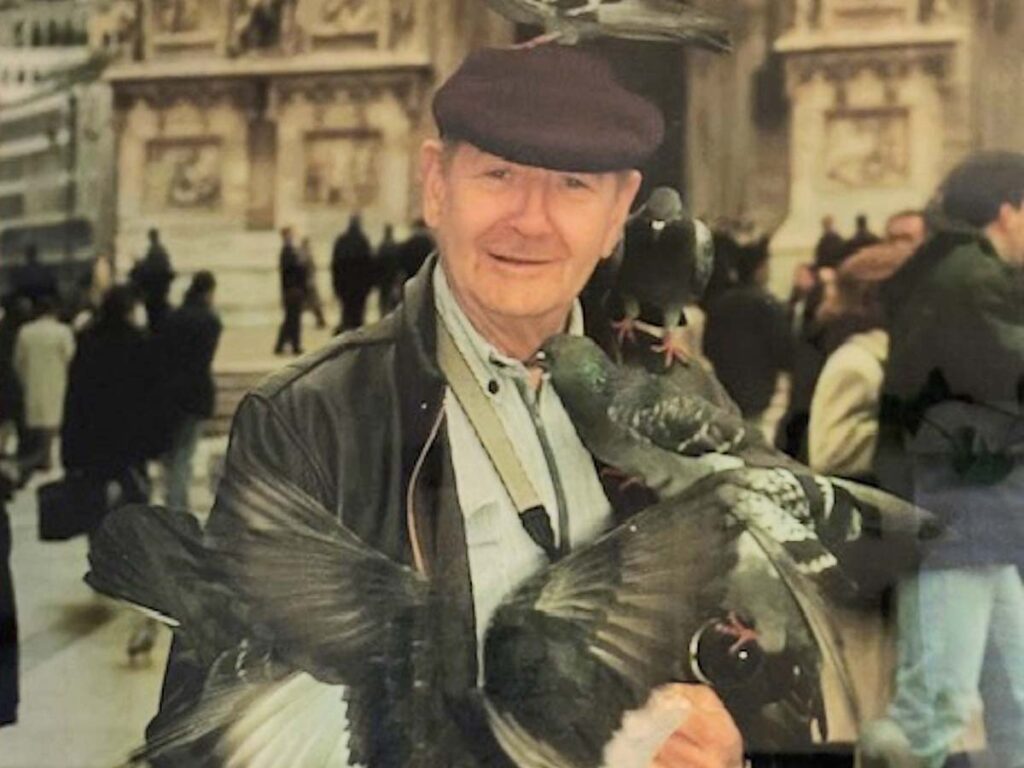
In addition to the knife her dad made for her, Robin’s other favorite keepsake is a photo of him, a joyous grin radiating from his face, as a cluster of pigeons lands on his shoulders and arms during a visit to Rome many years ago. “It’s a beautiful picture,” Robin stated, “and I look at it every day.”
It wasn’t easy for Bob Loveless, right from the start. But he made something of his opportunities and his native talents, shared them in the way he knew how, paying the price along the way and leaving a body of work of insight into what is beauty and flow in a handmade knife, like no one else has. For the record, he never billed himself as the world’s best knifemaker. He wasn’t, and he freely acknowledged that others were much more deserving of applause for their skills. It was his eye, perspective and sense of beauty and design that thoroughly set him apart.
Four Careers
When Robin grew up, moved out and moved on, she carried the best and the most worrisome of life experiences with her. She made her own way and has come to understand and appreciate the journey.
“I’ve really had four careers,” she reflected. “I worked 11 years in the banking industry and 20 years as a correctional peace officer at Pelican Bay State Prison in Crescent City, California, with 12 years as a peace officer. Put that together with the work in Dad’s office and then when my husband, Jimmie Askew, and I had a restaurant in Crescent City, California.” When she worked in banking, Robin went to Crescent City on business for her employer. While there she met the most eligible bachelor in town. “It was a 400-mile, eight-hour drive to Crescent City, and I was supposed to be there for a month,” she said. “It became one of those wonderful love stories. Jimmie and I were meant to be together.”
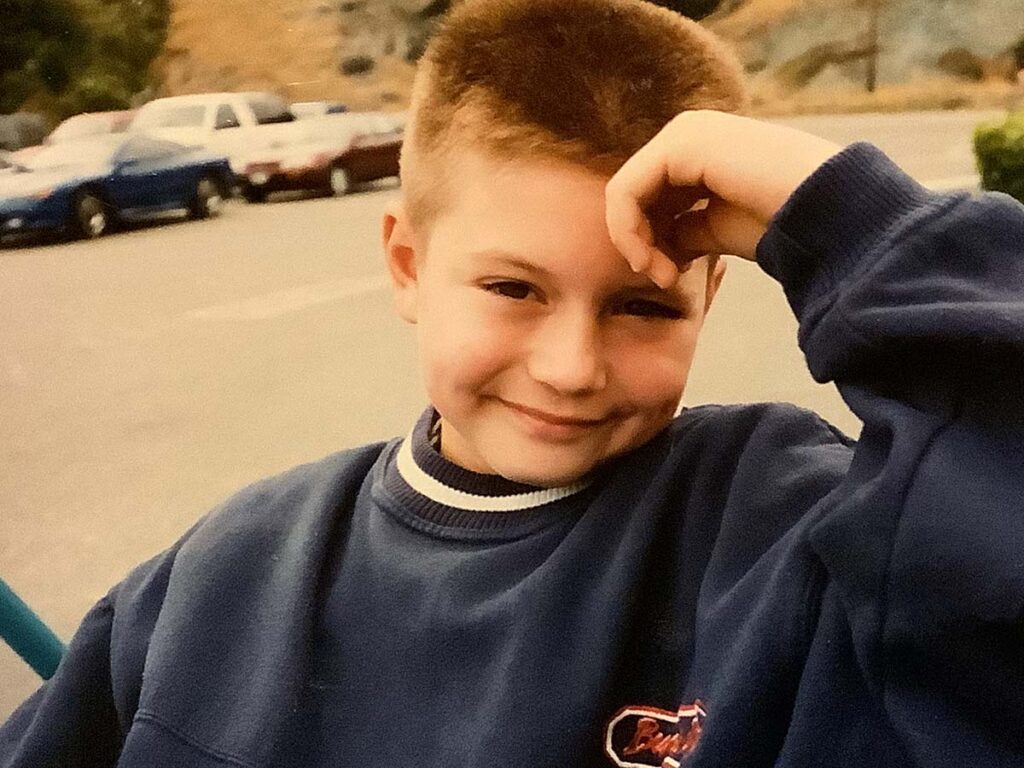
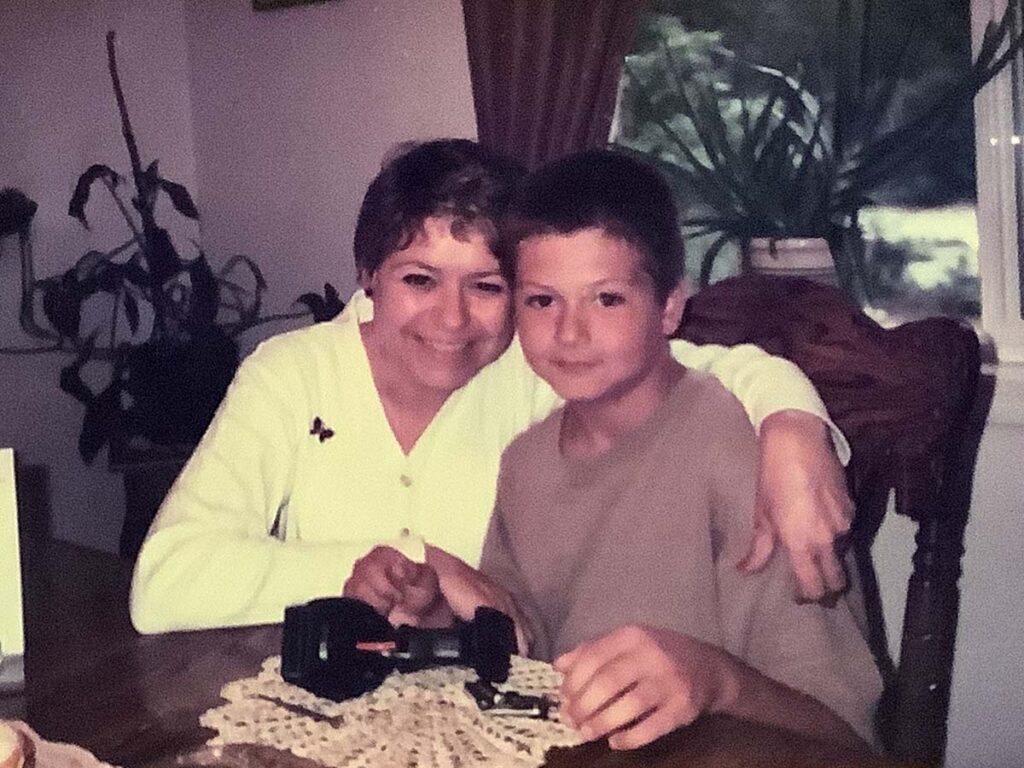
Bob Loveless photographed Robin’s son Nico during a regular visit while they were “out and about.” Nico was 9. The resemblance to his grandfather is striking. (Bob Loveless image)
Jimmie was an award-winning chef, and with Robin’s business background the couple put together a fine restaurant that served a variety of entrees.
“I met Jimmie in 1984,” she recalled wistfully. “We got married the next year, and he passed away 12 years later. He made prime rib, barbecue pork spareribs and fresh seafood. He would go out in the morning on his boat and catch 300 to 400 pounds of rock cod. He would clean the fish and then serve it that night. It was the best seafood in all of Crescent City—wonderful. We also had meat from our mesquite grill, chicken parmesan, grilled Italian sausage, vegetarian dishes and the deep-fried seafood platter.”
Nico
The couple had one son, Nico, who is now 36. When Robin speaks of those days, a tinge of heartache touches her words. But also during that time, she rediscovered the love and care that her father had always had for the family.
Nico and Robin
“Dad came up from Riverside to visit us a month before Jimmie died,” Robin recalled. He had been in touch by telephone continually and made himself the father figure that a 7-year-old boy needed during a tragic time.
“After Jimmie died, Dad would come up regularly,” Robin related. “He took Nico fishing four or five times a year. Grandpa was there for Nico. He taught him how to shoot a gun and would charter a boat on the Chetco River in Oregon and they would fish together. He came up to see Nico play soccer, baseball and football, and he stepped in to take care of my son.”
When Bob wasn’t physically present, he was always in touch with Robin and Nico. He worried that Robin worked in the toughest place at Pelican Bay State Prison. It was called the “shoe,” and he once told Robin how he worried for her safety. Her response was from deep inside, a manifestation of something she learned when her father made the introduction to that Japanese gentleman years earlier: “I told my dad, ‘I show them [the inmates] respect, and they show me respect. It’s really the safest place in the prison to work.’ I told him there were two officers for every inmate and that I really had no qualms about it.”
Bob took this picture when he visited Robin and Nico not long after Jimmie Askew passed away. Nico was 10.
That soft spot in Bob’s heart came through time and again as he cared for his daughter and grandson. “He would call us and say, ‘What’s Nico doing?’ He wrote a check to pay for Nico’s braces. He was there for both of us. Being a widow raising a young boy, I could call him anytime and we would talk. I also started to do that with my mother because I wanted to reach out and make sure that my contact with my family was really strong. Dad was so far away, but I talked to him at least once a week. He became the type of dad that my son needed.”
Traits & Quirks
All the while, the legend of Bob Loveless continued to grow. Tales were told. Knives were made and sold. Stories were swapped, and the maker slowly but surely grasped his own impact on the world of knives. At the same time, his various interests, personality traits and, yes, his quirks made him more than just a knifemaking phenomenon. They made him a marvel, a celebrity and an icon.
Bob always carried a gun. “Even when I was a little girl,” Robin laughed, “I remember that he would hang his gun on the towel rack in the bathroom.” For some time, he enjoyed rabbit hunting in the desert with friends. But then another fork in the road pointed a different direction when it came to outdoor activities.
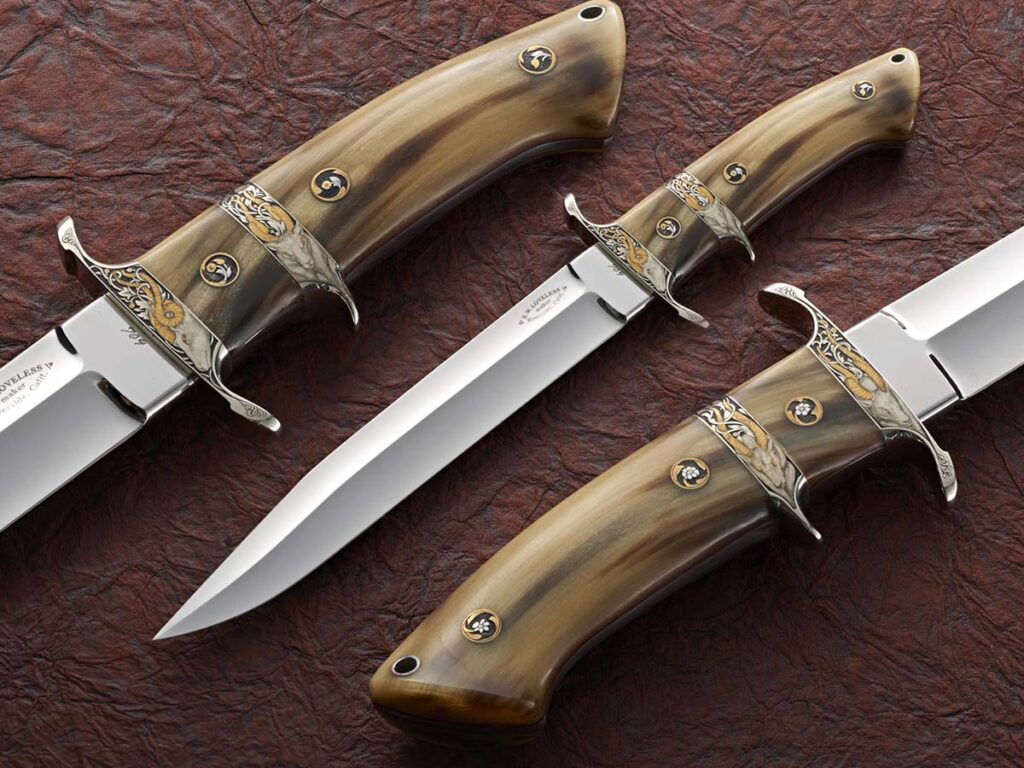
It was his eye, perspective and sense of beauty and design that set Bob Loveless apart. Few if any of his knives capture these traits better than his Big Bear fighter in sheep horn and gold engraving by Dan Wilkerson. (from the John Denton collection; Eric Eggly/PointSeven image)
Robin commented, “They took a lot of hunting trips, and one day Dad decided to stop shooting animals with a gun. He started shooting pictures with a camera. He loved photography, and I have no idea how all that started—but, gosh, I remember when I was a young kid he would take me and Allison on the weekends to camera stores. He would go in and talk for a couple of hours, and we were bored out of our minds. He would take pictures like you wouldn’t believe.”
Adding to Bob’s repertoire of activities, he was also an accomplished gunsmith. If these endeavors sound like a lot to pack into a lifetime, then there is no hesitation in labeling Loveless a true “Renaissance Man.”
Nonetheless, he had pursued his passions, probably without seeking the fame that came along with them. “I do know he never liked living in fancy houses,” Robin remarked. “But he had sports cars, and his favorite car depended on his age bracket. He would drive the back roads to the Chinese restaurant in Riverside and hit 100 miles per hour. At one time, he had three cars and two airplanes. He was a pilot with a lot of camera equipment. He probably got his pilot’s license before he moved to Riverside. I forget what year he got rid of his planes. He had crashed and it was no fault of his own. It happened when a bigger plane was landing and he got banged up. He had a limp after that.”
Keepsakes
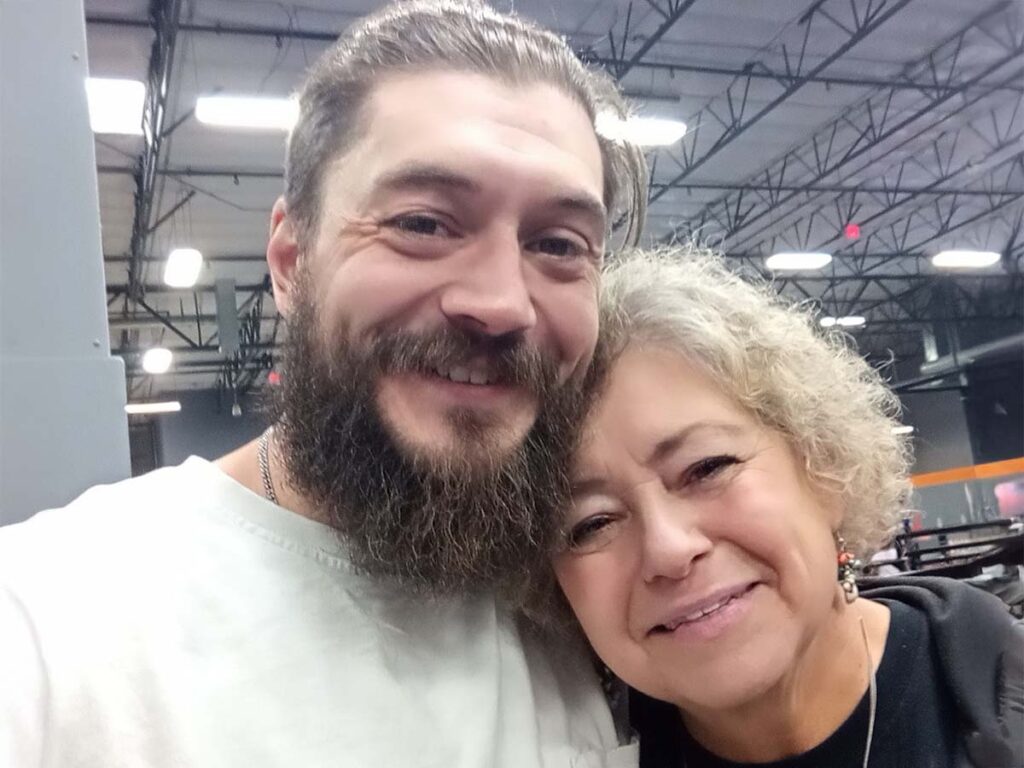
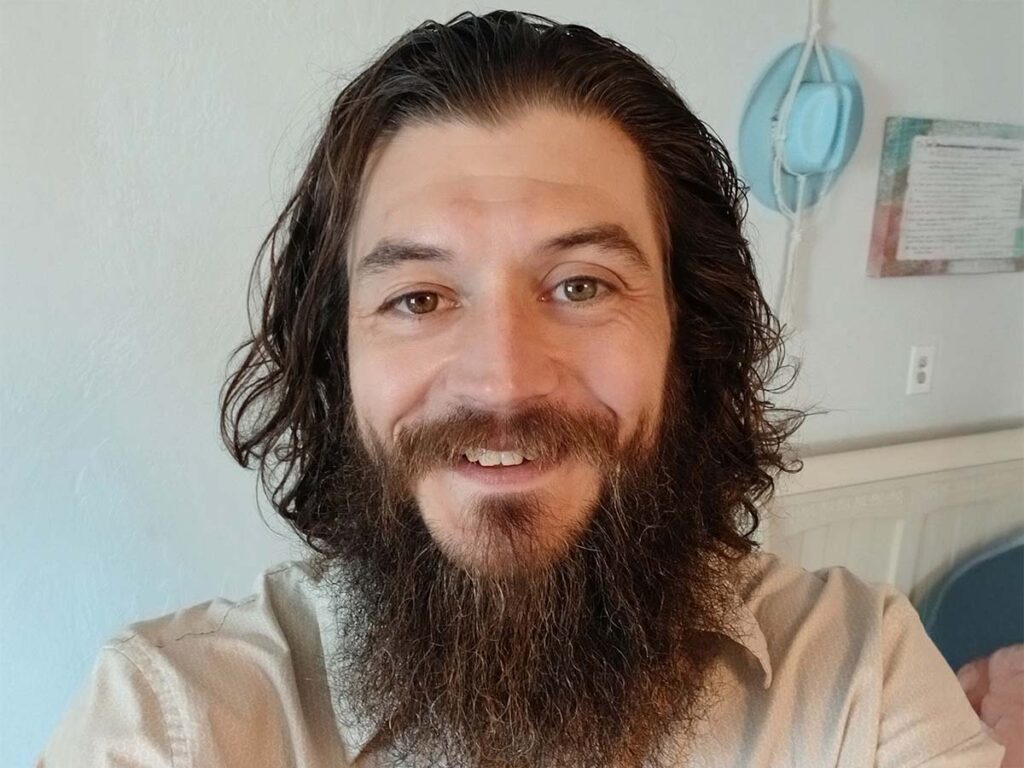
Writes Robin: “My handsome son Nico as he is today, shaggy beard and all. As a mother, I think his eyes and smile show what a kind and good man he is. I know his grandpa would agree with me and like this picture very much.”
Today, Robin’s heart is warmed by her memories, her strong Christian faith, and the knowledge that her dad truly became a father. His life was a mosaic of love and loss, turmoil and moments of calm, fiery and icy emotion, but always with a heart for the good and for his family. She clings to at least a couple of special items that symbolize the tie that binds.
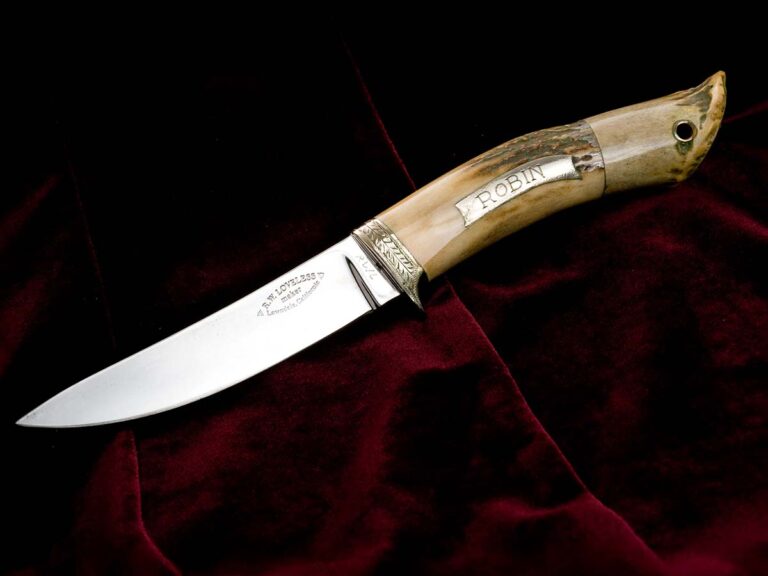
He made a banana skinner for her when she graduated from high school. “It has a stag handle with intricate engraving that he had done by a silversmith,” Robin said, “and I think the handle is at least 6 inches long with the blade about 7 inches. It is absolutely beautiful.”
A few years ago, Steve Johnson cleaned the knife up and put an edge on it. Dave Ellis took photographs of the one-of-a-kind piece, and John Denton, likely the foremost authority on Loveless knives in the world today, offered powerful words and urged her to treasure it always.
His various interests, personality traits and quirks made Bob Loveless more than just a knifemaking phenomenon—they made him a marvel, a celebrity and an icon.
The other keepsake is a photo of Bob, a joyous grin radiating from his face, as a cluster of pigeons lands on his shoulders and arms during a visit to Rome many years ago. It captures a sliver of his enjoyment of life, a glimpse into the heart and soul of just who he was. He was the gruff guy that gave generously to the local animal shelter, the edgy and matter-of-fact curmudgeon who handed substantial financial support to the UPS driver who had served faithfully in the area for years when Bob found out the guy had fallen on hard times. He was simply their quiet benefactor.
“It’s a beautiful picture and I look at it every day,” Robin offered. She ponders exactly where his genius came from and concludes that he inherited it from his mother. She admits that the spark of “genius” has not emerged from any other family member and concludes, “It was meant to be. That kind of genius is created before birth. My father was extremely gifted, and I always knew that.”
True enough, he was gifted, and in some ways that only a relative few others were even aware of.
Growing up Loveless and living within the sphere of influence her famous father created has been an adventure for Robin Askew, a thrill ride that began so many years ago, one that continues well after her dad’s departure from this Earth.
Read More On Bob Loveless:
Bob Loveless: The Icon’s Indelible Mark On The Knife Industry
Robin Askew reflects on being the daughter of Bob Loveless.
It was intimate and distant. It was warm and aloof. It was youth, adulthood, hope and memory—all at the same time.
Robin Askew is 70 years old now. She lives a quiet life in Sacramento, California, and her recollections of growing up as the daughter of a legend offer insights into years of experiences that few could imagine. Her father, BLADE Magazine Cutlery Hall-of-Fame® member Bob Loveless, was and remains one of the titans of the custom knife industry. He has been gone more than 15 years, but his imprint on the past, present and future of custom knives is unmistakable and not about to wane.
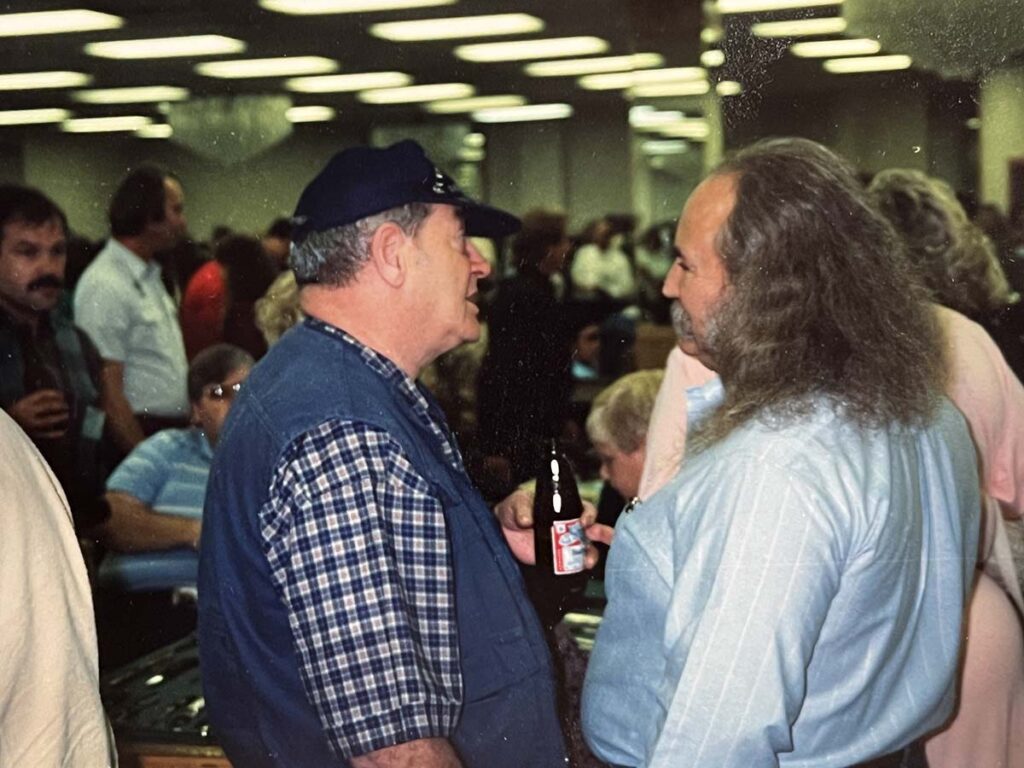
Bob Loveless (center) talks with David Crosby (right) of Crosby, Stills and Nash at the 1989 California Custom Knife Show. The two were good friends, with Loveless an inveterate harmonica player who at times would play with CSN at a local bar or night club. At left is a young, mustachioed Steve D’Lack, coordinator today of the New York and Nashville Custom Knife Shows. (John Denton image)
Likewise, those who knew him remember his unforgettable, often larger-than-life persona. Creative genius, irascibility, generosity and unique perspective came together in Loveless, the man who shaped custom knives and literally changed the landscape in tangible ways, including steel and its components, and in intangible ways such as the sweep of the blade, its flow and form, and the aesthetic qualities that characterized his legacy.
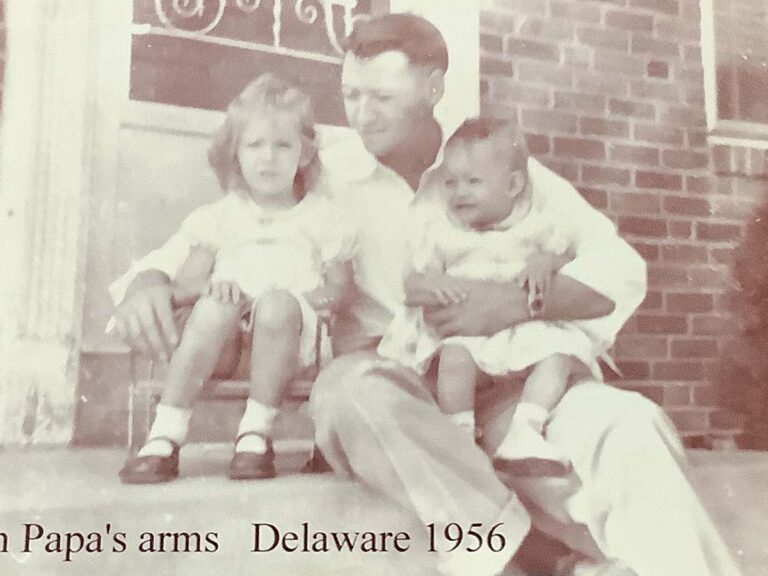
Robin experienced the evolution, both in the life of Loveless and in the industry that he forever altered. From her earliest memories, her father was a busy man building a future one knife at a time, crafting a legend—whether he knew it or not—one innovation after another from a basement in Delaware to his shops in California. In the midst of it all, growing up Loveless was a complex, frustrating, fallible, forgiving and ultimately joyous journey.
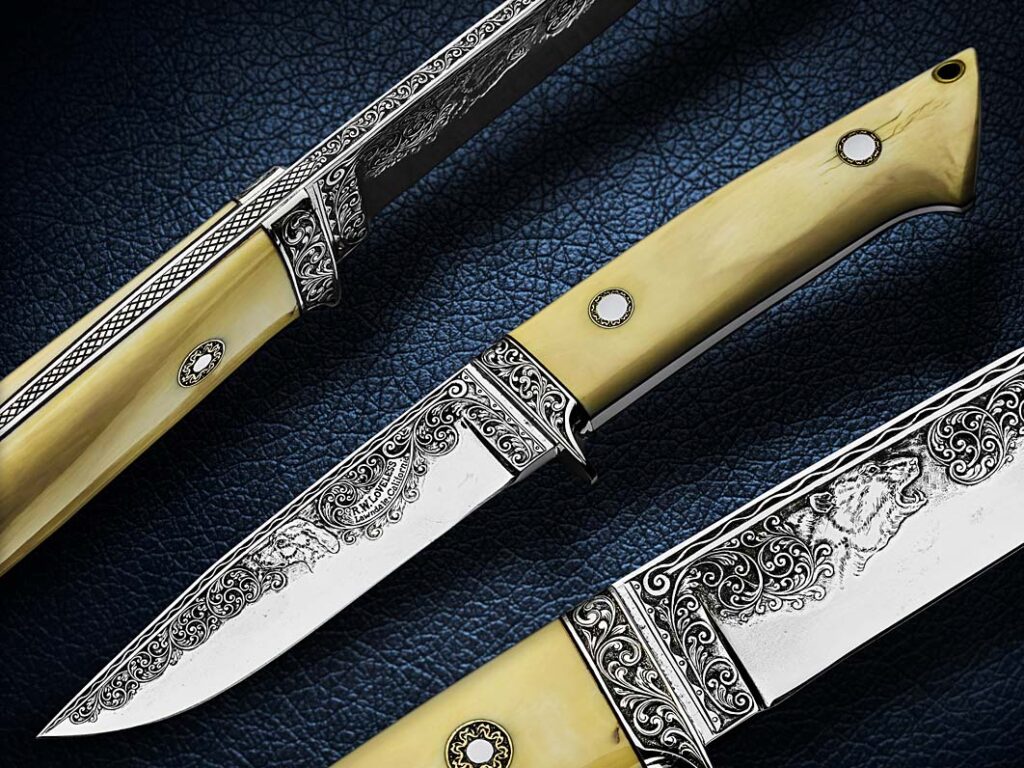
David Crosby owned this ivory-handled Loveless utility knife fully engraved by H.H. Frank. According to John Denton, it sold for $22,000 a few years ago. (Cory Martin image)
“Some people were actually frightened of him,” Robin smiled. “They might have been put off. But his bark was so much worse than his bite. Over the years, my father was so amazed by the fact that others regarded him with such a high standard. He didn’t embrace that at all. One time he said to me, ‘They still think I’m the greatest.’ That was something that he had never imagined and never really came to terms with.”
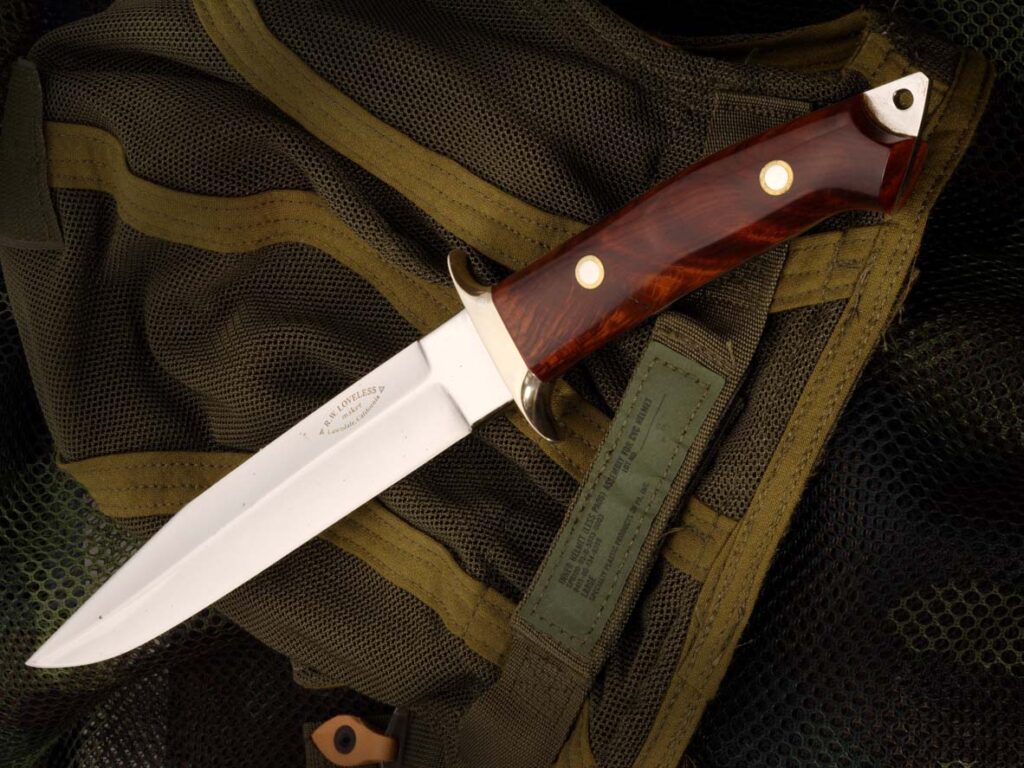
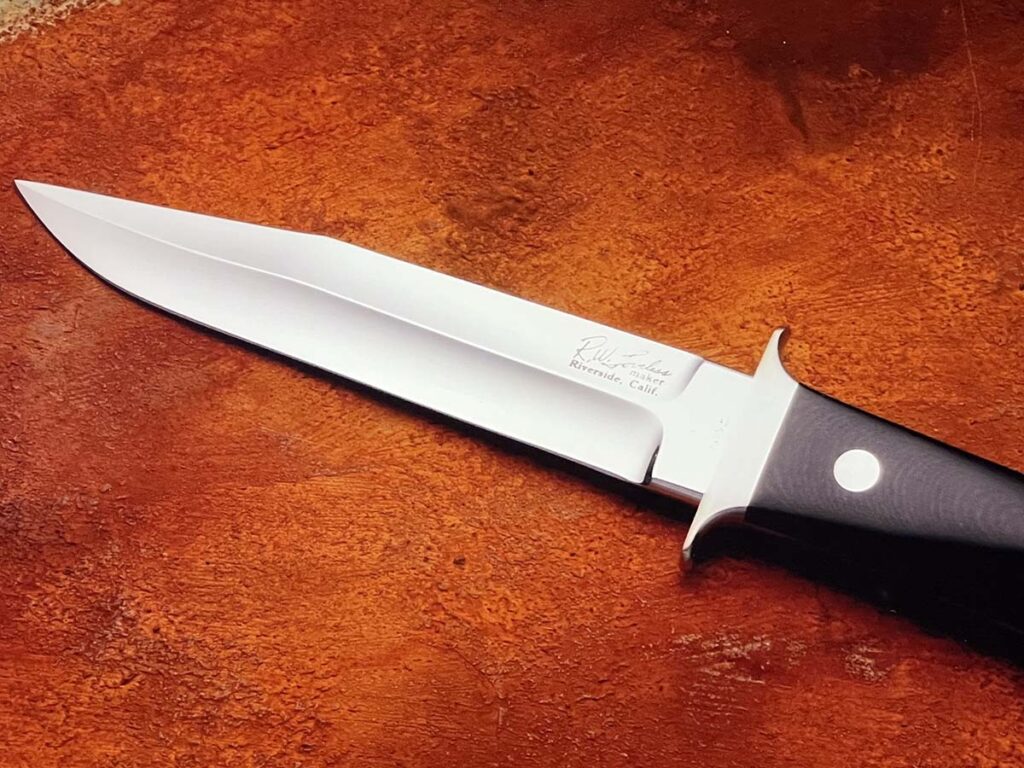
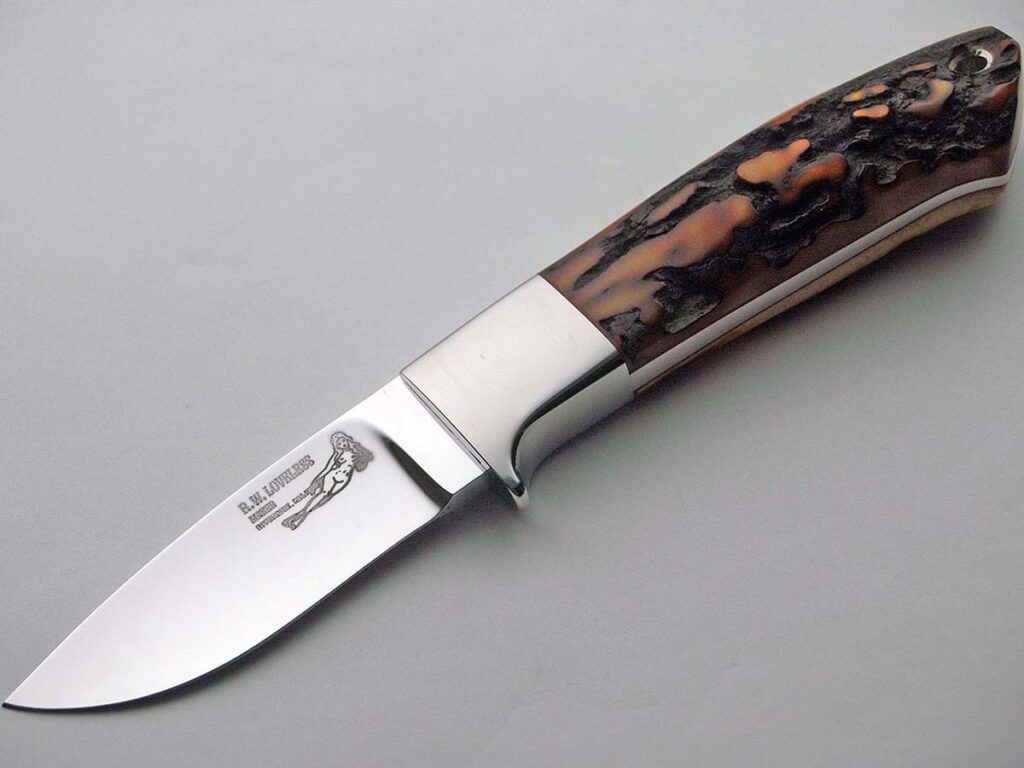
Bob Loveless made contributions to the knife industry on multiple levels. He was instrumental in the formation of The Knifemakers’ Guild and in establishing the custom knife market in concert with other great men like the incomparable Cutlery Hall-of-Famer A.G. Russell. Loveless reached across the globe and developed relationships in Japan that eventually brought ATS-34 stainless steel, a staple in blade construction, to other markets. He was a metallurgist who concocted his own steel composition and made Micarta® a handle material of choice. The curve and the sweep of the drop-point hunter and other Loveless creations touch the senses and influence generations of admirers even now.
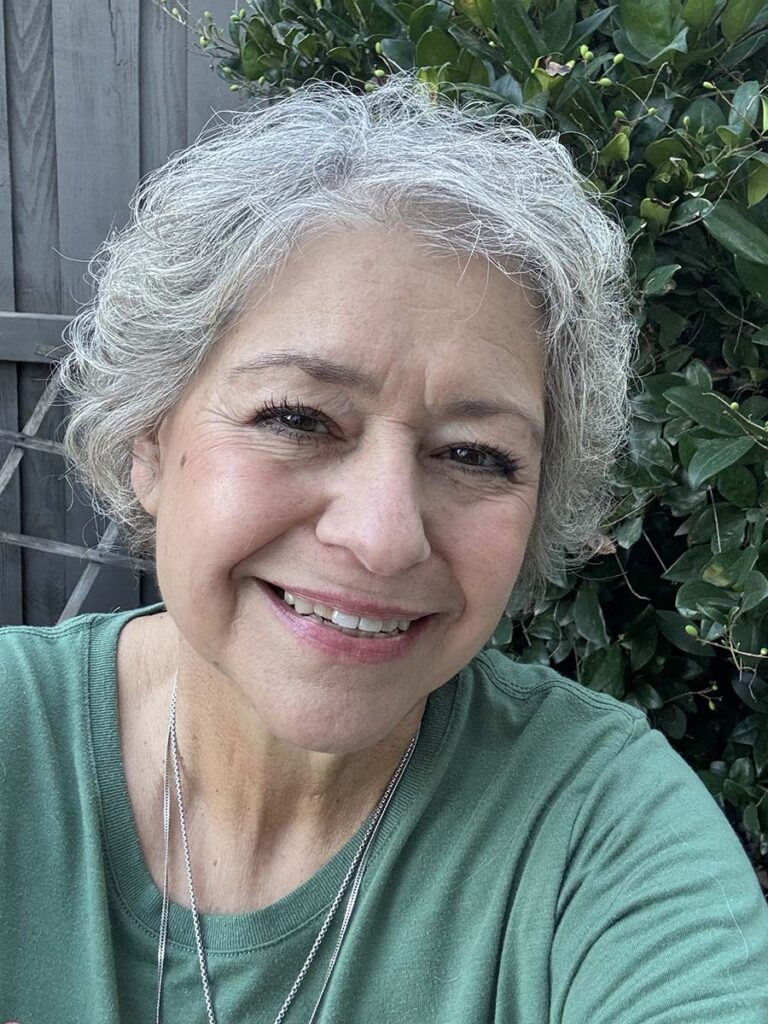
Robin Askew is alive and living well today at 70.
For Robin, more than half a century of a legend in the making is remembered in light and shadow, the image of her father at work tirelessly building and brainstorming and striving to make his way, and in turn taking care of those close to him. It was, at times, both turbulent and tender, but always something new.
“Daddy was super, super busy,” Robin recalled. “I never made a knife, just swept the shop floor. He would do things in batches and stages, and one of the most fascinating things I remember was when he would cut the leather and make the sheaths on a big stitching machine. He did everything with the knives, from drawing out the patterns to grinding the blades down and shaping them and putting the Micarta, stag or ivory handles on them. After he ground batches of blades, he would test them, pointing them down and dropping them onto the concrete floor of the shop. If the tip cracked, the whole batch of blades would be thrown away—but that never happened.”
Through the years, there were times when the family fractured, quite probably due at least in part to the stress and strain of a one-man enterprise that was on the rise, moving through uncharted territory and challenges. While something incredible was eventually gained, there was a cost to be counted. But such is true in life, true for everyone and in every relationship.
Lawndale & Riverside
For much of her young life in Lawndale, California, Robin lived in a small house with her mother and sister while her father lived in a studio apartment just down the road and worked in his basic shop.
“At the time I grew up with my dad, Allison and I were the oldest, and then Mary came along nine years later,” Robin commented. “Dad was getting to be known while the shop was in Lawndale, and when I was a senior in high school in 1973, the shop in Riverside, California, was not quite ready.
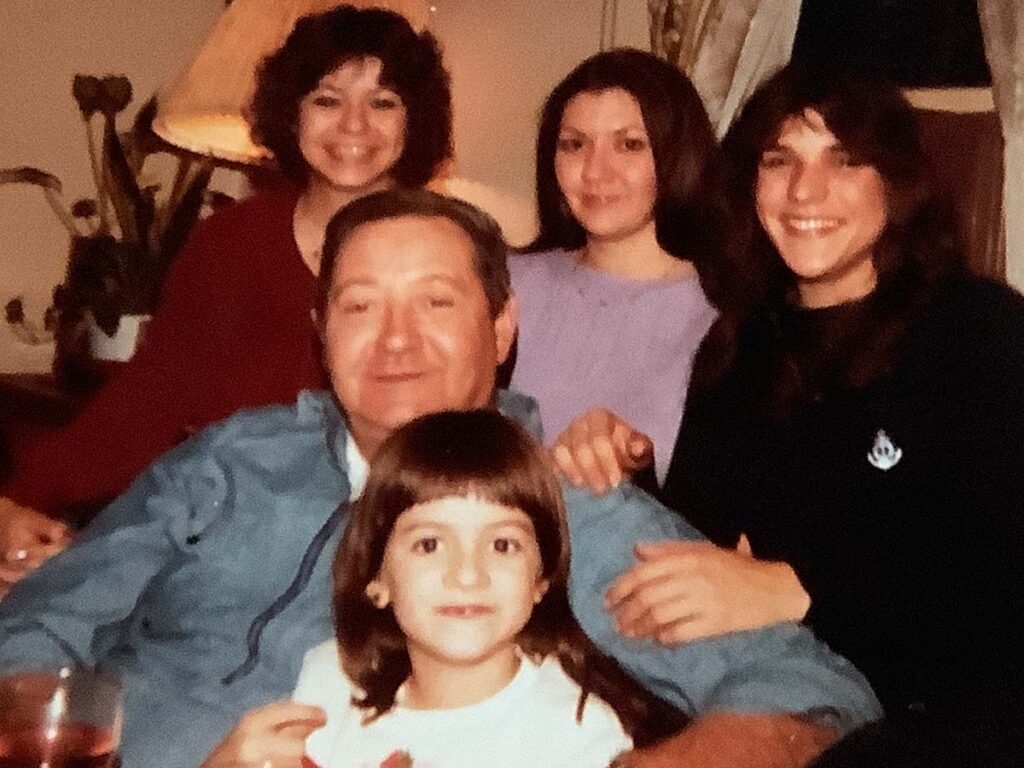
Taken on Christmas 1982, Loveless’s three daughters appear together, in back from left, Robin, Alison and Mary. Bob has his arm around Alison’s daughter Anna, the first Loveless grandchild.
“Still, he was getting telephone calls all the time. We would answer them in the house when he was working, and finally he put a phone in the shop because we had been taking all the calls,” she laughed. “He hired me to be his little secretary, and I would send out the catalogs and address them and seal them and take messages. It was a little weekend job, nice and fun.”
The relocation to Riverside occurred about 1974, and Robin remembers the dramatic change from Lawndale in terms of shop sophistication. “I had moved away,” she said, “and when I came to the shop in Riverside, it was so much more advanced than the little Lawndale shop with so many machines and things to look at. I was fascinated by everything he did, and it was fun to sit in his office.”
Along For The Ride
“Some people were actually frightened of him,” Robin said of her father. “They might have been put off. But his bark was so much worse than his bite.”
By that time, though, the Loveless mystique was already established. Bob was well on his way to custom knife stardom. And those around him? Well, they were along for the ride.
“People had started to come over and meet my dad,” Robin smiled. “There were so many people, different people, ordering knives. He would hang up the phone and say, ‘OK, John Wayne just ordered a knife.’”
Bob Loveless became a friend to the prominent, the eclectic and a diverse spectrum of admirers. Although they may have shared little else, they were each drawn, like moths to a flame, to the world and work of a master. Loveless met David Crosby, Stephen Stills and Graham Nash, stars of the pop music scene with their fame growing exponentially in the late 1960s. Crosby was a frequent visitor.
“When Dad first met them, the three were playing the circuit,” Robin remarked. “They were performing in bars and night clubs, and Dad would sit in with them on stage and play his harmonica. He loved to play the harmonica and had a lot of fun with them. Crosby would come to where Dad lived in the studio apartment about a quarter mile down the street from the house in Lawndale and just hang out. One time, he came to the door and said, ‘Is your dad here?’ and I yelled, ‘Dad, David Crosby is at the front door!’ They would just talk and enjoy themselves and do their thing.
“One time Crosby came into the kitchen and said, ‘Robin, can you make me a cup of coffee? You’re the only one who knows how I like it.’ This is 1973. These guys are really hot. And I’m a senior in high school!”
Vietnam
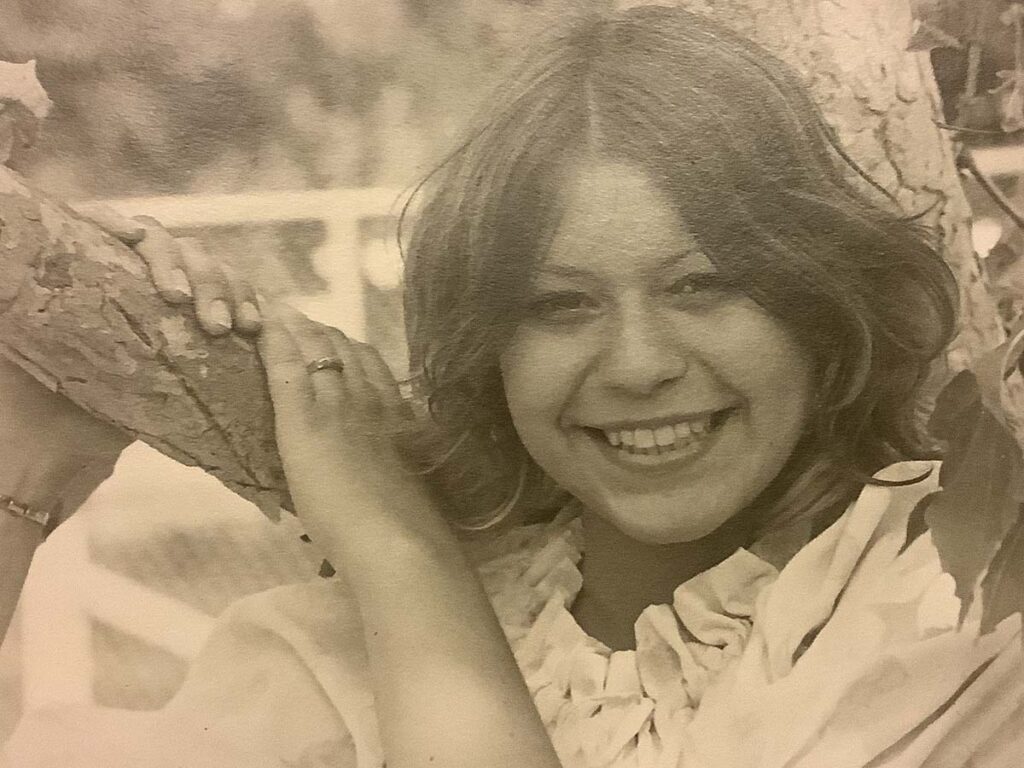
Robin visited her dad after he set up shop in Riverside, California, where this shot was taken in the backyard. She was 18.
During the 1960s and ’70s, Bob made many knives for military personnel, but Robin says he was sensitive to the situation when it came to his children. “My war was Vietnam,” she reflected, “and Dad made a lot of combat knives for Marines and Special Operations people who went overseas. I never knew that until I was an adult, and I don’t think Dad wanted us to know that. The war was so horrific in my eyes, but I supported everyone who ever went there. Some of them were my schoolmates.
“Dad was not a part of the California culture of that time,” she continued, “because he was always making knives. He had a lot of them on back order, and he would tell me the wait time was five years or six years, and later it got up to 10 years. He didn’t ever really have time to leave the shop, and he never discussed political things unless I called and asked his opinion about something. I do know that he made fighting knives—and these were like ‘killer knives.’ They were unbelievable. Then, his mother and stepfather were murdered in Ohio in 1985. They were stabbed to death in a robbery while he was in Japan.
According to John Denton, Loveless made this fighter in tulip wood with skull-cracker in Lawndale, California, for CIA operative Harry Archer. (Hiro Soga image)
“The decision was made not to tell him about it until he came home. He had already had a heart attack. So, after he was given the terrible news, I believe he felt bad about making knives because sometimes knives took people’s lives. Afterward, he no longer made combat knives.”
The life and times of Bob Loveless were surreal, energized and unequalled in excitement. “I remember once when a gentleman from Japan visited us in California,” Robin added. “My dad was instrumental in helping the Japanese Guild get started, and they would send makers over to work with him. I had no idea who this gentleman was, and you’ve got to remember that the Lawndale shop was just a tiny square box, not fancy but where he had put everything he had into it. This Japanese gentleman bowed to me. I was 16 at the time—and honored that he would bow to me. I didn’t really understand, but Dad said, ‘That’s what they do. They respect us, and they copy us because they respect our work.’”
Bob’s Beehive
Bob also cultivated a relationship with his one-time landlord, Dr. Dixon. He rented a house from Dixon and subsequently bought it. He made knives that Dixon collected, even naming a fighter style after his friend, this one with the Loveless signature logo. (John Denton image)
The Loveless shop, in Lawndale and then Riverside, was a beehive of activity. First, Bob was a solo act, and then great partnerships and friendships emerged. “In the morning, I would go to school, and he was busy all day,” Robin said. “Steve Johnson came in and was his partner. Steve was like an older brother to me. He was a very good boy, very shy and dedicated to learning the craft from my dad. He is maybe five years older than I am, and he grew into a wonderful man.
“Steve had a Camaro, and he would let me drive it,” she continued. “It had a manual shift, not an automatic. I went for the test to get my driver’s license in that car, and it didn’t go too well. The instructor said, ‘Are you all right? You turned too much!’ When we got back to the DMV, I told Steve I had flunked. But he still let me drive his car back home.”
The most famous Loveless knife of all, the drop-point hunter or, as he called it, the dropped hunter.(Dave Ellis/Exquisiteknives.com image)
Bob also cultivated a relationship with his one-time landlord, Dr. Dixon. He rented a house from Dixon and subsequently bought it. He made knives that Dixon collected, even naming a fighter style after his friend. Bob’s buddy Ray Randall was a frequent visitor as well. Robin recalled, “Ray was a sales representative, and he would bring us girls all kinds of shampoos and cream rinses for our hair when he came out to visit Dad.”
Read More On Bob Loveless:
Bob Loveless: The Icon’s Indelible Mark On The Knife Industry
BLADE Magazine Cutlery Hall-of-Fame® member Buster Warenski was the subject of an extensive six-page profile a half century ago in the January/February 1976 issue of The American Blade. He was larger than life then and would get even larger in the years to come.
Unmistakable in the low-crowned Stetson and mutton-chop sideburns he wore back then, Buster was interviewed in his new Richfield, Utah, knife shop by then editor L.V. Baker. Richard Barney, co-author with Cutlery Hall-of-Famer Bob Loveless of the landmark How To Make Knives book, was along to take photos. The lead image of Buster holding one of his latest knives at the time is about as iconic as it gets.
Done about half a decade before Buster would go on to make his reproduction of the King Tut Dagger, the story and spread reflect how consequential Buster was to the handmade knife movement of the 1970s. It covers from his early influences, including Harvey Draper and Cutlery Hall-of-Famers Gil Hibben and Bo Randall, the first two knives Warenski ever sold, some invaluable magazine publicity from Cutlery Hall-of-Famer B. R. Hughes, Buster’s first Guild Show in 1973 and his position on the Guild Board of Directors at the time of the interview.
One of Buster’s best quotes: “I think the industry is going to get bigger and better, just as our customers and collectors are going to become better educated about the knives they buy and are going to demand a better product.”
Buster was right, of course—and would be among the vanguard of makers to supply the knives for which he predicted there would one day be such great demand.
The story of a prototype Airman and a Marine pioneer.
Editor’s note: The author contacted BLADE® and asked if we would be interested in his story on a special Marine Corps knife and a special Marine to coincide with the semi-quincentennial of the United States Marine Corps. Needless to say, it was an easy decision on our part. Meanwhile, please join us in wishing a happy 250th birthday to the Corps and Marines everywhere.
The core values of honor, courage and commitment have defined the United States Marine Corps since its inception on Nov. 10, 1775. To remain an elite fighting force, the Marine Corps has adapted as the world has changed over the past 250 years, incorporating new technology and developing new doctrine.
One of the most significant transformations began with the birth of Marine Corps aviation in 1912. During World War II, Marine aviators played a vital role in the Pacific campaign, working closely with ground units to seize heavily defended island strongholds. As Gen. Keith B. McCutcheon, a pioneer of Marine aviation, later emphasized, “The Marine Corps is proud of the fact that it is a force of combined arms, and it jealously guards the integrity of its air-ground team.”
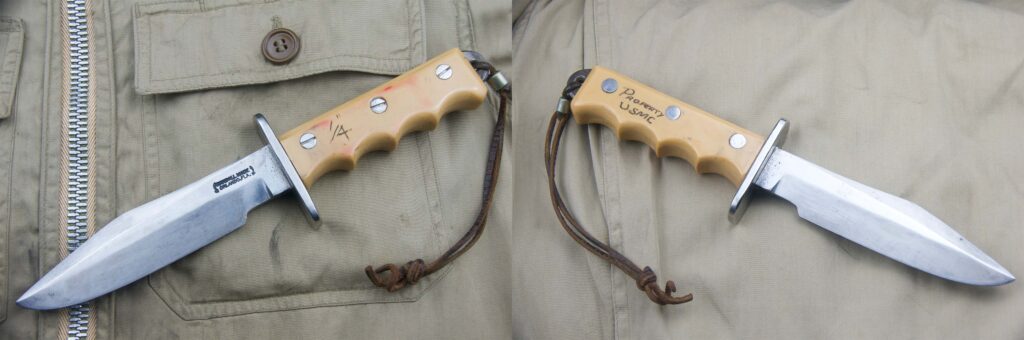
The mark and non-mark sides of a prototype Airman.
The evolution of air combat brought new challenges, challenges that extended even to the knives that aviators carried. One result was a collaboration between Marine aviators and BLADE Magazine Cutlery Hall-of-Fame® member Walter D. “Bo” Randall, who would redefine survival and combat knives with the now-iconic Randall Model 15. This article features one of Randall’s prototypes—a rugged, full-tang Airman’s Knife that was carried for more than 15 years by Gen. McCutcheon himself.
The Challenge
Marine aviators amassed extensive combat experience in World War II and Korea. By 1953, the Marine Corps recognized that the rigors of combat aviation demanded a new type of knife—one that was rugged, compact and versatile.
As documented by Randall historian Robert Gaddis, the Marine Corps Equipment Board assigned Lt. Col. H. Ross Jordan and Maj. Harold N. “Tex” Mehaffey to develop a survival and combat knife for Marine aviators. The knife had to be nearly indestructible—strong enough for an airman to pry, cut or smash his way out of a downed aircraft. At the same time, it had to be short enough to be worn in a cramped cockpit, and the sheath needed to allow the knife to be carried on the upper arm or lower leg.
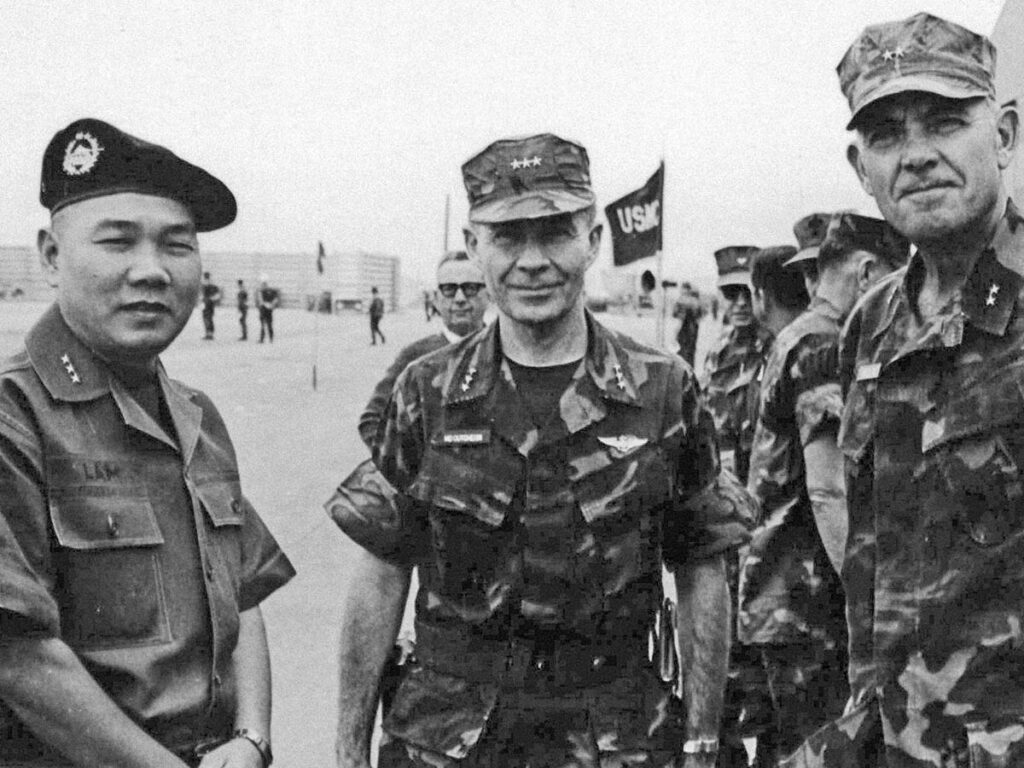
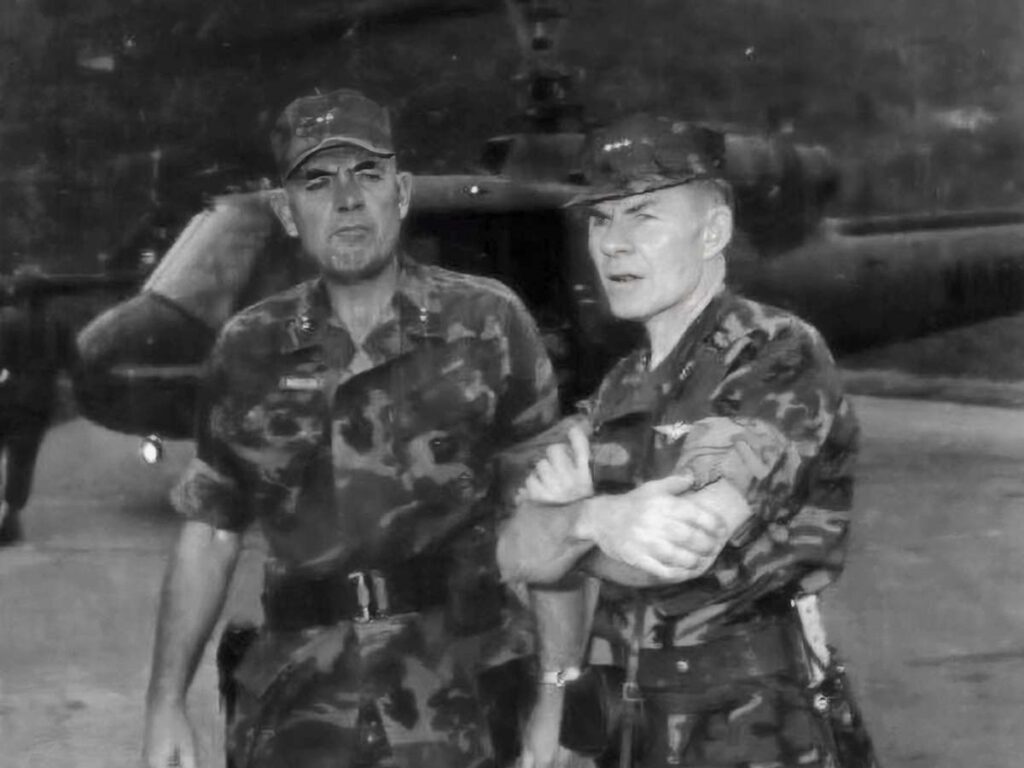
Wearing his sheathed Randall Model 15 Airman on his left hip, United States Marine Corps Gen. Keith McCutcheon (center) is flanked by South Vietnamese Gen. Hoang Xuan Lam, Commander of I Corps, and USMC Gen. Edwin B. Wheeler (right), commanding general of the 1st Marine Division. (image of McCutcheon, Lam and Wheeler from somewhere near Da Nang, Vietnam, March 16, 1970)
After reading a December 1953 magazine article about Bo and his expertly crafted blades, Mehaffey and Jordan arranged to tour his knife shop in Orlando on Feb. 11-12, 1954. By the end of their fruitful discussion on February 12, Bo had arrived at the basic design of the Randall Airman’s Knife. He also planned a longer-bladed version for ground troops, a design that would become the Randall Attack. Thus, this meeting launched the line of full-tang Randall models that would expand and evolve over the coming years.
Bo moved rapidly to fabricate prototypes that embodied his innovative design. The 5.5-inch blade would be forged from quarter-inch-thick O1 tool steel, a material that had been proven in earlier Randall combat knives. To strengthen the tip, the blade would retain the full quarter-inch thickness nearly to the point. To strengthen the junction between blade and the handle, the tang would be 7/8-inch wide along the entire grip. An extended segment of the tang would have a hole for a wrist thong and provide a surface that could be used for hammering. A heavy double hilt would prevent a gloved hand from slipping forward onto the blade. The handle would be made from a single piece of Tenite plastic, shaped with finger grips and a channel to snugly fit the tang. Stainless steel bolts would secure the handle.
To complete the package, Randall designed a sheath that could be worn on a belt, attached to a harness, or tied to the lower leg or upper arm with leather laces. It featured a diagonal keeper and rivets at stress points. The Randall shop completed the prototypes of the Airman’s Knife and the longer Attack Knife by the end of February 1954—barely more than two weeks after the formative design discussion—and Clarence Moore readied the sheaths soon after.
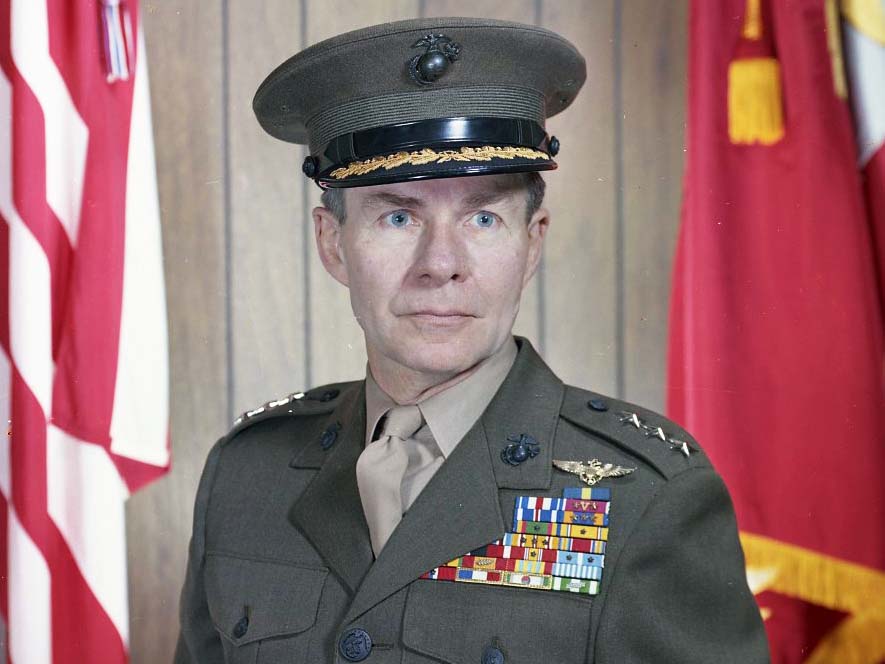
Three-star Gen. Keith McCutcheon, February 1970
The innovative features of the new knife and sheath designs were memorialized on certified blueprints on March 4, 1954. Randall filed a patent application on Aug. 11, 1954, and the United States Patent Office granted patent 177,590 for the Randall Airman’s Knife on May 1, 1956.
Prototype Testing
With prototypes in hand, Randall travelled to Quantico, Virginia in mid-March 1954 to present the new full-tang knives to Mehaffey, Jordan and other USMC and U.S. Navy officers. The group enthusiastically recommended that the Navy’s Bureau of Aeronautics purchase 10 prototype Airman’s Knives for evaluation: five from quarter-inch stock according to the original design, and five lighter examples from 3/16-inch stock.
The requisition arrived in early April 1954 and the shop shipped the 10 prototypes in early May. The invoice listed the Airman’s Knife as the #14, but later that month Randall adopted the still-current model numbers: the Airman became the Model 15, and the longer version became the Model 14 Attack.
The Marine Corps Equipment Board received two of the prototypes, one of each blade thickness, and the remaining eight were sent to squadrons and other units for real-world testing. In late May, Mehaffey informed Bo that preliminary testing had begun.
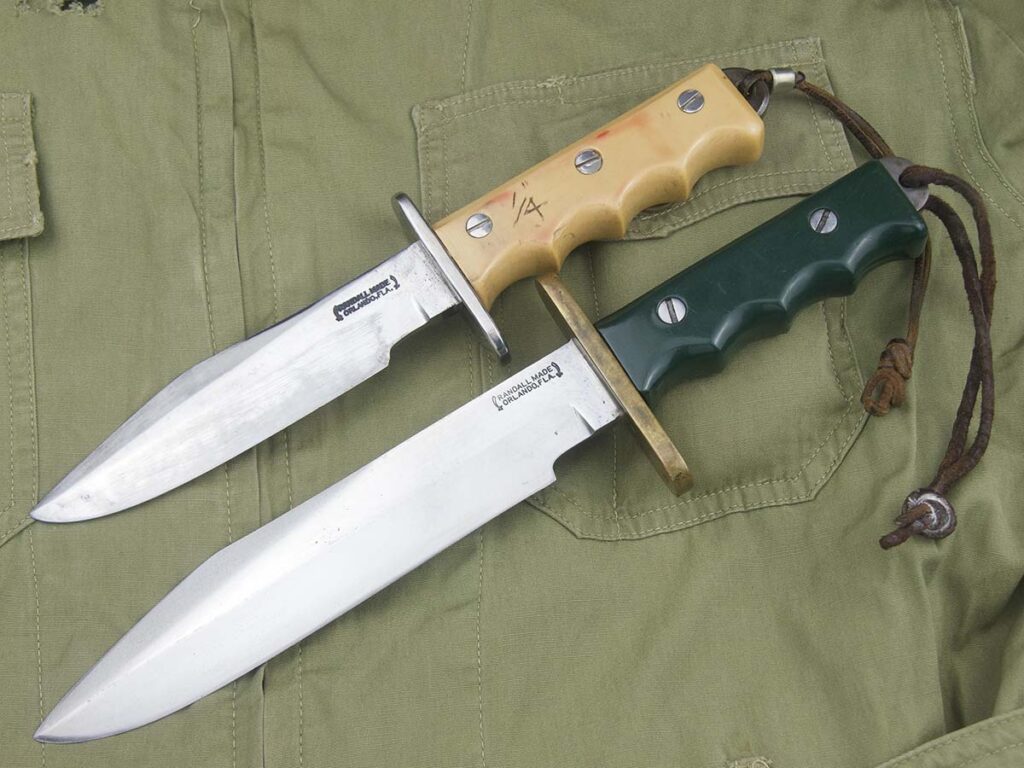
One of the original Randall prototypes is featured in the accompanying photographs. Made from quarter-inch steel, as indicated by the inscription on the handle, the prototype closely follows Bo’s patented design, except the blade lacks the fuller shown in the drawing. As in the original design, the prototype’s handle is secured by three bolts; this feature sets the prototype apart from later production examples of the Model 15, in which only two bolts were used.
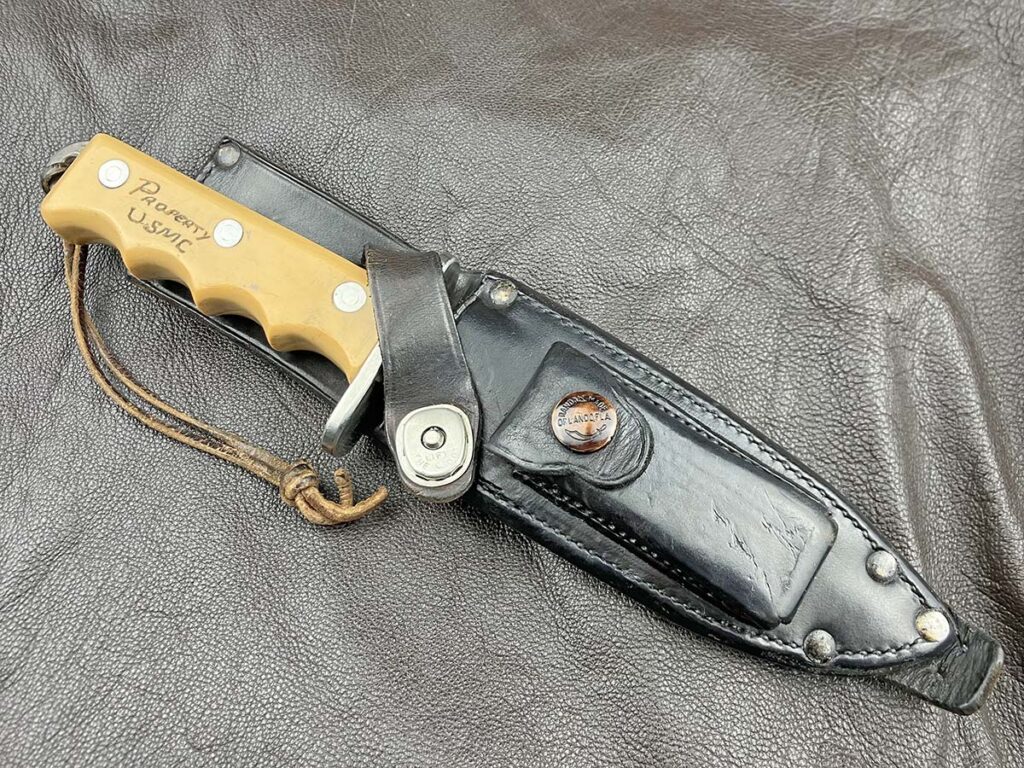
Leatherworker Clarence Moore made the sheath for the prototype Airman according to Bo Randall’s design. Moore made the sheaths for the earliest full-tang knives until Heiser took over production in 1955.
The handle is made from white Tenite, a material used only for a year or so before Randall adopted the more familiar green Tenite that was characteristic of production for nearly 10 years, until Randall Made replaced Tenite with Micarta® in the mid-1960s. The prototype’s hilt is nickel silver in contrast to the brass hilts seen on almost all Model 15s with Tenite handles. The sheath was made according to Bo’s design by master leatherworker Clarence Moore, who made sheaths for the earliest full-tang knives until Heiser took over production in 1955.
After more than 70 years, the knife and sheath are in outstanding condition—a testament to Randall’s craftsmanship and superb design.
Project Setbacks
Despite starting with such promise, the project faltered in the summer of 1954 when Mehaffey was transferred for duty in France and Jordan retired. The departure of the two enthusiastic advocates delayed testing and communications. The next official update was in December 1954, when Bo heard that testing had been underway for two months with positive feedback. In April 1955, the United States Air Force also ordered a group of Model 15s for evaluation. Bo wrote again to the USMC in June 1955 but heard nothing further from the Marines or the Air Force.
Although Randall was never officially informed of the results, author Frank Trzaska uncovered a September 1955 testing report in the USMC archives. The report was authored by USMC Maj. Norman W. Gourley, who had succeeded Mehaffey. Extensive testing of the Randall Airman prototypes showed that the quarter-inch-thick version (i.e., Bo’s original design) was “suitable for aviators’ survival use.”
SONY DSCAfter a fruitful meeting on Feb. 12, 1954 with USMC Maj. Harold N. “Tex” Mehaffey and Lt. Col. H. Ross Jordan, Bo Randall had arrived at the basic design of the Randall Airman’s Knife (top). Bo also planned a longer-bladed version for ground troops, a design that would become the Randall Model 14 Attack (one from 1955 is shown at bottom). The meeting launched the line of full-tang Randall models that would expand and evolve over the coming years.
The report, which pictures this story’s featured prototype, notes the high quality of the design, materials and workmanship of the Randall knife and sheath and concludes that it is acceptable for extreme survival tasks. The report also noted potential changes that would improve the knife further, such as the addition of saw teeth, a flat butt surface for hammering, and different handle configurations. Bo independently incorporated most of these features in various full-tang Randall models by the mid-1960s, and presumably he would have made the changes sooner if the request had ever been made.
While the tests of the Randall Airman were underway, the Navy adopted the Imperial Pilot Survival Knife for its aviators. Because the Marine Corps operates as part of the Department of the Navy, this surely complicated any attempt by the Marines to adopt a different design. The Randall Airman was never issued by the military, but Bo added the Model 14 Attack and the Model 15 Airman to the new Randall catalog printed in 1954, which showed prototypes of both models as “patent pending.” As envisioned by Bo and the Marine aviators who helped to shape the design, Randall’s full-tang combat and survival knives were embraced by many American servicemen who purchased them privately, especially during the Vietnam War.
Pioneer & His Prototype
One Marine who had a high opinion of the Randall Airman was aviation pioneer Keith B. McCutcheon, who as a colonel served as Chief, Air Section, Marine Corps Equipment Board from June 1954 to July 1957. After the Randall Airman tests concluded, McCutcheon carried the quarter-inch prototype for the rest of his career.
An attack helicopter warms up in the background as Gen. McCutcheon surveys the situation six miles southwest of Da Nang, March 17, 1970, his trusty Randall Model 15 Airman sheathed at his side. At left is Gen. Edwin B. Wheeler.
In January 1966, while commanding the 1st Marine Aircraft Wing in Da Nang, Vietnam, then-Brig. Gen. McCutcheon wrote that the Airman was a “wonderful knife” that he had carried for “10 or 11 years.” Photographs from 1970 show McCutcheon wearing the knife when he returned to Da Nang as a lieutenant general and commander of the III Marine Amphibious Force (III MAF).
Commissioned as a Marine 2nd lieutenant in 1937, McCutcheon was a brilliant, courageous leader who transformed Marine aviation over the course of his illustrious 34-year career. Gen. Earl Anderson said McCutcheon “was one of the finest and most dedicated Marine officers [whose career] reads like a history of Marine Aviation. He earned his wings as an aviator in 1940 and served in World War II, Korea and Vietnam.”
McCutcheon was instrumental in integrating helicopters into Marine operations, and has been called “the Father of Marine Helicopters.” But, as historian William Fails observed, that title does not capture McCutcheon’s central contributions to numerous other areas. He also advanced close air support doctrine and techniques, guided missile systems, and the AV-8 Harrier jump jet. McCutcheon was also an effective leader of ground operations, launching successful operations as commander of III MAF.
For his exemplary service over 34 years, McCutcheon received many of the nation’s highest military decorations, including three Distinguished Service Medals, the Silver Star Medal, three Legions of Merit with Combat “V,” the Distinguished Flying Cross, 10 Air Medals and others. He was appointed to become the assistant commandant of the Marine Corps but was unable to assume the post because of failing health. He retired as a four-star general on July 1, 1971, and passed away from an illness soon after.
Enduring Legacy
On the 250th birthday of the United States Marine Corps, it is fitting to honor the legacy of Gen. Keith B. McCutcheon, an extraordinary leader who helped shape the modern Marine Corps. McCutcheon’s prototype Randall Airman remains as a tangible link to his many accomplishments and to the connection between the Marine Corps and Randall Made Knives.
Sources
William R. Fails. 1978. “Marines and Helicopters 1962-1973.” History and Museums Division, Headquarters U.S. Marine Corps. Robert L. Gaddis. 1993. “Randall Made Knives: The History of the Man and the Blades” Paladin Press. James Anthony Ginther, Jr. 1999. “Keith Barr McCutcheon: Integrating Aviation into the United States Marine Corps, 1937-1971.” Doctoral Dissertation, Texas Tech University. Norman W. Gourley. 1955. Marine Corps Equipment Board report A9-E-1039 on Project E-1039. Frank Trzaska. 2001. “Randall’s Model 15 & the U.S.M.C.” February 2001 Knife World.