
Penny For A Knife: Unraveling The History Of This Tradition

2

The fascinating origins of the “penny for a knife” custom, from ancient Rome to Sheffield. Learn why a coin was exchanged saved friendships.

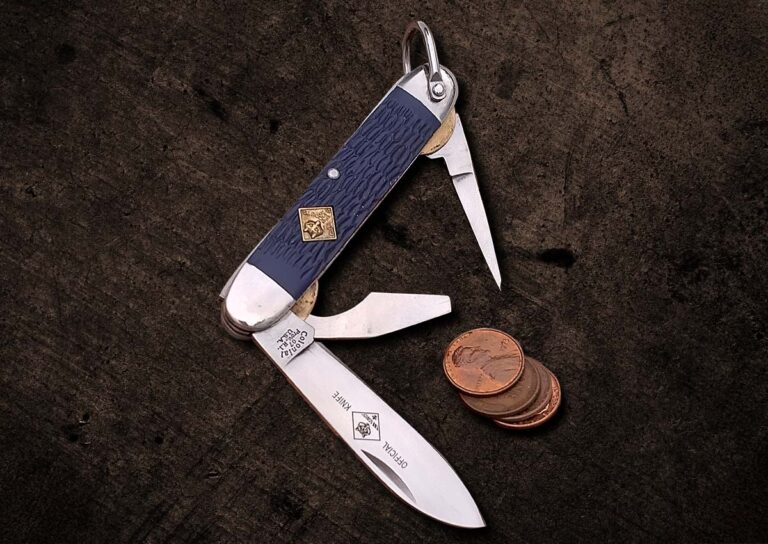
Not all that long ago, the tradition of a penny for a knife was a common practice. Today the custom appears to be barely clinging to relevance, though as traditions go there is the possibility that it may linger and even gain new traction. That, however, remains to be seen.

The old story goes that when someone gives a knife to someone else, the recipient is obliged to present the giver with a penny as a token of appreciation or even as an insurance policy. The origins of the old custom are shrouded in mystery and have become more obscure with the passage of time. Nonetheless, there is a larger aspect to the tradition, and that is its questionable staying power in the modern milieu that is the world of knives.

Is the old practice virtually clinging to life? Apparently so. A few folks contacted for the story were frank in their assessment. Phil Gibbs of A.G. Russell Knives in Rogers, Arkansas, went to the buying public and then conferred with his boss, BLADE Magazine Cutlery Hall-of-Fame® member Goldie Russell, both longtime participants in all things knife.
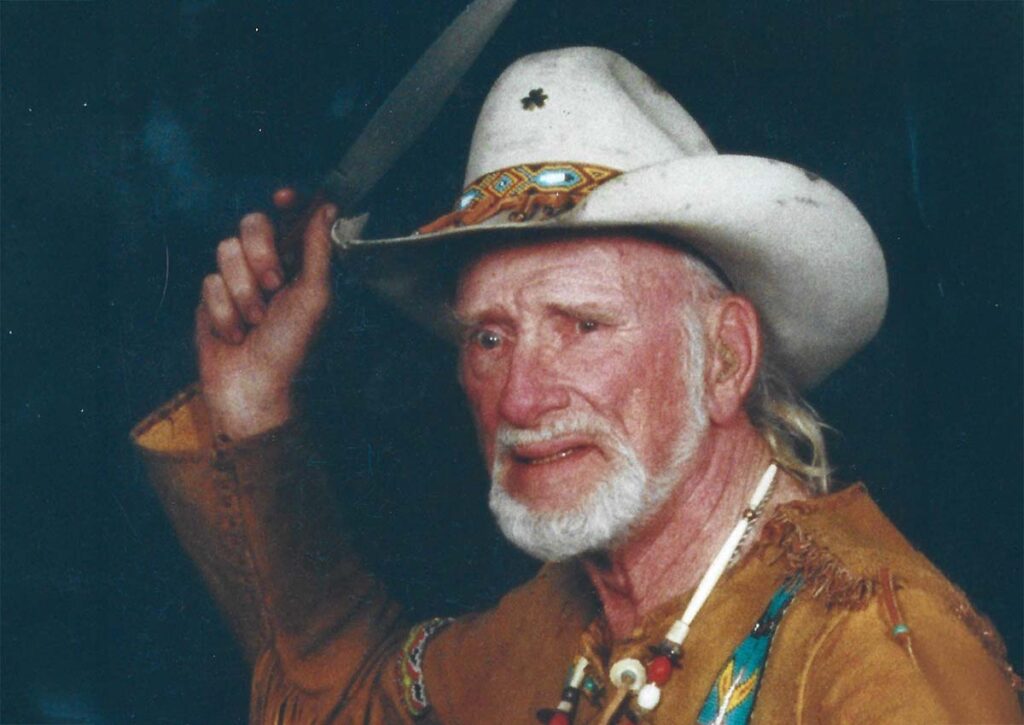
If somebody gave you a knife and you didn’t give him a penny in return, Cutlery Hall-of-Famer Dan Dennehy noted, “it would cut your friendship.” Dan is also a member of the International Knife Throwers Hall of Fame.If somebody gave you a knife and you didn’t give him a penny in return, Cutlery Hall-of-Famer Dan Dennehy noted, “it would cut your friendship.” Dan is also a member of the International Knife Throwers Hall of Fame.
If somebody gave you a knife and you didn’t give him a penny in return, Cutlery Hall-of-Famer Dan Dennehy noted, “it would cut your friendship.” Dan is also a member of the International Knife Throwers Hall of Fame.

“I’ve polled customers in our store since we first discussed this, and zero people were aware of the old custom,” Phil remarked. “Goldie and I agree that it was once quite prevalent but now is long gone and forgotten.”

The late Cutlery Hall-of-Famer A.G. Russell knew the custom well but sometimes found himself having to explain it a bit.

“Sometimes people look at me funny,” he said years ago of the times he gave a knife to someone and asked for a penny in return, “especially when they are younger. The younger they are, the funnier they look at me. I just think it’s a matter of their not knowing about it.

“As I was growing up, I saw it being done, not just once but many times. I still do it myself. I insist on compensation. It may end up being a quarter if they don’t have a penny, nickel or dime. I knew a man years ago who liked to give knives away, and he would give the knife away with a penny and then make you give the penny back.”

Veteran knife dealer Bill Claussen of Northwest Knives in Salem, Oregon, is another source who definitely would be in the know regarding the tradition, and his assessment was a straight-up, “I really don’t have anything to offer on this one. This is really not ‘old knife’ country out here, and I never even heard of this until a few years ago,” he noted, “and then I never heard it discussed.”

Cutlery Hall-of-Famer A.G. Russell (at far left) waits on a customer in the retail knife store inside A.G. Russell Knives.
Cutlery Hall-of-Famer A.G. Russell waits on a customer in the retail knife store inside A.G. Russell Knives.

The tradition may well be on life support. While it is likely fading or the sun has quite possibly set on it altogether, there are related memories. Matter of fact, this writer put together a BLADE® story on the topic some 26 years ago. Coincidentally, I had just experienced the tradition in action. When I handed a nice folder to a close friend, his wife piped up, “Now you have to give Mike a penny. My mother and father never gave one another anything with an edge without receiving a penny in return.” Even then, my friend’s wife had no idea where the practice had originated.

Penny For A Knife Origins

In that BLADE story 26 years ago, Cutlery Hall-of-Famer Bruce Voyles related that he believed the custom originated in ancient Rome.

“The general theory was that you would ask for the lowest coin of the realm when you were given a knife,” he said. “Back then, when you were dealing with an absolute monarch and the king or queen handed you a knife of their own, you were expected to kill yourself with it. But, if the king demanded a coin from you, then he was giving you the knife.”

Well-known knife dealer Jim Taylor, who grew up in Sheffield, England, remembered the penny for a knife custom as it was practiced in his family. “When I was a little boy,” he recalled years ago, “I had to give my mom a penny before she would give me a pocketknife she had bought for me. It might have been a particular Sheffield custom that became popular.

“I’ve always expected to be given a coin, whatever it might be, any coin at all. In England you don’t have to explain it, but in the United States sometimes the custom is not held so tightly. If I were to take someone a gift of a pocketknife in England, they would without question give me a coin. They think, ‘You must buy this because otherwise it might cut our friendship.’ I’ve seen knives from time to time with an old English farthing or half penny built into them.”

That was then.
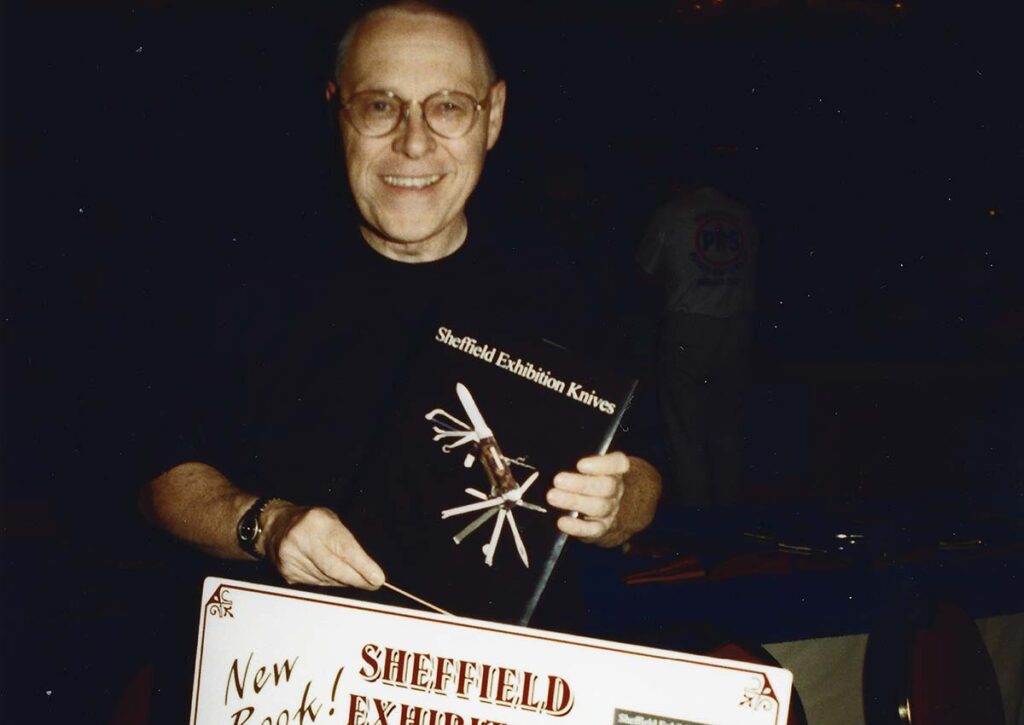
Bill Claussen with Sheffield Exhibition Knives, the book he authored in 1999 along with Brad Watts and Pete McMickle.

Even Queen Elizabeth II participated in the tradition. The Sheffield Star newspaper dutifully reported in its Dec. 12, 1986, edition that the Queen visited the city and was presented with a platinum penknife and responded by handing the presenter a six-pence coin in a case. Thirty-five years earlier, the monarch had visited Sheffield and handed a cased half penny to the giver in exchange for a gold penknife.

In fact, the practice was so widespread at one time that according to Cutlery Hall-of-Famer Bernard Levine, one of the foremost knife writers and folklorists, Gerber knives were often sold in the 1940s with an accompanying card that explained the penny for a knife tradition. The card even had a penny glued to the top along with the declaration of “invoice” and then space for a name along with the instruction, “debtor to” and then “1 box of Gerber Blades … 1 cent.”

Levine said the Gerber card explained the legend a bit further. “There is a superstition, or something, about giving away cutlery … etc., so I trust you will honor this bill,” the card stated. “Besides, I need the money.”

FRIENDSHIP CUTTER
Years ago, Cutlery Hall-of-Famer Dan Dennehy indicated that he had grown up with the tradition.

“If someone in our family gave you a pocketknife, they got a coin,” he recalled. “The value didn’t matter just as long as it was legal tender. If somebody gave you a knife, a letter opener, anything with a sharp edge, or even a butter knife, you always gave a coin in return because if you didn’t collect a payment it would cut your friendship.”
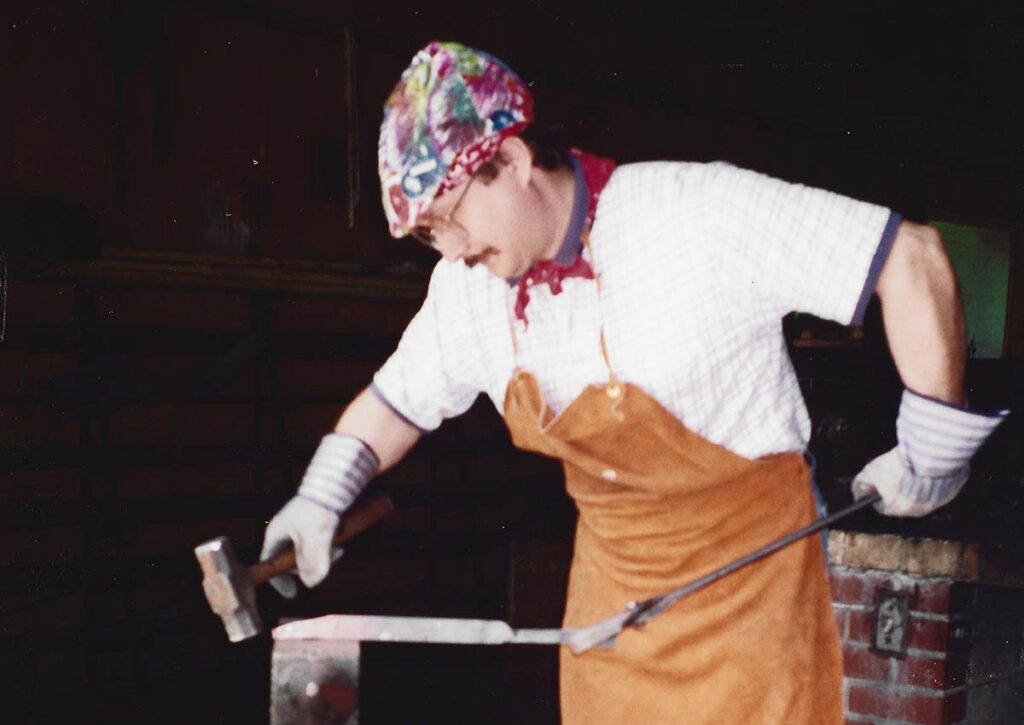
Cutlery Hall-of-Famer Bruce Voyles hammers hot steel during a basic bladesmithing course in 1994 at the Bill Moran School of Bladesmithing. (B. R. Hughes image)

Those who remembered the old practice seemed convinced a quarter century ago that fear of “cutting the friendship” was their prime motivation. Knifemaker John Dennehy, Dan’s son, remembers his close association with it.

“I’ve thought about this and don’t have any firm history about it,” John reflected. “I do remember my dad spoke about it a lot. Giving a knife as a gift can sever the friendship, so he always asked me for a quarter or something when I was a kid and a dollar as an adult. He often told the story about being on the radio with G. Gordon Liddy [talk show host, attorney and FBI agent involved in the Watergate scandal of the 1970s] and presenting him a knife. Gordon was prepared and had a silver dollar ready to give Dan. Being first-generation Irish in the U.S., he claimed it was an old Irish tradition. In the books and TV show Outlander, Jamie Fraser, the Scottish highlander, gifts his wife a custom knife. He asks her for a little something in return—says it’s an old Scottish tradition. That’s not much, but I did grow up with the tradition and carried it forward.”

In doing some research sometime back, it became apparent that the tradition has been a cross-cultural phenomenon. In Scandinavia, for example, it’s seriously bad luck to outright give someone a knife. A knife that was gifted but not meant to be a “killing knife” had a coin accompanying it with the initials of the maker. That would ensure the knife’s good use. Along with the knife an old saying, “A man without a knife is a man without a life,” added to the Scandinavian sincerity of the event.

Despite the fact that the tradition may be fading or has already slipped into history, some way or somehow it may experience a revival. Levine and many others seemed to love it. Some still do. After all, it adds to the quaintness and charm that surrounds the exchange of a knife with a friend or family member.

Tradition is a common thread that just makes the giving more memorable and enriches the experience for everyone. In these days of inflation, it’s cheap, too. It only costs a penny.

Pocketknife Info:

2025 Cutlery Hall Of Fame Welcomes Eight Inductees

Largest class as HOF honors living and deceased legends.

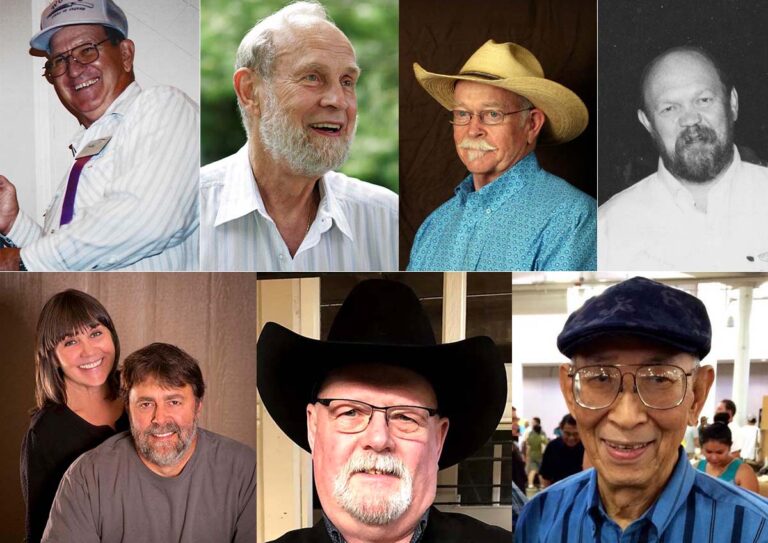
The BLADE Magazine Cutlery Hall of Fame® is proud to announce its new inductees for 2025: Harvey Dean, Stanley Fujisaka, Rick Dunkerley, Dr. James Lucie, Alfred Pendray, James Schmidt, and Daniel Winkler and Karen Shook.

In a procedural change new for this year, the Hall of Fame has expanded the number of annual inductees from three to seven, the latter including four living and four deceased individuals. (The team of Winkler and Shook is count as one inductee.) They, along with Dean and Dunkerley, are this year’s living inductees, with the balance being the deceased ones.

The new Hall of Famers will be formally inducted, including the posthumous inductions of the deceased members, during BLADE Show 2025 June 6-8 at the Cobb Galleria Centre in Atlanta. The induction ceremony will commence the Saturday morning of the show, June 7, at 8 a.m., and will include a breakfast in the Kennesaw Room of the show’s host hotel, the Renaissance Atlanta Waverly. Tickets are required in advance and are limited. For ticket information email [email protected].

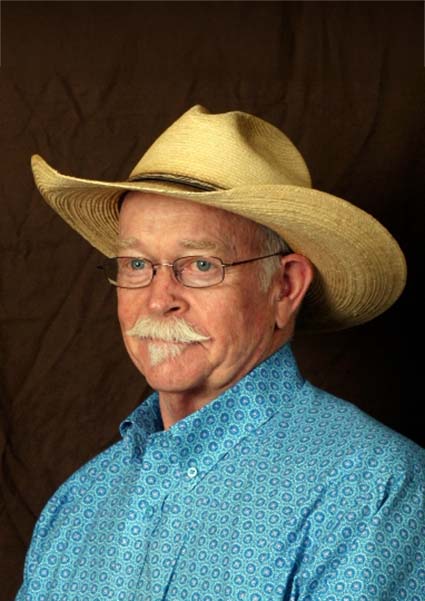
Harvey Dean

Harvey Dean
Harvey Dean

According to a nominator, “Harvey Dean earned his American Bladesmith Society master smith rating in 1992 and since then has taught an impressive number of students the art of bladesmithing. He became a member of the ABS Board of Directors in 2004 and served four years with distinction as ABS president from 2015-19. He continues to serve on the ABS board today. He was inducted into the ABS Hall of Fame in 2016. He has won an impressive number of judging awards for his knives, including at BLADE Show Texas, multiple times at the BLADE Show, from the Antique Bowie Knife Association and others. His knives have earned him membership in the prestigious Art Knife Invitational, limited to 25 of the world’s top knifemakers by a vote of the member makers.

He is a marvelous bladesmithing teacher, a master leader, a master administrator, and a master ambassador for the forged blade.” Along with award-winning knifemaker Johnny Stout, Harvey coordinated two annual knifemaking seminars in New Braunfels, Texas, for a number of years. He has also passed the knifemaking torch to his son Dillon, who creates utility fixed blades of his own. Concluded the nominator, “Harvey is among those named in the book Greatest Living Knifemakers written by Cutlery Hall-Of-Famer Steve Shackleford. I know of no one man deserving of being named to the Cutlery Hall Of Fame more than Harvey.”

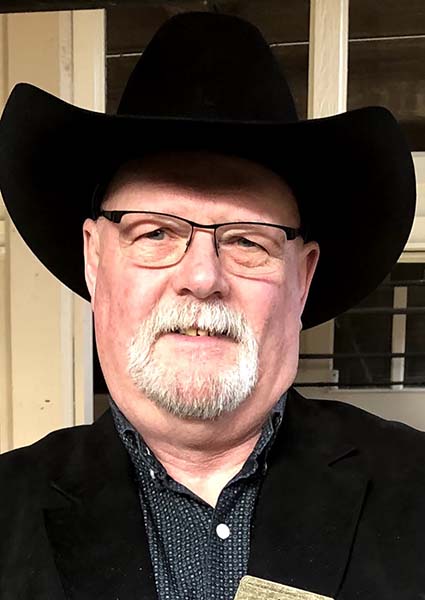
Rick Dunkerley

Rick Dunkerley
Rick Dunkerley

Rick Dunkerley began making knives in 1983 and started forging them in 1992. He specializes in mosaic damascus folders, winning judging awards for a number of them, as well as an occasional fixed blade. Among others, he’s won judging awards for his knives at the Oregon Knife Collectors Association Show, Montana Knifemakers Association Show, BLADE Show and BLADE Show Texas. His knives have earned him membership in the prestigious Art Knife Invitational, limited to 25 of the world’s top knifemakers by a vote of the member makers. He held many hammer-ins during the ’90s and brought in the best instructors of the time.

Rick has always been generous with information and is an excellent teacher. He’s taught at such venues as the Texarkana College/Bill Moran School of Bladesmithing, the Batson Bladesmithing Symposium, the Massachusetts College of Art, Saskatchewan Western Development Museum, Northern Minnesota Blacksmith’s Association, Northern Rockies Blacksmith’s Association and Western Canada Knifemakers’ Symposium. One of his students, Josh Smith, was the youngest ever to achieve both ABS journeyman and master smith status, and today runs the Montana Knife Co., a factory knife production operation with 80 employees. According to a nominator, “Rick has been on the board of the ABS and does the top shows worldwide. He has paid his dues, is a hell of a guy, always willing to share his knowledge, and makes world-class knives.”

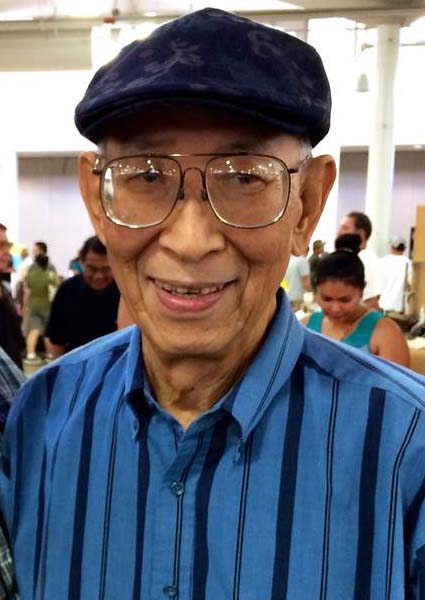
Stanley Fujisaka

Stanley Fujisaka
Stanley Fujisaka

Stanley “Stan” Fujisaka went full-time making knives in 1984 and was a prolific builder of award-winning folders and fixed blades. He was a beloved mentor in his Kaneohe, Hawaii, knife shop to a number of Hawaiian and other makers, including Scott Matsuoka, Les George, Cutlery Hall-Of-Famer Ken Onion and many more. Stan played a key role in encouraging Onion to patent his famous SpeedSafe assisted-opening mechanism. As a result and as Cutlery Hall-Of-Famer Dan Delavan wrote, “Ken went on to become the savior of Kershaw Knives.”

Stan also generously assisted knifemakers who fell victim to floods, shop fires, medical issues and more. He was a regular exhibitor at knife shows, donating many knives for door prizes. He collected custom knives and promoted them and the custom industry in general by supporting the Bay Area Knife Collectors Association Show, The Knifemakers’ Guild Show and other knife events. Together with his good friend, Cutlery Hall-Of-Famer Jim Sornberger, Stan co-hosted dinners for knife collectors, area celebrities and others, all of which helped promote custom knives. Finally, when it came to being a goodwill ambassador to the custom knife industry, few if any could rival Stan for his many gifts—including flowers, Hawaiian coffee and boxes of chocolate-macadamia nuts—that he doled out to friends, customers and other patrons at the shows where he exhibited.

Dr. James R. Lucie

Dr. James R. Lucie
Dr. James R. Lucie

According to a nominator, “Dr. James R. ‘Jim’ Lucie was Cutlery Hall-Of-Famer William Scagel’s physician and signed Scagel’s death certificate in 1963. This was the beginning of Dr. Lucie’s Scagel knife-collecting avocation. Scagel is considered by many the father of the modern custom knife. Dr. Lucie discovered his passion for knifemaking in 1990 when he took a class on bladesmithing from Cutlery Hall-of-Famer Bill Moran. Jim was a very talented maker and received several awards for his contributions to the knifemaking community. He assisted other makers often. In 2001, the ABS created the Dr. Jim Lucie Award, which it bestowed on Jim as its inaugural recipient. The award was ‘presented for the unselfish contribution to the preservation of the forged blade. The person receiving this award has gone far beyond the call … and exemplifies the type of person needed to keep … bladesmithing alive.’

Jim also received an ABS Special Service Award in 2002 ‘in recognition of his meritorious and unselfish services on behalf of … the forged blade.’ He also received the ABS Chairman’s Award for Outstanding Service more than once. He was a talented bladesmith, hand-forging mostly Scagel recreations of the highest quality. He improved on Scagel’s designs when it would enhance the knife. Jim dedicated three decades to researching Scagel’s life and collecting his works. Jim’s efforts culminated in Scagel Handmade, a massive hardbound book detailing Scagel’s life, with photos of over 200 knives and other Scagel items. Dr. Lucie hosted a hammer-in in 2001, with over 500 people in attendance. He shared his knowledge of Scagel’s techniques by giving speeches at many bladesmithing events. Late in life, Jim donated his blacksmithing, grinding and finishing equipment valued at $62,700 to the ABS. His actions consistently exhibited honesty, compassion for others and a dedication to the bladesmithing community.”

Alfred Pendray

Alfred Pendray
Alfred Pendray

Alfred “Al” Pendray was a rock to the many bladesmiths he taught and influenced over the decades. “I learned so much from him,” noted ABS master smith Charley Ochs, “not only about knives and metallurgy but also about life and social interaction as a person.” Softspoken but never at a loss for words on the subjects that mattered to him, Alfred possessed an intricate knowledge of many things, including wootz steel, bladesmithing/knifemaking and knife history in general. He had a solid work ethic and led as much or more by example than the spoken word. He knew when to express his views and when not to, a trait sadly lacking in much of today’s discourse. Alfred is co-author—along with Dr. John Verhoeven, a former metallurgical engineering professor at Iowa State University—of articles appearing in eight scientific journals, four bladesmith publications and BLADE on the nature of “genuine damascus,” or wootz steel.

Pendray was granted patent number 5,185,044 on a “method of making damascus blades.” He was a speaker at the Symposium on Damascus Steel at New York University in 1984. He also spoke at the International Conference on Damascus Steel in Germany in 1985 and the same conference in 1992. He lectured at the Imperial College in London, England, in 1992. He joined The Knifemakers’ Guild in 1982 and was awarded his master smith rating by the ABS in 1983. He received the ABS award for the Bill Moran Knife of The Year in 1991 and was elected to the Guild board of directors in 1992. He received the ABS W.W. Scagel Award in 1998 and is a past recipient of the Guild’s Red Watson Award. He served as Guild president from 1998-2004. In September 2001, he was featured on the nationally syndicated Paul Harvey radio show. In 2003, he was inducted into the ABS Hall of Fame.

James Schmidt

James Schmidt
James Schmidt

According to a nominator, James “Jim” Schmidt was instrumental in raising the level of knifemaking to compete with the finest crafts ever made. Most importantly, he elevated the pursuit to an art but never forgot the meticulous details of the craft. His knives are immediately recognizable and he influenced so many who came after him in meaningful ways. A spectacular book by BLADE® field editor Mike Haskew memorialized the man and his knives: JAMES A. SCHMIDT, The Great Master. A few passages from the book: “As a custom knifemaker he knew few peers. As a mentor and teacher, he was without equal”; “A man of few words, he allowed the results of his skill, precision, and limitless creativity to speak for him. In silent, stunning beauty, they thundered”; and “He welcomed those who were earnestly interested in improving their bladesmithing and knifemaking skills into his shop … and shared with them the light of precious knowledge that he realized should be readily and freely given rather than hidden.”

In the 1970s, along with Jimmy Fikes and Don Fogg, Jim formed the New England Bladesmith Society to promulgate the skills and techniques of knifemaking.  Before long the groundbreaking Ashokan Bladesmithing Seminar was born. Jim was a principal organizer, lecturer and demonstrator. He was one of the earliest members of the ABS and one of the earliest ABS master smiths, and a member of the ABS Hall of Fame. He was a constant member of the Art Knife Invitational, a winner of the Red Watson Award from the Knifemakers’ Guild, the Beretta Award for Outstanding Achievement, and many other honors from a number of custom knife shows. In time Jim decided to let someone else win an occasional award and became a judge at many shows. His approach was to be meticulously but fairly critical and always encouraging. He was indeed the ultimate teacher, his profession for most of his life.

Daniel Winkler And Karen Shook

Daniel Winkler And Karen Shook

ABS master smith Daniel Winkler and Karen Shook first made their mark in the world of knives with custom reproductions of historical knives and tomahawks. Daniel made the knives and hawks and Karen made the accompanying authentic period sheaths, and the two became internationally known for their work. Daniel and Karen taught for the ABS for many years and Daniel was in the vanguard of the Society’s early cutting competitions. The two were at the forefront of early American historical arms and their period pieces were among those featured in the 1992 feature film, Last of the Mohicans. In 1994 a Navy SEAL Special Warfare operator asked Daniel to make a tomahawk because there was nothing on the market that worked for the SEALs at the time. According to a nominator, “Karen designed a sheath the SEALs liked and over the years she and Daniel did more special projects for the SEALs, ultimately inspiring the two to form Winkler Knives II.” Added another nominator, Daniel and Karen’s operation “soon became the cutlery armorer of many top Special Ops teams, from the SEALs to Delta Force, and to those of other nations as well.

For many years Daniel and Karen quietly made the knives, axes and sheaths without seeking glory or publicity for their work. In fact, they insisted that their generosity and unselfishness remain a secret among those who discovered it. It was only upon mention of their work in the book No Easy Day, in which the SEAL Team member on the Bin Laden take-down mentioned he was carrying a Winkler knife, that Daniel and Karen’s work became known to the general public. With such demand, they have expanded into a mid-tech operation and from there into that of a cutlery producer.” Today, Winkler Knives has a 35,000-square-foot facility employing one part-time and 28 full-time workers. “Few have transitioned into the changing markets as well as Daniel and Karen,” the nominator noted, “and none have done so with such humility and class.”

See Other Hall Of Fame Members:

Collaboration Knives: How Do They Come Together?

Top makers explain how they collaborate with knife companies.

The old cliché of the win-win holds a real grain of truth. Any successful partnership must be mutually beneficial, and in the knife industry the phenomenon of the collaboration has come to exemplify the upside of working together.

Years ago, a veteran custom knifemaker described his relationship with a major manufacturer as serving as the company’s research and development department. Such a description is accurate in that the manufacturer often relies on the custom maker for new design inspiration, from good looks to materials and mechanics. The collaboration has emerged in the last 35 years or so as an outstanding means of bringing innovation to the public and putting first-rate knives in the hands of the mass market.

The ins and outs, nuts and bolts, and give and take of the collaboration process raise questions for makers interested in striking deals of their own. A few comments from makers who have achieved great success on the collaboration frontier offer helpful insights.

“It goes both ways,” observed BLADE Magazine Cutlery Hall-of-Fame® member Bob Terzuola, who indicated he completed his firstfactory collaboration with fellow Cutlery Hall-of-Famer Sal Glesser and the design team at Spyderco in 1989. “You can go to the company or the company can come to you depending on your notoriety. If you are just starting out, you probably have to go to the company.”

On the business side of the ledger, Suzi Terzuola takes the lead and has demonstrated proficiency in making the deal work for everyone involved. Her flair for negotiation and finding the right blend of maker-manufacturer cooperation has been demonstrated through the years as Bob has worked not only with Spyderco but also the old Camillus, Boker, Fox, Pro-Tech, Tactile Knife Co. and others.

BLADE Magazine Cutlery Hall-of-Fame® member Bob Terzuola has done collaborations with many companies, including the Bob Terzuola ATCF Auto Ultimate from Pro-Tech, the BLADE Magazine 2022 Investor/Collector Knife Of The Year®. (Eric Eggly/PointSeven knife image)

“I was raised by parents with their own successful businesses,” Suzi observed, “and I saw Bob receiving passive income from Spyderco and Camillus, and of course passive income is how you survive after having only so many years to make knives. I began looking at the knife designs Bob had and tried to match the design to the company. Bob has patents lining the walls, and when he lends his name to a knife he should receive a signing bonus and a bonus against the royalties.”

In return for his design skill and the use of his name in promotions, Bob has certainly established himself as a leader among successful custom collaborators. His contribution to a company’s success has enhanced his reputation of excellence across the industry, while Suzi has forged a business posture that results in security for the future.

Knife Collaboration Contracts

The contract is the key component of a collaborative deal, and depending on the circumstances everything is negotiable. Although early agreements made among friends were sometimes done on a handshake, it has become a “best practice” to hammer out the terms of the collaboration on paper, invest in an attorney’s review, and formally memorialize the discussions. Standard royalties run roughly 5 percent of the price at which the company sells the knife.

The Terzuolas include a period of time in which the company is allowed to produce the knife; the period may be extended at maturity with the agreement of both parties. Further, there may be a requirement that the company produces a certain number of knives in a given time period, also renewable. Restrictions on wholesale pricing or discounts that affect royalties may also be negotiated.

For those considering a foray into collaborations, Bob and Suzi offer some advice: “If you’re a new maker, you shouldn’t just walk up to [the company’s] booth at a show. Make an appointment to see them because they are at the show to deal with customers. Approach a company with one or more finished designs. They want a package presented to them, a prototype or existing model, something they can hold in their hands, and in the case of a prototype it’s good to have as many innovations and design creations as you can—anything that will set the knife apart from other potential deals out there.”

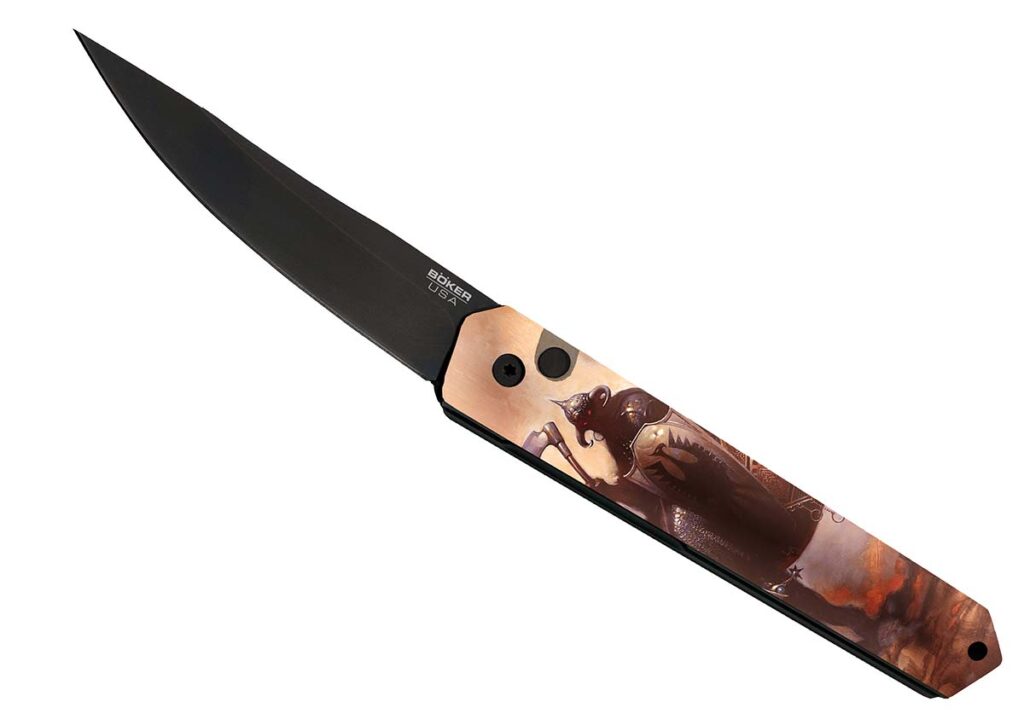
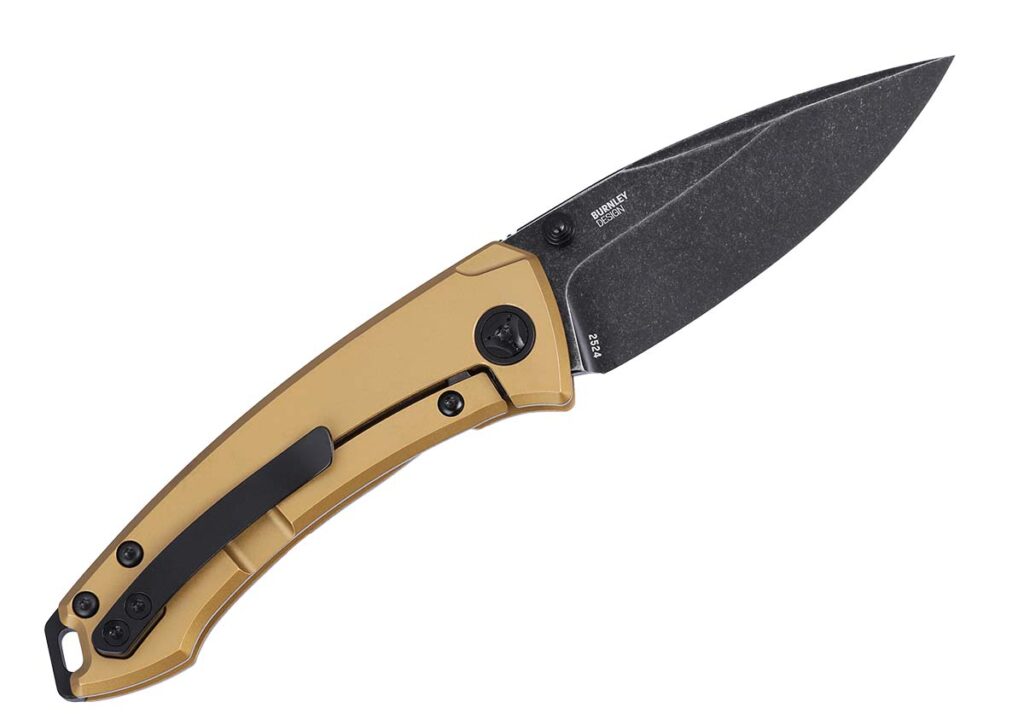
Lucas Burnley has designed several iterations of his Kwaiken for Boker, including the Kwaiken Auto Frazetta.

Suzi added that a higher profile in the industry can drive success.

“We are the R&D for a knife company,” she noted, “and when you approach them for a collaboration your social media resumé is very important.”

Making custom knives since 1994, Darriel Caston has concluded collaborations with numerous companies, including CRKT, Spyderco, Boker, V Nives, Kansept Knives and more.

“I’m prolific when it comes to designs,” he affirmed. “There are probably about 300 that I will never get to making. I’m an engineer by trade and my 3D drawings are almost ready for production, and that helps with the deals. They ask for STEP files [standardized 3D model data files for CAD and 3D printing] that can go right into machining. Sometimes we work with a prototype, and sometimes we work with a knife that I have been doing for quite a while.”

According to Darriel, one significant element of the collaboration is the retention of the rights to the design.

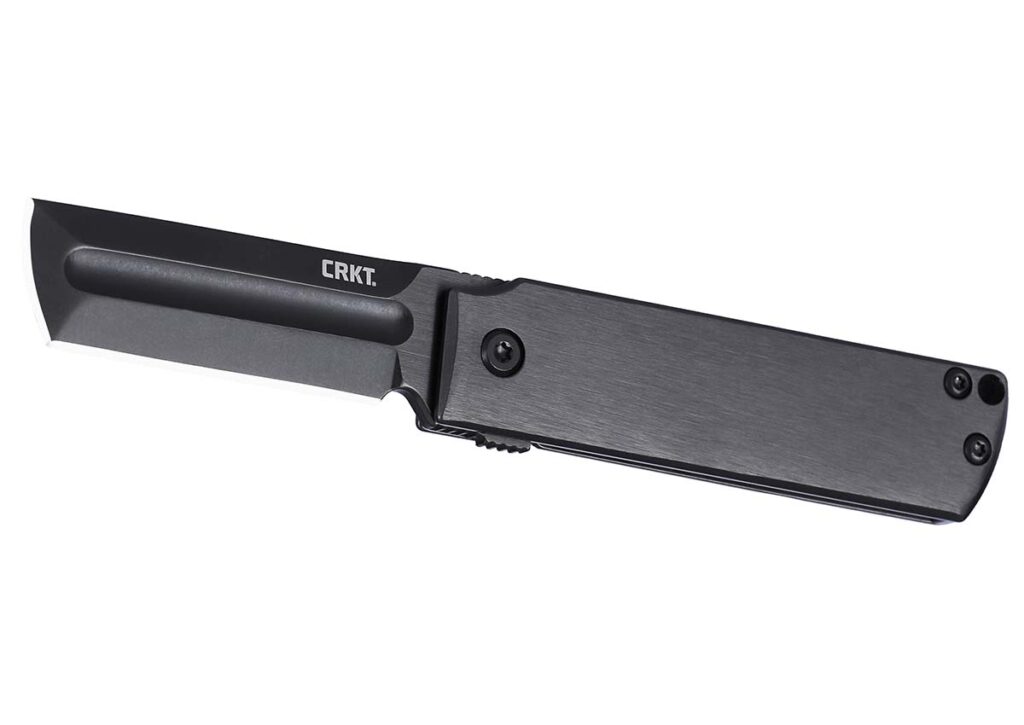
“Anybody who wants to do a collaboration must put footprints in the sand, get their work out there and show a story,” custom knifemaker Darriel Caston observed. One of his latest designs for CRKT is the blacked-out MinimalX framelock folder, an evolution of a knife originally made for SpaceX to commemorate a rocket launch.

“You never want to give up your design,” he warned. “I would license the design to the company usually up to four or five years, and the average is three years. After that, you can discuss if you want to continue if the relationship has been good for both parties. License the design and never sell it. If a company buys the design, then they own it forever. If it became their best seller, I could never make the knife again, and I would have to stay away from anything that looks like it.”

For Caston, every deal starts with a friendly conversation. As progress is made, attorneys draw up the contract. He sees the process as straightforward, whether dealing with an American manufacturer or a company headquartered in a foreign country.

“I find the knife community for the most part to be very honorable,” he commented. “I haven’t run into any bad juju. When you want to do a collaboration, I tell people they need to have a name and a track record of good designs with people following them on social media and stuff.”

Since his first collaboration—with Spyderco in 2015—Darriel can speak with confidence regarding the potential for success.

“It would be rare for someone to take a design to a company without a history or a footprint there. They look for your story,” he noted. “Anybody who wants to do a collaboration must put footprints in the sand, get their work out there and show a story. Then it becomes easier.”

Getting A Collab Off The Ground

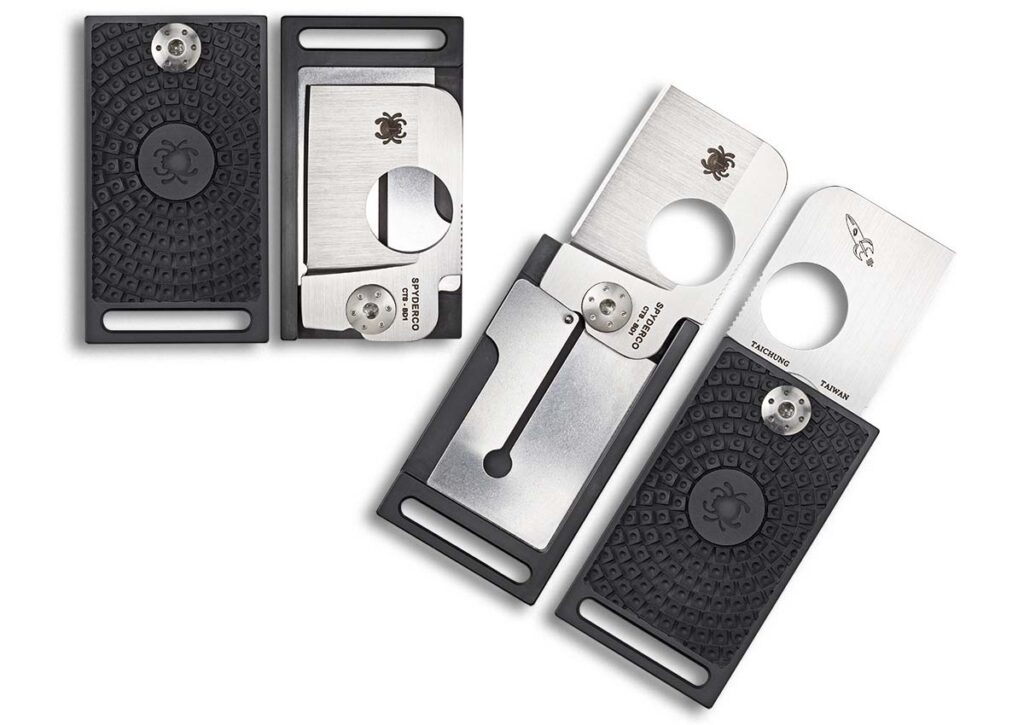
Darriel Caston has concluded collaborations with several companies. “I’m prolific when it comes to designs,” he affirmed. “There are probably about 300 that I will never get to making.” Now discontinued, the Squarehead was one of his early collaborations with Spyderco.

Custom maker/U.S. Marine Corps veteran Les George found early collaboration success at the SHOT Show some years back. He approached Pro-Tech a decade ago, and the association has continued since then.

“I had just finished my first batch of VECP [Value Engineering Change Proposal] mid-tech knives,” he remembered, “and I thought it would be cool to see Pro-Tech make the knife in an automatic. So, I did the CAD work to change the knife to an automatic and walked up to their booth at the SHOT Show. I asked to speak to the owner, and Dave Wattenberg came over and shook my hand. I drew a big breath and told him, ‘My name is Les George and I am a knifemaker and I have a design I think would be a great knife for you to make as an auto and I already have the CAD done would you like to see it?’ I said that all as one sentence in one breath!”

Still, a pragmatic view of the collaboration landscape demands preparation and planning. A so-called “cold call” may not meet with success.

“It depends on the company whether a direct approach will work or not,” George conceded. “Don’t walk up to a company at the BLADE Show and tell them you’re a hot maker and they should pay you to make one of your designs. Instead, walk up, introduce yourself, and show them with CAD pictures, a 3D printed model, or a real knife, and tell them why you think it would be awesome to work with them on a production project.”

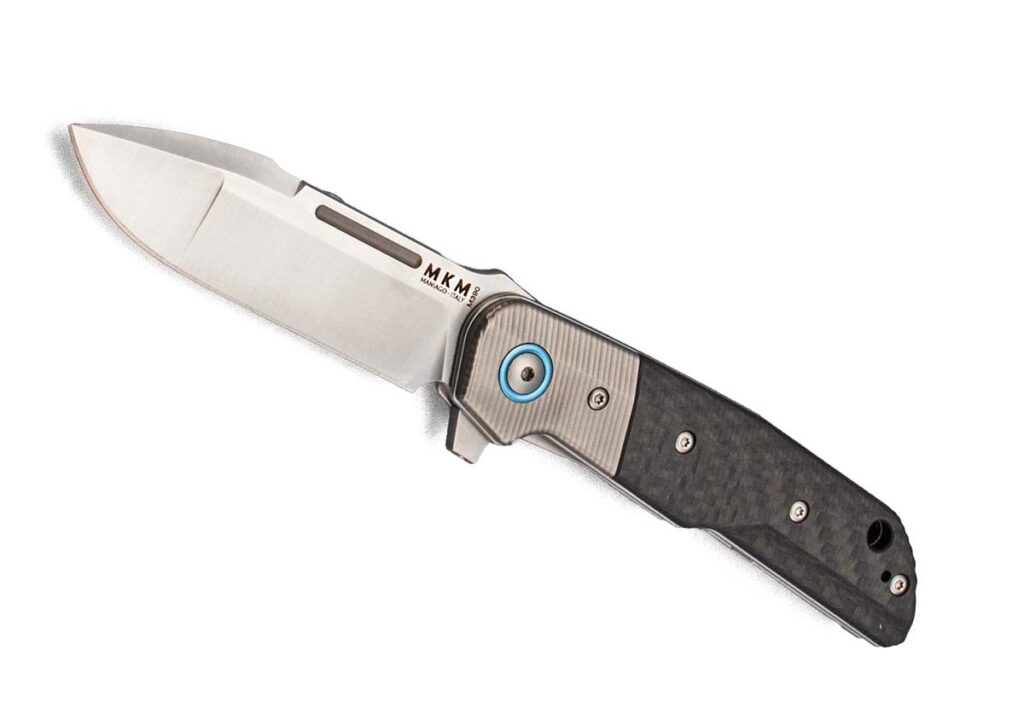
When it comes to her husband Bob’s collaborations, Suzi Terzuola takes the lead and has demonstrated proficiency in making the deal work for everyone involved. An example of several overseas Terzuola collaborations is the Clap from Italy’s Maniago Knife Makers.

Les sees the components of a particular collaboration deal varying. Of course, some of the structure depends on the negotiating skills of the parties. Commonly, the compensation may revolve around a percentage of dealer or distributor pricing on each unit, and particular deals may extend as long as each party is pleased with the progress.

“Collaborations should run as long as they are profitable,” Les remarked. “Companies don’t generally kill a successful project unless there is a capacity constraint issue or something else outside hindering it. Both parties can end the deal at any time with some allowances for production to finish with the things they have in progress already. Every contract I have ever seen gives one company the rights to exclusively make a particular model. My contracts have a provision that I can make as many customs of my models as I want. In the end, it would be counterproductive to license the same model to multiple companies. The maker would be competing with himself at that point, and it’s not helping the companies.”

Priming The Pump

Award-winning maker Lucas Burnley appreciates the help of friends in establishing a firm footing for collaboration.

“In general, I’m a big fan of pulling on my network,” he said. “If you have someone you can reach out to for an introduction, that’s always a strong move. If you don’t have someone to make an introduction, you might be able to ask around and at least figure out who you need to talk to. Regardless of how you get your foot in the door, I highly recommend going to a knife show and trying to set up a meeting in person.

“A design is only one part of a collaboration,” he continued, “so bring your ‘A’ game and think about what other value you can provide for the company. I was introduced to Boker by Jens Anso and Jesper Voxnaes, and Ken Onion put in a good word for me with Columbia River Knife & Tool. I’ll be forever grateful for those introductions and the relationships behind them. I’ve been able to pay it forward a few times, and hopefully I’ll be able to do it many more times in the years to come.”

Les George’s V14 dagger design for Spartan Blades was the BLADE Magazine 2014 Investor/Collector Knife Of The Year®.

In Burnley’s experience, contracts provide compensation most often in the form of monthly or quarterly royalties based on a percentage of sales. One-time lump sum payments are also seen; however, the income generated depends on the goals of the two parties involved.

“I want my designs to run until my grandkids are old enough to thank me for my good decisions,” he laughed. “If a model is selling, I want it to keep selling. On the flip side, I will routinely ask what models we can kill if they aren’t pulling their weight.

“One caveat here is that if a design is still in production, I want to get paid for it,” he concluded. “Some companies will offer a contract for a set period of time but have the option of continuing to produce the model. I view this as somewhat akin to a one-time payout. If it works for you great; just make sure you are paying attention.”

George specifically limits the number of companies he works with in order to give the relationships the priority he believes they deserve. Consistency, he says, is huge. Real, solid collaborations are not “get-rich-quick schemes.” He remembers getting his first collaboration check in 2014 totaling a whopping $6.

 “A design is only one part of a collaboration,” Lucas Burnley observed, “so bring your ‘A’ game and think about what other value you can provide for the company.” His Tuna Compact framelock design for CRKT is one of his latest collaborations.
“A design is only one part of a collaboration,” Lucas Burnley observed, “so bring your ‘A’ game and think about what other value you can provide for the company.” His Tuna Compact framelock design for CRKT is one of his latest collaborations. “A design is only one part of a collaboration,” Lucas Burnley observed, “so bring your ‘A’ game and think about what other value you can provide for the company.” His Tuna Compact framelock design for CRKT is one of his latest collaborations.

Times change—and checks change with good business practices, commitment, follow through, and most of all a process from contract to design and product that proves profitable for everyone.

More On Knife Collecting:

Bushcraft Tips and Tricks

0

Elevate your survival skills with these bushcraft tips!

A good bushcraft knife is characterized by its manageable size and weight, allowing for comfortable handling and easy resharpening.

Typically, a knife designed for bushcraft and carving tasks lacks spine gimping for the thumb. The cutting edge should have a continuous curvature that extends the entire length of the blade. A general-purpose bushcraft knife should have a blade that matches the width of your palm, with the tip aligned closely to the handle’s centerline. The handle and blade spines should remain on the same line.

The handle should feature an oval cross-section made from such materials as wood, Micarta® or plastic. It should not include finger cutouts that limit your grip, as such restrictions can lead to blisters. The handle length should fit comfortably in your palm. While Scandinavian blade grinds are standard for bushcraft knives, other blade grinds are also acceptable.

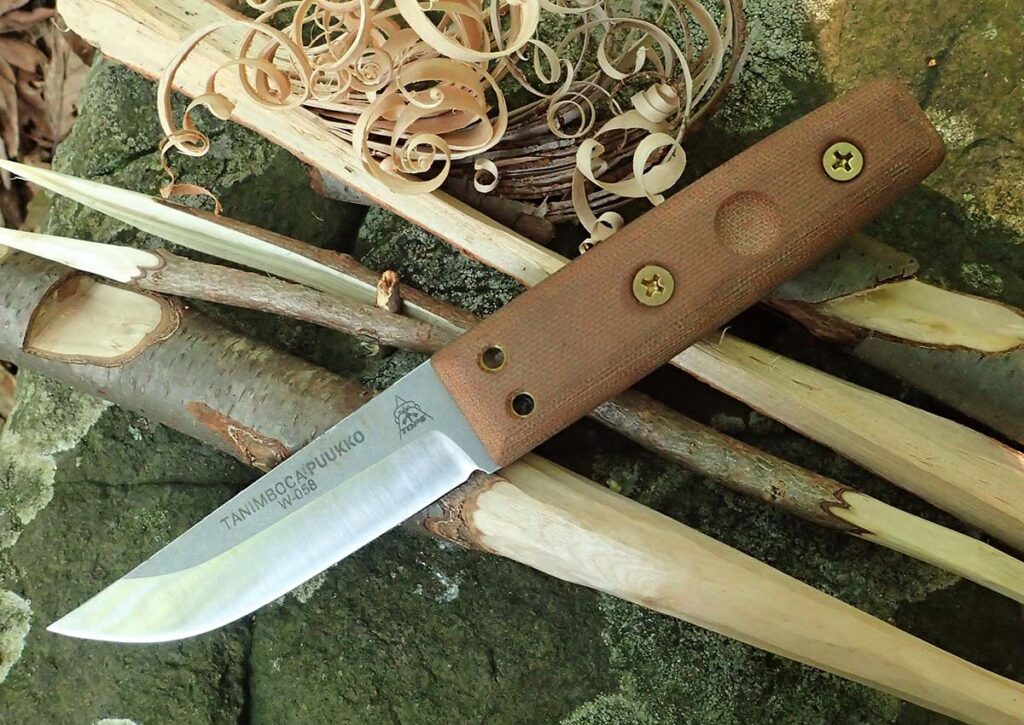
The Tanimboca Puukko from TOPS Knives made stakes, pot holders, fuzz sticks, bush forks, skewers, roasting sticks and traps. According to the author, it’s the perfect size for a bushcraft knife. Note the bow drill divot/socket on the handle for fire starting.

To quote Mors Kochanski, Canadian bushcraft and wilderness survival instructor and author of Bushcraft: Outdoor Skills and Wilderness Survival, “The knife is the smallest and most portable of all the cutting tools. Light and unobtrusive, the knife is readily available for hundreds of everyday tasks in bush living.”

Knife Safety

Always start with a safety briefing when working with tools, especially those that can cause serious injury. Books and teachings have provided several tips and procedures for knife use and safety. One key concept is the blood circle.

Stretch out your arm with the knife in hand and ensure you can make a complete circle without hitting anyone or anything, including tarps, backpacks, tents and water containers. The blood or death triangle is crucial when sitting and carving. Never use your leg as a backstop or cutting board. When removing large amounts of wood, cut to the side of your body on your dominant knife-hand side or lean forward, resting your forearms and elbows on your knees, keeping your work project and knife out of your blood triangle. Remember the blood circle. Some cuts, like a pull-cut, allow you to cut toward yourself in a controlled, slow manner, but generally cut away from yourself.

Bushcraft Grips And Cuts

Use an icepick grip to split small pieces of wood for a one-stick fire. Strike the knife and wood against a hard surface together, then twist slightly to split the wood.
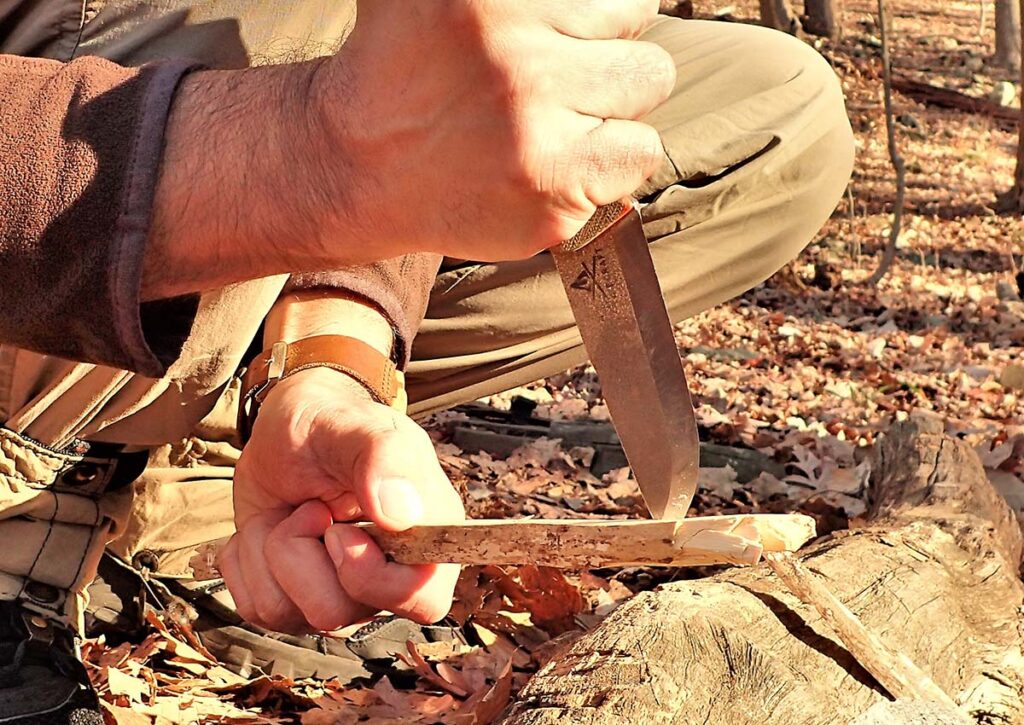
  • Forehand (Fist) Grip: The forehand grip is the most basic and natural way to hold objects securely. This grip is ideal for power cutting, allowing you to roughly remove a significant amount of material to shape the wood. To use this grip, curl all your fingers around the handle, creating a fist. Avoid placing your thumb on the knife’s spine, an everyday habit. Hold the wood off to the side, with the blade tip pointing slightly upward, and slice from the base of the blade to the tip. Lock your wrist and elbow and use your shoulder to push down as if punching through the floor. The motion resembles shrugging your shoulder. Alternatively, you can adapt this technique by pulling the wood back against the knife using your work hand.
    Pro Tip: This is not a jarring-of-the-elbow motion.
  • Thumb-Assisted Push Cut: This is commonly called a scissor grip cut. When viewed from above, the arrangement of the wood and the knife resembles the operation of scissors. It involves a thumb-assisted push cut, where the non-dominant hand’s thumb helps cut. The blade and wood pivot together like scissors, while the thumb on the non-knife hand presses the back of the knife into the wood. This technique features a short-cutting reach, applies soft-to-medium force, and offers a high degree of control. It is a more refined and detailed version of the chest-lever grip with a thumb-assisted push cut.
  • Chest-Lever Grip: The chest-lever grip is a powerful and controlled cutting technique commonly used in bushcrafting, characterized by a typical palm-up grip. To execute this cut, engage your lat muscles and leverage your body for power. Start by turning the knife blade outward to your right (if you’re right-handed) with your palm facing up. Grip the knife firmly, placing your thumb on the handle or side of the blade while your other hand holds the workpiece. Once the blade contacts the area you want to cut, rotate your shoulders forward and pull your hands apart as your shoulders open up, leveraging against your torso. Keep your hands connected to your ribs throughout the process. This technique and the forehand grip allow you to make powerful cuts for removing significant amounts of wood.
  • Peel Grip: Also known as a draw grip, apple peeling grip or paring grip, the peel grip facilitates more detailed, finishing cuts rather than powerful ones. Use it to finish the ends of a spoon handle, shape the top of the spoon bowl, chamfer a tent stake or trim wood to achieve a flat surface. To execute the peel grip, hold the knife in a reverse position with the blade facing you. Place your fingers on the back of the knife handle, positioning your thumb on the back end of the workpiece while your other hand clasps the work. Keep your knife-hand thumb out of the blade’s path as you close your hand into a loose fist, allowing for a slow, controlled cut. Author’s note: This grip is helpful for precise carving and finishing the edges of items.

Bushcraft Techniques

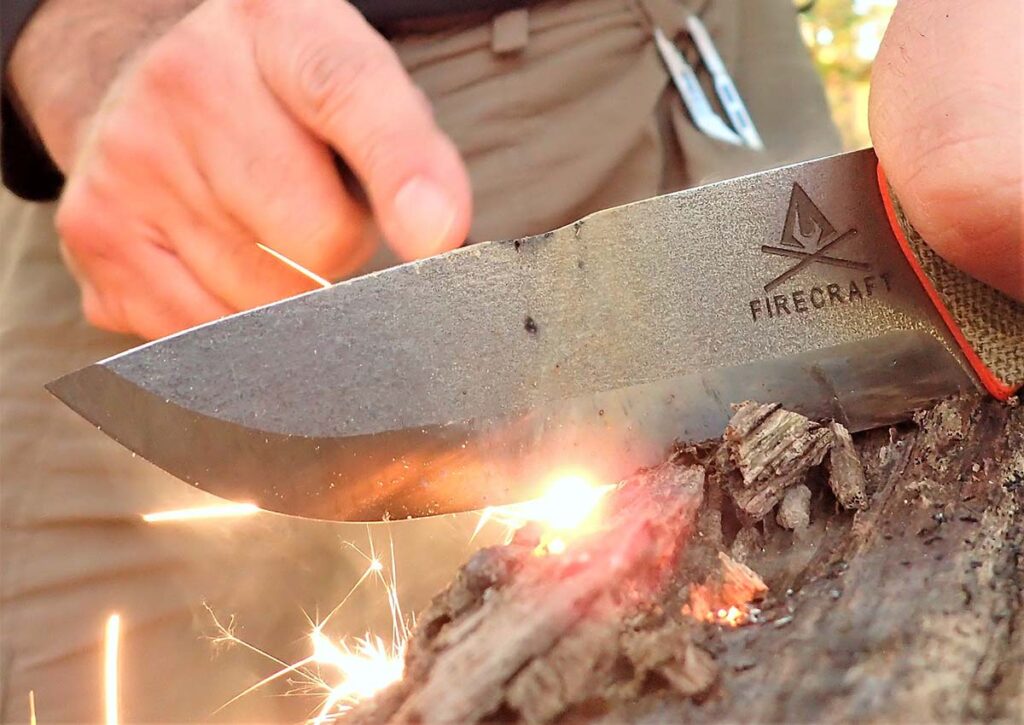
The author strikes the supplied ferro rod against the fire notch to ignite the tinder.

After addressing the basic grips, it’s time to learn a few helpful knife techniques commonly employed in bushcraft. Practice them at a comfortable pace and avoid rushing.

  • Bushcraft Batonning: A knife alone often lacks the weight needed for effective chopping. However, striking the blade’s spine with a heavy object can produce strong cuts. A sturdy, comfortably held stick serves as a baton to help cut down and limb small trees, making various cutting tasks much more straightforward. You can quickly cut through branches and small saplings using a knife and a baton. Bushcraft batonning describes using a baton for controlled cross-grain cuts, creating V-notches and splitting wood no wider than your wrist. Using a baton for limbing branches generally proves faster and safer than using an axe.
  • Beaver Chew: To cut a green or dry branch to the desired size, use the beaver chew technique, which leaves a somewhat rounded end for pounding into the ground. Make a series of cuts (nicks) around the stick. Thicker sticks require more time, so repeat this process several times, cutting deeper with each pass. Once the cut is halfway or two-thirds through the stick, you can break it off and trim the end.
  • Tension Cutting Saplings: To take down small green trees up to wrist size in thickness, first apply tension by bending the tree while holding it firmly with one hand. Start your cut at a 45-degree angle at the bend point, where the stress is most significant. There’s no need for a sawing motion; instead, use a gentle rocking back and forth with the blade to slice through the fibers under tension. Be careful during the crucial last part of the cut, as you need to restrain the tree from falling prematurely, which would require extra work to finish the cut. If done correctly, this process should take no more than 10 seconds.

To section long saplings, step on the top to hold it and bend it over your thigh or hip. Cut the bend to ensure avoid cutting yourself during the follow-through.

Pro Feather Sticks

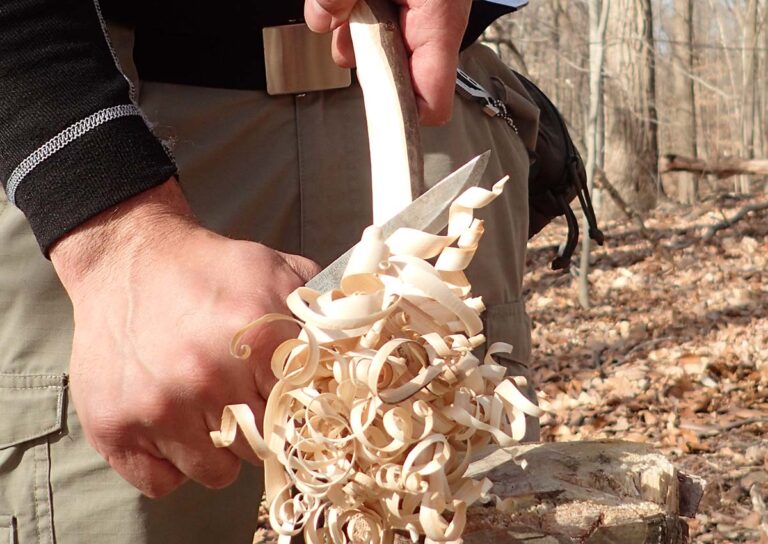
Creating tinder by shaving very thin pieces and kindling from deadwood is known as making a feather or fuzz stick. You can use various techniques but here’s the most basic approach.

Start with a forehand grip and resist the urge to place your thumb on the spine of your knife. Using gimping or a gimping grip applies uneven pressure, which often causes feathers to detach from the stick. When you reduce green wood for carving projects, think ahead and keep the shavings for fire making, regardless of their thickness. Thinly shaved greenwood dries quickly. Try to make them as thin as possible or save larger shavings to use as kindling. Emphasizing multi-use and maximizing the utility of everything you work on and cut truly embodies bushcrafting!

Try Stick It!

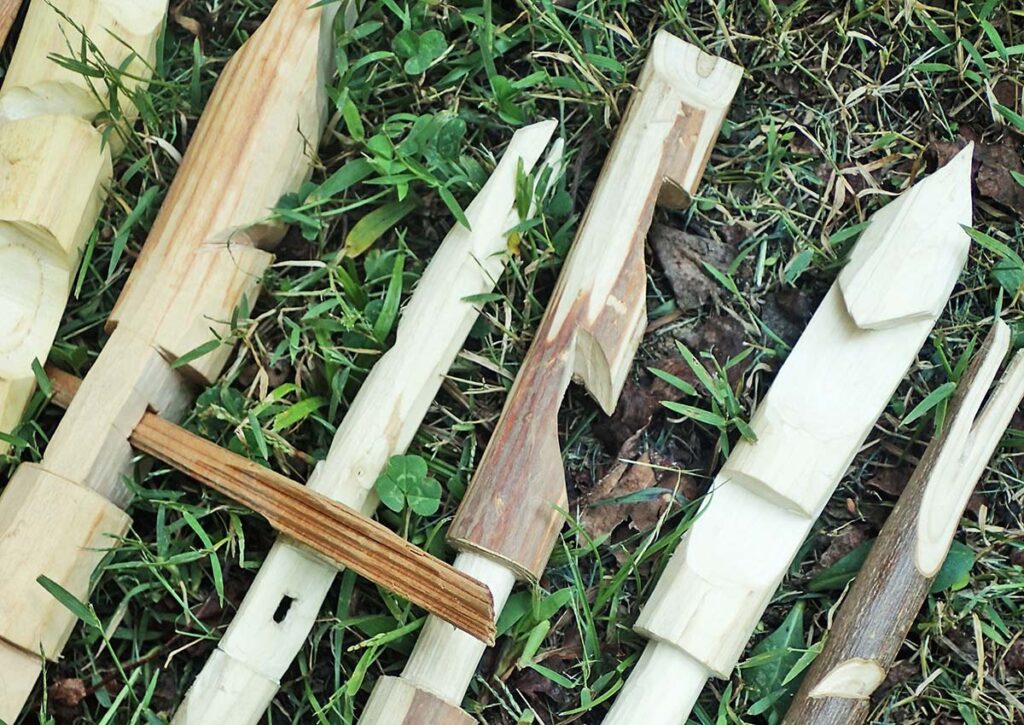
The author carved various try sticks with essential notches and additional features.

The Try Stick, made famous by wilderness educator, survival instructor and author Mors Kochanski, is a tool designed for practicing and showcasing knife skills in wood carving. While some notches are functional and often used to create items such as tent pegs, pot hangers and digging sticks, many notches on a Try Stick are more decorative and less commonly utilized. You can incorporate around 17 different types of notches on a Try Stick, but including as many as possible is typical. There’s no required number of notches to create; a Try Stick focuses on knife handling and safe practice.

Try Stick Notch types include:

  1. Round Notch
  2. Pot Hook
  3. Saddle Notch
  4. Square Notch
  5. Mitred Lapped Notch
  6. Jogged and Wedge Splice
  7. Dovetail Pin and Socket
  8. Dovetail Notch
  9. “V” Notch
  10. Spear Notch
  11. Knife Tip Mortice
  12. Diameter Reduction
  13. Knife Edge
  14. Split
  15. Bow Notch
  16. Latch Notch
  17. Bark Stripping
  18. Whistle Project

Check Out More Outdoor Knives:

Hawaii Knife Ban Stopped In Its Tracks

Vagueness of bill could have potentially banned the carry of all but a few knives.

Hawaii Knife Ban bill SB 433, which would have banned all carry of most knives and all knives in many public places in Hawaii, has been stopped. The stoppage occurred because the bill failed to receive a hearing by the stated deadline.

According to Knife Rights, one of the worst aspects of the bill was its vagueness. The bill added “bladed weapons” to the state’s sweeping firearms bans, which would have been expanded in SB 433.

“As written, nobody, not a resident, not a police officer, not a prosecutor, could possibly look at the proposed statute and know for sure what a ‘bladed weapon’ is that is being banned,” KR reported. “This is fundamentally unconstitutional and leaves the law open for law enforcement and prosecutorial abuse. Terms that capture everyday tools carried daily by the public for perfectly lawful uses should be defined crisply and clearly to provide fair notice as required by longstanding law.”

The bill banned all undefined “bladed weapons” everywhere in Hawaii except for switchblades and butterfly knives.

“So,” KR noted, “a not at all unreasonable interpretation of [‘bladed weapons’] would have banned carry of a common pocketknife in Hawaii, except for [switchblades and butterfly knives]! Who decides whether it’s a ‘bladed weapon’? Certainly not the average resident or visitor.” 

In other examples, fillet knives used for recreational, subsistence and commercial fishing and hunting knives used for boar hunting—a popular means of reducing feral hog populations on the islands and a popular tourist business—could have been banned, as could a box cutter carried to work by a warehouse worker.

More On Auto Knives:

Blunted Blades And Knife Bans: England Has Gone Over The Edge

England has had an uptick in knife crime in recent years, including the horrible incident costing three young girls their lives in Southport. Certainly, crime of any kind deserves scrutiny and solutions so that society can conduct its daily affairs in a safe and secure environment. Unfortunately, it’s never the calmer heads that prevail when dark winds blow.

Case in point, the utterly asinine suggestions emanating from the host of a BBC documentary on UK knife crime.

From the New York Post:

“Actor Idris Elba announced amid his forthcoming knife crime documentary that the United Kingdom must consider “innovative” prevention methods such as blunting or banning knives.”

Let that sink in… blunting or banning knives. And he’s not talking about neutering simply what might be considered “scary” knives—tactical fixed blades, karambits and the like. No, it’s the whole megillah.

He said in the Post article:

“The truth is that kitchen knives are perhaps 25% of the knives used in most terrible crimes. That’s one of the stats in the film. And those kitchen knives are usually a domestic situation,” Elba warned. “So kitchen knives… of course, it’s very difficult. They’re a domestic knife.”

This walks hand in hand with other extreme actions that have taken place in England regarding knife sales. One of the more atrocious, ID requirements and live video sales to purchase knives online. Why, the next thing you know there’ll be a proposal for licensing knives.

Well, you don’t have to wait long for that either.

Elba thinks this might be the panacea for his country’s woes, banning nearly everything, and licensing those scant few deemed worthies to own their family’s cherished sword or knife.

“So let’s ban them all, and if you have one of those knives, get a license for it,” he suggested of people wanting to keep family heirloom swords. “Simple as that.””

And if you think this sentiment is contained to one crackpot actor, well you’d be wrong.

According to The Telegraph:

“A ban on the sale of pointed kitchen knives has been backed by the Church of England, judges, top trauma doctors and psychiatrists, the police and victims as they argue that it would make life-threatening injuries far less likely.”

It’s unfortunate England has endured an uptick in knife crime, yet this isn’t the license for it or certain segments of it to go off the deep end. I know it might sound crazy, but perhaps the English should address the root of the problem—the perpetrators.

The harsh truth is this: no amount of blunted blades, banned kitchen knives, or bureaucratic licensing schemes will stop individuals hell-bent on violence. You can’t legislate evil out of existence by targeting inanimate objects. England doesn’t have a knife problem—it has a people problem. A system problem. A failure-to-act-when-it-matters problem.

Axel Rudakubana—the perpetrator of the Southport killings—wasn’t some shadowy figure hiding in the margins; he was a neon warning sign flashing in plain sight. Reported repeatedly, known to authorities, radiating red flags—and yet, nothing substantial was done. But instead of holding systems accountable for their glaring incompetence, the knee-jerk reaction is to demonize cutlery.

Blaming knives for violent crime is as absurd as blaming spoons for obesity. The issue isn’t the tool; it’s the hands that wield it—and the institutions that refuse to act until it’s too late. England doesn’t need another ban. It needs accountability, courage, and the will to confront the real problem: violent individuals, not the utensils in their kitchens.

More on Knife Laws:

2024 Knife World In Review

See what the highlights, low lights and everything in between were for the knife world in the past year.

Like most years, 2024 had more than its share of ups, downs and continuations of the same. From the promising developments in American-made factory knives to the harmful effects of Hurricanes Milton and Helene on knifemakers and at least one knife show, there were the goods, the bads, gains, losses, victories, debuts, swan songs and more. Among them:

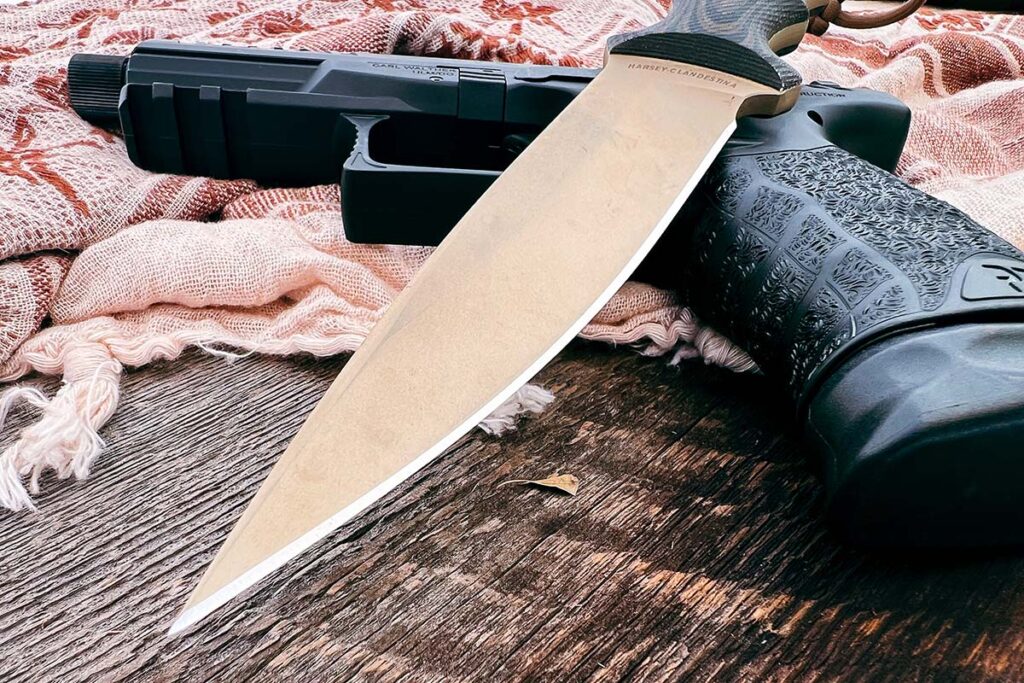
Spartan Blades Clandestina blade
Spartan Blades Clandestina
  • Newer and older knife companies alike, such as Montana Knife Co., Emerson Knives, Inc., Hawk Knife Design, Tactile Knife Co., White River Knife & Tool and others, lead a surge in quality American-made knives;
  • Original portions of the hull, deck and other parts of The Battleship Texas are distributed to artisans around the country, including bladesmiths and knifemakers such as Harvey Dean, Jason Fry, J. Neilsen, Jack Stottlemire, Greg Coker and many others, to make items they specialize in and donate them to raise money to restore the pre-World War I dreadnought (https://battleshiptxartisans.com/catalog/);
  • A boom in the number of international countries (35) with exhibitors at the BLADE Show, led by France (21 exhibitors), South Africa (18), Italy (14) and Brazil (13), reflect the continuing recovery from the devastating effect of the worldwide pandemic;
  • Spartan Blades headlines the BLADE Magazine Knife-of-the-Year® awards at the BLADE Show with the company’s first Overall Knife of the Year, the Bill Harsey designed Clandestina. It was company’s first ever win in the prestigious category;
  • Speaking of Harsey, he, along with Ted Dowell and Don Fogg, become the 72nd, 73rd and 74th members of the BLADE Magazine Cutlery Hall of Fame®;
  • In what promises to be the first of several, Cutlery Hall-of-Famer Bill Ruple and Case debut their inaugural collaboration, the Bill Ruple X Case Axe Handle;
  • CPM MagnaCut stainless continues its run as the No. 1 blade steel among factory knives;
  • After almost 30 years with Spyderco, including stints in customer service and as marketing manager and coordinator of all things public relations, past BLADE Magazine Publisher’s Award winner Joyce Laituri calls it a career;
  • ABS master smith Kevin Cashen is named new chairman of the American Bladesmith Society, succeeding ABS master smith Steve Dunn, who passed away unexpectedly May 21;
  • After its original lawsuit was dismissed in June on “absurd standing grounds,” Knife Rights files a new federal lawsuit in September challenging the constitutionality of portions of the Federal Switchblade Act;
  • Hurricanes play havoc not only with the Southeast USA but knife industry members in the affected areas, with Milton postponing the Louisiana Knife Show and Helene flooding and/or temporarily shutting down at least two North Carolina knifemaking operations, including Winkler Knives and Dogwood Custom Knives, and no doubt others elsewhere;
  • Companies/knives celebrating anniversaries include: Boker (155th); Tru-Bal Knives, aka Tru-Balance Knife Co., (75th); Kershaw (50th); Fallkniven (40th); and the Emerson Knives, Inc. CQC-7 (25th);
  • Finally, a number of friends of the knife community pass away, including: scrimshander Gary “Garbo” Williams; bladesmith/mokume gane guru Phillip “Phil” Baldwin; knifemaker/past National Knife Collectors Association president Bob Cargill; ABS master smiths Steve Dunn and Hanford Miller; long-time custom knife collector Walter Hoffman; veteran knifemaker Dave Ricke; Mrs. Lori Buck (wife of Cutlery Hall-of-Famer Chuck Buck); Mrs. Sallie Bos (wife of Cutlery Hall-of-Famer Paul Bos ); Mrs. Betty Dowell (wife of Cutlery Hall-of-Famer Ted Dowell); Cutlery Hall-of-Famer B. R. Hughes; and past BLADE art director Jim Sasse. God rest their souls—and please forgive me if I’ve omitted anyone.
Advertisement

Must Read Articles

Read this before you make a knife

Knifemaking 101 – Read This Before You Make a Knife

  by Wayne Goddard My experience has taught me that there's nothing like digging in and getting started. I've often said the hardest part of the...
how to forge damascus steel

How to Forge Damascus

Advertisement
Advertisement