
Top Knife Sharpeners: Five Options To Keep Your Edge

Keep your knife cutting ready with today’s top sharpeners.

It’s not much of a knife if it’s dull. Getting a blade sharp and keeping it that way is what the top sharpeners are all about. Pull throughs, V sharpeners, adjustable angle models and more, contemporary sharpeners not only will keep your knives keen, some are multi-tools with Torx tools and bits, screwdrivers, fire starters and window breakers. From those for use in the kitchen, camp or workshop to portable use and more, make way for today’s sharp makers.

Lansky Master’s Edge Sharpener
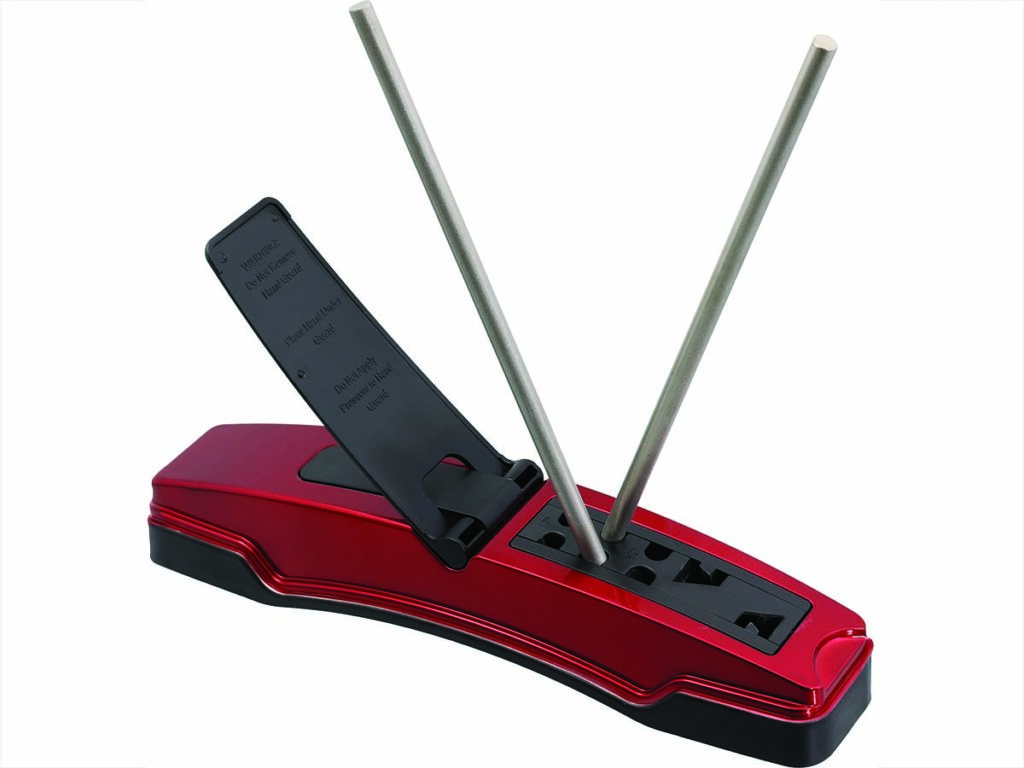
The Lansky Master’s Edge All Diamond Sharpener has a rubberized non-slip base with integrated hand guard for safe use.

Master’s Edge All Diamond Sharpener
Model type: V sharpener
Type of abrasive: Diamond coated
Grit: 400 & 600 grit round rods; triangular rod for serrations
Types of knives sharpened: Fillet/slicing, butcher, paring, skinning/kitchen/hunting, camping, utility and chef’s
Types of edges sharpened: Plain and serrated
Weight: 1.4 lbs.
Country of origin: China
MSRP: $139.95

Inspired by the design of Lansky’s top-selling Master’s Edge Sharpener, the Master’s Edge All Diamond Sharpener and its diamond-coated abrasives put a factory edge on hunting, utility, kitchen and other knives with just a few strokes. The unit includes a pair of medium (400 grit) and fine (600 grit) diamond-coated-abrasive rods for sharpening and polishing at your choice of preset angles: 17, 20 and 25 degrees. The 17-degree setting is for fillet and fine slicing knives, while the 20-degree angle is for slicing, butcher, paring and skinning knives. The 25-degree setting sharpens hunting, camping, utility and chef’s knives. A diamond-coated triangular rod sharpens serrated blades and also awls and fishhooks. A rubberized non-slip base with integrated hand guard ensures safe use and features easy snap-in storage in its underside. The unit can be kept on a counter or stores easily in a drawer.

Work Sharp Folding Field Sharpener
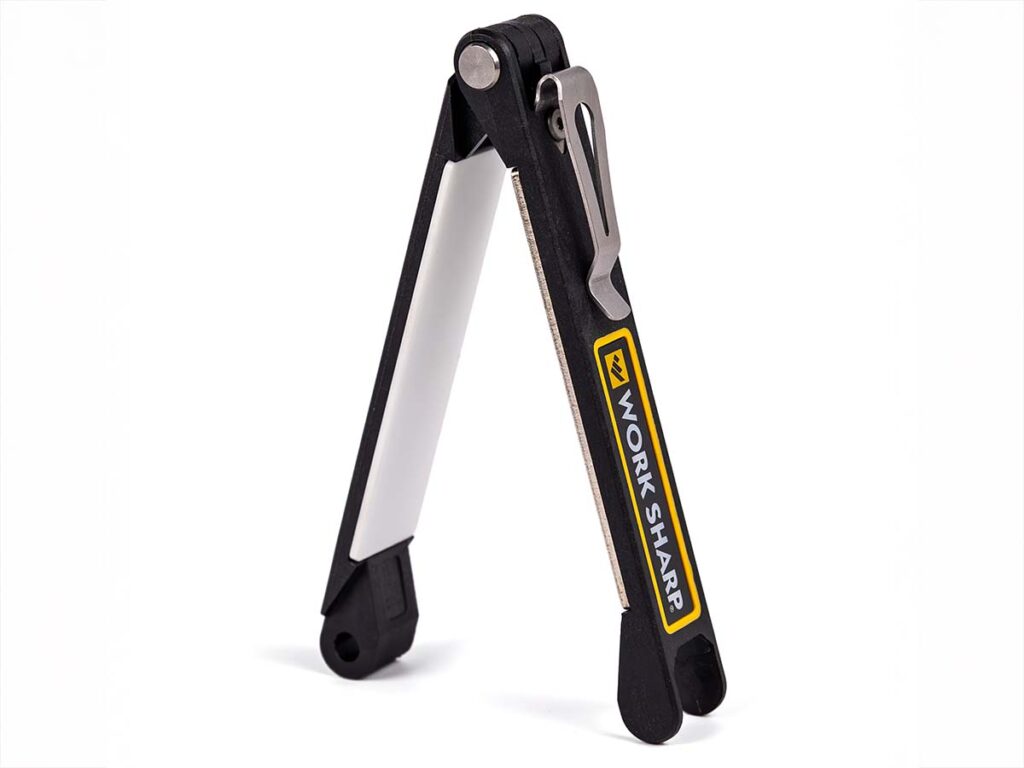
Especially effective on EDC knives, the new Work Sharp Folding Field Sharpener is one whiz-bang of a portable unit.

Folding Field Sharpener
Model type: Compact field sharpener
Type of abrasive: Diamond grit plate and fine grit ceramic plate
Grit: Coarse 400-grit for each plate
Unit dimensions:  4.75 x .75 x .5”
Unit materials: Sharpening plates, plastic, aluminum
Types of knives sharpened: Pocketknives, hunting knives, EDC
Types of edges sharpened: Plain 
Special features: Folding design; edge angle guides (20 & 25 degrees) help maintain a consistent angle when sharpening and honing; pocket clip
Weight: 4.6 ozs.
Country of origin: Designed, calibrated and quality checked in Ashland, Oregon, using foreign components
MSRP: $29.95

The Work Sharp Folding Field Sharpener is a compact, lightweight model designed for on-the-go sharpening. It features a 400-grit diamond plate with 20-degree sharpening guides and a fine-grit ceramic plate with 25-degree honing guides, ensuring consistent, reliable edges wherever you are. The folding design and integrated pocket clip make it easy to carry almost everywhere. A big package in a small platform, it’s designed to bring back an edge after a hard day’s use or simply for touchups. Especially effective on EDC knives, it is one whiz bang of a portable-type sharpener.

CRKT Knife Maintenance Tool
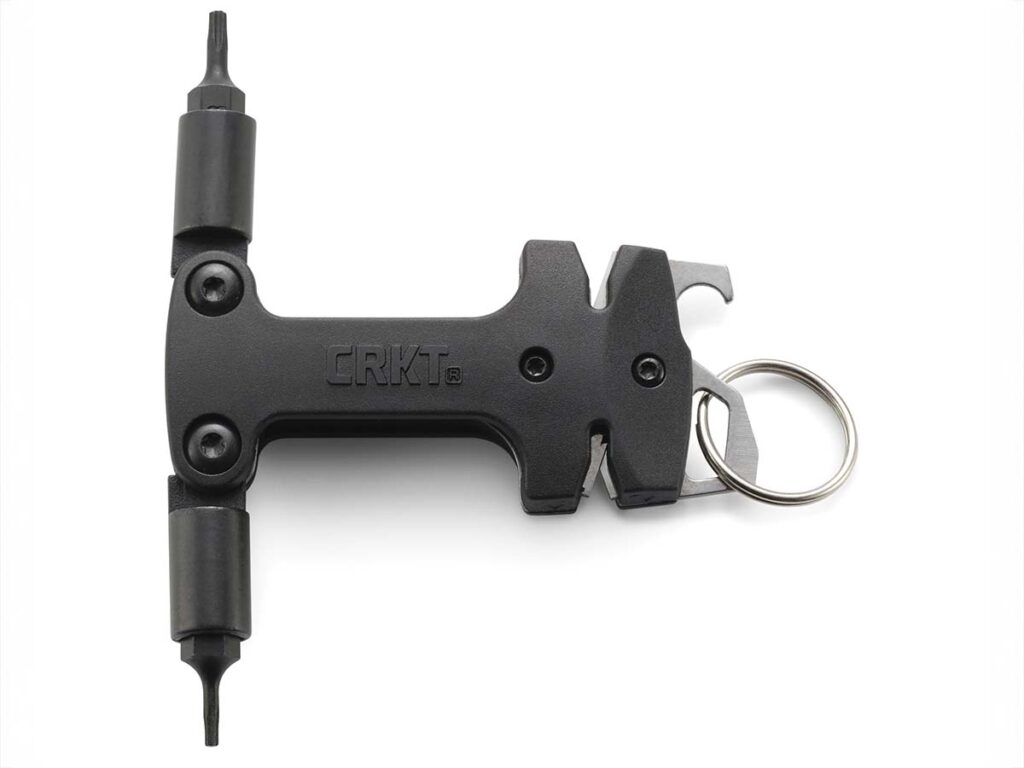
Designed by Tom Stokes, the CRKT Knife Maintenance Tool is two sharpeners and a multi-tool all rolled into one.

Knife Maintenance Tool
Model type: Keychain/pocket field sharpener and multi-tool
Type of abrasive: Tungsten carbide sharpener with ceramic honing edge
Unit dimensions: 2.7 x 1.18 x .47”
Handle: Glass-reinforced nylon
Types of knives sharpened: Pocketknives, EDC
Types of edges sharpened: Plain
Special features: T6 and T8 Torx tools/bits, flathead screwdriver, bottle opener, keychain compatible
Weight: 2.2 ozs.
Country of origin: China
MSRP: $30

Designed by mechanical engineer Tom Stokes, the CRKT Knife Maintenance Tool is a multi-tool sharpener that reflects Tom’s more than 25 years of experience in the aerospace industry, including his work with CAD software and rapid prototyping technology. He designed the Knife Maintenance Tool to prepare you for life’s various exigencies, everything from emergency repairs, popping a top on your favorite beverage—and, yes, sharpening your knives.

The Tool includes two pull-through sharpeners—one a tungsten carbide abrasive to establish a sharp edge, the other a ceramic abrasive to fine tune it—and two sizes of Torx tools/bits: T6 and T8. The sharpeners are on either side of the front of the handle, which is topped off with a bottle opener and flat-head screwdriver/lanyard hole for a keychain loop. The Torx tools are also on either side of the handle and fold out independently of one another for torquing screws pistol-grip style.

Wicked Edge GO-WE60 Precision Knife Sharpener
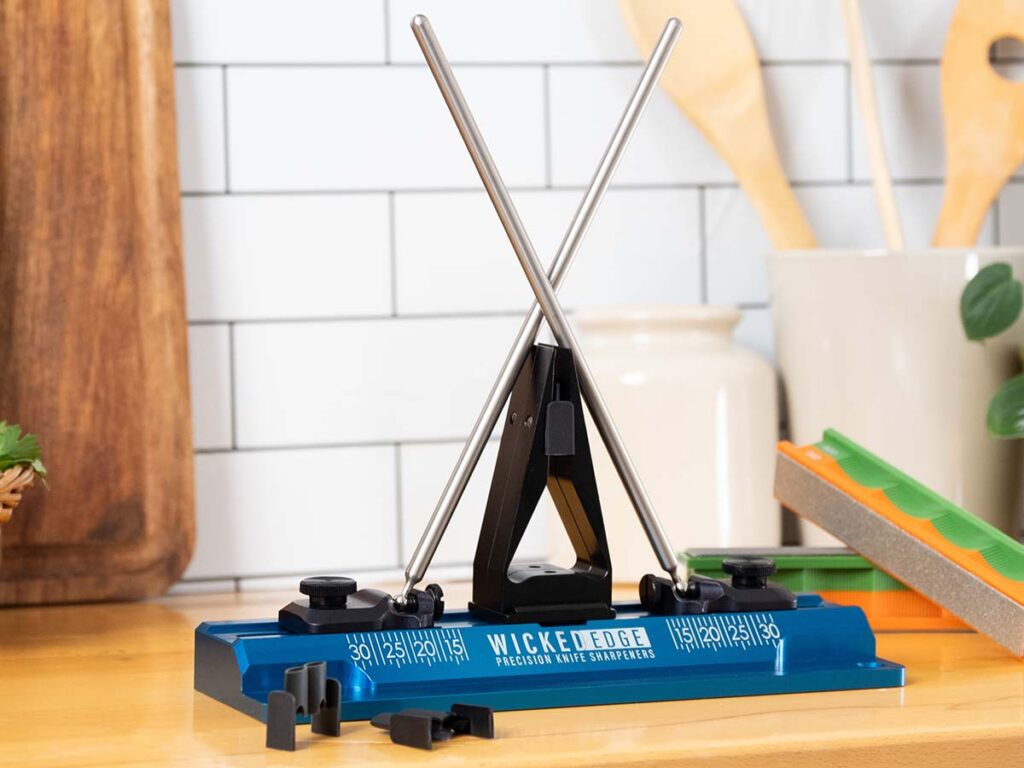
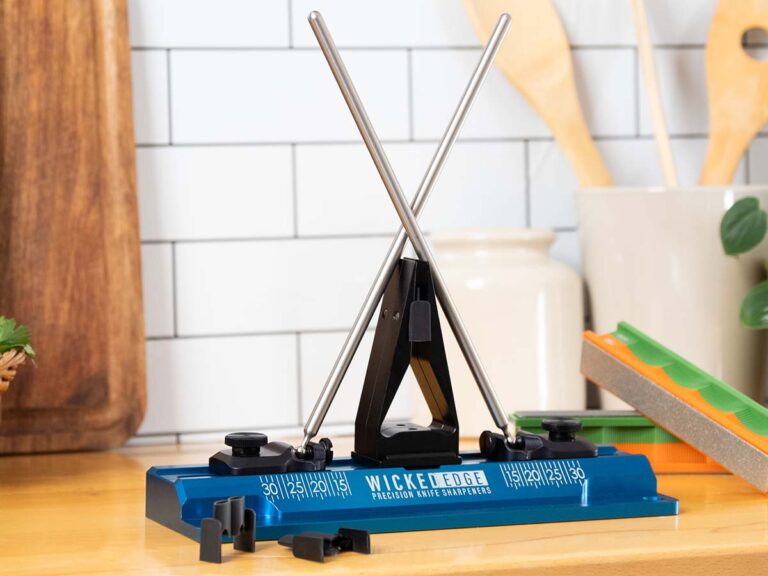
Premium abrasives on the Wicked Edge GO-WE60 are 200/600 grit monocrystalline diamond-coated stones.

GO-WE60 Precision Knife Sharpener
Blade Length Capacity: Up to 15”
Blade Thickness Capacity: Up to .25” (longer screws available for thicker blades)
Angle Markings: Calibrated for the blade’s edge to sit at 5/8” above the top of the vise
Guide Rod Length: 8.75”
Unit Weight: 3.6 lbs.
Country of origin: USA
MSRP: $299

The Wicked Edge GO-WE60 Precision Knife Sharpener is designed for novices and seasoned old pros alike, whether at home, in the field or on the road. A redesigned standard vise clamps fully flat-ground and distally tapered blades such as on pocketknives and household cutlery. Sharpening angles are adjustable from 13 to 31 degrees per side (26-62 degrees inclusive) in 1-degree increments for precise edge maintenance. Premium abrasives are 200/600 grit monocrystalline diamond-coated stones. Mounting options include securing to any flat surface with the included C-clamp or attaching directly using predrilled holes.

Bear & Son GATCO Scepter 2.0 Diamond
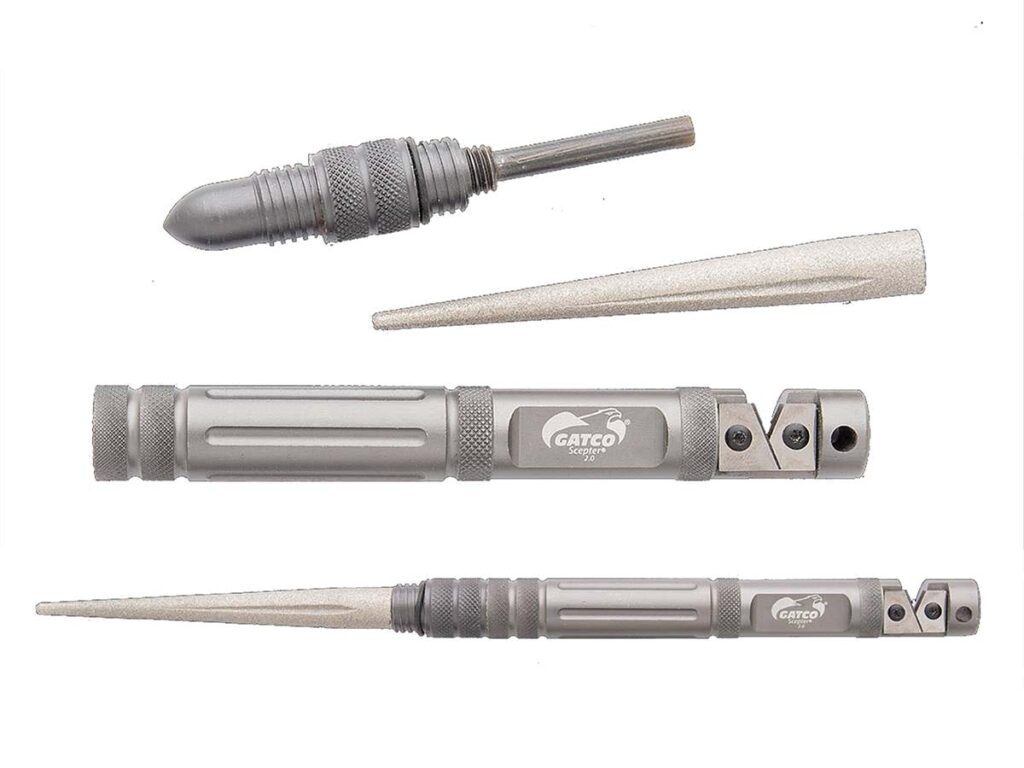
The multi-purpose GATCO Scepter 2.0 sharpens plain and serrated edges and has a magnesium rod for starting fires.

GATCO Scepter 2.0
Model type: Pull through and tapered diamond rod
Type of abrasive: Diamond coated and tungsten carbide
Unit dimensions: 6.125″
Unit material: 6061-T6 aluminum housing
Types of knives sharpened: Hunting, EDC, kitchen
Types of edges sharpened: Plain and serrated
Special features: Tapered diamond rod, magnesium fire starter rod, window breaker
Weight: 3.2 ozs.
Country of origin: China
MSRP: $49.99

The compact GATCO Scepter 2.0 Diamond Take Down Sharpener & Fire Survival Tool from Bear & Son is a multi-purpose implement for everyday pocket carry, the toolbox, to take camping and/or makes an ideal necessity for your bug-out bag. A magnesium rod for fire starting stows inside the tapered diamond sharpener, the latter which includes a groove for sharpening fishhooks. The rod and tapered sharpener are contained inside the CNC-machined, 6061-T6 aluminum carbide body, which has a pull-through tungsten carbide sharpener on the end. Each component features precision-machined threads and an outer “O” ring.

More Sharpening Articles:
Knife Sharpeners: To The Nth Degree

0

Three top sharpeners help you determine the proper sharpening angle.

Understanding sharpening angles is crucial for maximizing your knife’s performance. It doesn’t matter if you’re slicing a ripe tomato or carving a roast, the right angle makes all the difference. Let’s dive into the world of knife sharpening, where tradition meets innovation, and discover the top-tier systems that will keep your blades razor sharp.

I had three sharpening systems to use over one month. Luckily, I had a variety of knives that needed sharpening. I delegated what I felt were the appropriate knives for the sharpening system at hand.

One thing that was essential with each sharpener was safety first. Before you do anything, read the instructions and watch the video supplied by the manufacturer (if the latter is applicable). Move slowly—wearing light work gloves that offer dexterity wouldn’t hurt.

A.G. Russell Knives V Sharpener

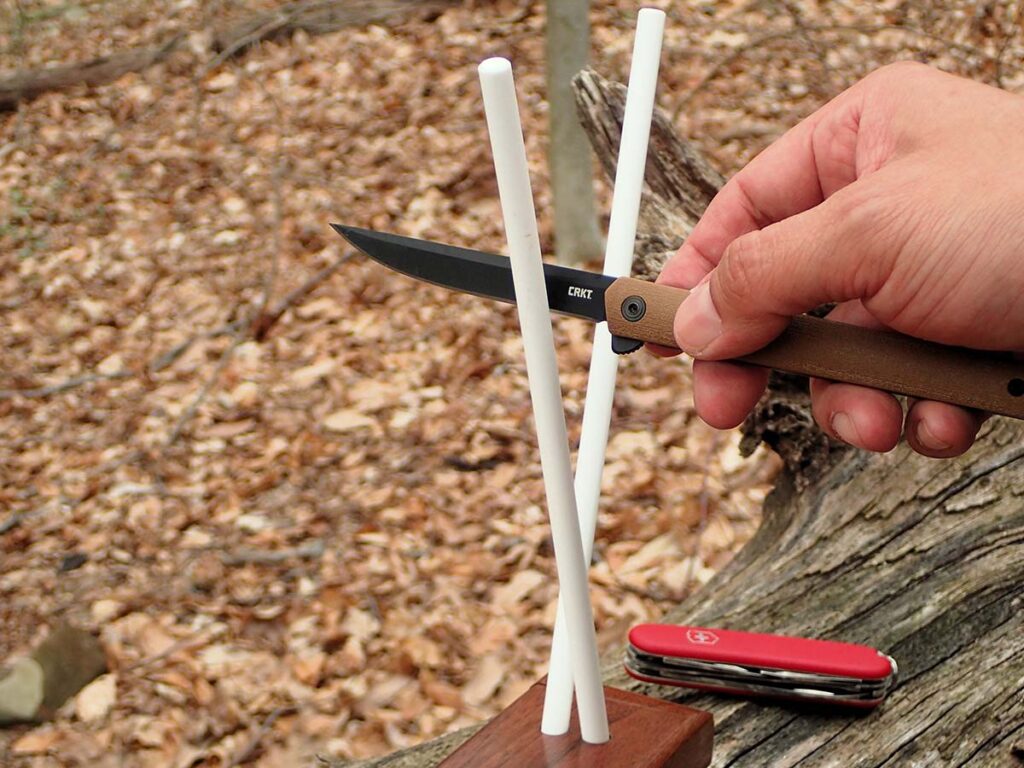
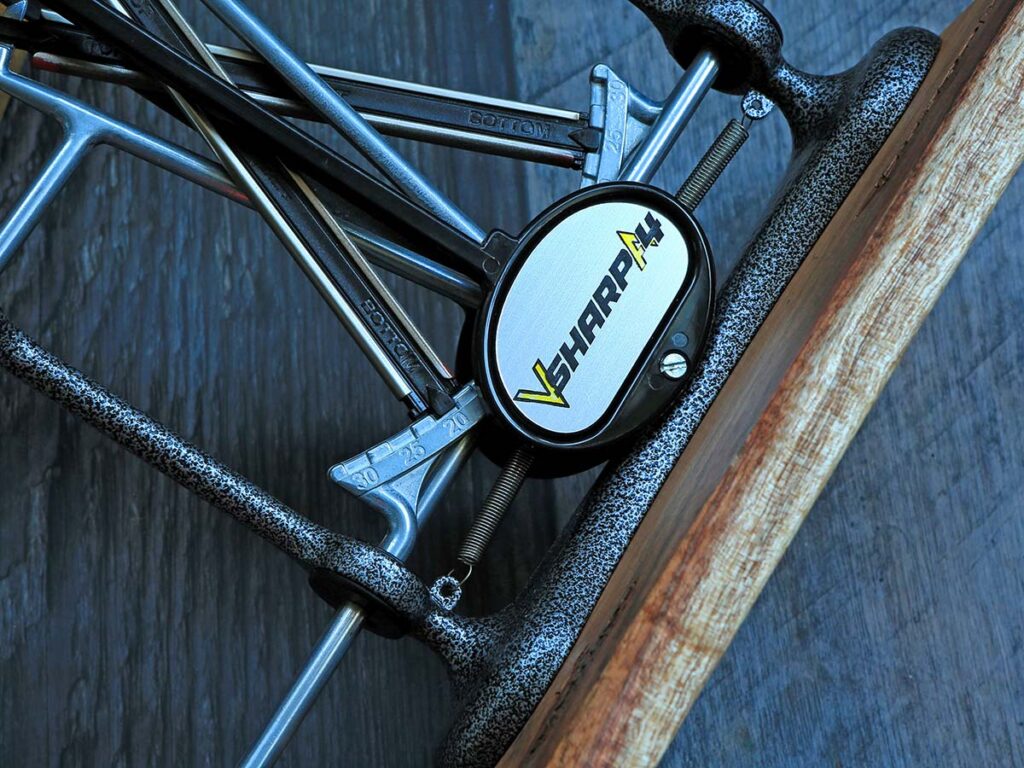
To preset the 15-degree angle with the A.G. Russell V Sharpener, start at the knife hilt and draw down steadily with moderate pressure.
  • 5° per side, creating a compound 30° angle on the blade edge
  • 90 percent+ Alumina Ceramic sharpening rods
  • Diamond Rods (optional)
  • Rod Storage
  • Walnut base is 10.25 inches long
  • Weight: 16 ounces
  • Made in USA
  • MSRP: $71.95

Pros

  • Consistent Edge Every Time
  • Durable Materials
  • Simple & Portable

Cons

  • Single Angle Only
  • No Intermediate Grit

The A.G. Russell Knives V Sharpener is a simple yet highly effective tool for keeping your knives razor sharp. Designed with a sturdy walnut base, it holds two ceramic or diamond rods in a precise V-shape, making it easy to maintain a consistent edge. The ceramic rods, made from 90 percent+ alumina, are built to last for years—unless you drop and break them, of course. On the other hand, the diamond rods are more aggressive and perfect for restoring dull blades before you hone them to perfection with the ceramic rods.

Using the V Sharpener is a breeze. Hold your knife straight up and down, like you’re slicing cheese, and draw it down one side of the V and then the other. In no time, you’ll have a razor-sharp edge ready for action. The walnut base is 10.25 inches long and keeps everything neatly in place. If the ceramic rods start looking dark from metal buildup, a quick rub with an A.G. Russell Rust Eraser will return them to peak performance.

Why 15 Degrees

I caught up with Jake Broce from A.G. Russell Knives to ask why the company went with one sharpening angle, settling on 15 degrees.

“A.G. Russell preferred a 15-degree-per-side [compound 30-degree] bevel for his slicing knives because it created a sharper, more efficient cutting edge,” Jake explained. “His knives were ground thinner than most, which made them slice exceptionally well. Since his sharpener was made for most general-use and kitchen knives, he chose a 15-degree angle per side.

“He once worked with a German knifemaker, a Mrs. Dahmann, who hesitated to grind A.G.’s blades so thin out of concern they’d be too fragile. A.G. told her his customers wouldn’t break them because he’d teach them how to use them properly. For tasks like chopping, however, he used thicker blades and more obtuse bevels—he tailored each edge to its specific function.”

Setup & Use

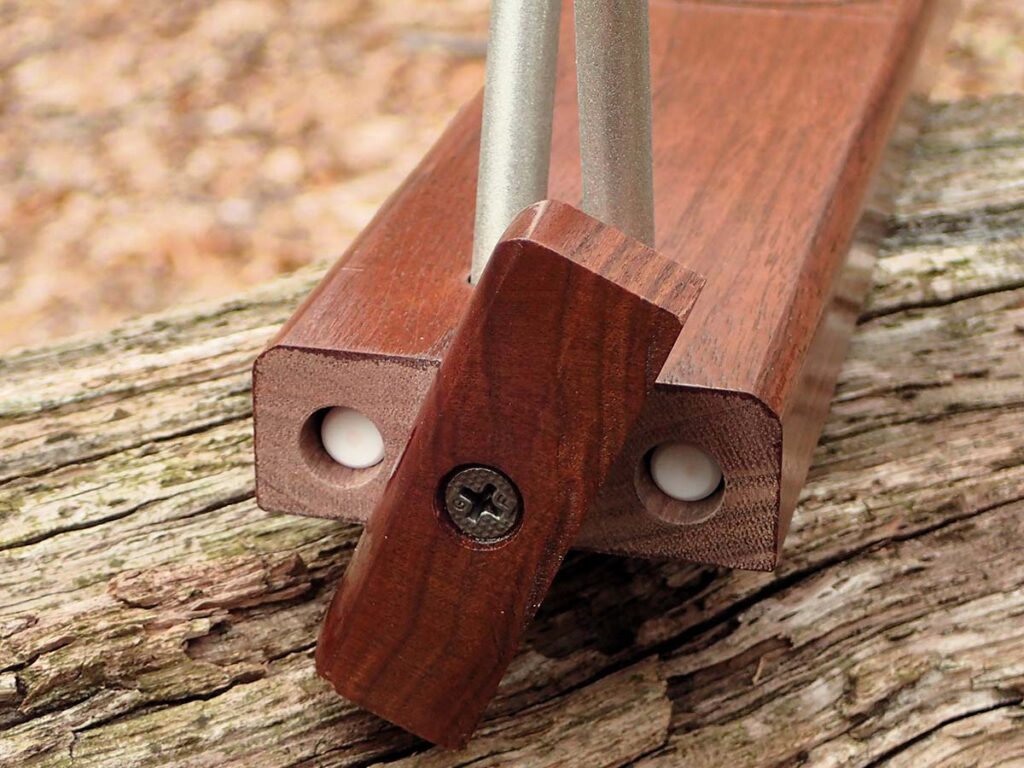
The A.G. Russell’s ceramic rods store in a walnut base with a wooden gate, while a plastic slip and cap protect the diamond rods against weather and damage from other gear.

Setting the V Sharpener up is a breeze. It was the second easiest to assemble of the test sharpeners. The ceramic rods are housed in the walnut base with a simple wooden gate. The diamond rods come in a plastic slip securely fastened with a plastic cap for protection against weather and from your other gear.

Once the sharpener is set up, start at the knife hilt on the diamond or ceramic and draw down. Keep it as steady as you can. Keep your hand behind the line depicted on the walnut base. Use moderate pressure, nothing too intense. Listen to the sound and feel the abrasives do their work.

This unit works easily at home or in the shop. It also fits easily into a pack for camping or a multiday cabin stay.

Report Card

The V Sharpener is a medium-weight unit. The only change I might make would be to add grit between the diamond and ceramic rods.

Whether you’re a seasoned chef or simply someone who appreciates a sharp blade, the V Sharpener is a solid investment that outperforms fancy gadgets and expensive machines. It’s simple, effective and built to last.

Warthog Elite A4 Sharpener

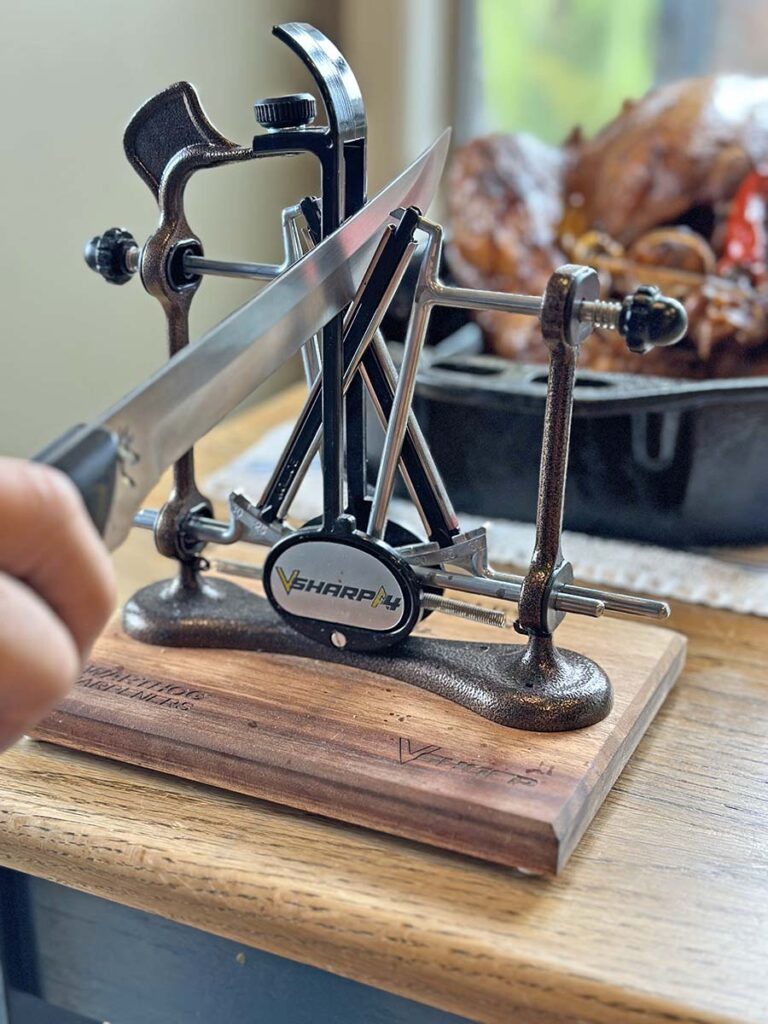
The Warthog A4 Elite uses a patented V-Sharp system with two spring-loaded diamond hones that sharpen both sides of the blade simultaneously—no more struggling to hold the perfect angle. (Warthog image)
  • 15° angle for high-end specialty knives
  • Patented V-Sharp system for precision angle adjustments
  • 4 Adjustable Angles of 15, 20, 25 and 30°
  • 325-Grit Natural Diamond Hones w/finishing steels included
  • Metal Frame Construction
  • Durable Powder Coat Finish
  • Additional 270, 325, 600 and 1,000 grit and ceramic hones available
  • Base of deluxe African wood
  • Weight: 1 pound 13 ounces
  • Made in South Africa
  • MSRP: $144.99

Pros

  • Dual-Side Sharpening
  • Adjustable Angles
  • User-Friendly

Cons

  • Not Travel-Friendly

The Warthog Elite A4 Sharpener is a game-changer that keeps your knives razor sharp with minimal effort. It uses a patented V-Sharp system with two spring-loaded diamond hones that sharpen both sides of the blade simultaneously—no more struggling to hold the perfect angle.

The A4 has a sturdy wooden base that keeps everything stable while you work, and the metal frame construction ensures durability. You can adjust the sharpening angle to 15, 20, 25 or 30 degrees, making it versatile enough for everything from delicate sushi knives to rugged outdoor blades. The included 325-grit diamond honing stones do the heavy lifting, while built-in finishing steels refine the edge. For even more control, you can swap in aftermarket hones with grits ranging from 270 to 1,000, or ceramic for serrated blades.
Setup & Use

You’re ready to rock and roll once you open the package and assemble the unit. The A4 setup stands out as the easiest among the three test sharpening systems.
“If you can slice a tomato, you can sharpen a knife,” asserts the Warthog video. Hold the knife securely and slice down along the ready-set angles. It’s as easy as that. The A4 is the user-friendliest of the test sharpeners.

This one is made for use at home or in the shop. It can be awkward to pack and take along with you. Let it stay ready for action in a semi-permanent location and carry a smaller field-worthy sharpener to the outdoors, on the go, etc.

Report Card

You can adjust the sharpening angle on the Warthog to 15, 20, 25 or 30 degrees, making it versatile enough for everything from delicate sushi knives to rugged hunting blades.
The A4 is a lightweight sharpener. I wouldn’t change much to the already simplistic method of sharpening. Despite its complex nature, I like the multi-angle positions and the hand protector.

Using it is simple. Slide your knife through the vertical guide and the sharpener does the rest. Whether you’re a home cook, professional chef or an outdoor enthusiast, the A4 makes sharpening fast, easy and precise. It comes in multiple colors, so pick one that matches your style.
Work Sharp Professional Precision Adjust Elite Sharpener

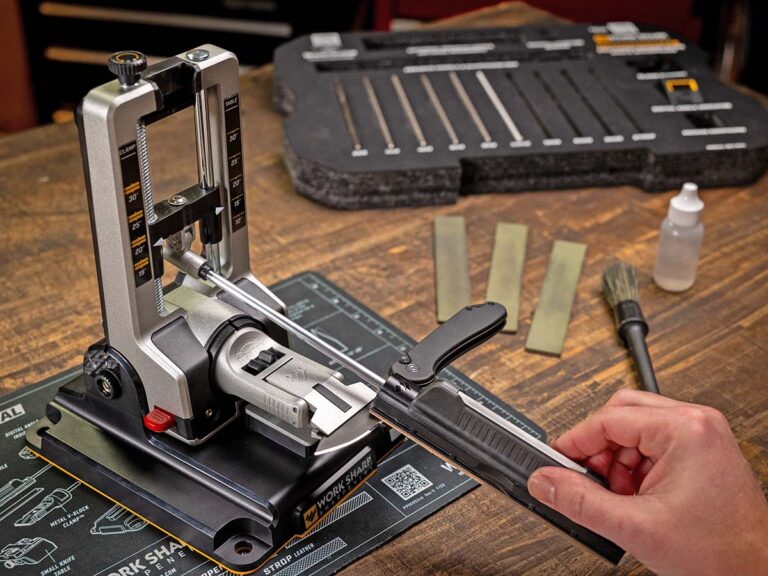
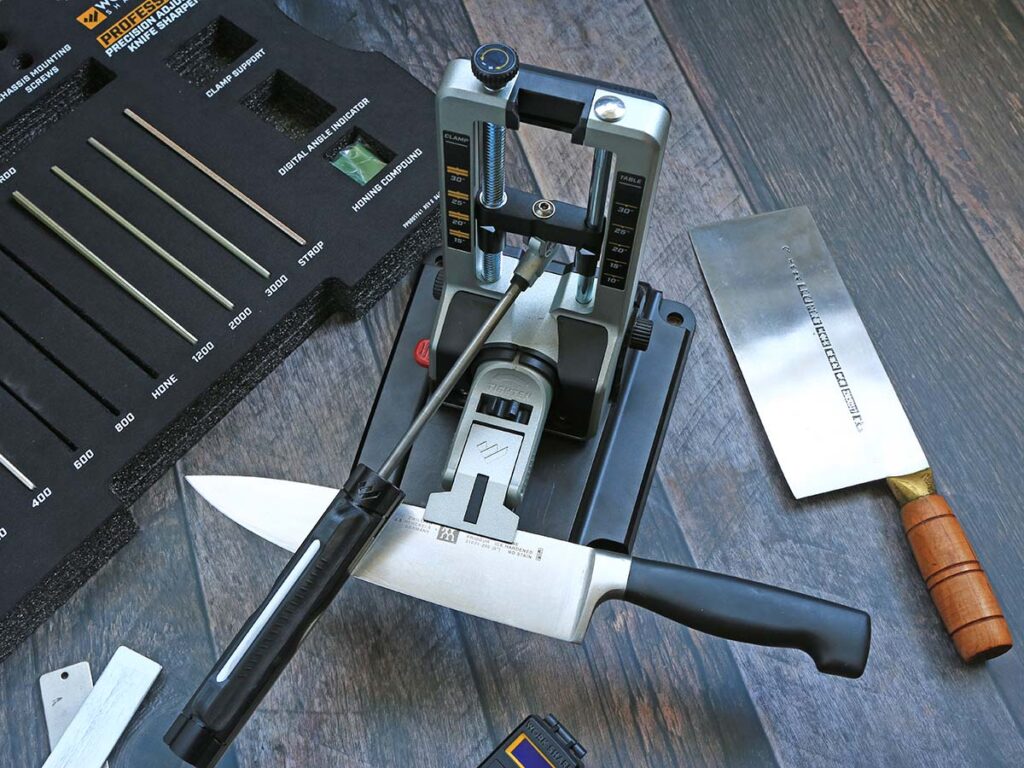
The supplied clamp support works on larger knives and eliminates any play, leaving a solid workspace with the Work Sharp unit.
  • Digital Angle Indicator
  • Comprehensive 10-Abrasive System
  • Coarse diamond plates (220, 320, 400 grit)
  • Fine diamond plates and ceramic plate (600, 800 grit, fine ceramic)
  • Premium resin-bonded diamond plates (1200, 2,000, 3,000 grit)
  • Leather Strop with .5 micron Chromium Oxide
  • Metal V-Block Clamp
  • Clamp Stabilizer Platform
  • Small Knife Table Attachment
  • Dedicated Serration Sharpener
  • Precision Metal Sharpening Frame
  • Heavy-duty carry case
  • Weight: 21 pounds
  • Designed, engineered and calibrated at Work Sharp’s facility in Ashland, Oregon. Work Sharp sources materials from various manufacturers, so some components may come from different locations.
  • MSRP: $449.95

Pros

  • Pro-Level Precision
  • Versatile & Comprehensive
  • Secure & Stable

Cons

  • Complex Setup

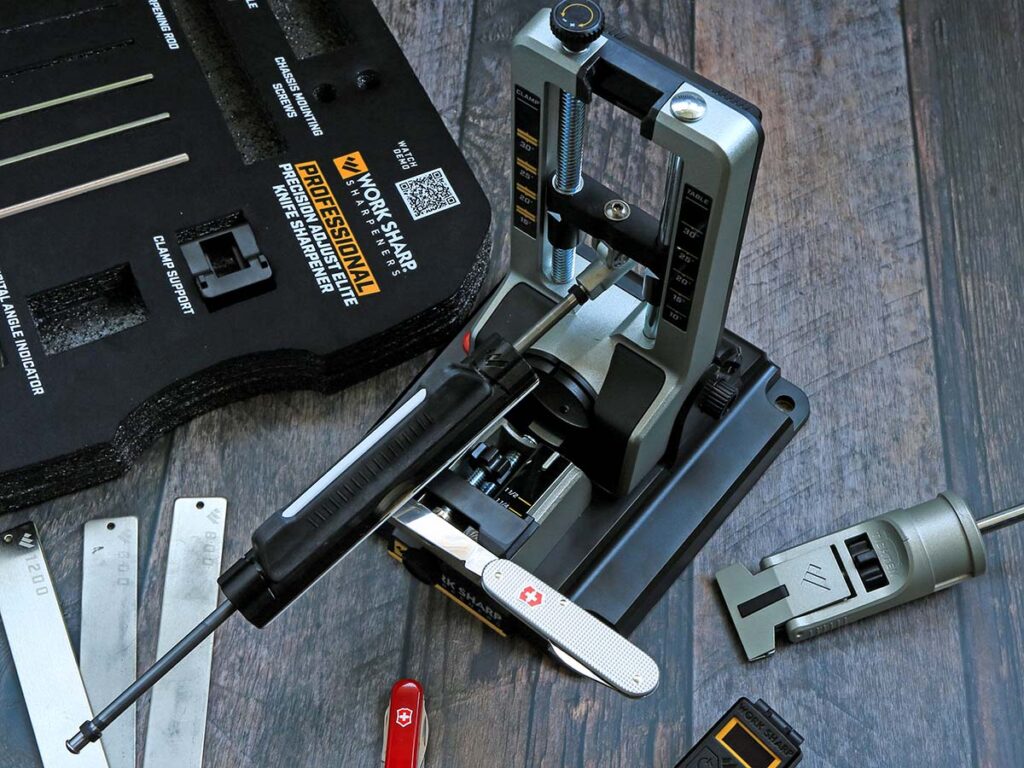
The Work Sharp Professional Precision Adjust Elite Sharpener is a powerhouse for anyone serious about keeping knives razor sharp. Built with solid metal construction and rugged hard plastic, the sharpener holds your blade steady while you work, ensuring accuracy every time. It features a fully adjustable angle system ranging from 15 to 30 degrees so you can fine tune your edge to match your needs.
The unit’s 10-abrasive system (1 x 6 inches) sets it apart. You get everything from coarse diamond plates (220, 320, 400, 600 and 800 grit) and ceramic hones to ultra-fine resin-bonded diamonds (1200, 2,000, 3,000 grit) and a leather strop for the final polished finish. Whether restoring a dull edge or refining an already sharp one, the Work Sharp covers you.

A V-block clamp securely holds your knife in place, making sharpening effortless, and the included knife table attachment ensures that even smaller blades get the same precision treatment. A rugged carry case keeps everything organized and portable when needed.

Setup & Use

While not challenging, setting this bad boy up takes time. The instructions are excellent, as all of them are for the reviewed sharpening units. Nonetheless, this required me to view a few videos. Read and watch to make yourself proficient in the use and setup. Though the Work Sharp is the hardest unit to assemble, it’s worth the trouble. Don’t let this factor deter you before giving it a chance. Take the time to familiarize yourself with the sharpener’s working parts and then you’ll be a believer. Once you master the process, you will pat yourself on the back!

The Work Sharp comes with a carrying case. However, where would you go besides a buddy’s house to show it off? It’s heavy and bulky for toting around. As a result, the sharpener is an ordained home and shop unit.

Report Card

The magnet system of the Work Sharp’s knife attachment helps keep smaller blades in place while a support hand helps steady them.

I like the 10 sharpening abrasives and leather attachment with honing compound. That’s a nice personal touch. I love how effortlessly I can tuck the abrasive sharpening rod away when I’m done. Whenever I need to flip the blade or make adjustments, the handle slides right into its designated slot in a flash. Plus, checking the blade burr before flipping is a breeze. Bravo, Work Sharp!

I wish there were an easier way to tell the difference between the unit’s clamp and table numbers and how they relate to the digital reader. Of course, this aspect can easily be chalked up to user confusion.

If you’re a knife enthusiast, chef or collector, the Pro Precision Adjust Elite delivers professional-level results efficiently. It’s not just a sharpener—it’s an investment in keeping your blades performing at their best.

More Sharpening Articles:

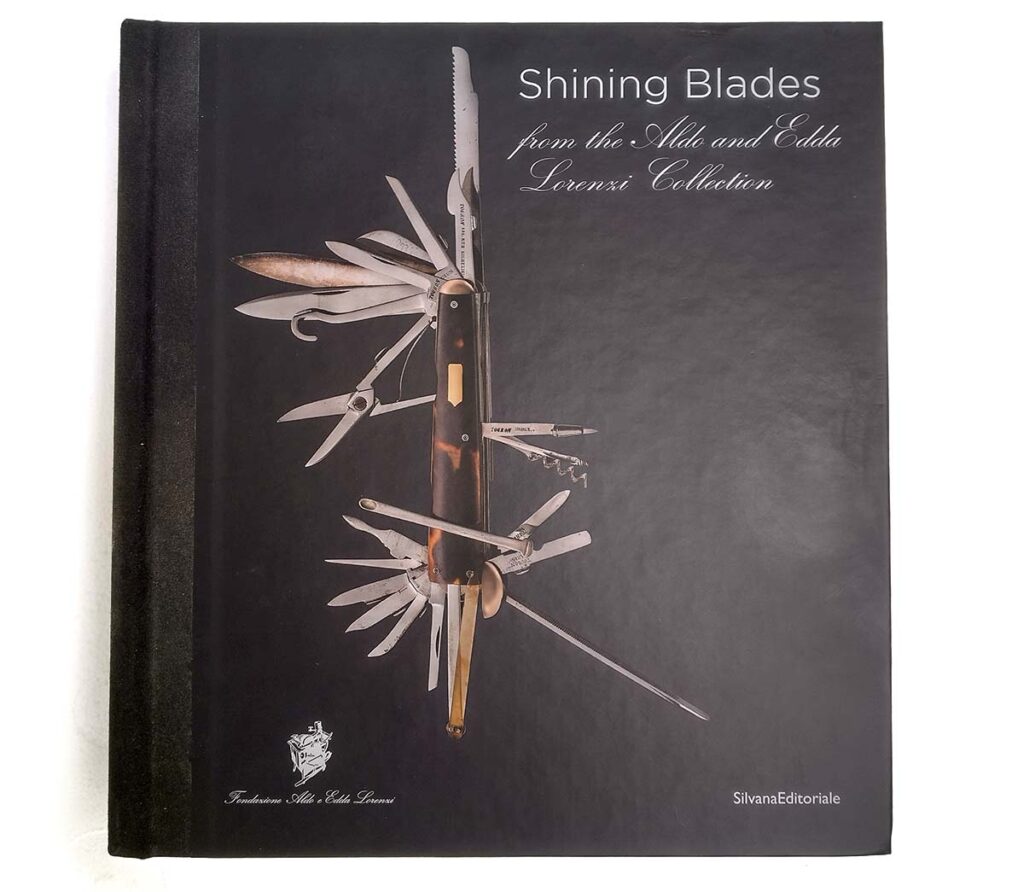
Shining Blades: Book Shines A Light On The Lorenzis’ Cutting Collection

Cutlery Hall-of-Famer’s book showcases the most unique, historic and outlandish blades to enter their treasury.

Probably the most important international buyers of modern American custom knives ever, BLADE Magazine Cutlery Hall-of-Fame® members Aldo and Edda Lorenzi bought and then sold those knives and many other edged items in their iconic G. Lorenzi retail cutlery store in Milan, Italy.

Located on the Via Montenapoleone in the heart of Milan’s elegant retail sales district, and under Aldo and Edda’s direction, G. Lorenzi sold the finest knives, scissors, razors, table cutlery and assorted other edged wonders from 1959 to 2014, serving customers from every corner of the globe.

If you read BLADE® regularly, you know of the Lorenzis—but mostly only through the eyes of BLADE. In their new book, Shining Blades from the Aldo and Edda Lorenzi Collection, the Lorenzis recall their journeys far and wide in their lifelong search for the finest blades as only they can tell it, from the age of Elvis and crewcuts to the internet era.

Intrepidly scouring Europe, America and elsewhere for cutting tools of all kinds, the Lorenzis chronicle their travels in Shining Blades. From Aldo doubling Edda on their Guzzi Galletto motorbike through the snow and rain in the Alps on their first working trip to Fance in the early 1960s, to their early visits to the knifemaking shops of John Nelson Cooper, Cutlery Hall-of-Famer Bob Loveless and many other of the most famous American makers and beyond, the Lorenzis share their incredible story.

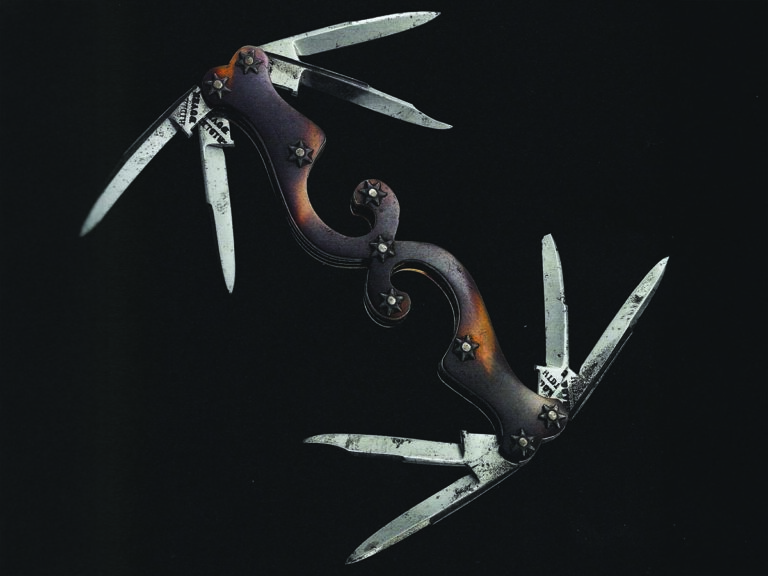
Shining through it all are full-page color images of some of the most spellbinding edged implements you will ever see. In addition to buying them the Lorenzis collected the vintage edged implements along the way. Bronze-Age spoons, folding forks and unbelievable folding knives of the 17th century forward are just some of the visual feasts of the edged art that populate the book’s pages.

For instance, if you think you’ve seen all there is to see in scissors, think again. The images of vintage scissors alone are enough to fill an encyclopedia on the subject. Spectacularly ornate and mystifying in construction, the scissors the Lorenzis amassed over the decades alone will take your breath away.

New shining blades

The preceding simply scratches the surface of what the book is all about. Most of what is illustrated and much more can be seen in the state-of-the-art Aldo and Edda Lorenzi Foundation museum in Milan.

The book also delves into some of the oldest knives known, from the 5,000-year-old knife of Otzi the Iceman discovered in 1991 on the Austrian-Italian border, the finest in European custom knives and knifemakers, ancient books on all things cutlery, notes on damascus steel and much more.

It’s all contained in a top-quality, 9 x 9.75-inch hardbound book with 344 pages that will provide you enjoyment for years to come. It’s a unique history with an MSRP of only $50—a ridiculously low price for such a landmark publication. However, as Edda Lorenzi noted, it’s not about the money so much as the education of worldwide edged tool enthusiasts and the recognition of those who authored some of the most fascinating edged tools extant.

“The book cost us about double its sales price [to produce], more or less,” she began. “Keeping the price low was our choice. It is a choice in line with our Nate Posner Award—to honor the artisans who created the works we loved most and whose names we would like to be known by as many people as possible, and to encourage new generations of artisans who, unlike collectors, certainly do not have large sums of money to invest in expensive books. To achieve this, this choice had to be made!”

If most anyone else had written the preceding paragraph I might be going, “Yeah, right.” But with the Lorenzis, you can rest assured it’s true. If you don’t believe me, ask members of the old guard at knife shows who know of them. If anything, my assessment of Aldo and Edda isn’t laudatory enough.

See Other Hall Of Fame Members:

Knife Steel After Crucible Industries LLC

Niagara will help fill the shoes of an industry icon.

The recent demise of Crucible Industries LLC not only marked the end of a celebrated name in the manufacture of blade steels, it denoted the dawn of a new age—not only for the steels famously known by their CPM prefix, but other premium blade materials as well.

Used by Crucible and short for Crucible Particle Metallurgy*, CPM prefixed such Crucible steels as CPM S30V, CPM S35VN, CPM MagnaCut—today’s hottest CPM variant—and others among some of the most-used blade materials since Chris Reeve Knives popularized S30V on Reeve knives beginning in 2004-2005. S30V, in fact, was the first modern steel manufactured specifically for knife use. All other manufactured steels used in blades were originally made for purposes other than knives.

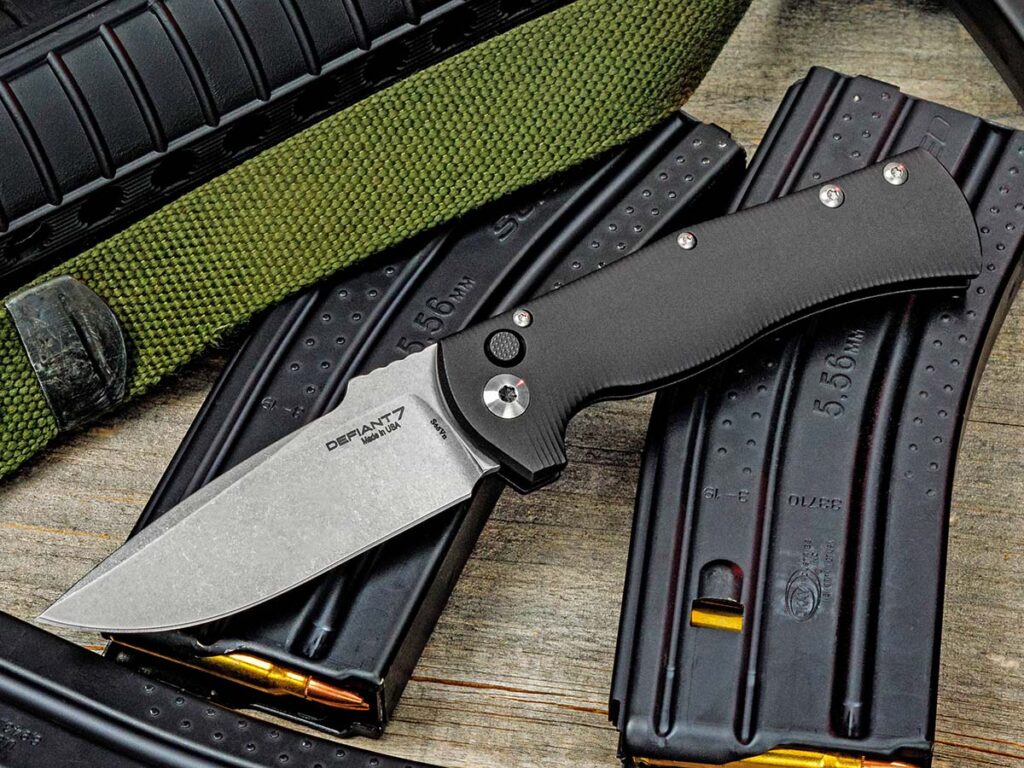
CPM S45VN is one of several of the old Crucible steels Niagara offers. The Defiant7 Auto Eagle has a stonewashed blade of the stainless steel and a black aluminum handle. Blade grind: flat. Weight: 4.4 ounces. Designed by Les George, it’s 4.75 inches closed. Country of origin: USA. MSRP: $285.

Crucible closed its doors earlier this year and sold most, if not all, of its assets at auction in February. So what happens to all those wonderful steels that both the factory and custom knife industries use in mass quantities?

According to Bob Shabala of Niagara Specialty Metals (NSM), NSM will do its part to have/supply most, if not all, of them, as well as other up-and-coming steels, to the custom and factory knife industries.

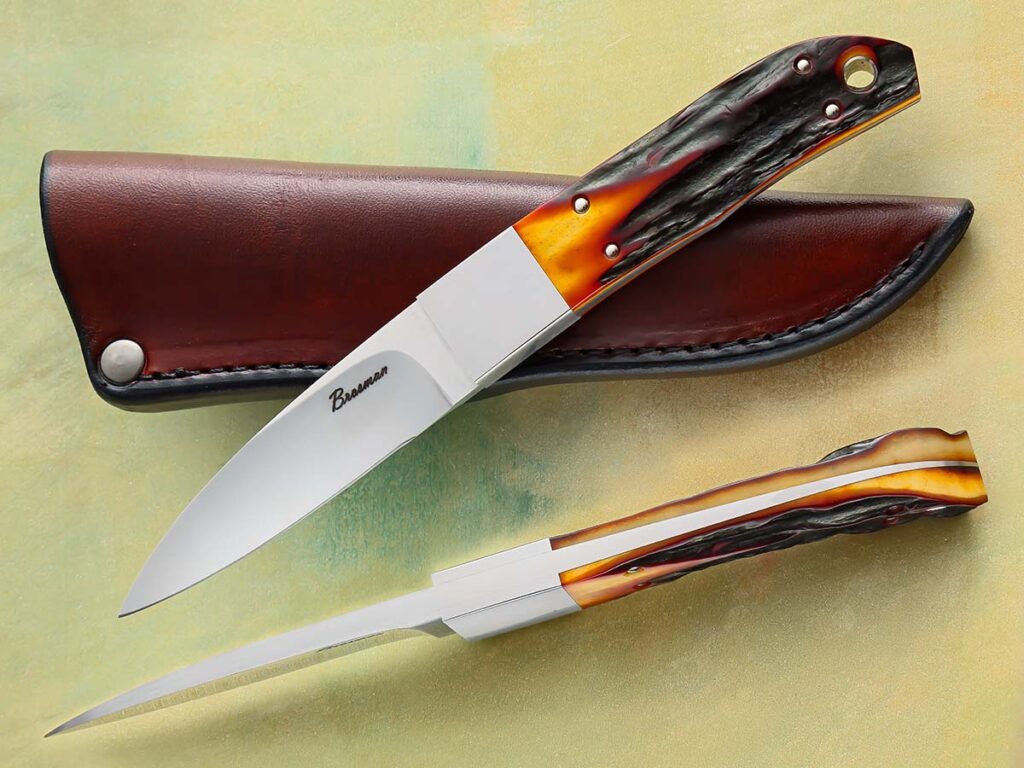
Among custom knifemakers especially, CPM 154 stainless is extremely popular. Craig Brosman employs it in a hollow grind and amber-dyed European red stag on his utility fixed blade. Overall length: 7.5 inches. (SharpByCoop image)

Opined Scott Devanna of steel service center SB Specialty Metals, “The majority of steel sheet in the U.S. comes out of Niagara. They’re the only [domestic mill] that can make it right now. It’s been that way for the last 25 years. They’re the only game in town.”

Erasteel And The Name Game

Erasteel, with state-of-the-art steel mills in France and Sweden, is owned by Syntagma Capital, a private equity group based in Brussels, Belgium. Erasteel acquired a part of the assets of the old Crucible Industries during the February auction, including working capital, steelmaking equipment and, perhaps most importantly, the trademarks for all the CPM steel names. A manufacturer and supplier of steels not only to the knife community but also the aerospace and other hi-tech industries, NSM had worked with Erasteel before the auction, processing millions of pounds of the Swedish mill’s steel for industrial applications.

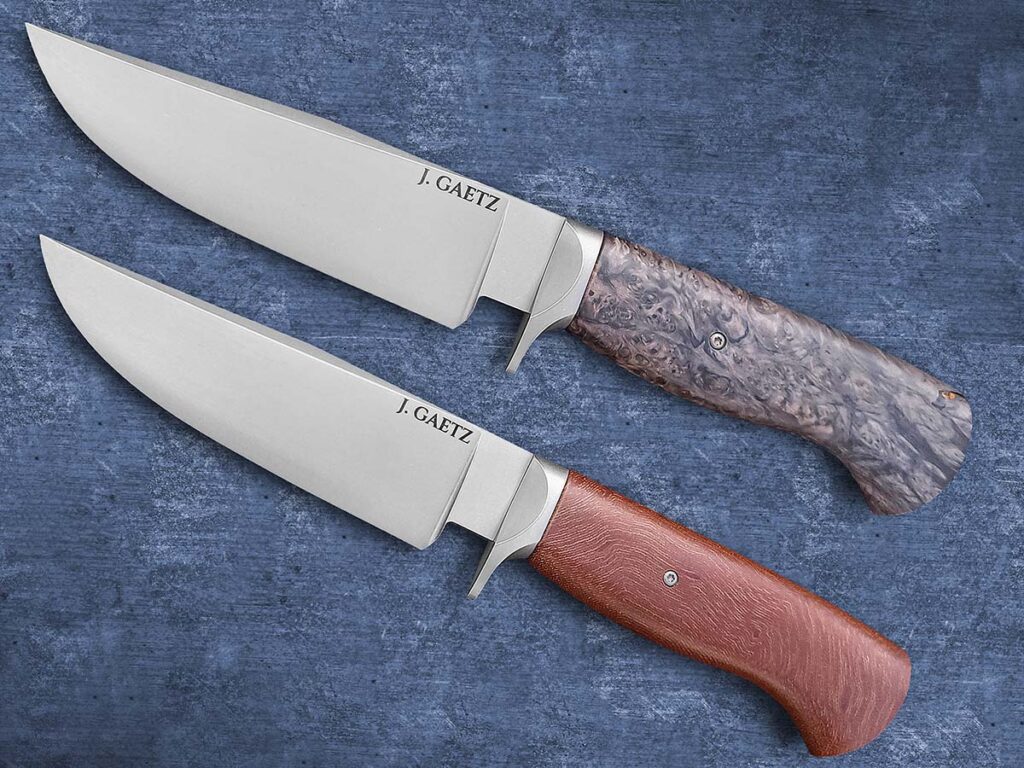
The 4.75-inch blade of Jacob Gaetz’s Large Field Hunter is CPM 3V carbon steel cryo-treated to a Rockwell hardness of 60-61 HRC. Handles are Apocalyptic box elder burl (left) and vintage Micarta® (right). Overall lengths: 9.875 inches. (Jocelyn Frasier image)

“We’d been doing that for several years,” Shabala noted, “so we know the quality of their steel is good.”

Together with Crucible, Erasteel is the pioneer in gas-atomized metal powders and started with the process in 1969. Today, it has the largest installed capacity in the world to produce metal powders, with two large atomizers built and designed by Erasteel.

Shabala said NSM officials understood their knife customers wanted the assorted CPM steels to keep the old names to avoid confusion among knife-buying consumers.

“They didn’t want to change the names and have to educate consumers on what the new names would be and how they related to the legacy Crucible names,” he explained.

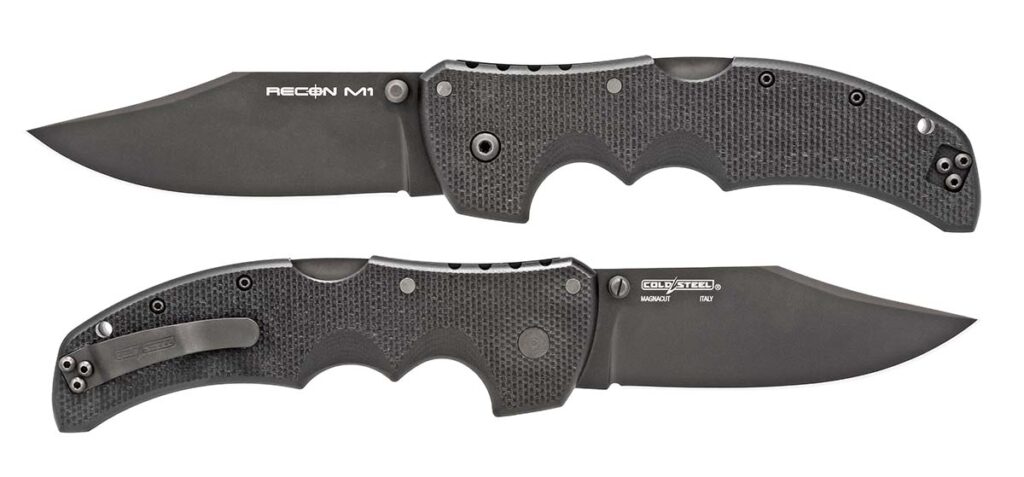
The Cold Steel Recon M1 sports a black-coated blade of MagnaCut stainless, which remains the hottest of the CPM steels used by both factory and custom segments of the sporting knife industry. Handle G-10. Lock: Atlas Lock. Weight: 5.2 ounces. Blade and closed lengths: 4 and 5.5 inches. Country of origin: Italy. MSRP: $309.99.

Meanwhile, the two companies reached an agreement where if NSM buys the steels exclusively from Erasteel, NSM can use the original names too, including S30V, S35VN, S45VN, MagnaCut, S110V, 3V and CPM 154. NSM and its customers can still use the full designation of CPM S30V, CPM S35VN and so on, though the customers can omit the CPM if they so choose.

“The reason we’re keeping the CPM 154 name is because everybody knows that it’s the powder metallurgy version of 154CM, so we want to keep that designation alive so people will know what’s going on there,” Shabala noted.

There will be a couple of exceptions. The steels formerly known as CPM Cruwear and CPM S90V will be renamed NSMwear and NSM 90PM, respectively.

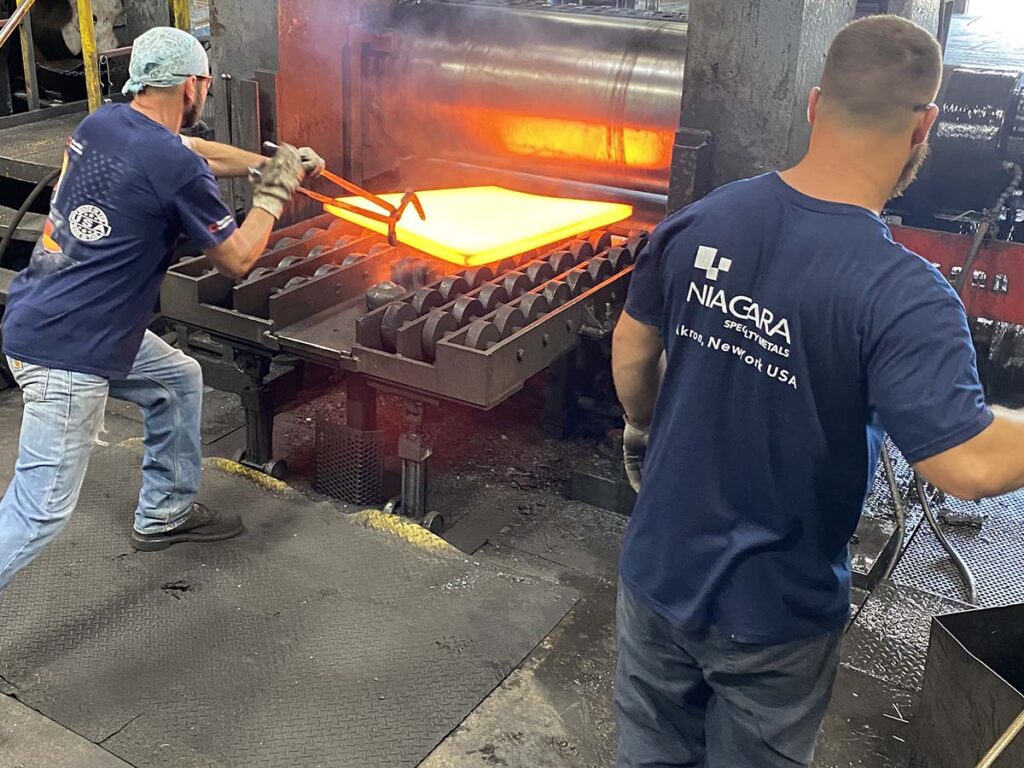
Niagara is both a manufacturer and distributor, not only of knife steel but also steel for the aerospace and other industries. It is employee owned and employs 41. (NSM image)

“Erasteel already had an agreement with another distributor to buy Cruwear exclusively, so we worked out a deal with them where we can buy the steel, we just can’t use the name,” Shabala explained. “It’s on us to educate people and let them know they can still get CPM Cruwear, it’s just a different name.”

As for CPM S90V, NSM already had Carpenter Technology’s version of it in stock and wanted to rebrand it so that it’s not sole-sourced to one mill. By renaming it NSM 90PM, “hopefully people will understand that it’s coming from us,” Bob said.

Steel Tariffs

Concerning steel supplies in stock, Shabala indicated NSM officials had been aware of Crucible’s coming demise, and in January 2024 began ramping up purchases to build inventory for any future supply disruptions.

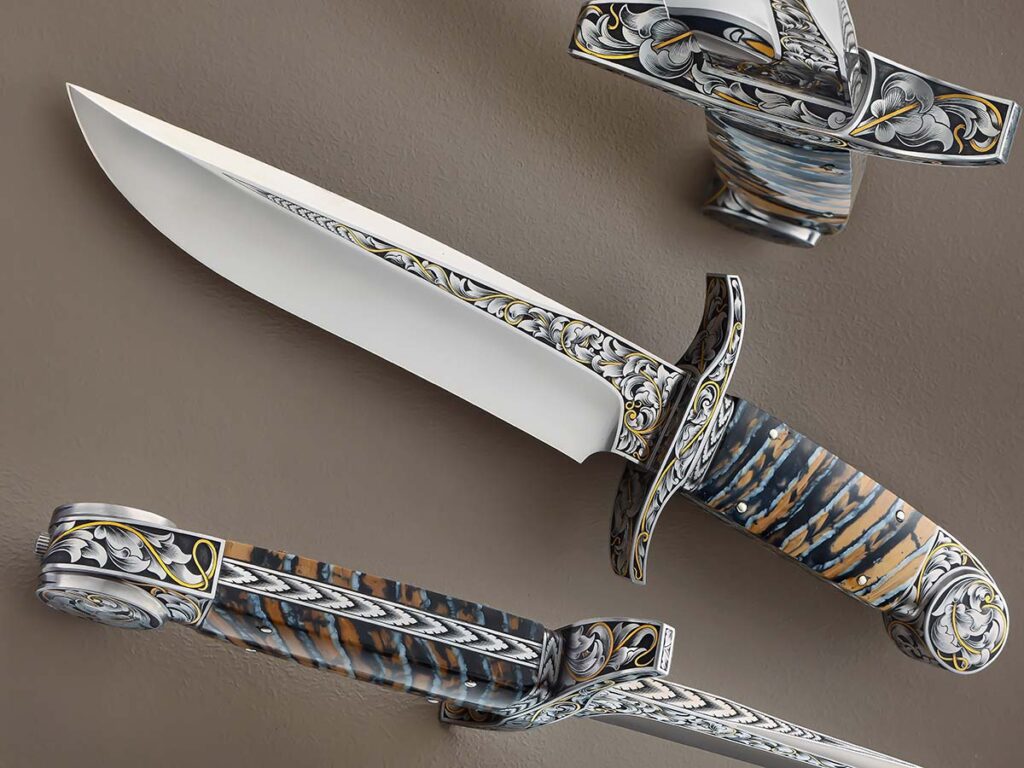
Dennis Friedly opts for CPM 154 stainless blade steel and a mammoth tooth handle for his Art Knife Invitational fighter. The copious engraving is by Ray Cover Jr. Overall length: 13 inches. (SharpByCoop image)

“We started placing orders with Carpenter and Erasteel in September 2024, though not knowing Erasteel would be the eventual owner of the CPM trademarks,” Shabala noted. “The steel we bought in September is starting to arrive. There will be some disruptions in MagnaCut and CPM 154, but everything else we still have a decent amount of and there should be no disruptions.”

In case you hadn’t heard, President Trump has instituted tariffs on most countries, including France and Sweden. At press time, the European tariff was 25 percent.

“Everything we buy from Erasteel as it stands right now is subject to a 25 percent tariff,” Shabala said. “Even the steel we buy from Carpenter, the powder for it is atomized in Sweden, so that’s subject to at least a 10 percent tariff.”

Dennis Friedly opts for CPM 154 stainless blade steel and a mammoth tooth handle for his Art Knife Invitational fighter. The copious engraving is by Ray Cover Jr. Overall length: 13 inches. (SharpByCoop image)

Another concern is whether knife companies can continue to mark their knives built with NSM steel “Made in the U.S.A.” Bob said he is up front with his customers, telling them that Erasteel will be supplying a “good chunk of our CPM alloys,” though it’s all hot rolled at NSM.

The question becomes if the raw materials are imported but don’t officially become a steel until they’re hot isostatic pressed, does that make the steel American made or imported? He indicated it will be up to his customers’ lawyers to hash out what the customers can and can’t do concerning U.S.A. markings on their knives.

NSM Innovaions

What’s on the horizon at NSM? One thing is a new grade developed by steel guru Larrin Thomas. Called Magnamax, it won’t be widely available until the end of the year. Since NSM has both patented and trademarked Magnamax, it can have it made by any mill it wants, and had it on order with both Erasteel and Carpenter at press time.

Bob Shabala of Niagara Specialty Metals

Meanwhile, along with Erasteel, Bob had high praise for the steel being made by Carpenter.

“We’re getting powder now that is atomized in a vacuum furnace. It’s a step forward in quality. We hardly ever had an issue with any CPM product from Crucible,” he qualified, “but I think Erasteel’s and Carpenter’s steel has a finer grain size. It’s a little microscopically cleaner than what we were getting before, so it really is an opportunity to provide a better product.”

As Shabala noted, Carpenter has made lots of cutlery steel, and NSM has processed a huge amount of it, hot rolling it into sheets and sending it back to Carpenter’s warehouse for sale to various customers. One of Carpenter’s best-known steels is CTS XHP stainless.

“It’s a grade that customers really like,” Shabala said, adding that NSM had over 20 tons of it and was in the process of preparing to make a big marketing push on it at press time.

Having steel manufactured in the USA remains a big selling point with many of NSM’s customers, so the company remains on the lookout for new melt sources, one of which is Prime Metals & Alloys (PMA) of Homer City, Pennsylvania. A manufacturer and supplier of a wide range of steels for assorted hi-tech and other uses, PMA was in the process of making steel for NSM at press time, which Shabala seemed to think holds great promise.

Larrin Thomas, metallurgist and knife writer

“We should receive it in a couple of months, but if it works out it’s going to be an ESR version of stainless steel that we’ve always supplied, so it should be a noticeably better product than what our customers were used to before,” he said. “It’s really a good find for us to be able to get a higher-quality steel with a shorter lead time, so we’re really excited about that.”

ESR stands for Electro-Slag Remelting, a process that results in a very clean steel devoid of contaminants.

“In a traditional melting process, you heat the steel up, get it in a molten state, pour it in an ingot and that’s it,” and later forge and finish it out, he explained. “With ESR you take that ingot and you remelt it again and all the slag and contaminants float to the top, and they’re skimmed off. What remains in the new ingot is a cleaner version of the original.”

Shabala added that two different grades of NSM stainless steels that had always been air melted will now be ESR melted.

NSM’s Role

People often misunderstand a company’s role in any endeavor, and Shabala said that seems to be the case with NSM.

“Larrin Thomas was concerned that people had the misconception that NSM is just a distributor, that we just got sheets from Crucible and resold them,” he observed. “He said we should emphasize the fact that we’re a lot more than a distributor, we’re a manufacturer, we buy slabs of steel, we process it into the final dimensions and ship it. Cutlery is a big part of what we do. We do a lot with the aerospace industry, so we know a lot about quality standards.”

NSM is 100 percent employee-owned, so all 41 employees in its mill in Akron, New York, just outside Buffalo, own a piece of the company.

“Everyone here has a vested interest in ensuring that we’re successful and doing everything we can to put out a good product,” Shabala said.

A last point of emphasis Bob made was that just because Crucible went out of business doesn’t mean NSM is going out of business—in fact, far from it.

“We’re very financially sound. We just put out a $7 million upgrade in our sheet mill, we’re rolling out finished product, it’s the biggest expansion we’ve ever done and we’re getting ready to expand our grinding and laser-cutting capability,” he noted. “We’re really, really in good shape.”

*Editor’s Note: For more on the particle metallurgy process, visit Knife Steel Nerd’s post on powder metallurgy.

More On Steel:

Lansky Folding Tapered Diamond Rod Sharpener Vs. Serrated Blades

0

The author tries out the Lansky Folding Tapered Diamond Rod Sharpener.

Over the years I’ve written a number of articles on sharpening. I have also taught countless sharpening classes covering everything from knives, saws to Forstner bits. Sometimes you need a special tool to get the job done. In the case of serrated edges, you need a dedicated sharpening tool. This time it’s the Folding Tapered Diamond Rod by Lansky. I will cover the basics of sharpening a serrated blade as well.

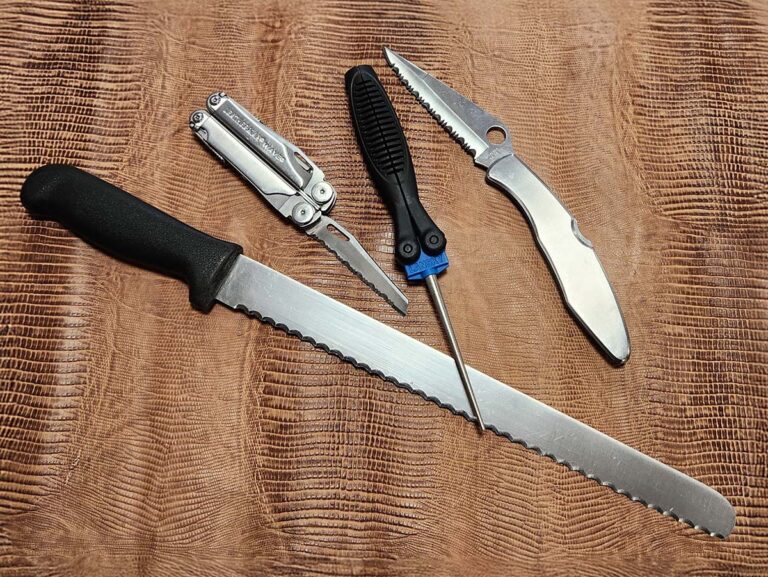
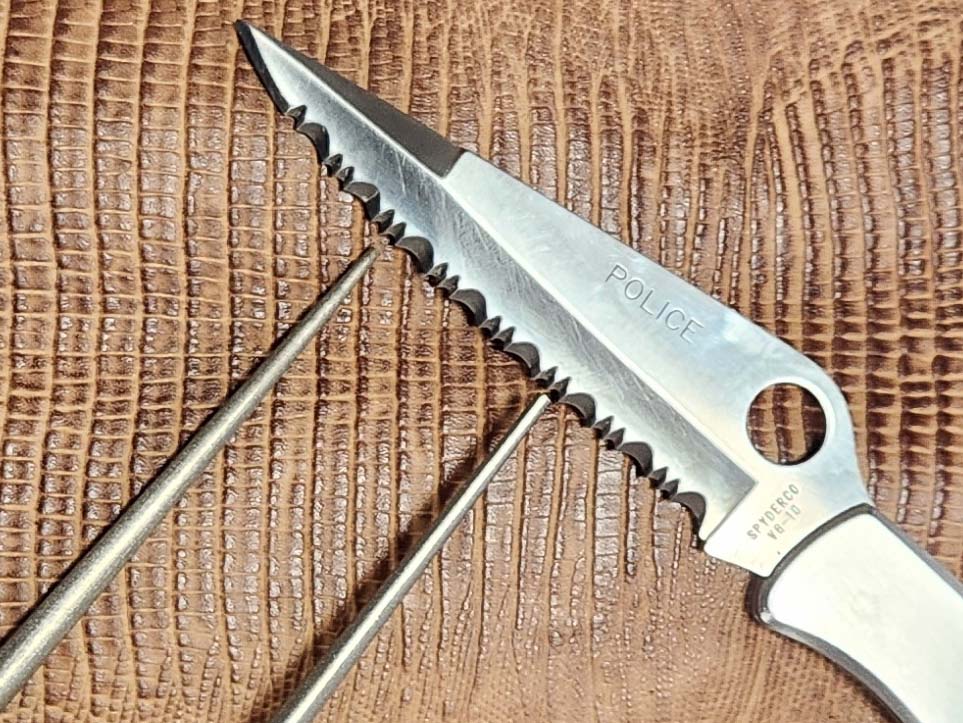
The two serrated blades I carry most is the one on my Leatherman Wave and my Spyderco Police. I am a property maintenance man and the Wave is like my right arm. The Police sends chills down the spines of people when I open it. Let’s get to sharpening them.

Keep It Simple

First off, there are those who would like to complicate sharpening by making it seem more than it is. At its core, sharpening is simply polishing two surfaces that meet at an edge. In the case of a serrated blade, the edge has a series of gullets (channels) and teeth. The different contours on a serrated edge require a sharpening tool that can accommodate such a surface.

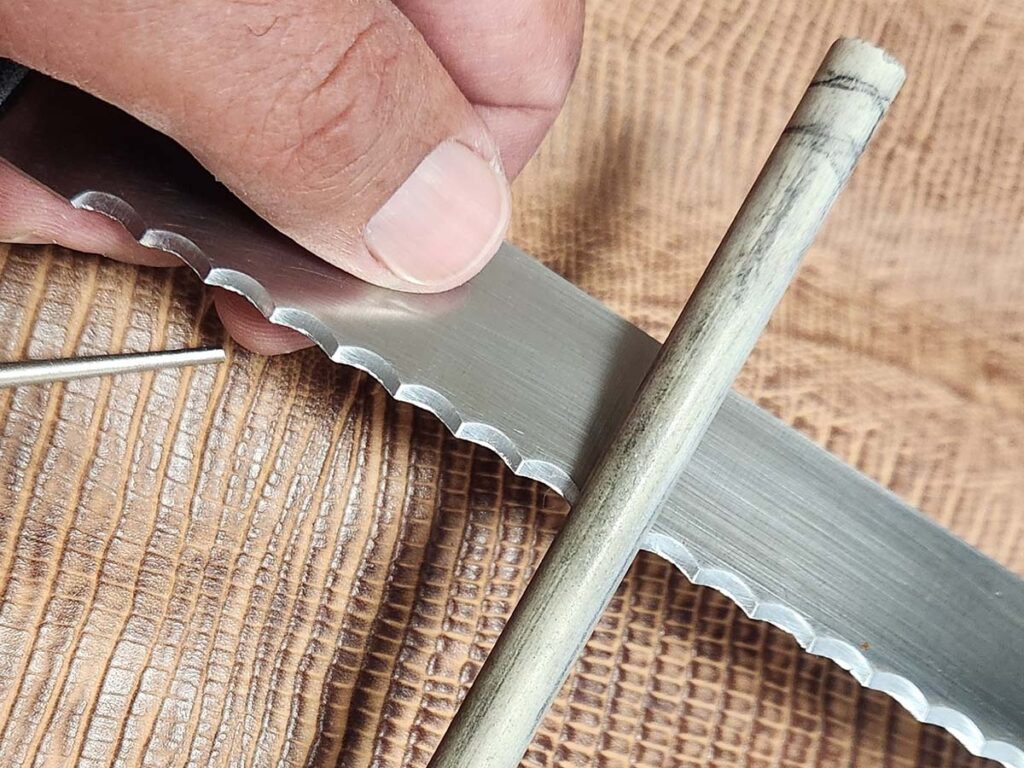
Sometimes when sharpening a serration with a broad diameter, the author follows the secondary bevel across the edge instead of pushing the sharpener into the blade.

Another feature of serrated edges is that a number of them are formed with a chisel-style grind. By chisel-style grind, I mean the secondary bevel to the edge is on one side only. Since serration patterns vary, you need a sharpener that will accommodate different sizes of teeth and gullets. A common form is the use of a cone. A cone-shaped sharpener should match the size of a serration somewhere along the cone.

Sharp Specs

Lansky has taken a tapered diamond impregnated rod and created a foldable handle that acts like a case for the rod. The style is not uncommon except Lansky takes the ergonomics a step further by making the injection-molded handle contoured for a more solid grip.

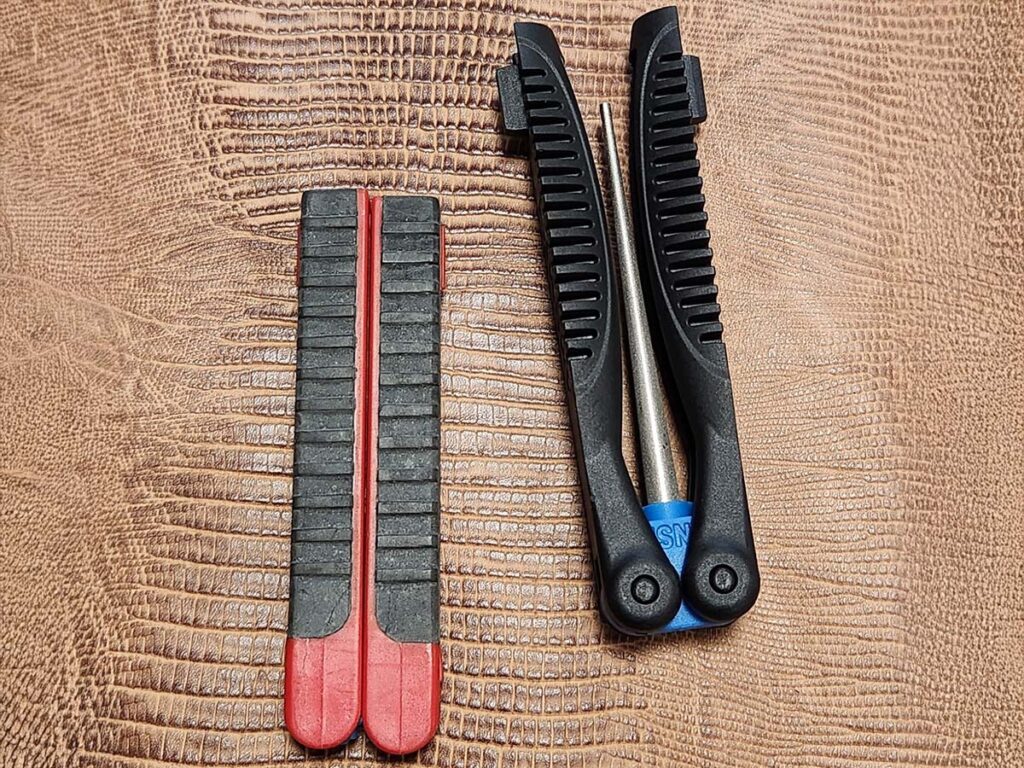
The author’s older Lansky folding sharpener (left) does not have a large enough diameter for some bigger serrations. Meanwhile, the new Lansky model (right) has a larger tip diameter than the older one, making it impossible to use on smaller serrations.

The diamond coating is electrostatic-plated to the rod, which is better than using an epoxy as some others do. Lansky uses a 600-grit coating. It is not an aggressive grit, though on the other hand you don’t want a grit that is too aggressive for serrations. If you get too aggressive of a grit, then a mistake can ruin the blade. The one issue I find with the Lansky is the tip of the cone is a bit large for some serrations. Other than that, I plan to get a lot of work out of this sharpener for years to come.

The Method

First, brace the blade you are sharpening against a stable surface. Position the blade’s secondary bevels up. I tend to prefer the dynamic style of sharpening in these cases, so I move the sharpener, not the blade. Match the angle of the secondary bevel when placing the rod in the serration.

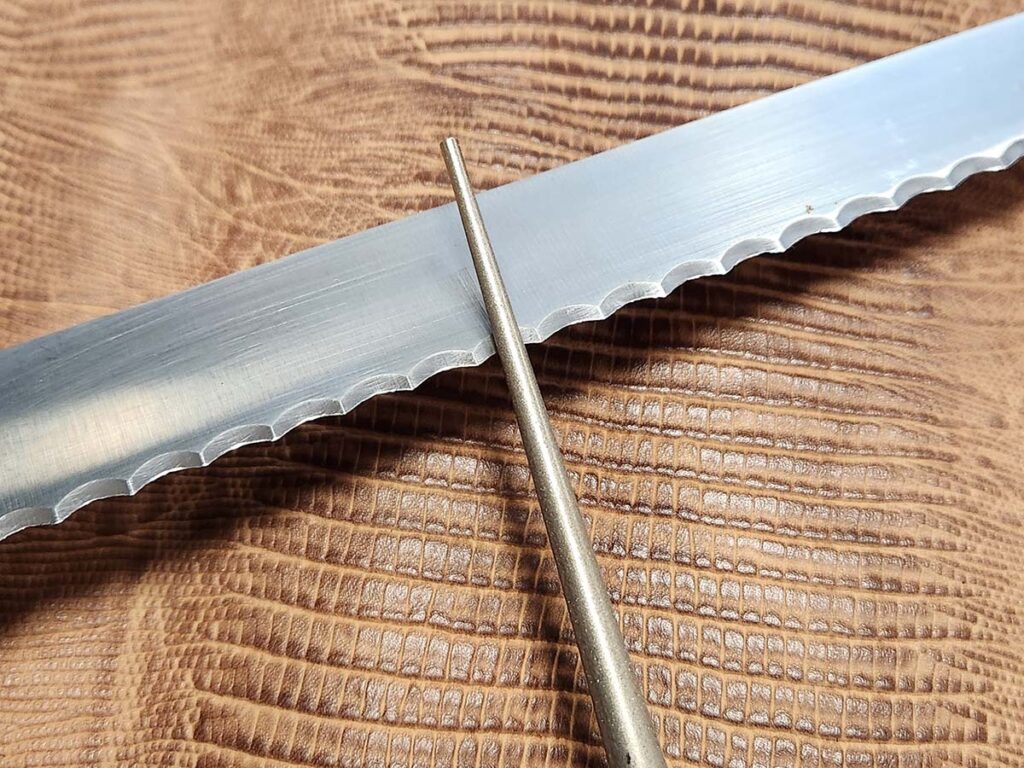
There is often more than one way to do something. Here the author uses a ceramic sharpening rod whose diameter closely matches the serration.

Position the rod a bit before the diameter of the cone that matches the serration being worked on. You don’t want to start your sharpening stroke at the beginning of the cone as that will change the shape of the gullet. The intent is to remove as little material as necessary. If you start sharpening close to the beginning of the cone, you will cut into the gullet. Keep close to the diameter of the gullet and take short passes.

When finished, I check all the teeth to make sure they are still pointed. Then I briefly strop the opposite side of the blade with a compound-loaded leather strop. Just a couple of passes will remove the burr. Lansky lays out the static method in the directions, which means you move the blade along the rod. Try both methods and see which one works best for you. Everyone has their own preference. In the end it is more important to get good results.

Parting Cuts

Serrations shine when it comes to cutting fibrous materials such as cord, rope and nylon straps. At my shooting range, when I score a bunch of cardboard for backers, I usually use my serrated knife to cut the cardboard down to size.

A downside to the new Lansky folding sharpener is that it isn’t as compact as the older Lansky design (right).

It is best to maintain serrated edges. With a plain edge you can let it go then sit down with it and bring it back to life easy enough. Serrated edges I find it best to stay on top of and regularly give them some upkeep. Wearing down the tips off the teeth and blowing out the gullets just makes more work and creates more chance you will mess up the serrations.

If you don’t own a good quality serrated knife because you are concerned about sharpening it, then buy a cheap one and practice your technique. Lastly, if you own just one serrated knife outside your kitchen bread knife, make it the rescue knife in your car.

Lansky Folding Tapered Diamond Rod Sharpener
Abrasive: Diamond-coated rod
Rod length: 3.5”
Rod thickness: 1/16” at tip, ¼” at base
Grit: 600
Handle: Nylon
Sharp stuff: Sharpens serrated blades, fishhooks, gut hooks and more; the rod folds into the handle for protection and ease of carry
Weight: .2 oz.
Closed length: 5”
Open Length: 9”
Country of origin: USA
MSRP: $19.95

More Sharpening Articles:

Best Scissor Sharpeners: Where To Find Your Edge

Consider three cool tools to keep your scissors shearing sharp.

I sharpen knives frequently but must admit I’m a loathsome scissors sharpener. It’s not like I’ve never sharpened scissors but only when I had to and never in an organized way.

However, when my editor gave me an assignment on scissors sharpeners, I took it as a personal challenge to mend my ways—and off I went. What follows is a primer on scissors sharpening using three different systems.

Before starting, there are a few obvious things to point out.

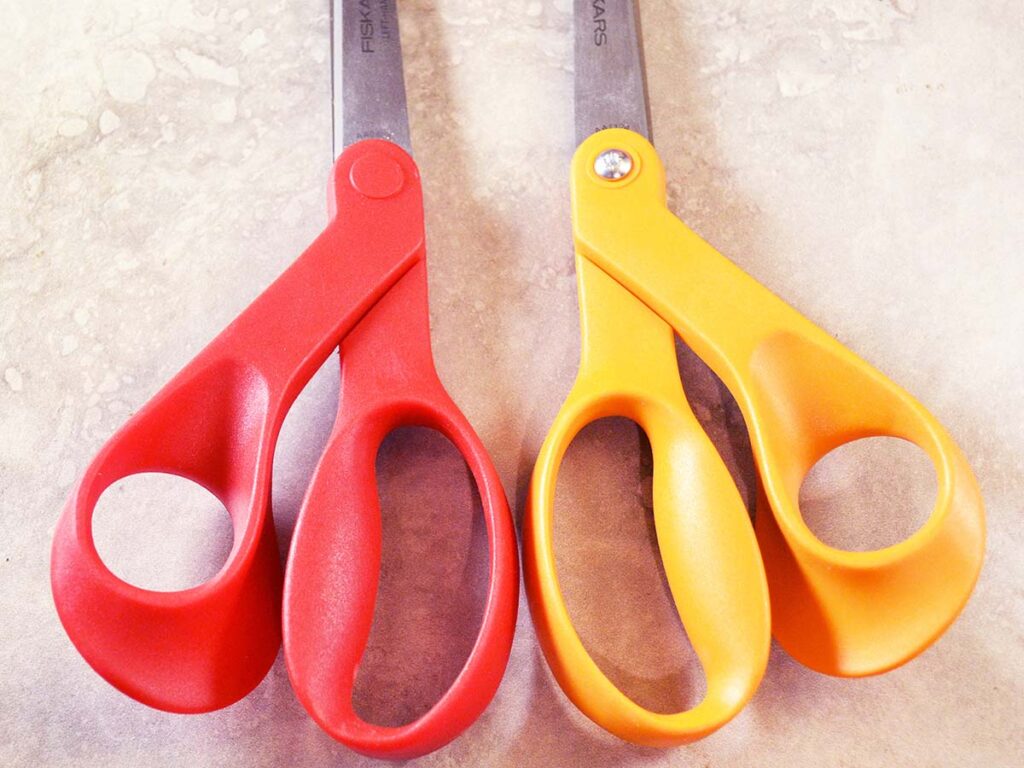
The most obvious is the fact that there are two blades to sharpen instead of one. Second, the two blade edges are sharpened to oppose each other. Third, most scissors are made for righthanders and can give lefthanders fits, especially models with asymmetrical handles. Some southpaws have more trouble than others, and if you are among them you might seek out companies that either offer lefthanded models, such as Fiskars, or those that specialize in such products, like Lefty’s Left Hand Store. My brother’s lefthanded and he’s never bought any lefty scissors. Instead, he simply buys and uses symmetrical right-hand-only models.

Simple handheld or desktop scissors sharpeners are the way to go if you want to keep a decent edge with very little hassle and time consumption.

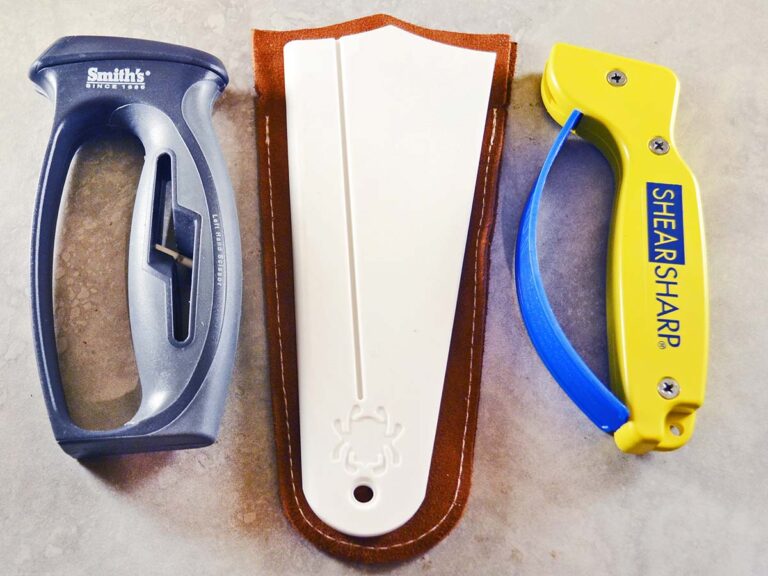
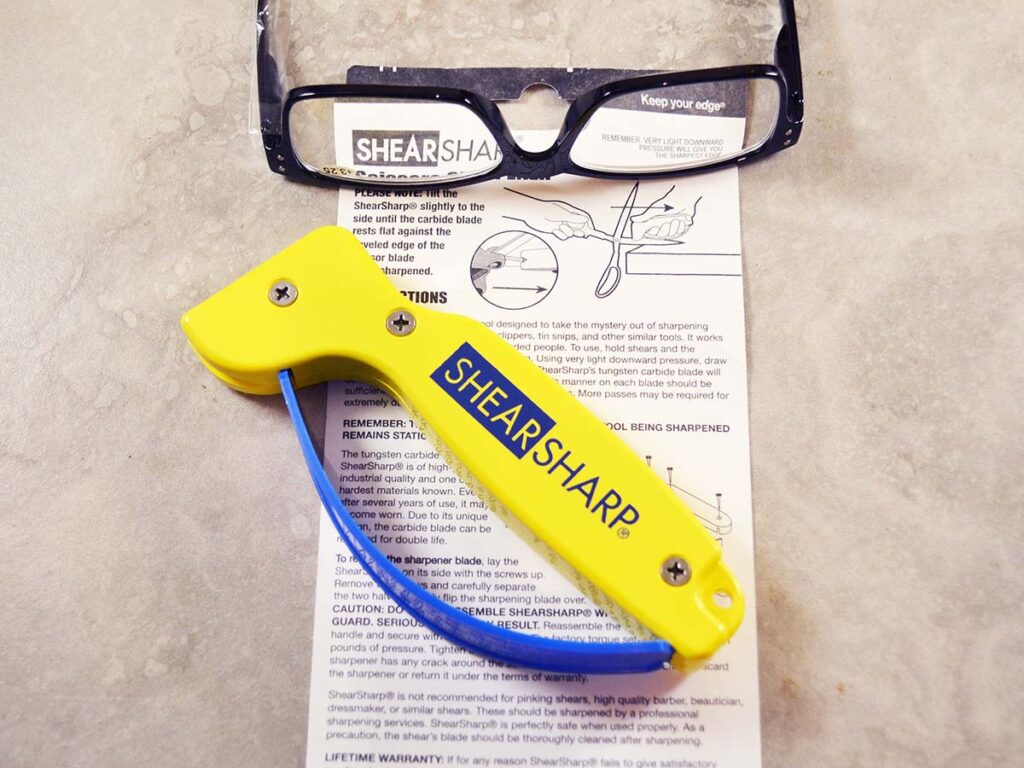
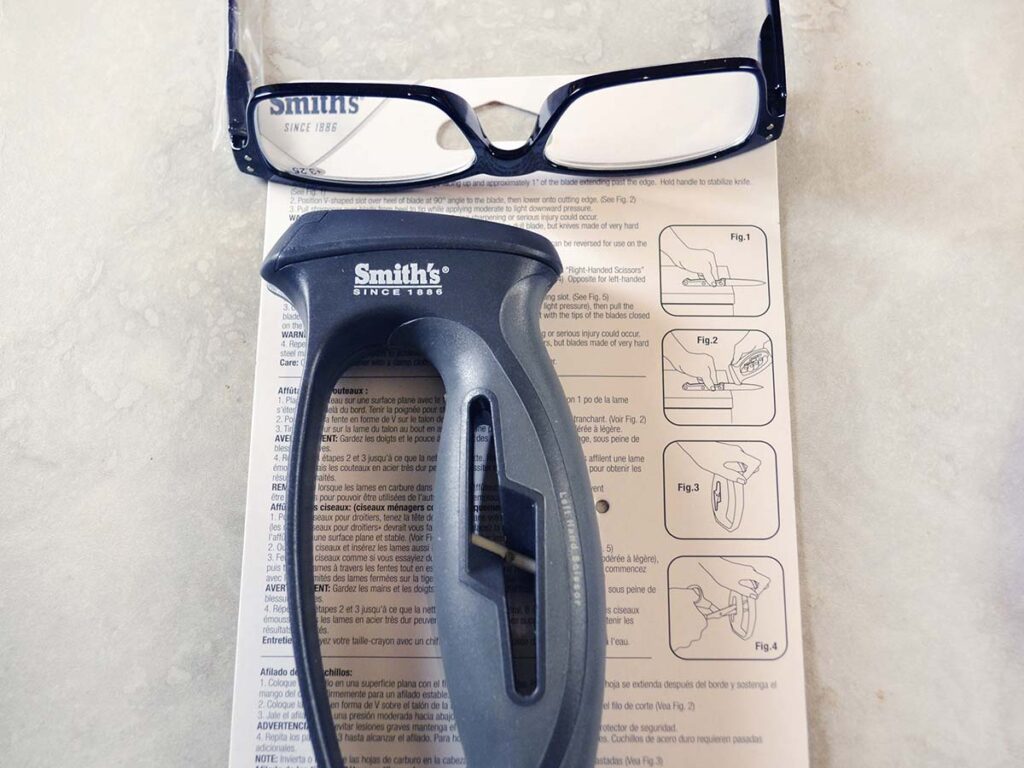
I tested two affordable versions: the AccuSharp ShearSharp Scissors Sharpener and the Smith’s V-Slot Knife & Scissors Sharpener. The pistol-grip-looking units appear similar at first but are actually quite different. The text and graphics on the back side of the cards the sharpeners are mounted on is very helpful, though if you’re like me you will need reading glasses to decipher them.

AccuSharp ShearSharp Scissors Sharpener

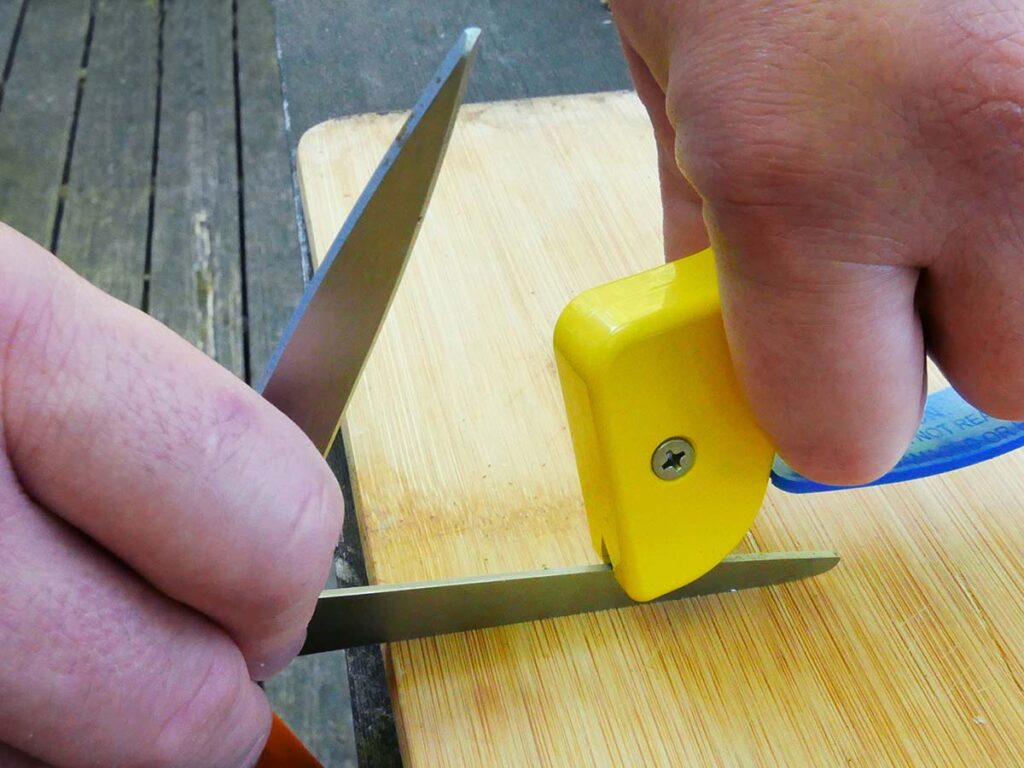
The AccuSharp ShearSharp Scissors Sharpener puts an edge on the blade bevels one side at a time. Here the blades are opened with one side resting on the flat work surface having the blade bevel sharpened. Note the other blade is off the surface. Once the first blade is done, the scissors are flipped and the second blade is sharpened in the same manner. (Covert image)

AccuSharp ShearSharp Scissors Sharpener
Size: 5.5 x 2.4 inches
Type: Hand-held, single sharpening blade
Abrasive: Tungsten carbide
Handle length: 5.6 inches
Handle material: Plastic
Country of origin: USA
MSRP: $9.59

The AccuSharp ShearSharp has a grip with a guard for knuckle protection and there’s a slot on the fore-end with a tungsten-carbide-metal sharpener for running down the blade bevel, sharpening it in the process. Open the scissors and lay the blades, one at a time, face-up to the sharpening medium. The rear blade—the one not being sharpened—hangs off the table or you can put it on a raised platform such as a wood block or book.

A hand-held design, the AccuSharp ShearSharp Scissors Sharpener addresses the blade bevels one at a time. You’ll need your reading glasses for these instructions, too!

The ShearSharp metal sharpener is canted to the angle of the bevel and runs down the blade from base to tip, rear to front. Accusharp recommends two to three passes of the sharpener, then flip the scissors over and do the same to the second blade. As with all three test units, keep an eye on your progress as scissors come in all phases of disrepair.

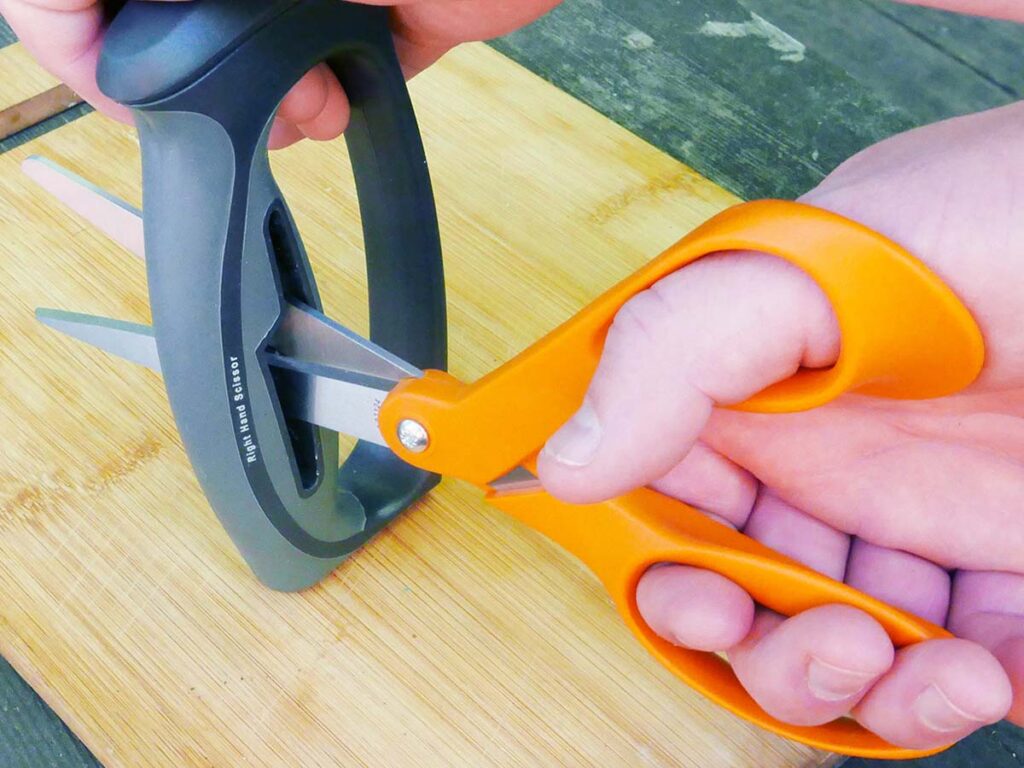
Smith’s V-Slot Knife & Scissors Sharpener

The bevels are sharpened when pushing the scissors blade tips simultaneously into the respective V-slots of the Smith’s unit. The diagonally mounted ceramic rod sharpens both blades at the same time. (Covert image)

Smith’s V-Slot Knife & Scissors Sharpener
Size: 6.75 x 2.74 inches
Type: Hand-held, two sharpening blades
Abrasive: Ceramic
Handle length: 6.75 inches
Handle material: Plastic
Country of origin: USA
MSRP: $9.99

Smith’s V-Slot Knife & Scissors Sharpener is a bit more sophisticated with great finger protection, and is easier to use. Inside the handle is a slot that holds a 1,000-grit ceramic rod angled to sharpen the two scissors bevels at the same time. The bevels are sharpened when pushing the scissors blade tips into the respective V-slots simultaneously. (Smith’s recommends not sharpening by pulling the blades out.)

You may need your reading glasses to decipher the instructions for the Smith’s V-Slot Knife & Scissors Sharpener.

Two to three passes is usually enough for blades of average dullness, more if needed. Once again, stopping to gauge your progress is your friend. An added benefit with the Smith’s sharpener is you can sharpen both right- and left-handed scissors depending on which side of the handle slot you use, and it’s conveniently noted on the sides of the unit itself.

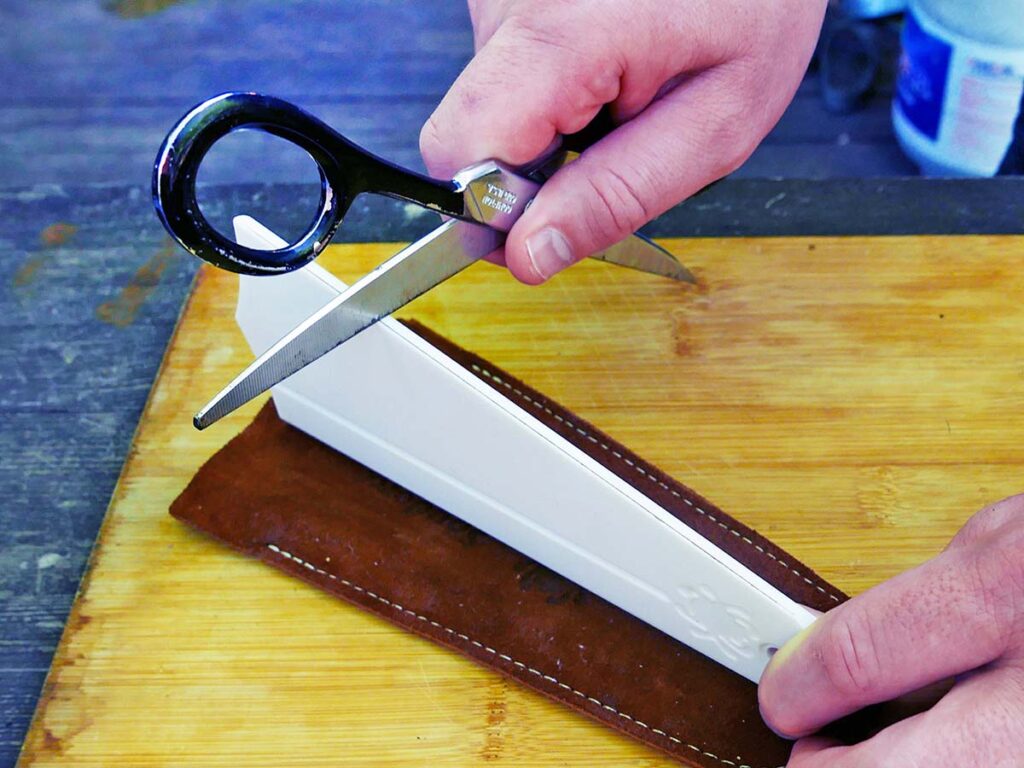
Spyderco Golden Stone

Starting at the top, slide the blade’s beveled edge down the length of the Golden Stone, gradually working the edge toward the tip. Once the edge is sharp, give the opposite blade the same treatment.

Spyderco Golden Stone Sharpener
Size: 7.2 x 3 inches
Type: Desktop sharpener
Abrasive: Alumina
Handle: None
Carry: Suede leather pouch
Country of origin: USA
MSRP: $210

I have become very familiar with the Spyderco Golden Stone sharpener over the years and have included it in several articles, though not for sharpening scissors. Spyderco knives are well known for their premier out-of-the-box sharpness, and company founder and BLADE Magazine Cutlery Hall-of-Fame® member Sal Glesser is a long-time guru on the topic, including today on YouTube.

The Golden Stone is a Glesser design that enables you to sharpen knives in many ways and at different angles, and even serrated blades. Spyderco uses alumina (aluminum oxide) for the Golden Stone’s material and other of its sharpeners, and claims the resulting models do not require oil or water for surface sharpening. Check out Spyderco’s YouTube sharpening videos for a myriad of ways to sharpen the company’s knives.

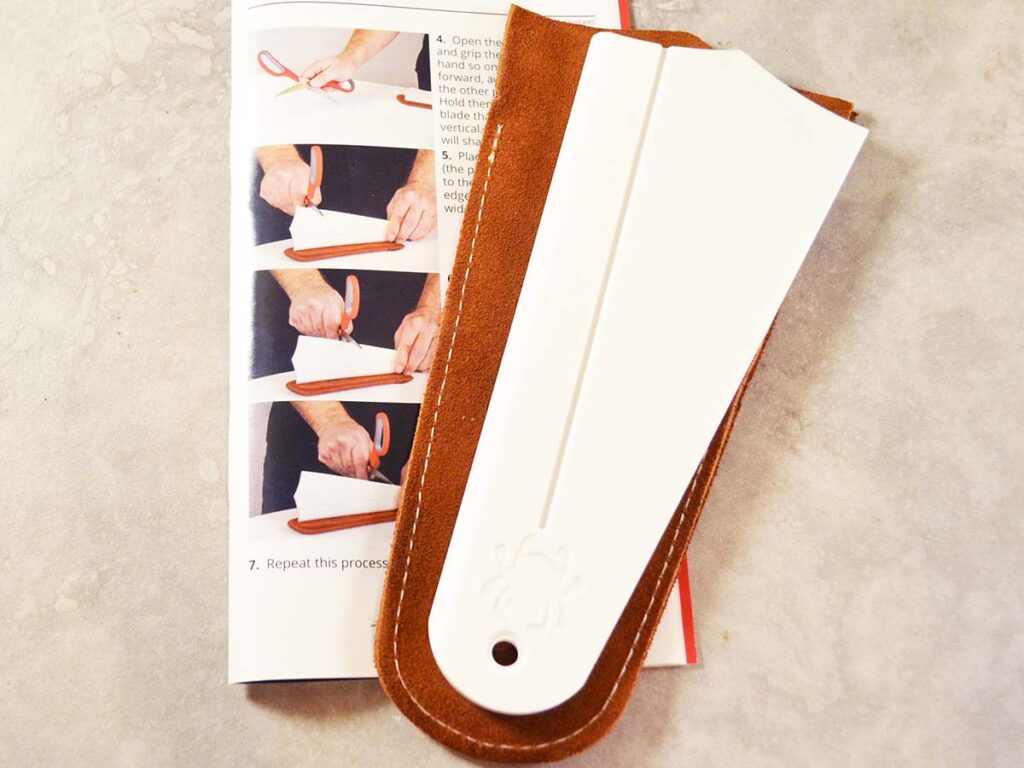
Designed by Spyderco founder Sal Glesser, the Spyderco Golden Stone is an odd triangular ceramic sharpener fit for many uses—one of which is sharpening scissors. For sharpening, position the suede pouch that carries the Golden Stone on a flat base to provide a non-slip surface. (Covert image)

To start with the Golden Stone, use the accompanying suede pouch as a non-slip surface on a flat base. Employ the stone’s rough triangular shape with the long side sideways and vertically. Grip the short side of the triangle with the long vertical side to your right, forming the sharpening platform. Now you’re ready to sharpen the first blade bevel.

Open the scissors wide and position the top of the base of the bevel grind over the high point of the sharpener, and slide it toward the low end as you slowly pull toward you.

It’s like sharpening a knife where you start at one end and slowly slide the tip toward the opposite end as you go—you’re just putting an edge on the bevel instead. Spyderco recommends eight to 10 passes but, once again, use your judgment depending on the condition of the scissors. Once you’re pleased with the bevel on the first blade, flip the scissors over and repeat the process on the second blade. When done you can remove any burr on the edges of the two blades by opening and closing the scissors a few times.

Conclusion

Both handheld units did a good job of sharpening the bevels, and though I prefer a ceramic sharpening rod just because you can better “feel” it rubbing against the bevel, there was no noticeable difference in the results. These two sharpeners are capable of putting a very decent edge on your scissors.

Fiskars is one of the few major companies that manufactures scissors specifically for lefthanders, and is known for such radically asymmetrical designs as these two. The red pair is for lefties.

The end result of my efforts with the Golden Stone paid off with two razor-sharp beveled edges on the scissors blades. Spyderco doesn’t assign numbers to the grits on its sharpening media, but the best I can tell the white alumina like that used on the Golden Stone is in the fine, 2,000-grit range.

Where To Find Your Edge

Is all the cost, time and increased degree of skill required by the Spyderco Golden Stone worth it? That’s up to you and what your expectations of your scissors are. There are folks whose livelihoods depend on scissors, others that just want to get the mail out the door and scads of people in-between. Choose your sharpener!

More Sharpening Articles:

Gloves And Knives: Do They Go Hand In Hand?

0

There are times gloves make all the sense in the world to use when using a knife and times they don’t.

The old saying goes that two things might “fit like a glove” or “go hand in glove.” But just maybe another question involves exactly when the “glove fits.”

Since mankind began working with tools, stone, bronze, steel and even in conditions that might be less than ideal, such as clearing trees and brush, dressing an animal, building a structure, or handling heat and cold temperatures, the idea of protection has been second nature. At first glance, the glove has its place and always will. But there are, in fact, other considerations in using hand protection, especially when it involves using a knife.

The time and place for gloved hands is the choice of the user, and thoughts on the topic vary.

“As you might expect, the answer ‘yes or no’ to gloves is ‘it depends,’” declared Craig Powell, general manager of TOPS Knives. “There are a lot of different reasons to wear gloves or not, depending on the use case. In cold weather, the gloves are more to keep your hands warm than they are necessarily for safety or grip. I wear gloves if I have them on me whenever I’m doing heavy-duty cutting like chopping firewood or other tasks that have a lot of impact involved.

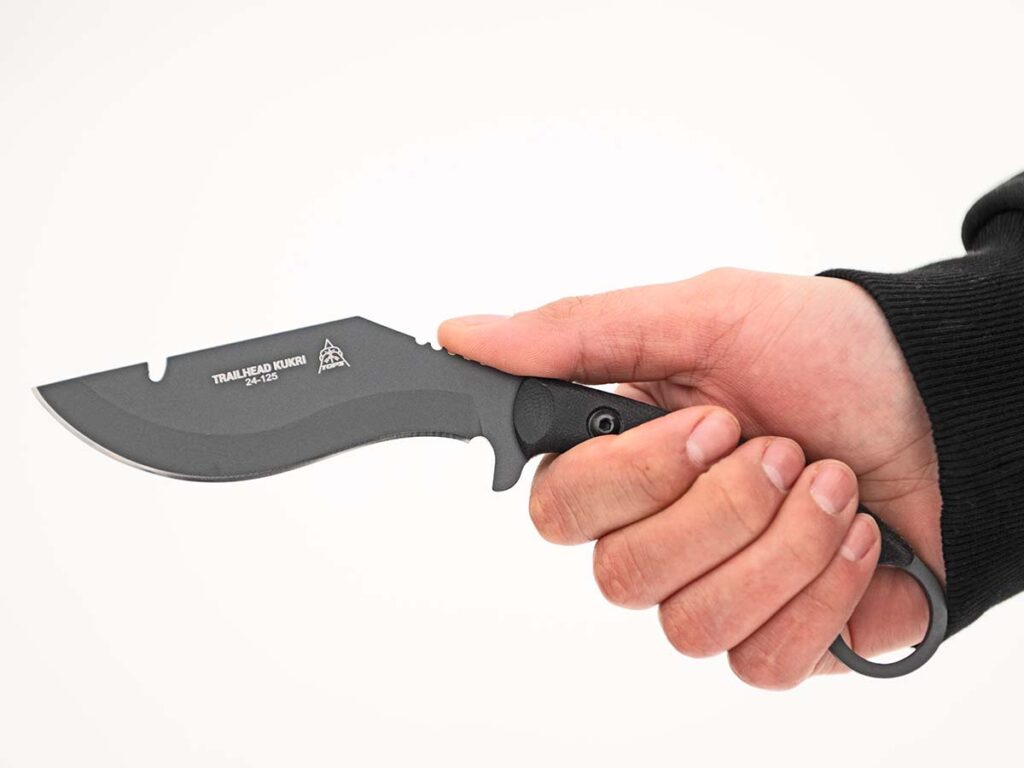
Craig Powell said one of the specific reasons for Micarta® or G-10 handles on TOPS knives is to provide a good grip when you need it. “Micarta is one of the best for grip even when wet and whether you have gloves or not,” he observed. The TOPS Trailhead Kukri has black canvas Micarta scales. (TOPS image)

“I also usually have a few pairs of latex or nitrile gloves handy when hunting just to keep things a little cleaner when gutting or skinning an animal,” Craig added. “If I’m doing tasks that require fine control of cutting, I don’t usually wear gloves. One of the reasons I use Micarta® or G-10 on TOPS knives is specifically to provide a good grip for when you need it. Micarta is one of the best for grip even when wet and whether you have gloves or not.”

Situational awareness, then, drives most decisions to use gloves or go barehanded when using a knife. There are times when working with steel in the shop or making camp in the field that gloves are indispensable, and then there are other tasks that require the most intricate feel and finesse that can only be achieved with the bare hand.

Reuben Bolieu, BLADE® correspondent, outdoor adventurer and designer for ESEE Knives, recognizes when and where the glove provides that necessary advantage.

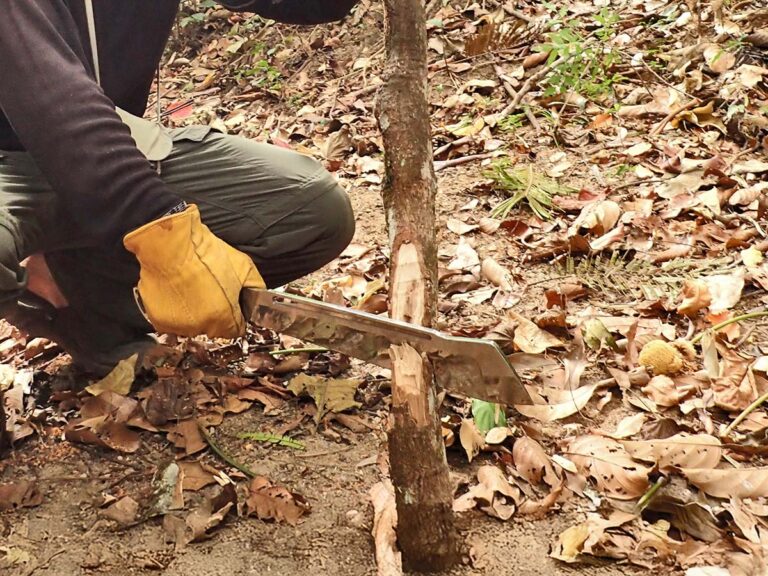
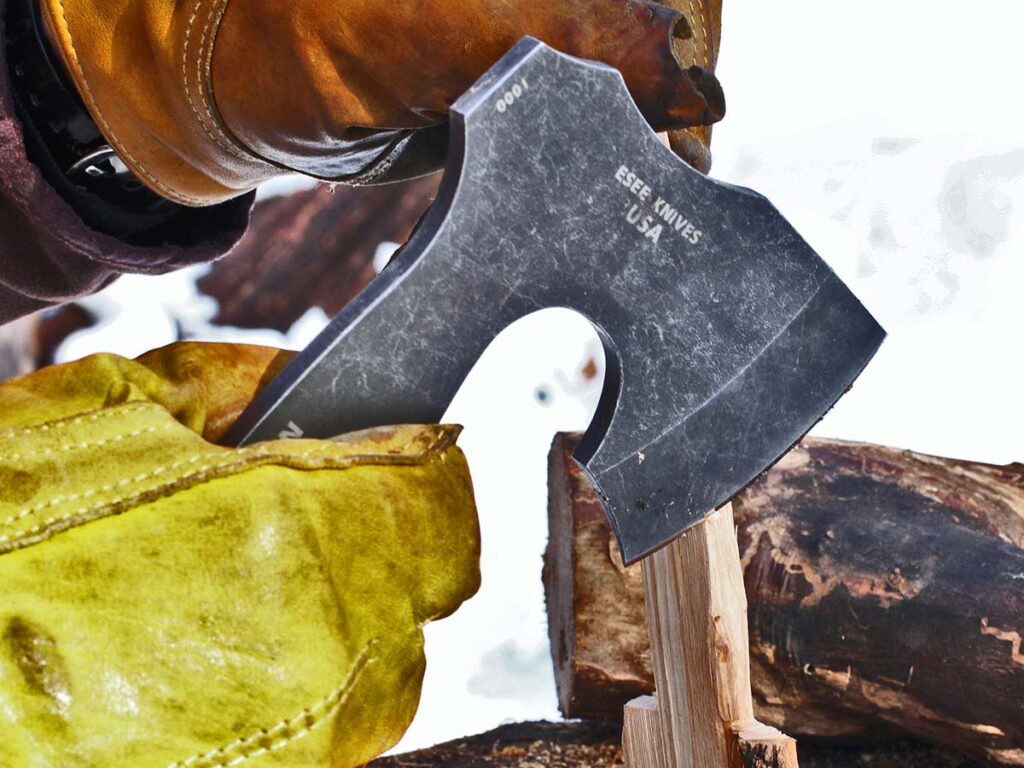
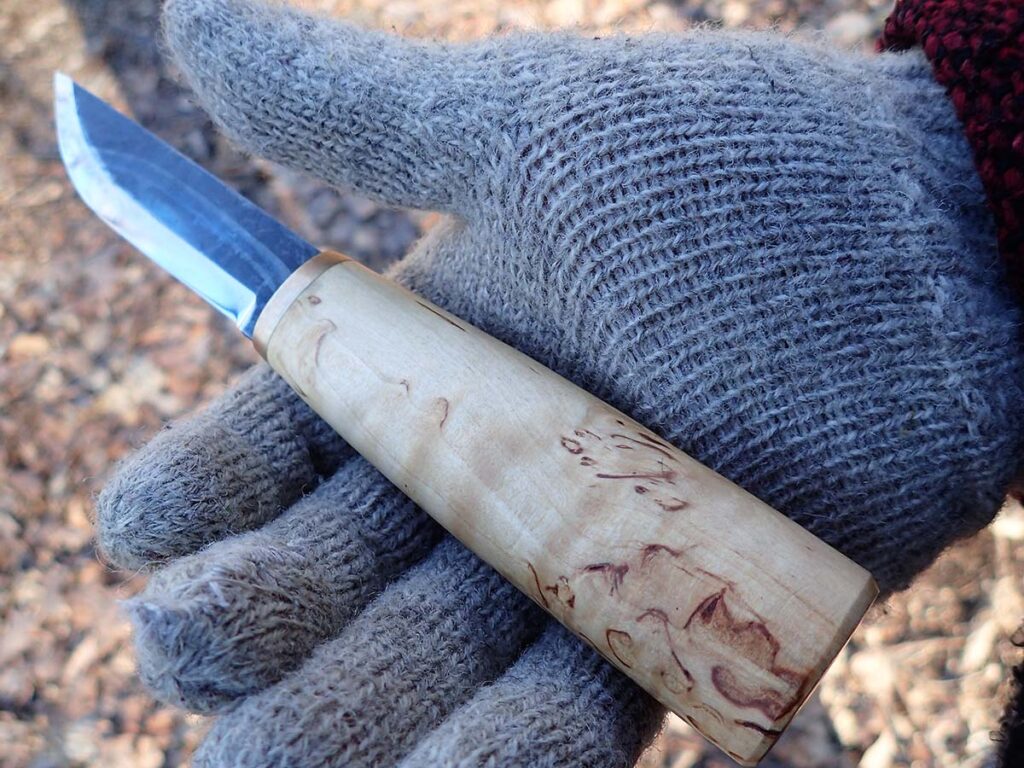
Reuben Bolieu wears cowhide gloves—nothing fancy—while chopping with his ESEE Gibson Carving Axe. As he noted, “These gloves are excellent general-purpose gloves when handling wood, bamboo, hot cookware and dirty work.” (Bolieu image)

“Gloves are the unsung hero of my camping trips,” he remarked. “They provide a momentary boost of superpower when handling hot pots or skillets taken directly from the campfire. Gloves also give you a second chance if you accidentally nick yourself while retrieving a big blade or axe from its sheath.”

Joe Flowers, designer for TOPS Knives and Condor Knife & Tool, answers emphatically regarding whether he uses gloves.

“Most of the time I do not, unless I am doing a highly repetitive motion or am working a particularly scaly or dangerous animal or material. This is general, as I can feel the blade and manipulate the tool more for the tasks at hand. The pro of wearing gloves, especially if you are not used to working tools, is the absence of concentrated friction that can lead to blisters. Even if you work a farm all day, you can get blisters doing a repetitive motion.

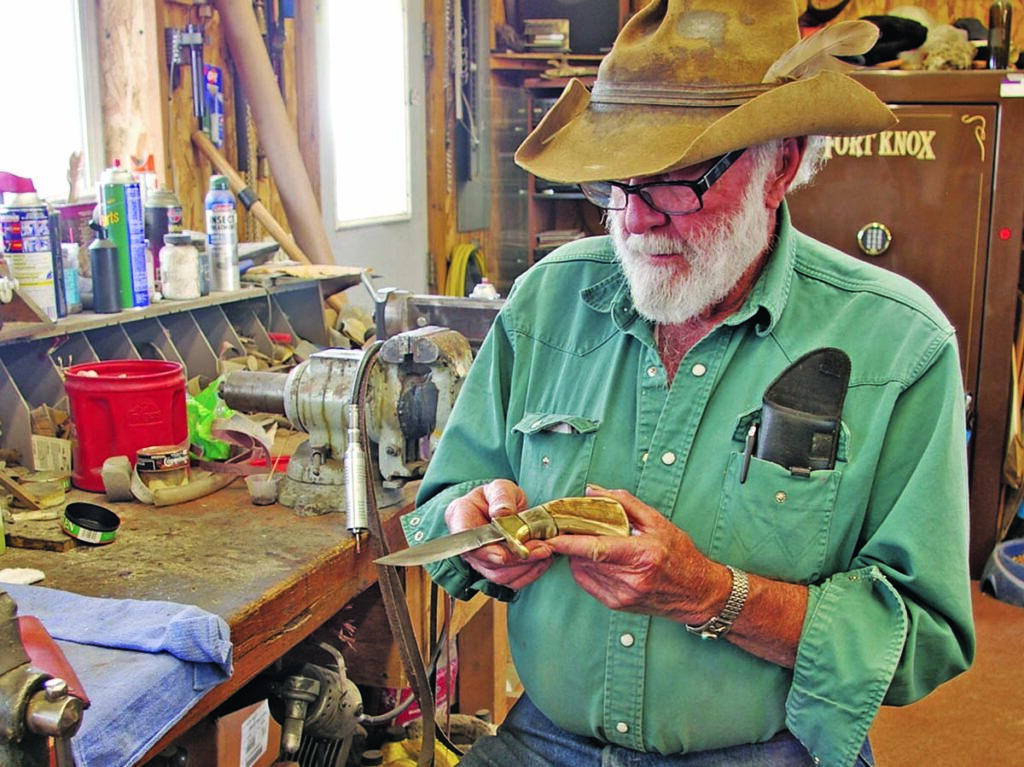
Feeling the handle of a knife against bare skin in the user or maker’s hand is considered the acid test for utility. Ed Fowler cradles one of his trademark sheep-horn handle knives at his shop bench.

“After hanging out with Anders Haglund, formerly of Helle Knives, I appreciated the idea of a larger handle for mitten manipulation,” Joe added. “The legacy of Sami reindeer herders who use large gloves helped him convince me. I don’t always design large handles, but if it is a design that could work with a Nordic culture I pay attention and put a larger handle on the blade. Sami culture sometimes calls their survival kit ‘a big knife, a small knife, and a reindeer.’ That’s all they need to survive.”

Gloves, Knives And Safety

Safety is always a factor in wearing gloves to use knives. Removing a knife from a sheath or deploying a folder blade always has a bit of hazardous duty involved. The same is true in the shop or the field, though the gloves themselves can sometimes present a hazard.

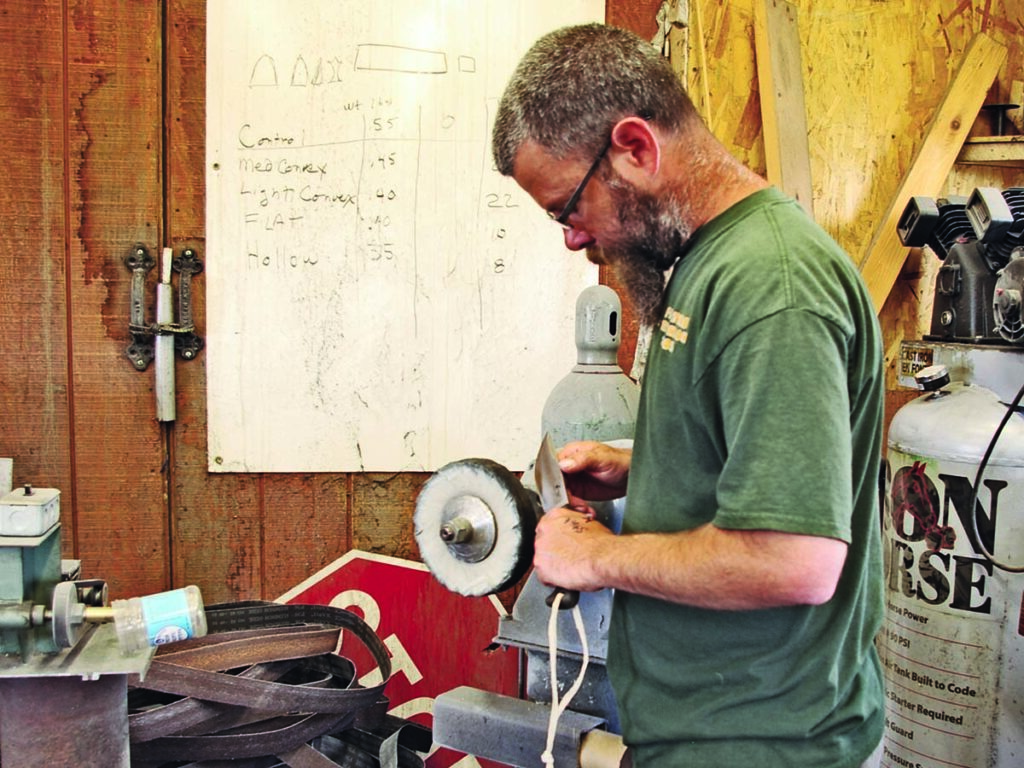
“Gloves get wet. This is wasteful,” explained longtime BLADE field editor and High Endurance Performance Knife master smith Ed Fowler. “They may be too loose and can get you caught up in machinery. The skin on our hands is very sensitive, and this sensitivity can help improve the quality of our knives, as well as our health. When buffing or grinding a hardened blade, our hand can communicate the temperature, where your heat treat might not remain just as you planned it to be. Friction is the enemy of our heat treats.”

“After hanging out with Anders Haglund, formerly of Helle Knives, I appreciated the idea of a larger handle for mitten manipulation,” Joe Flowers stated. “The legacy of Sami reindeer herders who use large gloves helped him convince me.” The Nordic-style fixed blade is a Marttiini Arctic Carving Knife. (Bolieu image)

At the risk of stating something readily apparent, the positive aspects of wearing gloves when using knives include minimizing a cut or slice that could require stitches or worse, managing heat and cold, reducing the build-up of friction that can create painful blisters, and possibly even improving grip and purchase in the hand.

“The obvious pros of gloves are safety from materials and the tools you use,” Bolieu related. “However, gloves are fumbly! This brings us to the cons: clumsy dexterity. Fiddling in the dark or cold is the worst when working with sharp tools or lacking time. Gloves can slow you down big time! Sometimes you need to take a stand and say, ‘The gloves are coming off!’”

When Powell is at work, he takes stock of the task at hand, and gloves may or may not be part of the equation.

“Fiddling in the dark or cold is the worst when working with sharp tools or lacking time. Gloves can slow you down big time,” Reuben Bolieu opined. “Sometimes you need to take a stand and say, ‘The gloves are coming off!’” (Bolieu image)

“Gloves can keep your hands from getting torn up when you’re doing a lot of heavy-duty cutting. They can also keep your hands clean when they need to be. Then, of course, there are gloves that will help prevent or at least lessen the cut you might receive if there is an accident. The cons are mainly the loss of dexterity and fine control. Depending on the type of glove, your ‘feel’ of the knife just won’t be as good as with a bare hand.”

Feeling the handle of a knife against bare skin in the user or maker’s hand is considered the acid test for utility. The glove is sometimes a barrier to truly getting the feel of the knife and developing an intuitive awareness of its capabilities.

“A good way to see if a handle is going to be comfortable for you to use is to give it a good, hard squeeze and hold it for a few seconds,” Powell commented. “Once you release it, if you feel some uncomfortable spots on your hand, that is a good sign that it will have some hot spots. Everyone’s hand is different, so while some knives might feel great for some, that same handle might feel terrible to others. A knife that looks great aesthetically doesn’t always do the job when it comes time to start cutting. So, a bare hand on the handle is a must whenever you can.”

Habit And Repetition

For those who wear gloves regularly when using knives, personal preference weighs in. The influence of habit and repetition contributes, too.

“Here’s a good analogy for this,” said Craig. “Most people wear shoes every day to keep their feet from getting cut or injured in some way. People that spend lots of time barefoot, especially outside, tend to have tougher feet. Basically, the same rocks that would cause some people a lot of pain don’t do anything to those who walk barefoot often. The same will be true for gloves. If you wear gloves every time you use knives or other hand tools, your hands don’t build up some of the toughness to be able to handle using knives often. A good handle will absolutely make a difference, but so will using tools often in general.”

As Ed Fowler noted, when buffing or grinding a hardened blade, the hand can communicate the temperature. Chris Amos buffs a blade in Ed’s shop in this file photo. (Fowler image)

Choosing whether to wear gloves or not shouldn’t be a difficult decision. The best advice available involves balancing risk versus return, hazards in relation to control and manageability.

“If gloves are the remedy, crack on!” Reuben offered. “Gear is terrain and weather-specific. I use leather gloves made of cowhide, the type you would see a ranch hand or cowboy use—nothing fancy. These gloves are excellent general-purpose gloves when handling wood, bamboo, hot cookware and dirty work.

“In winter, I add a thin fleece glove under them,” he noted. “This adds warmth but makes things extra fumbly. If I need more dexterity for making feather sticks or carving, I remove the leather glove and work the best I can with the fleece glove. It’s always a tradeoff. Safety first! More than anything, try with and without, see what works for you and have a blast!”

Flowers is strong in his opinion on the gloves themselves, but acknowledges there is a time and place for them when working with knives.

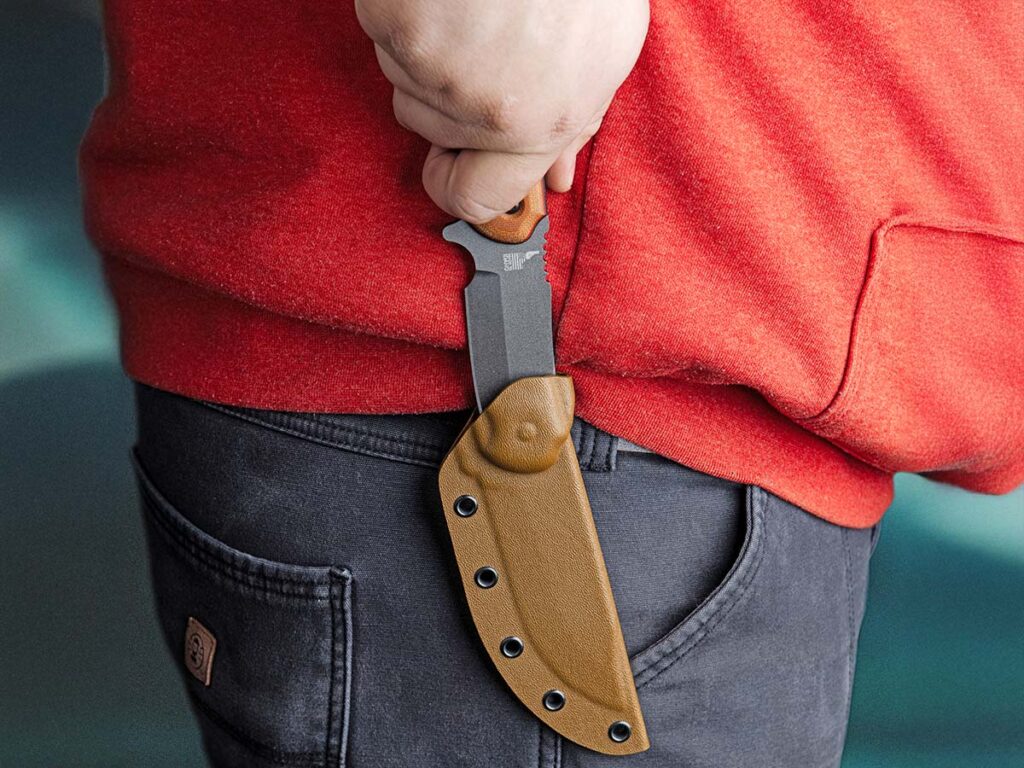
Pulling a knife from a sheath or deploying a folder blade always has a bit of hazardous duty involved. (TOPS image)

“Gloves do not determine how hardcore you are,” he advised. “I hate gloves but I wear them sometimes when the environment dictates it. I like to work beehives without gloves and I applaud anyone who does. Dexterity is very important when you manipulate and use a tool with a fine edge. Find gloves that you can move in … Gloves can help, but ultimately it is your time with a knife that is important, and, honestly, part of our human story.”

Experience is a great teacher, and familiarity with knives, their utility and hazards should drive the decision whether to use gloves.

“To each his own,” Powell concluded. “If you prefer to wear gloves when using knives, do it. If you don’t like wearing gloves don’t unless you’re doing something where there is a really good reason to have gloves on. For just regular daily use, I feel gloves are totally unnecessary, but I’ve also been in the knife world for over 25 years now.”

The use of gloves while working with knives does, then, involve the nature of the task, its brawn and repetition versus its intricacy and detail, control versus power. Having a pair of gloves handy is probably a best practice. Using them when and where appropriate enhances the knife experience.

Read More:

Advertisement

Must Read Articles

Read this before you make a knife

Knifemaking 101 – Read This Before You Make a Knife

  by Wayne Goddard My experience has taught me that there's nothing like digging in and getting started. I've often said the hardest part of the...
how to forge damascus steel

How to Forge Damascus

Advertisement
Advertisement