Knife Collecting

Knife collecting is an extremely rewarding experience for knife enthusiasts. There truly is a knife for everyone. Many increase or hold their value throughout the years, making collecting knives something to pass on to the next generation of knife collectors.

The Viking Seax And Where To Get One

Deeply Rooted In Scandinavian History, The Seax, AKA “Scramasax” Or “Sax,” Was The Blade Shape Of Choice For The Much-Feared And Revered Vikings.

Typically the Norsemen were associated with their famous axes, but, truth be known, they also carried a knife that saw more general use: the seax.

The Scandinavians usually lived in villages, farmed the land and raised animals. In such an agrarian society, they also needed tools to help them work the land and harvest the fruits of their labor. This is also where a knife came into play.

“Their personal knife was called the seax and it never left their side because it was their version of an EDC,” begins Ernest Emerson of Emerson Knives, Inc. “The knife was tasked with a myriad of chores, from skinning a freshly taken deer to cutting up the turnips they grubbed out of the ground with the same knife.”
Seax blade shapes
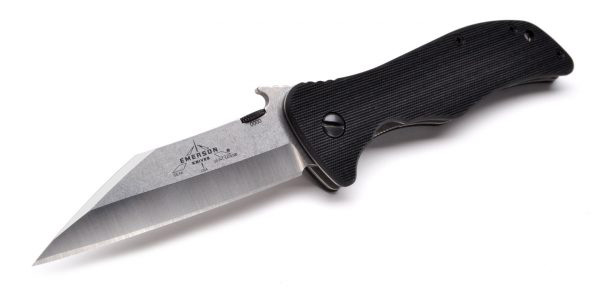
The folding Emerson Knives Seax puts a modern twist on this age-old blade design. (Image via Emerson Knives)

Emerson said the seax also could be employed as a self-defense weapon if needed. It was truly a blade for all seasons: Harvest produce in the morning, fend off the enemy after lunch, and then prepare supper in the evening—all with the same blade.

Seax Designs

All joking aside, the seax was a handy blade.

“It is a bowie-style blade, a spear-point type of blade, a Loveless drop-point hunter-style of blade, and, of course, the well-known ‘broken-back’ style featuring a severe clip close to the front, finishing in a point well below the center line,” Emerson said.

He said the broken-back seax style is the most common and appears in TV shows and movies depicting Vikings.
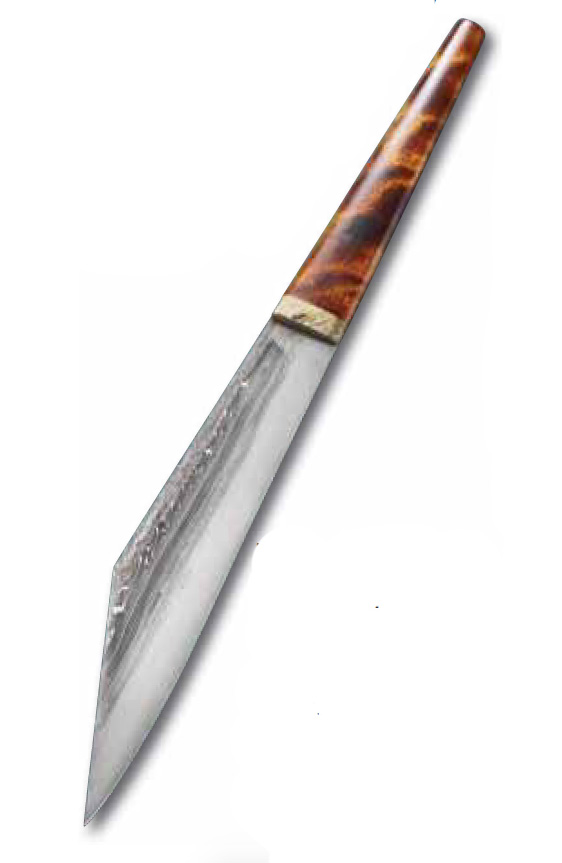
Broken Back Seax
The Broken Back Seax by Aidan Garrity of Iron Lion Blades features a 10-inch damascus blade of 1095 carbon and 15N20 nickel alloy steels, and wrought iron. The handle is maple and the bolster is moose antler. Overall length: 18 inches. (SharpByCoop image)

Blade lengths varied wildly from seven inches on the short end and topping out at 30 inches, the latter Emerson called a short sword, basically.

“The seax needed to be an all-around utility tool that could chop, cut, slice, and sometimes stab, all with equal ease of application,” he said. “A Viking’s livelihood depended on self-sufficiency, resourcefulness, and the quality of his toolkit.”
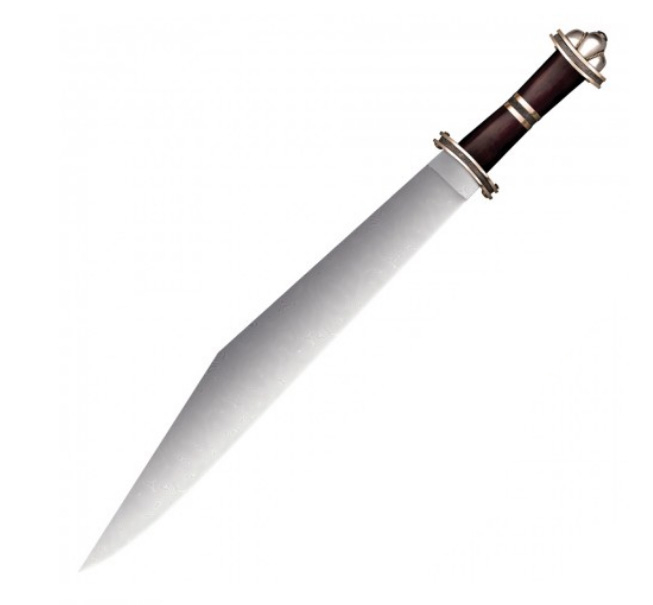
What is a seax
The Cold Steel Damascus Long Sax features a 17.25-inch blade with an edge that curves up toward the tip. MSRP: $635.99. (Cold Steel image)

At first glance, the seax may not seem as exciting as a recurve blade, but looks are not always everything. The beauty of such a blade lies within its ability to tackle cutting chores.

The straight-line cutting edge tackles a variety of tasks easily, and the point of the blade is both precise and powerful, with the ability to score as well as penetrate.

5 Best Seax Knives

The long history of the seax is still going strong today as companies young and old are making new versions of the historic blade.

These five are some of the more unique and exciting seax knives available today.

Terävä Skrama 240

Terävä Skrama 240
Terävä Skrama 240

Direct from the Finnish brand Terävä, the Skrama is a rugged bush knife great for chopping, slicing, and building shelters in the outdoors. The 9.4-inch blade is made from 80CrV2 steel with a 59 HRC. It comes married to a textured rubber handle for easy grip in any weather conditions.

The blade has a full tang and a flat edge but with a twist. It’s sharpened to a 34-degree edge except for the two inches closest to the hilt. That small section is sharpened to a finer 25-degree edge for more meticulous, precise knifework.

The Skrama comes with either a leather sheath or a plastic cover and has an MSRP of $69.99-109.99.

SZCO Supplies Brass-Studded Seax

SZCO Supplies Brass-Studded Seax

SZCO Supplies has made a fun, durable knife with its Brass-Studded Seax. The piece features a 10-inch blade married to a wooden handle. The knife is adorned with brass studs on the handle as well as a brass guard and pommel.

For a budge knife, it does have some weak points. The two main ones are that the leather sheath may need some working in to be at its best, and the knife may need a sharpen out of the box to have a pristine edge. Other than that, this is a good knife for the money.

Strong enough for a log, sharp enough for a piece of chicken, SZCO Supplies has made a  seax that is well priced at an MSRP of just $27.63.

Medieval Collectibles Viking Seax Knife

Medieval Collectibles Viking Seax Knife

This seax from Medieval Collectibles has the look and feel of a knife from the Viking era. It’s made from 5160 tempered carbon steel with a full tang, which is peened over the end of the handle’s metal end cap.

Just over 17 inches in length, and a blade length of 12.1 inches, the Viking Seax comes with a handle that has a wood grain finish and a hand-stitched leather scabbard with a belt hanger.

At just 14.4 ounces in weight this is a utility knife great for everything from chopping through wood and brush to defense and protection. The Viking Seax comes with an MSRP of $169.

Grimfrost Broken Back Seax, Type IV

Grimfrost Broken Back Seax, Type IV with scabbard

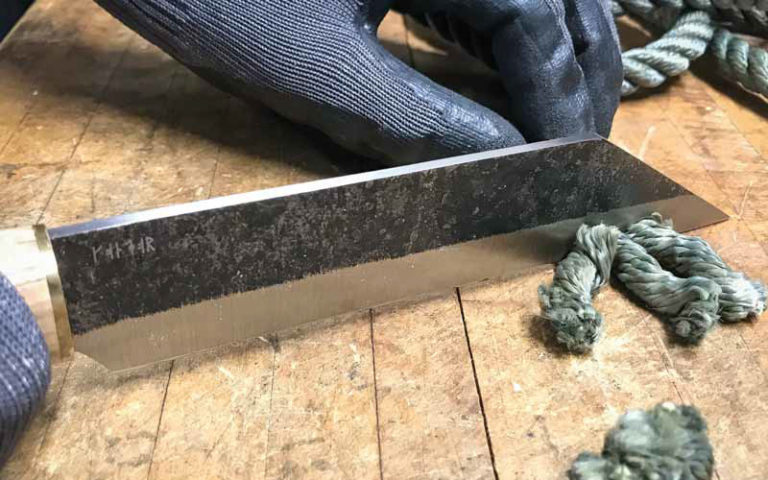
From Grimfrost comes a full-tang seax made of 1045 carbon steel. A reproduction of a 1,000-year-old seax found in London, the Broken Back Seax is 16 inches in length with an 11-inch blade.

The handle is handmade ash and the included leather scabbard is hand-stitched. It also features “Grimfrost” stamped in runes on the side of the blade.

Lots of time and care went into making this knife as authentic as it could be and it shows. So whether you want to feel like Leif Eriksson exploring new lands or just want a strong knife while chopping, Grimfrost has you covered.

The Broken Back Seax has an MSRP of $132.

Lunar Light Forge Damascus Sanmai Seax

Lunar Light Forge Damascus Sanmai Seax

This amazing seax is from the husband & wife duo of Nathaniel and Megan Everett at Lunar Light Forge in Akron, Ohio.

The damascus blade is made from 42 layers of 1095 and 15n20 steel around a 5160 core. It is paired with a handle made of Buffalo horn and Cocobolo wood, and it comes with a hand-tooled & hand-stitched leather sheath.

It’s just as much an art piece as it is an excellent utility knife. The 7-inch blade can process an animal, hack off tree limbs, and chop in the kitchen. It does have an MSRP of $722.50, but for the amount of craftsmanship and care that went into the piece, you’ll know you’re getting a knife of the highest quality.

Editor’s Note: Mike Abelson contributed to this piece

Read More
New Knives: Custom Options From All Categories And Continents

Hot haves by custom makers from around the globe.

With BLADE Show 2024 just around the corner, many new knives are hitting the custom and factory markets. We scoured the former end—hitting all points of the compass along the way—to bring you some of the latest and greatest handmade gems. If you’re heading to Atlanta, be on the lookout for these and other great custom creations.


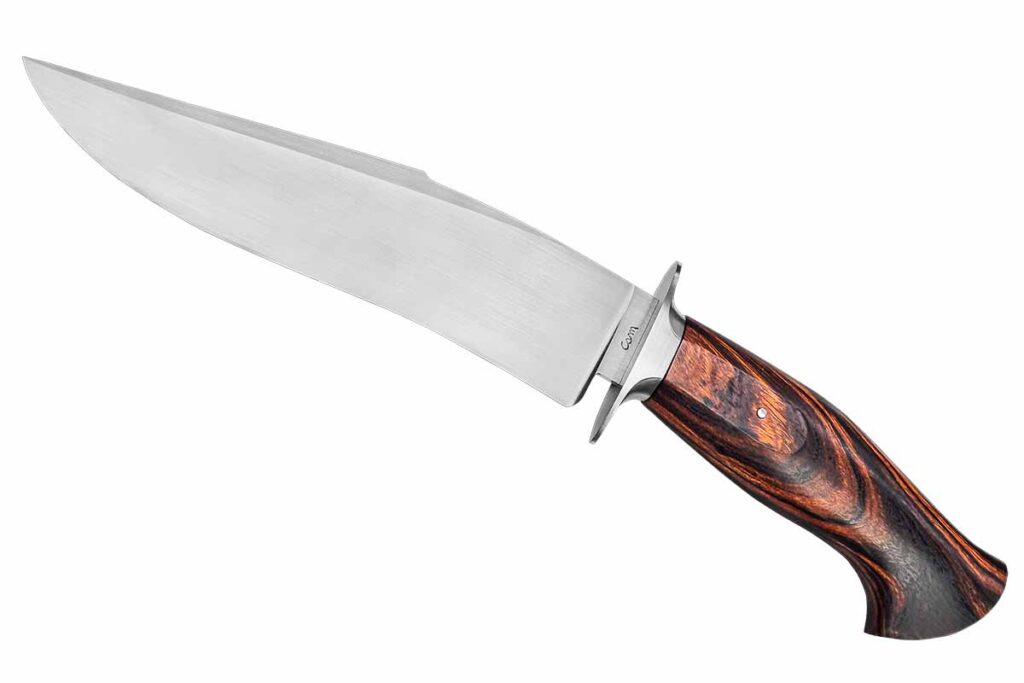
Camille Sennegon Fighter

Camille Sennegon Fighter

Blade length: 8”
Blade material: 80CrV2 carbon steel
Blade grind: Flat, w/a small convex grind on the edge
Blade finish: 800-grit satin
Blade pattern: Harpoon w/recurve edge
Handle: Ironwood
Bolster: 304 stainless steel
Overall length: 13”
Maker’s price for a similar knife: $800 at press time rate of exchange
Maker’s remark: “I made this knife based on a design drawn and given to me by my friend, ABS master smith Samuel Lurquin.” (Jocelyn Frasier image)


Francesco Piccinin Northern Style Utility

Francesco Piccinin Northern Style Utility

Blade length: 4”
Blade steel: 14C28N stainless
Blade grind: Flat
Handle: White G-10 w/black G-10 frame and spacers w/hole for a lanyard
Bolster: Ash burl
Overall length: 9”
Sheath: Leather w/belt loop and leather tiedown w/bead
Maker’s price for a similar knife and sheath: $600 at press time rate of exchange (Jocelyn Frasier image)


Steven Ramos Pisces

Steven Ramos Pisces

Knife pattern: Hunting/utility
Blade length: 7”
Blade steel: CPM 154 stainless
Blade grind: Hollow
Blade finish: Bead blast
Handle: Micarta® w/G-10 liners
Overall length: 10.625”
Sheath: Kydex over aluminum frame; made by Steven Ramos
Maker’s price for a similar knife and sheath: $825 (Jocelyn Frasier image)


David Lisch Singing Crusader

David Lisch Singing Crusader

Knife type: Fixed blade
Blade length: 5.25”
Blade material: Damascus of 1080 carbon and 15N20 nickel alloy steels
Blade grind: Convex
Construction: Damascus integral
Handle: Forged pipe handle holds ball bearings that make the knife “sing” when shaken
Knife to know: The bear head pommel is hand forged; the maker is an ABS master smith
Overall length: 10.5”
Maker’s price for a similar knife: $1,500, though this one being a one-of-a-kind, the pipe handle and carved pommel would be somewhat different, as would the damascus pattern
davidlisch.com (Jocelyn Frasier image)


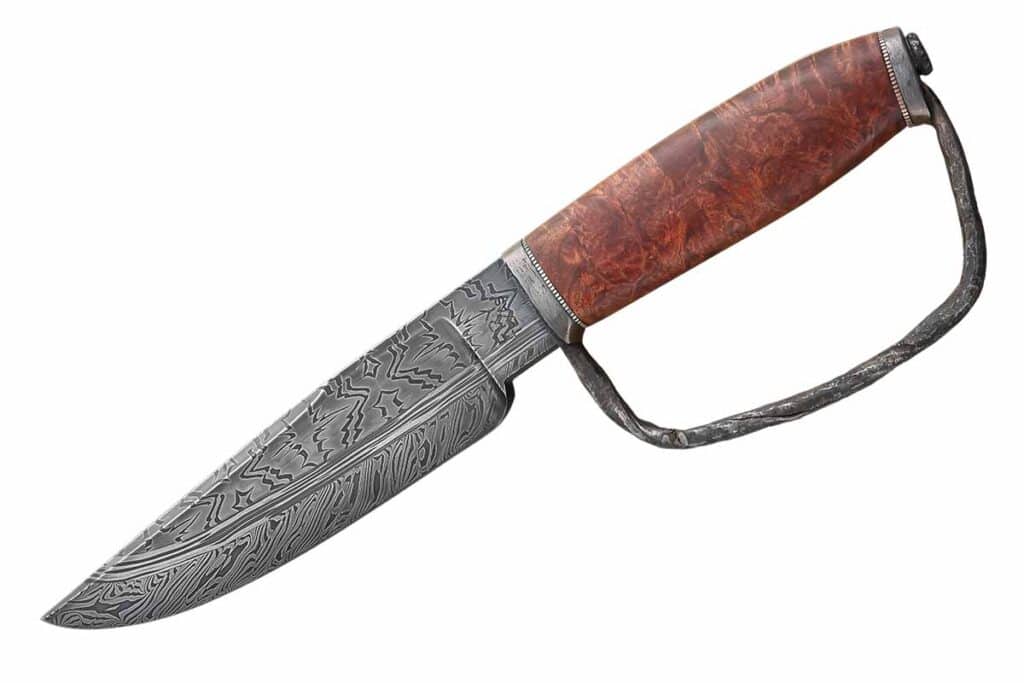
Jason Fry Border Bowie

Jason Fry Border Bowie

Blade length: 8”
Blade material: Explosion/twist/border-wall damascus
D-guard/bolster: 1880s wrought iron artifacts
Handle material: Mesquite
Frame: 1848 and 2023 half dollars
Overall length: 13”
Knife to know: Border-wall stand included
Maker’s price for a similar knife: $4,200
frycustomknives.com (SharpByCoop image)


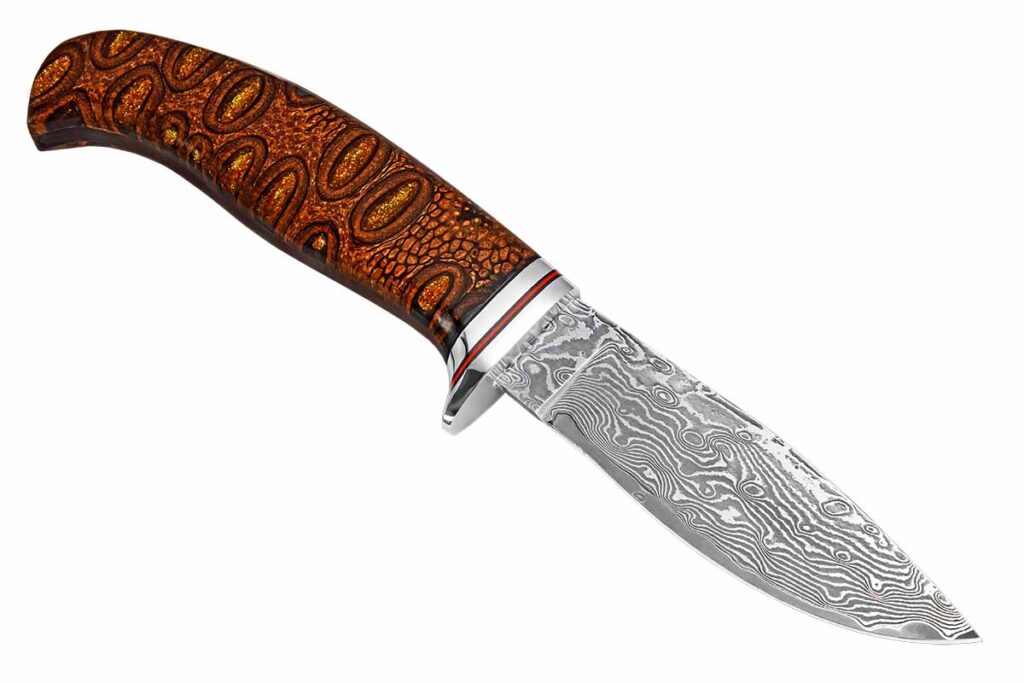
David Brodziak Hunter

David Brodziak Hunter

Blade length: 4”
Blade material: Stainless damascus w/VG-10 stainless core
Blade grind: Flat
Blade thickness @ ricasso: .126”
Guard: 416 stainless steel
Handle material: Banksia nut w/gold fleck inlay
Overall length: 8.27”
Maker’s price for a similar knife: $320 plus postage
brodziakcustomknives.com (Rod Hoare image)


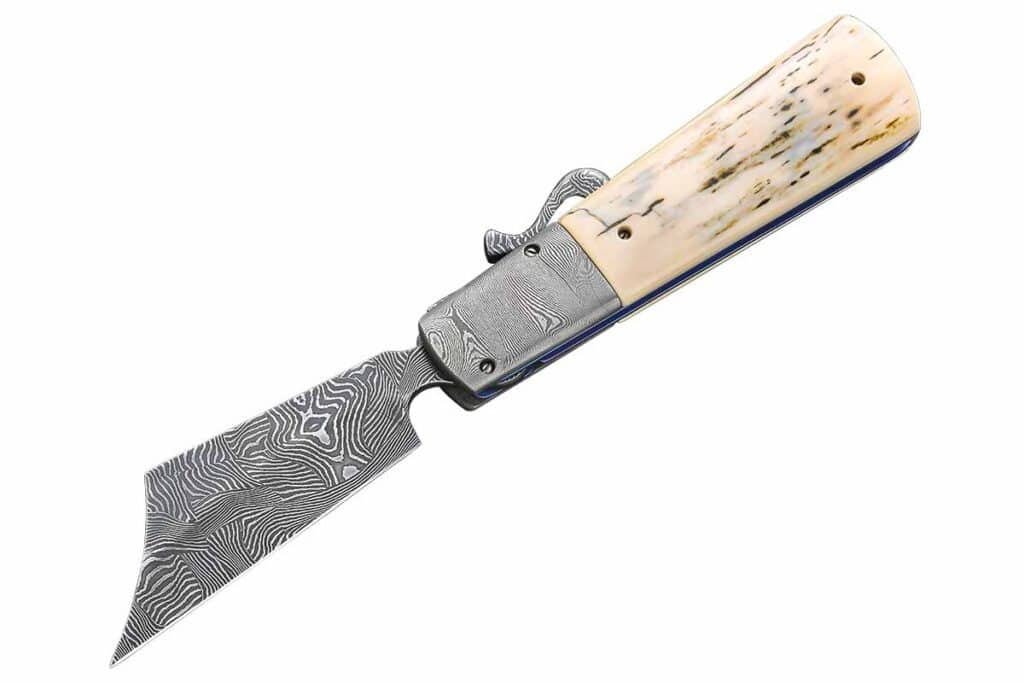
Mardi Meshejian Razor-Style Linerlock

Mardi Meshejian Razor-Style Linerlock

Blade length: 3”
Blade material: Damascus of 1080 carbon and 15N20 nickel-alloy steels
Blade grind: Hollow
Handle: Mammoth ivory
Bolster: Damascus
Liners: Titanium
Closed length: 6”
mardimeshejianbladesmith.com (SharpByCoop image)


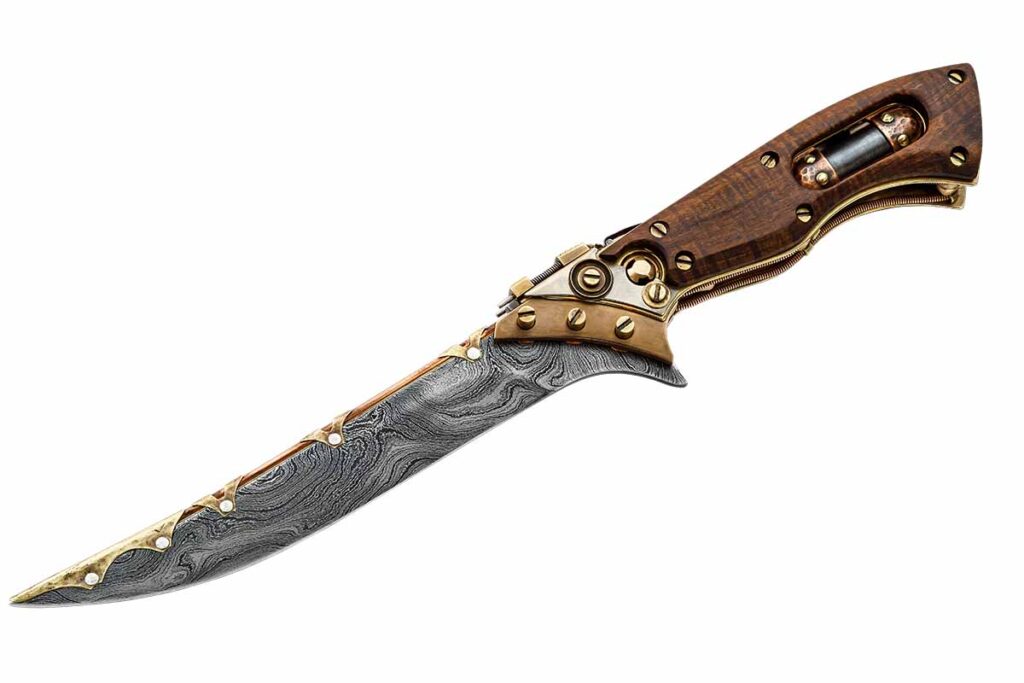
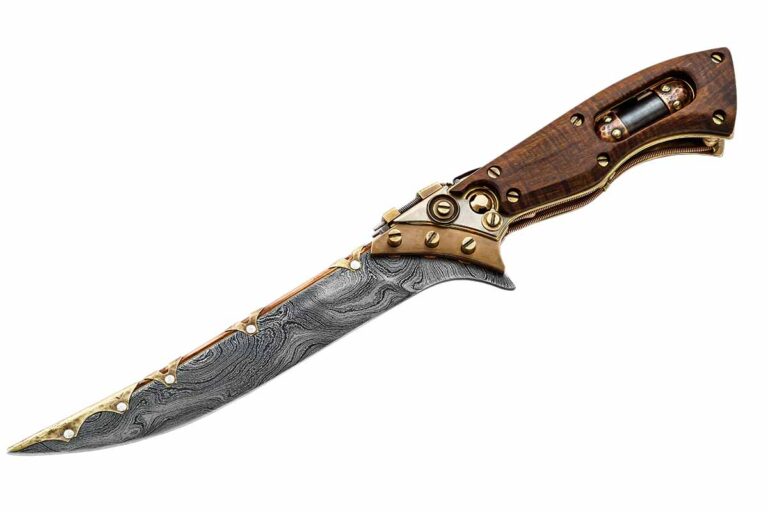
Adam Fromholtz Steampunk Assassin Injector

Adam Fromholtz Steampunk Assassin Injector

Blade length: 5.9”
Blade material: Damascus of 1075 carbon and 15N20 nickel-alloy steels
Blade grind: Flat
Handle: Tasmanian blackwood
Frame: Brass, copper, steel, clock parts, nickel silver
Guard: Bronze
Knife to know: The knife includes parts from clocks, a piano, cordless drill, gas valves, cigarette lighter and a gas bottle; the maker is a member of the Australian Knifemakers Guild and is an ABS apprentice smith
Overall length: 12.2”
Maker’s price for a similar knife: $4,700 at press time rate of exchange (Rod Hoare image)


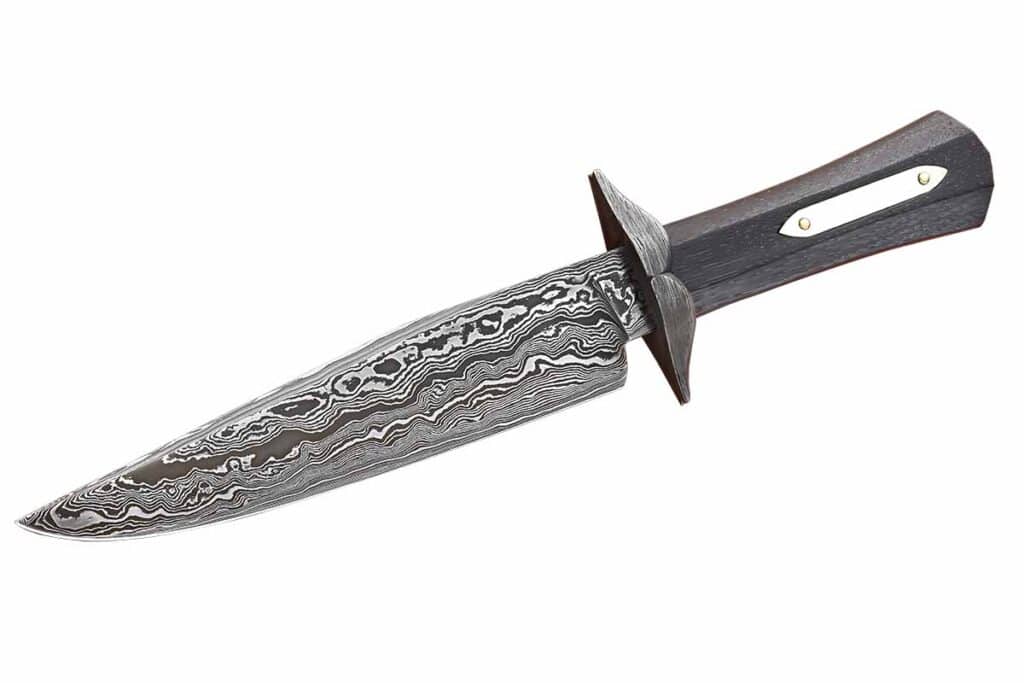
Gabriel Turner Fixed Blade

Gabriel Turner Fixed Blade

Blade length: 6.25”
Blade material: Damascus of 1084 carbon and 15N20 nickel-alloy steels
Blade grind: Full flat
Guard: Cable damascus
Handle material: Bog oak
Overall length: 11.25”
Maker’s price for a similar knife: $1,050 (SharpByCoop image)


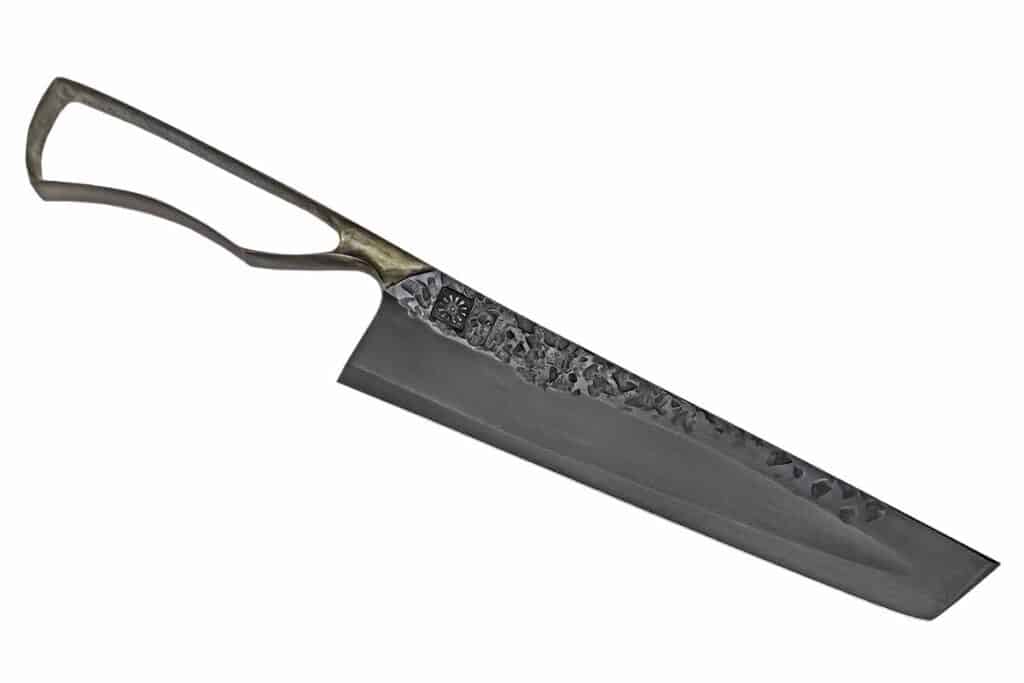
Julian Roche Nakiri Chef’s Knife

Julian Roche Nakiri Chef’s Knife

Blade length: 8.27”
Blade material: 1084 carbon steel
Blade grind: “S” grind
Blade thickness @ ricasso: .196”
Blade at widest: 1.77”
Knife to know: Forged from one piece of 1084; rust-blue finish and brassed
Overall length: 12.6”
Maker’s price for a similar knife: $450-$475 at press time rate of exchange (Rod Hoare image)


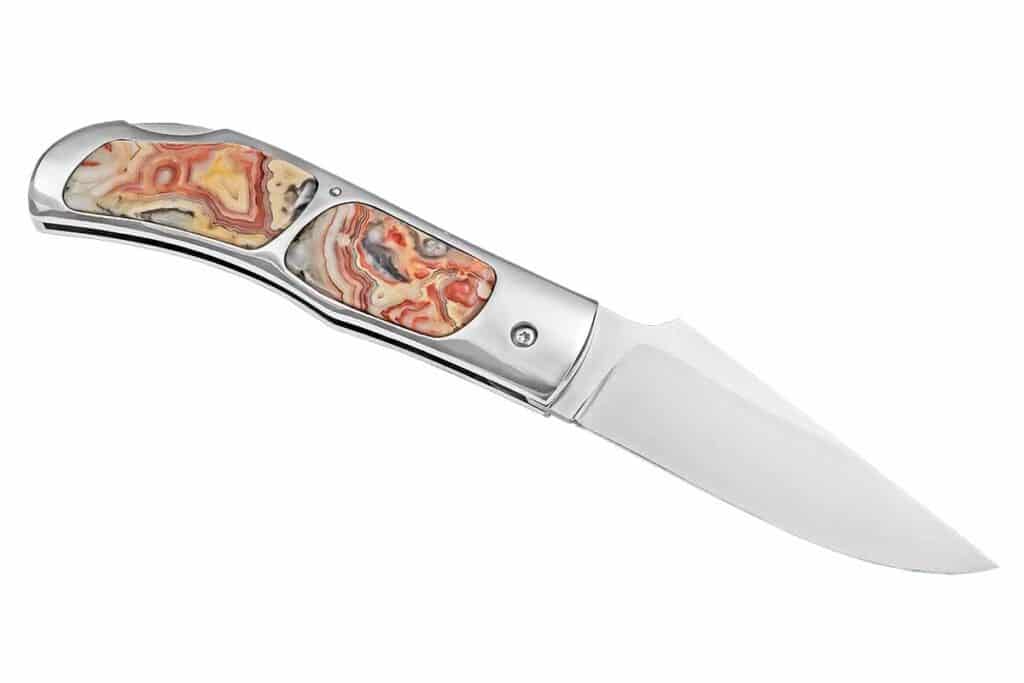
Jeremy Wheaton Leon

Jeremy Wheaton Leon

Knife type: Lockback folder
Blade length: 3.19”
Blade steel: CPM 154 stainless
Blade thickness @ ricasso: .12”
Blade @widest: 1.2”
Blade grind: Flat
Handle: Crazy lace agate seed inlays; a local miner sourced the agate
Frame: 410 stainless steel
Closed length: 5.27”
Maker’s price for a similar knife: $445 at press time rate of exchange
Maker’s remark: “The photo is a testament to Rod Hoare, who has worked very hard to bring his work up to an international standard. All of us Australian knifemakers are very grateful that we now have an artist of his caliber servicing our industry.”
wheatonartsandcrafts.com (Rod Hoare image)


Mike Tyre Beavertail

Mike Tyre Beavertail

Knife type: Double-action automatic/manual folder
Blade length: 3.5”
Blade material: Damascus of O1 and L6 tool steels
Blade grind: Flat
Blade pattern: Wharncliffe
Blade opener: Thumb stud
Handle: Gold-lip mother-of-pearl
Frame: Titanium
Lock: Linerlock
Closed length: 4.5”
Knife to know: Engraving w/gold inlay by Joe Mason; heat-colored filework
Maker’s price for a similar knife: $4,200
miketyrecustomknives.com (SharpByCoop image)


Check Out More Knife Drops:
Knife Test: Tom Ploppert Slip Joint

I was waiting for Tom Ploppert’s custom slip joint like a kid on Christmas morning. To my surprise, there were two knives in the package when it arrived. Tom had sent me a new knife for evaluation and another that had been used hard for a few years. Both still walk and talk like they are supposed to, but the older knife has a smoother action. Yes, the handle is beat up a little and the blade has been resharpened a few times, but I could tell it is a high-quality knife. This is a good sign of excellent workmanship—I have had slip joints get sloppy after a few uses. Tom used premium stag pinned on to make the knife scream, “Use me!”

EDGE TESTS

I started off with a sheet of copy paper. I held the slip joint between my thumb and index finger and let the weight of the folder do the cutting. I just kept turning the paper around to a fresh side and sliced along its entire length until I had cut all four sides. The knife has a very good feel to it and fits my hand very well.

    Next up: cardboard boxes. After 30 minutes of cutting I had slivers of cardboard all over the garage floor.

    I had to change out my Kydex® foam for some new stuff as I had run a large batch of sheaths and the old foam was getting too compressed. After gluing on the newly cut foam, I sliced up the older pieces by simply resting the blade edge on the foam and making a pulling cut. The slip joint sliced as fast as I could maneuver my fingers out of the way.

WOOD/ROPE/LEATHER CUTS

I had some pine 1x1s cut—they make perfect whittling sticks. Tom’s “slippy” is excellent at control and the big stag handle is very comfortable. It did not take long to produce a pile of curly-cues.

    Half-inch sisal rope was next on the agenda. The knife still felt sharp but I gave it a few strops on my leather pad for good luck. It crunched through the rope like a champ until I hit 60 cuts. My index finger rode up on the blade and I found the spine to be very sharp, and the inside of the liners also were sharp. A few strokes with a fine emery board dulled the sharpness and I settled back into cutting. I noticed the edge starting to slide at 120 cuts. Not bad at all and no more hot spots. I grabbed some leather and skived around the edges. The slip joint worked great and would still shave hair.

TIP TEST

I used the tip of the blade to cut and pry the dried skin from an old deer rack that needed cleaning. I was careful of the fine tip as I did not want to pop it off if it got stuck in the rack.

    I gave the tip another workout, stabbing it into a 2×4 and twisting the tip out. The tip handled a dozen stabs and twists without breaking or any loosening of the folder’s action. As long as I had the 2×4 handy, I gave it a few chops. The blade bit deeper than I thought it would and the knife was comfortable while doing it.

IF IT WERE MY KNIFE …

… I would soften every place that is sharp except the edge of the blade. I use knives hard and sharp edges where they should not be might result in a hot spot. Just a few minutes with fine sandpaper and it’s all good.

FINAL GRADE

Tom’s slip joint performed excellently. His fit and finish are very clean. This is one very well made, good-looking work knife. Great job!—By MSG Kim Breed, BLADE® field editor

For more information contact Tom Ploppert, Dept. BLADEMAG, 1407 2nd Ave. S.W., Cullman, AL 35055 256-962-4251 tomploppert3bellsouth.net.

PLOPPERT SLIPPY SPECS

Knife: One-blade slip joint

Maker: Tom Ploppert

Blade Steel: CPM-154 stainless

Blade Length: 3”

Handle: Sambar stag

Pins: Stainless steel

Liners: 416 stainless

Backspring: CPM-154

Closed Length: 4 1/16”

Maker’s List Price: $750

For info on how to subscribe to BLADE®, click on http://www.shopblade.com/blade-magazine-one-year-subscription-us/?lid=blss090712


Dagger Design: The Geometry of Penetration

Form, function and purpose of daggers–the most stab-ready knives.

Few weapons are as simple in concept yet as demanding to design as the dagger. At first glance, it is merely a blade—sometimes short, sometimes long, usually but not always double edged—yet every aspect of its form has been refined over millennia for one purpose: stabbing. Unlike blades that balance cutting, slicing or chopping, a dagger’s geometry, materials and ergonomics allow no compromises in pursuit of its one purpose.

From early Bronze-Age thrusting knives to the stilettos of the Renaissance, every angle in any dimension maximizes straight-line penetration. Whether for combat or display, understanding this purpose is essential for anyone who wishes to design, craft or appreciate these edged weapons. Even the most ornate ceremonial dagger should appear “stab-ready” at a glance, communicating the implied threat of the utilitarian tool with a statement of status and opulence.

This modern cinquedea by Vince Evans has a blade with a broad, rigid base tapering to an unforgiving point. Fullers down the middle serve to make the blade both lighter and stiffer. Equal parts status symbol and lethal instrument, it embodies the dagger’s refusal to compromise between beauty and purpose.

Dagger Design Points

Every deadly stab starts with three critical design choices that define a dagger’s unwavering purpose. A dagger blade must have sufficient spine thickness and ricasso rigidity to resist excessive bending under thrust load; it should be tapered to an acute but robust point for minimal tip-entry resistance; and it requires flexibility balanced with rigidity so it can reach vital organs, often protected by armor, without breaking.

Early thrusting blades illustrate this principle as far back as the late Bronze Age. A broad base near the guard tapers rapidly to a narrow point, ensuring rigidity at the grip and sharpness at the tip. By the 1st century A.D., the Roman pugio perfected it. With a base often exceeding 5⁄16 inch in thickness and a central ridge tapering to a sharp apex, the pugio shed weight without losing stiffness. In practice, its point could pierce leather, flesh or weak links in chain mail, while its spine endured repeated jabs against shield bosses and bucklers.

Extreme ornament, unconventional design, and opulent materials cannot disguise lethal intent and pure stabbing functionality in Bertie Rietveld’s ornamental dagger.

Yet precision in stabbing demands more than brute strength, it requires avoiding gratuitous cutting‐oriented features in a thrusting design.

Serrations, upswept points, hooked tips, prying points and even bottle openers can be handy on a knife, depending on the task, but all of these undermine the straight-line force a dagger needs and disrupt smooth entry. If you ever find yourself in a situation where stabbing is required, by all means use whatever you’ve got—just don’t complain when your bottle-opener tip gets snagged in an assailant’s clothing. However, if you have the luxury of time and thought to design and make a dagger, strip away anything that doesn’t serve pure penetration. A dagger’s geometry remains laser-focused on stabbing effectiveness.

Lastly, a dagger must balance penetration depth with material limits. A tip too slender might break or bend against bone or metal, while a tip too blunt simply won’t enter. Ancient workers of bronze and iron didn’t have modern labs or spreadsheets, yet somehow found the Goldilocks Zone that balanced reach and resilience. A well-tempered tip is tough enough to survive bone contact without snapping, yet with correct geometry stays stiff enough to slip between armor plates. Only through precise taper and temper can a dagger achieve depth without sacrificing strength.

Even in this highly stylized dagger by Jordan Lamothe, the spine ridge provides the stiffness and rigidity required for uncompromising penetration.

Combat Daggers Vs Art Daggers

From the earliest times, daggers fell into two broad categories: weapons of combat and symbols of prestige.

The combat dagger was stripped to essentials—minimal ornamentation, maximum toughness—while the art or status dagger has always been free to bend the rules of pure function to satisfy aesthetic expression and make statements of personality and prestige. Nonetheless, even the most ornate display piece must exude “stab-readiness” at first glance, a silent promise inherited from its lethal lineage.

The complex damascus pattern and construction style of this dagger by Australia’s Jackson Rumble demonstrates that while he understands the essentials of a dagger, he’s not afraid to push the boundaries of expression without compromising either the stabbing function or his artistic vision.

Surviving examples of Roman pugios from army camps demonstrate the utilitarian design, but gilded pieces from the same era, with elaborate inlays and inscriptions, do not stray far from purpose despite the decoration. All share the same fundamental geometry: a stiff, thick base, reinforced spine and unwavering taper to a sharp, flat-ground point.

The ornamented variants—often gifted as symbols of rank or worn by the wealthy and powerful—could feature ivory grips or gilded fittings without diminishing their stabbing credibility. Regardless of personal status or the knife’s level of ornamentation, no one who saw a pugio drawn in malice would misunderstand the message or the danger. Combat heritage endows art daggers with an unmistakable threat that no amount of embellishment can conceal, though the pugios that did in Julius Caesar probably looked rather nice.

The complex damascus pattern and construction style of this dagger by Australia’s Jackson Rumble demonstrates that while he understands the essentials of a dagger, he’s not afraid to push the boundaries of expression without compromising either the stabbing function or his artistic vision.

Another example is the pesh-kabz, a Persian-born dagger later adopted and lavishly ornamented by Mughal weaponsmiths. Its single-edged blade featured a thick spine and acutely tapered point, designed to pierce heavy mail and laminated armor. As Mughal craftsmanship flourished in Agra and Delhi, artisans added damascened patterns, jeweled pommels and silk-wrapped grips. Yet even a fully jeweled pesh-kabz retained the same reinforced spine and narrow, forward-weighted geometry as its battlefield ancestors. Worn at court in gilded sheaths, these daggers exhibited status while making it clear that underneath the glamor was a blade as deadly as any used in war. Art and combat, then, remain entwined.

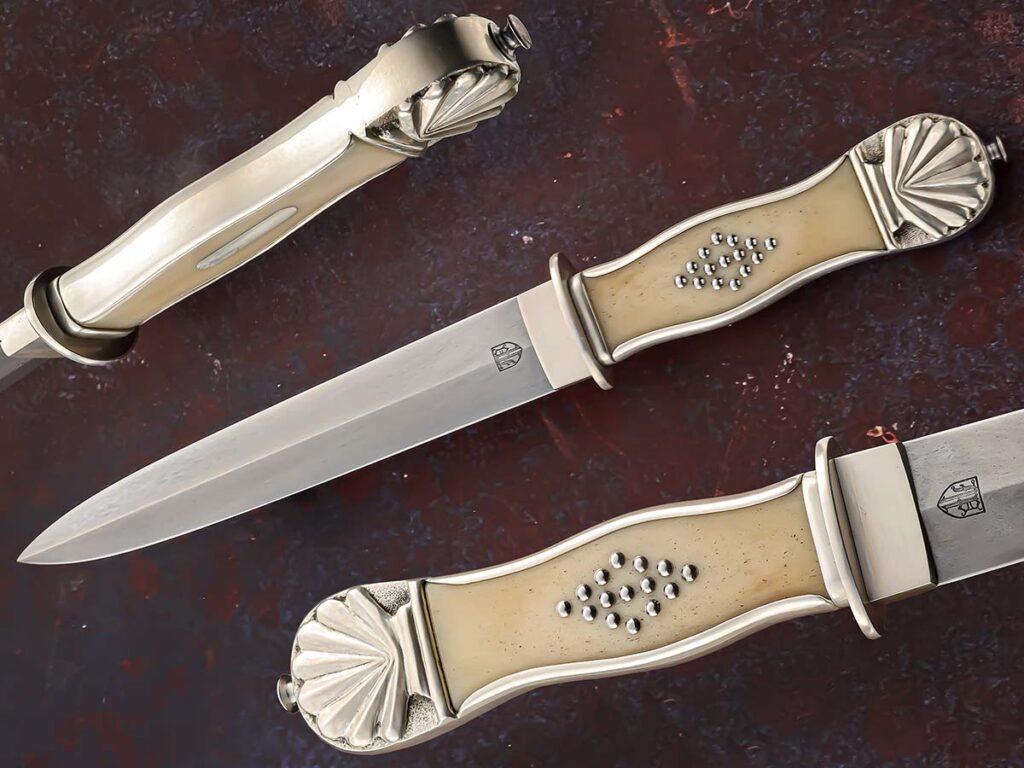
The junction of the handle, guard, and blade is where the true masters separate from the merely good—every element is a decision between comfort, control and ornament that fit together with no gaps. (Mike Quesenberry, Best of Show/Best Art Knife, 2011 OKCA Show)

This enduring marriage of lethality and ornamentation sets the stage for a deeper question: what separates an ordinary dagger from one that truly masters its intended purpose? The answer lies not just in history but in the details of profile, geometry, balance and structural refinement—each a mark of a dagger designed to do exactly what it must.

More On Daggers:
Collaboration Knives That Cut To The Quick

Designers and companies join forces to help consumers win with these knife collaborations.

A collaboration knife is produced when a designer or knifemaker partners up with a knife company to produce a particular knife. And more often times than not, such models offer the best of both worlds. Designers able to focus purely on designing and not confined to the limits of their shop can shoot for the stars. While companies take the reigns of producing the knife to exacting specs and usually at a buyer’s price. In the end, the knife consumer wins. Here is a handful of the latest collaboration drops certain to get knife aficionados juices flowing.
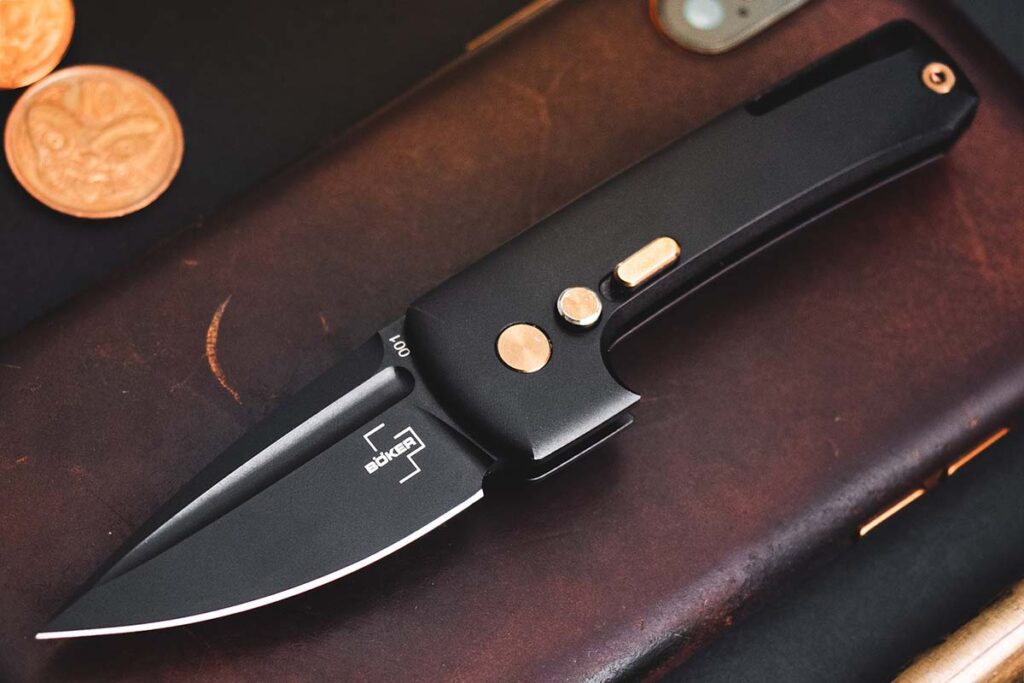
Harlock Mini / Boker Plus

Harlock Mini / Boker Plus
A blade only .11 inch at the thickest helps the Boker Plus Harlock Mini tip the scales at a scant 2.19 ounces. At about 2.87 inches closed and with a lean, sexy pocket clip, the Harlock Mini is made for executive wear. It comes with a nylon pouch.

If you’re looking for an elegant knife present for that special someone, you could do a lot worse than gift him or her the Boker Plus Harlock Mini designed by custom knifemaker Darriel Caston.

Designer: Darriel Caston
Knife type: Push-button automatic
Blade length: 2.05”
Blade steel: Black-coated 154 CM stainless
Blade grind: Convex
Handle material: Black-coated aluminum
Hardware: Brass
Knife to Know: A latching slide lock locks the blade closed and prevents accidental release
Closed length: 2.87”
Carry: Pocket clip and nylon pouch
Country of origin: USA
MSRP: $146


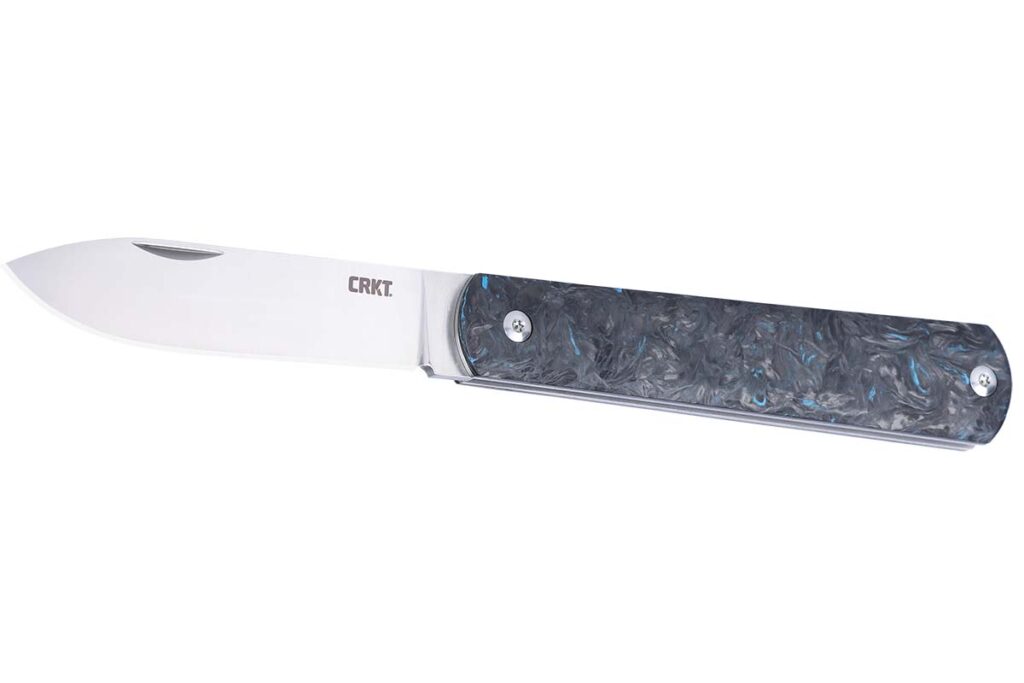
A.P.C. (Always. Pocket. Carry.) / CRKT

A.P.C. (Always. Pocket. Carry.) / CRKT
The A.P.C. is a two-hand opener, with the blade deploying via a traditional nail nick. The Fat Carbon Dark Matter handle material is strong and lightweight.

Unlike traditional slip joints, Steigerwalt’s new slip joint design for CRKT does not have a standard steel backspring. Instead, the slip joint springs from the liners and connects the liner springs with a hardened steel block that contacts the heel of the blade, eliminating the need for the backspring. Among other advantages, this reduces a fair amount of the weight a backspring would add, there is more space inside the handle to hold a wider blade, the position of the blade pivot pin can be changed and more.

Designer: Ken Steigerwalt
Knife type: Slip joint
Blade length: 2.88”
Blade steel: Bohler M390 stainless
Rockwell hardness: 59-61 HRC
Blade grind: Flat
Handle material: Fat Carbon Dark Matter
Weight: 1.7 ozs.
Closed length: 3.72”
Country of origin: Taiwan
MSRP: $175


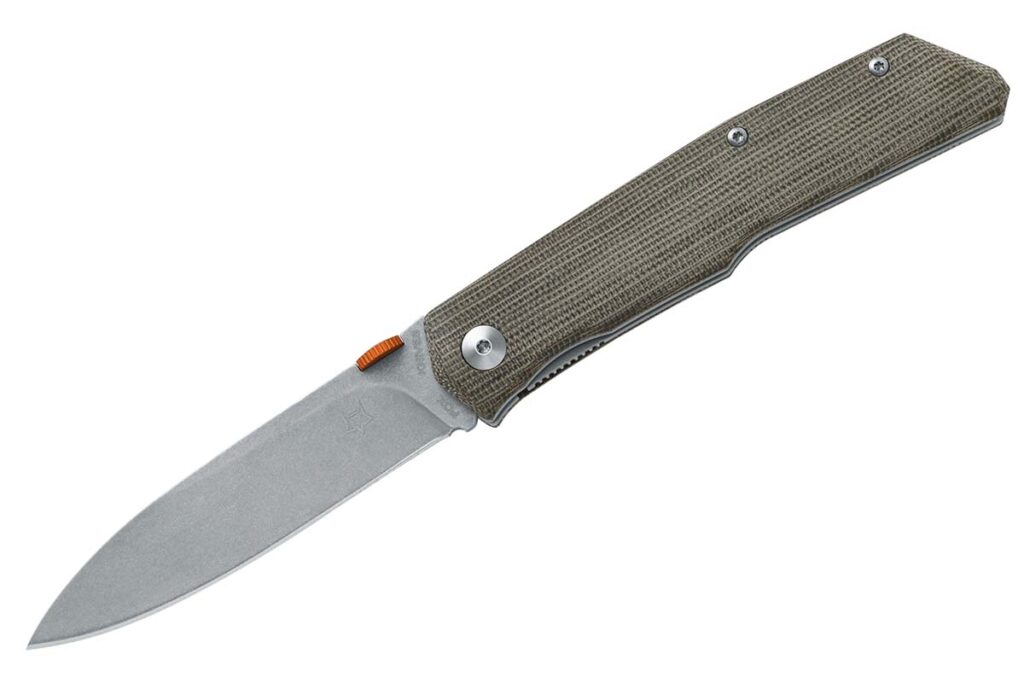
The Sicilian / Fox Knives


The Sicilian / Fox Knives
The Sicilian is a reinterpretation of Fox’s model FX-525, and the name pays homage to the Sicilian roots of Bob Terzuola’s family. Changes from the FX-525 include the BECUT stainless blade steel, the OD green canvas Micarta® handle and the wire pocket clip.

According to Fox’s Athena Greta Barbieri, “Bob Terzuola conceived the Sicilian taking inspiration from traditional knives used by ordinary people for everyday activities such as eating or working in the fields. The idea for this knife evokes images of landscapes warmed by the Sicilian sun and simple meals eaten among olive trees and vineyards.”

Designer: BLADE Magazine Cutlery Hall-Of-Fame® member Bob Terzuola
Knife type: EDC folder
Blade length: 3.35”
Blade steel: BECUT stainless
Rockwell hardness: 58-60 HRC
Blade @ thickest: .12”
Blade finish: Stonewashed
Blade opener: Disc
Handle material: OD green canvas Micarta®
Spacer: Aluminum anodized orange
Pocket clip: Wire
Lock: Linerlock
Weight: 3.53 ozs.
Closed length: 4.52”
Country of origin: Italy
MSRP: $164


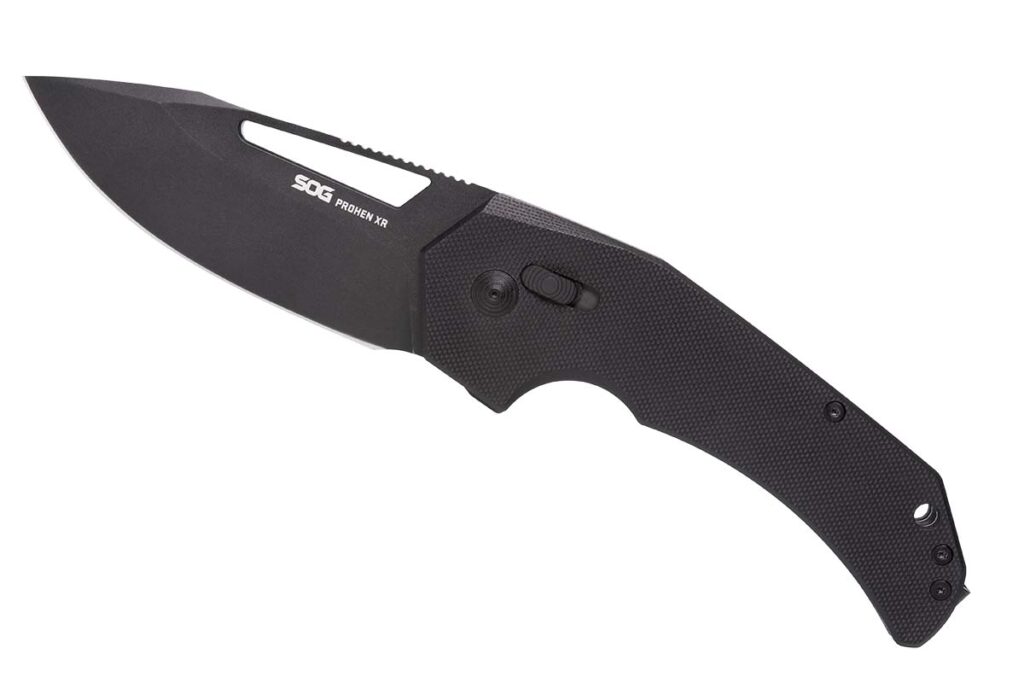
Prohen XR / SOG

Prohen XR / SOG
The extremely strong G-10 handle is micro-textured for a secure, comfortable grip in wet or slippery conditions.

Designed by custom knifemaker Mikkel Willumsen for SOG, the beefy Prohen XR flipper folder is a mix of curves and angles that features the XR Lock, a sliding transverse bar that locks the blade in place and promotes ambidextrous one-hand operation.

Designer: Mikkel Willumsen
Knife type: Flipper folder
Blade length: 3.4”
Blade material: Cryo D2 tool steel
Blade @ thickest: .157”
Blade grind: Flat
Blade pattern: Drop point
Blade finish: TiNi
Blade opener: Flipper tab or thumb hole
Handle: G-10
Pocket clip: Reversible, low carry
Lock: XR Lock
Knife to know: The XR Lock can withstand 1,500 lbs. of force
Weight: 5.6 ozs.
Closed length: 4.8”
Country of origin: China
MSRP: $70


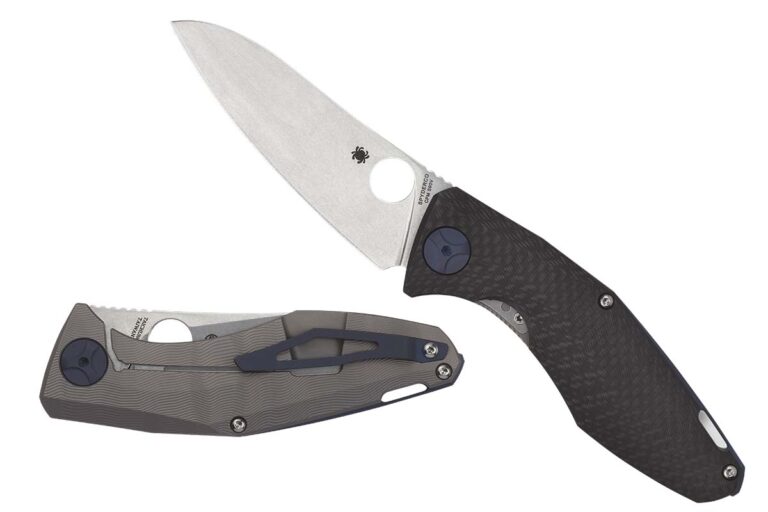
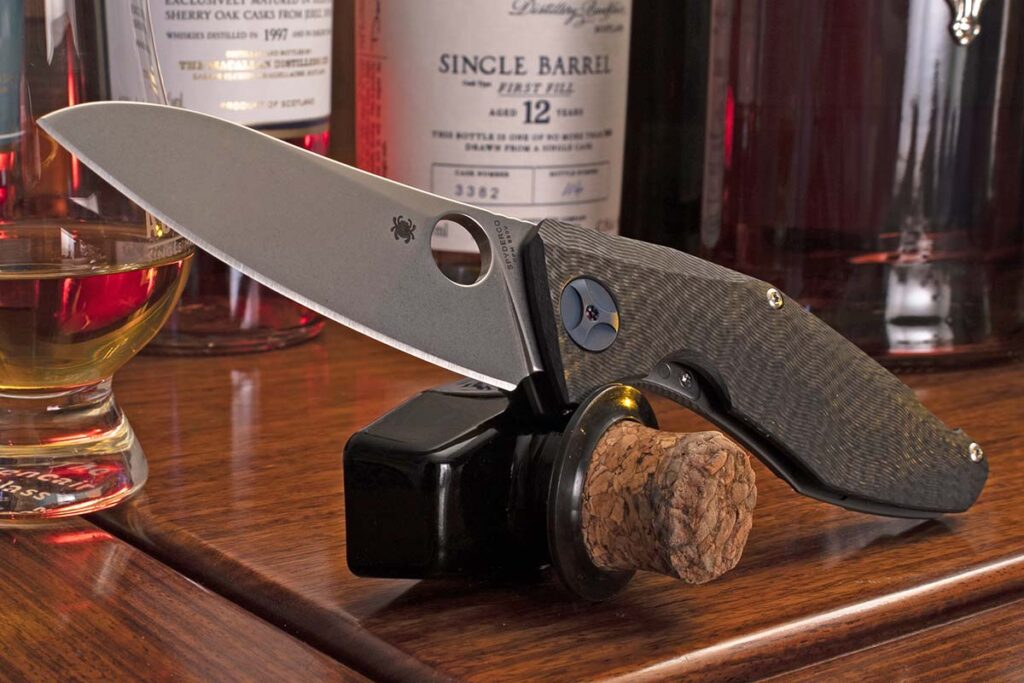
Dmitry Sinkevich / Spyderco

Drunken / Spyderco
Drunken / Spyderco

The Spyderco knife’s handle includes a titanium scale on one side and a solid carbon fiber scale and nested stainless steel liner on the other. The titanium scale is “webbed” to reduce weight and forms the basis for the knife’s Reeve Integral Lock (R.I.L.) mechanism, which includes a long-wearing stainless steel interface. Both scales are meticulously machined with the intricate “drunken” texture that gives the knife its name, and are accented by a matching color-anodized backspacer, pivot assembly, and right-side, tip-up pocket clip.

Designer: Dmitry Sinkevich
Blade length: 3.45”
Blade steel: CPM S90V stainless
Blade grind: Full-flat
Blade @ thickest: .138”
Blade finish: Tumbled
Handle: Carbon fiber/ titanium
Pocket clip: Right-handed, blade tip up
Lock: R.I.L. (Reeve Integral Lock)
Weight: 3.8 ozs.
Closed length: 4.61”
Country of origin: Taiwan
MSRP: $770

More On Collaboration Knives:

Huber Foxworth Bowie: The Men Behind The Blade

The men behind the Huber Foxworth Bowie are as captivating as the knife itself.

This is the story of a knife named in honor of an incredibly special man. In this highly populated world not many people get their name attached to anything. I do, however, know for a fact that Craig Fox Huber was very proud of the idea that people would be wanting the knife that bore his name for decades to come. He told me so in person. He lived a life that so many would aspire to but very few would have the moxie to follow through on. He was the real deal.

So, how did Craig impact a knifemaker to the point of naming a knife the Huber Foxworth Bowie? Here’s what my father, BLADE Magazine Cutlery Hall-Of-Fame® member Dan Dennehy, wrote about Craig in his 1970 Dan-D Knives Brochure:

Many self-styled “experts” have stopped by my shop from time to time to suggest to me how I should design the “perfect” knife … Not long ago a trim bearded crewcut type found his way to my shop, and we started talking knives. [Circa the late 1960s] I took an immediate liking to this handsome, rather cocky gent and was pleasantly surprised to learn that he spoke about knives with a rather rare understanding of design and more than just a rudimentary knowledge of metallurgy that I found uncommon even among some men whose names would be familiar to you as supposed “experts.” He not only talked good theory and design, but he spoke with considerable authority on how a fighting knife should be used.

Craig Huber
That’s Craig Fox Huber inset circa 1970 at the Fox Den’s second location in Mountain Home, Arkansas.

During our conversation I learned that he had earned three Purple Hearts while serving with a Marine Recon Unit in Viet Nam, and enough other “breast hardware” that when he spoke, I listened with both ears, and rather attentively.

Those who knew Dan might realize that these comments mean he really respected the “cocky gent.” And Craig respected Dan. Their long friendship stayed the course until the end. I also had a lot of respect for Craig and his vast knowledge of knives and other things.
I met him in the early ’70s at The Fox’s Den, his gun shop located in the small ranch community of Kirkland, Arizona. Dan took me there to meet Craig when I was about 13. I shook hands with a man wearing a drop-loop gun belt with rounds in every loop and a .45 Long Colt pistol in the holster. I was in awe. I also got to see some of the knives he carried and to learn why he carried them.

About a year later my family bought a small ranch in the area. I visited the gun shop at every chance. Dan would take me to Craig’s home occasionally. I was equally impressed at his collections. The next summer I worked for Craig, helping with his horses and other stuff around his place. They were good times and I must say that it was from his influence that I went to see the United States Marine Corps recruiter a few years later.

Craig Huber: Christian Patriot

Craig’s son Hunter can tell you better than anyone about his father. Of Craig he wrote:

Dad was a lot of things. He was a soldier, a gunfighter, inventor, storyteller, adventurer, hunter, fisherman, survivalist, outfitter, collector, gunsmith, writer, and the list goes on. He was a patriot and a Christian. He lived his life to the absolute fullest and would fight for everything he believed in and loved.

Two sides of bowie knife
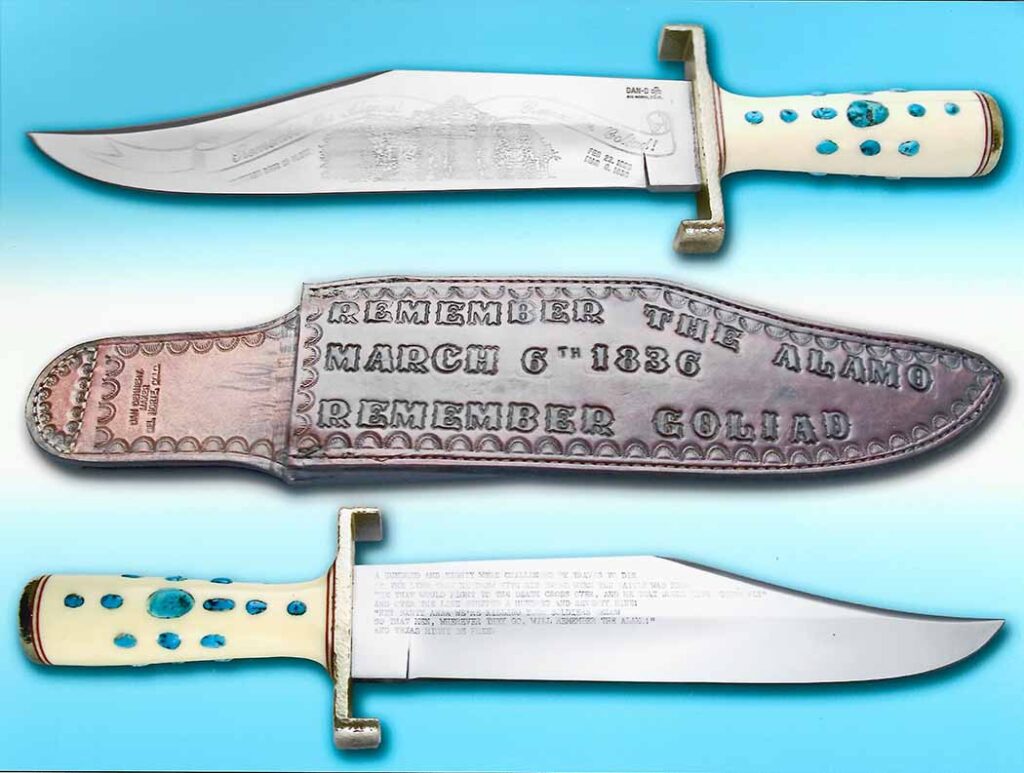
In his vast collection of Dan Dennehy knives, Craig’s favorites were the Dan-D Alamo Bowie and the Huber Foxworth Bowie. The Alamo Bowie has a 12-inch hollow-ground blade a quarter-inch thick and 2 inches wide. The blade’s non-mark side is etched with an eight-line poem that commemorates Col. Travis’s call for “defenders to step forward.” The handle is walrus ivory inlaid with 18 turquoise cabs. Overall length: 16.5 inches. The custom sheath is cowhide. (Bob Glassman image)

Despite having the option to go work for his father’s rapidly growing company in York, Pennsylvania, that was obviously of no interest to Dad so he went into the military. Even though he had trouble with authority and rules, he thrived in the Marines.

After the military his life got really interesting. His resume speaks for itself but here is a summary: police officer; sheriff; private investigator; horse wrangler; hunting guide, Ozark Mountains; fishing guide, French River, Canada; gun shop owner, Fox’s Den (Kirkland, Arizona, and Mountain Home, Arkansas); salesman, Camillus Knives and Levis; personal protection, bodyguard for Saudi Royal Family; professional hunter, South Africa; writer, Whitetail Times magazine and several personal protection books; gunsmith; gun dealer; private security, consulting and training; fugitive recovery; and much more. This is a very general overview and it took him to some very interesting places and dangerous spots, and he met some really interesting people along the way.

So here is what Dad loved. He loved his country and God. He loved our mom. He loved me and my sister. He loved adventure. And he loved guns and knives. Dad was an encyclopedia of firearms, handloading and ballistics. He had a real passion for Rugers, Ruger M77s in any and every caliber they make, but especially 7×57 and Ruger single action pistols. He was also a 1911 fanatic. I don’t remember a single occasion in my life where I ever saw Dad without a 1911 on his side or in a shoulder holster.

And he loved knives. Man did he love knives. I don’t know exactly where in his life this interest started, but he was as passionate about knives as guns, and maybe more. And this is coming from a guy whose gun collection is over 500. He loved all knives and always carried at least two at a time. He had a real appreciation for a good blade and considered knives the most valuable tool an outdoorsman or soldier could have.

Fox's Den Gun Shop
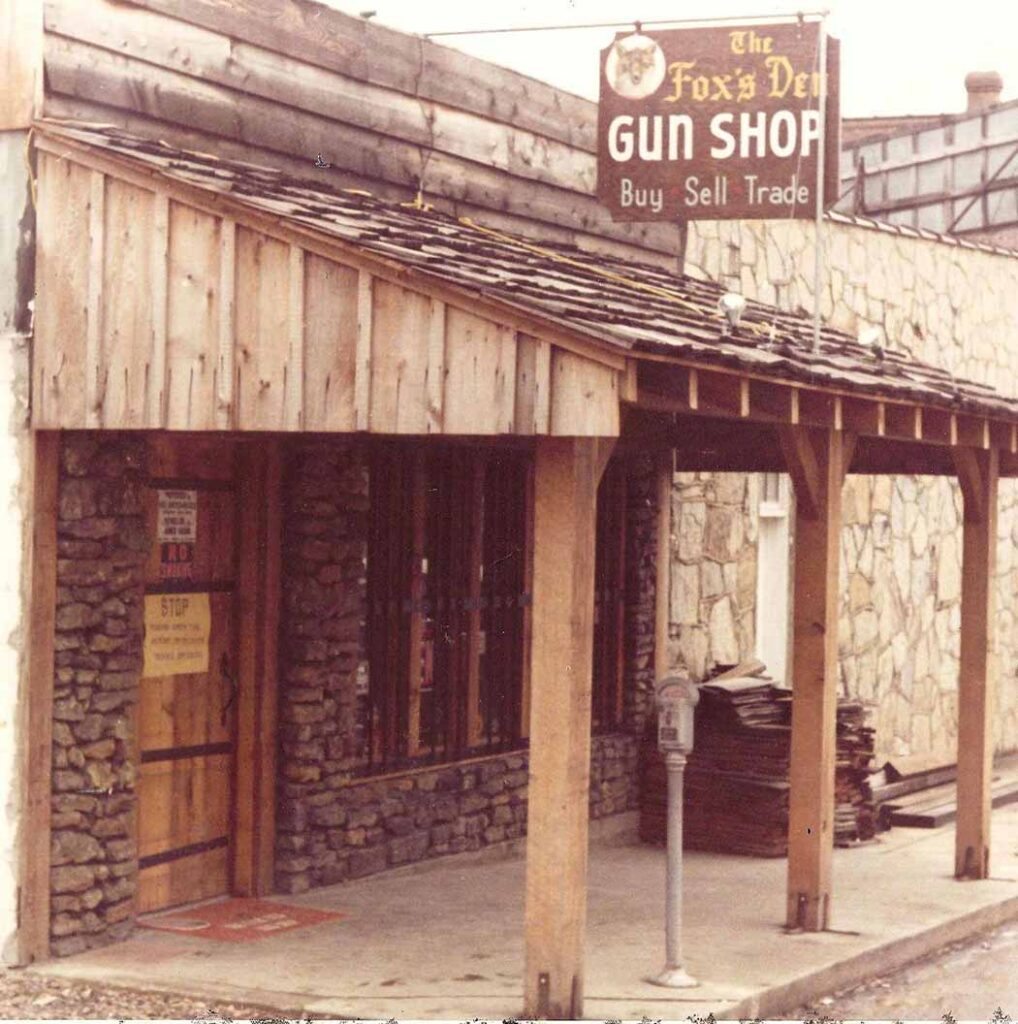
Here’s the second iteration of The Fox’s Den Gun Shop as it appeared in Mountain Home, Arkansas. Note the sidewalk parking meter.

As you would expect, just like factory rifles with factory ammo were not suitable for Dad’s standards, neither were factory knives. As a result he started reaching out to custom knifemakers and collaborating. He formed relationships with Bo Randall, Jimmy Lile, Art Wiman, Clyde Fischer, Blackie Collins, Harold Corby and George Herron, and most notably Dan D. Dad spoke of Dan D. with a manner of respect and admiration that he did not offer up lightly to many. A shared respect and appreciation for the art and skill behind making the ultimate tool, something that was practical and efficient, beautiful and deadly. Dad’s collection of Dan D. knives is vast but his two most prized are the Alamo Bowie and the Huber Foxworth Bowie.

Dad was the toughest man I’ve ever known. A real fighter, rock solid, set in his ways and unshakeable. No matter, if you had a problem, my Dad would be your first call and the man you wanted in your corner. Dad had a lot of fans and a lot of enemies. He had many acquaintances and peers and only a small handful of good friends. He always said if you get through life and only have a few good friends, real true friends, then consider yourself lucky. Dan D. was a true friend of Dad’s.

Machete and knife
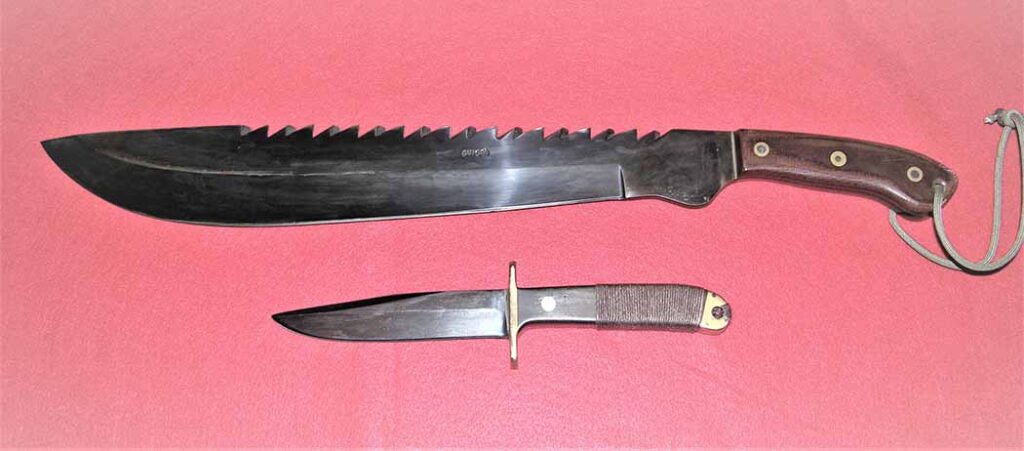
Two of Craig’s favorite Dan-D users included a survival machete and a Woodsman model. Craig designed both, with Dan-D making the former and helping Craig make the latter in the Dan-D shop. Craig carried the Woodsman more than any other knife for over 40 years.

Craig was one of those rare characters you meet along the road of life and always remember. Later he told me stories of discussions with Cutlery Hall-Of-Famer Bo Randall and knife designs for different purposes. Another story was how he talked to Cutlery Hall-Of-Famer Bob Loveless about the simplicity of balancing a knife using his personal theory of the tapered tang. He visited with his friend Cutlery Hall-Of-Famer Jimmy Lile long before the Rambo knife was created. John Horrigan told me about their hunting trip in Africa. Since Craig was a licensed guide the trip was arranged in exchange for a knife identical to the one John presented to President George W. Bush.

Huber Foxworth Bowie

But back to the Huber Foxworth Bowie. The brochure description continues:

This knife is a pure and simple Bowie style but with the handle dropped slightly which seems to give it a much better “pointing” ability and maneuverability not found in most common Bowie styles. [Craig] had a prototype of this knife made for him by a Philippine Negrito instructor while he was attending the armed forces Jungle Survival School in the Philippines. Pound for pound these little Negritos are about as slick and fierce a knife fighter as will be found anywhere.

Knives
In a 2011 email to the author Craig wrote, “This [image] shows all four pair of boot knives your Dad did for me, including two pairs of my Model III. All have been carried extensively over the past 40 years, and two of the knives have saved my life.”
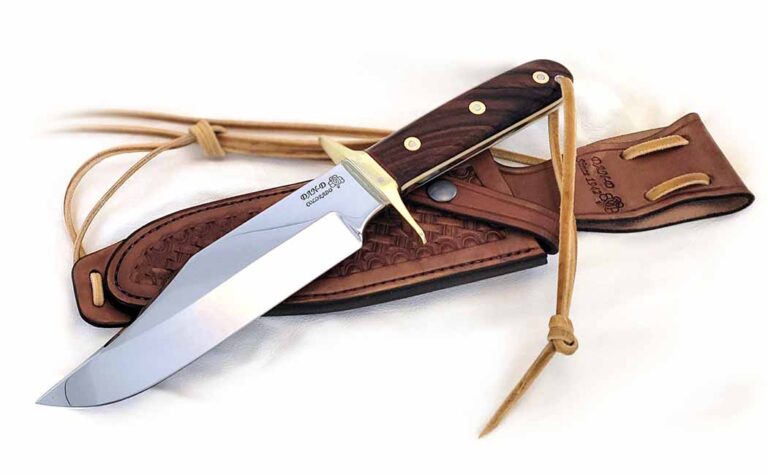
The blade is 8 inches long, 1.75 inches wide and in quarter-inch stock of 154 CPM stainless steel heat treated by Cutlery Hall-Of-Famer Paul Bos. It has a double guard and a 4.75-inch handle. According to the brochure, “This is a knife you could bet your life on.”

A couple of years ago, Hunter contacted me and told me of his father’s passing. Craig lived 76 years his way and made his mark in the world. His passion for God, his country and living life to the fullest extent had been accomplished. Hunter went on to explain that out of all the knives they cannot find the one that meant more to Craig than the Huber Foxworth Bowie.

Check Out More Cool Custom Knives:

Bowie Knives: Lingering Legacy Of The All-American Design

Truly an American design, the bowie continues to inspire today’s makers.

While its roots may be from across the sea, ties to the makers of old Sheffield and elsewhere, the bowie is today distinctly American. And it has been for more than two centuries.

Made famous by BLADE Magazine Cutlery Hall-of-Fame® member Jim Bowie and the fabled Sandbar Fight, no doubt present at the Alamo where Americans fought and died for freedom, and seen in countless photos of soldiers going to war—posing with the burly bowie in a proud moment—the iconic knife was also immortalized on the silver screen with the classic The Iron Mistress and other films. There is no other style of knife that more clearly defines the American spirit.

“Bowies are the quintessential American knife, deeply steeped in the mythos of our collective history,” observed ABS journeyman smith Matt Parkinson of Dragon’s Breath Forge. Shawn Shropshire of SDS Knifeworks agrees. “The bowie is the most iconic or at least the most recognized of American knife designs,” he said. “At the time of the Sandbar Fight, there was no single pattern that was called a ‘bowie knife.’ It varied in size, blade shape and even materials. Cinema later created what most people now recognize as the bowie knife, something with a large blade, clip point usually, with a double guard.”

ABS master smith Lin Rhea commented, “I do indeed believe the bowie knife is America’s knife design. It was created to fill a need. The country was expanding and was very wild and without law and order. The average traveler in the lawless wilderness needed a reliable defense weapon that could be carried on their person, that never misfired and was less conspicuous than a sword. The fact that a large knife was used in self-defense by Jim Bowie in the infamous Sandbar Fight just boosted the design into the realm of legend.”

Wrapped up in fact, fiction, myth, legend and lore, the bowie is a constant in the theme of adventure and survival. Although it does exhibit common attributes—among them impressive size—across the design, there are variations on the theme. To this day, the bowie remains a favorite form of expression for custom knifemakers who tip their creative cap to the history of the design and imprint their own skill, expertise and perspective on this truly American blade.

Barbary Coast Bowie

Matt Parkinson’s California-style bowie is deadly dapper. He describes it as “graceful and sleek,” featuring his own wootz steel and sterling silver bolster, pommel and guard. (SharpByCoop image)

Parkinson chose the San Francisco theme to highlight his take on the classic bowie. Representative of the days of the Barbary Coast and the rough-and-ready youth of a nation stretching from sea to shining sea, the idea captivated him.

“I have long been intrigued with the California- or San Francisco-style bowie,” he remarked. “They are graceful and sleek in a way that many bowies are not. In designing this particular piece, I looked at as many examples of this style as I could, both originals and contemporary. I didn’t copy anything but tried to match the design cues I saw in the originals that made them so iconic.”

Matt’s San Francisco Bowie features a 6.25-inch blade, an overall length of 11.75 inches, a bone handle and generous applications of stylized silver in shell and pin. “The blade is forged from my own wootz steel,” he noted, “and the bolster in front of the guard was cast, as was the shell pommel, and the guard and frame are all fabricated from sterling silver.

“One of the things I most admire about the California style bowies is the uniquely American lineage. Much of the bowie styles we think of are influenced by the Sheffield and London makers …This isn’t the case with the California makers. The knife they made for the 49ers used local materials and was a show of wealth, as much jewelry as a weapon. I kept these ideas in mind in making this one. The cow bone was a logical choice and a nod to local materials, as was the choice of sterling silver over nickel.”

Antiques Actualized

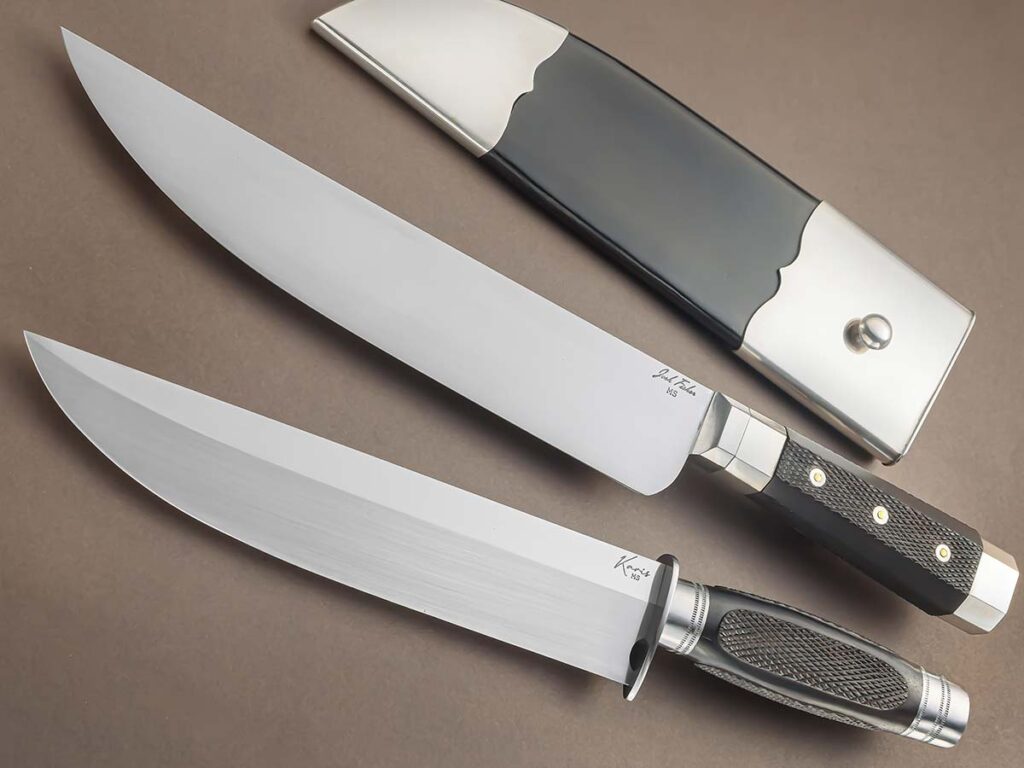
Aiming for historical accuracy circa-1830 style, father-daughter makers Josh and Karis Fisher pull off this dynamic duo. Josh’s bowie (left) was inspired by an original Schively-Perkins piece, while Karis (right) crafted a rendition of the Daniel Searles bowie. (SharpByCoop image)

The father-daughter ABS master smith duo of Josh and Karis Fisher share their own interpretations of the bowie with a pair of stunning knives touching the past. Each took inspiration from circa 1830 bowie designs: Josh the Schively-Perkins and Karis a Daniel Searles.

“I kept my reproduction similar to the original and as close in size as I could, so it would look and feel like the real knife,” Karis said. “I was mostly working from photographs, which made studying overall design really important. I also made a few changes to incorporate my own style. I left off the original silver pins and did hand checkering instead. I also changed the ferrule and butt cap. I didn’t use silver wraps. Instead, I used a combination of liners and spacers to match the original while adding my own style.”

“A few techniques that I used on my bowie were hand-checkered African blackwood on the handle and the silver ferrule and butt cap that I had to silver solder together, which was a challenge. It’s definitely a functional knife,” Josh reported. “While it’s on the larger side, it’s very well balanced due to the silver wraps on the ferrule and pommel.”

Capturing the notion of the bowie’s place in Americana, Josh related that his work in 80CrV2 carbon steel and sterling silver is true to such spirit. “It is a reproduction of an actual antique bowie knife,” he stated. “In my opinion, a bowie is a large fixed-blade knife, at least 10 inches in blade length, that is on the thicker side. I think typically they should have a clip point, but there are some exceptions as you can see in mine and Karis’s bowies.”

Small & Spruce

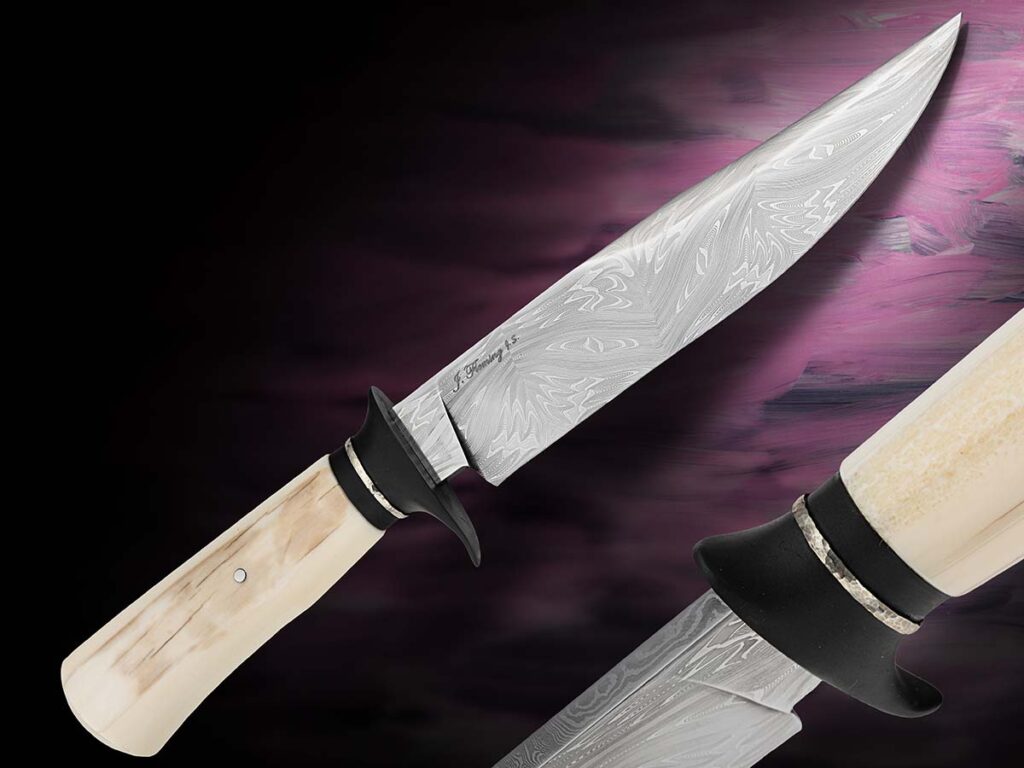
James Fleming’s gentleman’s bowie is diminutive in comparison to others but no less representative of the style. The damascus blade is complemented by an ancient walrus ivory handle with a nickel silver spacer and Parkerized steel bolster. Overall length: 11.5 inches. (Jocelyn Frasier image)

Working at Wasteland Forge, ABS journeyman smith James Fleming has produced a gentleman’s bowie, diminutive in comparison to others but no less representative of the style. The 6.5-inch damascus blade is complemented by an ancient walrus ivory handle with a nickel silver spacer and Parkerized steel bolster for an overall length of 11.5 inches.

“I wanted to make a knife that capitalized on the mosaic damascus pattern,” James explained. “I think the gentleman’s vest bowie complements the pattern. The knife is pretty recognizable as a bowie. It’s not as large as a regular bowie but has the same look and purpose. It fits the term ‘vest bowie’ perfectly. It is small enough to be concealed but large enough for defense in any western saloon. This is the kind of knife you’d see stabbed into a poker table after accusing someone of cheating at cards!”

The damascus pattern came from Fleming’s experimentation with Mareko Maumasi’s pattern-making process. He named it “Nazar,” which translates from the original Turkish as “evil eye.” He added, “I was also inspired by Lin Rhea in the way he makes his fittings. The nickel spacer is domed around the guard and bottom spacer, and it’s hammer textured to give it a nice look and feel in the hand.”

Mammoth Achievement

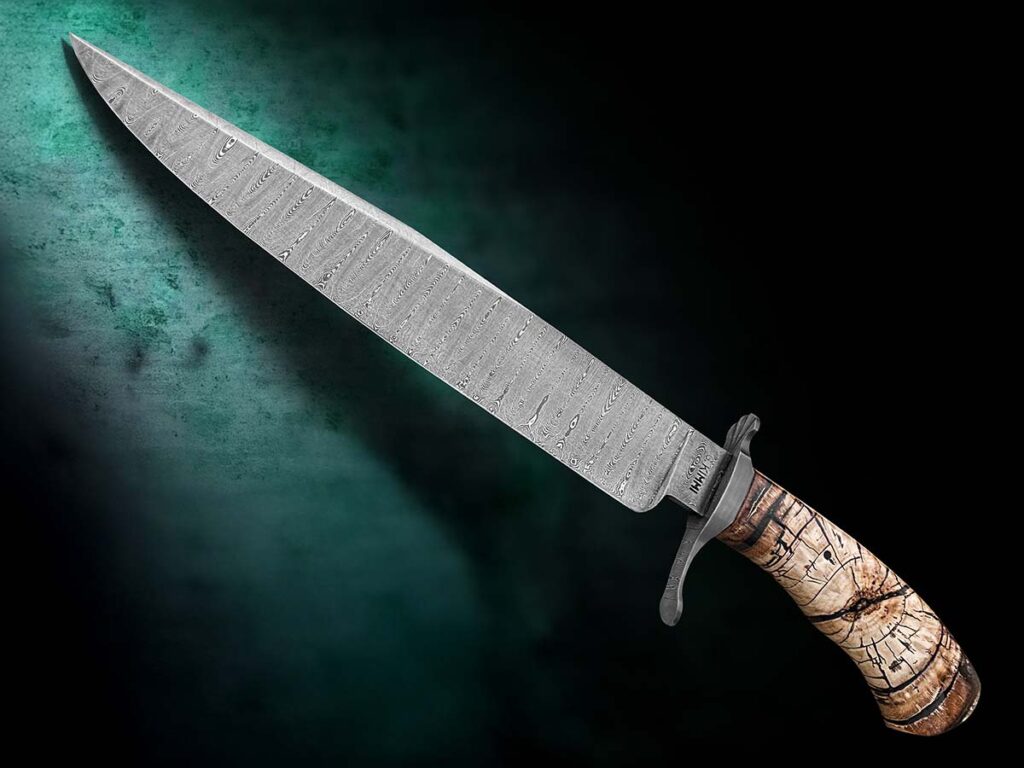
Attracted to larger bowie designs, Gene Kimmi pulls it off with a giant gem. Featuring ladder-pattern damascus—fashioned from dies he made himself—the 15.25-inch behemoth is further bespoke with a crosscut mammoth tusk handle. (Jocelyn Frasier image)

Gene Kimmi was intentional with his contribution to the bowie’s visual discourse. “I have always had a liking for the larger bowie knives,” he remarked. “When I made some laddering dies for my press, I knew one of the first knives I would make out of ladder-pattern damascus would be a large bowie. This one has some clam-shell type filing on the guard that I haven’t done before. The handle is heirloom/museum fit to the guard also.”

Gene’s bowie features the ladder damascus in a 9 7/8-inch blade and crosscut mammoth tusk handle with G-10 black pinning for an overall length of 15.25 inches. “The design is easily recognizable,” he asserted. “Anyone who sees it instantly thinks bowie. The lightness and the fit to the hand are attributes that everyone who handles it comments on. The uniqueness of the mammoth tusk handle adds to the beauty of the damascus. When I think of a bowie knife, I see a straight-backed blade of at least 6 inches. Limits can be pushed on the style and attributes of a bowie, maybe because of the mystery of the bowie knife’s beginning.”

User-Friendly Fighter

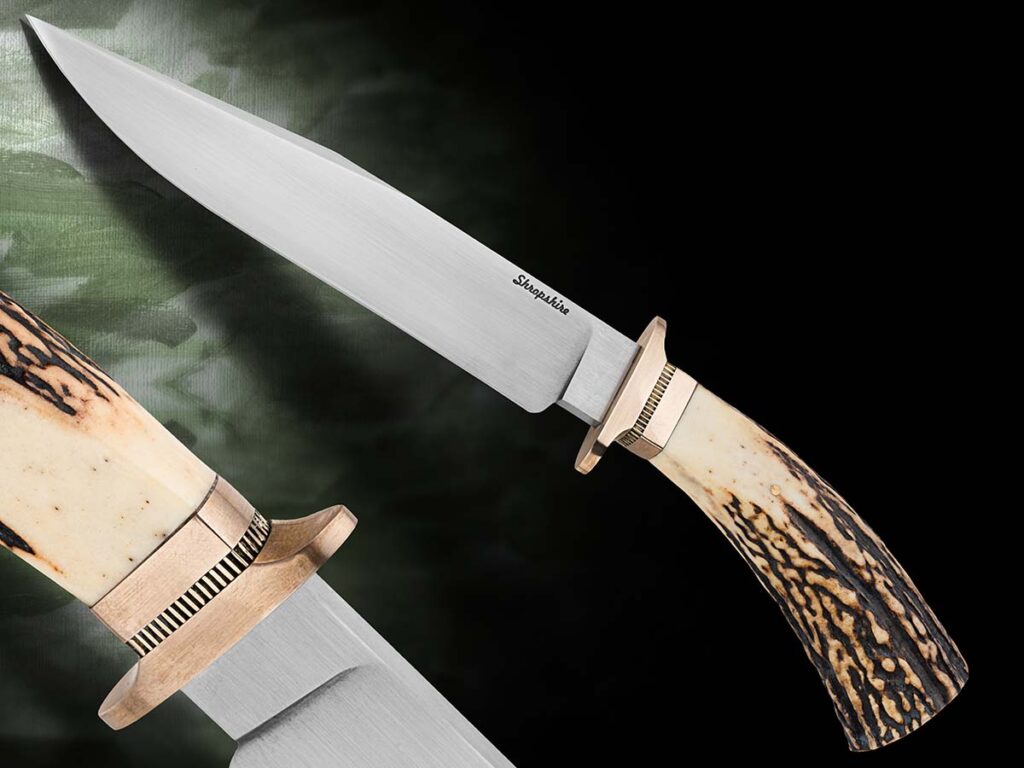
Shawn Shropshire wanted a bowie that not only looked sharp but also worked with the user. What he cooked up was this stag-handled beauty. With a 7.5-inch blade of 1084 carbon steel and a user-friendly bronze guard, the knife is easy to carry and manipulate. (Jocelyn Frasier image)

The famed Randall Model 1 provided some context for Shropshire to fashion his bowie of a 7.5-inch, 1084 carbon steel blade and stag handle with bronze bolster and an overall length of 12 inches. The proprietor of SDS Knifeworks blended the pattern with a desired functionality.

“I love making the larger versions of the bowie knife that many people think of, but as much as I enjoy them, they just aren’t very practical,” he reasoned. “This size and style is much more useful and easier to carry. It’s still a classic-looking pattern and functional without being so large that it is cumbersome and difficult to carry. I love the classic-looking lines paired with the look and feel of natural stag.”

After perusing photos of historical blades and the work of other makers, along with hours using a sketch pad, Shawn was pleased with the result. “In my opinion, this particular blade would have been right at home during the mid-to-late 1800s and at any time considered a bowie knife,” he advised. “I think most people today might refer to it more as a fighter because our notions of what a bowie knife is have been heavily influenced by cinema. The movies usually represent bowie knives as larger than life. Some were but many were not. I do think this blade hints at the history of what an American bowie is with the overall shape and the stag grip without instantly screaming ‘bowie knife.’”

Throughout the creation of his bowie, Shropshire kept user friendliness front and center. Aside from visual appeal, he designed it for easy carry with shorter “legs” on the guard and a coined spacer to help break up the smooth lines it exhibited.

The Legend Continues

The bowie theme lives—in thought, folklore and tangible craftsmanship. Staying true to its American heritage, the style has gained lasting fame and a following the world over.

Read More:

Advertisement

Must Read Articles

Read this before you make a knife

Knifemaking 101 – Read This Before You Make a Knife

  by Wayne Goddard My experience has taught me that there's nothing like digging in and getting started. I've often said the hardest part of the...
how to forge damascus steel

How to Forge Damascus

Advertisement
Advertisement