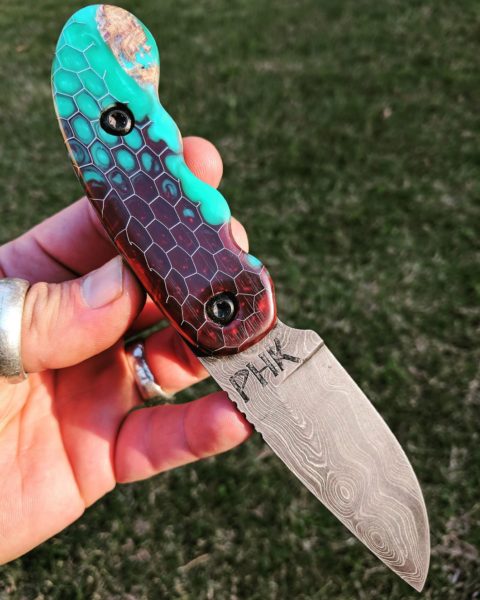
Knifemaking is the building of a knife, which includes the blade, handle and other accouterments. Blades are made by either removing metal from a steel blank via a grinder – known as stock removal – and the forging to shape of hot steel into a blade in the process known as bladesmithing. Other parts, including bolsters, guards, pommels, etc., are needed to complete the finished knife.
Fun Gun Gear Presents: “Treeman Knives”. Jim Behring Started out making Hand forged knives, but after a number a SEAL Team 4 members had him make their personal knives, he’s now making a complete line of High quality Combat knives for real world hostile enviorments. Interview at the 2012 Blade Show, Atlanta, GA.
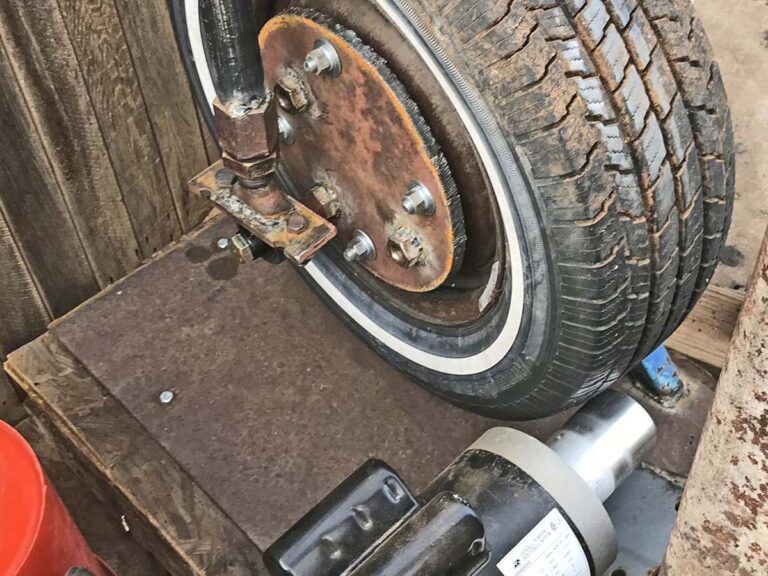
A clutch player in the knifemaker’s shop, the tire hammer gives more control than other D.I.Y. power hammers.
Like a variable-speed hand drill, your backyard power hammer should be able to run slowly, at full speed or in between, depending on the task. The simplest way to guarantee it does this is to use a slipping clutch.
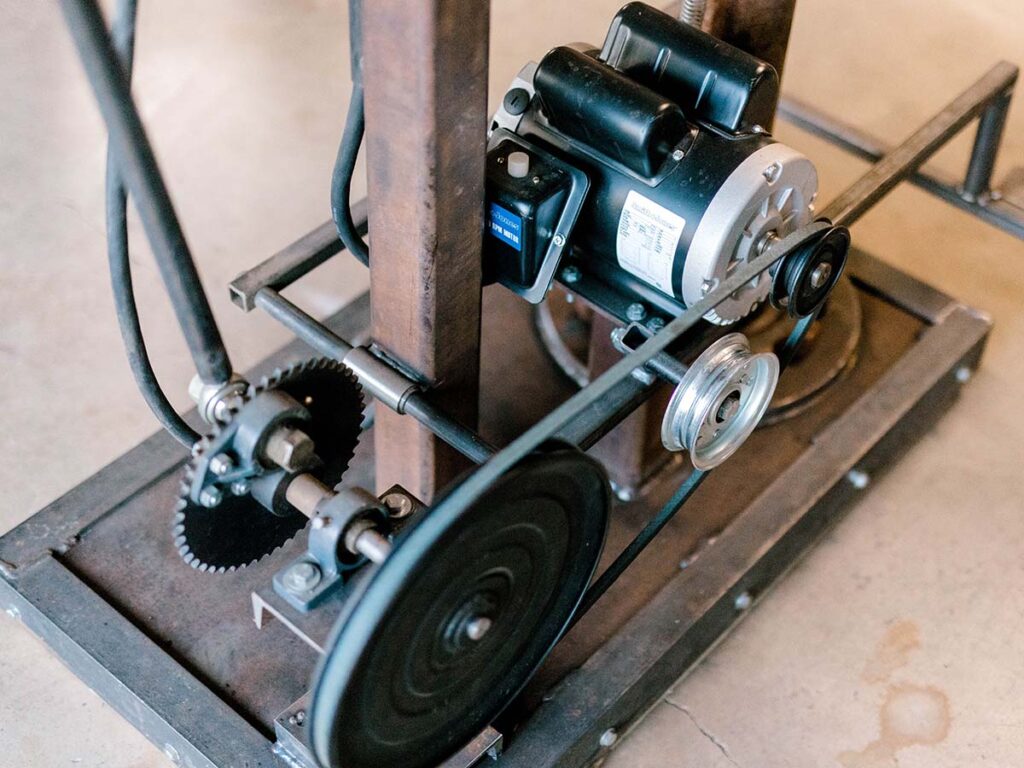
There are two main designs of slipping clutch. One uses a slack belt, a flywheel and pulleys. The drive pulley rotates within a slack belt. The foot pedal linkage pushes an idler wheel into the slack belt, increasing the belt tension to the point that the belt begins to turn the pulley on the flywheel.
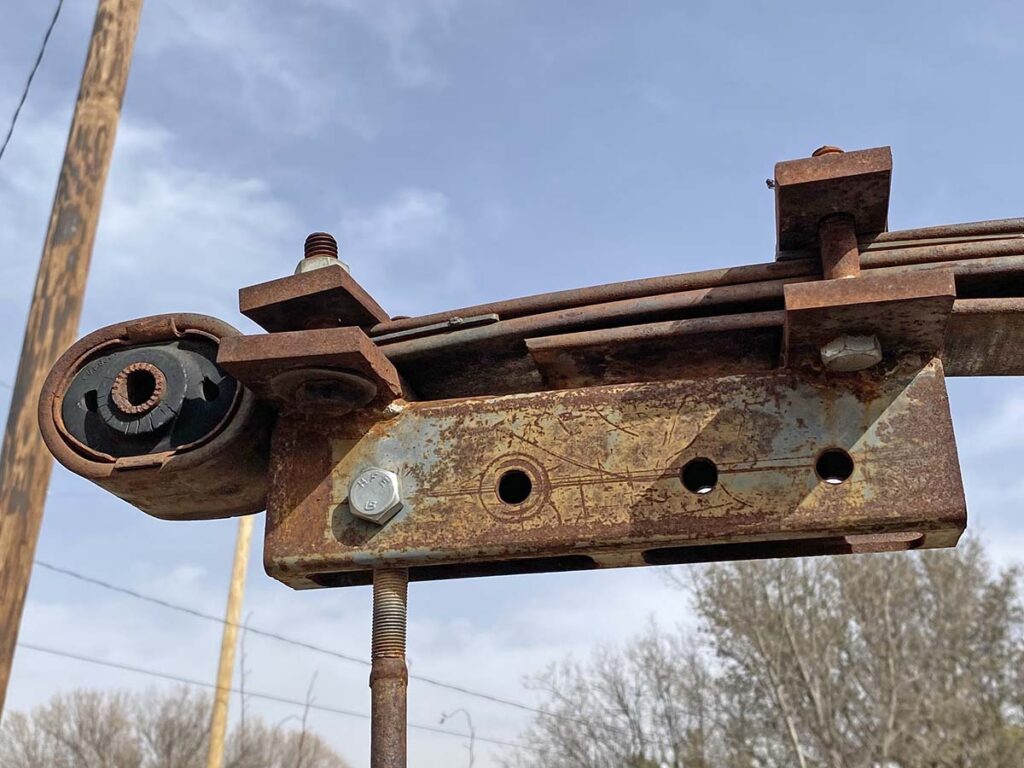
The author modified the spring-arm-to-pitman attachment to make it adjustable. Depending on which attachment point is used, the leverage of the stroke changes.
Another design uses a tire clutch, where the foot pedal linkage pushes a drive wheel into an automobile tire, with the hub of the tire serving as the flywheel. The most common “tire hammer” design uses a similar clutch but turned the other way and connected to a linkage. Your available parts will dictate your design.
Why A Clutch
A function of the clutch is to reduce the RPM of the motor speed to get the hammer rate of beats per minute (BPM) into a safe and useful range. You want the hammer rate to generally end up between 150 and 250 BPM, though many variables change with each hammer. In general, a heavier tup (aka hammer head assembly) requires a slower BPM, whereas a lighter hammer can have a higher BPM. You do not want your hammer running faster than you can control it, nor so fast that the inherent forces tear it apart. My hammer uses a 24-inch tire and a 3-inch drive wheel for an 8:1 reduction of a 1750 RPM motor, yielding a calculated 218 BPM at full speed. Your hammer will run differently depending on your motor RPM, your drive and driven wheel diameters, and the hammer’s overall design. I rarely run my hammer full speed during general forging work, and the tire clutch gives good speed control. Full speed works acceptably well for drawing out damascus billets or breaking down large stock.
My tire clutch has an integral flywheel bolted to the hub. On the flywheel I welded several different nuts for attaching the pitman arm (for more on the pitman arm, see part three last issue). Each nut is a different distance from the center of the hub. This allows me to vary the length of the stroke, in my case between 6.5, 7 and 7.5 inches, based on where I connect the arm to the flywheel. Coupled with an adjustable-length pitman arm, this setup allows a degree of tuning to get the hammer hitting in a way that transfers the power directly to the workpiece with efficiency, yet in a way that doesn’t place undue stress on the hammer itself.
Choosing A Motor For Your Tire Hammer
As for motors, the size may vary a bit depending on the overall tup weight of your hammer. For most homebuilt hammer sizes, a 1 or 1.5 HP motor is plenty. My 40-pound hammer uses a 1.5 HP motor running on 110v and does not trip a standard 15-amp breaker, suggesting that 1.5 HP is more than plenty for a 40-pound head. Whether the motor runs on 110v or 220v will depend on your shop setup and what you have available, but you’d be best served either way with a motor that runs in the 1700 RPM range, not one that runs in the 3400 RPM range. There’s no need to go three phase or variable speed unless you’re already set up for either.
Doug Davis’ homemade hammer uses a series of pulleys and an idler. When you step on the treadle, the idler tightens the belt and engages the hammer.
You will need an on/off switch for your motor. To run the hammer, turn the motor on, then use the foot pedal linkage to engage the clutch.
Sourcing Dies
Most power hammers have a set of dies in between the anvil and the hammer shaft. Dies may be built in a variety of shapes and sizes, depending on how you want your hammer to move the metal. Two basic die designs are flat and crowned. Flat dies move the metal somewhat equally in all four directions, while crowned dies will draw out the length of your workpiece perpendicular to the crown on the dies. Some smiths design their hammers to accommodate various top or bottom tools, or spring swages as well.
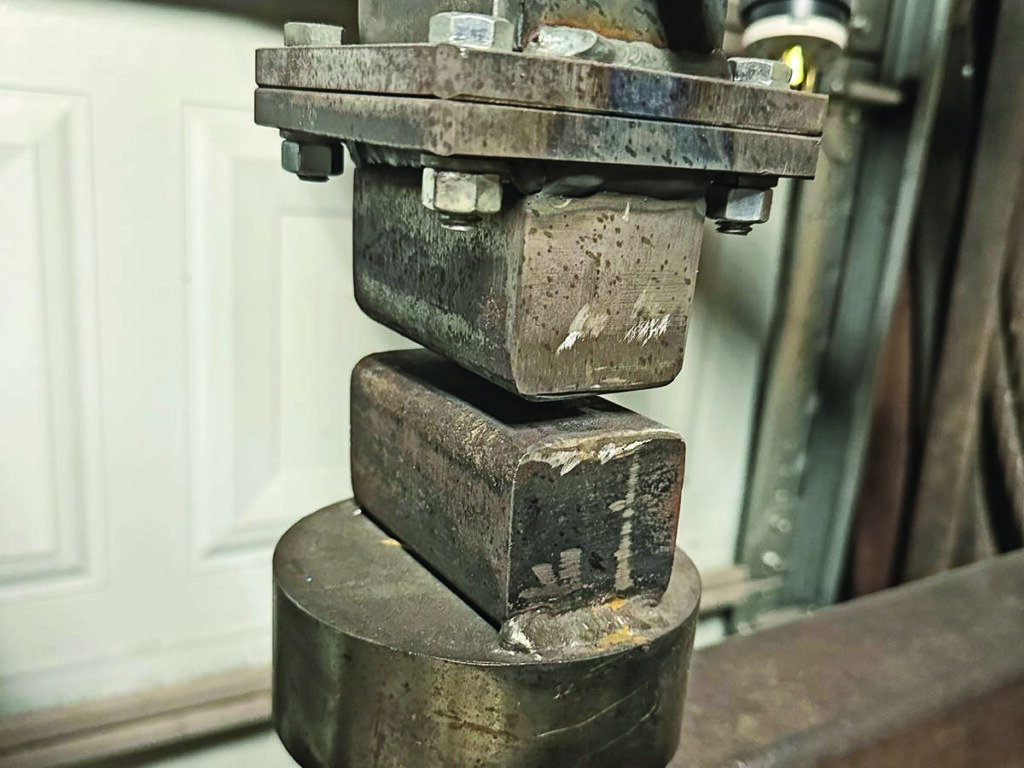
The die attachment on Doug Davis’ power hammer is more robust on the ram-to-die connection, but time will tell how the bottom-die direct-weld works out. (Erik Greiner image)
On my personal hammer, the dies are built out of 1.5-inch square 4140 steel bar stock, heat treated and ground essentially flat, with slightly radiused corners. Some hammers are set up with dies that are interchangeable but mine is not. Full disclosure: My die attachment is one point of weakness in my design. I ultimately welded my bottom die plate straight to the anvil, and I’ve had to reinforce the top die connection and re-weld it several times. Perhaps a more skilled welder could have done better!
Creative Necessity
I can’t emphasize enough the creativity necessary to build a functioning power hammer from scrap. It’s one thing to watch a YouTube video and think, “It must be nice to have a power hammer.” It’s another thing entirely to watch the same video and try to discern how the rocker arm connects to the center post, or how the tire clutch axle is set up.
At the time of my hammer build, there was an online gallery hosted in Czechoslovakia that had hundreds of pictures of various homebuilt and factory built hammers. I couldn’t have built mine without those examples. I don’t speak Czech but the pictures tell the story well.
Randy Madan, known as JR on social media, served in the U.S. Marine Corps from 1992 to 1996 as a combat engineer. “I blew things up,” he said, laughing. Now, at 43, he has been a federal correctional worker for 20 years.
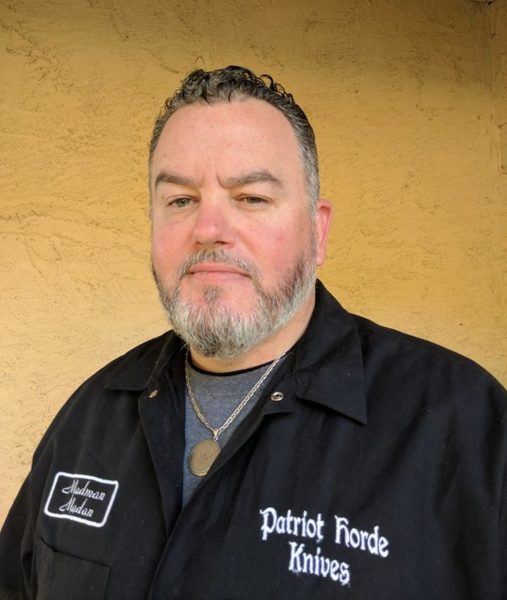
Randy Madan of Patriot Horde Knives hopes to be able to keep making knives when he retires from his job in the federal correctional system. Randy is supportive and encouraging of other veteran makers.
He always loved and carried knives, but he got his start in knifemaking in October 2016. “The knifemaker that I idolize, Michael Cleveland from Half Lives Knives, afforded me the opportunity to join a knife build-off for a veteran charity. Me being a vet myself, I jumped at the opportunity,” he explained. He has continued to make knives and to encourage other veteran makers.
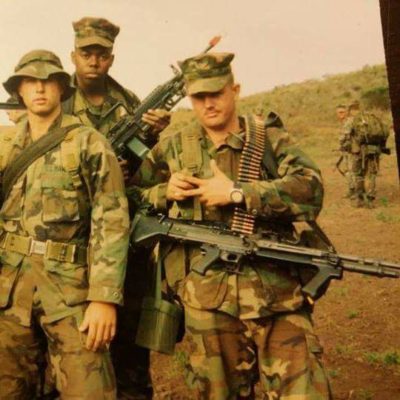
Randy Madan of Patriot Horde Knives served in the U.S. Marine Corps from 1992 to 1996 as a combat engineer.
“I am just a small-time maker, wanting to perfect my knives so that when I retire in a couple of years I can make more,” he said. Other makers who have helped along the way include John Savage, Ryan Schreiber, Denny Furey and Mark Wagoner.
Favorite blade steels: 1095 with plans to start using O1 and 80CrV2
Blade grinds: flat with plans to add hollow
How he tests his knives: shave hair, skive 7- to 9-ounce leather, cut ¼-inch bolts, chop 2-by-4s
Favorite handle materials: Voodoo Resins, Rob Carper Innovations, 8th Dimension Concepts and J Hue Customs. “I am a big fan of the hybrid materials,” Randy noted.
Price range: $250 and up
Forums he participate in: The Real Knife Makers of America, Global EDC and other Groups on Facebook
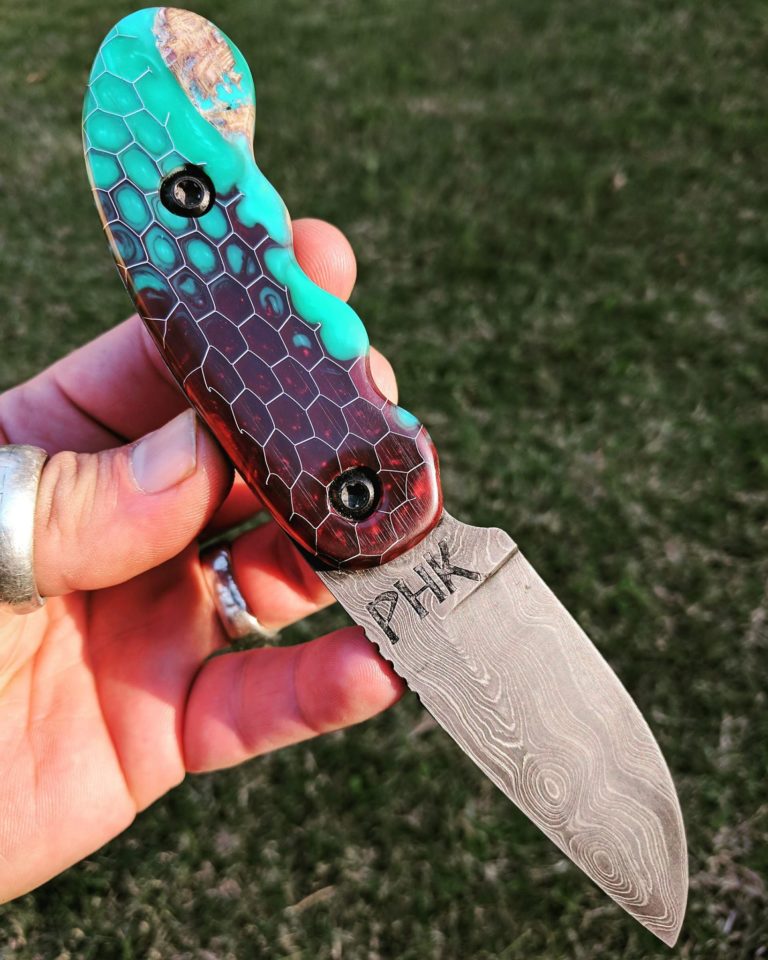
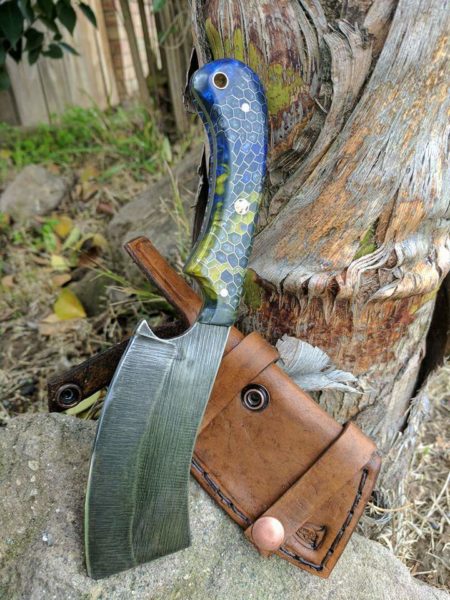
DaCleva has a 4-inch flat-ground blade made of 1095 steel with an acid-washed finish for a battle-worn look. Overall length is 9 inches. Scales are by Norman Robbins at 8th Dimension Concepts. Maker’s list price: $250 with Kydex sheath; $325 with leather.
The Lil Chubby drop-point is 8 inches overall, with a 3.5-inch flat-ground blade made with random pattern Alabama Damascus Steel from Lacy Smith. The handle scales are from Norm Robbins from 8th Dimension Concepts. Maker’s list price: $300 with sheath. In 1095 steel at $200. Contacts listed at the bottom of this article.
Randy uses All Star Abrasives in Lawrenceburg, Tennessee, for his abrasive supplies, which is what he puts to his hybrid scales to bring out their color.
Contact Randy Madan at [email protected], 760-885-9370 on Facebook at Patriot Horde Knives and on Instagram @the_patriot_horde.
A Digital Subscription to BLADE Is The Anwswer
You can read your digital issues of BLADE Magazine anywhere you have your phone, tablet or computer, and there’s no need to find storage for all your old issues.
If piling-up issues of magazines seems like a waste to you… If you feel like you don’t have time to read a magazine… If you like the stories we offer in BLADE, but want a more economical option, then a digital subscription is the answer. An annual subscription to BLADE is $17.98, $4 off the print price.
Dedicated in honor of the “Father of Modern” damascus—William F. Moran—the Moran Bladesmith and Artisan Academy is now a reality.
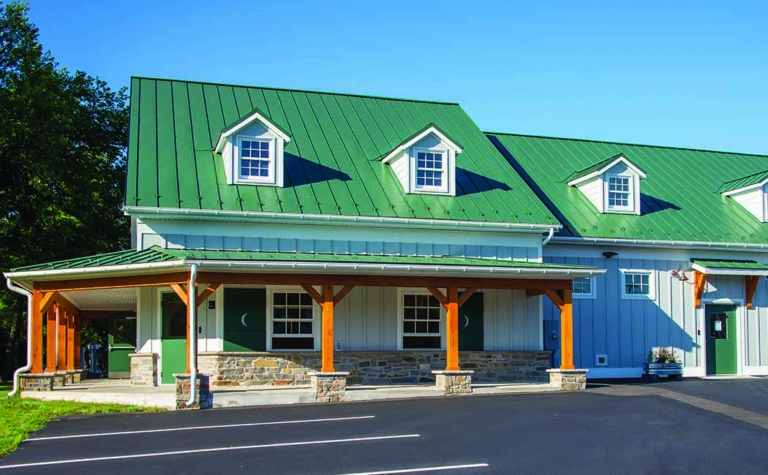
William F. “Bill” Moran, Jr., the first American bladesmith to successfully forge damascus steel blades and a founder of the American Bladesmith Society (ABS), was honored on October 16 in Middletown, Maryland, with the dedication of the Moran Bladesmith and Artisan Academy. Under the auspices of the Moran Museum & Foundation, the Academy is an impressive structure that stands less than 100 yards from Moran’s now idle knife shop.
The weather was virtually ideal as a large crowd assembled in front of the building. Director Nancy Hendrickson, mistress of ceremonies, welcomed the audience and introduced Robert Wilson, president of the Moran Foundation, who opened the proceedings with a prayer and gave an overview of the activities leading up to the dedication.
Mrs. Hendrickson next introduced the speakers for the afternoon: John Miller, burgess of Middletown; Jerry Donald, district commissioner; Jay Hendrickson, founder of the Moran Foundation and past ABS president; Joe Keeslar, past ABS president; Johnny Perry, past vice president and director of the Moran Foundation; and yours truly, a founder of the ABS and author of Master of the Forge, a Moran biography.
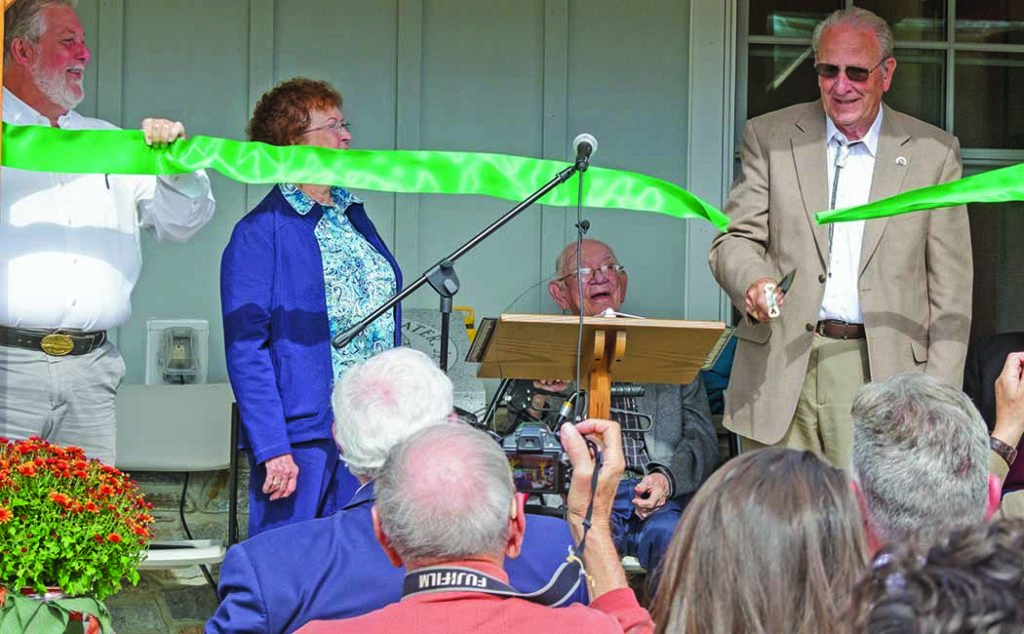
Jay Hendrickson uses one of Bill Moran’s favorite knives to cut the ribbon officially dedicating the Moran Academy. Looking on from left are Robert Wilson, Nancy Hendrickson and the author.
Following the oral presentations, a ribbon cutting done with a Moran knife was conducted by Jay Hendrickson, Robert Wilson and Gordon Conner, Foundation vice-president.
Mrs. Hendrickson closed the ceremony and the group enjoyed a round of refreshments that featured a cake cutting. The assemblage then toured the new building, which contains an office, classroom, museum and gift shop, and a large room where forging, grinding and related skills will be taught. The Moran shop, which is in excellent condition, will be a museum and a working smithy. A knife show was held October 15 in the space between the Moran Academy and the Moran shop, followed by an auction conducted by Robert Wilson.
FATHER of MODERN DAMASCUS Moran unveiled his eight damascus knives a half century ago at the 1973 Knifemakers’ Guild Show in Kansas City, Missouri. The knives were the hit of the show and rekindled interest in bladesmithing, which was a dying art form in America at the time. There were only about a dozen practicing smiths back then, including such notables as Bo Randall, Rudy Ruana and, of course, Moran. Under Moran’s leadership, the ABS was formed in 1976, with Moran elected president, Don Hastings, treasurer, Bill Bagwell, secretary, and yours truly, director. Moran, Bagwell and Hastings were the first three American smiths to successfully forge damascus knife blades.
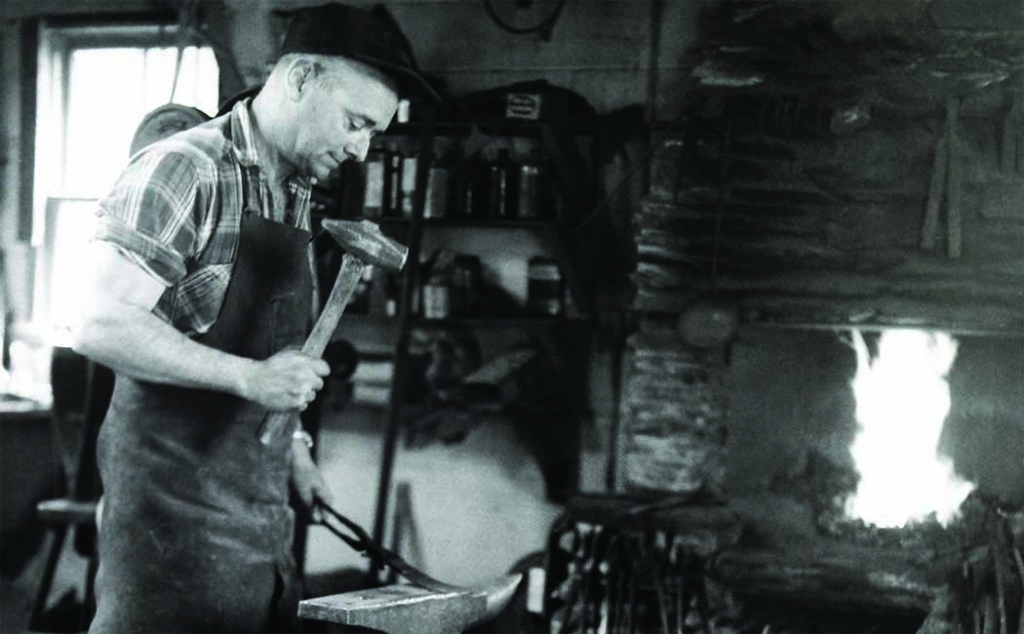
Bill Moran hammers away in his knife shop in this vintage photograph. The shop stands about 100 yards from the new Academy. The knife is the ST-24, considered one of the finest Moran knives ever. (Images from William F. Moran, Jr.: “Forever A Legend”)
As the meeting broke up, Moran turned to me and said, “If we play our cards right, Bill, one of these days we could have 25 members.” Today, of course, the ABS membership is many times that number and has gone global. The Moran Academy stands as mute testimony to the fact that Bill played his cards very well indeed. Almost single-handedly, he preserved the art of bladesmithing not only in America, but around the world.
Author’s note: Jay Hendrickson, Hughes, Keeslar, Moran, Randall and Ruana all are members of the BLADE Magazine Cutlery Hall of Fame® and the ABS Hall Of Fame as well.
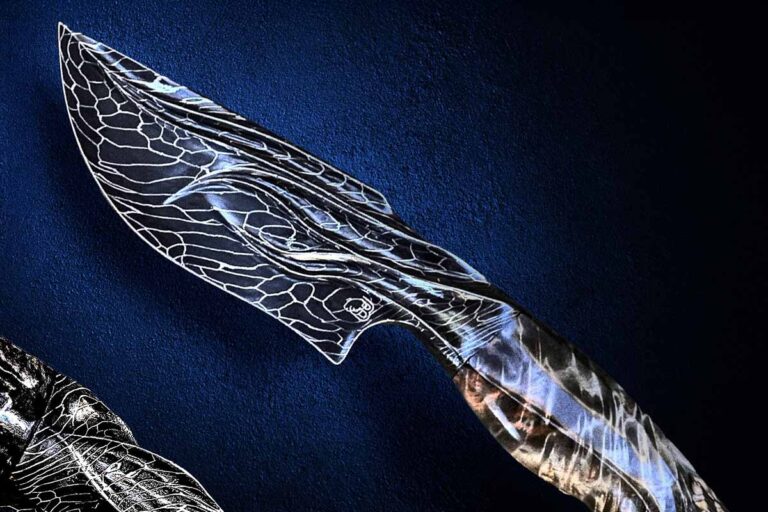
Jordon Berthelot marries two electric materials in one knife.
Jordon Berthelot achieves a hypnotic union of blade and handle materials in his integral hunter.
The blade is his HHH lightning damascus and the handle is cottonwood from Robswildwood.
“I used a wide variety of different bits and burrs with Foredom and Dremel tools to freehand carve the blade and handle,” he wrote.
“As my teacher Spencer Aplin always says, the most difficult part is deciding what to carve and how to give it the flow I want, which is so true,” Berthelot said. “I decided to incorporate the blade carving into the handle so it gave the whole piece a complete look, and also added some great purchase of the handle in multiple different grips.”
Berthelot Integral Hunter Specs Blade length: 4.5” Blade material: HHH lightning damascus forged from W1 tool steel/nickel rods w/4800 powder Handle material: Cottonwood from Robswildwood Overall length: 9” Maker’s price for a similar knife: $3,500
That’s why we want to hear about your accidents in your knife shops. There’s no shame, and you can remain anonymous if you’d like. The point is prevent someone else from making the same mistake.
The focus here is on safety. Preventative tips are welcome, too.
Your contributions will be used in an upcoming BLADE feature. Thank you!
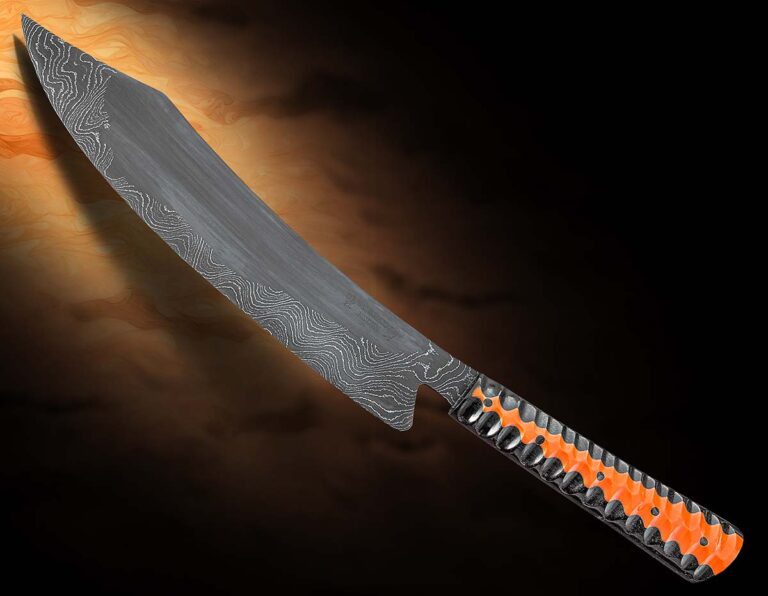
The Jose Santiago-Cummings BBQ Knife will rock your brisket.
Among Jose Santiago-Cummings’ growing ranks of customers are those he describes as “foodies,” and he built his second BBQ Knife expressly for them.
Not unlike a pirate boarding cutlass in appearance, the long, curved blade is designed for the rocking slices needed to cut meat and brisket. It’s similar to how a slicer is used as opposed to, for example, a nakiri for chop cuts.
Jose Santiago-Cummings
Jose, 62, used a cylindrical drum-sander-like attachment on a Ram tool to carve the grooves in the long, upswept handle. Jimmy Floyd forged the clip-point blade of damascus clad in wrought iron.
BBQ Knife Specs Maker: Jose Santiago-Cummings Blade length: 8.5” Blade steel: Damascus of 1084 carbon and 15N20 nickel-alloy steels clad in wrought iron Blade grind: Flat Handle: Black and orange G-10 resin Overall length: 13.25” Maker’s price for a similar knife: $450-$475


 Get started in knifemaking with the new book, BLADE’s Guide to Making Knives, Volume 2. Click here to check out this information-rich resource.