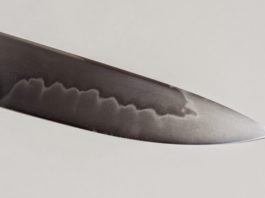
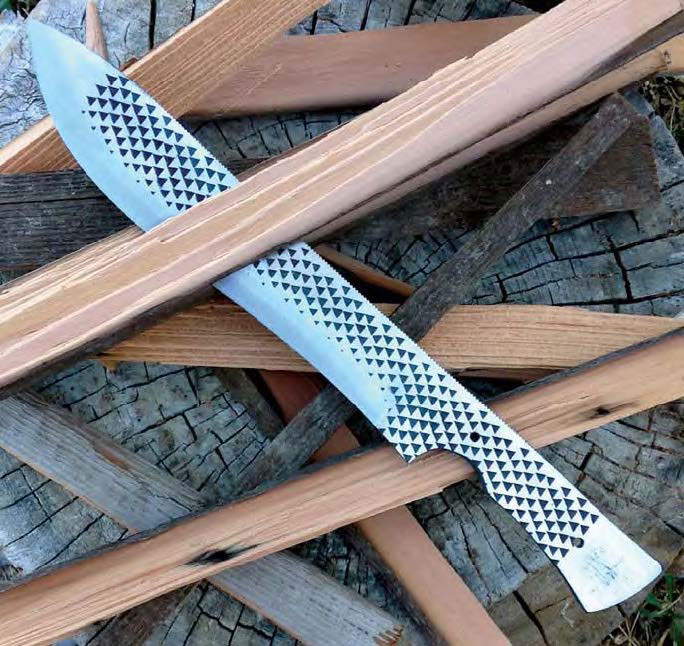
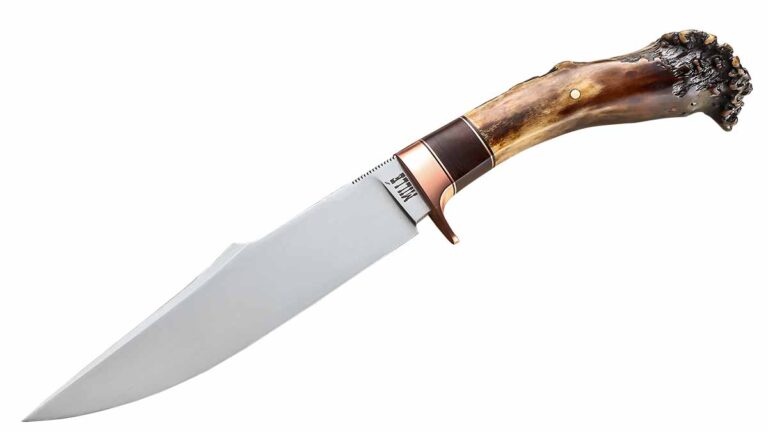
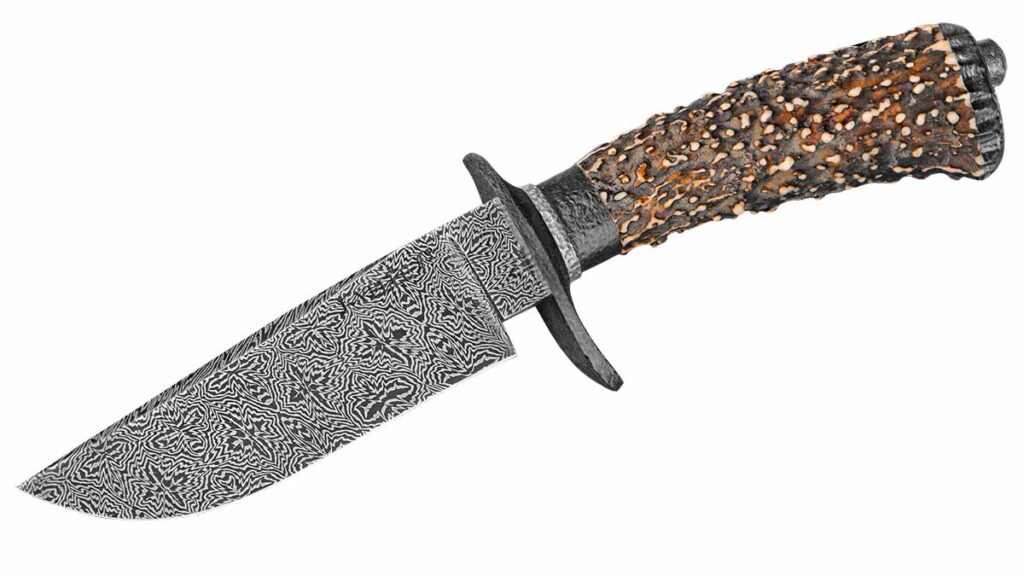
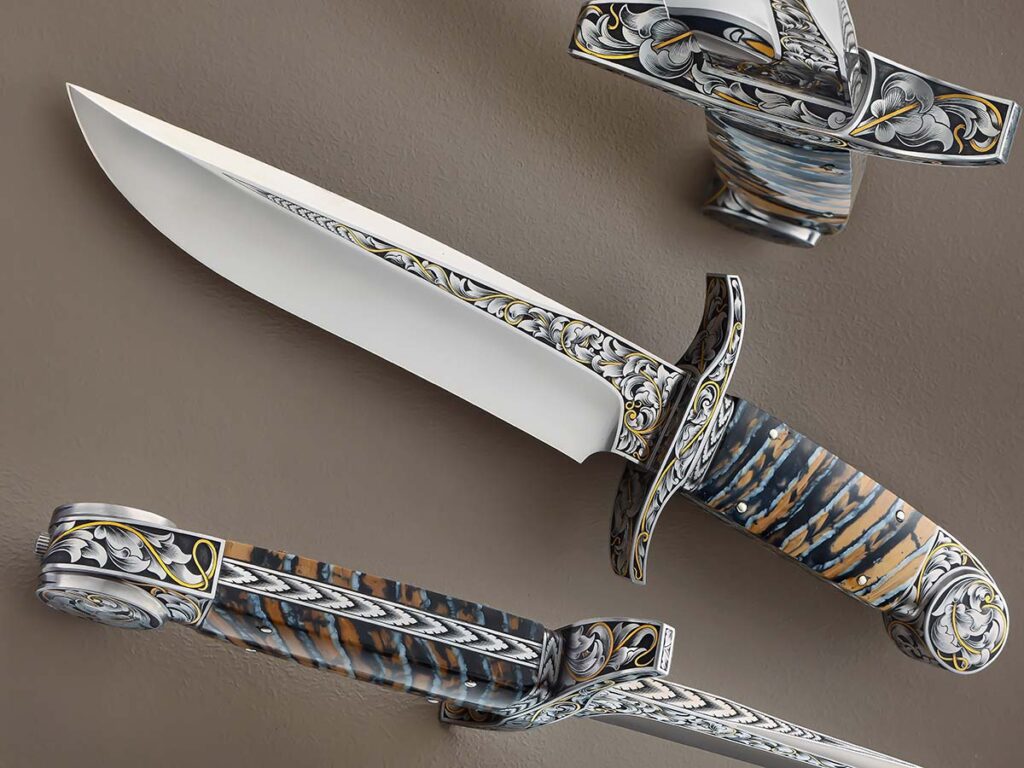
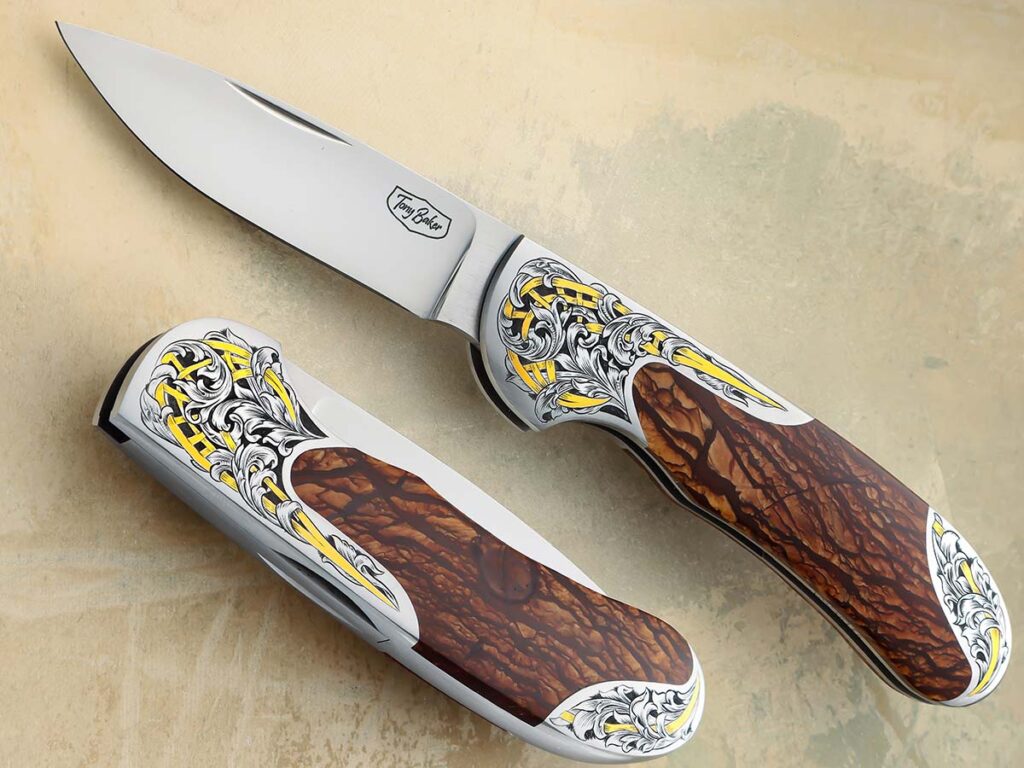
Knifemaking is the building of a knife, which includes the blade, handle and other accouterments. Blades are made by either removing metal from a steel blank via a grinder – known as stock removal – and the forging to shape of hot steel into a blade in the process known as bladesmithing. Other parts, including bolsters, guards, pommels, etc., are needed to complete the finished knife.
Batson was an aerospace engineer, master bladesmith, author and educator.
James Lucian Batson Jr., an aerospace engineer, master bladesmith, author and educator, passed away June 5, 2026, after a brief illness at the age of 90. He was born Feb. 2, 1936, in Steubenville, Ohio, the son of James L. Batson Sr. and Bertha Mae (Cummings) Batson.
Batson spent 33 years as an aerospace engineer at Redstone Arsenal in Huntsville, Alabama, working on several key defense and rocket programs. He earned his master’s degree in aerospace engineering from Auburn University in 1967 and a Ph.D. from the University of Texas in 1972.
Outside of his engineering career, Batson was a pioneering figure in the knifemaking and blacksmithing communities. An American Bladesmith Society (ABS) master bladesmith, he co-founded the Alabama Forge Council, served as president of the Artist-Blacksmith Association of North America and founded the Batson Bladesmith Symposium, now in its 38th year. His extensive contributions to the craft earned him inductions into both the ABS Hall of Fame and the BLADE® Magazine Cutlery Hall of Fame®. Additionally, in the February 2014 BLADE Magazine issue, he was ranked No. 9 among the top 13 knifemakers from 1989 to 2000.
An active researcher of historic cutlery, Batson authored numerous articles and books, particularly focusing on the history of the bowie knife and the material science of bladesmithing, publishing his final book at age 90.
His other accomplishments included sailing the Olympic-class sailboat called the Flying Dutchman in the pre-Olympic trials in 1967. He skippered a cruise sailing across the Gulf Stream to the Bahamas five times in 1972. He also earned the rank of Eagle Scout with the Boy Scouts as a youth and continued to lead Troop 400 as an adult, hiking part of the Appalachian Trail with the Scouts.
Following his passing, ABS Chairman and President Kevin R. Cashen paid tribute to Batson’s immense legacy and humble nature in the organization’s newsletter: “It was always a fun pleasure to point out to people that this down to earth, very approachable, guy in bib overalls, was an actual rocket scientist! That was the first thing I admired about Jim, his unpretentious and humble demeanor that had him working beside anybody to get the job done … In sorting old, and yellowed, papers one thing became noticeable about halfway through the years spanning the ABS timeline. Suddenly the volume and organization of the documents exploded … I saw one man single-handedly remake the ABS, setting it on a climbing trajectory as if it were the rockets he had worked on in his other career.”
Batson is survived by his wife, Barbara, two children, two stepchildren, 14 grandchildren and five great-grandchildren. A memorial celebration is planned for this fall in Huntsville.
Remembering Others The Knife Industry Has Lost:
Betty Dowell, Driving Force Behind Knifemaker Ted Dowell, Passes
B. R. Hughes, Pioneering Writer And Bladesmithing Teacher, Passes Away
Many Top Knifemakers Are Keeping Historic Styles And Methods Of Making Knives Alive Today.
Historical perspective is a relevant component in just about any undertaking. In the realm of cut, incorporating an appreciation of the past into the work of today brings another dimension to the custom knifemaker’s statement.
Interest in the knifemaking of a bygone era offers a window into the true artistry required to reproduce the knives of yesteryear, particularly with the absence of modern conveniences in the shop. Along with the interest in the historical knife, several custom makers bring famous designs, styles and patterns to life once again in tribute to those who have gone before.
The idea of the period piece blends old and new. “I’ve been making knives seriously since about 2002 when I took a class with the American Bladesmith Society in Washington, Arkansas,” related ABS master smith Lin Rhea. “Joe Keeslar and Greg Neely lit a fire under me and got me on my way. Since then the town of Washington has been like a second home, and I’ve even added to the personal connection between me and the area by interest in one of the town’s historical residents who was also a knifemaker. His name was James Black.”
A resident of Prattsville, Arkansas, Lin gained an appreciation for Black’s distinctive body of work*, using contrasting materials and techniques to create a bold, attractive look. “I’m grateful to get to know Mr. Black by studying his work,” Lin continued. “This intense study
Lin Rhea’s reproduction of the Carrigan Knife is based on a dress bowie James Black is thought to have made in the early 1830s in Washington, Arkansas. The original Carrigan includes a black walnut handle with coin silver pins and trim. The blade is about 6 inches long and the overall length is approximately 10.25 inches. (Whetstone Studio image)
led me to try to recreate one of his knives, the Carrigan Knife. The original knife, a guardless coffin-handled bowie, was made by Mr. Black in the early 1830s in Washington, Arkansas. I chose the Carrigan as my first attempt because of its less intimidating size; however, as is often the case I found it to be just as intimidating once I started into the project.”
The original Carrigan includes a black walnut handle providing a nice contrasting background to the coin silver pins and trim. The blade is about six inches long, and the overall length is approximately 10.25 inches. The full tang is virtually covered entirely by the walnut scales and the silver wrap.
When Rhea undertook his homage to Black and the Carrigan, he chose stabilized walnut, which he harvested himself several years ago, and trim in sterling silver. He forged the blade from 80CrV2 carbon steel and included at least 30 separate parts while attempting the same techniques used by Black nearly two centuries ago in fastening and assembling the finished knife.
“There is so much to be said about not only this knife but also Black’s work,” Lin concluded. “He was able to create a knife design utilizing only three materials yet impacting the knife world as few others could. His ability to arrange these materials into a functional, long-lasting, beautiful tool is only enhanced by the knowledge that he also built in other qualities like moisture resistance, logical assemblage and ergonomics. All of this was done in a historic setting without modern equipment and epoxies. In my opinion, his design is ingenious.”
Gold Rush Knives
Recently inducted into the BLADE Magazine Cutlery Hall of Fame® knifemaker Jim Sornberger has assimilated his gold and silversmith skill sets into custom knifemaking while helping introduce the modern world to the classic design, luster, and embellishment of the Gold Rush era and boomtown San Francisco of the mid-19th century.
Jim Sornberger’s interpretations of the Michael Price San Francisco/small dress bowie have won awards at various venues, including Best of Show at the 2019 International Custom Cutlery Exhibition in Fort Worth, Texas. Jim’s price for a similar knife: $3,500. (SharpByCoop image)
“I’ve been making knives since 1975 with the help of the late Les Berryman, an early Guild member, and with some guidance from Bob Loveless, Herman Schneider and Barry Wood,” Jim recalled. “The last three signed for me to join The Knifemakers’ Guild.”
For Sornberger, the style, embellishment and decoration of the canes, jewelry and knives of the Gold Rush era are most appealing. “San Francisco from 1850 to 1904, the Gold Rush period, was one of the wealthiest cities in the world, attracting some of the greatest artists, jewelers, carvers, and engravers to ply their trade to a wealthy clientele. The work done in that period,” he opined, “rivals the best ever done.”
In the knifemaking genre, Michael Price and Will & Finck were among the most successful and prolific of the Gold Rush. Their work remains emblematic of the great migration to settle the American West, and the riches and ruin that were found with the experience.
“Price was Irish, and both cutlery firms hired workers who were English, German and possibly Scottish,” Sornberger explained. “Their dress knives are probably the most embellished American knives made in the 1800s-1900s. The dress knives had two common handles: an interesting, modified coffin shape and a more rounded, subtle taper shape. The blade shapes are spear-point dagger and San Francisco clip spear point.”
Sornberger is recognized as an authority on original San Francisco knives, as well as the magnificent gold quartz that was used so well by Gold Rush artisans. His modern interpretations of the Michael Price San Francisco/small dress bowie have won awards at various venues, including Best of Show at the 2019 International Custom Cutlery Exhibition in Fort Worth, Texas.
Jim’s dress fixed-blade bowie in the accompanying picture was made with Vegas Forge stainless barstock AEBL and 412 stainless steels, and san-mai damascus steel with a solid core. The guard and wrap handle are in Mike Sakmar mokumé barstock. Jim’s made such handles in gold and silver and nickel silver, also. The inlays are tortoise celluloid and California native gold/gold quartz.
According to Sornberger, the biggest challenge in his stunning creation was grinding the blade to show the distinctive pattern of the shell and the hardened core. The san-mai laminated blade was etched with ferric chloride, rinsed and color set with WD-40®.
The Frog Knife
“The style of Michael Price’s work is a really good canvas with flowing lines, and there is a lot you can do with it,” observed ABS master smith Jon Christensen, who is in his 22nd year of making knives. “I wouldn’t call my San Francisco-style knives replicas. I do like to keep to the original form and honor the style of the maker, though.”
The Frog Knife by Jon Christensen is a San Francisco-style dress bowie with a back story. “I had seen the Poppy Knife that Michael Price made and thought I would do my version,” he related. “I took the knife to the BLADE Show, and it didn’t find its owner. Then, the handle got ruined, and I just took the opportunity to rehandle it with the frogs and lily pads.” Overall length: 10 inches. (SharpByCoop image)
One of Christensen’s most evocative pieces to date is referred to simply as the Frog Knife. However, the piece is far from simple, and Jon manages to convey the spirit of the Michael Price style while also imprinting some of his own personality.
“I built the feathered damascus for the blade with 1080 and 15N20,” he advised. “It’s a canister damascus. I forged the bamboo leaves and placed them in the can, welded it up, reduced it, and feather cut it so it would produce feather-cutting smears and leaves, and form branches to look like a little grove of bamboo leaves.”
The 10-inch knife has a 5.5-inch blade and a frame and sheath incorporating 410 stainless steel. Christensen utilized the “canvas” of the handle to the fullest, carving the mammoth ivory into a pleasing vignette of frogs and lily pads.
“The handle has something of a back story,” he smiled. “I had seen the Poppy Knife that Michael Price made and thought I would do my version. I took the knife to the BLADE Show and it didn’t find its owner. Then, the handle got ruined, and I just took the opportunity to rehandle it with the frogs and lily pads.”
Christensen got his start making stock removal knives after a career as a horticulturist. He learned to forge while working with ABS master smith Ed Caffrey and visited with knifemaker Rick Eaton and ABS master smiths Shane Taylor and Wade Colter. Jon also makes San Francisco folding knives and enjoys swordmaking. Plans for the future include more period pieces.
Kimball Style
ABS master smith Josh Smith owes his little league baseball coach, ABS master smith Rick Dunkerley, credit with getting him started making knives about 30 years ago. From the beginning, Josh has appreciated the thought process and craftsmanship of custom makers from a bygone era.
“There’s something special about reproducing something that was built nearly 200 years ago,” he reasoned. “It’s easy to get lost in your thoughts while working on these knives, wondering what the makers were thinking about at the time. Was the knife going into battle? Was a rich man just wanting something unique? Was the maker just trying to be different and impress people? Were function and effectiveness of use the only factors that mattered? It’s really cool to think about.”
Josh Smith’s dog-bone-handle dagger is a reproduction of a knife owned by Loring Kimball of Vicksburg, Mississippi, in the mid-1800s. The grip gets its name from its shape. Overall length: 14.25 inches. (Eric Eggly/PointSeven image)
Josh has found the opportunity to consider historical context with a dagger in the distinctive dog-bone handle, recalling the mid-1800s when a gentleman named Loring Kimball of Vicksburg, Mississippi, owned several similar original pieces that were probably made by at least two different knifemakers in the New Orleans area. Knives in what many refer to as the Kimball style have been reproduced by a number of modern makers, mostly bladesmiths.
“The distinctive characteristic of the dog bone is clearly the shape of the handle,” Smith said, “but to me it’s more than that. The large domed pins and the flat facets on the handle provide such a neat look. One of the original Kimball daggers from the 1830s had silver wrapped around the butt of the handle and a small, thin silver guard. I never pretend to exactly reproduce these knives. I always put my own spin on the knife, trying to bring some of my style into it.”
Smith’s dog-bone dagger is fashioned from his own ladder pattern “W’s” damascus blade, African blackwood handle and 18k-gold pins and liners. The 9.5-inch blade is forged from 1080 carbon and 15N20 nickel-alloy steels, while a gold collar stretches over the back of the blade and bears the engraved name of the maker. Overall length: 14.25 inches.
“This particular knife was heavily influenced by Tim Hancock,” Josh said. “I feel Tim, Harvey Dean and James Batson are the three men who led the way in bringing these knives back to prominence, and Tim had the most influence on my construction of these knives. I love period pieces and definitely plan on doing more. There are so many incredible weapons from the past that would be fun to recreate.”
*While a number of top industry authorities attribute such original 19th-century pieces as the Carrigan Knife, Bowie No. 1 and others to Black, no knives with Black’s mark are known to exist.
Acclaimed Makers Tom Krein, Jerry Moen, And Ben Breda Take Us Into Their Workshops And Show Us How They Turn Steel Into Knives.
For Tom Krein, making the shop comfortable is a big step in being productive and efficient.
“While it might not be quite what you expect, I consider things like a restroom, central heat and air, and a full kitchen as things that keep me at the shop and productive,” he commented. “I’m often here 12-to-15 hours a day, and having these available makes me comfortable and able to work longer. While it’s probably not something that would immediately come to mind, I consider this setup one of my most useful tools.”
Since Tom’s shop is not at his home, these add-ons make a difference in time and travel. No doubt, the ability to work and then take a quick break improves the quality of his finished knives as well.
When hard at work, Tom utilizes several key pieces of equipment. A variable speed mini mill from Little Machine Shop is a workhorse.
Tom does his CNC work on his HAAS Super Mini Mill.
“I have two of these that are very similar,” he said. “I’ve used these to build many folders. They take a lot more time than a floor model Bridgeport, but they can get the work done. Now that I have the HAAS CNC, I mostly use these for precision drilling, deburring and counterboring.”
While working for long-time custom maker Bob Dozier in 1998, Tom bought a grinder from his employer.
“I actually got paid to put it together,” he smiled. “I grind on it day in and day out. It wasn’t cheap when I purchased it, but it has never let me down. I’ve literally ground thousands of blades on it.”
Dozier was also influential on another of Tom’s most important shop tools.
“Bob helped me build a variable speed buffer in 1998, too,” Tom said. “This is another machine that I use on every single knife multiple times. I don’t know how I would make knives without it. It is currently set up with a ¼-inch cardboard wheel on the left-hand side for sharpening and a deburring wheel on the right-hand side.”
Tom Krein gravitates more toward making folders these days, such as his Alpha model. (Whetstone Studio knife image)
Tom has been making custom knives for nearly 30 years, and he is gravitating more toward folders now due to a touch of arthritis in his hands, but continues to make some fixed blades. His signature materials are D2 tool steel—a preference he gleaned from Dozier—and NitroV stainless steel as well. He uses a lot of G-10 and Micarta® for handles along with stabilized koa, stag and mammoth.
Jerry Moen
The day-to-day grind in the custom knifemaker’s shop is typically only as productive as the maker’s tools will allow. Skill, investment of time, and precision in the finished product are heavily influenced by the function and quality of the tools, and what the available equipment will allow.
For veteran knifemaker Jerry Moen, his best offerings from the shop are homegrown to a great extent. After selling a large number of shop tools and pieces of equipment to custom knifemaker and friend Todd Begg a few years ago, he regularly employs his own creations from Moen Tooling.
The Moen Blade Grinding Fixture includes carbide file guide blade clamps, a rugged anodized coating, friction-free nylon gliding surface, dual handles and adjustable blade standoffs. Jerry demonstrates it here in conjunction with the Turbo Grind Evo3 at BLADE Show Texas 2022.
“I use the basic stuff in my shop when I’m making a knife,” Jerry began, “so there really isn’t anything special about those things. But the platen from Moen Tooling has been a game changer for many makers who have ordered it so far. I can’t thank Princeton Wong enough for his contribution to Moen Tooling, either. Princeton is a brilliant young engineer, and I first realized his talent at the Fort Worth Show when he won best new maker.”
The platen indexes the knife blade and virtually eliminates the problems with belt bumps and heat that go along with other such products. The result is better symmetry and a smoother grind. The grinding process is also cooler, allowing the maker to use finer belts and minimize the bump.
“I’m a user of all the grinding fixtures Jerry has produced,” commented custom maker Tom Overeynder. “Using the new platen and grinding fixtures will greatly jump start new makers as well as old timers in accomplishing more accurate grinds. The user can hog off stock and can do the most delicate jobs. Overall, I love it and highly recommend it to anyone interested in doing top drawer workmanship.”
Moen pairs his platen with two other indispensable pieces of shop equipment. The first is his functional Outlaw grinder, and he believes it is adequate for the jobs at hand. However, he is close to a deal with AmeriBrade to promote its products.
He has also developed the Moen Blade Grinding Fixture, which includes carbide file guide blade clamps, a rugged anodized coating, friction-free nylon gliding surface, dual handles and adjustable blade standoffs. The dovetailed clamps help with transitions and the fixture is well-suited for flat, hollow or small-wheel grinding.
“This fixture takes all the guesswork out of it,” Moen noted. “It’s all indexed perfectly, and you can set angles where you need them. It holds the blade and sets the bevel you put on it, and you can flip it from one side to the other and take it to a 1200-grit finish in 30 minutes.”
Jerry sold Princeton 25 percent of Moen Tooling some time ago, and the two have made an impressive team.
Jerry Moen makes fine folders such as this one in a lightning-strike carbon fiber handle and is founder of Moen Tooling. (Eric Eggly/PointSeven knife image)
“He can do CAD and has helped with the design on some of our new stuff,” Moen added. “I might be the one with imagination but I depend on the best people I can find for what I’m short at.”
Custom maker Bob Ohlemann has put the Moen platen and fixture system to work as well.
“These days, I spend about as much time teaching knifemaking as I do making my own knives,” Bob remarked. “Most of my ‘dress tactical linerlock’ students are established makers looking to expand their skill set and offer new products to their customers. One of the most important techniques students look to learn in my classes is how to create high-precision bevel grinds with beautiful sweeping plunges and reduce their time hand finishing blades. This is where the Moen Tools platen and fixture system excel.”
Ben Breda
American Bladesmith Society Journeyman Smith Ben Breda tackles the forging of custom knives with an array of proven shop tools and equipment.
He has been forging knives for 10 years and has been full time for six of those, specializing in chef’s knives, hunters , bowies and fighters. He uses premium handle materials such as wood burls, stag and ivory. When fully engaged making knives, Ben has John Perry handle broaches nearby.
“These are a must for properly fitting hidden-tang handles,” he explained. “They are very well built and make fitting handles effortless.”
Ben said his John Perry handle broaches are a must for properly fitting hidden-tang handles.
Ben’s variable-speed-head Bridgeport milling machine is in continual use, and for good reason.
“This machine allows the maker to fit guards quickly and accurately, which is a must in any knife shop,” he commented. “This machine was a Craigslist find and similar machines often come up for sale. They are pretty easy to find.”
Pounding away at a piece of steel is part of the process for Ben, and he depends on a 50-pound Little Giant Power Hammer to get the job done.
Ben Breda counts such majestic bowies as this one among his specialties.
“With this old mechanical hammer, the maker can break down large steel stock and damascus billets and forge blades with ease,” Ben noted. “I bought this hammer from a retired knifemaker and had it shipped to my shop.”
Ben identifies the Wuertz TW90 belt grinder as another of the most important tools in his shop.
“Blades can be ground to very precise dimensions with this,” he related, “as well as hardware shaping and, of course, sculpting knife handles. The machine can be used at slow speeds for wood and high speeds for grinding steel away fast. It comes with several attachments as well as a horizontal option, making it a very versatile machine. These grinders can be bought directly from the Wuertz machine company.”
Rough as a mountain ridge and ready as razor-sharp edge, nothing beats stag handles—especially on these custom stunners.
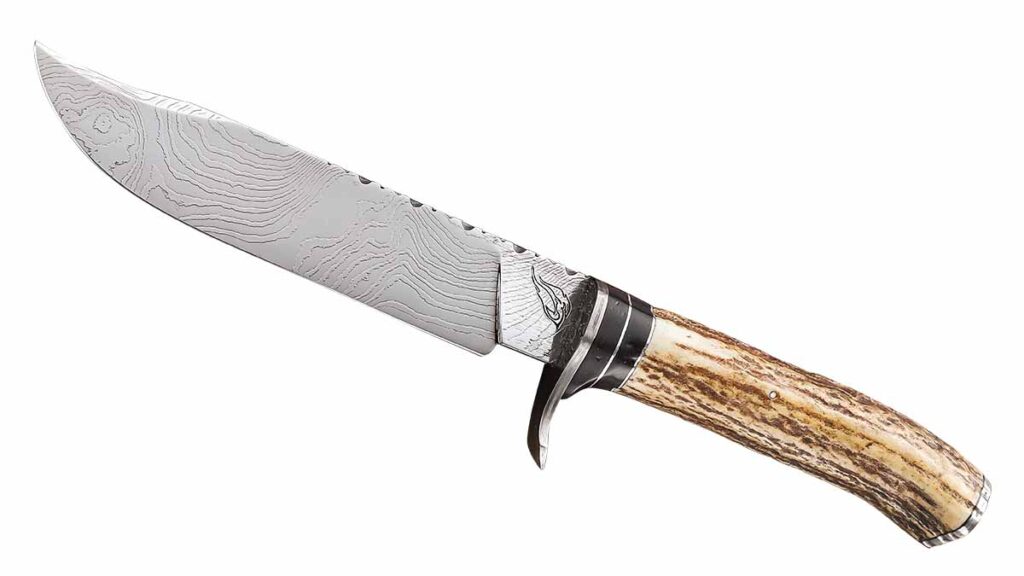
Stag is to knives what red is to rover, rock is to roll and John is to Wayne. It’s the total package in looks, feel and tradition. Sambar, axis, popcorn or whatever the type or style, when it comes to knife handles, stag has it all.
Jeremy Yelle: Takedown pocket bowie
You can almost see and smell the popcorn popping on the popcorn stag of Jeremy Yelle’s takedown pocket bowie. The guard and fittings are 416 stainless steel fire-etched and textured black. Blade and overall lengths: 4.5 and 9 1/8 inches. (Joyce Frasier image edit)
Liam Walle: Full-tang fighter
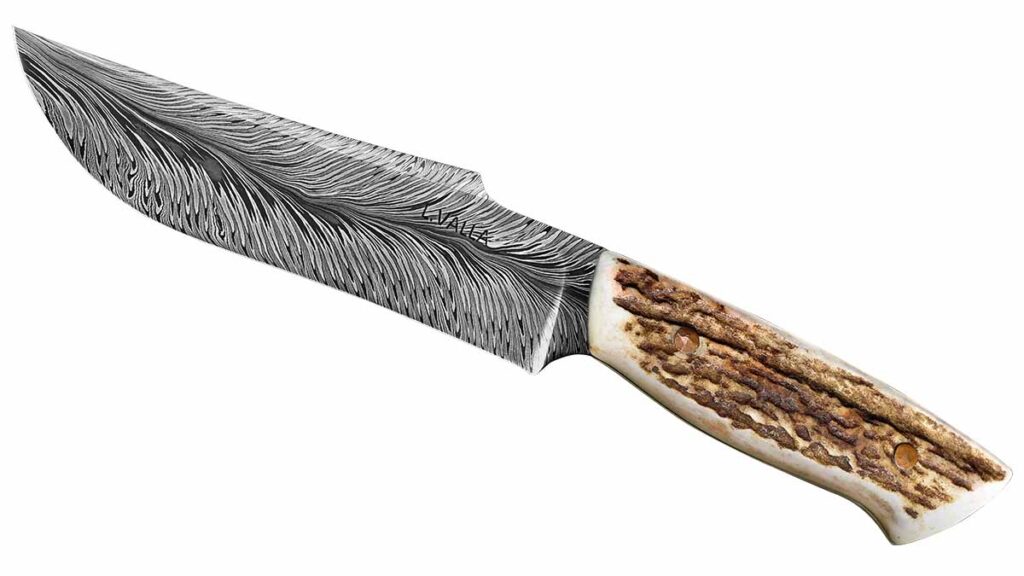
ABS apprentice smith Liam Walle opts for deer antler scales with copper pins for his full-tang fighter. The 5.7-inch harpoon blade is 2,340 layers of feather damascus in 1084 carbon and 15N20 nickel alloy steels. Overall length: 10.4 inches. (Jocelyn Frasier image edit)
Cowboy Szymanski: Bowie
Axis stag and ebony spacers comprise the handle of a bowie by Cowboy Szymanski. Blade steel is an accordion twist damascus of 1095 carbon and 15N20 nickel-alloy steels. The bolster is raindrop pattern damascus. Overall length: 11.75 inches. (SharpByCoop image)
Lin Rhea: D-guard bowie
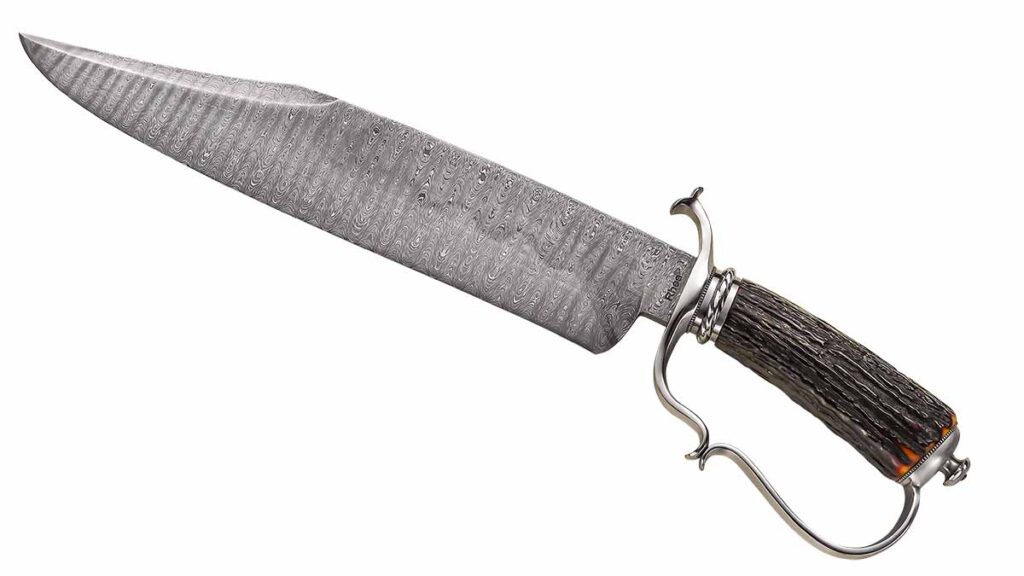
A stag handle and a blade of ladder-pattern damascus in 1084 carbon and 15N20 nickel alloy steels help complete ABS master smith Lin Rhea’s D-guard bowie. The sheath (not pictured) is by Cody Rowe. (SharpByCoop image)
Erik McCright’: Camp knife
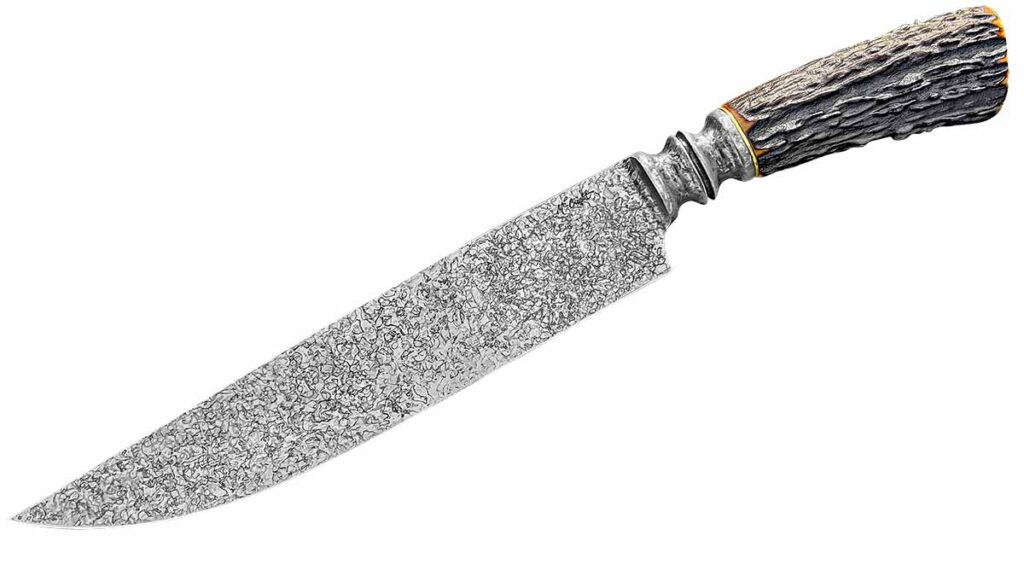
The dark Sambar stag—not to mention the fancy ferrule connection between handle and blade—of Erik McCright’s camp knife screams 19th-century Sheffield. The 8.75-inch blade is 52100 ball-bearing steel with a forced patina. (Jocelyn Frasier image edit)
David R. Davis: Slipjoint
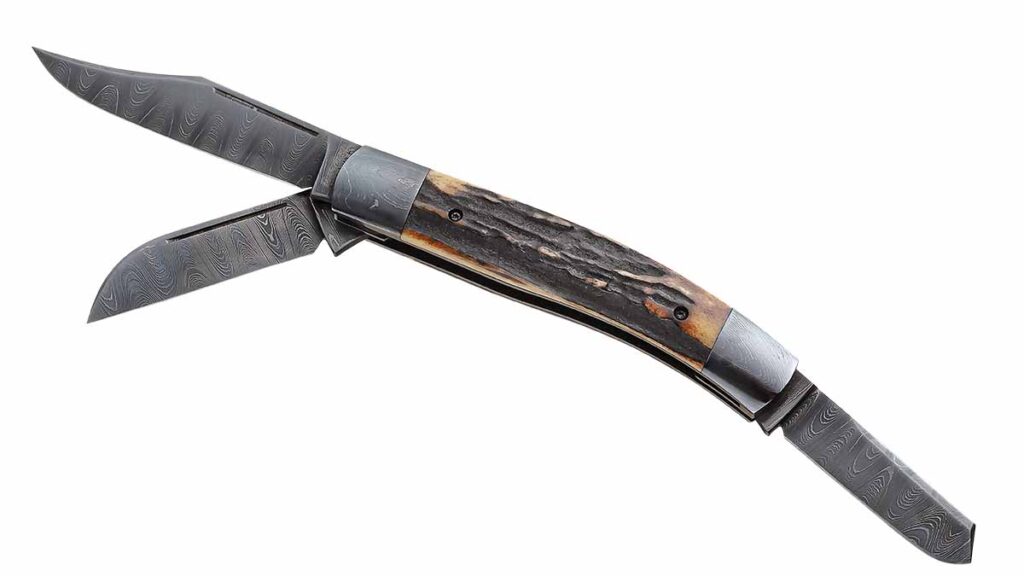
David R. Davis chose Sambar stag and pattern-welded blade steel from Alabama Damascus for his stockman. Blade lengths: 3, 2.25 and 2.5 inches. Blade grinds: flat. Closed length: 4.25 inches. His price for a similar knife: $1,100. (SharpByCoop image)
Adam Millé: Classic hunter
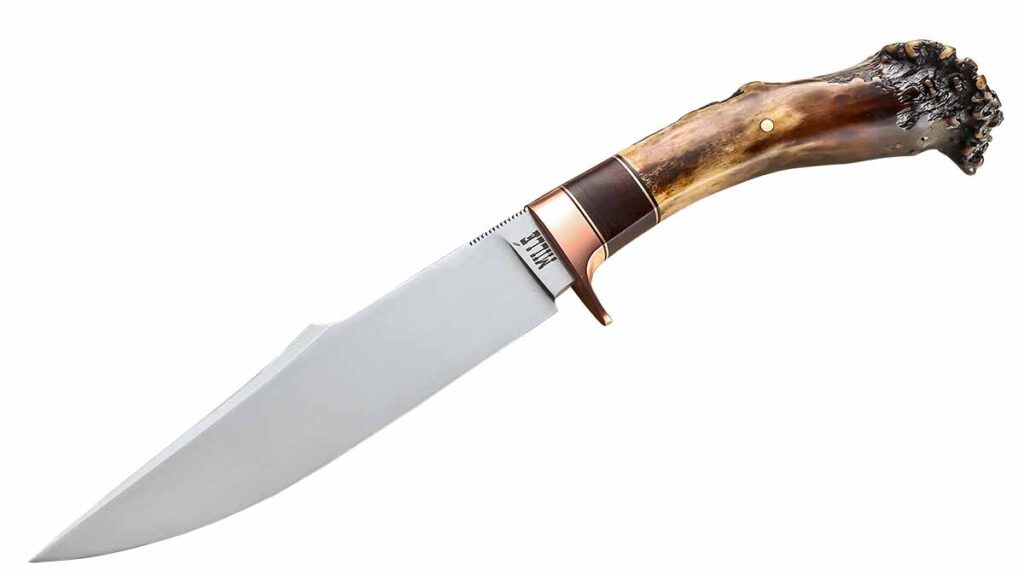
Crown stag and vintage Micarta® complete the handle of Adam Millé’s classic hunter. The bolster is copper. The 6-inch harpoon blade is W2 tool steel. Overall length: 11.25 inches. The handmade leather sheath (not shown) has python snakeskin inlay. (SharpByCoop image)
Know some of the criteria judges use to evaluate custom knives.
Artistic impression, technical merit, fit and finish, walk and talk: What are the standards and where are the attributes that lead to a judge’s conclusion when awards are on the line at a custom knife show? It goes without saying that sometimes the difference between a winner and runner-up is as thin as the edge of a sharpened blade.
Those who judge knife competitions are obviously obliged to employ their experience, skill, years of involvement with the industry and discerning subjectivity. As a result, looking at the criteria that some veteran judges employ helps observers develop a deeper perspective on the competition among the best custom makers in the business. Moreover, if you’re a collector, knowing what judges look for should help you improve your collection; if you’re a knifemaker, it should help you make better knives—or at least knives that are more likely to win judging competitions.
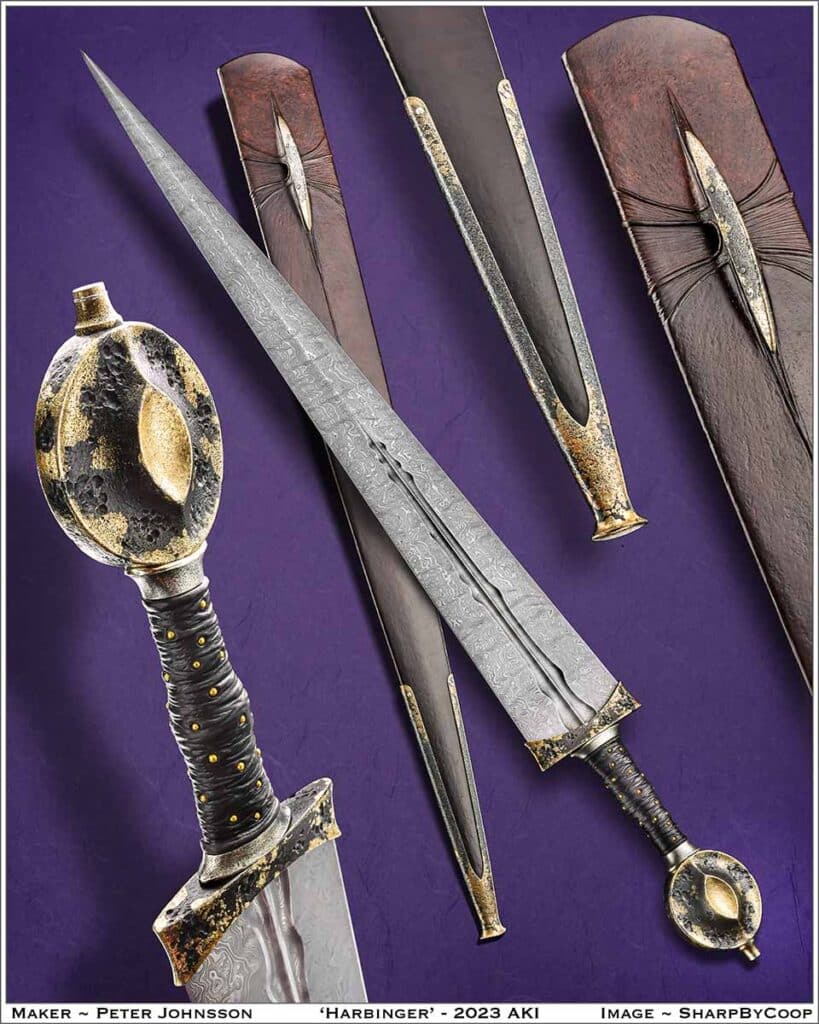
It’s not unusual for a knife to win a category based simply on how hard it is to make—and when you make it as superbly as Peter Johnsson does with the Harbinger, so much the better. (SharpByCoop image)
“I use the four F’s,” advised longtime purveyor Les Robertson, “fit, finish, flow and function. Fit is the overall look of the knife, focusing on how well the guard/bolster fits the blade and guard. How well does the material fit up against the guard and spacers? If a full tang or tapered tang, how well does the handle material fit to the tang?” When it comes to finish, Les primarily looks for consistency and degree of difficulty.
“No matter what type of finish, is it consistent from the tip to the end of the knife? It can have no spots, scratches or other inconsistencies,” he explained. “The degree of difficulty comes in the form of the type of finish. A mirror finish is much more complex than a tumble or bead blast finish. I give bonus points for two-tone finishes, such as a mirror finish on the hollow of the blade and satin for the flat of the blade.”
Finishing up with flow and function, Robertson commented, “Flow—does the knife transition smoothly from one end to the other? Sometimes art knives become more about the art. The embellishments can take away from the basic design the knife was built on. Function: will the knife do what the design intended it to do? While there is always room for improvement on standard designs, the maker should temper the changes and base them on reality. Often, the design borders on or moves into the fantasy realm.”
Robertson adds that the first thing he notices when judging is whether the knife fits the category entered. Hunters, for instance, do not generally feature 10-inch bowie-style blades. Common errors or flaws, he observes, can usually be found in grind line symmetry in the choil area, whether a folder or fixed blade.
Complexity
Jared Oeser has been a custom knifemaker for 13 years and finds himself most familiar with folders. “Folders tend to be, more often than not, the more complicated knives to make,” he began. “Fit and finish are big factors, especially on a folder, and every detail has to be taken into account along with how hard the knife is to make. Adding a lockback feature or multiple blades makes the knife more complicated, and I have seen knives win in categories—even best in show—that might have a tiny flaw but win on the sheer complexity of the knife, just how hard it was to make.”
Oeser likes to take a broad view in the beginning, looking over each of the knives in a particular competition and moving from there. “In a process of elimination, I take some away and then give an overview of the ones that stand out with their level of detail, refinement and craftsmanship,” he said. “I try to leave style aside because everybody has a style of their own. But I do want to see that they have accomplished what they intended to do within their own style. It may not be to my taste, but if they have nailed it, that’s great! What does the entire package look like?”
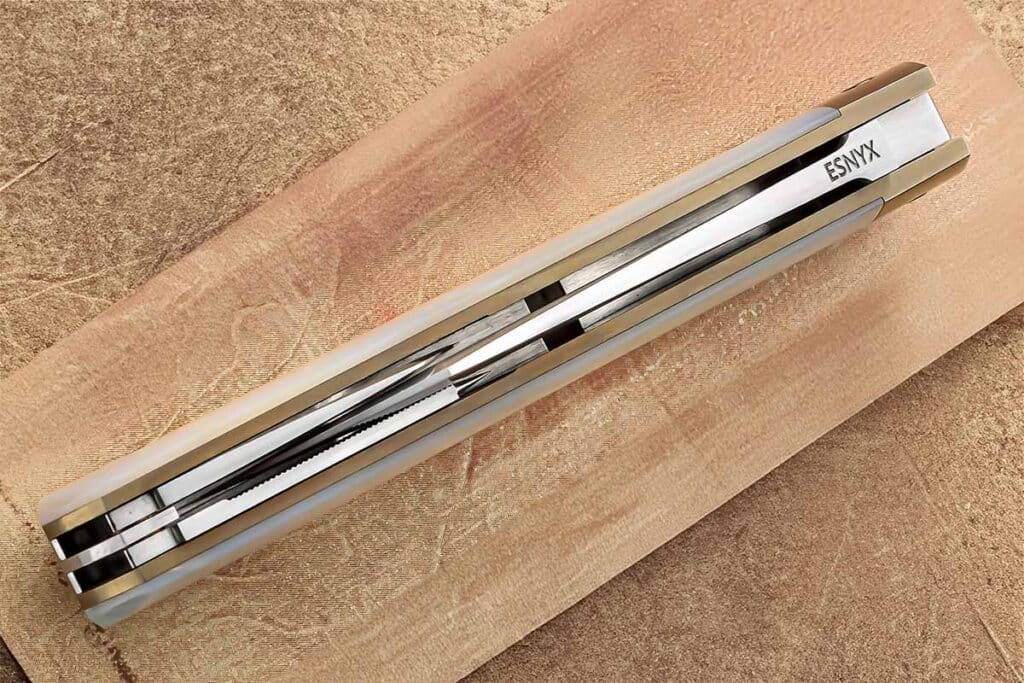
Top-down views of knives can reveal the good or the bad. Here it’s the good with the proper spacing between the closed blades on an Evan Nicolaides sportsman’s knives. (SharpByCoop image)
After judging for the first time at BLADE Show Texas in 2022, Jared has seen some entries that immediately fall out of contention. “There are automatic disqualifications if knives have massive flaws,” he related. “I was judging a competition with [ABS master smith] Jim Rodebaugh once, and there was a big bowie with the nut on the end of the pommel way off center. Jim put that knife down and said, ‘Well, that’s out.’”
Scale & Proportion
Scale and proportion are critical elements in the overall presentation of a custom knife, and these ideals apply to both fixed blades and folders, according to Jim Berkenfield of Forged in Thread, an apparel company that contributes revenues back to the knife industry. “I typically examine a knife from the tip of the blade to the handle,” he said, “but that’s just me. Right away your eye will pick up on common errors such as disproportionate size between blade and handle, major flaws in fit and finish, or any sort of material or structural flaw. In my opinion, line and flow are extremely important in both fixed blades and folders, yet as in most judging this is a subjective characteristic of a knife. Really, it’s no different than admiring a fine piece of sculpture or artwork and saying ‘I like that’ or ‘I don’t like that.’”
Fit and finish factor into the award-winning formula in virtually every judge’s point of view. Visual appeal and quality construction go hand in hand. “That’s extremely important in judging knives,” Berkenfield added, “because judges are always looking for perfection in whatever the category may be. Smooth transitions between materials, perfectly centered blades, and smooth locking mechanisms are all vital characteristics of a winning knife.
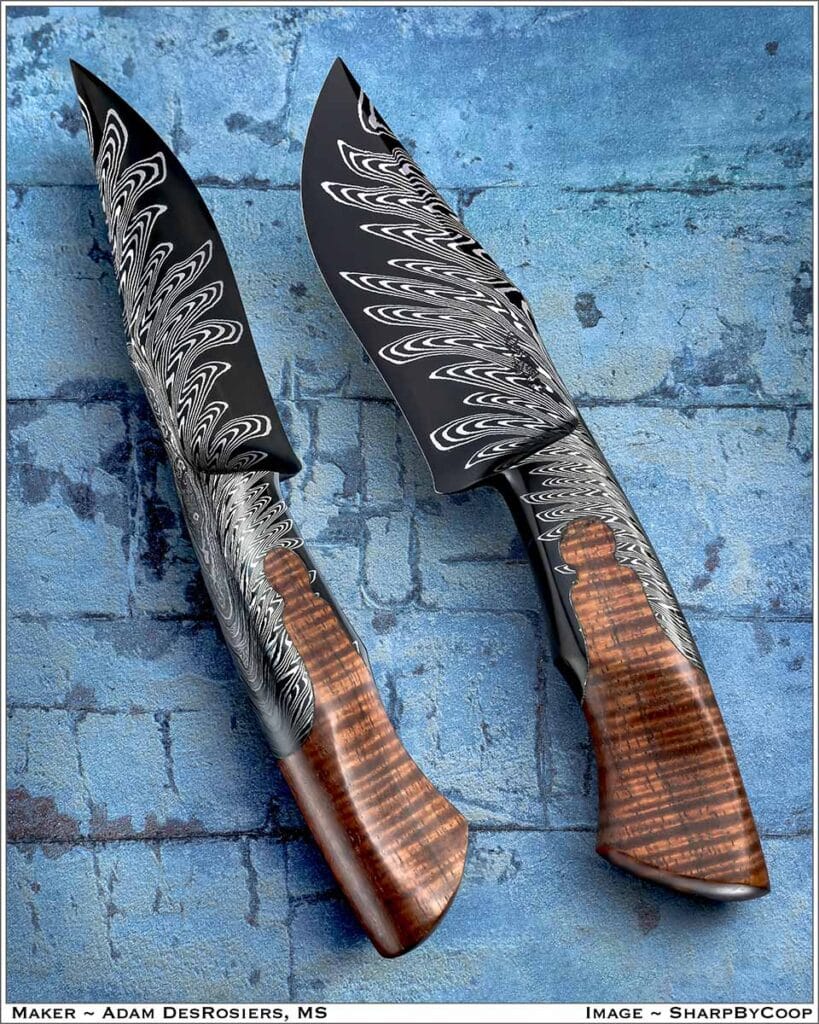
Flow is when the knife’s shape transitions smoothly from one end to the other. ABS master smith Adam DesRosiers nails the concept with his damascus keyhole hunter. (SharpByCoop image)
“In categories that I have judged, the judging teams quickly have been able to reduce the submissions to the top one, two or three knives almost at a glance. Occasionally a piece can be overlooked by a judge based upon the fact that it’s a knife that doesn’t fit [his/her] general aesthetic or knowledge set, and therefore [he/she has] a hard time appreciating it. Obviously, this is one of the reasons that judging is done by a panel and not by an individual judge.”
When it comes down to a pair of high-quality knives, Berkenfield seeks a closer examination of each piece, sometimes with a magnifying glass if necessary. Bad welds and asymmetry in damascus steel can make or break a winning knife.
“A piece of advice I have given to a lot of aspiring and up-and-coming makers is to try and find a way to distinguish your work from the multitude of other incredible knifemakers out there,” Jim concluded. “I tell them to imagine a table with 100 knives on it and one of their knives somewhere in the mix. They should be able to quickly scan the table and identify their knife from all the others. This is easier said than done and sometimes is accomplished with a completely unique design or simply by a small detail that identifies a knife as their own.”
Half The Equation
After making custom knives for eight years, Pennsylvanian Jim Vandeveld sees the judging aspect of his involvement weighted heavily on fit and finish, and his perspective on the topic is pretty specific. “Fit and finish are absolutely critical, and honestly, to me encompass more than 50 percent of a knife’s virtue,” he explained. “Polishing, edge breaking, hand satining, etching, buffing, etc., all must flow just as the design must flow. Inspecting it is purely visual and deficiencies are often glaringly obvious. For me, light usually tells the story. How a finished surface catches the light will often show most imperfections.”
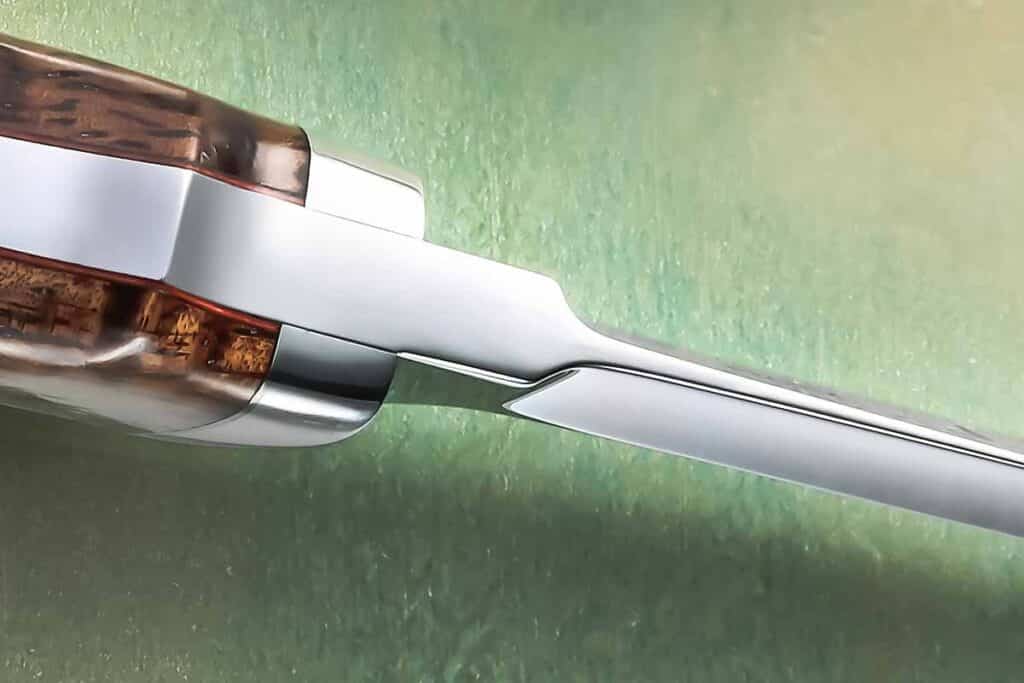
Common errors or flaws can usually be found in the grind line symmetry in the choil area. Carl Colson matches the plunge cuts quite well on his Loveless reproduction. (SharpByCoop image)
For Vandeveld, the judging experience begins at first sight—literally. “I think the way the knife is perceived visually at a distance is very important,” he commented. “I personally look for balance, flow and symmetry. These are broad spectrum visual cues that tend to draw me in to take a closer look at a piece. When judging a knife, all views must be taken into account. Lateral, top down, down the point, and more, all propose a different perspective and opportunity for detail to be found or missed. The same is true for folding knives.”
Vandeveld’s judging eye gravitates toward high quality, but common and recurring errors in the knifemaking process do surface. “I think the most common flaws that pop up within custom knives tend to be both visual—related to plunge and grind symmetry as well as faceting on handles and other components, straight-line fit-ups as far as gaps and locations, finishing with etching, sandblasting and polishing—as well as ergonomic hot spots and unbroken edges. These tend to be more subjective based on the maker’s style, but when judging a knife, how it fits in the hand is just as important as the aesthetic in my opinion.”
Set Of Standards
Most judges would probably agree that the devil—or the delight—is in the details when it comes to evaluating the entries in a custom knife competition. It’s way more than a beauty contest. Accessories such as sheaths or pocket clips are not necessarily required. As more than one judge has said, “I’m judging the knife and not the sheath.”
The sheer weight of the knife may even come into play for some, while others make it only a minor consideration. Walk and talk in folding knives certainly demonstrates the proficiency of the folder maker’s tolerances, centerline and spacing, and ease of opening. The list goes on.
One thing is certain—in judging the merits of a custom knife, an experienced individual learns to apply a set of standards to which all makers aspire.
Niagara will help fill the shoes of an industry icon.
The recent demise of Crucible Industries LLC not only marked the end of a celebrated name in the manufacture of blade steels, it denoted the dawn of a new age—not only for the steels famously known by their CPM prefix, but other premium blade materials as well.
Used by Crucible and short for Crucible Particle Metallurgy*, CPM prefixed such Crucible steels as CPM S30V, CPM S35VN, CPM MagnaCut—today’s hottest CPM variant—and others among some of the most-used blade materials since Chris Reeve Knives popularized S30V on Reeve knives beginning in 2004-2005. S30V, in fact, was the first modern steel manufactured specifically for knife use. All other manufactured steels used in blades were originally made for purposes other than knives.
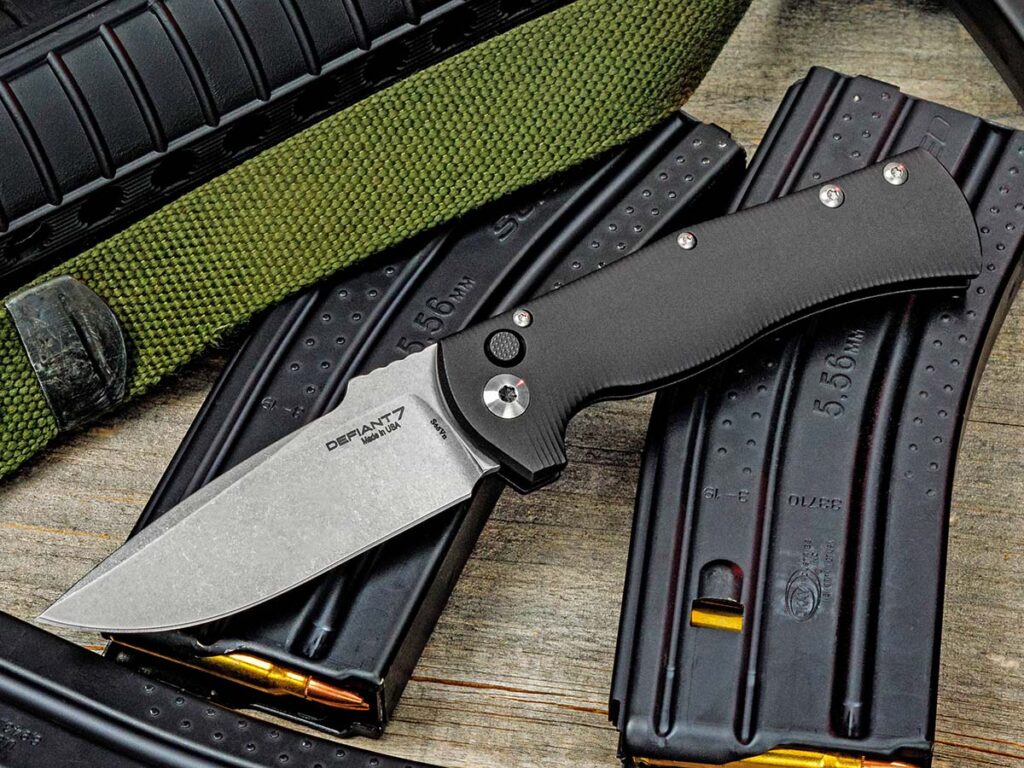
CPM S45VN is one of several of the old Crucible steels Niagara offers. The Defiant7 Auto Eagle has a stonewashed blade of the stainless steel and a black aluminum handle. Blade grind: flat. Weight: 4.4 ounces. Designed by Les George, it’s 4.75 inches closed. Country of origin: USA. MSRP: $285.
Crucible closed its doors earlier this year and sold most, if not all, of its assets at auction in February. So what happens to all those wonderful steels that both the factory and custom knife industries use in mass quantities?
According to Bob Shabala of Niagara Specialty Metals (NSM), NSM will do its part to have/supply most, if not all, of them, as well as other up-and-coming steels, to the custom and factory knife industries.
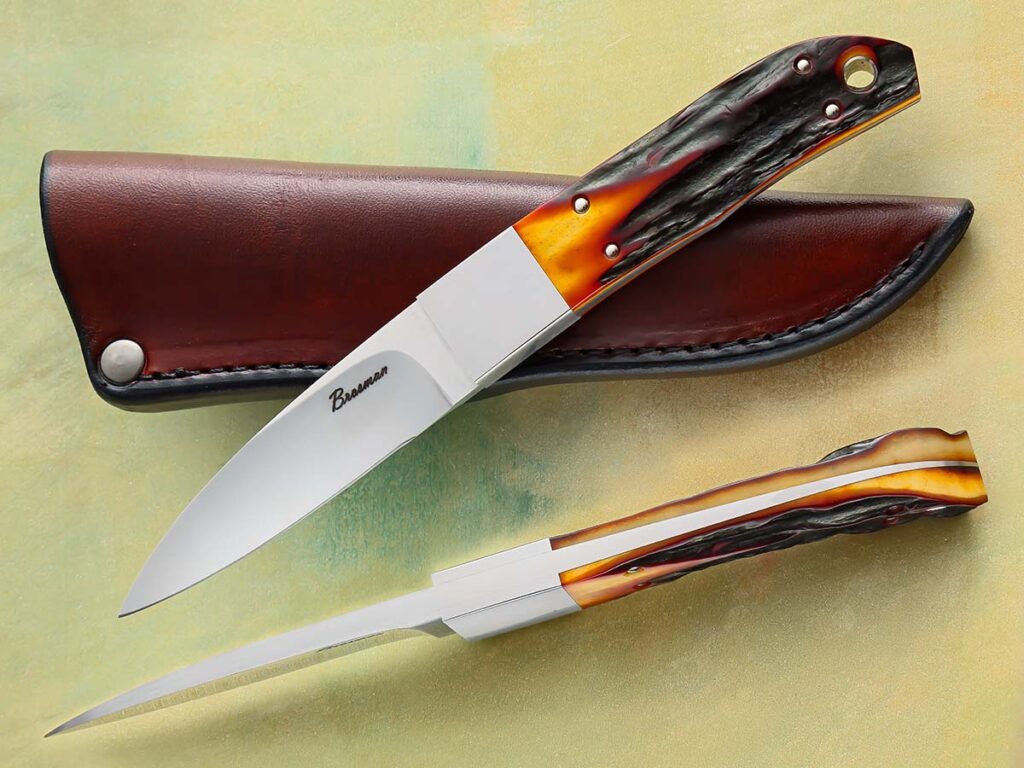
Among custom knifemakers especially, CPM 154 stainless is extremely popular. Craig Brosman employs it in a hollow grind and amber-dyed European red stag on his utility fixed blade. Overall length: 7.5 inches. (SharpByCoop image)
Opined Scott Devanna of steel service center SB Specialty Metals, “The majority of steel sheet in the U.S. comes out of Niagara. They’re the only [domestic mill] that can make it right now. It’s been that way for the last 25 years. They’re the only game in town.”
Erasteel And The Name Game
Erasteel, with state-of-the-art steel mills in France and Sweden, is owned by Syntagma Capital, a private equity group based in Brussels, Belgium. Erasteel acquired a part of the assets of the old Crucible Industries during the February auction, including working capital, steelmaking equipment and, perhaps most importantly, the trademarks for all the CPM steel names. A manufacturer and supplier of steels not only to the knife community but also the aerospace and other hi-tech industries, NSM had worked with Erasteel before the auction, processing millions of pounds of the Swedish mill’s steel for industrial applications.
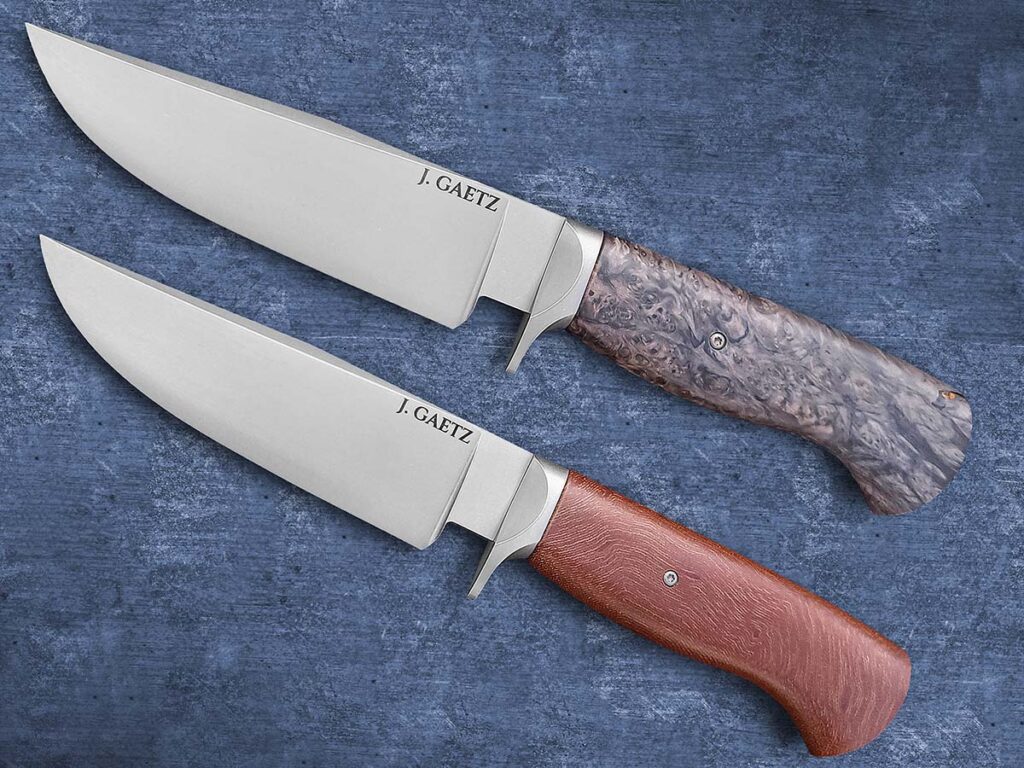
The 4.75-inch blade of Jacob Gaetz’s Large Field Hunter is CPM 3V carbon steel cryo-treated to a Rockwell hardness of 60-61 HRC. Handles are Apocalyptic box elder burl (left) and vintage Micarta® (right). Overall lengths: 9.875 inches. (Jocelyn Frasier image)
“We’d been doing that for several years,” Shabala noted, “so we know the quality of their steel is good.”
Together with Crucible, Erasteel is the pioneer in gas-atomized metal powders and started with the process in 1969. Today, it has the largest installed capacity in the world to produce metal powders, with two large atomizers built and designed by Erasteel.
Shabala said NSM officials understood their knife customers wanted the assorted CPM steels to keep the old names to avoid confusion among knife-buying consumers.
“They didn’t want to change the names and have to educate consumers on what the new names would be and how they related to the legacy Crucible names,” he explained.
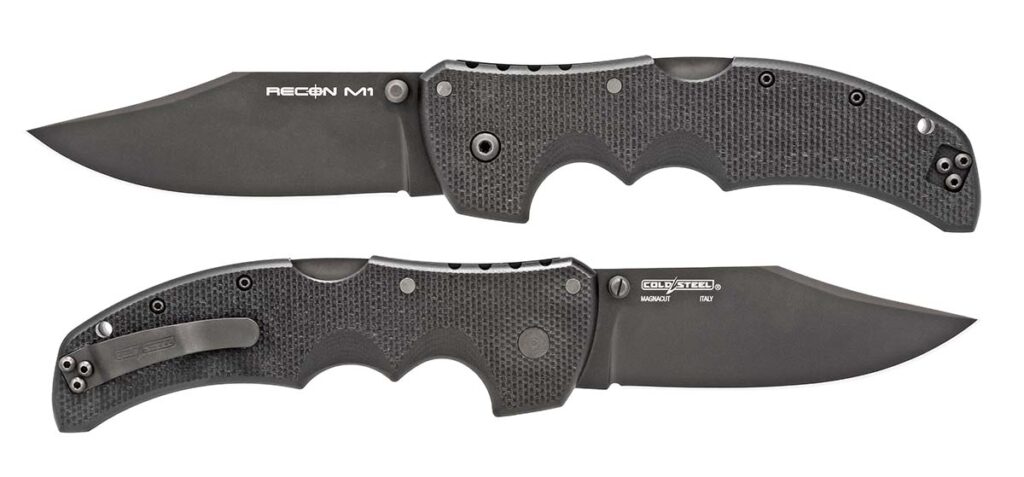
The Cold Steel Recon M1 sports a black-coated blade of MagnaCut stainless, which remains the hottest of the CPM steels used by both factory and custom segments of the sporting knife industry. Handle G-10. Lock: Atlas Lock. Weight: 5.2 ounces. Blade and closed lengths: 4 and 5.5 inches. Country of origin: Italy. MSRP: $309.99.
Meanwhile, the two companies reached an agreement where if NSM buys the steels exclusively from Erasteel, NSM can use the original names too, including S30V, S35VN, S45VN, MagnaCut, S110V, 3V and CPM 154. NSM and its customers can still use the full designation of CPM S30V, CPM S35VN and so on, though the customers can omit the CPM if they so choose.
“The reason we’re keeping the CPM 154 name is because everybody knows that it’s the powder metallurgy version of 154CM, so we want to keep that designation alive so people will know what’s going on there,” Shabala noted.
There will be a couple of exceptions. The steels formerly known as CPM Cruwear and CPM S90V will be renamed NSMwear and NSM 90PM, respectively.
Niagara is both a manufacturer and distributor, not only of knife steel but also steel for the aerospace and other industries. It is employee owned and employs 41. (NSM image)
“Erasteel already had an agreement with another distributor to buy Cruwear exclusively, so we worked out a deal with them where we can buy the steel, we just can’t use the name,” Shabala explained. “It’s on us to educate people and let them know they can still get CPM Cruwear, it’s just a different name.”
As for CPM S90V, NSM already had Carpenter Technology’s version of it in stock and wanted to rebrand it so that it’s not sole-sourced to one mill. By renaming it NSM 90PM, “hopefully people will understand that it’s coming from us,” Bob said.
Steel Tariffs
Concerning steel supplies in stock, Shabala indicated NSM officials had been aware of Crucible’s coming demise, and in January 2024 began ramping up purchases to build inventory for any future supply disruptions.
Dennis Friedly opts for CPM 154 stainless blade steel and a mammoth tooth handle for his Art Knife Invitational fighter. The copious engraving is by Ray Cover Jr. Overall length: 13 inches. (SharpByCoop image)
“We started placing orders with Carpenter and Erasteel in September 2024, though not knowing Erasteel would be the eventual owner of the CPM trademarks,” Shabala noted. “The steel we bought in September is starting to arrive. There will be some disruptions in MagnaCut and CPM 154, but everything else we still have a decent amount of and there should be no disruptions.”
In case you hadn’t heard, President Trump has instituted tariffs on most countries, including France and Sweden. At press time, the European tariff was 25 percent.
“Everything we buy from Erasteel as it stands right now is subject to a 25 percent tariff,” Shabala said. “Even the steel we buy from Carpenter, the powder for it is atomized in Sweden, so that’s subject to at least a 10 percent tariff.”
Dennis Friedly opts for CPM 154 stainless blade steel and a mammoth tooth handle for his Art Knife Invitational fighter. The copious engraving is by Ray Cover Jr. Overall length: 13 inches. (SharpByCoop image)
Another concern is whether knife companies can continue to mark their knives built with NSM steel “Made in the U.S.A.” Bob said he is up front with his customers, telling them that Erasteel will be supplying a “good chunk of our CPM alloys,” though it’s all hot rolled at NSM.
The question becomes if the raw materials are imported but don’t officially become a steel until they’re hot isostatic pressed, does that make the steel American made or imported? He indicated it will be up to his customers’ lawyers to hash out what the customers can and can’t do concerning U.S.A. markings on their knives.
NSM Innovaions
What’s on the horizon at NSM? One thing is a new grade developed by steel guru Larrin Thomas. Called Magnamax, it won’t be widely available until the end of the year. Since NSM has both patented and trademarked Magnamax, it can have it made by any mill it wants, and had it on order with both Erasteel and Carpenter at press time.
Bob Shabala of Niagara Specialty Metals
Meanwhile, along with Erasteel, Bob had high praise for the steel being made by Carpenter.
“We’re getting powder now that is atomized in a vacuum furnace. It’s a step forward in quality. We hardly ever had an issue with any CPM product from Crucible,” he qualified, “but I think Erasteel’s and Carpenter’s steel has a finer grain size. It’s a little microscopically cleaner than what we were getting before, so it really is an opportunity to provide a better product.”
As Shabala noted, Carpenter has made lots of cutlery steel, and NSM has processed a huge amount of it, hot rolling it into sheets and sending it back to Carpenter’s warehouse for sale to various customers. One of Carpenter’s best-known steels is CTS XHP stainless.
“It’s a grade that customers really like,” Shabala said, adding that NSM had over 20 tons of it and was in the process of preparing to make a big marketing push on it at press time.
Having steel manufactured in the USA remains a big selling point with many of NSM’s customers, so the company remains on the lookout for new melt sources, one of which is Prime Metals & Alloys (PMA) of Homer City, Pennsylvania. A manufacturer and supplier of a wide range of steels for assorted hi-tech and other uses, PMA was in the process of making steel for NSM at press time, which Shabala seemed to think holds great promise.
Larrin Thomas, metallurgist and knife writer
“We should receive it in a couple of months, but if it works out it’s going to be an ESR version of stainless steel that we’ve always supplied, so it should be a noticeably better product than what our customers were used to before,” he said. “It’s really a good find for us to be able to get a higher-quality steel with a shorter lead time, so we’re really excited about that.”
ESR stands for Electro-Slag Remelting, a process that results in a very clean steel devoid of contaminants.
“In a traditional melting process, you heat the steel up, get it in a molten state, pour it in an ingot and that’s it,” and later forge and finish it out, he explained. “With ESR you take that ingot and you remelt it again and all the slag and contaminants float to the top, and they’re skimmed off. What remains in the new ingot is a cleaner version of the original.”
Shabala added that two different grades of NSM stainless steels that had always been air melted will now be ESR melted.
NSM’s Role
People often misunderstand a company’s role in any endeavor, and Shabala said that seems to be the case with NSM.
“Larrin Thomas was concerned that people had the misconception that NSM is just a distributor, that we just got sheets from Crucible and resold them,” he observed. “He said we should emphasize the fact that we’re a lot more than a distributor, we’re a manufacturer, we buy slabs of steel, we process it into the final dimensions and ship it. Cutlery is a big part of what we do. We do a lot with the aerospace industry, so we know a lot about quality standards.”
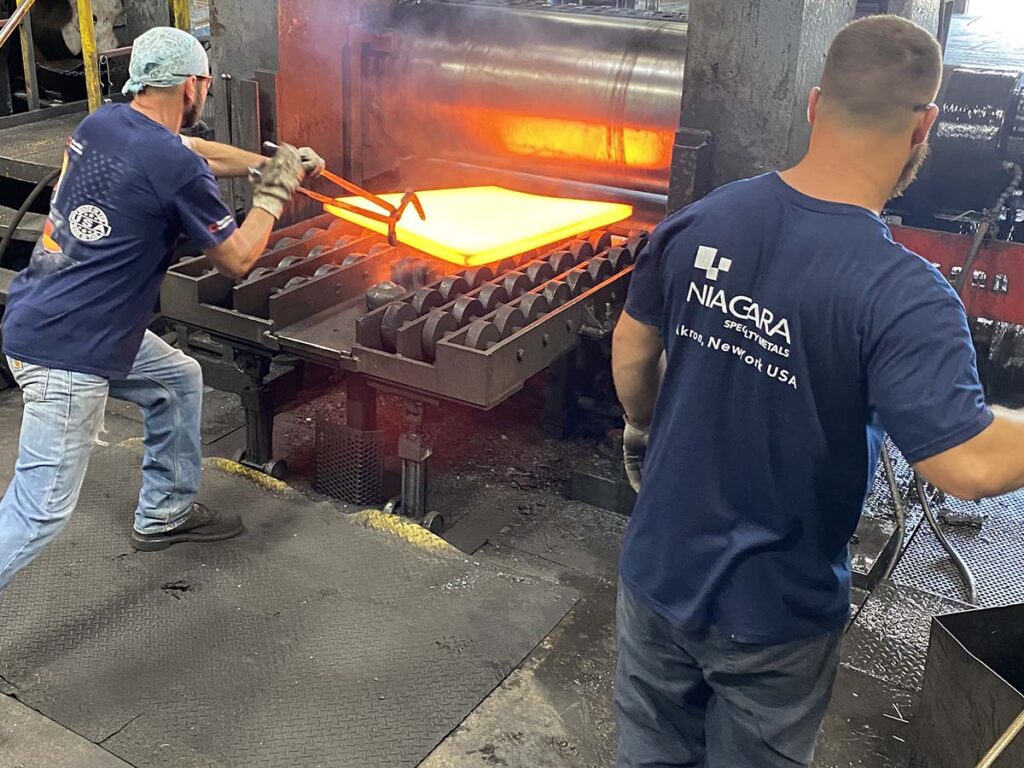
NSM is 100 percent employee-owned, so all 41 employees in its mill in Akron, New York, just outside Buffalo, own a piece of the company.
“Everyone here has a vested interest in ensuring that we’re successful and doing everything we can to put out a good product,” Shabala said.
A last point of emphasis Bob made was that just because Crucible went out of business doesn’t mean NSM is going out of business—in fact, far from it.
“We’re very financially sound. We just put out a $7 million upgrade in our sheet mill, we’re rolling out finished product, it’s the biggest expansion we’ve ever done and we’re getting ready to expand our grinding and laser-cutting capability,” he noted. “We’re really, really in good shape.”
*Editor’s Note: For more on the particle metallurgy process, visit Knife Steel Nerd’s post on powder metallurgy.
Fowler had a lasting impact on handmade knives and knife writing.
The cutlery world recently lost one of its most steadfast creators and philosophers. Ed Fowler, a man who epitomized the spirit of the custom knife movement, passed away on January 17.
Ed’s journey in the industry began in 1962. Over the following six decades, he became a driving force in the evolution of functional cutlery. While he didn’t invent the use of 52100 ball-bearing steel, he was arguably its greatest champion, popularizing the material alongside his then-controversial methods of multiple quenching during heat treatment. For Ed, a knife wasn’t just a tool; it was an ongoing experiment in maximum performance.
To the readers of BLADE Magazine, Ed was a household name. For over a quarter century, he penned his monthly “Knife Talk” column, which consistently ranked at the top of reader surveys alongside BLADE Magazine Cutlery Hall of Fame® member Wayne Goddard. His writings were eventually compiled into two essential volumes: Knife Talk I: The Art & Science of Knife Making and Knife Talk II: The High Performance Blade. Whether he was conducting demos at BLADE Show or teaching at BLADE University, Ed was always eager to share his findings with anyone who sought a deeper understanding of the craft.
A former ABS master smith, Ed eventually founded the High Endurance Performance Knife Association. This organization was a reflection of his own soul—dedicated to understanding the limits of steel and ensuring every knife reached its absolute potential.
Ed’s voice was unmistakable. In his writing, a knife was never an “it”—always a “she” or “her.” He spent his life in a relentless search for what he called “Excalibur,” his version of the perfect knife. He drew deep inspiration from the legends of the past, including Hall of Famers Bill Moran, William Scagel, Rudy Ruana, and the 19th-century bowies of Henry Huber.
He was perhaps most famous for his insistence on testing. Ed had no patience for makers or companies that didn’t put their blades to the trial, and he was never shy about saying so. This commitment to truth in steel earned him a fiercely loyal following. Many of his readers didn’t just follow his column; they traveled across the country to visit him at his Willow Bow Ranch in Riverton, Wyoming, to spend time in the shop with the man who helped define the modern high-performance blade.
Remembering Others The Knife Industry Has Lost:
Betty Dowell, Driving Force Behind Knifemaker Ted Dowell, Passes
B. R. Hughes, Pioneering Writer And Bladesmithing Teacher, Passes Away