Knifemaking

Knifemaking is the building of a knife, which includes the blade, handle and other accouterments. Blades are made by either removing metal from a steel blank via a grinder – known as stock removal – and the forging to shape of hot steel into a blade in the process known as bladesmithing. Other parts, including bolsters, guards, pommels, etc., are needed to complete the finished knife.

Featured Knives – – Knife Collecting – – Tactical Knives – – Survival Knives

Knife Handle Ergonomics 101: Getting A Grip On The Basics

1

Design factors are crucial in matching the knife handle and the hand.

It all started with a stone. Held between the thumb and index finger, it could be used to cut things efficiently if the user learned how to keep the edge sharp.
It was the birth of knife technology.

The next step was to attach the stone to a stick. The stick handle afforded more versatility on how the stone blade could be used. Even though it started out looking like a mere piece of broomstick, there is some obvious utility in it since many knives today have the same simple shape. As a result, though knife handle technology did advance quickly at first, it really hasn’t changed that much in several thousand years. The reason is hand ergonomics. There are only so many ways a handle can fit into the human hand, though small differences in handle design can sometimes be profoundly important.

Asymmetric handles can improve grip but also limit versatility.
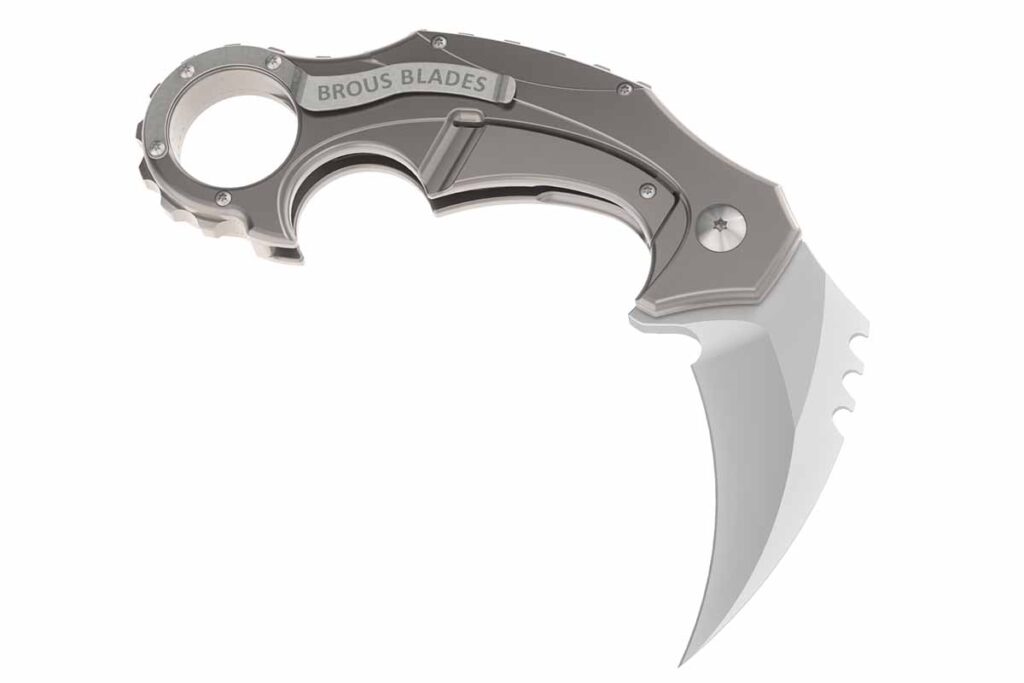
Asymmetric handles can improve grip but also limit versatility. An example is the karambit. The handle of the Elite Enforcer from Brous Blades is designed to provide a reliable grip in forward or reverse tactical positions. (Brous Blades image)

I bet that, as a knife collector, you have handled hundreds of knives and often exclaimed, “This knife is perfect.” We all have. What did we mean? What were we thinking? I would also bet the knife handle fit very snugly in your hand when you thought that. You were able to get a firm grip while you envisioned yourself using the knife on a camping trip, or perhaps defending your life, or doing a multitude of different tasks. The handle wasn’t too big, nor too little. There were no pressure points or sharp contours that caused discomfort. Your approval of the handle was probably appropriate to the task you were contemplating. However, while all blade configurations are not well suited for every possible task, likewise, for best use the knife handle design must complement the blade to which it is attached.

Cutting Jobs

Let’s simplify knife tasks into four basic categories:

  1. First are the simple everyday cutting chores, better known as “everyday carry” stuff. Open a package, cut a string, peel an apple, it’s just EDC. You think any tool with a sharp edge will do—and you’re right;
  2. Second is where you must open 500 cardboard boxes or a similar job that takes some degree of force and puts a lot of stress on your hand;
  3. Third is where you slice 10,000 tomatoes. Well, private, that’s a rough eight-hour shift in the mess hall! Many kitchen knives have some very non-ergonomic handles. Not a big deal if you’re cutting just one tomato, but in eight hours of doing that your hand might actually get some permanent damage. Yes, permanent;
  4. Fourth is an oft-used example and the pinnacle of all scenarios: defending your life. Oh yes, there has been many a knife made for extreme situations. It’s fun to own a big bowie!

The perfect handle for an EDC has so much latitude that the word perfect doesn’t seem like it should ever be used. Going to the other extreme of the fourth category, the concern would be on grip strength. You would not want to lose hold of the knife during a life-or-death situation. A handle that provides a good grip probably would sacrifice some versatility, though in an extreme situation grip strength is probably more important than versatility.

Size

Is the size of the handle’s diameter really important? There is some leeway here, but once you get into endless tomato and box cutting and especially the need for maximum “grip strength” during life-and-death situations, it is a very important factor. According to many studies, as the handle diameter is progressively increased, so too is the grip strength—at least up to a certain point. After that, grip strength starts to decrease.

It is a bit odd that shoe sizes come in a variety of lengths, even half sizes, and also various widths, but gloves are basically small, medium, large and extra large. Why not size gloves more like shoes? The expression “fits like a glove” might mean you are lucky to find a pair that actually fits.

Does one size fit all? Yes, sometimes. But just like buying shoes, you have to put them on and walk around the store a while. If you plan to climb a mountain, you better be damn sure that the shoes will fit, perform and not cause blisters. If a knife handle feels good, then is it good? Probably so. There are many knife handles that “look good” but the proof is how they feel in your hand, your particular hand.

Knife Handle Diameter

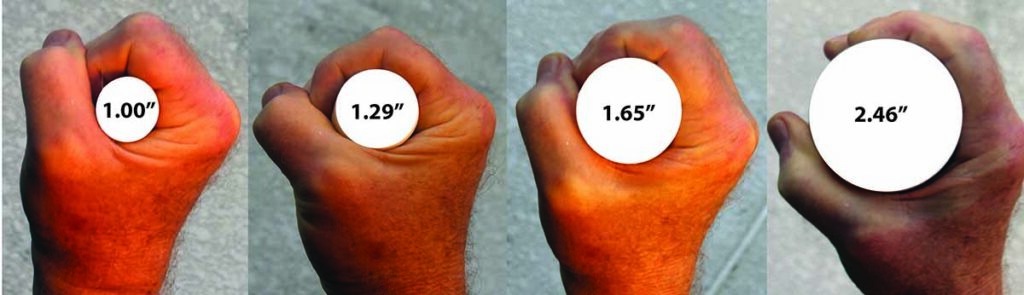
Knife Handle Grip Diameters

Gripping round sticks/knife handles of different diameters results in different ergonomic effects.

The first example shows less than optimal grip strength with a thin handle having diminished contact area between the palm and the handle surface. The force is maximum when the thumb and fingertips are directed parallel to the palm.

The second example favors a strong grip. The fingers are also able to wrap around the handle and there is more surface contact available.

The third example is near the peak of biomechanical advantage. Grip strength might be a little improved from the second example or perhaps a little diminished. Not very different there. Importantly, the thumb and fingers can still cross over each other. There is more advantage from friction. This might be the best fit for a baseball bat. Yet for a knife there will be less ability to change the hand position, which may be a disadvantage. Some consider a diameter of about 1.5 inches to offer the strongest grip and this example is a little larger than that.

The fourth example is loss of grip strength. The fingers can’t encase the handle. The strong ergonomic “power grip” is transforming to the ergonomically weaker “pinch grip.” —by LeRoi Price

Hand vs Handle

We already know about handle diameter. What about shape? Though the round shape of a broom handle works for a knife handle, an oval configuration fits well into the hand and, importantly, allows for indexing of the blade’s cutting edge. Most knife handles have a basically oval cross section.

Form follows function but it begins with ergonomics. There are several dedicated handle configurations that are suited well to a special purpose but are mainly limited to use for that single special purpose. One of the most notable examples is the karambit handle. Asymmetric handles can improve the grip but also limit versatility.

The anatomy, ergonomics and biomechanics of the hand present some challenges for handle design.

Palm Anatomy

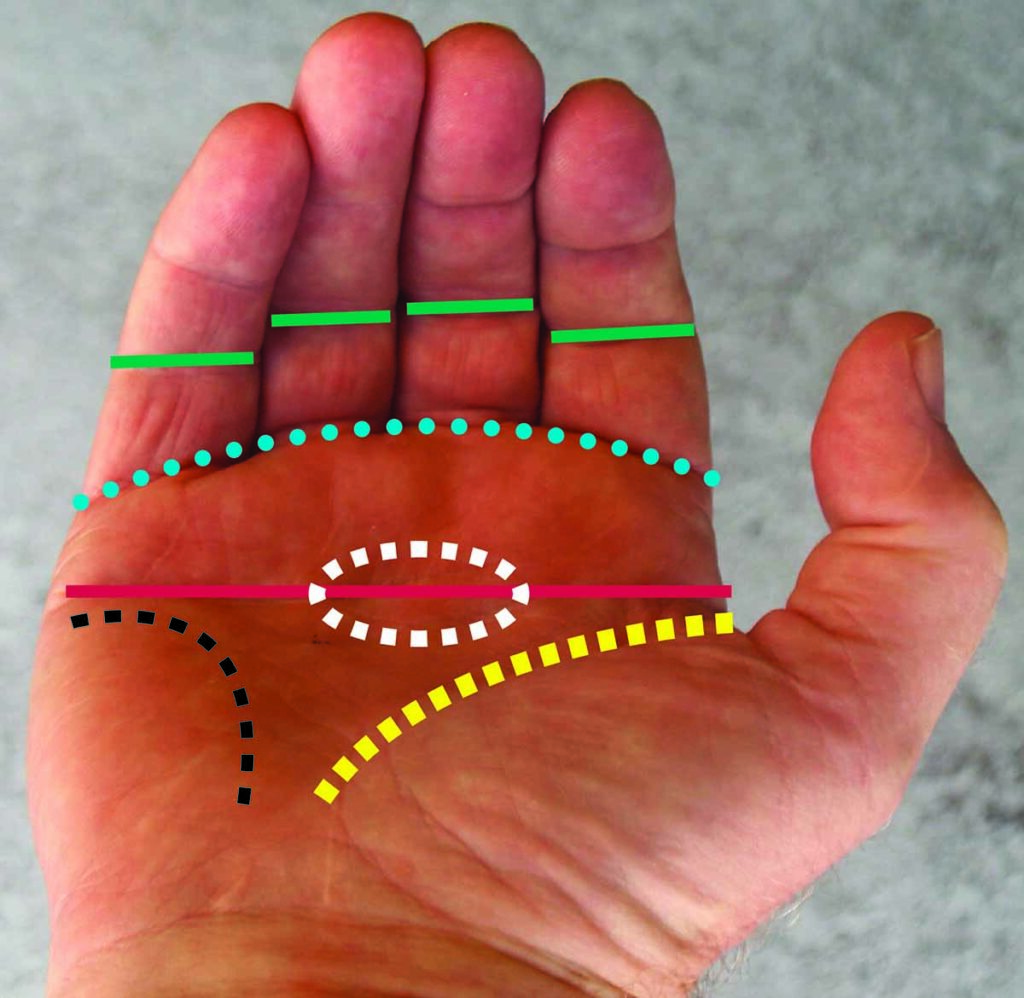
Palm Anatomy

Prominent features of palm anatomy play a pivotal role in hand ergonomics. The red line is the actual bending point of the fingers. The blue dots are where the fingers bend from the palm. The green dashes are the second of the three bending points of the fingers. The yellow squares represent the prominence of the base of the thumb. The black hyphens indicate the small prominence of the heal of the hand. The oval of white squares is a hollow space in the center of the palm.

Note: the hand is not like a door hinge. These lines move as the hand goes from flat open to a closed fist. Now look at the back of your hand as it goes from open to a fist. The knuckles go from a fairly flat line to a downward curve. The finger joints all have a different radius at which they bend.
Hand ergonomics is not a static condition, which makes things difficult for handle design.

Handle Subtlies

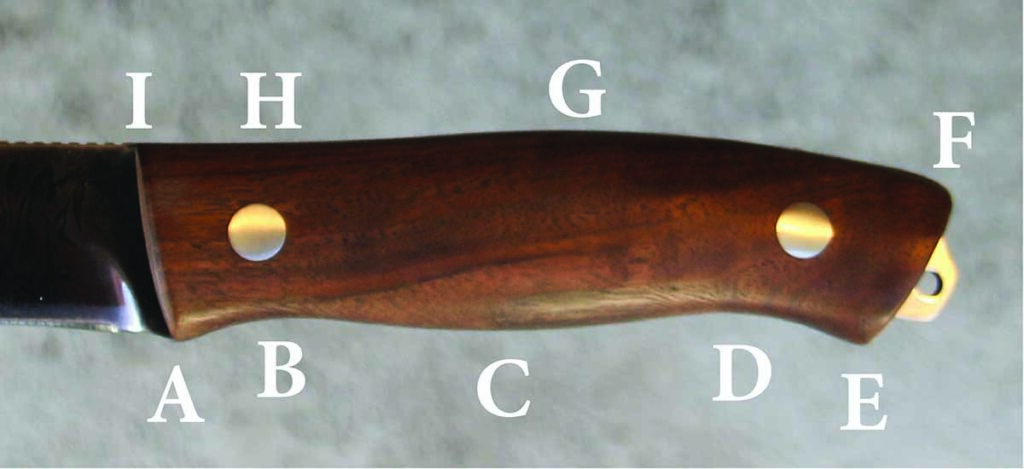
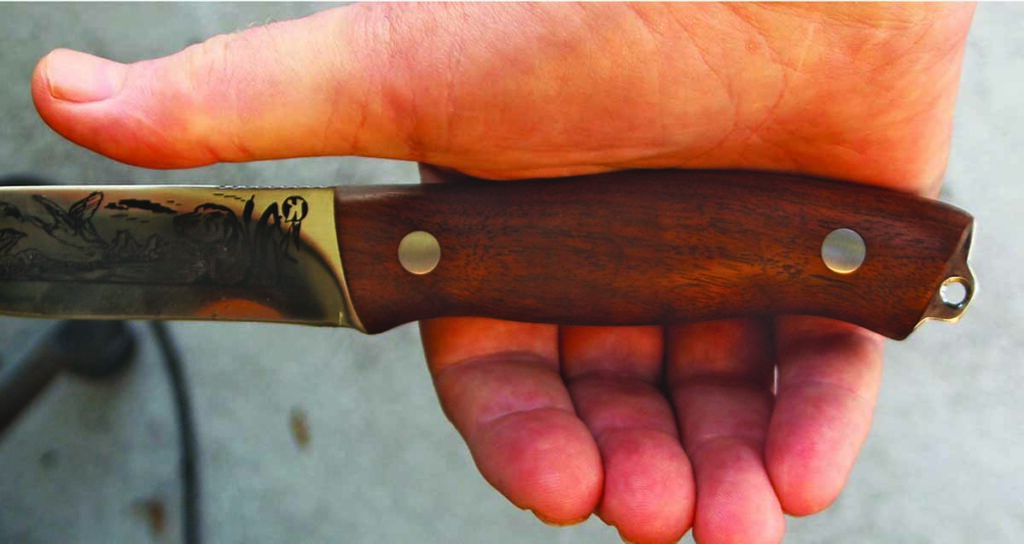
Here is a simple camp knife and somebody made it right. I’ll point out my reasons why starting with the finger groove (B). It is well demarcated though not deep nor very pronounced—just like all the subtle features of this handle. This allows the handle to be more easily manipulated than if the fingers are forced into deep recesses. The groove fits the index finger.

A slight forward rise (A) forms an integral guard. This is an important feature. Some knives like this one have a brass guard in front that is not just mere decoration. A rising protrusion (C) fits into the space of the middle and index fingers. Then it’s down to the groove where the little finger resides (D). Another protrusion (E) captures the little finger and forms a rear guard—again, important for a camp knife.

Area “F” extends more rearward and slopes down to contact the heal of the hand. A slight swell (G) fits into the palm. Some knives are flat in this area but that doesn’t fit hand anatomy well. The handle has a very subtle hollow at “H.” This is where the web of the thumb makes contact, which makes it best to keep it subtle. Area “I” rises slightly here but often is left flat in many knives. This is where you place your thumb when doing some tasks. Putting a guard on the handle spine is less effective than putting one underneath because there are no bones in the thumb web—though slightly rising at “I” is useful.

Conclusion

There is no agreement on the shape of the perfect handle, so you are left with my opinion. On the other hand, you have something to think about and can investigate further. My opinion is this: While there is no such thing as “perfect,” there is still “good enough.” The same can be said for a lot of things.

The handle’s outer contours attempt to nest into the hand’s inner contours
The handle’s outer contours attempt to nest into the hand’s inner contours. A perfect fit of the handle into the palm would not necessarily make for the so-called perfect handle since there are so many variables, such as the strength a particular finger can generate, the forces the blade will be subjected to during use, wrist angle to the blade, slippery conditions, etc. Non-slip handle texture is a different topic altogether, as well as a spongy outer surface that slightly conforms to the user’s palm.

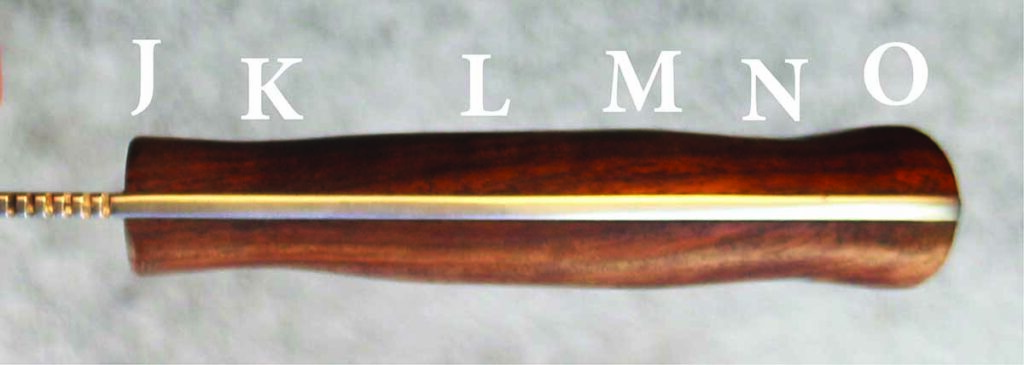
I shouldn’t give numbers but I know you’re going to be curious about some. For a 5-foot-8-inch man, shoe size 9D which correlates to a large size glove, the handle configuration should be oval with a top-to-bottom dimension of 1.125 inch and 1 inch width. These suggestions are approximate, of course, but are the actual dimensions of the pictured camp knife seen with a handle length of 4.675 inches. (Go up to perhaps 1.5 inches height for a combat knife.) The back of the handle should be convex as well as the lower belly. A shallow groove for the index finger is a good option, and perhaps a second one for the middle finger as well. More finger grooves improve grip strength but are a detriment to the ability to manipulate the knife. They also add pressure points.

Ergonomics in a folder also? Absolutely!
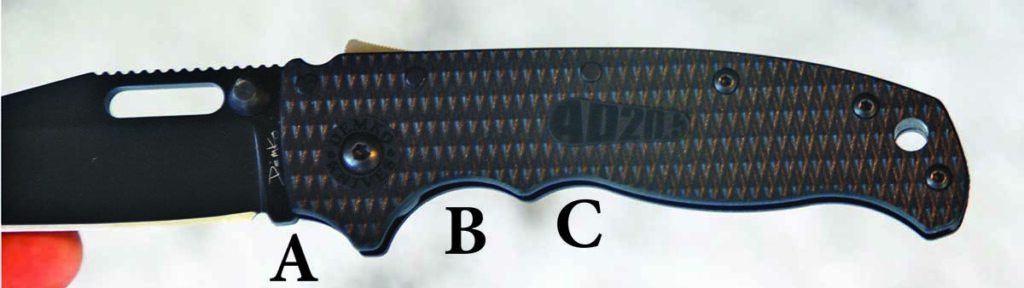
Ergonomics in a folder also? Absolutely! A Demko AD20.5 has a protrusion/integral guard between areas “B” and “C” that creates two finger grooves. The extra finger groove as well as the protrusion/integral guard forward of “B” are good ideas in a folder. The features increase grip strength, which is hindered in folder handles since they are thin compared to fixed-blade handles. The front of the handle is not squared off, which provides for a finger groove at “A.”

When you find a knife handle that doesn’t feel right, it is probably not right for you. Nonetheless, finding one that fits your hand “good enough” is probably the best you can do, and all you need to do.

More On Knife Handles:

Meier Helped Forge The World Of Damascus We Know Today

0

Daryl Meier’s star pupil pays tribute to a mentor who taught him oh so well.

Daryl Meier is a pattern-welding legend. He has influenced more modern pattern-welding experts than almost anyone I know, both in the USA and worldwide.

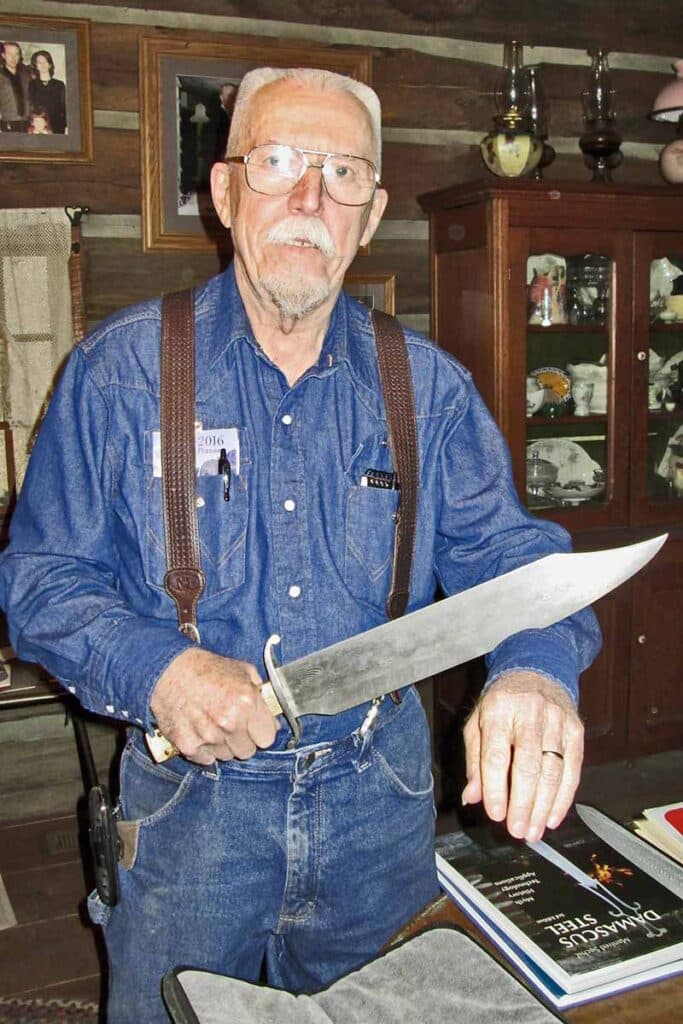
Daryl Meier in 2016 holding his American Spirit Bowie. (Tony Mannucci image)

Daryl was born just outside Carbondale, Illinois. In 1958 he moved into the small city, which is situated in the southern part of the state. There wasn’t much to see in Carbondale back then, though a local blacksmith worked there. It was in the blacksmith’s shop that Daryl developed an interest in forging which influenced his entire future career.

He influenced my work at levels I can’t even begin to explain.

Damascus Knife Renaissance

I started forging blades in 1972. I went to Alfred Pendray’s shop to learn how to forge weld and I was fortunate enough to learn from Alfred’s father, John Pendray, a master ferrier and a great blacksmith. Mr. John took a lot of the mystery out of the forge-welding process. To him, it was quite ordinary. He grew up doing it for a living.

There are many legends about pattern welding that have gone out of favor. It never really did. The history of pattern welding goes back unbroken for at least 2,000 years. Alfred told me that in the 1940s and ’50s, there were probably 40 or so ferriers around Ocala, Florida, alone who were putting tongs and hammers together out of different pieces of scrap steel of different alloys that, when etched, would show a pattern. This indicated the tongs and hammers were pattern welded, as far as I know, a common practice around any blacksmith shop or horse farm back in the day.

Pattern-welded material being used in knives in the USA began getting noticed in 1973. BLADE Magazine Cutlery Hall-of-Fame® member Bill Moran launched it all with the damascus knives he exhibited that year at The Knifemakers’ Guild Show in Kansas City.

Daryle Meier Cutting Edge Damascus

At the same time, Daryl began to put a group of guys together to research pattern-welded steel in Carbondale that included Daryl, Jim Wallace and Bob Griffith. The research involved extremely complex patterns stemming from the Merovingian culture (circa 450-750 A.D.). The pattern-welded material in Europe and Asia had continued to be produced for hundreds of years. There were several European makers in the 1800s and well into the 1940s actively making blades from the material (see “Who Made the First Damascus,” January 2015 BLADE®).

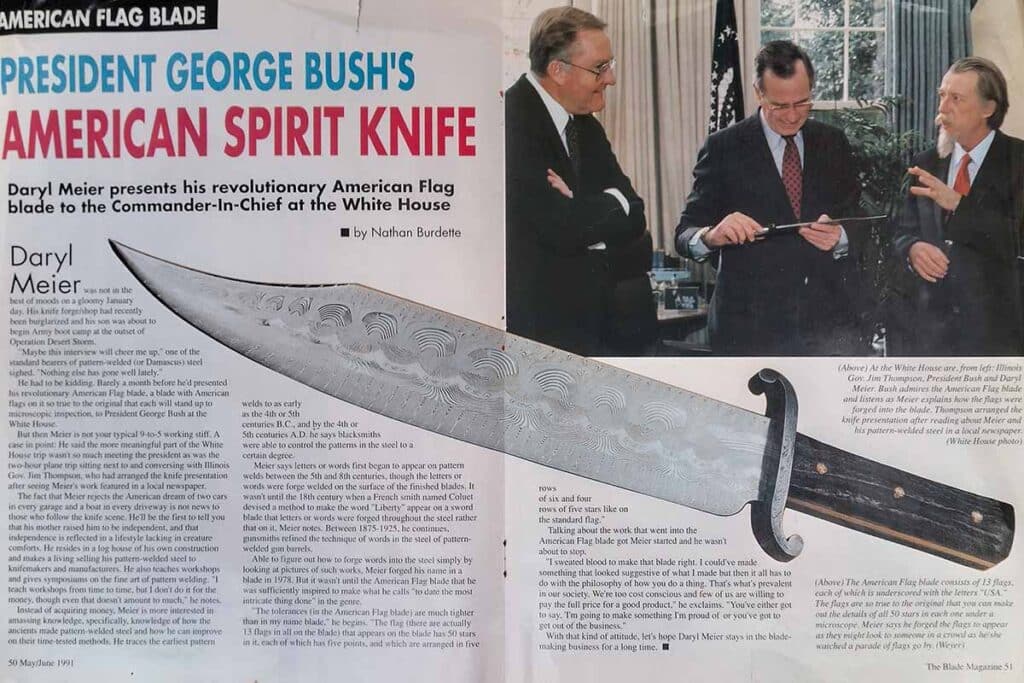
Daryl Meier made the American Spirit Bowie for President George H.W. Bush and presented it to the president at the White House in 1990. The story appeared in the May/June 1991 BLADE®.Daryl Meier made the American Spirit Bowie for President George H.W. Bush and presented it to the president at the White House in 1990. The story appeared in the May/June 1991 BLADE®.
Daryl Meier made the American Spirit Bowie for President George H.W. Bush and presented it to the president at the White House in 1990. The story appeared in the May/June 1991 BLADE®.

The renaissance in America came in the early 1970s with Moran. A short time later, along with bladesmiths Bill Bagwell and Don Hastings and Cutlery Hall-of-Famer B. R. Hughes, Moran founded the American Bladesmith Society (ABS) in 1976. Moran made some simple pattern-welded knives and reintroduced the material to the knife industry. Through the ABS he spread the knowledge of pattern-welded steel to many.

Daryl and his crew were doing their research on very complex-style pattern welding in the early ’70s. They focused on redeveloping the complex techniques of the ancient smiths. Daryl was a great influence on Alfred Pendray, me and almost every other maker of pattern-welded material. As far as I know, Daryl was the first one who made steel for other knifemakers. There may have been some others making steel for other knifemakers—I don’t know for sure. If there were it was just a handful of guys, maybe a dozen or so, but by the early ’90s there were over 300 such makers producing steel in the USA.

Meier As A Teacher

I was extremely excited whenever I had the chance to talk to Daryl. I met with him on several occasions. Pendray and I stopped by Daryl’s shop on the way to a Kansas City Guild Show one year, and we were able to see his operation and gained a lot of useful information from him. Around 1982 I attended a big hammer-in held in Birmingham, Alabama, and Daryl was there. I’d been making pattern-welded steel for a while. I also was doing some mosaic damascus.

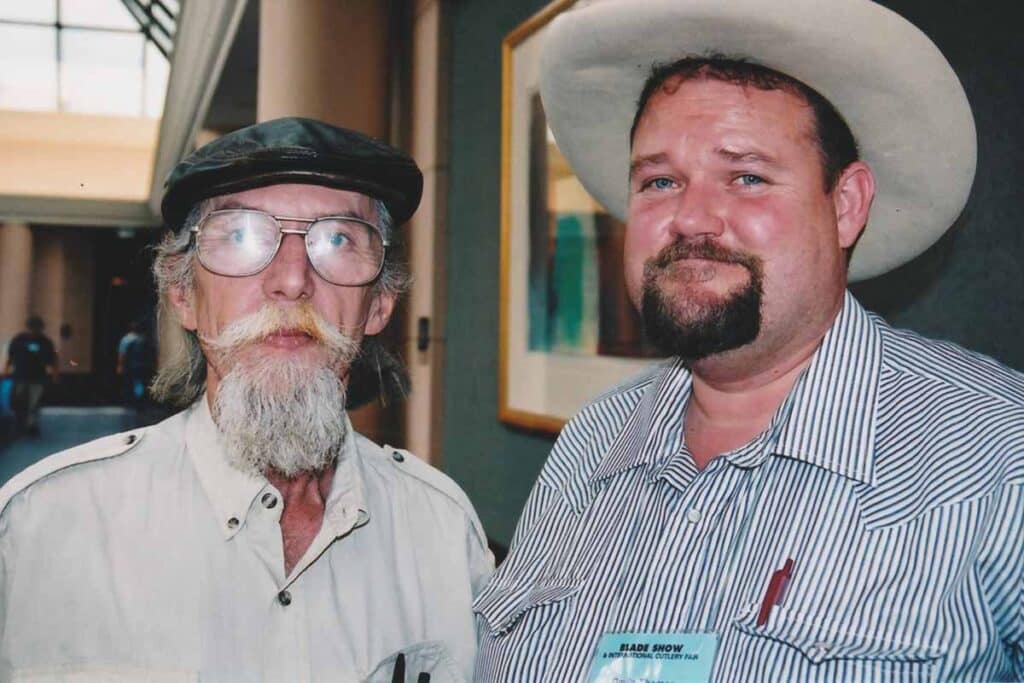
Daryl Meier (left) and BLADE Magazine Cutlery Hall-of-Fame® member Devin “Hoss” Thomas (right)—captured here at a past BLADE Show—comprise what is arguably the most dynamic duo of damascus makers in modern custom knife history.

Daryl was introducing me to a young man and I’m almost positive the young man was Rick Smith. He came up and they asked me how I did a particular pattern and when I explained how I did it, Daryl corrected me immediately. He said you don’t understand, Rick has his “ticket.” I said what’s his “ticket”? The young man immediately showed me a small slab of mosaic that had beautiful little chrome steps going up to a patterned center and a bar. He and I spent two hours together exchanging ideas. The lesson I learned: there were a lot of people working on mosaic damascus material who I did not know.

Later, as Daryl and I began to work on canister mosaic as a way to get around hot isothermal pressing, I devised a plan to use refrigeration hoses to introduce gas into the canister. I’d worked out this elaborate system with vacuuming and gassing, and, having experienced great success welding with very low temperatures, I could not wait to share the discovery with Daryl. He listened very patiently as I outlined the gear I used and said to me, “Well, what I do is add three or four drops of diesel or hydrocarbon [fuel] to my canister and I don’t have to use all that gear because the hydrocarbon will scavenge all the oxygen”—which is the bad thing, so my bubble was burst. It was one of many occasions where I approached Daryl with a new idea and he said either he thought it would work or, “I have a piece of that on my bench from a few years ago.” He has a great method of teaching.

Meier’s As An Innovator

Daryl was a great innovator and about 1990 made a knife called the American Spirit Bowie. Each side of the blade has 13 American flags all along its length with all 50 stars in each of them, and USA reading correctly from left to right no matter which side of the blade you viewed. It took Daryl 18 months and over 800 hours to build the blade, which he presented in person to President George H.W. Bush in the White House (see May/June 1991 BLADE®).

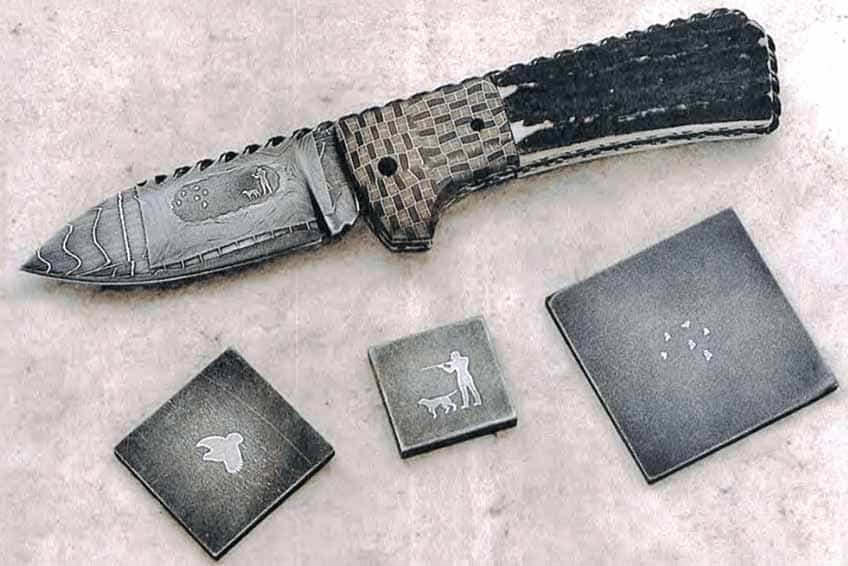
The Hunter’s Dream by the author is believed to be the first time anyone forged a scene into a mosaic damascus blade—and Daryl Meier played a large role in inspiring the author to do it.

Without doubt, Daryl’s work has influenced more makers than almost anyone else in the modern history of pattern welding. He’s still on the planet and still teaching from time to time. He’s done thousands of workshops over the years that added to the knowledge base of the entire industry. His presence influenced my work in more ways than I can count.

One of the major things he did for me was to push me to the limit of my abilities. After all, doing the easy stuff does not make you grow.

I made several panel blades consisting of all kinds of laminating and experimented with different patterns. I did some electrical discharge machining (EDM) work and Daryl used a bit of EDM in the American Spirit Bowie. He told me I should “make something real,” and that’s how my mosaic damascus shooting scene blade showing the hunter with his dog and the quail in flight came about. It was one of the most intense projects of my career.

Final Cut

Daryl’s students are legion and are some of the very best of the best—all the old guys that are considered the ancients, myself included, and a lot who are gone. A few of us are still around and Daryl was the guy we went to for information. We are standing on the shoulders of giants and one of the earliest ones is Daryl Meier. He may not give you a recipe for a cool new pattern, but he would give you the inspiration to go forward and explore it. He would always say the easy stuff does not make you grow. This is one of the main reasons I still teach because he took time with me.

Thank you, Daryl Meier.

More On Damascus:

Bill Adams: Cutlery Hall-of-Famer And Entrepreneur Passes

William “Bill” Adams was a revered knife entrepreneur, author and Cutlery Hall-of-Fame member. Learn about his immense impact on the knife community.

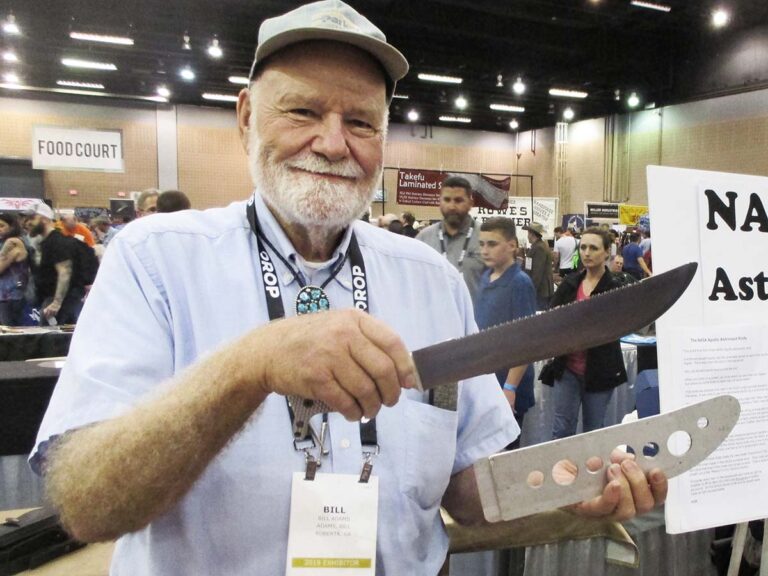
William Calhoun “Bill” Adams, knife entrepreneur, defender of all things knife, BLADE Magazine Cutlery Hall-of-Fame® member and invaluable friend of the knife community, passed away August 10. He was 87.

Known for his easy smile, snow white beard and amiable North Georgia drawl, Bill was liked and admired by many in the industry. He founded Atlanta Cutlery and, with Hank Reinhardt, co-founded Museum Replicas, both in Conyers, Georgia. Bill’s retail operations required him to travel the globe in search of the finest knives, swords and accouterments, including England, Ireland, Africa, India, parts of Central and South America, and all over the USA.

He served as president of the Antique Bowie Knife Association and helped found the Military Equipment and Weapons Collectors Association. He also helped found the Cutlery Collectors Legislative Committee, aka the CCLC, forerunner to today’s two leading pro-knife-legislation groups, Knife Rights and the American Knife & Tool Institute. In 1995, Bill was inducted into the Cutlery Hall of Fame.

He was a knowledgeable, gifted author, editing Sheffield Exhibition Knives and co-writing The Antique Bowie Knife Book, both of which are go-to guides for fans and aficionados of vintage Sheffield-made and antique bowies, respectively. He also was a dedicated knife collector, winning several awards for his wide-ranging collections at the BLADE Show. He retired to Roberta, Georgia, to live along the Flint River, where he enjoyed a quiet, peaceful and happy life.

He is survived by his sister-in-law Dee Anne Adams, his nephew David A. Adams and wife Cheryl, and dear friend and travel partner Elaine Barnes. The family wishes to express its thanks to Bill’s Roberta, Georgia, friends, especially Charles and Kate Rice, who cared for and treated him like family.

Remembering Others The Knife Industry Has Lost:

Remembering Hawaiian Knifemaker Keith Derrick Ouye

Remembering a dedicated craftsman of the Fujisaka lineage known for his tactical precision and collaborative artistry.

Keith Derrick Ouye, award-winning knifemaker of Honolulu, Hawaii, passed away on October 5. He was 80.

A stocky, happy guy well-liked by both knife enthusiasts and his knifemaking peers, Keith primarily made tactical knives, though he also built hunting knives to sell at local gun shows. In addition, he made fancy folders, often with fine engraving by Bruce Shaw, C.J. Cai or Lisa Tomlin. Keith exhibited his work at the BLADE Show and other top knife events over the years. Like many Hawaiian knifemakers, he was a student of BLADE Magazine Cutlery Hall-of-Fame® member Stanley Fujisaka.

Born in South Hilo, Hawaii, Keith lived in Hawaii Kai on the island of Oahu. “I spend most of my day working on my knives,” he wrote in his mini-bio on the Arizona Custom Knives website. “With assistance and guidance from Stan Fujisaka, I started to make fixed blades in early 2004. By the end of 2004, I also started making folders. I began making knives full-time in 2005.”

Keith was a big believer in sole authorship, noting “except for the screws, dowels, standoffs and pivots, I fabricate the rest of the knife myself.”

Remembering Others The Knife Industry Has Lost:

Bad And Beautiful

Few Patterns Are As Stunning And Audacious As Daggers And Fighters. These Four Makers From Around The World Show What Elite Craftsmen Are Creating Today.

Knives with attitude always have been popular among many makers and cutlery enthusiasts, and, if you’ve ever been to a BLADE Show, chances are you’ve seen some eye-popping examples. Many have in-your-face themes, with daggers and fighters getting lots of love among them.

Wardog Fighter By Samuel Lurquin

The Wardog Fighter by Samuel Lurquin includes a handsome leather pouch sheath with logo by Jeremy Guillaume, a sandblasted-then-blued blade, a tight-waisted bird’s beak handle, and a dog tag with appropriate verbiage and logo. Overall length: 12.8 inches.

If Samuel Lurquin’s Wardog Fighter looks familiar, that’s because it is—it served as one of three cover knives for the June BLADE®. However, due to space requirements, we were unable to give the knife its just due in that issue, so we correct that oversight here.

Sam is an ABS master smith from Belgium who makes bullet-proof tactical fixed blades ticketed for extreme “rough ’n tumble” use beyond the call of duty. Sam’s English is somewhat limited, so we turned to Dave Ellis, proprietor of Exquisite Knives, who specializes in upscale cutlery from around the world. Dave is California’s first ABS master smith who has since retired from hammering steel to become a purveyor of fine custom knives. Dave’s overview of the Wardog is insightful. 

“Sam’s combat knife was designed to be very concealable, nothing flashy that sticks out! Twenty years discussing the needs of end users helped him design a knife to be used hard in the field,” Dave observes. “Rather than taking credit for the knife’s design, Sam instead deferred to the many experts when it came to ergonomics, concealment, and design to ultimately come up with this sleek fighter.”

The beefy clip-point blade is 7.5 inches to go with the 5.3-inch black G-10 handle. 

“I asked Sam if he considered this to be the perfect combat/field knife,” Dave states. “His response was quite sincere. He said, ‘There’s never just one perfect knife.’ Use dictates the design of each piece, and this design Sam hopes is one that he could stake his own life on. This is very important to Lurquin—that if all else fails, his knife will prevail.”

Dave explained the Wardog’s finish process: “The blade was sand blasted then cold gun blued. The bluing produced a forced rusting [patina] that Sam removes with steel wool. The blade is stonewashed for the final finish, one that will stand up to hard use.”  

Sam designed the thick, all leather sheath and had his friend, Jeremy Guillaume of 8 Ball Leather, make it. “It’s double welted and has double latches to keep the knife secured on many media—belts, backpacks and the like,” Dave concludes. “Sam felt that Kydex is too noisy, thus the use of leather.”

Commando Dagger By Joe Israel

Joe Israel offers his Commando Dagger with the smaller Shrike EDC knife. A big fan of the Fairbairn-Sykes dagger of World War II fame, Joe patterned the handle on that of the F-S classic. The Kydex sheaths are by Harry Savage.

One of this issue’s cover knives, Joe Israel’s Commando Dagger is born out of Joe’s intense fondness for the armed forces knives with a double edge. 

“I’m inspired by all the great military daggers like the Case V-42, Fairbairn-Sykes, Gerber Mark II—these knives have always fascinated me,” he observes. “I wanted to create something both beautiful and a bit sinister which, after all, is what I think daggers are.”

Though very stylish, Joe’s knife is meant to be used. 

“For the Commando Dagger, I start with 3/16-inch CPM 154 stock that I flat grind by hand and heat treat myself, including a liquid nitrogen cryo. The blade is 6 inches long and the overall length is 11 inches,” he states. “It’s then hand sanded to 3,000 grit and mirror polished.” 

The blade is sharpened on both sides. If the curvaceous handle smacks of a certain famous World War II combat knife, it is purely intentional. 

“I always loved the shape of the Fairbairn-Sykes handles and I try to emulate their elegant shape in my Commando Dagger,” he comments. “The knife is full tang with a brass guard that I pin and solder in place old-school style.” The scales are black linen Micarta® with blood-red G-10 liners secured with brass pins.

Joe supplies his knives with no-frills, all-business black Kydex sheaths, and also offers them in leather. “Harry Savage makes the sheaths for the daggers and he’s just great to work with,” the maker opines. “His work is always top-notch. The small knife in the picture accompanying this story is my Shrike EDC. It’s available in a variety of steels and handle materials. I offer Kydex and leather sheaths for my other knives, too.”

The Toothpick By Matthew Roberts

Matt Roberts chose ladder-pattern damascus for his Toothpick dagger because it complements the symmetrical blade profile, and the coffin-handle design for its simplicity and flowing lines.

Matthew Roberts is an ABS journeyman smith with a passion for forging. 

“I modeled the Toothpick after the Gold Rush daggers and Arkansas toothpicks of the 19th century,” he explains. “I have no knowledge whatsoever of historical knives and their dimensions. I made this because it looks vicious. Utility was an afterthought for this build.

“I forged the blade from 15N20 and 80CrV2 steels,” he continues. “I chose ladder-pattern damascus because it complements the symmetrical profile. The blade geometry is very acute with a full distal taper—the point is ground to near zero.” The Toothpick has a 7.25-inch blade length and is 12 inches overall. The blade is 1.2 inches wide at the widest and has about a .165-inch maximum thickness.

Matt chose a coffin handle design for its simplicity and flowing lines. The radius of the handle profile mirrors the blade profile. The handle material is African blackwood that Matt faceted heavily. 

“Blackwood seemed to be an appropriate choice because I wanted the blade to be the focus of the piece,” he notes. “Also, blackwood is a very heavy wood which helped bring the point of balance well into the handle.” The guard and spacer are 416 stainless. The spacer fluting is mirror polished.    

Matt chose a simple sheath to reflect the clean lines of his dagger. “It’s buffalo hide over bridle leather,” he states. “The hide has a matte finish and is very soft.”

Coffin Dagger By Julian Sacco

Julian Sacco’s Coffin Dagger features a W2 tool steel blade made via the stock-removal method and an unusual smoky hamon he chose for an “ominous feel.” The African blackwood handle is configured in what the maker calls an “old-school-coffin” style.

Julian Sacco’s dagger redefines the word sleek—and that only begins to describe the distinctiveness of his take-down-construction Coffin Dagger. 

“The inspiration for this piece came from seeing a lot of other makers do coffin-style bowie knives,” Julian relates. “I felt a shape like a coffin would fit really well on this dagger, as it’s an entirely mirrored piece all the way around. Essentially I wanted it to have an old look and feel to it and I think the coffin style fit that profile perfectly.”

The blade is ultra-slim and has a notable hamon.

“The blade is W2 tool steel and is done in the stock removal method,” he notes. “I don’t have much experience with hamons but, as per the theme of this dagger, I tried to create a smoky pattern to give it an ominous feel.” The knife has a 7-inch cutting edge and is 13 inches overall. “I wanted this to be more of a nimble and easy maneuvering piece,” Julian states, “somewhat like a stiletto dagger, but not quite.”

The grip’s modified wasp waist exudes creativity as well. 

“The handle is shaped entirely to look like an old-school-style coffin, which I think it resembles quite well. I wanted to have an aggressive look to the overall construction, which is why I shaped the pommel with such sharp lines,” he remarks. “To match the guard I kept those similar shapes and lines on the outside while smoothing the areas that would be gripped in order to make it comfortable for the user. The brass pommel and guard were an excellent choice as I knew they would patina in a way that would fit the overall rustic look and feel I was going for, while the African blackwood handle complemented that look exactly how I hoped it would. It perfectly fits the profile of an old coffin with its rich lines and bold grain, tying the entire theme of the piece together.”

Read More

Cool Customs: Kurt Swearingen’s Buffalo Hunter Set

From One-Day Course To One-Of-A-Kind Knives, Kurt Swearingen’s Buffalo Hunter Set Shows How Quickly The Knifemaker Has Honed His Craft

ABS Journeyman Smith/Knifemakers’ Guild member Kurt Swearingen went with tradition and what works in his three-piece buffalo hunter set.

Made for North American big game, the set includes a Green River-type skinner, caper, and gut hook in CPM 154 stainless steel blades and black ash burl grips. Kurt based the design on a similar set he’d seen from the 1800s. He chose CPM 154 because that’s what he uses on his fixed-blade hunting knives and the ash because it’s a wood native to the Great Plains, home of the American bison. 

He made the sheath from three layers of stacked 9-ounce leather with two layers of welts. The sheathed set weighs 2-3 pounds so he hollow ground the blades and outfitted them with bolsters instead of guards to save on weight and size. The set wears on a belt, though Kurt modified it so you can string it on a pack or a saddle.

Who Is Kurt Swearingen?

Kurt Swearingen

Swearingen’s knifemaking journey began back in 2007 after taking a one-day class. From there he learned from one of the all-time greats, Lin Rhea, who helped him to perfect forging and heat treating techniques that have helped make his knives stand out from the pack.

Just seven years after that course that started it all, Swearingen earned the rank of journeyman smith. Today he specializes in hunting and camp knives of all types.

Buffalo Hunter Set Specs

Model: Buffalo Hunter Set
Maker: Kurt Swearingen
Patterns: Green River skinner, caper and gut hook
Blade lengths: 4.75 inches, 3 inches, and 2.75 inches
Blade steel: CPM 154 stainless
Handle material: Black ash burl
Sheath: Three layers of 9-ounce stacked leather
Maker’s price for a similar set: $1,850

Read More

Bob Loveless: The Icon’s Indelible Mark On The Knife Industry

Loveless’ impact is still felt today.

A week after BLADE Magazine Cutlery Hall-Of-Fame® member Bob Loveless died at age 81 on Sept. 2, 2010, Los Angeles Times reporter Valerie J. Nelson wrote a lengthy story on the man who sold his first knife to the Abercrombie & Fitch sporting outfitter for $14 more than 55 years earlier.

Nelson wrote that Loveless “made some of the world’s most coveted sporting cutlery by refining knife design to high art.” These succinct words convey a glimpse of the influence this giant in the cutlery industry wielded during his lifetime. In this 50th anniversary year for BLADE®, his legacy stands tall among those who have dedicated their lives in building the knife industry to what it is today.

Bob Loveless
Bob Loveless in his shop in October 2006. (image courtesy of Aaron Merritt, grandson of Jim Merritt)

Truth is, there’s scarcely an aspect, nook or cranny of the knife business that Robert Waldorf Loveless did not touch during his lifetime. He was forthright, sometimes gruff and always prone to speak his mind. During an interview for BLADE, he once asked this writer what the tapping noise was that he heard in the background. When I responded that it was the keys clicking as I was taking notes while we talked, he bluntly asked, “Can’t you remember anything? Why can’t you just listen?”

Loveless’ Defining Designs

No matter. Loveless was articulate, extremely intelligent and deep down passionate about art in knives. Cutlery Hall-Of-Famer Bruce Voyles knew Loveless and respected him for what he was.

“The thing about Loveless is he made a knife with eye appeal,” Bruce observed. “It was different, and a lot of people don’t understand why, but it was [his use of the] natural French curve. It was the design appeal.”

True enough, Loveless was a master of design. He had actually studied briefly at the Institute of Design in Chicago in the 1950s, and was a student of the Bauhaus Movement, a cultural and artistic design wave that peaked in the mid-1930s, something of a North Star, a muse if you will. Its dictum: Form Follows Function.

Loveless sub-hilt
Another of Loveless’s favorite designs is the sub-hilt, radiant in one of Bob’s Baby Bear fighters with mother-of-pearl scales, Naked Lady logo and Riverside, California, stamp. (Exquisiteknives.com image)

Longtime Loveless authority John Denton told reporter Nelson, “He is pretty much the Picasso of the knife world and the father of 20th century knifemaking. His design is what made him famous.”

Dave Ellis, proprietor of Exquisiteknives.com, agrees.

“Going back to the 1950s, Loveless has been instrumental in perfecting some of the more common traits found in contemporary knives,” he related. “The dropped hunter is probably Bob’s most emulated design, although the Archer chute, sub-hilt fighter and more show that Bob did not rest on his laurels. When a smaller, carry-sized fighter was called for, Loveless came up with the New York Special.”

Denton recalled the Loveless willingness to revive and reintroduce design and construction concepts that caught hold in modern times and energized new frontiers of imagination and artistry.

“He was not the first to use the tapered tang,” John explained, “but he found out about it from an old knife made in the 1850s that was given to him by Billy DuPont of the DuPont family. Loveless brought it back into the modern world with the tapered tang taking the weight out of the knife. Bob said, ‘It has to look so good you want to pick it up and feel so good you don’t want to put it down.’”

Bob Loveless, John Denton and Jim Merritt
From left, Bob Loveless, John Denton and Jim Merritt in the Loveless shop in Riverside, California.

According to Denton, Loveless also brought the brass wrap handle, hidden pin, two-tone pins and half tang into play.

Design achievement crowns Bob’s career, but there was so much more to him—so much that attempting to compile a summary of his contributions would require more space than this publication might allot in another half-century.

Voyles commented, “I always liked him because he could sum up a complex subject in a sentence. He and I visited one time and I would throw out topic after topic, and he would snap back a quick response. When you left him you knew you left somebody that was phenomenally intelligent on a variety of topics, but that doesn’t mean he had social graces.”

One of Bruce’s favorite Loveless memories was Bob’s rationale during the controversy that raged within the Knifemakers’ Guild as to what truly defined a handmade knife. Loveless liked Jack Daniel’s, so Voyles and Cutlery Hall-Of-Famer Dan Delavan bought a 1.75-liter bottle of Gentleman Jack whiskey (Single Barrel wasn’t available at the time) and presented it to Loveless at his home in Riverside, California.

Loveles prototype
In an arrangement between Loveless and Schrade’s Uncle Henry Baer facilitated by A.G. Russell, Loveless sent this actual prototype to Schrade to copy and make the Schrade Loveless collaboration in the early 1970s. It has no guard, an “improved handle,” and a more pronounced belly than most of the Loveless dropped hunters of later years. The handle is burgundy Micarta®. As John Denton observed, the knife “has a magical feel from the ol’ man.” (Denton image)

“I said to him, ‘I hope you will accept this gift in the spirit in which it is intended,’” Bruce smiled. “He laughed and put the bottle on his shelf. Then we sat down and asked him what he believed to be the definition of a handmade knife. We videotaped his answer. He said, ‘I wish I had a machine that I could dump handle material, steel and pins into, and then a knife would come out the other end, boxed and ready to send to somebody. So, make your knives any way you want to. The marketplace will sort you out soon enough.’”

Simple, straightforward and wise.

Bob’s Impact On The Industry

Loveless played a pivotal role in the genesis of knifemakers’ organizations. He was a founding member of the Knifemakers’ Guild and a pioneer with the California Knifemaker’s Association. He was a staunch supporter of knife shows, bringing people to the events just with his mere presence. According to Ellis, Bob regularly attended the Guild Show, BLADE Show, Solvang Show, California Custom Knife Show and Phil Lobred’s Art Knife Invitational

Loveless also brought along younger knifemakers, working with them and offering advice. A few include Jim Merritt, D.F. Kressler, Yoshihito Aida, Cutlery Hall-Of-Famer D’ Holder and Steve Johnson. Bob’s style and artistic interpretation live on in part with the work of these incredible craftsmen.

Loveless-Johnson daggers
Steve Johnson worked in the Loveless shop in the early ’70s and remembers Bob fondly. “He was a true friend to those who were genuine and sincere with him,” Steve noted. Of this rare set of Loveless-Johnson daggers John Denton wrote simply, “Three really great knives.” (Denton image)

“Many a maker is in debt to Bob Loveless for the support, counsel, corrections and guidance that he gave,” Johnson said. “He was a true friend to those who were genuine and sincere with him, and the relationship that they had with him. Bob, as we know, was outspoken and quick to correct what he felt was not right or smart, which led to some loving him and others not, a bit like Ed Henry—love or hate—but both were so very good to me personally!”

Materials Maven

Loveless was an innovator in the aspect of materials as well, including 154CM stainless steel and the introduction of ATS-34 from Japan, while also popularizing Micarta® as a handle material.

Ellis commented, “Loveless pioneered the use of many of the common steels used today, especially 154CM. The shop was able to purchase such quantities that Bob could pretty much order what he wanted. The favorite handle material of the Loveless shop was green Micarta.”

Johnson remembered, “There was a stack of 154CM steel lying in the driveway at 4319 W 187th Street [the address of the Loveless shop] the day I first walked in. Bob mentioned that he was excited to get some blades done and heat treated right off. Green canvas Micarta was set in stone as the best handle material in Bob’s view. It’s still right up there on top and is used by many a maker. It’s because of Bob’s legacy that this happens.”

Global Influence

A lasting dimension of the Loveless legacy was his bridge to Japan, as well as his overtures in the European markets.

“Bob was deified to the extent that every Japanese knifemaker included his designs among their offerings,” Ellis explained. “Bob was an icon in Japan, and to this day many of the top makers in Asia have Loveless designs in their repertoires.”

Five Loveless fixed blades
Five Loveless fixed blades sport the no bolt/no pin look in ivory handles. (Exquisiteknives.com image)

Voyles commented, “Bob went over there and showed the Japanese how to make good knives. I went to Japan in 1981 or ’82, and in every factory I went to there was a picture of Bob Loveless and the factory owner. The thing was that Bob’s wife, Yoshiko, was Japanese, so he didn’t have a problem with the language barrier, and he went to Japan to show them how to make knives that appeal to Americans.”

Loveless used his connections to make things happen, and Voyles credits him with the evolution of the folding knife among Japanese manufacturers, as well as a surge in the Japanese collector market.

“Bob didn’t make folders and the Japanese wanted folders,” Bruce recalled. “He had worked on a design with Jess Horn, and Bob put Jess and Japanese collectors in touch with each other. Horn also had a series of folders that he patterned after the old Remington Bullets. When Japanese collectors discovered that, their market for vintage Remingtons went straight through the roof. Loveless sowed the seeds in the 1990s for the collectibility of vintage knives in Japan.”

Collecting Loveless

Today, a Loveless knife is a collectible phenomenon in its own right. Name the year, name the mark on the blade, name the style and the materials, it will sell for astonishing dollars. Denton has noted some models made in the 1970s that sold for $400 then and have reached the rarefied air of $100,000 or more in recent years. The power of Loveless pricing simply takes your breath away.

Bruce is quick to add that Loveless was professionally unselfish. “If you wanted to make a style of his knife in your factory, that was OK,” Bruce noted. “Just ask him.”

Early Model Loveless
Circa 1955, Loveless sold his first knife to Abercrombie & Fitch for $14 (adjusted for inflation, almost $160 in today’s money). Loveless made this early model for A&F in his shop in Claymont, Delaware.

The pervasive Loveless influence stretched far and wide, from the custom knife shop to the factory.

“His designs for and collaborations with Schrade, Gerber, Lone Wolf and others, and the factory knife market in general, were significant,” Ellis recalled. “Early on the astute factories were taken by Loveless designs and made limited editions in dropped hunters and others. These days factory collaborations are quite common, and you can thank Bob Loveless if you want to give credit where it is due.”

When Sports Illustrated called Loveless for an interview in 1980 and the magazine published his words in the same edition that featured tennis superstar Bjorn Borg on the cover, the impact on the entire knife universe was transcendent. When asked why so many people considered his knives “better” than those of others, he mused, “A knife is an extension of your experience. And I’ve had more experiences than most people. There’s more character running in my veins.”

For those who knew Bob, just the knowing was an unforgettable experience. His contributions to his present and to the futures of others in the knife industry remains incalculable. And so, the longevity of a man does not reside in his years on Earth, but in the perpetual remembrance of his ideas, his workmanship and his innovative perspective on the world.

Therefore, it can be said that when Loveless left us he did not go gentle into that good night. He did not fade away. He didn’t drop the mic. He handed it to those with the foresight and the intestinal fortitude for the days to come. Now, what do we say and do? Loveless might grouse. He might gripe. But he just might also manage a grin.

Read More On BLADE Magazine And Show:

Advertisement

Must Read Articles

Read this before you make a knife

Knifemaking 101 – Read This Before You Make a Knife

  by Wayne Goddard My experience has taught me that there's nothing like digging in and getting started. I've often said the hardest part of the...
how to forge damascus steel

How to Forge Damascus

Advertisement
Advertisement