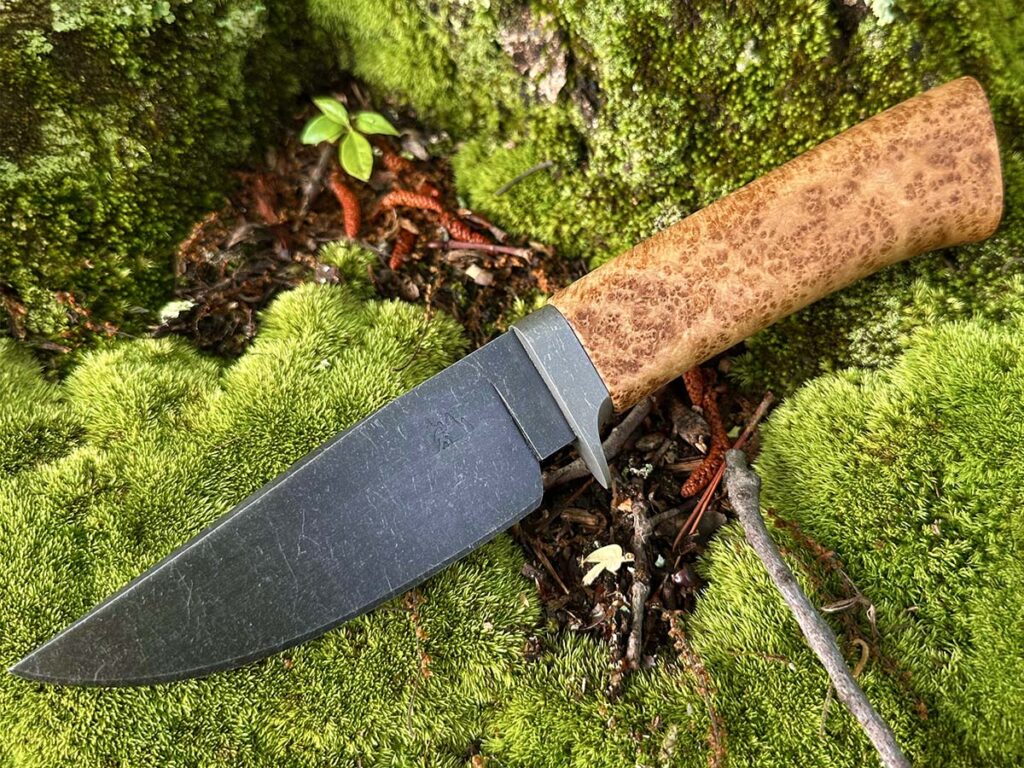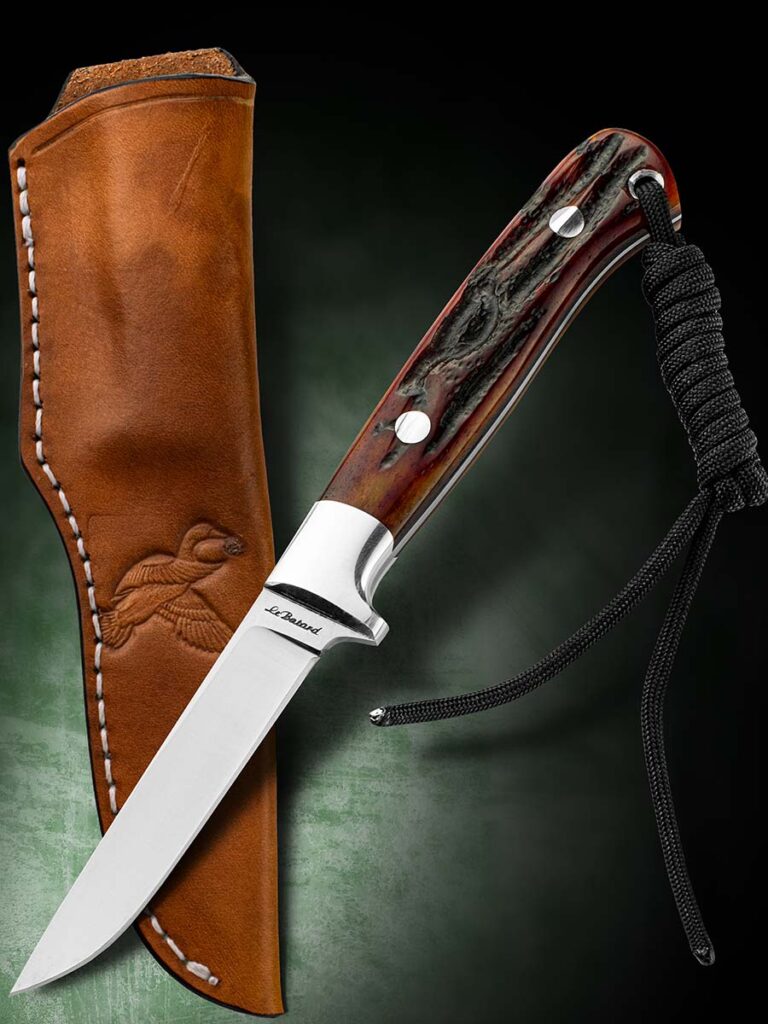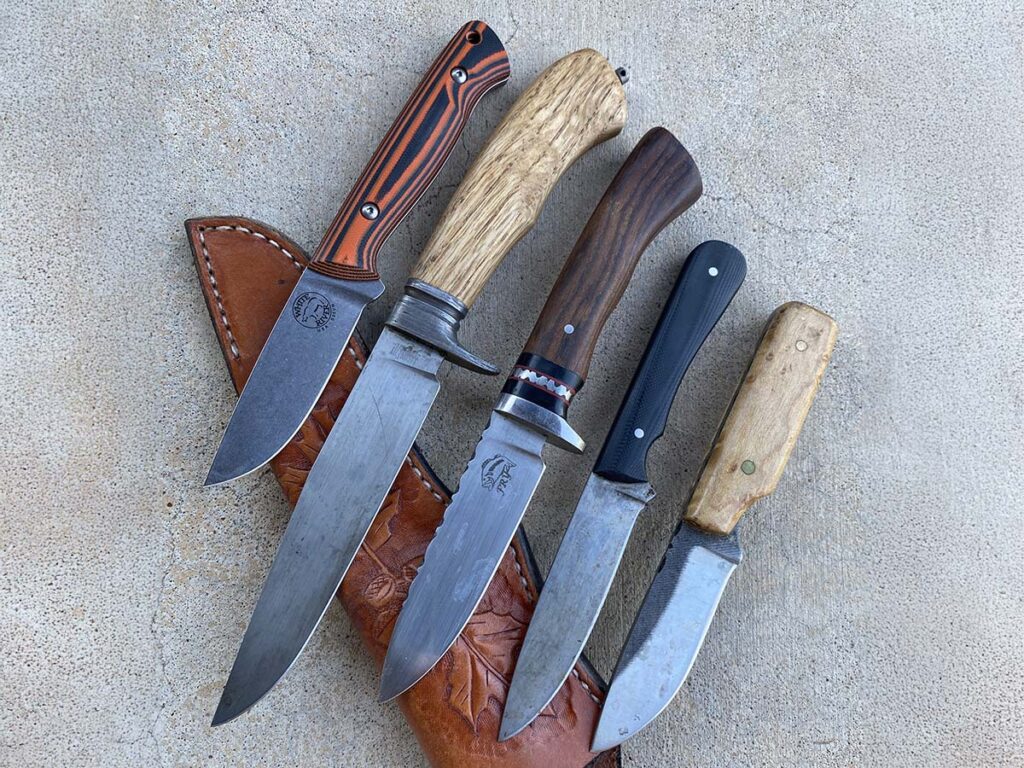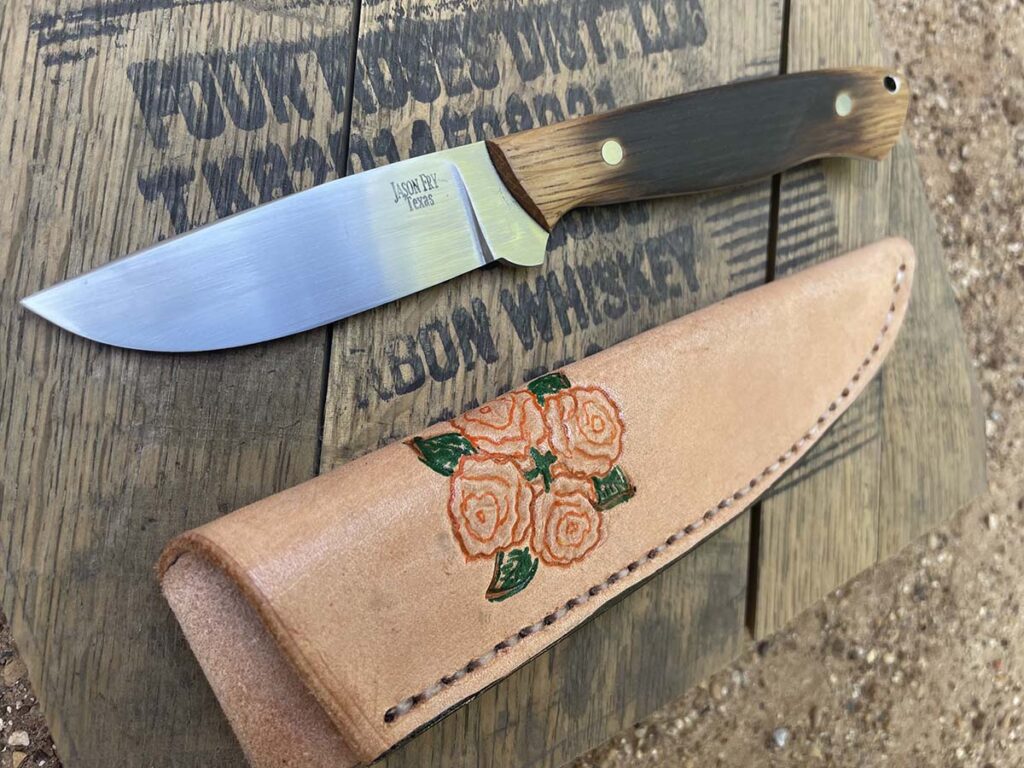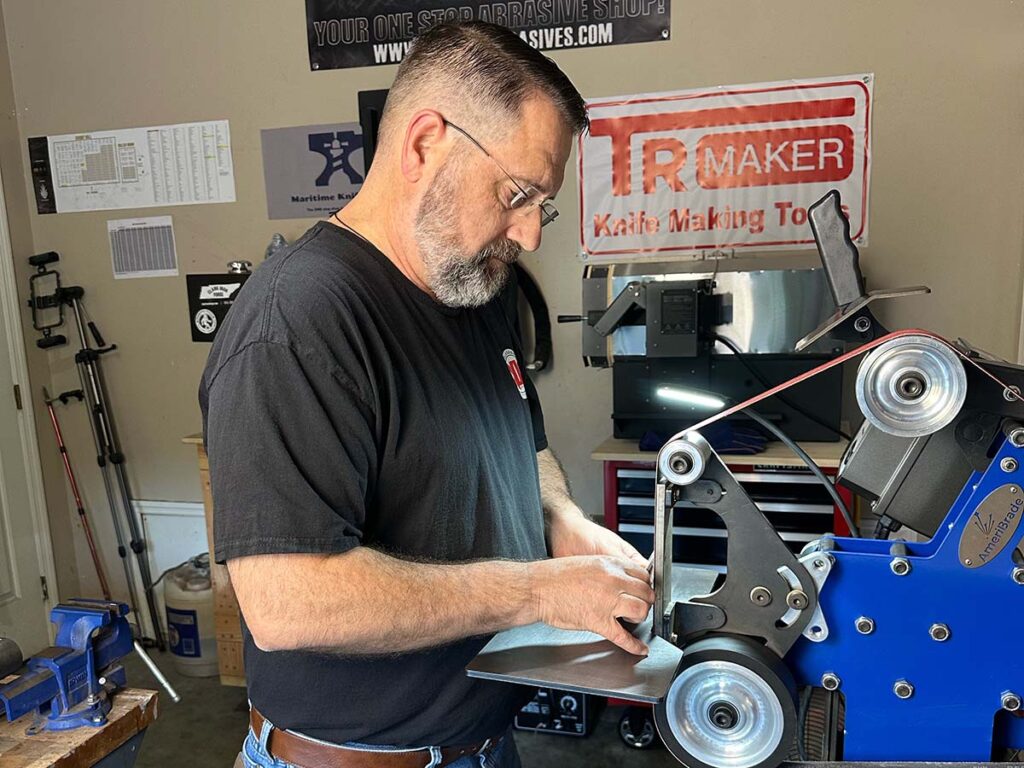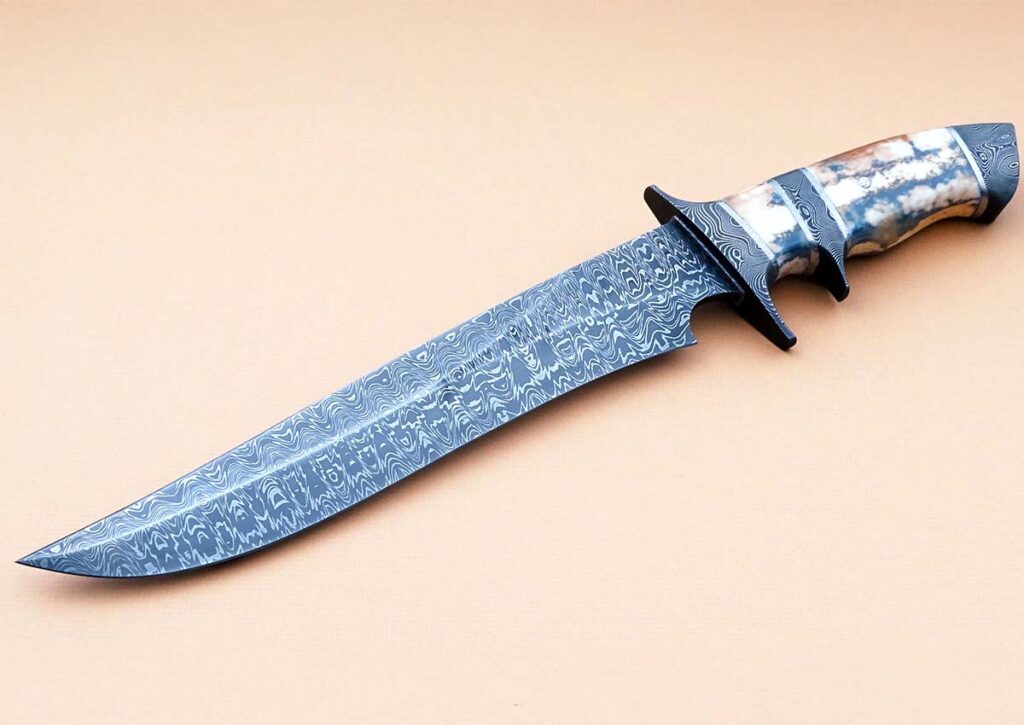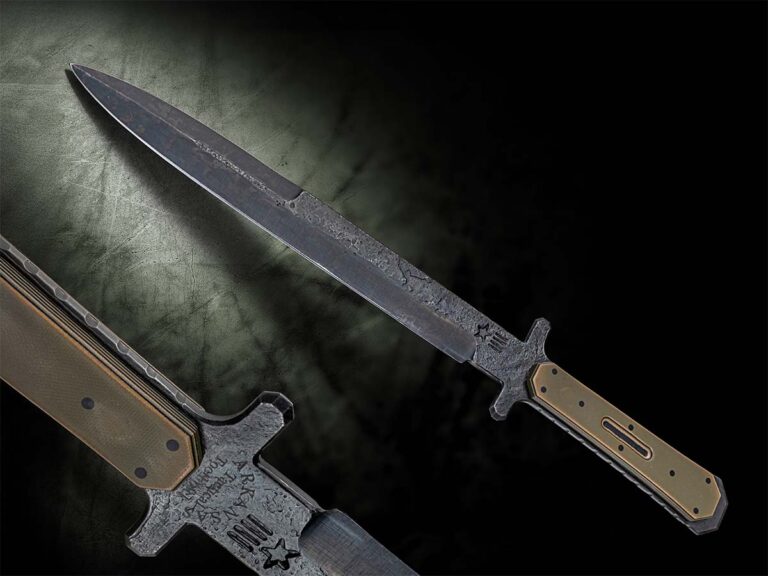
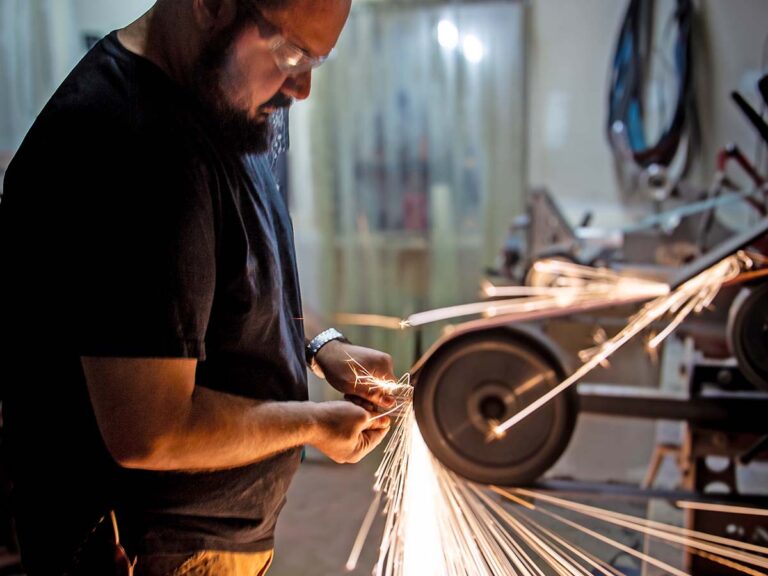
Knifemaking is the building of a knife, which includes the blade, handle and other accouterments. Blades are made by either removing metal from a steel blank via a grinder – known as stock removal – and the forging to shape of hot steel into a blade in the process known as bladesmithing. Other parts, including bolsters, guards, pommels, etc., are needed to complete the finished knife.
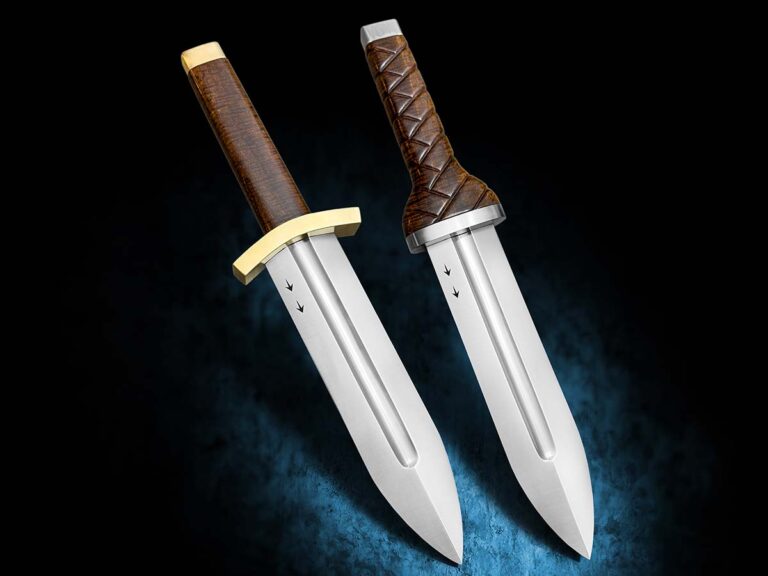
Hu takes the Vinland Saga’s famous daggers from screen to steel.
Anime and knifemaking are seldom mentioned in the same sentence. However, with a pair of striking daggers, an online knifemaking sensation has skillfully forged together that creative gap in cold, hard steel.
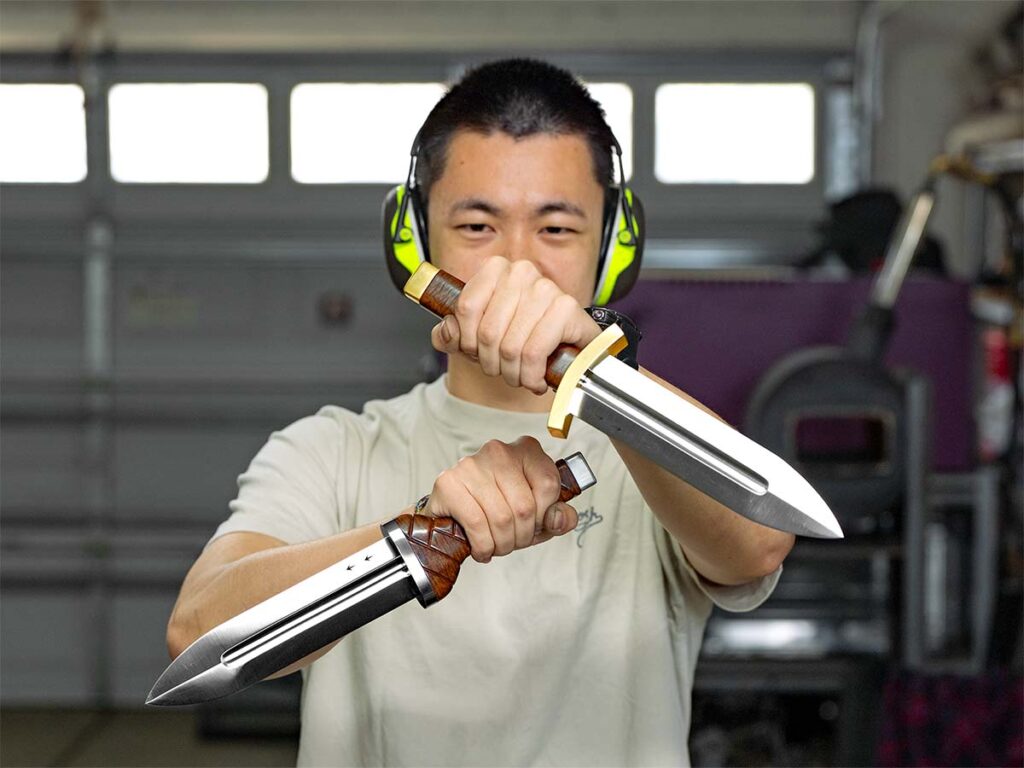
Jesse Hu is a multiple Forged in Fire champion and a prolific YouTube creator. When his online fans demanded a rendition of Thorfinn’s daggers from the popular animated Vinland Saga series, the adventuresome smith didn’t back down from the challenge. However, he set stringent goals for how he wanted the fictional blades to materialize.
“I have seen a lot of people make their own versions, but I haven’t seen any that truly captured their energy from the anime,” Hu said. “I felt it was possible for me to make a pair of daggers that fans would feel I directly pulled from the screen.”
The results are a spot-on set of daggers boasting 81/2-inch blades of 80CrV2 steel with carved Ringed Gidgee handles and one with a 1/2-inch-thick brass guard. Hu’s carving emulates the animation’s leather-wrapped look. While there is little actual Viking in the daggers’ overall design, the maker’s choice of wood for the handles did inadvertently bring a touch of the historic accuracy to the fantasy knives.
“One thing I discovered from a friend was that there were a bunch of carved wooden handles on Viking-era blades,” Hu related. “But I only heard about this after I had finished the daggers.”
Hu estimates he put two weeks of work into his rendition of Thorfinn’s daggers. In the end, the project was a labor of love, with Hu compensating himself by keeping the daggers. (Jesse Hu image)
The greatest challenge in bringing the two-dimensional blades into the physical world came from the inconsistency of the source material. In the anime series, Thorfinn’s daggers can change from scene to scene, forcing Hu to hit a moving target.
“Some pictures made the handle look rectangular in cross section as opposed to ovular; some made the central fuller look really thin and others quite thick,” he said. “I had to pick and choose from all these images to create something that felt accurate to all of them.”
Studying frames from the series and interpreting how the ink daggers’ ratios translate to steel was a painstaking process. Hu estimates he invested two weeks bringing the anime knives to life. Given the dedicated following of Vinland Saga, he figured the time invested would have paid off—had he not decided to keep them for himself.
“A cool piece doesn’t always mean a smart business decision,” he quipped.
Check Out More Cool Customs:
Cool Custom: Tony Lewis’ Tribute Knife To Steve Dunn
Cool Customs: Rocco Nawrocki’s Knife For Sergeant Bunker
A Father, With The Help Of His Uncle, Works To Make A One-Of-A-Kind Knife For His Son After Living The Life Of A Military Kid.
The hardest question for my son Zachary “Kaz” Kazmir to answer is “Where are you from?” His answer usually falls along the lines of, “Home is where the military takes your family.”
Zach’s answer is true for just about any token “military brat.” Military families often move every two to three years—that’s a rate of 10 times more than average civilian families. Living this kind of life for a child requires tremendous resilience, exceptional adaptability, and an uncommonly high maturity level. Zach would repeatedly get settled in a routine, a school, a friend group, and community activities, only to pick up, leave it all behind and start fresh again.
Oh, and the trials of life do not stop there. He persevered through my frequent deployments, earthquakes, accidents, and even a direct hit by one of the strongest tornadoes ever recorded while he was living in Moore, Oklahoma. Zach’s life led him on a journey spanning two countries, four states, and five schools.
Bobby Kazmir and his son Zach.
I wanted to give the young man something special on the occasion of his 21st birthday. Even with all the places he’s lived and the experiences he’s had, Zach’s fondest memories always gravitate to his time in Okinawa, Japan. The first memories of his life were created there. Okinawa will forever hold a special place in his heart. With that, I set out to have a knife crafted in hopes of capturing and honoring these priceless memories for him.
Uncle Stanley
I could think of no better place to turn for such a task than my uncle, Stanley Buzek. Uncle Stanley is a knifemaker from Caldwell, Texas, and is most certainly the right man for the job. There’s no one I know who puts as much heart into his craft as Uncle Stanley. He guided me through the many options, and I closed in on what would become the most meaningful and elegant 4.5-inch, two-blade Texas trapper I’ve ever seen.
My uncle crafted the frame and liners from raw bars of integral 416 stainless steel. As with each of his knives, he added a personal touch to the spine. This was truly amazing to witness. I’ve seen many of his finished knives over the years, but I hadn’t realized the level of precise craftsmanship he put into the pieces that non-makers like myself often take for granted. Most of us just naturally look to the business end of a blade.
In thinking of the knife for this gift, I aimed to give Zach a glimpse into his resiliency through my eyes. He has been stretched so thin that at times his only choice to keep from breaking was to fold over in the fetal position to regain his strength. He’s been heated, hammered, pressed to the edge of his capabilities, put back in the fire, crushed, bent beyond his limits, beaten down even more, and subjected to unrelenting pressures in different directions.
Nonetheless, he emerged from the fire stronger than ever before, with a character that can only be described as beautiful—just like the banding and mottling of damascus. The beautiful steel forged by Bill Poor couldn’t be more fitting for this knife. Bill transformed raw 1084 carbon and 15N20 nickel-alloy steels into an extra-fine River of Fire pattern with elaborate feathering that perfectly captures how I view Zach’s coming-of-age: indicative of many intense moments, but not scarred. Instead, radiating with a unique, luxurious magnificence that exemplifies resilience.
Making The Knife Handle
The next essential element on my mind was the scale material. (I called it the “side of the knife” but you know how knifemakers are about educating the ignorant.) The scales had to be more than just the perfect material, they had to be uniquely sourced. I wanted my son to have a literal piece of his childhood that he could hold in his hands whenever he wanted.
Scanning the beach for seashells while barefoot along the shoreline of Okinawa’s Devils Cove is no doubt among Zach’s favorite island memories.
I reached out to a military friend stationed in Okinawa to acquire a piece of one of the famed, colossal banyan trees from the island. With travel restrictions, import/export regulations on agricultural items, and COVID-related shipping delays, it proved much more difficult than we expected. However, my contact was able to come through! After nearly a year, a heavily worn, 5-by-10-inch piece of banyan tree finally arrived in the mail.
Uncle Stanley was reluctant to use banyan. He cautioned me not to get my hopes up because he knew how challenging it can be to properly stabilize such a soft wood. In addition, the sample was very weathered, extra-soft, and had several deep cracks inflicted in transit during shipping. In other words, there wasn’t a lot of room for error!
Uncle Stanley sent the wood to the very capable Terry Dunn of TNT Enterprises, and I was truly blown away by what he was able to do. Dunn not only stabilized the wood, he preserved its beautifully subtle grains and the small, intricate pitch pocket. The latter is a cavity in the wood where the tree suffered some sort of damage over its life, or a small knot of sorts if you will.
Stanley assembled the sleek trapper, affixed the scales, and presented me with a truly remarkable knife. Then he took it from my hands and said, “Now it’s time to go get it ‘scratched up.’”
Engraving The Knife
A slight fear came over me. I worried that an engraver could potentially damage this work of art. However, the worry left me as quick as it came when I learned the engraver was Alice B. Carter. I’ve seen her amazing work in the past. I knew she could add another layer of beauty to the piece.
To my surprise, Alice asked so much more than, “What would you like me to engrave?” She had an authentic interest in the story of the knife and its eventual recipient. I think she asked me more about Zach than she did about art that day. I shared with her the things Zach tends to reminisce about from his time in Okinawa, and we honed in on a few specifics.
One of the first memories of his life is enjoying the annual Cherry Blossom Festival in Okinawa’s capital city of Naha. The festival draws crowds of thousands each January to see the city streets completely encased in the vibrant blooms. Zach also speaks of how massive he remembers the banyan trees being there. If you’ve never seen a 200-year-old banyan, the behemoths appear to be as old as time and so wide they seem to fill the sky with a majestic, towering presence as if from a fantasy movie.
Alice’s smile grew wider and wider as we continued to talk through a few other details. She drew inspiration from our chat and created an absolute masterpiece. Engraving for more than 40 hours and inlaying more than six feet of 24k-gold wire, she created so much more than a scene or picture. Her art marvelously captured the emotions connected to the memories.
Reaching from corner to corner on the upper bolster of the facing side shines the island of Okinawa in pure, radiant gold. The shading effect seems to literally draw the island’s shape out from the knife. Carefully inlaid in the exact location of Kadena Air Base where Zach lived on the island, a one-millimeter copper marker memorializes his time there.
The lower bolsters hold a personal message from father to son: Ichi-go ichi-e. Emblazoned in bold Japanese Kanji, it is an idiom roughly translating to “for this time only.” Reaching from corner to corner on one side of the upper bolster shines the island of Okinawa engraved by Alice Carter in 24k gold. The knife’s oversized shield brilliantly gleams Zach’s nickname of “KAZ” in Japanese-styled English letters. (SharpByCoop image)
On the opposite side in exquisite detail is an ancient, powerful banyan tree spanning from edge to edge. In a beautiful complement to the gold inlay, the banyan’s leaves are adorned with Alice’s self-alloyed green gold. Zach can view the upper bolsters in remembrance of the land he once knew.
As is customary in the military, a servicemember’s last name becomes his or her first name. It’s the military way. Kazmir was shortened to “Kaz” almost immediately, and that nickname stuck for the entire two decades I served. As Zach approached adulthood, he began to go by this moniker as well. The knife’s oversized shield brilliantly gleams “KAZ” in Japanese-styled English letters—an embodiment of how I’ve passed on my name to my boy.
Finally, the lower bolsters hold a personal message from father to son: Ichi-go ichi-e. Emblazoned in bold Japanese Kanji, the message is an idiom roughly translating to “for this time only.” It means that Zach’s experience in Okinawa was truly a once-in-a-lifetime episode that can never be duplicated, and he should treasure it forever.
Alice brought all the components together by incorporating gorgeous cherry blossoms engraved with intricate detail resulting in what I see as the perfect gift. Zach received it as a Christmas present and shed some heavy tears as I explained each element. He and I are both still amazed at how everyone came together to help me make this one-of-a-kind knife happen.
Uncle Stanley once told me that nearly every knifemaker is an expert at something, but no knifemaker is an expert at everything. He described knifemaking as a network of experts who bring their talents together to make the impossible possible. In the military, we have a term for this—it’s called synergy. With this beautiful piece, I’m convinced the knifemaking community is synergy at its finest.
For more information about the knife, contact Stanley Buzek, Dept. BL8, P.O. Box 621, Caldwell, TX 77836 346-412-2532 [email protected], s.buzekknives.com.
The Subhilt Provides An Additional Element To Make A Knife One Of A Kind. These Makers Show What A Subhilt Can Be.
The subhilt adds a little extra. Its form is expressive and its function is useful. It takes its share of the spotlight and provides another avenue of artistic approach for custom knifemakers who choose to build it.
A few of the makers who accept the challenge of the subhilt put their finest work forward. They use bold, sleek lines, and high-quality materials to bring the best of the subhilt to the market, and the combination of aesthetic and utility blends in a delightful presentation.
Subhilts In Italy
Daniele Ibba was already a goldsmith and “transferred” his skills in that pursuit to making knives. He describes himself as an “autodidact,” a self-taught subhilt maker.
Residing in a small town near Milan, Italy, Daniele Ibba has been making knives since 2004. He finds the subhilt a perfect approach to both usefulness and beauty as evidenced by his integral Medusa Gorgona.
“Although the knife has a clear artistic connotation, it was developed as a not-artistic knife,” he explained, “and the purpose of this subhilt is to have a stable grip, especially in the lunge, and consequently the possibility to hit the target/threat harder.”
Grip options are plentiful, and Daniele calls his subhilt pleasant to handle in any position, with the best control in the standard or reverse grips. The subhilt allows the user to always know where the blade and edge are located, and offers more protection to the hand.
In the Medusa Gorgona, Ibba collaborated with Lana Gorska and took home best in show from the September 2021 SICAC Knife Show in Paris.
“We are very proud of this,” he smiled, “because in every international show the competition is always very high and winning such a prize is never easy.”
The Medusa Gorgona is made from a single piece of 440C stainless steel hardened to a Rockwell hardness of 58-59 HRC, and is embellished with 13 mother-of-pearl inlays—four on the front of the handle, eight in the spine and one in the pommel. It also has 20 green diamonds, eight yellow diamonds, two blue diamonds, and three rubies—one round cut and two marquis cut. The fine engraving was done by Italian master Roberto Bruci.
“Lana and I had done many models in Plastiline® [a high-precision modeling clay] searching for the best ergonomic shape,” Daniele related. “Being a subhilt, it was not simple to reconcile design and easy handling. I do not have a [pantograph] or automated machinery, so it was very difficult to realize the handle and the slots for the mother-of-pearl inlays, but with time and patience I was able to achieve a beautiful result. Before designing the knife, Lana and I decided to engrave the mother-of-pearl with the mythological theme of Medusa.
“The story tells that she was one of the three sisters called the ‘Gorgoni,’ daughters of the Gods Forco and Ceto, and they had the power to petrify anyone with their gaze. So, we decided to make the name of the knife with the theme of the engraving, and Gorgona is like a nickname.”
An exquisite award-winning showpiece, the Medusa Gorgona stands out. Ibba’s price for a similar integral presentation without diamonds and extensive engraving would be roughly $13,000.
Marc Aldrich
Marc Aldrich mirror polished the undersides of the 416 stainless steel quillons of the subhilt on his bowie in a blade of 80CrV2 carbon steel and a handle of artificial ivory. Blade and overall lengths: 10 7/8 and 16 1 /8 inches. (Photo: SharpByCoop)
ABS apprentice smith Marc Aldrich has been making knives since 2013 after taking a couple of courses from ABS master smith/BLADE® field editor Joe Szilaski. Marc admires the work of Dave Loukides, Sam Lurquin, and Jan Hafinec which gave life to his ideas for a subhilt bowie with dazzling results.
His featured piece includes a blade of 80CrV2 carbon steel finished to a grit of 1500, a stainless subhilt with copper spacers, and a handle of artificial ivory accented with a copper pin. Marc made the sheath of hand-stitched leather with a quilted and copper-studded front panel, copper-studded frog and pigskin lining. A trace of a hamon is visible on the blade, and he explained that he chose not to etch the line but appreciates the discerning eye that catches sight of such detail.
“Of course, a subhilt adds retention and looks cool,” he offered, “but it helps if it is placed and shaped well. If we think of a knife as a sculptural object, the subhilt is another compositional, visual and tactile element we can use to add interest and function. I think my subhilt bowie is a mix between a bowie and fighter. Although not having a sharp swedge, the slender blade profile, added retention of the subhilt and excellent balance would make it formidable. The blade finish is actually bright and nearly mirror.”
Marc says his goal with every knife is to distill the lines down to their “pure essence.” His formula is “lines, flow, proportion and a tasteful balance of detail backed up with quality workmanship.”
The subhilt, he added, is an interesting subset of the bowie genre that is also seen in other knife styles. However, in all cases it must be properly spaced and integrated to avoid a clunky look and awkward handling. His price for a similar piece would run about $2,200.
Japanese Influence
Robert Appleby based his subhilt on a Tom Maringer-styled-and-designed fighter. Exhibiting a strong Japanese influence, the takedown model is comprised of 17 parts as a reflection of the 17 syllables in a Japanese haiku poem.
When Robert Appleby started making knives 27 years ago, he did so as a self-taught craftsman. He studied the work of other makers in similar styles prior to launching a piece of his own, and contacted other makers in person or by telephone to exchange information and gain understanding.
Appleby’s featured subhilt is a Tom Maringer-styled-and-designed Haiku fighter. Exhibiting a strong Japanese influence, the takedown model is composed of 17 parts as a reflection of the 17 syllables in a Japanese haiku poem.
A customer approached Robert a few years ago asking to make a 6-inch version of the original Maringer knife. After gaining permission, Robert borrowed an earlier version from a gracious customer and studied it closely. Robert has since made two knives in this fashion. The featured one sports a 9-inch blade of 154CM stainless steel mirror polished and double hollow ground.
Robert Appleby’s fighter (Photo: SharpByCoop)
The habaki is forged 416 stainless, while the tsuba (guard) consists of four layers of 410 stainless, and the handle sports 416 stainless fittings. The subhilt is formed of approximately 60 feet of twisted 304 stainless steel wire.
The handle and blade are joined by a toggle or link, and a pin attaches the tang to the threaded toggle. A 10-24 socket head cap screw is fed through the pommel and threaded into the toggle. For pricing on a similar piece, contact Robert directly.
“In my opinion, a subhilt provides increased retention, a more secure grip and increased control,” Appleby commented. “I don’t see the subhilt as impeding any grip style, as the blade is also double edged, and the subhilt also provides more positive extraction from the sheath. Each spacer is marked by a series of dots, one, two, three, etc., to hold the upper right of the tang hole. As I fit them, only the top and bottom of the tang hole contact the tang so they are self-aligning, as well as the front endcap of the handle. Indexing pins are set into the handle and align the last spacer, handle and pommel.”
Subhilts For Rugged Use
Knifemakers’ Guild voting member Gary Langley said his reproduction of a Bob Loveless Big Bear subhilt fighter is the only Big Bear he’s seen with a rear bolster. Blade and overall lengths: 8 3/8 and 15 inches.
Gary Langley built his reproduction of a Bob Loveless Big Bear subhilt for action.
“This was designed to be a fighter,” he said. “I have sold one that was going to be used to hunt wild hogs, though this particular piece resides in a collection in Florida. It’s pretty much a straight grip, but I suppose you could hold it however you’re comfortable with it.”
After building a new house, Gary started making custom knives in 1977. His new neighbor was Don Dollar, and it was Don who revealed fit and finish to Gary for the first time.
“Don showed me a few books and The American Blade Magazine [today’s BLADE®], and I was off,” Gary smiled. “I haven’t built a lot of knives compared to some, and this one is number 603. I’m 68 now and hope to get to 1,000 before I’m done.”
His Big Bear has a CPM 154 stainless blade and 416 stainless guard and subhilt with a mammoth ivory handle. Alice Carter did the engraving. Langley said this is the only Big Bear with a rear bolster he’s seen.
“I’m basically self-taught,” he commented, “and I’ve had a lot of inspiration, but have never taken a class or worked with anyone. [Steve] Johnson’s DVD on building a fighter was a big help—lots of trial and error! It’s not a simple knife to grind, and the things I learned trying to grind it have reshaped my process and equipment.
“The challenge on this blade with a rear bolster is to fit eight edges without a gap,” Langley concluded. “You just have to slow down. I would use my flat disc and rather than turn the motor on, I would turn it by hand so I didn’t go too far too fast.”
Depending on the engraving requested, Gary said his price for a similar knife would be around $3,000.
A clutch player in the knifemaker’s shop, the tire hammer gives more control than other D.I.Y. power hammers.
Like a variable-speed hand drill, your backyard power hammer should be able to run slowly, at full speed or in between, depending on the task. The simplest way to guarantee it does this is to use a slipping clutch.
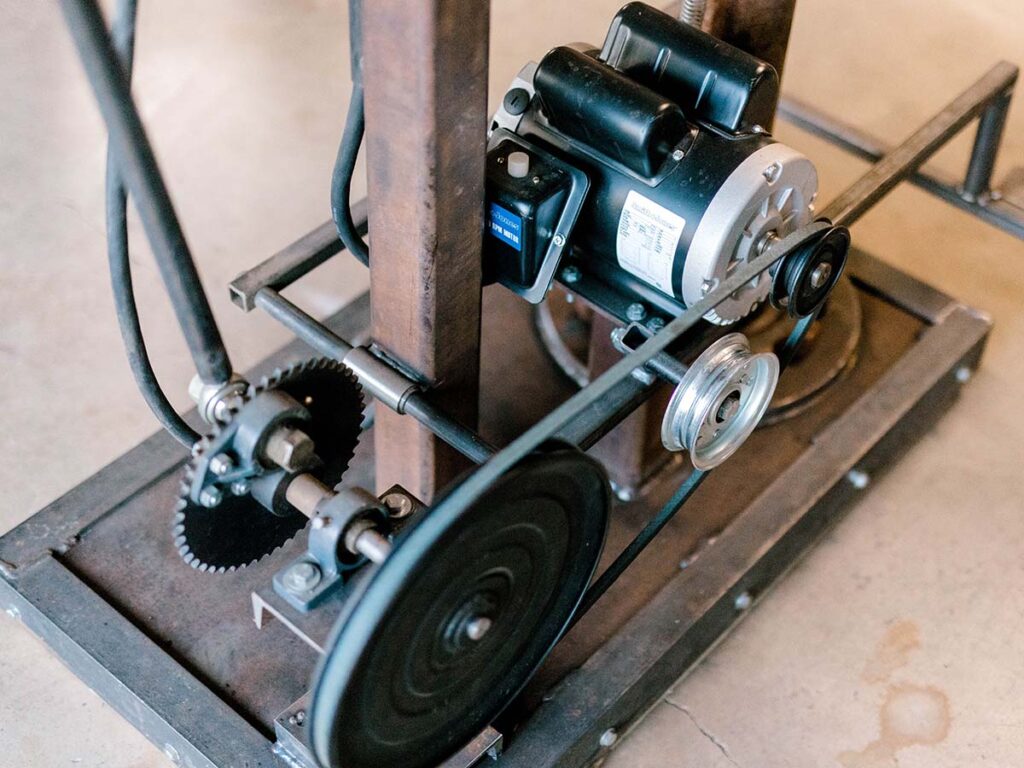
There are two main designs of slipping clutch. One uses a slack belt, a flywheel and pulleys. The drive pulley rotates within a slack belt. The foot pedal linkage pushes an idler wheel into the slack belt, increasing the belt tension to the point that the belt begins to turn the pulley on the flywheel.
The author modified the spring-arm-to-pitman attachment to make it adjustable. Depending on which attachment point is used, the leverage of the stroke changes.
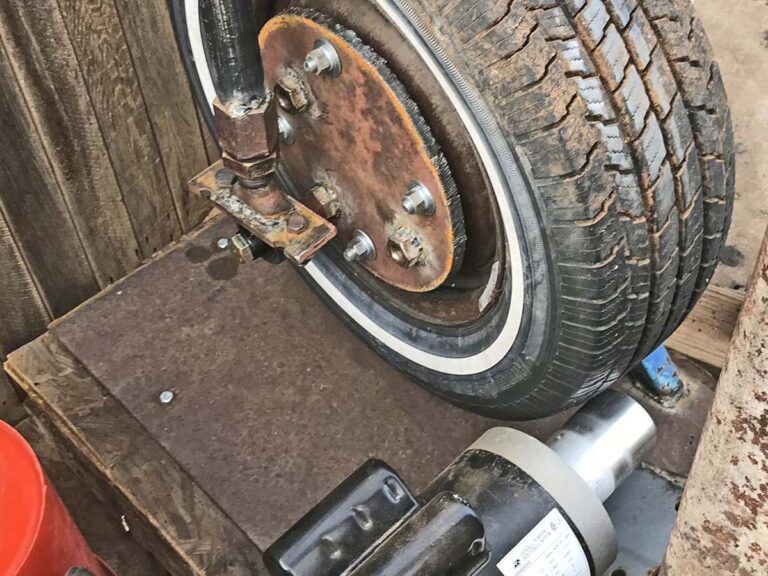
Another design uses a tire clutch, where the foot pedal linkage pushes a drive wheel into an automobile tire, with the hub of the tire serving as the flywheel. The most common “tire hammer” design uses a similar clutch but turned the other way and connected to a linkage. Your available parts will dictate your design.
Why A Clutch
A function of the clutch is to reduce the RPM of the motor speed to get the hammer rate of beats per minute (BPM) into a safe and useful range. You want the hammer rate to generally end up between 150 and 250 BPM, though many variables change with each hammer. In general, a heavier tup (aka hammer head assembly) requires a slower BPM, whereas a lighter hammer can have a higher BPM. You do not want your hammer running faster than you can control it, nor so fast that the inherent forces tear it apart. My hammer uses a 24-inch tire and a 3-inch drive wheel for an 8:1 reduction of a 1750 RPM motor, yielding a calculated 218 BPM at full speed. Your hammer will run differently depending on your motor RPM, your drive and driven wheel diameters, and the hammer’s overall design. I rarely run my hammer full speed during general forging work, and the tire clutch gives good speed control. Full speed works acceptably well for drawing out damascus billets or breaking down large stock.
My tire clutch has an integral flywheel bolted to the hub. On the flywheel I welded several different nuts for attaching the pitman arm (for more on the pitman arm, see part three last issue). Each nut is a different distance from the center of the hub. This allows me to vary the length of the stroke, in my case between 6.5, 7 and 7.5 inches, based on where I connect the arm to the flywheel. Coupled with an adjustable-length pitman arm, this setup allows a degree of tuning to get the hammer hitting in a way that transfers the power directly to the workpiece with efficiency, yet in a way that doesn’t place undue stress on the hammer itself.
Choosing A Motor For Your Tire Hammer
As for motors, the size may vary a bit depending on the overall tup weight of your hammer. For most homebuilt hammer sizes, a 1 or 1.5 HP motor is plenty. My 40-pound hammer uses a 1.5 HP motor running on 110v and does not trip a standard 15-amp breaker, suggesting that 1.5 HP is more than plenty for a 40-pound head. Whether the motor runs on 110v or 220v will depend on your shop setup and what you have available, but you’d be best served either way with a motor that runs in the 1700 RPM range, not one that runs in the 3400 RPM range. There’s no need to go three phase or variable speed unless you’re already set up for either.
Doug Davis’ homemade hammer uses a series of pulleys and an idler. When you step on the treadle, the idler tightens the belt and engages the hammer.
You will need an on/off switch for your motor. To run the hammer, turn the motor on, then use the foot pedal linkage to engage the clutch.
Sourcing Dies
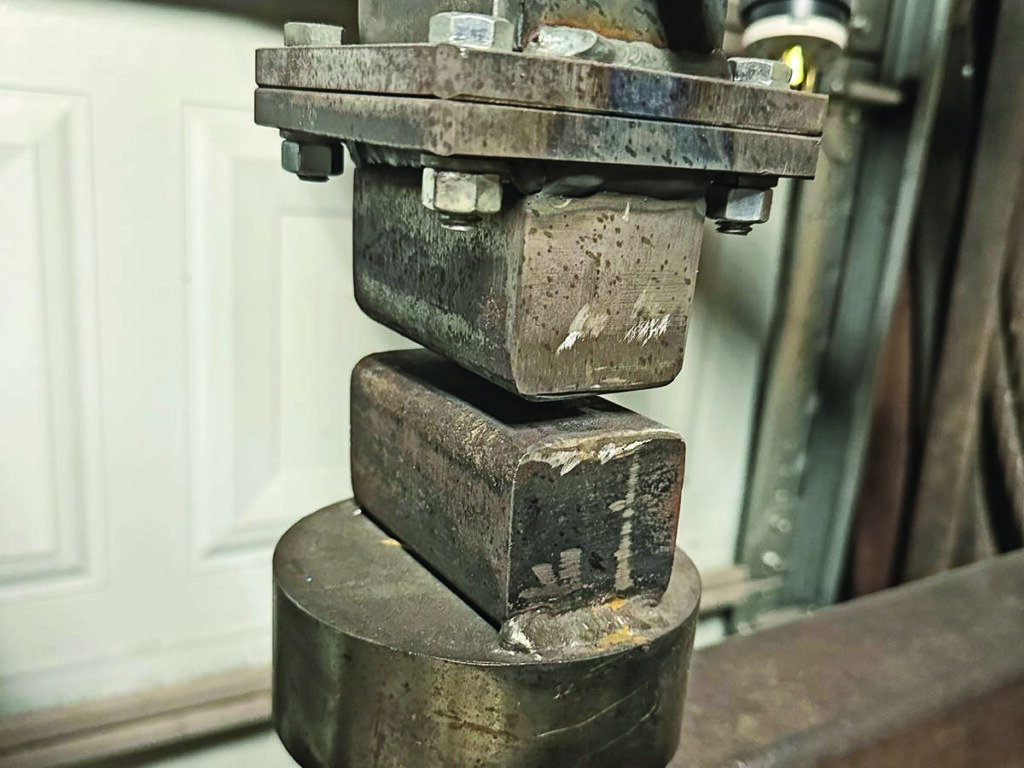
Most power hammers have a set of dies in between the anvil and the hammer shaft. Dies may be built in a variety of shapes and sizes, depending on how you want your hammer to move the metal. Two basic die designs are flat and crowned. Flat dies move the metal somewhat equally in all four directions, while crowned dies will draw out the length of your workpiece perpendicular to the crown on the dies. Some smiths design their hammers to accommodate various top or bottom tools, or spring swages as well.
The die attachment on Doug Davis’ power hammer is more robust on the ram-to-die connection, but time will tell how the bottom-die direct-weld works out. (Erik Greiner image)
On my personal hammer, the dies are built out of 1.5-inch square 4140 steel bar stock, heat treated and ground essentially flat, with slightly radiused corners. Some hammers are set up with dies that are interchangeable but mine is not. Full disclosure: My die attachment is one point of weakness in my design. I ultimately welded my bottom die plate straight to the anvil, and I’ve had to reinforce the top die connection and re-weld it several times. Perhaps a more skilled welder could have done better!
Creative Necessity
I can’t emphasize enough the creativity necessary to build a functioning power hammer from scrap. It’s one thing to watch a YouTube video and think, “It must be nice to have a power hammer.” It’s another thing entirely to watch the same video and try to discern how the rocker arm connects to the center post, or how the tire clutch axle is set up.
At the time of my hammer build, there was an online gallery hosted in Czechoslovakia that had hundreds of pictures of various homebuilt and factory built hammers. I couldn’t have built mine without those examples. I don’t speak Czech but the pictures tell the story well.
The author’s system is designed to help you accurately price custom knives.
After I wrote a recent BLADE® article on custom knife pricing, editor Steve Shackleford suggested I write a follow-up on the system I use to price custom knives—Robertson’s Maker Market Matrix or RM3. I wrote it to provide a basic guide for each collector or maker on how to do their own pricing. You can find many examples of weighted score tables with a quick Internet search.
A collection or business is a very individual thing. The research required to create a successful Matrix for either one depends on the individual doing it. Let’s dive in.
Market Position
A maker’s position in a market is not always apparent. While in graduate school, I wrote a paper on the impact of pricing and how it can apply to products. As a custom knife dealer, I was looking for a business advantage. I applied the findings in my paper to my business.
I opened my copy of KNIVES ’92 and, using a weighted score table, started to compare makers I found in the book’s index. Initially, I placed the knives in recognized categories, for example, hunters, fighters, bowies, tactical folders, etc. I wanted to compare similar knives/apples to apples. Each category had several hundred entrants.
My goal was to create a top-third, middle-third and bottom-third strata. This is where the weighted aspect of the table comes in. I developed essential criteria, such as quality of work, demand in the primary market, demand in the aftermarket, materials used, delivery time, awards and other gauges. Once I established the criteria, I gave each criterion an importance weight.
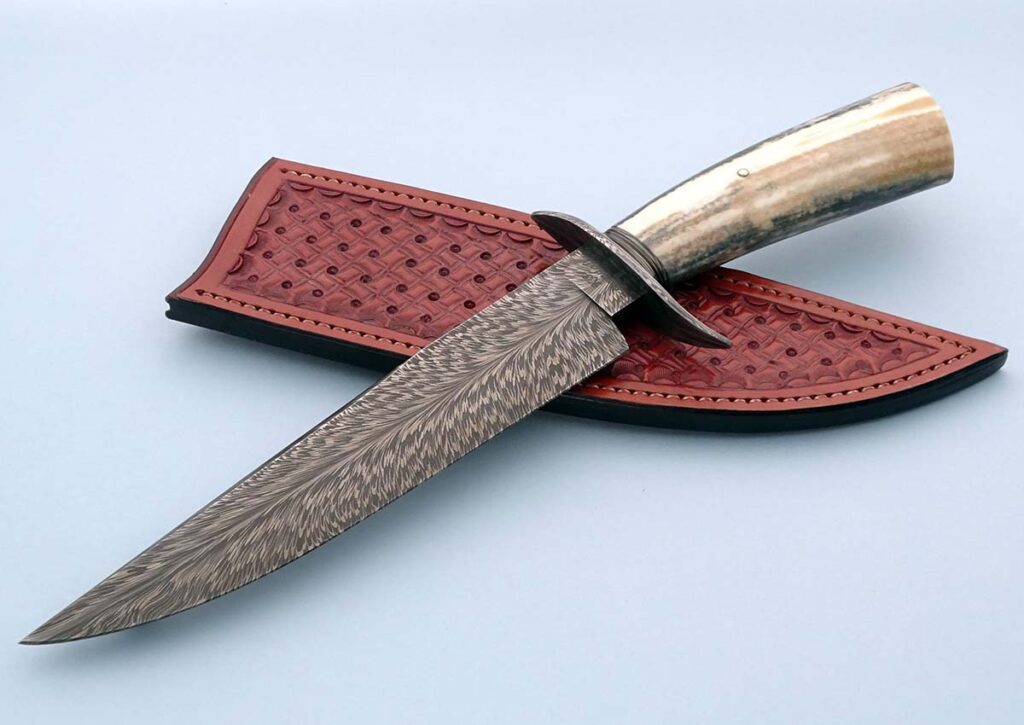
Maker: Steve Randall Model: Feather Damascus Fighter Blade Length: 8” Overall Length: 14” Blade Steel: Feather Pattern Damascus Guard Material: Feather Pattern Damascus Handle Material: Ancient Walrus Ivory Author’s Comments: “Steve is the quintessential ABS master smith. He is versatile, inquisitive, loves a challenge and always strives for perfection in every aspect of his knifemaking.” (Robertson’s Custom Cutlery image)
After the Matrix determined the maker’s position in the strata, the ultimate goal of the RM3 took shape in determining which makers’ prices accurately reflected their position in a particular market sector. My research showed that hundreds of makers’ prices were above their position in the market. In other words, many of these makers who were in the second strata were asking first-strata prices. The same was true for third-strata makers asking second-strata prices. The main reason for this is that the makers asked their knifemaking friends to price their knives.
Knifemakers are not knife buyers and, as such, generally do not have a real sense of what knives should sell for. This is especially true if they don’t know their market position. Additionally, asking your competitors/fellow makers to price your knives is not a recommended business strategy.
Among other things, one aspect of the RM3 I was surprised to find is that it identified makers who offered value pricing. At first glance, many people mistakenly think this means the least expensive price. Instead, given the maker’s position in the market, a value price provides the buyer value regardless of the price tag. The makers who came to my attention were those pricing their knives commensurate with the pricing in lower strata, e.g., a first-strata maker asking for a second-strata price.
Blade Game
When knife shows or knife sales are slow, the blame game begins. The reasons for the slowdowns usually center around the show promoter not doing the job. The economy is a favorite reason, along with the weather, lighting and position in the room. A maker once told me his sales were slow because he was facing a wall. Note that we were in a square room; everyone was facing a wall. What seldom, if ever, is brought up as a reason for slow sales is the maker’s prices.
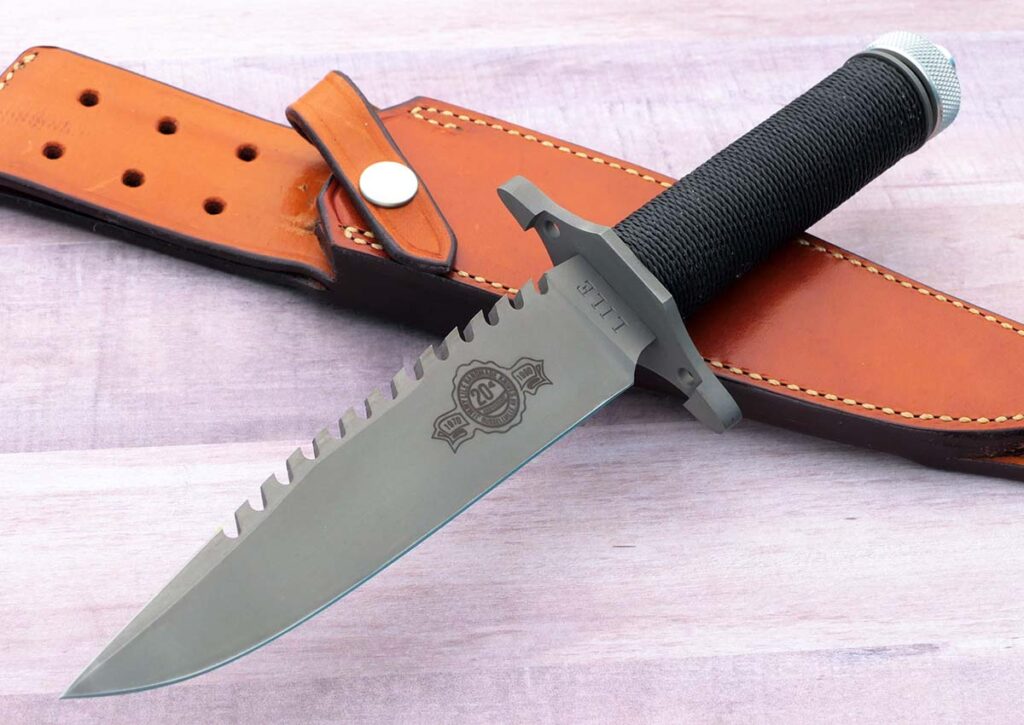
Maker: Jimmy Lile Model: 20th Anniversary SLY II Fighter Blade Length: 6” Overall Length: 10.5” Blade Steel: 440C stainless Blade Finish: Bead blast Guard Material: Stainless steel Handle Material: Aluminum tube w/cord wrapping Author’s comments: “A BLADE Magazine Cutlery Hall-of-Fame® member, Jimmy did more to introduce the knife world to the tactical fixed blade than any other custom knifemaker. This young infantry lieutenant saw a Rambo movie and it changed my world.” (Robertson’s Custom Cutlery image)
Very few people will tell makers their prices are too high, as makers can be touchy about their pricing. At the same time, few makers ask collectors or buyers what they think of their knives. This interaction is a prime opportunity for a maker to work on his or her Matrix. Further, this is an opportunity to educate the collector on why the maker’s knives are priced the way they are, and to give the collector a chance to work on his or her Matrix.
I cannot overstate how vital this flow of information is for both the maker and the collector. For the past 30+ years, at every show I have attended I have heard, “Les, come and look at my knives and tell me what you think.” I have the utmost respect for the makers who ask me to do that. It can be daunting for a maker to ask someone to critique the maker’s knives and prices. A quick “good job” may be nice for the maker’s ego, but a critical examination of the work and pricing will ultimately improve the maker’s knives and bottom line.
Hype Cycle
The Hype Cycle occurs when a custom knife market sector takes center stage. In 1988, interframe folders were all the rage—many sold for over $10,000 each. In 2001, I bought one of the same knives for $600 at an auction. The original sale price was $14,000. What happened? Answer: the Hype Cycle. The hype drove up the prices, and when the hype went away, the prices crashed. The Hype Cycle is a Matrix killer as prices become skewed to the point that they are unsustainable.
Whether you’re a collector or a maker, the Matrix can benefit you. Identifying the maker’s position in the market aids in an appropriate price, thus increasing sales for the maker. At the same time, it gives the collector a chance to sell or trade a knife at a fair price in the aftermarket, as it is in the aftermarket where collectors pay to go to school.
Custom knife markets are small cycles inside of larger cycles. New criteria will always enter a Matrix. Consequently, both makers and collectors must be sensitive to the ever-changing markets. Retirements, new materials, awards, bad reviews and other factors can all impact pricing.
R&T
Reading this, some may think the RM3 is a quick and easy solution for pricing knives. I assure you, it is not. The amount of research and time you put into your Matrix will directly affect your ability as a collector or as a maker to identify the maker’s position in his or her market. It also will give valuable insight as to whether the maker is offering value pricing. Makers will gain useful knowledge on how to price their knives correctly for their position in the market, helping them eliminate the blame game.
Maker: David Broadwell Model: MLR Sub-Hilt Fighter Blade Length: 8” Overall Length: 14” Blade Steel: Wolf’s Tooth Pattern Damascus Guard, Sub-Hilt and Pommel Material: Wolf’s Tooth Pattern Damascus Handle Material: Ancient Walrus Ivory Author’s Comments: “Dave has been making some of the finest sub-hilt fighters for over 40 years. His knives are the epitome of the 4 F’s; Fit, Finish, Form and Function.” (Robertson’s Custom Cutlery image)
More On the Robertson Matrix
How do you give what you call an “importance weight” to each criterion in a Matrix? What makes specific criteria more important than others? ROBERTSON: One criterion that has moved up my list and now carries more weight is customer service. We deal in so much poor customer service in our everyday lives. We don’t need this in our hobby. I am still amazed at the number of clients who tell me they have emailed or called a maker, often several times, with no response. Everyone is busy but it takes literally 60 seconds to respond to an email acknowledging receipt and indicating a response will be forthcoming asap. Those makers who don’t respond in a timely manner are telling you it is about them and not you. If they are making it difficult for you to give them your money, don’t.
What makes the ratings for your criteria change? ROBERTSON: Actually, it is the ratings of knife organizations that have caused me to change the weight the ratings carry in my criteria. When I first started in custom knives, to be a Knifemakers’ Guild voting member carried a lot of weight in the knifemaking community. Today the Guild is more of a club, though still a good idea that provides insight and help for makers. For me, at least, if a maker tells me he or she is a Guild voting member, that mostly tells me the maker is serious and has shown improvement in his or her knifemaking skills over the years, but it does not carry the weight in my criteria it once did.
How often do you update the ratings, and why? ROBERTSON: The custom knife market is never static and is always evolving. This evolution demands that weight associated with each criterion evolve as well. The weight I associate with a particular maker changes with the maker’s ability to incorporate the changes the collectors want, be it materials or design elements.
How often do you change the criteria themselves, and why? LES ROBERTSON: I’m generally one-to-two years ahead of where a market sector that interests me is going. Given this extended lead time, I often have to account for new information and tweaking of the weight within a particular criterion or the criterion itself. Perhaps the most difficult aspect of this is to not put too much weight into a criterion due to my personal biases. In other words, just because a particular style of knife is my favorite does not mean the majority of other collectors feel the same way. I try to take my feelings out of the equation and I am not always successful. The Matrix is not an exact science.
Stainless, high-carbon, super steels, see what 2025’s shakeups mean for knife steels in 2026.
Twenty-twenty-five saw radical change in the cutlery industry, but somehow the business of blades not only survived, in some ways, it also thrived. With new steels in the offing and despite a business environment made murky by the specter of tariffs, 2026 has several things going for it that could point to a year of continued resilience for knives.
Ironically, one of ’25’s biggest changes—the closing of Crucible Industries—did not turn out to be as debilitating as some thought it would be. While by mid-year there was no more Crucible, most of its coveted cutlery steels remained available, albeit under new manufacturer names (Knife After Crucible).
A steel processing company that came out quite well during the transition was Niagara Specialty Metals (NSM). Bob Shabala, NSM president, provided a look at the changes from an insider’s perspective.
Several sources say companies that manufacture their knives solely in the USA should experience little to no tariff-induced price increases in 2026. Case is such a company. The Crossroads Barlow features S35VN stainless blade steel and a black and tan Richlite handle. Closed length: 3.375 inches. MSRP: $118.99.
“Crucible’s decline didn’t happen overnight,” he notes. “Long before the shutdown, we saw signs of trouble: inconsistent allocations, slipping ship dates and growing uncertainty around future melts. As a steel processor that lives or dies by delivery reliability, we didn’t wait. We started to order more steel from Crucible to bolster our inventory in case something happened. We also reached out to Erasteel and Carpenter Technology to gauge their interest in supplying PM [powder metallurgy] steels. We have a long history with both companies and they were receptive to our requests. In September 2024, we started placing orders with both mills, not knowing that Erasteel would eventually buy the IP [intellectual property] and trademarks of Crucible in early 2025.
“In short, Crucible’s demise raised costs in the short term but also created an opportunity for us to buy high-quality steel from multiple suppliers. We diversified melt sources, invested in grinding/laser/ti capacity and kept steel flowing. The industry will come out of this with a more resilient supply chain, and makers will see faster builds and better consistency where it counts. If you’re a one-man shop or a major brand, you can get the material and the prep you need.”
Introduction MagnaMax Steel
Dr. Larrin Thomas, metallurgist.
Dr. Larrin Thomas is an acclaimed metallurgist whose web column knifesteelnerds.com is great reading if you want to stay current with knife steels. He sees the industry’s ability to bounce back over time as key to predicting events for the coming year.
“The huge changes in the ownership among steel manufacturers for cutlery consumers were minimal, mainly because the major players had a year to settle into their comfort zones,” states Thomas, whose portfolio as a steel designer includes the uber-popular MagnaCut. “Nothing changed as far as the king-of-the-hill steel. MagnaCut, which has been the most popular stainless steel among knife consumers for over two years, remains the top choice. That could change in 2026 because MagnaCut will be joined by a sibling dubbed MagnaMax.
“MagnaCut isn’t going away—its balance of edge retention, toughness and true ‘stainlessness’ keeps it the all-around benchmark. What’s new is MagnaMax: think MagnaCut-level corrosion resistance with meaningfully higher wear resistance, so edges hang on longer in abrasive cutting. That combination is why I expect MagnaMax to be one of 2026’s headline steels, especially in EDC folders, hunting/skinning knives, and pro kitchen blades that see lots of board or hide contact. MagnaMax complements MagnaCut rather than replacing it—pick MagnaMax when maximum edge life is the priority, MagnaCut when you want the ultimate do-everything balance.”
Knife Steels To Watch
AEB-L stainless will be one of the top blade steel choices for custom folders in 2026. Terry Jellison employs it on the blades of his Hobo Knife. Scales: mammoth ivory. Liners: brass. Closed length: 4 inches. The knife is not for sale. (Jocelyn Frasier image)
Despite or perhaps even because of the Crucible shakeup, manufacturers and custom makers have many steel options. Following is Larrin’s recap of the diversity of top-shelf options for 2026. First, the leading stainless steels for factory knives:
MagnaCut: Expanding across EDC folders, hunting knives and premium automatics as brands refresh the legacy of S30V/S35VN;
MagnaMax: Expect it to appear in the same knife types as MagnaCut and beyond. The appeal is simple: MagnaMax has the qualities of a stainless steel users already love (MagnaCut) but with more wear resistance for longer edge life, and;
LC200N and Vanax: Limited but visible in dive/fillet and salt-exposed knives where “no rust, period” is the spec.
Larrin’s top carbon steels for factory knives in ’26:
CPM 3V and CPM CruWear (aka NSM Wear): Factories use these steels selectively in choppers and survival/tactical fixed blades where warranty-safe toughness matters.
D2: The popular tool steel will persist in value lines, but you’ll see a gradual shift away from it toward tougher, easier-to-sharpen options. In the realm of carbon steels for custom knives, Larrin says Pop’s ProCut, a new blade material designed for use by bladesmiths, including in damascus, will shine. Its combination of nickel, tungsten and vanadium gives it high toughness and wear resistance while still being easy to forge and heat treat. It can be hardened in a 200°F window, which makes it extremely easy to heat treat. The high nickel content also makes it produce a bright layer in damascus. On the stainless custom side, Larrin says to watch these:
MagnaMax: Alongside MagnaCut and AEB-L, MagnaMax will be a go-to for customs where makers want a “set-and-forget” edge on EDC folders, hunting knives and chef’s knives. It delivers premium corrosion resistance plus a clear wear-resistance bump, which lets makers grind thin and still give customers long service intervals between sharpenings, and;
LC200N: It will fill a growing niche for dive knives, fillet knives, coastal EDC and pro kitchens where rust is the enemy.
Tariffs’ Affects On Knife Steel
Bear & Son is another company that manufactures its knives exclusively in the USA and that should experience little to no tariff-induced price increases in ’26. Its 11 7/8-inch White Smooth Bone Professional Fillet Knife features Sandvik 14C28N stainless blade steel. MSRP: $139.99.
Several sources say American consumers will see the effects of U.S. tariffs on both imported knives and/or the steel used in them in ’26—a double whammy in some cases. However, it’s too early to tell the overall impact tariffs will have on the prices American consumers will pay for imported knives. That said, enough has been done in the overall market to draw some conclusions as to what direction those numbers are heading in the knife market in general.
As for those who manufacture their knives in the USA, there will be little to no increase in prices, except for models that include some foreign-made parts. This is uncommon but a possibility, though for the most part, not a liability that cannot be overcome. Case, Bear & Son and others are among those that fall into this category.
The second group contains companies that do a large part of their manufacturing in the United States. Among those that fit into this group is Spyderco, which also has its “value line” of knives produced overseas. Sources say Spyderco can go with a bump in tariffs on its foreign-made knives, move all manufacturing in-house or ditch the value line entirely, though there was no indication at press time that the company will choose either of the latter two options.
Dr. Larrin Thomas says the new Pop’s ProCut blade material is designed for use by bladesmiths, including in damascus. Cliff Ivey combines it with 80CrV2 carbon steel for the damascus blade of his small hunter. Overall length: 6.25 inches. Cliff’s price for a similar knife: $450. (Jocelyn Frasier image)
Then there are American companies that produce the lion’s share of their knives overseas. CRKT is one such company. Sources indicate CRKT can work the tariff costs into existing pricing, move its manufacturing to a country that pays lower tariffs, or figure out a way to manufacture more of its knives domestically. Considering CRKT’s track record, it probably would be a mistake to underestimate the company’s ability to endure.
Bottom Line
While 2026 will have its challenges, barring any surprises, it should be relatively calmer than 2025 due to last year’s upheavals in the manufacturing sector and tariff-induced changes. Meanwhile, the cutlery industry remains healthy in both the budget, moderately priced and upscale sectors—and that is a very good sign.
Many Top Knifemakers Are Keeping Historic Styles And Methods Of Making Knives Alive Today.
Historical perspective is a relevant component in just about any undertaking. In the realm of cut, incorporating an appreciation of the past into the work of today brings another dimension to the custom knifemaker’s statement.
Interest in the knifemaking of a bygone era offers a window into the true artistry required to reproduce the knives of yesteryear, particularly with the absence of modern conveniences in the shop. Along with the interest in the historical knife, several custom makers bring famous designs, styles and patterns to life once again in tribute to those who have gone before.
The idea of the period piece blends old and new. “I’ve been making knives seriously since about 2002 when I took a class with the American Bladesmith Society in Washington, Arkansas,” related ABS master smith Lin Rhea. “Joe Keeslar and Greg Neely lit a fire under me and got me on my way. Since then the town of Washington has been like a second home, and I’ve even added to the personal connection between me and the area by interest in one of the town’s historical residents who was also a knifemaker. His name was James Black.”
A resident of Prattsville, Arkansas, Lin gained an appreciation for Black’s distinctive body of work*, using contrasting materials and techniques to create a bold, attractive look. “I’m grateful to get to know Mr. Black by studying his work,” Lin continued. “This intense study
Lin Rhea’s reproduction of the Carrigan Knife is based on a dress bowie James Black is thought to have made in the early 1830s in Washington, Arkansas. The original Carrigan includes a black walnut handle with coin silver pins and trim. The blade is about 6 inches long and the overall length is approximately 10.25 inches. (Whetstone Studio image)
led me to try to recreate one of his knives, the Carrigan Knife. The original knife, a guardless coffin-handled bowie, was made by Mr. Black in the early 1830s in Washington, Arkansas. I chose the Carrigan as my first attempt because of its less intimidating size; however, as is often the case I found it to be just as intimidating once I started into the project.”
The original Carrigan includes a black walnut handle providing a nice contrasting background to the coin silver pins and trim. The blade is about six inches long, and the overall length is approximately 10.25 inches. The full tang is virtually covered entirely by the walnut scales and the silver wrap.
When Rhea undertook his homage to Black and the Carrigan, he chose stabilized walnut, which he harvested himself several years ago, and trim in sterling silver. He forged the blade from 80CrV2 carbon steel and included at least 30 separate parts while attempting the same techniques used by Black nearly two centuries ago in fastening and assembling the finished knife.
“There is so much to be said about not only this knife but also Black’s work,” Lin concluded. “He was able to create a knife design utilizing only three materials yet impacting the knife world as few others could. His ability to arrange these materials into a functional, long-lasting, beautiful tool is only enhanced by the knowledge that he also built in other qualities like moisture resistance, logical assemblage and ergonomics. All of this was done in a historic setting without modern equipment and epoxies. In my opinion, his design is ingenious.”
Gold Rush Knives
Recently inducted into the BLADE Magazine Cutlery Hall of Fame® knifemaker Jim Sornberger has assimilated his gold and silversmith skill sets into custom knifemaking while helping introduce the modern world to the classic design, luster, and embellishment of the Gold Rush era and boomtown San Francisco of the mid-19th century.
Jim Sornberger’s interpretations of the Michael Price San Francisco/small dress bowie have won awards at various venues, including Best of Show at the 2019 International Custom Cutlery Exhibition in Fort Worth, Texas. Jim’s price for a similar knife: $3,500. (SharpByCoop image)
“I’ve been making knives since 1975 with the help of the late Les Berryman, an early Guild member, and with some guidance from Bob Loveless, Herman Schneider and Barry Wood,” Jim recalled. “The last three signed for me to join The Knifemakers’ Guild.”
For Sornberger, the style, embellishment and decoration of the canes, jewelry and knives of the Gold Rush era are most appealing. “San Francisco from 1850 to 1904, the Gold Rush period, was one of the wealthiest cities in the world, attracting some of the greatest artists, jewelers, carvers, and engravers to ply their trade to a wealthy clientele. The work done in that period,” he opined, “rivals the best ever done.”
In the knifemaking genre, Michael Price and Will & Finck were among the most successful and prolific of the Gold Rush. Their work remains emblematic of the great migration to settle the American West, and the riches and ruin that were found with the experience.
“Price was Irish, and both cutlery firms hired workers who were English, German and possibly Scottish,” Sornberger explained. “Their dress knives are probably the most embellished American knives made in the 1800s-1900s. The dress knives had two common handles: an interesting, modified coffin shape and a more rounded, subtle taper shape. The blade shapes are spear-point dagger and San Francisco clip spear point.”
Sornberger is recognized as an authority on original San Francisco knives, as well as the magnificent gold quartz that was used so well by Gold Rush artisans. His modern interpretations of the Michael Price San Francisco/small dress bowie have won awards at various venues, including Best of Show at the 2019 International Custom Cutlery Exhibition in Fort Worth, Texas.
Jim’s dress fixed-blade bowie in the accompanying picture was made with Vegas Forge stainless barstock AEBL and 412 stainless steels, and san-mai damascus steel with a solid core. The guard and wrap handle are in Mike Sakmar mokumé barstock. Jim’s made such handles in gold and silver and nickel silver, also. The inlays are tortoise celluloid and California native gold/gold quartz.
According to Sornberger, the biggest challenge in his stunning creation was grinding the blade to show the distinctive pattern of the shell and the hardened core. The san-mai laminated blade was etched with ferric chloride, rinsed and color set with WD-40®.
The Frog Knife
“The style of Michael Price’s work is a really good canvas with flowing lines, and there is a lot you can do with it,” observed ABS master smith Jon Christensen, who is in his 22nd year of making knives. “I wouldn’t call my San Francisco-style knives replicas. I do like to keep to the original form and honor the style of the maker, though.”
The Frog Knife by Jon Christensen is a San Francisco-style dress bowie with a back story. “I had seen the Poppy Knife that Michael Price made and thought I would do my version,” he related. “I took the knife to the BLADE Show, and it didn’t find its owner. Then, the handle got ruined, and I just took the opportunity to rehandle it with the frogs and lily pads.” Overall length: 10 inches. (SharpByCoop image)
One of Christensen’s most evocative pieces to date is referred to simply as the Frog Knife. However, the piece is far from simple, and Jon manages to convey the spirit of the Michael Price style while also imprinting some of his own personality.
“I built the feathered damascus for the blade with 1080 and 15N20,” he advised. “It’s a canister damascus. I forged the bamboo leaves and placed them in the can, welded it up, reduced it, and feather cut it so it would produce feather-cutting smears and leaves, and form branches to look like a little grove of bamboo leaves.”
The 10-inch knife has a 5.5-inch blade and a frame and sheath incorporating 410 stainless steel. Christensen utilized the “canvas” of the handle to the fullest, carving the mammoth ivory into a pleasing vignette of frogs and lily pads.
“The handle has something of a back story,” he smiled. “I had seen the Poppy Knife that Michael Price made and thought I would do my version. I took the knife to the BLADE Show and it didn’t find its owner. Then, the handle got ruined, and I just took the opportunity to rehandle it with the frogs and lily pads.”
Christensen got his start making stock removal knives after a career as a horticulturist. He learned to forge while working with ABS master smith Ed Caffrey and visited with knifemaker Rick Eaton and ABS master smiths Shane Taylor and Wade Colter. Jon also makes San Francisco folding knives and enjoys swordmaking. Plans for the future include more period pieces.
Kimball Style
ABS master smith Josh Smith owes his little league baseball coach, ABS master smith Rick Dunkerley, credit with getting him started making knives about 30 years ago. From the beginning, Josh has appreciated the thought process and craftsmanship of custom makers from a bygone era.
“There’s something special about reproducing something that was built nearly 200 years ago,” he reasoned. “It’s easy to get lost in your thoughts while working on these knives, wondering what the makers were thinking about at the time. Was the knife going into battle? Was a rich man just wanting something unique? Was the maker just trying to be different and impress people? Were function and effectiveness of use the only factors that mattered? It’s really cool to think about.”
Josh Smith’s dog-bone-handle dagger is a reproduction of a knife owned by Loring Kimball of Vicksburg, Mississippi, in the mid-1800s. The grip gets its name from its shape. Overall length: 14.25 inches. (Eric Eggly/PointSeven image)
Josh has found the opportunity to consider historical context with a dagger in the distinctive dog-bone handle, recalling the mid-1800s when a gentleman named Loring Kimball of Vicksburg, Mississippi, owned several similar original pieces that were probably made by at least two different knifemakers in the New Orleans area. Knives in what many refer to as the Kimball style have been reproduced by a number of modern makers, mostly bladesmiths.
“The distinctive characteristic of the dog bone is clearly the shape of the handle,” Smith said, “but to me it’s more than that. The large domed pins and the flat facets on the handle provide such a neat look. One of the original Kimball daggers from the 1830s had silver wrapped around the butt of the handle and a small, thin silver guard. I never pretend to exactly reproduce these knives. I always put my own spin on the knife, trying to bring some of my style into it.”
Smith’s dog-bone dagger is fashioned from his own ladder pattern “W’s” damascus blade, African blackwood handle and 18k-gold pins and liners. The 9.5-inch blade is forged from 1080 carbon and 15N20 nickel-alloy steels, while a gold collar stretches over the back of the blade and bears the engraved name of the maker. Overall length: 14.25 inches.
“This particular knife was heavily influenced by Tim Hancock,” Josh said. “I feel Tim, Harvey Dean and James Batson are the three men who led the way in bringing these knives back to prominence, and Tim had the most influence on my construction of these knives. I love period pieces and definitely plan on doing more. There are so many incredible weapons from the past that would be fun to recreate.”
*While a number of top industry authorities attribute such original 19th-century pieces as the Carrigan Knife, Bowie No. 1 and others to Black, no knives with Black’s mark are known to exist.