Knifemaking

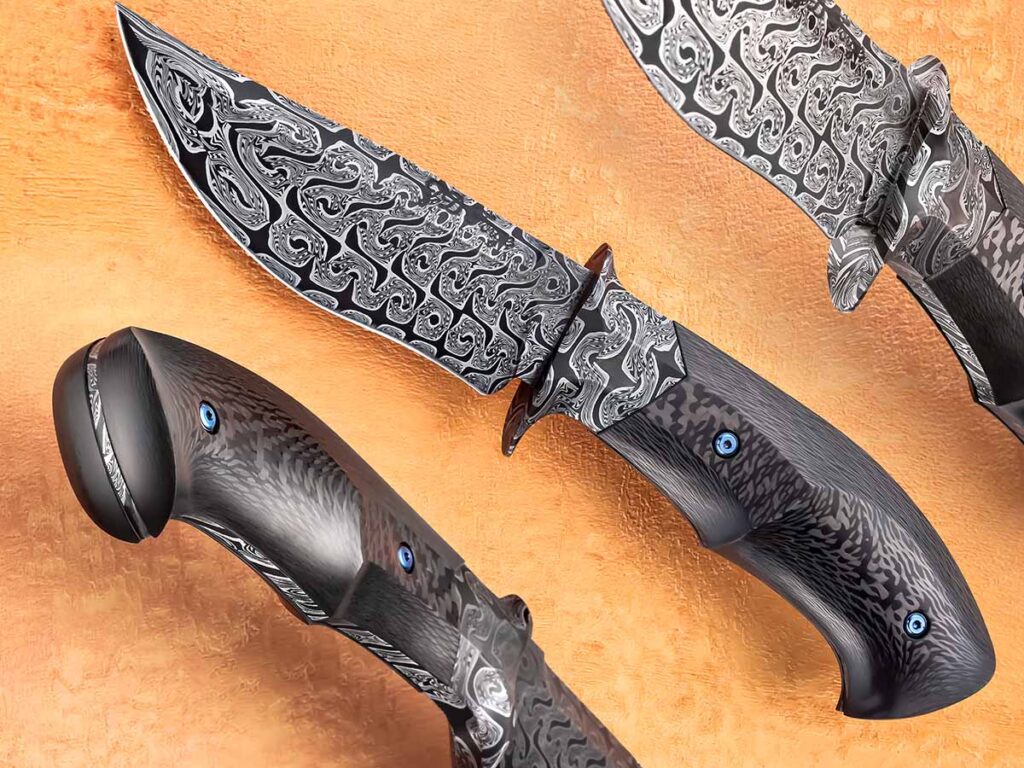
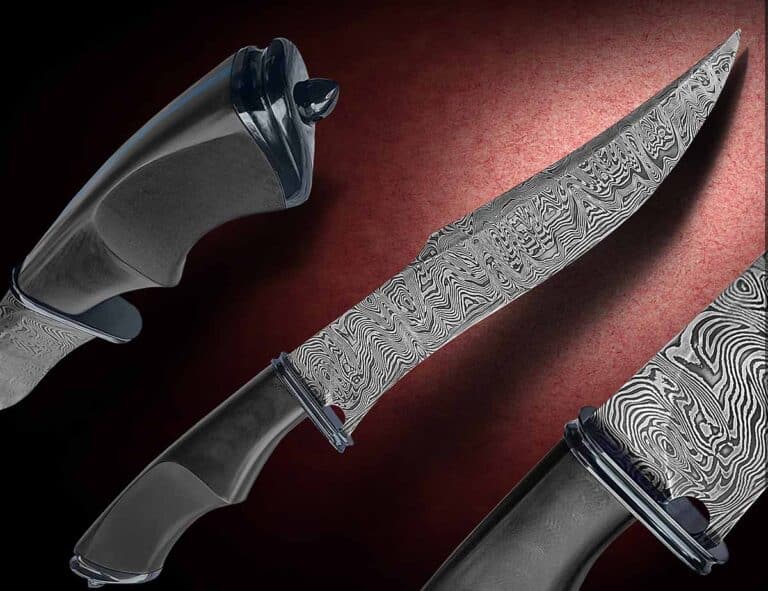
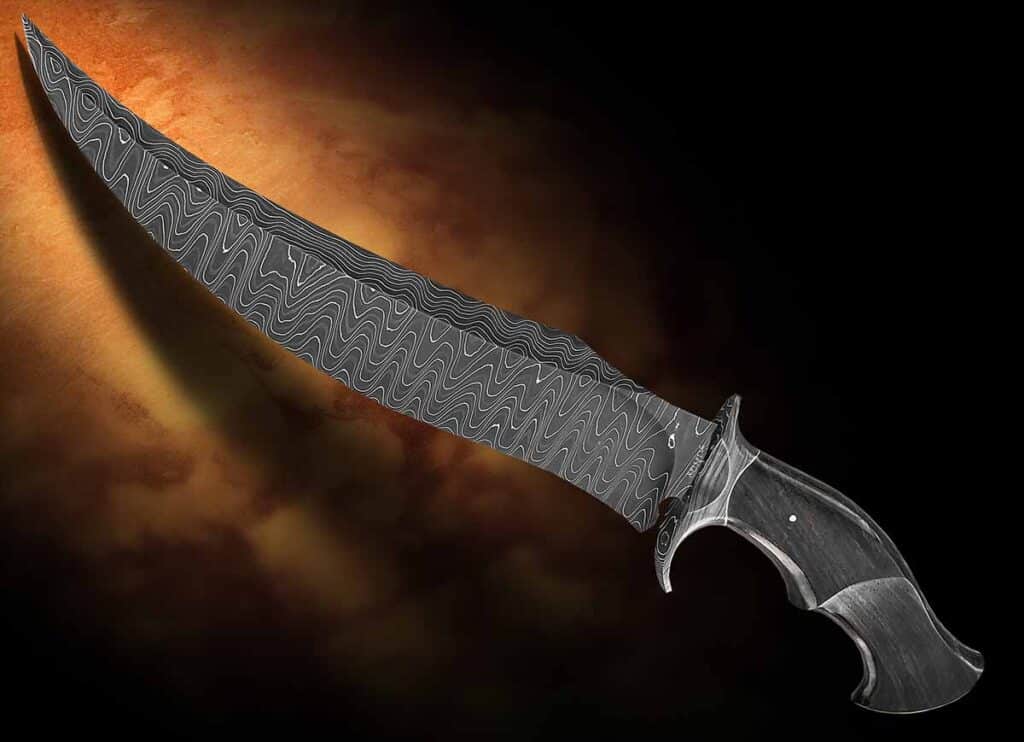
Knifemaking is the building of a knife, which includes the blade, handle and other accouterments. Blades are made by either removing metal from a steel blank via a grinder – known as stock removal – and the forging to shape of hot steel into a blade in the process known as bladesmithing. Other parts, including bolsters, guards, pommels, etc., are needed to complete the finished knife.

Featured Knives – – Knife Collecting – – Tactical Knives – – Survival Knives

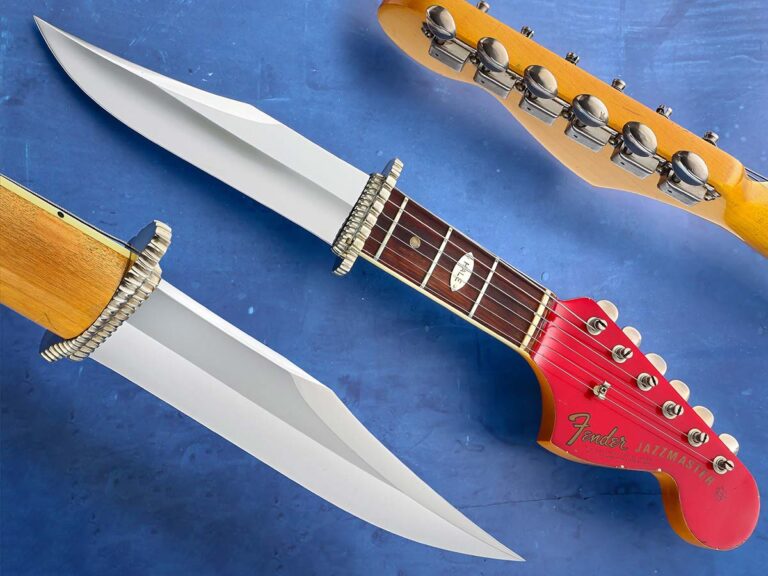
Cool Custom: Lloyd Hale’s Fender Jazzmaster Knife

Lloyd Hale made the singular knife circa 2000 from the neck of a 1960s Fender Jazzmaster.

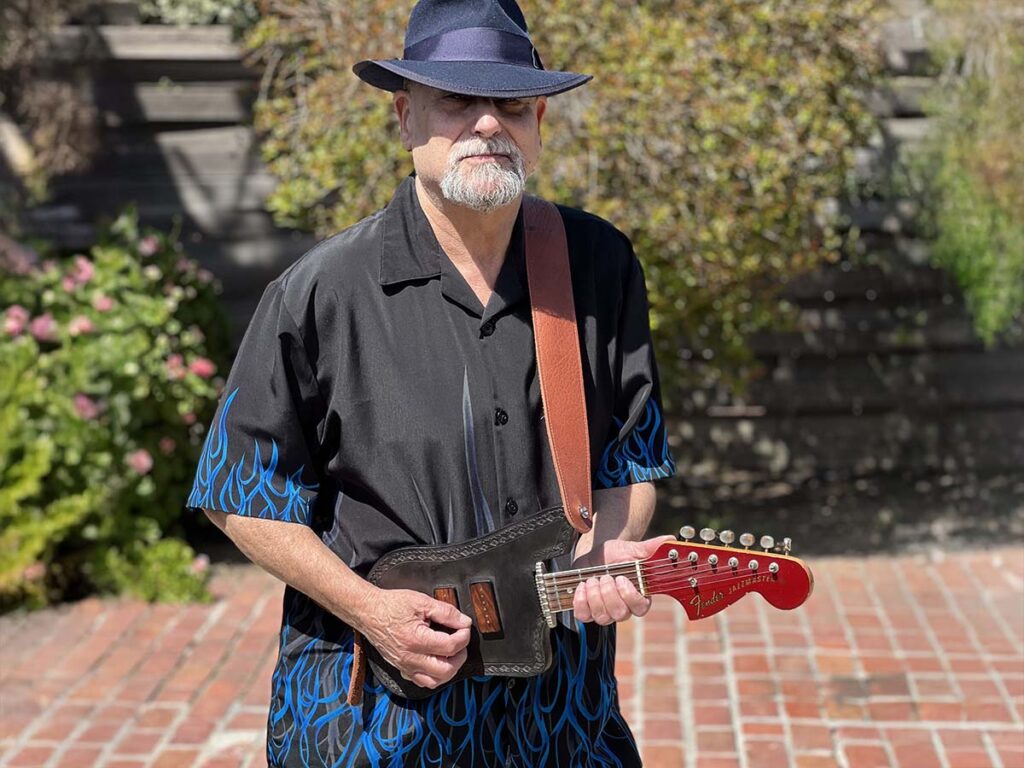
A self-described child of the ’60s, Larry Hirsch jumped at the chance to buy the DeFender when a collector offered it for sale.

Made by Lloyd Hale a quarter century ago from the neck of a 1960s-era Fender Jazzmaster guitar, the knife did not have a sheath originally, so Hirsch got with Hale earlier this year and brainstormed one in the shape of the main body of the guitar, complete with strap and volume and tone control knobs.

Larry Hirsch rocks his world with the DeFender. (Hirsch image)

“I told Lloyd the knobs had to turn because everyone that sees it, the first thing they will do is turn the knobs,” Hirsch said. Sure enough, when Larry displayed the knife at the 2025 Solvang Show, the first person that saw it turned the knobs.

Oh, left whole a 1960s-era Fender Jazzmaster—just the neck alone—would be worth obscene amounts today, but we won’t go there.

More Custom Knives:

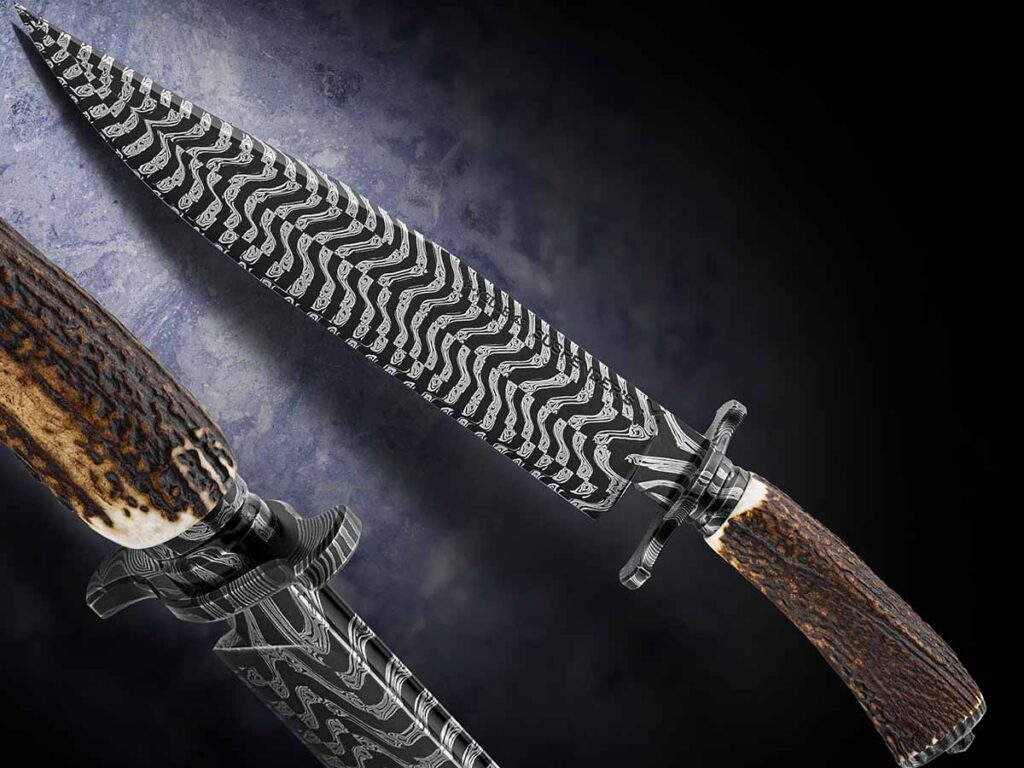
Bowie Knives: Lingering Legacy Of The All-American Design

Truly an American design, the bowie continues to inspire today’s makers.

While its roots may be from across the sea, ties to the makers of old Sheffield and elsewhere, the bowie is today distinctly American. And it has been for more than two centuries.

Made famous by BLADE Magazine Cutlery Hall-of-Fame® member Jim Bowie and the fabled Sandbar Fight, no doubt present at the Alamo where Americans fought and died for freedom, and seen in countless photos of soldiers going to war—posing with the burly bowie in a proud moment—the iconic knife was also immortalized on the silver screen with the classic The Iron Mistress and other films. There is no other style of knife that more clearly defines the American spirit.

“Bowies are the quintessential American knife, deeply steeped in the mythos of our collective history,” observed ABS journeyman smith Matt Parkinson of Dragon’s Breath Forge. Shawn Shropshire of SDS Knifeworks agrees. “The bowie is the most iconic or at least the most recognized of American knife designs,” he said. “At the time of the Sandbar Fight, there was no single pattern that was called a ‘bowie knife.’ It varied in size, blade shape and even materials. Cinema later created what most people now recognize as the bowie knife, something with a large blade, clip point usually, with a double guard.”

ABS master smith Lin Rhea commented, “I do indeed believe the bowie knife is America’s knife design. It was created to fill a need. The country was expanding and was very wild and without law and order. The average traveler in the lawless wilderness needed a reliable defense weapon that could be carried on their person, that never misfired and was less conspicuous than a sword. The fact that a large knife was used in self-defense by Jim Bowie in the infamous Sandbar Fight just boosted the design into the realm of legend.”

Wrapped up in fact, fiction, myth, legend and lore, the bowie is a constant in the theme of adventure and survival. Although it does exhibit common attributes—among them impressive size—across the design, there are variations on the theme. To this day, the bowie remains a favorite form of expression for custom knifemakers who tip their creative cap to the history of the design and imprint their own skill, expertise and perspective on this truly American blade.

Barbary Coast Bowie

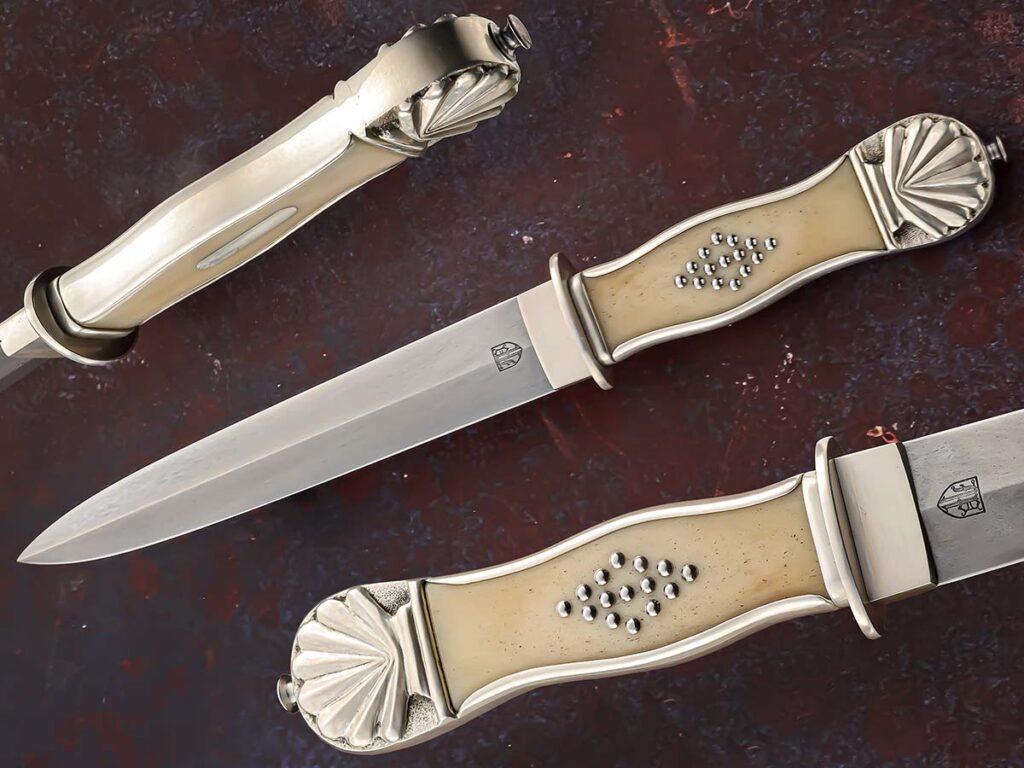
Matt Parkinson’s California-style bowie is deadly dapper. He describes it as “graceful and sleek,” featuring his own wootz steel and sterling silver bolster, pommel and guard. (SharpByCoop image)

Parkinson chose the San Francisco theme to highlight his take on the classic bowie. Representative of the days of the Barbary Coast and the rough-and-ready youth of a nation stretching from sea to shining sea, the idea captivated him.

“I have long been intrigued with the California- or San Francisco-style bowie,” he remarked. “They are graceful and sleek in a way that many bowies are not. In designing this particular piece, I looked at as many examples of this style as I could, both originals and contemporary. I didn’t copy anything but tried to match the design cues I saw in the originals that made them so iconic.”

Matt’s San Francisco Bowie features a 6.25-inch blade, an overall length of 11.75 inches, a bone handle and generous applications of stylized silver in shell and pin. “The blade is forged from my own wootz steel,” he noted, “and the bolster in front of the guard was cast, as was the shell pommel, and the guard and frame are all fabricated from sterling silver.

“One of the things I most admire about the California style bowies is the uniquely American lineage. Much of the bowie styles we think of are influenced by the Sheffield and London makers …This isn’t the case with the California makers. The knife they made for the 49ers used local materials and was a show of wealth, as much jewelry as a weapon. I kept these ideas in mind in making this one. The cow bone was a logical choice and a nod to local materials, as was the choice of sterling silver over nickel.”

Antiques Actualized

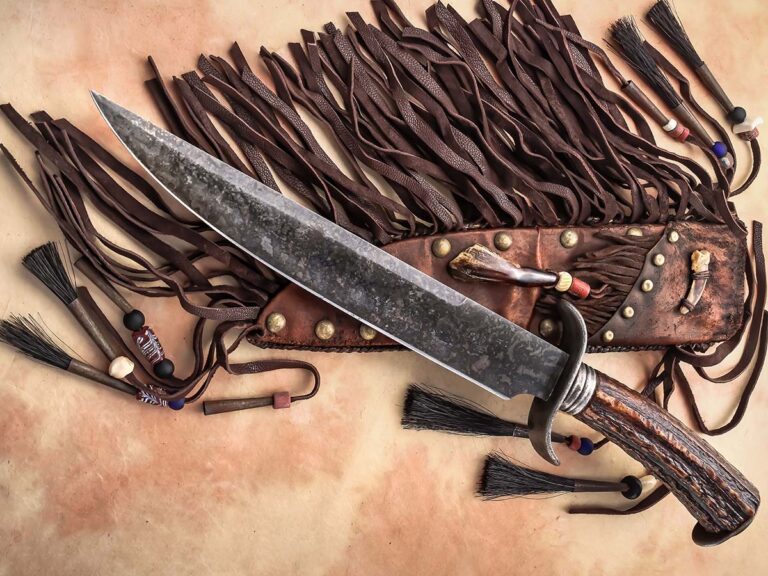
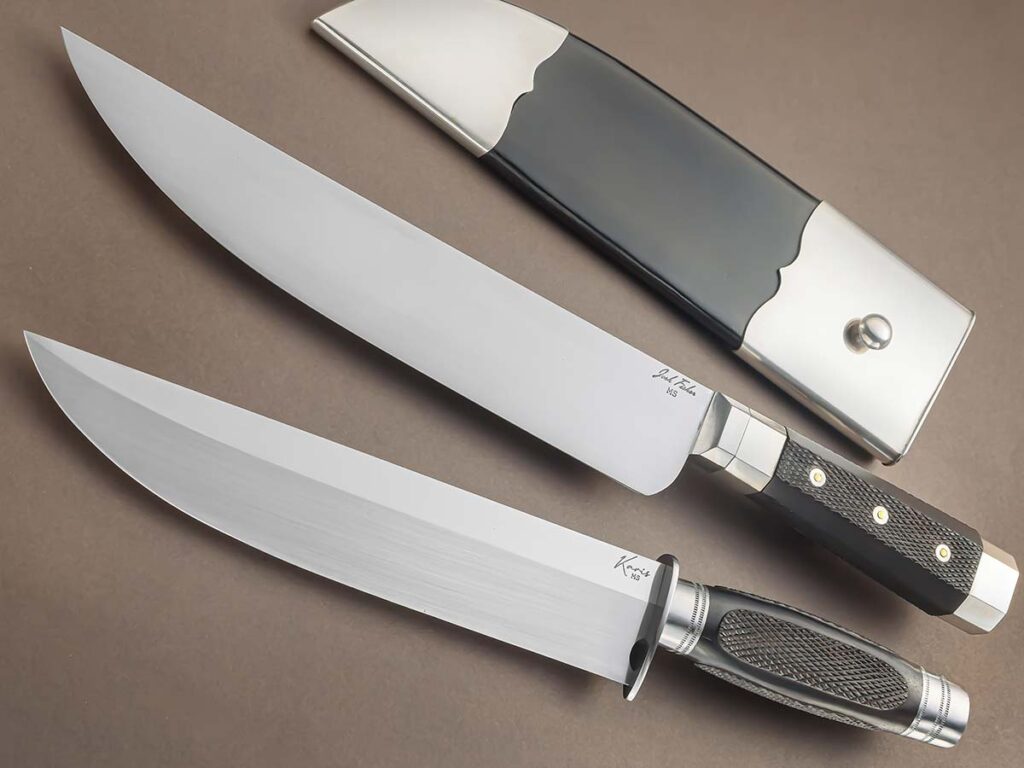
Aiming for historical accuracy circa-1830 style, father-daughter makers Josh and Karis Fisher pull off this dynamic duo. Josh’s bowie (left) was inspired by an original Schively-Perkins piece, while Karis (right) crafted a rendition of the Daniel Searles bowie. (SharpByCoop image)

The father-daughter ABS master smith duo of Josh and Karis Fisher share their own interpretations of the bowie with a pair of stunning knives touching the past. Each took inspiration from circa 1830 bowie designs: Josh the Schively-Perkins and Karis a Daniel Searles.

“I kept my reproduction similar to the original and as close in size as I could, so it would look and feel like the real knife,” Karis said. “I was mostly working from photographs, which made studying overall design really important. I also made a few changes to incorporate my own style. I left off the original silver pins and did hand checkering instead. I also changed the ferrule and butt cap. I didn’t use silver wraps. Instead, I used a combination of liners and spacers to match the original while adding my own style.”

“A few techniques that I used on my bowie were hand-checkered African blackwood on the handle and the silver ferrule and butt cap that I had to silver solder together, which was a challenge. It’s definitely a functional knife,” Josh reported. “While it’s on the larger side, it’s very well balanced due to the silver wraps on the ferrule and pommel.”

Capturing the notion of the bowie’s place in Americana, Josh related that his work in 80CrV2 carbon steel and sterling silver is true to such spirit. “It is a reproduction of an actual antique bowie knife,” he stated. “In my opinion, a bowie is a large fixed-blade knife, at least 10 inches in blade length, that is on the thicker side. I think typically they should have a clip point, but there are some exceptions as you can see in mine and Karis’s bowies.”

Small & Spruce

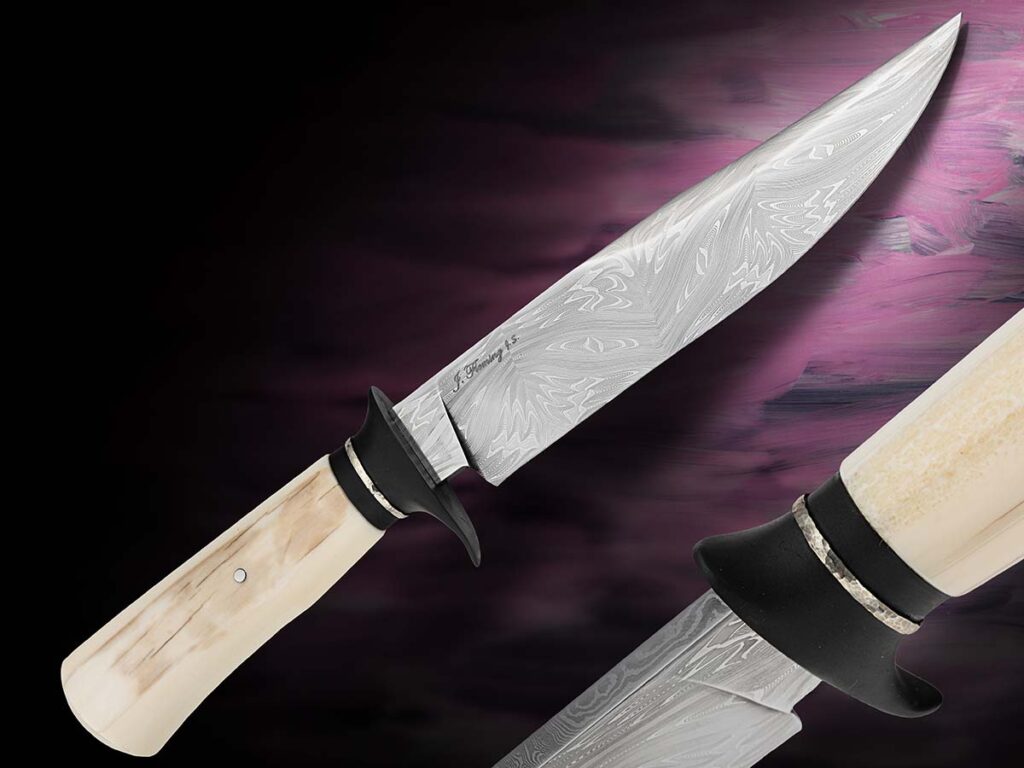
James Fleming’s gentleman’s bowie is diminutive in comparison to others but no less representative of the style. The damascus blade is complemented by an ancient walrus ivory handle with a nickel silver spacer and Parkerized steel bolster. Overall length: 11.5 inches. (Jocelyn Frasier image)

Working at Wasteland Forge, ABS journeyman smith James Fleming has produced a gentleman’s bowie, diminutive in comparison to others but no less representative of the style. The 6.5-inch damascus blade is complemented by an ancient walrus ivory handle with a nickel silver spacer and Parkerized steel bolster for an overall length of 11.5 inches.

“I wanted to make a knife that capitalized on the mosaic damascus pattern,” James explained. “I think the gentleman’s vest bowie complements the pattern. The knife is pretty recognizable as a bowie. It’s not as large as a regular bowie but has the same look and purpose. It fits the term ‘vest bowie’ perfectly. It is small enough to be concealed but large enough for defense in any western saloon. This is the kind of knife you’d see stabbed into a poker table after accusing someone of cheating at cards!”

The damascus pattern came from Fleming’s experimentation with Mareko Maumasi’s pattern-making process. He named it “Nazar,” which translates from the original Turkish as “evil eye.” He added, “I was also inspired by Lin Rhea in the way he makes his fittings. The nickel spacer is domed around the guard and bottom spacer, and it’s hammer textured to give it a nice look and feel in the hand.”

Mammoth Achievement

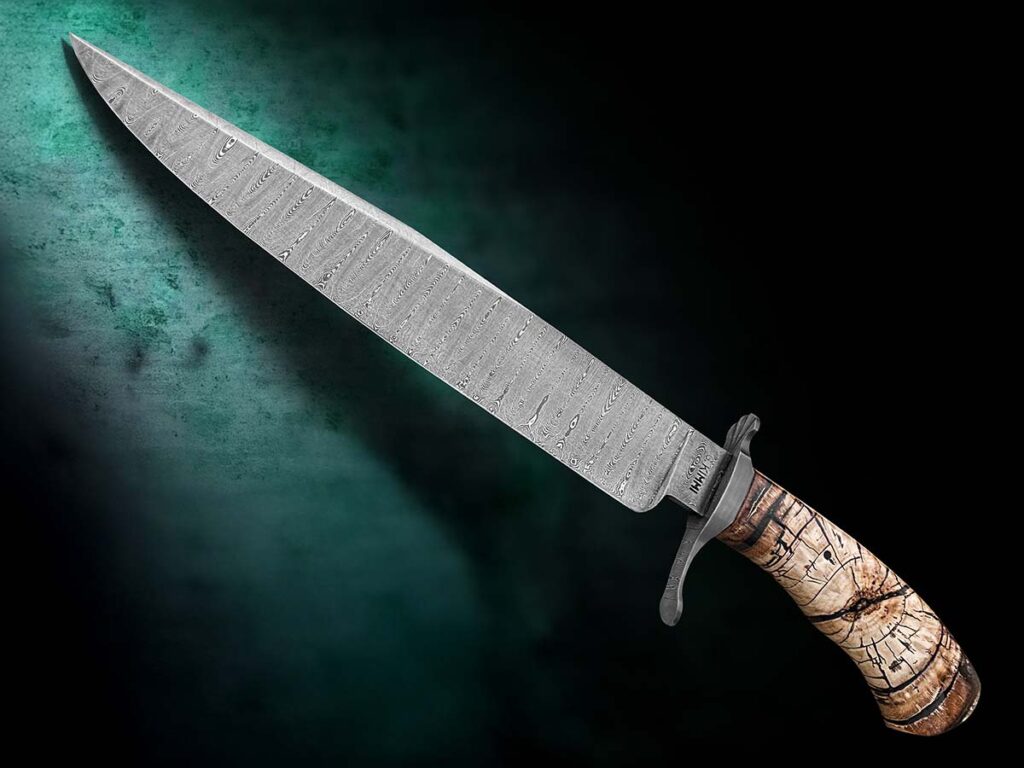
Attracted to larger bowie designs, Gene Kimmi pulls it off with a giant gem. Featuring ladder-pattern damascus—fashioned from dies he made himself—the 15.25-inch behemoth is further bespoke with a crosscut mammoth tusk handle. (Jocelyn Frasier image)

Gene Kimmi was intentional with his contribution to the bowie’s visual discourse. “I have always had a liking for the larger bowie knives,” he remarked. “When I made some laddering dies for my press, I knew one of the first knives I would make out of ladder-pattern damascus would be a large bowie. This one has some clam-shell type filing on the guard that I haven’t done before. The handle is heirloom/museum fit to the guard also.”

Gene’s bowie features the ladder damascus in a 9 7/8-inch blade and crosscut mammoth tusk handle with G-10 black pinning for an overall length of 15.25 inches. “The design is easily recognizable,” he asserted. “Anyone who sees it instantly thinks bowie. The lightness and the fit to the hand are attributes that everyone who handles it comments on. The uniqueness of the mammoth tusk handle adds to the beauty of the damascus. When I think of a bowie knife, I see a straight-backed blade of at least 6 inches. Limits can be pushed on the style and attributes of a bowie, maybe because of the mystery of the bowie knife’s beginning.”

User-Friendly Fighter

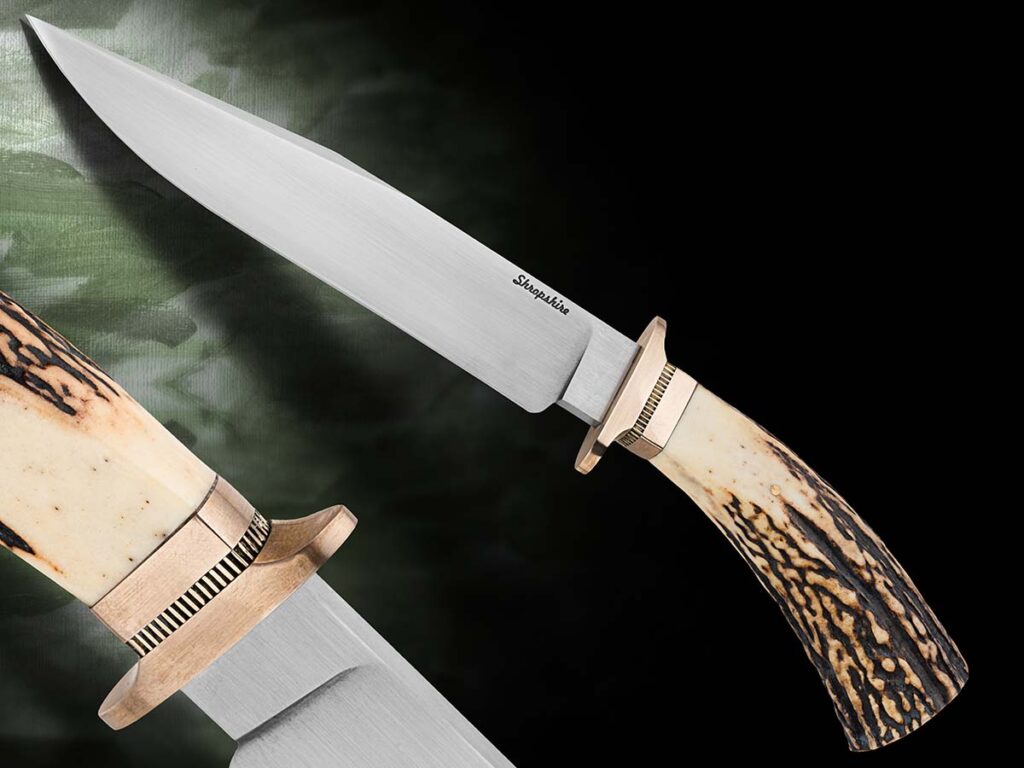
Shawn Shropshire wanted a bowie that not only looked sharp but also worked with the user. What he cooked up was this stag-handled beauty. With a 7.5-inch blade of 1084 carbon steel and a user-friendly bronze guard, the knife is easy to carry and manipulate. (Jocelyn Frasier image)

The famed Randall Model 1 provided some context for Shropshire to fashion his bowie of a 7.5-inch, 1084 carbon steel blade and stag handle with bronze bolster and an overall length of 12 inches. The proprietor of SDS Knifeworks blended the pattern with a desired functionality.

“I love making the larger versions of the bowie knife that many people think of, but as much as I enjoy them, they just aren’t very practical,” he reasoned. “This size and style is much more useful and easier to carry. It’s still a classic-looking pattern and functional without being so large that it is cumbersome and difficult to carry. I love the classic-looking lines paired with the look and feel of natural stag.”

After perusing photos of historical blades and the work of other makers, along with hours using a sketch pad, Shawn was pleased with the result. “In my opinion, this particular blade would have been right at home during the mid-to-late 1800s and at any time considered a bowie knife,” he advised. “I think most people today might refer to it more as a fighter because our notions of what a bowie knife is have been heavily influenced by cinema. The movies usually represent bowie knives as larger than life. Some were but many were not. I do think this blade hints at the history of what an American bowie is with the overall shape and the stag grip without instantly screaming ‘bowie knife.’”

Throughout the creation of his bowie, Shropshire kept user friendliness front and center. Aside from visual appeal, he designed it for easy carry with shorter “legs” on the guard and a coined spacer to help break up the smooth lines it exhibited.

The Legend Continues

The bowie theme lives—in thought, folklore and tangible craftsmanship. Staying true to its American heritage, the style has gained lasting fame and a following the world over.

Read More:

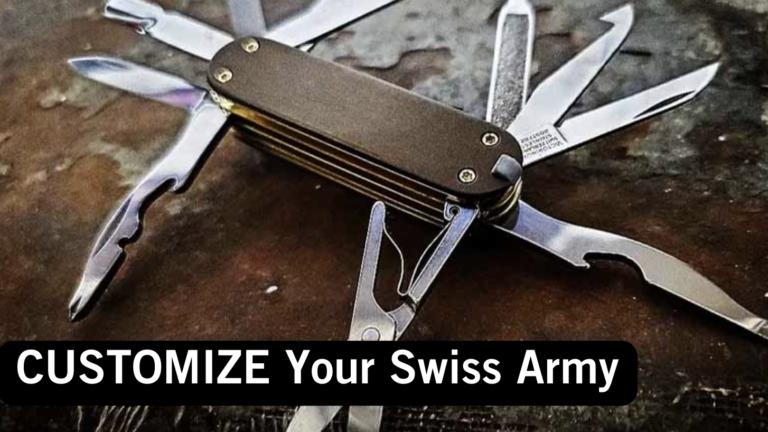
How To Create A Custom Swiss Army Knife

0

An Icon In And Of Itself, You Can Still Customize Your Swiss Army Knife To Make It Your Own.

There are few, if any, knives as instantly recognizable as the famous Swiss Army knife. The multi-tool is beloved around the world for its versatility and quality construction. 

While the famous red color is a global icon, there are far more ways to make the knife look how you want it. Some of these customizations are offered by Victorinox itself while others are more DIY. 

Either way, there is no shortage of ways to create a unique custom Swiss Army knife wholly your own.

Factory Customizations

Victorinox calls them “personalizations” and there are many ways you can find a Swiss Army knife that fits your needs and make it your own.

Different Sizes

The Swiss Army knife comes in a variety of sizes. Small knives weigh less than an ounce while the largest models can come with their own carrying/display case. Different sizes mean different types of blades and tools so you can pick the knife perfect for you.

Scales

Another excellent option from Victorinox is the ability to change the scales on many of their knives. Yes, every option defaults to the famous red but you can choose from many other colors and designs. You can choose camouflage, flags, and even transparent scales among a whole variety of solid and textured colors.

You also have the option of custom engravings on the scales to personalize them for yourself or a friend.

Specific Tool

While no two Swiss Army knife models are exactly alike in terms their tools, it’s possible to go a step further and order custom implements. For instance, Victorinox filled an industrial-sized order in Europe for a batch of knives featuring a toilet-paper holder key.

True enough, this isn’t something you’d need on a single knife for yourself. But, having the option for custom bulk purchases set the knife apart.

Knifemaker Customizations

There are makers today that make custom Swiss Army knives. Some stick to the aesthetic and make scales from exotic materials or designs. Others turn the knife on its head and make their own tools for the knife. Regardless, there are brilliant craftsmen creating one-of-a-kind Swiss Army knives around the world.

Chris Custom Works

Black Cerakote Grooved Soldier. Price $202.37

Based in Germany, Chris Custom Works specializes in detailed custom Swiss Army knives to order. From a handmade set of scales from wood or other materials to a fully modified suite of tools, the sky is the limit. As you can see above, the company’s Black Cerakote Grooved Soldier, not only are the scales one of a kind but the tools are finished with black Cerakote to match the micarta handle.

Andrzej Woronowski

Woro Knight: $221.95

Woronowski is based in Gdansk, Poland and makes beautiful custom scales for Swiss Army knives. His designs aren’t as loud and eye-popping as some other makers, but his craftsmanship is remarkable. With the help of his brother Kamil, Woronowski works with metals such as titanium, brass, and copper to create custom SAK models that are elegant and stand out. 

Sean Dooley

74mm Spydernox Clipitool Saw Executive.

Through his Sak Custom 58mm brand, Dooley has thumbed his nose at the traditional Victorinox designs and created magical works in their place. For starters, he removes the famous spear point blade from many of his builds and replaces it one-to-one with a blade from Spyderco.

This “Spydernox” hybrid, and Dooley’s creativity, are on full display with the knife above. The Spyderco blade and neon yellow G10 liners, the whole construction could convincingly seem like a completely different model, not a custom Swiss Army knife. It’s truly remarkable what Dooley has been creating from his shop in Connecticut.

Read More

Inside The Shop Of RJ Martin

0

Known For His High-Quality Custom Knives, RJ Martin Has Earned A Spot As One Of America’s Most Creative Knifemakers. 

Between his exquisite custom knives and numerous collaborations with factory cutlery companies, RJ Martin has become a legacy name in the knife industry. As a teenager he was inspired by a Sports Afield article on knifemaker Bob Dozier and decided to try his hand at knifemaking, which he did with very satisfactory results. The seed was planted for what would become a lifelong passion of working with steel, the results of which are his incredible knives today.

To get there he studied at Rensselaer Polytechnic Institute in Troy, New York, graduating in 1984 with a degree in materials engineering. From there he spent 17 years working in the aircraft industry designing parts and mechanisms for hi-tech helicopters. This exposed him to a wide range of materials including carbon fiber and titanium and, just as important, CNC (Computer Numerical Control) machining. You couldn’t ask for a better prelude to becoming a custom knifemaker.

When Martin retired in 2001, he rediscovered his love for knifemaking and set up shop. At the time the modern tactical knife era was in full swing, so RJ jumped on board and hasn’t gotten off the train since. His tactical folders are his mainstay and if you look at his body of work, his designs flow like a river.

RJ Martin’s Most Important Tools

One half of Martin’s favorite, and most important sets of tools: his hands.

RJ came right out of the chute with a surprise when tendering his most important shop tool. 

“My two favorite tools, bar none, are my own hands,” he begins. “Without them, I could not use any hand or machine tools. More importantly, I’d miss out on the incredible satisfaction working with my hands brings me. It’s important to take good care of your hands and eyes, and your lungs, because knifemaking will take its toll over time. I have had multiple hand and finger surgeries over the years to correct wear and tear—and a couple of my digits have suffered substantial injuries from knifemaking—so they’ve got character! Knifemaking is a contact sport and, banged up as they are, I wouldn’t trade them for anything. Lynyrd Skynyrd had it exactly right in their song Red White & Blue when they sang, ‘If you want to know where I’ve been, just look at my hands.’

“My favorite grinder is my Burr King BBA20, 2×72-inch belt model. It’s super smooth, runs incredibly true, and the 20-inch-diameter 60 durometer wheel lets me grind my bevels high while keeping my blades very strong. I re-grind almost all my blades after heat treating using this machine. The slow speed range is critical for steels like CPM S110V, S125V and MagnaCut, as they must be ground slowly with coolant and light pressure after the heat treat because they are so incredibly wear resistant. I got the adjustable-height pedestal stand because I’m tall, plus the super fancy ergonomic work rest option because it’s just too cool. This machine is also very quiet!”

The Tools RJ Martin Uses

RJ’s Sears 6×48-inch belt sander and the stand it’s sitting on belonged to his father, Richard, “who was a gifted artist, a great parent and—most of all—a decent and caring man. He never made a knife in his life but he encouraged me to make them.”

“And then there’s Sophia, my alter-ego and companion,” RJ continues. “Sophia is an Ares Seiki R5030, three-axis CNC mill built in 2021, and she’s, well, a badass! With 14 tools in her carousel and a 20,000 RPM dual-contact spindle running high-precision Big Kaiser 30-taper toolholders, she is my girl with a short skirt and a long jacket! With properly designed tooling, good [numerical control] programs and quality carbide tools, her precision is incredible. I named her Sophia because her name literally means ‘Wisdom,’ and she is indeed wise! I gave her some awesome LED lights made by OC White to illuminate her beautiful work, and I keep her super clean. She is, after all, a woman of class and distinction! Sophia wears my mom’s American flag, which I pass by every morning when I enter my shop.

“Finally, my Sears 6×48-inch belt sander and the stand it’s sitting on belonged to my father, Richard, who was a gifted artist, a great parent and—most of all—a decent and caring man. He never made a knife in his life but he encouraged me to make them.

“Those hands I wrote about earlier? They came from my father. Of this, I am certain. He passed before I really hit my stride as a knifemaker and I miss him dearly,” RJ notes. “So, I keep this machine in my row of grinders to remind me every day where I came from and how grateful I am to be able to work hard at a job that I love and am successful at.”

Read More

Spectacles In Steel: A Look At Definitive Damascus Patterns

Modern makers’ takes on this age-old steel art.

When BLADE Magazine Cutlery Hall-Of-Fame® member Bill Moran reintroduced knives with damascus blades at the 1973 Knifemakers’ Guild Show, little did he know how much damascus would evolve, redefine itself, expand into new media, and no telling what other recreations and rebirthings it has experienced in the half-century since that fateful weekend in the Muehlebach Hotel in downtown Kansas City.

On this page are some of today’s reincarnations of the material in its various forms, methods, materials and more. What’s staggering to consider is there are so many more variations—not only now but also to come. It is a phenomenon that is truly unique to the custom knife industry and should be celebrated and promoted whenever possible.

David Lisch Templars Mosaic

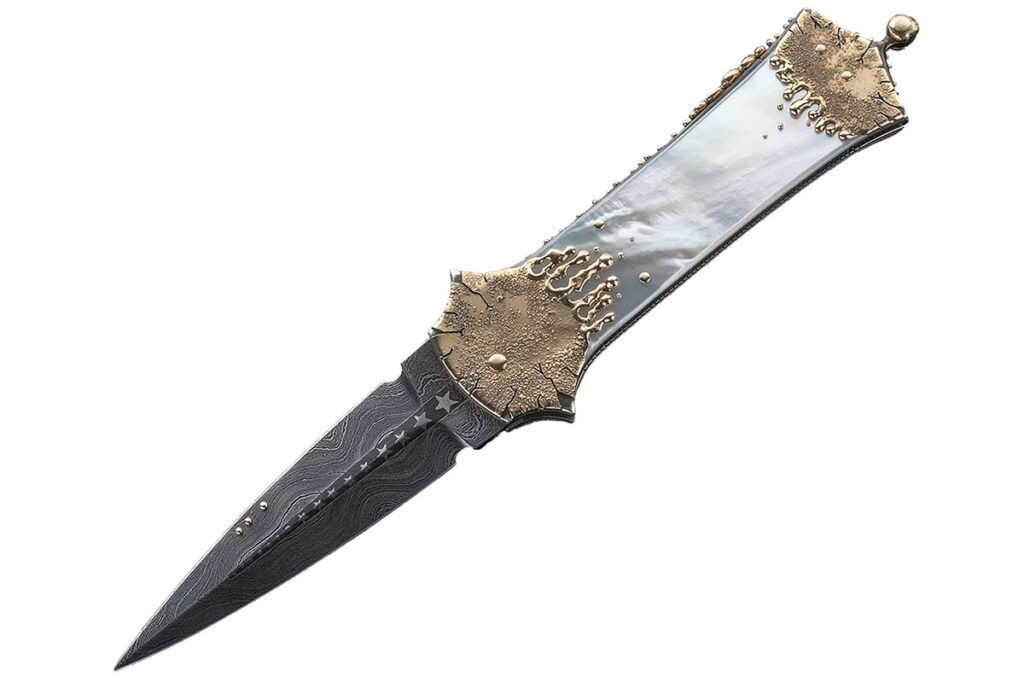
David Lisch’s dagger
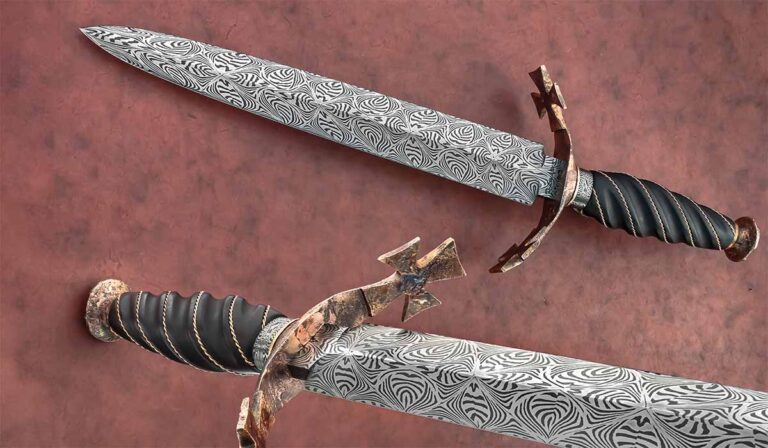
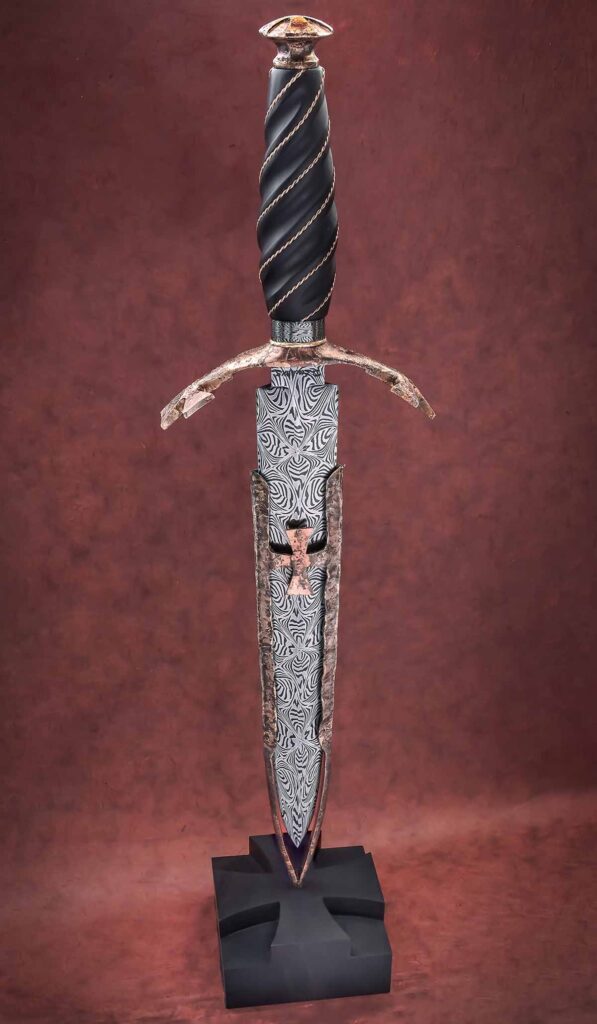
David Lisch’s spectacular art dagger features a 12-inch blade of his Templars Mosaic Damascus, a blackwood handle with gold wire wrap and a guard of pure iron covered in melted gold. Overall length: 17.75 inches. The knife comes with a stand that includes an embellished templars’ cross and one carved in the base as well. (SharpByCoop knife images)

Sporting a pattern ABS master smith David Lisch christened Templars Mosaic, the blade for his dagger is one he forged from 15N20 nickel-alloy and 1080 carbon steels and etched in ferric chloride.

“I was aiming for a bold, bright pattern that had a cross-like shape but wanted it to be a bit organic,” he wrote. The Templars’ cross also is represented on the guard and the finial, and there is one on the stand that holds the knife as well. “All these parts are pure iron covered in melted gold,” he noted. The dagger also has a domed gold spacer between the guard and Dragon Thunder damascus spacer that the fluted-blackwood-with-gold-wire-inlay handle butts up against.

“I made this dagger out of the love I have for creating art with no concern about how long it took or how much money I would make from it,” David stressed. “I did the handle twice and I did the big finial twice. I sold the piece for $10,000 and will not be making another one like this. You can be sure that the love I have for creating will take me to a new dagger, sword or bowie knife that tries to fill the void in me that can only be filled by creating art.”

Jeremy Yelle Jellyroll Mosaic Turkish Twist

jellyroll mosaic Turkish twist pattern damascus
The steels for the jellyroll mosaic Turkish twist pattern damascus of the collaborative bowie by Jeremy Yelle (right) and Alex Houle (left) is forged from 1080 carbon and 15N20 nickel-alloy steels. Blade and overall lengths: 10.25 and 15.5 inches. Their list price for a similar knife: $2,600. (Jocelyn Frasier knife image edit)

The blade damascus of ABS journeyman smith Jeremy Yelle’s and SBK Cutlery’s stag bowie is a positively electric jellyroll mosaic Turkish twist pattern Jeremy forged in a collaboration with his friend Alex Houle of SBK. Alex forged the collaborative damascus into a blade and Jeremy made the handle.

“We began by welding a billet of alternate layers,” Jeremy wrote of the forging process. The pair drew the billet into a bar and jelly rolled it. “Then we squared it up and welded a four-way incorporating some 1-inch-square 1080,” he continued. They welded the billet, drew it out to ¾-inch square, cut and twisted it, and made a Turkish-twist stack that Alex forged into a blade. “You can also see the ‘fish mouth*’ weld Alex did so the edge bar and the spine meet properly,” Jeremy wrote. “He did a wonderful job making the blade.” Jeremy showed Alex how to work with stag and they finished the parts. Alex revealed the beautiful pattern via a two-step etching process using a solution of ferric chloride and finishing the etch with a coffee-darkening soak and hot wax finish.

Zane Dvorak Multi-Bar

multi-bar damascus
The 4.25-inch blade of Zane Dvorak’s hunter is a multi-bar damascus of 1084 carbon and 15N20 nickel-alloy steels. Overall length: 9.25 inches. His price for a similar knife: $2,400. (SharpByCoop image)

The blade of Zane Dvorak’s hunter is a multi-bar damascus of 1084 carbon and 15N20 nickel-alloy steels. Zane forged the blade/tang of four twisted bars of a twisted-bar pattern, and forged welded the guards and bolsters on with the same pattern. He bird’s mouthed the blade tip and rewelded it back together to create flowing outer bars. For etchant he used Gator Piss Acid from Baker Forge & Tool.

Bird’s mouthing is a process done on multi-bar, mosaic or other types of damascus patterns. According to Zane, it involves cutting a triangle out of the end of the rectangular parent bar—the shape of which somewhat resembles a bird’s mouth—then bringing the steel of the edge and spine back together to form the point of the blade. By doing so the blade exhibits a better consistency and overall flow of the pattern.

Andrew Blomfield Alternate Pattern

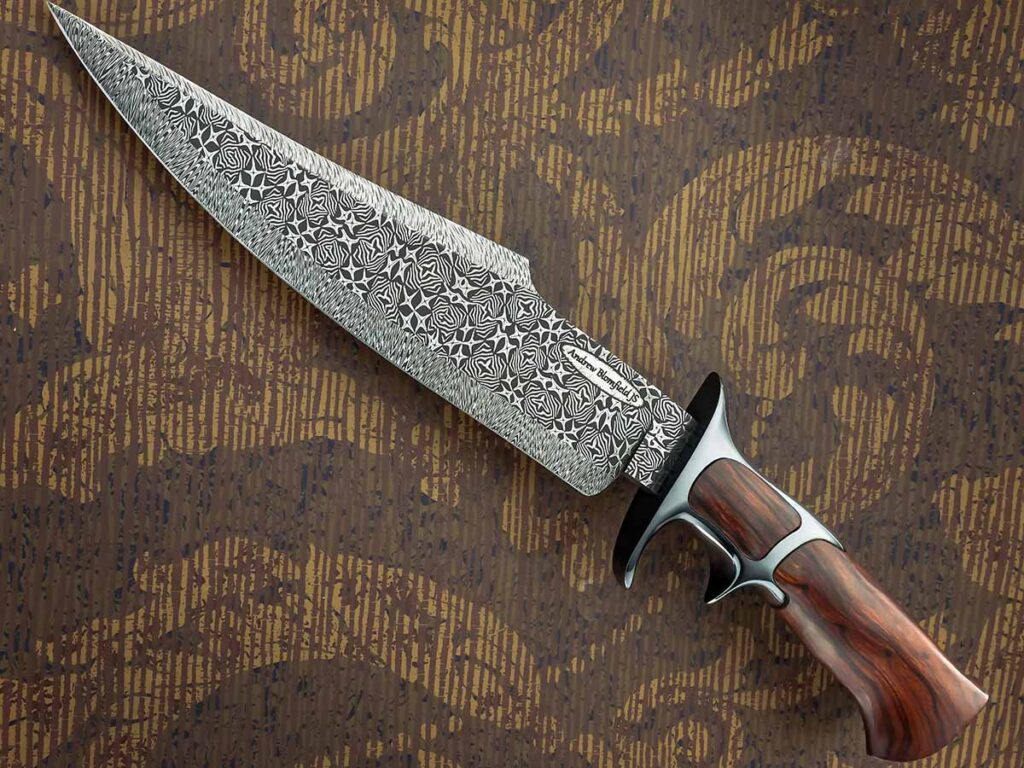
mosaic damascus Andrew Blomfield’s sub-hilt fighter
The mosaic damascus for Andrew Blomfield’s sub-hilt fighter is a combo of two separate billets welded in an alternate pattern. Blade and overall lengths: 9.5 and 14.5 inches. Blade grind: flat. Andrew’s price for a similar knife: $3,000. (SharpByCoop image)

The material mid-blade of Andrew Blomfield’s sub-hilt fighter is a combination of two separate billets of mosaic damascus welded in an alternate pattern. The edge is a straight feather pattern forge welded around the edge. The blade is a combination of pieces from three separate billets. The steels are 1084 carbon and 15N20 nickel alloy etched with ferric chloride.

The integral sub-hilt is 1020 low-carbon steel hot salt blued to a deep black finish. The handle is desert ironwood. The knife is of a full takedown construction.

Frank Edwards Palm Leaf Mosaic Pattern

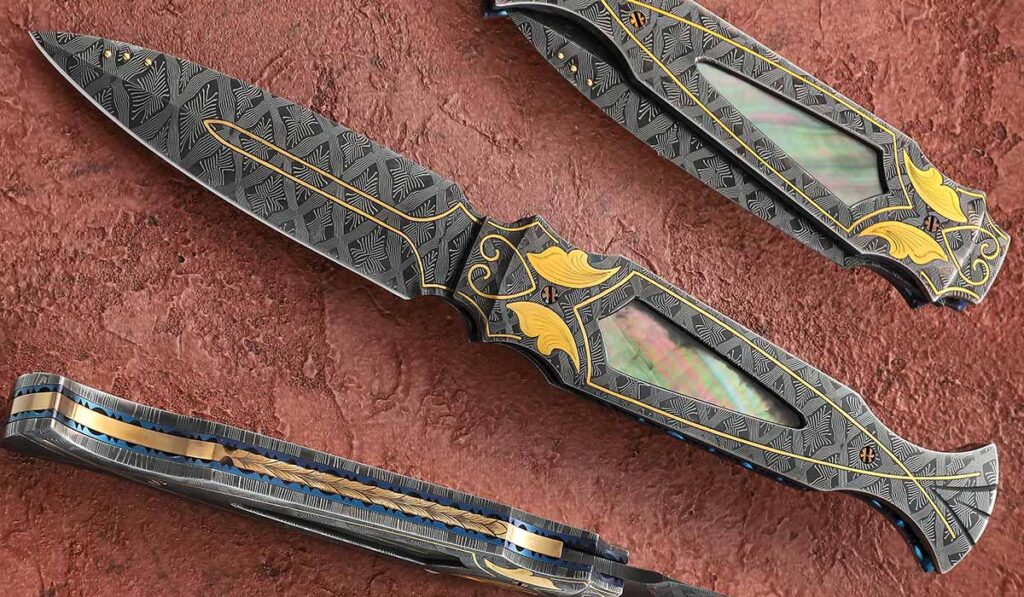
 Palm Leaf mosaic damascus by Frank Edwards i
The Palm Leaf mosaic damascus by Frank Edwards is an interweaving river system of straight lines. The handle inlay is black-lip mother-of-pearl. Blade and closed lengths: 3 and 4.25 inches. His price for a similar knife: $1,900. (SharpByCoop knife image)

The multi-bar damascus of Frank Edwards’s folding dagger blade is in a Palm Leaf mosaic pattern. Starting with a billet of straight lines, he reduced it all into a square and then biased the squares, four-waying the billet into a 1.5-inch square.

As Frank explained his recipe, “Forge weld another billet of straight lines, keeping them straight as possible to .5 inch by 1.5 inches. Add that to the previous billet and forge weld and reduce to a 1×1-inch square. Then four-way it again. This will give you the frame around the palm leaves. Keep repeating that until you achieve the size of pattern for the knife you’re building.

“The key to getting good mosaics is a slower reduction [of the steel]. We have presses and power hammers that help but they can move too much metal too fast, which will destroy a mosaic in a hurry. The slower reduction allows the billet to stay uniform throughout the length of the bar.” 
To expose the pattern he etched the blade with a four-to-one mixture of water/ferric chloride in 10-minute cycles, using 2,000-grit sandpaper between cycles.

Jackson Rumble Stunning Pattern

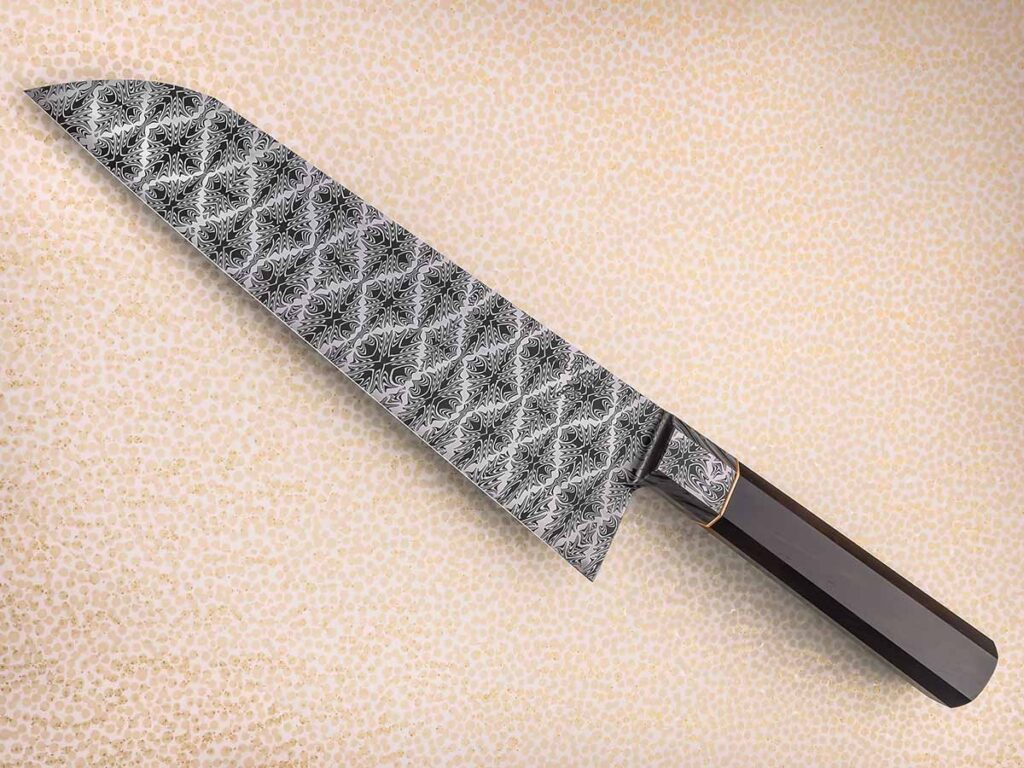
unnamed damascus pattern
The 8-inch blade of an integral chef’s knife by Jackson Rumble boasts a mesmerizing and at press time unnamed damascus pattern forged from 1084 carbon and 15N20 nickel-alloy steels. The handle is African blackwood. Overall length: 13 inches. The maker’s price for a similar knife would start at $2,500. (SharpByCoop knife image)

The technique for the stunning pattern on newly named ABS master smith Jackson Rumble’s chef’s knife is what he calls a “pretty standard process” of four-way welding and re-square cycles. Not bad for “pretty standard,” eh (page 28, top left)? The initial stack has large sections of both light and dark steels interspersed through the alternating layers, and Jackson added extra-light steel to the billet in the later stages of the forging process.

“Finally, I used the Filicietti Flip method to transfer the pattern to the face of the billet,” he wrote. “For the etching process I used ferric chloride followed by coffee.”
OK, Jackson, so what’s the “Filicietti Flip method”?

“I’ve heard the Filicietti Flip called other names like the Ferry Flip, or just tile welding,” he explained. “Basically, after you’ve finished building the pattern in the end grain of the billet, you take it to a bandsaw and cut slices off the end at a 35-degree angle. This makes a bunch of pieces in the shape of parallelograms or tiles. The tiles can then be rotated and forge welded back together to form a new billet. Instead of having the pattern showing on the end of the billet, the pattern will repeat itself along the face of the billet.”

We’re glad we asked.

*Also called fish lips, fish mouth is when the tip of the billet begins to curl up on either side during rough forging to resemble a fish’s mouth or lips, thus the name. It is an easy fix for knowledgeable bladesmiths such as Alex Houle.

Check Out More Cool Custom Knives:

Damascus Steels: What To Use And When

2

Bladesmiths outline which carbon steel combos they use and why.

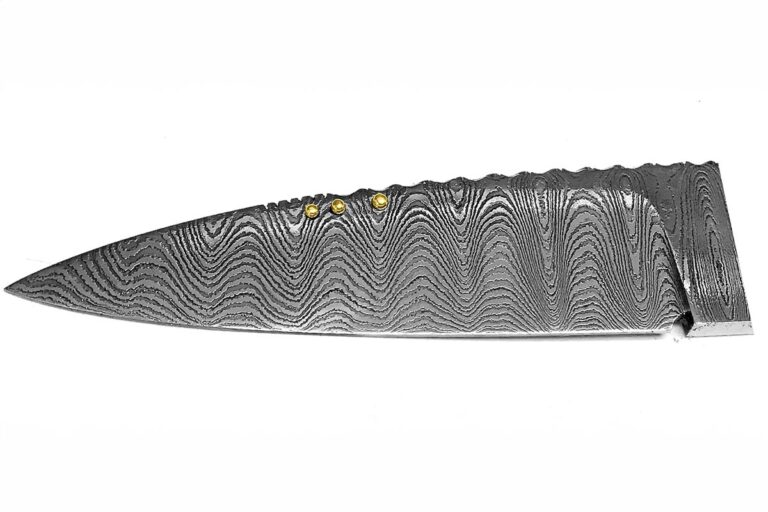
Damascus steel is a broad category with nearly infinite variations. It includes everything from low-layer random patterns to powdered canister creations and complex mosaic patterns.

The basics of damascus include forge-welded combinations of steels. Changes in the steel choices, in the welding or forging processes, and even in the etching method result in a wide variety of patterns and looks. Let’s dive into the many levels of damascus through the work of a few excellent smiths.

Smiths Takes On Damascus Steels

ABS apprentice smith Chris McPherson began making knives only four years ago, but he had a strong start attending classes taught by ABS master smiths Jason Knight and Josh Fisher. Now he forges his own damascus. One of his fighters (IMAGE 1) features a blade of 1075 carbon and 15N20 nickel-alloy steels.

ABS journeyman smith Brian Sellers used three steels instead of the standard two to help provide a darker look for his blade of ladder pattern damascus. As he observed, “Adding a third steel to damascus gives a unique depth to the finished blade, kind of like adding shades of gray to a tattoo.” (Jocelyn Frasier image)
Image 2 ABS journeyman smith Brian Sellers used three steels instead of the standard two to help provide a darker look for his blade of ladder pattern damascus. As he observed, “Adding a third steel to damascus gives a unique depth to the finished blade, kind of like adding shades of gray to a tattoo.” (Jocelyn Frasier image)

“I made the knife for a local state trooper benefit, for the teenage son of an officer who lost his life in the line of duty in March 2023,” Chris explained.  When asked about why he chose 1075 for his fighter, he said he “just wanted to try it out” after making other billets with 1095, 1084 and 1080 carbon steels. Though he’d heard that the 1075 may have a bit less contrast due to its lower manganese levels, it came out with beautiful contrast after a deeper etch.

Knifemaker Brian Sellers likes to mix things up a bit. In addition to the standard carbon steels of 1095 or 1084, Sellers occasionally includes 1080, 5160 or 52100.  “Adding a third steel to damascus gives a unique depth to the finished blade, kind of like adding shades of gray to a tattoo,” he says. For example, in a recent Persian fighter (IMAGE 2), Sellers included 1080 and 5160 along with 15N20 in a ladder pattern blade. Brian indicated all the steels work well with his equipment. He uses a 50-ton Riverside hydraulic press and a 50-pound Little Giant power hammer.  

Damascus is time and labor intensive, and the maker loses a good bit of the steel in the forging process. Bladesmith Blake Nichols knows this and is from the “waste not, want not” school of thought. 

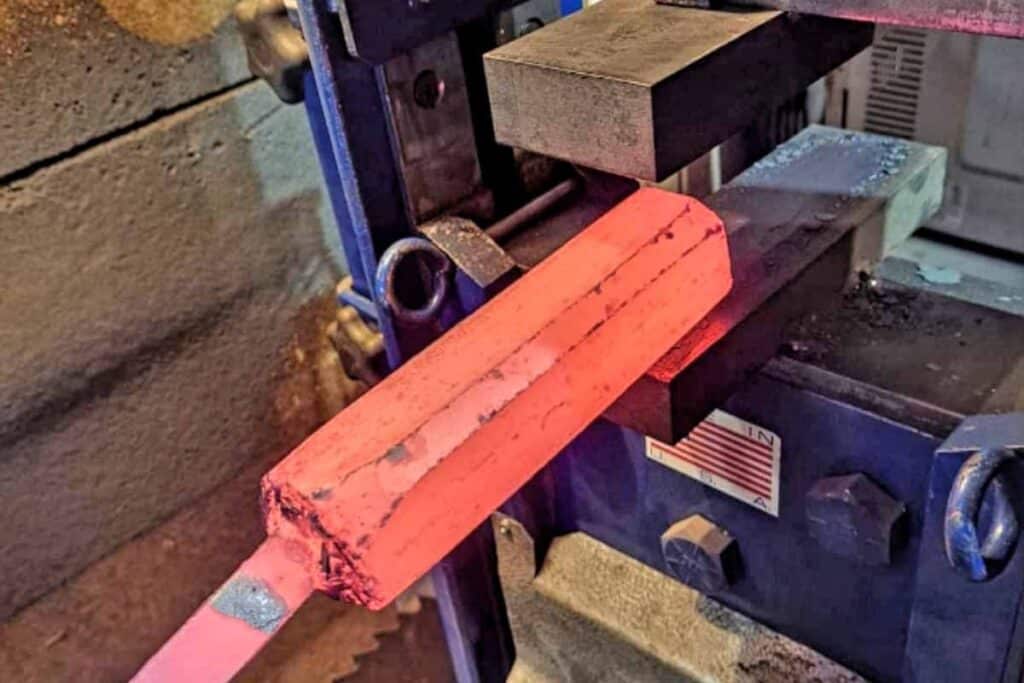
Robert Wayman uses a hydraulic press to weld and draw out his damascus billet.

“My mentor Greg Shahan gave me the end cut of a feather damascus billet a few years ago,” Nichols said. “It sat on my shelf for a long time before I incorporated it into [one of my] hunters.” 

Regarding his damascus, he added, “I wish I had a profound scientific answer as to why I use 15N20 and 1095 but I do not. The simple answer is it’s what I learned on. I’m comfortable with the heat-treating process. I also feel like I get the performance out of that combination that I desire.” I agree with Nichols when he said, “No matter what it’s made of, it has to function like a knife.  Even the fancy ones need to hold up to the performance standards.”

Why 15N20 In Damascus?

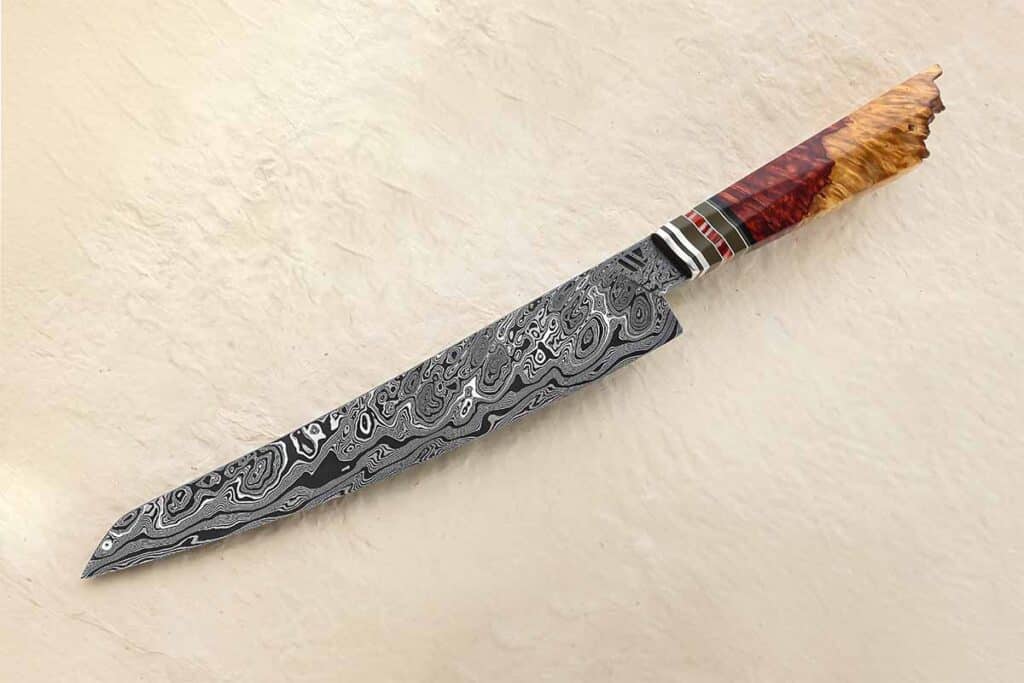
For a great example of a go-mai (five layer) damascus blade with the visual “pop” of nickel, Robert Wayman provides the fireworks via his sujihiki.  Damascus outer layers and a damascus core work together with the handle of live edge amboyna burl to make a stunning knife. Overall length: 16 inches. (SharpByCoop image)
Image 3 For a great example of a go-mai (five layer) damascus blade with the visual “pop” of nickel, Robert Wayman provides the fireworks via his sujihiki.  Damascus outer layers and a damascus core work together with the handle of live edge amboyna burl to make a stunning knife. Overall length: 16 inches. (SharpByCoop image)

You may have noticed one thing the featured bladesmiths all have in common: they include 15N20 in their damascus billets. The 15N20 is a simple carbon steel, basically 1075, but has a relatively large amount of a special ingredient: nickel. The nickel content makes 15N20 etch more slowly and show more brightly when polished. Because of the similar composition to the 10-series steels (1080, 1084, etc.), it welds well and hardens in similar temperatures, making it the perfect steel for high contrast in the damascus pattern.

Some smiths use pure nickel foil or sheet in their damascus for the same effect. The challenge is that the pure nickel won’t harden, so it must be kept away from the edge in the forging process. The contrast is great but the nickel itself won’t hold an edge. I like a nickel layer in between layers of san-mai or go-mai damascus. It really pops!

Bladesmith Robert Wayman illustrates the go-mai technique well on one of his kitchen knives (IMAGE 3). The blade was made from a patterned go-mai billet. There’s a core layer running down the center of the blade with two layers of material on each side. The core is 100-layer random pattern damascus forged from 1084 and 15N20. On each side of the core steel is a layer of nickel and on the outside of the billet is a layer of matching random pattern damascus. 

Key Element Comparisons by Steel

Steel10841075109515N201080516052100
C.865.7501.000.750.75-.88.60.98-1.10
Mn.750.550.450.375.06-.09.80.24-.45
N.2001.950
*C-carbon, Mn-manganese, N-nickel; the double hyphens indicate trace amounts. Note the relatively high amounts of nickel of the 15N20 and of manganese of the 1084, two elements beneficial for high contrast damascus. This chart is for the elements pertinent to the subject at hand only and does not list all the elements of each steel.

Once the final billet is forge welded, some of the cladding material is removed with a grinder to create a visual effect in the pattern, and then the billet is drawn out to length. Keeping the core material centered during the process is very important. “You want to take your time when laying out your billet,” Wayman advised. “I typically use a thicker core material and a thinner cladding material, but it’s definitely taken some time and practice to dial it in.”

Other Damascus Steels

Before 15N20 and 10-series combos became prevalent for damascus, one of the standard high-contrast combinations was O1 and L6 tool steels. While the latter combo makes great damascus, the two steels are harder to find in today’s market. Simply put, properly sized and affordable 15N20 and 10-series steels are much more available than all the other combos on the market. 

Damascus can be made of many things, including other damascus. These component bars became part of Robert Wayman’s chef’s knife.

Copper is another material that has caught on in the forging of copper-mai and other forms of copper damascus. Outfits like Baker Forge specialize in the process in which the copper is often clad over a standard carbon steel damascus core, as the copper itself won’t harden. 

Titanium alloys have been pattern welded, often called Timascus™, and can be anodized in an array of wild colors. Unfortunately, it’s difficult to produce and doesn’t harden, so Timascus blades are probably not in your future. Instead, Timascus makes a great folder frame, bolsters and other non-blade knife parts.

What Metals To Avoid

Are there any materials that don’t make a great contrasting damascus? Sellers reports that the “S” series high silicon steels like S5 and S7 don’t work. He speculated that it was either the steel composition or improper heat control, but welds of S5 and S7 don’t stick during forging.

Robert Wayman welded these five pieces of steel together to make the go-mai damascus blade of his chef’s knife.

I can attest that meteorite is a tempting addition to damascus because various samples are often high in nickel and mostly made of iron. Unfortunately, every meteorite varies widely in terms of content, so that individual pieces of the same meteorite each may have a very different chemical composition. As another confounding factor, many meteorites contain high silicon or other elements besides iron, carbon and nickel. Each new element adds its own problems to the process.

I was able to produce a satisfactory pair of billets containing some meteorite by putting small chunks in a canister with 1084 powder, and then welding and re-stacking the billet with more 1084 bar stock until the final layer count was over 1,000. By adding only 1084, I was assured that any bright spots in the final pattern were from the nickel in the meteorite. Even with this process, there were a few inclusions/flaws in the final product. Could I have continued to push the layer count and minimized the flaws further? We’ll never know.
  
Some may think AEBL stainless steel is nice and shiny. Can it or another stainless steel be put in the mix with carbon steel? If you think that “shiny” makes sense for high contrast, that part is true. Unfortunately, the high chromium in stainless steels causes problems for damascus makers in two ways. First, chromium steels don’t like to weld together. The chromium oxidizes quickly and prevents the welds from sticking. Second, the chromium changes the hardening properties. In a hypothetical AEBL and 1084 billet, the AEBL hardens from 1,900°F while the 1084 hardens from 1,500°F. If you quench the hypothetical billet from 1,900°F, the 1084 will have huge, brittle grain. If you quench the same billet from 1,500°F, the AEBL won’t harden.  

For the blade of his fancy hunter, Blake Nichols employs a damascus of 1095 carbon and 15N20 nickel alloy steels forged by Greg Shahan. Blake said he is comfortable with the heat-treating process and also feels like he gets the performance he wants from the combination of the two component steels. Overall length: 10 inches. The scrimshaw is by Charles W. Conner III. (SharpByCoop image)

While there are smiths who have figured out how to weld multiple types of stainless steel together in contrasting patterns, the process requires careful and precise heating and mitigation of oxygen, both procedures which are often beyond the scope of the backyard smith. Because of the complex process required to make it, stainless damascus commands premium prices.

Final Cut

Modern damascus retains strong demand in the knife market. By combining a choice of several standard carbon steels and 15N20, smiths can create damascus patterns that will make any knife stand out. Whether the pattern is random or ladder, raindrop or mosaic and more, a high-quality damascus knife is sure to be a winner. 

More On Damascus:

Hunting Knives: What Makes The Perfect Blade Geometry?

0

From razor-thin slicers to heavy-duty choppers, here’s how edge geometry and grind thickness impact real hunting performance—and what makes the perfect hunting knife.

Whether it’s a secret lure, special scent, backwoods honey hole, a custom-tuned call, or even camo boxers or lucky socks, all hunters have some kind of secret weapon, superstition or technique that they believe will give them an edge over their quarry. But when it comes to the actual edge—the blade of your knife—are you that particular? Are you that picky, that much caught up in hype or that much committed to tradition? Let’s explore the “hunter’s edge” as we consider what kind of grind and edge geometry makes a so-called perfect hunting knife.

Hunting is a game of tradeoffs. If you hunt the field, you can’t hunt the hill. You may be stuck at work on the nice weather days and sitting in the trees in the rain on Saturday. You may sit one time and kill a record buck, or you may sit all season and not see a single “shooter.” There’s seldom a way you can have it all at the same time.

Sojourn by Alex Harrison of Night Watch Knives features a blade of CPM 154 stainless in a blackened War Wash finish. The handle is textured, blasted G-10 with black liners and hollow pins. Guard: nickel. Construction: tapered tang. Overall length: 8 inches. Blade grind: hollow. Edge thickness: .010 inch. Alex said the ligature notch is meant to be a safe way to conduct an aggressive gross motor skills reverse cut and sever a ligature under tension. His price for a similar knife: $500.

The hunter’s knife is no different. In general, “small game, small knife, large game, large knife” holds true, but what characteristics make it so? A big knife can be an advantage or a small knife can be sufficient, depending on whether you’re hunting whitetails in Saskatchewan or Texas. Do you want to use the same knife for wild pigs and moose?

Hunters want a knife that will stay with them through thick and thin. But should the knife’s edge be thick or thin? I have hunted and harvested game since I was a boy, but it was not until I was nearly 40 that I put a caliper to a knife edge. A knife just was, an omnipresent tool taken for granted. Some worked better than others, though I had never thought about why it was that way. Let’s talk a little about edge thickness and numbers.

Optimal Hunting Knife Edge

An experienced hunter may want a knife to chop trails and trim brush, do camp chores or fire-building tasks, or split a deer’s pelvis or sternum. Those tasks lend themselves to a larger, heavier knife with a thicker edge. The heavy-use knife may be 10 or 11 inches overall of 3/16-inch-thick steel and maybe forty thousandths (.040) of an inch or more behind the edge.

A 4-inch blade of 8670 carbon steel in a stonewashed finish and a maple burl handle help complete the Wagu Cattleman by Guild probationary member Chip Carlisle of Skjeggmenn Knives. Handle: maple burl. Overall length: 9.5 inches. Blade grind: full-height flat. Edge thickness: .020 inch. His price for a similar knife: $400.

The grind is more likely to be full flat with a convex edge, or even full convex. The tradeoff is no matter how sharp such a knife gets, it won’t excel at fine work like making the initial cuts through fur or opening the abdomen. It’s not impossible to field dress a deer with a thick-edged knife, it’s just a bit more difficult.

Another hunter of equal skill may carry his knife on his belt or in her pack, only taking it out for the finer tasks of skinning, quartering and deboning. Such a knife could be as little as 3/32 inch thick and as short as 7.5 inches overall. The grind could be full flat or hollow, and somewhere in the 15-to-20 thousandths (.015-to-.020)-of-an-inch-thick-range, or even thinner.

If you use a caliper, you’ll need one that measures down to the thousandths-of-an-inch level.

On a small knife, you may not have the handle or blade length to give you the leverage you want to easily split the sternum on an elk. No matter how sharp the small knife is, it won’t excel at chopping or tasks that require leverage. It’s presumably not impossible to field dress a grizzly bear with a small, thin knife, it’s just a bit more difficult at some points in the process.

My “eyecrometer” doesn’t measure very precisely. As a simple frame of reference, 10 pages of BLADE® are roughly .020-inch thick. If you use a caliper, you’ll need one that measures down to the .001 (thousandths)-of-an-inch level.

Well, that was a nice theoretical discussion. Now let’s look at some concrete examples.

Different Hunting Knives

I asked a group of knifemakers to send me examples of knives that fit the hunting knife description. I was part of the judging panel for the Knifemakers’ Guild awards at the BLADE Show and got the chance to handle a wonderful knife from Guild voting member Alex Harrison of Night Watch Knives. Of all the knives in the judging, this one really spoke to me as an excellent hunting knife.

Field and Stream by newly elected Knifemakers’ Guild board member Paul LeBatard boasts a 3.5-inch blade of CPM 154 stainless and jigged bone scales.  Overall length: 7.75 inches. Blade grind: hollow. Edge thickness: .020 inch. His price for a similar knife: $400. (Jocelyn Frasier image)
Field and Stream by newly elected Knifemakers’ Guild board member Paul LeBatard boasts a 3.5-inch blade of CPM 154 stainless and jigged bone scales. Overall length: 7.75 inches. Blade grind: hollow. Edge thickness: .020 inch. His price for a similar knife: $400. (Jocelyn Frasier image)

First, there are the intentionally muted textures and tones. It’s all dark, rough and tough, and even the bright orange G-10 has subtlety from the combination of the ground-in divots and blasted grain of the material. Next, the shape was pleasant in the hand and the blade was all business. At first glance it’s a fairly standard drop point but it has all the small details: the short-serrated section near the ricasso, the swedged point, the ground edge at the top of the point. Underneath it all, the hollow grinds are simultaneously effective and pleasing to the eye.

“This knife is hollow ground, probably ‘ten thou’ behind the edge. That’s the sweet spot for me,” Alex explained. “Everyone loves a razor blade but people do stupid [stuff] with their knives, and even skilled users aren’t always gentle. I often have requests for serrations for game processing, so I taught myself how to grind them in such a way that they still slice paper.” I dare you to try to slice paper with the serrations on the standard big-box store hunter! Added Alex, “The ligature notch is meant to be a safe way to conduct an aggressive gross motor skills reverse cut and sever a ligature under tension.”

Guild probationary member Chip Carlisle’s take on a hunter is a bit bigger, a bit beefier and a bit more traditional. The Wagu Cattleman from Chip’s Skjeggmenn Knives is 9.5 inches overall with a 4-inch blade of 3/16-inch-thick stonewashed 8670 carbon steel. A precise, full-height flat grind comes to a thin .020-inch edge. The clip point is swedged, giving the blade a sleeker look than its height would automatically provide. Carlisle said the knife “delivers uncompromising performance where it matters most—at the edge of work and wilderness.”

All hunters have some kind of secret weapon, superstition or technique they believe will give them an edge over their quarry.

Newly elected Guild board member Paul LeBatard executes the traditional hunter with modern materials and an eye for precision. The 3.5-inch blade of his Field and Stream model is 3/32-inch stock hollow ground on a 12-inch wheel to an edge thickness of .020 inch. Overall length: 7.75 inches. The same design comes in two larger sizes called the Personal and Personal Plus. The profile reminds me of the old Case and Western hunters from years past.

Critiquing Work

 Knives the author has designed and/or made over the years, from left: his Jason Fry Hunter for White River Knife & Tool; his first real forged knife; the 100th knife he ever made, circa 2010; the 50th knife he ever made; and his first-ever knife, the Deer Disassembly Device, aka Triple D. For the knives’ grinds, edge thicknesses and other specs, see the story.
Knives the author has designed and/or made over the years, from left: his Jason Fry Hunter for White River Knife & Tool; his first real forged knife; the 100th knife he ever made, circa 2010; the 50th knife he ever made; and his first-ever knife, the Deer Disassembly Device, aka Triple D. For the knives’ grinds, edge thicknesses and other specs, see the story.

One of the unspoken rules of the knifemaking world is to not offer unsolicited criticism of another maker’s work. Now that I’ve put that rule in writing, I’ll be consistent and point out some flaws in some of my own early work to illustrate some points of error to look for.

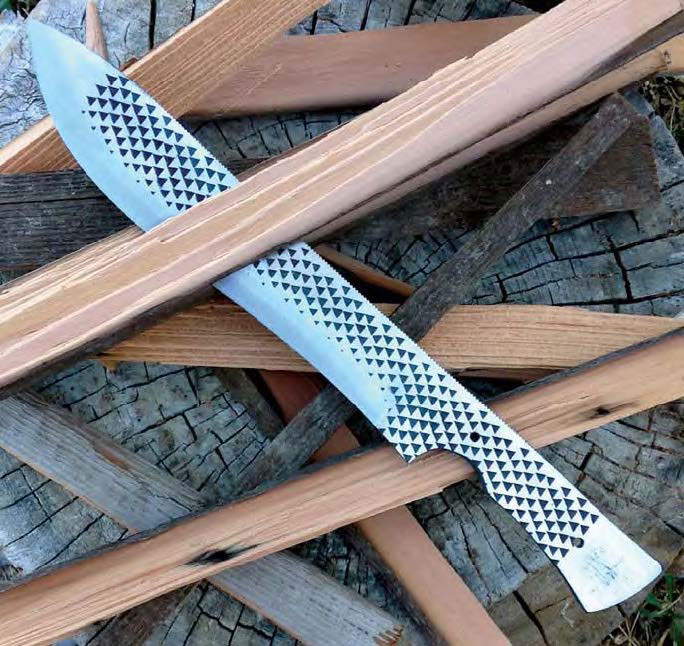
At far right in the accompanying image (above) of my five knives is the first knife I ever made, stock removal from a file, that I enthusiastically called the Triple D for Deer Disassembly Device. I was a bit delusional. Although I’ve processed many deer with this knife, the handle is too short for the blade, which causes problems with leverage while splitting the sternum. Also, the knife was made with files and sandpaper, not a grinder.

The original edge thickness was somewhere beyond .060 inch. Eventually, as my skills improved, I re-ground the knife a bit, pushing the edge back to a slightly more respectable .035 inch. The knife doesn’t slice well at all, mostly as a function of the thick geometry, but also of the shorter bevel grinds on thicker stock.

The author’s Four Roses sports a 3-inch blade of Nitro V stainless and scales from a Four Roses whiskey barrel. Construction: tapered tang. Overall length: 7.75 inches. Blade grind: flat. Edge thickness: .020. His price for a similar knife: $350.

Next from right in the image is my 50th knife, stock removal, ⅛-inch-thick 1084 carbon steel. This one also has handled its share of game. The edge thickness is .025 inch and works great but the handle is too thin. With ⅛-inch-thick steel and ⅛-inch-thick G-10 scales, there’s just not enough handle for my aging hands. The center knife is my 100th circa 2010.

I was into D2 and filework at the time, neither of which are particularly suited for a hunter, and the handle is fat and boxy. Next is my first real forged knife, from a drag harrow tooth from my grandfather’s ranch. The handle is 1955 white oak floorboards from my house at the time.

The knife is the best of those pictured in many ways, with a thin edge at .010 inch, a large enough handle, easily sharpenable steel, and a great story of how the original customer gave the knife back to me before he passed away. The full flat grind and distal taper make it a pleasure to use.

Chip Carlisle applies a flat blade grind using his belt grinder.

At far left in the picture is what I’ve settled on as my hunting knife of choice, the Jason Fry Hunter I designed for White River Knife & Tool in a full-flat-bevel-ground blade of S35VN stainless and black/orange G-10 scales. It’s just shy of 8 inches overall with a 3.5-inch blade. The handle length is enough to provide the necessary leverage, and the blade length is enough to do the cutting.

I’ve made this design for a decade by hand, both one-offs and small batches. For a general-use hunting knife for mass production, I wanted to split the difference between thin razor and beefy chopper. I specified the thickness at .020 inch and the White River guys nailed it.

The Perfect Hunting Knife

What makes the perfect hunting knife edge? It must be sharp. It has to be thin enough to slice fur yet burly enough to split a pelvis or sternum. It must have a handle big enough to provide leverage. It has to hold an edge through its primary tasks. Most of all, it must be with you when you hunt, an integral part of the package of secret weapons that set the hunter above the prey.

More On Knifemaking:

Advertisement

Must Read Articles

Read this before you make a knife

Knifemaking 101 – Read This Before You Make a Knife

  by Wayne Goddard My experience has taught me that there's nothing like digging in and getting started. I've often said the hardest part of the...
how to forge damascus steel

How to Forge Damascus

Advertisement
Advertisement