Knifemaking

Knifemaking is the building of a knife, which includes the blade, handle and other accouterments. Blades are made by either removing metal from a steel blank via a grinder – known as stock removal – and the forging to shape of hot steel into a blade in the process known as bladesmithing. Other parts, including bolsters, guards, pommels, etc., are needed to complete the finished knife.

Featured Knives – – Knife Collecting – – Tactical Knives – – Survival Knives

Two Generations Of Dennehy Knives Now At The Alamo

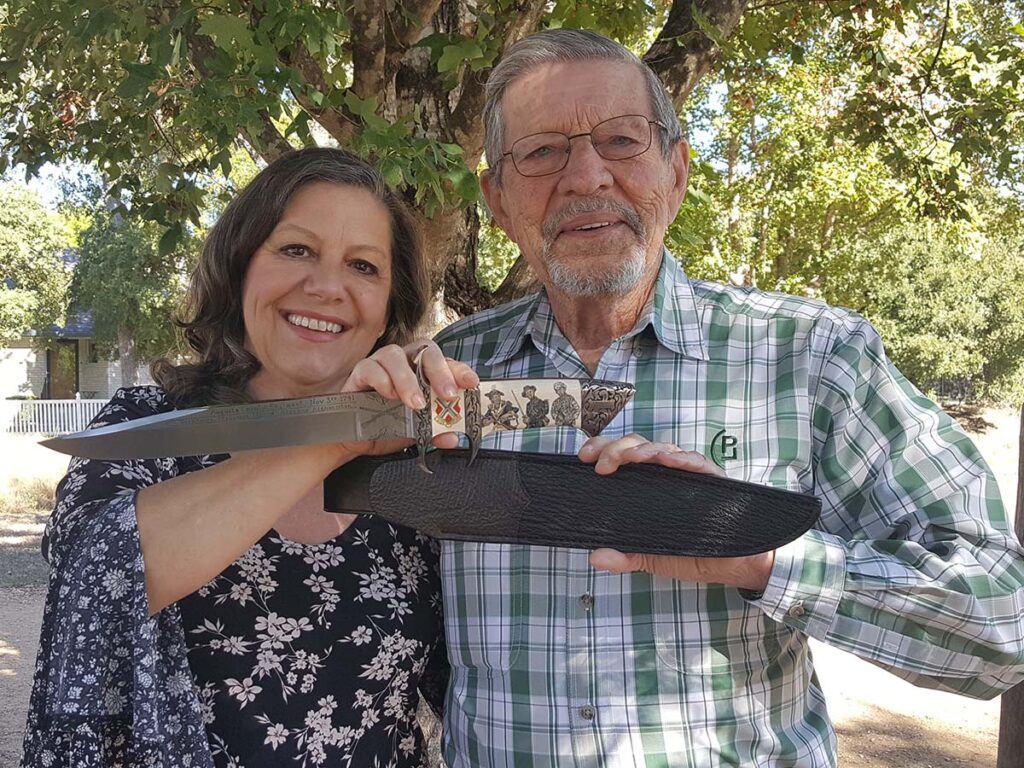
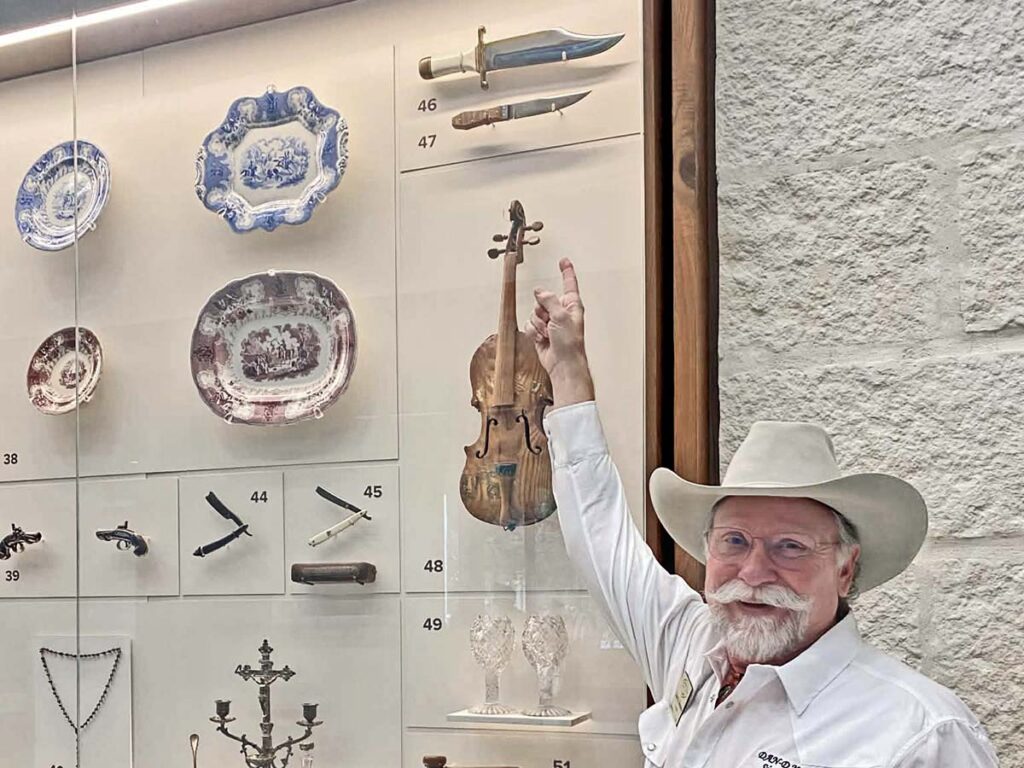
John Dennehy’s replica of his father’s Dan D Alamo Bowie, was accepted by the site on the 190th Anniversary of the historic battle.

We should always remember the Alamo, but 2026 is a particularly good year to keep the battle top of mind. It’s the 190th anniversary of the defining fight for Texas independence, and a fitting backdrop to a father-son knifemaking tale.

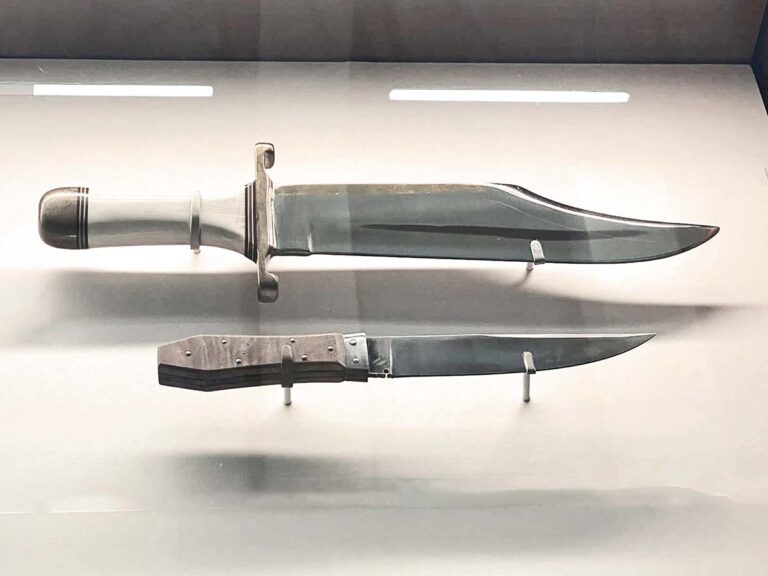
When Dan Dennehy donated his custom Dan D Alamo Bowie to the Daughters of the Republic of Texas in 1968, little did he know that a reproduction of the very same knife would be presented almost 60 years later to representatives of Alamo Trust just a few months before the historic anniversary of the Battle of the Alamo.

Made by Dan’s son John, the presentation reproduction is based on the original donated by Dan to the DRT in 1968. Save the engraving on the accompanying brass plaque. John did the entire repro project, which included 5/16-inch O1 tool steel like the blade material on his father’s original Dan D Alamo Bowie, and an embellished oak presentation frame.

Engraved number 5 of 10 by Pearce Richardson, the brass plaque reads: “Commemorative Dan D Alamo Bowie” over “In Honor of Those who Lost their Lives defending the Alamo in March 1836 and to the late Daniel J. Dennehy, Knifemaker, whose Alamo Bowie has proudly been on display at the Alamo since 1968.”

“It’s an honor that we can say we have knives from a father and son in our collection,” Alamo Senior Researcher and Historian Kolby Lanham said. “We are grateful to both Dan and John, two generations of knifemakers who chose to create works of art honoring James Bowie and the Alamo.”

John’s project started soon after his father’s death in 2011.

“The Alamo let me take pictures of Dan’s original knife in the spring right after his death,” he said. “I used those pictures and his knife pattern to make the reproductions. I wanted to jazz up the handle a bit since they are special editions with ivory Micarta and imitation ivory Micarta, along with some brass spacers for bling.”

From his own retelling of the story, Dan was inspired to make the donation during a visit to the Alamo, when he realized the historic site then didn’t have a single bowie knife. The namesake of the blade—Jim Bowie—was among the heroic men who fought and lost their lives at the battle.

The original Dan D Alamo Bowie is displayed inside the lobby of the Alamo Exhibit at the Ralston Family Collections Center, according to Lanham. John’s knife resides in the Alamo’s artifact vault.

There are other storied knifemakers whose works are displayed at the iconic Texas site, including a reproduction of the Joe Musso bowie by BLADE Magazine Cutlery Hall-of-Fame® member Gil Hibben.

A founding member of The Knifemakers’ Guild, Dan Dennehy was also a member of the Cutlery Hall of Fame and the International Knife Throwers Hall of Fame, and for many years conducted knife-and-tomahawk-throwing demonstrations at the BLADE Show. John makes knives and sheaths and has conducted seminars on how to make sheaths at both the BLADE Show and BLADE University.

New York-born, Dan was always a Westerner at heart, John pointed out, known as “Tex” in the Navy and wearing cowboy boots and a hat most of his adult life. He also loved and revered the history of the Alamo, finding it as sacred a location as native Texans.

“Having one of his knives on display [there] was one of his most cherished accomplishments,” John said.

Read More:

The Rise And Growth Of Women Knifemakers

Women Bladesmiths Thrive And Continue To Shape The Knife Industry.

Women’s pocketknives? Can’t anyone buy any type of pocketknife?

Sure, but knives designed and marketed specifically for women are few and far between even among the big knifemakers.

Enter Brighten Knives, a small, upstart knife company based in Utah. Founded by Diane Carver and her daughters Kristy, Katie, and Kimi, Brighten has grown into a successful maker thanks to a strong vision and some good luck.

“We worked with [the Salt Lake Tribune],” Diane said. “They wrote an article about us because aside from being women’s knives, which is kind of a cool product, it was also a human-interest story where it was a mom and three daughters starting a knife company.

“It was unique and different. They put an article out and it kind of snowballed from there. A radio station picked up on it, and our Utah Senator Mike Lee even sent us a letter.”

All that good press, along with a Kickstarter that raised almost $14,000 (almost triple the initial $5,000 goal), and Brighten has been on a roll ever since. 

Brighten’s Inspirational line of knives all come in bright, bold colors.

The company is built on Diane’s decades of experience in the industry. She was the knife product manager for Browning for 17 years and has worked with Fox Knives, along with marketing* household cutlery for companies like Traeger. 

Diane’s experience in the industry is complemented by her daughters’ work. Kristy created all the original designs and colorways of the company’s knives. Kimi has worked in product development and sales, and Katie has a background in sales and writing as well.

As the quartet designed their knives the hard question to answer was: What exactly does a woman’s pocketknife look like?

“Being in the industry for so long I know that most women, and I don’t want to generalize because there are a lot of women that carry it in their pockets, but a lot of our pants are made where they can’t even hold a knife,” Diane said. “The one thing that we did that kind of separated us was including the case. The case comes with all of our knives no matter [the product line] so that you can throw it in your purse or your glove compartment.”

Brighten has two original lines of knives: the Inspirational line and the Not So Heavy Metal Series. They all come with a case that’s roughly the size of a wallet that is easily portable. Additionally, all of the knives are available in a smaller keychain variety. 

All of the blades are made from 8Cr13MoV stainless steel. For the larger varieties, the blades are between 2.5- and 2.56-inches long, and the keychain knives are between 1.6- and 1.65-inches long. The knives open with a thumb stud and feature a linerlock. 

The Inspirational line is the company’s original line of knives. Each blade is married to an aluminum handle resplendent in brightly colored designs. The blades all also have a different inspirational word on the steel, words like “Faith” and “Hope” and “Brave.”

“All of the designs on the knives and cases are originally designed by my daughter Kristy,” Diane said. “I know it’s kind of unusual to see words like “laugh” and “faith” and “love” on knives, but we wanted it to be something fun. On the packaging, there’s a quote that goes along with each one. One thing we’ve seen is people like purchasing them for specific things. Our Hope knife is a breast cancer knife, and the quote on it is ‘When the world says give up, hope whispers try one more time.’”

Diane’s market research showed there was a large segment that wanted more muted colors and streamlined designs. Enter the Not So Heavy Metal line. Every color is named after a popular rock-and-roll band or song. 

Brighten Blades Green Day
The knives in the Not So Heavy Metal line come in more muted, monochrome colorways with a steel bolster.

Diane laughed, mentioning the generational differences as her daughters recommended Green Day while she mentioned names like Purple Rain and Blue Oyster Cult.

“There was about 25 percent [of women] that said they were more of a minimalist and wanted more plain, solid-colored things,” Diane said. “We want Brighten to be the premier knife company for women and so we wanted something that would appeal to everyone. That’s how we came out with our Not So Heavy Metal line. We had a ton of fun naming the colors.”

The full-length knives retail for $29.99, and the keychain knives sell for $19.99. 

As Brighten Knives has continued to expand, the press and publicity around it has swelled. YouTubers such as Neeves Knives have reached out and produced content about Brighten, as have other digital creators. 

Carver said the goal is to make knives that are women-forward that take care in their design and construction rather than just slapping some pink scales on the side and calling it a day. She did speak positively about the Kershaw Chive and some of Spyderco’s knives but that she hadn’t seen any marketing directly for women from those factory makers.

There is also the Femme Fatale line of women’s pocketknives from Defense Divas which are marketed as spring-assisted self-protection knives. 

femme fatale knife
The Sneakerhead rescue folder is an example of the types of knives, both in terms of utility and style, made by Defense Divas.

While all of Brighten’s knives have a story and purpose behind their design there is one question Diane and her team get regularly: Can these knives be used in self-defense?”

“We have a lot of questions about whether these are self-defense knives,” Carver said. “Obviously, any knife can be used for self-defense in a pinch, but that’s not what these knives are designed for. They’re in a case in your bag. We are coming out with some designs for self-defense but that’s another story.”

That “another story” will feature self-defense videos made by the company featuring self-defense experts with military backgrounds. Everything is one step at a time as the company looks to grow and sustain itself going forward.

For now, the company started by a mother and her three daughters continues to grow and thrive, and make fun, exciting pocketknives for women.

Female Knifemaking Standout Audra Draper

Few women in the field are as accomplished as Audra Draper. The Wyomingite was the first woman to earn master smith status in the American Bladesmith Society back in 2000. Since then she’s made pretty much everything and, along with her husband Mike, taught countless new makers the craft of making knives.

“Back in the day it was hard to get people to acknowledge that yes, a girl can do this, too,” Draper said. “But now it’s not a big deal, people don’t react so crazy anymore and that helped, because if you’re a young girl and walk up to a knifemaker’s table at a show and tell them you want to make knives, you need them to react like ‘Sweet, what can I do to help you?’ which everyone does now.”

While Draper is as experienced as it comes, one thing has both eluded her and caused her very little concern: making knives specifically for women. She said that she just wants to make beautiful, functional knives that people will want.

She said the only key difference can be making knives with a smaller handle since a woman’s hands are usually smaller than a man’s.

draper turmoil
Audra Draper’s Turmoil is a beautiful damascus fixed blade. (Image: SharpByCoop)

“Most women that are interested in knives don’t want a woman-specific knife,” Draper said. “They just want what the guys are carrying. I’ve made some knives that I was so certain would be purchased by a woman, and a man buys them 99 percent of the time. The women are usually hunters and fishers or they want it for the kitchen. The only difference if you’re a woman or a man is maybe a smaller handle.”

She laughed thinking about the times she’d made knives designed for women utilizing materials like turquoise, and when they hit the table the piece was scooped up by a man. She stressed that knives are neither feminine nor masculine–they just are. 

And for young women interested in learning the craft she had one simple bit of advice–reach out and ask people to help.

“Just ask questions. Talk to people,” Draper said. “There’s plenty of info our there now and plenty of courses to take. I would highly recommend before buying expensive equipment to take a course with an established maker because that’s going to tell them right away if this is something they want to do.”

Young Women Shining In The Knifemaking World

Raegan Lee and Karis Fisher are two young makers establishing themselves in the world of bladesmithing. Lee, an Idaho native, is just 21 years old but has been making fixed-blade knives for years from CPM 154 stainless. Are these specific knives for women? No, but having an enthusiastic, creative woman making knives will help craft what a “woman’s knife” becomes.

“I want to get into folders, specifically slip joints,” Lee said when we talked at BLADE Show West. “That’s where I’m heading. To be one of those makers that can bring three knives to a show and sell out on a lottery is a great feeling. To really be known in the community would be a huge, huge thing.”

Raegan Lee’s “Cow Poke” with red fiber Micarta® handle. Her price: $200

Lee went on to say how important it is to have female makers creating knives and being mentors and examples for young artisans entering the field. She said Audra Draper was an inspiration for her.

“I think it’s extremely important,” Lee said. “I do knives most of the time, but I’m also an aluminum welder at an off-road company, and that’s also a male-dominated world. I just think there has to be one of us, and the rest of us can see [what’s possible]. The more we have the more it’ll be great for us.”

Fisher is the daughter of ABS master smith Josh Fisher. Even though just a recent high school grad, her fixed blades are stunning and show off her skill in the forge and with the hammer.

Karis Fisher hunter
A hunting knife with an ironwood handle made by Karis Fisher

For Fisher, the biggest way to grow the base of female makers is simply by exposing more people to the craft of bladesmithing. TV shows and numerous YouTube channels have certainly helped a lot in bringing knifemaking more into the mainstream in recent years, and Fisher said that can only help.

Fisher even said that if her dad wasn’t a successful smith she probably wouldn’t even know about knifemaking.

“I think not too many people really know that knifemaking’s out there,” Fisher said. “If more people knew about it, it might be more [popular]. Forged in Fire does quite a bit for it.”

Read More

Cool Customs: Denis Tyrell’s Ice Blue Bowie

Denis Tyrell’s Ice Blue Bowie Showcases The Journeyman Smith’s Skills At Forging A Blade And Stylizing A Knife

Denis Tyrell’s Ice Blue Bowie is one cool sub-hilt fixed blade—so cool, in fact, that it recently won The Bowie Knife Challenge shown on 18 different YouTube channels.

The 14-inch bowie features a near-full-flat-ground blade of Tyrell’s Snowflake mosaic damascus, a stabilized wood handle and hot-blued fittings of a twisted damascus. The bowie is in a takedown construction with the pommel nut securing the handle and guard to the knife.

Tyrell, who helped organize the challenge along with a friend, won the first challenge this past June too, which consisted of competing gyutos shown across 10 different YouTube channels. Each winner was determined by a vote of viewers watching the makers. 

You can search “Tyrell Knifeworks” on YouTube to watch the past challenges and see the knifemakers in action. You can watch Tyrell make the Ice Blue Bowie in all its glory below.

Tyrell Knifeworks

Tyrell is a journeyman smith who moved to California in 2001 from his native Canada. He specializes in custom damascus knives. From his shop in Livermore, a moderate-sized city on the Eastern edge of San Francisco Bay, Tyrell runs a series of forging courses. 


His courses range from introductory classes in how to forge or how to make your first damascus pattern all the way up to more intense fare. He teaches specific classes on mosaic and feather damascus as well as, one of his most popular courses, a course teaching folks how to make copper-layered damascus. 

For more information, go to YouTube, enter “Tyrell Knifeworks”, and look for the challenge of your choice.You can watch Denis make the Ice Blue Bowie in the video below.

Ice Blue Bowie Knife Specs
Knife: Ice Blue Bowie
Blade length: 8 inches
Blade material: Snowflake damascus
Handle: Stabilized wood
Fittings: Twisted damascus
Steels: 1095 and 15N20 (both the blade and fittings)
Overall length: 14 inches
Maker’s list price for a similar piece: $2,000

Read More

Cool Custom: Derick Kemper’s Scottish Dirk

A bonnie blade to be sure, Kemper makes a statement with his Scottish dirk.

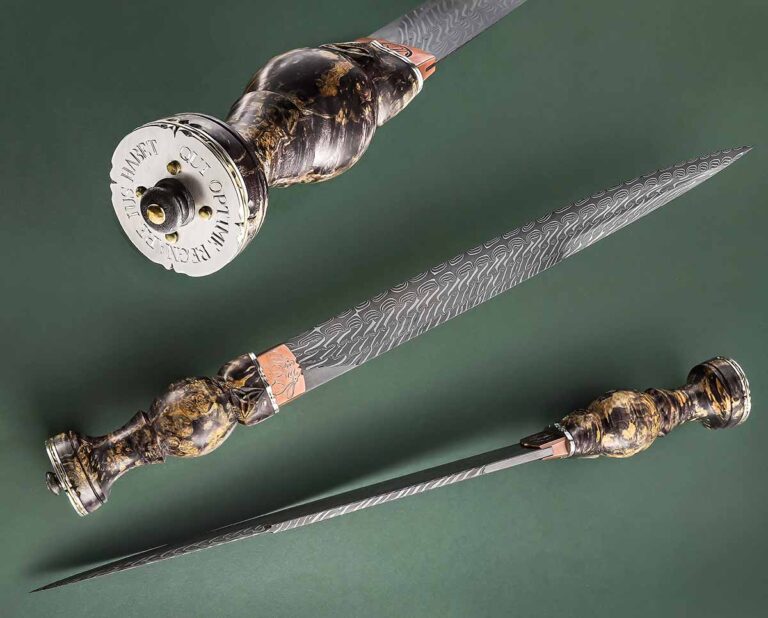
Derick Kemper celebrates his Scottish heritage with his sprawling reproduction of a Scottish dirk. It’s overstated to salute the legend and lore of his Scottish Highlander ancestors who fought so valiantly for their independence from Great Britain, beginning with the Jacobite rising of 1745.

The edge of the stunning damascus blade is a simple twist pattern of W2 carbon and 15N20 nickel alloy steels. The three bars above it are Derick’s version of Robert Eggerling’s paisley pattern—a modified twist of 203E carbon steel for the bright section and W2 and 15N20 as well.

The habaki has Derick’s Damselfly Forge stamp of two damselflies and his initials in the middle engraved on one side, and the white rose of Scotland’s “Bonnie Prince Charlie” (1720-1788) on the other.

Derick Kemper
Derick Kemper

The chess-piece-like handle is oversized as well, with the pommel engraved in Latin, Qui Optime Regnare Ius Habet. The English translation is “Who hath best right to reign,” a slogan that appeared on the flags and accouterments of many of the Highlanders in the 18th century.


Check Out More Cool Custom Knives:

Knife Steel Trends: What To Look Forward To In 2025

Knife industry pros give their takes on what the hot knife steels will be in the year ahead.

Every cutlery buyer faces a dizzying array of steel choices when it comes to buying that next knife, an array that represents the proverbial “double-edged sword.” While it’s nice to have choices, it can also be hard to keep up with so many options. Fortunately, industry professionals are available to help sort out which stainless and carbon varieties are either catching fire or cooling off.

Hot Steels for 2025

  • CPM Magnacut: Folders and fixed blades
  • CPM S30V: Hunting knives, tactical folders, custom knives
  • CPM S35VN: Tactical folders, custom knives, factory outdoor knives
  • CPM 154: Hunting knives, EDC knives, custom knives
  • CPM 20CV: EDC knives, custom knives, knives requiring heightened wear and corrosion resistance
  • CPM S90V: Knives requiring heightened wear and corrosion resistance
  • CPM Cruwear: Bushcraft knives and tactical fixed blades
  • CPM 3V: Bushcraft knives, survival knives, hard-use knives, tactical fixed blades
  • CPM 4V: Competition cutters, hard-use knives
  • M390: EDC knives, custom knives
  • 1095: Factory outdoor knives

*The steels are listed in no particular order by the knife patterns/types for which they are favored most by users and makers, according to the story’s sources.

MagnaCut Reigns Supreme

Last year when BLADE took the temperature of steel suppliers, the clear-cut champion of blade materials was Crucible Industries’ CPM MagnaCut stainless. The creation of steel guru Larrin Thomas, MagnaCut remains on top and will stay there for the foreseeable future. Bob Shabala, president of Niagara Specialty Metals, praised the high-performance blade material last year and still does today.

CRKT MagnaCut blade knife
CPM MagnaCut stainless ruled among knife steels in 2024 and will continue to hold sway in 2025. A representative example is the new CRKT Q, a folder in titanium and carbon fiber designed by Richard Rogers. Country of origin: Italy. MSRP: $225.

“We have sold about 320 tons of CPM MagnaCut since its introduction in 2020. It is our biggest selling cutlery grade right now and I don’t expect that to change anytime soon,” Bob said, adding the qualifier, “This is from Niagara Specialty Metals’ limited perspective. I’m sure other mills are working on new grades which I’m not privy to.”

One reason MagnaCut is so popular is it embraces all cutlery genres with ease.

“CPM MagnaCut remains in high demand across various knife patterns,” Bob observed. “Some customers currently using MagnaCut for fixed blades are expanding into folding knives and have expressed plans to continue using the steel for their new designs, reflecting its versatility and ongoing popularity.”

Larrin Thomas
MagnaCut maestro Larrin Thomas

Scott Devanna, vice president of technology and a metallurgist for SB Specialty Metals, tends to concur.

“I’m not sure there will be a new ‘super steel’ introduced in 2025. The introduction of new steels seems to have a three-to-four-year cycle, and with the recent intro of CPM MagnaCut such new introductions may be a few years off. We sell a lot of MagnaCut,” he stated. “I’ve learned over the years that new is very often the primary driver when new grades are introduced. This is what happened with CPM S30V, CPM 20CV and its European equivalent M390, and a few other grades.”

It should be noted that MagnaCut technically is going into its fifth year of existence. As you can see, it takes a while for a steel to work its way into the manufacturing pipeline and be given a thumbs up or thumbs down by the end user.

Specialty Grade Steels

Meanwhile, other specialty grade steels aren’t being ignored. In fact, many knife consumers prefer other steels that suit their needs better, both of the stainless and carbon varieties.

David Fleming Cowboy Knife
CPM 154 stainless will continue to be a steel of choice for custom hunting knives, here on the Cowboy Knife by David Fleming in a handle of sheep horn from a Rocky Mountain bighorn. Overall length: 7 inches.

“CPM S30V, one of the original cutlery-grade steels, continues to be one of our best-selling products,” Shabala noted. “Despite its age*, S30V maintains a strong position in the market, demonstrating its enduring reliability and widespread appeal among knifemakers.

Devanna agrees.

“CPM S30V is still a favorite for hunting knives, as well as CPM 154,” he noted. “For everyday carry folders, M390, CPM 20CV and CPM 154 are still used quite a bit as well.”

Scott said CPM S30V and S35VN remain strong for tactical folders.

Bob Shabala
Bob Shabala, Niagara Specialty Metals

Custom knifemakers aren’t as easily swayed by trends and tend to go with steels they are comfortable using, are time-proven to them personally, or geared to their particular customer base. While many are on the MagnaCut train, they tend to be more diverse in their choices.

“Other steels popular among custom knifemakers are M390, CPM 20CV, CPM 154, and to a lesser extent CPM S30V and CPM S35VN,” Devanna stated. “I have heard that CTS-XHP will be re-introduced, and this grade developed quite a following when it was readily available—especially for kitchen knives and high-end folders.”

Added Shabala, “CPM 154 is always popular with the custom makers.”

Carbon Steel

THE CARBON EQUATION
The outdoor crowd—bushcrafters, survivalists and open-air tactical users—has to be pleased with the attention they’ve been getting from the industry. These users’ requirements are different and they prefer a subset of steels all their own.

TOPS Shadow Hunter
While major outdoor knife manufacturers like TOPS and ESEE still sell the bulk of their knives in 1095, they have been gradually offering their customers more steel diversity, including stainless versions such as S35VN. The TOPS Shadow Hunter has a 4.5-inch blade of 1095 carbon steel in a tungsten Cerakote®. Country of origin: USA. MSRP: $250.

“CPM 3V and 4V are favored for hard-use knives due to the steels’ toughness, while CPM S90V and 20CV are popular among users who prioritize wear and corrosion resistance,” Shabala observed. “CPM 3V and CPM 4V are carbon steels that continue to sell well in specific areas. 3V is in high demand for bushcraft knives and 4V is being used by the current national champion in BladeSports International cutting competitions, Ben Propst. His wife Sue Ann is now using it and in 2024 they both won cutting events in Kokomo and the Smoky Mountain Knife Works fall festival.”

“I think CPM 3V and CPM Cruwear—mostly for bushcraft/survival knives as well as tactical fixed blades—are gaining popularity in the market,” Devanna opined. “CPM 3V has proven itself over the years and continues to be a popular grade. CTS PD#1 was in this category but availability of this grade is a problem.”

While major outdoor knife manufacturers like TOPS and ESEE still sell the bulk of their knives in 1095 carbon steel, they have been slowly offering their customers more diversity in their lines, including such stainless versions as S35VN.

Overall Take

As Shabala and Devanna noted, MagnaCut will be the top dog among steels in 2025, but it’s certainly not the only hound in the kennel.

Scorpion 6 Knives
Shane Magnussen uses the CPM S90V supplied by New Jersey Steel Baron on his model BBV2 folder. Closed length: 4.54 inches. (SharpByCoop image)

The cutlery industry is so diverse in the competition among manufacturers, custom makers, genres of knives and budget categories, there’s room for many different stainless and carbon steels. While what’s in the works remains unknown to most, you can bet there are teams of metallurgists working on the next great knife steel as these words are written.

As a knife enthusiast and cutlery buyer your choices are bountiful in all categories—from EDC to outdoor, fixed blade to folder—and affordable to expensive. Some users buy one knife to last for years while others rotate their carry or require cutting fare for specific purposes.

The good news is your knife and steel options have never been better!

*Editor’s note: The first-ever steel both designed and made specifically for knife blades, CPM S30V has been used for knives since 2001.

More On Knife Steel:

Knife Warranty Claims: The Good, Bad And Ugly

Some knife warranty claims stretch the limits, while others are just plain bizarre.

It’s an honorable option, a sensible aspect of a purchase contract, but can be the source of confusion, head scratching and plain ridiculousness.

The warranty is the buyer’s insurance policy. It’s the seller’s willingness to stake a reputation for quality on the performance of the product—in this case, a knife—or at least that’s what it’s meant to be. However, there are times when real life strains what is actually believable. So, when we explore the nature of the warranty with some of the finest knife companies in the world, a few of their warranty claims simply flirt with the edge of reason.

Wacky warranty claims, contentions from supposedly “dissatisfied” customers, are out there. Frankly, when some of these are brought to light, they are simply unbelievable. Give a nod to customer creativity, but then get real and consider what happens to a solid performing knife that is not simply put to good use, hard work and tough labor. Beating a knife with a hammer, soaking the handle and blade in corrosive liquid for an extended period, or shooting the defenseless edged tool with a gun are all beyond the pale. Follow such escapades with a dose of sheer audacity and what you get are warranty claims that would make a rational individual shake his or her head.

After an Army Special Forces soldier used his Chris Reeve Yarborough to cut a live electric cable during a mission, he sent in the damaged knife with $50 asking for repairs. The company sent the $50 back along with a new knife. Anne Reeve keeps the original knife, shown here, in her safe deposit box.

“A customer put a MagnaCut blade in a glass of saltwater for seven hours and claimed the rusting and pitting should be covered by our warranty!” recalled Anne Reeve of Chris Reeve Knives. “Another requested we replace the packaging of the parts he ordered because they smelled too strongly of perfume or lotion. A customer sent a knife in for a re-blade, and the original blade had an arrow and a smiley face welded onto it.”

Really? Try a few more from Chris Reeve Knives. A customer complained that the phosphor bronze washers of his Sebenza had stains on them and simply would not accept that it was normal patina. He also complained that the knife was not sharp and he had to sharpen it himself. He ground half the blade away and then said he should get a completely new knife. A customer shot his knife with a 9mm pistol and then sent the company a photo of the broken knife while requesting a new one under the standard warranty.

At Chris Reeve Knives, reputation is everything, and the company stands by its knives. But let’s sanity check. Warranties are not “get out of jail free cards” for new knives.

“We try to keep consistency in our warranty, but we do sometimes vary on case-by-case situations,” Anne explained. “Over the years we have tightened things up a bit because often we felt we would give an inch and the customer would take a mile.”

“Normal blade finish wear is not covered under warranty,” Daniel Winkler observed. “Working knives should look used.” The Winkler Hunter Axe LT shows some normal finish wear here. (Covert image)

Still, going out of their way to accommodate, the folks at Chris Reeve Knives have had some remarkable experiences.

“Mostly the customers who push back are simply rude,” Anne related. “Some just hang up or threaten to sell their knife. A customer informed us once that they had cut very acidic fruit multiple times and refused to clean the knife afterwards. They were furious we would not warranty their now rusted blade. Another customer took his brand new Umnumzaan and stabbed in into a tree. He then pried it 90 degrees to ‘tip test’ it. The tip snapped, and he claimed we should warranty the blade because what he did should not be considered misuse or abuse.”

Among unusual requests that Chris Reeve Knives went beyond the call of duty, or warranty, to make right, Anne has great memories. When a customer sent a 5.5-inch Green Beret in for recoating and it was lost in return shipping, the company made a custom iteration of the discontinued 5.5-inch knife from a 7-inch Green Beret blade blank. A sheath was available from the company archives and both were sent to the customer. When Reeve knives were abused by U.S. Customs officials, the company removed the scratches caused by bouncing around loose in transit, making the owner happy even though there was no warranty obligation. After an Army Special Forces soldier used his Yarborough to cut a live electric cable during a mission, he sent in the damaged knife with $50 asking for repairs. The company sent the $50 back along with a new knife.

Anne Reeve said a customer put the MagnaCut stainless steel blade of a Chris Reeve knife in a glass of saltwater for seven hours and claimed the rusting and pitting should be covered by the company’s warranty. Of course, like all stainless steels, MagnaCut stains less but is not stain proof. Quite understandably, the warranty request was denied.

“That original knife lives in my safe deposit box now,” Anne smiled. “On a few occasions we have older knives returned for sharpening and we can tell that the knife has been lovingly sharpened so many times that the blade is worn out. We have replaced the blades. When we made the One Piece Range, the paperwork specifically said that it was not a throwing knife and breakage from throwing would not be covered by warranty. A couple of times we had knives returned that were broken in two. The dings made it quite obvious that the knife had been thrown. Back then, we would replace the knife and give the customer a verbal slap on the wrist.”

Though Reeve, like other companies, has found it necessary to scrutinize warranty requests more closely in recent years, the dedicated effort to make the customer happy remains strong. At Chris Reeve Knives, the warranty is, as Anne puts it, “phenomenal.”

Judgment Calls

When did the rules change? Where does the line between normal expectation and radical knife recklessness blur?

A closeup of the blade and edge damage the Chris Reeve Knives Yarborough incurred after being used by the SF operative to cut a live electric cable is a tribute to the toughness of the company’s knives.

“We’ve had a few forgeries sent to us for repairs,” commented BLADE Magazine Cutlery Hall-of-Fame® member Daniel Winkler of Winkler Knives. “Reactions from customers can get hot when they learn they have been duped. Not many warranty requests are really ‘crazy’; normal sharpening or sometimes fixing a damaged tip. People also request a re-finish for worn blades. If a knife fails for any reason we will either fix it or replace it, and normal blade finish wear is not covered under warranty. Working knives should look used.”

Winkler is sensitive to certain situations and sees extraordinary conditions for what they are.

“On a few occasions we have sent replacement knives without receiving damaged ones back,” he remarked. “One was a military user that used his knife to destroy a communications location in a war zone. He fried the power supply, and it fused the knife in the connection. Another was a hiker who saved his dog in a rockslide. His knife fell to the bottom of a gorge, so we replaced it, too. A third was used in a home situation where a man used his Winkler knife to stab an intruder to save his family. His knife was held as evidence, so we sent him a new one.”

A tornado destroyed a home and carried away a safe full of knives, including several TOPS Knives models. Two to three years later, the safe was found. The knives were intact and basically undamaged. When TOPS was contacted for help with slight rust on the blade and engraving, the company obliged at no cost.

There lies the real judgment call in rendering the warranty verdict. Does the customer’s story pass the simple test of reasonableness? If so, most companies might feel a pang of compassion and try to resolve the request in the interest of good customer relations. Still, it’s a tough challenge sometimes. As much as a customer might feel slighted if a warranty request is dishonored, the maker might well feel used when the circumstances are not plausible or strain the normal standards that most people would accept.

“We go out of our way to promote positive customer relations,” Daniel added. “We have replaced or refunded knives and axes that we probably shouldn’t have due to how they were damaged in abuse, like prying or throwing. We will normally take the hit, but if it happens again we do not honor any warranty.”

Case-By-Case Decisions

At TOPS Knives, warranty requests are evaluated with the best outcome in mind. “Our philosophy on our warranty is that we have some things that will void a warranty or won’t be covered under warranty, but we still handle them all on a case-by-case basis,” remarked general manager Craig Powell. “The people that are honest and level with us are way more likely to get their issue handled under warranty—even if it shouldn’t be—than people that are rude or clearly lying to us.

“I always find it funny when someone says something happened to their knife and then the actual damage to the knife in no way matches their description,” Powell continued. “Like, maybe they think we don’t actually use or test our own gear and so we don’t know what would cause certain things to happen. But really, in the end very few people that contact us with an issue treat us poorly. So the vast majority get help under warranty.”

Back to the TOPS Tom Brown Tracker that was lost in the Iraqi IED incident: the local who originally found it after the explosion used it to split wood. The saw teeth had basically been mushroomed out of existence from the local beating on the knife with a piece of metal. Considering how the U.S. serviceman originally lost the knife, TOPS fulfilled the warranty.

Powell remembers certain circumstances that were somewhat unusual prior to a warranty request.

“When I had only been working here for a year or two, I took a call from a guy that was concerned about an issue with his Silent Hero. I talked to him for probably 15 minutes trying to figure out what was wrong. He kept saying that the knife was getting deformed and all he was doing was [batonning the blade spine to make] firewood. It probably took me longer than it should have, but I finally thought to ask what he was using as a baton. Turns out he was using the hammer side of a hatchet as his baton. So, a thick piece of metal is what he was using rather than a stick. I chuckled to myself and then we talked through the process of having a hatchet in your hand and choosing to use a knife to process firewood rather than the hatchet. He said ‘Oh!’ Then he basically apologized and said he understood. We didn’t end up fixing that knife for him, but that was because he realized what he had done and probably kept it as a reminder or trophy.”

On another occasion, a tornado destroyed a home and carried away a safe full of knives, including TOPS models. Some two to three years later, the safe was found. The knives were intact and basically undamaged. When TOPS was contacted for help with slight rust on the blade and engraving, the company obliged at no cost. Hikers have been known to lose TOPS knives on the trail and then miraculously find them months later. When the owner of one of these calls for warranty assistance, the TOPS folks fix the knives up, cleaning and refurbishing before sending them back in the context of a lesson learned: hold onto your valuables while out in the woods, especially your knife.

Extreme Situations

Military experiences have brought up several warranty requests, and these are sometimes caused by extreme situations. A Tom Brown Tracker was lost during the horrific explosion of an IED (improvised explosive device) in Iraq. The soldier involved was a chaplain, who returned some time later to the village where the explosion occurred. An old lady came forward with his knife after an interpreter and a $20 bill did some talking. The knife had been used in splitting wood.

“It was beat to hell,” Powell remembered. “The saw teeth had basically been mushroomed out of existence from this lady beating on it with a piece of metal. We swapped the soldier a new one and still have that knife [above] here today.”

A TOPS Knives Black Rhino was lost when a desert barracks burned to the ground. The scales were completely gone and the knife could not be repaired. TOPS sent the destroyed piece back to the serviceman along with a brand-new Black Rhino like this one.

A Black Rhino was lost when a desert barracks burned to the ground. The owner recovered the knife. Its scales were completely gone and the knife could not be repaired. TOPS sent the destroyed piece back to the serviceman along with a brand-new Black Rhino.

“While our policy isn’t a no-fault policy, we still cover most issues,” Craig said. “We know what we’re making is quality, and we strive for that on every knife. So anything that a customer’s knife should be able to do but doesn’t is going to get covered.”

In the broadest sense, the warranty works both ways. It protects buyer and seller and invokes the sense of quality and pride of craftsmanship, with reasonable performance expectation and use. There are outliers, but for the most part both knifemaker and knife user work together with warranties to achieve positive resolutions.

More On Knife Business:

Pull Of The Push Dagger

Master smiths explore the symmetry, skill and survivalist roots of a classic.

It’s part adventure with a bit of notoriety and a dash of creativity. For the modern custom knifemaker, several styles are brought to life with history in mind. And the push dagger is one of them.

Maybe seldom seen, but always intriguing, push daggers trace their lineage to a bygone era when self-defense at the card table or on the street meant quick deployment from a vest pocket. For sure, that perspective spurs some custom makers to insert the push dagger into their repertoire while the stylized and subtle blend of blade and handle combine for a unique test of shop skill.

“They’re a backup tool,” explained ABS master smith and BLADE Magazine Cutlery Hall-of-Fame® member Steve Schwarzer. “They were typically carried in the 1700s and 1800s along with a one-shot pistol. After that shot, the push dagger was the next position. It’s been around for a long time as an extension of your arm with a blade, and it is hard to take away from somebody that is skilled in its use.”

Schwarzer’s featured push dagger with stag handle and evocative faces carved on both ends is 5¾ inches long with a 3¾-inch blade of mosaic damascus steel. He has actually made two push daggers in this style and designed another for Benchmade about 20 years ago. “For me, they’re fun, and that’s why I like to make them,” he commented. “I’ve always had a fascination about them and adapted my martial arts background to training with them. The design traditionally is with a very short blade, and in martial arts, it has to do with the alignment of the hand and arm bones, along with the shape of the blade, which is double-edged traditionally. Everything in nature is curved for an effective cutting surface.”

Harvey Dean Tejas

Why a push dagger? Harvy Dean (inset) puts it succinctly, “They’re just cool.” That certainly holds true for his Tajas push dagger, with an elegant feather damascus blade, 24k gold raised vine work and a fossilized walrus tusk handle. At 16 1/2 inchces in length, Dean gave himself plenty of knife to decorate. (SharpByCoop image)

Legendary master smith and Hall of Famer Harvey Dean enjoys the historical aspect as well. “They’re just cool,” he offered. “A lot of people made them back years ago, and there was the idea of concealing them in the vest. Some were made with nickel-silver scabbards and called lapel knives because they were pinned under the vest or coat lapel.”

Dean’s pictured Tejas push dagger is a departure from standard sizing, with an overall length of 16¼ inches, with an 11-inch ladder pattern damascus blade and handle of fossilized walrus ivory. But then, everything is bigger in Texas.

“I’ve always liked [master smith] Larry Fuegen’s push daggers, and his work has had a lot of influence on mine,” Harvey said. “You really make them like any other knife, and I usually do around two or three a year. I like to use ivory and damascus and a stag handle is next up. I don’t do many plain ones, and most of mine are with two-piece handles. As far as marketing is concerned, you’ve got to have that special person who likes them–but they do usually sell quick.”

Hawks Nest Custom Push Talon

Matt Hunter (inset) has always had a thing for concealed carry knives, but admits his mother-of-pearl handled push daggers were his first crack at the style of knife. Angular and wickedly attractive, the Nichols Slither Armor Core stainless damascus daggers were designed as a matching set with his HawkWing knife, also pictured. (SharpByCoop image)

Damascus blade, mother-of-pearl handle and variations on the push dagger theme highlight Matt Hunter’s work at Hawks Nest Customs. He is a huge fan of concealed carry knives and started down the road with a boot dagger, neck knife and then his Push Talon.

“I think any dagger is challenging due to the symmetrical grinds that are required,” he noted. “You’ve really got to nail each and every one of them or the entire build needs to be scrapped. These push daggers are made with Nichols Slither Armor Core stainless damascus and mother-of-pearl on Westinghouse black canvas Micarta liners.
“Believe it or not, these were my first push daggers,” Matt added. “These were originally made for a customer to match the HawkWing, which is also in this photo. I told him I was planning on doing a pair of matching push daggers, and he asked if we could do the mother of pearl to match his knife. So, I obliged.”

Zack Jonas Totem

A study in starkness, Zack Jonas’ Totem push dagger grabs the eye with its clean lines and depth of damascus. That’s a san mai steel with laddered W’s and faces in a 1,000-layer laminate with pure nickel. Adding to its Spartan charm are its gold handle accents. (SharpByCoop image)

The Zack Jonas push dagger featured is his Totem model with a blade length of 4 inches and an overall length of 6½ inches. Its gold handle accents complement a san mai steel with laddered W’s and faces in a 1,000-layer laminate with pure nickel.

“The push dagger is one of the few knives that is actually designed to be folded into a tightly closed fist,” the master smith explained. “That means you have to make sure the handle comfortably conforms to the shape of the human hand in that unusual position. A push dagger is not a particularly functional tool outside the very limited frame of hand-to-hand combat; if you don’t have a secure grip when you need it, you’ve got a real problem.

“There are few makers that come to mind as design influences,” Jonas concluded. “[Master smith] J.D. Smith’s early influence on my career is never far from my hand or eye. I also think of Peter Johnsson’s work as I’m designing. He has never done a push dagger that I’m aware of, but I like to try and channel the way he conducts tension through his lines. Peter and [master smith] Kevin Cashen both come to mind when I think of the functionality in any dagger.”

Andrew Meers Rose Of Sharon

A bold mix of materials, Andrew Meers utilizes carbon fiber, stainless steel,  gold and a splintered mosaic damascus to bring-together this 9-inch push dagger. The centerpiece of the knife is its elegant Rose of Sharron engraving with the gold backing. (SharpByCoop image)

Andrew Meers included a push dagger in his ABS master smith set, which was complete with forged trout iron texture engraved with pangolins. “Push daggers have a place in my childhood memory,” he related. “I remember seeing one at a museum and being fascinated. In retrospect, I think having mostly seen conventionally handled pieces in media and collections, the manner in which the hand engages the handle is what is attractive to me.”

Meers’ featured push dagger is his first with a carbon fiber handle and a groove in the blade. Its 7-inch damascus blade is framed in stainless steel, and the engraving depicts the Rose of Sharon with a gold-plated relief background. The entire push dagger is 9 inches long. Andrew produced his first push dagger in 2014 and has made several since. His longest measured between 23 and 24 inches.

Jean Potvin Romanesque

Since push daggers are illegal in Jean Pierre Potvin’s homeland of Canada, he had to come up with a clever trick to get his his Romanesque push dagger past airport security and to a buyer at a show in Las Vegas. His solution, remove the illicit handle and replace it with a toilet plunger handle. (SharpbyCoop image)

“This push dagger is Roman in style,” remarked Jean Pierre Potvin. “It came about quite by chance. I rarely design in advance when I create. I prefer to let my imagination run free and follow new ideas that present themselves during the making process. During the making, I saw that it had a somewhat Roman style, and I continued in that direction with this result.”

Potvin’s push dagger measures 8 inches overall with a 4½-inch blade of damascus in 15N20 and 1084 carbon steel. The handle is fashioned from stabilized walnut burl and brass furniture. He had previously made only one push dagger. That was in 2022, and it was much smaller. “I had a buyer at the Nashville knife show,” he remembered, “and I had packed it in my luggage to take there. But when I got to the Montreal airport, it was confiscated by airport security.”

Since push daggers are illegal in Canada, that experience inspired Jean Pierre to remove the actual handle and replace it with a toilet plunger handle the next time he traveled with a push dagger. He made it to Las Vegas that second time and reattached the original handle after arrival. “It’s really funny because it’s the same dagger, but having a cross handle makes it illegal,” he smiled. “Sometimes you have to use tricks to get what you want.”

Somehow, the push dagger and its adventurous history seem to fit right in with Potvin’s novel experience.

Check Out More Cool Customs:

Advertisement

Must Read Articles

Read this before you make a knife

Knifemaking 101 – Read This Before You Make a Knife

  by Wayne Goddard My experience has taught me that there's nothing like digging in and getting started. I've often said the hardest part of the...
how to forge damascus steel

How to Forge Damascus

Advertisement
Advertisement