Home Blog Page 14

Buderus Mill Closure Threatens 10xx Carbon Steel Supply For Knifemakers

0

Read our full report on what the Buderus closure means for knifemakers, Damascus production, and company inventory.

Once when he was ill, Mark Twain famously quipped that “rumors of my death have been greatly exaggerated.” October 2025 brought troubling rumors to the knife industry regarding the potential closing of a major steel mill owned by Buderus Edelstahl.

Based in Wetzlar, Germany, Buderus is a major producer of 10xx series steels, including 1075, 1084, 1095 and 15N20, that are purchased through various suppliers. The company was founded in March 1731 and began steel production in April 1920. It has changed ownership several times, including being purchased from Bohler-Uddeholm by Voestalpine. Voestalpine sold the company to the German investment company Mutares in 2025.

BLADE® reached out to knife industry steel authorities for comment.

Dr. Larrin Thomas reported that he had spoken directly to two different Buderus employees. 

“We have been hearing conflicting reports about whether the [Buderus] hot and cold mills are being shut down,” he wrote in an e-mail. “Regardless, things are a bit too murky right now to say much definitively.”

Carbon steel 1095 is the material of choice for the 6.5-inch blade of the Modern Gladius by TOPS knives.

If the rumors inside the Buderus workplace match the ones inside most large workplaces, there’s a good chance that conflicting perspectives and speculation are flying around everywhere. It could be difficult to get to the actual facts, even directly from mill employees. However, Larrin remained hopeful.

An email obtained from steel supplier New Jersey Steel Baron (NJSB) was less hopeful. This past October, NJSB officials notified their intermediaries that the Buderus mill was closing at the end of the month. The email stated, “We are writing to inform you that as of October 31, 2025, Buderus Edelstahl, one of our primary vendors, will be ceasing its rolling operations. This marks the end of a fifteen-year partnership for NJ Steel Baron, and we anticipate it will significantly impact the bladesmithing, blacksmithing, and cutlery industries. We have already begun to pivot our production to new vendors and source new alloys to ensure our inventory remains robust.”

A story on n-tv.de, an online news platform based in Germany, carried the headline “Buderus Edelstahl steel is broken up—hundreds of jobs affected.” The story reported that, “The company’s steel mill … is to be closed by the end of October, Mutares announced.” 

NJSB’s Peter Bruno took the news hard, saying “I’m going to have to spend some time in the woods thinking about it.” 

In the NJSB press release he stated, “This has been more than a vendor relationship; it’s been a cornerstone of our steel program. Buderus has consistently delivered high-performance German steel that’s fueled makers, machinists, manufacturers, and craftsmen throughout the world. Losing this supply chain is a hard hit, not just for us, but for the entire industry.”

Paul DiStefano opts for 1084 carbon and 15N20 nickel-alloy blade steels for the damascus pattern configured to appear as what an animal might see if looking at a stalking tiger through a bamboo forest. Overall length: 19 inches. (pauldistefanoknives.com) (Jocelyn Frasier image)

Beyond the pure shock of losing its main supplier, NJSB is developing a plan. It has a good amount of steel on hand and is buying all the remaining Buderus stock it can. NJSB also has reached out to its customers and is selling steel by the pallet to ensure customers have at least short-term reliable access to the steel they need for ongoing orders.

“While we’re actively working to develop new sources and mill partnerships, the shift won’t be immediate, and some grades may remain out of reach for a while. Some alloys may not return anytime soon, if at all,” Bruno noted. “Once supplies run out, that may be the end of the line in some cases.”

Company Responses

The 10xx series steels are used by several knife manufacturers and importers for their hunting, outdoor, tactical and other utility-type knives. Some of those companies include Condor Tool & Knife, ESEE, KA-BAR, Utica, the previously mentioned TOPS and White River Knife & Tool. Some of the foregoing deal with Buderus and some do not. The 10xx series steels are also widely used by custom knifemakers for damascus and straight carbon knives.

The K-Night Panabas from Condor Tool & Knife boasts a 14.29-inch blade of convex-ground 1075 carbon steel.

Mike Olen, director of sales at Condor Tool & Knife, said Condor was not sourcing any steel through Buderus.

“For the 1075 and 1095 steels, we get them from a variety of vendors, mostly Europe and Asia based,” he noted. “I’m not sure exactly, but I know a lot of our steels have been coming from German and South Korean companies lately. We do the heat treatment in house, so it opens up more options for us when sourcing the raw materials.”

“KA-BAR has had a long relationship with Buderus,” wrote KA-BAR’s director of sales and marketing, Joe Bradley, though he added any potential closure of the Buderus steelworks would not affect KA-BAR immediately.

Powell said TOPS gets its steel from a leading distributor, though it was unclear at press time whether that distributor used Buderus as a source or not. At press time, he said TOPS was fine in terms of its supply of 10xx series steels, though the company likely will start stockpiling the steels in case of any shortages.

Suppy Alternative

Jantz Supply is a leading source of 10xx series steels for custom knifemakers and others. Jantz’s Shanna Kemp indicated her company maintains various sources of the steels and as a result does not expect supply delays.

A damascus of 1084, 15N20 and copper forged by Baker Forge & Tool comprises the 3.25-inch blade of Stephen Roney’s linerlock folder. (s.roney@myyahoo.com) (Jocelyn Frasier image)
A damascus of 1084, 15N20 and copper forged by Baker Forge & Tool comprises the 3.25-inch blade of Stephen Roney’s linerlock folder. ([email protected]) (Jocelyn Frasier image)

“We don’t expect any disruption from the Buderus mill closure,” Shanna wrote. “Jantz has strong relationships with multiple mills, so makers can count on us for steady access to the high-carbon steels they rely on. Our commitment to providing reliable, high-quality materials for knifemakers will not change.

“We have long-standing relationships with multiple steel mills and distributors worldwide. The majority of our 10xx series high-carbon steels come from reputable suppliers in the United States and Germany. This diversified supply chain ensures consistent quality and availability for our customers.”

In fact, Shanna said Buderus is but one of a number of producers of 10xx series steels.

“I don’t know the exact quantity of 10xx series steels the Buderus mill produced. However, they were one of several manufacturers worldwide,” she noted. “The 10xx series is a widely produced grade family, and multiple mills continue to make these steels. While the Buderus mill was a respected supplier, their closure does not significantly impact global availability.

The Junglas ESEE checks in with an 8.38-inch blade of 1095 in a textured powder-coat finish.

“Several mills and processors around the world continue to produce 10xx series steels. While the Buderus mill was a respected manufacturer, these grades are not unique to any single producer. The market has ample capacity to absorb the change, and we don’t anticipate any long-term supply issues.”

Past Is Prologue

If all this sounds a bit familiar, Crucible Steel went through a similar process of bankruptcy and acquisition at the beginning of this year. Owners of the familiar CPM (Crucible Particle Metallurgy) trademarks for MagnaCut and others, Crucible was a major force in the knife industry. Eventually it restructured and cut its research and development division. Ultimately even the restructured company failed and was sold in parts to Erasteel of Europe and an American company, Lauter. Erasteel continues to produce steel of the same compositions with the same names, as it purchased Crucible’s intellectual property. Lauter owns the former Crucible factory and has begun hiring for its specialty business of manufacturing screws and fasteners.

The Crucible situation had some impact on the knife steel business. Dr. Larrin Thomas sat down with Bob Shabala of Niagara Specialty Metals in May for a conversation about the transition. Niagara is the primary rolling mill that served the knife industry in taking Crucible steels from 3,000-pound billets down to workable sizes. Bob explained that Crucible was one of Niagara’s biggest customers, but that it also was up front with its struggles. Consequently, Niagara was well stocked in CPM steels by the time Crucible folded.

The Tick from TOPS Knives sports a 3-inch blade in 1095 carbon steel with a Tungsten Cerakote® finish.

Niagara also works with Erasteel and Carpenter, both of whom have the technology to produce steels of the same composition. Steel from Erasteel will retain the CPM trademarked names. Other versions of the same alloys rolled by Niagara will have new names for the steels the industry has used for years. Niagara officials predicted some disruptions because of panic buying as Crucible closed, but they also think business will return to “full speed ahead” for production of the knife steels in the former CPM formulations. Larrin indicated that Magna-Cut will survive and continue to be produced without disruption.

What’s Next

The steel industry has been challenged for many years, with more bankruptcies than start-up companies. To complicate things further, the steel the knife industry uses and needs is only a very small and specialized portion of a global steel industry that includes structural steel, automotive and more. With insatiable demand worldwide, the knife industry’s little corner of the market doesn’t get much attention. On top of that, steel production takes an enormous amount of energy, and with all the green and climate change talk of recent years, no one seems to be lining up to build anything but AI data centers at the moment.

Chad Jefferson chose 1080 and 15N20 to forge into a ladder W’s pattern for the 7-inch blade of his gyuto. (ak74forge@gmail.com) (Jocelyn Frasier image)
Chad Jefferson chose 1080 and 15N20 to forge into a ladder W’s pattern for the 7-inch blade of his gyuto. ([email protected]) (Jocelyn Frasier image)

Like the transition away from Crucible, the probable transition away from Buderus will no doubt cause some industry disruptions. For now, knifemakers can hope that rumors of the death of the Buderus mill remain greatly exaggerated—or at least, as with Crucible, its reincarnation is on the horizon. Will some other company buy the Buderus mill? Will, like Niagara, some other supplier step in the gap left by the closure? Will someone in the market feel the void and fill it? Time will tell, but for now, the best advice seems to be for knife companies and makers to buy the 10xx series steels while they can.

Editor’s Note: Blade Magazine Staff contributed to this report.

More On Steel:

First Look: Victorinox Alox Refined Collection

The Alox Refined Collection gives Victorinox’s classic design a modern twist.

As steady as the flow of an Alps glacier, Victorinox doesn’t veer far from its design fundamentals. It’s served the Swiss company well, given the Swiss Army Knife might be among the most recognizable tools in the world. In turn, when the iconic company tweaks its legendary pocketknives, it’s worth taking note.

Hence, the Alox Refined Collection deserves consideration—even if you aren’t a diehard collector of Victorinox.

More than anything, it appears Victorinox is modernizing the aesthetics of its knives with the three-knife line. Alox—aluminum scale—has been around for some time, but never quite in the guise it appears in the Refined Collection. The knifemaker has also attempted to improve the function of the series with the addition of a feature that has become almost a must-have on modern pocketknives—a pocket clip.

Refined Collection Different Colors

As to the looks of the Refined Collection, it’s solid, catching the classic SAK up to current sensibilities without veering from Victorinox’s winning formula. The scale has a sleek brushed finish, the texturing runs in a saddle near the spine and it features multiple cutouts. The last feature I like, given it gives a peek into the knives’ locking mechanisms and adds character. On the flip side, I get a bit clutchy on exposing these to the environment and fouling.

On the topic of lockup, the main blade has a locking leaf on all three models, potentially making it fit for more robust duty—at least fit for duties that could potentially close a slipjoint lock. As for the clip, it blends in with the curve of the knives’ end and is riveted onto the scale, so there’s no playing with how it’s carried. This shouldn’t be an issue, given blade deployment is still via a nail nick. The three models of the Refined Collection offer different tiers of tools, with the OneFold Alox offering a single blade, the Synergy Alox four tools and the Synergy X Alox five tools. The price tag on the series runs from $56 for the OneFold to $96 for the Synergy X.

Refined Collection Clip

Onto the differences in the models themselves. The OneFold is super simple, with the blade being the only tool present. The Synergy is the middle-tier model, with a considerable expansion to its toolbelt: in addition to the blade, it has the nail file/narrow driver, bottle opener/flat head driver and a new box opener tool that appears to be exclusive to the Refined Collection. Finally, we have the Synergy X which, if you know your Victorinox nomenclature, you will understand to have a pair of spring-loaded scissors in addition to the standard Synergy tool suite.

Synergy X Alox Specs

Synergy X Alox Specs

Tools: Blade, large / Scissors / Box Opener / Screwdriver 3 mm / Nail file / Nail cleaner / Bottle opener / Screwdriver 7 mm / Wire stripper / Carry clip
Height: 0.8 in
Length: 3.7 in
Width: 0.9 in
Weight: 3.5 oz
Country of origin: Switzerland
Blade lockable: Yes
One hand blade: No
No. of features: 10
MSRP: $96

Synergy Alox Specs

Synergy Alox

Tools: Blade, large / Box Opener / Screwdriver 3 mm / Nail file / Nail cleaner / Bottle opener / Screwdriver 7 mm / Wire stripper / Carry clip
Height: 0.7 in
Length: 3.7 in
Width: 0.9 in
Weight: 2.7 oz
Country of origin: Switzerland
Blade lockable: Yes
One hand blade: No
No. of features: 9
MSRP: $78

Onefold Alox Specs

Onefold Alox

Tools: Blade, large / Carry clip
Height: 0.6 in
Length: 3.7 in
Width: 0.9 in
Weight: 1.9 oz
Country of origin: Switzerland
Blade lockable: Yes
One hand blade: No
No. of features: 2
MSRP: $56

More Knife Reviews:

New Knives October 2025

Explore the world of custom kitchen knives! See award-winning Chef’s Knives, Gyutos, and more, forged with exotic Damascus and unique handle materials.

The art of knifemaking has officially stepped into the culinary arena, elevating daily prep into a true performance. This collection features some of the world’s most refined kitchen cutlery—from award-winning Gyutos and Nakiris to specialized Chef’s and Paring knives—each forged by today’s top custom makers. We’re showcasing a stunning array of blades that blend high-performance steel, such as Copper-clad 1084 and Aogami Super cores, with breathtaking handle materials like stabilized exotic burls, copper mesh resin, and mosaic damascus. These tools are built for precision and designed for prestige.


Joel Eckford Kitchen Knife

Signal One Forge Kitchen Knife

Blade length: 8.3”
Blade material: Copper-clad 1084 carbon steel forged by Dane Standen Knives
Blade grind: Flat
BLADE COAT: Dane Standen brutalist copper clad 1084 finish
Scales: Copper mesh in resin w/copper spacers
Overall length: 12.8”
Knife to know: The maker is a probationary member of the Australian Knifemakers Guild
Maker’s price for a similar knife: Contact maker for pricing
Maker: Signal One Forge, Joel Eckford (Rod Hoare image)


Evan Davis K-Tip Petty Chef’s Knife

Evan Davis K-Tip Petty Chef’s Knife

Blade length: 7.5”
Overall length: 12.5”
Blade material: 52100 carbon steel
Blade grind: Convex
Scales: Curly narra and ivory G-10
Maker’s price for a similar knife: $700
Maker: Evan Davis (Jocelyn Frasier image)


Kevin Korenek Chef’s Knife

Kevin Korenek Chef’s Knife

Blade length: 8.75”
Blade material: 80CrV2 carbon and 15N20 nickel-alloy steels forged by Jeff Waggenar
Damascus: Flower pattern
Blade grind: Flat
Scales: Blackwood amboyna/acrylic composite by Randy McBurrney
Overall length: 14.75”
Maker’s price for a similar knife: $1,175
Maker: Kevin Korenek (SharpByCoop image)


Paul Elkins Chef’s Knife

Paul Elkins Chef’s Knife

Blade length: 9.25”
Blade material: 1080 carbon and 15N20 nickel alloy steels
Blade grind: Convex
Scales: Dyed curly mango
Overall length: 14.5”
Knife to know: Integral bolster construction; the knife won the Texas Select 2025 Custom Cutlery Event’s Best Culinary Award
Maker’s price for a similar knife: $2,000
Maker: Paul Elkins (SharpByCoop image)


Cordina Customs Signature Series Gyuto

Cordina Customs Signature Series Gyuto

Blade length: 9.3”
Blade material: Aogami Super core, nickel and wrought iron forged by Oblivion Blades
Blade thickness @ricasso: .14”
Blade @widest: 1.9”
Blade grind: Compound bevel
Scales: Western myall wood
Spacer: Hand-stippled bronze w/heirloom fit
Bolster: Stabilized ebony
Overall length: 15.4”
Knife to know: Cordina’s Signature Series Gyuto won Best Kitchen Knife at the 2025 Australian Knifemakers Guild Melbourne Knife Show
Maker’s price for a similar knife: $700 at press-time exchange rate
Maker: Cordina Customs (Rod Hoare image)


Mazieres FrancoisParing knife

Mazieres Francois Paring knife

Blade length: 5”
Blade material: 150 pattern-welded layers of 1084 and 1075 carbon and 15N20 nickel-alloy steels embossed using chevron dies for the final pattern
Blade grind: Flat
Construction: Hidden tang
Scales: Stabilized South Australian ringed Western myall wood shaped as a composite Western/cowboy style handle; G-10 and 410 stainless spacers
Bolsters: Scalloped, pinned and soldered 416 stainless steel
Overall length: 10”
Knife to know: The maker’s paring knife won for Best Chef’s Knife at the 2025 Perth Knife Show; the maker is a member of the Australian Knifemakers Guild and a journeyman smith in the American Bladesmith Society
Maker’s price for a similar knife: $325 at press-time exchange rate
Maker: YANDIWA, Mazieres Francois https://www.Yandiwa.com.au (Rod Hoare image)


Jon McQuillan Kitchen Knife

Jon McQuillan Kitchen Knife

Blade length: 9”
Blade material: 1084 carbon and 15N20 nickel alloy steels
Damascus pattern: Mosaic Explosion
Scales: Tasmanian blackwood and turquoise cast w/bronze
Bolster: Muskox horn
Overall length: 13.5”
Maker’s price for a similar knife: $2,000
Maker: McQuillan Custom Works, Jon McQuillan j.mcquillan.com (SharpByCoop image)


Dan Tompkins Coppermascus Nakiri

Dan Tompkins Coppermascus Nakiri

Blade length: 8.5”
Blade material: Baker Forge & Tool coppermascus
Blade grind: Slight convex
Scales: Amboyna burl
Bolster: G-10/copper
Overall length: 13”
Knife to know: Heirloom fit; patinaed copper
Maker’s price for a similar piece: $1,700
Maker: Evolution Cutlery, Dan Tompkins, evolutioncutleryllc.com (SharpByCoop image)


Joey Dello Russo Santoku

Joey Dello Russo Santoku

Blade length: 9”
Blade material: 80CrV2 carbon steel and pure nickel
Blade grind: Flat convex
Handle: Richlite
Bolster: Nickel silver
Overall length: 13.5”
Maker’s price for a similar knife: $600
Knife to know: The maker is an ABS apprentice smith
Maker: Joey Dello Russo, imperialcustomworks.com (Jocelyn Frasier image)


BCK Knives Chef’s Knife

BCK Knives Chef’s Knife

Blade length: 8”
Blade material: A multi-layered X-mai damascus of 8670 and 80CrV2 carbon and 15N20 nickel-alloy steels, nickel silver and copper
Blade grind: Flat
Handle: Stabilized box elder burl dyed black
Spacer/bolster: McLaren carbon fiber
Overall length: 12.5”
Maker’s price for a similar knife: $1,200
Maker: BCK Knives (Jocelyn Frasier image)


Kyle Daily Chef’s Knife

Kyle Daily Chef’s Knife

Blade length: 8”
Blade steel: CPM 154 stainless
Blade grind: Flat
Handle: Old Glory Limitless Grip-Tec w/red/white/blue G-10
Overall length: 13”
Maker’s price for a similar knife: $500
Maker: Kyle Daily khdailyknives.com (Jocelyn Frasier image)


Matt Williams Chef’s Knife

Matt Williams Chef’s Knife

Blade length: 9.5”
Blade material: 400-layer Lace-pattern damascus san-mai w/a 1084 carbon steel core
Blade grind: Flat
Scales: Mesquite and silver and black acrylic
Overall length: 14.5”
Maker’s price for a similar knife: $800
Maker: Matt Williams, lasterdaywoodworks.com (SharpByCoop image)


Check Out Other Months:

Randall Airman: USMC Prototype Carried By The Father Of Marine Helicopters

The story of a prototype Airman and a Marine pioneer.

Editor’s note: The author contacted BLADE® and asked if we would be interested in his story on a special Marine Corps knife and a special Marine to coincide with the semi-quincentennial of the United States Marine Corps. Needless to say, it was an easy decision on our part. Meanwhile, please join us in wishing a happy 250th birthday to the Corps and Marines everywhere.

The core values of honor, courage and commitment have defined the United States Marine Corps since its inception on Nov. 10, 1775. To remain an elite fighting force, the Marine Corps has adapted as the world has changed over the past 250 years, incorporating new technology and developing new doctrine.

One of the most significant transformations began with the birth of Marine Corps aviation in 1912. During World War II, Marine aviators played a vital role in the Pacific campaign, working closely with ground units to seize heavily defended island strongholds. As Gen. Keith B. McCutcheon, a pioneer of Marine aviation, later emphasized, “The Marine Corps is proud of the fact that it is a force of combined arms, and it jealously guards the integrity of its air-ground team.”

The mark and non-mark sides of a prototype Airman.

The evolution of air combat brought new challenges, challenges that extended even to the knives that aviators carried. One result was a collaboration between Marine aviators and BLADE Magazine Cutlery Hall-of-Fame® member Walter D. “Bo” Randall, who would redefine survival and combat knives with the now-iconic Randall Model 15. This article features one of Randall’s prototypes—a rugged, full-tang Airman’s Knife that was carried for more than 15 years by Gen. McCutcheon himself.

The Challenge

Marine aviators amassed extensive combat experience in World War II and Korea. By 1953, the Marine Corps recognized that the rigors of combat aviation demanded a new type of knife—one that was rugged, compact and versatile.

As documented by Randall historian Robert Gaddis, the Marine Corps Equipment Board assigned Lt. Col. H. Ross Jordan and Maj. Harold N. “Tex” Mehaffey to develop a survival and combat knife for Marine aviators. The knife had to be nearly indestructible—strong enough for an airman to pry, cut or smash his way out of a downed aircraft. At the same time, it had to be short enough to be worn in a cramped cockpit, and the sheath needed to allow the knife to be carried on the upper arm or lower leg.

Wearing his sheathed Randall Model 15 Airman on his left hip, United States Marine Corps Gen. Keith McCutcheon (center) is flanked by South Vietnamese Gen. Hoang Xuan Lam, Commander of I Corps, and USMC Gen. Edwin B. Wheeler (right), commanding general of the 1st Marine Division. (image of McCutcheon, Lam and Wheeler from somewhere near Da Nang, Vietnam, March 16, 1970)

After reading a December 1953 magazine article about Bo and his expertly crafted blades, Mehaffey and Jordan arranged to tour his knife shop in Orlando on Feb. 11-12, 1954. By the end of their fruitful discussion on February 12, Bo had arrived at the basic design of the Randall Airman’s Knife. He also planned a longer-bladed version for ground troops, a design that would become the Randall Attack. Thus, this meeting launched the line of full-tang Randall models that would expand and evolve over the coming years.

Bo moved rapidly to fabricate prototypes that embodied his innovative design. The 5.5-inch blade would be forged from quarter-inch-thick O1 tool steel, a material that had been proven in earlier Randall combat knives. To strengthen the tip, the blade would retain the full quarter-inch thickness nearly to the point. To strengthen the junction between blade and the handle, the tang would be 7/8-inch wide along the entire grip. An extended segment of the tang would have a hole for a wrist thong and provide a surface that could be used for hammering. A heavy double hilt would prevent a gloved hand from slipping forward onto the blade. The handle would be made from a single piece of Tenite plastic, shaped with finger grips and a channel to snugly fit the tang. Stainless steel bolts would secure the handle.

To complete the package, Randall designed a sheath that could be worn on a belt, attached to a harness, or tied to the lower leg or upper arm with leather laces. It featured a diagonal keeper and rivets at stress points. The Randall shop completed the prototypes of the Airman’s Knife and the longer Attack Knife by the end of February 1954—barely more than two weeks after the formative design discussion—and Clarence Moore readied the sheaths soon after.

Three-star Gen. Keith McCutcheon, February 1970

The innovative features of the new knife and sheath designs were memorialized on certified blueprints on March 4, 1954. Randall filed a patent application on Aug. 11, 1954, and the United States Patent Office granted patent 177,590 for the Randall Airman’s Knife on May 1, 1956.

Prototype Testing

With prototypes in hand, Randall travelled to Quantico, Virginia in mid-March 1954 to present the new full-tang knives to Mehaffey, Jordan and other USMC and U.S. Navy officers. The group enthusiastically recommended that the Navy’s Bureau of Aeronautics purchase 10 prototype Airman’s Knives for evaluation: five from quarter-inch stock according to the original design, and five lighter examples from 3/16-inch stock.

The requisition arrived in early April 1954 and the shop shipped the 10 prototypes in early May. The invoice listed the Airman’s Knife as the #14, but later that month Randall adopted the still-current model numbers: the Airman became the Model 15, and the longer version became the Model 14 Attack.

The Marine Corps Equipment Board received two of the prototypes, one of each blade thickness, and the remaining eight were sent to squadrons and other units for real-world testing. In late May, Mehaffey informed Bo that preliminary testing had begun.

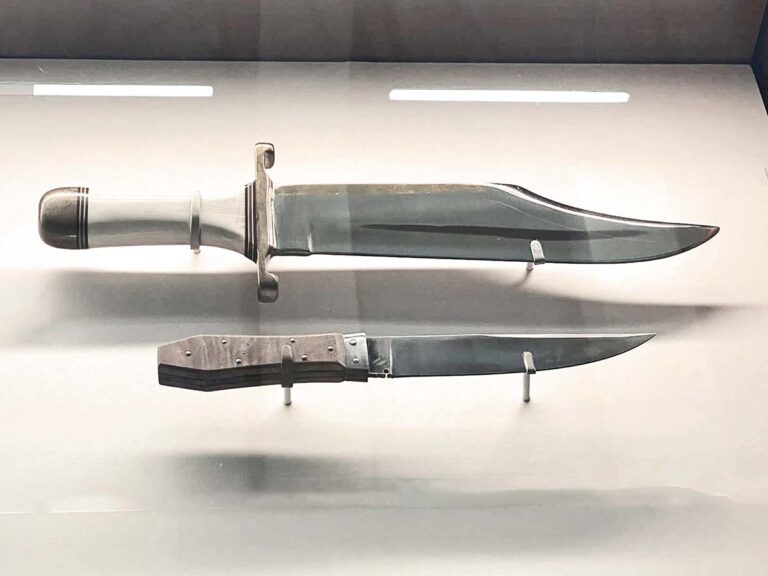
One of the original Randall prototypes is featured in the accompanying photographs. Made from quarter-inch steel, as indicated by the inscription on the handle, the prototype closely follows Bo’s patented design, except the blade lacks the fuller shown in the drawing. As in the original design, the prototype’s handle is secured by three bolts; this feature sets the prototype apart from later production examples of the Model 15, in which only two bolts were used.

Leatherworker Clarence Moore made the sheath for the prototype Airman according to Bo Randall’s design. Moore made the sheaths for the earliest full-tang knives until Heiser took over production in 1955.

The handle is made from white Tenite, a material used only for a year or so before Randall adopted the more familiar green Tenite that was characteristic of production for nearly 10 years, until Randall Made replaced Tenite with Micarta® in the mid-1960s. The prototype’s hilt is nickel silver in contrast to the brass hilts seen on almost all Model 15s with Tenite handles. The sheath was made according to Bo’s design by master leatherworker Clarence Moore, who made sheaths for the earliest full-tang knives until Heiser took over production in 1955.

After more than 70 years, the knife and sheath are in outstanding condition—a testament to Randall’s craftsmanship and superb design.

Project Setbacks

Despite starting with such promise, the project faltered in the summer of 1954 when Mehaffey was transferred for duty in France and Jordan retired. The departure of the two enthusiastic advocates delayed testing and communications. The next official update was in December 1954, when Bo heard that testing had been underway for two months with positive feedback. In April 1955, the United States Air Force also ordered a group of Model 15s for evaluation. Bo wrote again to the USMC in June 1955 but heard nothing further from the Marines or the Air Force.

Although Randall was never officially informed of the results, author Frank Trzaska uncovered a September 1955 testing report in the USMC archives. The report was authored by USMC Maj. Norman W. Gourley, who had succeeded Mehaffey. Extensive testing of the Randall Airman prototypes showed that the quarter-inch-thick version (i.e., Bo’s original design) was “suitable for aviators’ survival use.”

After a fruitful meeting on Feb. 12, 1954 with USMC Maj. Harold N. “Tex” Mehaffey and Lt. Col. H. Ross Jordan, Bo Randall had arrived at the basic design of the Randall Airman’s Knife (top). Bo also planned a longer-bladed version for ground troops, a design that would become the Randall Model 14 Attack (one from 1955 is shown at bottom). The meeting launched the line of full-tang Randall models that would expand and evolve over the coming years.
SONY DSCAfter a fruitful meeting on Feb. 12, 1954 with USMC Maj. Harold N. “Tex” Mehaffey and Lt. Col. H. Ross Jordan, Bo Randall had arrived at the basic design of the Randall Airman’s Knife (top). Bo also planned a longer-bladed version for ground troops, a design that would become the Randall Model 14 Attack (one from 1955 is shown at bottom). The meeting launched the line of full-tang Randall models that would expand and evolve over the coming years.

The report, which pictures this story’s featured prototype, notes the high quality of the design, materials and workmanship of the Randall knife and sheath and concludes that it is acceptable for extreme survival tasks. The report also noted potential changes that would improve the knife further, such as the addition of saw teeth, a flat butt surface for hammering, and different handle configurations. Bo independently incorporated most of these features in various full-tang Randall models by the mid-1960s, and presumably he would have made the changes sooner if the request had ever been made.

While the tests of the Randall Airman were underway, the Navy adopted the Imperial Pilot Survival Knife for its aviators. Because the Marine Corps operates as part of the Department of the Navy, this surely complicated any attempt by the Marines to adopt a different design. The Randall Airman was never issued by the military, but Bo added the Model 14 Attack and the Model 15 Airman to the new Randall catalog printed in 1954, which showed prototypes of both models as “patent pending.” As envisioned by Bo and the Marine aviators who helped to shape the design, Randall’s full-tang combat and survival knives were embraced by many American servicemen who purchased them privately, especially during the Vietnam War.

Pioneer & His Prototype

One Marine who had a high opinion of the Randall Airman was aviation pioneer Keith B. McCutcheon, who as a colonel served as Chief, Air Section, Marine Corps Equipment Board from June 1954 to July 1957. After the Randall Airman tests concluded, McCutcheon carried the quarter-inch prototype for the rest of his career.

An attack helicopter warms up in the background as Gen. McCutcheon surveys the situation six miles southwest of Da Nang, March 17, 1970, his trusty Randall Model 15 Airman sheathed at his side. At left is Gen. Edwin B. Wheeler.

In January 1966, while commanding the 1st Marine Aircraft Wing in Da Nang, Vietnam, then-Brig. Gen. McCutcheon wrote that the Airman was a “wonderful knife” that he had carried for “10 or 11 years.” Photographs from 1970 show McCutcheon wearing the knife when he returned to Da Nang as a lieutenant general and commander of the III Marine Amphibious Force (III MAF).

Commissioned as a Marine 2nd lieutenant in 1937, McCutcheon was a brilliant, courageous leader who transformed Marine aviation over the course of his illustrious 34-year career. Gen. Earl Anderson said McCutcheon “was one of the finest and most dedicated Marine officers [whose career] reads like a history of Marine Aviation. He earned his wings as an aviator in 1940 and served in World War II, Korea and Vietnam.”

McCutcheon was instrumental in integrating helicopters into Marine operations, and has been called “the Father of Marine Helicopters.” But, as historian William Fails observed, that title does not capture McCutcheon’s central contributions to numerous other areas. He also advanced close air support doctrine and techniques, guided missile systems, and the AV-8 Harrier jump jet. McCutcheon was also an effective leader of ground operations, launching successful operations as commander of III MAF.

For his exemplary service over 34 years, McCutcheon received many of the nation’s highest military decorations, including three Distinguished Service Medals, the Silver Star Medal, three Legions of Merit with Combat “V,” the Distinguished Flying Cross, 10 Air Medals and others. He was appointed to become the assistant commandant of the Marine Corps but was unable to assume the post because of failing health. He retired as a four-star general on July 1, 1971, and passed away from an illness soon after.

Enduring Legacy

On the 250th birthday of the United States Marine Corps, it is fitting to honor the legacy of Gen. Keith B. McCutcheon, an extraordinary leader who helped shape the modern Marine Corps. McCutcheon’s prototype Randall Airman remains as a tangible link to his many accomplishments and to the connection between the Marine Corps and Randall Made Knives.

Sources

William R. Fails. 1978. “Marines and Helicopters 1962-1973.” History and Museums Division, Headquarters U.S. Marine Corps.
Robert L. Gaddis. 1993. “Randall Made Knives: The History of the Man and the Blades” Paladin Press.
James Anthony Ginther, Jr. 1999. “Keith Barr McCutcheon: Integrating Aviation into the United States Marine Corps, 1937-1971.” Doctoral Dissertation, Texas Tech University.
Norman W. Gourley. 1955. Marine Corps Equipment Board report A9-E-1039 on Project E-1039.
Frank Trzaska. 2001. “Randall’s Model 15 & the U.S.M.C.” February 2001 Knife World.

More On Military Knives:

Wa Handle: Japanese Ergonomics Are Revolutionizing Custom Kitchen Knives

User-friendly custom takes on the classic Japanese knife handle abound.

The Japanese influence in kitchen knives is more or less a given. Those who work in food preparation, an art form unto itself, appreciate the style and utilitarian feel that the Japanese culture exerts on their vocation.

The kitchen knife has seen a wave of custom makers taking that context a step further. The knife is an extension of the hand and that extension starts with the handle. So, here again the ergonomics of Japanese influence emerge. The wa handle brings comfort and confidence to the kitchen user while also providing a sense of form, function and artistic expression for the custom maker.

The wa handle of Aidan Garrity’s santoku has largely parallel sides to the width of the ricasso with a small ‘beak’ at the bottom for hand retention and aesthetics. Blade steel: mosaic damascus. Vintage butterscotch Micarta® scales boast flat-shield cross-sections and G-10 spacers. Overall length: 14 inches. His list price for a similar knife: $2,300. Its sister piece is a Garrity nakiri that was featured on the March 2024 BLADE® cover. (SharpByCoop image)

According to maker Jacob Anstaett, the name itself is rooted in the Japanese language.

“Wa comes from the Japanese language and broadly translates as ‘harmony’ or ‘balance,’” he explained. “In knifemaking, it refers to the traditional Japanese handle style, which emphasizes simplicity, lightness and an ergonomic connection between the handle and the blade.”

Anstaett further defines the wa handle as “lightweight with forward-balanced design. Typically, it is either octagonal, oval or D-shaped in cross-section. The handle is crafted as a separate piece that fits onto a hidden tang rather than a full tang. The construction is what gives the blade its distinct balance, where the cutting edge feels alive in your hand instead of weighed down.”

A resident of Plano, Texas and a custom knifemaker for eight years, Jacob says his wa handle is an interpretation of the Japanese style.

Alex Töpfer described his wa-handled piece as “a general-purpose kitchen knife based on various santoku. The blade is 80CrV2 as it’s a good general steel I can forge and heat treat. The handle is Tasmanian blackwood to add some fanciness, and the same is true for the bronze bolster. It’s functional art you can appreciate as you use it to cook.” His price for a similar knife: $325. (Rod Hoare image)

“It’s best described as a variation of the traditional wa,” he explained. “I keep the core geometry usually as an octagon cross-section, but I adapt the dimensions slightly for comfort. Western chefs often prefer a little more thickness and resilience, so I adjust proportions while preserving the forward balance that makes wa handles so effective.”

Jacob devoted extensive time to the study of traditional Japanese wa handles and then embarked on his road to interpretation.

“Over time I developed my own hybrid approach,” he commented. “My reasoning was simple: I wanted to honor tradition while building something that stands up to modern kitchens. For instance, I blend traditional shapes with stabilized woods or composites, ensuring they can handle daily use in a busy Western kitchen without losing the essence of the Japanese design.”

What Makes A Wa Handle?

Elaborating on the spirit and style of the wa, Aidan Garrity of Iron Lion Blades in Madison, Connecticut remarked, “There are two schools of thought for what exactly categorizes as a wa handle. One is that the handle’s construction involves a hole the width of the knife’s tang being drilled into the handle, and the tang being enclosed in a slotted dowel to tightly fit into that round cavity. The other is that it is simply the style of the handle, usually slimline and often having angular geometries. For questions like these, I always answer with the understanding that it is just the style of the handle, but I personally consider the true wa handle to be one utilizing the dowel bedding construction.”

The wa handle of Mert Tansu’s gyuto has a half-inch-wide, 4-inch dowel (above) with a tang slot cut into it. “It is a traditional-shaped wa except for the internal structure,” Mert wrote. “While most Japanese blades are mounted to the handle with burning the tangs in, this is not possible with a hard timber-like ringed gidgee, and I glued mine in.”

Australian custom knifemaker Mert Tansu follows the wa tradition with his own interpretation. His perspective includes a geometric aspect that broadens the possibilities with the style.

“Wa handles come in a few different geometries,” he related, “from round to oval, to semi-octagonal to full octagonal and D-shape. Compared to their Western counterparts they are not sculpted and flat. Most of the traditional wa handles will have a horn ferrule and magnolia wood body.”

The wa handle of Mert Tansu’s gyuto has a half-inch-wide, 4-inch dowel (above) with a tang slot cut into it. “It is a traditional-shaped wa except for the internal structure,” Mert wrote. “While most Japanese blades are mounted to the handle with burning the tangs in, this is not possible with a hard timber-like ringed gidgee, and I glued mine in.”

Mert’s featured knife is a gyuto from his Hunter Valley Blades series of traditional Japanese chef’s knives with forged finishes and usually san-mai construction. He employed a dowel-bedding construction for the wa handle (page 16). He characterizes his chef’s knives as affordable and less time consuming to make than other custom types.

Specific features of the wa handle style translate into precision and control in the kitchen. He says that the flats allow the user to index the knife with ease. Despite the “stop sign” shape, the octagonal handle is quite comfortable and fashioned with precision on his disc grinder. Optimal length is a subjective question, but Mert likes paring knives with wa handles no longer than 4.7 inches, while handles of 5.3 to 5.5 inches work best in larger chef’s knives with overall lengths of 9.5 inches. For long slicing knives of overall lengths of 10.5 inches, he indicated he prefers a handle between 5.7 and 5.9 inches.

Wa Handle Interpretations

A custom knifemaker for seven years at his home near Melbourne, Australia, Alex Töpfer appreciates the employment of the hidden tang in his knife construction, and he says the wa-inspired handle works in both the active and aesthetic aspects of kitchen use.

“Obviously, I’m inspired by various styles of wa handles, specifically octagonal ones,” he commented, “and also the use of brass bolsters and guards in the Western context. The flats here are more to provide context with the organic, curved aspects of the wood grain and forged texture.

“I do think it’s important to have a flat [handle] surface that aligns with the blade, but the upper parts are more for looks. There is also the question of what an individual user likes. Personally, I prefer to use oval hidden-tang handles, but I do the occasional faceted one for practice and a change. I’ve only had problems when the tang is not long enough. So, I tend to go 2.75 to 3.15 inches of tang. That will support the handle during use. I have had issues with burl where the grain didn’t provide any strength, but a longer tang on that knife would have avoided the problem. Also, fancier materials might be easier to sell even if they’re not ideal. I like recycled ironbark but it doesn’t have that bling factor.”

The traditional handle of Dew Hara’s suigetsu has stabilized burl scales and a copper bolster. The 7-inch blade is tamahagane steel with a hamaguri grind. Overall length: 12.4 inches. (SharpByCoop image)

Garrity demonstrates his skill with the wa in his mosaic damascus santoku blade that combines 1095 and 52100 carbon and 15N20 nickel-alloy steels. He used the Ferry Flip method* and then placed the multi-bar construction to be framed by a monosteel edge and spine bars. Aidan’s santoku has a sister blade, a nakiri featured on the cover of the March 2024 BLADE® (page 13). He made the nakiri with the same bar of mosaic damascus as his santoku.

“This handle is of my own design. It has largely parallel sides to the width of the ricasso with a small ‘beak’ at the bottom for hand retention, as well as aesthetics. It wasn’t based on any particular style,” he noted, “but it does categorize as a shield-shaped wa handle. The flats lend themselves to helping the user maintain proper edge alignment while cutting, as an overly round grip doesn’t offer much [user feedback]. In addition, the flats are somewhat easier to bring to a high finish.”

In constructing a wa handle, Aidan leans heavily on the length of the blade.

“Typically, 4½ to 5½ inches is seen as a natural range to balance average length and weighted blades,” he remarked. “Thicker and wider blades like nakiri and bunka will often be more forward weighted compared to the more generalist shapes like santoku. The handle is often too slim with poor retention for any large chopping blades or fighters. It’s best to stick to kitchen knives for this type of handle design.”

Eric Hemker uses synthetic tortoise shell for the wa handle of his chef’s knife. The flat-ground 7.785-inch blade is a damascus of 1084 carbon and 15N20 nickel-alloy steels. The spacers are green, black and white G-10. Overall length: 14 inches. (SharpByCoop image)

The where, why and how of the wa are revealed in various interpretations, put to work with enthusiasm in the kitchen, and exhibit style and beauty whether in the midst of meal preparation or displayed for all to see. Their aesthetic is timeless, but so is their capacity to make the work of the chef an adventure in creativity.

*Editor’s Note: Named in honor of its creator, award-winning bladesmith Tom Ferry, the Ferry Flip is a variation on the canned steel technique. It basically consists of cutting slices at a 35-degree angle off the end of a damascus billet. The resulting tiles are rotated and forge welded together to form a new billet. As a result, instead of the pattern showing on the end of the new billet, the pattern repeats itself along the new billet’s face.

More Kitchen Knives:

Semper Fi Blades: Celebrating the US Marines’ 250th Anniversary

Honor 250 years of Marine Corps history! Discover the legendary KA-BAR/MK2 fighting knife and new anniversary blades from makers like Medford and Defiant 7.

The day before Veterans Day, November 10 is the 250th anniversary of some of the most storied combat fighters in world history—the United States Marines.

The Marines have a special aura that almost transcends their many exploits. And when it comes to American military exploits, the Battle of Iwo Jima is in the top two or three all time. The raising of the flag on Mount Suribachi is America personified, and the United States Marine Corps War Memorial across the Potomac River from Washington, D.C., celebrating the event is about the most awesome monument anywhere.

As for those in the knifemaking community, Marine veterans are well-represented and include two BLADE Magazine Cutlery Hall-of-Fame® members, Don Fogg and Joe Keeslar. Other Marine vets who make knives are Tim Britton; Matt Chase; Allen Elishewitz; Doug Esposito; Les George; Brad Jennings; Tim Kell; Jonathan McNees; Greg Medford; Jeff Moore; ABS Master Smith James Rodebaugh; Kevin Stack; and Connor Toor. There are no doubt many more, both present and past.

Then there’s the iconic Marine knife, variously known as the Mark 2/MK2, USMC fighting/utility, the Model 1219 or simply the generic kabar. Associated by many with having been made by KA-BAR Knives, the knife also was made by a number of other companies during World War II, including Camillus, Case, Colonial, Ontario, Pal, Queen, Robeson, etc., and is made by several of the foregoing that remain active today, as well as others. The 200th KA-BAR commemorative of the knife graced the cover of the November-December 1975 issue of The American Blade 50 years go in what may be the best BLADE® cover ever.

As for blades observing the 2025 anniversary, the 250th USMC Trench Knife by Medford Knife & Tool is available now. KA-BAR is making a dress sword in a limited edition of 250 pieces that at press time was slated to be out in early October. At Defiant 7, Allen Elishewitz and Les George are “reworking” the USMC MK2 in what will be called the M320. Among other features, it will include a 3V carbon steel blade and a stacked handle construction not unlike the original MK2 grip but in a polymer material and a more ergonomic shape. Ontario was reportedly working on a new kabar-inspired piece at press time, too.

Look for these and other anniversary-focused knives in future issues of BLADE. Choose one or more of them if you want a blade inspired by our incomparable Marines.

To America-loving Marines everywhere, Semper Fi! And to all U.S. military vets, Happy Veterans Day!

More On Military Knives:

Standouts From The New York Custom Knife Show

The Empire State’s finest.

The best in blade and handle materials decorated some of the most creative folder designs anywhere at the recent New York Custom Knife Show. Enjoy seven of them in all their glory on this and the facing page.


Alan Hollerbach Flipper Folder

Alan Hollerbach Flipper Folder

Alan Hollerbach’s flipper folder has a 4-inch hollow-ground blade of damascus forged by Baker Forge & Tool, and scales of Fatcarbon carbon fiber and carbon fiber inlays. All hardware is titanium. Closed length: 4.5 inches.


Eyal Landesman Mini Tritan Flipper

Eyal Landesman Mini Tritan Flipper

The Mini Tritan flipper folder by Eyal Landesman sports a 3.5-inch blade of mirror-polished RWL34 stainless steel. The mosaic “fish scale” inlay includes assorted “scales” of black-lip and white mother-of-pearl. Closed length: 4 inches.


Corrado Moro Vantage Framelock Flipper Folder

Corrado Moro Vantage Framelock Flipper Folder

The Vantage framelock flipper folder by Corrado Moro features a 3.38-inch harpoon-pattern blade of RWL34 stainless steel with a tapered fuller in the flat. The frame and pocket clip are Grade 5 titanium and the handle and pivot inlays are a G-10 composite. Closed length: 4.62 inches.


Chris Richardson Lockback Folder

Chris Richardson Lockback Folder

Panel and pivot inlays of fossilized coral and a 3.5-inch flat-ground blade of mosaic twist damascus top off Chris Richardson’s lockback folder. Frame: 416 stainless steel. Closed length: 4.5 inches.


Jeremy Krammes Helix Flipper Folder

Jeremy Krammes Helix Flipper Folder

Jeremy Krammes helps celebrates his 20th year of knifemaking with his Helix flipper folder in Chad Nichols damascus blade steel, a titanium frame, carbon fiber scales and a zirconium bolster and pocket clip. The 3.5-inch recurve blade is hollow ground.


Edison Barajas Waka Folder

Edison Barajas Waka Folder

Edison Barajas combines new school with old on his Waka folder, using titanium for the scales engraved by Wilfred Valtakis II and a thumb stud to open the 3.25-inch blade of premium stainless steel. Closed length: 4.5 inches.


Stefano Compostella Stria XL

Stria XL by Italy’s Stefano Compostella sports a 5-inch wharncliffe blade of premium stainless steel. The linerlock flipper folder features Damasteel handle overlay and titanium liners.

Advertisement

Must Read Articles

Read this before you make a knife

Knifemaking 101 – Read This Before You Make a Knife

  by Wayne Goddard My experience has taught me that there's nothing like digging in and getting started. I've often said the hardest part of the...
how to forge damascus steel

How to Forge Damascus

Advertisement
Advertisement