Home Blog Page 18

2025 BLADE Show West Recap: Flying High In The Rocky Mountains

BLADE Show West ’25 leaves them smiling in Salt Lake City.

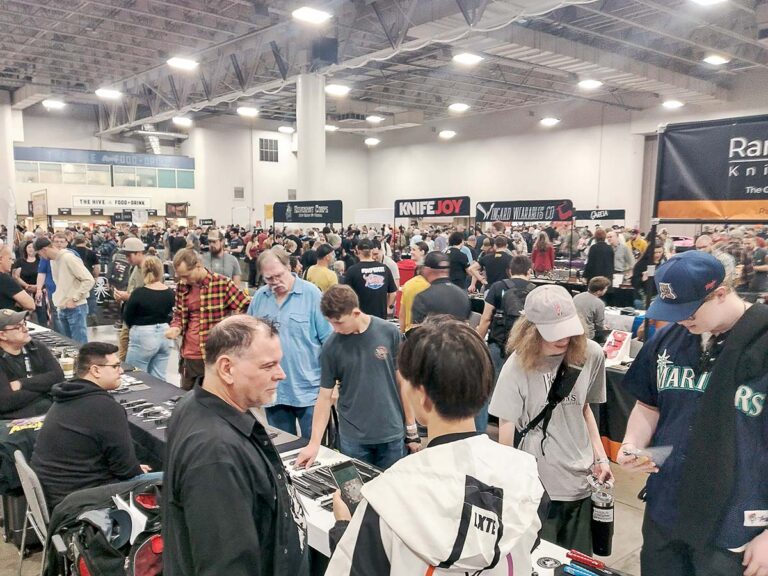
What a difference a year makes—and most involved with BLADE Show West October 10-11 in the Salt Palace Convention Center in Salt Lake City probably would be the first to agree.

While BLADE Show West ’24 didn’t exactly bomb, neither was it one of the best. Among the reasons for what some fairly or unfairly portrayed as an average event was the uncertainty surrounding the presidential election and how it would affect consumer spending, and the proximity of the show dates to the beginning of hunting season, among others. Whatever the excuses last year, no excuses were needed for the ’25 show as it met with approval from a large segment of exhibitors.

One of those exhibitors was BLADE Magazine Cutlery Hall-of-Fame member Bill Ruple. He was very pleased—and not just because he won Best Slipjoint in the custom judging.

“I thought the show was really good!” he exclaimed. “Attendance seemed a little higher than last year, but I think sales were much higher. I took six knives and sold them all on Friday. All the [South Texas] Slipjoint Cartel guys sold out.”
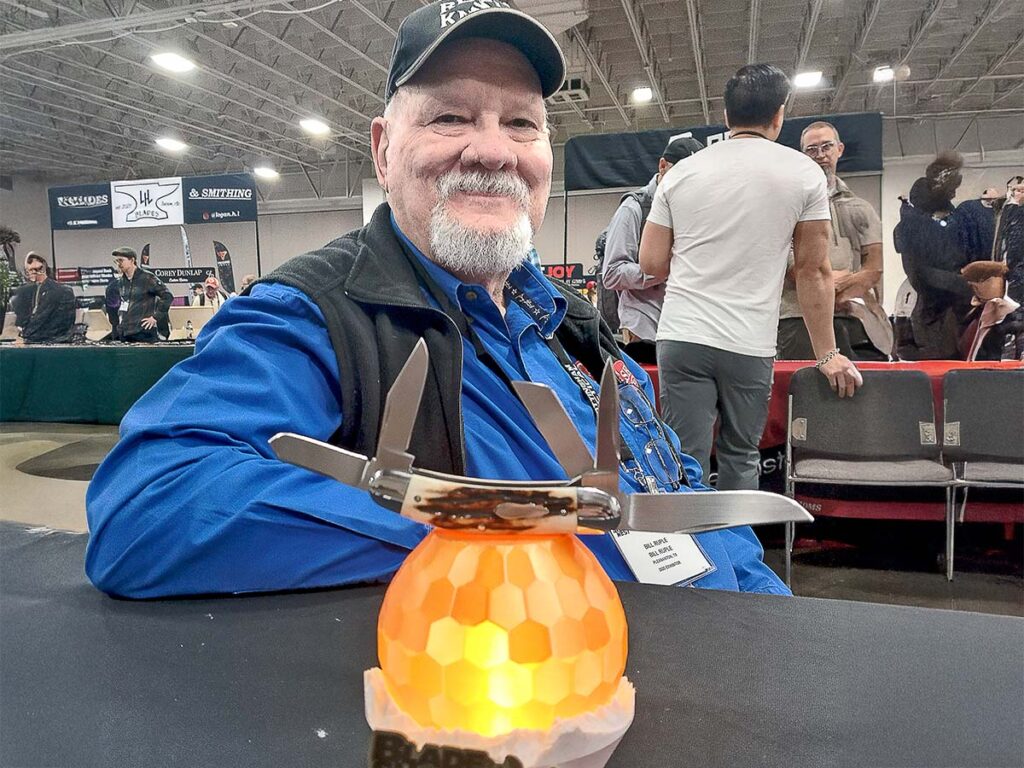
BLADE Magazine Cutlery Hall-of-Fame® member Bill Ruple won Best Slipjoint for his five-blade stockman (see page 60). Bill’s winning knife sits atop one of the trophies made especially for the show by Princeton Wong.

Counting Bill, those included Tanner Couch, Toby Hill and Luke Swenson.

Though there were the usual number of exceptions, exhibitor sales seemed up almost across the board, both custom and factory.

“It was a really good show for us with increased sales,” Jonathan McNees noted of his McNees Knives production knife company. “We brought about 100 knives and sold about 25 to 30 percent to customers and the rest to dealers.”

Custom maker Jared Oeser brought 11 knives and sold them all.
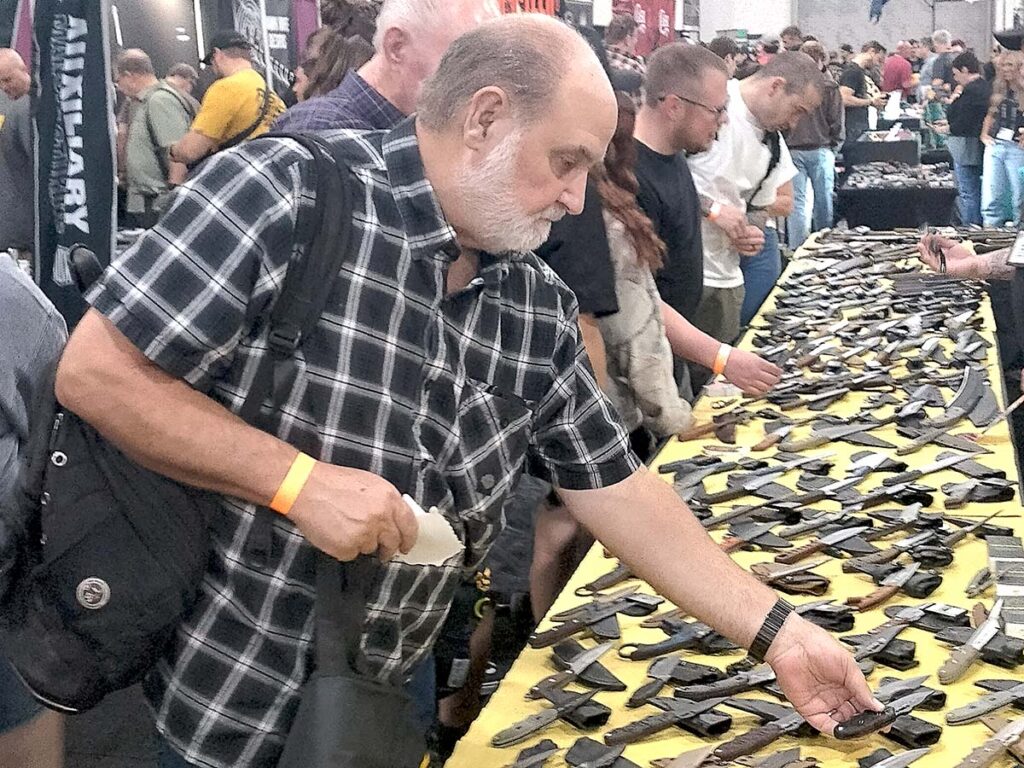
Lots of folks handled lots of knives at the TOPS Knives booth.

“I had a mix of FCFS [first come, first served], lotto and auction knives,” he observed. “I was busy pretty much the whole time. I judge it based on whether I can get away from my table, and I never had a chance to leave.”

It was the first-ever BLADE Show West in Salt Lake City for Cutlery Hall-of-Famers Daniel Winkler and Karen Shook, and they sold every production knife they brought.

“About half to individuals and half to dealers. We were well stocked,” Daniel wrote. “There were good sales and traffic. It seemed to be more of a user clientele than the collectors at the BLADE Show, which is good for us. Our focus is users rather than collectors.”

Maker Princeton Wong—who made the cool custom and factory award trophies for the judging competition winners—brought 12 knives and sold out. John Cammenga of White River Knife & Tool also sold out—about 90 percent to attendees and 10 percent to dealers. Maker Frank Edwards brought six knives and sold four. ABS Master Smith Shane Taylor brought six and sold only one, but was happy because it was the most expensive of the six. Zach Thull of Dauntless Manufacturing said his company sold about 30 knives and Eddie Johnson of CobraTec enjoyed another banner sales show.

Old friends Mick Strider of Strider Knives (left) and BLADE Magazine Cutlery Hall-of-Fame member Paul Bos (right) got caught up at the show.

“We always bring an overabundance of knives to the BLADE Shows, trying to ensure the customer’s experience is satisfying,” Johnson observed. “We sold 30 percent more knives this year over last year.” 

As for customer experiences, Eddie’s favorite show moment consisted of a most satisfying one.

“[It was] when the son came to the table several times with his dad,” Eddie related. “The son was enamored with a particular model that was a little more expensive than our others. His mother was being ‘Mrs. No.’ After the father and son touched every knife we had displayed, dad looked at son and told him to go ahead. The genuine joy and appreciation were evident in the son’s facial expression and body language. Then hearing, ‘Thank you, I love you, Dad,’ was the best experience I had and witnessed.”

Fast Start

The show got off to a fast start Friday, no doubt sparked by many who thought the best knives might go quick—which in a number of cases they did. While opinions varied on which day and time were busiest, most seemed to think attendance was up markedly over last year.
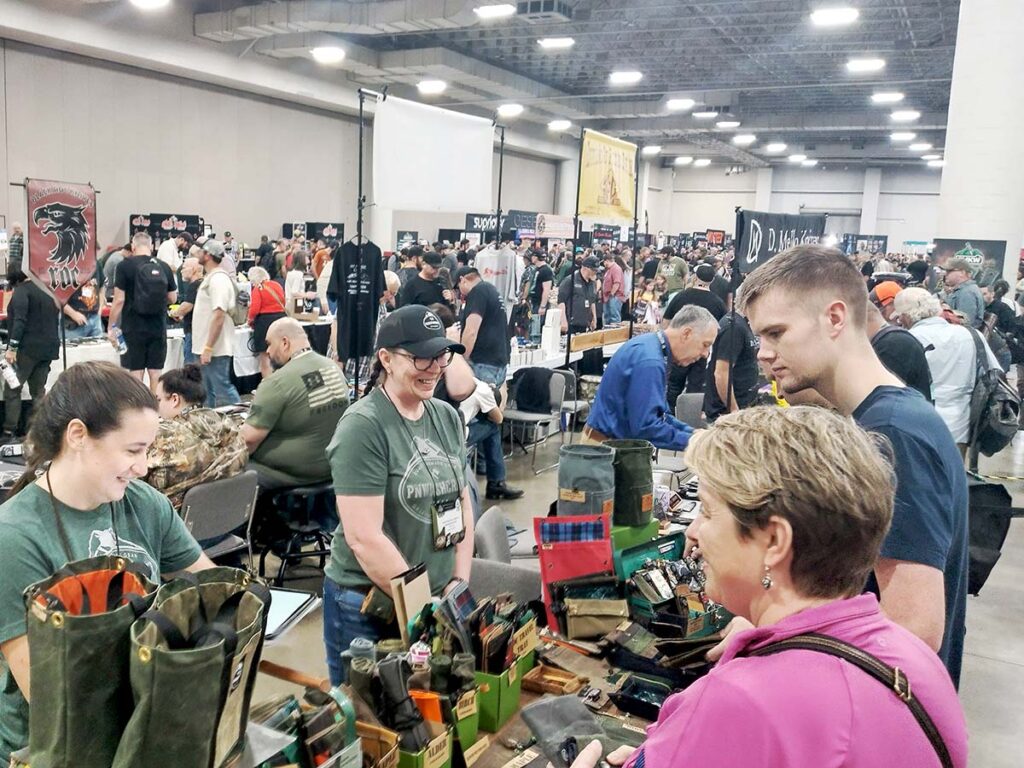
Knife accessories moved fast.

“It was way better than last year for sure,” Edwards noted. “It seemed like from opening till 3 p.m. both days were pretty busy.”

McNees indicated his booth had the most sales on Friday morning, but probably more traffic on Saturday morning. According to Ruple, attendance was about the same on both days. Taylor stated that while traffic was impressive and has been every year at BLADE Show West in Salt Lake City, Friday morning to mid-day was the busiest. Wong remarked that the opening times, the initial rush from early bird and general admission, were most hectic for him.

“Friday appeared to carry more steady foot traffic,” he stated, “with more people stopping by the table than Saturday.” Johnson indicated the inclement weather may have affected the crowd a little on Saturday, though overall attendance was definitely better than the previous year.

“For us, Friday was the busiest, fairly steady beginning an hour after the show opened until the later afternoon. Saturday had small flurries of activity followed by slow times. It seemed like a better Friday than last year and a slower Saturday than last year,” Cammenga assessed. “We definitely saw more return customers than in the last few years. We assume that’s from being in the same place a few years in a row.”
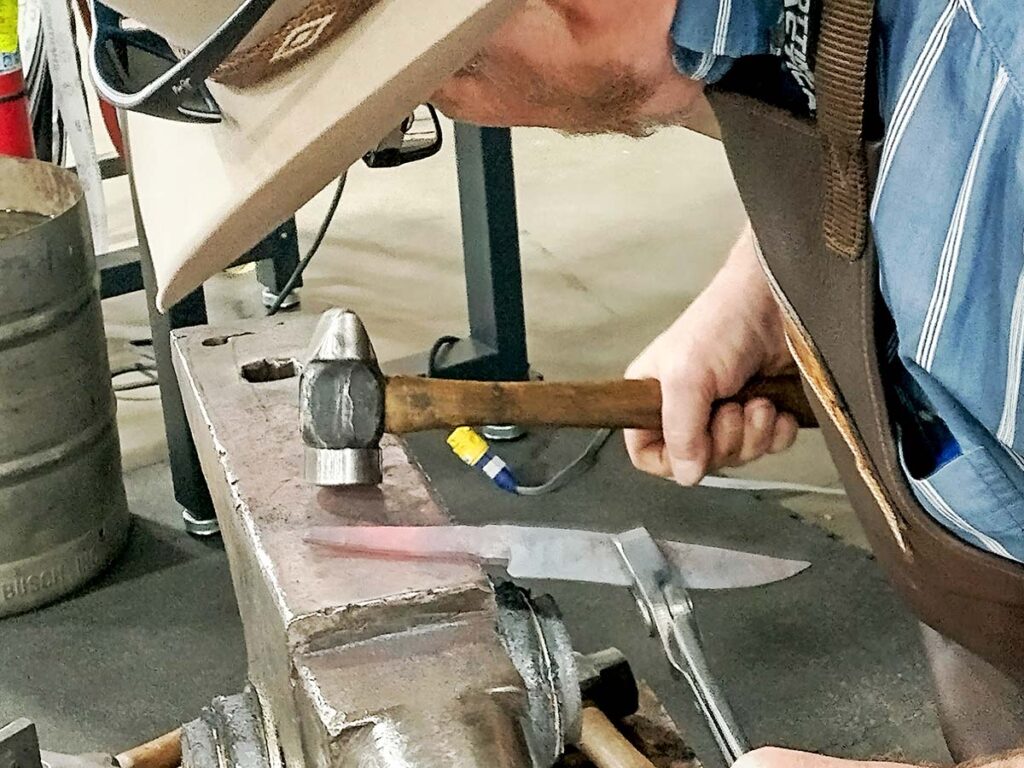
ABS Master Smith James Rodebaugh puts the finishing touches on a rough-forged hidden-tang knife at the indoor forge of Lonnie Jensen’s Mountain Shadow Forge.

“The show seemed like the busiest of the Salt Lake shows,” Oeser commented. “There were surprisingly a lot of locals coming through on Saturday and the line outside was down the street.”

When asked to rank the attendance on a 1-to-10 scale, with 10 the busiest, Jared qualified his answer.

“Of my limited time at shows the attendance at this one was about a 6, but I feel like shows and the knife market right now are not high,” he opined. “For current show standards I would adjust it to an 8 or 9.”

All the exhibitors but one quoted for the story said they would be back next year, which may be the best sign of a successful show of all.

Only Time?
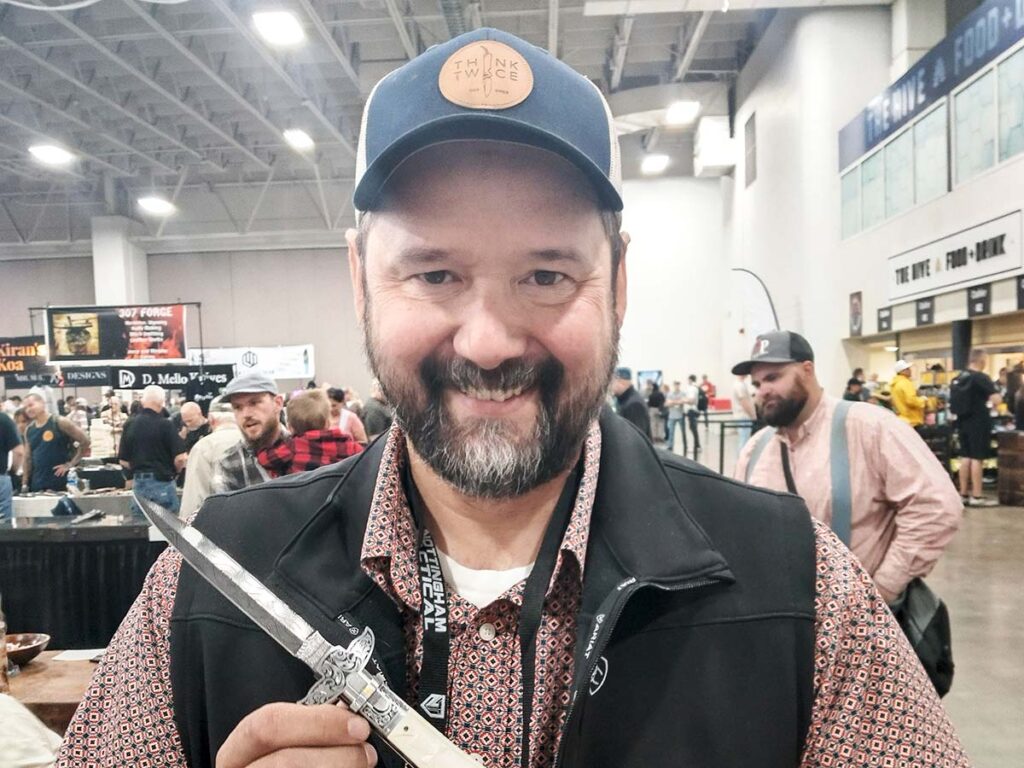
Frank Edwards displayed his heavily engraved damascus automatic dagger.

Enthusiasts came, they saw knives, they talked knives and, perhaps most important of all, spent time catching up and talking with each other at an event that may be the only time they see each other all year. But then that’s the way it is with a lot of knife shows, including the year’s last event in the BLADE Show triad of shows—BLADE Show West. Speaking of, plan now to attend next year’s sharp gala, Oct. 9-10, once again at the Salt Palace Convention Center in Salt Lake.

More On The Blade Shows:

EDC Fixed Blades: Compact And Ready For Any Task

Four U.S.-made EDC sheath knives take the author’s test.

EDC knives have been influenced by folding designs since the inception of steel, if not before. However, historically speaking, compact fixed blades were daily edged tools long before folders.

Cultures worldwide, both known and no doubt unknown, carried short sheath knives for utility, survival and ceremony. Japan’s tanto pierced with precision and Viking seaxes sliced with status. Native Americans relied on trade knives and ulus for skinning and barter. Indonesia’s badik and short kris blended practicality with spiritual meaning.

These blades reflected local needs and traditions, proving compact straight knives were essential long before EDC became a modern gear category.

Wharncliffe Vs. Sheepsfoot Blades

 The aptly named Bradford USA G3 Wharnie (top) has a classic wharncliffe blade while the Montana Knife Stockyard (bottom) boasts a modified sheepsfoot pattern.
The aptly named Bradford USA G3 Wharnie (top) has a classic wharncliffe blade while the Montana Knife Stockyard (bottom) boasts a modified sheepsfoot pattern.

Wharncliffe and sheepsfoot blades are similar and different. A wharncliffe features a long, straight cutting edge with a spine that tapers gradually to a fine, precise point. This geometry excels at controlled slicing, detailed scoring and utility work where accuracy at the tip is essential. The design allows steady pressure along the edge, making it ideal for carving, whittling and precision-driven EDC tasks.

A sheepsfoot, by contrast, has a straight edge with a spine that curves down sharply to meet the edge in a blunter tip. This greatly reduces the risk of piercing, making it safer for rescue work, controlled cuts and environments where safety matters most.

The wharncliffe offers versatility and precision for fine tasks, while the sheepsfoot provides dependable slicing power, rope-cutting efficiency and unmatched control under pressure. Together, they represent two specialized approaches to cutting—one prioritizing accuracy, the other emphasizing safety and reliability.—by Reuben Bolieu

Montana Knife Co. (MKC) Stockyard

The Montana Knife Stockyard whittled curly, thin feather sticks for a small twig stove. MKC offers free sharpening, cleaning and repair for life, ensuring the knife remains reliable for years to come.

Stockyard Specs
Blade Length: 3 3/8”
Blade @the Thickest: 0.115”
Blade Steel: MagnaCut stainless
Blade Finish: Stonewash
Scales: G-10
Weight: 3.14 ozs.
Overall Length: 7 5/8”
Sheath: Kydex
Country of Origin: USA
MSRP: $300

Pros

  • MagnaCut Steel Blade
  • Company After-Purchase Support
  • Light

Cons

  • Expensive

The Montana Knife Co. (MKC) Stockyard is made in the USA and hand-finished in Montana. It embodies the rugged traditions of ranch life and strikes a balance between compact carry and the strength needed for long days in the field. Its MagnaCut stainless steel is known for toughness, edge retention and corrosion resistance, and the blade’s thickness provides durability without excessive weight.

The sheepsfoot blade is designed for controlled slicing and safe utility, excelling in tasks such as cutting twine or trimming hooves where precision is crucial. The stonewash finish reduces glare and disguises wear, while the rugged G-10 scales in green and black ensure a secure grip, even in wet or gloved conditions. The ergonomic handle includes a “subtle hook profile” for extra control and quick deployment.

Each Stockyard comes with a USA-made Kydex sheath, featuring adjustable retention for a secure fit and both horizontal and vertical carry. The design keeps the knife accessible and comfortable, whether you’re riding fence lines or working in the shop. MKC also offers free sharpening, cleaning and repair for life, ensuring your knife remains reliable for years to come.

Bradford USA G3 Wharnie

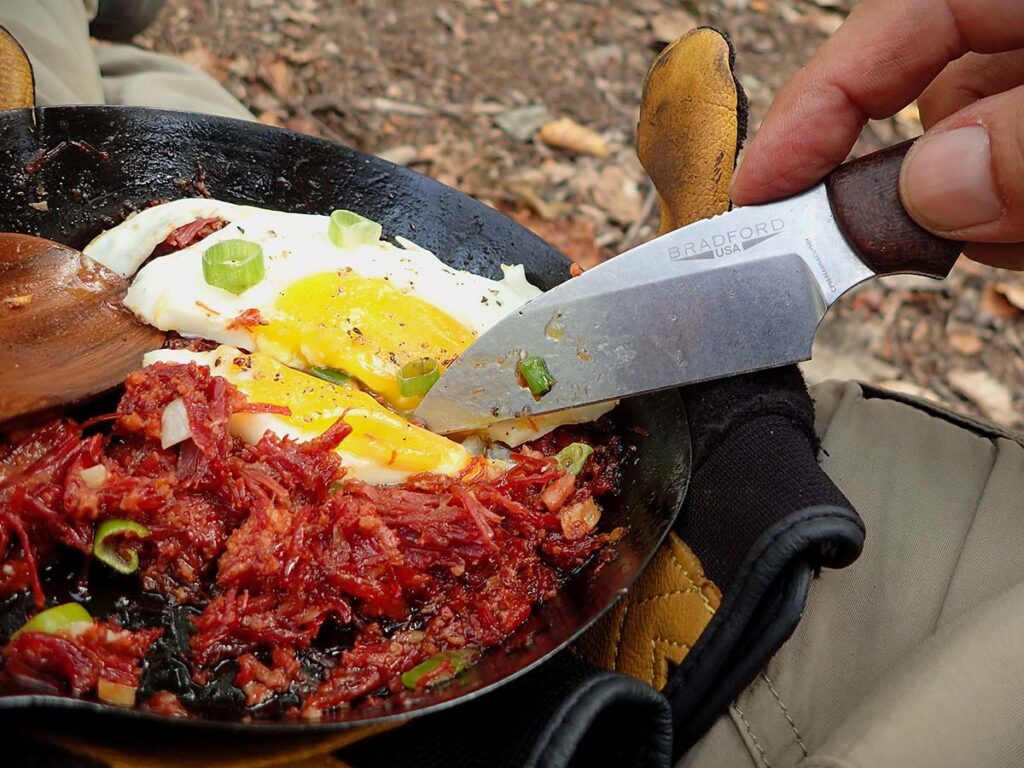
Wharncliffe and sheepsfoot blades allow you to choke up toward the tip and use a forefinger for fine control work. The author used the technique with the Bradford USA G3 Wharnie on a fried egg eaten right out of his carbon-steel skillet.

G3 Wharnie Specs
Blade Length: 3.625”
Blade @the Thickest: 0.14”
Blade Steel: MagnaCut stainless
Rockwell Hardness: 63-64 HRC
Blade Finish: Stonewash
Scales: Natural burlap Micarta®
Weight: 3.96 ozs.
Overall Length: 6.875”
Sheath: Kydex
Country of Origin: USA
MSRP: $259

Pros

  • Compact
  • MagnaCut Blade Steel
  • Excellent Slicer

Cons

  • Might Not Be Good At Prying

Skilled makers in Kent, Washington, meticulously craft the Bradford USA G3 Wharnie, ensuring every detail meets the highest quality standards. The compact fixed blade strikes a balance between portability and cutting strength, making it ideal for everyday carry and outdoor use. The blade’s long, straight edge offers both reach and control, versatile enough for slicing tasks and utility work. The blade thickness provides durability without the weight, allowing for agility in the hand.

Forged from premium Bohler M390 or MagnaCut stainless, the blade excels in edge retention, toughness and corrosion resistance. The wharncliffe blade, featuring the straight edge and fine tip, is particularly suited for controlled slicing, scoring and detailed cutting. A choice between a stonewash or tumbled finish minimizes glare while concealing wear, giving the knife a rugged, industrious appearance.

The handle features 3D-contoured scales in a choice of G-10, Micarta, carbon fiber or G-Wood, ensuring a secure grip and long-lasting durability. The ergonomic shape fits comfortably in hand for extended use, whether in the field or workshop. Each G3 Wharnie comes with a taco-style Kydex sheath that offers secure retention and customizable carry options.

Big Idea Design Deano

Deano Specs
Designer: Mak Kelsay
Blade Length: 3.125”
Blade Steel: Nitro-V stainless
Blade @the Thickest: 0.14”
Blade Finish: Graphite black Cerakote®
Weight: 3.6 ozs.
Scales: Micarta®
Overall Length: 7.5”
Sheath: Kydex w/UltiClip 3.3
Country of Origin: USA
MSRP: $325

Pros

  • Versatile Blade
  • Good Carry System
  • Full-Sized Grip

Cons

  • Expensive

The Deano from Big Idea Design is made in America with global steel origins. Designed by Mak Kelsay in Chattanooga, Tennessee, it strikes a nice balance between compact carry and dependable working strength. The blade provides versatile cutting power for everyday carry, camping and outdoor use. It also offers durability without unnecessary bulk, keeping it agile in hand.

The Nitro-V stainless blade steel delivers excellent toughness, edge retention and corrosion resistance in demanding environments. The modified drop point emphasizes control and practical utility. It tracks straight, bites clean and handles detail cuts with confidence. A graphite-black Cerakote®/tumbled finish creates a rugged, battle-worn look while reducing glare and concealing wear.

Scales are durable Micarta in black or green, providing a secure grip in all conditions. The ergonomic contour ensures comfort during extended use, whether in the field, workshop or camp.

The Deano includes a scout-carry Kydex sheath with an UltiClip Slim 3.3, offering secure retention and versatile carry options. The sheath system rides comfortably on a belt or pack, keeping the knife accessible and protected at all times.

Bear Forest Knives Stumpy

Stumpy Specs
Designer: Garrett Tremblay
Blade Length: 2 1/8”
Blade @the Thickest: .125”
Blade Steel: Nitro-V stainless
Blade Finish: Raw matte
Weight: 3.2 ozs.
Scales: Various Micarta®/wood/Bearcarta
Overall Length: 5 7/8”
Sheath: By JRE Industries of black leather
County of Origin: USA
MSRP: $200

Pros

  • Hand Built
  • Grind Options
  • Good Ergonomics

Cons

  • Smallish Handle

The Bear Forest Knives Stumpy is built by hand in the USA for everyday carry and outdoor reliability. It offers a compact profile that disappears on your belt. The short blade delivers precise cutting power for utility, camp chores and daily shop tasks, and strikes a balance between strength and nimble handling, making it quick and responsive in the hand.

The Nitro-V stainless blade steel provides excellent hardness, edge retention and corrosion resistance in demanding environments. The blade features a full flat grind but is also available with a Scandi grind. It has a 90-degree spine ideal for generating sparks with a ferro rod and for scraping tinder. A raw matte finish gives the knife a resilient, understated look while reducing glare and hiding wear.

Scales are available in Micarta, wood or Bearcarta, each offering durability, comfort and a secure grip in most all conditions. The ergonomic design ensures the knife locks naturally into your hand, even during extended use.

Each Stumpy includes a premium JRE Industries black leather sheath, designed for secure retention and comfortable carry. The sheath rides well on a belt or lanyard, keeping the knife accessible and protected wherever you go.

Real World Tests

There are two teams here, as I see it—straight blades and, more commonly, curved blades. Or, MagnaCut vs. Nitro-V. The blades were all hair-popping sharp out of the box, as expected. This is always the first test of any edged tool I get.

The handles are all unusual. The Stockyard and The Deano have full-sized grips, while the Stumpy and G3 Wharnie have shorter, more compact handles. The latter two also have beefier, hand-filling scales, adding to user comfort.

I had the Stumpy with its full flat grind the longest. It is the only EDC in the batch to have a straight, 90-degree sharpened spine. The continuous curve of the belly aided in making feather sticks for a fire, as did the sharp spine for striking a ferro rod. The smallish handle was comfortable due to the textured Micarta and thick scales. Besides, who doesn’t like a good Mexican blanket print on the scales?

The Deano has a thin handle, as many EDC fixed blades do. The scales are smooth and comfy—sleek. The modified drop point has a slightly clip-point feel and look.

On the utility side, I slashed through mounds of cardboard to break down boxes. I cut cardboard, not tape. (There’s nothing more annoying than a sticky blade on a good knife.) Slicing along the side of a box helps open it up and saves your edge, since it separates a lot of area with minimal gumminess. The light gimping was perfect for my forefinger when slicing down. I never use my thumb on the spine— it’s a bushcraft habit.

Wharny Or Sheepy?

The wharncliffe and sheepsfoot are two similar blade shapes with distinct attributes. I received the Bradford G3 Wharnie in MagnaCut first and rekindled my love for the straight-edge style with a curved spine. Nothing screams utility more than a straight edge similar to that of an X-Acto knife blade. Any box-opener blade fits in with the crowd, as does a wharncliffe. Tip-forward pressure is excellent for drawing back slices.

Wharncliffe and sheepsfoot blades allow you to choke up toward the tip and use a forefinger for fine, controlled work. I used the technique on a fried egg eaten right out of my carbon-steel skillet. Only a small amount of steel came in contact with the egg and skillet, as draw cuts use minimal edge.

I ran the MKC and Bradford through identical testing on various fibrous materials for practical EDC use. I sliced scrap leather, nylon webbing, zip ties, phone-charging and lamp cords, and lots of cardboard, all with zero issues. The more challenging materials were plastic packaging banding and 15,000-pound tow strapping. I severed the latter two media on a cutting board, draw cutting and push cutting. The forward leverage obtained from the straight-edge blades was apparent and much appreciated. Both blades sliced through the din with no holdups.

As for the performance difference between MagnaCut and Nitro-V, it has more to do with edge geometry and the materials you’re cutting than anything else. It would take a long time cutting similar materials with identical grinds on two knives to see any real difference. Suffice to say, these are two top-tier stainless steels.

Carry Systems

The test knives come with sturdy Kydex sheaths ready for scout carry.

Besides the Bradford G3 Wharnie, two of the test knives are set up for scout carry with straps. The older model of the BFK Stumpy has one-strap retention for scout carry, which you can adjust to different positions. The MKC Stockyard has a Kydex fold-over sheath that easily attached to my belt while I was already wearing pants. The feature is incredibly convenient for those who often forget to put things on until it’s time to work.

The Deano came with options: scout carry strap set and UltiClip Slim 3.3, like a choose-your-own-adventure book. Bradford sent me a sturdy Kydex sheath without attachments. However, Bradford has order options on its website. I carried the Bradford entry like a slip sheath in my pocket and eventually attached it to a small carabiner to hang on my belt loop.

Check Out More Outdoor Knives:

GSM Outdoors Purchases Smith’s Products

0

GSM Outdoor takes a larger stake in the knife industry with the purchase of Smith’s Products.

The outdoor industry is constantly shifting and the knife niche isn’t immune. One of the latest moves certain to touch a large swath of the edge tool market is GMS Outdoor acquiring Smith’s Products.

The deal, for an undisclosed amount, was completed in October. Already, GSM’s website has the company added to its 57-brand roster.

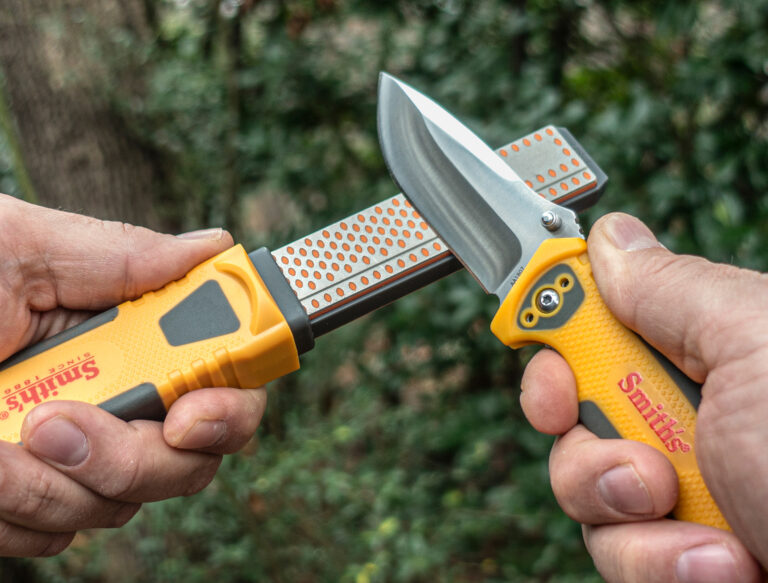
For those not well-versed in the industry, GMS is a large multi-brand conglomerate with a toehold in hunting, shooting and fishing. Smith’s was founded in 1886 as a small family operation, mining and selling raw sharpening stones. Over time, it grew into a multi-channel brand, supplying tools for everything from hunting and fishing to culinary and tactical use.

Interestingly, this is not the GSM’s first dalliance into the knife sphere. In 2020, the conglomerate purchased Cold Steel, and in 2021, it further ventured into the niche, buying SOG.

Up to this point, the company did not own a dedicated knife accessories business, which has always been Smith’s Products’ bread and butter. Even with these recent moves of the past five years, GSM’s main thrust remains in the hunting and fishing industry.

The overall effect of GSM’s purchase of Smith’s offerings and evolution remains to be seen. The Smith’s brand was fairly ubiquitous before the purchase, but likely will become more so under the multi-brand umbrella.

As to GSM’s angle on the purchase, its senior VP of sales, Chris Leonard, had this to say in a press release:

“Together, GSM Outdoors and Smith’s Products are poised to deliver greater value, drive meaningful growth, and continue building a more sustainable future for the industry in every facet.”

More On Knife Sharpening:

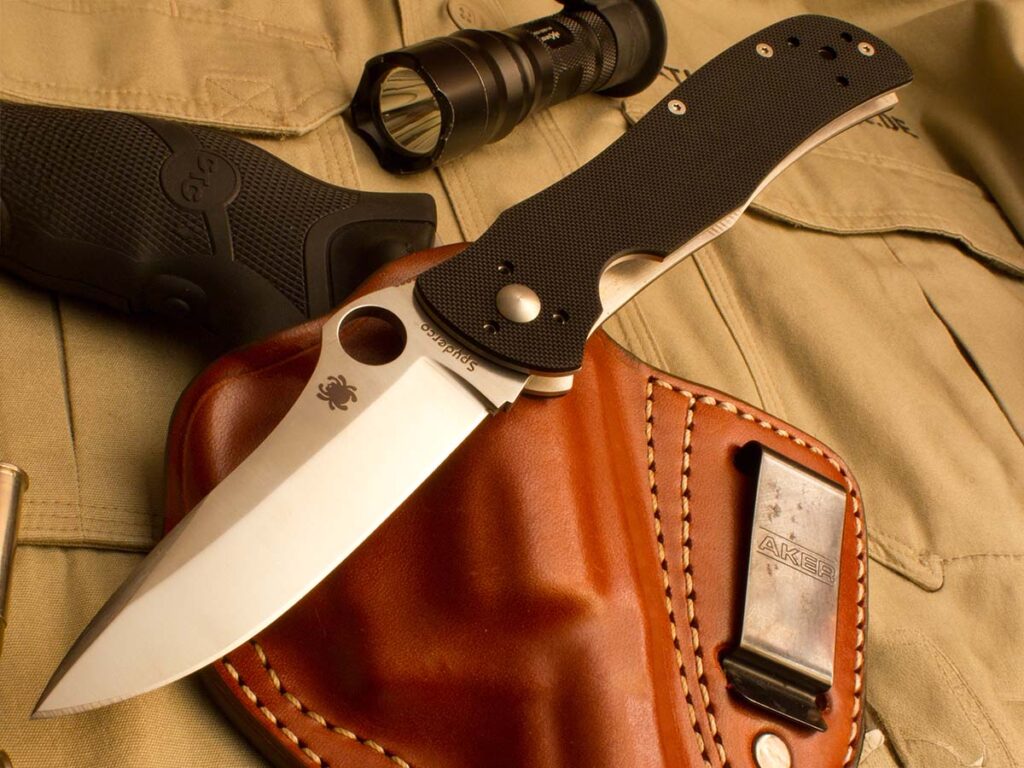
Spyderco Starmate: 25 Years Of The Definitive Terzuola Tactical Folder

Sprint Run Spyderco Starmate salutes Bob Terzuola and Sal Glesser.

“If I have seen further than others, it is by standing upon the shoulders of giants.”—Isaac Newton

Although Newton penned these words centuries ago, the spirit of his quote is timeless. Applied to the world of knives, today’s high-performance, state-of-the-art tactical folders are the direct result of two cutlery industry giants: legendary custom knifemaker Bob Terzuola and Spyderco co-founder Sal Glesser.

Both members of the BLADE Magazine Cutlery Hall of Fame®, independently these men each had a tremendous influence on the knife world. However, when they joined forces their impact was even more profound. One of their more influential collaborations was the Starmate, which combined the best elements of Terzuola’s iconic ATCF (Advanced Technology Combat Folder) and Glesser’s revolutionary CLIPIT platform.

To celebrate the 25th anniversary of this pivotal design—and commemorate several other important historical landmarks as well—Spyderco has introduced a limited-edition Sprint Run expression of the Starmate. To truly appreciate the knife, however, you need to appreciate the men behind it.

Brooklyn Boys

Sal Glesser (left) and Bob Terzuola (right).

Robert G. Terzuola was born in Brooklyn, New York, on Sept. 14, 1944. A diligent student, he earned a full scholarship to New York University, where he majored in vocational education. Upon graduation, he joined the Peace Corps and served in a variety of roles in Panama, Puerto Rico and Guatemala. During that time, he taught himself the art of jade carving and ultimately became the general manager of a jade jewelry company in Antigua, Guatemala. There he met Col. James Atwood, a former U.S. military intelligence officer, military edged weapons historian and CIA contract worker. Recognizing Terzuola’s skills as an artisan, Atwood suggested he try his hand at knifemaking and introduced him to many of his earliest customers—adventurers and soldiers of fortune in Central America.

With Atwood’s encouragement, in 1980 Terzuola began crafting handmade fixed blades. In 1982, he joined The Knifemakers’ Guild based on endorsements from the legendary Bob Loveless and Frank Centofante, Cutlery Hall of Famers in their own right. That same year Terzuola met Glesser at the New York Custom Knife Show.

A fellow Brooklyn native, Sal was—and still is—a passionate entrepreneur and inventor. He operated several successful businesses before he and his wife Gail founded Spyderco in 1976. Sal’s first knife-related product was the Tri-Angle Sharpmaker, an improved expression of the ceramic Crock Stick knife sharpener he and Gail sold at fairs and shows across the country.

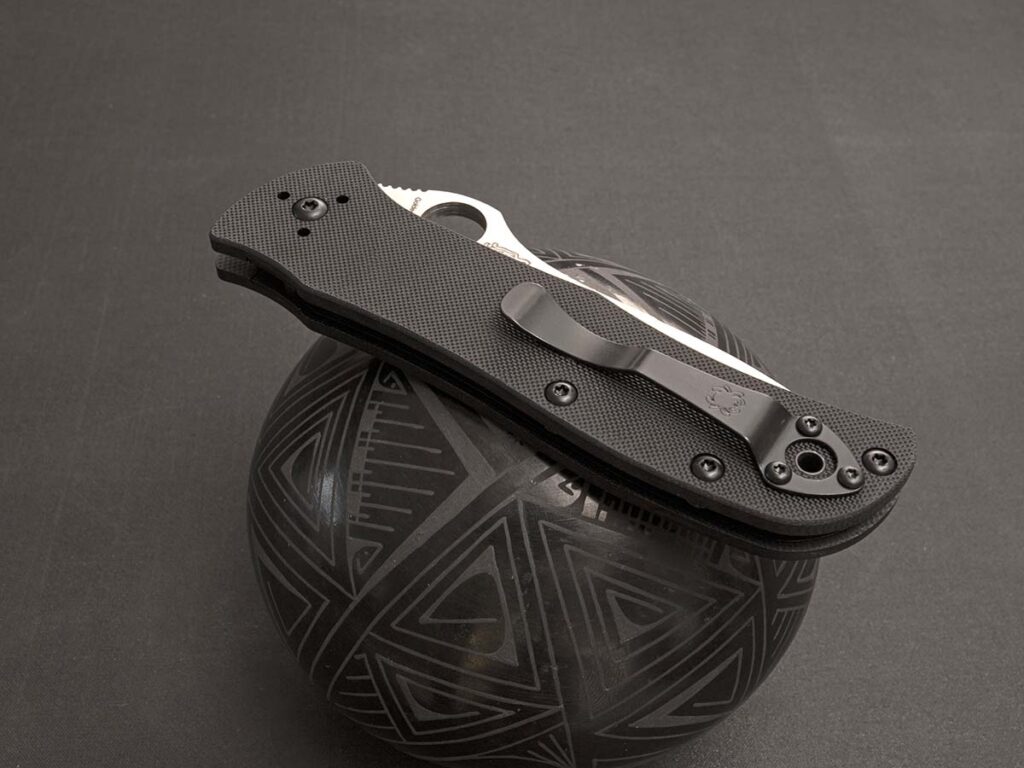
A broad-based, four-position pocket clip supports all carry modes for the revival of the Starmate.

In 1981, Sal introduced the first Spyderco knife: the Worker. Its revolutionary design was the first to include a pocket clip for convenient, top-of-the-pocket carry and Spyderco’s signature Trademark Round Hole for swift one-hand opening with either hand. The inaugural member of Spyderco’s groundbreaking CLIPIT family, a year later the Worker was also the first commercial folder to offer the aggressive cutting power of a serrated blade. Together, these features defined the form of the modern folding knife that still endures today.

Synergy For SpyderCo

When Bob first met Sal at the New York Custom Knife Show, he was impressed with Sal’s showmanship as a salesman of the Sharpmaker. Terzuola was equally taken with the CLIPIT folding knife concept and its revolutionary features. Similarly, Sal appreciated the impeccable craftsmanship of Bob’s knives and their no-nonsense style. The fact that both men hail from Brooklyn gave them additional common ground, and they quickly became good friends.

In 1984, Terzuola moved to Santa Fe, New Mexico, and began making knives full time. A year later, he learned the intricacies of making a linerlock folding knife directly from its inventor, renowned custom knifemaker and Cutlery Hall-of-Famer Michael Walker. Bob also asked Sal’s permission to incorporate the pocket clip into his folding knife designs. Sal not only gave Bob his blessing but generously sent him a box of Spyderco’s early three-screw clips.

Eric Glesser (right), today’s driving force behind Spyderco, was the catalyst behind the Starmate project.

Armed with the knowledge he had learned from Michael Walker and the inspiration of Sal’s CLIPIT concept, Terzuola turned his focus toward making folding knives. His first two designs—the Model 1 Utility and the Model 2 Mariner—were primarily utilitarian in nature. Both offered one-hand opening via a thumb disk, which Terzuola pioneered, and early versions were crafted with Spyderco clips.

After the success of those designs, Bob turned his focus back to the needs of his original clientele—soldiers and armed professionals—to create a low-profile, no-nonsense folding knife suitable for both defensive and utilitarian use. His third folder design, the ATCF, became Terzuola’s most iconic model, and Bob was attributed by many with coining the term “tactical folding knife,” aka “tactical folder.” With that, he became a pioneer of the genre.

First Collaboration

At the 1989 SHOT Show, Sal and Bob were discussing Spyderco’s growing line of CLIPIT knives when Bob commented that, despite their groundbreaking features, they were ugly. Sal quickly countered with an offer: “You design a pretty one and I’ll make it.” Terzuola took Sal’s challenge to heart and not only delivered a design that showcased both his personal style and Spyderco’s Trademark Round Hole, but a series of specific conditions for its production.

Spyderco ultimately discontinued the first-generation Starmate but reintroduced the knife in 2012. Crafted in Japan, the reintroduction featured full stainless-steel liners and a VG-10 stainless steel blade.

That design, the C15 Bob Terzuola, established Bob as Spyderco’s first collaborative designer. It also made history as the company’s first made-in-the-USA model, the first Spyderco knife to feature a linerlock, the first production knife to use ATS-34 stainless blade steel, the first factory-made knife to use a laser-cut blade, and the first CLIPIT to offer two-position carry. Introduced in 1990 with machined aluminum scales, in 1994 it made history again as the first factory knife to feature a G-10 handle. It was later joined by a smaller counterpart, the C19 Bob Terzuola Jr., which also was made with both aluminum and G-10 scales.

The Starmate

By 1999, Terzuola had established himself to many knife enthusiasts as the “Godfather of the Tactical Folding Knife” and among the world’s premier custom makers. Drawing inspiration from his acclaimed ATCF and his Century Starfighter designs, he partnered with Spyderco again to create the Starmate.

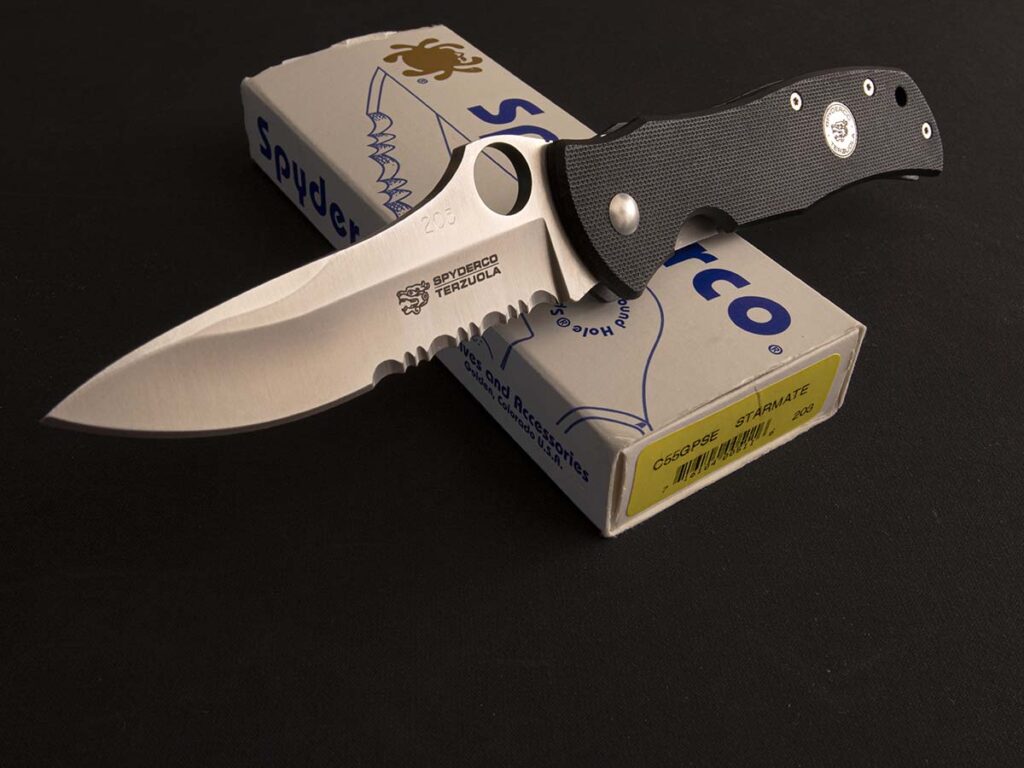
Manufactured in Golden, Colorado, the original Starmate featured a hollow-ground blade crafted from CPM 440V particle metallurgy stainless steel, smooth black G-10 scales, a single, nested stainless-steel liner, a linerlock, a round Spyderco/Terzuola inlay, and a pocket clip with a broad, triangular base configured for right-side, tip-down carry. It was produced in both PlainEdge and partially serrated CombinationEdge formats, and was an immediate hit with serious tactical knife users.

The original Spyderco Starmate was introduced in 1999. 
Here’s a first-generation model with an original product box. Note Terzuola’s distinctive dragon head blade logo inspired by the Mayan god of flint tools and edged weapons, Etz Nab.
The original Spyderco Starmate was introduced in 1999. Here’s a first-generation model with an original product box. Note Terzuola’s distinctive dragon head blade logo inspired by the Mayan god of flint tools and edged weapons, Etz Nab.

Although the first-generation Starmate was ultimately discontinued, in 2012 Spyderco resurrected and updated the design. This time it was manufactured in Japan with a saber-ground VG-10 stainless steel blade, full stainless-steel liners, peel-ply-textured G-10 scales, and a four-position pocket clip configurable for left or right-side, tip-up or tip-down carry. The rebirth of the model introduced a new generation of knife enthusiasts to Terzuola’s exceptional designs, which included two other Spyderco collaborations—the non-locking C131 Terzuola SLIPIT and the C174 Double Bevel.

Milestones

Reflecting on the rich history of Terzuola’s many accomplishments and his longstanding relationships with Glesser and Spyderco, in 2025 Sal’s son and heir, Eric, decided to create a special Sprint Run expression of the Starmate. Eric’s goal was to commemorate Bob’s 45th year as a knifemaker, his 81st birthday and the 35th anniversary of his first Spyderco collaboration. Like all Sprint Run projects, this limited-edition version of the design features a combination of materials unique for Spyderco and that the company will produce only once. Manufactured at Spyderco’s factory in Golden, Colorado, it pays homage to the profound impact both Terzuola and Glesser have had on the knife industry and their pioneering roles in creating the genre of the modern tactical folding knife.

Bob Terzuola (left) delivered the induction speech for Sal Glesser (right) when Sal entered the BLADE Magazine Cutlery Hall of Fame® in 1999. Terzuola was inducted in 2023.

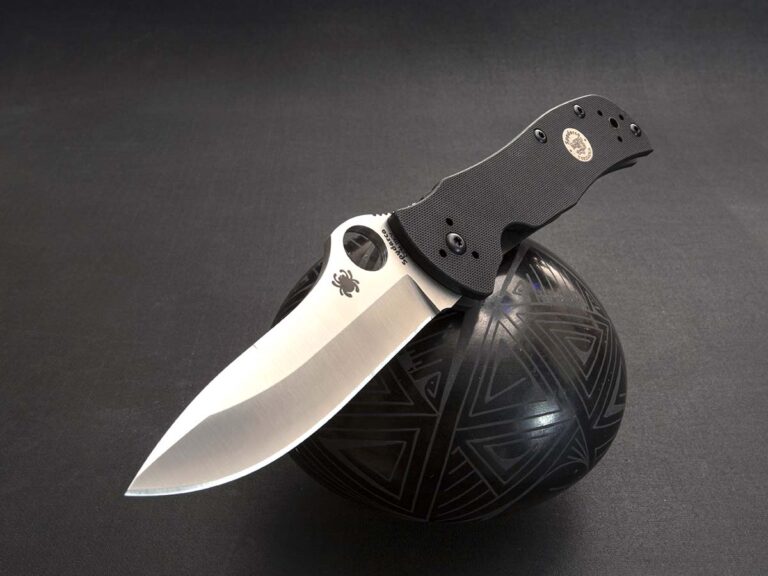
The Starmate Sprint Run edition faithfully revives Terzuola’s iconic design and elevates it with a blade crafted from CPM 20CV—a highly wear-resistant, powder metallurgy stainless steel that contains a high volume of vanadium carbides and the highest amount of chromium of any vanadium-rich stainless steel currently available. This distinctive alloy composition gives it a remarkable combination of edge retention, corrosion resistance and toughness and makes it ideal for the Starmate’s intended scope of use.
The knife’s hollow-ground blade features a handsome satin finish and a prominent swedge (unsharpened bevel) on the spine that adds distinctive style while ensuring an acute, utilitarian point. It also includes a large Trademark Round Hole accessible for ambidextrous one-hand opening and announces the knife’s Spyderco pedigree. A section of gimping above the hole provides a high-traction thumb purchase for enhanced control during use. The blade’s reverse side features a laser-engraved dragon head—Terzuola’s distinctive logo inspired by the Mayan god of flint tools and edged weapons.

The Starmate’s blade is supported by a sturdy linerlock and housed in a handle of black G-10 scales and nested, skeletonized stainless steel liners. The scales have a peel-ply texture for a non-slip grip and, like the original version, are accented by an inlaid Spyderco/Terzuola logo. To allow convenient carry, keep the knife poised for instant access and pay homage to the time-tested CLIPIT concept, it includes a four-position hourglass pocket clip. The broad-based clip is easily configurable for left- or right-side, tip-up or tip-down carry and, in the tip-up position, straddles a lanyard hole that allows the easy attachment of fobs, lanyards or security lines. In keeping with the knife’s tactical styling, the clip and handle hardware all feature stealthy black coatings. To complete the package, every knife comes complete with a zippered nylon pouch embroidered with the Spyderco “bug” logo and a detailed product information guide explaining the design’s history.

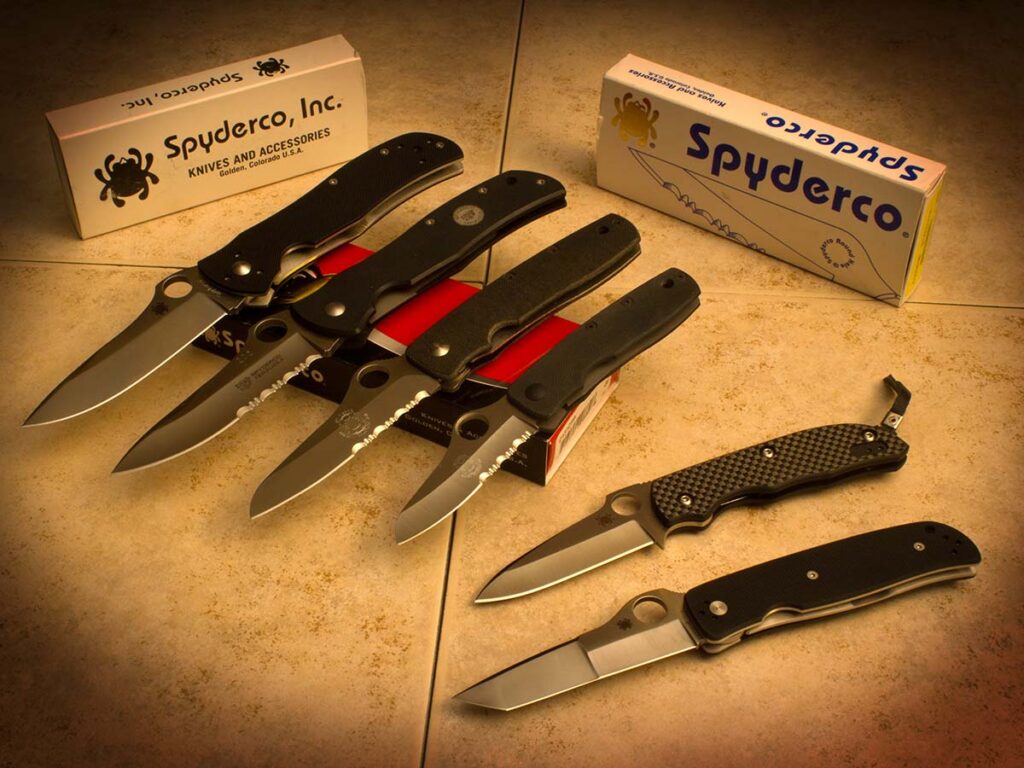
Bob Terzuola was Spyderco’s first collaborator and still reigns as one of the company’s most prolific collaborators. Here’s a selection of Terzuola-designed Spyderco folders.

Spyderco’s limited-edition Starmate is a proud tribute to two of knifemaking’s most legendary and influential figures. It is also a vivid reflection of their individual innovations, their longstanding friendship and mutual respect, and the powerful synergy of their collaborative efforts. This elite expression of the Starmate will be available while supplies last through Spyderco’s worldwide dealer network and directly from Spyderco.com.

Spyderco Starmate Sprint Run Specs
Designer: Bob Terzuola
Blade Length: 3.74”
Blade Steel: CPM 20CV stainless
Blade Thickness: 0.145”
Blade Grind: Hollow
Edge Length: 3.68”
Handle Material: G-10
Lock Type: Linerlock
Pocket Clip: Ambidextrous; 4-position
Knife Weight: 4 ozs.
Closed Length: 4.99”
Country of Origin: United States
MSRP: $450

More Spyderco Knives:

West Coast Flipping Championships Placers

0

See who took home top honors at the West Coast Flipping Championship.

The contestant known as @balisongnerd won the 6th Annual West Coast Flipping Championships October 11 at BLADE Show West in Salt Lake City.

Contestants @in8jo and @__hey.austin captured second and third place, respectively.

Hosted and conducted by Squid Industries before a crowd of engaged onlookers in the Salt Palace Convention Center, the event drew a large number of young contestants who competed against each other by displaying their balisong flipping talents in a round robin format.

Prizes included $1,000 for first place, along with a Poikilo Blade Nova, MachineWise Opus V2 Live Blade and Microtech Ultratech ZBP OTF Zero Forks from Blade HQ. Second place took home a $500 cash prize, a MachineWise Opus V2 Trainer and a Dessert Warrior Civivi Elementum II from Blade HQ. Third place earned $250, a MachineWise Opus V2 trainer and a CRKT Folts Minimalist Dessert Warrior from BladeHQ.

More On BLADE Show:

Dagger Design: Fundamentals Of Dagger Construction

From maintaining symmetry to adding fullers, we break down the intricate process of making a dagger design into a physical knife.

A dagger is not a kitchen knife in disguise. It is a purpose-built instrument of thrust and that purpose demands precision at every stage of construction. Small errors that might pass unnoticed in a hunter or utility knife compound on the exacting canvas of the dagger. A centerline that begins drifting by a fraction at the ricasso becomes an off-center tip, an uncentered bevel a blade that twists, the result a thrust off target. The difference between success and failure is geometry, and nowhere does geometry matter more than in the making of a dagger.

The process begins with detailed design and planning. The execution begins with precise layout. The central axis is the spine on which the whole piece will rest, and without it symmetry is impossible—the whole blade will stand or fall on getting this right. There are some tricks that will help ensure success.

Dagger Half Template

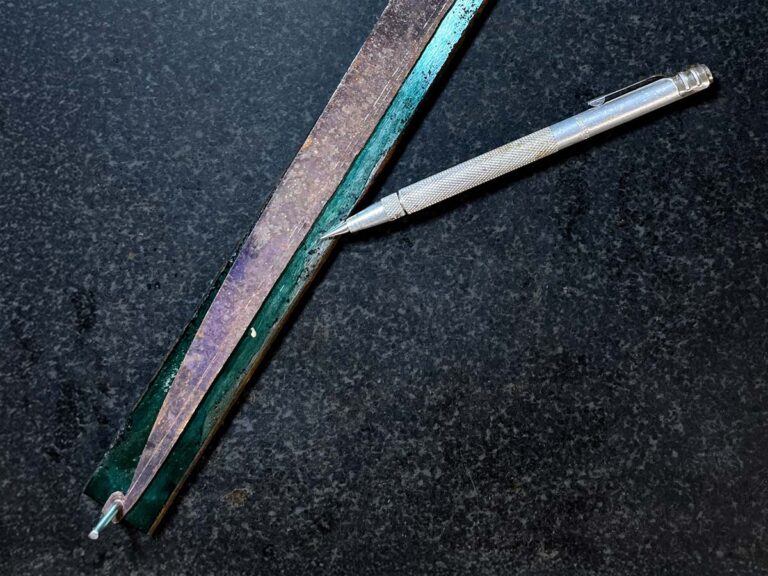
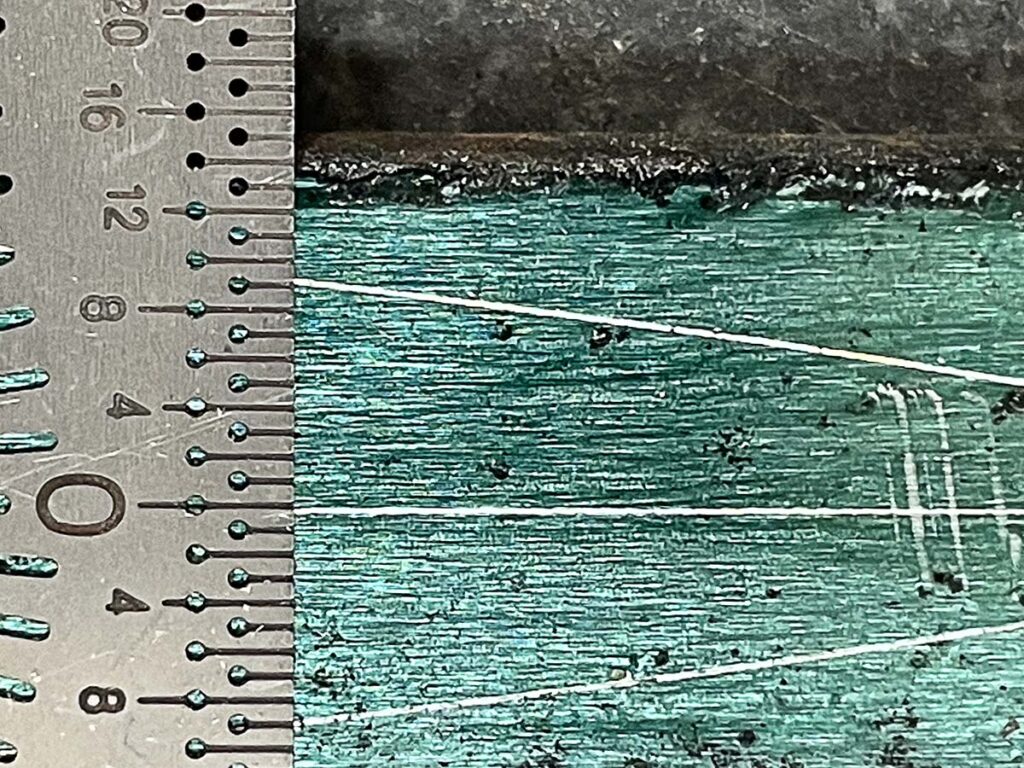
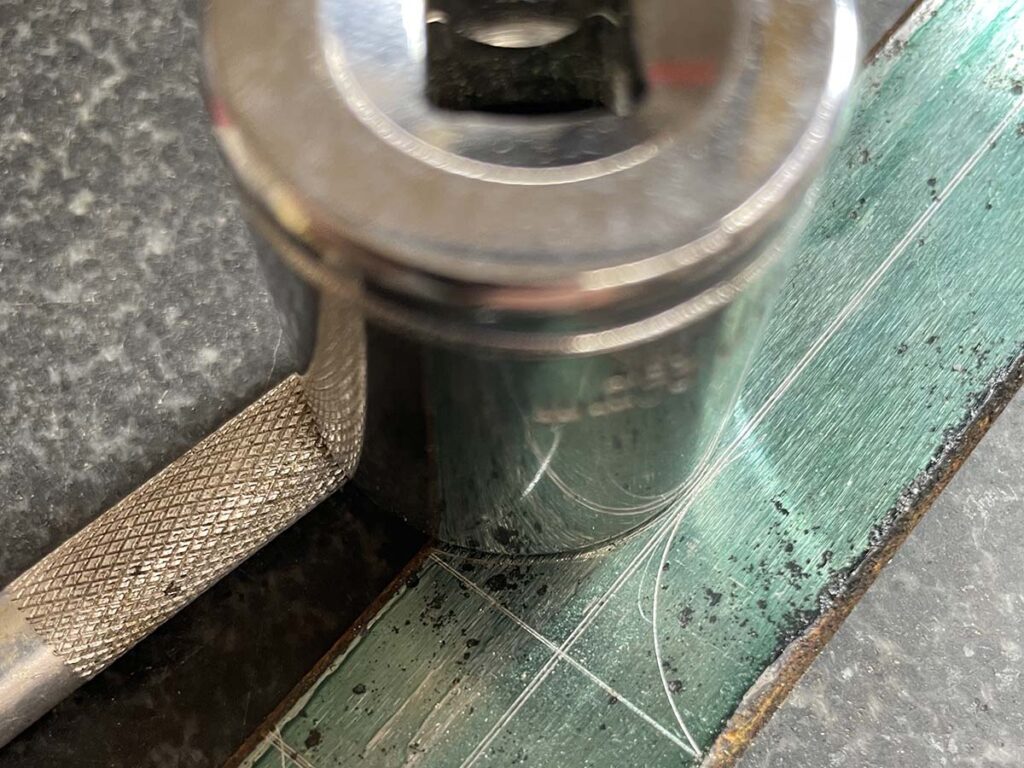
The Line That Rules Them All. A cleanly scribed centerline on both edge and flats sets the maker up for successful layout. A centering ruler can be a useful tool to check this.

Once you have determined the blade profile, preferably in some physical form like a drawing, make a template so it can be accurately transferred to steel. Here’s the thing, though: you only need half. A template representing only half of the blade profile will allow you to use it for each edge, ensuring perfect symmetry. Include the tang on your profile, not just the blade.

If you’re careful, your half template can be held on your blade stock aligned on a scribed center line and scribed on each side. If you’re less careful, oversize your blade stock and template so you can drill holes for alignment pins in the end of each that is outside the final profile. Using these holes to align the half template for marking each edge is the most precise way to lay out a symmetrical profile. If the stock is oversized, you’ll grind off the alignment holes when grinding the profile.

Planning Plunge Lines

Once you’ve accurately laid the profile out on the blade stock, take the time to scribe in the planned plunge lines on the blade flats and the edge. Sweeping, curved plunges are more visually appealing and careful layout will help ensure that your vision becomes reality. These lines are not decorative. They are the stops, targets if you will, that prevent the grind from slowly creeping toward the ricasso with each grinding pass.

Grinding the Plunges. Gradual, sweeping plunges are much more appealing to the eye than straight ones. Draw them in and grind to the drawing. This is more easily done on a wheel than with a flat platen but can be accomplished either way.

When it comes to grinding these sweeping plunges, hollow grinding on a wheel is easier than flat grinding on a platen—it’s easier to grind a curve with a curve—but by all means use a flat platen if that’s what you have. If you’re already grinding on a wheel, a 1-inch-wide wheel with a 1-inch belt will be an easier path to success than the standard 2-inch wheel and belt.

Sweeping plunges also will result in a thicker edge toward the ricasso. This is fine—you shouldn’t try to sharpen this part as doing so most likely will ruin all your careful design work. Will the unsharpened part of the edge impair the stabbing function? Perhaps, but only a little. Though it pains a serious knife person to admit it, most handmade modern daggers are for show. In most societies stabbing others is frowned on, and if you’re going to all this effort, choosing to focus on aesthetics is a good bet. However, if your dagger will be deployed in combat, ignore the aesthetics, grind sharper plunges and take the edge all the way to the ricasso.

Dagger Grinding And Stock Removal

Grinding and stock removal are the way to go for daggers. This is admittedly a hot take but in a game where winning is determined by symmetry, forging introduces unnecessary variables and distorts the base stock, making accurate layout more complicated—not impossible, just not as easy. There is little to gain by forging unless the steel itself or the situation requires it, or if you simply like doing it that way. If you want a damascus pattern to taper toward the tip, or if you’re making a dagger for American Bladesmith Society testing, by all means forge. It’s an impressive skill set. If you want to make the best dagger possible with an eye toward efficiency, and thereby your profit margins, grind it. Stock removal is the more predictable path, and predictability is the soul of symmetry. Every forged blade is a stock removal blade before it’s completed; don’t get hung up on this unless you have reason to.

Delicacy Of The Dagger Tip

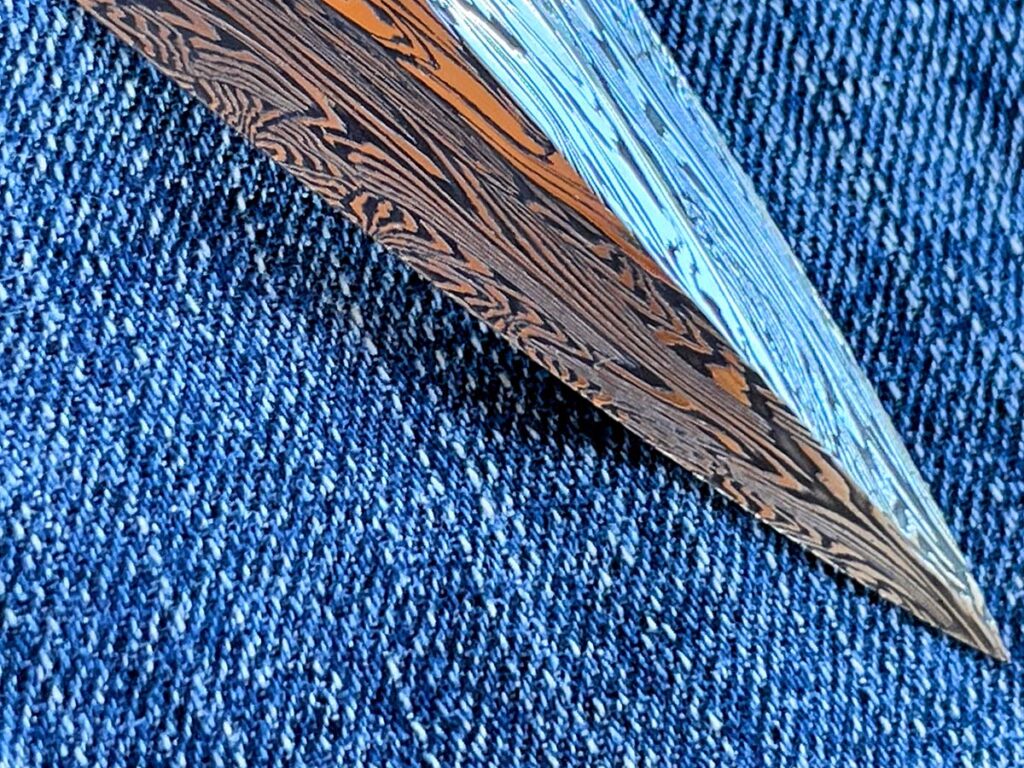
Forged for Continuity. An intricately patterned damascus dagger by Gregory Verizhnikov shows why sometimes forging is worth it—forging through the tip preserves the pattern’s flow.

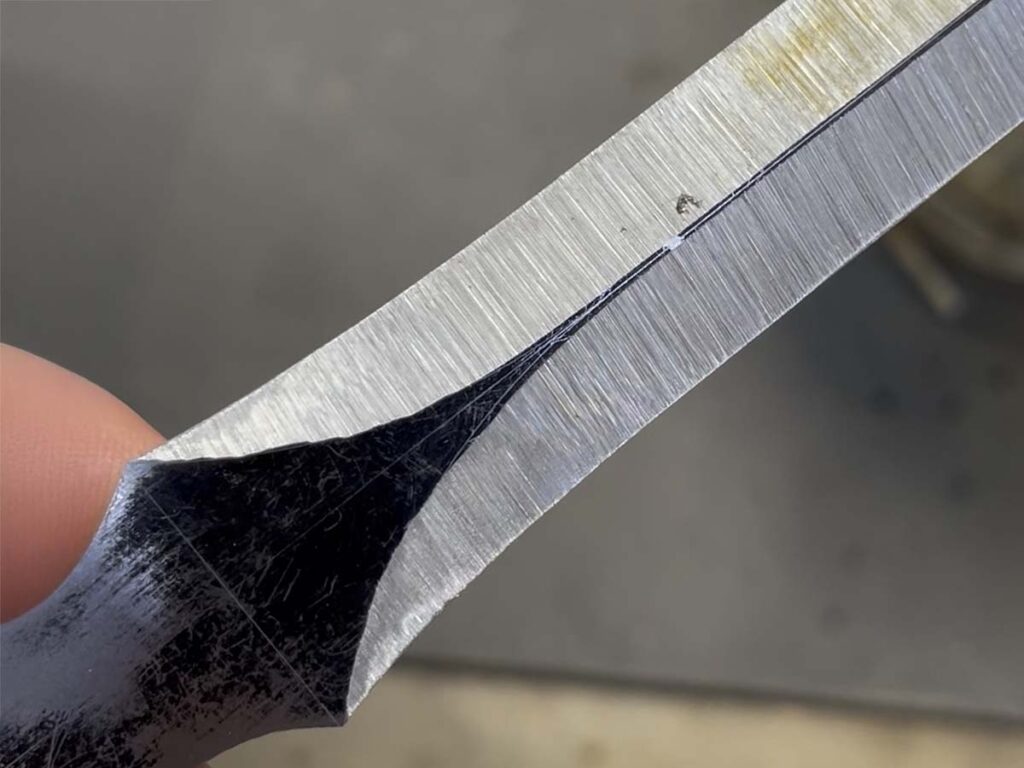
Where the mass of the ricasso anchors the entire weapon and provides strength at the critical juncture of guard and tang, the tip, by contrast, demands delicacy. Once your profile is carefully ground to shape and you turn to grinding the bevels, grind the tip first. More specifically, grind it at a steeper angle than you plan for the main bevels, and try not to cross the centerline even at that obtuse degree, except at the very end. After that, leave it alone.

Grind the main bevels like you normally would, paying perhaps more attention than usual to your scribed lines, and try to avoid that last inch toward the tip until everything else is pretty much done. This seems a bit odd at first, but consider that the final inch must maintain its thickness in order to be strong enough to pierce effectively without deformation or fracture. If you do it right, you’ll end up with a bevel at the transition. Some makers polish the transition so it remains crisp, while others blend it smooth while polishing. Either way, it should be deliberate. Neglect this and the point will be too thin.

When To Add Fullers

Lay Out Everything. Scribe curved plunge lines on the flats and edge mark exactly where each bevel begins and ends.

Fullers, if they are to be included, should be cut early while the blank still has parallel flats. Attempting them later invites misalignment, or at the least inserts a potentially unnecessary level of difficulty. Better machinists than this writer/dagger enthusiast will likely have little difficulty either way, but life has enough complications of its own without inviting them into play.

Dagger Balance

Balance matters as much as steel. A well-made dagger should balance at or just ahead of the guard, a neutral point where the hand feels neither burdened nor abandoned. This can be tested with nothing more elaborate than a rod beneath the mostly assembled knife, shifting it until it rests level. It’s really just as easy to adjust weight distribution by feel, removing or adding weight to the component parts until it feels right. Don’t forget to consider the added weight of your epoxy. When balance is right, the blade becomes an extension of the wrist, alive and responsive.

Tang & Spacers

How Not to Do It. This dagger blade poorly ground by the author clearly demonstrates that the easy way out usually leads back in. Off-center bevels and an off-center tip are predictable results of poor initial layout.

Even the tang deserves forethought. When profiling the blade blank, leaving the tang longer than necessary provides room for correction and fitting, and a threaded end can serve as both a work-holding aid during construction and a permanent anchor if a pommel or nut will close the assembly.

Spacers, fitted between guard and handle and again between handle and pommel, make alignment easier and allow pins to register each component precisely during glue-up. They’re also relatively easy targets for weight adjustment when working on overall balance. These details are seldom glamorous but are what let the final assembly come together without struggle.

Embellishments

What results from this attention is not decoration but readiness. The embellishments will come later… the fluted handles and twisted wires and all the flourishes that mark the master’s hand. But none of that matters if the design is poor, the execution haphazard, the details unconsidered.

More On Daggers:

Cool Custom: Tony Lewis’ Tribute Knife To Steve Dunn

Tony Lewis knife honors the late ABS master smith and chairman.

American Bladesmith Society Master Smith/past ABS chairman Steve Dunn was admired by many in the knife community and died way too soon at 68 in 2024. ABS Journeyman Smith Tony Lewis never met Steve but is a fan of his work, including Steve’s damascus pattern known as Thorns and Thistles.

Tony was fortunate enough to buy Steve’s Riverside hydraulic press, a purchase that included several of Dunn’s die sets. Among the dies was a saddle die—maybe the very one Steve originally used to make the Thorns and Thistles pattern.

Tony Lewis
Tony Lewis

“Recreating the Thorns and Thistles pattern was both a challenge and a joy,” Tony wrote. “Forging triangles and combining them into a cohesive mosaic was a new technique for me, but after some trial and error I managed to pull it off. When I finally etched the billet and saw the intricate pattern revealed, I felt a deep sense of satisfaction—and connection.”

After studying Steve’s signature style, Tony chose a bowie that he believes “embodies the spirit of Steve’s work.” The result is a terrific tribute to a most talented man.

More Custom Knives:

Advertisement

Must Read Articles

Read this before you make a knife

Knifemaking 101 – Read This Before You Make a Knife

  by Wayne Goddard My experience has taught me that there's nothing like digging in and getting started. I've often said the hardest part of the...
how to forge damascus steel

How to Forge Damascus

Advertisement
Advertisement