
Buyer's Guides

You’re looking for a new knife in a certain style – we’ve got recommendations on the best blades for every price point.

Fast And Furious: Our Top Picks for the Best OTF Knives On The Market

Despite A Rocky History Of Legality, OTF Knives Have Endured And Are Some Of The Most Popular Pocketknives On The Market Today

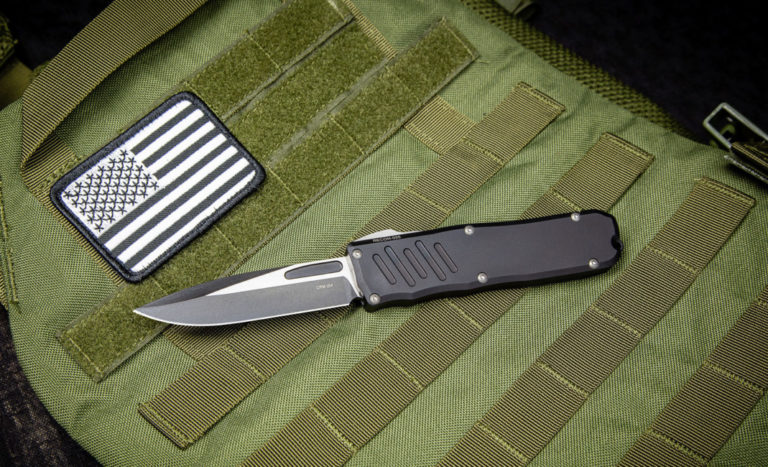
As its name suggests, an Out The Front (OTF) knife is a fairly straightforward affair.  In short, it has an enclosed handle with a blade that deploys from the front–the bolster, hilt or what have you. In general, these fast-from-the-gate options are small, most with an average blade length of 3-3.75 inches, though there are certainly larger examples. 

The knife is distinct from its “Out-The-Side” cousin, at least as a switchblade–one of its most common forms–in the variety of the way the blade is brought into action. Furthermore, the OTF knife needn’t any push-button, assisted-open system to flash cold, hard steel in the wink of an eye. 

Overall, OTF knives are a fascinating, if not slightly intimidating, corner of the knife world. In this guide, we’ll look at some of the history, usage and types of OTF knives. Then we’ll show you some of the best options on the market today. Get ready to flick into action.

Legality Of The OTF Knife 

In the past, these knives were favored by paratroopers and sailors. However, thanks to a media campaign in the 1950s that showed automatic knives as the tool of choice for criminals and underworld types, including popular movies like “Rebel Without A Cause”, automatic knives were banned nationwide. The Federal Switchblade Act passed into law on August 12, 1958 and effectively banned auto knives across the country. 

Going into 2023, the panic over OTF knives and other switchblades has somewhat subsided. Most states now allow ownership and carry of OTF, and other types of, automatic knives. However, 11 states still have a blanket ban. Furthermore, there are some issues when it comes to what many places call ‘stabbing instruments’ and other vague terms. Where this becomes an issue is some states that allow automatic knives have laws against double-edged blades. Given many OTF knife options fall into both categories, certain models have a narrow window of legal ownership.

As always, if OTF knives or switchblades tickle your fancy, please check your local laws before picking one up. Better safe than sorry.

Types Of OTF Knives

As mentioned above, there are four types of OTF knives. Each has positives and negatives, and the prices will vary wildly. It’s important to know the differences so you purchase the option that best suits your needs.

Manual OTF Knife

The most basic and least expensive OTF knives are the manuals. They are exactly that, knives that deploy and retract through manual operation. The most common way of doing this is via a slider on the handle. The upside is that you are in total control of the speed of your blade. However, it may not have the wow factor of other knives on the list. But hey, you’ll be safe while using it. 

Single-Action OTF Knife

These knives feature a powered deployment, usually with a button of some type, but require you to manually retract the blade to reset it. And it isn’t retracting like you might think. You pull a handle at the bottom to both retract the blade and recharge the spring so it’s ready to deploy again. 

Double-Action OTF Knife

When you think of an OTF knife you probably think of double-action OTFs–better known as fully automatic. The blade deploys and retracts with the touch of a button or flip of a switch. Prominent companies like Microtech and Cobra-Tec make dozens of different double-action OTF knives.

Gravity Knives

The four-leaf clovers of OTF knives are definitely gravity knives. Few companies still make them. The blades deploy and retract with the help of gravity.

The Reate EXO is one of the most popular gravity knives on the market today and a great example of the style. Just take into account your local knife laws as some places have specific laws banning the ownership or carry of gravity knives.

What To Look For In A Quality OTF Knife

You can find decent, but basic, OTF knives in the $30 range, but expect to pay ten times that for a model that extends and retracts on its own with the push of a button. Though, the sky is really the limit when it comes to the features on these knives, as some can easily jump over $1000 depending on what’s included.

The rub, for the price, is that even the expensive options do not do well for anything other than basic and light use as they are not as strong as other types of knives.

The basic selling point of OTFs–aside from inherent coolness–is convenience. Read that as they can be entirely used with one hand. It’s best to think of the OTF knife as a refined gentleman’s blade: a cutting tool that you could rely on for daily life and its inconveniences. 

OTF Blade Quality

The main issue surrounding blade quality on OTF knives is how light the blades have to be to function. Because the blade is entirely surrounded by the handle, the blade itself cannot be wider or longer than that existing space. As a result, most OTF knife blades are short and light. 

These blades are rarely what we would call a full-profiled knife and many are under 3 inches despite a full-sized handle. These blades are not especially strong and are essentially for cutting only, though there is utility in thrusting or stabbing depending on the strength of the locking mechanism. 

The small tang area is where the mechanisms are anchored, and this space is usually quite insignificant in surface area. It is entirely possible and even easy to break OTF knives if used improperly. 

Practicality Of OTF Knives

If you are in the market for an OTF knife, realize that there are better designs for most daily work that are substantially stronger and can handle a much wider variety of tasks, not to mention are cheaper. OTF knives do have their niche, much like karambits, balisongs, and friction folders, but each of these designs has hard limits on what they can accomplish as opposed to a fixed blade or a suitably strong folder. 

Best OTF Knives

SCHRADE VIPER OTF

Coming in at a relatively low cost (comparatively) is the Schrade Viper. The knife lacks some of the features of higher-end OTF knives, but at 1/10 the price of some of the others on this list, it is a good starting point should you want to familiarize yourself with the OTF style in general. 

The knife is a bit more manual than others in that it is assisted opening but needs to be manually closed. The overall structure of the knife is not cheap. The handle is made of aluminum and includes an integrated glass breaker in the pommel. It also features a manual safety system for opening and closing the blade to ensure it only opens when you want it to.

MSRP: $75

SMITH & WESSON M&P OTF

The M&P OTF retails in the same range as the Schrade Viper and is largely a product that appeals to an entry-level crowd. Many OTF knives on this list retail for more than some of S&W’s guns–a telling sign this market is for the discerning individual. with the M&P OTF, you get a large degree of utility without some of the additional features and glamor of higher-end models. 

Like the Schrade, this knife has an integrated glass breaker in the pommel and is similarly assisted opening/manual closing. If you already own an M&P pistol, you’ll notice that the handle contouring matches the slide machining cosmetically, including a safety lever that resembles the one on the pistol. MSRP: $70

HOGUE KNIVES COUNTERSTRIKE 

Hogue’s new Counterstrike is a flagship design that is sure to impress, not only with its modest price point for a fully-automatic knife but also the materials it is made from. 

What sets the Counterstrike apart is not just that sweet-spot price, but the high-end materials it’s made from and its excellent strength. Among these is the MagnaCut blade, which itself is a prime selling point. This steel is among the best in the industry and gives the Counterstrike excellent edge retention and adds rigidity to the already thin OTF blade profile.  Additionally, the knife has a glass-breaker pommel, aluminum, and carbon fiber handle, and is made in the USA. 

MSRP: $400

KERSHAW JENS ANSO KAPSULE MANUAL OTF 

The Kershaw Capsule is a small manual OTF excellent for concealment. At just 3.25 inches while closed and with a 1.9-inch blade, this small knife is a great self-defense tool because of its size and unassuming appearance.

However, it’s much more than that. The spear point blade works like a box cutter. The tip is great for puncturing the and edge can handle the type of slicing work you’d expect from a commercial box cutter. It’s convenient and compact enough that it can even fit on a keychain.

MSRP: $35

MICROTECH ULTRATECH D/E 

Microtech is one of the companies that popularized the modern OTF knife. In fact, most knife enthusiasts would go so far as to say that Microtech is completely responsible for this trend and has set the bar for all OTF knives going forward. The Ultratech is a solid example why the company calls the tune.A dependable OTF,  the knife displays an excellent balance in terms of material, strength, and utility. It is a fully-automatic design that opens and retracts with the same switch. If you want an incredibly reliable OTF knife for your daily use, the Ultratech is arguably the knife on this list with the most pocket hours across the board and is from an established OTF brand. Like others on this list, it features a glass breaker pommel and is made in the USA. 

MSRP: $310

HERETIC KNIVES ROC

Now here is something you don’t see every day. The Heretic Knives ROC is visually stunning, it is just so rare to see a curved blade on an OTF knife. The company no longer has the ROC listed on its site as of this writing, but it is available and in stock online. The ROC accomplishes its one-of-a-kind appearance by using a curved handle to match the blade, which overall seems like a no-brainer.

But it just isn’t seen these days, despite the advantages in self-defense or martial arts. While it resembles a karambit, this knife lacks a finger ring on the pommel. The ROC is a fully-automatic design that retracts and deploys on its own. If you are in the market for an eye-catching OTF design that is USA-made, you’d better get them before they are gone.

MSRP: $750

PIRANHA RATED-R 

The Piranha Rated-R is one of the most discreet and well-designed knives on this list. The others we’ve looked at have release buttons/switches on the side of the grip in line with the spine of the blade, whereas the Rated-R has it conveniently mounted where the thumb rests near the end of the handle. 

It is a fully-automatic knife and requires no movement of the hand to deploy and retract the blade thanks to the switch location. Unlike most of the others here, it lacks a glass breaker pommel, further adding to its discreet appearance. The knife is on the higher end of cost for OTF blades. But like any semi-custom product, it appeals to a certain customer that has specific needs for a strong, durable, and unassuming knife. The Rated-R is made in the USA. 

MSRP: $490

BENCHMADE AUTOCRAT

This list wouldn’t be complete without a knife from Benchmade. The company has been producing visually attractive and highly functional blades for the most demanding end users: hunters, cops, rescue crews, anglers, and bushcrafters, among many more. The Autocrat is the most sought-after Benchmade OTF model and it has an excellent reputation for strength and sharpness.

The knife is in the same cost range as most high-end OTF knives at $500, making it an investment for most people but a steal for those who desire American-made quality. The knife is fully automatic and is available in two colors. It does not include a glass breaker pommel, making it easier to use in the hand and a bit more classy in overall appearance. 

MSRP: $500

Read More

Hatchets: Hackers That Pack A Punch

0

Four hot hatchets pack more punch for their size than most.

There’s a good reason hatchets have always been a staple of camp tools. They pack more punch for their size than just about anything else you can put in your hand. Sure, an axe can outperform its smaller sibling but can be both size and weight prohibitive on many outings. Saws are lighter but their blades can break, leaving you empty-handed without a hatchet in the wings.

CAS Iberia APOC Hundr

CAS Iberia/APOC Hundr’s bearded hatchet
The CAS Iberia/APOC Hundr’s bearded hatchet head shaved bark off a wooden shaft via push cuts.

The CAS Iberia APOC Hundr gets its name from the Old Norse word meaning hound in reference to man’s best friend. It is a bearded-style hatchet with a main handle and head of quarter-inch-thick 9260 carbon steel. Quarter-inch-thick smooth black G-10 scales bring the handle’s overall thickness to three quarters of an inch. The sheath is a black thermoplastic unit that slides open-backed over the hatchet head and is secured by two nylon straps that snap into place.

CAS Iberia/APOC Hundr Hatchet
Blade material: 9260 carbon steel
Cutting edge: 3.75”
Head length: 4.65”
Head @ thickest: .235”
Handle material: G-10 composite
Design feature: Bearded style
Weight: 1 lb., 7 ozs.
Overall length: 12”
Carry: Black synthetic sheath, MOLLE compatible, snap on
Country of origin: China
MSRP: $89

SOG Camp Axe

SOG Camp Axe
Hatchets take a ton of abuse, requiring sharpening from time to time. The author uses a fine-grit Eze-Lap diamond stone to touch up the edge of the SOG Camp Axe.

The SOG Camp Axe is the most modern looking entry and second bearded-style hatchet of the test bunch. Its 5-inch-long head is the longest of the review pieces, too. The head is attached by four Phillips-head screws to a black, ovate GRN (glass-reinforced nylon) handle, and an aluminum collar adds strength. The poll is a healthy .6 inch thick and the main handle is ribbed for added purchase. A minimalist blade cover has a strap that wraps around the back side of the hatchet head and, in a clever touch, hooks horizontally over the SOG logo on the opposite side.

SOG Camp Axe Specs
Blade steel: 2Cr13 stainless
Cutting edge: 3.1”
Head length: 5”
Head @ thickest: .6”
Blade coating: Bright finish w/dark recess
Handle material: GRN (glass-reinforced nylon)
Design feature: Added poll thickness
Weight: 16.1 ozs.
Overall length: 11.5”
Carry: Molded nylon sheath
Country of origin: China
MSRP: $68.69

Schrade Bedrock Axe

Schrade Bedrock
Hatchets such as the Schrade Bedrock can be used to point pegs for securing tents. Protective eyewear is recommended when the chips start flying. The author prefers gloves for a more comfortable grip, especially during extended use.

Dubbed the Bedrock Axe, Schrade’s entry has the test group’s largest poll, measuring 1.75 by .75 inch. Six-and-a-half inches of the handle is a grippy, black, hard rubber overmold. It is the heftiest of the review hatchets at 1 pound, 8.6 ounces. The black polyester sheath has a fabric-fastener flap at the rear.

Schrade Bedrock Axe
Blade steel: 3Cr13MoV stainless
Cutting edge: 3.5”
Head length: 4.7”
Head @ thickest: .79”
Blade coating: Satin/black oxide
Handle material: Black overmold
Design feature: Thick poll
Weight: 1 lb., 8.6 ozs.
Overall length: 11.75”
Carry: Black polyester/fabric-fastener sheath
Country of origin: China
MSRP: $39.99

Winkler Knives Highland Hatchet

Winkler Knives Highland Hatchet
The Winkler Knives Highland Hatchet proved a workhorse when it came to splitting wood both free-hand and with a baton. The head has a nice wedge shape for getting down to business.

The Winkler Knives Highland Hatchet has all the period visual trappings of Daniel Winkler’s full-blown custom work, though is made via the stock removal method only instead of mostly being forged. While it may be the smallest hatchet of the test bunch, it has the heart of a ram. The maple handle tapers gently toward the base and a lanyard hole. A heat-formed black Kydex sheath with two black nylon drop loops slips over the hatchet head and secures by a heavy-duty elastic rod that wraps around the sheath.

Winkler Knives Highland Hatchet
Blade material: 80CrV2 carbon steel
Cutting edge: 2.55”
Head length: 4.8”
Head @ thickest: .3”
Blade finish: Black Caswell
Handle material: Maple
Sharp stuff: Period design
Weight: 1 lb., 5 ozs.
Overall length: 11”
Carry: Kydex sheath, nylon straps
MSRP: $550
Country of origin: USA

Testing Hatchets

thicker the poll the easier it is to perform functions like hammering
The thicker the poll the easier it is to perform functions like hammering tent pegs. It also adds more weight behind the swing of the hatchet when chopping. The test group offers a selection of poll thicknesses and heights.

I started by checking out the hatchets’ bite with swinging overhand chops on a 14-inch-wide-by-12-inch-deep crosscut slice of seasoned oak. I took each hatchet and buried the upper blade into the cross-grain of the stump, and they all stood up on their own. From there I worked the edge at alternate angles with each hatchet to get an idea of its bite. None of the candidates gave any resistance and all averaged cuts of ¾-to-1-inch deep. I repeated the alternate cuts on a length of 2-inch-diameter green oak tree limb and got similar results with all the subjects.

I tested the hatchets on specific tasks such as pointing stakes, shaving bark and baton work, and the exercises brought out the differences in their dimensions and configurations. For instance, the two bearded hatchets—the SOG and CAS Iberia/APOC—excelled at shaving bark. The ability to grip them behind the blade to direct them simply makes shaving with precision much easier. The Schrade Bedrock, with its large, thin blade, edged out its brethren in pointing stakes.

CAS Iberia/APOC and SOG
The CAS Iberia/APOC (top) and SOG are the bearded type. The longer drop on the bottom front edge allows you to grip the handle and use it to shave or carve wood with precision.

The hatchets with thicker polls, the SOG and Schrade, did better at hammering tent stakes due to their ease of target acquisition and scope of impact. The Winkler Highland Hatchet excelled at baton work, its wedge shape and streamlined profile ideal for the task. The individual advantages along with the size of the hatchet can be priorities in choosing the right one for your needs. Keep in mind, however, just because I called out certain models as excelling at specific tasks, such as pointing stakes, doesn’t mean the others won’t serve you to some degree.

Hatchet Carry

four different takes on hatchet sheathing
The review hatchets offer four different takes on sheathing, from the minimalist SOG at bottom right to the top shelf Winkler Kydex version (second from right).

The sheaths range from the premium one provided with the Winkler Knives Highland Hatchet to the minimalist one accompanying the avante garde SOG Camp Axe. In my days of extended trips in the wild I preferred to pack-carry a hatchet, but some may like it on the belt, and the SOG can accommodate you there. Hatchets are typically made to take abuse but are relatively easy to sharpen, either with a bench stone around the shop or a portable sharpener in the field or on the trail.

Final Cut

Options abound in the hatchet world and those on a budget should have no trouble finding competent fare in the category. The Winkler may seem pricey but once you try it you’ll appreciate its rock solid construction and extraordinary fit and finish. You’ll never be caught saying, “They don’t make ’em like that anymore.” The best news is there is enough diversity in the category that you can choose a hatchet to fit both your needs and budget, and that’s always a good thing.

More Axes, Hatchets And Tomahawks:

  • Bearded Axe: Best Bashers From Here To Valhalla
  • Best Tomahawks: Our Top Hawks For Backwoods To Battlefields
  • Wicked Breacher: Ben Seward’s SWAT Axe
  • Awesome Axes for Chopping Wood Like a True Lumberjack

G10 KNIFE HANDLES: ARE THEY THE BEST?

1

Rugged, Long-Lasting And Easy On The Eyes… G10 Might Just Be The Ultimate Knife Handle Material.

You often hear G10 lumped in with a variety of other materials, such as Micarta, glass-filled nylon, carbon fiber, and more. In this vein, you’ll also see misrepresentations such as ‘G10 Micarta’, this is generally incorrect despite being so close to right. This raises the question…

What The Hell Is G10 In The First Place?

G10 is its own material and is more or less a generic trade name for a subset of insulating fiberglass composite. Because it is a standard material used in both civilian and military manufacturing, it is very consistent and must meet certain standards to be called G10.

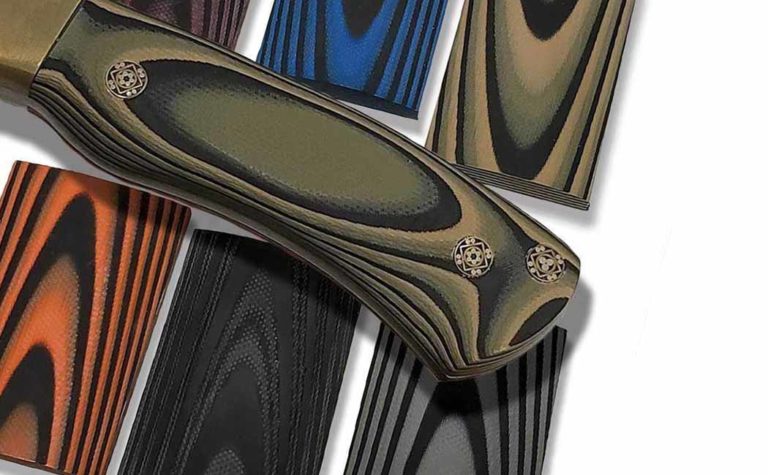
It is made in a similar way to Micarta, but instead of actual layers of cloth fabric being compressed, G10 uses glass cloth to achieve a similar result—a grainless, easily shaped material that is resistant to the elements and most chemicals.

It first appeared on the radar in the 1950s, but it arguably has seen the most use since 2000 and it has knives to thank for that.

G10 Usage And Properties

G10 is made colorful by alternating these glass cloth layers before it is heated and compressed. The original versions of this were a bit bland, and like Micarta, were developed to provide insulation barriers for electronics. G10 material is not common in electronics today, but in its day it was considered to be quite good at its job.

It is now primarily used for knife handles, gun grips and accessories, robotics, 3D printing, and in some aerospace roles. It has great strength-to-weight properties and is easily shaped, making it ideal for modern manufacturing techniques. Unlike Micarta, it won’t change color when wet and it doesn’t absorb water or chemicals. It is impervious to salt water, making it a great choice for any products that require a firm grip in maritime conditions.

Advantages Of G10

Durability is key to a knife handle. It is, after all, your interface with a sharp, dangerous tool. If you don’t trust your handle material, you don’t trust your knife, simple as that. G10 Gives you a lot to hang on to.

Very strong and light, it’s waterproof, corrosion-proof, and can be washed with normal cleaning products with no ill effect. On knives that are used for hunting or the outdoors, it isn’t bothered by blood, fat, or hasty cleaning methods.

If G10 is textured, it will provide a sure grip in all conditions. Don’t like that your grip is just a bit too textured and perhaps a bit sharp in places? Just take out some sandpaper and knock the edges off and then wipe it down with mineral oil. It will appear just as new.

G10 is just a rockstar material for knife handles because it does what we need it to do in all capacities from initial manufacture to end-use maintenance. G10 is a win-win material across the board and it shows.

Disadvantages Of G10

Due to the overwhelming amount of advantages G10 has over most other knife handle materials, the downsides are for the most part a personal matter. Some people don’t care for the appearance or texture of certain G10 products, and still, others don’t care for how widespread the material has become.

Wood, bone, and Micarta all have significant followings, but are less durable overall than G10 and are usually heavier. These materials do require regular maintenance unlike G10, but this is a relatively subjective thing at the end of the day.

GREAT G10 HANDLE KNIVES

Benchmade 15500-3 Meatcrafter

Benchmade Meatcrafter

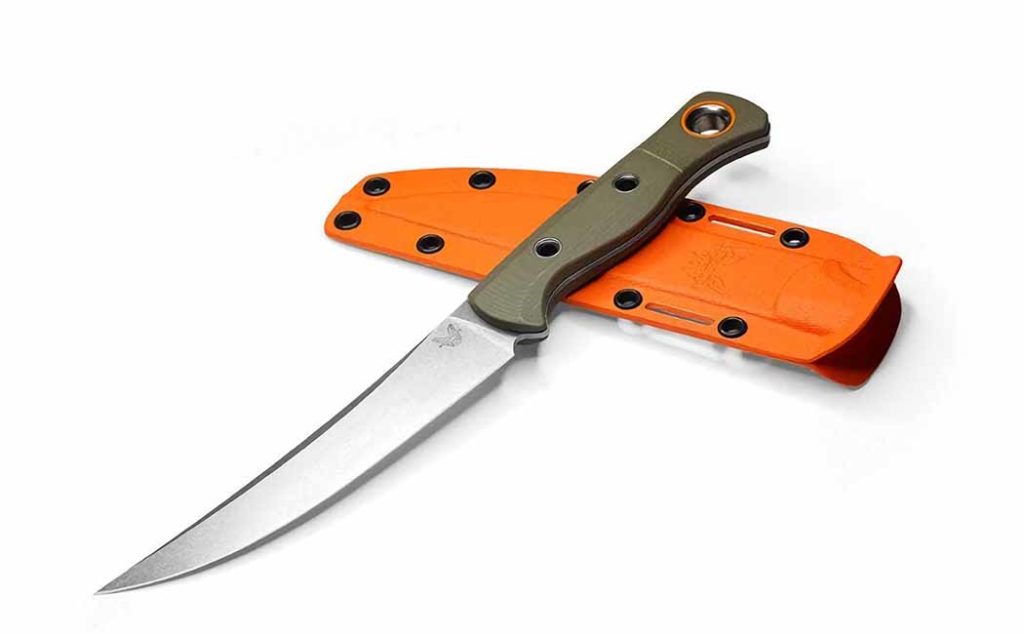
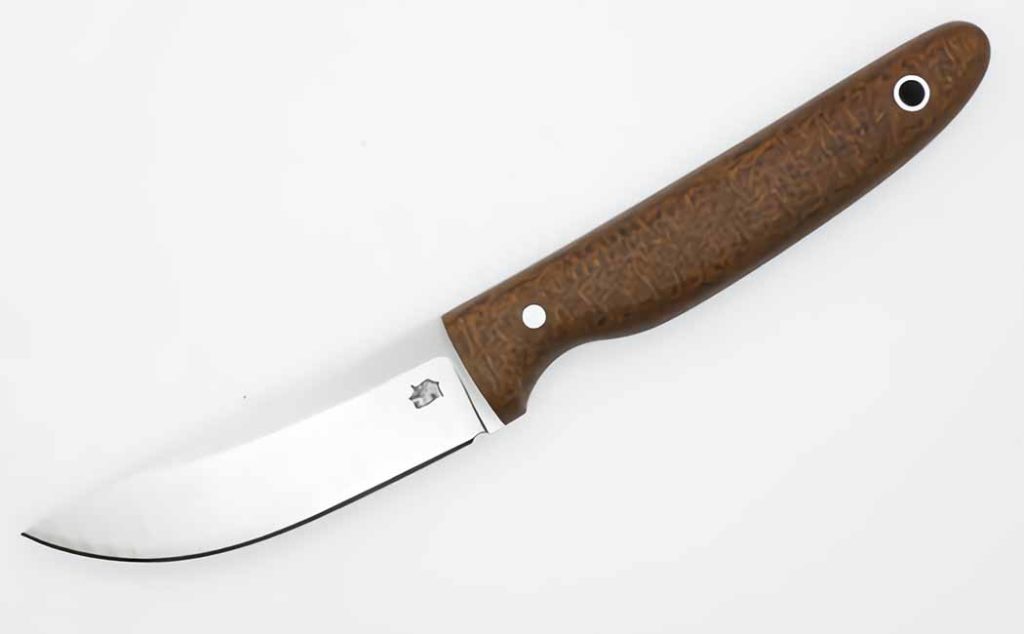
The Meatcrafter has been around for a few years, but it continues to undergo evolutions. This particular model features a razor-sharp blade using the company’s SelectEdge technology. The 15500–3 model is visually attractive and features green G10 grips with nice-looking accents.

The knife comes with a Boltaron sheath finished in high-visibility orange. The author has experience with the Meatcrafter series, and has found them extremely suitable for their niche. The blade profile is not especially thick, it borders on filet knife territory but is heavy-duty enough for working on large pieces of meat and big animals.

This knife isn’t meant for chopping or use on bone or camp chores. Rather it is for end processing of soft tissue only. The blade has a good degree of flex for boning, though not too much that it won’t give clean presentation cuts in the kitchen if you are trying to impress company. Though, the $370 price tag is impressive in its own right should your dish not wow your guests.

Tops Sky Marshall

Sky Marshall

Tops is known for making some of the most rugged and powerful cutting tools on the planet. Very few, if any, could be called under-engineered, rather it is just the opposite. Most Tops blades are thick, and heavy, and hold up to years of the worst abuse that their owners can put them through.

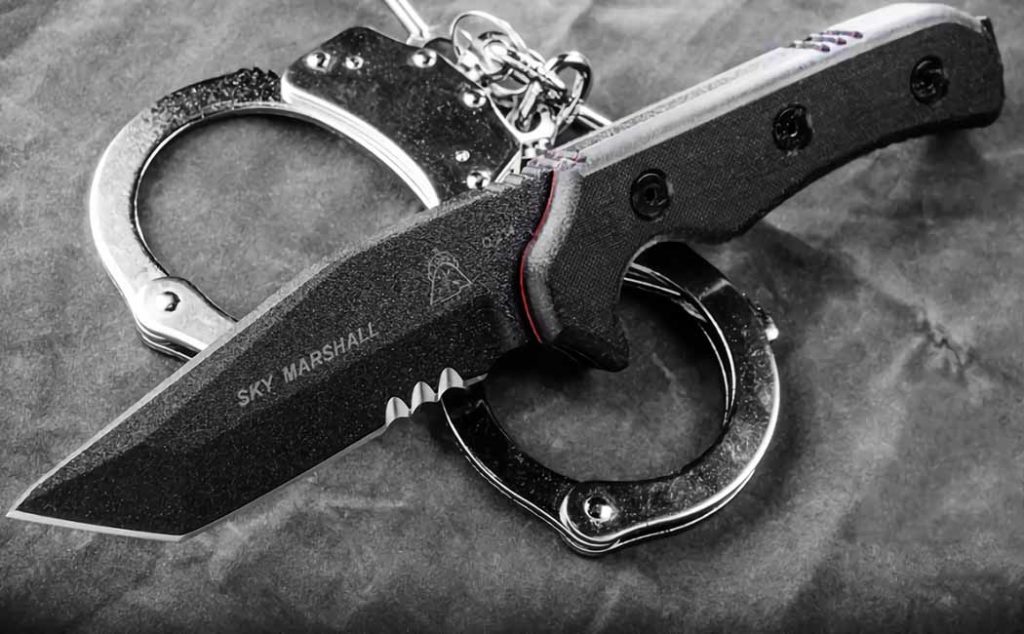
The Sky Marshall is one of those items in life you buy once and keep using. Barring being dropped into a lit forge, there is little that can deter the stout Sky Marshall. The knife has a tanto point and rear serration coupled with a daunting 1/4” spine. The knife is finished in all black with black G10 grips. It is both an attractive conversation piece and a hardcore tool. The blade profile has a lowered point and a specially contoured handle with a deep, secure finger choil to give it extra power when thrusting. The Sky Marshall retails at $210 and comes with a black Kydex belt sheath.

Tops Muley Combo

muley

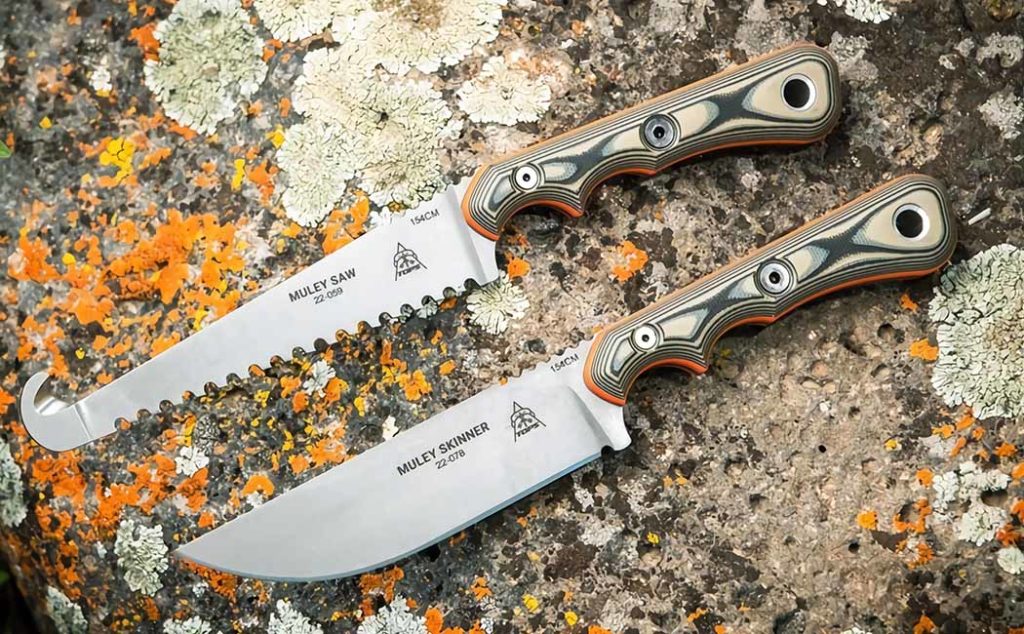
Another G10-handled set from Tops is the new Muley series, made specifically to address materials that are hard on blades when hunting. The Muley series is born to hunt and is best purchased in a set with a double sheath ($500), though each knife can be purchased separately should you wish. One is a standard knife while the other is a knife-handled saw with a gut hook meant for dealing with bone and cartridge.

The combo doesn’t take up much space and affords the owner a high amount of general utility when both weight and durability are concerned. The backcountry hunter doesn’t always get away with pack animals or 4-wheelers, so having multi-use tools is very important when ounces count. The dedicated saws take up room in the pack, and knives with gut hooks are a liability when splitting kindling or skinning. In this set, you get the best of all worlds and each is made of super-tough, easy-to-clean 154CM.

The G10 grips are meant to be stylish but also high-visibility thanks to their orange liners. As field tools, the Muley combo here is hard to beat, and the author looks forward to putting them to hard use in the coming years.

LT Wright Apex

LTW-Apex

LT Wright is a name synonymous with edged tool quality. The Apex is an interesting knife not just in construction, but in shape and cosmetics. It features black G10 grips with a striking bright green liner and a bright, saber-ground A2 steel blade packed nearly in a brown leather sheath.

The knife has a profile common to many working knives and resembles a Puuko in overall aesthetic, though, it has one interesting point worth touching on. The blade and the spine are reverse curved, giving the blade a deep belly and the handle a distinctive upturned profile reminiscent of traditional Japanese tanto and katana profiles.

This intriguing knife is excellent for just about any task from kitchen chores to outdoor labor, breaking down game, and as a regular EDC knife. The Apex is a fascinating product that deserves more than a second look, and for a decent retail price of just under $200, it won’t break the bank, either.

Toor Jank Shank

JANK-SHANK

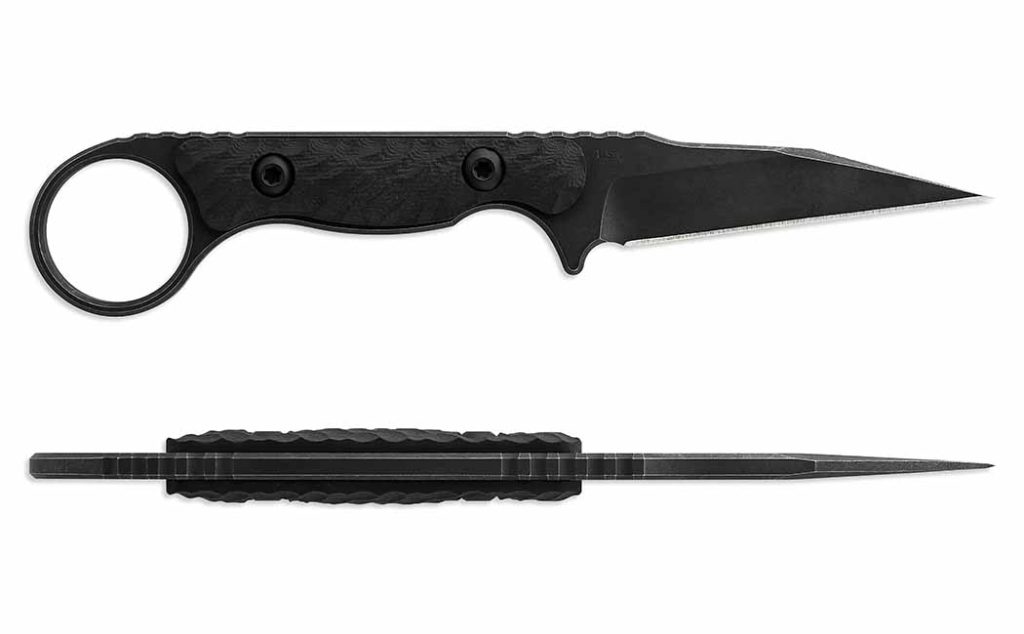
One of the more interesting knives released recently, the updated Toor Jank Shank is part EDC knife, part karambit, part self-defense tool, and all American made.

The knife is beefed up over the original release and is thicker in more places while more ergonomic in others. The most visually appealing variant on Toor’s site is a black blade with eye-catching white G10 grip panels.

The knife has an easy-to-maintain straight edge that can be used in many ways in conjunction with the finger ring or without. The tip is aggressive and will easily penetrate through most common clothing and jacket materials.

While not a true karambit in that it lacks the signature curve, it should translate easily for fans of the design while offering daily utility lacking in a hook-shaped tip. The Jank Shank retails at $195 and the included Kydex sheath is compatible with a variety of mounting interfaces.

Kizlyar Supreme Hammy

KS-HAMMY

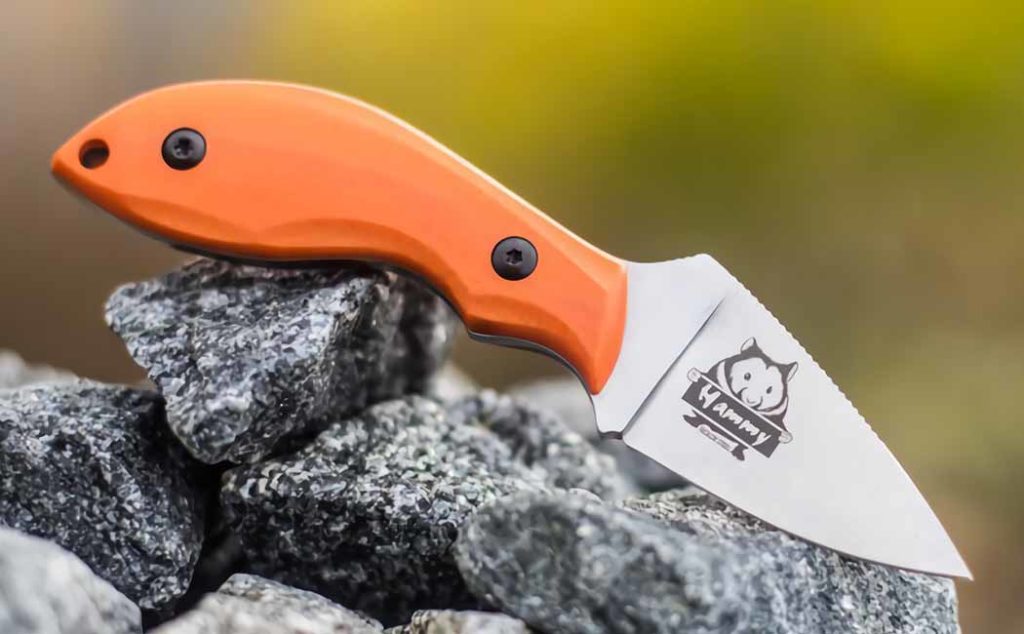
Hailing from Russia, the Hammy is a cute little blade that has a lovable little hamster engraved on it. While it is small, the Hammy lives up to its namesake—a tough, resourceful little animal that can pack several features into its cheeks… rather to say its small, easily carried profile.

The Hammy comes with bright orange G10 scales and is meant to be a highly visible working tool. The edge profile is designed for common cutting tasks and the handle is contoured for comfort in long periods of use.

The Hammy is the least costly of the bunch here at just $99, but it punches above its class and will probably be the knife in this group that you use the most daily basis. The Hammy comes with a multi-position leather sheath that also features a cute hamster motif.

Esee 5

esee5

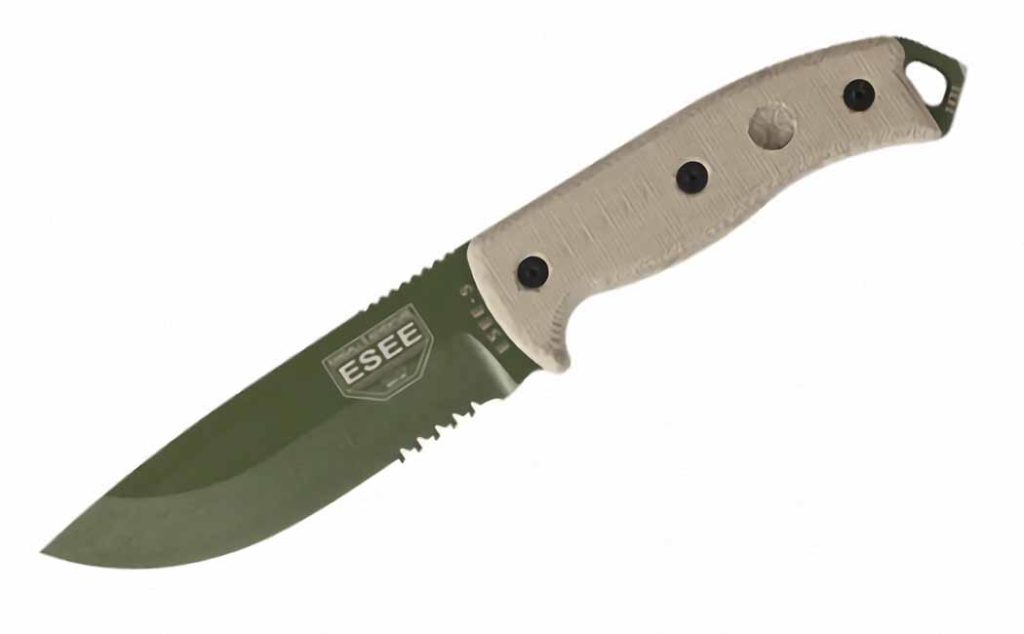
The Esee 5 is not a new knife, but it is notable for being so rugged and storied that it just had to be mentioned here when talking G10.

There are many models in the Esee 5 line, but the stand out—visually and functionally—is the all-orange model complete with black-and-orange G10 grips. This knife has a highly functional grip texture, is visible in many different light conditions, and is remarkably easy to maintain.

The Esee 5 is a weatherproof machine and it is a popular choice for bush crafters, rescue crews, hunters, and many military personnel for its wide-ranging capabilities. The G10 grips on this knife are available in other colors as well, and due to its popularity, a wide range of other G10 options are available aftermarket through renowned retailer The Knife Connection. TKC makes a full range of G10 grips for most of the Esee line should you wish to change colors or make your trusted blade just a bit more yours.

Check out More of Our Buyer’s Guides

Trainer Butterfly Knife: Options To Hone Your Tricks

For Anyone Interested In Learning How To Use A Balisong, A Trainer Butterfly Knife Is Extremely Important.

Not all knives are built the same, and no knife embodies that more than the butterfly knife. Also known as a balisong, this blade opens with a flourish, and creating tricks and moves to open and close the knife has become a passion for many.

Take a look at this video below for just a small sample of some of the more basic balisong tricks. Even at this level, the smoothness needed to execute them is remarkable.

Why A Trainer Butterfly Knife

In order to perform tricks, and well, you need to put in hours of practice. Well, practicing slinging a butterfly knife has its pitfalls because you are rapidly moving a razor-sharp knife. 

That blade isn’t for show. If you hesitate, swing the knife the wrong way or simply shake your hand at the wrong time, that could mean the difference between successfully pulling off a new move or slicing your finger wide open. That’s why several states and countries have banned the knife in the name of public safety (at least by they’re telling).

That’s where the trainer butterfly knife comes in. It flows and moves like a traditional balisong, but it has no sharp edge. Some are metal, some are plastic, and all of them allow you to try out moves without the threat of a trip to the ER.

Instead of a traditional blade there is a steel or plastic rod in its place. This helps with the visuals of the knife as it moves and it keeps the user safe. The worst-case scenario with a trainer butterfly knife is that the blade replacement knocks into your knuckle. Sure, that might be sore for a minute, but it’s a lot better than a dozen stitches.

Best Trainer Butterfly Knives

Boker Plus Balisong Trainer

Boker Plus Balisong Trainer

Boker is a fine maker of knives, and also a fine maker of knife trainers. Their balisong trainer is well-balanced and robust thanks to a high-quality construction. The whole trainer, blade and handle, is made from stainless and the G-10 scale feels good in the hand. You can even choose between red and blue scales to customize the look of your trainer. Featuring the same mechanism as one of the company’s actual butterfly knives, this trainer may be as good as it gets when trying to learn the ways of the balisong.

MSRP: $85.95

Good Worker Butterfly Knife Trainer

Good Worker Butterfly Knife Trainer

If you’re the type of person who practices hard and gives their trainers a beating, this model from Good Worker may be your best bet. Made completely from 420 stainless, this tool can take a beating. One of the lowest-priced trainers on our list, you won’t have to feel guilty if it flies out of your hand performing tricks or takes its lumps over time. 

MSRP: $10.99

Squid Industries Squiddy

Squid Industries Squiddy

How about plastic? This trainer from Squid Industries provides everything you want from a butterfly knife trainer but is made from CPVC. In fact, it’s the first-ever CNC-machined plastic balisong trainer. Pretty cool.

Don’t worry, this isn’t a flimsy toy. The high-impact, heat-resistant CPVC (chlorinated PVC which makes it more durable) ensures a robust trainer. And it’s just as balanced as a traditional steel trainer. This would be great for a younger person interested in learning how to manipulate a butterfly knife. And it’s made and assembled in the USA.

MSRP: $44.99

Bear & Son Butterfly Trainer

Bear & Son Butterfly Trainer

This model from Bear & Son is the most knife-like of the trainers on our list. The dulled blade is in the shape of a clip point and is made from 440 stainless. At a glance, it looks like a real, working knife so this may not be the best trainer to buy depending on the laws where you live. However, it works like a charm.

The zinc handle opens easily and the weight of the steel gives it a good balance while it’s rotating. The handle comes in three different colors so there’s a level of customization with this balisong. 

MSRP: $65.99

Bbbarfly Pro V3

We wrap our list with something a bit out there. What if your butterfly trainer was also a bottle opener? That’s what you get with the Pro V3 from Bbbarfly. This model features a high-quality steel construction. The blade/opener is made from a polished 410 stainless steel and aluminum handles. The CNC-machined washers and hardware provide a smooth opening every time. Sure, this is a great tool for party tricks and start conversations, but it’s built to be a high-quality balisong trainer as well.

MSRP: $125

Read More

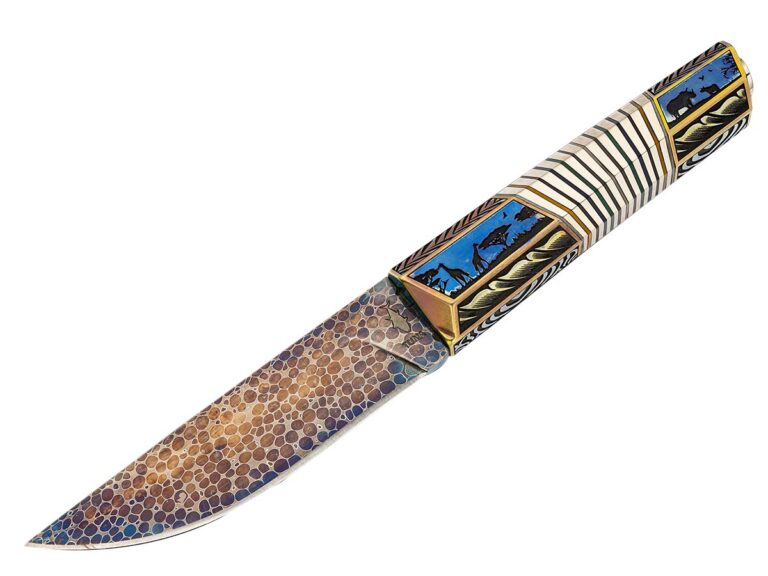
Summer’s Finest: Custom Damascus Knives You Need to See

Explore 11 jaw-dropping custom knives featuring premium damascus steel blades, exotic handle materials, and master craftsmanship.

This summer’s crop of custom knives brings damascus front and center. From twisted and ladder patterns to stainless blends and copper-clad creations, each blade in this collection highlights not just the maker’s skill, but their artistry with steel. Whether forged for daily carry, culinary precision, or collector prestige, these knives turn heads with standout materials—think crystallized titanium, crosscut mammoth, and ringed Western Myall—paired with performance-driven designs. Featured makers range from journeyman smiths to Guild members, each offering a unique take on the timeless beauty and cutting power of damascus steel.

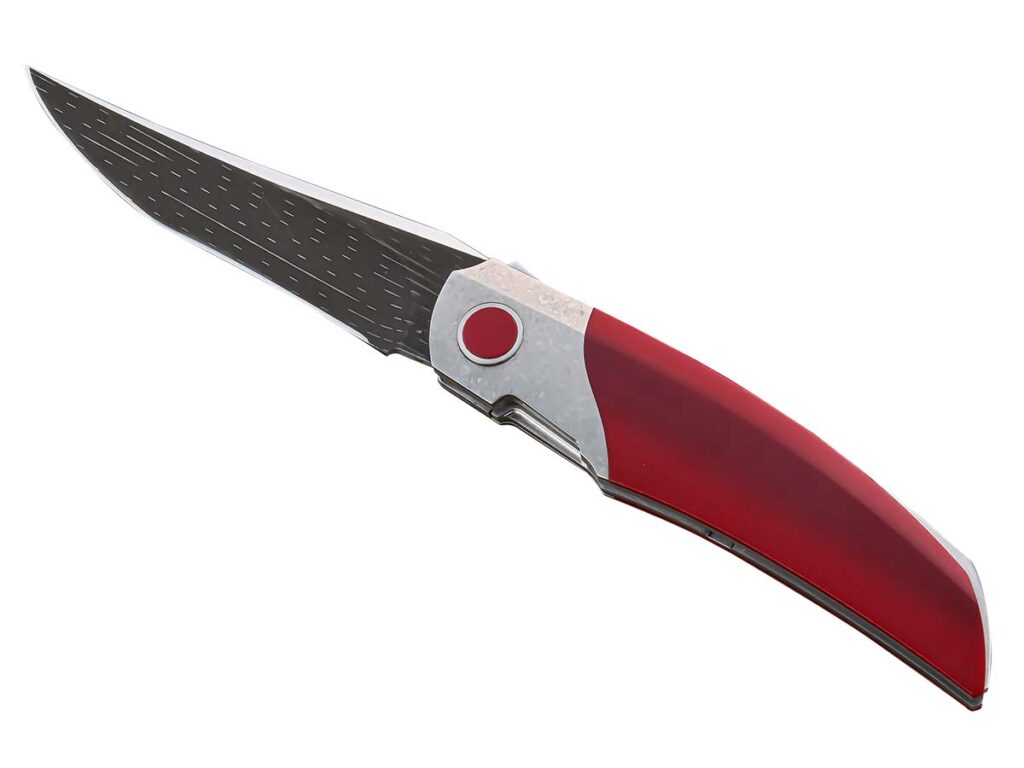
Carlos Queiros Thorn Persian TRS

Carlos Queiros Thorn Persian TRS

Knife type: Folder
Blade length: 3.35”
Blade material: Chad Nichols Starfire stainless damascus
Blade grind: Flat
Scales: Vintage bright red linen Micarta®
Bolsters: Crystalized titanium
Pocket clip: Yes
Closed length: 4.53”
Maker’s price for a similar knife: $4,700-$4,800 at press-time exchange rate
Maker: Carlos Queiros (SharpByCoop image)


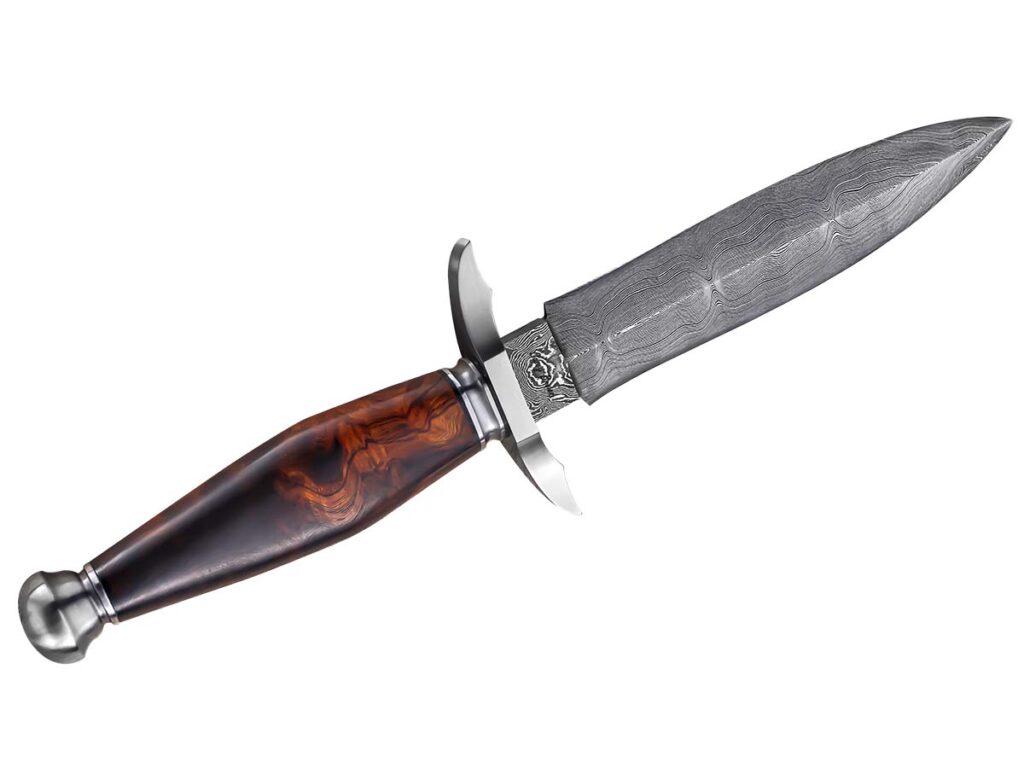
Casey Brown Dagger

Casey Brown Dagger

Blade length: 5.5”
Blade material: Ladder-pattern damascus
Blade grind: Flat
Scales: Desert ironwood
Guard/fittings: 416 stainless steel
Overall length: 10.25”
Maker’s price for a similar knife: $900
Knife to know: The maker is an ABS journeyman smith
Maker: Casey Brown (SharpByCoop image)


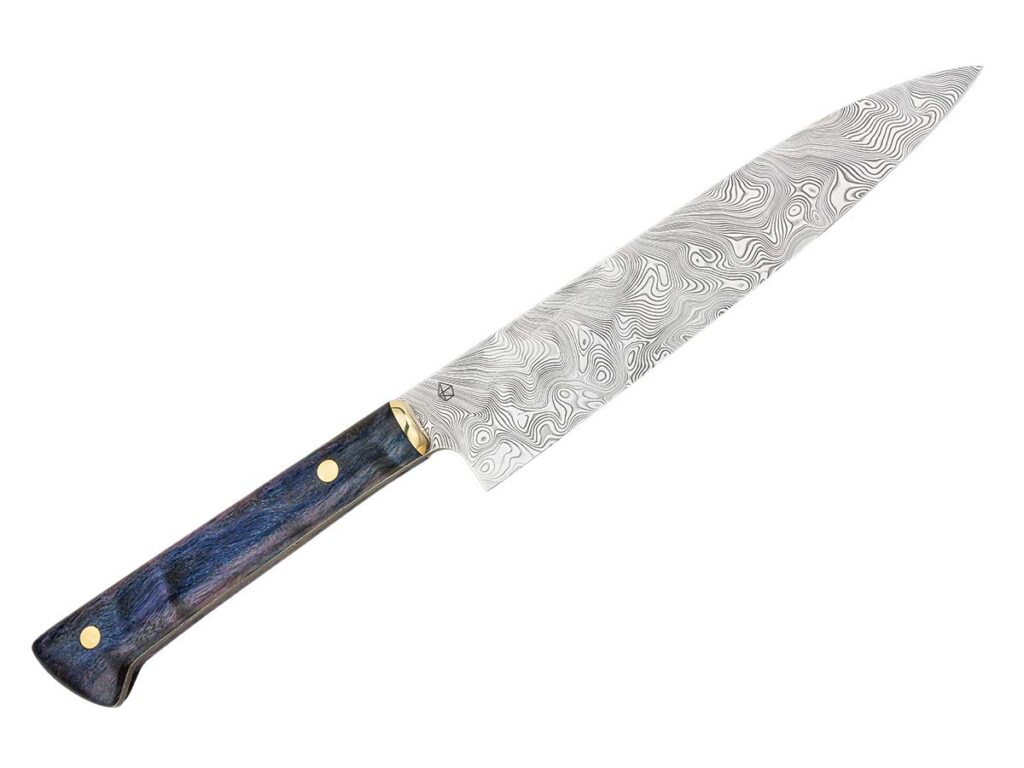
Luka Allen Petty Knife

Luka Allen Petty Knife

Blade length: 5 5/8”
Blade material: Bjorkman’s twist damascus by Damasteel
Blade grind: Flat
Scales: Cottonwood
Fittings: Brass
Overall length: 9.75”
Maker’s price for a similar knife: $450
Maker: Luka Allen, lukaallen.com (Jocelyn Frasier image)


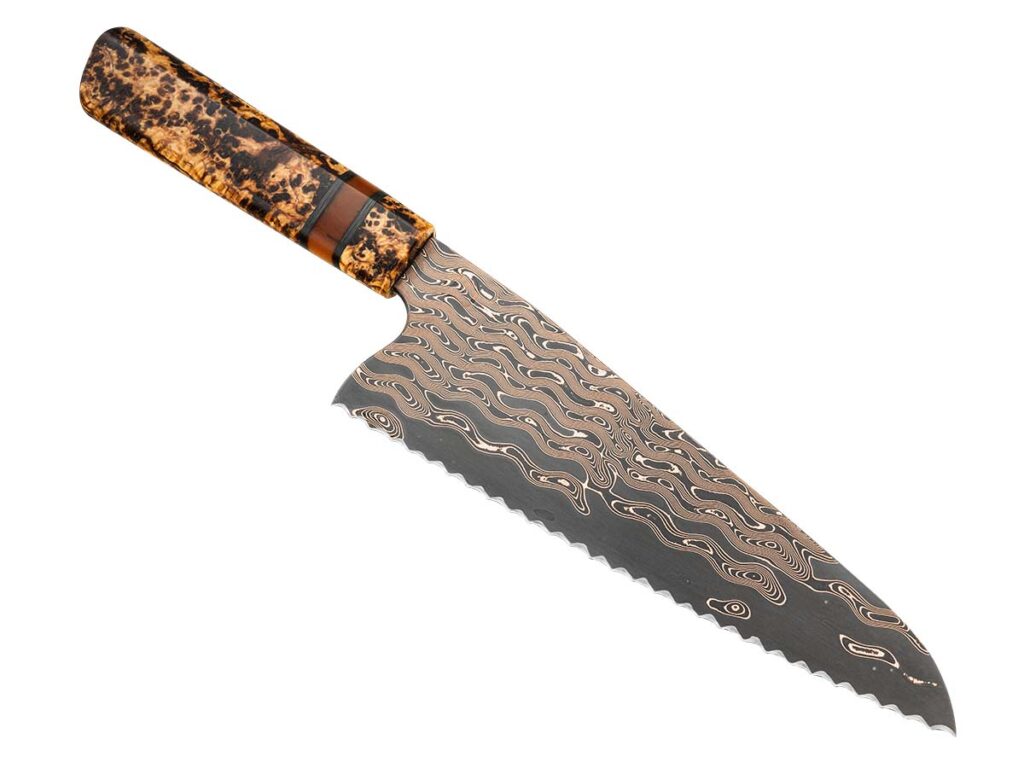
Micah Dunn Chef Bread Knife

Micah Dunn Chef Bread Knife

Blade length:7.5”
Blade material: Baker Forge & Tool copper-mai Surge pattern
Blade grind: Flat
Scales: Spalted chestnut burl and vintage Micarta®
Overall length: 12.25”
Maker’s price for a similar knife: $1,200
Maker: Micah Dunn, mdedgeworks.com (Jocelyn Frasier image)


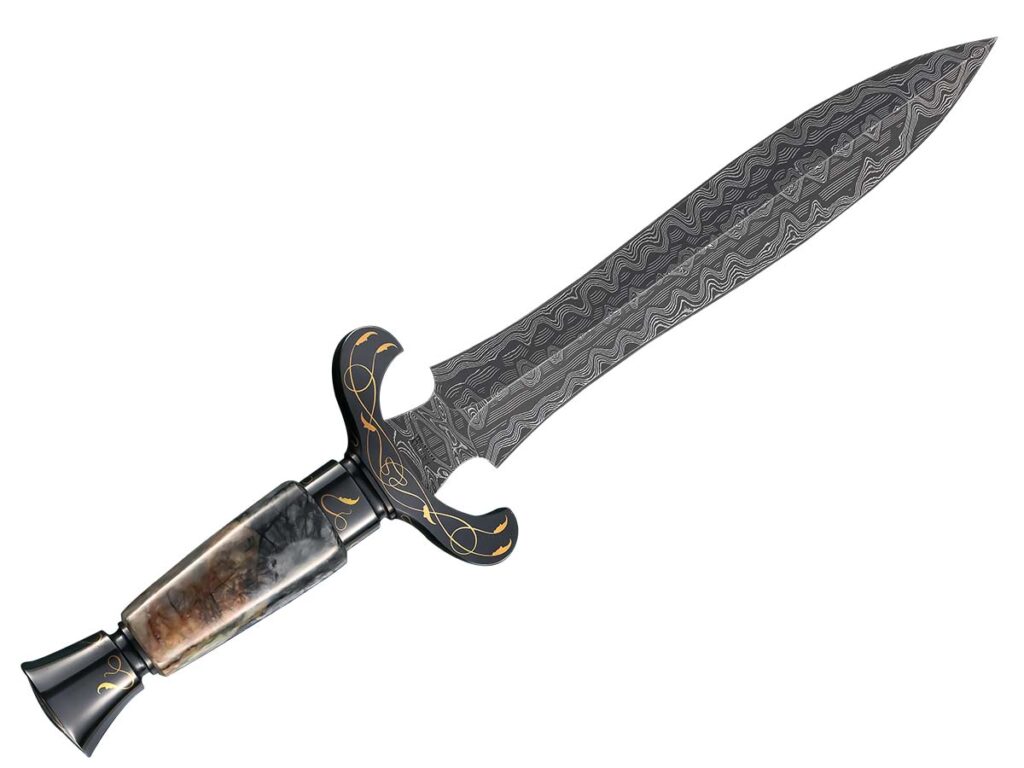
Dennis Friedly Art dagger

Dennis Friedly Art dagger

Blade length: 9”
Blade material: Mike Norris damascus
Blade grind: Hollow
Scales: Picasso marble
Fittings: Blued steel
Embellishment: 24k-gold inlay by Ray Cover Jr.
Maker’s price for a similar knife: $7,200
Knife to know: The maker is a voting member of The Knifemakers’ Guild
Maker: Dennis Friedly, friedlyknives.com (SharpByCoop image)


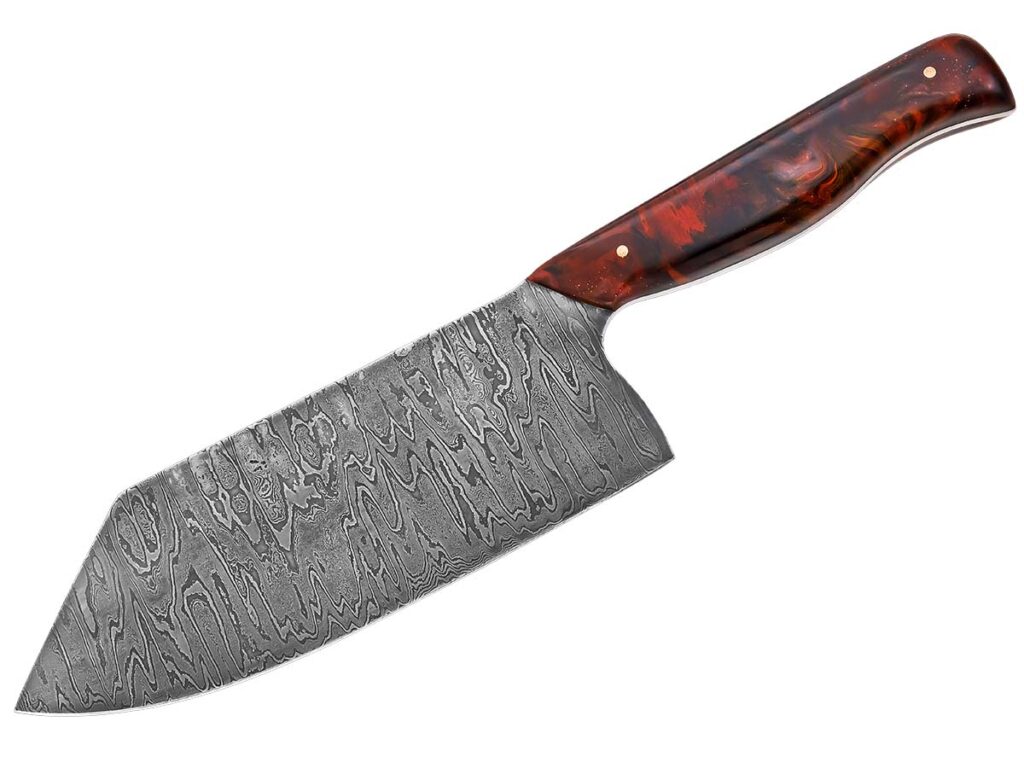
Dane Standen Cleaver

Dane Standen Cleaver

Blade length: 7.3”
Blade material: 243-layer textured damascus of 1084 carbon- and 15N20 nickel-alloy steels
Blade grind: Flat
Scales: Colored resin
Pins: Copper
Overall length: 12.2”
Maker’s price for a similar knife: Contact maker for info
Knife to know: The maker is a probationary member of the Australian Knifemakers Guild
Maker: Dane Standen (Rod Hoare image)


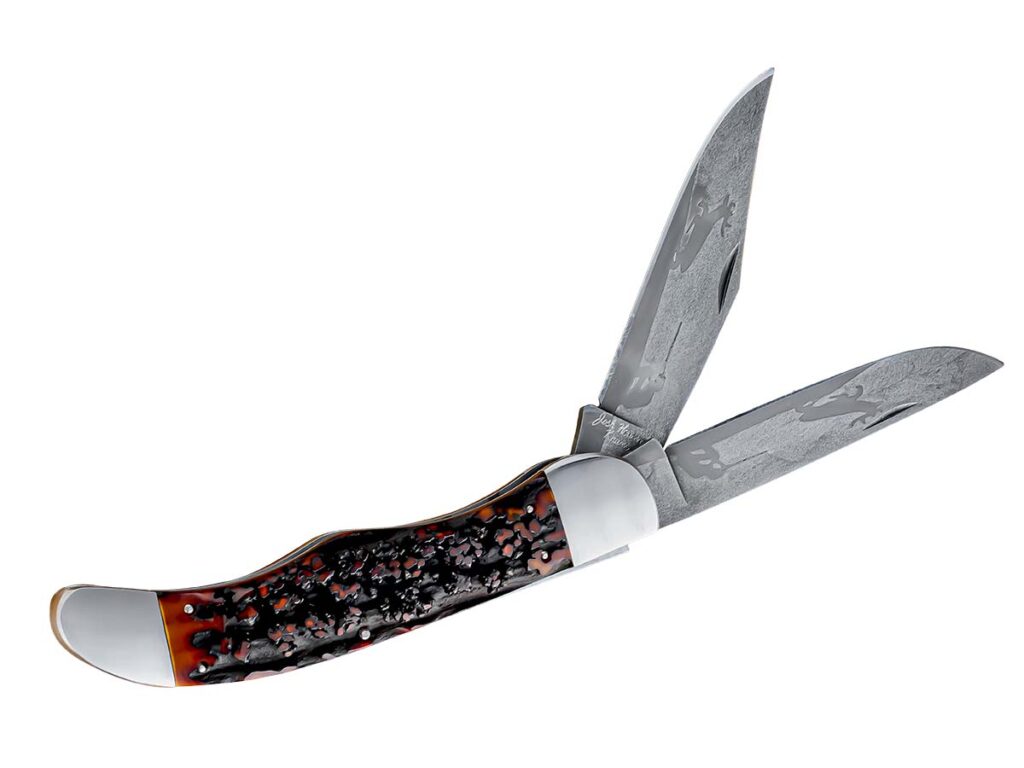
Josh Howard Folding Hunter

Josh Howard Folding Hunter

Action: Slipjoint
Blade length: 3.5”
Blade material: Pattern-welded deer hunting scene
Blade grind: Hollow
Scales: Amber stag
Handle frame & bolsters: Stainless steel
Closed length: 5.25”
Maker’s price for a similar knife: Contact the maker for info
Maker: Josh Howard, deerlickridgeforge.com (SharpByCoop image)


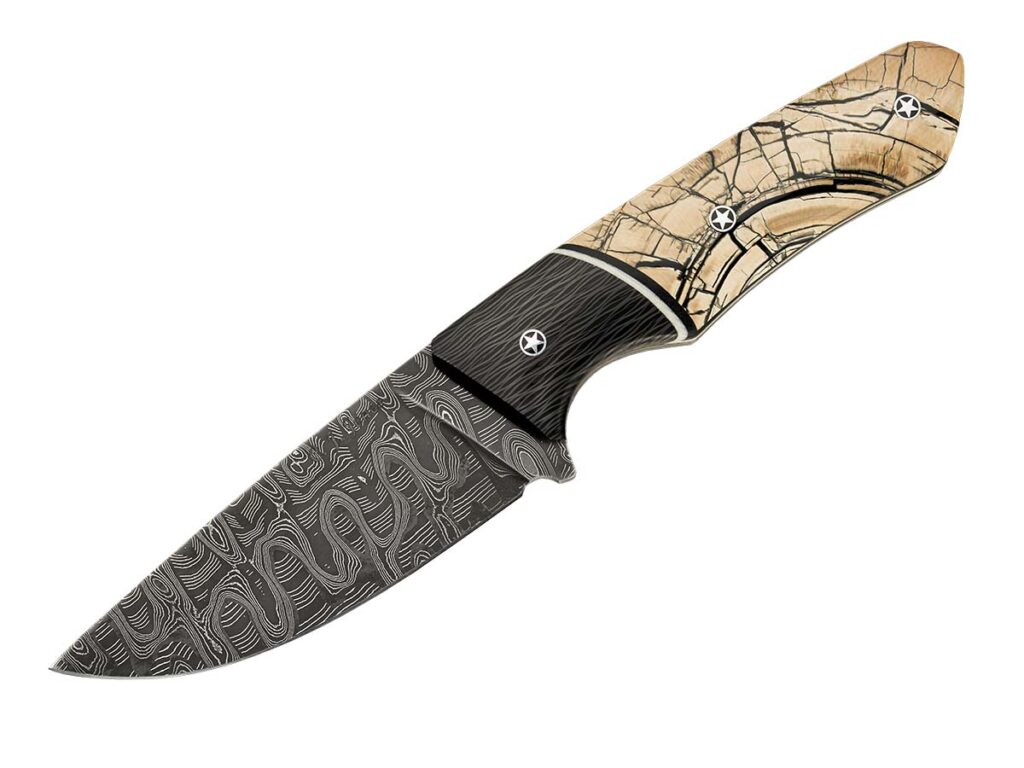
Chad J. Jones Hunter

Chad J. Jones Hunter

Blade length: 3.75”
Blade material: Mike Norris Hornet’s Nest stainless damascus
Blade grind: Flat
Scales: Crosscut mammoth tusk
Liners: Black and white G-10
Bolster: Zebra carbon fiber
Overall length: 8”
Maker’s price for a similar knife: $1,250
Maker: Chad J. Jones (Jocelyn Frasier image)


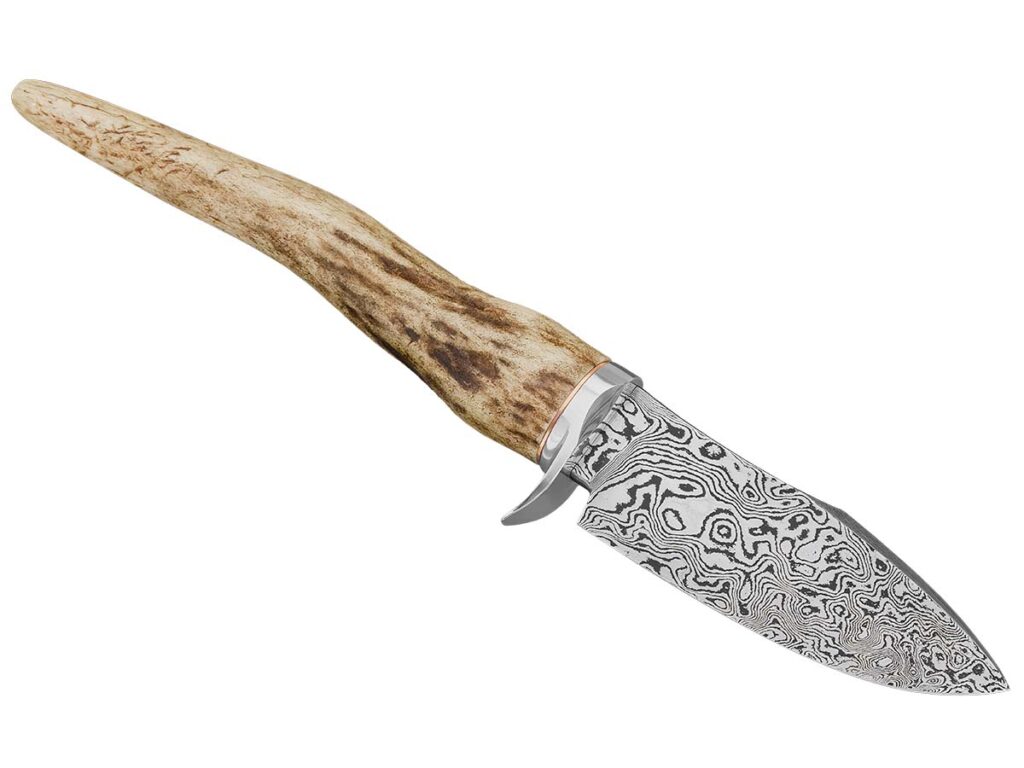
William Manning Hunter

William Manning Hunter

Blade length: 3.35”
Blade material: Random-pattern damascus of 1084 carbon-and 15N20 nickel-alloy steels
Blade grind: Flat
Scales: Antler w/copper spacer
Guard: 416 stainless steel
Overall length: 8.27”
Maker’s price for a similar knife: Contact maker for info
Knife to know: The maker is a probationary member of the Australian Knifemakers Guild
Maker: William Manning, manningblades.com (Rod Hoare image)


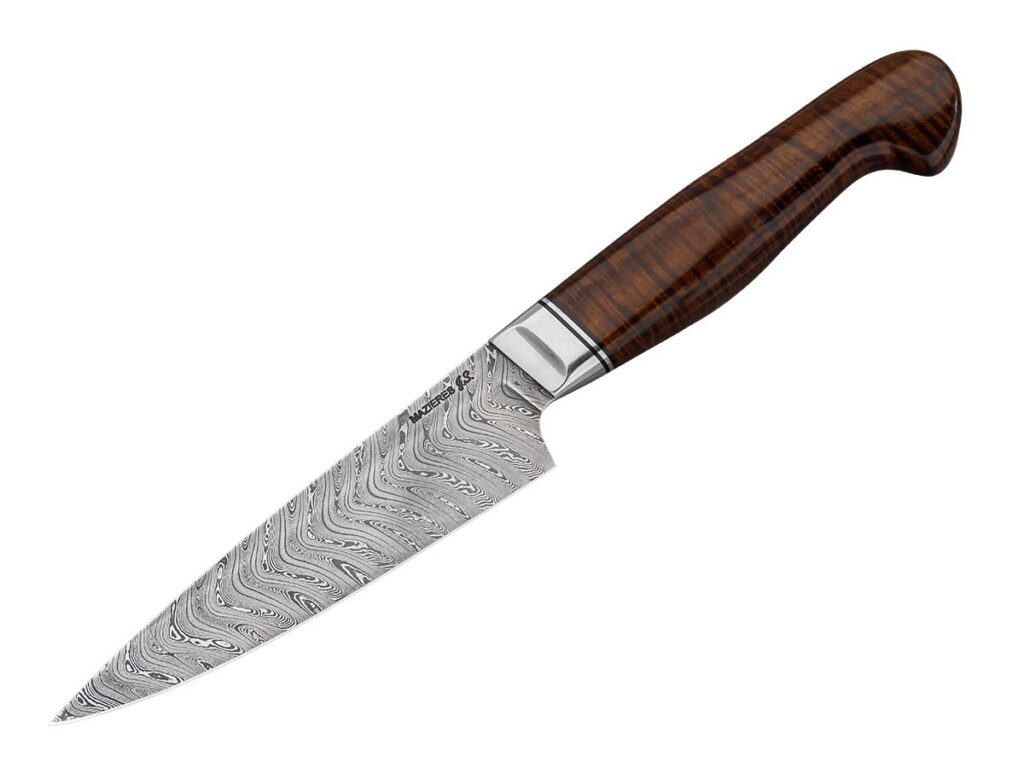
Francois Mazieres Medium Paring Knife

Francois Mazieres Medium Paring Knife

Blade length: 5”
Blade material: Pattern-welded damascus in 150 layers of 1084 and 1075 carbon- and 15N20 nickel-alloy steels embossed using
chevron dies for the final pattern
Blade grind: Flat
Scales: Stabilized South-Australian ringed Western Myall wood shaped in a composite Western/cowboy style
Spacers: G-10 and stainless steel
Bolsters: Scalloped, pinned and soldered 416 stainless steel
Construction: Hidden tang
Overall length: 10”
Maker’s price for a similar knife: $320.62 at press-time exchange rate
Knife to know: The maker is a member of the Australian Knifemakers Guild and a journeyman smith in the American Bladesmith Society
Maker: Francois Mazieres, Yandiwa.com.au (Rod Hoare image)


Nate “Tuna” Grant Utility Fixed Blade

Nate “Tuna” Grant Utility Fixed Blade

Blade length: 4”
Blade material: Rietveld Dragonskin damascus by Bertie Rietveld
Blade grind: Flat
Handle: Titanium, nickel silver, fiber liners, laser engraved
Overall length: 8”
Sheath: Guster leather; inlaid w/exotic animal skin; belt model with snap
Maker’s price for a similar knife: $5,000
Knife to know: The maker’s utility fixed blade won Best Utility at the 2024 Lost Pines Knife Show
Maker: Nate “Tuna” Grant, madebytuna.com (Jocelyn Frasier image)


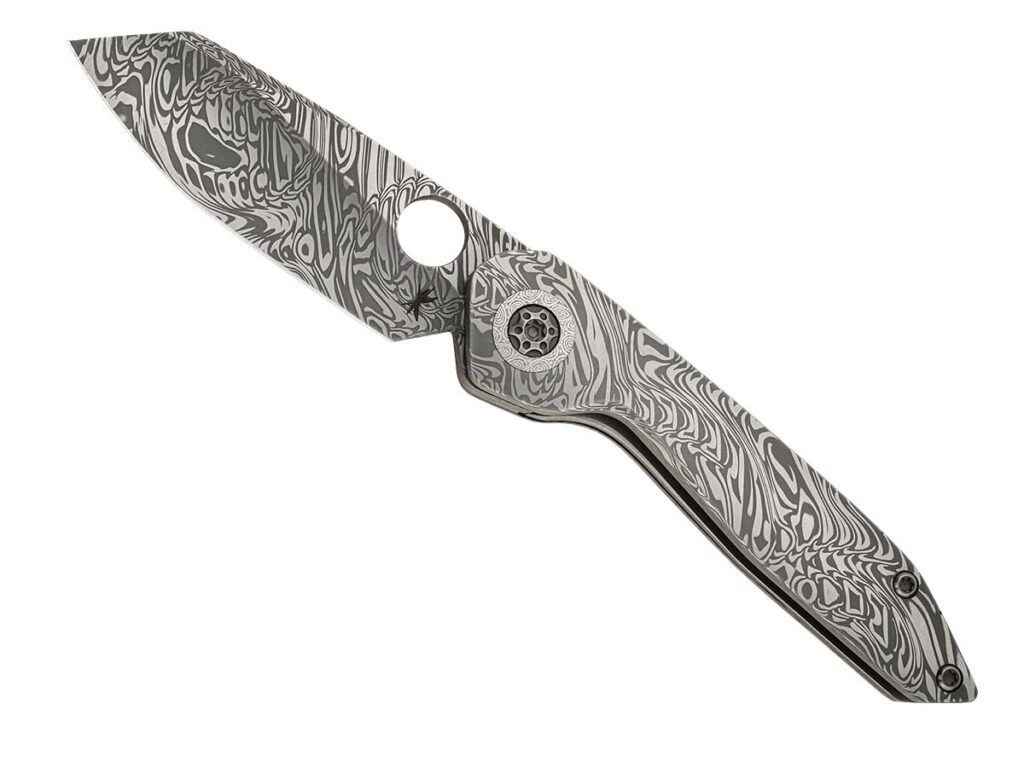
Bryan Montalvo Basset

Bryan Montalvo Basset

Knife type: Folder
Blade length: 3.25”
Blade material: Grabak damascus by Damasteel
Blade grind: Hollow
Blade pivot: Skiff caged ceramic bearings
Handle: Same material as blade
Lock: Linerlock
Pocket clip: Same material as handle
Closed length: 3.5”
Maker’s price for a similar knife: $3,000 at press-time material costs
Maker: Bryan Montalvo, keanisonknives.com (Jocelyn Frasier image)


More Knife Reviews:

Assisted Open Knives Buyer’s Guide [Tested]

Latest assisteds have all you need in swift, sharp folders.

The assisted opener appeals to many who are mechanism oriented and like to fidget with their knives. There’s something satisfying about tapping a flipper tab or nudging a thumb stud and then having spring force kick in and propel the blade open crisply and quickly. It’s sort of like an automatic but it’s not. In fact, in most areas its legality is no different than a standard one-hand folder* because you initiate the opening by manually pressing the flipper or thumb stud as opposed to releasing the blade under spring tension via a push button as done with an auto.

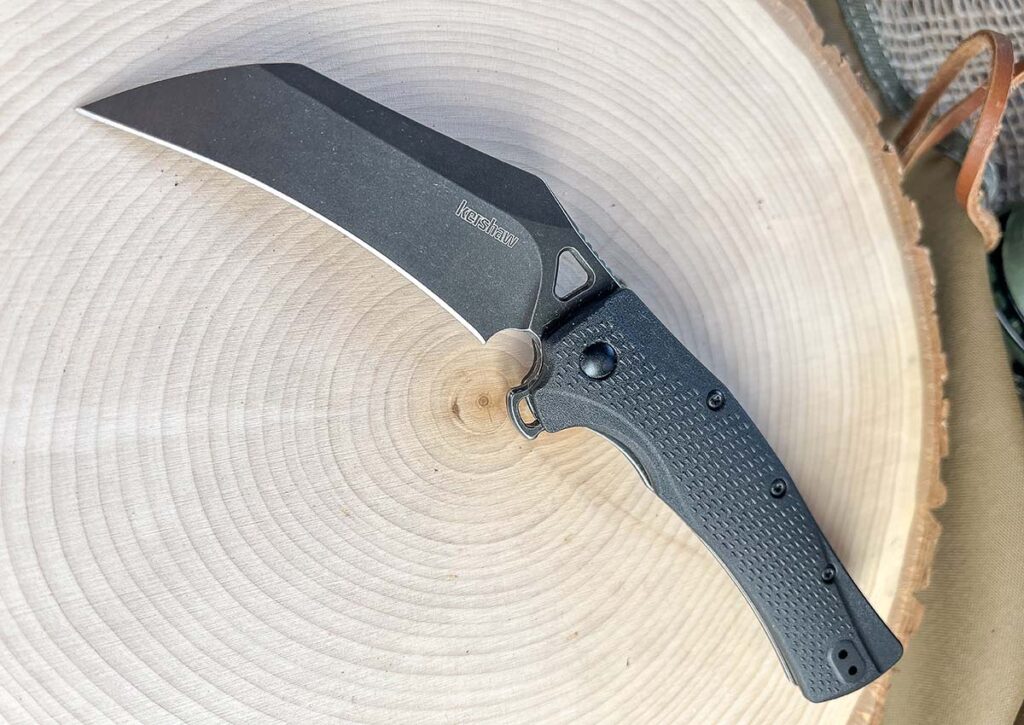
Kershaw Dawnstar

The flipper tab of the Kershaw Dawnstar is highly effective at deploying the blade. The large semi-circular choil is sort of unusual and adds to the knife’s distinct appearance

Kershaw was one of the first manufacturers to go all-in with assisted openers in the mid-to-late 1990s. It teamed with BLADE Magazine Cutlery Hall-of-Fame® member Ken Onion to make a line of collaboration knives that incorporated Onion’s SpeedSafe assisted-opening mechanism. The knives not only were great sellers for the company, but, more importantly, helped start the assisted-opening revolution in the knife industry. Soon after, other manufacturers began producing versions of folders with mechanisms that closely mirrored the SpeedSafe for both tactical and EDC purposes.

The Dawnstar is Kershaw’s latest entry in the genre. Sporting a hawkbill blade paired with a true tactical handle offering deep, tip-up carry, it is one of the company’s more radical configurations. The hawkbill isn’t seen too widely in tactical folders, so it stands out both visually and functionally. The 3.5-inch blade is 8Cr13MoV stainless steel. 

The main grind is hollow with a swedge, making the blade look a bit aggressive and also following through in use. A flipper tab deploys the blade quickly and is the only opening method. The handle is molded glass reinforced nylon (GRN) with dual skeletonized steel liners for strength. Strategically placed cutouts reduce weight. The handle is textured for a comfortable, nonslip grip.

The knife cuts best in a pulling motion, allowing the hawkbill to gather the material being cut into the blade’s curvature, not unlike pulling a zipper. The hawkbill is an aggressive pattern and goes through a variety of materials with ease. This is where the hollow grind really makes a difference. Cardboard, foam, even wire stripping—the assisted opener sails through it all. If you cut a lot of cardboard or make long, straight-line cuts in any material, the Dawnstar is for you. The handle is easy to hold onto. The large finger recess helps seat your hand. 

Approximate closed length: 4.4 inches.
Country of origin: China.
MSRP: $54.99.

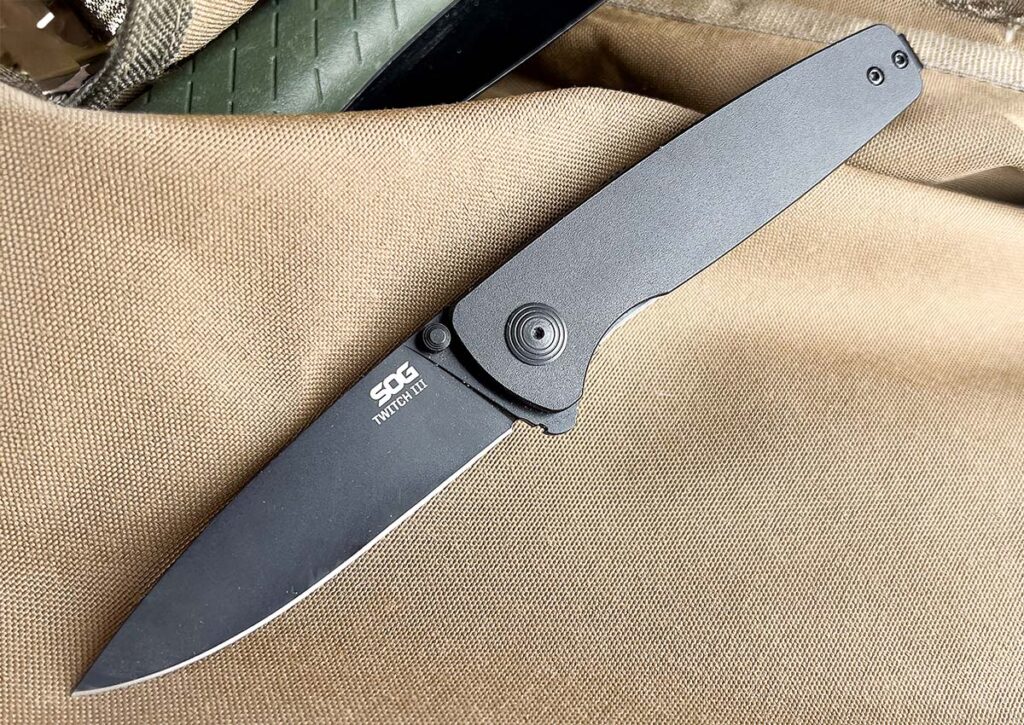
SOG Twitch III

The Twitch III is ultra-light, ultra-slim and elegant in appearance. A simple design with high function, it goes well with dress or casual clothes.

The Twitch III is the third installment in a highly successful series of assisted openers from SOG. It is a slim, stylish EDC capable of tackling a wide variety of cutting chores. It features a 3.1-inch spearpoint blade fully flat ground from 154CM stainless steel with ambidextrous thumb studs and a low-profile flipper tab for an additional opening option. A light press on the flipper and the blade pops out with authority.

The handle is lightweight yet strong aluminum, with dual steel liners providing the backbone. A subtle finger recess forms a bit of an integral guard to prevent your hand from sliding forward. A deep-carry, bayonet-style clip is affixed to the butt and positions the folder as low as possible in the pocket for ultimate concealment. The handle profile is flat and slender, making it extremely comfortable for daily pocket carry. The knife is equally at home in dress or casual clothes.  

For a slim knife the Twitch III performs very well. The blade glides through various materials with surprising ease. The 154CM offers more mileage for edge retention than lesser steels such as D2, 8Cr13MoV and AUS-8. It is the type knife you can carry for a range of varied-use scenarios, from slicing steak to more mundane things such as opening mail, packages, etc.

It excels at cutting open blister packs due to its pointy tip and flat- ground blade. Performance is great and the folder carries exceptionally well, so what’s not to like? However, I would caution against prolonged use due to the slender, flat profile and slick aluminum scales. If your hand is wet or sweaty, grip retention might be an issue.

The Twitch III comes in three varieties: all-black blade and handle, natural finished aluminum with satin blade and gold TiN coated hardware, and gray aluminum handle with black blade and hardware anodized a light blue. All are great-looking EDCs and a welcome addition to your collection. 

Closed length: 3.9 inches.
Country of origin: China.
MSRP: $79.95 for any of the three variants.  

Benchmade PSK 593BK-01

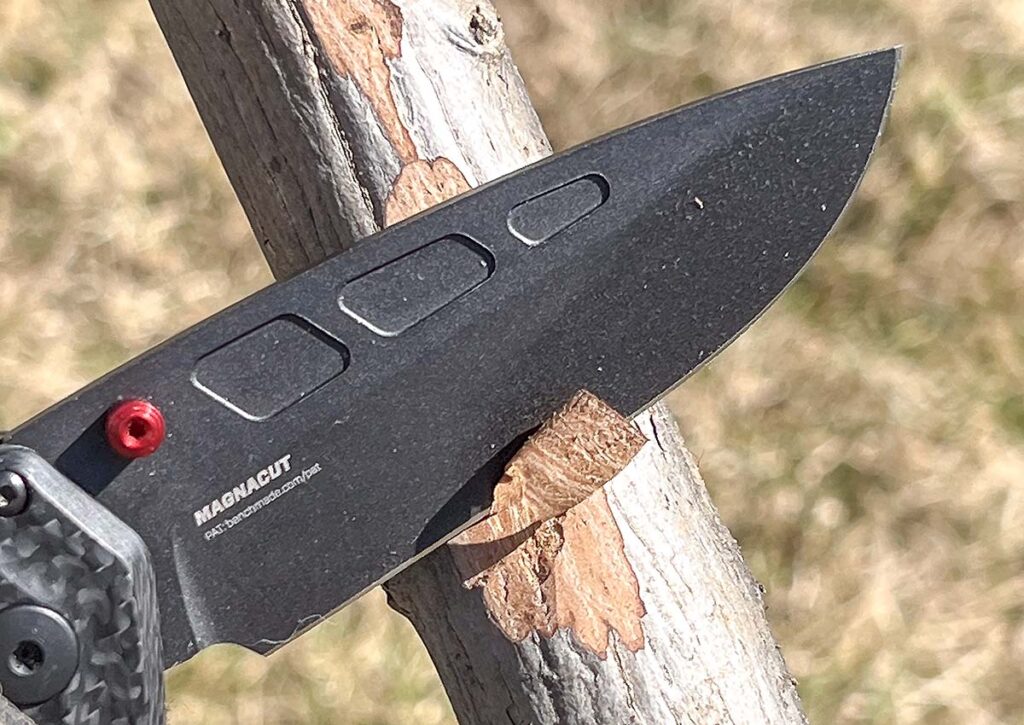
Benchmade’s PSK is a high-end outdoor folder using CPM MagnaCut stainless blade steel. MagnaCut holds an edge extremely well in addition to having excellent corrosion resistance—pretty much the perfect outdoor blade material. 

The brawny Benchmade PSK 593BK-01 is a rugged assisted opener engineered for survival use. It exhibits all the hallmarks of what makes applicable Benchmade knives standards in the industry: the AXIS crossbar lock mechanism and advanced materials for the handle and blade, including carbon fiber, G-10 and CPM MagnaCut stainless steel. The 3.4-inch modified drop-point blade has excellent edge retention and superior corrosion resistance—a perfect steel for a knife to carry while hiking, camping, hunting, etc.

An exposed flat area below the thumb stud that resembles a choil serves as a spot to use a ferrocerium rod for fire starting. It’s such a thoughtful touch on the PSK. The ergonomic handle incorporates forward and rear integral guards to prevent slipping and seats your hand well. Black carbon fiber bolsters are mated with black G-10 scales, with the blade DLC coated for additional corrosion resistance and a low-profile appearance—in other words, the knife is “murdered out” in mostly all black. 

The ambidextrous thumb studs are anodized red for an interesting splash of color. A deep carry pocket clip positions the PSK tip up and switches to the opposite side to accommodate lefties. The AXIS Lock Assist is rock solid while remaining easy to disengage by pulling back on the studs, then rotating the blade closed. A sliding switch safety in the handle spine locks the blade closed to help prevent the knife from accidentally flying open in your pocket or during inside waistband carry.

The PSK looks great and performs even better. Grip quality is excellent; the 3D machined grooves in the handle and bolster work great at keeping your hand in place without feeling overly aggressive, and they displace water as well. The blade rockets out via the assisted opener very quick and sure, almost like an automatic. 

The robust build and ergonomic grip instill user confidence in any climate. The PSK handles anything you throw at it, from slicing meat to whittling. The flat grind leaves enough cross-sectional steel on the blade to give it structural integrity, yet thins the edge down to where it has bite. 

Approximate closed length: 4.6 inches.
Country of origin: USA.
MSRP: $450.

Editor’s note: For that matter, in the many states and jurisdictions where bans against automatics have been lifted, neither is an assisted opener’s legality any different than an auto.

More Pocketknife Info:

Spyderco Starmate: 25 Years Of The Definitive Terzuola Tactical Folder

Sprint Run Spyderco Starmate salutes Bob Terzuola and Sal Glesser.

“If I have seen further than others, it is by standing upon the shoulders of giants.”—Isaac Newton

Although Newton penned these words centuries ago, the spirit of his quote is timeless. Applied to the world of knives, today’s high-performance, state-of-the-art tactical folders are the direct result of two cutlery industry giants: legendary custom knifemaker Bob Terzuola and Spyderco co-founder Sal Glesser.

Both members of the BLADE Magazine Cutlery Hall of Fame®, independently these men each had a tremendous influence on the knife world. However, when they joined forces their impact was even more profound. One of their more influential collaborations was the Starmate, which combined the best elements of Terzuola’s iconic ATCF (Advanced Technology Combat Folder) and Glesser’s revolutionary CLIPIT platform.

To celebrate the 25th anniversary of this pivotal design—and commemorate several other important historical landmarks as well—Spyderco has introduced a limited-edition Sprint Run expression of the Starmate. To truly appreciate the knife, however, you need to appreciate the men behind it.

Brooklyn Boys

Sal Glesser (left) and Bob Terzuola (right).

Robert G. Terzuola was born in Brooklyn, New York, on Sept. 14, 1944. A diligent student, he earned a full scholarship to New York University, where he majored in vocational education. Upon graduation, he joined the Peace Corps and served in a variety of roles in Panama, Puerto Rico and Guatemala. During that time, he taught himself the art of jade carving and ultimately became the general manager of a jade jewelry company in Antigua, Guatemala. There he met Col. James Atwood, a former U.S. military intelligence officer, military edged weapons historian and CIA contract worker. Recognizing Terzuola’s skills as an artisan, Atwood suggested he try his hand at knifemaking and introduced him to many of his earliest customers—adventurers and soldiers of fortune in Central America.

With Atwood’s encouragement, in 1980 Terzuola began crafting handmade fixed blades. In 1982, he joined The Knifemakers’ Guild based on endorsements from the legendary Bob Loveless and Frank Centofante, Cutlery Hall of Famers in their own right. That same year Terzuola met Glesser at the New York Custom Knife Show.

A fellow Brooklyn native, Sal was—and still is—a passionate entrepreneur and inventor. He operated several successful businesses before he and his wife Gail founded Spyderco in 1976. Sal’s first knife-related product was the Tri-Angle Sharpmaker, an improved expression of the ceramic Crock Stick knife sharpener he and Gail sold at fairs and shows across the country.

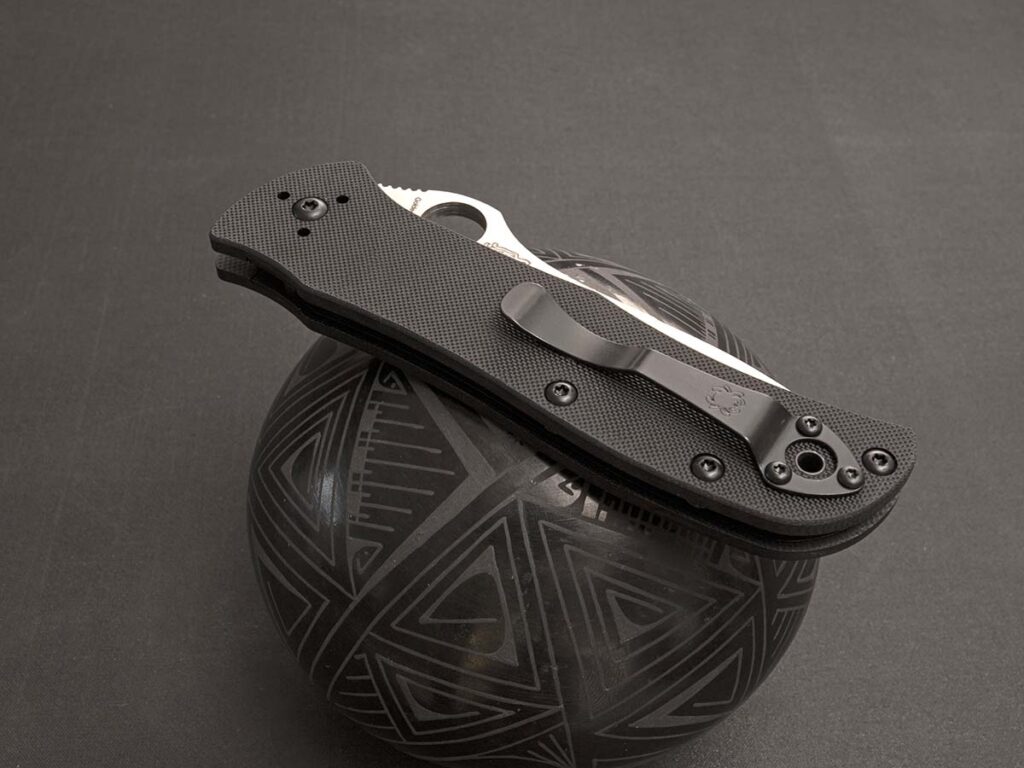
A broad-based, four-position pocket clip supports all carry modes for the revival of the Starmate.

In 1981, Sal introduced the first Spyderco knife: the Worker. Its revolutionary design was the first to include a pocket clip for convenient, top-of-the-pocket carry and Spyderco’s signature Trademark Round Hole for swift one-hand opening with either hand. The inaugural member of Spyderco’s groundbreaking CLIPIT family, a year later the Worker was also the first commercial folder to offer the aggressive cutting power of a serrated blade. Together, these features defined the form of the modern folding knife that still endures today.

Synergy For SpyderCo

When Bob first met Sal at the New York Custom Knife Show, he was impressed with Sal’s showmanship as a salesman of the Sharpmaker. Terzuola was equally taken with the CLIPIT folding knife concept and its revolutionary features. Similarly, Sal appreciated the impeccable craftsmanship of Bob’s knives and their no-nonsense style. The fact that both men hail from Brooklyn gave them additional common ground, and they quickly became good friends.

In 1984, Terzuola moved to Santa Fe, New Mexico, and began making knives full time. A year later, he learned the intricacies of making a linerlock folding knife directly from its inventor, renowned custom knifemaker and Cutlery Hall-of-Famer Michael Walker. Bob also asked Sal’s permission to incorporate the pocket clip into his folding knife designs. Sal not only gave Bob his blessing but generously sent him a box of Spyderco’s early three-screw clips.

Eric Glesser (right), today’s driving force behind Spyderco, was the catalyst behind the Starmate project.

Armed with the knowledge he had learned from Michael Walker and the inspiration of Sal’s CLIPIT concept, Terzuola turned his focus toward making folding knives. His first two designs—the Model 1 Utility and the Model 2 Mariner—were primarily utilitarian in nature. Both offered one-hand opening via a thumb disk, which Terzuola pioneered, and early versions were crafted with Spyderco clips.

After the success of those designs, Bob turned his focus back to the needs of his original clientele—soldiers and armed professionals—to create a low-profile, no-nonsense folding knife suitable for both defensive and utilitarian use. His third folder design, the ATCF, became Terzuola’s most iconic model, and Bob was attributed by many with coining the term “tactical folding knife,” aka “tactical folder.” With that, he became a pioneer of the genre.

First Collaboration

At the 1989 SHOT Show, Sal and Bob were discussing Spyderco’s growing line of CLIPIT knives when Bob commented that, despite their groundbreaking features, they were ugly. Sal quickly countered with an offer: “You design a pretty one and I’ll make it.” Terzuola took Sal’s challenge to heart and not only delivered a design that showcased both his personal style and Spyderco’s Trademark Round Hole, but a series of specific conditions for its production.

Spyderco ultimately discontinued the first-generation Starmate but reintroduced the knife in 2012. Crafted in Japan, the reintroduction featured full stainless-steel liners and a VG-10 stainless steel blade.

That design, the C15 Bob Terzuola, established Bob as Spyderco’s first collaborative designer. It also made history as the company’s first made-in-the-USA model, the first Spyderco knife to feature a linerlock, the first production knife to use ATS-34 stainless blade steel, the first factory-made knife to use a laser-cut blade, and the first CLIPIT to offer two-position carry. Introduced in 1990 with machined aluminum scales, in 1994 it made history again as the first factory knife to feature a G-10 handle. It was later joined by a smaller counterpart, the C19 Bob Terzuola Jr., which also was made with both aluminum and G-10 scales.

The Starmate

By 1999, Terzuola had established himself to many knife enthusiasts as the “Godfather of the Tactical Folding Knife” and among the world’s premier custom makers. Drawing inspiration from his acclaimed ATCF and his Century Starfighter designs, he partnered with Spyderco again to create the Starmate.

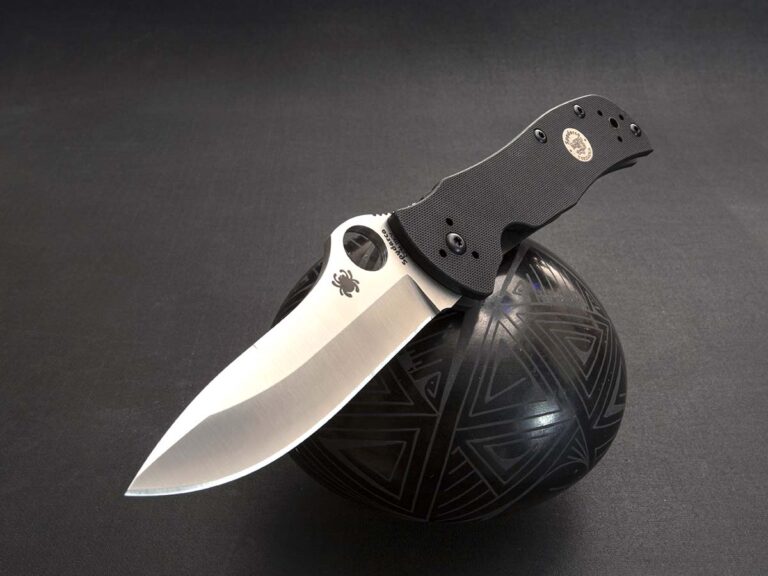
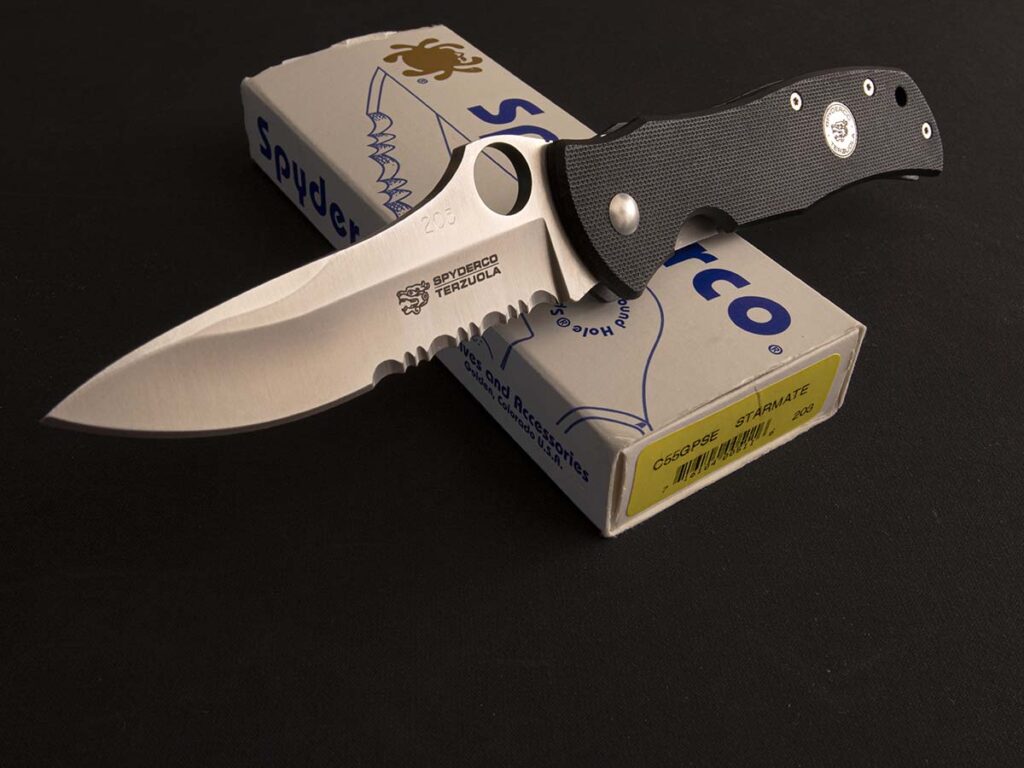
Manufactured in Golden, Colorado, the original Starmate featured a hollow-ground blade crafted from CPM 440V particle metallurgy stainless steel, smooth black G-10 scales, a single, nested stainless-steel liner, a linerlock, a round Spyderco/Terzuola inlay, and a pocket clip with a broad, triangular base configured for right-side, tip-down carry. It was produced in both PlainEdge and partially serrated CombinationEdge formats, and was an immediate hit with serious tactical knife users.

The original Spyderco Starmate was introduced in 1999. 
Here’s a first-generation model with an original product box. Note Terzuola’s distinctive dragon head blade logo inspired by the Mayan god of flint tools and edged weapons, Etz Nab.
The original Spyderco Starmate was introduced in 1999. Here’s a first-generation model with an original product box. Note Terzuola’s distinctive dragon head blade logo inspired by the Mayan god of flint tools and edged weapons, Etz Nab.

Although the first-generation Starmate was ultimately discontinued, in 2012 Spyderco resurrected and updated the design. This time it was manufactured in Japan with a saber-ground VG-10 stainless steel blade, full stainless-steel liners, peel-ply-textured G-10 scales, and a four-position pocket clip configurable for left or right-side, tip-up or tip-down carry. The rebirth of the model introduced a new generation of knife enthusiasts to Terzuola’s exceptional designs, which included two other Spyderco collaborations—the non-locking C131 Terzuola SLIPIT and the C174 Double Bevel.

Milestones

Reflecting on the rich history of Terzuola’s many accomplishments and his longstanding relationships with Glesser and Spyderco, in 2025 Sal’s son and heir, Eric, decided to create a special Sprint Run expression of the Starmate. Eric’s goal was to commemorate Bob’s 45th year as a knifemaker, his 81st birthday and the 35th anniversary of his first Spyderco collaboration. Like all Sprint Run projects, this limited-edition version of the design features a combination of materials unique for Spyderco and that the company will produce only once. Manufactured at Spyderco’s factory in Golden, Colorado, it pays homage to the profound impact both Terzuola and Glesser have had on the knife industry and their pioneering roles in creating the genre of the modern tactical folding knife.

Bob Terzuola (left) delivered the induction speech for Sal Glesser (right) when Sal entered the BLADE Magazine Cutlery Hall of Fame® in 1999. Terzuola was inducted in 2023.

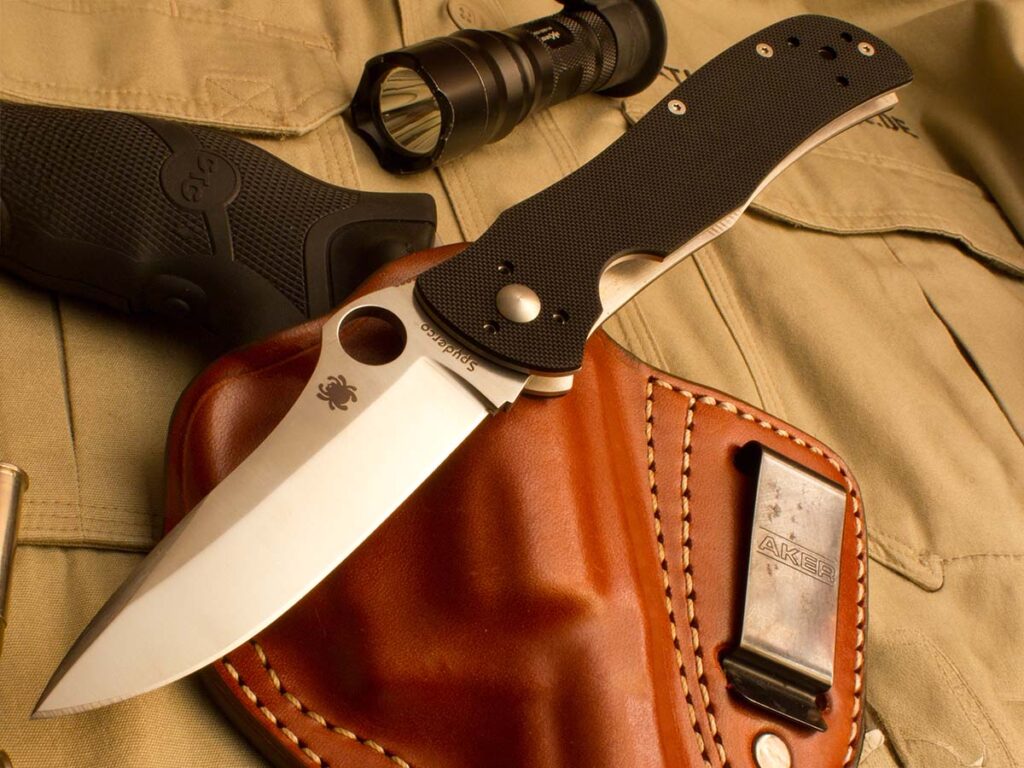
The Starmate Sprint Run edition faithfully revives Terzuola’s iconic design and elevates it with a blade crafted from CPM 20CV—a highly wear-resistant, powder metallurgy stainless steel that contains a high volume of vanadium carbides and the highest amount of chromium of any vanadium-rich stainless steel currently available. This distinctive alloy composition gives it a remarkable combination of edge retention, corrosion resistance and toughness and makes it ideal for the Starmate’s intended scope of use.
The knife’s hollow-ground blade features a handsome satin finish and a prominent swedge (unsharpened bevel) on the spine that adds distinctive style while ensuring an acute, utilitarian point. It also includes a large Trademark Round Hole accessible for ambidextrous one-hand opening and announces the knife’s Spyderco pedigree. A section of gimping above the hole provides a high-traction thumb purchase for enhanced control during use. The blade’s reverse side features a laser-engraved dragon head—Terzuola’s distinctive logo inspired by the Mayan god of flint tools and edged weapons.

The Starmate’s blade is supported by a sturdy linerlock and housed in a handle of black G-10 scales and nested, skeletonized stainless steel liners. The scales have a peel-ply texture for a non-slip grip and, like the original version, are accented by an inlaid Spyderco/Terzuola logo. To allow convenient carry, keep the knife poised for instant access and pay homage to the time-tested CLIPIT concept, it includes a four-position hourglass pocket clip. The broad-based clip is easily configurable for left- or right-side, tip-up or tip-down carry and, in the tip-up position, straddles a lanyard hole that allows the easy attachment of fobs, lanyards or security lines. In keeping with the knife’s tactical styling, the clip and handle hardware all feature stealthy black coatings. To complete the package, every knife comes complete with a zippered nylon pouch embroidered with the Spyderco “bug” logo and a detailed product information guide explaining the design’s history.

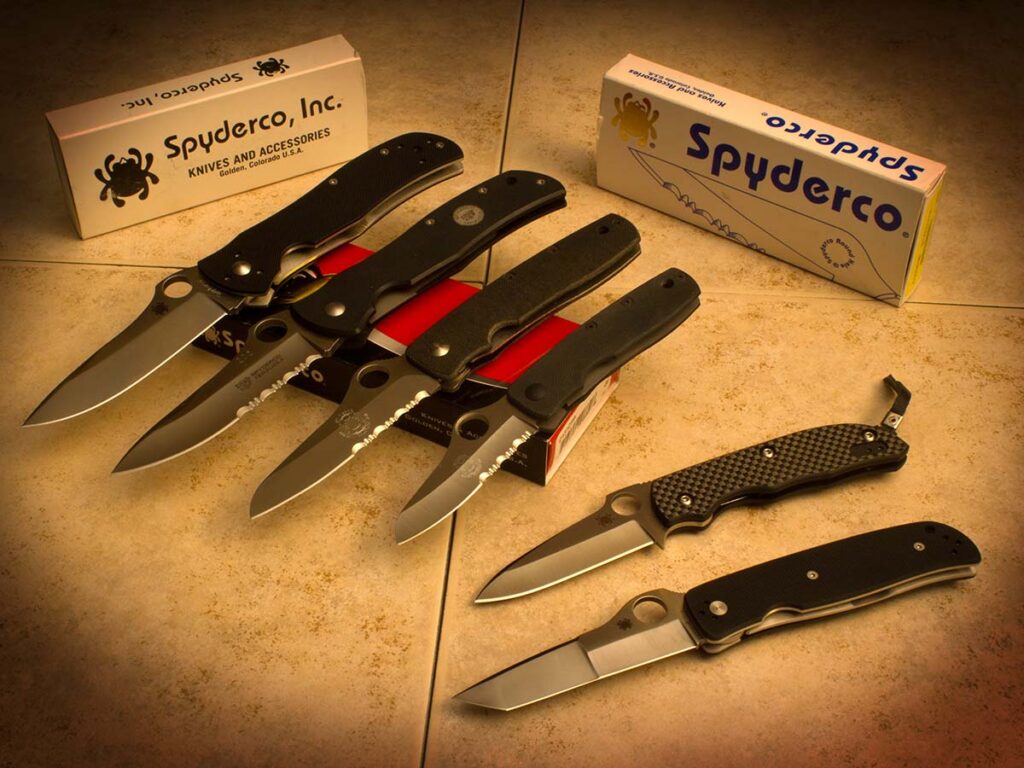
Bob Terzuola was Spyderco’s first collaborator and still reigns as one of the company’s most prolific collaborators. Here’s a selection of Terzuola-designed Spyderco folders.

Spyderco’s limited-edition Starmate is a proud tribute to two of knifemaking’s most legendary and influential figures. It is also a vivid reflection of their individual innovations, their longstanding friendship and mutual respect, and the powerful synergy of their collaborative efforts. This elite expression of the Starmate will be available while supplies last through Spyderco’s worldwide dealer network and directly from Spyderco.com.

Spyderco Starmate Sprint Run Specs
Designer: Bob Terzuola
Blade Length: 3.74”
Blade Steel: CPM 20CV stainless
Blade Thickness: 0.145”
Blade Grind: Hollow
Edge Length: 3.68”
Handle Material: G-10
Lock Type: Linerlock
Pocket Clip: Ambidextrous; 4-position
Knife Weight: 4 ozs.
Closed Length: 4.99”
Country of Origin: United States
MSRP: $450

More Spyderco Knives:

Advertisement

Must Read Articles

Read this before you make a knife

Knifemaking 101 – Read This Before You Make a Knife

  by Wayne Goddard My experience has taught me that there's nothing like digging in and getting started. I've often said the hardest part of the...
how to forge damascus steel

How to Forge Damascus

Advertisement
Advertisement