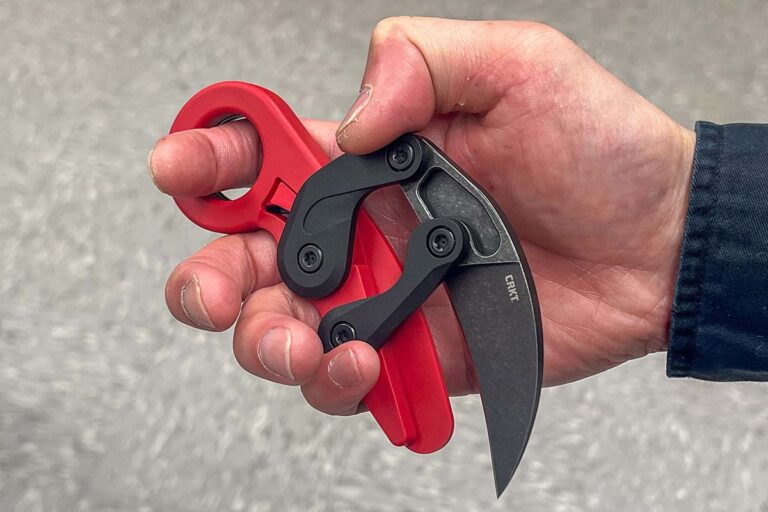
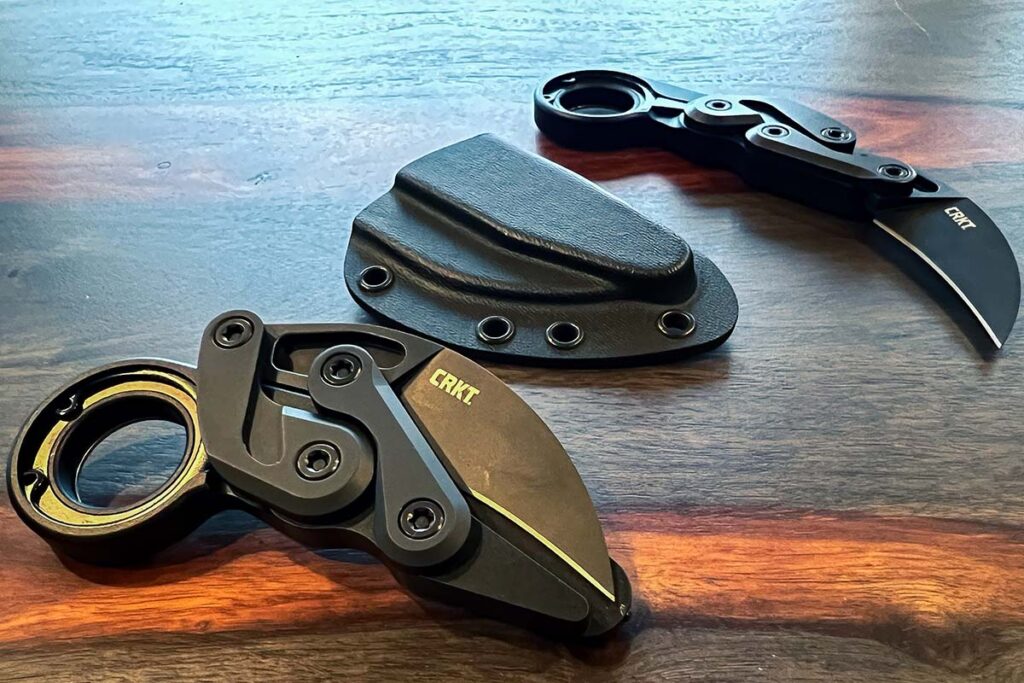
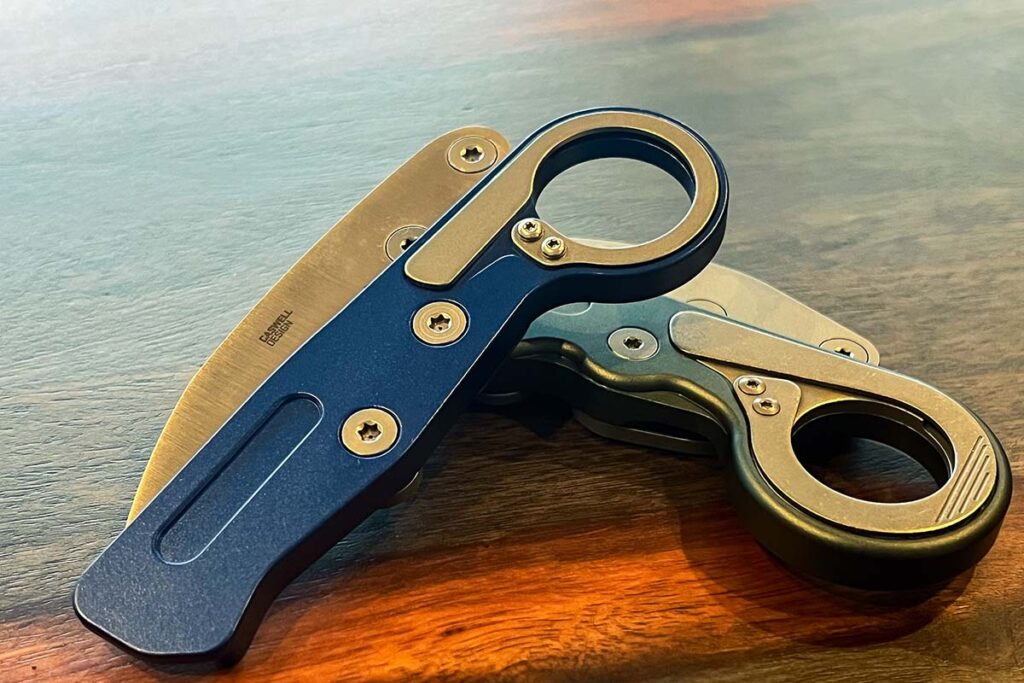
A mechanical wonder with practical functionality, the CRKT Provoke incites wonder.
Karambits are unique knives, originating in southeast Asia as an agricultural tool and later adapted as a weapon. Its signature claw-shaped blade allows effective slashing, and given its cutting edge is always oriented to the target at an angle, it also delivers wicked slices from point to hilt.
Just think about how a cat grabs, holds, punctures and cuts its prey and you have a pretty solid idea about how a karambit operates. The age-old design still inspires and intimidates, and some manufacturers have even figured out how to put a new spin on the longstanding design.
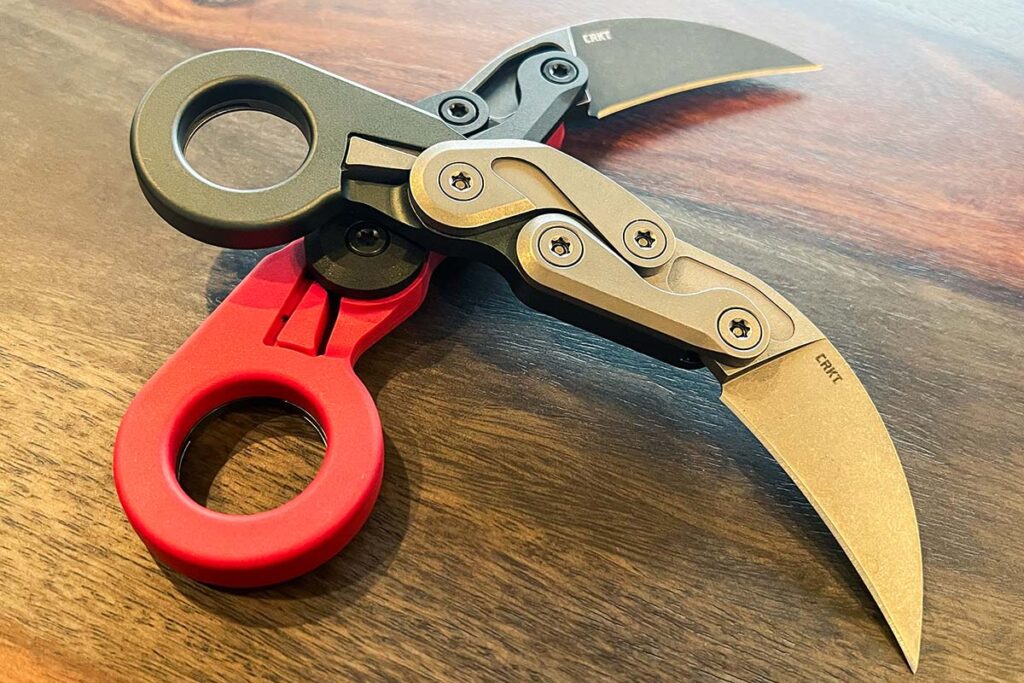
The Provoke offers a wicked chisle grind for maximum slicing, cutting and punturing ability.
Knifemaker Joe Caswell took the concept of a folding karambit and made it a bit different. Instead of the blade simply folding into the handle, the Provoke’s steel lunges out and back in with a simple flick of the thumb. In the ancient art of knifemaking it’s difficult to come up with something unique, but Caswell did.
The Provoke not only incites wonder in collectors but also elicits excitement in serious users.
Provoke Blade
The blade of the Provoke (MSRP $200) is 2.4-inches long and is made from D2 steel for superior edge retention. To work properly with the deployment mechanism, the blade is chisel ground. The flat side is faces in toward the handle, laying flush against the frame when closed. This is mainly a safety precaution, protecting the user from cuts or torn clothing when the blade isn’t in use.
Provoke Action
The mechanical action of the Provoke is one of a kind.
The Provoke’s signature action is what Caswell dubbed “kinematic”. It works thusly, the blade is attached to a pair of movable arms anchored into the handle. To deploy the blade, it is held in reverse grip and the thumb presses on the exposed end of the blade. The arms pivot and the blade leaps forward. Closing is equally as effortless. Just press down on the exposed locking tab just below the finger ring, then the blade is retracted backward until it rests fully against the handle frame.
Nicely, given it doesn’t take much force to open or close, the blade locks in the open position. Honestly, it’s a really neat, mechanical motion. Fairly self-evident, the movement of the Provoke is unlike anything else available on the market today and has the ability to capture even a jaded knife aficionado’s attention.
Getting Clipped
As unique as the action is the Provoke’s pocket clip, which lays flat until needed.
Another intriguing aspect of the CRKT offering is its pocket clip. Often used, rarely discussed and poured over, the clip is one of those unsung if not massively simple aspects of the knife. Even here the Provoke takes a different twist in design.
The clip is spring-loaded and rests against the finger ring completely. To open, you simply push down on a notched portion of the clip and it rises up. Some might complain it’s overly complex, but it does fit nicely in a knife defined by its mechanical ingenuity. Not to mention, in hand, you do not feel the clip at all—a break from nearly every other option with in a standard configuration.
Provoke Variations
Provoke Compact
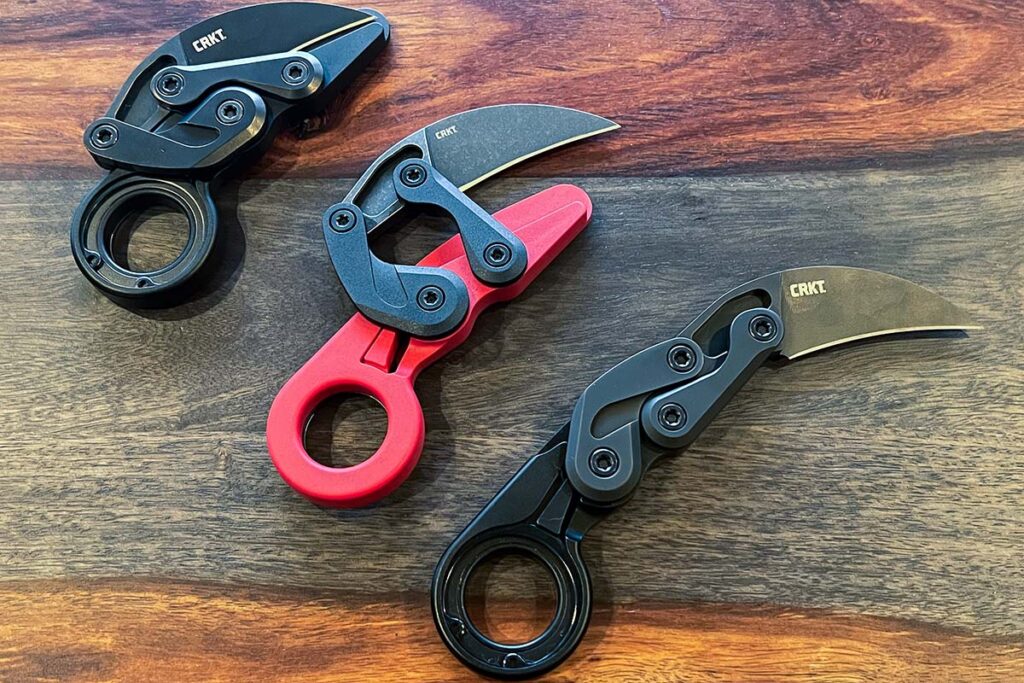
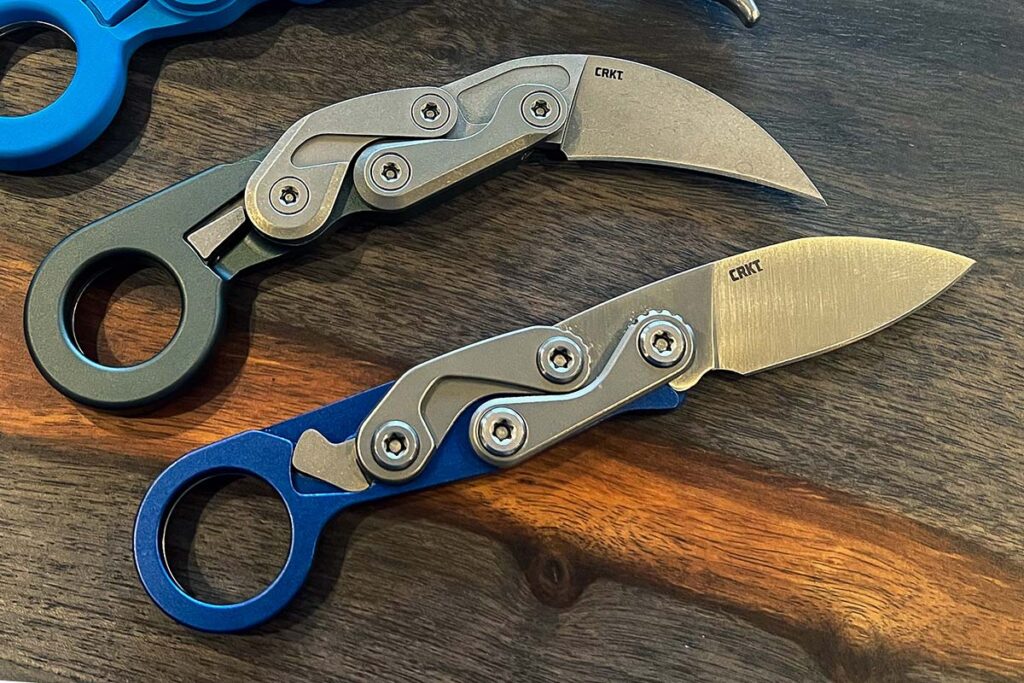
Provoke Compact (top) and Provoke Grivory (bottom) offer two lightweight EDC options.
In addition to the full-size Provoke, there is a scaled-down version in the form of the Provoke Compact (MSRP $150). Essentially, it’s the same knife but with a blade length of 2.2 inches. Where this petite Provoke earns its stripes is ease of carry, as it is much less cumbersome in the pocket than its big brother. And, from my perspective, this smaller version’s action is a bit crisper than the full-sized, perhaps due to the smaller blade.
Provoke Grivory
Again, aiming at EDC, CRKT also offers the lightweight Provoke Grivory (MSRP $100). You guessed it, the handle is made from injection-molded Grivory—a very stiff but lightweight glass-reinforced thermoplastic. Here you have a host of choices in handle colors, including fluorescent green, red, blue, and orange—adding some pop to an already exciting knife. Regardless of the color, the blade’s arms are always black Grivory, providing a nice contrast to the frame and matching the blade’s black stonewash finish.
It’s also worth noting that the Grivory arms are reinforced with steel to provide strength and rigidity to the material for superb blade action. The lightweight version weighs 4.7 ounces; for comparison, the full-size Provoke weighs 6.1 ounces. So there is considerable weight savings.
As for the action on the Grivory, it feels a bit different than the aluminum handle versions—in a good way. For me, it felt a bit lighter and faster in deployment.
Provoke First Responder
For the save and serve professionals, CRKT offers the Provoke First Responder (MSRP $225)—the full-size knife with a 2.4-inch blade. However, it does have some value adds life-saving professionals should appreciate, such as a ceramic glass breaker point inserted into the end of the handle frame.
The Provoke’s curved blade is especially suited for rescue work, particularly cleaving through seatbelts with a single, swift pulling motion. In addition to the standard integrated pocket clip that all Provoke models feature, the First Responder also includes a molded sheath with multiple carry options to offer carry flexibility if desired.
Provoke EDC
The EDC (bottom) next to the Compact (top). The EDC may prove more practical for some users.
The Provoke EDC (MSRP $175) features a 2.5-inch long drop point blade of D2. This iteration replaces the knife’s standard talon-shaped blade with a blade shape that is more friendly to daily cutting tasks. Honestly, it’s perhaps my favorite out of the entire Provoke family.
The action is very quick on this one, though once open you have to reorient your grip from a reverse to a forward grip. The blade’s lock release on the EDC version has been reoriented from the position of the other Provoke models, to make one-handed closing of the blade possible. You can deploy the Provoke EDC one-handed as well as close it one-handed. It does require some practice to close one-handed but once you get it down, you will be able to do that easily.
Provoke Trainer
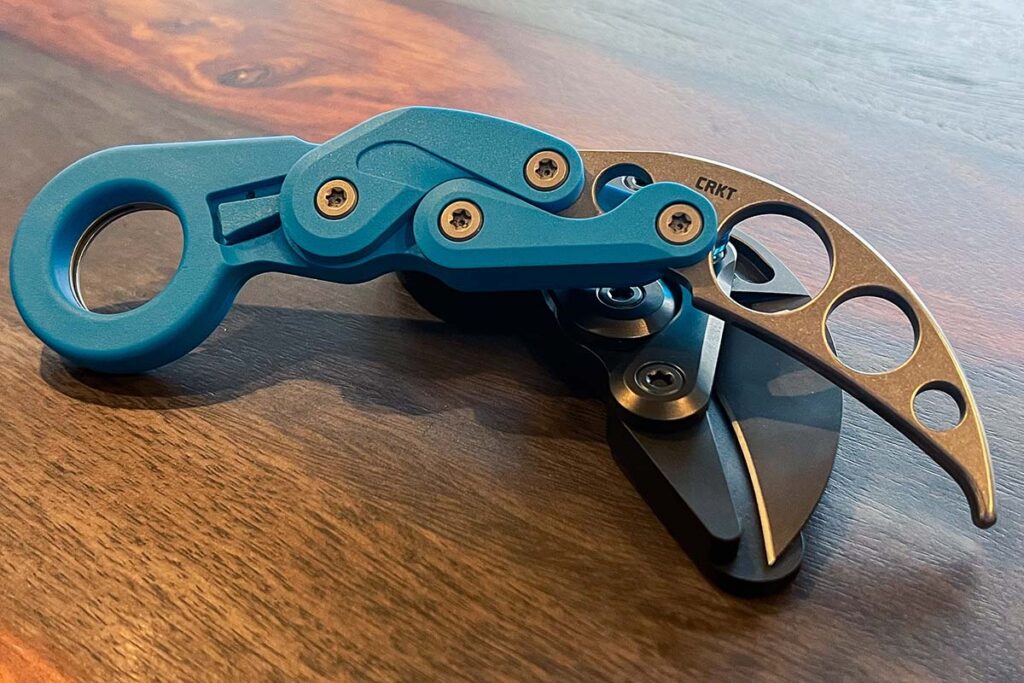
No need to upgrade your health insurance when practicing with the Provoke Trainer.
For those who might be serious about employing the Provoke for self-defense, or simply like to fiddle with the knife’s action as a fidget toy, CRKT offers a trainer model (MSRP $100). Built exactly like the live-bladed lightweight Provoke, it sports a dulled and blunted blade. In short, there’s no danger of accidental cuts or stabs while working with the knife.
Furthermore, a series of holes drilled into the blade blank subtracts weight so it is the same as the live-bladed version. The trainer is only available in an all-blue handle, signifying its purpose.
Using The Provoke
When using the regular Provoke, you’re limited to a pulling motion for cutting, though it has a defined blade tip for precise cutting and scoring. If you intend to carry one on an EDC basis then the Provoke EDC is a better candidate because of its double ground drop point blade, which is more conducive to general utility use.
Due to the more common blade shape along with the short length, this model allows you to get into places where a larger knife blade cannot. This means using the Provoke EDC to open mail, packages, strip wire, cut cardboard, and other general working tasks that a knife of this size would be called upon to do. The D2 steel does an excellent job at holding an edge yet when it comes time to resharpen, it’s still a great steel.
Final Cut
If you like knives that are a step away from ordinary—not to mention are conversation starters—the Provoke series is for you. If you like mechanical things…the Provoke has your name on it. However, I would pick the Provoke EDC as the best of this bunch if you are just going to carry one for daily cutting purposes.
Each model is made with excellent fit, finish, and sharp ess right out of the box, however. I think this design is perhaps one of the most inimitable knives out there right now. It may not be for everybody, though. But if your knife tastes venture into the unique and different, then the CRKT Provoke series has your name on it.
We round up a dozen dazzlers that are certain to make your wish list grow.
One thing nobody has ever said: “I have enough knives.” In that sprite, we’ve gathered up a ton of new knives that have hit the market in recent months, each one sharp as a razor in looks and function.
Maverik Knives Cleaver
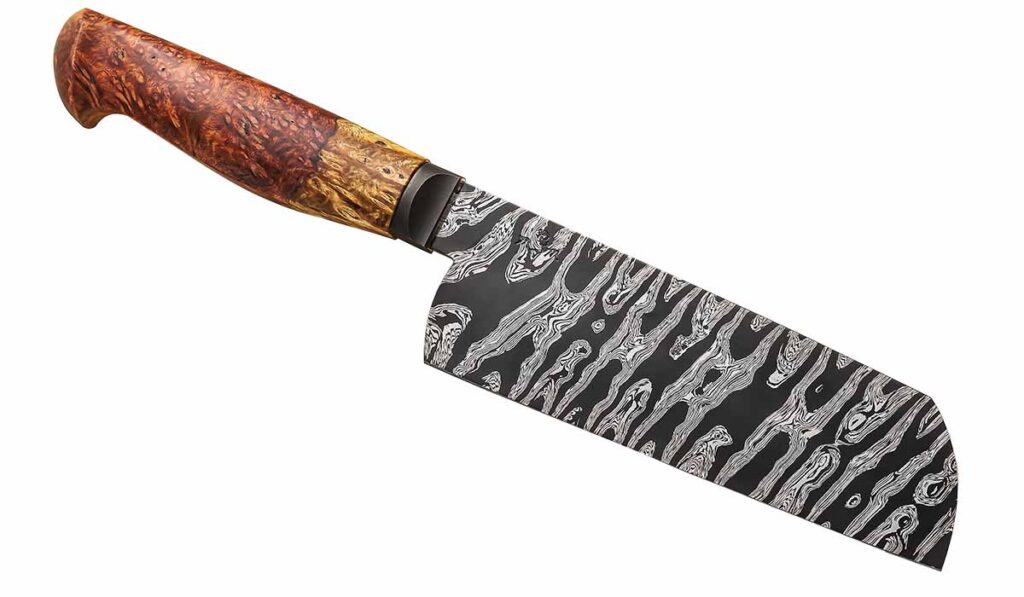
KNIFE TYPE: Cleaver BLADE LENGTH: 6.5” BLADE MATERIAL: 1084 carbon and 15N20 nickel-alloy steels in a zebra-twist damascus pattern BLADE GRIND: Flat w/convex edge BLADE AT THICKEST: .135” HANDLE MATERIAL: Amboyna burl BOLSTER: Antiqued bronze OVERALL LENGTH: 12” KNIFE TO KNOW: Maverik Murdock is an ABS apprentice smith MAKER’S PRICE FOR A SIMILAR KNIFE: $1,400 MAKER: Maverik Knives (SharpByCoop image)
S.K.MO Knives Fi
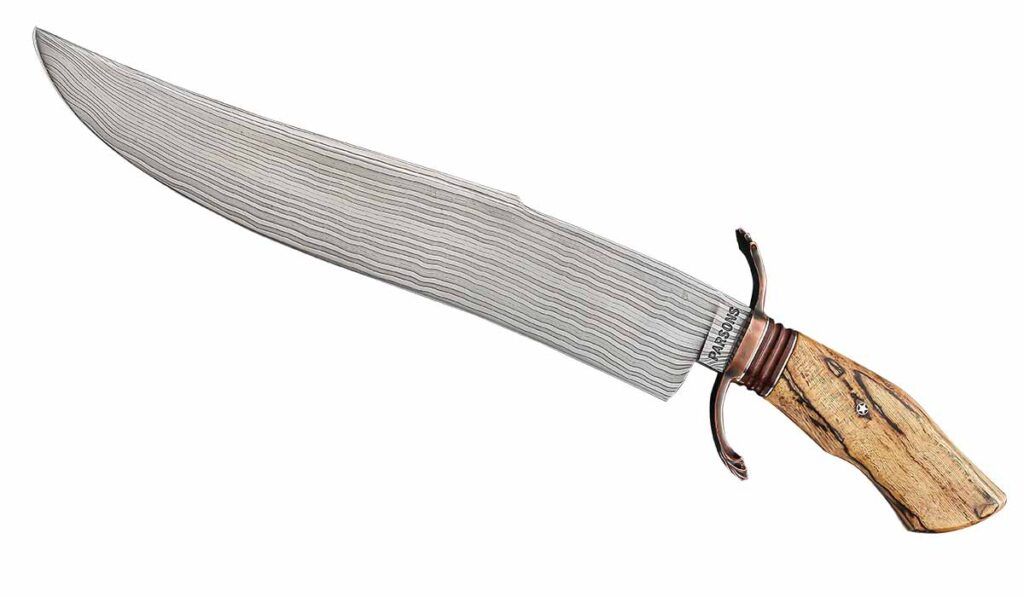
KNIFE TYPE: Fixed blade BLADE LENGTH: 13.25” BLADE MATERIAL: Canister damascus of 1095 powder and nails BLADE PATTERN: Harpoon HANDLE MATERIAL: Black palm and water buffalo horn w/nickel spacers and star pin GUARD/BOLSTER: Stainless steel OVERALL LENGTH: 17.75” KNIFE TO KNOW: S-guard and dropped-handle designs MAKER: S.K.MO Knives (SharpByCoop image)
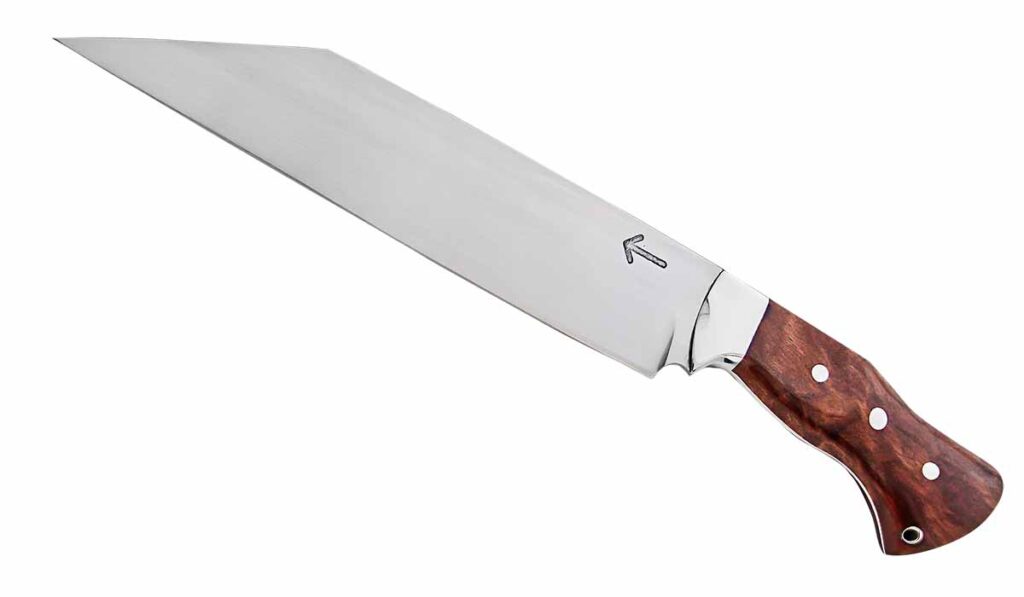
KNIFE NAME: Viking/Nordic seax KNIFE TYPE: Fixed blade BLADE LENGTH: 9.33” BLADE MATERIAL: Sup9 by Jake Mantel/Firepants Fabrication, w/proximal and distal tapers BLADE GRIND: Flat; secondary bevel w/convex edge BLADE AT THICKEST: .177” HANDLE MATERIAL: Stabilized, Northern-Territory-grown, figured coolabah wood OVERALL LENGTH: 14.96” MAKER’S PRICE FOR A SIMILAR KNIFE: $500 KNIFE TO KNOW: Francois Mazieres is an ABS apprentice smith and a member of both the Australian Knifemakers Guild and The Knifemakers’ Guild MAKER: Yandiwa (Rod Hoare image)
Tobin Hill Comanche
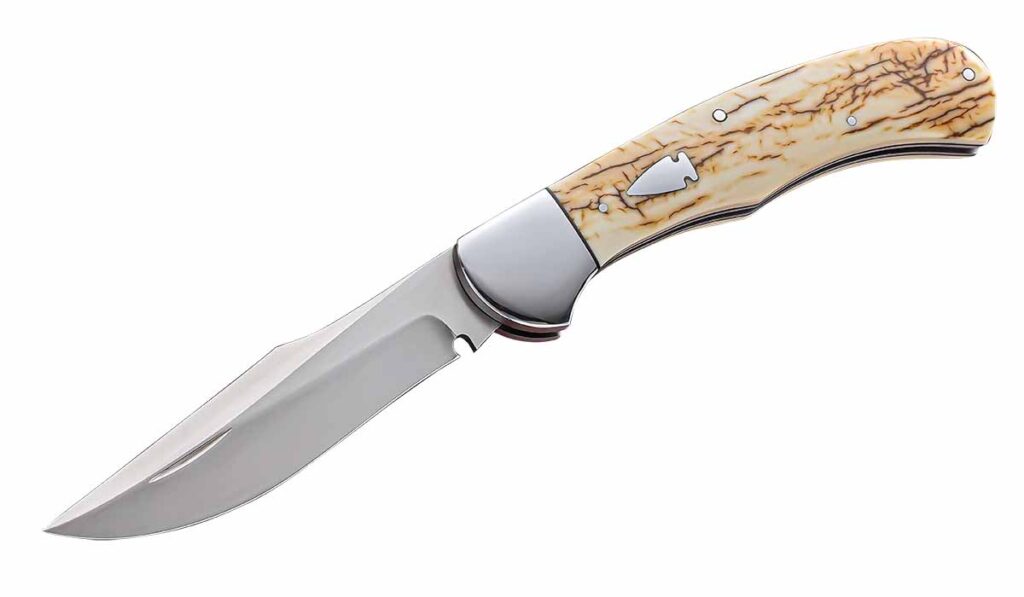
KNIFE NAME: Comanche KNIFE TYPE: Folder BLADE LENGTH: 3.75” BLADE STEEL: CPM 154 stainless BLADE GRIND: Hollow HANDLE MATERIAL: Ancient mammoth ivory GUARD/BOLSTER: 410 stainless CLOSED LENGTH: 4.75” KNIFE TO KNOW: The knife is a collaboration between Tobin Hill and ABS master smith Jason Knight MAKERS’ PRICE FOR A SIMILAR KNIFE: $3,500 CONTACT: Tobin Hill (SharpByCoop image)
Steve Gatlin Chute
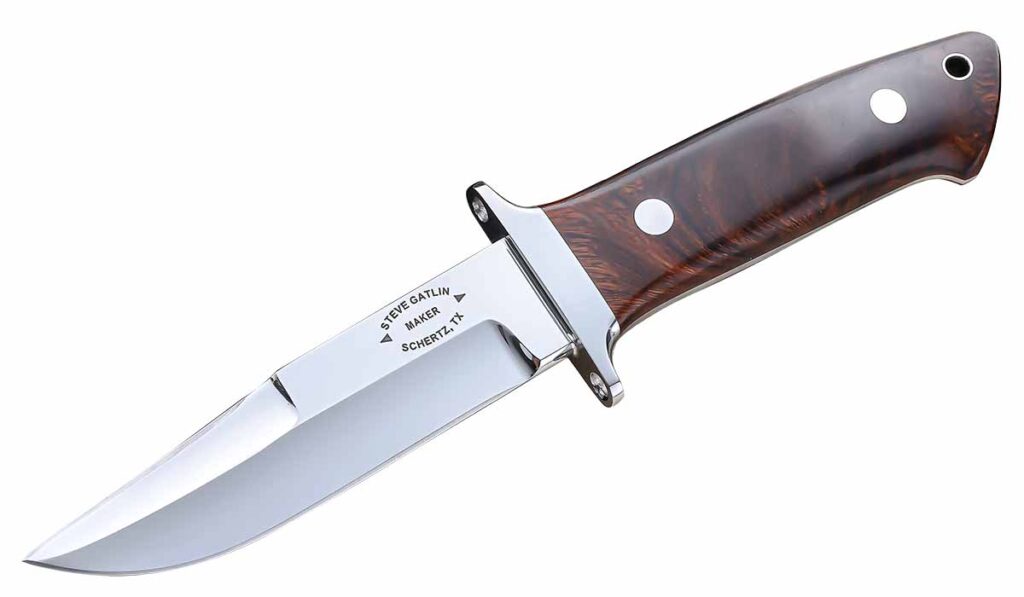
KNIFE NAME: Chute KNIFE TYPE: Fixed blade BLADE LENGTH: 4.5” BLADE STEEL: CPM 154 stainless BLADE GRIND: Hollow BLADE FINISH: Mirror polish HANDLE MATERIAL: Desert ironwood w/red liners GUARD/BOLSTER: 416 stainless OVERALL LENGTH: 9.125” SHEATH: Custom made of leather MAKER’S PRICE FOR A SIMILAR KNIFE: $1,400 MAKER: Steve Gatlin, (SharpByCoop image)
Allen Matthew Custom Knives Bushman’s Knife
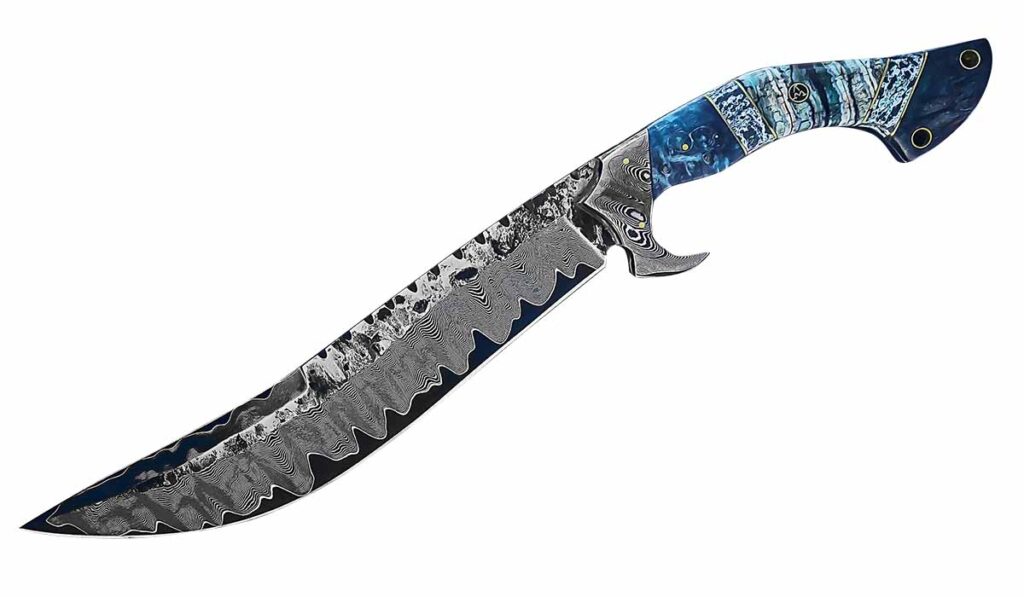
MODEL NAME: Bushman’s Knife KNIFE TYPE: Fixed blade BLADE LENGTH: 12” BLADE MATERIAL: 1095 carbon and 15N20 nickel-alloy steels in a damascus-clad san-mai construction HANDLE MATERIAL: Ancient mammoth molar tooth w/stabilized and dyed amboyna burl and yoskizaki; Starmascus glow in the dark spacers & brass highlights GUARD/BOLSTER: Damascus OVERALL LENGTH: 19” KNIFE TO KNOW: Bulldog Damascus forged the blade material MAKER’S PRICE FOR A SIMILAR KNIFE: $2,300 MAKER: Allen Matthew Custom Knives (Rod Hoare image)
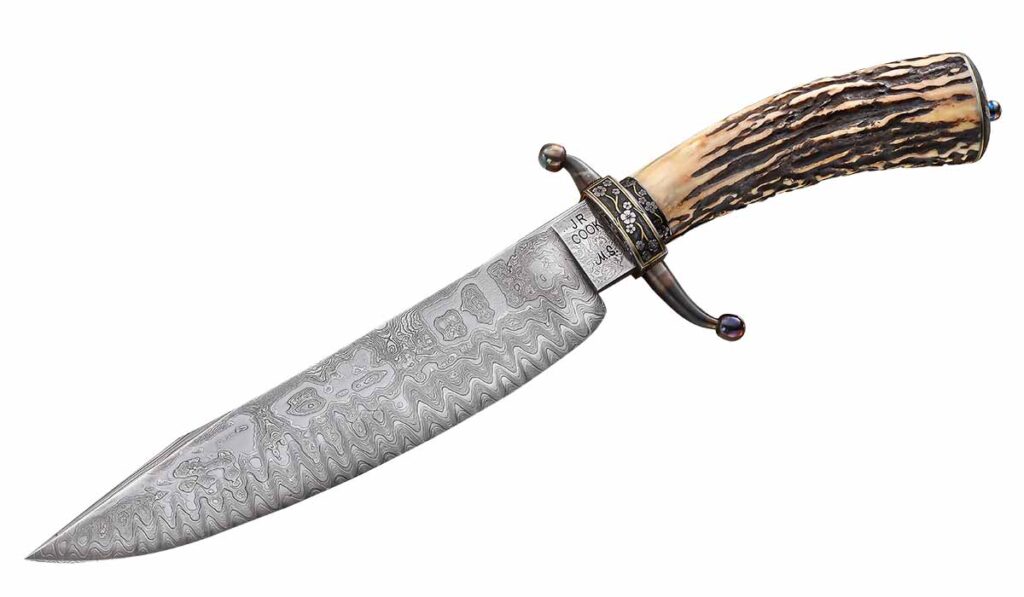
J.R. Cook Vaquero
KNIFE NAME: Vaquero BLADE LENGTH: 8” BLADE MATERIAL: Damascus steel in a wolf-tooth pattern HANDLE MATERIAL: Stag FITTINGS: 416 stainless steel engraved in 24k gold by J.R. Cook OVERALL LENGTH: 10.25” SHEATH: Custom-fitted, tooled-leather belt model KNIFE TO KNOW: The knife is sole authored; J.R. Cook is an ABS master smith and a past Arkansas Living Treasure MAKER’S PRICE FOR A SIMILAR KNIFE: $6,200 MAKER: J.R. Cook (SharpByCoop image)
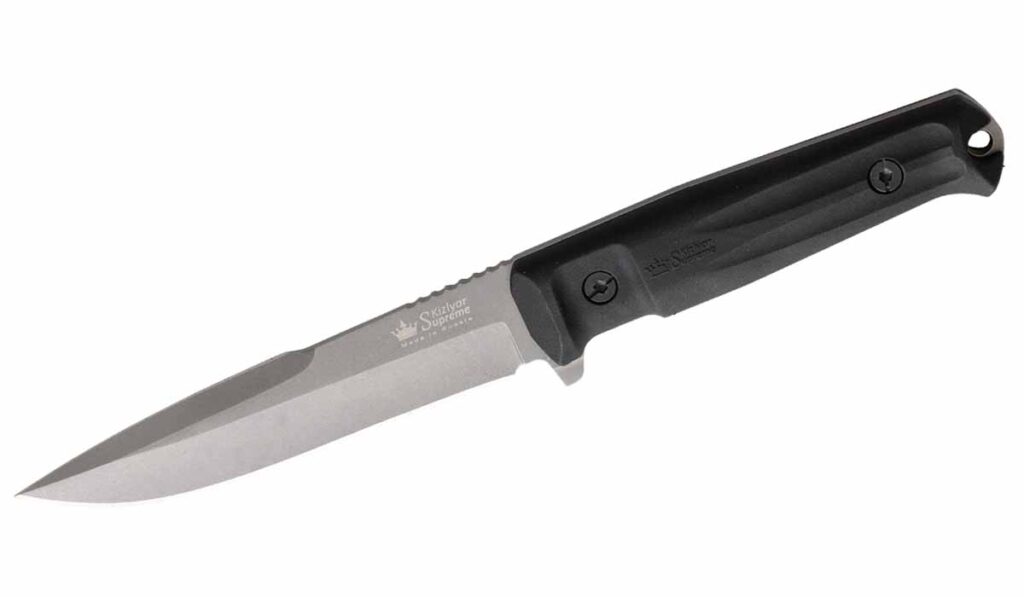
Kizlyar Supreme Delta AUS8 Black Titanium
KNIFE NAME: Delta AUS8 Black Titanium KNIFE TYPE: Tactical fixed blade BLADE LENGTH: 6” BLADE MATERIAL: AUS8 stainless steel BLADE GRIND: Hollow BLADE THICKNESS At GUARD: .185” BLADE PATTERN: Harpoon HANDLE MATERIAL: Contoured black Kraton/ABS synthetic w/lanyard hole CONSTRUCTION: Full tang OVERALL LENGTH: 11.1” SHEATH: MOLLE compatible w/three-point locking system KNIFE TO KNOW: Integral single guard, finger traction ridges on blade spine COUNTRY OF ORIGIN: Russia MSRP: $149 COMPANY: Kizlyar Supreme
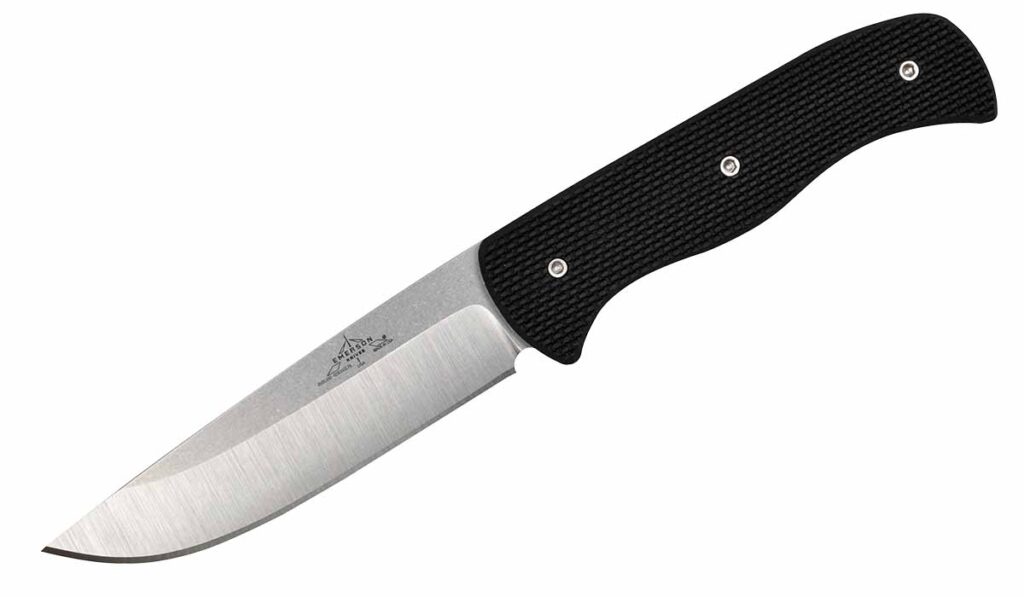
Emerson Knives Overland Renegade
KNIFE NAME: Overland Renegade KNIFE TYPE: Fixed blade BLADE LENGTH: 4.3” BLADE STEEL: 154CM stainless ROCKWELL HARDNESS: 57-59 HRC BLADE GRIND: Conventional “V” BLADE AT THICKEST: .125” BLADE FINISH: Stonewashed HANDLE MATERIAL: Black G-10 (also in Richlite) OVERALL LENGTH: 9” KNIFE TO KNOW: The Renegade is also available in a folding configuration COUNTRY OF ORIGIN: U.S.A. MSRP: $262.95 COMPANY: Emerson Knives
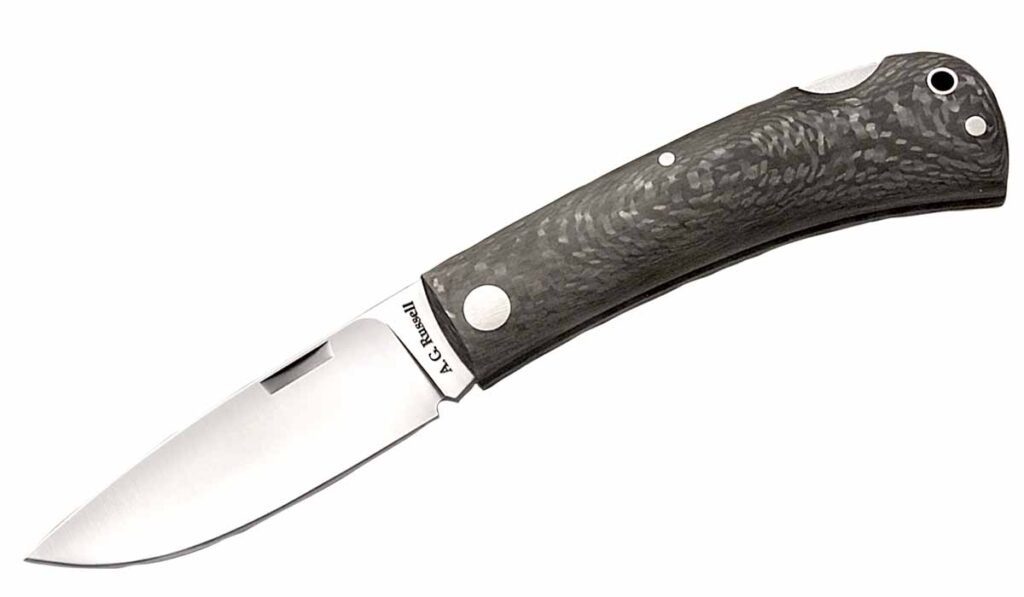
A.G. Russell Knives Skinny Brute
KNIFE NAME: Skinny Brute KNIFE TYPE: Utility folder BLADE LENGTH: 3.25” BLADE STEEL: CPM S35VN stainless BLADE GRIND: Flat BLADE PATTERN: Drop point BLADE FINISH: Satin HANDLE MATERIAL: Carbon fiber (also comes in green G-10) POCKET CLIP: None LOCK: Lockback CLOSED LENGTH: 41/8” KNIFE TO KNOW: The knife is an update from the original released in the 1970s; the handle is a “skinny” linerless design that is just over .5” thick at the center swell COUNTRY OF ORIGIN: China MSRP: $135 ($99 in green G-10) COMPANY: A.G. Russell Knives
Bear & Son Cutlery Auto Bold Action XV
KNIFE NAME: Auto Bold Action XV KNIFE TYPE: Automatic folder BLADE LENGTH: 31/8” BLADE STEEL: Sandvik 14C28N stainless ROCKWELL HARDNESS: 58-60 HRC BLADE GRIND: Hollow BLADE PATTERN: Reverse tanto BLADE FINISH: Black HANDLE MATERIAL: Black aluminum POCKET CLIP: Carries blade tip up LOCK: Lock safety WEIGHT: 2.6 ozs. CLOSED LENGTH: 4.5” KNIFE TO KNOW: Ball-bearing pivot; safety lock switch just below the push button opener COUNTRY OF ORIGIN: U.S.A. MSRP: $179.99 COMPANY: Bear & Son Cutlery
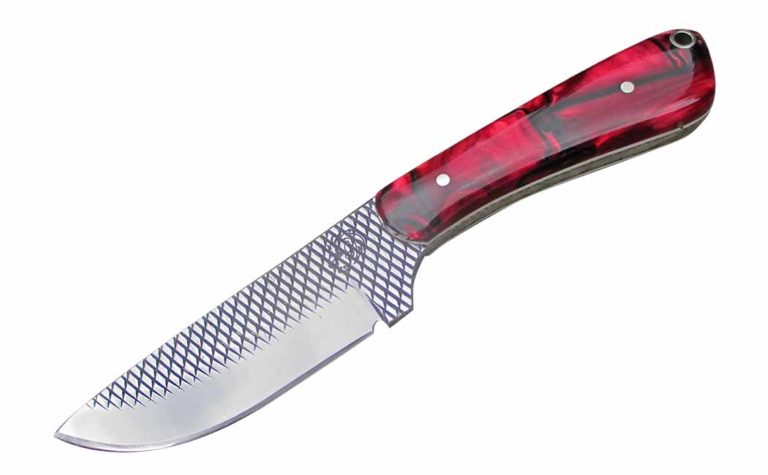
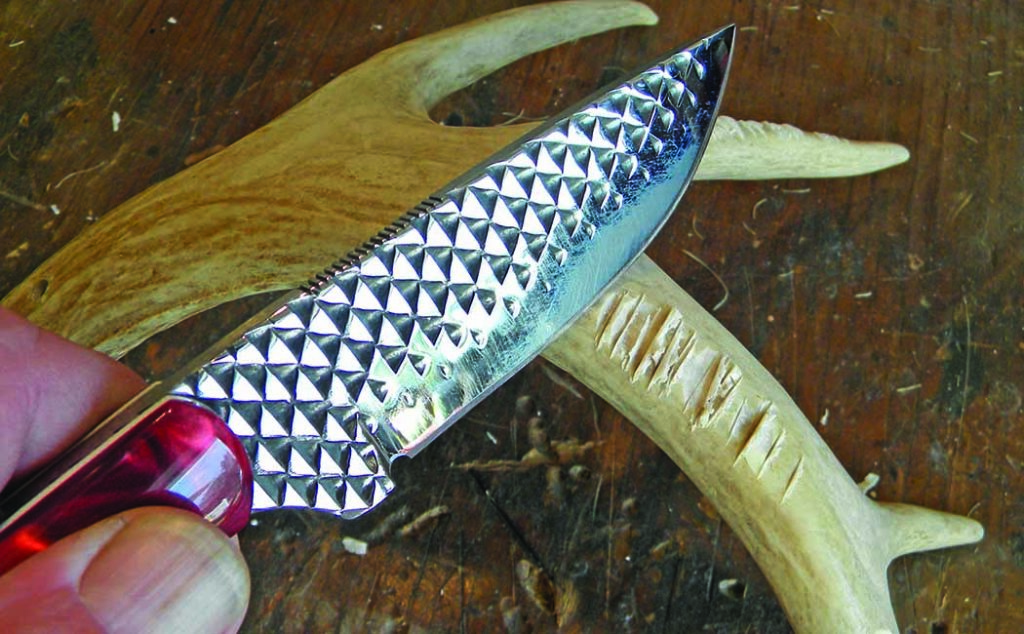
Visually Appealing Thanks To A Distinctive Rasp Pattern On The Blade And Attractive Handle, The Manzano Proves A Sharp Operator.
Old-school knives often have a classic look, and it’s even better when you can tell what the original material or tool was before it was transformed into a blade. When using recycled steel, more time is involved to prep the material for its new life. Can it be hardened, will it forge, will the steel take a polish?
Paul Gonzales did his homework in producing the Manzano Farrier Rasp Blade. There’s no doubt as to what the blade was before it became a knife.
Manzano Farrier Rasp Blade Edge Assessment
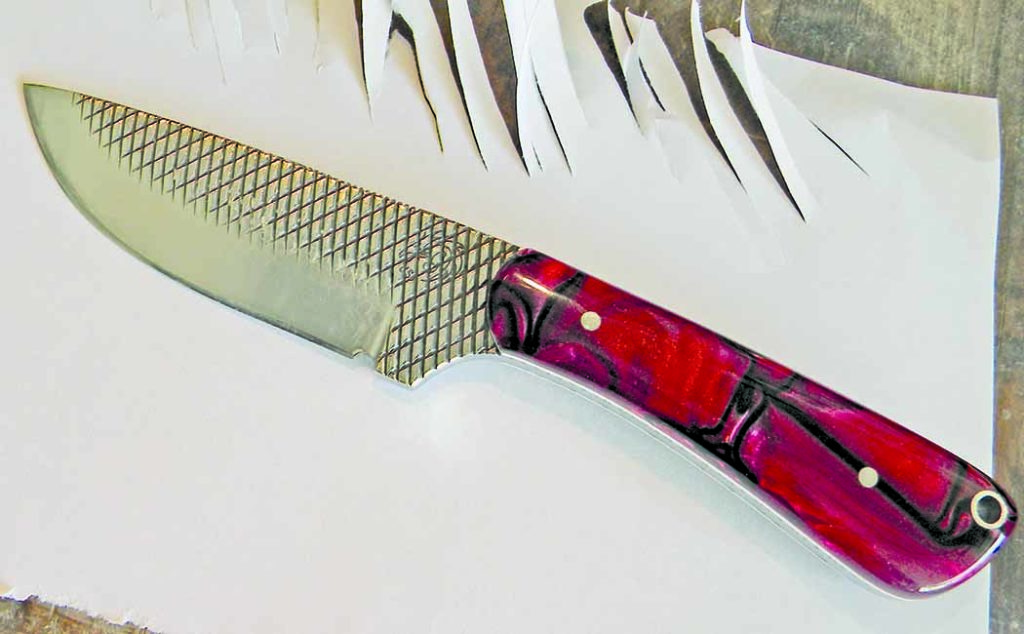
To assess the original edge, I sliced 20-pound-bond copy paper. The Manzano performed smoothly, making a zipping noise as it went through the paper. The knife’s weight made the push cuts easy to control.
As a final test, the author checked the edge once again on the copy paper. The Manzano didn’t skip a beat, slicing smoothly.
Heavy Cutting With The Manzano Farrier Rasp Blade
Next up, single-walled cardboard. At the start of the slice, the cardboard parted smoothly. The sliced strips crinkled from the grind bevels as the cut went deeper, maybe due a little bit to the rasp pattern in the steel. The Manzano’s sharp edge cut smoothly.
I used some dense foam left over from my Kydex press for the next test medium. I had great control over the slices using push cuts. The edge easily passed through the foam.
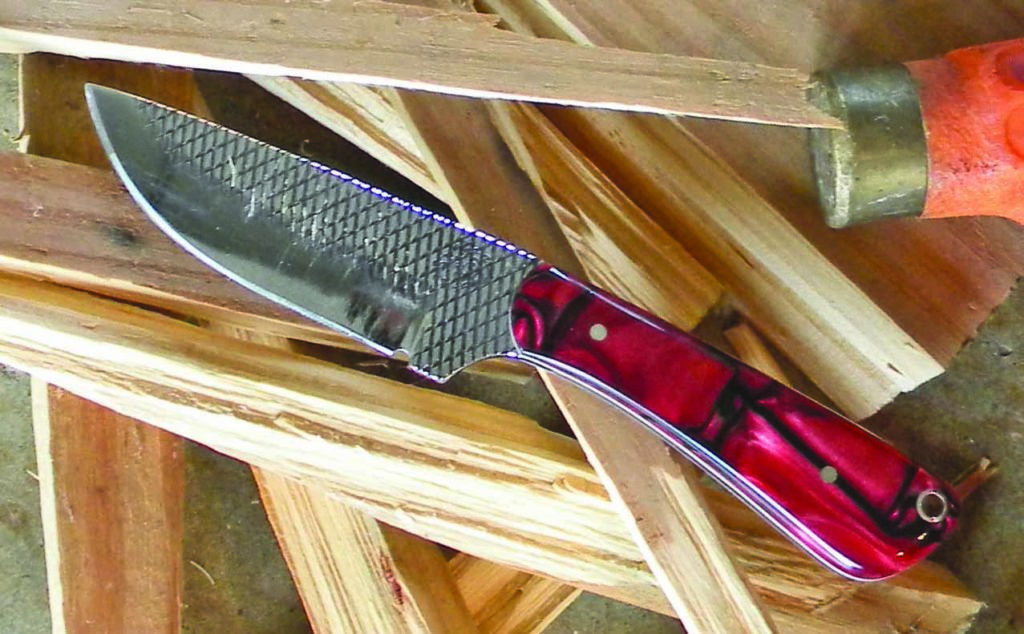
The author used the dead-blow hammer to baton the Manzano through a chunk of 2×10. The knife split the wood in two smacks with no excess shock transferred to the author’s hand, and then produced some nice kindling, too.
From there, on to 8-ounce leather. The Manzano was very aggressive skiving the material, producing nice crunching noises on each cut. The mirror-polished blade slid through the leather with ease. Paul did a nice job abrading the steel by the choil so there were no sharp edges where there shouldn’t be.
Firesticks were next. It was very simple to make smooth, fine curly-cues, as well as larger coarse ones. The handle is contoured perfectly for my hand for deeper cuts. The edge performed great while whittling wood.
The author checked the edge for toughness with the antler chop. Twenty hard whacks later and the edge and, therefore, the blade’s heat treatment, passed with flying colors.
For splitting larger wood I used a chunk of 2×10 and the dead-blow hammer. The Manzano parted the wood in two smacks with no excess shock transferred to my hand. The knife was very comfortable to use in this manner.
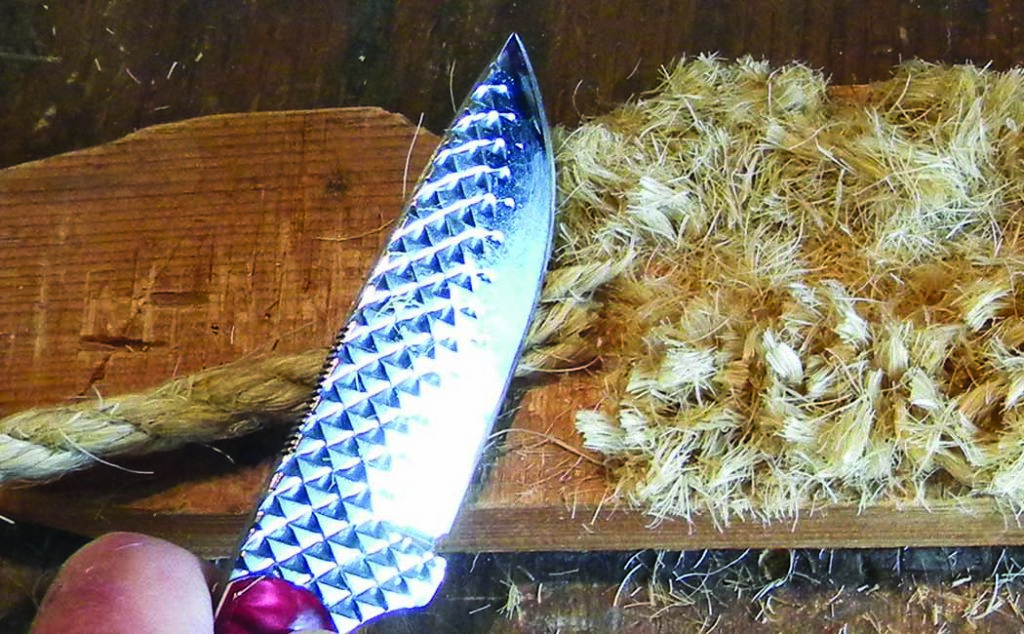
It was time for my favorite test material, sisal rope. Positioning half-inch sisal on my cutting board, I started with push cuts. The Manzano crunched its way to 200 cuts with no signs of stopping. That was plenty for my hand. There were no hot spots with the handle and the thumb notches were grippy but not sharp. This is a very comfortable knife to use—or did I already say that?
The Manzano crunched its way to 200 cuts in the half-inch rope with no signs of stopping. There were zero hot spots with the handle and the thumb notches were grippy but not sharp.
Time to stress the edge and check its toughness with the antler chop. I gave the medium 20 hard whacks, flinging chips all over my work bench. The results? The antler was chopped up and there was no damage to the edge. Kudos on the heat treatment.
Manzano Farrier Rasp Blade Edge Retention
Finally, it was time to return to the 20-pound bond paper. The Manzano didn’t skip a beat, slicing smoothly. I caught the paper with the choil/sharpening notch a few times, tearing it a bit. That was on me.
I Would
Bring the grind up closer to the spine for smoother slicing.
Final Cut
The Manzano is a great performer—classic looking all around and a very comfortable daily user. It’s made to cut.
Paul Gonzales warrants his knives against defects in materials and workmanship as long as the knives have not been abused. For more information contact Gonzales Blades 505-480-7982.
Manzano / Paul Gonzales Blade Length: 3.25 inches Blade Material: Farrier’s rasp Blade Temper: Differential Handle: Kirinite synthetic Handle Liners: White G-10 Handle Pins: Nickel silver Weight: 6 ounces Overall Length: 7.5 inches Sheath: Belt pouch design in 8-ounces leather Weight of Sheathed Knife: 8.5 ounces Maker’s Price: $200
There Are Few Factory Makers As Well-Known As Kershaw. The Oregon-Based Company Continues To Innovate And Create Top-Tier Knives.
Kershaw is a beloved knife brand set to celebrate its 50th year in business in 2024. In the years since the company was founded a half-century ago, it has delivered some incredible products that continue to set industry standards today.
Kershaw has become a staple of the knife industry at large and they represent a significant percentage of what is being regularly carried in pockets all over the country. Pete Kershaw began the company to create excellent outdoor knives and eventually partnered with Japanese company Kai to bring more high-quality products to market.
The modern Kershaw knife is a truly high-quality tool, and lucky for us, the company has a dizzying number of options that can fit just about any niche you may have.
Kershaw’s Top Ten
Kershaw has a large fanbase because the company is incredibly consistent at making quality knives at quality prices. These 10 have stood out as some of the company’s best.
Kershaw Leek
The Kershaw Leek is arguably the most prominent product that the company has released in recent years. This knife is the epitome of what you would consider being an everyday carry tool: it is light, sleek, and has an extremely reliable mechanism.
The lines of the product are immediately recognizable and it has achieved iconic status among knife enthusiasts. At the time of this writing, Kershaw offers over a dozen variations of the Leek, and, while the internal mechanism is the same, you get your choice as far as cosmetic features go. Currently, handle materials range from plain aluminum or color-anodized aluminum to exciting options like copper.
The actual copper handle material will patina over time, giving your individual knife a unique look as you carry and use it. Despite the fact that copper weighs a little bit more than aluminum and this knife costs a bit more than the other products in the Leek line, it isn’t for everyone. The Leek’s mechanism is an assisted-open type, and it is one of the more reliable and energetic on the market. In carrying Leek knives over time, the author has never had a failure to open or to remain closed.
The Skyline was one of Kershaw’s most recognizable products. The simple, black-handled knife
was one of the more popular carry options of years past and it earned a reputation for being strong and reliable at a good price.
There are, of course, other products that now fill its niche, but the Skyline will not soon be forgotten. Its status as a common, affordable, and reliable knife helps it make this list even though it is no longer available.
Many Kershaw fans have lamented the decision to axe this otherwise popular knife, and it has achieved a moderate collector interest since early 2021 alongside the Shallot and Camber, themselves very well-received by fans of their respective styles.
Skyline Knife Specs
Overall Length: 7.4 inches
Blade Length: 3.1 inches
Blade Steel: 14C28N
Weight: 2.5 ounces
Handle Material: G-10
Kershaw Lucha Carbon Fiber
At a hefty $500 retail the Lucha in carbon fiber is one of the more unique and interesting offerings currently had by Kershaw. This balisong is arguably one of the highest quality production blades of its type. Even custom options available on the market may not be able to match the Lucha in terms of overall fit and finish at the price.
For fans of this type of knife, this is certainly a holy grail item, and it boasts some very nice features. The blade rides on KVT ball bearings for exceptionally smooth handling. At a full ounce lighter than the original model, the carbon fiber Lucha features striking handles that are composed of blued titanium and overlaid carbon fiber.
The price is quite hefty for an EDC knife, though it’s without a doubt worth it to the person who loves flipping and twirling. While the fidget spinner craze ended a few years ago, you’ll probably find yourself playing with this knife in your hand more than you will end up performing cutting tasks with it.
Lucha Carbon Fiber Specs
Overall Length: 10.25 inches
Blade Length: 4.6 inches
Blade Steel: CPM 20CV
Weight: 4.9 ounces
Handle Material: titanium with Carbon Fiber Overlay
MSRP: $499.99
Kershaw Federalist
Taking a departure from today’s tactical and overbuilt blades, the Kershaw Federalist is a rugged gentleman’s knife that has a number of interesting and tasteful features. While the company does make a number of traditional styles of gentlemen’s knives, the Federalist is geared for that man of taste that still has to get some work done throughout the day.
This knife has a more traditional closing and opening mechanism reminiscent of the knives of yesteryear. It has a nail nick for opening and lacks any assist mechanism. In fact, the company lists this blade as a non-locking slipjoint with a dual-detent system. You’ll likely want to save this knife for general tasks and leave the heavy lifting to a more substantial tool.
In place of polished wood and silver inlay, the Federalist features green Micarta grip panels and a matte finish. Seeing as how assisted opening and larger, tactical-style blades have the majority of market share, it is refreshing to see that Kershaw is still catering to people who view knives as simple, everyday objects.
Federalist Knife Specs
Overall Length: 7.5 inches
Blade Length: 3.25 inches
Blade Material: CPM 154
Weight: 2.1 ounces
Handle Material: Micarta
MSRP: $169.99
Kershaw Launch 14
The Launch 14 is a large, automatic opening, cleaver-bladed knife. This is a hard-use tool that has the looks of a collector’s piece. Not all automatic-opening knives are meant for daily use, but this one breaks the mold and is geared for any task you may find on the job site or in your daily adventures.
The cleaver blade is not for everyone. Some people prefer to have a distinct drop point while others definitely prefer the more adaptable Wharncliffe style. The knife lacks a true puncturing tip, which to some could be considered a detriment. The steep tip angle on these cleaver-type blades is actually excellent for true cutting tasks where spear point or drop point blades may be too fragile.
Using a cleaver-style knife for puncturing can be achieved, although the stout angle of the tip may be too coarse for fine work. When it comes to cutting things like straps and heavy tubing, the type of knife we see here definitely excels. The Launch 14 is elegant in its execution and has very functional, subtle features, such as a recessed opening button and carbon fiber panels.
Launch 14 Knife Specs
Overall Length: 7.75 inches
Blade Length: 3.375 inches
Blade Steel: CPM 154
Weight: 3.2 ounces
Handle Material: 6061-T6 Aluminum, Carbon Fiber Scale Front
MSRP: $239.99
Kershaw Reverb XL
Borrowing the same features as its smaller namesake, the Reverb XL is a daily carry knife that has a wide range of uses for the outdoors. The knife has a long, upswept blade, reminiscent of fillet knives. Because of its size and light weight, it makes an excellent companion for the fisherman who enjoys working out of a canoe or kayak.
The knife doesn’t take up much space and doesn’t require an additional sheath. Not only that, at under $50, it won’t cause you financial issues if it accidentally falls overboard. The knife is very simple in terms of operation, it is a manually opening blade with a liner lock.
Although it lacks a fast opening blade, the discerning outdoorsman or angler shouldn’t find this to be an issue, considering that once the blade is out, it is likely going to get used for quite some time. If you find yourself in coastal towns, or perhaps going for a cold one after a fishing trip, this knife will not stand out like a fixed blade will.
Reverb XL Knife Specs
Overall Length: 7.4 inches
Blade Length: 3 inches
Blade Steel: 8Cr13MoV
Weight: 2.2 ounces
Handle Material: G10 with Carbon Fiber Overlay Front
MSRP: $53.99
Kershaw Lonerock RBK2
Knives with replaceable blades are something that have been around for quite some time. In the last 10 years, we’ve seen a greater interest in this style of knife, if you can even call it a knife in the first place.
The Lonerock RBK2 is a kit that includes a main, folding handle assembly, and a non-folding ‘buddy’ handle. The ‘buddy’ is simple and non-folding, but takes the same blades as the folding assembly. The basis of this system is meant for hunters as a means to keep sharp blades at the ready with no additional maintenance.
Keeping a good edge on the blade is no easy task in less than ideal conditions. Many people think that sharpening is as simple as pulling the blade through an off-the-shelf sharpener, but inevitably every knife needs to be professionally re-edged at a certain point. If your blade is replaceable, you shouldn’t have to worry about that latter part of the process. If the knife goes dull, simply pop in a new blade and keep working.
At just under $60 retail, the Interstellar is a mean looking knife that has function at its heart. While it appears to be an out-the-front automatic, the Interstellar is instead a manual knife that opens in the same way as a standard box cutter. The blade features a serrated tanto point and has an affordable price to match its rugged looks.
Kershaw lists this knife under their work knife category, and while it looks tactical, this knife is perfect for the job site. It is easy to use with heavy gloves on, and is excellent for controlled, one-handed operation. The tanto point is excellent for getting into those tight spaces and it is serrated for cutting through various types of cord and material.
People that work with materials like drywall will enjoy its ability to score easily before cutting. If basic folders and box cutters aren’t your style, you should really consider the Interstellar for your daily use. After a long day, you may want to break open some cold ones, and the Interstellar comes with an integrated bottle opener in its frame.
Interstellar Knife Specs
Overall Length: 6.9 inches
Blade Length: 2.7 inches
Blade Steel: 8Cr13MoV
Weight: 3.1 ounces
Handle Material: Glass-Filled Nylon
MSRP: $71.99
Kershaw Blur With Glassbreaker
The Blur is a rugged and popular design from Kershaw. Not only is it a suitable knife for daily carry, the glass breaker version is a simple-to-use and affordable rescue tool. Similar to Kershaw’s other assisted opening knives, the Blur can open with one hand and is ready to go into action. The glass breaker can be used with blade open or closed.
Additionally, the particular model we are talking about here also has a deep, swept belly with aggressive, scalloped serrations. This type of situation should make quick work of seatbelts or other types of common materials found in vehicles if someone needs to be removed quickly after an accident.
This knife features a pointed tip, so unlike other types of rescue tools that are designed to be completely blunt, you will need to take care not to accidentally stabbed or cut someone you were trying to free with this tool.
Emerson is well known for producing some exceptional tactical knives. The company needs no introduction here, and luckily, for us, they have collaborated extensively with Kershaw.
This particular knife, the CQC-10K, is striking to look at with its green scale handles and aggressive, Bowie tip. The knife features the patented Emerson Wave Feature that allows for an otherwise unassisted knife to open instantly upon draw. With practice, this knife can be drawn and opened in a fraction of a second, even faster than can be attained with an assisted opening mechanism.
This knife is not just for self-defense situations, it is ruggedly built, and should be an excellent friend for the field and trail. Thanks to its fine point, it can also be used for tasks such as fishing or skinning small game.
CQC-10K Knife Specs
Overall Length: 8.5 inches
Blade Length: 3.5 inches
Blade Steel: 8Cr14MoV
Weight: 5.1 ounces
Handle Material: G10 Front, 410 Stainless Steel Back
Top knife observers decipher the best custom huntering knives ever made.
It’s an ongoing discussion, or maybe a debate, slightly contentious but always cordial. When the question is pondered regarding who made the best custom hunting knives ever, a few names quickly come to mind.
Of course, there is no right or wrong answer. It’s a matter of interpretation, fit and finish, design, form and function, and the feel of the knife in the hand when it’s time to get down to the business of skinning and dressing game. Each respected and well-traveled knifemaker and observer consulted below can tell the stories that back up his top few. But in the end there is no doubt. Each of these revered custom makers and/or bladesmiths has got game. It’s proven in their work.
Bruce Voyles’ Take
BLADE Magazine Cutlery Hall-of-Fame® member and knife auctioneer Bruce Voyles accompanied his fellow Cutlery Hall of Famer, the legendary George Herron, on a few hunting trips and experienced his work in the field.
Among the top hunting knives BLADE Magazine Cutlery Hall-of-Fame® member George Herron made are the Model 6 (top) and the Model 3 skinner, aka Little Dude (bottom). The Model 6 sports a 4-inch blade and 9-inch overall length. Blade and overall lengths for the Little Dude: 2.75 and 6.75 inches. Respective blade steel, handle material and construction on each knife are ATS-34 stainless, curly maple and tapered tang. (Jay Mealing knife image)
“George was a fantastic hunter,” Bruce remembered. “When a group of us would go with him, we might kill three deer in a four-day morning and afternoon hunt, but he could get eight if he wanted to.”
Bruce tells the story of an Outdoor Writers Association hunt Herron organized after an invitation from a South Carolina country gentleman that George had helped change a tire. It seems the man owned a large tract of land, and in return for Herron’s kindness he was allowed to hunt deer on the property.
“When we got to that plantation, every guide there was carrying a George Herron knife,” Bruce commented. “The thing about George’s knives is that when you held one and used it, you were using a knife made by a man who had been there. He made tremendous skinning knives, and the balance and feel in the hand are unsurpassed. The balance, shape of the handle, and minor nuances of the tilt of the blade, its thinness, and the tapered tang set Herron knives apart.”
According to BLADE Magazine Cutlery Hall-of-Fame® member Bruce Voyles, the knives of Cutlery Hall-of-Famer Bill Moran feel like an extension of your hand. Mr. Moran’s engraved gentleman’s hunter in damascus and with one of his iconic moon logo sheaths is representative of Bruce’s sentiment. (Eric Eggly/PointSeven image)
According to Voyles, the knives of Herron, Jerry Fisk and Cutlery Hall-of-Famer Bill Moran feel like an extension of the hand. Herron also made knives that were affordable for a hunter to purchase. Since he put many knives in the hunters’ hands because of a reasonable price point, the praise of his work in the shop spread far and wide. Today, there are several quality custom knifemakers contending for recognition, and they include Ralph Smith, Larry Page and Wayne Hendrix to name just a trio, Bruce says.
“Wayne was one of the guys who trained in George’s shop, and while we were hunting he had his own shop set up on the grounds making knives to sell directly to hunters,” he noted. “He was a guide in South Carolina and approaches making hunting knives the same way George did. He’s the closest to George’s knives now.”
Jim Sornberger’s Take
Cutlery Hall-of-Fame knifemaker Jim Sornberger remembers the days years ago when names such as Harry Morseth and Cutlery Hall-of-Famers Bo Randall and Rudy Ruana were synonymous with excellence in hunting knife craftsmanship. He also mentions the fine work of Corbet Sigman and other contemporaries of the 1960s and ’70s.
“The first new model A.G. Russell made when he acquired Morseth Knives from Harry Morseth was the Model 1, also known as the Ozark Hunter,” Tom Krein noted. “It is a drop-point camp and hunting knife with a 3.5-inch blade, hidden tang, nice guard, and thin-shaped Micarta® handle that make the knife extremely light.” This version sports a stacked leather and fiber spacer handle with a stag butt. (Nordic Knives image)
“It goes back to when I was a kid and my uncle had a gun store in Redding, California,” Jim said. “Those names were famous, and I met Harry Morseth in the ’50s. His Cascade Skinner was my favorite hunting knife for many years with a great handle shape in leather or stag for a good grip and a guard, which is really important in a good hunting knife because you’ve got to hang onto an animal or fish if you’re working and you can’t afford to have the knife slip in your hand. The blades were laminated Brusletto steel from Norway, and the knives came with a safety sheath. Mine was copper-lined leather in the shape of the knife, and later models had a fiber material liner inside.”
Sornberger also mentions Cutlery Hall-of-Famer Gil Hibben, Ruffin Johnson and Clay Gault as makers of outstanding hunting knives. However, trying to identify custom makers that are in that rarefied air with the masters these days requires some reflection. “It’s tough because a lot of guys follow trends nowadays and they find it’s cheaper and faster to make a knife without a guard,” he opined. “Randy Lee has been around a long time and still makes a lot of good using knives. Dave Pitt in Redding, California, does as well, and that’s hunting country. Randy has a stubby little hunter with a 3.25-inch blade and nice guard, and that’s plenty of knife for most hunting applications.”
Tom Krein’s Take
Veteran knifemaker Tom Krein is upfront with his thoughts on the best maker of hunting knives.
“I actually worked for Bob Dozier and A.G. Russell from the mid-1990s to 2001, and honestly this is a tough one. We all use hunting knives differently in the field and for different things, but I would put Bob Dozier forward. He grew up hunting in the bayous and providing for his family, [and] he has a lot of experience making knives. He is an exceptional craftsman, and in the 1980s I feel one of the pioneers in the style of distilling everything down to make hunting knives easier to make and get them in everybody’s hands.”
Award-winning bladesmith Jerry Fisk’s Sendero hunter served as Tom Krein’s inspiration to make knives. (Eric Eggly/PointSeven image)
Krein likes the reasonable price point of a Dozier hunting knife and the attributes that characterize the maker’s outstanding work: a full tang, thinly ground blade, Micarta® handle, and often a Kydex sheath system for safety. “Dozier’s knives check all my boxes,” he related. “The Dozier Personal with a 2-inch blade works great on game, and an investment of $300 will get you a fine Dozier knife.”
Tom also has seen the Morseth line continue with A.G Russell and has tremendous respect for the maker’s legacy. “The first new model A.G. made when he acquired Morseth Knives from Harry was the Model 1, also known as the Ozark Hunter,” Krein noted. “It is a drop-point camp and hunting knife with a 3.5-inch blade, hidden tang, nice guard, and thin-shaped Micarta® handle that make the knife extremely light.”
Tom tips his hat to custom knifemaker Brian Goode, whose hunters and skinners are gaining notice, while he also acknowledges the great work of Jerry Fisk, whose Sendero served as Krein’s own inspiration to begin making knives. And then there’s the geometry and thinness of the blade in ABS master smith James Rodebaugh’s hunting knives that Krein calls “beautiful work.”
James Rodebaugh’s Take
Speaking of Rodebaugh, his thoughts on the best maker of hunting knives include George Herron, whose work he describes as “superb,” and two more greats, D. E. Henry and Cutlery Hall-of-Famer Jimmy Lile. “The first knife I ever owned was a Lile hunter, and he made one heck of a hunting knife,” James remarked. “That knife was my primary hunter before I even started making knives, and it did all I ever asked of it.”
ABS master smith James Rodebaugh is high on the work of Missouri-based maker Jason Coy and ABS master smiths Jason Knight and Adam DesRosiers. Adam’s clip-point hunter in damascus and stag is a stunner. (SharpByCoop image)
According to Rodebaugh, edge geometry is critical in a hunting knife, along with the design and profile of the handle and proper Rockwell hardness. Each of these characteristics is essential, and the Lile knife was “about as perfect as I’ve ever held, and I’ve dressed well north of 300 animals, not counting small game.”
Rodebaugh’s own knives are reflections of his hunting experience. He has been lauded for the field performance of his Raised Swedge Hunter, which some refer to as a harpoon point, that was actually inspired by a Marble’s hunter design. He has been making the Outfitter hunting knife for about 15 years, forging the blades in batches of five with O1 tool steel hardened to a Rockwell of 60-61 HRC, and a Micarta handle with a palm swell for added comfort.
James has been impressed recently with the work of Missouri-based maker Jason Coy and ABS master smiths Adam DesRosiers and Jason Knight. “Jason saw my raised swedge years ago and asked to use it, and I said ‘absolutely!’ Nobody has probably designed a ‘new’ blade in the last 1,000 years or so. Adam has worked with it as well, and now everybody in the country produces that design feature.”
Of Course, Bob Loveless
The names of custom makers past and present conjure images of their outstanding hunting knives. But no story on the topic would be complete without mention of Cutlery Hall-of-Famer Bob Loveless. While some have said Loveless was a fine maker, some have also said his fit and finish were reasonably good—not great. Nonetheless, the thing about Loveless was his eye for design.
According to BLADE Magazine Cutlery Hall-of-Fame® member Jim Sornberger, Randy Lee has been around a long time and still makes a lot of good using knives. An example is his drop point with an amber-spacer look reminiscent of the My Knife by BLADE Magazine Cutlery Hall-of-Fame® member D’ Holder, a pretty fair maker of hunting knives in his own right. (SharpByCoop image)
“Loveless went to design school,” Voyles explained. “He made a knife with eye appeal. It was different, and a lot of people don’t understand why, but it was the natural French curve. It was the design. People say Loveless made the perfect hunting knife because of the drop point, and to me it doesn’t work as good as one of George Herron’s knives.”
Sornberger knew Loveless well. “Bob was a good friend and signed for me to get into the Guild,” Jim began. “I think Bob found a universal handle shape that he used on all his knives, and it was a combination of a good kitchen knife and all with a guard except for a couple of models he made later on. All fit well in the hand. Bob got a lot of publicity. He could sell snow to Eskimos.”
Krein sees the Loveless drop point as iconic. “But there is a difference with the variance in game animals from squirrels to rabbits to deer, elk and moose. So best at what? I personally think the Loveless drop point is a fine design, but I wouldn’t take it into the woods,” he observed. “It’s just bigger than I like, and I like hidden tangs for hunting knives.”
Rodebaugh reminds that Loveless is a giant among custom knifemakers, and his hunters are noteworthy to say the least. “I met Bob many years ago and didn’t live far from him in California,” James recalled. “He made a good knife, and the drop point had a lot of impact on the industry, but contemporary with Bob were guys like Herron that produced excellent knives. Loveless made a solid working knife and took that to great heights through pretty good marketing, along with his popularizing of ATS-34 stainless blade steel.”
All hunters have a favorite knife, a trusted companion in the field that is handy, dependable, and built for the jobs encountered. While discussing the topic of just who might be the best custom maker of hunting knives is a never-ending exercise, suffice it to say that hunters are fortunate to find such steadfast companion tools when they are needed most.
Check Out More Outdoor Knives:
NESSMUK KNIFE: OPTIONS IN THE ALL-AMERICAN OUTDOOR KNIFE
BEST TOMAHAWKS: OUR TOP HAWKS FOR BACKWOODS TO BATTLEFIELDS
Nothing cuts as wicked a profile as a tanto knife.
The tanto is one of the most iconic and recognizable knife designs to ever forged, and today you can find it being made all over the world. From pocket folders to heavy fixed blades, there are a lot of Tantos to choose from.
Today, we’re going to go over everything you need to know about the tanto, from its history and modern usage to the best modern examples you can add to your collection.
Let’s dive right in.
Tanto Knives: Rich, Battlefield-Proven History
Japan has gifted the world with some excellent things: sushi, Godzilla, anime, the Honda Civic… list goes on. Perhaps some of the most iconic pieces of Japanese culture to spread around the world though are its blade designs.
The katana is probably the most famous in terms of combat-focused designs, but a close second is the beloved tanto. A very core idea of many sword-based Japanese martial arts is the idea of daishō, which translates to “big-little”.
Daishō essentially just means having one long sword, and one short sword or long knife to accompany it. Traditionally, the larger sword would often be left outside when entering a palace or other government building, or a temple, and the shorter weapon would be carried inside, tucked through a sash.
The Sidearm of Choice Before Pistols
Originally conceived as a sidearm to be paired with a long sword, the tanto was first carried primarily by Samurai alongside a tachi, the precursor to the katana most of us are familiar with from modern popular culture.
Over time, the tanto become more widespread, and a smaller version known as a kaikenbecame popular as a self-defense tool for women. Over several hundred years, the tanto became shorter and thicker, and closer to the blade we know today.
Photo: Wikipedia
Though eventually replaced in serious warfare by the wakizashi (functionally just a shorter katana, though with some design differences) the tanto remained popular for ceremonial usage and became a matter of pride and expression to wear or own in later years.
The tanto then saw a resurgence in the years leading up to WWII, as they were viewed as more traditional by the Imperial Court. Following Japan’s defeat, limits on sword forging caused a decline in all traditional Japanese sword-making.
In the 1960s, American and European obsession with Japanese martial arts (spurred on by excellent films such as 7 Samurai, Yojimbo, and others) lead to a resurgence of the tanto, particularly as a combat-focused knife shape.
Today, the iconic tanto tip is found on traditional full-length fixed blades, as well as more modern folding pocket knives designed for tactical/defensive use. Plenty of manufacturers make tanto-tipped knives, as well as smiths making excellent traditional tantos. (We’re going to cover both in our reviews, don’t worry).
What makes a Tanto, a Tanto?
Today, the definition of a tanto has shifted far beyond the traditional knife of 10th-century Japan, but we’re going to start there and then we’ll talk about the more modern incarnation where we see tanto tips added to a variety of EDC and tactical knives.
Traditional Tanto Blades
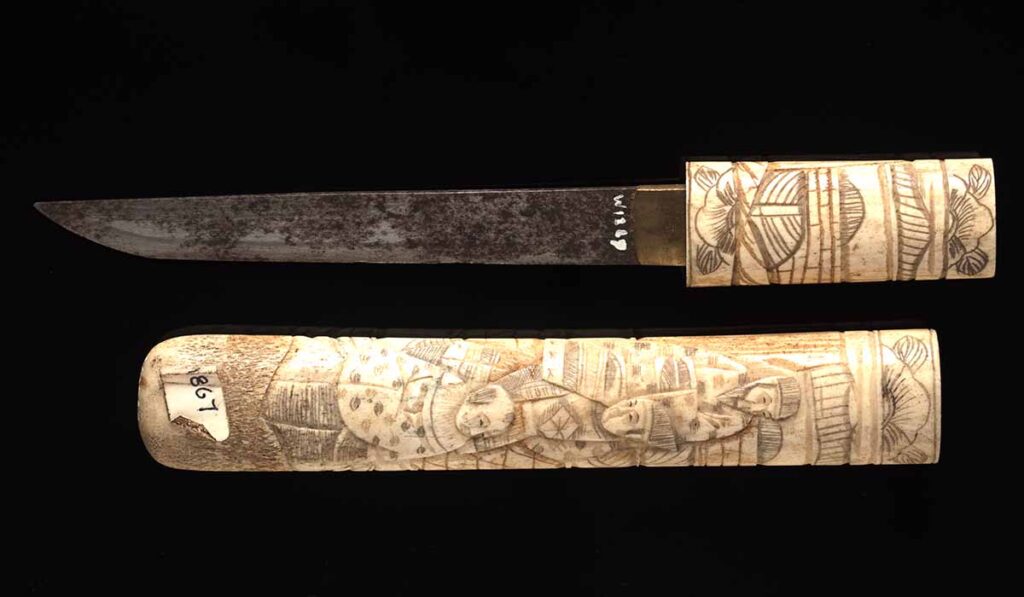
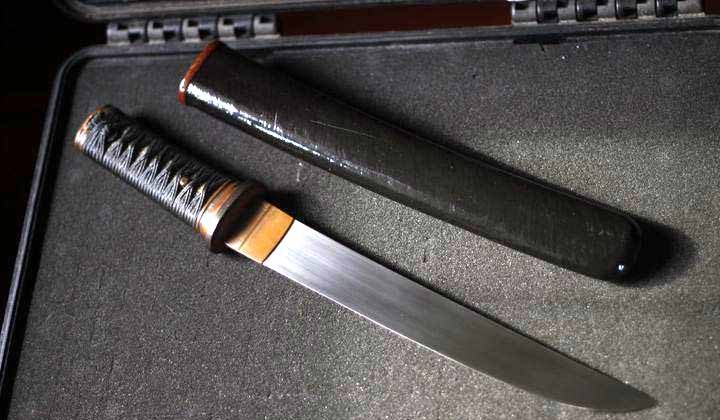
Originally, the tanto was more what we would call a short sword, or perhaps a long dagger, and was worn by samurai. It was very much a weapon to begin with, but become a more ornate and ceremonial piece over the years as weapon designs evolved.
The traditional tanto was a single or double-edged dagger with a length of around 6-12 inches and was designed primarily for stabbing. It was forged with very flat sides, and some were left short with an extra thick cross-section to aid in piercing armor.
Modern Tanto Blades
The more modern interpretation of the tanto is heavily influenced by American tactical knife designs and proves more common outside of Japan. Traditional blades are still made (and beautiful) but less practical for the modern world.
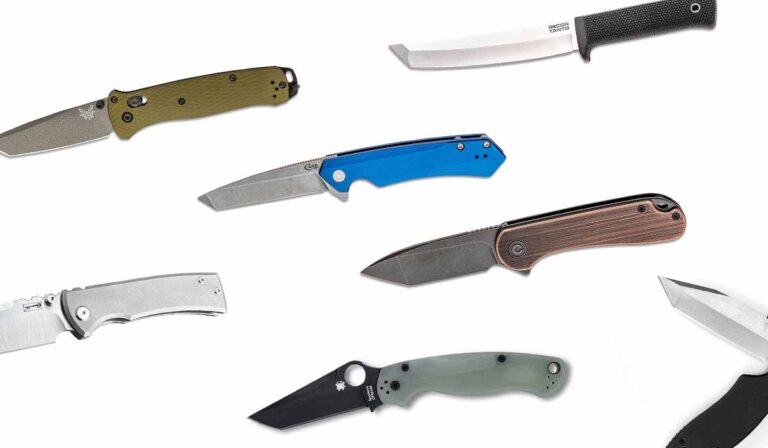
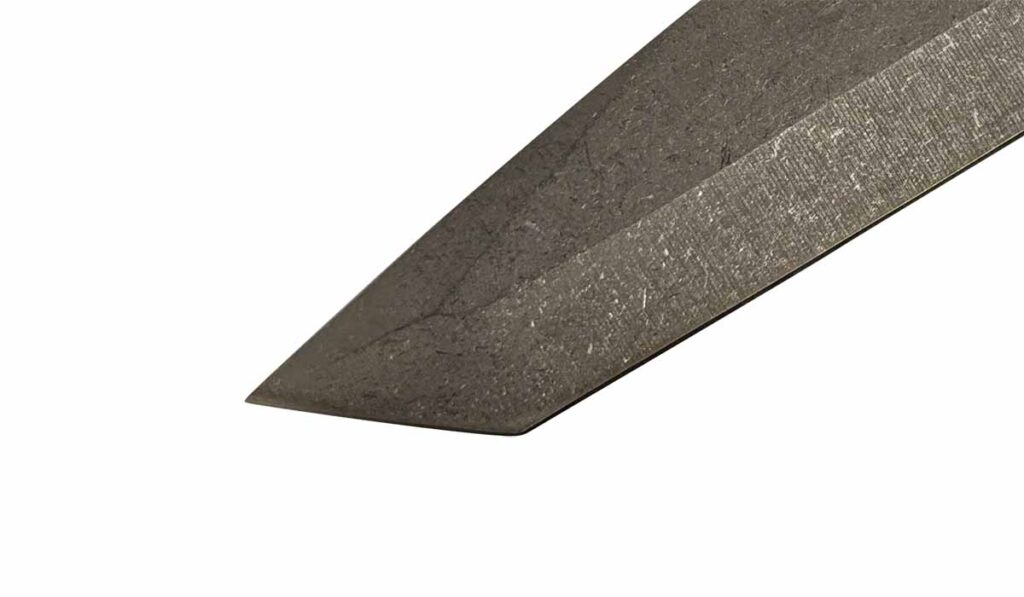
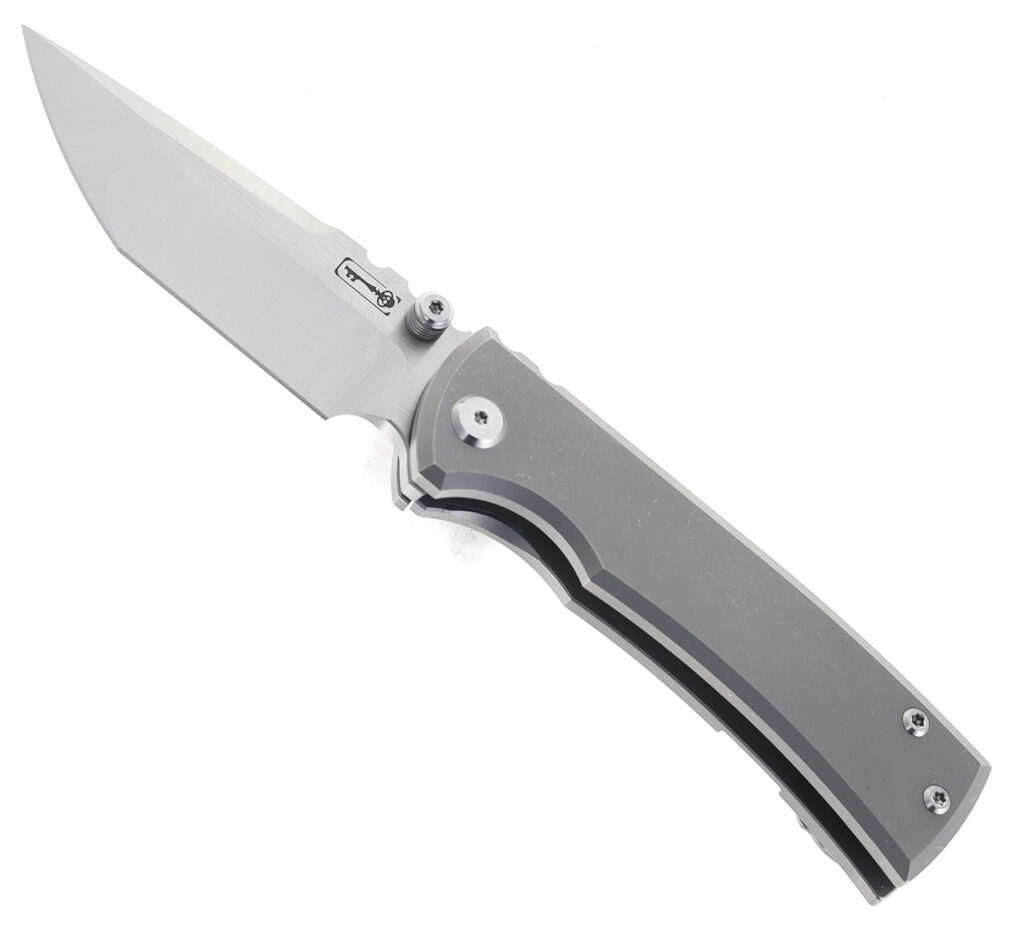
A variety of American and European knife makers now produce tanto-inspired knives with a very angular tip with the iconic sharply-upswept blade tip, essentially leaving you with two cutting planes—one parallel to the spine of the knife, and one at a 45-degree(ish) angle to the spine angling up towards the tip.
Most of these modern “American tanto” designs are folding knives, and while many are for “tactical” or defensive use, the tanto blade shape has become increasingly popular for EDC knives as well.
Pros of the Tanto Design
Piercing: Piercing, piercing, piercing. The shape of the tanto is optimized for stabbing and piercing, and it excels in those contexts.
Whether you’re a pre-Edo period Samurai trying to slip a blade between (or through) segments of your opponent’s armor, or a frustrated office worker attempting to poke your way into some plastic clamshell packaging, the tanto is ideal for putting a hole in something.
We see similar knives used for leather work around the world, and with good reason. The tanto is great for putting a hole in tough material.
Draw Cuts: Modern American tantos are also great for draw cuts and slices, particularly when you’re working with something on a flat surface like a cutting board. The dual edge geometry makes short work of many slicing tasks.
You can also (carefully) use that second point where the two edges meet like a chisel for shaving wood, scraping a sticker, etc. This makes for a very handy EDC.
Defense: Lastly, as a defensive tool, tantos excel because of their narrow, piercing point. This point easily defeats heavy clothing and makes for an effective means of defense in skilled hands.
Many knife-based martial arts focus on stabbing strikes as the most effective fight-enders, and the tanto fits that training paradigm very well, while still being perfectly capable of slashing.
Cons of the Tanto Design
Cutting Edge: The tanto’s main drawback, besides additional time and care needed when sharpening, is the fact that you lose some usable blade edge by having essentially two edges, one parallel to the spine and one swept forward and upwards.
In practical use, this means you have less effective blade length for certain tasks, around 20% less than you’d have with an equivalent-length drop or clip-point blade. To compensate, tanto blades intended for EDC are usually a bit longer than a similar knife with a different point.
All of this can be adjusted for, and as long as you aren’t doing something like spoon carving, you probably won’t notice a difference in real-world use.
At the end of the day, “real-world use” for most of us is opening boxes and packaging, and slicing apart those god-awful packing straps used to hold children’s toys in display boxes. And the tanto excels at all those tasks.
How The Hell Do You Sharpen a Tanto?
Sharpening a tanto may look a bit scary, but once you break the process down, it’s quite simple. All you’re doing is sharpening two edges that meet at a point. The only real pitfall is that it’s easy to round over the point where the forward edge and the edge parallel to the spine meet.
To avoid this, be mindful of that meeting point, and stop your sharpening stroke on or before it. Then, when sharpening the forward edge, rotate the blade and sharpen it in much the same way you would a chisel.
Just be careful not to pull through the point where the two edges meet so you don’t round over that point and you’ll be good to go. Beyond that, it’s just like sharpening any other knife.
10 Ten Knives with Tanto Blades: EDC, Fixed Blades, and Folders
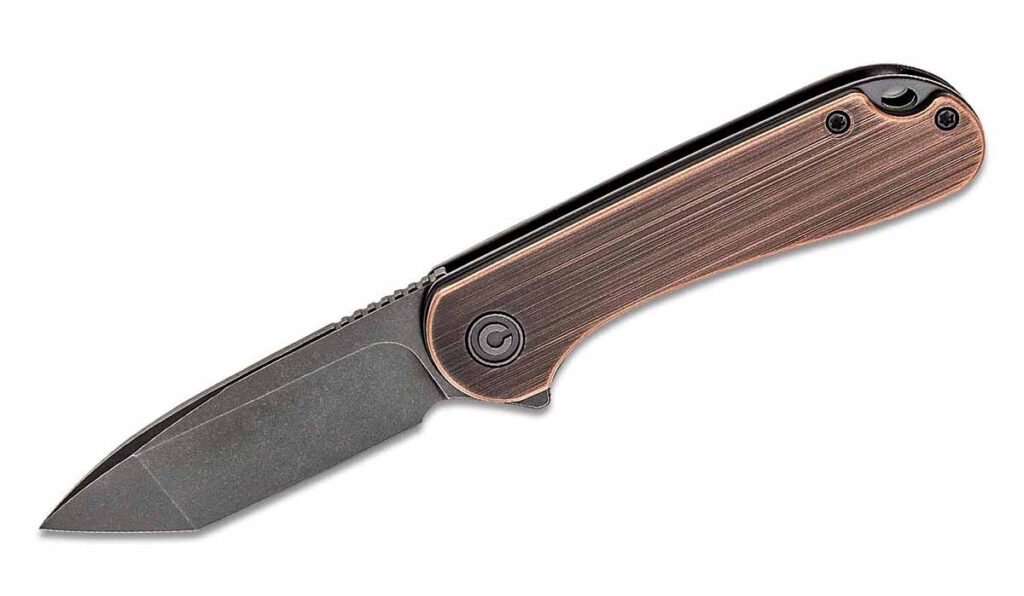
CIVIVI Elementum Tanto
The CIVIVI Elementum has become something of a modern classic in the EDC knife world. Since its release a few years ago has gone on to become one of the most popular pocket knives around.
There is a nearly limitless amount of blade and handle combinations out there now, but we’re going to focus on this excellent tanto blade with a copper handle.
At its core, this is still the same Elementum knife aficionados are already familiar with (a simple, dependable liner-lock flipper folder) but outfitted with a tanto blade that makes piercing tasks a cinch, without compromising on slicing performance.
Basically, it’s everything you need in an EDC knife for regular daily tasks, and it comes with a gussied-up stonewashed tanto blade and a lovely hand-polished copper handle that adds a touch of class and elegance to this very affordable knife.
The Elementum tanto is also available in a button lock version and features a 2.96-inch blade made of D2 steel.
MSRP: $80
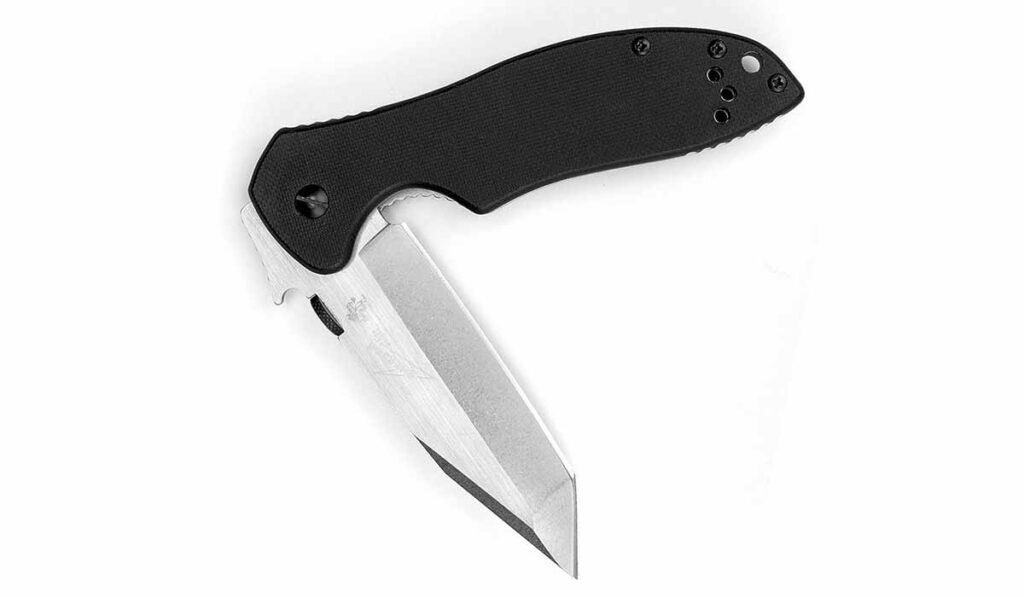
Kershaw Emerson CQC-7K
Ernest Emerson has brought much success to Kershaw with his designs. Back in 2014 he hit it out of the park again with the Emerson CQC-7k, which won that year’s Best Buy award at BLADE Show for sheer value. In the almost ten years since it’s held its own as one of the best EDC options out there.
It features the iconic Emerson Wave that facilitates blade deployment by simply pulling it from the pocket and hooking the “Wave-Shaped Feature” on the pocket on the way out (sort of an inverted kicker).
It also features an ambidextrous thumb disk that doubles as a comfortable place to press your thumb when doing fiddly work. The scales are nicely-textured G10, and the handle features a stainless frame lock that is one of the more secure we’ve tested (read: beat the hell out of).
The one thing to look out for is the blade steel. I would suggest spending an extra few bucks on the D2 stainless version and avoiding the 8cr14Mov version. There’s no reason to spend more than $40 on a knife with bottom-tier blade steel like that in this day and age.
You can get five gas station knives for that price and be better off.
The Emerson CQC-7K has a D2 blade that is 3.25-inches long.
MSRP: Starting at $74
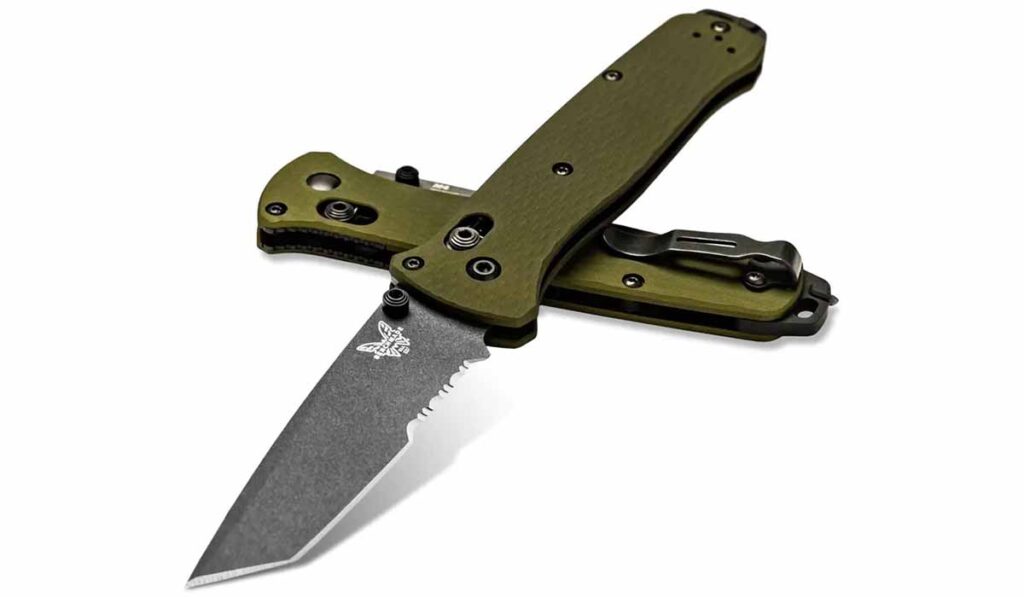
Benchmade Bailout
You’ve heard of the Bugout, surely. Now meet its newer, slightly-tacticooler cousin, the Bailout (one of my favorite knives of the past several years).
As you can surely imagine, the Bailout is a bit of a riff on the Bugout most of us knife fans know and love, but with some notable changes. Our favorite version is the CPM-M4 model which features woodland green anodized aluminum handles.
CPM-M4 is a great steel, which you would expect from Benchmade, and the knife itself is the perfect length to straddle the line between EDC knife and tactical folder. It also features a lanyard loop if you’re one of those people who like lanyard loops, and more interestingly a micro glass breaker.
How often do you need to break a car window in an emergency? Probably not very often, but it is nice to have it if you’re leaning toward a more tactical-style knife. You can also get a version that doesn’t have the glass breaker or the aluminum handles if you want to save a bit.
The Bailout features a 3.4-inches, CPM-M4 blade.
MSRP: $129
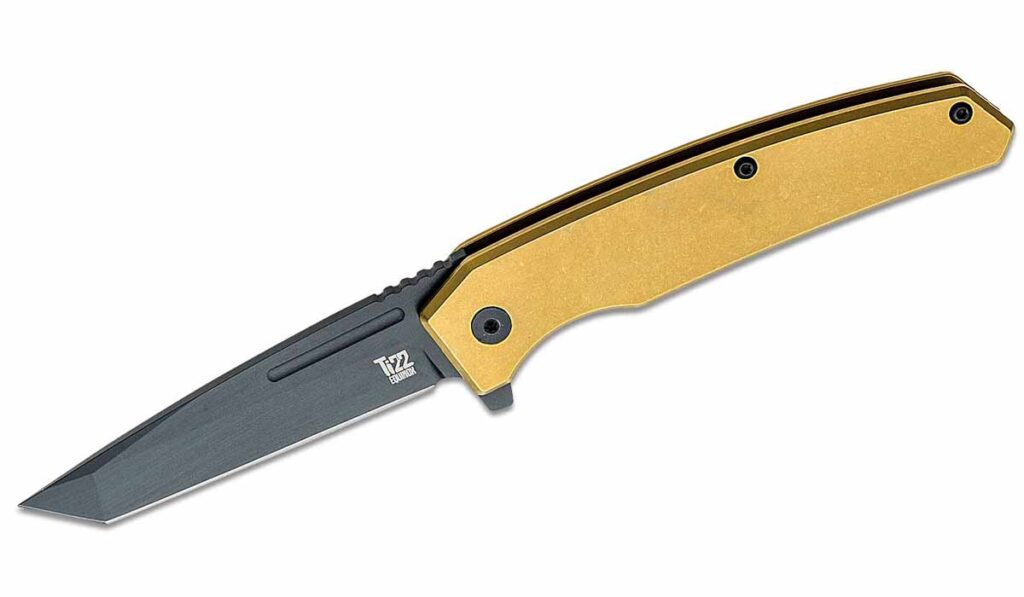
Ontario Ti-22 Equinox
Ontario Knife Co. is one of the most criminally underrated makers out there. Everything in its catalog is smartly designed and intended to excel in real-world conditions. That includes the Ti-22 Equinox.
It features, as the name suggests, a full titanium handle and an S35VN blade coated black to inhibit rust and corrosion in difficult environments. S35VN is a premium steel that holds an edge incredibly well, and the lightweight titanium handle is as robust as you could ever want.
The action is flippy and fidget-friendly, and the handle feels comfortable during extended use. The blade slices paper right out of the box, and comes to a sharp angle where the forward edge meets the primary cutting edge, giving you plenty of piercing power.
Draw cuts, slicing, and even some camp kitchen prep were easy and straightforward, and the knife handled being carried on a sailboat for a week without showing any signs of rust. All in all, a great EDC that again toes the line towards the more tactical/defensive side of things.
The Ti-22 has an S35VN blade that is 3.03-inches long.
MSRP: $138
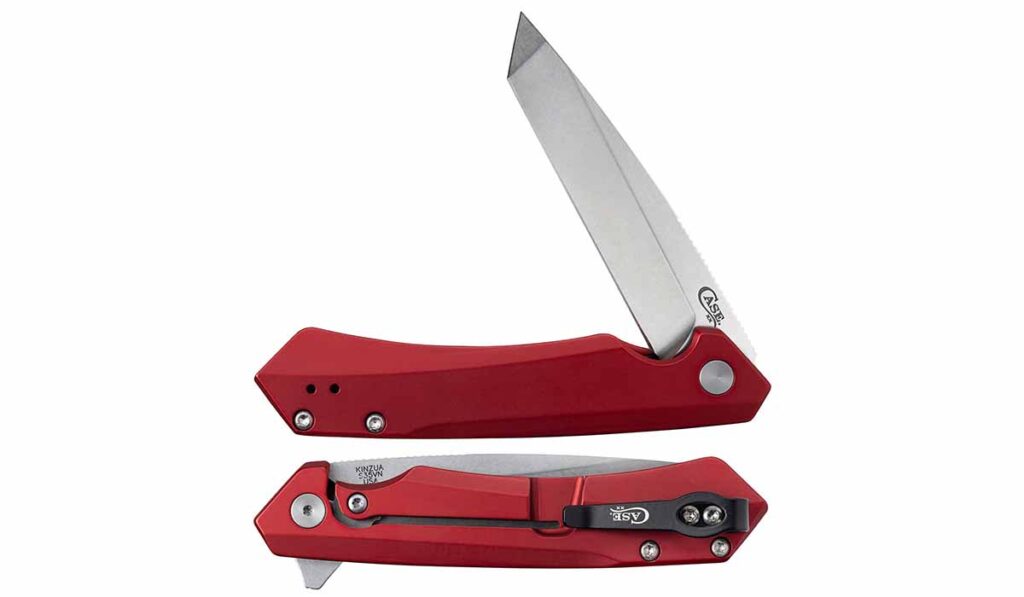
Case Kinzua
Case Knives made a flipper! Several actually, with the Kinzua being part of the first line of Modern Everyday Carry Knives to come from this iconic brand.
This isn’t your grandad’s Case knife, though we love some of those old three-blade traditional babies as much as anyone. These are incredibly modern designs for a modern audience that expects things like one-handed opening, a frame lock, and a deep-carry pocket clip.
In addition to all that, the Kinzua (named for a scenic forestry area in Allegheny County, PA) features an S35VN blade and faceted anodized aluminum handles that are a joy to hold. The flipper tab is nicely contoured, and the knife opens and closes smoothly.
The tip is a now-familiar American tanto and is great for piercing pesky packages, or anything else you might need to poke a hole into during your daily life.
MSRP: $179
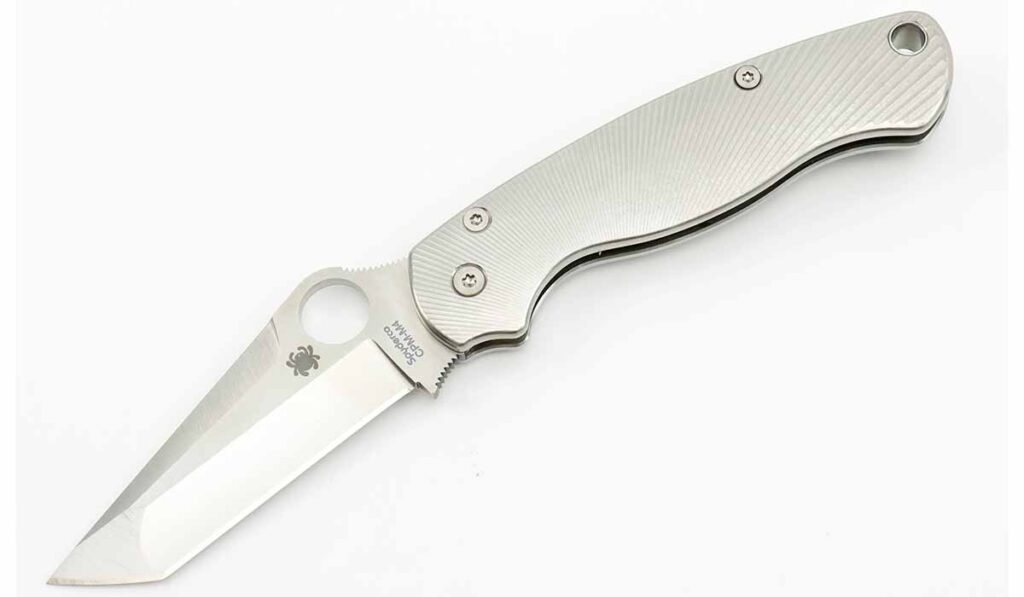
Spyderco Paramilitary 2 Tanto
The Spyderco Paramilitary 2 (or PM2) is beloved in the EDC community, and it’s not hard to figure out why.
It features a polished washer pivot system that is very smooth to open and close, features Spyderco’s iconic compression lock, and now, for the first time, comes with a tanto blade.
That blade is made of CPM-S30V steel, one of the best you can get in a pocket knife at this price range. Sharpening isn’t too difficult, and the edge will last you a very long time, even with aggressive daily use battering away as you slice open Amazon boxes (or whatever).
The PM2 has fine-textured G-10 handle scales out of the box, but you and your trusty screwdriver can pop those off and replace them with any one of roughly ten bazillion aftermarket options. Companies like Flytanium keep PM2 owners well-supplied with choices.
MSRP: $246
The Spyderco PM2 Tanto features a 3.44-inch blade made of CPM-S30V steel.
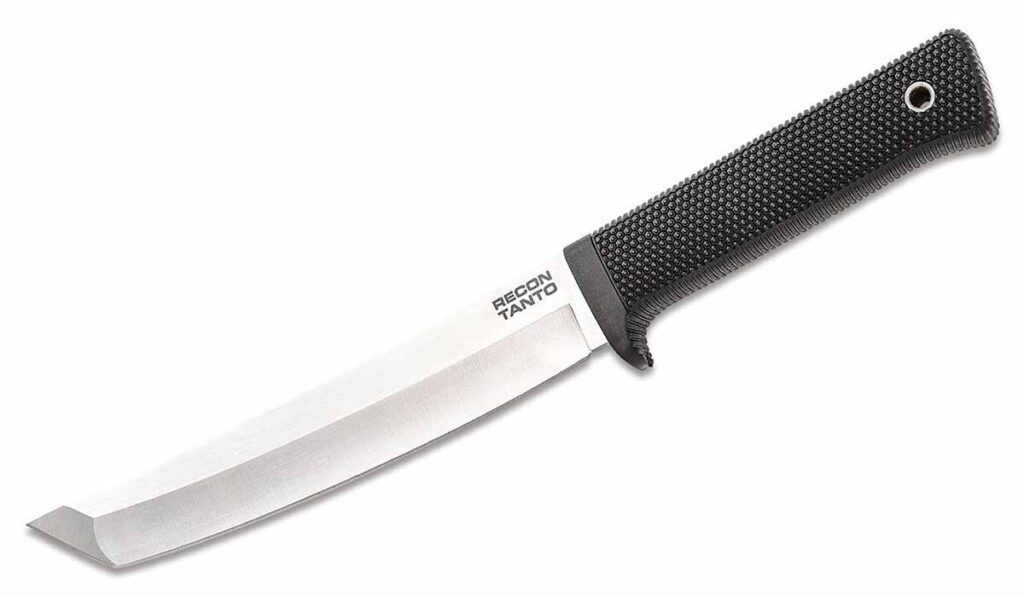
Cold Steel Recon Tanto
Of course, we can’t have a list of modern tanto knives without bringing out something from Cold Steel, the progenitors of the modern “American tanto” that is the most accurate description of most of the knives on this list.
Their Recon Tanto is our first fixed blade on this list and is positioned as a tactical/rescue blade. The incredibly robust SK5 steel used in the blade is a common for hard-use tools like machetes and survival knives, particularly military ones.
The grip is made with Kray-Ex, which is designed to maintain good friction in the hand at all times, even if your hands are wet or you’re wearing gloves. It also doesn’t shred your paws like some rougher materials.
If you’re looking for a more tactical tanto that can handle everything from camp tasks to self-defense, this is a great option that is a bit heavy, but bomb-proof and reliable.
The Recon Tanto has a 7-inch SK5 high-carbon steel blade.
MSRP: Starting at $70
Chaves Redención Street Tanto
Ramon Chaves is a custom knife maker that has made a name for himself as one of the premier designers of tough, hard-wearing, but still stylish blades. His Redención tanto is…very expensive, and worth every penny, exactly the way a custom knife should be.
If you’ve got the cash and you like the look of it, especially if you enjoy the artisan nature of a custom knife, go buy that.
For those of us with slightly less to spend, Reate has put out a production version of the Redención that comes with a slightly more obtainable street price and is considerably easier to find in stock.
Ramon works hard, but it’s always going to take longer to produce a custom knife than a production knife coming from a factory with purpose-built tooling. The Redención Street is a great way to get your hands on the design, without waiting months for the custom version.
The Street Tanto is an incredibly well-built framelock folder with an aggressive piercing tip. Despite a 3.63-inch blade length, the whole thing weighs in at just over 6oz thanks to the titanium handle design (which you can get in about two dozen different colors).
The blade is made from the fabulous Bohler M390 steel, one of the best you’ll find in a pocket knife.
MSRP: $300
Siam Blades Traditional Black Copper Hira Tanto
Lastly, I’m throwing in a little treat for the two or three of you reading this who came here looking for traditional, no-fooling, tantos made the old way. Siam Blades is a traditional blacksmith shop located in Thailand, but they have Japanese-trained smiths that create blades using traditional methods.
For most people, this is going to be a good balance of value and authenticity. A traditional tanto made in Japan will probably run you about three times what this one does. The Black Copper Hira tanto is made to a similar standard, in the same traditional way, and is as beautiful as it is functional.
Best of all, they have stock ready to ship, so you don’t have to wait 18 months for your tanto to be finished and shipped. I’ve chosen the Black Copper version here, but there is a large variety available depending on what aesthetic you’re going after.
The blade itself is made of extremely durable high-carbon SK5 steel (very common in machetes, and battle-ready sword reproductions) and is 9.5-inches long.
MSRP: $820
Final Thoughts on Tanto Knives
The tanto is an iconic design, whether we’re talking about the traditional Japanese original or the modern American remix. This knife shape has stuck around for a thousand years for a reason.
Today, most production tantos are more in the American style at least as far as the tip goes, but this battle-tested design has its roots going back much farther. I hope you’ve enjoyed this brief look into that long history, and you’ve got a better idea of what your options are for picking up a tanto of your very own.
If you spend time camping, you know the importance of proper tool selection for your excursions. The right kit makes a difference in how you enjoy your weekend woods getaway.
From batoning firewood to prepping dinner, these are the blades that will help you conquer the wild.
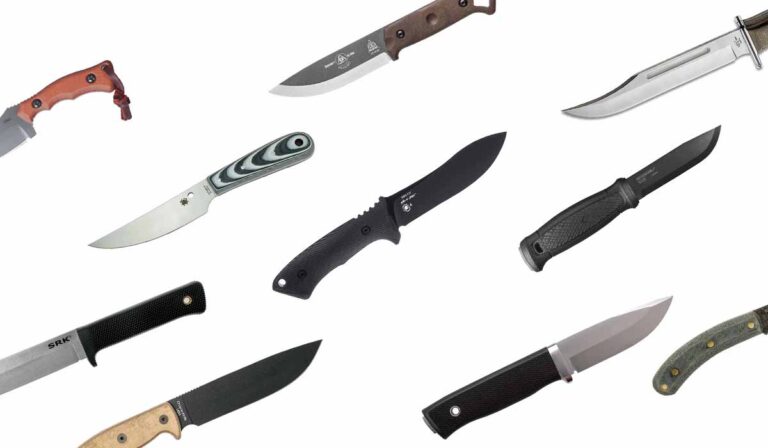
An important part of your gear should always include a camp knife of some sort. This multipurpose cutting tool takes on multiple roles in your camping trip and can handle the bulk of hard use when it comes to campsite tasks, campfire prep, processing food, and any other cutting task that comes up inside and outside of camp.
What Is A Camp Knife?
When you hear the word “camp knife”, what immediately comes to mind? Well, a rather larger fixed blade that has some heft to it. Which is partially true. Keep in mind not all camp knives are big, brawny choppers. And not all choppers can be camp knives either.
Blade: Camp knives have a proven blade shape. Nothing wild, but rather a design that can handle multiple tasks. Blade shapes like clip point, drop point, or even spear point.
Size: The knife also has to be of some length, around 7-8 inches is good. Such a blade length will facilitate tasks involving whittling, batoning firewood, chopping wood, or expediently slicing up food for cooking.
Handle: On the handle side, it’s important to have a handle shape that is very comfortable in your grip and incorporates design elements such as (but not limited to) finger grooves, palm swells, radiused edges, machined-in textures, and choils.
These features seat your hand better on the handle, making for a more comfortable user experience. Face it, if a handle isn’t comfortable you’re are not going to use the knife, regardless of how expensive it is or if it uses the best blade steel. Plus, as you are working, you want the handle to feel secure in your hand and not feel like it’s going to fly out. Therefore, such materials as G-10, micarta, and some molded thermoplastics are great choices for handle materials on camp knives.
Steel: What about blade steels? What about them? You have to remember the camp knife is a workhorse and you will probably have to sharpen the knife in camp. Carbon steel is still the steel of choice for this very reason of being easy to resharpen in the field.
1095 seems to be a factory favorite, found on outdoor knives, some fixed blade tactical, and EDC fixed blades. 1095 sharpens very easily but it’s not stainless so you will have to exercise extra care to make sure it’s dry as possible to prevent rust and stains.
Higher-end super stainless steels like S35VN are great and have the muscle to go the distance without frequent sharpening. Yet when it comes time to resharpen, you could end up investing a good deal of time.
To negate this, you can switch to a maintenance mode from resharpening mode, meaning, frequent honing will preserve the cutting edge. Something must be said for going old school, with carbon steel. There is a trade-off with frequent short-duration sharpening of blade steel that is softer and easier to manage, as opposed to spending a lot of time in the field sharpening a high-performance super stainless steel.
Now we have the basics out of the way, let’s dive further into some good examples of camp knives that might interest you.
TOPS Brakimo
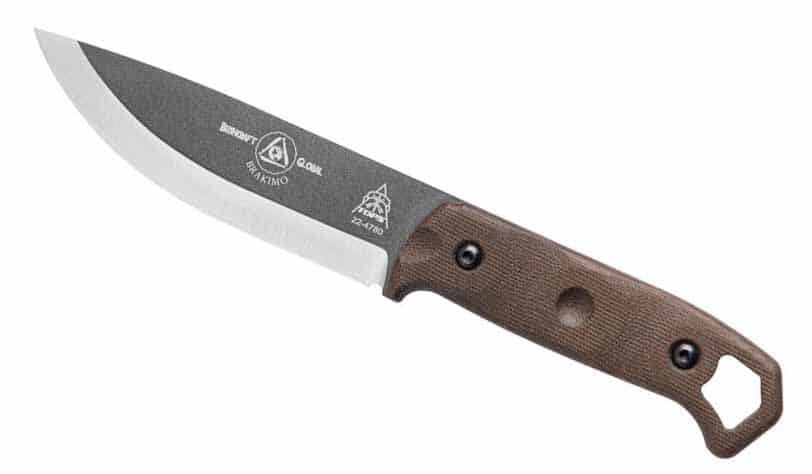
Designed by noted survival/outdoor expert Joe Flowers of Bushcraft Global, the TOPS BRAKIMO is as close to a do-it-all knife that can handle all tasks from whittling to cutting to chopping and baton work.
Its blade is 5 2/4-inches long and 0.190 inches thick and is made from 1095 carbon steel. The drop point shape gives plenty of belly to facilitate a broad range of tasks including but not limited to food prep. The modified Scandi grind is there for cutting performance as well as a thicker cross-section of the blade to promote strength in the blade. The handle is of OD green canvas micarta and has been finished to leave a “grip you back” quality to it. The edges have been chamfered for ultimate comfort, and there’s a divot for use with a bow drill. An extra-large lanyard hole allows you to use any cord diameter for a lanyard and possibly even attach it to a carabiner. Finishing out the Brakimo is a nice Kydex sheath that carries the knife at your side securely. A spring metal clip is the means to attach the sheath to your belt.
The Kydex sheath is nice although basic. But really in the end as long as it works, that’s all that matters.
MSRP: $169 Origin: USA
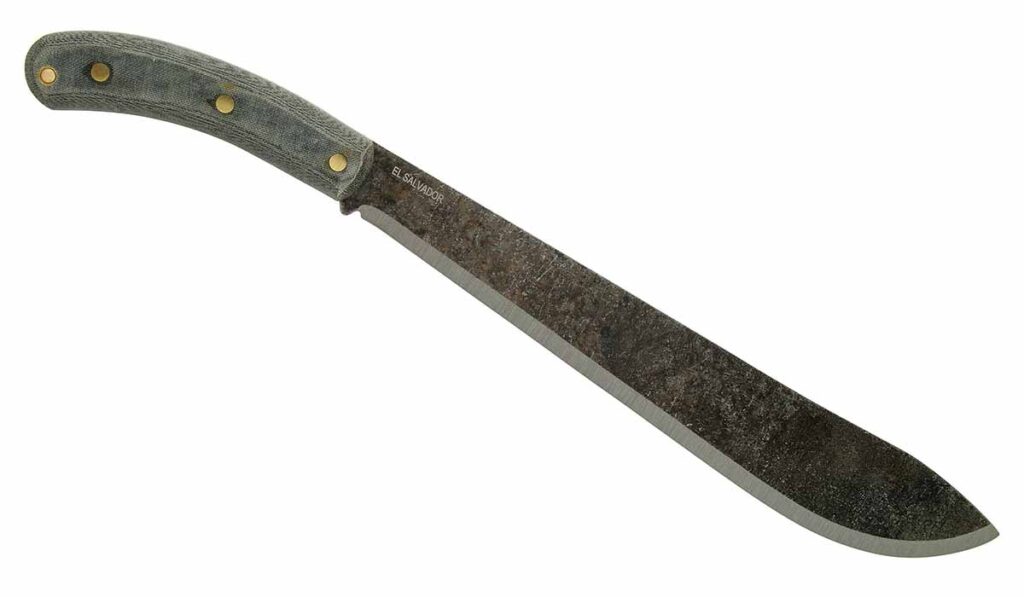
ESEE Expat Darien Machete
I know. This is a machete, but this is an article on camp knives. Truth is that machetes can be used in conjunction with camp knives. More so with the ESEE Expat Darien machete, this is also part machete and part knife as well.
Measuring a little over 18 inches, the Darien has a reach like any other machete, but it also has excellent balance and feels so agile in the hand that you can use it as a knife for whittling, chopping, batoning, and maybe some heavier cutting of camp food prep tasks. The blade is made from 1075 carbon steel and is very easy to resharpen in the field. At 0.094-inches thick, the blade stock is thin enough to be nimble and is thinner than most camp knives, which are at least ⅛-inch thick (0.125 inches).
The blade itself is a little over 12 inches, which is enough length to get work done. The handle is made from black micarta, which is a great choice because it’s a synthetic material that is dimensionally stable and has an excellent grip you back quality. The sheath is sewn canvas and is well made. An integrated belt look allows the Darien to be at your side whenever it is needed. Pair the Darien with a favorite full-blown camp knife and you have the ultimate combo!
MSRP: $121 Origin: El Salvador.
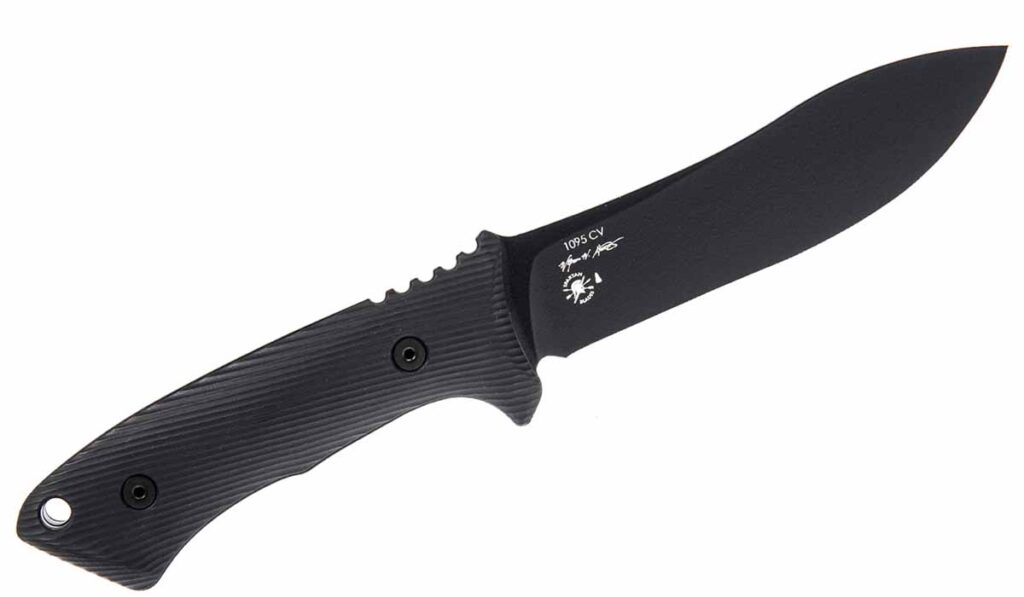
Spartan Blades Hersey Nessmuk
Spartan Blades made a name for itself as a top producer of high-end tactical and outdoor knives. It recently came out with a USA-made mid-grade line of professional use knives that are OEM’d by Kabar Knives in the Kabar factory in upstate NY. This series is known as the Silver line and offers enhanced features and value pricing. These are a step up from the company’s Bronze line of entry-level knives and a step down from its Gold line of elite, high-end knives. The Harsey Nessmuk was designed by knifemaker Bill Harsey to be a heavy-duty field companion on the hunt or at the campsite.
The Nessmuk skinner-inspired blade shape flares at the tip and is great for, well… skinning and slicing tasks. The 5-inch blade is big enough to get work done but short enough to not get in the way. 1095 carbon steel is used for the blade, and the high flat grind tapers allows it to slice cleanly and effectively. A black powder coating reduces glare and adds a layer of protection against corrosion.
One look at the handle design and you can tell it’s pure Harsey. Multiple features are integrated such as the lower hand guard, the palm swell in the middle, the traction notches at the thumb rest on the blade spine. There’s 3D machined texture for grip retention, all built into the black injection molded handles. Wrap your hand around the handle and you feel how secure and comfortable it is to grip, lending a feeling you can use the Spartan Harsey Nessmuk for extended periods.
It is a very well-thought-out design overall and meant for hard use in the great outdoors. The Harsey Nessmuk comes with an injection molded sheath with a thick webbing belt loop. An innovative retention feature locks the knife into the sheath, preventing it from coming out unless you want it to. There is a thumb button on the sheath you push up on as you grip the handle naturally to release the blade from the sheath. Not too many fixed blades have a feature like this and just rely on locking the sheath up around some part of the handle. When you insert the knife into the sheath, you will hear an audible click, indicating that the blade is locked. Very cool!
MSRP: $190 Origin: USA
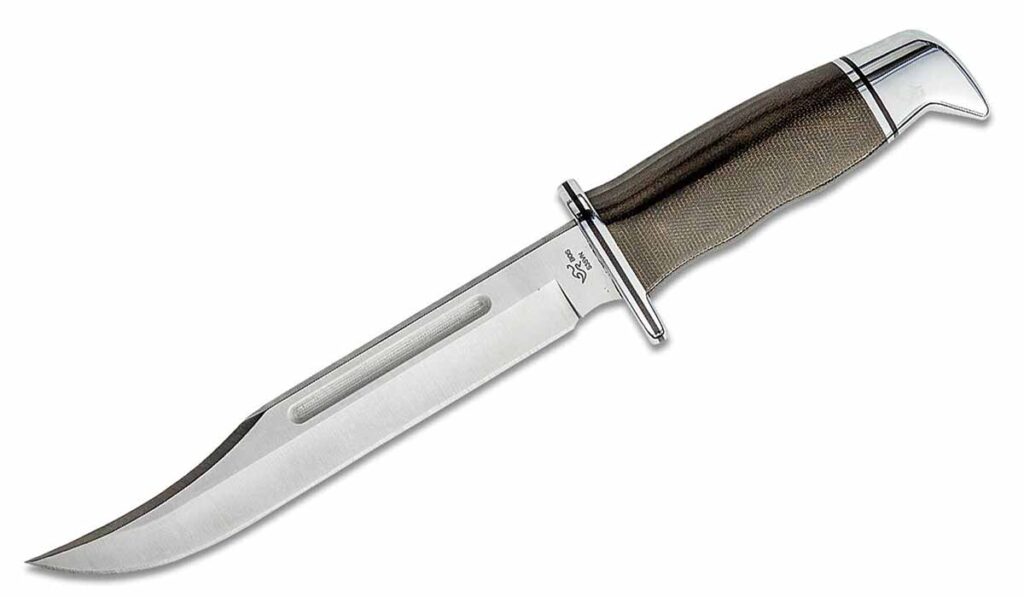
Buck Knives General Pro
Any article talking about outdoor knives isn’t complete without a mention of a Buck knife. The company has been synonymous with the great outdoors since its inception. Its model 120 General Pro is one such knife, built to take whatever the great outdoors can dish up.
Crafted with a blade made from premium CPM S35VN stainless steel, the General Pro is built for hard use in all environments. Measuring a little over 7 inches in length, the clip point blade has a hollow grind, pronounced swedge, and a milled-in fuller, giving the knife its aggressive look. The handle is made from OD green canvas micarta for the ultimate all-weather grip.
The signature aluminum guard and pommel, present on all Buck fixed blades, cap off the handle’s construction and appearance. The General Pro excels at camp food prep, whittling, some chopping, and baton work for wood splitting. At 12 inches overall, it’s the perfect large fixed blade to have when you hit the great outdoors. It is accompanied with a sewn leather sheath, as is common with all Bucks.
The General Pro is the tonier model, but if it’s out of your price range, the General model offers the same design only with 420HC stainless steel blade, black phenolic handle and lower price.
MSRP: $128
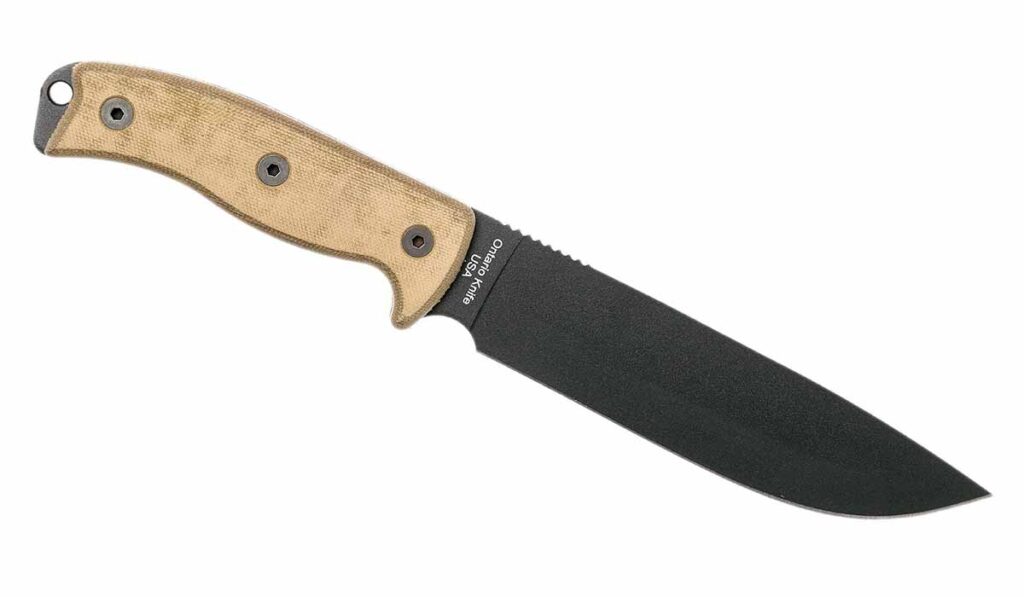
Ontario RAT 7
Ontario’s collaboration with Randall’s Adventure & Training has yielded a very highly successful series of folding and fixed-blade knives that are aimed solely at outdoor adventures. One such example is the RAT 7. The fixed blade is a larger knife that can handle all of your camp chores and some food prep. But tough work like chopping and batoning wood is what the RAT 7 is built for.
The 7-inch long, flat ground, drop point blade is ground from 1095 carbon steel and given an epoxy powder coating to keep rust and corrosion at bay. The handle is a tan canvas micarta, an excellent choice for outdoor knives because it is fully synthetic and is impervious to moisture, cracking, and gouging. The handle design itself incorporates an integral lower finger guard, an ergonomic curved gripping area, and an exposed pommel with a lanyard hole. There is also a forward choil at the tang so you can employ a choke grip for more control over the blade.
Each RAT 7 comes with a nylon belt sheath that features an exterior accessory pocket for storage of a sharpener, folding knife, or additional survival supplies.
MSRP: $135
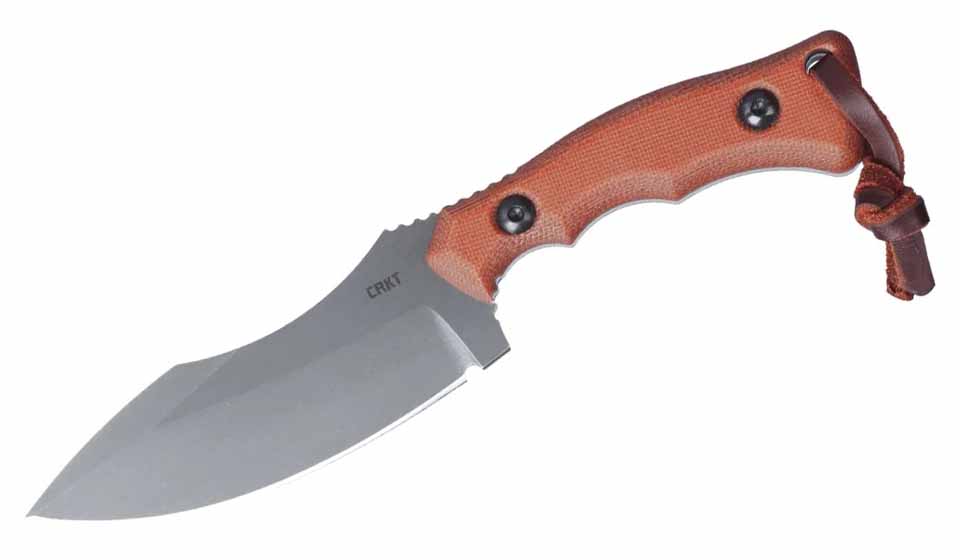
CRKT Bugsy
Designed by custom knifemaker and Discovery Channel’s Naked and Afraid star Kaila Cummings, the Bugsy is CRKT’s first USA-made fixed blade in the lineup. The knife receives its moniker from Cummings’s first appearance on the TV show when she received numerous big bites in the jungle in Colombia.
Featuring a 1095 carbon steel harpoon-style blade and a micarta handle, the Bugsy is as at home in the outdoors as it is an EDC fixed blade. With a blade length of a hair under 4 inches, the Bugsy is sized appropriately to take on most tasks inside camp or at home. Again, like some of the fixed blades discussed here, 1095 is used due to its low cost-to-performance ratio. It’s easy to resharpen in the field and offers reasonably good edge holding, which makes it a favorite amongst outdoor users.
The highly ergonomic handle showcases multiple finger grooves and an expanded butt end capture your hand to provide a secure, non-slip grip. Micarta is used due to its dimensional stability and excellent all-weather qualities—necessary for an outdoor use knife.
A leather fob is tied to the handle and acts as a handle extension for those with larger hands.
Accompanying each Bugsy is a high-quality leather sheath that holds the knife securely and at your side. There’s also a tactical version of Bugsy that features a black-coated, part-serrated blade and black G-10 handle. It comes with a black Kydex rig for belt carry.
MSRP: $200 Origin: USA
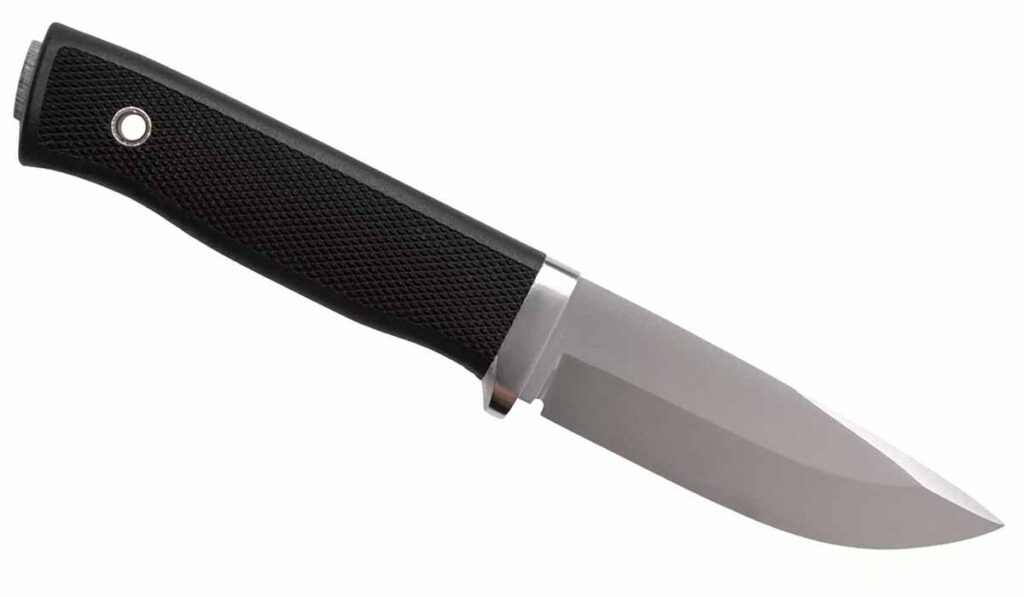
Fallkniven F1 Pro
For those not familiar with Fallkniven, it is a Swedish knife manufacturer with among the best-kept secrets in the production knife industry—its fixed blades. These tools are elegantly refined and yet sport blade and handle designs geared towards the practical. Like anything European, Fallknivens are a bit costly but are very worth it. You get what you pay for and then some.
Fallkniven’s F1 Pro fixed blade is a straightforward utility done up to the next level. The drop point blade is 4 inches in length and is ground from premium high-end ELMAX stainless steel, ensuring edge longevity and durability.
The handle is made from a polymer called Thermorun, a molded material soft to the touch. It sports checkered texturing that grips your hand back regardless of weather conditions. Hot, cold, wet, or dry…the Thermorun handle ensures a sturdy, comfortable purchase.
With an overall length of 8 and ½ inches, the F1 Pro carries very well in its hybrid molded Zytel sheath with nylon webbing belt loop. A secondary button snap strap secures the handle in place.
MSRP: $408
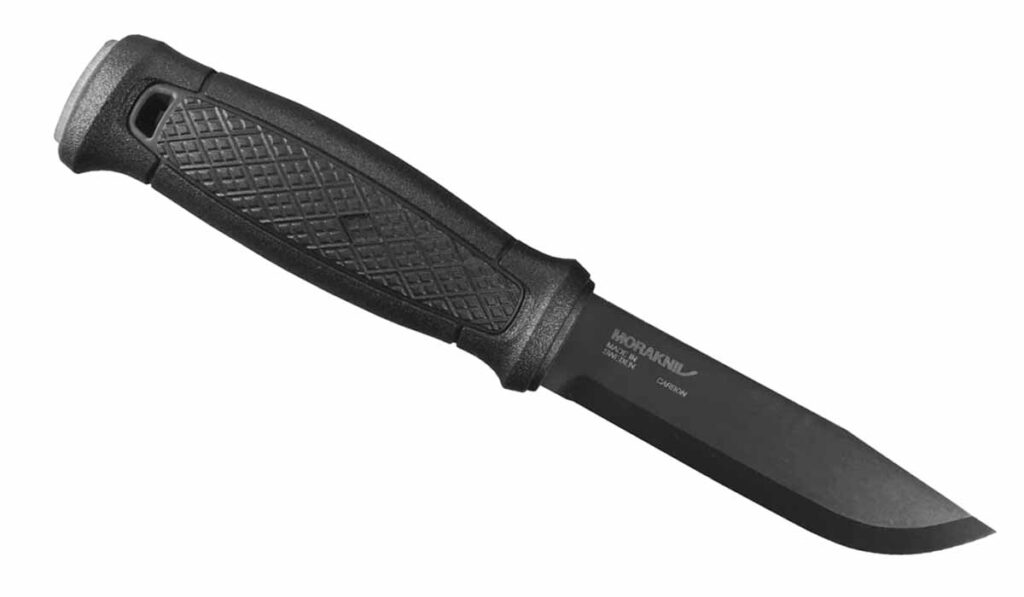
Mora Garberg Carbon
One of the best values in high-quality fixed blades undoubtedly is Mora, another Swedish knife manufacturer. Mora’s knives are highly functional and well-designed, yet they sell at prices anyone can afford. They are what I recommend to folks who want a good quality knife without breaking the budget. Mora’s Garberg is one of the company’s larger knives and is designed and built for survival and camping.
Starting with the blade, the modified clip point is made from carbon steel for ease of sharpening and is given a Scandi grind for optimum cutting performance and blade strength. The blade measures a hair over 4-inches long, which is enough to take care of most cutting tasks while being easy to carry. The blade is given a black coating to help protect it from corrosion since it isn’t stainless steel. The handle sports a full tang construction, the Garberg is the first Mora model to feature a full tang. This means the knife can withstand harder use than the other Mora knives.
The handle has a dual molded construction with molded Polyamide and hard rubber, for a durable and weather-resistant grip. The handle has rounded contours, which makes it easy on your hand for extended use. This handle design and construction is typical across the Mora knife line and is proven to be durable and comfortable in the long run. The sheath that accompanies the carbon steel Garberg is a nice leather sheath that protects the knife and allows the user to carry it conveniently.
MSRP: $130
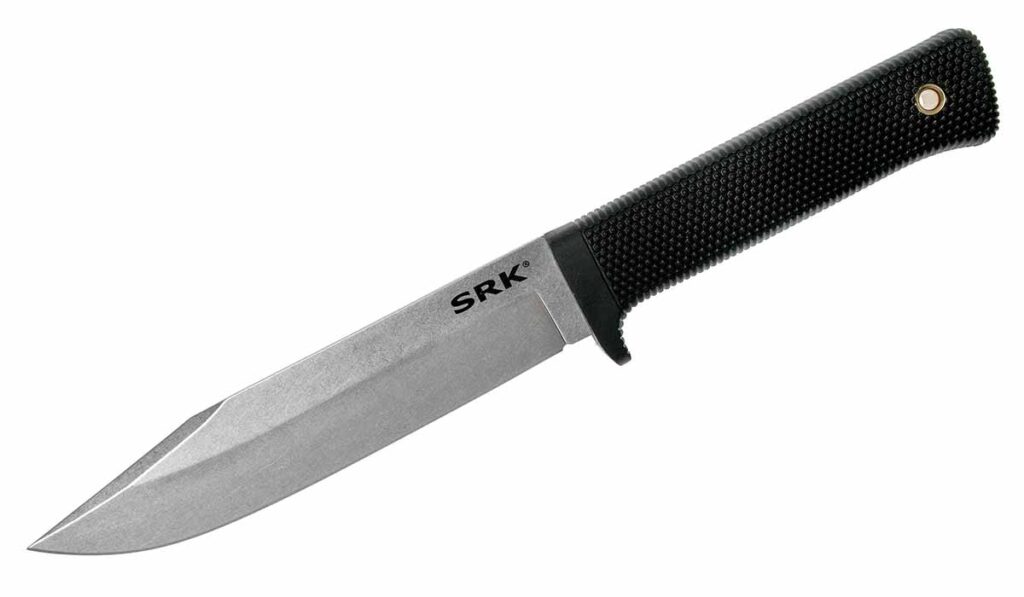
Cold Steel SRK
Those of you into knives for a while have heard of Cold Steel. It has been around for a long time and so have some of the company’s classic designs such as the SRK (Survival Rescue Knife). Don’t let the name fool you though, this knife also excels at camp chores as well as any cutting task indoors or out.
The 6-inch blade is ground from SK-5 carbon steel and given an epoxy coating to protect it from the elements. SK-5 is a Japanese steel that is roughly equal to 1080 carbon. The clip-point blade is straightforward, but pure utility all around. It can pierce, score, and slice its way through all your camp-cutting tasks.
The handle is a molded rubber-like material that Cold Steel calls Kray-Ex. It sports checkered texturing for the ultimate grip regardless of weather conditions. An integrated, lower hand guard prevents your hand from sliding forward. The handle color is available in black, tan, and OD green to suit your personal preferences and primary use environment. The overall length is a little over 10 inches, making this a larger fixed blade, and it’s ideal for hard-use applications. Each SRK comes with a molded Secure-Ex sheath which is very similar to Kydex, allowing the sheath to be form-fitting and securely carry the SRK without rattle.
MSRP: $62
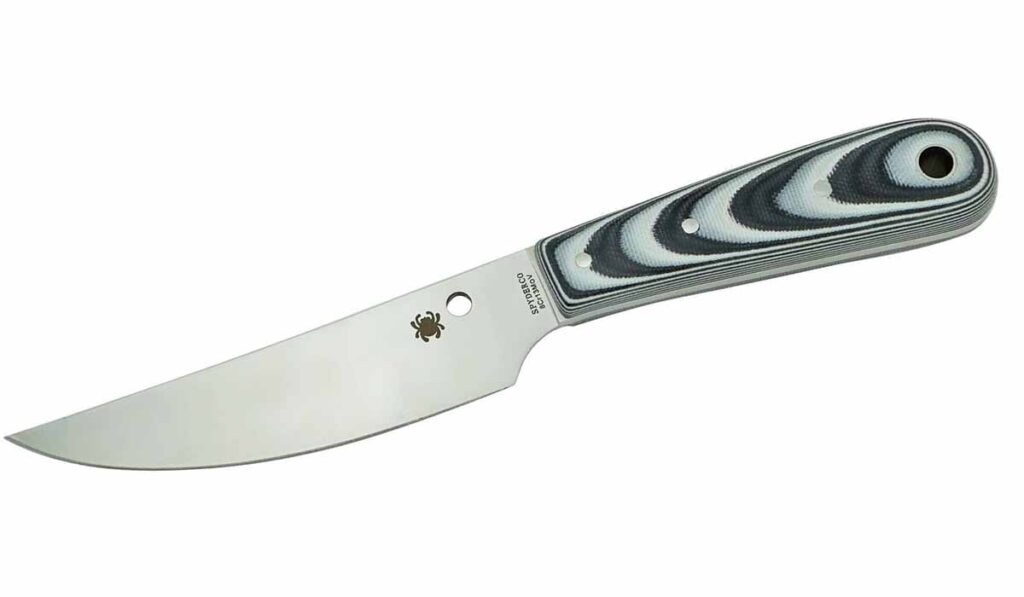
Spyderco Bow River
The Bow River from Spyderco is an affordable fixed blade in the SPYDERCO lineup that has great potential. Its trailing point blade style is highly adaptive to hunting, bird and trout, as well as general food prep in camp.
The blade is 4.4-inches long and is ground from 8Cr13MoV stainless steel, which is the Chinese equivalent of Japanese AUS-8 stainless. 8Cr13MoV is easy to sharpen out in the field and offers reasonable stain resistance. It’s a good middle-of-the-road production stainless steel, favored by quite a few production brands. The full flat grind ensures optimum cutting performance through a variety of foods and meats. The trailing point blade design offers a continuous blade belly that works excellently with food prep, facilitating ease of slicing motions. At an overall length of 8.1 inches, the Bow River is an excellent choice for a fixed blade that carries easily and won’t break the bank.
The handle is black and gray G-10, with alternating color layers that produce an interesting wood grain visual effect when the handle is contoured. The handle is rounded and contoured to lay in your hand easily and very comfortably. You can get a good grip on this shape, even though it lacks any texturing. Each Bow River comes with a sewn leather belt sheath that carries the knife, ready at hand for any task.