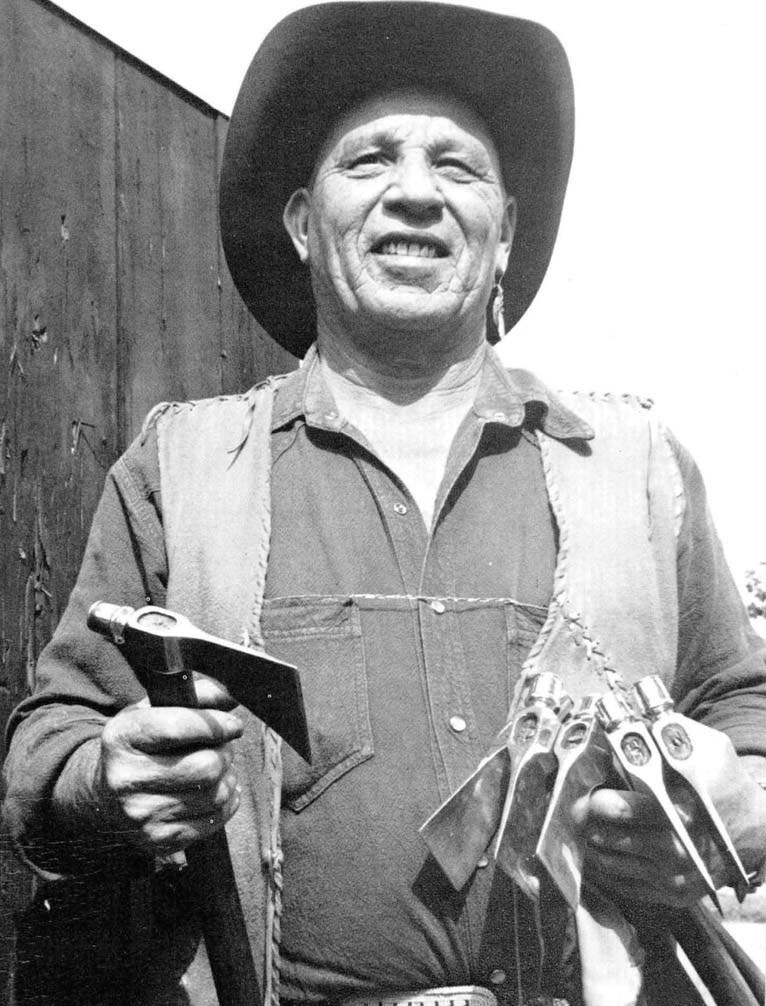
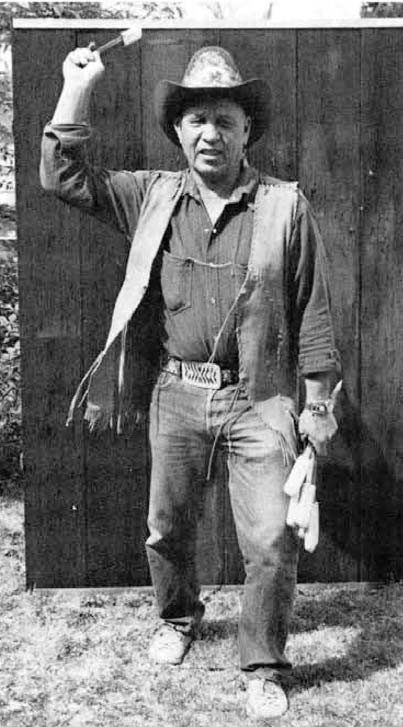
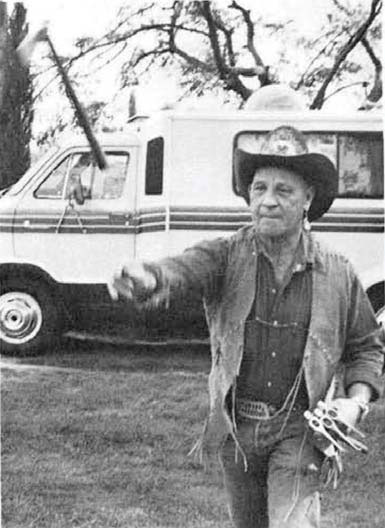
George E. “Skeeter” Vaughan (Grey Otter) was a sergeant in the Army’s U.S. Moccasin Rangers during World War II when he eliminated a German sentry with a prodigious knife throw on a snowy night in 1944.
George E. “Skeeter” Vaughan holds the distinction of making the most fantastic knife throw in recorded history—and considering the circumstances surrounding his legendary feat, he most likely will maintain his grasp on that honor for a long time to come.
An American Cherokee Indian whose given name was “Grey Otter,” Vaughan was a member of an elite Army unit called the U.S. Moccasin Rangers, all 15 members of which were American Indians especially gifted with excellent night sight. At the age of 19 he enlisted in the U.S. Cavalry in 1942, and later landed with his unit on Omaha Beach two days after D-Day in June 1944. Two weeks later the Moccasin Rangers were formed.
On a snowy November night in 1944, Skeeter and five other members of the Moccasin Rangers were given the assignment of knocking out a German bunker with pillbox on the Siegfried Line to make way for an American advance. Belly down in the snow behind the bunker concealed on the brow of a hill in a small stand of timber about 35 yards away, Vaughan and his men were faced with the problem of how to neutralize the emplacement.
Skeeter contracted trench foot during the war and doctors recommended his feet be amputated. He went AWOL from the service hospital and returned to his old unit, asking to be put on active duty rather than lose his feet. His request was granted. He was wounded five times and decorated profusely. He was the only member of the Moccasin Rangers to survive the war. He passed away in 1989.
Outside the bunker was a German sentry with his back to the hill where Vaughan and his men were positioned. The sentry had to be eliminated—and eliminated silently so he could not warn the other German soldiers. There was too much open ground for one of the Rangers to cross it and silence the sentry, and a gunshot would alert the enemy.
A sergeant and commander of the patrol, Vaughan was asked by one of his men if he could take out the sentry by throwing his bayonet/knife. As a boy, Vaughan had lived on Indian reservations and was taught all about weapons by his grandfather, old Limping Bear, a Cherokee born in the Smoky Mountains of Tennessee. Skeeter’s training included throwing knives and tomahawks, and he had put that training to use prior to the war hurling hawks and 16-inch knives made from old bayonets in performances at rodeos and in “Doc Willetson’s Big Medicine Show” that toured the West.
However, that training was about to undergo a test like no other.
As adept as he was at throwing knives, Skeeter was believed to be the world’s best at throwing hawks. His model of preference was a pipe hawk.
Skeeter crawled from the timber as far as he dared and stood, hoping he would not be spotted. The sentry’s back was still toward him. Skeeter threw the knife with a high trajectory, aiming about three feet above the sentry’s head. The knife turned silently over and over in its long, downhill pinwheel flight. The sentry dropped without a peep face down in the snow.
Considering the distance thrown—later measured at 87 feet—it was probably the longest successful throw in battle in the annals of knife throwing.
Later in life, Skeeter found acting roles in Happy Days, Gunsmoke,The Six Million Dollar Man, Magnum, P.I. and Revolution, per IMDB. He died in 1989.
Video Re-enactment
To get a better feel for what happened on that snowy day in 1944, here’s a re-enactment. Remember that Skeeter only had one chance to get it right.
The Correct Sheath Is Pivotal To The Complete Hunting Knife Package. A Good Sheath Can Keep Your Knives Safe And Sharp For Decades.
The Correct Sheath Is Pivotal To The Complete Hunting Knife Package. A Good Sheath Can Keep Your Knives Safe And Sharp For Decades.
For the hunter in the field, a dependable and durable hunting knife is indispensable equipment, and it follows that the sheath that holds the knife must be equally up to the task.
Secure carry, protection for the blade and handle, easy access, and the ability to stand up to the elements and hard use are essential. While there is a variety of sheaths available and each one contributes something to the equation, the sheathmakers themselves have come to eye-opening conclusions as to the making and deployment of the correct sheath for the hunting knife. Personal preference is still a prime mover, but the basics make the difference between cooperation and catastrophe in the field.
“The best style for a hunting knife sheath is whatever the hunter wants,” explained veteran sheathmaker Paul Long. “Personal preference is very important. However, the knife that would best be described as a hunter would be best suited in a deep seat pouch with a loop that would carry relatively high on the belt. In most cases the deep pouch would preclude the need for a retention strap. For a double-guard hunter, a drop-loop belt sheath would probably be best with a snap strap for secure retention.”
Depending on the style of the knife, the guard often dictates the best pouch configuration. “I favor the pouch-type sheath, and the hunting knife generally has a single guard as opposed to a double guard,” related sheathmaker Paul Lebatard, who also has found success with his custom knives through the years. “I make a lot of doubles, too. You would have to make a snap-type sheath with a keeper strap, but on hunting knives with single guards the pouch type is always best.”
Three different styles of pouch sheaths by Kenny Rowe, from left: regular pouch, plain leather; strap pouch, floral hand carved; and full flap pouch, full coverage gator. (Kenny Rowe image)
A sheathmaker for over 50 years, Chris Kravitt zeroes in on the personal preference perspective. “First and foremost, it’s a matter of the configuration of the knife, and then if more than one style will work it becomes a matter of personal preference,” he observed. “My preference is to go with the pouch because it is easier to draw and resheathe the knife without worrying about straps.”
At the same time, Kravitt acknowledges varying hunting knife construction and its influence in sheath form and function. “If a knife has a double guard, it isn’t going to work on a pouch sheath, and if you have a knife with an integral handle, possibly,” he said. “Certain things don’t lend themselves to the traditional style, like when the blade is the widest part of the knife or there is no bolster or ricasso extending beyond the edge.”
Kenny Rowe, owner of Rowe’s Leather in Hope, Arkansas, adds another option on the hunting knife sheath. “Ninety percent of these sheaths would be the pouch type because they cover most of the knife, and with the guard you can make a welt where the knife has some resistance coming in and out,” he noted. “Some sheaths will have a lid that has a snap on it, and that is as secure as you can get with the flap snapping over the front of the sheath.”
The consensus with the pouch sheath makes sense for all the reasons that the hunter encounters in the field. For its toughness and the ability to shape and mold the sheath as desired during the construction process, cowhide reigns supreme among sheath materials. Most sheathmakers use 7-to-9-ounce* vegetable-tanned cowhide.
Style Of Sheaths
The use of exotics such as ostrich, stingray, alligator, crocodile or other hides is a continuing option, though for the most part they are used as accents, often in the form of inlays, rather than adding any performance-related component to the sheath.
“Exotics are very useful in sheathmaking but primarily for aesthetics,” Long explained. “Elephant and shark are two that are tough enough to withstand very hard use and are usually built as an overlay on a vegetable-tanned base sheath. I work with various snakes, lizards, ostrich and many others.”
Ultimately, Chris Kravitt—here working on a sheath in his shop—stands by the individual perspective. “First and foremost,” he begins, “it’s a matter of the configuration of the knife, and then if more than one style will work it becomes a matter of personal preference.” (Chris Kravitt image)
As Kravitt noted, “The basic sheath is going to be cowhide 99 percent of the time, but for overlays and inlays my favorite is stingray, which is near bulletproof but more expensive and harder to work with—but great stuff. Ostrich leg or shin is very nice, and Malaysian horned frog has a very nice texture to it. Snakeskin is not very durable, but it’s fine when the knife and sheath are for show since it won’t hold up with regular use.”
Tooling and carving also provide style points and may be pleasing to the eye. However, neither actually contributes to the performance of the sheath in field use. “I occasionally do some tooling with stamps, but carving is a talent I don’t have,” Lebatard remarked. “Still, on almost every sheath I’ll put something in keeping with the theme of the knife, like a small deer. Someone might place an order and specify that they just want a bare, plain sheath, or they may want just their initials on it. That’s a good thing about leather. When it is wet it can be molded and stamped, and when it dries it will hold that impression.”
Tanning And Steel
Vegetable tanning is essential when the blade meets the sheath leather for an extended period. In contrast to chrome-tanned leather, a vegetable-tanned leather is not known to corrode or stain a blade left in the sheath for any length of time. That old admonition to store the knife itself separately from the sheath will then get a longer look.
“A lot of people say not to store knives in the sheaths, but as long as the sheath is made of good vegetable-tanned leather, I’ve never had a problem,” Lebatard noted. “I made a knife for a friend a few years ago and he didn’t want a sheath. He was going to get someone else to make the sheath for him. Several years later, he brought the knife to me and he had had it in a chrome-tanned leather sheath. It was nearly rusted through. The chrome-tanned leather is very corrosive.”
Kravitt has had similar experiences. “I hear so many people say not to store knives in leather sheaths, but I have kept knives in sheaths for years and never had a problem,” he recalled. “My sheaths are all vegetable tanned as opposed to chrome tanned. Chrome-tanned leather may have salts and other things in it.”
Drainage And Inserts
Waterproofing is another essential element, and in the construction itself there are questions surrounding drainage holes and inserts as well.
Most sheathmakers shy away from inserts since contact with the blade may dull the edge. After all, the welt and/or strap should suffice for a snug fit. Inserts in and of themselves may be judged to provide some measure of redundancy, but contribute little to the overall stability of the lockup or in protecting the knife itself. Long says, “Even the best inserts, being rigid, will do more harm to a blade than top grain leather.”
The different decorations Kenny Rowe offers with his sheaths include, from left: smooth; border tooled; basket weave; acorn and oak leaf hand carving; exotic skin overlay (gator); exotic skin inlay (beaver tail); and exotic skin full coverage (ostrich leg). (Kenny Rowe image)
At first glance it might appear that a drainage hole is a good idea to help maintain cleanliness and prevent the buildup of moisture or debris within the sheath. Not so fast!
“I do not ordinarily put a drain hole in my sheaths,” Long asserted. “Nor do I do any waterproofing of the interior of the sheath. Rather, I depend on the normal intelligence of my client to not go swimming with their sheath, and to at least try to clean the blood and guts off the blade before reinsertion.”
Rowe agrees. “I don’t see any sense in it,” he commented. “I can count on one hand the number of sheaths I’ve made with drain holes in them, and I’ve been making sheaths for 35 years at least. The only time I would expect someone to have their sheath in really wet conditions would be if they accidentally rolled into a deep river or their boat sank. I wouldn’t expect someone to haul off into neck deep water with their hunting gear on. For debris, it’s easy enough to take a wire with a little hook in the end and just rake the sheath out, or blow it out with air, or stand it upside down and shake it or tap it on a table.”
Kravitt, on the other hand, will utilize a drain hole and an insert from time to time. Often, the insert itself is fashioned from leather to avoid additional friction against the knife edge. The employment of the drain hole is in direct response to the future use of the gear in the field.
“If I know the sheath will be used in harsher conditions, I think it should have a drain hole,” he remarked, “not just for draining moisture, but also removing debris—especially when the user has spent a lot of time in the woods.”
Sheathmakers do tend to rely on the owner of the product and of the hunting knife to exercise responsibility in the field. “Explain to the client, if they are a novice, about the ‘care and feeding of a leather sheath,’” Long smiled.
How To Care For A Hunting Sheath
The well-crafted sheath is the constant companion of the hunting knife, either in the field or a collector’s cabinet, and the best measure of the sheath’s contribution is its role in that partnership. For the sheath to function properly, owners must remember the fundamentals of hunting knife care. Keep both the knife and sheath clean. Wipe away moisture and other fluids. Maintain the surfaces as needed. Don’t put the knife away wet and expect the sheath to do more than expected.
Adhering to best practices will ensure long life for both the hunting knife and its all-important sheath.
*According to the Montana Leather Co. website (montanaleather.com), leather thickness is typically measured in ounces. For instance, an ounce of leather is equal to 1/64 inch. As a result, 7-to-9 ounce leather will be in the 1/8 inch range, give or take a few millimeters.
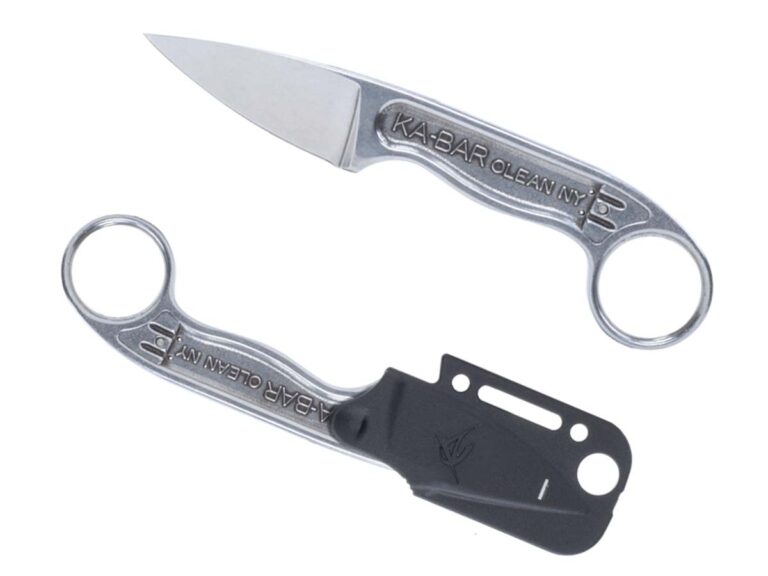
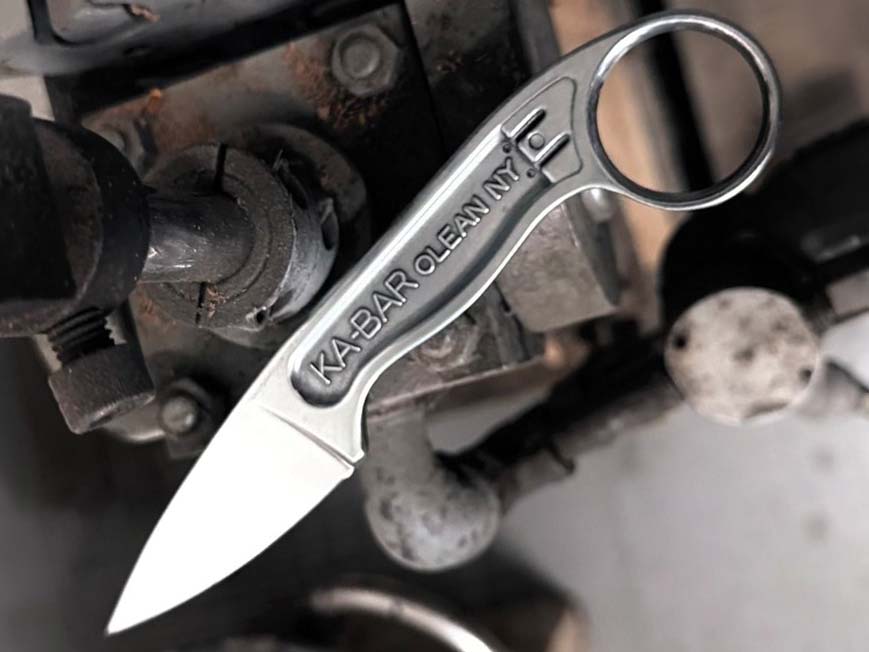
Designed by Allen Elishewitz, KA-BAR’s USA-made drop-forged EPT pairs a 2.5-inch blade with a clip-equipped sheath for easy pocket carry.
KA-BAR has expanded its line of drop-forged steel tools with the Elishewitz Pocket Tool, or EPT. Designed by veteran maker and former Force Recon Marine Allen Elishewitz, the compact fixed blade targets the growing daily carry market with a format tailored specifically for pocket carry rather than belt wear.
Built for Daily Duty
The EPT centers around a short, broad 2.5-inch drop-point blade ground flat to a 20-degree edge per side. KA-BAR crafts the knife from 0.1875-inch thick 425 high-carbon stainless steel, hardened to 56–58 HRC. The stout blade geometry offers plenty of strength for routine cutting tasks while keeping the overall footprint manageable.
Because the knife utilizes a one-piece drop-forged construction, the skeletonized handle is integral to the blade. A finger ring integrated into the butt end assists with control during use while serving as a quick-draw indexing point when pulling the knife from a pocket.
Pocket-Friendly Carry
Rather than relying on a traditional belt sheath, the EPT comes equipped with a custom USA-made sheath featuring a reversible, loop-over wire pocket clip. This setup allows the fixed blade to ride deep inside a pocket in much the same manner as a standard folding knife.
At 6.75 inches in overall length and weighing 3.2 ounces (0.2 lbs for the knife alone), the U.S.-manufactured piece delivers the structural integrity of a fixed blade without adding unnecessary bulk to a daily kit.
Elishewitz Pocket Tool (EPT) Specs Designer: Allen Elishewitz Overall Length: 6.75 in. Blade Length: 2.50 in. Blade Width: 1.70 in. Blade Thickness: 0.1875 in. Blade Steel: 425 High Carbon Stainless (56–58 HRC) Blade Type/Grind: Drop Point, Flat Grind Edge Angle: 20 degrees per side Construction: Integral drop-forged 425 stainless steel Weight: 3.2 oz. total (2.24 oz. knife weight) Sheath: USA-made sheath with reversible wire pocket clip MSRP: $78
Planning for a backwoods excursion? Here are four of the best hunting knife options, the fixed blade variety, presently rolling off factory lines.
As the fall outdoor season approaches, it’s important to assess your gear and decide if you need to purchase new equipment—hunting knives included. It’s time to maintain what you have or buy brand new models that will assist in camp chores and/or dressing game.
Fixed-blade hunters play an important role on the hunt as they do a lot more than just field dress. They also help prepare meals, prep firewood for cooking, and any other cutting chores that crop up.
Ontario Knife Co ADK Keene Valley Hunter
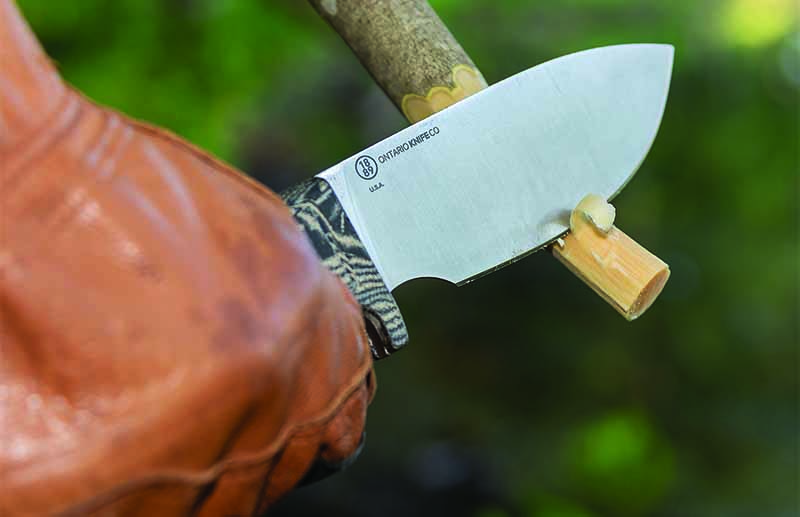
An example of one of the latest such edged tools is the ADK Keene Valley Hunter from Ontario Knife Co. The wide drop-point blade of 420HC stainless steel adapts to cutting or camp tasks easily. It offers plenty of belly to do the aforementioned chores and field dressing, too. Full-tang construction provide plenty of strength and balance. Interesting multicolor Micarta® scales supply a great grip in all weather conditions, and are highly resistant to cracking, chipping and peeling. The material’s highly stable nature and purchase qualities make it a favorite among users. The scales are tapered from the handle spine, allowing the knife to rest in your hand comfortably. The integral single guard and distinctive choil work in harmony to enable you to choke up on the handle for ever-greater cutting control and user confidence.
The best hunting knife? The deep-bellied blade of the Ontario ADK Keene Valley Hunter makes a case for it. It easily slices large cutting jobs down to size. ADK is short for the Adirondack Mountains, a range in Ontario’s home state of New York.
While 420HC is not my blade material of choice on such a knife, it has a good combination of both edge holding and ease of sharpening. Rounding out the package is a nicely sewn and riveted leather sheath that sports button-snap retention to hold the knife. Sheaths are often an area some manufacturers cut corners on to save money and hit the targeted price point, but not the ADK Keene Valley. The sheath is very nice in quality and holds the knife quite securely.
The handle feels a bit blocky but there are no crisp edges or anything to create hot spots. Micarta is one of my favorite handle materials due to its strength, light weight and color selection. It also has a nice grip-you-back quality. At 11.2 ounces the knife has a noticeable heft. The blade at its thickest is around .2 inch, which also contributes to the heavier weight but also plenty of thickness to withstand tough, unforgiving use. The flat grind thins it out nicely yet remains thick enough for strength. With its wide blade and generous belly, the knife slices really well—one of the traits to look for in a hunter.
Kizlyar Supreme Caspian
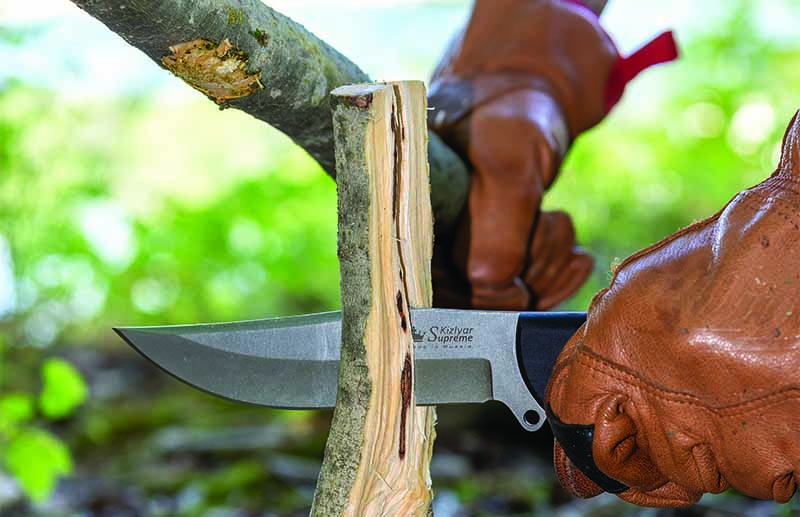
Ten inches overall, the Kizlyar Supreme Caspian features a hollow-ground blade of D2 tool steel and a handle of hornbeam wood. The classic clip-point-bowie blade never gets old and has a defined tip along with a prominent swedge. The bowie shape does equally well in the tactical and outdoor genres, a great overall pattern for both a tool and weapon. The hollow grind thins out the edge and gives the blade an extremely good bite. D2 has respectable edge-holding ability and is widely used in the production knife industry as an upgrade to lower-grade steels. It is well known for toughness and high impact resistance, which makes it an ideal inexpensive steel for outdoor knives.
The 5.4-inch clip-point blade of the Kizlyar Supreme Caspian provides plenty of sharpened real estate to process camp tasks and makes it a top hunting knife. Overall length: 10 inches.
The ergonomic handle features multiple finger recesses, and the butt turns down to form a pinky catch to prevent your hand from sliding rearward. The tang helps form an integral single guard, resulting in a comfortable, smart, secure handle design. Largely flat, the scales are secured via two hex-head screws. The handle edges are contoured for comfort.
The leather sheath is a riveted, sewn fold-over design. As a nice visual touch, contrasting thread is used for the stitching. The belt loop is a dangler type, allowing the hunting knife to ride a bit lower when affixed to the belt, as well as promoting greater freedom of movement to accommodate you in a seated position. Not every fixed blade has this sheath design and it is a plus in my book. To top things off, the sheath is stamped with the Kizlyar Supreme logo and website address.
The knife performs very well. It has the power to slice through various media with ease. It’s somewhat large for a hunter but does multiple cutting jobs, including camp chores and some food processing. The hornbeam scales are not stabilized so extra care might be required, such as but not limited to drying off the handle immediately after you wash the knife.
Spyderco Bow River
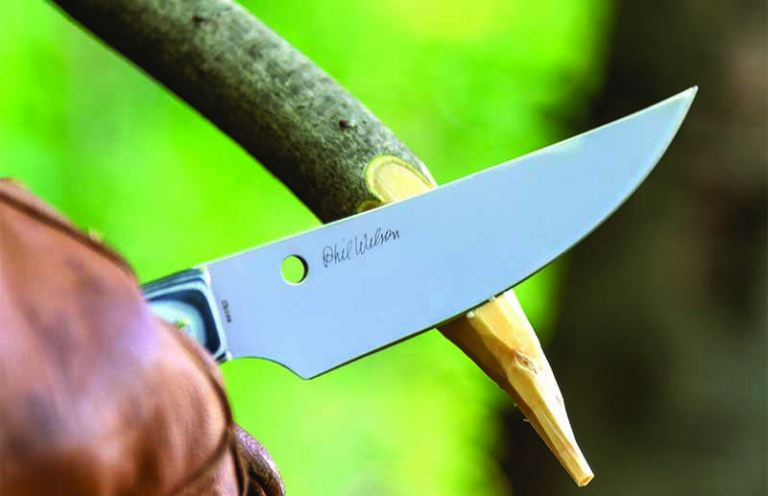
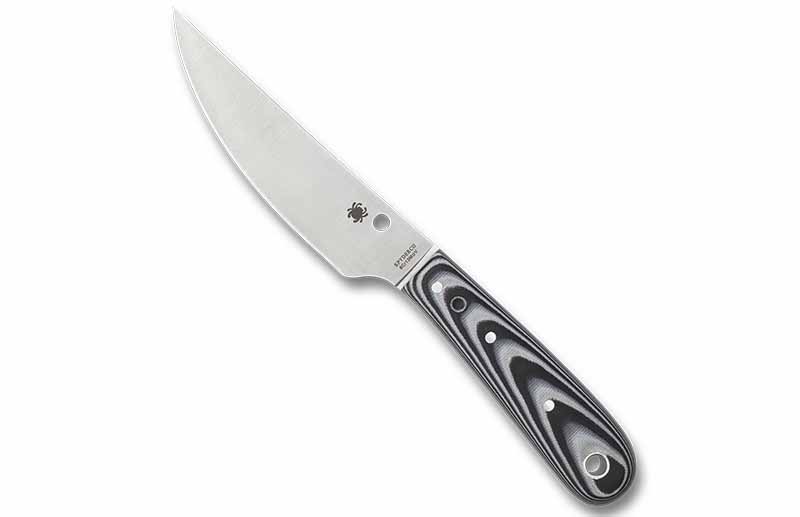
The FB46G Bow River is one of Spyderco‘s latest fixed blades. The design by custom knifemaker Phil Wilson is based on his experience as an avid hunter and fisherman. Spyderco has produced several of Wilson’s fixed-blade designs but those were always higher-end knives in terms of materials and price—until now.
The Spyderco Bow River is tailored for fine precision work such as field dressing and food prep in camp. It would make a great kitchen knife as well. (Spyderco image)
The Bow River is designed for the budget-minded outdoor enthusiast who demands performance and superior design in an edged field companion. Starting with the blade, 8Cr13MoV stainless steel is used for a good balance of edge holding and ease of resharpening in the field. The 4.36-inch blade is big enough to tackle most hunting chores but small enough to easily manipulate, as well as carry comfortably in a belt sheath. Wilson selected a trailing point blade design due to its generous sweeping belly that tackles slicing chores with ease. The full flat grind and distal taper enable the blade to sail through media easily.
The handle is rounded, contoured black-and-gray G-10. The alternating colored layers form a wood-grain-type pattern that is very eye-catching. The hunting knife rests in your hand comfortably and has no hot spots or crisp edges. The way the end of the handle is rounded off tucks into your palm snugly. Some with larger hands might find the handle a bit lacking but for me it’s just right. The surface finish is slick and devoid of texturing, though with the way the handle is shaped you can always get a secure hold no matter what. There is a large hole in the butt for a lanyard. The leather sheath is a sewn and riveted fold-over design with belt loop. It’s simple and executed very well, just like the Bow River. The knife fits inside the sheath well.
As for performance, it is definitely one efficient cutting tool. It is a well-designed fixed blade regardless of price. It is tailored for fine precision work such as field dressing and camp food prep. It would make a great kitchen knife as well.
Case Winkler Kyle Lamb Hunter
The Case Winkler Kyle Lamb Hunter salutes the design expertise of Daniel Winkler and military service of retired U.S. Army Sergeant Kyle Lamb. The 5-inch spear-point blade’s saber grind leaves enough material for strength—the full .195-inch thickness runs to the tip—but removes enough to thin the blade out for effective cutting. The choil and pronounced thumb rest help exert extra control when choking up on the blade. The 80CrV2 carbon steel is extremely tough and sharpens easily.
The Case Winkler Kyle Lamb Hunter serves well in outdoor or tactical settings. The 80CrV2 carbon steel blade provides the horsepower to tackle a variety of cuts. Overall length: 9.5 inches.
The black canvas Micarta® handle offers a great grip in most all weather conditions. It is rounded for comfort and has no hot spots. Two thong-tube pins secure the slabs, and there’s an extra-large oblong hole in the butt for a lanyard.
The hunting knife is a substantial tool. It has a good heft that conveys a solid feel and instills user confidence. It is equally at home as a tactical or outdoor knife because it has the features of both: great user blade shape, ergonomic handle and superior-grade materials. The blade is scary sharp out of the box. It dispatches large cutting jobs easily and quickly. Because the handle accommodates most hands very well, you can easily bear down and power through media. And when finesse is needed, you can choke up on the choil and thumb rest. The spear-point blade adapts to a wide range of tasks.
One word of note: some might find the gimping on the thumb rest and choil a bit harsh. It does bite into flesh just a bit but that can be a good thing, especially when your hands are wet, covered in animal blood or freezing. The gimping also works well if you wear gloves. They do a great job of biting into the glove material to keep the knife positioned in your grip.
The Kydex sheath is top-notch. Instead of a typical fold-over design it is a riveted one that incorporates a phenolic spacer material. The interior is lined with a felt-type material to reduce clatter. The exterior sports a laser cutout of Lamb’s Viking Tactics logo, a very nice touch. On the reverse side is a heavy-duty metal clip that affixes the hunting knife to belts up to 2 inches wide. The knife fits firmly inside the sheath with absolutely no play and no fear of falling out whatsoever.
Here’s a look at a movie knife classic, First Blood, and a movie that tried to rip off Rambo. Spoiler alert: ripping off Rambo is never a good idea.
Knife Use in First Blood: Rambo-esque, but Not Ridiculous
After I saw First Blood, the first Rambo movie, some buddies and I started to look at it with a critical, knife-centric eye.
Nothing that Rambo does in the movie is impossible. Some of the feats require a very well-trained man who’s in excellent physical condition, not to mention one who’s stubborn as hell. The feats also require a great deal of luck.
I’ve always been critical of fight sequences where the hero beats up 10-15 opponents all at one time. You can see the bad guys hanging back, each waiting his turn. That doesn’t happen in real life.
However, in First Blood, each person Rambo fights is physically isolated, so Rambo can take each one on one-on-one. It could work that way. The movie was very well thought out choreographically.
At one point Rambo leaps from a cliff and falls through a pine tree, breaking tree limbs on the way down, and survives. Tricky and tough—and yet possible. I once fell out of a pine tree, breaking pine limbs on the way down, and wasn’t hurt at all except for my 18-year-old ego. It was about a 20-foot drop, not anywhere near what Rambo fell, but long enough to convince me that it was possible to survive it.
Rambo’s use of the knife in First Blood is excellent. He knows what he’s doing. One of the first things he does is use the knife to make a spear, which is a good idea because a spear is a better hunting tool and a much better weapon than a knife. For one thing, a spear has reach and speed over a knife alone.
First Blood is an exciting movie. If you haven’t seen it, rent it. It’s worth it.
Knife Use in The Hunted: Ridiculous
Several of my friends saw The Hunted and told me that it was the MOAB (Mother Of All Bombs). However, having seen The Musketeer, I didn’t believe them. While The Hunted isn’t the MOAB, I would put it in the 2,000-pound category.
The Hunted isn’t a remake of First Blood but copies it—and does a lousy job at that.
The movie opens with a hellish scene in Kosovo, with Serbs killing Albanians right and left, especially women and children. I think the viewer is supposed to get the impression that all the Kosovo violence has driven the villain, Aaron Hallam— played by Benicio Del Toro—crazy.
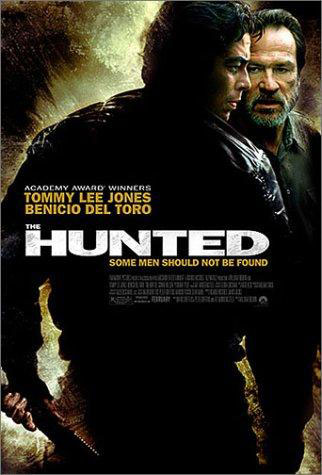
I realized that I was in a fantasy movie very quickly. Tommy Lee Jones, who portrays L.T. Bonham, is running through a forest that’s deep in snow when he sees a wolf caught in a snare. He catches the injured animal, frees it from the snare and then dresses its paw. The animal doesn’t bite Bonham or, for that matter, make any threatening moves whatsoever. Heck, my wife rescued a four-week-old puppy a few months ago and was bitten!
(image via imdb.com)
The plot is that Hallam is a real killing machine whom Bonham has trained. The main action takes place in the dense rain forest of Oregon—sound familiar?—and starts with a scene of two deer hunters. The hunters are equipped with bolt-action rifles sporting monstrous telescopic sights. Stupid is such a harsh word, so let me just say that it makes no sense to use telescopic sights in underbrush so thick you can’t see 10 yards in front of you!
Anyway, Hallam threatens the hunters, telling them they have no reverence for life, and they have to match their guns against his knife. Needless to say, he kills the hunters, and subsequent photos show that he chopped them up like butchered deer. Meanwhile, it turns out that he also has killed a couple more hunters. Since the movie never offers any other reason for Hallam’s behavior, I guess he must have joined a radical arm of PETA (People for the Ethical Treatment of Animals).
Bonham is an amazing tracker and expert knife fighter who’s called in to capture the killer. He starts out after Hallam and, of course, doesn’t take a weapon. Hallam immediately finds Bonham, they have a brief fight and the chase begins.
I can’t begin to tell you how incredibly stupid this movie is. For one, in one scene a thrown knife goes all the way through a tree trunk that looks to be about 3 inches in diameter! Bonham knaps a flint blade to use as a weapon, never thinking to simply buy a knife instead.
One of the most startling scenes is when Hallam breaks off chunks of leaf spring. He starts a small fire and then forges a knife using the chunks of leaf spring for steel, and another chunk as a hammer. After he rough forges the blade, he hardens it and then files it! I have no idea where he gets the file, let alone how an open fire that size develops the heat necessary to forge steel.
In certain segments, The Hunted is a direct steal of First Blood, right down to Bonham repeating a quote from the Stallone movie about how many body bags will be filled in the quest to nab Hallam.
The knife fighting and the scenes showing the training aren’t so much stupid as just silly. Some guy stands still as someone pretends to cut his throat, chest, stomach, brachial artery, and then moves down to cut both femoral arteries! I mean, what’s the point? How many times does your opponent need to bleed out? It’s like blowing up a rabbit with a stick of dynamite—the furry little critter can only die so much!
The final fight sequence between the two principals is very poorly choreographed. It bears no resemblance to a real fight. For those who have read my reviews about movie knives before, you know that I feel a fight must follow the flow of the film. In other words, it need not necessarily be a “real” fight but one that must be consistent with the plot. In that respect, the final fight does follow the plot—both are total and complete nonsense.
Don’t waste your time or your money on The Hunted. This time I did the suffering for you.
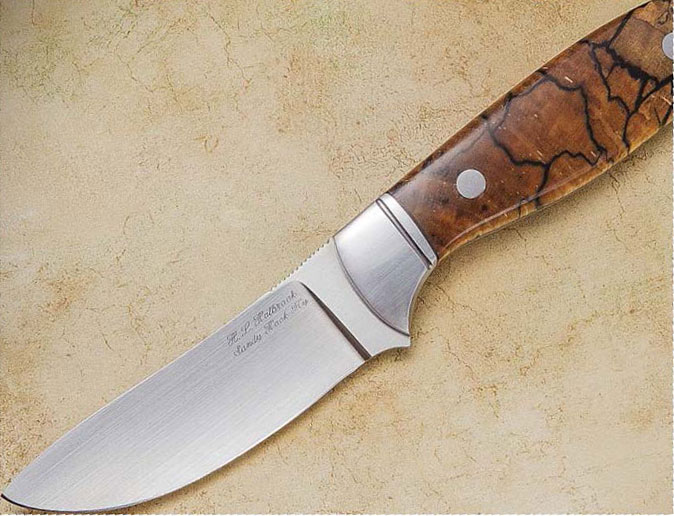
The gentle rise of the tip area of the blade is the classic sign of a skinner—or in this instance, the Semi Skinner #2 by H.L. Holbrook. The 3.5-inch blade is CPM 154 stainless and the handle is stabilized maple. Overall length: 8 inches. Contact H.L. Holbrook, Dept. BL3, POB 483, Sandy Hook, KY 41171 606-794-1497. (Chuck Ward image)
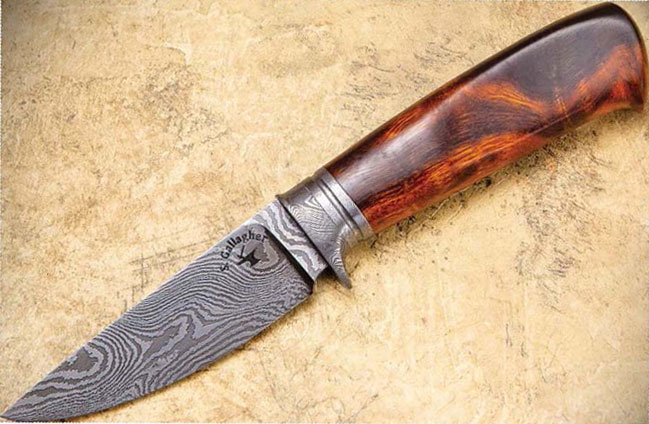
Scott Gallagher employs a 3-inch damascus blade, a damascus single guard and a handle of Arizona ironwood for his hunter. Overall length: 6.5 inches. Contact Scott Gallagher, Dept. BL3, 335 Winsten Manor Rd., Santa Rosa Beach, FL 32459 850-865-8264. (Chuck Ward image)
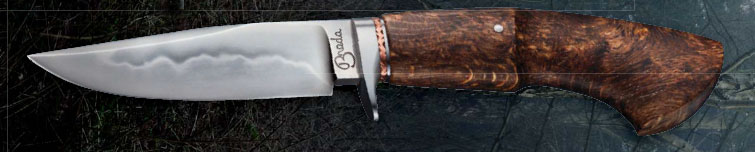
A 4-inch clip-point blade of W2 tool steel with hamon and a spalted sycamore handle and fileworked copper spacer distinguish Ben Breda’s hunter. Overall length: 9 inches. Contact Ben Breda, Dept. BL3, 56 Blueberry Hill Rd., Hope, ME 04847 [email protected]. (Caleb Royer image)
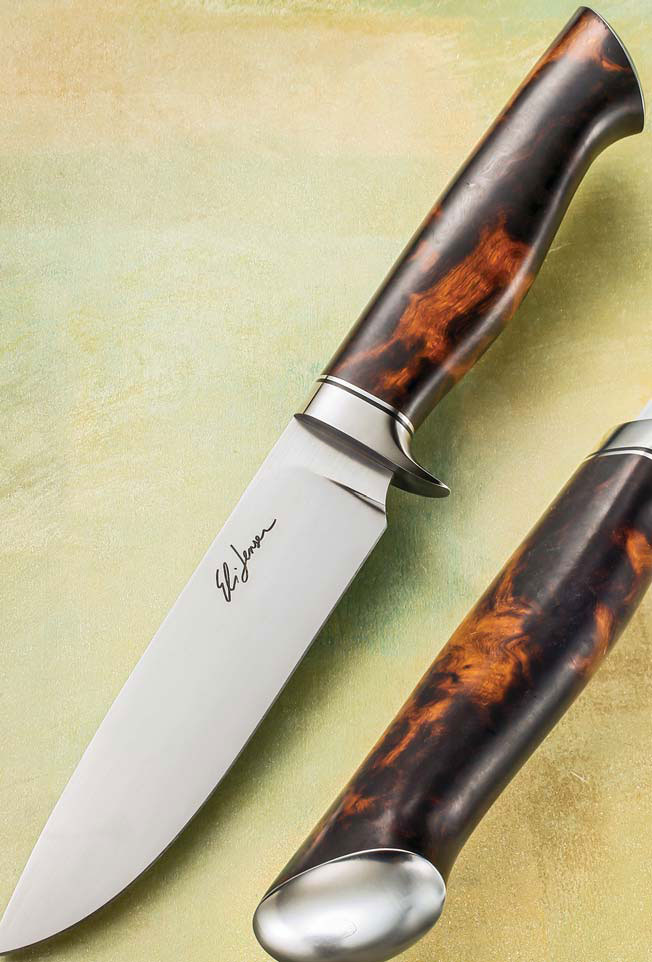
A gorgeous Arizona ironwood handle with a domed/curved 416 stainless steel butt plate and G-10 spacer, and a 5.75-inch blade of 1084 carbon steel help complete Eli Jensen’s Forester MKII hunting knife. Overall length: 10.75 inches. Contact Eli Jensen, Dept. BL3, 2840 W. Dreamscape Way, Chino Valley, AZ 86323 928-606-0373 [email protected], Facebook/Instagram: Eli Jensen. (Sharp-ByCoop image)
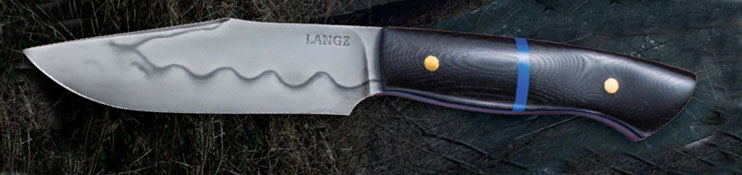
Kenneth Lange received an order for this hunter by a family friend whose husband is celebrating 10 years on the police force—thus the thin blue line on the black G-10 handle. The 4.5-inch blade is 1095 carbon steel. Overall length: 9 inches. Contact Kenneth Lange, Dept. BL3, 1200 County Road 5711, LaCoste, TX 78039 210-218-9415 [email protected], Facebook/Instagram: kjl_handmadegoods KJLhandmadegoods. (SharpByCoop image)
Top makers explain how they collaborate with knife companies.
The old cliché of the win-win holds a real grain of truth. Any successful partnership must be mutually beneficial, and in the knife industry the phenomenon of the collaboration has come to exemplify the upside of working together.
Years ago, a veteran custom knifemaker described his relationship with a major manufacturer as serving as the company’s research and development department. Such a description is accurate in that the manufacturer often relies on the custom maker for new design inspiration, from good looks to materials and mechanics. The collaboration has emerged in the last 35 years or so as an outstanding means of bringing innovation to the public and putting first-rate knives in the hands of the mass market.
The ins and outs, nuts and bolts, and give and take of the collaboration process raise questions for makers interested in striking deals of their own. A few comments from makers who have achieved great success on the collaboration frontier offer helpful insights.
“It goes both ways,” observed BLADE Magazine Cutlery Hall-of-Fame® member Bob Terzuola, who indicated he completed his firstfactory collaboration with fellow Cutlery Hall-of-Famer Sal Glesser and the design team at Spyderco in 1989. “You can go to the company or the company can come to you depending on your notoriety. If you are just starting out, you probably have to go to the company.”
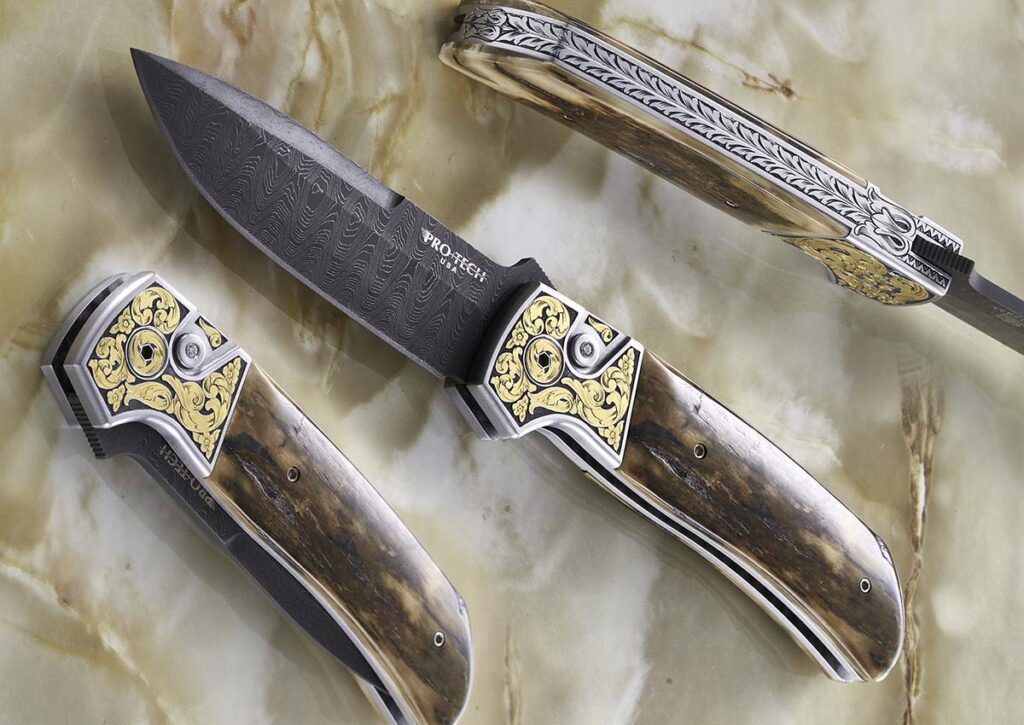
On the business side of the ledger, Suzi Terzuola takes the lead and has demonstrated proficiency in making the deal work for everyone involved. Her flair for negotiation and finding the right blend of maker-manufacturer cooperation has been demonstrated through the years as Bob has worked not only with Spyderco but also the old Camillus, Boker, Fox, Pro-Tech, Tactile Knife Co. and others.
BLADE Magazine Cutlery Hall-of-Fame® member Bob Terzuola has done collaborations with many companies, including the Bob Terzuola ATCF Auto Ultimate from Pro-Tech, the BLADE Magazine 2022 Investor/Collector Knife Of The Year®. (Eric Eggly/PointSeven knife image)
“I was raised by parents with their own successful businesses,” Suzi observed, “and I saw Bob receiving passive income from Spyderco and Camillus, and of course passive income is how you survive after having only so many years to make knives. I began looking at the knife designs Bob had and tried to match the design to the company. Bob has patents lining the walls, and when he lends his name to a knife he should receive a signing bonus and a bonus against the royalties.”
In return for his design skill and the use of his name in promotions, Bob has certainly established himself as a leader among successful custom collaborators. His contribution to a company’s success has enhanced his reputation of excellence across the industry, while Suzi has forged a business posture that results in security for the future.
Knife Collaboration Contracts
The contract is the key component of a collaborative deal, and depending on the circumstances everything is negotiable. Although early agreements made among friends were sometimes done on a handshake, it has become a “best practice” to hammer out the terms of the collaboration on paper, invest in an attorney’s review, and formally memorialize the discussions. Standard royalties run roughly 5 percent of the price at which the company sells the knife.
The Terzuolas include a period of time in which the company is allowed to produce the knife; the period may be extended at maturity with the agreement of both parties. Further, there may be a requirement that the company produces a certain number of knives in a given time period, also renewable. Restrictions on wholesale pricing or discounts that affect royalties may also be negotiated.
For those considering a foray into collaborations, Bob and Suzi offer some advice: “If you’re a new maker, you shouldn’t just walk up to [the company’s] booth at a show. Make an appointment to see them because they are at the show to deal with customers. Approach a company with one or more finished designs. They want a package presented to them, a prototype or existing model, something they can hold in their hands, and in the case of a prototype it’s good to have as many innovations and design creations as you can—anything that will set the knife apart from other potential deals out there.”
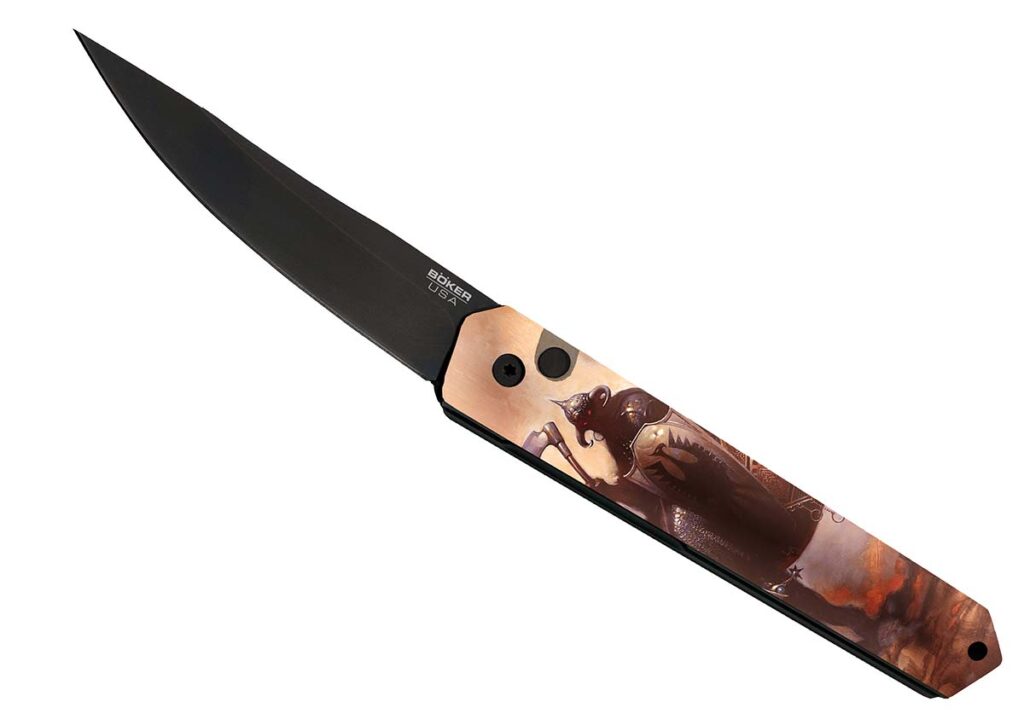
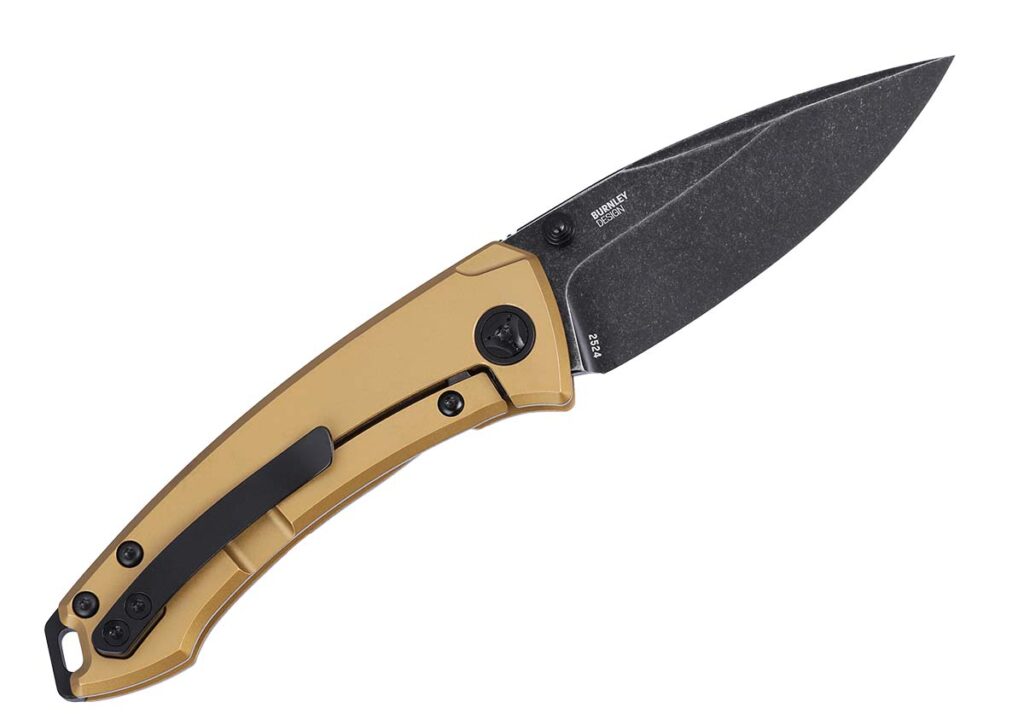
Lucas Burnley has designed several iterations of his Kwaiken for Boker, including the Kwaiken Auto Frazetta.
Suzi added that a higher profile in the industry can drive success.
“We are the R&D for a knife company,” she noted, “and when you approach them for a collaboration your social media resumé is very important.”
Making custom knives since 1994, Darriel Caston has concluded collaborations with numerous companies, including CRKT, Spyderco, Boker, V Nives, Kansept Knives and more.
“I’m prolific when it comes to designs,” he affirmed. “There are probably about 300 that I will never get to making. I’m an engineer by trade and my 3D drawings are almost ready for production, and that helps with the deals. They ask for STEP files [standardized 3D model data files for CAD and 3D printing] that can go right into machining. Sometimes we work with a prototype, and sometimes we work with a knife that I have been doing for quite a while.”
According to Darriel, one significant element of the collaboration is the retention of the rights to the design.
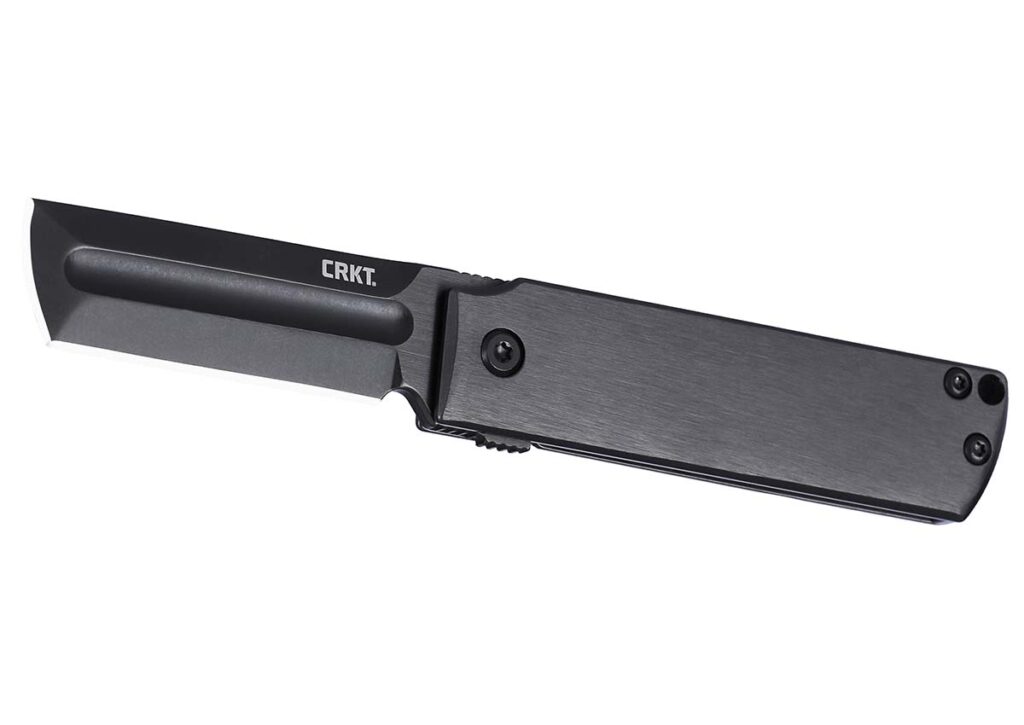
“Anybody who wants to do a collaboration must put footprints in the sand, get their work out there and show a story,” custom knifemaker Darriel Caston observed. One of his latest designs for CRKT is the blacked-out MinimalX framelock folder, an evolution of a knife originally made for SpaceX to commemorate a rocket launch.
“You never want to give up your design,” he warned. “I would license the design to the company usually up to four or five years, and the average is three years. After that, you can discuss if you want to continue if the relationship has been good for both parties. License the design and never sell it. If a company buys the design, then they own it forever. If it became their best seller, I could never make the knife again, and I would have to stay away from anything that looks like it.”
For Caston, every deal starts with a friendly conversation. As progress is made, attorneys draw up the contract. He sees the process as straightforward, whether dealing with an American manufacturer or a company headquartered in a foreign country.
“I find the knife community for the most part to be very honorable,” he commented. “I haven’t run into any bad juju. When you want to do a collaboration, I tell people they need to have a name and a track record of good designs with people following them on social media and stuff.”
Since his first collaboration—with Spyderco in 2015—Darriel can speak with confidence regarding the potential for success.
“It would be rare for someone to take a design to a company without a history or a footprint there. They look for your story,” he noted. “Anybody who wants to do a collaboration must put footprints in the sand, get their work out there and show a story. Then it becomes easier.”
Getting A Collab Off The Ground
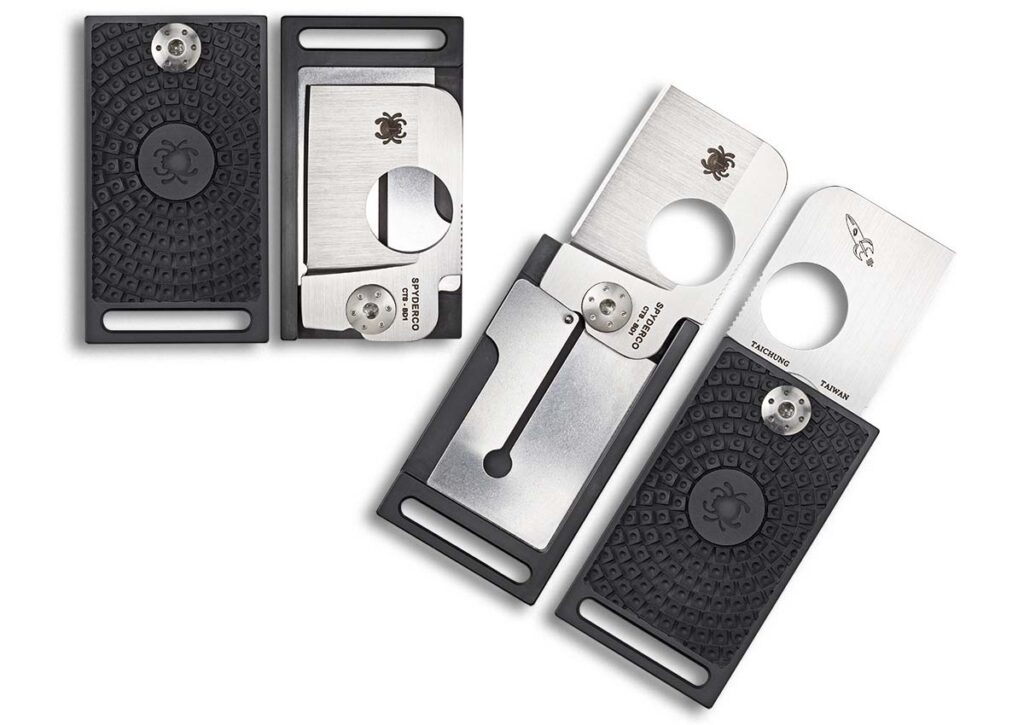
Darriel Caston has concluded collaborations with several companies. “I’m prolific when it comes to designs,” he affirmed. “There are probably about 300 that I will never get to making.” Now discontinued, the Squarehead was one of his early collaborations with Spyderco.
Custom maker/U.S. Marine Corps veteran Les George found early collaboration success at the SHOT Show some years back. He approached Pro-Tech a decade ago, and the association has continued since then.
“I had just finished my first batch of VECP [Value Engineering Change Proposal] mid-tech knives,” he remembered, “and I thought it would be cool to see Pro-Tech make the knife in an automatic. So, I did the CAD work to change the knife to an automatic and walked up to their booth at the SHOT Show. I asked to speak to the owner, and Dave Wattenberg came over and shook my hand. I drew a big breath and told him, ‘My name is Les George and I am a knifemaker and I have a design I think would be a great knife for you to make as an auto and I already have the CAD done would you like to see it?’ I said that all as one sentence in one breath!”
Still, a pragmatic view of the collaboration landscape demands preparation and planning. A so-called “cold call” may not meet with success.
“It depends on the company whether a direct approach will work or not,” George conceded. “Don’t walk up to a company at the BLADE Show and tell them you’re a hot maker and they should pay you to make one of your designs. Instead, walk up, introduce yourself, and show them with CAD pictures, a 3D printed model, or a real knife, and tell them why you think it would be awesome to work with them on a production project.”
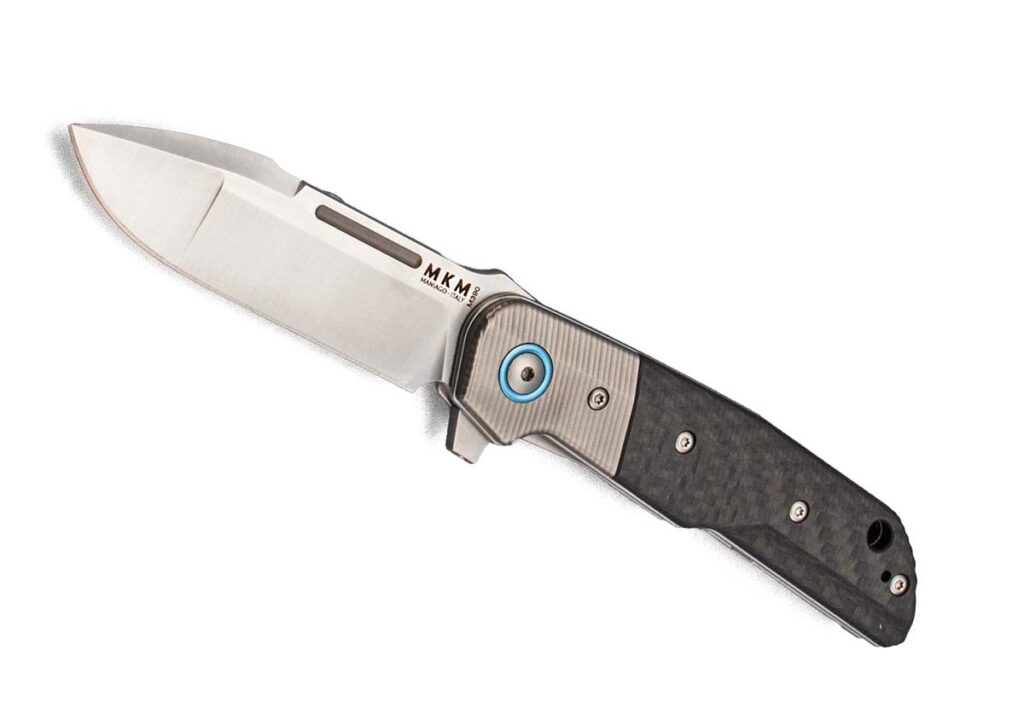
When it comes to her husband Bob’s collaborations, Suzi Terzuola takes the lead and has demonstrated proficiency in making the deal work for everyone involved. An example of several overseas Terzuola collaborations is the Clap from Italy’s Maniago Knife Makers.
Les sees the components of a particular collaboration deal varying. Of course, some of the structure depends on the negotiating skills of the parties. Commonly, the compensation may revolve around a percentage of dealer or distributor pricing on each unit, and particular deals may extend as long as each party is pleased with the progress.
“Collaborations should run as long as they are profitable,” Les remarked. “Companies don’t generally kill a successful project unless there is a capacity constraint issue or something else outside hindering it. Both parties can end the deal at any time with some allowances for production to finish with the things they have in progress already. Every contract I have ever seen gives one company the rights to exclusively make a particular model. My contracts have a provision that I can make as many customs of my models as I want. In the end, it would be counterproductive to license the same model to multiple companies. The maker would be competing with himself at that point, and it’s not helping the companies.”
Priming The Pump
Award-winning maker Lucas Burnley appreciates the help of friends in establishing a firm footing for collaboration.
“In general, I’m a big fan of pulling on my network,” he said. “If you have someone you can reach out to for an introduction, that’s always a strong move. If you don’t have someone to make an introduction, you might be able to ask around and at least figure out who you need to talk to. Regardless of how you get your foot in the door, I highly recommend going to a knife show and trying to set up a meeting in person.
“A design is only one part of a collaboration,” he continued, “so bring your ‘A’ game and think about what other value you can provide for the company. I was introduced to Boker by Jens Anso and Jesper Voxnaes, and Ken Onion put in a good word for me with Columbia River Knife & Tool. I’ll be forever grateful for those introductions and the relationships behind them. I’ve been able to pay it forward a few times, and hopefully I’ll be able to do it many more times in the years to come.”
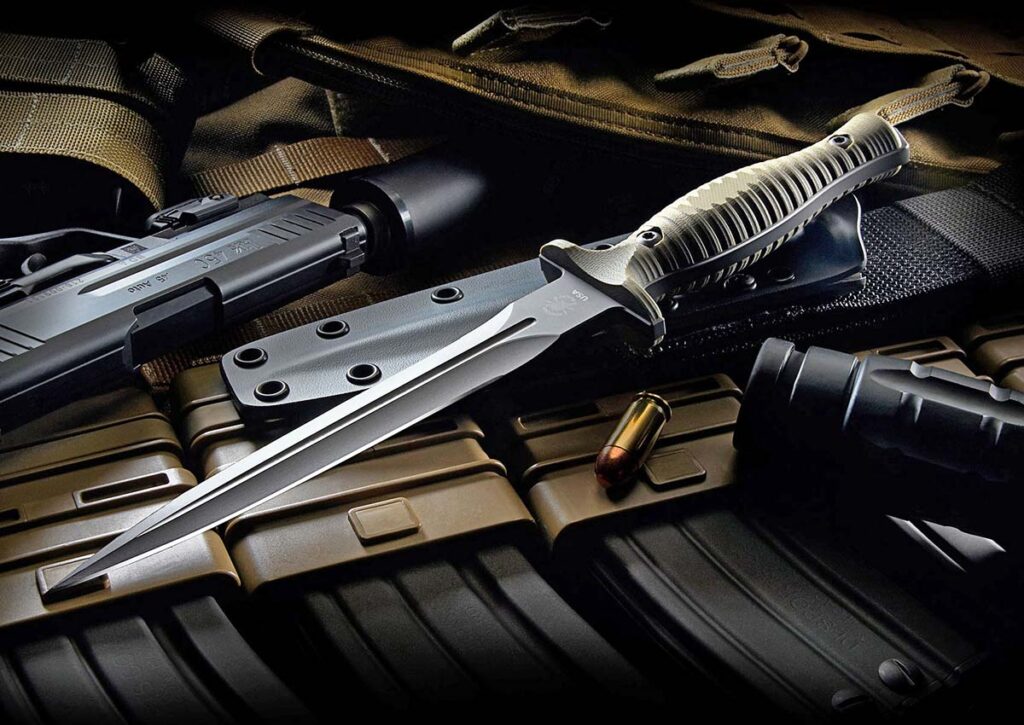
Les George’s V14 dagger design for Spartan Blades was the BLADE Magazine 2014 Investor/Collector Knife Of The Year®.
In Burnley’s experience, contracts provide compensation most often in the form of monthly or quarterly royalties based on a percentage of sales. One-time lump sum payments are also seen; however, the income generated depends on the goals of the two parties involved.
“I want my designs to run until my grandkids are old enough to thank me for my good decisions,” he laughed. “If a model is selling, I want it to keep selling. On the flip side, I will routinely ask what models we can kill if they aren’t pulling their weight.
“One caveat here is that if a design is still in production, I want to get paid for it,” he concluded. “Some companies will offer a contract for a set period of time but have the option of continuing to produce the model. I view this as somewhat akin to a one-time payout. If it works for you great; just make sure you are paying attention.”
George specifically limits the number of companies he works with in order to give the relationships the priority he believes they deserve. Consistency, he says, is huge. Real, solid collaborations are not “get-rich-quick schemes.” He remembers getting his first collaboration check in 2014 totaling a whopping $6.
“A design is only one part of a collaboration,” Lucas Burnley observed, “so bring your ‘A’ game and think about what other value you can provide for the company.” His Tuna Compact framelock design for CRKT is one of his latest collaborations. “A design is only one part of a collaboration,” Lucas Burnley observed, “so bring your ‘A’ game and think about what other value you can provide for the company.” His Tuna Compact framelock design for CRKT is one of his latest collaborations.
Times change—and checks change with good business practices, commitment, follow through, and most of all a process from contract to design and product that proves profitable for everyone.