

While visiting Sid Suedmeier at the Little Giant shop in Nebraska City, NE he explained the differences between the Old and New style Little Giant Power Hamm…
Knifemaking is the building of a knife, which includes the blade, handle and other accouterments. Blades are made by either removing metal from a steel blank via a grinder – known as stock removal – and the forging to shape of hot steel into a blade in the process known as bladesmithing. Other parts, including bolsters, guards, pommels, etc., are needed to complete the finished knife.
| Featured Knives – | – Knife Collecting – | – Tactical Knives – | – Survival Knives |

While visiting Sid Suedmeier at the Little Giant shop in Nebraska City, NE he explained the differences between the Old and New style Little Giant Power Hamm…
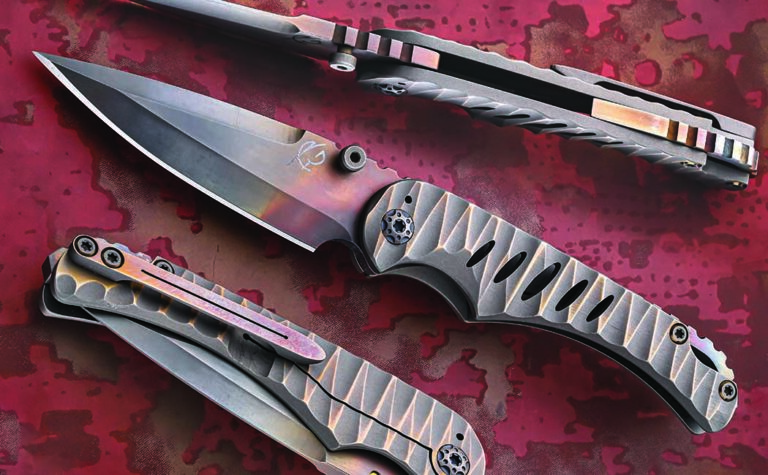
The long days of the COVID-19 pandemic may be mostly past us, but the cabin fever drove many people crazy. However, for some, those days inside proved to be a cauldron of creativity. For one knifemaker in Arizona, the creative juices flowed forth and gave birth to a one-of-a-kind knife.
Shane Magnussen was looking for ways to keep from going bonkers during the pandemic and found one with his “personal renaissance challenge.”
The challenge consisted of him sketching one new knife design per day for 75 days and then putting them all up for a vote on social media. The folder winner was his Sinnsyk model.
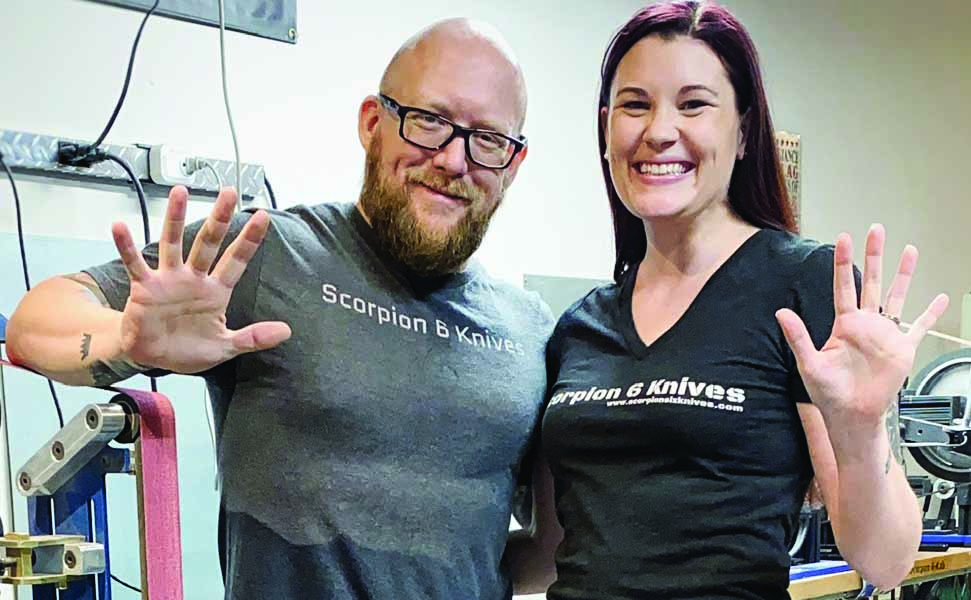
Shane is a former serviceman who led over two dozen successful operations in Afghanistan for the United States Army. After receiving an honorable discharge, Shane went into the automotive field and worked in numerous parts of the industry.
Eventually, he began working at a knife manufacturer and caught the knifemaking bug. From writing manuals about free hand grinding to innovating custom finishing methods Shane gained the experience needed to launch his own knife company, Scorpion 6 Knives.
Shane is first-generation Norwegian and sinnsyk is Norwegian for insane or crazy, which most people have been driven at least half during the troubles. His wife, Katie, helped with the zig-zag texturing on the titanium handle, which they did on a half-inch wheel of a Travis Wuertz TW-90 grinder.
The elliptical holes are a standard Shane design and enhance looks, lightweight and texture. The line down the center of the electro-anodized pocket clip serves as a kind of truss to keep the clip from grabbing neither too tight nor too loose.
Sinnsyk Knife Specs
Knife: Sinnsyk
Knife type: Folder
Blade length: 3.66 inches
Blade steel: Nitro-V stainless
Blade pattern: Spear point
Frame: Grade 5 titanium
Lock: Framelock
Closed length: 4.94 inchesMaker’s price for a similar knife: $1,200
For more information contact Shane Magnussen, Dept. BL3, 914 W. Belmont Red Trail, San Tan Valley, AZ 85143 [email protected].
Read More
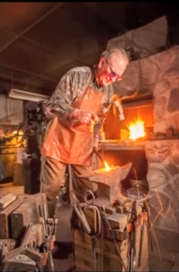
In this video from the American Bladesmith Society (ABS), master smith Jay Hendrickson gives some insight on ABS founder Bill Moran. His story offers a fascinating look at important pieces of knifemaking history.
Hendrickson is just one of the many knifemakers influenced by the legendary Bill Moran. Other than his highly-coveted originals, Moran’s work lives on through styles emulated by a number of other makers and companies, including this excellent Spyderco Bill Moran Drop Point Blade at ShopBlade.com.
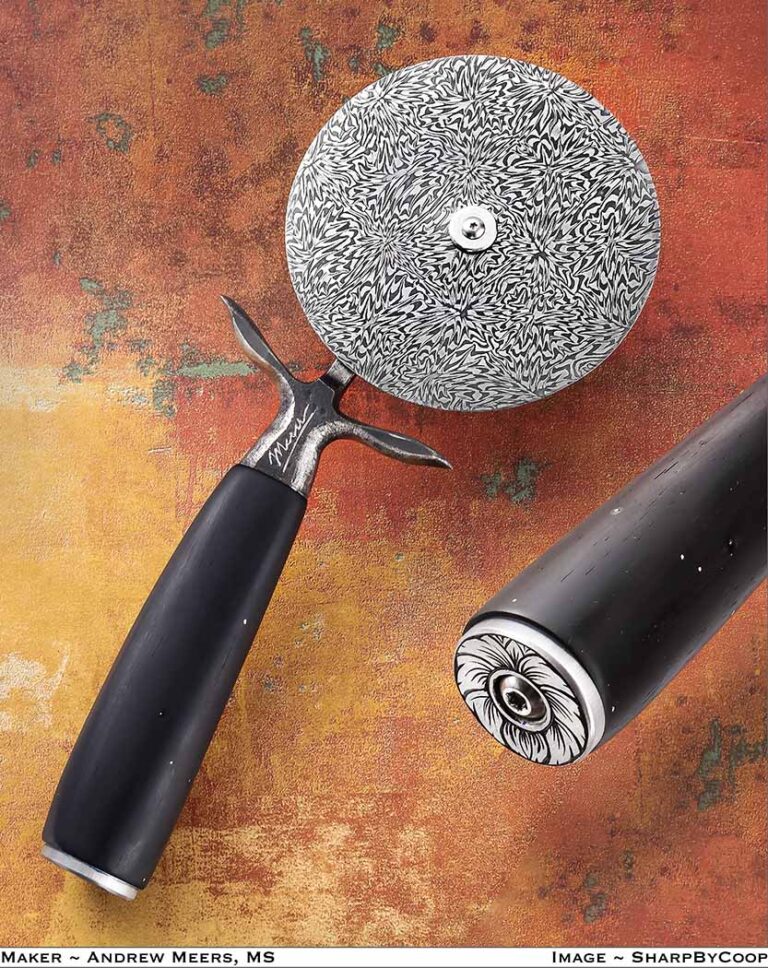
Andrew Meers loves pizza, so when his factory pizza cutter broke, he fixed it—and then made his first-ever custom version of one. The result has features only an award-winning ABS master smith such as Andrew would include.
Fresh out of the oven is the mesmerizing disc cutter in a W’s explosion pattern mosaic damascus. A pet peeve is loose pizza cutter discs that rattle, so he tightened his down with the help of a folding-knife pivot fitting.

The arm and guard are forged stainless with a blackened brut de forge look. He forged the crossguard in a plant-like shape, drawing the quillons out and giving them fullers for a bud-like appearance. The grip is ebony inlaid with bits of silver to resemble stars in the night sky.
If 20th-century actor, comedian and singer Dean “The King of Cool” Martin were here, he might croon, “When the moon hits your eye like a big pizza pie, that’s amore.”
For more information on his pizza cutter, contact Andrew Meers:
Email: [email protected]
Website: andrewmeersstudio.com.
Pizza Cutter Specs
Model: Pizza cutter
Maker: Andrew Meers
Dimensions: The cutting disc is 3.5 inches in diameter; the cutter’s overall length is 9 inches
Disc Material: W’s explosion pattern mosaic damascus of 1084 carbon and 15N20 nickel-alloy steels
Handle frame and guard: Blackened forged stainless w/a brut de forge look
Scale material: Ebony inlaid w/silver “stars”
Engraving: In a traditional Japanese line style by Andrew Meers
Andrew’s price for a similar piece: This one sold for $850
Andrew’s favorite pizzas: Meat Lovers, including the Whole Hog (red sauce, pepperoni, bacon, red onion, green pepper, jalapeno and mozzarella), and the Margherita, a typical Neapolitan pizza w/San Marzano tomatoes, fresh mozzarella, fresh basil, salt and extra-virgin olive oil
Read More
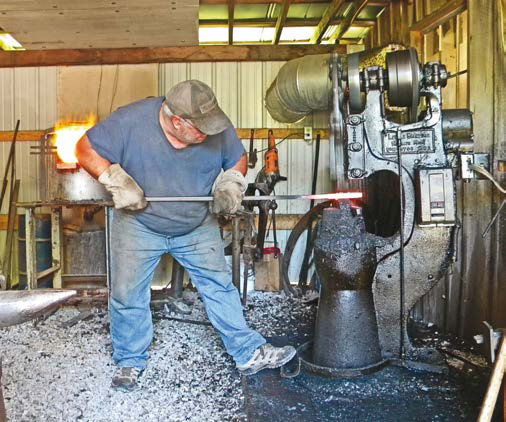
Like most forgers, I try to build a stockpile of damascus and different sized blades in the winter months when the temperature is below 50 degrees F. Sometimes, because of where you live, it might not drop below 70 degrees F. Hot is hot no matter where you forge, and there will be a time when you have to forge no matter how high the temperature is.
Here are some helpful hints to get you through the hot times.
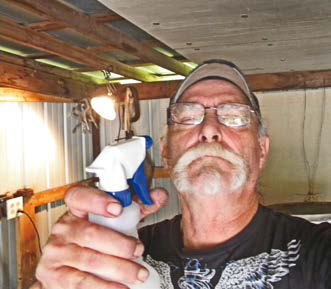
“Pre-hydrate” the day before you are going to forge. Also, drink plenty of water during forging and afterward. I use a squirt bottle to spray myself during forging to add extra cooling. Staying hydrated should keep those nasty headaches away.

If you are lucky enough to have a second person that knows how to forge helping you, take turns doing the work. This limits the amount of time one person has to stand by the hot forge. After your turn, get away from the heat and drink fluids.
Usually I’ll pull a chair close to the door to catch any breeze that might be blowing. I place a fan to blow across the cooling chair if the temperature’s above 90 degrees F. Some have a gas forge that can be moved outside, which is better for the radiating heat, though a strong wind can mess with the fire.
The main point here is to limit the time you are exposed to the forge heat.
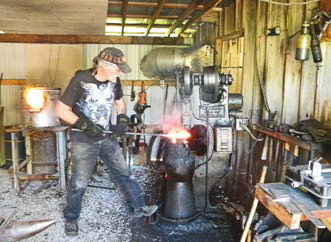
I do away with such coverings as aprons, arm covers and/or long sleeves. I haven’t gone to shorts because there would be a piece of hot something rolling down my leg and into my work boots. No amount of stomping around gets it out. I stick with jeans.
A towel or rag that helps keep the sweat from getting in your eyes is a good idea. Your shirt will be soaking wet after a few minutes, so don’t count on it as a sweat sponge.
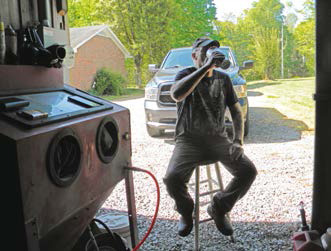
When welding damascus on very hot days, one day I do just the first weld to seal the billet. Then the next day, I stretch the billet. The following day, I cut and restack the billet for layer count.
I follow this pattern till I have the billet the way I want it. This takes a lot longer but it doesn’t wear you out at the end of the day.
Then again, sometimes I just work through the heat and sit in my truck with the air conditioning on high. An extra shirt also helps to keep sweat off your vehicle seat.
So remember: Drink fluids, limit your time being by the hot forge, stay as cool as possible—and keep forging!


Based in Sheridan, Wyoming, by way of Tennessee, 30-year Knifemakers’ Guild member John Bartlow uses CPM-154 for his bird and trout and hunting knives. When Bartlow first started making knives, he was also a hunting outfitter.
As a result, he gutted and skinned a lot of animals on a weekly basis. Having many of his guides use his knives, he got a lot of feedback over the years about design and function.
“I started out with 440C stainless steel a million years ago,” Bartlow remembered. “I quit that nearly 20 years ago and jumped to ATS-34 stainless and used it for years and years.”
He said that about a decade ago he started to become frustrated with the quality of the ATS he was getting. There weren’t major structural problems like chipping or breaking, but there were very subtle issues Bartlow observed under 10-to-12-power magnification.
“My customers never noticed it but it bugged me,” he continued. “I was trying to get some finishes in that stuff —and I was buying through normal channels from several suppliers—but when I would go to finish it, once in a while I’d get this little area that looked like it had pits in it, or it kind of had a little ‘road rash’ that I could not get rid of.”
He approached other makers about it at the time and they said they’d seen the same thing. That motivated him to jump ship to CPM-154, he said, which is very much a sister steel to ATS-34 and 154CM.
“They are closely related on the family tree of steel,” he said. In CPM-154, he found a material that allowed for a flawless finish. With the powder metallurgy process and the accompanying uniform distribution of carbides, it eliminated the “road rash” issue.
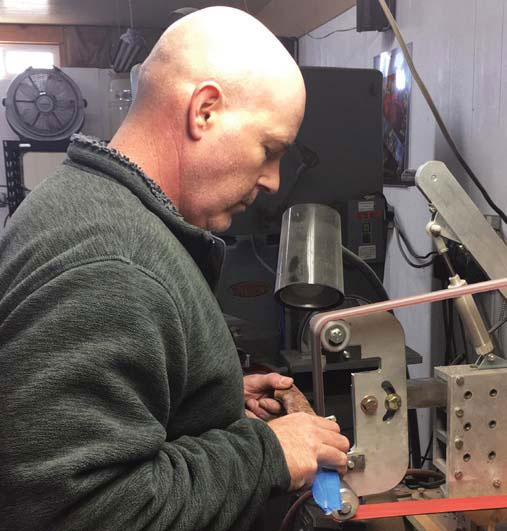
Custom maker David Sharp uses CPM-154, including on his reproductions of the knives of BLADE Magazine Cutlery Hall-Of-Fame© member Bob Loveless. Since Sharp began building knives in 2010, he has specialized in fine-finished fixed blades.
“A large percentage of my knives have a very fine finish, polished or over-1200-grit hand satin,” the maker based in Hesperia, California, remarked. “CPM-154 is very fine, so when it’s finished to a high level you don’t see the steel’s grain.”
He added that CPM-154 is not quite as abrasion resistant as other of the relatively newer steels, so obtaining a fine finish is a bit quicker. He said that though steels are an oft-discussed topic online, he very seldom has customers request a steel type or brand, which could be seen as a testament that his choice of CPM-154 is a good one.
“I have not noticed a downside,” Sharp continued. “The upside is the finish and that it is, in my opinion, a balanced steel. For the majority of users it exhibits excellent edge retention, sharpenability and corrosion resistance.”
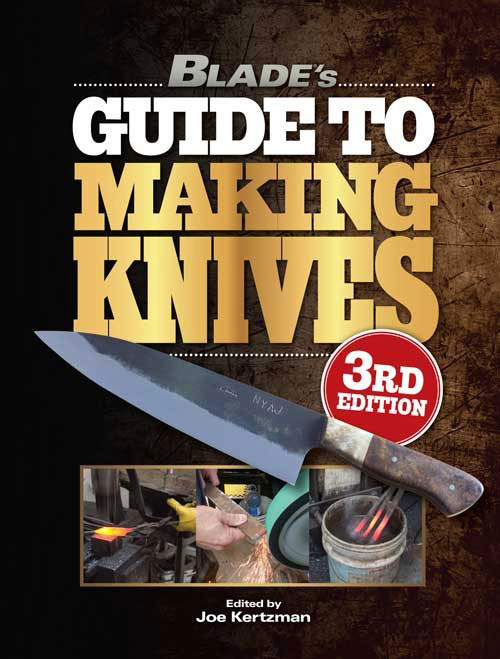
The Japanese influence on custom knives is everpresent in the marketplace, and, aside from the tanto, nowhere is its flair and focus felt more than with chef’s knives.
These tools of the culinary trade are functional as much as they are eye-catching, especially in examples of some of the top makers in the genre today.

Dmitriy Popov has conjured up a masterpiece he calls the wide-bevel Honyaki Gyuto Hybrid, a new take on a recognized Japanese style.
“It isn’t a traditional gyuto, as it has an upswept tip and the height of a nakiri,” he commented. “Having the tip aligned with the spine of the knife gives the user a feeling of control for precise tasks requiring use of the tip. Having the extra height in the heel allows me to create a knife that is super thin behind the edge while also having a significant amount of mass above it.”
Popov’s creation includes a near 9.5-inch blade of differentially heat treated W2 tool steel and a handle combination of desert ironwood and osage orange complemented by a carbon fiber liner. His prices for similar knives range from $900 to $2,500 based on size and materials.
“The hamon and ashi* I am able to get out of the W2 is mesmerizing,” Dimitriy added, “and I spend a large part of my life going deep down the hamon rabbit hole. Honyakis are part art and part science, and the failure rate is a lot higher than I would like it to be. I really like the minimalist wa handle style [see page 14], and rounding off the bottom facet does not alter the traditional design much, while making the handle more comfortable in the hand.”
Having made knives since 2011, Dmitriy looks back at the beginning in everyday carry, tactical and camp models. After three years, he gravitated toward chef’s knives, and since 2016 they have been his sole focus.
“Everyone cooks, and at some point most cooks or chefs will come to appreciate the benefits of a good quality knife,” he observed of a chef’s knife field that has become quite crowded. “There are way more prospective customers than there are makers, so to succeed as a maker all you need is a very small slither of the pie and a drive to evolve your craft each day.”

While Eric Hemker admits he is still learning some subtleties of making chef’s knives, he has found that the santoku style is excellent for use in final food preparation.
His custom-ordered version sports an 8-inch blade of random-pattern damascus forged from 1084 carbon and 15N20 nickel-alloy steels. The overall length is 14 inches, and the handle is exotic blue-dyed curly mango. His price for a similar knife is $960.
“The lack of a pointed tip on the blade means it is not well suited for delicate carving work such as breaking down bony proteins,” Eric explained. “However, its long and nearly flat cutting edge allows it to slice, dice and mince vegetables and proteins much easier than a knife with a sweeping belly on the cutting edge.”
Translating literally from the Japanese, santoku means “three virtues, or three uses,” and so the slicing, dicing, and mincing description is spot on.
“This blade is 144-layer random-pattern damascus, and it features a full flat grind with a convex edge. The flat grind is my usual go-to grind for most general-purpose cutting needs that are common in the kitchen or in hunting-type knives. I also add a slight convex grind that leads into the cutting edge to aid in food release.”
Eric chose a modified wa handle configuration and attributes the decision to keeping step with traditional Japanese appeal.
“The top of the handle has the traditional wa-style octagonal facets,” he said. “But I wanted to spruce this handle up a little to challenge myself, so the bottom is curved to give it a shield-shaped cross-section. The handle has a 304 stainless steel bolster and an heirloom-fit black G-10 spacer. One of the only things the customer specified was a colorful handle, so this piece of wood was a perfect fit.”
For Eric, the entire package comes together nicely, blending the good looks and function that are inherent in Japanese-inspired chef’s knives.
“All these materials will hold up well in kitchens,” he remarked. “G-10 is a synthetic material that also holds up very well in any harsh environment, and since the wood is stabilized it should also hold up well in water and getting dirty in general. Since the handle is wood, it would still need to be oiled occasionally, and it should go without saying that a custom piece like this with a carbon steel blade and a wood handle should never go in the dishwasher.”
Eric began making knives six years ago and still considers himself at the beginning of a promising journey.
“Kitchen knives have been some of my favorite knives to make from the beginning because everyone uses one,” he noted, “so they are some of the easiest pieces to sell and get feedback on.”
Meanwhile, he welcomes the expanding number of makers and buyers in the chef’s knife arena.
“I don’t believe the custom chef’s knife market is overly saturated by any means,” he commented. “I think the demand really drives the market for these custom pieces, and I believe there will almost always be customers at every price point. In the last decade or so, there really has been a resurgence of demand for well-crafted handmade goods in almost every category of consumer goods, and I don’t believe that trend is going to be dying out anytime soon. This may be especially true for culinary knives when food is such a big part of many people’s lives.”

The straight-edge kiritsuke from Dre Laborde is specifically made to slice fish and some softer meats, he says, and doesn’t necessarily lend itself to chopping vegetables.
“I’m no expert on Japanese knives as a whole,” he noted, “but from what I can find the kiritsuke seems to be a cross between the longer yanagiba and the stockier gyuto. The steel is X-pattern-ladder damascus that I purchased from MVH Damast based in the Netherlands. These steels have given me nothing but positive results and I can’t recommend them enough.”
The blade is 9.5 inches and the overall length is 14.5 inches. The handle is curly maple from
Realeyezwoodz, and the price of a similar knife would probably exceed the featured piece.
“It sold for $760,” explained Dre, “but it was a semi-experimental project for me, so a future project of this scale would cost more. The design, like all my knives, was drawn on paper to scale first and then made with the freedom to change the design as I see fit.”
The choice of handle material and design contributed to the overall appeal of the knife and its performance in the kitchen.
“The wood is stabilized, which means it was put under vacuum in a resin and hardened,” said Laborde. “This makes it resistant to water and to staining. The handle design is a slight variation on the common shape I do, made slightly longer to fit the length of the knife.”
Dre has been making knives for about three years and in that time hasn’t seen the chef’s knife market becoming overcrowded, though he has heard such comments. “Those willing to pay for a custom chef’s knife often have many and recognize the price tag that comes with them,” he added.

When Tony Cetani built his Haetori Honesuki with a 5.5-inch blade of Chevron copper-mai steel and an 80CrV2 core from Baker Forge and Tool, he added a handle of spalted box elder to complete the package and priced it at $1,000.
“Haetori means ‘jumping spider’ in Japanese,” he related, “and following my love for spiders this knife is named for the Haetori Gumo, a very common spider in Japan. It’s an all-around kitchen utility knife, and I based the design on the santoku and honesuki. Whereas a traditional honesuki’s main task is for deboning poultry, I made this to handle multiple tasks around the kitchen.”
Tony has been making knives since 2017 and tried chef’s knives for the first time three years later.
“Once I got a few kitchen knives under my belt, I fell in love,” he smiled. “I wanted to put kitchen cutlery on the market that was different and not your traditional kitchen-style knives.”
He succeeded with this effort and chose a slightly innovative handle style.
“This is a newer style that I designed specifically for this knife,” he said. “Adding a clip at the butt of the tang gives the palm a comfortable spot to rest when working the knife. I chose natural spalted box elder because it went well with the copper in the steel, and you can’t ever go wrong with box elder!”
As for today’s chef’s knife market, Tony sees strong demand and the capacity to supply it.
“There are a lot of makers out there putting out phenomenal chef’s knives. I think every maker has their style, and the style is what grabs the attention of a potential customer.”
*Ashi are various notches or details in hamons. To produce ashi, the maker applies thin strips of clay from the spine of the blade to the edge during the clay tempering process, which contributes to interesting variations in the resulting hamons.
Read More





