Knifemaking

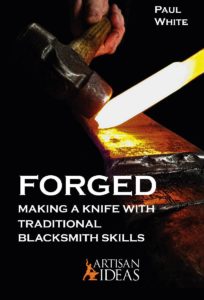
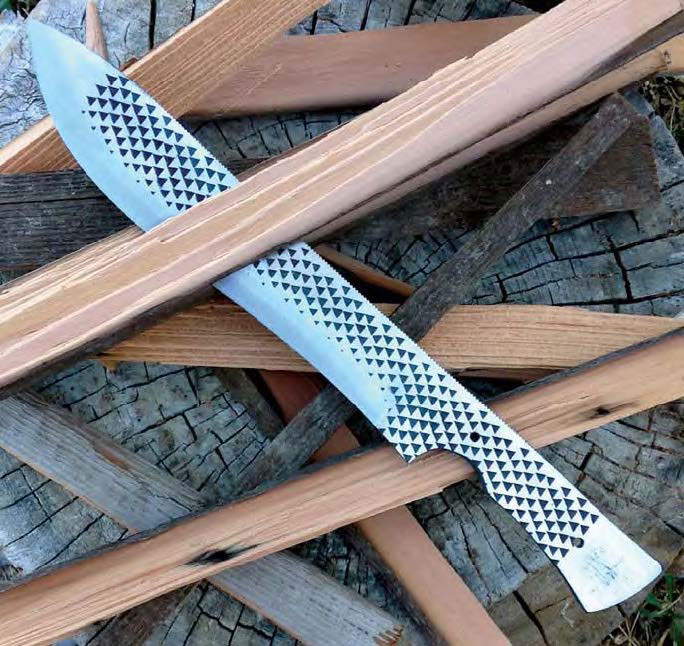
Knifemaking is the building of a knife, which includes the blade, handle and other accouterments. Blades are made by either removing metal from a steel blank via a grinder – known as stock removal – and the forging to shape of hot steel into a blade in the process known as bladesmithing. Other parts, including bolsters, guards, pommels, etc., are needed to complete the finished knife.

Featured Knives – – Knife Collecting – – Tactical Knives – – Survival Knives

D’Alton Holder Passes Away At The Age Of 82

1

Acclaimed Knifemaker And Cutlery Hall Of Famer D’Alton Holder Passes Away At The Age Of 82.

D’Alton Holder, whose knifemaking career spanned almost 60 years, served decades on the Knifemakers’ Guild board of directors and enjoyed almost 20 years as a member of the BLADE Magazine Cutlery Hall Of Fame®, passed away Nov. 19.

Known simply as “D’,” Holder was a consummate maker of fixed-blade knives, especially hunters. Among the latter, his “My Knife” in a stacked handle of oosic and amber was probably his best-known model and one of the most recognizable knives of its time.

He made his first knife in 1966, selling mostly at gun shows until 1973 when he joined the Guild. He was elected as a Guild board director in 1976 and served on the board for 23 years, during which time he held every board position, including three terms as president. His leadership helped sustain the Guild through the early years of its existence.

Holder organized the Arizona Knifemakers Association in 1975 and was its president for five years. He received the Guild’s Red Watson Award in 1982 and the American Firearms Industry Award of Merit in 1983, the only knifemaker to receive the honor. He was presented the Beretta Award for knifemaking excellence in 1994. He also served three years as president of the Arizona Knife Collectors Club.

He was a charter member of the board of regents of the American Knife & Tool Institute. Holder also was one of the winners of the 1998 Blade Magazine Publisher’s Award for his efforts on behalf of the AKTI.

He taught dozens of knifemakers how to fashion knives and helped dozens of other makers become more accomplished at the craft.

D’ was a very close friend of Cutlery Hall-Of-Famer Buster Warenski. When not making knives the two spent much time hunting and fishing together. In fact, D’ lent a lot of support to Buster during the latter’s making of the King Tut Dagger reproduction, probably the most famous knife of the modern custom era. Despite many delays caused by production problems and other setbacks, Buster finally finished the monumental project, much to D’s delight. “With it, he stood head and shoulders above anything else that had been done,” D’ noted. “I think he did a better job than the original guys, the Egyptians!”

In his speech inducting Holder into the Cutlery Hall Of Fame at the BLADE® Magazine awards banquet of the 2003 BLADE Show, ABS master smith Tim Hancock, a long-time friend of the inductee’s, may have said it best.

“His knives embody his philosophy of art and his dedication to great work and business ethics,” Hancock said of D’. “He has no doubt made a friend of everyone he has sold a knife to.

“He also saw the need to shape the future of the industry that he loved. In his spare time, he has advised, helped, and counseled volumes of fellow knife enthusiasts, knife promoters, and budding knifemakers in their pursuits in this industry. To put it simply, those of us who know him personally would say that his most amazing trait is his unselfish devotion to helping others.”

Arrangements to recognize D’s passing were ongoing, though whether there will be any kind of memorial service for him was unclear as these words were being written.

Read More

Cool Custom: Richard Dawes’ Dog-Bone Bowie

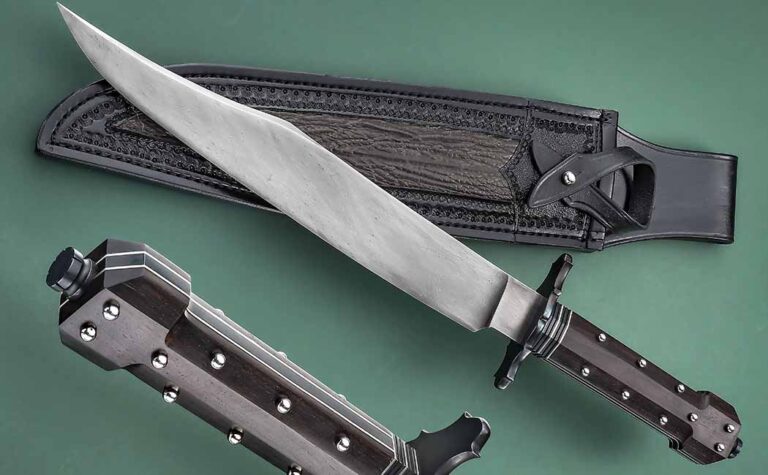
Handsomely pinned and with a handle to die for, Richard Dawes’ dog-bone bowie finds nearly the perfect chemistry.

Richard Dawes got a double pump of inspiration from the late, great ABS master smith John White for a long, lanky dog-bone bowie.

Dawes helps oversee an annual competition in White’s memory on Bladeforums for antique bowie repros. In so doing he came across one of White’s old work-in-progress frame-handle dog-bone projects on the web and found it most useful.

The resulting knife has a handsomely pinned dog-bone handle with a clip-point cable damascus blade, and it’s accompanied by a shark-skin-inlaid sheath by Paul Long. It’s Richard’s first frame-handle knife and first with pins, too.

Richard Dawes
Richard Dawes

“The key part of this knife looking good is to get a good fit on the guard,” he explained. “Once you’ve got that you want the rest of the parts to line up, and if you’ve got some 1/16-inch guide pins in there and got them all drilled for when you do the assembly, everything lines up, and that’s the key.”

A full-time chemistry professor at the Missouri University of Science and Technology who at press time was working for the National Science Foundation, Richard makes knives “on the side.” If this one is any indication, he has a career option waiting on him.

Dog-Bone Bowie Specs
Maker: Richard Dawes
Blade Length: 11”
Blade Material: Cable damascus
Handle Material: African blackwood
Handle Frame: Mild steel and nickel silver
Overall Length: 16”
Sheath Material: Custom leather inlaid w/shark skin, all by Paul Long
Maker’s Price For A Similar Knife And Sheath: $2,500

Check Out More Cool Custom Knives:

Daniel O’Connor Goes With The Flow On His Black Widow

A sushi knife that developed a taste for Texas brisket.

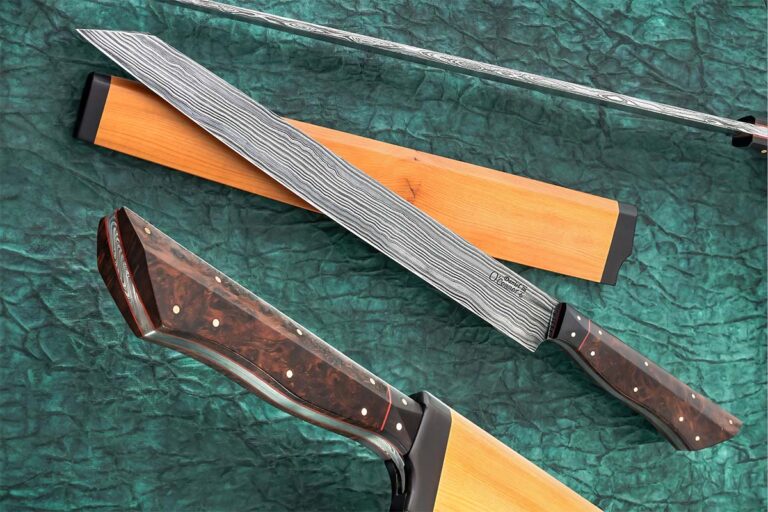
You might say Daniel O’Connor’s Black Widow leads a double life. It started as a sushi knife but when one of Daniel’s Texas pals said it looked like it would make a great brisket knife, O’Connor went with the flow, telling
his friend, “It’s about whatever you want it to be.”

OConnor Mug

Based on a kiritsuke yanagi-ba sushi knife, Black Widow features a damascus of 150 layers of 1084 carbon and 15N20 nickel-alloy steels. Daniel forged the steels in a square and then forged them flat, perpendicular to the original stack. This resulted in the edges of the layers showing up in more or less straight lines, what Japanese swordsmiths call masame hada.

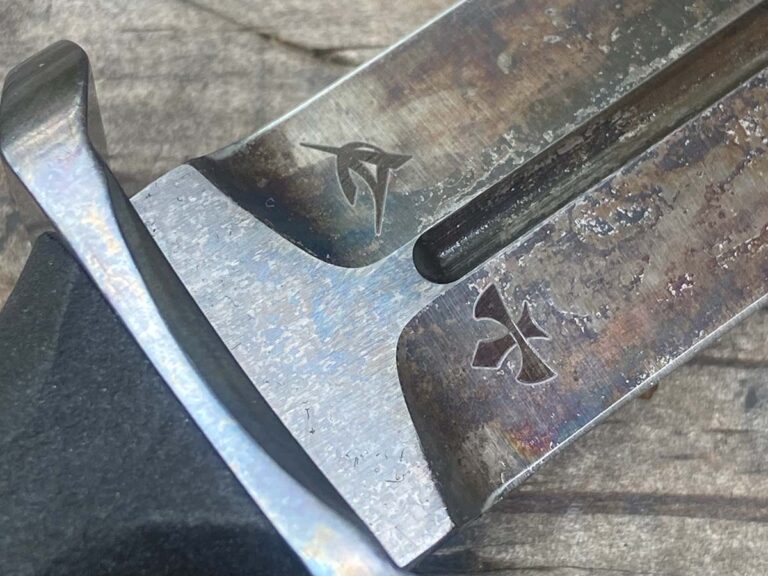
The accompanying image of the knife’s butt shows how the layers distorted when forged on edge. Daniel indicated he will use the pattern in the future.

Black Widow Specs
Blade length: 12”
Blade grind: A double urashi—double bevel w/a slight hollow on each side
Handle: Bocote burl w/red fiber liners
Bolster: Bog oak
Overall length: 17”
Sheath: Irish yew and bog oak
Maker’s price for a similar knife and sheath: $1,500

Check Out More Cool Custom Knives:

Dream Marine Team: Allen Elishewitz/Les George Collabs

Allen Elishewitz/Les George knife collaborations are four point oh.

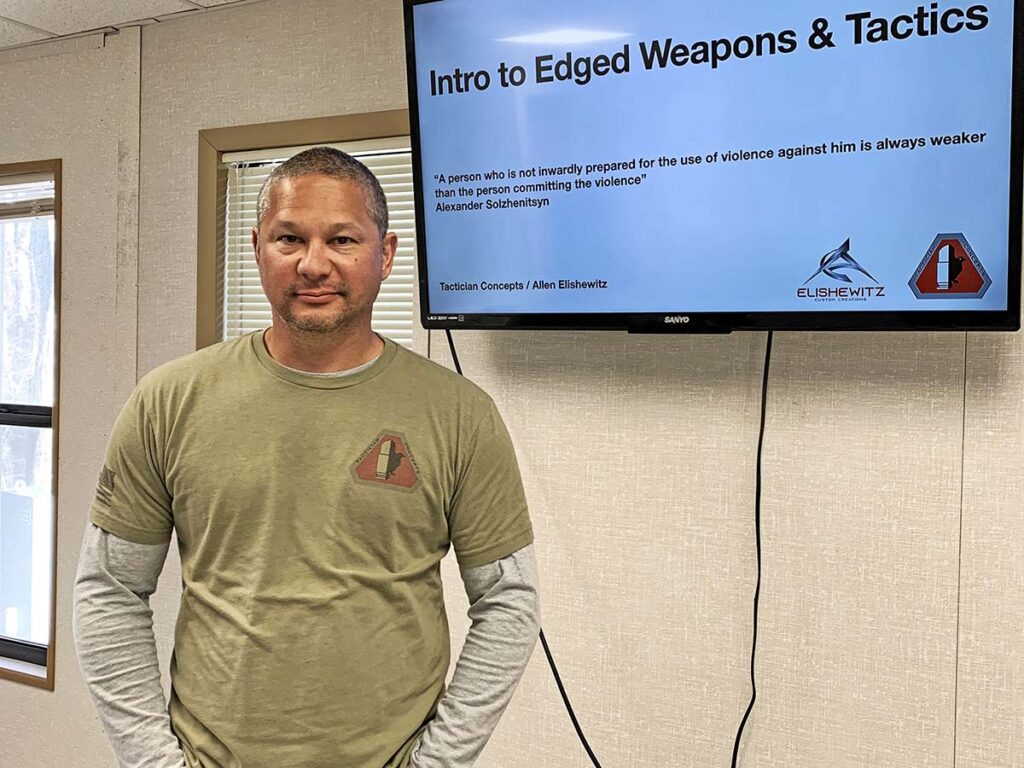
If you are into custom tactical knives, chances are very good that you have heard of knifemaking United States Marine Corps veterans Les George and Allen Elishewitz.

The two are at or near the top of the list for anyone wanting a high-quality custom tactical. Both possess an excellent knowledge of tactical design and the ability to execute same gained through their years of making knives—Les has 33 years of experience and Allen has 37. Their talent levels are extremely elevated.

Their time in service to their country walking the walk and talking the talk has helped each to fully understand the strengths and weaknesses of tactical knives. They have collaborated with factory brands such as Kershaw and Zero Tolerance (George), Benchmade, CRKT and Hogue Knives (Elishewitz), and Fox Knives and Pro-Tech (both of them). They also have collaborated with each other on some special custom knives.

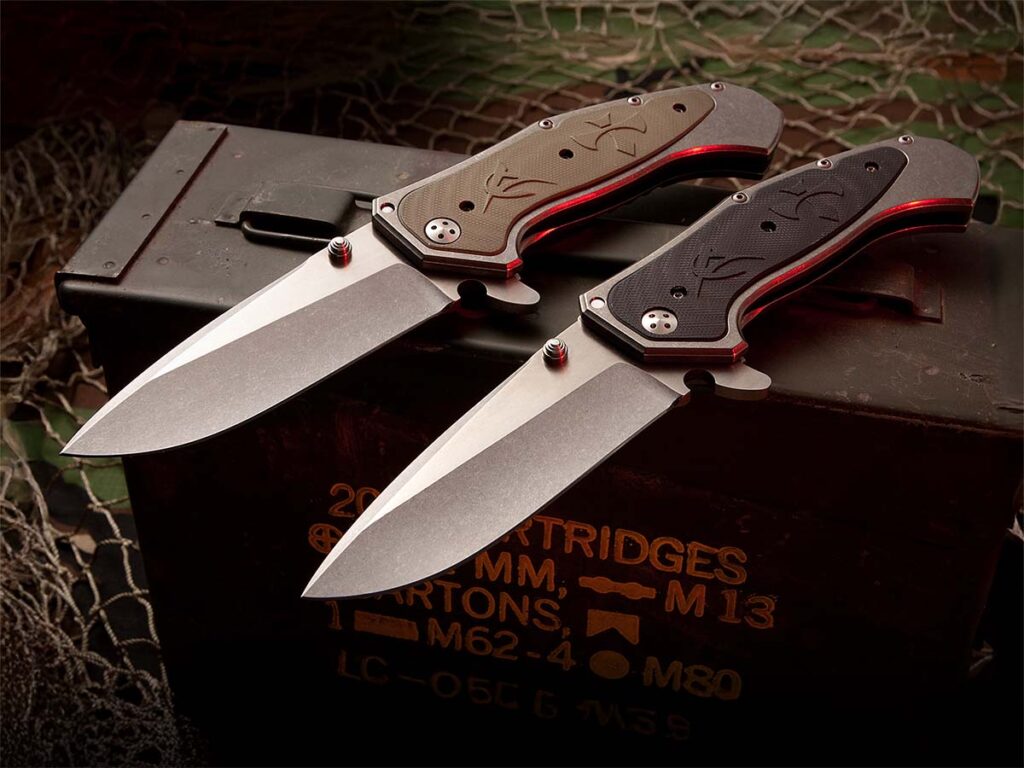
One of the more recent collaborative efforts between Allen Elishewitz and Les George is the Cerberus, a flipper folder in CPM 154 stainless blade steel and a titanium frame with insert. Closed length: 5 inches.

Perhaps most importantly, they are really good friends and inspire each other in many ways.

“I knew Allen by reputation and from the internet knife forums,” Les said. “When I moved to Texas, we were not far away [from each other].” It was about 15 years ago that Les first reached out and paid Allen a visit. 

“He contacted me after he got out of the USMC. He happened to be in Texas and wanted to swing by my shop,” Allen recalled. “I guess we hit it off OK,” Les undersold the moment with his trademark brand of sarcasm. 

In that initial meeting the two not only bonded over their service to their country but also their love of knifemaking, common grounds to forge a solid friendship. Each is outgoing and has a great sense of humor, not to mention an outstanding feel for knife design and ergonomics.

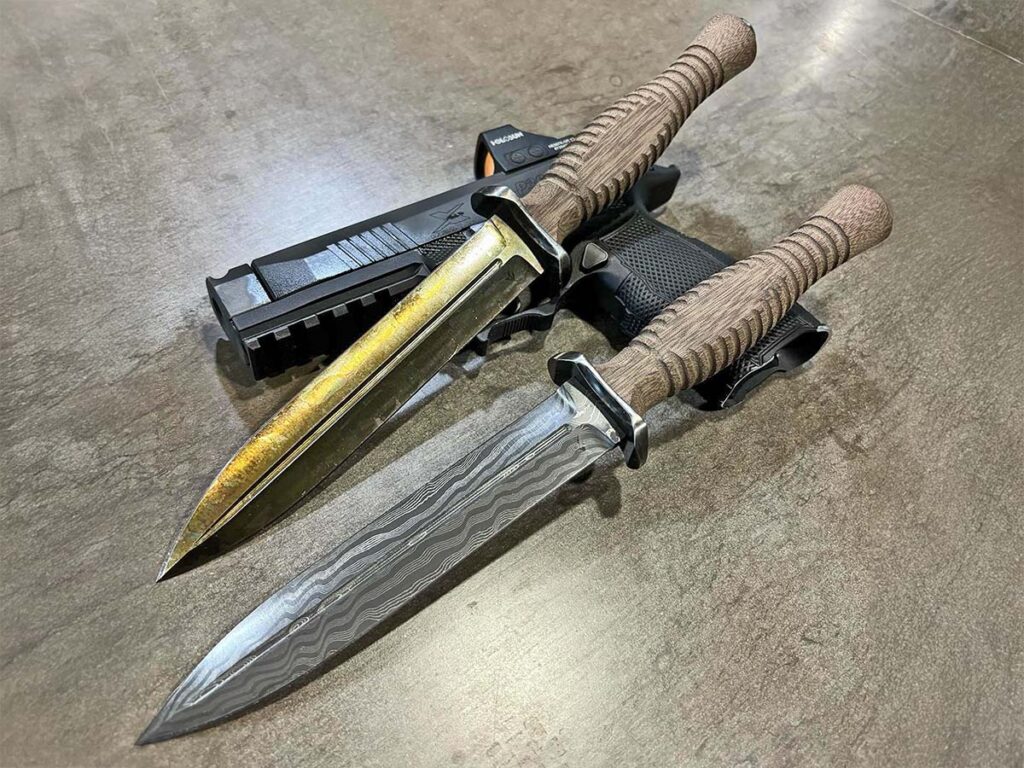
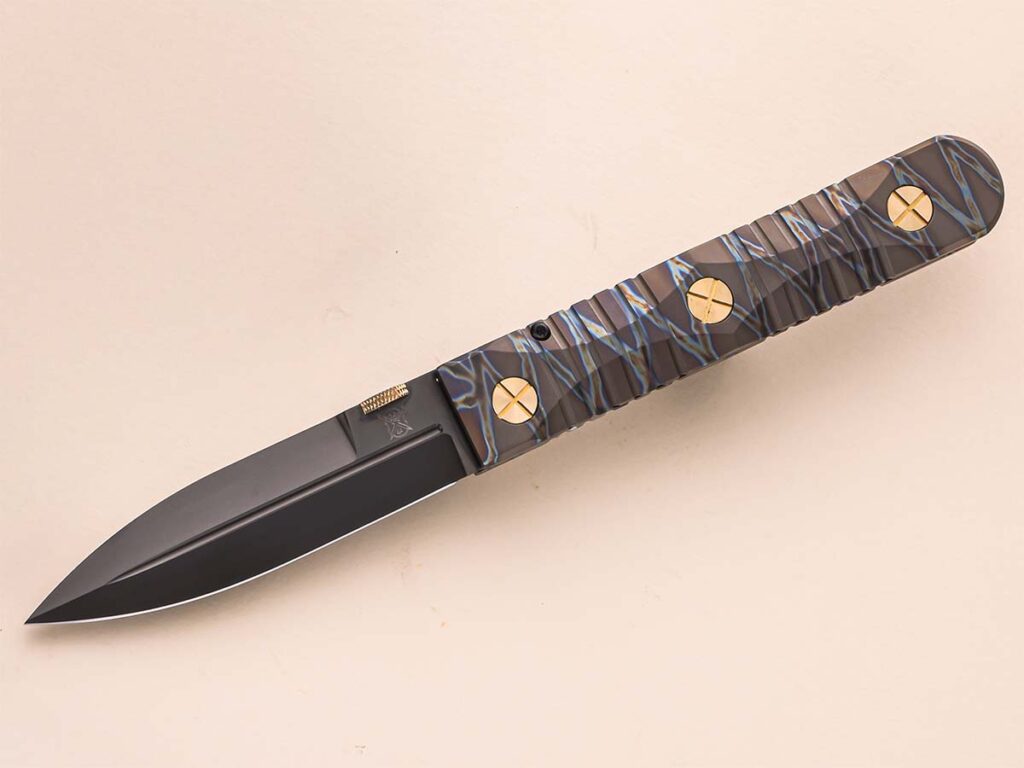
An excellent example of a collaboration between U.S. Marine veterans/knifemakers Allen Elishewitz and Les George is two iterations of the EGA (Elishewitz/George Association) Dagger, their spin on the iconic Fairbairn-Sykes dagger. The blade comes in a choice of CTS XHP stainless steel ($875 MSRP) and Chad Nichols stainless damascus ($1,200).

Allen’s first Military Occupational Specialty, or MOS, was designated O861 for Fire Support Marine, and his second was designated O321 for Reconnaissance Marine. In O861, he called in naval artillery and air support on targets, while in O321 he honed his recon skills in scouting and patrolling, small boat operations, long range communications and reconnaissance.

George’s path was slightly different. 

“I started out as a heavy equipment mechanic, then volunteered for embassy guard duty,” he said. 

Following embassy duty, he became an EOD (Explosive Ordinance Disposal) technician*. 

“You know, making the bad bombs stop,” he quipped. 

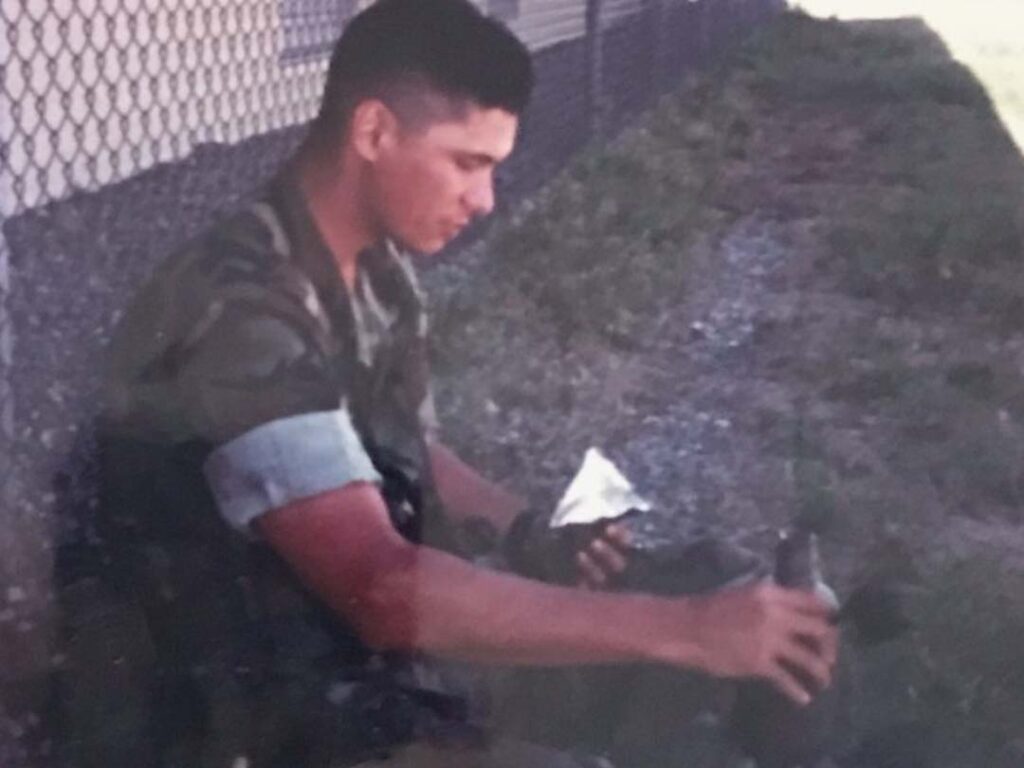
USMC Sergeant Allen Elishewitz takes a lunch break outside a Marine facility in the early ’90s.

The discipline and fortitude each gained in his respective duties set the stage for them to become solo entrepreneurs as knife designers and knifemakers. It also had a major influence on their approach to tactical knife design.

Their knifemaking styles are highly complementary.

“There are a lot of overlapping skill sets,” George observed.

For instance, Les has CNC experience while Allen has more manual machine know-how. 

“Les uses CAD and CNC, I am strictly handmade,” Elishewitz reiterated.

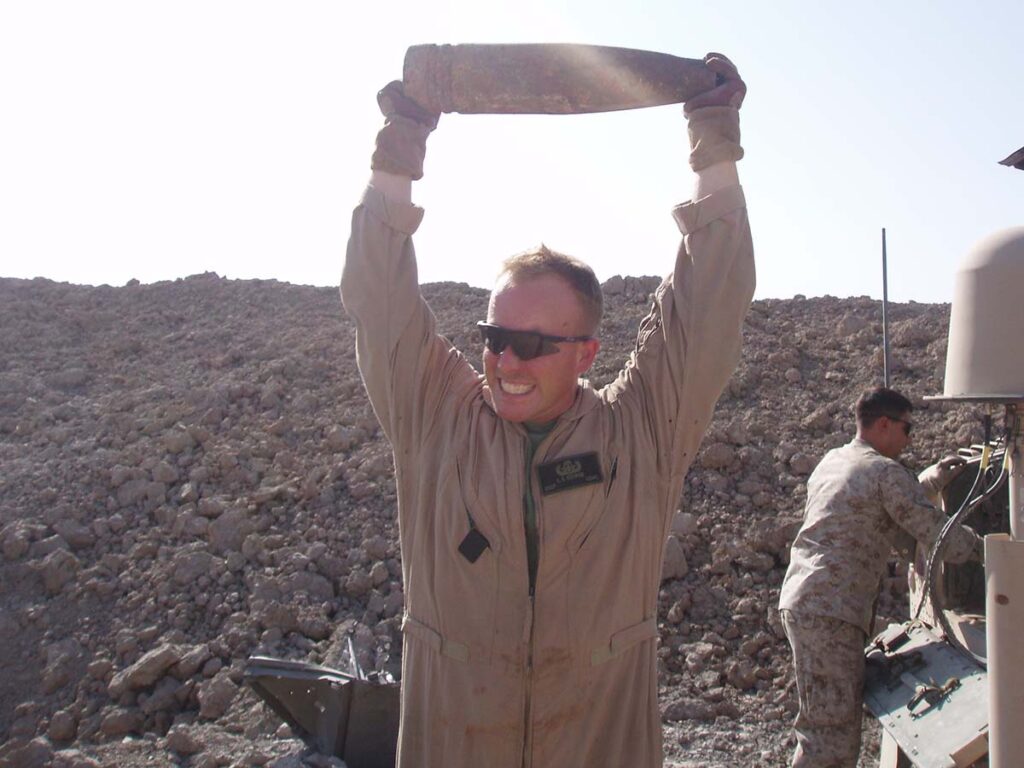
USMC Staff Sergeant Les George holds an artillery shell aloft somewhere in Iraq in the early 2000s.

“We can take a design and I can help scale it up and make more knives, while Allen can add the final touch,” Les noted. 

“I see Les’s knives as very practical and utilitarian,” Allen said. “I have the same approach but with a little more emphasis on artistic flair.” 

Both makers craft excellent cutting tools that are highly utilitarian. You can see the imagination and style in each of Elishewitz’s pieces. Meanwhile, form follows function with George’s work, where the beauty lies in how he builds his designs.

Long-Distance Teamwork

As with any business relationship, especially long-distance ones, it takes work to maintain along with the help of technology. Les lives in Blue Springs, Mississippi, and Allen in New Braunfels, Texas. 

Allen Elishewitz has made and designed award-winning tactical and other hi-tech folding knives since 1988.

“We send designs back and forth through emails and texts,” Elishewitz explained. “Les has 3D printing capabilities for quick prototyping that has been a game changer.”

Making use of technology almost makes it feel like you are working with someone in the same space even though there is a significant physical distance. Despite the distance, these two always find ways to make things work and to collaborate on beautiful edged pieces.
  
Behind every good man is an even better woman, and it was never truer than with Allen and Les. Both are happily married and their wives wholeheartedly support their husbands’ endeavors in the knife industry.

“Bianca is interested and supportive but not usually super involved,” Les stated of his better half. His passion is knifemaking, hers is abuzz with a passion for beekeeping. 

“Lots and lots of bees!” George affirmed. 

Les George is heavily influenced by classic military fixed blade designs and modern tactical folders and fixed blades.

Meanwhile, Valerie Elishewitz not only is very supportive of her husband’s career, she plays an active role in it. 

“Valerie is a crucial part of my business,” Allen stressed. “She takes care of all the administrative tasks which would eat up a lot of my time if I had to do it.”

Valerie sometimes answers emails, private messages, posts on Allen’s Facebook and Instagram accounts, helps pack and ship knife orders, and even helps her husband staff his table at knife shows. If you have bought a knife from Elishewitz at a knife show, chances are you met Valerie.

Upcoming ventures hold promise. 

“Allen is doing several designs with my production company, Defiant7,” George observed. 

“I’m really excited about the way those projects are shaping up.” Added Elishewitz, “We are going to do more of the Fairbairn-Sykes custom daggers. We made them a few years back and they were very popular.”

He also hints that he submitted designs to Les for what Elishewitz calls the BK, or Bangkok Special, a compact fixed blade for concealed carry for the Defiant7 line. He also submitted a blade design to accompany the handle of George’s M320 model for Defiant7. 

Last but not least, Allen said, “Later this year I am going to send Les a crossbar-lock SOG bowie that is going to be killer!”

Allen and Les designed the Ek Integral Folder for Ketuo, winner of Best Imported Knife in the factory knife judging competition at the 2024 BLADE Show Texas. The knife is based on the Model 2 Ek Commando fixed blade. (SharpByCoop image)

All this in addition to keeping up with orders for their custom knives, too. Not too shabby for a couple of Marine veterans, right?

*Les George won the BLADE Magazine 2023 Publisher’s Award for his humanitarian effort in making 300 mine probes for shipment to Ukraine to help remove the thousands of deadly explosive devices buried throughout the war-torn country.

For more on the collaborative knives of Allen Elishewitz and Les George, visit elishewitzknives.com, georgeknives.com or defiant7.com

Read More:

Dagger Design: Mastering Wire Wrapping The Handle

0

Wire wrapping the handle of a dagger is the finishing touch to the process, but requires a fine touch and patience.

Once the wire grooves and flutes are complete, the entire handle finished to its final state and the tang slot broached, insert the wires and lock them in tightly. As mentioned, 24-gauge wire looks good. If you want to use silver, Argentium or fine silver are both better choices than sterling, which tarnishes more quickly. Twenty-four-karat gold is terribly expensive but is the ultimate in luxury.

If you have Rolls-Royce taste but a Toyota budget, consider gold-filled wire as an alternative to pure gold. It’s brass at the core but at least 20 percent gold by thickness, and consequently much more durable than simple gold electroplate. It usually comes in 14k only. As a reference point, not long ago 12 feet of 24-gauge pure silver wire could be had for a little under $9. The same length of 24k gold in the same size was $1,050. The same length of gold fill was about $20. Save the 24k gold for times when you want to make a statement or your customer pays for the gold in advance.

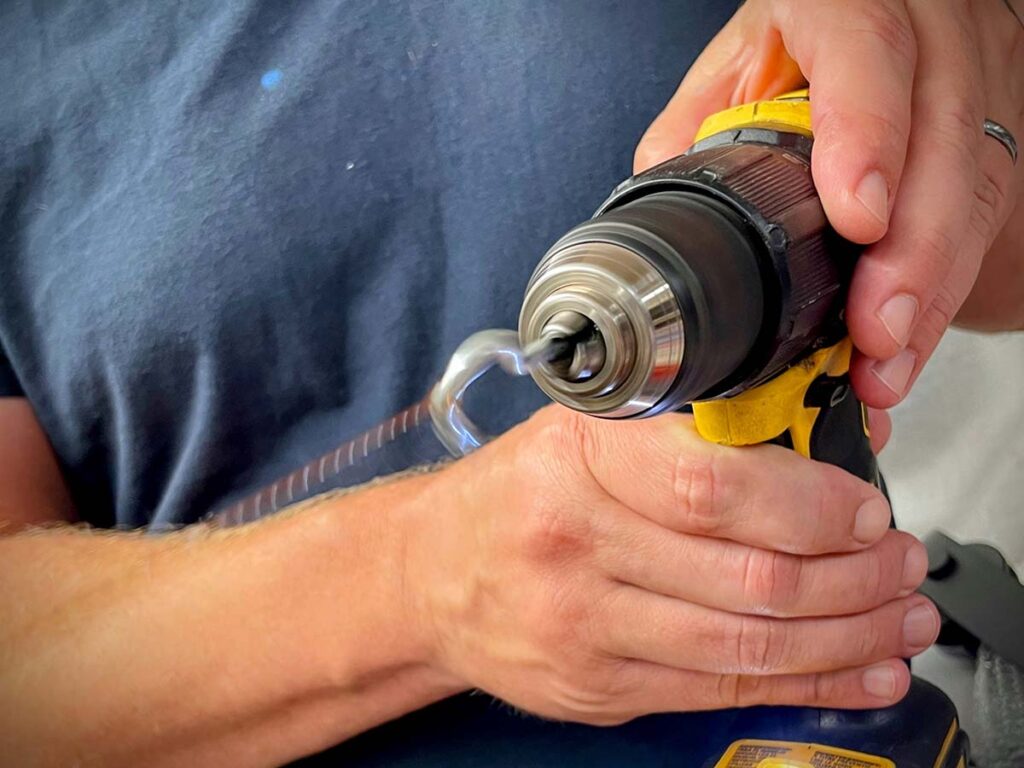
With a hook chucked in a hand drill, hook the resulting large loop, pull it tight and turn on the drill. Keep the tension constant—as you twist the wire it will pull you toward the vise.

Buy your wire dead-soft from your favorite supplier. You need about 20 percent more wire than twice the combined length of your wire grooves.

To twist the wire evenly, you must twist all of it at the same time. Clamp the two ends together tightly in a vise. With a hook chucked in a hand drill, hook the resulting large loop, pull it tight and turn on your drill. Keep the tension constant—as you twist it the wire will pull you toward the vise. If it breaks off at the vise, just re-clamp it and continue twisting. There’s no rule about how tightly the wire should be twisted, but tighter twists look better. If you aren’t sure it’s tight enough, twist it some more.

Annealing The Wire

Drill diagonal holes inside your groove, starting halfway between the broached hole and the edge.

The next step isn’t required but will make things easier. Most metals, including gold and silver, work harden. After all of that twisting your wire will be hard and springy, and it’s much easier to install your wires if they’re dead soft.

To soften the wire back to its original state, you must anneal it. To do this, coil it tightly around a 2-inch piece of pipe or something similar, and tie up the coil. Using a propane torch, heat the coil evenly until it glows slightly. One trick to make sure you don’t melt it is to color your wire thoroughly with a Sharpie® marker. When the ink burns off, it’s time to stop.

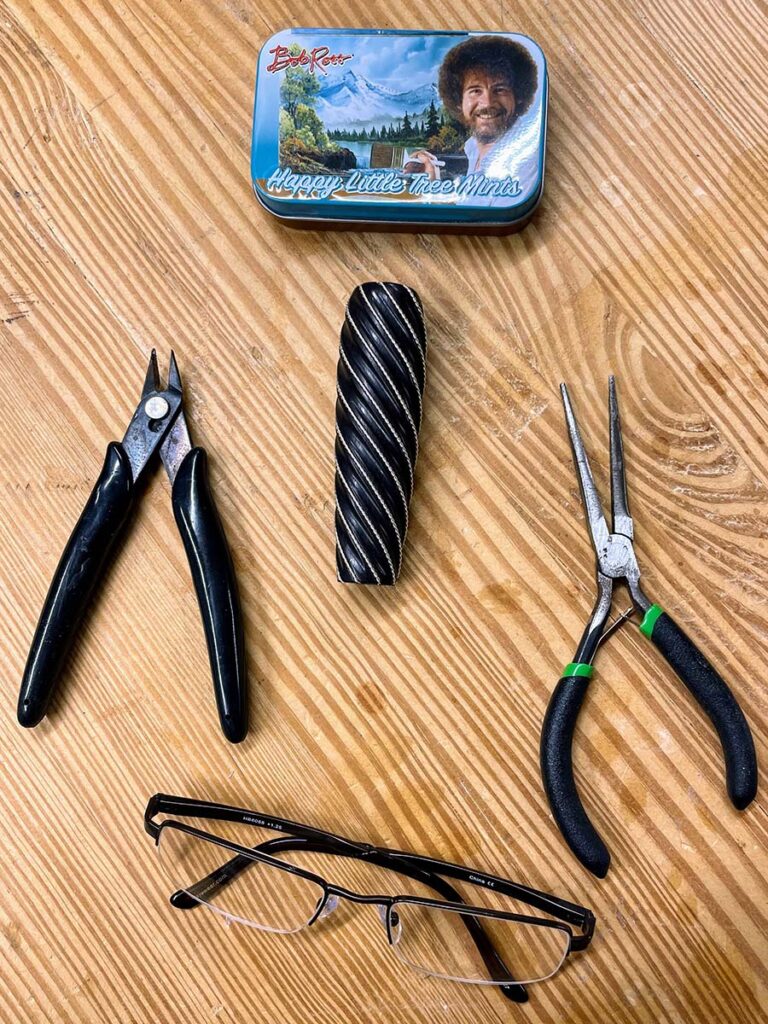
Don’t forget your essential tools—including your Bob Ross Happy Little Tree Mints.

Pick up the coil and drop it in water to cool it rapidly. It’s now dead-soft again but is likely discolored from oxidation. To remove the discoloration, let the coil sit in warm pickle solution that is available from any jewelry supply vendor. If you don’t want to go to the trouble of pickling, you’re better off dealing with the trouble of work-hardened wire.

Wire Installation

To install the wires, a little bit more work on the handle is necessary. Starting from the end points of your wire grooves, cut new grooves into both ends of your handle for at least half the distance between the outside of the handle and the tang slot. A Dremel or Foredom tool is best for this, but you can use a file also. If you use a file, go ahead and groove all the way to the tang slot—it’ll be easier that way and invisible on the assembled knife. These grooves need to be equal in depth to the diameter of the wire so that the handle will fit tight against the guard or pommel when the wire is installed and the knife is fully assembled. Cutting the line at an angle rather than perpendicular to the circumference will help when you pull things tight later.

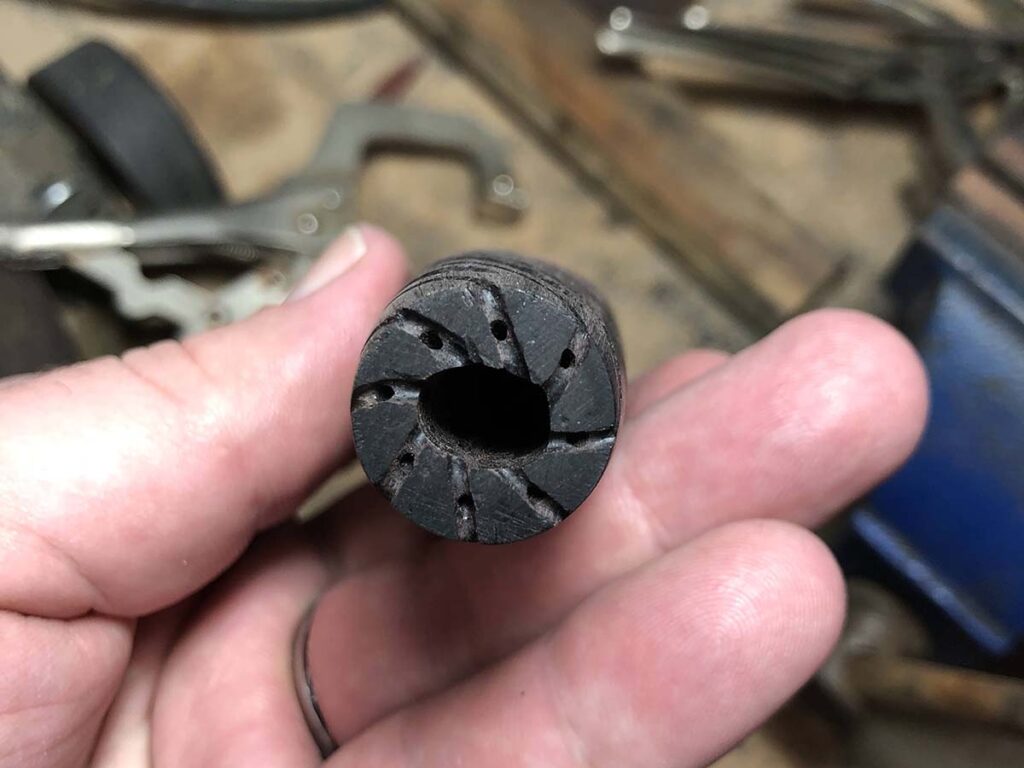
Drill diagonal holes inside your groove, starting halfway between the broached hole and the edge. Drill at an angle toward the center so that the hole for the wire exits into the tang slot about a quarter inch from the top and bottom of the handle, in line with the end of your groove. Make the holes slightly larger than your wire diameter.

After the handle is fully assembled and the glue is set up, perform a final finish check. The wires should be tight and fully seated in the grooves.

You’re almost to the fun part. Cut your wires at least an inch longer than the length of the groove to give yourself some extra to work with. To install the wire, thread one end through the hole you just drilled into the tang slot, grab the end with some small pliers, and bend the end back up toward the handle end, locking it in. Though not strictly necessary, you can pin the wire with a toothpick in the hole and a drop of CA Glue or 5-minute epoxy for extra security. This can be cut off and sanded flush later. Pull the wire tight, seating it in your groove, and repeat the process to lock in the other end. This method guarantees that your wires are as tight as they can possibly be. The wires and glue and toothpicks should lay flush with or below the surface of the ends of the handle. Cut off the excess wire inside the tang slot to ensure the wire doesn’t interfere with the final fit-up of your knife.

Finish Check

After the handle is fully assembled and the glue is set up, perform a final finish check. The wires should be tight and fully seated in the grooves. You can lightly buff the wires for extra shine but use a light touch to avoid unintended polishing of the handle. Tarnished wires can easily be brightened up with a Sunshine® Polishing Cloth. Don’t forget to give yourself a pat on the back.

That’s A Wrap

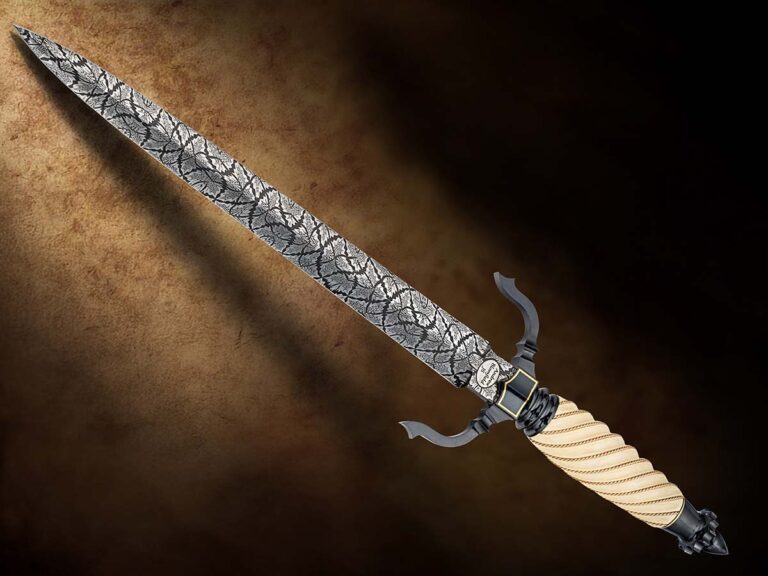
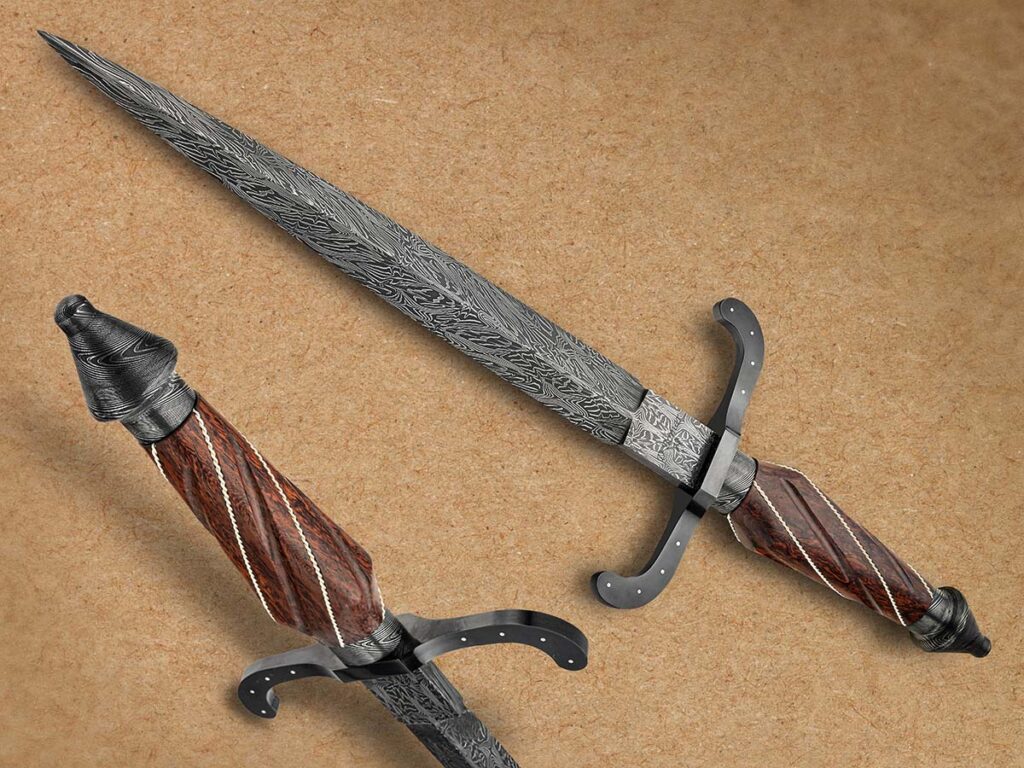
Silver wire wraps the rosewood grip of Duane Bomar’s dagger. The 10-inch blade is a damascus of 1084 carbon and 15N20 nickel-alloy steels. Overall length: 15 inches. (Jocelyn Frasier image)

Precision flutes and carefully inlaid twisted wires transform a utilitarian grip into a truly exemplary expression of craftsmanship. By selecting materials that balance luxury and performance, you anchor your design in both history and function. By following the instructions in this series, you’ll be able to master this exemplary style, and use the experience as foundation for future creativity.

Read More On Daggers:

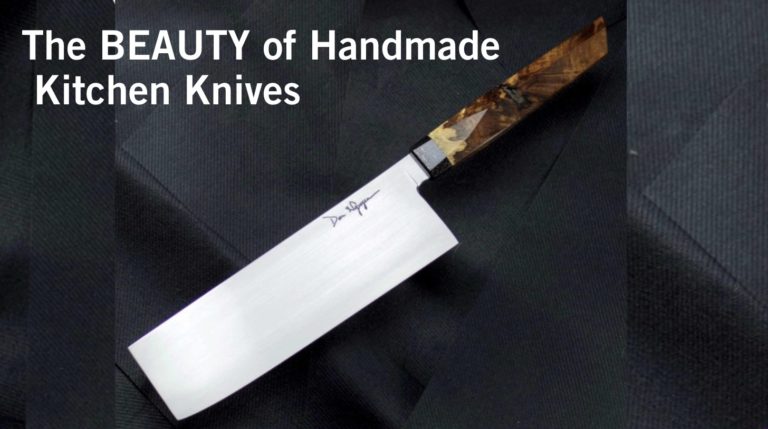
The Beauty Of Handmade Kitchen Knives

Handmade Kitchen Knives Reimagine What A Kitchen Knife Can Be

Don Nguyen didn’t know what he wanted from life when he was in college. An evening cooking at a friend’s apartment changed him forever. He was frustrated using his friend’s subpar, dull knives and wanted something better.

“It was that weird moment sharpening at a friend’s place where I said ‘I’m tired of this,’” Nguyen recalled. “I watched a bunch of YouTube videos, and those videos led me from sharpening to seeing Japanese makers make knives. I didn’t know what I wanted to do in life at that point so I was like OK, I want to do this. I dove in from there.”

Dive in he did, and now Nguyen has been making handmade kitchen knives, also commonly called custom kitchen knives, since 2017. He’s one of many makers entering the growing kitchen knife space and finding success.

Custom Kitchen Knife Advantage

Of course, the biggest difference between factory makers and custom makers is scale. A company like Wusthof can turn around hundreds of new knives every month. By contrast, Nguyen and his assistant complete a knife every one to two weeks. This allows for more delicate work when it comes to the actual knifemaking and makes getting different steels much easier.

Large Carbon Gyuto. Steel: 52100. Price: $3700

“Right now we’re probably averaging one knife every two weeks depending on the complexity, but we’re working on multiple knives at once so it’s hard to dictate how long a single knife takes,” Nguyen said. “I have an assistant and he helps me work on a bunch of stuff. We’re juggling projects all the time.

“I don’t have a lot of steel that I need to go through, and the steel choices I tend to use aren’t exotic steels. I go with 52100 for the most part for carbon steel knives. When I go with stainless I go with AEB-L or RWL-34. Those are fairly accessible. They’re usually in stock.”

Why Buy A Handmade Kitchen Knife?

When you talk to him, Nguyen’s passion is clear, and even with that passion, a big question remains: why should someone spend money on handmade kitchen knives instead of buying from a well-known factory maker?

He spoke honestly about how handmade kitchen knives won’t be for everyone, but for those who want them, they want only the best.

“Custom knives are made for a specific type of person,” Nguyen said. “They need to have food as their hobby. If they don’t like cooking all that much, they aren’t the intended audience for that. But if you love food, you follow it, buy books, read up on chefs, then you get into custom knives. Then you get knives in the [top] percentile of performance that are unique, made by someone you admire.”

Steel Sharpens Steel

As more makers enter the market, finding out ways to make your knives that are little bit better than your competitors has become the key to knifemaking. So much so that, according to Nguyen, many makers are working on what the knife does after it cuts the food.

“There’s a lot of interesting trends in knifemaking and the pursuit of the last 1 percent in performance,” Nguyen said. “A lot of makers now are working on food release. Being able to cut the food and having it pop off the [blade] without any effort at all. That’s a huge difference between a knife you buy off the shelf and a custom-made knife.”

Nguyen is one of the highly-skilled makers producing handmade kitchen knives. The below makers are also making exciting knives.

Best Handmade Kitchen Knife Makers

Mert Tansu

Nine-inch Damasteel gyuto in Heimskringla pattern. Price: $1,100

A former executive chef, Mert Tansu has been making remarkable kitchen knives in his native Australia for several years, learning to forge san-mai and damascus, and officially hung up his chef’s coat in 2018 to focus solely on making knives. 

His current knives are made in the Japanese tradition and fetch a tidy price, but the craftsmanship is clear from the moment you lay eyes on the blade.

Mareko Maumasi

4″ Phoenix Rising Mosaic Damascus Brute de Forge Bench Knife. Price: $650

Located in Washington state, Maumasi apprenticed under Bob Kramer, who we’ll talk about shortly, and makes multiple types of knives. He’s made many a wild damascus piece as well, and is a magician at working the steel to create exciting patterns.

“I think he’s one of the best makers out right now,” Nguyen said of Maumasi. “I talk with him all the time about business strategy, techniques, everything we’re going through.”

Bob Kramer

Meiji 10″ Chef’s Knives by Zwilling J.A. Henckels. Price: $379.99

He worked as a professional chef for a decade before asking himself “why can’t I and other chefs keep our knives sharp?” 

That question led him down the path to becoming one of the most accomplished makers of custom kitchen knives in the country. Kramer earned the title of ABS master smith in 1998, and since then he’s been “devoted … to the single-minded pursuit of crafting the perfect kitchen knife.”

His Kramer Knives not only turns out top-tier blades, but now features a small team to help keep the company strong and growing for decades to come. Additionally, his company has licensing agreements with a handful of major knife companies including Zwilling J.A. Henckels.

Andreas Kalani

The Dahlia. Price: $175

Andreas Kalani spent nearly a decade teaching himself the craft of knifemaking. He took his lumps and learned from his mistakes. Those years of trial and error have paid off as Kalani is now an accomplished knifemaker.

He makes beautiful Japanese-style knives as well as other kitchen utensils. Kalani even makes hunting knives and tools for skinning and processing your hunt. It all started with a dream for Kalani, and it has paid off handsomely thus far.

Will Brigham

Pattern-welded Sepharim Knife

Knives from Will Brigham are just as much art as they are kitchen tools. He specializes in pattern-welded damascus and mokume-gane knives. His sells his knives through his company, The Artificery, and he’s pushing hard to make the most distinctive damascus designs and highest-quality blades.

“Will Brigham is making crazy stainless steel damascus,” Nguyen said. “I think he’s kind  of the pioneer of modern stainless steel damascus.”

Read More

Ernest Emerson: His Shop And Tools

Ernest Emerson Is One Of The Leading Designer Of Tactical Knives, And We Get To See His Shop And How He Works

Ernest Emerson is entering his 44th year of knifemaking and his manufacturing company, Emerson Knives, Inc., is celebrating its 25th anniversary. Many knife nuts who have been around awhile remember Ernest when he was purely a custom knifemaker who was making exquisite folders exclusively. Then things changed.

When the first Gulf War came along, Emerson—who has an extensive background in martial arts—had already been working on tactical knife designs and, being the patriot he is, was ideally positioned to do his part in the war effort. Along with a handful of other talented custom makers, it wasn’t long before Ernest was instrumental in helping kick off the modern tactical knife movement that is still a huge part of the cutlery market today. 

He never looked back and 25 years ago took his designs to the masses, switching his focus to becoming a cutlery manufacturer of tactical knives, primarily of the folding kind. He continues to make a limited number of custom knives and also uses his skills designing new knives for his factory line. We asked Ernie to give us the lowdown on the tools and equipment he relies on most to do his custom work and prototypes for Emerson knives.

Ernest Emerson’s Tools And Machines

Emerson employs a number of light, low-cost bench-top drill presses. He leaves them set up for various drilling and reaming operations, which saves him a lot of time as he moves down the row drilling liners and handles.

He opened by praising his vintage mill. 

“The old Bridgeport has been fixed and rebuilt more than once but it is solid old-school quality and can still easily hold +/- .001-inch tolerances,” he observes. “I use it for all of my milling, tool, jig and fixture building, as well as all operations on bolsters and handles that require precise tolerances and hole depths such as bolsters, counterbores and handle countersinks.”

For grinding, he calls out one grinder maker in particular as his favorite. 

“I use a variety of grinders but my go-to machines are those by Travis Wuertz. They are solid, sturdy, virtually silent, and extremely well thought out—and engineered by Travis,” Ernest says. “Their real value to me is that I can build a wide variety of specialized fixtures and tools that allow me to do very precise grinding operations on both blades and handles.”

Emerson uses a number of low-cost bench-top drill presses. 

“At $125-$150 each I can afford to own several of them and leave them set up for various drilling and reaming operations,” he notes. “This saves me a lot of time as I can just move down the row as I drill liners and handles. The light drill presses work perfectly for me because all the holes I drill, tap or ream are small diameters and don’t need heavy drill presses to perform the operations. Plus, I get a better, lighter feel when I’m drilling delicate and expensive materials like pearl without damaging them.”

Keeping Things In Order

Hammered-6 in Moku-Ti bolsters with distressed solid copper scales and a hammered blade. Emerson’s list price: $10,000.

Ernest is a firm believer in being organized. 

“Although my work area may look a little cluttered or messy [he was preparing for a show when the accompanying photos were taken], I am extremely organized and orderly,” he emphasizes. “Having come up through an apprenticeship program to become a tool-and-die maker, I had it drummed into me the importance of cleanliness and organization in producing precise results.”

He also relies on the smaller things that make up the whole of knifemaking. 

“Although machines seem to play the biggest role in most shops, in my endeavors it is the jigs and fixtures that are my most valuable tools,” he states. “Coming up through the apprenticeship program early in my career and eventually earning the title of tool-and-die maker, it was hammered into me that the best machinists are the ones that can conceptualize and invent the most efficient and precise tools, jigs and fixtures to help them do their job. There is a lot of truth in that statement. I also have a full machine shop and woodworking shop with all the jointers, planers, sanders, table saws, routers, lathes and woodworking tools that I use.”

Read More

Advertisement

Must Read Articles

Read this before you make a knife

Knifemaking 101 – Read This Before You Make a Knife

  by Wayne Goddard My experience has taught me that there's nothing like digging in and getting started. I've often said the hardest part of the...
how to forge damascus steel

How to Forge Damascus

Advertisement
Advertisement