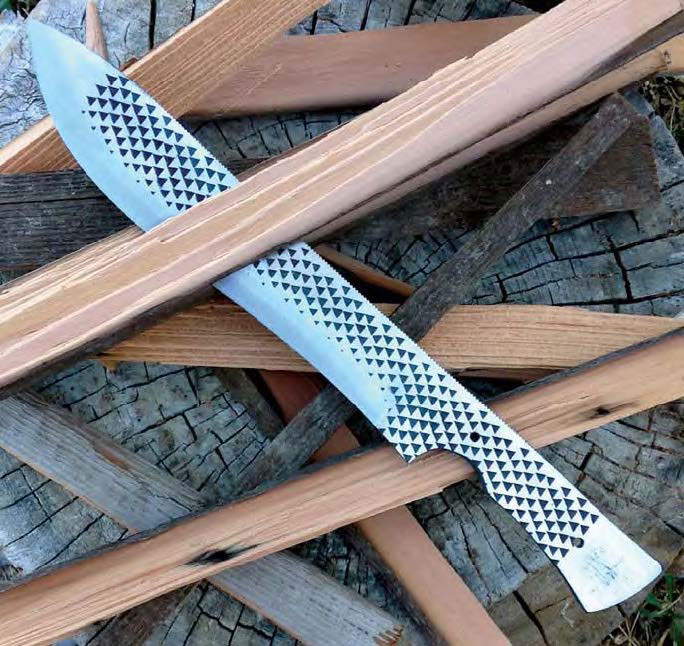
Knifemaking is the building of a knife, which includes the blade, handle and other accouterments. Blades are made by either removing metal from a steel blank via a grinder – known as stock removal – and the forging to shape of hot steel into a blade in the process known as bladesmithing. Other parts, including bolsters, guards, pommels, etc., are needed to complete the finished knife.
Ernest Emerson Is One Of The Leading Designer Of Tactical Knives, And We Get To See His Shop And How He Works
Ernest Emerson is entering his 44th year of knifemaking and his manufacturing company, Emerson Knives, Inc., is celebrating its 25th anniversary. Many knife nuts who have been around awhile remember Ernest when he was purely a custom knifemaker who was making exquisite folders exclusively. Then things changed.
When the first Gulf War came along, Emerson—who has an extensive background in martial arts—had already been working on tactical knife designs and, being the patriot he is, was ideally positioned to do his part in the war effort. Along with a handful of other talented custom makers, it wasn’t long before Ernest was instrumental in helping kick off the modern tactical knife movement that is still a huge part of the cutlery market today.
He never looked back and 25 years ago took his designs to the masses, switching his focus to becoming a cutlery manufacturer of tactical knives, primarily of the folding kind. He continues to make a limited number of custom knives and also uses his skills designing new knives for his factory line. We asked Ernie to give us the lowdown on the tools and equipment he relies on most to do his custom work and prototypes for Emerson knives.
Ernest Emerson’s Tools And Machines
Emerson employs a number of light, low-cost bench-top drill presses. He leaves them set up for various drilling and reaming operations, which saves him a lot of time as he moves down the row drilling liners and handles.
He opened by praising his vintage mill.
“The old Bridgeport has been fixed and rebuilt more than once but it is solid old-school quality and can still easily hold +/- .001-inch tolerances,” he observes. “I use it for all of my milling, tool, jig and fixture building, as well as all operations on bolsters and handles that require precise tolerances and hole depths such as bolsters, counterbores and handle countersinks.”
For grinding, he calls out one grinder maker in particular as his favorite.
“I use a variety of grinders but my go-to machines are those by Travis Wuertz. They are solid, sturdy, virtually silent, and extremely well thought out—and engineered by Travis,” Ernest says. “Their real value to me is that I can build a wide variety of specialized fixtures and tools that allow me to do very precise grinding operations on both blades and handles.”
Emerson uses a number of low-cost bench-top drill presses.
“At $125-$150 each I can afford to own several of them and leave them set up for various drilling and reaming operations,” he notes. “This saves me a lot of time as I can just move down the row as I drill liners and handles. The light drill presses work perfectly for me because all the holes I drill, tap or ream are small diameters and don’t need heavy drill presses to perform the operations. Plus, I get a better, lighter feel when I’m drilling delicate and expensive materials like pearl without damaging them.”
Keeping Things In Order
Hammered-6 in Moku-Ti bolsters with distressed solid copper scales and a hammered blade. Emerson’s list price: $10,000.
Ernest is a firm believer in being organized.
“Although my work area may look a little cluttered or messy [he was preparing for a show when the accompanying photos were taken], I am extremely organized and orderly,” he emphasizes. “Having come up through an apprenticeship program to become a tool-and-die maker, I had it drummed into me the importance of cleanliness and organization in producing precise results.”
He also relies on the smaller things that make up the whole of knifemaking.
“Although machines seem to play the biggest role in most shops, in my endeavors it is the jigs and fixtures that are my most valuable tools,” he states. “Coming up through the apprenticeship program early in my career and eventually earning the title of tool-and-die maker, it was hammered into me that the best machinists are the ones that can conceptualize and invent the most efficient and precise tools, jigs and fixtures to help them do their job. There is a lot of truth in that statement. I also have a full machine shop and woodworking shop with all the jointers, planers, sanders, table saws, routers, lathes and woodworking tools that I use.”
What to look for in a custom hunting knife and some sharp examples.
For outdoorsmen, a knife of some kind is almost a constant companion. Most carry a knife that falls into the category of a hunter.
The Merriam-Webster Dictionary defines hunting knife as a large, stout knife used to skin and process game. When I started judging custom knife competitions at knife shows 30 years ago, the category with the greatest number of entries was always the hunter. Why? Because there are so many interpretations of what a hunting knife is. Often the judges refer to their own experience using knives in the category. Entries generally range in blade length from 2.5 to 5 inches. I have seen knives entered in the category with 10-inch blades.
Blade Lengths
Blade lengths are often designed to process a particular bird or animal. Smaller blades in the 2.5-to-3-inch range are primarily used for dressing birds. The short blade length allows the hunter to quickly extract the bird’s breast meat. The most common blade length is 4 to 4.5 inches, a length that will dress out most game hunted regularly in North America. The dropped hunter/drop-point hunter designed by BLADE Magazine Cutlery Hall-Of-Fame® member Bob Loveless (page 26) is the world’s most copied hunting knife. The standard Loveless drop point features a 4-inch blade.
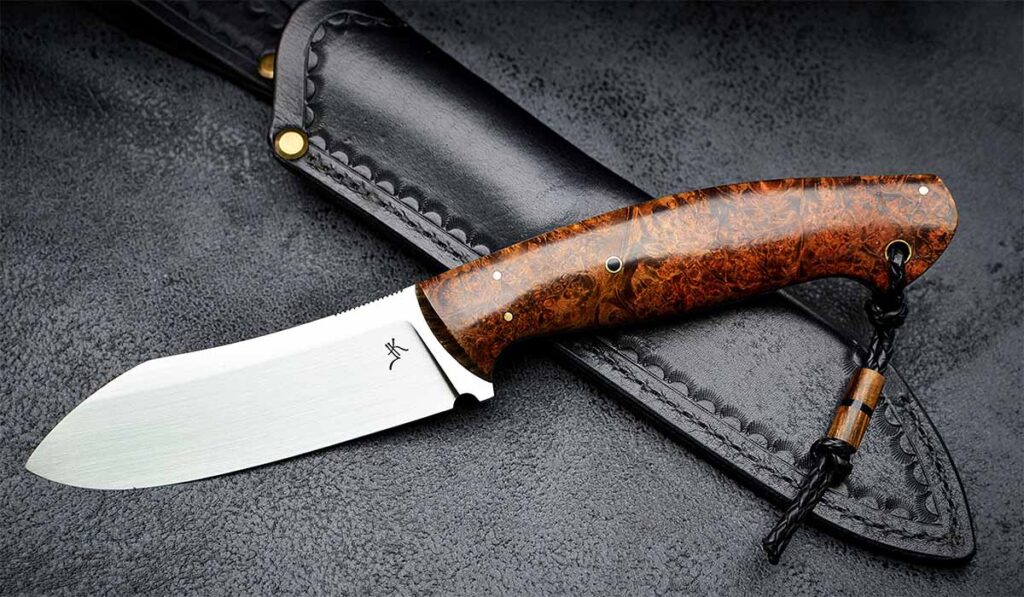
One of the more popular skinner designs is the Nessmuk, praised for its all-around versatility in the field. Luk Kuberski’s Nessmuk Hunter features Sleipner stainless blade steel with an impeccable satin finish and a mesmerizing handle of maple ash burl. (Luk Kuberski image)
Nessmuk Skinner Maker: Luk Kuberski Blade Length: 4.75” Blade Steel: Sleipner stainless Blade Finish: Satin Blade Style: Drop point Handle Material: Ash maple burl Overall Length: 8.6” Sheath: Leather pouch/belt model by the maker Author’s Comments: Full-tang construction; excellent balance and handle ergonomics; serrated thumb ramp enhances control Maker’s price for a similar knife: $350
When dressing out larger game such as moose or elk, many hunters prefer a longer blade because of the animal’s size. Why is the 5-inch blade the limit? The idea behind the hunting knife is to dress out the animal without losing control and cutting into the animal’s vital areas. Going much past a 5-inch blade can affect the average hunter’s ability to control the cutting edge.
Blade Steels
Materials for hunting knife blades are primarily stainless and carbon steels, though damascus has been gaining in popularity in recent years. The environment the hunters will be in and their skill level at resharpening a blade will enter into the choice of steel.
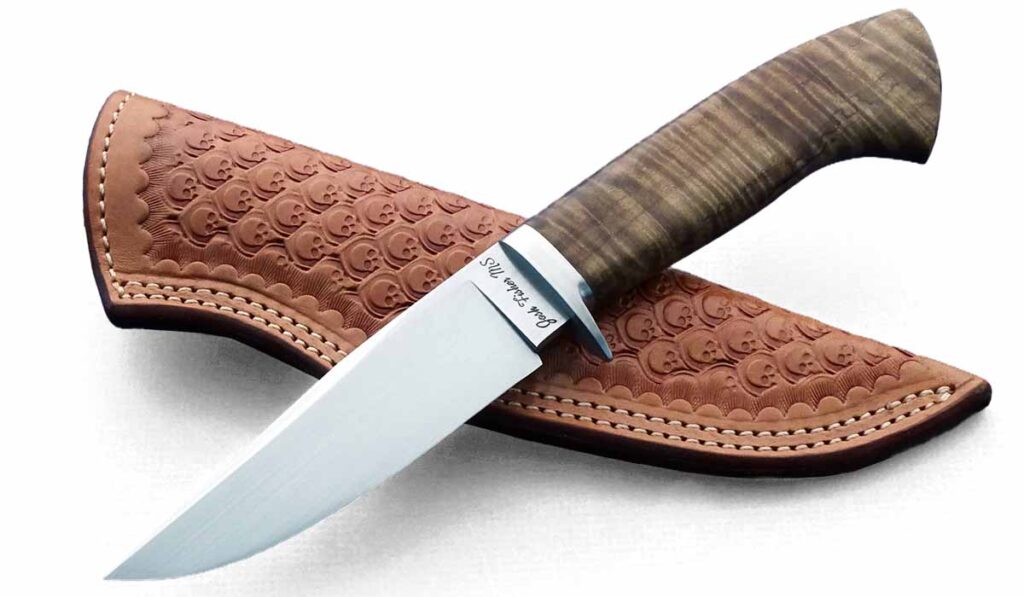
Wood is a popular handle material for custom hunting knives. Josh Fisher opts for curly maple on his drop-point hunter. And how about those skulls on the tooled-leather sheath by Bob Bobbert? (Robertson’s Custom Cutlery image)
Drop-Point Hunter Maker: Josh Fisher Blade Length: 4.5” Blade Material: 1084 carbon steel Blade Style: Drop point Guard Material: Stainless steel Handle Material: Curly maple Overall Length: 9” Sheath: Tooled-leather pouch/belt model in a skull motif by Bob Bobbert Author’s Comments: Excellent handle ergonomics and balance; Josh is an ABS master smith Maker’s list price for a similar knife: $625
Each steel has its advantage(s) concerning rust resistance, ease of sharpening and edge holding. Carbon steels such as 1084, 5160 and 52100 provide an extremely keen edge and can be easily resharpened. They do, however, require more corrosion maintenance. Stainless steels such as 440C, ATS-34 and CPM 154 make up the bulk of stainless steels used on custom hunters. These can be reasonably simple to sharpen and more forgiving regarding corrosion.
Whichever steel you choose, the blade should be cleaned after use and a light coat of oil should be applied. It is best not to store your knife long-term in a leather sheath, as the tannic acid found in the leather can rust your blade. Additionally, leather does hold moisture, which can hasten the rusting process of the steel. It is best to store knives in something other than their leather sheaths.
Handle Materials
A wide variety of handle materials are used for hunting knives. A favorite among makers and outdoorsmen is Sambar stag, either in its natural color or dyed to create amber stag. Stag is favored not only for its looks but because its contours provide an excellent gripping surface, even when wet. Another handle material gaining favor is elk and much for the same reasons. Two advantages of elk are it can be found in larger sizes and is less expensive.
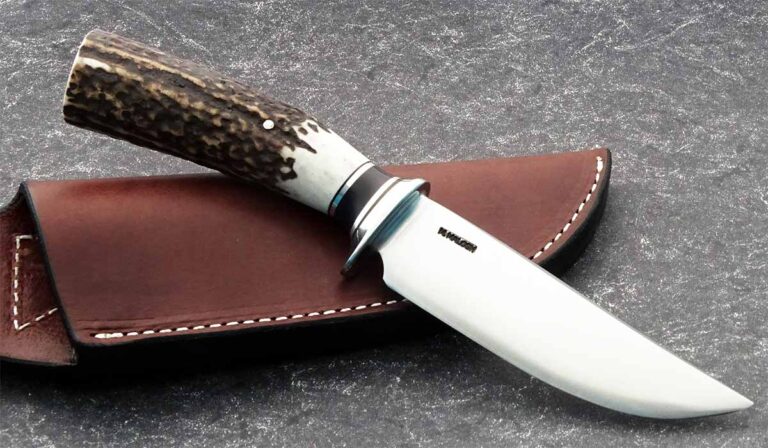
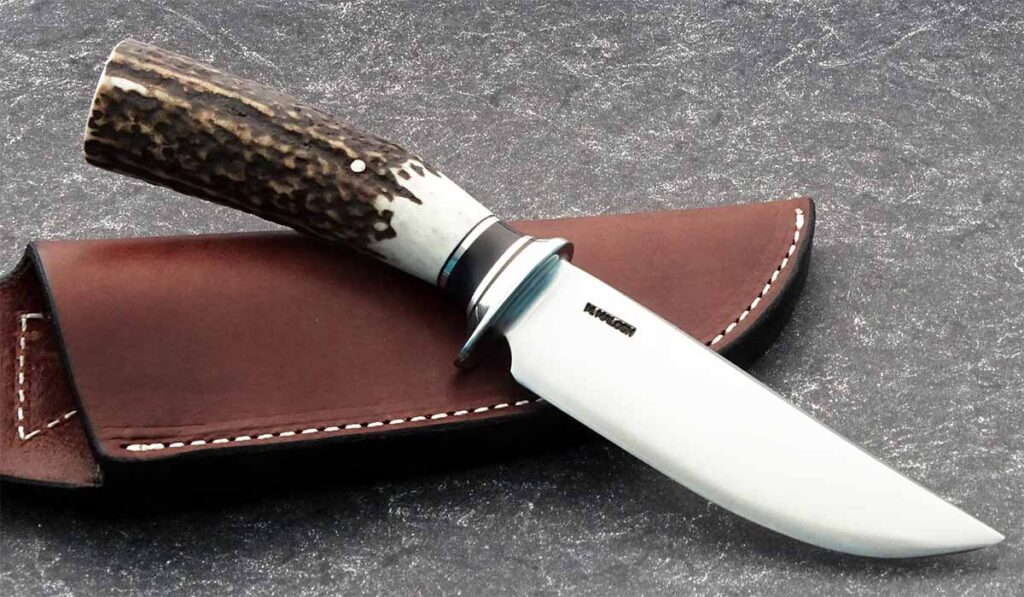
Sambar stag and elk are favored for their looks and because they provide an excellent gripping surface, even when wet. Mike Malosh’s Elk Hunter 23 custom hunting knife features elk scales. (Robertson’s Custom Cutlery image)
Elk Hunter 23 Maker: Mike Malosh Blade Length: 47/8” Blade Material: W-2 tool steel Blade Finish: Satin Guard Material: Stainless steel Handle Material: Elk w/black Micarta® and stainless steel spacers Overall Length: 9.5” Sheath: Leather pouch/belt model by the maker Author’s Comments: This knife is built for serious work; excellent balance and handle ergonomics Maker’s price for a similar knife: $395
Desert ironwood, curly koa, California buckeye burl and curly maple are among various kinds of popular handle woods used for hunters. Other popular materials are synthetics such as G-10 and Micarta®. The main advantage of these materials is that, for the most part, they are impervious to the elements. As such, they tend not to shrink and crack as some natural handle materials can do over time.
Guards
Guards are made primarily from either 304 or 416 stainless steel. If the knife features a hidden tang design, the joint between the guard and the blade should be soldered. Sealing the guard helps keep the moisture away from hidden tangs. Because their softness makes them prone to damage, along with their additional maintenance requirements, brass and nickel silver generally are not used for guards.
Blade Styles
The drop-point hunter is the most commonly made hunting knife. The drop-point blade maintains its thickness along the spine and then gently slopes to the point. Generally, the drop point is slightly thicker than other hunting blade patterns at the point. The blade thickness provides the drop point the versatility not only to skin but to disjoint and pry. These advantages can be critical to the hunter when dressing larger game.
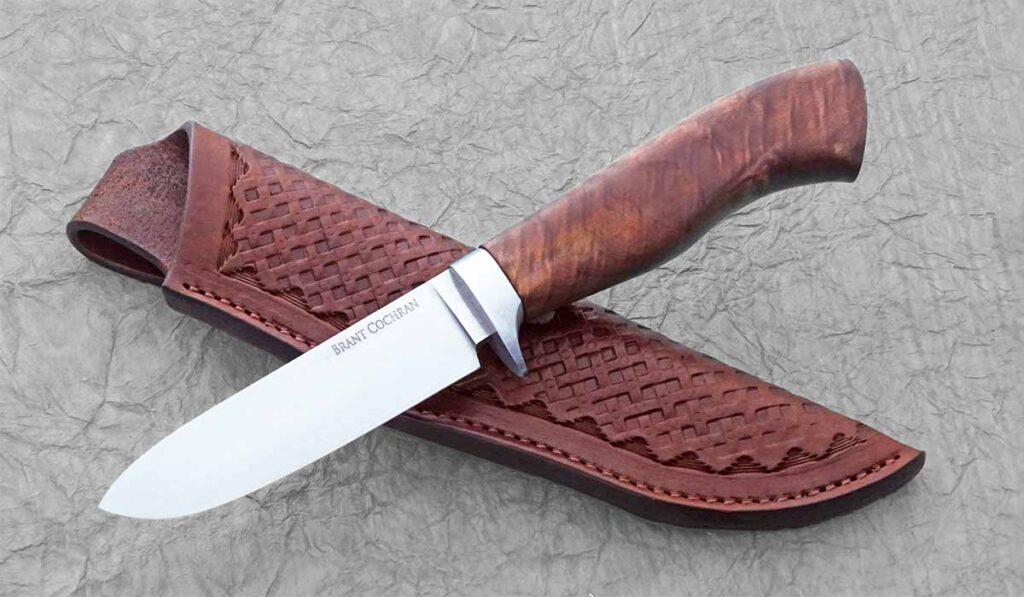
The slightly raised blade spine/hump extends the curved part of the semi-skinner blade for skinning while maintaining the drop point to avoid puncturing the abdominal cavity. Brant Cochran covers the pattern in a sturdy lightweight version of 80CrV2 carbon steel and walnut in his custom hunting knife. (Robertson’s Custom Cutlery image)
Semi-Skinner Maker: Brant Cochran Blade Length: 4.25” Blade Material: 80CrV2 carbon steel Blade Finish: Satin Guard Material: Stainless steel Handle Material: Walnut Overall Length: 9” Sheath: Tooled-leather pouch/belt model by the maker Author’s Comments: 80CrV2 is a carbon steel that is both tough and provides outstanding edge retention; excellent balance and handle ergonomics; sturdy lightweight knife, perfect for your next hunt; Brant is an ABS journeyman smith Maker’s price for a similar knife: $300
The idea of a skinner is basically to remove the skin/fur from the game. The skinning blade shape features a slightly thinner blade and edge meant for a specific purpose. The skinner is designed for elongated cuts and better control of the blade, ensuring the game’s fur maintains its integrity. While primarily intended to remove the fur, a knife with a skinner blade can be used to dress game out, too. One of the more popular skinner designs is the Nessmuk, praised for its all-around versatility in the field.
The semi-skinner blade is the middle ground between the drop-point and skinner blades. The slightly raised blade spine/hump extends the curved part of the blade for skinning while maintaining the drop point to avoid puncturing the abdominal cavity, which could taint the meat of the animal.
Conclusion
Picking the right edged companion for your time in the field should require some research. As noted, hunting knives come in various shapes and sizes. This variety enables you to choose the right size, steel and handle material necessary to get the job done. It would benefit you greatly to hold the knife in your hand, primarily for sizing. You must always be able to control the blade’s edge.
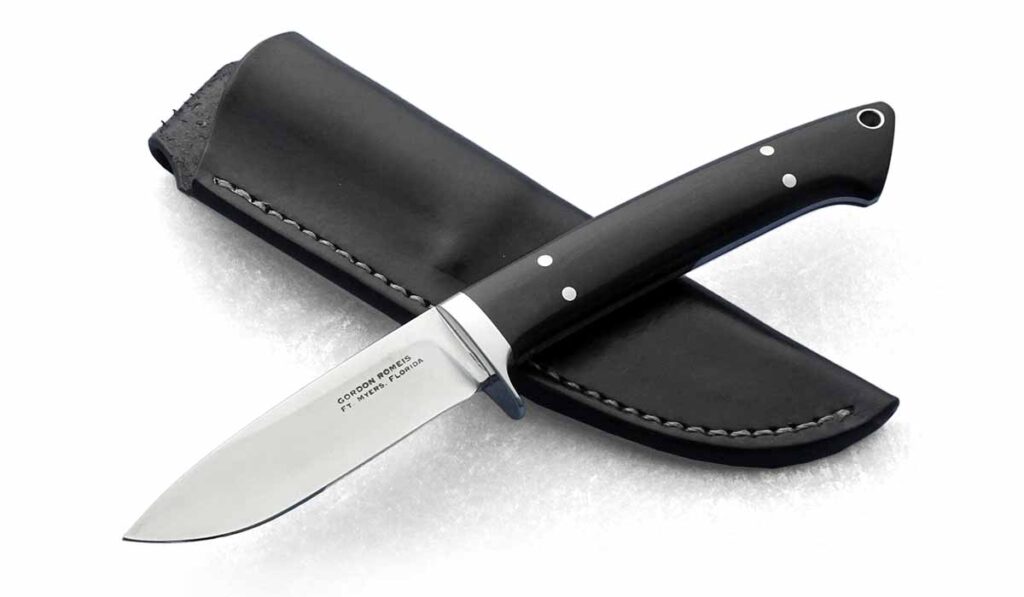
The drop-point hunter is the most commonly made hunting knife. A George Romeis drop point features CPM 154 stainless blade steel and a black G-10 handle. (Robertson’s Custom Cutlery image)
Drop-Point Hunter Maker: George Romeis Blade Length: 3.5” Blade Steel: CPM 154 stainless Blade Finish: Satin Guard Material: Stainless steel Handle Material: Black G-10 w/stainless-steel-lined thong hole Overall Length: 8” Sheath: Leather pouch/belt model by the maker Author’s Comments: Full-tapered tang, excellent balance, very comfortable in the hand Maker’s price for a similar knife: $300
Remember, the rifle or bow harvests the game but the knife creates what becomes dinner and the trophy.
In on the ground floor of the damascus knife movement, Daryl Meier has left an indelible mark forging and teaching.
I haven’t seen Daryl Meier for a number of years but there was a time when he was a regular at the BLADE, Guild and other knife shows. Sporting a cross between a goatee and a van dyke, glasses and his ever-present octagonal cap covering longish hair, Daryl stood out in a crowd. He looked equal parts World War II French Resistance fighter, 1950s beatnik and Vincent van Gogh (minus the red hair). In fact, it almost would have been more fitting if his name were Daryl van Meier. I can see him looking at me now, shaking his head in mild disgust at such a notion.
Daryl has a soft, laid-back way of talking that has kind of a hypnotic effect. Then, just when you think you’re going into a trance, he makes an observation that snaps you back to reality, elicits a laugh or otherwise makes you think. He has a great sense of humor and never takes himself too seriously. There is no ego in Daryl. He’s just Daryl.
BLADE Magazine Cutlery Hall-of-Fame® member Steve Schwarzer has known Daryl much longer and much better than me. When I asked Steve to write a story about Daryl, he jumped at the chance, and the result is very enlightening as to Daryl’s impact on damascus and the teaching of bladesmithing in general.
Steve writing the story was more appropriate than I thought at the time. In researching Steve and Daryl, I rediscovered that they each have entries in the top 13 custom knives from the years 1989-2000: Schwarzer’s groundbreaking Hunter’s Dream in mosaic damascus at No. 3 and Meier’s American Spirit Bowie at No. 9. The knives were selected in a poll of industry authorities and appeared in the June 2013 BLADE® story, “A Decade of Excellence.” Daryl presented the American Spirit Bowie in person to President George H.W. Bush in the White House in 1990.
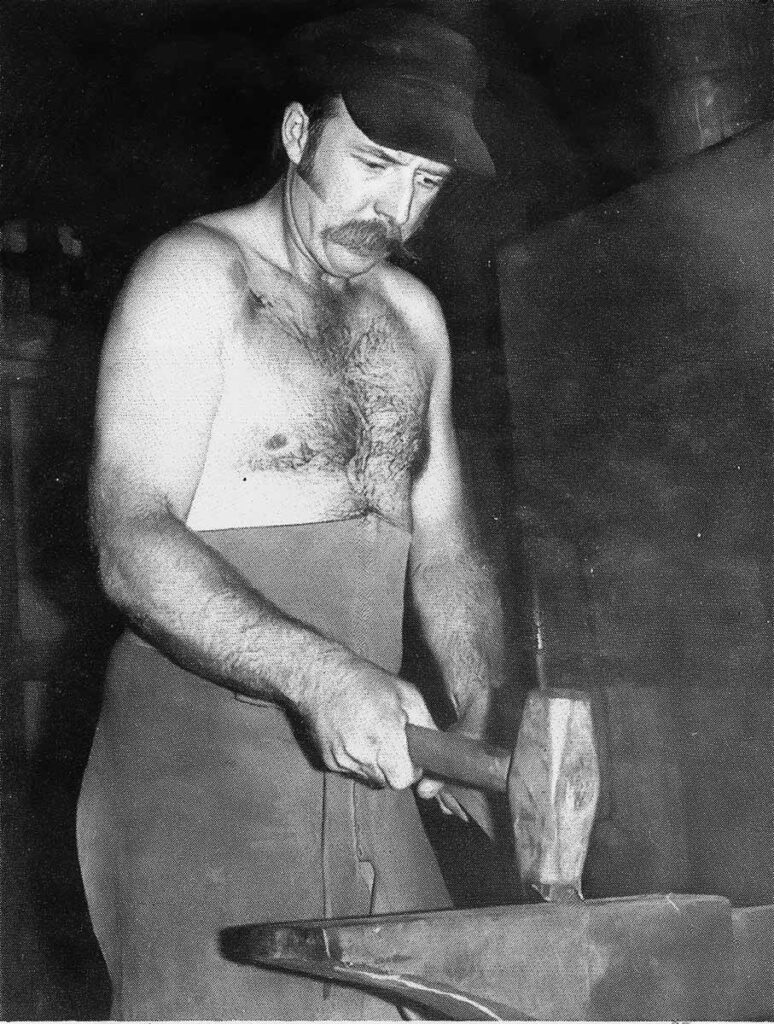
Daryl Meier forging steel in 1976.
Daryl’s contributions to damascus are legend.
As early as 1976 he was teaching a four-week course on forging damascus steel, no doubt one of the first such courses in the modern custom knife era. He was one of the first if not the first to write a regular column on damascus steel called—surprise!—“Damascus Steel” for BLADE in the early 1980s. One of the columns was titled “Wootz Revisited” and featured an image of a misspelled “Stephen Swertzer”—aka Steve Schwarzer—doing the ancient silk scarf-cutting test.
As important as Daryl’s contributions to the forging of damascus have been his dissemination of his damascus in general he probably has had more impact on the knife industry. Call him the Sensei of Steel. He was among the first if not the first to make damascus for use by other knifemakers, and helped inspire others to do the same, including Cutlery Hall-of-Famer Devin Thomas, Mike Norris, Bob Eggerling, Chris Marks, Gary House and others.
Today, making damascus for use by other knifemakers has long been a sub-industry unto itself—and Daryl was there at the beginning of it all. For these and other contributions, he was awarded the BLADE Magazine Industry Achievement Award in 2008.
The last time I talked to Daryl was about a year ago by phone. He sounded chipper and upbeat as ever. In fact, even in his early 80s he remains physically active and was all excited about a new pursuit—dancing—and how he was attending local dances on a weekly basis. Always ready to try new things, even in the fourth quarter of life—that’s Daryl. And I bet he can beat a mean rug, too!
This summer’s crop of custom knives brings damascus front and center. From twisted and ladder patterns to stainless blends and copper-clad creations, each blade in this collection highlights not just the maker’s skill, but their artistry with steel. Whether forged for daily carry, culinary precision, or collector prestige, these knives turn heads with standout materials—think crystallized titanium, crosscut mammoth, and ringed Western Myall—paired with performance-driven designs. Featured makers range from journeyman smiths to Guild members, each offering a unique take on the timeless beauty and cutting power of damascus steel.
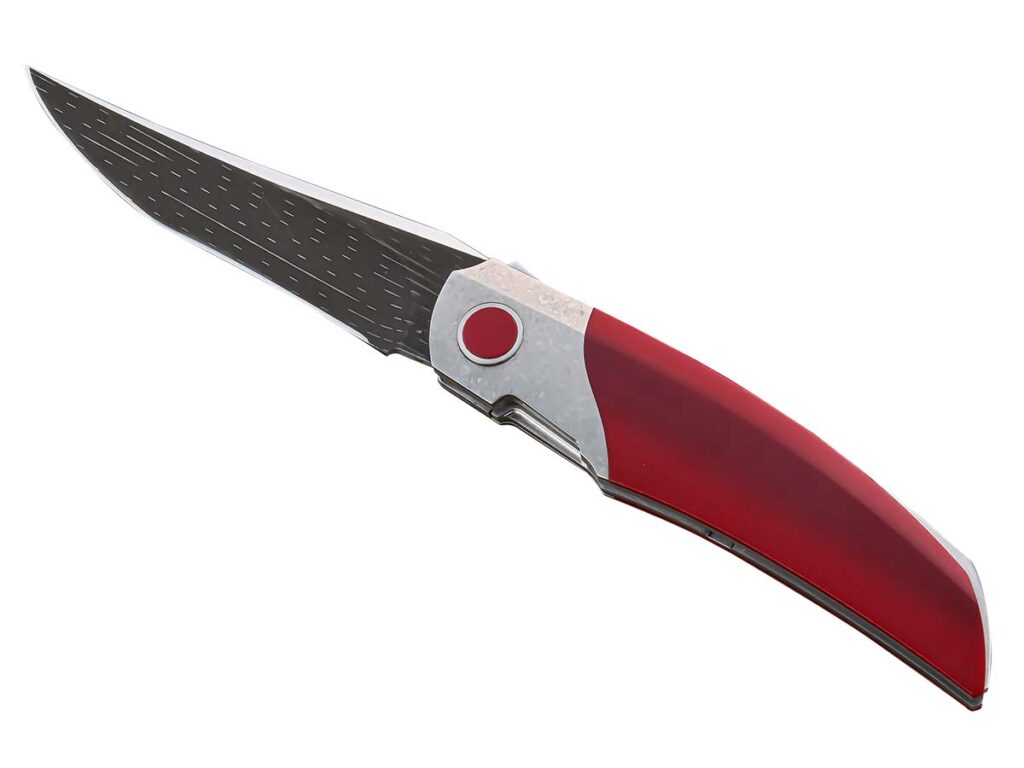
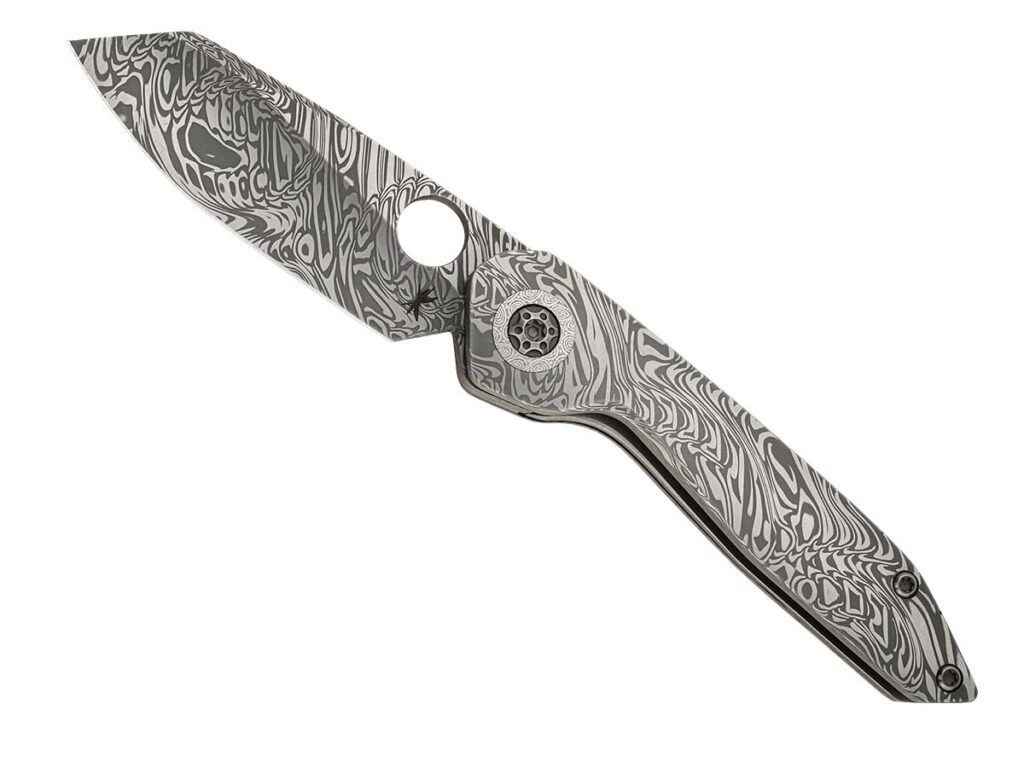
Carlos Queiros Thorn Persian TRS
Knife type: Folder Blade length: 3.35” Blade material: Chad Nichols Starfire stainless damascus Blade grind: Flat Scales: Vintage bright red linen Micarta® Bolsters: Crystalized titanium Pocket clip: Yes Closed length: 4.53” Maker’s price for a similar knife: $4,700-$4,800 at press-time exchange rate Maker: Carlos Queiros (SharpByCoop image)
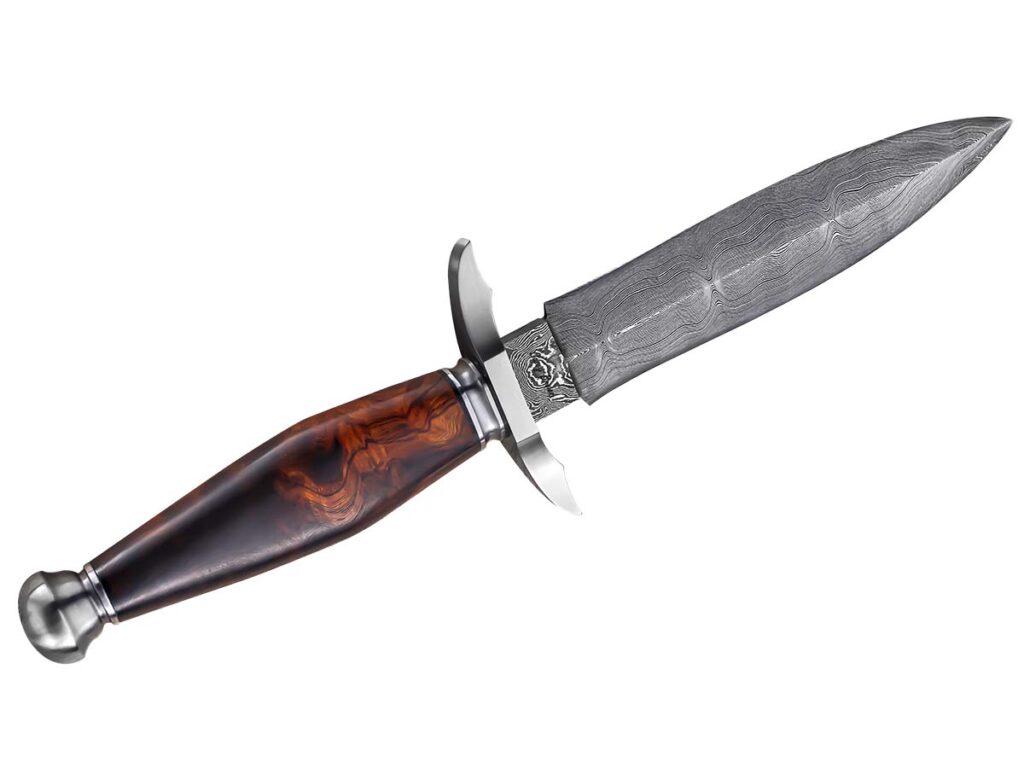
Casey Brown Dagger
Blade length: 5.5” Blade material: Ladder-pattern damascus Blade grind: Flat Scales: Desert ironwood Guard/fittings: 416 stainless steel Overall length: 10.25” Maker’s price for a similar knife: $900 Knife to know: The maker is an ABS journeyman smith Maker: Casey Brown (SharpByCoop image)
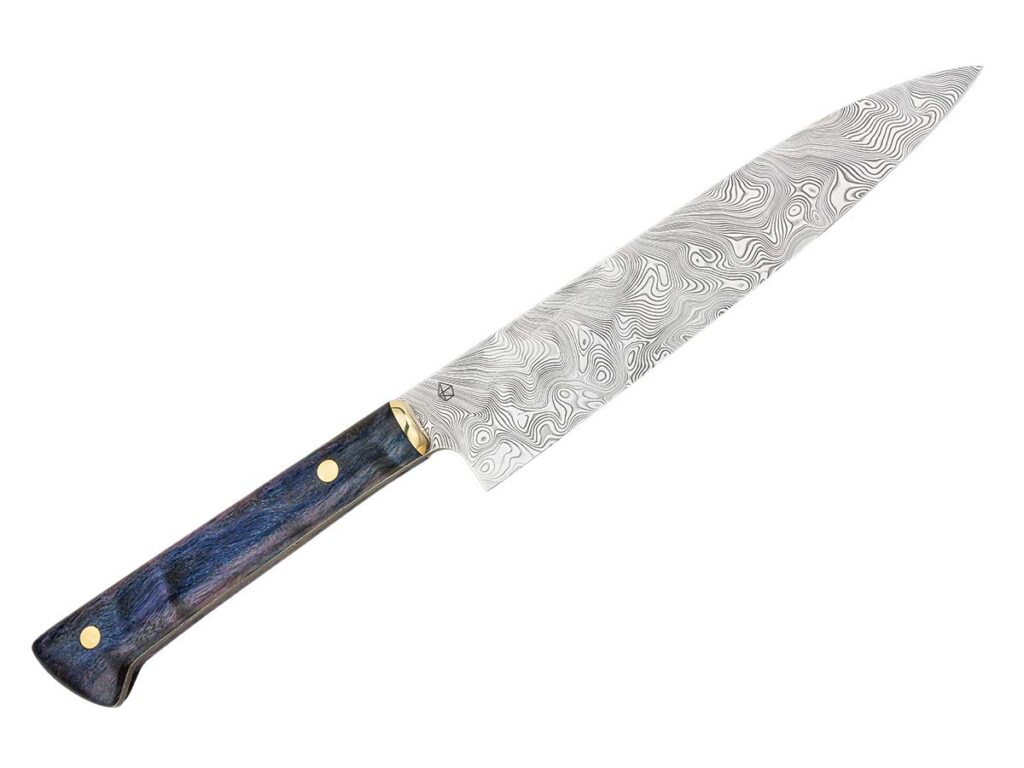
Luka Allen Petty Knife
Blade length: 5 5/8” Blade material: Bjorkman’s twist damascus by Damasteel Blade grind: Flat Scales: Cottonwood Fittings: Brass Overall length: 9.75” Maker’s price for a similar knife: $450 Maker: Luka Allen, lukaallen.com (Jocelyn Frasier image)
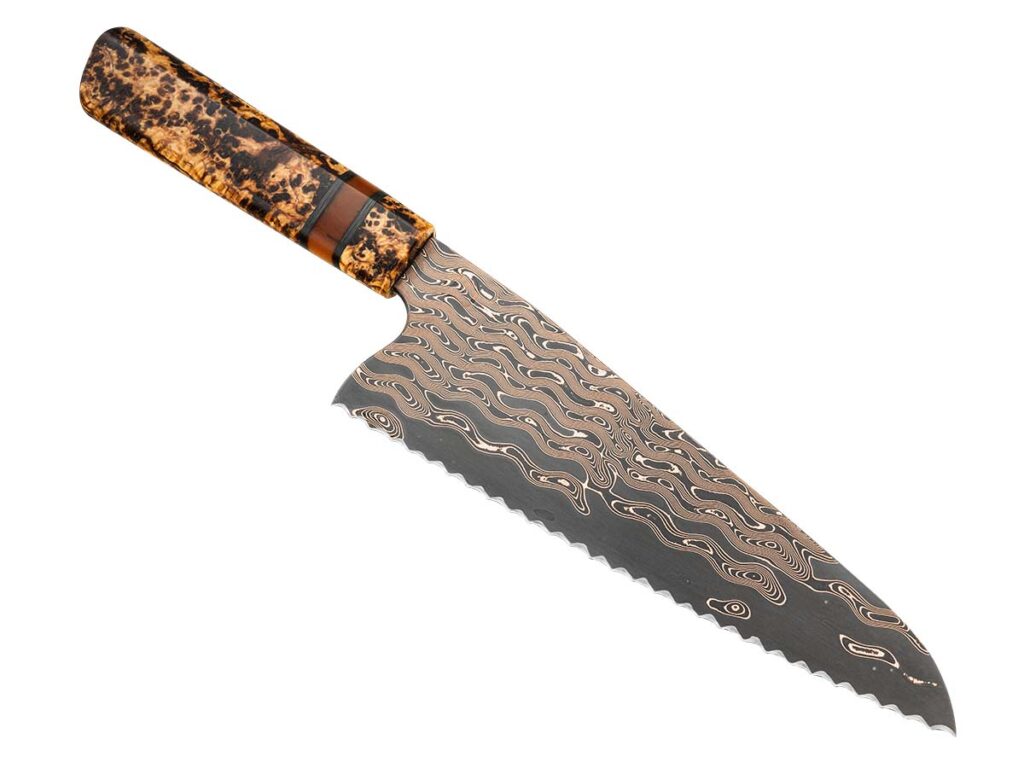
Micah Dunn Chef Bread Knife
Blade length:7.5” Blade material: Baker Forge & Tool copper-mai Surge pattern Blade grind: Flat Scales: Spalted chestnut burl and vintage Micarta® Overall length: 12.25” Maker’s price for a similar knife: $1,200 Maker: Micah Dunn, mdedgeworks.com (Jocelyn Frasier image)
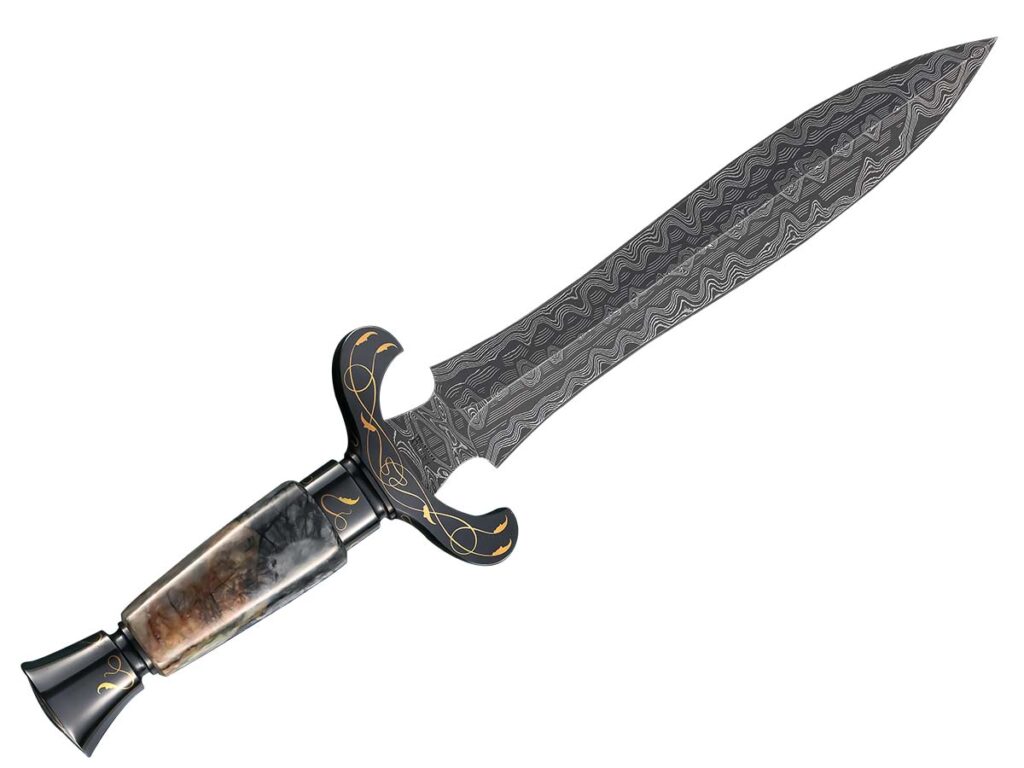
Dennis Friedly Art dagger
Blade length: 9” Blade material: Mike Norris damascus Blade grind: Hollow Scales: Picasso marble Fittings: Blued steel Embellishment: 24k-gold inlay by Ray Cover Jr. Maker’s price for a similar knife: $7,200 Knife to know: The maker is a voting member of The Knifemakers’ Guild Maker: Dennis Friedly, friedlyknives.com (SharpByCoop image)
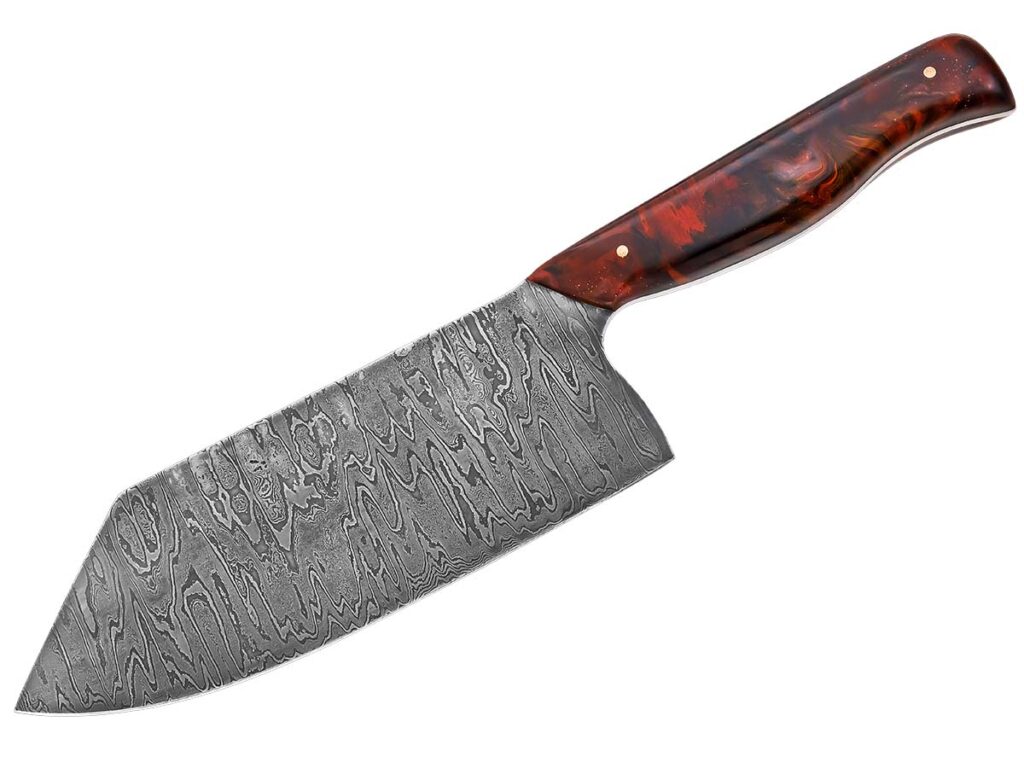
Dane Standen Cleaver
Blade length: 7.3” Blade material: 243-layer textured damascus of 1084 carbon- and 15N20 nickel-alloy steels Blade grind: Flat Scales: Colored resin Pins: Copper Overall length: 12.2” Maker’s price for a similar knife: Contact maker for info Knife to know: The maker is a probationary member of the Australian Knifemakers Guild Maker: Dane Standen (Rod Hoare image)
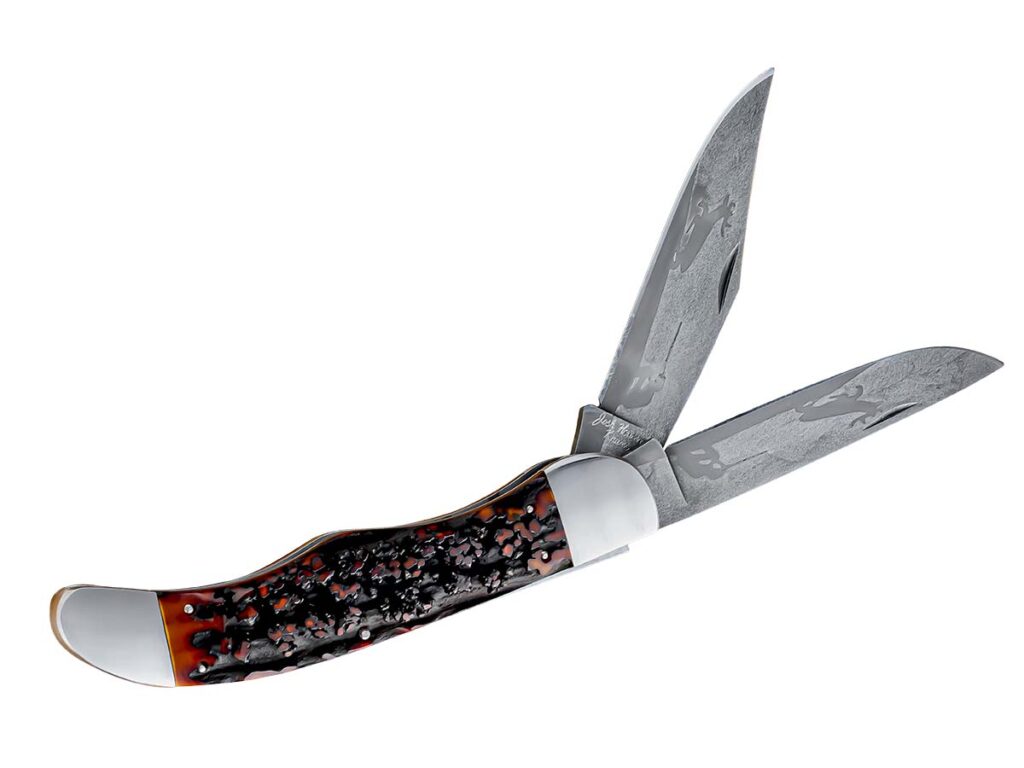
Josh Howard Folding Hunter
Action: Slipjoint Blade length: 3.5” Blade material: Pattern-welded deer hunting scene Blade grind: Hollow Scales: Amber stag Handle frame & bolsters: Stainless steel Closed length: 5.25” Maker’s price for a similar knife: Contact the maker for info Maker: Josh Howard, deerlickridgeforge.com (SharpByCoop image)
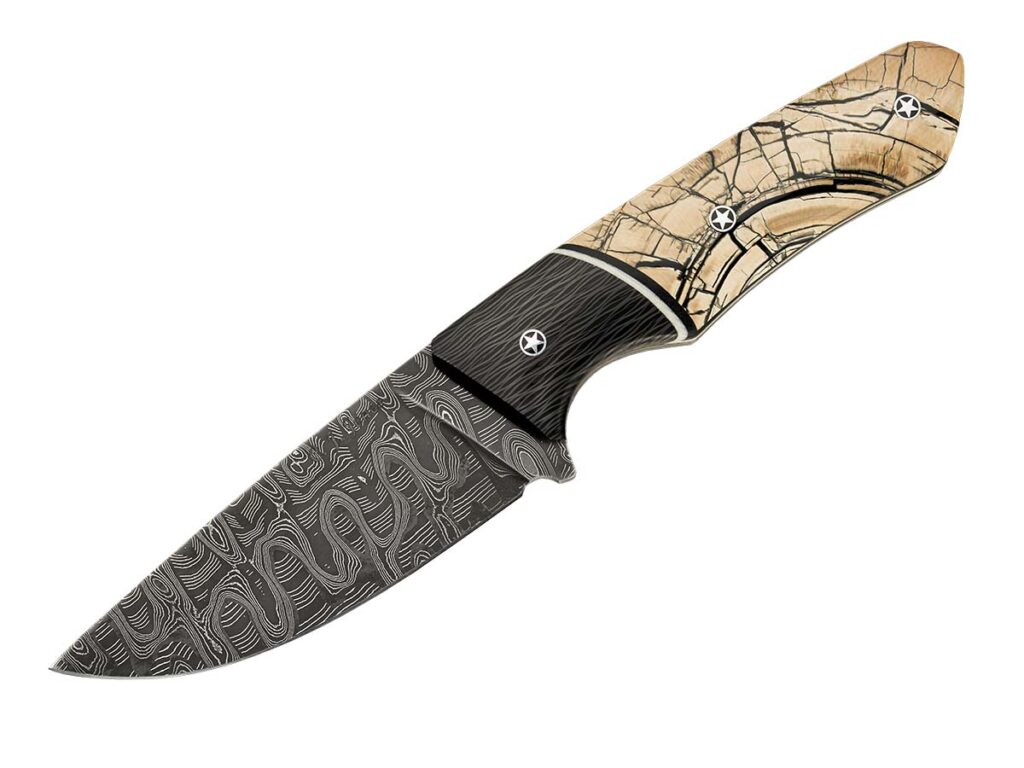
Chad J. Jones Hunter
Blade length: 3.75” Blade material: Mike Norris Hornet’s Nest stainless damascus Blade grind: Flat Scales: Crosscut mammoth tusk Liners: Black and white G-10 Bolster: Zebra carbon fiber Overall length: 8” Maker’s price for a similar knife: $1,250 Maker: Chad J. Jones (Jocelyn Frasier image)
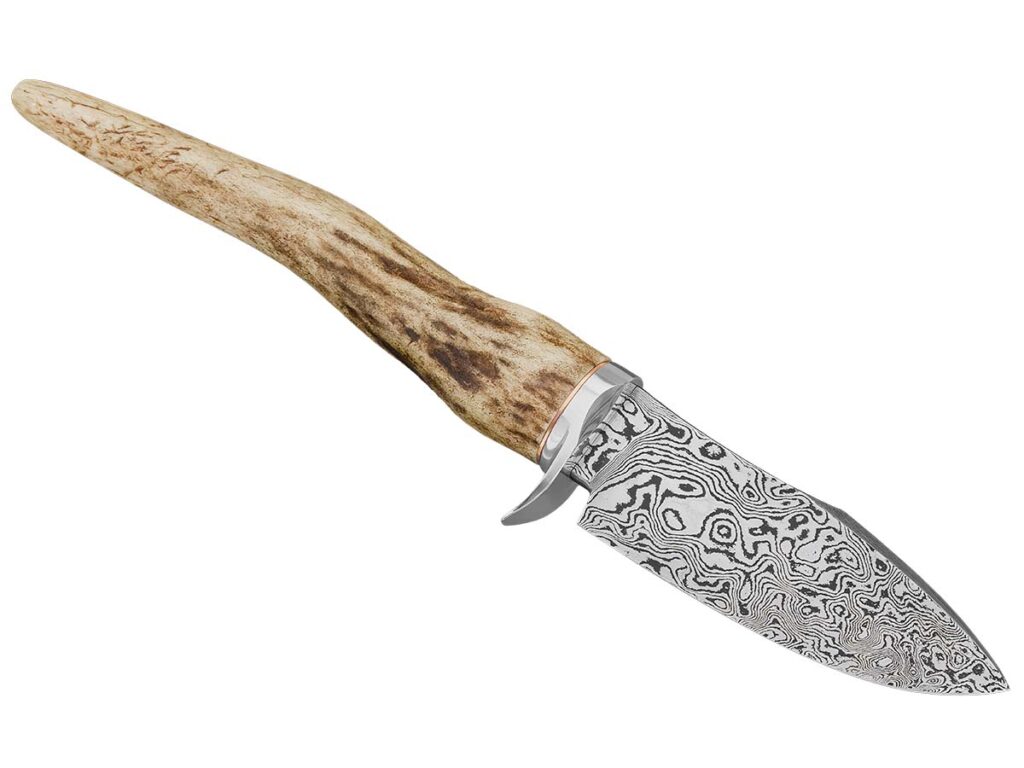
William Manning Hunter
Blade length: 3.35” Blade material: Random-pattern damascus of 1084 carbon-and 15N20 nickel-alloy steels Blade grind: Flat Scales: Antler w/copper spacer Guard: 416 stainless steel Overall length: 8.27” Maker’s price for a similar knife: Contact maker for info Knife to know: The maker is a probationary member of the Australian Knifemakers Guild Maker: William Manning, manningblades.com (Rod Hoare image)
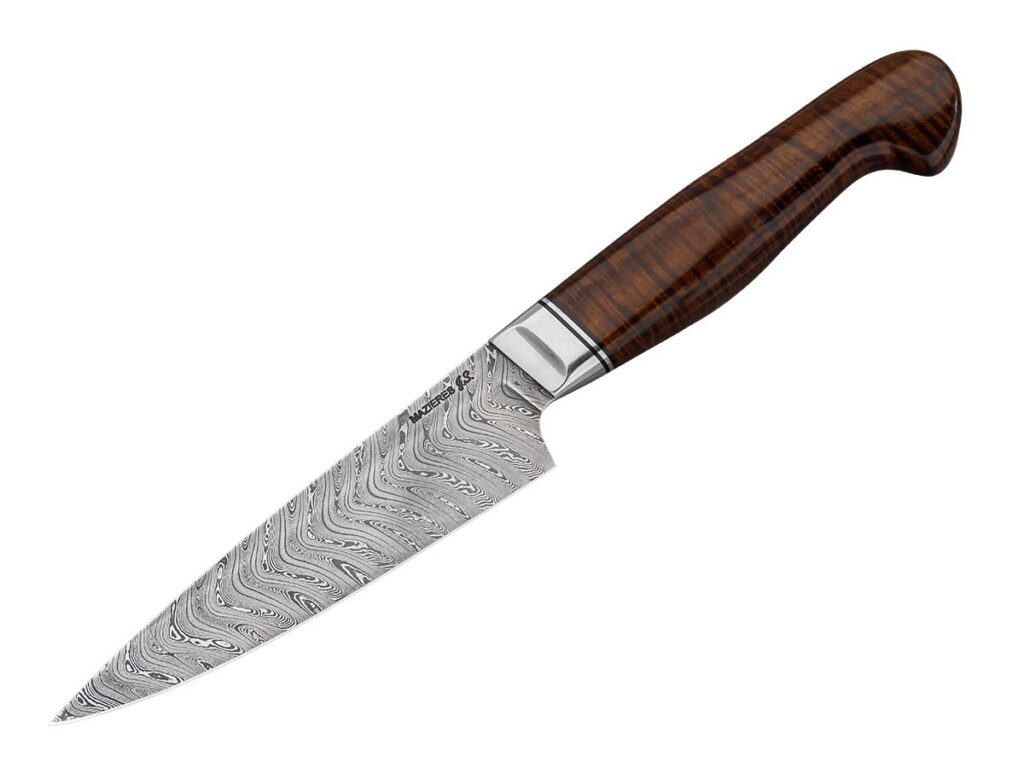
Francois MazieresMedium Paring Knife
Blade length: 5” Blade material: Pattern-welded damascus in 150 layers of 1084 and 1075 carbon- and 15N20 nickel-alloy steels embossed using chevron dies for the final pattern Blade grind: Flat Scales: Stabilized South-Australian ringed Western Myall wood shaped in a composite Western/cowboy style Spacers: G-10 and stainless steel Bolsters: Scalloped, pinned and soldered 416 stainless steel Construction: Hidden tang Overall length: 10” Maker’s price for a similar knife: $320.62 at press-time exchange rate Knife to know: The maker is a member of the Australian Knifemakers Guild and a journeyman smith in the American Bladesmith Society Maker: Francois Mazieres, Yandiwa.com.au (Rod Hoare image)
Nate “Tuna” Grant Utility Fixed Blade
Blade length: 4” Blade material: Rietveld Dragonskin damascus by Bertie Rietveld Blade grind: Flat Handle: Titanium, nickel silver, fiber liners, laser engraved Overall length: 8” Sheath: Guster leather; inlaid w/exotic animal skin; belt model with snap Maker’s price for a similar knife: $5,000 Knife to know: The maker’s utility fixed blade won Best Utility at the 2024 Lost Pines Knife Show Maker: Nate “Tuna” Grant, madebytuna.com (Jocelyn Frasier image)
Bryan Montalvo Basset
Knife type: Folder Blade length: 3.25” Blade material: Grabak damascus by Damasteel Blade grind: Hollow Blade pivot: Skiff caged ceramic bearings Handle: Same material as blade Lock: Linerlock Pocket clip: Same material as handle Closed length: 3.5” Maker’s price for a similar knife: $3,000 at press-time material costs Maker: Bryan Montalvo, keanisonknives.com (Jocelyn Frasier image)
Stuart Kerr just can’t help meddling in the affairs of dragons with his custom straight razors.
Priced out of the custom straight razor market, Stuart Kerr figured he’d make his own. A lucky plunge for anyone who appreciates quirky and unique takes on the ol’ cut throat.
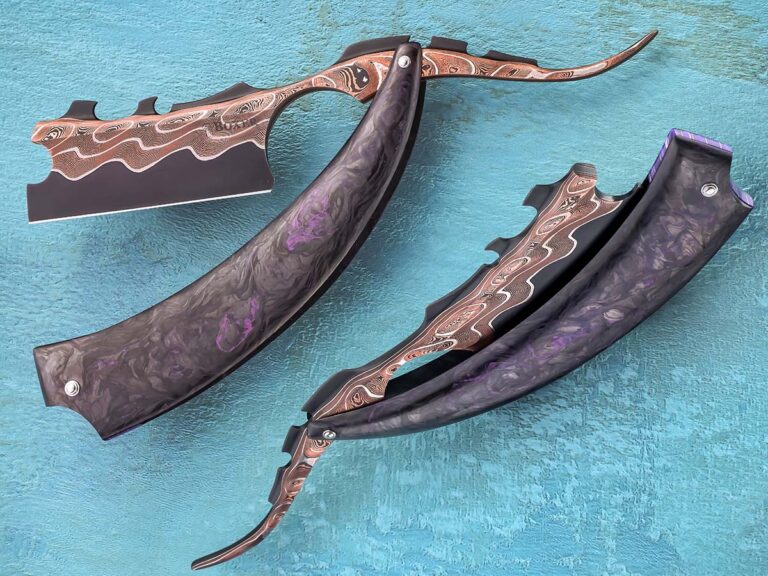
The Australian Knifemakers Guild member’s Cu Mai Dragon is a grand example of his deft and distinctive style. Kerr crafted a 2.56-inch blade from Baker Forge & Tool Tsunami Chevron Copper San Mai and offset it with a FatCarbon Dark Matter Purple Marble carbon-fiber handle. Striking enough as it is, but memorable thanks to the dragon scale on the spine and tang.
However, the proprietor of Boxer Custom Razors is darkly playful in much of his work.
“The concept of the dragon motif evolved from a couple of non-folding razors I made years back that were based on human bones. I was asked to design a razor with a handle that looked like a human spine,” the Queensland, Australia, resident said. “This inspired me to push the artistic envelope further and eventually evolved into the Dragon Tail and Dragon Spine razors.”
Kerr got his start restoring vintage straights, and when he made the jump to crafting them in 2011—aside from know-how—he started somewhat from scratch.
“I had a background in metal fabrication prior to studying to be a mechanical engineer, so I had the tools required to make my first belt grinder out of some plywood and an old pump motor,” he said.
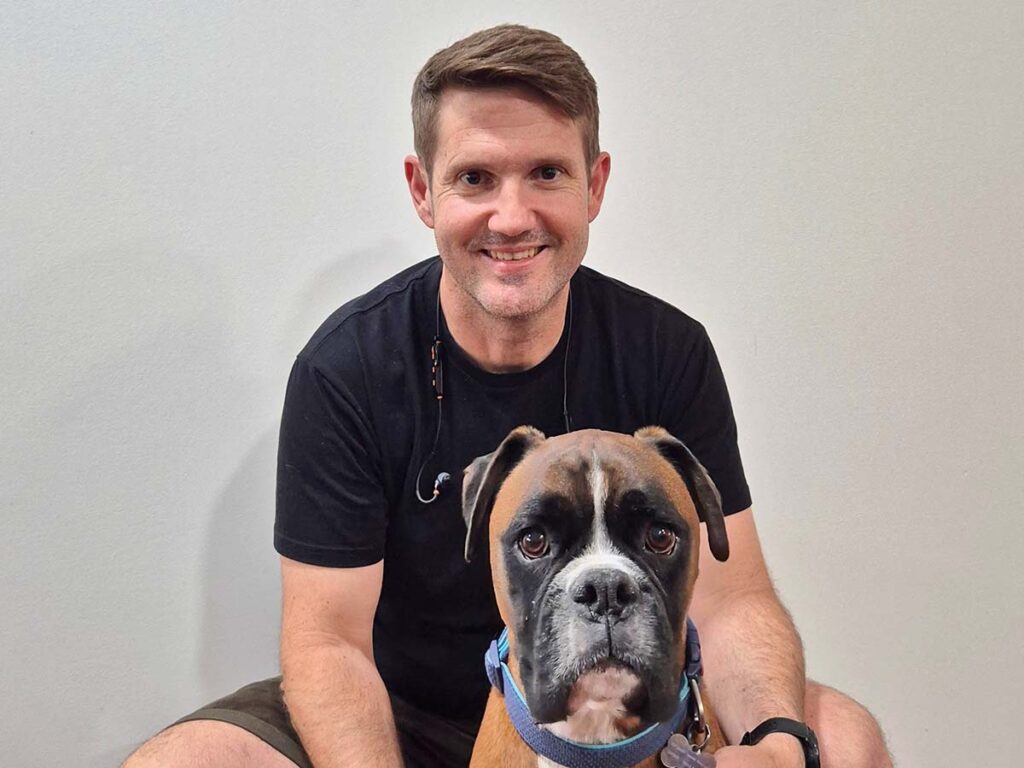
Stuart Kerr and Zeus the boxer.
Requiring an edge meant to split hairs, Kerr’s honing process on his razors is meticulous, to say the least. After the grinding is done, he works his way through whetstones with grits from 1,000 to 16,000. Then it’s a few laps on balsa loaded with chromium oxide.
“Final step is stropping on a kangaroo hide strop,” he said.
A very Australian finish, indeed.
Check Out More Cool Customs:
Cool Custom: Tony Lewis’ Tribute Knife To Steve Dunn
Cool Customs: Rocco Nawrocki’s Knife For Sergeant Bunker
Awards Were Given Out In Nine Different Custom Knife Categories Including Best In Show At BLADE Show West In Salt Lake City.
Dozens of makers entered knives in competition across eight different custom knife categories. The skill on display was tremendous, and numerous knives wowed the judges. However, these were the blades that stood out from the crowd and took home the awards. All images are SharpByCoop Images.
This Texas-Based Maker Has A Shop Full Of Grinders And More To Make His Traditional-Style Pocketknives
Tom Ploppert has been building knives only since 2009, but he’s made up for lost time in spades. He is a member of the South Texas Slipjoint Cartel, a group of makers who all studied under BLADE Magazine Cutlery Hall-Of-Fame® member Bill Ruple.
More recently Tom has been an acolyte of another legend, the late Cutlery Hall-Of-Famer Tony Bose, who he credits with helping achieve a milestone in his knifemaking career: making a lockback whittler.
Not surprising given his mentors, Ploppert specializes in traditional pocketknives, both single- and multi-blades, in stag, bark ivory, and jigged bone, as well as more modern standbys such as Micarta® and carbon fiber. Blade-wise Tom works with both damascus and a variety of stainless steels and, like his mentor, his work is clean and crisp as an ironed linen sheet. He keeps his shop in similar order.
Tom Ploppert’s Tools
In addition to his big belt grinders, Ploppert also uses a Hardcore horizontal grinder and two 9-inch disc grinders—one horizontal and one vertical.
He starts off the tour with a host of grinders.
“Like most knifemakers I have an array of equipment that I use every day,” he notes. “I guess the most-used tools and equipment are the grinders. I have three Baders, one Northern Tool and a 20-inch Burr King dedicated to grinding blades. I also use a Hardcore horizontal grinder, and two 9-inch disc grinders, one horizontal and one vertical. Something that is also important is a quality light source. I’ve changed all shop lights to LED and use Steris examination lights that show everything.
“When making slip joints things must be flat, parallel or perpendicular. My Jet surface grinder has been an invaluable piece of equipment at the shop. After heat treating with my Paragon Oven I can grind everything flat if there is any movement during the heat-treat process. I traded an old Dodge farm truck for the surface grinder. The grinder hasn’t had the first transmission issue either!
“I use a Servo precision drill press to accurately drill small holes,” he continues. “I use my Jet machining mill to drill larger holes for bushings and lanyard holes. My mill also serves to machine integral liners and cut tang reliefs in liners. Like most of the other slip-joint makers, I’m learning to use my Deckel pantograph to cut and inlay shields.
“Probably the most important and overlooked piece of equipment is my vacuum system. It is a three-phase, 5 horsepower Torit-Douglas system that will filter the air to two microns and re-circulates it back into the shop. It’s nice not losing your temperature-controlled air in the shop.”
Ribbing his mentor, Ploppert concludes, “Lastly, I believe in keeping the shop organized and clean to a high standard. I can’t work in a dirty shop like Bill Ruple’s!”