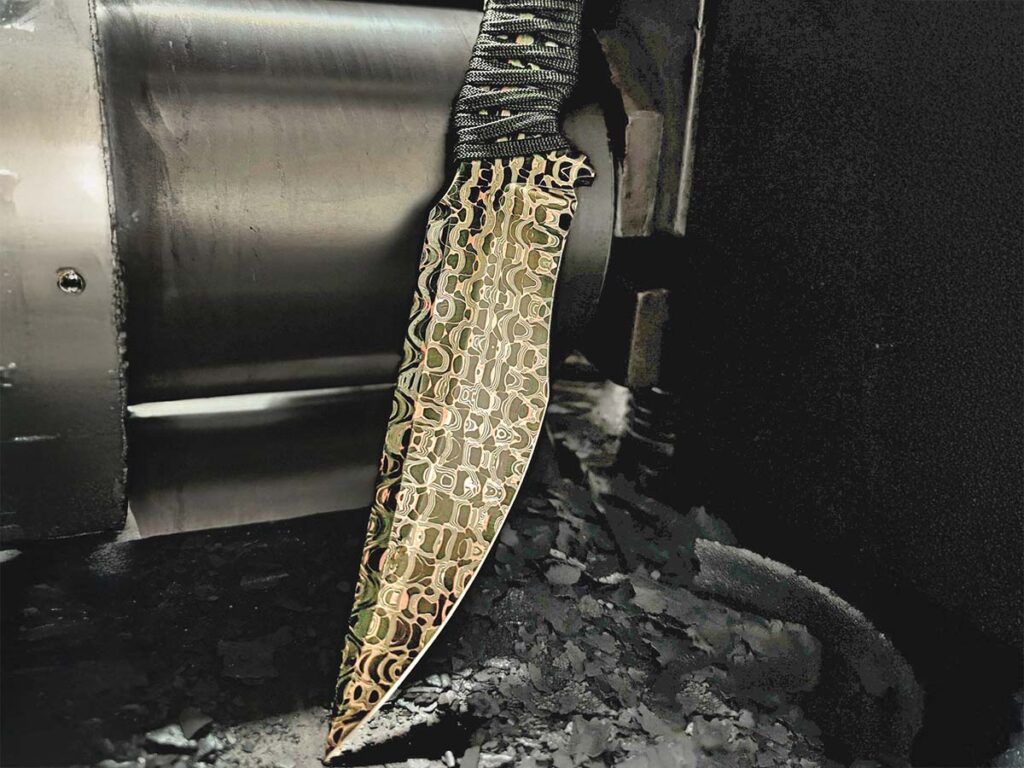
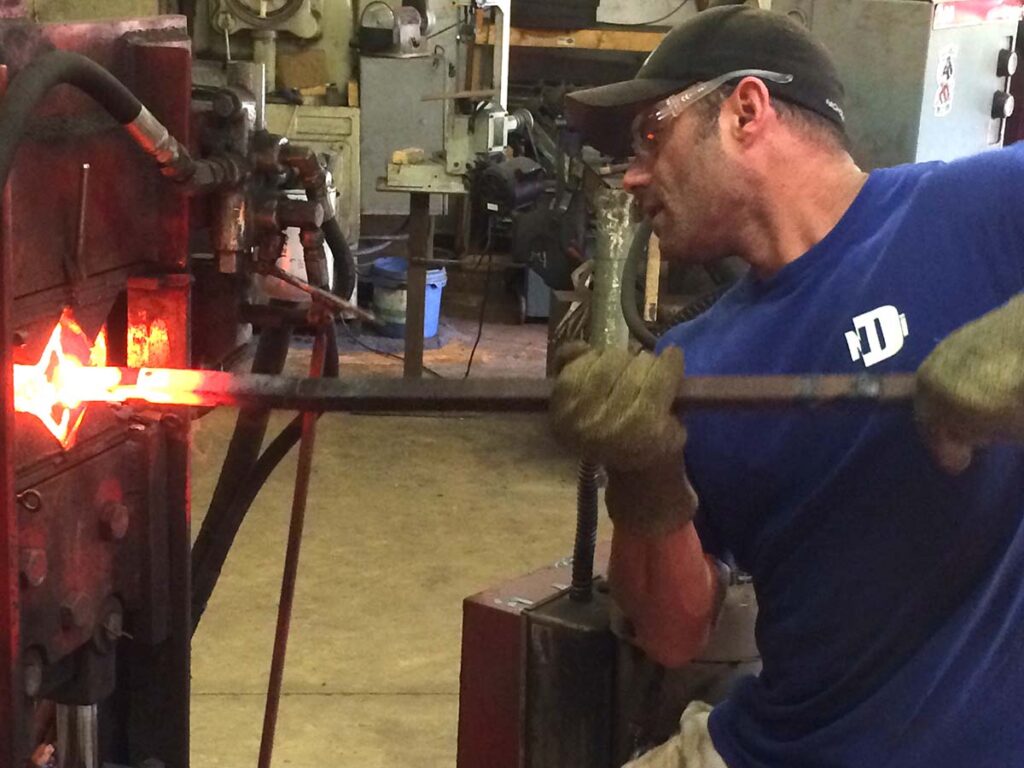
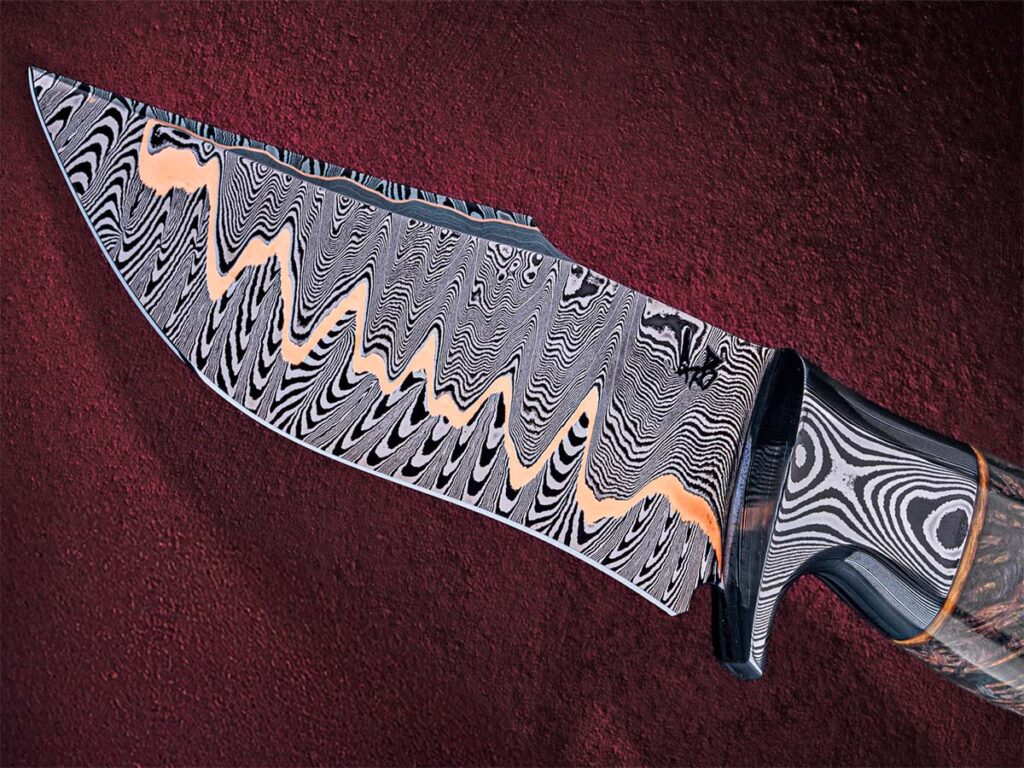
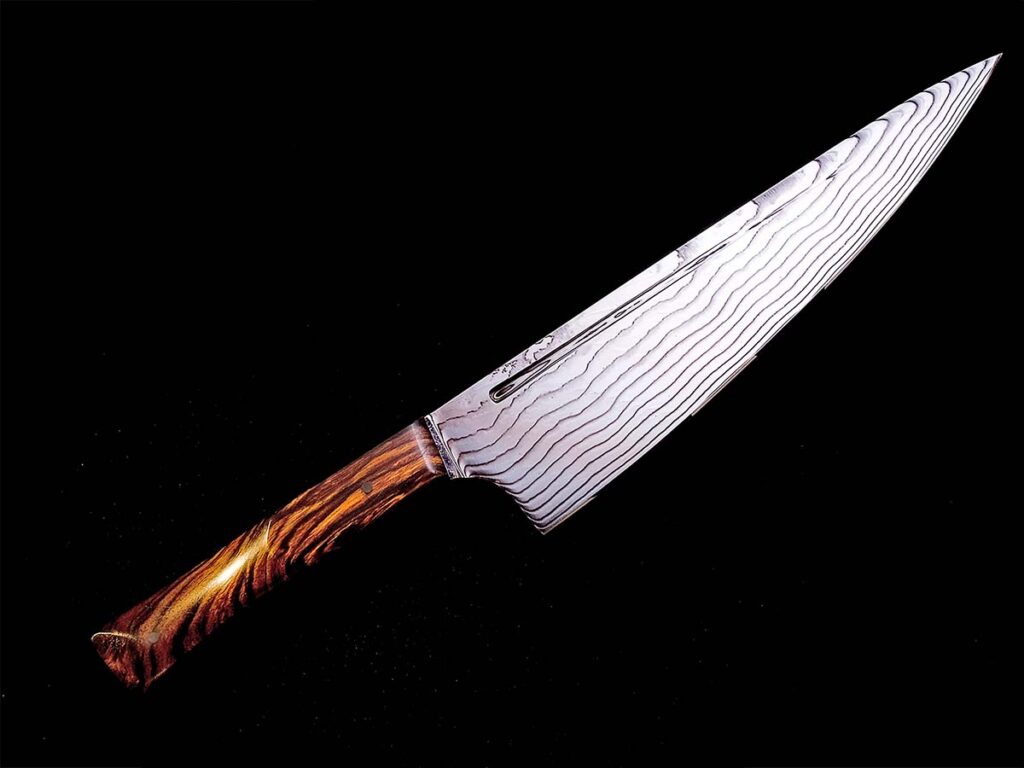
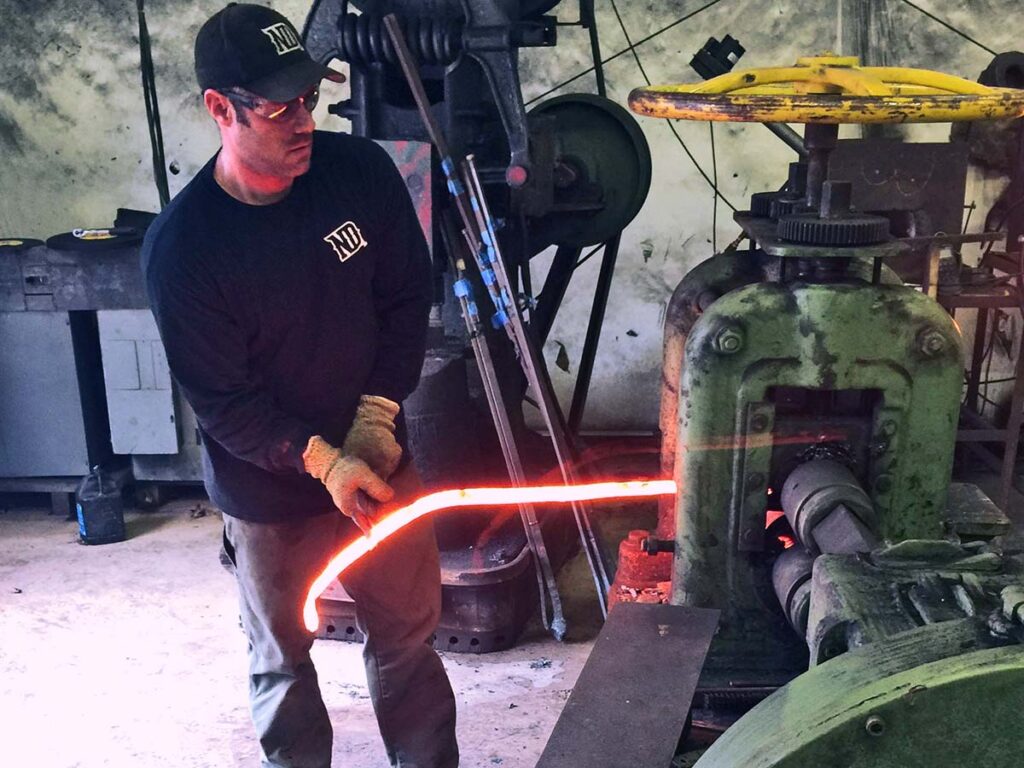
Knifemaking is the building of a knife, which includes the blade, handle and other accouterments. Blades are made by either removing metal from a steel blank via a grinder – known as stock removal – and the forging to shape of hot steel into a blade in the process known as bladesmithing. Other parts, including bolsters, guards, pommels, etc., are needed to complete the finished knife.
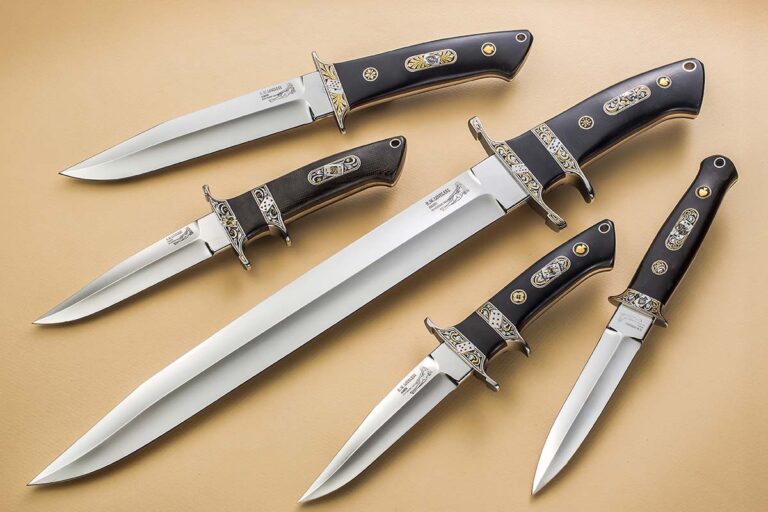
The sub-hilt is at once belligerent and beautiful, adding a strange allure to the knives that sport it.
There is no consensus as to the origin of the sub-hilt knife, though most agree the sub-hilt fighter was popularized by BLADE Magazine Cutlery Hall-of-Fame® member Bob Loveless in the 1970s, if not earlier. Some believe the sub-hilt design was for hunting, and that the main purpose for the added hilt was for greater leverage when a surer grip was needed. A few have even postulated the additional hilt was for use as a brace in pulling the knife out after being stabbed into bone or another hard material, a use that it would no doubt accommodate most effectively.
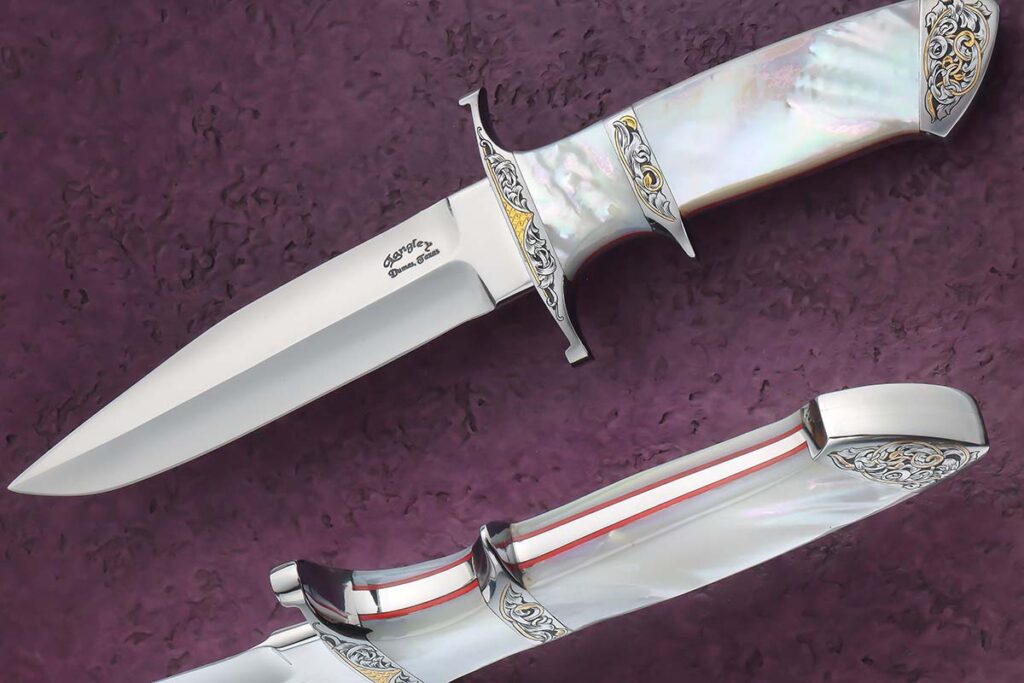
Gary Langley: Gentleman’s Fixed Blade
Custom maker Gary Langley’s sub-hilt fighter may be small at 9 inches overall but makes up for its size in sleek blade grinds, exquisite mother-of-pearl scales and gold inlay. Blade and overall lengths: 4.5 and 9 inches. Alice Carter did the engraving. (SharpByCoop knife image)
Many knife enthusiasts think of a sub-hilt fighter as being a heavier-edged companion—and in many cases it is—but custom knifemaker Gary Langley’s iteration is a little gem of a knife.
“The small Loveless-style sub-hilt fighter is 3/16-inch CPM 154 steel with a double hollow grind on a 3-inch wheel,” the Dumas, Texas, maker notes. “The heat treatment is by [Cutlery Hall-of-Famer] Paul Bos. I originally designed the knife without the rear bolster. I added it when I couldn’t source the mother-of-pearl scales long enough—and I believe it turned out even better.”
It has what might be called a 19th-century Michael Price San Francisco knife look that makes it a prime candidate for a true gentleman’s fixed blade.
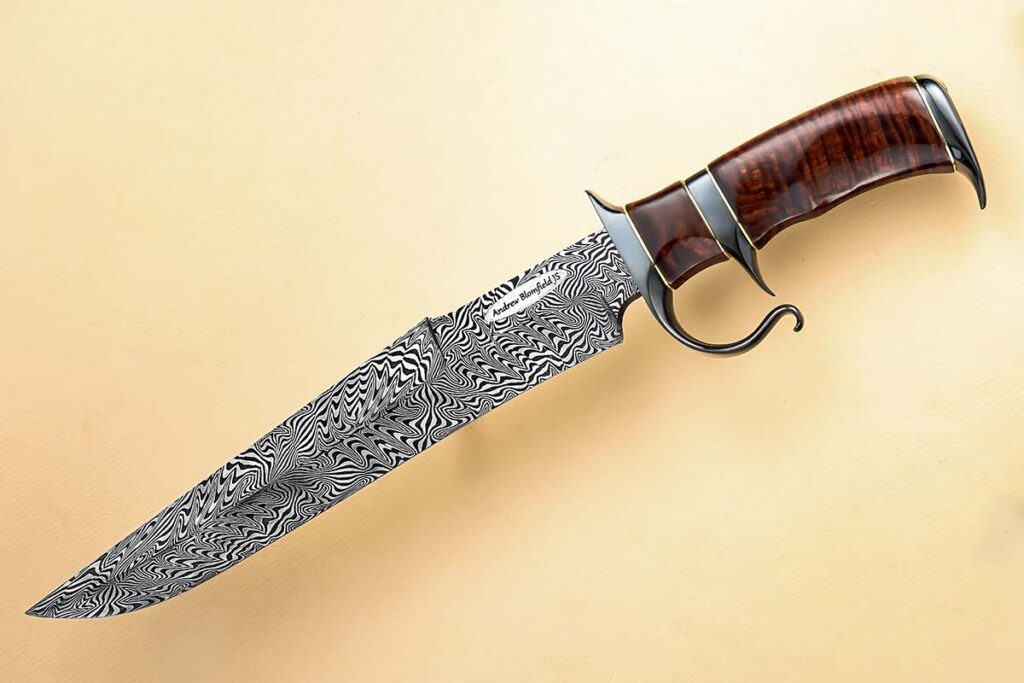
Andrew Blomfield: Sub-Hilt Bowie
ABS master smith Andrew Blomfield’s sub-hilt bowie is a tour de force of explosive mosaic damascus, salt-blackened steel, brass spacers, and exquisite Australian ringed gidgee wood. Blade and overall lengths: 11 and 16 inches. (SharpByCoop knife image)
An ABS master smith from New South Wales, Australia, Andrew Blomfield enjoys building large knives such as bowies and daggers. “The bigger the knife the better,” he states. An example is his sub-hilt bowie.
“I feel that this knife has great flow and balance,” he begins. “The blade is an explosion mosaic pattern damascus hardened to 59 HRC. The guards and pommel are salt-blackened steel with brass spacers and the handle is a beautiful piece of Australian ringed gidgee.”
The guard’s bottom quillon curves back toward the sub-hilt to partially enclose the user’s hand a la a D-guard, but also has hints of both a C- and an S-guard to it. Very unusual!
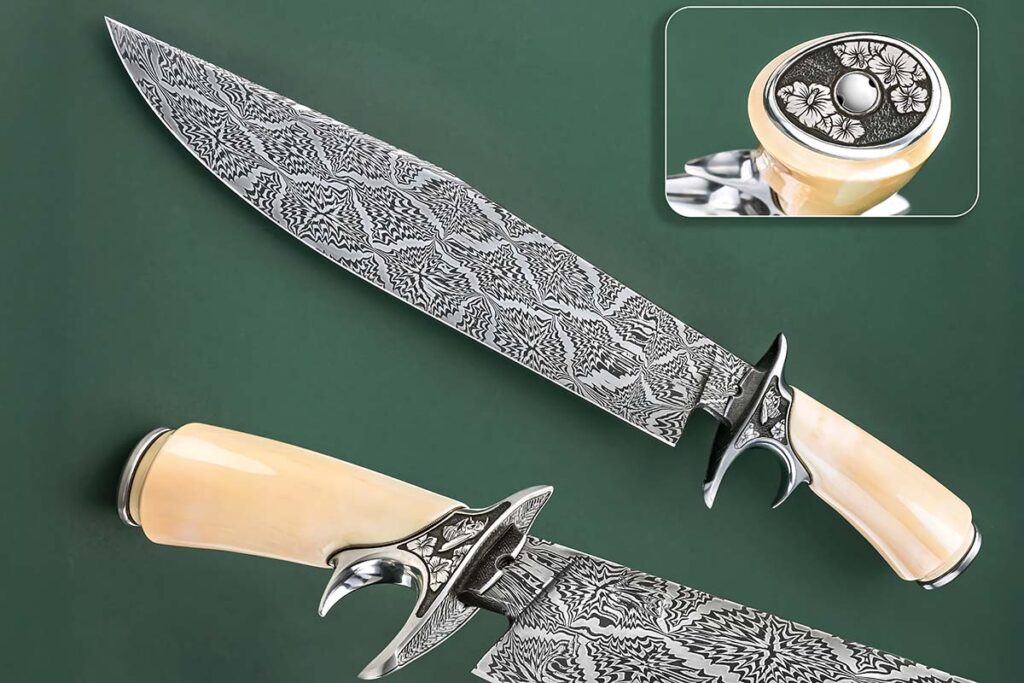
Andrew Meers: Rose of Sharon
ABS master smith Andrew Meers calls his 16.5-inch sub-hilt fighter Bees and Flowers, due in no small part to the Rose of Sharon and bees engraving. The 12-inch blade is a damascus of 1084 carbon and 15N20 nickel-alloy steels in a mosaic pattern. Guard and furniture are 416 stainless steel. Overall length: 16.5 inches. (SharpByCoop knife image)
ABS master smith Andrew Meers of Raleigh, North Carolina, says, “I started with the sub-hilt in mind, which is a departure for me.” To say his deviation from the norm worked out well is an understatement.
“I like to incorporate Japanese influences wherever I can, and I wound up adding an integral habaki into the guard design as well,” he explains. “I wanted a blade that was able to feature a mosaic pattern, so I chose a broader shape that expands towards the point rather than tapers. The handle is a simple design to contrast the visual complexity of the guard.”
The engraving theme is of the Rose of Sharon and bees.
“The client had requested a floral theme, and we worked on the rest of the design and layout from there,” Andrew says. “The engraving was meant to complement the layout of the guard and furniture.”
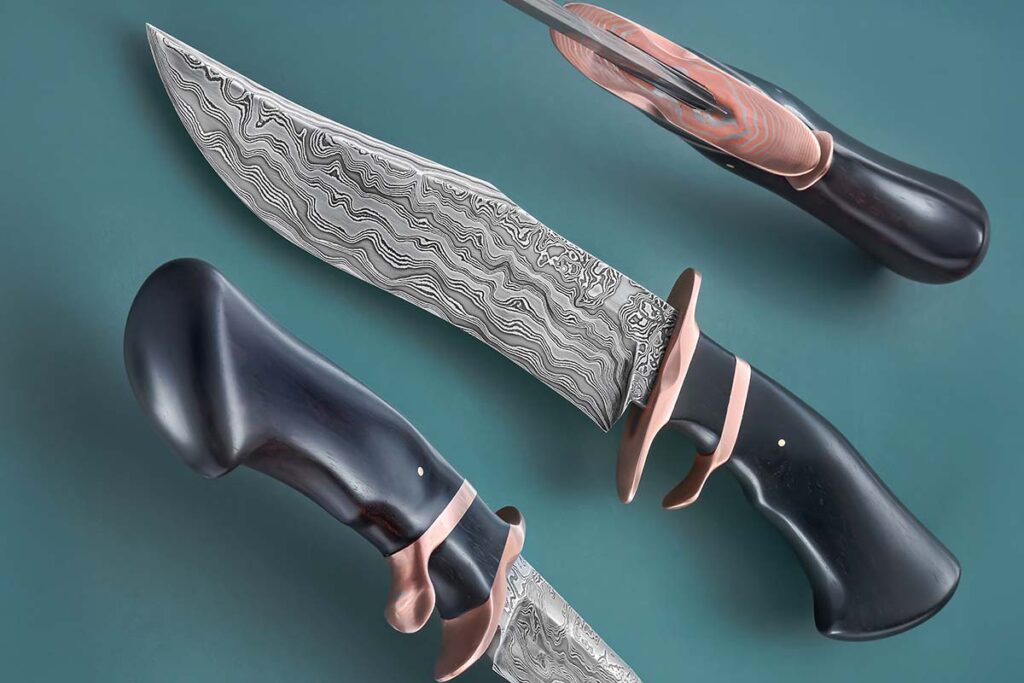
Justin Harrington: A-Team
Built for an Army buddy, Justin Harrington’s superb sub-hilt fighter incorporates a masterful balance of random pattern damascus, mokumé gané and African blackwood. Blade and overall lengths: 8.5 and 13.5 inches. (SharpByCoop knife image)
Justin Harrington of Clemmons, North Carolina, began smithing 18 years ago and is the owner of Cyclops Forge. Of the sub-hilt he says, “It’s the racecar of fighting knives—weight, balance, curvature, tip control and placement all are important variables to be employed to reach a harmony which is felt right away when correctly done.
“This knife started its life as a phone call from an Army A-team member who wanted a special combat retirement gift for his buddy. The three of us got together and forged a damascus billet for the knife over three days in my shop. The 8-inch recurve blade is a random-pattern damascus of 1084 and 15N20 carbon steels. The guard and sub-hilt are made from a copper-and-nickel mokumé gané I make in my shop. The handle is around 5 inches of sculpted African blackwood with a bronze pin.”
The sub-hilt has a forward lean and spoon-cupped quillon that slants toward the guard to capture the user’s index finger. The result is a handle that seems to want to grab your hand.
Cool & Sexy
Whether fighter, bowie or what have you, the sub-hilt-knife genre may be more recognizably custom than any other. From the classic Loveless Big Bear fighter to the wide array of today’s renditions, top sub-hilts are cool, sexy and in harmony with the best custom knives extant.
Along with all other things razor sharp, the BLADE Show attracts the cream of the international custom knife crop. Included are a wealth of the leading forgers of damascus steel, many of whom vie for the show’s Best Damascus Award, with the winner at BLADE Show 2026, Julian Antunes, a superlative example.
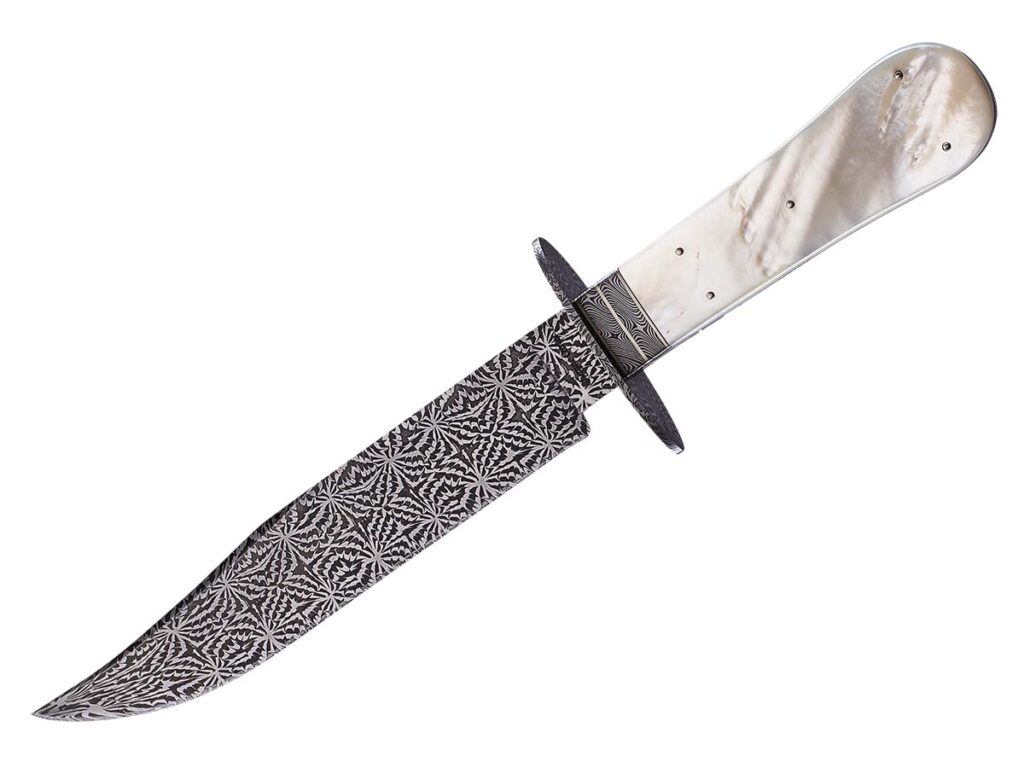
As with all things knife, damascus steel evolves, and a revealing way to observe examples of its evolution is to review some of the BLADE Show’s Best Damascus winners—in this case, from 2021 to 2025: Shayne Carter, Mike Quesenberry, CAS Knives, Ronmell Fernandes and Gabe Fletcher, respectively.
“All five of these knives are excellent examples of very fine damascus patterns. All are well thought out and executed with great control in the forging,” observed Devin “Hoss” Thomas, a BLADE Magazine Cutlery Hall-of-Fame® guru of carbon and stainless damascus. “Most of these pieces are forged to shape, which gives them that extra touch … All are very impressive. I would hesitate to pick one over the other.”
Cutlery Hall-of-Famer/mosaic damascus pioneer Steve Schwarzer, on the other hand, had no such reservations.
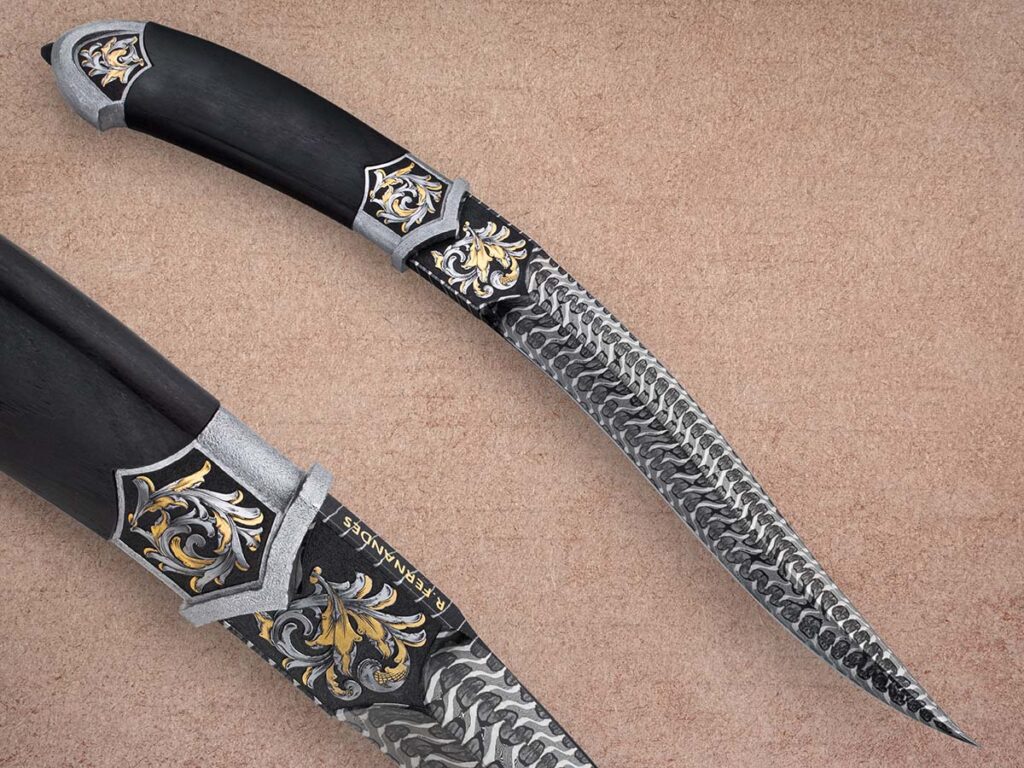
“All the blades that won Best Damascus are great examples of fine craftsmanship,” he agreed. “Two are head and shoulders above the rest. The Ronmell Persian Knife is a prime example of excellent design and embellishment woven into a master work. The blade pattern requires very controlled forging and construction. I give it a full ‘10.’”
Steve was just getting warmed up.
Ronmell Fernandes captured Best Damascus at BLADE Show 2024 for his Persian Knife in Turkish damascus. He gave it a 10 on the difficulty scale because of it being “the union of two damascus patterns in a single Turkish damascus bar,” adding it “was the best pattern I made because the composition was perfect between the black and silver of the steel alloys.” (Jocelyn Frasier knife image; image of Fernandes from The Art Knife Invitational)
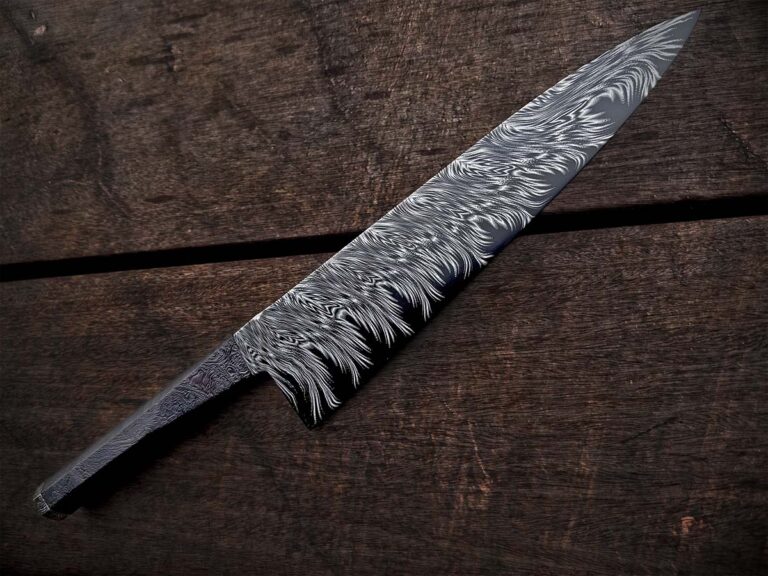
“The Gabe Fletcher chef’s knife winner is, in my opinion, light years ahead of the other blades—not for the chef’s knife construction, which is very well done. It stands alone for the unique patterning technique* recently developed and the choice of blade materials. The difficulty in forging complex, unique pattern welding has eluded modern bladesmiths worldwide for as long as I can remember. This is a mosaic stainless steel construction using very new patterning sequences.”
Fletcher’s damascus “represents a breakthrough event in modern bladesmithing,” Steve continued. “On a 1 to 10 scale of difficulty for the blade material and construction alone, I give it a 12 … The current offerings by Gabe in this unique material and patterns are in my opinion at the pointy end of the spear.”
Forge Control
As each Hall of Famer noted, controlled forging is a common thread in the best damascus. According to Gabe Fletcher, it also was a major hurdle in the successful mixture of crushed W’s and S’s in his award-winning blade.
“The most difficult and one of the most important parts of forging this pattern and most mosaic patterns is forge control,” he related. “It’s so important that you etch the ends of the bars before you weld them together so that all of your lines line up. If you just stack them together, you will see the shift in the patterns where the weld boundaries are, and it doesn’t look like a complete piece. I know that’s not always easy, but that’s one thing I strive for when I make a pattern.”
Shayne Carter took home Best Damascus at BLADE Show 2021 for his gent’s bowie in a Fourth of July pattern. Noted Shayne, “In many ways, damascus has become a worldwide language. Techniques and influences now cross borders freely, creating a global community of makers.” (Whetstone Studio knife image)
Forging the bars very clean and to exact and even dimensions so the pattern is not lost when grinding the bars clean for the next weld is paramount for exceptional damascus. “If one end is thicker than the other, or taller, when you grind everything flat, your pattern is not going to mirror correctly and you’re going to see that big shift in the lines of the pattern,” Gabe explained.
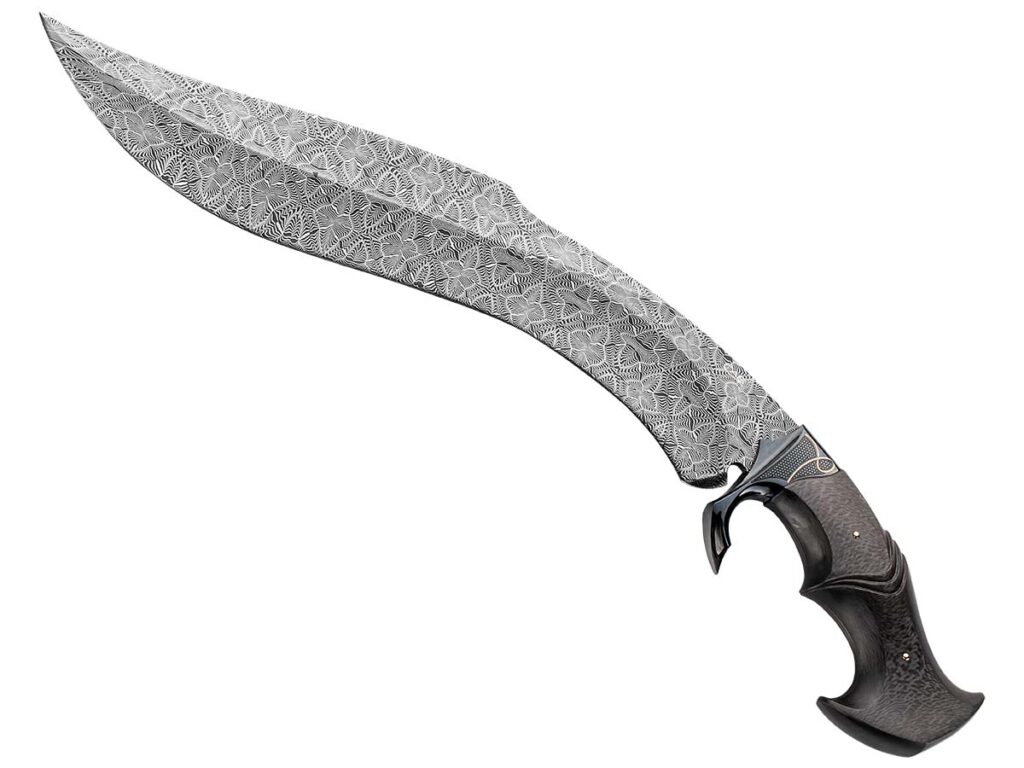
Schwarzer pointed to the CAS Knives kukri in a mosaic damascus as another example of controlled forging. “The CAS blade is a great combination of elements that add up. It is not just the pattern. The pattern is very controlled, requiring precision forging … This blade stands out for finish and overall design and execution. I give it an 8.5.”
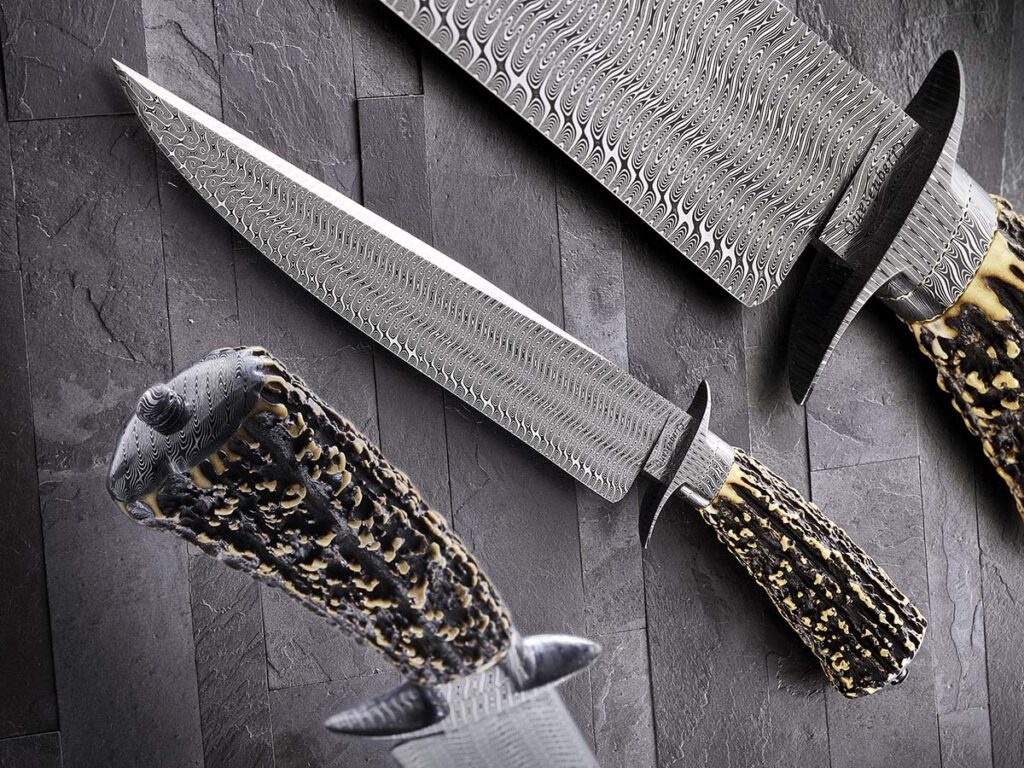
Quesenberry indicated forge control was key as well in the Turkish twist pattern of his award winner forge welded in alternating layers of 1080 and 15N20 carbon steels. “The billet is then twisted very tightly to resemble a machine-thread screw,” he stated. “It is subsequently stacked and forge-welded back together before being forged to its final shape.
“Making the pattern itself is not especially difficult, but maintaining control is the real challenge. You have to carefully control the dimensions, heat and uniformity of the twists throughout the process.”
Forth Of July
Shayne Carter usually doesn’t name his damascus patterns but indicated that if he had to name the one on his 2021 winner it would be Fourth of July. The first weld was a low-layer-count stack and the second one was low-layered W’s. “This pattern was forged on the bias, then four-wayed, four-wayed again, tile welded and finally forged into the blade,” he wrote. Steels: 15N20 and 1084.
TCAS Knives nabbed Best Damascus at BLADE Show 2023 for a kukri in a mosaic damascus pattern of 1095 carbon and 15N20 nickel-alloy steels Steve Schwarzer described as being very controlled and that required precision forging. Inset are Claudio and Ariel Sobral of CAS. (Jocelyn Frasier knife image)
“This blade was on the more difficult side because it required four to five welds,” Shayne explained. “Tile welding always adds another level of challenge. At that point in my bladesmithing career, I had not made many mosaic damascus patterns, so this project pushed my abilities.”
It can be difficult to keep track of a new pattern as it develops, so to keep track of his Fourth of July pattern he cut off a small piece of the billet after each weld. This enabled him to reference the size and appearance of the material before four-waying, tile welding and other operations. “Unfortunately, that process also results in a smaller billet,” Shayne noted. “That ultimately influenced the shape and size of the blade. The pattern turned out very well but the finished knife ended up on the smaller side.”
The biggest challenge was knowing when to stop forging. “After tile welding and surface grinding the billet, a quick edge reveal showed that I had something special. I wanted to open up the pattern slightly,” he recalled, “and I also wanted the tip to look intentionally forged rather than overworked.
“Many damascus patterns become over-forged, especially feather patterns. It is difficult to walk away from a blade when you have so much time invested in it, but restraint was important to preserving the integrity of the pattern.”
What’s Hot & Will Be
Shayne indicated that when he won the BLADE Show award in 2021, mosaics, especially in kitchen knives and those in the explosion pattern, were particularly popular. “Most makers producing hunters, bowies and fighters were still working with more traditional pattern-welded designs. Many smiths were actively trying to create and name new patterns,” he observed.
Mike Quesenberry took a different approach in forging the Turkish twist pattern for his BLADE Show 2022 Best Damascus winner. “Rather than fish-mouthing the billet, I forged it directly to shape,” he noted. “This method preserves and reveals the pattern differently throughout the blade. The fish-mouth technique has a more precise look to it, whereas the technique I use has a more organic appearance.” (Eric Eggly knife image)
“Feather damascus was extremely popular then and remains popular today. Variations on feather patterns, such as Dragon’s Breath and River of Fire, continue to attract attention, and many folder makers are especially fond of feather designs.”
Agreed Fletcher, “As far as a popular style, I think the feather damascus wins that title. The feather pattern is not my favorite but Josh Prince makes amazing variations of the technique, incorporating all kinds of elements like jelly rolls instead of just cutting W’s down the center.”
While the feather has been and seems to continue to be most popular, other patterns such as the Turkish twist remain hot as well.
“The Turkish twist has been a popular damascus pattern for many years,” Mike Quesenberry opined. “In my opinion, several makers from South America have elevated Turkish twist to an exceptional level. Most achieve the final appearance through a process commonly referred to as fish-mouthing, in which the twisted bars are manipulated and assembled to expose the pattern in a specific orientation.”
Mosaics in general also remain in demand. “Mosaic damascus has been elevated to an entirely new level,” Carter observed. “Latin American smiths are producing incredible Turkish twists, while North American makers are creating some truly remarkable mosaics.” Added Ronmell Fernandes, “The most popular patterns are mosaics because they are patterns that please a lot for their geometry.”
Hoss Thomas pulled the crystal ball from his 10-gallon hat and went full prognosticator. “I think that quilted mosaics will continue to be popular. I see more makers using plug-welded-theme patterns. I like that more makers are doing composite patterns, including Turkish twist. More guys are experimenting with gradient and fading patterns, which I find very beautiful. There are too many smiths doing great work to narrow it down to just a few,” he observed. He added the caveat, “I can tell you that there are many new makers making lazy damascus patterns, which I don’t care for. Too low in layers, not well thought out, etc.”
Further development and expansion into other patterns of the gradient element*, which Fletcher used in his BLADE Show ’25 winner, seem likely. “Created by Mareko Maumasi and Peter Burt, the gradient element will add a lot of dimension and pattern possibilities to almost any pattern ever made,” Gabe noted.
It’s anybody’s guess as to which patterns will rule and what advancements in damascus forging will emerge. At least one thing appears likely, though: whatever they are, they will be equal parts breathtaking and mindboggling.
“I believe the future of damascus is limitless,” Carter predicted. “New patterns will continue to emerge but there will always be a place for timeless classics such as twist, ladder, chevron and raindrop. Bladesmiths will always push themselves creatively, and the excitement of placing a blade into the acid and waiting for the pattern to reveal itself will always feel like Christmas morning.”
*The unique patterning technique Steve Schwarzer refers to and that Gabe Fletcher also mentions, the gradient element mixes the initial steel stack in such a way that the final damascus pattern graduates from light to dark in a kind of fading or shading effect instead of just mixing the steel in an even way. It also creates more depth of field in the pattern on the flat, two-dimensional surface of a damascus blade.
The Correct Sheath Is Pivotal To The Complete Hunting Knife Package. A Good Sheath Can Keep Your Knives Safe And Sharp For Decades.
The Correct Sheath Is Pivotal To The Complete Hunting Knife Package. A Good Sheath Can Keep Your Knives Safe And Sharp For Decades.
For the hunter in the field, a dependable and durable hunting knife is indispensable equipment, and it follows that the sheath that holds the knife must be equally up to the task.
Secure carry, protection for the blade and handle, easy access, and the ability to stand up to the elements and hard use are essential. While there is a variety of sheaths available and each one contributes something to the equation, the sheathmakers themselves have come to eye-opening conclusions as to the making and deployment of the correct sheath for the hunting knife. Personal preference is still a prime mover, but the basics make the difference between cooperation and catastrophe in the field.
“The best style for a hunting knife sheath is whatever the hunter wants,” explained veteran sheathmaker Paul Long. “Personal preference is very important. However, the knife that would best be described as a hunter would be best suited in a deep seat pouch with a loop that would carry relatively high on the belt. In most cases the deep pouch would preclude the need for a retention strap. For a double-guard hunter, a drop-loop belt sheath would probably be best with a snap strap for secure retention.”
Depending on the style of the knife, the guard often dictates the best pouch configuration. “I favor the pouch-type sheath, and the hunting knife generally has a single guard as opposed to a double guard,” related sheathmaker Paul Lebatard, who also has found success with his custom knives through the years. “I make a lot of doubles, too. You would have to make a snap-type sheath with a keeper strap, but on hunting knives with single guards the pouch type is always best.”
Three different styles of pouch sheaths by Kenny Rowe, from left: regular pouch, plain leather; strap pouch, floral hand carved; and full flap pouch, full coverage gator. (Kenny Rowe image)
A sheathmaker for over 50 years, Chris Kravitt zeroes in on the personal preference perspective. “First and foremost, it’s a matter of the configuration of the knife, and then if more than one style will work it becomes a matter of personal preference,” he observed. “My preference is to go with the pouch because it is easier to draw and resheathe the knife without worrying about straps.”
At the same time, Kravitt acknowledges varying hunting knife construction and its influence in sheath form and function. “If a knife has a double guard, it isn’t going to work on a pouch sheath, and if you have a knife with an integral handle, possibly,” he said. “Certain things don’t lend themselves to the traditional style, like when the blade is the widest part of the knife or there is no bolster or ricasso extending beyond the edge.”
Kenny Rowe, owner of Rowe’s Leather in Hope, Arkansas, adds another option on the hunting knife sheath. “Ninety percent of these sheaths would be the pouch type because they cover most of the knife, and with the guard you can make a welt where the knife has some resistance coming in and out,” he noted. “Some sheaths will have a lid that has a snap on it, and that is as secure as you can get with the flap snapping over the front of the sheath.”
The consensus with the pouch sheath makes sense for all the reasons that the hunter encounters in the field. For its toughness and the ability to shape and mold the sheath as desired during the construction process, cowhide reigns supreme among sheath materials. Most sheathmakers use 7-to-9-ounce* vegetable-tanned cowhide.
Style Of Sheaths
The use of exotics such as ostrich, stingray, alligator, crocodile or other hides is a continuing option, though for the most part they are used as accents, often in the form of inlays, rather than adding any performance-related component to the sheath.
“Exotics are very useful in sheathmaking but primarily for aesthetics,” Long explained. “Elephant and shark are two that are tough enough to withstand very hard use and are usually built as an overlay on a vegetable-tanned base sheath. I work with various snakes, lizards, ostrich and many others.”
Ultimately, Chris Kravitt—here working on a sheath in his shop—stands by the individual perspective. “First and foremost,” he begins, “it’s a matter of the configuration of the knife, and then if more than one style will work it becomes a matter of personal preference.” (Chris Kravitt image)
As Kravitt noted, “The basic sheath is going to be cowhide 99 percent of the time, but for overlays and inlays my favorite is stingray, which is near bulletproof but more expensive and harder to work with—but great stuff. Ostrich leg or shin is very nice, and Malaysian horned frog has a very nice texture to it. Snakeskin is not very durable, but it’s fine when the knife and sheath are for show since it won’t hold up with regular use.”
Tooling and carving also provide style points and may be pleasing to the eye. However, neither actually contributes to the performance of the sheath in field use. “I occasionally do some tooling with stamps, but carving is a talent I don’t have,” Lebatard remarked. “Still, on almost every sheath I’ll put something in keeping with the theme of the knife, like a small deer. Someone might place an order and specify that they just want a bare, plain sheath, or they may want just their initials on it. That’s a good thing about leather. When it is wet it can be molded and stamped, and when it dries it will hold that impression.”
Tanning And Steel
Vegetable tanning is essential when the blade meets the sheath leather for an extended period. In contrast to chrome-tanned leather, a vegetable-tanned leather is not known to corrode or stain a blade left in the sheath for any length of time. That old admonition to store the knife itself separately from the sheath will then get a longer look.
“A lot of people say not to store knives in the sheaths, but as long as the sheath is made of good vegetable-tanned leather, I’ve never had a problem,” Lebatard noted. “I made a knife for a friend a few years ago and he didn’t want a sheath. He was going to get someone else to make the sheath for him. Several years later, he brought the knife to me and he had had it in a chrome-tanned leather sheath. It was nearly rusted through. The chrome-tanned leather is very corrosive.”
Kravitt has had similar experiences. “I hear so many people say not to store knives in leather sheaths, but I have kept knives in sheaths for years and never had a problem,” he recalled. “My sheaths are all vegetable tanned as opposed to chrome tanned. Chrome-tanned leather may have salts and other things in it.”
Drainage And Inserts
Waterproofing is another essential element, and in the construction itself there are questions surrounding drainage holes and inserts as well.
Most sheathmakers shy away from inserts since contact with the blade may dull the edge. After all, the welt and/or strap should suffice for a snug fit. Inserts in and of themselves may be judged to provide some measure of redundancy, but contribute little to the overall stability of the lockup or in protecting the knife itself. Long says, “Even the best inserts, being rigid, will do more harm to a blade than top grain leather.”
The different decorations Kenny Rowe offers with his sheaths include, from left: smooth; border tooled; basket weave; acorn and oak leaf hand carving; exotic skin overlay (gator); exotic skin inlay (beaver tail); and exotic skin full coverage (ostrich leg). (Kenny Rowe image)
At first glance it might appear that a drainage hole is a good idea to help maintain cleanliness and prevent the buildup of moisture or debris within the sheath. Not so fast!
“I do not ordinarily put a drain hole in my sheaths,” Long asserted. “Nor do I do any waterproofing of the interior of the sheath. Rather, I depend on the normal intelligence of my client to not go swimming with their sheath, and to at least try to clean the blood and guts off the blade before reinsertion.”
Rowe agrees. “I don’t see any sense in it,” he commented. “I can count on one hand the number of sheaths I’ve made with drain holes in them, and I’ve been making sheaths for 35 years at least. The only time I would expect someone to have their sheath in really wet conditions would be if they accidentally rolled into a deep river or their boat sank. I wouldn’t expect someone to haul off into neck deep water with their hunting gear on. For debris, it’s easy enough to take a wire with a little hook in the end and just rake the sheath out, or blow it out with air, or stand it upside down and shake it or tap it on a table.”
Kravitt, on the other hand, will utilize a drain hole and an insert from time to time. Often, the insert itself is fashioned from leather to avoid additional friction against the knife edge. The employment of the drain hole is in direct response to the future use of the gear in the field.
“If I know the sheath will be used in harsher conditions, I think it should have a drain hole,” he remarked, “not just for draining moisture, but also removing debris—especially when the user has spent a lot of time in the woods.”
Sheathmakers do tend to rely on the owner of the product and of the hunting knife to exercise responsibility in the field. “Explain to the client, if they are a novice, about the ‘care and feeding of a leather sheath,’” Long smiled.
How To Care For A Hunting Sheath
The well-crafted sheath is the constant companion of the hunting knife, either in the field or a collector’s cabinet, and the best measure of the sheath’s contribution is its role in that partnership. For the sheath to function properly, owners must remember the fundamentals of hunting knife care. Keep both the knife and sheath clean. Wipe away moisture and other fluids. Maintain the surfaces as needed. Don’t put the knife away wet and expect the sheath to do more than expected.
Adhering to best practices will ensure long life for both the hunting knife and its all-important sheath.
*According to the Montana Leather Co. website (montanaleather.com), leather thickness is typically measured in ounces. For instance, an ounce of leather is equal to 1/64 inch. As a result, 7-to-9 ounce leather will be in the 1/8 inch range, give or take a few millimeters.
Three Knifemakers Take Us Into Their Shop To Show Us Their Process And How They Forge Steel Into Beautiful Blades.
How serious was Kirby Lambert about buying the necessary equipment to become a custom knifemaker?
“I dropped out of school at the University of Calgary to start my knifemaking career,” he began. “In order to purchase machinery, tools, and equipment I had to sell off the one thing I had that was worth any money—my 1969 440 Dodge Charger.
“My milling/drilling machine was one of the very first pieces of equipment I purchased at the beginning of my knifemaking career. It’s a Force International that was made for House of Tools, which is no longer in existence. I purchased it around 2002, and every knife I’ve made since that time has either been drilled and/or milled on it.
“Some of the most important and most-used pieces of machinery I have are my belt grinders,” Kirby continued. “My favorite is the TW-90 [the one with the yellow belt illustrated in one of the accompanying pictures]. Not only is it one of the most versatile grinders on the market, it’s also designed and made by my good friend, Travis Wuertz. This grinder does it all and then some. Not only do I use it for grinding bevels and the like, it comes with small wheel attachments and an incredible surface-grinding attachment, which is perfect when having limited shop space.”
Kirby bought his other TW-90 grinder from KMG many years ago and uses it often to this day.
One of the latest flipper folders from Kirby Lambert is the Raine in Damacore stainless damascus by Damasteel, a carboquartz handle, and Zircuti bolsters and clip. (SharpByCoop knife image)
“Another must-have tool for any folder maker is a tapping head,” he observed. “It allows you to tap and thread holes quickly and easily. I purchased the one I use from KBC Tool in the early 2000s. It’s mounted to a drill press that has some sentimental value. I got it from knifemaker Bill Schiller, who helped me out a lot when I was first getting started in the early 1990s. Sadly, Bill passed away in 2017.”
Lambert extolled the virtues of a good buffer for fine surface finishing.
“Another of the first tools I purchased that I still regularly use is my buffing unit. I bought it from Bill Schiller as well,” Kirby recalled. “He had done some modifications to it by machining heavier shafts/arbors. With a number of different wheels, buffers and compounds, I use this machine to achieve a variety of finishes on knife blades and parts.”
Kirby’s heat-treating oven is key for preparing the steel that goes into his blades—and it holds sentimental value as well.
“My Paragon oven was given to me by my dear friend and mentor, Brian Lyttle. I worked with Brian for a few years in his shop in Alberta before moving back to Saskatchewan to set up my own shop. If it weren’t for Brian, I would not be where I am today. He passed away in 2016,” Kirby lamented. “No matter how fancy the steel or materials, a knife doesn’t become a knife until it’s properly heat treated. It’s the most crucial step in knifemaking and is the moment the knife gets its soul.”
Mike Quesenberry
Mike made his 9-inch disc sander from sourced components—a 1-horsepower, 3-phase Leeson motor paired with the KBAC-24D VFD and a 9-inch flat steel disc.
A knifemaker since 2005, Mike Quesenberry received his ABS journeyman smith stamp at the 2009 BLADE Show. At the 2014 BLADE Show he earned his ABS master smith stamp and the coveted B.R. Hughes Award for the show’s best knife submitted by a master smith applicant. In a nutshell, Mike makes top-shelf stuff and has the shop to do it.
“A good grinder is essential for the knifemaker and the TW-90 is a great one,” he opined. “Travis Wuertz was the innovator with this style of grinder and has had countless copycats. It’s made with the best materials, motors and VFDs [variable frequency drives] on the market.
“The one invaluable accessory is the surface-grinding attachment. As knifemakers we are in constant need of making things flat, and this does it quickly and efficiently. I own two of these machines. The first one was out of the initial batch back in 2010 and is still going strong today. I can’t say enough positive things about the TW-90.
“If you’re looking to cut down on your hand-sanding time, the 9-inch disk sander is the answer. I made mine from sourced components—a 1-horsepower, 3-phase Leeson motor paired with the KBAC-24D VFD and a 9-inch flat steel disc. The stand is fully adjustable and the addition of the task lighting makes seeing a uniform scratch pattern a breeze. I use repositionable adhesive for the 9×11 sandpaper sheets and for the quarter-inch rubber backing, available from K&G supply. The bare steel disk gives crisp flats and the rubber backing allows higher-grit finishes and bevels blended to a zero edge.”
Keeping everything organized is key, and Mike considers his workbench the most valuable asset in the shop.
Mike Quesenberry forged this damascus double-lugged full integral with a tapered tang. The shaped blackwood scales are left proud and secured with domed Argentium pins. (Caleb Royer knife image)
“The efficiency and organization behind it save me countless hours. My wife, Antoinette, was a huge help in the construction of this bench. Without her it would have never looked this nice,” he noted. “The two side stands are made from Craftsman toolboxes with different drawer configurations. They sit on 2×6 frames, giving rigidity to the structure, but, most importantly, the screw or pin that falls off the bench has nowhere to go. I have found that a paper cutter is the most efficient way of processing strips of sandpaper, and I go through a lot of it. The granite surface plate with 120-grit paper is great for finishing flats.
“The most used part of my bench is the vise. It’s a small one—3-to-4 inches is ideal—and perfect for holding knife-sized work. The stand is built from 21/2- and 3-inch square tubing. It allows the vise to move in and out and up and down. Versatility is the key, allowing you to sit or stand and be comfortable no matter if you’re hand sanding or doing detailed filework. Hours spent at a workstation that is not ergonomic can be hard on the body. Take the time and build a friendly work environment—your body and productivity will thank you.”
Rick Eaton
A GRS engraving instructor since 2005, Rick has an engraving office desk station that includes a GRS GraverMach with Magnum and 901 Monarch handpieces, plus an 860 high-speed rotary handpiece.
Knifemaker Rick Eaton forges the blades for his exquisite art knives, so a dependable hydraulic press is a must.
“For forging damascus I use a Carlisle Imagination Xpress 25-ton hydraulic press made by Jeff Carlisle of Simms, Montana,” Rick stated, adding he doesn’t know if Carlisle still makes the presses or not. “I got this one in 1999 after starting to learn how to forge damascus from Shane Taylor and Steve Schwarzer at Shane’s family ranch. This press has given me 23 years of use with zero problems and I’ve made a whole lot of damascus with it. It has a two-stage pump so the hydraulics work fast. If you have one machine for forging damascus, this one is great. Dies are easy to make and changing them is fast when going to different operations.”
For cooking his steel, Eaton made his own heat-treating oven.
“It’s has a 20-inch outside diameter and about an 18-inch vertical interior diameter. It’s propane fired with forced air using a blower. I received guidance from Shane and Steve on how to build it back in 1999. It has castable refractory cement in the bottom with Kaowool insulated sides covered in more refractory cement. I’ve relined it multiple times—it’s about due for another one. It works great for large cans or stacks [of steel].”
One of Rick’s specialties is the interframe folder, which requires an extraordinary degree of precision to execute. For reducing and transferring his designs he relies on his pantograph.
The Roman Gold folder by Rick Eaton features a Roman-style mosaic damascus blade. The 18k-rose-gold-slab handle is full-relief carved and engraved with two scenes in the bulino style. (Eric Eggly/PointSeven knife image)
“I use a Gorton P2-3 pantograph, made about 1972, that I’ve owned since 1994. I do all my interframes and side-locks using it,” Rick noted. “The one issue with this pantograph is it only goes down to a 2:1 ratio, so my final templates are made at this size. For doing interframes I hand make a 4:1 template, then use this one to make a 2:1 template to cut the handle. This machine gives me the ability to remake an interframe pattern accurately and quickly. Any of my knives that are numbered were done with this, even though my high-end art models are not copied—they are all one-offs.”
Like Kirby Lambert and Mike Quesenberry before him, Rick is a big fan of the TW-90 belt grinder.
“For many of my grinding chores I use a Travis Wuertz TW-90 vertical/horizontal grinder with a 2-horsepower variable 220 motor. I can do just about anything with this grinder,” he commented. “It tracks real well and I love all the different attachments that you can get with it. It’s a top-of-the-line grinder.”
Rick not only does all the engraving on his art knives. He’s been a GRS engraving instructor since 2005.
“I have an engraving office desk station with a GRS GraverMach with Magnum and 901 Monarch handpieces, plus an 860 high-speed rotary handpiece. It has the GRS positioning vise on top of the satellite stand,” he stated. “I also use the Acrobat stand Leica A60 variable microscope, and for keeping the tools sharp it has a GraverHone with Apex sharpening system, all hooked up to a large air compressor out in the shop area. This is GRS’s top-of-the-line setup.”
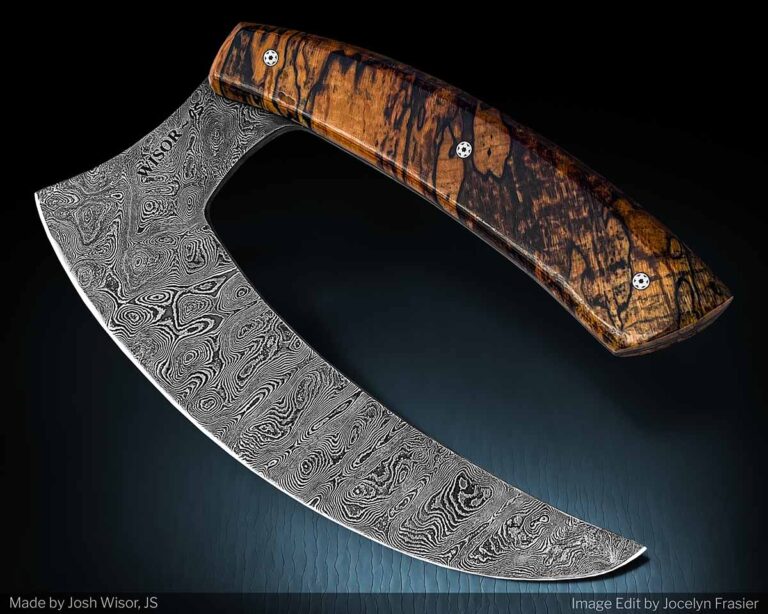
Josh Wisor makes a special knife for a special customer.
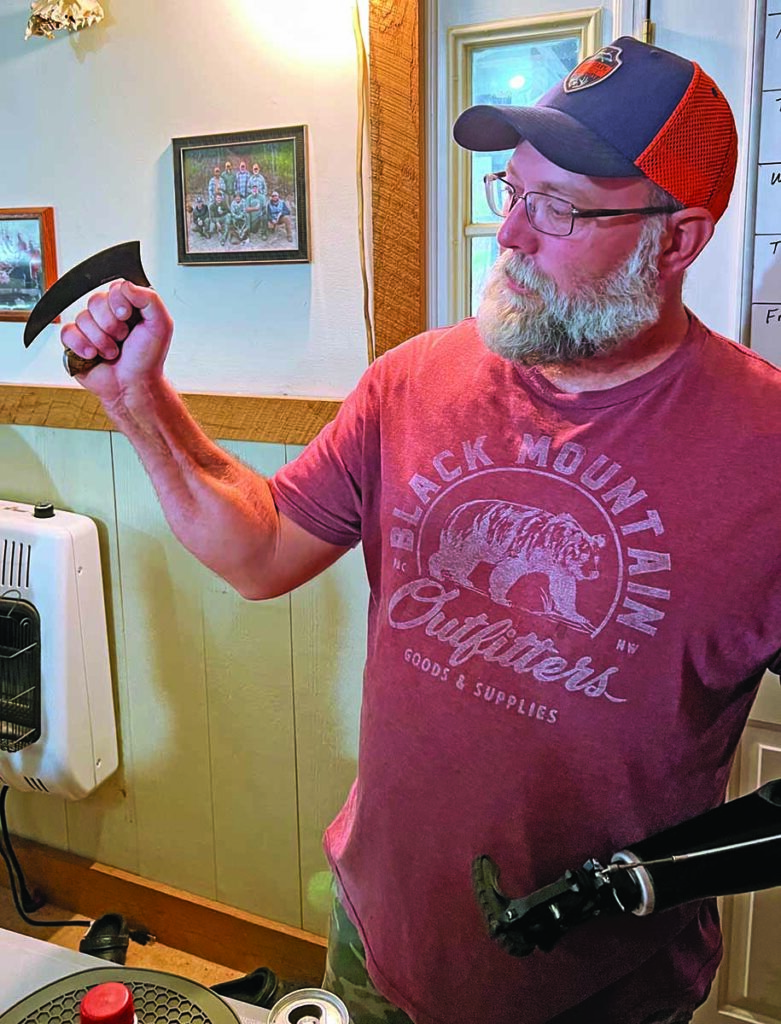
If you think Josh Wisor’s Alaska Ulu looks a bit different, that’s because it is—Josh built it for a customer who lost an arm and suffered nerve damage to the other as a result of a farming accident.
Josh made the ulu open-ended so the customer can more easily grip the handle and thus use it more easily as well with the hand of his nerve-damaged arm. The customer uses the knife for food prep and even on deer in hunting camp.
Josh’s customer demonstrates how the Alaska ulu’s open-ended design enables him to easily grip the handle.
A big fan of damascus, the customer wanted a pattern-welded blade, so Josh accommodated him with one of 1084 carbon and 15N20 nickel-alloy steels heat treated to a Rockwell hardness of 60-61 HRC. In other words, it is equipped to do some serious cutting.
The result is a noteworthy using knife for a more-than-satisfied customer.
Dunn and Miller left lasting impressions on ABS, students and custom knifemaking.
The American Bladesmith Society lost two of its finest leaders and bladesmithing instructors recently with the passing of ABS master smiths Steve Dunn and Hanford J. Miller.
Steve Dunn
Steve died on May 21. He was 68. Outgoing chairman of the ABS, he was a longtime Society member, receiving his master smith stamp in 1994 before going on to serve on the ABS board of directors and eventually being elected chairman.
“He was a craftsman of the highest level, as evident in the exceptional blades he made, and unsurpassed as an engraver, which he passed on to so many with his teaching,” americanbladesmith.org reported.
Many in the ABS were still recovering from the shock of the news as BLADE® was going to press, ABS master smith Billy Bob Sowell among them.
“I was stunned,” he wrote. “Steve was one of my judges for my master smith stamp. I took his engraving class and his folder class. I’ll miss him.”
According to his bio on the ABS website, Steve began making knives as a hobby in 1988. In 1990 he enrolled in the basic forging class at the Bill Moran School of Bladesmithing, where he started forging damascus. After achieving master smith, it wasn’t long before he began teaching at the Moran School. In 2003 he was selected to serve on the Society’s board of directors.
A strong believer in sole authorship of his knives, he enrolled in a basic engraving class at GRS Tools in 2002. He later studied with Chris DeCamillus on Bulino style engraving and was asked to be an instructor at the GRS school in 2005.
Hanford Dunn
Hanford passed away on March 25. He sold his first knife in 1968. He made knives in the Moran style, including bowies, fighters, camp knives and other large fixed blades, and also period pieces such as reproductions of the cinquedea. His mark was his initials or name within a bowie logo.
In addition to being an outstanding maker of forged knives, Hanford served on the ABS board of directors as treasurer for many years. According to americanbladesmith.org, he was best of friends with BLADE Magazine Cutlery Hall-of-Fame® member Bill Moran, with the pair being “like two peas in a pod.”
They first met in 1974 in Bill’s shop. Hanford read about Bill in a library book about knives and realized he was only a short drive away from Hanford’s home in Randallstown, Maryland.
“Bill was a great mentor,” the site observed, “and their friendship lasted long after Hanford moved to Colorado in 1976.”
From copper-infused patterns to stainless steel sheets, discover the innovations driving the red-hot market for production damascus.
Are we seeing a bit of “global warming” in the knife industry, where red-hot damascus steel is getting even hotter? BLADE® spoke with some industry leaders, and 2025 and beyond looks good to them when it comes to production damascus in both carbon and stainless steels.
There are many individual makers who make high-quality damascus in simple and complex patterns in their home shops, backyards or shared maker spaces. This article focuses instead on production damascus forged by specialized outfits such as Baker Forge & Tool, Damasteel, Chad Nichols Damascus and Vegas Forge. At a level beyond “regular” damascus makers, these companies make steel for the masses, for production companies, and specialize in innovative new materials that are sure to delight the industry.
BLADE readers will be familiar with Baker Forge & Tool, a prolific producer of innovative damascus patterns that include copper, such as CopperMai, TigerMai, GoMai and others.
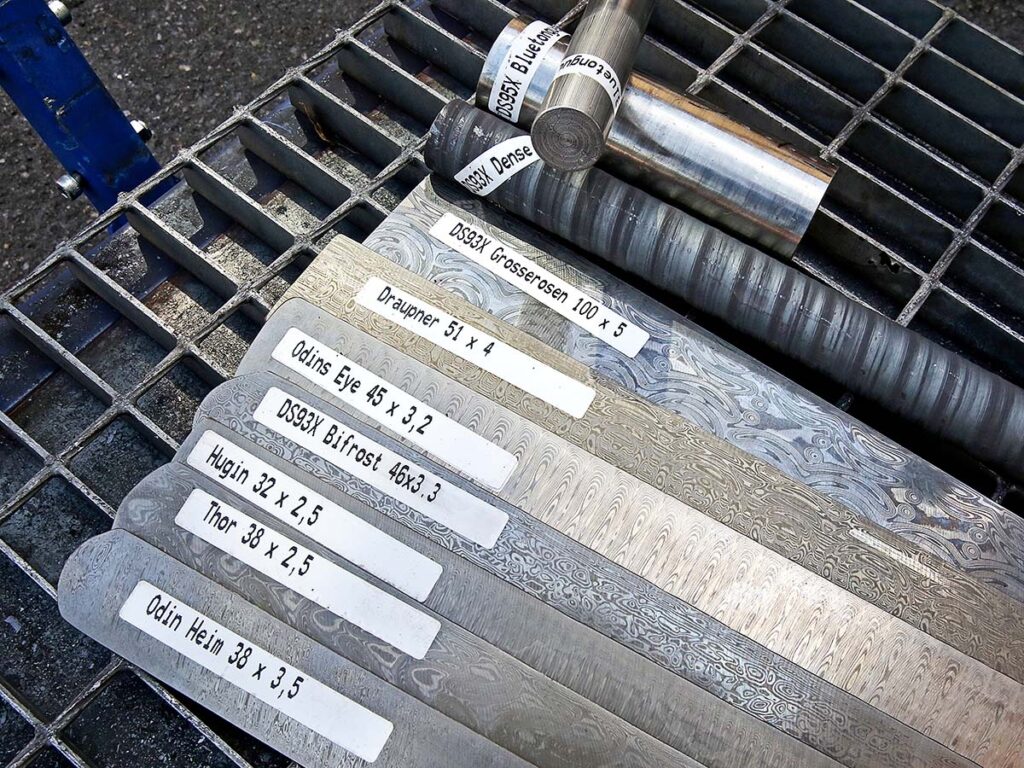
DS93X steel—fourth from bottom in bar form—is Damasteel’s standard mix, “combining good performance with good looks.” “For us it’s more about expanding the patterns than about trying new steel combos,” noted Per Jarbelius. The other patterns in bar form are representative examples of what you can expect from the Swedish steel maker.
“We make carbon steel damascus patterns with copper, and they’ve been hot. We expect them to stay hot through 2025,” Coy Baker said. When it comes to steel selection, the company most often sticks with the gold standard combination of 1084 carbon and 15N20 nickel-alloy steels.
Baker also has been experimenting with Apex Ultra as a core steel for its copper san-mai. For those unfamiliar, Apex Ultra is a tungsten steel alloy, kind of a super-52100 carbon steel. It’s made in small batches and is hard to get in the USA, but Baker has found that the material makes a great damascus core.
“Demand for our Apex core billets far outpaces supply,” Coy noted.
Baker has also been experimenting with stainless and copper damascus and san-mai, using 154CM and AEB-L stainless steels. This writer also makes knives and that combo sounds quite challenging to forge. Baker confirmed that it was very challenging and wouldn’t reveal any secrets, other than the 154CM etches light and the AEB-L etches darker.
Growth In The ‘Sip
Down in beautiful Bush Springs, Mississippi, Chad Nichols makes traditional carbon steel damascus at a production level.
Vegas Forge has always been innovative and 2025 will be no exception. “We’ve figured out how to do copper in with the damascus pattern manipulation, not just as a line between san-mai,” Jesse Harber noted. (Vegasforge.com image)
“I stick mostly to carbon steel 1075 or 1095 plus 15N20 with occasionally a little bit of 3V,” Nichols explained. “I’ve got my process down and these steels go together well.” He makes a variety of mosaic patterns, most of which go to a single manufacturer. “The carbon steels are so much more organic,” Nichols said. “You can do so much more with them in a cost-effective way.”
Nichols’ goal for 2025 is to increase his production of mosaic patterns.
“There just aren’t many people doing production mosaics,” he said. “It’s a great opportunity for growth.”
Another area he’d like to see grow in 2025 is the use of exotic and historical materials. He’s made a run of steel for Boker with steel from a German Tiger tank, and has a run coming for William Henry with some leaf springs sourced by WH.
Collab Designs
Damascus isn’t just a U.S. product. Damasteel produces high-quality stainless steel damascus in Sweden.
Chad Nichols (above) stated the goal at Chad Nichols Damascus for 2025 is to increase the production of mosaic patterns.
“Our DS93X steel is our standard mix, combining good performance with good looks,” Damasteel’s Per Jarbelius remarked. “For us it’s more about expanding the patterns than about trying new steel combos.”
DS93X is described as a “patented powder metallurgy product” that includes “two different hardenable steel grades.” “We use only stainless steel,” Jarbelius explained, ‘because it doesn’t rust and has the same or better performance.”
Damasteel historically produces a new pattern each year. For 2025 it also has begun a special project to collaboratively design patterns. Benchmade collaborated with Damasteel to make a steel pattern called “Monarch” exclusively for the Benchmade Gold Class Necron balisong. Jarbelius is excited for the potential to expand the collaborative effort with other companies who want proprietary patterns.
In another innovation, Damasteel has developed the capability to produce stainless damascus in sheets, not just bars. This will come in handy for small-batch and mid-tech production. The sheet steel pattern is called “Drakkar,” which is the old Norse word for the dragon-shaped Viking longboats.
Copper In The Pattern
What happens in Vegas may stay in Vegas, but that’s not the slogan for Vegas Forge, whose damascus is well known worldwide. It is a consistent producer of high-quality carbon and stainless damascus in complex patterns.
Baker Forge & Tool has been experimenting with Apex Ultra as a core steel for copper san-mai. This integral fighter by Greyson Weltyk features Baker copper damascus for its recurve harpoon blade. (Bakerforge.com image)
“One of our most popular patterns is ‘Reptilian,’ which has three alloys included: O1, 1075 and nickel,” observed the company’s Jesse Harber.
Vegas Forge has always been innovative and 2025 will be no exception.
“We’ve figured out how to do copper in with the damascus pattern manipulation, not just as a line between san-mai,” Jesse noted. “We can take our Reptilian pattern with copper in it, and then clad that billet over an O1 or 1095 core.”
As far as stainless goes, Vegas Forge continues to push the complexity of its patterns. Its most popular pattern, “Virus,” begins with a single stack of 1200 pieces! The company uses 154CM cores for most of its stainless san-mai, along with CTS XHP when available.
Ultimate Hotness
What kind of knives do the manufacturers predict for ultimate hotness in 2025?
Damasteel has developed the capability to produce stainless damascus in sheets, not just bars. The sheet steel pattern is called “Drakkar,” the old Norse word for the dragon-shaped Viking longboats, and is used here on a chef’s knife by a local Swedish cutler.
Both Baker and Jarbelius indicated culinary knives will stay hot, especially in stainless. Baker pointed out that stainless steel handles kitchen abuse better, and this writer agrees. Per said Damasteel’s Damacore and DC18N nitrogen steels are top of the line, and the company has a culinary knife coming in partnership with BLADE Magazine Cutlery Hall-of-Fame® member Ken Onion and CRKT. Both Damasteel officials and Chad Nichols agree that complex patterns are expected to do well for the pocketknife and one-off makers.
Jarbelius “expects growth in the complex pattern market” even as Damasteel’s basic traditional rose, ladder and twist damascus patterns remain best sellers. Nichols states that the mosaic niche he addresses will continue to grow.
All four steel makers expect growth in the production side of the market. Even in a slower economy, the big knife manufacturing companies are still producing limited runs of high-quality damascus knives. Baker looks for growth in his damascus-core san-mai steels.
“They’re easier to get a consistent etch on than the mono-steel cores,” he explained.
Chad Nichols stated that he expects growth in the use of mosaic damascus steels by factory knife companies in 2025.
Manufacturing is all about consistency and efficient processes. Damasteel achieves consistency by using the same steel combo for all its patterns. Nichols gets there by batch building for specific manufacturers so that each run is internally consistent. Harber mentioned that he was approached at BLADE Show West* by multiple production companies looking to order steel for 100-to-200-piece runs. He indicated he expects the mid-range sub-$800 production folders to stay hot.
Gonna Be Intersting
The new year is going to be an interesting one for the economy and politics, both of which are inextricably entwined. Fortunately, thanks to the work of those in the damascus industry, it’ll also be an interesting year in the world of knives. If nothing else, knife enthusiasts will have plenty of beautiful damascus production knives coming off the assembly lines to keep them entertained.