Knifemaking is the building of a knife, which includes the blade, handle and other accouterments. Blades are made by either removing metal from a steel blank via a grinder – known as stock removal – and the forging to shape of hot steel into a blade in the process known as bladesmithing. Other parts, including bolsters, guards, pommels, etc., are needed to complete the finished knife.
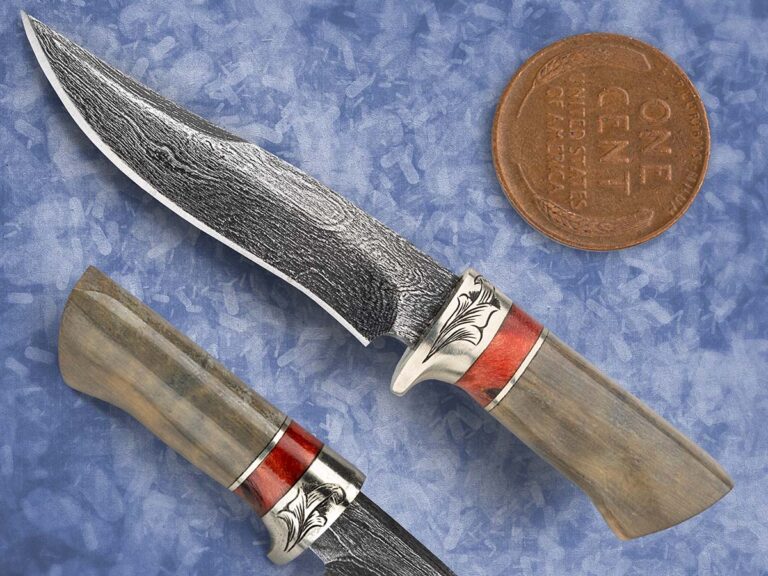
Robert Logan had a scrap to pull off his Tiny Fighter.
ABS apprentice smith and member of the Texas Knifemakers Guild, Robert Logan, has developed a varied catalog over his nearly nine-year career. His work in kitchen cutlery has raised eyebrows in some corners of the knife world. Yet, his smaller projects are certainly worth consideration.
Such is the case with Robert’s Tiny Fighter, a minuscule fighter whose detailed execution is hard to miss—even if it’s no larger than a penny. The knife measures a scant 2.875 inches in overall length, with a 1.6875-inch damascus blade (192 layer 1084-15n20). Setting it all off is a mammoth-ivory handle and a beautiful guard featuring engraving by Alice Carter.
Robert Logan
Robert has tinkered with miniatures previously, making a couple of dozen scaled-down versions of his Mini Cleaver Belt Knife. But the Tiny Fighter, he said, was his first crack at venturing deeper than a simple slab handle in a miniature piece. Without special equipment for the job, it was especially tricky.
“Honestly, the most challenging thing about making tiny knives for me is just holding on to them,” Robert confessed. “I don’t use grinding jigs, so just holding on to the thing to grind, it was hilarious.”
After Decades In And Around The Knife Industry, The Author Reflects On His Five Favorite Knifemakers And What Makes Them So Memorable.
Over the past 38 years, I’ve met thousands of knifemakers with work ranging from newbie to legend. Being a newbie myself at first, I found myself gravitating to the newer makers, primarily because I could afford their knives and could get one without waiting years or decades.
Today I approach things differently and look for outstanding makers who share the following traits:
•Each is charismatic in his own way;
•Each gives of both his time and talent(s) to educate others, and;
•Each has a great sense of humor and is serious about his knives.
Here are my five favorite American makers who share the traits I look for most.
Walter Brend
The SF Dagger by Walter Brend features an 8-inch blade of D2 tool steel with a satin finish and Walter’s impeccable grind lines. Handle: black Micarta®. Guard: stainless steel. Special features: Full-tang construction, double edge, thong hole and a skullcrusher pommel. Overall length: 12.75 inches. (SharpByCoop knife image)
During my military service in the U.S. Army 101st Airborne, my unit went through processing for an overseas deployment. At the time I was carrying a Robert Parrish hollow-handle fighter with a serrated blade. It was suggested to me that I find a new knife that didn’t have serrations. That was the bad news. The good news is I had to buy a new knife, and the search began.
Scanning a magazine I saw a photo of three knives, all different lengths of the same model. I was immediately drawn to one of the knives, found the maker’s contact information and called him. On the other end of the line was Walter Brend and I ordered the knife: an 8-inch Model 2. In October 1985 I bought my first of hundreds of knives from Walter. In my opinion, his Model 2 is the finest tactical fixed blade in the world.
What draws my eye to the knife are the impeccable grinds. Perfect symmetry runs the length of the blade, including both the top and bottom grinds. The radiused guard and contoured handle are also trademarks of Walter’s work. These features may not be more evident anywhere than in his daggers. Clean, precise, sleek and lethal are words that all come to mind.
David Broadwell
According to the author, David Broadwell makes the world’s best sub-hilt fighters. An example is his Fuller Sub-Hilt Fighter in a 9-inch blade of Delbert Ely damascus. Handle: ancient ivory. Guard, sub-hilt and pommel: damascus. Overall length: 14 inches. (Image courtesy of Photography By NB Designs)
I was visiting family and friends near Chicago in 1988 and attended a small knife show. I had recently started buying guardless fighters, as the knives’ clean lines appealed to me. On the show table before me was a beautiful guardless fighter with an engraved bolster. The knife felt great in my hand and the price was more than reasonable. I bought the fixed blade from David Broadwell.
My favorite knife has always been and still is the sub-hilt fighter, and David excels at making one. Having written about him for several publications, I have always pointed out I think he makes the best sub-hilt fighter(s) in the world.
David is an artist in the true sense of the word. His eye for detail and beauty in steel is exceptional. He and I have collaborated on several designs over the years. He takes my basic two-dimensional linear drawing and brings it to three-dimensional life.
Diversification is one of David’s hallmarks. In the early 2000s I asked him to build knives that featured stone handles. Most were sub-hilt fighters and today remain some of my favorites.
When Bob Neal and I did our LDC Custom Knife series, David was the only maker to contribute both a folder and a fixed blade to it. Today he creates masterworks of art that would be at home in any museum in the world. While my design ideas were not always his favorites, David delivers knives that were everything I had hoped for—and more.
RJ Martin
RJ Martin has won awards for both best tactical folder multiple times and also best tactical fixed blade at past BLADE Shows. His Ghost Pepper Q36 cover knife sports a 4-inch blade of Chad Nichols damascus, a titanium frame and hand-rubbed zirconium bolsters. Scales and spacer material: black carbo quartz w/orange G-10 back-side inlays. (SharpByCoop knife image)
I was at The Knifemakers’ Guild Show in 1996 and, like everyone else, walked up and down the aisles looking for that one special knife or 12. I passed a maker who had Japanese-style tacticals on his table. I took two steps, did an about-face and walked back to the table. I was greeted by the big friendly smile many now know belongs to RJ Martin.
The guards, handles, sheaths and particularly the blades were the cleanest I had ever seen on a Japanese-style tactical. Trends change and I suggested to RJ that he should consider making a tactical folder. Within a month he sent me his first one, the Q30. I couldn’t believe it was his first folder. It easily rivaled most of the well-known tactical folder makers of the day. Then again, I should have expected this from a lead airframe engineer for Sikorsky helicopters such as RJ. He lives in the world of thousandths of an inch and milligrams.
From 2000 to 2010, RJ made 12 different limited designs for my Robertson’s Custom Cutlery Vanguard series. They featured hollow-handle fighters, a sub-hilt fighter, Japanese-style tacticals and, of course, folders. He is one of the few knifemakers in the world skilled enough to do it all with equal excellence. Quite notably, he has won the award for both best tactical folder a number of times and also best tactical fixed blade at past BLADE Shows.
Today his folders are among the most sought after in the world. Unlike so many of the tactical folders built over the past decade, his increased in price in the aftermarket. For those in pursuit of a level of perfection most of us cannot appreciate, RJ is that perfectionist.
George Herron
The author stated the knives George Herron made are design-driven, exactly what you would expect from a lifelong hunter and fisherman. The Herron Model #12 boasts a 6.5-inch blade of ATS-34 stainless steel with a mirror finish. (Impress By Design knife image)
I was attending the 1987 BLADE Show when a friend introduced me to BLADE Magazine Cutlery Hall-Of-Fame® member George Herron. With his pipe hanging from his lip, George said, “Lad, what is it you do for a living?” I said, “Mr. Herron, I’m in the Army.” He smiled and said, “I was in the Army, too. You see anything on the table you like?”
Had I known then what I know now, I would have bought every knife on the table. His knives were clean, lightweight, possessed exceptional handle ergonomics and were design-driven—all traits you would expect from a lifelong hunter and fisherman.
Years after meeting George and his wife, Miss Barbara, I attended the Southern Wildlife Expo in Charleston, South Carolina. This was long before the drawings and bid-up knives that have become common today. It wasn’t long before I noticed over 90 people waiting in line. I asked the person at the end of the queue if this was the line for admission to the show. He said, “No, this is the line to get a knife from Mr. Herron.” With that, I bought my show ticket and went to the table where Miss Barbara was standing.
There I was treated to an experience akin to watching children waiting to visit Santa Claus. They all had ordered their Herron knives long in advance of the Wildlife Expo. They approached the table, paid Miss Barbara and she handed their knife to George. It was then you would see young and old alike light up as if it were Christmas morning as they received the “toy” they had longed for—a Herron knife from George himself. I saw three generations of knife buyers—first-time knife buyers, hardcore Herron collectors, they were all there. It was truly a sight to behold.
Steve Randall
As the author noted, there is never any backward movement with the work of ABS master smith Steve Randall—his knives always continue to improve. Steve’s 7-Bar-Twist Sub-Hilt has a 10-inch blade of a seven-bar-twist damascus in 1080 carbon and 15N20 nickel-alloy steels, and an ancient walrus ivory handle. Maker’s price at press time: $3,300. (Alison Randall knife image)
Before the 2015 BLADE Show, I was checking out custom knifemakers’ work on various social media platforms. I kept returning to one maker in particular, ABS journeyman smith Steve Randall.
While photos can be deceiving, I have a pretty good eye for knives. Looking at images of his knives, I could tell he too had a good eye and understood making knives well beyond the short time he had been making them. He combined all the dimensions and aspects of the knife to make it flow.
I bought my first knife from Steve at that 2015 BLADE Show. In 2016 he earned his ABS master smith stamp. In 2022 his knives continue to impress me. There is no backward movement with his work and his knives continue to improve.
One of Steve’s best attributes is that he is willing to learn and try new things. In my opinion, many ABS master smiths are reluctant to work outside their comfort zone. I have asked Steve to build knives for me and my clients that may have some aspects he had never done before. Steve and his work never disappoint.
I was fortunate to have worked with or still work with my five favorite American makers. They have taught me so much about the art of knifemaking, and those who are with us still do. (Mr. Herron passed away in 2007). Perhaps more importantly I consider each of them a friend.
Brandon Hyner’s First Knife Is One Of His Most Current Knives As His New Work Takes Inspiration From His First Blade
Sometimes things take their own sweet time before coming to fruition. Such is the case with Brandon Hyner’s damascus gentleman’s hunter.
Hyner is an accomplished maker. He is a champion of History Channel’s Forged in Fire and has built a business of knifemaking and blacksmithing in his shop in Groton, on the Connecticut coast of Long Island Sound. He has built a following of just over 9,000 followers on Instagram where he showcases his work and produces behind the scenes videos in his shop of him doing everything from welding to forging by hand.
The damascus gentleman’s hunter is the second of a design Brandon made when he first started blacksmithing and knifemaking. With the help of a Texas bladesmith, he forged a damascus billet for the first knife, and “was forever grateful” for the opportunity. Four years later Brandon decided to finish the knife and was very pleased with how it turned out. As he noted, “I decided to keep the blade as is, as it was a big milestone knife for me.”
It has a six-inch blade with a desert ironwood handle. The brass spacer and carbon fiber bolster complete the look.
He posted the knife online and someone asked to buy it. However, rather than sell it, Brandon made a similar knife instead. “The second knife came out much better than the first one,” he noted, “but I’m extremely happy with them both.”
It’s a matched pair he can always point to as proof of his maturation as a maker and a beginning of possibly greater things to come. It was a four-year odyssey well worth the wait.
Damascus Gentleman’s Hunter Knife Specs
Knife name: Damascus gentleman’s hunter
Blade length: 6 inches
Blade material: Low-layer twist damascus
Handle: Desert ironwood w/brass spacer
Bolster: Carbon fiber
Overall length: 10 inches
For more information contact Brandon Hyner, Dept. BL4, 852 Bank St., New London, CT 06320 631-742-7227 [email protected].
Learn what the latest BLADE Show custom knife award is all about.
Some people are familiar with “Mack Daddy,” the 1992 Sir Mix-a-lot album with the smash hit “Baby Got Back.” On the other end of the cultural spectrum is the Mack truck, the reliable American long-haul vehicle revered by truckers and country songs. Knife enthusiasts may also be familiar with the Bobby Darin’s classic Mack the Knife: “O the shark, babe, has such teeth, dear …” Just now coming into the knife culture is the idea of a “M.A.C.K” knife, which stands for “machine assisted custom knife.”
Custom, Production And M.A.CKnives
Savvy BLADE® readers know the difference between a “custom” and a “production” knife. A custom knife is made by a craftsman using a combination of skill, experience and tools. The maker grinds the blade, polishes it, installs a handle and fittings, and so forth. Custom knives are often made one at a time or in small batches. Sometimes portions of the process are outsourced, such as waterjetting blade profiles or using a professional heat treater. In general, the maker’s name is prominently featured on the blade, such as Tom Overeynder, Gary Langley, etc. The price of custom knives can be quite high, particularly as the complexity of the knife and the magnitude of the maker’s reputation increases.
By contrast, a production knife is made in bulk using modern or traditional manufacturing techniques. Blades are made by the hundreds or thousands, ground and polished by machines, and assembled in a factory or large production shop. In general, the name of the company is prominently featured, like Case, Benchmade, White River Knife & Tool, etc. Sometimes a production knife will feature the name of the designer, such as the various CRKT production knives that have BLADE Magazine Cutlery Hall-Of-Fame® member Ken Onion’s name. Production knives may be expensive but are generally more affordable than custom knives of similar materials and construction.
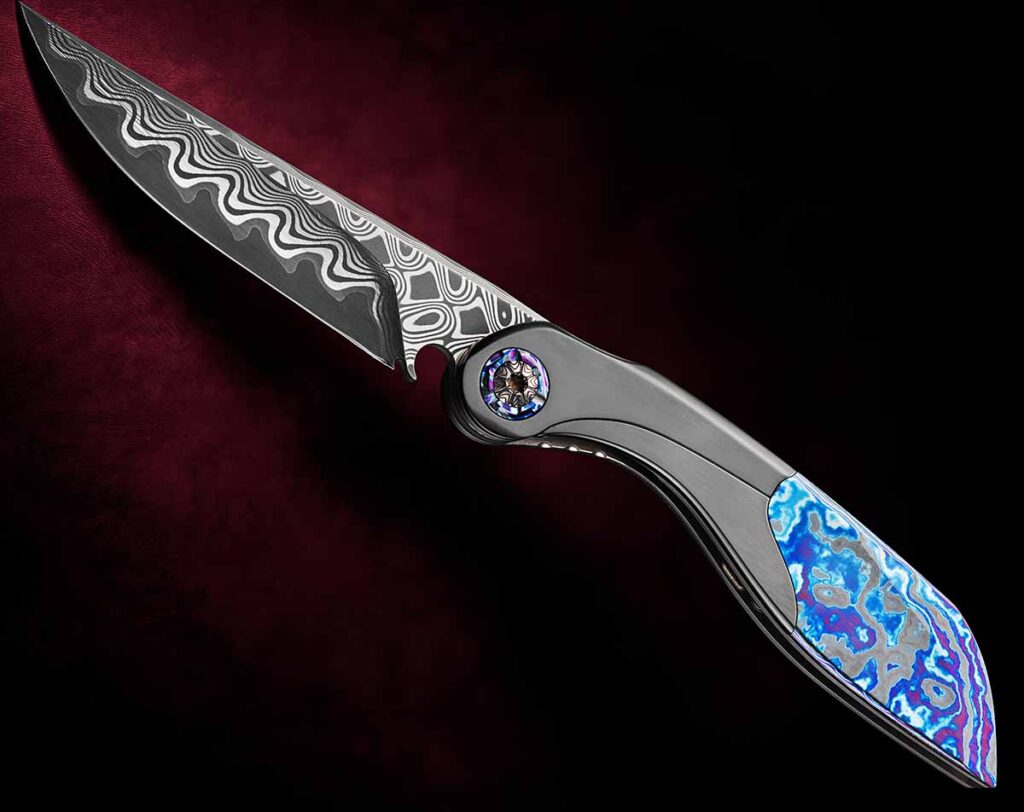
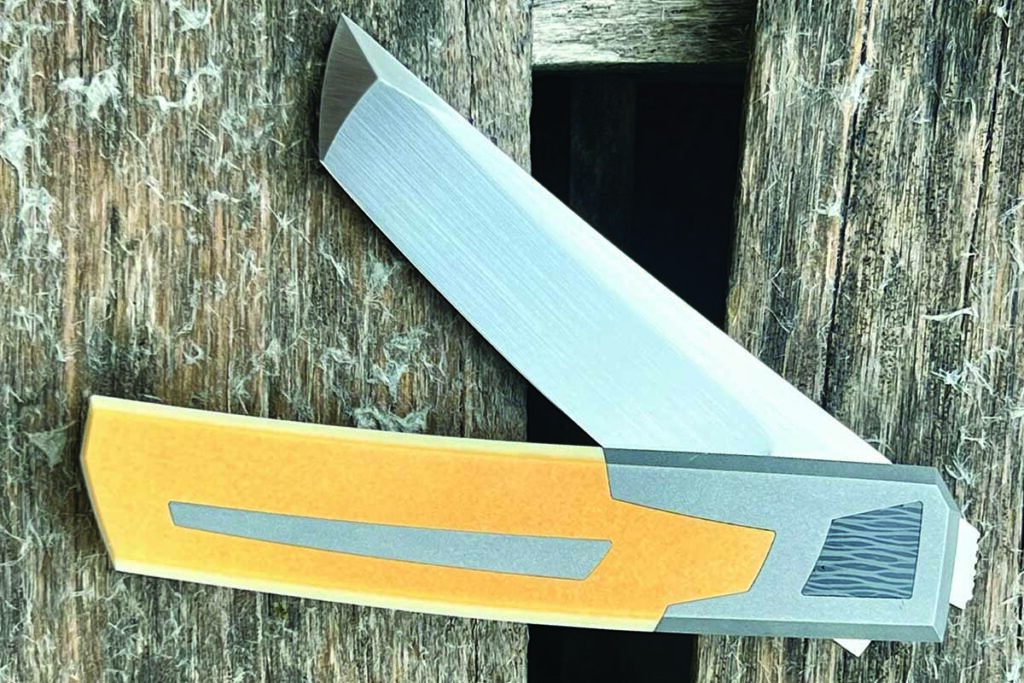
Princeton Wong has a five-axis waterjet in his machine shop, so he makes everything but the screws. An example of his work is this award-winning knife from the 2021 International Custom Cutlery Exposition, now known as BLADE Show Texas. (Caleb Royer image)
In between custom and production is a vast world described by the umbrella term mid-tech. It describes knives that use both production and custom techniques or methods in varying proportions. Some would say that any knife that has production techniques like waterjet is a mid-tech, while others would argue that as long as a person does the final assembly and fit up, a knife can be called a custom.
It takes talent, practice, education and skill to make a knife by hand. Many makers of such knives have no problem with using machines like a band saw, 2×72 belt grinder, manual mill or pantograph. At some level, almost every modern handmade, aka custom, knife is “machine assisted.” At the same time, the industry recognizes that when it’s primarily the maker’s dexterity and artistic vision that makes the knife, the label of custom or even “handmade” applies.
It also takes talent, practice, education and skill to program a series of CNC (Computer Numerically Controlled) waterjets, grinders and mills to make a knife by machine. Custom guys often make “polished turds” and “boat anchors” at the beginning. Beginner machine guys break tooling and crash expensive machines. In neither case does a person wake up one Tuesday and immediately become a competent knifemaker.
Think about the amount of variability in custom/handmade knifemaking. Each steel, each belt, each grinder speed, each brand of sandpaper, and every variable changes the process. If you heat treat your own steel, you must master temperature control, soak time, quench speed, decarb, warpage and tempering, and must use a different formula for each steel. After dealing with all that, is making a knife by machine any easier?
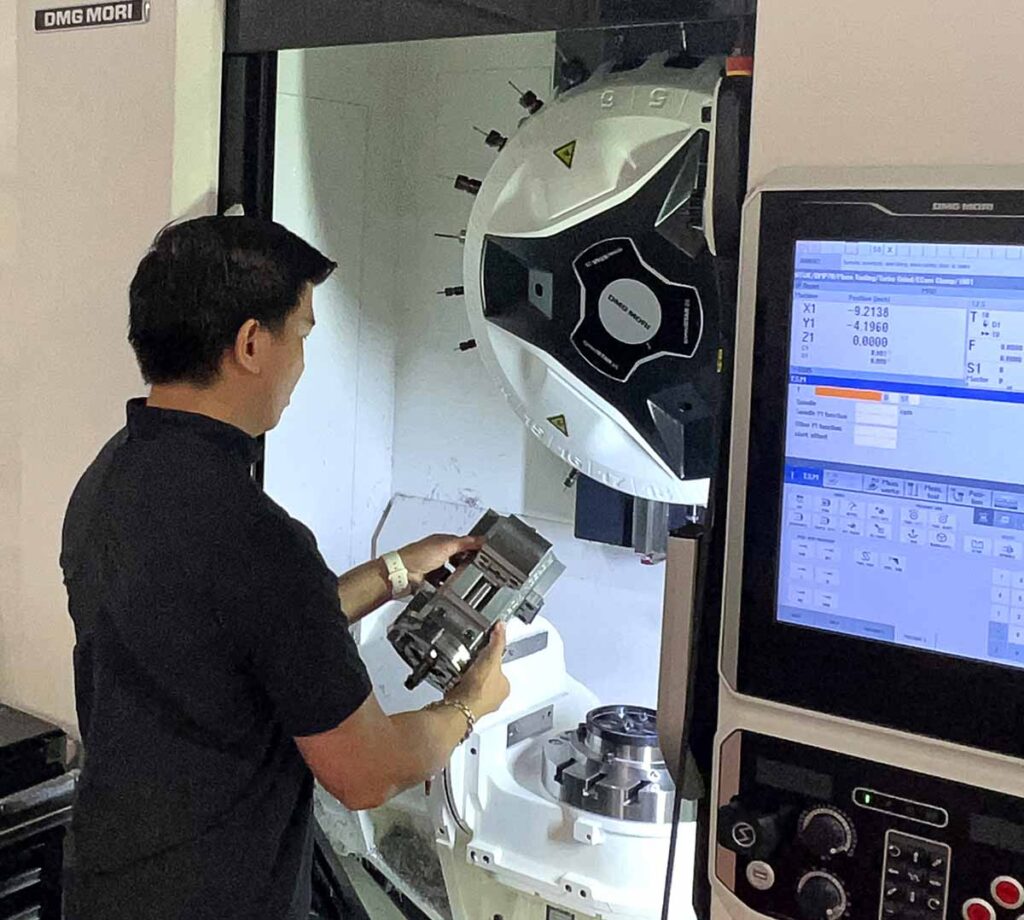
Princeton Wong operates the CNC mill. It can cut complex 3D shapes in metal and handle material.
Not according to M.A.C.K. knifemaker Princeton Wong. In CNC you deal with the geometry and composition of various cutting tools, plus the speeds and feeds at which you apply them. You must figure out fixturing to hold your workpiece, and how to work the tool in a way that leaves the desired surface finish. “It’s the same idea as using different belts or different files for each task,” Princeton explains, “but the variables are infinitely more complex. And then on top of that, you still have to learn and master all of the different hand-finishing techniques.”
So how does the knife industry show respect to the skills and talent of the makers who artfully combine programming with handwork? How do you showcase the ability of a maker who can run both a HAAS CNC mill and a belt grinder?
Defining M.A.C.K. Knives
BLADE Show 2023 included for the first time an award category for M.A.C.K. knives. According to the category rules:
The knife must be of the folding/locking, non-slip-joint, EDC variety that is first and foremost a cutting tool. It must be functional, beautiful and have great ergonomics, yet still have practical applications and uses. It must consist of both at least one handmade feature—such as hand-ground blades, hand-contoured scales, manually machined parts, etc.—and of automated features such as waterjet-cut liners/scales, CNC’d handles, etc. The judges will assume that the knife’s parts that are not handmade are made through a machine-aided process.
What background education and experience does it take to make a quality M.A.C.K. knife? Just like with any other skill set, the path is quite diverse. Take Princeton for example. Knifemaking for him growing up was a passion.
“As an Asian kid into martial arts, I’ve always had a love for bladed implements,” he notes.
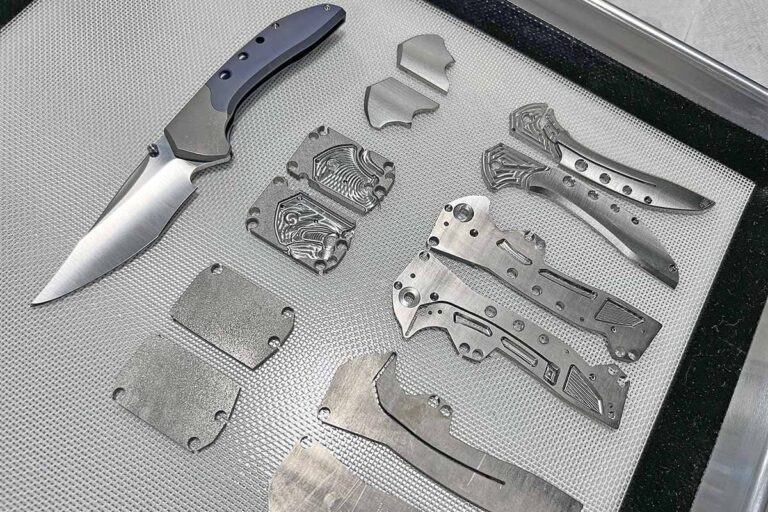
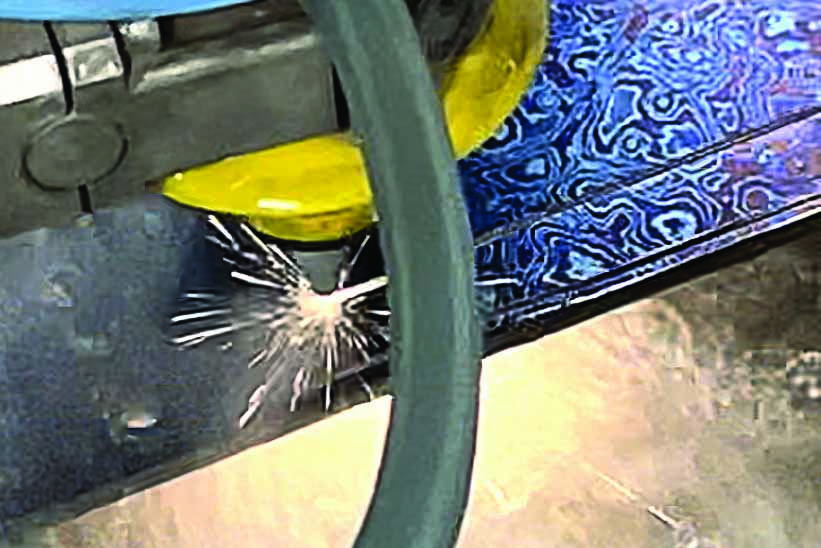
A waterjet machine uses a high-pressure stream of water and abrasives to cut profiles in flat stock. Princeton Wong uses his waterjet here to cut Timascus™ for folder handles.
He bought a Sherline mill after high school that had been converted to CNC, and learned by trial and error from there.
“After years of fiddling with stuff, breaking endmills and crappy software, I finally started figuring it out,” he observes. But for Princeton, learning wasn’t all trial and error. He studied mechanical engineering and graphic design in college. He had jobs in print, web, graphics and fabrication. Eventually, he started his own machine shop serving automotive and architectural clients. In 2018 he decided to use his machining skills to make knives.
“I didn’t know the knife industry or knife people but had a machine shop, so I gave it a shot,” he recalls. “I didn’t own a ‘real’ belt grinder until I was two years into making knives. I had a 4×36 from Lowe’s but was able to do very close work on the CNCs. By focusing on an intentionally machined look, I was able to get by.”
Princeton has a five-axis waterjet in his machine shop, so he makes “everything but the screws.” Earlier in his progress, he would bandsaw blanks and then fixture them in his CNC mill.
“I never had a need to outsource, but most people don’t have 70 amps of 480-volt three-phase electricity to run a $100,000 waterjet,” he says.
A waterjet cuts steel and other plates into shapes, “but it doesn’t make knives.” It’s a highly efficient profile-cutting tool.
Bridging The Gap Between Custom And Production
Most people don’t take Wong’s path and start out as fully equipped and capable machinists when they begin making knives.
Consider the precise fitting and complex geometry of the joints on Jared Oeser’s “Tachi” folder. Integral bolsters and Westinghouse Micarta® come together quite well.
M.A.C.K. knifemaker Jared Oeser started like many makers, with a mentor, a few tools and a new hobby. As a homebuilder, his business took a hit in the 2011 recession. Faced with spare time, he took up knifemaking. After a few fixed blades he moved fairly quickly into slip joints, merging modern materials into traditional designs at a time when that was a new thing. He continues to push the limits and bridge the gap between traditional designs and the “modern” folding knives.
About five years ago a friend needed a place to store a CNC mill. Oeser agreed to store it in exchange for lessons and use of the machine in the meantime. By the time the friend needed the machine back Oeser was hooked and bought his machine shortly thereafter.
After five years, he considers himself not good enough to make a knife completely on the machine. Coding for CNC is quite a different skill set, far beyond traditional knifemaking.
“I don’t want to go 100 percent machine,” Jared says. “I like the hand work, and I’ve gone about as far as I want toward machine-made. Everybody kind of finds their ‘spot,’ but the key is to disclose it, to say it. Don’t say ‘mine’s handmade’ if you’re afraid to say how you did it. At the end of the day, you’ve got to be good at hand work and have a skill set to make a quality knife.”
Handmade Vs Machine Assisted Knives
So what’s the difference between a “custom/handmade” and a “machine assisted” knife?
Wong suggested that a machine assisted knife should have a bit more precision than the typical custom knife. Because you can machine to exact tolerances and fit, there’s less room for error. He also suggested that the maker should try to push the boundaries of the machine’s capabilities. Just like there are a few knifemaking operations that can only be done by hand, such as Wolfgang Loerchner’s amazing hand-filed creations, there are also machinable features that people wouldn’t realistically try by hand. Creativity isn’t limited to hand tools.
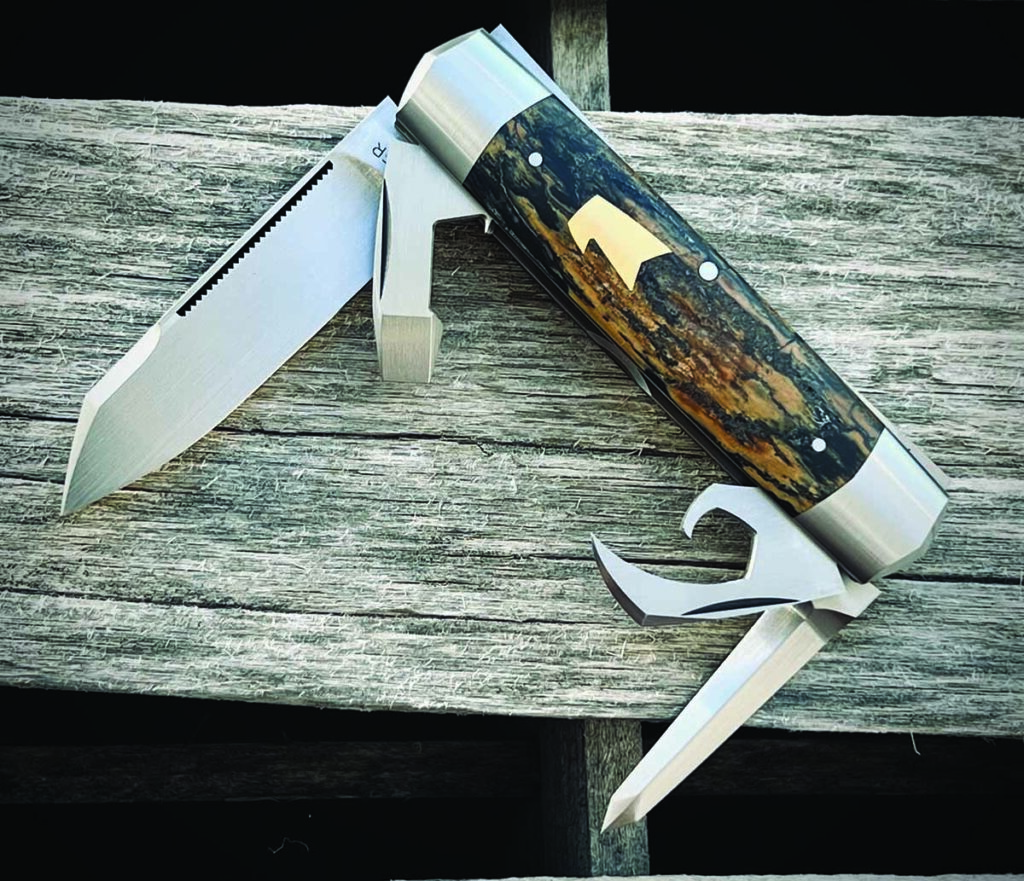
Jared Oeser’s “Eagle” is a four-blade slip joint. This one has mammoth ivory handles and a 14k-gold shield, combining modern techniques with traditional materials.
According to Oeser, “Among the makers and collectors I know, we’re OK with whatever a knife is, as long as you honestly disclose how you built the knife.”
He considers his knives machine assisted. On a slip joint, he uses a HAAS CNC mill to cut out the shapes of the liners, the shield inlay pocket, and to profile the blade and spring. Even though he uses a CNC mill that is squarely in the “machine assisted” category, using it primarily to cut profiles is pretty much the same thing as a waterjet.
Taking The Plunge Into M.A.C.K.
As a mostly one-off knifemaker myself, I was curious what it takes to build a knife that falls squarely into the M.A.C.K. category.
After talking with some M.A.C.K. makers, I found the process seems to typically begin with waterjet cutting. Either the maker has used a waterjet before and has his or her own CAD (Computer Aided Design) files, or the contracted machine shop will have a CAD expert on staff. Experienced CAD folks can work from a drawing or PDF for things as simple as profiles, and may use modeling software for contours and handles.
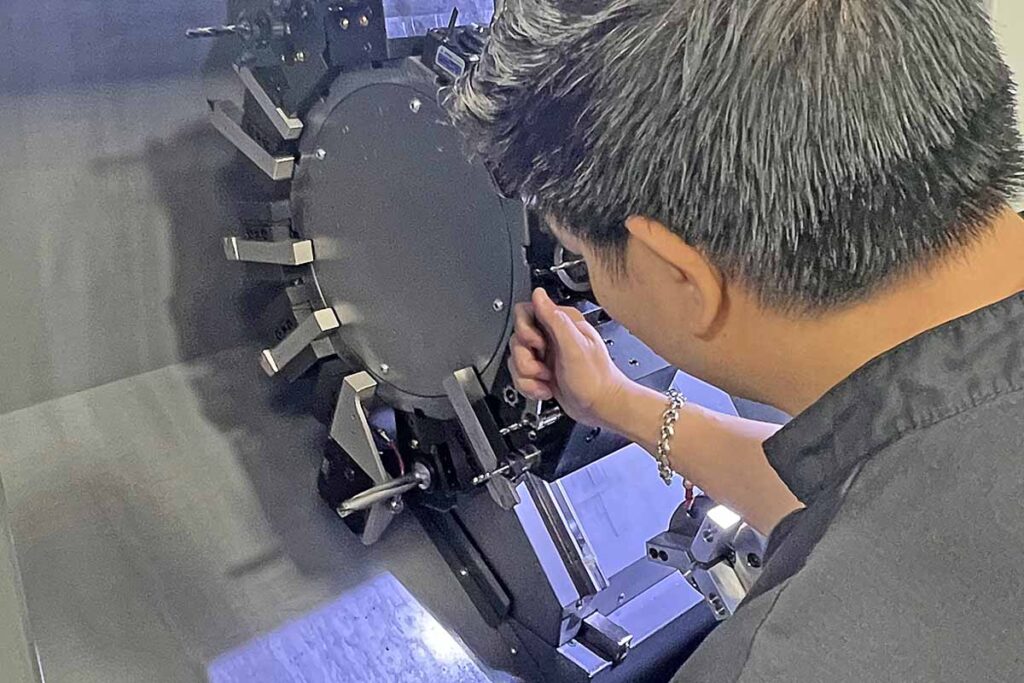
Princeton Wong checks the tooling on a CNC lathe. The lathe cuts precise round stock, such as screws and folder pivots.
Typically the liners are cut and the holes spotted, or are occasionally fully drilled and tapped. Pocket clips and backspacers come pre-cut. Handle profiles and contours are cut with a ball end mill, leaving a fairly clean finish. Sometimes this finish by itself is sufficient, while other times more hand polishing is necessary to achieve the final effect. Blades are typically delivered cut to contour, and the maker often does the bevel grinding by jig or by hand on a traditional belt grinder. Other times the blades come with machined bevels at varying degrees of surface finish. Once again, it’s up to the maker to decide if the machined finish is sufficient or if further hand work is necessary.
If you’ve ever used waterjet or milled parts, you know that the edge finishes are not precise. If you’ve had holes spotted but not drilled, you still have to drill and tap the holes. All in all, even in a knife that comes to you in a bag from a machine shop, there’s more to a cleanly finished M.A.C.K. knife than just assembly. If you want to be a winner in the M.A.C.K. category, you’ve got to have the hand finishing techniques down pat.
If you want a firsthand look at a quality M.A.C.K. knife, check out the applicable tables at a BLADE Show. Whether you prefer the events in Atlanta, Texas or Utah, there’s no doubt that “M.A.C.K. is back in town.”
Knife edges come in all different styles. We break down the major types in this quick guide to blade grinds.
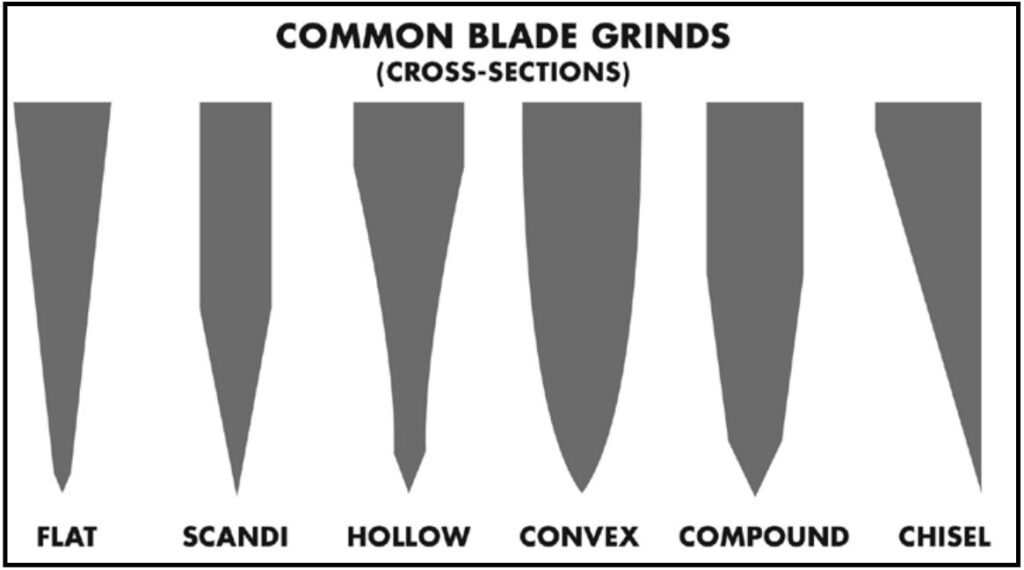
Cutting performance is greatly influenced by the way in which the maker grinds the knife. Each grind will have different cutting characteristics. A good knifemaker will consider whether the grind of the knife is suited to the chosen task. You as a buyer will also need to consider if the grind of a knife will suit the tasks you have in mind.
Blade grinds you’ll often come across can be seen here. (Image courtesy of Knafs.com)
Flat Grind
A flat-ground knife is a simple wedge and may be thick or thin. Flat grinds are good for slicing and deep cuts. I personally prefer a flat grind that goes all the way to the spine. A thinner flat grind will cut more smoothly than a thicker flat grind, where a thicker grind may be more durable.
Hollow Grind
A hollow-ground knife has a slightly concave bevel, which makes it thinner behind the cutting edge. This makes for good skinning and shallow cut work, without giving up overall blade heft or durability. Deep cuts or chopping are not well suited to a hollow grind.
Convex Grind
Convex grinds have slightly rounded bevels, which increases their edge stability. While they may not excel at slicing, they’re the way to go for hard use cutting and chopping.
Scandi Grind
Scandi grinds are a short flat grind with no secondary bevel. “Scandi” refers to the Scandinavian countries where that grind style is popular, especially Finland. This grind style cuts very well but can be difficult to sharpen properly.
Compound Grind
A compound grind may combine several of the basic grind shapes. Particularly on tactical and folding knives, many modern grinds are aesthetically interesting, but at the occasional sacrifice of performance. If you’re collecting for aesthetic reasons, however, these grinds could be all you ever wanted out of a knife.
The Emerson Family shares decades and generations in knives.
Through the years, the name Emerson Knives has come to represent outstanding craftsmanship, quality and overall excellence in the knife industry. And each member of the Emerson family has contributed in his and her own way.
“They grew up in the shop, both Megan and Rachael while my shop was at home, and Lucas was born after we opened our production factory,” Ernest Emerson remembered. “So we fenced off a corner in Mary’s office for him as a baby and a toddler. They have all worked in the company since the beginning, and today Mary is the overall manager, Megan is director of marketing, Rachael is operations director, and Lucas is engineering and is being groomed to run the shop. Me, I’m the government mule.”
For some it would be enough to say with pride that the family has built the Emerson Knives brand together, each contributing in his or her own way. But the Emersons have taken their commitment to excellence and the already incredible story of their enterprise to a new level. Each one of them has completed an Emerson original, a knife of their own from concept to finish, and Ernest has had the pleasure of watching the extraordinary conclusion of this labor of love and pure knifemaking joy.
“I didn’t know any of them would ever want to make a knife,” he confessed, “and with their personal lives being so busy outside of work I didn’t know if they would ever have time to do something else. Megan is busy raising a family and runs a working ranch in Colorado. Rachael is busy with Jiu Jitsu and finishing up her second degree in nutritional therapy. Lucas is hardcore into training and computer programming, and Mary runs our business, which by itself is a 24/7 job, and still manages to cook dinner, keep our house in order, and even fits in a round of golf when she can.”
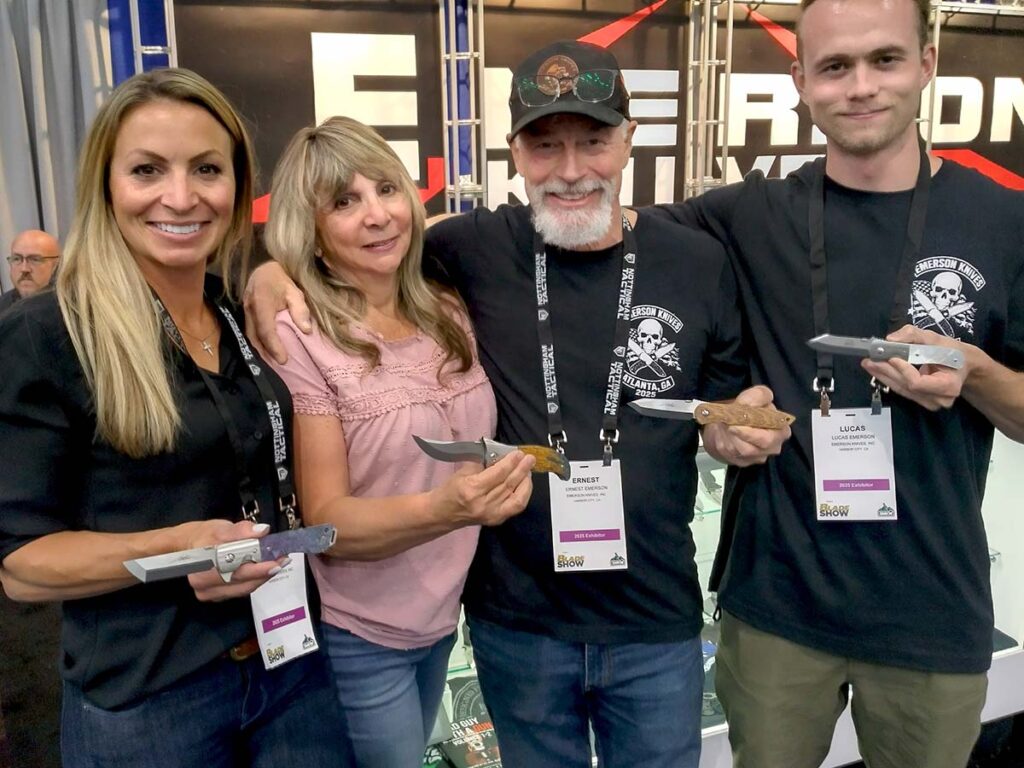
(From left) Megan, Mary, Ernest and Lucas hold their knives at BLADE Show 2025. Megan, Mary, Lucas and Rachael all had their knives debut at the show. Rachael was unable to attend due to a special family event. (BLADE® image)
Still, with everything else that demands their most precious commodity—time—the Emersons have expressed themselves in the actual completion of the tool that has been the centerpiece of their lives as long as they can remember. It almost feels like destiny, like it had to happen. And despite the headwinds, it has.
Earliest Memories
Twenty-four now, Lucas started making knives officially in January 2023, though he has watched and learned since his earliest memories.
“I have always had a passion for making things, and with my dad as a mentor knifemaking has become second nature to me. For me, making knives was never a question of ‘why?’ but of ‘why not?’”
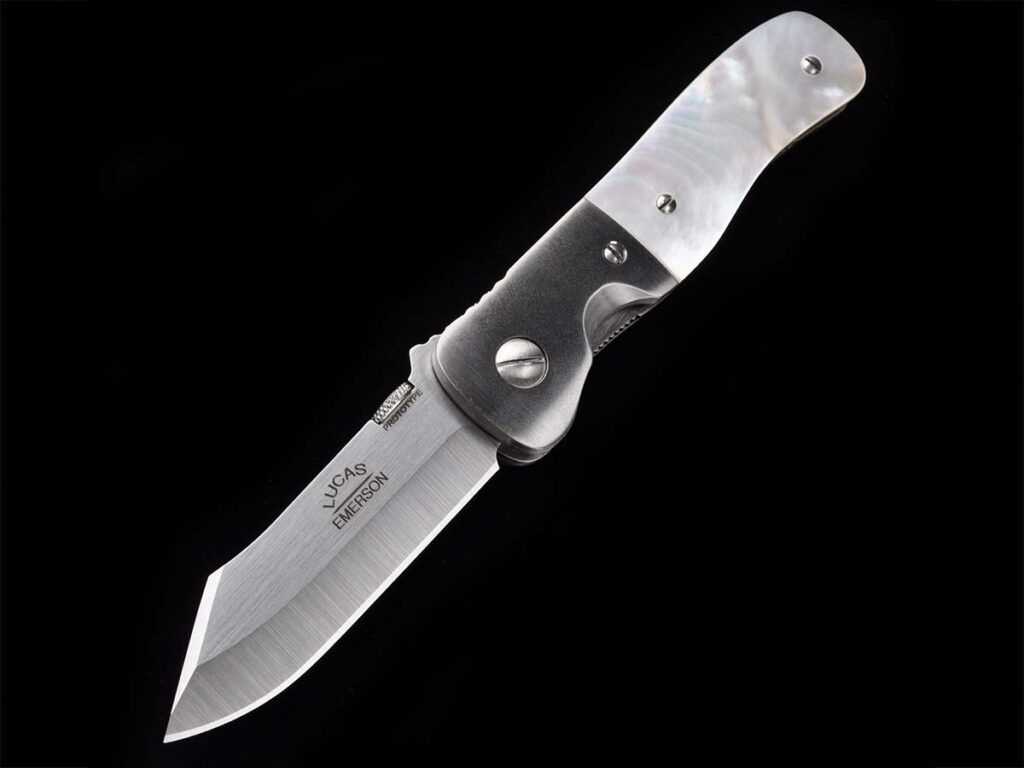
At BLADE Show 2025, Lucas chose to debut his newly designed MX-400 model. He wanted to produce a compact knife ideal for everyday carry.
“The MX-400 I had on display at the BLADE Show with pearl-handle scales will go into my personal collection,” he said. “I did bring three other MX-400s to the show, which I sold via lottery.”
Lucas makes knives part time and devotes plenty of energy first to the production company, Emerson Knives, Inc. At some point in the future, he may turn to knifemaking full time, but for now he manages the best of both endeavors. The most difficult part of the knifemaking process, he says, is grinding the blades.
Lucas Emerson debuted his MX-400, “a compact knife that is ideal for everyday carry,” at BLADE Show 2025. He put the one in mother-of-pearl scales he displayed at the show in his personal collection.
“This is the quickest way to make mistakes,” he advised, “and it tends to be quite time consuming. Luckily, I’m pretty consistent and at this point I’ve got nothing to do but improve. On the other hand, the easiest part of my knifemaking is the hand finishing. This is where I take my time making sure everything is clean, even and symmetrical. I would consider it foundational for the knives I intend to create.”
For his next knife, Lucas intends to design a fixed blade for his own everyday carry. “I want something that I can carry with me at all times,” he noted, “and which I can rely on for any situation that may arise. It will need to be versatile, easy to maintain and easy to conceal on my person.”
Stay tuned!
Iron Lotus
Rachael Emerson Hardin has been making knives for about 20 years now, much of her experience being directly engaged in the business.
“I started assembling knives when I was in high school,” she remembered. “I would leave school after lunch my junior and senior year, drive to work, and assemble until they turned the lights off. I’m still here making knives years later, so I guess you could say I enjoy it.”
For years, the idea of designing and finishing her own knife had been in the back of Rachael’s mind.
“I always had favorite designs of my dad’s and thought how cool it would be to make something like that but with my own flair,” she reflected. “It wasn’t until recently when Lucas began coming up with his own designs that it dawned on me—maybe I can try this too! I’ve been around this my whole life. I know what works and what doesn’t. It couldn’t hurt to try.”
Rachael took the knifemaking plunge with her own design that she calls Iron Lotus, and she is enthusiastic about more knives to come. To date, there are two prototypes. It is her first design, and the plan is for her to keep one and possibly sell the other.
So Rachael took the plunge with her own design that she calls Iron Lotus, and she is enthusiastic about more knives to come.
“It’s hard to say that this is my favorite yet,” she related. “My favorite knives aren’t because of the way they look on paper generally. It comes after the production process. Behind the scenes I experience all the hiccups and fallbacks firsthand. Some knives go together like peanut butter and jelly. Others need tweaking.”
As for her own creations, the 37-year-old Rachael is optimistic about the future.
“Heck yeah, I’m going to make more knives. I live, eat and breathe knives. It’s in my blood. Eventually, the Emerson kids will take over the business. Making knives is fun. There is something very freeing about it. And I have the best teacher in the world.”
To date, there are two prototypes of Rachael’s Iron Lotus. It is her first design, and the plan is to keep one of them and possibly sell the other.
“I’m not sure about carrying it because it is a little fancy,” she observed. “I have a few ideas that I’ve been brainstorming. Currently I’ve been diving deep into Japanese-style blades. I’m a big fan of the Japanese tanto. I love simple designs too, like the gentleman’s folder.”
Paying Tribute
With her completed knife, Megan Emerson Gomez, 41, fulfilled an ambition that had lingered for many years. She has also been captivated by Japanese-style blades and used that energy in her own creation.
“I have always been a big fan of the traditional tanto,” she commented, “so I thought I would design something with that look. My design is called the Shinobi or M-Shinobi [Ninja]. This was the first knife I have entirely designed, but I have been involved and making design suggestions for many years. The CQC-17 model blade design was my idea, and I am sure you can see the similarities in my latest design.”
Megan parlayed her long-time admiration for tantos into the Shinobi/M-Shinobi. Though she has been involved in making design suggestions for many years, it is the first knife she designed entirely by herself. As she noted, “The CQC-17 model blade design was my idea, and I am sure you can see the similarities in [the Shinobi].”
Megan was positive about the outcome of her completed project from the moment it began, and she looks back at the experience with quiet confidence.
“I never once doubted that I could finish it, but there was a moment where I had to decide if I was willing to push forward with a design that really didn’t look like a typical ‘Emerson.’”
Staying the course, she produced an exceptional piece and recalls that the most challenging aspect of the experience was paying tribute to history.
“The most difficult part was respecting the traditional tanto shape while still making it feel like mine. The style carries serious weight. It’s steeped in warrior culture, precision and intention. I wanted to channel that strength into something functional, modern and personal. Getting the balance right between tradition, aggression and clean design took the most time and thought. The easiest part then was handing it over to my dad. Once the design was dialed in, I knew exactly who should bring it to life.”
Mom’s Time
Each of the Emerson children accomplished an ambitious task that required a step up in devotion to the art and craft, the imagination and precision, that come together in a completed knife. Then, of course, Mom tried her hand as well, and the effort produced a beauty.
“I just started making knives about a year ago,” Mary remarked. “I have been around knives and knifemaking for years and years, so I kind of had a head start on things. I wanted to make a knife for a long time but it was hard to find the time. I’ve had lots of ideas and designs just sitting on the backburner for quite a few years.”
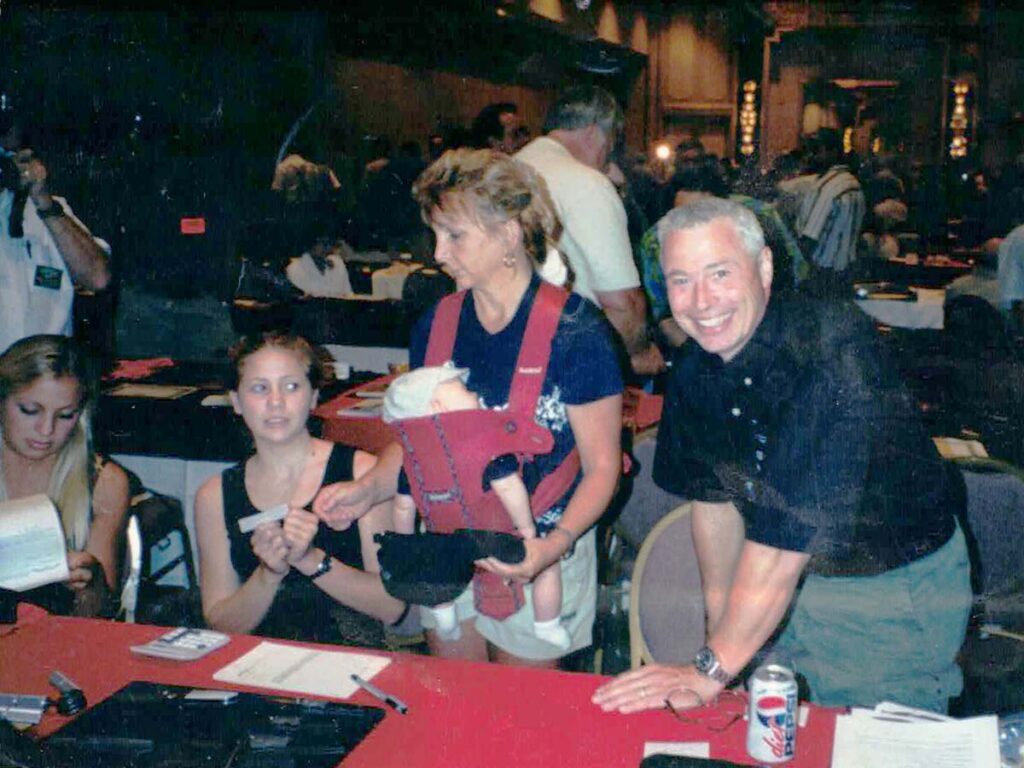
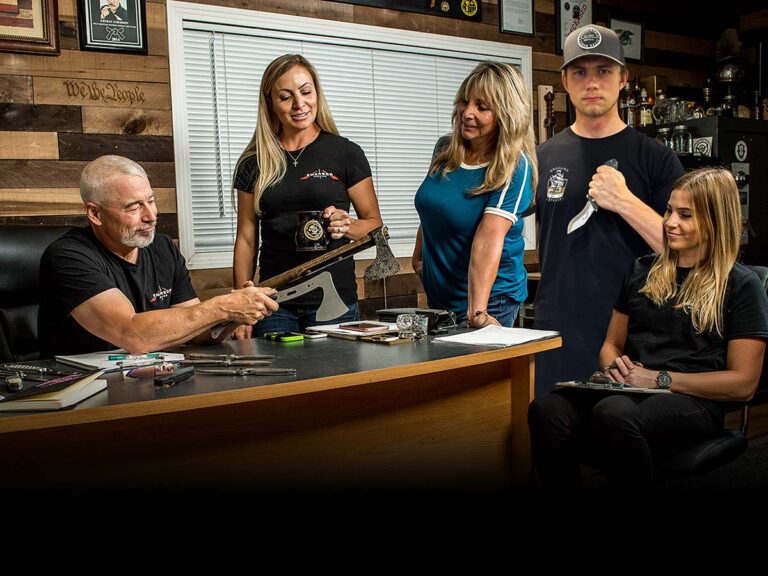
From left at right are Megan, Rachael, Mary with Lucas asleep in the baby carrier and Ernest. Among those in the front of the table at left are knife purveyors Bob and Linda Neal, Karen and Jay Sadow and BLADE Magazine Cutlery Hall-of-Fame® member Dan Delavan.
At long last, Mary’s time did come.
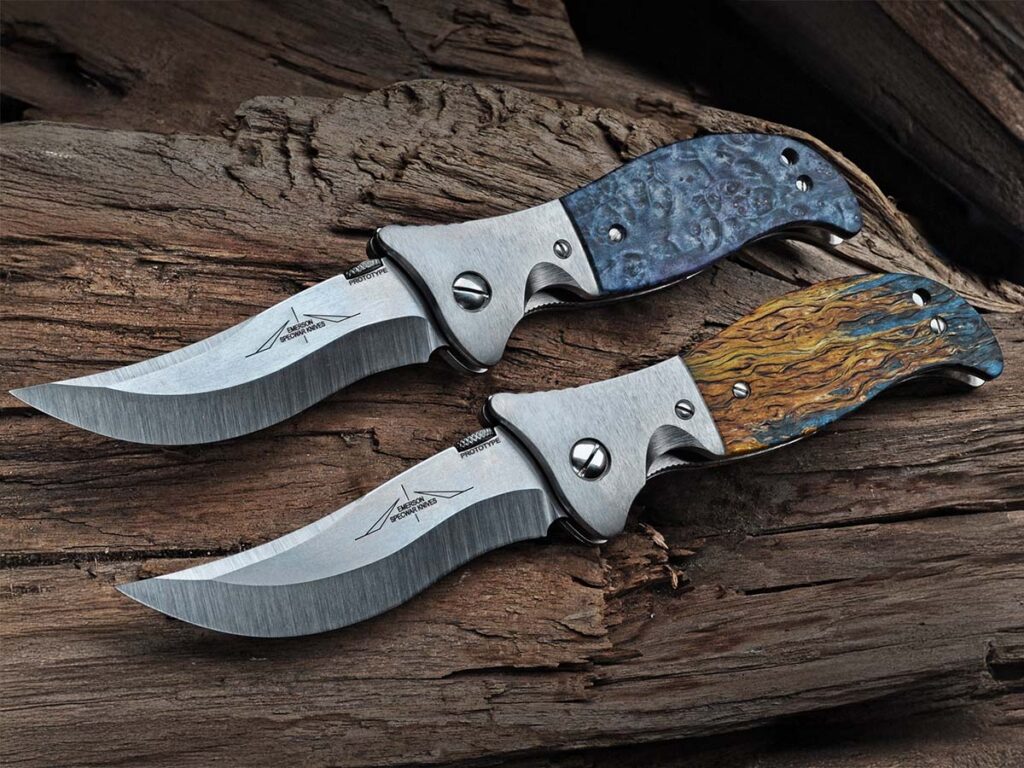
“I really have liked our CQC-15 and the Persian-esque blade styles, and I liked our Specwar handle,” she noted. “I like the curved and recurved blades, so my two designs, the Denali and the Falcon, reflect my likes in blade designs.
“Grinding the blade was the hardest part. It’s the dirtiest and most gritty part of the process. Getting one side ground the way I wanted it still left the other side to match up. The easiest part was the design. That was an easy day for me.”
During one grinding session, Mary toyed with the idea of halting the project—but only for a moment. “Ernie kept coming in and checking my grind lines. I told him to get out,” she smiled, “and I locked the grinding room door!”
Mary’s next knife adventure, though she will probably never be full time due to all her commitments to the business, is a fixed blade that is small enough to wear on her belt while riding her horse.
Next Mission
Along with Ernest, Mary looks at the body of work that surrounds the family, the business enterprise with so many facets and opportunities, the work of a lifetime, and the possibilities of the future. And yes, there is something else.
“Additionally,” she stated, “I’m very proud that my children are so interested in carrying on the family legacy. My next mission is to get the grandkids interested and involved. I’m very much looking forward to that.”
Mary’s partiality to curved and recurved blades is reflected in her two designs, the Denali and the Falcon, the latter here in two handle iterations. “Grinding the blade was the hardest part,” she noted. “Getting one side ground the way I wanted it still left the other side to match up.” During one grinding session, she considered halting the project—but only for a moment. “Ernie kept coming in and checking my grind lines. I told him to get out,” she smiled, “and I locked the grinding room door!”
Meanwhile, Ernie surveys the current scene with satisfaction and gratitude. He wanted to be surrounded by a family of knifemakers and that has actually come to pass. His quiet observation has made the situation even more satisfying.
“I never expected any of them to make knives, but deep down of course I wanted them to,” he reflected. “In any endeavor you undertake, if your heart is not in it you will never have the same enthusiasm and drive than when you are doing something you love and want to do. It is very satisfying because I never pushed any of them to pursue the craft. All of them chose to do it of their own accord, and that makes it even better.”
Just to put the experience in perspective, Megan, Rachael and Lucas validate their father’s approach. They confirm that he encouraged, advised and taught but never forced a single grind, pin or hand finish on them.
“I wanted to design a knife for as long as I can remember,” Megan said, “and I think my whole life he has been training me to make knives and run the business. I have been involved in the business since I was a little girl. I watched him grinding knives in our garage, and the ladies we hired assembled knives in our living room.”
Rachael offered, “My dad has always provided feedback to me over the years. His father and sister, my grandpa and aunt, were both teachers. So, it’s always been something he has done.”
Lucas was a hands-on learner.
“From a young age, I remember my dad allowing me to help him with his own custom knives,” he recalled. “This is where I spent most of my time learning, not only the craft but also the principles behind Emerson designs. I work on my own now, but if I ever have any questions my dad is there to provide the best answers he can. He is an excellent teacher in this regard and has always been my go-to person for advice.”
In a most rewarding way, the knife life of the Emerson family has come full circle. The generations have discovered and honored that common thread, one that binds them together like nothing else.
Harvey McBurnette etched his name in high-dollar knife sales.
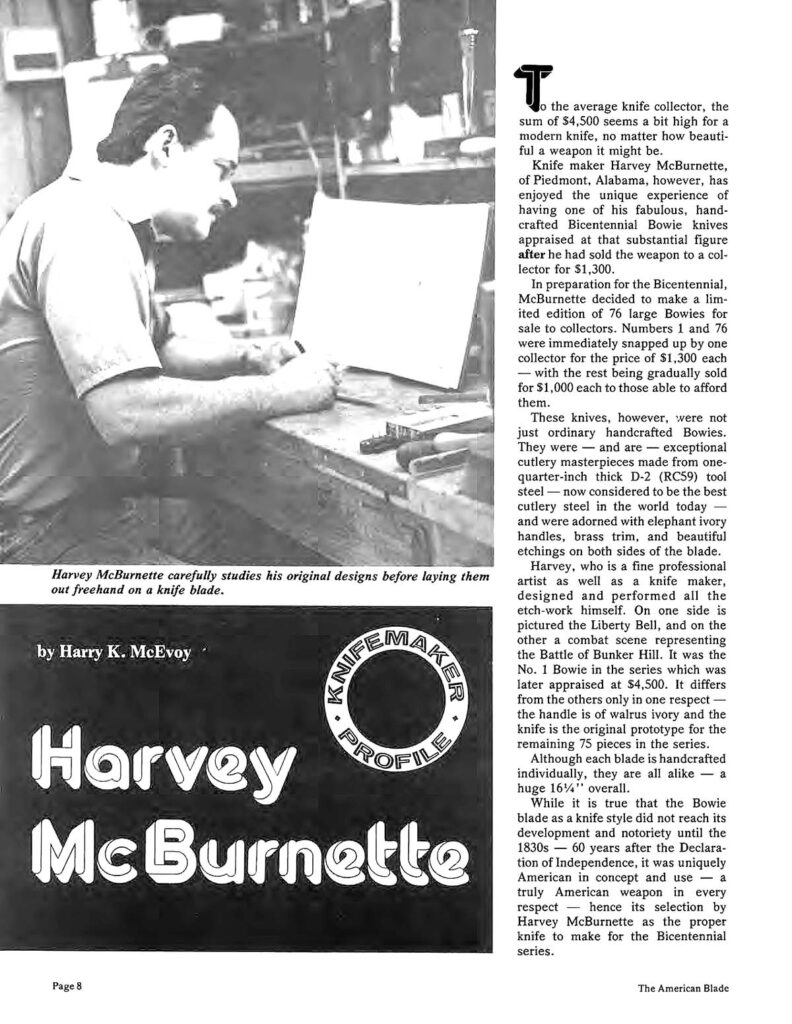
Harvey McBurnette of Piedmont, Alabama, landed in the July-August issue of the 1976 American Blade for somewhat patriotic reasons. Somewhat, because the lead of Harry K. McEvoy’s exposé on the maker was McBurnette’s celebrated Bicentennial Bowies. But there’s more to the matter than a simple commemoration of the nation’s birthday in steel.
McEvoy hooks readers by showing what the artistically talented knifemaker’s work commanded back when your dollar went a long way. In 1976, the exact sum was $4,500. As McEvoy wrote, “[O]ne of his fabulous, hand-crafted Bicentennial Bowie knives appraised at that substantial figure after he had sold the weapon to a collector for $1,300.”
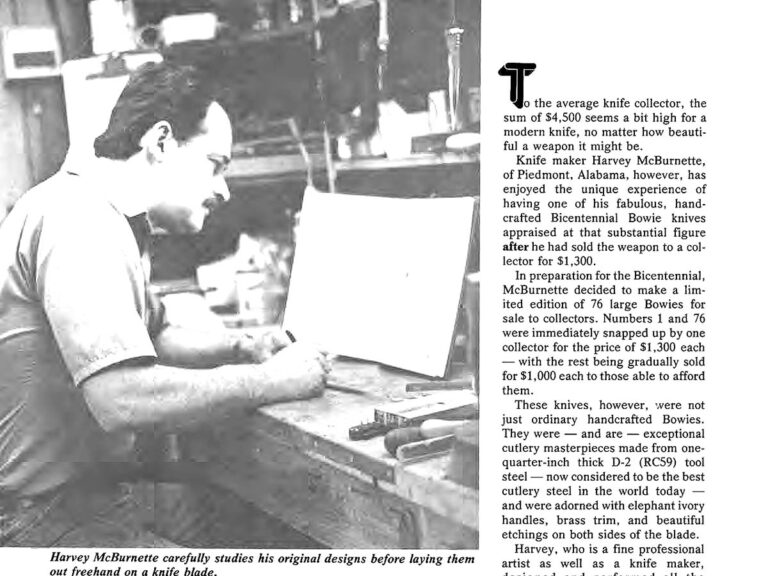
The lead image of the profile on Harvey McBurnette shows him studying his original knife design and free handing it to the steel. The maker had a strong artistic streak and was known, in part, for the embellishments he etched onto his knives.
For context, that’s roughly $26,000 in today’s dollars. What likely made the run of 76 bowies desirable was McBurnette’s unique system of adorning the knives—etching. This system, seen on many of his knives, was a very conscious choice on the maker’s part, as the story reports, serving to differentiate his work from other custom craftsmen of the day.
“I wanted to do something unique, or at least different, with my knives,” McBurnette was quoted as saying in the article. “And since I was an artist I thought if I engraved or etched my blade, I would add a touch I felt was needed to make them stand out. I chose the art of etching because there were a few other knife makers who engraved their knives. Besides, even a master engraver cannot do what an etcher can do.”
McBurnette’s Bicentennial Bowies had quite a motif etched on either side of their D2 tool steel blades. On one side of the 16.25-inch knife is an image of the Liberty Bell, and on the other a battle scene depicting Bunker Hill. The images are the same on all 76 knives, and 75 of them had elephant ivory handles. The knife appraised for the then astronomical sum did differ; the No. 1 of the series was a prototype with a walrus ivory handle.








![Megan parlayed her long-time admiration for tantos into the Shinobi/M-Shinobi. Though she has been involved in making design suggestions for many years, it is the first knife she designed entirely by herself. As she noted, “The CQC-17 model blade design was my idea, and I am sure you can see the similarities in [the Shinobi].”](https://blademag.com/wp-content/uploads/Family-5-1024x768.jpg)