Buyer's Guides

You’re looking for a new knife in a certain style – we’ve got recommendations on the best blades for every price point.

Custom Hunting Knives: Hunting For The Best Value

Understand how and why custom hunting knives cost what they do.

When I attend shows, one of my main goals is to talk with knifemakers and check the prices of various custom knives. One of the best shows to do that is the BLADE Show. This past June my goal in the Cobb Galleria Centre in Atlanta was to talk with 50 custom makers to get their takes on trends, material prices, overall demand, etc., regarding the knives they make and sell.

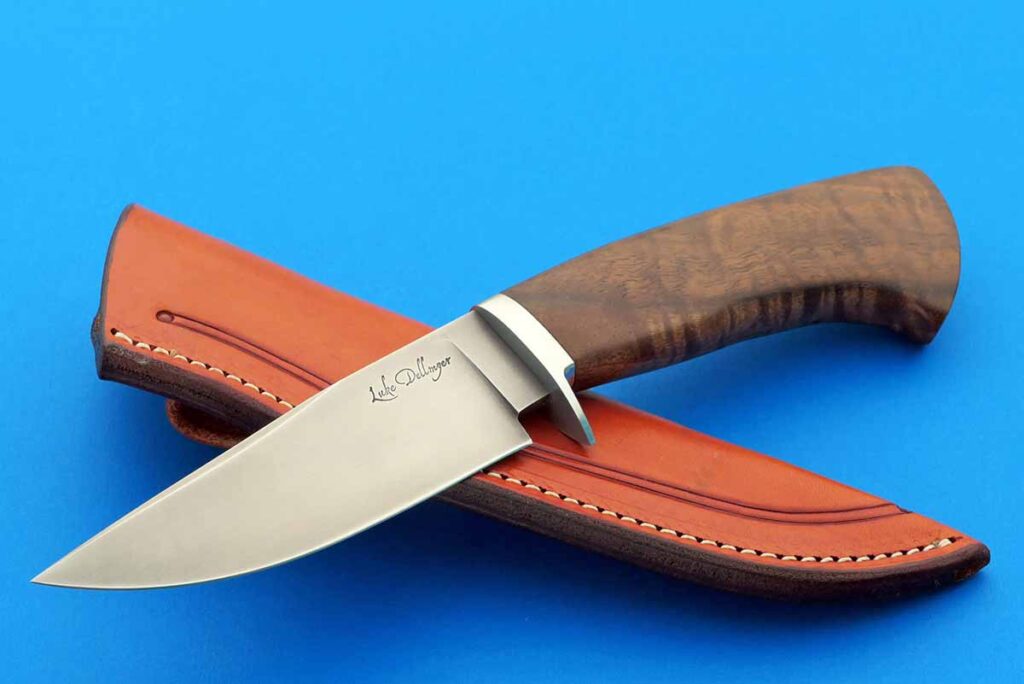
Luke Dellmyer custom hunting knife.

The custom knife that dominates the fixed-blade market is the hunter. This is due primarily to the fact that there seems to be an endless variety of hunting knives that can be made, and they usually have a lower price point than many other custom knives. Unlike other customs, hunting knives are often bought for use. Consequently, they are frequently tested by many users, from the casual outdoorsman to the professional hunting guide. The firearm may dispatch the game, but the knife provides the meat and potentially the trophy the taxidermist creates.

Over the years, thousands of articles have been written on and about hunting knives, including a few by this writer. In this article, I want to discuss not types or designs but pricing on knives in the hunter category.

Custom Hunting Knives Cost

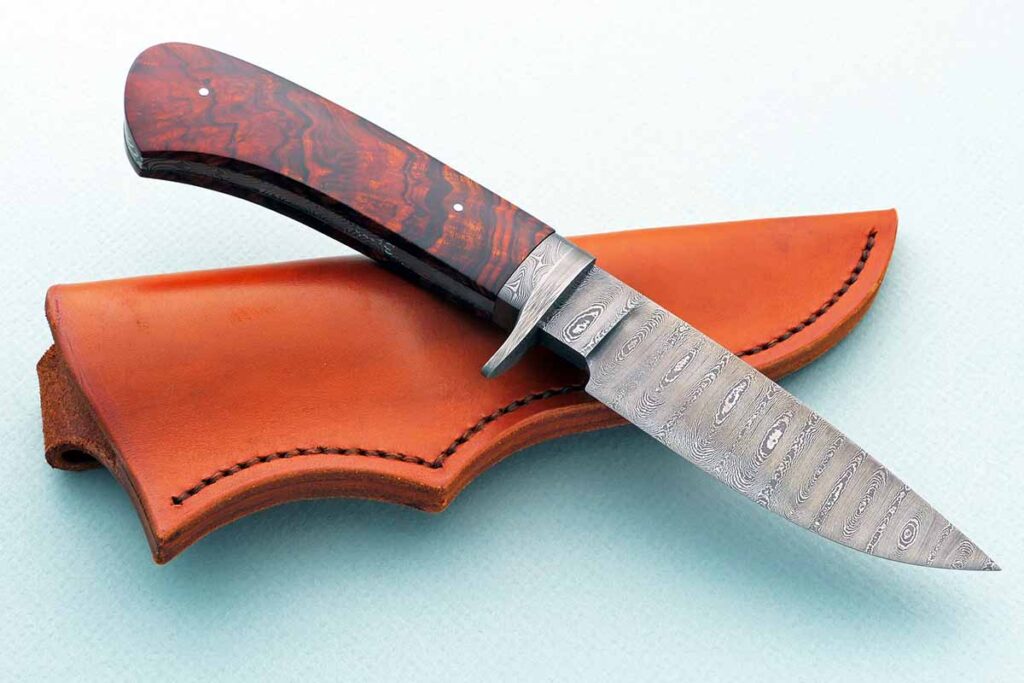
Wess Barnhill ladder-pattern damascus hunter.

Several factors go into the cost of building or making anything. Most makers need a place to make the knives, usually a garage or a shop. Next comes the equipment, which varies from maker to maker. Belts for grinding, polishing and putting an edge on the blade can be one of the more costly items a maker utilizes. Electricity, propane or wood provide the energy to work the materials that become the knife. No matter how the knife is built, these are typical costs shared by most makers. The costs vary depending on the prices of the materials to make the knife. Steel, guard/bolster material, handle material and leather if a sheath is required all impact the finished knife’s price, as will the maker’s skill at using these materials.

Custom Hunting Knives Blade Steel

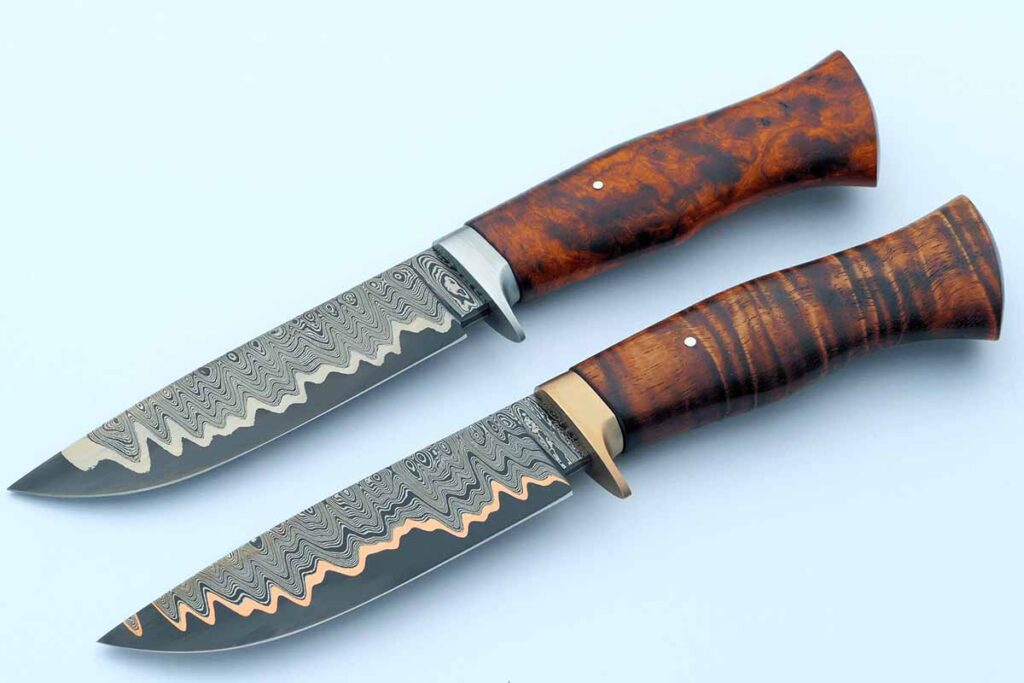
Dan Lewis' dmascus and copper san-mai hunters, both striking outdoor options.
Dan Lewis’ dmascus and copper san-mai hunters, both striking outdoor options.

The majority of makers use either stainless or carbon steel. Each offers advantages and disadvantages. Because of the diversity of steel, hunters can select a knife with the steel that best suits their needs.

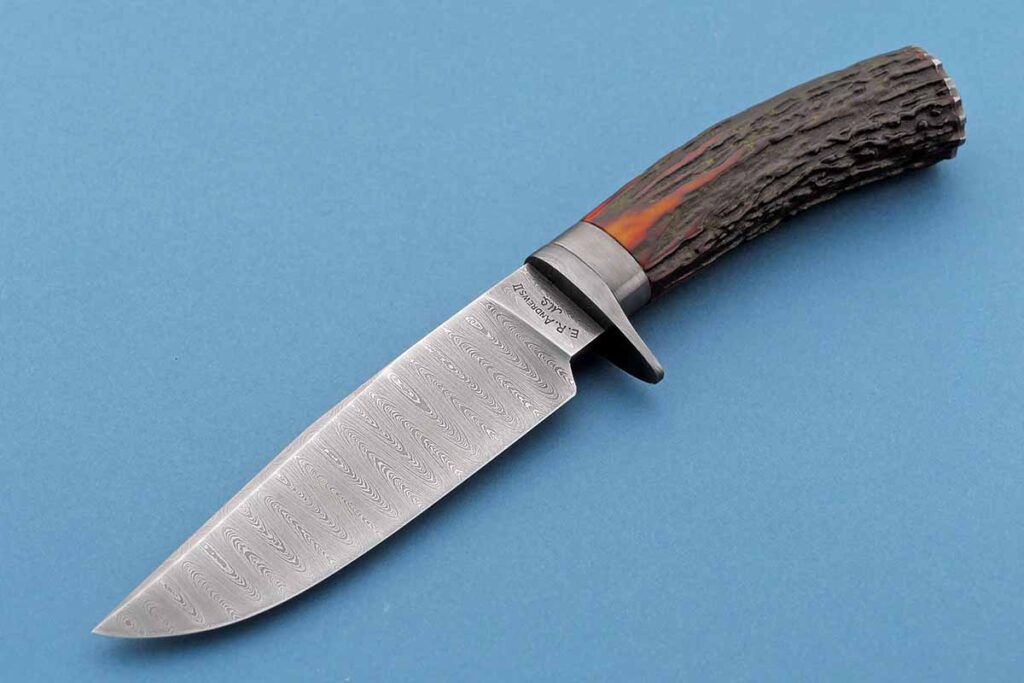
Some hunters prefer patterned damascus steel, such as the ladder pattern of the damascus hunter by ABS master smith Russ Andrews (see accompanying image). Some hunters indicate the damascus blade’s distal tapering and differential heat treatment give the knife a better edge-holding capability. Others prefer steel of a san-mai construction as in the knife of ABS journeyman smith Dan Lewis. By forge welding more malleable steel onto either side of a harder steel, san-mai provides the blade with more structural integrity without sacrificing its ability to hold an edge.

As you can imagine, creating these steels takes additional time and is an added expense. The steels can add anywhere from $150 to $400 to the knife’s cost.

Custom Hunting Knives Handle

Russ Andrews amber stag hunter is a looker.

The handle material varies from natural to such synthetic(s) as G-10, carbon fiber and Micarta®. Natural handle materials are even more diverse, including ivory, antler/horn, wood, mother-of-pearl and bone. The advantage of synthetics is they are not subject to the effects of weather and temperature and so do not shrink and/or expand. Also, Micarta and G-10 are less expensive than some natural handle materials.

Natural handle materials can give your knife a unique look, making it stand out from other knives. Ivory, predominantly mammoth or ancient walrus ivory, is among the most distinctive and expensive handle materials used on hunting knives. Mammoth ivory comes in the form of scales and can cost anywhere from $100 to $250. Ancient walrus ivory costs are largely determined by the color(s) and condition. Prices generally range from $200 to $400.

Antlers and horns of all types have been used as knife handles from the onset of knives being built. The most commonly used antler on custom hunting knives is Sambar stag. In addition to its classic look, the natural lands* and grooves of the antler will contour to your hand, giving you a better grip when using the knife. Stag’s demand and lack of supply over the past 15 years have driven the price up considerably. You can expect to add $125 to $175 to the cost of the knife for an excellent piece of stag.

Mike Malosh's hunters are outfitted with either an elk and black Micarta or stacked leather washers.
Mike Malosh’s hunters are outfitted with either an elk and black Micarta or stacked leather washers.

Watching the price of stag increase encouraged me to look at other members of the deer family. One such member is the elk. It has many of the same characteristics as the stag antler, such as the natural lands, grooves and coloring. However, the price is considerably less than stag—around $50. The Elk Hunter (see accompanying image) by Mike Malosh gives you an idea of what an elk antler looks like on a custom hunting knife.

Wood is also a favorite handle material for both makers and collectors. Talk about diversity—wood offers just about any color you could want. Now, with the wood stabilization process commonplace, you eliminate most of the adverse effects of weather on the natural handle material. The price point for wood ranges from $5 to $50 to $75 for scales or a block of desert ironwood or koa. The damascus hunter by ABS journeyman smith Wess Barnhill features a beautiful set of desert ironwood scales. Its range of colors helps ironwood find its way to many knife handles.

Walnut is a hardwood favored by makers such as ABS journeyman smith Luke Dellmyer. It is a very stable, attractive wood that costs $30 a block. Another natural handle material I like, but you don’t see much, is stacked leather washers, as on the Mike Malosh Bear Hunter. One advantage I found with stacked leather is that, over time, the handle material will conform to your hand, providing you with a custom grip. You can expect stacked leather to add about $30 to the knife’s cost.

What Makes A True Value

As a professional custom knife purveyor, I offer prices based on my conversations with suppliers and makers and the materials I have bought over the years. As you know, everything gets more expensive, so prices may vary. The makers’ ability to combine the materials to create functional and aesthetically pleasing knives comes from years of honing their skills in their shops. Once you understand material pricing and can differentiate the skill levels of the different makers, you will realize that this is where the true value lies.

*Like on the inside of the barrel of a firearm, lands are the raised part of the antler and the grooves are the recessed part.

Check Out More Outdoor Knives:

Work Sharp Ken Onion Elite Mk2 Review [Hands On]

0

Has Work Sharp improved on its legendary tool?

The Work Sharp Ken Onion Elite has been the standard for powered abrasive belt sharpening for about a decade. And it’s more than earned its place in knife enthusiasts’ sharpening stations. Yet, Onion and Work Sharp were just getting warmed up.

Unveiled at the beginning of 2024, the Ken Onion Elite Mk2 (KOE Mk2) aims to outdo the original in about every way. But does it?

That’s what I aimed to find out when I pulled out a bevy of knives and put the unit through its paces. Is the sharpener more user-friendly? Does it offer more functionality? Can it unseat the legendary Work Sharp Ken Onion Elite?

Let’s find out.

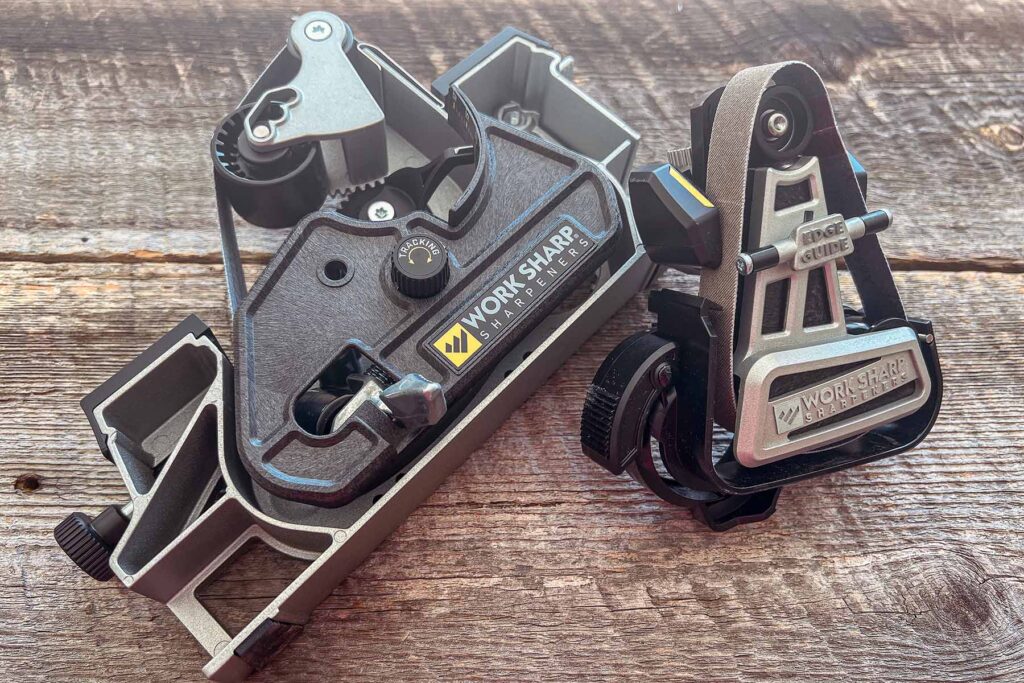
Work Sharp Ken Onion Elite Mk2 Grinding Attachment

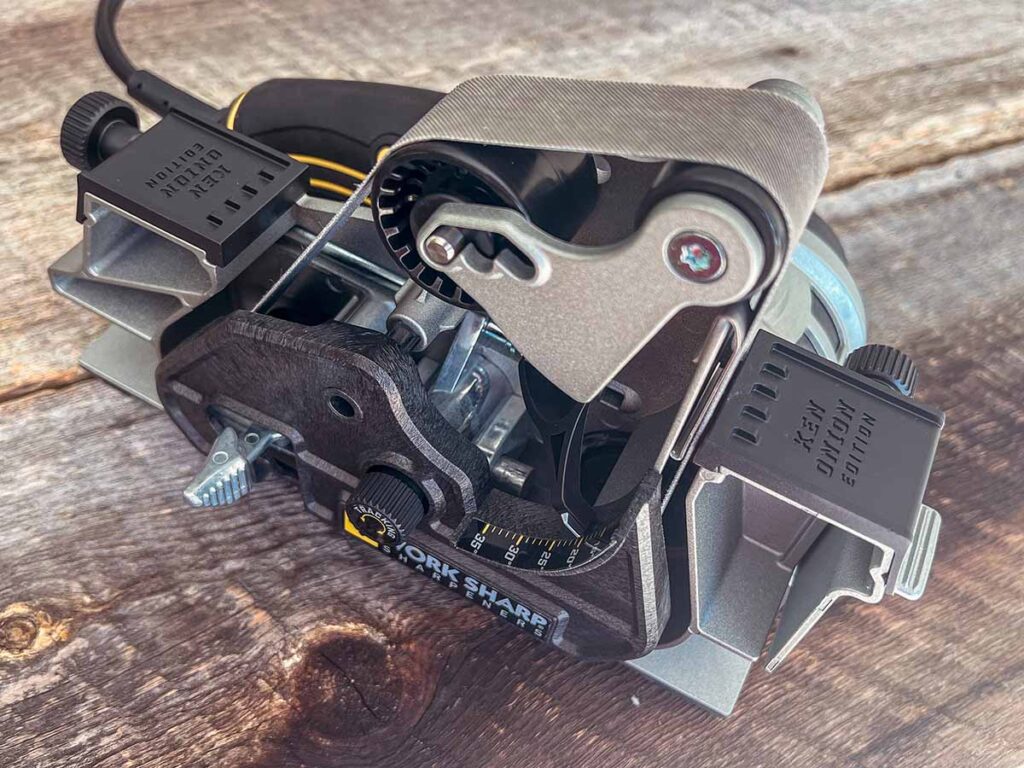
Ken Onion WorkSharp MK.2 with grinding head

Work Sharp didn’t veer away from the basic functionality of the Work Sharp Ken Onion Elite in the Mk2. For example, blade grinding attachment still uses the same 1”x18” belts as the original and pretty much functions the same.

Onion and the company, however, have enhanced the operation of the attachment in several ways.

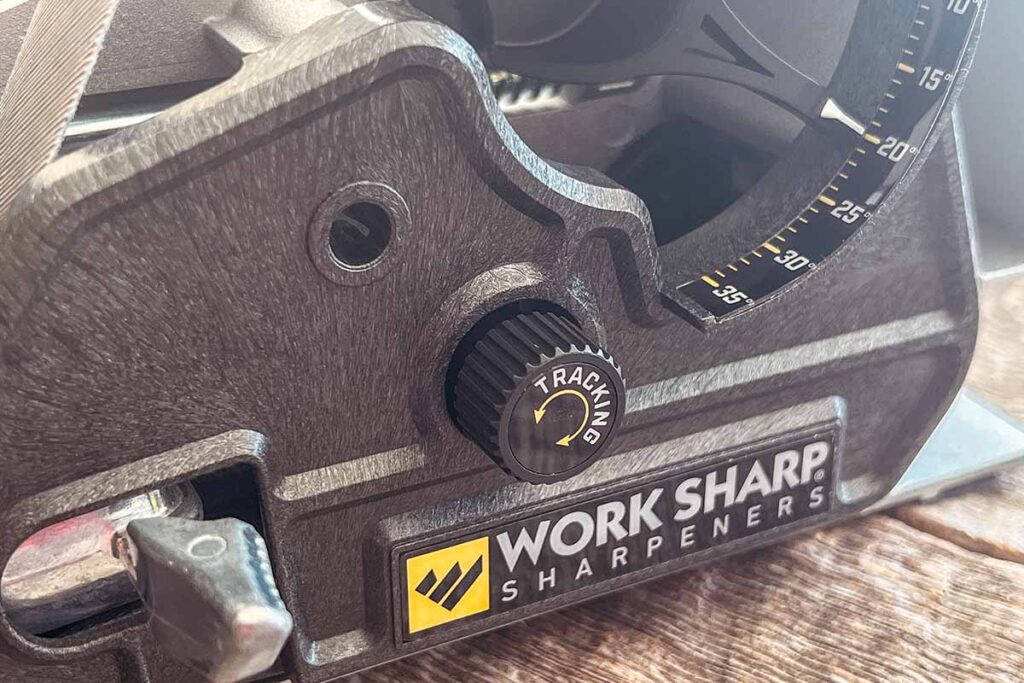
The angle adjustments on the grinding attachment now can be made on the fly and without de-tensioning the belt or even turning the unit off. This is done through a round nob under the plate controls, which raises and lowers the idler wheel. A built-in angle indicator allows you to dial in the exact edge.

The aforementioned idler wheel is also new to the system and can be set for three edge types: conventional V, low-angle convex, and high-angle convex. A major plus, this is achieved without tools or even de-tensioning the belt—though, the power must be off.

Ken Onion WorkSharp MK.2 grinder adjustment

Work sharp has included a belt guard on the new model, gone are the days of the original’s open face. The guard has a port hole that you can place the hub fastener into (so you won’t lose it!) whenever you convert this unit to the standard three-pulley cassette.

Finally, the Mk2 has an adjustable height reference plate on the platen end of the grinding attachment. Quite simply, this allows for finer adjustments at the platen end.

Overall the build, of the new BGA is more substantial than the original, as there is now more weight to it.

Work Sharp Ken Onion Elite Mk2 Sharpening Head

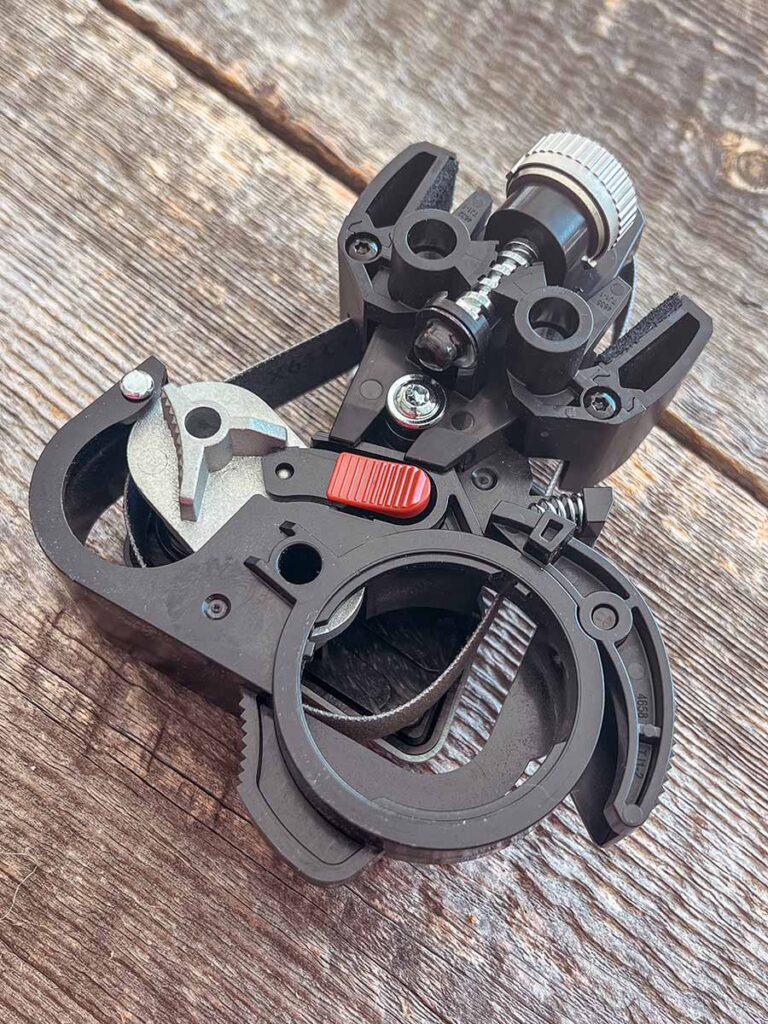
Ken Onion WorkSharp MK.2 Sharpening Head

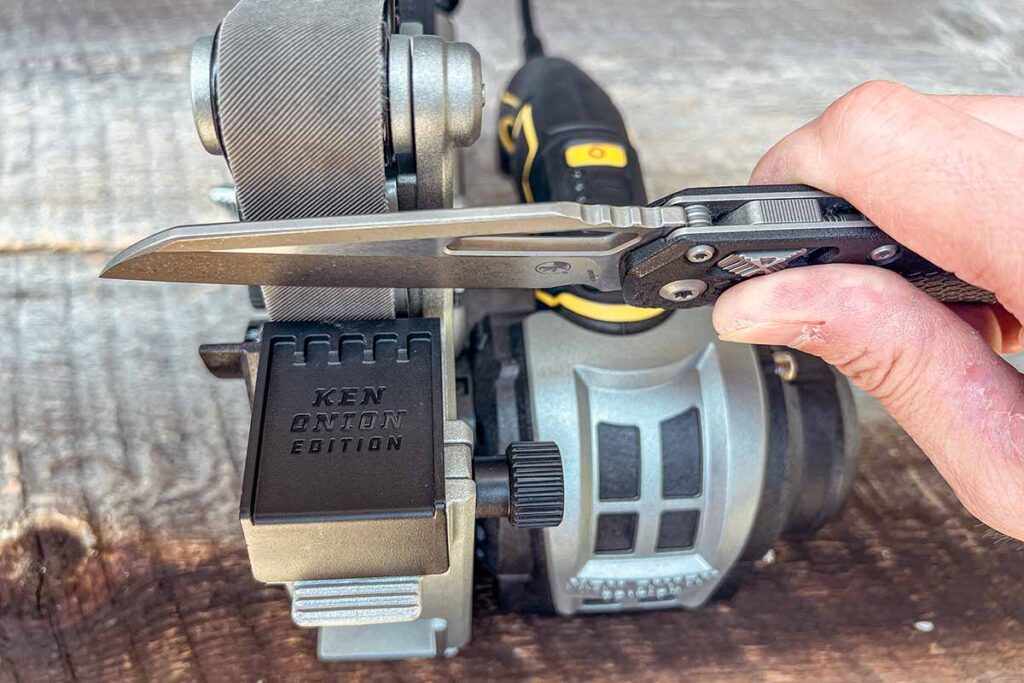
If you prefer to use the standard three-pulley cassette instead of the Blade Grinding Attachment, you can physically swap out the two easily. The power head attaches to either using a simple twist lock connection at the motor housing at the drive shaft.

A nice aspect of the cassette is it includes a scissor guide in addition to a knife guide, which is set at a 65-degree angle. For knives, you use the pull-through method, resting the blade on one of the leather-lined blade rests and pulling the blade through along the belt.

Selecting your edge angle is as easy as turning a dial, similar to the blade grinding attachment. Rotate the knob to the desired edge angle and both blade rests will move in or out simultaneously.

There’s also an included blade rest with plastic rollers that allow you to steady the blade as you pull it through. If you wish to not use these, they simply rotate out of the way and lock into the stowed position.

However, with the cassette, there is no option to adjust for different edge types (standard V, low convex, or high convex). You just get a regular convex edge only, but still razor sharp.

Work Sharp Ken Onion Elite Mk2 Power Head

As for the power head end of things, there are several improvements here. You’ll notice the larger motor housing and inside is a more powerful motor with electronic torque management. The motor senses the load placed on the belt and compensates for it, making this sharpener almost impossible to bog down in use.

The pushbutton speed control with LED light scale shows you at a glance how fast the belt is running. And slowing down or speeding up the belt is as easy as pushing a button.

The Mk2 has a constant on setting—you just squeeze the power trigger and press a button to lock in the setting. Shutting it off is a matter of hitting the stop button or squeezing the power trigger.

The body of the Mk2 has a cast metal overlay that adds rigidity as well as boosts the rough and tumble looks of the tool. Furthermore, the metal overlay makes the unit quieter and dampens vibrations.

Work Sharp Ken Onion Elite Mk2 Testing

Putting the Ken Onion Elite Mk2 to use is a pleasure. However, I’d say, that to step up to a tool of this nature you need to know your manual sharpening skills inside and out—especially when using the grinding attachment. If you don’t know what you’re doing you risk damaging blades or simply spinning your wheels with a sub-par sharpening. Given the guides, the cassette is more forgiving.

I have ten solid years of experience with the original Ken Onion Elite and know the limits of the machine. With this being said, the functionality of the Mk2 is identical to the original and the improvements mentioned make it more user-friendly, improving the overall experience.

Ken Onion WorkSharp MK.2 sharpening with grinding head

I also found the Mk2 is easier to set up and dial in, as well as change angles instantly with the machine powered on. The ability to dial in the edge type (standard V, low convex, and high convex) allows you to tailor the edge format to your specific task for the knife.

Personally, I prefer the high convex, which allows you to cut the edge angle back 2-3 degrees more for enhanced edge sharpness. At the same time, it still retains enough “meat” in the center for lateral strength.

Final Cut

As it goes, the Work Sharp Ken Onion Elite Mk2 doesn’t come cheap with an MSRP of $300. It’s a bit steep for a sharpener. But when you look at what you get, it’s easy to see why it’s still valuable.

While this was primarily designed as a sharpening machine, it’s also a miniature variable speed belt sander that will work on metal, PVC, plastic, and wood. In turn, you receive two machines in one, plus it can handle knives and scissors as well as assist you with projects in your garage or shop. How can you beat that?

Honestly, if you want to take your sharpening game to the next level and beyond, invest in the Ken Onion Elite Mk2 from Work Sharp.

More On Sharpening:

Hunting Knife Sets: Hands-On And Tested

The latest hunting knife combos will exalt your outdoor experience.

When choosing a hunting set of cutting tools, consider the quality of the tools and how they complement each other. Before you do that, though, be sure the set is properly outfitted.

A good set should include a gut hook, knife, saw and small hatchet for field dressing and processing game. Each tool serves a specific purpose:

  • Gut hook: makes opening the animal’s abdomen easier,
  • Sharp knife: essential for skinning and butchering
  • Saw: helps cut through bone or branches
  • Small hatchet: helps split bone or cut wood.

Consider durability and ease of use, as well as how the tools can be packed for transport.

Gut Hook Knives

A gut hook hunting knife serves multiple purposes in the field. Its primary function is to assist in the field dressing process by opening the animal’s abdomen with minimal damage to the internal organs. The hook feature helps prevent puncturing the organs while skinning and reduces the risk of cutting into the stomach or intestines. A gut hook can be used for cutting through tough connective tissues, tendons and cartilage, too. Its precision and specialized design make it an essential tool for hunters, allowing for efficient and safe processing of game in the field. It also works great for hooking under a bail and lifting hot pots and other items off a camp stove, etc.

Caping Knives

A caping knife in a hunting set serves various purposes, making it an essential tool for hunters. Its precision and maneuverability render it ideal for delicate tasks such as skinning around trophy areas, making intricate cuts, and separating hide from the meat. Also known as a caper, it is great for creating shoulder mounts or European mounts of game animals, preserving the hide for taxidermy purposes. The fine point and sharp blade allow for detailed, careful work without damaging the hide or underlying tissue. A caper is a versatile tool that adds value to any hunting tool set, especially for hunters looking to preserve trophies.

Boker Arbolito Guides Combo

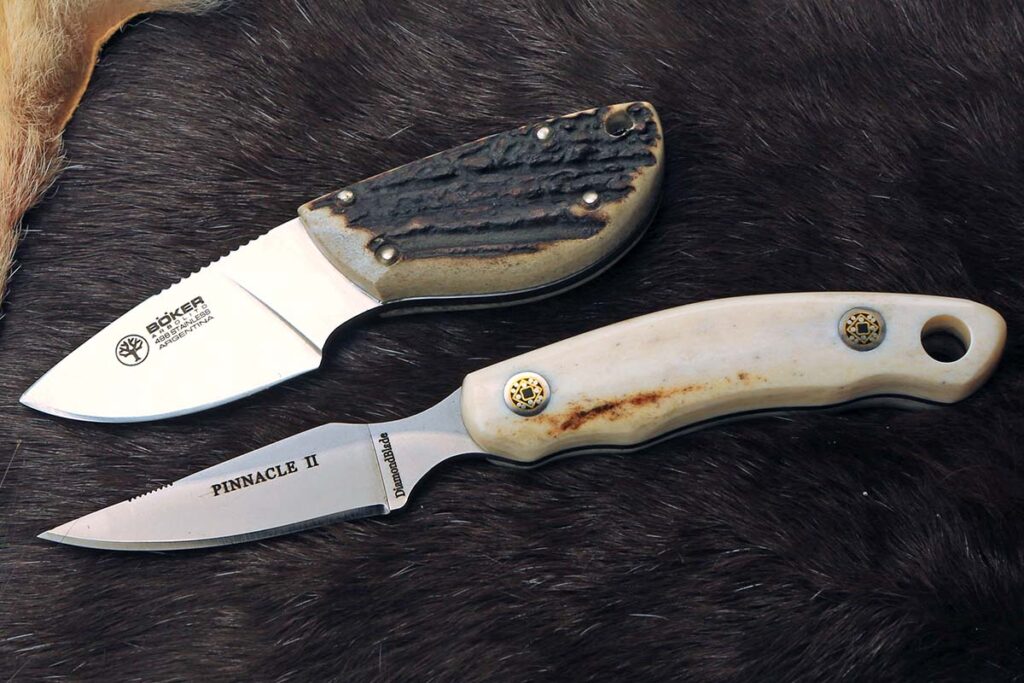
Boker 2.25-inch drop point and Diamond Blade Knives Pinnacle
The Boker 2.25-inch drop point and Diamond Blade Knives Pinnacle II are both classic caper/utility tools featuring handsome stag scales.

The Boker Arbolito Manufactory in Buenos Aires, Argentina, is known for crafting high-quality knives using premium materials, with an emphasis on hunting and outdoor models featuring handles of wood and stag. These traditional knives are designed to cater to a variety of needs and tasks, whether for professional use, sports, everyday carry or collectors with a keen interest.

A notable offering is the Arbolito Guides Combo set in satin blades and stag handles. It includes a 4.25-inch gut hook skinning blade and a 2.25-inch drop point hunter. The gut hook prevents accidental punctures during skinning and is designed with a large forward finger choil for enhanced control. The little drop point is suitable for small, detailed cutting tasks, providing precision cuts. It is an excellent utility blade for cutting cord, fishing line and packaging, and it can act as a small skinner. Both knives sport stag handles for a secure grip and a rustic appearance.

The set includes a brown leather piggyback belt sheath for easy carry. The gut hook pouch boasts a solid snap to ensure retention. The small drop point comes with a simple drop-in friction-fit pouch, which is easy to access and is held on the main sheath via a rivet. This set presents function and style for processing your next trophy animal or other outdoor tasks.

Arbolito Guides Combo Set Specs
Blade Lengths: Gut hook skinner 4.25”, drop point 2.25”
Blade Steel: Bohler N695 stainless
Blade Grinds: Skinner hollow, drop point flat
Blades @ Thickest: .125”
Blade Finish: Satin
Handle Material: White/brown stag
Overall Lengths: Skinner 8.6”, drop point 4.8”
Sheath: Leather piggyback
Country of Origin: Argentina
MSRP: $291 at press-time exchange rate

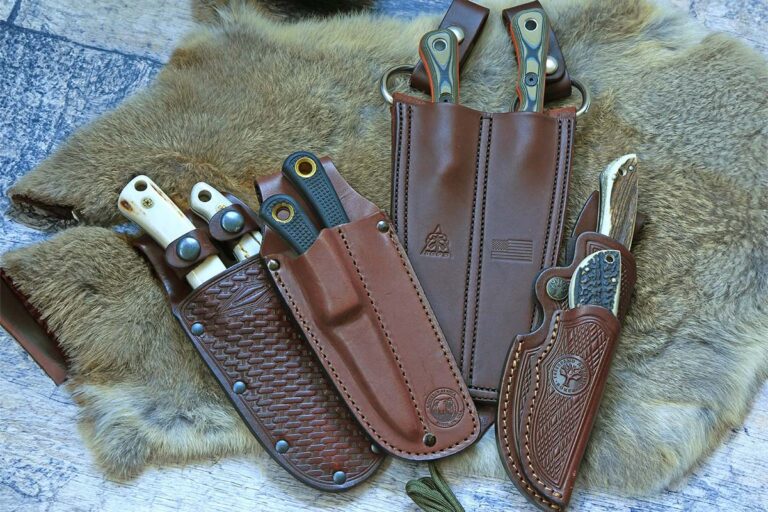
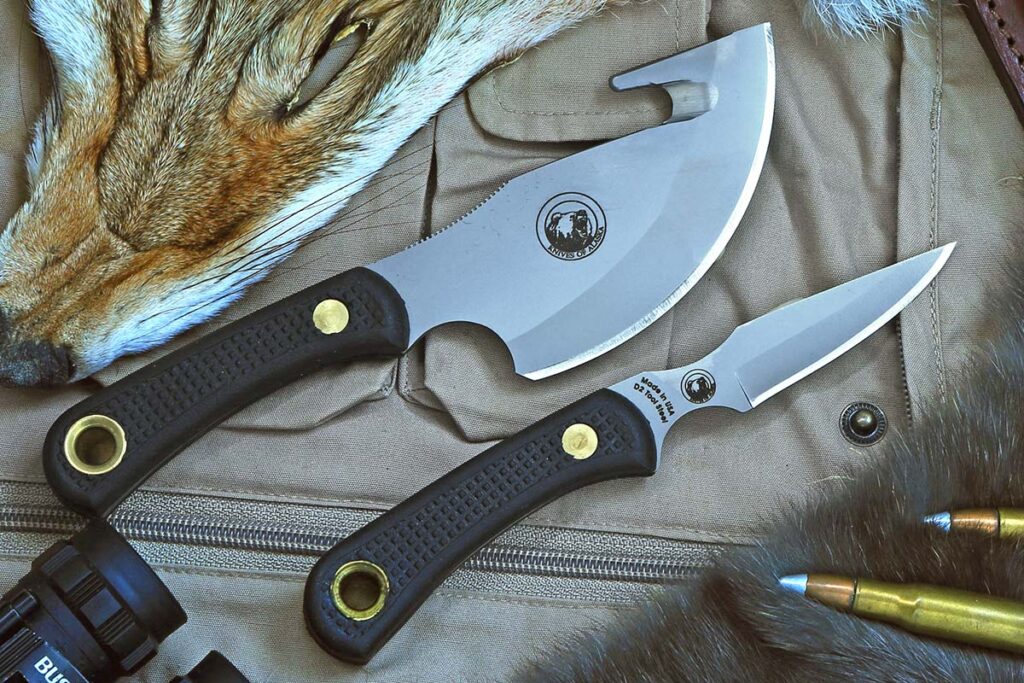
Knives of Alaska Caribou Combo

KOA Caribou Combo work well together
The two knives of the KOA Caribou Combo work well together. The skinner has a deep belly for slicing and enough weight to be a light cleaver. The Cub Bear is a tremendous caper that pulls triple duty as a fine carver and paring knife.

The Knives of Alaska Caribou Combo offers a slimmer alternative to the company’s Light Hunter Combo. The Caribou Combo features the same gut hook skinner design as the Light Hunter Combo but with a thinner blade for a sharper, longer-lasting cutting edge. The Caribou is ideal for those seeking a complete field dressing kit for whitetail deer and other medium-sized game.

The Caribou Combo includes two knives—a gut hook skinner and Cub Bear—in a side-by-side sheath. The skinner is a full-tang knife 7.5 inches overall. It has a .1-inch-thick D2 tool steel blade and a 4.25-inch cutting edge. It features thumb notches and a large-capacity gut hook.

The Cub Bear is a fine-detail-work knife of D2 with a blade 3/32 inch thick at the thickest. Both models feature black SureGrip handles with large, lined lanyard holes. For hunting deer, sheep and mountain goats, the Caribou Combo is an excellent choice.

The two knives work perfectly together. The skinner has a deep belly for slicing and enough weight to be a light cleaver. Besides the obvious skinning qualities and gut hook that opens the abdomen safely, it’s an excellent butcher knife. Using it to slice and chop up meat chunks for a rustic, slow-cooked meal was a breeze. The Cub Bear, meanwhile, is a tremendous caper that pulls triple duty as a fine carver and paring knife.

In my humble opinion, of the test group this set was by far the best buy for the money.

Caribou Combo Specs
Blade Lengths: Gut hook skinner 3.5”, Cub Bear 2.75”
Blade Material: D2 tool steel
Blade Grind: Saber
Blades @ Thickest: Skinner .1”, Cub Bear .09”
Blade Finish: Bead blast
Handle Material: Black SureGrip
Overall Lengths: Skinner 7.5”, Cub Bear 6.75”
Sheath: Brown leather double pouch
Country of Origin: USA
MSRP: $189.99

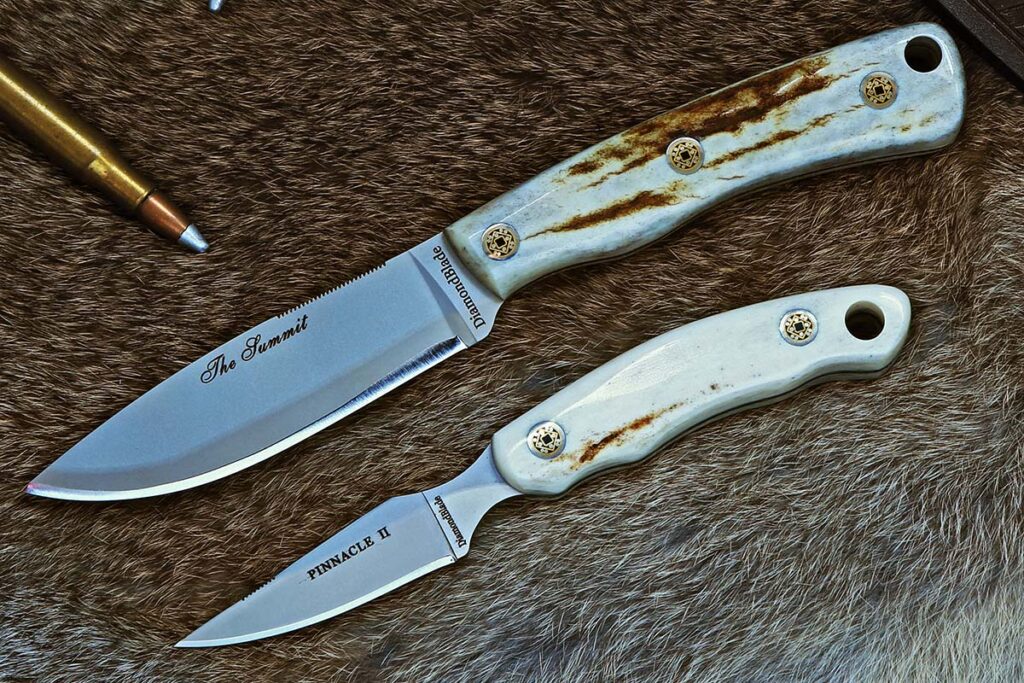
Diamond Blade Knives Summit Combo

Summit has a long skinning radius, making it proficient at swiftly and effectively breaking down game. A scalpel-like knife, the Pinnacle II is ideal for caping and initial incisions
The Summit has a long skinning radius, making it proficient at swiftly and effectively breaking down game. A scalpel-like knife, the Pinnacle II is ideal for caping and initial incisions, boasting finger gimping and cutouts for optimal leverage.

The Summit Combo from Diamond Blade Knives is a pro hunter’s set meticulously crafted with the benefit of decades of hunting and field dressing expertise. It includes the Summit drop point and the Pinnacle II, both highly efficient field tools.

The Summit has a long skinning radius, making it the perfect tool for swiftly and effectively breaking down game. A scalpel-like knife, the Pinnacle II is ideal for caping and initial incisions, sporting finger gimping and cutouts for optimal leverage.

Designed for professional hunters, this versatile kit provides reliable and efficient tools for most aspects of field dressing. The set includes an American-made dual leather sheath with a Kydex insert for secure retention and easy access while preventing damage to the knives.

The substantial Summit proved ideal for effortlessly carving meat for a hearty stew or canning. The large handle gave ample space for various grips or when wearing gloves. The Pinnacle II did an excellent job on small detailed work, especially slicing herbs and peeling garlic.

The double sheath was my favorite of the test bunch because it held the knives perfectly in place, even with the snaps open, due to the Kydex insert. The attractive outer leather provides the best of both worlds.

Knives Summit Combo Specs
Blade Lengths: Pinnacle II Scalpel 2.55”, Summit Drop Point 3.75”
Blade Material: Friction Forged® D2 tool steel
Blade Grind: Flat
Blades @ Thickest: Pinnacle II Scalpel .09”, Summit Drop Point .125”
Blade Finish: Satin
Handle Material: Stag
Overall Lengths: Pinnacle II Scalpel 7”, Summit Drop Point 8.75”
Sheath: Leather double model w/Kydex insert
Country of Origin: USA
MSRP: $799

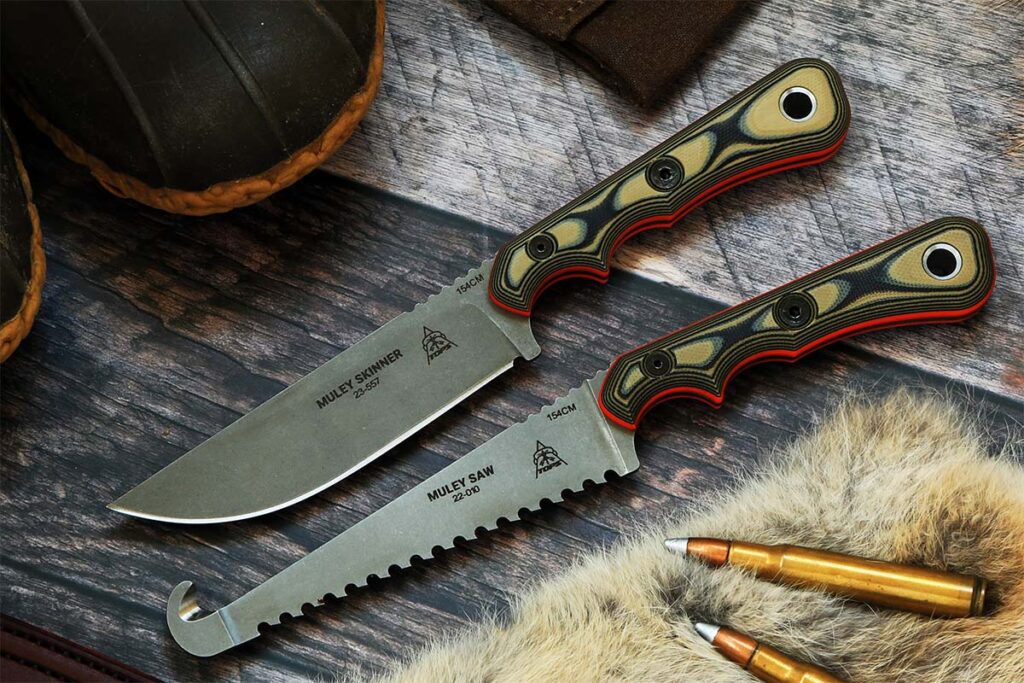
TOPS Knives Muley Skinner/Saw Combo

TOPS Knives Muley Skinner
The long, deep-bellied blade of the TOPS Knives Muley Skinner is well-suited for skinning game and performing campsite tasks such as prepping, kindling and food processing. The Muley Saw is a bone saw tailored for efficient game processing and can saw wood in emergencies.

Winner of Best Hunting Knife at BLADE Show West 2023, the TOPS Knives Muley Skinner/Saw Combo is a game changer. The Muley Skinner is a solid fixed blade for outdoor jobs. The long, deep-bellied blade is well-suited for skinning game and performing campsite tasks such as prepping, kindling and food processing. The Muley Saw is a bone saw tailored for efficient game processing and can serve as a wood saw in emergencies. The saw blade sports a razor-sharp gut hook for added function.

Due to in no small part to its flat grind, the skinner excelled at slicing meat. It also deboned chicken thighs, as the belly fit nicely between the joints while roll cutting. The robust build instills confidence for using the knife for baton cuts. The saw was aggressive and did equally well on bone as on branches. It was the most diverse tool of all those in the test sets.

Muley Combo Specs
Designer: Leo Espinoza
Blade Lengths: Skinner 4.5”, Saw 4.25”
Blade Steel: 154CM stainless
Rockwell Hardness: 58-60 HRC, cryo-treated
Blade Grind: Flat
Blades @ Thickest: .13”
Blade Finish: Tumble
Handle Material: Tan/Black G-10 w/orange G-10 liners
Overall Lengths: Skinner 8.75”, Saw 9”
Sheath: Brown leather double model
Knife to know: Winner of Best Hunting Knife at BLADE Show West 2023
Country of Origin: USA
MSRP: $550

Final Cut

The reviewed sets ensure you have everything you need for field dressing and processing game efficiently. A good hunting knife set can make the process quicker and more manageable, especially when dealing with larger game. Lastly, having a set of dedicated hunting tools helps preserve the sharpness and integrity of your everyday carry knife, as it won’t be subjected to the same level of wear and tear that field dressing often involves.

Check Out More Outdoor Knives And Tools:

Plain Vs Serrated Knives: Which Is Best For Who

2

School yourself on which edge is best for you and your knife.

Coffee or tea? Pizza or hamburger? Ice cream or cake? Truck or car? Having choices in life is a good thing. You base the choices on such criteria as what you’re in the mood for to eat, how much you can afford for a nice vehicle and more. Likewise, you have tons of choices in knives, including plain, serrated or partially serrated/combo edges.

Most choose plain edges because plain edges provide the most versatile cutting format, regardless of task. They’re also the easiest to sharpen. Some have rougher slicing tasks to do, like cutting rope, cardboard, or webbing or plastic straps. If you undertake such tasks more frequently, a knife with a serrated edge will power through tough and fibrous materials with ease. 

Knowing the intended use for your knife will help you select the proper edge format, so let’s explore the possibilities for plain, serrated and partially serrated edges. Showing typical uses for all three should help you decide which edge format is for you.

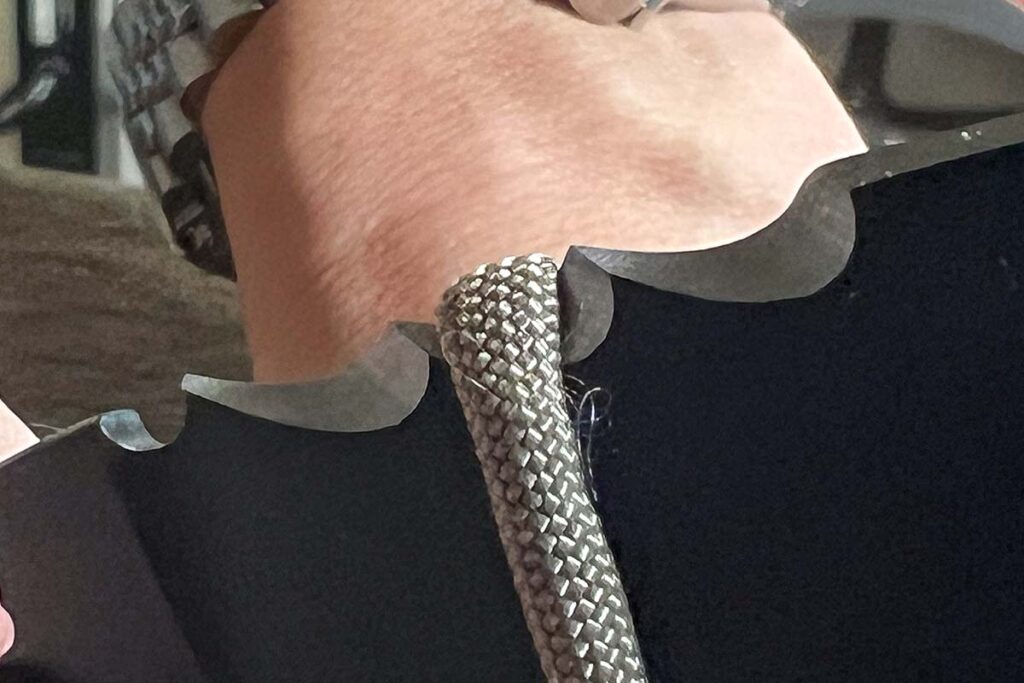
CRKT Bugsy

Bugsy’s Veff serrated teeth
Rest whatever you’re cutting inside one of the Bugsy’s Veff serrated teeth and it will help hold the material as well as cut it. 

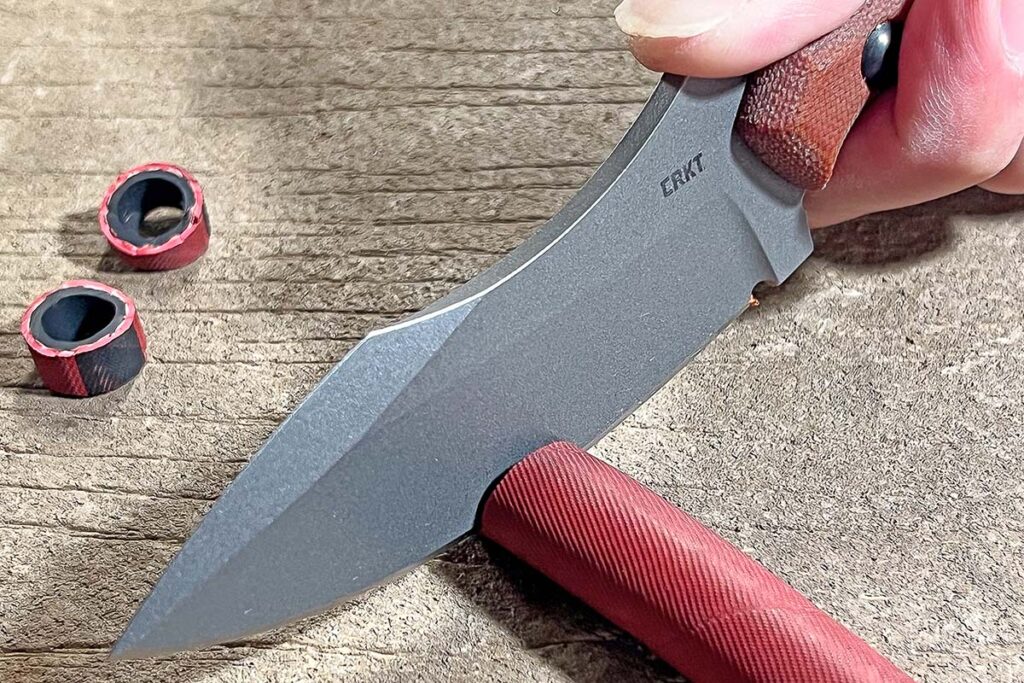
Kaila Cumings, the three-time contestant on Discovery Channel’s Naked and Afraid reality TV show, designed the CRKT Bugsy. Kaila grew up hunting, fishing and camping with her father, thus starting her lifelong interest in survival skills and tools, including knives. She designed the Bugsy as a compact fixed blade with high utility characteristics and superior ergonomics. 

The 3.7-inch blade enables the knife to execute a variety of tasks related to camping/survival. The modified clip point shape with a defined tip is ideal for scoring, and the gentle sweep of the main bevel gives plenty of belly to facilitate slicing chores such as food prep. The 1095-blade steel provides good edge holding and ease of resharpening in the field. As a result, it is a favorite carbon steel of knife users. The handle’s finger grooves help lock in your grip, and their rounded edges melt into your hand.

Plain edge Bugsy cutting hose
The plain edge Bugsy works well with utility chores such as cutting rubber hose. The curve of the edge makes for great slicing action.

There are two versions of the Bugsy: a plain edge blade in a gray Cerakote® finish, a tan Micarta® handle and a leather belt sheath, and a partly serrated blade in a black Cerakote finish, a black G-10 handle and a molded Kydex sheath.  The former is outdoor/hunting themed, the latter tactical—same design, two different personalities.

Performance-wise, the Bugsy is an ideal fixed-blade companion in either flavor. It’s just shy of 7.5 inches overall, making it very comfortable for everyday carry. It’s compact enough to carry well yet there is enough blade length to handle most cutting jobs. Both versions have an MSRP of $170 and are made in the USA for CRKT by TOPS Knives.

Spyderco Paramilitary 2

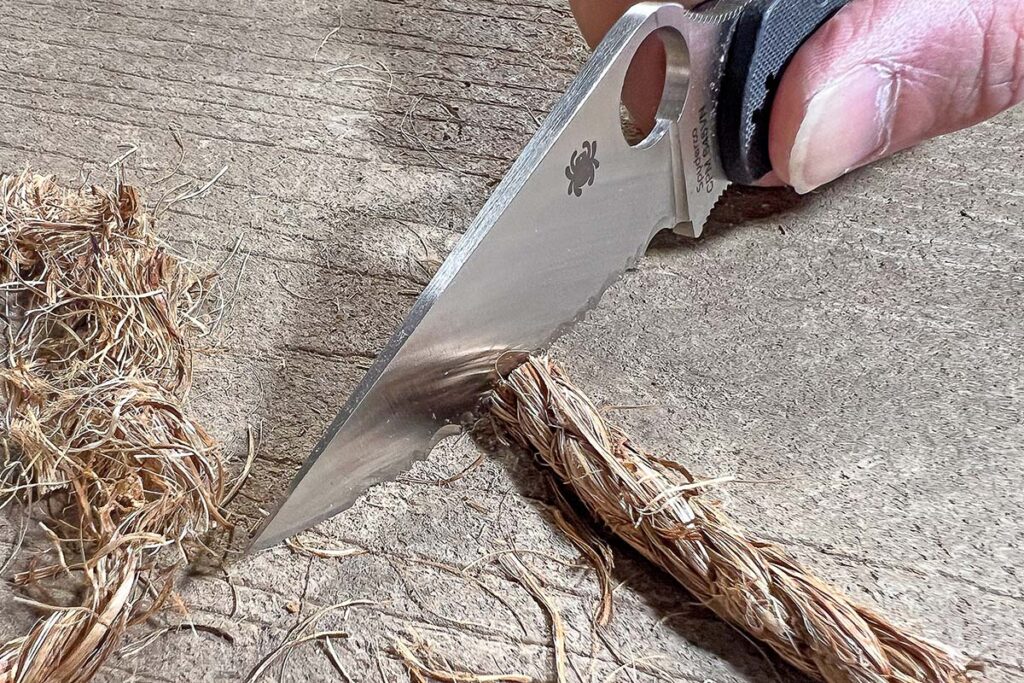
Spyderco Para2 cutting rope
This is where the fully serrated Spyderco Para2 shines. Manila rope is tough to cut and the Para2 handles it without any effort exerted. “If you cut rope regularly,” the author noted, “fully serrated is the way to go.”

The Paramilitary 2, aka Para2, is one of Spyderco’s hottest-selling folders. Taking what works for the company’s full-size Military model and making it a bit more compact and pocketable, the Para2’s design and performance lineage is undeniable. It has a full-flat-ground blade that makes the Military a lean, mean cutting machine. 

There’s also the ultra-strong Compression Lock that secures the blade open, yet is easy to manipulate and close one-handed. The ergonomically shaped G-10 handle sports a nice peel-ply texture that aids in grip retention. The Para2 is built for serious EDC use. The 3.4-inch clip point blade is CPM S45VN high-performance stainless steel for enhanced edge holding. 

The reasons for the Para2’s superior cutting performance are both the full flat grind and the distal taper from tang to blade tip. The resulting progressively thinning down of the blade allows it to sail effortlessly through whatever you’re cutting. The thumb rest and finger choil boast deep traction notches for a nonslip grip, allowing a choke-up grip when more control or pressure is required.

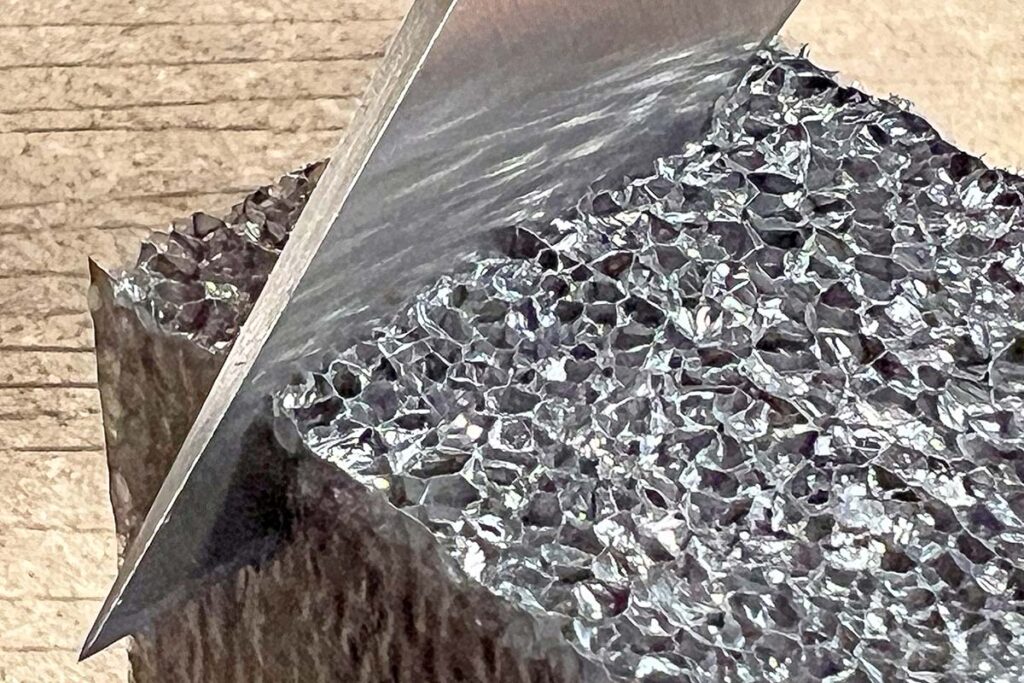
Plain edge Para2 has a slight distal taper
The full-flat-ground blade of the plain edge Para2 has a slight distal taper from tang to tip, which makes it bite hard and sink into the cutting media. It goes through foam block like a laser.

The edges of the G-10 are chamfered to prevent hot spots. An hourglass-shaped steel pocket clip mounts in one of four ways conducive for lefties and righties, as well as blade tip up or tip down. The Para2 carries well in whatever mode you select, making it a popular choice among Spyderco enthusiasts as well as those who fancy a well-made working folder.

Spyderco long has been known for its handle shapes, blending ergonomics with smart, practical design, resulting in a knife comfortable to use for extended periods. The Para2 handle has an integral guard just behind the finger choil. There’s also a generous swell in the grip area to accommodate your fingers comfortably. The butt swells just enough to prevent your hand from sliding rearward. 

With the Para2 you have a choice of a plain or fully serrated edge. Spyderco has long been known for its fully serrated blades, with its serration pattern regarded by many as the best in the industry. The tooth pattern cuts aggressively while still having a smooth action. MSRP for the plain or serrated Para 2 is $265. Country of origin: USA.  

Plain Vs Serrated Knives

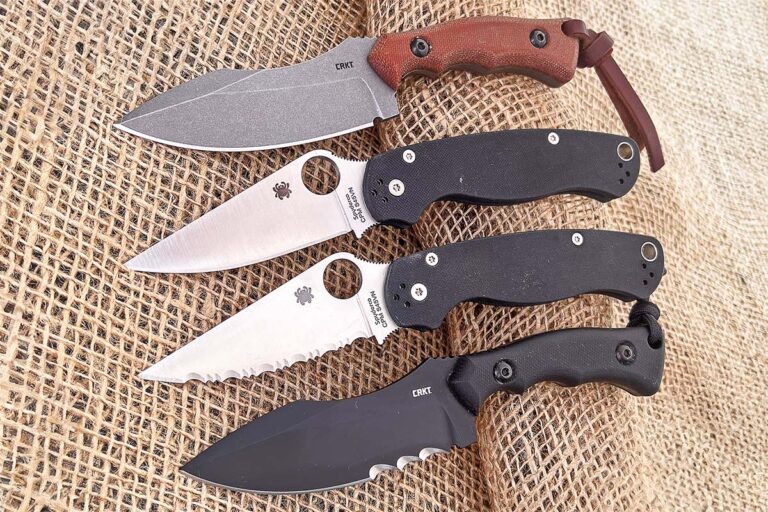
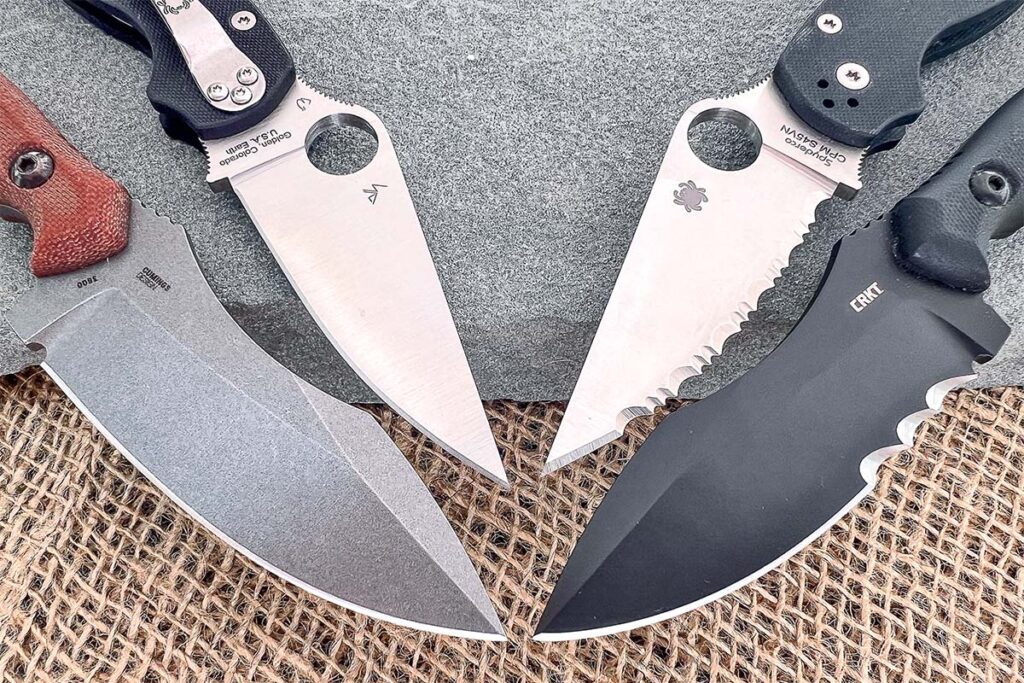
Plain and serrated or partly serrated edge versions of the same knife model, clockwise from bottom left: CRKT Bugsy plain, Spyderco Para2 plain, Para 2 fully serrated and Bugsy partially serrated.

Choose your edge format carefully to best suit most of your cutting needs. Most opt for a plain edge for the previously mentioned reasons. A plain edge does well in a variety of settings, from opening packages to stripping wire, doing light-duty scraping tasks, and even food prep. Ninety percent of cutting tasks are suited to plain edges while roughly 10 percent or so require more muscle.

Plain edge blades are easy to sharpen as well—just be sure to select your sharpener carefully based on steel type. Harder, more-wear-resistant steels like the CPM varieties require diamond sharpeners due to how aggressively diamond abrasives cut. Steels not as hard as the CPM varieties can be addressed with diamonds too, but other types of sharpeners like ceramic are very effective as well. A properly sharpened plain edge blade is all you need for most cutting jobs, big and small.

Remember that if you can reprofile the edge angle, you can decrease it by one or two degrees to get a sharper edge. For instance, most factory edge angles are 22 degrees, average. If you cut the angle back by just two degrees, you will be surprised at how much sharper the edge will be and therefore have more bite.

You need a sharpener specifically designed to address serrations. One is the Spyderco Sharpmaker 204. Set the 204 up to where the “points” of its triangular-shaped hones contact the serrated cutting edge. The points get inside each tooth as well as sharpen the tips of the serrations. There are others out there that address serrations but the best I have found is the 204. Some say serrations are difficult to sharpen but they aren’t if you use the correct sharpener.

Again, choose your edge format carefully to match the intended uses for your knife. You don’t want to cut open boxes or prep food with a serrated blade. You can do such tasks with a serrated blade if it’s the only blade you have, but, if given a choice, such tasks are better suited for a plain edge due to the smoothness of how it cuts.

Plain Vs Serrated Knife Analysis

The plain-edge versions of the Bugsy and Para2 work exceptionally well. The Bugsy’s blade belly makes slicing effortless and has plenty of bite. The Para2’s full flat grind with distal taper allows the blade to effortlessly cleave through tough materials. The excellent edge geometry enables the blade to bite in deep. In fact, the Para2’s blade makes cutting tasks easy and fun to complete, taking the work out of work.

The serrated versions of each knife have their own pluses and minuses. With the partially serrated Bugsy, the Veff serrations are ground at an angle, cutting most effectively on the pull rather than the push cut. The large scalloped teeth also help in cutting paracord, string for weed trimmers, twine, threads and zip tie ends. Just rest whatever you are cutting inside one of the teeth and that will help to hold the material as well as cut it. 

The serrations perform great but I felt that they were ineffective for some cutting work due to their limited length. You must saw back and forth with the blade to make effective use of the serrations, and sometimes that is just not feasible. A fully serrated blade would be nicer to allow for more edge real estate to apply the serrations and make full use of them. However, for what the Veff serrations are, they work well and are aggressive. I would not rely on them a whole lot but, as they say, they’re better than nothing.

There is a reason why Spyderco makes some of the best fully serrated blades on the market. The Para2 fully serrated version is a solid, proven performer. It’s pretty much an ultra-compact folding buzzsaw in your pocket. The two-step serration pattern typical of Spyderco is aggressive in bite and smooth in action. You need not even apply an excessive amount of pressure to make the cut as the serrations enable the blade to power itself through. 

Cutting manila rope is something that is tough on edges. The edge must be very sharp to do it. When I cut rope with the fully serrated Para2, I could immediately feel the edge bite in deep and effectively power its way through. Same for cardboard. The action is a bit rough but still, it gets the job done quickly.

The fully serrated Para2 also does a surprisingly good job cutting vegetables. You would think a plain edge blade would excel with the task and while you’re certainly not wrong in your thinking, you’ll be pleasantly surprised that a fully serrated blade can handle more delicate cutting tasks well, in addition to the tougher ones that require more horsepower.

More Knife Buyer’s Guides:

Spartan Blades Poros Review [Tested]

The Poros takes a beating and keeps on cutting.

The Poros by Spartan Blades is a great feeling folder. The flipper design is spot-on for hand placement.

Company co-founders Curtis Iovito and Mark Carey are excellent to work with and built Spartan from scratch. Both are retired from Special Forces and have a lot of pride in workmanship. The Poros is their field-grade-version linerlock. It might not have the fancy material and looks but the performance is top shelf.

Poros Light Cutting Duties

Initial slicing of 20-pound copy paper was excellent. The Poros was very smooth and aggressive. The blade shape really helped slicing paper, especially when I employed a roll cut. The flat-ground blade sliced straight with no curling of the paper.

Poros Cutting Leather
The 154CM stainless steel blade was exceptionally aggressive in the 8-ounce leather slice.

The Poros easily devoured single-walled cardboard. As with the copy paper, the blade sliced it both forcefully and effortlessly, resulting in nice, straight cuts. The slices were extremely quick with no resistance felt.

The folder was quite aggressive again in the 8-ounce leather slice. It was very easy to control the thickness of the skiving—I just needed to move my fingers faster. I had two fingernail nicks after the skiving. The edge remained sharp.

Poros Medium Cutting Duties

It was time to do a fire stick. The flat grind produced excellent curlicues. It sliced the wood incredibly fast and I had to slow down for more control to keep the curlicues on the stick. The handle was comfortable while making the deeper cuts. It was awfully simple to whittle with the knife.

Spartan Blades Poros cutting curlicues
The flat grind produced excellent curlicues. It sliced the wood awfully fast and the author had to slow down for more control to keep the curlicues on the stick.

For the next exercise I used 1-inch manila rope. The Poros crunched to 197 cuts before I ran out of rope. The edge was still good. The handle was very comfortable during heavy use. There were no issues with the blade lock. Nicely done, Spartan.

Poros Heavy Cutting Duties

I split kindling into smaller pieces to check lockup by doing baton work. There continued to be no issues with lockup or edge retention. The knife can handle a beating for sure. It’s not that I recommend baton work with a folder but if you have to it can be done with the Poros.

Poros splitting wood
The author split kindling into smaller pieces to check lockup via some baton work. There were no issues with lockup or edge retention.

To push the knife a bit further, I grabbed my trusty whitetail deer antler. After 30 hard whacks on it, the edge was still sharp with no rolling or chips, indicating spot-on heat treatment.

The last test was back to the copy paper slice. The Poros continued cutting smoothly and my arm was tired. Outstanding job, guys!

Final Cut

The Poros folder is worthy of riding in anyone’s pocket. It’s well designed, sharp and easy on—and comfortable in—the hand. I really don’t know what I’d change on this one, though I would love to see an A-2 tool steel version.

Poros Specs
Maker: Spartan Blades
Knife type: Flipper folder
Blade length: 3 7/8”
Blade steel: 154CM stainless
Rockwell hardness: 58-60 HRC
Blade finish: Black PVD
Handle: Carbon-fiber-patterned G-10
Lock: Linerlock
Closed length: 5 1/8”
Country of origin: USA
MSRP: $190

Check Out More Knife Reviews:

First Look: Boker Plus Modern Gentleman

Hitting the right notes as a gentleman and EDC knife, the Boker Plus Modern Gentleman offers the best of both worlds.

Not every situation—or person’s routine—calls for a decked-out and oversized blade. Though, in some cases, EDC knives have trended this way. However, the pendulum may be returning to a more refined and aggressive design for a do-all tote around.

Case in point, Boker Plus’s Modern Gentleman.

As the name suggests, the flipper/folder has the lines of a knife you wouldn’t be afraid to use among polite company or button-down business associates. However, it is proportioned right and ruggedly constructed to tackle heavier chores in which a true gentleman’s knife might falter. A hybrid of sorts, the Modern Gentleman offers the best of both worlds.

The knife features a relatively understated drop-point blade that at 2.95 inches offers plenty of utility. Constructed from Nitro-V, a nitrogen-enhanced steel with a reputation for good toughness; it’s a material that’s been picking up steam in recent years. As for the blade’s profile, it has just enough belly to enhance slicking duties, with a nice long straight section back to the choil for substantive push cuts. It comes to a pronounced tip, making it fairly capable of punctures and perforation.

Boker Modern Gentleman Closed

Adding a touch of class to the Modern Gentleman’s design is a steel bolster, coated black—titanium—like the blade. The dark overtones of the steel components are offset by a canvas Micarta scale—a very fetching two-tone effect. While thin, the handle offers plenty of real estate to get a grip on the knife, measuring in at just a few ticks of the tape under 4 inches. Yet, its overall svelteness keeps the Modern Gentleman at a very carry-friendly 2.26 ounces.

Other points of interest, the knife has and low-key kicker that does its best to avoid deploying out of the pocket, yet with a tuned detent is quick to deploy. Though there is likely a sticky point in the liner for some—the clip is non-reversible. OK if you dig front-pocket, tip-up carry and you’re a righty, not so hot for others.

Overall, Boker prices the Modern Gentleman to move, listing it at $59.95 on its website. At that price, certainly, many knife enthusiasts will find the gentlemanly EDC the perfect companion, for work or play.

Modern Gentleman Plus Specs
Overall Length: 6.69 in
Blade Length: 2.95 in
Blade Thickness: 0.09 in
Weight: 2.26 oz
Blade Material: Nitro-V
Handle Material: Micarta
Opener: Flipper
Opening: Manual
Lock Type: Linerlock
MSRP: $59.98

More On Boker Knives:

New Custom Knives Dripping With Damascus

We gathered up a bevy of new custom damascus blades that are sure to knock your socks off.

Our latest knife roundup features a stunning collection of new custom Damascus blades that are sure to impress. These meticulously crafted knives showcase the intricate patterns and superior craftsmanship that Damascus steel is known for, making each piece a work of art. Whether you’re a collector or simply appreciate high-quality blades, this selection is bound to knock your socks off with its blend of beauty, durability, and cutting-edge performance.


Brent Dignam Hunter

Brent Dignam Hunter

BLADE LENGTH: 5”
BLADE MATERIAL: San-mai damascus w/1084 carbon steel core forged by Robert Corey Scott of Bulldog Damascus
BLADE GRIND: Flat
HANDLE MATERIAL: Curly maple
LINER MATERIAL: G-10
SPACER MATERIAL: Mammoth molar
OVERALL LENGTH: 9”
MAKER’S PRICE FOR A SIMILAR KNIFE: $800
MAKER: Brent Dignam (SharpByCoop image)


Rick Dunkerley Persian Folder

Rick Dunkerley Persian Folder

BLADE LENGTH: 4.25”
BLADE MATERIAL: Feather pattern damascus of 1080 carbon and 15N20 nickel alloy steels; Dellana Dots in 18k gold
BLADE GRIND: Double fighter
HANDLE MATERIAL: Antique shell
BOLSTERS: Milled steel
EMBELLISHMENT: 24k-gold inlay in blade and bolsters
CLOSED LENGTH: 5.25”
MAKER’S PRICE FOR A SIMILAR KNIFE: $15,000
KNIFE TO KNOW: Rick Dunkerley is a master smith in the American Bladesmith Society
MAKER: Rick Dunkerley (Mitchell Cohen image)


Mark Lambert Hunter

Mark Lambert Hunter

BLADE LENGTH: 4.75”
BLADE MATERIAL: 320-layer ladder-pattern damascus of 1084 carbon and 15N20 nickel-alloy steels
HANDLE MATERIAL: Bog oak
GUARD MATERIAL: 413 stainless steel
OVERALL LENGTH: 9 3/8”
KNIFE TO KNOW: Contoured grip includes flats on either side starting around midway and extending to the bird’s-beak butt; Mark Lambert is an apprentice smith in the American Bladesmith Society
MAKER’S PRICE FOR A SIMILAR KNIFE: Contact maker for more information
MAKER: Mark Lambert (Jocelyn Frasier image)


John Horrigan Automatic

John Horrigan Automatic

BLADE LENGTH: 3.75”
BLADE MATERIAL: 6-bar Turkish twist damascus w/Dellana Dots
BLADE GRIND: Hollow
BLADE OPENER: Push button
HANDLE FRAME: 416 stainless steel
HANDLE INLAY: Edwards black jade
MAKER’S PRICE FOR A SIMILAR KNIFE: $5,200
KNIFE TO KNOW: John Horrigan is a master smith in the American Bladesmith Society and sole authors all of his knives
MAKER: John Horrigan (Mitchell Cohen image)


Q Hardtner Blades Fixed Blade

Q Hardtner Blades Fixed Blade

KNIFE TYPE: Fixed blade
BLADE LENGTH: 8.5”
BLADE GRIND: Flat
BLADE MATERIAL: Feather damascus of 1084 carbon and 15N20 nickel-alloy steels
FURNITURE: 416 stainless steel
HANDLE MATERIAL: Ancient walrus tusk
CONSTRUCTION: Takedown
OVERALL LENGTH: 13.5”
SHEATH: Made and handcarved by Bob Bobbitt
MAKER’S PRICE FOR A SIMILAR KNIFE: $2,200
KNIFE TO KNOW: Quintin Hardtner has been making knives for about two years and mentored under veteran maker Dan Graves
MAKER: Q Hardtner Blades (SharpByCoop image)


Trevor Morgan Jr. Chef’s Knife

Trevor Morgan Jr. Chef’s Knife

BLADE LENGTH: 9”
BLADE MATERIAL: Feather-pattern damascus of 1084 carbon and 15N20 nickel-alloy steels
BLADE GRIND: Slightly convex flat
HANDLE MATERIAL: Curly koa
BOLSTER: Integral
OVERALL LENGTH: 14”
MAKER’S PRICE FOR A SIMILAR KNIFE: $1,750
MAKER: Trevor Morgan Jr. (SharpByCoop image)


David Longworth Emergence

David Longworth Emergence

KNIFE TYPE: Folder
BLADE LENGTH: 3.8”
BLADE MATERIAL: Mosaic damascus of 1084 carbon and 15N20 nickel-alloy steels
BLADE GRIND: Flat
HANDLE FRAME: 416 stainless steel
HANDLE MATERIAL: Black-lip mother-of-pearl
LOCK: Rocker Lock
CLOSED LENGTH: 4.9”
KNIFE TO KNOW: The Rocker Lock locks the blade in the open and closed positions; when the knife is closed, push the lower side of the button to unlock the blade; when the knife is open, push the upper side of the button to unlock it; the knife is a California or assisted opener, so the blade pops out a little when the button is pushed; all steel on the knife is hardened
MAKER’S PRICE FOR A SIMILAR KNIFE: $8,000
MAKER: David Longworth (SharpByCoop image)


Koen Knives Chef’s Knife

Koen Knives Chef’s Knife

KNIFE PATTERN: Chef’s knife
BLADE LENGTH: 7.87”
BLADE MATERIAL: Damascus of 1084 carbon and 15N20 nickel alloy steels
BLADE THICKNESS @RICASSO: .157”
BLADE @ WIDEST: 2.165”
BLADE GRIND: Full flat
HANDLE MATERIAL: Stabilized red mallee burl
FERRULE: Brass and G-10
OVERALL LENGTH: 13.38”
MAKER’S PRICE FOR A SIMILAR KNIFE: $600 at press-time exchange rate
MAKER: Koen Knives (Rod Hoare image)


Adamas Forge Integral Horizontal-Tang Damascus Chef’s Knife

Adamas Forge Integral Horizontal-Tang Damascus Chef’s Knife

MODEL NAME: Horizontal Tang
BLADE LENGTH: 7.87”
BLADE MATERIAL: Damascus of 1084 carbon and 15N20 nickel-alloy steels
BLADE @ THICKEST: .102”
BLADE @ WIDEST: 2.04”
BLADE GRIND: Full flat
HANDLE MATERIAL: Stabilized white American oak
OVERALL LENGTH: 12.59”
MAKER’S PRICE FOR A SIMILAR KNIFE: Contact maker for more information
MAKER: Adamas Forge (Rod Hoare image)


Brook Turner Integral Gyuto

Brook Turner Integral Gyuto

KNIFE PATTERN: Integral gyuto
BLADE LENGTH: 9.05”
BLADE MATERIAL: 280-layer random-pattern damascus of 1084 carbon and 15N20 nickel-alloy steels
BLADE THICKNESS @RICASSO: .216”
BLADE @ WIDEST: 2.04”
BLADE GRIND: Convex
HANDLE MATERIAL: Stabilized huon pine burl
OVERALL LENGTH: 14.17”
MAKER’S PRICE FOR A SIMILAR KNIFE: $1,500
KNIFE TO KNOW: Brook Turner is a member of the Australian Knifemakers Guild
MAKER: Brook Turner Blades (Rod Hoare image)


Bob Ohlemann Freelancer XL Model 2

Bob Ohlemann Freelancer XL Model 2

KNIFE TYPE: Folder
BLADE LENGTH: 3.5”
BLADE MATERIAL: Chad Nichols stainless Boomerang damascus
BLADE GRIND: Full flat
BLADE PATTERN: Recurve w/harpoon swedge
BLADE FINISH: Hand rubbed/etched
BLADE OPENER: Thumb stud
HANDLE MATERIAL: Double black Micarta®
LOCK: Linerlock
POCKET CLIP: Timascus; right-handed, blade tip up
LINERS: Titanium, jeweled and anodized
BOLSTER & PIVOT SCREWS: Zirconium
PIVOT COLLARS: Timascus™
BACKSPACER: Titanium in black Cerakote® finish
CLOSED LENGTH: 4.5”
MAKER’S PRICE FOR A SIMILAR KNIFE: $2,060
MAKER: Bob Ohlemann (Jocelyn Frasier image)


Check Out More Buyer’s Guides:

Advertisement

Must Read Articles

Read this before you make a knife

Knifemaking 101 – Read This Before You Make a Knife

  by Wayne Goddard My experience has taught me that there's nothing like digging in and getting started. I've often said the hardest part of the...
how to forge damascus steel

How to Forge Damascus

Advertisement
Advertisement