Knife collecting is an extremely rewarding experience for knife enthusiasts. There truly is a knife for everyone. Many increase or hold their value throughout the years, making collecting knives something to pass on to the next generation of knife collectors.
Hu takes the Vinland Saga’s famous daggers from screen to steel.
Anime and knifemaking are seldom mentioned in the same sentence. However, with a pair of striking daggers, an online knifemaking sensation has skillfully forged together that creative gap in cold, hard steel.
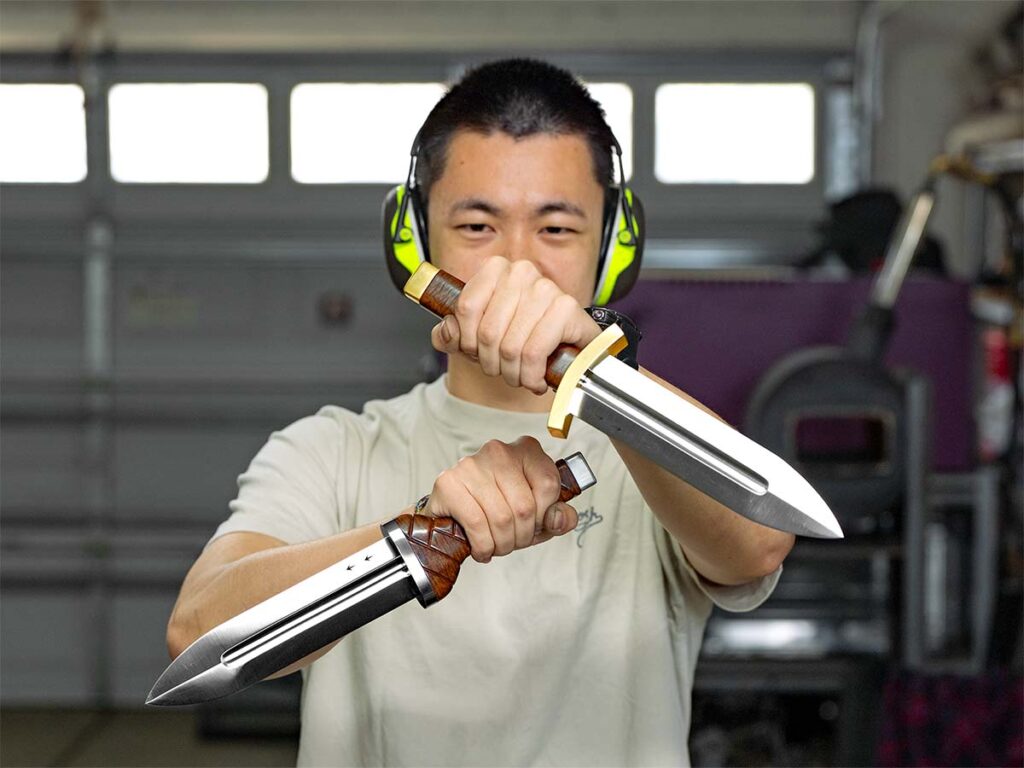
Jesse Hu is a multiple Forged in Fire champion and a prolific YouTube creator. When his online fans demanded a rendition of Thorfinn’s daggers from the popular animated Vinland Saga series, the adventuresome smith didn’t back down from the challenge. However, he set stringent goals for how he wanted the fictional blades to materialize.
“I have seen a lot of people make their own versions, but I haven’t seen any that truly captured their energy from the anime,” Hu said. “I felt it was possible for me to make a pair of daggers that fans would feel I directly pulled from the screen.”
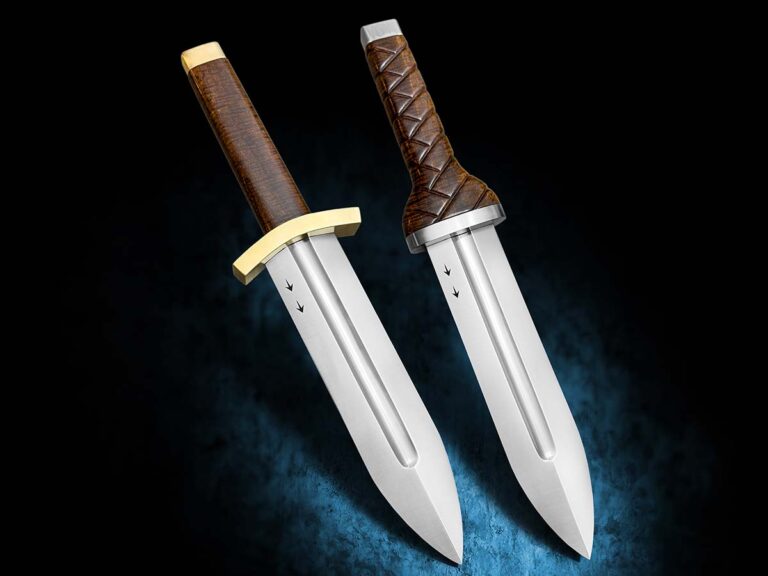
The results are a spot-on set of daggers boasting 81/2-inch blades of 80CrV2 steel with carved Ringed Gidgee handles and one with a 1/2-inch-thick brass guard. Hu’s carving emulates the animation’s leather-wrapped look. While there is little actual Viking in the daggers’ overall design, the maker’s choice of wood for the handles did inadvertently bring a touch of the historic accuracy to the fantasy knives.
“One thing I discovered from a friend was that there were a bunch of carved wooden handles on Viking-era blades,” Hu related. “But I only heard about this after I had finished the daggers.”
Hu estimates he put two weeks of work into his rendition of Thorfinn’s daggers. In the end, the project was a labor of love, with Hu compensating himself by keeping the daggers. (Jesse Hu image)
The greatest challenge in bringing the two-dimensional blades into the physical world came from the inconsistency of the source material. In the anime series, Thorfinn’s daggers can change from scene to scene, forcing Hu to hit a moving target.
“Some pictures made the handle look rectangular in cross section as opposed to ovular; some made the central fuller look really thin and others quite thick,” he said. “I had to pick and choose from all these images to create something that felt accurate to all of them.”
Studying frames from the series and interpreting how the ink daggers’ ratios translate to steel was a painstaking process. Hu estimates he invested two weeks bringing the anime knives to life. Given the dedicated following of Vinland Saga, he figured the time invested would have paid off—had he not decided to keep them for himself.
“A cool piece doesn’t always mean a smart business decision,” he quipped.
Check Out More Cool Customs:
Cool Custom: Tony Lewis’ Tribute Knife To Steve Dunn
Cool Customs: Rocco Nawrocki’s Knife For Sergeant Bunker
When BLADE Magazine Cutlery Hall-Of-Fame® member Bill Moran reintroduced knives with damascus blades at the 1973 Knifemakers’ Guild Show, little did he know how much damascus would evolve, redefine itself, expand into new media, and no telling what other recreations and rebirthings it has experienced in the half-century since that fateful weekend in the Muehlebach Hotel in downtown Kansas City.
On this page are some of today’s reincarnations of the material in its various forms, methods, materials and more. What’s staggering to consider is there are so many more variations—not only now but also to come. It is a phenomenon that is truly unique to the custom knife industry and should be celebrated and promoted whenever possible.
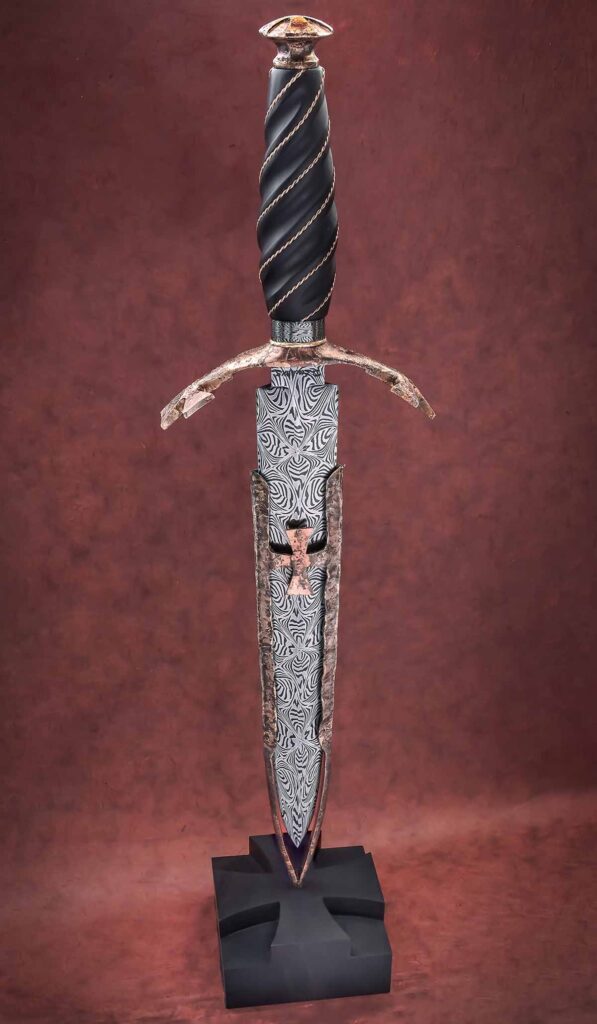
David Lisch Templars Mosaic
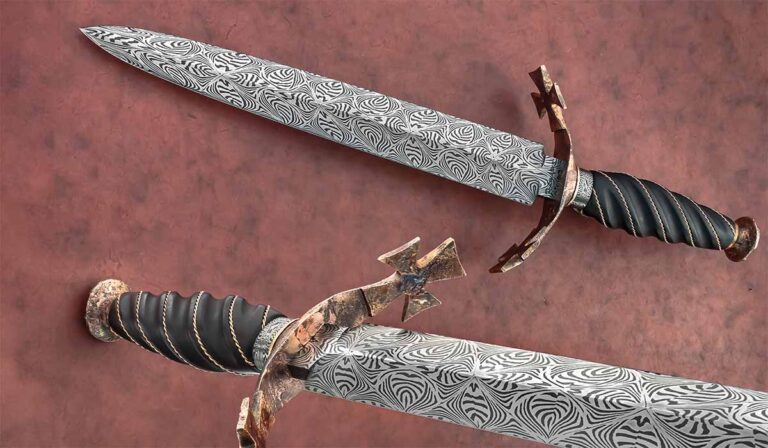
David Lisch’s spectacular art dagger features a 12-inch blade of his Templars Mosaic Damascus, a blackwood handle with gold wire wrap and a guard of pure iron covered in melted gold. Overall length: 17.75 inches. The knife comes with a stand that includes an embellished templars’ cross and one carved in the base as well. (SharpByCoop knife images)
Sporting a pattern ABS master smith David Lisch christened Templars Mosaic, the blade for his dagger is one he forged from 15N20 nickel-alloy and 1080 carbon steels and etched in ferric chloride.
“I was aiming for a bold, bright pattern that had a cross-like shape but wanted it to be a bit organic,” he wrote. The Templars’ cross also is represented on the guard and the finial, and there is one on the stand that holds the knife as well. “All these parts are pure iron covered in melted gold,” he noted. The dagger also has a domed gold spacer between the guard and Dragon Thunder damascus spacer that the fluted-blackwood-with-gold-wire-inlay handle butts up against.
“I made this dagger out of the love I have for creating art with no concern about how long it took or how much money I would make from it,” David stressed. “I did the handle twice and I did the big finial twice. I sold the piece for $10,000 and will not be making another one like this. You can be sure that the love I have for creating will take me to a new dagger, sword or bowie knife that tries to fill the void in me that can only be filled by creating art.”
Jeremy Yelle Jellyroll Mosaic Turkish Twist
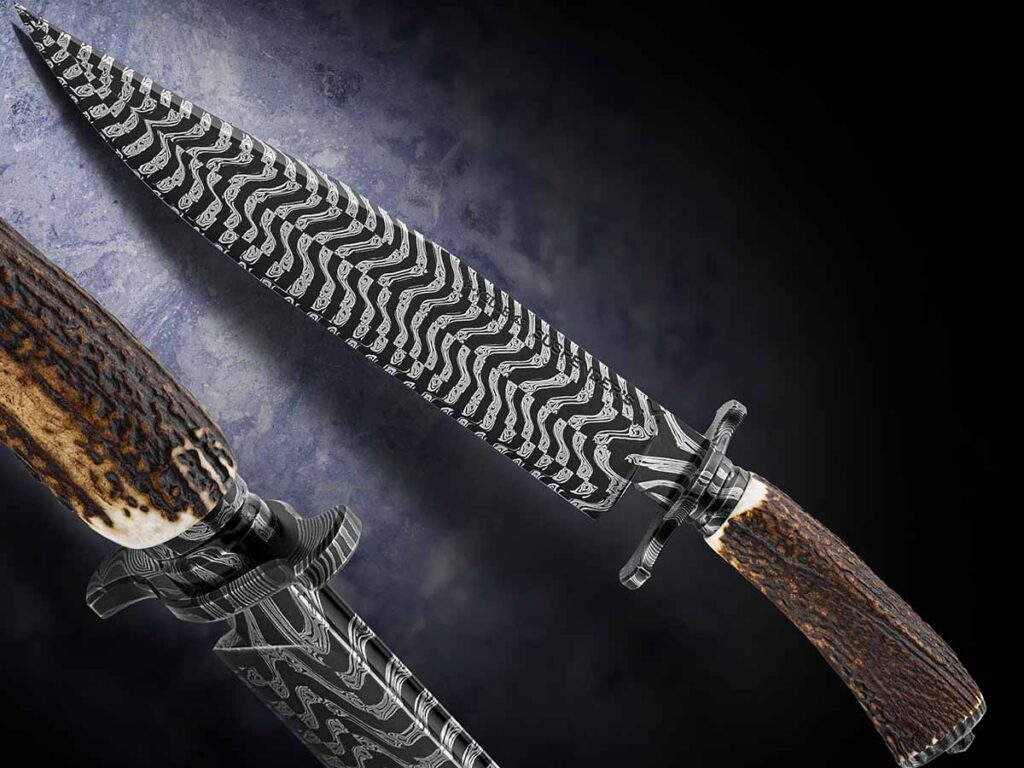
The steels for the jellyroll mosaic Turkish twist pattern damascus of the collaborative bowie by Jeremy Yelle (right) and Alex Houle (left) is forged from 1080 carbon and 15N20 nickel-alloy steels. Blade and overall lengths: 10.25 and 15.5 inches. Their list price for a similar knife: $2,600. (Jocelyn Frasier knife image edit)
The blade damascus of ABS journeyman smith Jeremy Yelle’s and SBK Cutlery’s stag bowie is a positively electric jellyroll mosaic Turkish twist pattern Jeremy forged in a collaboration with his friend Alex Houle of SBK. Alex forged the collaborative damascus into a blade and Jeremy made the handle.
“We began by welding a billet of alternate layers,” Jeremy wrote of the forging process. The pair drew the billet into a bar and jelly rolled it. “Then we squared it up and welded a four-way incorporating some 1-inch-square 1080,” he continued. They welded the billet, drew it out to ¾-inch square, cut and twisted it, and made a Turkish-twist stack that Alex forged into a blade. “You can also see the ‘fish mouth*’ weld Alex did so the edge bar and the spine meet properly,” Jeremy wrote. “He did a wonderful job making the blade.” Jeremy showed Alex how to work with stag and they finished the parts. Alex revealed the beautiful pattern via a two-step etching process using a solution of ferric chloride and finishing the etch with a coffee-darkening soak and hot wax finish.
Zane Dvorak Multi-Bar
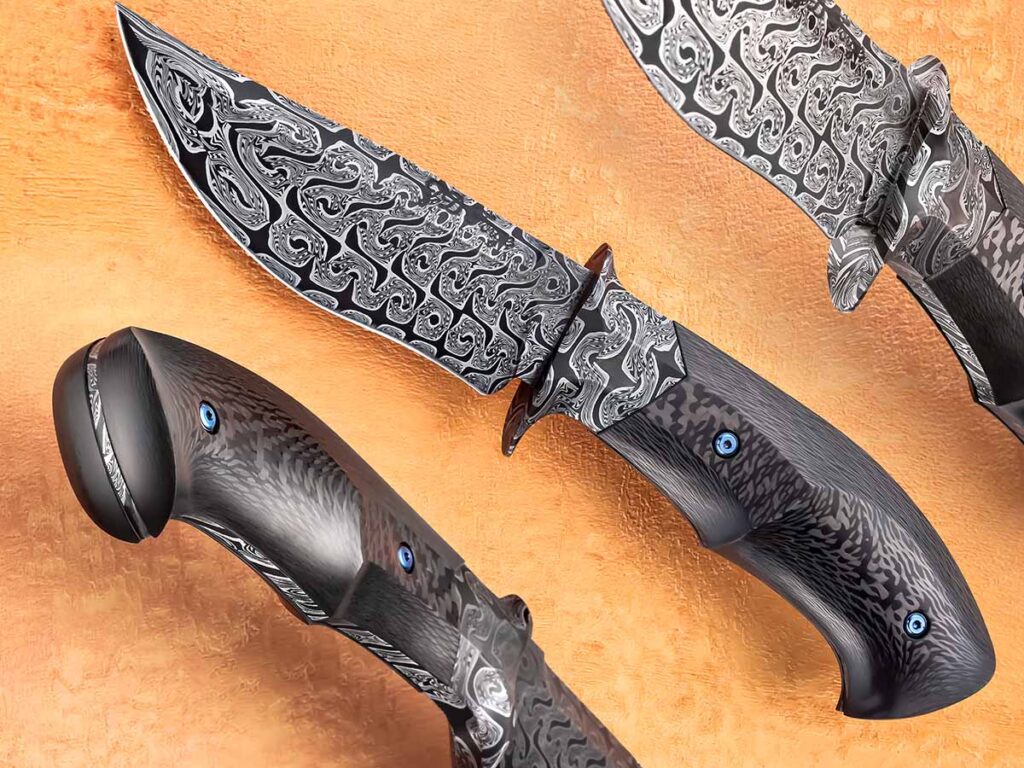
The 4.25-inch blade of Zane Dvorak’s hunter is a multi-bar damascus of 1084 carbon and 15N20 nickel-alloy steels. Overall length: 9.25 inches. His price for a similar knife: $2,400. (SharpByCoop image)
The blade of Zane Dvorak’s hunter is a multi-bar damascus of 1084 carbon and 15N20 nickel-alloy steels. Zane forged the blade/tang of four twisted bars of a twisted-bar pattern, and forged welded the guards and bolsters on with the same pattern. He bird’s mouthed the blade tip and rewelded it back together to create flowing outer bars. For etchant he used Gator Piss Acid from Baker Forge & Tool.
Bird’s mouthing is a process done on multi-bar, mosaic or other types of damascus patterns. According to Zane, it involves cutting a triangle out of the end of the rectangular parent bar—the shape of which somewhat resembles a bird’s mouth—then bringing the steel of the edge and spine back together to form the point of the blade. By doing so the blade exhibits a better consistency and overall flow of the pattern.
Andrew Blomfield Alternate Pattern
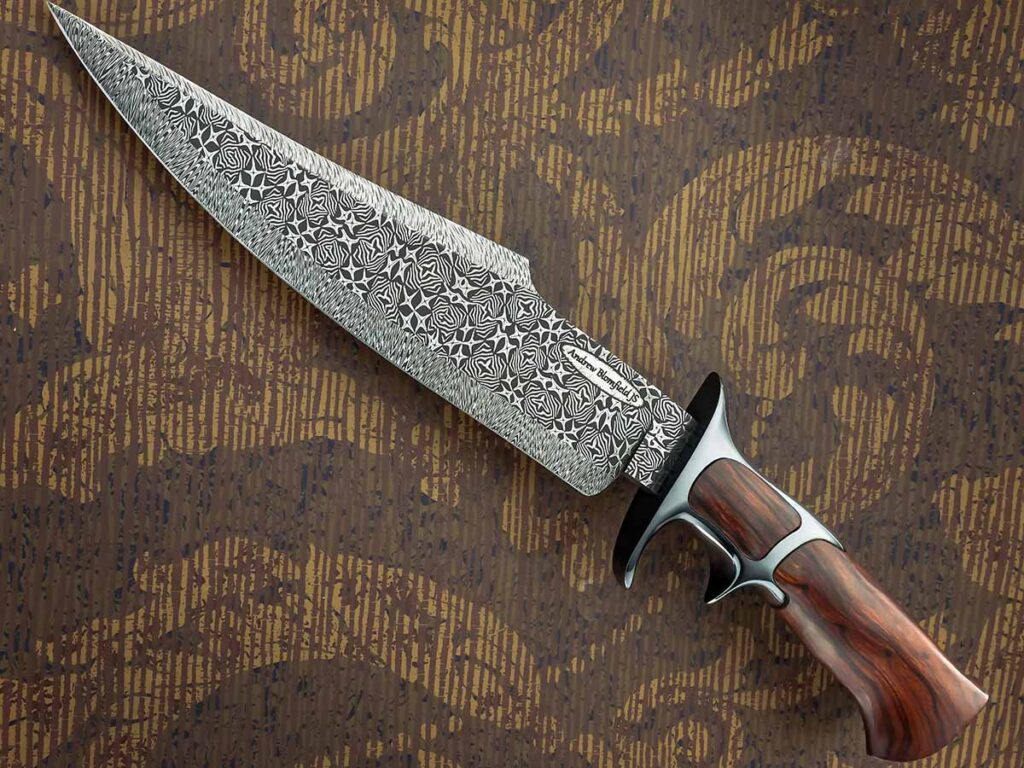
The mosaic damascus for Andrew Blomfield’s sub-hilt fighter is a combo of two separate billets welded in an alternate pattern. Blade and overall lengths: 9.5 and 14.5 inches. Blade grind: flat. Andrew’s price for a similar knife: $3,000. (SharpByCoop image)
The material mid-blade of Andrew Blomfield’s sub-hilt fighter is a combination of two separate billets of mosaic damascus welded in an alternate pattern. The edge is a straight feather pattern forge welded around the edge. The blade is a combination of pieces from three separate billets. The steels are 1084 carbon and 15N20 nickel alloy etched with ferric chloride.
The integral sub-hilt is 1020 low-carbon steel hot salt blued to a deep black finish. The handle is desert ironwood. The knife is of a full takedown construction.
Frank Edwards Palm Leaf Mosaic Pattern
The Palm Leaf mosaic damascus by Frank Edwards is an interweaving river system of straight lines. The handle inlay is black-lip mother-of-pearl. Blade and closed lengths: 3 and 4.25 inches. His price for a similar knife: $1,900. (SharpByCoop knife image)
The multi-bar damascus of Frank Edwards’s folding dagger blade is in a Palm Leaf mosaic pattern. Starting with a billet of straight lines, he reduced it all into a square and then biased the squares, four-waying the billet into a 1.5-inch square.
As Frank explained his recipe, “Forge weld another billet of straight lines, keeping them straight as possible to .5 inch by 1.5 inches. Add that to the previous billet and forge weld and reduce to a 1×1-inch square. Then four-way it again. This will give you the frame around the palm leaves. Keep repeating that until you achieve the size of pattern for the knife you’re building.
“The key to getting good mosaics is a slower reduction [of the steel]. We have presses and power hammers that help but they can move too much metal too fast, which will destroy a mosaic in a hurry. The slower reduction allows the billet to stay uniform throughout the length of the bar.” To expose the pattern he etched the blade with a four-to-one mixture of water/ferric chloride in 10-minute cycles, using 2,000-grit sandpaper between cycles.
Jackson Rumble Stunning Pattern
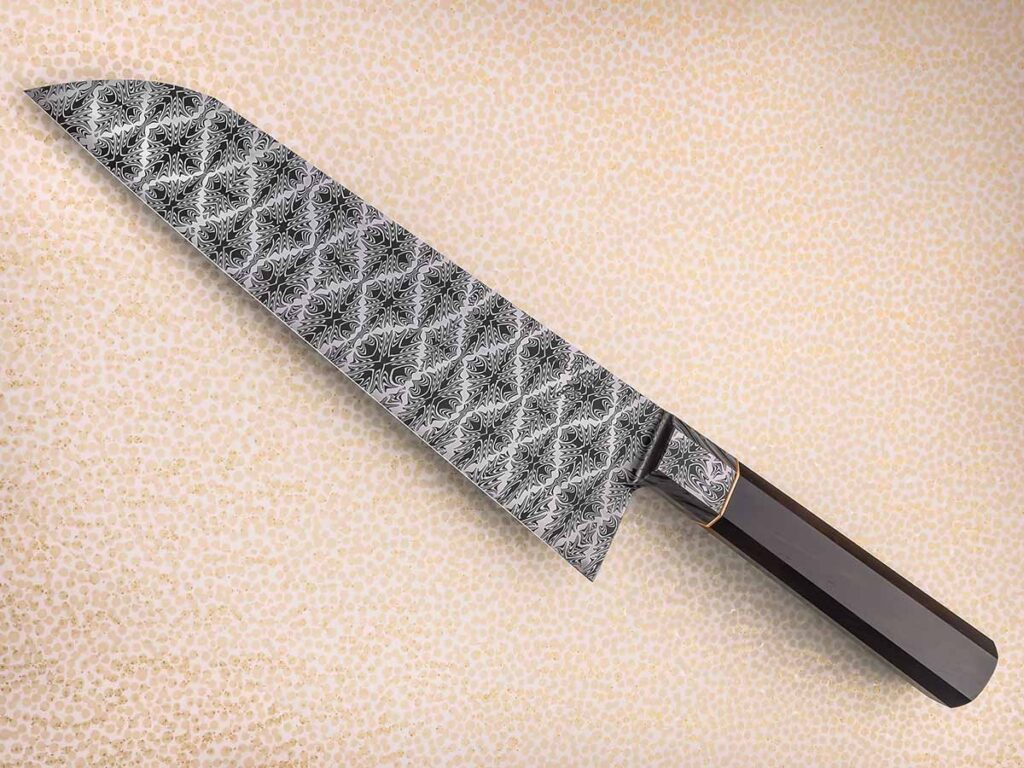
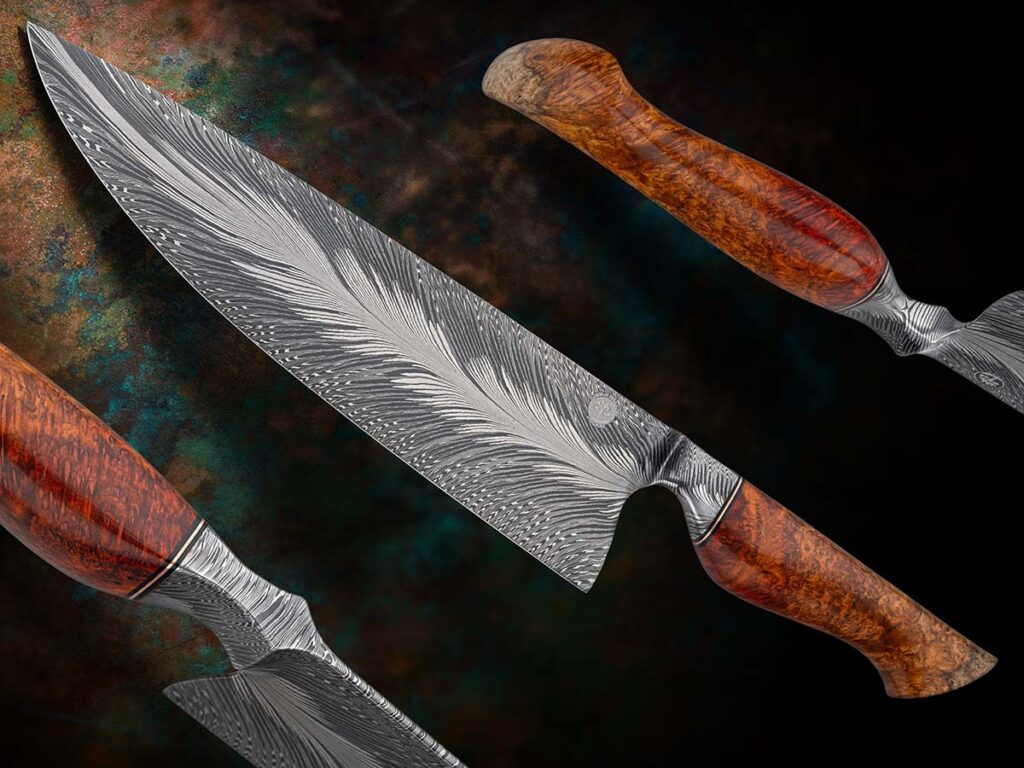
The 8-inch blade of an integral chef’s knife by Jackson Rumble boasts a mesmerizing and at press time unnamed damascus pattern forged from 1084 carbon and 15N20 nickel-alloy steels. The handle is African blackwood. Overall length: 13 inches. The maker’s price for a similar knife would start at $2,500. (SharpByCoop knife image)
The technique for the stunning pattern on newly named ABS master smith Jackson Rumble’s chef’s knife is what he calls a “pretty standard process” of four-way welding and re-square cycles. Not bad for “pretty standard,” eh (page 28, top left)? The initial stack has large sections of both light and dark steels interspersed through the alternating layers, and Jackson added extra-light steel to the billet in the later stages of the forging process.
“Finally, I used the Filicietti Flip method to transfer the pattern to the face of the billet,” he wrote. “For the etching process I used ferric chloride followed by coffee.” OK, Jackson, so what’s the “Filicietti Flip method”?
“I’ve heard the Filicietti Flip called other names like the Ferry Flip, or just tile welding,” he explained. “Basically, after you’ve finished building the pattern in the end grain of the billet, you take it to a bandsaw and cut slices off the end at a 35-degree angle. This makes a bunch of pieces in the shape of parallelograms or tiles. The tiles can then be rotated and forge welded back together to form a new billet. Instead of having the pattern showing on the end of the billet, the pattern will repeat itself along the face of the billet.”
We’re glad we asked.
*Also called fish lips, fish mouth is when the tip of the billet begins to curl up on either side during rough forging to resemble a fish’s mouth or lips, thus the name. It is an easy fix for knowledgeable bladesmiths such as Alex Houle.
The company name stamped on the blade isn’t always the manufacturer’s name.
Who doesn’t like solving a good mystery? Remember the mystery game Clue, with its colorful game board depicting an old mansion, a stack of character cards, various miniature weapons, a detective’s notebook, a set of dice, and clue cards? The object of the game is to determine who murdered the victim, where the crime took place, and which weapon was used. Each player assumes the role of one of six suspects and attempts to solve the whodunnit by strategically moving around the game board that represents rooms of the mansion and collecting clues about the circumstances of the murder from other players. Clue is cited in several Top 10 lists as the fifth highest-selling board game of all time, with over 200 million copies sold.
Mysteries regarding knife production abound because thousands of cutlery manufacturers exist in the United States. Collecting vintage or antique knives inevitably turns up many examples with mysterious or unknown tang stamps and origins, even for seasoned collectors. To many knife enthusiasts, determining which factories produced specific models is unimportant. However, for serious and curious collectors interested in researching some recent finds, tracking down the origins of unknown tang stamps is akin to solving a cutlery history mystery.
In most cases, the finders of these unknown specimens can reference highly regarded publications with lists of knife manufacturers, descriptions of tang stamps, production dates, countries of origin, and sometimes even desirability ratings or collectible rankings.
The same company made two original sheaths of widely different patterns. A page from Dean Case’s Kinfolks Knives book shows the exact carved leather sheath and proves that the company made it.
Such books include those authored by John Goins and Bernard Levine. I use the references much like a history book since they are devoted explicitly to production knife history, perusing years, dates, details and fascinatingly unique information. Of course, there is also the Internet and its various search engines, which, if used correctly, can uncover published data on most little-known knife tang stamps. Keep in mind, however, that much of the Internet, especially forums, consists of a series of posts made by individuals, some experts, but many not. Most posts are simply an individual’s opinion and are not based on factual material such as military contracts or production knife company catalogs and ephemera.
Like detective work, looking for clues is the key to solving most knife mysteries. Many knives can reveal clues to their history if one knows where to research and what to look for. Unfortunately, just when you think you’ve traced a particular knife back to its manufacturing origins, you inevitably discover that thousands of models were not even manufactured by the company indicated on the tang stamp, but were, in fact, made on contract by different factories. Those factories derived a significant portion of their business taking orders. In other words, the stamping on the blade, which generally indicates a manufacturer and city of origin, may not be the factory or the city where the knife was made.
Production knife companies can be divided into two categories. The first manufactures blades bearing their own stampings and makes few, if any, knives for other businesses. Remington Cutlery appears to be one of those manufacturers that produces only knives bearing the company’s full name. Remington did have a couple of production lines, one with knives stamped in a straight-line “Remington,” but it only produced its own blades and did not work with outside contracts.
A gorgeous, red-handled hunting knife is stamped “Ideal” on the knife and sheath—the snaps on the top of the sheath hint at its origin.
The second are those that not only produced knives bearing the official company name but also accepted contracts to make models for any of several major retail outlets needing factory-fixed blades and folders. For many manufacturers in the second category, making knives for retailers or putting other companies’ brand names on tang stamps equated to a significant source of revenue.
Knives On Contract
Some production knife companies made blades on contract to spread their knives throughout the United States. This was particularly important for manufacturers like the Western States Cutlery of Boulder, Colorado, which had difficulty selling its knives east of the Great Plains. Other companies include industry giants like Camillus, Colonial, Western Cutlery and Kinfolks. Some outlets contracting with Western Cutlery to make knives for them included Sears, Montgomery Wards, Coast Hardware, Western Auto, Spiegel and Shapleigh Hardware.
Camillus is perhaps the best example of a production knife company known for copyrighting dozens of tang stamps, yet the manufacturer made all the blades. The list of those stampings takes up pages but includes Kingston, Clover, Sta-Sharp, Dunlap, Kwik-Kut, Streamline, OVB (Our Very Best), High Carbon Steel, Keen Kutter, Kent, Sword Brand, Tip Top and Buck. While most stampings are contract-made knives (like Keen Kutter and Buck), others are merely Camillus Cutlery’s sub-brands.
With the data well documented regarding the practice of knife manufacturers producing contract brands, a look at specific examples is in order. The origins of many of the tang stamps started as mysteries that were eventually solved through clues inherent to the knives.
Western Cutlery knives hold some specific clues, which, once recognized, can prove beyond a shadow of a doubt that they were made by the company even when stamped with another name. The first and most obvious clue lies in the aluminum pommels that Western used on its various hunting knives. Unlike the rounded, mushroom-shaped or ovoid pommels of other knife manufacturers, Western employed a bird’s-beak pommel.
The aluminum pommel extends smoothly from the last series of colorful handle spacers to form a bird’s beak and head. The top of the pommel is not flat, as most others, but slanted like a bird’s head, sloping down at an angle toward its back. Recognizing this obvious clue, it becomes easy to put a hunting knife stamped “Western” next to those stamped “Craftsman,” “Western Field,” and “Hawthorne” and recognize that Western Cutlery made them all, and those featuring alternative tang stamps were built under contract for Sears and Montgomery Ward.
A red-handle Ideal hunting knife, which snaps onto the Kinfolks hatchet set sheath. Notice the similarities of the leather sheath embossing style—a perfect match. Kinfolks made the “Ideal” knife.
A second clue to whether Western Cutlery manufactured specific knives is those stamped with a unique patent number, 1,967,479. The number refers to a patent by Harlow Platts described as a “novel and simple method of forming a handle for a tool which is durable, strong and which cannot be displaced or loosened.” The patent refers to Western’s double-tang handle configuration, which is two flattened steel rods that run from the blade to the pommel and between which fiber and leather spacers are stacked to form a handle that does not move.
Since only Western knives incorporated the patented handle design, it becomes a simple matter to look at a typical hunting knife from that era to see whether the steel tangs are visible on both sides of the handle, with the spacers lying between the two—Western most certainly made knives with this design feature.
Round Leather Spacers
Most other hunting knife handles from the time were made with a single round rod extending from the base of the blade to the pommel. Round leather handle spacers with holes in the middle are stacked tightly, with the rod running through them, for the length of the handle between the blade and pommel. Generally, the rod is threaded so that a round, usually brass nut can be tightened to sandwich and secure the handle spacers between the blade and pommel, making a durable handle. On these knives, the top ends of the aluminum pommels have round indentations where threaded nuts are seated. Marble’s knives are examples of this handle construction.
A closeup of the stag-handle hunter shows the WARD tang stamp and a patent number below it, giving an obvious hint as to the knife’s maker.
Over several months, I accumulated four hunting knives with a wide-blade style known as a “woodcraft” pattern popularized by the Marble Arms Company. The knives had four different tang stamps, one reading JEAN CASE CUT. CO., a second, BELNAP, LOUISVILLE, the third, HOLLINGER, and the fourth was stamped KINFOLKS, INC. I was already familiar with the Kinfolks stamp, as I have always favored this wide-blade style. I also knew Kinfolks had a knife factory built in the 1930s but did not realize that the manufacturer was potentially involved in contracts with other companies to produce their knives.
An examination of the four hunting knives laid side by side clearly showed that they were almost identical in blade length, had the same highly polished chrome-vanadium blades, and identical aluminum guards and pommels with brass centering nuts.
If I needed yet another piece of evidence to prove that Kinfolks made the four knives, the spacer pattern proved a strong clue. The knives had identical stacked leather handles ending near the guards with alternating black and white spacers—five black spacers separated by three white spacers. Finally, looking at the sheaths was the icing on the cake. Although all four hunting knives had sheaths of the same length and width, with identical rivet spacing, one was patterned differently from previously known Kinfolks examples. Wondering if this last leather sheath with a unique stamping was original to the knife and produced by Kinfolks, I turned to a book by Dean Elliot Case titled Kinfolks Knives, a History of Cutlery and Cousins.
Western was a significant producer of contract knives for Sears, Montgomery Ward, Western Auto and others. Here are four examples branded “The Coast Cutlery,” “Western Auto,” “Hunt Master” (Spiegel), and “Western Boulder.” Some enthusiasts specialize in collecting Western’s contract-branded knives.
Looking at the illustrations of various Kinfolks knives in the book, I came across a picture of a sheath identical to that which housed the Jean Case woodcraft knife. The mystery was solved, and all four hunting knives were made by Kinfolks, even though they had different stampings.
A unique hunting knife appeared recently in an Internet auction. Being attracted to colored hunting knife handles from days gone by, I bid on it. My winning bid soon arrived, and opening the package revealed a hunting knife and a leather sheath with the word “Ideal” embossed in script lettering. The blade tang was also etched “Ideal.” The mystery was in what production knife company made it. I noticed that, at the top of the leather sheath, were two snaps, one on each side of the pommel. Those snaps led me to rustle through my collection of hunting knives, explicitly looking for knife/axe combination sets. I found just the set, made by Kinfolks, with the same two snaps on the knife sheath and an identical set on the hatchet sheath. Taking the newly purchased Ideal hunting knife, I aligned the snaps on that sheath to the Kinfolks knife/axe combination set. “Snap, snap,” a perfect match.
Examining the leather embossing on the Ideal hunting knife sheath proved to be a perfect match to the Kinfolks sheath for the knife/axe combination set. My investigation solved which company made the Ideal hunting knife with red handle slabs. It was a part of a Kinfolks hunting knife set with an Ideal stamping. I am sure a matching hatchet with an Ideal stamp and a red handle is somewhere.
Different Handle Material
One of Western’s most interesting knife styles was a wide-bladed pattern with a different handle material from what it usually used. Western Cutlery was generally known for its stacked-leather knife handles. The H-shaped leather washers are stacked together with various patterns of fiber spacers along the company’s patented double-tang handle, all held in place by an aluminum pommel that is double-pinned to two steel tang sections.
Two hunting knives, one with a stag handle and the other featuring a sectioned “cracked ice” celluloid handle, have similar “bird’s beak” pommels, blade shapes and tang stampings.
The knives I acquired are stamped “West-Cut,” indicating Western’s less expensive line of knives, most of which incorporate stacked-leather handles. Each of these knives, however, enlists a thin aluminum guard and a shiny, molded handle, which narrows at the butt to form a quasi-shaped pommel. The handles are plastic, deep brown with specks and swirls of lighter browns.
Finding several other examples, which I assumed to be West-Cut’s as well, I was struck by the stamping on the blades, which included Shapleigh’s, Colonial, Providence, Viking, New York, and yet another with an arched line reading “The Coast Cutlery, Portland, Oregon.” The Viking example had an aluminum handle. The Colonial was bright orange, and the Coast Cutlery (not pictured) model featured a relatively thick aluminum guard with a red spacer between two aluminum pieces.
Once again, the mystery lies in which productive factory made the hunting knives. Colonial Cutlery of Providence, RI, was known for making thousands of knife styles with colored handle materials. Living in Colorado, I have located a half-dozen examples of these molded, brown-handled knives.
A closeup comparison of the two hunting knives shows the same patent number on both blade tangs. This patent number was awarded to Western Cutlery for “a simple method of forming a handle for the tool”—the double steel tang upon which H-shaped fiber spacers and washers could be stacked to form the handle. Western made the WARD hunting knife; thus, another mystery was solved.
Also, I know that Coast Cutlery of Portland, OR, had extensive contracts with Western for producing small red and white bird-and-trout knives, reinforcing Western’s status as the maker of the molded-handle knives. The “Shapleigh’s St. Louis” example is a monkey wrench in the works, as is the “Viking, New York.” Both are located quite far from Boulder, and Western Cutlery generally had few contracts to make knives east of the Mississippi River. Colonial Cutlery in Providence is even farther away.
Since Western has been out of business since 1992, and all company records are available to collectors and researchers, the idea that Western produced all these knives is up in the air. A letter to current Providence Cutlery owners was also a dead end. Who made these colored, molded-handle knives? That’s a mystery yet to be solved.
Solving cutlery’s history mysteries involves following the clues, comparing examples, looking at knife construction, examining the sheaths, reading company histories, talking to other collectors, and formulating educated guesses.
Form, function and purpose of daggers–the most stab-ready knives.
Few weapons are as simple in concept yet as demanding to design as the dagger. At first glance, it is merely a blade—sometimes short, sometimes long, usually but not always double edged—yet every aspect of its form has been refined over millennia for one purpose: stabbing. Unlike blades that balance cutting, slicing or chopping, a dagger’s geometry, materials and ergonomics allow no compromises in pursuit of its one purpose.
From early Bronze-Age thrusting knives to the stilettos of the Renaissance, every angle in any dimension maximizes straight-line penetration. Whether for combat or display, understanding this purpose is essential for anyone who wishes to design, craft or appreciate these edged weapons. Even the most ornate ceremonial dagger should appear “stab-ready” at a glance, communicating the implied threat of the utilitarian tool with a statement of status and opulence.
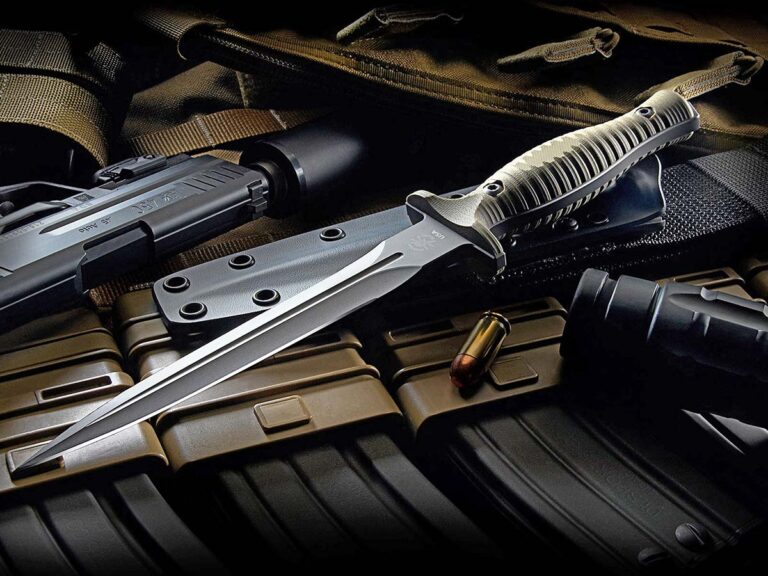
This modern cinquedea by Vince Evans has a blade with a broad, rigid base tapering to an unforgiving point. Fullers down the middle serve to make the blade both lighter and stiffer. Equal parts status symbol and lethal instrument, it embodies the dagger’s refusal to compromise between beauty and purpose.
Dagger Design Points
Every deadly stab starts with three critical design choices that define a dagger’s unwavering purpose. A dagger blade must have sufficient spine thickness and ricasso rigidity to resist excessive bending under thrust load; it should be tapered to an acute but robust point for minimal tip-entry resistance; and it requires flexibility balanced with rigidity so it can reach vital organs, often protected by armor, without breaking.
Early thrusting blades illustrate this principle as far back as the late Bronze Age. A broad base near the guard tapers rapidly to a narrow point, ensuring rigidity at the grip and sharpness at the tip. By the 1st century A.D., the Roman pugio perfected it. With a base often exceeding 5⁄16 inch in thickness and a central ridge tapering to a sharp apex, the pugio shed weight without losing stiffness. In practice, its point could pierce leather, flesh or weak links in chain mail, while its spine endured repeated jabs against shield bosses and bucklers.
Extreme ornament, unconventional design, and opulent materials cannot disguise lethal intent and pure stabbing functionality in Bertie Rietveld’s ornamental dagger.
Yet precision in stabbing demands more than brute strength, it requires avoiding gratuitous cutting‐oriented features in a thrusting design.
Serrations, upswept points, hooked tips, prying points and even bottle openers can be handy on a knife, depending on the task, but all of these undermine the straight-line force a dagger needs and disrupt smooth entry. If you ever find yourself in a situation where stabbing is required, by all means use whatever you’ve got—just don’t complain when your bottle-opener tip gets snagged in an assailant’s clothing. However, if you have the luxury of time and thought to design and make a dagger, strip away anything that doesn’t serve pure penetration. A dagger’s geometry remains laser-focused on stabbing effectiveness.
Lastly, a dagger must balance penetration depth with material limits. A tip too slender might break or bend against bone or metal, while a tip too blunt simply won’t enter. Ancient workers of bronze and iron didn’t have modern labs or spreadsheets, yet somehow found the Goldilocks Zone that balanced reach and resilience. A well-tempered tip is tough enough to survive bone contact without snapping, yet with correct geometry stays stiff enough to slip between armor plates. Only through precise taper and temper can a dagger achieve depth without sacrificing strength.
Even in this highly stylized dagger by Jordan Lamothe, the spine ridge provides the stiffness and rigidity required for uncompromising penetration.
Combat Daggers Vs Art Daggers
From the earliest times, daggers fell into two broad categories: weapons of combat and symbols of prestige.
The combat dagger was stripped to essentials—minimal ornamentation, maximum toughness—while the art or status dagger has always been free to bend the rules of pure function to satisfy aesthetic expression and make statements of personality and prestige. Nonetheless, even the most ornate display piece must exude “stab-readiness” at first glance, a silent promise inherited from its lethal lineage.
The complex damascus pattern and construction style of this dagger by Australia’s Jackson Rumble demonstrates that while he understands the essentials of a dagger, he’s not afraid to push the boundaries of expression without compromising either the stabbing function or his artistic vision.
Surviving examples of Roman pugios from army camps demonstrate the utilitarian design, but gilded pieces from the same era, with elaborate inlays and inscriptions, do not stray far from purpose despite the decoration. All share the same fundamental geometry: a stiff, thick base, reinforced spine and unwavering taper to a sharp, flat-ground point.
The ornamented variants—often gifted as symbols of rank or worn by the wealthy and powerful—could feature ivory grips or gilded fittings without diminishing their stabbing credibility. Regardless of personal status or the knife’s level of ornamentation, no one who saw a pugio drawn in malice would misunderstand the message or the danger. Combat heritage endows art daggers with an unmistakable threat that no amount of embellishment can conceal, though the pugios that did in Julius Caesar probably looked rather nice.
The complex damascus pattern and construction style of this dagger by Australia’s Jackson Rumble demonstrates that while he understands the essentials of a dagger, he’s not afraid to push the boundaries of expression without compromising either the stabbing function or his artistic vision.
Another example is the pesh-kabz, a Persian-born dagger later adopted and lavishly ornamented by Mughal weaponsmiths. Its single-edged blade featured a thick spine and acutely tapered point, designed to pierce heavy mail and laminated armor. As Mughal craftsmanship flourished in Agra and Delhi, artisans added damascened patterns, jeweled pommels and silk-wrapped grips. Yet even a fully jeweled pesh-kabz retained the same reinforced spine and narrow, forward-weighted geometry as its battlefield ancestors. Worn at court in gilded sheaths, these daggers exhibited status while making it clear that underneath the glamor was a blade as deadly as any used in war. Art and combat, then, remain entwined.
The junction of the handle, guard, and blade is where the true masters separate from the merely good—every element is a decision between comfort, control and ornament that fit together with no gaps. (Mike Quesenberry, Best of Show/Best Art Knife, 2011 OKCA Show)
This enduring marriage of lethality and ornamentation sets the stage for a deeper question: what separates an ordinary dagger from one that truly masters its intended purpose? The answer lies not just in history but in the details of profile, geometry, balance and structural refinement—each a mark of a dagger designed to do exactly what it must.
The popular pattern offers a complex combination of material and motif.
The variations on damascus steel themes are endless. The possibilities are tempered only by the maker’s time at the forge and his or her desire to create.
Among these many variations, one pattern has recently captured the spotlight. These days, feather damascus is trending and custom makers are producing knives that turn heads, captivating buyers with the intricate layering that produces hard steel intertwined with the look of the light and wispy. Feather damascus offers a medium of both performance and artistic expression that influences every aspect of the maker’s creativity.
Ethan Kolar of Plummer, Idaho, describes his interest in feather damascus as “chaotic flow.” He explains, “The pattern’s center seam, where the jagged W’s converge, creates a flow in the blade which really adds to the overall confluence of the knife as well as creating a controlled chaos as the pattern explodes from the center filling out the blade.”
Kolar enjoys the hint of “jaggedness” and the center line that ties the blade together, and in the making of his feather damascus, his focus lies in test etching every restack from the forge. He sees the pattern in many different forms with the observation that “a pattern is not right or wrong but more of what the maker envisions and creates and what is right to him for his knife.”
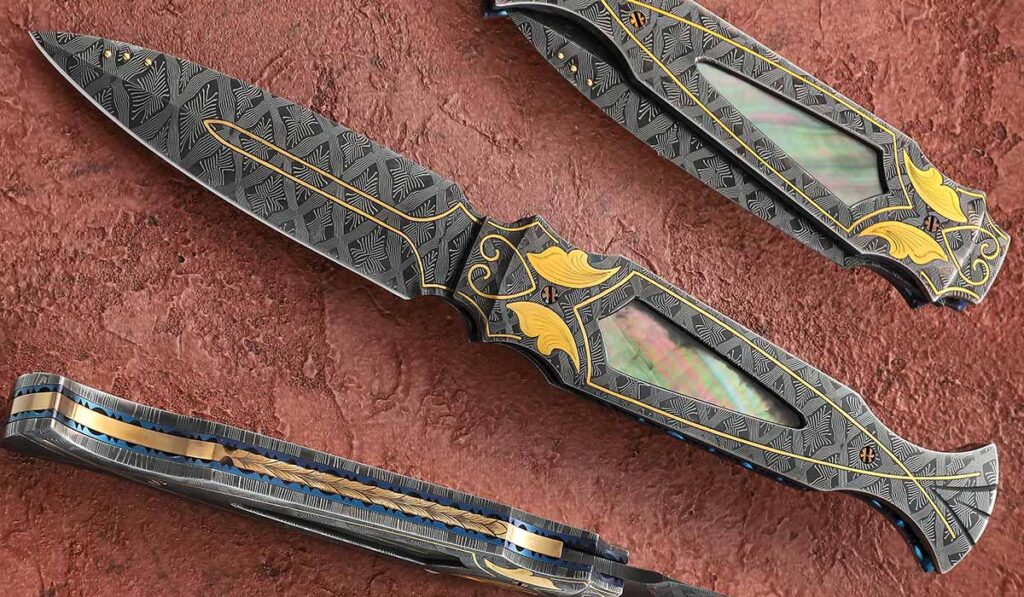
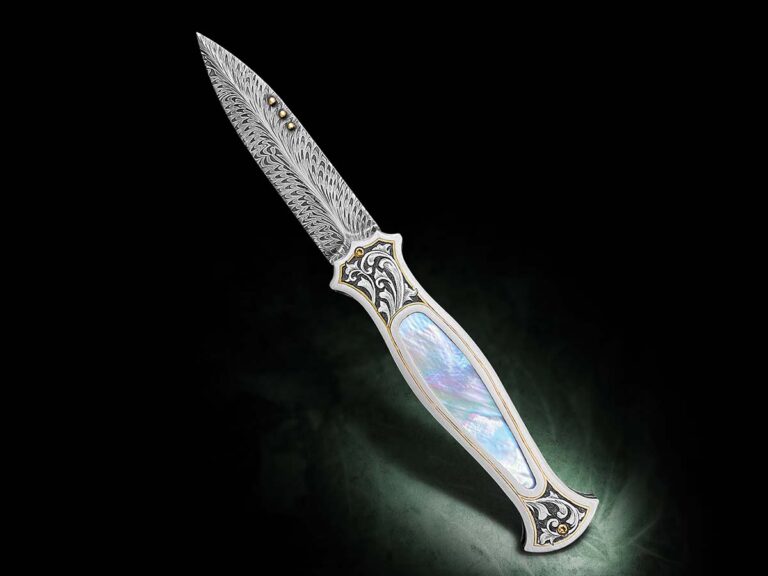
The folding dagger Ethan composed includes a 3-inch feather damascus blade of 1084 and 15N20 steels with an engraved gold inlay and scroll worked 416 stainless steel window frame fitted with exhibition-grade white-lip mother of pearl. Liners are 15N20 file-worked and nitre blued, while the backbar of 416 stainless is engraved and sports delicate file work. Its overall length is 7 inches.
“Most of the inspiration I have while making damascus comes from envisioning my final product,” Ethan remarked, “what engraving will go with it, the handle embellishment, and a lot to do with the overall color of the knife, deciding whether the pattern will be brighter or darker.”
Steel On Fire
Winning Best Damascus at the 2025 BLADE Show West, Trevor Morgan’s “Torrent of Fire” chef’s knife includes a 9.25-inch blade of 1084 and 15N20 in a mix of W’s and straight layers with a fat core of 15N20. The knife’s overall length is 14.2 inches, and the handle is dark red tiger’s blood amboyna burl with a splash of sapwood for contrast. (Jocelyn Frasier image)
Another contemporary artisan exploring the feather damascus pattern is ABS journeyman smith Trevor Morgan. Having attended the Bill Moran School of Bladesmithing in Texarkana, Texas, in 2020, his goal with each feather damascus blade is to make the pattern “pop.” To achieve that look, his hand follows an artistic eye.
“Contrast, for sure, really makes any pattern cool,” said Trevor, “especially feather or mosaic damascus, larger pieces of dark and bright steel, gradients and that kind of thing. Also, out-of-the-ordinary stuff like feather [damascus] can be really cool to look at. Symmetry is always great with a feather pattern because it’s pretty easy to notice when something is out of whack with a feather due to the defined center. Complexity is also great. If it’s hard to figure out, all the better.”
According to Morgan, a resident of Apple Valley, California, the feather pattern can be challenging due to the hot-cut process, which puts enormous stress on the billet in somewhat weird ways and causes every forge weld to want to split open. The problem, however, can be mitigated by mig welding all the way around the seams. But this is his least favorite method of achieving the integrity of the billet because it requires grinding away the welds, wasting material and consuming time.
Trevor’s inspiration for feather damascus pieces comes from the world around him. “It’s places and people,” he commented, “from nature and the endeavor to make something organic and as lifelike as possible in steel. I regularly get swept up in the general zeitgeist surrounding the making of complex patterns. I see something on social media or somewhere, and I think, ‘Man, that’s really awesome! I’d love to try to make something like that.’ Then comes the real creative part, where I just get an idea of something that might look really cool and put it together.”
Morgan’s method is readily revealed in his featured piece, named “Torrent of Fire.” The knife includes a 9.25-inch blade of 1084 and 15N20 in a mix of W’s and straight layers with a fat core of 15N20. The knife’s overall length is 14.2 inches, and the handle is dark red tiger’s blood amboyna burl with a splash of sapwood for contrast.
Organic Appeal
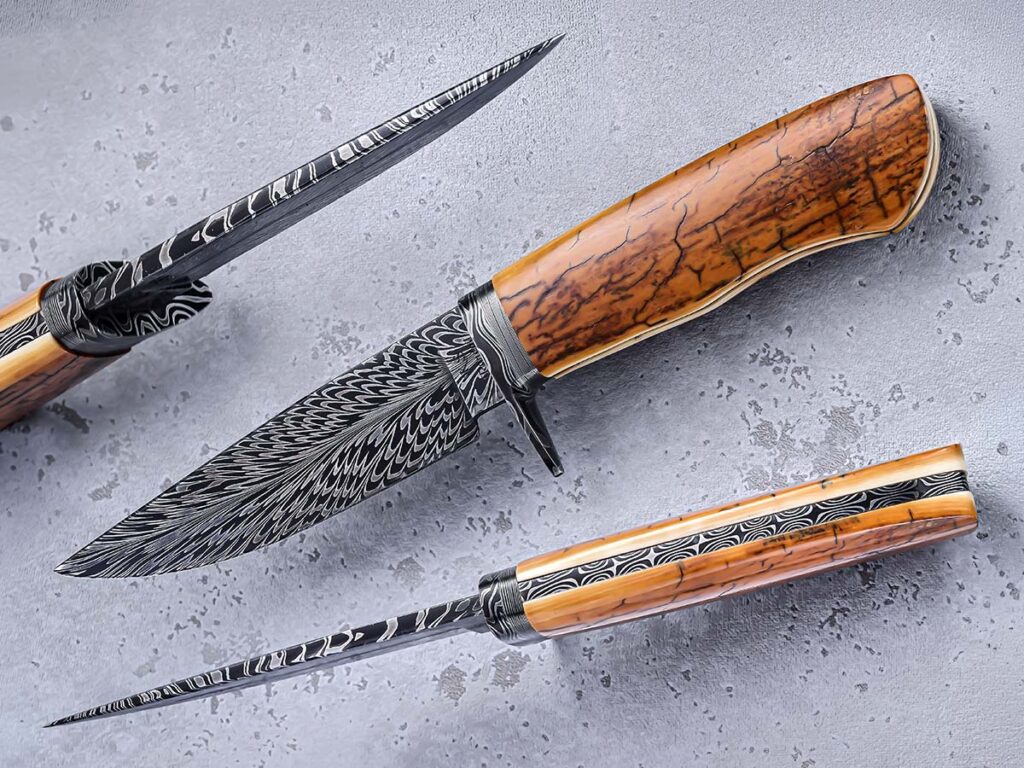
Splitting the billet down the center to maintain symmetry is among the trickiest aspects of feather damascus to Steve Randall. He nails it on his frame-handle hunter, with the axis of the pattern fountaining from the mastodon scales in a balanced and spectacular fashion. (SharpByCoop image)
Feather damascus has been a staple steel for ABS master smith Steve Randall for some time. He seeks a continual flow of the steel from the handle to the tip, and oriented so that the handle appears to actually hold a feather. “I was attracted to the feather pattern because of it’s a very cool, organic look,” he advised. “Like a snowflake, there are no two exactly the same. I’ve been forging feather damascus for at least seven years, and I’ve made several bowies and hunters.”
Randall, of Estancia, New Mexico, presents his feather damascus piece with frame-handle construction, showcasing mastodon scales with an overall length of 9½ inches and a blade of 4¾ inches. “Feather damascus is a more challenging pattern,” he said. “My tricks are patience and concentration. There are many welds involved in the pattern, which can contribute to cold shuts, which can destroy hours of hard work. The trickiest part is splitting the billet right down the middle and maintaining symmetry.”
While he describes the feather damascus forging process as complicated and labor-intensive, Steve sees the payoff in the harmony of the pattern and its related materials in the finished knife. “I always try to complement it with the best handle materials I have available,” he reasoned. “I prefer stag or ivory. If using wood, I avoid busy patterns and colors. I draw inspiration from many other makers. There are so many accomplished makers who produce a variety of feather patterns. It is one of my favorite patterns to forge because it can really accent the flow of the blade and give it a great overall look.”
Movement And Flow
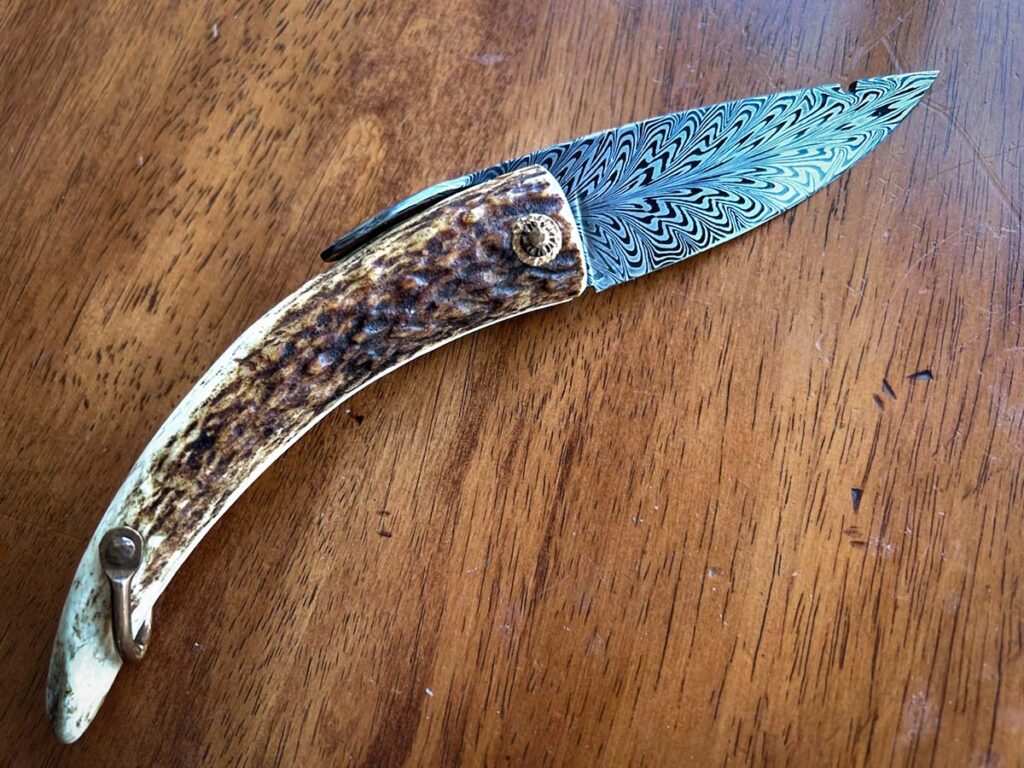
While David Lisch doesn’t feel he’s hit the limits of his Mountain Man folder, the style of knife is striking with its feather damascus blade set in stag-tip handle. Copper hardware and pivot give the knife its antediluvian look, while the flowing pattern of the blade anchors it in modern forge techniques. (David Lisch image)
It took a single demonstration by the great master smith Harvey Dean to convince David Lisch, who earned his ABS journeyman stamp in 2009 and his master stamp six years later, to try the feather pattern. “I was always attracted to feather damascus,” he remembered, “but around 2008 I had the chance to see Harvey Dean demonstrate it at an event at Josh Smith’s, and I went right home and made the tools needed and gave it a go. I’ve been making feather damascus since his demo, and my hat is off to Harvey.”
For David, the making of feather damascus is challenging, but he says book matching the blocks really helps with the constant flow of the pattern. Sometimes, he says, makers will intentionally disrupt the flow by spinning one block one way and one the other to enhance the look. If it is done intentionally, he advises, there is no wrong way to stack the blocks. Forging all begins with the initial stack, and David starts with a 12- to 15-pound billet, acknowledging that the pattern can be wasteful in material. He tries not to go too far or stop too short in the forging process and offers that sometimes less is actually more.
“I love feather damascus because it looks different from maker to maker,” added Lisch. “I like a feather with movement and flow, not too bold and not way too fine, something that is easy to look at. For me, the more the pattern follows the forging, the more I like it. The center should lift up into the bolster or ricasso, showing that the blade was forged rather than running off the blade under the ricasso, showing it was just ground into a shape that disrupts the flow.”
Lisch gained a measure of popularity with his Mountain Man 2 folder, and the pictured knife is an example of what he describes as a “deep dive” into the style while using stag tips. “I set out trying to create my own version of one of the oldest knife designs in America,” he remarked, “and I believe I did just OK. But I’m not finished. So far, I’ve made several versions of the folder and have taken it even further with help from my friend and mentor [master smith] Mike Vagnino.”
Lisch had brought together his feather damascus touch and innovative design composition by introducing a clocking adjustable pivot that he has incorporated into a slipjoint, linerlock, lockback and flipper, all in the Mountain Man style with bronze, copper, stag and, of course, feather damascus. He has yet to reach the outer limits of his Mountain Man creativity and says that more will come in due time.
Hard cases, rolls, soft sides and more … here are some of the Best Knife Cases around.
Safely stowing away one knife is easy. Doing the same for a cornucopia of knives is a challenge.
Given you’ve laid down cold, hard cash on your dream blades, you need a better place than your junk draw to keep them safe. This is where a solid knife case enters the picture … kind of.
It could be a time-tested knife roll or a display case you show off your treasures when not in use. However you cut it, you need somewhere to keep your knives in pristine order.
We’re is here to help. We’ve gathered 9 of the best knife cases and other knife storage solutions to make your hunt easier. By no means is this exhaustive, but gives you a solid start on what you need to stow away your blades.
But before we get to that, you may be asking ….
Why Do I Need A Knife Case?
Good question.
Many casual owners might not need to make the investment. The top of the chest of drawers is a good enough place for a knife when the day is done.
In all likelihood, these are one or two knife owners who pick up whatever works down at the bait shop, hardware store or mega-mart. When you have $20 or $30 wrapped up in a work knife there’s not much call for kid gloves.
Things change when you drop three, four or even five figures on a top-end factory or custom blade. Heck, you might even have a burgeoning knifemaking business and want to take care of your wares. So here are some reasons why you might want to invest in a knife case, roll or other storage/transport system.
Protection: A good knife case needs to protect your knives. They’re investments. They’re tools. They’re a part of you. Making sure they are protected whether you’re traveling or just in the shop is paramount. A case that doesn’t adequately protect your blades isn’t worth the money or the time.
Transportation: Do you really want to trust the luggage throwers at the airport? Or is skimping really worth banging around your beauties? Near or far, if you travel with more than one knife you should really consider a solution above and beyond chucking your knife in a checked bag.
Organization: The best knife cases have beauty in their organization. There’s something incredibly satisfying about opening a case and seeing all your knives cozily tucked exactly where you last left them.
Security: You wouldn’t toss your knives in a shopping bag and leave them outside your door, would you? A quality case provides the necessary security needed to keep your knives safe. Some even have a low-profile appearance so people don’t know what you have under your arm.
What’s The Best Case For You?
The cliche, but true answer, is it depends. If you’re a serious knife collector who crisscrosses the country going to shows, you’re going to want a case that not only locks but is also TSA-compliant so you can fly with as check luggage.
If you’re the type of person who wants something to show off your few prized knives, a display case would be your best bet. It keeps your knives safe while allowing you to be proud of them.
And if you’re someone who regularly stops by the local knife shop to see what new models are available and maybe buy one or two a year, a study roll might be all you’ll need.
What Makes A Good Case?
More than anything, a good knife case is one that’s well made. Kind of obvious, right? But it’s the truth. Here are some of the basic aspects you want your investment to include.
Durable: You want to spend your money on knives, not replacing a knife case. Buy something built for the long haul.
Protective: Hey, this is one of the main reasons you’re buying a knife case. One that doesn’t protect your investment isn’t worth your money.
Convenient: This depends on you, buy the case needs to match your needs. A large hardcase might not prove ideal if you have a small collection. A knife roll might come up short if you fly cross country to shows on a regular basis.
Best Knife Case Options
Spyderco Spyderpac Large
Spyderco Spyderpac Large
Large is an understatement. Spyderco‘s pocketknife case holds 30 folders, each secured in a pouch with a clear plastic window. This is a nice touch, allowing you to find a particular knife at a glance. Constructed of black polyester Cordura, the roll is definitely built to last. And the 24- by nearly 8-inch tri-fold is easy to get in and out of thanks to its Velcro fastener. An added bonus is a handy strap for carrying ease or hanging up your collection for easy access. MSRP: $66.
Pelican V100 Vault Knife Case
Pelican V100 Vault Knife Case
There’s nothing as durable and rugged as a Nalpak Pelican case. Used to keep fragile camera equipment safe on movie sets, it’s up to the task of knife transportation. A crushproof high-impact polymer exterior makes the knife case nearly bulletproof to all but the most extreme abuse. A full O-ring seal around the lid keeps the interior impervious to water and dust, while a purge value ensures the internal environment is ideal. Multiple layer foam dividers keep your knives in place–there’s room for 19 of them–and protects them from typical jostling damage. And twin stainless-steel lock hasps let’s you lock them away and stay TSA compliant. MSRP: $99.99
Hersent Pocket Knife Display Case
Hersent Pocket Knife Display Case
The budget model on our list of pocket knife cases, Hersent’s display case is no-frills done right. Less than eight inches long, the Display Case has slots for 14 folding knives. Each knife is kept in place by a fabric elastic band. The downside, it is a tight squeeze with seven on each hemisphere, and there aren’t individual pockets. Rougher environments these deficits could potentially could lead to damage. However, with this in mind, the knife case is more than adequate for short excursions where rough and tumble isn’t the norm or if case funds are tight. MSRP: $17.88
Vault Case Secure
Vault Case Secure
Vault’s case is modular and TSA compliant if you need to travel with your knives. Boasting an ample 11- by 6.5-inch interior and utilizing removable foam pannels with a Velco loop system. You get six in all, including one buffer pannel perfect for squirlling away patches (if your into that sort of thing). The advantage of the knife case, it’s extremely flexible, giving you the power to configure it to your needs. And it’s secure, with a TSA-approved combo lock with resetable code on its zipper entry. The one negative, the carbon fiber exterior isn’t actually carbon fiber. Still it looks nice. MSRP: $64.96
Bradley Mountain Field Roll
Bradley Mountain Field Roll
A touch of outdoorsman class, the Field Roll from Bradley Mountain is stylish and functional. Room enough to transport up to seven knives and a sharpening stone the waterproof duck canvas is a classic. At 18 ounces, it’s also little trouble to tote along. Traditional knife roll function, the field roll is simple to access, secured by a stylish leather strap. As for storage, it’s 3.5-inch deep pockets are perfect for to keep your folders, whether a one-of-a-kind slipjoint or the latest tactical flipper. MSRP: $48
Messermeister Preservation Chef Backpack
Messermeister Preservation Chef Backpack1
The ultimate in portability, security, and style, this backpack from Messermeister might be the perfect solution for the mobile chef. It features three multipurpose compartments to orgainze everything from a full-sized chef’s knife to a meat thermometer. Plus, a small front pocket can fit your daily items such as a phone, wallet, and a notebook. It has 12 individual pockets for your cutlery and other tools along with a mesh pocket for anything too wide to fit into the main dozen pockets. The last pocket, closet to the back straps, is a standard backpack pocket, great to tote along whatever you need to bring with you. MSRP: $149.95
Castlecreek Collector’s Cabinet Display Case
Castlecreek Collector’s Cabinet Display Case
Part knife case, part furniture, the Castlecreek Collector’s Cabinet Display Case is an elegant way to show off your knives. This case is a big boy, weighing it at almost 16 pounds, but that’s what you get with a wood and brass construction. Each of the seven draws has a green, felt-lined finish and is completely removable. The top shelf is under glass so your prized knife, or any other possession for that matter, can be seen by all. All of the draws are removable and gold-toned brass hardware. The draws are deep enough to store numerous folders or a good amount of fixed blade knives. At 20 inches long, it’s deep enough to store a large chef’s knife or a Bowie knife or sizable recurve. MSRP: $129.99
QCWN Knife Bag
QCWN Knife Bag
Knife rolls are generally geared toward folders, but QCWN‘s Knife Bag gives fixed-blade fan someplace to look. Primaraly intended for on-the-go culinary types, the roll is versitile enough to handle a wild array of other knives–a long as they don’t exceed 17-inches in length. Made from a thick, waxed canvas, the bag is water resistant and nearly impervious to punctures and cuts. A canvas strap secures the bag into a tidy roll when in route and it’s classic look give the sachale timeless appeal. MSRP: $17.49
Shun 8-Slot Knife Roll
Shun 8-Slot Knife Roll
Shun makes great knives, and they also make great knife cases. The Knife Roll can hold eight knives in individual elasticized pockets, and there’s a zippered internal net pocket to hold other tools and accessories. The closures are fully zippered and feature Velcro as well, and the padded handle makes for easy travel. Made from 600D polyester, this option also holds up against rough use. As with many of Shun’s knives and other products, there are no fancy bells and whistles on this knife case. It’s just a high-quality utilitarian product that can be used for years. MSRP: $50
Sourced from Geronimo country Rybar’s Prospector dagger and bolo combo prove pure gold.
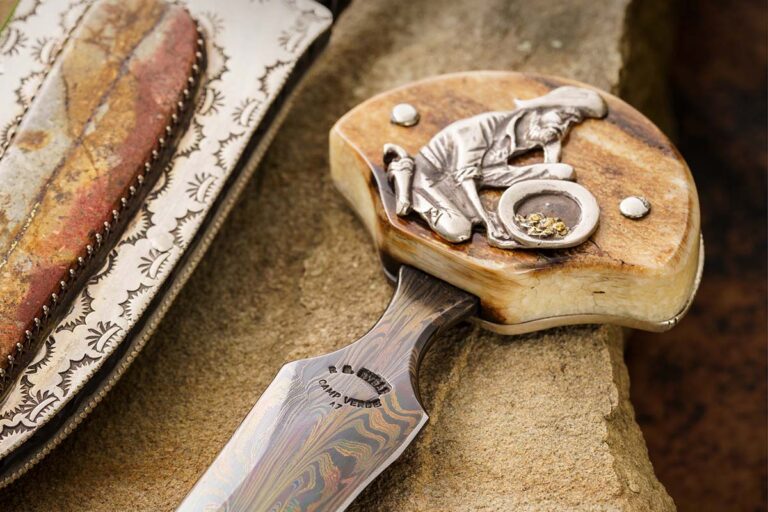
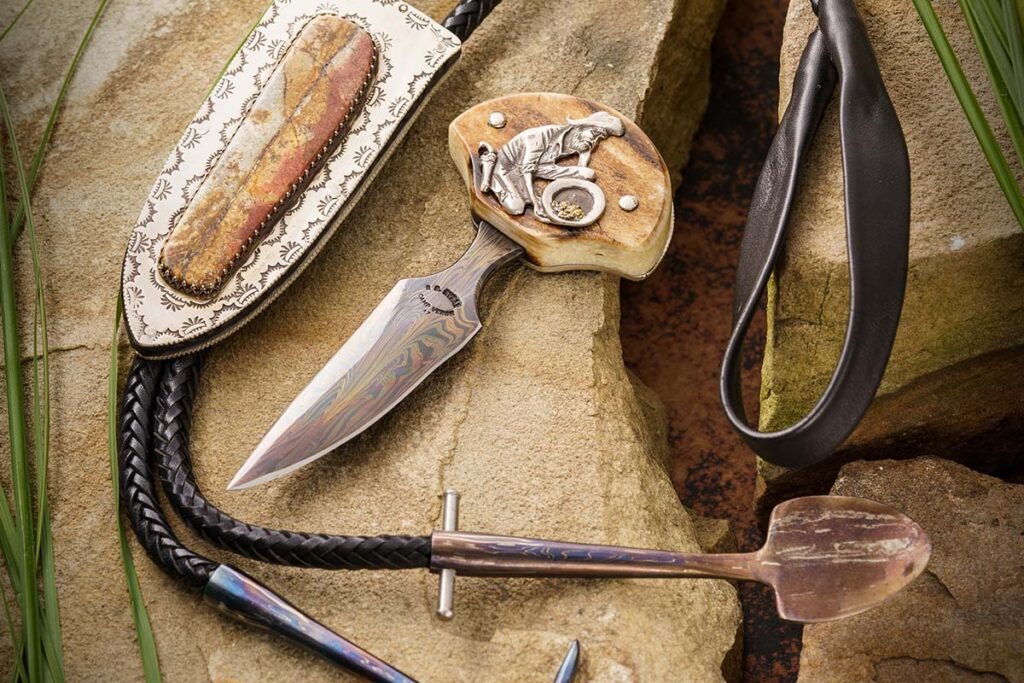
The Prospector by Ray Rybar is a push dagger/bolo combo that bespeaks not only his talent as an ABS master smith but also the array of beautiful, valuable ore in and around his home in Camp Verde, Arizona.
Ray lives in the middle of an Apache reservation where he owns three or four gold mine claims. Camp Verde was the headquarters of U.S. Army Gen. George Crook during the Army’s pursuit and eventual defeat of Geronimo and his Chiricahua Apache band in 1886. Navajos live in the area as well.
Also from near one of his claims, the rock for the inlay has a naturally occurring “stringer” of gold down the center. A local Apache weaved the beautiful leather bolo strap, and Ray forged the shovel and pick of carbon steel and heat colored them. (Eric Eggly/PointSeven images)
Ray teaches various forging and other classes. On occasion he takes his students out to forage for blade and other materials in and around his claims. There they find not only gold every so often but also iron/nickel meteorite, samples of Fe3 and Fe4 iron, ore that can be developed into copper, silver and more. He teaches his students how to convert the iron ore into high-carbon steel. He saves up the leftover steel forged by his students and also rocks he finds and slices with a slab saw for his knives and sheaths. The results can be spectacular—of which The Prospector is a most representative example.
Prospector Specs Knife name: The Prospector Maker: ABS master smith Ray Rybar Knife type: Push dagger/bolo Blade length: 4” Blade material: Damascus forged from iron ore converted to high carbon steel and also iron/nickel meteorite Handle: Ancient walrus ivory w/silver pins and backing Handle inlay: Prospector is solid silver and his tray contains real gold nuggets Sheath: Silver front and back and ebony center w/silver pins; decorated with various marks/designs made with stamps Ray cut from carbon steel and based on those used by the local Apaches and Navajos Sheath inlay: Rock containing quartz, feldspar and a stringer of gold Bolo strap: Leather weaved by a local Apache Maker’s price for a similar push dagger/bolo: $6,500