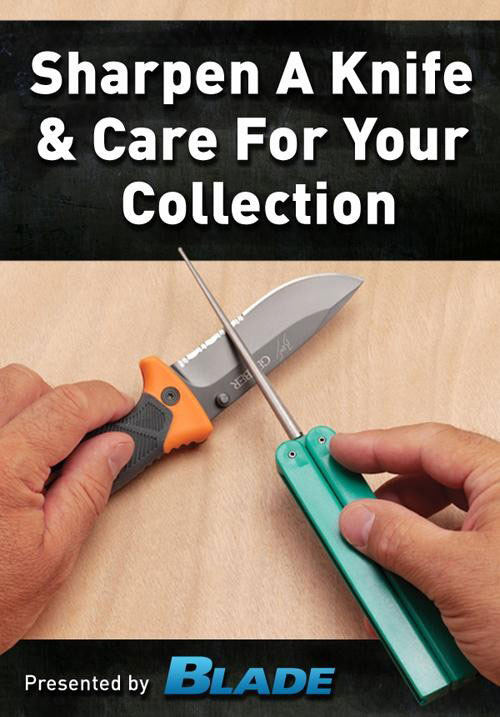
Knife collecting is an extremely rewarding experience for knife enthusiasts. There truly is a knife for everyone. Many increase or hold their value throughout the years, making collecting knives something to pass on to the next generation of knife collectors.
There are four categories of “glow.” Bioluminescence is, say, a firefly. There’s chemiluminescence, caused by a chemical reaction—think glow stick. Radioluminescence is most frequently used in clock or watch paints and on instrument panels. Then there’s phosphorescence, frequently used in toys, or toys for grown-ups: knives, or more specifically knife handles. The old-school invisible type of glow-in-the-dark scales show white-ish in daylight. The handle might have tinges of color, but it’s essentially white. If it has been exposed to enough sunlight, it will glow in blues, purples or greens in the dark. New-school daylight glow is visible day or night and comes in variety of colors. Here are six knife handles that glow in the dark, three of each variety, perfect options for Halloween or the everyday kid in all of us.
1. A son makes glow-in-the-dark-handled knife for his dad
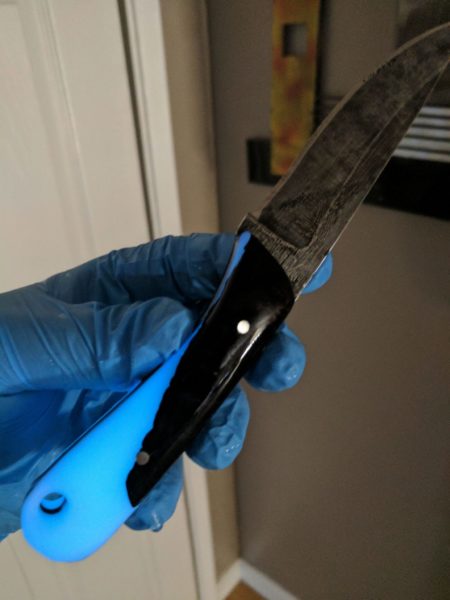
Randy Madan of Patriot Horde Knives made this Pig Poker for his dad, Randy, who uses it on his farm in Kentucky. This type of old-school glow will appear creamy or pasty by day and either blue-violet or green by night, provided it has absorbed some UV light, explained scalemaker, Rob Carper of Rob Carper Innovations (RCI).
Randy Madan of Patriot Horde Knives made this 4.5-inch flat-ground blade out of 1095 steel from Aldo Bruno at New Jersey Steel Baron. The Pig Poker has an acid-washed finish and a hybrid glow-in-the-dark handle by Rob Carper of RC Innovations. The knife is 9 inches overall. Maker’s list price: $200. Contact Patriot Horde Knives, 760-885-9370, [email protected], on Facebook at Patriot Horde Knives or Jr Madan and on Instagram @the_patriot_horde.In low light this Pig Poker from The Patriot Horde Knives glows blue, provided it has absorbed enough light.
2. This GITD friction folder is pinned by a grenade pull
A rescue knife has a blunt point for two reasons, explained Denny Furey of Furey’s Urban Combat Knives – Unlimited. One, it can be used to pry with, and two, if you needed to cut someone’s seatbelt, for example, you don’t want to run the risk of sticking them with a sharp point.
The grenade pull locks the blade in the open position for secure cutting. The pin can then be stored in the attached slot on the sheath, similar to how a ferro rod might be stowed.
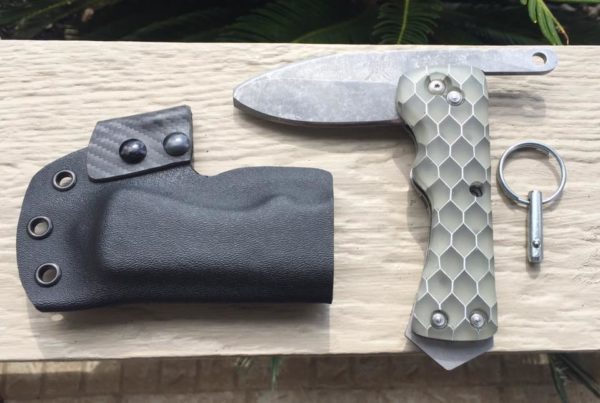
The “Resukyū” (Rescue) Friction Folder is a one-off by Denny Furey of Furey’s Urban Combat Knives – Unlimited. The 3-inch blunt-tip rescue blade is made out of O1 tool steel, as are the breacher/bottle opener and spacers. The blade and back spacer have an acid stonewashed finish. The knife measures 6.75 inches closed and 8 inches overall. The handle scales are Glow In The Dark by Voodoo Resins. The hardware, including the grenade pin lock, is stainless steel. Maker’s list price: $300 with Kydex/Holstex sheath. Contact Denny Furey, Furey’s Urban Combat Knives – Unlimited, 405-642-2198, [email protected], on Facebook at Furey’s Urban Combat Knives – Unlimited.This Denny Furey friction folder handle was made by Voodoo Resins and appears green in the dark.
3. New-school daytime glow is visible day or night
Jason Batdorf of Delaney Knives makes his own glow mix, using raw materials, but one would need to be a chemist with a laboratory to actually make the glow powder.
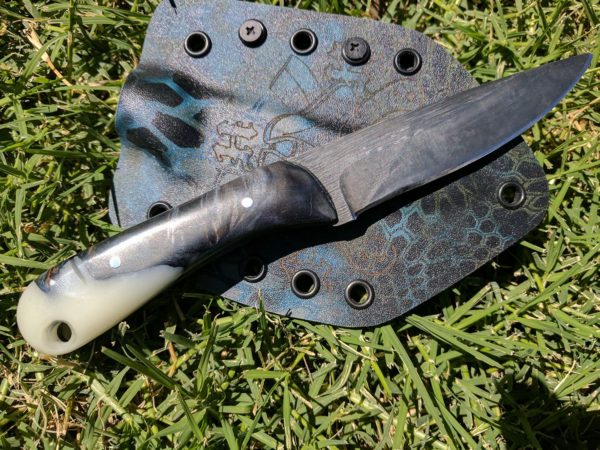
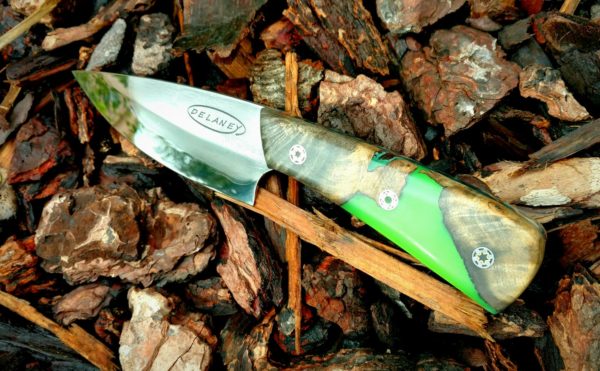
Jason Batdorf made this 4-inch flat-ground Delaney drop-point blade out of 1095 steel with hamon. The handle is a buckeye burl and glow hybrid made by the maker with his own glow mix. Overall length is 8 inches. Maker’s list price: $250. Contact Jason Batdorf, at Delaney Knives on Facebook or call 419-583-8238.
4. Knife named for a customer’s departed sister
Brent Vacarro of Black Widow Knifeworks & Tactical Gear designed this blade for a customer as a custom order. When Brent began receiving interest in the knife, he wanted to introduce it into his lineup. But there were two problems. “First, I had to get permission from the customer, and second, I needed a name for it,” Brent explained. He contacted the customer and asked if it would be OK if he made more of this knife model. The customer was fine with that. “Then I asked him to name the blade,” Brent continued. “This is where it becomes very special very fast. He had told me about his sister passing away when they were younger, so he had asked if we can name the blade after her. My immediate response was ‘Of course!’ So that’s where H.E.R.L comes from, her initials.”
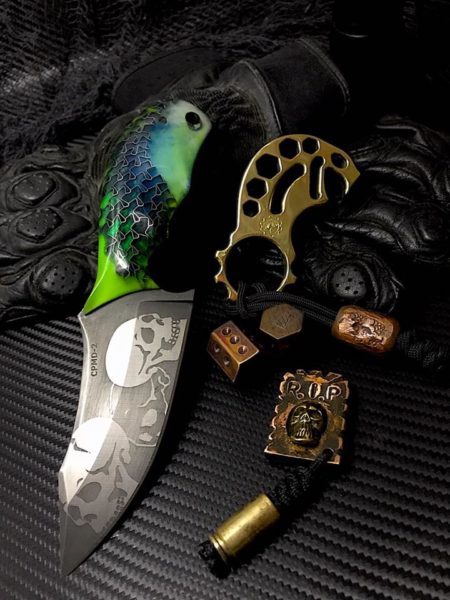
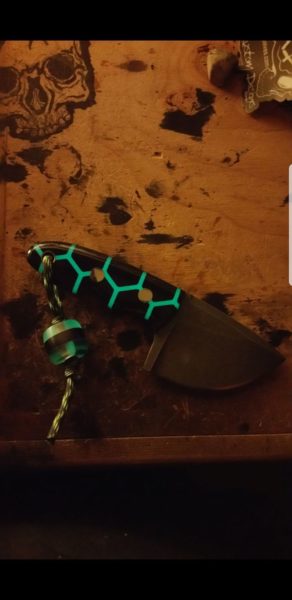
Brent Vaccaro’s H.E.R.L has a 4.5-inch flat-ground blade of CPM D2, acid-washed with etched skulls. The handle is Voodoo Resins’ Dr. Strangelove (green/blue glow) with green G-10 liners. Overall length is 7 inches. Maker’s list price: $280-$350. Contact Brent Vacarro at [email protected], 908-328-2049, on Facebook at Black Widow Knifeworks & Tactical Gear and on Instagram @blackwidowknifeworks.Dr. Strangelove scales are made by Matt Peterson at Voodoo Resins. Dimensions are 5.9 inches long by 1.85 inches wide by .300-inch thick. Makers list price: $40/set.
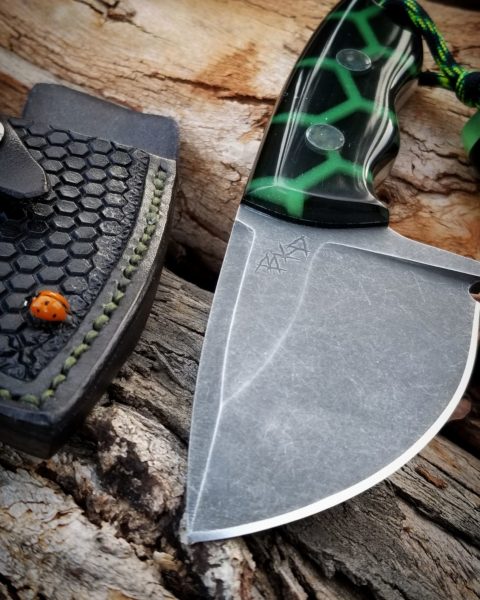
5. Glow-in-the-dark honeycomb pattern is echoed in leather sheath
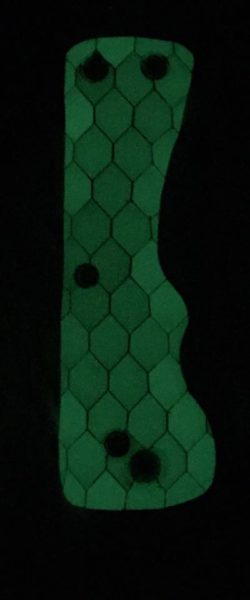
Namen Borras’ BKD Skinner has a flat-ground 2.5-inch blade with swedge made out of CPM S35VN with acid and stonewashed finish. The knife is 6 inches overall. The handle scales are glow-in-the-dark honeycomb with clear resin by DerangedDonkey with black G10 liners. Maker’s list price: $350 with black leather sheath with matching honeycomb pattern. Contact Namen Borras on Instagram @borraskustomdesigns, www.bkdknives.com or at [email protected].This is how the honeycomb pattern on the above knife appears in the dark.
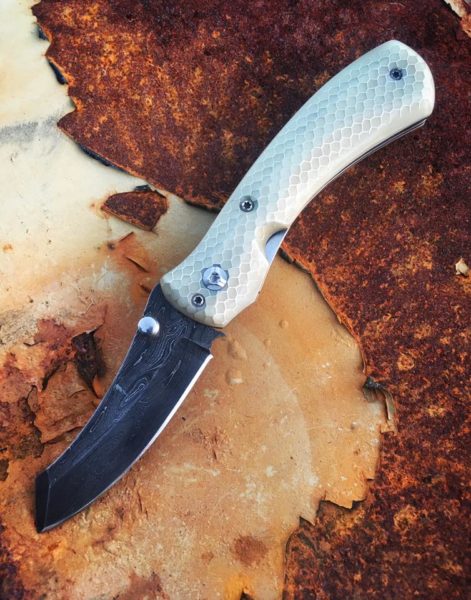
6. Old-school Glow Hex emits violet shade in the dark
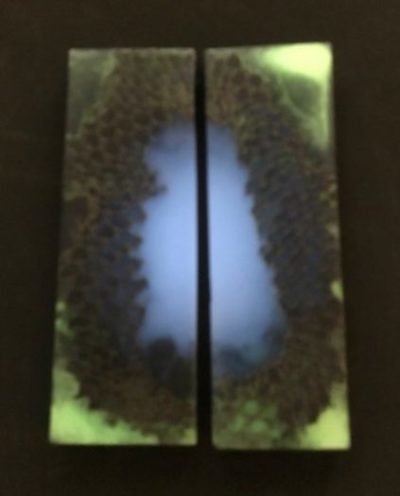
Tyler Freund made this one-off custom folder with a 1.3-inch flat-ground blade of pattern-welded steel from Alabama Damascus Steel. The Glow Hex scales are by Beyond Wood Products, and are paired with titanium liners. Screws, pivot pin, pivot screw, backspacers and clip are also titanium. Overall length is 9.7 inches. Maker’s list price: $400. Contact Tyler Freund, Freund Custom Knives, 1755 Madison 541, Ironton, MO 63650; 573-366-3906, [email protected] and on Instagram @freunds_customs.Tyler Freund’s one-off custom folder glows a blue-purple in the dark when it has absorbed sufficient UV light.
A Digital Subscription to BLADE Is The Answer
You can read your digital issues of BLADE Magazine anywhere you have your phone, tablet or computer, and there’s no need to find storage for all your old issues.
If piling-up issues of magazines seems like a waste to you… If you feel like you don’t have time to read a magazine… If you like the stories we offer in BLADE, but want a more economical option, then a digital subscription is the answer. An annual subscription to BLADE is $17.98, $4 off the print price.
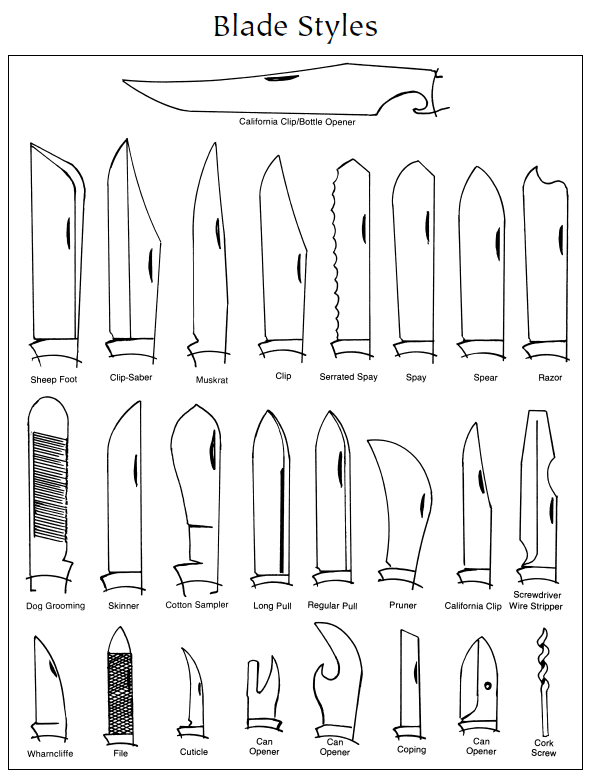
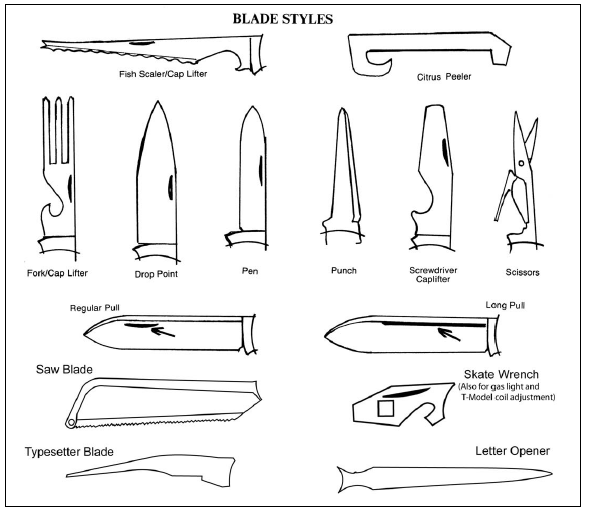
Learn about the different types of blades out there with these handy illustrated guides. They’re perfect for anyone curious about blade shapes, terminology or what to look for before buying a knife for a particular use. Just click on either image for a larger view. Types of blades covered include:
California Clip
Can Opener
Citrus Peeler
Clip
Clip-Saber
Coping
Cotton Sampler
Cuticle
Dog Grooming
Drop Point
File
Fish Scakler/Cap Lifter
Letter Opener
Long Pull
Muskrat
Pen
Pruner
Punch
Razor
Regular Pull
Saw
Screwdriver/Wire Stripper
Serrated Spay
Sheep Foot
Skate Wrench
Skinner
Spay
Spear
Typesetter
Wharncliffe
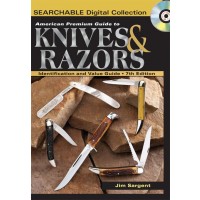
This illustrated guide to types of blades is excerpted from the American Premium Guide to Knives & Razors CD. Jim Sargent’s book is ideal for anyone who collects Case knives or has an interest in knife history.
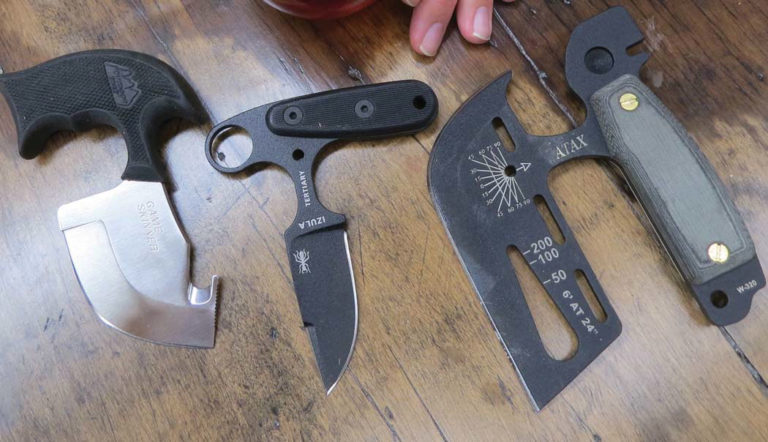
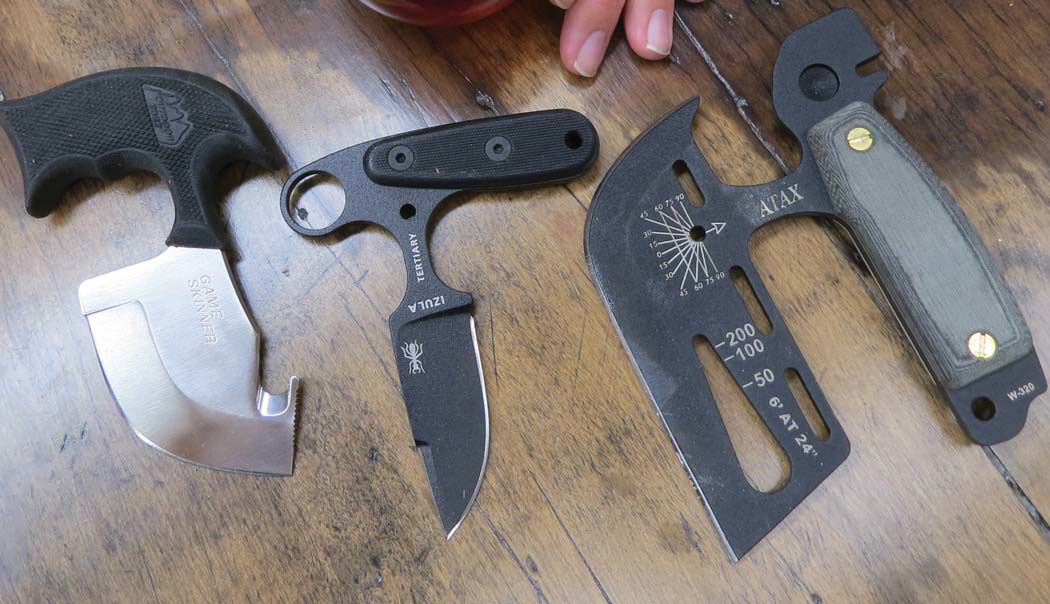
Pistol-grip knives from left, with manufacturer’s suggested retail prices in parentheses: Outdoor Edge Game Skinner ($88.95), ESEE Tertiary ($103.99) and TOPS Knives ATAX ($225).
Pistol grips aren’t only for firearms; they’re functional designs for knives, too. Here is a review of three examples.
Solid Build: ESEE Tertiary
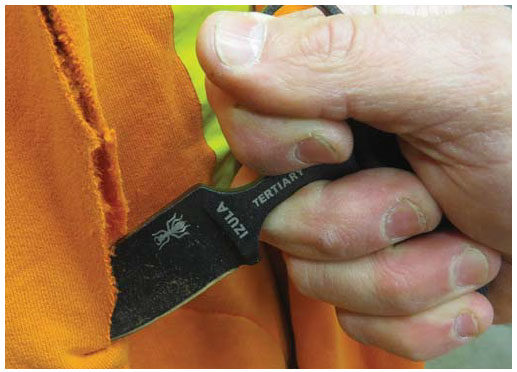
The ESEE Tertiary was super sharp out of the box. The author used the knife to make aggressive slashes on a work jersey suspended from a hanger. A good test for an edge is not necessarily cutting something hard but something loose that could easily recoil from the edge when cutting. If the edge is sharp enough not to push the material but sever it, then the edge is truly sharp.
The ESEE Tertiary is a standard push dagger design. According to ESEE, SWAT officer Lee Smith designed the knife and named it “Tertiary” because of its place in a person’s weapons system. That is, first there’s your primary firearm, then your back up and then the Tertiary, which is for hand-to-hand.
It is a double-edged knife with top blade grinds. The top grind extends a third of the blade length only. The blade profile is that of a drop point. It is important to remember that a double-edged knife is illegal in some states (one such state is Michigan). Check your local knife laws whenever you choose a knife for everyday carry (EDC).
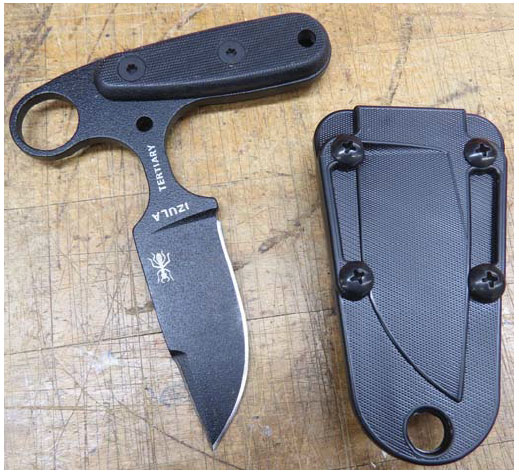
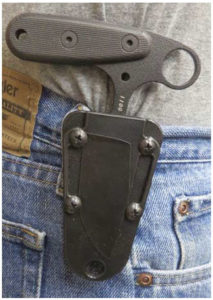
The Tertiary sheath’s clip can be changed to accommodate right- or left-handed carries and vertical or horizontal positioning. The large hole in the tip of the sheath allows you to rig the Tertiary as a neck knife as well.The Tertiary comes with a molded sheath that sports a steel belt clip for you to attach the knife on a waistband, boot or assorted gear.
The Tertiary is a full-tang design with the blade positioned between the index and middle fingers. It has a flat-ground blade of 1095 carbon steel with a textured powder coat and textured G-10 scales.
The knife works as expected as a push dagger. For an edge to get the job done it takes getting used to the grip, but you can do minor chores like the type you normally encounter.
After a while, though, the pressure of the post between the two fingers really starts a hot spot. For the most part, given the nature of ESEE’s push dagger, I would carry a folder to do my EDC work and leave the Tertiary concealed and out of sight.
Comfy Classic: Outdoor Edge Game Skinner
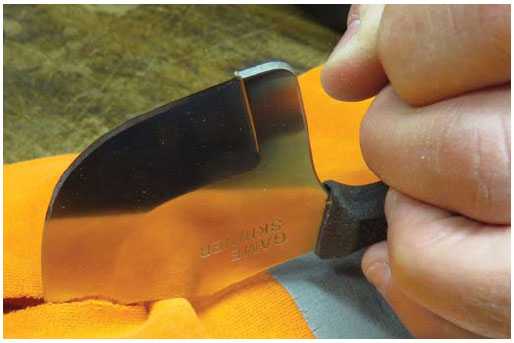
The author tested the Game Skinner gut hook on a number of materials, including pulling it through a jersey with only the weight of the shirt holding it in place. How razor sharp does an edge have to be to slice a loose material instead of dragging it?
When it won the BLADE Magazine 1988 Imported Design Of-The-Year Award, the Outdoor Edge Game Skinner took the world of hunting knives by storm. It remained an Outdoor Edge mainstay ever since, and appears to have been ahead of its time.
As the name implies, the knife is for skinning game. It combines a blade edge with a gut hook. It is a beefy specimen with a 3.25-inch blade that is 2 inches wide. A hollow grind forms the main edge. The blade is AUS-8 stainless steel. I have had plenty of good knives made of AUS-8. It all depends on the heat treat and grind.
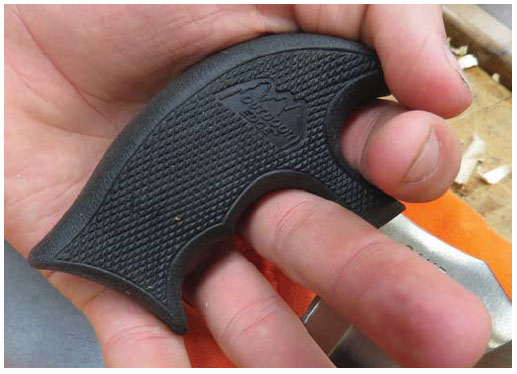
The handle is a textured, molded Kraton. I was impressed with it. It is brawny yet still comfortable, and the textured grip along with the slight give of the rubber kept the knife steadfast in my hand no matter how slimy things got.
The molded grip of the Outdoor Edge Game Skinner is designed for a three-finger hold. The rounded spine makes it easier to use a pinch grip and enables you to put forward pressure on draw cuts while maintaining a comfortable position.
During testing on leather, meat and hair on hide pieces, the edge held up well. The blade belly makes slicing cuts easy to perform, helping you get in there and skin. As for the gut hook, you might as well have a zipper on the animal.
It comes with a well-built leather sheath with snap closure. Though I personally wouldn’t have much use for this knife on my belt, I would keep it with my gear until it was time to field dress game. If you see yourself using this style of knife for hunting, it is a good quality edged tool. Over the years, I have learned that many hunters have their own style of cutlery they like to use and their own way of handling it.
Multi-Functional Tool: TOPS Knives ATAX
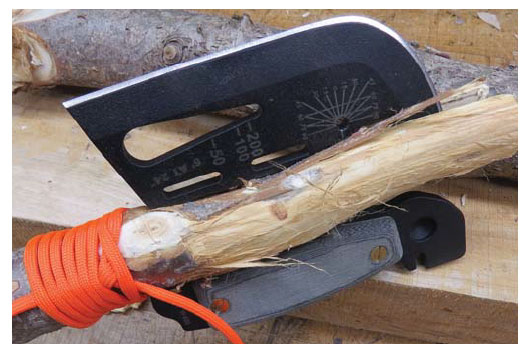
The author extended the ATAX handle using a piece of dry wood to make an axe for light chopping. For heavier use he would have used green wood and lashed the top. The addition of a long handle creates an obvious physical advantage.
From the get-go the TOPS Knives ATAX is one of those knives that catches your eye and maybe inspires a little pupil dilation.
The knife is designed as a multifunction tool. I have to say, though, sometimes you end up with something that does many things but never any one of them exceptionally well. Looking at the overall design, I would be more apt to see the ATAX as an ulu variant over a push dagger.
TOPS has been selling the knife for years. It is the design of the late Ron Hood. There are so many different tools involved in it that it would take a while to review each one. I will try to hit the main functions for now. The blade is quarter-inch-thick 1095 carbon steel with a powder coating. The handle is a black Micarta® affixed with screws. A saber grind forms the cutting edge, which I found too chunky for doing standard chores easily. The edge runs parallel to the grip just like on an ulu, but the grind is so thick that manipulations of the edge are difficult—not impossible but difficult. The design could be a great meat processor with a higher grind.
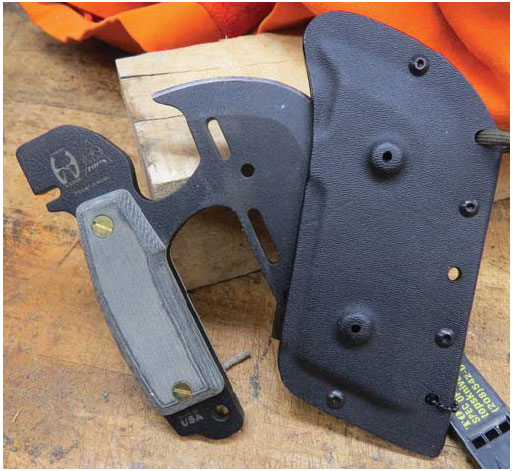
Use a rocking motion to remove the ATAX from the sheath. As the knife emerges the sharp tip presents itself, which the author stated he found a bit dangerous.
There are a number of ways to complete a cut with the knife, as the platform allows you a variety of holds. For instance, holding it upside down enabled me to better do things like whittling or shaving. The ATAX requires getting familiar with, and even then some using methods are more practical than others.
Taking a long period to set up your handholds and the material for cuts should be balanced with the practicality of effort toward the job being done. One of the design purposes for the knife is to attach it to a stick and use it as an axe. The thick edge serves the chopper feature well and allows the ATAX to take a beating. Still, as noted, the grind does many things but none exceptionally well.
Other tools designed into the ATAX are a range finder, clinometer, compass, bowl drill socket and wire cutter. A molded Kydex sheath with double steel clips provides Scout carry. The way the sheath operates gives me cause for concern as the method of drawing the knife from the sheath can easily result in injury if you are not paying close attention.
Unsheathing requires a rocking motion that leads with the pointed part of the curved edge. You will want to make sure everything is clear of the blade tip as it rocks free.
The design shows ingenuity and in a pinch serves as a backup tool. Would I want it as my primary knife? I would have to do some major changes to the edge geometry, as the ulu-style use is very serviceable.
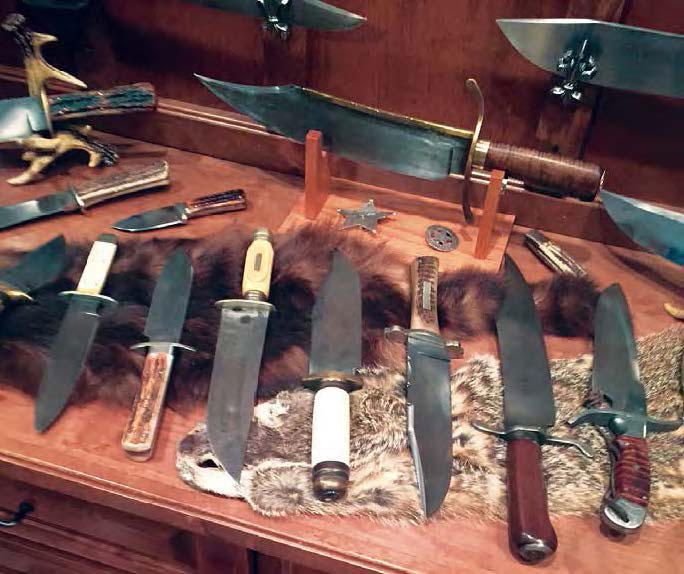
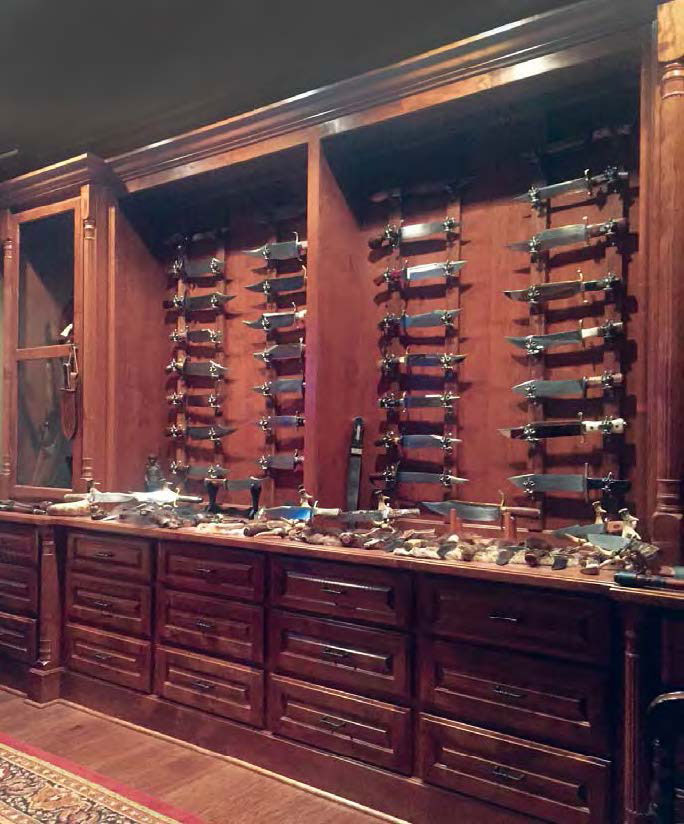
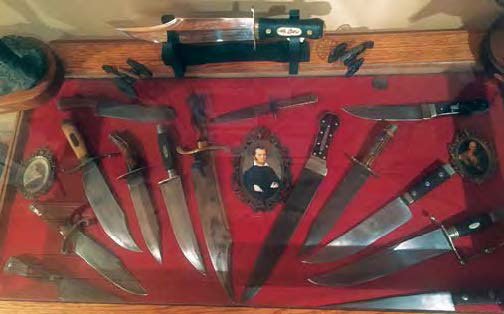
Chris Nolen’s collection of custom repros of antique bowies tops 200. Here are some of them in his 7×14-foot display vault made of alderwood, including 18 drawers full of bowies at the bottom. (All images by Chris Nolen unless otherwise noted)
Editor’s note: This article originally appeared in the February 2018 edition of BLADE.Download the issue here.
A Bowie Knife Collecting Obsession
The trail of the fabled bowie knife is long and winding. From the Sandbar Fight to the Alamo and beyond, its fact, mystery and myth have become the stuff of legend. The trail extends nearly 200 years, and for half his life Chris Nolen of West Monroe, Louisiana, has traveled down it.
For sure, he’s gone further than most.
At 65, Chris remains heavily engaged in a custom embroidery and screen print business called Reflections with his daughter, Lori Rockett, while another daughter, Lindsey Sanders, lives in Chattanooga, Tennessee. A retired telecommunications worker, he has sought and bought knives since his days mowing lawns for money so that he could run to the local hardware store and buy the knives that caught his eye.
“My mother still kids me about not having any money in those days because I was always buying knives,” he smiled.
A close-up of Nolen’s display is a bowie buff’s delight.
Cutlery Hall-Of-Famer Jim Bowie’s legendary encounter at the sandbar, his final hours at the Alamo, the association of numerous knives that bear his name with the history of Texas, its link to the Civil War, and its stretch across the Atlantic to beginnings in the cradle of quality knifemaking—Sheffield, England—made the bowie irresistible.
“It seems like every time I went to a show I was attracted to the big bowie knives,” he recalled. “Sometimes, you might say, ‘What are these good for?’ but I saw them as art in steel.”
Today, the Nolen collection of bowies tops 200, and a fortress-like display room keeps them safe and allows their owner to show them to visitors. One of Chris’s primary pursuits has been the history of the bowie along with a desire to own reproductions of some of the most significant bowies in history. He has worked with several top-notch custom knifemakers, pored over documents and traveled to various locations, the results of which are nothing short of spectacular.
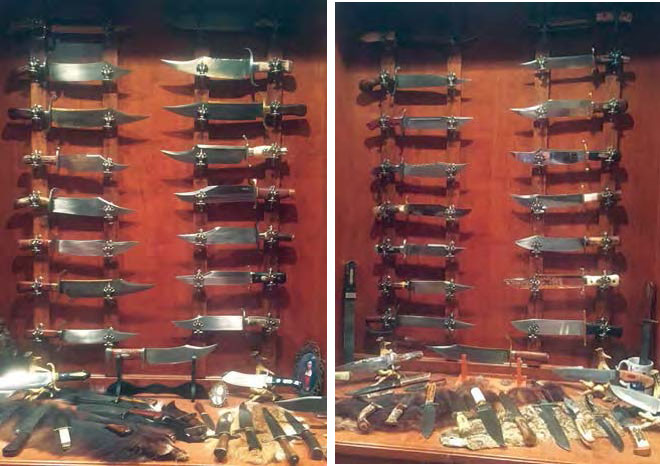
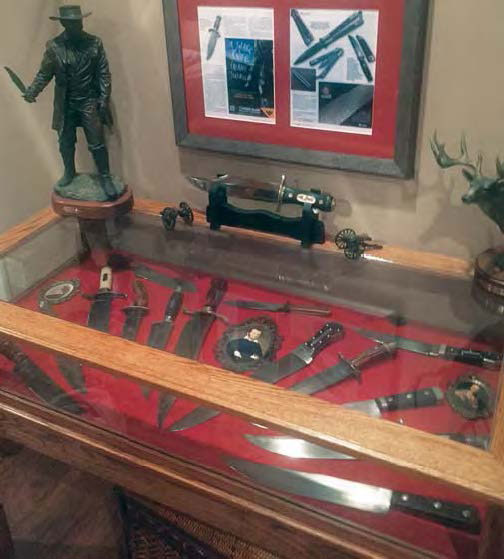
A look at a different angle down into “The Bowie Knife: Fact-Myth-Legend” display reveals custom repros of classic antique bowies. From lower left to right: Jesse Clift Knife; Bart Moore Bowie; Noah Smithwick Bowie; Huber Steel Bowie; Searles-Fowler Bowie; Musso Bowie; Bowie No. 1; Berrera-Campbell Bowie; Schively-Perkins Bowie; Juan Seguin Bowie; and Edwin Forrest Bowie. Across the top, from left: Caiaphas Ham Knife, Madame Candelaria Knife and James Black Knife. At top: the Iron Mistress.
Among his bowies are repros of the Searles-Fowler bowie (the original of which is on display in the Alamo), the Joe Musso brass-back bowie, the Iron Mistress, the Jesse Clift bowie, the Juan Seguin Bowie and Bowie No. 1, to name a few.
“No Turning Back”
In 1986, Chris contacted knifemaker Jerry Berry of Natchitoches, Louisiana, after sketching a bowie. He asked if Berry could actually make the knife from the drawings. Of course, the answer was yes.
“That knife has a 9.5-inch blade with a slight recurve,” Nolen said, “with brass and nickel-silver trim and a solid stag handle with a hidden tang. The blade is ATS-34 stainless steel. That is one of my favorites because it was one of the first. Once I got it there was no turning back, and for the last 30 years I have pretty much stuck with the big bowies. Robert Blasingame of Kilgore, Texas, helped me get started on the making of copies of antique knives before he passed away in 2010. He was quite a historian.
Bringing Bowie Knife History to Life
“It was about 10 years ago that I got this wild idea to track back the bowie and its origin,” Chris continued, “and Linda and I visited 12 museums and met curators, who were all such nice people who even let us hold some of the original knives that were associated with the Bowie family.
“For example, we went to the Alamo and actually got the dimensions of the original Searles-Fowler knife. Now, we’ve researched and had reproductions made of pretty much every knife associated with the Bowie family.”
Nolen’s “The Bowie Knife: Fact-Myth-Legend” glass display with a statue of Jim Bowie atop it at left. The framed magazine pages on the wall are from a story that included Nolen as a source in a past issue of BLADE®.
Through the years Chris has developed a reputation as something of an expert on bowie knives, resulting in his traveling exhibit aptly named, “Bowie Knife: Fact, Myth, and Legend.” In 2014, he traveled to the Historic Arkansas Museum in Little Rock, where more than 200 genuine bowies were on display.
“They had my reproductions at the entrance there in a big black case,” he remembered. “There is probably more legend than anything surrounding these knives. Jim Bowie didn’t leave us much to go on, and I have studied him for years now. His brother, Rezin, was a big promoter of the bowie knife and gave a lot of them away as gifts. These reproduction knives have been everywhere, and I get a kick out of it.”
Along with the history lesson that the bowie repros convey, visitors can begin to grasp the tremendous skill that is required to produce a high quality bowie.
“It’s hard for a maker in today’s time to get into the head of a maker from 180 or 200 years ago,” Chris offered, “and most of them want to put their own artistic spin on a knife. But along with Jerry Berry, I narrowed it down to Rich McDonald and Mark Banfield who do a lot of work for me, and Cowboy Bob Giles of Whitefish, Montana, who has probably made 15 of them for me. These men are unbelievable artists.”
Musso and Musician Phil Collins
The Joe Musso Bowie repro by Mark Banfield with the brass back and “S” guard on the stand serves as a centerpiece for one section of Nolen’s display.
Mention of the Musso Bowie conjures some of the theory and conjecture surrounding its authenticity.
According to Chris, Joe Musso sold the original knife to Phil Collins of the rock music group, Genesis, who in turn donated the original to the Alamo, where some metallurgical testing has been done and some believe the “JB” mark on the guard ties the knife to Jim Bowie.
“That is one of my favorite reproductions because Mark [Banfield] went the extra mile and even copied the stains on the blade,” Chris commented, “and it is the only authorized true copy of the Musso knife. I have some Samuel Bell copies and one of my favorites was just done by Giles. It is an exact copy of the Charles Congreve knife done in Sheffield around 1835, a big swayback bowie trimmed in silver.”
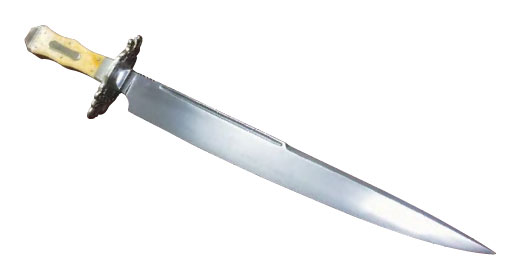
Among others, Nolen is a big fan of 19th-century bowie maker Samuel Bell. Mark Banfield reproduced this Bell bowie.
A “Dazzling Display” of Bowie Knives
A couple of years ago Chris and Linda decided to build their dream house on a tract of land they had owned for a while. The move brought to light several knives that had been packed away for 20 years or so. Thinking about the future of his collection, Chris decided to make space available to display it properly.
“I always wanted to have a secured room to display the knives in,” he remarked, “so we designed this room 20 by 18 with no windows, solid brick, and with concrete next to the brick. It would take a tank to get into this thing. There is also a solid steel security door, so it is pretty much a vault. Lori’s husband, Marc, owns a custom cabinet shop. He cuts wood with a laser, and he cut out an entire wall and put in a cabinet for guns to go on each end and 18 drawers at the bottom. You can pull out the knife displays. There are two center panels, and the display is 14 feet wide and 7 feet tall. The center panels have 32 pewter hangers in a fleur-de-lis design that hold 32 bowie knives. At the bottom is a 3-foot shelf that holds about 40 bowies.
“It isn’t everywhere that you can see 70 or 80 bowie knives in the open,” Chris added. “People come in and they have to catch their breath. I also have a coffee table with a glass-top display that holds about 20 knives and is kind of my dedication to Davy Crockett. The other side of the room is a glass display of the ‘Fact, Myth, and Legend.’ The cabinetry is all of alderwood.”
To complete the dazzling display, Nolen commissioned three paintings depicting the epic of the bowie knife during the desperate, heroic stand at the Alamo. The first painting depicts the death of Jim Bowie, slashing defiantly at Mexican soldiers from his cot.
The second depicts the death of Crockett, a death which is surrounded in controversy. The artist allows the viewer to decide Crockett’s fate, depicting the legendary Tennessee long hunter and adventurer standing but exhausted.
The third depicts the death of Col. William Travis, commander of the doomed Alamo garrison.
Although it might seem to the casual observer that the Nolen journey down the bowie trail is complete, such is not the case.
Chris continues to add to his collection. Mark Zalesky, editor of KNIFE magazine, recently pitched in to assist with the recreation of a Samuel Bell knife located in Knoxville, Tennessee, and Mark Banfield completed the addition.
For starters, honing a knife is different from sharpening a knife in one major way: how much steel is removed from the blade. Sharpening involves removing steel along the edge using an abrasive. It’s more aggressive than honing, which is a process by which the grains of steel on the edge are made uniform.
While honing isn’t a replacement for sharpening, it can extend the time between sharpenings. Honing is also a quick way to refresh a blade before use. Professional chefs will often use honing rods on their knives before getting to work.
You don’t need to be a five-star chef to hone your knives like a pro, though. No matter the task at hand, you can bring your knife back to life quickly with these simple steps.
Step 1: Buy A Honing Rod
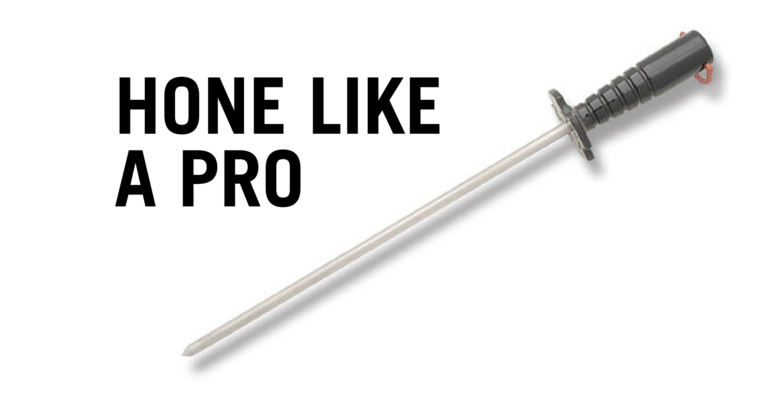
In general, honing rods come in three styles: steel, ceramic and diamond. Each comes with different characteristics.
Steel is the least expensive. Because it’s softer than the other two styles, it won’t remove much metal from the blade. It’s great for beginners.
Ceramic carries more bite than steel. The honing will last longer because of this, but ceramic is also less forgiving of the novice.
Diamond honing rods are usually the most expensive of the three. The diamonds embedded in the rod remove a good amount of steel, so this style should only be used by the skilled knife enthusiast.
No matter which style you choose, aim for these features:
A secure, ergonomic grip
A sturdy guard that protects your hand
A ring on the handle for slipping a pinky through in case you drop it
Step 2: Find Your Angle
Place the rod perpendicular onto a non-slip surface. Hold the handle of the rod and plant the tip onto a soft yet durable surface, like a cutting board. Place the heel of the knife against the top of the rod at an approximate 15-20 degree angle. It’s important to match the angle of the edge already set on the blade.
If you’re not sure of the degree, angle the edge against the rod almost like you’re going to cut a long, thin slice of the rod off, and then apply light downward pressure until the edge catches.
Step 3: Time to Hone
Using light pressure, draw the knife down the rod. Use the full length of the rod (you paid to use the whole thing) and pull across the full length of the blade (you paid for that, too). Do your best to maintain a constant angle. Do the same for the other side of the blade.
Repeat eight to 12 passes on each side of the blade. Take your time. There’s no need to show off by honing quickly. That comes later.
With practice, honing will be like second nature to you. Honing will put your knives into a whole new light. You’ll be amazed at how quickly you can give your blade a new pair of shoes.
Looking For a Shortcut? Try Knife Aid
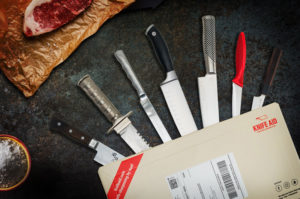
The next best thing to sharpening and honing on your own is to use a mail-in knife sharpening service, like Knife Aid.
Knife Aid makes it simple. After placing your order, Knife Aid sends you everything you need to send them your knives for sharpening. It’s as easy as dropping your order in the mail, waiting a little bit and receiving the knives back in the mail as good as new. You can read BLADE‘s review of Knife Aid here.
With the AccuSharp Diamond Paddle model, use light pressure and let the abrasives do the work. Too much pressure and you can dislodge the diamond particles, reducing the sharpener’s effectiveness. (All images by David M. Stanfield, DMS Captures)
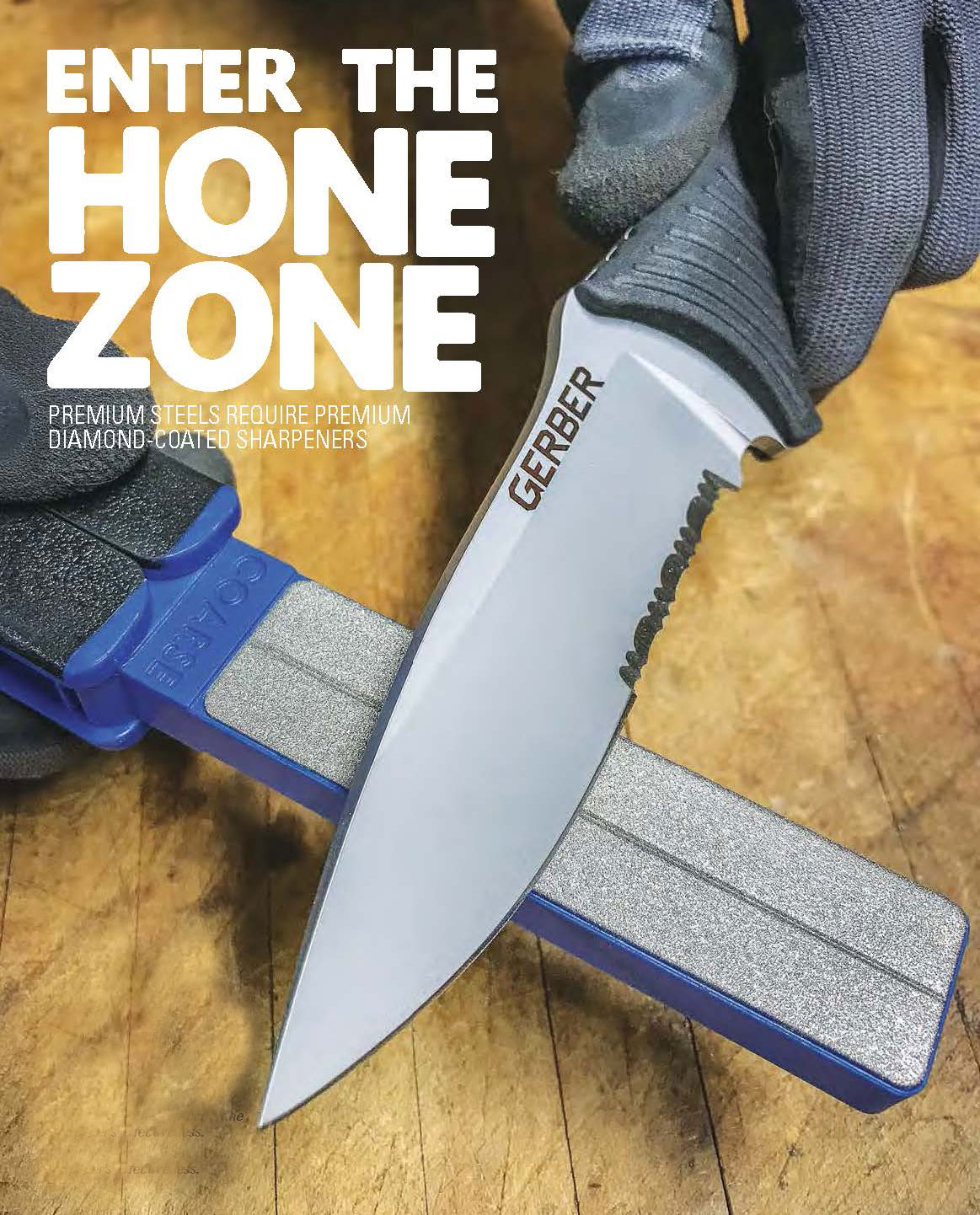
Many knife users/collectors opt for high-performance blade steels such as CPM S30V, CPM 154, 154CM, CPM S35VN, BG-42, CTS 204P, CTS XHP and others. These high grades of stainless offer maximum edge holding, though at a price—and that price comes due when you resharpen the blades. Since these steels excel at wear resistance and can hold an edge for a long time, it also makes them difficult to resharpen. It’s a tradeoff you must consider when buying knives with premium blade steels.
Ergo, especially if you’re going to sharpen the knives yourself, it’s imperative you buy a sharpener that can address such steels effectively. If you’re new to the super steels, not only is selection of the proper sharpener critical but the necessary investment of time is also required.
With the proper sharpener, that time can be kept to a minimum.
Enter Diamond-Coated Sharpeners
Historically, diamond-coated sharpeners are at the upper echelon for sharpening knives. They are the most durable and longest lasting. The tradeoff is price. They are generally more expensive but you must bear in mind that unlike other sharpeners that can break or eventually wear out, there is almost nothing to break or wear out with a diamond sharpener.
Once you buy it, if you can keep from losing it, it should last your lifetime.
AccuSharp Diamond Paddle Sharpener
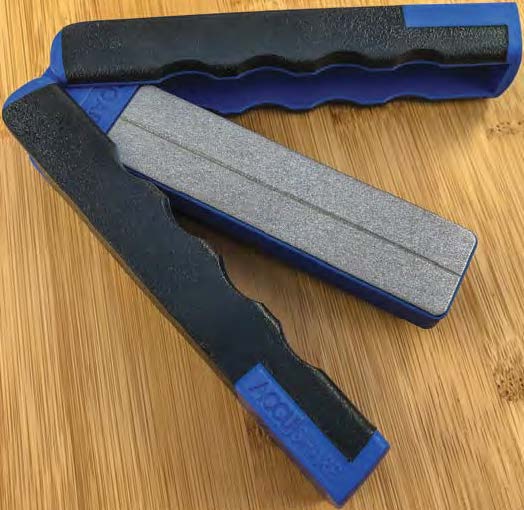
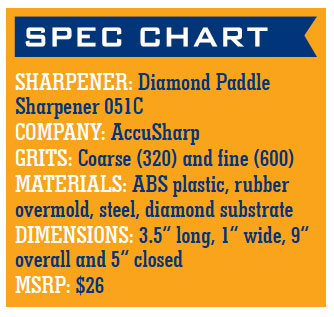
The handles of the AccuSharp Diamond Paddle Sharpener fold up to encase the sharpening surfaces and protect them during storage and transport. The rubber overmold gripping areas are a nice touch and make the sharpener easy to hold securely.
AccuSharp’s Diamond Paddle Sharpener model 051C is a double-sided model featuring both coarse (320) and fine (600) grits. At a healthy .75 by 3.75 inches, it has a large diamond-coated sharpening surface.
The big surface enables the 051C to address all types of knives, from multi-blade slip joints to large fixed-blade hunters. It includes a sharpening groove for use with all kinds of hooks, darts and other pointed items. It features handles similar to a butterfly knife’s that fold up around the sharpening surface, protecting it from damage during transport or storage. The handles feature a secure gripping surface as well.
The 051C works very well. With a diamond sharpener, use light pressure and let the abrasives do the work.
Too much pressure and you can dislodge the diamond particles, reducing the sharpener’s effectiveness. I like the sharpener’s two sides, which eliminate the need to carry a separate finer-grit sharpener to fine tune the edge. When done re-profiling the edge with the coarse side, just flip the 051C over and continue your work to refine the edge.
Another thing I like about the 051C is the rubber overmold gripping area. With or without gloves or wet hands, the sharpener is comfortable to hold. It never felt unsecure in my grip. Along with the rubber overmold, the thickness of the handles adds to comfort by filling my grip easier.
However, I can see where the girth can also be a downside, making the 051C difficult to stow in tight quarters like a zippered pouch or glove box.
Diamond Machining Technology Diafold
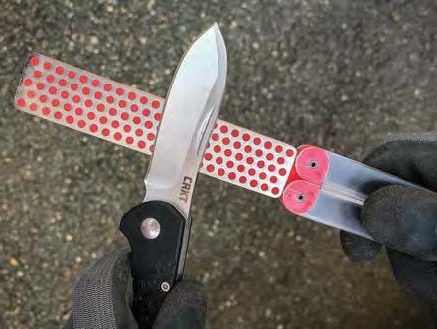
The DMT Diafold easily sharpens high-performance stainless steels with ease. The fine grit carefully constructs the final edge keenly, and is for use only after re-profiling the edge employing a coarse-grit sharpener.
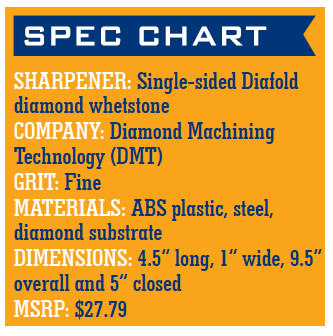
In my opinion the most iconic product made by Diamond Machining Technology (DMT) is the single-sided Diafold diamond whetstone sharpener. DMT’s sharpeners are easily recognizable by their trademark round polka-dot sharpening surface. They offer near-perfect grit-size consistency across the sharpening surface.
The Diafold is a compact sharpener with a flat form factor, allowing it to be carried in a large pocket, toolbox, glovebox, tackle box or carry bag. The handles double as a carrying case, folding up to conceal the sharpening surface and protect it from damage during transport.
Each DMT sharpener is color-coded according to grit, so, once you learn the codes, it’s easy to identify each grit by its color. The clear handles make identification easy and are a nice touch, so there’s no mistake which grit you have.
The Diafold works exceptionally well. It has been on the market many years and in my opinion is pretty much the gold standard when it comes to compact handheld sharpeners. It easily addresses all types of high performance stainless steels with ease. The fine grit carefully constructs the final edge keenly, and is for use only after re-profiling the edge employing a coarse-grit sharpener.
An improvement I recommend would be to make the sharpener a bit thicker to give the handles some width, which in turn would make it easier to hold—especially for an extended period of time sharpening several knives in one sitting.
Still, as is it functions well and, when the handles are folded, the thin profile makes it easy to pack.
Spyderco Tri-Angle Sharpmaker 204MF
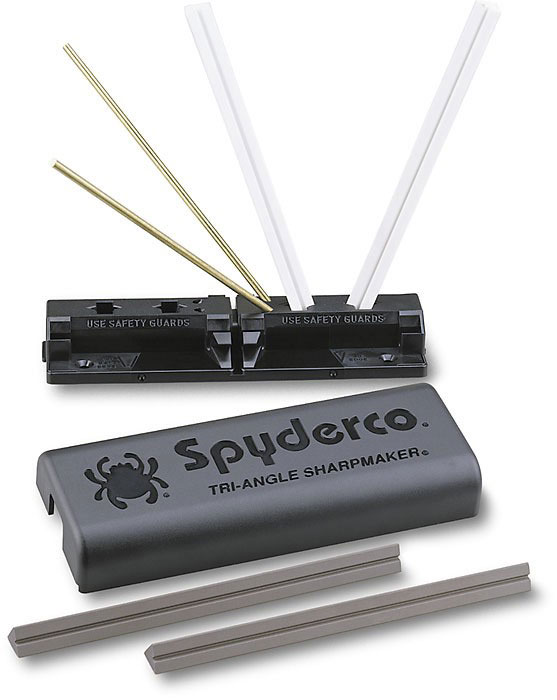
The Spyderco Tri-Angle Sharpmaker’s triangular-shaped rods enable you to address both plain edges on the rods’ flats and serrations using the “points” of the triangle.
“In the 1970s when [Mrs. Gail Glesser] and I started selling knife sharpeners at local fairs, we were buying and selling other people’s sharpeners,” begins BLADE Magazine Cutlery Hall-Of-Fame® member Sal Glesser, CEO and founder of Spyderco. One of the sharpeners the Glessers sold was a V-stick type that they liked, though they identified some of its shortcomings. “We invented the Tri-Angle Sharpmaker because, while similar to the [V-stick] sharpener, it solved many sharpening challenges/problems the [V-stick] couldn’t perform,” he says.
One of those problems is the V-stick model could not sharpen serrated blades. Enter the Sharpmaker’s triangular-shaped rods, which allow it to address both plain edges on the rods’ flats and serrations using the “points” of the triangle.
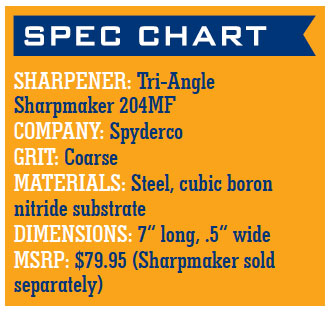
With the advent of higher-performance steels, the Sharpmaker’s ceramic rods were underpowered, so the company devised the 204CBN (Cubic Boron Nitride) Tri-Angle hones. The CBN hones work exceptionally well addressing dull or damaged blades. They can reprofile edges efficiently, handling not only the super stainless steels but all steel types. Like the ceramic Tri-Angle hones, the CBN easily addresses both plain and serrated edges.
As with the ceramic rods, a groove running the length of the CBN rod’s length allows for sharpening pointed objects and tools. The CBN material is what Spyderco calls a “super abrasive” second in hardness to diamond.
The CBN hones cost extra. The 204CBN complements the included medium- and fine-grit ceramic hones well. Once you re-establish the new cutting edge, switch to the medium and fine ceramic hones to further fine-tune it to razor sharpness. The CBN hones work on any blade length, fixed or folding.
Once you set the sharpener up, start your blade from where the edge starts closest to the tang and run it down the hone, at the same time pulling the blade back toward you, ensuring the hone contacts the entire length of the cutting edge all the way to the tip. Hence, you’re doing two simultaneous motions—moving down the hone and pulling the blade back toward you. Do it all with light pressure.
An improvement I would recommend would be to include a set of CBN hones as standard with the Sharpmaker. The CBN hones speed up the process of edge recreation. Granted, the addition would increase the Sharpmaker’s cost but the increase would be justified.
DMD Double-Sided Bench Stone
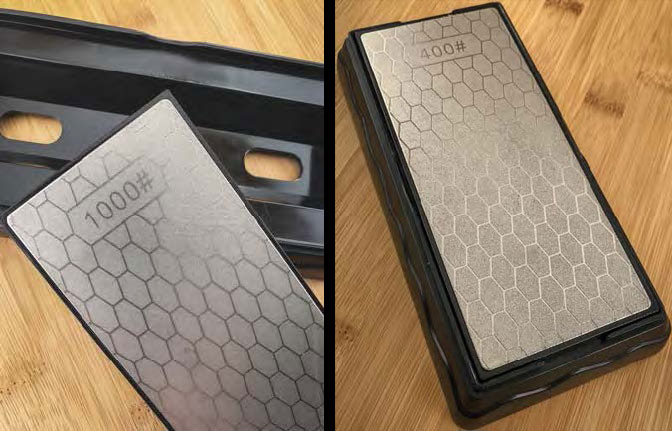
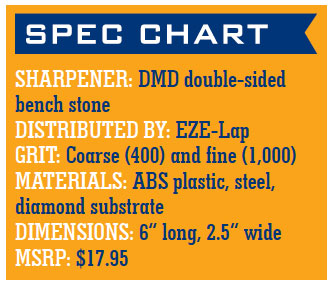
The DMD Double Sided Bench Stone features two grits on one stone. Coarse (400) and fine (1,000) grits address high-performance steel blades. The metal plate is double sided and lies on the base just so to provide sharpening convenience.
The DMD double-sided bench stone sports two different grits: a coarse 400 and fine 1,000. The base is molded ABS plastic and features wide, anti-skid rubber feet to keep the sharpener in place while working on a flat table, counter or bench. The sharpening surface sits in a cavity of the base. To change grits, flip the hone over and return it to the base.
A hex-like pattern on both sharpening surfaces removes the tiny metal particles so they won’t collect and clog the surfaces as you sharpen the blade.
Work with the DMD and discover the convenience of a double-sided diamond bench stone, a rarity among such stones. The coarse side easily and quickly re-establishes worn edges to sharp. After you establish the primary edge, flip the sharpening surface over to the fine side and fine-tune the blade.
The DMD did a great job on CPM S30V and CPM 154. Keep in mind that since this isn’t an angle guide-type sharpener where the angle is held consistent for you, extra care/consideration is required to get a nice edge.
Try using a permanent marker to color in the entire cutting edge on both sides of the blade. As you sharpen, note where the ink is removed and where it remains on the cutting edge. By doing so you can adjust your angle accordingly to capture the entire cutting edge and, therefore, keep the angle consistent for a sharp blade.
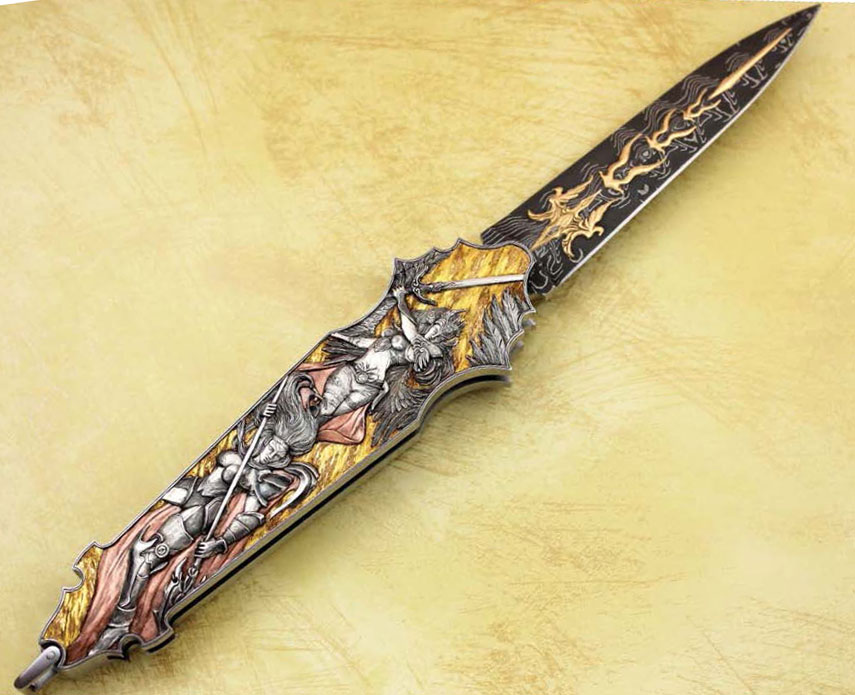
Instead of turning to cotton cloths for wiping down his knives, Carlos Lopez uses microfiber cloths. This beauty made and engraved with a fantasy warrior theme by Bulgaria’s Alex Gev has a special place in the Lopez collection, and is one of Carlos’s favorites.
Custom Knives Require a Special Kind of Tender Loving Maintenance
Most everyone knows what’s needed to care for a utility knife, including maintaining a working edge and wiping it down after use. However, keeping your custom knife as stunning as the day you first laid eyes on it is another matter. BLADE® polled four veteran knife collectors for their input on the subject. After years of collecting, they have more than a few ideas on how to keep knives presentation ready.
It may not be apparent when buying just one knife, but tallied up and considered together, knife collections can add up to a serious investment.
“It’s imperative that you preserve it as a group,” said U.S. Army veteran and long-time knife collector Louis Chow of San Francisco. “And even more so for the people that prefer a certain maker, you can say Loveless collectors or Moran collectors or what not, because it becomes a collection that is actually known to others.”
One knife care product Louis Chow has reached for over the past three decades to keep everything pristine is Renaissance Wax. Chow began using the wax after knifemaker Clay Gault recommended it to him. Gault was known for his natural handle materials. The knife is by Don Lozier. (Kris Kandler image)
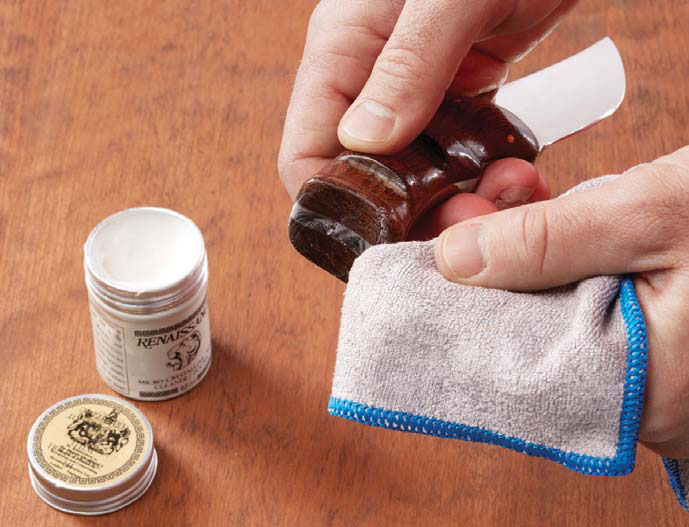
For the diverse kinds of knives in his collection, some with stainless steel blades and others with leather grips, Chow has reached for one product over the past three decades to keep things pristine: Renaissance Wax. Chow began using it after maker Clay Gault recommended it. Gault was known for his natural handle materials.
“If it’s good enough for the British Museum, I think it’s good enough for me,” Louis said of Renaissance Wax.
Researchers at the British Museum learned that natural waxes went acidic over time, which was not good for the museum’s relics. In the late 1950s, Dr. A.E.A. Werner reportedly developed Renaissance Wax in the museum’s research laboratory.
With Renaissance Wax, Chow doesn’t have to distinguish between blade and handle. It works equally well protecting carbon blades, stacked leather handles and the sheaths that encompass them.
When knives sit in padded, acid-free cases, the wax doesn’t soak into the fabric of the cases as oils do. After returning from knife shows and to remove the traces of soda, coffee and fingerprints, Chow wipes down his blades with cotton buffing cloths from auto centers or specialty shops. He uses the cotton buffing cloths instead of microfleece because the latter tends to leave fibers everywhere.
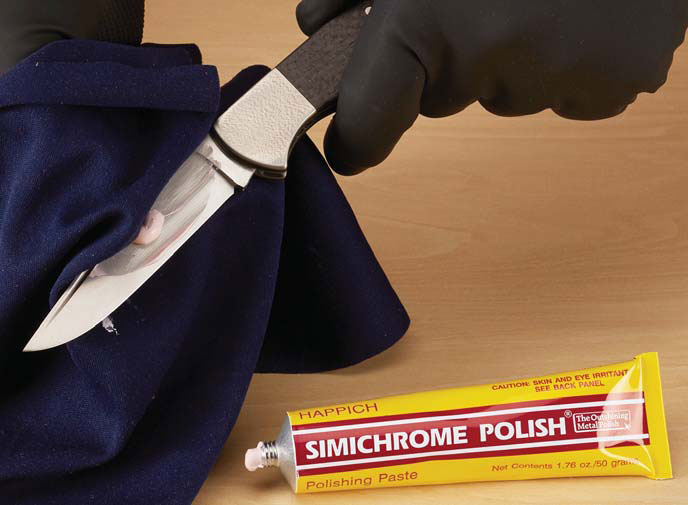
Louis Chow uses a polish paste on his carbon steel knives if he notices rust forming. He’s careful to use a mild polish without a lot of grit, such as Simichrome or 3M. Other polishes have a fine grit that, with a mirror polish blade, might change the condition of the finish. (Kris Kandler image)
Chow also uses a polish paste on his carbon steel knives if he notices rust beginning to form. He’s careful to use a mild polish without a lot of grit, such as Simichrome or 3M. Other polishes have a fine grit that, “if you have a mirror polish blade, that might change the condition of the finish.”
See the Light
Folder pivots by top makers don’t need a lot of lubrication because they are often made with tight tolerances. “Bob Terzuola once humorously mentioned to me how often people ‘over oil’ their knives, telling me how he would sometimes get knives back for a refurb that were literally dripping oil,” Chris Schluter recalled. If lint collects in a folder’s hard-to-reach crevices, a blast of compressed air does the trick. The folder is by Tom Ferry and the lube is by Quick Release. (Kris Kandler image)
Paul Kessler not only preserves the finely fitted and oft en engraved knives he collects, but he displays them as well. Of maintaining knives, he said, “It’s like taking care of your eyeglasses.”
The mortgage advisor’s maintenance routine begins when a new knife joins his collection. He cleans the fresh blade with WD-40. Kessler uses WD-40 only to clean blades. It tends to migrate, he says.
To lubricate folder pivots he uses Tuf-Oil or Breakfree.
“It’s a recommendation that I received from knifemaker Tom Overeynder, and they both work extremely well,” Paul noted. “They’re Teflon-bearing oils that won’t coagulate.”
Moisture and light are Kessler’s biggest concern when storing his knives. Just as sunlight changes the cabinetry of a kitchen, it can affect knives, he said.
“What happens with mammoth ivory, sunlight fades the color,” he observed. “When exposed to light, cocobolo gets darker. Elephant ivory, on the other hand, darkens and ‘patinas,’ and actually looks nicer.”
The first line of defense against light is museum glass that deflects the harmful rays. Kessler’s cases are lined with a Ph-neutral cloth and he turns to industrial magnets that hold the knives in place with 100 pounds of force.
He has used cigar boxes and antique picture frames to display his knives. They are French fitted, dustproof and airtight.
He stores fixed blades out of their sheaths and automatic knives with their springs not under pressure.
“I’ll use mineral oil with the 0000-steel wool on something that’s been exposed to the sun to bring the color back a little bit,” he said.
Every three months, Kessler moves his knives’ actions and oils the pivots with Tuf-Coat lubricant. He does not use Renaissance Wax. He finds that it leaves a film, giving the knife less of a luster.
Instead, he turns to RustFree, a product sold by A.G. Russell Knives. Kessler works a little on a cloth, wipes the knives and stores the cloth in a bag.
No Knife Wash Blues
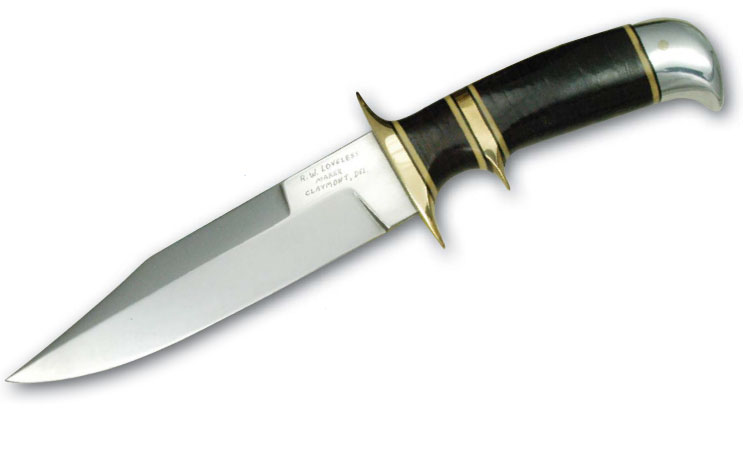
After returning from knife shows and in order to remove the traces of soda, coffee and fingerprints from his knives—such as this vintage Delaware Maid sub-hilt fighter by Bob Loveless—U.S. Army Major veteran Louis Chow wipes down the blades with cotton buffing cloths that he picks up at auto centers or specialty shops. He uses the cotton buffing cloths instead of microfleece because the latter tends to leave fibers everywhere. (Louis Chow image)
Carlos Lopez is a residential builder in Florida. Being a purveyor of high-end custom knives and running the website knifetreasures.com is his “fun job.” He compares the care of a high-end custom knife to that of a car.
“It’s like you drive a car, it gets dirty, you wash it. You gotta maintain it,” he said.
Showtime is maintenance time for Lopez, who will wipe down and open and close each blade. He uses light oil and Renaissance Wax. The cleaning continues throughout the show.
“At a show, anytime anybody picks up a knife, after they see it, you wipe it clean,” Lopez said. “Fingerprints and oils from the fingers can eventually damage and rust a blade or handle.”
However, instead of turning to a cotton cloth, Lopez uses microfiber. When a microfiber cloth gets dirty, he throws it away. The key, he says, is to keep the cloth clean so it doesn’t pick up a piece of dirt that will scratch the blade. He gets multipacks of the microfiber cloths because he has to throw away the many that get dirty.
Living in Florida, Lopez keeps his house air-conditioned. This maintains his home—and the knives within—in a low-humidity environment.
If one of his knives develops rust, Lopez usually sends it to the knife’s maker for a fix up. If the original maker is deceased, he sends the knife to a maker who does similar work. When it comes to specialty materials such as ivory, Lopez recommends two treatments. Applying Renaissance Wax—letting it dry and then buffing it off —or baby oil helps seal the material.
“If you go to dry-weather places with ivory pieces they can crack within a day,” he advised, “so yeah, you need to maintain them and seal them.”
Don’t Over Oil!
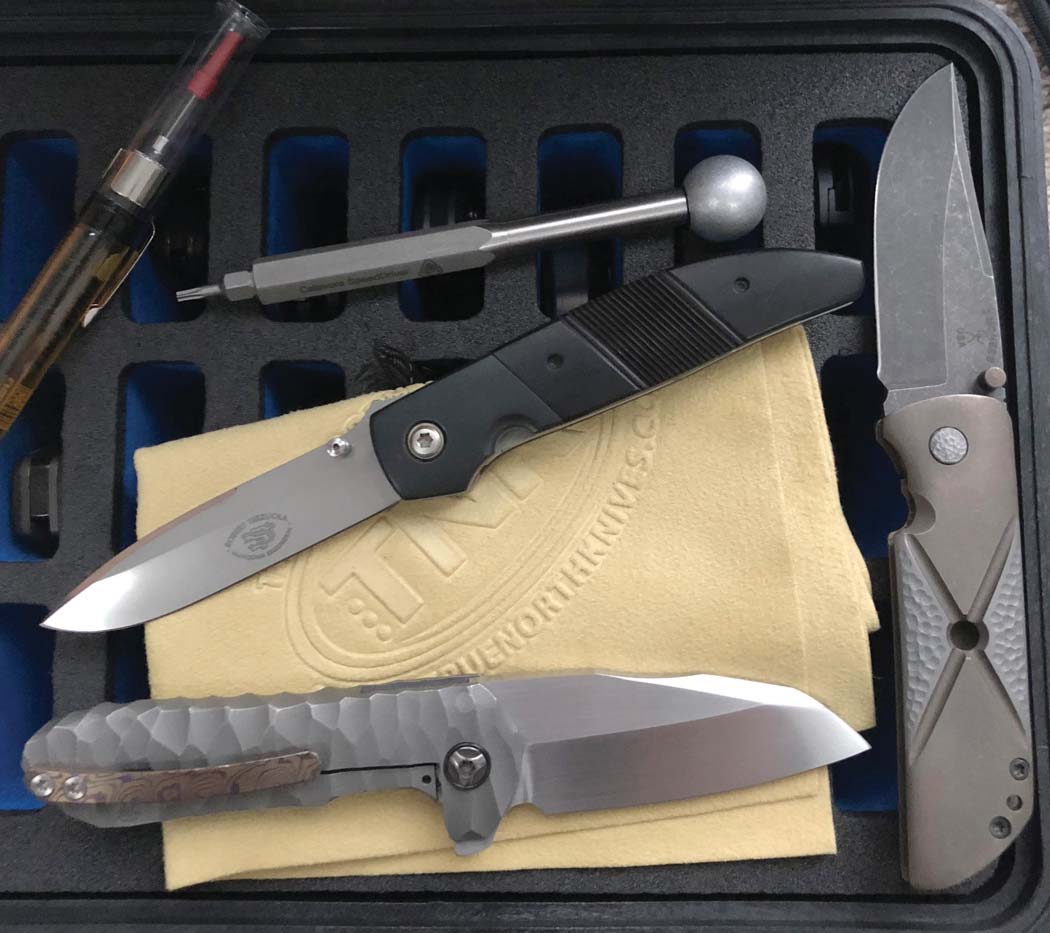
A peak inside the knife case of Chris Schluter (inset) reveals, clockwise from top left: a tube applicator of Breakfree pivot lube, a Torx driver from Prometheus Design Werx, the Tanjun by Jonathan Mcnees, Peter Rassenti’s Pebble and a Model 7 by Bob Terzuola, the latter two resting on a True North Knives chamois. (Chris Schluter image)
Unlike bone handles or carbon steel blades, maintenance for tactical knives is a bit easier—or so says Chris Schluter, a stay-at-home dad in Chicago who formerly worked at the German-American Chamber of Commerce.
“I love the utilitarian designs which a maker can dress up or down as desires,” he observed.
“Part of the beauty of tactical folders is that, normally at least, not a lot of care is needed,” Schluter said. “This can depend on materials, of course. However, many materials commonly used on tactical folders are by design robust and maintenance free. G-10, titanium, carbon fiber, zirconium, etc., really don’t need care. That leaves one with the blade to care for. Even then, it’s usually a high-performance”—and thus low-maintenance—“stainless steel.”
When it comes to the care of tactical folders’ pivots, they don’t need a lot of lubrication, Schluter noted, because they are often made with tight tolerances.
“Bob Terzuola once humorously mentioned to me how often people ‘over oil’ their knives, telling me how he would sometimes get knives back for a refurb that were literally dripping oil,” Schluter recalled. If lint collects in a folder’s hard-to-reach crevices, a blast of compressed air does the trick.
“Pivots which become loose over time should be tightened with the proper screwdriver or Torx wrench and a drop of Loctite® added,” Schluter said.
He stores most of his 300 custom folders in a large gun safe in padded pouches, and dozens adorn the walls of his office in display cases. As for care, he tries to wipe down each knife with a high-quality oil like Tuf-Glide a few times a year, or after he handles one.
“Unfortunately—or fortunately, depending on how you look at it—I just have too many knives now to do this all at once,” he writes. “These days I do this in batches or when I happen to be handling a piece.”
The key for him is to avoid the ever-creeping rust. For the knives in his safe, he throws in a few moisture-absorbing desiccant packs and moisture removers.
“As with any treasured belongings, protecting them is a priority,” he stressed. “I would hate to open my safe and find a bunch of rusty knives.”