Knifemaking

Knifemaking is the building of a knife, which includes the blade, handle and other accouterments. Blades are made by either removing metal from a steel blank via a grinder – known as stock removal – and the forging to shape of hot steel into a blade in the process known as bladesmithing. Other parts, including bolsters, guards, pommels, etc., are needed to complete the finished knife.

Featured Knives – – Knife Collecting – – Tactical Knives – – Survival Knives

Dads And Daughters: Passing The Art Of Knifemaking Down

0

The Older Generation Is Teaching The Next Crop Of Makers The Ropes Of How To Turn Steel Into Knives And Knives Into Memories.

Though it isn’t rare for kids to follow in the footsteps of their parents when it comes to choosing a career, the path to becoming a well-known custom knifemaker may just involve a bit more dedication than most other vocations.

For American Bladesmith Society (ABS) master smith Josh Fisher and Wolfgang Loerchner, the adventure has been quite rewarding as their respective daughters, Karis and Elizabeth, have become quite accomplished in their own right. 

Josh And Karis Fisher

The 2021 Texarkana Hammer-In was a memorable one for the Fishers, with Karis earning her ABS journeyman smith (JS) stamp, Josh his ABS master smith (MS) stamp, and each taking home the annual award for the best knife submitted by a JS and MS.

“When I was younger, I would always sit out in the shop watching my dad make knives,” Karis remembered. “Over time, I slowly started messing around sanding on pieces of metal, thinking I was making a knife. This eventually led to my interest. My first knife was a small full-tang hunter with a pink handle that my dad helped me make.”

Josh, no doubt, was ready and willing to help his daughter hone her skills when the time came. “Karis has always been pretty good at grinding blades,” he smiled, “but she struggled with guard fit up for a while and finally got that figured out.”

Of course, there were challenges and an obstacle or two along the way as Karis gained knowledge in the custom knifemaking world. She spent time at the forge, hammering away in preparation for ABS recognition, but that got placed on hold for a while.

“Yes. Definitely, I had a few setbacks,” she reflected. “I first attempted the ABS journeyman smith test in 2019 and failed. I then tried to retest the next year, but due to [the pandemic] it was canceled. In 2021, at the Texarkana Hammer-In, I finally got to retest and passed. Looking back, I think it worked out for the best because I was able to come back and win the Keeslar Award.”

The Joe Keesler Award is an annual honor for the best knife submitted by a successful journeyman smith applicant. If nothing else, the award validated the hours that both Josh and Karis had dedicated to her custom knife and bladesmith upbringing. And making the year extra special, Josh received his ABS master smith designation at the Texarkana Hammer-In, and later the B.R. Hughes Award for the best knife submitted by a successful master smith applicant. It, too, is an annual honor.

Josh added that sheer space and equipment limitations have impacted the progress of the Fishers’ work from time to time.

 “One of the main obstacles is working around each other in the shop,” he said. “We currently only have one grinder, so we sometimes have to wait for the other to finish before getting to work. Another grinder is definitely one of the next tools we are going to have to get.”

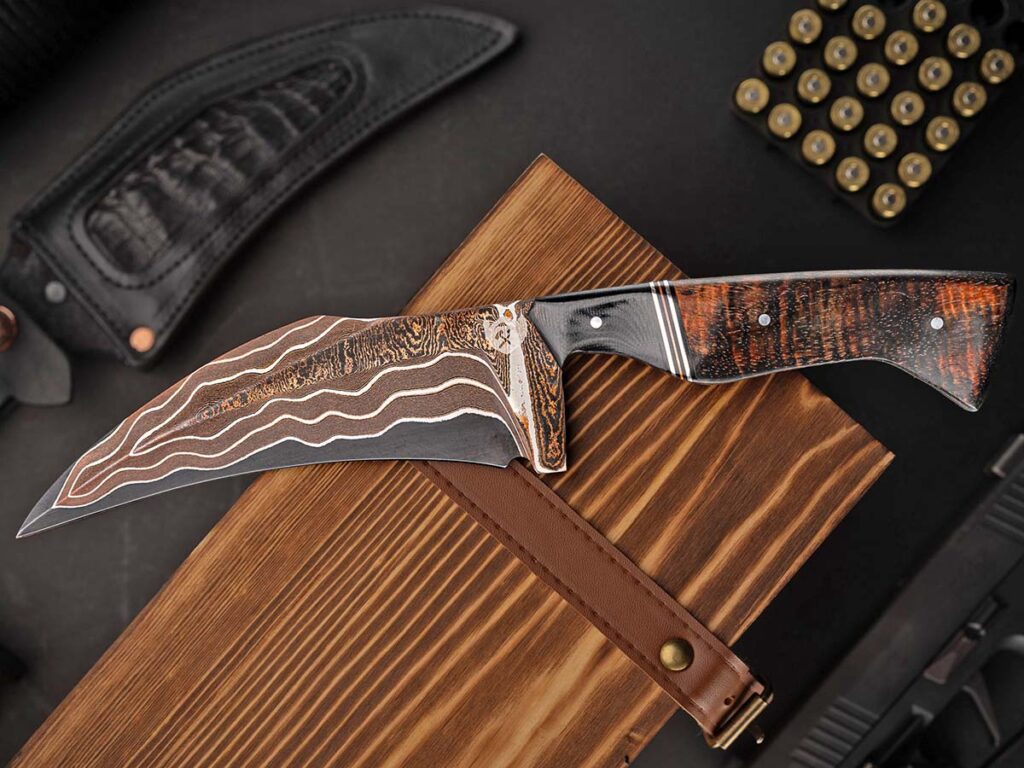
Bog oak comprises the handle of a Karis Fisher fixed blade with a recurve damascus blade.

Despite a little inconvenience, Karis has come a long way in a relatively short period of time. Family and friends are impressed. 

“All my relatives have always thought that it was cool,” that I made knives, she observed, “but my friends have always thought it was a little strange, especially the fact that my Instagram account has no pictures of me, just my knives.”

Her mom, Kim, is a big fan. “My wife loves to go to knife shows,” Josh related, “so she has always been supportive and happy about Karis and her work in knives.”

While Karis isn’t sure of an exact moment when she knew she wanted to make knives, the idea was never far from her mind. “I think I’ve always kind of known that it was something that I wanted to do,” she noted. “I enjoy making all types of knives, but small hunters are probably my favorite right now. I recently made my first slip joint, and I think they could easily become my new favorite.

“Probably my favorite part of knifemaking is seeing the finished product. But, if I had to choose an actual step, it would be all of the small embellishments and final finishing of the knives. If I had to pick a least favorite part, it would be hand sanding the blades!”

Wolfgang And Elizabeth Loerchner

Wolfgang Loerchner (left) and Elizabeth (right) had to share space in Wolfe’s crowded shop in the early days—at one point including long hours seven days a week for about a year—but it has all paid off. In the middle is Wolfe’s granddaughter by his eldest son.

The year 1982 was momentous for Wolfgang Loerchner. He made his first knife, and topping that achievement, his daughter, Elizabeth, was born. 

“It almost seems as if this path was destined for her,” he smiled. “Knives were a part of her life from the very beginning in various ways—observing the stages of the creation of a knife, the many shows, photos, and articles of the knife shows as seen in various magazines, observing friends visiting, and the many conversations that surrounded all aspects of knives. In some way, shape, or form, knives have always been a part of Elizabeth’s life.”

Elizabeth made an early step into knifemaking and then regrouped. Her second foray has been hugely successful.

“Having always had a strong interest in the arts, knifemaking was something I considered at one point when trying to decide my future,” she commented. “I made one attempt at knifemaking in 2003-2004. However, it quickly became apparent that the timing was not correct. It was not until several years later, after visiting the Milano Show in 2009, that I became truly inspired.”

Elizabeth and Wolfgang were sitting together on their return trip from the Milano Show, and she presented him with the idea of teaching her again. Of course, he was more than happy to get started, and Elizabeth began working on a knife design immediately. In January 2010, she sat down with her father once more—this time in his shop—and custom knifemaking quickly became a huge part of her life.

“I’ve had a couple of personal situations that did set me back,” she related, “but they have not kept me down. All around, there has been full support of my decision. Everyone has been happy to see me working in the arts and also to be carrying on what my father has been doing.”

Elizabeth’s mother, Dianne, shared a positive perspective. “I was glad for her, that she was able to use her artistic abilities to create knives. During her high school education, Elizabeth was always happiest when she was in the midst of creating an art project. In the few years directly after high school, she was thinking about steel and what she could do artistically with steel, which seemed a logical first step to me. 

“Elizabeth has an artistic flair that is unique to her, different from her father’s, and allows her to create pieces that carry more of a whimsical note to her knives. This is reflective of her deep creative ability. When she asked her father to teach her, I was a little hesitant since she had been living away from home for several years. While there were several tense moments, overall it was a good experience for both of them.”

Elizabeth’s knives have been recognized by aficionados worldwide at such exclusive venues as the Arts In Metal Show in Stresa, Italy, including this piece from the 2014 event. In fact, both she and her father have been regular exhibitors at the elite Italian show. (Francesco Pachi image)

The commitment of time and energy made for a few challenges in the learning process, but the entire experience has been worth the investment for Wolfgang and Elizabeth. Each has a distinctive design and artistic expression, coexisting, learning, and producing outstanding objects of art.

“One of the greatest obstacles we probably had to face was learning to work so closely side by side for so many long hours,” Wolfgang recalled. “There were other small obstacles. Working together in this way involved learning a whole new form of communication. We would often be saying the same thing but speaking it in a different language. Many mistakes were made as a result, but in due time we found our way to overcome this obstacle and work through things more smoothly and efficiently.”

Elizabeth recognizes the fact that she has learned to accept constructive criticism and teaching moments from her father. Wolfgang, on the other hand, points to a new method of communication developed as they worked together. Still, Elizabeth is adjusting.

“The most difficult part has been living in the path or shadow of my father,” she noted, “with the sense of needing to live up to the expectations of others. Creating my designs, it only seems to come naturally that my style is so similar to his. There are many reasons for this, and I constantly strive to find that fingerprint of my own.”

Elizabeth has always been an accomplished artist, drawing and painting with passion. Holding a file seems to come almost as naturally as working with a paintbrush or pencil. So, as her hand-eye coordination came together almost effortlessly, working in steel and making lines flow in knives was virtually second nature.

Fixed blades and integrals are the favorite types of knives for Elizabeth, and she appreciates their aesthetic qualities. 

“There is something about the power and strength of them,” she reasoned, “and what seems to be a limitless canvas. There is something pleasurable about working with folders and how the knife changes, whether open or closed. When working with daggers, fixed blades, and integrals, the limitations of working around the mechanical parts have been removed, and I find this gives more freedom to my designs.

“The most pleasurable part of knifemaking,” she added, “is the filework. Watching the steel slowly come to life, seeing the design come out of it as if it always lived there, is highly rewarding. The final finishing of a knife can be the most frustrating part. This is when any possible flaws start coming to light. Since I am my own worst critic, it can turn into a never-ending process of doing multiple things over and over again.”

Nonetheless, the Loerchners know they were destined to work together, one to learn from the other. In turn, each helps the other reach new heights of artistic expression.

Read More

Cool Customs: John Thunert’s Capemaster

0

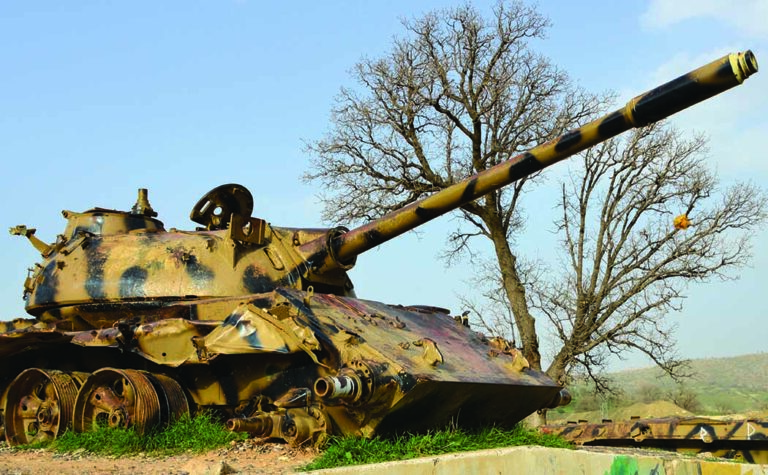
Utilizing Steel From An Iraqi Tank, John Thunert’s Capemaster Is A Skinner Built On The Foundation Of A Caping Knife.

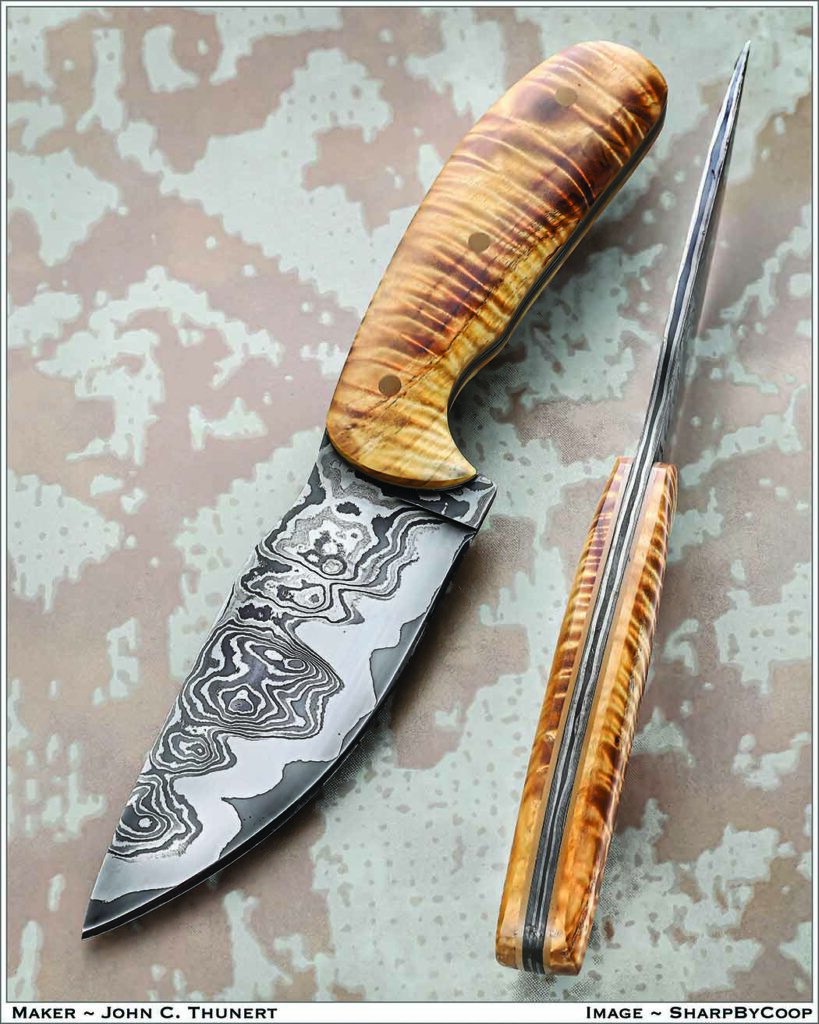
When John Thunert learned an acquaintance had some spare steel from an Iraqi tank, he jumped at the chance to buy some of it and forge it in the damascus of his Capemaster skinner.

Strips of steel 3×3 inches and 4×4 inches, each 3/16-inch thick, were torch cut from the armored vehicle, which was stored in a “tank graveyard” in Iraq. John cleaned the steel up, including removing some paint. He also got a copy of the form his friend had to fill out on the steel as a “war trophy,” which is how he was able to legally ship the steel stateside. “It kinda gives me some bona fides,” John noted.

Capemaster Knife

He said an analysis of the material identified it as a very pure form of mild steel containing 99 percent iron and few impurities. Though the knife started out as a caper, it kept “growing” until it became a skinner, but John kept the caper name. The handle is quilted poplar with pins of a subdued coyote brown G-10 to match the liners.

Who Is John Thunert?

John has been making knives since 2017 and has competed on The History Channel’s Forged In Fire show. He sells more than a dozen varieties of his Capemaster knife on his website, with the majority made from exclusively 80CrV2 steel. The majority of his Capemasters retail for $245.He has also made Bowie knives as well as multiple types of kitchen knives.

Capemaster Knife Specs
Blade Length: 4.75 inches
Blade Grind: Flat
Blade Steel: 80CrV2/1095/15N20/Iraqi tank steels
Overall Length: 9.25 inches
Handle Material: Quilted Poplar with Coyote Brown G-10
Price Of A Similar Knife: $625

Read More

In Memoriam Of Grant Hawk: 1941-2023

The award-winning knifemaker and designer passed at 82 after a life filled with adventure and craftsmanship.

Award-winning knifemaker and knife designer Grant Hawk of Hawk Knives passed away peacefully at his Idaho City, Idaho, residence on November 8. He was 82.

Born in Boise, Idaho, on Feb. 15, 1941, to Woodrow Allen “Kelly” Stroud and Dortha Bunce, Grant’s life was a remarkable journey of adventure, resilience and creativity. His early years were spent as a cowboy in Boise, where his connection with the outdoors and love for craftsmanship began. The 1960s saw Grant moving to California to make camper trailers, but he quickly became entangled in the revolutionary spirit of the era, leading to a brush with the law. This encounter prompted a pivotal decision in his life: to adopt a new identity and retreat to the Idaho mountains.

In his seclusion, living in a teepee, Grant’s interest in gold prospecting blossomed. This pursuit marked his gradual reintegration into society and laid the groundwork for his future endeavors. It was during this period of reflection and growth that he discovered his true calling in knifemaking.

Alongside his son, Gavin, Grant embarked on a remarkable journey in the world of craftsmanship. Together they forged a path in knifemaking, combining adventurous spirit with Grant’s innate skill and creativity. Their collaboration led to the creation of distinctive and innovative knife designs, earning acclaim in the knifemaking community.

His final accomplishment was completing his autobiography, which he delivered to the printer just two days before his passing. On the night of his death, he was in good spirits and feeling well, but unexpectedly fell ill and passed away gracefully within 15 minutes.

Grant’s life was a tapestry of diverse experiences, from cowboy to gold prospector, and finally to a revered knifemaker. His legacy lives on through his son Gavin and their shared creations, which continue to inspire and captivate knife enthusiasts around the world.

Grant’s story is a testament to the power of resilience, adaptation and the pursuit of passion. His memory will be cherished by his family, friends, and all who knew him as a man who carved his path, much like the knives he so skillfully crafted.

More About Custom Knives:

Cool Customs: Pat Antuzzi’s Hand-Knapped Fixed Blade

When it comes to crafting a knife, Pat Antuzzi works one flake at a time.

“What I do is go back to the Stone Age,” Pat Antuzzi says of his knapped obsidian knives. He has been knapping blades for almost a quarter century.

In that time he has found the best of the best obsidian to be the royal Mexican variety from the state of Jalisco in Mexico, a variety that’s basically been mined out. He used the material for the blade of his straight-edged fixed blade, as well as Portoro marble from Italy for the handle. But it’s the royal Mexican obsidian itself and how it’s knapped that are the keys.

Pat Antuzzi

“Every indentation you see on the blade is one flake removal from [the obsidian], and if it’s done right, you’re going to see it one flake after the other, just like the ancients would’ve done it,” he explained. “It’s wicked sharp.”

Hand-Knapped Fixed Blade Specs
Maker: Pat Antuzzi
Blade length: Not quite 5”
Blade material: Mexican gold obsidian volcanic glass from Jalisco, Mexico
Handle material: Portoro marble from Italy
Overall length: 9.5”
Maker’s price for a similar knife: N/A

Damascus: What Are The Hot Patterns And Steels In 2026

Jesse Harber and Coy Baker forecast the hottest damascus steel for ’26.

There’s something about predicting the future that has intrigued humanity for ages. If you could just somehow know which stocks would turn a profit, which crypto would “go to the moon,” or which numbers were coming in the PowerBall, you like to imagine that you could really take advantage. Thus far the ability to accurately predict the future has been a challenge, which begs the question—what damascus steels and patterns will be hot for 2026?

Jesse Harber of Vegas Forge doesn’t hesitate to jump right in.

“Our Reptilian pattern stayed hot in 2025,” he observes, “and it should continue to do well.” Vegas most often uses a combination of AEB-L, 440C and 302 stainless steels for contrast in its stainless billets. It prefers the combination of O1 tool, 1075 carbon and nickel-alloy steels for its carbon varieties.

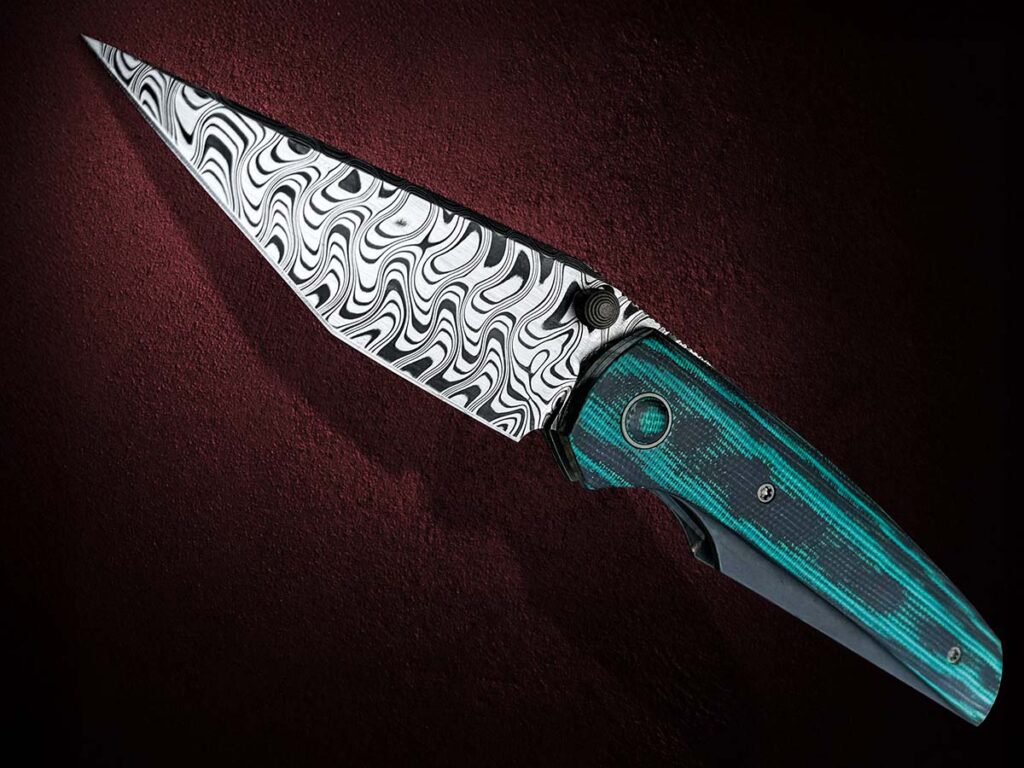
Jake McCoy used Baker’s Zeus stainless damascus for the blade of his folder.

Twenty-twenty-five was a fun year for Vegas Forge. It was able to continue making the steel it loves, the steel most knife enthusiasts all love to use—and it still managed to find time to innovate.

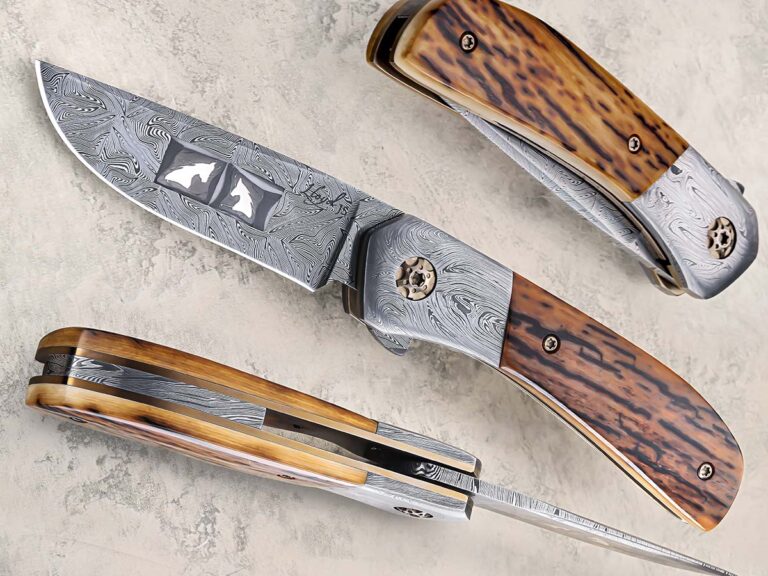
Makers have been using EDM cutouts in canisters to make unique figures and shapes for some time now. Over the past few years, a few have experimented with 3D-printed shapes inside canisters for truly limitless possibilities. Vegas has taken a different approach of using smaller cutouts within canisters that are then layered into “regular” damascus. There are obviously other critical details of the process not mentioned here, but the end result is small shapes or logos within the layers of the steel, not just as a shape like the other canister types you usually see.

Hammering Away At Baker Forge & Tool

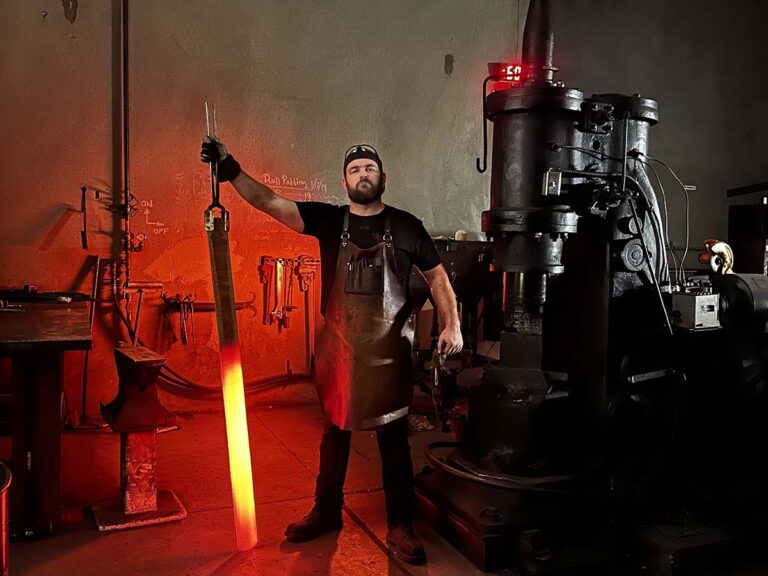
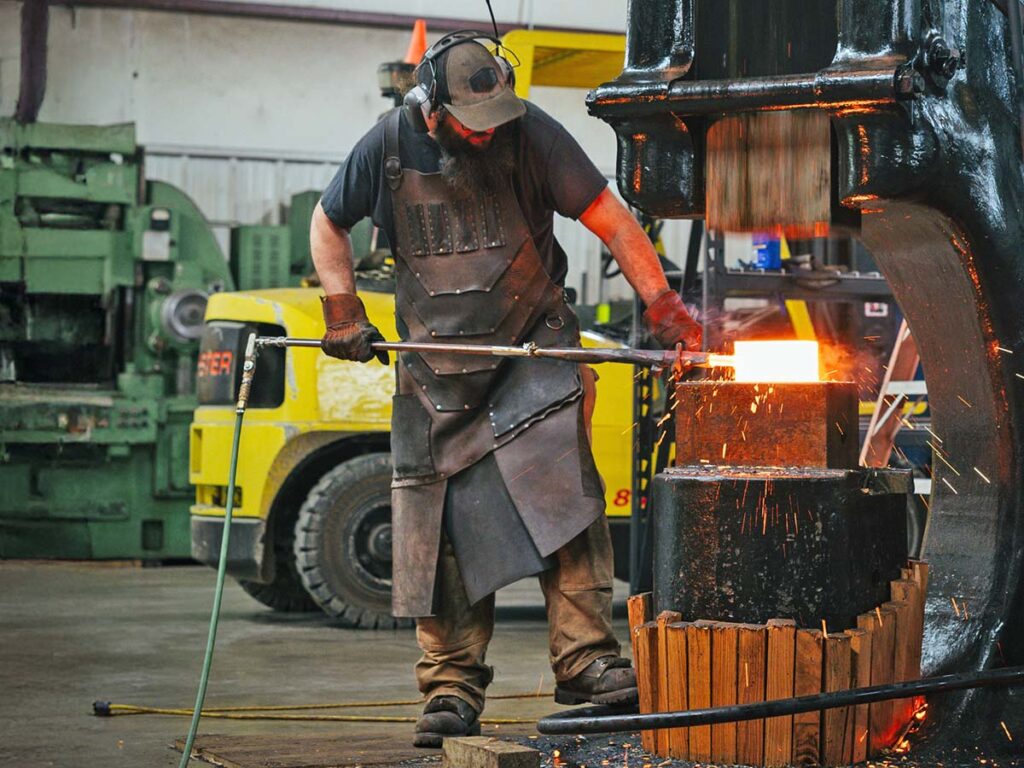
Coy Baker said Baker Forge & Tool is “really moving and shaking” for 2026, partly because of a new Chambersburg steam hammer converted to air. With a die surface of 6-by-14 inches and a 750-pound ram, the whole shop shakes when the hammer pounds on a giant billet. The hammer originally was used to make jib cranes for the Charlotte Railroad and runs on a 50-horsepower compressor with multiple 750-gallon air tanks. Coy stated he hasn’t pushed the hammer to its max, but said he thinks it can handle billets up to 35 pounds.

Baker’s Tsunami copper-mai steel is the material for the blade of a piece by Hans Molenkamp of Crimson Knife Co. (crimsonknives.com).

Why in the world would Baker Forge need such a giant hammer? Because the company, too, has been innovating and expanding into the production of stainless damascus. After two years of research and development and fine-tuning Baker’s processes for production, the prodigious pounder is finally up to speed. Baker prefers a combination of AEB-L and 154CM for its stainless damascus.

“The steel is really hard even when it’s hot,” Coy said. “Even with our 350-pound hammer it was like pounding on a rock.” The giant Chambersburg, on the other hand, moves a giant stainless billet with ease.

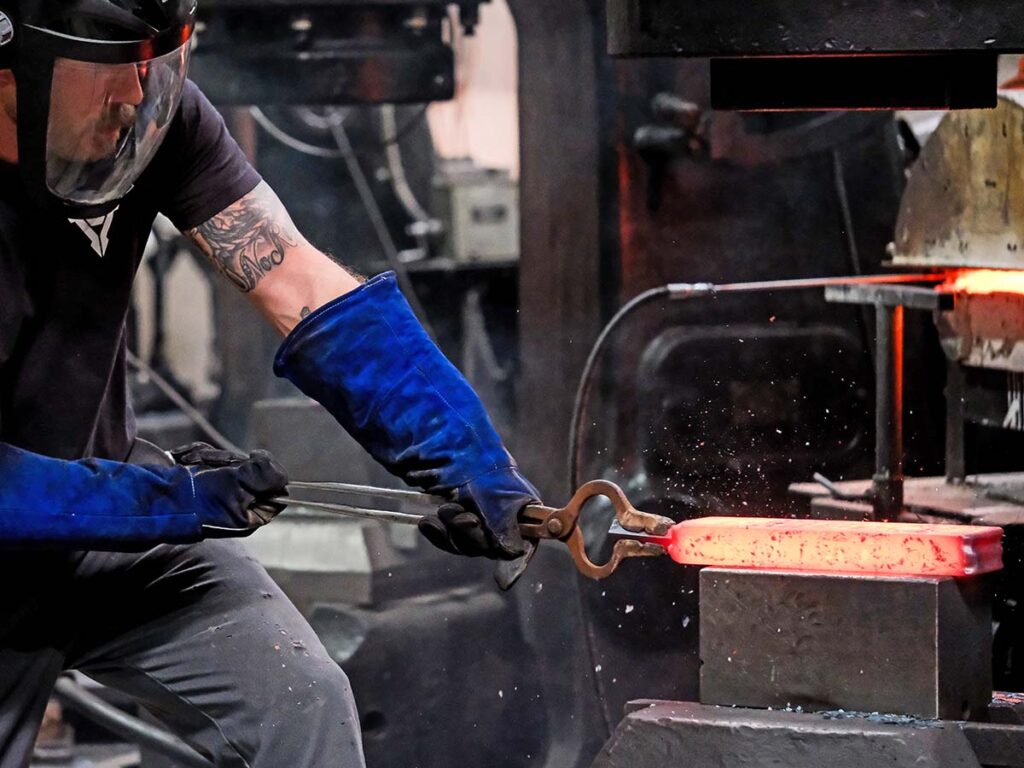
For those of you who don’t know, forging stainless damascus is quite a challenge, beyond the capability of many backyard smiths. Stainless steels contain high chromium, sometimes 12-to-15 percent, and chromium oxide doesn’t forge weld. Any oxygen at all in the forging environment and the welds simply will not stick. There are multiple ways to get around that, including inert gas purges and welding inside canisters. Add that to the fact that the stainless doesn’t like to move under the hammer and has only about a 100-degree-temperature window when you can safely work it, and you get a very difficult process.

Baker Forge & Tool’s Will Spears forges a billet of stainless damascus on the Chambersburg high-frame power hammer at Baker. Built in 1946, the power hammer has a 750-pound ram and weighs just shy of 11 tons. “It took us 14 months to install,” Coy Baker laughed. “The foundation for it is over 12 feet deep.”

Baker isn’t just producing stainless damascus in run-of-the-mill patterns, it is innovating. It has developed patterns it will use in its stainless steel exclusively, particularly one called Zeus.

Copper damascus has long been Baker’s hottest commodity, and it’s still producing it at high volume and quantity. The company is pushing the limits there as well and has developed a method to weld and manipulate copper on the end grain. While the technique is under wraps, the results will be broadcast far and wide: copper damascus in formerly unobtainable mosaic patterns. When clad over a monosteel or carbon damascus core, the patterns stretch the imagination of what’s possible.

Steel Industry Challenges

Both Baker and Harber mentioned challenges and areas for growth in the steel industry. Baker was the first to put BLADE® on the story about Buderus apparently closing its primary mill for 10xx series steels. Coupled with the recent closing of Crucible on the stainless side (see our article on Crucible Industries closing), both Baker and Harber have been exploring new steel options in case their mainstays become unavailable. Vegas in particular is moving toward more cores of Nitro-V and Elmax and moving away from MagnaCut and XHP.

Vegas Forge team member Franklin draws out a 40-pound canister of stainless Raindrop-pattern damascus on the company’s 5B Nazel hammer.

The hot new kid on the block is ProCut, the brainchild of a partnership between Larrin Thomas and Pop’s Knife Supply. Both Vegas and Baker are looking forward to pushing the limits of ProCut. As a high-alloy steel, when combined with Apex Ultra, the maker achieves high performance out of what looks like “ordinary” 1084/15N20 damascus. If you think of the difference in performance between 1084 and 52100 carbon steels, you’re on the right track. Baker Forge is currently in the lead on the ProCut “arms race” but Vegas Forge has steel in hand and is ready to go.

What fun new things can we expect in the world of damascus in 2026? Vegas Forge is entertaining a few recent orders that sound interesting. There’s a maker in Alaska using Vegas material to make high-end custom ice skates, and another customer using the company’s material to make stainless damascus computer keyboards. Who’d a thunk it? For those who enjoy a good picture show, Vegas has another top-secret project in the works. Think aliens with amazing damascus weapons and tools and you’re on the right track.

Take two leaders in the field like Baker and Vegas, factor in the demand for their top steels and add lots of innovation, and you get the makings of a really great year to come in the world of damascus.

More On Damascus:

Cool Custom: Jon Christensen’s Mythical Undertaking

Guardian Sword proves a painstaking quest.

It’s easy to toss around the word epic and difficult to describe Jon Christensen’s recent work any other way. Of course, the subject material for his two-handed sword made it challenging for the results of the project to be anything other than mythical.

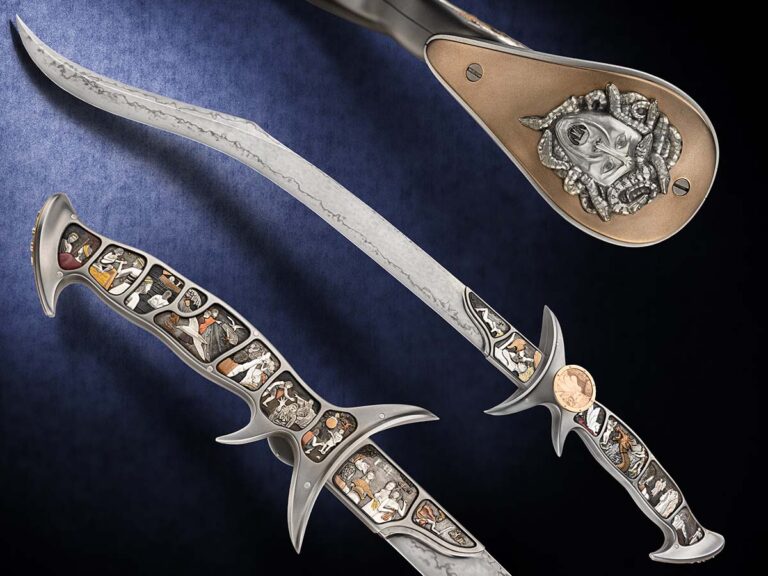
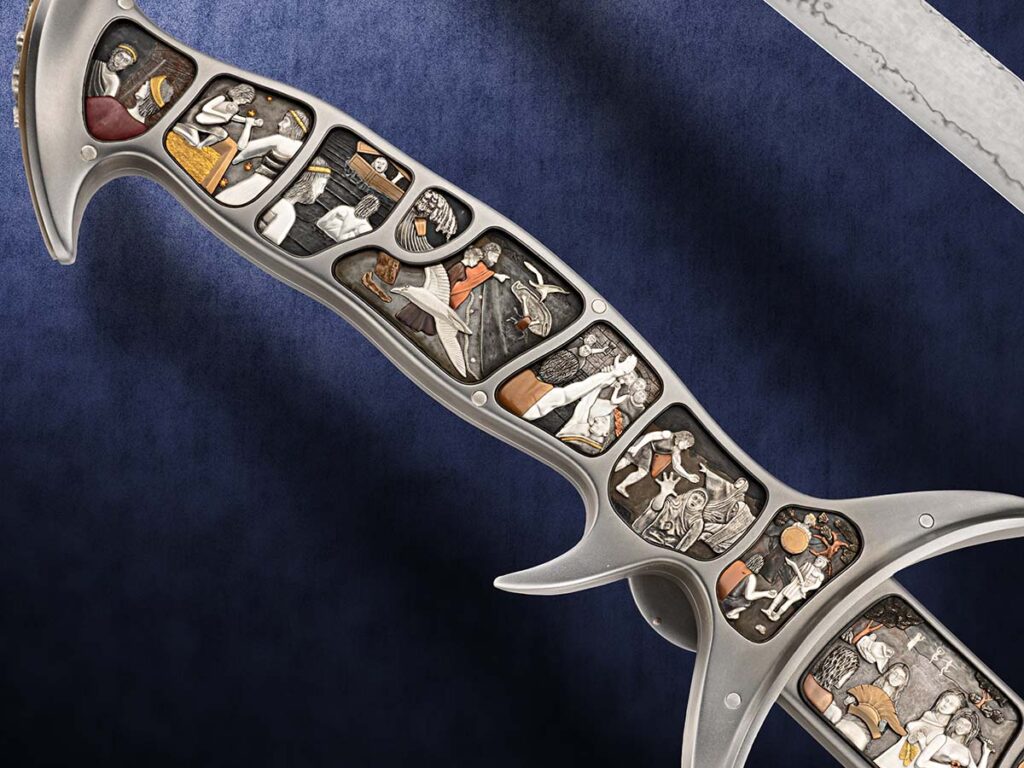
The Montana-based ABS master smith captures the ancient Greek myth of Perseus and Medusa in 16 hand-engraved iron panels inset into the 410SS handle and a bulino-engraved bronze shield on the guard of his Guardian Sword. Among other things, the handle features gold, bronze, copper, silver, custom alloy and mother-of-pearl inlay and is punctuated with Medusa’s head on the butt.

Jon Christensen
Jon Christensen

“The bulino engraving was very challenging as it was my first,” Christensen confessed. “There was a ‘paying my dues’ stage of time spent, which I just had to accept.”

It might be said that the entire project was an exercise in dues-paying. In addition to challenging himself with a new engraving technique, he was also delving into an unfamiliar subject. Christensen gave himself a crash course in the story of Medusa before conceptualizing the panels. But the client who commissioned the sword raised the bar on his retelling of the myth.

“Before starting on the project, the collector requested my interpretation of the story be approved by Tufts University, which is known for a strong program in classical mythology,” he said. “I compiled and submitted a document of the concept showing drawings and descriptions for each scene, as well as the overall sword. They replied saying, ‘It was a masterful interpretation.’”

The Guardian Sword handle, with the panels depicting the Greek myth of Perseus and Medusa.

The sword is reminiscent of the one featured in Benvenuto Cellini’s sculpture of Perseus, showcasing the same unique shape in its 37.5-inch W2 blade, with a hamon. While this aspect of the sword presented challenges, Christensen admits it was the easy part of the Guardian. Much of the 4,000 or so hours he dedicated to the work were focused on the handle, engravings and accurately retelling the ancient myth.

“The time on completing the blade would be measured in weeks, the handle scenes in years working under a microscope,” he said.
Epic, indeed.

“Yes, the scope of the project was very intimidating at times. I had to constantly manage my thoughts to the task at hand,” Christensen said. “As the saying goes, ‘How do you eat an elephant? One bite at a time.’”

Check Out More Cool Customs:

Samurai Chef’s Knives

Few Knives Have Been As Heavily Influenced By Japanese Methods As The Chef’s Knife. These Four Quality Blades Show Off The Modern Meeting The Historic.

The Japanese influence on custom knives is everpresent in the marketplace, and, aside from the tanto, nowhere is its flair and focus felt more than with chef’s knives. 

These tools of the culinary trade are functional as much as they are eye-catching, especially in examples of some of the top makers in the genre today.

Honyaki Byuto Hybrid By Dmitriy Popov

Popov Gyuto hybrid
Dmitriy Popov aligned the tip with the spine on his wide-bevel Honyaki Gyuto Hybrid for enhanced control during jobs requiring precise use of the tip. (SharpByCoop knife image)

Dmitriy Popov has conjured up a masterpiece he calls the wide-bevel Honyaki Gyuto Hybrid, a new take on a recognized Japanese style. 

“It isn’t a traditional gyuto, as it has an upswept tip and the height of a nakiri,” he commented. “Having the tip aligned with the spine of the knife gives the user a feeling of control for precise tasks requiring use of the tip. Having the extra height in the heel allows me to create a knife that is super thin behind the edge while also having a significant amount of mass above it.”

Popov’s creation includes a near 9.5-inch blade of differentially heat treated W2 tool steel and a handle combination of desert ironwood and osage orange complemented by a carbon fiber liner. His prices for similar knives range from $900 to $2,500 based on size and materials.

“The hamon and ashi* I am able to get out of the W2 is mesmerizing,” Dimitriy added, “and I spend a large part of my life going deep down the hamon rabbit hole. Honyakis are part art and part science, and the failure rate is a lot higher than I would like it to be. I really like the minimalist wa handle style [see page 14], and rounding off the bottom facet does not alter the traditional design much, while making the handle more comfortable in the hand.”

Having made knives since 2011, Dmitriy looks back at the beginning in everyday carry, tactical and camp models. After three years, he gravitated toward chef’s knives, and since 2016 they have been his sole focus.

“Everyone cooks, and at some point most cooks or chefs will come to appreciate the benefits of a good quality knife,” he observed of a chef’s knife field that has become quite crowded. “There are way more prospective customers than there are makers, so to succeed as a maker all you need is a very small slither of the pie and a drive to evolve your craft each day.”

Santoku-Style Knife By Eric Hemker

Hemker santoku
The long, nearly flat cutting edge of the damascus santoku by Eric Hemker enables it to slice, dice, and mince vegetables much easier than a blade with a sweeping belly. (SharpByCoop knife image)

While Eric Hemker admits he is still learning some subtleties of making chef’s knives, he has found that the santoku style is excellent for use in final food preparation. 

His custom-ordered version sports an 8-inch blade of random-pattern damascus forged from 1084 carbon and 15N20 nickel-alloy steels. The overall length is 14 inches, and the handle is exotic blue-dyed curly mango. His price for a similar knife is $960.

“The lack of a pointed tip on the blade means it is not well suited for delicate carving work such as breaking down bony proteins,” Eric explained. “However, its long and nearly flat cutting edge allows it to slice, dice and mince vegetables and proteins much easier than a knife with a sweeping belly on the cutting edge.”

Translating literally from the Japanese, santoku means “three virtues, or three uses,” and so the slicing, dicing, and mincing description is spot on. 

“This blade is 144-layer random-pattern damascus, and it features a full flat grind with a convex edge. The flat grind is my usual go-to grind for most general-purpose cutting needs that are common in the kitchen or in hunting-type knives. I also add a slight convex grind that leads into the cutting edge to aid in food release.”

Eric chose a modified wa handle configuration and attributes the decision to keeping step with traditional Japanese appeal. 

“The top of the handle has the traditional wa-style octagonal facets,” he said. “But I wanted to spruce this handle up a little to challenge myself, so the bottom is curved to give it a shield-shaped cross-section. The handle has a 304 stainless steel bolster and an heirloom-fit black G-10 spacer. One of the only things the customer specified was a colorful handle, so this piece of wood was a perfect fit.”

For Eric, the entire package comes together nicely, blending the good looks and function that are inherent in Japanese-inspired chef’s knives. 

“All these materials will hold up well in kitchens,” he remarked. “G-10 is a synthetic material that also holds up very well in any harsh environment, and since the wood is stabilized it should also hold up well in water and getting dirty in general. Since the handle is wood, it would still need to be oiled occasionally, and it should go without saying that a custom piece like this with a carbon steel blade and a wood handle should never go in the dishwasher.”

Eric began making knives six years ago and still considers himself at the beginning of a promising journey. 

“Kitchen knives have been some of my favorite knives to make from the beginning because everyone uses one,” he noted, “so they are some of the easiest pieces to sell and get feedback on.”

Meanwhile, he welcomes the expanding number of makers and buyers in the chef’s knife arena. 

“I don’t believe the custom chef’s knife market is overly saturated by any means,” he commented. “I think the demand really drives the market for these custom pieces, and I believe there will almost always be customers at every price point. In the last decade or so, there really has been a resurgence of demand for well-crafted handmade goods in almost every category of consumer goods, and I don’t believe that trend is going to be dying out anytime soon. This may be especially true for culinary knives when food is such a big part of many people’s lives.”

Straight-Edge Kiritsuke By Dre Laborde

kiritsuke by Laborde
The straight-edge damascus kiritsuke by Dre Laborde is specifically made to slice fish and some softer meats. The handle is curly maple from Realeyezwoodz. The sheath is stabilized maple and a joint project between Dre and Realeyezwoods. (SharpByCoop knife image)

The straight-edge kiritsuke from Dre Laborde is specifically made to slice fish and some softer meats, he says, and doesn’t necessarily lend itself to chopping vegetables. 

“I’m no expert on Japanese knives as a whole,” he noted, “but from what I can find the kiritsuke seems to be a cross between the longer yanagiba and the stockier gyuto. The steel is X-pattern-ladder damascus that I purchased from MVH Damast based in the Netherlands. These steels have given me nothing but positive results and I can’t recommend them enough.”

The blade is 9.5 inches and the overall length is 14.5 inches. The handle is curly maple from

Realeyezwoodz, and the price of a similar knife would probably exceed the featured piece. 

“It sold for $760,” explained Dre, “but it was a semi-experimental project for me, so a future project of this scale would cost more. The design, like all my knives, was drawn on paper to scale first and then made with the freedom to change the design as I see fit.”

The choice of handle material and design contributed to the overall appeal of the knife and its performance in the kitchen. 

“The wood is stabilized, which means it was put under vacuum in a resin and hardened,” said Laborde. “This makes it resistant to water and to staining. The handle design is a slight variation on the common shape I do, made slightly longer to fit the length of the knife.”

Dre has been making knives for about three years and in that time hasn’t seen the chef’s knife market becoming overcrowded, though he has heard such comments. “Those willing to pay for a custom chef’s knife often have many and recognize the price tag that comes with them,” he added.

Haetori Honesuki By Tony Cetani

Haetori Honesuki by Tony Cetani
The Haetori Honesuki by Tony Cetani is an all-around kitchen utility knife design based on the santoku and honesuki, the latter a Japanese boning knife. Whereas a traditional honesuki’s main task is for deboning poultry, Tony made the Haetori Honesuki to handle multiple kitchen jobs.

When Tony Cetani built his Haetori Honesuki with a 5.5-inch blade of Chevron copper-mai steel and an 80CrV2 core from Baker Forge and Tool, he added a handle of spalted box elder to complete the package and priced it at $1,000.

“Haetori means ‘jumping spider’ in Japanese,” he related, “and following my love for spiders this knife is named for the Haetori Gumo, a very common spider in Japan. It’s an all-around kitchen utility knife, and I based the design on the santoku and honesuki. Whereas a traditional honesuki’s main task is for deboning poultry, I made this to handle multiple tasks around the kitchen.”

Tony has been making knives since 2017 and tried chef’s knives for the first time three years later. 

“Once I got a few kitchen knives under my belt, I fell in love,” he smiled. “I wanted to put kitchen cutlery on the market that was different and not your traditional kitchen-style knives.”

He succeeded with this effort and chose a slightly innovative handle style. 

“This is a newer style that I designed specifically for this knife,” he said. “Adding a clip at the butt of the tang gives the palm a comfortable spot to rest when working the knife. I chose natural spalted box elder because it went well with the copper in the steel, and you can’t ever go wrong with box elder!”

As for today’s chef’s knife market, Tony sees strong demand and the capacity to supply it. 

“There are a lot of makers out there putting out phenomenal chef’s knives. I think every maker has their style, and the style is what grabs the attention of a potential customer.”

*Ashi are various notches or details in hamons. To produce ashi, the maker applies thin strips of clay from the spine of the blade to the edge during the clay tempering process, which contributes to interesting variations in the resulting hamons.

Read More

Advertisement

Must Read Articles

Read this before you make a knife

Knifemaking 101 – Read This Before You Make a Knife

  by Wayne Goddard My experience has taught me that there's nothing like digging in and getting started. I've often said the hardest part of the...
how to forge damascus steel

How to Forge Damascus

Advertisement
Advertisement