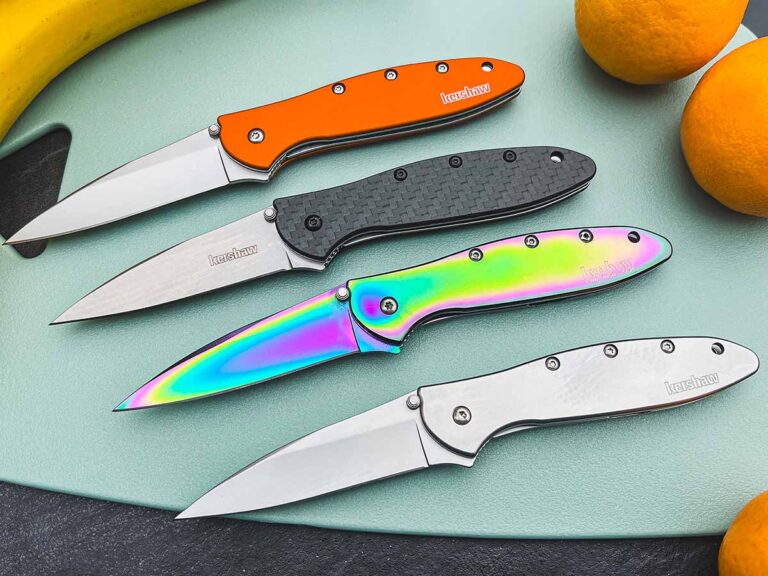
A Ken Onion design, the Kershaw Leek has cut a commanding profile.
It’s no wonder why the Kershaw Leek is such a phenomenal EDC folding knife. It has all the right elements that knife users crave—style, sturdy construction, premium materials, an impressive selection and is priced right.
The Leek is essentially the bigger brother of Kershaw’s Chive, answering the call from knife fanatics for a larger option of this Ken Onion design. And the petite option doesn’t disappoint.
We’ll examine why it’s been a popular seller for Kershaw, explore some popular variants and find out why this isn’t your garden-variety EDC knife.
Kershaw Leek Blade
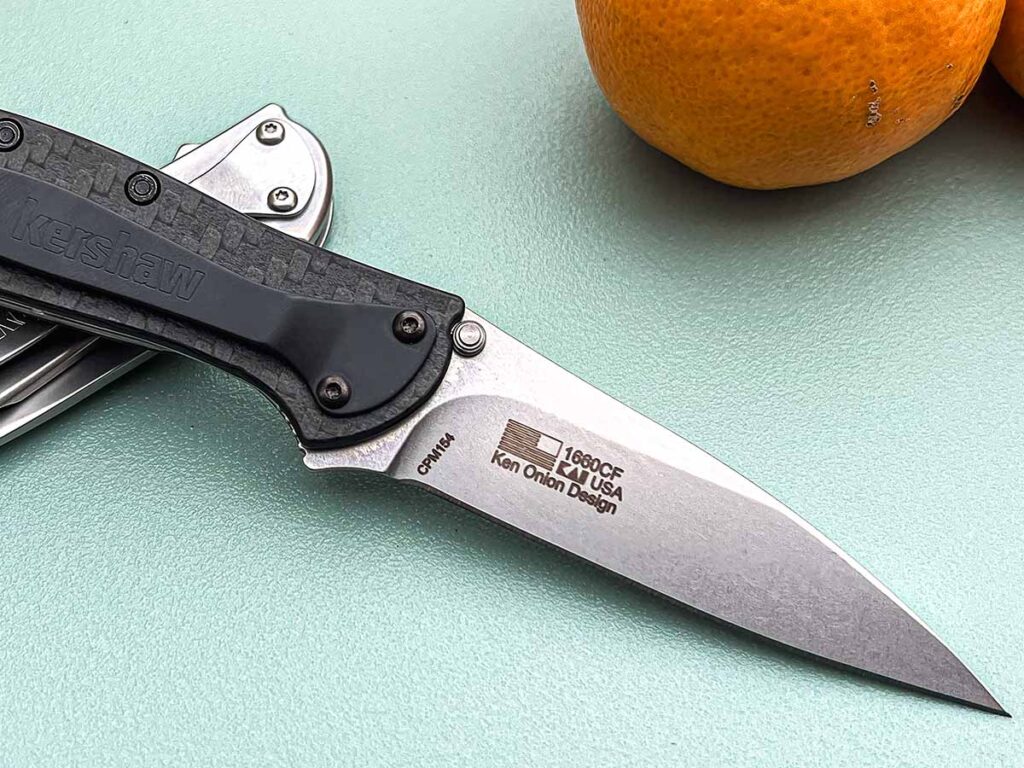
The Leek’s blade measures 3 inches and is made from Sandvik 14C28N stainless steel, making it great at holding an edge. However, it’s the blade’s profile that demands attention. It’s a modified clip point and the profile tapers down to almost a needle tip. This is both a good and bad thing, which I will go into in depth later.
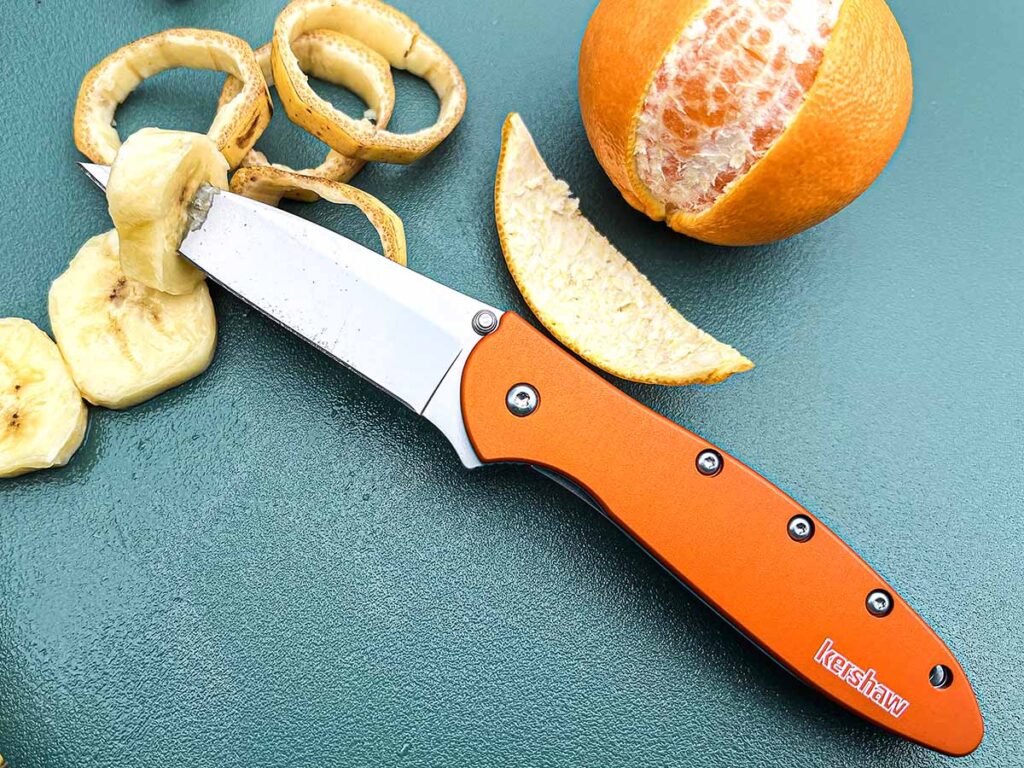
A born cutter, the Leek’s modified clip point blade made quick work of nearly any task set in front of it. Photos by Marty Stanfield, Marty Stanfield Photography
The hollow grind of the blade thins it down nicely to where the blade takes a smart, sharp edge easily. Dual thumb studs are present, but do not function as traditional thumb studs. Instead, they are used only for a positive stop in the open position.
Kershaw Leek Handle
The handle is a slender, elongated shape that favors daily carry due to its thin profile. The handle itself measures 4 inches, bringing the overall length of the Leek to 7 inches when open.
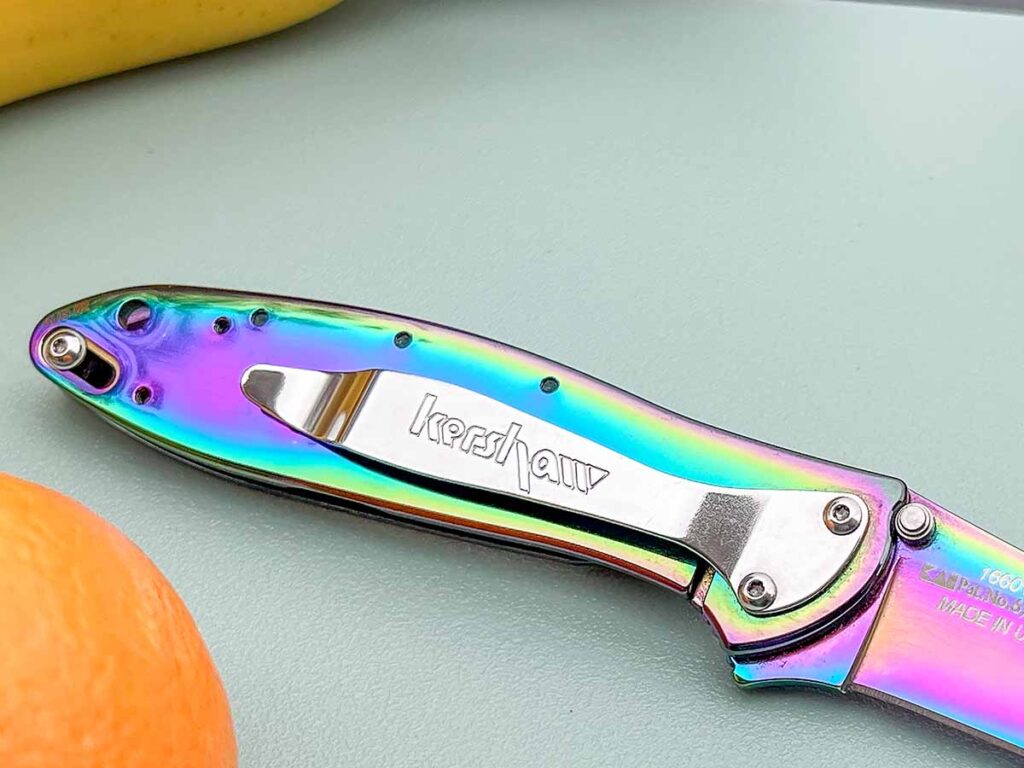
The handle sports a nice, comfortable chamfer all the way around making gripping it easier and presenting fewer hot spots. A large, steel pocket clip can be affixed to the handle to carry the Leek in the tip-up or tip-down position, whatever you wish to do. The clip holds the Leek securely in your pocket, and it can be removed as well should you desire to carry it in the bottom of your pocket.
A movable clip allows the Leek to be carried tip-up or tip-down. Photos by Marty Stanfield, Marty Stanfield Photography
The base Leek (model 1660) has a handle of bead-blasted stainless steel with a matching bead-blasted blade. The Leek is available with a variety of handle finishes, from several colors of anodized aluminum to black PVD-coated, Blackwash and carbon fiber, to name a few.
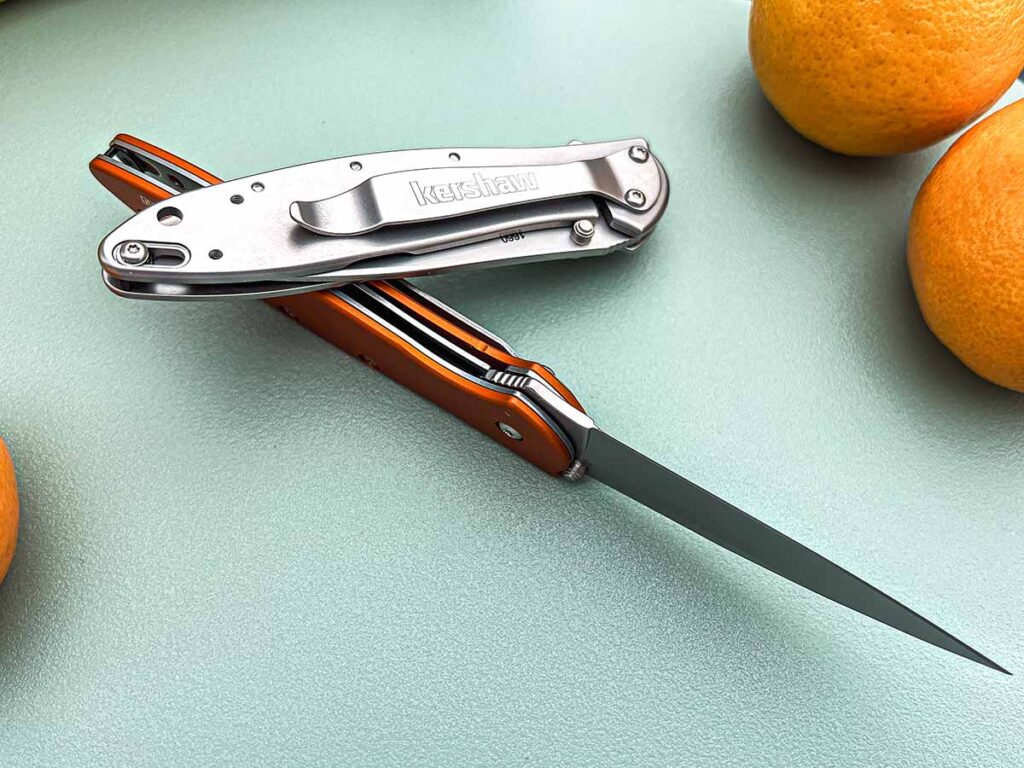
As for the lock, it’s a frame lock that engages the blade tang positively, securing it in the open position. Very solid and easy to operate when you’re ready to stash the blade.
Testing The Leek
For this review, Kershaw sent me several of their popular selling Leek models for closer examination. I have the 1660 base model Leek with a bead blast finish on the blade and handle. The 1660OR is a liner lock and has orange-anodized aluminum handles. The Leek is available in an array of anodized aluminum colors. Speaking of colors, there’s also the very unique 1660VIB which is a high polish 1660 with the addition of a rainbow titanium coating. And finally, we have the high-tech 1660CF liner lock which features futuristic carbon fiber handles and upgraded blade steel to CPM154 for higher performance cutting and longer edge retention
My pick of this bunch is the 1660CF, given there’s a lot going on with this particular model. You get the benefit of the unique look and the lightweight of the carbon fiber, combined with the high-end blade steel. The 1660CF carries very well due to the reduced mass compared with the regular 1660 Leek framelock.
The Leek’s frame lock is sturdy and easy to manipulate. Photos by Marty Stanfield, Marty Stanfield Photography
Structurally speaking, the base model 1660 Leek frame lock has a very rock-solid lockup. It’s very hard to defeat and only closes when you deliberately command it to. It actually makes a good work knife as long as you use it as a cutting tool and nothing else that it wasn’t designed for (more on this in a bit).
Performance-wise, the Leek—across the board regardless of the blade steel or handle configuration—is definitely a slicer. The blade stock is very thin and when it is ground, it is attenuated even more.
Right out of the box, the leek has a lot of bite. It goes through thicker stuff like cardboard very easily. The tip being acute, makes for an excellent scoring tool as well. The Leek excels at being an all-around EDC cutter.
The blade opens fast, with the press of the exposed flipper tab on the blade spine, Kershaw’s Speed Safe assisted opening technology takes over and powers the blade to the fully open and locked position. It’s easy to see why the Leek remains a popular Kershaw model after all these years, it simply works well and is a good-looking design.
Leek Sticky Points
Two of the most common failures I have seen in the Leek are where folks misuse the knife as well as the sliding safety breaking.
While the blade is an accomplished cutter, it’s thin enough the tip is easily damaged when used to pry. Photos by Marty Stanfield, Marty Stanfield Photography
Because the tip of the blade is pointy, it’s a weak spot with the knife. Where you get into trouble is when you use the tip to pry, even lightly. This either results in a bend or break off entirely. This is a cutting tool, not a pry tool or screwdriver.
Each Leek also comes with a sliding safety that, when the blade is closed, you slide over the tip of the blade to physically block it from coming out of the handle. There is a hex screw on the backside you use your thumb to move and this moves the safety. Sometimes the safety can slide on its own while the blade is open; when you go to close the blade it comes down on the safety tab. If done hard enough this will cause the safety to break, as it is plastic. The nice part, the tab is replaceable.
Final Cut
Other than these points, the Leek is a proven EDC knife. It’s rather compact, slender, and doesn’t garner unwanted attention. It’s worth a look if you’re in the market for a blade that balances looks and performance.
As for price, the MSRP for the base 1660 Leek is $115. The 1660OR orange handle Leek is $105. And the Carbon Fiber 1660 CF runs $190. In the scheme of things, not bad pricing for USA-made EDC folding knife—particularly with an Onion pedigree!
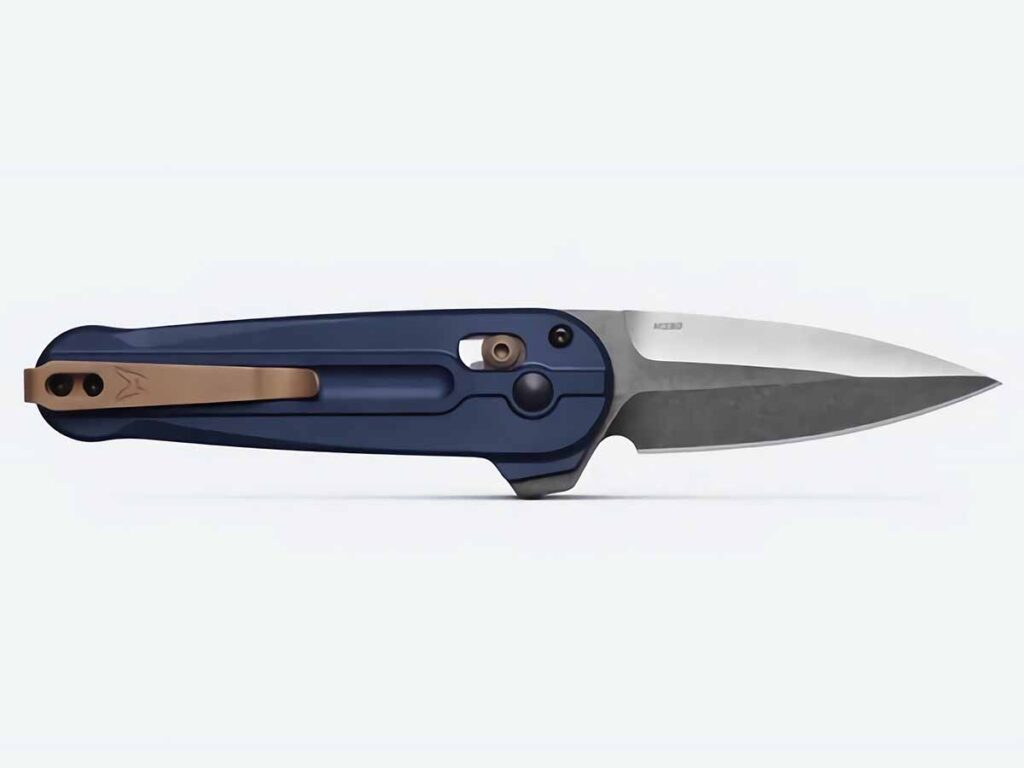
A bold new release from Benchmade, the Lowden blends premium materials, M390 steel, and fidget-worthy deployment in a sleek, spear-point EDC design.
Benchmade just shook things up with the release of the Lowden—and if you’re into flippers, this one’s going to catch your eye.
Known for their rock-solid AXIS lock and high-quality builds, Benchmade isn’t typically the first brand you think of when it comes to rear flippers. But the Lowden changes that.
This sleek little blade flips open like a dream. You’ve got the option of using the flipper tab or sticking with the tried-and-true AXIS lock for one-handed deployment, and both are smooth and snappy. It’s a fun, fidget-friendly knife that doesn’t compromise on function.
The Lowden sports a 2.79-inch spear-point blade made from M390 super steel—translation: this thing holds an edge like a champ, resists corrosion, and is tough enough for serious work.
The handles are lightweight anodized aluminum with a stainless-steel inset frame, giving it that slim, dagger-inspired profile without skimping on strength. Plus, Benchmade matched the color on the AXIS button and deep-carry pocket clip for a clean, cohesive look.
Sure, a spear-point blade might seem like an odd choice for EDC or outdoor use, but in practice, it works. It’s surprisingly versatile, with great piercing power and slicing ability. The ergonomics are solid too—with an ample handle fitting comfortably in a wide range of hand sizes and offers a confident grip.
Are there a couple of nitpicks? Sure.
There’s no lanyard hole, which could be a downside for folks who like a little extra security, and the flipper tab could use some jimping. But overall, the Lowden is a refined, premium knife that’s just plain enjoyable to carry and use—classic Benchmade quality with a fresh twist.
In the field, these knives always help you keep your edge.
And now for a style of edged tool that brings its own brand of controversy most wherever it goes—the replaceable-blade knife. No, not the utility knives you see in a ton of kitchen junk drawers, tradesman’s tool bags and on garage workbenches, but the models made for hunting and possible EDC use.
The controversy tends to surface between the traditional knife-carrying crowd and those who appreciate convenience. As one who loves and teaches sharpening, I tend to leave the replacement blades for my utility knives. These days, however, they have made their way into many different knife styles.
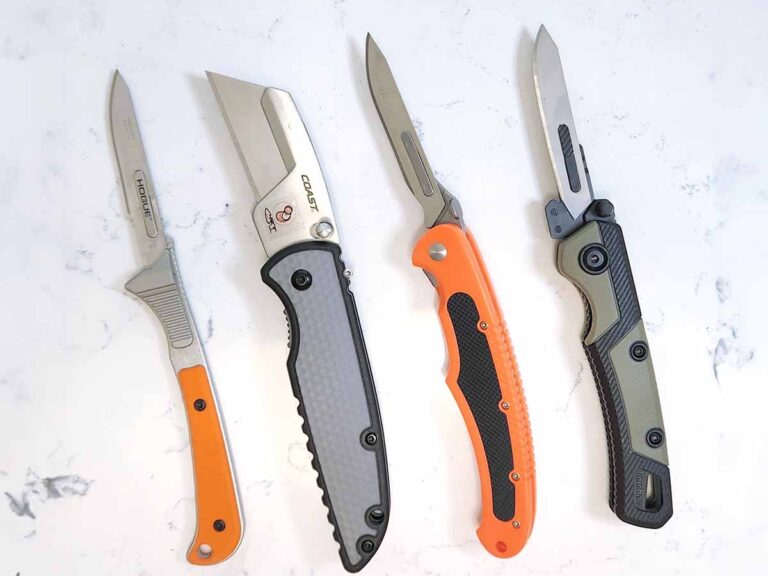
I’m going to gauge how four of the latest replacement models cut and handle, and, most importantly in my mind, how easy it is to change a blade on each one.
Hogue Expel Scalpel 2.5
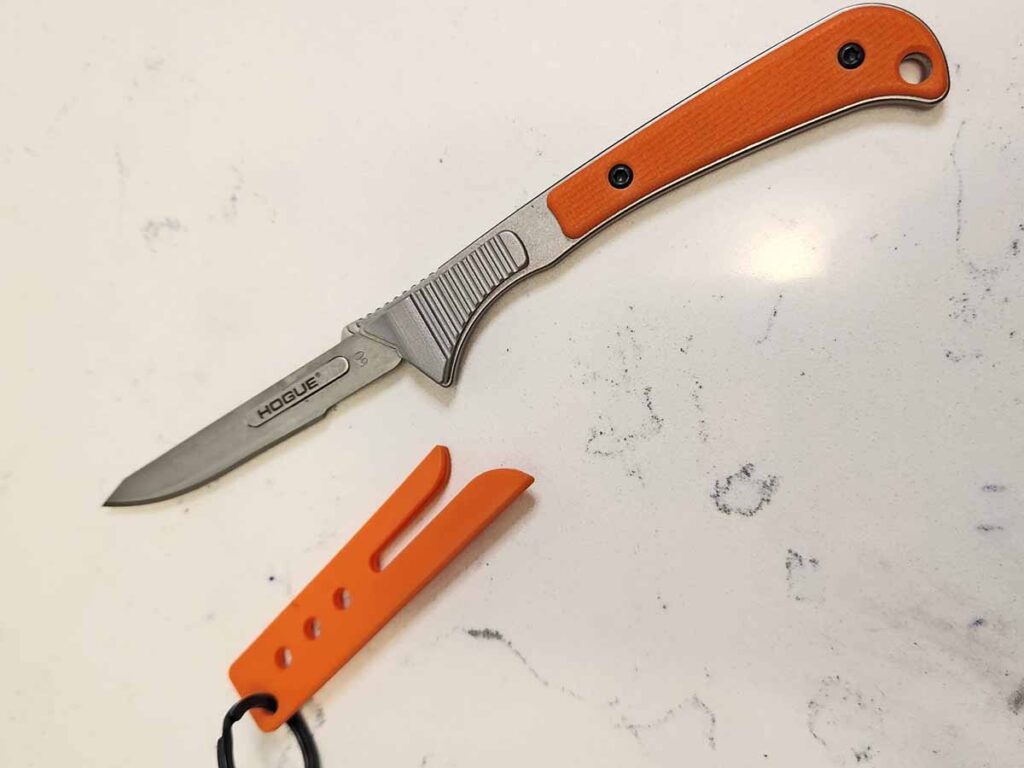
You get a sturdy full-tang design with Hogue’s Expel Scalpel. A tight-fitting cover with a split ring carries the blade. Country of origin: USA.
Right off the bat, you will notice the Hogue Expel Scalpel 2.5 is some serious gear. The handle is a steel tang construction with textured G-10 scales in a blaze orange. The front bolster area is gimped, complete with a thumb ramp. Though the bolsters are screwed on the thumb ramp is not reversible, so sorry to all you southpaws out there. The handle is American made but the blade is marked England and #60. A #60 scalpel is used in dental surgery and postmortem work (it’s nice to know medical examiners wait for the person to expire before they start hacking into them with such a scalpel). Instead of stainless the blade is a high carbon steel. If you want to prolong the life of the Expel’s replacement blade, you can easily strop it.
Since it is an actual scalpel blade, that means you should be able to source multiples of them easy enough. I would go online and order. Since the pattern is used for postmortem work, that would raise fewer eyebrows. I did a quick check and was able to find a pack of 20 of the blades for around $10.
Hogue’s design for its replaceable blade knife uses the traditional blade mounting system. The best way to change the blade is with a pair of pliers. Doctors usually use a set of forceps. Handling wise the knife is quick and nimble. You hold it like a regular scalpel, with your index finger along the blade spine, and guide the edge. It comes with a zipped pouch and a plastic sleeve that fits over the blade. Having the textured G-10 scales and beefier handle contour enhances purchase. I like the design. It fits my hand well. I had perfect control over the edge. I wouldn’t hesitate to take this with me hunting and use it as a caping knife. I certainly will be packing it for pheasant hunting this fall to process the birds and clean up the gizzards.
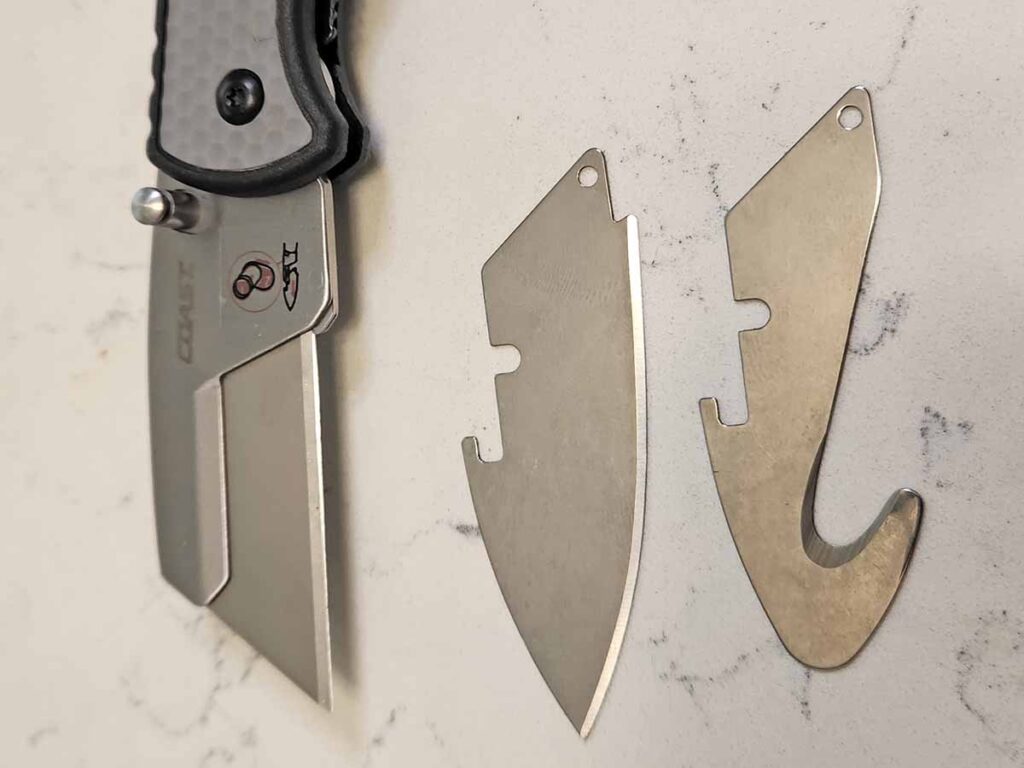
The selection of blades Coast supplies with the 1919 is compatible with regular utility blades. From top: an attached regular utility blade, drop point and gut hook. Country of origin: China.
With the 1919 Reserve Shift, Coast has gone with more of a traditional utility folder design. Don’t let that fool you, though, because the knife does offer some innovations. Coast has patented both the blade changing arrangement—called the swap out system—as well as the blade storage system. Two of the three blade styles that come with the knife are customized: the spear tip and gut hook. The third is a regular utility pattern. The system is compatible with standard utility blades, which means you can buy other patterns such as serrated and a roofer’s hooked blades. I don’t know why the company bothered designing a gut hook, as a hooked utility blade would work just as well. The handle is a glass reinforced nylon with a textured rubber insert. The 1919 carries in a pouch sheath.
There are two locking systems. The primary is a linerlock and a double lock prevents the liner from moving to the side. A thumb stud provides ambidextrous one-hand opening. The stud is also part of the opening system. Depress the button on the stud, slide the stud down and the blade comes out.
The blade release system works well but, as far as innovation goes, it doesn’t draw a “wow” from me. Conversely, that Coast bothered to care about how easy it is for you to access the extra blade storage is impressive. It is a straightforward arrangement but, after all, what good is a replaceable-blade system if you can’t get at the extra blades?
Overall, the knife handles like any other utility folder, but the devil is in the details. All the little extras help it edge out the other similar designs. Best of all, except for the proprietary blades, you can pretty much walk into a Walmart and get a blade for the 1919.
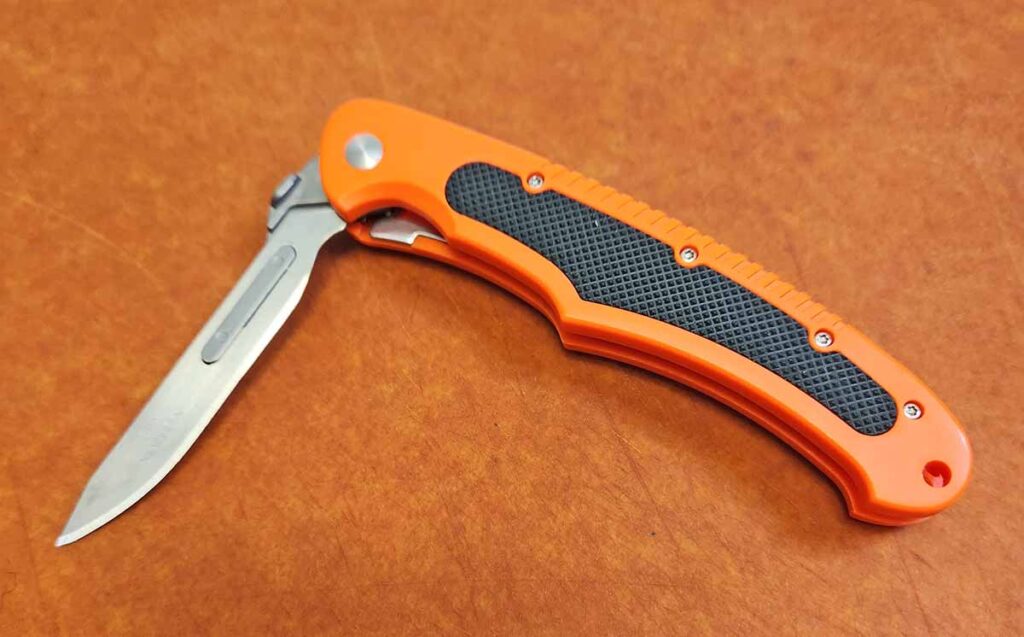
Note the thumb disc on the Havalon Bolt’s blade holder, which makes ambidextrous opening possible. Also, the bright orange ABS handle on this replaceable blade knife makes it more likely you will find the knife if you ever set it down. Country of origin: handle made in Taiwan and the blades are made in India.
The Havalon Piranta Bolt is a blend between the Coast 1919 and the Hogue Expel Scalpel. The Bolt uses a #60 surgical blade like the Expel Scalpel, though Havalon’s is marked 60A and listed as stainless steel. The blade opens via an ambidextrous thumb disc and locks via a linerlock like the 1919.
A belt carry case houses 12 extra blades. If you only occasionally stropped your blades instead of changing them out, you would have a ton of cutting time. The handle is a bright orange ABS plastic with a textured rubber insert. It feels blocky in the hand. Using ABS plastic keeps the knife lightweight. Between the lightweight feel of the plastic and the lack of contouring, it is not a comfortable grip. The small, trim-profile pocket clip is stronger than it looks.
Havalon gets innovative as far as providing a blade-replacing tool. When changing a scalpel blade, normally you take a set of forceps or a pliers and lift up the back end and push the blade forward. Havalon’s little clamshell-style tool closes around the blade so the edge is not exposed. Snap the tool closed and the rear of the blade bends upward, enabling you to pull the blade off the holder. It worked every time I tried it and it didn’t damage the blade. I was even able to reinstall the same blade. An issue is that there is no place to store the tool in the pouch and, due to its size, would be easy to misplace/lose.
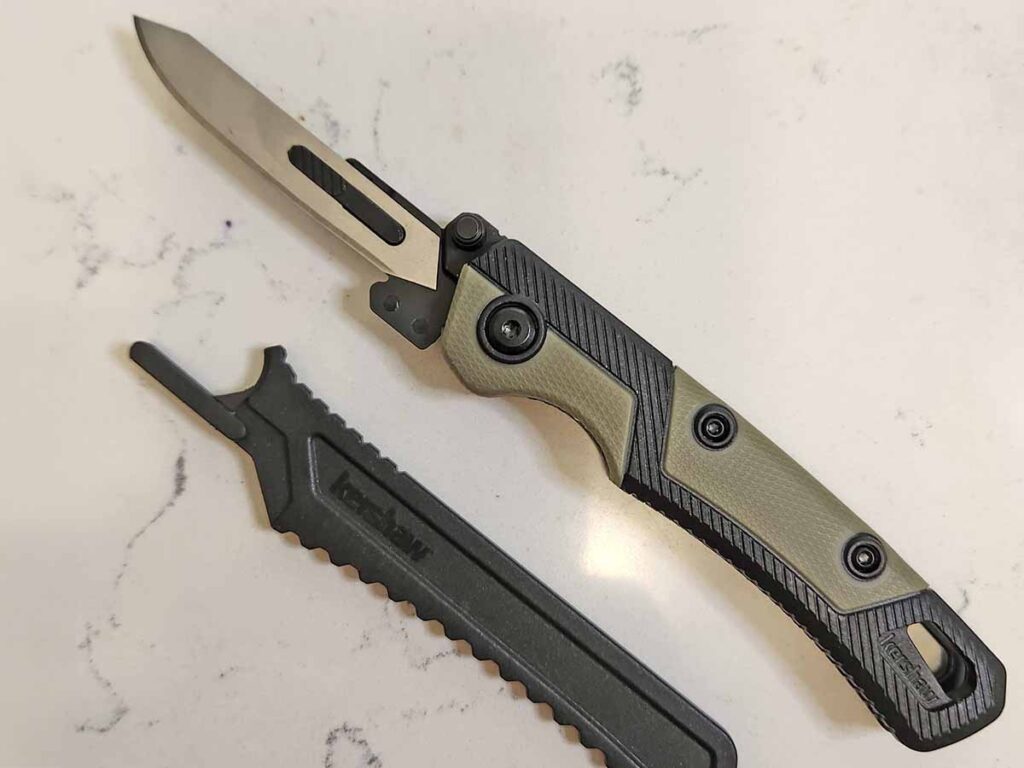
Kershaw also includes a fixed-blade handle with its replaceable blade knife’s kit. It’s lightweight and the texture and profile offer plenty of purchase power.
The Kershaw LoneRock RBK 2 is another replaceable model that uses a #60 scalpel blade. (I’m starting to feel like a few of these companies had a meeting and I wasn’t invited.) The RBK 2 comes with 14 extra blades in a carry case and one on the knife. A pocket in the belt pouch holds the carry case. A cool feature of the case is a slash pocket for the knife, making it easier to get a purchase on the handle for deployment.
Speaking of the handle, it’s glass filled nylon with rubber overlay. It’s listed as black and tan but looks more like black and green. If I had to pick something Kershaw should have had more foresight about, it’s the color. Green and black pretty much screams “lose me” for a hunting knife. On the other hand, for caping the #60 scalpel blades should do the trick. Also, Kershaw did a great job contouring the handle so it’s easy and comfortable to hold. The blade opens ambidextrously via the double thumb stud and secures via a linerlock. There is no pocket clip, though there is a hole for a lanyard.
Kershaw really put its thinking cap on when it comes to tool-less blade removal. A liner lifts the rear of the scalpel blade, enabling you to slide the blade off. However, I would still play it safe and grab the blade with, say, a pair of pliers. During use I never had an issue with the removal liner being bumped, but I will wait and see. I must say, Kershaw impressed me with this one.
Replaceable-blade knives add to the depth of edged tools available in the cutlery world. As with all knives, they have their place. They have already experienced some popularity among certain trades and professions. If you like to sharpen, remember that even a replaceable blade can be touched up at times.
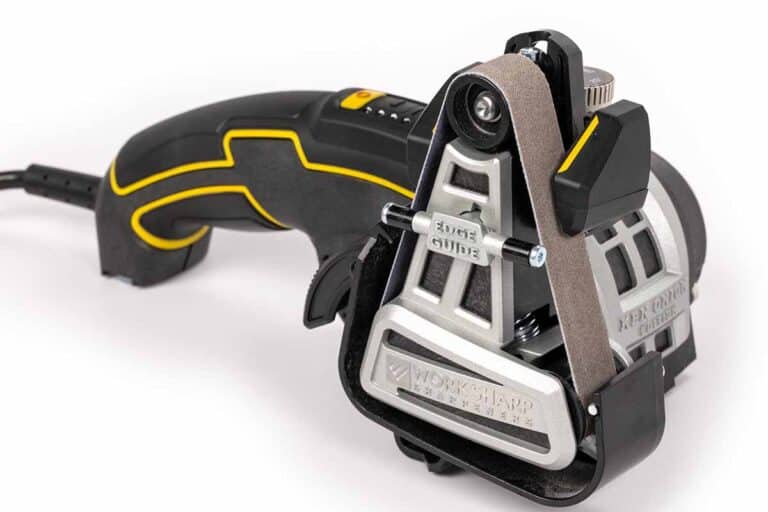
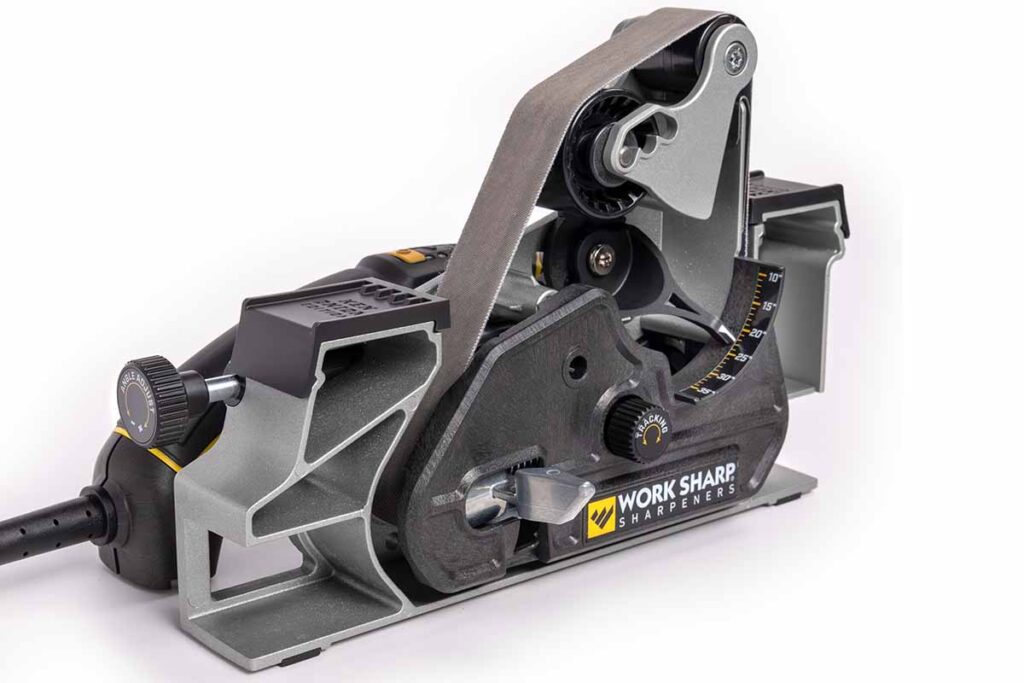
Work Sharp’s Ken Onion Knife & Tool Sharpener has been keeping knife enthusiasts’ edges sharp for a decade. A good run, by anyone’s measure. But the device’s time is up as the company welcomes the dawning of a new era—the Ken Onion Knife & Tool Sharpener MK.2. I’m sure some of you saw that coming.
Thankfully, Work Sharp hasn’t reinvented the wheel with the refresh of this time-tested multitool. Instead, the unit maintains many of the features that made it popular in the first place but offer a few notable enhancements that sharpeners and makers should find welcome, including a MK.2 Elite model with grinding functions.
Chief among the enhancements is the MK.2’s speed control, now offering seven preset speed settings to provide consistent and repeatable results. A new torque control delivers consistent power, even under load. To make the sharpener easier to dial in, Work Sharp has included a very clear amber LED indicator light for the belt speed selection for quick and precise adjustment. Furthermore, a scope click adjustment knob on the sharpening guide, with detent clicks, allows users to adjust in half-degree increments by touch. Incidentally, the guide is adjustable from 15 degrees at the low end to 30 degrees at the high, hitting nearly every angle for both knives and tools.
The MK.2 also comes with leather-lined angle guides that offer protection for knives during sharpening. Users will also note a lockout belt tensioner on the sharpening cassette that helps make changing abrasive belts fast and simple. The Ken Onion MK.2 will come with five grits to accommodate the full spectrum of sharpening from repair to ultra-fine polishing.
As for the grinding, the Ken Onion MK.2 Elite model has some interesting aspects too. The redesigned grinder attachment quickly and easily mounts to the power base without tools or calibration. Once attached, the grinder boasts on-the-fly motor speed control and continuous run time. Additionally, an adjustable, three-position convex pulley system allows users to customize their grind profile depending on personal preference or the type of knives being sharpened.
The Ken Onion Knife & Tool Sharpener MK.2 boasts a $200 MSRP for the base model and $300 MSRP for the Elite. While the original sharpener has been a standby for a long time, the new addition to the Work Sharp lineup should prove sharp.
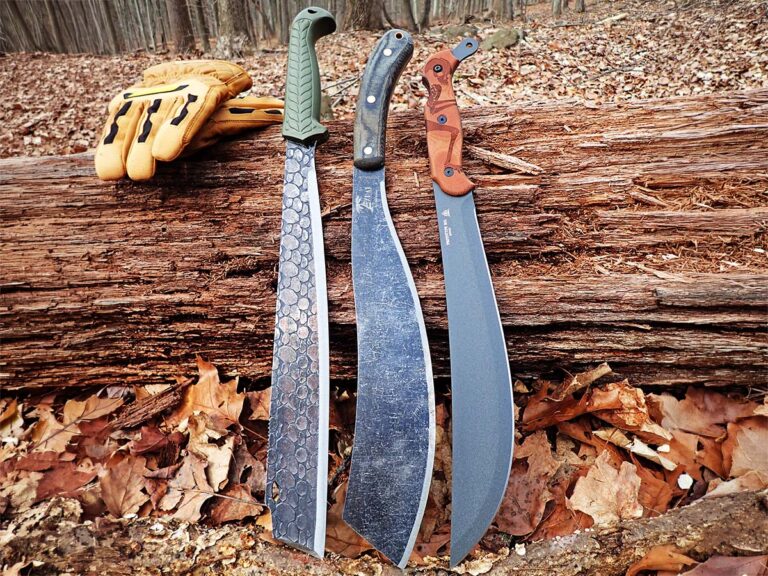
We slash away with three machete options to see which is ready to tame your greenery.
Spring uncovers what winter buries. Duff piles up, vines tighten their grip and brush crowds every trail and fence line. A machete cuts through that mess with reach and rhythm. The long blade sweeps low to clear ground clutter, snaps vines before they climb and trims brush without constant repositioning. One tool handles duff, extra brush and creeping vines in a continuous flow, so a hillside that looked wild at breakfast starts to open by lunch.
A good machete carries authority without dead weight. Thin stock bites deep and releases clean, so each swing clears more space with less effort. The long edge opens lanes. The spine knocks dead twigs free. The tip digs, pries and handles rough chores that punish smaller blades. In much of the world, a machete counts as the only daily tool. That heritage still matters in 2026, whether you reclaim a backyard slope or beat a trail back into shape. These three long blades are our picks to tame your wild hills, homestead and camp.
Getting The Swing Of The Machete
Brush changes the fight, so your swing must change with it. Light grass needs quick wrist cuts that keep your pace steady. Thin vines demand snap cuts that break tension before the blade binds. Thick brush calls for short power strokes that drive the edge through stubborn growth. Deadfall needs controlled chops that protect the edge from hidden knots. Each swing builds from stance, grip and rhythm, not brute force. When you match technique to terrain, the machete feels faster and safer. The right swing turns rough ground into clean, workable space without burning your energy.
Condor Roarlock
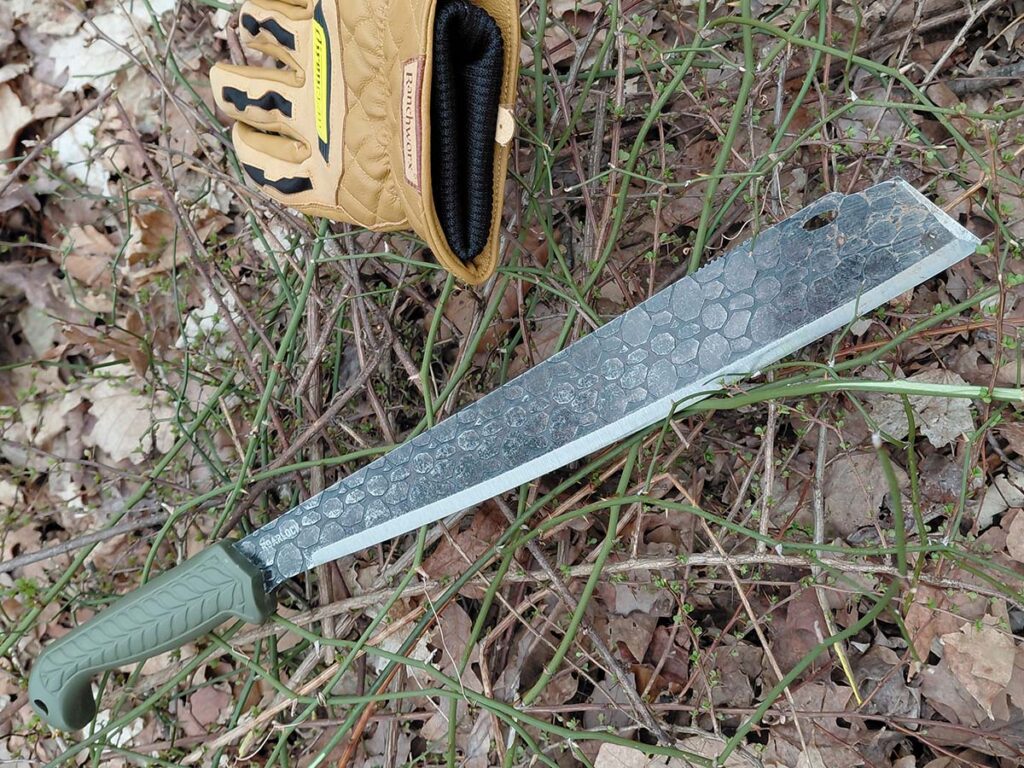
Chopping Japanese barberry, an invasive vine with painful thorns, is a necessary and annoying chore—the Condor Roarlock hacked it!
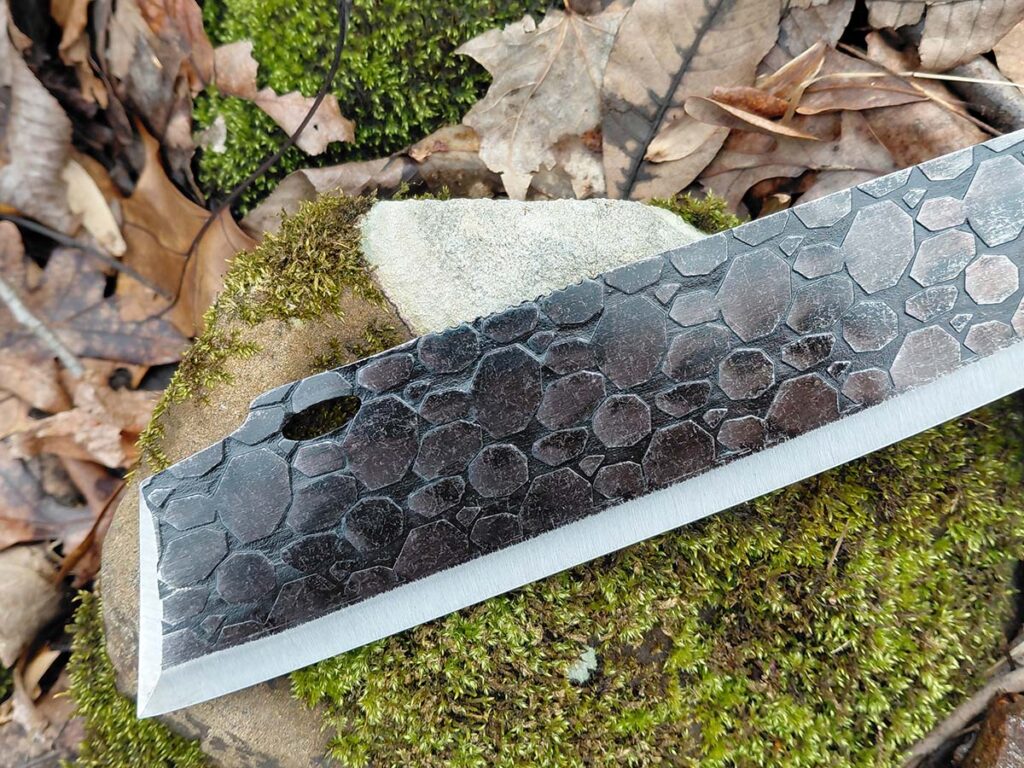
Condor’s Roarlock brings Southeast Asian machete influence into a compact, modern clearing tool. The 14.24‑inch blade has a 20.33‑inch overall length and a 0.12-inch thickness of 1075 high-carbon steel. This design keeps the weight at about 21.5 ounces. The etched damascus‑style finish gives the blade a wild, worked look, while the convex grind drives deep into vines, saplings and stubborn brush without sticking. A high‑impact polypropylene handle locks into the hand and shrugs off weather, sweat and abuse. A full‑tang build runs through the handle, so the Roarlock feels solid when you lean into heavy swings.
The ballistic nylon sheath carries light, rides tough and lets the machete move from truck to trail without fuss. Designed by Joe Flowers for 2026, the Roarlock feels like a fast, compact power tool built for real brush, not just catalog photos.
Beating Barberry Back
The Roarlock has the Godzilla silhouette, with usable features for digging and root-cutting.
I’m a fan of any long blade that has more bend than a straight blade, especially when it has some drop to it. Like a Filipino bolo and kukri, whenever the blade precedes the chopping hand, that’s a good thing. Max impact and leverage are far superior to using an all-straight design. The Roarlock has this!
Chopping the most annoying and painful vines in my forest was a must-do chore. Japanese barberry is an invasive plant with small thorns that are sure to get my knuckles and fingers when removed. They stab directly through hiking pants and most layers of clothing. A machete works best at beating them back, but it’s hard to get to the base without suffering a few thorns. The longer reach of the 14.24‑inch blade on the Roarlock helps. Especially when using a helper stick to push back the thorny shrub of mayhem.
Soon enough, I had a pile of various vines, including blackberry, dry grasses, small creeper vines and the dreaded barberry. Also, soon enough, I hit a rock or two and mashed the tool’s tip. So what? It’s 1075 carbon steel and would be easy to get back in order. However, it’ll happen again, but this is a tool meant for work!
ESEE Expat El Deguello
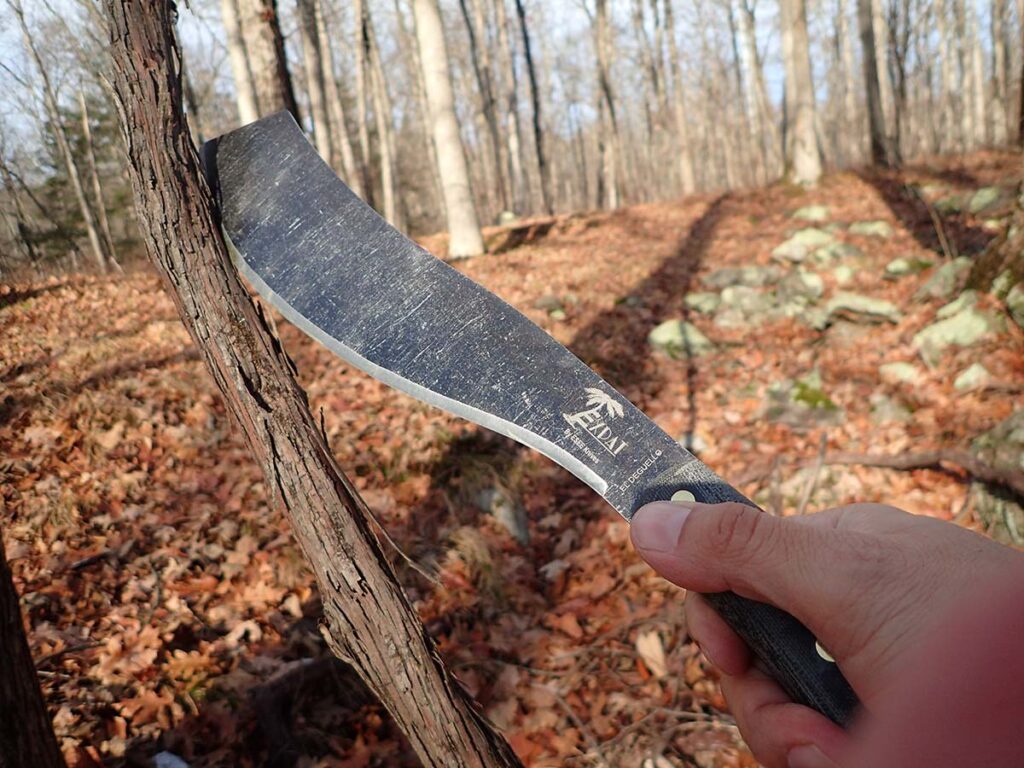
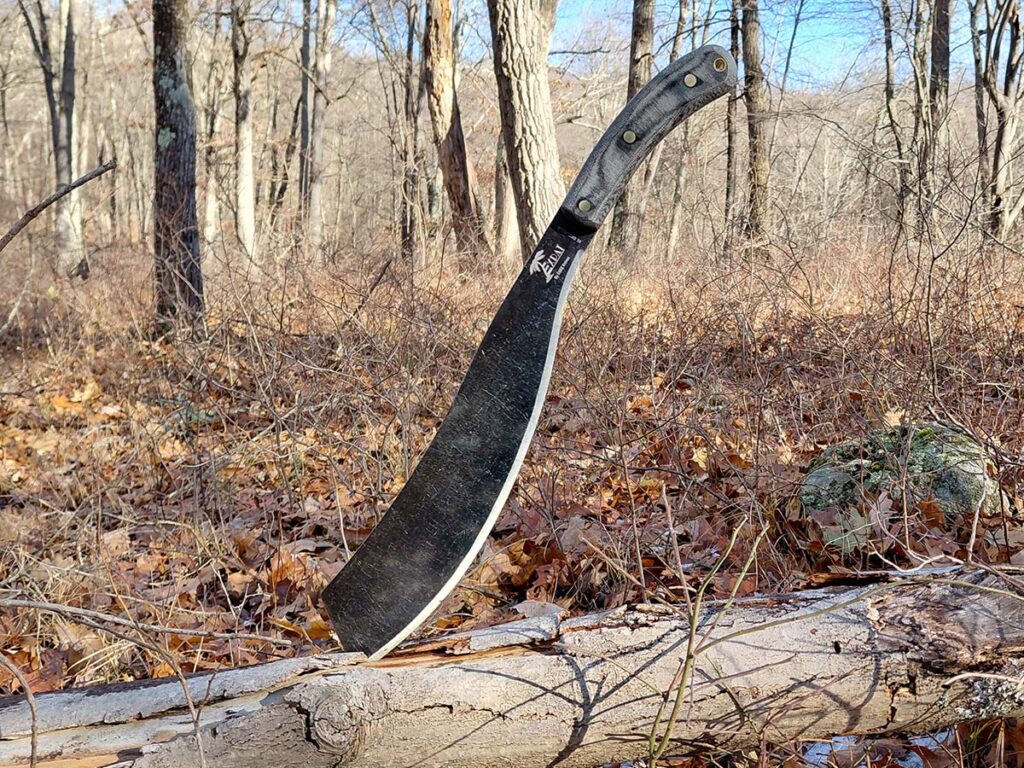
Expat El Deguello, influenced by years of travel and Randall’s Adventure & Training, features a 12.75-inch 1075 carbon steel blade.
The ESEE Expat El Deguello grew out of years of Expat travel and hanging out with Randall’s Adventure & Training. This was in places where a machete counted as daily life support, not a luxury. The blade is about 12.75 inches of 1075 carbon steel with a dark stonewashed finish, set in an overall length of around 18.75 to 19 inches. The blade’s shape has a parang-ish style, giving the machete a strong, weight‑forward feel without turning it into a boat anchor. A flat grind keeps the edge lively and easy to touch up with a pocket stone in the field. Black linen Micarta scales wrap the full tang and give a secure, textured grip that stays honest in sweat, rain and humidity. A brass‑lined lanyard hole anchors a safety cord for steep slopes or riverbanks.
The tan canvas sheath rides light on the belt and matches the tool’s no‑nonsense attitude. Built in El Salvador as part of the Expat line, the El Deguello blends South American machete DNA with ESEE’s survival mindset. Making it a dependable long‑blade for trail clearing, camp work and hard bushcraft.
Seasonal Slashing
I got my hands on the El Deguello Expat machete in winter. I wasn’t sure how it would do in a snowy environment. However, we needed to travel through uneven terrain with gear weight, so light was right. No axe or thick splitting tool accompanied we three adventurers on this trip. In fact, we had two Expat machetes in camp as my buddy brought his Expat Darien machete.
The El Deguello started earning its keep from the start. Due to many branches and small trees succumbing to the weight of the snow, the El Deguello shone. I cleared woody and leafy debris to make the path easier for campers arriving later in the day. By the time I got to camp, I was already a believer of the utility the El Deguello packs. Chopping frozen wood from previous campfires and new dead branches were on the docket. This was predominantly a hardwood forest, so the El Deguello had to be hatchet-ready. And it was!
TOPS Knives Sneak Reaper
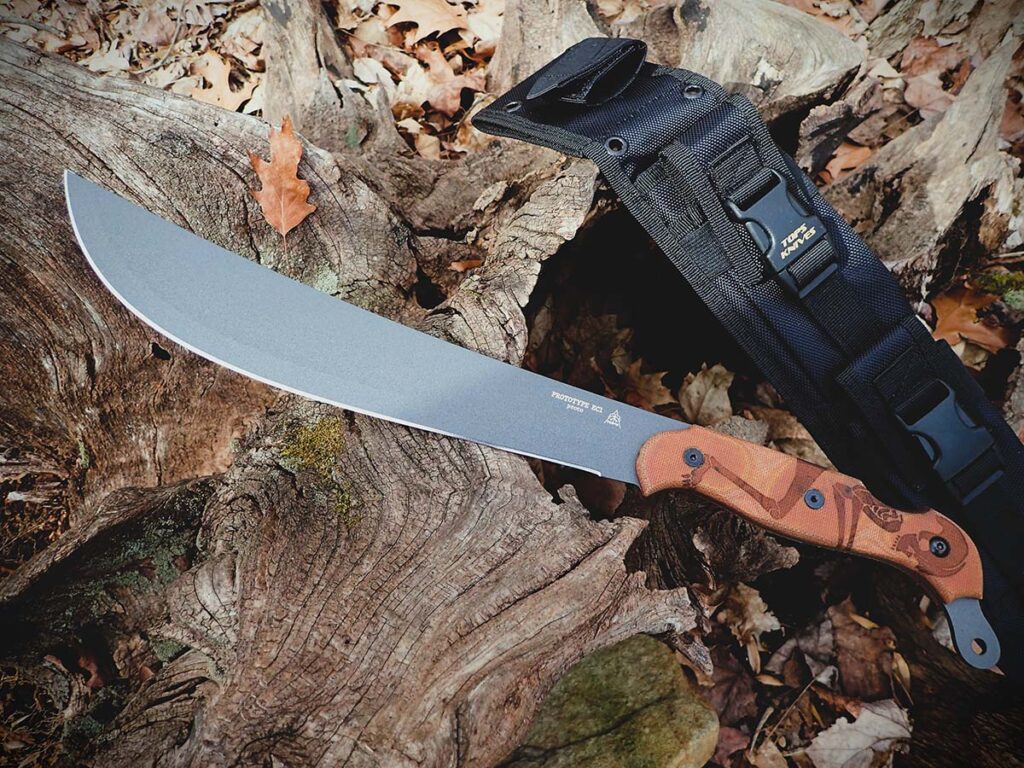
The TOPS Knives Sneak Reaper features an 18.5-inch length and a fast-moving 12-inch blade, designed for tight brush.
The TOPS Knives Sneak Reaper draws on Ed Calderon’s counter‑custody background, shaping a fast, purposeful blade built for tight spaces. It has a lean profile that favors quick cuts through vines and brush. The long edge rewards snap cuts, while the balanced weight keeps the machete quick instead of front‑heavy. The handle geometry follows Calderon’s no‑wasted‑motion mindset and gives a locked grip during hard clearing strokes and tight work around obstacles.
The Sneak Reaper has an overall length of 18.5 inches and a 12-inch blade that moves fast through tight brush. The black powder coating protects the blade and supports Calderon’s stripped‑down, purpose‑driven style. The saber grind gives the edge a strong bite, enabling it to handle vines and stubborn growth without slowing your rhythm. The 0.125‑inch thickness keeps the blade lively and responsive during long clearing sessions.
The sheath system supports fast deployment and secure carry, echoing the tool’s defensive roots and utility. Final production specs have not yet been added to TOPS’ catalog pages.
In The Thickets
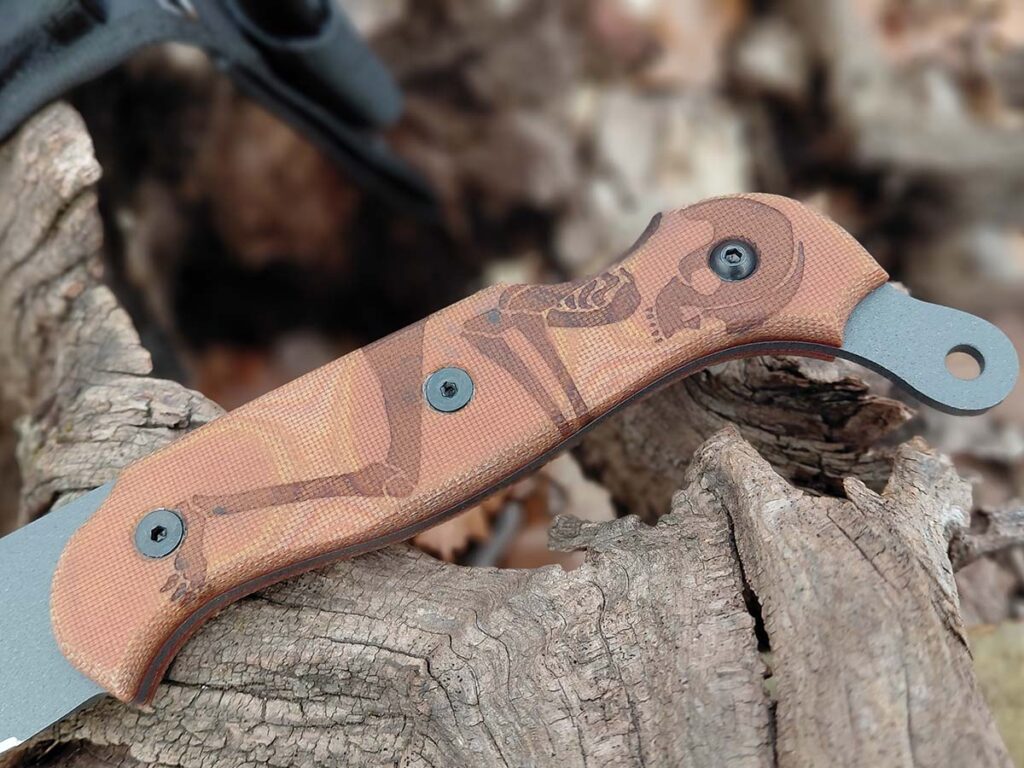
The TOPS Sneak Reaper has a 5-inch tan Micarta handle that offers a confident, secure grip with great traction.
Once I got this cutting machine in the woods, it called to more substantial branches and green wood. It wasn’t the weight as much as the thickness and feel. The sweet spot was several inches from the tip, making it feel like a shorter machete. This aspect got me thinking of what a great camp machete it would make. However, the pronounced upsweep had its benefits while standing or bending slightly. The front curve can easily nip nasty, thorny vines and thin, new growth without needing to get low. It reminded me of a smaller panga-style machete.
Turning the blade over revealed a sharp tip that could drag and pull the brush back after chopping it. This tip was also excellent at impaling scrap wood and relocating it. I love a tool that helps out.
The 5‑inch handle uses contoured tan Micarta that locks into the hand with confident traction. The 15‑ounce blade weight creates a sharp balance between speed and authority during heavy swings. In a standing position, slashing out front, the curve helped continually slice through materials with authority. I can’t wait to use this one on meat and coconuts.
Final Cut
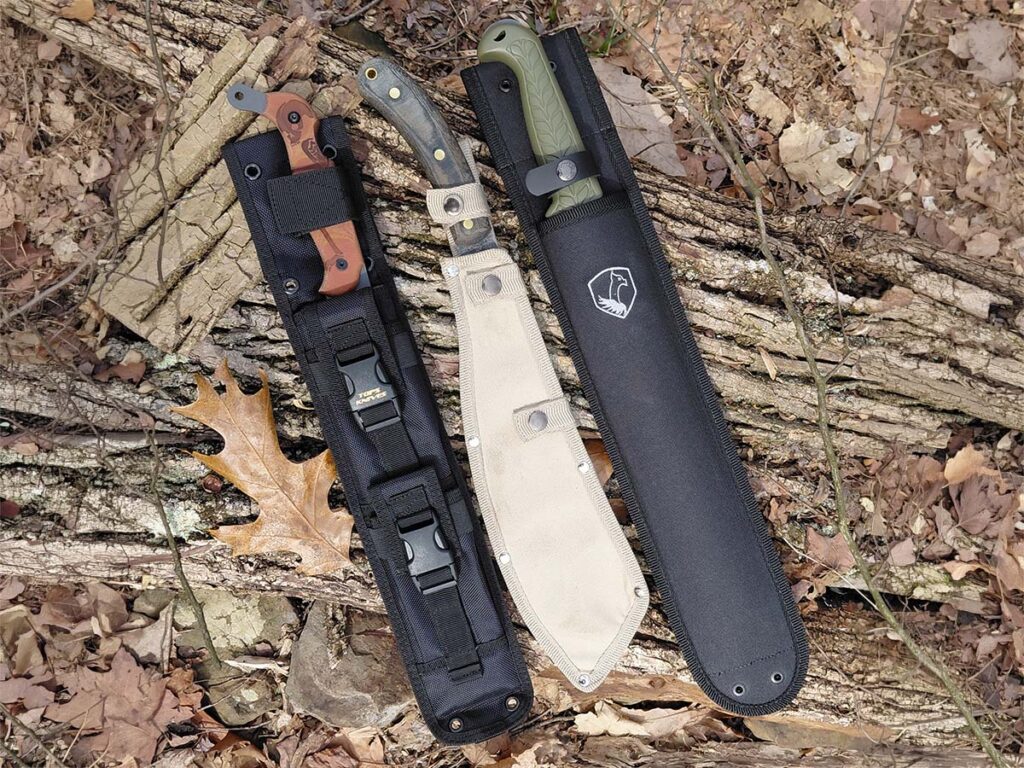
Three styles of machete sheaths for each trail tamer From left, the Sneak Reaper, El Deguello and Roarlock.
The Roarlock was the clear pick for me while beating back the new brush of spring. Had this been a machete camp challenge, the TOPS Sneak Reaper and Expat El Deguello would shine. Maybe that’s better left for another article!
Find the perfect hunting knife with our guide to the best skinners on the market. We review top models from respected makers.
A skinner is a knife purpose-built for the delicate but necessary job of skinning game animals. Its singular mission: separate hide from muscle without causing a mess that makes a taxidermist weep.
Skinning knives serve specific purposes. Primarily, they glide beneath the hide with minimal resistance. This feature allows for a smoother cutting experience, making it easier to separate the skin from the meat.
Skinners also aim to minimize accidental punctures to the underlying meat or organs. This is crucial for preserving the quality of the meat and ensuring that it remains uncontaminated during the skinning process. Finally, skinners offer the control necessary for making fine cuts around joints, facial features and paws. This level of precision is essential for skilled processing, allowing for clean and efficient work.
Good Skinners and Bad
A good skinner slices smoothly without requiring brute force, retaining the cutting edge throughout the job. It cleans easily, especially around the scales, and feels intuitive in your hand, almost as if the knife knows your intentions before you do. Moreover, it keeps the hide intact, avoiding headaches caused by unwanted holes.
A bad skinner features an overly aggressive tip that punctures organs at the slightest touch, slippery scales that become a liability when blood is involved, and poor edge retention that necessitates awkward sharpening breaks. It may possess a clunky balance that makes it feel more like a garden tool than a precision instrument and hard-to-clean crevices that turn into breeding grounds for bacteria.
In short, an effective skinner collaborates with, rather than works against, you; it’s about finesse, not sheer strength, resembling a scalpel instead of a medieval cleaver.
Classic Design Skinners
Classic skinners are all about specific design features as opposed to gimmicks. They typically have a blade with a wide belly and sweeping curve for long, confident strokes that excel at slicing through hide. Most use a drop point or semi-rounded tip to prevent accidental stabbing when dealing with gut sacks.
A flat or convex grind offers a good balance between sharpness and strength, while hollow grinds, though sometimes sharper, can be fragile. Blade lengths usually range from 3 to 4 inches for maneuverability in tight areas like hooves or facial contours. Ergonomics is also crucial, with grippy materials like Micarta® or textured rubber preferred to prevent slippage.
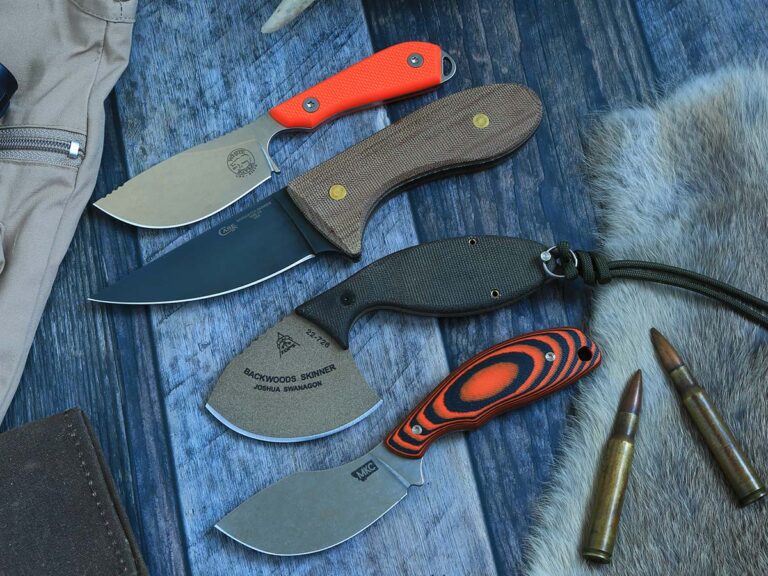
Montana Knife Co. Packout Skinner
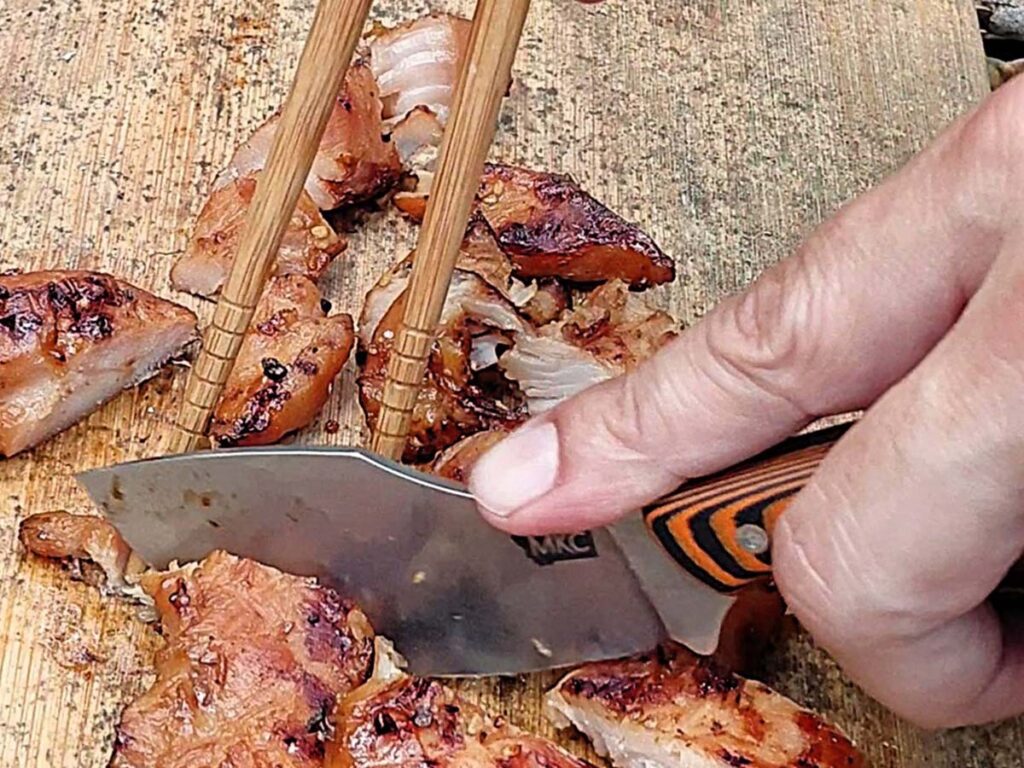
The author indicated the Packout Skinner would make Nessmuk proud. With a MagnaCut stainless steel blade and textured G-10 handle, it sliced through Teriyaki chicken like a champ.
The Montana Knife Co. (MKC) Packout Skinner is a compact powerhouse built for precision in the field. It packs a generous belly into a tight footprint—ideal for long, clean skinning strokes. The blade offers top-tier edge retention, corrosion resistance and toughness that thrives in backcountry conditions. Full-tang construction is paired with a milled handle shaped for a secure, glove-friendly grip that stays comfortable through extended use. The ergonomic palm swell and thoughtful finger ramp give you control whether you’re slicing hide or fleshing out detail work.
A custom-molded sheath complements the package, providing secure retention and versatile carry options: horizontal, vertical or pack-mounted. This knife doesn’t just show up, it works hard—just like the hunters it is built for.
A simple knife test I use is rustic meat cooking and slicing. In my eyes, and according to George Washington Sears, aka Nessmuk, an outdoor knife should be able to skin, butcher and slice. The Packout Skinner would make him proud. It does it all. I had a small summer barbecue with Teriyaki chicken and the skinner sliced it like a champ.
The sheath came in scout carry mode, so that’s how I used it. It carried comfortably. However, bending forward processing meat and camp must-haves made me remove it for a few minutes. On the plus side, it was easy to remove and attach without having to take it off my belt.
W.R. Case & Sons Laramy Miller Sasquatch Skinner
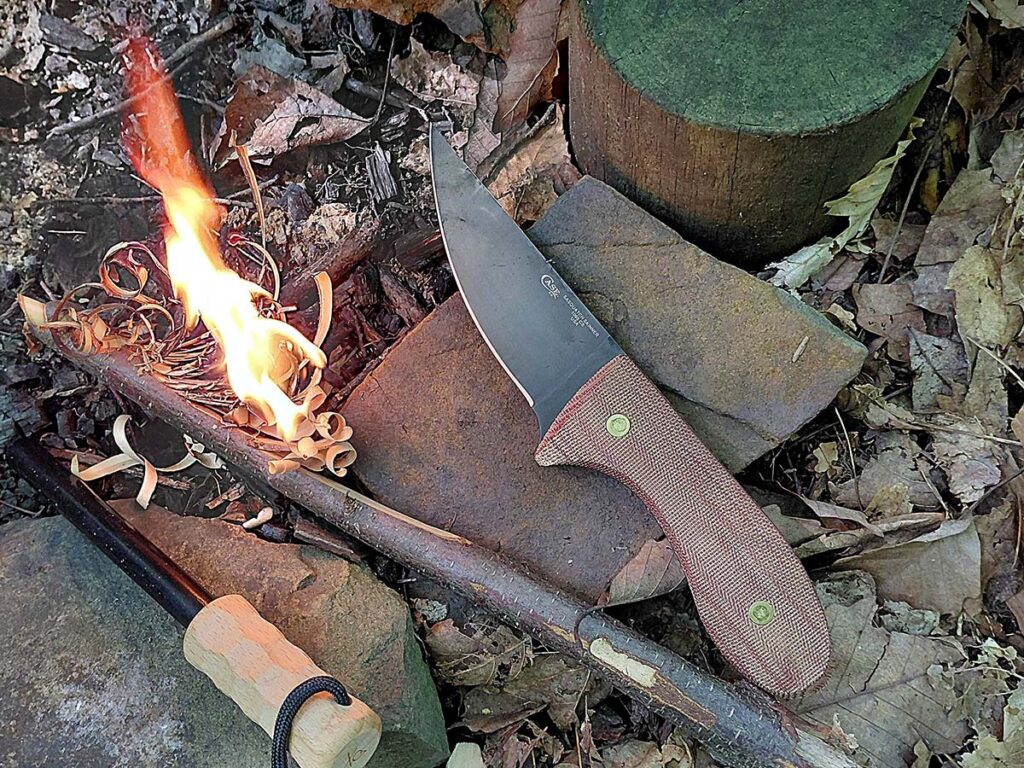
The Sasquatch easily feathered wood that took a spark from a stout ferro rod. The edge was sharp and the spine has a good 90-degree angle for fire starting.
The W.R. Case & Sons Laramy Miller Sasquatch Skinner is a rugged fixed blade fashioned for serious field work. It strikes a balance between reach and control, perfect for skinning game or tackling camp chores. The blade has excellent edge retention and a stealthy, corrosion-resistant surface.
The smooth handle offers a secure, scratch-resistant grip with a soft feel that stays comfortable through prolonged use. The full-tang construction adds durability, while the ergonomic shape keeps your hand locked in when things get messy.
A fitted sheath completes the package, offering classic protection and easy belt carry. This knife is built to perform and last.
The rugged Sasquatch Skinner feels like a survival knife meant for hard use and skinning. The first thing I did was make a fire. I feathered a dry birch stick and was impressed with the skinner’s edge geometry. I made curls that were thin enough to take a spark via my Uberleben ferro rod and the blade spine. I didn’t read any info on the spine having a 90-degree angle. However, it’s a hidden gem! The second half of the spine—middle to tip—is where it’s sharp.
I employed the Sasquatch to split poplar and maple via a baton with no worries. I found the handle a bit thin for gripping during specific crafts. Maybe that’s why it’s a skinner, not a survival knife.
The edge was sharp and stayed that way. I like the absence of gimping as I don’t use it. However, most knife folks would disagree, especially with a skinner. The knife seemed like a ramped-up skinner, slightly on the heavy side, but then think of survivalist/mountain man Laramy Miller—they don’t call him Sasquatch for nothing!
The sheath carries traditionally on the belt at a medium height. It’s not too much of a rib jabber, nor does it carry too low.
White River Knife & Tool Model 1 Skinner
The grip on the Model 1 was secure and the spine’s forward gimping proved useful. After an hour of skinning and deboning, the author had no complaints. The thin grind made cutting effortless and the taper is outstanding.
The White River Knife & Tool Model 1 Skinner is a target-constructed field knife that blends compact control with premium materials perfectly sized for precision work without sacrificing reach. The blade has excellent edge retention and corrosion resistance for repeated use in harsh conditions. The textured handle provides a secure, ergonomic grip—wet or gloved—while the large choil and gimping enhance control during delicate skinning tasks. A custom-molded sheath ensures safe carry and quick access, whether belt-mounted or pack-ready. Lightweight and razor sharp, the Model 1 is a reliable companion for hunters who demand performance without bulk.
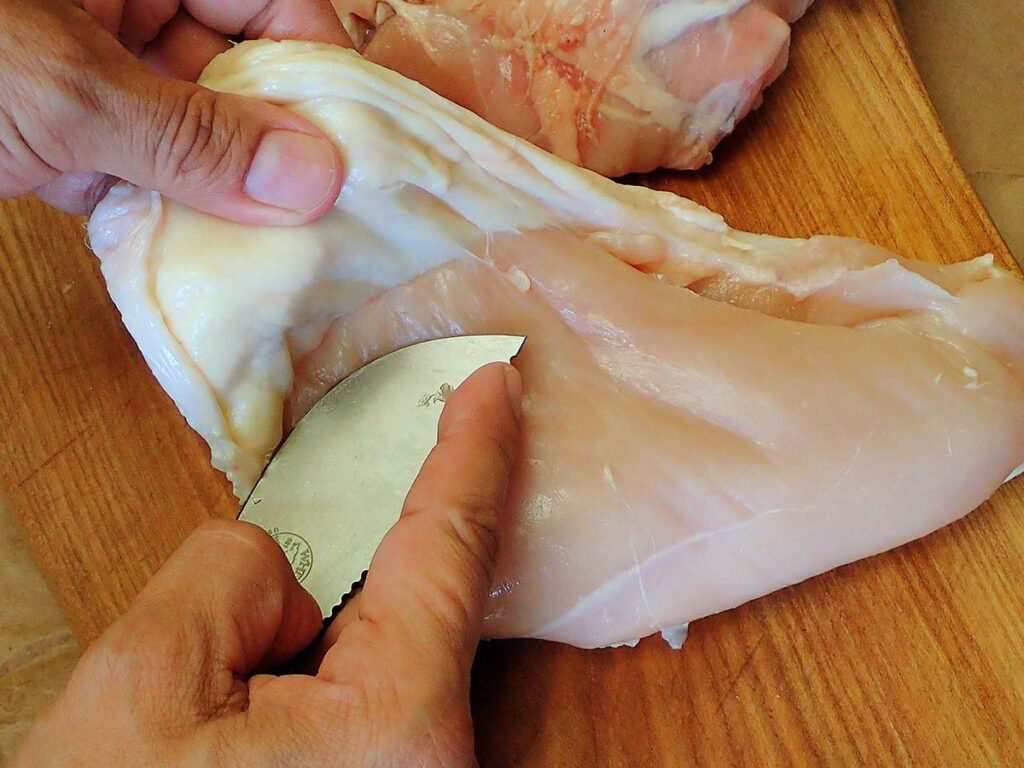
While there wasn’t a running wild game season in my area of the Northeast when I wrote these words, I stuck with simplicity. One bird always in season is chicken. I buy skin-on, bone-in and prefer to do the preparation. The Model 1 makes for an excellent, nimble butcher knife. I used the little gem to debone split-chicken breasts and skinned them with ease. The grip was never in question and the forward spine gimping proved helpful. I used it for about one hour, skinning and deboning with no complaints. The thin grind glided through the meat with ease and the taper is excellent.
TOPS Knives Backwoods Skinner
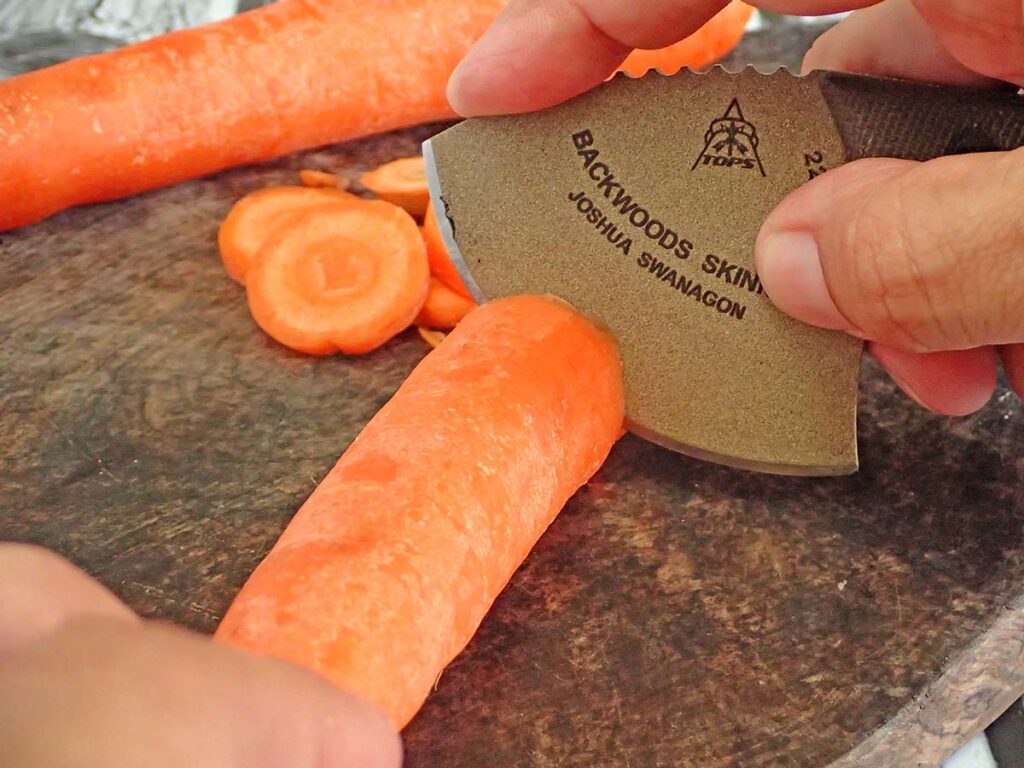
In ulu mode with the Backwoods Skinner, the author sliced raw carrots effortlessly. The edge geometry works for food and game prepping.
Pros
Versatile and Multi-Purpose
Unique and Secure Gut Hook
Excellent Ergonomics
Cons
Gut Hook Deployment
Backwoods Skinner Specs Designer: Joshua Swanagon Blade Length: 3” Blade @Thickest: .16” Blade Material: 1095 carbon steel Blade Finish: Coyote tan coating Scales: Green canvas Micarta® Weight: 5.4 ozs. Overall Length: 6.75” Sheath: Black leather Country of Origin: U.S.A. MSRP: $270
The TOPS Knives Backwoods Skinner is a compact ulu-inspired knife built for precision and endurance. The deep-bellied blade is perfect for slicing through hide and tackling bushcraft tasks without flinching.
The gut hook nestled in the handle is excellent for hunting season. I used it as a cord cutter. The sharp hook is a standard fixture for search-and-rescue personnel to slice cord and rope and to free people from entanglements. Remove the grenade pin and carefully take out the gut hook. Reverse the hook and install it in the proper hole for security. Make sure to put the sheath on to prevent cuts. My gut hook took some working in with another object until it fit. I suggest using leather gloves to avoid cuts from the hook.
The handle features an ovulated grip and deep choil, offering fatigue-free control and a confident hold even in messy conditions. Hidden in the pommel is a clever gut hook, deployable when needed and safely tucked away when not. A sheath combining classic style with belt-loop-carry convenience augment the package. Designed by survival authority Joshua Swanagon, the knife is ready for big game, small game and everything in between.
I remember a video with designer Joshua Swanagon talking about the ulu-shaped blade. I saw the ulu pattern immediately when I first saw the knife. Luckily for me, carrots were in season. I used the Backwoods Skinner as I would an ulu, slicing and dicing. Carrots are more difficult to cut due to their hardness. A dull or too thickly beveled blade will wedge and split the vegetable. However, there was none of that. I used my forefinger on the drop portion of the blade tip as intended for controlled slices. I also used it like a regular kitchen knife, choking up in a chef’s pinch grip. Both worked perfectly fine and were comfortable.
Check Out More Outdoor Knives:
BEST TOMAHAWKS: OUR TOP HAWKS FOR BACKWOODS TO BATTLEFIELDS
Top knife observers decipher the best custom huntering knives ever made.
It’s an ongoing discussion, or maybe a debate, slightly contentious but always cordial. When the question is pondered regarding who made the best custom hunting knives ever, a few names quickly come to mind.
Of course, there is no right or wrong answer. It’s a matter of interpretation, fit and finish, design, form and function, and the feel of the knife in the hand when it’s time to get down to the business of skinning and dressing game. Each respected and well-traveled knifemaker and observer consulted below can tell the stories that back up his top few. But in the end there is no doubt. Each of these revered custom makers and/or bladesmiths has got game. It’s proven in their work.
Bruce Voyles’ Take
BLADE Magazine Cutlery Hall-of-Fame® member and knife auctioneer Bruce Voyles accompanied his fellow Cutlery Hall of Famer, the legendary George Herron, on a few hunting trips and experienced his work in the field.
Among the top hunting knives BLADE Magazine Cutlery Hall-of-Fame® member George Herron made are the Model 6 (top) and the Model 3 skinner, aka Little Dude (bottom). The Model 6 sports a 4-inch blade and 9-inch overall length. Blade and overall lengths for the Little Dude: 2.75 and 6.75 inches. Respective blade steel, handle material and construction on each knife are ATS-34 stainless, curly maple and tapered tang. (Jay Mealing knife image)
“George was a fantastic hunter,” Bruce remembered. “When a group of us would go with him, we might kill three deer in a four-day morning and afternoon hunt, but he could get eight if he wanted to.”
Bruce tells the story of an Outdoor Writers Association hunt Herron organized after an invitation from a South Carolina country gentleman that George had helped change a tire. It seems the man owned a large tract of land, and in return for Herron’s kindness he was allowed to hunt deer on the property.
“When we got to that plantation, every guide there was carrying a George Herron knife,” Bruce commented. “The thing about George’s knives is that when you held one and used it, you were using a knife made by a man who had been there. He made tremendous skinning knives, and the balance and feel in the hand are unsurpassed. The balance, shape of the handle, and minor nuances of the tilt of the blade, its thinness, and the tapered tang set Herron knives apart.”
According to BLADE Magazine Cutlery Hall-of-Fame® member Bruce Voyles, the knives of Cutlery Hall-of-Famer Bill Moran feel like an extension of your hand. Mr. Moran’s engraved gentleman’s hunter in damascus and with one of his iconic moon logo sheaths is representative of Bruce’s sentiment. (Eric Eggly/PointSeven image)
According to Voyles, the knives of Herron, Jerry Fisk and Cutlery Hall-of-Famer Bill Moran feel like an extension of the hand. Herron also made knives that were affordable for a hunter to purchase. Since he put many knives in the hunters’ hands because of a reasonable price point, the praise of his work in the shop spread far and wide. Today, there are several quality custom knifemakers contending for recognition, and they include Ralph Smith, Larry Page and Wayne Hendrix to name just a trio, Bruce says.
“Wayne was one of the guys who trained in George’s shop, and while we were hunting he had his own shop set up on the grounds making knives to sell directly to hunters,” he noted. “He was a guide in South Carolina and approaches making hunting knives the same way George did. He’s the closest to George’s knives now.”
Jim Sornberger’s Take
Cutlery Hall-of-Fame knifemaker Jim Sornberger remembers the days years ago when names such as Harry Morseth and Cutlery Hall-of-Famers Bo Randall and Rudy Ruana were synonymous with excellence in hunting knife craftsmanship. He also mentions the fine work of Corbet Sigman and other contemporaries of the 1960s and ’70s.
“The first new model A.G. Russell made when he acquired Morseth Knives from Harry Morseth was the Model 1, also known as the Ozark Hunter,” Tom Krein noted. “It is a drop-point camp and hunting knife with a 3.5-inch blade, hidden tang, nice guard, and thin-shaped Micarta® handle that make the knife extremely light.” This version sports a stacked leather and fiber spacer handle with a stag butt. (Nordic Knives image)
“It goes back to when I was a kid and my uncle had a gun store in Redding, California,” Jim said. “Those names were famous, and I met Harry Morseth in the ’50s. His Cascade Skinner was my favorite hunting knife for many years with a great handle shape in leather or stag for a good grip and a guard, which is really important in a good hunting knife because you’ve got to hang onto an animal or fish if you’re working and you can’t afford to have the knife slip in your hand. The blades were laminated Brusletto steel from Norway, and the knives came with a safety sheath. Mine was copper-lined leather in the shape of the knife, and later models had a fiber material liner inside.”
Sornberger also mentions Cutlery Hall-of-Famer Gil Hibben, Ruffin Johnson and Clay Gault as makers of outstanding hunting knives. However, trying to identify custom makers that are in that rarefied air with the masters these days requires some reflection. “It’s tough because a lot of guys follow trends nowadays and they find it’s cheaper and faster to make a knife without a guard,” he opined. “Randy Lee has been around a long time and still makes a lot of good using knives. Dave Pitt in Redding, California, does as well, and that’s hunting country. Randy has a stubby little hunter with a 3.25-inch blade and nice guard, and that’s plenty of knife for most hunting applications.”
Tom Krein’s Take
Veteran knifemaker Tom Krein is upfront with his thoughts on the best maker of hunting knives.
“I actually worked for Bob Dozier and A.G. Russell from the mid-1990s to 2001, and honestly this is a tough one. We all use hunting knives differently in the field and for different things, but I would put Bob Dozier forward. He grew up hunting in the bayous and providing for his family, [and] he has a lot of experience making knives. He is an exceptional craftsman, and in the 1980s I feel one of the pioneers in the style of distilling everything down to make hunting knives easier to make and get them in everybody’s hands.”
Award-winning bladesmith Jerry Fisk’s Sendero hunter served as Tom Krein’s inspiration to make knives. (Eric Eggly/PointSeven image)
Krein likes the reasonable price point of a Dozier hunting knife and the attributes that characterize the maker’s outstanding work: a full tang, thinly ground blade, Micarta® handle, and often a Kydex sheath system for safety. “Dozier’s knives check all my boxes,” he related. “The Dozier Personal with a 2-inch blade works great on game, and an investment of $300 will get you a fine Dozier knife.”
Tom also has seen the Morseth line continue with A.G Russell and has tremendous respect for the maker’s legacy. “The first new model A.G. made when he acquired Morseth Knives from Harry was the Model 1, also known as the Ozark Hunter,” Krein noted. “It is a drop-point camp and hunting knife with a 3.5-inch blade, hidden tang, nice guard, and thin-shaped Micarta® handle that make the knife extremely light.”
Tom tips his hat to custom knifemaker Brian Goode, whose hunters and skinners are gaining notice, while he also acknowledges the great work of Jerry Fisk, whose Sendero served as Krein’s own inspiration to begin making knives. And then there’s the geometry and thinness of the blade in ABS master smith James Rodebaugh’s hunting knives that Krein calls “beautiful work.”
James Rodebaugh’s Take
Speaking of Rodebaugh, his thoughts on the best maker of hunting knives include George Herron, whose work he describes as “superb,” and two more greats, D. E. Henry and Cutlery Hall-of-Famer Jimmy Lile. “The first knife I ever owned was a Lile hunter, and he made one heck of a hunting knife,” James remarked. “That knife was my primary hunter before I even started making knives, and it did all I ever asked of it.”
ABS master smith James Rodebaugh is high on the work of Missouri-based maker Jason Coy and ABS master smiths Jason Knight and Adam DesRosiers. Adam’s clip-point hunter in damascus and stag is a stunner. (SharpByCoop image)
According to Rodebaugh, edge geometry is critical in a hunting knife, along with the design and profile of the handle and proper Rockwell hardness. Each of these characteristics is essential, and the Lile knife was “about as perfect as I’ve ever held, and I’ve dressed well north of 300 animals, not counting small game.”
Rodebaugh’s own knives are reflections of his hunting experience. He has been lauded for the field performance of his Raised Swedge Hunter, which some refer to as a harpoon point, that was actually inspired by a Marble’s hunter design. He has been making the Outfitter hunting knife for about 15 years, forging the blades in batches of five with O1 tool steel hardened to a Rockwell of 60-61 HRC, and a Micarta handle with a palm swell for added comfort.
James has been impressed recently with the work of Missouri-based maker Jason Coy and ABS master smiths Adam DesRosiers and Jason Knight. “Jason saw my raised swedge years ago and asked to use it, and I said ‘absolutely!’ Nobody has probably designed a ‘new’ blade in the last 1,000 years or so. Adam has worked with it as well, and now everybody in the country produces that design feature.”
Of Course, Bob Loveless
The names of custom makers past and present conjure images of their outstanding hunting knives. But no story on the topic would be complete without mention of Cutlery Hall-of-Famer Bob Loveless. While some have said Loveless was a fine maker, some have also said his fit and finish were reasonably good—not great. Nonetheless, the thing about Loveless was his eye for design.
According to BLADE Magazine Cutlery Hall-of-Fame® member Jim Sornberger, Randy Lee has been around a long time and still makes a lot of good using knives. An example is his drop point with an amber-spacer look reminiscent of the My Knife by BLADE Magazine Cutlery Hall-of-Fame® member D’ Holder, a pretty fair maker of hunting knives in his own right. (SharpByCoop image)
“Loveless went to design school,” Voyles explained. “He made a knife with eye appeal. It was different, and a lot of people don’t understand why, but it was the natural French curve. It was the design. People say Loveless made the perfect hunting knife because of the drop point, and to me it doesn’t work as good as one of George Herron’s knives.”
Sornberger knew Loveless well. “Bob was a good friend and signed for me to get into the Guild,” Jim began. “I think Bob found a universal handle shape that he used on all his knives, and it was a combination of a good kitchen knife and all with a guard except for a couple of models he made later on. All fit well in the hand. Bob got a lot of publicity. He could sell snow to Eskimos.”
Krein sees the Loveless drop point as iconic. “But there is a difference with the variance in game animals from squirrels to rabbits to deer, elk and moose. So best at what? I personally think the Loveless drop point is a fine design, but I wouldn’t take it into the woods,” he observed. “It’s just bigger than I like, and I like hidden tangs for hunting knives.”
Rodebaugh reminds that Loveless is a giant among custom knifemakers, and his hunters are noteworthy to say the least. “I met Bob many years ago and didn’t live far from him in California,” James recalled. “He made a good knife, and the drop point had a lot of impact on the industry, but contemporary with Bob were guys like Herron that produced excellent knives. Loveless made a solid working knife and took that to great heights through pretty good marketing, along with his popularizing of ATS-34 stainless blade steel.”
All hunters have a favorite knife, a trusted companion in the field that is handy, dependable, and built for the jobs encountered. While discussing the topic of just who might be the best custom maker of hunting knives is a never-ending exercise, suffice it to say that hunters are fortunate to find such steadfast companion tools when they are needed most.
Check Out More Outdoor Knives:
NESSMUK KNIFE: OPTIONS IN THE ALL-AMERICAN OUTDOOR KNIFE
BEST TOMAHAWKS: OUR TOP HAWKS FOR BACKWOODS TO BATTLEFIELDS